<?xml version="1.0" encoding="ISO-8859-1"?><article xmlns:mml="http://www.w3.org/1998/Math/MathML" xmlns:xlink="http://www.w3.org/1999/xlink" xmlns:xsi="http://www.w3.org/2001/XMLSchema-instance">
<front>
<journal-meta>
<journal-id>2079-3480</journal-id>
<journal-title><![CDATA[Cuban Journal of Agricultural Science]]></journal-title>
<abbrev-journal-title><![CDATA[Cuban J. Agric. Sci.]]></abbrev-journal-title>
<issn>2079-3480</issn>
<publisher>
<publisher-name><![CDATA[Editorial del Instituto de Ciencia Animal]]></publisher-name>
</publisher>
</journal-meta>
<article-meta>
<article-id>S2079-34802015000300015</article-id>
<title-group>
<article-title xml:lang="en"><![CDATA[Flora diversity in the Ecuadorian Páramo grassland ecosystem]]></article-title>
<article-title xml:lang="es"><![CDATA[Diversidad de la flora en el ecosistema de páramo ecuatoriano]]></article-title>
</title-group>
<contrib-group>
<contrib contrib-type="author">
<name>
<surname><![CDATA[Fiallos]]></surname>
<given-names><![CDATA[L]]></given-names>
</name>
<xref ref-type="aff" rid="A01"/>
</contrib>
<contrib contrib-type="author">
<name>
<surname><![CDATA[Herrera]]></surname>
<given-names><![CDATA[R. S]]></given-names>
</name>
<xref ref-type="aff" rid="A02"/>
</contrib>
<contrib contrib-type="author">
<name>
<surname><![CDATA[Velázquez]]></surname>
<given-names><![CDATA[R]]></given-names>
</name>
<xref ref-type="aff" rid="A03"/>
</contrib>
</contrib-group>
<aff id="A01">
<institution><![CDATA[,Escuela Superior Politécnica de Chimborazo Docente Facultad de Ciencias Pecuarias ]]></institution>
<addr-line><![CDATA[Riobamba ]]></addr-line>
<country>Ecuador</country>
</aff>
<aff id="A02">
<institution><![CDATA[,Instituto de Ciencia Animal  ]]></institution>
<addr-line><![CDATA[San José de las Lajas Mayabeque]]></addr-line>
<country>Cuba</country>
</aff>
<aff id="A03">
<institution><![CDATA[,Universidad de Granma  ]]></institution>
<addr-line><![CDATA[Bayamo ]]></addr-line>
<country>Cuba</country>
</aff>
<pub-date pub-type="pub">
<day>00</day>
<month>09</month>
<year>2015</year>
</pub-date>
<pub-date pub-type="epub">
<day>00</day>
<month>09</month>
<year>2015</year>
</pub-date>
<volume>49</volume>
<numero>3</numero>
<fpage>399</fpage>
<lpage>405</lpage>
<copyright-statement/>
<copyright-year/>
<self-uri xlink:href="http://scielo.sld.cu/scielo.php?script=sci_arttext&amp;pid=S2079-34802015000300015&amp;lng=en&amp;nrm=iso"></self-uri><self-uri xlink:href="http://scielo.sld.cu/scielo.php?script=sci_abstract&amp;pid=S2079-34802015000300015&amp;lng=en&amp;nrm=iso"></self-uri><self-uri xlink:href="http://scielo.sld.cu/scielo.php?script=sci_pdf&amp;pid=S2079-34802015000300015&amp;lng=en&amp;nrm=iso"></self-uri><abstract abstract-type="short" xml:lang="en"><p><![CDATA[This research was carried out in the Ecuadorian Páramo grasslands, between 2900 and 4200 m o.s.l, in Loja, Zamora Chinchipe, Azuay, Cañar, Chimborazo, Bolívar, Tungurahua, Cotopaxi, Pichincha, Imbabura and Carchi provinces. For the identification and taxonomical classification of species there were taken herborized samples and identified by agrostologists. The Hitchcock, Gould, Lombardo and Tovar taxonomic keys were used for the identification. From the grasses family, in the eight study places, 90 species were identified, including 37 genus, being the mains, with higher number of species: Festuca (14), Paspalum (10), Agrostis (7), Calamagrostis (7), Bromus (6), Stipa (5), Poa (5), Agropirum (3), Arrhenatherum (2), Brisa (2) and Andropogon (2).The species that prevailed in the study places were: Agrostis breviculmis, Agrostis exigua, Bromus lanatus, Calamagrostis tarmensis, Festuca humilior, Festuca ortophylla, Festuca weberbaueri and Paspalum bomplandianum. The diversity indexes of the existent meadow species showed values from mean (0.72) to high (0.90), as for their uniformity. This allowed determining that the biodiversity is variable, according to the environmental conditions of the studied Páramo grassland ecosystems. Similar performance was obtained for trees grasses species]]></p></abstract>
<abstract abstract-type="short" xml:lang="es"><p><![CDATA[El estudio se realizó en los páramos ecuatorianos, entre los 2900 y 4200 msnm de altitud, en las provincias de Loja, Zamora Chinchipe, Azuay, Cañar, Chimborazo, Bolívar, Tungurahua, Cotopaxi, Pichincha, Imbabura y Carchi. Para la identificación y clasificación taxonómica de especies se tomaron muestras herborizadas e identificadas por agrostólogos. Para la identificación se utilizaron las claves taxonómicas de Hitchcock, Gould, Lombardo y Tovar. De la familia de las gramíneas, en los ocho sitios de estudio, se identificaron 90 especies, comprendidas en 37 géneros, siendo los principales, con mayor número de especies: Festuca (14), Paspalum (10), Agrostis (7), Calamagrostis (7), Bromus (6), Stipa (5), Poa (5), Agropirum (3), Arrhenatherum (2), Brisa (2) y Andropogon (2). Las especies que predominaron en los sitios de estudio fueron: Agrostis breviculmis, Agrostis exigua, Bromus lanatus, Calamagrostis tarmensis, Festuca humilior, Festuca ortophylla, Festuca weberbaueri y Paspalum bomplandianum. Los índices de diversidad de especies pratenses existentes mostraron valores de medios (0.72) a altos (0.90), en cuanto a su uniformidad. Esto permitió determinar que la biodiversidad es variable, según las condiciones ambientales de los ecosistemas de páramo estudiados. Similar comportamiento se obtuvo para especies de gramíneas forrajeras]]></p></abstract>
<kwd-group>
<kwd lng="en"><![CDATA[Páramo grasslands]]></kwd>
<kwd lng="en"><![CDATA[Ecuador]]></kwd>
<kwd lng="en"><![CDATA[grasses]]></kwd>
<kwd lng="en"><![CDATA[diversity]]></kwd>
<kwd lng="es"><![CDATA[páramos]]></kwd>
<kwd lng="es"><![CDATA[Ecuador]]></kwd>
<kwd lng="es"><![CDATA[gramíneas]]></kwd>
<kwd lng="es"><![CDATA[diversidad]]></kwd>
</kwd-group>
</article-meta>
</front><body><![CDATA[ <p align="right"><font size="2" face="Verdana, Arial, Helvetica,   sans-serif"><b>ORIGINAL ARTICLE</b></font></p>     <p>&nbsp;</p>     <p align="justify"><font size="4" face="Verdana, Arial, Helvetica, sans-serif"><b>Flora diversity in the Ecuadorian Páramo grassland ecosystem</b></font></p>     <p align="justify">&nbsp;</p>     <p align="justify"><font size="3" face="Verdana, Arial, Helvetica, sans-serif"><b>Diversidad de la flora en el ecosistema de páramo ecuatoriano</b></font></p>     <p align="justify">&nbsp;</p>     <p align="justify">&nbsp;</p>     <p align="justify"><font size="2" face="Verdana, Arial, Helvetica, sans-serif"><b>L. Fiallos,</b><sup><b>I</b></sup><b> R. S. Herrera,</b><sup><b>II</b></sup><b> R. Velázquez,</b><sup><b>III</b></sup></font></p>     <p align="justify"><font size="2" face="Verdana, Arial, Helvetica, sans-serif"><sup>I</sup>Escuela Superior Politécnica de Chimborazo, Docente Facultad de Ciencias Pecuarias, Riobamba, Ecuador.    <br>   </font><font size="2" face="Verdana, Arial, Helvetica, sans-serif"><sup>II</sup>Instituto de Ciencia Animal, Apartado Postal 24, San José de las Lajas, Mayabeque, Cuba.    ]]></body>
<body><![CDATA[<br>   </font><font size="2" face="Verdana, Arial, Helvetica, sans-serif"><sup>III</sup>Universidad de Granma, Bayamo, Cuba.</font>   </p>     <p align="justify">&nbsp;</p>     <p align="justify">&nbsp;</p> <hr align="JUSTIFY">     <p align="justify"><font size="2" face="Verdana, Arial, Helvetica, sans-serif"><b>ABSTRACT</b></font></p>     <p align="justify"><font size="2" face="Verdana, Arial, Helvetica, sans-serif">This  research was carried out in the Ecuadorian P&aacute;ramo grasslands, between 2900 and  4200 m o.s.l, in Loja, Zamora Chinchipe, Azuay, Ca&ntilde;ar, Chimborazo, Bol&iacute;var,  Tungurahua, Cotopaxi, Pichincha, Imbabura and Carchi provinces. For the  identification and taxonomical classification of species there were taken  herborized samples and identified by agrostologists. The Hitchcock, Gould,  Lombardo and Tovar taxonomic keys were used for the identification. From the  grasses family, in the eight study places, 90 species were identified,  including 37 genus, being the mains, with higher number of species: Festuca  (14), Paspalum (10), Agrostis (7), Calamagrostis (7), Bromus (6), Stipa (5),  Poa (5), Agropirum (3), Arrhenatherum (2), Brisa (2) and Andropogon (2).The  species that prevailed in the study places were: <em>Agrostis breviculmis</em>, <em>Agrostis  exigua</em>, <em>Bromus lanatus</em>, <em>Calamagrostis tarmensis</em>, Festuca  humilior, <em>Festuca ortophylla</em>, <em>Festuca weberbaueri</em> and <em>Paspalum  bomplandianum</em>. The diversity indexes of the existent meadow species showed  values from mean (0.72) to high (0.90), as for their uniformity. This allowed  determining that the biodiversity is variable, according to the environmental  conditions of the studied P&aacute;ramo grassland ecosystems. Similar performance was  obtained for trees grasses species.</font></p>     <p align="justify"><font size="2" face="Verdana, Arial, Helvetica, sans-serif"><b>Key words:</b> Páramo grasslands, Ecuador, grasses, diversity.</font></p> <hr align="JUSTIFY">     <p align="justify"><font size="2" face="Verdana, Arial, Helvetica, sans-serif"><b>RESUMEN</b></font></p>     <p align="justify"><font size="2" face="Verdana, Arial, Helvetica, sans-serif">El estudio se realiz&oacute; en los p&aacute;ramos ecuatorianos,  entre los 2900 y 4200 msnm de altitud, en las provincias de Loja, Zamora  Chinchipe, Azuay, Ca&ntilde;ar, Chimborazo, Bol&iacute;var, Tungurahua, Cotopaxi, Pichincha,  Imbabura y Carchi. Para la identificaci&oacute;n y clasificaci&oacute;n taxon&oacute;mica de  especies se tomaron muestras herborizadas e identificadas por agrost&oacute;logos.  Para la identificaci&oacute;n se utilizaron las claves taxon&oacute;micas de Hitchcock,  Gould, Lombardo y Tovar. De la familia de las gram&iacute;neas, en los ocho sitios de  estudio, se identificaron 90 especies, comprendidas en 37 g&eacute;neros, siendo los  principales, con mayor n&uacute;mero de especies: Festuca (14), Paspalum (10),  Agrostis (7), Calamagrostis&nbsp; (7), Bromus  (6), Stipa (5), Poa (5), Agropirum (3), Arrhenatherum (2), Brisa (2) y  Andropogon (2). Las especies que predominaron en los sitios de estudio fueron: <em>Agrostis  breviculmis</em>, <em>Agrostis exigua</em>, <em>Bromus lanatus</em>, <em>Calamagrostis  tarmensis</em>, Festuca humilior, <em>Festuca ortophylla</em>, <em>Festuca  weberbaueri</em> y <em>Paspalum bomplandianum</em>. Los &iacute;ndices de diversidad de  especies pratenses existentes mostraron valores de medios (0.72) a altos  (0.90), en cuanto a su uniformidad. Esto permiti&oacute; determinar que la  biodiversidad es variable, seg&uacute;n las condiciones ambientales de los ecosistemas  de p&aacute;ramo estudiados. Similar comportamiento se obtuvo para especies de  gram&iacute;neas forrajeras.</font></p>     <p align="justify"><font size="2" face="Verdana, Arial, Helvetica, sans-serif"><b>Palabras    clave:</b>    páramos, Ecuador, gramíneas, diversidad.</font></p> <hr align="JUSTIFY">     <p align="justify">&nbsp;</p>     ]]></body>
<body><![CDATA[<p align="justify">&nbsp;</p>     <p align="justify"><strong><font size="3" face="Verdana, Arial, Helvetica, sans-serif">INTRODUCTION</font></strong></p>     <p align="justify"><font size="2" face="Verdana, Arial, Helvetica, sans-serif">Currently, the biodiversity conservation is a topic that it has  progressively relevance. However, the biodiversity, as natural valuable  resource, is not used in the best way, which has caused the genetic erosion of  native and naturalized species. As consequence, the many species survival is in  danger (Bravo 2014).</font></p>     <p align="justify"><font size="2" face="Verdana, Arial, Helvetica, sans-serif">The P&aacute;ramo grasslands are almost permanently humid and of great  cloudiness, with annual precipitations higher to 1000 mm and up to 3000 mm or  more. They exit, mainly, in Colombia and Ecuador. The grasses are dominants in  these areas, in tufts from Calamagrostis, Festuca, Stipa and Agrostis genus  (Chaparro 2012).These scrubland extensions (promissory grasses community)  become the natural main forage, with higher limitations for their use by the  cattle (Becker 2006).</font></p>     <p align="justify"><font size="2" face="Verdana, Arial, Helvetica, sans-serif">At present, 10 % of the P&aacute;ramo grassland surface is dedicated to  grazing and corresponds to natural meadows. This can be one of the causes that  in Ecuador seeds of native or naturalized species do not been produced,  identified as promissory, which forces to the germplasm import that have  nothing in common to our ecosystems conditions, and increase the price of  grasslands establishment (De la Cruz <em>et al.</em> 2009).</font></p>     <p align="justify"><font size="2" face="Verdana, Arial, Helvetica, sans-serif">This research was carried out to  identify grasses species with productive interest, as grasses and forages, by  means of the use of prospecting, characterization and <em>in situ</em> selection  in the Ecuadorians P&aacute;ramo grasslands ecosystems.</font></p>     <p align="justify">&nbsp;</p>     <p align="justify"><strong><font size="3" face="Verdana, Arial, Helvetica, sans-serif">MATERIALS AND METHODS</font></strong></p>     <p align="justify"><font size="2" face="Verdana, Arial, Helvetica, sans-serif">The research was carried out in the  Ecuadorian P&aacute;ramo grasslands, at 2900 m o.s.l in Loja, Zamora Chinchipe, Azuay,  Ca&ntilde;ar, Chimborazo, Bol&iacute;var, Tungurahua, Cotopaxi, Pichincha, Imbabura and  Carchi provinces. To identify a specie and to determine their taxonomical  classification, there were taken 50 samples of each and of the place where they  coming from during three consecutive four &ndash; month period. The species were  herborized and identified by agrostologists. The Hitchcock (1927), Gould  (1975), Lombardo (1984) and Tovar (1988) taxonomic keys were used for the  identification. The biodiversity was evaluated by means of the specialized  statistical package for biological diversity calculations (Franja 1993).It was  determined the species richness, uniformity, community coefficient and high  importance indexes: Shannon, Margalef and Simpson, indicators that were  evaluated to determine the diversity of existent species in the study areas.</font></p>     <p align="justify">&nbsp;</p>     ]]></body>
<body><![CDATA[<p align="justify"><strong><font size="3" face="Verdana, Arial, Helvetica, sans-serif">RESULTS AND DISCUSSION</font></strong></p>     <p align="justify"><font size="2" face="Verdana, Arial, Helvetica, sans-serif">The census, by regions and places, of  the identified species that&nbsp; are of  interest for animal feeding allowed finding 169 species of plants with trees  importance (<a href="/img/revistas/cjas/v49n3/t0115315.gif">table 1</a>).Of&nbsp; these,90 belongs  to grasses family, 14 are legumes, 28 compounds, and 37 between&nbsp; Equitaceas, Oxalidaceas, Liliaceas,  Scrophulariaceas, Rosaceas, Ciperaceas, Poligonaceas, Plantaginaceas,  Arbustivas, Orchideaceas, Ranunculaceas and Gentianaceas. This shows higher  prevalence of forage grasses, which corresponds to that informed by different  authors in other countries that share the Andean P&aacute;ramo grasslands (Ca&ntilde;adas  1993, Aguirre 2002 and Beck    2008). </font></p>     
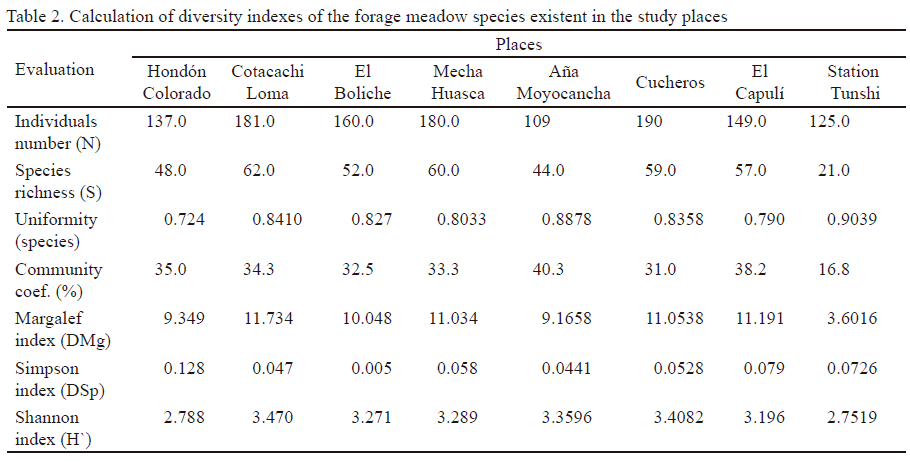
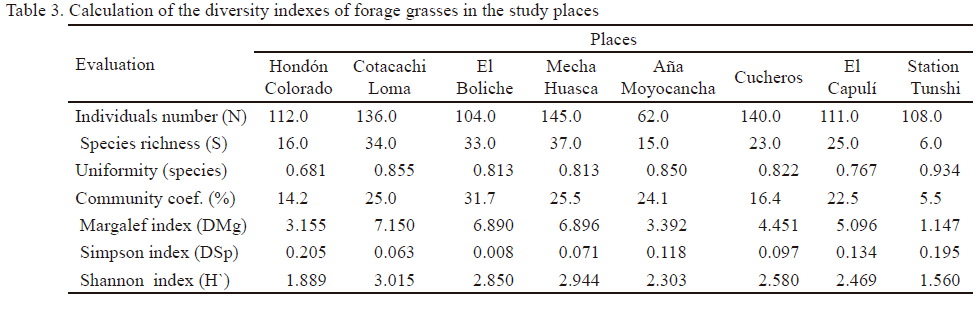
<p align="justify"><font size="2" face="Verdana, Arial, Helvetica, sans-serif">Doumenge (2005) and Bravo (2014) showed that grasses, even without  being the family with higher number of species in nature, are ecologically the  most dominant, and this dominance usually is associated to low relative levels  of biodiversity.</font></p>     <p align="justify"><font size="2" face="Verdana, Arial, Helvetica, sans-serif">In the eight study places, a total of 90  species from the grasses family were identified, that included 37 genus, being  the mains with higher number of species: Festuca (14), Paspalum (10), Agrostis  (7), Calamagrostis (7), Bromus (6), Stipa (5), Poa (5), Agropirum (3),  Arrhenatherum (2), Brisa (2), Andropogon (2) and Lolium (2).Other genus with  lower number of species were: Polipogon, Anthonxanthum, Trisetun, Mulembergia,  Bouteloua, Distichlis, Eragrostis, Dactylis, Holcus, Cortaderia, Sporobolus,  Botriochloa, Setaria, Digitaria, Axonopus, Pennisetum, Panicum, Danhonia,  Arundo, Melinis, Pharapholis, Aira, Alopecurus, Avena and Euchlaena. This shows  that the grasses, besides of being the most abundant family, is the most  varied, which can be due to, maybe, to that the most promissory constitute the  plant community that has adapted to the adverse temperature conditions, soil  humidity and available water for plants in the P&aacute;ramo grasslands ecosystem,  among other aspects (Crespo 2012). </font></p>     <p align="justify"><font size="2" face="Verdana, Arial, Helvetica, sans-serif">Regarding to the studied places, the highest richness of meadow  species was found in the ecological reserve &ldquo;Cotacachi Cayapas&rdquo;, with a total  of 62 species, probably associated to the quantity of annual precipitation    (1200 mm), organic matter content (8 %), 12h light and relative humidity higher  than 90%.The biodiversity of the ecological reserve &ldquo;Cotacachi Cayapas&rdquo; is  considered the richest in the Ecuador natives grasslands ecosystem (Bravo  2014).</font></p>     <p align="justify"><font size="2" face="Verdana, Arial, Helvetica, sans-serif">In the humid P&aacute;ramo grasslands of this  reserve, between 3000 and 4500 m o.s.l, there are extensions of Espeletia  genus, which members are commonly known as frailej&oacute;n and grasslands, which  constitutes places of extensive grazing, mainly of cattle. Of the 62 identified  species, 34 are grasses. Between them are the Festuca genus, with eight  species; Stipa and Bromus, with four; Calamagrostis, with three; Agrostis, with  four, and Paspalum, with one. The Poa, Vulpia, Parapholis, Anthonxanthum,  Agropirum, Andropogon, Cortaderia, Bouteloua and Distichlis genus were  registered with only one species. Cyperaceas was with three species. In legumes  family, the Lupinos, Vicea, Trifolium, Astragalus and Omnix genus prevailed with  one species each. The lower number of legumes is due to that this family  requires soils of deep tilled layer, well drained, fertile, with neuter pH to  slightly alkaline and resistant to drought, with characteristics contrary to  the P&aacute;ramo grassland conditions, with clayey soil, poorly drained, with pH  between 4.5 and 6.5 and temperatures lower than 4 &deg;C. These regions support  frosts that affect the crops; conditions to those legumes have not adapted  (CONDENSAN 2013 and Cuesta <em>et al.</em> 2014). </font></p>     <p align="justify"><font size="2" face="Verdana, Arial, Helvetica, sans-serif">The lower species richness was in the Experimental Station Tunshi,  with 21meadow species. This could be related with the man anthropic action,  which has desolated the natural meadow to implant agricultural crops and to  introduce improved species, in detriment of the natural and naturalized.</font></p>     <p align="justify"><font size="2" face="Verdana, Arial, Helvetica, sans-serif">Everything means that in this place the ecosystem is simplified and,  therefore, there is loss of biodiversity, because as Galv&aacute;n and Escobedo (2005)  said, in grass area, the high intervention and escalation in its use, with the  purpose of obtaining high productions, it always takes implicit loss of the  biodiversity. Just to point out that the uncontrolled man intervention in  nature is one of the main causes of the biodiversity loss and of the ecosystem  sustenance. Some authors consider that, at the moment, by the human action on  the natural ecosystems, the annual extinction rate of the species is of 17000,  between 100 and 1000 times higher to the normal (Garc&iacute;a 2005).</font></p>     <p align="justify"><font size="2" face="Verdana, Arial, Helvetica, sans-serif"><em>Calculation of the biodiversity indexes for the different study places</em>. The different biodiversity indexes (<a href="/img/revistas/cjas/v49n3/t0215315.gif">tables 2</a> and <a href="/img/revistas/cjas/v49n3/t0315315.gif">3</a>) show  uniformity in time and space, from mean to high, of meadow species (0.72-0.90)  and of grasses (0.68-0.93) independently, in accordance with the Franja (1993)  statistical model. This shows the favorable tendency in the species maintenance  in the ecosystems in those that the man does not    intervene.</font></p>     
<p align="justify"><font size="2" face="Verdana, Arial, Helvetica, sans-serif">With regard to the places, the higher  uniformity of meadow species was in Tunshi Experimental Station, due to man  intervention, which has affected the biodiversity. Specifically, in this place  there have been incorporated species of introduced grasses as perennial  Rygrass. To this respect, Crissman (2013) showed that the main threats to the  diversity in some P&aacute;ramo grassland places are the non sustainable practices of  the land use, particularly in agriculture, in the use of grazing and livestock  lands and in the forest    technique. </font></p>     ]]></body>
<body><![CDATA[<p align="justify"><font size="2" face="Verdana, Arial, Helvetica, sans-serif">In the ecological reserve &ldquo;El &Aacute;ngel&rdquo;  (Hondon Colorado) there was lower uniformity and higher diversity, probably  because in this area the climatological conditions (precipitations and relative  humidity) favor the species permanence (Ruiz and Tapia 2002).</font></p>     <p align="justify"><font size="2" face="Verdana, Arial, Helvetica, sans-serif">In correspondence with the uniformity and diversity, the community  coefficient (Cc) of meadow species linked to animal grazing did not exceed 50%,  which shows prevalence of other plant communities in the studied places. The  lower value was recorded in &ldquo;Tunshi&rdquo;, with 16.8 % and the higher in &ldquo;A&ntilde;a  Moyocancha&rdquo; (40.3 %).</font></p>     <p align="justify"><font size="2" face="Verdana, Arial, Helvetica, sans-serif">Specifically, for the grasses, regarding the total of existent species  dedicated to grazing, the lower value was also in &ldquo;Tunshi&rdquo; (5.5 %) and the  higher, in &ldquo;El Boliche&rdquo; with 31.7 %.</font></p>     <p align="justify"><font size="2" face="Verdana, Arial, Helvetica, sans-serif">The rest of places showed values that fluctuate among the referred  ends, which demonstrates that the dominance of the forage meadow species is, in  high proportion, in &ldquo;A&ntilde;a Moyocancha&rdquo;. Regarding to the forage grasses, are  dominant in &ldquo;El Boliche&rdquo; and it is lower, for both cases, in &ldquo;Tunshi&rdquo;.</font></p>     <p align="justify"><font size="2" face="Verdana, Arial, Helvetica, sans-serif">The Margalef index showed that the higher richness in the meadow  species diversity was in the place Cotacachi Loma, with 62, for 11.73.The lower  value of this indicator was in &ldquo;A&ntilde;a Moyocancha&rdquo; (9.16), with 44 species, and in  Tunshi (3.60) with 21.Similar values regarding to the diversity richness there  were obtained by means of Shannon index, with 3.41 for &ldquo;Cotacachi Loma&rdquo; and in  &ldquo;Hond&oacute;n Colorado&rdquo; and &ldquo;Tunshi&rdquo;, with 2.78 and 2.75, respectively.</font></p>     <p align="justify"><font size="2" face="Verdana, Arial, Helvetica, sans-serif">The highest richness of grasses species, according to Margalef  index, was in &ldquo;Cotacachi Loma&rdquo;, with    34 grasses and biodiversity index of 7.15. The lowest diversity was in the  &ldquo;Hondon Colarado&rdquo; and &ldquo;Tunshi&rdquo; places, with 16 species value of 3.15, with 6  and 1.14, respectively.</font></p>     <p align="justify"><font size="2" face="Verdana, Arial, Helvetica, sans-serif">The Shannon index, the same as of  Margalef, values the species richness, for what the tendency in the values was  similar. For all cases, the higher value of indexes was in &ldquo;Cotacachi Loma&rdquo;  (3.01) and the lower, in &ldquo;Tunshi&rdquo; (1.56) and &ldquo;Hond&oacute;n Colorado&rdquo; (1.88). </font></p>     <p align="justify"><font size="2" face="Verdana, Arial, Helvetica, sans-serif">The values observed in the Shannon (H)  index showed, in general way, that the meadow species biodiversity existing in  the Ecuadorian P&aacute;ramo grassland is not neither it lower neither very high,  because the fluctuating values takes an intermediate position in the scale  proposed by Ferrer (2001).These date are lower to those showed by Premauer and  Vargas (2004), when evaluating the diversity of Chingazo P&aacute;ramo grassland in  Colombia, in grazed and burned vegetation. These authors showed values of H=  7.7 near to those referred by Rodr&iacute;guez (2006) in meadows grazed in mountainous  areas of Spain (3.47- 3.65) and to the informed by Ruiz and Tapia (2002) on  subalpine soil of Pirineo (3.0 - 3.5).</font></p>     <p align="justify"><font size="2" face="Verdana, Arial, Helvetica, sans-serif">The values of Margalef index, consider  for meadow species in their group, exceed those showed by Premauer and Vargas  (2004) under the mentioned conditions, while for the independent grasses is    lower. </font></p>     <p align="justify"><font size="2" face="Verdana, Arial, Helvetica, sans-serif">The Simpson index is a measure of the dominance between species. As  this one increase, the existent diversity is lower, for what this index  overvalues the most abundant species in detriment of the total richness of  species. In this study, the higher dominance was in &ldquo;Hondon Colorado&rdquo;, with  0.1284, and the lower, in &ldquo;El Boliche&rdquo;, with 0.0056.</font></p>     ]]></body>
<body><![CDATA[<p align="justify"><font size="2" face="Verdana, Arial, Helvetica, sans-serif">The Simpson index, for grasses species, was higher again in its  diversity in &ldquo;El Boliche&rdquo;, with value of 0.008. The lower diversity was in  &ldquo;Hond&oacute;n Colorado&rdquo; and &ldquo;Tunshi&rdquo;, with 0.20 and 0.19, respectively. </font></p>     <p align="justify"><font size="2" face="Verdana, Arial, Helvetica, sans-serif">The diversity indexes of meadow species showed high values as for  their uniformity, higher at 0.68 in all studied places. This allows to conclude  that the existent biodiversity, taking into account the Margalef, Simpson and  Shannon index, is variable, which corresponds with the P&aacute;ramo grassland  ecosystems, identified as of poor diversity, given the height to which they are  and the adverse climatic conditions. </font></p>     <p align="justify"><font size="2" face="Verdana, Arial, Helvetica, sans-serif">This can be due to that the biological  diversity of the P&aacute;ramo grassland has showed to be very sensitive to the  ecological changes in an ecosystem. At the moment suffers adverse effects on  the plant communities of grasses, due to the climatic change. In a grasses  community, the diversity is affected by the temperature changes, in day and  night hours. It has been verified that is more restrictive with temperatures  that can reach to 8 and 4&ordm; C, and when physical- chemical factors of the water  and soil are present, as the pH levels every time more acid, that caused that  some species, more spread than others, get higher abundances in a very short  time and others, that do not adapt, they tend to disappear, reducing the  diversity of the P&aacute;ramo grassland ecosystem (Jim&eacute;nez 2013 and Monasterio 2013). </font></p>     <p align="justify"><font size="2" face="Verdana, Arial, Helvetica, sans-serif">It is recommended that for the constant climatic changes that takes  place in the Earth and for being the P&aacute;ramo grassland ecosystem fragile, should  be create policies of ecological restoration and environmental protection plans  that reduce even more the anthropic effect on the ecosystem, and allow to  control the biodiversity loss that caused the natural effects, so it can  recover the resident flora, which has a forage productive potential necessary  for animal production.</font></p>     <p align="justify">&nbsp;</p>     <p align="justify"><strong><font size="3" face="Verdana, Arial, Helvetica, sans-serif">REFERENCES</font></strong></p>     <!-- ref --><p align="justify"><font size="2" face="Verdana, Arial, Helvetica, sans-serif">Aguirre, N. 2002. <em>Flora de los alrededores de la  Laguna Negra, Cant&oacute;n Esp&iacute;ndola, Provincia Loja,  Ecuador</em>. Provincia Loja, Ecuador: Loja, Herbario de Loja, 12-18 p.    </font></p>     <!-- ref --><p align="justify"><font size="2" face="Verdana, Arial, Helvetica, sans-serif">Beck, E. 2008. <em><span lang="EN-US">Cold  tolerance in tropical alpine plants.Tropical Alpine  Environments, plant form and functions</span></em><span lang="EN-US">. </span>Cambridge University  Press, 77-107 p.    </font></p>     ]]></body>
<body><![CDATA[<!-- ref --><p align="justify"><font size="2" face="Verdana, Arial, Helvetica, sans-serif">Becker, B. 2006. <em>Los pastizales y producci&oacute;n  forrajera en la Sierra del Ecuador</em>. Quito: Estad&iacute;sticas Universidad Central  del Ecuador, 125 p.    </font></p>     <!-- ref --><p align="justify"><font size="2" face="Verdana, Arial, Helvetica, sans-serif">Bravo, E. 2014. <em>La biodiversidad en el Ecuador</em>.  1st ed., Quito, Ecuador: Editorial Universitaria Abya-  Ayala, 23-27 p.    </font></p>     <!-- ref --><p align="justify"><font size="2" face="Verdana, Arial, Helvetica, sans-serif">Ca&ntilde;adas, V. 1993. <em>Desarrollo, conocimiento y  participaci&oacute;n en la Comunidad Andina</em>. Riobamba: Federaci&oacute;n de  Organizaciones Ind&iacute;genas de las Faldas del Chimborazo (FOCIFCH), 23 p.    </font></p>     <!-- ref --><p align="justify"><font size="2" face="Verdana, Arial, Helvetica, sans-serif">Chaparro, J. 2012. <em>Beneficios de los ecosistemas de  p&aacute;ramo, organizaciones y pol&iacute;ticas de conservaci&oacute;n</em>. 1st ed., Boyac&aacute;,  Colombia: Cupido, 20 p.    </font></p>     <p align="justify"><font size="2" face="Verdana, Arial, Helvetica, sans-serif">CONDESAN. 2013. <em>Mejoramiento de la productividad y  sostenibilidad de los sistemas de producci&oacute;n mixtos: cultivosganader&iacute;a,  en la eco regi&oacute;n andina del Ecuador. Proyecto PROMSA</em>.  , Available:  &lt;<a href="Ecu005/2000.www.condesan.org/memoria/ ECU0500.PDF /2006" target="_blank">Ecu005/2000.www.condesan.org/memoria/ ECU0500.PDF /2006</a>&gt;, [Consulted:&nbsp;April 16, 2015].</font></p>     <p align="justify"><font size="2" face="Verdana, Arial, Helvetica, sans-serif">Crespo, P. 2012. <em>Puentes entre alturas.  Sistematizaci&oacute;n del Proyecto &ldquo;P&aacute;ramo Andino en Venezuela, Colombia, Ecuador y  Per&uacute;</em>. Rodr&iacute;guez M. (ed.), Quito, Ecuador: CONDENSAN.</font></p>     ]]></body>
<body><![CDATA[<!-- ref --><p align="justify"><font size="2" face="Verdana, Arial, Helvetica, sans-serif">Crissman, C. 2013. <em>La agricultura en los  p&aacute;ramos: Estrategias para el uso del espacio</em>. Per&uacute;, Lima: CONDESAN, 24 p.    </font></p>     <!-- ref --><p align="justify"><font size="2" face="Verdana, Arial, Helvetica, sans-serif">Cuesta, F., Sevink, J., Llamb&iacute;, L., De Bi&egrave;vre, B. &amp; Posner, J. 2014. <em>Avances en investigaci&oacute;n para la  conservaci&oacute;n de los p&aacute;ramos andinos</em>. Quito, Ecuador: CONDESAN.    </font></p>     <!-- ref --><p align="justify"><font size="2" face="Verdana, Arial, Helvetica, sans-serif">De la Cruz, R., Mena V&aacute;sconez,  P., Morales, M., Ortiz, P., Ram&oacute;n, G., Rivadeneira, S., Su&aacute;rez, e, Ter&aacute;n, J. F.  &amp; Vel&aacute;squez, C. 2009. <em>Gente y ambiente de p&aacute;ramo: realidades y  perspectivas en el Ecuador</em>. <span lang="EN-US">Quito: EcoCiencia-Abya  Yala.    </span></font></p>     <!-- ref --><p align="justify"><font size="2" face="Verdana, Arial, Helvetica, sans-serif"><span lang="EN-US">Doumenge, C. 2005. <em>Tropical montane  cloud forests: conservation status and management issues</em>. </span>New York, Springer:  Scatena, 24-37 p.    </font></p>     <!-- ref --><p align="justify"><font size="2" face="Verdana, Arial, Helvetica, sans-serif">Ferrer, J. 2001. <em>La noci&oacute;n de la biodiversidad en  los ecosistemas pasc&iacute;colas espa&ntilde;oles</em>. Espa&ntilde;a:  Universidad Agraria de Zaragoza, 35 p.    </font></p>     ]]></body>
<body><![CDATA[<!-- ref --><p align="justify"><font size="2" face="Verdana, Arial, Helvetica, sans-serif">Franja, D. 1993. <em>Programa &iacute;ndice de diversidad  (divers.exe) y medidas de similitud (simil.exe)</em>. , Available:  &lt;<a href="http//www.perso. wanadoo.es/Jp-L/descargas.html" target="_blank">http//www.perso. wanadoo.es/Jp-L/descargas.html</a>.&gt;,  [Consulted:&nbsp;January 24,  2015].    </font></p>     <p align="justify"><font size="2" face="Verdana, Arial, Helvetica, sans-serif">Galv&aacute;n, A. &amp; Escobedo, R. 2005. &lsquo;&lsquo;Propuestas para  el uso racional de los humedales altoandinos en el  Sur del Per&uacute;&rsquo;&rsquo;. <em>Revista de Agricultura Sustentable LEISA</em>: 34&ndash;38.</font></p>     <!-- ref --><p align="justify"><font size="2" face="Verdana, Arial, Helvetica, sans-serif">Garc&iacute;a, L. 2005. <em>Conservaci&oacute;n de la diversidad  biol&oacute;gica</em>. Pa&iacute;ses Bajos: Uni&oacute;n de Conservaci&oacute;n Europea, 23-34 p.    </font></p>     <!-- ref --><p align="justify"><font size="2" face="Verdana, Arial, Helvetica, sans-serif"><span lang="EN-US">Gould, F. 1975. <em>The Grasses  of Texas</em>. Xares (ed.), 1st ed., Texas, USA, 93 p.    </span></font></p>     <!-- ref --><p align="justify"><font size="2" face="Verdana, Arial, Helvetica, sans-serif"><span lang="EN-US">Hitchcock, A. 1927. <em>Manual  of the grasses of the Ecuador, Peru and Bolivia</em>. </span>Herbarium (ed.), New York, 14 - 26 p.    </font></p>     <!-- ref --><p align="justify"><font size="2" face="Verdana, Arial, Helvetica, sans-serif">Jim&eacute;nez, J. 2013. <em>Establecimiento y manejo del  banco de germoplasma de especies forrajeras altoandinas</em>.  Escuela Superior Polit&eacute;cnica de Chimborazo, Facultad de Ciencias Pecuarias.    </font></p>     <!-- ref --><p align="justify"><font size="2" face="Verdana, Arial, Helvetica, sans-serif">Lombardo, A. 1984. <em>Flora Montevidensis  Tomo II</em>. Montevideo, Uruguay: Servicio de publicaciones y prensa, 67-69 p.    </font></p>     <!-- ref --><p align="justify"><font size="2" face="Verdana, Arial, Helvetica, sans-serif">Monasterio, M. 2013. <em>Caracterizaci&oacute;n ecol&oacute;gica del  clima en el P&aacute;ramo</em>. <span lang="EN-US">Quito- Ecuador: Ayala.    </span></font></p>     <!-- ref --><p align="justify"><font size="2" face="Verdana, Arial, Helvetica, sans-serif"><span lang="EN-US">Premauer, J. &amp; Vargas, O. 2004. <em>Diversity  patterns in grazed and burned vegetation in a humid bamboo paramo  (Chingaza Natural Park, Colombia)</em>. </span>ECOTROPICOS, 52-66 p.    </font></p>     <!-- ref --><p align="justify"><font size="2" face="Verdana, Arial, Helvetica, sans-serif">Rodr&iacute;guez, P. 2006. <em>Valoraci&oacute;n de la pradera  natural con el uso de &iacute;ndices de diversidad biol&oacute;gica</em>. Acribia  (ed.), Espa&ntilde;a, 21-36 p.    </font></p>     <!-- ref --><p align="justify"><font size="2" face="Verdana, Arial, Helvetica, sans-serif">Ruiz, L. &amp; Tapia, M. 2002. <em>Producci&oacute;n y manejo  de forrajes en los Andes del Ecuador</em>. Quito-Ecuador: Instituto Nacional de  Investigaciones Agropecuarias (INIAP) Convenio INIAP-CIID, p. 205.    </font></p>     <p align="justify"><font size="2" face="Verdana, Arial, Helvetica, sans-serif">Tovar, O. 1988. <em>Manual de  identificaci&oacute;n de pastos naturales de los Andes del Sur peruano (gram&iacute;neas)</em>.  Lima-Per&uacute;: Proyecto Alpacas COTESU/IC, pp. 15&ndash;25</font><font size="2" face="Verdana, Arial, Helvetica, sans-serif">.</font></p>     <p align="justify">&nbsp;</p>     <p align="justify">&nbsp;</p>     <p align="justify"><font size="2" face="Verdana, Arial, Helvetica, sans-serif">Received: July 17, 2015    <br> Accepted: July 21, 2015</font></p>     <p align="justify">&nbsp;</p>     <p align="justify">&nbsp;</p>     <p align="justify"><font size="2" face="Verdana, Arial, Helvetica, sans-serif"><i>L. Fiallos,</i> Escuela Superior Politécnica de Chimborazo, Docente Facultad de Ciencias Pecuarias, Riobamba, Ecuador.    Email: <a href="mailto:luisfior@yahoo.es">luisfior@yahoo.es</a></font></p>      ]]></body><back>
<ref-list>
<ref id="B1">
<nlm-citation citation-type="book">
<person-group person-group-type="author">
<name>
<surname><![CDATA[Aguirre,]]></surname>
<given-names><![CDATA[N.]]></given-names>
</name>
</person-group>
<source><![CDATA[Flora de los alrededores de la Laguna Negra, Cantón Espíndola, Provincia Loja, Ecuador]]></source>
<year>2002</year>
<page-range>12-18</page-range><publisher-loc><![CDATA[Provincia Loja, Ecuador ]]></publisher-loc>
<publisher-name><![CDATA[Loja, Herbario de Loja]]></publisher-name>
</nlm-citation>
</ref>
<ref id="B2">
<nlm-citation citation-type="book">
<person-group person-group-type="author">
<name>
<surname><![CDATA[Beck]]></surname>
<given-names><![CDATA[E.]]></given-names>
</name>
</person-group>
<source><![CDATA[Cold tolerance in tropical alpine plants.Tropical Alpine Environments, plant form and functions]]></source>
<year>2008</year>
<page-range>77-107</page-range><publisher-name><![CDATA[Cambridge University Press]]></publisher-name>
</nlm-citation>
</ref>
<ref id="B3">
<nlm-citation citation-type="book">
<person-group person-group-type="author">
<name>
<surname><![CDATA[Becker]]></surname>
<given-names><![CDATA[B.]]></given-names>
</name>
</person-group>
<source><![CDATA[Los pastizales y producción forrajera en la Sierra del Ecuador]]></source>
<year>2006</year>
<page-range>125</page-range><publisher-loc><![CDATA[Quito ]]></publisher-loc>
<publisher-name><![CDATA[Estadísticas Universidad Central del Ecuador]]></publisher-name>
</nlm-citation>
</ref>
<ref id="B4">
<nlm-citation citation-type="book">
<person-group person-group-type="author">
<name>
<surname><![CDATA[Bravo]]></surname>
<given-names><![CDATA[E.]]></given-names>
</name>
</person-group>
<source><![CDATA[La biodiversidad en el Ecuador]]></source>
<year>2014</year>
<edition>1st</edition>
<page-range>23-27</page-range><publisher-loc><![CDATA[Quito, Ecuador ]]></publisher-loc>
<publisher-name><![CDATA[Editorial Universitaria Abya- Ayala]]></publisher-name>
</nlm-citation>
</ref>
<ref id="B5">
<nlm-citation citation-type="book">
<person-group person-group-type="author">
<name>
<surname><![CDATA[Cañadas]]></surname>
<given-names><![CDATA[V.]]></given-names>
</name>
</person-group>
<source><![CDATA[Desarrollo, conocimiento y participación en la Comunidad Andina]]></source>
<year>1993</year>
<page-range>23</page-range><publisher-loc><![CDATA[Riobamba ]]></publisher-loc>
<publisher-name><![CDATA[Federación de Organizaciones Indígenas de las Faldas del Chimborazo (FOCIFCH)]]></publisher-name>
</nlm-citation>
</ref>
<ref id="B6">
<nlm-citation citation-type="book">
<person-group person-group-type="author">
<name>
<surname><![CDATA[Chaparro]]></surname>
<given-names><![CDATA[J.]]></given-names>
</name>
</person-group>
<source><![CDATA[Beneficios de los ecosistemas de páramo, organizaciones y políticas de conservación]]></source>
<year>2012</year>
<edition>1st</edition>
<page-range>20</page-range><publisher-loc><![CDATA[Boyacá, Colombia ]]></publisher-loc>
<publisher-name><![CDATA[Cupido]]></publisher-name>
</nlm-citation>
</ref>
<ref id="B7">
<nlm-citation citation-type="book">
<person-group person-group-type="author">
<name>
<surname><![CDATA[Crespo]]></surname>
<given-names><![CDATA[P.]]></given-names>
</name>
<name>
<surname><![CDATA[Rodríguez]]></surname>
<given-names><![CDATA[M.]]></given-names>
</name>
</person-group>
<source><![CDATA[Puentes entre alturas. Sistematización del Proyecto “Páramo Andino en Venezuela, Colombia, Ecuador y Perú]]></source>
<year>2012</year>
<publisher-loc><![CDATA[Quito, Ecuador ]]></publisher-loc>
<publisher-name><![CDATA[CONDENSAN]]></publisher-name>
</nlm-citation>
</ref>
<ref id="B8">
<nlm-citation citation-type="book">
<person-group person-group-type="author">
<name>
<surname><![CDATA[Crissman]]></surname>
<given-names><![CDATA[C.]]></given-names>
</name>
</person-group>
<source><![CDATA[La agricultura en los páramos: Estrategias para el uso del espacio]]></source>
<year>2013</year>
<page-range>24</page-range><publisher-loc><![CDATA[Perú, Lima ]]></publisher-loc>
<publisher-name><![CDATA[CONDESAN]]></publisher-name>
</nlm-citation>
</ref>
<ref id="B9">
<nlm-citation citation-type="book">
<person-group person-group-type="author">
<name>
<surname><![CDATA[Cuesta,]]></surname>
<given-names><![CDATA[F.]]></given-names>
</name>
<name>
<surname><![CDATA[Sevink]]></surname>
<given-names><![CDATA[J.]]></given-names>
</name>
<name>
<surname><![CDATA[Llambí]]></surname>
<given-names><![CDATA[L.]]></given-names>
</name>
<name>
<surname><![CDATA[De Bièvre]]></surname>
<given-names><![CDATA[B.]]></given-names>
</name>
<name>
<surname><![CDATA[Posner]]></surname>
<given-names><![CDATA[J.]]></given-names>
</name>
</person-group>
<source><![CDATA[Avances en investigación para la conservación de los páramos andinos]]></source>
<year>2014</year>
<publisher-loc><![CDATA[Quito, Ecuador ]]></publisher-loc>
<publisher-name><![CDATA[CONDESAN]]></publisher-name>
</nlm-citation>
</ref>
<ref id="B10">
<nlm-citation citation-type="book">
<person-group person-group-type="author">
<name>
<surname><![CDATA[De la Cruz]]></surname>
<given-names><![CDATA[R.]]></given-names>
</name>
<name>
<surname><![CDATA[Mena Vásconez]]></surname>
<given-names><![CDATA[P.]]></given-names>
</name>
<name>
<surname><![CDATA[Morales]]></surname>
<given-names><![CDATA[M.]]></given-names>
</name>
<name>
<surname><![CDATA[Ortiz]]></surname>
<given-names><![CDATA[P.]]></given-names>
</name>
<name>
<surname><![CDATA[Ramón]]></surname>
<given-names><![CDATA[G.]]></given-names>
</name>
<name>
<surname><![CDATA[Rivadeneira]]></surname>
<given-names><![CDATA[S.]]></given-names>
</name>
<name>
<surname><![CDATA[Suárez]]></surname>
<given-names><![CDATA[e]]></given-names>
</name>
<name>
<surname><![CDATA[Terán]]></surname>
<given-names><![CDATA[J. F.]]></given-names>
</name>
<name>
<surname><![CDATA[Velásquez]]></surname>
<given-names><![CDATA[C.]]></given-names>
</name>
</person-group>
<source><![CDATA[Gente y ambiente de páramo: realidades y perspectivas en el Ecuador]]></source>
<year>2009</year>
<publisher-loc><![CDATA[Quito ]]></publisher-loc>
<publisher-name><![CDATA[EcoCiencia-Abya Yala]]></publisher-name>
</nlm-citation>
</ref>
<ref id="B11">
<nlm-citation citation-type="book">
<person-group person-group-type="author">
<name>
<surname><![CDATA[Doumenge]]></surname>
<given-names><![CDATA[C.]]></given-names>
</name>
</person-group>
<source><![CDATA[Tropical montane cloud forests: conservation status and management issues]]></source>
<year>2005</year>
<page-range>24-37</page-range><publisher-loc><![CDATA[New York, Springer ]]></publisher-loc>
<publisher-name><![CDATA[Scatena]]></publisher-name>
</nlm-citation>
</ref>
<ref id="B12">
<nlm-citation citation-type="book">
<person-group person-group-type="author">
<name>
<surname><![CDATA[Ferrer]]></surname>
<given-names><![CDATA[J.]]></given-names>
</name>
</person-group>
<source><![CDATA[La noción de la biodiversidad en los ecosistemas pascícolas españoles]]></source>
<year>2001</year>
<page-range>35</page-range><publisher-loc><![CDATA[España ]]></publisher-loc>
<publisher-name><![CDATA[Universidad Agraria de Zaragoza]]></publisher-name>
</nlm-citation>
</ref>
<ref id="B13">
<nlm-citation citation-type="">
<person-group person-group-type="author">
<name>
<surname><![CDATA[Franja]]></surname>
<given-names><![CDATA[D.]]></given-names>
</name>
</person-group>
<source><![CDATA[Programa índice de diversidad (divers.exe) y medidas de similitud (simil.exe)]]></source>
<year>1993</year>
</nlm-citation>
</ref>
<ref id="B14">
<nlm-citation citation-type="journal">
<person-group person-group-type="author">
<name>
<surname><![CDATA[Galván]]></surname>
<given-names><![CDATA[A.]]></given-names>
</name>
<name>
<surname><![CDATA[Escobedo]]></surname>
<given-names><![CDATA[R.]]></given-names>
</name>
</person-group>
<article-title xml:lang="nd"><![CDATA[Propuestas para el uso racional de los humedales altoandinos en el Sur del Perú]]></article-title>
<source><![CDATA[Revista de Agricultura Sustentable LEISA]]></source>
<year>2005</year>
<page-range>34-38</page-range></nlm-citation>
</ref>
<ref id="B15">
<nlm-citation citation-type="book">
<person-group person-group-type="author">
<name>
<surname><![CDATA[García]]></surname>
<given-names><![CDATA[L.]]></given-names>
</name>
</person-group>
<source><![CDATA[Conservación de la diversidad biológica]]></source>
<year>2005</year>
<page-range>23-34</page-range><publisher-loc><![CDATA[Países Bajos ]]></publisher-loc>
<publisher-name><![CDATA[Unión de Conservación Europea]]></publisher-name>
</nlm-citation>
</ref>
<ref id="B16">
<nlm-citation citation-type="">
<person-group person-group-type="author">
<name>
<surname><![CDATA[Gould]]></surname>
<given-names><![CDATA[F.]]></given-names>
</name>
</person-group>
<source><![CDATA[The Grasses of Texas]]></source>
<year>1975</year>
<edition>1st</edition>
<page-range>93</page-range><publisher-loc><![CDATA[Texas, USA ]]></publisher-loc>
</nlm-citation>
</ref>
<ref id="B17">
<nlm-citation citation-type="">
<person-group person-group-type="author">
<name>
<surname><![CDATA[Hitchcock]]></surname>
<given-names><![CDATA[A.]]></given-names>
</name>
</person-group>
<source><![CDATA[Manual of the grasses of the Ecuador, Peru and Bolivia]]></source>
<year>1927</year>
<page-range>14 - 26</page-range><publisher-loc><![CDATA[New York ]]></publisher-loc>
</nlm-citation>
</ref>
<ref id="B18">
<nlm-citation citation-type="book">
<person-group person-group-type="author">
<name>
<surname><![CDATA[Jiménez]]></surname>
<given-names><![CDATA[J.]]></given-names>
</name>
</person-group>
<source><![CDATA[Establecimiento y manejo del banco de germoplasma de especies forrajeras altoandinas]]></source>
<year>2013</year>
<publisher-name><![CDATA[Escuela Superior Politécnica de Chimborazo, Facultad de Ciencias Pecuarias]]></publisher-name>
</nlm-citation>
</ref>
<ref id="B19">
<nlm-citation citation-type="book">
<person-group person-group-type="author">
<name>
<surname><![CDATA[Lombardo]]></surname>
<given-names><![CDATA[A.]]></given-names>
</name>
</person-group>
<source><![CDATA[Flora Montevidensis Tomo II]]></source>
<year>1984</year>
<page-range>67-69</page-range><publisher-loc><![CDATA[Montevideo, Uruguay ]]></publisher-loc>
<publisher-name><![CDATA[Servicio de publicaciones y prensa]]></publisher-name>
</nlm-citation>
</ref>
<ref id="B20">
<nlm-citation citation-type="book">
<person-group person-group-type="author">
<name>
<surname><![CDATA[Monasterio]]></surname>
<given-names><![CDATA[M.]]></given-names>
</name>
</person-group>
<source><![CDATA[Caracterización ecológica del clima en el Páramo]]></source>
<year>2013</year>
<publisher-loc><![CDATA[Quito- Ecuador ]]></publisher-loc>
<publisher-name><![CDATA[Ayala]]></publisher-name>
</nlm-citation>
</ref>
<ref id="B21">
<nlm-citation citation-type="book">
<person-group person-group-type="author">
<name>
<surname><![CDATA[Premauer]]></surname>
<given-names><![CDATA[J.]]></given-names>
</name>
<name>
<surname><![CDATA[Vargas]]></surname>
<given-names><![CDATA[O.]]></given-names>
</name>
</person-group>
<source><![CDATA[Diversity patterns in grazed and burned vegetation in a humid bamboo paramo (Chingaza Natural Park, Colombia)]]></source>
<year>2004</year>
<page-range>52-66</page-range><publisher-name><![CDATA[ECOTROPICOS]]></publisher-name>
</nlm-citation>
</ref>
<ref id="B22">
<nlm-citation citation-type="">
<person-group person-group-type="author">
<name>
<surname><![CDATA[Rodríguez]]></surname>
<given-names><![CDATA[P.]]></given-names>
</name>
</person-group>
<source><![CDATA[Valoración de la pradera natural con el uso de índices de diversidad biológica]]></source>
<year>2006</year>
<page-range>21-36</page-range><publisher-loc><![CDATA[España ]]></publisher-loc>
</nlm-citation>
</ref>
<ref id="B23">
<nlm-citation citation-type="book">
<person-group person-group-type="author">
<name>
<surname><![CDATA[Ruiz]]></surname>
<given-names><![CDATA[L.]]></given-names>
</name>
<name>
<surname><![CDATA[Tapia]]></surname>
<given-names><![CDATA[M.]]></given-names>
</name>
</person-group>
<source><![CDATA[Producción y manejo de forrajes en los Andes del Ecuador]]></source>
<year>2002</year>
<page-range>205</page-range><publisher-loc><![CDATA[Quito-Ecuador ]]></publisher-loc>
<publisher-name><![CDATA[Instituto Nacional de Investigaciones Agropecuarias (INIAP) Convenio INIAP-CIID]]></publisher-name>
</nlm-citation>
</ref>
<ref id="B24">
<nlm-citation citation-type="book">
<person-group person-group-type="author">
<name>
<surname><![CDATA[Tovar]]></surname>
<given-names><![CDATA[O.]]></given-names>
</name>
</person-group>
<source><![CDATA[Manual de identificación de pastos naturales de los Andes del Sur peruano (gramíneas)]]></source>
<year>1988</year>
<page-range>15-25</page-range><publisher-loc><![CDATA[Lima-Perú ]]></publisher-loc>
<publisher-name><![CDATA[Proyecto Alpacas COTESU/IC]]></publisher-name>
</nlm-citation>
</ref>
<ref id="B25">
<nlm-citation citation-type="">
<source><![CDATA[Mejoramiento de la productividad y sostenibilidad de los sistemas de producción mixtos: cultivosganadería, en la eco región andina del Ecuador. Proyecto PROMSA]]></source>
<year>2013</year>
</nlm-citation>
</ref>
</ref-list>
</back>
</article>