<?xml version="1.0" encoding="ISO-8859-1"?><article xmlns:mml="http://www.w3.org/1998/Math/MathML" xmlns:xlink="http://www.w3.org/1999/xlink" xmlns:xsi="http://www.w3.org/2001/XMLSchema-instance">
<front>
<journal-meta>
<journal-id>2079-3480</journal-id>
<journal-title><![CDATA[Cuban Journal of Agricultural Science]]></journal-title>
<abbrev-journal-title><![CDATA[Cuban J. Agric. Sci.]]></abbrev-journal-title>
<issn>2079-3480</issn>
<publisher>
<publisher-name><![CDATA[Editorial del Instituto de Ciencia Animal]]></publisher-name>
</publisher>
</journal-meta>
<article-meta>
<article-id>S2079-34802015000300017</article-id>
<title-group>
<article-title xml:lang="en"><![CDATA[Plant species used in animal feeding in Mera, Santa Clara and Pastaza cantons in Pastaza province, Ecuador]]></article-title>
<article-title xml:lang="es"><![CDATA[Especies vegetales utilizadas en la alimentación animal en los cantones Mera, Santa Clara y Pastaza en la provincia de Pastaza, Ecuador]]></article-title>
</title-group>
<contrib-group>
<contrib contrib-type="author">
<name>
<surname><![CDATA[Abril]]></surname>
<given-names><![CDATA[R.V]]></given-names>
</name>
<xref ref-type="aff" rid="A01"/>
</contrib>
<contrib contrib-type="author">
<name>
<surname><![CDATA[Aguinda]]></surname>
<given-names><![CDATA[Janeth K]]></given-names>
</name>
<xref ref-type="aff" rid="A02"/>
</contrib>
<contrib contrib-type="author">
<name>
<surname><![CDATA[Ruiz]]></surname>
<given-names><![CDATA[T. E]]></given-names>
</name>
<xref ref-type="aff" rid="A03"/>
</contrib>
<contrib contrib-type="author">
<name>
<surname><![CDATA[Alonso]]></surname>
<given-names><![CDATA[J]]></given-names>
</name>
<xref ref-type="aff" rid="A03"/>
</contrib>
</contrib-group>
<aff id="A01">
<institution><![CDATA[,Docente Universidad Estatal Amazónica Ecuador Departamento de Ciencias de Vida ]]></institution>
<addr-line><![CDATA[ ]]></addr-line>
<country>Ecuador</country>
</aff>
<aff id="A02">
<institution><![CDATA[,Universidad Estatal Amazónica del Ecuador Departamento de Ciencias de la Vida ]]></institution>
<addr-line><![CDATA[ ]]></addr-line>
<country>Ecuador</country>
</aff>
<aff id="A03">
<institution><![CDATA[,Instituto de Ciencia Animal  ]]></institution>
<addr-line><![CDATA[San José de las Lajas Mayabeque]]></addr-line>
<country>Cuba</country>
</aff>
<pub-date pub-type="pub">
<day>00</day>
<month>09</month>
<year>2015</year>
</pub-date>
<pub-date pub-type="epub">
<day>00</day>
<month>09</month>
<year>2015</year>
</pub-date>
<volume>49</volume>
<numero>3</numero>
<fpage>415</fpage>
<lpage>423</lpage>
<copyright-statement/>
<copyright-year/>
<self-uri xlink:href="http://scielo.sld.cu/scielo.php?script=sci_arttext&amp;pid=S2079-34802015000300017&amp;lng=en&amp;nrm=iso"></self-uri><self-uri xlink:href="http://scielo.sld.cu/scielo.php?script=sci_abstract&amp;pid=S2079-34802015000300017&amp;lng=en&amp;nrm=iso"></self-uri><self-uri xlink:href="http://scielo.sld.cu/scielo.php?script=sci_pdf&amp;pid=S2079-34802015000300017&amp;lng=en&amp;nrm=iso"></self-uri><abstract abstract-type="short" xml:lang="en"><p><![CDATA[This study was developed in Mera, Santa Clara and Pastaza cantons, located in Pastaza province, Ecuador, to identify accessions used by agricultural producers in animal feeding and to know its performance, in function of the use frequency, related to the canton, ethnicity of the producer, main source of economical incomes, type of farm production, years of experience, and other types of uses. A survey was applied to 214 producers, for 30% of the founded in their farms. Socioeconomic aspects, ecosystem description of the place and use of the plants in their farms were considered. Samples of the species used in animal feeding were collected and they were transported to the Amazon State University herbarium. The analysis of the results by means of the proportions square application, in function of the report frequency of each species, showed chi square of Pearson significance differences in the canton component, ethnicity of the producer, main source of economical incomes, and other type of species use. The analysis of report frequencies, applying Duncan test, stated that the species Axonopus scoparius, Bactris gasipaes, Bracharia brizanta, Colocasia sculenta, Cymbopogon citratus, Manhiot sculenta, Musa sp., Penisetum purpureum, Pouteria caimito, Psidium guajava, Saccharum officinarum L. and Zea mayz, showed different performances, while Axonopus scoparius showed differences in higher number of analysis. It is concluded that the geographical, cultural and economical factors, influence in the use report frequency, having in several species, animal feeding as alternative to other established uses]]></p></abstract>
<abstract abstract-type="short" xml:lang="es"><p><![CDATA[Este estudio se desarrolló en los municipios Mera, Santa Clara y Pastaza, ubicados en la provincia de Pastaza, Ecuador, para identificar accesiones utilizadas por productores agropecuarios en alimentación animal y conocer su comportamiento, en función de la frecuencia de uso, con relación al cantón, etnia del productor, principal fuente de ingresos económicos, tipo de producción de la finca, años de experiencia, y otros tipos de usos. Se aplicó una encuesta a 214 productores, para 30 % de los encontrados en sus fincas. Se contemplaron aspectos socioeconómicos, descripción ecosistémica del lugar y uso de las plantas en sus fincas. Se recolectaron muestras de las especies utilizadas en la alimentación animal y se transportaron al herbario de la Universidad Estatal Amazónica. El análisis de los resultados mediante la aplicación de cuadros de proporciones, en función de la frecuencia de reporte de cada especie, mostró diferencias significativas chi cuadrado de Pearson en los componentes cantón, etnia del productor, principal fuente de ingresos económicos y otros tipos de uso de las especies. El análisis de frecuencias de reporte, aplicando la dócima de Duncan, establece que las especies Axonopus scoparius .Bactris gasipaes, Bracharia brizanta, Colocasia sculenta, Cymbopogon citratus, Manhiot sculenta, Musa sp., Penisetum purpureum, Pouteria caimito, Psidium guajava, Saccharum officinarum L. y Zea mayz, muestran comportamientos diferentes, mientras que Axonopus scoparius presentó diferencias en mayor número de análisis. Se concluye que los factores geográfico, cultural y económico, inciden en la frecuencia de reporte de uso, teniendo en varias especies, la alimentación animal como alternativa a otros usos establecidos]]></p></abstract>
<kwd-group>
<kwd lng="en"><![CDATA[animal feeding]]></kwd>
<kwd lng="en"><![CDATA[distribution]]></kwd>
<kwd lng="en"><![CDATA[ethnicity]]></kwd>
<kwd lng="es"><![CDATA[alimento anima]]></kwd>
<kwd lng="es"><![CDATA[distribución]]></kwd>
<kwd lng="es"><![CDATA[etnia]]></kwd>
</kwd-group>
</article-meta>
</front><body><![CDATA[ <p align="right"><font size="2" face="Verdana, Arial, Helvetica,   sans-serif"><b>ORIGINAL ARTICLE</b></font></p>     <p>&nbsp;</p>     <p align="justify"><font size="4" face="Verdana, Arial, Helvetica, sans-serif"><b>Plant species used in animal feeding in Mera, Santa Clara and Pastaza cantons in Pastaza province, Ecuador</b></font></p>     <p align="justify">&nbsp;</p>     <p align="justify"><font size="3" face="Verdana, Arial, Helvetica, sans-serif"><b>Especies vegetales utilizadas en la alimentación animal en los cantones Mera, Santa Clara y Pastaza en la provincia de Pastaza, Ecuador</b></font></p>     <p align="justify">&nbsp;</p>     <p align="justify">&nbsp;</p>     <p align="justify"><font size="2" face="Verdana, Arial, Helvetica, sans-serif"><b>R.V. Abril,</b><sup><b>I</b></sup><b> Janeth K. Aguinda,</b><sup><b>II</b></sup><b> T. E. Ruiz,</b><sup><b>III</b></sup><b> J. Alonso,</b><sup><b>III</b></sup></font></p>     <p align="justify"><font size="2" face="Verdana, Arial, Helvetica, sans-serif"><sup>I</sup>Docente Universidad Estatal Amazónica Ecuador, Departamento de Ciencias de Vida, km 2 ½ Vía a Napo Puyo, Ecuador.    <br>   </font><font size="2" face="Verdana, Arial, Helvetica, sans-serif"><sup>II</sup>Universidad Estatal Amazónica del Ecuador, Departamento de Ciencias de la Vida, km 2 ½ Vía a Napo Puyo, Ecuador.    ]]></body>
<body><![CDATA[<br>   </font><font size="2" face="Verdana, Arial, Helvetica, sans-serif"><sup>III</sup>Instituto de Ciencia Animal, Apartado Postal 24, San José de las Lajas, Mayabeque, Cuba.</font></p>     <p align="justify">&nbsp;</p>     <p align="justify">&nbsp;</p> <hr align="JUSTIFY">     <p align="justify"><font size="2" face="Verdana, Arial, Helvetica, sans-serif"><b>ABSTRACT</b></font></p>     <p align="justify"><font size="2" face="Verdana, Arial, Helvetica, sans-serif">This study was developed in Mera, Santa Clara and Pastaza cantons,  located in Pastaza province, Ecuador, to identify accessions used by  agricultural producers in animal feeding and to know its performance, in  function of the use frequency, related to the canton, ethnicity of the  producer, main source of economical incomes, type of farm production, years of  experience, and other types of uses. A survey was applied to 214 producers, for  30% of the founded in their farms. Socioeconomic aspects, ecosystem description  of the place and use of the plants in their farms were considered. Samples of  the species used in animal feeding were collected and they were transported to  the Amazon State University herbarium. The analysis of the results by means of  the proportions square application, in function of the report frequency of each  species, showed chi square of Pearson significance differences in the canton  component, ethnicity of the producer, main source of economical incomes, and  other type of species use. The analysis of report frequencies, applying Duncan  test, stated that the species <em>Axonopus scoparius</em>, <em>Bactris gasipaes</em>, <em>Bracharia brizanta</em>, <em>Colocasia sculenta</em>, <em>Cymbopogon citratus</em>, <em>Manhiot sculenta</em>, <em>Musa sp</em>., <em>Penisetum purpureum</em>, <em>Pouteria  caimito</em>, <em>Psidium guajava</em>, <em>Saccharum officinarum</em> L. and <em>Zea  mayz</em>, showed different performances, while <em>Axonopus scoparius</em> showed  differences in higher number of analysis. It is concluded that the  geographical, cultural and economical factors, influence in the use report  frequency, having in several species, animal feeding as alternative to other  established uses.</font></p>     <p align="justify"><font size="2" face="Verdana, Arial, Helvetica, sans-serif"><b>Key words:</b> animal feeding, distribution, ethnicity.</font></p> <hr align="JUSTIFY">     <p align="justify"><font size="2" face="Verdana, Arial, Helvetica, sans-serif"><b>RESUMEN</b></font></p>     <p align="justify"><font size="2" face="Verdana, Arial, Helvetica, sans-serif">Este estudio se desarroll&oacute; en los municipios Mera,  Santa Clara y Pastaza, ubicados en la provincia de Pastaza, Ecuador, para  identificar accesiones utilizadas por productores agropecuarios en alimentaci&oacute;n  animal y conocer su comportamiento, en funci&oacute;n de la frecuencia de uso, con  relaci&oacute;n al cant&oacute;n, etnia del productor, principal fuente de ingresos  econ&oacute;micos, tipo de producci&oacute;n de la finca, a&ntilde;os de experiencia, y otros tipos  de usos. Se aplic&oacute; una encuesta a 214 productores, para 30 % de los encontrados  en sus fincas. Se contemplaron aspectos socioecon&oacute;micos, descripci&oacute;n ecosist&eacute;mica  del lugar y uso de las plantas en sus fincas. Se recolectaron muestras de las  especies utilizadas en la alimentaci&oacute;n animal y se transportaron al herbario de  la Universidad Estatal Amaz&oacute;nica. El an&aacute;lisis de los resultados mediante la  aplicaci&oacute;n de cuadros de proporciones, en funci&oacute;n de la frecuencia de reporte  de cada especie, mostr&oacute; diferencias significativas chi cuadrado de Pearson en  los componentes cant&oacute;n, etnia del productor, principal fuente de ingresos  econ&oacute;micos y otros tipos de uso de las especies. El an&aacute;lisis de frecuencias de  reporte, aplicando la d&oacute;cima de Duncan, establece que las especies <em>Axonopus  scoparius</em> .<em>Bactris gasipaes</em>, <em>Bracharia brizanta</em>, <em>Colocasia  sculenta</em>, <em>Cymbopogon citratus</em>, <em>Manhiot sculenta</em>, <em>Musa sp</em>., <em>Penisetum purpureum</em>, <em>Pouteria caimito</em>, <em>Psidium guajava</em>, <em>Saccharum  officinarum</em> L. y <em>Zea mayz</em>, muestran comportamientos diferentes,  mientras que <em>Axonopus scoparius</em> present&oacute; diferencias en mayor n&uacute;mero de  an&aacute;lisis. Se concluye que los factores geogr&aacute;fico, cultural y econ&oacute;mico,  inciden en la frecuencia de reporte de uso, teniendo en varias especies, la  alimentaci&oacute;n animal como alternativa a otros usos establecidos.</font></p>     <p align="justify"><font size="2" face="Verdana, Arial, Helvetica, sans-serif"><b>Palabras    clave:</b>    alimento animal, distribución, etnia.</font></p> <hr align="JUSTIFY">     <p align="justify">&nbsp;</p>     ]]></body>
<body><![CDATA[<p align="justify">&nbsp;</p>     <p align="justify"><strong><font size="3" face="Verdana, Arial, Helvetica, sans-serif">INTRODUCTION</font></strong></p>     <p align="justify"><font size="2" face="Verdana, Arial, Helvetica, sans-serif">The development of societies is related with the use and  exploitation of the plant resource available in the areas neighboring to its  populations. The man take advantages of the potentialities that this resource  offers to be use in the feeding and human and animal medicine, in materials for  homes construction, in rituals that are based on the use of certain plants and  the making of great number of articles.</font></p>     <p align="justify"><font size="2" face="Verdana, Arial, Helvetica, sans-serif">The Ecuadorian history  informs about researches related with the use of plants, in order to put plant  species to governments or kingdoms disposition; others show information of  general character on this topic (De la Torre and Macia 2008). A total of 408  ethnobotanical studies were registered, 107 are of Amazonia, and are focused in  their majority, in topics of general ethnobotanic, medicinal and edible plants  (R&iacute;os <em>et al.</em>2007).The survey has been one of the main information  sources in these studies, because it can be use in the frequency distribution  analysis, with the application of the statistical V of&nbsp; Cramer for association relations between  variables(D&iacute;az de Rada 2010).If the sample size is big, it can be apply the  two-tailed hypothesis method, that is based on the distribution of chi square  probabilities with contingency tables (Sabo and Boone 2013).</font></p>     <p align="justify"><font size="2" face="Verdana, Arial, Helvetica, sans-serif">Pastaza province, located in the Ecuadorian Amazonia,  houses in its territory the Achuar, Andowa, Huaorani, Kichwa, Shiwiar, Shuar  and Z&aacute;para nationalities and migrant mestizo population from other provinces  (Gobierno Aut&oacute;nomo Descentralizado Provincial de    Pastaza 2014).</font></p>     <p align="justify"><font size="2" face="Verdana, Arial, Helvetica, sans-serif">The importance of this  research is based on the plant species register that can have a potential use  in animal feeding, from the knowledge of the used plants by producers of  Pastaza province. These allow providing of documented information about the use  of the plant resource available in the study zone, in interest of achieving  better development in cattle rising. </font></p>     <p align="justify"><font size="2" face="Verdana, Arial, Helvetica, sans-serif">The objective of this research was to identify plant  species used in animal feeding by agricultural producers of Pastaza, Mera and  Santa Clara cantons, in Pastaza province, Ecuador. Their use was compared in  function of the canton, ethnicity of the producer, main source of economical  incomes, years of experience of the producer, type of farm production and other  applications for the identified species.</font></p>     <p align="justify">&nbsp;</p>     <p align="justify"><strong><font size="3" face="Verdana, Arial, Helvetica, sans-serif">MATERIALS AND METHODS</font></strong></p>     <p align="justify"><font size="2" face="Verdana, Arial, Helvetica, sans-serif"><em>Location of the study  area</em>. Ecuador is in  South America. It has limits from 01&ordm; 28&rsquo; of north latitude with Colombia  Republic, 05&ordm; 01&rsquo;south latitude and    75&ordm; 11&rsquo; west longitude with Peru Republic up to the    81&ordm; 01&lsquo;with the Pacific Ocean. Geographically it is divided in four natural  regions: coast, mountain, Amazonia and insular region. This research was  carried out in the Amazonian region, Pastaza province, bordered on the north  with Napo and Orellana; to the south with Morona Santiago province, to the east  with Peru Republic, and to the west with Tungurahua and Chimborazo provinces. </font></p>     ]]></body>
<body><![CDATA[<p align="justify"><font size="2" face="Verdana, Arial, Helvetica, sans-serif"><em>Edaphoclimatic characteristics of the study area</em>. In the area where the research was carried out at Mera canton,  with Madre Tierra parish; Puyo canton, with Tarqui, Veracruz, 10 de Agosto and  F&aacute;tima parishes, and Santa Clara canton, with San Jos&eacute; and Santa Clara  parishes. <a href="/img/revistas/cjas/v49n3/t0117315.gif">Table 1</a> shows the edaphoclimatic characteristics of the region.</font></p>     
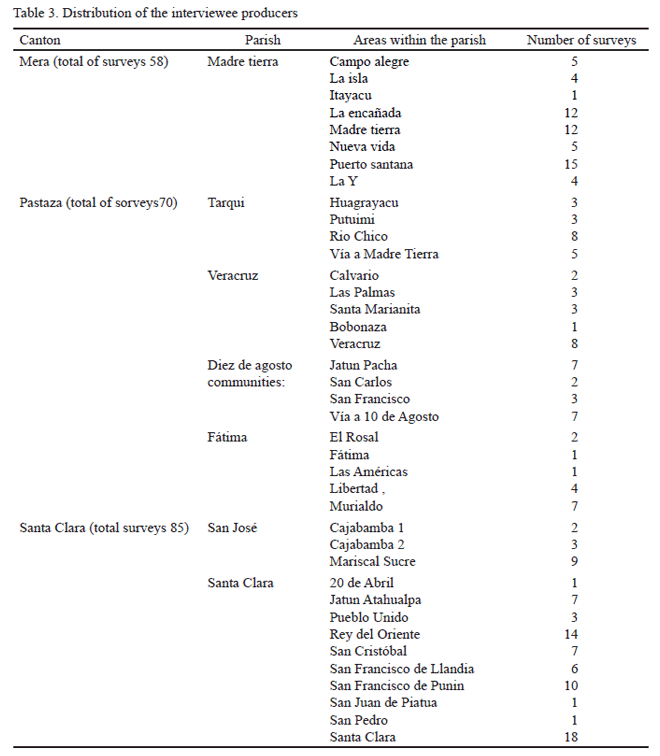
<p align="justify"><font size="2" face="Verdana, Arial, Helvetica, sans-serif">A survey was applied to  identify the socioeconomic, productive, edaphoclimatic and descriptive  characteristics of plant species (Mott 1979).After having designed it; it was  previously validated by 40 producers, to identify if it was understandable and  it was also checked, by experts. The treated aspects are detailed in <a href="/img/revistas/cjas/v49n3/t0217315.gif">table  2</a>. The survey was applied to123 producers (<a href="/img/revistas/cjas/v49n3/t0317315.gif">table 3</a>).</font></p>     
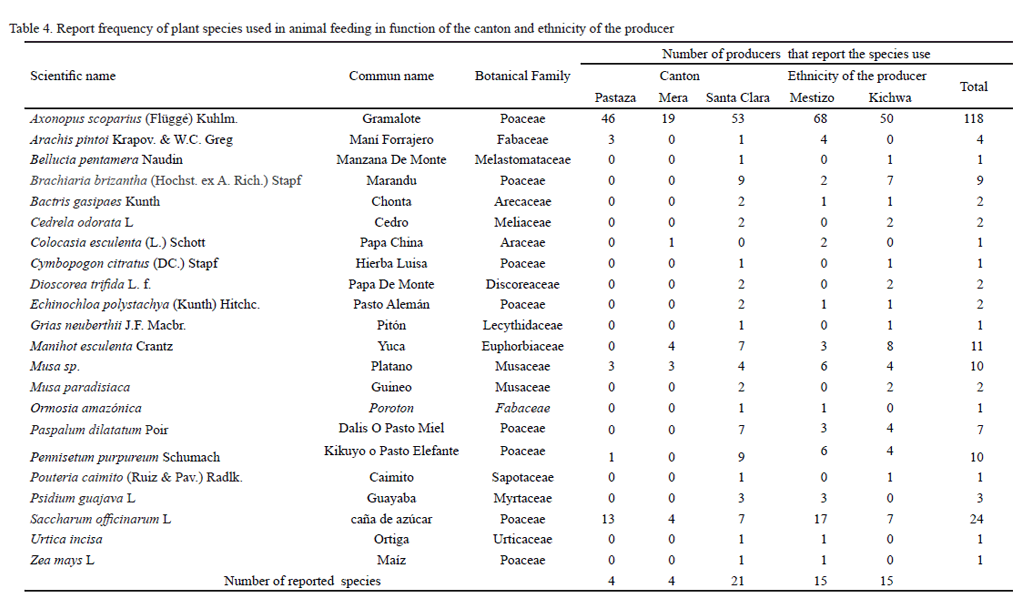
<p align="justify"><font size="2" face="Verdana, Arial, Helvetica, sans-serif">The farms geographical location  was registered with GPS. The specimens were photographed and plant samples were  collected with aerial mower and pruning shear. Then there were transported to  the Amazon State University herbarium to identify those of uncertain  classification. It was turn for it to illustrations found in the specialized  bibliography .From the photographs and graphics checking comparisons that  allowed the classification were established (Gentry 1996 and Burnieo 2006).It  was also appealed to look out the database of the Missouri Botanical Garden  portal (www.tropicos.org). </font></p>     <p align="justify"><font size="2" face="Verdana, Arial, Helvetica, sans-serif">The processed data were  analyzed with the INFOSTAT (2009) program by means of contingency tables in  which the X<sup>2</sup> statistical was applied in the use frequency informed  by species, animal feeding vs canton, species used in animal feeding vs  producer type, species vs years of experience of the producer, species vs  producer dedication, species vs type of farms, and animal production species vs  use types. In the components which analysis showed significance differences in  its chi square coefficient, the proportions analysis was carried out. Duncan  multiple comparison test was applied (Garc&iacute;a <em>et al.</em> 2001) by means of  Excel COMPAPRO application, with the objective of determining the species that  showed higher differences in their use report. These frequency reports allowed,  in turn, to compare the proportion level that were of interest for each  categorical descriptive variable.</font></p>     <p align="justify">&nbsp;</p>     <p align="justify"><strong><font size="3" face="Verdana, Arial, Helvetica, sans-serif">RESULTS AND DISCUSSION</font></strong></p>     <p align="justify"><font size="2" face="Verdana, Arial, Helvetica, sans-serif">Of the seven nationalities that reside in Pastaza  province, only Kichwa was identified, besides mestizo producers. In the area a  total of 22 plant species are uses in animal feeding (<a href="/img/revistas/cjas/v49n3/t0417315.gif">table 4</a>), belonging to 13  botanical families. The proportions analysis showed significant differences in  the P value, regarding to the frequency of use report by the producers and its  comparison with the components of each canton&nbsp;&nbsp;  (Pastaza, Mera, Santa Clara), ethnicity of the producer (mestizo or of  Kichwa nationality), main economical activity (<a href="/img/revistas/cjas/v49n3/t0517315.gif">table 5</a>) and species used in  animal feeding vs other use types informed for the specie (animal medicine,  human medicine, animal feeding and constructions materials), (<a href="/img/revistas/cjas/v49n3/t0617315.gif">table 6</a>).  Significances differences were not informed in P value in the analysis of  species used in animal feeding vs years of experiences. For it was categorized  in experience of a year or less, from two at five years, from six at ten, from  11 at 20, and more than 20. Neither there were differences in the analysis of  species used in animal feeding vs type of farm production (<a href="/img/revistas/cjas/v49n3/t0617315.gif">table 6</a>) categorized  in culture, animal production, culture plus animal production, wooden  exploitation and culture plus wood.</font></p>     
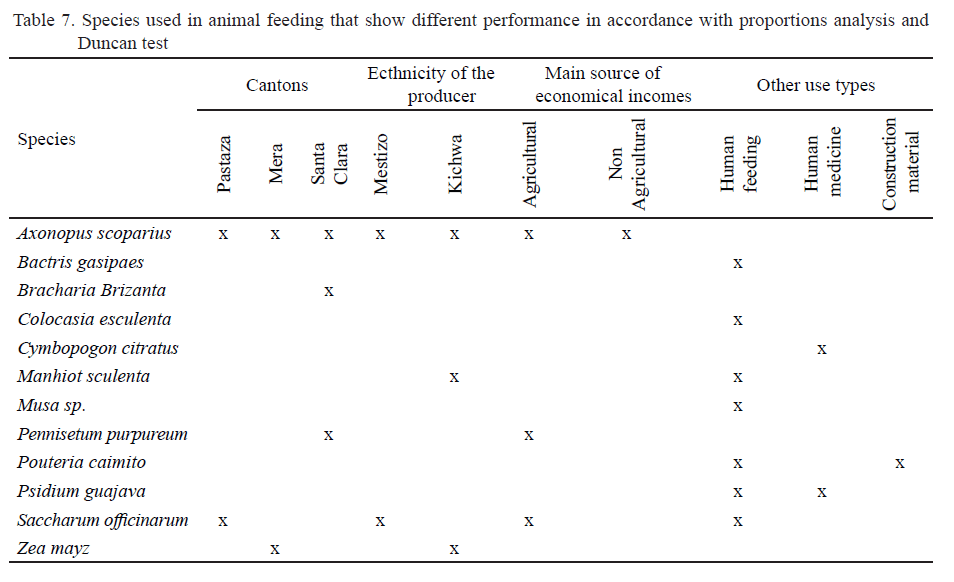
<p align="justify"><font size="2" face="Verdana, Arial, Helvetica, sans-serif">The analysis carried out in  the frequencies of use report of species used in animal feeding vs canton  component shows significant differences. Santa Clara reported higher number of  species, with high value to other cantons. The&nbsp; <em>Axonopus scoparius</em> and <em>Saccharum officinarum</em> L species  prevailed. There were also informed significant differences in relation with  the species used in animal feeding vs ethnicity of the producer. Both groups,  mestizo and&nbsp; Kichwa, showed same number  of reported species, but the plants used in each ethnic group were different.  There were stood out in the mentioned components introduced plants, mainly from  the Poaceae family. When having cantons with several edaphoclimatic  characteristics, and producers with different socio-economical characteristics,  differences in the species used in each component are generated. This was also  reported when analyzing the used species vs the main source of economic incomes  between producers, which main income was the farming activity, and those that  have other types of economical incomes. Turner <em>et al.</em> (2011) stated that  the use of species in different ecosystems differs according to the lifestyle  and climatic areas. </font></p>     <p align="justify"><font size="2" face="Verdana, Arial, Helvetica, sans-serif">The species used in animal  feeding that showed different performance are shown in <a href="/img/revistas/cjas/v49n3/t0717315.gif">table 7</a>, as for their  report frequency when being applied the Duncan test in the components that  showed significant differences in the proportions analysis. The <em>Axonopus  scoparius</em> species shows differences in higher number of analysis. In the  canton, ethnicity of the producer and main source of economical incomes  components, the most of used species belonging to Poaceae family were of common  use in animal feeding. The component other use types showed, in their majority,  species from botanical families different to Poaceae. Among them, <em>Bactris  gasipaes</em>, <em>Colocasia esculenta</em>, <em>Manhiot sculenta</em>, <em>Musa sp</em>., <em>Pouteria caimito</em>, <em>Psidium guajava</em> and <em>Saccharum officinarum</em>,  which mainly use&nbsp; is animal feeding,  showing that its&nbsp; use as animal food is a  residual value regarding to other functions that it can have. </font></p>     
<p align="justify"><font size="2" face="Verdana, Arial, Helvetica, sans-serif">The area did not show great  diversity of plants used for animal feeding, there were only verified 22 species.  This is more significant if it is compared with the number that is used at  national level, which is of 1987, for vertebrates animal feeding (De la Torre  and Macia 2008).The materials with higher report number corresponded to  introduced species: <em>Axonopus scoparius</em>, with 118 presences, located in  35 areas within the parish, and <em>Pennisetum purpureum</em> with 10, located in  six areas within the parish. These species were reported as animal food by R&iacute;os <em>et al.</em> (2007).In the remainders, animal feeding was secondary. The  mentioned author also informed <em>Bellucia pentamera</em>, <em>Cedrela odorata</em> and <em>Grias neuberthii</em>. The <em>Pouteria caimito</em>, <em>Bactris maraja</em>, <em>Psidium guajava</em>, <em>Musa paradisiaca</em>, <em>Cymbopogon citratus</em>, <em>Zea  maiz</em>, <em>Colocasia esculenta</em>, <em>Musa sp</em>. and <em>Manhiot esculenta</em> species were reported with other uses. In Paoletti (2005) reports other species  used in animal feeding are referred: <em>Axonopus scoparius</em>, <em>Bactris  gasipaes</em>, <em>Citrus maxima</em> <em>Musa sp</em>., <em>Pouteria caimito</em>, <em>Psidium  guajava</em>, <em>Saccharum officinarum</em> L. and <em>Zea mayz</em>, while <em>Bracharia  brizanta</em> was reported by Rojas <em>et al.</em> (2011).It is neccessary to  highlihgt that <em>Grias neuberthii</em>, <em>Bactris gasipaes</em>, <em>Cedrela  odorata</em>, <em>Dioscorea trifida</em> and <em>Bellucia pentamera</em> were  uncultivated species, finding them in their natural environment. </font></p>     ]]></body>
<body><![CDATA[<p align="justify"><font size="2" face="Verdana, Arial, Helvetica, sans-serif">The identified species were  also reported in other studies in South America: <em>Bactris gasipaes</em> (Clement 1999), <em>Colocasia sculenta</em> (Rodr&iacute;guez <em>et al.</em>2011), <em>Cymbopogon  citratus</em> (R&iacute;os 2010), <em>Manhiot esculenta</em>, <em>Pouteria caimito</em>, <em>Psidium  guajava</em> and <em>Zea mayz</em> (Clement 1999).In Ecuador, (R&iacute;os <em>et al.</em> 2007) reported <em>Axonopus scoparius</em> Kuhlm, <em>Bactris gasipaes</em>, <em>Citrus  maxima</em>, <em>Manhiot esculenta</em>, <em>Pouteria caimito</em> and <em>Zea mayz</em> species .Also R&iacute;os <em>et al.</em> (2007) and Patzel (2012) concided in informing  the <em>Colocasia sculenta</em>, <em>Cymbopogon citratus</em> and <em>Musa sp.</em> species. The <em>Saccharum officinarum</em> L.specie showed their cosmopolite  character because of their wide distribution range, it was found by R&iacute;os <em>et  al.</em> (2007) and Patzel (2012). </font></p>     <p align="justify"><font size="2" face="Verdana, Arial, Helvetica, sans-serif">It is concluded that the  areas corresponding to Mera and Pastaza cantons there were not show a wide  diversity of species used in animal feeding. The most reported were introduced  species, mainly from the Poaceas family, and it was recurrent the use of  introduced grass (<em>Axonopus scoparius</em>).The contingency analysis for the  different components showed differences in the use reports, in function of  canton, ethnicity of the producer, main source of economical incomes and others  use types components, at the same time there were not showed significance differences,  as for years of experiences and type of farm production. This shows that the  species use is, mainly, by the sector geographical conditions and by the  producer cultural characteristics. Also the statistical analysis, when  comparing the reported species with others uses types, showed that for <em>Bactris  gasipaes</em>, <em>Colocasia esculenta</em>, <em>Cymbopogon citratus</em>, <em>Manhiot  sculenta</em>, <em>Musa sp</em>. <em>Pouteria caimito</em>, <em>Psidium guajava</em> species, animal feeding is a secondary application. </font></p>     <p align="justify"><font size="2" face="Verdana, Arial, Helvetica, sans-serif">&nbsp;In&nbsp; <em>Grias neuberthii</em>, <em>Bactris gasipaes</em>, <em>Cedrela odorata</em>, <em>Dioscorea trifida</em> and <em>Bellucia pentamera</em> species, animal feeding is an alternative use, being these in their majority  trees and shrubs that are mostly in their natural environment, but that they  have also been tamed when using them as cultivation dedicated to human  feeding.&nbsp; </font></p>     <p align="justify">&nbsp;</p>     <p align="justify"><font size="3" face="Verdana, Arial, Helvetica, sans-serif"><strong>REFERENCES</strong></font></p>     <!-- ref --><p align="justify"><font size="2" face="Verdana, Arial, Helvetica, sans-serif">Burnieo, G. 2006. <em>Bot&aacute;nica. Gu&iacute;a ilustrada de  plantas: m&aacute;s de 10.000 especies de la A a la Z y c&oacute;mo cultivarlas</em>. 1st ed., Koneman, Barcelona: Gordon Cheers, S.L., 1021 p.    </font></p>     <p align="justify"><font size="2" face="Verdana, Arial, Helvetica, sans-serif">Clement, C. 1999. &lsquo;&lsquo;1492 and  the Loss of Amazonian Crop Genetic Resources. II&rsquo;&rsquo;. <em>Crop Biogeography at Contact. Economic Botany</em>,  53: 203.</font></p>     <!-- ref --><p align="justify"><font size="2" face="Verdana, Arial, Helvetica, sans-serif">De la Torre, L. &amp; Marcia, J. 2008. <em>La  etnobot&aacute;nica en el Ecuador Enciclopedia de las plantas &uacute;tiles del Ecuador</em>.  1st ed.    </font></p>     ]]></body>
<body><![CDATA[<!-- ref --><p align="justify"><font size="2" face="Verdana, Arial, Helvetica, sans-serif">De la Torre, L., Navarrete, H., Muriel, P., Mac&iacute;a, J.,  Balslev, H., Quito &amp; Aarthusn.d. Quito, Ecuador, 13 p.    </font></p>     <!-- ref --><p align="justify"><font size="2" face="Verdana, Arial, Helvetica, sans-serif">D&iacute;az de Rada, I. 2010. <em>Opiniones y actitudes.  Comparaci&oacute;n entre los resultados proporcionados por encuestas telef&oacute;nicas y  personales</em>. , Available: &lt;<a href="http//libreria.cis.es/static/pdf/OyA66a.pdf" target="_blank">http//libreria.cis.es/static/pdf/OyA66a.pdf</a>.&gt;,  [Consulted:&nbsp;July 1, 2014].    </font></p>     <p align="justify"><font size="2" face="Verdana, Arial, Helvetica, sans-serif">Direcci&oacute;n de Aviaci&oacute;n Civil. 2012. <em>Datos  meteorol&oacute;gicos. Aeropuerto R&iacute;o Amazonas</em>. Direcci&oacute;n de Aviaci&oacute;n Civil.</font></p>     <p align="justify"><font size="2" face="Verdana, Arial, Helvetica, sans-serif">Ecuador, Instituto Nacional De Meteorolog&iacute;a E  Hidrolog&iacute;a. 2014. <em>Anuario meteorol&oacute;gico. No 51-2011</em>. , Available:  &lt;<a href="http:// www. serviciometeorologico.gob.ec/wp-content/uploads/anuarios/meteorologicos/Am%202011.pdf" target="_blank">http:// www.  serviciometeorologico.gob.ec/wp-content/uploads/anuarios/meteorologicos/Am%202011.pdf</a>&gt;,  [Consulted:&nbsp;December 30, 2014].</font></p>     <p align="justify"><font size="2" face="Verdana, Arial, Helvetica, sans-serif">Garc&iacute;a Villalpando, J. A., Castillo Morales, A.,  Ram&iacute;rez Guzm&aacute;n, M. E., Rend&oacute;n S&aacute;nchez, G. &amp; Larque Saavedra, M. . 2001.  &lsquo;&lsquo;Comparaci&oacute;n de los procedimientos de Tukey, Duncan, Dunnett, Hsu y Bechhofer  para selecci&oacute;n de medias&rsquo;&rsquo;. <em>Agrociencia</em>, 35: 79.</font></p>     <!-- ref --><p align="justify"><font size="2" face="Verdana, Arial, Helvetica, sans-serif">Gentry, A. 1996. <em>A Field  Guide to the Families and Genera of Woody Plants of Northwest South America:  (Colombia, Ecuador, Peru) With Supplementary Notes on Herbaceous</em>. 1st ed.,  Chicago, Estados Unidos: Taxa. Chicago: University of Chicago Press, 791 p.    </font></p>     <p align="justify"><font size="2" face="Verdana, Arial, Helvetica, sans-serif">Gobierno Aut&oacute;nomo Descentralizado Provincial De  Pastaza. 2011. <em>Plan de ordenamiento de desarrollo estructural y territorial  de la provincia de Pastaza, Mapa de s&iacute;ntesis de la estructura territorial:  cultura</em>. , Available: &lt;<a href="http://www.pastaza.gob.ec/ mapas/25_nacionalidades_indigenasjpg/download" target="_blank">http://www.pastaza.gob.ec/  mapas/25_nacionalidades_indigenasjpg/download</a>&gt;, [Consulted:&nbsp;July 1,  2014].</font></p>     ]]></body>
<body><![CDATA[<p align="justify"><font size="2" face="Verdana, Arial, Helvetica, sans-serif">Gobierno Aut&oacute;nomo Provincial De Pastaza. 2014. <em>Santa Clara</em>. , Available:  &lt;<a href="http://www.pastaza.gob.ec/pastaza/santa-clara" target="_blank">http://www.pastaza.gob.ec/pastaza/santa-clara</a>&gt;, [Consulted:&nbsp;July 1,  2014].</font></p>     <!-- ref --><p align="justify"><font size="2" face="Verdana, Arial, Helvetica, sans-serif">INFOSTAT 2009. <em>Grupo InfoStat, FCA</em>. version 1, Universidad Nacional de  C&oacute;rdova, Argentina.    </font></p>     <!-- ref --><p align="justify"><font size="2" face="Verdana, Arial, Helvetica, sans-serif">Mott, G. 1979. <em>Collection,  Preservation and Characterization of Tropical Forage Germplasm Resources</em>.  Cali: CIAT, 65 p.    </font></p>     <!-- ref --><p align="justify"><font size="2" face="Verdana, Arial, Helvetica, sans-serif">Paoletti, M. 2005. <em>Ecological  Implications of Minilivestock: Potential of Insects, Rodents, Frogs and Snails</em>.  Ithaca, New York, United States: Science Publishers.    </font></p>     <!-- ref --><p align="justify"><font size="2" face="Verdana, Arial, Helvetica, sans-serif">Patzel, E. 2012. <em>Flora del  Ecuador</em>. 6th ed.,  Quito, Ecuador: Imprefe, 238 p.    </font></p>     <p align="justify"><font size="2" face="Verdana, Arial, Helvetica, sans-serif">R&iacute;os, E. 2010. &lsquo;&lsquo;Evaluation of  the essential oil and study of cold conservation of Cymbopogon citratus&rsquo;&rsquo;. <em>Revista de Investigaciones  Universidad de Quindio,</em> 20: 24.</font></p>     ]]></body>
<body><![CDATA[<!-- ref --><p align="justify"><font size="2" face="Verdana, Arial, Helvetica, sans-serif">R&iacute;os, M., Koisoil, M., Borgtoft, H. &amp; Granda, G.  2007. <em>Plantas &uacute;tiles del Ecuador: Aplicaciones, retos y perspectivas</em>.  Quito, Ecuador: Abya Yala, 652 p.    </font></p>     <p align="justify"><font size="2" face="Verdana, Arial, Helvetica, sans-serif">Rodr&iacute;guez, J., Rivadeneira, J., Ram&iacute;rez, E. D.,  Juares, J. M., Herrera, E. &amp; Herrera, R. 2011. &lsquo;&lsquo;Caracterizaci&oacute;n  fisicoqu&iacute;mica, funcional y contenido fen&oacute;lico de harina de malanga (Colocasia  esculenta), cultivada en la regi&oacute;n de Tuxtepec&rsquo;&rsquo;. <em>Ciencia y Mar</em>, 15: 37.</font></p>     <p align="justify"><font size="2" face="Verdana, Arial, Helvetica, sans-serif">Rojas, S., Olivarez, J., Jim&eacute;nez, R., Guti&eacute;rrez, J.  &amp; Avil&eacute;s-Nova, F. 2011. &lsquo;&lsquo;Producci&oacute;n de materia seca y componentes&rsquo;&rsquo;. <em>Avances  en Investigaci&oacute;n Agropecuaria</em>, 15: 3.</font></p>     <!-- ref --><p align="justify"><font size="2" face="Verdana, Arial, Helvetica, sans-serif">Sabo, R. &amp; Boone, E. 2013. <em>Statistical Research Methods</em>. , Available: &lt;<a href="http: //link.springer.com/content/pdf/bfm%3A978-1- 4614-8708-1%2F1.pdf" target="_blank">http:  //link.springer.com/content/pdf/bfm%3A978-1- 4614-8708-1%2F1.pdf</a>.    &gt;.</font></p>     <p align="justify"><font size="2" face="Verdana, Arial, Helvetica, sans-serif">Sociedad Ecuatoriana del Suelo 1986. <em>Mapa de suelos  del Ecuador, Quito</em>. Instituto Geogr&aacute;fico Militar.</font></p>     <!-- ref --><p align="justify"><font size="2" face="Verdana, Arial, Helvetica, sans-serif">TROPICOS.n.d. <em>Missouri Botanical Garden</em>. ,  Available: &lt;<a href="http://www.tropicos.org" target="_blank">http://www.tropicos.org</a>&gt;    .</font></p>     <!-- ref --><p align="justify"><font size="2" face="Verdana, Arial, Helvetica, sans-serif">Turner, N., Jacub, L.,  Migliorini, P., Pieroni, A., Drean, A. &amp; Sacheti, L. 2011. <em>Edible and  Tended Wild Plants, Traditional Ecological</em>. Critical Reviews and Plant  Sciences, Available: &lt;<a href="http://www.etnobotanica.de/Turner%20at%20 al.,%202011.pdf" target="_blank">http://www.etnobotanica.de/Turner%20at%20  al.,%202011.pdf</a>.&gt;, [Consulted:&nbsp;July 1, 2014].    </font></p>     <!-- ref --><p align="justify"><font size="2" face="Verdana, Arial, Helvetica, sans-serif">United States. Departament of Agriculture 2010. <em>Keys to Soil Taxonomy</em>.  11th ed., Available: &lt;<a href="http://www.nrcs.usda. gov/Internet/FSE_DOCUMENTS/nrcs142p2_050915.pdf" target="_blank">http://www.nrcs.usda.  gov/Internet/FSE_DOCUMENTS/nrcs142p2_050915.pdf</a>&gt;, [Consulted:&nbsp;April 6,  2015].    </font></p>     <p align="justify">&nbsp;</p>     <p align="justify">&nbsp;</p>     <p align="justify"><font size="2" face="Verdana, Arial, Helvetica, sans-serif">Received: April 23, 2014    <br> Accepted: July 28, 2015</font></p>     <p align="justify">&nbsp;</p>     <p align="justify">&nbsp;</p>     <p align="justify"><font size="2" face="Verdana, Arial, Helvetica, sans-serif"><i>R.V. Abril,</i> Docente Universidad Estatal Amazónica Ecuador, Departamento de Ciencias de Vida, km 2 ½ Vía a Napo Puyo, Ecuador .    Email: <a href="mailto:rvabril@uea.edu.ec">rvabril@uea.edu.ec</a></font></p>     ]]></body>
<body><![CDATA[ ]]></body><back>
<ref-list>
<ref id="B1">
<nlm-citation citation-type="book">
<person-group person-group-type="author">
<name>
<surname><![CDATA[Burnieo]]></surname>
<given-names><![CDATA[G.]]></given-names>
</name>
</person-group>
<source><![CDATA[Botánica. Guía ilustrada de plantas: más de 10.000 especies de la A a la Z y cómo cultivarlas]]></source>
<year>2006</year>
<edition>1st</edition>
<page-range>1021</page-range><publisher-loc><![CDATA[Koneman, Barcelona ]]></publisher-loc>
<publisher-name><![CDATA[Gordon Cheers, S.L.]]></publisher-name>
</nlm-citation>
</ref>
<ref id="B2">
<nlm-citation citation-type="journal">
<person-group person-group-type="author">
<name>
<surname><![CDATA[Clement]]></surname>
<given-names><![CDATA[C.]]></given-names>
</name>
</person-group>
<article-title xml:lang="nd"><![CDATA[1492 and the Loss of Amazonian Crop Genetic Resources. II]]></article-title>
<source><![CDATA[Crop Biogeography at Contact. Economic Botany]]></source>
<year>1999</year>
<volume>53</volume>
<page-range>203</page-range></nlm-citation>
</ref>
<ref id="B3">
<nlm-citation citation-type="">
<person-group person-group-type="author">
<name>
<surname><![CDATA[De la Torre]]></surname>
<given-names><![CDATA[L.]]></given-names>
</name>
<name>
<surname><![CDATA[Marcia]]></surname>
<given-names><![CDATA[J.]]></given-names>
</name>
</person-group>
<source><![CDATA[La etnobotánica en el Ecuador Enciclopedia de las plantas útiles del Ecuador]]></source>
<year>2008</year>
<edition>1st</edition>
</nlm-citation>
</ref>
<ref id="B4">
<nlm-citation citation-type="">
<person-group person-group-type="author">
<name>
<surname><![CDATA[De la Torre]]></surname>
<given-names><![CDATA[L.]]></given-names>
</name>
<name>
<surname><![CDATA[Navarrete]]></surname>
<given-names><![CDATA[H.]]></given-names>
</name>
<name>
<surname><![CDATA[Muriel]]></surname>
<given-names><![CDATA[P.]]></given-names>
</name>
<name>
<surname><![CDATA[Macía]]></surname>
<given-names><![CDATA[J.]]></given-names>
</name>
<name>
<surname><![CDATA[Balslev]]></surname>
<given-names><![CDATA[H.]]></given-names>
</name>
</person-group>
<source><![CDATA[]]></source>
<year></year>
<page-range>13</page-range><publisher-loc><![CDATA[Quito, Ecuador ]]></publisher-loc>
</nlm-citation>
</ref>
<ref id="B5">
<nlm-citation citation-type="">
<person-group person-group-type="author">
<name>
<surname><![CDATA[Díaz de Rada]]></surname>
<given-names><![CDATA[I.]]></given-names>
</name>
</person-group>
<source><![CDATA[Opiniones y actitudes. Comparación entre los resultados proporcionados por encuestas telefónicas y personales]]></source>
<year>2010</year>
</nlm-citation>
</ref>
<ref id="B6">
<nlm-citation citation-type="journal">
<person-group person-group-type="author">
<name>
<surname><![CDATA[García Villalpando]]></surname>
<given-names><![CDATA[J. A.]]></given-names>
</name>
<name>
<surname><![CDATA[Castillo Morales]]></surname>
<given-names><![CDATA[A.]]></given-names>
</name>
<name>
<surname><![CDATA[Ramírez Guzmán]]></surname>
<given-names><![CDATA[M. E.]]></given-names>
</name>
<name>
<surname><![CDATA[Rendón Sánchez]]></surname>
<given-names><![CDATA[G.]]></given-names>
</name>
<name>
<surname><![CDATA[Larque Saavedra]]></surname>
<given-names><![CDATA[M. .]]></given-names>
</name>
</person-group>
<article-title xml:lang="nd"><![CDATA[Comparación de los procedimientos de Tukey, Duncan, Dunnett, Hsu y Bechhofer para selección de medias]]></article-title>
<source><![CDATA[Agrociencia]]></source>
<year>2001</year>
<volume>35</volume>
<page-range>79</page-range></nlm-citation>
</ref>
<ref id="B7">
<nlm-citation citation-type="book">
<person-group person-group-type="author">
<name>
<surname><![CDATA[Gentry]]></surname>
<given-names><![CDATA[A.]]></given-names>
</name>
</person-group>
<source><![CDATA[A Field Guide to the Families and Genera of Woody Plants of Northwest South America: (Colombia, Ecuador, Peru) With Supplementary Notes on Herbaceous]]></source>
<year>1996</year>
<edition>1st</edition>
<page-range>791</page-range><publisher-loc><![CDATA[Chicago, Estados Unidos ]]></publisher-loc>
<publisher-name><![CDATA[Taxa. Chicago: University of Chicago Press]]></publisher-name>
</nlm-citation>
</ref>
<ref id="B8">
<nlm-citation citation-type="">
<person-group person-group-type="author">
<name>
<surname><![CDATA[INFOSTAT]]></surname>
</name>
</person-group>
<source><![CDATA[Grupo InfoStat, FCA]]></source>
<year>2009</year>
<publisher-loc><![CDATA[Universidad Nacional de Córdova, Argentina ]]></publisher-loc>
</nlm-citation>
</ref>
<ref id="B9">
<nlm-citation citation-type="book">
<person-group person-group-type="author">
<name>
<surname><![CDATA[Mott]]></surname>
<given-names><![CDATA[G.]]></given-names>
</name>
</person-group>
<source><![CDATA[Collection, Preservation and Characterization of Tropical Forage Germplasm Resources]]></source>
<year>1979</year>
<page-range>65</page-range><publisher-name><![CDATA[Cali: CIAT]]></publisher-name>
</nlm-citation>
</ref>
<ref id="B10">
<nlm-citation citation-type="book">
<person-group person-group-type="author">
<name>
<surname><![CDATA[Paoletti]]></surname>
<given-names><![CDATA[M.]]></given-names>
</name>
</person-group>
<source><![CDATA[Ecological Implications of Minilivestock: Potential of Insects, Rodents, Frogs and Snails]]></source>
<year>2005</year>
<publisher-loc><![CDATA[Ithaca, New York, United States ]]></publisher-loc>
<publisher-name><![CDATA[Science Publishers]]></publisher-name>
</nlm-citation>
</ref>
<ref id="B11">
<nlm-citation citation-type="book">
<person-group person-group-type="author">
<name>
<surname><![CDATA[Patzel]]></surname>
<given-names><![CDATA[E.]]></given-names>
</name>
</person-group>
<source><![CDATA[Flora del Ecuador]]></source>
<year>2012</year>
<edition>6th</edition>
<page-range>238</page-range><publisher-loc><![CDATA[Quito, Ecuador ]]></publisher-loc>
<publisher-name><![CDATA[Imprefe]]></publisher-name>
</nlm-citation>
</ref>
<ref id="B12">
<nlm-citation citation-type="journal">
<person-group person-group-type="author">
<name>
<surname><![CDATA[Ríos]]></surname>
<given-names><![CDATA[E.]]></given-names>
</name>
</person-group>
<article-title xml:lang="nd"><![CDATA[Evaluation of the essential oil and study of cold conservation of Cymbopogon citratus]]></article-title>
<source><![CDATA[Revista de Investigaciones Universidad de Quindio,]]></source>
<year>2010</year>
<volume>20</volume>
<page-range>24</page-range></nlm-citation>
</ref>
<ref id="B13">
<nlm-citation citation-type="book">
<person-group person-group-type="author">
<name>
<surname><![CDATA[Ríos]]></surname>
<given-names><![CDATA[M.]]></given-names>
</name>
<name>
<surname><![CDATA[Koisoil]]></surname>
<given-names><![CDATA[M.]]></given-names>
</name>
<name>
<surname><![CDATA[Borgtoft]]></surname>
<given-names><![CDATA[H.]]></given-names>
</name>
<name>
<surname><![CDATA[Granda]]></surname>
<given-names><![CDATA[G.]]></given-names>
</name>
</person-group>
<source><![CDATA[Plantas útiles del Ecuador: Aplicaciones, retos y perspectivas]]></source>
<year>2007</year>
<page-range>652</page-range><publisher-loc><![CDATA[Quito, Ecuador ]]></publisher-loc>
<publisher-name><![CDATA[Abya Yala]]></publisher-name>
</nlm-citation>
</ref>
<ref id="B14">
<nlm-citation citation-type="journal">
<person-group person-group-type="author">
<name>
<surname><![CDATA[Rodríguez]]></surname>
<given-names><![CDATA[J.]]></given-names>
</name>
<name>
<surname><![CDATA[Rivadeneira]]></surname>
<given-names><![CDATA[J.]]></given-names>
</name>
<name>
<surname><![CDATA[Ramírez]]></surname>
<given-names><![CDATA[E. D.]]></given-names>
</name>
<name>
<surname><![CDATA[Juares]]></surname>
<given-names><![CDATA[J. M.]]></given-names>
</name>
<name>
<surname><![CDATA[Herrera]]></surname>
<given-names><![CDATA[E.]]></given-names>
</name>
<name>
<surname><![CDATA[Herrera]]></surname>
<given-names><![CDATA[R.]]></given-names>
</name>
</person-group>
<article-title xml:lang="nd"><![CDATA[Caracterización fisicoquímica, funcional y contenido fenólico de harina de malanga (Colocasia esculenta), cultivada en la región de Tuxtepec]]></article-title>
<source><![CDATA[Ciencia y Mar]]></source>
<year>2011</year>
<volume>15</volume>
<page-range>37</page-range></nlm-citation>
</ref>
<ref id="B15">
<nlm-citation citation-type="journal">
<person-group person-group-type="author">
<name>
<surname><![CDATA[Rojas]]></surname>
<given-names><![CDATA[S.]]></given-names>
</name>
<name>
<surname><![CDATA[Olivarez]]></surname>
<given-names><![CDATA[J.]]></given-names>
</name>
<name>
<surname><![CDATA[Jiménez]]></surname>
<given-names><![CDATA[R.]]></given-names>
</name>
<name>
<surname><![CDATA[Gutiérrez]]></surname>
<given-names><![CDATA[J.]]></given-names>
</name>
<name>
<surname><![CDATA[Avilés-Nova]]></surname>
<given-names><![CDATA[F.]]></given-names>
</name>
</person-group>
<article-title xml:lang="nd"><![CDATA[Producción de materia seca y componentes]]></article-title>
<source><![CDATA[Avances en Investigación Agropecuaria]]></source>
<year>2011</year>
<volume>15</volume>
<page-range>3</page-range></nlm-citation>
</ref>
<ref id="B16">
<nlm-citation citation-type="">
<person-group person-group-type="author">
<name>
<surname><![CDATA[Sabo]]></surname>
<given-names><![CDATA[R.]]></given-names>
</name>
<name>
<surname><![CDATA[Boone]]></surname>
<given-names><![CDATA[E.]]></given-names>
</name>
</person-group>
<source><![CDATA[Statistical Research Methods]]></source>
<year>2013</year>
</nlm-citation>
</ref>
<ref id="B17">
<nlm-citation citation-type="">
<person-group person-group-type="author">
<name>
<surname><![CDATA[TROPICOS]]></surname>
</name>
</person-group>
<source><![CDATA[Missouri Botanical Garden]]></source>
<year></year>
</nlm-citation>
</ref>
<ref id="B18">
<nlm-citation citation-type="">
<person-group person-group-type="author">
<name>
<surname><![CDATA[Turner]]></surname>
<given-names><![CDATA[N.]]></given-names>
</name>
<name>
<surname><![CDATA[Jacub]]></surname>
<given-names><![CDATA[L.]]></given-names>
</name>
<name>
<surname><![CDATA[Migliorini]]></surname>
<given-names><![CDATA[P.]]></given-names>
</name>
<name>
<surname><![CDATA[Pieroni]]></surname>
<given-names><![CDATA[A.]]></given-names>
</name>
<name>
<surname><![CDATA[Drean]]></surname>
<given-names><![CDATA[A.]]></given-names>
</name>
<name>
<surname><![CDATA[Sacheti]]></surname>
<given-names><![CDATA[L.]]></given-names>
</name>
</person-group>
<source><![CDATA[Edible and Tended Wild Plants, Traditional Ecological]]></source>
<year>2011</year>
</nlm-citation>
</ref>
<ref id="B19">
<nlm-citation citation-type="">
<person-group person-group-type="author">
<name>
<surname><![CDATA[United States. Departament of Agriculture]]></surname>
</name>
</person-group>
<source><![CDATA[Keys to Soil Taxonomy]]></source>
<year>2010</year>
<edition>11th</edition>
</nlm-citation>
</ref>
<ref id="B20">
<nlm-citation citation-type="">
<source><![CDATA[Datos meteorológicos. Aeropuerto Río Amazonas]]></source>
<year>2012</year>
</nlm-citation>
</ref>
<ref id="B21">
<nlm-citation citation-type="">
<source><![CDATA[Anuario meteorológico. No 51-2011]]></source>
<year>2014</year>
</nlm-citation>
</ref>
<ref id="B22">
<nlm-citation citation-type="">
<source><![CDATA[Plan de ordenamiento de desarrollo estructural y territorial de la provincia de Pastaza, Mapa de síntesis de la estructura territorial: cultura]]></source>
<year>2011</year>
</nlm-citation>
</ref>
<ref id="B23">
<nlm-citation citation-type="">
<source><![CDATA[Santa Clara]]></source>
<year>2014</year>
</nlm-citation>
</ref>
<ref id="B24">
<nlm-citation citation-type="book">
<source><![CDATA[Mapa de suelos del Ecuador, Quito]]></source>
<year>1986</year>
<publisher-name><![CDATA[Instituto Geográfico Militar]]></publisher-name>
</nlm-citation>
</ref>
</ref-list>
</back>
</article>