<?xml version="1.0" encoding="ISO-8859-1"?><article xmlns:mml="http://www.w3.org/1998/Math/MathML" xmlns:xlink="http://www.w3.org/1999/xlink" xmlns:xsi="http://www.w3.org/2001/XMLSchema-instance">
<front>
<journal-meta>
<journal-id>2079-3480</journal-id>
<journal-title><![CDATA[Cuban Journal of Agricultural Science]]></journal-title>
<abbrev-journal-title><![CDATA[Cuban J. Agric. Sci.]]></abbrev-journal-title>
<issn>2079-3480</issn>
<publisher>
<publisher-name><![CDATA[Editorial del Instituto de Ciencia Animal]]></publisher-name>
</publisher>
</journal-meta>
<article-meta>
<article-id>S2079-34802015000400007</article-id>
<title-group>
<article-title xml:lang="en"><![CDATA[Optimization of an immunoenzymatic (ELISA) assay for detecting ovine antibodies against Haemonchus contortus]]></article-title>
<article-title xml:lang="es"><![CDATA[Optimización de un ensayo inmunoenzimático (ELISA) para detectar anticuerpos de ovinos contra Haemonchus contortus]]></article-title>
</title-group>
<contrib-group>
<contrib contrib-type="author">
<name>
<surname><![CDATA[Díaz]]></surname>
<given-names><![CDATA[A]]></given-names>
</name>
<xref ref-type="aff" rid="A01"/>
</contrib>
<contrib contrib-type="author">
<name>
<surname><![CDATA[Arenal]]></surname>
<given-names><![CDATA[A]]></given-names>
</name>
<xref ref-type="aff" rid="A01"/>
</contrib>
<contrib contrib-type="author">
<name>
<surname><![CDATA[França]]></surname>
<given-names><![CDATA[Jessea]]></given-names>
</name>
<xref ref-type="aff" rid="A02"/>
</contrib>
<contrib contrib-type="author">
<name>
<surname><![CDATA[Gomes]]></surname>
<given-names><![CDATA[Alda L]]></given-names>
</name>
<xref ref-type="aff" rid="A03"/>
</contrib>
<contrib contrib-type="author">
<name>
<surname><![CDATA[Machado]]></surname>
<given-names><![CDATA[Maria A]]></given-names>
</name>
<xref ref-type="aff" rid="A03"/>
</contrib>
<contrib contrib-type="author">
<name>
<surname><![CDATA[Sossanovicz]]></surname>
<given-names><![CDATA[M]]></given-names>
</name>
<xref ref-type="aff" rid="A02"/>
</contrib>
<contrib contrib-type="author">
<name>
<surname><![CDATA[Yoshitani]]></surname>
<given-names><![CDATA[Úrsula]]></given-names>
</name>
<xref ref-type="aff" rid="A02"/>
</contrib>
<contrib contrib-type="author">
<name>
<surname><![CDATA[Molento]]></surname>
<given-names><![CDATA[M.B]]></given-names>
</name>
<xref ref-type="aff" rid="A02"/>
</contrib>
</contrib-group>
<aff id="A01">
<institution><![CDATA[,Universidad de Camagüey Departamento de Morfofisiología Laboratorio de Bioquímica]]></institution>
<addr-line><![CDATA[ ]]></addr-line>
<country>Cuba</country>
</aff>
<aff id="A02">
<institution><![CDATA[,Universidad Federal de Paraná Laboratorio de Enfermedades Parasitarias ]]></institution>
<addr-line><![CDATA[ Curitiba]]></addr-line>
<country>Brasil</country>
</aff>
<aff id="A03">
<institution><![CDATA[,Universidad Federal de Paraná Departamento de Zootecnia ]]></institution>
<addr-line><![CDATA[ Curitiba]]></addr-line>
<country>Brasil</country>
</aff>
<pub-date pub-type="pub">
<day>00</day>
<month>12</month>
<year>2015</year>
</pub-date>
<pub-date pub-type="epub">
<day>00</day>
<month>12</month>
<year>2015</year>
</pub-date>
<volume>49</volume>
<numero>4</numero>
<fpage>477</fpage>
<lpage>485</lpage>
<copyright-statement/>
<copyright-year/>
<self-uri xlink:href="http://scielo.sld.cu/scielo.php?script=sci_arttext&amp;pid=S2079-34802015000400007&amp;lng=en&amp;nrm=iso"></self-uri><self-uri xlink:href="http://scielo.sld.cu/scielo.php?script=sci_abstract&amp;pid=S2079-34802015000400007&amp;lng=en&amp;nrm=iso"></self-uri><self-uri xlink:href="http://scielo.sld.cu/scielo.php?script=sci_pdf&amp;pid=S2079-34802015000400007&amp;lng=en&amp;nrm=iso"></self-uri><abstract abstract-type="short" xml:lang="en"><p><![CDATA[Diseases originated by gastrointestinal nematodes are one of the most important causes of economic losses in animals, mainly in small ruminants. The objective of this study was to optimize an ELISA immunoenzymatic assay for Haemonchus contortus. For that, an extract of total proteins was extracted from a macerate of the adults of this nematode. Blood samples were taken of 48 sheep for obtaining the serum. The parameters of an immunoenzimatic (ELISA) assay were optimized. The best concentration for covering the antigen was 5 µg/mL. The best relationships between the signals of the positive and negative serums for serum dilution, the Anti-IgG and the bovine fetal serum were obtained in 1:300, 1:7000 and 0.25 %, respectively. The optimization of the parameters of this ELISA immunoenzymatic assay allowed the detection of IgG that recognize Haemonchus contortus with low unspecific interactions. This is the first study available on the optimization of an ELISA assay for Haemonchus contortus]]></p></abstract>
<abstract abstract-type="short" xml:lang="es"><p><![CDATA[Las enfermedades ocasionadas por nemátodos gastrointestinales constituyen una de las más importantes causas de pérdidas económica en los animales, fundamentalmente en los pequeños rumiantes. El objetivo de este estudio fue optimizar un ensayo inmunoenzimático de ELISA para Haemonchus contortus. Para ello, se obtuvo un extracto de proteínas totales a partir de un macerado de los adultos de este nemátodo. Se tomaron muestras de sangre de 48 ovinos para obtener el suero. Se optimizaron los indicadores de un ensayo inmunoenzimático (ELISA). La mejor concentración para el recubrimiento del antígeno fue de 5 µg/mL. Las mejores relaciones entre las señales de los sueros positivos y negativos para la dilución de los sueros, el Anti-IgG y el suero fetal bovino se obtuvieron en 1:300. 1:7000 y 0.25 %, respectivamente. La optimización de los parámetros de este ensayo inmunoenzimático de ELISA permitió la detección de IgG que reconocen Haemonchus contortus, con bajas interacciones inespecíficas. Este es el primer trabajo que se tiene reporte sobre la optimización de un ensayo de ELISA para Haemonchus contortus]]></p></abstract>
<kwd-group>
<kwd lng="en"><![CDATA[optical density]]></kwd>
<kwd lng="en"><![CDATA[IgG]]></kwd>
<kwd lng="en"><![CDATA[Haemonchus contortus]]></kwd>
<kwd lng="es"><![CDATA[densidad óptica]]></kwd>
<kwd lng="es"><![CDATA[IgG]]></kwd>
<kwd lng="es"><![CDATA[Haemonchus contortus]]></kwd>
</kwd-group>
</article-meta>
</front><body><![CDATA[ <p align="right"><font size="2" face="Verdana, Arial, Helvetica,   sans-serif"><b>ORIGINAL ARTICLE</b></font></p>     <p>&nbsp;</p>     <p align="justify"><font size="4" face="Verdana, Arial, Helvetica, sans-serif"><b>Optimization of an immunoenzymatic (ELISA) assay for detecting ovine antibodies against <em>Haemonchus contortus</em></b></font></p>     <p align="justify">&nbsp;</p>     <p align="justify"><font size="3" face="Verdana, Arial, Helvetica, sans-serif"><b>Optimización de un ensayo inmunoenzimático (ELISA) para detectar anticuerpos de ovinos contra <em>Haemonchus contortus</em></b></font></p>     <p align="justify">&nbsp;</p>     <p align="justify">&nbsp;</p>     <p align="justify"><font size="2" face="Verdana, Arial, Helvetica, sans-serif"><b>A. Díaz,</b><sup><b>I</b></sup><b> A. Arenal,</b><sup><b>I</b></sup><b> Jessea França,</b><sup><b>II</b></sup><b> Alda L. Gomes,</b><sup><b>III</b></sup><b> Maria A. Machado,</b><sup><b>III</b></sup><b> M. Sossanovicz,</b><sup><b>II</b></sup><b> Úrsula Yoshitani,</b><sup><b>II</b></sup><b> M.B. Molento,</b><sup><b>II</b></sup></font></p>     <p align="justify"><font size="2" face="Verdana, Arial, Helvetica, sans-serif"><b> </b></font><font size="2" face="Verdana, Arial, Helvetica, sans-serif"><sup>I</sup>Laboratorio de Bioquímica, Departamento de Morfofisiología, Universidad de Camagüey km 5 ½ 74650, Cuba.    <br>   <sup>II</sup>Laboratorio de Enfermedades Parasitarias, Universidad Federal de Paraná, Curitiba,  Brasil, Rua dos    Funcionários, 1540. Curitiba, PR, CEP: 80.035-050.     ]]></body>
<body><![CDATA[<br>   <sup>III</sup>Departamento de Zootecnia, Universidad Federal de Paraná, Curitiba, Brasil, Rua dos Funcionários, 1540.   Curitiba, PR, CEP: 80035-050.    <br>   <sup>*</sup>Estos autores contribuyeron por igual a la realización del trabajo.  Email: amilcar.arenal@reduc.edu.cu. </font></p>     <p align="justify">&nbsp;</p>     <p align="justify">&nbsp;</p> <hr align="JUSTIFY">     <p align="justify"><font size="2" face="Verdana, Arial, Helvetica, sans-serif"><b>ABSTRACT</b></font></p>     <p align="justify"><font size="2" face="Verdana, Arial, Helvetica, sans-serif"><span style="font-family:'Verdana','sans-serif'; font-size:10.0pt; ">Diseases  originated by gastrointestinal nematodes are one of the most important causes  of economic losses in animals, mainly in small ruminants. The objective of this  study was to optimize an ELISA immunoenzymatic assay for <em>Haemonchus  contortus</em>. For that, an extract of total proteins was extracted from a  macerate of the adults of this nematode. Blood samples were taken of 48 sheep  for obtaining the serum. The parameters of an immunoenzimatic (ELISA) assay  were optimized.&nbsp; The best concentration for  covering the antigen was 5 &micro;g/mL.&nbsp; The  best relationships between the signals of the positive and negative serums for  serum dilution, the Anti-IgG and the bovine fetal serum were obtained in 1:300,  1:7000 and 0.25 %, respectively.&nbsp; The  optimization of the parameters of this ELISA immunoenzymatic assay allowed the  detection of IgG that recognize <em>Haemonchus contortus</em> with low unspecific  interactions. This is the first study available on the optimization of an ELISA  assay for Haemonchus    contortus</span>.</font></p>     <p align="justify"><font size="2" face="Verdana, Arial, Helvetica, sans-serif"><b>Key words:</b> optical density, IgG, <em>Haemonchus contortus</em>.</font></p> <hr align="JUSTIFY">     <p align="justify"><font size="2" face="Verdana, Arial, Helvetica, sans-serif"><b>RESUMEN</b></font></p>     <p align="justify"><font size="2" face="Verdana, Arial, Helvetica, sans-serif"><span style="letter-spacing:-.25pt; font-family:'Verdana','sans-serif'; font-size:10.0pt; ">Las enfermedades ocasionadas por nem&aacute;todos  gastrointestinales constituyen una de las m&aacute;s importantes causas de p&eacute;rdidas  econ&oacute;mica en los animales, fundamentalmente en los peque&ntilde;os rumiantes. El  objetivo de este estudio fue optimizar un ensayo inmunoenzim&aacute;tico de ELISA para <em>Haemonchus contortus</em>. Para ello, se obtuvo un extracto de prote&iacute;nas  totales a partir de un macerado de los adultos de este nem&aacute;todo. Se tomaron  muestras de sangre de 48 ovinos para obtener el suero. Se optimizaron los  indicadores de un ensayo inmunoenzim&aacute;tico (ELISA). La mejor concentraci&oacute;n para  el recubrimiento del ant&iacute;geno fue de 5 &micro;g/mL. Las mejores relaciones entre las  se&ntilde;ales de los sueros positivos y negativos para la diluci&oacute;n de los sueros, el  Anti-IgG y el suero fetal bovino se obtuvieron en 1:300. 1:7000 y 0.25 %,  respectivamente. La optimizaci&oacute;n de los par&aacute;metros de este ensayo  inmunoenzim&aacute;tico de ELISA permiti&oacute; la detecci&oacute;n de IgG que reconocen <em>Haemonchus  contortus</em>, con bajas interacciones inespec&iacute;ficas. Este es el primer trabajo  que se tiene reporte sobre la optimizaci&oacute;n de un ensayo de ELISA para <em>Haemonchus  contortus</em></span>.</font></p>     <p align="justify"><font size="2" face="Verdana, Arial, Helvetica, sans-serif"><b>Palabras    clave:</b> densidad óptica, IgG, <em>Haemonchus contortus</em>.</font></p> <hr align="JUSTIFY">     ]]></body>
<body><![CDATA[<p align="justify">&nbsp;</p>     <p align="justify">&nbsp;</p>        <p align="justify"><span style="font-family:'Verdana','sans-serif'; font-size=3; "><strong>INTRODUCTION</strong></span></p>       <p align="justify" class="Cuerpodetexto"><span style="font-family:'Verdana','sans-serif'; font-size:10.0pt; ">Gastrointestinal  nematodes (GIN) are one of the most important causes of economic losses for  ruminant exploitations. They generate weight gain reduction, growth delay,  decrease of feed intake, reduction of milk yield, wool and low fertility and,  in cases of mass infections, animal death (Kui-zheng <em>et al.</em> 2007, Liu <em>et  al.</em> 2009 and Oliveira <em>et al.</em> 2012). From the GIN, the most important  for small ruminants is <em>Haemonchus contortus</em>, which is present in warm  climates (Giudici <em>et al.</em> 1999, Amarante 2014 and Wilmsen <em>et al.</em> 2014) and in temperate regions (Waller <em>et al.</em> 2004, Mederos <em>et al.</em> 2010 and Felippelli <em>et al.</em> 2014).</span></p>       <p align="justify" class="Cuerpodetexto"><span style="font-family:'Verdana','sans-serif'; font-size:10.0pt; ">For <em>Haemonchus contortus</em> diagnosis, the most utilized method consists of  techniques for determining the presence and/or number of parasite eggs (Ward <em>et  al.</em> 1997). Within these techniques, McMaster is the most worldwide popular  (Bosco 2014) and more recently the Mini-FLOTAC (Rinaldi 2014). Post-mortem  examination (necropsy) in slaughter houses allows the confirmation of the  diagnosis through the finding of the adult parasites (Sissay <em>et al.</em> 2007, Qamar <em>et al.</em> 2009 and Khalafalla <em>et al.</em> 2011).</span></p>       <p align="justify" class="Cuerpodetexto"><span style="letter-spacing:.2pt; font-family:'Verdana','sans-serif'; font-size:10.0pt; ">The ELISA immunoenzymatic assay is one of the most used  tools for establishing diagnostic methodologies for the most dissimilar  parasites both in humans as in animals: <em>Taenia solium</em> (Deplazes <em>et  al.</em> 1991), <em>Fasciola hepatica</em> (Howell <em>et al.</em> 2015), <em>Crypto  sporidium</em> (Elgun and Koltas 2011), <em>Schistosoma mansoni</em> (El-Badry  2009), <em>Trichinella spiralis</em> (Johnson <em>et al.</em> 1996) and <em>Taenia  saginata</em> (Wandra <em>et al.</em> 2006). However, for <em>Haemonchus contortus</em> there is still no immunoenzymatic method allowing animal diagnosis</span><span style="font-family:'Verdana','sans-serif'; font-size:10.0pt; ">.</span></p>       <p align="justify" class="Cuerpodetexto"><span style="letter-spacing:.1pt; font-family:'Verdana','sans-serif'; font-size:10.0pt; ">The objective of this study was to optimize the ELISA  immunoenzymatic assay for <em>Haemonchus contortus</em>.</span></p>       <p align="justify" class="Cuerpodetexto"><span style="font-family:'Verdana','sans-serif'; font-size:10.0pt; ">&nbsp;</span></p>       <p align="justify" class="subtitulo"><strong><span style="font-family:'Verdana','sans-serif'; font-size=3">MATERIALS AND METHODS</span></strong></p>       <p align="justify" class="Cuerpodetexto"><em><span style="font-family:'Verdana','sans-serif'; font-size:10.0pt; ">Haemonchus contortus</span></em><span style="font-family:'Verdana','sans-serif'; font-size:10.0pt; "> <em>proteins extract</em>. Adult <em>H. contortus</em>,  collected from the abomasums of slaughtered animals were macerated in 10 g  liquid nitrogen and 10 mL of saline solution buffered with phosphates (SSTP) 1  X (KH<sub>2</sub>PO<sub>4</sub> 1.8 mmol/L; Na<sub>2</sub>HPO<sub>4</sub> 8.4  mmol/L; KCl 12.6 mmol/L and NaCl 136.8 mmol/L, pH 7.2). Later all this  macerated material was deposited in a 50 mL centrifuge test tube and it was  adjusted until 20 mL with SSTP IX.&nbsp; The  tube was agitated for 30 min at 4 &ordm;C. Afterwards it was centrifuged at 10000  rpm for 20 min at     ]]></body>
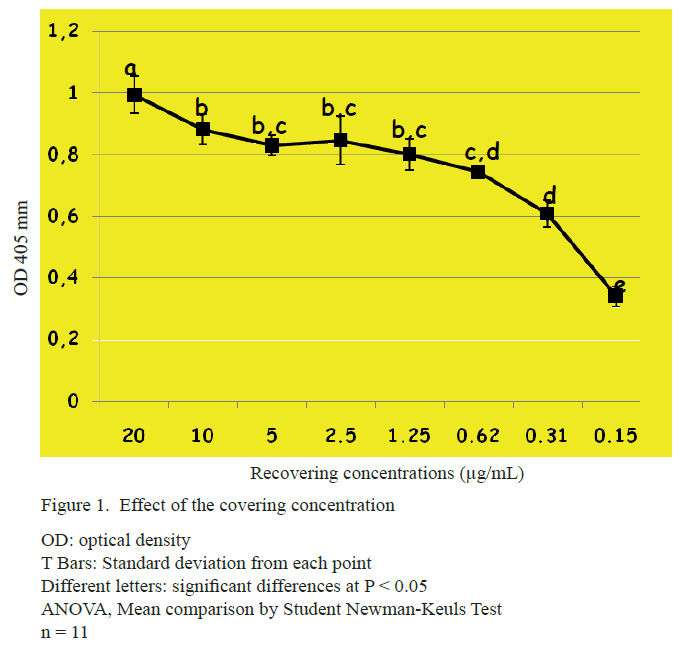
<body><![CDATA[<br>     4 &ordm;C. The supernatant was collected and filtered.&nbsp; Protein determination was carried out through  the QuantiProTM High Sensitivity Protein Assay      Kit.</span><span style="font-family:'Verdana','sans-serif'; font-size:10.0pt; "> </span></p>       <p align="justify" class="Cuerpodetexto"><em><span style="font-family:'Verdana','sans-serif'; font-size:10.0pt; ">Sampling</span></em><span style="font-family:'Verdana','sans-serif'; font-size:10.0pt; ">. For  establishing ELISA, samples of blood serum were used of 48 female sheep from  the Laboratory of Sheep and Goat Research and Production (LAPOC) belonging to  the Federal University of Paran&aacute; in Brazil. To all animals fecal feces were  taken for realizing the modified method of McMaster and coproculture. In this  way the infestation or not by the nematode was determined. Blood obtained was  centrifuged at 3000 rpm for 10 min.&nbsp; A  mixture with similar volumes of all serums was conformed and stored at -20&ordm; C.</span><span style="font-family:'Verdana','sans-serif'; font-size:10.0pt; "> </span></p>       <p align="justify" class="Cuerpodetexto"><em><span style="font-family:'Verdana','sans-serif'; font-size:10.0pt; ">Immunoenzymatic  (ELISA) assay.</span></em><span style="font-family:'Verdana','sans-serif'; font-size:10.0pt; "> Microtitration plates of 96 dishes  (PolySorp, Nunc) were recovering&nbsp; the  concentration of 5 &micro;g/mL (100 &micro;L/dish) with the <em>Haemonchus contortus</em> proteins extract diluted in recovering buffer (carbonate-sodium bicarbonate      0.1 mM, pH 9.6) and incubated at 4&ordm; C throughout the night.&nbsp; Dishes were washed three times with SSTP IX  solution with Tween 20 at 0.2 % ([vol/vol]). The blocking was made with Bovine  Fetal Serum (BFS) at 3 % ([vol/vol]) diluted in SSTP 1X with Tween 20 at 0.2 %  for one hour.&nbsp; Dishes were washed three  times with SSTP 1X solution with Tween 20 at 0.2 %      [vol/vol].&nbsp; Serum samples of vaccinated  animals with the parasite extract and the controls were applied      (100 &micro;L/dish) diluted in SSTP IX with Tween 20 at      0.2 % ([vol/vol]) and BFS at 25 % ([vol/vol]). After plate incubation for one  hour at environmental temperature, dishes were washed three times with SSTP IX  solution with Tween 20 at 0.2 % [vol/vol] and the Anti IgG of sheep was added  diluted 1:7000 in SSTP IX with Tween 20 at 0.2 %      ([vol/vol]) and BFS at 0.25 % ([vol/vol]) was incubated for one hour.&nbsp; The dishes were washed three times with SSTP  IX solution with Tween 20 at 0.2 % ([vol/vol]) and the buffer ABTS (revealing)  was added, it was incubated in the darkness for 30 min.&nbsp; The optical density was determined in the  Biotek reader EL x 800 at 405 nm.</span></p>       <p align="justify" class="Cuerpodetexto"><em><span style="font-family:'Verdana','sans-serif'; font-size:10.0pt; ">Statistical  analysis</span></em><span style="font-family:'Verdana','sans-serif'; font-size:10.0pt; ">.&nbsp;  For data processing the statistical package Graph Pad Prism 5 was  used.&nbsp; An analysis of variance (ANOVA)  was carried out and for mean comparison the Post hoc test of Student  Newman-Keuls was used.</span></p>       <p align="justify" class="Cuerpodetexto"><span style="font-family:'Verdana','sans-serif'; font-size:10.0pt; ">&nbsp;</span></p>       <p align="justify" class="subtitulo"><strong><span style="font-family:'Verdana','sans-serif'; font-size=3">RESULTS AND DISCUSSION</span></strong></p>       <p align="justify" class="Cuerpodetexto"><span style="font-family:'Verdana','sans-serif'; font-size:10.0pt; ">In  <a href="/img/revistas/cjas/v49n4/f0107415.gif">figure 1</a> is shown the effect of the recovering at different antigen  concentrations.&nbsp; A better performance  between 20 and 5 &micro;g/mL is observed with values of optical density of one for  the first and 0.82 for the second.&nbsp; For  the rest, the signal decreases until attaining the minimum concentration  assessed (0.15 &micro;g/mL) with optical density value close to 0.3.</span></p>       
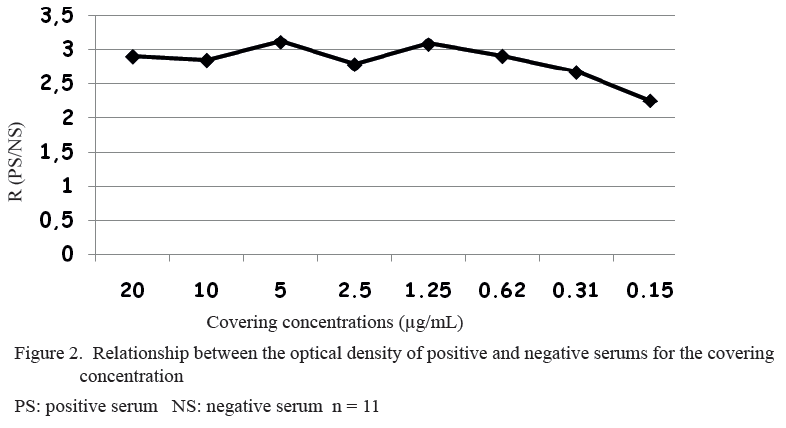
<p align="justify" class="Cuerpodetexto"><span style="font-family:'Verdana','sans-serif'; font-size:10.0pt; ">The best relationship between the optical density of the  positive and the negative serums (<a href="/img/revistas/cjas/v49n4/f0207415.gif">figure 2</a>) were found in 5 &micro;g/mL of the  covering concentration.&nbsp; Other reports  used the same covering concentration for the detection of titers against <em>Haemonchus  contortus</em> (Dom&iacute;nguez- Tora&ntilde;o <em>et al.</em> 2003, Shakya <em>et al.</em> 2011  and Fawzi <em>et al.</em> 2014). Nonetheless, coverings of 1 and 2 &micro;g/mL were  employed for the determination of antibodies induced by vaccination with this  nematode (Bakker 2004, De Vries <em>et al.</em> 2009, Bassetto <em>et al.</em> 2011  and Molina <em>et al.</em> 2012). Meanwhile the covering with 10 &micro;g/mL was also  used (van Stijn <em>et al.</em> 2010).</span></p>       
<p align="justify" class="Cuerpodetexto"><span style="font-family:'Verdana','sans-serif'; font-size:10.0pt; "><a href="/img/revistas/cjas/v49n4/f0307415.gif">Figure 3</a> shows the effect of the dilution of the animal  serum.&nbsp; The 1:200 dilution was of the  highest optical density (1.1).&nbsp; The  remaining dilutions behaved very similar but with a tendency to the decrease of  the signal</span><span style="font-family:'Verdana','sans-serif'; font-size:10.0pt; ">.</span></p>       
<p align="justify" class="Cuerpodetexto"><span style="font-family:'Verdana','sans-serif'; font-size:10.0pt; ">The  relationship between the optical density of the positive and negative serums is  shown in <a href="/img/revistas/cjas/v49n4/f0407415.gif">figure 4</a>. In the 1:300 dilution 2.7 relationship was obtained which is  much higher to that of 1:200 that was of 2.2.&nbsp;  Reports indicate the utilization of serums for detecting antibodies  against <em>Haemonchus contortus</em> at the most different concentrations, 1:100  (De Vries <em>et al.</em> 2009); 1:200 (Ruiz <em>et al. </em>2004, Bassetto <em>et  al.</em> 2011 and Molina <em>et al.</em> 2012); 1:1000 (Sun <em>et al.</em> 2011,  Han <em>et al.</em> 2012 and Yan <em>et al.</em> 2013) and 1:4000 (Smith <em>et al.</em> 2003). </span></p>       
]]></body>
<body><![CDATA[<p align="justify" class="Cuerpodetexto"><span style="font-family:'Verdana','sans-serif'; font-size:10.0pt; ">The  effect of the conjugate (Anti-IgG of sheep) dilution is shown in <a href="/img/revistas/cjas/v49n4/f0507415.gif">figure 5</a>. The  conjugate dilution recommended by the producer (Invitrogen&reg;, USA) was of  1:7000.&nbsp; Nonetheless, conjugate dilutions  from 1:7000 to 1:13000 were evaluated.&nbsp;  The dilutions 1:7000 and 1:9000 exhibited values of optical densities  higher to one. On diluting more the conjugate the tendency was to decrease the  signal with minimum in 1:11000 and 1:13000.</span></p>       
<p align="justify" class="Cuerpodetexto"><span style="font-family:'Verdana','sans-serif'; font-size:10.0pt; "><a href="/img/revistas/cjas/v49n4/f0607415.gif">Figure 6</a> presents the relationship between the optical  density of the positive and negative serums.&nbsp;  The conjugate dilution 1:7000 was that of highest relationship. Some  authors report the utilization of the conjugate at a dilution of 1:8000 (Fawzi <em>et  al.</em> 2014) which is similar to ours. On the contrary, in other reports  conjugate dilutions ranging from 1:3000 (Bakker 2004), 1:4000 (Ruiz </span><em><span style="font-family:'Verdana','sans-serif'; font-size:10.0pt; ">et  al. </span></em><span style="font-family:'Verdana','sans-serif'; font-size:10.0pt; ">2004 and Molina <em>et  al.</em> 2012), 1:5000 (Santos <em>et al.</em> 2014), 1:10000 (Bassetto <em>et al.</em> 2011), 1:20000 (Muleke <em>et al.</em> 2007) up to 1:25000 (Shakya <em>et al.</em> 2011).</span></p>       
<p align="justify" class="Cuerpodetexto"><span style="font-family:'Verdana','sans-serif'; font-size:10.0pt; ">For  serum incubation and the conjugate (Anti-IgG), BFS was used for decreasing the  unspecific interactions of the assay. For this, dilutions were assessed from 0  until 1 % (<a href="/img/revistas/cjas/v49n4/f0707415.gif">figure 7</a>). In the dilutions where no BFA was utilized and in that of  0.25 %, the values of optical density were approximately one. As BFS  concentration increased, the tendency was to decrease the values of optical      density.</span></p>       
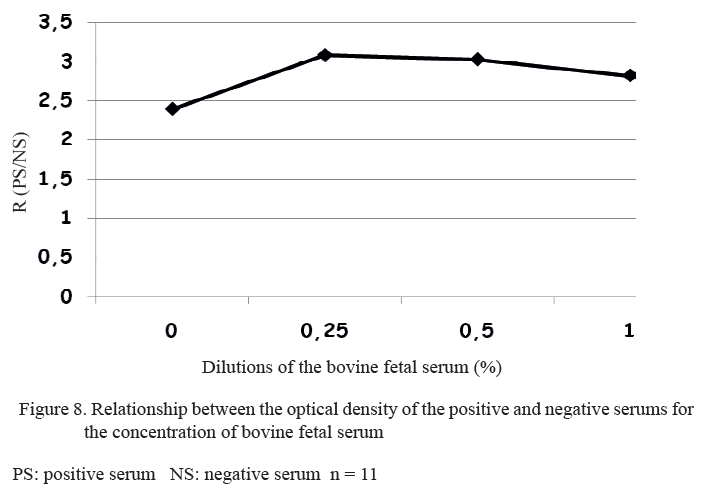
<p align="justify" class="Cuerpodetexto"><span style="font-family:'Verdana','sans-serif'; font-size:10.0pt; "><a href="/img/revistas/cjas/v49n4/f0807415.gif">Figure  8</a> shows the relationship between the positive and negative serums for  determining BFS concentration.&nbsp; The  highest relationship was attained with the dilution at 0.25 %.&nbsp; When BFS concentration was increased, the  signal decreased.&nbsp; BFS dilutions at 1 %  (Rodr&iacute;guez S&aacute;nchez <em>et al.</em> 2005) and at 2 % (Pupo-Ant&uacute;nez <em>et al.</em> 2011) were employed with the purpose of eliminating the unspecific interactions  in ELISA assays.&nbsp; Bashir <em>et al.</em> (2011) and Wu <em>et al.</em> (2015) reported the use of albumin from bovine  serum for this objective.&nbsp; The first do  not declare the concentration utilized while the second made it at 1 %.</span></p>       
<p align="justify" class="Cuerpodetexto"><span style="font-family:'Verdana','sans-serif'; font-size:10.0pt; ">The optimization of the parameters of this ELISA  immunoenzymatic assay allowed achieving high optical density values with low  unspecific interactions. With this procedure the effect of <em>Haemonchus  contortus</em> can be assessed on meat and wool production without the need of  animal slaughtering.&nbsp; For this, it is  necessary the identification of the gray zone of this assay.</span></p>       <p align="justify" class="Cuerpodetexto"><span style="font-family:'Verdana','sans-serif'; font-size:10.0pt; ">&nbsp;</span></p>       <p align="justify" class="subtitulo"><strong><span style="font-family:'Verdana','sans-serif'; font-size=3">ACKNOWLEDGEMENTS</span></strong></p>       <p align="justify"><span style="font-family:'Verdana','sans-serif'; font-size:10.0pt; ">The authors are indebted to  CAPES and BIOLAC for financing pre-doctoral scholarships that allowed the  development of this research.&nbsp; To the  Federal University of Paran&aacute; (UFPR), to all its technicians, staff members, students  and professors for their inestimable help</span><font size="2" face="Verdana, Arial, Helvetica, sans-serif">.</font></p>        <p align="justify">&nbsp;</p>     <p align="justify"><font size="2" face="Verdana, Arial, Helvetica, sans-serif"><font size="3"><b>REFERENCES</b></font></font></p>     ]]></body>
<body><![CDATA[<p align="justify" class="MsoNormal" style="line-height:normal;"><span style="font-family:'Verdana','sans-serif'; font-size:10.0pt; ">Amarante, A. F. T. 2014. &ldquo;Sustainable worm  control practices in South America&rdquo;. <em>Small Ruminant Research</em>, 118 (1):  56&ndash;62.</span></p>     <p align="justify" class="MsoNormal" style="line-height:normal;"><span style="font-family:'Verdana','sans-serif'; font-size:10.0pt; ">Bakker, N., Vervelde, L., Kanobana, K., Knox, D.  P., Cornelissen, A., De Vries, E. &amp; Yatsuda, A. P. 2004. &ldquo;Vaccination  against the nematode Haemonchus contortus with a thiol-binding fraction from  the excretory/secretory products (ES)&rdquo;. <em>Vaccine</em>, 22 (5): 618&ndash;628.</span></p>     <p align="justify" class="MsoNormal" style="line-height:normal;"><span style="font-family:'Verdana','sans-serif'; font-size:10.0pt; ">Bashir, S., Singh, R., Sharma, B. &amp; Yadav,  S. K. 2011. &ldquo;Development of a sandwich ELISA for the detection of bovine  herpesvirus type 1&rdquo;. <em>Asian Pacific J. Tropical Medicine</em>, 4: 363.</span></p>     <p align="justify" class="MsoNormal" style="line-height:normal;"><span style="font-family:'Verdana','sans-serif'; font-size:10.0pt; ">Bassetto, C. C., Silva, B. F., Newlands, G. F.  J., Smith, W. D. &amp; Amarante, A. F. T. do 2011. &ldquo;Protection of calves  against <em>Haemonchus placei</em> and <em>Haemonchus contortus</em> after  immunization with gut membrane proteins from <em>H. contortus</em>&rdquo;. <em>Parasite  immunology</em>, 33 (7): 377&ndash;381.</span></p>     <!-- ref --><p align="justify" class="MsoNormal" style="line-height:normal;"><span style="font-family:'Verdana','sans-serif'; font-size:10.0pt; ">Bosco, A. 2014. <em>The coprological diagnosis of  gastrointestinal nematode infections in small ruminants</em>. Ph.D. Thesis,  Universit&agrave; degli Studi di Napoli Federico II, Napoli, Italia.    </span></p>     <p align="justify" class="MsoNormal" style="line-height:normal;"><span style="font-family:'Verdana','sans-serif'; font-size:10.0pt; ">Deplazes, P., Eckert, J., Pawlowski, Z. S.,  Machowska, L. &amp; Gottstein, B. 1991. &ldquo;An enzyme-linked immunosorbent assay  for diagnostic detection of <em>Taenia saginata</em> copro-antigens in humans&rdquo;. <em>Transactions  of the Royal Society of Tropical Medicine and Hygiene</em>, 85 (3): 391&ndash;396.</span></p>     <p align="justify" class="MsoNormal" style="line-height:normal;"><span style="font-family:'Verdana','sans-serif'; font-size:10.0pt; ">De Vries, E., Bakker, N., Krijgsveld, J., Knox,  D. P., Heck, A. J. R. &amp; Yatsuda, A. P. 2009. &ldquo;An AC-5 cathepsin B-like  protease purified from <em>Haemonchus contortus</em> excretory secretory products  shows protective antigen potential for lambs&rdquo;. </span><em><span style="font-family:'Verdana','sans-serif'; font-size:10.0pt; ">Veterinary research</span></em><span style="font-family:'Verdana','sans-serif'; font-size:10.0pt; ">, 40 (4): 1&ndash;11.</span></p>     <p align="justify" class="MsoNormal" style="line-height:normal;"><span style="font-family:'Verdana','sans-serif'; font-size:10.0pt; ">Dom&#305;nguez-Torano,  I. A., Fern&aacute;ndez-P&eacute;rez, F. J., G&oacute;mez-Mu&ntilde;oz, M. T., Alunda, J. M. &amp;  Cuquerella, M. 2003. </span><span style="font-family:'Verdana','sans-serif'; font-size:10.0pt; ">&ldquo;Humoral and cellular response in lambs vaccinated against <em>Haemonchus  contortus</em> with p26/23&rdquo;. <em>Small Ruminant Research</em>, 50 (1): 29&ndash;37.</span></p>     <p align="justify" class="MsoNormal" style="line-height:normal;"><span style="font-family:'Verdana','sans-serif'; font-size:10.0pt; ">El-Badry, A. A. 2009. &ldquo;ELISA-based coproantigen  in human strongyloidiaisis: a diagnostic method correlating with worm burden&rdquo;. <em>Journal  of the Egyptian Society of Parasitology</em>, 39 (3): 757&ndash;768.</span></p>     ]]></body>
<body><![CDATA[<p align="justify" class="MsoNormal" style="line-height:normal;"><span style="font-family:'Verdana','sans-serif'; font-size:10.0pt; ">Elgun, G. &amp; Koltas, I. S. 2011.  &ldquo;Investigation of <em>Cryptosporidium</em> spp. antigen by ELISA method in stool  specimens obtained from patients with diarrhea&rdquo;. </span><em><span style="font-family:'Verdana','sans-serif'; font-size:10.0pt; ">Parasitology research</span></em><span style="font-family:'Verdana','sans-serif'; font-size:10.0pt; ">, 108 (2): 395&ndash;397.</span></p>     <p align="justify" class="MsoNormal" style="line-height:normal;"><span style="font-family:'Verdana','sans-serif'; font-size:10.0pt; ">Fawzi, E. M.,  Gonz&aacute;lez-S&aacute;nchez, M. E., Corral, M. J., Cuquerella, M. &amp; Alunda, J. M.  2014. </span><span style="font-family:'Verdana','sans-serif'; font-size:10.0pt; ">&ldquo;Vaccination of lambs against <em>Haemonchus  contortus</em> infection with a somatic protein (Hc23) from adult helminths&rdquo;. <em>International  journal for parasitology</em>, 44 (7): 429&ndash;436.</span></p>     <p align="justify" class="MsoNormal" style="line-height:normal;"><span style="font-family:'Verdana','sans-serif'; font-size:10.0pt; ">Felippelli, G., Lopes, W. D. Z., Cruz, B. C.,  Teixeira, W. F. P., Maciel, W. G., F&aacute;vero, F. C., Buzzulini, C., Sakamoto, C.,  Soares, V. E. &amp; Gomes, L. V. C. 2014. &ldquo;Nematode resistance to ivermectin  (630 and 700</span><span style="font-family:'Verdana','sans-serif'; font-size:10.0pt; ">&mu;</span><span style="font-family:'Verdana','sans-serif'; font-size:10.0pt; ">g/kg) in cattle from the Southeast and South of Brazil&rdquo;. <em>Parasitology  international</em>, 63 (6): 835&ndash;840.</span></p>     <p align="justify" class="MsoNormal" style="line-height:normal;"><span style="font-family:'Verdana','sans-serif'; font-size:10.0pt; ">Giudici, C., Aumont, G., Mahieu, M., Saulai, M.  &amp; Cabaret, J. 1999. &ldquo;Changes in gastro-intestinal helminth species  diversity in lambs under mixed grazing on irrigated pastures in the tropics  (French West Indies)&rdquo;. <em>Veterinary Research</em>, 30 (6): 573&ndash;581.</span></p>     <p align="justify" class="MsoNormal" style="line-height:normal;"><span style="font-family:'Verdana','sans-serif'; font-size:10.0pt; ">Han, K., Xu, L., Yan, R., Song, X. &amp; Li, X.  2012. &ldquo;Vaccination of goats with glyceraldehyde-3-phosphate dehydrogenase DNA  vaccine induced partial protection against <em>Haemonchus contortus</em>&rdquo;. <em>Veterinary  immunology and immunopathology</em>, 149 (3): 177&ndash;185.</span></p>     <p align="justify" class="MsoNormal" style="line-height:normal;"><span style="font-family:'Verdana','sans-serif'; font-size:10.0pt; ">Howell, A., Baylis, M., Smith, R., Pinchbeck, G.  &amp; Williams, D. 2015. &ldquo;Epidemiology and impact of <em>Fasciola hepatica</em> exposure in high-yielding dairy herds&rdquo;. <em>Preventive veterinary medicine</em>,  121 (1): 41&ndash;48.</span></p>     <p align="justify" class="MsoNormal" style="line-height:normal;"><span style="font-family:'Verdana','sans-serif'; font-size:10.0pt; ">Johnson, M. J., Behnke, J. M. &amp; Coles, G. C.  1996. &ldquo;Detection of gastrointestinal nematodes by a coproantigen capture  ELISA&rdquo;. <em>Research in veterinary science</em>, 60 (1): 7&ndash;12.</span></p>     <p align="justify" class="MsoNormal" style="line-height:normal;"><span style="font-family:'Verdana','sans-serif'; font-size:10.0pt; ">Khalafalla, R. E., Elseify, M. A. &amp; Elbahy,  N. M. 2011. &ldquo;Seasonal prevalence of gastrointestinal nematode parasites of  sheep in Northern region of Nile Delta, Egypt&rdquo;. <em>Parasitology research</em>,  108 (2): 337&ndash;340.</span></p>     <p align="justify" class="MsoNormal" style="line-height:normal;"><span style="font-family:'Verdana','sans-serif'; font-size:10.0pt; ">Kui-zheng, C. A. I., Xiao-ye, Y., Xiao-liang,  W., Cheng, H. A. O., Gui-hua, M. A., Feng-bao, Y., Yan-bin, F., Xu-bin, Z.,  De-xin, R. E. N. &amp; Zhen-lian, L. I. U. 2007. &ldquo;Investigation on resistance of  gastrointestinal nematodes in sheep and goats to anthelmintics in Ningxia,  China&rdquo;. <em>Veterinary Science in China</em>, 6: 9.</span></p>     <p align="justify" class="MsoNormal" style="line-height:normal;"><span style="font-family:'Verdana','sans-serif'; font-size:10.0pt; ">Liu, Y., Li, F., Liu, W., Dai, R. S., Tan, Y.  M., He, D. S., Lin, R. Q. &amp; Zhu, X. Q. 2009. &ldquo;Prevalence of helminths in  water buffaloes in Hunan Province, China&rdquo;. <em>Tropical animal health and  production</em>, 41 (4): 543&ndash;546.</span></p>     ]]></body>
<body><![CDATA[<p align="justify" class="MsoNormal" style="line-height:normal;"><span style="font-family:'Verdana','sans-serif'; font-size:10.0pt; ">Mederos, A., Fern&aacute;ndez, S., VanLeeuwen, J.,  Peregrine, A. S., Kelton, D., Menzies, P., LeBoeuf, A. &amp; Martin, R. 2010.  &ldquo;Prevalence and distribution of gastrointestinal nematodes on 32 organic and  conventional commercial sheep farms in Ontario and Quebec, Canada (2006&ndash;2008)&rdquo;. </span><em><span style="font-family:'Verdana','sans-serif'; font-size:10.0pt; ">Veterinary parasitology</span></em><span style="font-family:'Verdana','sans-serif'; font-size:10.0pt; ">, 170 (3): 244&ndash;252.</span></p>     <p align="justify" class="MsoNormal" style="line-height:normal;"><span style="font-family:'Verdana','sans-serif'; font-size:10.0pt; ">Molina, J. M.,  Mart&iacute;n, S., Hern&aacute;ndez, Y. I., Gonz&aacute;lez, J. F., Ferrer, O. &amp; Ruiz, A. 2012. </span><span style="font-family:'Verdana','sans-serif'; font-size:10.0pt; ">&ldquo;Immunoprotective effect of  cysteine proteinase fractions from two <em>Haemonchus contortus</em> strains  adapted to sheep and goats&rdquo;. </span><em><span style="font-family:'Verdana','sans-serif'; font-size:10.0pt; ">Veterinary  parasitology</span></em><span style="font-family:'Verdana','sans-serif'; font-size:10.0pt; ">, 188 (1): 53&ndash;59.</span></p>     <p align="justify" class="MsoNormal" style="line-height:normal;"><span style="font-family:'Verdana','sans-serif'; font-size:10.0pt; ">Muleke, C. I.,  Yan, R., Sun, Y., Zhao, G., Xu, L. &amp; Li, X. 2007. </span><span style="font-family:'Verdana','sans-serif'; font-size:10.0pt; ">&ldquo;Vaccination of goats against <em>Haemonchus  contortus</em> with a recombinant cysteine protease&rdquo;. <em>Small Ruminant Research</em>,  73 (1): 95&ndash;102.</span></p>     <p align="justify" class="MsoNormal" style="line-height:normal;"><span style="font-family:'Verdana','sans-serif'; font-size:10.0pt; ">Oliveira, A. C., Nunes, A. P., Bern, M. E. N.,  Borba, M. F. S., Echevarria, F., Vaz, C. M. &amp; Carvalho, F. I. F. 2012. </span><span style="font-family:'Verdana','sans-serif'; font-size:10.0pt; ">&ldquo;Estudo da variabilidade gen&eacute;tica de resist&ecirc;ncia a nemat&oacute;deos  gastrintestinais em ovinos da ra&ccedil;a corriedale com marcadores RAPD.&rdquo;. </span><em><span style="font-family:'Verdana','sans-serif'; font-size:10.0pt; ">Current Agricultural Science  and Technology</span></em><span style="font-family:'Verdana','sans-serif'; font-size:10.0pt; ">, 13 (1),  Available:  &lt;<a href="http://www.periodicos.ufpel.edu.br/ojs2/index.php/CAST/article/viewArticle/1306" target="_blank">http://www.periodicos.ufpel.edu.br/ojs2/index.php/CAST/article/viewArticle/1306</a>&gt;,  [Consulted:&nbsp;May 5, 2016].</span></p>     <p align="justify" class="MsoNormal" style="line-height:normal;"><span style="font-family:'Verdana','sans-serif'; font-size:10.0pt; ">Pupo-Ant&uacute;nez,  M., Cabrera Rodriguez, V., V&aacute;zquez Mojena, Y., Drebot, M., Andonova, M.,  Dickinson Meneses, F., Fuentes Gonzalez, O., P&eacute;rez Rodriguez, A. &amp; Santos  Montero, P. 2011. &ldquo;Estudio serol&oacute;gico en localidades cubanas con infecciones  confirmadas al virus del Nilo Occidental&rdquo;. <em>Revista Cubana de Medicina  Tropical</em>, 63 (3): 227&ndash;230.</span></p>     <p align="justify" class="MsoNormal" style="line-height:normal;"><span style="font-family:'Verdana','sans-serif'; font-size:10.0pt; ">Qamar, M. F.,  Maqbool, A., Khan, M. S., Ahmad, N. &amp; Muneer, M. A. 2009. </span><span style="font-family:'Verdana','sans-serif'; font-size:10.0pt; ">&ldquo;Epidemiology of Haemonchosis  in sheep and goats under different managemental conditions&rdquo;. <em>Veterinary  World</em>, 2 (11): 413&ndash;417.</span></p>     <!-- ref --><p align="justify" class="MsoNormal" style="line-height:normal;"><span style="font-family:'Verdana','sans-serif'; font-size:10.0pt; ">Rinaldi, L. 2014. <em>The coprological diagnosis  of gastrointestinal nematode infections in small ruminants</em>. Ph.D. Thesis,  Ghent University, Ghent, B&eacute;lgica.    </span></p>     <p align="justify" class="MsoNormal" style="line-height:normal;"><span style="font-family:'Verdana','sans-serif'; font-size:10.0pt; ">Rodr&iacute;guez S&aacute;nchez, H., Pupo Ant&uacute;nez, M., Ilnait,  M. T., Otero, A. &amp; Mart&iacute;nez Mach&iacute;n, G. 2005. </span><span style="font-family:'Verdana','sans-serif'; font-size:10.0pt; ">&ldquo;Anticuerpos  monoclonales que reconocen al polisac&aacute;rido capsular de <em>Cryptococcus  neoformans</em>&rdquo;. <em>Revista Cubana de Medicina Tropical</em>, 57 (2): 162&ndash;164.</span></p>     <p align="justify" class="MsoNormal" style="line-height:normal;"><span style="font-family:'Verdana','sans-serif'; font-size:10.0pt; ">Ruiz, A.,  Molina, J. M., Gonz&aacute;lez, J. F., Conde, M. M., Mart&iacute;n, S. &amp; Hern&aacute;ndez, Y. I.  2004. </span><span style="font-family:'Verdana','sans-serif'; font-size:10.0pt; ">&ldquo;Immunoprotection in goats  against <em>Haemonchus contortus</em> after immunization with cysteine protease  enriched protein fractions&rdquo;. <em>Veterinary research</em>, 35 (5): 565&ndash;572.</span></p>     ]]></body>
<body><![CDATA[<p align="justify" class="MsoNormal" style="line-height:normal;"><span style="font-family:'Verdana','sans-serif'; font-size:10.0pt; ">Santos, M. C., Xavier, J. K., Amarante, M. R.,  Bassetto, C. C. &amp; Amarante, A. F. 2014. &ldquo;Immune response to <em>Haemonchus  contortus</em> and <em>Haemonchus placei</em> in sheep and its role on parasite  specificity&rdquo;. <em>Veterinary parasitology</em>, 203 (1): 127&ndash;138.</span></p>     <p align="justify" class="MsoNormal" style="line-height:normal;"><span style="font-family:'Verdana','sans-serif'; font-size:10.0pt; ">Shakya, K. P., Miller, J. E., Lomax, L. G. &amp;  Burnett, D. D. 2011. &ldquo;Evaluation of immune response to artificial infections of <em>Haemonchus contortus</em> in Gulf Coast Native compared with Suffolk lambs&rdquo;. <em>Veterinary  parasitology</em>, 181 (2): 239&ndash;247.</span></p>     <p align="justify" class="MsoNormal" style="line-height:normal;"><span style="font-family:'Verdana','sans-serif'; font-size:10.0pt; ">Sissay, M. M., Uggla, A. &amp; Waller, P. J.  2007. &ldquo;Prevalence and seasonal incidence of nematode parasites and fluke  infections of sheep and goats in eastern Ethiopia&rdquo;. <em>Tropical Animal Health  and Production</em>, 39 (7): 521&ndash;531.</span></p>     <p align="justify" class="MsoNormal" style="line-height:normal;"><span style="font-family:'Verdana','sans-serif'; font-size:10.0pt; ">Smith, W. D., Skuce, P. J., Newlands, G. F. J.,  Smith, S. K. &amp; Pettit, D. 2003. &ldquo;Aspartyl proteases from the intestinal  brush border of <em>Haemonchus contortus</em> as protective antigens for sheep&rdquo;. </span><em><span style="font-family:'Verdana','sans-serif'; font-size:10.0pt; ">Parasite immunology</span></em><span style="font-family:'Verdana','sans-serif'; font-size:10.0pt; ">, 25 (11-12): 521&ndash;530.</span></p>     <p align="justify" class="MsoNormal" style="line-height:normal;"><span style="font-family:'Verdana','sans-serif'; font-size:10.0pt; ">Sun, W., Song,  X., Yan, R., Xu, L. &amp; Li, X. 2011. </span><span style="font-family:'Verdana','sans-serif'; font-size:10.0pt; ">&ldquo;Vaccination of goats with a glutathione  peroxidase DNA vaccine induced partial protection against <em>Haemonchus  contortus</em> infection&rdquo;. </span><em><span style="font-family:'Verdana','sans-serif'; font-size:10.0pt; ">Veterinary parasitology</span></em><span style="font-family:'Verdana','sans-serif'; font-size:10.0pt; ">, 182 (2): 239&ndash;247.</span></p>     <p align="justify" class="MsoNormal" style="line-height:normal;"><span style="font-family:'Verdana','sans-serif'; font-size:10.0pt; ">van Stijn, C.  M., van den Broek, M., Vervelde, L., Alvarez, R. A., Cummings, R. D., Tefsen,  B. &amp; van Die, I. 2010. </span><span style="font-family:'Verdana','sans-serif'; font-size:10.0pt; ">&ldquo;Vaccination-induced IgG response to Gal</span><span style="font-family:'Verdana','sans-serif'; font-size:10.0pt; ">&alpha;</span><span style="font-family:'Verdana','sans-serif'; font-size:10.0pt; ">1&ndash;3GalNAc glycan epitopes in  lambs protected against <em>Haemonchus contortus</em> challenge infection&rdquo;. <em>International  journal for parasitology</em>, 40 (2): 215&ndash;222.</span></p>     <p align="justify" class="MsoNormal" style="line-height:normal;"><span style="font-family:'Verdana','sans-serif'; font-size:10.0pt; ">Waller, P. J., Rudby-Martin, L., Ljungstr&ouml;m, B.  L. &amp; Rydzik, A. 2004. &ldquo;The epidemiology of abomasal nematodes of sheep in  Sweden, with particular reference to over-winter survival strategies&rdquo;. </span><em><span style="font-family:'Verdana','sans-serif'; font-size:10.0pt; ">Veterinary parasitology</span></em><span style="font-family:'Verdana','sans-serif'; font-size:10.0pt; ">, 122 (3): 207&ndash;220.</span></p>     <p align="justify" class="MsoNormal" style="line-height:normal;"><span style="font-family:'Verdana','sans-serif'; font-size:10.0pt; ">Wandra, T.,  Sutisna, P., Dharmawan, N. S., Margono, S. S., Sudewi, R., Suroso, T., Craig,  P. S. &amp; Ito, A. 2006. </span><span style="font-family:'Verdana','sans-serif'; font-size:10.0pt; ">&ldquo;High prevalence of <em>Taenia saginata</em> taeniasis and status of <em>Taenia  solium</em> cysticercosis in Bali, Indonesia, 2002&ndash;2004&rdquo;. <em>Transactions of the  Royal Society of Tropical Medicine and hygiene</em>, 100 (4): 346&ndash;353.</span></p>     <p align="justify" class="MsoNormal" style="line-height:normal;"><span style="font-family:'Verdana','sans-serif'; font-size:10.0pt; ">Ward, M. P., Lyndal-Murphy, M. &amp; Baldock, F.  C. 1997. &ldquo;Evaluation of a composite method for counting helminth eggs in cattle  faeces&rdquo;. <em>Veterinary parasitology</em>, 73 (1): 181&ndash;187.</span></p>     <p align="justify" class="MsoNormal" style="line-height:normal;"><span style="font-family:'Verdana','sans-serif'; font-size:10.0pt; ">Wilmsen, M. O., Silva, B. F., Bassetto, C. C.  &amp; Amarante, A. F. T. do 2014. &ldquo;Gastrointestinal nematode infections in  sheep raised in Botucatu, state of S&atilde;o Paulo, Brazil&rdquo;. </span><em><span style="font-family:'Verdana','sans-serif'; font-size:10.0pt; ">Revista Brasileira de Parasitologia Veterin&aacute;ria</span></em><span style="font-family:'Verdana','sans-serif'; font-size:10.0pt; ">, 23 (3): 348&ndash;354.</span></p>     ]]></body>
<body><![CDATA[<p align="justify" class="MsoNormal" style="line-height:normal;"><span style="font-family:'Verdana','sans-serif'; font-size:10.0pt; ">Wu, M., Li, H.,  Zhang, Y. &amp; Chen, D. 2015. </span><span style="font-family:'Verdana','sans-serif'; font-size:10.0pt; ">&ldquo;Development of a C3c-based ELISA method for the determination of  anti-complementary potency of Bupleurum polysaccharides&rdquo;. </span><em><span style="font-family:'Verdana','sans-serif'; font-size:10.0pt; ">Acta Pharmaceutica Sinica B</span></em><span style="font-family:'Verdana','sans-serif'; font-size:10.0pt; ">, 5 (4):  316&ndash;322.</span></p>     <p align="justify" class="MsoNormal" style="margin-bottom:.0001pt;line-height:normal;"><span style="font-family:'Verdana','sans-serif'; font-size:10.0pt; ">Yan, R., Sun, W., Song, X., Xu, L. &amp; Li, X. 2013. </span><span style="font-family:'Verdana','sans-serif'; font-size:10.0pt; ">&ldquo;Vaccination of goats with DNA  vaccine encoding Dim-1 induced partial protection against <em>Haemonchus  contortus</em>: A preliminary experimental study&rdquo;. </span><em><span style="font-family:'Verdana','sans-serif'; font-size:10.0pt; ">Research in veterinary science</span></em><span style="font-family:'Verdana','sans-serif'; font-size:10.0pt; ">, 95 (1):  189&ndash;199.</span></p>     <p align="justify">&nbsp;</p>     <p align="justify">&nbsp;</p>     <p align="justify"><font size="2" face="Verdana, Arial, Helvetica, sans-serif">Received: November 25, 2015    <br>   Accepted: January 19, 2016</font></p>     <p align="justify">&nbsp;</p>     <p align="justify">&nbsp;</p>     <p align="justify"><font size="2" face="Verdana, Arial, Helvetica, sans-serif"><i>A. Díaz,</i> Laboratorio de Bioquímica, Departamento de Morfofisiología, Universidad de Camagüey km 5 ½ 74650, Cuba.    Email: <a href="mailto:amilcar.arenal@reduc.edu.cu">amilcar.arenal@reduc.edu.cu</a></font></p>      ]]></body><back>
<ref-list>
<ref id="B1">
<nlm-citation citation-type="journal">
<person-group person-group-type="author">
<name>
<surname><![CDATA[Amarante]]></surname>
<given-names><![CDATA[A. F. T.]]></given-names>
</name>
</person-group>
<article-title xml:lang="nd"><![CDATA[Sustainable worm control practices in South America]]></article-title>
<source><![CDATA[Small Ruminant Research]]></source>
<year>2014</year>
<volume>118</volume>
<numero>1</numero>
<issue>1</issue>
<page-range>56-62</page-range></nlm-citation>
</ref>
<ref id="B2">
<nlm-citation citation-type="journal">
<person-group person-group-type="author">
<name>
<surname><![CDATA[Bakker]]></surname>
<given-names><![CDATA[N.]]></given-names>
</name>
<name>
<surname><![CDATA[Vervelde]]></surname>
<given-names><![CDATA[L.]]></given-names>
</name>
<name>
<surname><![CDATA[Kanobana]]></surname>
<given-names><![CDATA[K.]]></given-names>
</name>
<name>
<surname><![CDATA[Knox]]></surname>
<given-names><![CDATA[D. P.]]></given-names>
</name>
<name>
<surname><![CDATA[Cornelissen]]></surname>
<given-names><![CDATA[A.]]></given-names>
</name>
<name>
<surname><![CDATA[De Vries]]></surname>
<given-names><![CDATA[E.]]></given-names>
</name>
<name>
<surname><![CDATA[Yatsuda]]></surname>
<given-names><![CDATA[A. P.]]></given-names>
</name>
</person-group>
<article-title xml:lang="nd"><![CDATA[Vaccination against the nematode Haemonchus contortus with a thiol-binding fraction from the excretory/secretory products (ES)]]></article-title>
<source><![CDATA[Vaccine]]></source>
<year>2004</year>
<volume>22</volume>
<numero>5</numero>
<issue>5</issue>
<page-range>618-628</page-range></nlm-citation>
</ref>
<ref id="B3">
<nlm-citation citation-type="journal">
<person-group person-group-type="author">
<name>
<surname><![CDATA[Bashir]]></surname>
<given-names><![CDATA[S.]]></given-names>
</name>
<name>
<surname><![CDATA[Singh]]></surname>
<given-names><![CDATA[R.]]></given-names>
</name>
<name>
<surname><![CDATA[Sharma]]></surname>
<given-names><![CDATA[B.]]></given-names>
</name>
<name>
<surname><![CDATA[Yadav]]></surname>
<given-names><![CDATA[S. K.]]></given-names>
</name>
</person-group>
<article-title xml:lang="nd"><![CDATA[Development of a sandwich ELISA for the detection of bovine herpesvirus type 1]]></article-title>
<source><![CDATA[Asian Pacific J. Tropical Medicine]]></source>
<year>2011</year>
<volume>4</volume>
<page-range>363</page-range></nlm-citation>
</ref>
<ref id="B4">
<nlm-citation citation-type="journal">
<person-group person-group-type="author">
<name>
<surname><![CDATA[Bassetto]]></surname>
<given-names><![CDATA[C. C.]]></given-names>
</name>
<name>
<surname><![CDATA[Silva]]></surname>
<given-names><![CDATA[B. F.]]></given-names>
</name>
<name>
<surname><![CDATA[Newlands]]></surname>
<given-names><![CDATA[G. F. J.]]></given-names>
</name>
<name>
<surname><![CDATA[Smith]]></surname>
<given-names><![CDATA[W. D.]]></given-names>
</name>
<name>
<surname><![CDATA[Amarante]]></surname>
<given-names><![CDATA[A. F. T. do]]></given-names>
</name>
</person-group>
<article-title xml:lang="nd"><![CDATA[Protection of calves against Haemonchus placei and Haemonchus contortus after immunization with gut membrane proteins from H. contortus]]></article-title>
<source><![CDATA[Parasite immunology]]></source>
<year>2011</year>
<volume>33</volume>
<numero>7</numero>
<issue>7</issue>
<page-range>377-381</page-range></nlm-citation>
</ref>
<ref id="B5">
<nlm-citation citation-type="book">
<person-group person-group-type="author">
<name>
<surname><![CDATA[Bosco]]></surname>
<given-names><![CDATA[A.]]></given-names>
</name>
</person-group>
<source><![CDATA[The coprological diagnosis of gastrointestinal nematode infections in small ruminants]]></source>
<year>2014</year>
<publisher-loc><![CDATA[Napoli, Italia ]]></publisher-loc>
<publisher-name><![CDATA[Università degli Studi di Napoli Federico II]]></publisher-name>
</nlm-citation>
</ref>
<ref id="B6">
<nlm-citation citation-type="journal">
<person-group person-group-type="author">
<name>
<surname><![CDATA[Deplazes]]></surname>
<given-names><![CDATA[P.]]></given-names>
</name>
<name>
<surname><![CDATA[Eckert]]></surname>
<given-names><![CDATA[J.]]></given-names>
</name>
<name>
<surname><![CDATA[Pawlowski]]></surname>
<given-names><![CDATA[Z. S.]]></given-names>
</name>
<name>
<surname><![CDATA[Machowska]]></surname>
<given-names><![CDATA[L.]]></given-names>
</name>
<name>
<surname><![CDATA[Gottstein]]></surname>
<given-names><![CDATA[B.]]></given-names>
</name>
</person-group>
<article-title xml:lang="nd"><![CDATA[An enzyme-linked immunosorbent assay for diagnostic detection of Taenia saginata copro-antigens in humans]]></article-title>
<source><![CDATA[Transactions of the Royal Society of Tropical Medicine and Hygiene]]></source>
<year>1991</year>
<volume>85</volume>
<numero>3</numero>
<issue>3</issue>
<page-range>391-396</page-range></nlm-citation>
</ref>
<ref id="B7">
<nlm-citation citation-type="journal">
<person-group person-group-type="author">
<name>
<surname><![CDATA[De Vries]]></surname>
<given-names><![CDATA[E.]]></given-names>
</name>
<name>
<surname><![CDATA[Bakker]]></surname>
<given-names><![CDATA[N.]]></given-names>
</name>
<name>
<surname><![CDATA[Krijgsveld]]></surname>
<given-names><![CDATA[J.]]></given-names>
</name>
<name>
<surname><![CDATA[Knox]]></surname>
<given-names><![CDATA[D. P.]]></given-names>
</name>
<name>
<surname><![CDATA[Heck]]></surname>
<given-names><![CDATA[A. J. R.]]></given-names>
</name>
<name>
<surname><![CDATA[Yatsuda]]></surname>
<given-names><![CDATA[A. P.]]></given-names>
</name>
</person-group>
<article-title xml:lang="nd"><![CDATA[An AC-5 cathepsin B-like protease purified from Haemonchus contortus excretory secretory products shows protective antigen potential for lambs]]></article-title>
<source><![CDATA[Veterinary research]]></source>
<year>2009</year>
<volume>40</volume>
<numero>4</numero>
<issue>4</issue>
<page-range>1-11</page-range></nlm-citation>
</ref>
<ref id="B8">
<nlm-citation citation-type="journal">
<person-group person-group-type="author">
<name>
<surname><![CDATA[Dominguez-Torano]]></surname>
<given-names><![CDATA[I. A.]]></given-names>
</name>
<name>
<surname><![CDATA[Fernández-Pérez]]></surname>
<given-names><![CDATA[F. J.]]></given-names>
</name>
<name>
<surname><![CDATA[Gómez-Muñoz]]></surname>
<given-names><![CDATA[M. T.]]></given-names>
</name>
<name>
<surname><![CDATA[Alunda]]></surname>
<given-names><![CDATA[J. M.]]></given-names>
</name>
<name>
<surname><![CDATA[Cuquerella]]></surname>
<given-names><![CDATA[M.]]></given-names>
</name>
</person-group>
<article-title xml:lang="nd"><![CDATA[Humoral and cellular response in lambs vaccinated against Haemonchus contortus with p26/23]]></article-title>
<source><![CDATA[Small Ruminant Research]]></source>
<year>2003</year>
<volume>50</volume>
<numero>1</numero>
<issue>1</issue>
<page-range>29-37</page-range></nlm-citation>
</ref>
<ref id="B9">
<nlm-citation citation-type="journal">
<person-group person-group-type="author">
<name>
<surname><![CDATA[El-Badry]]></surname>
<given-names><![CDATA[A. A.]]></given-names>
</name>
</person-group>
<article-title xml:lang="nd"><![CDATA[ELISA-based coproantigen in human strongyloidiaisis: a diagnostic method correlating with worm burden]]></article-title>
<source><![CDATA[Journal of the Egyptian Society of Parasitology]]></source>
<year>2009</year>
<volume>39</volume>
<numero>3</numero>
<issue>3</issue>
<page-range>757-768</page-range></nlm-citation>
</ref>
<ref id="B10">
<nlm-citation citation-type="journal">
<person-group person-group-type="author">
<name>
<surname><![CDATA[Elgun]]></surname>
<given-names><![CDATA[G.]]></given-names>
</name>
<name>
<surname><![CDATA[Koltas]]></surname>
<given-names><![CDATA[I. S.]]></given-names>
</name>
</person-group>
<article-title xml:lang="nd"><![CDATA[Investigation of Cryptosporidium spp. antigen by ELISA method in stool specimens obtained from patients with diarrhea]]></article-title>
<source><![CDATA[Parasitology research]]></source>
<year>2011</year>
<volume>108</volume>
<numero>2</numero>
<issue>2</issue>
<page-range>395-397</page-range></nlm-citation>
</ref>
<ref id="B11">
<nlm-citation citation-type="journal">
<person-group person-group-type="author">
<name>
<surname><![CDATA[Fawzi]]></surname>
<given-names><![CDATA[E. M.]]></given-names>
</name>
<name>
<surname><![CDATA[González-Sánchez]]></surname>
<given-names><![CDATA[M. E.]]></given-names>
</name>
<name>
<surname><![CDATA[Corral]]></surname>
<given-names><![CDATA[M. J.]]></given-names>
</name>
<name>
<surname><![CDATA[Cuquerella]]></surname>
<given-names><![CDATA[M.]]></given-names>
</name>
<name>
<surname><![CDATA[Alunda]]></surname>
<given-names><![CDATA[J. M.]]></given-names>
</name>
</person-group>
<article-title xml:lang="nd"><![CDATA[Vaccination of lambs against Haemonchus contortus infection with a somatic protein (Hc23) from adult helminths]]></article-title>
<source><![CDATA[International journal for parasitology]]></source>
<year>2014</year>
<volume>44</volume>
<numero>7</numero>
<issue>7</issue>
<page-range>429-436</page-range></nlm-citation>
</ref>
<ref id="B12">
<nlm-citation citation-type="journal">
<person-group person-group-type="author">
<name>
<surname><![CDATA[Felippelli]]></surname>
<given-names><![CDATA[G.]]></given-names>
</name>
<name>
<surname><![CDATA[Lopes]]></surname>
<given-names><![CDATA[W. D. Z.]]></given-names>
</name>
<name>
<surname><![CDATA[Cruz]]></surname>
<given-names><![CDATA[B. C.]]></given-names>
</name>
<name>
<surname><![CDATA[Teixeira]]></surname>
<given-names><![CDATA[W. F. P.]]></given-names>
</name>
<name>
<surname><![CDATA[Maciel]]></surname>
<given-names><![CDATA[W. G.]]></given-names>
</name>
<name>
<surname><![CDATA[Fávero]]></surname>
<given-names><![CDATA[F. C.]]></given-names>
</name>
<name>
<surname><![CDATA[Buzzulini]]></surname>
<given-names><![CDATA[C.]]></given-names>
</name>
<name>
<surname><![CDATA[Sakamoto]]></surname>
<given-names><![CDATA[C.]]></given-names>
</name>
<name>
<surname><![CDATA[Soares]]></surname>
<given-names><![CDATA[V. E.]]></given-names>
</name>
<name>
<surname><![CDATA[Gomes]]></surname>
<given-names><![CDATA[L. V. C.]]></given-names>
</name>
</person-group>
<article-title xml:lang="nd"><![CDATA[Nematode resistance to ivermectin (630 and 700µg/kg) in cattle from the Southeast and South of Brazil]]></article-title>
<source><![CDATA[Parasitology international]]></source>
<year>2014</year>
<volume>63</volume>
<numero>6</numero>
<issue>6</issue>
<page-range>835-840</page-range></nlm-citation>
</ref>
<ref id="B13">
<nlm-citation citation-type="journal">
<person-group person-group-type="author">
<name>
<surname><![CDATA[Giudici]]></surname>
<given-names><![CDATA[C.]]></given-names>
</name>
<name>
<surname><![CDATA[Aumont]]></surname>
<given-names><![CDATA[G.]]></given-names>
</name>
<name>
<surname><![CDATA[Mahieu]]></surname>
<given-names><![CDATA[M.]]></given-names>
</name>
<name>
<surname><![CDATA[Saulai]]></surname>
<given-names><![CDATA[M.]]></given-names>
</name>
<name>
<surname><![CDATA[Cabaret]]></surname>
<given-names><![CDATA[J.]]></given-names>
</name>
</person-group>
<article-title xml:lang="nd"><![CDATA[Changes in gastro-intestinal helminth species diversity in lambs under mixed grazing on irrigated pastures in the tropics (French West Indies)]]></article-title>
<source><![CDATA[Veterinary Research]]></source>
<year>1999</year>
<volume>30</volume>
<numero>6</numero>
<issue>6</issue>
<page-range>573-581</page-range></nlm-citation>
</ref>
<ref id="B14">
<nlm-citation citation-type="journal">
<person-group person-group-type="author">
<name>
<surname><![CDATA[Han]]></surname>
<given-names><![CDATA[K.]]></given-names>
</name>
<name>
<surname><![CDATA[Xu]]></surname>
<given-names><![CDATA[L.]]></given-names>
</name>
<name>
<surname><![CDATA[Yan]]></surname>
<given-names><![CDATA[R.]]></given-names>
</name>
<name>
<surname><![CDATA[Song]]></surname>
<given-names><![CDATA[X.]]></given-names>
</name>
<name>
<surname><![CDATA[Li]]></surname>
<given-names><![CDATA[X.]]></given-names>
</name>
</person-group>
<article-title xml:lang="nd"><![CDATA[Vaccination of goats with glyceraldehyde-3-phosphate dehydrogenase DNA vaccine induced partial protection against Haemonchus contortus]]></article-title>
<source><![CDATA[Veterinary immunology and immunopathology]]></source>
<year>2012</year>
<volume>149</volume>
<numero>3</numero>
<issue>3</issue>
<page-range>177-185</page-range></nlm-citation>
</ref>
<ref id="B15">
<nlm-citation citation-type="journal">
<person-group person-group-type="author">
<name>
<surname><![CDATA[Howell]]></surname>
<given-names><![CDATA[A.]]></given-names>
</name>
<name>
<surname><![CDATA[Baylis]]></surname>
<given-names><![CDATA[M.]]></given-names>
</name>
<name>
<surname><![CDATA[Smith]]></surname>
<given-names><![CDATA[R.]]></given-names>
</name>
<name>
<surname><![CDATA[Pinchbeck]]></surname>
<given-names><![CDATA[G.]]></given-names>
</name>
<name>
<surname><![CDATA[Williams]]></surname>
<given-names><![CDATA[D.]]></given-names>
</name>
</person-group>
<article-title xml:lang="nd"><![CDATA[Epidemiology and impact of Fasciola hepatica exposure in high-yielding dairy herds]]></article-title>
<source><![CDATA[Preventive veterinary medicine]]></source>
<year>2015</year>
<volume>121</volume>
<numero>1</numero>
<issue>1</issue>
<page-range>41-48</page-range></nlm-citation>
</ref>
<ref id="B16">
<nlm-citation citation-type="journal">
<person-group person-group-type="author">
<name>
<surname><![CDATA[Johnson]]></surname>
<given-names><![CDATA[M. J.]]></given-names>
</name>
<name>
<surname><![CDATA[Behnke]]></surname>
<given-names><![CDATA[J. M.]]></given-names>
</name>
<name>
<surname><![CDATA[Coles]]></surname>
<given-names><![CDATA[G. C.]]></given-names>
</name>
</person-group>
<article-title xml:lang="nd"><![CDATA[Detection of gastrointestinal nematodes by a coproantigen capture ELISA]]></article-title>
<source><![CDATA[Research in veterinary science]]></source>
<year>1996</year>
<volume>60</volume>
<numero>1</numero>
<issue>1</issue>
<page-range>7-12</page-range></nlm-citation>
</ref>
<ref id="B17">
<nlm-citation citation-type="journal">
<person-group person-group-type="author">
<name>
<surname><![CDATA[Khalafalla]]></surname>
<given-names><![CDATA[R. E.]]></given-names>
</name>
<name>
<surname><![CDATA[Elseify]]></surname>
<given-names><![CDATA[M. A.]]></given-names>
</name>
<name>
<surname><![CDATA[Elbahy]]></surname>
<given-names><![CDATA[N. M.]]></given-names>
</name>
</person-group>
<article-title xml:lang="nd"><![CDATA[Seasonal prevalence of gastrointestinal nematode parasites of sheep in Northern region of Nile Delta, Egypt]]></article-title>
<source><![CDATA[Parasitology research]]></source>
<year>2011</year>
<volume>108</volume>
<numero>2</numero>
<issue>2</issue>
<page-range>337-340</page-range></nlm-citation>
</ref>
<ref id="B18">
<nlm-citation citation-type="journal">
<person-group person-group-type="author">
<name>
<surname><![CDATA[Kui-zheng]]></surname>
<given-names><![CDATA[C. A. I.]]></given-names>
</name>
<name>
<surname><![CDATA[Xiao-ye]]></surname>
<given-names><![CDATA[Y.]]></given-names>
</name>
<name>
<surname><![CDATA[Xiao-liang]]></surname>
<given-names><![CDATA[W.]]></given-names>
</name>
<name>
<surname><![CDATA[Cheng]]></surname>
<given-names><![CDATA[H. A. O.]]></given-names>
</name>
<name>
<surname><![CDATA[Gui-hua]]></surname>
<given-names><![CDATA[M. A.]]></given-names>
</name>
<name>
<surname><![CDATA[Feng-bao]]></surname>
<given-names><![CDATA[Y.]]></given-names>
</name>
<name>
<surname><![CDATA[Yan-bin]]></surname>
<given-names><![CDATA[F.]]></given-names>
</name>
<name>
<surname><![CDATA[Xu-bin]]></surname>
<given-names><![CDATA[Z.]]></given-names>
</name>
<name>
<surname><![CDATA[De-xin]]></surname>
<given-names><![CDATA[R. E. N.]]></given-names>
</name>
<name>
<surname><![CDATA[Zhen-lian]]></surname>
<given-names><![CDATA[L. I. U.]]></given-names>
</name>
</person-group>
<article-title xml:lang="nd"><![CDATA[Investigation on resistance of gastrointestinal nematodes in sheep and goats to anthelmintics in Ningxia, China]]></article-title>
<source><![CDATA[Veterinary Science in China]]></source>
<year>2007</year>
<volume>6</volume>
<page-range>9</page-range></nlm-citation>
</ref>
<ref id="B19">
<nlm-citation citation-type="journal">
<person-group person-group-type="author">
<name>
<surname><![CDATA[Liu]]></surname>
<given-names><![CDATA[Y.]]></given-names>
</name>
<name>
<surname><![CDATA[Li]]></surname>
<given-names><![CDATA[F.]]></given-names>
</name>
<name>
<surname><![CDATA[Liu]]></surname>
<given-names><![CDATA[W.]]></given-names>
</name>
<name>
<surname><![CDATA[Dai]]></surname>
<given-names><![CDATA[R. S.]]></given-names>
</name>
<name>
<surname><![CDATA[Tan]]></surname>
<given-names><![CDATA[Y. M.]]></given-names>
</name>
<name>
<surname><![CDATA[He]]></surname>
<given-names><![CDATA[D. S.]]></given-names>
</name>
<name>
<surname><![CDATA[Lin]]></surname>
<given-names><![CDATA[R. Q.]]></given-names>
</name>
<name>
<surname><![CDATA[Zhu]]></surname>
<given-names><![CDATA[X. Q.]]></given-names>
</name>
</person-group>
<article-title xml:lang="nd"><![CDATA[Prevalence of helminths in water buffaloes in Hunan Province, China]]></article-title>
<source><![CDATA[Tropical animal health and production]]></source>
<year>2009</year>
<volume>41</volume>
<numero>4</numero>
<issue>4</issue>
<page-range>543-546</page-range></nlm-citation>
</ref>
<ref id="B20">
<nlm-citation citation-type="journal">
<person-group person-group-type="author">
<name>
<surname><![CDATA[Mederos]]></surname>
<given-names><![CDATA[A.]]></given-names>
</name>
<name>
<surname><![CDATA[Fernández]]></surname>
<given-names><![CDATA[S.]]></given-names>
</name>
<name>
<surname><![CDATA[VanLeeuwen]]></surname>
<given-names><![CDATA[J.]]></given-names>
</name>
<name>
<surname><![CDATA[Peregrine]]></surname>
<given-names><![CDATA[A. S.]]></given-names>
</name>
<name>
<surname><![CDATA[Kelton]]></surname>
<given-names><![CDATA[D.]]></given-names>
</name>
<name>
<surname><![CDATA[Menzies]]></surname>
<given-names><![CDATA[P.]]></given-names>
</name>
<name>
<surname><![CDATA[LeBoeuf]]></surname>
<given-names><![CDATA[A.]]></given-names>
</name>
<name>
<surname><![CDATA[Martin]]></surname>
<given-names><![CDATA[R.]]></given-names>
</name>
</person-group>
<article-title xml:lang="nd"><![CDATA[Prevalence and distribution of gastrointestinal nematodes on 32 organic and conventional commercial sheep farms in Ontario and Quebec, Canada (2006-2008)]]></article-title>
<source><![CDATA[Veterinary parasitology]]></source>
<year>2010</year>
<volume>170</volume>
<numero>3</numero>
<issue>3</issue>
<page-range>244-252</page-range></nlm-citation>
</ref>
<ref id="B21">
<nlm-citation citation-type="journal">
<person-group person-group-type="author">
<name>
<surname><![CDATA[Molina]]></surname>
<given-names><![CDATA[J. M.]]></given-names>
</name>
<name>
<surname><![CDATA[Martín]]></surname>
<given-names><![CDATA[S.]]></given-names>
</name>
<name>
<surname><![CDATA[Hernández]]></surname>
<given-names><![CDATA[Y. I.]]></given-names>
</name>
<name>
<surname><![CDATA[González]]></surname>
<given-names><![CDATA[J. F.]]></given-names>
</name>
<name>
<surname><![CDATA[Ferrer]]></surname>
<given-names><![CDATA[O.]]></given-names>
</name>
<name>
<surname><![CDATA[Ruiz]]></surname>
<given-names><![CDATA[A.]]></given-names>
</name>
</person-group>
<article-title xml:lang="nd"><![CDATA[Immunoprotective effect of cysteine proteinase fractions from two Haemonchus contortus strains adapted to sheep and goats]]></article-title>
<source><![CDATA[Veterinary parasitology]]></source>
<year>2012</year>
<volume>188</volume>
<numero>1</numero>
<issue>1</issue>
<page-range>53-59</page-range></nlm-citation>
</ref>
<ref id="B22">
<nlm-citation citation-type="journal">
<person-group person-group-type="author">
<name>
<surname><![CDATA[Muleke]]></surname>
<given-names><![CDATA[C. I.]]></given-names>
</name>
<name>
<surname><![CDATA[Yan]]></surname>
<given-names><![CDATA[R.]]></given-names>
</name>
<name>
<surname><![CDATA[Sun]]></surname>
<given-names><![CDATA[Y.]]></given-names>
</name>
<name>
<surname><![CDATA[Zhao]]></surname>
<given-names><![CDATA[G.]]></given-names>
</name>
<name>
<surname><![CDATA[Xu]]></surname>
<given-names><![CDATA[L.]]></given-names>
</name>
<name>
<surname><![CDATA[Li]]></surname>
<given-names><![CDATA[X.]]></given-names>
</name>
</person-group>
<article-title xml:lang="nd"><![CDATA[Vaccination of goats against Haemonchus contortus with a recombinant cysteine protease]]></article-title>
<source><![CDATA[Small Ruminant Research]]></source>
<year>2007</year>
<volume>73</volume>
<numero>1</numero>
<issue>1</issue>
<page-range>95-102</page-range></nlm-citation>
</ref>
<ref id="B23">
<nlm-citation citation-type="journal">
<person-group person-group-type="author">
<name>
<surname><![CDATA[Oliveira]]></surname>
<given-names><![CDATA[A. C.]]></given-names>
</name>
<name>
<surname><![CDATA[Nunes]]></surname>
<given-names><![CDATA[A. P.]]></given-names>
</name>
<name>
<surname><![CDATA[Bern]]></surname>
<given-names><![CDATA[M. E. N.]]></given-names>
</name>
<name>
<surname><![CDATA[Borba]]></surname>
<given-names><![CDATA[M. F. S.]]></given-names>
</name>
<name>
<surname><![CDATA[Echevarria]]></surname>
<given-names><![CDATA[F.]]></given-names>
</name>
<name>
<surname><![CDATA[Vaz]]></surname>
<given-names><![CDATA[C. M.]]></given-names>
</name>
<name>
<surname><![CDATA[Carvalho]]></surname>
<given-names><![CDATA[F. I. F.]]></given-names>
</name>
</person-group>
<article-title xml:lang="nd"><![CDATA[Estudo da variabilidade genética de resistência a nematódeos gastrintestinais em ovinos da raça corriedale com marcadores RAPD.]]></article-title>
<source><![CDATA[Current Agricultural Science and Technology]]></source>
<year>2012</year>
<volume>13</volume>
<numero>1</numero>
<issue>1</issue>
</nlm-citation>
</ref>
<ref id="B24">
<nlm-citation citation-type="journal">
<person-group person-group-type="author">
<name>
<surname><![CDATA[Pupo-Antúnez]]></surname>
<given-names><![CDATA[M.]]></given-names>
</name>
<name>
<surname><![CDATA[Cabrera Rodriguez]]></surname>
<given-names><![CDATA[V.]]></given-names>
</name>
<name>
<surname><![CDATA[Vázquez Mojena]]></surname>
<given-names><![CDATA[Y.]]></given-names>
</name>
<name>
<surname><![CDATA[Drebot]]></surname>
<given-names><![CDATA[M.]]></given-names>
</name>
<name>
<surname><![CDATA[Andonova]]></surname>
<given-names><![CDATA[M.]]></given-names>
</name>
<name>
<surname><![CDATA[Dickinson Meneses]]></surname>
<given-names><![CDATA[F.]]></given-names>
</name>
<name>
<surname><![CDATA[Fuentes Gonzalez]]></surname>
<given-names><![CDATA[O.]]></given-names>
</name>
<name>
<surname><![CDATA[Pérez Rodriguez]]></surname>
<given-names><![CDATA[A.]]></given-names>
</name>
<name>
<surname><![CDATA[Santos Montero]]></surname>
<given-names><![CDATA[P.]]></given-names>
</name>
</person-group>
<article-title xml:lang="nd"><![CDATA[Estudio serológico en localidades cubanas con infecciones confirmadas al virus del Nilo Occidental]]></article-title>
<source><![CDATA[Revista Cubana de Medicina Tropical]]></source>
<year>2011</year>
<volume>63</volume>
<numero>3</numero>
<issue>3</issue>
<page-range>227-230</page-range></nlm-citation>
</ref>
<ref id="B25">
<nlm-citation citation-type="journal">
<person-group person-group-type="author">
<name>
<surname><![CDATA[Qamar]]></surname>
<given-names><![CDATA[M. F.]]></given-names>
</name>
<name>
<surname><![CDATA[Maqbool]]></surname>
<given-names><![CDATA[A.]]></given-names>
</name>
<name>
<surname><![CDATA[Khan]]></surname>
<given-names><![CDATA[M. S.]]></given-names>
</name>
<name>
<surname><![CDATA[Ahmad]]></surname>
<given-names><![CDATA[N.]]></given-names>
</name>
<name>
<surname><![CDATA[Muneer]]></surname>
<given-names><![CDATA[M. A.]]></given-names>
</name>
</person-group>
<article-title xml:lang="nd"><![CDATA[Epidemiology of Haemonchosis in sheep and goats under different managemental conditions]]></article-title>
<source><![CDATA[Veterinary World]]></source>
<year>2009</year>
<volume>2</volume>
<numero>11</numero>
<issue>11</issue>
<page-range>413-417</page-range></nlm-citation>
</ref>
<ref id="B26">
<nlm-citation citation-type="book">
<person-group person-group-type="author">
<name>
<surname><![CDATA[Rinaldi]]></surname>
<given-names><![CDATA[L.]]></given-names>
</name>
</person-group>
<source><![CDATA[The coprological diagnosis of gastrointestinal nematode infections in small ruminants]]></source>
<year>2014</year>
<publisher-loc><![CDATA[Ghent, Bélgica ]]></publisher-loc>
<publisher-name><![CDATA[Ghent University]]></publisher-name>
</nlm-citation>
</ref>
<ref id="B27">
<nlm-citation citation-type="journal">
<person-group person-group-type="author">
<name>
<surname><![CDATA[Rodríguez Sánchez]]></surname>
<given-names><![CDATA[H.]]></given-names>
</name>
<name>
<surname><![CDATA[Pupo Antúnez]]></surname>
<given-names><![CDATA[M.]]></given-names>
</name>
<name>
<surname><![CDATA[Ilnait]]></surname>
<given-names><![CDATA[M. T.]]></given-names>
</name>
<name>
<surname><![CDATA[Otero]]></surname>
<given-names><![CDATA[A.]]></given-names>
</name>
<name>
<surname><![CDATA[Martínez Machín]]></surname>
<given-names><![CDATA[G.]]></given-names>
</name>
</person-group>
<article-title xml:lang="nd"><![CDATA[Anticuerpos monoclonales que reconocen al polisacárido capsular de Cryptococcus neoformans]]></article-title>
<source><![CDATA[Revista Cubana de Medicina Tropical]]></source>
<year>2005</year>
<volume>57</volume>
<numero>2</numero>
<issue>2</issue>
<page-range>162-164</page-range></nlm-citation>
</ref>
<ref id="B28">
<nlm-citation citation-type="journal">
<person-group person-group-type="author">
<name>
<surname><![CDATA[Ruiz]]></surname>
<given-names><![CDATA[A.]]></given-names>
</name>
<name>
<surname><![CDATA[Molina]]></surname>
<given-names><![CDATA[J. M.]]></given-names>
</name>
<name>
<surname><![CDATA[González]]></surname>
<given-names><![CDATA[J. F.]]></given-names>
</name>
<name>
<surname><![CDATA[Conde]]></surname>
<given-names><![CDATA[M. M.]]></given-names>
</name>
<name>
<surname><![CDATA[Martín]]></surname>
<given-names><![CDATA[S.]]></given-names>
</name>
<name>
<surname><![CDATA[Hernández]]></surname>
<given-names><![CDATA[Y. I.]]></given-names>
</name>
</person-group>
<article-title xml:lang="nd"><![CDATA[Immunoprotection in goats against Haemonchus contortus after immunization with cysteine protease enriched protein fractions]]></article-title>
<source><![CDATA[Veterinary research]]></source>
<year>2004</year>
<volume>35</volume>
<numero>5</numero>
<issue>5</issue>
<page-range>565-572</page-range></nlm-citation>
</ref>
<ref id="B29">
<nlm-citation citation-type="journal">
<person-group person-group-type="author">
<name>
<surname><![CDATA[Santos]]></surname>
<given-names><![CDATA[M. C.]]></given-names>
</name>
<name>
<surname><![CDATA[Xavier]]></surname>
<given-names><![CDATA[J. K.]]></given-names>
</name>
<name>
<surname><![CDATA[Amarante]]></surname>
<given-names><![CDATA[M. R.]]></given-names>
</name>
<name>
<surname><![CDATA[Bassetto]]></surname>
<given-names><![CDATA[C. C.]]></given-names>
</name>
<name>
<surname><![CDATA[Amarante]]></surname>
<given-names><![CDATA[A. F.]]></given-names>
</name>
</person-group>
<article-title xml:lang="nd"><![CDATA[Immune response to Haemonchus contortus and Haemonchus placei in sheep and its role on parasite specificity]]></article-title>
<source><![CDATA[Veterinary parasitology]]></source>
<year>2014</year>
<volume>203</volume>
<numero>1</numero>
<issue>1</issue>
<page-range>127-138</page-range></nlm-citation>
</ref>
<ref id="B30">
<nlm-citation citation-type="journal">
<person-group person-group-type="author">
<name>
<surname><![CDATA[Shakya]]></surname>
<given-names><![CDATA[K. P.]]></given-names>
</name>
<name>
<surname><![CDATA[Miller]]></surname>
<given-names><![CDATA[J. E.]]></given-names>
</name>
<name>
<surname><![CDATA[Lomax]]></surname>
<given-names><![CDATA[L. G.]]></given-names>
</name>
<name>
<surname><![CDATA[Burnett]]></surname>
<given-names><![CDATA[D. D.]]></given-names>
</name>
</person-group>
<article-title xml:lang="nd"><![CDATA[Evaluation of immune response to artificial infections of Haemonchus contortus in Gulf Coast Native compared with Suffolk lambs]]></article-title>
<source><![CDATA[Veterinary parasitology]]></source>
<year>2011</year>
<volume>181</volume>
<numero>2</numero>
<issue>2</issue>
<page-range>239-247</page-range></nlm-citation>
</ref>
<ref id="B31">
<nlm-citation citation-type="journal">
<person-group person-group-type="author">
<name>
<surname><![CDATA[Sissay]]></surname>
<given-names><![CDATA[M. M.]]></given-names>
</name>
<name>
<surname><![CDATA[Uggla]]></surname>
<given-names><![CDATA[A.]]></given-names>
</name>
<name>
<surname><![CDATA[Waller]]></surname>
<given-names><![CDATA[P. J.]]></given-names>
</name>
</person-group>
<article-title xml:lang="nd"><![CDATA[Prevalence and seasonal incidence of nematode parasites and fluke infections of sheep and goats in eastern Ethiopia]]></article-title>
<source><![CDATA[Tropical Animal Health and Production]]></source>
<year>2007</year>
<volume>39</volume>
<numero>7</numero>
<issue>7</issue>
<page-range>521-531</page-range></nlm-citation>
</ref>
<ref id="B32">
<nlm-citation citation-type="journal">
<person-group person-group-type="author">
<name>
<surname><![CDATA[Smith]]></surname>
<given-names><![CDATA[W. D.]]></given-names>
</name>
<name>
<surname><![CDATA[Skuce]]></surname>
<given-names><![CDATA[P. J.]]></given-names>
</name>
<name>
<surname><![CDATA[Newlands]]></surname>
<given-names><![CDATA[G. F. J.]]></given-names>
</name>
<name>
<surname><![CDATA[Smith]]></surname>
<given-names><![CDATA[S. K.]]></given-names>
</name>
<name>
<surname><![CDATA[Pettit]]></surname>
<given-names><![CDATA[D.]]></given-names>
</name>
</person-group>
<article-title xml:lang="nd"><![CDATA[Aspartyl proteases from the intestinal brush border of Haemonchus contortus as protective antigens for sheep]]></article-title>
<source><![CDATA[Parasite immunology]]></source>
<year>2003</year>
<volume>25</volume>
<numero>11-12</numero>
<issue>11-12</issue>
<page-range>521-530</page-range></nlm-citation>
</ref>
<ref id="B33">
<nlm-citation citation-type="journal">
<person-group person-group-type="author">
<name>
<surname><![CDATA[Sun]]></surname>
<given-names><![CDATA[W.]]></given-names>
</name>
<name>
<surname><![CDATA[Song]]></surname>
<given-names><![CDATA[X.]]></given-names>
</name>
<name>
<surname><![CDATA[Yan]]></surname>
<given-names><![CDATA[R.]]></given-names>
</name>
<name>
<surname><![CDATA[Xu]]></surname>
<given-names><![CDATA[L.]]></given-names>
</name>
<name>
<surname><![CDATA[Li]]></surname>
<given-names><![CDATA[X.]]></given-names>
</name>
</person-group>
<article-title xml:lang="nd"><![CDATA[Vaccination of goats with a glutathione peroxidase DNA vaccine induced partial protection against Haemonchus contortus infection]]></article-title>
<source><![CDATA[Veterinary parasitology]]></source>
<year>2011</year>
<volume>182</volume>
<numero>2</numero>
<issue>2</issue>
<page-range>239-247</page-range></nlm-citation>
</ref>
<ref id="B34">
<nlm-citation citation-type="journal">
<person-group person-group-type="author">
<name>
<surname><![CDATA[van Stijn]]></surname>
<given-names><![CDATA[C. M.]]></given-names>
</name>
<name>
<surname><![CDATA[van den Broek]]></surname>
<given-names><![CDATA[M.]]></given-names>
</name>
<name>
<surname><![CDATA[Vervelde]]></surname>
<given-names><![CDATA[L.]]></given-names>
</name>
<name>
<surname><![CDATA[Alvarez]]></surname>
<given-names><![CDATA[R. A.]]></given-names>
</name>
<name>
<surname><![CDATA[Cummings]]></surname>
<given-names><![CDATA[R. D.]]></given-names>
</name>
<name>
<surname><![CDATA[Tefsen]]></surname>
<given-names><![CDATA[B.]]></given-names>
</name>
<name>
<surname><![CDATA[van Die]]></surname>
<given-names><![CDATA[I.]]></given-names>
</name>
</person-group>
<article-title xml:lang="nd"><![CDATA[Vaccination-induced IgG response to Gala1-3GalNAc glycan epitopes in lambs protected against Haemonchus contortus challenge infection]]></article-title>
<source><![CDATA[International journal for parasitology]]></source>
<year>2010</year>
<volume>40</volume>
<numero>2</numero>
<issue>2</issue>
<page-range>215-222</page-range></nlm-citation>
</ref>
<ref id="B35">
<nlm-citation citation-type="journal">
<person-group person-group-type="author">
<name>
<surname><![CDATA[Waller]]></surname>
<given-names><![CDATA[P. J.]]></given-names>
</name>
<name>
<surname><![CDATA[Rudby-Martin]]></surname>
<given-names><![CDATA[L.]]></given-names>
</name>
<name>
<surname><![CDATA[Ljungström]]></surname>
<given-names><![CDATA[B. L.]]></given-names>
</name>
<name>
<surname><![CDATA[Rydzik]]></surname>
<given-names><![CDATA[A.]]></given-names>
</name>
</person-group>
<article-title xml:lang="nd"><![CDATA[The epidemiology of abomasal nematodes of sheep in Sweden, with particular reference to over-winter survival strategies]]></article-title>
<source><![CDATA[Veterinary parasitology]]></source>
<year>2004</year>
<volume>122</volume>
<numero>3</numero>
<issue>3</issue>
<page-range>207-220</page-range></nlm-citation>
</ref>
<ref id="B36">
<nlm-citation citation-type="journal">
<person-group person-group-type="author">
<name>
<surname><![CDATA[Wandra]]></surname>
<given-names><![CDATA[T.]]></given-names>
</name>
<name>
<surname><![CDATA[Sutisna]]></surname>
<given-names><![CDATA[P.]]></given-names>
</name>
<name>
<surname><![CDATA[Dharmawan]]></surname>
<given-names><![CDATA[N. S.]]></given-names>
</name>
<name>
<surname><![CDATA[Margono]]></surname>
<given-names><![CDATA[S. S.]]></given-names>
</name>
<name>
<surname><![CDATA[Sudewi]]></surname>
<given-names><![CDATA[R.]]></given-names>
</name>
<name>
<surname><![CDATA[Suroso]]></surname>
<given-names><![CDATA[T.]]></given-names>
</name>
<name>
<surname><![CDATA[Craig]]></surname>
<given-names><![CDATA[P. S.]]></given-names>
</name>
<name>
<surname><![CDATA[Ito]]></surname>
<given-names><![CDATA[A.]]></given-names>
</name>
</person-group>
<article-title xml:lang="nd"><![CDATA[High prevalence of Taenia saginata taeniasis and status of Taenia solium cysticercosis in Bali, Indonesia, 2002-2004]]></article-title>
<source><![CDATA[Transactions of the Royal Society of Tropical Medicine and hygiene]]></source>
<year>2006</year>
<volume>100</volume>
<numero>4</numero>
<issue>4</issue>
<page-range>346-353</page-range></nlm-citation>
</ref>
<ref id="B37">
<nlm-citation citation-type="journal">
<person-group person-group-type="author">
<name>
<surname><![CDATA[Ward]]></surname>
<given-names><![CDATA[M. P.]]></given-names>
</name>
<name>
<surname><![CDATA[Lyndal-Murphy]]></surname>
<given-names><![CDATA[M.]]></given-names>
</name>
<name>
<surname><![CDATA[Baldock]]></surname>
<given-names><![CDATA[F. C.]]></given-names>
</name>
</person-group>
<article-title xml:lang="nd"><![CDATA[Evaluation of a composite method for counting helminth eggs in cattle faeces]]></article-title>
<source><![CDATA[Veterinary parasitology]]></source>
<year>1997</year>
<volume>73</volume>
<numero>1</numero>
<issue>1</issue>
<page-range>181-187</page-range></nlm-citation>
</ref>
<ref id="B38">
<nlm-citation citation-type="journal">
<person-group person-group-type="author">
<name>
<surname><![CDATA[Wilmsen]]></surname>
<given-names><![CDATA[M. O.]]></given-names>
</name>
<name>
<surname><![CDATA[Silva]]></surname>
<given-names><![CDATA[B. F.]]></given-names>
</name>
<name>
<surname><![CDATA[Bassetto]]></surname>
<given-names><![CDATA[C. C.]]></given-names>
</name>
<name>
<surname><![CDATA[Amarante]]></surname>
<given-names><![CDATA[A. F. T. do]]></given-names>
</name>
</person-group>
<article-title xml:lang="nd"><![CDATA[Gastrointestinal nematode infections in sheep raised in Botucatu, state of São Paulo, Brazil]]></article-title>
<source><![CDATA[Revista Brasileira de Parasitologia Veterinária]]></source>
<year>2014</year>
<volume>23</volume>
<numero>3</numero>
<issue>3</issue>
<page-range>348-354</page-range></nlm-citation>
</ref>
<ref id="B39">
<nlm-citation citation-type="journal">
<person-group person-group-type="author">
<name>
<surname><![CDATA[Wu]]></surname>
<given-names><![CDATA[M.]]></given-names>
</name>
<name>
<surname><![CDATA[Li]]></surname>
<given-names><![CDATA[H.]]></given-names>
</name>
<name>
<surname><![CDATA[Zhang]]></surname>
<given-names><![CDATA[Y.]]></given-names>
</name>
<name>
<surname><![CDATA[Chen]]></surname>
<given-names><![CDATA[D.]]></given-names>
</name>
</person-group>
<article-title xml:lang="nd"><![CDATA[Development of a C3c-based ELISA method for the determination of anti-complementary potency of Bupleurum polysaccharides]]></article-title>
<source><![CDATA[Acta Pharmaceutica Sinica B]]></source>
<year>2015</year>
<volume>5</volume>
<numero>4</numero>
<issue>4</issue>
<page-range>316-322</page-range></nlm-citation>
</ref>
<ref id="B40">
<nlm-citation citation-type="journal">
<person-group person-group-type="author">
<name>
<surname><![CDATA[Yan]]></surname>
<given-names><![CDATA[R.]]></given-names>
</name>
<name>
<surname><![CDATA[Sun]]></surname>
<given-names><![CDATA[W.]]></given-names>
</name>
<name>
<surname><![CDATA[Song]]></surname>
<given-names><![CDATA[X.]]></given-names>
</name>
<name>
<surname><![CDATA[Xu]]></surname>
<given-names><![CDATA[L.]]></given-names>
</name>
<name>
<surname><![CDATA[Li]]></surname>
<given-names><![CDATA[X.]]></given-names>
</name>
</person-group>
<article-title xml:lang="nd"><![CDATA[Vaccination of goats with DNA vaccine encoding Dim-1 induced partial protection against Haemonchus contortus: A preliminary experimental study]]></article-title>
<source><![CDATA[Research in veterinary science]]></source>
<year>2013</year>
<volume>95</volume>
<numero>1</numero>
<issue>1</issue>
<page-range>189-199</page-range></nlm-citation>
</ref>
</ref-list>
</back>
</article>