<?xml version="1.0" encoding="ISO-8859-1"?><article xmlns:mml="http://www.w3.org/1998/Math/MathML" xmlns:xlink="http://www.w3.org/1999/xlink" xmlns:xsi="http://www.w3.org/2001/XMLSchema-instance">
<front>
<journal-meta>
<journal-id>2079-3480</journal-id>
<journal-title><![CDATA[Cuban Journal of Agricultural Science]]></journal-title>
<abbrev-journal-title><![CDATA[Cuban J. Agric. Sci.]]></abbrev-journal-title>
<issn>2079-3480</issn>
<publisher>
<publisher-name><![CDATA[Editorial del Instituto de Ciencia Animal]]></publisher-name>
</publisher>
</journal-meta>
<article-meta>
<article-id>S2079-34802015000400011</article-id>
<title-group>
<article-title xml:lang="en"><![CDATA[Nutritional effect of the chemical silage of fish by-products in broiler (Gallus domesticuset al.) feeding]]></article-title>
<article-title xml:lang="es"><![CDATA[Efecto nutricional del ensilado químico de subproductos piscícolas en la alimentación de pollos de engorde (Gallus domesticuset al.)]]></article-title>
</title-group>
<contrib-group>
<contrib contrib-type="author">
<name>
<surname><![CDATA[Garcés]]></surname>
<given-names><![CDATA[Yeny]]></given-names>
</name>
<xref ref-type="aff" rid="A01"/>
</contrib>
<contrib contrib-type="author">
<name>
<surname><![CDATA[Perea]]></surname>
<given-names><![CDATA[C]]></given-names>
</name>
<xref ref-type="aff" rid="A01"/>
</contrib>
<contrib contrib-type="author">
<name>
<surname><![CDATA[Valencia]]></surname>
<given-names><![CDATA[N. F.]]></given-names>
</name>
<xref ref-type="aff" rid="A02"/>
</contrib>
<contrib contrib-type="author">
<name>
<surname><![CDATA[Hoyos]]></surname>
<given-names><![CDATA[J. L.]]></given-names>
</name>
<xref ref-type="aff" rid="A01"/>
</contrib>
<contrib contrib-type="author">
<name>
<surname><![CDATA[Gómez]]></surname>
<given-names><![CDATA[J. A]]></given-names>
</name>
<xref ref-type="aff" rid="A02"/>
</contrib>
</contrib-group>
<aff id="A01">
<institution><![CDATA[,Universidad del Cauca Facultad de Ciencias Agrarias ]]></institution>
<addr-line><![CDATA[ Popayán]]></addr-line>
<country>Colombia</country>
</aff>
<aff id="A02">
<institution><![CDATA[,Universidad Nacional de Colombia  ]]></institution>
<addr-line><![CDATA[ Palmira]]></addr-line>
<country>Colombia</country>
</aff>
<pub-date pub-type="pub">
<day>00</day>
<month>12</month>
<year>2015</year>
</pub-date>
<pub-date pub-type="epub">
<day>00</day>
<month>12</month>
<year>2015</year>
</pub-date>
<volume>49</volume>
<numero>4</numero>
<fpage>503</fpage>
<lpage>508</lpage>
<copyright-statement/>
<copyright-year/>
<self-uri xlink:href="http://scielo.sld.cu/scielo.php?script=sci_arttext&amp;pid=S2079-34802015000400011&amp;lng=en&amp;nrm=iso"></self-uri><self-uri xlink:href="http://scielo.sld.cu/scielo.php?script=sci_abstract&amp;pid=S2079-34802015000400011&amp;lng=en&amp;nrm=iso"></self-uri><self-uri xlink:href="http://scielo.sld.cu/scielo.php?script=sci_pdf&amp;pid=S2079-34802015000400011&amp;lng=en&amp;nrm=iso"></self-uri><abstract abstract-type="short" xml:lang="en"><p><![CDATA[The present study was aimed at assessing the nutritional effect of including chemical silage of rainbow trout (Oncorhynchus mikiss) viscera (0, 10, 20 and 30 %) in broiler chick (Gallus domesticuset al.) diets. A completely randomized design was used and the productive and economical parameters were determined. There were significant differences (P < 0.05) in feed consumption, live weight gain, feed conversion index, mortality, carcass yield, economic conversion index and economic profitability index. The best results were obtained in diets including 10 and 20 % silage. Results demonstrated that the chemical silage had a high nutritional value constituting a protein and alternative energy source for broiler feeding]]></p></abstract>
<abstract abstract-type="short" xml:lang="es"><p><![CDATA[El objetivo del presente estudio fue evaluar el efecto nutricional de la inclusión de ensilado químico de vísceras de Trucha arcoíris (Oncorhynchus mikiss) (0%, 10%, 20% y 30%) en dietas para de pollos de engorde (Gallus domesticuset al.). Mediante un diseño completamente al azar se determinaron parámetros productivos y económicos. Se presentaron diferencias significativas (P < 0.05) en el consumo de alimento, ganancia de peso, índice de conversión alimentaria, mortalidad, rendimiento en canal, índice de conversión económica y de rentabilidad económica. Se obtuvieron los mejores resultados en dietas con inclusión del 10 y 20 % de ensilado. Los resultados demostraron que el ensilado químico tuvo alto valor nutricional y constituye una fuente proteica y energética alternativa para la alimentación en pollos de engorde]]></p></abstract>
<kwd-group>
<kwd lng="en"><![CDATA[viscera]]></kwd>
<kwd lng="en"><![CDATA[productive parameters]]></kwd>
<kwd lng="en"><![CDATA[growth]]></kwd>
<kwd lng="en"><![CDATA[alternative feeding]]></kwd>
<kwd lng="es"><![CDATA[vísceras]]></kwd>
<kwd lng="es"><![CDATA[parámetros productivos]]></kwd>
<kwd lng="es"><![CDATA[crecimiento]]></kwd>
<kwd lng="es"><![CDATA[alimentación alternativa]]></kwd>
</kwd-group>
</article-meta>
</front><body><![CDATA[ <p align="right"><font size="2" face="Verdana, Arial, Helvetica,   sans-serif"><b>ORIGINAL ARTICLE</b></font></p>     <p>&nbsp;</p>     <p align="justify"><font size="4" face="Verdana, Arial, Helvetica, sans-serif"><b>Nutritional effect of the chemical silage of fish by-products in  broiler (<em>Gallus domesticuset</em> al.) feeding</b></font></p>     <p align="justify">&nbsp;</p>     <p align="justify"><font size="3" face="Verdana, Arial, Helvetica, sans-serif"><b>Efecto nutricional del ensilado químico de subproductos piscícolas en la alimentación de pollos de engorde (<em>Gallus domesticuset</em> al.)</b></font></p>     <p align="justify">&nbsp;</p>     <p align="justify">&nbsp;</p>     <p align="justify"><font size="2" face="Verdana, Arial, Helvetica, sans-serif"><b>Yeny Garcés,</b><sup><b>I</b></sup><b> C. Perea,</b><sup><b>I</b></sup><b> N. F. Valencia,</b><sup><b>II</b></sup><b> J. L. Hoyos,</b><sup><b>I</b></sup><b> J. A. Gómez,</b><sup><b>II</b></sup></font></p>     <p align="justify"><font size="2" face="Verdana, Arial, Helvetica, sans-serif"><b> </b></font><font size="2" face="Verdana, Arial, Helvetica, sans-serif"><sup>I</sup>Universidad del Cauca, Facultad de Ciencias Agrarias, Popayán, Colombia.    <br>   <sup>II</sup>Universidad Nacional de Colombia, Palmira, Colombia. </font></p>     ]]></body>
<body><![CDATA[<p align="justify">&nbsp;</p>     <p align="justify">&nbsp;</p> <hr align="JUSTIFY">     <p align="justify"><font size="2" face="Verdana, Arial, Helvetica, sans-serif"><b>ABSTRACT</b></font></p>     <p align="justify"><font size="2" face="Verdana, Arial, Helvetica, sans-serif"><span style="letter-spacing:.1pt; font-family:'Verdana','sans-serif'; font-size:10.0pt; ">The present study was aimed at assessing the nutritional effect of  including chemical silage of rainbow trout (<em>Oncorhynchus mikiss</em>) viscera  (0, 10, 20 and 30 %) in broiler chick (<em>Gallus domesticuset </em>al.) diets. A  completely randomized design was used and the productive and economical  parameters were determined.&nbsp; There were  significant differences (P &lt; 0.05) in feed consumption, live weight gain,  feed conversion index, mortality, carcass yield, economic conversion index and  economic profitability index.&nbsp; The best  results were obtained in diets including 10 and 20 % silage.&nbsp; Results demonstrated that the chemical silage  had a high nutritional value constituting a protein and alternative energy  source for broiler feeding</span>.</font></p>     <p align="justify"><font size="2" face="Verdana, Arial, Helvetica, sans-serif"><b>Key words:</b> viscera, productive parameters, growth, alternative feeding.</font></p> <hr align="JUSTIFY">     <p align="justify"><font size="2" face="Verdana, Arial, Helvetica, sans-serif"><b>RESUMEN</b></font></p>     <p align="justify"><font size="2" face="Verdana, Arial, Helvetica, sans-serif"><span style="letter-spacing:-.2pt; font-family:'Verdana','sans-serif'; font-size:10.0pt; ">El objetivo del presente estudio fue evaluar el efecto  nutricional de la inclusi&oacute;n de ensilado qu&iacute;mico de v&iacute;sceras de Trucha arco&iacute;ris  (<em>Oncorhynchus mikiss</em>) (0%, 10%, 20% y 30%) en dietas para de pollos de  engorde (<em>Gallus domesticuset </em>al<em>.</em>). Mediante un dise&ntilde;o  completamente al azar se determinaron par&aacute;metros productivos y econ&oacute;micos. Se  presentaron diferencias significativas (P &lt; 0.05) en el consumo de alimento,  ganancia de peso, &iacute;ndice de conversi&oacute;n alimentaria, mortalidad, rendimiento en  canal, &iacute;ndice de conversi&oacute;n econ&oacute;mica y de rentabilidad econ&oacute;mica. Se  obtuvieron los mejores resultados en dietas con inclusi&oacute;n del 10 y 20 % de  ensilado. Los resultados demostraron que el ensilado qu&iacute;mico tuvo alto valor  nutricional y constituye una fuente proteica y energ&eacute;tica alternativa para la  alimentaci&oacute;n en pollos de engorde</span>.</font></p>     <p align="justify"><font size="2" face="Verdana, Arial, Helvetica, sans-serif"><b>Palabras    clave:</b>    vísceras, parámetros productivos, crecimiento, alimentación alternativa.</font></p> <hr align="JUSTIFY">     <p align="justify">&nbsp;</p>     <p align="justify">&nbsp;</p>     ]]></body>
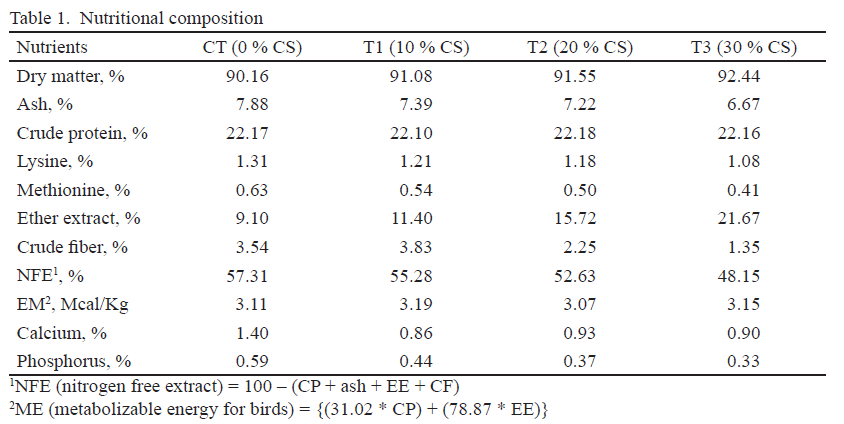
<body><![CDATA[<p align="justify"><font size="2" face="Verdana, Arial, Helvetica, sans-serif"><b><font size="3">INTRODUCTION</font></b></font></p>       <p align="justify" class="Cuerpodetexto"><span style="font-family:'Verdana','sans-serif'; font-size:10.0pt; ">In  Colombia, the poultry industry in the last year has achieved moving into a  second place of the gross domestic product (GDP) in the agricultural sector of  the country. This is due to the business growth and to the high demand of  poultry products among which chicken meat outstands (Jaimes <em>et al.</em> 2010). In broiler production, nutrition is an important factor since poultry  feeding is subjected to the high input cost and to the transfer of raw  materials for the elaboration of new products. This originates the increase of  feed prices and for that reason alternative raw matters are searched for that  can contribute protein and energy with better feed efficiency at lower  cost.&nbsp; In this way the raw matter  dependence with extremely high prices decreases (FAO 2012).</span></p>       <p align="justify" class="Cuerpodetexto"><span style="letter-spacing:.1pt; font-family:'Verdana','sans-serif'; font-size:10.0pt; ">The by-products of the fish industry turned into silage  through a chemical fermentation generate suitable characteristics for animal  nutrition.&nbsp; It allows recycling wastes  and decreases the negative impact to the environment (Gallego 2006).&nbsp; Silages are an important source of protein,  fatty acids and high quality energy and can attain substituting partially or  totally the utilization of conventional raw matters for the preparation of  poultry diets.&nbsp; In addition, its low cost  permits obtaining greater efficiency and profitability in the activity (Solano  2005).</span></p>       <p align="justify" class="Cuerpodetexto"><span style="font-family:'Verdana','sans-serif'; font-size:10.0pt; ">Nonetheless,  prior to recommending silages in animal feeding, trials must be carried out for  assessing, in biological terms, the effects of its inclusion. Thus, the  objective of this study was to evaluate the nutritional effect of the chemical  silage of trout viscera in chick broiler feeding as a better quality  alternative and lower cost.</span></p>       <p align="justify" class="Cuerpodetexto"><span style="font-family:'Verdana','sans-serif'; font-size:10.0pt; ">&nbsp;</span></p>       <p align="justify" class="subtitulo"><strong><span style="font-family:'Verdana','sans-serif'; font-size=3">MATERIALS AND METHODS</span></strong></p>       <p align="justify" class="Cuerpodetexto"><span style="font-family:'Verdana','sans-serif'; font-size:10.0pt; ">This study was developed at the Faculty of Agricultural  Sciences of the University of Cauca, Colombia at a height of 1780 masl, a mean  temperature of 19&ordm;C, 80 % of relative humidity and an annual rainfall of 1800  mm.&nbsp; For the preparation of the chemical  silage, viscera of rainbow trout were used.&nbsp;  Formic acid (2.5 %) was added and later mixed.&nbsp; The product was stored for 12 d in 60 kg  capacity plastic containers where stability was attained (Tunubal&aacute; and Hurtado  2013).</span><span style="font-family:'Verdana','sans-serif'; font-size:10.0pt; "> </span></p>       <p align="justify" class="Cuerpodetexto"><span style="letter-spacing:.2pt; font-family:'Verdana','sans-serif'; font-size:10.0pt; ">For evaluating the nutritional effect of the chemical  silage (CS) in broiler feeding, productive parameters were determined such as: feed  consumption (FC) weight gain (WG), feed conversion index (FCI), mortality (AM),  carcass yield (CY), economic conversion index (ECI) and economic profitability  index (EPI) (G&oacute;mez <em>et al.</em> 2014 and G&oacute;mez 2006). One hundred twenty eight  one day old chick broilers (females) of the Cobb 500 line were used with an  average weight of 42.8 &plusmn; 3.4 g. Chicks were distributed in 16 cages in a  completely randomized design with four treatments and four replications.&nbsp; Each replicate (cage with 8 birds) was taken  as the experimental unit.&nbsp; Treatments  evaluated were:      CT &ndash; control (0 % CS), T1 (10 % CS), T2 (20 % CS) and T3 (30 % CS).&nbsp; The nutritional composition of the evaluated  treatments is shown in <a href="/img/revistas/cjas/v49n4/t0111415.gif">table 1</a>.</span> </p>       
<p align="justify" class="Cuerpodetexto"><span style="font-family:'Verdana','sans-serif'; font-size:10.0pt; ">Broilers were evaluated for a period of 42 d. FC and AM  were registered daily, WG every 8 d.&nbsp; The  FCI, the same as the CY, ECI and EPI were established at the end of the  experiment.&nbsp; Every one of the variables  determined was analyzed by the application of an analysis of variance by  repeated measurements      (P &lt; 0.05). Duncan&rsquo;s test was used for mean comparison (&alpha; &lt; 0.05).&nbsp; The statistical program employed was SAS  (Statistical Analysis System), version 9.4.</span></p>       <p align="justify" class="Cuerpodetexto"><span style="font-family:'Verdana','sans-serif'; font-size:10.0pt; ">&nbsp;</span></p>       ]]></body>
<body><![CDATA[<p align="justify" class="subtitulo"><strong><span style="font-family:'Verdana','sans-serif'; font-size=3">RESULTS AND DISCUSSION</span></strong></p>       <p align="justify" class="Cuerpodetexto"><span style="font-family:'Verdana','sans-serif'; font-size:10.0pt; ">The  analysis of variance allowed observing that treatments evaluated showed  significant differences (P &lt; 0.05) for FC, WG. FCI, AM, ECI and EPI. From  Duncan&rsquo;s test various groups per variable (<a href="/img/revistas/cjas/v49n4/t0211415.gif">table 2</a>) were obtained.</span></p>       
<p align="justify" class="Cuerpodetexto"><span style="font-family:'Verdana','sans-serif'; font-size:10.0pt; ">Economic profitability index. Results indicated that  broilers showed acceptability to the diets with CS inclusion (<a href="/img/revistas/cjas/v49n4/t0211415.gif">table 2</a>).&nbsp; There were no undernourishment symptoms or  anomalies.&nbsp; In addition, all treatments  manifested weight gain in broilers.&nbsp; As a  higher CS percentage was included in the diets, fat deposition increased but  feed consumption decreased.&nbsp; This was due  to the increase in the energy that permitted covering the energetic  requirements with less feed intake (P&eacute;rez <em>et al.</em> 1974).&nbsp; This confirms that the extra fat addition  promotes growth and improves feed utilization by the animal.</span><span style="font-family:'Verdana','sans-serif'; font-size:10.0pt; "> </span></p>       
<p align="justify" class="Cuerpodetexto"><span style="font-family:'Verdana','sans-serif'; font-size:10.0pt; ">G&oacute;mez <em>et al.</em> (1974) studied the inclusion of red <em>Oreochromis  spp.</em> viscera silage in broiler feed during the starter stage. These authors  found that the inclusion of fish silage did not affect significantly feed  palatability. On the contrary, Al-Marzooqi <em>et al.</em> (2010) on studying the  effect of sardine silage on broiler feeding reported that by including between  10 and 20 % FC increased.&nbsp; Therefore, up  to 20 % soybean meal could be replaced without affecting poultry yield.&nbsp; Possibly, this effect is due to the fact that  the protein of the sardine silage has better quality and amino acid contents  that soybean meal.&nbsp; According to  Betancourt <em>et al.</em> (2006)&nbsp;  evaluating the trout viscera silage on the productive performance of  broilers (weight at 21 d), found preferences for the feed when included 20 %  fish silage.&nbsp; Perhaps this effect could  be produced by higher diet palatability.</span><span style="font-family:'Verdana','sans-serif'; font-size:10.0pt; "> </span></p>       <p align="justify" class="Cuerpodetexto"><span style="font-family:'Verdana','sans-serif'; font-size:10.0pt; ">For  WG, on including 10 % CS in the diets, there was better weight gain but  decreasing it when the inclusion percentage increased (<a href="/img/revistas/cjas/v49n4/t0211415.gif">table 2</a>).&nbsp; Kjos <em>et al.</em> (2000) remarked that on  increasing silage inclusion in broiler diets fat deposition increases which  negatively affects growth.&nbsp; A similar  performance was shown in this study, where diets with higher silage inclusion  percentage had lower weight gain.</span></p>       
<p align="justify" class="Cuerpodetexto"><span style="font-family:'Verdana','sans-serif'; font-size:10.0pt; ">G&oacute;mez <em>et al.</em> (2014) reported weight gain decrease as silage was included,  indicating that although fish silage is a raw matter with high amino acid  contents and adequate available amino acid profile for the utilization by the  animal with less energy expense, this was not reflected in the WG of broilers.  Sotto <em>et al.</em> (2024) studied the inclusion (0, 10, 20 and 30 %) of a  mixture with biological fish silage in quail diets during the growth-fattening  stage.&nbsp; These authors did not find  significant differences between the treatments evaluated.&nbsp; Quails gain more weight with the inclusion of  10 % of the mixture.</span></p>       <p align="justify" class="Cuerpodetexto"><span style="font-family:'Verdana','sans-serif'; font-size:10.0pt; ">Similar  results obtained Al-Marzooqi <em>et al.</em> (2010), who found that chickens that  had more final weight and higher daily weight gain were those consuming 10 and  20 % inclusion of fish silage, while animals consuming 0 and 30 % inclusion  attained lower daily weight gains.&nbsp;  Betancourt <em>et al.</em> (2006) evaluating the effect of trout viscera  silage (0, 10 and 20 %) on the productive performance of broilers found higher  weight at slaughtering by including 20 % trout viscera ensilage in broilers.</span></p>       <p align="justify" class="Cuerpodetexto"><span style="letter-spacing:.35pt; font-family:'Verdana','sans-serif'; font-size:10.0pt; ">In this respect, better FCI in the treatments with CS  inclusion were attained showing treatment T1 the best value (<a href="/img/revistas/cjas/v49n4/t0211415.gif">table 2</a>).&nbsp; Kjos <em>et al.</em> (2000) found better FCI  values in the diets with the inclusion of fish silage which suggests that fish  silage is a good protein source for broilers and that can substitute protein  sources as fish meal.&nbsp; G&oacute;mez <em>et al.</em> (2014) reported similar FCI in the diets including <em>Oreochromis spp.</em>.  (1.85, 1.85 and 1.9) for inclusions of 10, 20 and 30 %, respectively, although  there were no significant differences between treatments.&nbsp; Ram&iacute;rez <em>et al.</em> (2013) on evaluating  the effect of the biological fish silage on yield and quality characteristics  of quail meat (<em>Coturnix coturnix </em>japonica) referred that fish silage  including in quail diets did not affect significantly the FCI.&nbsp; Although there were no statistical  differences, it could be observed that treatments T1 (79.1 %) and T2 (78.2 %)  showed higher percentage of CY (<a href="/img/revistas/cjas/v49n4/t0211415.gif">table 2</a>).&nbsp;  According to COBB (2012) and Abdullah <em>et al.</em> (2010) carcass yield  is influenced by various factors.&nbsp; The  most relevant are weight, age, nutrition and sex of the chickens. That is to  say that at higher animal live weight, at higher age and at higher protein level  in the diet of female chickens, higher carcass yield will be obtained</span><span style="font-family:'Verdana','sans-serif'; font-size:10.0pt; ">.</span></p>       
<p align="justify" class="Cuerpodetexto"><span style="font-family:'Verdana','sans-serif'; font-size:10.0pt; ">Similar results were obtained by Ram&iacute;rez <em>et al.</em> (2013) who reported that the inclusion (0, 10, 20 and      30 %) of an ensiled mixture of fish-soybean meal for quails did not affect  carcass yield. These authors concluded that carcass yield is not negatively  affected by the addition of fish silage in the diets. On the contrary, Sotto <em>et  al.</em> (2014) on evaluating diets that contained a mixture of fish silage  found that the inclusion of up to 20 % of the mixture did not affect carcass  yields of birds</span><span style="font-family:'Verdana','sans-serif'; font-size:10.0pt; ">.</span></p>       <p align="justify" class="Cuerpodetexto"><span style="font-family:'Verdana','sans-serif'; font-size:10.0pt; ">AM occurred in the study was not attributable to the  effects of the silage in the feed, since the highest value was observed in the  CT.&nbsp; Together with the above mentioned,  the treatment with higher CS inclusion (T4) had no mortality. General AM was of  14.06 %, that caused by the ascitic syndrome was 7.81 % and the rest by other  death causes as crushing (6.25 %).&nbsp;  Hammoumi <em>et al.</em> (1998) in a trial for characterizing fermented  fish wastes (fish silage) in broiler feeding with the inclusion of 0, 25 and 50  % in the diets, reported that there was no mortality or abnormal symptoms in  any of the treatment</span><span style="font-family:'Verdana','sans-serif'; font-size:10.0pt; ">s.</span></p>       ]]></body>
<body><![CDATA[<p align="justify" class="Cuerpodetexto"><span style="font-family:'Verdana','sans-serif'; font-size:10.0pt; ">The  ECI is the cost of the concentrate required for producing one kilogram of  poultry meat.&nbsp; To higher CS inclusion  (10, 20 and 30 %), lower is the ECI ($1328.3, $1312.5 and $1203.9,  respectively). According to Mo&ntilde;ino (2002) on including CS in broiler diets the  economic expense decreases per kilogram of feed regarding the diets prepared  with conventional raw matters.</span></p>       <p align="justify" class="Cuerpodetexto"><span style="font-family:'Verdana','sans-serif'; font-size:10.0pt; ">In the EPI it was observed that on including 10 and 20 %  CS there is higher profitability ($6304.7 and $5706.2, respectively).  Al-Marzooqi <em>et al.</em> (2010) studied that effect on the feeding of  different silage levels on broiler yield, indicating that it is economically  profitable including up to 20 % fish silage in the diet in replacement of  soybean meal. G&oacute;mez <em>et al.</em> (2014)  evaluated silage inclusion and found that diets with 10, 20 and 30 % were less  expensive up to 20 % regarding the control diet.</span><span style="font-family:'Verdana','sans-serif'; font-size:10.0pt; "> </span></p>       <p align="justify" class="Cuerpodetexto"><span style="font-family:'Verdana','sans-serif'; font-size:10.0pt; ">Treatments  with the inclusion of 10&nbsp; (T1) and 20 %  (T2) of CS showed higher yield mainly in indicators such as WG, FCI and  CY.&nbsp; This is due to the inclusion of  silage in the diets.</span></p>       <p align="justify" class="Cuerpodetexto"><span style="font-family:'Verdana','sans-serif'; font-size:10.0pt; ">With the inclusion of CS in broiler diets, cost decreases  and economic profitability of the feed improves which makes the silage of trout  viscera a raw matter of great potential for the nutrition of      broilers</span><span style="font-family:'Verdana','sans-serif'; font-size:10.0pt; ">.</span></p>       <p align="justify" class="Cuerpodetexto"><span style="font-family:'Verdana','sans-serif'; font-size:10.0pt; ">&nbsp;</span></p>       <p align="justify" class="subtitulo"><strong><span style="font-family:'Verdana','sans-serif'; font-size=3">ACKNOWLEDGEMENTS</span></strong></p>       <p align="justify"><span style="font-family:'Verdana','sans-serif'; font-size:10.0pt; ">We are indebted to the  University of Cauca, research group ASUBAAGROIN, to the National University of Colombia,  Palmira Headquarters, Animal Nutrition Laboratory and to the General Royalty  System and APROPESCA</span><font size="2" face="Verdana, Arial, Helvetica, sans-serif">.</font></p>     <p align="justify">&nbsp;</p>      <p align="justify"><font size="2" face="Verdana, Arial, Helvetica, sans-serif"><font size="3"><b>REFERENCES</b></font></font></p>     <p align="justify" class="MsoNormal" style="line-height:normal;"><span style="font-family:'Verdana','sans-serif'; font-size:10.0pt; ">Abdullah, A. Y., Muwalla, M. M., Maharmeh, H.  O., Matarneh, S. K. &amp; Ishmais, M. A. A. 2010. &ldquo;Effects of strain on performance,  and age at slaughter and duration of post-chilling aging on meat quality traits  of broiler&rdquo;. </span><em><span style="font-family:'Verdana','sans-serif'; font-size:10.0pt; ">Asian-Australasian Journal of Animal Sciences</span></em><span style="font-family:'Verdana','sans-serif'; font-size:10.0pt; ">, 23 (12): 1645&ndash;1656.</span></p>     ]]></body>
<body><![CDATA[<p align="justify" class="MsoNormal" style="line-height:normal;"><span style="font-family:'Verdana','sans-serif'; font-size:10.0pt; ">Agudelo, C.,  Ortega, R. &amp; Hoyos, J. L. 2010. &ldquo;Determinaci&oacute;n de par&aacute;metros cin&eacute;ticos de  dos in&oacute;culos l&aacute;cticos: <em>Lactobacillus plantarum</em> A6 y bacterias &aacute;cido  l&aacute;cticas de yogurt&rdquo;. <em>Facultad de Ciencias Agropecuarias</em>, 8 (2): 8&ndash;16.</span></p>     <p align="justify" class="MsoNormal" style="line-height:normal;"><span style="font-family:'Verdana','sans-serif'; font-size:10.0pt; ">Ag&uuml;ero, V. R.  S., Oberto, R. I., L&oacute;pez, V. B. &amp; U&ntilde;a, I. F. 2014. &ldquo;Inclusi&oacute;n de la harina  de Pennisetum purpureum enriquecida con ensilado biol&oacute;gico de pescado en dietas  para codorniz en la etapa de crecimiento-ceba&rdquo;. </span><em><span style="font-family:'Verdana','sans-serif'; font-size:10.0pt; ">Rev. Prod. Anim.</span></em><span style="font-family:'Verdana','sans-serif'; font-size:10.0pt; ">, 26 (2).</span></p>     <p align="justify" class="MsoNormal" style="line-height:normal;"><span style="font-family:'Verdana','sans-serif'; font-size:10.0pt; ">Al-Marzooqi, W., Al-Farsi, M. A., Kadim, I. T.,  Mahgoub, O., Goddard, J. S. &amp; others 2010. &ldquo;The effect of feeding different  levels of sardine fish silage on broiler performance, meat quality and sensory  characteristics under closed and open-sided housing systems&rdquo;. <em>Asian-Australasian  Journal of Animal Sciences</em>, 23 (12): 1614&ndash;1625.</span></p>     <!-- ref --><p align="justify" class="MsoNormal" style="line-height:normal;"><span style="font-family:'Verdana','sans-serif'; font-size:10.0pt; ">Betancourt, L., D&iacute;az, G., Aguilar, X. &amp; R&iacute;os,  J. 2006. </span><em><span style="font-family:'Verdana','sans-serif'; font-size:10.0pt; ">Efecto del ensilaje de v&iacute;sceras de trucha  (Oncorhynchus mykiss) sobre el comportamiento productivo y el contenido de  &aacute;cidos omega-3 en h&iacute;gado, muslos y pechuga, de pollos de engorde</span></em><span style="font-family:'Verdana','sans-serif'; font-size:10.0pt; ">. Facultad de Zootecnia, Universidad de La Salle, Available:  &lt;<a href="http://www.cipav.org.co/lrrd/lrrd17/9/beta17106.htm" target="_blank">http://www.cipav.org.co/lrrd/lrrd17/9/beta17106.htm</a>&gt;    .</span></p>     <!-- ref --><p align="justify" class="MsoNormal" style="line-height:normal;"><span style="font-family:'Verdana','sans-serif'; font-size:10.0pt; ">COBB. 2012. <em>Suplemento  informativo sobre rendimiento y nutrici&oacute;n de pollos de engorde</em>. ,  Available: &lt;<a href="http://www.cobb-vantress. com/docs/default-source/cobb-500-guides/cobb500_bpn_supp_ spanish.pdfsfvrsn=2" target="_blank">http://www.cobb-vantress.  com/docs/default-source/cobb-500-guides/cobb500_bpn_supp_ spanish.pdfsfvrsn=2</a>&gt;    .</span></p>     <!-- ref --><p align="justify" class="MsoNormal" style="line-height:normal;"><span style="font-family:'Verdana','sans-serif'; font-size:10.0pt; ">FAO 2013. <em>Revisi&oacute;n  del Desarrollo Av&iacute;cola</em>. Roma: Organizaci&oacute;n de las Naciones Unidas para la  Agricultura y la Alimentaci&oacute;n, ISBN: 978-92-5-308067-0, Available:  &lt;<a href="http://www.fao.org/docrep/019/i3531s/i3531s.pdf" target="_blank">http://www.fao.org/docrep/019/i3531s/i3531s.pdf</a>&gt;, [Consulted:&nbsp;May  5, 2016].    </span></p>     <p align="justify" class="MsoNormal" style="line-height:normal;"><span style="font-family:'Verdana','sans-serif'; font-size:10.0pt; ">Gallego, M. R.  2012. &ldquo;Producci&oacute;n m&aacute;s limpia en la industria alimentaria&rdquo;. <em>Producci&oacute;n +  Limpia</em>, 1: 87.</span></p>     ]]></body>
<body><![CDATA[<p align="justify" class="MsoNormal" style="line-height:normal;"><span style="font-family:'Verdana','sans-serif'; font-size:10.0pt; ">G&oacute;mez, G.,  Ortiz, M., Perea, C. &amp; L&oacute;pez, F. 2014. &ldquo;Evaluaci&oacute;n del ensilaje de v&iacute;sceras  de tilapia roja (<em>Oreochromis</em> spp) en alimentaci&oacute;n de pollos de engorde&rdquo;. <em>Biotecnolog&iacute;a en el Sector Agropecuario y Agroindustrial</em>, 12 (1),  Available:  &lt;<a href="http://search.ebscohost.com/login.aspx?direct=true&profile=ehost&scope=site&authtype=crawler&jrnl=16923561&AN=114307413&h=VTPVj1bPWGurQz6%2B6PYq6FZ4fsbhosvcTDfj1dhw4RewIxqYO3B2KpnwMLgPWwYKHAZGIq9fq41wAQ0F4C5ahg%3D%3D&crl=c" target="_blank">http://search.ebscohost.com/login.aspx?direct=true&amp;profile=ehost&amp;scope=site&amp;authtype=crawler&amp;jrnl=16923561&amp;AN=114307413&amp;h=VTPVj1bPWGurQz6%2B6PYq6FZ4fsbhosvcTDfj1dhw4RewIxqYO3B2KpnwMLgPWwYKHAZGIq9fq41wAQ0F4C5ahg%3D%3D&amp;crl=c</a>&gt;,  [Consulted:&nbsp;May 5, 2016].</span></p>     <!-- ref --><p align="justify" class="MsoNormal" style="line-height:normal;"><span style="font-family:'Verdana','sans-serif'; font-size:10.0pt; ">G&oacute;mez, J. 2006. <em>Contribuci&oacute;n al estudio de estrategias de alimentaci&oacute;n en dorada Sparus  aurata, L.</em> Ph.D. Thesis, Universidad Polit&eacute;cnica de Valencia, Valencia,  Espa&ntilde;a.    </span></p>     <p align="justify" class="MsoNormal" style="line-height:normal;"><span style="font-family:'Verdana','sans-serif'; font-size:10.0pt; ">Hammoumi, A., Faid, M. &amp; Amarouch, H. 1998.  &ldquo;Characterization of fermented fish waste used in feeding trials with  broilers&rdquo;. </span><em><span style="font-family:'Verdana','sans-serif'; font-size:10.0pt; ">Process Biochemistry</span></em><span style="font-family:'Verdana','sans-serif'; font-size:10.0pt; ">, 33 (4):  423&ndash;427.</span></p>     <p align="justify" class="MsoNormal" style="line-height:normal;"><span style="font-family:'Verdana','sans-serif'; font-size:10.0pt; ">Jaimes, J. A.,  G&oacute;mez Ram&iacute;rez, A. P., &Aacute;lvarez Espejo, D. C. M., Soler Tovar, D., Romero Prada,  J. R. &amp; Villamil Jim&eacute;nez, L. C. 2010. &ldquo;Las enfermedades infecciosas y su  importancia en el sector av&iacute;cola&rdquo;. <em>Revista de Medicina Veterinaria</em>,  (20): 49&ndash;61.</span></p>     <p align="justify" class="MsoNormal" style="line-height:normal;"><span style="font-family:'Verdana','sans-serif'; font-size:10.0pt; ">Kjos, N. P.,  Herstad, O., &Oslash;verland, M. &amp; Skrede, A. 2000. </span><span style="font-family:'Verdana','sans-serif'; font-size:10.0pt; ">&ldquo;Effects of dietary fish silage and fish fat on  growth performance and meat quality of broiler chicks&rdquo;. </span><em><span style="font-family:'Verdana','sans-serif'; font-size:10.0pt; ">Canadian Journal of Animal Science</span></em><span style="font-family:'Verdana','sans-serif'; font-size:10.0pt; ">, 80 (4):  625&ndash;632.</span></p>     <!-- ref --><p align="justify" class="MsoNormal" style="line-height:normal;"><span style="font-family:'Verdana','sans-serif'; font-size:10.0pt; ">Larrea, J.  2009. <em>Caracterizaci&oacute;n y mejoramiento de la producci&oacute;n de carne de pollo de  ceba para la amazon&iacute;a bajo el sistema YACHANA-B</em>. Riobamba Ecuador: Escuela  Superior Polit&eacute;cnica De Chimborazo. Facultad De Ciencias Pecuarias.    </span></p>     <!-- ref --><p align="justify" class="MsoNormal" style="line-height:normal;"><span style="font-family:'Verdana','sans-serif'; font-size:10.0pt; ">Merino, E.  2009. <em>Determinaci&oacute;n de una funci&oacute;n de producci&oacute;n en pollos de engorde usando  una dieta con componentes locales</em>. Zamorano, Honduras.    </span></p>     ]]></body>
<body><![CDATA[<p align="justify" class="MsoNormal" style="line-height:normal;"><span style="font-family:'Verdana','sans-serif'; font-size:10.0pt; ">Mojica, A.  &amp; Paredes, J. 2005. &ldquo;Caracter&iacute;sticas del sector av&iacute;cola colombiano y su  reciente evolucion en el departamento de Santander&rdquo;. <em>Ensayos sobre econom&iacute;a  regional</em>, Available: &lt;<a href="http://www.banrep.gov.co/es/eser-29" target="_blank">http://www.banrep.gov.co/es/eser-29</a>&gt;,  [Consulted:&nbsp;May 5, 2016].</span></p>     <p align="justify" class="MsoNormal" style="line-height:normal;"><span style="font-family:'Verdana','sans-serif'; font-size:10.0pt; ">Mo&ntilde;ino, A.,  Tom&aacute;s, A., Fern&aacute;ndez, M., L&aacute;zaro, R., P&eacute;rez, L., Espin&oacute;s, F. J., Tiana, A.  &amp; Jover, M. 2011. &ldquo;Estudio del crecimiento, del aprovechamiento nutritivo y  de la productividad econ&oacute;mica de la dorada <em>Sparus auratus</em> L., 1758  alimentada con piensos comerciales de diferente contenido en prote&iacute;na y  l&iacute;pidos&rdquo;. <em>Bolet&iacute;n. Instituto Espa&ntilde;ol de Oceanograf&iacute;a</em>, 18 (1-4): 275&ndash;280.</span></p>     <p align="justify" class="MsoNormal" style="line-height:normal;"><span style="font-family:'Verdana','sans-serif'; font-size:10.0pt; ">P&eacute;rez, J.,  Gutierrez, L. &amp; Guacar&aacute;n, P. 1974. &ldquo;Niveles de grasa cruda en dietas para  pollos de engorde&rdquo;. <em>Agronom&iacute;a Tropical</em>, 24 (3): 193&ndash;200.</span></p>     <p align="justify" class="MsoNormal" style="line-height:normal;"><span style="font-family:'Verdana','sans-serif'; font-size:10.0pt; ">Ram&iacute;rez, J. C.  R., Ibarra, J. I., Romero, F. A., Ulloa, P. R., Ulloa, J. A., Matsumoto, K. S.,  Cordoba, B. V. &amp; Manzano, M. &Aacute;. M. 2013. </span><span style="font-family:'Verdana','sans-serif'; font-size:10.0pt; ">&ldquo;Preparation of biological fish silage and its  effect on the performance and meat quality characteristics of quails (<em>Coturnix  coturnix</em> japonica)&rdquo;. </span><em><span style="font-family:'Verdana','sans-serif'; font-size:10.0pt; ">Brazilian Archives of Biology and  Technology</span></em><span style="font-family:'Verdana','sans-serif'; font-size:10.0pt; ">, 56 (6): 1002&ndash;1010.</span></p>     <!-- ref --><p align="justify" class="MsoNormal" style="line-height:normal;"><span style="font-family:'Verdana','sans-serif'; font-size:10.0pt; ">Tovar, R. 2012. <em>Pr&aacute;cticas de manejo en la cr&iacute;a de pollos de engorde en una granja comercial  ubicada en la localidad de Mor&oacute;n</em>. municipio de Santa B&aacute;rbara, Estado de  Monagas.    </span></p>     <!-- ref --><p align="justify"><span style="font-family:'Verdana','sans-serif'; font-size:10.0pt; ">Tunubal&aacute;,  E. &amp; Hurtado, G. 2013. <em>Evaluaci&oacute;n del proceso de fermentaci&oacute;n de  ensilado biol&oacute;gico a partir de v&iacute;sceras de trucha arco&iacute;ris (Oncorhynchus  mykiss), adquiridas de la asociaci&oacute;n de productores pisc&iacute;colas del municipio de  Silvia Cauca</em>. Graduated Thesis, Universidad Cooperativa de Colombia, Sede  Popay&aacute;n, Colombia</span><font size="2" face="Verdana,     Arial, Helvetica, sans-serif">.</font> </p>     <p align="justify">&nbsp;</p>     <p align="justify">&nbsp;</p>     ]]></body>
<body><![CDATA[<p align="justify"><font size="2" face="Verdana, Arial, Helvetica, sans-serif">Received: November 25, 2015    <br>   Accepted: January 14 , 2016</font></p>     <p align="justify">&nbsp;</p>     <p align="justify">&nbsp;</p>     <p align="justify"><font size="2" face="Verdana, Arial, Helvetica, sans-serif"><i>Yeny Garcés,</i> Universidad del Cauca, Facultad de Ciencias Agrarias, Popayán, Colombia.    Email: <a href="mailto:yjgarcesc@unal.edu.co">yjgarcesc@unal.edu.co</a></font></p>      ]]></body><back>
<ref-list>
<ref id="B1">
<nlm-citation citation-type="journal">
<person-group person-group-type="author">
<name>
<surname><![CDATA[Abdullah]]></surname>
<given-names><![CDATA[A. Y.]]></given-names>
</name>
<name>
<surname><![CDATA[Muwalla]]></surname>
<given-names><![CDATA[M. M.]]></given-names>
</name>
<name>
<surname><![CDATA[Maharmeh]]></surname>
<given-names><![CDATA[H. O.]]></given-names>
</name>
<name>
<surname><![CDATA[Matarneh]]></surname>
<given-names><![CDATA[S. K.]]></given-names>
</name>
<name>
<surname><![CDATA[Ishmais]]></surname>
<given-names><![CDATA[M. A. A.]]></given-names>
</name>
</person-group>
<article-title xml:lang="nd"><![CDATA[Effects of strain on performance, and age at slaughter and duration of post-chilling aging on meat quality traits of broiler]]></article-title>
<source><![CDATA[Asian-Australasian Journal of Animal Sciences]]></source>
<year>2010</year>
<volume>23</volume>
<numero>12</numero>
<issue>12</issue>
<page-range>1645–1656</page-range></nlm-citation>
</ref>
<ref id="B2">
<nlm-citation citation-type="journal">
<person-group person-group-type="author">
<name>
<surname><![CDATA[Agudelo]]></surname>
<given-names><![CDATA[C.]]></given-names>
</name>
<name>
<surname><![CDATA[Ortega]]></surname>
<given-names><![CDATA[R.]]></given-names>
</name>
<name>
<surname><![CDATA[Hoyos]]></surname>
<given-names><![CDATA[J. L.]]></given-names>
</name>
</person-group>
<article-title xml:lang="nd"><![CDATA[Determinación de parámetros cinéticos de dos inóculos lácticos: Lactobacillus plantarum A6 y bacterias ácido lácticas de yogurt]]></article-title>
<source><![CDATA[Facultad de Ciencias Agropecuarias]]></source>
<year>2010</year>
<volume>8</volume>
<numero>2</numero>
<issue>2</issue>
<page-range>8–16</page-range></nlm-citation>
</ref>
<ref id="B3">
<nlm-citation citation-type="journal">
<person-group person-group-type="author">
<name>
<surname><![CDATA[Agüero]]></surname>
<given-names><![CDATA[V. R. S.]]></given-names>
</name>
<name>
<surname><![CDATA[Oberto]]></surname>
<given-names><![CDATA[R. I.]]></given-names>
</name>
<name>
<surname><![CDATA[López]]></surname>
<given-names><![CDATA[V. B.]]></given-names>
</name>
<name>
<surname><![CDATA[Uña]]></surname>
<given-names><![CDATA[I. F.]]></given-names>
</name>
</person-group>
<article-title xml:lang="nd"><![CDATA[Inclusión de la harina de Pennisetum purpureum enriquecida con ensilado biológico de pescado en dietas para codorniz en la etapa de crecimiento-ceba]]></article-title>
<source><![CDATA[Rev. Prod. Anim.]]></source>
<year>2014</year>
<volume>26</volume>
<numero>2</numero>
<issue>2</issue>
</nlm-citation>
</ref>
<ref id="B4">
<nlm-citation citation-type="journal">
<person-group person-group-type="author">
<name>
<surname><![CDATA[Al-Marzooqi]]></surname>
<given-names><![CDATA[W.]]></given-names>
</name>
<name>
<surname><![CDATA[Al-Farsi]]></surname>
<given-names><![CDATA[M. A.]]></given-names>
</name>
<name>
<surname><![CDATA[Kadim]]></surname>
<given-names><![CDATA[I. T.]]></given-names>
</name>
<name>
<surname><![CDATA[Mahgoub]]></surname>
<given-names><![CDATA[O.]]></given-names>
</name>
<name>
<surname><![CDATA[Goddard]]></surname>
<given-names><![CDATA[J. S.]]></given-names>
</name>
</person-group>
<article-title xml:lang="nd"><![CDATA[The effect of feeding different levels of sardine fish silage on broiler performance, meat quality and sensory characteristics under closed and open-sided housing systems]]></article-title>
<source><![CDATA[Asian-Australasian Journal of Animal Sciences]]></source>
<year>2010</year>
<volume>23</volume>
<numero>12</numero>
<issue>12</issue>
<page-range>1614–1625</page-range></nlm-citation>
</ref>
<ref id="B5">
<nlm-citation citation-type="book">
<person-group person-group-type="author">
<name>
<surname><![CDATA[Betancourt]]></surname>
<given-names><![CDATA[L.]]></given-names>
</name>
<name>
<surname><![CDATA[Díaz]]></surname>
<given-names><![CDATA[G.]]></given-names>
</name>
<name>
<surname><![CDATA[Aguilar]]></surname>
<given-names><![CDATA[X.]]></given-names>
</name>
<name>
<surname><![CDATA[Ríos]]></surname>
<given-names><![CDATA[J.]]></given-names>
</name>
</person-group>
<source><![CDATA[Efecto del ensilaje de vísceras de trucha (Oncorhynchus mykiss) sobre el comportamiento productivo y el contenido de ácidos omega-3 en hígado, muslos y pechuga, de pollos de engorde]]></source>
<year>2006</year>
<publisher-name><![CDATA[Facultad de Zootecnia, Universidad de La Salle]]></publisher-name>
</nlm-citation>
</ref>
<ref id="B6">
<nlm-citation citation-type="">
<person-group person-group-type="author">
<name>
<surname><![CDATA[COBB]]></surname>
</name>
</person-group>
<source><![CDATA[Suplemento informativo sobre rendimiento y nutrición de pollos de engorde]]></source>
<year>2012</year>
</nlm-citation>
</ref>
<ref id="B7">
<nlm-citation citation-type="book">
<person-group person-group-type="author">
<name>
<surname><![CDATA[FAO]]></surname>
</name>
</person-group>
<source><![CDATA[Revisión del Desarrollo Avícola]]></source>
<year>2013</year>
<publisher-loc><![CDATA[Roma ]]></publisher-loc>
<publisher-name><![CDATA[Organización de las Naciones Unidas para la Agricultura y la Alimentación]]></publisher-name>
</nlm-citation>
</ref>
<ref id="B8">
<nlm-citation citation-type="journal">
<person-group person-group-type="author">
<name>
<surname><![CDATA[Gallego]]></surname>
<given-names><![CDATA[M. R.]]></given-names>
</name>
</person-group>
<article-title xml:lang="nd"><![CDATA[Producción más limpia en la industria alimentaria]]></article-title>
<source><![CDATA[Producción + Limpia]]></source>
<year>2012</year>
<volume>1</volume>
<page-range>87</page-range></nlm-citation>
</ref>
<ref id="B9">
<nlm-citation citation-type="journal">
<person-group person-group-type="author">
<name>
<surname><![CDATA[Gómez]]></surname>
<given-names><![CDATA[G.]]></given-names>
</name>
<name>
<surname><![CDATA[Ortiz]]></surname>
<given-names><![CDATA[M.]]></given-names>
</name>
<name>
<surname><![CDATA[Perea]]></surname>
<given-names><![CDATA[C.]]></given-names>
</name>
<name>
<surname><![CDATA[López]]></surname>
<given-names><![CDATA[F.]]></given-names>
</name>
</person-group>
<article-title xml:lang="nd"><![CDATA[Evaluación del ensilaje de vísceras de tilapia roja (Oreochromis spp) en alimentación de pollos de engorde]]></article-title>
<source><![CDATA[Biotecnología en el Sector Agropecuario y Agroindustrial]]></source>
<year>2014</year>
<volume>12</volume>
<numero>1</numero>
<issue>1</issue>
</nlm-citation>
</ref>
<ref id="B10">
<nlm-citation citation-type="book">
<person-group person-group-type="author">
<name>
<surname><![CDATA[Gómez]]></surname>
<given-names><![CDATA[J.]]></given-names>
</name>
</person-group>
<source><![CDATA[Contribución al estudio de estrategias de alimentación en dorada Sparus aurata, L.]]></source>
<year>2006</year>
<publisher-loc><![CDATA[Valencia, España ]]></publisher-loc>
<publisher-name><![CDATA[Universidad Politécnica de Valencia]]></publisher-name>
</nlm-citation>
</ref>
<ref id="B11">
<nlm-citation citation-type="journal">
<person-group person-group-type="author">
<name>
<surname><![CDATA[Hammoumi]]></surname>
<given-names><![CDATA[A.]]></given-names>
</name>
<name>
<surname><![CDATA[Faid]]></surname>
<given-names><![CDATA[M.]]></given-names>
</name>
<name>
<surname><![CDATA[Amarouch]]></surname>
<given-names><![CDATA[H.]]></given-names>
</name>
</person-group>
<article-title xml:lang="nd"><![CDATA[Characterization of fermented fish waste used in feeding trials with broilers]]></article-title>
<source><![CDATA[Process Biochemistry]]></source>
<year>1998</year>
<volume>33</volume>
<numero>4</numero>
<issue>4</issue>
<page-range>423–427</page-range></nlm-citation>
</ref>
<ref id="B12">
<nlm-citation citation-type="journal">
<person-group person-group-type="author">
<name>
<surname><![CDATA[Jaimes]]></surname>
<given-names><![CDATA[J. A.]]></given-names>
</name>
<name>
<surname><![CDATA[Gómez Ramírez]]></surname>
<given-names><![CDATA[A. P.]]></given-names>
</name>
<name>
<surname><![CDATA[Álvarez Espejo]]></surname>
<given-names><![CDATA[D. C. M.]]></given-names>
</name>
<name>
<surname><![CDATA[Soler Tovar]]></surname>
<given-names><![CDATA[D.]]></given-names>
</name>
<name>
<surname><![CDATA[Romero Prada]]></surname>
<given-names><![CDATA[J. R.]]></given-names>
</name>
<name>
<surname><![CDATA[Villamil Jiménez]]></surname>
<given-names><![CDATA[L. C.]]></given-names>
</name>
</person-group>
<article-title xml:lang="nd"><![CDATA[Las enfermedades infecciosas y su importancia en el sector avícola]]></article-title>
<source><![CDATA[Revista de Medicina Veterinaria]]></source>
<year>2010</year>
<numero>20</numero>
<issue>20</issue>
<page-range>49–61</page-range></nlm-citation>
</ref>
<ref id="B13">
<nlm-citation citation-type="journal">
<person-group person-group-type="author">
<name>
<surname><![CDATA[Kjos]]></surname>
<given-names><![CDATA[N. P.]]></given-names>
</name>
<name>
<surname><![CDATA[Herstad]]></surname>
<given-names><![CDATA[O.]]></given-names>
</name>
<name>
<surname><![CDATA[Øverland]]></surname>
<given-names><![CDATA[M.]]></given-names>
</name>
<name>
<surname><![CDATA[Skrede]]></surname>
<given-names><![CDATA[A.]]></given-names>
</name>
</person-group>
<article-title xml:lang="nd"><![CDATA[Effects of dietary fish silage and fish fat on growth performance and meat quality of broiler chicks]]></article-title>
<source><![CDATA[Canadian Journal of Animal Science]]></source>
<year>2000</year>
<volume>80</volume>
<numero>4</numero>
<issue>4</issue>
<page-range>625–632</page-range></nlm-citation>
</ref>
<ref id="B14">
<nlm-citation citation-type="book">
<person-group person-group-type="author">
<name>
<surname><![CDATA[Larrea]]></surname>
<given-names><![CDATA[J.]]></given-names>
</name>
</person-group>
<source><![CDATA[Caracterización y mejoramiento de la producción de carne de pollo de ceba para la amazonía bajo el sistema YACHANA-B]]></source>
<year>2009</year>
<publisher-loc><![CDATA[Riobamba Ecuador ]]></publisher-loc>
<publisher-name><![CDATA[Escuela Superior Politécnica De Chimborazo. Facultad De Ciencias Pecuarias]]></publisher-name>
</nlm-citation>
</ref>
<ref id="B15">
<nlm-citation citation-type="">
<person-group person-group-type="author">
<name>
<surname><![CDATA[Merino]]></surname>
<given-names><![CDATA[E.]]></given-names>
</name>
</person-group>
<source><![CDATA[Determinación de una función de producción en pollos de engorde usando una dieta con componentes locales]]></source>
<year>2009</year>
<publisher-loc><![CDATA[Zamorano, Honduras ]]></publisher-loc>
</nlm-citation>
</ref>
<ref id="B16">
<nlm-citation citation-type="journal">
<person-group person-group-type="author">
<name>
<surname><![CDATA[Mojica]]></surname>
<given-names><![CDATA[A.]]></given-names>
</name>
<name>
<surname><![CDATA[Paredes]]></surname>
<given-names><![CDATA[J.]]></given-names>
</name>
</person-group>
<article-title xml:lang="nd"><![CDATA[Características del sector avícola colombiano y su reciente evolucion en el departamento de Santander]]></article-title>
<source><![CDATA[Ensayos sobre economía regional]]></source>
<year>2005</year>
</nlm-citation>
</ref>
<ref id="B17">
<nlm-citation citation-type="journal">
<person-group person-group-type="author">
<name>
<surname><![CDATA[Moñino]]></surname>
<given-names><![CDATA[A.]]></given-names>
</name>
<name>
<surname><![CDATA[Tomás]]></surname>
<given-names><![CDATA[A.]]></given-names>
</name>
<name>
<surname><![CDATA[Fernández]]></surname>
<given-names><![CDATA[M.]]></given-names>
</name>
<name>
<surname><![CDATA[Lázaro]]></surname>
<given-names><![CDATA[R.]]></given-names>
</name>
<name>
<surname><![CDATA[Pérez]]></surname>
<given-names><![CDATA[L.]]></given-names>
</name>
<name>
<surname><![CDATA[Espinós]]></surname>
<given-names><![CDATA[F. J.]]></given-names>
</name>
<name>
<surname><![CDATA[Tiana]]></surname>
<given-names><![CDATA[A.]]></given-names>
</name>
<name>
<surname><![CDATA[Jover]]></surname>
<given-names><![CDATA[M.]]></given-names>
</name>
</person-group>
<article-title xml:lang="nd"><![CDATA[Estudio del crecimiento, del aprovechamiento nutritivo y de la productividad económica de la dorada Sparus auratus L., 1758 alimentada con piensos comerciales de diferente contenido en proteína y lípidos]]></article-title>
<source><![CDATA[Boletín. Instituto Español de Oceanografía]]></source>
<year>2011</year>
<volume>18</volume>
<numero>1-4</numero>
<issue>1-4</issue>
<page-range>275–280</page-range></nlm-citation>
</ref>
<ref id="B18">
<nlm-citation citation-type="journal">
<person-group person-group-type="author">
<name>
<surname><![CDATA[Pérez]]></surname>
<given-names><![CDATA[J.]]></given-names>
</name>
<name>
<surname><![CDATA[Gutierrez]]></surname>
<given-names><![CDATA[L.]]></given-names>
</name>
<name>
<surname><![CDATA[Guacarán]]></surname>
<given-names><![CDATA[P.]]></given-names>
</name>
</person-group>
<article-title xml:lang="nd"><![CDATA[Niveles de grasa cruda en dietas para pollos de engorde]]></article-title>
<source><![CDATA[Agronomía Tropical]]></source>
<year>1974</year>
<volume>24</volume>
<numero>3</numero>
<issue>3</issue>
<page-range>193–200</page-range></nlm-citation>
</ref>
<ref id="B19">
<nlm-citation citation-type="journal">
<person-group person-group-type="author">
<name>
<surname><![CDATA[Ramírez]]></surname>
<given-names><![CDATA[J. C. R.]]></given-names>
</name>
<name>
<surname><![CDATA[Ibarra]]></surname>
<given-names><![CDATA[J. I.]]></given-names>
</name>
<name>
<surname><![CDATA[Romero]]></surname>
<given-names><![CDATA[F. A.]]></given-names>
</name>
<name>
<surname><![CDATA[Ulloa]]></surname>
<given-names><![CDATA[P. R.]]></given-names>
</name>
<name>
<surname><![CDATA[Ulloa]]></surname>
<given-names><![CDATA[J. A.]]></given-names>
</name>
<name>
<surname><![CDATA[Matsumoto]]></surname>
<given-names><![CDATA[K. S.]]></given-names>
</name>
<name>
<surname><![CDATA[Cordoba]]></surname>
<given-names><![CDATA[B. V.]]></given-names>
</name>
<name>
<surname><![CDATA[Manzano]]></surname>
<given-names><![CDATA[M. Á. M.]]></given-names>
</name>
</person-group>
<article-title xml:lang="nd"><![CDATA[Preparation of biological fish silage and its effect on the performance and meat quality characteristics of quails (Coturnix coturnix japonica)]]></article-title>
<source><![CDATA[Brazilian Archives of Biology and Technology]]></source>
<year>2013</year>
<volume>56</volume>
<numero>6</numero>
<issue>6</issue>
<page-range>1002–1010</page-range></nlm-citation>
</ref>
<ref id="B20">
<nlm-citation citation-type="">
<person-group person-group-type="author">
<name>
<surname><![CDATA[Tovar]]></surname>
<given-names><![CDATA[R.]]></given-names>
</name>
</person-group>
<source><![CDATA[Prácticas de manejo en la cría de pollos de engorde en una granja comercial ubicada en la localidad de Morón]]></source>
<year>2012</year>
<publisher-loc><![CDATA[municipio de Santa Bárbara, Estado de Monagas ]]></publisher-loc>
</nlm-citation>
</ref>
<ref id="B21">
<nlm-citation citation-type="book">
<person-group person-group-type="author">
<name>
<surname><![CDATA[Tunubalá]]></surname>
<given-names><![CDATA[E.]]></given-names>
</name>
<name>
<surname><![CDATA[Hurtado]]></surname>
<given-names><![CDATA[G.]]></given-names>
</name>
</person-group>
<source><![CDATA[Evaluación del proceso de fermentación de ensilado biológico a partir de vísceras de trucha arcoíris (Oncorhynchus mykiss), adquiridas de la asociación de productores piscícolas del municipio de Silvia Cauca]]></source>
<year>2013</year>
<publisher-loc><![CDATA[Colombia ]]></publisher-loc>
<publisher-name><![CDATA[Universidad Cooperativa de Colombia, Sede Popayán]]></publisher-name>
</nlm-citation>
</ref>
</ref-list>
</back>
</article>