<?xml version="1.0" encoding="ISO-8859-1"?><article xmlns:mml="http://www.w3.org/1998/Math/MathML" xmlns:xlink="http://www.w3.org/1999/xlink" xmlns:xsi="http://www.w3.org/2001/XMLSchema-instance">
<front>
<journal-meta>
<journal-id>2079-3480</journal-id>
<journal-title><![CDATA[Cuban Journal of Agricultural Science]]></journal-title>
<abbrev-journal-title><![CDATA[Cuban J. Agric. Sci.]]></abbrev-journal-title>
<issn>2079-3480</issn>
<publisher>
<publisher-name><![CDATA[Editorial del Instituto de Ciencia Animal]]></publisher-name>
</publisher>
</journal-meta>
<article-meta>
<article-id>S2079-34802016000100005</article-id>
<title-group>
<article-title xml:lang="en"><![CDATA[Validation of a mathematical model developed for the solid state fermentation process of the sugar cane (Saccharum officinarum) with sweet potato (Ipomoea batata Lam)]]></article-title>
<article-title xml:lang="es"><![CDATA[Validación de un modelo matemático desarrollado para el proceso de fermentación en estado sólido de la caña de azúcar (Saccharum officinarum) con boniato (Ipomoea batata Lam)]]></article-title>
</title-group>
<contrib-group>
<contrib contrib-type="author">
<name>
<surname><![CDATA[Sosa]]></surname>
<given-names><![CDATA[Dailyn]]></given-names>
</name>
<xref ref-type="aff" rid="A01"/>
</contrib>
<contrib contrib-type="author">
<name>
<surname><![CDATA[Dustet]]></surname>
<given-names><![CDATA[J.C]]></given-names>
</name>
<xref ref-type="aff" rid="A02"/>
</contrib>
<contrib contrib-type="author">
<name>
<surname><![CDATA[Boucourt]]></surname>
<given-names><![CDATA[R]]></given-names>
</name>
<xref ref-type="aff" rid="A01"/>
</contrib>
<contrib contrib-type="author">
<name>
<surname><![CDATA[Rodríguez]]></surname>
<given-names><![CDATA[Zoraya]]></given-names>
</name>
<xref ref-type="aff" rid="A01"/>
</contrib>
</contrib-group>
<aff id="A01">
<institution><![CDATA[,Instituto de Ciencia Animal  ]]></institution>
<addr-line><![CDATA[San José de las Lajas Mayabeque]]></addr-line>
</aff>
<aff id="A02">
<institution><![CDATA[,Instituto Superior Politécnico José Antonio Echeverría Facultad de Ingeniería Química Grupo de Biotecnología Aplicada]]></institution>
<addr-line><![CDATA[ La Habana]]></addr-line>
</aff>
<pub-date pub-type="pub">
<day>00</day>
<month>03</month>
<year>2016</year>
</pub-date>
<pub-date pub-type="epub">
<day>00</day>
<month>03</month>
<year>2016</year>
</pub-date>
<volume>50</volume>
<numero>1</numero>
<fpage>25</fpage>
<lpage>38</lpage>
<copyright-statement/>
<copyright-year/>
<self-uri xlink:href="http://scielo.sld.cu/scielo.php?script=sci_arttext&amp;pid=S2079-34802016000100005&amp;lng=en&amp;nrm=iso"></self-uri><self-uri xlink:href="http://scielo.sld.cu/scielo.php?script=sci_abstract&amp;pid=S2079-34802016000100005&amp;lng=en&amp;nrm=iso"></self-uri><self-uri xlink:href="http://scielo.sld.cu/scielo.php?script=sci_pdf&amp;pid=S2079-34802016000100005&amp;lng=en&amp;nrm=iso"></self-uri><abstract abstract-type="short" xml:lang="en"><p><![CDATA[The objective of this research was to validate the mathematical model developed by Sosa et al. (2012) with the experimental data of the solid state fermentation of the sugar cane with sweet potato. This model took into account the mass and energy balances, the logistic equation for microbial growth and an auxiliary equation for the specific growth rate in function of temperature. Sensitivity analysis of the model main variables responses was conducted. It was verify that the parameters which affect predictions in a range of ± 30% variation were the substrate apparent density, the biomass/oxygen yield and the initial inoculum concentration. The heat capacity, thermal conductivity, porosity, biomass/substrate, biomass/water yields and higher biomass concentration did not cause variations in the results. The mathematical model allowed determining the total fermentation time and the time in which is necessary to turn the substrate to get a more efficient process]]></p></abstract>
<abstract abstract-type="short" xml:lang="es"><p><![CDATA[El objetivo de este estudio fue validar el modelo matemático desarrollado por Sosa et al. (2012) con los datos experimentales de la fermentación en estado sólido de la caña de azúcar con boniato. Este modelo tuvo en cuenta los balances de masa y energía, la ecuación logística para el crecimiento microbiano y una ecuación auxiliar para la velocidad específica de crecimiento en función de la temperatura. Se realizó el análisis de sensibilidad de las principales variables respuestas del modelo. Se constató que los parámetros que afectaron las predicciones en un intervalo de ± 30 % de variación fueron la densidad aparente del sustrato, el rendimiento biomasa/oxígeno y la concentración inicial de inóculo. La capacidad calorífica, conductividad térmica, porosidad, rendimientos biomasa/sustrato, biomasa/agua y concentración máxima de biomasa no provocaron variaciones en los resultados. El modelo matemático permitió determinar el tiempo total de fermentación y el tiempo en que es necesario voltear el sustrato para lograr un proceso más eficiente]]></p></abstract>
<kwd-group>
<kwd lng="en"><![CDATA[solid fermentation]]></kwd>
<kwd lng="en"><![CDATA[mathematic modeling]]></kwd>
<kwd lng="en"><![CDATA[animal feed]]></kwd>
<kwd lng="es"><![CDATA[fermentación sólida]]></kwd>
<kwd lng="es"><![CDATA[modelación matemática]]></kwd>
<kwd lng="es"><![CDATA[alimento animal]]></kwd>
</kwd-group>
</article-meta>
</front><body><![CDATA[ <p align="right"><strong>Cuban Journal  of Agricultural Science, 50(1): 25-38, 2016, ISSN: 2079-3480</strong></p>     <p align="right">&nbsp;</p>     <p align="right"><font size="2" face="Verdana, Arial, Helvetica, sans-serif"><b>ORIGINAL ARTICLE</b></font></p>     <p align="justify">&nbsp;</p>     <p align="justify"><font size="4" face="Verdana, Arial, Helvetica, sans-serif"><b>Validation of a mathematical model developed for the solid state fermentation process of the sugar cane (<em>Saccharum officinarum</em>) with sweet potato (<em>Ipomoea batata</em> Lam)</b></font></p>     <p align="justify">&nbsp;</p>     <p align="justify"><font size="3" face="Verdana, Arial, Helvetica, sans-serif"><b>Validación de un modelo matemático desarrollado para el proceso de fermentación en estado sólido de la caña de azúcar (<em>Saccharum officinarum</em>) con boniato (<em>Ipomoea batata</em> Lam)</b></font></p>     <p align="justify">&nbsp;</p>     <p align="justify">&nbsp;</p>     <p align="justify"><font size="2" face="Verdana, Arial, Helvetica, sans-serif"><b>Dailyn Sosa,</b><sup><b>I</b></sup><b> J.C. Dustet,</b><sup><b>II</b></sup><b> R. Boucourt,</b><sup><b>I</b></sup><b> Zoraya Rodríguez,</b><sup><b>I</b></sup></font></p>     ]]></body>
<body><![CDATA[<p align="justify"><font size="2" face="Verdana, Arial, Helvetica, sans-serif"><b> </b></font><font size="2" face="Verdana, Arial, Helvetica, sans-serif"><sup>I</sup>Instituto de Ciencia Animal, Apartado Postal 24, San José de las Lajas, Mayabeque.    <br>   <sup>II</sup>Grupo de Biotecnología Aplicada, Facultad de Ingeniería Química, Instituto Superior Politécnico “José Antonio  Echeverría”, La Habana. </font></p>     <p align="justify">&nbsp;</p>     <p align="justify">&nbsp;</p> <hr align="JUSTIFY">     <p align="justify"><font size="2" face="Verdana, Arial, Helvetica, sans-serif"><b>ABSTRACT</b></font></p>     <p align="justify"><font size="2" face="Verdana, Arial, Helvetica, sans-serif"><span style=" letter-spacing:.2pt; font-family:'Verdana','sans-serif'; font-size:10.0pt; ">The objective of this research was to validate the mathematical model  developed by Sosa <em>et al.</em> (2012) with the experimental data of the solid  state fermentation of the sugar cane with sweet potato. This model took into  account the mass and energy balances, the logistic equation for microbial  growth and an auxiliary equation for the specific growth rate in function of  temperature. Sensitivity analysis of the model main variables responses was  conducted. It was verify that the parameters which affect predictions in a  range of &plusmn; 30% variation were the substrate apparent density, the  biomass/oxygen yield and the initial inoculum concentration. The heat capacity,  thermal conductivity, porosity,  biomass/substrate, biomass/water yields and higher biomass concentration did  not cause variations in the results. The mathematical model allowed determining  the total fermentation time and the time in which is necessary to turn the  substrate to get a more efficient  process</span>.</font></p>     <p align="justify"><font size="2" face="Verdana, Arial, Helvetica, sans-serif"><b>Key words:</b> solid fermentation, mathematic modeling, animal  feed.</font></p> <hr align="JUSTIFY">     <p align="justify"><font size="2" face="Verdana, Arial, Helvetica, sans-serif"><b>RESUMEN</b></font></p>     <p align="justify"><font size="2" face="Verdana, Arial, Helvetica, sans-serif">El objetivo de este estudio fue validar el modelo matemático desarrollado por Sosa <em>et al.</em> (2012) con los datos experimentales de la fermentación en estado sólido de la caña de azúcar con boniato. Este modelo tuvo en cuenta los balances de masa y energía, la ecuación logística para el crecimiento microbiano y una ecuación auxiliar para la velocidad específica de crecimiento en función de la temperatura. Se realizó el análisis de sensibilidad de las principales variables respuestas del modelo. Se constató que los parámetros que afectaron las predicciones en un intervalo de ± 30 % de variación fueron la densidad aparente del sustrato, el rendimiento  biomasa/oxígeno y la concentración inicial de inóculo. La capacidad calorífica, conductividad térmica, porosidad, rendimientos  biomasa/sustrato, biomasa/agua y concentración máxima de biomasa no provocaron variaciones en los resultados. El modelo matemático permitió determinar el tiempo total de fermentación y el tiempo en que es necesario voltear el sustrato para lograr un proceso más eficiente.</font></p>     <p align="justify"><font size="2" face="Verdana, Arial, Helvetica, sans-serif"><b>Palabras    clave:</b>  fermentación sólida, modelación matemática, alimento animal.</font></p> <hr align="JUSTIFY">     ]]></body>
<body><![CDATA[<p align="justify">&nbsp;</p>     <p align="justify">&nbsp;</p>     <p align="justify"><font size="2" face="Verdana, Arial, Helvetica, sans-serif"><b><font size="3">INTRODUCTION</font></b></font></p>       <p align="justify" class="Cuerpodetexto" style="text-indent:0in;"><span style=" letter-spacing:.2pt; font-family:'Verdana','sans-serif'; font-size:10.0pt; ">In Cuba there is great interest in producing animal feed  from agro-industrial waste. The Instituto de Ciencia Animal (ICA) has  technologies for the obtaining of different products, among them: Saccharina,  Sacchamaize, Sacchasorghum and Sacchasweet potato. The latter is obtained from  the solid state fermentation (SSF) of sugar cane with sweet potato and can be  used in the non-conventional feeding of monogastric animals (Rodriguez <em>et  al.</em> 1998). The most acceptable technology for obtaining Sacchasweet potato  was to perform fermentation in rustic conditions, which consist on a solids bed  extended on a flat surface, exposed to the environment, without circulation of  forced      aeration.</span><span style=" font-family:'Verdana','sans-serif'; font-size:10.0pt; "> </span></p>       <p align="justify" class="Cuerpodetexto" style="text-indent:0in;"><span style="font-family:'Verdana','sans-serif'; font-size:10.0pt; ">The  rustic fermentations can be an alternative for animal feed production, due to  the bioreactors do not have application in this type of process because of its  higher investment and operating costs. However, in the rustic SSF are some  difficulties because the main environmental variables are not possible to  control. Hence, it is necessary to develop mathematical models which allow to  describe physical phenomena that take place and to establish operation  conditions.</span></p>       <p align="justify" class="Cuerpodetexto" style="text-indent:0in;"><span style="font-family:'Verdana','sans-serif'; font-size:10.0pt; ">In  the current scientific literature are available numerous papers on mathematical  modeling for SSF, which are conducted under controlled bioreactors conditions,  which is an important tool in the simulation of these processes (Vali&ntilde;o <em>et  al.</em> 2011). This does not happen equally to the rustic SSF, since they have  no models to characterize the process.</span></p>       <p align="justify" class="Cuerpodetexto" style="text-indent:0in;"><span style=" letter-spacing:.1pt; font-family:'Verdana','sans-serif'; font-size:10.0pt; ">The most of models developed for bioreactors establish  operating strategies that improve the SSF yield (Mitchell <em>et al.</em> 2010),  although very few were validated, optimized and allowed to scale the process  satisfactorily (Julian <em>et al.</em> 2014). Generally, these models allow  solving the problems of heat and mass transfer, as well as significantly  reducing the number of experiments, which in turn saves time and resources  (Hasan <em>et al.</em> 2007, Singhania <em>et al.</em> 2009 and Mitchell <em>et al.</em> 2010).</span><span style="font-family:'Verdana','sans-serif'; font-size:10.0pt; "> </span></p>       <p align="justify"><span style=" font-family:'Verdana','sans-serif'; font-size:10.0pt; ">From this perspective, Sosa <em>et al.</em> (2012) developed a mathematical model for rustic SSF that took  into account the mass and energy balances. The objective of this research was  to validate the mathematical model developed by these authors with experimental  data from the fermentation of sugar cane with sweet potato under floor  conditions</span><font size="2" face="Verdana, Arial, Helvetica, sans-serif">.</font>   </p>       <p align="justify">&nbsp;</p>     <p align="justify"><font size="2" face="Verdana, Arial, Helvetica, sans-serif"><b><font size="3">MATERIALS AND METHODS</font></b></font></p>     ]]></body>
<body><![CDATA[<p align="justify" class="Cuerpodetexto" style="text-indent:0in;"><em><span style=" font-family:'Verdana','sans-serif'; font-size:10.0pt; ">Inoculum  preparation</span></em><span style="font-family:'Verdana','sans-serif'; font-size:10.0pt; ">. An activated culture from the LRO  (Rhodotorula) strain was used, belonging to the microorganisms collection of  the Departamento de Ciencias Biofisiol&oacute;gicas, of Instituto de Ciencia Animal.  This yeast was culture in malt extract media (pH 8), it was incubated in  orbital shaker at 110 rpm and 29 &deg;C of temperature. Samples of 400 mL of this  culture were taken and put into a fermenter containing 40 L of a mdeia (<a href="#t1">table  1</a>) designed to guarantee the microorganisms conditions. A discontinuous  fermentation at 26 &deg;C during 20 h was carried out.</span></p>     <p align="center" class="Cuerpodetexto" style="text-indent:0in;"><a name="t1"></a></p>     <p align="center" class="Cuerpodetexto" style="text-indent:0in;"><img src="../img/revistas/cjas/v50n1/t0105116.gif" width="250" height="228" longdesc="/img/revistas/cjas/v50n1/t0105116.gif"></p>     
<p align="justify" class="Cuerpodetexto" style="text-indent:0in;"><em><span style=" letter-spacing:.2pt; font-family:'Verdana','sans-serif'; font-size:10.0pt; ">Solid state fermentation of sugar cane with sweet potato</span></em><span style="font-family:'Verdana','sans-serif'; font-size:10.0pt; ">. Clean sugar cane was used, between 24 and 48 h after the  cut and sweet potato after 24 h of the harvest. They were ground in a  stationary Bolgar mill and mixed in the 50:50 (w/w) proportion. Minerals salts  0.5 % (w/w) and urea 1 % (w/w) was added. Plots of    1 m<sup>2 </sup>were prepared, with solids bedding heights of    0.10 and 0.15 m (Rodriguez 2004), inoculated by sprinkling at 48h with a yeast  culture at a concentration of    5.63&bull;10<sup>6 </sup>live cells&bull;mL<sup>-1</sup>. The inoculum size represented  10 % of the substrate initial weight. The samplings were carried out at 0, 24,  48, 72 and 96 h in five points of the plot, to determine the dry matter  according to AOAC (1995). The temperature was measured with digital sensor  (Digi-Termo 10 &deg;C-110 &deg;C) previously to the sampling.&nbsp; Mean  temperature was 26 &deg;C. All experimental data taken at sampling points were  averaged to form a single value of each    parcel.</span><span style="font-family:'Verdana','sans-serif'; font-size:10.0pt; "> </span></p>     <p align="justify" class="Cuerpodetexto" style="text-indent:0in;"><em><span style="font-family:'Verdana','sans-serif'; font-size:10.0pt; ">Mathematical  model. </span></em><span style="font-family:'Verdana','sans-serif'; font-size:10.0pt; ">The phenomenological model proposed by Sosa <em>et al.</em> (2012) was used, which took into account the description of the  physical situation in mathematical terms. The model consists on the following  equations:</span></p>     <p align="justify" class="Cuerpodetexto" style="text-indent:0in;"><span style="font-family:'Verdana','sans-serif'; font-size:10.0pt; ">&nbsp;Kinetic equation:</span></p>     <p align="center" class="Cuerpodetexto" style="text-indent:0in;"><span style="font-family:'Verdana','sans-serif'; font-size:10.0pt; ">&nbsp;</span><a name="e1"></a></p>     <p align="center" class="Cuerpodetexto" style="text-indent:0in;"><img src="../img/revistas/cjas/v50n1/e0105116.gif" width="314" height="70" longdesc="/img/revistas/cjas/v50n1/e0105116.gif"></p>     
<p align="justify" class="Cuerpodetexto" style="text-indent:0in;"><em><span style="font-family:'Verdana','sans-serif'; font-size:10.0pt; ">X</span></em><span style="font-family:'Verdana','sans-serif'; font-size:10.0pt; ">-  biomass concentration (kg of biomass/kg of substrate)&nbsp; </span></p>     <p align="justify" class="Cuerpodetexto" style="text-indent:0in;"><em><span style="font-family:'Verdana','sans-serif'; font-size:10.0pt; ">X<sub>m</sub></span></em><span style="font-family:'Verdana','sans-serif'; font-size:10.0pt; ">-&nbsp; maximum concentration (kg of biomass/kg of  substrate)</span></p>     ]]></body>
<body><![CDATA[<p align="justify" class="Cuerpodetexto" style="text-indent:0in;"><span style="font-family:'Verdana','sans-serif'; font-size:10.0pt; "><em>X<sub>o</sub></em>&ndash;&nbsp; initial concentration of biomass respectively  (kg of biomass/kg of substrate), </span></p>     <p align="justify" class="Cuerpodetexto" style="text-indent:0in;"><span style="font-family:'Verdana','sans-serif'; font-size:10.0pt; ">&mu;  &ndash;&nbsp; the specific growth rate (h-1)  and&nbsp; t is the time (h)</span></p>     <p align="justify" class="Cuerpodetexto" style="text-indent:0in;"><span style="font-family:'Verdana','sans-serif'; font-size:10.0pt; ">Energy  balance:</span></p>     <p align="center" class="Cuerpodetexto" style="text-indent:0in;"><a name="e2"></a></p>     <p align="center" class="Cuerpodetexto" style="text-indent:0in;"><img src="../img/revistas/cjas/v50n1/e0205116.gif" width="416" height="56" longdesc="/img/revistas/cjas/v50n1/e0205116.gif"></p>     
<p align="justify" class="Cuerpodetexto" style="text-indent:0in;"><em><span style="font-family:'Verdana','sans-serif'; font-size:10.0pt; ">&rho;<sub>b</sub></span></em><span style="font-family:'Verdana','sans-serif'; font-size:10.0pt; "> -&nbsp; bedding density in the solids (kg/m<sup>3</sup>)</span></p>     <p align="justify" class="Cuerpodetexto" style="text-indent:0in;"><span style="font-family:'Verdana','sans-serif'; font-size:10.0pt; "><em>C<sub>p<span style="position:relative; top:4.0pt; ">b</span></sub></em>- heat capacity of bedding  in the solids (J/kg &deg;C)</span></p>     <p align="justify" class="Cuerpodetexto" style="text-indent:0in;"><em><span style="font-family:'Verdana','sans-serif'; font-size:10.0pt; ">T</span></em><span style="font-family:'Verdana','sans-serif'; font-size:10.0pt; "> - temperature (&ordm;C)</span></p>     <p align="justify" class="Cuerpodetexto" style="text-indent:0in;"><em><span style="font-family:'Verdana','sans-serif'; font-size:10.0pt; ">t</span></em><span style="font-family:'Verdana','sans-serif'; font-size:10.0pt; "> - time (h)</span></p>     <p align="justify" class="Cuerpodetexto" style="text-indent:0in;"><em><span style="font-family:'Verdana','sans-serif'; font-size:10.0pt; ">k<sub>b</sub></span></em><span style="font-family:'Verdana','sans-serif'; font-size:10.0pt; "> -&nbsp; thermal conductivity of bedding in the  solids </span></p>     ]]></body>
<body><![CDATA[<p align="justify" class="Cuerpodetexto" style="text-indent:0in;"><span style="font-family:'Verdana','sans-serif'; font-size:10.0pt; ">&nbsp;&nbsp;&nbsp;&nbsp;&nbsp; (J/mh&deg;C), </span></p>     <p align="justify" class="Cuerpodetexto" style="text-indent:0in;"><em><span style="font-family:'Verdana','sans-serif'; font-size:10.0pt; ">x</span></em><span style="font-family:'Verdana','sans-serif'; font-size:10.0pt; "> - bedding length in the solids (m)</span></p>     <p align="justify" class="Cuerpodetexto" style="text-indent:0in;"><em><span style="font-family:'Verdana','sans-serif'; font-size:10.0pt; ">z </span></em><span style="font-family:'Verdana','sans-serif'; font-size:10.0pt; ">- bedding height in the solids (m) </span></p>     <p align="justify" class="Cuerpodetexto" style="text-indent:0in;"><em><span style="font-family:'Verdana','sans-serif'; font-size:10.0pt; ">&#8710;H<sub>0</sub></span></em><span style="font-family:'Verdana','sans-serif'; font-size:10.0pt; "> - standard combustion heat of organic molecules (J/kg of oxygen)</span></p>     <p align="justify" class="Cuerpodetexto" style="text-indent:0in;"><em><span style="font-family:'Verdana','sans-serif'; font-size:10.0pt; ">&rho;<sub>S</sub></span></em><span style="font-family:'Verdana','sans-serif'; font-size:10.0pt; "> - substrate density (kg/m<sup>3</sup>) </span></p>     <p align="justify" class="Cuerpodetexto" style="text-indent:0in;"><em><span style="font-family:'Verdana','sans-serif'; font-size:10.0pt; ">&epsilon;</span></em><span style="font-family:'Verdana','sans-serif'; font-size:10.0pt; "> - bedding porosity in the solids (-)</span></p>     <p align="justify" class="Cuerpodetexto" style="text-indent:0in;"><em><span style="font-family:'Verdana','sans-serif'; font-size:10.0pt; ">X</span></em><span style="font-family:'Verdana','sans-serif'; font-size:10.0pt; "> - biomass concentration (kg of biomass/kg of substrate) </span></p>     <p align="justify" class="Cuerpodetexto" style="text-indent:0in;"><em><span style="font-family:'Verdana','sans-serif'; font-size:10.0pt; ">Y<sub>X&frasl;O2</sub></span></em><span style="font-family:'Verdana','sans-serif'; font-size:10.0pt; "> - yield coefficient of biomass/oxygen (kg of biomass/kg of oxygen).</span></p>     <p align="justify" class="Cuerpodetexto" style="text-indent:0in;"><span style="font-family:'Verdana','sans-serif'; font-size:10.0pt; ">Mass  balances:</span></p>     <p align="justify" class="Cuerpodetexto" style="text-indent:0in;"><span style="font-family:'Verdana','sans-serif'; font-size:10.0pt; ">Substrate:</span></p>     ]]></body>
<body><![CDATA[<p align="center" class="Cuerpodetexto" style="text-indent:0in;"><a name="e3"></a></p>     <p align="center" class="Cuerpodetexto" style="text-indent:0in;"><img src="../img/revistas/cjas/v50n1/e0305116.gif" width="314" height="52" longdesc="/img/revistas/cjas/v50n1/e0305116.gif"></p>     
<p align="justify" class="Cuerpodetexto" style="text-indent:0in;"><span style="font-family:'Verdana','sans-serif'; font-size:10.0pt; ">Oxigen:</span></p>     <p align="center" class="Cuerpodetexto" style="text-indent:0in;"><a name="e4"></a></p>     <p align="center" class="Cuerpodetexto" style="text-indent:0in;; font-family: 'Verdana', 'sans-serif'; font-size: 10.0pt"><img src="../img/revistas/cjas/v50n1/e0405116.gif" width="296" height="66" longdesc="/img/revistas/cjas/v50n1/e0405116.gif"></p>     
<p align="justify" class="Cuerpodetexto" style="text-indent:0in;"><span style="font-family:'Verdana','sans-serif'; font-size:10.0pt; ">Water:</span></p>     <p align="center" class="Cuerpodetexto" style="text-indent:0in;"><a name="e5"></a></p>     <p align="center" class="Cuerpodetexto" style="text-indent:0in;"><img src="../img/revistas/cjas/v50n1/e0505116.gif" width="318" height="82" longdesc="/img/revistas/cjas/v50n1/e0505116.gif"></p>     
<p align="justify" class="Cuerpodetexto" style="text-indent:0in;"><span style="font-family:'Verdana','sans-serif'; font-size:10.0pt; ">Where: </span></p>     <p align="justify" class="Cuerpodetexto" style="text-indent:0in;"><span style="font-family:'Verdana','sans-serif'; font-size:10.0pt; "><em>C<sub>S</sub></em><sub> </sub>-&nbsp;&nbsp; solids concentration (kg/m<sup>3</sup>) </span></p>     ]]></body>
<body><![CDATA[<p align="justify" class="Cuerpodetexto" style="text-indent:0in;"><em><span style="font-family:'Verdana','sans-serif'; font-size:10.0pt; ">&epsilon;<sub>es</sub></span></em><span style="font-family:'Verdana','sans-serif'; font-size:10.0pt; "> - bedding porosity in the solids (-)</span></p>     <p align="justify" class="Cuerpodetexto" style="text-indent:0in;"><span style="font-family:'Verdana','sans-serif'; font-size:10.0pt; "><em>t</em> - time (h)</span></p>     <p align="justify" class="Cuerpodetexto" style="text-indent:0in;"><em><span style="font-family:'Verdana','sans-serif'; font-size:10.0pt; ">&rho;<sub>S</sub></span></em><span style="font-family:'Verdana','sans-serif'; font-size:10.0pt; "> &ndash;  substrate density (kg/m<sup>3</sup>)</span></p>     <p align="justify" class="Cuerpodetexto" style="text-indent:0in;"><em><span style="font-family:'Verdana','sans-serif'; font-size:10.0pt; ">Y<sub>X&frasl;S</sub></span></em><span style="font-family:'Verdana','sans-serif'; font-size:10.0pt; "> &ndash; yield coefficient of biomass/substrate (kg of biomass/kg of substrate)</span></p>     <p align="justify" class="Cuerpodetexto" style="text-indent:0in;"><em><span style="font-family:'Verdana','sans-serif'; font-size:10.0pt; ">X</span></em><span style="font-family:'Verdana','sans-serif'; font-size:10.0pt; "> -&nbsp; biomass concentration (kg of  biomass/kg de substrate)</span></p>     <p align="justify" class="Cuerpodetexto" style="text-indent:0in;"><em><span style="font-family:'Verdana','sans-serif'; font-size:10.0pt; ">C<sub>O<span style="position:relative; top:3.0pt; ">2</span></sub></span></em><sub><span style="font-family:'Verdana','sans-serif'; font-size:10.0pt; ">&nbsp;</span></sub><span style="font-family:'Verdana','sans-serif'; font-size:10.0pt; ">&ndash;  oxygen concentration (kg/m<sup>3</sup>)</span></p>     <p align="justify" class="Cuerpodetexto" style="text-indent:0in;"><em><span style="font-family:'Verdana','sans-serif'; font-size:10.0pt; ">Y<sub>X&frasl;O2</sub></span></em><span style="font-family:'Verdana','sans-serif'; font-size:10.0pt; ">-&nbsp; yield coefficient of biomass/oxygen (kg of  biomass/kg of oxygen)&nbsp; </span></p>     <p align="justify" class="Cuerpodetexto" style="text-indent:0in;"><em><span style="font-family:'Verdana','sans-serif'; font-size:10.0pt; ">C<sub>H2O</sub></span></em><span style="font-family:'Verdana','sans-serif'; font-size:10.0pt; "> -&nbsp; water concentration&nbsp; (kg/m<sup>3</sup>)&nbsp;&nbsp;&nbsp;&nbsp;&nbsp;&nbsp; </span></p>     <p align="justify" class="Cuerpodetexto" style="text-indent:0in;"><em><span style="font-family:'Verdana','sans-serif'; font-size:10.0pt; ">Y<sub>x/H2O</sub></span></em><span style="font-family:'Verdana','sans-serif'; font-size:10.0pt; "> -&nbsp; yield&nbsp;&nbsp;  coefficient of biomass/water (kg of biomass/kg of water) </span></p>     <p align="justify" class="Cuerpodetexto" style="text-indent:0in;"><span style="font-family:'Verdana','sans-serif'; font-size:10.0pt; ">Auxiliary equation: </span></p>     ]]></body>
<body><![CDATA[<p align="center" class="Cuerpodetexto" style="text-indent:0in;"><a name="e6"></a></p>     <p align="center" class="Cuerpodetexto" style="text-indent:0in;"><img src="../img/revistas/cjas/v50n1/e0605116.gif" width="222" height="84" longdesc="/img/revistas/cjas/v50n1/e0605116.gif"></p>     
<p align="justify" class="Cuerpodetexto" style="text-indent:0in;"><em><span style="font-family:'Verdana','sans-serif'; font-size:10.0pt; "></span></em><span style="font-family:'Verdana','sans-serif'; font-size:10.0pt; ">Where: </span></p>     <p align="justify" class="Cuerpodetexto" style="text-indent:0in;"><span style="font-family:'Verdana','sans-serif'; font-size:10.0pt; ">&mu;&ndash; specific growth rate (h<sup>-1</sup>)</span></p>     <p align="justify" class="Cuerpodetexto" style="text-indent:0in;"><em><span style="font-family:'Verdana','sans-serif'; font-size:10.0pt; ">A</span></em><span style="font-family:'Verdana','sans-serif'; font-size:10.0pt; "> - empirical constant (h<sup>-1</sup>)</span></p>     <p align="justify" class="Cuerpodetexto" style="text-indent:0in;"><em><span style="font-family:'Verdana','sans-serif'; font-size:10.0pt; ">B</span></em><span style="font-family:'Verdana','sans-serif'; font-size:10.0pt; "> - empirical constant (-)</span></p>     <p align="justify" class="Cuerpodetexto" style="text-indent:0in;"><em><span style="font-family:'Verdana','sans-serif'; font-size:10.0pt; ">E<sub>a1</sub></span></em><span style="font-family:'Verdana','sans-serif'; font-size:10.0pt; "> &ndash; activation energy (J/g mol)</span></p>     <p align="justify" class="Cuerpodetexto" style="text-indent:0in;"><em><span style="font-family:'Verdana','sans-serif'; font-size:10.0pt; ">E<sub>a2</sub></span></em><span style="font-family:'Verdana','sans-serif'; font-size:10.0pt; "> &ndash; non -activation energy (J/g mol)</span></p>     <p align="justify" class="Cuerpodetexto" style="text-indent:0in;"><em><span style="font-family:'Verdana','sans-serif'; font-size:10.0pt; ">R</span></em><span style="font-family:'Verdana','sans-serif'; font-size:10.0pt; "> - universal gas constant (J/g mol K) </span></p>     <p align="justify" class="Cuerpodetexto" style="text-indent:0in;"><em><span style="font-family:'Verdana','sans-serif'; font-size:10.0pt; ">T</span></em><span style="font-family:'Verdana','sans-serif'; font-size:10.0pt; "> -temperature (&ordm;C)</span></p>     ]]></body>
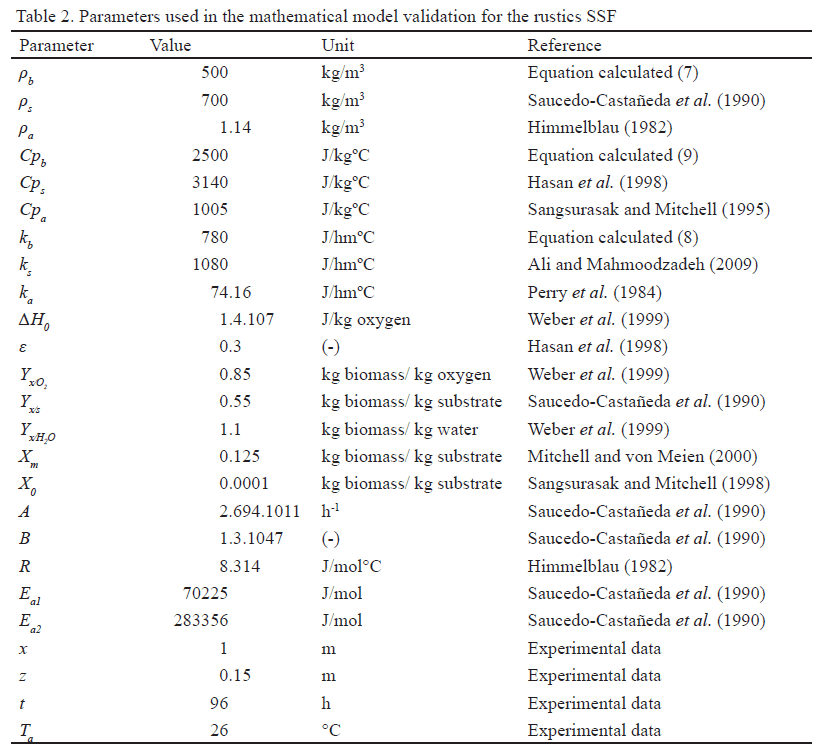
<body><![CDATA[<p align="justify" class="Cuerpodetexto" style="text-indent:0in;"><span style="font-family:'Verdana','sans-serif'; font-size:10.0pt; ">The  kinetics equation is used to determine the biomass production during the  process. The energy balance allow to determine the temperature profiles, while  mass balances allow to determine the rate of substrate and oxygen intake&nbsp; and the water production rate, respectively.  The auxiliary equation represents the variations of the specific growth rate,  depending on the temperature. </span></p>     <p align="justify" class="Cuerpodetexto" style="text-indent:0in;"><span style="font-family:'Verdana','sans-serif'; font-size:10.0pt; ">In this research the solution and validation of the  mathematical model was developed, as well as its applications. All these aspects  are in correspondence with the strategy described by Mitchell <em>et al.</em> (2006) for the development of mathematical models in the fermentative  processes.</span></p>     <p align="justify" class="Cuerpodetexto" style="text-indent:0in;"><em><span style="font-family:'Verdana','sans-serif'; font-size:10.0pt; ">Estimation of physical properties</span></em><span style="font-family:'Verdana','sans-serif'; font-size:10.0pt; ">. The determination of physical properties is an essential  aspect for the mathematical modeling of these processes. In this article a  compilation of the parameters taken into account to validate the mathematical  model from the data reported in the literature (<a href="/img/revistas/cjas/v50n1/t0205116.gif">table 2</a>) was    performed.</span> </p>     
<p align="justify" class="Cuerpodetexto" style="text-indent:0in;"><span style="font-family:'Verdana','sans-serif'; font-size:10.0pt; ">To  determine the density and thermal conductivity of the bedding in the solids,  the equations of Ali and Mahmoodzadeh (2009) were used, which allowed treat the  system as pseudo-homogeneous:</span></p>     <p align="justify" class="Cuerpodetexto" style="text-indent:0in;"><em><span style="font-family:'Verdana','sans-serif'; font-size:10.0pt; ">&rho;<sub>b</sub>=&epsilon;&rho;<sub>a</sub>+(1-&epsilon;)  &rho;<sub>s</sub></span></em><span style="font-family:'Verdana','sans-serif'; font-size:10.0pt; "> (7)</span></p>     <p align="justify" class="Cuerpodetexto" style="text-indent:0in;"><em><span style="font-family:'Verdana','sans-serif'; font-size:10.0pt; ">k<sub>b</sub>=&epsilon;k<sub>a</sub>+(1-&epsilon;)  k<sub>s</sub></span></em><span style="font-family:'Verdana','sans-serif'; font-size:10.0pt; "> (8) </span></p>     <p align="justify" class="Cuerpodetexto" style="text-indent:0in;"><em><span style="font-family:'Verdana','sans-serif'; font-size:10.0pt; ">&rho;<sub>a</sub></span></em><span style="font-family:'Verdana','sans-serif'; font-size:10.0pt; "> &ndash; air density (kg/m<sup>3</sup>)</span></p>     <p align="justify" class="Cuerpodetexto" style="text-indent:0in;"><em><span style="font-family:'Verdana','sans-serif'; font-size:10.0pt; ">k<sub>a</sub></span></em><span style="font-family:'Verdana','sans-serif'; font-size:10.0pt; "> - termical conductivity of the air (J/mh&deg;C) </span></p>     <p align="justify" class="Cuerpodetexto" style="text-indent:0in;"><em><span style="font-family:'Verdana','sans-serif'; font-size:10.0pt; ">k<sub>s</sub></span></em><span style="font-family:'Verdana','sans-serif'; font-size:10.0pt; "> - termical conductivity of the substrate (J/mh&deg;C).</span></p>     <p align="justify" class="Cuerpodetexto" style="text-indent:0in;"><span style="font-family:'Verdana','sans-serif'; font-size:10.0pt; ">While  for the heat capacity it was worked with the equation reported by Sangsurasak  and Mitchell    (1995):</span></p>     ]]></body>
<body><![CDATA[<p align="justify" class="Cuerpodetexto" style="text-indent:0in;"><em><span style="font-family:'Verdana','sans-serif'; font-size:10.0pt; ">Cp<sub>b</sub> = &epsilon;Cp<sub>a</sub>+(1-&epsilon;) Cp</span></em><sub><span style="font-family:'Verdana','sans-serif'; font-size:10.0pt; ">s</span></sub><span style="font-family:'Verdana','sans-serif'; font-size:10.0pt; "> (9) where: </span></p>     <p align="justify" class="Cuerpodetexto" style="text-indent:0in;"><em><span style="font-family:'Verdana','sans-serif'; font-size:10.0pt; ">Cp<sub>a</sub></span></em><span style="font-family:'Verdana','sans-serif'; font-size:10.0pt; "> -&nbsp; heat capacity of the air (J/kg&deg;C) </span></p>     <p align="justify" class="Cuerpodetexto" style="text-indent:0in;"><span style="font-family:'Verdana','sans-serif'; font-size:10.0pt; ">&nbsp;<em>Cp<sub>s</sub></em> -heat capacity of the  substrate (J/kg&deg;C)</span></p>     <p align="justify" class="Cuerpodetexto" style="text-indent:0in;"><span style="font-family:'Verdana','sans-serif'; font-size:10.0pt; ">The sensitivity analysis of the response variables  (temperature, substrate intake rate and water production rate) was performed  depending on the physical properties, kinetic and transport, for what it was  worked in a range of &plusmn; 30% of the reference value of each parameter. The  fermentation time was    24 h.</span></p>     <p align="justify" class="Cuerpodetexto" style="text-indent:0in;"><em><span style="font-family:'Verdana','sans-serif'; font-size:10.0pt; ">Model  solution</span></em><span style="font-family:'Verdana','sans-serif'; font-size:10.0pt; ">. The solution of the partial differential  equation, which represents the energy balance, was obtained by the finite  differences method, while for mass balances were not required the use of numerical  methods, because there were determined intake rates and main compounds  production. All equations were programmed in MATLAB software, version 7.8.0.347  (2009), which provides results in matrix form. <span style="letter-spacing:.1pt; ">In addition, the following initial and contour conditions for the  solution of the model were taken into    account:</span></span></p>     <p align="justify" class="Cuerpodetexto" style="text-indent:0in;"><span style="font-family:'Verdana','sans-serif'; font-size:10.0pt; ">Initial  condition:</span></p>     <p align="justify" class="Cuerpodetexto" style="text-indent:0in;"><em><span style="font-family:'Verdana','sans-serif'; font-size:10.0pt; ">t=0&nbsp;&nbsp;&nbsp;&nbsp;&nbsp;&nbsp;&nbsp;&nbsp;&nbsp;&nbsp; T=T<sub>a</sub></span></em></p>     <p align="justify" class="Cuerpodetexto" style="text-indent:0in;"><span style="font-family:'Verdana','sans-serif'; font-size:10.0pt; ">Boundary  conditions:</span></p>     <p align="justify" class="Cuerpodetexto" style="text-indent:0in;"><em><span style="font-family:'Verdana','sans-serif'; font-size:10.0pt; ">x</span></em><span style="font-family:'Verdana','sans-serif'; font-size:10.0pt; ">=0&nbsp;&nbsp;&nbsp;&nbsp;&nbsp;&nbsp;&nbsp;&nbsp;&nbsp;&nbsp;&nbsp;&nbsp;&nbsp;&nbsp;&nbsp;&nbsp;&nbsp;&nbsp; <em>T=T<sub>a</sub></em></span></p>     <p align="justify" class="Cuerpodetexto" style="text-indent:0in;"><em><span style="font-family:'Verdana','sans-serif'; font-size:10.0pt; ">x</span></em><span style="font-family:'Verdana','sans-serif'; font-size:10.0pt; ">=1  m&nbsp;&nbsp;&nbsp;&nbsp;&nbsp;&nbsp;&nbsp;&nbsp;&nbsp;&nbsp;&nbsp;&nbsp;&nbsp;&nbsp; <em>T=T<sub>a</sub></em></span></p>     ]]></body>
<body><![CDATA[<p align="justify" class="Cuerpodetexto" style="text-indent:0in;"><em><span style="font-family:'Verdana','sans-serif'; font-size:10.0pt; ">z</span></em><span style="font-family:'Verdana','sans-serif'; font-size:10.0pt; ">=0&nbsp;&nbsp;&nbsp;&nbsp;&nbsp;&nbsp;&nbsp;&nbsp;&nbsp;&nbsp;&nbsp;&nbsp;&nbsp;&nbsp;&nbsp;&nbsp;&nbsp;&nbsp;&nbsp; <em>T=T<sub>a</sub></em></span></p>     <p align="justify" class="Cuerpodetexto" style="text-indent:0in;"><em><span style="font-family:'Verdana','sans-serif'; font-size:10.0pt; ">z</span></em><span style="font-family:'Verdana','sans-serif'; font-size:10.0pt; ">=0.15  m&nbsp;&nbsp;&nbsp;&nbsp;&nbsp;&nbsp;&nbsp;&nbsp;&nbsp;&nbsp; <em>T=T<sub>a</sub></em>&nbsp;&nbsp;&nbsp; </span></p>     <p align="justify" class="Cuerpodetexto" style="text-indent:0in;"><span style="font-family:'Verdana','sans-serif'; font-size:10.0pt; ">where: </span></p>     <p align="justify" class="Cuerpodetexto" style="text-indent:0in;"><em><span style="font-family:'Verdana','sans-serif'; font-size:10.0pt; ">T<sub>a</sub></span></em><span style="font-family:'Verdana','sans-serif'; font-size:10.0pt; "> -&nbsp; mean temperature </span></p>     <p align="justify"><span style=" font-family:'Verdana','sans-serif'; font-size:10.0pt; ">Model validation was made  from the same initial conditions of the experimental work. Values of  temperature and humidity content were also taken in five points of the matrix,  which were averaged to obtain a single value. These results were compared with  the experimental study</span><font size="2" face="Verdana, Arial, Helvetica, sans-serif">.</font> </p>     <p align="justify">&nbsp;</p>     <p align="justify"><font size="2" face="Verdana, Arial, Helvetica, sans-serif"><b><font size="3">RESULTS AND DISCUSSION</font></b></font></p>     <p align="justify" class="Cuerpodetexto" style="text-indent:0in;"><em><span style=" font-family:'Verdana','sans-serif'; font-size:10.0pt; ">Validation  of the matemathical modelefficiency</span></em><span style="font-family:'Verdana','sans-serif'; font-size:10.0pt; ">.<em>Energy  balance</em>. <a href="/img/revistas/cjas/v50n1/f0105116.gif">Figure 1</a> shows the temperature profile obtained by the model and  the experimental results of the rustic SSF of sugar cane with sweet potatoes.  In addition it provides that the proposed model predicted, satisfactorily, the  experimental data. The observed differences could be given by the variations in  the variables that affect the models predictions.</span></p>     
<p align="justify" class="Cuerpodetexto" style="text-indent:0in;"><span style="font-family:'Verdana','sans-serif'; font-size:10.0pt; "><a href="/img/revistas/cjas/v50n1/f0205116.gif">Figure  2</a> shows the modeling results, for 10 and     
<br>   15 cm of bedding height in the solids. For 15 cm higher temperature values were  reached, which coincides with Rodriguez <em>et al.</em> (2006) studies for this  type of fermentation process.</span></p>     ]]></body>
<body><![CDATA[<p align="justify" class="Cuerpodetexto" style="text-indent:0in;"><span style="font-family:'Verdana','sans-serif'; font-size:10.0pt; ">The  bedding height in the solids is one of the main factors to control in  fermentations performed under rustic conditions. As the height is higher,  higher temperatures will be found, mainly, due, to the high thermal isolation  capacity of the substrate, which prevents the metabolic heat dissipation  generated during fermentation (Rodriguez <em>et al.</em> 2006).</span></p>     <p align="justify" class="Cuerpodetexto" style="text-indent:0in;"><span style=" letter-spacing:.1pt; font-family:'Verdana','sans-serif'; font-size:10.0pt; ">In the SSF processes, mainly in those performed under  rustic conditions, in which the main parameters are not controlled, important  amounts of metabolic heat are generated. This produces higher temperature  gradients that may favor by the non-inclusion of forced aeration in the  processes with bioreactors or because the substrate cannot turn, as happen  under rustic conditions (Carrasco <em>et al.</em> 1997). Other aspects which can  affect are the low thermal conductivity of biological materials and the  humidity content of the substrate (Rodriguez <em>et al.</em> 2006). The  temperature profiles are directly related to the microbial kinetics, because as  the cells population grows the metabolic heat is generated. In <a href="/img/revistas/cjas/v50n1/f0205116.gif">figure 2</a> is  observed that these maintained a similar performance to the microbial growth  which the logistic equation describes.</span></p>     
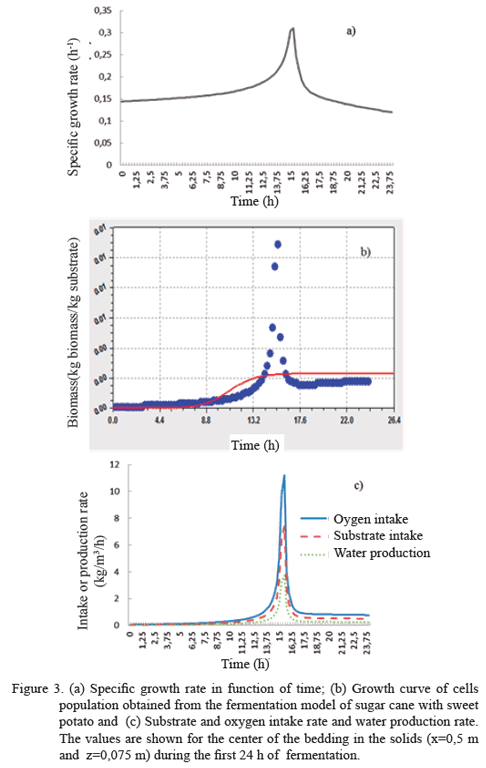
<p align="justify" class="Cuerpodetexto" style="text-indent:0in;"><span style="font-family:'Verdana','sans-serif'; font-size:10.0pt; "><a href="/img/revistas/cjas/v50n1/f0305116.gif">Figure  3</a> shows the estimated performance of the specific growth rate, biomass  formation, the rate of substrate and oxygen intake as well as the water production  rate for 24 h of fermentation. During the first 13 h of the process, the  specific growth rate remained, approximately, constant. From this moment  increased, and then decreased (<a href="/img/revistas/cjas/v50n1/f0305116.gif">figure 3a</a>).The decrease in microbial growth  should be understood, mainly, to the high temperatures reached during the  fermentation process (<a href="/img/revistas/cjas/v50n1/f0205116.gif">figure 2</a>). In the area where the highest values of  specific growth rate were recorded, the appropriate interval temperature for  microorganisms growth was obtained, which in this case ranged between 30-40 &deg;  C, approximately.</span></p>     
<p align="justify" class="Cuerpodetexto" style="text-indent:0in;"><span style="font-family:'Verdana','sans-serif'; font-size:10.0pt; "><a href="/img/revistas/cjas/v50n1/f0305116.gif">Figure  3b</a> shows that during the first hours of fermentation there is biomass  formation, although in lower proportion because of the low growth rates that  were showed. The same occurs with the substrate and oxygen intake rates, as  well as with the water production rate that, in this range were very low  (<a href="/img/revistas/cjas/v50n1/f0305116.gif">figure 3c</a>). As increased the specific growth rate of the microorganisms from  13h, the highest nutrients intake were obtained, as well as higher biomass  concentrations and water production (<a href="/img/revistas/cjas/v50n1/f0305116.gif">figure 3</a>).</span></p>     
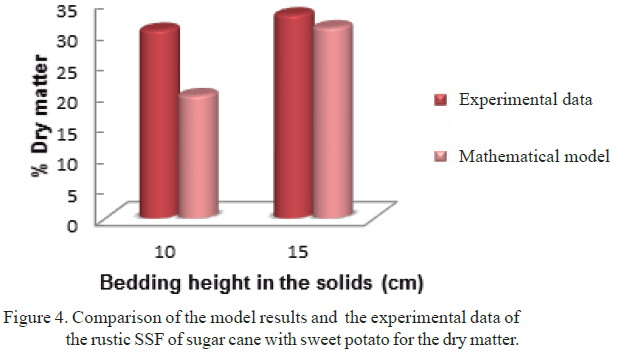
<p align="justify" class="Cuerpodetexto" style="text-indent:0in;"><span style=" letter-spacing:.2pt; font-family:'Verdana','sans-serif'; font-size:10.0pt; ">In the processes of solid state fermentation (SSF),  biomass formation and oxygen intake represent the most convenient way to verify  the microbial growth. In these aerobic systems, the heat metabolic generation  rate is proportional to the oxygen intake rate (Mitchell <em>et al.</em> 2006),  while the aeration in the rustic SSF is related to the bedding height. As the  latter is smaller, better aeration in the system is achieved. For higher  bedding heights, aeration does not satisfy the metabolic heat extraction and  then it is needed to turn the substrate.</span><span style="font-family:'Verdana','sans-serif'; font-size:10.0pt; "> </span></p>     <p align="justify" class="Cuerpodetexto" style="text-indent:0in;"><span style="font-family:'Verdana','sans-serif'; font-size:10.0pt; ">A</span><span style=" letter-spacing:.3pt; font-family:'Verdana','sans-serif'; font-size:10.0pt; "> comparison between the dry matter values offered by the model and those  obtained from the experimental procedure are shown in <a href="/img/revistas/cjas/v50n1/f0405116.gif">figure 4</a>. As seen, the  results are in function of the bedding height in the solids. It was found that  the highest differences are 10 cm. This is due to variations which may exist in  those parameters that affect the mathematical model. Moreover, the dry matter  was higher when the bedding height in the solids was increased, because in this  case the fermentation process is not as efficient, because there is lower  oxygenation, higher metabolic heat accumulation and then, higher temperatures  which limit microbial growth are reached. These results coincide with studies  carried out by Carrasco <em>et al.</em> (1997) for fermentations with sugar cane,  in which was also demonstrated that, when turning the substrate, the dry matter  increased due to the loss of solid humidity.</span></p>     
<p align="justify" class="Cuerpodetexto" style="text-indent:0in;"><em><span style=" letter-spacing:-.1pt; font-family:'Verdana','sans-serif'; font-size:10.0pt; ">Sensitivity analysis</span></em><span style="font-family:'Verdana','sans-serif'; font-size:10.0pt; ">. The sensitivity analysis showed that the variables  which affect the predictions of the mathematical model were the substrate  apparent density, the biomass/oxygen</span><span style="font-family:'Verdana','sans-serif'; font-size:10.0pt; "> yield and the  initial inoculums concentration. While the heat capacity, thermal conductivity,  porosity,  biomass/substrate and biomass/water yields and the higher biomass concentration  did not cause variations in the results.</span></p>     <p align="justify" class="Cuerpodetexto" style="text-indent:0in;"><span style="font-family:'Verdana','sans-serif'; font-size:10.0pt; ">The  results of the variables which affect the model predictions are shown in <a href="/img/revistas/cjas/v50n1/f0505116.gif">figure  5</a>. In all cases, there were no affectations in the value of maximum temperature  reached during the process. Differences resided in the time needed to reached  and were up to 10 &deg;C approximately with respect to the reference value for the  same period of fermentation, which is of great interest because this is one of  the factors that most influences on the microbial growth. From the practical  point of view, these differences are the most important, they offer an idea of  the need to experimentally measure the variables that affect the rustic SSF. In  addition, they bring problems in selecting the appropriate time to turn the  substrate.</span></p>     
<p align="justify" class="Cuerpodetexto" style="text-indent:0in;"><span style="font-family:'Verdana','sans-serif'; font-size:10.0pt; ">In previous studies, Sangsurasak and Mitchell (1998)  developed a mathematical model in two-dimensional space for a packed- bed  bioreactor. They found that one of the variables that affect the model  predictions was the initial inoculum concentration, while with respect to the  substrate apparent density, they explain that there was not much clarity on how  it can affect microbial growth, because if this is limited by the available  surface area of the substrate, then this variable would have little effect.</span></p>     <p align="justify" class="Cuerpodetexto" style="text-indent:0in;"><span style="font-family:'Verdana','sans-serif'; font-size:10.0pt; ">When the biomass/oxygen yield decreases, the metabolic  heat increases and variations in the temperature profile are obtained (<a href="/img/revistas/cjas/v50n1/f0505116.gif">figure  5c</a>). The yields depend on the biomass reduction degree and energy yields of the  process (Erickson </span><em><span style=" letter-spacing:-.2pt; font-family:'Verdana','sans-serif'; font-size:10.0pt; ">et  al. </span></em><span style="font-family:'Verdana','sans-serif'; font-size:10.0pt; ">1978). Generally, the  stoichiometric parameters considerably vary, due to the substrates diversity  used in the SSF and therefore, also change the reduction degrees. This means  that the yields may be different from a fermentation process to another.</span></p>     
]]></body>
<body><![CDATA[<p align="justify" class="Cuerpodetexto" style="text-indent:0in;"><span style="font-family:'Verdana','sans-serif'; font-size:10.0pt; "><a href="/img/revistas/cjas/v50n1/t0305116.gif">Table 3</a> shows the results of the sensitivity analysis for  variables that did not affect the mathematical model predictions. This was  carried out for a time of 15 h because it was when there was a higher  difference. In this regard, Smits <em>et al.</em> (1999) offered similar results  for the heat capacity. In addition, the fact that the thermal conductivity did  not cause changes in the results indicates that the conduction mechanism was  not affected by the changes in this transport parameter. In the case of the  porosity, the few variations constitute an advantage for rustic SSF, since  there were not affectations in the development of the process after turn the  bedding in the solids, which is essential, since this is the only way in which  it is achieve to control the temperature in these    processes.</span><span style="font-family:'Verdana','sans-serif'; font-size:10.0pt; "> </span></p>     
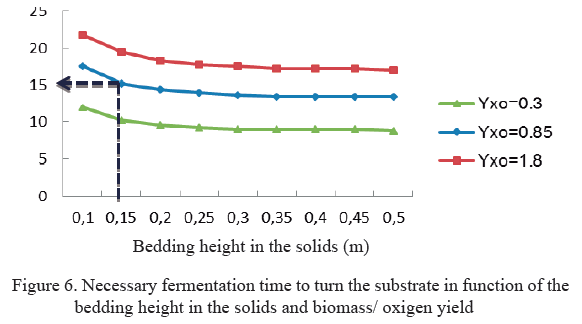
<p align="justify" class="Cuerpodetexto" style="text-indent:0in;"><span style="font-family:'Verdana','sans-serif'; font-size:10.0pt; ">One of the main practical applications of the mathematical  model in study is to determine the time in which the substrate should be move  due to high temperatures. From the results of the equations of mass and energy  balances, it can state that between    13-15 h of fermentation higher microorganisms growth rate occur, thereby the  rate of substrate and oxygen intake increase, as well as the water production  rate. This demonstrates an important metabolic activity in the optimum  temperature range for growth    (30 - 40 &deg;C).</span><span style="font-family:'Verdana','sans-serif'; font-size:10.0pt; "> </span></p>     <p align="justify" class="Cuerpodetexto" style="text-indent:0in;"><span style=" letter-spacing:.45pt; font-family:'Verdana','sans-serif'; font-size:10.0pt; ">When values over this range were reached, it is necessary  to turn the substrate, since the growth specific rate begins to decrease  because of the high temperatures that occur in the system, due to the low  metabolic heat dissipation generated. A study of the fermentation time  performance for various bedding heights in the solids and different    biomass/oxygen yields is show in <a href="/img/revistas/cjas/v50n1/f0605116.gif">figure 6</a>. As can be seen, as the bedding  height in the solids increases, the time in which the substrate should turn  decreases up to a value that remained constant, despite height continue  increasing. The time was reduced when decreasing the biomass/oxygen yield. The  arrow on the graph indicates the fermentation time in which the optimum  temperature range    (30 - 40 &deg;C) for growth was reached, from which the substrate must be moved in  this study.</span></p>     
<p align="justify" class="Cuerpodetexto" style="text-indent:0in;"><span style="font-family:'Verdana','sans-serif'; font-size:10.0pt; ">From the practical point of view, these results are  indispensable for the fermentations performed under rustic conditions, then  turning the substrate is the most effective way to control the temperature in  this type of process. From the graph it can also determine, the time required  for fermentation, which will depend on whether or not reach the protein and  fiber percentages suitable for animal feed.</span></p>     <p align="justify" class="Cuerpodetexto" style="text-indent:0in;"><span style="font-family:'Verdana','sans-serif'; font-size:10.0pt; ">It  is concluded that the mathematical model developed by Sosa <em>et al.</em> (2012)  was able to predict the experimental results from the fermentation of sugar  cane with sweet potato. </span></p>     <p align="justify" class="Cuerpodetexto" style="text-indent:0in;"><span style="font-family:'Verdana','sans-serif'; font-size:10.0pt; ">In  addition, an adequate description of the rustic SSF process in two dimensions  of space and time was achieved. With the model it can predict important  operating variables, such as the time at which to turn the substrate and the  maximum height of the bedding in the solids to maintain an appropriate  temperature value in the process.</span></p>     <p align="justify"><span style=" font-family:'Verdana','sans-serif'; font-size:10.0pt; ">The parameters that affect  the predictions of the mathematical model were the substrate apparent density,  the biomass/oxygen yield and the initial inoculum concentration. The remaining  variables did not cause changes in the results. Generally, the model can be  applied in studies of solid state rustic fermentations used in animal feed  production</span><font size="2" face="Verdana, Arial, Helvetica, sans-serif">.</font></p>      <p align="justify">&nbsp;</p>      <p align="justify"><font size="2" face="Verdana, Arial, Helvetica, sans-serif"><font size="3"><b>REFERENCES</b></font></font></p>     <p align="justify" class="MsoBibliography"><span style=" font-family:'Verdana','sans-serif'; font-size:10.0pt; ">Ali, F. M.  &amp; Mahmoodzadeh, V. B. 2009. &lsquo;&lsquo;Modeling of temperature gradients in  packed-bed solid-state bioreactors&rsquo;&rsquo;. <em>Chemical Engineering and Processing:  Process Intensification</em>, 48 (1), pp. 446&ndash;451, ISSN: 0255-2701, DOI:  10.1016/j.cep.2008.06.001.</span></p>     ]]></body>
<body><![CDATA[<p align="justify" class="MsoBibliography"><span style="font-family:'Verdana','sans-serif'; font-size:10.0pt; ">AOAC. 1995. <em>Official  methods of analysis of AOAC</em>. 16th ed., vol. 1, Washington, D.C.: AOAC  International, ISBN: 978-0-935584-54-7, Available:  &lt;<a href="http://www.cabdirect.org/abstracts/19951414840.html" target="_blank">http://www.cabdirect.org/abstracts/19951414840.html</a>&gt;,  [Accessed:&nbsp;February 16, 2016].</span></p>     <p align="justify" class="MsoBibliography"><span style="font-family:'Verdana','sans-serif'; font-size:10.0pt; ">Carrasco, E., Bocourt, R. &amp; El&iacute;as, A.  1997. </span><span style="font-family:'Verdana','sans-serif'; font-size:10.0pt; ">&lsquo;&lsquo;Layer height and  tumbling on sugar cane fermentation with bovine faeces&rsquo;&rsquo;. <em>Cuban Journal of  Agricultural Science</em>, 31 (1), p. 43, ISSN: 2079-3480.</span></p>     <p align="justify" class="MsoBibliography"><span style="font-family:'Verdana','sans-serif'; font-size:10.0pt; ">Erickson, L.  E., Selga, S. E. &amp; Viesturs, U. E. 1978. &lsquo;&lsquo;Application of mass and energy  balance regularities to product formation&rsquo;&rsquo;. <em>Biotechnology and  Bioengineering</em>, 20 (10), pp. 1623&ndash;1638, ISSN: 1097-0290, DOI:  10.1002/bit.260201009.</span></p>     <p align="justify" class="MsoBibliography"><span style="font-family:'Verdana','sans-serif'; font-size:10.0pt; ">Hasan, S. A.,  Kumar, S. &amp; Kumar, S. 2007. &lsquo;&lsquo;Modelling of a packed bed solid-state  fermentation bioreactor using the N-tanks in series approach&rsquo;&rsquo;. <em>Biochemical  Engineering Journal</em>, 35 (1), pp. 20&ndash;28, ISSN: 1369-703X, DOI:  10.1016/j.bej.2006.12.016.</span></p>     <p align="justify" class="MsoBibliography"><span style="font-family:'Verdana','sans-serif'; font-size:10.0pt; ">Hasan, S. D.  M., Costa, J. A. V. &amp; Sanzo, A. V. L. 1998. &lsquo;&lsquo;Heat transfer simulation of  solid state fermentation in a packed-bed bioreactor&rsquo;&rsquo;. <em>Biotechnology  Techniques</em>, 12 (10), pp. 787&ndash;791, ISSN: 0951-208X, 1573-6784, DOI:  10.1023/A:1008887828569.</span></p>     <p align="justify" class="MsoBibliography"><span style="font-family:'Verdana','sans-serif'; font-size:10.0pt; ">Himmelblau, D.  M. 1982. <em>Basic principles and calculations in chemical engineering</em>.  Englewood Cliffs, NJ, United States: Prentice-Hall, Inc., Available:  &lt;<a href="http://www.osti.gov/scitech/biblio/5410794" target="_blank">http://www.osti.gov/scitech/biblio/5410794</a>&gt;, [Accessed:&nbsp;February  16, 2016].</span></p>     <p align="justify" class="MsoBibliography"><span style="font-family:'Verdana','sans-serif'; font-size:10.0pt; ">Juli&aacute;n, R. M. C., Ramos, S. L. B. &amp;  G&oacute;mez, A. A. O. 2015. &lsquo;&lsquo;Modelaci&oacute;n matem&aacute;tica del proceso de enriquecimiento  proteico del bagazo de ca&ntilde;a de az&uacute;car en un biorreactor de lecho fijo&rsquo;&rsquo;. </span><em><span style="font-family:'Verdana','sans-serif'; font-size:10.0pt; ">Tecnolog&iacute;&shy;a Qu&iacute;mica</span></em><span style="font-family:'Verdana','sans-serif'; font-size:10.0pt; ">, 34 (3), pp. 207&ndash;216, ISSN: 2224-6185.</span></p>     <!-- ref --><p align="justify" class="MsoBibliography"><span style="font-family:'Verdana','sans-serif'; font-size:10.0pt; ">MathWorks,  Inc. 2009. <em>MATLAB<sup>&reg;</sup></em>. version 7.8.0.347, [Microsoft Windows],  Available: &lt;<a href="https://www.mathworks.com" target="_blank">https://www.mathworks.com</a>&gt;    .</span></p>     <p align="justify" class="MsoBibliography"><span style="font-family:'Verdana','sans-serif'; font-size:10.0pt; ">Mitchell, D. A., Cunha, L. E. N., Machado,  A. V. L., de Lima Luz Jr., L. F. &amp; Krieger, N. 2010. </span><span style="font-family:'Verdana','sans-serif'; font-size:10.0pt; ">&lsquo;&lsquo;A model-based investigation of the potential  advantages of multi-layer packed beds in solid-state fermentation&rsquo;&rsquo;. <em>Biochemical  Engineering Journal</em>, 48 (2), pp. 195&ndash;203, ISSN: 1369-703X, DOI:  10.1016/j.bej.2009.10.008.</span></p>     ]]></body>
<body><![CDATA[<p align="justify" class="MsoBibliography"><span style="font-family:'Verdana','sans-serif'; font-size:10.0pt; ">Mitchell, D.  A. &amp; von Meien, O. F. 2000. &lsquo;&lsquo;Mathematical modeling as a tool to  investigate the design and operation of the zymotis packed-bed bioreactor for  solid-state fermentation&rsquo;&rsquo;. <em>Biotechnology and Bioengineering</em>, 68 (2),  pp. 127&ndash;135, ISSN: 1097-0290, DOI:  10.1002/(SICI)1097-0290(20000420)68:2&lt;127::AID-BIT1&gt;3.0.CO;2-K.</span></p>     <p align="justify" class="MsoBibliography"><span style="font-family:'Verdana','sans-serif'; font-size:10.0pt; ">Mitchell, D.  D. A., Berovi&#269;, P. M. &amp; Krieger, D. N. 2006. &lsquo;&lsquo;Solid-State Fermentation  Bioreactor Fundamentals: Introduction and Overview&rsquo;&rsquo;. In: Mitchell, D. D. A.,  Berovi&#269;, D. M. &amp; Krieger, D. N. (eds.), <em>Solid-State Fermentation  Bioreactors</em>, Springer Berlin Heidelberg, pp. 1&ndash;12, ISBN: 978-3-540-31285-7,  Available: &lt;<a href="http://link.springer.com/chapter/10.1007/3-540-31286-2_1" target="_blank">http://link.springer.com/chapter/10.1007/3-540-31286-2_1</a>&gt;,  [Accessed:&nbsp;February 16, 2016].</span></p>     <p align="justify" class="MsoBibliography"><span style="font-family:'Verdana','sans-serif'; font-size:10.0pt; ">Perry, R. H.,  Green, D. W. &amp; Maloney, J. O. 1984. <em>Perry&rsquo;s Chemical engineers&rsquo; handbook</em>.  6th ed., New York: McGraw-Hill, ISBN: 978-0-07-049479-4.</span></p>     <p align="justify" class="MsoBibliography"><span style="font-family:'Verdana','sans-serif'; font-size:10.0pt; ">Rodr&iacute;guez, A. Z. 2004. <em>Uso del boniato  en la tecnolog&iacute;a de fermentaci&oacute;n en estado s&oacute;lido de la ca&ntilde;a de az&uacute;car</em>. Ph.  D. thesis, Universidad Agraria de La Habana &lsquo;Fructuoso Rodr&iacute;guez P&eacute;rez&rsquo;, La  Habana, Cuba.</span></p>     <p align="justify" class="MsoBibliography"><span style="font-family:'Verdana','sans-serif'; font-size:10.0pt; ">Rodr&iacute;guez, Z., Boucourt, R., El&iacute;as, A.,  Herrera, F. R. &amp; Nu&ntilde;ez, O. 2006. </span><span style="font-family:'Verdana','sans-serif'; font-size:10.0pt; ">&lsquo;&lsquo;Effect of layer height on the fermentation dynamics of sugarcane (<em>Saccharum  officinarum</em>) and sweet potato (<em>Ipomea batata</em> Lam) mixtures&rsquo;&rsquo;. <em>Cuban  Journal of Agricultural Science</em>, 40 (2), pp. 161&ndash;170, ISSN: 2079-3480.</span></p>     <p align="justify" class="MsoBibliography"><span style="font-family:'Verdana','sans-serif'; font-size:10.0pt; ">Rodr&iacute;guez, Z.,  El&iacute;as, A. &amp; River&iacute;, Z. 1998. &lsquo;&lsquo;Studies on theutilization of sweet potato (<em>Ipomea  batata</em> Lam) in solidstate fermentation of sugar cane&rsquo;&rsquo;. <em>Cuban Journal of  Agricultural Science</em>, 32 (3), pp. 285&ndash;290, ISSN: 2079-3480.</span></p>     <p align="justify" class="MsoBibliography"><span style="font-family:'Verdana','sans-serif'; font-size:10.0pt; ">Sangsurasak,  P. &amp; Mitchell, D. A. 1995. &lsquo;&lsquo;Incorporation of death kinetics into a  2-dimensional dynamic heat transfer model for solid state fermentation&rsquo;&rsquo;. <em>Journal  of Chemical Technology &amp; Biotechnology</em>, 64 (3), pp. 253&ndash;260, ISSN:  1097-4660, DOI: 10.1002/jctb.280640307.</span></p>     <p align="justify" class="MsoBibliography"><span style="font-family:'Verdana','sans-serif'; font-size:10.0pt; ">Sangsurasak,  P. &amp; Mitchell, D. A. 1998. &lsquo;&lsquo;Validation of a model describing  two-dimensional heat transfer during solid-state fermentation in packed bed  bioreactors&rsquo;&rsquo;. <em>Biotechnology and Bioengineering</em>, 60 (6), pp. 739&ndash;749,  ISSN: 1097-0290, DOI:  10.1002/(SICI)1097-0290(19981220)60:6&lt;739::AID-BIT10&gt;3.0.CO;2-U.</span></p>     <p align="justify" class="MsoBibliography"><span style="font-family:'Verdana','sans-serif'; font-size:10.0pt; ">Saucedo, C.  G., Guti&eacute;rrez, R. M., Bacquet, G., Raimbault, M. &amp; Viniegra, G. G. 1990.  &lsquo;&lsquo;Heat transfer simulation in solid substrate fermentation&rsquo;&rsquo;. <em>Biotechnology  and Bioengineering</em>, 35 (8), pp. 802&ndash;808, ISSN: 1097-0290, DOI:  10.1002/bit.260350808.</span></p>     <p align="justify" class="MsoBibliography"><span style="font-family:'Verdana','sans-serif'; font-size:10.0pt; ">Singhania, R.  R., Patel, A. K., Soccol, C. R. &amp; Pandey, A. 2009. &lsquo;&lsquo;Recent advances in  solid-state fermentation&rsquo;&rsquo;. <em>Biochemical Engineering Journal</em>, 44 (1), pp.  13&ndash;18, ISSN: 1369-703X, DOI: 10.1016/j.bej.2008.10.019.</span></p>     ]]></body>
<body><![CDATA[<p align="justify" class="MsoBibliography"><span style="font-family:'Verdana','sans-serif'; font-size:10.0pt; ">Smits, J. P.,  Sonsbeek, H. M. van, Tramper, J., Knol, W., Geelhoed, W., Peeters, M. &amp;  Rinzema, A. 1999. &lsquo;&lsquo;Modelling fungal solid-state fermentation: the role of  inactivation kinetics&rsquo;&rsquo;. <em>Bioprocess Engineering</em>, 20 (5), pp. 391&ndash;404,  ISSN: 0178-515X, 1615-7605, DOI: 10.1007/s004490050607.</span></p>     <p align="justify" class="MsoBibliography"><span style="font-family:'Verdana','sans-serif'; font-size:10.0pt; ">Sosa, D.,  Boucourt, R. &amp; Dustet, J. C. 2012. &lsquo;&lsquo;Use of mathematical modeling on the  solid-state fermentation processes of fibrous substrates for animal feeding&rsquo;&rsquo;. </span><em><span style="font-family:'Verdana','sans-serif'; font-size:10.0pt; ">Cuban  Journal of Agricultural Science</span></em><span style="font-family:'Verdana','sans-serif'; font-size:10.0pt; ">, 46 (2), pp. 119&ndash;126,  ISSN: 2079-3480.</span></p>     <p align="justify" class="MsoBibliography"><span style="font-family:'Verdana','sans-serif'; font-size:10.0pt; ">Vali&ntilde;o, E. C., Ibarra, A., Garc&iacute;a, Y.,  Izquierdo, E. &amp; Dustet, J. C. 2011. &lsquo;&lsquo;Descripci&oacute;n de la fermentaci&oacute;n del  bagazo de ca&ntilde;a por <em>Trichoderma viride</em> M5-2 en un biorreactor est&aacute;tico  mediante un modelo fenomenol&oacute;gico&rsquo;&rsquo;. </span><em><span style="font-family:'Verdana','sans-serif'; font-size:10.0pt; ">Cuban Journal of Agricultural Science</span></em><span style="font-family:'Verdana','sans-serif'; font-size:10.0pt; ">, 45 (3), p. 267, ISSN: 2079-3480.</span></p>     <p align="justify"><span style="font-family:'Verdana','sans-serif'; font-size:10.0pt; ">Weber, F. J., Tramper, J.  &amp; Rinzema, A. 1999. &lsquo;&lsquo;A simplified material and energy balance approach for  process development and scale-up of <em>Coniothyrium minitans</em> conidia  production by solid-state cultivation in a packed-bed reactor&rsquo;&rsquo;. <em>Biotechnology  and Bioengineering</em>, 65 (4), pp. 447&ndash;458, ISSN: 1097-0290, DOI:  10.1002/(SICI)1097-0290(19991120)65:4&lt;447::AID-BIT9&gt;3.0.CO;2-K</span><font size="2" face="Verdana, Arial, Helvetica, sans-serif">.</font> </p>     <p align="justify">&nbsp;</p>     <p align="justify">&nbsp;</p>     <p align="justify"><font size="2" face="Verdana, Arial, Helvetica, sans-serif">Received: June 3, 2015    <br> Accepted: March 25, 2016</font></p>     <p align="justify">&nbsp;</p>     <p align="justify">&nbsp;</p>     ]]></body>
<body><![CDATA[<p align="justify"><font size="2" face="Verdana, Arial, Helvetica, sans-serif"><i>Dailyn Sosa,</i> Instituto de Ciencia Animal, Apartado Postal 24, San José de las Lajas, Mayabeque.    Email: <a href="mailto:dsosa@ica.co.cu">dsosa@ica.co.cu</a></font></p>      ]]></body><back>
<ref-list>
<ref id="B1">
<nlm-citation citation-type="journal">
<person-group person-group-type="author">
<name>
<surname><![CDATA[Ali]]></surname>
<given-names><![CDATA[F. M.]]></given-names>
</name>
<name>
<surname><![CDATA[Mahmoodzadeh]]></surname>
<given-names><![CDATA[V. B.]]></given-names>
</name>
</person-group>
<article-title xml:lang="nd"><![CDATA[Modeling of temperature gradients in packed-bed solid-state bioreactors]]></article-title>
<source><![CDATA[Chemical Engineering and Processing: Process Intensification]]></source>
<year>2009</year>
<volume>48</volume>
<numero>1</numero>
<issue>1</issue>
<page-range>446-451</page-range></nlm-citation>
</ref>
<ref id="B2">
<nlm-citation citation-type="book">
<person-group person-group-type="author">
<name>
<surname><![CDATA[AOAC]]></surname>
</name>
</person-group>
<source><![CDATA[Official methods of analysis of AOAC]]></source>
<year>1995</year>
<volume>1</volume>
<edition>16th</edition>
<publisher-loc><![CDATA[Washington, D.C. ]]></publisher-loc>
<publisher-name><![CDATA[AOAC International]]></publisher-name>
</nlm-citation>
</ref>
<ref id="B3">
<nlm-citation citation-type="journal">
<person-group person-group-type="author">
<name>
<surname><![CDATA[Carrasco]]></surname>
<given-names><![CDATA[E.]]></given-names>
</name>
<name>
<surname><![CDATA[Bocourt]]></surname>
<given-names><![CDATA[R.]]></given-names>
</name>
<name>
<surname><![CDATA[Elías]]></surname>
<given-names><![CDATA[A.]]></given-names>
</name>
</person-group>
<article-title xml:lang="nd"><![CDATA[Layer height and tumbling on sugar cane fermentation with bovine faeces]]></article-title>
<source><![CDATA[Cuban Journal of Agricultural Science]]></source>
<year>1997</year>
<volume>31</volume>
<numero>1</numero>
<issue>1</issue>
<page-range>43</page-range></nlm-citation>
</ref>
<ref id="B4">
<nlm-citation citation-type="journal">
<person-group person-group-type="author">
<name>
<surname><![CDATA[Hasan]]></surname>
<given-names><![CDATA[S. A.]]></given-names>
</name>
<name>
<surname><![CDATA[Kumar]]></surname>
<given-names><![CDATA[S.]]></given-names>
</name>
<name>
<surname><![CDATA[Kumar]]></surname>
<given-names><![CDATA[S.]]></given-names>
</name>
</person-group>
<article-title xml:lang="nd"><![CDATA[Modelling of a packed bed solid-state fermentation bioreactor using the N-tanks in series approach]]></article-title>
<source><![CDATA[Biochemical Engineering Journal]]></source>
<year>2007</year>
<volume>35</volume>
<numero>1</numero>
<issue>1</issue>
<page-range>20-28</page-range></nlm-citation>
</ref>
<ref id="B5">
<nlm-citation citation-type="journal">
<person-group person-group-type="author">
<name>
<surname><![CDATA[Hasan]]></surname>
<given-names><![CDATA[S. D. M.]]></given-names>
</name>
<name>
<surname><![CDATA[Costa]]></surname>
<given-names><![CDATA[J. A. V.]]></given-names>
</name>
<name>
<surname><![CDATA[Sanzo]]></surname>
<given-names><![CDATA[A. V. L.]]></given-names>
</name>
</person-group>
<article-title xml:lang="nd"><![CDATA[Heat transfer simulation of solid state fermentation in a packed-bed bioreactor]]></article-title>
<source><![CDATA[Biotechnology Techniques]]></source>
<year>1998</year>
<volume>12</volume>
<numero>10</numero>
<issue>10</issue>
<page-range>787-791</page-range></nlm-citation>
</ref>
<ref id="B6">
<nlm-citation citation-type="book">
<person-group person-group-type="author">
<name>
<surname><![CDATA[Himmelblau]]></surname>
<given-names><![CDATA[D. M.]]></given-names>
</name>
</person-group>
<source><![CDATA[Basic principles and calculations in chemical engineering]]></source>
<year>1982</year>
<publisher-loc><![CDATA[Englewood Cliffs, NJ, United States ]]></publisher-loc>
<publisher-name><![CDATA[Prentice-Hall, Inc.]]></publisher-name>
</nlm-citation>
</ref>
<ref id="B7">
<nlm-citation citation-type="journal">
<person-group person-group-type="author">
<name>
<surname><![CDATA[Julián]]></surname>
<given-names><![CDATA[R. M. C.]]></given-names>
</name>
<name>
<surname><![CDATA[Ramos]]></surname>
<given-names><![CDATA[S. L. B.]]></given-names>
</name>
<name>
<surname><![CDATA[Gómez]]></surname>
<given-names><![CDATA[A. A. O.]]></given-names>
</name>
</person-group>
<article-title xml:lang="nd"><![CDATA[Modelación matemática del proceso de enriquecimiento proteico del bagazo de caña de azúcar en un biorreactor de lecho fijo]]></article-title>
<source><![CDATA[Tecnologí­a Química]]></source>
<year>2015</year>
<volume>34</volume>
<numero>3</numero>
<issue>3</issue>
<page-range>207-216</page-range></nlm-citation>
</ref>
<ref id="B8">
<nlm-citation citation-type="">
<person-group person-group-type="author">
<name>
<surname><![CDATA[MathWorks, Inc.]]></surname>
</name>
</person-group>
<source><![CDATA[MATLAB®]]></source>
<year>2009</year>
</nlm-citation>
</ref>
<ref id="B9">
<nlm-citation citation-type="journal">
<person-group person-group-type="author">
<name>
<surname><![CDATA[Mitchell]]></surname>
<given-names><![CDATA[D. A.]]></given-names>
</name>
<name>
<surname><![CDATA[Cunha]]></surname>
<given-names><![CDATA[L. E. N.]]></given-names>
</name>
<name>
<surname><![CDATA[Machado]]></surname>
<given-names><![CDATA[A. V. L.]]></given-names>
</name>
<name>
<surname><![CDATA[de Lima Luz Jr.]]></surname>
<given-names><![CDATA[L. F.]]></given-names>
</name>
<name>
<surname><![CDATA[Krieger]]></surname>
<given-names><![CDATA[N.]]></given-names>
</name>
</person-group>
<article-title xml:lang="nd"><![CDATA[A model-based investigation of the potential advantages of multi-layer packed beds in solid-state fermentation]]></article-title>
<source><![CDATA[Biochemical Engineering Journal]]></source>
<year>2010</year>
<volume>48</volume>
<numero>2</numero>
<issue>2</issue>
<page-range>195-203</page-range></nlm-citation>
</ref>
<ref id="B10">
<nlm-citation citation-type="journal">
<person-group person-group-type="author">
<name>
<surname><![CDATA[Mitchell]]></surname>
<given-names><![CDATA[D. A.]]></given-names>
</name>
<name>
<surname><![CDATA[von Meien]]></surname>
<given-names><![CDATA[O. F.]]></given-names>
</name>
</person-group>
<article-title xml:lang="nd"><![CDATA[Mathematical modeling as a tool to investigate the design and operation of the zymotis packed-bed bioreactor for solid-state fermentation]]></article-title>
<source><![CDATA[Biotechnology and Bioengineering]]></source>
<year>2000</year>
<volume>68</volume>
<numero>2</numero>
<issue>2</issue>
<page-range>127-135</page-range></nlm-citation>
</ref>
<ref id="B11">
<nlm-citation citation-type="book">
<person-group person-group-type="author">
<name>
<surname><![CDATA[Mitchell]]></surname>
<given-names><![CDATA[D. D. A.]]></given-names>
</name>
<name>
<surname><![CDATA[Berovic]]></surname>
<given-names><![CDATA[P. M.]]></given-names>
</name>
<name>
<surname><![CDATA[Krieger]]></surname>
<given-names><![CDATA[D. N.]]></given-names>
</name>
</person-group>
<article-title xml:lang="nd"><![CDATA[Solid-State Fermentation Bioreactor Fundamentals: Introduction and Overview]]></article-title>
<person-group person-group-type="editor">
<name>
<surname><![CDATA[Mitchell]]></surname>
<given-names><![CDATA[D. D. A.]]></given-names>
</name>
<name>
<surname><![CDATA[Berovic]]></surname>
<given-names><![CDATA[D. M.]]></given-names>
</name>
<name>
<surname><![CDATA[Krieger]]></surname>
<given-names><![CDATA[D. N.]]></given-names>
</name>
</person-group>
<source><![CDATA[Solid-State Fermentation Bioreactors]]></source>
<year>2006</year>
<page-range>1-12</page-range><publisher-name><![CDATA[Springer Berlin Heidelberg]]></publisher-name>
</nlm-citation>
</ref>
<ref id="B12">
<nlm-citation citation-type="book">
<person-group person-group-type="author">
<name>
<surname><![CDATA[Perry]]></surname>
<given-names><![CDATA[R. H.]]></given-names>
</name>
<name>
<surname><![CDATA[Green]]></surname>
<given-names><![CDATA[D. W.]]></given-names>
</name>
<name>
<surname><![CDATA[Maloney]]></surname>
<given-names><![CDATA[J. O.]]></given-names>
</name>
</person-group>
<source><![CDATA[Perry’s Chemical engineers’ handbook]]></source>
<year>1984</year>
<edition>6th</edition>
<publisher-loc><![CDATA[New York ]]></publisher-loc>
<publisher-name><![CDATA[McGraw-Hill]]></publisher-name>
</nlm-citation>
</ref>
<ref id="B13">
<nlm-citation citation-type="book">
<person-group person-group-type="author">
<name>
<surname><![CDATA[Rodríguez]]></surname>
<given-names><![CDATA[A. Z.]]></given-names>
</name>
</person-group>
<source><![CDATA[Uso del boniato en la tecnología de fermentación en estado sólido de la caña de azúcar]]></source>
<year>2004</year>
<publisher-loc><![CDATA[La Habana, Cuba ]]></publisher-loc>
<publisher-name><![CDATA[Universidad Agraria de La Habana ‘Fructuoso Rodríguez Pérez’]]></publisher-name>
</nlm-citation>
</ref>
<ref id="B14">
<nlm-citation citation-type="journal">
<person-group person-group-type="author">
<name>
<surname><![CDATA[Rodríguez]]></surname>
<given-names><![CDATA[Z.]]></given-names>
</name>
<name>
<surname><![CDATA[Boucourt]]></surname>
<given-names><![CDATA[R.]]></given-names>
</name>
<name>
<surname><![CDATA[Elías]]></surname>
<given-names><![CDATA[A.]]></given-names>
</name>
<name>
<surname><![CDATA[Herrera]]></surname>
<given-names><![CDATA[F. R.]]></given-names>
</name>
<name>
<surname><![CDATA[Nuñez]]></surname>
<given-names><![CDATA[O.]]></given-names>
</name>
</person-group>
<article-title xml:lang="nd"><![CDATA[Effect of layer height on the fermentation dynamics of sugarcane (Saccharum officinarum) and sweet potato (Ipomea batata Lam) mixtures]]></article-title>
<source><![CDATA[Cuban Journal of Agricultural Science]]></source>
<year>2006</year>
<volume>40</volume>
<numero>2</numero>
<issue>2</issue>
<page-range>161-170</page-range></nlm-citation>
</ref>
<ref id="B15">
<nlm-citation citation-type="journal">
<person-group person-group-type="author">
<name>
<surname><![CDATA[Rodríguez]]></surname>
<given-names><![CDATA[Z.]]></given-names>
</name>
<name>
<surname><![CDATA[Elías]]></surname>
<given-names><![CDATA[A.]]></given-names>
</name>
<name>
<surname><![CDATA[Riverí]]></surname>
<given-names><![CDATA[Z.]]></given-names>
</name>
</person-group>
<article-title xml:lang="nd"><![CDATA[Studies on theutilization of sweet potato (Ipomea batata Lam) in solidstate fermentation of sugar cane]]></article-title>
<source><![CDATA[Cuban Journal of Agricultural Science]]></source>
<year>1998</year>
<volume>32</volume>
<numero>3</numero>
<issue>3</issue>
<page-range>285-290</page-range></nlm-citation>
</ref>
<ref id="B16">
<nlm-citation citation-type="journal">
<person-group person-group-type="author">
<name>
<surname><![CDATA[Sangsurasak]]></surname>
<given-names><![CDATA[P.]]></given-names>
</name>
<name>
<surname><![CDATA[Mitchell]]></surname>
<given-names><![CDATA[D. A.]]></given-names>
</name>
</person-group>
<article-title xml:lang="nd"><![CDATA[Incorporation of death kinetics into a 2-dimensional dynamic heat transfer model for solid state fermentation]]></article-title>
<source><![CDATA[Journal of Chemical Technology & Biotechnology]]></source>
<year>1995</year>
<volume>64</volume>
<numero>3</numero>
<issue>3</issue>
<page-range>253-260</page-range></nlm-citation>
</ref>
<ref id="B17">
<nlm-citation citation-type="journal">
<person-group person-group-type="author">
<name>
<surname><![CDATA[Sangsurasak]]></surname>
<given-names><![CDATA[P.]]></given-names>
</name>
<name>
<surname><![CDATA[Mitchell]]></surname>
<given-names><![CDATA[D. A.]]></given-names>
</name>
</person-group>
<article-title xml:lang="nd"><![CDATA[Validation of a model describing two-dimensional heat transfer during solid-state fermentation in packed bed bioreactors]]></article-title>
<source><![CDATA[Biotechnology and Bioengineering]]></source>
<year>1998</year>
<volume>60</volume>
<numero>6</numero>
<issue>6</issue>
<page-range>739-749</page-range></nlm-citation>
</ref>
<ref id="B18">
<nlm-citation citation-type="journal">
<person-group person-group-type="author">
<name>
<surname><![CDATA[Saucedo]]></surname>
<given-names><![CDATA[C. G.]]></given-names>
</name>
<name>
<surname><![CDATA[Gutiérrez]]></surname>
<given-names><![CDATA[R. M.]]></given-names>
</name>
<name>
<surname><![CDATA[Bacquet]]></surname>
<given-names><![CDATA[G.]]></given-names>
</name>
<name>
<surname><![CDATA[Raimbault]]></surname>
<given-names><![CDATA[M.]]></given-names>
</name>
<name>
<surname><![CDATA[Viniegra]]></surname>
<given-names><![CDATA[G. G.]]></given-names>
</name>
</person-group>
<article-title xml:lang="nd"><![CDATA[Heat transfer simulation in solid substrate fermentation]]></article-title>
<source><![CDATA[Biotechnology and Bioengineering]]></source>
<year>1990</year>
<volume>35</volume>
<numero>8</numero>
<issue>8</issue>
<page-range>802-808</page-range></nlm-citation>
</ref>
<ref id="B19">
<nlm-citation citation-type="journal">
<person-group person-group-type="author">
<name>
<surname><![CDATA[Selga]]></surname>
<given-names><![CDATA[S. E.]]></given-names>
</name>
<name>
<surname><![CDATA[Viesturs]]></surname>
<given-names><![CDATA[U. E.]]></given-names>
</name>
</person-group>
<article-title xml:lang="nd"><![CDATA[Application of mass and energy balance regularities to product formation]]></article-title>
<source><![CDATA[Biotechnology and Bioengineering]]></source>
<year>1978</year>
<volume>20</volume>
<numero>10</numero>
<issue>10</issue>
<page-range>1623-1638</page-range></nlm-citation>
</ref>
<ref id="B20">
<nlm-citation citation-type="journal">
<person-group person-group-type="author">
<name>
<surname><![CDATA[Singhania]]></surname>
<given-names><![CDATA[R. R.]]></given-names>
</name>
<name>
<surname><![CDATA[Patel]]></surname>
<given-names><![CDATA[A. K.]]></given-names>
</name>
<name>
<surname><![CDATA[Soccol]]></surname>
<given-names><![CDATA[C. R.]]></given-names>
</name>
<name>
<surname><![CDATA[Pandey]]></surname>
<given-names><![CDATA[A.]]></given-names>
</name>
</person-group>
<article-title xml:lang="nd"><![CDATA[Recent advances in solid-state fermentation]]></article-title>
<source><![CDATA[Biochemical Engineering Journal]]></source>
<year>2009</year>
<volume>44</volume>
<numero>1</numero>
<issue>1</issue>
<page-range>13-18</page-range></nlm-citation>
</ref>
<ref id="B21">
<nlm-citation citation-type="journal">
<person-group person-group-type="author">
<name>
<surname><![CDATA[Smits]]></surname>
<given-names><![CDATA[J. P.]]></given-names>
</name>
<name>
<surname><![CDATA[Sonsbeek]]></surname>
<given-names><![CDATA[H. M. van]]></given-names>
</name>
<name>
<surname><![CDATA[Tramper]]></surname>
<given-names><![CDATA[J.]]></given-names>
</name>
<name>
<surname><![CDATA[Knol]]></surname>
<given-names><![CDATA[W.]]></given-names>
</name>
<name>
<surname><![CDATA[Geelhoed]]></surname>
<given-names><![CDATA[W.]]></given-names>
</name>
<name>
<surname><![CDATA[Peeters]]></surname>
<given-names><![CDATA[M.]]></given-names>
</name>
<name>
<surname><![CDATA[Rinzema]]></surname>
<given-names><![CDATA[A.]]></given-names>
</name>
</person-group>
<article-title xml:lang="nd"><![CDATA[Modelling fungal solid-state fermentation: the role of inactivation kinetics]]></article-title>
<source><![CDATA[Bioprocess Engineering]]></source>
<year>1999</year>
<volume>20</volume>
<numero>5</numero>
<issue>5</issue>
<page-range>391-404</page-range></nlm-citation>
</ref>
<ref id="B22">
<nlm-citation citation-type="journal">
<person-group person-group-type="author">
<name>
<surname><![CDATA[Sosa]]></surname>
<given-names><![CDATA[D.]]></given-names>
</name>
<name>
<surname><![CDATA[Boucourt]]></surname>
<given-names><![CDATA[R.]]></given-names>
</name>
<name>
<surname><![CDATA[Dustet]]></surname>
<given-names><![CDATA[J. C.]]></given-names>
</name>
</person-group>
<article-title xml:lang="nd"><![CDATA[Use of mathematical modeling on the solid-state fermentation processes of fibrous substrates for animal feeding]]></article-title>
<source><![CDATA[Cuban Journal of Agricultural Science]]></source>
<year>2012</year>
<volume>46</volume>
<numero>2</numero>
<issue>2</issue>
<page-range>119-126</page-range></nlm-citation>
</ref>
<ref id="B23">
<nlm-citation citation-type="journal">
<person-group person-group-type="author">
<name>
<surname><![CDATA[Valiño]]></surname>
<given-names><![CDATA[E. C.]]></given-names>
</name>
<name>
<surname><![CDATA[Ibarra]]></surname>
<given-names><![CDATA[A.]]></given-names>
</name>
<name>
<surname><![CDATA[García]]></surname>
<given-names><![CDATA[Y.]]></given-names>
</name>
<name>
<surname><![CDATA[Izquierdo]]></surname>
<given-names><![CDATA[E.]]></given-names>
</name>
<name>
<surname><![CDATA[Dustet]]></surname>
<given-names><![CDATA[J. C.]]></given-names>
</name>
</person-group>
<article-title xml:lang="nd"><![CDATA[Descripción de la fermentación del bagazo de caña por Trichoderma viride M5-2 en un biorreactor estático mediante un modelo fenomenológico]]></article-title>
<source><![CDATA[Cuban Journal of Agricultural Science]]></source>
<year>2011</year>
<volume>45</volume>
<numero>3</numero>
<issue>3</issue>
<page-range>267</page-range></nlm-citation>
</ref>
<ref id="B24">
<nlm-citation citation-type="journal">
<person-group person-group-type="author">
<name>
<surname><![CDATA[Weber]]></surname>
<given-names><![CDATA[F. J.]]></given-names>
</name>
<name>
<surname><![CDATA[Tramper]]></surname>
<given-names><![CDATA[J.]]></given-names>
</name>
<name>
<surname><![CDATA[Rinzema]]></surname>
<given-names><![CDATA[A.]]></given-names>
</name>
</person-group>
<article-title xml:lang="nd"><![CDATA[A simplified material and energy balance approach for process development and scale-up of Coniothyrium minitans conidia production by solid-state cultivation in a packed-bed reactor]]></article-title>
<source><![CDATA[Biotechnology and Bioengineering]]></source>
<year>1999</year>
<volume>65</volume>
<numero>4</numero>
<issue>4</issue>
<page-range>447-458</page-range></nlm-citation>
</ref>
</ref-list>
</back>
</article>