<?xml version="1.0" encoding="ISO-8859-1"?><article xmlns:mml="http://www.w3.org/1998/Math/MathML" xmlns:xlink="http://www.w3.org/1999/xlink" xmlns:xsi="http://www.w3.org/2001/XMLSchema-instance">
<front>
<journal-meta>
<journal-id>2079-3480</journal-id>
<journal-title><![CDATA[Cuban Journal of Agricultural Science]]></journal-title>
<abbrev-journal-title><![CDATA[Cuban J. Agric. Sci.]]></abbrev-journal-title>
<issn>2079-3480</issn>
<publisher>
<publisher-name><![CDATA[Editorial del Instituto de Ciencia Animal]]></publisher-name>
</publisher>
</journal-meta>
<article-meta>
<article-id>S2079-34802016000100014</article-id>
<title-group>
<article-title xml:lang="en"><![CDATA[Physicochemical and biological indicators in silages of taro (Colocasia esculenta (L.) Schott) tubers for animal feeding]]></article-title>
<article-title xml:lang="es"><![CDATA[Indicadores físico-químicos y biológicos en ensilados de tubérculos de (Colocasia esculenta (L.) Schott) para la alimentación animal]]></article-title>
</title-group>
<contrib-group>
<contrib contrib-type="author">
<name>
<surname><![CDATA[Caicedo]]></surname>
<given-names><![CDATA[W.]]></given-names>
</name>
<xref ref-type="aff" rid="A01"/>
</contrib>
<contrib contrib-type="author">
<name>
<surname><![CDATA[Rodríguez]]></surname>
<given-names><![CDATA[R.]]></given-names>
</name>
<xref ref-type="aff" rid="A02"/>
</contrib>
<contrib contrib-type="author">
<name>
<surname><![CDATA[Lezcano]]></surname>
<given-names><![CDATA[P.]]></given-names>
</name>
<xref ref-type="aff" rid="A03"/>
</contrib>
<contrib contrib-type="author">
<name>
<surname><![CDATA[Ly]]></surname>
<given-names><![CDATA[J.]]></given-names>
</name>
<xref ref-type="aff" rid="A03"/>
</contrib>
<contrib contrib-type="author">
<name>
<surname><![CDATA[Valle]]></surname>
<given-names><![CDATA[S.]]></given-names>
</name>
<xref ref-type="aff" rid="A01"/>
</contrib>
<contrib contrib-type="author">
<name>
<surname><![CDATA[Flores]]></surname>
<given-names><![CDATA[L.]]></given-names>
</name>
<xref ref-type="aff" rid="A04"/>
</contrib>
<contrib contrib-type="author">
<name>
<surname><![CDATA[Ferreira]]></surname>
<given-names><![CDATA[F.N.A.]]></given-names>
</name>
<xref ref-type="aff" rid="A05"/>
</contrib>
</contrib-group>
<aff id="A01">
<institution><![CDATA[,Universidad Estatal Amazónica  ]]></institution>
<addr-line><![CDATA[ Pastaza]]></addr-line>
<country>Ecuador</country>
</aff>
<aff id="A02">
<institution><![CDATA[,Universidad de Granma Centro de Estudios de Producción Animal ]]></institution>
<addr-line><![CDATA[Bayamo ]]></addr-line>
<country>Cuba</country>
</aff>
<aff id="A03">
<institution><![CDATA[,Instituto de Ciencia Animal  ]]></institution>
<addr-line><![CDATA[San José de las Lajas Mayabeque]]></addr-line>
<country>Cuba</country>
</aff>
<aff id="A04">
<institution><![CDATA[,Escuela Superior Politécnica de Chimborazo  ]]></institution>
<addr-line><![CDATA[ Riobamba]]></addr-line>
<country>Ecuador</country>
</aff>
<aff id="A05">
<institution><![CDATA[,Universidad Federal Minas Gerais  ]]></institution>
<addr-line><![CDATA[ Belo Horizonte]]></addr-line>
<country>Brasil</country>
</aff>
<pub-date pub-type="pub">
<day>00</day>
<month>03</month>
<year>2016</year>
</pub-date>
<pub-date pub-type="epub">
<day>00</day>
<month>03</month>
<year>2016</year>
</pub-date>
<volume>50</volume>
<numero>1</numero>
<fpage>121</fpage>
<lpage>129</lpage>
<copyright-statement/>
<copyright-year/>
<self-uri xlink:href="http://scielo.sld.cu/scielo.php?script=sci_arttext&amp;pid=S2079-34802016000100014&amp;lng=en&amp;nrm=iso"></self-uri><self-uri xlink:href="http://scielo.sld.cu/scielo.php?script=sci_abstract&amp;pid=S2079-34802016000100014&amp;lng=en&amp;nrm=iso"></self-uri><self-uri xlink:href="http://scielo.sld.cu/scielo.php?script=sci_pdf&amp;pid=S2079-34802016000100014&amp;lng=en&amp;nrm=iso"></self-uri><abstract abstract-type="short" xml:lang="en"><p><![CDATA[For assessing the physicochemical and biological indicators in silages of taro (Colocasia esculenta (L.) Schott) tubers for animal feeding, four silages with waste tubers were made. Treatments were: (1_NY) natural yogurt, (2_W) whey, (3_WMB5) whey and 5 %molasses B and 4_WMB10) whey and 10 % molasses B. The experimental design was a completely randomized of simple classification. Regarding the temperature at day zero, treatment 2_W showed the highest value (P < 0.05) (22.65 ºC). At day one, 1_NY exhibited the highest value (P < 0.05) (22.53 ºC). At days two and three in treatment 2_W the highest values were obtained (P < 0.05) (22.53 - 22.49 ºC). From day four, to 180 in the 4_WMB10 the highest temperature was reached 22.83 - 22.54 ºC. Regarding pH, at day 0, treatment 3_WMB5 presented the highest value (P < 0.05) 5.4. From day 1 to 4, pH was proportionally reduced in the silages being higher in treatment 2_W, in 0.71 units from day 5 to 180. Later, the pH was stabilized in all silages. Treatment 3_WMB5 showed the lowest value (P < 0.05) (3.93 - 3.83). Fungi, yeasts, total coliform and Escherichia coli were present on day zero and later were absent. There was no Clostridium spp. or Salmonella spp. throughout the study. The physicochemical and microbiological indicators in the silages until day 180 showed a perfect performance, fit for animal feeding]]></p></abstract>
<abstract abstract-type="short" xml:lang="es"><p><![CDATA[Con el propósito de evaluar los indicadores físico-químicos y biológicos en ensilados de tubérculos de papa china (Colocasia esculenta (L.) Schott) para su empleo en la alimentación animal, se realizaron cuatro ensilados con tubérculos de desecho. Los tratamientos fueron: (1_YN) yogurt natural, (2_SL) suero de leche, (3_SLMB5) suero de leche y miel B 5 % y (4_SLMB10) suero de leche y miel B 10 %. El experimento se condujo mediante un diseño completamente aleatorizado de clasificación simple. Con respecto a la temperatura, en el día cero, el tratamiento (2_SL) presentó el mayor valor (P < 0.05) (22.65 ºC). En el día uno, el (1_YN) mostró el valor más alto (P < 0.05) (22.53 ºC). En los días dos y tres, en el tratamiento (2_SL) se obtuvieron los mayores valores (P < 0.05) (22.53 - 22.49 ºC). Desde el día cuatro, al 180, en el (4_MB10) se alcanzó la mayor temperatura (22.83 - 22.54 ºC). Con respecto al pH, en el día cero, el tratamiento (3_MB5) presentó el mayor valor (P < 0.05) 5.4. A partir del día 1 al 4, el pH se redujo proporcionalmente en los ensilados, y fue mayor en tratamiento (2_SL), en 0.71 unidades del día 5 al 180. Luego, el pH se estabilizó en todos los ensilados. El tratamiento (3_MB5) mostró el menor valor (P < 0.05) (3.93-3.83). Los hongos, levaduras, coliformes totales y Escherichia coli estuvieron presentes en el día cero, y después se ausentaron. No hubo Clostridium spp. ni Salmonella spp. durante el estudio. Los indicadores físico-químicos y microbiológicos de los ensilajes hasta el día 180 tuvieron un comportamiento idóneo, aptos para su uso en la alimentación animal]]></p></abstract>
<kwd-group>
<kwd lng="en"><![CDATA[tubers]]></kwd>
<kwd lng="en"><![CDATA[fermentation]]></kwd>
<kwd lng="en"><![CDATA[microorganisms]]></kwd>
<kwd lng="en"><![CDATA[animal feeding]]></kwd>
<kwd lng="es"><![CDATA[tubérculos]]></kwd>
<kwd lng="es"><![CDATA[fermentación]]></kwd>
<kwd lng="es"><![CDATA[microorganismos]]></kwd>
<kwd lng="es"><![CDATA[alimentación animal]]></kwd>
</kwd-group>
</article-meta>
</front><body><![CDATA[ <p align="right"><strong>Cuban Journal  of Agricultural Science, 50(1): 121-129, 2016, ISSN: 2079-3480</strong></p>     <p align="right">&nbsp;</p>     <p align="right"><font size="2" face="Verdana, Arial, Helvetica, sans-serif"><b>ORIGINAL ARTICLE</b></font></p>     <p align="right">&nbsp;</p>     <p align="justify"><font size="4" face="Verdana, Arial, Helvetica, sans-serif"><b>Physicochemical and biological indicators in silages of taro (<em>Colocasia esculenta</em> (L.) Schott) tubers for animal feeding</b></font></p>     <p align="justify">&nbsp;</p>     <p align="justify"><font size="3" face="Verdana, Arial, Helvetica, sans-serif"><b>Indicadores físico-químicos y biológicos en ensilados de tubérculos de (<em>Colocasia esculenta</em> (L.) Schott) para la alimentación animal</b></font></p>     <p align="justify">&nbsp;</p>     <p align="justify">&nbsp;</p>     <p align="justify"><font size="2" face="Verdana, Arial, Helvetica, sans-serif"><b>W. Caicedo,</b><sup><b>I</b></sup><b> R. Rodríguez,</b><sup><b>II</b></sup><b> P. Lezcano,</b><sup><b>III</b></sup><b> J. Ly,</b><sup><b>III</b></sup><b> S. Valle,</b><sup><b>I</b></sup><b> L. Flores,</b><sup><b>IV</b></sup><b> F.N.A. Ferreira,</b><sup><b>V</b></sup></font></p>     ]]></body>
<body><![CDATA[<p align="justify"><font size="2" face="Verdana, Arial, Helvetica, sans-serif"><b> </b></font><font size="2" face="Verdana, Arial, Helvetica, sans-serif">   <sup>I</sup>Universidad Estatal Amazónica, km 2 ½ vía a Napo, Pastaza, Ecuador.    <br>   <sup>II</sup>Universidad de Granma, Centro de Estudios de Producción Animal, Bayamo, Cuba.     <br>   <sup>III</sup>Instituto de Ciencia Animal, Apartado Postal 24, San José de las Lajas, Mayabeque, Cuba.    <br>   <sup>IV</sup>Escuela Superior Politécnica de Chimborazo, Riobamba, Ecuador.    <sup>    <br>V</sup>Universidad Federal Minas Gerais, Belo Horizonte, Brasil.</font></p>     <p align="justify">&nbsp;</p>     <p align="justify">&nbsp;</p> <hr align="JUSTIFY">     <p align="justify"><font size="2" face="Verdana, Arial, Helvetica, sans-serif"><b>ABSTRACT</b></font></p>     <p align="justify"><font size="2" face="Verdana, Arial, Helvetica, sans-serif"><span style="letter-spacing:.1pt; font-family:'Verdana','sans-serif'; font-size:10.0pt; ">For assessing the physicochemical and biological indicators in silages  of taro (<em>Colocasia esculenta</em> (L.) Schott) tubers for animal feeding,  four silages with waste tubers were made.&nbsp;  Treatments were: (1_NY) natural yogurt, (2_W) whey, (3_WMB5) whey and 5  %molasses B and 4_WMB10) whey and 10 % molasses B.&nbsp; The experimental design was a completely  randomized of simple classification. Regarding the temperature at day zero,  treatment 2_W showed the highest value (P &lt; 0.05) (22.65 &ordm;C). At day one,  1_NY exhibited the highest value (P &lt; 0.05) (22.53 &ordm;C).&nbsp; At days two and three in treatment 2_W the  highest values were obtained  (P &lt; 0.05) (22.53 &ndash; 22.49 &ordm;C). From day four, to 180 in the 4_WMB10 the  highest temperature was reached 22.83 &ndash; 22.54 &ordm;C.&nbsp; Regarding pH, at day 0, treatment 3_WMB5  presented the highest value  (P &lt; 0.05) 5.4.&nbsp; From day 1 to 4, pH  was proportionally reduced in the silages being higher in treatment 2_W, in  0.71 units from day 5 to 180.&nbsp; Later, the  pH was stabilized in all silages.&nbsp;  Treatment 3_WMB5 showed the lowest value (P &lt; 0.05) (3.93 &ndash;  3.83).&nbsp; Fungi, yeasts, total coliform and <em>Escherichia coli</em> were present on day zero and later were absent.&nbsp; There was no <em>Clostridium spp.</em> or <em>Salmonella  spp.</em> throughout the study. The physicochemical and microbiological  indicators in the silages until day 180 showed a perfect performance, fit for  animal feeding</span>.</font></p>     <p align="justify"><font size="2" face="Verdana, Arial, Helvetica, sans-serif"><b>Key words:</b> tubers, fermentation, microorganisms, animal feeding.</font></p> <hr align="JUSTIFY">     ]]></body>
<body><![CDATA[<p align="justify"><font size="2" face="Verdana, Arial, Helvetica, sans-serif"><b>RESUMEN</b></font></p>     <p align="justify"><font size="2" face="Verdana, Arial, Helvetica, sans-serif"><span style="letter-spacing:-.2pt; font-family:'Verdana','sans-serif'; font-size:10.0pt; ">Con el prop&oacute;sito de evaluar los indicadores  f&iacute;sico-qu&iacute;micos y biol&oacute;gicos en ensilados de tub&eacute;rculos de papa china (<em>Colocasia  esculenta</em> (L.) Schott) para su empleo en la alimentaci&oacute;n animal, se  realizaron cuatro ensilados con tub&eacute;rculos de desecho. Los tratamientos fueron:  (1_YN) yogurt natural, (2_SL) suero de leche, (3_SLMB5) suero de leche y miel B  5 % y (4_SLMB10) suero de leche y miel B 10 %. El experimento se condujo  mediante un dise&ntilde;o completamente aleatorizado de clasificaci&oacute;n simple. Con  respecto a la temperatura, en el d&iacute;a cero, el tratamiento (2_SL) present&oacute; el  mayor valor (P &lt; 0.05) (22.65 &ordm;C). En el d&iacute;a uno, el (1_YN) mostr&oacute; el valor  m&aacute;s alto (P &lt; 0.05) (22.53 &ordm;C). En los d&iacute;as dos y tres, en el tratamiento  (2_SL) se obtuvieron los mayores valores  (P &lt; 0.05) (22.53 - 22.49 &ordm;C). Desde el d&iacute;a cuatro, al 180, en el (4_MB10)  se alcanz&oacute; la mayor temperatura (22.83 - 22.54 &ordm;C). Con respecto al pH, en el  d&iacute;a cero, el tratamiento&nbsp; (3_MB5)  present&oacute; el mayor valor  (P &lt; 0.05) 5.4. A partir del d&iacute;a 1 al 4, el pH se redujo proporcionalmente  en los ensilados, y fue mayor en&nbsp;  tratamiento (2_SL), en 0.71 unidades del d&iacute;a 5 al 180. Luego, el pH se  estabiliz&oacute; en todos los ensilados. El tratamiento&nbsp; (3_MB5) mostr&oacute; el menor valor (P &lt; 0.05)  (3.93-3.83). Los hongos, levaduras, coliformes totales y <em>Escherichia coli</em> estuvieron presentes en el d&iacute;a cero, y despu&eacute;s se ausentaron. No hubo <em>Clostridium  spp.</em> ni <em>Salmonella spp.</em> durante el estudio. Los indicadores  f&iacute;sico-qu&iacute;micos y microbiol&oacute;gicos de los ensilajes hasta el d&iacute;a 180 tuvieron un  comportamiento id&oacute;neo, aptos para su uso en la alimentaci&oacute;n animal</span>.</font></p>     <p align="justify"><font size="2" face="Verdana, Arial, Helvetica, sans-serif"><b>Palabras    clave:</b>    tubérculos, fermentación, microorganismos, alimentación animal.</font></p> <hr align="JUSTIFY">     <p align="justify">&nbsp;</p>     <p align="justify">&nbsp;</p>     <p align="justify"><font size="2" face="Verdana, Arial, Helvetica, sans-serif"><b><font size="3">INTRODUCTION</font></b></font></p>       <p align="justify" class="Cuerpodetexto" style="text-indent:0in;"><span style="font-family:'Verdana','sans-serif'; font-size:10.0pt; ">Alternative  feeds, because of its perishable condition, cannot be stored without processing  for preserving its nutritive value.&nbsp; In  addition, since they can be available in large volume only in certain periods,  cannot be used completely in animal feeding (Dom&iacute;nguez <em>et al.</em> 2012 and  Fr&aacute;nquez <em>et al.</em> 2012).</span></p>       <p align="justify" class="Cuerpodetexto" style="text-indent:0in;"><span style="letter-spacing:.1pt; font-family:'Verdana','sans-serif'; font-size:10.0pt; ">In Ecuador, there are viable alternative feeds for animal  feeding that are not utilized because their nutritional characteristics are not  known.&nbsp; Among these are the taro (<em>C</em></span><em><span style="font-family:'Verdana','sans-serif'; font-size:10.0pt; ">olocasia <span style="letter-spacing:.1pt; ">esculenta</span></span></em><span style="font-family:'Verdana','sans-serif'; font-size:10.0pt; "> (L.) Schott) tubers that contain excellent nutrients for  its utilization in the animal diet (Caicedo 2013).&nbsp; This condition facilitates the possibility of  applying the ensiling technique as alternative for preserving these products for  a long time and assure animal feeding (Caicedo <em>et al.</em>    2013).</span></p>       <p align="justify" class="Cuerpodetexto" style="text-indent:0in;"><span style="font-family:'Verdana','sans-serif'; font-size:10.0pt; ">The  ensiling technique allows preserving the nutrients in humid stage and limits  the development of putrefactive and pathogen microorganisms that provoke great  losses of the raw material employed (Balsinde <em>et al.</em> 2003 and Zynudheen and  Ramachandran 2008). For obtaining a good quality silage, it is required a fast  stabilization of temperature and pH. In this way a final product with optimum  microbiological quality is obtained and risks of diseases are prevented in the  animals consuming it (Driehuis and Elferink 2000, Posada <em>et al.</em> 2007 and  Driehuis 2013).</span></p>       <p align="justify"><span style="font-family:'Verdana','sans-serif'; font-size:10.0pt; ">The objective of this  research was to assess the physicochemical and biological indicators in silages  of taro (<em>Colocasia esculenta</em> (L.) Schott) tubers for animal feeding</span><font size="2" face="Verdana, Arial, Helvetica, sans-serif">.</font>   </p>       ]]></body>
<body><![CDATA[<p align="justify">&nbsp;</p>     <p align="justify"><font size="2" face="Verdana, Arial, Helvetica, sans-serif"><b><font size="3">MATERIALS AND METHODS</font></b></font></p>     <p align="justify" class="Cuerpodetexto" style="text-indent:0in;"><span style="font-family:'Verdana','sans-serif'; font-size:10.0pt; ">The  experiment was carried out in the facilities of the agricultural farm &ldquo;El  Progreso&rdquo; belonging to the parish &ldquo;Tarqui&rdquo; located in Pastaza province,  Ecuador.&nbsp; This region has a semi-warm or  humid subtropical climate with rainfall ranging between 4000 and    4500 mm annually.&nbsp; It is located at a  height of    900 masl with an average relative humidity of 87 % and an average minimum and  maximum temperature of 20 to 28 &ordm;C (INAMI 2013).</span></p>     <p align="justify" class="Cuerpodetexto" style="text-indent:0in;"><span style="letter-spacing:.1pt; font-family:'Verdana','sans-serif'; font-size:10.0pt; ">For silage preparation (<a href="/img/revistas/cjas/v50n1/t0114116.gif">table 1</a>) the recommendations of  Caicedo (2013) were followed. Microsilos  preparation was carried out with waste tubers which according to its appearance  do not fulfill the requirements established at the national and international  markets for human consumption regarding size, form and weight.</span> </p>     
<p align="justify" class="Cuerpodetexto" style="text-indent:0in;"><span style="font-family:'Verdana','sans-serif'; font-size:10.0pt; ">Tubers  were washed and in fresh form were ground in a mixed mill provided with blades  and a 2.5 cm sieve for obtaining a uniform particle size.</span></p>     <p align="justify" class="Cuerpodetexto" style="text-indent:0in;"><span style="font-family:'Verdana','sans-serif'; font-size:10.0pt; ">For  the formulation of the silages, raw matters were weighed in a CAMRY digital  balance of 100 kg capacity.&nbsp; They were  deposited in four clean plastic tanks with a 450 kg capacity each.&nbsp; Ingredients were added in the following  order: silage 1) chopped tubers, natural yogurt and drinking water for human  consumption (1_NY); 2) chopped tubers and whey (2_W); 3) chopped tubers,    5 % molasses B (83&ordm; Brix) and whey (3_WMB5) and 4) chopped tubers, 10 %  molasses B (83&ordm; Brix) and whey (4_WMB10).</span></p>     <p align="justify" class="Cuerpodetexto" style="text-indent:0in;"><span style="font-family:'Verdana','sans-serif'; font-size:10.0pt; ">The  ingredients were manually mixed homogenously with a wood spatula for 15 min at  an environmental temperature of 24 &ordm;C. Later they were introduced in the  polyethylene microsilos with a capacity of 5 kg. The microsilos were closed  according to the methodology of Ottati and Bello (1990). They were stored  indoors protected from sunlight (Guevara <em>et al.</em> 1991). Samples for the  analyses were taken according to the methodology of Tejada (1992).</span></p>     <p align="justify" class="Cuerpodetexto" style="text-indent:0in;"><span style="letter-spacing:.2pt; font-family:'Verdana','sans-serif'; font-size:10.0pt; ">The physicochemical indicators (temperature and pH) were  assessed in 1152 microsilos at 0, 1, 2, 3, 4, 5, 10, 15, 30, 60, 90 and 180  d.&nbsp; Twenty four microsilos were evaluated  per treatment for totalizing 96 microsilos assessed each day of  preservation.&nbsp; Once realized the  respective measurements the microsilos were thrown away.&nbsp; Temperature of the microsilos was determined  according the technique of Mier (2009) consisting of measuring the temperature  at 20 cm depth.&nbsp; After one resting hour  for pH evaluation, watery extract was used made up of a fraction of 25 g of  silage and 250 mL of distilled water (Cherney and Cherney 2003).</span><span style="font-family:'Verdana','sans-serif'; font-size:10.0pt; "> </span></p>     <p align="justify" class="Cuerpodetexto" style="text-indent:0in;"><span style="font-family:'Verdana','sans-serif'; font-size:10.0pt; ">In the microorganism count the amount of fungi, yeasts and  total coliform, <em>Escherichia coli</em>, <em>Clostridium spp.</em> and <em>Salmonella  spp.</em> were determined at 0; 15; 30; 60; 90 and 180 d according with the  procedures of Merck (2005).&nbsp; A total of  192 samples of 200 g of the silage were collected in sterile transparent  plastic containers with 250 g capacity.&nbsp;  Random samples were taken in 32 microsilos (eight per treatment) of the  96 evaluated on the physicochemical indicators at each preservation day. All  determinations were made in triplicate.</span><span style="font-family:'Verdana','sans-serif'; font-size:10.0pt; "> </span></p>     <p align="justify"><span style="font-family:'Verdana','sans-serif'; font-size:10.0pt; ">The physicochemical and  biological parameters were assessed through a simple completely randomized  design.&nbsp; The analysis of variance was  made according to the recommendations of Steel <em>et al.</em> (1997). In the  cases in which significant differences (P &lt; 0.05) were found the means were  compared by Duncan&rsquo;s (1955) test.&nbsp;  Analyses were made through the application of the statistical program  Infostat (Di Rienzo <em>et al.</em>  2012)</span><font size="2" face="Verdana, Arial, Helvetica, sans-serif">.</font> </p>     ]]></body>
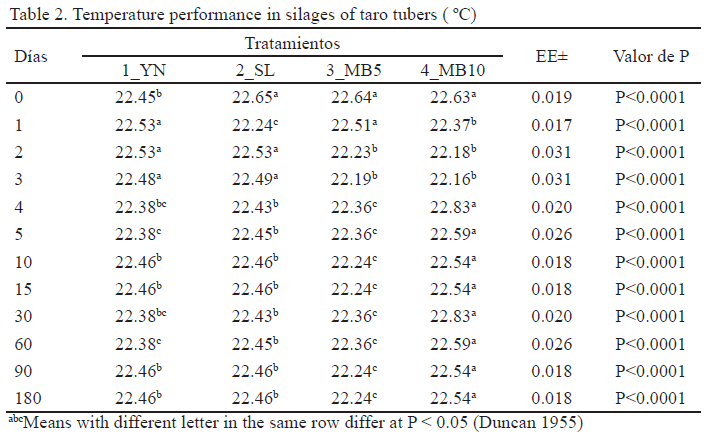
<body><![CDATA[<p align="justify">&nbsp;</p>     <p align="justify"><font size="2" face="Verdana, Arial, Helvetica, sans-serif"><b><font size="3">RESULTS AND DISCUSSION</font></b></font></p>     <p align="justify" class="Cuerpodetexto" style="text-indent:0in;"><span style="font-family:'Verdana','sans-serif'; font-size:10.0pt; ">At  the opening time of the microsilos, no alcohol presence or decomposition  symptom of the ensiled materials was observed. All microsilos had a sweet  caramel coated smell.&nbsp; <a href="/img/revistas/cjas/v50n1/t0214116.gif">Table 2</a> shows the  temperature performance in silages of taro tubers.</span></p>     
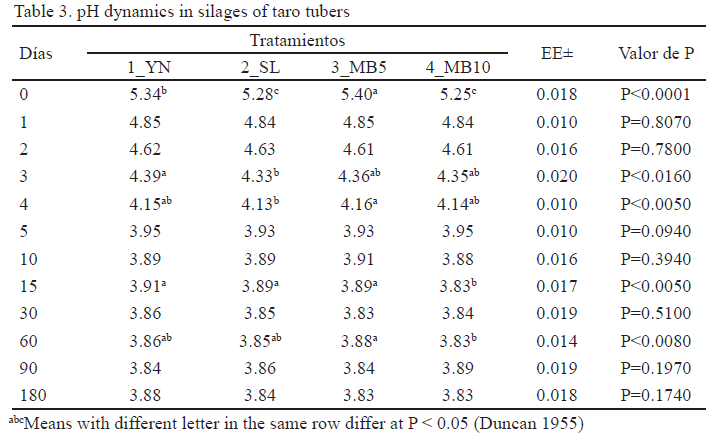
<p align="justify" class="Cuerpodetexto" style="text-indent:0in;"><span style="font-family:'Verdana','sans-serif'; font-size:10.0pt; ">There  were no significant differences (P &lt; 0.05) between treatments 2_W (22.65  &ordm;C); 3_MB5 (22.64 &ordm;C) and 4_MB10 (22.63 &ordm;C) at the zero day of preservation.&nbsp; These treatments surpassed the treatment with  natural yogurt as inoculum source 1_NY (22.45 &ordm;C).&nbsp; However, at day one, treatments with natural  yogurt 1_NY    (22.53 &ordm;C) and 5 % molasses B 3_MB5 (22.51 &ordm;C) showed the highest temperature  value (P &lt; 0.05) differing from treatments 4_MB10 (22.24 &ordm;C)&nbsp; and 2_W (22.37 &ordm;C) .&nbsp; At days two and three there were no  significant differences (P &lt; 0.05) for the temperature of the treatments  1_NY (22.53-22.48 &ordm;C)&nbsp; and 2_W  (2.53-22.49 &ordm;C)&nbsp; which was superior to  3_MB5 (22.23-   22.19 &ordm;C)&nbsp; and 4_MB10 (22.18-22.16 &ordm;C),  respectively.</span></p>     <p align="justify" class="Cuerpodetexto" style="text-indent:0in;"><span style="font-family:'Verdana','sans-serif'; font-size:10.0pt; ">Temperature  from day four and until the 180 of evaluation was stable in all  treatments.&nbsp; The treatment in which  molasses B at 10 % (4_MB10) attained the highest value (P &lt; 0.05) of  temperature (22.83&ndash;  22.54 &ordm;C) and differed from 1_NY 22.38-22.46 &ordm;C; 2_W 22.43-22.46 &ordm;C)&nbsp; and 3_MB5 (22.36-22.24).</span></p>     <p align="justify" class="Cuerpodetexto" style="text-indent:0in;"><span style="font-family:'Verdana','sans-serif'; font-size:10.0pt; ">In  <a href="/img/revistas/cjas/v50n1/t0314116.gif">table 3</a> is shown the pH dynamics in silages of taro tubers.&nbsp; The pH presented the highest values at the  beginning of the fermentation process (day 0) in all treatments.&nbsp; However, the (3_MB5) reached the highest  value (P &lt; 0.05) of this indicator (5.40).</span></p>     
<p align="justify" class="Cuerpodetexto" style="text-indent:0in;"><span style="font-family:'Verdana','sans-serif'; font-size:10.0pt; ">From  day one to four, pH decreased proportionally in all treatments (2_W) 0.71;  (1_NY) 0.70; (4_MB10) 0.70 and (3_MB5) 0.69 units.&nbsp; From day five to 180, pH stabilized with  values between 3.95-3.88 (1_NY); 3.95-3.83 (4_MB10); 3.93-3.84 (2_W) and  3.93-3.83 (3_MB5).</span></p>     <p align="justify" class="Cuerpodetexto" style="text-indent:0in;"><span style="font-family:'Verdana','sans-serif'; font-size:10.0pt; ">The  pH was maintained between the established ranges for producing silage of good  biological quality.&nbsp; The adequate pH  indexes obtained in the four silage variants made possible that these latter  were considered of optimum quality for its use in animal feeding. Well  preserved silages presented values between 3.8 and    4.2.</span></p>     <p align="justify" class="Cuerpodetexto" style="text-indent:0in;"><span style="font-family:'Verdana','sans-serif'; font-size:10.0pt; ">The  evaluation of the microorganisms is a premise, if the introduction of an animal  feed is tried.&nbsp; Thus, it is of vital  importance knowing the sanitary stage of these microorganisms. Fungi, yeasts,  total coliform and <em>E. coli</em> bacteria exhibited a concentration of    (&lt;10 CFU g<sup>-1</sup>) at day zero of evaluation.&nbsp; However, at 15; 30; 60: 90 and 180 d these  microorganisms were absent in all treatments. Neither were there presence of <em>Clostridium  spp.</em> or <em>Salmonella spp.</em> during the study.</span></p>     <p align="justify" class="Cuerpodetexto" style="text-indent:0in;"><span style="font-family:'Verdana','sans-serif'; font-size:10.0pt; ">In  the variation of the temperature between treatments at the beginning of the  fermentation process could have influenced the presence of the existing  microflora in the yogurt, whey and molasses B of sugar cane (Caicedo <em>et al.</em> 2015).&nbsp; These feeds have their own  microorganisms that act with greater intensity producing heat.&nbsp; Among the most important are the fungi,  yeasts, bacteria and actinomycetes (D&iacute;az <em>et al.</em> 2014).</span></p>     ]]></body>
<body><![CDATA[<p align="justify" class="Cuerpodetexto" style="text-indent:0in;"><span style="letter-spacing:.1pt; font-family:'Verdana','sans-serif'; font-size:10.0pt; ">Treatment (4_MB10) at day one presented the lowest value  (P &lt; 0.05) of temperature. However, the highest value was attained on day 4  until the 180.&nbsp; Argamenteria <em>et al.</em> (1997) and Jobim <em>et al.</em> (2007) stated that in silages of energetic  sources the exact causes confirming the rate of worsening and the increase of  the temperature in ensiled materials are not known, since as a biological  process these phenomena are related with the environmental temperature and the  heat generated in this process (Caicedo 2015).&nbsp;  Nonetheless, with silages of protein sources in the temperature  influences mainly the microbiological and proteolytic activity (Morales 2012).</span><span style="font-family:'Verdana','sans-serif'; font-size:10.0pt; "> </span></p>     <p align="justify" class="Cuerpodetexto" style="text-indent:0in;"><span style="font-family:'Verdana','sans-serif'; font-size:10.0pt; ">In all silage variants of taro tubers, pH decreased until  the fourth fermentation day and stabilized at the fifth.&nbsp; Similar pH values reported Caicedo (2013) in  silages of taro tubers until the 180 day of preservation (3.65).&nbsp; In biological silages with the inclusion of  variable levels of carbohydrate and protein sources, Maza <em>et al.</em> (2011)  determined values between 3.63 and 3.75.&nbsp;  Morales (2012) obtained a value of 4.&nbsp;  Seemingly the great soluble carbohydrates availability of the taro  tubers favored the rapid pH stabilization of the    silages.</span><span style="font-family:'Verdana','sans-serif'; font-size:10.0pt; "> </span></p>     <p align="justify" class="Cuerpodetexto" style="text-indent:0in;"><span style="font-family:'Verdana','sans-serif'; font-size:10.0pt; ">In silages with whey, ruminal contents or bovine feces,  D&iacute;az (2014) showed a pH decrease from the initial eight hours of the process  with value of 5.77. This tendency was maintained until the final evaluation (96  h), with pH of 3.87 which influenced on other fermentation factors as the  absence of coliform microorganisms.</span><span style="font-family:'Verdana','sans-serif'; font-size:10.0pt; "> </span></p>     <p align="justify" class="Cuerpodetexto" style="text-indent:0in;"><span style="font-family:'Verdana','sans-serif'; font-size:10.0pt; ">pH is an indicator of great relevance in the fermentation  processes. It is one of the most radical transformations occurring in the  utilized material (Adedeji <em>et al.</em> 2011).&nbsp;  pH is closely related with the degradation processes taking place during  preservation (Fagbenro and Jauncey 1998). When the silage has attained values  between 3.8 and 4.2, it attains its stability (Lopes <em>et al.</em> 2013).&nbsp; In this pH range, there is restriction of the  development of proteolytic enzymes, enterobacteria and clostridiums (Tomich <em>et  al.</em> 2004). The four variants of taro silage showed pH values which are  between those recommended for this type of feed.</span><span style="font-family:'Verdana','sans-serif'; font-size:10.0pt; "> </span></p>     <p align="justify" class="Cuerpodetexto" style="text-indent:0in;"><span style="font-family:'Verdana','sans-serif'; font-size:10.0pt; ">In  the silages the concentration of &lt; 10 CFU g<sup>-1</sup> of fungi, yeasts,  total coliform and <em>E. coli</em> at day zero of assessment was determined.  This can be associated with the external pollution of the tubers by the  irrigation water systems, soil and organic fecal matter (poultry litter, swine  litter) that can represent microbial pollution sources (Kozlowski 2007). However, in the continuous assessment until  day 180 there was no presence of these microorganisms.</span></p>     <p align="justify" class="Cuerpodetexto" style="text-indent:0in;"><span style="font-family:'Verdana','sans-serif'; font-size:10.0pt; ">When  the fermentation processes are adequate, sugars turn into organic acids, mainly  in lactic acid and acetic acid, which are responsible for the fast pH fall that  inhibits clostridium growth, responsible for great losses by the production of  butyric acid in the silos (Posada <em>et al.</em> 2007 and Rend&oacute;n <em>et al.</em> 2014).</span></p>     <p align="justify" class="Cuerpodetexto" style="text-indent:0in;"><span style="letter-spacing:.2pt; font-family:'Verdana','sans-serif'; font-size:10.0pt; ">In studies of Nikosi <em>et al.</em> (2009) with maize  silage and in experiments of Nikosi <em>et al.</em> (2010) with potato an  improvement in the aerobic stability of the silage with the inoculation of  lactobacilli was observed. Nikosi and Meeske (2010) stated that the  fermentation quality of the potato silage also improved with the addition of  whey and    molasses.</span><span style="font-family:'Verdana','sans-serif'; font-size:10.0pt; "> </span></p>     <p align="justify" class="Cuerpodetexto" style="text-indent:0in;"><span style="font-family:'Verdana','sans-serif'; font-size:10.0pt; ">Possibly,  results obtained in the inhibitory performance of <em>Clostridium spp.</em> and <em>Salmonella  spp.</em> in the silages are directly related with the low pH of the silos under  anaerobiosis conditions and before the presence of antimicrobial compounds  produced by the lactic bacteria present in the fermentation processes (McDonald <em>et al.</em> 1991, Bello <em>et al.</em> 1993, Kozlowski 2007, Duniere <em>et al.</em> 2013 and Gismervika <em>et al.</em>  2015).</span></p>     <p align="justify" class="Cuerpodetexto" style="text-indent:0in;"><span style="font-family:'Verdana','sans-serif'; font-size:10.0pt; ">The  lactic acid bacteria had positive effects on the silage characteristics among  those cited are pH decrease, greater production of lactic acid, high DM  digestibility, mainly on using homofermentative strains and greater aerobic  stability on using heterofermentative (Filya 2003).</span></p>     <p align="justify"><span style="font-family:'Verdana','sans-serif'; font-size:10.0pt; ">The biological competition  among different types of bacteria responsible for generating different products  and the lactic acid influence directly on the pH curve.&nbsp; El&iacute;as <em>et al.</em> (1990) and Garc&iacute;a <em>et  al.</em> (2005) found that lactic bacteria prevail due to the lactic acid  production and of other short chain organic acids</span><font size="2" face="Verdana, Arial, Helvetica, sans-serif">.</font> </p>     ]]></body>
<body><![CDATA[<p align="justify">&nbsp;</p>     <p align="justify"><font size="2" face="Verdana, Arial, Helvetica, sans-serif"><b><font size="3">CONCLUSION</font></b></font></p>     <p align="justify"><font size="2" face="Verdana, Arial, Helvetica, sans-serif"><span style="font-family:'Verdana','sans-serif'; font-size:10.0pt; ">The  four silage variants of taro tubers had a adequate performance of the  physicochemical and microbiological indicators until day 180 being thus fit for  animal feeding use</span>.</font></p>     <p align="justify">&nbsp;</p>     <p align="justify"><font size="2" face="Verdana, Arial, Helvetica, sans-serif"><b><font size="3">ACKNOWLEDGEMENTS</font></b></font></p>     <p align="justify"><font size="2" face="Verdana, Arial, Helvetica, sans-serif"><span style="font-family:'Verdana','sans-serif'; font-size:10.0pt; ">Thanks  are due to the National Secretariat of Higher Education for Science, Technology  and Innovation (SENESCYT) of Ecuador for financing the development of this  investigation</span>.</font></p>     <p align="justify">&nbsp;</p>      <p align="justify"><font size="2" face="Verdana, Arial, Helvetica, sans-serif"><font size="3"><b>REFERENCES</b></font></font></p>     <p align="justify" class="MsoBibliography"><span style="font-family:'Verdana','sans-serif'; font-size:10.0pt; ">Adedeji I. A., Olapade-Og F., Farayola C.  O. &amp; Adejumo I. O. 2011. </span><span style="font-family:'Verdana','sans-serif'; font-size:10.0pt; ">&lsquo;&lsquo;Productivity  Effects of Occupational Hazards among Poultry Farmers and Farm Workers in  Osogbo Local Government Area of Osun State&rsquo;&rsquo;. <em>International Journal of  Poultry Science</em>, 10 (11), pp. 867&ndash;870, ISSN: 16828356, DOI: 10.3923/ijps.2011.867.870.</span></p>     <p align="justify" class="MsoBibliography"><span style="font-family:'Verdana','sans-serif'; font-size:10.0pt; ">AOAC  International; Latimer G. W. &amp; Horwitz W. (eds.). 2007. <em>Official Methods  of Analysis of AOAC International</em>. </span><span style="font-family:'Verdana','sans-serif'; font-size:10.0pt; ">18th ed., Gaithersburg,  MD: AOAC International, ISBN: 978-0-935584-78-3.</span></p>     ]]></body>
<body><![CDATA[<!-- ref --><p align="justify" class="MsoBibliography"><span style="font-family:'Verdana','sans-serif'; font-size:10.0pt; ">Argamenter&iacute;a G. A., de La Roza B., Mart&iacute;nez  A., S&aacute;nchez L. &amp; Mart&iacute;nez Y. 1997. <em>El Ensilado en Asturias</em>. Servicio  de Publicaciones, Principado de Asturias, 127 p., ISBN: 978-84-7847-462-2.    </span></p>     <p align="justify" class="MsoBibliography"><span style="font-family:'Verdana','sans-serif'; font-size:10.0pt; ">Balsinde M., Fraga I. &amp; Galindo J.  2003. &lsquo;&lsquo;Inclusi&oacute;n de ensilado de pescado como alternativa en la elaboraci&oacute;n de  alimento extruido para el camar&oacute;n de cultivo (<em>Litopenaeus schmitti</em>)&rsquo;&rsquo;.  In: <em>II Congreso Iberoamericano Virtual de Acuicultura</em>, La Habana: CIVA,  pp. 303&ndash;309, Available: &lt;<a href="http://www.oceandocs.org/handle/1834/2078" target="_blank">http://www.oceandocs.org/handle/1834/2078</a>&gt;,  [Accessed:&nbsp;February 26, 2016].</span></p>     <p align="justify" class="MsoBibliography"><span style="font-family:'Verdana','sans-serif'; font-size:10.0pt; ">Bello R., Cardillo E. &amp; Mart&iacute;nez R.  1993. </span><span style="font-family:'Verdana','sans-serif'; font-size:10.0pt; ">&lsquo;&lsquo;Microbial silage  production from eviscerated fish&rsquo;&rsquo;. </span><em><span style="font-family:'Verdana','sans-serif'; font-size:10.0pt; ">Archivos Latinoamericanos  de Nutrici&oacute;n</span></em><span style="font-family:'Verdana','sans-serif'; font-size:10.0pt; ">, 43 (3), pp. 221&ndash;227, ISSN: 0004-0622,  PMID: 8779624.</span></p>     <!-- ref --><p align="justify" class="MsoBibliography"><span style="font-family:'Verdana','sans-serif'; font-size:10.0pt; ">Caicedo W. 2013. <em>Potencial nutritivo del  ensilado de tub&eacute;rculos de papa china </em>(<em>Colocasia esculenta </em>(L.)  Schott)<em> para la alimentaci&oacute;n de cerdos</em>. Master Thesis, Universidad de  Granma, Bayamo, Cuba, 60 p.    </span></p>     <!-- ref --><p align="justify" class="MsoBibliography"><span style="font-family:'Verdana','sans-serif'; font-size:10.0pt; ">Caicedo W. O. 2015. <em>Valoraci&oacute;n nutritiva  del ensilado de tub&eacute;rculos de papa china </em>(<em>Colocasia esculenta </em>(L.)  Schott)<em> y su uso en la alimentaci&oacute;n de cerdos en crecimiento ceba</em>. Ph.D.  Thesis, Universidad de Granma, Bayamo, Cuba, 100 p.    </span></p>     <p align="justify" class="MsoBibliography"><span style="font-family:'Verdana','sans-serif'; font-size:10.0pt; ">Caisedo W., Rodr&iacute;guez R., Lezcano P., Ly  J., Valle S., Flores L. &amp; Ferreira F. N. A. 2015. </span><span style="font-family:'Verdana','sans-serif'; font-size:10.0pt; ">&lsquo;&lsquo;Chemical composition and in vitro digestibility of  silages of taro (<em>Colocasia esculenta</em> (L.) Schott) tubers for feeding  pigs&rsquo;&rsquo;. <em>Cuban Journal of Agricultural Science</em>, 49 (1), p. 59, ISSN:  2079-3480.</span></p>     <p align="justify" class="MsoBibliography"><span style="font-family:'Verdana','sans-serif'; font-size:10.0pt; ">Cherney J. H.  &amp; Cherney D. J. R. 2003. &lsquo;&lsquo;Assessing silage quality&rsquo;&rsquo;. In: Buxton D. R.,  Muck R. E. and Harrison J. H., <em>Silage science and technology</em>, Wisconsin,  USA: American Society of Agronomy, pp. 141&ndash;198, ISBN: 0-89118-151-2, Available:  &lt;<a href="http://library.wur.nl/WebQuery/clc/1740797" target="_blank">http://library.wur.nl/WebQuery/clc/1740797</a>&gt;, [Accessed:&nbsp;February  26, 2016].</span></p>     ]]></body>
<body><![CDATA[<p align="justify" class="MsoBibliography"><span style="font-family:'Verdana','sans-serif'; font-size:10.0pt; ">D&iacute;az B. 2013.  &lsquo;&lsquo;Nutritional and economical efficiency of three biosilages from agroindustrial  wastes in beef cattle&rsquo;&rsquo;. </span><em><span style="font-family:'Verdana','sans-serif'; font-size:10.0pt; ">Cuban Journal of Agricultural Science</span></em><span style="font-family:'Verdana','sans-serif'; font-size:10.0pt; ">,  47 (2), p. 143, ISSN: 2079-3480.</span></p>     <!-- ref --><p align="justify" class="MsoBibliography"><span style="font-family:'Verdana','sans-serif'; font-size:10.0pt; ">D&iacute;az B. 2014. <em>Evaluaci&oacute;n de Residuos  Agr&iacute;colas Post Cosecha en Ensilados Inoculados con Preparados Microbianos  Nativos para Alimentaci&oacute;n de Vacas Lecheras en Ecuador</em>. Ph.D. Thesis,  Instituto de Ciencia Animal, Mayabeque, Cuba, 63 p.    </span></p>     <p align="justify" class="MsoBibliography"><span style="font-family:'Verdana','sans-serif'; font-size:10.0pt; ">D&iacute;az B., Iglesias A. &amp; Vali&ntilde;o E. 2014.  &lsquo;&lsquo;Evaluaci&oacute;n del bioensilaje de br&oacute;coli (<em>Brassica oleracea</em> L.) y avena (<em>Avena  sativa</em> L.) como suplemento en vacas lecheras&rsquo;&rsquo;. <em>Archivos  Latinoamericanos de Producci&oacute;n Animal</em>, 22 (1-2), pp. 21&ndash;29, ISSN:  1022-1301.</span></p>     <!-- ref --><p align="justify" class="MsoBibliography"><span style="font-family:'Verdana','sans-serif'; font-size:10.0pt; ">Di Rienzo J. A., Casanoves F., Balzarini M.  G., Gonz&aacute;lez L. &amp; Robledo C. W. 2012. <em>InfoStat</em>. version 2012,  [Windows], Universidad Nacional de C&oacute;rdoba, Argentina: Grupo InfoStat,  Available: &lt;<a href="http://www.infostat.com.ar" target="_blank">http://www.infostat.com.ar</a>/&gt;    .</span></p>     <p align="justify" class="MsoBibliography"><span style="font-family:'Verdana','sans-serif'; font-size:10.0pt; ">Dom&iacute;nguez P. L., Chao R., V&iacute;ctores N. &amp;  Herrera R. 2012. &lsquo;&lsquo;Utilizaci&oacute;n digestiva y balance de N de ensilado de cuerpos  de cerdos para el ganado porcino&rsquo;&rsquo;. </span><em><span style="font-family:'Verdana','sans-serif'; font-size:10.0pt; ">Revista Computadorizada de Producci&oacute;n Animal</span></em><span style="font-family:'Verdana','sans-serif'; font-size:10.0pt; ">, 19 (2), pp. 128&ndash;130, ISSN: 1026-9053.</span></p>     <p align="justify" class="MsoBibliography"><span style="font-family:'Verdana','sans-serif'; font-size:10.0pt; ">Driehuis F.  2013. &lsquo;&lsquo;Silage and the safety and quality of dairy foods: a review&rsquo;&rsquo;. <em>Agricultural  and Food Science</em>, 22 (1), pp. 16&ndash;34, ISSN: 1795-1895.</span></p>     <p align="justify" class="MsoBibliography"><span style="font-family:'Verdana','sans-serif'; font-size:10.0pt; ">Driehuis F.  &amp; Elferink S. J. W. H. O. 2000. &lsquo;&lsquo;The impact of the quality of silage on  animal health and food safety: A review&rsquo;&rsquo;. <em>Veterinary Quarterly</em>, 22 (4),  pp. 212&ndash;216, ISSN: 0165-2176, DOI: 10.1080/01652176.2000.9695061, PMID:  11087133.</span></p>     <p align="justify" class="MsoBibliography"><span style="font-family:'Verdana','sans-serif'; font-size:10.0pt; ">Duncan D. B.  1955. &lsquo;&lsquo;Multiple Range and Multiple F Tests&rsquo;&rsquo;. <em>Biometrics</em>, 11 (1), pp.  1&ndash;42, ISSN: 0006-341X, DOI: 10.2307/3001478.</span></p>     ]]></body>
<body><![CDATA[<p align="justify" class="MsoBibliography"><span style="font-family:'Verdana','sans-serif'; font-size:10.0pt; ">Duni&egrave;re L.,  Sindou J., Chaucheyras-Durand F., Chevallier I. &amp; Th&eacute;venot-Sergentet D.  2013. &lsquo;&lsquo;Silage processing and strategies to prevent persistence of undesirable  microorganisms&rsquo;&rsquo;. <em>Animal Feed Science and Technology</em>, 182 (1&ndash;4), pp.  1&ndash;15, ISSN: 0377-8401, DOI: 10.1016/j.anifeedsci.2013.04.006.</span></p>     <p align="justify" class="MsoBibliography"><span style="font-family:'Verdana','sans-serif'; font-size:10.0pt; ">El&iacute;as A., Lezcano O., Lezcano P., Cordero  J. &amp; Quintana L. 1990. &lsquo;&lsquo;Rese&ntilde;a descriptiva sobre el desarrollo de una  tecnolog&iacute;a de enriquecimiento proteico de la ca&ntilde;a de az&uacute;car mediante  fermentaci&oacute;n en estado s&oacute;lido (Saccharina)&rsquo;&rsquo;. </span><em><span style="font-family:'Verdana','sans-serif'; font-size:10.0pt; ">Cuban Journal of Agricultural Science</span></em><span style="font-family:'Verdana','sans-serif'; font-size:10.0pt; ">, 24 (1), pp. 1&ndash;12, ISSN: 2079-3480.</span></p>     <p align="justify" class="MsoBibliography"><span style="font-family:'Verdana','sans-serif'; font-size:10.0pt; ">Fagbenro O. A.  &amp; Jauncey K. 1998. &lsquo;&lsquo;Physical and nutritional properties of moist fermented  fish silage pellets as a protein supplement for tilapia (<em>Oreochromis  niloticus</em>)&rsquo;&rsquo;. <em>Animal Feed Science and Technology</em>, 71 (1&ndash;2), pp.  11&ndash;18, ISSN: 0377-8401, DOI: 10.1016/S0377-8401(97)00123-5.</span></p>     <p align="justify" class="MsoBibliography"><span style="font-family:'Verdana','sans-serif'; font-size:10.0pt; ">Filya I. 2003.  &lsquo;&lsquo;The effect of <em>Lactobacillus buchneri</em>, with or without homofermentative  lactic acid bacteria, on the fermentation, aerobic stability and ruminal  degradability of wheat, sorghum and maize silages&rsquo;&rsquo;. <em>Journal of Applied  Microbiology</em>, 95 (5), pp. 1080&ndash;1086, ISSN: 1364-5072, 1365-2672, DOI:  10.1046/j.1365-2672.2003.02081.x.</span></p>     <p align="justify" class="MsoBibliography"><span style="font-family:'Verdana','sans-serif'; font-size:10.0pt; ">Fr&aacute;nquez P.,  Garc&iacute;a Y., Rodr&iacute;guez J. G., Lemus C. &amp; Ly J. 2012. </span><span style="font-family:'Verdana','sans-serif'; font-size:10.0pt; ">&lsquo;&lsquo;Estudios  de interdependencia entre rasgos de comportamiento y del patr&oacute;n de consumo en  cerdos alimentados con dietas conteniendo aguacate&rsquo;&rsquo;. <em>Revista  Computadorizada de Producci&oacute;n Porcina</em>, 19 (2), pp. 119&ndash;122, ISSN:  1026-9053.</span></p>     <p align="justify" class="MsoBibliography"><span style="font-family:'Verdana','sans-serif'; font-size:10.0pt; ">Garc&iacute;a Y., El&iacute;as A. &amp; Herrera F. R.  2005. &lsquo;&lsquo;Din&aacute;mica microbiana de la fermentaci&oacute;n <em>in vitro</em> de las excretas  de gallinas ponedoras&rsquo;&rsquo;. </span><em><span style="font-family:'Verdana','sans-serif'; font-size:10.0pt; ">Cuban  Journal of Agricultural Science</span></em><span style="font-family:'Verdana','sans-serif'; font-size:10.0pt; ">, 39 (1), pp. 75&ndash;79, ISSN: 2079-3480.</span></p>     <p align="justify" class="MsoBibliography"><span style="font-family:'Verdana','sans-serif'; font-size:10.0pt; ">Gismervik K.,  Randby &Aring;. T., R&oslash;rvik L. M., Bruheim T., Andersen A., Hernandez M. &amp; Skaar  I. 2015. &lsquo;&lsquo;Effect of invasive slug populations (<em>Arion vulgaris</em>) on grass  silage. II: Microbiological quality and feed safety&rsquo;&rsquo;. <em>Animal Feed Science  and Technology</em>, 199, pp. 20&ndash;28, ISSN: 0377-8401, DOI:  10.1016/j.anifeedsci.2014.09.024.</span></p>     <p align="justify" class="MsoBibliography"><span style="font-family:'Verdana','sans-serif'; font-size:10.0pt; ">Guevara Y. J., Bello R. A. &amp; Montilla  J. J. 1991. &lsquo;&lsquo;Evaluaci&oacute;n del ensilado de pescado elaborado por via  microbiol&oacute;gica como suplemento prote&iacute;nico en dietas para pollos de engorde&rsquo;&rsquo;. <em>Archivos  Latinoamericanos de Nutrici&oacute;n</em>, 41 (2), pp. 246&ndash;56, ISSN: 0004-0622.</span></p>     <p align="justify" class="MsoBibliography"><span style="font-family:'Verdana','sans-serif'; font-size:10.0pt; ">Guzm&aacute;n O., Lemus C., Mart&iacute;nez S., Bonilla  J., Plasencia A. &amp; Ly J. 2012. </span><span style="font-family:'Verdana','sans-serif'; font-size:10.0pt; ">&lsquo;&lsquo;Chemical characteristics of silages of mango (<em>Mangifera indica</em> L.) by products for animal feeding&rsquo;&rsquo;. </span><em><span style="font-family:'Verdana','sans-serif'; font-size:10.0pt; ">Cuban Journal of Agricultural  Science</span></em><span style="font-family:'Verdana','sans-serif'; font-size:10.0pt; ">, 46, p. 369, ISSN: 2079-3480.</span></p>     <p align="justify" class="MsoBibliography"><span style="font-family:'Verdana','sans-serif'; font-size:10.0pt; ">INAMHI. 2013. <em>Reportes Clim&aacute;ticos del  Ecuador</em>. Ecuador: Instituto Nacional Meteorol&oacute;gico H&iacute;drico, pp. 20&ndash;25.</span></p>     ]]></body>
<body><![CDATA[<p align="justify" class="MsoBibliography"><span style="font-family:'Verdana','sans-serif'; font-size:10.0pt; ">Jobim C. C.,  Nussio L. G., Reis R. A. &amp; Schmidt P. 2007. </span><span style="font-family:'Verdana','sans-serif'; font-size:10.0pt; ">&lsquo;&lsquo;Avan&ccedil;os  metodol&oacute;gicos na avalia&ccedil;&atilde;o da qualidade da forragem conservada&rsquo;&rsquo;. <em>Revista  Brasileira de Zootecnia</em>, 36, pp. 101&ndash;119, ISSN: 1806-9290, DOI:  10.1590/S1516-35982007001000013.</span></p>     <p align="justify" class="MsoBibliography"><span style="font-family:'Verdana','sans-serif'; font-size:10.0pt; ">Kozlowski J. 2007. </span><span style="font-family:'Verdana','sans-serif'; font-size:10.0pt; ">&lsquo;&lsquo;The distribution, biology, population dynamics and  harmfulness of Arion lusitanicus Mabille, 1868 (Gastropoda: Pulmonata:  Arionidae) in Poland&rsquo;&rsquo;. <em>Journal of Plant Protection Research</em>, 47 (3),  pp. 219&ndash;230, ISSN: 1427-4345.</span></p>     <p align="justify" class="MsoBibliography"><span style="font-family:'Verdana','sans-serif'; font-size:10.0pt; ">Lopes M. P. e  C., J&uacute;nior Z., Antonio F., Alberton L. R., Otutumi L. K., Silveira A. P. &amp;  Meza S. karla L. 2013. </span><span style="font-family:'Verdana','sans-serif'; font-size:10.0pt; ">&lsquo;&lsquo;Caracteriza&ccedil;&atilde;o nutricional da silagem de  baga&ccedil;o de cana de a&ccedil;ucar (<em>Saccharum officinarum</em> L) adicionada ou n&atilde;o de  soro de queijo e/ou gr&atilde;o de milho&rsquo;&rsquo;. <em>Arquivos de Ci&ecirc;ncias Veterin&aacute;rias e  Zoologia da UNIPAR</em>, 16 (1), ISSN: 1415-8167, Available:  &lt;<a href="http://bases.bireme.br/cgi-bin/wxislind.exe/iah/online/?IsisScript=iah/iah.xis&src=google&base=LILACS&lang=p&nextAction=lnk&exprSearch=718764&indexSearch=ID" target="_blank">http://bases.bireme.br/cgi-bin/wxislind.exe/iah/online/?IsisScript=iah/iah.xis&amp;src=google&amp;base=LILACS&amp;lang=p&amp;nextAction=lnk&amp;exprSearch=718764&amp;indexSearch=ID</a>&gt;,  [Accessed:&nbsp;March 2, 2016].</span></p>     <p align="justify" class="MsoBibliography"><span style="font-family:'Verdana','sans-serif'; font-size:10.0pt; ">Maza A. L., Vergara G. O. &amp; Paternina  D. E. 2011. &lsquo;&lsquo;Evaluaci&oacute;n qu&iacute;mica y organol&eacute;ptica del ensilaje de maralfalfa (<em>Pennisetum</em> sp.) m&aacute;s yuca fresca (<em>Manihot esculenta</em>)&rsquo;&rsquo;. <em>Revista MVZ C&oacute;rdoba</em>,  16 (2), pp. 2528&ndash;2537, ISSN: 0122-0268.</span></p>     <!-- ref --><p align="justify" class="MsoBibliography"><span style="font-family:'Verdana','sans-serif'; font-size:10.0pt; ">McDonald P., Henderson A. R. &amp; Heron S.  J. E. 1991. </span><em><span style="font-family:'Verdana','sans-serif'; font-size:10.0pt; ">The  Biochemistry of Silage</span></em><span style="font-family:'Verdana','sans-serif'; font-size:10.0pt; ">.  2nd ed., Kingston: Scholium Intl, 340 p., ISBN: 978-0-948617-22-5.    </span></p>     <!-- ref --><p align="justify" class="MsoBibliography"><span style="font-family:'Verdana','sans-serif'; font-size:10.0pt; ">Mier M. Q. 2009. <em>Caracterizaci&oacute;n del  valor nutritivo y estabilidad aer&oacute;bica de ensilados en forma de microsilos para  ma&iacute;z forrajero</em>. Master Thesis, Universidad de C&oacute;rdoba, C&oacute;rdoba, Espa&ntilde;a, 29  p.    </span></p>     <!-- ref --><p align="justify" class="MsoBibliography"><span style="font-family:'Verdana','sans-serif'; font-size:10.0pt; ">Morales A. 2012. <em>Caracterizaci&oacute;n qu&iacute;mica  y biol&oacute;gica de la Harina de (Pennisetumpurpureum) enriquecida con ensilado de  pescado</em>. Master Thesis, Universidad de Granma, Bayamo, Cuba, 20 p.    </span></p>     ]]></body>
<body><![CDATA[<p align="justify" class="MsoBibliography"><span style="font-family:'Verdana','sans-serif'; font-size:10.0pt; ">Nkosi B. D. &amp; Meeske R. 2010. </span><span style="font-family:'Verdana','sans-serif'; font-size:10.0pt; ">&lsquo;&lsquo;Effects of whey and molasses as silage additives on  potato hash silage quality and growth performance of lambs&rsquo;&rsquo;. <em>South African  Journal of Animal Science</em>, 40 (3), pp. 229&ndash;237, ISSN: 0375-1589.</span></p>     <p align="justify" class="MsoBibliography"><span style="font-family:'Verdana','sans-serif'; font-size:10.0pt; ">Nkosi B. D.,  Meeske R., Palic D. &amp; Langa T. 2009. &lsquo;&lsquo;Laboratory evaluation of an  inoculant for ensiling whole crop maize in South Africa&rsquo;&rsquo;. <em>Animal Feed  Science and Technology</em>, 150 (1&ndash;2), pp. 144&ndash;150, ISSN: 0377-8401, DOI:  10.1016/j.anifeedsci.2008.07.008.</span></p>     <p align="justify" class="MsoBibliography"><span style="font-family:'Verdana','sans-serif'; font-size:10.0pt; ">Nkosi B. D.,  Meeske R., van der Merwe H. J. &amp; Groenewald I. B. 2010. &lsquo;&lsquo;Effects of  homofermentative and heterofermentative bacterial silage inoculants on potato  hash silage fermentation and digestibility in rams&rsquo;&rsquo;. <em>Animal Feed Science  and Technology</em>, 157 (3&ndash;4), pp. 195&ndash;200, ISSN: 0377-8401, DOI:  10.1016/j.anifeedsci.2010.03.008.</span></p>     <p align="justify" class="MsoBibliography"><span style="font-family:'Verdana','sans-serif'; font-size:10.0pt; ">Ottati M. &amp; Bello R. 1989. &lsquo;&lsquo;Ensilado  microbiano de pescado en la alimentaci&oacute;n porcina. Valor nutritivo del producto  en dietas para cerdos&rsquo;&rsquo;. In: <em>Trabajos presentados en la segunda consulta de  expertos sobre tecnolog&iacute;a de productos pesqueros en Am&eacute;rica Latina</em>,  Montevideo: Food &amp; Agriculture Org., ISBN: 978-92-5-303254-9.</span></p>     <p align="justify" class="MsoBibliography"><span style="font-family:'Verdana','sans-serif'; font-size:10.0pt; ">Posada S., Rosero R. &amp; Jim&eacute;nez A. 2007.  &lsquo;&lsquo;Valor nutricional y caracter&iacute;sticas de fermentaci&oacute;n del ensilaje de pasto  maralfalfa (<em>Pennisetum</em> sp.) con diferentes niveles de inclusi&oacute;n de ca&ntilde;a  de az&uacute;car (<em>Saccharum officinarum</em>)&rsquo;&rsquo;. <em>Revista Colombiana de Ciencias  Pecuarias</em>, 20 (4), p. 640, ISSN: 0120-0690.</span></p>     <p align="justify" class="MsoBibliography"><span style="font-family:'Verdana','sans-serif'; font-size:10.0pt; ">Rend&oacute;n M. E., Noguera R. R. &amp; Posada S.  L. 2014. &lsquo;&lsquo;Vinaza de ca&ntilde;a como aditivo acidificante en la elaboraci&oacute;n de  ensilaje de ma&iacute;z (<em>Zea mays</em>)&rsquo;&rsquo;. </span><em><span style="font-family:'Verdana','sans-serif'; font-size:10.0pt; ">Livestock Research for Rural Development</span></em><span style="font-family:'Verdana','sans-serif'; font-size:10.0pt; ">, 26 (1), ISSN: 0121-3784, Available:  &lt;<a href="http://lrrd.cipav.org.co/lrrd26/1/rend26007.html" target="_blank">http://lrrd.cipav.org.co/lrrd26/1/rend26007.html</a>&gt;, [Accessed:&nbsp;March  2, 2016].</span></p>     <!-- ref --><p align="justify" class="MsoBibliography"><span style="font-family:'Verdana','sans-serif'; font-size:10.0pt; ">Steel R. G. D.  1997. <em>Principles and Procedures of Statistics: A Biometrical Approach</em>.  McGraw-Hill, 696 p., ISBN: 978-0-07-061028-6.    </span></p>     <p align="justify" class="MsoBibliography"><span style="font-family:'Verdana','sans-serif'; font-size:10.0pt; ">Tomich T. R.,  Rodrigues J. a. S., Tomich R. G. P., Gon&ccedil;alves L. C. &amp; Borges I. 2004.  &lsquo;&lsquo;Forage potential of sorghum sudangrass hybrids&rsquo;&rsquo;. <em>Arquivo Brasileiro de  Medicina Veterin&aacute;ria e Zootecnia</em>, 56 (2), pp. 258&ndash;263, ISSN: 0102-0935,  DOI: 10.1590/S0102-09352004000200017.</span></p>     <p align="justify"><span style="font-family:'Verdana','sans-serif'; font-size:10.0pt; ">Zynudheen A. A., Anandan R.  &amp; Ramachandran N. K. G. 2008. &lsquo;&lsquo;Effect of dietary supplementation of  fermented fish silage on egg production in Japanese quail (<em>Coturnix  coromandelica</em>)&rsquo;&rsquo;. </span><em><span style="font-family:'Verdana','sans-serif'; font-size:10.0pt; ">African  Journal of Agricultural Research</span></em><span style="font-family:'Verdana','sans-serif'; font-size:10.0pt; ">, 3 (5), pp. 379&ndash;383, ISSN: 1991-637X</span><font size="2" face="Verdana, Arial, Helvetica, sans-serif">.</font> </p>     ]]></body>
<body><![CDATA[<p align="justify">&nbsp;</p>     <p align="justify">&nbsp;</p>     <p align="justify"><font size="2" face="Verdana, Arial, Helvetica, sans-serif">Received: March 23, 2015    <br>   Accepted: April 29, 2016</font></p>     <p align="justify">&nbsp;</p>     <p align="justify">&nbsp;</p>     <p align="justify"><font size="2" face="Verdana, Arial, Helvetica, sans-serif"><i>W. Caicedo,</i> Universidad Estatal Amazónica, km 2 ½ vía a Napo, Pastaza, Ecuador.    Email: <a href="mailto:orlando.caicedo@yahoo.es">orlando.caicedo@yahoo.es</a></font></p>      ]]></body><back>
<ref-list>
<ref id="B1">
<nlm-citation citation-type="journal">
<person-group person-group-type="author">
<name>
<surname><![CDATA[Adedeji]]></surname>
<given-names><![CDATA[I. A.]]></given-names>
</name>
<name>
<surname><![CDATA[Olapade-Og]]></surname>
<given-names><![CDATA[F.]]></given-names>
</name>
<name>
<surname><![CDATA[Farayola]]></surname>
<given-names><![CDATA[C. O.]]></given-names>
</name>
<name>
<surname><![CDATA[Adejumo]]></surname>
<given-names><![CDATA[I. O.]]></given-names>
</name>
</person-group>
<article-title xml:lang="nd"><![CDATA[Productivity Effects of Occupational Hazards among Poultry Farmers and Farm Workers in Osogbo Local Government Area of Osun State]]></article-title>
<source><![CDATA[International Journal of Poultry Science]]></source>
<year>2011</year>
<volume>10</volume>
<numero>11</numero>
<issue>11</issue>
<page-range>867-870</page-range></nlm-citation>
</ref>
<ref id="B2">
<nlm-citation citation-type="book">
<person-group person-group-type="author">
<name>
<surname><![CDATA[AOAC International]]></surname>
</name>
<name>
<surname><![CDATA[Latimer]]></surname>
<given-names><![CDATA[G. W.]]></given-names>
</name>
<name>
<surname><![CDATA[Horwitz]]></surname>
<given-names><![CDATA[W.]]></given-names>
</name>
</person-group>
<source><![CDATA[Official Methods of Analysis of AOAC International]]></source>
<year>2007</year>
<edition>18th</edition>
<publisher-loc><![CDATA[Gaithersburg, MD ]]></publisher-loc>
<publisher-name><![CDATA[AOAC International]]></publisher-name>
</nlm-citation>
</ref>
<ref id="B3">
<nlm-citation citation-type="book">
<person-group person-group-type="author">
<name>
<surname><![CDATA[Argamentería]]></surname>
<given-names><![CDATA[G. A.]]></given-names>
</name>
<name>
<surname><![CDATA[de La Roza]]></surname>
<given-names><![CDATA[B.]]></given-names>
</name>
<name>
<surname><![CDATA[Martínez]]></surname>
<given-names><![CDATA[A.]]></given-names>
</name>
<name>
<surname><![CDATA[Sánchez]]></surname>
<given-names><![CDATA[L.]]></given-names>
</name>
<name>
<surname><![CDATA[Martínez]]></surname>
<given-names><![CDATA[Y.]]></given-names>
</name>
</person-group>
<source><![CDATA[El Ensilado en Asturias]]></source>
<year>1997</year>
<page-range>127</page-range><publisher-name><![CDATA[Servicio de Publicaciones, Principado de Asturias]]></publisher-name>
</nlm-citation>
</ref>
<ref id="B4">
<nlm-citation citation-type="book">
<person-group person-group-type="author">
<name>
<surname><![CDATA[Balsinde]]></surname>
<given-names><![CDATA[M.]]></given-names>
</name>
<name>
<surname><![CDATA[Fraga]]></surname>
<given-names><![CDATA[I.]]></given-names>
</name>
<name>
<surname><![CDATA[Galindo]]></surname>
<given-names><![CDATA[J.]]></given-names>
</name>
</person-group>
<article-title xml:lang="nd"><![CDATA[Inclusión de ensilado de pescado como alternativa en la elaboración de alimento extruido para el camarón de cultivo (Litopenaeus schmitti)]]></article-title>
<source><![CDATA[]]></source>
<year>2003</year>
<page-range>303-309</page-range><publisher-loc><![CDATA[La Habana ]]></publisher-loc>
<publisher-name><![CDATA[CIVA]]></publisher-name>
</nlm-citation>
</ref>
<ref id="B5">
<nlm-citation citation-type="journal">
<person-group person-group-type="author">
<name>
<surname><![CDATA[Bello]]></surname>
<given-names><![CDATA[R.]]></given-names>
</name>
<name>
<surname><![CDATA[Cardillo]]></surname>
<given-names><![CDATA[E.]]></given-names>
</name>
<name>
<surname><![CDATA[Martínez]]></surname>
<given-names><![CDATA[R.]]></given-names>
</name>
</person-group>
<article-title xml:lang="nd"><![CDATA[Microbial silage production from eviscerated fish]]></article-title>
<source><![CDATA[Archivos Latinoamericanos de Nutrición]]></source>
<year>1993</year>
<volume>43</volume>
<numero>3</numero>
<issue>3</issue>
<page-range>221-227</page-range></nlm-citation>
</ref>
<ref id="B6">
<nlm-citation citation-type="book">
<person-group person-group-type="author">
<name>
<surname><![CDATA[Caicedo]]></surname>
<given-names><![CDATA[W.]]></given-names>
</name>
</person-group>
<source><![CDATA[Potencial nutritivo del ensilado de tubérculos de papa china (Colocasia esculenta (L.) Schott) para la alimentación de cerdos]]></source>
<year>2013</year>
<page-range>60</page-range><publisher-loc><![CDATA[Bayamo, Cuba ]]></publisher-loc>
<publisher-name><![CDATA[Universidad de Granma]]></publisher-name>
</nlm-citation>
</ref>
<ref id="B7">
<nlm-citation citation-type="book">
<person-group person-group-type="author">
<name>
<surname><![CDATA[Caicedo]]></surname>
<given-names><![CDATA[W. O.]]></given-names>
</name>
</person-group>
<source><![CDATA[Valoración nutritiva del ensilado de tubérculos de papa china (Colocasia esculenta (L.) Schott) y su uso en la alimentación de cerdos en crecimiento ceba]]></source>
<year>2015</year>
<page-range>100</page-range><publisher-loc><![CDATA[Bayamo, Cuba ]]></publisher-loc>
<publisher-name><![CDATA[Universidad de Granma]]></publisher-name>
</nlm-citation>
</ref>
<ref id="B8">
<nlm-citation citation-type="journal">
<person-group person-group-type="author">
<name>
<surname><![CDATA[Caisedo]]></surname>
<given-names><![CDATA[W.]]></given-names>
</name>
<name>
<surname><![CDATA[Rodríguez]]></surname>
<given-names><![CDATA[R.]]></given-names>
</name>
<name>
<surname><![CDATA[Lezcano]]></surname>
<given-names><![CDATA[P.]]></given-names>
</name>
<name>
<surname><![CDATA[Ly]]></surname>
<given-names><![CDATA[J.]]></given-names>
</name>
<name>
<surname><![CDATA[Valle]]></surname>
<given-names><![CDATA[S.]]></given-names>
</name>
<name>
<surname><![CDATA[Flores]]></surname>
<given-names><![CDATA[L.]]></given-names>
</name>
<name>
<surname><![CDATA[Ferreira]]></surname>
<given-names><![CDATA[F. N. A.]]></given-names>
</name>
</person-group>
<article-title xml:lang="nd"><![CDATA[Chemical composition and in vitro digestibility of silages of taro (Colocasia esculenta (L.) Schott) tubers for feeding pigs]]></article-title>
<source><![CDATA[Cuban Journal of Agricultural Science]]></source>
<year>2015</year>
<volume>49</volume>
<numero>1</numero>
<issue>1</issue>
<page-range>59</page-range></nlm-citation>
</ref>
<ref id="B9">
<nlm-citation citation-type="book">
<person-group person-group-type="author">
<name>
<surname><![CDATA[Cherney]]></surname>
<given-names><![CDATA[J. H.]]></given-names>
</name>
<name>
<surname><![CDATA[Cherney]]></surname>
<given-names><![CDATA[D. J. R.]]></given-names>
</name>
</person-group>
<article-title xml:lang="nd"><![CDATA[Assessing silage quality]]></article-title>
<source><![CDATA[Silage science and technology]]></source>
<year>2003</year>
<page-range>141-198</page-range><publisher-loc><![CDATA[Wisconsin, USA ]]></publisher-loc>
<publisher-name><![CDATA[American Society of Agronomy]]></publisher-name>
</nlm-citation>
</ref>
<ref id="B10">
<nlm-citation citation-type="journal">
<person-group person-group-type="author">
<name>
<surname><![CDATA[Díaz]]></surname>
<given-names><![CDATA[B.]]></given-names>
</name>
</person-group>
<article-title xml:lang="nd"><![CDATA[Nutritional and economical efficiency of three biosilages from agroindustrial wastes in beef cattle]]></article-title>
<source><![CDATA[Cuban Journal of Agricultural Science]]></source>
<year>2013</year>
<volume>47</volume>
<numero>2</numero>
<issue>2</issue>
<page-range>143</page-range></nlm-citation>
</ref>
<ref id="B11">
<nlm-citation citation-type="book">
<person-group person-group-type="author">
<name>
<surname><![CDATA[Díaz]]></surname>
<given-names><![CDATA[B.]]></given-names>
</name>
</person-group>
<source><![CDATA[Evaluación de Residuos Agrícolas Post Cosecha en Ensilados Inoculados con Preparados Microbianos Nativos para Alimentación de Vacas Lecheras en Ecuador]]></source>
<year>2014</year>
<page-range>63</page-range><publisher-loc><![CDATA[Mayabeque, Cuba ]]></publisher-loc>
<publisher-name><![CDATA[Instituto de Ciencia Animal]]></publisher-name>
</nlm-citation>
</ref>
<ref id="B12">
<nlm-citation citation-type="journal">
<person-group person-group-type="author">
<name>
<surname><![CDATA[Díaz]]></surname>
<given-names><![CDATA[B.]]></given-names>
</name>
<name>
<surname><![CDATA[Iglesias]]></surname>
<given-names><![CDATA[A.]]></given-names>
</name>
<name>
<surname><![CDATA[Valiño]]></surname>
<given-names><![CDATA[E.]]></given-names>
</name>
</person-group>
<article-title xml:lang="nd"><![CDATA[Evaluación del bioensilaje de brócoli (Brassica oleracea L.) y avena (Avena sativa L.) como suplemento en vacas lecheras]]></article-title>
<source><![CDATA[Archivos Latinoamericanos de Producción Animal]]></source>
<year>2014</year>
<volume>22</volume>
<numero>1-2</numero>
<issue>1-2</issue>
<page-range>21-29</page-range></nlm-citation>
</ref>
<ref id="B13">
<nlm-citation citation-type="book">
<person-group person-group-type="author">
<name>
<surname><![CDATA[Di Rienzo]]></surname>
<given-names><![CDATA[J. A.]]></given-names>
</name>
<name>
<surname><![CDATA[Casanoves]]></surname>
<given-names><![CDATA[F.]]></given-names>
</name>
<name>
<surname><![CDATA[Balzarini]]></surname>
<given-names><![CDATA[M. G.]]></given-names>
</name>
<name>
<surname><![CDATA[González]]></surname>
<given-names><![CDATA[L.]]></given-names>
</name>
<name>
<surname><![CDATA[Robledo]]></surname>
<given-names><![CDATA[C. W.]]></given-names>
</name>
</person-group>
<source><![CDATA[InfoStat]]></source>
<year>2012</year>
<publisher-loc><![CDATA[Universidad Nacional de Córdoba, Argentina ]]></publisher-loc>
<publisher-name><![CDATA[Grupo InfoStat]]></publisher-name>
</nlm-citation>
</ref>
<ref id="B14">
<nlm-citation citation-type="journal">
<person-group person-group-type="author">
<name>
<surname><![CDATA[Domínguez]]></surname>
<given-names><![CDATA[P. L.]]></given-names>
</name>
<name>
<surname><![CDATA[Chao]]></surname>
<given-names><![CDATA[R.]]></given-names>
</name>
<name>
<surname><![CDATA[Víctores]]></surname>
<given-names><![CDATA[N.]]></given-names>
</name>
<name>
<surname><![CDATA[Herrera]]></surname>
<given-names><![CDATA[R.]]></given-names>
</name>
</person-group>
<article-title xml:lang="nd"><![CDATA[Utilización digestiva y balance de N de ensilado de cuerpos de cerdos para el ganado porcino]]></article-title>
<source><![CDATA[Revista Computadorizada de Producción Animal]]></source>
<year>2012</year>
<volume>19</volume>
<numero>2</numero>
<issue>2</issue>
<page-range>128-130</page-range></nlm-citation>
</ref>
<ref id="B15">
<nlm-citation citation-type="journal">
<person-group person-group-type="author">
<name>
<surname><![CDATA[Driehuis]]></surname>
<given-names><![CDATA[F.]]></given-names>
</name>
</person-group>
<article-title xml:lang="nd"><![CDATA[Silage and the safety and quality of dairy foods: a review]]></article-title>
<source><![CDATA[Agricultural and Food Science]]></source>
<year>2013</year>
<volume>22</volume>
<numero>1</numero>
<issue>1</issue>
<page-range>16-34</page-range></nlm-citation>
</ref>
<ref id="B16">
<nlm-citation citation-type="journal">
<person-group person-group-type="author">
<name>
<surname><![CDATA[Driehuis]]></surname>
<given-names><![CDATA[F.]]></given-names>
</name>
<name>
<surname><![CDATA[Elferink]]></surname>
<given-names><![CDATA[S. J. W. H. O.]]></given-names>
</name>
</person-group>
<article-title xml:lang="nd"><![CDATA[The impact of the quality of silage on animal health and food safety: A review]]></article-title>
<source><![CDATA[Veterinary Quarterly]]></source>
<year>2000</year>
<volume>22</volume>
<numero>4</numero>
<issue>4</issue>
<page-range>212-216</page-range></nlm-citation>
</ref>
<ref id="B17">
<nlm-citation citation-type="journal">
<person-group person-group-type="author">
<name>
<surname><![CDATA[Duncan]]></surname>
<given-names><![CDATA[D. B.]]></given-names>
</name>
</person-group>
<article-title xml:lang="nd"><![CDATA[Multiple Range and Multiple F Tests]]></article-title>
<source><![CDATA[Biometrics]]></source>
<year>1955</year>
<volume>11</volume>
<numero>1</numero>
<issue>1</issue>
<page-range>1-42</page-range></nlm-citation>
</ref>
<ref id="B18">
<nlm-citation citation-type="journal">
<person-group person-group-type="author">
<name>
<surname><![CDATA[Dunière]]></surname>
<given-names><![CDATA[L.]]></given-names>
</name>
<name>
<surname><![CDATA[Sindou]]></surname>
<given-names><![CDATA[J.]]></given-names>
</name>
<name>
<surname><![CDATA[Chaucheyras-Durand]]></surname>
<given-names><![CDATA[F.]]></given-names>
</name>
<name>
<surname><![CDATA[Chevallier]]></surname>
<given-names><![CDATA[I.]]></given-names>
</name>
<name>
<surname><![CDATA[Thévenot-Sergentet]]></surname>
<given-names><![CDATA[D.]]></given-names>
</name>
</person-group>
<article-title xml:lang="nd"><![CDATA[Silage processing and strategies to prevent persistence of undesirable microorganisms]]></article-title>
<source><![CDATA[Animal Feed Science and Technology]]></source>
<year>2013</year>
<volume>182</volume>
<numero>1-4</numero>
<issue>1-4</issue>
<page-range>1-15</page-range></nlm-citation>
</ref>
<ref id="B19">
<nlm-citation citation-type="journal">
<person-group person-group-type="author">
<name>
<surname><![CDATA[Elías]]></surname>
<given-names><![CDATA[A.]]></given-names>
</name>
<name>
<surname><![CDATA[Lezcano]]></surname>
<given-names><![CDATA[O.]]></given-names>
</name>
<name>
<surname><![CDATA[Lezcano]]></surname>
<given-names><![CDATA[P.]]></given-names>
</name>
<name>
<surname><![CDATA[Cordero]]></surname>
<given-names><![CDATA[J.]]></given-names>
</name>
<name>
<surname><![CDATA[Quintana]]></surname>
<given-names><![CDATA[L.]]></given-names>
</name>
</person-group>
<article-title xml:lang="nd"><![CDATA[Reseña descriptiva sobre el desarrollo de una tecnología de enriquecimiento proteico de la caña de azúcar mediante fermentación en estado sólido (Saccharina)]]></article-title>
<source><![CDATA[Cuban Journal of Agricultural Science]]></source>
<year>1990</year>
<volume>24</volume>
<numero>1</numero>
<issue>1</issue>
<page-range>1-12</page-range></nlm-citation>
</ref>
<ref id="B20">
<nlm-citation citation-type="journal">
<person-group person-group-type="author">
<name>
<surname><![CDATA[Fagbenro]]></surname>
<given-names><![CDATA[O. A.]]></given-names>
</name>
<name>
<surname><![CDATA[Jauncey]]></surname>
<given-names><![CDATA[K.]]></given-names>
</name>
</person-group>
<article-title xml:lang="nd"><![CDATA[Physical and nutritional properties of moist fermented fish silage pellets as a protein supplement for tilapia (Oreochromis niloticus)]]></article-title>
<source><![CDATA[Animal Feed Science and Technology]]></source>
<year>1998</year>
<volume>71</volume>
<numero>1-2</numero>
<issue>1-2</issue>
<page-range>11-18</page-range></nlm-citation>
</ref>
<ref id="B21">
<nlm-citation citation-type="journal">
<person-group person-group-type="author">
<name>
<surname><![CDATA[Filya]]></surname>
<given-names><![CDATA[I.]]></given-names>
</name>
</person-group>
<article-title xml:lang="nd"><![CDATA[The effect of Lactobacillus buchneri, with or without homofermentative lactic acid bacteria, on the fermentation, aerobic stability and ruminal degradability of wheat, sorghum and maize silages]]></article-title>
<source><![CDATA[Journal of Applied Microbiology]]></source>
<year>2003</year>
<volume>95</volume>
<numero>5</numero>
<issue>5</issue>
<page-range>1080-1086</page-range></nlm-citation>
</ref>
<ref id="B22">
<nlm-citation citation-type="journal">
<person-group person-group-type="author">
<name>
<surname><![CDATA[Fránquez]]></surname>
<given-names><![CDATA[P.]]></given-names>
</name>
<name>
<surname><![CDATA[García]]></surname>
<given-names><![CDATA[Y.]]></given-names>
</name>
<name>
<surname><![CDATA[Rodríguez]]></surname>
<given-names><![CDATA[J. G.]]></given-names>
</name>
<name>
<surname><![CDATA[Lemus]]></surname>
<given-names><![CDATA[C.]]></given-names>
</name>
<name>
<surname><![CDATA[Ly]]></surname>
<given-names><![CDATA[J.]]></given-names>
</name>
</person-group>
<article-title xml:lang="nd"><![CDATA[Estudios de interdependencia entre rasgos de comportamiento y del patrón de consumo en cerdos alimentados con dietas conteniendo aguacate]]></article-title>
<source><![CDATA[Revista Computadorizada de Producción Porcina]]></source>
<year>2012</year>
<volume>19</volume>
<numero>2</numero>
<issue>2</issue>
<page-range>119-122</page-range></nlm-citation>
</ref>
<ref id="B23">
<nlm-citation citation-type="journal">
<person-group person-group-type="author">
<name>
<surname><![CDATA[García]]></surname>
<given-names><![CDATA[Y.]]></given-names>
</name>
<name>
<surname><![CDATA[Elías]]></surname>
<given-names><![CDATA[A.]]></given-names>
</name>
<name>
<surname><![CDATA[Herrera]]></surname>
<given-names><![CDATA[F. R.]]></given-names>
</name>
</person-group>
<article-title xml:lang="nd"><![CDATA[Dinámica microbiana de la fermentación in vitro de las excretas de gallinas ponedoras]]></article-title>
<source><![CDATA[Cuban Journal of Agricultural Science]]></source>
<year>2005</year>
<volume>39</volume>
<numero>1</numero>
<issue>1</issue>
<page-range>75-79</page-range></nlm-citation>
</ref>
<ref id="B24">
<nlm-citation citation-type="journal">
<person-group person-group-type="author">
<name>
<surname><![CDATA[Gismervik]]></surname>
<given-names><![CDATA[K.]]></given-names>
</name>
<name>
<surname><![CDATA[Randby]]></surname>
<given-names><![CDATA[Å. T.]]></given-names>
</name>
<name>
<surname><![CDATA[Rørvik]]></surname>
<given-names><![CDATA[L. M.]]></given-names>
</name>
<name>
<surname><![CDATA[Bruheim]]></surname>
<given-names><![CDATA[T.]]></given-names>
</name>
<name>
<surname><![CDATA[Andersen]]></surname>
<given-names><![CDATA[A.]]></given-names>
</name>
<name>
<surname><![CDATA[Hernandez]]></surname>
<given-names><![CDATA[M.]]></given-names>
</name>
<name>
<surname><![CDATA[Skaar]]></surname>
<given-names><![CDATA[I.]]></given-names>
</name>
</person-group>
<article-title xml:lang="nd"><![CDATA[Effect of invasive slug populations (Arion vulgaris) on grass silage. II: Microbiological quality and feed safety]]></article-title>
<source><![CDATA[Animal Feed Science and Technology]]></source>
<year>2015</year>
<volume>199</volume>
<page-range>20-28</page-range></nlm-citation>
</ref>
<ref id="B25">
<nlm-citation citation-type="journal">
<person-group person-group-type="author">
<name>
<surname><![CDATA[Guevara]]></surname>
<given-names><![CDATA[Y. J.]]></given-names>
</name>
<name>
<surname><![CDATA[Bello]]></surname>
<given-names><![CDATA[R. A.]]></given-names>
</name>
<name>
<surname><![CDATA[Montilla]]></surname>
<given-names><![CDATA[J. J.]]></given-names>
</name>
</person-group>
<article-title xml:lang="nd"><![CDATA[Evaluación del ensilado de pescado elaborado por via microbiológica como suplemento proteínico en dietas para pollos de engorde]]></article-title>
<source><![CDATA[Archivos Latinoamericanos de Nutrición]]></source>
<year>1991</year>
<volume>41</volume>
<numero>2</numero>
<issue>2</issue>
<page-range>246-56</page-range></nlm-citation>
</ref>
<ref id="B26">
<nlm-citation citation-type="journal">
<person-group person-group-type="author">
<name>
<surname><![CDATA[Guzmán]]></surname>
<given-names><![CDATA[O.]]></given-names>
</name>
<name>
<surname><![CDATA[Lemus]]></surname>
<given-names><![CDATA[C.]]></given-names>
</name>
<name>
<surname><![CDATA[Martínez]]></surname>
<given-names><![CDATA[S.]]></given-names>
</name>
<name>
<surname><![CDATA[Bonilla]]></surname>
<given-names><![CDATA[J.]]></given-names>
</name>
<name>
<surname><![CDATA[Plasencia]]></surname>
<given-names><![CDATA[A.]]></given-names>
</name>
<name>
<surname><![CDATA[Ly]]></surname>
<given-names><![CDATA[J.]]></given-names>
</name>
</person-group>
<article-title xml:lang="nd"><![CDATA[Chemical characteristics of silages of mango (Mangifera indica L.) by products for animal feeding]]></article-title>
<source><![CDATA[Cuban Journal of Agricultural Science]]></source>
<year>2012</year>
<volume>46</volume>
<page-range>369</page-range></nlm-citation>
</ref>
<ref id="B27">
<nlm-citation citation-type="book">
<person-group person-group-type="author">
<name>
<surname><![CDATA[INAMHI]]></surname>
</name>
</person-group>
<source><![CDATA[Reportes Climáticos del Ecuador]]></source>
<year>2013</year>
<page-range>20-25</page-range><publisher-loc><![CDATA[Ecuador ]]></publisher-loc>
<publisher-name><![CDATA[Instituto Nacional Meteorológico Hídrico]]></publisher-name>
</nlm-citation>
</ref>
<ref id="B28">
<nlm-citation citation-type="journal">
<person-group person-group-type="author">
<name>
<surname><![CDATA[Jobim]]></surname>
<given-names><![CDATA[C. C.]]></given-names>
</name>
<name>
<surname><![CDATA[Nussio]]></surname>
<given-names><![CDATA[L. G.]]></given-names>
</name>
<name>
<surname><![CDATA[Reis]]></surname>
<given-names><![CDATA[R. A.]]></given-names>
</name>
<name>
<surname><![CDATA[Schmidt]]></surname>
<given-names><![CDATA[P.]]></given-names>
</name>
</person-group>
<article-title xml:lang="nd"><![CDATA[Avanços metodológicos na avaliação da qualidade da forragem conservada]]></article-title>
<source><![CDATA[Revista Brasileira de Zootecnia]]></source>
<year>2007</year>
<volume>36</volume>
<page-range>101-119</page-range></nlm-citation>
</ref>
<ref id="B29">
<nlm-citation citation-type="journal">
<person-group person-group-type="author">
<name>
<surname><![CDATA[Kozlowski]]></surname>
<given-names><![CDATA[J.]]></given-names>
</name>
</person-group>
<article-title xml:lang="nd"><![CDATA[The distribution, biology, population dynamics and harmfulness of Arion lusitanicus Mabille, 1868 (Gastropoda: Pulmonata: Arionidae) in Poland]]></article-title>
<source><![CDATA[Journal of Plant Protection Research]]></source>
<year>2007</year>
<volume>47</volume>
<numero>3</numero>
<issue>3</issue>
<page-range>219-230</page-range></nlm-citation>
</ref>
<ref id="B30">
<nlm-citation citation-type="journal">
<person-group person-group-type="author">
<name>
<surname><![CDATA[Lopes]]></surname>
<given-names><![CDATA[M. P. e C.]]></given-names>
</name>
<name>
<surname><![CDATA[Júnior]]></surname>
<given-names><![CDATA[Z.]]></given-names>
</name>
<name>
<surname><![CDATA[Antonio]]></surname>
<given-names><![CDATA[F.]]></given-names>
</name>
<name>
<surname><![CDATA[Alberton]]></surname>
<given-names><![CDATA[L. R.]]></given-names>
</name>
<name>
<surname><![CDATA[Otutumi]]></surname>
<given-names><![CDATA[L. K.]]></given-names>
</name>
<name>
<surname><![CDATA[Silveira]]></surname>
<given-names><![CDATA[A. P.]]></given-names>
</name>
<name>
<surname><![CDATA[Meza]]></surname>
<given-names><![CDATA[S. karla L.]]></given-names>
</name>
</person-group>
<article-title xml:lang="nd"><![CDATA[Caracterização nutricional da silagem de bagaço de cana de açucar (Saccharum officinarum L) adicionada ou não de soro de queijo e/ou grão de milho]]></article-title>
<source><![CDATA[Arquivos de Ciências Veterinárias e Zoologia da UNIPAR]]></source>
<year>2013</year>
<volume>16</volume>
<numero>1</numero>
<issue>1</issue>
</nlm-citation>
</ref>
<ref id="B31">
<nlm-citation citation-type="journal">
<person-group person-group-type="author">
<name>
<surname><![CDATA[Maza]]></surname>
<given-names><![CDATA[A. L.]]></given-names>
</name>
<name>
<surname><![CDATA[Vergara]]></surname>
<given-names><![CDATA[G. O.]]></given-names>
</name>
<name>
<surname><![CDATA[Paternina]]></surname>
<given-names><![CDATA[D. E.]]></given-names>
</name>
</person-group>
<article-title xml:lang="nd"><![CDATA[Evaluación química y organoléptica del ensilaje de maralfalfa (Pennisetum sp.) más yuca fresca (Manihot esculenta)]]></article-title>
<source><![CDATA[Revista MVZ Córdoba]]></source>
<year>2011</year>
<volume>16</volume>
<numero>2</numero>
<issue>2</issue>
<page-range>2528-2537</page-range></nlm-citation>
</ref>
<ref id="B32">
<nlm-citation citation-type="book">
<person-group person-group-type="author">
<name>
<surname><![CDATA[McDonald]]></surname>
<given-names><![CDATA[P.]]></given-names>
</name>
<name>
<surname><![CDATA[Henderson]]></surname>
<given-names><![CDATA[A. R.]]></given-names>
</name>
<name>
<surname><![CDATA[Heron]]></surname>
<given-names><![CDATA[S. J. E.]]></given-names>
</name>
</person-group>
<source><![CDATA[The Biochemistry of Silage]]></source>
<year>1991</year>
<edition>2nd</edition>
<page-range>340</page-range><publisher-loc><![CDATA[Kingston ]]></publisher-loc>
<publisher-name><![CDATA[Scholium Intl]]></publisher-name>
</nlm-citation>
</ref>
<ref id="B33">
<nlm-citation citation-type="book">
<person-group person-group-type="author">
<name>
<surname><![CDATA[Mier]]></surname>
<given-names><![CDATA[M. Q.]]></given-names>
</name>
</person-group>
<source><![CDATA[Caracterización del valor nutritivo y estabilidad aeróbica de ensilados en forma de microsilos para maíz forrajero]]></source>
<year>2009</year>
<page-range>29</page-range><publisher-loc><![CDATA[Córdoba, España ]]></publisher-loc>
<publisher-name><![CDATA[Universidad de Córdoba]]></publisher-name>
</nlm-citation>
</ref>
<ref id="B34">
<nlm-citation citation-type="book">
<person-group person-group-type="author">
<name>
<surname><![CDATA[Morales]]></surname>
<given-names><![CDATA[A.]]></given-names>
</name>
</person-group>
<source><![CDATA[Caracterización química y biológica de la Harina de (Pennisetumpurpureum) enriquecida con ensilado de pescado]]></source>
<year>2012</year>
<page-range>20</page-range><publisher-loc><![CDATA[Bayamo, Cuba ]]></publisher-loc>
<publisher-name><![CDATA[Universidad de Granma]]></publisher-name>
</nlm-citation>
</ref>
<ref id="B35">
<nlm-citation citation-type="journal">
<person-group person-group-type="author">
<name>
<surname><![CDATA[Nkosi]]></surname>
<given-names><![CDATA[B. D.]]></given-names>
</name>
<name>
<surname><![CDATA[Meeske]]></surname>
<given-names><![CDATA[R.]]></given-names>
</name>
</person-group>
<article-title xml:lang="nd"><![CDATA[Effects of whey and molasses as silage additives on potato hash silage quality and growth performance of lambs]]></article-title>
<source><![CDATA[South African Journal of Animal Science]]></source>
<year>2010</year>
<volume>40</volume>
<numero>3</numero>
<issue>3</issue>
<page-range>229-237</page-range></nlm-citation>
</ref>
<ref id="B36">
<nlm-citation citation-type="journal">
<person-group person-group-type="author">
<name>
<surname><![CDATA[Nkosi]]></surname>
<given-names><![CDATA[B. D.]]></given-names>
</name>
<name>
<surname><![CDATA[Meeske]]></surname>
<given-names><![CDATA[R.]]></given-names>
</name>
<name>
<surname><![CDATA[Palic]]></surname>
<given-names><![CDATA[D.]]></given-names>
</name>
<name>
<surname><![CDATA[Langa]]></surname>
<given-names><![CDATA[T.]]></given-names>
</name>
</person-group>
<article-title xml:lang="nd"><![CDATA[Laboratory evaluation of an inoculant for ensiling whole crop maize in South Africa]]></article-title>
<source><![CDATA[Animal Feed Science and Technology]]></source>
<year>2009</year>
<volume>150</volume>
<numero>1-2</numero>
<issue>1-2</issue>
<page-range>144-150</page-range></nlm-citation>
</ref>
<ref id="B37">
<nlm-citation citation-type="journal">
<person-group person-group-type="author">
<name>
<surname><![CDATA[Nkosi]]></surname>
<given-names><![CDATA[B. D.]]></given-names>
</name>
<name>
<surname><![CDATA[Meeske]]></surname>
<given-names><![CDATA[R.]]></given-names>
</name>
<name>
<surname><![CDATA[van der Merwe]]></surname>
<given-names><![CDATA[H. J.]]></given-names>
</name>
<name>
<surname><![CDATA[Groenewald]]></surname>
<given-names><![CDATA[I. B.]]></given-names>
</name>
</person-group>
<article-title xml:lang="nd"><![CDATA[Effects of homofermentative and heterofermentative bacterial silage inoculants on potato hash silage fermentation and digestibility in rams]]></article-title>
<source><![CDATA[Animal Feed Science and Technology]]></source>
<year>2010</year>
<volume>157</volume>
<numero>3-4</numero>
<issue>3-4</issue>
<page-range>195-200</page-range></nlm-citation>
</ref>
<ref id="B38">
<nlm-citation citation-type="book">
<person-group person-group-type="author">
<name>
<surname><![CDATA[Ottati]]></surname>
<given-names><![CDATA[M.]]></given-names>
</name>
<name>
<surname><![CDATA[Bello]]></surname>
<given-names><![CDATA[R.]]></given-names>
</name>
</person-group>
<article-title xml:lang="nd"><![CDATA[Ensilado microbiano de pescado en la alimentación porcina. Valor nutritivo del producto en dietas para cerdos]]></article-title>
<source><![CDATA[]]></source>
<year>1989</year>
<publisher-loc><![CDATA[Montevideo ]]></publisher-loc>
<publisher-name><![CDATA[Food & Agriculture Org.]]></publisher-name>
</nlm-citation>
</ref>
<ref id="B39">
<nlm-citation citation-type="journal">
<person-group person-group-type="author">
<name>
<surname><![CDATA[Posada]]></surname>
<given-names><![CDATA[S.]]></given-names>
</name>
<name>
<surname><![CDATA[Rosero]]></surname>
<given-names><![CDATA[R.]]></given-names>
</name>
<name>
<surname><![CDATA[Jiménez]]></surname>
<given-names><![CDATA[A.]]></given-names>
</name>
</person-group>
<article-title xml:lang="nd"><![CDATA[Valor nutricional y características de fermentación del ensilaje de pasto maralfalfa (Pennisetum sp.) con diferentes niveles de inclusión de caña de azúcar (Saccharum officinarum)]]></article-title>
<source><![CDATA[Revista Colombiana de Ciencias Pecuarias]]></source>
<year>2007</year>
<volume>20</volume>
<numero>4</numero>
<issue>4</issue>
<page-range>640</page-range></nlm-citation>
</ref>
<ref id="B40">
<nlm-citation citation-type="journal">
<person-group person-group-type="author">
<name>
<surname><![CDATA[Rendón]]></surname>
<given-names><![CDATA[M. E.]]></given-names>
</name>
<name>
<surname><![CDATA[Noguera]]></surname>
<given-names><![CDATA[R. R.]]></given-names>
</name>
<name>
<surname><![CDATA[Posada]]></surname>
<given-names><![CDATA[S. L.]]></given-names>
</name>
</person-group>
<article-title xml:lang="nd"><![CDATA[Vinaza de caña como aditivo acidificante en la elaboración de ensilaje de maíz (Zea mays)]]></article-title>
<source><![CDATA[Livestock Research for Rural Development]]></source>
<year>2014</year>
<volume>26</volume>
<numero>1</numero>
<issue>1</issue>
</nlm-citation>
</ref>
<ref id="B41">
<nlm-citation citation-type="book">
<person-group person-group-type="author">
<name>
<surname><![CDATA[Steel]]></surname>
<given-names><![CDATA[R. G. D.]]></given-names>
</name>
</person-group>
<source><![CDATA[Principles and Procedures of Statistics: A Biometrical Approach]]></source>
<year>1997</year>
<page-range>696</page-range><publisher-name><![CDATA[McGraw-Hill]]></publisher-name>
</nlm-citation>
</ref>
<ref id="B42">
<nlm-citation citation-type="journal">
<person-group person-group-type="author">
<name>
<surname><![CDATA[Tomich]]></surname>
<given-names><![CDATA[T. R.]]></given-names>
</name>
<name>
<surname><![CDATA[Rodrigues]]></surname>
<given-names><![CDATA[J. a. S.]]></given-names>
</name>
<name>
<surname><![CDATA[Tomich]]></surname>
<given-names><![CDATA[R. G. P.]]></given-names>
</name>
<name>
<surname><![CDATA[Gonçalves]]></surname>
<given-names><![CDATA[L. C.]]></given-names>
</name>
<name>
<surname><![CDATA[Borges]]></surname>
<given-names><![CDATA[I.]]></given-names>
</name>
</person-group>
<article-title xml:lang="nd"><![CDATA[Forage potential of sorghum sudangrass hybrids]]></article-title>
<source><![CDATA[Arquivo Brasileiro de Medicina Veterinária e Zootecnia]]></source>
<year>2004</year>
<volume>56</volume>
<numero>2</numero>
<issue>2</issue>
<page-range>258-263</page-range></nlm-citation>
</ref>
<ref id="B43">
<nlm-citation citation-type="journal">
<person-group person-group-type="author">
<name>
<surname><![CDATA[Zynudheen]]></surname>
<given-names><![CDATA[A. A.]]></given-names>
</name>
<name>
<surname><![CDATA[Anandan]]></surname>
<given-names><![CDATA[R.]]></given-names>
</name>
<name>
<surname><![CDATA[Ramachandran]]></surname>
<given-names><![CDATA[N. K. G.]]></given-names>
</name>
</person-group>
<article-title xml:lang="nd"><![CDATA[Effect of dietary supplementation of fermented fish silage on egg production in Japanese quail (Coturnix coromandelica)]]></article-title>
<source><![CDATA[African Journal of Agricultural Research]]></source>
<year>2008</year>
<volume>3</volume>
<numero>5</numero>
<issue>5</issue>
<page-range>379-383</page-range></nlm-citation>
</ref>
</ref-list>
</back>
</article>