<?xml version="1.0" encoding="ISO-8859-1"?><article xmlns:mml="http://www.w3.org/1998/Math/MathML" xmlns:xlink="http://www.w3.org/1999/xlink" xmlns:xsi="http://www.w3.org/2001/XMLSchema-instance">
<front>
<journal-meta>
<journal-id>2079-3480</journal-id>
<journal-title><![CDATA[Cuban Journal of Agricultural Science]]></journal-title>
<abbrev-journal-title><![CDATA[Cuban J. Agric. Sci.]]></abbrev-journal-title>
<issn>2079-3480</issn>
<publisher>
<publisher-name><![CDATA[Editorial del Instituto de Ciencia Animal]]></publisher-name>
</publisher>
</journal-meta>
<article-meta>
<article-id>S2079-34802016000100015</article-id>
<title-group>
<article-title xml:lang="en"><![CDATA[Evaluation of three varieties of Megathyrsus maximus in the dry period]]></article-title>
<article-title xml:lang="es"><![CDATA[Evaluación de tres variedades de Megathyrsus maximus en el período poco lluvioso]]></article-title>
</title-group>
<contrib-group>
<contrib contrib-type="author">
<name>
<surname><![CDATA[Fortes]]></surname>
<given-names><![CDATA[Dayleni]]></given-names>
</name>
<xref ref-type="aff" rid="A01"/>
</contrib>
<contrib contrib-type="author">
<name>
<surname><![CDATA[Valenciaga]]></surname>
<given-names><![CDATA[Daiky]]></given-names>
</name>
<xref ref-type="aff" rid="A01"/>
</contrib>
<contrib contrib-type="author">
<name>
<surname><![CDATA[García]]></surname>
<given-names><![CDATA[C.R.]]></given-names>
</name>
<xref ref-type="aff" rid="A01"/>
</contrib>
<contrib contrib-type="author">
<name>
<surname><![CDATA[García]]></surname>
<given-names><![CDATA[M.]]></given-names>
</name>
<xref ref-type="aff" rid="A01"/>
</contrib>
<contrib contrib-type="author">
<name>
<surname><![CDATA[Cruz]]></surname>
<given-names><![CDATA[Ana M.]]></given-names>
</name>
<xref ref-type="aff" rid="A01"/>
</contrib>
<contrib contrib-type="author">
<name>
<surname><![CDATA[Romero]]></surname>
<given-names><![CDATA[Aida]]></given-names>
</name>
<xref ref-type="aff" rid="A01"/>
</contrib>
</contrib-group>
<aff id="A01">
<institution><![CDATA[,Instituto de Ciencia Animal  ]]></institution>
<addr-line><![CDATA[San José de Las Lajas Mayabeque]]></addr-line>
<country>Cuba</country>
</aff>
<pub-date pub-type="pub">
<day>00</day>
<month>03</month>
<year>2016</year>
</pub-date>
<pub-date pub-type="epub">
<day>00</day>
<month>03</month>
<year>2016</year>
</pub-date>
<volume>50</volume>
<numero>1</numero>
<fpage>131</fpage>
<lpage>137</lpage>
<copyright-statement/>
<copyright-year/>
<self-uri xlink:href="http://scielo.sld.cu/scielo.php?script=sci_arttext&amp;pid=S2079-34802016000100015&amp;lng=en&amp;nrm=iso"></self-uri><self-uri xlink:href="http://scielo.sld.cu/scielo.php?script=sci_abstract&amp;pid=S2079-34802016000100015&amp;lng=en&amp;nrm=iso"></self-uri><self-uri xlink:href="http://scielo.sld.cu/scielo.php?script=sci_pdf&amp;pid=S2079-34802016000100015&amp;lng=en&amp;nrm=iso"></self-uri><abstract abstract-type="short" xml:lang="en"><p><![CDATA[To characterize morphoagronomical and quality indicators of Megathyrsus maximus cv. Likoni, Mombaza and Tanzania in the dry period, a random block design with five replications and three treatments which corresponding to the studied varieties was used. Plots of 5x7 m were sown and the cutting height was of 10 cm above soil level. The study was developed during two consecutive years. The determined indictors were: dry matter content of the whole plant, height, dry matter yield, morphological composition, length and width of leaves, number of tillers and number of plants/m². The quality indicators of plants were also analyzed: crude protein, neutral detergent fiber and acid detergent fiber. Mombaza and Tanzania had the highest yields (P < 0.001) during the first year, with values of 3.84 and 3.94 t/ha, respectively, while Likoni and Tanzania showed the highest yields(P < 0.001) in the second year (2.49 and 2.46 t/ha, respectively). The Likoni variety showed the lower (P < 0.001) leaves percentage (65.42 % and 67.84 %) and higher (P < 0.001) of stems (34.58 % and 20.47 %) during the first and second year, respectively. The quality indicators: crude protein, EE, neutral detergent fiber, acid detergent fiber, lignin, cellulose, hemicelluloses and in vitro dry matter digestibility showed no differences between varieties. It is concluded that the plants studied had an adequate agroproductive performance under the edphoclimatic and management conditions in which the study was carried out. The Mombaza and Tanzania varieties are a good option to counteract the lack of food in the dry period because of its higher leaves proportion, which provides a higher quality to the food]]></p></abstract>
<abstract abstract-type="short" xml:lang="es"><p><![CDATA[Para caracterizar indicadores morfoagronómicos y de calidad de Megathyrsus maximus vc. Likoni, Mombaza y Tanzania en el período poco lluvioso, se utilizó un diseño de bloques al azar con cinco réplicas y tres tratamientos que se correspondieron con las variedades estudiadas. Se sembraron parcelas de 5 x 7 m y la altura de corte fue de 10 cm sobre la superficie del suelo. El estudio se desarrolló durante dos años consecutivos. Los indicadores determinados fueron: contenido de materia seca de la planta íntegra, altura, rendimiento de materia seca, composición morfológica, largo y ancho de hojas, número de hijos y número de plantas/m². Se analizaron además, indicadores de calidad de las plantas: proteína bruta, fibra neutro detergente y fibra ácido detergente. Mombaza y Tanzania tuvieron los mayores rendimientos (P < 0.001) durante el primer año, con valores de 3.84 y 3.94 t/ha, respectivamente, mientras que en el segundo año Likoni y Tanzania mostraron los mayores (P < 0.001) rendimientos (2.49 y 2.46 t/ha, respectivamente). La variedad Likoni mostró el menor (P < 0.001) porcentaje de hojas (65.42 % y 67.84 %) y mayor (P < 0.001) de tallos (34.58 % y 20.47 %) durante el primero y segundo año, respectivamente. Los indicadores de la calidad: proteína bruta, EE, fibra neutro detergente, fibra ácido detergente, lignina, celulosa, hemicelulosa y digestibilidad in vitro de la materia seca no mostraron diferencias entre variedades. Se concluye que las plantas estudiadas tuvieron comportamiento agroproductivo adecuado en las condiciones edafoclimáticas y de manejo en las que se desarrolló el estudio. Las variedades Mombaza y Tanzania constituyen una buena opción para contrarrestar el déficit de alimentos del período seco por su mayor proporción de hojas, lo que le brinda una mayor calidad al alimento]]></p></abstract>
<kwd-group>
<kwd lng="en"><![CDATA[Megathyrsus]]></kwd>
<kwd lng="en"><![CDATA[quality]]></kwd>
<kwd lng="en"><![CDATA[morphoagronomical performance]]></kwd>
<kwd lng="en"><![CDATA[dry period]]></kwd>
<kwd lng="es"><![CDATA[Megathyrsus]]></kwd>
<kwd lng="es"><![CDATA[calidad]]></kwd>
<kwd lng="es"><![CDATA[comportamiento morfoagronómico]]></kwd>
<kwd lng="es"><![CDATA[período poco lluvioso]]></kwd>
</kwd-group>
</article-meta>
</front><body><![CDATA[ <p align="right"><strong>Cuban Journal  of Agricultural Science, 50(1): 131-137, 2016, ISSN: 2079-3480</strong></p>     <p align="right">&nbsp;</p>     <p align="right"><font size="2" face="Verdana, Arial, Helvetica, sans-serif"><b>ORIGINAL ARTICLE</b></font></p>     <p align="justify">&nbsp;</p>     <p align="justify"><font size="4" face="Verdana, Arial, Helvetica, sans-serif">  <b>Evaluation of three varieties of Megathyrsus maximus in the  dry period</b></font></p>      <p align="justify">&nbsp;</p>     <p align="justify"><font size="3" face="Verdana, Arial, Helvetica, sans-serif">  <b>Evaluación de tres variedades  de Megathyrsus maximus en el período poco lluvioso</b></font></p>      <p align="justify">&nbsp;</p>     <p align="justify">&nbsp;</p>     <p align="justify"><font size="2" face="Verdana, Arial, Helvetica, sans-serif">  <b>Dayleni Fortes,</b><sup><b>I</b></sup> <b> Daiky Valenciaga,</b><sup><b>I</b></sup> <b> C.R. García,</b><sup><b>I</b></sup> <b> M. García,</b><sup><b>I</b></sup> <b> Ana M. Cruz,</b><sup><b>I</b></sup> <b> Aida Romero,</b><sup><b>I</b></sup>  </font></p>     ]]></body>
<body><![CDATA[<p align="justify"><font size="2" face="Verdana, Arial, Helvetica, sans-serif"><b> </b></font><font size="2" face="Verdana, Arial, Helvetica, sans-serif">    <sup>I</sup>Instituto de Ciencia Animal, Apartado Postal 24,  San José de Las Lajas, Mayabeque, Cuba.</font></p>     <p align="justify">&nbsp;</p>     <p align="justify">&nbsp;</p> <hr align="JUSTIFY">     <p align="justify"><font size="2" face="Verdana, Arial, Helvetica, sans-serif"><b>ABSTRACT</b></font></p>     <p align="justify"><font size="2" face="Verdana, Arial, Helvetica, sans-serif"><span style="letter-spacing:.1pt; font-family:'Verdana','sans-serif'; font-size:10.0pt; ">To characterize morphoagronomical and quality indicators of <em>Megathyrsus  maximus</em> cv. Likoni, Mombaza and Tanzania in the dry period, a random block  design with five replications and three treatments which corresponding to the  studied varieties was used. Plots of 5x7 m were sown and the cutting height was  of 10 cm above soil level. The study was developed during two consecutive  years. The determined indictors were: dry matter content of the whole plant,  height, dry matter yield, morphological composition, length and width of  leaves, number of tillers and number of  plants/m<sup>2</sup>. The quality indicators of plants were also analyzed:  crude protein, neutral detergent fiber and acid detergent fiber. Mombaza and  Tanzania had the highest yields (P &lt; 0.001) during the first year, with  values of 3.84 and 3.94 t/ha, respectively, while Likoni and Tanzania showed  the highest yields(P &lt; 0.001)&nbsp; in the  second year (2.49 and 2.46 t/ha, respectively). The Likoni variety showed the  lower (P &lt; 0.001) leaves percentage (65.42 % and  67.84 %) and higher (P &lt; 0.001) of stems (34.58 % and 20.47 %) during the  first and second year, respectively. The quality indicators: crude protein, EE,  neutral detergent fiber, acid detergent fiber, lignin, cellulose,  hemicelluloses and <em>in vitro</em> dry matter digestibility showed no  differences between varieties. It is concluded that the plants studied had an  adequate agroproductive performance under the edphoclimatic and management  conditions in which the study was carried out. The Mombaza and Tanzania  varieties are a good option to counteract the lack of food in the dry period because  of its higher leaves proportion, which provides a higher quality to the food</span>.</font></p>     <p align="justify"><font size="2" face="Verdana, Arial, Helvetica, sans-serif"><b>Key words:</b> Megathyrsus, quality, morphoagronomical performance, dry period.</font></p> <hr align="JUSTIFY">     <p align="justify"><font size="2" face="Verdana, Arial, Helvetica, sans-serif"><b>RESUMEN</b></font></p>     <p align="justify"><font size="2" face="Verdana, Arial, Helvetica, sans-serif"><span style="letter-spacing:-.1pt; font-family:'Verdana','sans-serif'; font-size:10.0pt; ">Para caracterizar indicadores morfoagron&oacute;micos y de  calidad de <em>Megathyrsus maximus</em> vc. Likoni,&nbsp; Mombaza y Tanzania en el per&iacute;odo poco  lluvioso, se utiliz&oacute; un dise&ntilde;o de bloques al azar con cinco r&eacute;plicas y tres  tratamientos que se correspondieron con las variedades estudiadas. Se sembraron  parcelas de 5 x 7 m y la altura de corte fue de 10 cm sobre la superficie del  suelo. El estudio se desarroll&oacute; durante dos a&ntilde;os consecutivos. Los indicadores  determinados fueron: contenido de materia seca de la planta &iacute;ntegra, altura,  rendimiento de materia seca, composici&oacute;n morfol&oacute;gica, largo y ancho de hojas,  n&uacute;mero de hijos y n&uacute;mero de plantas/m<sup>2</sup>. Se analizaron adem&aacute;s,  indicadores de calidad de las plantas: prote&iacute;na bruta, fibra neutro detergente  y fibra &aacute;cido detergente. Mombaza y Tanzania tuvieron los mayores rendimientos  (P &lt; 0.001) durante el primer a&ntilde;o, con valores de 3.84 y 3.94 t/ha,  respectivamente, mientras que en el segundo a&ntilde;o Likoni y Tanzania mostraron los  mayores (P &lt; 0.001) rendimientos (2.49 y 2.46 t/ha, respectivamente). La  variedad Likoni mostr&oacute; el menor (P &lt; 0.001) porcentaje de hojas (65.42 %  y&nbsp; 67.84 %) y mayor  (P &lt; 0.001) de tallos (34.58 % y 20.47 %) durante el primero y segundo a&ntilde;o,  respectivamente.&nbsp; Los indicadores de la  calidad: prote&iacute;na bruta, EE, fibra neutro detergente, fibra &aacute;cido detergente,  lignina, celulosa, hemicelulosa y digestibilidad <em>in vitro</em> de la materia  seca no mostraron diferencias entre variedades. Se concluye que las plantas  estudiadas tuvieron comportamiento agroproductivo adecuado en&nbsp; las condiciones edafoclim&aacute;ticas y de manejo  en las que se desarroll&oacute; el estudio. Las variedades Mombaza y Tanzania  constituyen una buena opci&oacute;n&nbsp; para  contrarrestar el d&eacute;ficit de alimentos del per&iacute;odo seco por su mayor proporci&oacute;n  de hojas, lo que le brinda una mayor calidad al alimento</span>.</font></p>     <p align="justify"><font size="2" face="Verdana, Arial, Helvetica, sans-serif"><b>Palabras    clave:</b>    Megathyrsus, calidad, comportamiento morfoagronómico, período poco lluvioso.</font></p> <hr align="JUSTIFY">     <p align="justify">&nbsp;</p>     ]]></body>
<body><![CDATA[<p align="justify">&nbsp;</p>     <p align="justify"><font size="2" face="Verdana, Arial, Helvetica, sans-serif"><b><font size="3">INTRODUCTION</font></b></font></p>       <p align="justify" class="Cuerpodetexto" style="text-indent:0in;"><span style="letter-spacing:.1pt; font-family:'Verdana','sans-serif'; font-size:10.0pt; ">Cuban livestock needs a feeding basis that facilitates the  cattle to express their best production potential. Therefore, there must be  count with species and varieties with high biomass production and quality,  especially in the dry season, in which there is a great lack of food.</span><span style="font-family:'Verdana','sans-serif'; font-size:10.0pt; "> </span></p>       <p align="justify" class="Cuerpodetexto" style="text-indent:0in;"><span style="letter-spacing:.2pt; font-family:'Verdana','sans-serif'; font-size:10.0pt; ">The plants of Megathyrsus genus are characterized by their  great biomass and quality production potential (Medinilla 2012).That is why the  varieties <em>Megathyrsus maximus</em> vc. Mombaza and Tanzania were introduced  in Cuba, with the purpose of having species that increase the possibilities of  feeding self-sufficiency in the cattle units. These could help to mitigate the  need of food that cattle have, mainly in the dry season. However, their  performance under the edaphoclimatic conditions of the western region of the  country is unknown.</span><span style="font-family:'Verdana','sans-serif'; font-size:10.0pt; "> </span></p>       <p align="justify"><span style="font-family:'Verdana','sans-serif'; font-size:10.0pt; ">The objective of this  research was to characterize the morphoagronomical and quality indicators of <em>Megathyrsus  maximus</em> cv. Likoni, Mombaza and Tanzania, in the dry period</span><font size="2" face="Verdana, Arial, Helvetica, sans-serif">.</font>   </p>       <p align="justify">&nbsp;</p>     <p align="justify"><font size="2" face="Verdana, Arial, Helvetica, sans-serif"><b><font size="3">MATERIALS AND METHODS</font></b></font></p>     <p align="justify" class="Cuerpodetexto" style="text-indent:0in;"><em><span style="font-family:'Verdana','sans-serif'; font-size:10.0pt; ">Location,  climate and soil.</span></em><span style="font-family:'Verdana','sans-serif'; font-size:10.0pt; "> The research was carried  out at the Experimental Center of Pastures and Forages &ldquo;Miguel Sistachs Naya&rdquo;  of the Instituto de Ciencia Animal de la Rep&uacute;blica de Cuba (ICA). The soil of  the experimental area is red ferrallitic (Hern&aacute;ndez <em>et al.</em> 2015).</span></p>     <p align="justify" class="Cuerpodetexto" style="text-indent:0in;"><span style="font-family:'Verdana','sans-serif'; font-size:10.0pt; ">In  <a href="/img/revistas/cjas/v50n1/f0115116.gif">figure 1</a> is show the performance of the climatic variables during the two  experimental years, according to data from the Meteorological Station of the  Instituto de Ciencia Animal. In the evaluated period (October-April), the  precipitations values during the first year were below 53 mm, with five rainy  days as average, the minimum temperatures were approximately 16 &deg;C and maximum  were next 27 &deg;C. The mean temperature was 21.6 &deg;C. During the second year,  precipitations were even scarcer, with 36 mm in the studied period, and less  than two days with rain. The minimum and mean temperatures were also lower,  with an average of 13.9 &deg;C and    20.6 &deg;C, respectively, while the maximum temperature was maintained at 27 &deg;C.</span></p>     
<p align="justify" class="Cuerpodetexto" style="text-indent:0in;"><em><span style="font-family:'Verdana','sans-serif'; font-size:10.0pt; ">Treatment  and design. </span></em><span style="font-family:'Verdana','sans-serif'; font-size:10.0pt; ">A random block design with five  replications was used. Treatments consisted on the three varieties: <em>Megathyrsus  maximus</em> cv. Likoni, Mombaza and Tanzania.</span></p>     ]]></body>
<body><![CDATA[<p align="justify" class="Cuerpodetexto" style="text-indent:0in;"><em><span style="letter-spacing:.1pt; font-family:'Verdana','sans-serif'; font-size:10.0pt; ">Procedure.</span></em><span style="font-family:'Verdana','sans-serif'; font-size:10.0pt; "> The experiment was established in the rainy season of 2009. A conventional soil  preparation was made, consisting on plough and harrow, with alternative sweeps  of mean harrow and plots were maintained clean until their establishment. Plots  of    5 x 7 m were sown at a 70 cm sowing distance between rows. The sowing rate was  8.0 kg/ha of a seed with 80% of germination at the sowing time. The study was  developed in the dry period, during two consecutive years, from 2010.Two  cuttings were carried out in this period, which were performed every 90 d.  Cutting height was of 10 cm regarding soil level.&nbsp; A fertilization of maintenance was made, with    50 kg/ha of N as urea in the rainy period. Irrigation was not applied in the  two study years.</span><span style="font-family:'Verdana','sans-serif'; font-size:10.0pt; "> </span></p>     <p align="justify" class="Cuerpodetexto" style="text-indent:0in;"><em><span style="letter-spacing:.2pt; font-family:'Verdana','sans-serif'; font-size:10.0pt; ">Measured indicators</span></em><span style="font-family:'Verdana','sans-serif'; font-size:10.0pt; ">. In each cutting were taken the indicators dead matter  (DM) content of the whole plant, height (cm), morphological composition  (percentage of leaves, steams and MM), DM yield, length and width of leaves. In  the second year of study the number of tillers/plant and number of plants per  square meter were also measured, which were transformed according to &radic;X.&nbsp; Plant height was determined with a graduated  rule, from soil level to the point where the flag leaf bends. Five plants were  taken at random per replicate.</span><span style="font-family:'Verdana','sans-serif'; font-size:10.0pt; "> </span></p>     <p align="justify" class="Cuerpodetexto" style="text-indent:0in;"><span style="font-family:'Verdana','sans-serif'; font-size:10.0pt; ">&nbsp;For determining yields and their components,  complete plot harvesting was carried out. Later, 200 g of the sample were  weighed; leaves were separated from the stems and weighed separately, for  determining leaf and stem yields, as well as their proportion. The dry matter  percentage was determined by an air recirculation oven during 72 h, at 60&ordm; C,  according to the Herrera (2007) methodology.</span></p>     <p align="justify" class="Cuerpodetexto" style="text-indent:0in;"><span style="font-family:'Verdana','sans-serif'; font-size:10.0pt; ">For data processing, the DM yield of the two cuts made in  the evaluation period for each year of study was added. For other indicators,  cuts values were averaged.</span></p>     <p align="justify" class="Cuerpodetexto" style="text-indent:0in;"><em><span style="font-family:'Verdana','sans-serif'; font-size:10.0pt; ">Chemical analysis</span></em><span style="font-family:'Verdana','sans-serif'; font-size:10.0pt; ">. The dry matter(DM), crude protein(CP) and ether extract  (EE) was determined, according to AOAC (2000).The neutral detergent fiber(NDF),  acid detergent fiber( ADF), lignin, cellulose and hemicellulose, were  determined according to Goering and van Soest (1970). The analyses were  performed to samples taken in February cut, which is representative of the dry  period (Herrera <em>et al.</em> 2014).</span><span style="font-family:'Verdana','sans-serif'; font-size:10.0pt; "> </span></p>     <p align="justify" class="Cuerpodetexto" style="text-indent:0in;"><span style="font-family:'Verdana','sans-serif'; font-size:10.0pt; ">T<span style="letter-spacing:.2pt; ">o determine the <em>in vitro</em> true digestibility  of dry matter (IVTDDM), the protocol recommended for&nbsp; the incubator DaisyII&reg; (ANKOM Technology,  Fairport, NY-USA), as defined by ANKOM Technology (2014) was followed. Samples  were incubated during 48h in the DaisyII&reg; for <em>in vitro</em> digestibility, at  a temperature of 39.2 &plusmn; 0.5 &deg;C, with constant circular agitation. After incubation,  they were washed with cold water to stop fermentation. Incubation residues were  in a neutral detergent solution at 100 &deg;C for one hour. They included three  successive washes with water at    90 &deg;C and were dried in forced air oven at 105 &deg;C for a minimum of two hours.  Subsequently, the bags were weighed to obtain results in terms of <em>in vitro</em> true digestibility of DM (IVTDDM).</span></span></p>     <p align="justify" class="Cuerpodetexto" style="text-indent:0in;"><span style="font-family:'Verdana','sans-serif'; font-size:10.0pt; ">All  chemical analyzes were performed during the second year of study, in duplicate,  per treatment and replication.</span></p>     <p align="justify"><em><span style="font-family:'Verdana','sans-serif'; font-size:10.0pt; ">Statistical analysis.</span></em><span style="font-family:'Verdana','sans-serif'; font-size:10.0pt; "> A variance analysis was  applied, according to experimental design. The program SPSS, version 14.0.1  (IBM Corporation 2006) and Duncan (1955) test was used for mean comparison in  the necessary    cases</span><font size="2" face="Verdana, Arial, Helvetica, sans-serif">.</font> </p>     <p align="justify">&nbsp;</p>     <p align="justify"><font size="2" face="Verdana, Arial, Helvetica, sans-serif"><b><font size="3">RESULTS AND DISCUSSION</font></b></font></p>     ]]></body>
<body><![CDATA[<p align="justify" class="Cuerpodetexto" style="text-indent:0in;"><span style="font-family:'Verdana','sans-serif'; font-size:10.0pt; "><a href="/img/revistas/cjas/v50n1/t0115116.gif">Table  1</a> show the performance of the agronomical indicators for the dry period. In the  first year, there was no differences in the DM percentage between varieties,  while in the second year, the highest DM percentage    (P &lt;0.001) was for Mombaza. The DM yields had variable performance, because  during the first year Tanzania and Mombaza showed the highest yields (3.94 and    3.89 t/ha, respectively), while in the second was Likoni and Tanzania, with  2.49 and 2.46 t/ha, respectively. Tanzania variety showed good performance  during the two experimentation years, which could be due to a better response  to the&nbsp; climate adverse effects, such as  low temperatures and the amount of precipitations occurred during this climatic  period (<a href="/img/revistas/cjas/v50n1/f0115116.gif">figure 1</a>). Verdecia <em>et al.</em> (2008) found similar values of this  indicator in Tanzania variety during the dry period in the eastern of Cuba.  Homen <em>et al.</em> (2010) also found values of 2 to    3 tDM/ha. </span></p>     
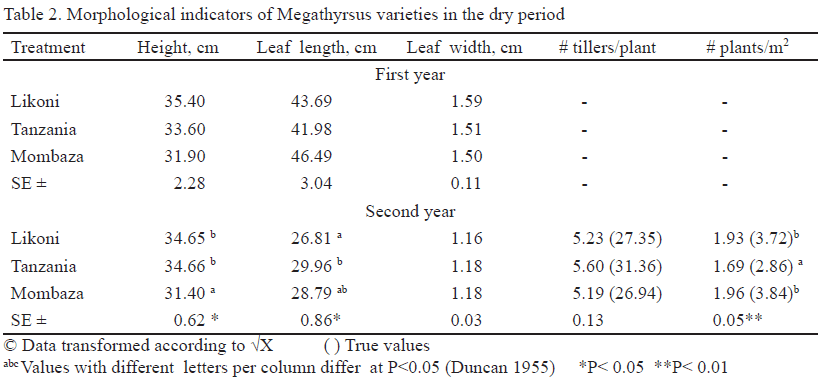
<p align="justify" class="Cuerpodetexto" style="text-indent:0in;"><span style="letter-spacing:.2pt; font-family:'Verdana','sans-serif'; font-size:10.0pt; ">Santos <em>et al.</em> (2011) stated that productivity and  quality of grasses are affected by environmental factors, as temperature, solar  radiation and precipitations, joined to intrinsic factors of the plant. The  temperature and water availability limit the proper growth and grasses quality,  besides to affect their morphological, physiological and biological structure.  This could be the cause of the low yields of this period, in which the climate  factors limit the forage productivity. Moreover, as it was explained irrigation  was not used in the experiment.</span><span style="font-family:'Verdana','sans-serif'; font-size:10.0pt; "> </span></p>     <p align="justify" class="Cuerpodetexto" style="text-indent:0in;"><span style="font-family:'Verdana','sans-serif'; font-size:10.0pt; ">Ramirez <em>et al.</em> (2010) found that the yield of forage of Mombaza grass during the  rains was   559 % higher, compared with the yield during drought. This shows the negative  effect of low precipitations and low temperatures in biomass production of  these    varieties.</span></p>     <p align="justify" class="Cuerpodetexto" style="text-indent:0in;"><span style="font-family:'Verdana','sans-serif'; font-size:10.0pt; ">Leaves  percentage was higher in Tanzania and Mombaza varieties. The opposite occurred  with the stems during the two evaluation years. If it is consider that animals  mainly intake the leaf fraction (provided there is an adequate availability),  the results suggest that Mombaza and Tanzania have the highest leaves proportion  available for animal intake, which makes them promising on cattle feeding.</span></p>     <p align="justify" class="Cuerpodetexto" style="text-indent:0in;"><span style="font-family:'Verdana','sans-serif'; font-size:10.0pt; ">Height,  length and width of leaves during the dry period did not show significant  differences between varieties during the first experimental year (<a href="/img/revistas/cjas/v50n1/t0215116.gif">table 2</a>).  However, in the second, Mombaza showed lower height than Likoni and Tanzania.  The highest values of leaf length were for Mombaza and Tanzania during the  second year of study. This result could favor the biomass production in the  plant, it could correspond with a greater leaf area which favors the light  energy uptake and the transformation into chemical energy and biomass (Ta&iacute;z and  Zeiger 2010).</span></p>     
<p align="justify" class="Cuerpodetexto" style="text-indent:0in;"><span style="font-family:'Verdana','sans-serif'; font-size:10.0pt; ">Tillering during the second year showed a similar  performance for the three varieties studied. However, the number of plants/m<sup>2</sup> was lower in Tanzania, showing that the low temperatures and precipitations in  the dry season (<a href="/img/revistas/cjas/v50n1/f0115116.gif">figure 1</a>) could influence on the plants population of this  variety in the plots    studied.</span> </p>     
<p align="justify" class="Cuerpodetexto" style="text-indent:0in;"><span style="font-family:'Verdana','sans-serif'; font-size:10.0pt; ">In <a href="/img/revistas/cjas/v50n1/t0315116.gif">table 3</a> is shows the chemical composition of the  varieties studied in the dry season. The results indicated that the contents of  CP, EE, NDF, ADF, hemicellulose, cellulose, lignin and IVIDDM in Likoni were  similar to the evaluated cultivars Mombaza and Tanzania.</span> </p>     
<p align="justify" class="Cuerpodetexto" style="text-indent:0in;"><span style="font-family:'Verdana','sans-serif'; font-size:10.0pt; ">In  this regard, Moreno (2004) states that when the nutritional value of forage is  compared, the variability is low between cultivars and even between species and  genus of tropical grasses in relation to differences between physiological  ages. This makes difficult the comparison of the results available in the literature  that, mostly, comes from the analysis of collected forages in different  physiological ages (different growth    periods).</span></p>     <p align="justify" class="Cuerpodetexto" style="text-indent:0in;"><span style="font-family:'Verdana','sans-serif'; font-size:10.0pt; ">Under the edaphoclimatic conditions of livestock areas in  Jimaguay&uacute;, Camag&uuml;ey, Cruz <em>et al.</em> (2012) obtained higher results (P&le;0.05)  in CP content in <em>Megathyrsus maximus</em> cv. Mombaza regarding Tanzania,  when cuts every 90 d were made. This different performance in both studies  could be due to the edaphoclimatic differences in both regions of the country.  Lazarin (2013), when performing the nutritional evaluation of different  tropical grasses species in Veracruz, Mexico, obtained CP and IVTDDM contents  for Mombaza similar to those of this study. </span><span style="font-family:'Verdana','sans-serif'; font-size:10.0pt; "> </span></p>     <p align="justify" class="Cuerpodetexto" style="text-indent:0in;"><span style="font-family:'Verdana','sans-serif'; font-size:10.0pt; ">The  CP and IVTDDM values of leaves were higher than the stems. The opposite  occurred with the NDF, ADF, hemicellulose, cellulose and lignin. Alves de Brito <em>et al.</em> (1999) quantified the percentage of different structural tissues  present in the leaf and stem, and found higher proportions of vascular tissue  with sclerenchyma and parenchyma lignified in stems with respect to leaf blade  and leaf sheath, which have high epidermal tissues proportions.</span></p>     ]]></body>
<body><![CDATA[<p align="justify" class="Cuerpodetexto" style="text-indent:0in;"><span style="font-family:'Verdana','sans-serif'; font-size:10.0pt; ">The  IVTDDM lower values of stems are related to the content of the cell wall  components, that favors great formation of covalent links of the lignin with  the structural carbohydrate of the cell wall and limit their digestion  (Villareal <em>et al.</em> 2014).</span></p>     <p align="justify" class="Cuerpodetexto" style="text-indent:0in;"><span style="font-family:'Verdana','sans-serif'; font-size:10.0pt; ">It  is concluded that the studied varieties showed good agroproductive performance  under the edaphoclimatic and management conditions used. The Mombaza and Tanzania  varieties are a good option to counteract the lack of food of the dry period,  due to its higher leaves proportion, which provides higher quality to the    food.</span></p>     <p align="justify"><span style="font-family:'Verdana','sans-serif'; font-size:10.0pt; ">It is recommended the use  of Mombaza and Tanzania in the dry season and the evaluation of all studied  varieties with the use of irrigation and fertilizers to get higher yields. In  addition, it should continue the nutritional value studies of these cultivars  under different edaphoclimatic conditions and in both climatic periods, so that  their use can be recommended according to the conditions of each region</span><font size="2" face="Verdana, Arial, Helvetica, sans-serif">.</font></p>      <p align="justify">&nbsp;</p>      <p align="justify"><font size="2" face="Verdana, Arial, Helvetica, sans-serif"><font size="3"><b>REFERENCES</b></font></font></p>     <p align="justify" class="MsoBibliography"><span style="font-family:'Verdana','sans-serif'; font-size:10.0pt; ">Alves de Brito, C. J. F., Rodella, R. A.,  Deschamps, F. C. &amp; Alquini, Y. 1999. </span><span style="font-family:'Verdana','sans-serif'; font-size:10.0pt; ">&lsquo;&lsquo;Quantitative anatomy and in vitro tissue degradation  in elephant grass (<em>Pennisetum purpureum</em> Schumach.) cultivars&rsquo;&rsquo;. <em>Revista  Brasileira de Zootecnia</em>, 28 (2), pp. 223&ndash;229, ISSN: 1516-3598, DOI:  10.1590/S1516-35981999000200001.</span></p>     <p align="justify" class="MsoBibliography"><span style="font-family:'Verdana','sans-serif'; font-size:10.0pt; ">ANKOM  Technology. 2014. <em>Neutral Detergent Fiber in Feeds-Filter Bag Technique (for  A200 and A2 00I)</em>. no. NDF Method 6, Inst. ANKOM Technology, USA, Available:  &lt;<a href="https://www.ankom.com/sites/default/files/document-files/Method_13_NDF_Method_A2000_RevE_4_10_15.pdf" target="_blank">https://www.ankom.com/sites/default/files/document-files/Method_13_NDF_Method_A2000_RevE_4_10_15.pdf</a>&gt;,  [Accessed:&nbsp;February 12, 2014].</span></p>     <p align="justify" class="MsoBibliography"><span style="font-family:'Verdana','sans-serif'; font-size:10.0pt; ">Cruz, M. C., Rodr&iacute;guez, L. C., Viera, R.  G., Mouso, J. P., Cabrera, D. M., Escobar, Y. T., P&eacute;rez, L. E. R., Hern&aacute;ndez,  M. P., Cuza, L. F. &amp; Socarr&aacute;s, Y. C. 2012. &lsquo;&lsquo;Evaluaci&oacute;n agron&oacute;mica de tres  gram&iacute;neas bajo condiciones edafoclim&aacute;ticas&rsquo;&rsquo;. <em>Revista Producci&oacute;n Animal</em>,  24 (2), ISSN: 0258-6010, Available:  &lt;<a href="http://www.reduc.edu.cu/147/12/2/147120205.pdf" target="_blank">http://www.reduc.edu.cu/147/12/2/147120205.pdf</a>&gt;,  [Accessed:&nbsp;February 12, 2016].</span></p>     <p align="justify" class="MsoBibliography"><span style="font-family:'Verdana','sans-serif'; font-size:10.0pt; ">Duncan, D. B.  1955. &lsquo;&lsquo;Multiple Range and Multiple F Tests&rsquo;&rsquo;. <em>Biometrics</em>, 11 (1), pp.  1&ndash;42, ISSN: 0006-341X, DOI: 10.2307/3001478.</span></p>     <p align="justify" class="MsoBibliography"><span style="font-family:'Verdana','sans-serif'; font-size:10.0pt; ">Goering, H. K.  &amp; Soest, P. J. V. 1970. <em>Forage Fiber Analyses (apparatus, Reagents,  Procedures, and Some Applications)</em>. (ser. Agriculture handbook, no. ser.  379), U.S. Agricultural Research Service, 24 p., Available:  &lt;<a href="https://books.google.com.cu/books/about/Forage_Fiber_Analyses_apparatus_Reagents.html?id=yn8wAAAAYAAJ&redir_esc=y" target="_blank">https://books.google.com.cu/books/about/Forage_Fiber_Analyses_apparatus_Reagents.html?id=yn8wAAAAYAAJ&amp;redir_esc=y</a>&gt;,  [Accessed:&nbsp;February 12, 2016].</span></p>     ]]></body>
<body><![CDATA[<p align="justify" class="MsoBibliography"><span style="font-family:'Verdana','sans-serif'; font-size:10.0pt; ">Hern&aacute;ndez, A., P&eacute;rez, J., Bosch, D. &amp;  Castro, N. 2015. <em>Clasificaci&oacute;n de los suelos de Cuba 2015</em>. Mayabeque,  Cuba: Ediciones INCA, 93 p., ISBN: 978-959-7023-77-7.</span></p>     <p align="justify" class="MsoBibliography"><span style="font-family:'Verdana','sans-serif'; font-size:10.0pt; ">Herrera, R. S. 2007. &lsquo;&lsquo;La muestra y su  procesamiento en los experimentos de evaluaci&oacute;n&rsquo;&rsquo;. In: <em>II Congreso  Internacional de Producci&oacute;n Animal Tropical</em>, La Habana, Cuba: Instituto de  Ciencia Animal, ISBN: 978-959-7171-12-6.</span></p>     <p align="justify" class="MsoBibliography"><span style="font-family:'Verdana','sans-serif'; font-size:10.0pt; ">Herrera, R. S., Mart&iacute;nez, R. O., Mart&iacute;nez,  M., Tuero, R., Cruz, A. M. &amp; Romero, A. 2014. &lsquo;&lsquo;Frecuencia de corte en  indicadores de calidad de variedades de Pennisetum y Saccharum durante el  per&iacute;odo poco lluvioso&rsquo;&rsquo;. </span><em><span style="font-family:'Verdana','sans-serif'; font-size:10.0pt; ">Cuban  Journal of Agricultural Science</span></em><span style="font-family:'Verdana','sans-serif'; font-size:10.0pt; ">, 48 (2), pp. 159&ndash;166, ISSN: 2079-3480.</span></p>     <p align="justify" class="MsoBibliography"><span style="font-family:'Verdana','sans-serif'; font-size:10.0pt; ">Homen, M.,  Entrena, I., Arriojas, L. &amp; Ramia, M. 2010. </span><span style="font-family:'Verdana','sans-serif'; font-size:10.0pt; ">&lsquo;&lsquo;Biomasa y valor  nutritivo del pasto Guinea <em>Megathyrsus maximus</em> (Jacq.) BK Simon &amp;  SWL Jacobs.&#8219; Gamelote&rsquo;en diferentes per&iacute;odos del a&ntilde;o en la zona de bosque  h&uacute;medo tropical, Barlovento, estado Miranda&rsquo;&rsquo;. </span><em><span style="font-family:'Verdana','sans-serif'; font-size:10.0pt; ">Zootecnia Tropical</span></em><span style="font-family:'Verdana','sans-serif'; font-size:10.0pt; ">, 28 (2), pp. 255&ndash;266, ISSN: 0798-7269.</span></p>     <p align="justify" class="MsoBibliography"><span style="font-family:'Verdana','sans-serif'; font-size:10.0pt; ">IBM  Corporation. 2006. <em>IBM SPSS Statistics</em>. version 14.0.1, [Windows], U.S,  Available: &lt;<a href="http://www.ibm.com" target="_blank">http://www.ibm.com</a>&gt;.</span></p>     <p align="justify" class="MsoBibliography"><span style="font-family:'Verdana','sans-serif'; font-size:10.0pt; ">Lazarin, Z. 2013. <em>Evaluaci&oacute;n nutricional  de pastos tropicales seg&uacute;n la estructura del CNCPS</em>. Graduate Theses,  Universidad Veracruzana, Veracruz,&nbsp;  M&eacute;xico, 104 p.</span></p>     <p align="justify" class="MsoBibliography"><span style="font-family:'Verdana','sans-serif'; font-size:10.0pt; ">Medinilla, L. 2012. <em>Crecimiento,  productividad y calidad de Megathyrsus maximus bajo cobertura arb&oacute;rea de  Gliricidia sepium</em>. Master These, Consejo Nacional de Ciencia y Tecnolog&iacute;a,  M&eacute;xico, 115 p.</span></p>     <p align="justify" class="MsoBibliography"><span style="font-family:'Verdana','sans-serif'; font-size:10.0pt; ">Moreno, L. S. B. 2004. <em>Produ&ccedil;&atilde;o de  forragem de capins do g&ecirc;nero Panicum e modelagem de respostas produtivas e  morfofisiol&oacute;gicas em fun&ccedil;&atilde;o de vari&aacute;veis clim&aacute;ticas</em>. Master Science Thesis,  Escuela Superior de Agricultura &lsquo;Luiz de Queiroz&rsquo;, Universidad de Sao Paulo,  Brasil.</span></p>     <p align="justify" class="MsoBibliography"><span style="font-family:'Verdana','sans-serif'; font-size:10.0pt; ">Ram&iacute;rez, R. O., Garay, A. H., Silva, S. C.  da, P&eacute;rez, J. P., J&uacute;nior, S. J. de S., Rivera, R. C. &amp; Quiroz, J. F. E.  2010. &lsquo;&lsquo;Caracter&iacute;sticas morfog&eacute;nicas y su influencia en el rendimiento del  pasto mombaza, cosechado a diferentes intervalos de corte&rsquo;&rsquo;. <em>Tropical and  Subtropical Agroecosystems</em>, 12 (2), pp. 303&ndash;311, ISSN: 1870-0462.</span></p>     <p align="justify" class="MsoBibliography"><span style="font-family:'Verdana','sans-serif'; font-size:10.0pt; ">Santos, M. C. S., Lira, M. A., Tabosa, J.  N., Mello, A. C. L. &amp; Santos, M. V. F. 2011. </span><span style="font-family:'Verdana','sans-serif'; font-size:10.0pt; ">&lsquo;&lsquo;Response of <em>Pennisetum</em> clones to periods of  controlled hidric restriction.&rsquo;&rsquo;. <em>Archivos de Zootecnia</em>, 60 (229), pp.  31&ndash;39, ISSN: 0004-0592.</span></p>     ]]></body>
<body><![CDATA[<p align="justify" class="MsoBibliography"><span style="font-family:'Verdana','sans-serif'; font-size:10.0pt; ">Taiz, L. &amp;  Zeiger, E. 2010. <em>Plant Physiology</em>. 5th ed., Sunderland, MA: Sinauer  Associates, Inc., 782 p., ISBN: 978-0-87893-866-7.</span></p>     <p align="justify" class="MsoBibliography"><span style="font-family:'Verdana','sans-serif'; font-size:10.0pt; ">Verdecia, D. M., Ram&iacute;rez, J. L., Leonard,  I., Pascual, Y. &amp; L&oacute;pez, Y. 2008. &lsquo;&lsquo;Rendimiento y componentes del valor  nutritivo del <em>Panicum maximum</em> cv. Tanzania&rsquo;&rsquo;. <em>REDVET. Revista  Electr&oacute;nica de Veterinaria</em>, 9 (5), pp. 1&ndash;9, ISSN: 1695-7504.</span></p>     <p align="justify" class="MsoBibliography"><span style="font-family:'Verdana','sans-serif'; font-size:10.0pt; ">Villareal, G. J. A., Hern&aacute;ndez, G. A.,  Mart&iacute;nez, H. P. A., Rodr&iacute;guez, G., de Dios, J., Zebad&uacute;a, V. &amp; Eugenia, M.  2014. &lsquo;&lsquo;Rendimiento y calidad de forraje del pasto ovillo (<em>Dactylis  glomerata</em> L.) al variar la frecuencia e intensidad de pastoreo&rsquo;&rsquo;. <em>Revista  Mexicana de Ciencias Pecuarias</em>, 5 (2), pp. 231&ndash;245, ISSN: 2007-1124.</span></p>     <!-- ref --><p align="justify"><span style="font-family:'Verdana','sans-serif'; font-size:10.0pt; ">Horwitz, W. (ed.). 2000. <em>Official  Methods of Analysis of AOAC International</em>. (ser. Official Methods of  Analysis of AOAC International), 17th ed., AOAC International, 2200 p., ISBN:  978-0-935584-67-7</span><font size="2" face="Verdana,     Arial, Helvetica, sans-serif">.</font> </p>     <p align="justify">&nbsp;</p>     <p align="justify">&nbsp;</p>     <p align="justify"><font size="2" face="Verdana, Arial, Helvetica, sans-serif">Received: December 8, 2014    <br>   Accepted: March 10, 2016</font></p>     <p align="justify">&nbsp;</p>     ]]></body>
<body><![CDATA[<p align="justify">&nbsp;</p>     <p align="justify"><font size="2" face="Verdana, Arial, Helvetica, sans-serif"><i>Dayleni Fortes,</i> Instituto de Ciencia Animal, Apartado Postal 24,  San José de Las Lajas, Mayabeque, Cuba.    Email: <a href="mailto:dfortes@ica.co.cu">dfortes@ica.co.cu</a></font></p>      ]]></body><back>
<ref-list>
<ref id="B1">
<nlm-citation citation-type="journal">
<person-group person-group-type="author">
<name>
<surname><![CDATA[Alves de Brito]]></surname>
<given-names><![CDATA[C. J. F.]]></given-names>
</name>
<name>
<surname><![CDATA[Rodella]]></surname>
<given-names><![CDATA[R. A.]]></given-names>
</name>
<name>
<surname><![CDATA[Deschamps]]></surname>
<given-names><![CDATA[F. C.]]></given-names>
</name>
<name>
<surname><![CDATA[Alquini]]></surname>
<given-names><![CDATA[Y.]]></given-names>
</name>
</person-group>
<article-title xml:lang="nd"><![CDATA[Quantitative anatomy and in vitro tissue degradation in elephant grass (Pennisetum purpureum Schumach.) cultivars]]></article-title>
<source><![CDATA[Revista Brasileira de Zootecnia]]></source>
<year>1999</year>
<volume>28</volume>
<numero>2</numero>
<issue>2</issue>
<page-range>223-229</page-range></nlm-citation>
</ref>
<ref id="B2">
<nlm-citation citation-type="">
<person-group person-group-type="author">
<name>
<surname><![CDATA[ANKOM Technology]]></surname>
</name>
</person-group>
<source><![CDATA[Neutral Detergent Fiber in Feeds-Filter Bag Technique (for A200 and A2 00I)]]></source>
<year>2014</year>
<publisher-loc><![CDATA[USA ]]></publisher-loc>
</nlm-citation>
</ref>
<ref id="B3">
<nlm-citation citation-type="journal">
<person-group person-group-type="author">
<name>
<surname><![CDATA[Cruz]]></surname>
<given-names><![CDATA[M. C.]]></given-names>
</name>
<name>
<surname><![CDATA[Rodríguez]]></surname>
<given-names><![CDATA[L. C.]]></given-names>
</name>
<name>
<surname><![CDATA[Viera]]></surname>
<given-names><![CDATA[R. G.]]></given-names>
</name>
<name>
<surname><![CDATA[Mouso]]></surname>
<given-names><![CDATA[J. P.]]></given-names>
</name>
<name>
<surname><![CDATA[Cabrera]]></surname>
<given-names><![CDATA[D. M.]]></given-names>
</name>
<name>
<surname><![CDATA[Escobar]]></surname>
<given-names><![CDATA[Y. T.]]></given-names>
</name>
<name>
<surname><![CDATA[Pérez]]></surname>
<given-names><![CDATA[L. E. R.]]></given-names>
</name>
<name>
<surname><![CDATA[Hernández]]></surname>
<given-names><![CDATA[M. P.]]></given-names>
</name>
<name>
<surname><![CDATA[Cuza]]></surname>
<given-names><![CDATA[L. F.]]></given-names>
</name>
<name>
<surname><![CDATA[Socarrás]]></surname>
<given-names><![CDATA[Y. C.]]></given-names>
</name>
</person-group>
<article-title xml:lang="nd"><![CDATA[Evaluación agronómica de tres gramíneas bajo condiciones edafoclimáticas]]></article-title>
<source><![CDATA[Revista Producción Animal]]></source>
<year>2012</year>
<volume>24</volume>
<numero>2</numero>
<issue>2</issue>
</nlm-citation>
</ref>
<ref id="B4">
<nlm-citation citation-type="journal">
<person-group person-group-type="author">
<name>
<surname><![CDATA[Duncan]]></surname>
<given-names><![CDATA[D. B.]]></given-names>
</name>
</person-group>
<article-title xml:lang="nd"><![CDATA[Multiple Range and Multiple F Tests]]></article-title>
<source><![CDATA[Biometrics]]></source>
<year>1955</year>
<volume>11</volume>
<numero>1</numero>
<issue>1</issue>
<page-range>1-42</page-range></nlm-citation>
</ref>
<ref id="B5">
<nlm-citation citation-type="book">
<person-group person-group-type="author">
<name>
<surname><![CDATA[Goering]]></surname>
<given-names><![CDATA[H. K.]]></given-names>
</name>
<name>
<surname><![CDATA[Soest]]></surname>
<given-names><![CDATA[P. J. V.]]></given-names>
</name>
</person-group>
<source><![CDATA[Forage Fiber Analyses (apparatus, Reagents, Procedures, and Some Applications)]]></source>
<year>1970</year>
<page-range>24</page-range><publisher-name><![CDATA[U.S. Agricultural Research Service]]></publisher-name>
</nlm-citation>
</ref>
<ref id="B6">
<nlm-citation citation-type="book">
<person-group person-group-type="author">
<name>
<surname><![CDATA[Hernández]]></surname>
<given-names><![CDATA[J. A.]]></given-names>
</name>
<name>
<surname><![CDATA[Pérez]]></surname>
<given-names><![CDATA[J. J. M.]]></given-names>
</name>
<name>
<surname><![CDATA[Bosch]]></surname>
<given-names><![CDATA[I. D.]]></given-names>
</name>
<name>
<surname><![CDATA[Castro]]></surname>
<given-names><![CDATA[S. N.]]></given-names>
</name>
</person-group>
<source><![CDATA[Clasificación de los suelos de Cuba 2015]]></source>
<year>2015</year>
<page-range>93</page-range><publisher-loc><![CDATA[Mayabeque, Cuba ]]></publisher-loc>
<publisher-name><![CDATA[Ediciones INCA]]></publisher-name>
</nlm-citation>
</ref>
<ref id="B7">
<nlm-citation citation-type="book">
<person-group person-group-type="author">
<name>
<surname><![CDATA[Herrera]]></surname>
<given-names><![CDATA[R. S.]]></given-names>
</name>
</person-group>
<article-title xml:lang="nd"><![CDATA[La muestra y su procesamiento en los experimentos de evaluación]]></article-title>
<source><![CDATA[]]></source>
<year>2007</year>
<publisher-loc><![CDATA[La Habana, Cuba ]]></publisher-loc>
<publisher-name><![CDATA[Instituto de Ciencia Animal]]></publisher-name>
</nlm-citation>
</ref>
<ref id="B8">
<nlm-citation citation-type="journal">
<person-group person-group-type="author">
<name>
<surname><![CDATA[Herrera]]></surname>
<given-names><![CDATA[R. S.]]></given-names>
</name>
<name>
<surname><![CDATA[Martínez]]></surname>
<given-names><![CDATA[R. O.]]></given-names>
</name>
<name>
<surname><![CDATA[Martínez]]></surname>
<given-names><![CDATA[M.]]></given-names>
</name>
<name>
<surname><![CDATA[Tuero]]></surname>
<given-names><![CDATA[R.]]></given-names>
</name>
<name>
<surname><![CDATA[Cruz]]></surname>
<given-names><![CDATA[A. M.]]></given-names>
</name>
<name>
<surname><![CDATA[Romero]]></surname>
<given-names><![CDATA[A.]]></given-names>
</name>
</person-group>
<article-title xml:lang="nd"><![CDATA[Frecuencia de corte en indicadores de calidad de variedades de Pennisetum y Saccharum durante el período poco lluvioso]]></article-title>
<source><![CDATA[Cuban Journal of Agricultural Science]]></source>
<year>2014</year>
<volume>48</volume>
<numero>2</numero>
<issue>2</issue>
<page-range>159-166</page-range></nlm-citation>
</ref>
<ref id="B9">
<nlm-citation citation-type="journal">
<person-group person-group-type="author">
<name>
<surname><![CDATA[Homen]]></surname>
<given-names><![CDATA[M.]]></given-names>
</name>
<name>
<surname><![CDATA[Entrena]]></surname>
<given-names><![CDATA[I.]]></given-names>
</name>
<name>
<surname><![CDATA[Arriojas]]></surname>
<given-names><![CDATA[L.]]></given-names>
</name>
<name>
<surname><![CDATA[Ramia]]></surname>
<given-names><![CDATA[M.]]></given-names>
</name>
</person-group>
<article-title xml:lang="nd"><![CDATA[Biomasa y valor nutritivo del pasto Guinea Megathyrsus maximus (Jacq.) BK Simon & SWL Jacobs.? Gamelote’en diferentes períodos del año en la zona de bosque húmedo tropical, Barlovento, estado Miranda]]></article-title>
<source><![CDATA[Zootecnia Tropical]]></source>
<year>2010</year>
<volume>28</volume>
<numero>2</numero>
<issue>2</issue>
<page-range>255-266</page-range></nlm-citation>
</ref>
<ref id="B10">
<nlm-citation citation-type="book">
<person-group person-group-type="author">
<name>
<surname><![CDATA[Horwitz]]></surname>
<given-names><![CDATA[W.]]></given-names>
</name>
</person-group>
<source><![CDATA[Official Methods of Analysis of AOAC International]]></source>
<year>2000</year>
<edition>17th</edition>
<page-range>2200</page-range><publisher-name><![CDATA[AOAC International]]></publisher-name>
</nlm-citation>
</ref>
<ref id="B11">
<nlm-citation citation-type="">
<person-group person-group-type="author">
<name>
<surname><![CDATA[IBM Corporation]]></surname>
</name>
</person-group>
<source><![CDATA[IBM SPSS Statistics]]></source>
<year>2006</year>
<publisher-loc><![CDATA[U.S ]]></publisher-loc>
</nlm-citation>
</ref>
<ref id="B12">
<nlm-citation citation-type="book">
<person-group person-group-type="author">
<name>
<surname><![CDATA[Lazarin]]></surname>
<given-names><![CDATA[Z.]]></given-names>
</name>
</person-group>
<source><![CDATA[Evaluación nutricional de pastos tropicales según la estructura del CNCPS]]></source>
<year>2013</year>
<page-range>104</page-range><publisher-loc><![CDATA[Veracruz, México ]]></publisher-loc>
<publisher-name><![CDATA[Universidad Veracruzana]]></publisher-name>
</nlm-citation>
</ref>
<ref id="B13">
<nlm-citation citation-type="book">
<person-group person-group-type="author">
<name>
<surname><![CDATA[Medinilla]]></surname>
<given-names><![CDATA[L.]]></given-names>
</name>
</person-group>
<source><![CDATA[Crecimiento, productividad y calidad de Megathyrsus maximus bajo cobertura arbórea de Gliricidia sepium]]></source>
<year>2012</year>
<page-range>115</page-range><publisher-loc><![CDATA[México ]]></publisher-loc>
<publisher-name><![CDATA[Consejo Nacional de Ciencia y Tecnología]]></publisher-name>
</nlm-citation>
</ref>
<ref id="B14">
<nlm-citation citation-type="book">
<person-group person-group-type="author">
<name>
<surname><![CDATA[Moreno]]></surname>
<given-names><![CDATA[L. S. B.]]></given-names>
</name>
</person-group>
<source><![CDATA[Produção de forragem de capins do gênero Panicum e modelagem de respostas produtivas e morfofisiológicas em função de variáveis climáticas]]></source>
<year>2004</year>
<publisher-loc><![CDATA[Brasil ]]></publisher-loc>
<publisher-name><![CDATA[Escuela Superior de Agricultura ‘Luiz de Queiroz’, Universidad de Sao Paulo]]></publisher-name>
</nlm-citation>
</ref>
<ref id="B15">
<nlm-citation citation-type="journal">
<person-group person-group-type="author">
<name>
<surname><![CDATA[Ramírez]]></surname>
<given-names><![CDATA[R. O.]]></given-names>
</name>
<name>
<surname><![CDATA[Garay]]></surname>
<given-names><![CDATA[A. H.]]></given-names>
</name>
<name>
<surname><![CDATA[Silva]]></surname>
<given-names><![CDATA[S. C. da]]></given-names>
</name>
<name>
<surname><![CDATA[Pérez]]></surname>
<given-names><![CDATA[J. P.]]></given-names>
</name>
<name>
<surname><![CDATA[Júnior]]></surname>
<given-names><![CDATA[S. J. de S.]]></given-names>
</name>
<name>
<surname><![CDATA[Rivera]]></surname>
<given-names><![CDATA[R. C.]]></given-names>
</name>
<name>
<surname><![CDATA[Quiroz]]></surname>
<given-names><![CDATA[J. F. E.]]></given-names>
</name>
</person-group>
<article-title xml:lang="nd"><![CDATA[Características morfogénicas y su influencia en el rendimiento del pasto mombaza, cosechado a diferentes intervalos de corte]]></article-title>
<source><![CDATA[Tropical and Subtropical Agroecosystems]]></source>
<year>2010</year>
<volume>12</volume>
<numero>2</numero>
<issue>2</issue>
<page-range>303-311</page-range></nlm-citation>
</ref>
<ref id="B16">
<nlm-citation citation-type="journal">
<person-group person-group-type="author">
<name>
<surname><![CDATA[Santos]]></surname>
<given-names><![CDATA[M. C. S.]]></given-names>
</name>
<name>
<surname><![CDATA[Lira]]></surname>
<given-names><![CDATA[M. A.]]></given-names>
</name>
<name>
<surname><![CDATA[Tabosa]]></surname>
<given-names><![CDATA[J. N.]]></given-names>
</name>
<name>
<surname><![CDATA[Mello]]></surname>
<given-names><![CDATA[A. C. L.]]></given-names>
</name>
<name>
<surname><![CDATA[Santos]]></surname>
<given-names><![CDATA[M. V. F.]]></given-names>
</name>
</person-group>
<article-title xml:lang="nd"><![CDATA[Response of Pennisetum clones to periods of controlled hidric restriction.]]></article-title>
<source><![CDATA[Archivos de Zootecnia]]></source>
<year>2011</year>
<volume>60</volume>
<numero>229</numero>
<issue>229</issue>
<page-range>31-39</page-range></nlm-citation>
</ref>
<ref id="B17">
<nlm-citation citation-type="book">
<person-group person-group-type="author">
<name>
<surname><![CDATA[Taiz]]></surname>
<given-names><![CDATA[L.]]></given-names>
</name>
<name>
<surname><![CDATA[Zeiger]]></surname>
<given-names><![CDATA[E.]]></given-names>
</name>
</person-group>
<source><![CDATA[Plant Physiology]]></source>
<year>2010</year>
<edition>5th</edition>
<page-range>782</page-range><publisher-loc><![CDATA[Sunderland, MA ]]></publisher-loc>
<publisher-name><![CDATA[Sinauer Associates, Inc.]]></publisher-name>
</nlm-citation>
</ref>
<ref id="B18">
<nlm-citation citation-type="journal">
<person-group person-group-type="author">
<name>
<surname><![CDATA[Verdecia]]></surname>
<given-names><![CDATA[D. M.]]></given-names>
</name>
<name>
<surname><![CDATA[Ramírez]]></surname>
<given-names><![CDATA[J. L.]]></given-names>
</name>
<name>
<surname><![CDATA[Leonard]]></surname>
<given-names><![CDATA[I.]]></given-names>
</name>
<name>
<surname><![CDATA[Pascual]]></surname>
<given-names><![CDATA[Y.]]></given-names>
</name>
<name>
<surname><![CDATA[López]]></surname>
<given-names><![CDATA[Y.]]></given-names>
</name>
</person-group>
<article-title xml:lang="nd"><![CDATA[Rendimiento y componentes del valor nutritivo del Panicum maximum cv. Tanzania]]></article-title>
<source><![CDATA[REDVET. Revista Electrónica de Veterinaria]]></source>
<year>2008</year>
<volume>9</volume>
<numero>5</numero>
<issue>5</issue>
<page-range>1-9</page-range></nlm-citation>
</ref>
<ref id="B19">
<nlm-citation citation-type="journal">
<person-group person-group-type="author">
<name>
<surname><![CDATA[Villareal]]></surname>
<given-names><![CDATA[G. J. A.]]></given-names>
</name>
<name>
<surname><![CDATA[Hernández]]></surname>
<given-names><![CDATA[G. A.]]></given-names>
</name>
<name>
<surname><![CDATA[Martínez]]></surname>
<given-names><![CDATA[H. P. A.]]></given-names>
</name>
<name>
<surname><![CDATA[Rodríguez]]></surname>
<given-names><![CDATA[G.]]></given-names>
</name>
<name>
<surname><![CDATA[de Dios]]></surname>
<given-names><![CDATA[J.]]></given-names>
</name>
<name>
<surname><![CDATA[Zebadúa]]></surname>
<given-names><![CDATA[V.]]></given-names>
</name>
<name>
<surname><![CDATA[Eugenia]]></surname>
<given-names><![CDATA[M.]]></given-names>
</name>
</person-group>
<article-title xml:lang="nd"><![CDATA[Rendimiento y calidad de forraje del pasto ovillo (Dactylis glomerata L.) al variar la frecuencia e intensidad de pastoreo]]></article-title>
<source><![CDATA[Revista Mexicana de Ciencias Pecuarias]]></source>
<year>2014</year>
<volume>5</volume>
<numero>2</numero>
<issue>2</issue>
<page-range>231-245</page-range></nlm-citation>
</ref>
</ref-list>
</back>
</article>