<?xml version="1.0" encoding="ISO-8859-1"?><article xmlns:mml="http://www.w3.org/1998/Math/MathML" xmlns:xlink="http://www.w3.org/1999/xlink" xmlns:xsi="http://www.w3.org/2001/XMLSchema-instance">
<front>
<journal-meta>
<journal-id>2079-3480</journal-id>
<journal-title><![CDATA[Cuban Journal of Agricultural Science]]></journal-title>
<abbrev-journal-title><![CDATA[Cuban J. Agric. Sci.]]></abbrev-journal-title>
<issn>2079-3480</issn>
<publisher>
<publisher-name><![CDATA[Editorial del Instituto de Ciencia Animal]]></publisher-name>
</publisher>
</journal-meta>
<article-meta>
<article-id>S2079-34802016000200001</article-id>
<title-group>
<article-title xml:lang="en"><![CDATA[Agro-ecological principles in Cuban technologies with legumes for animal production]]></article-title>
<article-title xml:lang="es"><![CDATA[Principios agroecológicos en tecnologías cubanas con leguminosas para la producción animal]]></article-title>
</title-group>
<contrib-group>
<contrib contrib-type="author">
<name>
<surname><![CDATA[Alonso]]></surname>
<given-names><![CDATA[J]]></given-names>
</name>
<xref ref-type="aff" rid="A01"/>
</contrib>
</contrib-group>
<aff id="A01">
<institution><![CDATA[,Instituto de Ciencia Animal  ]]></institution>
<addr-line><![CDATA[San José de las Lajas Mayabeque]]></addr-line>
<country>Cuba</country>
</aff>
<pub-date pub-type="pub">
<day>00</day>
<month>06</month>
<year>2016</year>
</pub-date>
<pub-date pub-type="epub">
<day>00</day>
<month>06</month>
<year>2016</year>
</pub-date>
<volume>50</volume>
<numero>2</numero>
<fpage>171</fpage>
<lpage>183</lpage>
<copyright-statement/>
<copyright-year/>
<self-uri xlink:href="http://scielo.sld.cu/scielo.php?script=sci_arttext&amp;pid=S2079-34802016000200001&amp;lng=en&amp;nrm=iso"></self-uri><self-uri xlink:href="http://scielo.sld.cu/scielo.php?script=sci_abstract&amp;pid=S2079-34802016000200001&amp;lng=en&amp;nrm=iso"></self-uri><self-uri xlink:href="http://scielo.sld.cu/scielo.php?script=sci_pdf&amp;pid=S2079-34802016000200001&amp;lng=en&amp;nrm=iso"></self-uri><abstract abstract-type="short" xml:lang="en"><p><![CDATA[Different ecological principles are analyzed, which should be included on the management and exploitation of Cuban cattle agricultural systems. These systems are characterized by the use of grasses and forages as main basis of their feeding systems. It is important the use of shrubs and creeping legumes in technologies that favor biological diversity, soil restoration and agricultural-animal husbandry integration, as strategy for the development of a more profitable and ecologically stable livestock activity. Finally, an evaluation is carried out to the need of developing animal production systems in tropical areas that visualize the approach to natural systems as a real and practical alternative for persistence, sustainability and environmental regulation of animal husbandry agro-ecosystems]]></p></abstract>
<abstract abstract-type="short" xml:lang="es"><p><![CDATA[Se analizan algunos principios ecológicos que se deben incorporar en el manejo y explotación de los agroecosistemas ganaderos cubanos, caracterizados por la utilización de los pastos y forrajes como base fundamental en sus sistemas de alimentación. Se destaca la utilización de leguminosas, rastreras y arbustivas, en tecnologías que favorecen la diversidad biológica, la restauración de suelo y la integración agricultura-ganadería, como estrategia para el desarrollo de una actividad pecuaria más rentable y estable ecológicamente. Se valora la necesidad de desarrollar sistemas de producción animal cercanos a los sistemas naturales, como alternativa práctica y real para la persistencia, sostenibilidad y regulación ambiental de los agroecosistemas ganaderos en el trópico]]></p></abstract>
<kwd-group>
<kwd lng="en"><![CDATA[agro-ecology]]></kwd>
<kwd lng="en"><![CDATA[grazing systems]]></kwd>
<kwd lng="en"><![CDATA[animal production]]></kwd>
<kwd lng="es"><![CDATA[agroecología]]></kwd>
<kwd lng="es"><![CDATA[sistemas de pastoreo]]></kwd>
<kwd lng="es"><![CDATA[producción animal]]></kwd>
</kwd-group>
</article-meta>
</front><body><![CDATA[ <p align="right"><font size="2" face="Verdana, Arial, Helvetica, sans-serif"><b>Cuban Journal  of Agricultural Science, 50(2): 171-183, 2016, ISSN: 2079-3480</b></font></p>     <p align="right">&nbsp;</p>     <p align="right"><font size="2" face="Verdana, Arial, Helvetica, sans-serif"><b>REVIEW</b></font></p>     <p align="justify">&nbsp;</p>     <p align="justify"><font size="4" face="Verdana, Arial, Helvetica, sans-serif">  <b>Agro-ecological principles in Cuban technologies with legumes for animal production</b></font></p>      <p align="justify">&nbsp;</p>     <p align="justify"><font size="3" face="Verdana, Arial, Helvetica, sans-serif">  <b>Principios agroecológicos en tecnologías cubanas con leguminosas para la producción animal</b></font></p>      <p align="justify">&nbsp;</p>     <p align="justify">&nbsp;</p>     <p align="justify"><font size="2" face="Verdana, Arial, Helvetica, sans-serif">  <b>J. Alonso</b></font></p>     ]]></body>
<body><![CDATA[<p align="justify"><font size="2" face="Verdana, Arial, Helvetica, sans-serif"><b> </b></font><font size="2" face="Verdana, Arial, Helvetica, sans-serif">Instituto de Ciencia Animal, Apartado Postal 24, San José de las Lajas, Mayabeque, Cuba. </font></p>     <p align="justify">&nbsp;</p>     <p align="justify">&nbsp;</p> <hr align="JUSTIFY">     <p align="justify"><font size="2" face="Verdana, Arial, Helvetica, sans-serif"><b>ABSTRACT</b></font></p>     <p align="justify"><font size="2" face="Verdana, Arial, Helvetica, sans-serif"><span style="font-family:'Verdana','sans-serif'; font-size:10.0pt; ">Different  ecological principles are analyzed, which should be included on the management  and exploitation of Cuban cattle agricultural systems. These systems are  characterized by the use of grasses and forages as main basis of their feeding  systems. It is important the use of shrubs and creeping legumes in technologies  that favor biological diversity, soil restoration and agricultural-animal  husbandry integration, as strategy for the development of a more profitable and  ecologically stable livestock activity. Finally, an evaluation is carried out  to the need of developing animal production systems in tropical areas that  visualize the approach to natural systems as a real and practical alternative  for persistence, sustainability and environmental regulation of animal  husbandry agro-ecosystems</span>.</font></p>     <p align="justify"><font size="2" face="Verdana, Arial, Helvetica, sans-serif"><b>Key words:</b> agro-ecology, grazing systems, animal production.</font></p> <hr align="JUSTIFY">     <p align="justify"><font size="2" face="Verdana, Arial, Helvetica, sans-serif"><b>RESUMEN</b></font></p>     <p align="justify"><font size="2" face="Verdana, Arial, Helvetica, sans-serif"><span style="font-family:'Verdana','sans-serif'; font-size:10.0pt; ">Se analizan algunos principios ecol&oacute;gicos que se  deben incorporar en el manejo y explotaci&oacute;n de los agroecosistemas ganaderos  cubanos, caracterizados por la utilizaci&oacute;n de los pastos y forrajes como base  fundamental en sus sistemas de alimentaci&oacute;n. Se destaca la utilizaci&oacute;n de  leguminosas, rastreras y arbustivas,&nbsp; en  tecnolog&iacute;as que favorecen la diversidad biol&oacute;gica, la restauraci&oacute;n de suelo y  la integraci&oacute;n agricultura-ganader&iacute;a, como estrategia para el desarrollo de una  actividad pecuaria m&aacute;s rentable y estable ecol&oacute;gicamente. Se valora la  necesidad de desarrollar sistemas de producci&oacute;n animal cercanos a los sistemas  naturales, como alternativa pr&aacute;ctica y real para la persistencia,  sostenibilidad y regulaci&oacute;n ambiental de los agroecosistemas ganaderos en el  tr&oacute;pico</span>.</font></p>     <p align="justify"><font size="2" face="Verdana, Arial, Helvetica, sans-serif"><b>Palabras    clave:</b><span style="font-family:'Verdana','sans-serif'; font-size:10.0pt; "> agroecolog&iacute;a, sistemas de pastoreo, producci&oacute;n  anima</span>l.</font></p> <hr align="JUSTIFY">     <p align="justify">&nbsp;</p>     ]]></body>
<body><![CDATA[<p align="justify">&nbsp;</p>     <p align="justify"><font size="2" face="Verdana, Arial, Helvetica, sans-serif"><b><font size="3">INTRODUCTION</font></b></font></p>     <p align="justify" class="Cuerpodetexto" style="margin-top:12.0pt;margin-right:0cm;margin-bottom:5.95pt;margin-left:0cm;text-indent:0cm;"><span style="letter-spacing:.1pt; font-family:'Verdana','sans-serif'; font-size:10.0pt; ">Human activity is responsible for 90 % of climatic changes  occurring on the planet. In the last decade, the rate of deforestation, at  world level, reached 13 million of ha year<sup>-1</sup> (FAO 2012), with local  effects such as soil degradation and loss of their productivity. The  transformation of large forested lands into animal husbandry areas, through  deforestation, contributes to a quarter of greenhouse gas emissions,  biodiversity loss in natural forests and imbalance of other soil ecosystems.</span></p>     <p align="justify" class="Cuerpodetexto" style="margin-top:12.0pt;margin-right:0cm;margin-bottom:5.95pt;margin-left:0cm;text-indent:0cm;"><span style="font-family:'Verdana','sans-serif'; font-size:10.0pt; ">Currently, human beings have changed, through conventional  agriculture, the environmental structure in large areas, replacing the  diversity of nature with several cultivated plants and domestic animals (Peters <em>et al.</em> 2010). This serious process has favored the development of  livestock production systems that are based on the use of monoculture, the  application of toxic and chemical fertilizers, and irrigation water that fail  to increase efficiently the production and productivity, mainly due to the lack  of budget for purchasing these inputs and to the ignorance of the existing  interactions between animal and plant species with agro-ecosystem.</span><span style="font-family:'Verdana','sans-serif'; font-size:10.0pt; "> </span></p>     <p align="justify" class="Cuerpodetexto" style="margin-top:12.0pt;margin-right:0cm;margin-bottom:5.95pt;margin-left:0cm;text-indent:0cm;"><span style="font-family:'Verdana','sans-serif'; font-size:10.0pt; ">Inevitably,  natural resources in tropical regions, necessary to encourage the agricultural  development, suffer from an accelerated deterioration that endangers the  solution for vital needs of future generations, with the known risks to  ecological, social, political and economic stability in many countries, mainly  due to management practices used by them. According to Molina and Uribe (2005),  tropical animal husbandry faces serious challenges due to the prevailing  production model, characterized by large extensions and little or no diversity  of species.</span></p>     <p align="justify" class="Cuerpodetexto" style="margin-top:12.0pt;margin-right:0cm;margin-bottom:5.95pt;margin-left:0cm;text-indent:0cm;"><span style="font-family:'Verdana','sans-serif'; font-size:10.0pt; ">Despite these questions, Ibrahim <em>et al.</em> (2006)  reported that animal husbandry is a type of subsistence and alleviation of  poverty in many developing countries. The first characteristic of these  production systems, mainly from medium to small scale, is that different  strategies are implemented on them, which allow them to resist the problems of  market and natural disasters since, from an environmental point of view, some  studies show that it is feasible to develop animal husbandry, conserving the  environment through the use of integrated technologies (Murgueitio 2003,  Funes-Monzote <em>et al.</em> 2008).</span><span style="font-family:'Verdana','sans-serif'; font-size:10.0pt; "> </span></p>     <p align="justify" class="Cuerpodetexto" style="margin-top:12.0pt;margin-right:0cm;margin-bottom:5.95pt;margin-left:0cm;text-indent:0cm;"><span style="letter-spacing:.1pt; font-family:'Verdana','sans-serif'; font-size:10.0pt; ">This  review analyzes some of the potentialities that can be obtained in beef and  milk production with the implementation of agro-ecological technologies, which  visualize the improvement of livestock agro-ecosystems through the use of  legumes and the adaptation of agricultural practices that consider integration  as an essential tool for animal production in tropical areas</span><font size="2" face="Verdana, Arial, Helvetica, sans-serif">.</font></p>     <p align="justify">&nbsp;</p>     <p align="justify"><font size="2" face="Verdana, Arial, Helvetica, sans-serif"><b><font size="3">CONCEPTUALIZATION AND DIMENSION OF AGRO-ECOLOGY IN CATTLE  AGRICULTURAL SYSTEMS </font></b></font></p>     <p align="justify" class="Cuerpodetexto" style="margin-top:12.0pt;margin-right:0cm;margin-bottom:5.95pt;margin-left:0cm;text-indent:0cm;"><span style="font-family:'Verdana','sans-serif'; font-size:10.0pt; ">It  is obvious that for beef and milk production based on grasses and forages, the  most important approach, from the agronomic, biological, economical and social  point of view, is the one that achieves the balanced combination of all the  components that intervene in the &ldquo;soil-plant- animal-man&rdquo; complex (agro- ecosystem),  in which influence and relate all the factors that affect the production, use,  stability and permanence of different components.</span></p>     ]]></body>
<body><![CDATA[<p align="justify" class="Cuerpodetexto" style="margin-top:12.0pt;margin-right:0cm;margin-bottom:5.95pt;margin-left:0cm;text-indent:0cm;"><span style="letter-spacing:.2pt; font-family:'Verdana','sans-serif'; font-size:10.0pt; ">&nbsp;The application of  concepts and ecological principles to the design, development and management of  sustainable cattle systems, it is the fundamental base that differentiates the  agro-ecology systems of the conventional cattle. These can be applied in the  organic, conventional, intensive or extensive livestock. Glisseman (2009)  points out that the main challenge in the design of sustainable agro-ecosystems  is to obtain the characteristics of a natural ecosystem and, at the same time,  to maintain a desirable productivity.</span><span style="font-family:'Verdana','sans-serif'; font-size:10.0pt; "> </span></p>     <p align="justify" class="Cuerpodetexto" style="margin-top:12.0pt;margin-right:0cm;margin-bottom:5.95pt;margin-left:0cm;text-indent:0cm;"><span style="font-family:'Verdana','sans-serif'; font-size:10.0pt; ">Altieri  and Nicholls (2004) noted that an agro-ecosystem can be defined, to any scale,  by the interactions between people, natural resources and food production in an  area or specific field, making difficult to define its exacts limits. This  definition has to do directly with the agro-ecology concepts, as it focuses in  the ecological relations that take place on the agricultural and livestock  systems, with the purpose of clarifying the structure, functions and dynamics  of these relations. </span></p>     <p align="justify" class="Cuerpodetexto" style="margin-top:12.0pt;margin-right:0cm;margin-bottom:5.95pt;margin-left:0cm;text-indent:0cm;"><span style="font-family:'Verdana','sans-serif'; font-size:10.0pt; ">It  is obvious that the design of agro-ecological systems can not be based on  rules, but on principles. It must take into account the existing realities, the  farmer knowledge and their aspirations. Besides of provide other economic,  ecological and productive considerations (Garc&iacute;a Trujillo 1996). Among these  principles it stands:</span></p>     <p align="justify" class="Cuerpodetexto" style="margin-top:12.0pt;margin-right:0cm;margin-bottom:5.95pt;margin-left:0cm;text-indent:0cm;"><span style="font-family:'Verdana','sans-serif'; font-size:10.0pt; ">-  Biological diversity: rotations, polycrops, wooded areas and animals, among  others. </span></p>     <p align="justify" class="Cuerpodetexto" style="margin-top:12.0pt;margin-right:0cm;margin-bottom:5.95pt;margin-left:0cm;text-indent:0cm;"><span style="font-family:'Verdana','sans-serif'; font-size:10.0pt; ">-  Protection of soils and increase of their fertility by naturals means:&nbsp; minimum culture, contour lines, munching,  replace crops, green manure, organic matter, amendments, rotations, among  other.</span></p>     <p align="justify" class="Cuerpodetexto" style="margin-top:12.0pt;margin-right:0cm;margin-bottom:5.95pt;margin-left:0cm;text-indent:0cm;"><span style="font-family:'Verdana','sans-serif'; font-size:10.0pt; ">-  Increase of nutrients recycling: use of agricultural wastes for animal feeding,  manure as fertilizer, crop rotation, use of plants that extract nutrients from  deeper soil layers, use of green manure that mobilize nutrients, activation of  soil&nbsp; biology.</span></p>     <p align="justify" class="Cuerpodetexto" style="margin-top:12.0pt;margin-right:0cm;margin-bottom:5.95pt;margin-left:0cm;text-indent:0cm;"><span style="font-family:'Verdana','sans-serif'; font-size:10.0pt; ">-  Increase of the nitrogen biological fixation: use of legumes, green manures,  nitrogen fixing trees, activation of soil life.</span></p>     <p align="justify" class="Cuerpodetexto" style="margin-top:12.0pt;margin-right:0cm;margin-bottom:5.95pt;margin-left:0cm;text-indent:0cm;"><span style="font-family:'Verdana','sans-serif'; font-size:10.0pt; ">-  Promotion of techniques that conserve soil moisture: munching, minimum culture,  organic matter, protective crops, replace crop, among others.</span></p>     <p align="justify" class="Cuerpodetexto" style="margin-top:12.0pt;margin-right:0cm;margin-bottom:5.95pt;margin-left:0cm;text-indent:0cm;"><span style="font-family:'Verdana','sans-serif'; font-size:10.0pt; ">-  Implementation of integration systems: use of biological diversity, efficient  use of land, use of multi- layer, allelopathic effects and suppressive of  undesirable plants.</span></p>     <p align="justify" class="Cuerpodetexto" style="margin-top:12.0pt;margin-right:0cm;margin-bottom:5.95pt;margin-left:0cm;text-indent:0cm;"><span style="letter-spacing:.1pt; font-family:'Verdana','sans-serif'; font-size:10.0pt; ">The  application and use of these agro- ecological principles in the animal production  systems in tropical areas show the necessity to develop technologies that  increase the interaction between each of the system components, with  multidisciplinary character and decisive participation of the experience and  local knowledge of the producers. The knowledge of these characteristics  indicates the simplicity of what should be made and the complexity with which  the technologies should be implemented for the production system</span><font size="2" face="Verdana, Arial, Helvetica, sans-serif">.</font></p>     ]]></body>
<body><![CDATA[<p align="justify">&nbsp;</p>     <p align="justify"><font size="2" face="Verdana, Arial, Helvetica, sans-serif"><b><font size="3">AGRO-ECOLOGICAL PRINCIPLES IN TECHNOLOGIES WITH LEGUMES</font></b></font></p>     <p align="justify" class="Cuerpodetexto" style="margin-top:12.0pt;margin-right:0cm;margin-bottom:5.95pt;margin-left:0cm;text-indent:0cm;"><span style="letter-spacing:.2pt; font-family:'Verdana','sans-serif'; font-size:10.0pt; ">The biodiversity in animal husbandry agro-ecosystems can  be as varied as the different crops, weeds, arthropods or microorganisms,  according to geographical, climatic, edaphic localities and socioeconomic  factors (Navarro <em>et al.</em> 2012). The interactions between the various  biotic components can also being of multiple natures. Some of these  interactions can be used to induce positive and direct effects on the  biological control of specific of crops, regeneration and increase of soil  fertility and its conservation. The exploitation of these interactions in real  situations involves the agro-ecosystem design and management, and requires an  understanding of the numerous relations between soils, microorganisms, plants,  insects, herbivores and natural    enemies.</span></p>     <p align="justify" class="Cuerpodetexto" style="margin-top:12.0pt;margin-right:0cm;margin-bottom:5.95pt;margin-left:0cm;text-indent:0cm;"><span style="font-family:'Verdana','sans-serif'; font-size:10.0pt; ">Studies carried out by Alonso <em>et al.</em> (2007) showed  significant increase in the species richness and the biological diversity index  of Shannon, as a leucaena-guinea grass silvopastoral system was developed. They  also verified increase in the macrofauna of the soil, birds and insects  associated to the system. These results are also related with the difference  that is obtained with the silvopastoral systems in the number of plant strata  and with the presence of a half stratum of leucaena shrubs that, together with  the exploitation time of the system, led to increased the total productivity of  the system, of plant diversity and, therefore, of the number of associated    species.&nbsp;&nbsp; </span><span style="font-family:'Verdana','sans-serif'; font-size:10.0pt; ">&nbsp;</span></p>     <p align="justify" class="Cuerpodetexto" style="margin-top:12.0pt;margin-right:0cm;margin-bottom:5.95pt;margin-left:0cm;text-indent:0cm;"><span style="font-family:'Verdana','sans-serif'; font-size:10.0pt; ">Valenciaga <em>et al.</em> (2010), when studying cattle  agro-ecosystems with the use of a silvopastoral system with leucaena-guinea  grass showed the system capacity as insects and arachnids reservoir. According  to their alimentary habits, these authors classified the arthropods in  phytophagous and bio-regulators. It was gather the majority in the Insecta  class, and the rest, in the Arachnida. The Hemiptera order, with its sub-orders  Homoptera and Hemiptera, had a good representation of phytophagous, while the  Coleoptera order grouped the known&nbsp;&nbsp;&nbsp;  crysomelids, responsible for the holes in the leaves, and the <em>Chilocorus  cacti</em>, bioregulator insect belonging to the Coccinelidae family. This last  is an excellent predator of aphids and psyllids, very frequent in  leucaena-guinea grass silvopastoral systems.</span><span style="font-family:'Verdana','sans-serif'; font-size:10.0pt; "> </span></p>     <p align="justify" class="Cuerpodetexto" style="margin-top:12.0pt;margin-right:0cm;margin-bottom:5.95pt;margin-left:0cm;text-indent:0cm;"><span style="font-family:'Verdana','sans-serif'; font-size:10.0pt; ">The  abundance and proportion of bio-regulators depend intimately on the abundance  and proportion of the phytophagous and, at the same time, on the type and the  architecture of the plants in the area. This situation is justified by the  ecological theories cited by Altieri <em>et al.</em> (2011). The hypothesis of  the natural enemies states that in the diversified agro-ecosystems there is  higher variety and quantity of feeding available sources, better microhabitat  conditions, changes in the chemical signs affecting the location of pests and  increase in the stability of the dynamics of predator-prey and parasitoids-host  populations. These factors contribute to the improvement of the reproduction  success, survival and efficacy of the natural enemies.</span></p>     <p align="justify" class="Cuerpodetexto" style="margin-top:12.0pt;margin-right:0cm;margin-bottom:5.95pt;margin-left:0cm;text-indent:0cm;"><span style="font-family:'Verdana','sans-serif'; font-size:10.0pt; ">The  beneficial interactions that could show in the implementation of agro-ecology  systems with the presence of legumes trees and shrubs in grazing systems for  meat and milk production, are also reflected in the increase of nutrient  recycling by the return to the soil of leaves, fruits, branches, feces and  urine, which is due, mainly, to the increase of the soil biological activity.  Alonso (2004) showed that the soil macrofauna, in a leucaena-guinea grass  silvopastoral system, was stabilized in the time with annelids prevalence which  with their activity favored the soil aeration and accelerated the litter  decomposition. </span></p>     <p align="justify" class="Cuerpodetexto" style="margin-top:12.0pt;margin-right:0cm;margin-bottom:5.95pt;margin-left:0cm;text-indent:0cm;"><span style="font-family:'Verdana','sans-serif'; font-size:10.0pt; ">According  to Lok (2006), trees in silvopastoral systems have ecological functions on soil  protection, reduce the direct effects of the sun, water and wind. They can also  modify the soil physical characteristics, when improving their structural  stability by the addition of litter, roots and stems (Murovhi <em>et al.</em> 2012); besides of increasing the organic matter values, the capacity of  cationic interchange and N, P and K&nbsp;  availability (Mart&iacute;nez 2013).</span></p>     <p align="justify" class="Cuerpodetexto" style="margin-top:12.0pt;margin-right:0cm;margin-bottom:5.95pt;margin-left:0cm;text-indent:0cm;"><span style="letter-spacing:.1pt; font-family:'Verdana','sans-serif'; font-size:10.0pt; ">Other studies show better use of the soil nutrients and  higher grass availability, when nutrients were associated to tree species, due  to the improvement of soil fertility and shade conditions that are created in  the agro-ecosystem (Hern&aacute;ndez and S&aacute;nchez 2006).The effect of these systems on  the soil fertility not only be expected on superficial layers but it also occur  in deeper laters, as the exploitation time of the system increases, a  phenomenon found when studying a silvopastoral system with&nbsp; <em>Acacia mangium</em> and <em>Brachiaria  decumbens</em>.</span><span style="font-family:'Verdana','sans-serif'; font-size:10.0pt; "> </span></p>     <p align="justify" class="Cuerpodetexto" style="margin-top:12.0pt;margin-right:0cm;margin-bottom:5.95pt;margin-left:0cm;text-indent:0cm;"><span style="font-family:'Verdana','sans-serif'; font-size:10.0pt; ">The  use of mixed agro-ecosystems, with more complex interaction levels, could  increase the land use and animal production, since they are more ecologically  stables and their practice can recover and increase soil productivity,  stabilize a sustainable agriculture and generate multiple environmental  services. Naranjo <em>et al.</em> (2012) concluded that the intensive  silvopastoral systems with tree legumes are technologies that can contributes  to the mitigation of climatic change because they have, for their productive  capacity( plant and animal), a natural capital that allows to reach a positive  balance of greenhouse gas effect.</span></p>     ]]></body>
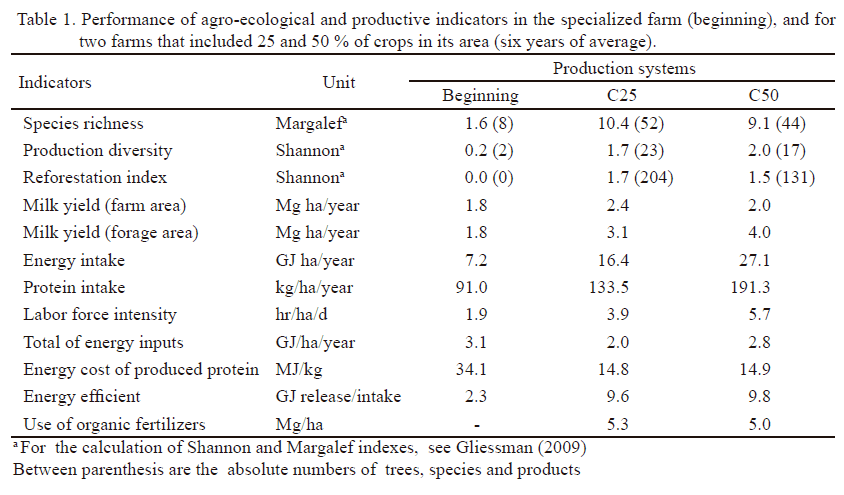
<body><![CDATA[<p align="justify" class="Cuerpodetexto" style="margin-top:12.0pt;margin-right:0cm;margin-bottom:5.95pt;margin-left:0cm;text-indent:0cm;"><span style="font-family:'Verdana','sans-serif'; font-size:10.0pt; ">For  their characteristics, these agro-ecosystems are more ecologically feasible  than the monocultures. As consequence, their practice can recover degraded  areas, to motivate the integrated systems use and generate new products for  small and big producers (Murgueitio <em>et al.</em> 2011). The use of forest  species in the agricultural production systems, according to Rom&aacute;n <em>et al.</em> (2013), contributes to reduce pressure in natural forests. These species can be  incorporated in non-forested areas.<span style="letter-spacing:.2pt; "> </span></span></p>     <p align="justify" class="Cuerpodetexto" style="margin-top:12.0pt;margin-right:0cm;margin-bottom:5.95pt;margin-left:0cm;text-indent:0cm;"><span style="font-family:'Verdana','sans-serif'; font-size:10.0pt; ">These systems have, in principle, a macrobiotic effect of  great importance for the environment, in the soil management and conservation,  environment and basins protection, so they guarantee higher sustainability of  agricultural and cattle productive process by means of obtaining forages,  animal protein and forest product. </span><span style="font-family:'Verdana','sans-serif'; font-size:10.0pt; "> </span></p>     <p align="justify" class="Cuerpodetexto" style="margin-top:12.0pt;margin-right:0cm;margin-bottom:5.95pt;margin-left:0cm;text-indent:0cm;"><span style="font-family:'Verdana','sans-serif'; font-size:10.0pt; ">The  conversion of a specialized system for the livestock production to another of  agricultural- animal husbandry integration, at farm level, was study object  during ten years by Funes-Monzote <em>et al.</em> (2008). These authors  demonstrated that the matter is not if high or low inputs are used, or if the  production is specialized or diversified, but the specific characteristics of  the production systems and the way in which the inputs and agro-diversity are  managed. </span></p>     <p align="justify" class="Cuerpodetexto" style="margin-top:12.0pt;margin-right:0cm;margin-bottom:5.95pt;margin-left:0cm;text-indent:0cm;"><span style="letter-spacing:.2pt; font-family:'Verdana','sans-serif'; font-size:10.0pt; ">The  farms, integrated in 25 and 50% of the area with agricultural crops, were  highlighted by having higher diversity of the production and therefore, higher  variation of the agro-diversity, in time and space (<a href="/img/revistas/cjas/v50n2/t0101216.gif">table 1</a>). In low inputs conditions  and high uncertainty in which these farms operate, the high diversity greatly  contributes to reduce danger and to elevate productivity. The internal and  external resources were used with higher efficiency in the integrated farms and  these, in turn, were more efficient in the use of energy, when reducing the  energy costs of protein production</span><font size="2" face="Verdana, Arial, Helvetica, sans-serif">.</font></p>     
<p align="justify">&nbsp;</p>     <p align="justify"><font size="2" face="Verdana, Arial, Helvetica, sans-serif"><font size="3"><b>PRODUCTIVE RESULTS WITH CUBAN TECHNOLOGIES UNDER AGRO-ECOLOGICAL  PRINCIPLES </b></font></font></p>     <p align="justify" class="Cuerpodetexto" style="margin-top:12.0pt;margin-right:0cm;margin-bottom:5.95pt;margin-left:0cm;text-indent:0cm;"><span style="letter-spacing:.2pt; font-family:'Verdana','sans-serif'; font-size:10.0pt; ">There are many benefits that the agro-ecological  principles can contribute in technologies for cattle exploitation. The positive  effect of the grasses and legumes association on the dry matter yield and the  availability of the edible dry biomass (Ruiz <em>et al.</em> 2015) explains the  best bio-economical perform of the exploited herds in agro-ecological systems.</span></p>     <p align="justify" class="Cuerpodetexto" style="margin-top:12.0pt;margin-right:0cm;margin-bottom:5.95pt;margin-left:0cm;text-indent:0cm;"><span style="letter-spacing:.1pt; font-family:'Verdana','sans-serif'; font-size:10.0pt; ">The impacts of the intensive systems, mainly in soil  component and therefore in the biomass production, showed the need to raise the  participation level of legumes in the grazing area. In this context Iglesia and  Mart&iacute;n (2011) showed, that the renovation and introduction of appropriate  grasses, and adapted to the local edaphoclimatic conditions, join to the  strategic incorporation of trees and shrubs plants in&nbsp; grazing areas, could be a technological  alternative that would contribute to improve cattle production, reducing the  negative impact in the ecosystems where it is developed</span><span style="font-family:'Verdana','sans-serif'; font-size:10.0pt; ">.&nbsp; </span></p>     <p align="justify" class="Cuerpodetexto" style="margin-top:12.0pt;margin-right:0cm;margin-bottom:5.95pt;margin-left:0cm;text-indent:0cm;"><span style="font-family:'Verdana','sans-serif'; font-size:10.0pt; ">However,  the persistence of the legume component in grazing systems has always been a  question since its useful life generally does not exceed two years of exploitation  when they are mainly used in monoculture. This technological problem motivated  the most efficient use of the biological diversity of this family in grazing  systems, facilitating the development of technologies where the association of  grasses with multiple legumes mixtures is used.</span></p>     <p align="justify" class="Cuerpodetexto" style="margin-top:12.0pt;margin-right:0cm;margin-bottom:5.95pt;margin-left:0cm;text-indent:0cm;"><span style="font-family:'Verdana','sans-serif'; font-size:10.0pt; ">Papers  developed to deep in the performance of associations of creeping grasses &ndash;  legumes under grazing show us that the low plants population and of rooted  points per square meter are the causes of the low stability of biomass  production of these systems (Ruiz <em>et al.</em> 2005). As commonly happens in  the associated grasslands, the legume only has as&nbsp; anchor point the mother plant, while branches  grow over the grass but without being able to take root. The papers related with  grassland establishment and exploitation should be guided to achieve a great  number of plants and rooted points per area. </span></p>     ]]></body>
<body><![CDATA[<p align="justify" class="Cuerpodetexto" style="margin-top:12.0pt;margin-right:0cm;margin-bottom:5.95pt;margin-left:0cm;text-indent:0cm;"><span style="font-family:'Verdana','sans-serif'; font-size:10.0pt; ">When  this indicators show a positive balance in the association a great productive  life of the grassland is achieved with stable biomass availability (Ruiz <em>et  al.</em> 2003), independently of the climatic season (<a href="/img/revistas/cjas/v50n2/t0201216.gif">table 2</a>), therefore one of  the objectives that were stated when planting multiple mixtures, since when a  species diminishes its contribution to the yield , another will take function.  When analyzing the contribution per species shows that kudz&uacute; (<em>Pueraria  phaseoloides</em>) had the lowest contribution in the dry. While siratro (<em>Macroptilium  atropurpureum</em>) and stylo (<em>Stylosanthes guyanensis</em>) decreased its  presence in the rain, although it was also associate to that the same ones  began to disappear from the mixture. </span></p>     
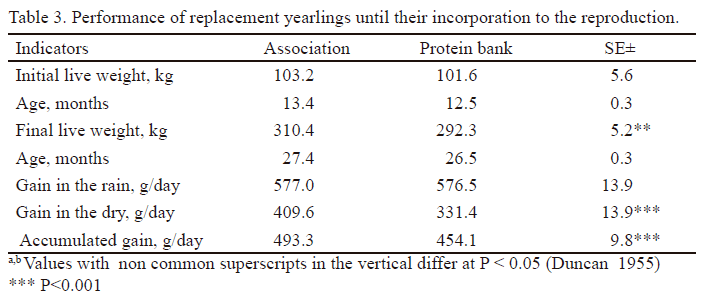
<p align="justify" class="Cuerpodetexto" style="margin-top:12.0pt;margin-right:0cm;margin-bottom:5.95pt;margin-left:0cm;text-indent:0cm;"><span style="font-family:'Verdana','sans-serif'; font-size:10.0pt; ">The  association of herbaceous or shrubs legumes with pastures, as an option to  introduce agro- ecology principles and to intensify the land use in cattle  areas, has economical advantages because of the&nbsp;  animal production increase. Regarding to their use in systems for  replacement female feeding, Iglesias <em>et al.</em> (2006) showed that during  the dry season it is possible to reach individual gains higher than 500  g/animal/d in growing yearling heifer that grazed andropogon associations with  centrosema, rotationally, with an stocking rate of two animals/ha, which did  not differ of that obtained in common guinea, fertilized with200-30-50 of    NPK/ha/year.</span></p>     <p align="justify" class="Cuerpodetexto" style="margin-top:12.0pt;margin-right:0cm;margin-bottom:5.95pt;margin-left:0cm;text-indent:0cm;"><span style="font-family:'Verdana','sans-serif'; font-size:10.0pt; ">Mej&iacute;as <em>et al.</em> (2000) demonstrated the advantage of an appropriate feeding in  the post weaning period in calves that grazed an association of pangola (<em>Digitaria  decumbens</em>) and stylo (<em>Stylosanthes guyanensis</em>).These authors  obtained gains in this initial phase of    478 g/animal/d, that allowed to reach to the yearling stage with more than 200  kg of live weight and begin grazing in a tree- grass association.</span></p>     <p align="justify" class="Cuerpodetexto" style="margin-top:12.0pt;margin-right:0cm;margin-bottom:5.95pt;margin-left:0cm;text-indent:0cm;"><span style="font-family:'Verdana','sans-serif'; font-size:10.0pt; ">These results facilitated to design a technology, in which  the association of grasses and creeping or shrubs legumes were used in 100% of  the area for rearing replacement females, and not as protein bank, which  generates and increase the agro- ecological principles in the whole system .The  studies showed that the dependence of external inputs in these systems was minimal,  since the grazing areas were not fertilized and irrigated; while the animals  neither received any supplementation during the dry period (Iglesias 2003). The  high grassland availability, besides the contribution provided by herbaceous  legumes and leucaena by browsing and pruning, allowed the animals covered their  nutritional requirements and to obtain desired gains for the yearling female  category (<a href="/img/revistas/cjas/v50n2/t0301216.gif">table 3</a>).</span> </p>     
<p align="justify" class="Cuerpodetexto" style="margin-top:12.0pt;margin-right:0cm;margin-bottom:5.95pt;margin-left:0cm;text-indent:0cm;"><span style="font-family:'Verdana','sans-serif'; font-size:10.0pt; ">The use of agro- ecological principles in technologies for  milk production were beginners in tropical regions, with the use of legume  component as protein source in the feeding of animals that allowed to reach  individual productions close to&nbsp; 10  L/cow/d. Nevertheless, at the end of 90s in last century, these technologies  showed the possibility of increasing the total milk production per effect of  raising the total stocking rate, due to the increase in the biomass quantity  and quality and its effect on the milking cows percentage.</span><span style="font-family:'Verdana','sans-serif'; font-size:10.0pt; "> </span></p>     <p align="justify" class="Cuerpodetexto" style="margin-top:12.0pt;margin-right:0cm;margin-bottom:5.95pt;margin-left:0cm;text-indent:0cm;"><span style="font-family:'Verdana','sans-serif'; font-size:10.0pt; ">Other  papers show that when comparing systems of grasses monoculture, with a  silvopastoral system of grasses and tree legumes, significant improvements were  achieved in all the productive indicators of the dairy herd (<a href="/img/revistas/cjas/v50n2/t0401216.gif">table 4</a>).These are  directly related with the protein contribution and other nutrients that the  tree component carry out (Sim&oacute;n 2005).</span></p>     
<p align="justify" class="Cuerpodetexto" style="margin-top:12.0pt;margin-right:0cm;margin-bottom:5.95pt;margin-left:0cm;text-indent:0cm;"><span style="font-family:'Verdana','sans-serif'; font-size:10.0pt; ">An  important element that should be highlight in the agro- systems, which are  managed and used with agro-ecological principles, is that are in a constant  dynamic development. These involve, in all cases, a holistic analysis of their  components from the experiences, knowledge and interpretation of them. The  anthropic component plays a fundamental function in the agro-ecosystems  functioning. </span></p>     <p align="justify" class="Cuerpodetexto" style="margin-top:12.0pt;margin-right:0cm;margin-bottom:5.95pt;margin-left:0cm;text-indent:0cm;"><span style="font-family:'Verdana','sans-serif'; font-size:10.0pt; ">When carring out a comparative bio-economical analysis  between simple systems (monoculture) and silvopastoral complex systems, as  decisive tool in the farm sustainability, Reinoso (2000) found that grazing in  a silvopastoral system reached a very favorable cost- benefit relation (1.59  Cuban pesos), mainly due to that the costs per kilogram of produced milk and  the cost per Cuban pesos produced were lower in    0.30 and 0.48 Cuban pesos, respectively regarding the monoculture (<a href="/img/revistas/cjas/v50n2/t0501216.gif">table 5</a>).</span> </p>     
<p align="justify" class="Cuerpodetexto" style="margin-top:12.0pt;margin-right:0cm;margin-bottom:5.95pt;margin-left:0cm;text-indent:0cm;"><span style="font-family:'Verdana','sans-serif'; font-size:10.0pt; ">The  incorporation of <em>Pennisetum purpureum</em> cv. Cuba CT-115 in different  technologies for meat and milk production shows positive results, since it  allowed facing the lack of food volume at critical times of the year, when  precipitations decreased (Mart&iacute;nez 2001). This grass, from the agro-ecological  point of view, has multiple advantages, since it keeps the soil covered the  whole year, it is used in grazing, and it generates less input of fossil fuel  for the farm and preserves high nutrients return to the soil.&nbsp;&nbsp; </span></p>     <p align="justify" class="Cuerpodetexto" style="margin-top:12.0pt;margin-right:0cm;margin-bottom:5.95pt;margin-left:0cm;text-indent:0cm;"><span style="font-family:'Verdana','sans-serif'; font-size:10.0pt; ">The  experience in a dairy farm of 60 ha, with 30 % of the area with CT-115 as  biomass bank for the dry period (Mart&iacute;nez 2006) shows that during the first  year, when 12% of the dairy had biomass bank, the food lack in the dry period  could be satisfy in 47%, and only 13% with external resources. With the  planting of 20 ha in this unit, the biomass bank solved 95% from the lack of  the dry.</span></p>     ]]></body>
<body><![CDATA[<p align="justify" class="Cuerpodetexto" style="margin-top:12.0pt;margin-right:0cm;margin-bottom:5.95pt;margin-left:0cm;text-indent:0cm;"><span style="font-family:'Verdana','sans-serif'; font-size:10.0pt; ">The  balance reached in animal feeding with the introduction of this technology in  grazing areas was reflected in the gradual increase of the dairy productive  parameters&nbsp; (<a href="/img/revistas/cjas/v50n2/f0101216.gif">Figure 1</a>).</span></p>     
<p align="justify" class="Cuerpodetexto" style="margin-top:12.0pt;margin-right:0cm;margin-bottom:5.95pt;margin-left:0cm;text-indent:0cm;"><span style="font-family:'Verdana','sans-serif'; font-size:10.0pt; ">Studies  developed by Diaz (2008), in an area of    14.5 ha, showed that the use of agro- ecological technologies, as grasses and  herbaceous legumes association, a silvopastoral system with leucaena and the  use of    CT-115 for meat production in the tropic, can reach the animals slaughter at 22  months of age, with 445kg of liveweight in 363 days of stayed in fattening and  MDG of 838g animal<sup>-1</sup>. These results are more relevant, when being  obtaining only with an expense of 180kg of supplement per animal which it is  slaughter during the whole fattening period. </span></p>     <p align="justify" class="Cuerpodetexto" style="margin-top:12.0pt;margin-right:0cm;margin-bottom:5.95pt;margin-left:0cm;text-indent:0cm;"><span style="font-family:'Verdana','sans-serif'; font-size:10.0pt; ">Similar  results obtained Iglesias (2003), when using associate systems of guinea grass(<em>Panicum  maximun</em> vc. Likoni) with leucaena for the male zebu fattening    (without energy- protein supplementation), although in the dry season the daily  mean gains only reached 429 g per animal. This author, when comparing this  technology with a protein bank system and grass monoculture (guinea), showed  that the accumulated mean gain (<a href="/img/revistas/cjas/v50n2/t0601216.gif">table 6</a>) was higher for the association, and  higher than    620 g/animal/d, which caused animals with higher weight to 400kg, at 26 months  of age. </span></p>     
<p align="justify" class="Cuerpodetexto" style="margin-top:12.0pt;margin-right:0cm;margin-bottom:5.95pt;margin-left:0cm;text-indent:0cm;"><span style="font-family:'Verdana','sans-serif'; font-size:10.0pt; ">The  associated systems of grasses and legumes, with the minimum use of supplement,  are an economically viable option in the tropics for grazing cattle fattening  (Cino <em>et al.</em> 2011). Although legumes can have low persistence, because  they are more sensitive to high intensity and grazing pressure, stocking rate  and size of the animal bite, with appropriate management and supplementation  fit, it can obtain higher mean daily gains of liveweight (Diaz 2004). </span></p>     <p align="justify" class="Cuerpodetexto" style="margin-top:12.0pt;margin-right:0cm;margin-bottom:5.95pt;margin-left:0cm;text-indent:0cm;"><span style="font-family:'Verdana','sans-serif'; font-size:10.0pt; ">It can be concluded that the generation and multiplication  of productive systems, under agro-ecological principles that privilege the  persistence and species coexistence, the high biomass production and maximize  the photosynthesis process, they transform into a practical and real  alternative to the environmental regulation in cattle agro-ecosystems, because  they are able to also generate , environmental services. </span><span style="font-family:'Verdana','sans-serif'; font-size:10.0pt; "> </span></p>     <p align="justify" class="Cuerpodetexto" style="margin-top:12.0pt;margin-right:0cm;margin-bottom:5.95pt;margin-left:0cm;text-indent:0cm;"><span style="letter-spacing:.2pt; font-family:'Verdana','sans-serif'; font-size:10.0pt; ">During  the evolution process, the man developed production systems with simple  technologies that were reliable, it was only to exploit these systems with very  expensive external components. However, that is not the way the nature has to  make reliable, sustainable and less polluting systems. The nature preferred a  very different way: to make that the systems were sustainable per amount of  components that do the same task, components that can fail and the system  continues</span><font size="2" face="Verdana, Arial, Helvetica, sans-serif">.</font></p>     <p align="justify">&nbsp;</p>     <p align="justify"><font size="2" face="Verdana, Arial, Helvetica, sans-serif"><font size="3"><b>REFERENCES</b></font></font></p>     <!-- ref --><p align="justify" class="MsoBibliography" style="margin-top:12.0pt;margin-right:0cm;margin-bottom:5.95pt;margin-left:0cm;text-align:justify;"><span style="font-family:'Verdana','sans-serif'; font-size:10.0pt; ">Alonso, J. 2004. <em>Factores  que intervien en la producci&oacute;n de biomasa de un sistema silvopastoral Leucaena </em>(<em>L.  leucocephala</em>)<em> Guinea </em>(<em>P. maximum</em>). Ph.D. Thesis, Instituto de  Ciencia Animal, La Habana, Cuba, 120 p.    </span></p>     ]]></body>
<body><![CDATA[<p align="justify" class="MsoBibliography" style="margin-top:12.0pt;margin-right:0cm;margin-bottom:5.95pt;margin-left:0cm;text-align:justify;"><span style="font-family:'Verdana','sans-serif'; font-size:10.0pt; ">Alonso, L. J., Valenciaga,  V. N., Arruda, S. R. &amp; Demolin, L. G. L. 2007. </span><span style="font-family:'Verdana','sans-serif'; font-size:10.0pt; ">&lsquo;&lsquo;Zoological diversity associated to a silvopastural  system leucaena-guinea grass with different establishment times&rsquo;&rsquo;. </span><em><span style="font-family:'Verdana','sans-serif'; font-size:10.0pt; ">Pesquisa  Agropecu&aacute;ria Brasileira</span></em><span style="font-family:'Verdana','sans-serif'; font-size:10.0pt; ">, 42 (12): 1667&ndash;1674, ISSN: 0100-204X,  DOI: 10.1590/S0100-204X2007001200001.</span></p>     <p align="justify" class="MsoBibliography" style="margin-top:12.0pt;margin-right:0cm;margin-bottom:5.95pt;margin-left:0cm;text-align:justify;"><span style="font-family:'Verdana','sans-serif'; font-size:10.0pt; ">Altieri, M. A., Funes, M.  F. R. &amp; Petersen, P. 2011. </span><span style="font-family:'Verdana','sans-serif'; font-size:10.0pt; ">&lsquo;&lsquo;Agroecologically  efficient agricultural systems for smallholder farmers: contributions to food  sovereignty&rsquo;&rsquo;. <em>Agronomy for Sustainable Development</em>, 32 (1): 1&ndash;13, ISSN:  1774-0746, 1773-0155, DOI: 10.1007/s13593-011-0065-6.</span></p>     <!-- ref --><p align="justify" class="MsoBibliography" style="margin-top:12.0pt;margin-right:0cm;margin-bottom:5.95pt;margin-left:0cm;text-align:justify;"><span style="font-family:'Verdana','sans-serif'; font-size:10.0pt; ">Altieri, M. &amp; Nicholls, C. 2004. <em>Biodiversity and Pest Management  in Agroecosystems</em>. 2nd ed., Binghamton, NY: CRC Press, 259 p., ISBN:  978-1-56022-923-0.    </span></p>     <p align="justify" class="MsoBibliography" style="margin-top:12.0pt;margin-right:0cm;margin-bottom:5.95pt;margin-left:0cm;text-align:justify;"><span style="font-family:'Verdana','sans-serif'; font-size:10.0pt; ">Cino, D. M., D&iacute;az, A., Castillo, E. &amp; Hern&aacute;ndez, J. L. 2011.  &lsquo;&lsquo;Cattle fattening in Leucaena leucocephala grazing: some economic and  financial indicators for making decisions&rsquo;&rsquo;. </span><em><span style="font-family:'Verdana','sans-serif'; font-size:10.0pt; ">Cuban Journal of  Agricultural Science</span></em><span style="font-family:'Verdana','sans-serif'; font-size:10.0pt; ">, 45 (1): 7&ndash;10, ISSN: 2079-3480.</span></p>     <!-- ref --><p align="justify" class="MsoBibliography" style="margin-top:12.0pt;margin-right:0cm;margin-bottom:5.95pt;margin-left:0cm;text-align:justify;"><span style="font-family:'Verdana','sans-serif'; font-size:10.0pt; ">D&iacute;az, A. 2004. <em>Preceba  bovina en pastoreo con asociaci&oacute;n de leguminosas rastrera y pasto natural</em>.  M.Sc. Thesis, Universidad Agraria de La Habana, Cuba, 56 p.    </span></p>     <!-- ref --><p align="justify" class="MsoBibliography" style="margin-top:12.0pt;margin-right:0cm;margin-bottom:5.95pt;margin-left:0cm;text-align:justify;"><span style="font-family:'Verdana','sans-serif'; font-size:10.0pt; ">D&iacute;az, A. 2008. <em>Producci&oacute;n  de carne bovina en pastoreo con gram&iacute;neas y leguminosas</em>. Ph.D. Thesis,  Instituto de Ciencia Animal, La Habana, Cuba, 80 p.    </span></p>     <!-- ref --><p align="justify" class="MsoBibliography" style="margin-top:12.0pt;margin-right:0cm;margin-bottom:5.95pt;margin-left:0cm;text-align:justify;"><span style="font-family:'Verdana','sans-serif'; font-size:10.0pt; ">FAO 2012. <em>El estado de  los bosques del mundo</em>. Roma, Italia: Organizaci&oacute;n de las Naciones Unidas  para la Alimentaci&oacute;n y la Agricultura (FAO), 50 p., ISBN: 978-92-5-307292-7,  Available: &lt;<a href="http://www.fao.org/docrep/016/i3010s/i3010s.pdf" target="_blank">http://www.fao.org/docrep/016/i3010s/i3010s.pdf</a>&gt;,  [Consulted:&nbsp;April 4, 2016].    </span></p>     <p align="justify" class="MsoBibliography" style="margin-top:12.0pt;margin-right:0cm;margin-bottom:5.95pt;margin-left:0cm;text-align:justify;"><span style="font-family:'Verdana','sans-serif'; font-size:10.0pt; ">Funes, M. F., Tittonell,  P. &amp; L&oacute;pez, R. S. 2009. &lsquo;&lsquo;La diversidad y eficiencia de los sistemas  agr&iacute;colas, elementos clave para la intensificaci&oacute;n agroecol&oacute;gica&rsquo;&rsquo;. In: <em>Agrodesarrollo&rsquo;09  - Por una agricultura con futuro - II Simposio Internacional  &quot;Extensionismo, transferencias de tecnolog&iacute;as, aspectos socioecon&oacute;micos y  desarrollo agrario sostenible&rsquo;</em>, Matanzas, Cuba: Estaci&oacute;n Experimental &Iacute;ndio  Hatuey, pp. 251&ndash;255, ISBN: 978-959-16-1036-2, Available:  &lt;<a href="http://prodinra.inra.fr/record/31009" target="_blank">http://prodinra.inra.fr/record/31009</a>&gt;, [Consulted:&nbsp;April 4, 2016].</span></p>     <!-- ref --><p align="justify" class="MsoBibliography" style="margin-top:12.0pt;margin-right:0cm;margin-bottom:5.95pt;margin-left:0cm;text-align:justify;"><span style="font-family:'Verdana','sans-serif'; font-size:10.0pt; ">Garc&iacute;a, T. R. 1996. <em>Los  animales en los sistemas agroecol&oacute;gicos</em>. La Habana, Cuba: Asociaci&oacute;n Cubana  de Agricultura Ecol&oacute;gica y Pan para el Mundo, 95 p., Available:  &lt;<a href="http://doctoradoagroecologia2010.pbworks.com/f/Los+animales+en+los+Sis+Agroecologicos+_libro_.pdf" target="_blank">http://doctoradoagroecologia2010.pbworks.com/f/Los+animales+en+los+Sis+Agroecologicos+_libro_.pdf</a>&gt;,  [Consulted:&nbsp;April 4, 2016].    </span></p>     <!-- ref --><p align="justify" class="MsoBibliography" style="margin-top:12.0pt;margin-right:0cm;margin-bottom:5.95pt;margin-left:0cm;text-align:justify;"><span style="font-family:'Verdana','sans-serif'; font-size:10.0pt; ">Gliessman, S. R. 2002. <em>Agroecolog&iacute;a:  procesos ecol&oacute;gicos en agricultura sostenible</em>. </span><span style="font-family:'Verdana','sans-serif'; font-size:10.0pt; ">CATIE, 392 p., ISBN: 978-9977-57-385-4, Available:  &lt;<a href="https://books.google.com.cu/books?hl=es&lr=&id=rnqan8BOVNAC&oi=fnd&pg=PR1&dq=Agroecolog%C3%ADa:+Procesos+Ecol%C3%B3gicos+en+Agricultura+Sostenible+2009&ots=AhEkLuvmlG&sig=qBbEQrxZLzcKDJuiVDhlnBZ9ylk&redir_esc=y#v=onepage&q&f=false" target="_blank">https://books.google.com.cu/books?hl=es&amp;lr=&amp;id=rnqan8BOVNAC&amp;oi=fnd&amp;pg=PR1&amp;dq=Agroecolog%C3%ADa:+Procesos+Ecol%C3%B3gicos+en+Agricultura+Sostenible+2009&amp;ots=AhEkLuvmlG&amp;sig=qBbEQrxZLzcKDJuiVDhlnBZ9ylk&amp;redir_esc=y#v=onepage&amp;q&amp;f=false</a>&gt;,  [Consulted:&nbsp;April 4, 2016].    </span></p>     <p align="justify" class="MsoBibliography" style="margin-top:12.0pt;margin-right:0cm;margin-bottom:5.95pt;margin-left:0cm;text-align:justify;"><span style="font-family:'Verdana','sans-serif'; font-size:10.0pt; ">Hern&aacute;ndez, M. &amp;  S&aacute;nchez, S. 2006. &lsquo;&lsquo;Evoluci&oacute;n de la composici&oacute;n qu&iacute;mica y la macrofauna ed&aacute;fica  en sistemas silvopastoriles&rsquo;&rsquo;. In: <em>IV Congreso Latinoamericano de  Agroforester&iacute;a para la Producci&oacute;n Pecuaria Sostenible</em>, Centro de  Convenciones de Plaza Am&eacute;rica, Varadero, Cuba, p. 107.</span></p>     <p align="justify" class="MsoBibliography" style="margin-top:12.0pt;margin-right:0cm;margin-bottom:5.95pt;margin-left:0cm;text-align:justify;"><span style="font-family:'Verdana','sans-serif'; font-size:10.0pt; ">Ibrahim, M., Villanueva,  C., Casasola, F. &amp; Rojas, J. 2006. &lsquo;&lsquo;Sistemas silbo pastoriles como una  herramienta para el mejoramiento de la productividad y restauraci&oacute;n de la  integridad ecol&oacute;gica de paisajes ganaderos&rsquo;&rsquo;. <em>Pastos y Forrajes</em>, 29 (4):  383&ndash;419, ISSN: 2078-8452.</span></p>     <p align="justify" class="MsoBibliography" style="margin-top:12.0pt;margin-right:0cm;margin-bottom:5.95pt;margin-left:0cm;text-align:justify;"><span style="font-family:'Verdana','sans-serif'; font-size:10.0pt; ">Iglesia, J. M. &amp;  Mart&iacute;n, G. 2011. &lsquo;&lsquo;Los Sistemas Silvopastoriles en Cuba&rsquo;&rsquo;. <em>Rev. Sist. Prod.  Agroecol.</em>, 2 (1): 81&ndash;102.</span></p>     <!-- ref --><p align="justify" class="MsoBibliography" style="margin-top:12.0pt;margin-right:0cm;margin-bottom:5.95pt;margin-left:0cm;text-align:justify;"><span style="font-family:'Verdana','sans-serif'; font-size:10.0pt; ">Iglesias, J. M. 2003. <em>Los  sistemas silvopastoriles, una alternativa para la crianza de bovinos j&oacute;venes en  condiciones de bajo insumos</em>. Ph.D. Thesis, Instituto de Ciencia Animal, La  Habana, Cuba.    </span></p>     <p align="justify" class="MsoBibliography" style="margin-top:12.0pt;margin-right:0cm;margin-bottom:5.95pt;margin-left:0cm;text-align:justify;"><span style="font-family:'Verdana','sans-serif'; font-size:10.0pt; ">Iglesias, J. M.,  Hern&aacute;ndez, D., Sim&oacute;n, L., Zamora, A. &amp; Mejias, R. 2011. &lsquo;&lsquo;Sistemas de  pastoreo para hembras bovinas de reemplazo&rsquo;&rsquo;. In: Milera R. M. (ed.), <em>Recursos  forrajeros herb&aacute;ceos y arb&oacute;reos</em>, Estaci&oacute;n Experimental de Pastos y  Forrajes, p. 377, ISBN: 978-959-7138-05-1.</span></p>     <!-- ref --><p align="justify" class="MsoBibliography" style="margin-top:12.0pt;margin-right:0cm;margin-bottom:5.95pt;margin-left:0cm;text-align:justify;"><span style="font-family:'Verdana','sans-serif'; font-size:10.0pt; ">Lok, S. 2005. <em>Estudio y  selecci&oacute;n de indicadores de estabilidad del sistema suelo-planta en pastizales  en explotaci&oacute;n</em>. Ph.D. Thesis, Instituto de Ciencia Animal, La Habana, Cuba,  120 p.    </span></p>     <!-- ref --><p align="justify" class="MsoBibliography" style="margin-top:12.0pt;margin-right:0cm;margin-bottom:5.95pt;margin-left:0cm;text-align:justify;"><span style="font-family:'Verdana','sans-serif'; font-size:10.0pt; ">Mart&iacute;nez, J. C. 2013. <em>Producci&oacute;n  y descomposici&oacute;n de hojarasca en sistemas silvopastoriles de estratos m&uacute;ltiples  y su efecto sobre propiedades bioorg&aacute;nicas del suelo en el valle medio del R&iacute;o  Sin&uacute;</em>. Ph.D. Thesis, Medellin, Colombia, 178 p.    </span></p>     <!-- ref --><p align="justify" class="MsoBibliography" style="margin-top:12.0pt;margin-right:0cm;margin-bottom:5.95pt;margin-left:0cm;text-align:justify;"><span style="font-family:'Verdana','sans-serif'; font-size:10.0pt; ">Mart&iacute;nez, O. 2001. <em>Manual  de producci&oacute;n de biomasa: Yerba Elefante CT-115</em>. La Habana, Cuba: Consejo  de Iglesias de Cuba, Department de Coordinaci&oacute;n y Asesoria de Proyectos,  CIC-DECAP, 27 p., Available:  &lt;<a href="https://books.google.com.cu/books/about/Manual_de_producci%C3%B3n_de_biomasa.html?id=CxGemwEACAAJ&redir_esc=y" target="_blank">https://books.google.com.cu/books/about/Manual_de_producci%C3%B3n_de_biomasa.html?id=CxGemwEACAAJ&amp;redir_esc=y</a>&gt;,  [Consulted:&nbsp;April 4, 2016].    </span></p>     <p align="justify" class="MsoBibliography" style="margin-top:12.0pt;margin-right:0cm;margin-bottom:5.95pt;margin-left:0cm;text-align:justify;"><span style="font-family:'Verdana','sans-serif'; font-size:10.0pt; ">Mart&iacute;nez, O. 2006.  &lsquo;&lsquo;Bancos de biomasa para la sostenibilidad de la ganader&iacute;a tropical&rsquo;&rsquo;. In: <em>Estrategias  de alimentaci&oacute;n para el ganado bovino en el tr&oacute;pico</em>, La Habana, Cuba:  EDICA, p. 123.</span></p>     <p align="justify" class="MsoBibliography" style="margin-top:12.0pt;margin-right:0cm;margin-bottom:5.95pt;margin-left:0cm;text-align:justify;"><span style="font-family:'Verdana','sans-serif'; font-size:10.0pt; ">Mej&iacute;as, R., Ruiz, T. &amp;  L&oacute;pez, M. A. 2000. &lsquo;&lsquo;Evaluaci&oacute;n del crecimiento y la reproducci&oacute;n de novillas  lecheras en pastoreo de leguminosas&rsquo;&rsquo;. In: <em>I Congreso Internacional Sobre  Mejoramiento Animal</em>, La Habana, Cuba: CITMA, p. 132.</span></p>     ]]></body>
<body><![CDATA[<p align="justify" class="MsoBibliography" style="margin-top:12.0pt;margin-right:0cm;margin-bottom:5.95pt;margin-left:0cm;text-align:justify;"><span style="font-family:'Verdana','sans-serif'; font-size:10.0pt; ">Molina, C. H. &amp; Uribe,  F. 2005. &lsquo;&lsquo;Experiencia de producci&oacute;n limpia de ganader&iacute;as en pastoreo&rsquo;&rsquo;. In: <em>III  Seminario Internacional sobre competitividad en leche y carne. Experiencia en  producci&oacute;n limpia de ganader&iacute;a en pastoreo</em>, Cal&iacute;, Colombia, p. 157.</span></p>     <p align="justify" class="MsoBibliography" style="margin-top:12.0pt;margin-right:0cm;margin-bottom:5.95pt;margin-left:0cm;text-align:justify;"><span style="font-family:'Verdana','sans-serif'; font-size:10.0pt; ">Murgueitio, E. 2003.  &lsquo;&lsquo;Investigaci&oacute;n participativa en sistemas silvopastoriles integrados: La  experiencia de CIPAV en Colombia&rsquo;&rsquo;. In: <em>Taller Internacional Ganader&iacute;a  Desarrollo Sostenible y&nbsp; Medio Ambiente</em>,  La Habana, Cuba, p. 207.</span></p>     <p align="justify" class="MsoBibliography" style="margin-top:12.0pt;margin-right:0cm;margin-bottom:5.95pt;margin-left:0cm;text-align:justify;"><span style="font-family:'Verdana','sans-serif'; font-size:10.0pt; ">Murgueitio, E., Calle, Z.,  Uribe, F., Calle, A. &amp; Solorio, B. 2011. </span><span style="font-family:'Verdana','sans-serif'; font-size:10.0pt; ">&lsquo;&lsquo;Native trees and shrubs for the productive  rehabilitation of tropical cattle ranching lands&rsquo;&rsquo;. <em>Forest Ecology and  Management</em>, 261 (10): 1654&ndash;1663, ISSN: 0378-1127, DOI:  10.1016/j.foreco.2010.09.027.</span></p>     <p align="justify" class="MsoBibliography" style="margin-top:12.0pt;margin-right:0cm;margin-bottom:5.95pt;margin-left:0cm;text-align:justify;"><span style="font-family:'Verdana','sans-serif'; font-size:10.0pt; ">Murovhi, N. R., Materechera, S. A. &amp; Mulugeta, S. D. 2012.  &lsquo;&lsquo;Seasonal changes in litter fall and its quality from three sub-tropical fruit  tree species at Nelspruit, South Africa&rsquo;&rsquo;. </span><em><span style="font-family:'Verdana','sans-serif'; font-size:10.0pt; ">Agroforestry  Systems</span></em><span style="font-family:'Verdana','sans-serif'; font-size:10.0pt; ">, 86 (1): 61&ndash;71, ISSN: 0167-4366, 1572-9680, DOI:  10.1007/s10457-012-9508-6.</span></p>     <p align="justify" class="MsoBibliography" style="margin-top:12.0pt;margin-right:0cm;margin-bottom:5.95pt;margin-left:0cm;text-align:justify;"><span style="font-family:'Verdana','sans-serif'; font-size:10.0pt; ">Naranjo, J. F., Cuartas,  C. A., Murgueitio, E., Char&aacute;, J. &amp; Barahona, R. 2012. &lsquo;&lsquo;Balance de gases de  efecto invernadero en sistemas silvopastoriles intensivos con Leucaena  leucocephala en Colombia&rsquo;&rsquo;. </span><em><span style="font-family:'Verdana','sans-serif'; font-size:10.0pt; ">Livestock  Research for Rural Development</span></em><span style="font-family:'Verdana','sans-serif'; font-size:10.0pt; ">, 24 (8)ISSN: 0121-3784, Available:  &lt;<a href="http://www.lrrd.org/lrrd24/8/nara24150.htm" target="_blank">http://www.lrrd.org/lrrd24/8/nara24150.htm</a>&gt;, [Consulted:&nbsp;April 4,  2016].</span></p>     <p align="justify" class="MsoBibliography" style="margin-top:12.0pt;margin-right:0cm;margin-bottom:5.95pt;margin-left:0cm;text-align:justify;"><span style="font-family:'Verdana','sans-serif'; font-size:10.0pt; ">Navarro, G. H., Santiago,  S. A., Mus&aacute;lem, S. M. &Aacute;., Vibrans, L. H. &amp; P&eacute;rez, O. M. A. 2012. &lsquo;&lsquo;La  diversidad de especies &uacute;tiles y sistemas agroforestales&rsquo;&rsquo;. <em>Revistas Chapingo  Seria Ciencias Forestales y del Ambiente</em>, 18 (1): 71&ndash;86, ISSN: 01863231,  DOI: 10.5154/r.rchscfa.2010.11.124.</span></p>     <p align="justify" class="MsoBibliography" style="margin-top:12.0pt;margin-right:0cm;margin-bottom:5.95pt;margin-left:0cm;text-align:justify;"><span style="font-family:'Verdana','sans-serif'; font-size:10.0pt; ">Peters, M., van der Hoek,  R. &amp; Schultze, K. R. 2010. &lsquo;&lsquo;Los pastos y Forrajes en el tr&oacute;pico. Retos en  el marco de un desarrollo sostenible&rsquo;&rsquo;. In: <em>III Congreso de Producci&oacute;n  Animal Tropical. V Foro latinoamericano de Pastos y Forrajes</em>, La Habana,  Cuba: Instituto de Ciencia Animal, p. 19, ISBN: 978-959-7171-31-7.</span></p>     <!-- ref --><p align="justify" class="MsoBibliography" style="margin-top:12.0pt;margin-right:0cm;margin-bottom:5.95pt;margin-left:0cm;text-align:justify;"><span style="font-family:'Verdana','sans-serif'; font-size:10.0pt; ">Reinoso, M. 2000. <em>Contribuci&oacute;n  al conocimiento del potencial lechero y reproductivo de sistemas de pastoreo  racional arborizado empleando vacas Siboney de Cuba</em>. Ph.D. Thesis,  Universidad Central de Las Villas, Villa Clara, Cuba.    </span></p>     <p align="justify" class="MsoBibliography" style="margin-top:12.0pt;margin-right:0cm;margin-bottom:5.95pt;margin-left:0cm;text-align:justify;"><span style="font-family:'Verdana','sans-serif'; font-size:10.0pt; ">Rom&aacute;n, M. M. L., Mart&iacute;nez,  R. L. A., Mora, S. A., Torres, M. P., Gallegos, R. A. &amp; Avenda&ntilde;o, L. A.  2013. &lsquo;&lsquo;<em>Leucaena lanceolata</em> S. Watson ssp. lanceolata, especie forestal  con potencial para ser introducida en sistemas silvopastoriles&rsquo;&rsquo;. <em>Revista  Chapingo Serie Ciencias Forestales y del Ambiente</em>, 19 (1): 103&ndash;114, ISSN:  2007-3828, 2007-4018, DOI: 10.5154/r.rchscfa.2011.09.070.</span></p>     ]]></body>
<body><![CDATA[<p align="justify" class="MsoBibliography" style="margin-top:12.0pt;margin-right:0cm;margin-bottom:5.95pt;margin-left:0cm;text-align:justify;"><span style="font-family:'Verdana','sans-serif'; font-size:10.0pt; ">Ruiz, T. E., Alonso, J.,  Febles, G. &amp; Lok, S. 2005. &lsquo;&lsquo;Las leguminosas para la producci&oacute;n de biomasa  en el tr&oacute;pico&rsquo;&rsquo;. In: <em>III Foro Latinoamericano de Pastos y Forrajes</em>, La  Habana, Cuba.</span></p>     <p align="justify" class="MsoBibliography" style="margin-top:12.0pt;margin-right:0cm;margin-bottom:5.95pt;margin-left:0cm;text-align:justify;"><span style="font-family:'Verdana','sans-serif'; font-size:10.0pt; ">Ruiz, T. E., Crespo, G.  &amp; Febles, G. 2003. &lsquo;&lsquo;Tendencias de la investigaci&oacute;n cient&iacute;fica sobre pastos  tropicales&rsquo;&rsquo;. In: <em>II Foro Latinoamericano de Pastos y Forrajes</em>, La  Habana, Cuba.</span></p>     <p align="justify" class="MsoBibliography" style="margin-top:12.0pt;margin-right:0cm;margin-bottom:5.95pt;margin-left:0cm;text-align:justify;"><span style="font-family:'Verdana','sans-serif'; font-size:10.0pt; ">Ruiz, T. E., Febles, G.  &amp; Alonso, J. 2015. </span><span style="font-family:'Verdana','sans-serif'; font-size:10.0pt; ">&lsquo;&lsquo;A  scientific contribution to legume studies during the fifty years of the  Institute of Animal Science&rsquo;&rsquo;. </span><em><span style="font-family:'Verdana','sans-serif'; font-size:10.0pt; ">Cuban Journal of  Agricultural Science</span></em><span style="font-family:'Verdana','sans-serif'; font-size:10.0pt; ">, 49 (2): 233&ndash;241, ISSN: 2079-3480.</span></p>     <p align="justify" class="MsoBibliography" style="margin-top:12.0pt;margin-right:0cm;margin-bottom:5.95pt;margin-left:0cm;text-align:justify;"><span style="font-family:'Verdana','sans-serif'; font-size:10.0pt; ">Sim&oacute;n, L. 2005. &lsquo;&lsquo;Impacto  bioecon&oacute;mico y ambiental de la tecnolog&iacute;a del silvopastoreo racional en Cuba&rsquo;&rsquo;.  In: Sim&oacute;n L. (ed.), <em>Silvopastoreo: un nuevo concepto de pastizal</em>,  Matanzas, Cuba: Estaci&oacute;n Experimental de Pastos y Forrajes &lsquo;Indio Hatuey&rsquo;, p.  203.</span></p>     <p align="justify" class="MsoBibliography" style="margin-top:12.0pt;margin-right:0cm;margin-bottom:5.95pt;margin-left:0cm;text-align:justify;"><span style="font-family:'Verdana','sans-serif'; font-size:10.0pt; ">Valenciaga, N., Herrera,  M., Mora, C. &amp; Noda, A. C. 2010. &lsquo;&lsquo;Assessment and determination of infestation  levels of phytophagous insects in a leucaena-guinea grass agro-ecosystem.&rsquo;&rsquo;. </span><em><span style="font-family:'Verdana','sans-serif'; font-size:10.0pt; ">Cuban Journal of  Agricultural Science</span></em><span style="font-family:'Verdana','sans-serif'; font-size:10.0pt; ">, 44  (3): 309&ndash;315, ISSN: 2079-3480</span><font size="2" face="Verdana, Arial, Helvetica, sans-serif">.</font></p>     <p align="justify">&nbsp;</p>     <p align="justify">&nbsp;</p>     <p align="justify"><font size="2" face="Verdana, Arial, Helvetica, sans-serif">Received: 7/10/2013    <br>   Accepted: 7/6/2016</font></p>     <p align="justify">&nbsp;</p>     ]]></body>
<body><![CDATA[<p align="justify">&nbsp;</p>     <p align="justify"><font size="2" face="Verdana, Arial, Helvetica, sans-serif"><i>J. Alonso,</i> Instituto de Ciencia Animal, Apartado Postal 24, San José de las Lajas, Mayabeque, Cuba.    Email: <a href="mailto:jalonso@ica.co.cu">jalonso@ica.co.cu</a></font></p>      ]]></body><back>
<ref-list>
<ref id="B1">
<nlm-citation citation-type="book">
<person-group person-group-type="author">
<name>
<surname><![CDATA[Alonso]]></surname>
<given-names><![CDATA[J.]]></given-names>
</name>
</person-group>
<source><![CDATA[Factores que intervien en la producción de biomasa de un sistema silvopastoral Leucaena (L. leucocephala) Guinea (P. maximum)]]></source>
<year>2004</year>
<page-range>120</page-range><publisher-loc><![CDATA[La Habana, Cuba ]]></publisher-loc>
<publisher-name><![CDATA[Instituto de Ciencia Animal]]></publisher-name>
</nlm-citation>
</ref>
<ref id="B2">
<nlm-citation citation-type="journal">
<person-group person-group-type="author">
<name>
<surname><![CDATA[Alonso]]></surname>
<given-names><![CDATA[L. J.]]></given-names>
</name>
<name>
<surname><![CDATA[Valenciaga]]></surname>
<given-names><![CDATA[V. N.]]></given-names>
</name>
<name>
<surname><![CDATA[Arruda]]></surname>
<given-names><![CDATA[S. R.]]></given-names>
</name>
<name>
<surname><![CDATA[Demolin]]></surname>
<given-names><![CDATA[L. G. L.]]></given-names>
</name>
</person-group>
<article-title xml:lang="nd"><![CDATA[Zoological diversity associated to a silvopastural system leucaena-guinea grass with different establishment times]]></article-title>
<source><![CDATA[Pesquisa Agropecuária Brasileira]]></source>
<year>2007</year>
<volume>42</volume>
<numero>12</numero>
<issue>12</issue>
<page-range>1667-1674</page-range></nlm-citation>
</ref>
<ref id="B3">
<nlm-citation citation-type="book">
<person-group person-group-type="author">
<name>
<surname><![CDATA[Altieri]]></surname>
<given-names><![CDATA[M.]]></given-names>
</name>
<name>
<surname><![CDATA[Nicholls]]></surname>
<given-names><![CDATA[C.]]></given-names>
</name>
</person-group>
<source><![CDATA[Biodiversity and Pest Management in Agroecosystems]]></source>
<year>2004</year>
<edition>2nd</edition>
<page-range>259</page-range><publisher-loc><![CDATA[Binghamton, NY ]]></publisher-loc>
<publisher-name><![CDATA[CRC Press]]></publisher-name>
</nlm-citation>
</ref>
<ref id="B4">
<nlm-citation citation-type="journal">
<person-group person-group-type="author">
<name>
<surname><![CDATA[Altieri]]></surname>
<given-names><![CDATA[M. A.]]></given-names>
</name>
<name>
<surname><![CDATA[Funes]]></surname>
<given-names><![CDATA[M. F. R.]]></given-names>
</name>
<name>
<surname><![CDATA[Petersen]]></surname>
<given-names><![CDATA[P.]]></given-names>
</name>
</person-group>
<article-title xml:lang="nd"><![CDATA[Agroecologically efficient agricultural systems for smallholder farmers: contributions to food sovereignty]]></article-title>
<source><![CDATA[Agronomy for Sustainable Development]]></source>
<year>2011</year>
<volume>32</volume>
<numero>1</numero>
<issue>1</issue>
<page-range>1-13</page-range></nlm-citation>
</ref>
<ref id="B5">
<nlm-citation citation-type="journal">
<person-group person-group-type="author">
<name>
<surname><![CDATA[Cino]]></surname>
<given-names><![CDATA[D. M.]]></given-names>
</name>
<name>
<surname><![CDATA[Díaz]]></surname>
<given-names><![CDATA[A.]]></given-names>
</name>
<name>
<surname><![CDATA[Castillo]]></surname>
<given-names><![CDATA[E.]]></given-names>
</name>
<name>
<surname><![CDATA[Hernández]]></surname>
<given-names><![CDATA[J. L.]]></given-names>
</name>
</person-group>
<article-title xml:lang="nd"><![CDATA[Cattle fattening in Leucaena leucocephala grazing: some economic and financial indicators for making decisions]]></article-title>
<source><![CDATA[Cuban Journal of Agricultural Science]]></source>
<year>2011</year>
<volume>45</volume>
<numero>1</numero>
<issue>1</issue>
<page-range>7-10</page-range></nlm-citation>
</ref>
<ref id="B6">
<nlm-citation citation-type="book">
<person-group person-group-type="author">
<name>
<surname><![CDATA[Díaz]]></surname>
<given-names><![CDATA[A.]]></given-names>
</name>
</person-group>
<source><![CDATA[Preceba bovina en pastoreo con asociación de leguminosas rastrera y pasto natural]]></source>
<year>2004</year>
<page-range>56</page-range><publisher-loc><![CDATA[Cuba ]]></publisher-loc>
<publisher-name><![CDATA[Universidad Agraria de La Habana]]></publisher-name>
</nlm-citation>
</ref>
<ref id="B7">
<nlm-citation citation-type="book">
<person-group person-group-type="author">
<name>
<surname><![CDATA[Díaz]]></surname>
<given-names><![CDATA[A.]]></given-names>
</name>
</person-group>
<source><![CDATA[Producción de carne bovina en pastoreo con gramíneas y leguminosas]]></source>
<year>2008</year>
<page-range>80</page-range><publisher-loc><![CDATA[La Habana, Cuba ]]></publisher-loc>
<publisher-name><![CDATA[Instituto de Ciencia Animal]]></publisher-name>
</nlm-citation>
</ref>
<ref id="B8">
<nlm-citation citation-type="book">
<person-group person-group-type="author">
<name>
<surname><![CDATA[FAO]]></surname>
</name>
</person-group>
<source><![CDATA[El estado de los bosques del mundo]]></source>
<year>2012</year>
<page-range>50</page-range><publisher-loc><![CDATA[Roma, Italia ]]></publisher-loc>
<publisher-name><![CDATA[Organización de las Naciones Unidas para la Alimentación y la Agricultura (FAO)]]></publisher-name>
</nlm-citation>
</ref>
<ref id="B9">
<nlm-citation citation-type="book">
<person-group person-group-type="author">
<name>
<surname><![CDATA[Funes]]></surname>
<given-names><![CDATA[M. F.]]></given-names>
</name>
<name>
<surname><![CDATA[Tittonell]]></surname>
<given-names><![CDATA[P.]]></given-names>
</name>
<name>
<surname><![CDATA[López]]></surname>
<given-names><![CDATA[R. S.]]></given-names>
</name>
</person-group>
<article-title xml:lang="nd"><![CDATA[La diversidad y eficiencia de los sistemas agrícolas, elementos clave para la intensificación agroecológica]]></article-title>
<source><![CDATA[]]></source>
<year>2009</year>
<page-range>251-255</page-range><publisher-loc><![CDATA[Matanzas, Cuba ]]></publisher-loc>
<publisher-name><![CDATA[Estación Experimental Índio Hatuey]]></publisher-name>
</nlm-citation>
</ref>
<ref id="B10">
<nlm-citation citation-type="book">
<person-group person-group-type="author">
<name>
<surname><![CDATA[García]]></surname>
<given-names><![CDATA[T. R.]]></given-names>
</name>
</person-group>
<source><![CDATA[Los animales en los sistemas agroecológicos]]></source>
<year>1996</year>
<page-range>95</page-range><publisher-loc><![CDATA[La Habana, Cuba ]]></publisher-loc>
<publisher-name><![CDATA[Asociación Cubana de Agricultura Ecológica y Pan para el Mundo]]></publisher-name>
</nlm-citation>
</ref>
<ref id="B11">
<nlm-citation citation-type="book">
<person-group person-group-type="author">
<name>
<surname><![CDATA[Gliessman]]></surname>
<given-names><![CDATA[S. R.]]></given-names>
</name>
</person-group>
<source><![CDATA[Agroecología: procesos ecológicos en agricultura sostenible]]></source>
<year>2002</year>
<page-range>392</page-range><publisher-name><![CDATA[CATIE]]></publisher-name>
</nlm-citation>
</ref>
<ref id="B12">
<nlm-citation citation-type="">
<person-group person-group-type="author">
<name>
<surname><![CDATA[Hernández]]></surname>
<given-names><![CDATA[M.]]></given-names>
</name>
<name>
<surname><![CDATA[Sánchez]]></surname>
<given-names><![CDATA[S.]]></given-names>
</name>
</person-group>
<article-title xml:lang="nd"><![CDATA[Evolución de la composición química y la macrofauna edáfica en sistemas silvopastoriles]]></article-title>
<source><![CDATA[]]></source>
<year>2006</year>
<page-range>107</page-range><publisher-loc><![CDATA[Centro de Convenciones de Plaza América, Varadero, Cuba ]]></publisher-loc>
</nlm-citation>
</ref>
<ref id="B13">
<nlm-citation citation-type="journal">
<person-group person-group-type="author">
<name>
<surname><![CDATA[Ibrahim]]></surname>
<given-names><![CDATA[M.]]></given-names>
</name>
<name>
<surname><![CDATA[Villanueva]]></surname>
<given-names><![CDATA[C.]]></given-names>
</name>
<name>
<surname><![CDATA[Casasola]]></surname>
<given-names><![CDATA[F.]]></given-names>
</name>
<name>
<surname><![CDATA[Rojas]]></surname>
<given-names><![CDATA[J.]]></given-names>
</name>
</person-group>
<article-title xml:lang="nd"><![CDATA[Sistemas silbo pastoriles como una herramienta para el mejoramiento de la productividad y restauración de la integridad ecológica de paisajes ganaderos]]></article-title>
<source><![CDATA[Pastos y Forrajes]]></source>
<year>2006</year>
<volume>29</volume>
<numero>4</numero>
<issue>4</issue>
<page-range>383-419</page-range></nlm-citation>
</ref>
<ref id="B14">
<nlm-citation citation-type="journal">
<person-group person-group-type="author">
<name>
<surname><![CDATA[Iglesia]]></surname>
<given-names><![CDATA[J. M.]]></given-names>
</name>
<name>
<surname><![CDATA[Martín]]></surname>
<given-names><![CDATA[G.]]></given-names>
</name>
</person-group>
<article-title xml:lang="nd"><![CDATA[Los Sistemas Silvopastoriles en Cuba]]></article-title>
<source><![CDATA[Rev. Sist. Prod. Agroecol.]]></source>
<year>2011</year>
<volume>2</volume>
<numero>1</numero>
<issue>1</issue>
<page-range>81-102</page-range></nlm-citation>
</ref>
<ref id="B15">
<nlm-citation citation-type="book">
<person-group person-group-type="author">
<name>
<surname><![CDATA[Iglesias]]></surname>
<given-names><![CDATA[J. M.]]></given-names>
</name>
</person-group>
<source><![CDATA[Los sistemas silvopastoriles, una alternativa para la crianza de bovinos jóvenes en condiciones de bajo insumos]]></source>
<year>2003</year>
<publisher-loc><![CDATA[La Habana, Cuba ]]></publisher-loc>
<publisher-name><![CDATA[Instituto de Ciencia Animal]]></publisher-name>
</nlm-citation>
</ref>
<ref id="B16">
<nlm-citation citation-type="book">
<person-group person-group-type="author">
<name>
<surname><![CDATA[Iglesias]]></surname>
<given-names><![CDATA[J. M.]]></given-names>
</name>
<name>
<surname><![CDATA[Hernández]]></surname>
<given-names><![CDATA[D.]]></given-names>
</name>
<name>
<surname><![CDATA[Simón]]></surname>
<given-names><![CDATA[L.]]></given-names>
</name>
<name>
<surname><![CDATA[Zamora]]></surname>
<given-names><![CDATA[A.]]></given-names>
</name>
<name>
<surname><![CDATA[Mejias]]></surname>
<given-names><![CDATA[R.]]></given-names>
</name>
</person-group>
<article-title xml:lang="nd"><![CDATA[Sistemas de pastoreo para hembras bovinas de reemplazo]]></article-title>
<person-group person-group-type="editor">
<name>
<surname><![CDATA[Milera]]></surname>
<given-names><![CDATA[R. M.]]></given-names>
</name>
</person-group>
<source><![CDATA[Recursos forrajeros herbáceos y arbóreos]]></source>
<year>2011</year>
<page-range>377</page-range><publisher-name><![CDATA[Estación Experimental de Pastos y Forrajes]]></publisher-name>
</nlm-citation>
</ref>
<ref id="B17">
<nlm-citation citation-type="book">
<person-group person-group-type="author">
<name>
<surname><![CDATA[Lok]]></surname>
<given-names><![CDATA[S.]]></given-names>
</name>
</person-group>
<source><![CDATA[Estudio y selección de indicadores de estabilidad del sistema suelo-planta en pastizales en explotación]]></source>
<year>2005</year>
<page-range>120</page-range><publisher-loc><![CDATA[La Habana, Cuba ]]></publisher-loc>
<publisher-name><![CDATA[Instituto de Ciencia Animal]]></publisher-name>
</nlm-citation>
</ref>
<ref id="B18">
<nlm-citation citation-type="">
<person-group person-group-type="author">
<name>
<surname><![CDATA[Martínez]]></surname>
<given-names><![CDATA[J. C.]]></given-names>
</name>
</person-group>
<source><![CDATA[Producción y descomposición de hojarasca en sistemas silvopastoriles de estratos múltiples y su efecto sobre propiedades bioorgánicas del suelo en el valle medio del Río Sinú]]></source>
<year>2013</year>
<page-range>178</page-range><publisher-loc><![CDATA[Medellin, Colombia ]]></publisher-loc>
</nlm-citation>
</ref>
<ref id="B19">
<nlm-citation citation-type="book">
<person-group person-group-type="author">
<name>
<surname><![CDATA[Martínez]]></surname>
<given-names><![CDATA[O.]]></given-names>
</name>
</person-group>
<source><![CDATA[Manual de producción de biomasa: Yerba Elefante CT-115]]></source>
<year>2001</year>
<page-range>27</page-range><publisher-loc><![CDATA[La Habana, Cuba ]]></publisher-loc>
<publisher-name><![CDATA[Consejo de Iglesias de Cuba, Department de Coordinación y Asesoria de Proyectos, CIC-DECAP]]></publisher-name>
</nlm-citation>
</ref>
<ref id="B20">
<nlm-citation citation-type="book">
<person-group person-group-type="author">
<name>
<surname><![CDATA[Martínez]]></surname>
<given-names><![CDATA[O.]]></given-names>
</name>
</person-group>
<article-title xml:lang="nd"><![CDATA[Bancos de biomasa para la sostenibilidad de la ganadería tropical]]></article-title>
<source><![CDATA[]]></source>
<year>2006</year>
<page-range>123</page-range><publisher-loc><![CDATA[La Habana, Cuba ]]></publisher-loc>
<publisher-name><![CDATA[EDICA]]></publisher-name>
</nlm-citation>
</ref>
<ref id="B21">
<nlm-citation citation-type="book">
<person-group person-group-type="author">
<name>
<surname><![CDATA[Mejías]]></surname>
<given-names><![CDATA[R.]]></given-names>
</name>
<name>
<surname><![CDATA[Ruiz]]></surname>
<given-names><![CDATA[T.]]></given-names>
</name>
<name>
<surname><![CDATA[López]]></surname>
<given-names><![CDATA[M. A.]]></given-names>
</name>
</person-group>
<article-title xml:lang="nd"><![CDATA[Evaluación del crecimiento y la reproducción de novillas lecheras en pastoreo de leguminosas]]></article-title>
<source><![CDATA[]]></source>
<year>2000</year>
<page-range>132</page-range><publisher-loc><![CDATA[La Habana, Cuba ]]></publisher-loc>
<publisher-name><![CDATA[CITMA]]></publisher-name>
</nlm-citation>
</ref>
<ref id="B22">
<nlm-citation citation-type="">
<person-group person-group-type="author">
<name>
<surname><![CDATA[Molina]]></surname>
<given-names><![CDATA[C. H.]]></given-names>
</name>
<name>
<surname><![CDATA[Uribe]]></surname>
<given-names><![CDATA[F.]]></given-names>
</name>
</person-group>
<article-title xml:lang="nd"><![CDATA[Experiencia de producción limpia de ganaderías en pastoreo]]></article-title>
<source><![CDATA[]]></source>
<year>2005</year>
<page-range>157</page-range><publisher-loc><![CDATA[Calí, Colombia ]]></publisher-loc>
</nlm-citation>
</ref>
<ref id="B23">
<nlm-citation citation-type="">
<person-group person-group-type="author">
<name>
<surname><![CDATA[Murgueitio]]></surname>
<given-names><![CDATA[E.]]></given-names>
</name>
</person-group>
<article-title xml:lang="nd"><![CDATA[Investigación participativa en sistemas silvopastoriles integrados: La experiencia de CIPAV en Colombia]]></article-title>
<source><![CDATA[]]></source>
<year>2003</year>
<page-range>207</page-range><publisher-loc><![CDATA[La Habana, Cuba ]]></publisher-loc>
</nlm-citation>
</ref>
<ref id="B24">
<nlm-citation citation-type="journal">
<person-group person-group-type="author">
<name>
<surname><![CDATA[Murgueitio]]></surname>
<given-names><![CDATA[E.]]></given-names>
</name>
<name>
<surname><![CDATA[Calle]]></surname>
<given-names><![CDATA[Z.]]></given-names>
</name>
<name>
<surname><![CDATA[Uribe]]></surname>
<given-names><![CDATA[F.]]></given-names>
</name>
<name>
<surname><![CDATA[Calle]]></surname>
<given-names><![CDATA[A.]]></given-names>
</name>
<name>
<surname><![CDATA[Solorio]]></surname>
<given-names><![CDATA[B.]]></given-names>
</name>
</person-group>
<article-title xml:lang="nd"><![CDATA[Native trees and shrubs for the productive rehabilitation of tropical cattle ranching lands]]></article-title>
<source><![CDATA[Forest Ecology and Management]]></source>
<year>2011</year>
<volume>261</volume>
<numero>10</numero>
<issue>10</issue>
<page-range>1654-1663</page-range></nlm-citation>
</ref>
<ref id="B25">
<nlm-citation citation-type="journal">
<person-group person-group-type="author">
<name>
<surname><![CDATA[Murovhi]]></surname>
<given-names><![CDATA[N. R.]]></given-names>
</name>
<name>
<surname><![CDATA[Materechera]]></surname>
<given-names><![CDATA[S. A.]]></given-names>
</name>
<name>
<surname><![CDATA[Mulugeta]]></surname>
<given-names><![CDATA[S. D.]]></given-names>
</name>
</person-group>
<article-title xml:lang="nd"><![CDATA[Seasonal changes in litter fall and its quality from three sub-tropical fruit tree species at Nelspruit, South Africa]]></article-title>
<source><![CDATA[Agroforestry Systems]]></source>
<year>2012</year>
<volume>86</volume>
<numero>1</numero>
<issue>1</issue>
<page-range>61-71</page-range></nlm-citation>
</ref>
<ref id="B26">
<nlm-citation citation-type="journal">
<person-group person-group-type="author">
<name>
<surname><![CDATA[Naranjo]]></surname>
<given-names><![CDATA[J. F.]]></given-names>
</name>
<name>
<surname><![CDATA[Cuartas]]></surname>
<given-names><![CDATA[C. A.]]></given-names>
</name>
<name>
<surname><![CDATA[Murgueitio]]></surname>
<given-names><![CDATA[E.]]></given-names>
</name>
<name>
<surname><![CDATA[Chará]]></surname>
<given-names><![CDATA[J.]]></given-names>
</name>
<name>
<surname><![CDATA[Barahona]]></surname>
<given-names><![CDATA[R.]]></given-names>
</name>
</person-group>
<article-title xml:lang="nd"><![CDATA[Balance de gases de efecto invernadero en sistemas silvopastoriles intensivos con Leucaena leucocephala en Colombia]]></article-title>
<source><![CDATA[Livestock Research for Rural Development]]></source>
<year>2012</year>
<volume>24</volume>
<numero>8</numero>
<issue>8</issue>
</nlm-citation>
</ref>
<ref id="B27">
<nlm-citation citation-type="journal">
<person-group person-group-type="author">
<name>
<surname><![CDATA[Navarro]]></surname>
<given-names><![CDATA[G. H.]]></given-names>
</name>
<name>
<surname><![CDATA[Santiago]]></surname>
<given-names><![CDATA[S. A.]]></given-names>
</name>
<name>
<surname><![CDATA[Musálem]]></surname>
<given-names><![CDATA[S. M. Á.]]></given-names>
</name>
<name>
<surname><![CDATA[Vibrans]]></surname>
<given-names><![CDATA[L. H.]]></given-names>
</name>
<name>
<surname><![CDATA[Pérez]]></surname>
<given-names><![CDATA[O. M. A.]]></given-names>
</name>
</person-group>
<article-title xml:lang="nd"><![CDATA[La diversidad de especies útiles y sistemas agroforestales]]></article-title>
<source><![CDATA[Revistas Chapingo Seria Ciencias Forestales y del Ambiente]]></source>
<year>2012</year>
<volume>18</volume>
<numero>1</numero>
<issue>1</issue>
<page-range>71-86</page-range></nlm-citation>
</ref>
<ref id="B28">
<nlm-citation citation-type="book">
<person-group person-group-type="author">
<name>
<surname><![CDATA[Peters]]></surname>
<given-names><![CDATA[M.]]></given-names>
</name>
<name>
<surname><![CDATA[van der Hoek]]></surname>
<given-names><![CDATA[R.]]></given-names>
</name>
<name>
<surname><![CDATA[Schultze]]></surname>
<given-names><![CDATA[K. R.]]></given-names>
</name>
</person-group>
<article-title xml:lang="nd"><![CDATA[Los pastos y Forrajes en el trópico. Retos en el marco de un desarrollo sostenible]]></article-title>
<source><![CDATA[]]></source>
<year>2010</year>
<page-range>19</page-range><publisher-loc><![CDATA[La Habana, Cuba ]]></publisher-loc>
<publisher-name><![CDATA[Instituto de Ciencia Animal]]></publisher-name>
</nlm-citation>
</ref>
<ref id="B29">
<nlm-citation citation-type="book">
<person-group person-group-type="author">
<name>
<surname><![CDATA[Reinoso]]></surname>
<given-names><![CDATA[M.]]></given-names>
</name>
</person-group>
<source><![CDATA[Contribución al conocimiento del potencial lechero y reproductivo de sistemas de pastoreo racional arborizado empleando vacas Siboney de Cuba]]></source>
<year>2000</year>
<publisher-loc><![CDATA[Villa Clara, Cuba ]]></publisher-loc>
<publisher-name><![CDATA[Universidad Central de Las Villas]]></publisher-name>
</nlm-citation>
</ref>
<ref id="B30">
<nlm-citation citation-type="journal">
<person-group person-group-type="author">
<name>
<surname><![CDATA[Román]]></surname>
<given-names><![CDATA[M. M. L.]]></given-names>
</name>
<name>
<surname><![CDATA[Martínez]]></surname>
<given-names><![CDATA[R. L. A.]]></given-names>
</name>
<name>
<surname><![CDATA[Mora]]></surname>
<given-names><![CDATA[S. A.]]></given-names>
</name>
<name>
<surname><![CDATA[Torres]]></surname>
<given-names><![CDATA[M. P.]]></given-names>
</name>
<name>
<surname><![CDATA[Gallegos]]></surname>
<given-names><![CDATA[R. A.]]></given-names>
</name>
<name>
<surname><![CDATA[Avendaño]]></surname>
<given-names><![CDATA[L. A.]]></given-names>
</name>
</person-group>
<article-title xml:lang="nd"><![CDATA[Leucaena lanceolata S. Watson ssp. lanceolata, especie forestal con potencial para ser introducida en sistemas silvopastoriles]]></article-title>
<source><![CDATA[Revista Chapingo Serie Ciencias Forestales y del Ambiente]]></source>
<year>2013</year>
<volume>19</volume>
<numero>1</numero>
<issue>1</issue>
<page-range>103-114</page-range></nlm-citation>
</ref>
<ref id="B31">
<nlm-citation citation-type="">
<person-group person-group-type="author">
<name>
<surname><![CDATA[Ruiz]]></surname>
<given-names><![CDATA[T. E.]]></given-names>
</name>
<name>
<surname><![CDATA[Alonso]]></surname>
<given-names><![CDATA[J.]]></given-names>
</name>
<name>
<surname><![CDATA[Febles]]></surname>
<given-names><![CDATA[G.]]></given-names>
</name>
<name>
<surname><![CDATA[Lok]]></surname>
<given-names><![CDATA[S.]]></given-names>
</name>
</person-group>
<article-title xml:lang="nd"><![CDATA[Las leguminosas para la producción de biomasa en el trópico]]></article-title>
<source><![CDATA[]]></source>
<year>2005</year>
<publisher-loc><![CDATA[La Habana, Cuba ]]></publisher-loc>
</nlm-citation>
</ref>
<ref id="B32">
<nlm-citation citation-type="">
<person-group person-group-type="author">
<name>
<surname><![CDATA[Ruiz]]></surname>
<given-names><![CDATA[T. E.]]></given-names>
</name>
<name>
<surname><![CDATA[Crespo]]></surname>
<given-names><![CDATA[G.]]></given-names>
</name>
<name>
<surname><![CDATA[Febles]]></surname>
<given-names><![CDATA[G.]]></given-names>
</name>
</person-group>
<article-title xml:lang="nd"><![CDATA[Tendencias de la investigación científica sobre pastos tropicales]]></article-title>
<source><![CDATA[]]></source>
<year>2003</year>
<publisher-loc><![CDATA[La Habana, Cuba ]]></publisher-loc>
</nlm-citation>
</ref>
<ref id="B33">
<nlm-citation citation-type="journal">
<person-group person-group-type="author">
<name>
<surname><![CDATA[Ruiz]]></surname>
<given-names><![CDATA[T. E.]]></given-names>
</name>
<name>
<surname><![CDATA[Febles]]></surname>
<given-names><![CDATA[G.]]></given-names>
</name>
<name>
<surname><![CDATA[Alonso]]></surname>
<given-names><![CDATA[J.]]></given-names>
</name>
</person-group>
<article-title xml:lang="nd"><![CDATA[A scientific contribution to legume studies during the fifty years of the Institute of Animal Science]]></article-title>
<source><![CDATA[Cuban Journal of Agricultural Science]]></source>
<year>2015</year>
<volume>49</volume>
<numero>2</numero>
<issue>2</issue>
<page-range>233-241</page-range></nlm-citation>
</ref>
<ref id="B34">
<nlm-citation citation-type="book">
<person-group person-group-type="author">
<name>
<surname><![CDATA[Simón]]></surname>
<given-names><![CDATA[L.]]></given-names>
</name>
</person-group>
<article-title xml:lang="nd"><![CDATA[Impacto bioeconómico y ambiental de la tecnología del silvopastoreo racional en Cuba]]></article-title>
<person-group person-group-type="editor">
<name>
<surname><![CDATA[Simón]]></surname>
<given-names><![CDATA[L.]]></given-names>
</name>
</person-group>
<source><![CDATA[Silvopastoreo: un nuevo concepto de pastizal]]></source>
<year>2005</year>
<page-range>203</page-range><publisher-loc><![CDATA[Matanzas, Cuba ]]></publisher-loc>
<publisher-name><![CDATA[Estación Experimental de Pastos y Forrajes ‘Indio Hatuey’]]></publisher-name>
</nlm-citation>
</ref>
<ref id="B35">
<nlm-citation citation-type="journal">
<person-group person-group-type="author">
<name>
<surname><![CDATA[Valenciaga]]></surname>
<given-names><![CDATA[N.]]></given-names>
</name>
<name>
<surname><![CDATA[Herrera]]></surname>
<given-names><![CDATA[M.]]></given-names>
</name>
<name>
<surname><![CDATA[Mora]]></surname>
<given-names><![CDATA[C.]]></given-names>
</name>
<name>
<surname><![CDATA[Noda]]></surname>
<given-names><![CDATA[A. C.]]></given-names>
</name>
</person-group>
<article-title xml:lang="nd"><![CDATA[Assessment and determination of infestation levels of phytophagous insects in a leucaena-guinea grass agro-ecosystem.]]></article-title>
<source><![CDATA[Cuban Journal of Agricultural Science]]></source>
<year>2010</year>
<volume>44</volume>
<numero>3</numero>
<issue>3</issue>
<page-range>309-315</page-range></nlm-citation>
</ref>
</ref-list>
</back>
</article>