<?xml version="1.0" encoding="ISO-8859-1"?><article xmlns:mml="http://www.w3.org/1998/Math/MathML" xmlns:xlink="http://www.w3.org/1999/xlink" xmlns:xsi="http://www.w3.org/2001/XMLSchema-instance">
<front>
<journal-meta>
<journal-id>2079-3480</journal-id>
<journal-title><![CDATA[Cuban Journal of Agricultural Science]]></journal-title>
<abbrev-journal-title><![CDATA[Cuban J. Agric. Sci.]]></abbrev-journal-title>
<issn>2079-3480</issn>
<publisher>
<publisher-name><![CDATA[Editorial del Instituto de Ciencia Animal]]></publisher-name>
</publisher>
</journal-meta>
<article-meta>
<article-id>S2079-34802016000200002</article-id>
<title-group>
<article-title xml:lang="en"><![CDATA[Integral evaluation of indicators in models of parametric and non-parametric analysis of variance. Use of the categorical principal component]]></article-title>
<article-title xml:lang="es"><![CDATA[Valoración integral de indicadores en los modelos de análisis de varianza paramétrico y no paramétrico. Uso del componente principal categórico]]></article-title>
</title-group>
<contrib-group>
<contrib contrib-type="author">
<name>
<surname><![CDATA[Herrera]]></surname>
<given-names><![CDATA[Magaly]]></given-names>
</name>
<xref ref-type="aff" rid="A01"/>
</contrib>
<contrib contrib-type="author">
<name>
<surname><![CDATA[Walkiria Guerra]]></surname>
<given-names><![CDATA[Caridad]]></given-names>
</name>
<xref ref-type="aff" rid="A02"/>
</contrib>
<contrib contrib-type="author">
<name>
<surname><![CDATA[Medina]]></surname>
<given-names><![CDATA[Yolaine]]></given-names>
</name>
<xref ref-type="aff" rid="A01"/>
</contrib>
</contrib-group>
<aff id="A01">
<institution><![CDATA[,Instituto de Ciencia Animal  ]]></institution>
<addr-line><![CDATA[San José de las Lajas Mayabeque]]></addr-line>
<country>Cuba</country>
</aff>
<aff id="A02">
<institution><![CDATA[,Centro Universitario Municipal de Güines  ]]></institution>
<addr-line><![CDATA[Güines Mayabeque]]></addr-line>
<country>Cuba</country>
</aff>
<pub-date pub-type="pub">
<day>00</day>
<month>06</month>
<year>2016</year>
</pub-date>
<pub-date pub-type="epub">
<day>00</day>
<month>06</month>
<year>2016</year>
</pub-date>
<volume>50</volume>
<numero>2</numero>
<fpage>185</fpage>
<lpage>191</lpage>
<copyright-statement/>
<copyright-year/>
<self-uri xlink:href="http://scielo.sld.cu/scielo.php?script=sci_arttext&amp;pid=S2079-34802016000200002&amp;lng=en&amp;nrm=iso"></self-uri><self-uri xlink:href="http://scielo.sld.cu/scielo.php?script=sci_abstract&amp;pid=S2079-34802016000200002&amp;lng=en&amp;nrm=iso"></self-uri><self-uri xlink:href="http://scielo.sld.cu/scielo.php?script=sci_pdf&amp;pid=S2079-34802016000200002&amp;lng=en&amp;nrm=iso"></self-uri><abstract abstract-type="short" xml:lang="en"><p><![CDATA[In order to establish possible relations among statistical indicators in models of parametric and non-parametric analysis of variance, belonging to completely randomized and random block experimental designs, the categorical principal component analysis was used because they are quantitative and qualitative. The models of analysis of variance of simple classification, with 16 experiments, were selected, as well as those of double classification with five experiments. An amount of 100 discrete and categorical variables were analyzed. A matrix of data was designed using the indicators of completely randomized designs and the test of Kruskal-Wallis, which is its non-parametric homologue, the model of random blocks with its non-parametric homologue, and the test of Friedman. The categorical principal component analysis showed adequate reliability and a variability percentage explained with 0.94. The indicators with more importance in the first dimension are related to probability of type I error and power, showing absolute values close to one and allowing to determine their contribution in this study. The results evidenced the existing relations among the analyzed statistical indicators, from the high degree of positive correlation over 0.90 among the values of probability of type I error in the F test of Fisher (with and without transformation) and its non-parametric homologue test, as well as the high negative correlations, existing between around 0.8 and 0.93 of them with values of power (with or without data transformation). It is necessary to continue the analysis for different data distributions and sample sizes]]></p></abstract>
<abstract abstract-type="short" xml:lang="es"><p><![CDATA[Para establecer posibles relaciones entre indicadores estadísticos en los modelos de análisis de varianza paramétrico y no paramétrico, correspondientes a los diseños completamente aleatorizados y de bloques al azar, se utilizó el análisis de componentes principales categóricos por ser estos cuantitativos y cualitativos. Se seleccionaron los modelos de análisis de varianza de clasificación simple, con dieciséis experimentos, y doble con cinco. Se analizaron en total 100 variables de tipos discretas y categóricas. Con los indicadores de los diseños completamente aleatorizados y su homólogo no paramétrico, la dócima de Kruskal-Wallis, y el de modelo de bloques al azar con su homólogo no paramétrico, la dócima de Friedman, se conformó una matriz de datos. El análisis de componentes principales categóricos mostró adecuada fiabilidad y porcentaje de variabilidad explicada con 0.94. Los indicadores con mayor peso en la primera dimensión se encuentran relacionados con la probabilidad de error tipo I y la potencia, que presentaron valores absolutos cercanos a uno, que permiten determinar el aporte de los mismos en el estudio. Los resultados evidenciaron las relaciones que existen entre los indicadores estadísticos analizados, a partir del alto grado de correlación positiva por encima de 0.90 entre los valores de probabilidad de error tipo I en la dócima F de Fisher (sin transformación y con ella) y la dócima homóloga no paramétrica, así como de las altas correlaciones negativas que existen entre 0.8 y 0.93 aproximadamente de estos con los valores de potencia (sin y con transformación de los datos). Se considera oportuno continuar el análisis para diferentes distribuciones de datos y tamaños de muestras]]></p></abstract>
<kwd-group>
<kwd lng="en"><![CDATA[statistical indicators]]></kwd>
<kwd lng="en"><![CDATA[models of simple and double variance analysis]]></kwd>
<kwd lng="en"><![CDATA[categorical principal component analysis]]></kwd>
<kwd lng="es"><![CDATA[indicadores estadísticos]]></kwd>
<kwd lng="es"><![CDATA[modelos de análisis de varianza simple y doble]]></kwd>
<kwd lng="es"><![CDATA[análisis de componentes principales categóricos]]></kwd>
</kwd-group>
</article-meta>
</front><body><![CDATA[ <p align="right"><font size="2" face="Verdana, Arial, Helvetica, sans-serif"><b>Cuban Journal  of Agricultural Science, 50(2): 185-191, 2016, ISSN: 2079-3480</b></font></p>     <p align="right">&nbsp;</p>     <p align="right"><font size="2" face="Verdana, Arial, Helvetica, sans-serif"><b>ORIGINAL ARTICLE</b></font></p>     <p align="justify">&nbsp;</p>     <p align="justify"><font size="4" face="Verdana, Arial, Helvetica, sans-serif">  <b>Integral evaluation of indicators in models of parametric and  non-parametric analysis of variance. Use of the categorical principal component</b></font></p>      <p align="justify">&nbsp;</p>     <p align="justify"><font size="3" face="Verdana, Arial, Helvetica, sans-serif">  <b>Valoración integral de indicadores en los modelos de análisis de varianza paramétrico y no paramétrico. Uso del componente principal categórico</b></font></p>      <p align="justify">&nbsp;</p>     <p align="justify">&nbsp;</p>     <p align="justify"><font size="2" face="Verdana, Arial, Helvetica, sans-serif">  <b>Magaly Herrera,</b><sup><b>I</b></sup> <b> Caridad Walkiria Guerra,</b><sup><b>II</b></sup> <b> Yolaine Medina,</b><sup><b>I</b></sup></font></p>     ]]></body>
<body><![CDATA[<p align="justify"><font size="2" face="Verdana, Arial, Helvetica, sans-serif"><b> </b></font><font size="2" face="Verdana, Arial, Helvetica, sans-serif">    <sup>I</sup>Instituto de Ciencia Animal, Apartado Postal 24, San José de las Lajas, Mayabeque, Cuba.    <br>   <sup>II</sup>Centro Universitario Municipal de Güines, Calle 86, No.7312, Güines, Mayabeque,  Cuba. </font></p>     <p align="justify">&nbsp;</p>     <p align="justify">&nbsp;</p> <hr align="JUSTIFY">     <p align="justify"><font size="2" face="Verdana, Arial, Helvetica, sans-serif"><b>ABSTRACT</b></font></p>     <p align="justify"><font size="2" face="Verdana, Arial, Helvetica, sans-serif"><span style="letter-spacing:.2pt; font-family:'Verdana','sans-serif'; font-size:10.0pt; ">In order to establish possible relations among statistical indicators in  models of parametric and non-parametric analysis of variance, belonging to  completely randomized and random block experimental designs, the categorical  principal component analysis was used because they are quantitative and  qualitative. The models of analysis of variance of simple classification, with  16 experiments, were selected, as well as those of double classification with  five experiments. An amount of 100 discrete and categorical variables were  analyzed. A matrix of data was designed using the indicators of completely  randomized designs and the test of Kruskal-Wallis, which is its non-parametric  homologue, the model of random blocks with its non-parametric homologue, and  the test of Friedman. The categorical principal component analysis showed  adequate reliability and a variability percentage explained with 0.94. The  indicators with more importance in the first dimension are related to  probability of type I error and power, showing absolute values close to one and  allowing to determine their contribution in this study. The results evidenced  the existing relations among the analyzed statistical indicators, from the high  degree of positive correlation over 0.90 among the values of probability of  type I error in the F test of Fisher (with and without transformation) and its  non-parametric homologue test, as well as the high negative correlations,  existing between around 0.8 and 0.93 of them with values of power (with or  without data transformation). It is necessary to continue the analysis for  different data distributions and sample sizes</span>.</font></p>     <p align="justify"><font size="2" face="Verdana, Arial, Helvetica, sans-serif"><b>Key words:</b> statistical indicators, models of simple and double variance analysis, categorical principal component analysis.</font></p> <hr align="JUSTIFY">     <p align="justify"><font size="2" face="Verdana, Arial, Helvetica, sans-serif"><b>RESUMEN</b></font></p>     <p align="justify"><font size="2" face="Verdana, Arial, Helvetica, sans-serif"><span style="letter-spacing:-.2pt; font-family:'Verdana','sans-serif'; font-size:10.0pt; ">Para establecer posibles relaciones entre indicadores  estad&iacute;sticos en los modelos de an&aacute;lisis de varianza param&eacute;trico y no  param&eacute;trico, correspondientes a los dise&ntilde;os completamente aleatorizados y de  bloques al azar, se utiliz&oacute; el an&aacute;lisis de componentes principales categ&oacute;ricos  por ser estos cuantitativos y cualitativos.&nbsp;  Se seleccionaron los modelos de an&aacute;lisis de varianza de clasificaci&oacute;n  simple, con diecis&eacute;is experimentos, y doble con cinco. Se analizaron en total  100 variables de tipos discretas y categ&oacute;ricas. Con los indicadores de los  dise&ntilde;os completamente aleatorizados y su hom&oacute;logo no param&eacute;trico, la d&oacute;cima de  Kruskal-Wallis, y el de modelo de bloques al azar con su hom&oacute;logo no  param&eacute;trico, la d&oacute;cima de Friedman, se conform&oacute; una matriz de datos. El  an&aacute;lisis de componentes principales categ&oacute;ricos mostr&oacute; adecuada fiabilidad y  porcentaje de variabilidad explicada con 0.94. Los indicadores con mayor peso  en la primera dimensi&oacute;n se encuentran relacionados con la probabilidad de error  tipo I y la potencia, que presentaron valores absolutos cercanos a uno, que  permiten&nbsp; determinar el aporte de los  mismos en el estudio.&nbsp; Los resultados  evidenciaron las relaciones que existen entre los indicadores estad&iacute;sticos  analizados, a partir del alto grado de correlaci&oacute;n positiva por encima de 0.90  entre los valores de probabilidad de error tipo I en la d&oacute;cima F de Fisher (sin  transformaci&oacute;n y con ella) y la d&oacute;cima hom&oacute;loga no param&eacute;trica, as&iacute; como de las  altas correlaciones negativas que existen entre 0.8 y 0.93 aproximadamente de  estos con los valores de potencia (sin y con transformaci&oacute;n de los datos). Se  considera oportuno continuar el an&aacute;lisis para diferentes distribuciones de  datos y tama&ntilde;os de muestras</span>.</font></p>     <p align="justify"><font size="2" face="Verdana, Arial, Helvetica, sans-serif"><b>Palabras    clave:</b>    indicadores estadísticos, modelos de análisis de varianza simple y doble, análisis de componentes principales categóricos.</font></p> <hr align="JUSTIFY">     ]]></body>
<body><![CDATA[<p align="justify">&nbsp;</p>     <p align="justify">&nbsp;</p>     <p align="justify"><font size="2" face="Verdana, Arial, Helvetica, sans-serif"><b><font size="3">INTRODUCTION</font></b></font></p>     <p align="justify" class="Cuerpodetexto" style="margin-top:12.0pt;margin-right:0cm;margin-bottom:5.95pt;margin-left:0cm;text-indent:0cm;"><span style="letter-spacing:.1pt; font-family:'Verdana','sans-serif'; font-size:10.0pt; ">There are some indicators in the analysis of variance that  allow to evaluate quality and rigor of this procedure. Some of them are  probability of type I error, test power, sample size and fulfillment of  assumptions. In this last, data should distribute normally and have homogeneous  variances. However, many times they are not taken into account, even though  they provide a valuable information on effectiveness of the used analysis  procedures.</span><span style="font-family:'Verdana','sans-serif'; font-size:10.0pt; "> </span></p>     <p align="justify" class="Cuerpodetexto" style="margin-top:12.0pt;margin-right:0cm;margin-bottom:5.95pt;margin-left:0cm;text-indent:0cm;"><span style="font-family:'Verdana','sans-serif'; font-size:10.0pt; ">De Calzadilla (1999), V&aacute;squez (2011), De Calzadilla <em>et  al.</em></span><span style="font-family:'Verdana','sans-serif'; font-size:10.0pt; ">(2002) studied and determined relations  among indicators related to the analysis of variance. However, there is no  information in the literature about an analysis that integrates the results of  parametric and non-parametric analysis of variance.</span></p>     <p align="justify" class="Cuerpodetexto" style="margin-top:12.0pt;margin-right:0cm;margin-bottom:5.95pt;margin-left:0cm;text-indent:0cm;"><span style="font-family:'Verdana','sans-serif'; font-size:10.0pt; ">In  order to carry out this integrating analysis, a multivariate statistical method  is needed, which will allow to establish possible relations among these  indicators, and evaluate its contribution to the research. It is suggested the  use of categorical principal component analysis (CATPCA), which allows to  analyze qualitative and quantitative variables.</span></p>     <p align="justify" class="Cuerpodetexto" style="margin-top:12.0pt;margin-right:0cm;margin-bottom:5.95pt;margin-left:0cm;text-indent:0cm;"><span style="font-family:'Verdana','sans-serif'; font-size:10.0pt; ">The  CATPCA is similar to the standard principal component analysis (PCA). It is  used with the same objective but, unlike this last, the CATPCA allows to scale  the variables at different measuring levels and also allows non-linear  relations among them (Molina and de los Monteros 2010).</span></p>     <p align="justify" class="Cuerpodetexto" style="margin-top:12.0pt;margin-right:0cm;margin-bottom:5.95pt;margin-left:0cm;text-indent:0cm;"><span style="letter-spacing:.2pt; font-family:'Verdana','sans-serif'; font-size:10.0pt; ">Like its homologue for continuous variables (principal  component analysis), this method may be considered as an exploratory technique  for dimension reduction (Navarro <em>et al.</em> 2010, V&aacute;zquez 2012). The  application of this method allows to integrate statistical indicators from  ANAVA due to their characteristics.</span><span style="font-family:'Verdana','sans-serif'; font-size:10.0pt; "> </span></p>     <p align="justify" class="Cuerpodetexto" style="margin-top:12.0pt;margin-right:0cm;margin-bottom:5.95pt;margin-left:0cm;text-indent:0cm;"><span style="font-family:'Verdana','sans-serif'; font-size:10.0pt; ">Therefore, the objective of  this study was to perform an integral analysis of a group of statistical  indicators associated to the models of parametric and non-parametric analysis  of variance, and to establish possible relations among them through the  procedure of categorical principal components</span><font size="2" face="Verdana, Arial, Helvetica, sans-serif">.</font></p>     <p align="justify">&nbsp;</p>     ]]></body>
<body><![CDATA[<p align="justify"><font size="2" face="Verdana, Arial, Helvetica, sans-serif"><b><font size="3">MATERIALS AND METHODS</font></b></font></p>     <p align="justify" class="Cuerpodetexto" style="margin-top:12.0pt;margin-right:0cm;margin-bottom:5.95pt;margin-left:0cm;text-indent:0cm;"><span style="font-family:'Verdana','sans-serif'; font-size:10.0pt; ">The  information selected for the database was processed from 2003 and 2011 by the  Department of Biomathematics from the Institute of Animal Science, located in  San Jos&eacute; de las Lajas, Mayabeque province. Data belonged to researches  developed by specialists from different departments. </span></p>     <p align="justify" class="Cuerpodetexto" style="margin-top:12.0pt;margin-right:0cm;margin-bottom:5.95pt;margin-left:0cm;text-indent:0cm;"><span style="font-family:'Verdana','sans-serif'; font-size:10.0pt; ">The  selected researches were related to 16 experiments that used the completely  randomized design (CRD), and some others related to five experiments that  applied the random block design (RBD), summing 100 discrete and categorical  variables.</span></p>     <p align="justify" class="Cuerpodetexto" style="margin-top:12.0pt;margin-right:0cm;margin-bottom:5.95pt;margin-left:0cm;text-indent:0cm;"><span style="font-family:'Verdana','sans-serif'; font-size:10.0pt; ">In  the selected variables, the theoretical assumptions of the analysis of variance  and normality of errors were analyzed. For that purpose, the test of Shapiro  and Wilk (1965) was used, as well as the test of&nbsp; Levene (1960) for analyzing homogeneity of  variance. Both were applied to the original variables, after the use of &radic;X,  &radic;X+0.375, arcsine (&radic;p) and Log X transformations for variables of counting and  percentage, expressed in a logarithmic scale, respectively.</span></p>     <p align="justify" class="Cuerpodetexto" style="margin-top:12.0pt;margin-right:0cm;margin-bottom:5.95pt;margin-left:0cm;text-indent:0cm;"><span style="font-family:'Verdana','sans-serif'; font-size:10.0pt; ">The  parametric analysis of variance was used for CRD and its non-parametric  homologue, as well as the Kruskal-Wallis test for RBD and its non-parametric  homologue, and the test of Friedman. Both analysis were compared and the  statistical results were evaluated. A matrix of data was produced with the  obtained information. The lines were the result of the different selected  researches, related to the used designs. The columns were the statistical  indicators and those of the experimental design that are later mentioned. The  matrix had a 100 x12 dimension:</span></p>     <p align="justify" class="Cuerpodetexto" style="margin-top:12.0pt;margin-right:0cm;margin-bottom:5.95pt;margin-left:0cm;text-indent:0cm;"><span style="font-family:'Verdana','sans-serif'; font-size:10.0pt; ">&bull;  Type of design (design)</span></p>     <p align="justify" class="Cuerpodetexto" style="margin-top:12.0pt;margin-right:0cm;margin-bottom:5.95pt;margin-left:0cm;text-indent:0cm;"><span style="font-family:'Verdana','sans-serif'; font-size:10.0pt; ">&bull;  Type of experiment (code)</span></p>     <p align="justify" class="Cuerpodetexto" style="margin-top:12.0pt;margin-right:0cm;margin-bottom:5.95pt;margin-left:0cm;text-indent:0cm;"><span style="font-family:'Verdana','sans-serif'; font-size:10.0pt; ">&bull;  Fulfillment of the assumptions without transformation (Cumpl S/T)</span></p>     <p align="justify" class="Cuerpodetexto" style="margin-top:12.0pt;margin-right:0cm;margin-bottom:5.95pt;margin-left:0cm;text-indent:0cm;"><span style="font-family:'Verdana','sans-serif'; font-size:10.0pt; ">&bull;  Fulfillment of the assumptions with transformation    (Cumpl T)</span></p>     <p align="justify" class="Cuerpodetexto" style="margin-top:12.0pt;margin-right:0cm;margin-bottom:5.95pt;margin-left:0cm;text-indent:0cm;"><span style="font-family:'Verdana','sans-serif'; font-size:10.0pt; ">&bull;  P value of Fisher F test without transformation (Valp S/T)</span></p>     ]]></body>
<body><![CDATA[<p align="justify" class="Cuerpodetexto" style="margin-top:12.0pt;margin-right:0cm;margin-bottom:5.95pt;margin-left:0cm;text-indent:0cm;"><span style="font-family:'Verdana','sans-serif'; font-size:10.0pt; ">&bull;  P value of Fisher F test with transformation    (ValpT)</span></p>     <p align="justify" class="Cuerpodetexto" style="margin-top:12.0pt;margin-right:0cm;margin-bottom:5.95pt;margin-left:0cm;text-indent:0cm;"><span style="font-family:'Verdana','sans-serif'; font-size:10.0pt; ">&bull;  P value of non-parametric test (Valp NP)</span></p>     <p align="justify" class="Cuerpodetexto" style="margin-top:12.0pt;margin-right:0cm;margin-bottom:5.95pt;margin-left:0cm;text-indent:0cm;"><span style="font-family:'Verdana','sans-serif'; font-size:10.0pt; ">&bull;&nbsp; Power value for Fisher F test without  transformation (Pot S/T)</span></p>     <p align="justify" class="Cuerpodetexto" style="margin-top:12.0pt;margin-right:0cm;margin-bottom:5.95pt;margin-left:0cm;text-indent:0cm;"><span style="font-family:'Verdana','sans-serif'; font-size:10.0pt; ">&bull;  Power value for Fisher F test with transformation (Pot T)</span></p>     <p align="justify" class="Cuerpodetexto" style="margin-top:12.0pt;margin-right:0cm;margin-bottom:5.95pt;margin-left:0cm;text-indent:0cm;"><span style="font-family:'Verdana','sans-serif'; font-size:10.0pt; ">&bull;  Sample size (SS) </span></p>     <p align="justify" class="Cuerpodetexto" style="margin-top:12.0pt;margin-right:0cm;margin-bottom:5.95pt;margin-left:0cm;text-indent:0cm;"><span style="font-family:'Verdana','sans-serif'; font-size:10.0pt; ">&bull;  Amount of treatments (No. Tto)</span></p>     <p align="justify" class="Cuerpodetexto" style="margin-top:12.0pt;margin-right:0cm;margin-bottom:5.95pt;margin-left:0cm;text-indent:0cm;"><span style="font-family:'Verdana','sans-serif'; font-size:10.0pt; ">&bull;  Distribution (Distcod)</span></p>     <p align="justify" class="Cuerpodetexto" style="margin-top:12.0pt;margin-right:0cm;margin-bottom:5.95pt;margin-left:0cm;text-indent:0cm;"><span style="font-family:'Verdana','sans-serif'; font-size:10.0pt; ">The  CAPTCA was used for performing an integral evaluation of statistical indicators  and establish its possible relations, as well as to represent the information  through a Biplot graph. The alpha index of Cronbach was used for measuring  reliability of the method with a scale of values proposed by&nbsp; Hair <em>et al. </em>(1999).</span></p>     <p align="justify" class="Cuerpodetexto" style="margin-top:12.0pt;margin-right:0cm;margin-bottom:5.95pt;margin-left:0cm;text-indent:0cm;"><span style="font-family:'Verdana','sans-serif'; font-size:10.0pt; ">For the analysis of  theoretical assumptions of the model of analysis of variance, Statistica  (StatSoft 2007) program was used. For the parametric and non-parametric  analysis of variance, the statistical package Infostat (Di Rienzo <em>et al.</em> 2012) was applied, as well as the SPSS statistical package, 19.0 version (IBM  Corporation 2010), for categorical principal component analysis</span><font size="2" face="Verdana, Arial, Helvetica, sans-serif">.</font></p>     <p align="justify">&nbsp;</p>     ]]></body>
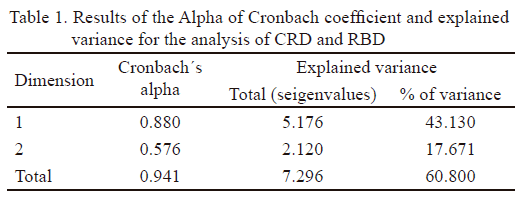
<body><![CDATA[<p align="justify"><font size="2" face="Verdana, Arial, Helvetica, sans-serif"><b><font size="3">RESULTS AND DISCUSSION</font></b></font></p>     <p align="justify" class="Cuerpodetexto" style="margin-top:12.0pt;margin-right:0cm;margin-bottom:5.95pt;margin-left:0cm;text-indent:0cm;"><span style="font-family:'Verdana','sans-serif'; font-size:10.0pt; "><a href="/img/revistas/cjas/v50n2/t0102216.gif">Table  1</a> shows a summary of the results of CATPCA for the analyzed indicators. Two  dimensions were obtained, which explain 60.8 % of variability of the original  information. The Cronbach&acute;s alpha coefficient showed a total reliability level  of 0.94, which is considered as excellent, according to the scale proposed by  Hair <em>et al. </em>(1999). These authors indicated that the used method is  adequate when the values of this coefficient are between 0.60 and 0.70.  Dimension one is emphasized because it explains 43.13 % of the total variance,  with a coefficient of 0.88. This evidences that the indicators represented in  this dimension show a good level of reliability.</span></p>     
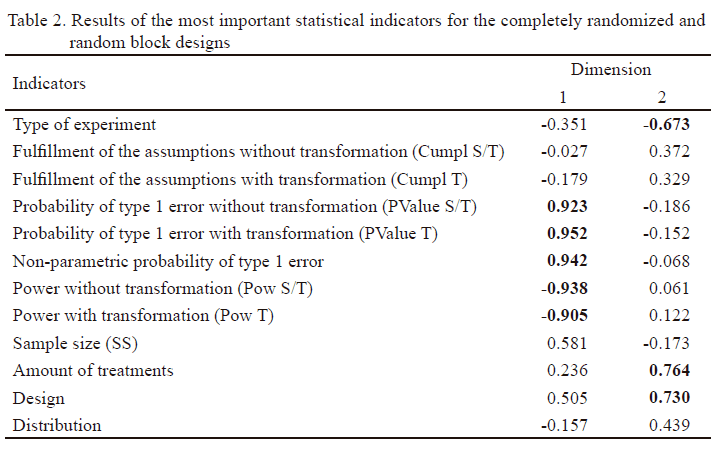
<p align="justify" class="Cuerpodetexto" style="margin-top:12.0pt;margin-right:0cm;margin-bottom:5.95pt;margin-left:0cm;text-indent:0cm;"><span style="letter-spacing:.2pt; font-family:'Verdana','sans-serif'; font-size:10.0pt; "><a href="/img/revistas/cjas/v50n2/t0202216.gif">Table 2</a> shows the most important indicators of each  dimension. In the first one, there is a list of those related to probability of  type 1 error and power, which present positive and negative values close to  one. They allow to determine the contribution of those indicators in the study,  which represent one of the aspects to be considered by researchers in the  process of experimentation. In dimension two, indicators showing a superior  contribution to information are those related to amount of treatments, design  (CRD and RBD) and type of experiment, which present values over 0.60.</span><span style="font-family:'Verdana','sans-serif'; font-size:10.0pt; ">&nbsp; </span></p>     
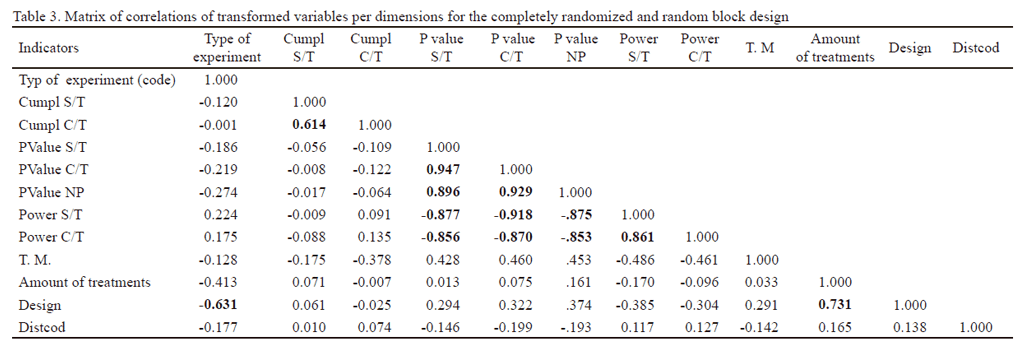
<p align="justify" class="Cuerpodetexto" style="margin-top:12.0pt;margin-right:0cm;margin-bottom:5.95pt;margin-left:0cm;text-indent:0cm;"><span style="font-family:'Verdana','sans-serif'; font-size:10.0pt; ">The  most notable indicators in dimension one show correlations over 0.80 of  absolute value. Those from dimension two show positive correlations over 0.60  (<a href="/img/revistas/cjas/v50n2/t0302216.gif">table 3</a>).</span></p>     
<p align="justify" class="Cuerpodetexto" style="margin-top:12.0pt;margin-right:0cm;margin-bottom:5.95pt;margin-left:0cm;text-indent:0cm;"><span style="font-family:'Verdana','sans-serif'; font-size:10.0pt; ">It  should be highlighted that high negative correlations among probability values  of type 1 error and powers, showing an inverse relation, which means a high  probability of finding significant differences or rejecting the null hypothesis  when it is false, evidenced that with inferior values of &alpha;, there were superior  values of power and vice versa. This result agrees with that stated by G&oacute;mez  (2005).</span></p>     <p align="justify" class="Cuerpodetexto" style="margin-top:12.0pt;margin-right:0cm;margin-bottom:5.95pt;margin-left:0cm;text-indent:0cm;"><span style="font-family:'Verdana','sans-serif'; font-size:10.0pt; "><a href="/img/revistas/cjas/v50n2/f0102216.gif">Figure  1</a> shows a graphic representation of the analyzed statistical indicators that  were divided into four groups. The first group includes indicators associated  with probability values of type 1 error, Fisher F test, ANAVA test for  variables (with and without transformation) and the non-parametric homologues  Kruskal- Wallis and Friedman (P NP value). The second group contains criteria  related to the fulfillment of theoretical assumptions of ANAVA. The third group  includes power values (with and without transformation) and the fourth group,  which is different from the rest, contains the indicators related to type of  experiment and experimental design.</span></p>     
<p align="justify" class="Cuerpodetexto" style="margin-top:12.0pt;margin-right:0cm;margin-bottom:5.95pt;margin-left:0cm;text-indent:0cm;"><span style="font-family:'Verdana','sans-serif'; font-size:10.0pt; ">It is considered that the grouping of probability values  of parametric and non-parametric tests is possible because the Fisher F test is  characterized by being strong in front of heterogeneity of variance, mainly  when it works with the same number of observations per treatments (Steel and  Torrie 1992, Pe&ntilde;a 1994), as in the case of the analyzed designs. In addition,  it presents high power with a low probability of making a type 1 error,  manifested in the high negative correlations between powers and probability  values of type 1 error (with or without data transformation).</span><span style="font-family:'Verdana','sans-serif'; font-size:10.0pt; "> </span></p>     <p align="justify" class="Cuerpodetexto" style="margin-top:12.0pt;margin-right:0cm;margin-bottom:5.95pt;margin-left:0cm;text-indent:0cm;"><span style="font-family:'Verdana','sans-serif'; font-size:10.0pt; ">The  high negative correlations between power and probability of type 1 error, for  the non-parametric test, are due to this last, regarding the parametric one  (under the assumption of normal distribution), shows high relative asymptotic  efficiency (RAE), which is 95.5%. This corresponds to the criterion of  power-efficiency, stated by Siegel (1970), Siegel and Castellan (1995), de  Calzadilla (1999), who suggested that, in order to achieve similar results  regarding rejection of null hypothesis (H<sub>0</sub>), the non-parametric test  should have a sample size of 100 observations and the parametric one, around  95.</span></p>     <p align="justify" class="Cuerpodetexto" style="margin-top:12.0pt;margin-right:0cm;margin-bottom:5.95pt;margin-left:0cm;text-indent:0cm;"><span style="font-family:'Verdana','sans-serif'; font-size:10.0pt; ">Although sample size is not importantly associated with  the analyzed indicators, it is an aspect that should be considered due to its  importance for researches. Torres and Cobo (2015) state that nowadays there are  no studies on this subject or it is not deeply    studied.</span></p>     <p align="justify" class="Cuerpodetexto" style="margin-top:12.0pt;margin-right:0cm;margin-bottom:5.95pt;margin-left:0cm;text-indent:0cm;"><span style="font-family:'Verdana','sans-serif'; font-size:10.0pt; ">The obtained results  evidenced the relations among the analyzed statistical indicators, from the  high degree of positive correlation among the probability values of type 1  error in the Fisher F test (with or without transformation) and the  non-parametric homologue test, as well as the high negative correlations of  them with power values (with and without data transformation). This supposes  the use of the categorical principal component analysis for an integral  evaluation of statistical indicators of models of parametric and non-parametric  analysis of variance. It is necessary to continue the study for different data  distributions and sample sizes</span><font size="2" face="Verdana, Arial, Helvetica, sans-serif">.</font></p>     ]]></body>
<body><![CDATA[<p align="justify">&nbsp;</p>     <p align="justify"><font size="2" face="Verdana, Arial, Helvetica, sans-serif"><font size="3"><b>REFERENCES</b></font></font></p>     <!-- ref --><p align="justify" class="MsoBibliography" style="margin-top:12.0pt;margin-right:0cm;margin-bottom:5.95pt;margin-left:0cm;text-align:justify;"><span style="font-family:'Verdana','sans-serif'; font-size:10.0pt; ">de  Calzadilla, J. 1999. <em>Procedimientos de la Estad&iacute;stica no param&eacute;trica. Aplicaciones en las Ciencias Agropecuarias</em>.  M.Sc. Thesis, Instituto Nacional de Ciencias Agr&iacute;colas, Cuba.    </span></p>     <p align="justify" class="MsoBibliography" style="margin-top:12.0pt;margin-right:0cm;margin-bottom:5.95pt;margin-left:0cm;text-align:justify;"><span style="font-family:'Verdana','sans-serif'; font-size:10.0pt; ">De  Calzadilla, J., Guerra, W. &amp; Torres, V. 2002. </span><span style="font-family:'Verdana','sans-serif'; font-size:10.0pt; ">&ldquo;Use and misuse of  mathematical transformations. Applications in models of analysis of variance&rdquo;. <em>Cuban  Journal of Agricultural Science</em>, 36 (2): 101&ndash;104, ISSN: 2079-3480.</span></p>     <!-- ref --><p align="justify" class="MsoBibliography" style="margin-top:12.0pt;margin-right:0cm;margin-bottom:5.95pt;margin-left:0cm;text-align:justify;"><span style="font-family:'Verdana','sans-serif'; font-size:10.0pt; ">Di  Rienzo, J. A., Casanoves, F., Balzarini, M. G., Gonz&aacute;lez, L., Tablada, M. &amp;  Robledo, C. W. 2012. <em>InfoStat</em>. version 2012, [Windows], Universidad  Nacional de C&oacute;rdoba, Argentina: Grupo InfoStat, Available:  &lt;<a href="http://www.infostat.com.ar/" target="_blank">http://www.infostat.com.ar/</a>&gt;    .</span></p>     <!-- ref --><p align="justify" class="MsoBibliography" style="margin-top:12.0pt;margin-right:0cm;margin-bottom:5.95pt;margin-left:0cm;text-align:justify;"><span style="font-family:'Verdana','sans-serif'; font-size:10.0pt; ">G&oacute;mez,  V. M. &Aacute;. 2005. <em>Inferencia estad&iacute;stica</em>. D&iacute;az de Santos, 544 p., ISBN:  978-84-7978-687-8, Available:  &lt;<a href="https://books.google.com.cu/books?hl=es&lr=&id=MlgqjIRE_MUC&oi=fnd&pg=PA207&dq=G%C3%B3mez+2005+Inferencia+estad%C3%ADstica&ots=Vz0rDN8OC2&sig=8y_gzxQFQklmbfOtRTxsr6RBuVU&redir_esc=y#v=onepage&q=G%C3%B3mez%202005%20Inferencia%20estad%C3%ADstica&f=false" target="_blank">https://books.google.com.cu/books?hl=es&amp;lr=&amp;id=MlgqjIRE_MUC&amp;oi=fnd&amp;pg=PA207&amp;dq=G%C3%B3mez+2005+Inferencia+estad%C3%ADstica&amp;ots=Vz0rDN8OC2&amp;sig=8y_gzxQFQklmbfOtRTxsr6RBuVU&amp;redir_esc=y#v=onepage&amp;q=G%C3%B3mez%202005%20Inferencia%20estad%C3%ADstica&amp;f=false</a>&gt;,  [Consulted:&nbsp;April 19, 2016].    </span></p>     <!-- ref --><p align="justify" class="MsoBibliography" style="margin-top:12.0pt;margin-right:0cm;margin-bottom:5.95pt;margin-left:0cm;text-align:justify;"><span style="font-family:'Verdana','sans-serif'; font-size:10.0pt; ">Hair,  J. 1999. <em>An&aacute;lisis multivariante de datos</em>. Prentice E. &amp; Cano D.  (trans.), Edici&oacute;n: 5 ed., Madrid: PRENTICE HALL, 832 p., ISBN: 978-84-8322-035-1,  Available:  &lt;<a href="https://www.amazon.es/An%C3%A1lisis-multivariante-datos-Joseph-Hair/dp/8483220350" target="_blank">https://www.amazon.es/An%C3%A1lisis-multivariante-datos-Joseph-Hair/dp/8483220350</a>&gt;,  [Consulted:&nbsp;April 19, 2016].    </span></p>     <!-- ref --><p align="justify" class="MsoBibliography" style="margin-top:12.0pt;margin-right:0cm;margin-bottom:5.95pt;margin-left:0cm;text-align:justify;"><span style="font-family:'Verdana','sans-serif'; font-size:10.0pt; ">IBM Corporation 2010. <em>IBM SPSS Statistics</em>.  version 19, [Windows], Multiplataforma, U.S: IBM Corporation, Available:  &lt;<a href="http://www.ibm.com" target="_blank">http://www.ibm.com</a>&gt;    .</span></p>     <p align="justify" class="MsoBibliography" style="margin-top:12.0pt;margin-right:0cm;margin-bottom:5.95pt;margin-left:0cm;text-align:justify;"><span style="font-family:'Verdana','sans-serif'; font-size:10.0pt; ">Levene, H. 1960. &ldquo;Robust tests for the equality  of variance&rdquo;. In: Olkin I., <em>Contributions to Probability and Statistics:  Essays in Honor of Harold Hotelling</em>, Stanford University Press, pp.  278&ndash;292, ISBN: 978-0-8047-0596-7, Available:  &lt;<a href="https://books.google.com.cu/books?hl=es&lr=&id=ZUSsAAAAIAAJ&oi=fnd&pg=PA3&dq=Contributions+to+Probability+and+Statistics&ots=GchNfCzOVQ&sig=-W3BeBmuWhTzgRCkktOdQjq0Di4&redir_esc=y#v=onepage&q=Contributions%20to%20Probability%20and%20Statistics&f=false" target="_blank">https://books.google.com.cu/books?hl=es&amp;lr=&amp;id=ZUSsAAAAIAAJ&amp;oi=fnd&amp;pg=PA3&amp;dq=Contributions+to+Probability+and+Statistics&amp;ots=GchNfCzOVQ&amp;sig=-W3BeBmuWhTzgRCkktOdQjq0Di4&amp;redir_esc=y#v=onepage&amp;q=Contributions%20to%20Probability%20and%20Statistics&amp;f=false</a>&gt;,  [Consulted:&nbsp;April 19, 2016].</span></p>     <p align="justify" class="MsoBibliography" style="margin-top:12.0pt;margin-right:0cm;margin-bottom:5.95pt;margin-left:0cm;text-align:justify;"><span style="font-family:'Verdana','sans-serif'; font-size:10.0pt; ">Molina,  M. &Oacute;. &amp; de los Monteros, P. E. 2010. &ldquo;Rotaci&oacute;n en an&aacute;lisis de componentes  principales categ&oacute;rico: un caso pr&aacute;ctico&rdquo;. <em>Metodolog&iacute;a de Encuestas</em>, 12  (1): 63&ndash;88, ISSN: 15757803.</span></p>     <p align="justify" class="MsoBibliography" style="margin-top:12.0pt;margin-right:0cm;margin-bottom:5.95pt;margin-left:0cm;text-align:justify;"><span style="font-family:'Verdana','sans-serif'; font-size:10.0pt; ">Navarro,  C. J. M., Casas, C. G. M. &amp; Gonz&aacute;lez, R. E. 2010. &ldquo;An&aacute;lisis de Componentes  Principales y An&aacute;lisis de Regresi&oacute;n para Datos Categ&oacute;ricos. Aplicaci&oacute;n en la  Hipertensi&oacute;n Arterial&rdquo;. <em>Revista de Matem&aacute;tica: Teor&iacute;a y Aplicaciones</em>, 17  (2): 199&ndash;230, ISSN: 2215-3373, DOI: 10.15517/rmta.v17i2.2128.</span></p>     <!-- ref --><p align="justify" class="MsoBibliography" style="margin-top:12.0pt;margin-right:0cm;margin-bottom:5.95pt;margin-left:0cm;text-align:justify;"><span style="font-family:'Verdana','sans-serif'; font-size:10.0pt; ">Pe&ntilde;a,  S. de R. 1994. <em>Estad&iacute;stica: Modelos y M&eacute;todos</em>. 2nd ed., Madrid: Alianza  Universal Textos, 745 p.    </span></p>     <p align="justify" class="MsoBibliography" style="margin-top:12.0pt;margin-right:0cm;margin-bottom:5.95pt;margin-left:0cm;text-align:justify;"><span style="font-family:'Verdana','sans-serif'; font-size:10.0pt; ">Shapiro, S. S. &amp; Wilk, M. B. 1965. &ldquo;An  Analysis of Variance Test for Normality (Complete Samples)&rdquo;. </span><em><span style="font-family:'Verdana','sans-serif'; font-size:10.0pt; ">Biometrika</span></em><span style="font-family:'Verdana','sans-serif'; font-size:10.0pt; ">,  52 (3/4): 591&ndash;611, ISSN: 0006-3444, DOI: 10.2307/2333709.</span></p>     <!-- ref --><p align="justify" class="MsoBibliography" style="margin-top:12.0pt;margin-right:0cm;margin-bottom:5.95pt;margin-left:0cm;text-align:justify;"><span style="font-family:'Verdana','sans-serif'; font-size:10.0pt; ">Siegel,  S. 1970. <em>Dise&ntilde;o experimental no param&eacute;trico aplicado a las ciencias de la  conducta</em>. Revolucionaria ed., Habana, Cuba: Instituto Cubano del Libro, 346  p., Available:  &lt;<a href="http://www.sidalc.net/cgi-bin/wxis.exe/?IsisScript=bac.xis&method=post&formato=2&cantidad=1&expresion=mfn=032983" target="_blank">http://www.sidalc.net/cgi-bin/wxis.exe/?IsisScript=bac.xis&amp;method=post&amp;formato=2&amp;cantidad=1&amp;expresion=mfn=032983</a>&gt;,  [Consulted:&nbsp;April 19, 2016].    </span></p>     <!-- ref --><p align="justify" class="MsoBibliography" style="margin-top:12.0pt;margin-right:0cm;margin-bottom:5.95pt;margin-left:0cm;text-align:justify;"><span style="font-family:'Verdana','sans-serif'; font-size:10.0pt; ">Siegel,  S. &amp; Castellan, N. 1995. <em>Estad&iacute;stica no param&eacute;trica aplicada a las  ciencias de la conducta</em>. </span><span style="font-family:'Verdana','sans-serif'; font-size:10.0pt; ">4th ed., M&eacute;xico: Trillas, 432 p., ISBN: 968-24-5101-9,  Available: &lt;<a href="http://www.sidalc.net/cgi-bin/wxis.exe/?IsisScript=CAMZA.xis&method=post&formato=2&cantidad=1&expresion=mfn=014608" target="_blank">http://www.sidalc.net/cgi-bin/wxis.exe/?IsisScript=CAMZA.xis&amp;method=post&amp;formato=2&amp;cantidad=1&amp;expresion=mfn=014608</a>&gt;,  [Consulted:&nbsp;April 19, 2016].    </span></p>     <!-- ref --><p align="justify" class="MsoBibliography" style="margin-top:12.0pt;margin-right:0cm;margin-bottom:5.95pt;margin-left:0cm;text-align:justify;"><span style="font-family:'Verdana','sans-serif'; font-size:10.0pt; ">StatSoft 2007. <em>STATISTICA (data analysis  software system)</em>. version 8.0, [Windows], US: StatSoft, Inc., Available:  &lt;<a href="http://www.statsoft.com" target="_blank">http://www.statsoft.com</a>&gt;    .</span></p>     <!-- ref --><p align="justify" class="MsoBibliography" style="margin-top:12.0pt;margin-right:0cm;margin-bottom:5.95pt;margin-left:0cm;text-align:justify;"><span style="font-family:'Verdana','sans-serif'; font-size:10.0pt; ">Steel, R. G. &amp; Torrie, I. H. 1992. </span><em><span style="font-family:'Verdana','sans-serif'; font-size:10.0pt; ">Bioestad&iacute;stica: principios y procedimientos</span></em><span style="font-family:'Verdana','sans-serif'; font-size:10.0pt; ">. M&eacute;xico: McGraw-Hill Interamericana, 228 p.    </span></p>     <p align="justify" class="MsoBibliography" style="margin-top:12.0pt;margin-right:0cm;margin-bottom:5.95pt;margin-left:0cm;text-align:justify;"><span style="font-family:'Verdana','sans-serif'; font-size:10.0pt; ">Torres, V. &amp; Cobo, R. 2015. &ldquo;Applied  Mathematics in researches from the Instituto de Ciencia Animal. Fifty years of  experience&rdquo;. <em>Cuban Journal of Agricultural Science</em>, 49 (2): 117&ndash;125,  ISSN: 2079-3480.</span></p>     <!-- ref --><p align="justify" class="MsoBibliography" style="margin-top:12.0pt;margin-right:0cm;margin-bottom:5.95pt;margin-left:0cm;text-align:justify;"><span style="font-family:'Verdana','sans-serif'; font-size:10.0pt; ">V&aacute;squez,  R. E. 2011. <em>Contribuci&oacute;n al tratamiento estad&iacute;stico de datos con  distribuci&oacute;n Binomial en el Modelo de An&aacute;lisis de Varianza</em>. Ph.D. Thesis,  Instituto Nacional de Ciencias Agr&iacute;colas, Cuba.    </span></p>     ]]></body>
<body><![CDATA[<!-- ref --><p align="justify" class="MsoBibliography" style="margin-top:12.0pt;margin-right:0cm;margin-bottom:5.95pt;margin-left:0cm;text-align:justify;"><span style="font-family:'Verdana','sans-serif'; font-size:10.0pt; ">V&aacute;zquez,  Y. 2012. <em>Modelaci&oacute;n Estad&iacute;stico-Matem&aacute;tica con variables mixtas para el  estudio de la sostenibilidad social en una empresa ganadera bovina</em>. Ph.D.  Thesis, Instituto Nacional de Ciencias Agr&iacute;colas, Cuba</span><font size="2" face="Verdana,     Arial, Helvetica, sans-serif">.</font></p>     <p align="justify">&nbsp;</p>     <p align="justify">&nbsp;</p>     <p align="justify"><font size="2" face="Verdana, Arial, Helvetica, sans-serif">Received: 11/2/2014    <br>   Accepted: 1/6/2016</font></p>     <p align="justify">&nbsp;</p>     <p align="justify">&nbsp;</p>     <p align="justify"><font size="2" face="Verdana, Arial, Helvetica, sans-serif"><i>Magaly Herrera,</i> Instituto de Ciencia Animal, Apartado Postal 24, San José de las Lajas, Mayabeque, Cuba.    Email: <a href="mailto:mvillafranca@ica.co.cu ">mvillafranca@ica.co.cu </a></font></p>      ]]></body><back>
<ref-list>
<ref id="B1">
<nlm-citation citation-type="book">
<person-group person-group-type="author">
<name>
<surname><![CDATA[de Calzadilla]]></surname>
<given-names><![CDATA[J.]]></given-names>
</name>
</person-group>
<source><![CDATA[Procedimientos de la Estadística no paramétrica. Aplicaciones en las Ciencias Agropecuarias]]></source>
<year>1999</year>
<publisher-loc><![CDATA[Cuba ]]></publisher-loc>
<publisher-name><![CDATA[Instituto Nacional de Ciencias Agrícolas]]></publisher-name>
</nlm-citation>
</ref>
<ref id="B2">
<nlm-citation citation-type="journal">
<person-group person-group-type="author">
<name>
<surname><![CDATA[De Calzadilla]]></surname>
<given-names><![CDATA[J.]]></given-names>
</name>
<name>
<surname><![CDATA[Guerra]]></surname>
<given-names><![CDATA[W.]]></given-names>
</name>
<name>
<surname><![CDATA[Torres]]></surname>
<given-names><![CDATA[V.]]></given-names>
</name>
</person-group>
<article-title xml:lang="nd"><![CDATA[Use and misuse of mathematical transformations. Applications in models of analysis of variance]]></article-title>
<source><![CDATA[Cuban Journal of Agricultural Science]]></source>
<year>2002</year>
<volume>36</volume>
<numero>2</numero>
<issue>2</issue>
<page-range>101-104</page-range></nlm-citation>
</ref>
<ref id="B3">
<nlm-citation citation-type="book">
<person-group person-group-type="author">
<name>
<surname><![CDATA[Di Rienzo]]></surname>
<given-names><![CDATA[J. A.]]></given-names>
</name>
<name>
<surname><![CDATA[Casanoves]]></surname>
<given-names><![CDATA[F.]]></given-names>
</name>
<name>
<surname><![CDATA[Balzarini]]></surname>
<given-names><![CDATA[M. G.]]></given-names>
</name>
<name>
<surname><![CDATA[González]]></surname>
<given-names><![CDATA[L.]]></given-names>
</name>
<name>
<surname><![CDATA[Tablada]]></surname>
<given-names><![CDATA[M.]]></given-names>
</name>
<name>
<surname><![CDATA[Robledo]]></surname>
<given-names><![CDATA[C. W.]]></given-names>
</name>
</person-group>
<source><![CDATA[InfoStat]]></source>
<year>2012</year>
<publisher-loc><![CDATA[Universidad Nacional de Córdoba, Argentina ]]></publisher-loc>
<publisher-name><![CDATA[Grupo InfoStat]]></publisher-name>
</nlm-citation>
</ref>
<ref id="B4">
<nlm-citation citation-type="book">
<person-group person-group-type="author">
<name>
<surname><![CDATA[Gómez]]></surname>
<given-names><![CDATA[V. M. Á.]]></given-names>
</name>
</person-group>
<source><![CDATA[Inferencia estadística]]></source>
<year>2005</year>
<page-range>544</page-range><publisher-name><![CDATA[Díaz de Santos]]></publisher-name>
</nlm-citation>
</ref>
<ref id="B5">
<nlm-citation citation-type="book">
<person-group person-group-type="author">
<name>
<surname><![CDATA[Hair]]></surname>
<given-names><![CDATA[J.]]></given-names>
</name>
<name>
<surname><![CDATA[Prentice]]></surname>
<given-names><![CDATA[E.]]></given-names>
</name>
<name>
<surname><![CDATA[Cano]]></surname>
<given-names><![CDATA[D.]]></given-names>
</name>
</person-group>
<source><![CDATA[Análisis multivariante de datos]]></source>
<year>1999</year>
<edition>Edición: 5</edition>
<page-range>832</page-range><publisher-loc><![CDATA[Madrid ]]></publisher-loc>
<publisher-name><![CDATA[PRENTICE HALL]]></publisher-name>
</nlm-citation>
</ref>
<ref id="B6">
<nlm-citation citation-type="book">
<person-group person-group-type="author">
<name>
<surname><![CDATA[IBM Corporation]]></surname>
</name>
</person-group>
<source><![CDATA[IBM SPSS Statistics]]></source>
<year>2010</year>
<publisher-loc><![CDATA[U.S ]]></publisher-loc>
<publisher-name><![CDATA[IBM Corporation]]></publisher-name>
</nlm-citation>
</ref>
<ref id="B7">
<nlm-citation citation-type="book">
<person-group person-group-type="author">
<name>
<surname><![CDATA[Levene]]></surname>
<given-names><![CDATA[H.]]></given-names>
</name>
</person-group>
<article-title xml:lang="nd"><![CDATA[Robust tests for the equality of variance]]></article-title>
<source><![CDATA[Contributions to Probability and Statistics: Essays in Honor of Harold Hotelling]]></source>
<year>1960</year>
<page-range>278-292</page-range><publisher-name><![CDATA[Stanford University Press]]></publisher-name>
</nlm-citation>
</ref>
<ref id="B8">
<nlm-citation citation-type="journal">
<person-group person-group-type="author">
<name>
<surname><![CDATA[Molina]]></surname>
<given-names><![CDATA[M. Ó.]]></given-names>
</name>
<name>
<surname><![CDATA[de los Monteros]]></surname>
<given-names><![CDATA[P. E.]]></given-names>
</name>
</person-group>
<article-title xml:lang="nd"><![CDATA[Rotación en análisis de componentes principales categórico: un caso práctico]]></article-title>
<source><![CDATA[Metodología de Encuestas]]></source>
<year>2010</year>
<volume>12</volume>
<numero>1</numero>
<issue>1</issue>
<page-range>63-88</page-range></nlm-citation>
</ref>
<ref id="B9">
<nlm-citation citation-type="journal">
<person-group person-group-type="author">
<name>
<surname><![CDATA[Navarro]]></surname>
<given-names><![CDATA[C. J. M.]]></given-names>
</name>
<name>
<surname><![CDATA[Casas]]></surname>
<given-names><![CDATA[C. G. M.]]></given-names>
</name>
<name>
<surname><![CDATA[González]]></surname>
<given-names><![CDATA[R. E.]]></given-names>
</name>
</person-group>
<article-title xml:lang="nd"><![CDATA[Análisis de Componentes Principales y Análisis de Regresión para Datos Categóricos. Aplicación en la Hipertensión Arterial]]></article-title>
<source><![CDATA[Revista de Matemática: Teoría y Aplicaciones]]></source>
<year>2010</year>
<volume>17</volume>
<numero>2</numero>
<issue>2</issue>
<page-range>199-230</page-range></nlm-citation>
</ref>
<ref id="B10">
<nlm-citation citation-type="book">
<person-group person-group-type="author">
<name>
<surname><![CDATA[Peña]]></surname>
<given-names><![CDATA[S. de R.]]></given-names>
</name>
</person-group>
<source><![CDATA[Estadística: Modelos y Métodos]]></source>
<year>1994</year>
<edition>2nd</edition>
<page-range>745</page-range><publisher-loc><![CDATA[Madrid ]]></publisher-loc>
<publisher-name><![CDATA[Alianza Universal Textos]]></publisher-name>
</nlm-citation>
</ref>
<ref id="B11">
<nlm-citation citation-type="journal">
<person-group person-group-type="author">
<name>
<surname><![CDATA[Shapiro]]></surname>
<given-names><![CDATA[S. S.]]></given-names>
</name>
<name>
<surname><![CDATA[Wilk]]></surname>
<given-names><![CDATA[M. B.]]></given-names>
</name>
</person-group>
<article-title xml:lang="nd"><![CDATA[An Analysis of Variance Test for Normality (Complete Samples)]]></article-title>
<source><![CDATA[Biometrika]]></source>
<year>1965</year>
<volume>52</volume>
<numero>3/4</numero>
<issue>3/4</issue>
<page-range>591-611</page-range></nlm-citation>
</ref>
<ref id="B12">
<nlm-citation citation-type="book">
<person-group person-group-type="author">
<name>
<surname><![CDATA[Siegel]]></surname>
<given-names><![CDATA[S.]]></given-names>
</name>
</person-group>
<source><![CDATA[Diseño experimental no paramétrico aplicado a las ciencias de la conducta]]></source>
<year>1970</year>
<edition>Revolucionaria</edition>
<page-range>346</page-range><publisher-loc><![CDATA[Habana, Cuba ]]></publisher-loc>
<publisher-name><![CDATA[Instituto Cubano del Libro]]></publisher-name>
</nlm-citation>
</ref>
<ref id="B13">
<nlm-citation citation-type="book">
<person-group person-group-type="author">
<name>
<surname><![CDATA[Siegel]]></surname>
<given-names><![CDATA[S.]]></given-names>
</name>
<name>
<surname><![CDATA[Castellan]]></surname>
<given-names><![CDATA[N.]]></given-names>
</name>
</person-group>
<source><![CDATA[Estadística no paramétrica aplicada a las ciencias de la conducta]]></source>
<year>1995</year>
<edition>4th</edition>
<page-range>432</page-range><publisher-loc><![CDATA[México ]]></publisher-loc>
<publisher-name><![CDATA[Trillas]]></publisher-name>
</nlm-citation>
</ref>
<ref id="B14">
<nlm-citation citation-type="book">
<person-group person-group-type="author">
<name>
<surname><![CDATA[StatSoft]]></surname>
</name>
</person-group>
<source><![CDATA[STATISTICA (data analysis software system)]]></source>
<year>2007</year>
<publisher-loc><![CDATA[US ]]></publisher-loc>
<publisher-name><![CDATA[StatSoft, Inc.]]></publisher-name>
</nlm-citation>
</ref>
<ref id="B15">
<nlm-citation citation-type="book">
<person-group person-group-type="author">
<name>
<surname><![CDATA[Steel]]></surname>
<given-names><![CDATA[R. G.]]></given-names>
</name>
<name>
<surname><![CDATA[Torrie]]></surname>
<given-names><![CDATA[I. H.]]></given-names>
</name>
</person-group>
<source><![CDATA[Bioestadística: principios y procedimientos]]></source>
<year>1992</year>
<page-range>228</page-range><publisher-loc><![CDATA[México ]]></publisher-loc>
<publisher-name><![CDATA[McGraw-Hill Interamericana]]></publisher-name>
</nlm-citation>
</ref>
<ref id="B16">
<nlm-citation citation-type="journal">
<person-group person-group-type="author">
<name>
<surname><![CDATA[Torres]]></surname>
<given-names><![CDATA[V.]]></given-names>
</name>
<name>
<surname><![CDATA[Cobo]]></surname>
<given-names><![CDATA[R.]]></given-names>
</name>
</person-group>
<article-title xml:lang="nd"><![CDATA[Applied Mathematics in researches from the Instituto de Ciencia Animal. Fifty years of experience]]></article-title>
<source><![CDATA[Cuban Journal of Agricultural Science]]></source>
<year>2015</year>
<volume>49</volume>
<numero>2</numero>
<issue>2</issue>
<page-range>117-125</page-range></nlm-citation>
</ref>
<ref id="B17">
<nlm-citation citation-type="book">
<person-group person-group-type="author">
<name>
<surname><![CDATA[Vásquez]]></surname>
<given-names><![CDATA[R. E.]]></given-names>
</name>
</person-group>
<source><![CDATA[Contribución al tratamiento estadístico de datos con distribución Binomial en el Modelo de Análisis de Varianza]]></source>
<year>2011</year>
<publisher-loc><![CDATA[Cuba ]]></publisher-loc>
<publisher-name><![CDATA[Instituto Nacional de Ciencias Agrícolas]]></publisher-name>
</nlm-citation>
</ref>
<ref id="B18">
<nlm-citation citation-type="book">
<person-group person-group-type="author">
<name>
<surname><![CDATA[Vázquez]]></surname>
<given-names><![CDATA[Y.]]></given-names>
</name>
</person-group>
<source><![CDATA[Modelación Estadístico-Matemática con variables mixtas para el estudio de la sostenibilidad social en una empresa ganadera bovina]]></source>
<year>2012</year>
<publisher-loc><![CDATA[Cuba ]]></publisher-loc>
<publisher-name><![CDATA[Instituto Nacional de Ciencias Agrícolas]]></publisher-name>
</nlm-citation>
</ref>
</ref-list>
</back>
</article>