<?xml version="1.0" encoding="ISO-8859-1"?><article xmlns:mml="http://www.w3.org/1998/Math/MathML" xmlns:xlink="http://www.w3.org/1999/xlink" xmlns:xsi="http://www.w3.org/2001/XMLSchema-instance">
<front>
<journal-meta>
<journal-id>2079-3480</journal-id>
<journal-title><![CDATA[Cuban Journal of Agricultural Science]]></journal-title>
<abbrev-journal-title><![CDATA[Cuban J. Agric. Sci.]]></abbrev-journal-title>
<issn>2079-3480</issn>
<publisher>
<publisher-name><![CDATA[Editorial del Instituto de Ciencia Animal]]></publisher-name>
</publisher>
</journal-meta>
<article-meta>
<article-id>S2079-34802016000200005</article-id>
<title-group>
<article-title xml:lang="en"><![CDATA[Effect of the supplementation with a ruminal protein activator on weight gain of steers fed rice straw]]></article-title>
<article-title xml:lang="es"><![CDATA[Efecto de la suplementación con un activador proteico ruminal en la ganancia de peso de novillos alimentados con paja de arroz]]></article-title>
</title-group>
<contrib-group>
<contrib contrib-type="author">
<name>
<surname><![CDATA[Ascanio]]></surname>
<given-names><![CDATA[G. N. D]]></given-names>
</name>
<xref ref-type="aff" rid="A01"/>
</contrib>
<contrib contrib-type="author">
<name>
<surname><![CDATA[Elías]]></surname>
<given-names><![CDATA[A.]]></given-names>
</name>
<xref ref-type="aff" rid="A02"/>
</contrib>
<contrib contrib-type="author">
<name>
<surname><![CDATA[Flores]]></surname>
<given-names><![CDATA[Angela J.]]></given-names>
</name>
<xref ref-type="aff" rid="A03"/>
</contrib>
<contrib contrib-type="author">
<name>
<surname><![CDATA[Rodríguez]]></surname>
<given-names><![CDATA[R.]]></given-names>
</name>
<xref ref-type="aff" rid="A02"/>
</contrib>
<contrib contrib-type="author">
<name>
<surname><![CDATA[Herrera]]></surname>
<given-names><![CDATA[F.]]></given-names>
</name>
<xref ref-type="aff" rid="A02"/>
</contrib>
</contrib-group>
<aff id="A01">
<institution><![CDATA[,NUTREZA SRL  ]]></institution>
<addr-line><![CDATA[ Santa Fe]]></addr-line>
<country>Argentina</country>
</aff>
<aff id="A02">
<institution><![CDATA[,Instituto de Ciencia Animal  ]]></institution>
<addr-line><![CDATA[San José de las Lajas Mayabeque]]></addr-line>
<country>Cuba</country>
</aff>
<aff id="A03">
<institution><![CDATA[,INTA EEA Mercedes  ]]></institution>
<addr-line><![CDATA[Corrientes ]]></addr-line>
<country>Argentina</country>
</aff>
<pub-date pub-type="pub">
<day>00</day>
<month>06</month>
<year>2016</year>
</pub-date>
<pub-date pub-type="epub">
<day>00</day>
<month>06</month>
<year>2016</year>
</pub-date>
<volume>50</volume>
<numero>2</numero>
<fpage>215</fpage>
<lpage>224</lpage>
<copyright-statement/>
<copyright-year/>
<self-uri xlink:href="http://scielo.sld.cu/scielo.php?script=sci_arttext&amp;pid=S2079-34802016000200005&amp;lng=en&amp;nrm=iso"></self-uri><self-uri xlink:href="http://scielo.sld.cu/scielo.php?script=sci_abstract&amp;pid=S2079-34802016000200005&amp;lng=en&amp;nrm=iso"></self-uri><self-uri xlink:href="http://scielo.sld.cu/scielo.php?script=sci_pdf&amp;pid=S2079-34802016000200005&amp;lng=en&amp;nrm=iso"></self-uri><abstract abstract-type="short" xml:lang="en"><p><![CDATA[In order to evaluate the animal response to supplementation with a ruminal protein activator to steers consuming rice straw rolls, an amount of 27 animals of 160 kg were used, distributed into three treatments (rice straw, rice straw + 200g of ruminal protein activator and rice straw + 400 g of ruminal protein activator.animal.d-1). A random blocks design was applied, with three animals per treatment and three repetitions. Mean composition was 4.9 and 45.2 % of crude protein and 61.5 and 20.3 % of neutral detergent fiber for rice straw rolls and the ruminal protein activator, respectively. The control animals, fed only rice straw rolls, lost weight (-0.09 kg.animal.d-1). Treated groups gained 0.242 and 0.325 kg.animal.d-1 (P <0.001) for low and high doses, respectively, although without differences among them. The intake of rice straw rolls increased in 16 % in the treatments supplemented with the activator (P < 0.01), but not between doses. Final efficiency of the use of the activator was 1 g of ruminal protein activator per 1 g of daily weight gain. It is recommended the doses of 1.16 g of ruminal protein activator per kilogram of liveweight]]></p></abstract>
<abstract abstract-type="short" xml:lang="es"><p><![CDATA[Para evaluar la respuesta animal a la suplementación con un activador proteico ruminal a novillos que consumen rollos de paja de arroz, se utilizaron 27 animales de 160 kg, distribuidos en tres tratamientos (paja de arroz, paja de arroz + 200 g de activador proteico ruminal y paja de arroz + 400 g de activador proteico ruminal.animal.d-1). Se aplicó un diseño de bloques al azar, con tres animales por tratamiento y tres repeticiones. La composición promedio fue de 4.9 y 45.2 % de proteína bruta y 61.5 y 20.3 % de fibra neutro detergente para rollos de paja de arroz y el activador proteico ruminal, respectivamente. Los animales control, alimentados solo con rollos de paja de arroz,perdieron peso (-0.09 kg.animal.d-1). Los grupos tratados ganaron 0.242 y 0.325 kg.animal.d-1 (P < 0.01), pero no entre dosis. La eficiencia final de uso del activador fue de 1 g de activador proteico ruminal por 1 g de ganancia diaria de peso vivo. Se recomienda la dosis de 1.16 g de activador proteico ruminal por kilogramo de peso vivo]]></p></abstract>
<kwd-group>
<kwd lng="en"><![CDATA[protein supplementation]]></kwd>
<kwd lng="en"><![CDATA[low quality forages]]></kwd>
<kwd lng="en"><![CDATA[protein activator]]></kwd>
<kwd lng="es"><![CDATA[suplementación proteica]]></kwd>
<kwd lng="es"><![CDATA[forrajes baja calidad]]></kwd>
<kwd lng="es"><![CDATA[activador proteico]]></kwd>
</kwd-group>
</article-meta>
</front><body><![CDATA[ <p align="right"><font size="2" face="Verdana, Arial, Helvetica, sans-serif"><b>Cuban Journal  of Agricultural Science, 50(2): 215-224, 2016, ISSN: 2079-3480</b></font></p>     <p align="right">&nbsp;</p>     <p align="right"><font size="2" face="Verdana, Arial, Helvetica, sans-serif"><b>ORIGINAL ARTICLE</b></font></p>     <p align="justify">&nbsp;</p>     <p align="justify"><font size="4" face="Verdana, Arial, Helvetica, sans-serif">  <b>Effect of the supplementation with a ruminal protein activator on weight gain of steers fed rice straw</b></font></p>      <p align="justify">&nbsp;</p>     <p align="justify"><font size="3" face="Verdana, Arial, Helvetica, sans-serif">  <b>Efecto de la suplementación con un activador proteico ruminal en la ganancia de peso de novillos alimentados con paja de arroz</b></font></p>      <p align="justify">&nbsp;</p>     <p align="justify">&nbsp;</p>     <p align="justify"><font size="2" face="Verdana, Arial, Helvetica, sans-serif">  <b>G. N. D’Ascanio,</b><sup><b>I</b></sup> <b> A. Elías,</b><sup><b>II</b></sup> <b> Angela J. Flores,</b><sup><b>III</b></sup> <b> R. Rodríguez,</b><sup><b>II</b></sup> <b> F. Herrera,</b><sup><b>II</b></sup>  </font></p>     ]]></body>
<body><![CDATA[<p align="justify"><font size="2" face="Verdana, Arial, Helvetica, sans-serif"><b> </b></font><font size="2" face="Verdana, Arial, Helvetica, sans-serif">    <sup>I</sup>NUTREZA SRL, Ruta 11, km 751. (3572) Malabrigo, Santa Fe, Argentina.    <br>   <sup>II</sup>Instituto de Ciencia Animal, Apartado Postal 24, San José de las Lajas, Mayabeque, Cuba.     <br>   <sup>III</sup>INTA EEA Mercedes. Corrientes, Argentina. </font></p>     <p align="justify">&nbsp;</p>     <p align="justify">&nbsp;</p> <hr align="JUSTIFY">     <p align="justify"><font size="2" face="Verdana, Arial, Helvetica, sans-serif"><b>ABSTRACT</b></font></p>     <p align="justify"><font size="2" face="Verdana, Arial, Helvetica, sans-serif"><span style="line-height:115%; font-family:'Verdana','sans-serif'; font-size:10.0pt; ">In order to evaluate the animal response to  supplementation with a ruminal protein activator to steers consuming rice straw  rolls, an amount of 27 animals of 160 kg were used, distributed into three  treatments (rice straw, rice straw + 200g of ruminal protein activator and rice  straw + 400 g of ruminal protein activator.animal.d<sup>-1</sup>). A random  blocks design was applied, with three animals per treatment and three  repetitions. Mean composition was 4.9 and 45.2 % of crude protein and 61.5 and  20.3 % of neutral detergent fiber for rice straw rolls and the ruminal protein  activator, respectively. The control animals, fed only rice straw rolls, lost  weight  (-0.09 kg.animal.d<sup>-1</sup>). Treated groups gained 0.242 and  0.325 kg.animal.d<sup>-1</sup> (P &lt;0.001) for low and high doses,  respectively, although without differences among them.&nbsp; The intake of rice straw rolls increased in  16 % in the treatments supplemented with the activator (P &lt; 0.01), but  not&nbsp; between doses. Final efficiency of  the use of the activator was 1 g of ruminal protein activator per 1 g of daily  weight gain. It is recommended the doses of 1.16 g of ruminal protein activator  per kilogram of liveweight</span>.</font></p>     <p align="justify"><font size="2" face="Verdana, Arial, Helvetica, sans-serif"><b>Key words:</b> protein supplementation, low quality forages, protein activator.</font></p> <hr align="JUSTIFY">     <p align="justify"><font size="2" face="Verdana, Arial, Helvetica, sans-serif"><b>RESUMEN</b></font></p>     <p align="justify"><font size="2" face="Verdana, Arial, Helvetica, sans-serif">Para evaluar la respuesta animal a la suplementación con un activador proteico ruminal a novillos que consumen rollos de paja de arroz, se utilizaron 27 animales de 160 kg, distribuidos en tres tratamientos (paja de arroz, paja de arroz + 200 g de activador proteico ruminal y paja de arroz + 400 g de activador proteico ruminal.animal.d-1). Se aplicó un diseño de bloques al azar, con tres animales por tratamiento y tres repeticiones. La composición promedio fue de 4.9 y 45.2 % de proteína bruta y 61.5 y 20.3 % de fibra neutro detergente para rollos de paja de arroz  y el activador proteico ruminal, respectivamente. Los animales control, alimentados solo con  rollos de paja de arroz,perdieron peso (-0.09 kg.animal.d-1). Los grupos tratados ganaron 0.242 y  0.325 kg.animal.d-1 (P <0.001) para la baja y alta dosis del suplemento respectivamente, aunque sin diferencias entre estas. El consumo de rollos de paja de arroz se incrementó en 16 % en los tratamientos suplementados con el activador (P < 0.01), pero no entre dosis. La eficiencia final de uso del activador fue de 1 g de activador proteico ruminal por 1 g de ganancia diaria de peso vivo. Se recomienda la dosis de 1.16 g de activador proteico ruminal por kilogramo de peso vivo.</font></p>     ]]></body>
<body><![CDATA[<p align="justify"><font size="2" face="Verdana, Arial, Helvetica, sans-serif"><b>Palabras    clave:</b>    suplementación proteica, forrajes baja calidad, activador proteico.</font></p> <hr align="JUSTIFY">     <p align="justify">&nbsp;</p>     <p align="justify">&nbsp;</p>     <p class="subtitulo" align="justify" style="text-align:left;"><span style="line-height:120%; font-family:'Verdana','sans-serif'; font-size:13.0pt; color:windowtext; "><b>INTRODUCTION</b></span></p>     <p align="justify" class="Cuerpodetexto" style="margin-top:5.95pt;text-indent:0cm;"><span style="line-height:120%; letter-spacing:.2pt; font-family:'Verdana','sans-serif'; font-size:10.0pt; ">The main basis of livestock in  Argentine Republic is constituted by large areas of grassland. Currently, the  animal husbandry activity in the country is displaced towards extra Pampas  ecosystems that rely most of their productive livelihood on pastoral systems,  mainly composed of seasonal growth grasses. These grassland ecosystems occupy  more than 70% of the country (Chiossone 2011), with over 1,000,000 km<sup>2</sup> and 25,000,000 cattle heads, which represent 48% of total livestock from Argentina  (Rossanigo <em>et al.</em> 2012).</span><span style="line-height:120%; font-family:'Verdana','sans-serif'; font-size:10.0pt; "> </span></p>     <p align="justify" class="Cuerpodetexto" style="margin-top:5.95pt;text-indent:0cm;"><span style="line-height:120%; letter-spacing:.1pt; font-family:'Verdana','sans-serif'; font-size:10.0pt; ">The exploitation of C<sub>4</sub> photosynthetic pathway pastures, with marked seasonality on their yields and  low nutritional value, due to their high fiber contents and low protein levels  during most of the year, are features shared by animal husbandry ecosystems.  Therefore, conserved forages have high fiber content and low proportion of  nitrogen, with less than 8% of crude protein (CP).</span><span style="font-family:'Verdana','sans-serif'; font-size:10.0pt; "> </span></p>     <p align="justify" class="Cuerpodetexto" style="margin-top:5.95pt;text-indent:0cm;"><span style="font-family:'Verdana','sans-serif'; font-size:10.0pt; ">These low quality feeds determine a ruminal environment  that limits the development of cellulolytic bacteria, resulting in low rates of  digestion of food passage fiber, have a negative influence on intake and  restrict weight gain, especially in growing cattle (El&iacute;as 1983, Balbuena <em>et  al.</em> 2000, Barbera and Sampedro 2010). </span></p>     <p align="justify" class="Cuerpodetexto" style="margin-top:5.95pt;text-indent:0cm;"><span style="font-family:'Verdana','sans-serif'; font-size:10.0pt; ">Intake may be increased by protein supplementation, in  order to reduce the deficiency of CP available for ruminal microorganisms, with  the consequent positive effect on the rate and extent of fiber fermentation.  This is because, under conditions of forage availability, CP deficiency is the  primary factor restricting weight gain of the animal (Del Curto <em>et al.</em> 2000). </span></p>     <p align="justify" class="Cuerpodetexto" style="margin-top:5.95pt;text-indent:0cm;"><span style="font-family:'Verdana','sans-serif'; font-size:10.0pt; ">The supply of non-protein nitrogen (urea, protected  urea or cellulolytic enzymes) to ruminants reared extensively in the field, in  order to increase efficiency of ruminal degradation of low quality forages, is  limited because there are no practical ways to provide it in the needed doses.</span></p>     <p align="justify" class="Cuerpodetexto" style="margin-top:5.95pt;text-indent:0cm;"><span style="font-family:'Verdana','sans-serif'; font-size:10.0pt; ">Ruminal protein activators (RPA) of slow release, in  form of hard cylindrical tacos with specific weight from 1.2 to 1.4 kg.L<sup>-1</sup> and resistance to compression between 8 and 12 kgf/cm<sup>2</sup>, work as an  accelerating formula of ruminal processes. They were designed to provide  nutrients to populations of cellulolytic microorganisms and accelerate the  ruminal processes of bovines (D'Ascanio <em>et al.</em> 2015). Formulation of  this supplement includes a combination of protein meals, urea, molasses and  minerals. These RPA are salivated and swallowed entirely or in pieces by the  animals, which can be confirmed within the animal rumen, where they slowly and  synchronically dissolve its nutrients (D'Ascanio 2014).&nbsp;&nbsp;&nbsp; </span></p>     ]]></body>
<body><![CDATA[<p align="justify" class="Cuerpodetexto" style="margin-top:5.95pt;text-indent:0cm;"><span style="font-family:'Verdana','sans-serif'; font-size:10.0pt; ">The objective of this study was to evaluate the effect  of RPA, as tacos, in the voluntary intake and weight gain of steers fed  low-quality forage.</span></p>     <p align="justify" class="Cuerpodetexto" style="margin-top:5.95pt;text-indent:0cm;"><span style="font-family:'Verdana','sans-serif'; font-size:10.0pt; ">&nbsp;</span></p>     <p class="subtitulo" align="justify" style="text-align:left;"><span style="font-family:'Verdana','sans-serif'; font-size:13.0pt; color:windowtext; "><b>MATERIAL AND METHODS</b></span></p>     <p align="justify" class="Cuerpodetexto" style="margin-top:5.95pt;text-indent:0cm;"><span style="font-family:'Verdana','sans-serif'; font-size:10.0pt; ">The experiment was conducted at the  Estaci&oacute;n Experimental Agropecuaria of INTA &quot;Mercedes&quot;  (27 &deg; 40'34 &quot;South, 59 &deg; 48'25&quot; West; 98 m o.s.l.), near the city of  Mercedes (Corrientes, Argentine), during October and November, 2012. The  experimental work consisted on evaluating, for 60 days, two levels of RPA, as  hard tacos, as a supplement for Hereford and Braford calves and their crosses,  weaned in autumn and reared in the field with winter supplementation, until  their stabulation in pens with rice straw rolls <em>ad libitum</em>. Before  starting the experiment, the animals were dewormed with ivermectin, were  vaccinated against keratoconjunctivitis, ear tagged and weighed individually at  0, 30 and 60 d in a mechanical  scale.</span><span style="font-family:'Verdana','sans-serif'; font-size:10.0pt; "> </span></p>     <p align="justify" class="Cuerpodetexto" style="margin-top:5.95pt;text-indent:0cm;"><span style="font-family:'Verdana','sans-serif'; font-size:10.0pt; ">Three treatments were established: </span></p>     <p align="justify" class="Cuerpodetexto" style="margin-top:5.95pt;text-indent:0cm;"><span style="font-family:'Verdana','sans-serif'; font-size:10.0pt; ">T1) rice straw <em>ad libitum</em> (control) </span></p>     <p align="justify" class="Cuerpodetexto" style="margin-top:5.95pt;text-indent:0cm;"><span style="font-family:'Verdana','sans-serif'; font-size:10.0pt; ">T2) rice straw <em>ad libitum</em> + 200 g of RPA. head<sup>-1</sup>/.d<sup>-1</sup></span></p>     <p align="justify" class="Cuerpodetexto" style="margin-top:5.95pt;text-indent:0cm;"><span style="font-family:'Verdana','sans-serif'; font-size:10.0pt; ">T3) rice straw <em>ad libitum</em> + 400 g of RPA. head<sup>-1</sup>/.d<sup>-1</sup></span></p>     <p align="justify" class="Cuerpodetexto" style="margin-top:5.95pt;text-indent:0cm;"><span style="font-family:'Verdana','sans-serif'; font-size:10.0pt; ">The RPA were produced by the author  of this study at the NUTREZA SRL (Ruta Nacional Na 11.Ciudad de Malabrigo,  Santa Fe, Argentine), which is the enterprise that produces supplements and  feeds for animals according to invention patent (D'Ascanio 2014).&nbsp; </span><span style="font-family:'Verdana','sans-serif'; font-size:10.0pt; ">&nbsp;&nbsp;&nbsp;</span></p>     <p align="justify" class="Cuerpodetexto" style="margin-top:5.95pt;text-indent:0cm;"><span style="font-family:'Verdana','sans-serif'; font-size:10.0pt; ">The voluntary intake of rice straw,  as the difference in weighing the offer and rejection, was estimated. The  supplement was delivered daily, during the morning, in feeding troughs,  together and at open sky per each treatment, without recording rejection of  RPA. On three occasions, feed samples were taken to determine chemical  composition of used feeds. DM was determined by drying in an air forced oven, at  105 &deg;C for 4 h. Ashes (A) were determined by calcination, CP by the Kjeldahl  method and minerals by spectrophotometry, according to Latimer (2012). NDF and  ADF were determined by the fractioning proposed by Goering and van Soest  (1970).</span></p>     ]]></body>
<body><![CDATA[<p align="justify" class="Cuerpodetexto" style="margin-top:5.95pt;text-indent:0cm;"><span style="font-family:'Verdana','sans-serif'; font-size:10.0pt; ">An amount of 27 castrated male  calves, with different sizes, were used in a random block design, which defined  the range of initial weight of the animals as block. Three animals were  allocated and three repetitions were included per treatment. The studied  variables were analyzed by ANOVA, using the statistical package InfoStat (Di  Rienzo <em>et al.</em> 2012). After detecting the differences (P&lt;0.05), means  of the treatments were compared by the multiple range test of Duncan (1955).</span></p>     <p class="subtitulo" align="justify" style="text-align:left;"><span style="line-height:120%; font-family:'Verdana','sans-serif'; font-size:10.0pt; font-weight:normal; ">&nbsp;</span></p>     <p class="subtitulo" align="justify" style="text-align:left;"><span style="font-family:'Verdana','sans-serif'; font-size:13.0pt; color:windowtext; "><b>RESULTS AND DISCUSSION</b></span></p>     <p align="justify" class="Cuerpodetexto" style="margin-top:5.95pt;text-indent:0cm;"><span style="font-family:'Verdana','sans-serif'; font-size:10.0pt; "><a href="/img/revistas/cjas/v50n2/t0105216.gif">Table 1</a> shows the chemical composition of the two feeds  used in the experiment. The chemical composition of rice straw was in the range  of the parameters indicated by the NRC (1996). The composition of the activator  was also among the parameters foreseen for its    formulation.</span></p>     
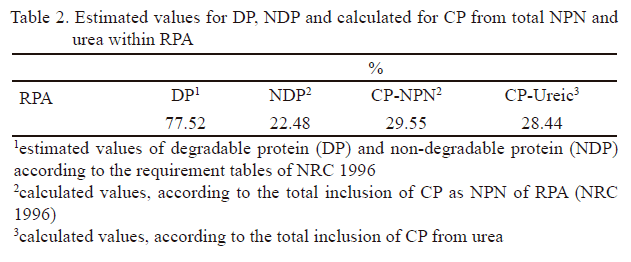
<p align="justify" class="Cuerpodetexto" style="margin-top:5.95pt;text-indent:0cm;"><span style="font-family:'Verdana','sans-serif'; font-size:10.0pt; "><a href="/img/revistas/cjas/v50n2/t0205216.gif">Table 2</a> presents the estimated mean composition of the  activator, which is similar to some recommendations of different authors for  this type of protein supplement. Before, Koster <em>et al.</em> (1997) determined  that, when the amount of urea exceeds 75% of the total equivalent of degradable  protein (DP), the response of all the criteria on forage intake, digestion of  OM and NDF have a quadratic and substantial decrease. Therefore, the maximum  point recommended for substitution is 50 %. For this RPA, the maximum amount of  used urea from the total equivalent of DP was 37 %, maintained among the  recommended limits. K&ocirc;ster <em>et al.</em> (1997),&nbsp; from the results cited before, determined a  minimum limit of    25 %, equivalent to supplementary DP, which should come from true protein to  maximize intake and digestion of forage. For this RPA, it was 62 %, over the  minimum recommended limit.</span></p>     
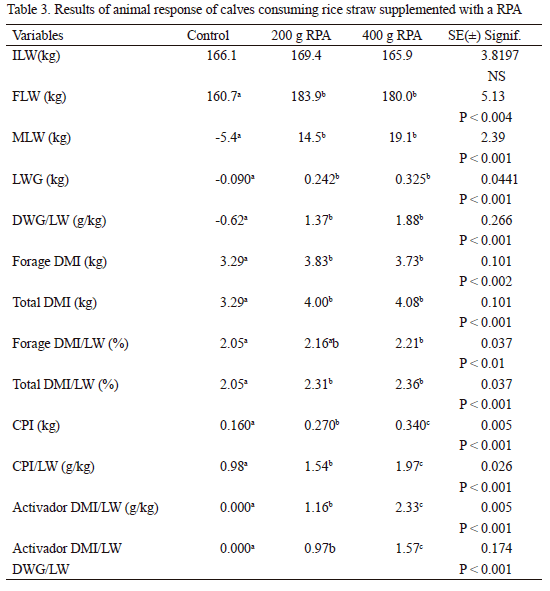
<p align="justify" class="Cuerpodetexto" style="margin-top:5.95pt;text-indent:0cm;"><em><span style="font-family:'Verdana','sans-serif'; font-size:10.0pt; ">In vivo</span></em><span style="font-family:'Verdana','sans-serif'; font-size:10.0pt; "> estimations, conducted by Balbuena <em>et al.</em> (2002),  determined degradation levels of CP, close to 60 % of cotton and soy bean  pellets, and next to 85 % for sunflower pellets. These values are very close to  those used for calculating the RPA in this    experiment.</span><span style="font-family:'Verdana','sans-serif'; font-size:10.0pt; "> </span></p>     <p align="justify" class="Cuerpodetexto" style="margin-top:5.95pt;text-indent:0cm;"><span style="font-family:'Verdana','sans-serif'; font-size:10.0pt; "><a href="/img/revistas/cjas/v50n2/t0305216.gif">Table 3</a> shows the results of animal  response. Regarding the analysis of initial liveweight (ILW), there were no  differences among treatments. According to final liveweight (FLW), there was a  decrease in the control group, unlike those consuming RPA. These last  registered an increase of LW during the evaluated period, without differences  among doses. The average FLW of both treatments was 182 kg, enough to exploit,  in quantity and quality, the high forage production, taking place at the end of  winter, which enables a compensatory growth with high LW gains.</span> </p>     
<p align="justify" class="Cuerpodetexto" style="margin-top:5.95pt;text-indent:0cm;"><span style="font-family:'Verdana','sans-serif'; font-size:10.0pt; ">Regarding weight  difference (MLW), registered by the control group, it lost 5 kg of LW as  average, similar values to those reported for mature forages during the winter  period in grasslands from Chaco H&uacute;medo Argentino (Peruchena and D&rsquo;Ascanio  1992a). The supplemented groups increased between 14 and 19 kg of LW, with an  average difference, regarding the control, of 21.5 kg. With similar forage  bases, which are poor in CP (+ 4 %), for mature or frozen grasslands, but at  the field, with implicit harvest cost in post weaning animals, the registered  losses were superior, between 10 and    20 kg of weight, for a similar winter period (Peruchena and D&rsquo;Ascanio 1992b). </span></p>     <p align="justify" class="Cuerpodetexto" style="margin-top:5.95pt;text-indent:0cm;"><span style="font-family:'Verdana','sans-serif'; font-size:10.0pt; ">Daily weight gains (DWG) differed between the control  and supply of activators (200 and    400 g.animal<sup>-1</sup>.d<sup>-1</sup>). However, there were no differences  among the used doses. Therefore, the doses of  200 g.animal<sup>-1</sup>.d<sup>-1</sup> should be considered as the most  convenient, from an economic point of view, which could also be expressed as  1.37 g of daily weight gain per kilogram of LW for those doses. </span></p>     <p align="justify" class="Cuerpodetexto" style="margin-top:5.95pt;text-indent:0cm;"><span style="font-family:'Verdana','sans-serif'; font-size:10.0pt; ">Balbuena <em>et al.</em> (2011) found  in calves grazing <em>Dichantium caricosum</em> a higher weight gain, after  supplementing with cotton and soy bean pellets (682 and 626 g.animal.d<sup>-1</sup>),  regarding the use of sunflower pellets (531 g.animal<sup>-1</sup>.d<sup>-1</sup>),  respectively.&nbsp; It is possible that  differences obtained between this experiment and that conducted by Balbuena <em>et  al.</em> (2011), are because of the use of calves grazing with the possibility  of selecting a different material, with better nutritional quality and the  possibility of selecting a different feed. In addition, the intake of protein  supplement was provided in a higher amount: 3 g of byproduct per kilogram of LW  as average.</span><span style="font-family:'Verdana','sans-serif'; font-size:10.0pt; "> </span></p>     ]]></body>
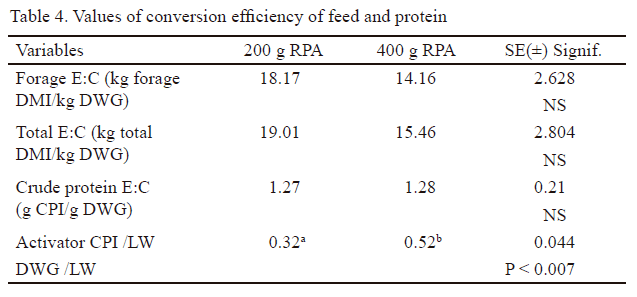
<body><![CDATA[<p align="justify" class="Cuerpodetexto" style="margin-top:5.95pt;text-indent:0cm;"><span style="font-family:'Verdana','sans-serif'; font-size:10.0pt; ">Intake of total (total DMI) and forage dry matter  (forage DMI) showed a tendency similar to previous results, being both superior  for the treatments supplemented with different doses of RPA regarding the  control. Mean increase was 16% for forage DMI and 21% for total DMI. It is  possible that the lack of differences in forage DMI.kg<sup>-1</sup>.PV<sup>-1</sup>,  obtained among the calves fed only rice straw and those receiving the lowest  dose of the supplement, was caused by low CP intake (0.160 and 0.270 kg,  respectively) of both groups, related to the low concentration of CP, of both  diets (4.86 and 61 %) respectively.</span></p>     <p align="justify" class="Cuerpodetexto" style="margin-top:5.95pt;text-indent:0cm;"><span style="font-family:'Verdana','sans-serif'; font-size:10.0pt; ">It is known that, according to El&iacute;as (1983),  intake of fibrous forages of CP content below 7% decreases and, due to high  crude fiber content, digestibility of organic matter is limited by the low  availability of amino acid or ammonia nitrogen for ruminal cellulolytic  bacteria. In contrast, when animals fed those forages receive  energy-protein-mineral supplementation, which reaches a protein concentration  of the diet superior to 7% diet, the animals increase the DMI and DWG (Preston  1995, Galina <em>et al.</em> 1997, Delgado <em>et al.</em> 2002). Therefore,  sufficient amounts of protein and energy should be provided for increasing  forage digestion and NPN utilization (El&iacute;as 1983), as happened with the highest  forage intake in absolute and relative values in animals that consumed higher  amounts RPA (8.33% CP), compared to those that consumed only rice    straw.</span><span style="font-family:'Verdana','sans-serif'; font-size:10.0pt; "> </span></p>     <p align="justify" class="Cuerpodetexto" style="margin-top:5.95pt;text-indent:0cm;"><span style="font-family:'Verdana','sans-serif'; font-size:10.0pt; ">These results coincide with those  stated by several authors, who indicated that the addition of protein to low  quality forages provokes an increase of voluntary intake of animals (K&ouml;ster <em>et  al.</em> 1996). Heldt <em>et al.</em> (1997), conducting studies with casein and  different energy sources, obtained a similar response to Olson <em>et al.</em> (1997). These authors reported 72% optimal increases of digestible organic  matter intake (DOMI) regarding the control, and 27% when comparing high and low  CP intake. In addition, these authors concluded that the positive effect of  supplementation with CP in DOMI was caused by the increased of digestion and  forage intake. This agrees with the information provided by Minson (1990), who  in reviewing supplementation studies found that true protein and non-protein  nitrogen were able to stimulate forage intake.</span><span style="font-family:'Verdana','sans-serif'; font-size:10.0pt; "> </span></p>     <p align="justify" class="Cuerpodetexto" style="margin-top:5.95pt;text-indent:0cm;"><span style="font-family:'Verdana','sans-serif'; font-size:10.0pt; ">Forage DMI, in percent of animal LW (forage    DMI/LW), was similar between control and the lowest dose of the supplement, but  different with respect to that using the highest dose.</span></p>     <p align="justify" class="Cuerpodetexto" style="margin-top:5.95pt;text-indent:0cm;"><span style="font-family:'Verdana','sans-serif'; font-size:10.0pt; ">Regarding total dry matter intake, in percent of animal  liveweight (totalDMI/LW), the same tendency of the previous case was found.  There were differences between control and treatments with supplements, but  there were no differences among doses.</span></p>     <p align="justify" class="Cuerpodetexto" style="margin-top:5.95pt;text-indent:0cm;"><span style="font-family:'Verdana','sans-serif'; font-size:10.0pt; ">Total intake of crude protein  (ICP), and related to liveweight (ICP/LW), was different among treatments and  increased as the RPA dose increased. Bailey <em>et al.</em> (2012) found positive  results in cattle receiving increased doses of intra-ruminal casein on a  natural pasture hay (5.8% CP), which increased the ruminal concentration of NH<sub>3</sub>,  acetate and propionate. They also increased pH, with higher flow of microbial N,  when it passed fro</span><span style="font-family:'Verdana','sans-serif'; font-size:10.0pt; ">m 120 to 240 g.d<sup>-1</sup><span style="letter-spacing:.2pt; "> casein as DP. Unlike the doses used in this study,  which were between 134 (173 g activator ICP x    77.52 % activator DP) and 268 g (346 g activator CP x  77.52 % activator DP) of DP per head and per day, the studies of Bailey <em>et  al.</em> (2012) had no differential animal response in contrast with the  positive results of ruminal fermentation.&nbsp;&nbsp;&nbsp; </span></span></p>     <p align="justify" class="Cuerpodetexto" style="margin-top:5.95pt;text-indent:0cm;"><span style="font-family:'Verdana','sans-serif'; font-size:10.0pt; ">Sawyer <em>et al.</em> (2012) evaluated different types  of protein (high and low ruminal degradability) at low levels of  supplementation in diets based on hay, and found no responses to doses lower  than 160 g.day<sup>-1</sup> of CP in the use of N and NDF digestibility, apart  from the type of protein. However, with doses close to 390 g CP day<sup>-1</sup> of cotton seed meal, concentrations of ruminal ammonia, ureic N and blood  glucose increased, as well as DM degradability</span></p>     <p align="justify" class="Cuerpodetexto" style="margin-top:5.95pt;text-indent:0cm;"><span style="font-family:'Verdana','sans-serif'; font-size:10.0pt; ">After analyzing the efficiency of utilization of the  activator regarding weight gain reached by the animals (activator  DMI/LW/DWG/LW), and considering the doses of 200 g of RPA as the most efficient  with DWG and total intake of forage (there were no significant differences with  400 g of RPA), an efficiency of utilization of the supplement of 1:1 was  obtained. This represents 1g of RPA per 1 g of gained liveweight. Revising  different studies from different authors (Balbuena <em>et al.</em> 2002, Barbera <em>et  al.</em> 2011, Rochinotti <em>et al.</em>&nbsp;  2011, Sampedro <em>et al.</em> 2004), it was concluded that average  response to different protein supplements, especially those of sunflower, soy  bean and cotton pellets, ranges between 2.2 and 2.5 g of supplement per 1g of  gained LW. This means that from 1 to 1.5 g more of the supplement may be used  to reach the response obtained in this study.&nbsp; </span></p>     <p align="justify" class="Cuerpodetexto" style="margin-top:5.95pt;text-indent:0cm;"><span style="font-family:'Verdana','sans-serif'; font-size:10.0pt; ">The conducted analysis has an important economic effect  because cited authors recommend a contribution close to 400g of supplementary  protein. However, variations on the composition of oleaginous by-products  provoke instability of the required amounts of this by-products (D&rsquo;Ascanio and  Peruchena 1992). Therefore, this may double or triple the costs of  supplementation with low quality forages at the moment of its implementation.  In addition, other costs should be considered, like those related to management  and infrastructure (storage, distribution, supply and some others).&nbsp;&nbsp;&nbsp;&nbsp; </span></p>     <p align="justify" class="Cuerpodetexto" style="margin-top:5.95pt;text-indent:0cm;"><span style="font-family:'Verdana','sans-serif'; font-size:10.0pt; "><a href="/img/revistas/cjas/v50n2/t0405216.gif">Table 4</a> shows the efficiency of  food conversion. There were no significant differences between both doses of  the activator for any of the determined indicators, neither for forage matter  intake nor for total or crude protein on daily weight gain. The most convenient  dose was supplementation with 200 g of RPA for animals of 160 kg of mean LW,  fed rice straw rolls. Thus, crude protein intake of activator/kg of gained  weight was different between both doses. The best efficiency of utilization was  obtained with 200 g of RPA. </span> </p>     
]]></body>
<body><![CDATA[<p align="justify" class="Cuerpodetexto" style="margin-top:5.95pt;text-indent:0cm;"><span style="font-family:'Verdana','sans-serif'; font-size:10.0pt; ">From the production technology, and according to  performance and physiochemical characteristics of the RPA, animals consume it  entire or, mainly, in particles of big size. Due to its high content of CP and  DP and its associative composition among different sources of protein meals,  urea, molasses and minerals, it may be inferred that high response to  supplementation with this activator is determined by slow and synchronic  release of its nutrients to ruminal ecosystem. In order to debate this fact,  there is a suggestion to consider first nutritional processes: nutrition of  ruminal microbial population as an element, and nutrition of the host as  another element, although they are together in their practical application.  This way, it was demonstrated that ruminal microorganisms need important  nutrients that allow their development (El&iacute;as 1971, Wallace and Newbold    1993).</span></p>     <p align="justify" class="Cuerpodetexto" style="margin-top:5.95pt;text-indent:0cm;"><span style="font-family:'Verdana','sans-serif'; font-size:10.0pt; ">Some researchers propose the manipulation of rumen to  develop a favorable ecosystem that facilitates the increase of total volatile  fatty acids, mainly propionic acid (Ortiguez-Marty and Majdowb 2003), through  the supply of degradable protein in the rumen (El&iacute;as 1983, El-Kadi <em>et al.</em> 2003), starch (Voigt <em>et al.</em> 2003) and long chain fatty acids (Voigt <em>et  al.</em> 2003). It was also suggested the control of protozoa and the increase  of structural carbohydrate digestion through physical and chemical treatment of  forages and addition of fermentable nitrogen (urea, ammonia) accompanied by  micronutrients like sulfur, phosphorus, amino acids and peptides&nbsp; (El&iacute;as 1971). </span></p>     <p align="justify" class="Cuerpodetexto" style="margin-top:5.95pt;text-indent:0cm;"><span style="font-family:'Verdana','sans-serif'; font-size:10.0pt; ">The main problem of this technique  lies on making possible that rumen to reach its optimal useful condition in a  cellulosic environment, from low quality forages. This demonstrates that, with  the union of cited technological elements, it is possible to optimize the use  of forage, focusing on the useful condition of the ruminal ecosystem in the  portion of higher fermentative condition that may be reached in degradation of  grass cellulose for benefiting animals and humans.</span><span style="font-family:'Verdana','sans-serif'; font-size:10.0pt; "> </span></p>     <p align="justify" class="Cuerpodetexto" style="margin-top:5.95pt;text-indent:0cm;"><span style="font-family:'Verdana','sans-serif'; font-size:10.0pt; ">The use of RPA improved the  productive response of calves fed rice straw due to the increase of intake of  forage, total dry matter and crude protein, as well as improving conversion of  these productive indicators</span><font size="2" face="Verdana, Arial, Helvetica, sans-serif">.</font></p>     <p align="justify">&nbsp;</p>     <p align="justify"><font size="2" face="Verdana, Arial, Helvetica, sans-serif"><font size="3"><b>REFERENCES</b></font></font></p>     <p align="justify" class="MsoBibliography" style="margin-top:12.0pt;margin-right:0cm;margin-bottom:5.95pt;margin-left:0cm;text-align:justify;"><span style="line-height:115%; font-family:'Verdana','sans-serif'; font-size:10.0pt; ">Bailey, E. A., Titgemeyer, E. C.,  Olson, K. C., Brake, D. W., Jones, M. L. &amp; Anderson, D. E. 2012. &ldquo;Effects  of supplemental energy and protein on forage digestion and urea kinetics in  growing beef cattle&rdquo;. <em>Journal of Animal Science</em>, 90 (10): 3492&ndash;3504,  ISSN: 1525-3163, DOI: 10.2527/jas.2011-4458.</span></p>     <p align="justify" class="MsoBibliography" style="margin-top:12.0pt;margin-right:0cm;margin-bottom:5.95pt;margin-left:0cm;text-align:justify;"><span style="font-family:'Verdana','sans-serif'; font-size:10.0pt; ">Balbuena, O., Kucseva, C. D.,  Arakaki, C. L., Stahringer, R. C. &amp; Velazco, G. A. 2000. </span><span style="font-family:'Verdana','sans-serif'; font-size:10.0pt; ">&ldquo;Fuentes de prote&iacute;na en la  suplementaci&oacute;n invernal de la recr&iacute;a de bovinos en pasturas subtropicales&rdquo;. <em>Revista  Argentina de Producci&oacute;n Animal</em>, 20 (Supl 1): 62&ndash;63, ISSN: 0326-0550,  2314-324X.</span></p>     <p align="justify" class="MsoBibliography" style="margin-top:12.0pt;margin-right:0cm;margin-bottom:5.95pt;margin-left:0cm;text-align:justify;"><span style="font-family:'Verdana','sans-serif'; font-size:10.0pt; ">Balbuena, O., Rochinotti, D., Arakaki, C. L., Kucseva, C.  D., Somma,&nbsp; de F. G. R., Slanac, A. L.  &amp; Koza, G. A. 2002. &ldquo;Efecto de la suplementaci&oacute;n proteica sobre la  digestibilidad y flujo nitrogenado en novillos consumiendo pasto estrella&rdquo;. <em>Revista  Argentina de Producci&oacute;n Animal</em>, 22 (1): 13, ISSN: 0326-0550, 2314-324X.</span></p>     <p align="justify" class="MsoBibliography" style="margin-top:12.0pt;margin-right:0cm;margin-bottom:5.95pt;margin-left:0cm;text-align:justify;"><span style="font-family:'Verdana','sans-serif'; font-size:10.0pt; ">Barbera, P. &amp; Sampedro, D. H. 2010. &ldquo;Suplementaci&oacute;n con  diferentes fuentes proteicas de novillitos a corral, consumiendo heno de paja  de arroz&rdquo;. <em>Revista Argentina de Producci&oacute;n Animal</em>, 30 (1): 488&ndash;489,  ISSN: 0326-0550, 2314-324X.</span></p>     ]]></body>
<body><![CDATA[<p align="justify" class="MsoBibliography" style="margin-top:12.0pt;margin-right:0cm;margin-bottom:5.95pt;margin-left:0cm;text-align:justify;"><span style="font-family:'Verdana','sans-serif'; font-size:10.0pt; ">Chiossone, G. O. 2011. &ldquo;Pastizales naturales de Argentina&rdquo;.  In: <em>IX Congreso Internacional de Pastizales</em>, Santa Fe, Argentina: INTA y  La Asociaci&oacute;n Argentina de Pastizales (AAMPN), Available:  &lt;<a href="http://www.pregonagropecuario.com/cat.php?txt=2027" target="_blank">http://www.pregonagropecuario.com/cat.php?txt=2027</a>&gt;,  [Consulted:&nbsp;April 4, 2016].</span></p>     <!-- ref --><p align="justify" class="MsoBibliography" style="margin-top:12.0pt;margin-right:0cm;margin-bottom:5.95pt;margin-left:0cm;text-align:justify;"><span style="font-family:'Verdana','sans-serif'; font-size:10.0pt; ">D&acute;Ascanio, G. 2014. <em>Formulaci&oacute;n aceleradora de la  celul&oacute;lisis ruminal</em>. no. INPI P-265/03, Inst. Instituto Nacional de la  Propiedad Industrial. Administraci&oacute;n Nacional de Patentes, Rep&uacute;blica Argentina.    </span></p>     <p align="justify" class="MsoBibliography" style="margin-top:12.0pt;margin-right:0cm;margin-bottom:5.95pt;margin-left:0cm;text-align:justify;"><span style="font-family:'Verdana','sans-serif'; font-size:10.0pt; ">del Curto, T., Hess, B. W., Huston,  J. E. &amp; Olson, K. C. 2000. &ldquo;Optimum supplementation strategies for beef  cattle consuming low-quality roughages in the western United States&rdquo;. <em>Journal  of Animal Science</em>, 77: 1&ndash;16, ISSN: 0021-8812, 1525-3163.</span></p>     <p align="justify" class="MsoBibliography" style="margin-top:12.0pt;margin-right:0cm;margin-bottom:5.95pt;margin-left:0cm;text-align:justify;"><span style="font-family:'Verdana','sans-serif'; font-size:10.0pt; ">Delgado, A., Crespo, G., El&iacute;as, A.  &amp; Yanes, A. 2002. &ldquo;Fattening of grazing yearlings with molasses/urea  supplementation&rdquo;. <em>Cuban Journal of Agricultural Science</em>, 36 (1): 43&ndash;47,  ISSN: 2079-3480.</span></p>     <!-- ref --><p align="justify" class="MsoBibliography" style="margin-top:12.0pt;margin-right:0cm;margin-bottom:5.95pt;margin-left:0cm;text-align:justify;"><span style="font-family:'Verdana','sans-serif'; font-size:10.0pt; ">Di Rienzo, J. A., Casanoves, F.,  Balzarini, M. G., Gonz&aacute;lez, L., Tablada, M. &amp; Robledo, C. W. 2012. </span><em><span style="font-family:'Verdana','sans-serif'; font-size:10.0pt; ">InfoStat</span></em><span style="font-family:'Verdana','sans-serif'; font-size:10.0pt; ">. version 2012, [Windows], Universidad  Nacional de C&oacute;rdoba, Argentina: Grupo InfoStat, Available:  &lt;<a href="http://www.infostat.com.ar/" target="_blank">http://www.infostat.com.ar/</a>&gt;    .</span></p>     <p align="justify" class="MsoBibliography" style="margin-top:12.0pt;margin-right:0cm;margin-bottom:5.95pt;margin-left:0cm;text-align:justify;"><span style="font-family:'Verdana','sans-serif'; font-size:10.0pt; ">Elias, A. 1971. <em>The rumen  bacteria of animals feed on a high&ndash;molasses-urea-diets</em>. </span><span style="font-family:'Verdana','sans-serif'; font-size:10.0pt; ">Ph.D. Thesis, University of Aberdeen,  Escocia.</span></p>     <p align="justify" class="MsoBibliography" style="margin-top:12.0pt;margin-right:0cm;margin-bottom:5.95pt;margin-left:0cm;text-align:justify;"><span style="font-family:'Verdana','sans-serif'; font-size:10.0pt; ">El&iacute;as, A. 1983. &ldquo;Digesti&oacute;n de pastos y forrajes tropicales&rdquo;.  In: Ugarte J., Herrera R., Ruiz R., Garc&iacute;a R., V&aacute;zquez C. &amp; Senra A.  (eds.), <em>Los pastos en Cuba</em>, vol. 2, La Habana, Cuba: Instituto de  Ciencia Animal, pp. 187&ndash;246, Available:  &lt;<a href="http://www.sidalc.net/cgi-bin/wxis.exe/?IsisScript=catalco.xis&method=post&formato=2&cantidad=1&expresion=mfn=030111" target="_blank">http://www.sidalc.net/cgi-bin/wxis.exe/?IsisScript=catalco.xis&amp;method=post&amp;formato=2&amp;cantidad=1&amp;expresion=mfn=030111</a>&gt;,  [Consulted:&nbsp;March 2, 2016].</span></p>     <p align="justify" class="MsoBibliography" style="margin-top:12.0pt;margin-right:0cm;margin-bottom:5.95pt;margin-left:0cm;text-align:justify;"><span style="font-family:'Verdana','sans-serif'; font-size:10.0pt; ">El-Kadi, S. W., Sunny, N. E., Oba,  M., Owens, S. L. &amp; Bequette, B. J. 2003. &ldquo;Glucose metabolism by the  gastrointestinal tract of sheep as affected by protein supply&rdquo;. In: Souffrant  W. B. &amp; Metges C. C., <em>Progress in Research on Energy and Protein  Metabolism</em>, Netherlands: Wageningen Academic Pub, pp. 401&ndash;405, ISBN:  978-90-76998-24-4.</span></p>     ]]></body>
<body><![CDATA[<p align="justify" class="MsoBibliography" style="margin-top:12.0pt;margin-right:0cm;margin-bottom:5.95pt;margin-left:0cm;text-align:justify;"><span style="font-family:'Verdana','sans-serif'; font-size:10.0pt; ">Galina, M. A., Pineda, J., Rosado, J., Aguilar, A., Puga,  C., Rubio, C. &amp; Murillo, J. C. 1997. </span><span style="font-family:'Verdana','sans-serif'; font-size:10.0pt; ">&ldquo;Fattening of  steers zebu+ F1 cross feed high fermentable carbohydrate diet of a continuous  non-protein nitrogen and by-pass protein supplement&rdquo;. <em>Advance Agricultural  Research</em>, 6 (3): 22&ndash;32, ISSN: 2053-1265.</span></p>     <!-- ref --><p align="justify" class="MsoBibliography" style="margin-top:12.0pt;margin-right:0cm;margin-bottom:5.95pt;margin-left:0cm;text-align:justify;"><span style="font-family:'Verdana','sans-serif'; font-size:10.0pt; ">Goering, H. K. &amp; van Soest, P.  J. 1970. <em>Forage fiber analyses (apparatus, reagents, procedures, and some  applications)</em>. (ser. Agriculture Handbook, no. ser. 379), Washington, DC.,  USA: U.S. Agricultural Research Service, 24 p.    </span></p>     <p align="justify" class="MsoBibliography" style="margin-top:12.0pt;margin-right:0cm;margin-bottom:5.95pt;margin-left:0cm;text-align:justify;"><span style="font-family:'Verdana','sans-serif'; font-size:10.0pt; ">Heldt, J. S., Cochran, R. C.,  Mathis, C. P., Woods, B. C., Stokka, G. L., Olson, K. C., Titgemeyer, E. C.  &amp; Nagaraja, T. G. 1997. &ldquo;Evaluation of the effects of carbohydrate source  and level of degradable intake protein on the intake and digestion of  tallgrass-prairie hay by beef steers&rdquo;. In: <em>Cattlemen&rsquo;s Day</em>, Manhattan,  KS: Kansas State University. Agricultural Experiment Station and Cooperative  Extension Service, pp. 60&ndash;62, Available:  &lt;<a href="http://krex.k-state.edu/dspace/handle/2097/4816" target="_blank">http://krex.k-state.edu/dspace/handle/2097/4816</a>&gt;,  [Consulted:&nbsp;February 16, 2016].</span></p>     <p align="justify" class="MsoBibliography" style="margin-top:12.0pt;margin-right:0cm;margin-bottom:5.95pt;margin-left:0cm;text-align:justify;"><span style="font-family:'Verdana','sans-serif'; font-size:10.0pt; ">K&ouml;ster, H. H., Cochran, R. C.,  Titgemeyer, E. C., Vanzant, E. S., Abdelgadir, I. &amp; St-Jean, G. 1996.  &ldquo;Effect of increasing degradable intake protein on intake and digestion of  low-quality, tallgrass-prairie forage by beef cows&rdquo;. <em>Journal of Animal  Science</em>, 74 (10): 2473&ndash;2481, ISSN: 0021-8812, DOI: /1996.74102473x.</span></p>     <p align="justify" class="MsoBibliography" style="margin-top:12.0pt;margin-right:0cm;margin-bottom:5.95pt;margin-left:0cm;text-align:justify;"><span style="font-family:'Verdana','sans-serif'; font-size:10.0pt; ">K&ouml;ster, H. H., Cochran, R. C.,  Titgemeyer, E. C., Vanzant, E. S., Nagaraja, T. G., Kreikemeier, K. K. &amp; St  Jean, G. 1997. &ldquo;Effect of increasing proportion of supplemental nitrogen from  urea on intake and utilization of low-quality, tallgrass-prairie forage by beef  steers&rdquo;. <em>Journal of Animal Science</em>, 75 (5): 1393&ndash;1399, ISSN: 0021-8812,  DOI: /1997.7551393x.</span></p>     <!-- ref --><p align="justify" class="MsoBibliography" style="margin-top:12.0pt;margin-right:0cm;margin-bottom:5.95pt;margin-left:0cm;text-align:justify;"><span style="font-family:'Verdana','sans-serif'; font-size:10.0pt; ">Latimer, G. W. 2012. <em>Official  Methods of Analysis of AOAC International</em>. 19th ed., Gaithersburg, Md.:  AOAC International, ISBN: 978-0-935584-83-7, Available:  &lt;<a href="http://www.amazon.com/Official-Methods-Analysis-OFFICIAL-ANALYSIS/dp/0935584838/ref=pd_sim_sbs_14_1?ie=UTF8&dpID=31iikC-xl2L&dpSrc=sims&preST=_AC_UL160_SR160%2C160_&refRID=101AB94246X0EM9N7XMW" target="_blank">http://www.amazon.com/Official-Methods-Analysis-OFFICIAL-ANALYSIS/dp/0935584838/ref=pd_sim_sbs_14_1?ie=UTF8&amp;dpID=31iikC-xl2L&amp;dpSrc=sims&amp;preST=_AC_UL160_SR160%2C160_&amp;refRID=101AB94246X0EM9N7XMW</a>&gt;,  [Consulted:&nbsp;April 1, 2016].    </span></p>     <p align="justify" class="MsoBibliography" style="margin-top:12.0pt;margin-right:0cm;margin-bottom:5.95pt;margin-left:0cm;text-align:justify;"><span style="font-family:'Verdana','sans-serif'; font-size:10.0pt; ">L&oacute;pez, V. S., Flores, A. J., Sampedro, D., Celcer, R. R.  &amp; G&oacute;mez, M. 2010. &ldquo;Evaluaci&oacute;n de fuentes proteicas en suplementaci&oacute;n  invernal de vaquillas de reposici&oacute;n&rdquo;. <em>Revista Argentina de Producci&oacute;n Animal</em>,  30 (Supl. 1): 489&ndash;490, ISSN: 2314-324x, 0326-0550.</span></p>     <!-- ref --><p align="justify" class="MsoBibliography" style="margin-top:12.0pt;margin-right:0cm;margin-bottom:5.95pt;margin-left:0cm;text-align:justify;"><span style="font-family:'Verdana','sans-serif'; font-size:10.0pt; ">Minson, D. J. 1990. </span><em><span style="font-family:'Verdana','sans-serif'; font-size:10.0pt; ">Forage in  ruminant nutrition</span></em><span style="font-family:'Verdana','sans-serif'; font-size:10.0pt; ">. Academic Press, 520 p., ISBN: 978-0-12-498310-6.    </span></p>     <p align="justify" class="MsoBibliography" style="margin-top:12.0pt;margin-right:0cm;margin-bottom:5.95pt;margin-left:0cm;text-align:justify;"><span style="font-family:'Verdana','sans-serif'; font-size:10.0pt; ">National Research Council (NRC)  1996. <em>Nutrient Requirements of Beef Cattle</em>. 7th ed., Washington, D.C.:  National Academies Press, ISBN: 978-0-309-06934-2, Available: &lt;<a href="http://www.nap.edu/catalog/9791" target="_blank">http://www.nap.edu/catalog/9791</a>&gt;,  [Consulted:&nbsp;May 19, 2016].</span></p>     <p align="justify" class="MsoBibliography" style="margin-top:12.0pt;margin-right:0cm;margin-bottom:5.95pt;margin-left:0cm;text-align:justify;"><span style="font-family:'Verdana','sans-serif'; font-size:10.0pt; ">Olson, K. C., Cochran, R. C., Jones,  T. J., Vanzant, E. S. &amp; Titgemeyer, E. C. 1997. &ldquo;Effects of various  supplemental starch and protein levels on ruminal fermentation and liquid  passage of beef steers fed tallgrass-prairie hay&rdquo;. In: <em>Cattlemen&rsquo;s Day</em>,  Manhattan, KS: Kansas State University. Agricultural Experiment Station and  Cooperative Extension Service, pp. 53&ndash;55, Available:  &lt;<a href="http://krex.k-state.edu/dspace/handle/2097/4813" target="_blank">http://krex.k-state.edu/dspace/handle/2097/4813</a>&gt;,  [Consulted:&nbsp;February 16, 2016].</span></p>     <p align="justify" class="MsoBibliography" style="margin-top:12.0pt;margin-right:0cm;margin-bottom:5.95pt;margin-left:0cm;text-align:justify;"><span style="font-family:'Verdana','sans-serif'; font-size:10.0pt; ">Ortiguez, M., J. &amp; Majdoub, L. 2003. </span><span style="font-family:'Verdana','sans-serif'; font-size:10.0pt; ">&ldquo;Ruminal acetate  propionante pattern and nitrogenous fluxes across splanchnic and hind limb tissues  in growing lambs&rdquo;. In: Souffrant W. B. &amp; Metges C. C., <em>Progress in  Research on Energy and Protein Metabolism</em>, Wageningen Academic Pub, pp.  213&ndash;217, ISBN: 978-90-76998-24-4.</span></p>     <p align="justify" class="MsoBibliography" style="margin-top:12.0pt;margin-right:0cm;margin-bottom:5.95pt;margin-left:0cm;text-align:justify;"><span style="font-family:'Verdana','sans-serif'; font-size:10.0pt; ">Peruchena, C. O. &amp; D&rsquo;Ascanio, G. 1992. &ldquo;Suplementaci&oacute;n  energ&eacute;tico-proteica de bovinos para carne en el centro-norte santafesino&rdquo;. <em>Revista  Argentina de Producci&oacute;n Animal</em>, 12 (supl. 1): 41&ndash;52, ISSN: 0326-0550,  2314-324X.</span></p>     <!-- ref --><p align="justify" class="MsoBibliography" style="margin-top:12.0pt;margin-right:0cm;margin-bottom:5.95pt;margin-left:0cm;text-align:justify;"><span style="font-family:'Verdana','sans-serif'; font-size:10.0pt; ">Preston, T. R. 1995. <em>Tropical  animal feeding. A manual for research works</em>. Rome: Food and Agriculture  Organization of the United Nations (FAO), ISBN: 92-5-103758-2, Available: &lt;<a href="http://www.fao.org/docrep/003/v9327e/v9327e00.HTM" target="_blank">http://www.fao.org/docrep/003/v9327e/v9327e00.HTM</a>&gt;,  [Consulted:&nbsp;April 4, 2016].    </span></p>     <p align="justify" class="MsoBibliography" style="margin-top:12.0pt;margin-right:0cm;margin-bottom:5.95pt;margin-left:0cm;text-align:justify;"><span style="font-family:'Verdana','sans-serif'; font-size:10.0pt; ">Rossanigo, M. V. C., Arano, P. A. A. &amp; V&aacute;zquez, G. R.  2012. &ldquo;Stock 2012 del ganado bovino&rdquo;. <em>Informaci&oacute;n T&eacute;cnica</em>, (187): 3&ndash;16,  ISSN: 0327-425X.</span></p>     <p align="justify" class="MsoBibliography" style="margin-top:12.0pt;margin-right:0cm;margin-bottom:5.95pt;margin-left:0cm;text-align:justify;"><span style="font-family:'Verdana','sans-serif'; font-size:10.0pt; ">Sawyer, J. E., Mulliniks, J. T., Waterman,  R. C. &amp; Petersen, M. K. 2012. &ldquo;Influence of protein type and level on  nitrogen and forage use in cows consuming low-quality forage&rdquo;. <em>Journal of  Animal Science</em>, 90 (7): 2324&ndash;2330, ISSN: 0021-8812, 1525-3163, DOI:  10.2527/jas.2011-4782.</span></p>     <p align="justify" class="MsoBibliography" style="margin-top:12.0pt;margin-right:0cm;margin-bottom:5.95pt;margin-left:0cm;text-align:justify;"><span style="font-family:'Verdana','sans-serif'; font-size:10.0pt; ">Voigt, J., Gaafar, K., Hagemeister,  H., Kanitz, W. &amp; Precht, D. 2003. &ldquo;Fat vs. starch as energy sources in  diets for high yielding lactating dairy cows&rdquo;. In: Soufrant W. B. &amp; Metges  C. C. (eds.), <em>Progress in research on energy and protein metabolism.  International Symposium</em>, Rostock-Warnem&uuml;nde, Germany: Wageningen Academic  Publishers, pp. 445&ndash;448, ISBN: 90-76998-24-8.</span></p>     ]]></body>
<body><![CDATA[<p align="justify" class="MsoBibliography" style="margin-top:12.0pt;margin-right:0cm;margin-bottom:5.95pt;margin-left:0cm;text-align:justify;"><span style="font-family:'Verdana','sans-serif'; font-size:10.0pt; ">Wallace, R. J. &amp; Newbold, C. J. 1994. &ldquo;Rumer  fermentation and its manipulation: the development of yeast cutures as feed  additives&rdquo;. In: Lyons T. P. &amp; Jacques K. A., <em>Biotechnology in the Feed  Industry: Proceedings of Alltech&rsquo;s 10th Annuel Symposium</em>, Loughborough,  England: Nottingham University Press, p. 173, ISBN: 978-1-897676-51-6</span><font size="2" face="Verdana, Arial, Helvetica, sans-serif">.</font></p>     <p align="justify">&nbsp;</p>     <p align="justify">&nbsp;</p>     <p align="justify"><font size="2" face="Verdana, Arial, Helvetica, sans-serif">Received: 15/5/2015    <br>   Accepted: 30/6/2016</font></p>     <p align="justify">&nbsp;</p>     <p align="justify">&nbsp;</p>     <p align="justify"><font size="2" face="Verdana, Arial, Helvetica, sans-serif"><i>G. N. D’Ascanio,</i> NUTREZA SRL, Ruta 11, km 751. (3572) Malabrigo, Santa Fe, Argentina.    Email: <a href="mailto:www.nutreza.com.ar">www.nutreza.com.ar</a></font></p>      ]]></body><back>
<ref-list>
<ref id="B1">
<nlm-citation citation-type="journal">
<person-group person-group-type="author">
<name>
<surname><![CDATA[Bailey]]></surname>
<given-names><![CDATA[E. A.]]></given-names>
</name>
<name>
<surname><![CDATA[Titgemeyer]]></surname>
<given-names><![CDATA[E. C.]]></given-names>
</name>
<name>
<surname><![CDATA[Olson]]></surname>
<given-names><![CDATA[K. C.]]></given-names>
</name>
<name>
<surname><![CDATA[Brake]]></surname>
<given-names><![CDATA[D. W.]]></given-names>
</name>
<name>
<surname><![CDATA[Jones]]></surname>
<given-names><![CDATA[M. L.]]></given-names>
</name>
<name>
<surname><![CDATA[Anderson]]></surname>
<given-names><![CDATA[D. E.]]></given-names>
</name>
</person-group>
<article-title xml:lang="nd"><![CDATA[Effects of supplemental energy and protein on forage digestion and urea kinetics in growing beef cattle]]></article-title>
<source><![CDATA[Journal of Animal Science]]></source>
<year>2012</year>
<volume>90</volume>
<numero>10</numero>
<issue>10</issue>
<page-range>3492-3504</page-range></nlm-citation>
</ref>
<ref id="B2">
<nlm-citation citation-type="journal">
<person-group person-group-type="author">
<name>
<surname><![CDATA[Balbuena]]></surname>
<given-names><![CDATA[O.]]></given-names>
</name>
<name>
<surname><![CDATA[Kucseva]]></surname>
<given-names><![CDATA[C. D.]]></given-names>
</name>
<name>
<surname><![CDATA[Arakaki]]></surname>
<given-names><![CDATA[C. L.]]></given-names>
</name>
<name>
<surname><![CDATA[Stahringer]]></surname>
<given-names><![CDATA[R. C.]]></given-names>
</name>
<name>
<surname><![CDATA[Velazco]]></surname>
<given-names><![CDATA[G. A.]]></given-names>
</name>
</person-group>
<article-title xml:lang="nd"><![CDATA[Fuentes de proteína en la suplementación invernal de la recría de bovinos en pasturas subtropicales]]></article-title>
<source><![CDATA[Revista Argentina de Producción Animal]]></source>
<year>2000</year>
<volume>20</volume>
<numero>Supl 1</numero>
<issue>Supl 1</issue>
<page-range>62-63</page-range></nlm-citation>
</ref>
<ref id="B3">
<nlm-citation citation-type="journal">
<person-group person-group-type="author">
<name>
<surname><![CDATA[Balbuena]]></surname>
<given-names><![CDATA[O.]]></given-names>
</name>
<name>
<surname><![CDATA[Rochinotti]]></surname>
<given-names><![CDATA[D.]]></given-names>
</name>
<name>
<surname><![CDATA[Arakaki]]></surname>
<given-names><![CDATA[C. L.]]></given-names>
</name>
<name>
<surname><![CDATA[Kucseva]]></surname>
<given-names><![CDATA[C. D.]]></given-names>
</name>
<name>
<surname><![CDATA[Somma]]></surname>
<given-names><![CDATA[de F. G. R.]]></given-names>
</name>
<name>
<surname><![CDATA[Slanac]]></surname>
<given-names><![CDATA[A. L.]]></given-names>
</name>
<name>
<surname><![CDATA[Koza]]></surname>
<given-names><![CDATA[G. A.]]></given-names>
</name>
</person-group>
<article-title xml:lang="nd"><![CDATA[Efecto de la suplementación proteica sobre la digestibilidad y flujo nitrogenado en novillos consumiendo pasto estrella]]></article-title>
<source><![CDATA[Revista Argentina de Producción Animal]]></source>
<year>2002</year>
<volume>22</volume>
<numero>1</numero>
<issue>1</issue>
<page-range>13</page-range></nlm-citation>
</ref>
<ref id="B4">
<nlm-citation citation-type="journal">
<person-group person-group-type="author">
<name>
<surname><![CDATA[Barbera]]></surname>
<given-names><![CDATA[P.]]></given-names>
</name>
<name>
<surname><![CDATA[Sampedro]]></surname>
<given-names><![CDATA[D. H.]]></given-names>
</name>
</person-group>
<article-title xml:lang="nd"><![CDATA[Suplementación con diferentes fuentes proteicas de novillitos a corral, consumiendo heno de paja de arroz.]]></article-title>
<source><![CDATA[Revista Argentina de Producción Animal]]></source>
<year>2010</year>
<volume>30</volume>
<numero>1</numero>
<issue>1</issue>
<page-range>488-489</page-range></nlm-citation>
</ref>
<ref id="B5">
<nlm-citation citation-type="book">
<person-group person-group-type="author">
<name>
<surname><![CDATA[Chiossone]]></surname>
<given-names><![CDATA[G. O.]]></given-names>
</name>
</person-group>
<article-title xml:lang="nd"><![CDATA[Pastizales naturales de Argentina]]></article-title>
<source><![CDATA[]]></source>
<year>2011</year>
<publisher-loc><![CDATA[Santa Fe, Argentina ]]></publisher-loc>
<publisher-name><![CDATA[INTA y La Asociación Argentina de Pastizales (AAMPN)]]></publisher-name>
</nlm-citation>
</ref>
<ref id="B6">
<nlm-citation citation-type="">
<person-group person-group-type="author">
<name>
<surname><![CDATA[D´Ascanio]]></surname>
<given-names><![CDATA[G.]]></given-names>
</name>
</person-group>
<source><![CDATA[Formulación aceleradora de la celulólisis ruminal]]></source>
<year>2014</year>
<publisher-loc><![CDATA[República Argentina ]]></publisher-loc>
</nlm-citation>
</ref>
<ref id="B7">
<nlm-citation citation-type="journal">
<person-group person-group-type="author">
<name>
<surname><![CDATA[del Curto]]></surname>
<given-names><![CDATA[T.]]></given-names>
</name>
<name>
<surname><![CDATA[Hess]]></surname>
<given-names><![CDATA[B. W.]]></given-names>
</name>
<name>
<surname><![CDATA[Huston]]></surname>
<given-names><![CDATA[J. E.]]></given-names>
</name>
<name>
<surname><![CDATA[Olson]]></surname>
<given-names><![CDATA[K. C.]]></given-names>
</name>
</person-group>
<article-title xml:lang="nd"><![CDATA[Optimum supplementation strategies for beef cattle consuming low-quality roughages in the western United States]]></article-title>
<source><![CDATA[Journal of Animal Science]]></source>
<year>2000</year>
<volume>77</volume>
<page-range>1-16</page-range></nlm-citation>
</ref>
<ref id="B8">
<nlm-citation citation-type="journal">
<person-group person-group-type="author">
<name>
<surname><![CDATA[Delgado]]></surname>
<given-names><![CDATA[A.]]></given-names>
</name>
<name>
<surname><![CDATA[Crespo]]></surname>
<given-names><![CDATA[G.]]></given-names>
</name>
<name>
<surname><![CDATA[Elías]]></surname>
<given-names><![CDATA[A.]]></given-names>
</name>
<name>
<surname><![CDATA[Yanes]]></surname>
<given-names><![CDATA[A.]]></given-names>
</name>
</person-group>
<article-title xml:lang="nd"><![CDATA[Fattening of grazing yearlings with molasses/urea supplementation]]></article-title>
<source><![CDATA[Cuban Journal of Agricultural Science]]></source>
<year>2002</year>
<volume>36</volume>
<numero>1</numero>
<issue>1</issue>
<page-range>43-47</page-range></nlm-citation>
</ref>
<ref id="B9">
<nlm-citation citation-type="book">
<person-group person-group-type="author">
<name>
<surname><![CDATA[Di Rienzo]]></surname>
<given-names><![CDATA[J. A.]]></given-names>
</name>
<name>
<surname><![CDATA[Casanoves]]></surname>
<given-names><![CDATA[F.]]></given-names>
</name>
<name>
<surname><![CDATA[Balzarini]]></surname>
<given-names><![CDATA[M. G.]]></given-names>
</name>
<name>
<surname><![CDATA[González]]></surname>
<given-names><![CDATA[L.]]></given-names>
</name>
<name>
<surname><![CDATA[Tablada]]></surname>
<given-names><![CDATA[M.]]></given-names>
</name>
<name>
<surname><![CDATA[Robledo]]></surname>
<given-names><![CDATA[C. W.]]></given-names>
</name>
</person-group>
<source><![CDATA[InfoStat]]></source>
<year>2012</year>
<publisher-loc><![CDATA[Universidad Nacional de Córdoba, Argentina ]]></publisher-loc>
<publisher-name><![CDATA[Grupo InfoStat]]></publisher-name>
</nlm-citation>
</ref>
<ref id="B10">
<nlm-citation citation-type="book">
<person-group person-group-type="author">
<name>
<surname><![CDATA[Elias]]></surname>
<given-names><![CDATA[A.]]></given-names>
</name>
</person-group>
<source><![CDATA[The rumen bacteria of animals feed on a high-molasses-urea-diets]]></source>
<year>1971</year>
<publisher-loc><![CDATA[Escocia ]]></publisher-loc>
<publisher-name><![CDATA[University of Aberdeen]]></publisher-name>
</nlm-citation>
</ref>
<ref id="B11">
<nlm-citation citation-type="book">
<person-group person-group-type="author">
<name>
<surname><![CDATA[Elías]]></surname>
<given-names><![CDATA[A.]]></given-names>
</name>
</person-group>
<article-title xml:lang="nd"><![CDATA[Digestión de pastos y forrajes tropicales]]></article-title>
<person-group person-group-type="editor">
<name>
<surname><![CDATA[Ugarte]]></surname>
<given-names><![CDATA[J.]]></given-names>
</name>
<name>
<surname><![CDATA[Herrera]]></surname>
<given-names><![CDATA[R.]]></given-names>
</name>
<name>
<surname><![CDATA[Ruiz]]></surname>
<given-names><![CDATA[R.]]></given-names>
</name>
<name>
<surname><![CDATA[García]]></surname>
<given-names><![CDATA[R.]]></given-names>
</name>
<name>
<surname><![CDATA[Vázquez]]></surname>
<given-names><![CDATA[C.]]></given-names>
</name>
<name>
<surname><![CDATA[Senra]]></surname>
<given-names><![CDATA[A.]]></given-names>
</name>
</person-group>
<source><![CDATA[Los pastos en Cuba]]></source>
<year>1983</year>
<volume>2</volume>
<page-range>187-246</page-range><publisher-loc><![CDATA[La Habana, Cuba ]]></publisher-loc>
<publisher-name><![CDATA[Instituto de Ciencia Animal]]></publisher-name>
</nlm-citation>
</ref>
<ref id="B12">
<nlm-citation citation-type="book">
<person-group person-group-type="author">
<name>
<surname><![CDATA[El-Kadi]]></surname>
<given-names><![CDATA[S. W.]]></given-names>
</name>
<name>
<surname><![CDATA[Sunny]]></surname>
<given-names><![CDATA[N. E.]]></given-names>
</name>
<name>
<surname><![CDATA[Oba]]></surname>
<given-names><![CDATA[M.]]></given-names>
</name>
<name>
<surname><![CDATA[Owens]]></surname>
<given-names><![CDATA[S. L.]]></given-names>
</name>
<name>
<surname><![CDATA[Bequette]]></surname>
<given-names><![CDATA[B. J.]]></given-names>
</name>
</person-group>
<article-title xml:lang="nd"><![CDATA[Glucose metabolism by the gastrointestinal tract of sheep as affected by protein supply]]></article-title>
<source><![CDATA[Progress in Research on Energy and Protein Metabolism]]></source>
<year>2003</year>
<page-range>401-405</page-range><publisher-loc><![CDATA[Netherlands ]]></publisher-loc>
<publisher-name><![CDATA[Wageningen Academic Pub]]></publisher-name>
</nlm-citation>
</ref>
<ref id="B13">
<nlm-citation citation-type="journal">
<person-group person-group-type="author">
<name>
<surname><![CDATA[Galina]]></surname>
<given-names><![CDATA[M. A.]]></given-names>
</name>
<name>
<surname><![CDATA[Pineda]]></surname>
<given-names><![CDATA[J.]]></given-names>
</name>
<name>
<surname><![CDATA[Rosado]]></surname>
<given-names><![CDATA[J.]]></given-names>
</name>
<name>
<surname><![CDATA[Aguilar]]></surname>
<given-names><![CDATA[A.]]></given-names>
</name>
<name>
<surname><![CDATA[Puga]]></surname>
<given-names><![CDATA[C.]]></given-names>
</name>
<name>
<surname><![CDATA[Rubio]]></surname>
<given-names><![CDATA[C.]]></given-names>
</name>
<name>
<surname><![CDATA[Murillo]]></surname>
<given-names><![CDATA[J. C.]]></given-names>
</name>
</person-group>
<article-title xml:lang="nd"><![CDATA[Fattening of steers zebu+ F1 cross feed high fermentable carbohydrate diet of a continuous non-protein nitrogen and by-pass protein supplement]]></article-title>
<source><![CDATA[Advance Agricultural Research]]></source>
<year>1997</year>
<volume>6</volume>
<numero>3</numero>
<issue>3</issue>
<page-range>22-32</page-range></nlm-citation>
</ref>
<ref id="B14">
<nlm-citation citation-type="book">
<person-group person-group-type="author">
<name>
<surname><![CDATA[Goering]]></surname>
<given-names><![CDATA[H. K.]]></given-names>
</name>
<name>
<surname><![CDATA[van Soest]]></surname>
<given-names><![CDATA[P. J.]]></given-names>
</name>
</person-group>
<source><![CDATA[Forage fiber analyses (apparatus, reagents, procedures, and some applications)]]></source>
<year>1970</year>
<page-range>24</page-range><publisher-loc><![CDATA[Washington, DC., USA ]]></publisher-loc>
<publisher-name><![CDATA[U.S. Agricultural Research Service]]></publisher-name>
</nlm-citation>
</ref>
<ref id="B15">
<nlm-citation citation-type="book">
<person-group person-group-type="author">
<name>
<surname><![CDATA[Heldt]]></surname>
<given-names><![CDATA[J. S.]]></given-names>
</name>
<name>
<surname><![CDATA[Cochran]]></surname>
<given-names><![CDATA[R. C.]]></given-names>
</name>
<name>
<surname><![CDATA[Mathis]]></surname>
<given-names><![CDATA[C. P.]]></given-names>
</name>
<name>
<surname><![CDATA[Woods]]></surname>
<given-names><![CDATA[B. C.]]></given-names>
</name>
<name>
<surname><![CDATA[Stokka]]></surname>
<given-names><![CDATA[G. L.]]></given-names>
</name>
<name>
<surname><![CDATA[Olson]]></surname>
<given-names><![CDATA[K. C.]]></given-names>
</name>
<name>
<surname><![CDATA[Titgemeyer]]></surname>
<given-names><![CDATA[E. C.]]></given-names>
</name>
<name>
<surname><![CDATA[Nagaraja]]></surname>
<given-names><![CDATA[T. G.]]></given-names>
</name>
</person-group>
<article-title xml:lang="nd"><![CDATA[Evaluation of the effects of carbohydrate source and level of degradable intake protein on the intake and digestion of tallgrass-prairie hay by beef steers]]></article-title>
<source><![CDATA[]]></source>
<year>1997</year>
<page-range>60-62</page-range><publisher-loc><![CDATA[Manhattan, KS ]]></publisher-loc>
<publisher-name><![CDATA[Kansas State University. Agricultural Experiment Station and Cooperative Extension Service]]></publisher-name>
</nlm-citation>
</ref>
<ref id="B16">
<nlm-citation citation-type="journal">
<person-group person-group-type="author">
<name>
<surname><![CDATA[Köster]]></surname>
<given-names><![CDATA[H. H.]]></given-names>
</name>
<name>
<surname><![CDATA[Cochran]]></surname>
<given-names><![CDATA[R. C.]]></given-names>
</name>
<name>
<surname><![CDATA[Titgemeyer]]></surname>
<given-names><![CDATA[E. C.]]></given-names>
</name>
<name>
<surname><![CDATA[Vanzant]]></surname>
<given-names><![CDATA[E. S.]]></given-names>
</name>
<name>
<surname><![CDATA[Abdelgadir]]></surname>
<given-names><![CDATA[I.]]></given-names>
</name>
<name>
<surname><![CDATA[St-Jean]]></surname>
<given-names><![CDATA[G.]]></given-names>
</name>
</person-group>
<article-title xml:lang="nd"><![CDATA[Effect of increasing degradable intake protein on intake and digestion of low-quality, tallgrass-prairie forage by beef cows]]></article-title>
<source><![CDATA[Journal of Animal Science]]></source>
<year>1996</year>
<volume>74</volume>
<numero>10</numero>
<issue>10</issue>
<page-range>2473-2481</page-range></nlm-citation>
</ref>
<ref id="B17">
<nlm-citation citation-type="journal">
<person-group person-group-type="author">
<name>
<surname><![CDATA[Köster]]></surname>
<given-names><![CDATA[H. H.]]></given-names>
</name>
<name>
<surname><![CDATA[Cochran]]></surname>
<given-names><![CDATA[R. C.]]></given-names>
</name>
<name>
<surname><![CDATA[Titgemeyer]]></surname>
<given-names><![CDATA[E. C.]]></given-names>
</name>
<name>
<surname><![CDATA[Vanzant]]></surname>
<given-names><![CDATA[E. S.]]></given-names>
</name>
<name>
<surname><![CDATA[Nagaraja]]></surname>
<given-names><![CDATA[T. G.]]></given-names>
</name>
<name>
<surname><![CDATA[Kreikemeier]]></surname>
<given-names><![CDATA[K. K.]]></given-names>
</name>
<name>
<surname><![CDATA[St Jean]]></surname>
<given-names><![CDATA[G.]]></given-names>
</name>
</person-group>
<article-title xml:lang="nd"><![CDATA[Effect of increasing proportion of supplemental nitrogen from urea on intake and utilization of low-quality, tallgrass-prairie forage by beef steers]]></article-title>
<source><![CDATA[Journal of Animal Science]]></source>
<year>1997</year>
<volume>75</volume>
<numero>5</numero>
<issue>5</issue>
<page-range>1393-1399</page-range></nlm-citation>
</ref>
<ref id="B18">
<nlm-citation citation-type="book">
<person-group person-group-type="author">
<name>
<surname><![CDATA[Latimer]]></surname>
<given-names><![CDATA[G. W.]]></given-names>
</name>
</person-group>
<source><![CDATA[Official Methods of Analysis of AOAC International]]></source>
<year>2012</year>
<edition>19th</edition>
<publisher-loc><![CDATA[Gaithersburg, Md. ]]></publisher-loc>
<publisher-name><![CDATA[AOAC International]]></publisher-name>
</nlm-citation>
</ref>
<ref id="B19">
<nlm-citation citation-type="journal">
<person-group person-group-type="author">
<name>
<surname><![CDATA[López]]></surname>
<given-names><![CDATA[V. S.]]></given-names>
</name>
<name>
<surname><![CDATA[Flores]]></surname>
<given-names><![CDATA[A. J.]]></given-names>
</name>
<name>
<surname><![CDATA[Sampedro]]></surname>
<given-names><![CDATA[D.]]></given-names>
</name>
<name>
<surname><![CDATA[Celcer]]></surname>
<given-names><![CDATA[R. R.]]></given-names>
</name>
<name>
<surname><![CDATA[Gómez]]></surname>
<given-names><![CDATA[M.]]></given-names>
</name>
</person-group>
<article-title xml:lang="nd"><![CDATA[Evaluación de fuentes proteicas en suplementación invernal de vaquillas de reposición]]></article-title>
<source><![CDATA[Revista Argentina de Producción Animal]]></source>
<year>2010</year>
<volume>30</volume>
<numero>Supl. 1</numero>
<issue>Supl. 1</issue>
<page-range>489-490</page-range></nlm-citation>
</ref>
<ref id="B20">
<nlm-citation citation-type="book">
<person-group person-group-type="author">
<name>
<surname><![CDATA[Minson]]></surname>
<given-names><![CDATA[D. J.]]></given-names>
</name>
</person-group>
<source><![CDATA[Forage in ruminant nutrition]]></source>
<year>1990</year>
<page-range>520</page-range><publisher-name><![CDATA[Academic Press]]></publisher-name>
</nlm-citation>
</ref>
<ref id="B21">
<nlm-citation citation-type="book">
<person-group person-group-type="author">
<name>
<surname><![CDATA[National Research Council]]></surname>
</name>
</person-group>
<source><![CDATA[Nutrient Requirements of Beef Cattle]]></source>
<year>1996</year>
<edition>7th</edition>
<publisher-loc><![CDATA[Washington, D.C. ]]></publisher-loc>
<publisher-name><![CDATA[National Academies Press]]></publisher-name>
</nlm-citation>
</ref>
<ref id="B22">
<nlm-citation citation-type="book">
<person-group person-group-type="author">
<name>
<surname><![CDATA[Olson]]></surname>
<given-names><![CDATA[K. C.]]></given-names>
</name>
<name>
<surname><![CDATA[Cochran]]></surname>
<given-names><![CDATA[R. C.]]></given-names>
</name>
<name>
<surname><![CDATA[Jones]]></surname>
<given-names><![CDATA[T. J.]]></given-names>
</name>
<name>
<surname><![CDATA[Vanzant]]></surname>
<given-names><![CDATA[E. S.]]></given-names>
</name>
<name>
<surname><![CDATA[Titgemeyer]]></surname>
<given-names><![CDATA[E. C.]]></given-names>
</name>
</person-group>
<article-title xml:lang="nd"><![CDATA[Effects of various supplemental starch and protein levels on ruminal fermentation and liquid passage of beef steers fed tallgrass-prairie hay]]></article-title>
<source><![CDATA[]]></source>
<year>1997</year>
<page-range>53-55</page-range><publisher-loc><![CDATA[Manhattan, KS ]]></publisher-loc>
<publisher-name><![CDATA[Kansas State University. Agricultural Experiment Station and Cooperative Extension Service]]></publisher-name>
</nlm-citation>
</ref>
<ref id="B23">
<nlm-citation citation-type="book">
<person-group person-group-type="author">
<name>
<surname><![CDATA[Ortiguez]]></surname>
<given-names><![CDATA[M.]]></given-names>
</name>
<name>
<surname><![CDATA[Majdoub]]></surname>
<given-names><![CDATA[L.]]></given-names>
</name>
</person-group>
<article-title xml:lang="nd"><![CDATA[Ruminal acetate propionante pattern and nitrogenous fluxes across splanchnic and hind limb tissues in growing lambs]]></article-title>
<source><![CDATA[Progress in Research on Energy and Protein Metabolism]]></source>
<year>2003</year>
<page-range>213-217</page-range><publisher-name><![CDATA[Wageningen Academic Pub]]></publisher-name>
</nlm-citation>
</ref>
<ref id="B24">
<nlm-citation citation-type="journal">
<person-group person-group-type="author">
<name>
<surname><![CDATA[Peruchena]]></surname>
<given-names><![CDATA[C. O.]]></given-names>
</name>
<name>
<surname><![CDATA[D’Ascanio]]></surname>
<given-names><![CDATA[G.]]></given-names>
</name>
</person-group>
<article-title xml:lang="nd"><![CDATA[Suplementación energético-proteica de bovinos para carne en el centro-norte santafesino]]></article-title>
<source><![CDATA[Revista Argentina de Producción Animal]]></source>
<year>1992</year>
<volume>12</volume>
<numero>supl. 1</numero>
<issue>supl. 1</issue>
<page-range>41-52</page-range></nlm-citation>
</ref>
<ref id="B25">
<nlm-citation citation-type="book">
<person-group person-group-type="author">
<name>
<surname><![CDATA[Preston]]></surname>
<given-names><![CDATA[T. R.]]></given-names>
</name>
</person-group>
<source><![CDATA[Tropical animal feeding. A manual for research works]]></source>
<year>1995</year>
<publisher-loc><![CDATA[Rome ]]></publisher-loc>
<publisher-name><![CDATA[Food and Agriculture Organization of the United Nations (FAO)]]></publisher-name>
</nlm-citation>
</ref>
<ref id="B26">
<nlm-citation citation-type="journal">
<person-group person-group-type="author">
<name>
<surname><![CDATA[Rossanigo]]></surname>
<given-names><![CDATA[M. V. C.]]></given-names>
</name>
<name>
<surname><![CDATA[Arano]]></surname>
<given-names><![CDATA[P. A. A.]]></given-names>
</name>
<name>
<surname><![CDATA[Vázquez]]></surname>
<given-names><![CDATA[G. R.]]></given-names>
</name>
</person-group>
<article-title xml:lang="nd"><![CDATA[Stock 2012 del ganado bovino]]></article-title>
<source><![CDATA[Información Técnica]]></source>
<year>2012</year>
<numero>187</numero>
<issue>187</issue>
<page-range>3-16</page-range></nlm-citation>
</ref>
<ref id="B27">
<nlm-citation citation-type="journal">
<person-group person-group-type="author">
<name>
<surname><![CDATA[Sawyer]]></surname>
<given-names><![CDATA[J. E.]]></given-names>
</name>
<name>
<surname><![CDATA[Mulliniks]]></surname>
<given-names><![CDATA[J. T.]]></given-names>
</name>
<name>
<surname><![CDATA[Waterman]]></surname>
<given-names><![CDATA[R. C.]]></given-names>
</name>
<name>
<surname><![CDATA[Petersen]]></surname>
<given-names><![CDATA[M. K.]]></given-names>
</name>
</person-group>
<article-title xml:lang="nd"><![CDATA[Influence of protein type and level on nitrogen and forage use in cows consuming low-quality forage]]></article-title>
<source><![CDATA[Journal of Animal Science]]></source>
<year>2012</year>
<volume>90</volume>
<numero>7</numero>
<issue>7</issue>
<page-range>2324-2330</page-range></nlm-citation>
</ref>
<ref id="B28">
<nlm-citation citation-type="book">
<person-group person-group-type="author">
<name>
<surname><![CDATA[Voigt]]></surname>
<given-names><![CDATA[J.]]></given-names>
</name>
<name>
<surname><![CDATA[Gaafar]]></surname>
<given-names><![CDATA[K.]]></given-names>
</name>
<name>
<surname><![CDATA[Hagemeister]]></surname>
<given-names><![CDATA[H.]]></given-names>
</name>
<name>
<surname><![CDATA[Kanitz]]></surname>
<given-names><![CDATA[W.]]></given-names>
</name>
<name>
<surname><![CDATA[Precht]]></surname>
<given-names><![CDATA[D.]]></given-names>
</name>
</person-group>
<article-title xml:lang="nd"><![CDATA[Fat vs. starch as energy sources in diets for high yielding lactating dairy cows]]></article-title>
<person-group person-group-type="editor">
<name>
<surname><![CDATA[Soufrant]]></surname>
<given-names><![CDATA[W. B.]]></given-names>
</name>
<name>
<surname><![CDATA[Metges]]></surname>
<given-names><![CDATA[C. C.]]></given-names>
</name>
</person-group>
<source><![CDATA[]]></source>
<year>2003</year>
<page-range>445-448</page-range><publisher-loc><![CDATA[Rostock-Warnemünde, Germany ]]></publisher-loc>
<publisher-name><![CDATA[Wageningen Academic Publishers]]></publisher-name>
</nlm-citation>
</ref>
<ref id="B29">
<nlm-citation citation-type="book">
<person-group person-group-type="author">
<name>
<surname><![CDATA[Wallace]]></surname>
<given-names><![CDATA[R. J.]]></given-names>
</name>
<name>
<surname><![CDATA[Newbold]]></surname>
<given-names><![CDATA[C. J.]]></given-names>
</name>
</person-group>
<article-title xml:lang="nd"><![CDATA[Rumer fermentation and its manipulation: the development of yeast cutures as feed additives]]></article-title>
<source><![CDATA[Biotechnology in the Feed Industry: Proceedings of Alltech’s 10th Annuel Symposium]]></source>
<year>1994</year>
<page-range>173</page-range><publisher-loc><![CDATA[Loughborough, England ]]></publisher-loc>
<publisher-name><![CDATA[Nottingham University Press]]></publisher-name>
</nlm-citation>
</ref>
</ref-list>
</back>
</article>