<?xml version="1.0" encoding="ISO-8859-1"?><article xmlns:mml="http://www.w3.org/1998/Math/MathML" xmlns:xlink="http://www.w3.org/1999/xlink" xmlns:xsi="http://www.w3.org/2001/XMLSchema-instance">
<front>
<journal-meta>
<journal-id>2079-3480</journal-id>
<journal-title><![CDATA[Cuban Journal of Agricultural Science]]></journal-title>
<abbrev-journal-title><![CDATA[Cuban J. Agric. Sci.]]></abbrev-journal-title>
<issn>2079-3480</issn>
<publisher>
<publisher-name><![CDATA[Editorial del Instituto de Ciencia Animal]]></publisher-name>
</publisher>
</journal-meta>
<article-meta>
<article-id>S2079-34802016000200012</article-id>
<title-group>
<article-title xml:lang="en"><![CDATA[Effect of Vitafert on the digestive use of nitrogen in roosters that consume Moringa oleifera forage meal]]></article-title>
<article-title xml:lang="es"><![CDATA[Efecto del Vitafert en la utilización digestiva del nitrógeno en gallos que consumen harina de forraje de Moringa oleifera]]></article-title>
</title-group>
<contrib-group>
<contrib contrib-type="author">
<name>
<surname><![CDATA[Bustamante]]></surname>
<given-names><![CDATA[Daymara]]></given-names>
</name>
<xref ref-type="aff" rid="A01"/>
</contrib>
<contrib contrib-type="author">
<name>
<surname><![CDATA[Savón]]></surname>
<given-names><![CDATA[Lourdes]]></given-names>
</name>
<xref ref-type="aff" rid="A01"/>
</contrib>
<contrib contrib-type="author">
<name>
<surname><![CDATA[Elías]]></surname>
<given-names><![CDATA[A.]]></given-names>
</name>
<xref ref-type="aff" rid="A01"/>
</contrib>
<contrib contrib-type="author">
<name>
<surname><![CDATA[Caro]]></surname>
<given-names><![CDATA[Y.]]></given-names>
</name>
<xref ref-type="aff" rid="A01"/>
</contrib>
<contrib contrib-type="author">
<name>
<surname><![CDATA[Sierra]]></surname>
<given-names><![CDATA[F.]]></given-names>
</name>
<xref ref-type="aff" rid="A01"/>
</contrib>
<contrib contrib-type="author">
<name>
<surname><![CDATA[Almeida]]></surname>
<given-names><![CDATA[Mabel]]></given-names>
</name>
<xref ref-type="aff" rid="A01"/>
</contrib>
</contrib-group>
<aff id="A01">
<institution><![CDATA[,Instituto de Ciencia Animal  ]]></institution>
<addr-line><![CDATA[San José de las Lajas Mayabeque]]></addr-line>
<country>Cuba</country>
</aff>
<pub-date pub-type="pub">
<day>00</day>
<month>06</month>
<year>2016</year>
</pub-date>
<pub-date pub-type="epub">
<day>00</day>
<month>06</month>
<year>2016</year>
</pub-date>
<volume>50</volume>
<numero>2</numero>
<fpage>273</fpage>
<lpage>278</lpage>
<copyright-statement/>
<copyright-year/>
<self-uri xlink:href="http://scielo.sld.cu/scielo.php?script=sci_arttext&amp;pid=S2079-34802016000200012&amp;lng=en&amp;nrm=iso"></self-uri><self-uri xlink:href="http://scielo.sld.cu/scielo.php?script=sci_abstract&amp;pid=S2079-34802016000200012&amp;lng=en&amp;nrm=iso"></self-uri><self-uri xlink:href="http://scielo.sld.cu/scielo.php?script=sci_pdf&amp;pid=S2079-34802016000200012&amp;lng=en&amp;nrm=iso"></self-uri><abstract abstract-type="short" xml:lang="en"><p><![CDATA[A total of 16 colostomized roosters (hybrid H5) were used, housed in metabolic cages, to evaluate the effect of dry Vitafert on the digestive use of nitrogen (N) of moringa forage meal. The treatments were: I) control diet, II) 10 % of moringa forage meal, III) 2 % of dry Vitafert and IV) mixture of 10% of moringa forage meal with 2 % of dry Vitafert. A completely randomized design with four repetitions / treatment was used. The dry Vitafert was prepared from the mixture of liquid Vitafert with corn-meal (1:1). The chemical composition and nitrogen use was determined. The N intake (g/d) and fecal digestibility of N (%) in the animals, which consumed the mixture of moringa forage meal with dry Vitafert, was higher (P &#706; 0.001) compared to those who intake moringa forage meal. Fecal excretion of N (g/d) did not differ between treatments. It is concluded that the inclusion of dry Vitafert could stimulate the digestive use of N in roosters fed moringa forage meal]]></p></abstract>
<abstract abstract-type="short" xml:lang="es"><p><![CDATA[Se utilizaron 16 gallos colostomizados (híbrido H5), alojados en jaulas metabólicas, para evaluar el efecto del Vitafert seco en la utilización digestiva del nitrógeno (N) de la harina de forraje de moringa. Los tratamientos fueron: I) dieta control, II) 10 % de harina de forraje de moringa, III) 2 % de Vitafert seco y IV) mezcla de 10 % de la harina de forraje de moringa con 2 % de Vitafert seco. Se empleó diseño completamente aleatorizado con cuatro repeticiones/tratamiento. El Vitafert seco se elaboró a partir de la mezcla del Vitafert líquido con harina de maíz (1:1). Se determinó la composición química y la utilización del nitrógeno. El consumo de N (g/d) y la digestibilidad fecal del N (%) en los animales que consumieron la mezcla de la harina de forraje de moringa con el Vitafert seco fue mayor (P &#706; 0.001) en comparación con los que consumieron harina de forraje de moringa. La excreción fecal del N (g/d) no difirió entre tratamientos. Se concluye que la inclusión del Vitafert seco pudiera estimular el aprovechamiento digestivo del N en gallos alimentados con harina de forraje de moringa]]></p></abstract>
<kwd-group>
<kwd lng="en"><![CDATA[Vitafert]]></kwd>
<kwd lng="en"><![CDATA[moringa]]></kwd>
<kwd lng="en"><![CDATA[roosters]]></kwd>
<kwd lng="en"><![CDATA[fecal digestibility of nitrogen]]></kwd>
<kwd lng="es"><![CDATA[Vitafert]]></kwd>
<kwd lng="es"><![CDATA[moringa]]></kwd>
<kwd lng="es"><![CDATA[gallos]]></kwd>
<kwd lng="es"><![CDATA[digestibilidad fecal del nitrógeno]]></kwd>
</kwd-group>
</article-meta>
</front><body><![CDATA[ <p align="right"><font size="2" face="Verdana, Arial, Helvetica, sans-serif"><b>Cuban Journal  of Agricultural Science, 50(2): 273-278, 2016, ISSN: 2079-3480</b></font></p>     <p align="right">&nbsp;</p>     <p align="right"><font size="2" face="Verdana, Arial, Helvetica, sans-serif"><b>TECHNICAL NOTE</b></font></p>     <p align="justify">&nbsp;</p>     <p align="justify"><font size="4" face="Verdana, Arial, Helvetica, sans-serif">  <b>Effect of Vitafert on the digestive use of nitrogen in roosters that consume <em>Moringa oleifera</em> forage meal</b></font></p>      <p align="justify">&nbsp;</p>     <p align="justify"><font size="3" face="Verdana, Arial, Helvetica, sans-serif">  <b>Efecto del Vitafert en la utilización digestiva del nitrógeno en gallos que consumen harina de forraje de <em>Moringa oleifera</em></b></font></p>      <p align="justify">&nbsp;</p>     <p align="justify">&nbsp;</p>     <p align="justify"><font size="2" face="Verdana, Arial, Helvetica, sans-serif">  <b>Daymara Bustamante,</b><b> Lourdes Savón,</b><b> A. Elías,</b><b> Y. Caro,</b><b> F. Sierra,</b><b> Mabel Almeida</b></font></p>     ]]></body>
<body><![CDATA[<p align="justify"><font size="2" face="Verdana, Arial, Helvetica, sans-serif"><b> </b></font><font size="2" face="Verdana, Arial, Helvetica, sans-serif">Instituto de Ciencia Animal, Apartado Postal 24, San José de las Lajas, Mayabeque, Cuba. </font></p>     <p align="justify">&nbsp;</p>     <p align="justify">&nbsp;</p> <hr align="JUSTIFY">     <p align="justify"><font size="2" face="Verdana, Arial, Helvetica, sans-serif"><b>ABSTRACT</b></font></p>     <p align="justify"><font size="2" face="Verdana, Arial, Helvetica, sans-serif"><span style="font-family:'Verdana','sans-serif'; font-size:10.0pt; ">A  total of 16 colostomized roosters (hybrid H5) were used, housed in metabolic  cages, to evaluate the effect of dry Vitafert on the digestive use of nitrogen  (N) of moringa forage meal. The treatments were: I) control diet, II) 10 % of  moringa forage meal, III) 2 % of dry Vitafert and IV) mixture of 10% of moringa  forage meal with 2 % of dry Vitafert. A completely randomized design with four  repetitions / treatment was used. The dry Vitafert was prepared from the  mixture of liquid Vitafert with corn-meal (1:1). The chemical composition and  nitrogen use was determined. The N intake (g/d) and fecal digestibility of N  (%) in the animals, which consumed the mixture of moringa forage meal with dry  Vitafert, was higher (P </span><span style="font-family:'Arial','sans-serif'; font-size:10.0pt; ">&#706;</span><span style="font-family:'Verdana','sans-serif'; font-size:10.0pt; "> 0.001) compared to those  who intake moringa forage meal. Fecal excretion of N (g/d) did not differ  between treatments. It is concluded that the inclusion of dry Vitafert could  stimulate the digestive use of N in roosters fed moringa forage meal</span>.</font></p>     <p align="justify"><font size="2" face="Verdana, Arial, Helvetica, sans-serif"><b>Key words:</b> Vitafert, moringa, roosters, fecal digestibility of  nitrogen.</font></p> <hr align="JUSTIFY">     <p align="justify"><font size="2" face="Verdana, Arial, Helvetica, sans-serif"><b>RESUMEN</b></font></p>     <p align="justify"><font size="2" face="Verdana, Arial, Helvetica, sans-serif"><span style="letter-spacing:-.1pt; font-family:'Verdana','sans-serif'; font-size:10.0pt; ">Se utilizaron 16 gallos colostomizados (h&iacute;brido H5),  alojados en jaulas metab&oacute;licas, para evaluar el efecto del Vitafert seco en la  utilizaci&oacute;n digestiva del nitr&oacute;geno (N) de la harina de forraje de moringa. Los  tratamientos fueron: I) dieta control, II) 10 % de harina de forraje de  moringa, III) 2 % de Vitafert seco y IV) mezcla de 10 % de la harina de forraje  de moringa con&nbsp; 2 % de Vitafert seco. Se  emple&oacute; dise&ntilde;o completamente aleatorizado con cuatro repeticiones/tratamiento.  El Vitafert seco se elabor&oacute; a partir de la mezcla del Vitafert l&iacute;quido con  harina de ma&iacute;z (1:1). Se determin&oacute; la composici&oacute;n qu&iacute;mica y la utilizaci&oacute;n del  nitr&oacute;geno. El consumo de N (g/d) y la digestibilidad fecal del N (%) en los  animales que consumieron la mezcla de la harina de forraje de moringa con el  Vitafert seco fue mayor (P </span><span style="letter-spacing:-.1pt; font-family:'Arial','sans-serif'; font-size:10.0pt; ">&#706;</span><span style="font-family:'Verdana','sans-serif'; font-size:10.0pt; "> 0.001) en comparaci</span><span style="font-family:'Verdana','sans-serif'; font-size:10.0pt; ">&oacute;</span><span style="font-family:'Verdana','sans-serif'; font-size:10.0pt; ">n con  los que consumieron harina de forraje de moringa. La excreci</span><span style="font-family:'Verdana','sans-serif'; font-size:10.0pt; ">&oacute;</span><span style="font-family:'Verdana','sans-serif'; font-size:10.0pt; ">n fecal del N (g/d) no  difiri</span><span style="font-family:'Verdana','sans-serif'; font-size:10.0pt; ">&oacute;</span><span style="font-family:'Verdana','sans-serif'; font-size:10.0pt; "> entre tratamientos. Se concluye  que la inclusi&oacute;n del Vitafert seco pudiera estimular el aprovechamiento  digestivo del N en gallos alimentados con harina de forraje de moringa</span>.</font></p>     <p align="justify"><font size="2" face="Verdana, Arial, Helvetica, sans-serif"><b>Palabras    clave:</b>    Vitafert, moringa, gallos, digestibilidad fecal del nitrógeno.</font></p> <hr align="JUSTIFY">     <p align="justify">&nbsp;</p>     ]]></body>
<body><![CDATA[<p align="justify">&nbsp;</p>     <p align="justify"><font size="2" face="Verdana, Arial, Helvetica, sans-serif"><b><font size="3">INTRODUCTION</font></b></font></p>     <p align="justify" class="Cuerpodetexto" style="margin-top:12.0pt;margin-right:0cm;margin-bottom:5.95pt;margin-left:0cm;text-indent:0cm;"><span style="letter-spacing:.2pt; font-family:'Verdana','sans-serif'; font-size:10.0pt; ">The use of fibrous foods in poultry feeding is very common  in tropical countries, although it extends to temperate climates. The main  alterations that this practice cause in the&nbsp;  animal digestive physiology are related to the transit speed of the  digesta, fermentation, water adsorption capacity and the endogenous excretion  rate. For these reasons, the inclusion of fiber in pigs and poultry diets can  reduce nitrogen digestibility and, therefore, increase their total excretion.</span><span style="font-family:'Verdana','sans-serif'; font-size:10.0pt; "> </span></p>     <p align="justify" class="Cuerpodetexto" style="margin-top:12.0pt;margin-right:0cm;margin-bottom:5.95pt;margin-left:0cm;text-indent:0cm;"><span style="letter-spacing:.1pt; font-family:'Verdana','sans-serif'; font-size:10.0pt; ">The manipulation of the diet is an option to reduce the  environmental effect of animal dejections. The use of fermented products is a  tool that has gained great development in livestock production in intensive  breeding systems. The use of efficient microorganisms in obtaining food gives  it probiotic properties (Savvidou 2009).Among these, Vitafert is a compound of  efficiency microorganisms biologically active containing lactobacillus, yeast,  organic acids, besides of having low pH (Guti&eacute;rrez 2012). This microbial  additive has been used to prevent intestinal infections, increase growth rate,  feed efficiency and retention of energy and nitrogen in monogastric species  (Guti&eacute;rrez 2005).</span><span style="font-family:'Verdana','sans-serif'; font-size:10.0pt; "> </span></p>     <p align="justify" class="Cuerpodetexto" style="margin-top:12.0pt;margin-right:0cm;margin-bottom:5.95pt;margin-left:0cm;text-indent:0cm;"><span style="font-family:'Verdana','sans-serif'; font-size:10.0pt; ">In  birds, in order to estimate the nitrogen digestibility is necessary to  differentiate between fecal and urine, due to a mixture of feces and urine is  excreted. Therefore, it has had to resort to surgical methods, such as  colostomy and / or ureters externalization.</span></p>     <p align="justify" class="Cuerpodetexto" style="margin-top:12.0pt;margin-right:0cm;margin-bottom:5.95pt;margin-left:0cm;text-indent:0cm;"><span style="font-family:'Verdana','sans-serif'; font-size:10.0pt; ">It  is important to highlight that there is no previous studies related to fecal  digestibility of moringa forage in birds. The objective of this study was to  evaluate the effect of dry Vitafert on the digestive use of nitrogen in  colostomized roosters that intake moringa forage    meal.</span></p>     <p align="justify" class="Cuerpodetexto" style="margin-top:12.0pt;margin-right:0cm;margin-bottom:5.95pt;margin-left:0cm;text-indent:0cm;"><span style="font-family:'Verdana','sans-serif'; font-size:10.0pt; ">A  total of 16 colostomized adult roosters (hybrid H5) were used, of 52 days of age  and initial average liveweight of 1.89 kg, housed in individual metabolic  cages. Each bird was a repetition.</span></p>     <p align="justify" class="Cuerpodetexto" style="margin-top:12.0pt;margin-right:0cm;margin-bottom:5.95pt;margin-left:0cm;text-indent:0cm;"><span style="font-family:'Verdana','sans-serif'; font-size:10.0pt; ">The surgical technique used to make the colostomy was that  described by Okumura (1976), modified by Dihigo <em>et al</em>. (1994). To  evaluate the effect of the addition of dry Vitafert on a diet that included a  fiber source in its composition, four treatments were used: I) control based on  maize and soybean, II) 10% of moringa forage meal, III) 2% of dry Vitafert and  IV) mixture of 10% moringa forage meal with 2% of dry Vitafert. The  experimental diets were formulated according to NRC (1994) requirements. The  percentage composition and bromatological analysis of diets are showed in <a href="/img/revistas/cjas/v50n2/t0112216.gif">table  1</a>.</span> </p>     
<p align="justify" class="Cuerpodetexto" style="margin-top:12.0pt;margin-right:0cm;margin-bottom:5.95pt;margin-left:0cm;text-indent:0cm;"><span style="font-family:'Verdana','sans-serif'; font-size:10.0pt; ">The dry Vitafert was obtained according to the methodology  described by Guti&eacute;rrez (2005). Its chemical composition (dry basis) was: 92.18%    (n = 6) of DM, 1.74% (n = 6) of N and 5.38 of pH of the dry Vitafert.</span><span style="font-family:'Verdana','sans-serif'; font-size:10.0pt; "> </span></p>     <p align="justify" class="Cuerpodetexto" style="margin-top:12.0pt;margin-right:0cm;margin-bottom:5.95pt;margin-left:0cm;text-indent:0cm;"><span style="font-family:'Verdana','sans-serif'; font-size:10.0pt; ">The moringa variety used was the Supergenius, with cutting  age of 60 d (second cut). The moringa whole forage meal was prepared according  to Savon <em>et al</em>. (2004). Its chemical composition (dry    basis) was: 89.62% (n = 6) of DM and 1.67%  (n = 6) of N.</span><span style="font-family:'Verdana','sans-serif'; font-size:10.0pt; "> </span></p>     ]]></body>
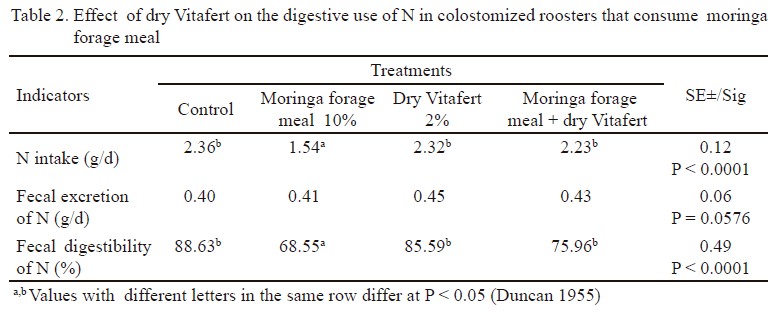
<body><![CDATA[<p align="justify" class="Cuerpodetexto" style="margin-top:12.0pt;margin-right:0cm;margin-bottom:5.95pt;margin-left:0cm;text-indent:0cm;"><span style="font-family:'Verdana','sans-serif'; font-size:10.0pt; ">Six  samples of each food were randomly taken and analyzed in duplicate.</span></p>     <p align="justify" class="Cuerpodetexto" style="margin-top:12.0pt;margin-right:0cm;margin-bottom:5.95pt;margin-left:0cm;text-indent:0cm;"><span style="font-family:'Verdana','sans-serif'; font-size:10.0pt; ">The  animals were adapted to the cages and to the intake of diets for seven days.  The food supply was reduced to 50% and was offered twice daily in two equal  portions (8:30 am and 1:30 pm). During the period, the animals received water <em>ad  libitum</em>, which was offered in automatic drinkers.</span></p>     <p align="justify" class="Cuerpodetexto" style="margin-top:12.0pt;margin-right:0cm;margin-bottom:5.95pt;margin-left:0cm;text-indent:0cm;"><span style="font-family:'Verdana','sans-serif'; font-size:10.0pt; ">The  feces collection started in the third week after the operation. They were  collected during three days individually in nylon bags, quantitatively. Every  day 10% of each sample / animal was taken. At the end of period a pool for each  animal was formed, which was kept frozen at -20 &deg;C until their analysis. The  feces were dried in an oven at 60 &deg;C for 72 h. To calculate daily intake the  rejection was controlled.</span></p>     <p align="justify" class="Cuerpodetexto" style="margin-top:12.0pt;margin-right:0cm;margin-bottom:5.95pt;margin-left:0cm;text-indent:0cm;"><span style="font-family:'Verdana','sans-serif'; font-size:10.0pt; ">In  the food and excreta the DM and N was determined, according to the methodology  described by AOAC (2012) .With the obtained data the N intake (g / d) and fecal  excretion of N (g/d) was determined. The fecal digestibility of N (%) was  determined by direct method, according to Crampton and Harris (1969)  methodology. The N digestibility was calculated according to the following  equation:</span></p>     <p align="justify" class="Cuerpodetexto" style="margin-top:12.0pt;margin-right:0cm;margin-bottom:5.95pt;margin-left:0cm;text-indent:0cm;"><span style="font-family:'Verdana','sans-serif'; font-size:10.0pt; ">Digestibility,  % = (Ndiet-Nfeces/Ndiet)*100<span style="position:relative; top:5.0pt; ">&nbsp;&nbsp; </span>&nbsp;&nbsp;&nbsp;&nbsp;&nbsp;&nbsp;&nbsp;&nbsp;&nbsp;&nbsp;&nbsp;&nbsp;&nbsp;&nbsp;&nbsp;&nbsp;&nbsp;&nbsp;</span></p>     <p align="justify" class="Cuerpodetexto" style="margin-top:12.0pt;margin-right:0cm;margin-bottom:5.95pt;margin-left:0cm;text-indent:0cm;"><span style="font-family:'Verdana','sans-serif'; font-size:10.0pt; ">A  completely randomized design with four treatments and four replications was  used. For data analysis INFOSTAT computerized statistical package (Balzarini <em>et  al</em>. 2012), version of Windows XP was used. In necessary cases, the mean  values were compared by means of the Duncan (1955) test.</span></p>     <p align="justify" class="Cuerpodetexto" style="margin-top:12.0pt;margin-right:0cm;margin-bottom:5.95pt;margin-left:0cm;text-indent:0cm;"><span style="font-family:'Verdana','sans-serif'; font-size:10.0pt; ">The  effect of dry Vitafert on the digestive use of N in colostomized roosters that  consume moringa forage meal is show in <a href="/img/revistas/cjas/v50n2/t0212216.gif">table 2</a>.</span></p>     
<p align="justify" class="Cuerpodetexto" style="margin-top:12.0pt;margin-right:0cm;margin-bottom:5.95pt;margin-left:0cm;text-indent:0cm;"><span style="font-family:'Verdana','sans-serif'; font-size:10.0pt; ">The tropical forage trees are characterized by their high  protein content. However, it is proposed that, approximately, 31% of this N is  joined to NDF, which is not available to the animal (Bindelle <em>et al</em>.  2008).The N intake (g / d) in the animals which&nbsp;  intake the mixture of moringa forage meal and dry Vitafert differ (P  &lt;0.0001) than those who intake moringa forage meal. The lower intake of dry  matter and nitrogen in roosters who received moringa forage meal could be given  by the quality of the fiber source, determined by its chemical composition.  This last influences on the physicochemical properties that, in turn, determine  the physiological effects on the digestive tract of animals. Almeida (2015)  reported higher values in the N intake of colostomized roosters who intake  moringa forage meal due to there was content of 50.37% of NDF and lignin values  of 8.10%. The solubility was 26.64% and the volume and water retention capacity  of 3.62 and 6.59 g / g respectively, whereas the meal used in this study showed  values of NDF and lignin of 57.74%, 13.66% respectively, with solubility of  20.81%, volume of 12.43% and water retention capacity 12.43g/g.</span><span style="font-family:'Verdana','sans-serif'; font-size:10.0pt; "> </span></p>     <p align="justify" class="Cuerpodetexto" style="margin-top:12.0pt;margin-right:0cm;margin-bottom:5.95pt;margin-left:0cm;text-indent:0cm;"><span style="font-family:'Verdana','sans-serif'; font-size:10.0pt; ">The positive effect of dry Vitafert on the N intake in  roosters that intake the fibrous material could be because the animals ingested  amounts of beneficial microorganisms, which could stimulate the competition for  nutrients and niches for colonization. The composition of the intestinal  ecosystem can be modified by the type of substrate that goes to the caecum.  This means that the fermentation can lead to significant changes in food  digestibility (J&oslash;rgensen <em>et al</em>. 2010).</span><span style="font-family:'Verdana','sans-serif'; font-size:10.0pt; "> </span></p>     <p align="justify" class="Cuerpodetexto" style="margin-top:12.0pt;margin-right:0cm;margin-bottom:5.95pt;margin-left:0cm;text-indent:0cm;"><span style="font-family:'Verdana','sans-serif'; font-size:10.0pt; ">Safalaoh  (2006) provided a preparation of efficiency microorganisms (consisting of a  defined mixture of lactobacillus and yeasts) and found increased in the  efficiency of nitrogen use in broilers.</span></p>     ]]></body>
<body><![CDATA[<p align="justify" class="Cuerpodetexto" style="margin-top:12.0pt;margin-right:0cm;margin-bottom:5.95pt;margin-left:0cm;text-indent:0cm;"><span style="font-family:'Verdana','sans-serif'; font-size:10.0pt; ">In  the N (g/d) excretion there were not differences between treatments, although  there was in the N intake, with lower values for moringa meal. It is important  to clarify that the data could be controversial, because Nuengjamnong and  Luangtongkum (2014) showed that the use of efficient microorganisms in diets  for broilers favored the reduction in the N excretion. The authors considered  that the obtained results could also be given by the sample size which was  used.</span></p>     <p align="justify" class="Cuerpodetexto" style="margin-top:12.0pt;margin-right:0cm;margin-bottom:5.95pt;margin-left:0cm;text-indent:0cm;"><span style="font-family:'Verdana','sans-serif'; font-size:10.0pt; ">The  fermented diets can stimulate indirectly the protein digestion by reducing the  gastric pH, essential aspect to increase the pepsin activity. These acidic  conditions reduce the gastric emptying rate, so that the time for gastric  digestion increase, which favors that in the small intestine degrade and absorb  more protein (Canibe <em>et al</em>. 2013).</span></p>     <p align="justify" class="Cuerpodetexto" style="margin-top:12.0pt;margin-right:0cm;margin-bottom:5.95pt;margin-left:0cm;text-indent:0cm;"><span style="font-family:'Verdana','sans-serif'; font-size:10.0pt; ">Betancourt  and Romero (2002) stated that the amino acid metabolism and acid-base  homeostasis are closely related, due to the protein degradation generates  inorganic acids which dependent from the amino acid pattern. Specifically, in  the degradation of the basic amino acids tends to cause metabolic acidosis.  This metabolic state stimulates protein degradation by glucocorticoids and  reduces nitrogen retention (May <em>et al</em>. 1986). These hypotheses must be  taken into consideration for future studies.</span></p>     <p align="justify" class="Cuerpodetexto" style="margin-top:12.0pt;margin-right:0cm;margin-bottom:5.95pt;margin-left:0cm;text-indent:0cm;"><span style="font-family:'Verdana','sans-serif'; font-size:10.0pt; ">The use of digestibility to evaluate the N use, although  it is accepted as approved procedure, is incorrect. This is because in the  metabolism of dietary and endogenous N influences the degradation of caecal  microbial population. Therefore, the fecal digestibility of N tends to  overestimate the availability of the protein content of diet (Sauer and Ozimek  1986). However, there are evidences that suggest microbial activity in the  small intestine. This fact is supported by the refluxes that occur in the  digestive system of birds (Bach and Jensen 1991).</span><span style="font-family:'Verdana','sans-serif'; font-size:10.0pt; "> </span></p>     <p align="justify" class="Cuerpodetexto" style="margin-top:12.0pt;margin-right:0cm;margin-bottom:5.95pt;margin-left:0cm;text-indent:0cm;"><span style="letter-spacing:.1pt; font-family:'Verdana','sans-serif'; font-size:10.0pt; ">The  fecal apparent digestibility of N did not differ in roosters fed the control  diet and dry Vitafert, so higher values were obtained. Whereas, with the  inclusion of dry fermented product in the diet containing moringa forage meal,  the digestibility increased with respect to diet does not contain this  biological additive. It&nbsp;&nbsp; is concluded  that the dry Vitafert favored the increase in the fecal apparent digestibility  of nitrogen in colostomized roosters that consume moringa forage meal</span><font size="2" face="Verdana, Arial, Helvetica, sans-serif">.</font></p>     <p align="justify">&nbsp;</p>     <p align="justify"><font size="2" face="Verdana, Arial, Helvetica, sans-serif"><b><font size="3">ACKNOWLEDGMENTS</font></b></font></p>     <p align="justify"><font size="2" face="Verdana, Arial, Helvetica, sans-serif"><span style="font-family:'Verdana','sans-serif'; font-size:10.0pt; ">We  thank to DMVZ. Alvaro Delgado and Ivette Orta for their collaboration in the  birds surgery and the laboratory tests performance, respectively</span>.</font></p>     <p align="justify">&nbsp;</p>     <p align="justify"><font size="2" face="Verdana, Arial, Helvetica, sans-serif"><font size="3"><b>REFERENCES</b></font></font></p>     ]]></body>
<body><![CDATA[<!-- ref --><p align="justify" class="MsoBibliography" style="margin-top:12.0pt;margin-right:0cm;margin-bottom:5.95pt;margin-left:0cm;text-align:justify;"><span style="font-family:'Verdana','sans-serif'; font-size:10.0pt; ">Almeida, M. 2015. <em>Indicadores  morfofisiol&oacute;gicos y de salud en pollos de ceba colostomizados que consumen  harina de forraje de moringa</em>. M.Sc. Thesis, Instituto de Ciencia Animal,  Mayabeque, Cuba, 87 p.    </span></p>     <p align="justify" class="MsoBibliography" style="margin-top:12.0pt;margin-right:0cm;margin-bottom:5.95pt;margin-left:0cm;text-align:justify;"><span style="font-family:'Verdana','sans-serif'; font-size:10.0pt; ">Bach, K. K. E. &amp; Jensen, B. B. 1991. &ldquo;Effect of source and level of  dietary fibre on microbial fermentation in the large intestine of pigs&rdquo;. In:  Verstegen, M. W. A., Huisman, J. &amp; den Hartog, L. A. (eds.), <em>V  International Symposium on Digestive Physiology in Pigs</em>, (ser. EAAP  publication), Wageningen (Doorwerth), Netherlands: Pudoc, pp. 389&ndash;394, ISBN:  978-90-220-1040-2, OCLC: 832531280.</span></p>     <!-- ref --><p align="justify" class="MsoBibliography" style="margin-top:12.0pt;margin-right:0cm;margin-bottom:5.95pt;margin-left:0cm;text-align:justify;"><span style="font-family:'Verdana','sans-serif'; font-size:10.0pt; ">Balzarini, M. G., Casanoves, F., Di Rienzo, J. A., Gonz&aacute;lez, L. &amp;  Robledo, C. W. 2012. </span><em><span style="font-family:'Verdana','sans-serif'; font-size:10.0pt; ">InfoStat</span></em><span style="font-family:'Verdana','sans-serif'; font-size:10.0pt; ">. version 5.1,  [Windows], Universidad Nacional de C&oacute;rdoba, Argentina: Grupo InfoStat,  Available: &lt;<a href="http://www.infostat.com.ar/" target="_blank">http://www.infostat.com.ar/</a>&gt;    .</span></p>     <p align="justify" class="MsoBibliography" style="margin-top:12.0pt;margin-right:0cm;margin-bottom:5.95pt;margin-left:0cm;text-align:justify;"><span style="font-family:'Verdana','sans-serif'; font-size:10.0pt; ">Betancourt, L. &amp;  Romero, H. 2002. &ldquo;Una revisi&oacute;n del metabolismo &aacute;cido-base y su relaci&oacute;n con la  nutrici&oacute;n en aves&rdquo;. </span><em><span style="font-family:'Verdana','sans-serif'; font-size:10.0pt; ">Colombian  Journal of Animal Science and Veterinary Medicine</span></em><span style="font-family:'Verdana','sans-serif'; font-size:10.0pt; ">, 15(2): 198&ndash;206, ISSN: 2256-2958.</span></p>     <p align="justify" class="MsoBibliography" style="margin-top:12.0pt;margin-right:0cm;margin-bottom:5.95pt;margin-left:0cm;text-align:justify;"><span style="font-family:'Verdana','sans-serif'; font-size:10.0pt; ">Bindelle, J., Buldgen, A., Delacollette, M., Wavreille, J., Agneessens,  R., Destain, J. P. &amp; Leterme, P. 2008. &ldquo;Influence of source and  concentrations of dietary fiber on <em>in vivo</em> nitrogen excretion pathways  in pigs as reflected by <em>in vitro</em> fermentation and nitrogen incorporation  by fecal bacteria&rdquo;. <em>Journal of Animal Science</em>, 87(2): 583&ndash;593, ISSN:  0021-8812, 1525-3163, DOI: 10.2527/jas.2007-0717.</span></p>     <p align="justify" class="MsoBibliography" style="margin-top:12.0pt;margin-right:0cm;margin-bottom:5.95pt;margin-left:0cm;text-align:justify;"><span style="font-family:'Verdana','sans-serif'; font-size:10.0pt; ">Canibe, N., Jensen, B. B. &amp; Pedersen, A. &Oslash;. 2013. &ldquo;Fermented Feeds  for Pigs-Impact on Nutritional Quality and on Animal Gastrointestinal Health  and Growth Performance&rdquo;. In: <em>34th Western Nutrition Conference</em>,  Saskatchewan, Canada: Western Nutrition Conference Planning Committee, pp.  101&ndash;115, Record Number: 20143091350, Available:  &lt;<a href="http://www.cabdirect.org/abstracts/20143091350.html;jsessionid=46A0FB8DFB0E84A3122C0AC2AA26A13F" target="_blank">http://www.cabdirect.org/abstracts/20143091350.html;jsessionid=46A0FB8DFB0E84A3122C0AC2AA26A13F</a>&gt;,  [Consulted:&nbsp;June 30, 2016].</span></p>     <!-- ref --><p align="justify" class="MsoBibliography" style="margin-top:12.0pt;margin-right:0cm;margin-bottom:5.95pt;margin-left:0cm;text-align:justify;"><span style="font-family:'Verdana','sans-serif'; font-size:10.0pt; ">Crampton, E. W. &amp; Harris, L. E. 1969. <em>Applied Animal Nutrition</em>.  2nd ed., San Francisco: W.H. Freeman, ASIN: B000JFF290, Available: &lt;<a href="https://www.amazon.com/Applied-Animal-Nutrition-Harris-Crampton/dp/B000JFF290" target="_blank">https://www.amazon.com/Applied-Animal-Nutrition-Harris-Crampton/dp/B000JFF290</a>&gt;,  [Consulted:&nbsp;June 23, 2016].    </span></p>     ]]></body>
<body><![CDATA[<p align="justify" class="MsoBibliography" style="margin-top:12.0pt;margin-right:0cm;margin-bottom:5.95pt;margin-left:0cm;text-align:justify;"><span style="font-family:'Verdana','sans-serif'; font-size:10.0pt; ">Dihigo, L. E., Marrero, A.  I. &amp; Sav&oacute;n, L. 1994. <em>Digestibilidad in vitro utilizando el contenido  fecal del cerdo en dietas para el pollo de engorde</em>. Graduated Thesis,  Universidad Agraria de La Habana &lsquo;Fructuoso Rodr&iacute;guez P&eacute;rez&rsquo;, La Habana, Cuba,  55 p.</span></p>     <p align="justify" class="MsoBibliography" style="margin-top:12.0pt;margin-right:0cm;margin-bottom:5.95pt;margin-left:0cm;text-align:justify;"><span style="font-family:'Verdana','sans-serif'; font-size:10.0pt; ">Duncan, D. B. 1955. &ldquo;Multiple Range and Multiple F Tests&rdquo;. <em>Biometrics</em>,  11(1): 1&ndash;42, ISSN: 0006-341X, DOI: 10.2307/3001478.</span></p>     <!-- ref --><p align="justify" class="MsoBibliography" style="margin-top:12.0pt;margin-right:0cm;margin-bottom:5.95pt;margin-left:0cm;text-align:justify;"><span style="font-family:'Verdana','sans-serif'; font-size:10.0pt; ">Guti&eacute;rrez, B. R. 2005. </span><em><span style="font-family:'Verdana','sans-serif'; font-size:10.0pt; ">Actividad probi&oacute;tica de un  producto biofermentado (VITAFER), en pollos de ceba</span></em><span style="font-family:'Verdana','sans-serif'; font-size:10.0pt; ">.  M.Sc. Thesis, Instituto de Ciencia Animal, La Habana, Cuba, 52 p.    </span></p>     <!-- ref --><p align="justify" class="MsoBibliography" style="margin-top:12.0pt;margin-right:0cm;margin-bottom:5.95pt;margin-left:0cm;text-align:justify;"><span style="font-family:'Verdana','sans-serif'; font-size:10.0pt; ">Guti&eacute;rrez, D. 2012. <em>Efecto  del aditivo biol&oacute;gico Vitafert en dietas de forrajes de baja calidad para la  alimentaci&oacute;n de cabras lecheras</em>. Ph.D. Thesis, Instituto de Ciencia Animal,  Mayabeque, Cuba, 124 p.    </span></p>     <p align="justify" class="MsoBibliography" style="margin-top:12.0pt;margin-right:0cm;margin-bottom:5.95pt;margin-left:0cm;text-align:justify;"><span style="font-family:'Verdana','sans-serif'; font-size:10.0pt; ">J&oslash;rgensen, H., Sholly, D., Pedersen, A. &Oslash;., Canibe, N. &amp; Knudsen, K.  E. B. 2010. &ldquo;Fermentation of cereals &mdash; Influence on digestibility of nutrients  in growing pigs&rdquo;. <em>Livestock Science</em>, 134(1-3): 56&ndash;58, ISSN: 18711413,  DOI: 10.1016/j.livsci.2010.06.096.</span></p>     <!-- ref --><p align="justify" class="MsoBibliography" style="margin-top:12.0pt;margin-right:0cm;margin-bottom:5.95pt;margin-left:0cm;text-align:justify;"><span style="font-family:'Verdana','sans-serif'; font-size:10.0pt; ">Latimer, G. W. 2012. <em>Official Methods of Analysis of AOAC  International</em>. 19th ed., Gaithersburg, Md.: AOAC International, ISBN:  978-0-935584-83-7, Available: &lt;<a href="http://www.amazon.com/Official-Methods-Analysis-OFFICIAL-ANALYSIS/dp/0935584838/ref=pd_sim_sbs_14_1?ie=UTF8&dpID=31iikC-xl2L&dpSrc=sims&preST=_AC_UL160_SR160%2C160_&refRID=101AB94246X0EM9N7XMW" target="_blank">http://www.amazon.com/Official-Methods-Analysis-OFFICIAL-ANALYSIS/dp/0935584838/ref=pd_sim_sbs_14_1?ie=UTF8&amp;dpID=31iikC-xl2L&amp;dpSrc=sims&amp;preST=_AC_UL160_SR160%2C160_&amp;refRID=101AB94246X0EM9N7XMW</a>&gt;,  [Consulted:&nbsp;April 1, 2016].    </span></p>     <p align="justify" class="MsoBibliography" style="margin-top:12.0pt;margin-right:0cm;margin-bottom:5.95pt;margin-left:0cm;text-align:justify;"><span style="font-family:'Verdana','sans-serif'; font-size:10.0pt; ">May, R. C., Kelly, R. A. &amp; Mitch, W. E. 1986. &ldquo;Metabolic acidosis  stimulates protein degradation in rat muscle by a glucocorticoid-dependent  mechanism.&rdquo;. <em>Journal of Clinical Investigation</em>, 77(2): 614&ndash;621, ISSN:  0021-9738, DOI: 10.1172/JCI112344.</span></p>     ]]></body>
<body><![CDATA[<!-- ref --><p align="justify" class="MsoBibliography" style="margin-top:12.0pt;margin-right:0cm;margin-bottom:5.95pt;margin-left:0cm;text-align:justify;"><span style="font-family:'Verdana','sans-serif'; font-size:10.0pt; ">NRC (National Research Council), Subcommittee on Poultry Nutrition &amp;  Board on Agriculture 1994. <em>Nutrient Requirements of Poultry</em>. 9th ed.,  Washington, D.C: National Academies Press, 176 p., ISBN: 978-0-309-04892-7,  Available:  &lt;<a href="https://www.amazon.com/Nutrient-Requirements-Poultry-Revised-Domestic/dp/0309048923" target="_blank">https://www.amazon.com/Nutrient-Requirements-Poultry-Revised-Domestic/dp/0309048923</a>&gt;,  [Consulted:&nbsp;June 23, 2016].    </span></p>     <p align="justify" class="MsoBibliography" style="margin-top:12.0pt;margin-right:0cm;margin-bottom:5.95pt;margin-left:0cm;text-align:justify;"><span style="font-family:'Verdana','sans-serif'; font-size:10.0pt; ">Nuengjamnong, C. &amp; Luangtongkum, T. 2014. &ldquo;Effects of Effective  Microorganisms on Growth Performances, Ammonia Reduction, Hematological Changes  and Shedding of <em>Salmonella enterica</em> and <em>Campylobacter</em> spp. in  Broilers&rdquo;. <em>The Thai Journal of Veterinary Medicine</em>, 44(1): 15&ndash;22, ISSN:  0125-6491.</span></p>     <p align="justify" class="MsoBibliography" style="margin-top:12.0pt;margin-right:0cm;margin-bottom:5.95pt;margin-left:0cm;text-align:justify;"><span style="font-family:'Verdana','sans-serif'; font-size:10.0pt; ">Okumura, J. 1976. &ldquo;Method of colostomy and cannulation of the chicken&rdquo;. <em>British  Poultry Science</em>, 17(5): 547&ndash;551, ISSN: 0007-1668, DOI:  10.1080/00071667608416310, PMID: 963571.</span></p>     <p align="justify" class="MsoBibliography" style="margin-top:12.0pt;margin-right:0cm;margin-bottom:5.95pt;margin-left:0cm;text-align:justify;"><span style="font-family:'Verdana','sans-serif'; font-size:10.0pt; ">Safalaoh, A. C. L. 2006. &ldquo;Body weight gain, dressing percentage,  abdominal fat and serum cholesterol of broilers supplemented with a microbial  preparation&rdquo;. <em>African Journal of Food, Agriculture, Nutrition and  Development</em>, 6(1): 1&ndash;10, ISSN: 1684-5374, DOI: 10.4314/ajfand.v6i1.19170.</span></p>     <p align="justify" class="MsoBibliography" style="margin-top:12.0pt;margin-right:0cm;margin-bottom:5.95pt;margin-left:0cm;text-align:justify;"><span style="font-family:'Verdana','sans-serif'; font-size:10.0pt; ">Sauer, W. C. &amp; Ozimek, L. 1986. &ldquo;Digestibility of amino acids in  swine: Results and their practical applications. A review&rdquo;. <em>Livestock  Production Science</em>, 15(4): 367&ndash;388, ISSN: 0301-6226, DOI:  10.1016/0301-6226(86)90076-X.</span></p>     <p align="justify" class="MsoBibliography" style="margin-top:12.0pt;margin-right:0cm;margin-bottom:5.95pt;margin-left:0cm;text-align:justify;"><span style="font-family:'Verdana','sans-serif'; font-size:10.0pt; ">Sav&oacute;n, L., Scull, I., Orta, M. &amp; Torres, V. 2004. &ldquo;Physicochemical  characterization of the fibrous fraction of five tropical foliage meals for  monogastric species&rdquo;. <em>Cuban Journal of Agricultural Science</em>, 38(3):  281&ndash;286, ISSN: 2079-3480.</span></p>     <!-- ref --><p align="justify" class="MsoBibliography" style="margin-top:12.0pt;margin-right:0cm;margin-bottom:5.95pt;margin-left:0cm;text-align:justify;"><span style="font-family:'Verdana','sans-serif'; font-size:10.0pt; ">Savvidou, S. 2009. <em>Selection  of a chicken Lactobacillus strain with probiotic properties and its application  in poultry production</em>. </span><span style="font-family:'Verdana','sans-serif'; font-size:10.0pt; ">Ph.D. Thesis, University of Plymouth, Plymouth, 226 p</span><font size="2" face="Verdana,     Arial, Helvetica, sans-serif">.</font></p>     <p align="justify">&nbsp;</p>     ]]></body>
<body><![CDATA[<p align="justify">&nbsp;</p>     <p align="justify"><font size="2" face="Verdana, Arial, Helvetica, sans-serif">Received: 8/12/2014    <br>   Accepted: 14/7/2016</font></p>     <p align="justify">&nbsp;</p>     <p align="justify">&nbsp;</p>     <p align="justify"><font size="2" face="Verdana, Arial, Helvetica, sans-serif"><i>Daymara Bustamante,</i> Instituto de Ciencia Animal, Apartado Postal 24, San José de las Lajas, Mayabeque, Cuba.    Email: <a href="mailto:dbustamante@ica.co.cu">dbustamante@ica.co.cu</a></font></p>      ]]></body><back>
<ref-list>
<ref id="B1">
<nlm-citation citation-type="book">
<person-group person-group-type="author">
<name>
<surname><![CDATA[Almeida]]></surname>
<given-names><![CDATA[M.]]></given-names>
</name>
</person-group>
<source><![CDATA[Indicadores morfofisiológicos y de salud en pollos de ceba colostomizados que consumen harina de forraje de moringa]]></source>
<year>2015</year>
<page-range>87</page-range><publisher-loc><![CDATA[Mayabeque, Cuba ]]></publisher-loc>
<publisher-name><![CDATA[Instituto de Ciencia Animal]]></publisher-name>
</nlm-citation>
</ref>
<ref id="B2">
<nlm-citation citation-type="book">
<person-group person-group-type="author">
<name>
<surname><![CDATA[Bach]]></surname>
<given-names><![CDATA[K. K. E.]]></given-names>
</name>
<name>
<surname><![CDATA[Jensen]]></surname>
<given-names><![CDATA[B. B.]]></given-names>
</name>
</person-group>
<article-title xml:lang="nd"><![CDATA[Effect of source and level of dietary fibre on microbial fermentation in the large intestine of pigs]]></article-title>
<person-group person-group-type="editor">
<name>
<surname><![CDATA[Verstegen]]></surname>
<given-names><![CDATA[M. W. A.]]></given-names>
</name>
<name>
<surname><![CDATA[Huisman]]></surname>
<given-names><![CDATA[J.]]></given-names>
</name>
<name>
<surname><![CDATA[den Hartog]]></surname>
<given-names><![CDATA[L. A.]]></given-names>
</name>
</person-group>
<source><![CDATA[]]></source>
<year>1991</year>
<page-range>389-394</page-range><publisher-loc><![CDATA[Wageningen (Doorwerth), Netherlands ]]></publisher-loc>
<publisher-name><![CDATA[Pudoc]]></publisher-name>
</nlm-citation>
</ref>
<ref id="B3">
<nlm-citation citation-type="book">
<person-group person-group-type="author">
<name>
<surname><![CDATA[Balzarini]]></surname>
<given-names><![CDATA[M. G.]]></given-names>
</name>
<name>
<surname><![CDATA[Casanoves]]></surname>
<given-names><![CDATA[F.]]></given-names>
</name>
<name>
<surname><![CDATA[Di Rienzo]]></surname>
<given-names><![CDATA[J. A.]]></given-names>
</name>
<name>
<surname><![CDATA[González]]></surname>
<given-names><![CDATA[L.]]></given-names>
</name>
<name>
<surname><![CDATA[Robledo]]></surname>
<given-names><![CDATA[C. W.]]></given-names>
</name>
</person-group>
<source><![CDATA[InfoStat]]></source>
<year>2012</year>
<publisher-loc><![CDATA[Universidad Nacional de Córdoba, Argentina ]]></publisher-loc>
<publisher-name><![CDATA[Grupo InfoStat]]></publisher-name>
</nlm-citation>
</ref>
<ref id="B4">
<nlm-citation citation-type="journal">
<person-group person-group-type="author">
<name>
<surname><![CDATA[Betancourt]]></surname>
<given-names><![CDATA[L.]]></given-names>
</name>
<name>
<surname><![CDATA[Romero]]></surname>
<given-names><![CDATA[H.]]></given-names>
</name>
</person-group>
<article-title xml:lang="nd"><![CDATA[Una revisión del metabolismo ácido-base y su relación con la nutrición en aves]]></article-title>
<source><![CDATA[Colombian Journal of Animal Science and Veterinary Medicine]]></source>
<year>2002</year>
<volume>15</volume>
<numero>2</numero>
<issue>2</issue>
<page-range>198-206</page-range></nlm-citation>
</ref>
<ref id="B5">
<nlm-citation citation-type="journal">
<person-group person-group-type="author">
<name>
<surname><![CDATA[Bindelle]]></surname>
<given-names><![CDATA[J.]]></given-names>
</name>
<name>
<surname><![CDATA[Buldgen]]></surname>
<given-names><![CDATA[A.]]></given-names>
</name>
<name>
<surname><![CDATA[Delacollette]]></surname>
<given-names><![CDATA[M.]]></given-names>
</name>
<name>
<surname><![CDATA[Wavreille]]></surname>
<given-names><![CDATA[J.]]></given-names>
</name>
<name>
<surname><![CDATA[Agneessens]]></surname>
<given-names><![CDATA[R.]]></given-names>
</name>
<name>
<surname><![CDATA[Destain]]></surname>
<given-names><![CDATA[J. P.]]></given-names>
</name>
<name>
<surname><![CDATA[Leterme]]></surname>
<given-names><![CDATA[P.]]></given-names>
</name>
</person-group>
<article-title xml:lang="nd"><![CDATA[Influence of source and concentrations of dietary fiber on in vivo nitrogen excretion pathways in pigs as reflected by in vitro fermentation and nitrogen incorporation by fecal bacteria]]></article-title>
<source><![CDATA[Journal of Animal Science]]></source>
<year>2008</year>
<volume>87</volume>
<numero>2</numero>
<issue>2</issue>
<page-range>583-593</page-range></nlm-citation>
</ref>
<ref id="B6">
<nlm-citation citation-type="book">
<person-group person-group-type="author">
<name>
<surname><![CDATA[Canibe]]></surname>
<given-names><![CDATA[N.]]></given-names>
</name>
<name>
<surname><![CDATA[Jensen]]></surname>
<given-names><![CDATA[B. B.]]></given-names>
</name>
<name>
<surname><![CDATA[Pedersen]]></surname>
<given-names><![CDATA[A. Ø.]]></given-names>
</name>
</person-group>
<article-title xml:lang="nd"><![CDATA[Fermented Feeds for Pigs-Impact on Nutritional Quality and on Animal Gastrointestinal Health and Growth Performance]]></article-title>
<source><![CDATA[]]></source>
<year>2013</year>
<page-range>101-115</page-range><publisher-loc><![CDATA[Saskatchewan, Canada ]]></publisher-loc>
<publisher-name><![CDATA[Western Nutrition Conference Planning Committee]]></publisher-name>
</nlm-citation>
</ref>
<ref id="B7">
<nlm-citation citation-type="book">
<person-group person-group-type="author">
<name>
<surname><![CDATA[Crampton]]></surname>
<given-names><![CDATA[E. W.]]></given-names>
</name>
<name>
<surname><![CDATA[Harris]]></surname>
<given-names><![CDATA[L. E.]]></given-names>
</name>
</person-group>
<source><![CDATA[Applied Animal Nutrition]]></source>
<year>1969</year>
<edition>2nd</edition>
<publisher-loc><![CDATA[San Francisco ]]></publisher-loc>
<publisher-name><![CDATA[W.H. Freeman]]></publisher-name>
</nlm-citation>
</ref>
<ref id="B8">
<nlm-citation citation-type="book">
<person-group person-group-type="author">
<name>
<surname><![CDATA[Dihigo]]></surname>
<given-names><![CDATA[L. E.]]></given-names>
</name>
<name>
<surname><![CDATA[Marrero]]></surname>
<given-names><![CDATA[A. I.]]></given-names>
</name>
<name>
<surname><![CDATA[Savón]]></surname>
<given-names><![CDATA[L.]]></given-names>
</name>
</person-group>
<source><![CDATA[Digestibilidad in vitro utilizando el contenido fecal del cerdo en dietas para el pollo de engorde]]></source>
<year>1994</year>
<page-range>55</page-range><publisher-loc><![CDATA[La Habana, Cuba ]]></publisher-loc>
<publisher-name><![CDATA[Universidad Agraria de La Habana ‘Fructuoso Rodríguez Pérez’]]></publisher-name>
</nlm-citation>
</ref>
<ref id="B9">
<nlm-citation citation-type="journal">
<person-group person-group-type="author">
<name>
<surname><![CDATA[Duncan]]></surname>
<given-names><![CDATA[D. B.]]></given-names>
</name>
</person-group>
<article-title xml:lang="nd"><![CDATA[Multiple Range and Multiple F Tests]]></article-title>
<source><![CDATA[Biometrics]]></source>
<year>1955</year>
<volume>11</volume>
<numero>1</numero>
<issue>1</issue>
<page-range>1-42</page-range></nlm-citation>
</ref>
<ref id="B10">
<nlm-citation citation-type="book">
<person-group person-group-type="author">
<name>
<surname><![CDATA[Gutiérrez]]></surname>
<given-names><![CDATA[B. R.]]></given-names>
</name>
</person-group>
<source><![CDATA[Actividad probiótica de un producto biofermentado (VITAFER), en pollos de ceba]]></source>
<year>2005</year>
<page-range>52</page-range><publisher-loc><![CDATA[La Habana, Cuba ]]></publisher-loc>
<publisher-name><![CDATA[Instituto de Ciencia Animal]]></publisher-name>
</nlm-citation>
</ref>
<ref id="B11">
<nlm-citation citation-type="book">
<person-group person-group-type="author">
<name>
<surname><![CDATA[Gutiérrez]]></surname>
<given-names><![CDATA[D.]]></given-names>
</name>
</person-group>
<source><![CDATA[Efecto del aditivo biológico Vitafert en dietas de forrajes de baja calidad para la alimentación de cabras lecheras]]></source>
<year>2012</year>
<page-range>124</page-range><publisher-loc><![CDATA[Mayabeque, Cuba ]]></publisher-loc>
<publisher-name><![CDATA[Instituto de Ciencia Animal]]></publisher-name>
</nlm-citation>
</ref>
<ref id="B12">
<nlm-citation citation-type="journal">
<person-group person-group-type="author">
<name>
<surname><![CDATA[Jørgensen]]></surname>
<given-names><![CDATA[H.]]></given-names>
</name>
<name>
<surname><![CDATA[Sholly]]></surname>
<given-names><![CDATA[D.]]></given-names>
</name>
<name>
<surname><![CDATA[Pedersen]]></surname>
<given-names><![CDATA[A. Ø.]]></given-names>
</name>
<name>
<surname><![CDATA[Canibe]]></surname>
<given-names><![CDATA[N.]]></given-names>
</name>
<name>
<surname><![CDATA[Knudsen]]></surname>
<given-names><![CDATA[K. E. B.]]></given-names>
</name>
</person-group>
<article-title xml:lang="nd"><![CDATA[Fermentation of cereals - Influence on digestibility of nutrients in growing pigs]]></article-title>
<source><![CDATA[Livestock Science]]></source>
<year>2010</year>
<volume>134</volume>
<numero>1-3</numero>
<issue>1-3</issue>
<page-range>56-58</page-range></nlm-citation>
</ref>
<ref id="B13">
<nlm-citation citation-type="book">
<person-group person-group-type="author">
<name>
<surname><![CDATA[Latimer]]></surname>
<given-names><![CDATA[G. W.]]></given-names>
</name>
</person-group>
<source><![CDATA[Official Methods of Analysis of AOAC International]]></source>
<year>2012</year>
<edition>19th</edition>
<publisher-loc><![CDATA[Gaithersburg, Md. ]]></publisher-loc>
<publisher-name><![CDATA[AOAC International]]></publisher-name>
</nlm-citation>
</ref>
<ref id="B14">
<nlm-citation citation-type="journal">
<person-group person-group-type="author">
<name>
<surname><![CDATA[May]]></surname>
<given-names><![CDATA[R. C.]]></given-names>
</name>
<name>
<surname><![CDATA[Kelly]]></surname>
<given-names><![CDATA[R. A.]]></given-names>
</name>
<name>
<surname><![CDATA[Mitch]]></surname>
<given-names><![CDATA[W. E.]]></given-names>
</name>
</person-group>
<article-title xml:lang="nd"><![CDATA[Metabolic acidosis stimulates protein degradation in rat muscle by a glucocorticoid-dependent mechanism.]]></article-title>
<source><![CDATA[Journal of Clinical Investigation]]></source>
<year>1986</year>
<volume>77</volume>
<numero>2</numero>
<issue>2</issue>
<page-range>614-621</page-range></nlm-citation>
</ref>
<ref id="B15">
<nlm-citation citation-type="book">
<person-group person-group-type="author">
<name>
<surname><![CDATA[NRC (National Research Council)]]></surname>
</name>
<name>
<surname><![CDATA[Subcommittee on Poultry Nutrition & Board on Agriculture]]></surname>
</name>
</person-group>
<source><![CDATA[Nutrient Requirements of Poultry]]></source>
<year>1994</year>
<edition>9th</edition>
<page-range>176</page-range><publisher-loc><![CDATA[Washington, D.C ]]></publisher-loc>
<publisher-name><![CDATA[National Academies Press]]></publisher-name>
</nlm-citation>
</ref>
<ref id="B16">
<nlm-citation citation-type="journal">
<person-group person-group-type="author">
<name>
<surname><![CDATA[Nuengjamnong]]></surname>
<given-names><![CDATA[C.]]></given-names>
</name>
<name>
<surname><![CDATA[Luangtongkum]]></surname>
<given-names><![CDATA[T.]]></given-names>
</name>
</person-group>
<article-title xml:lang="nd"><![CDATA[Effects of Effective Microorganisms on Growth Performances, Ammonia Reduction, Hematological Changes and Shedding of Salmonella enterica and Campylobacter spp. in Broilers]]></article-title>
<source><![CDATA[The Thai Journal of Veterinary Medicine]]></source>
<year>2014</year>
<volume>44</volume>
<numero>1</numero>
<issue>1</issue>
<page-range>15-22</page-range></nlm-citation>
</ref>
<ref id="B17">
<nlm-citation citation-type="journal">
<person-group person-group-type="author">
<name>
<surname><![CDATA[Okumura]]></surname>
<given-names><![CDATA[J.]]></given-names>
</name>
</person-group>
<article-title xml:lang="nd"><![CDATA[Method of colostomy and cannulation of the chicken]]></article-title>
<source><![CDATA[British Poultry Science]]></source>
<year>1976</year>
<volume>17</volume>
<numero>5</numero>
<issue>5</issue>
<page-range>547-551</page-range></nlm-citation>
</ref>
<ref id="B18">
<nlm-citation citation-type="journal">
<person-group person-group-type="author">
<name>
<surname><![CDATA[Safalaoh]]></surname>
<given-names><![CDATA[A. C. L.]]></given-names>
</name>
</person-group>
<article-title xml:lang="nd"><![CDATA[Body weight gain, dressing percentage, abdominal fat and serum cholesterol of broilers supplemented with a microbial preparation]]></article-title>
<source><![CDATA[African Journal of Food, Agriculture, Nutrition and Development]]></source>
<year>2006</year>
<volume>6</volume>
<numero>1</numero>
<issue>1</issue>
<page-range>1-10</page-range></nlm-citation>
</ref>
<ref id="B19">
<nlm-citation citation-type="journal">
<person-group person-group-type="author">
<name>
<surname><![CDATA[Sauer]]></surname>
<given-names><![CDATA[W. C.]]></given-names>
</name>
<name>
<surname><![CDATA[Ozimek]]></surname>
<given-names><![CDATA[L.]]></given-names>
</name>
</person-group>
<article-title xml:lang="nd"><![CDATA[Digestibility of amino acids in swine: Results and their practical applications. A review]]></article-title>
<source><![CDATA[Livestock Production Science]]></source>
<year>1986</year>
<volume>15</volume>
<numero>4</numero>
<issue>4</issue>
<page-range>367-388</page-range></nlm-citation>
</ref>
<ref id="B20">
<nlm-citation citation-type="journal">
<person-group person-group-type="author">
<name>
<surname><![CDATA[Savón]]></surname>
<given-names><![CDATA[L.]]></given-names>
</name>
<name>
<surname><![CDATA[Scull]]></surname>
<given-names><![CDATA[I.]]></given-names>
</name>
<name>
<surname><![CDATA[Orta]]></surname>
<given-names><![CDATA[M.]]></given-names>
</name>
<name>
<surname><![CDATA[Torres]]></surname>
<given-names><![CDATA[V.]]></given-names>
</name>
</person-group>
<article-title xml:lang="nd"><![CDATA[Physicochemical characterization of the fibrous fraction of five tropical foliage meals for monogastric species]]></article-title>
<source><![CDATA[Cuban Journal of Agricultural Science]]></source>
<year>2004</year>
<volume>38</volume>
<numero>3</numero>
<issue>3</issue>
<page-range>281-286</page-range></nlm-citation>
</ref>
<ref id="B21">
<nlm-citation citation-type="book">
<person-group person-group-type="author">
<name>
<surname><![CDATA[Savvidou]]></surname>
<given-names><![CDATA[S.]]></given-names>
</name>
</person-group>
<source><![CDATA[Selection of a chicken Lactobacillus strain with probiotic properties and its application in poultry production]]></source>
<year>2009</year>
<page-range>226</page-range><publisher-loc><![CDATA[Plymouth ]]></publisher-loc>
<publisher-name><![CDATA[University of Plymouth]]></publisher-name>
</nlm-citation>
</ref>
</ref-list>
</back>
</article>