<?xml version="1.0" encoding="ISO-8859-1"?><article xmlns:mml="http://www.w3.org/1998/Math/MathML" xmlns:xlink="http://www.w3.org/1999/xlink" xmlns:xsi="http://www.w3.org/2001/XMLSchema-instance">
<front>
<journal-meta>
<journal-id>2079-3480</journal-id>
<journal-title><![CDATA[Cuban Journal of Agricultural Science]]></journal-title>
<abbrev-journal-title><![CDATA[Cuban J. Agric. Sci.]]></abbrev-journal-title>
<issn>2079-3480</issn>
<publisher>
<publisher-name><![CDATA[Editorial del Instituto de Ciencia Animal]]></publisher-name>
</publisher>
</journal-meta>
<article-meta>
<article-id>S2079-34802016000200014</article-id>
<title-group>
<article-title xml:lang="en"><![CDATA[Space distribution of Pennisetum purpureum, according to projections for climate change in Cuba]]></article-title>
<article-title xml:lang="es"><![CDATA[Distribución espacial de Pennisetum purpureum, según las proyecciones de cambio climático para Cuba]]></article-title>
</title-group>
<contrib-group>
<contrib contrib-type="author">
<name>
<surname><![CDATA[Álvarez-Adán]]></surname>
<given-names><![CDATA[A.]]></given-names>
</name>
<xref ref-type="aff" rid="A01"/>
</contrib>
<contrib contrib-type="author">
<name>
<surname><![CDATA[Febles]]></surname>
<given-names><![CDATA[G.]]></given-names>
</name>
<xref ref-type="aff" rid="A01"/>
</contrib>
<contrib contrib-type="author">
<name>
<surname><![CDATA[Fernández]]></surname>
<given-names><![CDATA[J. M.]]></given-names>
</name>
<xref ref-type="aff" rid="A01"/>
</contrib>
</contrib-group>
<aff id="A01">
<institution><![CDATA[,Instituto de Ciencia Animal  ]]></institution>
<addr-line><![CDATA[San José de las Lajas La Habana]]></addr-line>
<country>Cuba</country>
</aff>
<pub-date pub-type="pub">
<day>00</day>
<month>06</month>
<year>2016</year>
</pub-date>
<pub-date pub-type="epub">
<day>00</day>
<month>06</month>
<year>2016</year>
</pub-date>
<volume>50</volume>
<numero>2</numero>
<fpage>291</fpage>
<lpage>303</lpage>
<copyright-statement/>
<copyright-year/>
<self-uri xlink:href="http://scielo.sld.cu/scielo.php?script=sci_arttext&amp;pid=S2079-34802016000200014&amp;lng=en&amp;nrm=iso"></self-uri><self-uri xlink:href="http://scielo.sld.cu/scielo.php?script=sci_abstract&amp;pid=S2079-34802016000200014&amp;lng=en&amp;nrm=iso"></self-uri><self-uri xlink:href="http://scielo.sld.cu/scielo.php?script=sci_pdf&amp;pid=S2079-34802016000200014&amp;lng=en&amp;nrm=iso"></self-uri><abstract abstract-type="short" xml:lang="en"><p><![CDATA[In order to determine the future space distribution of Pennisetum purpureum, according to projections of climate change for Cuba, with the purpose of contributing to take proper decisions regarding future management of this species and to establish efficient regulations for its adaptation to the influence of climate change, a general methodology of analysis was designed that combined the information of mean annual temperature and precipitation, type of soil, pH, and irrigation with the implementation of space analysis operations: filtration and map superposition to achieve space distribution. Therefore, daily outputs of the General Circulation Model Echan4 were used with forcing of emission scenarios A2 and B2, for the analysis of future climates. It was confirmed that, according to soil potential, only 34% of Cuban territory may be used for the cultivation of the studied species. In addition, there was a tendency to decrease the areas with potential of precipitation-temperature, favorable for the development and growth of this species. A2 scenario was the most critical. Negative anomalies increased up to 64 and 59% for A2 and B2, respectively. It is concluded that integration of physical, climate and soil factors allowed the identification of potentially usable areas for cultivation and development of this species]]></p></abstract>
<abstract abstract-type="short" xml:lang="es"><p><![CDATA[Para determinar la distribución espacial futura de la especie Pennisetum purpureum, según las proyecciones del cambio climático para Cuba, con el propósito de que contribuya a tomar decisiones adecuadas en cuanto al manejo futuro de la especie y al establecimiento de medidas eficaces para su adaptación ante la influencia del cambio climático, se diseñó una metodología general de análisis, que combinó la información de temperatura y precipitación media anual, tipo de suelo, pH y drenaje con la ejecución de las operaciones de análisis espacial: filtrado y superposición de mapas para lograr la distribución espacial. Se utilizó para ello salidas diarias del Modelo de Circulación General Echan4 con forzamiento de los escenarios de emisiones A2 y B2, para el análisis de los climas futuros. Se comprobó que, según el potencial de suelo, solo 34 % del territorio cubano se puede utilizar para el cultivo de la especie estudiada. Además, se observó tendencia a la disminución de las áreas con potencial de precipitación - temperatura, favorables para el desarrollo y crecimiento de esta especie. El escenario A2 fue el más crítico. Las anomalías negativas crecieron hasta 64 y 59 % para el A2 y el B2, respectivamente. Se concluye que la integración de los factores físicos, clima y suelo, permitió la identificación de las áreas potencialmente utilizables para el cultivo y desarrollo de la especie]]></p></abstract>
<kwd-group>
<kwd lng="en"><![CDATA[future climates]]></kwd>
<kwd lng="en"><![CDATA[Pennisetum purpureum]]></kwd>
<kwd lng="en"><![CDATA[space distribution]]></kwd>
<kwd lng="es"><![CDATA[climas futuros]]></kwd>
<kwd lng="es"><![CDATA[Pennisetum purpureum]]></kwd>
<kwd lng="es"><![CDATA[distribución espacial]]></kwd>
</kwd-group>
</article-meta>
</front><body><![CDATA[ <p align="right"><font size="2" face="Verdana, Arial, Helvetica, sans-serif"><b>Cuban Journal  of Agricultural Science, 50(2): 291-303, 2016, ISSN: 2079-3480</b></font></p>     <p align="right">&nbsp;</p>     <p align="right"><font size="2" face="Verdana, Arial, Helvetica, sans-serif"><b>ORIGINAL ARTICLE</b></font></p>     <p align="justify">&nbsp;</p>     <p align="justify"><font size="4" face="Verdana, Arial, Helvetica, sans-serif">  <b>Space distribution of <em>Pennisetum purpureum</em>, according to projections for climate change in Cuba</b></font></p>      <p align="justify">&nbsp;</p>     <p align="justify"><font size="3" face="Verdana, Arial, Helvetica, sans-serif">  <b>Distribución espacial de <em>Pennisetum purpureum</em>, según las  proyecciones de cambio climático para Cuba</b></font></p>      <p align="justify">&nbsp;</p>     <p align="justify">&nbsp;</p>     <p align="justify"><font size="2" face="Verdana, Arial, Helvetica, sans-serif">  <b>A. Álvarez-Adán,</b><b> G. Febles,</b><b> J. M. Fernández</b></font></p>     ]]></body>
<body><![CDATA[<p align="justify"><font size="2" face="Verdana, Arial, Helvetica, sans-serif"><b> </b></font><font size="2" face="Verdana, Arial, Helvetica, sans-serif">Instituto de Ciencia Animal, Apartado Postal 24, San José de las Lajas, La Habana, Cuba. </font></p>     <p align="justify">&nbsp;</p>     <p align="justify">&nbsp;</p> <hr align="JUSTIFY">     <p align="justify"><font size="2" face="Verdana, Arial, Helvetica, sans-serif"><b>ABSTRACT</b></font></p>     <p align="justify"><font size="2" face="Verdana, Arial, Helvetica, sans-serif"><span style="line-height:107%; letter-spacing:.1pt; font-family:'Verdana','sans-serif'; font-size:10.0pt; ">In order to determine the future space distribution of <em>Pennisetum  purpureum</em>, according to projections of climate change for Cuba, with the  purpose of contributing to take proper decisions regarding future management of  this species and to establish efficient regulations for its adaptation to the  influence of climate change, a general methodology of analysis was designed  that combined the information of mean annual temperature and precipitation,  type of soil, pH, and irrigation with the implementation of space analysis  operations: filtration and map superposition to achieve space distribution.  Therefore, daily outputs of the General Circulation Model Echan4 were used with  forcing of emission scenarios A2 and B2, for the analysis of future climates.  It was confirmed that, according to soil potential, only 34% of Cuban territory  may be used for the cultivation of the studied species. In addition, there was  a tendency to decrease the areas with potential of precipitation-temperature,  favorable for the development and growth of this species. A2 scenario was the  most critical. Negative anomalies increased up to 64 and 59% for A2 and B2,  respectively. It is concluded that integration of physical, climate and soil  factors allowed the identification of potentially usable areas for cultivation  and development of this species</span>.</font></p>     <p align="justify"><font size="2" face="Verdana, Arial, Helvetica, sans-serif"><b>Key words:</b> future climates, Pennisetum purpureum, space distribution.</font></p> <hr align="JUSTIFY">     <p align="justify"><font size="2" face="Verdana, Arial, Helvetica, sans-serif"><b>RESUMEN</b></font></p>     <p align="justify"><font size="2" face="Verdana, Arial, Helvetica, sans-serif"><span style="line-height:107%; font-family:'Verdana','sans-serif'; font-size:10.0pt; ">Para  determinar la distribuci&oacute;n espacial futura de la especie <em>Pennisetum  purpureum</em>, seg&uacute;n las proyecciones del cambio clim&aacute;tico para Cuba, con el  prop&oacute;sito de que contribuya a tomar decisiones adecuadas en cuanto al manejo  futuro de la especie y al establecimiento de medidas eficaces para su  adaptaci&oacute;n ante la influencia del cambio clim&aacute;tico, se dise&ntilde;&oacute; una metodolog&iacute;a  general de an&aacute;lisis, que combin&oacute; la informaci&oacute;n de temperatura y precipitaci&oacute;n  media anual, tipo de suelo, pH y drenaje con la ejecuci&oacute;n de las operaciones de  an&aacute;lisis espacial: filtrado y superposici&oacute;n de mapas para lograr la  distribuci&oacute;n espacial. Se utiliz&oacute; para ello salidas diarias del Modelo de  Circulaci&oacute;n General Echan4 con forzamiento de los escenarios de emisiones A2 y  B2, para el an&aacute;lisis de los climas futuros. Se comprob&oacute; que, seg&uacute;n el potencial  de suelo, solo&nbsp; 34 % del territorio  cubano se puede utilizar para el cultivo de la especie estudiada. Adem&aacute;s, se  observ&oacute; tendencia a la disminuci&oacute;n de las &aacute;reas con potencial de precipitaci&oacute;n  &ndash; temperatura, favorables para el desarrollo y crecimiento de esta especie. El  escenario A2 fue el m&aacute;s cr&iacute;tico. Las anomal&iacute;as negativas crecieron hasta 64 y  59 % para el A2 y el B2, respectivamente. Se concluye que la integraci&oacute;n de los  factores f&iacute;sicos, clima y suelo, permiti&oacute; la identificaci&oacute;n de las &aacute;reas  potencialmente utilizables para el cultivo y desarrollo de la especie</span>.</font></p>     <p align="justify"><font size="2" face="Verdana, Arial, Helvetica, sans-serif"><b>Palabras    clave:</b>    climas futuros, Pennisetum purpureum, distribución espacial.</font></p> <hr align="JUSTIFY">     <p align="justify">&nbsp;</p>     ]]></body>
<body><![CDATA[<p align="justify">&nbsp;</p>     <p align="justify"><font size="2" face="Verdana, Arial, Helvetica, sans-serif"><b><font size="3">INTRODUCTION</font></b></font></p>     <p align="justify" class="Cuerpodetexto" style="margin-top:12.0pt;text-indent:0cm;"><span style="line-height:120%; letter-spacing:.1pt; font-family:'Verdana','sans-serif'; font-size:10.0pt; color:windowtext; ">In the tropics,  grasses are the main resource for cattle feeding. The lack of coarse feed for  cattle during dry season leads to the increase of their production to raise  livestock productivity. According to Su&aacute;rez y Herrera (1986), the cultivation  of these plants in Cuba shows its maximum productivity during rainy season  (May-October), which basically decreases during dry period (November-April), in  which only 30% of annual yield is reached (Herrera <em>et al</em>. 2014). In this  season, temperature and solar radiation are low, and days are short compared to  the months of rainy season. In addition, water scarcity is a climatic factor  limiting production during this time.</span><span style="line-height:120%; font-family:'Verdana','sans-serif'; font-size:10.0pt; color:windowtext; "> </span></p>     <p align="justify" class="Cuerpodetexto" style="margin-top:12.0pt;text-indent:0cm;"><span style="font-family:'Verdana','sans-serif'; font-size:10.0pt; color:windowtext; ">Together with the  above, climatic fluctuations recorded in various regions of Earth also affect  Cuba and are the subject of study and concern by the national and international  scientific community, because they affect food production. Added to this,  nowadays, climate change scenarios are studied on the basis of assimilation and  use of regional climate models integrated to the system of regional modeling  PRECIS (Providing Regional Climates for Impacts Study) (Jones 2004).</span><span style="font-family:'Verdana','sans-serif'; font-size:10.0pt; color:windowtext; "> </span></p>     <p align="justify" class="Cuerpodetexto" style="margin-top:12.0pt;text-indent:0cm;"><span style="line-height:120%; letter-spacing:.2pt; font-family:'Verdana','sans-serif'; font-size:10.0pt; color:windowtext; ">Currently, the  genus Pennisetum is found in the tropical and subtropical areas, represented by  many species and varieties. This genre, and specifically <em>P. purpureum</em>,  stands out as forage plant in Cuba (Herrera 2005, Garc&iacute;a <em>et al</em>.  2014)&nbsp; and Latin America (Nava <em>et al</em>.  2013, Murillo <em>et al</em>. 2014) due to its energy value and high productive  potential, in irrigation and drought.</span><span style="font-family:'Verdana','sans-serif'; font-size:10.0pt; color:windowtext; "> </span></p>     <p align="justify" class="Cuerpodetexto" style="margin-top:12.0pt;text-indent:0cm;"><span style="font-family:'Verdana','sans-serif'; font-size:10.0pt; color:windowtext; ">Knowledge of the space distribution of  pastures may be an effective tool for the management of the specific species  and for the establishment of effective measures for adapting to future climate  variations.</span></p>     <p align="justify" class="Cuerpodetexto" style="margin-top:12.0pt;text-indent:0cm;"><span style="font-family:'Verdana','sans-serif'; font-size:10.0pt; color:windowtext; ">Given these conditions, the objective  of this research was to determine the future space distribution of <em>P.  purpureum</em>, according to projections of climate change for Cuba, so to take  adequate decisions in the future management of this species and the  establishment of effective adaptation measures in front of the influence of  climate changes.</span></p>     <p align="justify" class="Cuerpodetexto" style="margin-top:12.0pt;text-indent:0cm;">&nbsp;</p>     <p align="justify" class="subtitulo" style="margin-top:12.0pt;text-align:justify;"><span style="line-height:120%; font-family:'Verdana','sans-serif'; font-size:13.0pt; color:windowtext; "><b>MATERIALS AND METHODS</b></span></p>     <p align="justify" class="Cuerpodetexto" style="margin-top:12.0pt;text-indent:0cm;"><span style="font-family:'Verdana','sans-serif'; font-size:10.0pt; color:windowtext; ">To determine the  potential of temperature-precipitation for the development of <em>P. purpureum</em>,  data of temperature and average monthly precipitation was used, from 61  meteorological stations distributed throughout the country, belonging to the  Meteorological Institute of Cuba (INSMET, initials in Spanish). A record of 30  years, from 1961 to 1990 period, was considered, and it was used as baseline.  In order to know the potential of the soil, information about soil type, pH and  irrigation soil map of Cuba, at a scale of 1: 250 000, was used and it was  correlated to the New Genetic Classification of Soils from Cuba (Hern&aacute;ndez <em>et  al</em>. 2015).</span><span style="font-family:'Verdana','sans-serif'; font-size:10.0pt; color:windowtext; "> </span></p>     ]]></body>
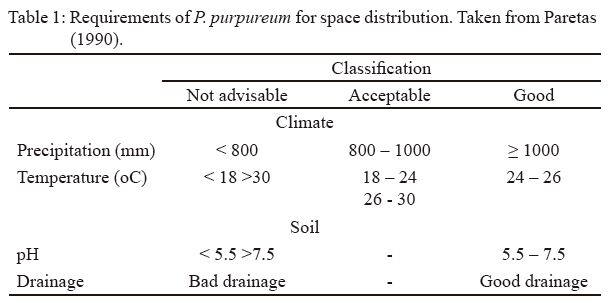
<body><![CDATA[<p align="justify" class="Cuerpodetexto" style="margin-top:12.0pt;text-indent:0cm;"><span style="font-family:'Verdana','sans-serif'; font-size:10.0pt; color:windowtext; ">For the space distribution of this  species, considered as the delimitation of areas with the potential of  precipitation-temperature and soil conditions for the development of this  species, a general methodology of analysis (<a href="/img/revistas/cjas/v50n2/f0114216.gif">figure 1</a>) was designed, which  combined information of precipitation and annual mean temperature and type of  soil, pH and drainage, integrated into an analytical Geographic Information  System (GIS), and implementation of space analysis operations (filtering map of  soil with variables of analysis soil type, pH and drainage, and reclassifying  maps), according to edaphoclimatic requirements of this species reported by  Paretas (1990) for <em>P. purpureum</em> (<a href="/img/revistas/cjas/v50n2/t0114216.gif">table 1</a> and <a href="/img/revistas/cjas/v50n2/t0214216.gif">2</a>), which took into account  the natural conditions of regions, as well as the conditions of the studied  crop and superposition of&nbsp; maps resulting  from the previous operations. </span></p>     
<p align="justify" class="Cuerpodetexto" style="margin-top:12.0pt;text-indent:0cm;"><span style="font-family:'Verdana','sans-serif'; font-size:10.0pt; color:windowtext; ">With soil type information, three  groups were formed: good, regular and poor, according to studies conducted by  Paretas (1990) for this species (<a href="/img/revistas/cjas/v50n2/t0214216.gif">table 2</a>), covering 20 soil types described in  the New Genetic Classification of Soils of Cuba (Hernandez <em>et al</em>. 2015).</span></p>     
<p align="justify" class="Cuerpodetexto" style="margin-top:12.0pt;text-indent:0cm;"><span style="font-family:'Verdana','sans-serif'; font-size:10.0pt; color:windowtext; ">Temporary periods  2040, 2070 and 2099 were considered as limits of the three periods established  for the analysis of future climates. Daily outputs of temperature and mean  precipitations of General Circulation Models (GCM) Echan4 were used, with space  resolution of 25 km and A2 and B2&nbsp;  emission scenarios (SRES) were used, proposed by Houghton and IPCC  (2001). Both scenarios propose a situation in which the world does not follow a  globalizing pattern. Nevertheless, A2 indicates that local identities are  preserved and population will grow at a medium rhythm. Economic and  technological development will be fragmented and slower than in other  scenarios. Therefore, a less favorable scenario will be considered, regarding  greenhouse effect gases emissions. In scenario B2, local solutions for social,  economic and environmental problems will be very important. Technological  evolution will be less fast but more diverse than in the rest of scenarios. It  will be oriented to environment protection and social equality, at local or  regional level. A more favorable scenario will be considered. </span><span style="font-family:'Verdana','sans-serif'; font-size:10.0pt; color:windowtext; ">&nbsp;</span></p>     <p align="justify" class="Cuerpodetexto" style="margin-top:12.0pt;text-indent:0cm;"><span style="font-family:'Verdana','sans-serif'; font-size:10.0pt; color:windowtext; ">This selection of  scenarios was confirmed by B&aacute;rcena (2010) and B&aacute;rcena <em>et al</em>. (2014),  because it is considered that conditions of Latin America and the Caribbean  will be determined by economic development, with new clean technologies, mainly  at regional or local level. In addition, this model, according to criteria of  Jones (2004) and Campbell <em>et al</em>. (2011), is one of the available models  and represent, properly, the general circulation of the atmosphere in the  Caribbean.</span></p>     <p align="justify" class="Cuerpodetexto" style="margin-top:12.0pt;text-indent:0cm;"><span style="font-family:'Verdana','sans-serif'; font-size:10.0pt; color:windowtext; ">It is important to  point out that the function of climate is well documented as a soil forming  factor so there is a relationship among temperature, precipitation and physical  properties of soil. However, there are no current studies on the effects of  climate change on soil properties. Hern&aacute;ndez <em>et al</em>. (2008), for example,  refer that combination of temperature and humidity conditions determine the  rate of creation and decomposition of organic matter, as well as the speed and  character of weathering processes. Likewise, changes of precipitations and  temperatures create different conditions of the type of formation of clay  minerals in the soil, which contribute to important changes in their physical  and chemical properties. Among other effects, the increase of global  temperature may also accelerate carbon losses of soils, which increases the  concentration of carbon dioxide in the atmosphere. Equally, changes of rain  patterns may contribute to the increase of erosion in vulnerable soils that  usually experience a low content of organic matter, as in the case of those  occupying grasses in Cuba.</span><span style="font-family:'Verdana','sans-serif'; font-size:10.0pt; color:windowtext; "> </span></p>     <p align="justify" class="Cuerpodetexto" style="margin-top:12.0pt;text-indent:0cm;"><span style="font-family:'Verdana','sans-serif'; font-size:10.0pt; color:windowtext; ">Nevertheless, in Cuba, some precise  studies on soil use changes and erosion have been conducted. In this last case,  there is a very specific study of Febles <em>et al</em>. (2014), stating that red  ferrallitic soils from Mayabeque and Artemisa provinces will experiment losses  of    50 % towards 2050, due to the erosions provoked by the increase of the  frequency of hurricanes of high intensity in the area.</span></p>     <p align="justify" class="Cuerpodetexto" style="margin-top:12.0pt;text-indent:0cm;">&nbsp;</p>     <p align="justify" class="subtitulo" style="margin-top:12.0pt;text-align:justify;"><span style="font-family:'Verdana','sans-serif'; font-size:13.0pt; color:windowtext; "><b>RESULTS AND DISCUSSION</b> </span></p>     <p align="justify" class="Cuerpodetexto" style="margin-top:12.0pt;text-indent:0cm;"><span style="font-family:'Verdana','sans-serif'; font-size:10.0pt; color:windowtext; ">For conducting any predictive study,  it is important to know the available potentialities, in this case, climatic  ones. They may be known from temperature, mean monthly precipitations and soil  indicators, from the type of soil, pH and drainage to cover the needs of crops  under analysis that will be used in the space     <br>   distribution.&nbsp;&nbsp; </span></p>     ]]></body>
<body><![CDATA[<p align="justify" class="Cuerpodetexto" style="margin-top:12.0pt;text-indent:0cm;"><span style="font-family:'Verdana','sans-serif'; font-size:10.0pt; color:windowtext; ">The analysis of the potential of  precipitation-temperature from 1961 to 1990 reported the formation of four  categories, depending on the combination of the criteria of experts for  climatic elements (<a href="/img/revistas/cjas/v50n2/t0114216.gif">table 1</a>) that allowed the space distribution of this  species:</span></p>     
<p align="justify" class="Cuerpodetexto" style="margin-top:12.0pt;text-indent:0cm;"><span style="font-family:'Verdana','sans-serif'; font-size:10.0pt; color:windowtext; ">- Not advisable: areas with  precipitations lower than 800 mm and temperature inferior to 18 &ordm;C or superior  to 30 &ordm;C.</span></p>     <p align="justify" class="Cuerpodetexto" style="margin-top:12.0pt;text-indent:0cm;"><span style="font-family:'Verdana','sans-serif'; font-size:10.0pt; color:windowtext; ">- Acceptable: areas with mean annual  temperatures between 18 and 24 &ordm;C or superior (26-30 &ordm;C) and acceptable  precipitations between 800 and 1000 mm<span style="letter-spacing:.2pt; ">.</span></span></p>     <p align="justify" class="Cuerpodetexto" style="margin-top:12.0pt;text-indent:0cm;"><span style="font-family:'Verdana','sans-serif'; font-size:10.0pt; color:windowtext; ">- Moderately good: areas with  incidence of proper temperatures (24- 26 &ordm;C) and acceptable precipitations or  with another combination of high temperatures with proper precipitations,  superior to 1,000 mm.</span></p>     <p align="justify" class="Cuerpodetexto" style="margin-top:12.0pt;text-indent:0cm;"><span style="font-family:'Verdana','sans-serif'; font-size:10.0pt; color:windowtext; ">- Good: areas with values of  precipitation superior to 1000 mm and temperatures range between 24 and     <br>   26 &ordm;C.</span></p>     <p align="justify" class="Cuerpodetexto" style="margin-top:12.0pt;text-indent:0cm;"><span style="font-family:'Verdana','sans-serif'; font-size:10.0pt; color:windowtext; ">According to data of <a href="/img/revistas/cjas/v50n2/t0314216.gif">table 3</a>, it can  be stated that Cuban climate, at baseline, shows high potential for the  development of this species. It means that 100% of national territory has  climatic conditions for fulfilling the requirements of this species. An amount  of 93.2 % of its areas is included into the categories of moderately acceptable  and good. This condition indicates that the space distribution has homogeneous  conditions, which means high vulnerability of the territory to future  variations of regional climate.</span></p>     
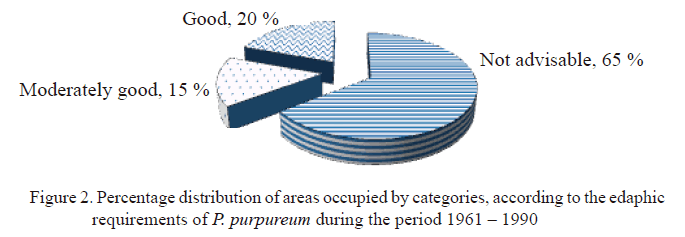
<p align="justify" class="Cuerpodetexto" style="margin-top:12.0pt;text-indent:0cm;"><span style="font-family:'Verdana','sans-serif'; font-size:10.0pt; color:windowtext; ">After a joint  analysis of the requirements of <em>P. purpureum</em>, in order to determine the  soil potential from the criteria stated in <a href="/img/revistas/cjas/v50n2/t0114216.gif">tables 1</a> and <a href="/img/revistas/cjas/v50n2/t0214216.gif">2</a>, it was confirmed  that only 35,603.62 km<sup>2</sup> (34 %) of national territory (distributed  into the categories of acceptable and good) can be used for cultivating this  species. The first category included the areas where the type of soil was  qualified as regular, with acceptable conditions of pH and drainage. Second  category corresponded to areas where the type of soil was considered as good,  with proper drainage and accepted values of pH for <em>P. purpureum</em> (<a href="/img/revistas/cjas/v50n2/f0214216.gif">figure  2</a>). This means that the reported percentage corresponds to areas with  acceptable conditions of type of soil, pH and drainage for the development of  this crop. However, this does not indicate that this species is exclusive for  these areas. Nowadays, it may be found in several ecosystems from Cuban  territory, although, as it happens with the cultivar Cuba CT-115, it does not  reach all its productive potential, even though it is used for animal feeding  during dry period, as its technology recommends (Mart&iacute;nez and Herrera 2015). </span></p>     
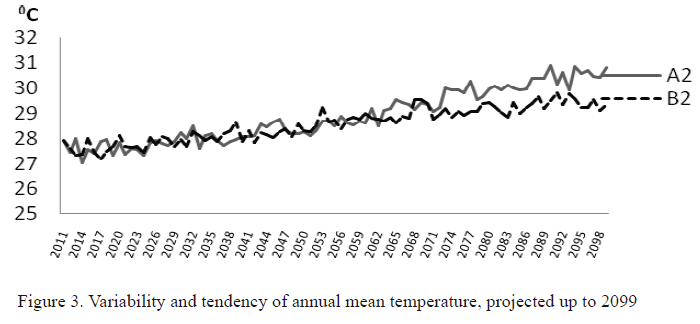
<p align="justify" class="Cuerpodetexto" style="margin-top:12.0pt;text-indent:0cm;"><span style="font-family:'Verdana','sans-serif'; font-size:10.0pt; color:windowtext; ">It is important to state that space  distribution of <em>P. purpureum</em> at the baseline presented the same  categories and percentages that showed the space distribution of soil potential.</span></p>     <p align="justify" class="Cuerpodetexto" style="margin-top:12.0pt;text-indent:0cm;"><em><span style="font-family:'Verdana','sans-serif'; font-size:10.0pt; color:windowtext; ">Projected scenarios</span></em><span style="font-family:'Verdana','sans-serif'; font-size:10.0pt; color:windowtext; ">. Mean superficial temperature of air, projected up to 2099  for Cuba, should present a tendency to increase with high variability between  years (<a href="/img/revistas/cjas/v50n2/f0314216.gif">figure 3</a>) and possibilities to reach maximum values of 30.1 &ordm;C for  scenario A2, and 29.3 &ordm;C for B2 in the temporary period 2071-2099. These values  depend on increases between 2.7 and 5.0 &ordm;C of scenario A2 versus 2.7 and 4.2 &ordm;C  of B2. Regarding tendency, it is highlighted that, up to 2070, there will be a  marked differentiation between scenarios. </span></p>     
]]></body>
<body><![CDATA[<p align="justify" class="Cuerpodetexto" style="margin-top:12.0pt;text-indent:0cm;"><span style="font-family:'Verdana','sans-serif'; font-size:10.0pt; color:windowtext; ">Although it is  predicted a constant increase of temperature, mean annual values will be close  to the established limits for the good performance of this species. With this  statement, it could be assumed that this species will experience a gradual adaptation  process, which will minimize the possible effects of these increases on  physiological processes of this plant. However, from a more critical vision,  the increase of temperature over the optimal value may suppose effects on  growth reduction due to the decrease of photosynthetic activity by enzymatic  inactivation and to the increase of respiratory demand (respiration and  photo-respiration) (Herrera 2006). There will also be expected effects on grass  quality (Herrera and Ramos 2015). </span><span style="font-family:'Verdana','sans-serif'; font-size:10.0pt; color:windowtext; "> </span></p>     <p align="justify" class="Cuerpodetexto" style="margin-top:12.0pt;text-indent:0cm;"><span style="font-family:'Verdana','sans-serif'; font-size:10.0pt; color:windowtext; ">Del Pozo (2002)  states that one of the structural mechanisms for grasses to reduce stress  effects due to high temperatures is the increase of cell wall content, mainly  in lignin, which reduces their digestibility and quality. In addition, it is  known that, during rainy season, when temperatures are high and transpiration  reaches superior values, quality of grasses is negatively altered, which mostly  may be measured with leaf percentage</span><span style="font-family:'Verdana','sans-serif'; font-size:10.0pt; color:windowtext; ">.</span></p>     <p align="justify" class="Cuerpodetexto" style="margin-top:12.0pt;text-indent:0cm;"><span style="font-family:'Verdana','sans-serif'; font-size:10.0pt; color:windowtext; ">Unlike the adequate coherence among  the future estimations of air temperature, results of precipitations showed  higher dispersion and variability of values in both scenarios (<a href="/img/revistas/cjas/v50n2/f0414216.gif">figure 4a</a>). It  is important to highlight that the three temporary periods to be analyzed  (2011-2040, 2041-2070 and 2071-2099) should show negative anomalies, which  supposes increase of water deficiencies for this crop (<a href="/img/revistas/cjas/v50n2/f0414216.gif">figure 4b</a>).</span></p>     
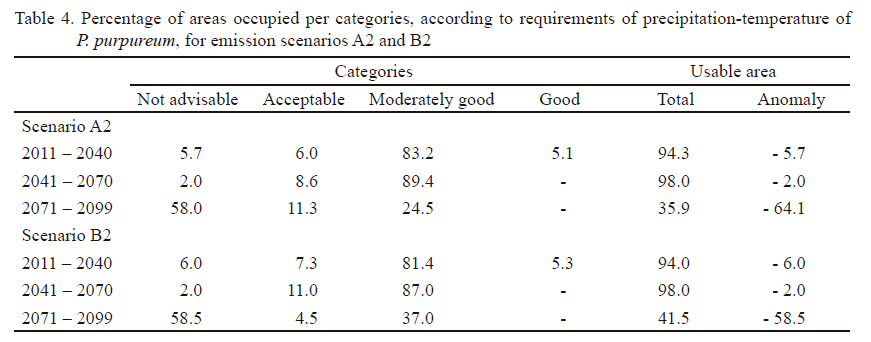
<p align="justify" class="Cuerpodetexto" style="margin-top:12.0pt;text-indent:0cm;"><span style="font-family:'Verdana','sans-serif'; font-size:10.0pt; color:windowtext; ">In a general  sense, performance of water deficit indicates a slight recovery towards period  2041-2070 and a later decrease. Simulation of scenario B2 reveals a tendency to  recovery, despite that, in 2099, there will be no superior values to those of  the first temporary period and it will not reach values of precipitation  reported for the baseline. It means that values of anomalies will range between  -15 and    -13 %. Scenario A2 will show the highest water deficit, with a tendency to  intensification for the last period of analysis and its values of anomalies  will vary from -10 a -21 %. </span><span style="font-family:'Verdana','sans-serif'; font-size:10.0pt; color:windowtext; "> </span></p>     <p align="justify" class="Cuerpodetexto" style="margin-top:12.0pt;text-indent:0cm;"><span style="font-family:'Verdana','sans-serif'; font-size:10.0pt; color:windowtext; ">Stress due to droughts, common in  tropical regions, intensified from projections of precipitations established  for Cuba, may affect the physiological and morphological performance of the  plant, depending on intensity, and growth and development state of the plants.  Among the most sensitive effects, there is a reduction of cell expansion,  motivated by decrease of turgency, stoma closure, transpiration and  photosynthesis. In addition, water deficit modifies the relationship of biomass  between the aerial and radicular part of the plant (Coraza and Quintero 1991,  Hern&aacute;ndez <em>et al</em>. 2008).</span></p>     <p align="justify" class="Cuerpodetexto" style="margin-top:12.0pt;text-indent:0cm;"><span style="font-family:'Verdana','sans-serif'; font-size:10.0pt; color:windowtext; ">These results agree with reports of  Centella <em>et al</em>. </span><span style="font-family:'Verdana','sans-serif'; font-size:10.0pt; color:windowtext; ">(2001),  Solano <em>et al</em>. (2005) and Planos <em>et al</em>. </span><span style="font-family:'Verdana','sans-serif'; font-size:10.0pt; color:windowtext; ">(2013), which indicate an increase of temperature that, in  the most adverse scenario (A2), could increase up to 4 &deg;C for 2100. The  uncertain performance of precipitations, with dispersion of values in magnitude  and in sign, may decrease in 20%, as well as the increase of evaporation due to  increase of temperature that will favor aridity of Cuban territory.</span></p>     <p align="justify" class="Cuerpodetexto" style="margin-top:12.0pt;text-indent:0cm;"><span style="font-family:'Verdana','sans-serif'; font-size:10.0pt; color:windowtext; ">In order to talk  about expected impacts on future space distribution of <em>P. purpureum</em>, it  is necessary to perform an integral analysis of the projections of each factor:  temperature, mean annual precipitation, type of soil, pH and drainage. In  addition, relations among cited factors should be established in order to have  an idea, close as possible, of the wanted    result. </span><span style="font-family:'Verdana','sans-serif'; font-size:10.0pt; color:windowtext; "> </span></p>     <p align="justify" class="Cuerpodetexto" style="margin-top:12.0pt;text-indent:0cm;"><span style="font-family:'Verdana','sans-serif'; font-size:10.0pt; color:windowtext; ">From the temporary  point of view, there was a tendency to decrease the areas with potential for  precipitation and temperature, favorable for biomass production of this  species. Scenario A2 was the most critical. Negative anomalies will increase,  from the first to the last temporary period, from 5.7 to    64.1 % for A2 and from 6 up to 58.5 % in B2, according to <a href="/img/revistas/cjas/v50n2/t0414216.gif">table 4</a>. In addition,  for both scenarios, the areas within the not advisable category will increase  during the last thirty years of the century. It is also observed the  disappearance of areas with the combination of temperatures between 24 and 26  &deg;C and precipitations superior to 1,000 mm, considered as good, from 2041 to  2070.</span><span style="font-family:'Verdana','sans-serif'; font-size:10.0pt; color:windowtext; "> </span></p>     
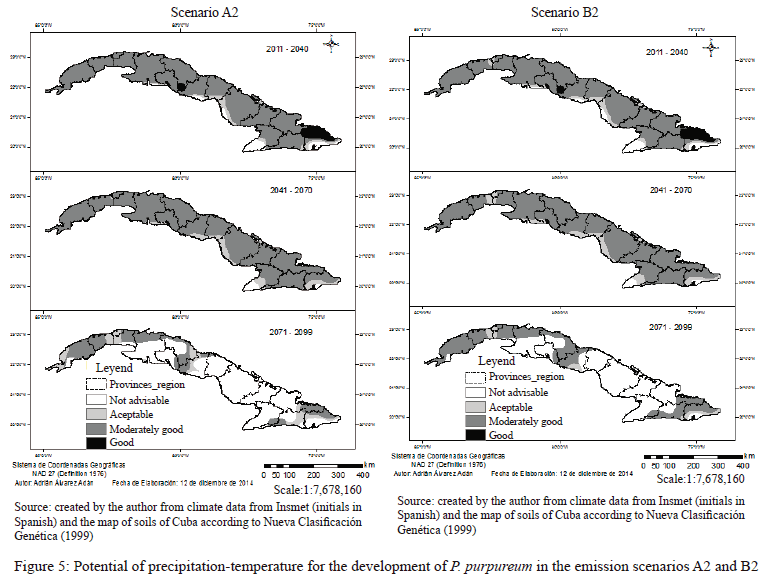
<p align="justify" class="Cuerpodetexto" style="margin-top:12.0pt;text-indent:0cm;"><span style="font-family:'Verdana','sans-serif'; font-size:10.0pt; color:windowtext; ">The previous  result is spatially confirmed (<a href="/img/revistas/cjas/v50n2/f0514216.gif">figure 5</a>) and it is foreseen that this species  will occupy almost all the territory during the first two periods (2011 &ndash;  2070), up to 36 and 42 % in scenarios A2 and B2, respectively.</span><span style="font-family:'Verdana','sans-serif'; font-size:10.0pt; color:windowtext; "> </span></p>     
<p align="justify" class="Cuerpodetexto" style="margin-top:12.0pt;text-indent:0cm;"><span style="font-family:'Verdana','sans-serif'; font-size:10.0pt; color:windowtext; ">A first interpretation of this  analysis may be that these projected scenarios of increase of mean annual  temperature will be notably determining the space pattern of potentialities of  precipitation-temperature for the development of this species. A second  interpretation will be that, up to 2070, there will be a homogenization of  distribution towards all the country of moderately good category, which will  substitute the good category existing at the baseline of occidental region and  some areas of central region. From 2071, climate will be potentially favorable  only for some regions of the country. The most affected areas will be those  from the central region. </span></p>     ]]></body>
<body><![CDATA[<p align="justify" class="Cuerpodetexto" style="margin-top:12.0pt;text-indent:0cm;"><span style="font-family:'Verdana','sans-serif'; font-size:10.0pt; color:windowtext; ">Space distribution of this species  also shows a similar performance to that of the potential of  precipitation-temperature. Temporarily (<a href="/img/revistas/cjas/v50n2/t0514216.gif">table 5</a>), although anomalies will be  negative as time passes, there will be a slight increase of potential areas for  its development during 2041-2070, with very close values to those of baseline,  so the category of good will be potentiated. From that moment, it will show a  radical decrease, reaching between 19.7 (scenario B2) and 21.7 % (scenario A2)  of the territory towards the end of the century, regarding the baseline. The  areas under the not advisable categories will present the highest values, which  will range between 67 % for period 2011 &ndash; 2040 and 87 % for 2099, for the most  critical scenario (A2), with a difference of two percentage units more than B2,  at the same time. It is important to state that, in the projected scenarios,  there will be no information about areas with acceptable category. This idea  comes from the analysis carried out between 1961 and 1990.</span></p>     
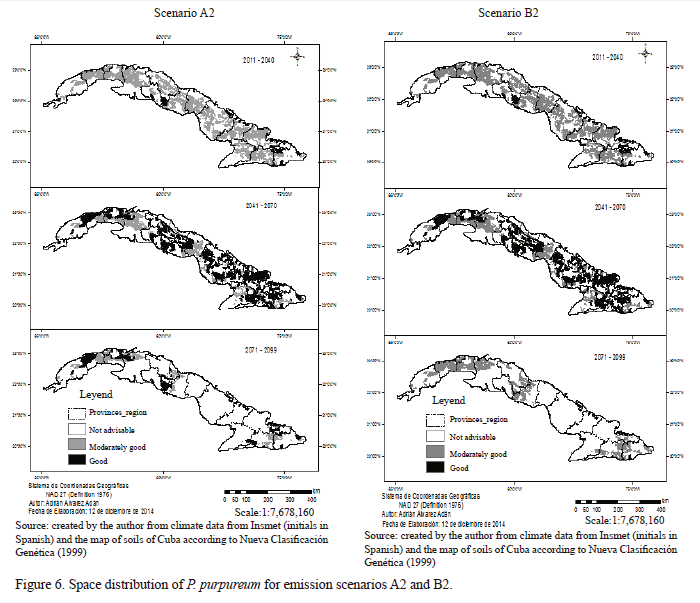
<p align="justify" class="Cuerpodetexto" style="margin-top:12.0pt;text-indent:0cm;"><span style="font-family:'Verdana','sans-serif'; font-size:10.0pt; color:windowtext; ">The analysis of  space distribution (<a href="/img/revistas/cjas/v50n2/f0614216.gif">figure 6</a>) shows that, despite projections of potentially  usable areas are low, they are represented by one category or another all over  the country. It will only be affected in the last studied temporary period, in  which three well defined regions are observed. One of great extension will  include some areas of Pinar del R&iacute;o province, as well as Artemisa, La Habana,  Mayabeque and the North part of Matanzas province. The second is smaller, and  includes limiting areas of Villa Clara and Sancti Spiritus provinces. The third  is more disperse, with small cores within Santiago de Cuba, Guant&aacute;namo and  Holgu&iacute;n provinces.</span><span style="font-family:'Verdana','sans-serif'; font-size:10.0pt; color:windowtext; "> </span></p>     
<p align="justify" class="Cuerpodetexto" style="margin-top:12.0pt;text-indent:0cm;"><span style="font-family:'Verdana','sans-serif'; font-size:10.0pt; color:windowtext; ">This performance  of the decrease of future potentially usable areas of <em>P. purpureum</em> agrees with studies carried out for other species of commercial interest like  oaks (<em>Querscus spp</em>.) (Mascot <em>et al</em>. 2015), plum (<em>Spondias spp</em>.)  (Arce <em>et al</em>. 2015 ) and others (Monterroso <em>et al</em>. 2015) developed  in Mexico, and with those of potato (Veneros <em>et al</em>. 2015) conducted in  Peru. It also coincides with results of researches by Gavazov <em>et al</em>.(2013),  who studied dynamics of forage production in mountain areas in Switzerland,  according to projections of climate change. In addition, there are reports on  the increase of areas for wheat in Yunnan province, in China (Lu <em>et al</em>.  2013).</span><span style="font-family:'Verdana','sans-serif'; font-size:10.0pt; color:windowtext; "> </span></p>     <p align="justify" class="Cuerpodetexto" style="margin-top:12.0pt;text-indent:0cm;"><span style="font-family:'Verdana','sans-serif'; font-size:10.0pt; color:windowtext; ">It is important to  state that, although there are only representations of good and moderately good  categories in this space distribution, as potentially usable areas, they could  have important problems of floodings during intense rains and huricanes. It  means that, despite these categories include soils of good drainage, <em>P.  purpureum</em> is very sensitive to prolonged floodings (Febles and Herrera  2015) for more than two days, mainly provoked by these meteorological  phenomena. Although it may be a local fact , it has adverse effects on  development and growth of this plant and may cause its death due to lack of  oxigen within the roots (Taiz and Zeiger 2006).</span></p>     <p align="justify" class="Cuerpodetexto" style="margin-top:12.0pt;text-indent:0cm;"><span style="font-family:'Verdana','sans-serif'; font-size:10.0pt; color:windowtext; ">Results of this  study are very important from a practical point of view, taking into  consideration that the Ministry of Agriculture of Cuba recommends the  generalization of this technology of biomass banks as an alternative for  grazing during dry period in tropical areas with one of the varieties of this  species (Cuba CT-115), because it presents better potentialities for this  purpose, according to reports of Mart&iacute;nez and Herrera (2015). In addition,  other varieties are included on the strategy such as OM-22 and CT-169, as well  as varieties of sugar cane with similar requirements to those of Pennisetum. </span></p>     <p align="justify" class="Cuerpodetexto" style="margin-top:12.0pt;text-indent:0cm;">&nbsp;</p>     <p align="justify" class="subtitulo" style="margin-top:12.0pt;text-align:justify;"><span style="font-family:'Verdana','sans-serif'; font-size:13.0pt; color:windowtext; "><b>CONCLUSIONS</b></span></p>     <p align="justify" class="Cuerpodetexto" style="margin-top:12.0pt;text-indent:0cm;"><span style="font-family:'Verdana','sans-serif'; font-size:10.0pt; color:windowtext; ">The potential precipitation-  temperature for the development of <em>P. purpureum</em> in Cuba will be highly  affected and will contribute to reduction of potential areas from 2071, between  59 (scenario B2) and 64 % (scenario A2). The most affected areas will be those  from central region. On the other hand, soil potential will determine 34 % of  usable area.</span></p>     <p align="justify" class="Cuerpodetexto" style="margin-top:12.0pt;text-indent:0cm;"><span style="font-family:'Verdana','sans-serif'; font-size:10.0pt; color:windowtext; ">Integration of  physical factors (climate and soil) allowed to identify potentially usable areas  (space distribution) for cultivating and developing this species, which will  follow the model stated by the potential of precipitation-temperature. In this  case, reduction of potential areas, according to edaphoclimatic requirements of  this species, will be between 20 (B2) and 22 % (A2) for the temporary period  2071-2099.</span><span style="font-family:'Verdana','sans-serif'; font-size:10.0pt; color:windowtext; "> </span></p>     <p align="justify" class="Cuerpodetexto" style="margin-top:12.0pt;text-indent:0cm;"><span style="line-height:107%; font-family:'Verdana','sans-serif'; font-size:10.0pt; ">This research may be used  as pattern for planning an <em>in situ</em> and <em>ex situ</em> conservation  strategy of genetic resources of <em>P. purpureum</em>, because the most suitable  places for the establishment of <em>in vivo</em> germplasm banks of this  phytogenetic resource may be predicted. It can be also used as a strategy for  management of areas established with this species, as to allow to minimize the  effects of climate change and reach a better adaptation to different productive  systems</span><font size="2" face="Verdana, Arial, Helvetica, sans-serif">.</font></p>     ]]></body>
<body><![CDATA[<p align="justify">&nbsp;</p>     <p align="justify"><font size="2" face="Verdana, Arial, Helvetica, sans-serif"><font size="3"><b>REFERENCES</b></font></font></p>     <p align="justify" class="MsoBibliography" style="margin-top:12.0pt;text-align:justify;"><span style="line-height:107%; font-family:'Verdana','sans-serif'; font-size:10.0pt; ">Arce, A. R., Monterroso, R. A. I., G&oacute;mez, J. D.  &amp; Cruz, L. A. 2015. &ldquo;Distribuci&oacute;n potencial de ciruela (<em>Spondias</em> spp.) en M&eacute;xico bajo escenarios de cambio clim&aacute;tico&rdquo;. In: <em>X Convenci&oacute;n  Internacional sobre Medio Ambiente y Desarrollo</em>, 15 June, La Habana, Cuba:  Agencia de Medio Ambiente, ISBN: 978-959-300-073-4, Available:  &lt;<a href="https://drive.google.com/open?id=0B1biY1FzrBrQQ0dwY3dvblBwSEE" target="_blank">https://drive.google.com/open?id=0B1biY1FzrBrQQ0dwY3dvblBwSEE</a>&gt;,  [Consulted:&nbsp;November 23, 2015].</span></p>     <p align="justify" class="MsoBibliography" style="margin-top:12.0pt;text-align:justify;"><span style="font-family:'Verdana','sans-serif'; font-size:10.0pt; ">B&aacute;rcena, A. 2010. &ldquo;Restricciones estructurales del  desarrollo en Am&eacute;rica Latina y el Caribe: una reflexi&oacute;n postcrisis&rdquo;. <em>Revista  de la CEPAL</em>, (100): 7&ndash;28, ISSN: 1682-0908.</span></p>     <!-- ref --><p align="justify" class="MsoBibliography" style="margin-top:12.0pt;text-align:justify;"><span style="font-family:'Verdana','sans-serif'; font-size:10.0pt; ">B&aacute;rcena, A., Prado, A., Samaniego, J. &amp; P&eacute;rez,  R. 2014. <em>La econom&iacute;a del cambio clim&aacute;tico en Am&eacute;rica Latina y el Caribe.  Paradojas y desaf&iacute;os del desarrollo sostenible</em>. (ser. Documentos de  Proyectos, no. ser. </span><span style="font-family:'Verdana','sans-serif'; font-size:10.0pt; ">LC/L.3895), Santiago de Chile: ONU-CEPAL, 76 p., Available:  &lt;<a href="http://200.9.3.98/bitstream/handle/11362/37471/S1420763_es.pdf?sequence=1" target="_blank">http://200.9.3.98/bitstream/handle/11362/37471/S1420763_es.pdf?sequence=1</a>&gt;,  [Consulted:&nbsp;June 2, 2016].    </span></p>     <p align="justify" class="MsoBibliography" style="margin-top:12.0pt;text-align:justify;"><span style="font-family:'Verdana','sans-serif'; font-size:10.0pt; ">Campbell, J. D., Taylor, M.  A., Stephenson, T. S., Watson, R. A. &amp; Whyte, F. S. 2011. &ldquo;Future climate  of the Caribbean from a regional climate model&rdquo;. </span><em><span style="font-family:'Verdana','sans-serif'; font-size:10.0pt; ">International Journal of Climatology</span></em><span style="font-family:'Verdana','sans-serif'; font-size:10.0pt; ">, 31(12): 1866&ndash;1878, ISSN: 1097-0088, DOI:  10.1002/joc.2200.</span></p>     <!-- ref --><p align="justify" class="MsoBibliography" style="margin-top:12.0pt;text-align:justify;"><span style="font-family:'Verdana','sans-serif'; font-size:10.0pt; ">Centella, A., Llanes, J., Paz, L., L&oacute;pez, C. &amp;  Limia, M. 2001. <em>Primera Comunicaci&oacute;n Nacional a la Convenci&oacute;n Marco de las  Naciones Unidas sobre Cambio Clim&aacute;tico</em>. La Habana, Cuba: Grupo Nacional de  Cambio Clim&aacute;tico-Instituto de Meteorolog&iacute;a, 166 p., Available:  &lt;<a href="http://ncsp.undp.org/sites/default/files/198.pdf" target="_blank">http://ncsp.undp.org/sites/default/files/198.pdf</a>&gt;, [Consulted:&nbsp;June  2, 2016].    </span></p>     <!-- ref --><p align="justify" class="MsoBibliography" style="margin-top:12.0pt;text-align:justify;"><span style="font-family:'Verdana','sans-serif'; font-size:10.0pt; ">Coraza, R. &amp; Quintero, E. 1991. <em>Agrometeorolog&iacute;a</em>.  Villa Clara, Cuba: Publicaciones CDICT, 390 p.    </span></p>     <p align="justify" class="MsoBibliography" style="margin-top:12.0pt;text-align:justify;"><span style="font-family:'Verdana','sans-serif'; font-size:10.0pt; ">Del Pozo, R. P. P. 2002. &ldquo;Bases ecofisiol&oacute;gicas  para el manejo de los pastos tropicales&rdquo;. <em>Pastos</em>, 32(2): 109&ndash;137, ISSN:  0210-1270.</span></p>     <p align="justify" class="MsoBibliography" style="margin-top:12.0pt;text-align:justify;"><span style="font-family:'Verdana','sans-serif'; font-size:10.0pt; ">Febles, G. &amp; Herrera, R. S. 2015. &ldquo;Introducci&oacute;n  y caracter&iacute;sticas bot&aacute;nicas&rdquo;. In: Herrera, G. R. S., <em>Producci&oacute;n de biomasa  de variedades y clones de Pennisetum purpureum para la ganader&iacute;a</em>, 1st ed.,  Mayabeque, Cuba: EDICA, p. 171, ISBN: 978-959-7171-67-6.</span></p>     <p align="justify" class="MsoBibliography" style="margin-top:12.0pt;text-align:justify;"><span style="font-family:'Verdana','sans-serif'; font-size:10.0pt; ">Febles, G. J. M., Vega, C. M. B., Amaral, S. N. M.  B., Tol&oacute;n, B. A. &amp; Lastra, B. X. B. 2014. </span><span style="font-family:'Verdana','sans-serif'; font-size:10.0pt; ">&ldquo;Soil loss from erosion in  the next 50 years in karst regions of Mayabeque province, Cuba&rdquo;. <em>Land  Degradation &amp; Development</em>, 25(6): 573&ndash;580, ISSN: 10853278, DOI:  10.1002/ldr.2184.</span></p>     <p align="justify" class="MsoBibliography" style="margin-top:12.0pt;text-align:justify;"><span style="font-family:'Verdana','sans-serif'; font-size:10.0pt; ">Garc&iacute;a, L. M., Mesa, A. R.  &amp; Hern&aacute;ndez, M. 2014. </span><span style="font-family:'Verdana','sans-serif'; font-size:10.0pt; ">&ldquo;Potencial  forrajero de cuatro cultivares de <em>Pennisetum purpureum</em> en un suelo Pardo  de Las Tunas&rdquo;. <em>Pastos y Forrajes</em>, 37(4): 413&ndash;419, ISSN: 0864-0394.</span></p>     <p align="justify" class="MsoBibliography" style="margin-top:12.0pt;text-align:justify;"><span style="font-family:'Verdana','sans-serif'; font-size:10.0pt; ">Garea, L. E., Soto, C. F. &amp; Vantour, C. A.  2006. &ldquo;Combinaci&oacute;n de m&eacute;todos de an&aacute;lisis espacial para la zonificaci&oacute;n  agroecol&oacute;gica de cultivos en condiciones de monta&ntilde;a&rdquo;. <em>Ciencias de la Tierra  y el Espacio</em>, 7: 38&ndash;46, ISSN: 1729-3790.</span></p>     <p align="justify" class="MsoBibliography" style="margin-top:12.0pt;text-align:justify;"><span style="font-family:'Verdana','sans-serif'; font-size:10.0pt; ">Gavazov, K. S., Peringer, A., Buttler, A., Gillet,  F. &amp; Spiegelberger, T. 2013. </span><span style="font-family:'Verdana','sans-serif'; font-size:10.0pt; ">&ldquo;Dynamics of Forage Production in Pasture-woodlands of  the Swiss Jura Mountains under Projected Climate Change Scenarios&rdquo;. </span><em><span style="font-family:'Verdana','sans-serif'; font-size:10.0pt; ">Ecology and Society</span></em><span style="font-family:'Verdana','sans-serif'; font-size:10.0pt; ">, 18(1): 38, ISSN: 1708-3087, DOI:  10.5751/ES-04974-180138.</span></p>     <!-- ref --><p align="justify" class="MsoBibliography" style="margin-top:12.0pt;text-align:justify;"><span style="font-family:'Verdana','sans-serif'; font-size:10.0pt; ">Hern&aacute;ndez, A., Ascanio, M. O., Morales, M.,  Boj&oacute;rquez, J. I., Garc&iacute;a, N. E. &amp; Garc&iacute;a, J. D. 2008. <em>El suelo:  Fundamentos sobre su formaci&oacute;n, los cambios globales y su manejo</em>. M&eacute;xico:  Universidad Aut&oacute;noma de Nayarit, 264 p., ISBN: 978-968-833-072-2.    </span></p>     <!-- ref --><p align="justify" class="MsoBibliography" style="margin-top:12.0pt;text-align:justify;"><span style="font-family:'Verdana','sans-serif'; font-size:10.0pt; ">Hern&aacute;ndez, J. A., P&eacute;rez, J. J. M., Bosch, I. D.  &amp; Castro, S. N. 2015. <em>Clasificaci&oacute;n de los suelos de Cuba 2015</em>.  Mayabeque, Cuba: Ediciones INCA, 93 p., ISBN: 978-959-7023-77-7.    </span></p>     <p align="justify" class="MsoBibliography" style="margin-top:12.0pt;text-align:justify;"><span style="font-family:'Verdana','sans-serif'; font-size:10.0pt; ">Herrera, R. S. 2005. &ldquo;Evaluaci&oacute;n de gram&iacute;neas.  Contribuci&oacute;n del Instituto de Ciencia Animal&rdquo;. <em>Cuban Journal of Agricultural  Science</em>, 39(3): 253&ndash;259, ISSN: 2079-3480.</span></p>     <p align="justify" class="MsoBibliography" style="margin-top:12.0pt;text-align:justify;"><span style="font-family:'Verdana','sans-serif'; font-size:10.0pt; ">Herrera, R. S. 2006. &ldquo;Fisiolog&iacute;a, calidad y  muestreos&rdquo;. In: Herrera, G. R. S., Rodriguez, G. I. D. &amp; Febles, P. G. J., <em>Fisiolog&iacute;a,  producci&oacute;n de biomasa y sistemas silvopastoriles en pastos tropicales: abono  org&aacute;nico y biog&aacute;s</em>, La Habana, Cuba: EDICA, ISBN: 978-959-7171-04-1,  Available:  &lt;<a href="https://books.google.com.cu/books/about/Fisiolog%C3%ADa_producci%C3%B3n_de_biomasa_y_sis.html?id=fVwbkgEACAAJ&redir_esc=y" target="_blank">https://books.google.com.cu/books/about/Fisiolog%C3%ADa_producci%C3%B3n_de_biomasa_y_sis.html?id=fVwbkgEACAAJ&amp;redir_esc=y</a>&gt;,  [Consulted:&nbsp;June 2, 2016].</span></p>     <p align="justify" class="MsoBibliography" style="margin-top:12.0pt;text-align:justify;"><span style="font-family:'Verdana','sans-serif'; font-size:10.0pt; ">Herrera, R. S., Mart&iacute;nez, R. O., Mart&iacute;nez, M.,  Tuero, R., Cruz, A. M. &amp; Romero, A. 2014. &ldquo;Frecuencia de corte en  indicadores de calidad de variedades de <em>Pennisetum</em> y <em>Saccharum</em> durante el per&iacute;odo poco lluvioso&rdquo;. </span><em><span style="font-family:'Verdana','sans-serif'; font-size:10.0pt; ">Cuban Journal of Agricultural Science</span></em><span style="font-family:'Verdana','sans-serif'; font-size:10.0pt; ">, 48(2): 159&ndash;166, ISSN:  2079-3480.</span></p>     <p align="justify" class="MsoBibliography" style="margin-top:12.0pt;text-align:justify;"><span style="font-family:'Verdana','sans-serif'; font-size:10.0pt; ">Herrera, R. S. &amp; Ramos,  N. 2015. </span><span style="font-family:'Verdana','sans-serif'; font-size:10.0pt; ">&ldquo;Factores que influyen en la  producci&oacute;n de biomasa y la calidad&rdquo;. In: Herrera, G. R. S., <em>Producci&oacute;n de  biomasa de variedades y clones de Pennisetum purpureum para la ganader&iacute;a</em>,  1st ed., Mayabeque, Cuba: EDICA, p. 171, ISBN: 978-959-7171-67-6.</span></p>     <p align="justify" class="MsoBibliography" style="margin-top:12.0pt;text-align:justify;"><span style="font-family:'Verdana','sans-serif'; font-size:10.0pt; ">Houghton, J. T. &amp; IPCC  (Intergovernmental Panel on Climate Change) (eds.). 2001. <em>Climate change  2001: the scientific basis: contribution of Working Group I to the third  assessment report of the Intergovernmental Panel on Climate Change</em>. call  no. QC981.8.C5 C511345 2001, New York, USA: Cambridge University Press, 881 p.,  ISBN: 978-0-521-80767-8, Available:  &lt;<a href="http://www.grida.no/climate/ipcc_tar/wg1/pdf/wg1_tar-front.pdf" target="_blank">http://www.grida.no/climate/ipcc_tar/wg1/pdf/wg1_tar-front.pdf</a>&gt;,  [Consulted:&nbsp;June 2, 2016].</span></p>     <!-- ref --><p align="justify" class="MsoBibliography" style="margin-top:12.0pt;text-align:justify;"><span style="font-family:'Verdana','sans-serif'; font-size:10.0pt; ">Jones, R. 2004. <em>Generating  high resolution climate change scenarios using precis</em>. Met office, 39 p.,  ISBN: 978-0-86180-372-9, Available:  &lt;<a href="https://books.google.com.cu/books/about/Generating_high_resolution_climate_chang.html?id=4d_TOwAACAAJ&redir_esc=y" target="_blank">https://books.google.com.cu/books/about/Generating_high_resolution_climate_chang.html?id=4d_TOwAACAAJ&amp;redir_esc=y</a>&gt;,  [Consulted:&nbsp;June 2, 2016].    </span></p>     <p align="justify" class="MsoBibliography" style="margin-top:12.0pt;text-align:justify;"><span style="font-family:'Verdana','sans-serif'; font-size:10.0pt; ">Lu, Y., Cao, L., Zhang, Z.  &amp; Li, H. 2013. &ldquo;Study on Eco-climate Type Regionalization of Wheat Growing  Areas in Yunnan Province&rdquo;. </span><em><span style="font-family:'Verdana','sans-serif'; font-size:10.0pt; ">Asian  Agricultural Research</span></em><span style="font-family:'Verdana','sans-serif'; font-size:10.0pt; ">, 5(7): 38,  ISSN: 1819-1894.</span></p>     <p align="justify" class="MsoBibliography" style="margin-top:12.0pt;text-align:justify;"><span style="font-family:'Verdana','sans-serif'; font-size:10.0pt; ">Mart&iacute;nez, Z. R. O. &amp; Herrera, R. S. 2015.  &ldquo;Empleo del Cuba CT-115 para solucionar el d&eacute;ficit de alimentos durante la  seca&rdquo;. In: Herrera, G. R. S., <em>Producci&oacute;n de biomasa de variedades y clones  de Pennisetum Purpureum para la ganader&iacute;a</em>, 1st ed., Mayabeque, Cuba: EDICA,  p. 171, ISBN: 978-959-7171-67-6.</span></p>     ]]></body>
<body><![CDATA[<p align="justify" class="MsoBibliography" style="margin-top:12.0pt;text-align:justify;"><span style="font-family:'Verdana','sans-serif'; font-size:10.0pt; ">Mascot, E., Badano, E. I., Rivas, J. F. &amp;  Douterlunge, D. 2015. &ldquo;Supervivencia de encinos (<em>Querscus</em> spp.) de  ambientes templados ante posibles escenarios del cambio clim&aacute;tico&rdquo;. In: <em>X  Convenci&oacute;n Internacional sobre Medio Ambiente y Desarrollo</em>, 15 July, La  Habana, Cuba, ISBN: 978-959-300-073-4, Available:  &lt;<a href="https://drive.google.com/open?id=0B1biY1FzrBrQQ0dwY3dvblBwSEE" target="_blank">https://drive.google.com/open?id=0B1biY1FzrBrQQ0dwY3dvblBwSEE</a>&gt;,  [Consulted:&nbsp;November 23, 2015].</span></p>     <p align="justify" class="MsoBibliography" style="margin-top:12.0pt;text-align:justify;"><span style="font-family:'Verdana','sans-serif'; font-size:10.0pt; ">Monterroso, R. A. I., G&oacute;mez, D. J. D., Arce, R. A.  R. &amp; Lechuga, G. L. M. 2015. &ldquo;Aptitud para algunos cultivos en condiciones  de cambio clim&aacute;tico para M&eacute;xico&rdquo;. In: <em>X Convenci&oacute;n Internacional sobre Medio  Ambiente y Desarrollo</em>, 15 July, La Habana, Cuba, ISBN: 978-959-300-073-4,  Available:  &lt;<a href="https://drive.google.com/open?id=0B1biY1FzrBrQQ0dwY3dvblBwSEE" target="_blank">https://drive.google.com/open?id=0B1biY1FzrBrQQ0dwY3dvblBwSEE</a>&gt;,  [Consulted:&nbsp;November 23, 2015].</span></p>     <p align="justify" class="MsoBibliography" style="margin-top:12.0pt;text-align:justify;"><span style="font-family:'Verdana','sans-serif'; font-size:10.0pt; ">Murillo, S. J., Barros, H. J. A., Roncallo, F. B.  &amp; Arrieta, P. G. 2014. &ldquo;Requerimientos h&iacute;dricos de cuatro gram&iacute;neas de  corte para uso eficiente del agua en el Caribe seco colombiano&rdquo;. <em>Corpoica:  Ciencia y Tecnologia Agropecuaria</em>, 15(1): 83&ndash;99, ISSN: 0122-8706.</span></p>     <p align="justify" class="MsoBibliography" style="margin-top:12.0pt;text-align:justify;"><span style="font-family:'Verdana','sans-serif'; font-size:10.0pt; ">Nava, C. J. J., Guti&eacute;rrez, O. E., Zavala, G. F.,  Olivares, S. E., Trevi&ntilde;o, J. E., Bernal, B. H. &amp; Herrera, G. R. S. 2013.  &ldquo;Establecimiento del pasto &lsquo;CT-115&rsquo; (<em>Pennisetum purpureum</em>) en una zona  semi&aacute;rida del noreste de M&eacute;xico&rdquo;. <em>Revista Fitotecnia Mexicana</em>, 36(3):  239&ndash;244, ISSN: 0187-7380.</span></p>     <!-- ref --><p align="justify" class="MsoBibliography" style="margin-top:12.0pt;text-align:justify;"><span style="font-family:'Verdana','sans-serif'; font-size:10.0pt; ">Paretas, J. J. 1990. <em>Ecosistemas y  regionalizaci&oacute;n de pastos en Cuba</em>. La Habana, Cuba: Universidad de La  Habana, 178 p.    </span></p>     <p align="justify" class="MsoBibliography" style="margin-top:12.0pt;text-align:justify;"><span style="font-family:'Verdana','sans-serif'; font-size:10.0pt; ">Planos, E. O., Vega, R. &amp; Guevara, A. (eds.).  2013. <em>Impacto del Cambio Clim&aacute;tico y Medidas de Adaptaci&oacute;n en Cuba</em>. La  Habana, Cuba: Instituto de Meteorolog&iacute;a-Agencia de Medio Ambiente-Ministerio de  Ciencia, Tecnolog&iacute;a y Medio Ambiente, 430 p.</span></p>     <p align="justify" class="MsoBibliography" style="margin-top:12.0pt;text-align:justify;"><span style="font-family:'Verdana','sans-serif'; font-size:10.0pt; ">Solano, O., V&aacute;zquez, R., Men&eacute;ndez, C., Men&eacute;ndez, J.  A. &amp; Mart&iacute;n, M. E. 2005. &ldquo;Evaluaci&oacute;n de la Sequ&iacute;a Agr&iacute;cola en Cuba&rdquo;. <em>Revista  Cubana de Meteorolog&iacute;a</em>, 12(2): 3&ndash;14, ISSN: 0864-151X.</span></p>     <p align="justify" class="MsoBibliography" style="margin-top:12.0pt;text-align:justify;"><span style="font-family:'Verdana','sans-serif'; font-size:10.0pt; ">Su&aacute;rez, J. J. &amp; Herrera, J. 1986. &ldquo;El Clima de  Cuba y la producci&oacute;n de pastos&rdquo;. In: <em>Los pastos en Cuba</em>, 2nd ed., vol.  1, La Habana, Cuba: EDICA, p. 800.</span></p>     <!-- ref --><p align="justify" class="MsoBibliography" style="margin-top:12.0pt;text-align:justify;"><span style="font-family:'Verdana','sans-serif'; font-size:10.0pt; ">Taiz, L. &amp; Zeiger, E. 2006. <em>Fisiolog&iacute;a  vegetal</em>. Castell&oacute; de la Plana: Universitat Jaume I, ISBN: 978-84-8021-601-2,  OCLC: 803304985, Available:  &lt;<a href="https://books.google.com.cu/books?id=7QIbYg-OC5AC&redir_esc=y" target="_blank">https://books.google.com.cu/books?id=7QIbYg-OC5AC&amp;redir_esc=y</a>&gt;,  [Consulted:&nbsp;June 2, 2016].    </span></p>     <p align="justify" class="MsoBibliography" style="margin-top:12.0pt;text-align:justify;"><span style="font-family:'Verdana','sans-serif'; font-size:10.0pt; ">Veneros,  J., Tonnang, H., Vela, A., Seminario, J., Veneros, M., Garc&iacute;a, M. &amp;  Estacio, M. 2015. </span><span style="font-family:'Verdana','sans-serif'; font-size:10.0pt; ">&ldquo;Potential effects of  climate change on a potato tuber moth: distribution and number of generations&rdquo;. </span><span style="font-family:'Verdana','sans-serif'; font-size:10.0pt; ">In: <em>X Convenci&oacute;n Internacional sobre Medio Ambiente y Desarrollo</em>, 15 July,  La Habana, Cuba, ISBN: 978-959-300-073-4, Available:  &lt;<a href="https://drive.google.com/open?id=0B1biY1FzrBrQQ0dwY3dvblBwSEE" target="_blank">https://drive.google.com/open?id=0B1biY1FzrBrQQ0dwY3dvblBwSEE</a>&gt;,  [Consulted:&nbsp;November 23, 2015]</span><font size="2" face="Verdana, Arial, Helvetica, sans-serif">.</font></p>     <p align="justify">&nbsp;</p>     <p align="justify">&nbsp;</p>     <p align="justify"><font size="2" face="Verdana, Arial, Helvetica, sans-serif">Received: 15/7/2015    <br>   Accepted: 30/5/2016</font></p>     <p align="justify">&nbsp;</p>     <p align="justify">&nbsp;</p>     <p align="justify"><font size="2" face="Verdana, Arial, Helvetica, sans-serif"><i>A. Álvarez-Adán,</i> Instituto de Ciencia Animal, Apartado Postal 24, San José de las Lajas, La Habana, Cuba.  Email: <a href="mailto:adanalvarez@ica.co.cu">adanalvarez@ica.co.cu</a></font></p>      ]]></body><back>
<ref-list>
<ref id="B1">
<nlm-citation citation-type="book">
<person-group person-group-type="author">
<name>
<surname><![CDATA[Arce]]></surname>
<given-names><![CDATA[A. R.]]></given-names>
</name>
<name>
<surname><![CDATA[Monterroso]]></surname>
<given-names><![CDATA[R. A. I.]]></given-names>
</name>
<name>
<surname><![CDATA[Gómez]]></surname>
<given-names><![CDATA[J. D.]]></given-names>
</name>
<name>
<surname><![CDATA[Cruz]]></surname>
<given-names><![CDATA[L. A.]]></given-names>
</name>
</person-group>
<article-title xml:lang="nd"><![CDATA[Distribución potencial de ciruela (Spondias spp.) en México bajo escenarios de cambio climático]]></article-title>
<source><![CDATA[]]></source>
<year>2015</year>
<publisher-loc><![CDATA[La Habana, Cuba ]]></publisher-loc>
<publisher-name><![CDATA[Agencia de Medio Ambiente]]></publisher-name>
</nlm-citation>
</ref>
<ref id="B2">
<nlm-citation citation-type="journal">
<person-group person-group-type="author">
<name>
<surname><![CDATA[Bárcena]]></surname>
<given-names><![CDATA[A.]]></given-names>
</name>
</person-group>
<article-title xml:lang="nd"><![CDATA[Restricciones estructurales del desarrollo en América Latina y el Caribe: una reflexión postcrisis]]></article-title>
<source><![CDATA[Revista de la CEPAL]]></source>
<year>2010</year>
<numero>100</numero>
<issue>100</issue>
<page-range>7-28</page-range></nlm-citation>
</ref>
<ref id="B3">
<nlm-citation citation-type="book">
<person-group person-group-type="author">
<name>
<surname><![CDATA[Bárcena]]></surname>
<given-names><![CDATA[A.]]></given-names>
</name>
<name>
<surname><![CDATA[Prado]]></surname>
<given-names><![CDATA[A.]]></given-names>
</name>
<name>
<surname><![CDATA[Samaniego]]></surname>
<given-names><![CDATA[J.]]></given-names>
</name>
<name>
<surname><![CDATA[Pérez]]></surname>
<given-names><![CDATA[R.]]></given-names>
</name>
</person-group>
<source><![CDATA[La economía del cambio climático en América Latina y el Caribe. Paradojas y desafíos del desarrollo sostenible]]></source>
<year>2014</year>
<page-range>76</page-range><publisher-loc><![CDATA[Santiago de Chile ]]></publisher-loc>
<publisher-name><![CDATA[ONU-CEPAL]]></publisher-name>
</nlm-citation>
</ref>
<ref id="B4">
<nlm-citation citation-type="journal">
<person-group person-group-type="author">
<name>
<surname><![CDATA[Campbell]]></surname>
<given-names><![CDATA[J. D.]]></given-names>
</name>
<name>
<surname><![CDATA[Taylor]]></surname>
<given-names><![CDATA[M. A.]]></given-names>
</name>
<name>
<surname><![CDATA[Stephenson]]></surname>
<given-names><![CDATA[T. S.]]></given-names>
</name>
<name>
<surname><![CDATA[Watson]]></surname>
<given-names><![CDATA[R. A.]]></given-names>
</name>
<name>
<surname><![CDATA[Whyte]]></surname>
<given-names><![CDATA[F. S.]]></given-names>
</name>
</person-group>
<article-title xml:lang="nd"><![CDATA[Future climate of the Caribbean from a regional climate model]]></article-title>
<source><![CDATA[International Journal of Climatology]]></source>
<year>2011</year>
<volume>31</volume>
<numero>12</numero>
<issue>12</issue>
<page-range>1866-1878</page-range></nlm-citation>
</ref>
<ref id="B5">
<nlm-citation citation-type="book">
<person-group person-group-type="author">
<name>
<surname><![CDATA[Centella]]></surname>
<given-names><![CDATA[A.]]></given-names>
</name>
<name>
<surname><![CDATA[Llanes]]></surname>
<given-names><![CDATA[J.]]></given-names>
</name>
<name>
<surname><![CDATA[Paz]]></surname>
<given-names><![CDATA[L.]]></given-names>
</name>
<name>
<surname><![CDATA[López]]></surname>
<given-names><![CDATA[C.]]></given-names>
</name>
<name>
<surname><![CDATA[Limia]]></surname>
<given-names><![CDATA[M.]]></given-names>
</name>
</person-group>
<source><![CDATA[Primera Comunicación Nacional a la Convención Marco de las Naciones Unidas sobre Cambio Climático]]></source>
<year>2001</year>
<page-range>166</page-range><publisher-loc><![CDATA[La Habana, Cuba ]]></publisher-loc>
<publisher-name><![CDATA[Grupo Nacional de Cambio Climático-Instituto de Meteorología]]></publisher-name>
</nlm-citation>
</ref>
<ref id="B6">
<nlm-citation citation-type="book">
<person-group person-group-type="author">
<name>
<surname><![CDATA[Coraza]]></surname>
<given-names><![CDATA[R.]]></given-names>
</name>
<name>
<surname><![CDATA[Quintero]]></surname>
<given-names><![CDATA[E.]]></given-names>
</name>
</person-group>
<source><![CDATA[Agrometeorología]]></source>
<year>1991</year>
<page-range>390</page-range><publisher-loc><![CDATA[Villa Clara, Cuba ]]></publisher-loc>
<publisher-name><![CDATA[Publicaciones CDICT]]></publisher-name>
</nlm-citation>
</ref>
<ref id="B7">
<nlm-citation citation-type="journal">
<person-group person-group-type="author">
<name>
<surname><![CDATA[Del Pozo]]></surname>
<given-names><![CDATA[R. P. P.]]></given-names>
</name>
</person-group>
<article-title xml:lang="nd"><![CDATA[Bases ecofisiológicas para el manejo de los pastos tropicales]]></article-title>
<source><![CDATA[Pastos]]></source>
<year>2002</year>
<volume>32</volume>
<numero>2</numero>
<issue>2</issue>
<page-range>109-137</page-range></nlm-citation>
</ref>
<ref id="B8">
<nlm-citation citation-type="book">
<person-group person-group-type="author">
<name>
<surname><![CDATA[Febles]]></surname>
<given-names><![CDATA[G.]]></given-names>
</name>
<name>
<surname><![CDATA[Herrera]]></surname>
<given-names><![CDATA[R. S.]]></given-names>
</name>
</person-group>
<article-title xml:lang="nd"><![CDATA[Introducción y características botánicas]]></article-title>
<source><![CDATA[Producción de biomasa de variedades y clones de Pennisetum purpureum para la ganadería]]></source>
<year>2015</year>
<edition>1st</edition>
<page-range>171</page-range><publisher-loc><![CDATA[Mayabeque, Cuba ]]></publisher-loc>
<publisher-name><![CDATA[EDICA]]></publisher-name>
</nlm-citation>
</ref>
<ref id="B9">
<nlm-citation citation-type="journal">
<person-group person-group-type="author">
<name>
<surname><![CDATA[Febles]]></surname>
<given-names><![CDATA[G. J. M.]]></given-names>
</name>
<name>
<surname><![CDATA[Vega]]></surname>
<given-names><![CDATA[C. M. B.]]></given-names>
</name>
<name>
<surname><![CDATA[Amaral]]></surname>
<given-names><![CDATA[S. N. M. B.]]></given-names>
</name>
<name>
<surname><![CDATA[Tolón]]></surname>
<given-names><![CDATA[B. A.]]></given-names>
</name>
<name>
<surname><![CDATA[Lastra]]></surname>
<given-names><![CDATA[B. X. B.]]></given-names>
</name>
</person-group>
<article-title xml:lang="nd"><![CDATA[Soil loss from erosion in the next 50 years in karst regions of Mayabeque province, Cuba]]></article-title>
<source><![CDATA[Land Degradation & Development]]></source>
<year>2014</year>
<volume>25</volume>
<numero>6</numero>
<issue>6</issue>
<page-range>573-580</page-range></nlm-citation>
</ref>
<ref id="B10">
<nlm-citation citation-type="journal">
<person-group person-group-type="author">
<name>
<surname><![CDATA[García]]></surname>
<given-names><![CDATA[L. M.]]></given-names>
</name>
<name>
<surname><![CDATA[Mesa]]></surname>
<given-names><![CDATA[A. R.]]></given-names>
</name>
<name>
<surname><![CDATA[Hernández]]></surname>
<given-names><![CDATA[M.]]></given-names>
</name>
</person-group>
<article-title xml:lang="nd"><![CDATA[Potencial forrajero de cuatro cultivares de Pennisetum purpureum en un suelo Pardo de Las Tunas]]></article-title>
<source><![CDATA[Pastos y Forrajes]]></source>
<year>2014</year>
<volume>37</volume>
<numero>4</numero>
<issue>4</issue>
<page-range>413-419</page-range></nlm-citation>
</ref>
<ref id="B11">
<nlm-citation citation-type="journal">
<person-group person-group-type="author">
<name>
<surname><![CDATA[Garea]]></surname>
<given-names><![CDATA[L. E.]]></given-names>
</name>
<name>
<surname><![CDATA[Soto]]></surname>
<given-names><![CDATA[C. F.]]></given-names>
</name>
<name>
<surname><![CDATA[Vantour]]></surname>
<given-names><![CDATA[C. A.]]></given-names>
</name>
</person-group>
<article-title xml:lang="nd"><![CDATA[Combinación de métodos de análisis espacial para la zonificación agroecológica de cultivos en condiciones de montaña]]></article-title>
<source><![CDATA[Ciencias de la Tierra y el Espacio]]></source>
<year>2006</year>
<volume>7</volume>
<page-range>38-46</page-range></nlm-citation>
</ref>
<ref id="B12">
<nlm-citation citation-type="journal">
<person-group person-group-type="author">
<name>
<surname><![CDATA[Gavazov]]></surname>
<given-names><![CDATA[K. S.]]></given-names>
</name>
<name>
<surname><![CDATA[Peringer]]></surname>
<given-names><![CDATA[A.]]></given-names>
</name>
<name>
<surname><![CDATA[Buttler]]></surname>
<given-names><![CDATA[A.]]></given-names>
</name>
<name>
<surname><![CDATA[Gillet]]></surname>
<given-names><![CDATA[F.]]></given-names>
</name>
<name>
<surname><![CDATA[Spiegelberger]]></surname>
<given-names><![CDATA[T.]]></given-names>
</name>
</person-group>
<article-title xml:lang="nd"><![CDATA[Dynamics of Forage Production in Pasture-woodlands of the Swiss Jura Mountains under Projected Climate Change Scenarios]]></article-title>
<source><![CDATA[Ecology and Society]]></source>
<year>2013</year>
<volume>18</volume>
<numero>1</numero>
<issue>1</issue>
<page-range>38</page-range></nlm-citation>
</ref>
<ref id="B13">
<nlm-citation citation-type="book">
<person-group person-group-type="author">
<name>
<surname><![CDATA[Hernández]]></surname>
<given-names><![CDATA[A.]]></given-names>
</name>
<name>
<surname><![CDATA[Ascanio]]></surname>
<given-names><![CDATA[M. O.]]></given-names>
</name>
<name>
<surname><![CDATA[Morales]]></surname>
<given-names><![CDATA[M.]]></given-names>
</name>
<name>
<surname><![CDATA[Bojórquez]]></surname>
<given-names><![CDATA[J. I.]]></given-names>
</name>
<name>
<surname><![CDATA[García]]></surname>
<given-names><![CDATA[N. E.]]></given-names>
</name>
<name>
<surname><![CDATA[García]]></surname>
<given-names><![CDATA[J. D.]]></given-names>
</name>
</person-group>
<source><![CDATA[El suelo: Fundamentos sobre su formación, los cambios globales y su manejo]]></source>
<year>2008</year>
<page-range>264</page-range><publisher-loc><![CDATA[México ]]></publisher-loc>
<publisher-name><![CDATA[Universidad Autónoma de Nayarit]]></publisher-name>
</nlm-citation>
</ref>
<ref id="B14">
<nlm-citation citation-type="book">
<person-group person-group-type="author">
<name>
<surname><![CDATA[Hernández]]></surname>
<given-names><![CDATA[J. A.]]></given-names>
</name>
<name>
<surname><![CDATA[Pérez]]></surname>
<given-names><![CDATA[J. J. M.]]></given-names>
</name>
<name>
<surname><![CDATA[Bosch]]></surname>
<given-names><![CDATA[I. D.]]></given-names>
</name>
<name>
<surname><![CDATA[Castro]]></surname>
<given-names><![CDATA[S. N.]]></given-names>
</name>
</person-group>
<source><![CDATA[Clasificación de los suelos de Cuba 2015]]></source>
<year>2015</year>
<page-range>93</page-range><publisher-loc><![CDATA[Mayabeque, Cuba ]]></publisher-loc>
<publisher-name><![CDATA[Ediciones INCA]]></publisher-name>
</nlm-citation>
</ref>
<ref id="B15">
<nlm-citation citation-type="journal">
<person-group person-group-type="author">
<name>
<surname><![CDATA[Herrera]]></surname>
<given-names><![CDATA[R. S.]]></given-names>
</name>
</person-group>
<article-title xml:lang="nd"><![CDATA[Evaluación de gramíneas. Contribución del Instituto de Ciencia Animal]]></article-title>
<source><![CDATA[Cuban Journal of Agricultural Science]]></source>
<year>2005</year>
<volume>39</volume>
<numero>3</numero>
<issue>3</issue>
<page-range>253-259</page-range></nlm-citation>
</ref>
<ref id="B16">
<nlm-citation citation-type="book">
<person-group person-group-type="author">
<name>
<surname><![CDATA[Herrera]]></surname>
<given-names><![CDATA[R. S.]]></given-names>
</name>
</person-group>
<article-title xml:lang="nd"><![CDATA[Fisiología, calidad y muestreos]]></article-title>
<source><![CDATA[Fisiología, producción de biomasa y sistemas silvopastoriles en pastos tropicales: abono orgánico y biogás]]></source>
<year>2006</year>
<publisher-loc><![CDATA[La Habana, Cuba ]]></publisher-loc>
<publisher-name><![CDATA[EDICA]]></publisher-name>
</nlm-citation>
</ref>
<ref id="B17">
<nlm-citation citation-type="journal">
<person-group person-group-type="author">
<name>
<surname><![CDATA[Herrera]]></surname>
<given-names><![CDATA[R. S.]]></given-names>
</name>
<name>
<surname><![CDATA[Martínez]]></surname>
<given-names><![CDATA[R. O.]]></given-names>
</name>
<name>
<surname><![CDATA[Martínez]]></surname>
<given-names><![CDATA[M.]]></given-names>
</name>
<name>
<surname><![CDATA[Tuero]]></surname>
<given-names><![CDATA[R.]]></given-names>
</name>
<name>
<surname><![CDATA[Cruz]]></surname>
<given-names><![CDATA[A. M.]]></given-names>
</name>
<name>
<surname><![CDATA[Romero]]></surname>
<given-names><![CDATA[A.]]></given-names>
</name>
</person-group>
<article-title xml:lang="nd"><![CDATA[Frecuencia de corte en indicadores de calidad de variedades de Pennisetum y Saccharum durante el período poco lluvioso]]></article-title>
<source><![CDATA[Cuban Journal of Agricultural Science]]></source>
<year>2014</year>
<volume>48</volume>
<numero>2</numero>
<issue>2</issue>
<page-range>159-166</page-range></nlm-citation>
</ref>
<ref id="B18">
<nlm-citation citation-type="book">
<person-group person-group-type="author">
<name>
<surname><![CDATA[Herrera]]></surname>
<given-names><![CDATA[R. S.]]></given-names>
</name>
<name>
<surname><![CDATA[Ramos]]></surname>
<given-names><![CDATA[N.]]></given-names>
</name>
</person-group>
<article-title xml:lang="nd"><![CDATA[Factores que influyen en la producción de biomasa y la calidad]]></article-title>
<source><![CDATA[Producción de biomasa de variedades y clones de Pennisetum purpureum para la ganadería]]></source>
<year>2015</year>
<edition>1st</edition>
<page-range>171</page-range><publisher-loc><![CDATA[Mayabeque, Cuba ]]></publisher-loc>
<publisher-name><![CDATA[EDICA]]></publisher-name>
</nlm-citation>
</ref>
<ref id="B19">
<nlm-citation citation-type="book">
<person-group person-group-type="author">
<name>
<surname><![CDATA[Houghton]]></surname>
<given-names><![CDATA[J. T.]]></given-names>
</name>
<name>
<surname><![CDATA[IPCC (Intergovernmental Panel on Climate Change)]]></surname>
</name>
</person-group>
<source><![CDATA[Climate change 2001: the scientific basis: contribution of Working Group I to the third assessment report of the Intergovernmental Panel on Climate Change]]></source>
<year>2001</year>
<page-range>881</page-range><publisher-loc><![CDATA[New York, USA ]]></publisher-loc>
<publisher-name><![CDATA[Cambridge University Press]]></publisher-name>
</nlm-citation>
</ref>
<ref id="B20">
<nlm-citation citation-type="book">
<person-group person-group-type="author">
<name>
<surname><![CDATA[Jones]]></surname>
<given-names><![CDATA[R.]]></given-names>
</name>
</person-group>
<source><![CDATA[Generating high resolution climate change scenarios using precis]]></source>
<year>2004</year>
<page-range>39</page-range><publisher-name><![CDATA[Met office]]></publisher-name>
</nlm-citation>
</ref>
<ref id="B21">
<nlm-citation citation-type="journal">
<person-group person-group-type="author">
<name>
<surname><![CDATA[Lu]]></surname>
<given-names><![CDATA[Y.]]></given-names>
</name>
<name>
<surname><![CDATA[Cao]]></surname>
<given-names><![CDATA[L.]]></given-names>
</name>
<name>
<surname><![CDATA[Zhang]]></surname>
<given-names><![CDATA[Z.]]></given-names>
</name>
<name>
<surname><![CDATA[Li]]></surname>
<given-names><![CDATA[H.]]></given-names>
</name>
</person-group>
<article-title xml:lang="nd"><![CDATA[Study on Eco-climate Type Regionalization of Wheat Growing Areas in Yunnan Province]]></article-title>
<source><![CDATA[Asian Agricultural Research]]></source>
<year>2013</year>
<volume>5</volume>
<numero>7</numero>
<issue>7</issue>
<page-range>38</page-range></nlm-citation>
</ref>
<ref id="B22">
<nlm-citation citation-type="book">
<person-group person-group-type="author">
<name>
<surname><![CDATA[Martínez]]></surname>
<given-names><![CDATA[Z. R. O.]]></given-names>
</name>
<name>
<surname><![CDATA[Herrera]]></surname>
<given-names><![CDATA[R. S.]]></given-names>
</name>
</person-group>
<article-title xml:lang="nd"><![CDATA[Empleo del Cuba CT-115 para solucionar el déficit de alimentos durante la seca]]></article-title>
<source><![CDATA[Producción de biomasa de variedades y clones de Pennisetum Purpureum para la ganadería]]></source>
<year>2015</year>
<edition>1st</edition>
<page-range>171</page-range><publisher-loc><![CDATA[Mayabeque, Cuba ]]></publisher-loc>
<publisher-name><![CDATA[EDICA]]></publisher-name>
</nlm-citation>
</ref>
<ref id="B23">
<nlm-citation citation-type="">
<person-group person-group-type="author">
<name>
<surname><![CDATA[Mascot]]></surname>
<given-names><![CDATA[E.]]></given-names>
</name>
<name>
<surname><![CDATA[Badano]]></surname>
<given-names><![CDATA[E. I.]]></given-names>
</name>
<name>
<surname><![CDATA[Rivas]]></surname>
<given-names><![CDATA[J. F.]]></given-names>
</name>
<name>
<surname><![CDATA[Douterlunge]]></surname>
<given-names><![CDATA[D.]]></given-names>
</name>
</person-group>
<article-title xml:lang="nd"><![CDATA[Supervivencia de encinos (Querscus spp.) de ambientes templados ante posibles escenarios del cambio climático]]></article-title>
<source><![CDATA[]]></source>
<year>2015</year>
<publisher-loc><![CDATA[La Habana, Cuba ]]></publisher-loc>
</nlm-citation>
</ref>
<ref id="B24">
<nlm-citation citation-type="">
<person-group person-group-type="author">
<name>
<surname><![CDATA[Monterroso]]></surname>
<given-names><![CDATA[R. A. I.]]></given-names>
</name>
<name>
<surname><![CDATA[Gómez]]></surname>
<given-names><![CDATA[D. J. D.]]></given-names>
</name>
<name>
<surname><![CDATA[Arce]]></surname>
<given-names><![CDATA[R. A. R.]]></given-names>
</name>
<name>
<surname><![CDATA[Lechuga]]></surname>
<given-names><![CDATA[G. L. M.]]></given-names>
</name>
</person-group>
<article-title xml:lang="nd"><![CDATA[Aptitud para algunos cultivos en condiciones de cambio climático para México]]></article-title>
<source><![CDATA[]]></source>
<year>2015</year>
<publisher-loc><![CDATA[La Habana, Cuba ]]></publisher-loc>
</nlm-citation>
</ref>
<ref id="B25">
<nlm-citation citation-type="journal">
<person-group person-group-type="author">
<name>
<surname><![CDATA[Murillo]]></surname>
<given-names><![CDATA[S. J.]]></given-names>
</name>
<name>
<surname><![CDATA[Barros]]></surname>
<given-names><![CDATA[H. J. A.]]></given-names>
</name>
<name>
<surname><![CDATA[Roncallo]]></surname>
<given-names><![CDATA[F. B.]]></given-names>
</name>
<name>
<surname><![CDATA[Arrieta]]></surname>
<given-names><![CDATA[P. G.]]></given-names>
</name>
</person-group>
<article-title xml:lang="nd"><![CDATA[Requerimientos hídricos de cuatro gramíneas de corte para uso eficiente del agua en el Caribe seco colombiano]]></article-title>
<source><![CDATA[Corpoica: Ciencia y Tecnologia Agropecuaria]]></source>
<year>2014</year>
<volume>15</volume>
<numero>1</numero>
<issue>1</issue>
<page-range>83-99</page-range></nlm-citation>
</ref>
<ref id="B26">
<nlm-citation citation-type="journal">
<person-group person-group-type="author">
<name>
<surname><![CDATA[Nava]]></surname>
<given-names><![CDATA[C. J. J.]]></given-names>
</name>
<name>
<surname><![CDATA[Gutiérrez]]></surname>
<given-names><![CDATA[O. E.]]></given-names>
</name>
<name>
<surname><![CDATA[Zavala]]></surname>
<given-names><![CDATA[G. F.]]></given-names>
</name>
<name>
<surname><![CDATA[Olivares]]></surname>
<given-names><![CDATA[S. E.]]></given-names>
</name>
<name>
<surname><![CDATA[Treviño]]></surname>
<given-names><![CDATA[J. E.]]></given-names>
</name>
<name>
<surname><![CDATA[Bernal]]></surname>
<given-names><![CDATA[B. H.]]></given-names>
</name>
<name>
<surname><![CDATA[Herrera]]></surname>
<given-names><![CDATA[G. R. S.]]></given-names>
</name>
</person-group>
<article-title xml:lang="nd"><![CDATA[Establecimiento del pasto ‘CT-115’ (Pennisetum purpureum) en una zona semiárida del noreste de México]]></article-title>
<source><![CDATA[Revista Fitotecnia Mexicana]]></source>
<year>2013</year>
<volume>36</volume>
<numero>3</numero>
<issue>3</issue>
<page-range>239-244</page-range></nlm-citation>
</ref>
<ref id="B27">
<nlm-citation citation-type="book">
<person-group person-group-type="author">
<name>
<surname><![CDATA[Paretas]]></surname>
<given-names><![CDATA[J. J.]]></given-names>
</name>
</person-group>
<source><![CDATA[Ecosistemas y regionalización de pastos en Cuba]]></source>
<year>1990</year>
<page-range>178</page-range><publisher-loc><![CDATA[La Habana, Cuba ]]></publisher-loc>
<publisher-name><![CDATA[Universidad de La Habana]]></publisher-name>
</nlm-citation>
</ref>
<ref id="B28">
<nlm-citation citation-type="book">
<person-group person-group-type="author">
<name>
<surname><![CDATA[Planos]]></surname>
<given-names><![CDATA[E. O.]]></given-names>
</name>
<name>
<surname><![CDATA[Vega]]></surname>
<given-names><![CDATA[R.]]></given-names>
</name>
<name>
<surname><![CDATA[Guevara]]></surname>
<given-names><![CDATA[A.]]></given-names>
</name>
</person-group>
<source><![CDATA[Impacto del Cambio Climático y Medidas de Adaptación en Cuba]]></source>
<year>2013</year>
<page-range>430</page-range><publisher-loc><![CDATA[La Habana, Cuba ]]></publisher-loc>
<publisher-name><![CDATA[Instituto de Meteorología-Agencia de Medio Ambiente-Ministerio de Ciencia, Tecnología y Medio Ambiente]]></publisher-name>
</nlm-citation>
</ref>
<ref id="B29">
<nlm-citation citation-type="journal">
<person-group person-group-type="author">
<name>
<surname><![CDATA[Solano]]></surname>
<given-names><![CDATA[O.]]></given-names>
</name>
<name>
<surname><![CDATA[Vázquez]]></surname>
<given-names><![CDATA[R.]]></given-names>
</name>
<name>
<surname><![CDATA[Menéndez]]></surname>
<given-names><![CDATA[C.]]></given-names>
</name>
<name>
<surname><![CDATA[Menéndez]]></surname>
<given-names><![CDATA[J. A.]]></given-names>
</name>
<name>
<surname><![CDATA[Martín]]></surname>
<given-names><![CDATA[M. E.]]></given-names>
</name>
</person-group>
<article-title xml:lang="nd"><![CDATA[Evaluación de la Sequía Agrícola en Cuba]]></article-title>
<source><![CDATA[Revista Cubana de Meteorología]]></source>
<year>2005</year>
<volume>12</volume>
<numero>2</numero>
<issue>2</issue>
<page-range>3-14</page-range></nlm-citation>
</ref>
<ref id="B30">
<nlm-citation citation-type="book">
<person-group person-group-type="author">
<name>
<surname><![CDATA[Suárez]]></surname>
<given-names><![CDATA[J. J.]]></given-names>
</name>
<name>
<surname><![CDATA[Herrera]]></surname>
<given-names><![CDATA[J.]]></given-names>
</name>
</person-group>
<article-title xml:lang="nd"><![CDATA[El Clima de Cuba y la producción de pastos]]></article-title>
<source><![CDATA[Los pastos en Cuba]]></source>
<year>1986</year>
<volume>1</volume>
<edition>2nd</edition>
<page-range>800</page-range><publisher-loc><![CDATA[La Habana, Cuba ]]></publisher-loc>
<publisher-name><![CDATA[EDICA]]></publisher-name>
</nlm-citation>
</ref>
<ref id="B31">
<nlm-citation citation-type="book">
<person-group person-group-type="author">
<name>
<surname><![CDATA[Taiz]]></surname>
<given-names><![CDATA[L.]]></given-names>
</name>
<name>
<surname><![CDATA[Zeiger]]></surname>
<given-names><![CDATA[E.]]></given-names>
</name>
</person-group>
<source><![CDATA[Fisiología vegetal]]></source>
<year>2006</year>
<publisher-loc><![CDATA[Castelló de la Plana ]]></publisher-loc>
<publisher-name><![CDATA[Universitat Jaume I]]></publisher-name>
</nlm-citation>
</ref>
<ref id="B32">
<nlm-citation citation-type="">
<person-group person-group-type="author">
<name>
<surname><![CDATA[Veneros]]></surname>
<given-names><![CDATA[J.]]></given-names>
</name>
<name>
<surname><![CDATA[Tonnang]]></surname>
<given-names><![CDATA[H.]]></given-names>
</name>
<name>
<surname><![CDATA[Vela]]></surname>
<given-names><![CDATA[A.]]></given-names>
</name>
<name>
<surname><![CDATA[Seminario]]></surname>
<given-names><![CDATA[J.]]></given-names>
</name>
<name>
<surname><![CDATA[Veneros]]></surname>
<given-names><![CDATA[M.]]></given-names>
</name>
<name>
<surname><![CDATA[García]]></surname>
<given-names><![CDATA[M.]]></given-names>
</name>
<name>
<surname><![CDATA[Estacio]]></surname>
<given-names><![CDATA[M.]]></given-names>
</name>
</person-group>
<article-title xml:lang="nd"><![CDATA[Potential effects of climate change on a potato tuber moth: distribution and number of generations]]></article-title>
<source><![CDATA[]]></source>
<year>2015</year>
<publisher-loc><![CDATA[La Habana, Cuba ]]></publisher-loc>
</nlm-citation>
</ref>
</ref-list>
</back>
</article>