<?xml version="1.0" encoding="ISO-8859-1"?><article xmlns:mml="http://www.w3.org/1998/Math/MathML" xmlns:xlink="http://www.w3.org/1999/xlink" xmlns:xsi="http://www.w3.org/2001/XMLSchema-instance">
<front>
<journal-meta>
<journal-id>2079-3480</journal-id>
<journal-title><![CDATA[Cuban Journal of Agricultural Science]]></journal-title>
<abbrev-journal-title><![CDATA[Cuban J. Agric. Sci.]]></abbrev-journal-title>
<issn>2079-3480</issn>
<publisher>
<publisher-name><![CDATA[Editorial del Instituto de Ciencia Animal]]></publisher-name>
</publisher>
</journal-meta>
<article-meta>
<article-id>S2079-34802016000200015</article-id>
<title-group>
<article-title xml:lang="en"><![CDATA[Effect of storage time of Albizia lebbeck (L.) Benth. seeds on the germinative capacity]]></article-title>
<article-title xml:lang="es"><![CDATA[Efecto del tiempo de almacenaje de las semillas de Albizia lebbeck (L.) Benth. en la capacidad germinativa]]></article-title>
</title-group>
<contrib-group>
<contrib contrib-type="author">
<name>
<surname><![CDATA[Navarro]]></surname>
<given-names><![CDATA[Marlen]]></given-names>
</name>
<xref ref-type="aff" rid="A01"/>
</contrib>
<contrib contrib-type="author">
<name>
<surname><![CDATA[Febles]]></surname>
<given-names><![CDATA[G.]]></given-names>
</name>
<xref ref-type="aff" rid="A02"/>
</contrib>
<contrib contrib-type="author">
<name>
<surname><![CDATA[Torres]]></surname>
<given-names><![CDATA[Verena]]></given-names>
</name>
<xref ref-type="aff" rid="A02"/>
</contrib>
<contrib contrib-type="author">
<name>
<surname><![CDATA[Herrera]]></surname>
<given-names><![CDATA[R.S.]]></given-names>
</name>
<xref ref-type="aff" rid="A02"/>
</contrib>
<contrib contrib-type="author">
<name>
<surname><![CDATA[Noda]]></surname>
<given-names><![CDATA[Aida]]></given-names>
</name>
<xref ref-type="aff" rid="A02"/>
</contrib>
</contrib-group>
<aff id="A01">
<institution><![CDATA[,Estación Experimental de Pastos y Forrajes  ]]></institution>
<addr-line><![CDATA[ Matanzas]]></addr-line>
<country>Cuba</country>
</aff>
<aff id="A02">
<institution><![CDATA[,Instituto de Ciencia Animal  ]]></institution>
<addr-line><![CDATA[San José de las Lajas La Habana]]></addr-line>
</aff>
<pub-date pub-type="pub">
<day>00</day>
<month>06</month>
<year>2016</year>
</pub-date>
<pub-date pub-type="epub">
<day>00</day>
<month>06</month>
<year>2016</year>
</pub-date>
<volume>50</volume>
<numero>2</numero>
<fpage>305</fpage>
<lpage>313</lpage>
<copyright-statement/>
<copyright-year/>
<self-uri xlink:href="http://scielo.sld.cu/scielo.php?script=sci_arttext&amp;pid=S2079-34802016000200015&amp;lng=en&amp;nrm=iso"></self-uri><self-uri xlink:href="http://scielo.sld.cu/scielo.php?script=sci_abstract&amp;pid=S2079-34802016000200015&amp;lng=en&amp;nrm=iso"></self-uri><self-uri xlink:href="http://scielo.sld.cu/scielo.php?script=sci_pdf&amp;pid=S2079-34802016000200015&amp;lng=en&amp;nrm=iso"></self-uri><abstract abstract-type="short" xml:lang="en"><p><![CDATA[In order to evaluate the storage effect of A. lebbeck seeds on the viability, germination and dormancy indicators, a completely randomized design with factorial arrangement (3 x 6) was used, in which the factors were determined by the study years and storage times. A variance analysis was performed, according to simple classification model in factorial arrangement. The multiple comparison Duncan test (1955) was applied and differences were declared as significant at P <0.05. The percentage of viable seeds slightly decreased, as the storage increased. The most marked decrease occurred in the range of 0 to 2 months of storage started (mss) for three years, with significant differences between both evaluations in each year. Germination had variable performance in each year. In each storage period, the highest percentage, although without differ each other, it was found at 0 mss. In each of the months there were no significant differences between years, except for the value reported at 7 mss for years 1 and 3.The first year (31.0%) was not different from year 2 (34.0%), and in turn the latter showed no differences with regard to year 3 (37.75%). At the start of storage (0 mss), the values of dormant and hard seeds were identical (52.85%), although, from this evaluation slight differences were observed, which only at 11 mss were 7% (51.0 vs 58.0% respectively). It is very probably that the germination percentage and longevity of A. lebbeck seeds depend on the time they spent in the store, indicating that the intrinsic factors may be the main responsible agent of viability loss]]></p></abstract>
<abstract abstract-type="short" xml:lang="es"><p><![CDATA[Para evaluar el efecto del almacenamiento de las semillas de A. lebbeck en los indicadores viabilidad, germinación y dormancia, se utilizó un diseño completamente aleatorizado con arreglo factorial (3 x 6), en el que los factores estuvieron determinados por los años de estudio y los tiempos de almacenamiento. Se realizó análisis de varianza, según modelo de clasificación simple en arreglo factorial. Se aplicó la dócima de comparación múltiple de Duncan (1955) y las diferencias se declararon como significativas en valores de P < 0.05. El porcentaje de semillas viables disminuyó ligeramente, en la medida que aumentó el almacenaje. El descenso más marcado se presentó en el intervalo de 0 a 2 meses de iniciado el almacenamiento (mdia) para los tres años, con diferencias significativas entre ambas evaluaciones en cada año. La germinación tuvo comportamiento variable en cada año. En cada período de almacenamiento, el porcentaje más alto, aunque sin diferir entre sí, se constató a 0 mdia. En cada uno de los meses no se encontraron diferencias significativas entre los años, a excepción del valor informado a los 7 mdia para los años 1 y 3. El año 1 (31.0 %) no difirió del 2 (34.0 %), y a su vez este último no mostró diferencias con respecto al 3 (37.75 %). Al inicio del almacenamiento (0 mdia), los valores de semillas dormantes y duras fueron idénticos (52.85 %), aunque, a partir de esta evaluación se observaron ligeras diferencias, que solo a 11 mdia fueron de 7 % (51.0 vs 58.0 %, respectivamente). Es muy probable que el porcentaje de germinación y la longevidad de las semillas de A. lebbeck dependan del tiempo que permanecen en el almacén, lo que indica que los factores intrínsecos pueden constituir el principal agente causante de la pérdida de viabilidad]]></p></abstract>
<kwd-group>
<kwd lng="en"><![CDATA[Albizia lebbeck]]></kwd>
<kwd lng="en"><![CDATA[germination]]></kwd>
<kwd lng="en"><![CDATA[viability]]></kwd>
<kwd lng="en"><![CDATA[dormancy]]></kwd>
<kwd lng="es"><![CDATA[Albizia lebbeck]]></kwd>
<kwd lng="es"><![CDATA[germinación]]></kwd>
<kwd lng="es"><![CDATA[viabilidad]]></kwd>
<kwd lng="es"><![CDATA[dormancia]]></kwd>
</kwd-group>
</article-meta>
</front><body><![CDATA[ <p align="right"><font size="2" face="Verdana, Arial, Helvetica, sans-serif"><b>Cuban Journal  of Agricultural Science, 50(2): 305-313, 2016, ISSN: 2079-3480</b></font></p>     <p align="right">&nbsp;</p>     <p align="right"><font size="2" face="Verdana, Arial, Helvetica, sans-serif"><b>ORIGINAL ARTICLE</b></font></p>     <p align="justify">&nbsp;</p>     <p align="justify"><font size="4" face="Verdana, Arial, Helvetica, sans-serif">  <b>Effect of storage time of <em>Albizia lebbeck</em> (L.) Benth. seeds on the germinative capacity </b></font></p>      <p align="justify">&nbsp;</p>     <p align="justify"><font size="3" face="Verdana, Arial, Helvetica, sans-serif">  <b>Efecto del tiempo de almacenaje de las semillas de <em>Albizia lebbeck</em> (L.) Benth. en la capacidad germinativa</b></font></p>      <p align="justify">&nbsp;</p>     <p align="justify">&nbsp;</p>     <p align="justify"><font size="2" face="Verdana, Arial, Helvetica, sans-serif">  <b>Marlen Navarro,</b><sup><b>I</b></sup> <b> G. Febles,</b><sup><b>II</b></sup> <b> Verena Torres,</b><sup><b>II</b></sup> <b> R.S. Herrera,</b><sup><b>II</b></sup> <b> Aida Noda,</b><sup><b>II</b></sup>  </font></p>     ]]></body>
<body><![CDATA[<p align="justify"><font size="2" face="Verdana, Arial, Helvetica, sans-serif"><b> </b></font><font size="2" face="Verdana, Arial, Helvetica, sans-serif">    <sup>I</sup>Estación Experimental de Pastos y Forrajes “Indio Hatuey”. Universidad de Matanzas. Central, España Republicana. CP 44280. Matanzas, Cuba.    <br>   <sup>II</sup>Instituto de Ciencia Animal, Apartado Postal 24, San José de las Lajas, La Habana. </font></p>     <p align="justify">&nbsp;</p>     <p align="justify">&nbsp;</p> <hr align="JUSTIFY">     <p align="justify"><font size="2" face="Verdana, Arial, Helvetica, sans-serif"><b>ABSTRACT</b></font></p>     <p align="justify"><font size="2" face="Verdana, Arial, Helvetica, sans-serif"><span style="line-height:107%; letter-spacing:.1pt; font-family:'Verdana','sans-serif'; font-size:10.0pt; ">In order to evaluate the storage effect of <em>A. lebbeck</em> seeds on  the viability, germination and dormancy indicators, a completely randomized  design with factorial arrangement (3 x 6) was used, in which the factors were  determined by the study years and storage times. A variance analysis was  performed, according to simple classification model in factorial arrangement.  The multiple comparison Duncan test (1955) was applied and differences were  declared as significant at P &lt;0.05. The percentage of viable seeds slightly  decreased, as the storage increased. The most marked decrease occurred in the  range of 0 to 2 months of storage started (mss) for three years, with  significant differences between both evaluations in each year. Germination had  variable performance in each year. In each storage period, the highest percentage,  although without differ each other, it was found at 0 mss. In each of the  months there were no significant differences between years, except for the  value reported at 7 mss for years 1 and 3.The first year (31.0%) was not  different from year 2 (34.0%), and in turn the latter showed no differences  with regard&nbsp; to year 3 (37.75%). At the  start of storage (0 mss), the values of dormant and hard seeds were identical  (52.85%), although, from this evaluation slight differences were observed,  which only at 11 mss were 7% (51.0 vs 58.0% respectively). It is very probably  that the germination percentage and longevity of <em>A. lebbeck</em> seeds depend  on the time they spent in the store, indicating that the intrinsic factors may  be the main responsible agent of viability loss</span>.</font></p>     <p align="justify"><font size="2" face="Verdana, Arial, Helvetica, sans-serif"><b>Key words:</b> <em>Albizia lebbeck</em>, germination, viability, dormancy.</font></p> <hr align="JUSTIFY">     <p align="justify"><font size="2" face="Verdana, Arial, Helvetica, sans-serif"><b>RESUMEN</b></font></p>     <p align="justify"><font size="2" face="Verdana, Arial, Helvetica, sans-serif"><span style="line-height:107%; letter-spacing:-.1pt; font-family:'Verdana','sans-serif'; font-size:10.0pt; ">Para evaluar el efecto del almacenamiento de las  semillas de <em>A. lebbeck</em> en los indicadores viabilidad, germinaci&oacute;n y  dormancia, se utiliz&oacute; un dise&ntilde;o completamente aleatorizado con arreglo  factorial (3 x 6), en el que los factores estuvieron determinados por los a&ntilde;os  de estudio y los tiempos de almacenamiento. Se realiz&oacute; an&aacute;lisis de varianza,  seg&uacute;n modelo de clasificaci&oacute;n simple en arreglo factorial. Se aplic&oacute; la d&oacute;cima  de comparaci&oacute;n m&uacute;ltiple de Duncan (1955) y las diferencias se declararon&nbsp; como significativas en valores de P &lt;  0.05. El porcentaje de semillas viables disminuy&oacute; ligeramente, en la medida que  aument&oacute; el almacenaje. El descenso m&aacute;s marcado se present&oacute; en el intervalo de 0  a 2 meses de iniciado el almacenamiento (mdia) para los tres a&ntilde;os, con  diferencias significativas entre ambas evaluaciones en cada a&ntilde;o. La germinaci&oacute;n  tuvo comportamiento variable en cada a&ntilde;o. En cada per&iacute;odo de almacenamiento, el  porcentaje m&aacute;s alto, aunque sin diferir entre s&iacute;, se constat&oacute; a 0 mdia. En cada  uno de los meses no se encontraron diferencias significativas entre los a&ntilde;os, a  excepci&oacute;n del valor informado a los 7 mdia para los a&ntilde;os 1 y 3. El a&ntilde;o 1 (31.0  %) no difiri&oacute; del 2 (34.0 %), y a su vez este &uacute;ltimo no mostr&oacute; diferencias con  respecto al 3 (37.75 %). Al inicio del almacenamiento (0 mdia), los valores de  semillas dormantes y duras fueron id&eacute;nticos (52.85 %), aunque, a partir de esta  evaluaci&oacute;n se observaron ligeras diferencias, que solo a 11 mdia fueron de 7 %  (51.0 vs 58.0 %, respectivamente). Es muy probable que el porcentaje de  germinaci&oacute;n y la longevidad de las semillas de <em>A. lebbeck</em> dependan del  tiempo que permanecen en el almac&eacute;n, lo que indica que los factores intr&iacute;nsecos  pueden constituir el principal agente causante de la p&eacute;rdida de viabilidad</span>.</font></p>     <p align="justify"><font size="2" face="Verdana, Arial, Helvetica, sans-serif"><b>Palabras    clave:</b>    <em>Albizia lebbeck</em>, germinación, viabilidad, dormancia.</font></p> <hr align="JUSTIFY">     ]]></body>
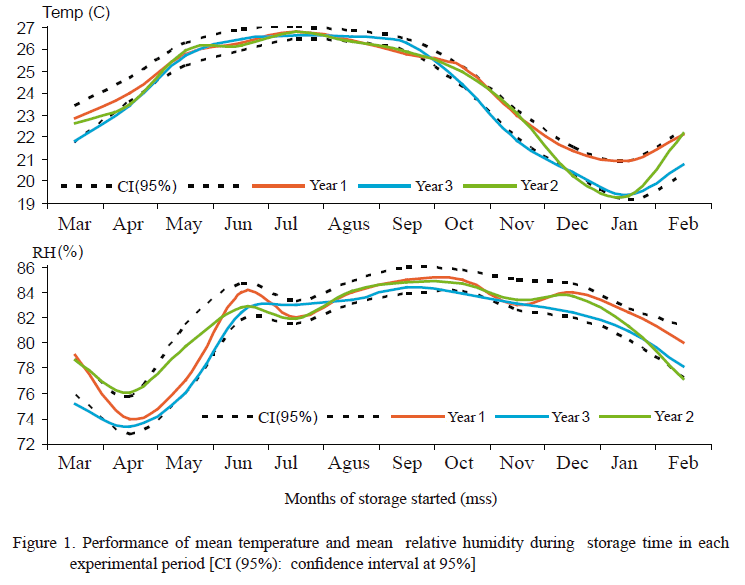
<body><![CDATA[<p align="justify">&nbsp;</p>     <p align="justify">&nbsp;</p>     <p align="justify"><font size="2" face="Verdana, Arial, Helvetica, sans-serif"><b><font size="3">INTRODUCTION</font></b></font></p>     <p align="justify" class="Cuerpodetexto" style="margin-top:12.0pt;text-indent:0cm;"><span style="line-height:120%; font-family:'Verdana','sans-serif'; font-size:10.0pt; color:windowtext; ">The study of viability preserving by  storing is one of the starting points of researches related with seeds  performance, in which is expected to determine whether this procedure may  influence on the detection of dormancy in tree legume species in a relatively  short time. The papers on this subject also have among their objectives to  determine whether that the mentioned procedure contributes to the knowledge of  some characteristics of dormancy, viability and    germination.</span></p>     <p align="justify" class="Cuerpodetexto" style="margin-top:12.0pt;text-indent:0cm;"><em><span style="font-family:'Verdana','sans-serif'; font-size:10.0pt; color:windowtext; ">Albizia lebbeck</span></em><span style="font-family:'Verdana','sans-serif'; font-size:10.0pt; color:windowtext; "> (L.) Benth. is one of the tropical tree species that has  been identified in Cuba as promising for current production systems, which  involves plants and animals in an agro-ecological context (Paretas and Lopez  2006).</span></p>     <p align="justify" class="Cuerpodetexto" style="margin-top:12.0pt;text-indent:0cm;"><span style="font-family:'Verdana','sans-serif'; font-size:10.0pt; color:windowtext; ">The objective of this research was to  evaluate the storage effect of <em>A. lebbeck</em> seeds on uncontrolled  environmental conditions, specifically with respect to viability and  germination indicators. It also intends, to know through this process some  dormancy    characteristics.</span></p>     <p align="justify" class="Cuerpodetexto" style="margin-top:12.0pt;text-indent:0cm;"><span style="font-family:'Verdana','sans-serif'; font-size:10.0pt; color:windowtext; ">&nbsp;</span></p>     <p align="justify" class="subtitulo" style="margin-top:12.0pt;text-align:justify;"><span style="line-height:120%; font-family:'Verdana','sans-serif'; font-size:13.0pt; color:windowtext; "><b>MATERIALS AND METHODS</b></span></p>     <p align="justify" class="Cuerpodetexto" style="margin-top:12.0pt;text-indent:0cm;"><em><span style="font-family:'Verdana','sans-serif'; font-size:10.0pt; color:windowtext; ">Experimental design and treatments</span></em><span style="font-family:'Verdana','sans-serif'; font-size:10.0pt; color:windowtext; ">. The dormancy presence was studied by the variables  germination and viability of <em>A. lebbeck</em> seeds at regular intervals  (evaluations) during eleven months in a sufficiently ventilated place, similar  to conventional warehouses of enterprises, farms and seed banks in Cuba,  described by Yanez and Funes (1989) and Funes <em>et al.</em> (1998). The  temperature and mean relative humidity were recorded during the three years of  study and are shown in    <a href="/img/revistas/cjas/v50n2/f0115216.gif">figure 1</a>.</span></p>     
<p align="justify" class="Cuerpodetexto" style="margin-top:12.0pt;text-indent:0cm;"><span style="font-family:'Verdana','sans-serif'; font-size:10.0pt; color:windowtext; ">A completely randomized design for  germination and viability, with factorial arrangement (3 x 6) was used, in  which the factors were determined by the study years (3) and storage times, per  months (6).</span></p>     ]]></body>
<body><![CDATA[<p align="justify" class="Cuerpodetexto" style="margin-top:12.0pt;text-indent:0cm;"><span style="font-family:'Verdana','sans-serif'; font-size:10.0pt; color:windowtext; ">The evaluations were conducted at 0,  2, 5, 7, 9 and 11 months of storage started (mss) .In each four repetitions of  100 seeds each were used, according to ISTA (2004) standards. The years  indicated the three successive harvests that gave rise to each storage period.  The just harvested seeds correspond with the storage beginning (0 mss). Each  storage period, in each experimental year, lasted 11 months.</span></p>     <p align="justify" class="Cuerpodetexto" style="margin-top:12.0pt;text-indent:0cm;"><em><span style="font-family:'Verdana','sans-serif'; font-size:10.0pt; color:windowtext; ">Studied variables </span></em><span style="font-family:'Verdana','sans-serif'; font-size:10.0pt; color:windowtext; "> </span></p>     <p align="justify" class="Cuerpodetexto" style="margin-top:12.0pt;text-indent:0cm;"><em><span style="font-family:'Verdana','sans-serif'; font-size:10.0pt; color:windowtext; ">Viable seeds</span></em><span style="font-family:'Verdana','sans-serif'; font-size:10.0pt; color:windowtext; ">. Living seeds, with capacity for germination under non  limiting conditions of temperature, water, oxygen and light.</span></p>     <p align="justify" class="Cuerpodetexto" style="margin-top:12.0pt;text-indent:0cm;"><span style="font-family:'Verdana','sans-serif'; font-size:10.0pt; color:windowtext; "><em>Germinated seeds</em>. Germination was  interpreted as the capacity of the embryo main structures to begin growth in  visual terms and the emergency of the embryo radicle.</span></p>     <p align="justify" class="Cuerpodetexto" style="margin-top:12.0pt;text-indent:0cm;"><span style="font-family:'Verdana','sans-serif'; font-size:10.0pt; color:windowtext; "><em>Hard seeds </em>.Viable seeds which not  germinate when the standard germination test end in each evaluation, due to the  covers impermeability. </span></p>     <p align="justify" class="Cuerpodetexto" style="margin-top:12.0pt;text-indent:0cm;"><span style="font-family:'Verdana','sans-serif'; font-size:10.0pt; color:windowtext; "><em><span style="letter-spacing:.2pt; ">Dormant  seeds. </span></em>Viable seeds which are not  able to germinate because of some dormatic obstacle in them (hard seeds), so  when the germination test ends they were subjected to the seminal covers  removal. This procedure consists on to cut the testa with a scalpel. The result  was offered seven days after the test started in the cabin and it was named  dormant seeds percentage.&nbsp; </span></p>     <p align="justify" class="Cuerpodetexto" style="margin-top:12.0pt;text-indent:0cm;"><em><span style="font-family:'Verdana','sans-serif'; font-size:10.0pt; color:windowtext; "><span style="letter-spacing:.1pt; ">Experimental  procedure.</span></span></em><span style="line-height:120%; letter-spacing:.1pt; font-family:'Verdana','sans-serif'; font-size:10.0pt; color:windowtext; "> To make a fast estimate of seeds viability the  tetrazolium (TZ) topographical test was used. For this test an aqueous solution  of chloride of 2, 3, 5-triphenyl tetrazolium (pH 6.5-7.5), at 1.0% concentration  was used. Random samples from a fraction of <em>A. lebbeck</em> seeds were taken  and four replications were established, 100 seeds each. These ones were placed  to absorb, with previous removal of seminal covers in the aqueous solution  mentioned before. For the evaluation of viability, calculation and the results  expression, the international rules which control the work in this biochemical  test for tree legumes and others species (AOSA 2013) were considered, that are  based on the coloration or not of the embryo structures. The results were  expressed in viable seeds percentage. </span><span style="font-family:'Verdana','sans-serif'; font-size:10.0pt; color:windowtext; ">&nbsp;&nbsp;</span></p>     <p align="justify" class="Cuerpodetexto" style="margin-top:12.0pt;text-indent:0cm;"><span style="font-family:'Verdana','sans-serif'; font-size:10.0pt; color:windowtext; ">To do the germination test capsules  Petri, with 184 g of river sand (washed and disinfected) as inert substrate  were used. At the sowing moment, 48mL of distilled water (at room temperature)  were applied, measure that was fitted to the value of the sand saturation  capacity. In each evaluation, the capsules stayed in the cabin under  approximately controlled conditions of light (12h), temperature (25 &ordm;C) and  humidity (85 % HR) during 21d, which coincides with the ruled by the ISTA  (2004) for the seeds of tropical shrubs and trees. The evaluation carried out  to 0 mss represents the beginning of the storage period. </span></p>     <p align="justify" class="Cuerpodetexto" style="margin-top:12.0pt;text-indent:0cm;"><em><span style="line-height:120%; letter-spacing:.2pt; font-family:'Verdana','sans-serif'; font-size:10.0pt; color:windowtext; ">Statistical  processing of results. </span></em><span style="font-family:'Verdana','sans-serif'; font-size:10.0pt; color:windowtext; ">To assess the performance of temperature and mean relative  humidity in the warehouse during the three experimental years an interval of 10  years was established, in which the three experiments were included. To this  information an analysis known as determination of the confidence interval (CI)  was carried out, in this case for 95% of probability. The data show that the  performance of mean temperature and mean relative humidity during the research  years was included within the CI.</span><span style="font-family:'Verdana','sans-serif'; font-size:10.0pt; color:windowtext; "> </span></p>     <p align="justify" class="Cuerpodetexto" style="margin-top:12.0pt;text-indent:0cm;"><span style="font-family:'Verdana','sans-serif'; font-size:10.0pt; color:windowtext; ">Variance analyses  were performed, according to simple classification model in factorial  arrangement (3 x 6) for germination and viability variables. The data were  transformed according to aresin &radic;x+0.375. The multiple comparison of Duncan  (1955) test was used and differences were declared significant at P &lt;0.05  values. The statistical processing was performed by using the program InfoStat.  version 1.0 (Di Rienzo <em>et al.</em> 2001).</span></p>     ]]></body>
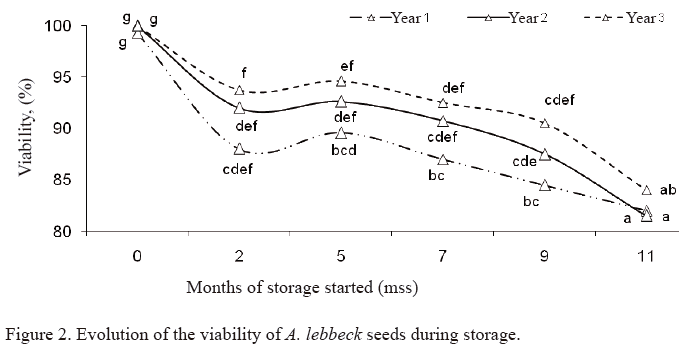
<body><![CDATA[<p align="justify" class="Cuerpodetexto" style="margin-top:12.0pt;text-indent:0cm;"><span style="font-family:'Verdana','sans-serif'; font-size:10.0pt; color:windowtext; ">&nbsp;</span></p>     <p align="justify" class="subtitulo" style="margin-top:12.0pt;text-align:justify;"><span style="font-family:'Verdana','sans-serif'; font-size:13.0pt; color:windowtext; "><b>RESULTS AND DISCUSSION</b> </span></p>     <p align="justify" class="Cuerpodetexto" style="margin-top:12.0pt;text-indent:0cm;"><span style="font-family:'Verdana','sans-serif'; font-size:10.0pt; color:windowtext; ">At the beginning of the research, the  humidity content of the seeds was between 10 and 12%. According to Carvalho and  Nakagawa (2012), these values tend to equilibrate with the environment as time  passes, mainly when storage is not hermetic. Therefore, it was extremely  important to know the deterioration degree that could present the <em>A. lebbeck</em> seeds before starting the storage period (Delouche 2005), so the topographical  tetrazolium test was performed.</span></p>     <p align="justify" class="Cuerpodetexto" style="margin-top:12.0pt;text-indent:0cm;"><span style="font-family:'Verdana','sans-serif'; font-size:10.0pt; color:windowtext; ">The results of  this test showed that the seeds began their life in the store with 99.25; 100  and 100% of viability for the first, second and third year of study,  respectively (<a href="/img/revistas/cjas/v50n2/f0215216.gif">figure 2</a>), indicating that the deterioration was practically  nonexistent. This agree with that informed by Rosental <em>et al.</em> (2014),  who explained that the deterioration is reflected in the viability, only when  the seeds are moving towards an advanced stage, due to that they are able to  repair the damage only when this one does not become irreversible. In addition,  the high percentage of viability of albizia seeds when storage start    (0 mss) suggested that there were not negative factors, environmental or management,  during harvesting and processing process before storage.</span><span style="font-family:'Verdana','sans-serif'; font-size:10.0pt; color:windowtext; "> </span></p>     
<p align="justify" class="Cuerpodetexto" style="margin-top:12.0pt;text-indent:0cm;"><em><span style="font-family:'Verdana','sans-serif'; font-size:10.0pt; color:windowtext; ">Longevity and deterioration</span></em><span style="font-family:'Verdana','sans-serif'; font-size:10.0pt; color:windowtext; ">. Significant differences between evaluations for interaction  harvesting year per seeds storage time were found. In <a href="/img/revistas/cjas/v50n2/f0215216.gif">figure 2</a> are represented  the percentage values of viability of <em>A. lebbeck</em> seeds on the six  evaluations carried out during the three experimental years. The curves show  the similarity of the results for the storage years; it could say that all  follow the same tendency. The most marked decrease occurred in the range of 0  to 2 mss for the three years, with significant differences between both  evaluations in each year.</span></p>     
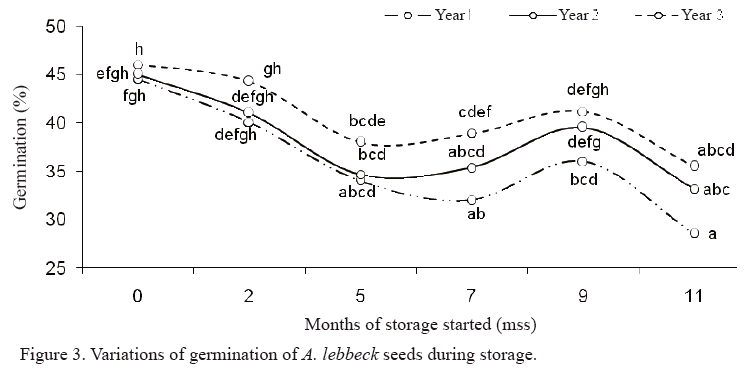
<p align="justify" class="Cuerpodetexto" style="margin-top:12.0pt;text-indent:0cm;"><span style="font-family:'Verdana','sans-serif'; font-size:10.0pt; color:windowtext; ">The percentage of <em>A. lebbeck</em> viable seeds slightly decreases as storage time increased. The natural aging of  these seeds was a slow, gradual and natural process. These results agree with  Bruggink <em>et al.</em> (1999) and Bhanuprakash and Umesha (2015) with regard to  the tendency that viability experiment during storage. These authors state that  this performance is not linear in time, but usually follows a sigmoid pattern  and depends on the species.</span></p>     <p align="justify" class="Cuerpodetexto" style="margin-top:12.0pt;text-indent:0cm;"><span style="font-family:'Verdana','sans-serif'; font-size:10.0pt; color:windowtext; ">This is a logical process, as it is  known that, even under ideal storage conditions can only be maintained the  viability, but never improve it (Carvalho and Nakagawa, 2012). </span></p>     <p align="justify" class="Cuerpodetexto" style="margin-top:12.0pt;text-indent:0cm;"><span style="font-family:'Verdana','sans-serif'; font-size:10.0pt; color:windowtext; ">The performance may be associated to  different intrinsic factors. Among them, according to Priestley (1986) and  Smith and Berjak (1995), are the breakdown of cell membranes, the loss of  catalytic activity of enzymes, the accumulation of mutations in chromosomes and  reserves food decrease, elements that were not measured in this experiment, and  that may have exhibited some extent.</span></p>     <p align="justify" class="Cuerpodetexto" style="margin-top:12.0pt;text-indent:0cm;"><span style="font-family:'Verdana','sans-serif'; font-size:10.0pt; color:windowtext; ">In other tree species from Leguminosae  family, whose freshly harvested seeds, as <em>A. lebbeck</em>, they presented  orthodox performance, storage under ambient conditions not significantly limits  viability. Timyan (1996), Powell (1997), Gonz&aacute;lez <em>et al.</em> (1998) and  CATIE (2000) also reached similar conclusions in studies with other trees from  the tropic.</span></p>     <p align="justify" class="Cuerpodetexto" style="margin-top:12.0pt;text-indent:0cm;"><em><span style="font-family:'Verdana','sans-serif'; font-size:10.0pt; color:windowtext; ">Germination capacity</span></em><span style="font-family:'Verdana','sans-serif'; font-size:10.0pt; color:windowtext; ">. <a href="/img/revistas/cjas/v50n2/f0315216.gif">Figure 3</a> shows the interaction between the studied factors  and indicates the occurrence of a similar performance pattern for the three  years throughout the experimental period.</span></p>     
]]></body>
<body><![CDATA[<p align="justify" class="Cuerpodetexto" style="margin-top:12.0pt;text-indent:0cm;"><span style="font-family:'Verdana','sans-serif'; font-size:10.0pt; color:windowtext; ">So, while germination was 46.0 % to 0  mss in the third year, it reached approximately 42.0 % in first and second  year, in this evaluation.</span></p>     <p align="justify" class="Cuerpodetexto" style="margin-top:12.0pt;text-indent:0cm;"><span style="font-family:'Verdana','sans-serif'; font-size:10.0pt; color:windowtext; ">Germination had a variable performance  in each year. In each storage period, the highest percentage, although not  differ from each other, it was observed at 0 mss. Then, declined to 7 mss,  except in the third year, that instead of continuing to decline up to 7 mss  increased between 7 and 9 mss. However, statistically there were not found  significant differences between both evaluations.</span></p>     <p align="justify" class="Cuerpodetexto" style="margin-top:12.0pt;text-indent:0cm;"><span style="font-family:'Verdana','sans-serif'; font-size:10.0pt; color:windowtext; ">In each of the months (individually)  significant differences between the years in which germination was evaluated  were not found, except in the value informed at 7 mss, for the first and third  years. In this case, the first year (31.0%) did not differ from the second  (34.0%). In turn, the latter showed no difference with the third (37.75%).</span></p>     <p align="justify" class="Cuerpodetexto" style="margin-top:12.0pt;text-indent:0cm;"><span style="font-family:'Verdana','sans-serif'; font-size:10.0pt; color:windowtext; ">Mathias (1998), when measuring the  germination of <em>A. lebbeck</em> seeds at three, six and twelve months of  stored under ambient conditions, also found a similar performance. Same habit  noted Gonz&aacute;lez <em>et al.</em> (1998) in the seeds of <em>L. leucocephala</em> cv.  Cunningham under similar storage conditions.</span></p>     <p align="justify" class="Cuerpodetexto" style="margin-top:12.0pt;text-indent:0cm;"><span style="font-family:'Verdana','sans-serif'; font-size:10.0pt; color:windowtext; ">Similar results were informed in <em>Acacia  farnesiana</em> (L.) Willd. (Timyan 1996), when the germination percentage of  fresh seeds ranged between 10 and    40 %. Another example is <em>Albizia guachapele </em>(Kundh) Dugand., whose seeds  without receiving previous treatment show 20 to 35% of germination (CATIE 2000)  and <em>Pithecellobium dulce</em> (Roxb.) Benth., with values between 36 and 54%  for young seeds ( Molina <em>et al.</em> 1996).</span></p>     <p align="justify" class="Cuerpodetexto" style="margin-top:12.0pt;text-indent:0cm;"><span style="font-family:'Verdana','sans-serif'; font-size:10.0pt; color:windowtext; ">The recorded percentages were always  lower than the value obtained at the start of the evaluation period of each  year (0 mss) and up to 2 mss, without statistically differ.</span></p>     <p align="justify" class="Cuerpodetexto" style="margin-top:12.0pt;text-indent:0cm;"><span style="font-family:'Verdana','sans-serif'; font-size:10.0pt; color:windowtext; ">Another element  that should be discuss are Harrington (1972) criteria, supported by Baskin and  Baskin (2014), regarding the influence of temperature and humidity content in  the storage. During uncontrolled storage, the respiration rate is one of the  problems associated to the viability loss. A high respiration rate can lead to  a rapid loss of energy and food reserves, especially in the embryo that is not  able to germinate. In turn, the respiration rate increases with the increase of  ambient temperature and the humidity content of seeds, among other factors. The  information of <a href="/img/revistas/cjas/v50n2/f0115216.gif">figure 1</a> shows that during the experiment the temperature  fluctuated as the relative humidity.</span> </p>     
<p align="justify" class="Cuerpodetexto" style="margin-top:12.0pt;text-indent:0cm;"><em><span style="font-family:'Verdana','sans-serif'; font-size:10.0pt; color:windowtext; ">Period and intensity of dormancy.</span></em><span style="font-family:'Verdana','sans-serif'; font-size:10.0pt; color:windowtext; "> Regardless of the explained interactions, a general  appreciation of the information indicates that the high expression for  viability and germination indicators was presented at the beginning of the  study, while the viability percentages in each evaluation were always higher  than those of the standard germination test (<a href="/img/revistas/cjas/v50n2/f0215216.gif">figure 2</a> and <a href="/img/revistas/cjas/v50n2/f0315216.gif">figure 3</a>). Even, in  the last evaluation (11 mss), there was a marked difference between the two indicators.  The viable seeds did not germinate when there were provided the conditions that  favor the germination process, according to Cohn (2006).</span></p>     
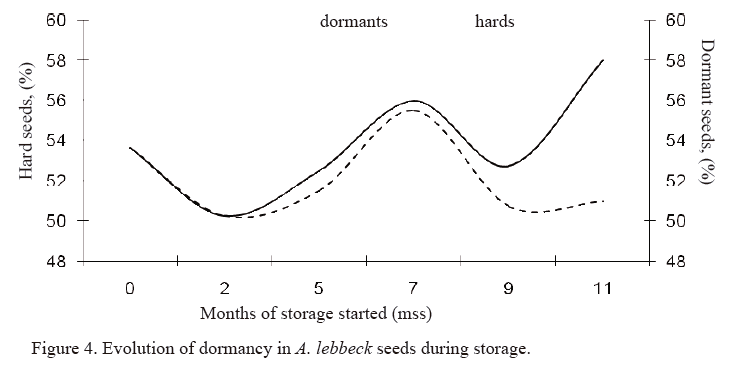
<p align="justify" class="Cuerpodetexto" style="margin-top:12.0pt;text-indent:0cm;"><span style="font-family:'Verdana','sans-serif'; font-size:10.0pt; color:windowtext; ">This phenomenon may be associated to what in  the plants physiology is known as dormancy (Hilhorst <em>et al.</em> 2010).  According to Kigel <em>et al.</em> (2015), a large group of tropical species from  Leguminosae family show dormancy in their seeds.</span></p>     <p align="justify" class="Cuerpodetexto" style="margin-top:12.0pt;text-indent:0cm;"><span style="font-family:'Verdana','sans-serif'; font-size:10.0pt; color:windowtext; ">Dormancy in legumes is due to the  cover impermeability (Jayasuriya <em>et al.</em> 2012 and Venier <em>et al.</em> 2012). In this experiment, the germination test determined the presence of the  named &quot;hard seeds&quot; (<a href="/img/revistas/cjas/v50n2/f0415216.gif">figure 4</a>).</span></p>     
]]></body>
<body><![CDATA[<p align="justify" class="Cuerpodetexto" style="margin-top:12.0pt;text-indent:0cm;"><span style="font-family:'Verdana','sans-serif'; font-size:10.0pt; color:windowtext; ">The marked difference between the  dormant seeds and hard seeds, between 9 and 11 mss, suggested that in that  interval the impermeability of the seminal covers is reinforced, as a defense  mechanism against the increase of the physiological age and physiological  consequences associated to the permanence of seeds in a conventional warehouse.</span></p>     <p align="justify" class="Cuerpodetexto" style="margin-top:12.0pt;text-indent:0cm;"><span style="font-family:'Verdana','sans-serif'; font-size:10.0pt; color:windowtext; ">When analyzing the  percentage of dormant seeds and their physical expression, as hard seeds in  each of the evaluations, at the start of storage (0 mss) the values were  identical (52.85 %), although from this evaluation slight differences were  observed, which only at 11 mss were of 7 % (51.0 vs 58.0 %, respectively). Each  value represents the average of the three years. This also supports the view  that there is a direct link between dormant seeds and hard seeds, and state  that the dormancy in this species is closely related to the seeds hardness.</span><span style="font-family:'Verdana','sans-serif'; font-size:10.0pt; color:windowtext; "> </span></p>     <p align="justify" class="Cuerpodetexto" style="margin-top:12.0pt;text-indent:0cm;"><span style="font-family:'Verdana','sans-serif'; font-size:10.0pt; color:windowtext; ">At the end of the germination tests,  in each year, and as more objective verification element between dormancy /  hard seed relation, a small cut was applied to seeds and they remained  germinating for seven additional days. The results showed germination values  close to 100%.</span></p>     <p align="justify" class="Cuerpodetexto" style="margin-top:12.0pt;text-indent:0cm;"><span style="font-family:'Verdana','sans-serif'; font-size:10.0pt; color:windowtext; ">According to Hilhorst <em>et al.</em> (2010) and Nonogaki (2014), there are several dormancy degrees, which can range  from very slight to very severe (deep). When evaluating the experimental data  obtained up to this point, it can be inferred that there is a dormancy of  approximately 50 %, which does not decrease noticeably during one year.</span></p>     <p align="justify" class="Cuerpodetexto" style="margin-top:12.0pt;text-indent:0cm;"><span style="font-family:'Verdana','sans-serif'; font-size:10.0pt; color:windowtext; ">It is concluded that the seed storage  during a year was a useful method, by which it was determined the dormancy  existence and the performance of viability, germination and emergence.</span></p>     <p align="justify" class="Cuerpodetexto" style="margin-top:12.0pt;text-indent:0cm;"><span style="font-family:'Verdana','sans-serif'; font-size:10.0pt; color:windowtext; ">The results of this experiment allow  stating that during postharvest management, prior to storage starting, the <em>A.  lebbeck</em> seeds were not perceptibly deteriorate; while when the storage time  increase they aging at a progressive rate.</span></p>     <p align="justify" class="Cuerpodetexto" style="margin-top:12.0pt;text-indent:0cm;"><span style="line-height:107%; letter-spacing:.1pt; font-family:'Verdana','sans-serif'; font-size:10.0pt; ">It is  very probably that the germination percentage and longevity of <em>A. lebbeck</em> seeds depend on the time they spent in the warehouse, indicating that the  intrinsic factors may be the main responsible agent of viability loss</span><font size="2" face="Verdana, Arial, Helvetica, sans-serif">.</font></p>     <p align="justify">&nbsp;</p>     <p align="justify"><font size="2" face="Verdana, Arial, Helvetica, sans-serif"><font size="3"><b>REFERENCES</b></font></font></p>     <!-- ref --><p align="justify" class="MsoBibliography" style="margin-top:12.0pt;text-align:justify;"><span style="line-height:107%; font-family:'Verdana','sans-serif'; font-size:10.0pt; ">AOSA &amp; SCST 2013. <em>Tetrazolium  Testing Handbook</em>. Miller A. L. (ed.), 2010th ed., Washington, DC:  Association of Official Seed Analysts-Society of Commercial Seed Technologists,  32 p., Available: &lt;<a href="http://www.aosaseed.com/tetrazolium_testing_handbook" target="_blank">http://www.aosaseed.com/tetrazolium_testing_handbook</a>&gt;,  [Consulted:&nbsp;April 3, 2016].    </span></p>     <!-- ref --><p align="justify" class="MsoBibliography" style="margin-top:12.0pt;text-align:justify;"><span style="font-family:'Verdana','sans-serif'; font-size:10.0pt; ">Baskin, C. C. &amp; Baskin,  J. M. 2014. <em>Seeds, Second Edition: Ecology, Biogeography, and, Evolution of  Dormancy and Germination</em>. 2nd ed., San Diego, CA: Academic Press, 1600 p.,  ISBN: 978-0-12-416677-6.    </span></p>     <p align="justify" class="MsoBibliography" style="margin-top:12.0pt;text-align:justify;"><span style="font-family:'Verdana','sans-serif'; font-size:10.0pt; ">Bhanuprakash, K. &amp;  Umesha 2015. &lsquo;&lsquo;Seed Biology and Technology&rsquo;&rsquo;. In: Bahadur B., Rajam M. V.,  Sahijram L. &amp; Krishnamurthy K. V. (eds.), <em>Plant Biology and  Biotechnology</em>, Springer India, pp. 469&ndash;497, ISBN: 978-81-322-2285-9, DOI:  10.1007/978-81-322-2286-6_19, Available:  &lt;<a href="http://link.springer.com/chapter/10.1007/978-81-322-2286-6_19" target="_blank">http://link.springer.com/chapter/10.1007/978-81-322-2286-6_19</a>&gt;,  [Consulted:&nbsp;March 2, 2016].</span></p>     <p align="justify" class="MsoBibliography" style="margin-top:12.0pt;text-align:justify;"><span style="font-family:'Verdana','sans-serif'; font-size:10.0pt; ">Bruggink, G. T., Ooms, J.  J. J. &amp; van der Toorn, P. 1999. &lsquo;&lsquo;Induction of longevity in primed seeds&rsquo;&rsquo;. </span><em><span style="font-family:'Verdana','sans-serif'; font-size:10.0pt; ">Seed Science Research</span></em><span style="font-family:'Verdana','sans-serif'; font-size:10.0pt; ">, 9 (01): 49&ndash;53, ISSN: 1475-2735, DOI:  10.1017/S0960258599000057.</span></p>     <!-- ref --><p align="justify" class="MsoBibliography" style="margin-top:12.0pt;text-align:justify;"><span style="font-family:'Verdana','sans-serif'; font-size:10.0pt; ">CATIE 2000. <em>Manejo de semillas de 100 especies  forestales de Am&eacute;rica Latina</em>. (ser. Serie tecnica, no. ser. 41), CATIE, 218  p., ISBN: 978-9977-57-349-6.    </span></p>     <p align="justify" class="MsoBibliography" style="margin-top:12.0pt;text-align:justify;"><span style="font-family:'Verdana','sans-serif'; font-size:10.0pt; ">Cohn, M. A. 2006. </span><span style="font-family:'Verdana','sans-serif'; font-size:10.0pt; ">&lsquo;&lsquo;Dormancy: an overview&rsquo;&rsquo;.  In: Bewley J. D., Black M. &amp; Halmer P. (eds.), <em>The Encyclopedia of  Seeds: Science, Technology and Uses</em>, Wallingford, UK: CABI, p. 828, ISBN:  978-0-85199-723-0.</span></p>     <p align="justify" class="MsoBibliography" style="margin-top:12.0pt;text-align:justify;"><span style="font-family:'Verdana','sans-serif'; font-size:10.0pt; ">Delouche, C. J. 2005. &lsquo;&lsquo;Calidad y desempe&ntilde;o de la  semilla&rsquo;&rsquo;. <em>SEED News</em>, 15, ISSN: 1415-0387.</span></p>     <!-- ref --><p align="justify" class="MsoBibliography" style="margin-top:12.0pt;text-align:justify;"><span style="font-family:'Verdana','sans-serif'; font-size:10.0pt; ">Di Rienzo, J. A., Casanoves, F., Balzarini, M. G.,  Gonz&aacute;lez, L., Tablada, M. &amp; Robledo, C. W. 2001. <em>InfoStat</em>. version  2001, [Windows], Universidad Nacional de C&oacute;rdoba, Argentina: Grupo InfoStat,  Available: &lt;<a href="http://www.infostat.com.ar/" target="_blank">http://www.infostat.com.ar/</a>&gt;    .</span></p>     <p align="justify" class="MsoBibliography" style="margin-top:12.0pt;text-align:justify;"><span style="font-family:'Verdana','sans-serif'; font-size:10.0pt; ">Duncan, D. B. 1955. &lsquo;&lsquo;Multiple  Range and Multiple F Tests&rsquo;&rsquo;. </span><em><span style="font-family:'Verdana','sans-serif'; font-size:10.0pt; ">Biometrics</span></em><span style="font-family:'Verdana','sans-serif'; font-size:10.0pt; ">, 11 (1): 1&ndash;42, ISSN: 0006-341X, DOI:  10.2307/3001478.</span></p>     <!-- ref --><p align="justify" class="MsoBibliography" style="margin-top:12.0pt;text-align:justify;"><span style="font-family:'Verdana','sans-serif'; font-size:10.0pt; ">Funes, F., Y&aacute;&ntilde;ez, S. &amp; Zambrana, T. 1998. <em>Semillas  de pastos y forrajes tropicales: M&eacute;todos pr&aacute;cticos para su producci&oacute;n  sostenible</em>. La Habana, Cuba: ACPA, 138 p., Available:  &lt;<a href="http://centroderecursos.alboan.org/es/registros/7777-semillas-de-pastos-y" target="_blank">http://centroderecursos.alboan.org/es/registros/7777-semillas-de-pastos-y</a>&gt;,  [Consulted:&nbsp;March 2, 2016].    </span></p>     <p align="justify" class="MsoBibliography" style="margin-top:12.0pt;text-align:justify;"><span style="font-family:'Verdana','sans-serif'; font-size:10.0pt; ">Gonz&aacute;lez, Y., Reino, J., S&aacute;nchez, J. A. &amp;  Machado, R. 2012. &lsquo;&lsquo;Efecto del almacenamiento al ambiente en semillas de <em>Leucaena  leucocephala</em> cv. Cunningham sometidas a hidrataci&oacute;n parcial&rsquo;&rsquo;. <em>Pastos y  Forrajes</em>, 35 (4): 393&ndash;399, ISSN: 0864-0394.</span></p>     <p align="justify" class="MsoBibliography" style="margin-top:12.0pt;text-align:justify;"><span style="font-family:'Verdana','sans-serif'; font-size:10.0pt; ">Harrington, J. F. 1972. </span><span style="font-family:'Verdana','sans-serif'; font-size:10.0pt; ">&lsquo;&lsquo;Seed storage and  longevity&rsquo;&rsquo;. In: Kozlowski T. T. (ed.), <em>Insects, and Seed Collection,  Storage, Testing, and Certification</em>, Academic Press, pp. 145&ndash;245, ISBN:  978-0-12-395605-7, Available:  &lt;<a href="http://www.sciencedirect.com/science/article/pii/B9780123956057500090" target="_blank">http://www.sciencedirect.com/science/article/pii/B9780123956057500090</a>&gt;,  [Consulted:&nbsp;April 4, 2016].</span></p>     <p align="justify" class="MsoBibliography" style="margin-top:12.0pt;text-align:justify;"><span style="font-family:'Verdana','sans-serif'; font-size:10.0pt; ">Hilhorst, H. W. M.,  Finch-Savage, W. E., Buitink, J., Bolingue, W. &amp; Leubner-Metzger, G. 2010.  &lsquo;&lsquo;Dormancy in Plant Seeds&rsquo;&rsquo;. In: Lubzens E., Cerda J. &amp; Clark M. (eds.), <em>Dormancy  and Resistance in Harsh Environments</em>, (ser. Topics in Current Genetics, no.  ser. 21), Springer Berlin Heidelberg, pp. 43&ndash;67, ISBN: 978-3-642-12421-1, DOI: 10.1007/978-3-642-12422-8_4,  Available:  &lt;<a href="http://link.springer.com/chapter/10.1007/978-3-642-12422-8_4" target="_blank">http://link.springer.com/chapter/10.1007/978-3-642-12422-8_4</a>&gt;,  [Consulted:&nbsp;March 2, 2016].</span></p>     <!-- ref --><p align="justify" class="MsoBibliography" style="margin-top:12.0pt;text-align:justify;"><span style="font-family:'Verdana','sans-serif'; font-size:10.0pt; ">International Seed Testing  Association 2004. <em>International rules for seed testing</em>. vol. 2,  Bassersdorf, CH-Switzerland: International Seed Testing Association, 174 p.,  ISBN: 3-906549-38-0, Available:  &lt;<a href="http://trove.nla.gov.au/work/9024848?q&sort=holdings+desc&_=1456945892468&versionId=10451274" target="_blank">http://trove.nla.gov.au/work/9024848?q&amp;sort=holdings+desc&amp;_=1456945892468&amp;versionId=10451274</a>&gt;,  [Consulted:&nbsp;April 4, 2016].    </span></p>     <p align="justify" class="MsoBibliography" style="margin-top:12.0pt;text-align:justify;"><span style="font-family:'Verdana','sans-serif'; font-size:10.0pt; ">Jayasuriya, K. M. G. G.,  Baskin, J. M., Baskin, C. C. &amp; Fernando, M. T. R. 2012. &lsquo;&lsquo;Variation in Seed  Dormancy and Storage Behavior of Three Liana Species of <em>Derris</em> (Fabaceae, Faboideae) in Sri Lanka and Ecological Implications&rsquo;&rsquo;. <em>Research  Journal of Seed Science</em>, 5 (1): 1&ndash;18, ISSN: 18193552, DOI: 10.3923/rjss.2012.1.18.</span></p>     ]]></body>
<body><![CDATA[<p align="justify" class="MsoBibliography" style="margin-top:12.0pt;text-align:justify;"><span style="font-family:'Verdana','sans-serif'; font-size:10.0pt; ">Kigel, P. J., Rosental, L.  &amp; Fait, P. A. 2015. &lsquo;&lsquo;Seed Physiology and Germination of Grain Legumes&rsquo;&rsquo;.  In: Ron A. M. D. (ed.), <em>Grain Legumes</em>, (ser. Handbook of Plant Breeding,  no. ser. 10), Springer New York, pp. 327&ndash;363, ISBN: 978-1-4939-2796-8, DOI:  10.1007/978-1-4939-2797-5_11, Available:  &lt;<a href="http://link.springer.com/chapter/10.1007/978-1-4939-2797-5_11" target="_blank">http://link.springer.com/chapter/10.1007/978-1-4939-2797-5_11</a>&gt;,  [Consulted:&nbsp;March 2, 2016].</span></p>     <p align="justify" class="MsoBibliography" style="margin-top:12.0pt;text-align:justify;"><span style="font-family:'Verdana','sans-serif'; font-size:10.0pt; ">Mat&iacute;as, C. 1998. &lsquo;&lsquo;Determinaci&oacute;n del marco de  siembra &oacute;ptimo para la producci&oacute;n de semillas de <em>Albizia lebbeck</em>&rsquo;&rsquo;. <em>Pastos  y Forrajes</em>, 21 (1): 67, ISSN: 2078-8452.</span></p>     <!-- ref --><p align="justify" class="MsoBibliography" style="margin-top:12.0pt;text-align:justify;"><span style="font-family:'Verdana','sans-serif'; font-size:10.0pt; ">Molina, M., Brenes, G. &amp; Morales, D. 1996. <em>Descripci&oacute;n  y viverizaci&oacute;n de 14 especies forestales nativas del bosque tropical seco</em>.  vol. 1, San Jos&eacute;, Costa Rica: Esfera, 91 p., ISBN: 978-9977-9920-2-0,  Available: &lt;<a href="https://www.researchgate.net/publication/280096985_Descripcion_y_viverizacion_de_14_especies_forestales_nativas_del_bosque_tropical_seco_Vol1" target="_blank">https://www.researchgate.net/publication/280096985_Descripcion_y_viverizacion_de_14_especies_forestales_nativas_del_bosque_tropical_seco_Vol1</a>&gt;,  [Consulted:&nbsp;March 2, 2016].    </span></p>     <!-- ref --><p align="justify" class="MsoBibliography" style="margin-top:12.0pt;text-align:justify;"><span style="font-family:'Verdana','sans-serif'; font-size:10.0pt; ">Moreira,&nbsp; de  C. N. &amp; Nakagawa, J. 2012. <em>Sementes-Ci&ecirc;ncia, Tecnologia e Produ&ccedil;&atilde;o</em>. </span><span style="font-family:'Verdana','sans-serif'; font-size:10.0pt; ">5th ed., Funep, 590 p.,  ISBN: 978-85-7805-090-0, Available:  &lt;<a href="http://www.funep.org.br/visualizar_livro.php?idlivro=2513" target="_blank">http://www.funep.org.br/visualizar_livro.php?idlivro=2513</a>&gt;,  [Consulted:&nbsp;March 2, 2016].    </span></p>     <p align="justify" class="MsoBibliography" style="margin-top:12.0pt;text-align:justify;"><span style="font-family:'Verdana','sans-serif'; font-size:10.0pt; ">Nonogaki, H. 2014. &lsquo;&lsquo;Seed  dormancy and germination-emerging mechanisms and new hypotheses&rsquo;&rsquo;. <em>Frontiers  in Plant Science</em>, 28 (5): 233, ISSN: 1664-462X, DOI:  10.3389/fpls.2014.00233, PMID: 24904627PMCID: PMC4036127.</span></p>     <p align="justify" class="MsoBibliography" style="margin-top:12.0pt;text-align:justify;"><span style="font-family:'Verdana','sans-serif'; font-size:10.0pt; ">Paretas, J. J. &amp; L&oacute;pez, M. 2006.  &lsquo;&lsquo;Regionalizaci&oacute;n de gram&iacute;neas, leguminosas y &aacute;rboles multiprop&oacute;sitos&rsquo;&rsquo;. In:  Milera R. M. (ed.), <em>Recursos forrajeros, herbaceos y arboreos: Un Nuevo  Concepto de Pastizal</em>, (ser. Cuadernos de Debate), Guatemala: Amazon, p. 37,  ISBN: 978-959-16-0209-1, Available:  &lt;<a href="http://www.amazon.com/Recursos-forrajeros-herbaceos-arboreos-Resources/dp/959160209X" target="_blank">http://www.amazon.com/Recursos-forrajeros-herbaceos-arboreos-Resources/dp/959160209X</a>&gt;,  [Consulted:&nbsp;April 3, 2016].</span></p>     <!-- ref --><p align="justify" class="MsoBibliography" style="margin-top:12.0pt;text-align:justify;"><span style="font-family:'Verdana','sans-serif'; font-size:10.0pt; ">Powell, M. H. 1997. <em>Calliandra  calothyrsus production and use. A field manual</em>. Arkansas, USA: Winrock  International Institute for Agricultural Development, 62 p.    </span></p>     ]]></body>
<body><![CDATA[<!-- ref --><p align="justify" class="MsoBibliography" style="margin-top:12.0pt;text-align:justify;"><span style="font-family:'Verdana','sans-serif'; font-size:10.0pt; ">Priestley, D. A. 1986. <em>Seed  Aging: Implications for Seed Storage and Persistence in the Soil</em>. 1st ed.,  Ithaca, N.Y: Comstock Pub Assoc, 304 p., ISBN: 978-0-8014-1865-5, Available:  &lt;<a href="http://www.amazon.com/Seed-Aging-Implications-Persistence-Comstock/dp/0801418658" target="_blank">http://www.amazon.com/Seed-Aging-Implications-Persistence-Comstock/dp/0801418658</a>&gt;,  [Consulted:&nbsp;April 3, 2016].    </span></p>     <p align="justify" class="MsoBibliography" style="margin-top:12.0pt;text-align:justify;"><span style="font-family:'Verdana','sans-serif'; font-size:10.0pt; ">Smith, M. T. &amp; Berjak,  P. 1995. &lsquo;&lsquo;Deteriorative changes associated with the loss viability of stored  desiccation tolerant and desiccation-sensitive seeds&rsquo;&rsquo;. In: Kigel J. (ed.), <em>Seed  Development and Germination</em>, (ser. Books in Soils, Plants, and the  Environment), vol. 41, CRC Press, p. 701, ISBN: 978-0-8247-9229-9.</span></p>     <!-- ref --><p align="justify" class="MsoBibliography" style="margin-top:12.0pt;text-align:justify;"><span style="font-family:'Verdana','sans-serif'; font-size:10.0pt; ">Timyan, J. 1996. <em>Bwa yo:  important trees of Haiti</em>. Washington, D.C.: University of Michigan Library,  440 p., ISBN: 978-0-9645449-0-1.    </span></p>     <p align="justify" class="MsoBibliography" style="margin-top:12.0pt;text-align:justify;"><span style="font-family:'Verdana','sans-serif'; font-size:10.0pt; ">Venier, P., Funes, G. &amp; Carrizo Garc&iacute;a, C.  2012. </span><span style="font-family:'Verdana','sans-serif'; font-size:10.0pt; ">&lsquo;&lsquo;Physical dormancy and histological features of seeds of five Acacia  species (Fabaceae) from xerophytic forests in central Argentina&rsquo;&rsquo;. <em>Flora -  Morphology, Distribution, Functional Ecology of Plants</em>, 207 (1): 39&ndash;46,  ISSN: 0367-2530, DOI: 10.1016/j.flora.2011.07.017.</span></p>     <!-- ref --><p align="justify" class="MsoBibliography" style="margin-top:12.0pt;text-align:justify;"><span style="font-family:'Verdana','sans-serif'; font-size:10.0pt; ">Ya&ntilde;ez,  S. &amp; Funes, F. 1989. <em>Manual pr&aacute;ctico para la producci&oacute;n de semillas de  pastos en Cuba</em>. Ministerio de la Agricultura, Instituto de Investigaciones  de Pastos y Forrajes, 134 p</span><font size="2" face="Verdana,     Arial, Helvetica, sans-serif">.</font></p>     <p align="justify">&nbsp;</p>     <p align="justify">&nbsp;</p>     ]]></body>
<body><![CDATA[<p align="justify"><font size="2" face="Verdana, Arial, Helvetica, sans-serif">Received: 3/6/2014    <br>   Accepted: 13/6/2016</font></p>     <p align="justify">&nbsp;</p>     <p align="justify">&nbsp;</p>     <p align="justify"><font size="2" face="Verdana, Arial, Helvetica, sans-serif"><i>Marlen Navarro,</i> Estación Experimental de Pastos y Forrajes “Indio Hatuey”. Universidad de Matanzas. Central , España Republicana. CP 44280. Matanzas, Cuba.  Email: <a href="mailto:boulandier@ihatuey.cu">boulandier@ihatuey.cu</a></font></p>      ]]></body><back>
<ref-list>
<ref id="B1">
<nlm-citation citation-type="book">
<person-group person-group-type="author">
<name>
<surname><![CDATA[AOSA]]></surname>
</name>
<name>
<surname><![CDATA[SCST]]></surname>
</name>
<name>
<surname><![CDATA[Miller]]></surname>
<given-names><![CDATA[A. L.]]></given-names>
</name>
</person-group>
<source><![CDATA[Tetrazolium Testing Handbook]]></source>
<year>2013</year>
<edition>2010th</edition>
<page-range>32</page-range><publisher-loc><![CDATA[Washington, DC ]]></publisher-loc>
<publisher-name><![CDATA[Association of Official Seed Analysts-Society of Commercial Seed Technologists]]></publisher-name>
</nlm-citation>
</ref>
<ref id="B2">
<nlm-citation citation-type="book">
<person-group person-group-type="author">
<name>
<surname><![CDATA[Baskin]]></surname>
<given-names><![CDATA[C. C.]]></given-names>
</name>
<name>
<surname><![CDATA[Baskin]]></surname>
<given-names><![CDATA[J. M.]]></given-names>
</name>
</person-group>
<source><![CDATA[Seeds, Second Edition: Ecology, Biogeography, and, Evolution of Dormancy and Germination]]></source>
<year>2014</year>
<edition>2nd</edition>
<page-range>1600</page-range><publisher-loc><![CDATA[San Diego, CA ]]></publisher-loc>
<publisher-name><![CDATA[Academic Press]]></publisher-name>
</nlm-citation>
</ref>
<ref id="B3">
<nlm-citation citation-type="book">
<person-group person-group-type="author">
<name>
<surname><![CDATA[Bhanuprakash]]></surname>
<given-names><![CDATA[K.]]></given-names>
</name>
<name>
<surname><![CDATA[Umesha]]></surname>
</name>
</person-group>
<article-title xml:lang="nd"><![CDATA[Seed Biology and Technology]]></article-title>
<person-group person-group-type="editor">
<name>
<surname><![CDATA[Bahadur]]></surname>
<given-names><![CDATA[B.]]></given-names>
</name>
<name>
<surname><![CDATA[Rajam]]></surname>
<given-names><![CDATA[M. V.]]></given-names>
</name>
<name>
<surname><![CDATA[Sahijram]]></surname>
<given-names><![CDATA[L.]]></given-names>
</name>
<name>
<surname><![CDATA[Krishnamurthy]]></surname>
<given-names><![CDATA[K. V.]]></given-names>
</name>
</person-group>
<source><![CDATA[Plant Biology and Biotechnology]]></source>
<year>2015</year>
<page-range>469-497</page-range><publisher-name><![CDATA[Springer India]]></publisher-name>
</nlm-citation>
</ref>
<ref id="B4">
<nlm-citation citation-type="journal">
<person-group person-group-type="author">
<name>
<surname><![CDATA[Bruggink]]></surname>
<given-names><![CDATA[G. T.]]></given-names>
</name>
<name>
<surname><![CDATA[Ooms]]></surname>
<given-names><![CDATA[J. J. J.]]></given-names>
</name>
<name>
<surname><![CDATA[van der Toorn]]></surname>
<given-names><![CDATA[P.]]></given-names>
</name>
</person-group>
<article-title xml:lang="nd"><![CDATA[Induction of longevity in primed seeds]]></article-title>
<source><![CDATA[Seed Science Research]]></source>
<year>1999</year>
<volume>9</volume>
<numero>1</numero>
<issue>1</issue>
<page-range>49-53</page-range></nlm-citation>
</ref>
<ref id="B5">
<nlm-citation citation-type="book">
<person-group person-group-type="author">
<name>
<surname><![CDATA[CATIE]]></surname>
</name>
</person-group>
<source><![CDATA[Manejo de semillas de 100 especies forestales de América Latina]]></source>
<year>2000</year>
<page-range>218</page-range><publisher-name><![CDATA[CATIE]]></publisher-name>
</nlm-citation>
</ref>
<ref id="B6">
<nlm-citation citation-type="book">
<person-group person-group-type="author">
<name>
<surname><![CDATA[Cohn]]></surname>
<given-names><![CDATA[M. A.]]></given-names>
</name>
</person-group>
<article-title xml:lang="nd"><![CDATA[Dormancy: an overview]]></article-title>
<person-group person-group-type="editor">
<name>
<surname><![CDATA[Bewley]]></surname>
<given-names><![CDATA[J. D.]]></given-names>
</name>
<name>
<surname><![CDATA[Black]]></surname>
<given-names><![CDATA[M.]]></given-names>
</name>
<name>
<surname><![CDATA[Halmer]]></surname>
<given-names><![CDATA[P.]]></given-names>
</name>
</person-group>
<source><![CDATA[The Encyclopedia of Seeds: Science, Technology and Uses]]></source>
<year>2006</year>
<page-range>828</page-range><publisher-loc><![CDATA[Wallingford, UK ]]></publisher-loc>
<publisher-name><![CDATA[CABI]]></publisher-name>
</nlm-citation>
</ref>
<ref id="B7">
<nlm-citation citation-type="journal">
<person-group person-group-type="author">
<name>
<surname><![CDATA[Delouche]]></surname>
<given-names><![CDATA[C. J.]]></given-names>
</name>
</person-group>
<article-title xml:lang="nd"><![CDATA[Calidad y desempeño de la semilla]]></article-title>
<source><![CDATA[SEED News]]></source>
<year>2005</year>
<volume>15</volume>
</nlm-citation>
</ref>
<ref id="B8">
<nlm-citation citation-type="book">
<person-group person-group-type="author">
<name>
<surname><![CDATA[Di Rienzo]]></surname>
<given-names><![CDATA[J. A.]]></given-names>
</name>
<name>
<surname><![CDATA[Casanoves]]></surname>
<given-names><![CDATA[F.]]></given-names>
</name>
<name>
<surname><![CDATA[Balzarini]]></surname>
<given-names><![CDATA[M. G.]]></given-names>
</name>
<name>
<surname><![CDATA[González]]></surname>
<given-names><![CDATA[L.]]></given-names>
</name>
<name>
<surname><![CDATA[Tablada]]></surname>
<given-names><![CDATA[M.]]></given-names>
</name>
<name>
<surname><![CDATA[Robledo]]></surname>
<given-names><![CDATA[C. W.]]></given-names>
</name>
</person-group>
<source><![CDATA[InfoStat]]></source>
<year>2001</year>
<publisher-loc><![CDATA[Universidad Nacional de Córdoba, Argentina ]]></publisher-loc>
<publisher-name><![CDATA[Grupo InfoStat]]></publisher-name>
</nlm-citation>
</ref>
<ref id="B9">
<nlm-citation citation-type="journal">
<person-group person-group-type="author">
<name>
<surname><![CDATA[Duncan]]></surname>
<given-names><![CDATA[D. B.]]></given-names>
</name>
</person-group>
<article-title xml:lang="nd"><![CDATA[Multiple Range and Multiple F Tests]]></article-title>
<source><![CDATA[Biometrics]]></source>
<year>1955</year>
<volume>11</volume>
<numero>1</numero>
<issue>1</issue>
<page-range>1-42</page-range></nlm-citation>
</ref>
<ref id="B10">
<nlm-citation citation-type="book">
<person-group person-group-type="author">
<name>
<surname><![CDATA[Funes]]></surname>
<given-names><![CDATA[F.]]></given-names>
</name>
<name>
<surname><![CDATA[Yáñez]]></surname>
<given-names><![CDATA[S.]]></given-names>
</name>
<name>
<surname><![CDATA[Zambrana]]></surname>
<given-names><![CDATA[T.]]></given-names>
</name>
</person-group>
<source><![CDATA[Semillas de pastos y forrajes tropicales: Métodos prácticos para su producción sostenible]]></source>
<year>1998</year>
<page-range>138</page-range><publisher-loc><![CDATA[La Habana, Cuba ]]></publisher-loc>
<publisher-name><![CDATA[ACPA]]></publisher-name>
</nlm-citation>
</ref>
<ref id="B11">
<nlm-citation citation-type="journal">
<person-group person-group-type="author">
<name>
<surname><![CDATA[González]]></surname>
<given-names><![CDATA[Y.]]></given-names>
</name>
<name>
<surname><![CDATA[Reino]]></surname>
<given-names><![CDATA[J.]]></given-names>
</name>
<name>
<surname><![CDATA[Sánchez]]></surname>
<given-names><![CDATA[J. A.]]></given-names>
</name>
<name>
<surname><![CDATA[Machado]]></surname>
<given-names><![CDATA[R.]]></given-names>
</name>
</person-group>
<article-title xml:lang="nd"><![CDATA[Efecto del almacenamiento al ambiente en semillas de Leucaena leucocephala cv. Cunningham sometidas a hidratación parcial]]></article-title>
<source><![CDATA[Pastos y Forrajes]]></source>
<year>2012</year>
<volume>35</volume>
<numero>4</numero>
<issue>4</issue>
<page-range>393-399</page-range></nlm-citation>
</ref>
<ref id="B12">
<nlm-citation citation-type="book">
<person-group person-group-type="author">
<name>
<surname><![CDATA[Harrington]]></surname>
<given-names><![CDATA[J. F.]]></given-names>
</name>
</person-group>
<article-title xml:lang="nd"><![CDATA[Seed storage and longevity]]></article-title>
<person-group person-group-type="editor">
<name>
<surname><![CDATA[Kozlowski]]></surname>
<given-names><![CDATA[T. T.]]></given-names>
</name>
</person-group>
<source><![CDATA[Insects, and Seed Collection, Storage, Testing, and Certification]]></source>
<year>1972</year>
<page-range>145-245</page-range><publisher-name><![CDATA[Academic Press]]></publisher-name>
</nlm-citation>
</ref>
<ref id="B13">
<nlm-citation citation-type="book">
<person-group person-group-type="author">
<name>
<surname><![CDATA[Hilhorst]]></surname>
<given-names><![CDATA[H. W. M.]]></given-names>
</name>
<name>
<surname><![CDATA[Finch-Savage]]></surname>
<given-names><![CDATA[W. E.]]></given-names>
</name>
<name>
<surname><![CDATA[Buitink]]></surname>
<given-names><![CDATA[J.]]></given-names>
</name>
<name>
<surname><![CDATA[Bolingue]]></surname>
<given-names><![CDATA[W.]]></given-names>
</name>
<name>
<surname><![CDATA[Leubner-Metzger]]></surname>
<given-names><![CDATA[G.]]></given-names>
</name>
</person-group>
<article-title xml:lang="nd"><![CDATA[Dormancy in Plant Seeds]]></article-title>
<person-group person-group-type="editor">
<name>
<surname><![CDATA[Lubzens]]></surname>
<given-names><![CDATA[E.]]></given-names>
</name>
<name>
<surname><![CDATA[Cerda]]></surname>
<given-names><![CDATA[J.]]></given-names>
</name>
<name>
<surname><![CDATA[Clark]]></surname>
<given-names><![CDATA[M.]]></given-names>
</name>
</person-group>
<source><![CDATA[Dormancy and Resistance in Harsh Environments]]></source>
<year>2010</year>
<page-range>43-67</page-range><publisher-name><![CDATA[Springer Berlin Heidelberg]]></publisher-name>
</nlm-citation>
</ref>
<ref id="B14">
<nlm-citation citation-type="book">
<person-group person-group-type="author">
<name>
<surname><![CDATA[International Seed Testing Association]]></surname>
</name>
</person-group>
<source><![CDATA[International rules for seed testing]]></source>
<year>2004</year>
<volume>2</volume>
<page-range>174</page-range><publisher-loc><![CDATA[Bassersdorf, CH-Switzerland ]]></publisher-loc>
<publisher-name><![CDATA[International Seed Testing Association]]></publisher-name>
</nlm-citation>
</ref>
<ref id="B15">
<nlm-citation citation-type="journal">
<person-group person-group-type="author">
<name>
<surname><![CDATA[Jayasuriya]]></surname>
<given-names><![CDATA[K. M. G. G.]]></given-names>
</name>
<name>
<surname><![CDATA[Baskin]]></surname>
<given-names><![CDATA[J. M.]]></given-names>
</name>
<name>
<surname><![CDATA[Baskin]]></surname>
<given-names><![CDATA[C. C.]]></given-names>
</name>
<name>
<surname><![CDATA[Fernando]]></surname>
<given-names><![CDATA[M. T. R.]]></given-names>
</name>
</person-group>
<article-title xml:lang="nd"><![CDATA[Variation in Seed Dormancy and Storage Behavior of Three Liana Species of Derris (Fabaceae, Faboideae) in Sri Lanka and Ecological Implications]]></article-title>
<source><![CDATA[Research Journal of Seed Science]]></source>
<year>2012</year>
<volume>5</volume>
<numero>1</numero>
<issue>1</issue>
<page-range>1-18</page-range></nlm-citation>
</ref>
<ref id="B16">
<nlm-citation citation-type="book">
<person-group person-group-type="author">
<name>
<surname><![CDATA[Kigel]]></surname>
<given-names><![CDATA[P. J.]]></given-names>
</name>
<name>
<surname><![CDATA[Rosental]]></surname>
<given-names><![CDATA[L.]]></given-names>
</name>
<name>
<surname><![CDATA[Fait]]></surname>
<given-names><![CDATA[P. A.]]></given-names>
</name>
</person-group>
<article-title xml:lang="nd"><![CDATA[Seed Physiology and Germination of Grain Legumes]]></article-title>
<person-group person-group-type="editor">
<name>
<surname><![CDATA[Ron]]></surname>
<given-names><![CDATA[A. M. D.]]></given-names>
</name>
</person-group>
<source><![CDATA[Grain Legumes]]></source>
<year>2015</year>
<page-range>327-363</page-range><publisher-name><![CDATA[Springer New York]]></publisher-name>
</nlm-citation>
</ref>
<ref id="B17">
<nlm-citation citation-type="journal">
<person-group person-group-type="author">
<name>
<surname><![CDATA[Matías]]></surname>
<given-names><![CDATA[C.]]></given-names>
</name>
</person-group>
<article-title xml:lang="nd"><![CDATA[Determinación del marco de siembra óptimo para la producción de semillas de Albizia lebbeck]]></article-title>
<source><![CDATA[Pastos y Forrajes]]></source>
<year>1998</year>
<volume>21</volume>
<numero>1</numero>
<issue>1</issue>
<page-range>67</page-range></nlm-citation>
</ref>
<ref id="B18">
<nlm-citation citation-type="book">
<person-group person-group-type="author">
<name>
<surname><![CDATA[Molina]]></surname>
<given-names><![CDATA[M.]]></given-names>
</name>
<name>
<surname><![CDATA[Brenes]]></surname>
<given-names><![CDATA[G.]]></given-names>
</name>
<name>
<surname><![CDATA[Morales]]></surname>
<given-names><![CDATA[D.]]></given-names>
</name>
</person-group>
<source><![CDATA[Descripción y viverización de 14 especies forestales nativas del bosque tropical seco]]></source>
<year>1996</year>
<volume>1</volume>
<page-range>91</page-range><publisher-loc><![CDATA[San José, Costa Rica ]]></publisher-loc>
<publisher-name><![CDATA[Esfera]]></publisher-name>
</nlm-citation>
</ref>
<ref id="B19">
<nlm-citation citation-type="book">
<person-group person-group-type="author">
<name>
<surname><![CDATA[Moreira]]></surname>
<given-names><![CDATA[de C. N.]]></given-names>
</name>
<name>
<surname><![CDATA[Nakagawa]]></surname>
<given-names><![CDATA[J.]]></given-names>
</name>
</person-group>
<source><![CDATA[Sementes-Ciência, Tecnologia e Produção]]></source>
<year>2012</year>
<edition>5th</edition>
<page-range>590</page-range><publisher-name><![CDATA[Funep]]></publisher-name>
</nlm-citation>
</ref>
<ref id="B20">
<nlm-citation citation-type="journal">
<person-group person-group-type="author">
<name>
<surname><![CDATA[Nonogaki]]></surname>
<given-names><![CDATA[H.]]></given-names>
</name>
</person-group>
<article-title xml:lang="nd"><![CDATA[Seed dormancy and germination-emerging mechanisms and new hypotheses]]></article-title>
<source><![CDATA[Frontiers in Plant Science]]></source>
<year>2014</year>
<volume>28</volume>
<numero>5</numero>
<issue>5</issue>
<page-range>233</page-range></nlm-citation>
</ref>
<ref id="B21">
<nlm-citation citation-type="book">
<person-group person-group-type="author">
<name>
<surname><![CDATA[Paretas]]></surname>
<given-names><![CDATA[J. J.]]></given-names>
</name>
<name>
<surname><![CDATA[López]]></surname>
<given-names><![CDATA[M.]]></given-names>
</name>
</person-group>
<article-title xml:lang="nd"><![CDATA[Regionalización de gramíneas, leguminosas y árboles multipropósitos]]></article-title>
<person-group person-group-type="editor">
<name>
<surname><![CDATA[Milera]]></surname>
<given-names><![CDATA[R. M.]]></given-names>
</name>
</person-group>
<source><![CDATA[Recursos forrajeros, herbaceos y arboreos: Un Nuevo Concepto de Pastizal]]></source>
<year>2006</year>
<page-range>37</page-range><publisher-loc><![CDATA[Guatemala ]]></publisher-loc>
<publisher-name><![CDATA[Amazon]]></publisher-name>
</nlm-citation>
</ref>
<ref id="B22">
<nlm-citation citation-type="book">
<person-group person-group-type="author">
<name>
<surname><![CDATA[Powell]]></surname>
<given-names><![CDATA[M. H.]]></given-names>
</name>
</person-group>
<source><![CDATA[Calliandra calothyrsus production and use. A field manual]]></source>
<year>1997</year>
<page-range>62</page-range><publisher-loc><![CDATA[Arkansas, USA ]]></publisher-loc>
<publisher-name><![CDATA[Winrock International Institute for Agricultural Development]]></publisher-name>
</nlm-citation>
</ref>
<ref id="B23">
<nlm-citation citation-type="book">
<person-group person-group-type="author">
<name>
<surname><![CDATA[Priestley]]></surname>
<given-names><![CDATA[D. A.]]></given-names>
</name>
</person-group>
<source><![CDATA[Seed Aging: Implications for Seed Storage and Persistence in the Soil]]></source>
<year>1986</year>
<edition>1st</edition>
<page-range>304</page-range><publisher-loc><![CDATA[Ithaca, N.Y ]]></publisher-loc>
<publisher-name><![CDATA[Comstock Pub Assoc]]></publisher-name>
</nlm-citation>
</ref>
<ref id="B24">
<nlm-citation citation-type="book">
<person-group person-group-type="author">
<name>
<surname><![CDATA[Smith]]></surname>
<given-names><![CDATA[M. T.]]></given-names>
</name>
<name>
<surname><![CDATA[Berjak]]></surname>
<given-names><![CDATA[P.]]></given-names>
</name>
</person-group>
<article-title xml:lang="nd"><![CDATA[Deteriorative changes associated with the loss viability of stored desiccation tolerant and desiccation-sensitive seeds]]></article-title>
<person-group person-group-type="editor">
<name>
<surname><![CDATA[Kigel]]></surname>
<given-names><![CDATA[J.]]></given-names>
</name>
</person-group>
<source><![CDATA[Seed Development and Germination]]></source>
<year>1995</year>
<volume>41</volume>
<page-range>701</page-range><publisher-name><![CDATA[CRC Press]]></publisher-name>
</nlm-citation>
</ref>
<ref id="B25">
<nlm-citation citation-type="book">
<person-group person-group-type="author">
<name>
<surname><![CDATA[Timyan]]></surname>
<given-names><![CDATA[J.]]></given-names>
</name>
</person-group>
<source><![CDATA[Bwa yo: important trees of Haiti]]></source>
<year>1996</year>
<page-range>440</page-range><publisher-loc><![CDATA[Washington, D.C. ]]></publisher-loc>
<publisher-name><![CDATA[University of Michigan Library]]></publisher-name>
</nlm-citation>
</ref>
<ref id="B26">
<nlm-citation citation-type="journal">
<person-group person-group-type="author">
<name>
<surname><![CDATA[Venier]]></surname>
<given-names><![CDATA[P.]]></given-names>
</name>
<name>
<surname><![CDATA[Funes]]></surname>
<given-names><![CDATA[G.]]></given-names>
</name>
<name>
<surname><![CDATA[Carrizo García]]></surname>
<given-names><![CDATA[C.]]></given-names>
</name>
</person-group>
<article-title xml:lang="nd"><![CDATA[Physical dormancy and histological features of seeds of five Acacia species (Fabaceae) from xerophytic forests in central Argentina]]></article-title>
<source><![CDATA[Flora - Morphology, Distribution, Functional Ecology of Plants]]></source>
<year>2012</year>
<volume>207</volume>
<numero>1</numero>
<issue>1</issue>
<page-range>39-46</page-range></nlm-citation>
</ref>
<ref id="B27">
<nlm-citation citation-type="book">
<person-group person-group-type="author">
<name>
<surname><![CDATA[Yañez]]></surname>
<given-names><![CDATA[S.]]></given-names>
</name>
<name>
<surname><![CDATA[Funes]]></surname>
<given-names><![CDATA[F.]]></given-names>
</name>
</person-group>
<source><![CDATA[Manual práctico para la producción de semillas de pastos en Cuba]]></source>
<year>1989</year>
<page-range>134</page-range><publisher-name><![CDATA[Ministerio de la Agricultura, Instituto de Investigaciones de Pastos y Forrajes]]></publisher-name>
</nlm-citation>
</ref>
</ref-list>
</back>
</article>