<?xml version="1.0" encoding="ISO-8859-1"?><article xmlns:mml="http://www.w3.org/1998/Math/MathML" xmlns:xlink="http://www.w3.org/1999/xlink" xmlns:xsi="http://www.w3.org/2001/XMLSchema-instance">
<front>
<journal-meta>
<journal-id>2079-3480</journal-id>
<journal-title><![CDATA[Cuban Journal of Agricultural Science]]></journal-title>
<abbrev-journal-title><![CDATA[Cuban J. Agric. Sci.]]></abbrev-journal-title>
<issn>2079-3480</issn>
<publisher>
<publisher-name><![CDATA[Editorial del Instituto de Ciencia Animal]]></publisher-name>
</publisher>
</journal-meta>
<article-meta>
<article-id>S2079-34802016000300009</article-id>
<title-group>
<article-title xml:lang="en"><![CDATA[Isolation, selection and characterization of cellulolytic fungi from cocoa (Theobroma cacao L) hull]]></article-title>
<article-title xml:lang="es"><![CDATA[Aislamiento, selección y caracterización de hongos celulolíticos a partir de cáscara de cacao (Theobroma cacao L)]]></article-title>
</title-group>
<contrib-group>
<contrib contrib-type="author">
<name>
<surname><![CDATA[Chafla]]></surname>
<given-names><![CDATA[Ana L.]]></given-names>
</name>
<xref ref-type="aff" rid="A01"/>
</contrib>
<contrib contrib-type="author">
<name>
<surname><![CDATA[Rodríguez]]></surname>
<given-names><![CDATA[Zoraya]]></given-names>
</name>
<xref ref-type="aff" rid="A02"/>
</contrib>
<contrib contrib-type="author">
<name>
<surname><![CDATA[Boucourt]]></surname>
<given-names><![CDATA[R.]]></given-names>
</name>
<xref ref-type="aff" rid="A02"/>
</contrib>
<contrib contrib-type="author">
<name>
<surname><![CDATA[Espín]]></surname>
<given-names><![CDATA[J.]]></given-names>
</name>
<xref ref-type="aff" rid="A01"/>
</contrib>
<contrib contrib-type="author">
<name>
<surname><![CDATA[Silva]]></surname>
<given-names><![CDATA[Lucia]]></given-names>
</name>
<xref ref-type="aff" rid="A03"/>
</contrib>
</contrib-group>
<aff id="A01">
<institution><![CDATA[,Universidad Estatal Amazónica  ]]></institution>
<addr-line><![CDATA[Puyo Pastaza]]></addr-line>
<country>Ecuador</country>
</aff>
<aff id="A02">
<institution><![CDATA[,Instituto de Ciencia Animal  ]]></institution>
<addr-line><![CDATA[San José de las Lajas Mayabeque]]></addr-line>
<country>Cuba</country>
</aff>
<aff id="A03">
<institution><![CDATA[,Escuela Superior Politécnica de Chimborazo  ]]></institution>
<addr-line><![CDATA[ Riobamba]]></addr-line>
<country>Ecuador</country>
</aff>
<pub-date pub-type="pub">
<day>00</day>
<month>09</month>
<year>2016</year>
</pub-date>
<pub-date pub-type="epub">
<day>00</day>
<month>09</month>
<year>2016</year>
</pub-date>
<volume>50</volume>
<numero>3</numero>
<fpage>411</fpage>
<lpage>420</lpage>
<copyright-statement/>
<copyright-year/>
<self-uri xlink:href="http://scielo.sld.cu/scielo.php?script=sci_arttext&amp;pid=S2079-34802016000300009&amp;lng=en&amp;nrm=iso"></self-uri><self-uri xlink:href="http://scielo.sld.cu/scielo.php?script=sci_abstract&amp;pid=S2079-34802016000300009&amp;lng=en&amp;nrm=iso"></self-uri><self-uri xlink:href="http://scielo.sld.cu/scielo.php?script=sci_pdf&amp;pid=S2079-34802016000300009&amp;lng=en&amp;nrm=iso"></self-uri><abstract abstract-type="short" xml:lang="en"><p><![CDATA[The objective of this study was to isolate, select and characterize fungi with cellulolytic capacity from fresh cocoa hulls, in order to use them as inoculum for solid fermentation of fiber residues. For taking the sampled fruits, the five points method was applied on cocoa crops (creole variety), belonging to the Center of Research and Postgraduate Courses (CIPCA, initials in Spanish) from the Universidad Estatal Amazónica, Ecuador. Samples were ground and exposed to three collection environments, with records of contamination due to microorganisms. For selecting isolates, growth in the medium, macroscopic characteristics, cellulolytic activity, measured by digestion halos and power index were considered. Out of 68 isolates, 21 strains were previously selected from the environment with the highest microbial culture diversity. Cluster analysis was applied to the characteristics of the selected colonies, as well as analysis of the obtained dendrogram, and four groups were formed. With help of taxonomical keys, nine strains of Aspergillus, seven of Trichoderma, four of Chrysosporium and one of Fusarium were identified. The 47.62% of the strains showed the highest degradation halo, which belonged to Aspergillus (5), Chrysosporium (3) and Trichoderma (2) genera. Strains A8 of Aspergillus and T1 of Trichoderma showed the highest power index (2.88and 2.45respectively), so they can be considered for their industrial use or as inocula in solid state fermentation, in order to obtain enzymes or animal feeding]]></p></abstract>
<abstract abstract-type="short" xml:lang="es"><p><![CDATA[El objetivo de este estudio fue aislar, seleccionar y caracterizar hongos con capacidad celulolítica a partir de cáscaras de cacao frescas, con el propósito de utilizarlos como inóculo en fermentación sólida de residuos fibrosos. Para la toma de los frutos muestreados, se aplicó el método cinco de oro en cultivos de cacao, variedad criollo, perteneciente al Centro de Investigación y Posgrado (CIPCA) de la Universidad Estatal Amazónica, Ecuador. Las muestras se molieron y expusieron a tres ambientes de colección, con historial de contaminación por microorganismos. En la selección de los aislados se consideró el crecimiento sobre el medio, características macroscópicas, microscópicas, actividad celulolítica medida por los halos de digestión y el índice de potencia. De 68 aislados, se preseleccionaron 21 cepas del ambiente con mayor diversidad de cultivos microbianos. A las características de las colonias seleccionadas se le aplicó análisis de conglomerados y del dendograma obtenido y se conformaron cuatro grupos. Con ayuda de claves taxonómicas se identificaron nueve cepas pertenecientes al género Aspergillus, siete de Trichoderma, cuatro de Chrysosporium y un Fusarium. El 47.62% de las cepas presentaron los mayores HD, que se correspondieron con los géneros Aspergillus (5), Chrysosporium (3) Trichoderma (2). Las cepas A8 de Aspergillus y T1 de Trichoderma presentaron mayor índice de potencia (2.88 y 2.45 respectivamente), por lo que se podrían considerar para su empleo industrial o como inóculos en FES para la obtención de enzimas o alimento animal]]></p></abstract>
<kwd-group>
<kwd lng="en"><![CDATA[degradation halo]]></kwd>
<kwd lng="en"><![CDATA[power index]]></kwd>
<kwd lng="en"><![CDATA[Aspergillus]]></kwd>
<kwd lng="en"><![CDATA[Trichoderma]]></kwd>
<kwd lng="es"><![CDATA[halo de degradación]]></kwd>
<kwd lng="es"><![CDATA[Índice de potencia]]></kwd>
<kwd lng="es"><![CDATA[Aspergillus]]></kwd>
<kwd lng="es"><![CDATA[Trichoderma]]></kwd>
</kwd-group>
</article-meta>
</front><body><![CDATA[ <p align="right"><font size="2" face="Verdana, Arial, Helvetica, sans-serif"><b>Cuban Journal  of Agricultural Science, 50(3): 411-420, 2016, ISSN: 2079-3480</b></font></p>     <p align="right">&nbsp;</p>     <p align="right"><font size="2" face="Verdana, Arial, Helvetica, sans-serif"><b>ORIGINAL ARTICLE</b></font></p>     <p align="justify">&nbsp;</p>     <p align="justify"><font size="4" face="Verdana, Arial, Helvetica, sans-serif">  <b>Isolation, selection and characterization of cellulolytic fungi from cocoa (<em>Theobroma cacao</em> L) hull</b></font></p>      <p align="justify">&nbsp;</p>     <p align="justify"><font size="3" face="Verdana, Arial, Helvetica, sans-serif">  <b>Aislamiento, selección y caracterización de hongos celulolíticos a partir de cáscara de cacao (<em>Theobroma cacao</em> L)</b></font></p>      <p align="justify">&nbsp;</p>     <p align="justify">&nbsp;</p>     <p align="justify"><font size="2" face="Verdana, Arial, Helvetica, sans-serif">  <b>Ana L. Chafla,</b><sup><b>I</b></sup> <b> Zoraya Rodríguez,</b><sup><b>II</b></sup> <b> R. Boucourt,</b><sup><b>II</b></sup> <b> J. Espín,</b><sup><b>I</b></sup> <b> Lucia Silva,</b><sup><b>III</b></sup>  </font></p>     ]]></body>
<body><![CDATA[<p align="justify"><font size="2" face="Verdana, Arial, Helvetica, sans-serif"><b> </b></font><font size="2" face="Verdana, Arial, Helvetica, sans-serif">    <sup>I</sup>Universidad Estatal Amazónica, Puyo. Pastaza. Ecuador.    <br>   <sup>II</sup>Instituto de Ciencia Animal, Apartado Postal 24, San José de las Lajas, Mayabeque, Cuba.     <br>   <sup>III</sup>Escuela Superior Politécnica de Chimborazo. Riobamba. Ecuador. </font></p>     <p align="justify">&nbsp;</p>     <p align="justify">&nbsp;</p> <hr align="JUSTIFY">     <p align="justify"><font size="2" face="Verdana, Arial, Helvetica, sans-serif"><b>ABSTRACT</b></font></p>     <p align="justify" class="resumen" style="margin-top:12.0pt;"><span style="line-height:120%; letter-spacing:.1pt; font-family:'Verdana','sans-serif'; font-size:10.0pt; color:windowtext; ">The objective of this study was to  isolate, select and characterize fungi with cellulolytic capacity from fresh  cocoa hulls, in order to use them as inoculum for solid fermentation of fiber  residues. For taking the sampled fruits, the five points method was applied on  cocoa crops (creole variety), belonging to the Center of Research and  Postgraduate Courses (CIPCA, initials in Spanish) from the Universidad Estatal  Amaz&oacute;nica, Ecuador. Samples were ground and exposed to three collection  environments, with records of contamination due to microorganisms. For  selecting isolates, growth in the medium, macroscopic characteristics,  cellulolytic activity, measured by digestion halos and power index were  considered. Out of 68 isolates, 21 strains were previously selected from the  environment with the highest microbial culture diversity. Cluster analysis was  applied to the characteristics of the selected colonies, as well as analysis of  the obtained dendrogram, and four groups were formed. With help of taxonomical keys,  nine strains of Aspergillus, seven of Trichoderma, four of Chrysosporium and  one of Fusarium were identified. The 47.62% of the strains showed the highest  degradation halo, which belonged to Aspergillus (5), Chrysosporium (3) and  Trichoderma (2) genera. Strains A8 of Aspergillus and T1 of Trichoderma showed  the highest power index (2.88and 2.45respectively), so they can be considered  for their industrial use or as inocula in solid state fermentation, in order to  obtain enzymes or animal feeding.</span><span style="line-height:120%; font-family:'Verdana','sans-serif'; font-size:10.0pt; color:windowtext; "> </span></p>     <div align="justify"><strong><span style="line-height:107%; letter-spacing:.1pt; font-family:'Verdana','sans-serif'; font-size:10.0pt; ">Key words:</span></strong><span style="font-family:'Verdana','sans-serif'; font-size:10.0pt; "> degradation halo, power index, Aspergillus,  Trichoderma</span><font size="2" face="Verdana, Arial, Helvetica, sans-serif">.</font> </div> <hr align="JUSTIFY">     <p align="justify"><font size="2" face="Verdana, Arial, Helvetica, sans-serif"><b>RESUMEN</b></font></p>     <p align="justify" class="resumen" style="margin-top:12.0pt;"><span style="line-height:120%; letter-spacing:-.1pt; font-family:'Verdana','sans-serif'; font-size:10.0pt; color:windowtext; ">El objetivo de este  estudio fue aislar, seleccionar y caracterizar hongos con capacidad  celulol&iacute;tica a partir de c&aacute;scaras de cacao frescas, con el prop&oacute;sito de  utilizarlos como in&oacute;culo en fermentaci&oacute;n s&oacute;lida de residuos fibrosos. Para la  toma de los frutos muestreados, se aplic&oacute; el m&eacute;todo cinco de oro en cultivos de  cacao, variedad criollo, perteneciente al Centro de Investigaci&oacute;n y Posgrado  (CIPCA) de la Universidad Estatal Amaz&oacute;nica, Ecuador. Las muestras se molieron  y expusieron a tres ambientes de colecci&oacute;n, con historial de contaminaci&oacute;n por  microorganismos. En la selecci&oacute;n de los aislados se consider&oacute; el crecimiento sobre  el medio, caracter&iacute;sticas macrosc&oacute;picas, microsc&oacute;picas, actividad celulol&iacute;tica  medida por los halos de digesti&oacute;n y el &iacute;ndice de potencia. De 68 aislados, se  preseleccionaron 21 cepas del ambiente con mayor diversidad de cultivos  microbianos. A las caracter&iacute;sticas de las colonias seleccionadas se le aplic&oacute;  an&aacute;lisis de conglomerados y del dendograma obtenido y se conformaron cuatro  grupos. Con ayuda de claves taxon&oacute;micas se identificaron nueve cepas  pertenecientes al g&eacute;nero Aspergillus, siete de Trichoderma, cuatro de  Chrysosporium y un Fusarium. El 47.62% de las cepas presentaron los mayores  HD,&nbsp; que se correspondieron con los  g&eacute;neros Aspergillus (5), Chrysosporium (3) Trichoderma (2). Las cepas A8 de  Aspergillus y T1 de Trichoderma presentaron mayor &iacute;ndice de potencia (2.88 y  2.45 respectivamente), por lo que se podr&iacute;an considerar para su empleo  industrial o como in&oacute;culos en FES para la obtenci&oacute;n de enzimas o alimento  animal.</span><span style="line-height:120%; font-family:'Verdana','sans-serif'; font-size:10.0pt; color:windowtext; "> </span></p>     ]]></body>
<body><![CDATA[<div align="justify"><strong><span style="line-height:107%; font-family:'Verdana','sans-serif'; font-size:10.0pt; ">Palabras clave:</span></strong><span style="font-family:'Verdana','sans-serif'; font-size:10.0pt; "> halo de  degradaci&oacute;n, &Iacute;ndice de potencia, Aspergillus, Trichoderma</span><font size="2" face="Verdana, Arial, Helvetica, sans-serif">.</font> </div> <hr align="JUSTIFY">     <p align="justify">&nbsp;</p>     <p align="justify">&nbsp;</p>     <p align="justify"><font size="2" face="Verdana, Arial, Helvetica, sans-serif"><b><font size="3">INTRODUCTION</font></b></font></p>     <p align="justify" class="Cuerpodetexto" style="margin-top:12.0pt;text-indent:0cm;"><span style="line-height:120%; font-family:'Verdana','sans-serif'; font-size:10.0pt; color:windowtext; ">Agriculture, agribusiness and  industries of forestry, processing of pulp, paper and feed generate lots of  residues, which are rich in lignin and cellulose and favor environmental  pollution. These wastes represent losses due to the waste of matter that can be  converted into several products with added values (Dashtban <em>et al.</em> 2010).</span></p>     <p align="justify" class="Cuerpodetexto" style="margin-top:12.0pt;text-indent:0cm;"><span style="line-height:120%; letter-spacing:.2pt; font-family:'Verdana','sans-serif'; font-size:10.0pt; color:windowtext; ">Ecuador is  characterized by its great biodiversity, thanks to its geographical location  and edaphoclimatic characteristics. Its economy is based on agriculture and  livestock, mainly on cocoa production. In 2014, this production recorded an  export of 235,000 metric tons (Castillo and Rosado 2016). Cocoa production  experts have determined that this operation only uses 10 % of the weight of  fresh fruit, because 90% are waste. Cocoa skin represents 75% of the total  weight of harvested cobs (Barazarte <em>et al.</em> 2008).For this reason, it is  necessary to optimize treatment systems for this type of waste (Arvanitoyannis  and Varzakas 2008).</span></p>     <p align="justify" class="Cuerpodetexto" style="margin-top:12.0pt;text-indent:0cm;"><span style="font-family:'Verdana','sans-serif'; font-size:10.0pt; color:windowtext; ">A use alternative with high potential  is the biotechnological processing of cellulosic biomass by solid state  fermentation (SSF), technology that allows to obtain human and animal feed  (Chang 2007). Approximately 75-80 % of lignocellulosic residues can be degraded  by the action of cellulases (Carvalho <em>et al.</em> 2013).However, hydrolytic  activity of this enzyme complex is affected by physical and chemical factors,  limiting the degradation of insoluble cellulose (Lee and Fan 1983).</span></p>     <p align="justify" class="Cuerpodetexto" style="margin-top:12.0pt;text-indent:0cm;"><span style="font-family:'Verdana','sans-serif'; font-size:10.0pt; color:windowtext; ">For this reason, the search for  microorganisms with better cellulolytic capabilities is very important because  they could enable new biological sources for their use as products of high  added value, such as enzymes for industrial purposes. </span></p>     <p align="justify" class="Cuerpodetexto" style="margin-top:12.0pt;text-indent:0cm;"><span style="font-family:'Verdana','sans-serif'; font-size:10.0pt; color:windowtext; ">The objective of this research was to  isolate, select and characterize native fungi strains from cocoa skin with high  cellulolytic activity for their use as inoculum in SSF of fiber residues  destined to the obtaining of enzymes or animal feed.</span></p>     <p align="justify" class="subtitulo" style="margin-top:12.0pt;text-align:justify;"><span style="font-family:'Verdana','sans-serif'; font-size:10.0pt; color:windowtext; ">&nbsp;</span></p>     ]]></body>
<body><![CDATA[<p align="justify" class="subtitulo" style="margin-top:12.0pt;text-align:justify;"><span style="line-height:120%; font-family:'Verdana','sans-serif'; font-size:13.0pt; color:windowtext; "><b>MATERIALS AND METHODS</b></span></p>     <p align="justify" class="Cuerpodetexto" style="margin-top:12.0pt;text-indent:0cm;"><em><span style="font-family:'Verdana','sans-serif'; font-size:10.0pt; color:windowtext; ">Collection of  cocoa fruit</span></em><span style="font-family:'Verdana','sans-serif'; font-size:10.0pt; color:windowtext; ">.  Fruit collection was carried out at an experimental plot from the Center of  Research and Postgraduate Courses (CIPCA, initials in Spanish), belonging to  the Universidad Estatal Amaz&oacute;nica (UEA) in Ecuador. Fruits were selected  through the five points method, proposed by Bautista <em>et al.</em> (2011). The  minimum number of samples for an area of 5 ha was 12 fruits per each sampling  point, with a total of 60 fruits. Mature and healthy fruits were selected, with  mean weight of 478.94 g &plusmn; 95 per pod.</span><span style="font-family:'Verdana','sans-serif'; font-size:10.0pt; color:windowtext; "> </span></p>     <p align="justify" class="Cuerpodetexto" style="margin-top:12.0pt;text-indent:0cm;"><em><span style="font-family:'Verdana','sans-serif'; font-size:10.0pt; color:windowtext; ">Processing of cocoa hulls</span></em><span style="font-family:'Verdana','sans-serif'; font-size:10.0pt; color:windowtext; ">. An amount of 20 cocoa fruit from the total obtained, was  taken through a random sampling. These fruits were divided into the half with a  vertical cut, seeds were removed and only the empty pods remained. The obtained  subsamples were located for 15 d in three collection places: bromatology lab  (BL), agribusiness lab (AL) and microbiology lab (ML). Average room temperature  during the experiment was 23&plusmn;3 &ordm;C and 82&plusmn;1.8 % of relative humidity. There  parameters were daily registered with a digital thermometer with calibrated  hygrometer (Thomas USA brand).</span></p>     <p align="justify" class="Cuerpodetexto" style="margin-top:12.0pt;text-indent:0cm;"><em><span style="font-family:'Verdana','sans-serif'; font-size:10.0pt; color:windowtext; ">Preliminary  selection and isolation of microorganisms</span></em><span style="font-family:'Verdana','sans-serif'; font-size:10.0pt; color:windowtext; ">. Out of every collection place, samples  that presented fungal growth in cacao hull were taken. They were ground at  particle size from 0.5 to 1 cm, in a feed grinder (Trapp-TRF brand    80/Brazil), with a sieve of 12 mm. An amount of    10 g of sample were dissolved in 20 mL of a peptone solution at 0.1% (p/v). The  solution was filtered with a sterile gaze. A milliliter of the filtered was  taken and added 9 mL of a saline solution at 0.09 % to achieve a dilution of 10<sup>-6</sup> (Stanier <em>et al.</em> 1996). Each microbial suspension to be evaluated was  inoculated on filter paper circles (Whatman No.1) of 0.5 cm, located in the  center of Petri dishes, containing solid medium of malt extract agar at 2%  (p/v), supplemented with yeast extract 0.4% (p/v) at pH 6. For each dilution, a  dish without inoculation was left as control. Dishes were located in an  incubator (MEMMERT brand, model INB 400) at 30 &ordm;C for eight days. For the  selection of microorganisms, those with the highest number of isolates in the  collection environment were considered. Isolates were purified by exhaustion in  the same medium to which chloramphenicol at 1% was added to prevent bacterial  growth. For conservation, they were cultivated in potato dextrose agar (PDA),  in inclined tubes and kept at 4 &deg;C. For their study, they were periodically  cultivated and incubated at  28 &deg;C. </span><span style="font-family:'Verdana','sans-serif'; font-size:10.0pt; color:windowtext; "> </span></p>     <p align="justify" class="Cuerpodetexto" style="margin-top:12.0pt;text-indent:0cm;"><em><span style="font-family:'Verdana','sans-serif'; font-size:10.0pt; color:windowtext; ">Selection and  characterization of colonies.</span></em><span style="font-family:'Verdana','sans-serif'; font-size:10.0pt; color:windowtext; "> From the areas that presented decomposition, repetitions  were conducted in PDA, supplemented with carboxymethyl cellulose (CMC at 1%  p/v) under the same conditions of the previous isolation. For selection, the  morphotypes of higher size and frequency in the selective medium of each  environment were considered. The characterization of fungi strains was  performed by macroscopic and microscopic analysis (MOTIC stereoscope  microscope) with digital camera and coupled micrometers, so the group of  qualitative (growth, color and shape of the colony, medium pigmentation,  reverse color, texture, exudate fluid, colony shape, conidia and mycelium  shapes) and quantitative variables (lineage length, vesicle width, phialides  and conidia) were determined.</span></p>     <p align="justify" class="Cuerpodetexto" style="margin-top:12.0pt;text-indent:0cm;"><span style="font-family:'Verdana','sans-serif'; font-size:10.0pt; color:windowtext; ">Evaluation of cellulolytic ability of  isolates. Petri dishes were prepared with synthetic medium, with carboxymethyl  cellulose (CMC) (10 g CMC, 0.5 g NaNO<sub>3</sub>, K<sub>2</sub>HPO<sub>4</sub> 1.0 g, MgSO<sub>4</sub>7H<sub>2</sub>O 0.5 g, KCl 0.5 g, FeSO<sub>4</sub>.7H<sub>2</sub>O  0.001 g L<sup>-1</sup>) as the only source of carbon (Waghmare <em>et al.</em> 2014). Three dishes per each isolation were cultivated. Dishes were incubated  for three days and for the disclosure of degradation halos (DH), the  superficial growth was covered with lactophenol blue solution of Merck. The  evaluation of cellulolytic ability was categorized by DH intensity from 1 to 3,  being 1 a less visible halo and 3 a very visible one (Pedroza <em>et al.</em> 2007). To establish the differences in the degradation activity, the analysis  of comparison of proportions was used according to the COMPARPRO program (Font <em>et  al.</em> 2007).</span></p>     <p align="justify" class="Cuerpodetexto" style="margin-top:12.0pt;text-indent:0cm;"><span style="font-family:'Verdana','sans-serif'; font-size:10.0pt; color:windowtext; ">To determine the power index (PI),  strains with DH equal to 3 were taken from each genera, and the relationship  between degradation diameter and colony diameter was calculated (Vali&ntilde;o 1999).  These diameters were measured with Vernier caliper (Suertek brand, sensitivity of  &plusmn; 0.02 mm). A. niger was used as reference strain, from the UEA Microbiology  laboratory. Strains with PI&gt; 2 were selected.</span></p>     <p align="justify" class="Cuerpodetexto" style="margin-top:12.0pt;text-indent:0cm;"><em><span style="line-height:120%; letter-spacing:.1pt; font-family:'Verdana','sans-serif'; font-size:10.0pt; color:windowtext; ">Statistical  analysis</span></em><span style="font-family:'Verdana','sans-serif'; font-size:10.0pt; color:windowtext; ">.  Hierarchical cluster analysis was used for forming the groups with common  characteristics, according to the linking method between groups with the  measure of association cosine of vector angles (Torres 2015). The method of  grouping from the Euclidian distance was used. To define groups, cut was made  in 0.7. Statistical analyses for characterization were performed by IBM SPSS  software (IBM Corporation 2013).</span><span style="font-family:'Verdana','sans-serif'; font-size:10.0pt; color:windowtext; "> </span></p>     <p align="justify" class="subtitulo" style="margin-top:12.0pt;text-align:justify;"><span style="font-family:'Verdana','sans-serif'; font-size:10.0pt; color:windowtext; ">&nbsp;</span></p>     <p align="justify" class="subtitulo" style="margin-top:12.0pt;text-align:justify;"><span style="font-family:'Verdana','sans-serif'; font-size:13.0pt; color:windowtext; "><b>RESULTS AND DISCUSSION</b> </span></p>     ]]></body>
<body><![CDATA[<p align="justify" class="Cuerpodetexto" style="margin-top:12.0pt;text-indent:0cm;"><span style="font-family:'Verdana','sans-serif'; font-size:10.0pt; color:windowtext; ">Microorganisms are spread into the  surrounding medium, so to select the isolation places, characteristics that  should be preserved in isolates must be taken into account (Alcarraz <em>et al.</em> 2010). In general, the more demanding is the medium, the more restricted is  life diversity (Vali&ntilde;o 1999). Sometimes, when the characteristics of  microorganism are used since the selection, some steps are saved during  isolation (Guzman <em>et al.</em> 2015). For primary isolation of cellulolytic  fungi, Ferrer <em>et al.</em> (2011) used a culture medium with crystalline  cellulose as the only carbon source, in order to increase the number of  candidates. Therefore, this study conducted the isolation in the raw material  that should be transformed, and thus, the guarantee that isolates counted on  enzymes or enzymatic complexes adapted to the substrate itself.</span></p>     <p align="justify" class="Cuerpodetexto" style="margin-top:12.0pt;text-indent:0cm;"><span style="font-family:'Verdana','sans-serif'; font-size:10.0pt; color:windowtext; ">From primary  isolation, 53 morphotypes of LB, 11 morphotypes of LA and 4 morphotypes for LM  were obtained, indicating that selected environments actually had potential for  contamination. Considering the highest number of present morphotypes, the LB  was chosen for purification and 21 fungi isolates were obtained, with distinct  characteristics (<a href="/img/revistas/cjas/v50n3/t0109316.gif">tables 1</a>  and <a href="/img/revistas/cjas/v50n3/t0209316.gif">2</a>).</span> </p>     
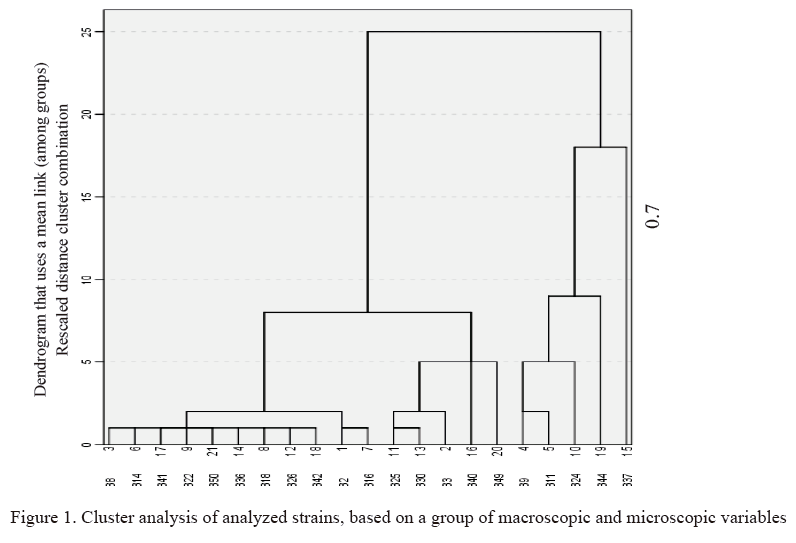
<p align="justify" class="Cuerpodetexto" style="margin-top:12.0pt;text-indent:0cm;"><span style="font-family:'Verdana','sans-serif'; font-size:10.0pt; color:windowtext; ">Cluster analysis was applied to the  group of qualitative variables and <a href="/img/revistas/cjas/v50n3/f0109316.gif">figure 1</a> shows the resulting dendrogram. It  was possible to combine four groups and the obtained genera were identified  using taxonomic keys: nine strains of Aspergillus genus (LB8, LB14, LB41, LB22,  LB50, LB36, LB18, LB26, LB42) with 42.86 %; seven of Trichoderma (LB2, LB16,  LB25, LB30, LB3, LB40, LB49), which represented 33.33%; four of Chrysosporium  (LB9, LB11, LB24, LB44) that represented 19.05 % and one of Fusarium (LB37)  with 4.76 %.</span></p>     
<p align="justify" class="Cuerpodetexto" style="margin-top:12.0pt;text-indent:0cm;"><span style="font-family:'Verdana','sans-serif'; font-size:10.0pt; color:windowtext; ">Around 56 species  of cellulose-producer filamentous fungi have been identified (Vali&ntilde;o 1999).  From the collected material, it was possible to have a diverse and  representative sample of Aspergillus and Trichoderma genera, referred to in the  literature as important producers of cellulase enzymes (Hill <em>et al.</em> 2009, Llacza 2012).</span><span style="font-family:'Verdana','sans-serif'; font-size:10.0pt; color:windowtext; "> </span></p>     <p align="justify" class="Cuerpodetexto" style="margin-top:12.0pt;text-indent:0cm;"><span style="font-family:'Verdana','sans-serif'; font-size:10.0pt; color:windowtext; ">&nbsp;Copetti <em>et al.</em> (2011), to study cocoa  microbiota during drying and storage phase, observed fungal diversity in the  collected samples. Among them, the most frequent were: Absidiacorymbiferanov,  Penicillium and Aspergillus, the latter reported as the most frequent in this  research.</span></p>     <p align="justify" class="Cuerpodetexto" style="margin-top:12.0pt;text-indent:0cm;"><span style="font-family:'Verdana','sans-serif'; font-size:10.0pt; color:windowtext; ">With respect to cellulolytic activity,  performed to 21 isolated strains by determination of degradation halo (HD),  although there were no significant differences (P&gt; 0.05) in the degrading  activity, 10 strains (47.62 %) were obtained, which presented DH equals three.  Out of these, Aspergillus genus showed the highest frequency (<a href="/img/revistas/cjas/v50n3/f0209316.gif">figure 2</a>).</span></p>     
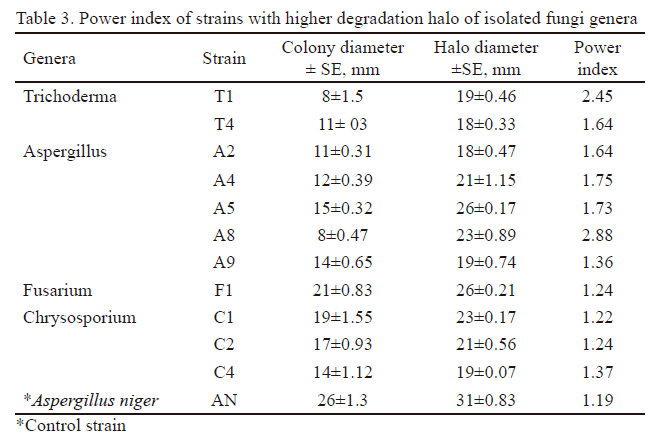
<p align="justify" class="Cuerpodetexto" style="margin-top:12.0pt;text-indent:0cm;"><span style="font-family:'Verdana','sans-serif'; font-size:10.0pt; color:windowtext; ">In the consulted  literature, there were no results from degrading activity by this method in  strains isolated from cocoa skin. However, Cruz <em>et al.</em> (2009) obtained  34.7% of the Aspergillus genus with DH equals three in isolates from  agricultural residues. Ferrer <em>et al.</em> (2011) found only 10% of fungi,  isolated from sugar cane bagasse, and showed good crystalline cellulose  degradation, measured by methods as those used in this study. Several studies  with fungi found that enzymatic activity depends heavily on the evaluated  species and on factors like pH, temperature, nitrogen concentration and  processes of inhibition by reaction products or the presence of proteases (Vali&ntilde;o  1999, Verlent <em>et al.</em> 2005).</span><span style="font-family:'Verdana','sans-serif'; font-size:10.0pt; color:windowtext; "> </span></p>     <p align="justify" class="Cuerpodetexto" style="margin-top:12.0pt;text-indent:0cm;"><span style="font-family:'Verdana','sans-serif'; font-size:10.0pt; color:windowtext; ">Regarding PI  values, <a href="/img/revistas/cjas/v50n3/t0309316.gif">table 3</a> shows that all evaluated strains with DH equal 3 presented PI  values higher than those determined in the control strain. Out of them, T1 and  A8 strains showed PI values higher than 2. This is an indicator of intense  production of organic matter degrading cellulases, which colonize and hydrolyze  these organic compounds very fast (P&eacute;rez <em>et al.</em> 2010).</span><span style="font-family:'Verdana','sans-serif'; font-size:10.0pt; color:windowtext; "> </span></p>     
<p align="justify" class="Cuerpodetexto" style="margin-top:12.0pt;text-indent:0cm;"><span style="font-family:'Verdana','sans-serif'; font-size:10.0pt; color:windowtext; ">Ferrer <em>et al.</em> (2011), after selecting five strains of fungi, isolated from sugar cane bagasse  with degrading activity on crystalline cellulose, in which a similar rate to  that of this study was calculated, found values inferior to the unit. However,  the best diameters of cellulolytic activity found in this study were inferior  to halos of 5 and 3 cm, which were produced by <em>Trichoderma reesei</em> and <em>Aspergillus  niger</em>, respectively, reported by Guti&eacute;rrez <em>et al.</em> (2012).&nbsp; They were also inferior to clearing zones of  7.5 cm for fungi from Trichoderma genus in studies of Ponce and Castillo  (2011). However, due to the amount of factors that may affect the enzymatic  activity, a better optimization of culture medium, supplemented with carbon and  nitrogen sources and other surfactant substances, is required, besides  adjusting the culture conditions to know the true cellulolytic potential of all  the fungi found in all the different sampling    sites.</span><span style="font-family:'Verdana','sans-serif'; font-size:10.0pt; color:windowtext; "> </span></p>     <p align="justify" class="Cuerpodetexto" style="margin-top:12.0pt;text-indent:0cm;"><span style="line-height:107%; font-family:'Verdana','sans-serif'; font-size:10.0pt; ">An amount of 21 strains,  with superior cellulolytic capacity to the reference strain, were isolated. A8  and T1 strains of Aspergillus and Trichoderma genera, respectively, showed  power indexes superior to 2, indicating high cellulolytic capacity. These  strains, native from cocoa skin, could be considered for its industrial use or  as inocula in SSF to obtain enzymes or animal feed</span><span style="font-family:'Verdana','sans-serif'; font-size:10.0pt; color:windowtext; ">.</span></p>     ]]></body>
<body><![CDATA[<p align="justify" class="MsoNormal" style="margin-top:12.0pt;text-align:justify;"><span style="line-height:107%; font-family:'Verdana','sans-serif'; font-size:10.0pt; ">&nbsp;</span></p>     <p align="justify" class="subtitulo" style="margin-top:12.0pt;text-align:justify;"><span style="font-family:'Verdana','sans-serif'; font-size:13.0pt; color:windowtext; "><b>REFERENCES</b></span></p>     <p align="justify" class="referencias" style="margin-top:12.0pt;margin-right:0cm;margin-bottom:.0001pt;margin-left:0cm;text-indent:0cm;"><span style="font-family:'Verdana','sans-serif'; font-size:10.0pt; color:windowtext; ">Alcarraz, C. M., Flores, P. A. &amp; Godoy, A. J. de D. 2010. &ldquo;Producci&oacute;n  de celulasas por inmovilizaci&oacute;n celular para el tratamiento de efluentes  industriales lignocelul&oacute;sicos&rdquo;. Revista del Instituto de Investigaci&oacute;n de la  Facultad de Ingenier&iacute;a Geol&oacute;gica, Minera, Metalurgica y Geogr&aacute;fica, 13(26):  97&ndash;102, ISSN: 1682-3087.</span></p>     <p align="justify" class="referencias" style="margin-top:12.0pt;margin-right:0cm;margin-bottom:.0001pt;margin-left:0cm;text-indent:0cm;"><span style="font-family:'Verdana','sans-serif'; font-size:10.0pt; color:windowtext; ">Arvanitoyannis,  I. S. &amp; Varzakas, T. H. 2008. &ldquo;Vegetable Waste Treatment: Comparison and  Critical Presentation of Methodologies&rdquo;. Critical Reviews in Food Science and  Nutrition, 48(3): 205&ndash;247, ISSN: 1040-8398, 1549-7852, DOI:  10.1080/10408390701279798.</span></p>     <p align="justify" class="referencias" style="margin-top:12.0pt;margin-right:0cm;margin-bottom:.0001pt;margin-left:0cm;text-indent:0cm;"><span style="font-family:'Verdana','sans-serif'; font-size:10.0pt; color:windowtext; ">Barazarte,  H., Sangronis, E. &amp; Unai, E. 2008. </span><span style="font-family:'Verdana','sans-serif'; font-size:10.0pt; color:windowtext; ">&ldquo;La c&aacute;scara de cacao (<em>Theobroma cacao</em> L.): una posible fuente comercial de pectinas&rdquo;. Archivos Latinoamericanos de  Nutrici&oacute;n, 58(1): 64&ndash;68, ISSN: 0004-0622.</span></p>     <p align="justify" class="referencias" style="margin-top:12.0pt;margin-right:0cm;margin-bottom:.0001pt;margin-left:0cm;text-indent:0cm;"><span style="font-family:'Verdana','sans-serif'; font-size:10.0pt; color:windowtext; ">Bautista, F., Palacio, J. L. &amp; Delf&iacute;n, H. 2011. T&eacute;cnicas de muestreo  para manejadores de recursos naturales. 2nd ed., M&eacute;xico: Universidad Nacional  Aut&oacute;noma de M&eacute;xico, 670 p., ISBN: 978-607-02-21297-9, Available:  &lt;<a href="http://www.ciga.unam.mx/publicaciones/images/abook_file/tmuestreo.pdf" target="_blank">http://www.ciga.unam.mx/publicaciones/images/abook_file/tmuestreo.pdf</a>&gt;,  [Consulted: November 10, 2016].</span></p>     <p align="justify" class="referencias" style="margin-top:12.0pt;margin-right:0cm;margin-bottom:.0001pt;margin-left:0cm;text-indent:0cm;"><span style="font-family:'Verdana','sans-serif'; font-size:10.0pt; color:windowtext; ">Carvalho, A. F. A., Neto, P. de O., da Silva, D. F. &amp; Pastore, G. M.  2013. </span><span style="font-family:'Verdana','sans-serif'; font-size:10.0pt; color:windowtext; ">&ldquo;Xylo-oligosaccharides from lignocellulosic materials:  Chemical structure, health benefits and production by chemical and enzymatic  hydrolysis&rdquo;. Food Research International, 51(1): 75&ndash;85, ISSN: 0963-9969, DOI:  10.1016/j.foodres.2012.11.021.</span></p>     <!-- ref --><p align="justify" class="referencias" style="margin-top:12.0pt;margin-right:0cm;margin-bottom:.0001pt;margin-left:0cm;text-indent:0cm;"><span style="font-family:'Verdana','sans-serif'; font-size:10.0pt; color:windowtext; ">Castillo,  C. &amp; Rosado, C. 2016. </span><span style="font-family:'Verdana','sans-serif'; font-size:10.0pt; color:windowtext; ">An&aacute;lisis de la exportaci&oacute;n de cacao y  elaborados periodo 2004-2015 y evaluaci&oacute;n de estrategias que contribuyan al  crecimiento del sector considerando el cambio de la matriz productiva.  Graduated Thesis, Universidad Cat&oacute;lica Santiago de Guayaquil, Ecuador, 119 p.,  Available: &lt;<a href="http://repositorio.ucsg.edu.ec/handle/3317/5226" target="_blank">http://repositorio.ucsg.edu.ec/handle/3317/5226</a>&gt;, [Consulted:  November 10, 2016].    </span></p>     <p align="justify" class="referencias" style="margin-top:12.0pt;margin-right:0cm;margin-bottom:.0001pt;margin-left:0cm;text-indent:0cm;"><span style="font-family:'Verdana','sans-serif'; font-size:10.0pt; color:windowtext; ">Chang,  S. T. 2007. &ldquo;Mushroom cultivation using the ZERI principle: potential for  application&rdquo;. </span><span style="font-family:'Verdana','sans-serif'; font-size:10.0pt; color:windowtext; ">Micolog&iacute;a Aplicada International, 19(2):  33&ndash;34, ISSN: 1534-2581.</span></p>     ]]></body>
<body><![CDATA[<p align="justify" class="referencias" style="margin-top:12.0pt;margin-right:0cm;margin-bottom:.0001pt;margin-left:0cm;text-indent:0cm;"><span style="font-family:'Verdana','sans-serif'; font-size:10.0pt; color:windowtext; ">Colina, A., Ferrer, A. &amp; Urribarr&iacute;, L. 2009. </span><span style="font-family:'Verdana','sans-serif'; font-size:10.0pt; color:windowtext; ">&ldquo;Cellulase  production by <em>Trichoderma reesei</em> Rut C-30 from different cellulosic  substrates&rdquo;. </span><span style="font-family:'Verdana','sans-serif'; font-size:10.0pt; color:windowtext; ">Revista T&eacute;cnica de la Facultad de Ingenier&iacute;a. Universidad  del Zulia, 32(2): 152&ndash;159, ISSN: 0254-0770.</span></p>     <p align="justify" class="referencias" style="margin-top:12.0pt;margin-right:0cm;margin-bottom:.0001pt;margin-left:0cm;text-indent:0cm;"><span style="font-family:'Verdana','sans-serif'; font-size:10.0pt; color:windowtext; ">Copetti, M. V., Iamanaka, B. T., Pereira, J. L., Fungaro, M. H. &amp;  Taniwaki, M. H. 2011. </span><span style="font-family:'Verdana','sans-serif'; font-size:10.0pt; color:windowtext; ">&ldquo;Aflatoxigenic fungi and aflatoxin in cocoa&rdquo;. International  Journal of Food Microbiology, 148(2): 141&ndash;144, ISSN: 0168-1605, DOI:  10.1016/j.ijfoodmicro.2011.05.020.</span></p>     <p align="justify" class="referencias" style="margin-top:12.0pt;margin-right:0cm;margin-bottom:.0001pt;margin-left:0cm;text-indent:0cm;"><span style="font-family:'Verdana','sans-serif'; font-size:10.0pt; color:windowtext; ">Cruz, N., Castellanos, D. &amp; Arg&uuml;ello, H. 2009. &ldquo;Degradaci&oacute;n de celulosa  y xilano por microorganismos aislados de dos tipos de compost de residuos  agr&iacute;colas en la Sabana de Bogot&aacute;&rdquo;. Revista Colombiana de Ciencias Hort&iacute;colas,  3(2): 237&ndash;249, ISSN: 2011-2173, DOI: 10.17584/rcch.2009v3i2.1215.</span></p>     <p align="justify" class="referencias" style="margin-top:12.0pt;margin-right:0cm;margin-bottom:.0001pt;margin-left:0cm;text-indent:0cm;"><span style="font-family:'Verdana','sans-serif'; font-size:10.0pt; color:windowtext; ">Dashtban, M., Schraft, H., Syed, T. A. &amp; Qin, W. 2010. </span><span style="font-family:'Verdana','sans-serif'; font-size:10.0pt; color:windowtext; ">&ldquo;Fungal  biodegradation and enzymatic modification of lignin&rdquo;. International Journal of  Biochemistry and Molecular Biology, 1(1): 36&ndash;50, ISSN: 2152-4114.</span></p>     <p align="justify" class="referencias" style="margin-top:12.0pt;margin-right:0cm;margin-bottom:.0001pt;margin-left:0cm;text-indent:0cm;"><span style="font-family:'Verdana','sans-serif'; font-size:10.0pt; color:windowtext; ">Ferrer,  M. Y., Le&oacute;n, R. M., Michelena, &Aacute;. G., Dustet, M. J. C., Duque, O. A., Iba&ntilde;ez,  F. M. L. &amp; Tortol&oacute;, C. K. 2011. </span><span style="font-family:'Verdana','sans-serif'; font-size:10.0pt; color:windowtext; ">&ldquo;Selecci&oacute;n de hongos aislados de bagazo  de ca&ntilde;a con actividad celulasa sobre celulosa cristalina para posibles  aplicaciones industriales&rdquo;. ICIDCA. Sobre los Derivados de la Ca&ntilde;a de Az&uacute;car,  45(1): 3&ndash;12, ISSN: 0138-620.</span></p>     <!-- ref --><p align="justify" class="referencias" style="margin-top:12.0pt;margin-right:0cm;margin-bottom:.0001pt;margin-left:0cm;text-indent:0cm;"><span style="font-family:'Verdana','sans-serif'; font-size:10.0pt; color:windowtext; ">Font, H., Noda, A., Torres, V., Herrera, M., Lizazo, D., Sarduy, L. &amp;  Rodr&iacute;guez, L. 2007. Comparpro. version 1.0, La Habana, Cuba: Instituto de  Ciencia Animal, Departamento de Biomatem&aacute;tica.    </span></p>     <p align="justify" class="referencias" style="margin-top:12.0pt;margin-right:0cm;margin-bottom:.0001pt;margin-left:0cm;text-indent:0cm;"><span style="font-family:'Verdana','sans-serif'; font-size:10.0pt; color:windowtext; ">Guti&eacute;rrez, R. L. A., P&eacute;rez, B. J. A. &amp; Uribe, M. A. 2012. &ldquo;Evaluaci&oacute;n <em>in  vitro</em> de celulasas producidas por cepas nativas de <em>Trichoderma reesei</em>, <em>Cladosporium herbarum </em>y <em>Aspergillus niger</em>&rdquo;. Journal of  Agriculture and Animal Sciences, 1(1): 7&ndash;15, ISSN: 2256-3342.</span></p>     <p align="justify" class="referencias" style="margin-top:12.0pt;margin-right:0cm;margin-bottom:.0001pt;margin-left:0cm;text-indent:0cm;"><span style="font-family:'Verdana','sans-serif'; font-size:10.0pt; color:windowtext; ">Guzm&aacute;n, C. &Aacute;. M., Zambrano, P. D. E., Rivera, F. R. D., Rond&oacute;n, A. J.,  Laurencio, S. M. &amp; P&eacute;rez, Q. M. 2015. &ldquo;Aislamiento y selecci&oacute;n de bacterias  aut&oacute;ctonas de Manab&iacute;-Ecuador con actividad celulol&iacute;tica&rdquo;. </span><span style="font-family:'Verdana','sans-serif'; font-size:10.0pt; color:windowtext; ">Cultivos  Tropicales, 36(1): 7&ndash;16, ISSN: 0258-5936.</span></p>     <p align="justify" class="referencias" style="margin-top:12.0pt;margin-right:0cm;margin-bottom:.0001pt;margin-left:0cm;text-indent:0cm;"><span style="font-family:'Verdana','sans-serif'; font-size:10.0pt; color:windowtext; ">IBM  Corporation. 2013. IBM SPSS Statistics. version 22, [Windows], U.S: IBM  Corporation, Available: &lt;<a href="http://www.ibm.com" target="_blank">http://www.ibm.com</a>&gt;.</span></p>     ]]></body>
<body><![CDATA[<p align="justify" class="referencias" style="margin-top:12.0pt;margin-right:0cm;margin-bottom:.0001pt;margin-left:0cm;text-indent:0cm;"><span style="font-family:'Verdana','sans-serif'; font-size:10.0pt; color:windowtext; ">Lee, Y.  H. &amp; Fan, L. T. 1983. &ldquo;Kinetic studies of enzymatic hydrolysis of insoluble  cellulose: (II). Analysis of extended hydrolysis times&rdquo;. Biotechnology and  Bioengineering, 25(4): 939&ndash;966, ISSN: 1097-0290, DOI: 10.1002/bit.260250406.</span></p>     <!-- ref --><p align="justify" class="referencias" style="margin-top:12.0pt;margin-right:0cm;margin-bottom:.0001pt;margin-left:0cm;text-indent:0cm;"><span style="font-family:'Verdana','sans-serif'; font-size:10.0pt; color:windowtext; ">Llacza, H. 2012. Evaluaci&oacute;n de la actividad celulol&iacute;tica del complejo  enzim&aacute;tico celulasa en cepas f&uacute;ngicas de los departamentos de Cajamarca, Lima,  Jun&iacute;n, Hu&aacute;nuco. Graduated Thesis, Facultad de Ciencias Biol&oacute;gicas, Universidad  Nacional Mayor de San Marcos, Lima, Per&uacute;, 68 p.    </span></p>     <!-- ref --><p align="justify" class="referencias" style="margin-top:12.0pt;margin-right:0cm;margin-bottom:.0001pt;margin-left:0cm;text-indent:0cm;"><span style="font-family:'Verdana','sans-serif'; font-size:10.0pt; color:windowtext; ">Pedroza, R. A. M., Matiz, V. A. &amp; Quevedo, H. A. M. 2007. Manual de  Laboratorio de Procesos Biotecnologicos. (ser. Apuntes), Bogot&aacute;, Colombia:  Pontificia Universidad Javeriana, 9 p., ISBN: 97895876029, Available:  &lt;<a href="http://catalogo.udes.edu.co/cgi-bin/koha/opac-detail.pl?biblionumber=8486">http://catalogo.udes.edu.co/cgi-bin/koha/opac-detail.pl?biblionumber=8486</a>&gt;,  [Consulted: November 4, 2016].    </span></p>     <p align="justify" class="referencias" style="margin-top:12.0pt;margin-right:0cm;margin-bottom:.0001pt;margin-left:0cm;text-indent:0cm;"><span style="font-family:'Verdana','sans-serif'; font-size:10.0pt; color:windowtext; ">P&eacute;rez, B. Y., Rebollido, R. R. &amp; Mart&iacute;nez, S. J. 2010. &ldquo;Aislamiento e  identificaci&oacute;n de hongos en compost elaborado a partir de residuos s&oacute;lidos  urbanos&rdquo;. </span><span style="font-family:'Verdana','sans-serif'; font-size:10.0pt; color:windowtext; ">Agro Sur, 38(1): 1&ndash;7, ISSN: 0304-8802, DOI:  10.4206/agrosur.2010.v38n1-01.</span></p>     <!-- ref --><p align="justify" class="referencias" style="margin-top:12.0pt;margin-right:0cm;margin-bottom:.0001pt;margin-left:0cm;text-indent:0cm;"><span style="font-family:'Verdana','sans-serif'; font-size:10.0pt; color:windowtext; ">Ponce, K. &amp; Castillo, E. 2011. Aislamiento y caracterizaci&oacute;n  morfol&oacute;gica y enzimo-funcional de hongos lignino-celulol&iacute;ticos procedentes de  la corteza de aliso (<em>Alnus acuminata</em>), Array&aacute;n (<em>Myrcian theshallii</em>)  y Pumamaqui (<em>Oreopanax heterophyllus</em>) presentes en las manchas del  bosque nativo del Pasochoa, bajo condiciones de laboratorio. Graduated Thesis,  ESPE, Sangolqu&iacute;, Ecuador, 73 p.    </span></p>     <!-- ref --><p align="justify" class="referencias" style="margin-top:12.0pt;margin-right:0cm;margin-bottom:.0001pt;margin-left:0cm;text-indent:0cm;"><span style="font-family:'Verdana','sans-serif'; font-size:10.0pt; color:windowtext; ">Stanier, R. Y., Ingraham, J. L., Wheelis, M. L. &amp; Painter, P. R. 1996.  Microbiolog&iacute;a. Villanueva, J. R. (ed.), Reverte, 776 p., ISBN:  978-84-291-1868-1, Available:  &lt;<a href="https://books.google.com.cu/books/about/Microbiolog%C3%ADa.html?id=2u-6Q2XCMDgC&redir_esc=y" target="_blank">https://books.google.com.cu/books/about/Microbiolog%C3%ADa.html?id=2u-6Q2XCMDgC&amp;redir_esc=y</a>&gt;,  [Consulted: November 4, 2016].    </span></p>     ]]></body>
<body><![CDATA[<p align="justify" class="referencias" style="margin-top:12.0pt;margin-right:0cm;margin-bottom:.0001pt;margin-left:0cm;text-indent:0cm;"><span style="font-family:'Verdana','sans-serif'; font-size:10.0pt; color:windowtext; ">Torres, V. 2015. &ldquo;Aspectos estad&iacute;sticos a considerar en el dise&ntilde;o,  muestreo, procesamiento e interpretaci&oacute;n de datos en la investigaci&oacute;n de  sistemas productivos agropecuarios&rdquo;. In: Vargas, B. J. C., Ben&iacute;tez, J. D.,  Bravo, C., Leonard, I., P&eacute;rez, M., Torres, V., R&iacute;os, S. &amp; Torres, A., Retos  y posibilidades para una ganader&iacute;a sostenible en la provincia Pastaza de la  Amazon&iacute;a Ecuatoriana, Puyo, Ecuador: Universidad Estatal Amaz&oacute;nica, pp. 83&ndash;108,  ISBN: 978-9942-932-16-7, Available:  &lt;<a href="https://www.researchgate.net/publication/295548677_Retos_y_posibilidades_para_una_ganaderia_sostenible_enla_provincia_de_Pastaza_de_la_Amazonia_Ecuatoriana" target="_blank">https://www.researchgate.net/publication/295548677_Retos_y_posibilidades_para_una_ganaderia_sostenible_enla_provincia_de_Pastaza_de_la_Amazonia_Ecuatoriana</a>&gt;,  [Consulted: November 4, 2016].</span></p>     <!-- ref --><p align="justify" class="referencias" style="margin-top:12.0pt;margin-right:0cm;margin-bottom:.0001pt;margin-left:0cm;text-indent:0cm;"><span style="font-family:'Verdana','sans-serif'; font-size:10.0pt; color:windowtext; ">Vali&ntilde;o, E. 1999. Fermentaci&oacute;n en estado s&oacute;lido del bagazo de ca&ntilde;a de az&uacute;car  por hongos conidiales productores de celulasas. Ph.D. Thesis, Instituto de  Ciencia Animal, La Habana, Cuba.    </span></p>     <p align="justify" class="referencias" style="margin-top:12.0pt;margin-right:0cm;margin-bottom:.0001pt;margin-left:0cm;text-indent:0cm;"><span style="font-family:'Verdana','sans-serif'; font-size:10.0pt; color:windowtext; ">Verlent,  I., Smout, C., Duvetter, T., Hendrickx, M. E. &amp; Van Loey, A. 2005. &ldquo;Effect  of temperature and pressure on the activity of purified tomato  polygalacturonase in the presence of pectins with different patterns of methyl  esterification&rdquo;. Innovative Food Science &amp; Emerging Technologies, 6(3):  293&ndash;303, ISSN: 1466-8564, DOI: 10.1016/j.ifset.2005.02.003.</span></p>     <p align="justify" class="referencias" style="margin-top:12.0pt;margin-right:0cm;margin-bottom:.0001pt;margin-left:0cm;text-indent:0cm;"><span style="font-family:'Verdana','sans-serif'; font-size:10.0pt; ">Waghmare, P. R.,  Kshirsagar, S. D., Saratale, R. G., Govindwar, S. P. &amp; Saratale, G. D.  2014. &ldquo;Production and characterization of cellulolytic enzymes by isolated  Klebsiella sp. PRW-1 using agricultural waste biomass&rdquo;. Emirates Journal of  Food and Agriculture, 26(1): 44&ndash;59, ISSN: 2079-052X, 2079-0538, DOI:  10.9755/ejfa.v26i1.15296</span><font size="2" face="Verdana, Arial, Helvetica, sans-serif">.</font></p>     <p align="justify">&nbsp;</p>     <p align="justify">&nbsp;</p>     <p align="justify"><font size="2" face="Verdana, Arial, Helvetica, sans-serif">Received: 08/2/2016    <br> Accepted: 03/11/2016</font></p>     <p align="justify">&nbsp;</p>     ]]></body>
<body><![CDATA[<p align="justify">&nbsp;</p>     <p align="justify"><font size="2" face="Verdana, Arial, Helvetica, sans-serif"><i>Ana L. Chafla,</i> Universidad Estatal Amazónica, Puyo. Pastaza. Ecuador.    Email: <a href="mailto:achafla@uea.edu.ec">achafla@uea.edu.ec</a></font></p>      ]]></body><back>
<ref-list>
<ref id="B1">
<nlm-citation citation-type="journal">
<person-group person-group-type="author">
<name>
<surname><![CDATA[Alcarraz]]></surname>
<given-names><![CDATA[C. M.]]></given-names>
</name>
<name>
<surname><![CDATA[Flores]]></surname>
<given-names><![CDATA[P. A.]]></given-names>
</name>
<name>
<surname><![CDATA[Godoy]]></surname>
<given-names><![CDATA[A. J. de D.]]></given-names>
</name>
</person-group>
<article-title xml:lang="nd"><![CDATA[Producción de celulasas por inmovilización celular para el tratamiento de efluentes industriales lignocelulósicos]]></article-title>
<source><![CDATA[Revista del Instituto de Investigación de la Facultad de Ingeniería Geológica, Minera, Metalurgica y Geográfica]]></source>
<year>2010</year>
<volume>13</volume>
<numero>26</numero>
<issue>26</issue>
<page-range>97–102</page-range></nlm-citation>
</ref>
<ref id="B2">
<nlm-citation citation-type="journal">
<person-group person-group-type="author">
<name>
<surname><![CDATA[Arvanitoyannis]]></surname>
<given-names><![CDATA[I. S.]]></given-names>
</name>
<name>
<surname><![CDATA[Varzakas]]></surname>
<given-names><![CDATA[T. H.]]></given-names>
</name>
</person-group>
<article-title xml:lang="nd"><![CDATA[Vegetable Waste Treatment: Comparison and Critical Presentation of Methodologies]]></article-title>
<source><![CDATA[Critical Reviews in Food Science and Nutrition]]></source>
<year>2008</year>
<volume>48</volume>
<numero>3</numero>
<issue>3</issue>
<page-range>205–247</page-range></nlm-citation>
</ref>
<ref id="B3">
<nlm-citation citation-type="journal">
<person-group person-group-type="author">
<name>
<surname><![CDATA[Barazarte]]></surname>
<given-names><![CDATA[H.]]></given-names>
</name>
<name>
<surname><![CDATA[Sangronis]]></surname>
<given-names><![CDATA[E.]]></given-names>
</name>
<name>
<surname><![CDATA[Unai]]></surname>
<given-names><![CDATA[E.]]></given-names>
</name>
</person-group>
<article-title xml:lang="nd"><![CDATA[La cáscara de cacao (Theobroma cacao L.): una posible fuente comercial de pectinas]]></article-title>
<source><![CDATA[Archivos Latinoamericanos de Nutrición]]></source>
<year>2008</year>
<volume>58</volume>
<numero>1</numero>
<issue>1</issue>
<page-range>64–68</page-range></nlm-citation>
</ref>
<ref id="B4">
<nlm-citation citation-type="book">
<person-group person-group-type="author">
<name>
<surname><![CDATA[Bautista]]></surname>
<given-names><![CDATA[F.]]></given-names>
</name>
<name>
<surname><![CDATA[Palacio]]></surname>
<given-names><![CDATA[J. L.]]></given-names>
</name>
<name>
<surname><![CDATA[Delfín]]></surname>
<given-names><![CDATA[H.]]></given-names>
</name>
</person-group>
<source><![CDATA[Tecnicas de muestreo para manejadores de recursos naturales]]></source>
<year>2011</year>
<edition>2nd</edition>
<page-range>670</page-range><publisher-loc><![CDATA[México ]]></publisher-loc>
<publisher-name><![CDATA[Universidad Nacional Autónoma de México]]></publisher-name>
</nlm-citation>
</ref>
<ref id="B5">
<nlm-citation citation-type="journal">
<person-group person-group-type="author">
<name>
<surname><![CDATA[Carvalho]]></surname>
<given-names><![CDATA[A. F. A.]]></given-names>
</name>
<name>
<surname><![CDATA[Neto]]></surname>
<given-names><![CDATA[P. de O.]]></given-names>
</name>
<name>
<surname><![CDATA[da Silva]]></surname>
<given-names><![CDATA[D. F.]]></given-names>
</name>
<name>
<surname><![CDATA[Pastore]]></surname>
<given-names><![CDATA[G. M.]]></given-names>
</name>
</person-group>
<article-title xml:lang="nd"><![CDATA[Xylo-oligosaccharides from lignocellulosic materials: Chemical structure, health benefits and production by chemical and enzymatic hydrolysis]]></article-title>
<source><![CDATA[Food Research International]]></source>
<year>2013</year>
<volume>51</volume>
<numero>1</numero>
<issue>1</issue>
<page-range>75–85</page-range></nlm-citation>
</ref>
<ref id="B6">
<nlm-citation citation-type="book">
<person-group person-group-type="author">
<name>
<surname><![CDATA[Castillo]]></surname>
<given-names><![CDATA[C.]]></given-names>
</name>
<name>
<surname><![CDATA[Rosado]]></surname>
<given-names><![CDATA[C.]]></given-names>
</name>
</person-group>
<source><![CDATA[Análisis de la exportación de cacao y elaborados periodo 2004-2015 y evaluación de estrategias que contribuyan al crecimiento del sector considerando el cambio de la matriz productiva]]></source>
<year>2016</year>
<page-range>119</page-range><publisher-loc><![CDATA[Ecuador ]]></publisher-loc>
<publisher-name><![CDATA[Universidad Católica Santiago de Guayaquil]]></publisher-name>
</nlm-citation>
</ref>
<ref id="B7">
<nlm-citation citation-type="journal">
<person-group person-group-type="author">
<name>
<surname><![CDATA[Chang]]></surname>
<given-names><![CDATA[S. T.]]></given-names>
</name>
</person-group>
<article-title xml:lang="nd"><![CDATA[Mushroom cultivation using the ZERI principle: potential for application]]></article-title>
<source><![CDATA[Micología Aplicada International]]></source>
<year>2007</year>
<volume>19</volume>
<numero>2</numero>
<issue>2</issue>
<page-range>33–34</page-range></nlm-citation>
</ref>
<ref id="B8">
<nlm-citation citation-type="journal">
<person-group person-group-type="author">
<name>
<surname><![CDATA[Colina]]></surname>
<given-names><![CDATA[A.]]></given-names>
</name>
<name>
<surname><![CDATA[Ferrer]]></surname>
<given-names><![CDATA[A.]]></given-names>
</name>
<name>
<surname><![CDATA[Urribarrí]]></surname>
<given-names><![CDATA[L.]]></given-names>
</name>
</person-group>
<article-title xml:lang="nd"><![CDATA[Cellulase production by Trichoderma reesei Rut C-30 from different cellulosic substrates]]></article-title>
<source><![CDATA[Revista Técnica de la Facultad de Ingeniería. Universidad del Zulia]]></source>
<year>2009</year>
<volume>32</volume>
<numero>2</numero>
<issue>2</issue>
<page-range>152–159</page-range></nlm-citation>
</ref>
<ref id="B9">
<nlm-citation citation-type="journal">
<person-group person-group-type="author">
<name>
<surname><![CDATA[Copetti]]></surname>
<given-names><![CDATA[M. V.]]></given-names>
</name>
<name>
<surname><![CDATA[Iamanaka]]></surname>
<given-names><![CDATA[B. T.]]></given-names>
</name>
<name>
<surname><![CDATA[Pereira]]></surname>
<given-names><![CDATA[J. L.]]></given-names>
</name>
<name>
<surname><![CDATA[Fungaro]]></surname>
<given-names><![CDATA[M. H.]]></given-names>
</name>
<name>
<surname><![CDATA[Taniwaki]]></surname>
<given-names><![CDATA[M. H.]]></given-names>
</name>
</person-group>
<article-title xml:lang="nd"><![CDATA[Aflatoxigenic fungi and aflatoxin in cocoa]]></article-title>
<source><![CDATA[International Journal of Food Microbiology]]></source>
<year>2011</year>
<volume>148</volume>
<numero>2</numero>
<issue>2</issue>
<page-range>141–144</page-range></nlm-citation>
</ref>
<ref id="B10">
<nlm-citation citation-type="journal">
<person-group person-group-type="author">
<name>
<surname><![CDATA[Cruz]]></surname>
<given-names><![CDATA[N.]]></given-names>
</name>
<name>
<surname><![CDATA[Castellanos]]></surname>
<given-names><![CDATA[D.]]></given-names>
</name>
<name>
<surname><![CDATA[Argüello]]></surname>
<given-names><![CDATA[H.]]></given-names>
</name>
</person-group>
<article-title xml:lang="nd"><![CDATA[Degradación de celulosa y xilano por microorganismos aislados de dos tipos de compost de residuos agrícolas en la Sabana de Bogotá]]></article-title>
<source><![CDATA[Revista Colombiana de Ciencias Hortícolas]]></source>
<year>2009</year>
<volume>3</volume>
<numero>2</numero>
<issue>2</issue>
<page-range>237–249</page-range></nlm-citation>
</ref>
<ref id="B11">
<nlm-citation citation-type="journal">
<person-group person-group-type="author">
<name>
<surname><![CDATA[Dashtban]]></surname>
<given-names><![CDATA[M.]]></given-names>
</name>
<name>
<surname><![CDATA[Schraft]]></surname>
<given-names><![CDATA[H.]]></given-names>
</name>
<name>
<surname><![CDATA[Syed]]></surname>
<given-names><![CDATA[T. A.]]></given-names>
</name>
<name>
<surname><![CDATA[Qin]]></surname>
<given-names><![CDATA[W.]]></given-names>
</name>
</person-group>
<article-title xml:lang="nd"><![CDATA[Fungal biodegradation and enzymatic modification of lignin]]></article-title>
<source><![CDATA[International Journal of Biochemistry and Molecular Biology]]></source>
<year>2010</year>
<volume>1</volume>
<numero>1</numero>
<issue>1</issue>
<page-range>36–50</page-range></nlm-citation>
</ref>
<ref id="B12">
<nlm-citation citation-type="journal">
<person-group person-group-type="author">
<name>
<surname><![CDATA[Ferrer]]></surname>
<given-names><![CDATA[M. Y.]]></given-names>
</name>
<name>
<surname><![CDATA[León]]></surname>
<given-names><![CDATA[R. M.]]></given-names>
</name>
<name>
<surname><![CDATA[Michelena]]></surname>
<given-names><![CDATA[Á. G.]]></given-names>
</name>
<name>
<surname><![CDATA[Dustet]]></surname>
<given-names><![CDATA[M. J. C.]]></given-names>
</name>
<name>
<surname><![CDATA[Duque]]></surname>
<given-names><![CDATA[O. A.]]></given-names>
</name>
<name>
<surname><![CDATA[Ibañez]]></surname>
<given-names><![CDATA[F. M. L.]]></given-names>
</name>
<name>
<surname><![CDATA[Tortoló]]></surname>
<given-names><![CDATA[C. K.]]></given-names>
</name>
</person-group>
<article-title xml:lang="nd"><![CDATA[Selección de hongos aislados de bagazo de caña con actividad celulasa sobre celulosa cristalina para posibles aplicaciones industriales]]></article-title>
<source><![CDATA[ICIDCA. Sobre los Derivados de la Caña de Azúcar]]></source>
<year>2011</year>
<volume>45</volume>
<numero>1</numero>
<issue>1</issue>
<page-range>3–12</page-range></nlm-citation>
</ref>
<ref id="B13">
<nlm-citation citation-type="book">
<person-group person-group-type="author">
<name>
<surname><![CDATA[Font]]></surname>
<given-names><![CDATA[H.]]></given-names>
</name>
<name>
<surname><![CDATA[Noda]]></surname>
<given-names><![CDATA[A.]]></given-names>
</name>
<name>
<surname><![CDATA[Torres]]></surname>
<given-names><![CDATA[V.]]></given-names>
</name>
<name>
<surname><![CDATA[Herrera]]></surname>
<given-names><![CDATA[M.]]></given-names>
</name>
<name>
<surname><![CDATA[Lizazo]]></surname>
<given-names><![CDATA[D.]]></given-names>
</name>
<name>
<surname><![CDATA[Sarduy]]></surname>
<given-names><![CDATA[L.]]></given-names>
</name>
<name>
<surname><![CDATA[Rodríguez]]></surname>
<given-names><![CDATA[L.]]></given-names>
</name>
</person-group>
<source><![CDATA[Comparpro]]></source>
<year>2007</year>
<publisher-loc><![CDATA[La Habana, Cuba ]]></publisher-loc>
<publisher-name><![CDATA[Instituto de Ciencia Animal, Departamento de Biomatemática]]></publisher-name>
</nlm-citation>
</ref>
<ref id="B14">
<nlm-citation citation-type="journal">
<person-group person-group-type="author">
<name>
<surname><![CDATA[Gutiérrez]]></surname>
<given-names><![CDATA[R. L. A.]]></given-names>
</name>
<name>
<surname><![CDATA[Pérez]]></surname>
<given-names><![CDATA[B. J. A.]]></given-names>
</name>
<name>
<surname><![CDATA[Uribe]]></surname>
<given-names><![CDATA[M. A.]]></given-names>
</name>
</person-group>
<article-title xml:lang="nd"><![CDATA[Evaluación in vitro de celulasas producidas por cepas nativas de Trichoderma reesei, Cladosporium herbarum y Aspergillus niger]]></article-title>
<source><![CDATA[Journal of Agriculture and Animal Sciences]]></source>
<year>2012</year>
<volume>1</volume>
<numero>1</numero>
<issue>1</issue>
<page-range>7–15</page-range></nlm-citation>
</ref>
<ref id="B15">
<nlm-citation citation-type="journal">
<person-group person-group-type="author">
<name>
<surname><![CDATA[Guzmán]]></surname>
<given-names><![CDATA[C. Á. M.]]></given-names>
</name>
<name>
<surname><![CDATA[Zambrano]]></surname>
<given-names><![CDATA[P. D. E.]]></given-names>
</name>
<name>
<surname><![CDATA[Rivera]]></surname>
<given-names><![CDATA[F. R. D.]]></given-names>
</name>
<name>
<surname><![CDATA[Rondón]]></surname>
<given-names><![CDATA[A. J.]]></given-names>
</name>
<name>
<surname><![CDATA[Laurencio]]></surname>
<given-names><![CDATA[S. M.]]></given-names>
</name>
<name>
<surname><![CDATA[Pérez]]></surname>
<given-names><![CDATA[Q. M.]]></given-names>
</name>
</person-group>
<article-title xml:lang="nd"><![CDATA[Aislamiento y selección de bacterias autóctonas de Manabí-Ecuador con actividad celulolítica]]></article-title>
<source><![CDATA[Cultivos Tropicales]]></source>
<year>2015</year>
<volume>36</volume>
<numero>1</numero>
<issue>1</issue>
<page-range>7–16</page-range></nlm-citation>
</ref>
<ref id="B16">
<nlm-citation citation-type="journal">
<person-group person-group-type="author">
<name>
<surname><![CDATA[Lee]]></surname>
<given-names><![CDATA[Y. H.]]></given-names>
</name>
<name>
<surname><![CDATA[Fan]]></surname>
<given-names><![CDATA[L. T.]]></given-names>
</name>
</person-group>
<article-title xml:lang="nd"><![CDATA[Kinetic studies of enzymatic hydrolysis of insoluble cellulose: (II). Analysis of extended hydrolysis times]]></article-title>
<source><![CDATA[Biotechnology and Bioengineering]]></source>
<year>1983</year>
<volume>25</volume>
<numero>4</numero>
<issue>4</issue>
<page-range>939–966</page-range></nlm-citation>
</ref>
<ref id="B17">
<nlm-citation citation-type="book">
<person-group person-group-type="author">
<name>
<surname><![CDATA[Llacza]]></surname>
<given-names><![CDATA[H.]]></given-names>
</name>
</person-group>
<source><![CDATA[Evaluación de la actividad celulolítica del complejo enzimático celulasa en cepas fúngicas de los departamentos de Cajamarca, Lima, Junín, Huánuco]]></source>
<year>2012</year>
<page-range>68</page-range><publisher-loc><![CDATA[Lima, Perú ]]></publisher-loc>
<publisher-name><![CDATA[Facultad de Ciencias Biológicas, Universidad Nacional Mayor de San Marcos]]></publisher-name>
</nlm-citation>
</ref>
<ref id="B18">
<nlm-citation citation-type="book">
<person-group person-group-type="author">
<name>
<surname><![CDATA[Pedroza]]></surname>
<given-names><![CDATA[R. A. M.]]></given-names>
</name>
<name>
<surname><![CDATA[Matiz]]></surname>
<given-names><![CDATA[V. A.]]></given-names>
</name>
<name>
<surname><![CDATA[Quevedo]]></surname>
<given-names><![CDATA[H. A. M.]]></given-names>
</name>
</person-group>
<source><![CDATA[Manual de Laboratorio de Procesos Biotecnologicos]]></source>
<year>2007</year>
<page-range>9</page-range><publisher-loc><![CDATA[Bogotá, Colombia ]]></publisher-loc>
<publisher-name><![CDATA[Pontificia Universidad Javeriana]]></publisher-name>
</nlm-citation>
</ref>
<ref id="B19">
<nlm-citation citation-type="journal">
<person-group person-group-type="author">
<name>
<surname><![CDATA[Pérez]]></surname>
<given-names><![CDATA[B. Y.]]></given-names>
</name>
<name>
<surname><![CDATA[Rebollido]]></surname>
<given-names><![CDATA[R. R.]]></given-names>
</name>
<name>
<surname><![CDATA[Martínez]]></surname>
<given-names><![CDATA[S. J.]]></given-names>
</name>
</person-group>
<article-title xml:lang="nd"><![CDATA[Aislamiento e identificación de hongos en compost elaborado a partir de residuos sólidos urbanos]]></article-title>
<source><![CDATA[Agro Sur]]></source>
<year>2010</year>
<volume>38</volume>
<numero>1</numero>
<issue>1</issue>
<page-range>1–7</page-range></nlm-citation>
</ref>
<ref id="B20">
<nlm-citation citation-type="book">
<person-group person-group-type="author">
<name>
<surname><![CDATA[Ponce]]></surname>
<given-names><![CDATA[K.]]></given-names>
</name>
<name>
<surname><![CDATA[Castillo]]></surname>
<given-names><![CDATA[E.]]></given-names>
</name>
</person-group>
<source><![CDATA[Aislamiento y caracterización morfológica y enzimo-funcional de hongos lignino-celulolíticos procedentes de la corteza de aliso (Alnus acuminata), Arrayán (Myrcian theshallii) y Pumamaqui (Oreopanax heterophyllus) presentes en las manchas del bosque nativo del Pasochoa, bajo condiciones de laboratorio]]></source>
<year>2011</year>
<page-range>73</page-range><publisher-loc><![CDATA[Sangolquí, Ecuador ]]></publisher-loc>
<publisher-name><![CDATA[ESPE]]></publisher-name>
</nlm-citation>
</ref>
<ref id="B21">
<nlm-citation citation-type="book">
<person-group person-group-type="author">
<name>
<surname><![CDATA[Stanier]]></surname>
<given-names><![CDATA[R. Y.]]></given-names>
</name>
<name>
<surname><![CDATA[Ingraham]]></surname>
<given-names><![CDATA[J. L.]]></given-names>
</name>
<name>
<surname><![CDATA[Wheelis]]></surname>
<given-names><![CDATA[M. L.]]></given-names>
</name>
<name>
<surname><![CDATA[Painter]]></surname>
<given-names><![CDATA[P. R.]]></given-names>
</name>
<name>
<surname><![CDATA[Villanueva]]></surname>
<given-names><![CDATA[J. R.]]></given-names>
</name>
</person-group>
<source><![CDATA[Microbiología]]></source>
<year>1996</year>
<page-range>776</page-range><publisher-name><![CDATA[Reverte]]></publisher-name>
</nlm-citation>
</ref>
<ref id="B22">
<nlm-citation citation-type="book">
<person-group person-group-type="author">
<name>
<surname><![CDATA[Torres]]></surname>
<given-names><![CDATA[V.]]></given-names>
</name>
</person-group>
<article-title xml:lang="nd"><![CDATA[Aspectos estadísticos a considerar en el diseño, muestreo, procesamiento e interpretación de datos en la investigación de sistemas productivos agropecuarios]]></article-title>
<source><![CDATA[Retos y posibilidades para una ganadería sostenible en la provincia Pastaza de la Amazonía Ecuatoriana]]></source>
<year>2015</year>
<page-range>83–108</page-range><publisher-loc><![CDATA[Puyo, Ecuador ]]></publisher-loc>
<publisher-name><![CDATA[Universidad Estatal Amazónica]]></publisher-name>
</nlm-citation>
</ref>
<ref id="B23">
<nlm-citation citation-type="book">
<person-group person-group-type="author">
<name>
<surname><![CDATA[Valiño]]></surname>
<given-names><![CDATA[E.]]></given-names>
</name>
</person-group>
<source><![CDATA[Fermentación en estado sólido del bagazo de caña de azúcar por hongos conidiales productores de celulasas]]></source>
<year>1999</year>
<publisher-loc><![CDATA[La Habana, Cuba ]]></publisher-loc>
<publisher-name><![CDATA[Instituto de Ciencia Animal]]></publisher-name>
</nlm-citation>
</ref>
<ref id="B24">
<nlm-citation citation-type="journal">
<person-group person-group-type="author">
<name>
<surname><![CDATA[Verlent]]></surname>
<given-names><![CDATA[I.]]></given-names>
</name>
<name>
<surname><![CDATA[Smout]]></surname>
<given-names><![CDATA[C.]]></given-names>
</name>
<name>
<surname><![CDATA[Duvetter]]></surname>
<given-names><![CDATA[T.]]></given-names>
</name>
<name>
<surname><![CDATA[Hendrickx]]></surname>
<given-names><![CDATA[M. E.]]></given-names>
</name>
<name>
<surname><![CDATA[Van Loey]]></surname>
<given-names><![CDATA[A.]]></given-names>
</name>
</person-group>
<article-title xml:lang="nd"><![CDATA[Effect of temperature and pressure on the activity of purified tomato polygalacturonase in the presence of pectins with different patterns of methyl esterification]]></article-title>
<source><![CDATA[Innovative Food Science & Emerging Technologies]]></source>
<year>2005</year>
<volume>6</volume>
<numero>3</numero>
<issue>3</issue>
<page-range>293–303</page-range></nlm-citation>
</ref>
<ref id="B25">
<nlm-citation citation-type="journal">
<person-group person-group-type="author">
<name>
<surname><![CDATA[Waghmare]]></surname>
<given-names><![CDATA[P. R.]]></given-names>
</name>
<name>
<surname><![CDATA[Kshirsagar]]></surname>
<given-names><![CDATA[S. D.]]></given-names>
</name>
<name>
<surname><![CDATA[Saratale]]></surname>
<given-names><![CDATA[R. G.]]></given-names>
</name>
<name>
<surname><![CDATA[Govindwar]]></surname>
<given-names><![CDATA[S. P.]]></given-names>
</name>
<name>
<surname><![CDATA[Saratale]]></surname>
<given-names><![CDATA[G. D.]]></given-names>
</name>
</person-group>
<article-title xml:lang="nd"><![CDATA[Production and characterization of cellulolytic enzymes by isolated Klebsiella sp. PRW-1 using agricultural waste biomass]]></article-title>
<source><![CDATA[Emirates Journal of Food and Agriculture]]></source>
<year>2014</year>
<volume>26</volume>
<numero>1</numero>
<issue>1</issue>
<page-range>44–59</page-range></nlm-citation>
</ref>
<ref id="B26">
<nlm-citation citation-type="book">
<source><![CDATA[IBM SPSS Statistics]]></source>
<year>2013</year>
<publisher-loc><![CDATA[U.S ]]></publisher-loc>
<publisher-name><![CDATA[IBM Corporation]]></publisher-name>
</nlm-citation>
</ref>
</ref-list>
</back>
</article>