<?xml version="1.0" encoding="ISO-8859-1"?><article xmlns:mml="http://www.w3.org/1998/Math/MathML" xmlns:xlink="http://www.w3.org/1999/xlink" xmlns:xsi="http://www.w3.org/2001/XMLSchema-instance">
<front>
<journal-meta>
<journal-id>2079-3480</journal-id>
<journal-title><![CDATA[Cuban Journal of Agricultural Science]]></journal-title>
<abbrev-journal-title><![CDATA[Cuban J. Agric. Sci.]]></abbrev-journal-title>
<issn>2079-3480</issn>
<publisher>
<publisher-name><![CDATA[Editorial del Instituto de Ciencia Animal]]></publisher-name>
</publisher>
</journal-meta>
<article-meta>
<article-id>S2079-34802016000300012</article-id>
<title-group>
<article-title xml:lang="en"><![CDATA[Use of diets with Moringa oleifera (stems + leaves) meals in laying hens]]></article-title>
<article-title xml:lang="es"><![CDATA[Utilización de dietas con harina de Moringa oleifera (tallos + hojas) en gallinas ponedoras]]></article-title>
</title-group>
<contrib-group>
<contrib contrib-type="author">
<name>
<surname><![CDATA[Valdivié]]></surname>
<given-names><![CDATA[M.]]></given-names>
</name>
<xref ref-type="aff" rid="A01"/>
</contrib>
<contrib contrib-type="author">
<name>
<surname><![CDATA[Mesa]]></surname>
<given-names><![CDATA[O.]]></given-names>
</name>
<xref ref-type="aff" rid="A01"/>
</contrib>
<contrib contrib-type="author">
<name>
<surname><![CDATA[Rodríguez]]></surname>
<given-names><![CDATA[Bárbara]]></given-names>
</name>
<xref ref-type="aff" rid="A01"/>
</contrib>
</contrib-group>
<aff id="A01">
<institution><![CDATA[,Instituto de Ciencia Animal  ]]></institution>
<addr-line><![CDATA[San José de las Lajas Mayabeque]]></addr-line>
<country>Cuba</country>
</aff>
<pub-date pub-type="pub">
<day>00</day>
<month>09</month>
<year>2016</year>
</pub-date>
<pub-date pub-type="epub">
<day>00</day>
<month>09</month>
<year>2016</year>
</pub-date>
<volume>50</volume>
<numero>3</numero>
<fpage>445</fpage>
<lpage>454</lpage>
<copyright-statement/>
<copyright-year/>
<self-uri xlink:href="http://scielo.sld.cu/scielo.php?script=sci_arttext&amp;pid=S2079-34802016000300012&amp;lng=en&amp;nrm=iso"></self-uri><self-uri xlink:href="http://scielo.sld.cu/scielo.php?script=sci_abstract&amp;pid=S2079-34802016000300012&amp;lng=en&amp;nrm=iso"></self-uri><self-uri xlink:href="http://scielo.sld.cu/scielo.php?script=sci_pdf&amp;pid=S2079-34802016000300012&amp;lng=en&amp;nrm=iso"></self-uri><abstract abstract-type="short" xml:lang="en"><p><![CDATA[An amount of 36 L-33 laying hens, with 1618 g of liveweight and more than 80 % of laying, were used in order to evaluate productive performance of diets with 0, 10 and 20 % of Moringa oleifera meal, from 34 to 50 weeks of age. Birds were kept in individual cages, at a rate of 12 hens/treatment, according to a completely randomized design, with three treatments and 12 repetitions. Performance of laying hens had no differences among treatments with 0 and 10 % of moringa for variability (100 %), liveweight (1756 to 1765 g/bird), food intake (110 g/bird) and egg production (76 to 81 %). However, with 20 % of moringa on the diet, there was a reduction of laying in 14 % regarding control treatment. Moringa favored pigmentation of egg yolks. With 10 % of moringa, cost of needed food to produce a thousand eggs was lower than control. From a nutritional point of view, it was evident the possibility of using up to 10 % of Moringa oleifera (stems + leaves) meal in diets for laying hens between 34 and 50 weeks of age]]></p></abstract>
<abstract abstract-type="short" xml:lang="es"><p><![CDATA[Se utilizaron 36 gallinas ponedoras L-33, de 1618 g de peso vivo y más de 80 % de puesta, para evaluar el comportamiento productivo con la utilización de dietas con 0, 10 y 20 % de harina de Moringa oleifera, desde la 34 hasta las 50 semanas de edad. Las aves se alojaron en jaulas individuales, a razón de 12 gallinas/tratamiento, según diseño completamente aleatorizado con tres tratamientos y 12 repeticiones. El comportamiento de las gallinas ponedoras no difirió entre los tratamientos con 0 y 10 % de moringa para viabilidad (100 %), peso vivo (1756 a 1765 g/ave), consumo de alimento (110 g/ave) y puesta de huevos (76 a 81 %). Sin embargo, con 20 % de moringa en la dieta, se redujo la puesta en 14 % con respecto al tratamiento control. La moringa favoreció la pigmentación de la yema de huevo. Con 10 % de moringa, el costo del alimento necesario para producir un millar de huevos fue menor al del control. Nutricionalmente se evidenció la posibilidad de utilizar hasta 10 % de harina de Moringa oleifera (hojas + tallos) en dietas para gallinas ponedoras entre la 34 y 50 semana de edad]]></p></abstract>
<kwd-group>
<kwd lng="en"><![CDATA[forage]]></kwd>
<kwd lng="en"><![CDATA[moringa]]></kwd>
<kwd lng="en"><![CDATA[laying hens]]></kwd>
<kwd lng="es"><![CDATA[forraje]]></kwd>
<kwd lng="es"><![CDATA[moringa]]></kwd>
<kwd lng="es"><![CDATA[gallinas ponedoras]]></kwd>
</kwd-group>
</article-meta>
</front><body><![CDATA[ <p align="right"><font size="2" face="Verdana, Arial, Helvetica, sans-serif"><b>Cuban Journal  of Agricultural Science, 50(3): 445-454, 2016, ISSN: 2079-3480</b></font></p>     <p align="right">&nbsp;</p>     <p align="right"><font size="2" face="Verdana, Arial, Helvetica, sans-serif"><b>ORIGINAL ARTICLE</b></font></p>     <p align="justify">&nbsp;</p>     <p align="justify"><font size="4" face="Verdana, Arial, Helvetica, sans-serif">  <b>Use of diets with <em>Moringa oleifera</em> (stems + leaves) meals in laying hens</b></font></p>      <p align="justify">&nbsp;</p>     <p align="justify"><font size="3" face="Verdana, Arial, Helvetica, sans-serif">  <b>Utilización de dietas con harina de <em>Moringa oleifera</em> (tallos + hojas)  en gallinas ponedoras</b></font></p>      <p align="justify">&nbsp;</p>     <p align="justify">&nbsp;</p>     <p align="justify"><font size="2" face="Verdana, Arial, Helvetica, sans-serif">  <b>M. Valdivié,</b><b> O. Mesa,</b><b> Bárbara Rodríguez</b></font></p>     ]]></body>
<body><![CDATA[<p align="justify"><font size="2" face="Verdana, Arial, Helvetica, sans-serif"><b> </b></font><font size="2" face="Verdana, Arial, Helvetica, sans-serif">Instituto de Ciencia Animal, Apartado Postal 24, San José de las Lajas, Mayabeque, Cuba. </font></p>     <p align="justify">&nbsp;</p>     <p align="justify">&nbsp;</p> <hr align="JUSTIFY">     <p align="justify"><font size="2" face="Verdana, Arial, Helvetica, sans-serif"><b>ABSTRACT</b></font></p>     <p align="justify" class="resumen" style="margin-top:12.0pt;"><span style="line-height:120%; letter-spacing:.2pt; font-family:'Verdana','sans-serif'; font-size:10.0pt; color:windowtext; ">An amount of 36 L-33 laying hens, with  1618 g of liveweight and more than 80 % of laying, were used in order to  evaluate productive performance of diets with 0, 10 and 20 % of <em>Moringa  oleifera</em> meal, from 34 to 50 weeks of age. Birds were kept in individual  cages, at a rate of 12 hens/treatment, according to a completely randomized  design, with three treatments and    12 repetitions. Performance of laying hens had no differences among treatments  with 0 and 10 % of moringa for variability  (100 %), liveweight (1756 to 1765 g/bird), food intake (110 g/bird) and egg  production (76 to 81 %). However, with 20 % of moringa on the diet, there was a  reduction of laying in 14 % regarding control treatment. Moringa favored  pigmentation of egg yolks. With 10 % of moringa, cost of needed food to produce  a thousand eggs was lower than control. From a nutritional point of view, it  was evident the possibility of using up to 10 % of <em>Moringa oleifera</em> (stems + leaves) meal in diets for laying hens between 34 and 50 weeks of age.</span><span style="line-height:120%; font-family:'Verdana','sans-serif'; font-size:10.0pt; color:windowtext; "> </span></p>     <div align="justify"><strong><span style="line-height:107%; font-family:'Verdana','sans-serif'; font-size:10.0pt; ">Key words:</span></strong><span style="font-family:'Verdana','sans-serif'; font-size:10.0pt; "> forage,  moringa, laying hens</span><font size="2" face="Verdana, Arial, Helvetica, sans-serif">.</font> </div> <hr align="JUSTIFY">     <p align="justify"><font size="2" face="Verdana, Arial, Helvetica, sans-serif"><b>RESUMEN</b></font></p>     <p align="justify" class="resumen" style="margin-top:12.0pt;"><span style="line-height:120%; font-family:'Verdana','sans-serif'; font-size:10.0pt; color:windowtext; ">Se utilizaron 36 gallinas ponedoras  L-33, de 1618 g de peso vivo y m&aacute;s de 80 % de puesta, para evaluar el  comportamiento productivo con la utilizaci&oacute;n&nbsp;  de dietas con 0, 10 y 20 % de harina de <em>Moringa oleifera</em>, desde  la 34 hasta las 50 semanas de edad. Las aves se alojaron en jaulas  individuales, a raz&oacute;n de 12 gallinas/tratamiento, seg&uacute;n dise&ntilde;o completamente  aleatorizado con tres tratamientos y 12 repeticiones. El comportamiento de las  gallinas ponedoras no difiri&oacute; entre los tratamientos con 0 y 10 % de moringa  para viabilidad    (100 %), peso vivo (1756 a 1765 g/ave), consumo de alimento (110 g/ave) y  puesta de huevos (76 a 81 %). Sin embargo, con  20 % de moringa en la dieta, se redujo la puesta en 14 % con respecto al  tratamiento control. La moringa favoreci&oacute; la pigmentaci&oacute;n de la yema de huevo.  Con 10 % de moringa, el costo del alimento necesario para producir un millar de  huevos fue menor al del control. Nutricionalmente se evidenci&oacute; la posibilidad de  utilizar hasta 10 % de harina de <em>Moringa oleifera</em> (hojas + tallos) en  dietas para gallinas ponedoras entre la 34 y 50 semana de edad.</span></p>     <div align="justify"><strong><span style="line-height:107%; font-family:'Verdana','sans-serif'; font-size:10.0pt; ">Palabras clave:</span></strong><span style="font-family:'Verdana','sans-serif'; font-size:10.0pt; "> forraje-moringa-gallinas  ponedoras</span><font size="2" face="Verdana, Arial, Helvetica, sans-serif">.</font> </div> <hr align="JUSTIFY">     <p align="justify">&nbsp;</p>     ]]></body>
<body><![CDATA[<p align="justify">&nbsp;</p>     <p align="justify"><font size="2" face="Verdana, Arial, Helvetica, sans-serif"><b><font size="3">INTRODUCTION</font></b></font></p>     <p align="justify" class="Cuerpodetexto" style="margin-top:12.0pt;text-indent:0cm;"><span style="line-height:120%; font-family:'Verdana','sans-serif'; font-size:10.0pt; color:windowtext; ">Price of maize and soy meal for laying  hen feeding has increased significantly in the period 2008-2013 (Trade and  Market Division 2013). It has reached almost unaffordable prices in the ports  of the United States in early 2016: 290 USD / t of maize and 371 USD/t dollars  of soybean meal, according to the Central Bank of Cuba (2016), regardless  maritime fees, insurance and taxes that may increase those prices between 80  and 100 USD/ t for Cuban importers.</span></p>     <p align="justify" class="Cuerpodetexto" style="margin-top:12.0pt;text-indent:0cm;"><em><span style="font-family:'Verdana','sans-serif'; font-size:10.0pt; color:windowtext; ">Moringa oleifera</span></em><span style="font-family:'Verdana','sans-serif'; font-size:10.0pt; color:windowtext; "> (leaves + stems) forage comes from a plant that yields large  quantities of forage with more than 17% of crude protein and low content of  anti-nutritional substances (Makkar and Becker 1997). Therefore, it has been  successfully used in diets for laying hens, at levels from 5 to 10% (Kakengi <em>et  al.</em> 2007, Olugbemi <em>et al.</em> 2010, Abou <em>et al.</em> 2011),&nbsp; as a partial substitute for maize and soybean  meal, with positive economic results.</span></p>     <p align="justify" class="Cuerpodetexto" style="margin-top:12.0pt;text-indent:0cm;"><span style="font-family:'Verdana','sans-serif'; font-size:10.0pt; color:windowtext; ">This study was conducted in order to  characterize the productive performance of Cuban laying hens    (L-33), between 34 and 50 weeks of age, using diets with 0, 10 and 20 % of <em>Moringa  oleifera</em> (leaves+stems) as partial substitute of maize and soybean cake,  imported in  Cuba.</span></p>     <p align="justify" class="subtitulo" style="margin-top:12.0pt;text-align:justify;"><span style="font-family:'Verdana','sans-serif'; font-size:10.0pt; color:windowtext; ">&nbsp;</span></p>     <p align="justify" class="subtitulo" style="margin-top:12.0pt;text-align:justify;"><span style="line-height:120%; font-family:'Verdana','sans-serif'; font-size:13.0pt; color:windowtext; "><b>MATERIALS AND METHODS</b></span></p>     <p align="justify" class="Cuerpodetexto" style="margin-top:12.0pt;text-indent:0cm;"><span style="font-family:'Verdana','sans-serif'; font-size:10.0pt; color:windowtext; ">An amount of 36 L-33 laying hens, with  1,618 g of liveweight, between 34 and 50 weeks of age, and more than 80% of  laying, in order to evaluate their productive performance, using diets with 0,  10 and 20 % of <em>Moringa oleifera</em>. </span></p>     <p align="justify" class="Cuerpodetexto" style="margin-top:12.0pt;text-indent:0cm;"><span style="font-family:'Verdana','sans-serif'; font-size:10.0pt; color:windowtext; ">Birds were kept in individual cages,  at a rate of    12 hens per treatment, according to a completely random design with three  treatments (diets with 0, 10 and 20 % of <em>Moringa oleifera</em> ) and 12  repetitions (a hen per cage). The statistical analysis was carried out with  INFOSTAT statistical program (Di Rienzo <em>et al.</em> 2001). Differences among  means were determined&nbsp; according to&nbsp; Duncan (1955).</span></p>     <p align="justify" class="Cuerpodetexto" style="margin-top:12.0pt;text-indent:0cm;"><span style="font-family:'Verdana','sans-serif'; font-size:10.0pt; color:windowtext; "><a href="/img/revistas/cjas/v50n3/t0112316.gif">Table 1</a> shows the composition and  contribution of diets. Hens received 110 g of feedstuff/hen/day in individual  feed troughs.</span></p>     
]]></body>
<body><![CDATA[<p align="justify" class="Cuerpodetexto" style="margin-top:12.0pt;text-indent:0cm;"><span style="line-height:120%; letter-spacing:.2pt; font-family:'Verdana','sans-serif'; font-size:10.0pt; color:windowtext; ">A hen was located  per cage (40 cm in the front and 41 cm in the back), with a linear feeding  trough of    40 cm in the front and two nipple water troughs per cage. They were exposed to  16 h of light and eight hours of darkness. These birds received no veterinary  treatment or medicines during the 119 days of experimentation </span><span style="font-family:'Verdana','sans-serif'; font-size:10.0pt; color:windowtext; "> </span></p>     <p align="justify" class="Cuerpodetexto" style="margin-top:12.0pt;text-indent:0cm;"><span style="font-family:'Verdana','sans-serif'; font-size:10.0pt; color:windowtext; ">The indicators  controlled were daily mortality, daily intake/hen, initial liveweight,  liveweight at 38 and 50 weeks of age, daily production of eggs and egg weight.  Yolk pigmentation was evaluated every Wednesday according to Roche scale.  Conversion    (g of feed/egg) and metabolizable energy intake (ME) MJ/bird/d were also  controlled, as well as crude protein (CP) g/bird/d, crude fiber g/bird/d and  ether extract intake g/bird/d. </span><span style="font-family:'Verdana','sans-serif'; font-size:10.0pt; color:windowtext; "> </span></p>     <p align="justify" class="Cuerpodetexto" style="margin-top:12.0pt;text-indent:0cm;"><span style="font-family:'Verdana','sans-serif'; font-size:10.0pt; color:windowtext; ">Weight of consumed feed, of eggs and  individual weight of hens was measured with a digital scale FWE, with a range  between 0 and 25 kg and 0.001 g of precision. </span></p>     <p align="justify" class="Cuerpodetexto" style="margin-top:12.0pt;text-indent:0cm;"><span style="font-family:'Verdana','sans-serif'; font-size:10.0pt; color:windowtext; ">At the end of the  experiment, at 50 weeks of age, all hens were weighed and eight birds/treatment  were slaughtered. Their jugular was cut and they were bled to extract and  weight the abdominal fat, liver, ovaries and oviduct. During the last week of  research, egg samples were taken (10 per treatment) in order to determine their  relative content of white, yolk and shell + membranes.</span><span style="font-family:'Verdana','sans-serif'; font-size:10.0pt; color:windowtext; "> </span></p>     <p align="justify" class="Cuerpodetexto" style="margin-top:12.0pt;text-indent:0cm;"><span style="font-family:'Verdana','sans-serif'; font-size:10.0pt; color:windowtext; ">This study used Supergenius variety of  moringa. It was cropped at ICA and, at 62 days after cutting, it was dried at  the air and formulated considering their contribution of nutrients and ME: 89 %  of dry matter, 17 % of crude protein, 13 % of crude fiber, 3.42 % of calcium,  0.1 % of available phosphorus, 0.52 % of methionine + cysteine, 0.78 % of  lysine, 0.69 % of threonine, 0.25 % of tryptophan and 7.945 MJ of    ME/kg.</span></p>     <p align="justify" class="Cuerpodetexto" style="margin-top:12.0pt;text-indent:0cm;"><span style="font-family:'Verdana','sans-serif'; font-size:10.0pt; color:windowtext; ">Chemical composition of moringa was  determined according to AOAC (2012), for DM, CP, CF, Ca and total phosphorus.  Amino acid and ME contributions were taken from reports from Valdivi&eacute; and  Cabezas (2015). Available phosphorus was estimated considering that adult birds  use 50 % of total phosphorus.</span></p>     <p align="justify" class="Cuerpodetexto" style="margin-top:12.0pt;text-indent:0cm;"><span style="font-family:'Verdana','sans-serif'; font-size:10.0pt; color:windowtext; ">Prices of raw matters for feedstuffs,  in American dollars, were: moringa meal (150 dollars/t), maize (354 dollars/t)  soy bean meal (521.34 dollars/t), raw vegetal oil (1,663.81 dollars/t),  dicalcium phosphate    (501.98 dollars/t), calcium carbonate (94.68 dollars/t), salt (118.14  dollars/t), DL methionine (6063.96 dollars/t), pre-mixture of vitamins and  minerals (617.52 dollars/t).</span></p>     <p align="justify" class="subtitulo" style="margin-top:12.0pt;text-align:justify;"><span style="font-family:'Verdana','sans-serif'; font-size:10.0pt; color:windowtext; ">&nbsp;</span></p>     <p align="justify" class="subtitulo" style="margin-top:12.0pt;text-align:justify;"><span style="font-family:'Verdana','sans-serif'; font-size:13.0pt; color:windowtext; "><b>RESULTS AND DISCUSSION</b></span></p>     <p align="justify" class="Cuerpodetexto" style="margin-top:12.0pt;text-indent:0cm;"><span style="font-family:'Verdana','sans-serif'; font-size:10.0pt; color:windowtext; ">Viability was 100% in all treatments,  demonstrating that the inclusion of 0, 10 and 20 % of <em>Moringa oleifera</em> meal on diets for laying hens caused no mortality, which is supported by  studies of Valdivi&eacute; and Cabezas (2015), who also included up to 40 % of <em>Moringa  oleifera</em> meal on feedstuff for laying hens during 19 weeks of laying    peak.</span></p>     ]]></body>
<body><![CDATA[<p align="justify" class="Cuerpodetexto" style="margin-top:12.0pt;text-indent:0cm;"><span style="line-height:120%; letter-spacing:.1pt; font-family:'Verdana','sans-serif'; font-size:10.0pt; color:windowtext; ">In this paper,  crude protein and feed intake did not differ among compared treatments, because    110 g of feed/bird/d were offered and birds consumed it completely without  leaving leftovers, and for being isoprotein diets. However, <a href="/img/revistas/cjas/v50n3/t0212316.gif">Table 2</a> shows that  as the level of moringa within the diet increased, intake of ME/bird/d  decrease. This was attributed to the relatively low content of ME within  moringa forage (7.11 to 7.95 MJ of ME/kg), according to reports Valdivi&eacute; and  Cabezas (2015). It was also attributed to not formulating isoenergetic diets  for reducing their cost, due to the use of vegetable oil, which has a price of  941.50 USD/t (Central Bank of Cuba 2016) in the ports of the United States of  America.</span><span style="font-family:'Verdana','sans-serif'; font-size:10.0pt; color:windowtext; "> </span></p>     
<p align="justify" class="Cuerpodetexto" style="margin-top:12.0pt;text-indent:0cm;"><span style="font-family:'Verdana','sans-serif'; font-size:10.0pt; color:windowtext; ">By increasing the level of moringa on  the diet, its crude fiber content increased (<a href="/img/revistas/cjas/v50n3/t0112316.gif">Table 1</a>). Therefore, crude fiber  intake also increased (<a href="/img/revistas/cjas/v50n3/t0212316.gif">Table 2</a>). However, by increasing the percent of moringa  meal on the diet (<a href="/img/revistas/cjas/v50n3/t0112316.gif">Table 1</a>), ether extract content (EE) was reduced. Because of  this, EE intake decreased (<a href="/img/revistas/cjas/v50n3/t0212316.gif">Table 2</a>).</span></p>     
<p align="justify" class="Cuerpodetexto" style="margin-top:12.0pt;text-indent:0cm;"><span style="font-family:'Verdana','sans-serif'; font-size:10.0pt; color:windowtext; ">This increase of crude fiber content  and decreased of EE content explains the decrease of ME content of diets as the  level of <em>Moringa oleifera</em> increases. </span></p>     <p align="justify" class="Cuerpodetexto" style="margin-top:12.0pt;text-indent:0cm;"><span style="font-family:'Verdana','sans-serif'; font-size:10.0pt; color:windowtext; ">Liveweight of laying hens at 38 and 50  weeks old had no differences among treatments (0, 10 and 20 % of moringa in  diet) (<a href="/img/revistas/cjas/v50n3/t0312316.gif">Table 3</a>). This shows that these levels of moringa not affect live weight  of these birds between 34 and 50 weeks old. With higher levels of moringa in  diets (40%), Valdivi&eacute; and Cabezas (2015) found that laying hens gained no live  weight during the laying peak and even lost weight. This was associated to low  ME    intake. </span></p>     
<p align="justify" class="Cuerpodetexto" style="margin-top:12.0pt;text-indent:0cm;"><span style="font-family:'Verdana','sans-serif'; font-size:10.0pt; color:windowtext; ">Egg production had no differences  between control treatment and 10% of moringa (<a href="/img/revistas/cjas/v50n3/t0312316.gif">Table 3</a>), because birds could  meet their needs of crude protein, ME and other nutrients (Tables 1 and 2),  according to the requirements established by Scott <em>et al.</em> (1982), NRC  (1994), Rostagno <em>et al.</em> (2005), Santiago <em>et al.</em> (2011) for hens  laying white eggs. </span></p>     
<p align="justify" class="Cuerpodetexto" style="margin-top:12.0pt;text-indent:0cm;"><span style="font-family:'Verdana','sans-serif'; font-size:10.0pt; color:windowtext; ">The use of diets with 10% of <em>Moringa  oleifera</em> for laying hens, without damaging egg production, had already been  indicated by Kakengi <em>et al.</em> (2007), Olugbemi <em>et al.</em> (2010), Abou <em>et  al.</em> (2011), among other authors.</span></p>     <p align="justify" class="Cuerpodetexto" style="margin-top:12.0pt;text-indent:0cm;"><span style="font-family:'Verdana','sans-serif'; font-size:10.0pt; color:windowtext; "><a href="/img/revistas/cjas/v50n3/t0312316.gif">Table 3</a> shows that 20% of moringa in  diet for laying hens between 34 and 50 weeks of age, reduced egg production,  compared to control. This may be caused by the lowest ME intake performed by  poultry from the treatment with 20% of moringa in this experiment (<a href="/img/revistas/cjas/v50n3/t0212316.gif">Table 2</a>). </span></p>     
<p align="justify" class="Cuerpodetexto" style="margin-top:12.0pt;text-indent:0cm;"><span style="font-family:'Verdana','sans-serif'; font-size:10.0pt; color:windowtext; ">Kakengi <em>et al.</em> (2007) and Abou <em>et  al.</em> (2011) agree that, regarding control diet without moringa, egg  production is reduced with the inclusion of 15 or 20 % of moringa, while  Valdivi&eacute; and Cabezas (2015), with    20 % of moringa in young chickens from 20 to 25 weeks old, stated that laying  was not affected compared to  control.</span></p>     <p align="justify" class="Cuerpodetexto" style="margin-top:12.0pt;text-indent:0cm;"><span style="font-family:'Verdana','sans-serif'; font-size:10.0pt; color:windowtext; ">&nbsp;In this study, diets were developed in the  form of meal, as well as those of Kakengi <em>et al.</em> (2007) and Abou <em>et  al.</em> (2011), while diets with 20 %, prepared by Valdivi&eacute; and Cabezas (2015)  were pelleted and offered <em>ad libitum</em>, aspect that should be researched  in future studies because pelleting removes dustability of diets, increases  their specific weight and improves their nutritional value (Leeson &amp;  Summers 2008). </span></p>     <p align="justify" class="Cuerpodetexto" style="margin-top:12.0pt;text-indent:0cm;"><span style="font-family:'Verdana','sans-serif'; font-size:10.0pt; color:windowtext; ">In studies of  Valdivi&eacute; and Cabezas (2015), young hens receiving pelletized feed <em>ad libitum</em>,  also had higher feed intake than those of control treatment, at 24 and 25 weeks  old. This may explain, to some extent, that there were no differences for the  production of eggs in these young birds with lower production capacity eggs  found that of this study, based on age and reproductive physiology (Leeson and  Summers 2008).</span><span style="font-family:'Verdana','sans-serif'; font-size:10.0pt; color:windowtext; "> </span></p>     ]]></body>
<body><![CDATA[<p align="justify" class="Cuerpodetexto" style="margin-top:12.0pt;text-indent:0cm;"><span style="font-family:'Verdana','sans-serif'; font-size:10.0pt; color:windowtext; ">It is necessary to  found out why sometimes diets with 15 or 20 % of <em>Moringa oleifera</em> forage  meal enable a normal laying, and sometimes, egg production is reduced, when  they are compared to a control diet without moringa, although it could be  related and depend on multiple cause of variation in the contribution of  nutrients, secondary metabolites, fiber components and ME in <em>Moringa  oleifera</em> meals, according to reports of Joshi and Mehta (2010), Ogbe and  Affiku (2011), Padilla <em>et al.</em> </span><span style="font-family:'Verdana','sans-serif'; font-size:10.0pt; color:windowtext; ">(2014), F&ouml;rster <em>et al.</em> (2015),  Leone <em>et al.</em> (2015), Sav&oacute;n <em>et al.</em> (2015), Valdivi&eacute; and Cabezas  (2015).</span><span style="font-family:'Verdana','sans-serif'; font-size:10.0pt; color:windowtext; "> </span></p>     <p align="justify" class="Cuerpodetexto" style="margin-top:12.0pt;text-indent:0cm;"><span style="font-family:'Verdana','sans-serif'; font-size:10.0pt; color:windowtext; ">These authors attributed the  variations in the contribution of nutrients, fiber, secondary metabolites and  ME to genetic variations of plants, soil fertility, stress presence or absence  in plants, state of growth-development-maturity, different cropping techniques,  agro-climatic differences among countries or regions, type and intensity of  solar radiation, pests and diseases, forage leaf/stem relation, drying methods  and conditions, type of mills for forages, damages during storage, wrong  sampling method and effects of chemical analysts and labs, among other aspects.</span></p>     <p align="justify" class="Cuerpodetexto" style="margin-top:12.0pt;text-indent:0cm;"><span style="font-family:'Verdana','sans-serif'; font-size:10.0pt; color:windowtext; "><a href="/img/revistas/cjas/v50n3/t0312316.gif">Table 3</a> shows the efficiency of feed  use, expressed in grams of feed/produced egg. It indicates that there is no  difference between control diet and that containing 10 % of moringa. This is  logical because there were no differences for feed intake or laying among  treatments with 0 and 10 % of moringa. However, there were differences between  0 and 20 % de moringa in the diet because, with 20 % of moringa, laying decreased  and intake did not differ, which was divided into    110 g/bird/d.</span></p>     
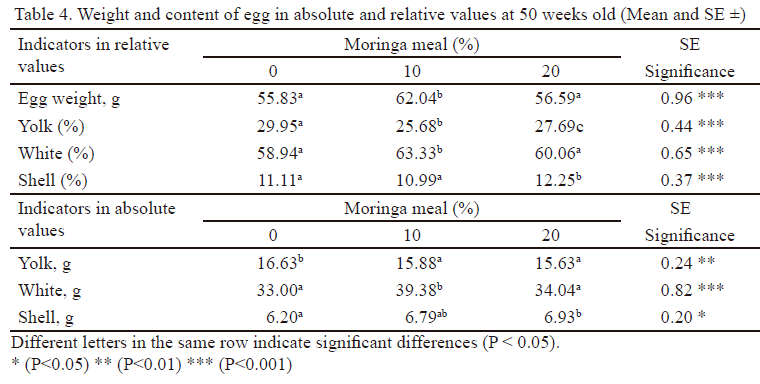
<p align="justify" class="Cuerpodetexto" style="margin-top:12.0pt;text-indent:0cm;"><span style="font-family:'Verdana','sans-serif'; font-size:10.0pt; color:windowtext; ">Egg average weight did not differ  between treatments with 0 and 20 % of moringa meal in diets, but it was higher  in the treatment with 10 % of moringa (<a href="/img/revistas/cjas/v50n3/t0312316.gif">table 3</a>). This result was difficult to  explain so the relative content of white, yolk and shell + membranes in the egg  during the last week of experimentation. <a href="/img/revistas/cjas/v50n3/t0412316.gif">Table 4</a> shows these results. </span></p>     
<p align="justify" class="Cuerpodetexto" style="margin-top:12.0pt;text-indent:0cm;"><span style="font-family:'Verdana','sans-serif'; font-size:10.0pt; color:windowtext; ">Treatment with 10  % of moringa produced bigger eggs because they contained more white than the  rest of the treatments (in absolute and relative values). This suggests better  efficiency in the use of protein and amino acids for protein synthesis with 10  % of moringa.</span></p>     <p align="justify" class="Cuerpodetexto" style="margin-top:12.0pt;text-indent:0cm;"><span style="font-family:'Verdana','sans-serif'; font-size:10.0pt; color:windowtext; ">Treatment with 10  % of moringa also produced lower yolk synthesis in absolute and relative values  regarding control (<a href="/img/revistas/cjas/v50n3/t0412316.gif">table 4</a>). This may be attributed to lower ME availability  for synthesis of yolk lipids or to a decrease effect provoked by lipogenesis of  this diets with high contents of <em>Moringa oleifera</em> meal. The same  happened with the Mulard ducks fed 20, 30, 40, 45 and 60 % of tree forage meal  in diets used by Mesa <em>et al.</em> (2015), or with White Leghorn replacement  birds fed 20% of meal from this plant in diets used Mesa (2016).&nbsp; </span><span style="font-family:'Verdana','sans-serif'; font-size:10.0pt; color:windowtext; "> </span></p>     
<p align="justify" class="Cuerpodetexto" style="margin-top:12.0pt;text-indent:0cm;"><span style="font-family:'Verdana','sans-serif'; font-size:10.0pt; color:windowtext; ">Treatment with 10% of moringa had no  differences in the content of shell in relative and absolute values regarding  the control treatment. </span></p>     <p align="justify" class="Cuerpodetexto" style="margin-top:12.0pt;text-indent:0cm;"><span style="font-family:'Verdana','sans-serif'; font-size:10.0pt; color:windowtext; ">Diet with 20% of  moringa promoted higher content of shell in eggs (<a href="/img/revistas/cjas/v50n3/t0412316.gif">Table 4</a>). This indicates a  good use of calcium in the diet, despite being iso-calcic    (<a href="/img/revistas/cjas/v50n3/t0112316.gif">table 1</a>). </span></p>     
<p align="justify" class="Cuerpodetexto" style="margin-top:12.0pt;text-indent:0cm;"><span style="font-family:'Verdana','sans-serif'; font-size:10.0pt; color:windowtext; ">Calcium content of <em>Moringa oleifera</em> forage, Supergenius variety, ranges between 2.27% and 4.19%, according to Caro  (2014), Bustamante (2014), Almeida (2015). Results of shell content with 20 %  of moringa in the diet (<a href="/img/revistas/cjas/v50n3/t0412316.gif">table 4</a>) show that calcium was efficiently used in this  work. </span></p>     
<p align="justify" class="Cuerpodetexto" style="margin-top:12.0pt;text-indent:0cm;"><span style="font-family:'Verdana','sans-serif'; font-size:10.0pt; color:windowtext; ">White content with 20 % of moringa did  not differ from control. This indicates that use efficiency of protein and  amino acids of the diet with 20 % of moringa, for protein synthesis in the  white, did not differ from control without moringa, although produced less  total eggs than control treatment.</span></p>     ]]></body>
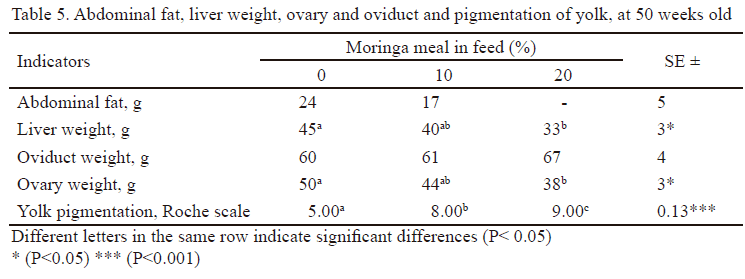
<body><![CDATA[<p align="justify" class="Cuerpodetexto" style="margin-top:12.0pt;text-indent:0cm;"><span style="font-family:'Verdana','sans-serif'; font-size:10.0pt; color:windowtext; ">Diet with 20% of  moringa promoted production of eggs with the same weight as the eggs of control  diet (tables 3 and 4). However, these eggs contained less yolk than those of  control diet, which could be associated with lower contribution of ME for lipid  synthesis in the yolk or the cited reducer effect of lipogenesis.</span><span style="font-family:'Verdana','sans-serif'; font-size:10.0pt; color:windowtext; "> </span></p>     <p align="justify" class="Cuerpodetexto" style="margin-top:12.0pt;text-indent:0cm;"><span style="font-family:'Verdana','sans-serif'; font-size:10.0pt; color:windowtext; ">In alfalfa meal,  which is a forage meal rich in protein and high fiber content like moringa  forage meal, ME values in birds are between 3.22 and    6.82 MJ ME/kg, according to Batal and Dale (2016) and Heuz&eacute; <em>et al.</em> (2016) that is associated to the content of crude fiber, EE, CP and ashes. It  is possible that ME concentration, selected to formulate diets  (7.94 MJ/kg) is over-dimensioned. Therefore, egg production and efficiency in  the utilization of feed is damaged in this experiment, by including 20 % of  moringa meal on the diet. In further experiments, ME increase should be  evaluated in diets with 2 0% or more of <em>Moringa oleifera</em>.</span><span style="font-family:'Verdana','sans-serif'; font-size:10.0pt; color:windowtext; "> </span></p>     <p align="justify" class="Cuerpodetexto" style="margin-top:12.0pt;text-indent:0cm;"><span style="font-family:'Verdana','sans-serif'; font-size:10.0pt; color:windowtext; ">Yolk pigmentation  increased as moringa concentration increased in the diets (<a href="/img/revistas/cjas/v50n3/t0512316.gif">table 5</a>). This is  attributed to the contribution of carotenoid pigments from forage moringa (Abou <em>et al.</em> 2011, Moyo <em>et al.</em> 2011, Gakuya <em>et al.</em> 2014, Cabezas  Valdivi&eacute; and 2015, Mesa 2016). </span><span style="font-family:'Verdana','sans-serif'; font-size:10.0pt; color:windowtext; "> </span></p>     
<p align="justify" class="Cuerpodetexto" style="margin-top:12.0pt;text-indent:0cm;"><span style="font-family:'Verdana','sans-serif'; font-size:10.0pt; color:windowtext; ">In birds  slaughtered at the end of the experiment at 50 weeks of age, abdominal fat  content did not differ among treatments with 0 and 10 % of moringa meal (<a href="/img/revistas/cjas/v50n3/t0512316.gif">table  5</a>), while diet with 20 % of moringa did not allow birds to retain or synthesize  this abdominal fat and its presence was null or zero in the treatment with    20 %.</span></p>     
<p align="justify" class="Cuerpodetexto" style="margin-top:12.0pt;text-indent:0cm;"><span style="font-family:'Verdana','sans-serif'; font-size:10.0pt; color:windowtext; ">&nbsp;Liver weight did not differ among diets with 0  and 10% of moringa. However, with 20 % of moringa, it was lower than in the  control treatment. This is also attributed to a reduction of lipid synthesis  and less deposition of triglycerides in the liver, because the contribution of  ME and ether extract was lower, and crude fiber contribution of this diet with  20 % of moringa meal was higher    (<a href="/img/revistas/cjas/v50n3/t0112316.gif">table 1</a>). </span></p>     
<p align="justify" class="Cuerpodetexto" style="margin-top:12.0pt;text-indent:0cm;"><span style="font-family:'Verdana','sans-serif'; font-size:10.0pt; color:windowtext; ">In birds, the organ responsible for  the synthesis of fatty acids is the liver (Crespo 2003), which also serves for  the storage of fat in migratory birds and those dedicated to the production of  fatty liver, when consuming abundant carbohydrates, lipids or amino acids&nbsp; (Babil&eacute; 1989, Crespo 2003), or simply reduce  its weight by consuming less energy.</span></p>     <p align="justify" class="Cuerpodetexto" style="margin-top:12.0pt;text-indent:0cm;"><span style="font-family:'Verdana','sans-serif'; font-size:10.0pt; color:windowtext; ">Inhibition of abdominal fat and  decrease of liver weight, caused by diet with 20 % of moringa, may have been  caused by insufficient ME intake or other unidentified factors that are able to  reduce lipogenesis, as stated by studies of Mesa <em>et al.</em> (2015) and Mesa    (2016). </span></p>     <p align="justify" class="Cuerpodetexto" style="margin-top:12.0pt;text-indent:0cm;"><span style="font-family:'Verdana','sans-serif'; font-size:10.0pt; color:windowtext; ">Weight of ovaries did not differ among  treatments with 0 and 10% of moringa (<a href="/img/revistas/cjas/v50n3/t0512316.gif">table 5</a>). However, it was decreased in  the treatment with 20 % of moringa, which produced fewer eggs. This could be  associated with the lowest maturation of follicles and also to the lowest yolk  synthesis (<a href="/img/revistas/cjas/v50n3/t0412316.gif">table 4</a>).</span></p>     
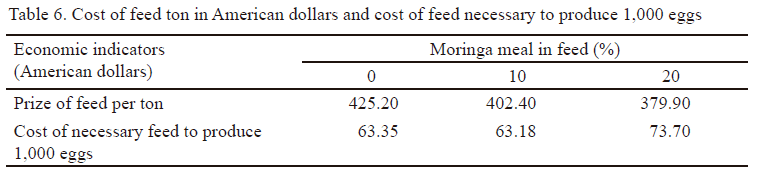
<p align="justify" class="Cuerpodetexto" style="margin-top:12.0pt;text-indent:0cm;"><span style="font-family:'Verdana','sans-serif'; font-size:10.0pt; color:windowtext; ">Weight of oviducts was not damaged  with the use of diets with 0, 10 and 20 % of moringa, suggesting their normal  development and performance in all    treatments.</span></p>     <p align="justify" class="Cuerpodetexto" style="margin-top:12.0pt;text-indent:0cm;"><span style="font-family:'Verdana','sans-serif'; font-size:10.0pt; color:windowtext; ">The price per ton of feed was always  cheaper with the inclusion of moringa on diets and, particularly, with 20% of  moringa (<a href="/img/revistas/cjas/v50n3/t0612316.gif">Table 6</a>). </span></p>     
]]></body>
<body><![CDATA[<p align="justify" class="Cuerpodetexto" style="margin-top:12.0pt;text-indent:0cm;"><span style="font-family:'Verdana','sans-serif'; font-size:10.0pt; color:windowtext; ">In addition, as the price per ton of  moringa meal was reduced, the price per ton of feed was also lower.</span></p>     <p align="justify" class="Cuerpodetexto" style="margin-top:12.0pt;text-indent:0cm;"><span style="font-family:'Verdana','sans-serif'; font-size:10.0pt; color:windowtext; "><a href="/img/revistas/cjas/v50n3/t0612316.gif">Table 6</a> shows the cost of feed needed  to produce 1,000 eggs, stating that with 10% of moringa meal, it is 17 cents  cheaper than control, while the inclusion of 20 % of moringa meal on the diet  increased the cost of thousand eggs in 10.35 US dollars, when compared to  control. </span></p>     
<p align="justify" class="Cuerpodetexto" style="margin-top:12.0pt;text-indent:0cm;"><span style="line-height:107%; font-family:'Verdana','sans-serif'; font-size:10.0pt; ">Results of this study  showed the possibility of using up to 10 % of <em>Moringa oleifera</em> meal  (leaves+stems) in diets for laying hens between 34 and 50 weeks old</span><span style="font-family:'Verdana','sans-serif'; font-size:10.0pt; color:windowtext; ">.</span></p>     <p align="justify" class="Cuerpodetexto" style="margin-top:12.0pt;text-indent:0cm;"><span style="font-family:'Verdana','sans-serif'; font-size:10.0pt; color:windowtext; ">&nbsp;</span></p>     <p align="justify" class="subtitulo" style="margin-top:12.0pt;text-align:justify;"><span style="font-family:'Verdana','sans-serif'; font-size:13.0pt; color:windowtext; "><b>REFERENCES</b> </span></p>     <p align="justify" class="referencias" style="margin-top:12.0pt;margin-right:0cm;margin-bottom:.0001pt;margin-left:0cm;text-indent:0cm;"><span style="font-family:'Verdana','sans-serif'; font-size:10.0pt; color:windowtext; ">Abou, E. F. M. K., Sarmiento, F. L., Santos, R. R. &amp; Solorio, S. F.  2011. </span><span style="font-family:'Verdana','sans-serif'; font-size:10.0pt; color:windowtext; ">&ldquo;Nutritional effects of dietary inclusion of Leucaena  leucocephala and <em>Moringa oleifera</em> leaf meal on Rhode Island Red hens&rsquo;  performance&rdquo;. </span><span style="font-family:'Verdana','sans-serif'; font-size:10.0pt; color:windowtext; ">Cuban Journal of Agricultural Science,  45(2): 163&ndash;169, ISSN: 2079-3480.</span></p>     <!-- ref --><p align="justify" class="referencias" style="margin-top:12.0pt;margin-right:0cm;margin-bottom:.0001pt;margin-left:0cm;text-indent:0cm;"><span style="font-family:'Verdana','sans-serif'; font-size:10.0pt; color:windowtext; ">Almeida, M. 2015. Indicadores morfofisiol&oacute;gicos y de salud en pollos de  ceba colostomizados que consumieron harina de forraje de moringa (<em>Moringa  oleifera</em>). M.Sc. Thesis, Instituto de Ciencia Animal, Mayabeque, Cuba, 87  p.    </span></p>     <p align="justify" class="referencias" style="margin-top:12.0pt;margin-right:0cm;margin-bottom:.0001pt;margin-left:0cm;text-indent:0cm;"><span style="font-family:'Verdana','sans-serif'; font-size:10.0pt; color:windowtext; ">Latimer,  G. W. 2012. Official Methods of Analysis of AOAC International. 19th ed.,  Gaithersburg, Md.: AOAC International, ISBN: 978-0-935584-83-7, Available:  &lt;<a href="http://www.amazon.com/Official-Methods-Analysis-OFFICIAL-ANALYSIS/dp/0935584838/ref=pd_sim_sbs_14_1?ie=UTF8&dpID=31iikC-xl2L&dpSrc=sims&preST=_AC_UL160_SR160%2C160_&refRID=101AB94246X0EM9N7XMW" target="_blank">http://www.amazon.com/Official-Methods-Analysis-OFFICIAL-ANALYSIS/dp/0935584838/ref=pd_sim_sbs_14_1?ie=UTF8&amp;dpID=31iikC-xl2L&amp;dpSrc=sims&amp;preST=_AC_UL160_SR160%2C160_&amp;refRID=101AB94246X0EM9N7XMW</a>&gt;,  [Consulted: April 1, 2016].</span></p>     <!-- ref --><p align="justify" class="referencias" style="margin-top:12.0pt;margin-right:0cm;margin-bottom:.0001pt;margin-left:0cm;text-indent:0cm;"><span style="font-family:'Verdana','sans-serif'; font-size:10.0pt; color:windowtext; ">Babil&eacute;,  R. 1989. La production de foies gras de canards de Barbarie (<em>Ca&iuml;rina  moschata</em>): Aspects g&eacute;n&eacute;tiques, nutritionnels et technolo-giques. Ph.D.  Thesis, INPT, Toulouse, France, 231 p., Available:  &lt;<a href="http://www.theses.fr/1989INPT008A" target="_blank">http://www.theses.fr/1989INPT008A</a>&gt;, [Consulted: August 5, 2016].    </span></p>     <p align="justify" class="referencias" style="margin-top:12.0pt;margin-right:0cm;margin-bottom:.0001pt;margin-left:0cm;text-indent:0cm;"><span style="font-family:'Verdana','sans-serif'; font-size:10.0pt; color:windowtext; ">Banco Central de Cuba 2016. &ldquo;Informaci&oacute;n Econ&oacute;mica&rdquo;. Bolet&iacute;n Informaci&oacute;n  Econ&oacute;mica, 10(214): 1&ndash;2, RNPS-2330.</span></p>     <p align="justify" class="referencias" style="margin-top:12.0pt;margin-right:0cm;margin-bottom:.0001pt;margin-left:0cm;text-indent:0cm;"><span style="font-family:'Verdana','sans-serif'; font-size:10.0pt; color:windowtext; ">Batal, A. &amp; Dale, N. 2016. </span><span style="font-family:'Verdana','sans-serif'; font-size:10.0pt; color:windowtext; ">&ldquo;Ingredient Analysis Table&rdquo;. In:  Feedstuffs Reference Issue &amp; Buyers Guide, Bloomington, Indiana:  Feedstuffs, Available:  &lt;<a href="http://feedstuffs.com/mdfm/Feeess50/author/427/2015/11/Feedstuffs_RIBG_Ingredient_Analysis_Table_2016.pdf" target="_blank">http://feedstuffs.com/mdfm/Feeess50/author/427/2015/11/Feedstuffs_RIBG_Ingredient_Analysis_Table_2016.pdf</a>&gt;,  [Consulted: July 12, 2016].</span></p>     <!-- ref --><p align="justify" class="referencias" style="margin-top:12.0pt;margin-right:0cm;margin-bottom:.0001pt;margin-left:0cm;text-indent:0cm;"><span style="font-family:'Verdana','sans-serif'; font-size:10.0pt; color:windowtext; ">Bustamante, D. 2014. Efecto del aditivo biol&oacute;gico Vitafert en la  utilizaci&oacute;n del nitr&oacute;geno en pollos de ceba alimentados con harina de forraje  de <em>Moringa oleifera</em> var. supergenius. M.Sc. Thesis, Universidad de La  Habana, La Habana, Cuba, 79 p.    </span></p>     <!-- ref --><p align="justify" class="referencias" style="margin-top:12.0pt;margin-right:0cm;margin-bottom:.0001pt;margin-left:0cm;text-indent:0cm;"><span style="font-family:'Verdana','sans-serif'; font-size:10.0pt; color:windowtext; ">Caro, Y. 2014. Uso de la harina de forraje de Moringa (<em>Moringa oleifera</em> var. supergenius) en la alimentaci&oacute;n de conejos de ceba Nueva Zelanda Blanco.  M.Sc. Thesis, Instituto de Ciencia Animal, Mayabeque, Cuba, 56 p.    </span></p>     <!-- ref --><p align="justify" class="referencias" style="margin-top:12.0pt;margin-right:0cm;margin-bottom:.0001pt;margin-left:0cm;text-indent:0cm;"><span style="font-family:'Verdana','sans-serif'; font-size:10.0pt; color:windowtext; ">Crespo, A. N. 2003. Reducci&oacute;n de la deposici&oacute;n de grasa abdominal en el  pollo de carne mediante la modificaci&oacute;n del perfil de &aacute;cidos grasos de la  dieta. Ph.D. Thesis, Universidad Rovira i Virgili, Espa&ntilde;a, 202 p.    </span></p>     <!-- ref --><p align="justify" class="referencias" style="margin-top:12.0pt;margin-right:0cm;margin-bottom:.0001pt;margin-left:0cm;text-indent:0cm;"><span style="font-family:'Verdana','sans-serif'; font-size:10.0pt; color:windowtext; ">Di Rienzo, J. A., Casanoves, F., Balzarini, M. G., Gonz&aacute;lez, L., Tablada,  M. &amp; Robledo, C. W. 2001. InfoStat. version 2001, [Windows], Universidad  Nacional de C&oacute;rdoba, Argentina: Grupo InfoStat, Available:  &lt;<a href="http://www.infostat.com.ar/" target="_blank">http://www.infostat.com.ar/</a>&gt;    .</span></p>     <p align="justify" class="referencias" style="margin-top:12.0pt;margin-right:0cm;margin-bottom:.0001pt;margin-left:0cm;text-indent:0cm;"><span style="font-family:'Verdana','sans-serif'; font-size:10.0pt; color:windowtext; ">Duncan,  D. B. 1955. &ldquo;Multiple Range and Multiple F Tests&rdquo;. Biometrics, 11(1): 1&ndash;42,  ISSN: 0006-341X, DOI: 10.2307/3001478.</span></p>     <p align="justify" class="referencias" style="margin-top:12.0pt;margin-right:0cm;margin-bottom:.0001pt;margin-left:0cm;text-indent:0cm;"><span style="font-family:'Verdana','sans-serif'; font-size:10.0pt; color:windowtext; ">F&ouml;rster,  N., Ulrichs, C., Schreiner, M., Arndt, N., Schmidt, R. &amp; Mewis, I. 2015.  &ldquo;Ecotype Variability in Growth and Secondary Metabolite Profile in <em>Moringa  oleifera</em>: Impact of Sulfur and Water Availability&rdquo;. Journal of Agricultural  and Food Chemistry, 63(11): 2852&ndash;2861, ISSN: 0021-8561, 1520-5118, DOI:  10.1021/jf506174v.</span></p>     <p align="justify" class="referencias" style="margin-top:12.0pt;margin-right:0cm;margin-bottom:.0001pt;margin-left:0cm;text-indent:0cm;"><span style="font-family:'Verdana','sans-serif'; font-size:10.0pt; color:windowtext; ">Gakuya,  D. W., Mbugua, P. N., Kavoi, B. &amp; Kiama, S. G. 2014. &ldquo;Effect of  Supplementation of <em>Moringa oleifera</em> Leaf Meal in Broiler Chicken Feed&rdquo;.  International Journal of Poultry Scienc, 13(4): 208&ndash;213, ISSN: 1682-8356.</span></p>     <!-- ref --><p align="justify" class="referencias" style="margin-top:12.0pt;margin-right:0cm;margin-bottom:.0001pt;margin-left:0cm;text-indent:0cm;"><span style="font-family:'Verdana','sans-serif'; font-size:10.0pt; color:windowtext; ">Heuz&eacute;,  V., Tran, G., Boval, M., Noblet, J., Renaudeau, D., Lessire, M. &amp; Lebas, F.  2016. Alfalfa (<em>Medicago sativa</em>). Feedipedia: Animal feed resources  information system, Available: &lt;<a href="http://www.feedipedia.org/node/275" target="_blank">http://www.feedipedia.org/node/275</a>&gt;,  [Consulted: August 5, 2016].    </span></p>     <p align="justify" class="referencias" style="margin-top:12.0pt;margin-right:0cm;margin-bottom:.0001pt;margin-left:0cm;text-indent:0cm;"><span style="font-family:'Verdana','sans-serif'; font-size:10.0pt; color:windowtext; ">Joshi,  P. &amp; Mehta, D. 2010. &ldquo;Effect of dehydration on the nutritive value of  drumstick leaves&rdquo;. Journal of Metabolomics and Systems Biology, 1(1): 5&ndash;9,  ISSN: 2329-1583.</span></p>     <p align="justify" class="referencias" style="margin-top:12.0pt;margin-right:0cm;margin-bottom:.0001pt;margin-left:0cm;text-indent:0cm;"><span style="font-family:'Verdana','sans-serif'; font-size:10.0pt; color:windowtext; ">Kakengi,  A., Kaijage, J. T., Sarwatt, S. V., Mutayoba, S. K., Shem, M. N. &amp;  Fujihara, T. 2007. &ldquo;Effect of <em>Moringa oleifera</em> leaf meal as a substitute  for sunflower seed meal on performance of laying hens in Tanzania&rdquo;. Livestock  Research for Rural Development, 19(8), ISSN: 0121-3784, Available:  &lt;<a href="http://www.lrrd.cipav.org.co/lrrd19/8/kake19120.htm" target="_blank">http://www.lrrd.cipav.org.co/lrrd19/8/kake19120.htm</a>&gt;, [Consulted: July  12, 2016].</span></p>     <p align="justify" class="referencias" style="margin-top:12.0pt;margin-right:0cm;margin-bottom:.0001pt;margin-left:0cm;text-indent:0cm;"><span style="font-family:'Verdana','sans-serif'; font-size:10.0pt; color:windowtext; ">Leeson,  S. &amp; Summers, J. D. 2008. Commercial Poultry Nutrition. 3rd ed., Thrumpton,  Nottingham: Nottingham University Press, 398 p., ISBN: 978-1-904761-09-9, OCLC:  460200884, Available:  &lt;<a href="http://public.eblib.com/choice/publicfullrecord.aspx?p=457204" target="_blank">http://public.eblib.com/choice/publicfullrecord.aspx?p=457204</a>&gt;,  [Consulted: July 12, 2016].</span></p>     <p align="justify" class="referencias" style="margin-top:12.0pt;margin-right:0cm;margin-bottom:.0001pt;margin-left:0cm;text-indent:0cm;"><span style="font-family:'Verdana','sans-serif'; font-size:10.0pt; color:windowtext; ">Leone,  A., Fiorillo, G., Criscuoli, F., Ravasenghi, S., Santagostini, L., Fico, G.,  Spadafranca, A., Battezzati, A., Schiraldi, A., Pozzi, F., di Lello, S.,  Filippini, S. &amp; Bertoli, S. 2015. &ldquo;Nutritional Characterization and  Phenolic Profiling of <em>Moringa oleifera</em> Leaves Grown in Chad, Sahrawi  Refugee Camps, and Haiti&rdquo;. International Journal of Molecular Sciences, 16(8):  18923&ndash;18937, ISSN: 1422-0067, DOI: 10.3390/ijms160818923.</span></p>     ]]></body>
<body><![CDATA[<p align="justify" class="referencias" style="margin-top:12.0pt;margin-right:0cm;margin-bottom:.0001pt;margin-left:0cm;text-indent:0cm;"><span style="font-family:'Verdana','sans-serif'; font-size:10.0pt; color:windowtext; ">Makkar,  H. P. S. &amp; Becker, K. 1997. &ldquo;Nutrients and antiquality factors in different  morphological parts of the <em>Moringa oleifera</em> tree&rdquo;. The Journal of  Agricultural Science, 128(3): 311&ndash;322, ISSN: 1469-5146, DOI: null.</span></p>     <!-- ref --><p align="justify" class="referencias" style="margin-top:12.0pt;margin-right:0cm;margin-bottom:.0001pt;margin-left:0cm;text-indent:0cm;"><span style="font-family:'Verdana','sans-serif'; font-size:10.0pt; color:windowtext; ">Mesa, O.  2016. </span><span style="font-family:'Verdana','sans-serif'; font-size:10.0pt; color:windowtext; ">Alimentaci&oacute;n de pollitas de reemplazo y gallinas  ponedoras con harina de forraje de <em>Moringa oleifera</em>. M.Sc. Thesis,  Instituto de Ciencia Animal, Mayabeque, Cuba, 50 p.    </span></p>     <p align="justify" class="referencias" style="margin-top:12.0pt;margin-right:0cm;margin-bottom:.0001pt;margin-left:0cm;text-indent:0cm;"><span style="font-family:'Verdana','sans-serif'; font-size:10.0pt; color:windowtext; ">Mesa, O., Valdivi&eacute;, M., Rodr&iacute;guez, B. &amp; Rabello, C. B. 2015. &ldquo;Dietas  con <em>Moringa oleifera</em> modifican las canales de los patos mular&rdquo;. Revista  Cubana de Ciencia Av&iacute;cola, 39(2): 23&ndash;32, ISSN: 0138-6352.</span></p>     <p align="justify" class="referencias" style="margin-top:12.0pt;margin-right:0cm;margin-bottom:.0001pt;margin-left:0cm;text-indent:0cm;"><span style="font-family:'Verdana','sans-serif'; font-size:10.0pt; color:windowtext; ">Moyo, B., Masika, P. J., Hugo, A. &amp; Muchenje, V. 2011. </span><span style="font-family:'Verdana','sans-serif'; font-size:10.0pt; color:windowtext; ">&ldquo;Nutritional  characterization of Moringa (<em>Moringa oleifera</em> Lam.) leaves&rdquo;. African  Journal of Biotechnology, 10(60): 12925&ndash;12933, ISSN: 1684-5315.</span></p>     <p align="justify" class="referencias" style="margin-top:12.0pt;margin-right:0cm;margin-bottom:.0001pt;margin-left:0cm;text-indent:0cm;"><span style="font-family:'Verdana','sans-serif'; font-size:10.0pt; color:windowtext; ">National  Research Council (NRC) 1994. Nutrient requirements of poultry. 9th ed.,  Washington, D.C.: National Academy Press, 176 p., ISBN: 978-0-585-03711-0,  OCLC: 42417371, Available:  &lt;<a href="https://www.amazon.com/Nutrient-Requirements-of-Poultry/dp/0585037116?ie=UTF8&SubscriptionId=0JRA4J6WAV0RTAZVS6R2&camp=2025&creative=165953&creativeASIN=0585037116&linkCode=xm2&tag=worldcat-20" target="_blank">https://www.amazon.com/Nutrient-Requirements-of-Poultry/dp/0585037116?ie=UTF8&amp;SubscriptionId=0JRA4J6WAV0RTAZVS6R2&amp;camp=2025&amp;creative=165953&amp;creativeASIN=0585037116&amp;linkCode=xm2&amp;tag=worldcat-20</a>&gt;,  [Consulted: July 12, 2016].</span></p>     <p align="justify" class="referencias" style="margin-top:12.0pt;margin-right:0cm;margin-bottom:.0001pt;margin-left:0cm;text-indent:0cm;"><span style="font-family:'Verdana','sans-serif'; font-size:10.0pt; color:windowtext; ">Ogbe, A.  O. &amp; Affiku, J. P. 2011. &ldquo;Proximate study, mineral and anti-nutrient  composition of <em>Moringa oleifera</em> leaves harvested from Lafia, Nigeria:  potential benefits in poultry nutrition and health&rdquo;. The Journal of  Microbiology, Biotechnology and Food Sciences, 1(3): 296&ndash;308, ISSN: 1338-5178.</span></p>     <p align="justify" class="referencias" style="margin-top:12.0pt;margin-right:0cm;margin-bottom:.0001pt;margin-left:0cm;text-indent:0cm;"><span style="font-family:'Verdana','sans-serif'; font-size:10.0pt; color:windowtext; ">Olugbemi,  T. S., Mutayoba, S. K. &amp; Lekule, F. P. 2010. &ldquo;Evaluation of <em>Moringa  oleifera</em> leaf meal inclusion in cassava chip based diets fed to laying  birds&rdquo;. Livestock Research for Rural Development, 22(6), ISSN: 0121-3784,  Available: &lt;<a href="http://lrrd.cipav.org.co/lrrd22/6/olug22118.htm" target="_blank">http://lrrd.cipav.org.co/lrrd22/6/olug22118.htm</a>&gt;, [Consulted:  July 12, 2016].</span></p>     <p align="justify" class="referencias" style="margin-top:12.0pt;margin-right:0cm;margin-bottom:.0001pt;margin-left:0cm;text-indent:0cm;"><span style="font-family:'Verdana','sans-serif'; font-size:10.0pt; color:windowtext; ">Padilla, C., Fraga, N., Scull, I., Tuero, R. &amp; Sarduy, L. 2014. &ldquo;Efecto  de la altura de corte en indicadores de la producci&oacute;n de forraje de <em>Moringa  oleifera</em> vc. </span><span style="font-family:'Verdana','sans-serif'; font-size:10.0pt; color:windowtext; ">Plain&rdquo;. Cuban Journal of Agricultural Science, 48(4):  405&ndash;409, ISSN: 2079-3480.</span></p>     <p align="justify" class="referencias" style="margin-top:12.0pt;margin-right:0cm;margin-bottom:.0001pt;margin-left:0cm;text-indent:0cm;"><span style="font-family:'Verdana','sans-serif'; font-size:10.0pt; color:windowtext; ">Rostagno, H. S., Albino, L. F. T., Donzele, J. L., Gomes, P. C., Oliveira,  R. F. de, Lopes, D. C., Ferreira, A. S. &amp; Barreto, S. L. de T. 2005.  Tabelas brasileiras para aves e su&iacute;nos: composi&ccedil;&atilde;o de alimentos e exig&ecirc;ncias  nutricionais. 2nd ed., Vi&ccedil;osa, Brasil: Universidad Federal de Vi&ccedil;osa &ndash;  Departamento de Zootecnia, 186 p., OCLC: 69924599.</span></p>     ]]></body>
<body><![CDATA[<!-- ref --><p align="justify" class="referencias" style="margin-top:12.0pt;margin-right:0cm;margin-bottom:.0001pt;margin-left:0cm;text-indent:0cm;"><span style="font-family:'Verdana','sans-serif'; font-size:10.0pt; color:windowtext; ">Santiago, R. H., Teixeira, A. L. F., Lopes, D. J., Cezar, G. P.,  Fl&aacute;via,&nbsp; de O. R., Clementito, L. D.,  Soares, F. A., Toledo, B. S. L. &amp; Frederico, E. R. 2011. Tablas Brasile&ntilde;as  para aves y cerdos. Composici&oacute;n de Alimentos y Requerimientos Nutricionales.  Salguero, C. S. C. &amp; Prada, L. J. A. (trans.), Santiago, R. H. (ed.), 3rd  ed., Brasil: Departamento de Zootecnia, Universidad Federal de Vi&ccedil;osa, 259 p.,  Available: &lt;<a href="http://www.produccion-animal.com.ar/tablas_composicion_alimentos/126-tablas_brasileras_aves_cerdos.pdf" target="_blank">http://www.produccion-animal.com.ar/tablas_composicion_alimentos/126-tablas_brasileras_aves_cerdos.pdf</a>&gt;,  [Consulted: July 16, 2016].    </span></p>     <p align="justify" class="referencias" style="margin-top:12.0pt;margin-right:0cm;margin-bottom:.0001pt;margin-left:0cm;text-indent:0cm;"><span style="font-family:'Verdana','sans-serif'; font-size:10.0pt; color:windowtext; ">Sav&oacute;n, L., Scull, I., Bustamante, D., Almeida, M. &amp; Caro, Y. 2015.  &ldquo;Aspectos fisiol&oacute;gicos de la utilizaci&oacute;n de <em>Moringa oleifera</em> (moringa)  en la alimentaci&oacute;n de especies monog&aacute;stricas&rdquo;. In: V Congreso de Producci&oacute;n  Animal Tropical, Palacio de Convenciones, La Habana, Cuba: EDICA, pp. 331&ndash;337,  ISBN: 978-959-7171-70-6.</span></p>     <p align="justify" class="referencias" style="margin-top:12.0pt;margin-right:0cm;margin-bottom:.0001pt;margin-left:0cm;text-indent:0cm;"><span style="font-family:'Verdana','sans-serif'; font-size:10.0pt; color:windowtext; ">Scott,  M. L., Nesheim, M. C. &amp; Young, R. J. 1982. Nutrition of the chicken. 3rd  ed., Ithaca, N.Y.: M. L. Scott of Ithaca Pub., 562 p., ISBN: 978-0-9602726-2-4,  OCLC: 8424850, Available:  &lt;<a href="http://www.betterworldbooks.com/nutrition-of-the-chicken-id-0960272623.aspx&utm_source=Affiliate&utm_campaign=Text&utm_medium=booklink&utm_term=3630151&utm_content=Homepage" target="_blank">http://www.betterworldbooks.com/nutrition-of-the-chicken-id-0960272623.aspx&amp;utm_source=Affiliate&amp;utm_campaign=Text&amp;utm_medium=booklink&amp;utm_term=3630151&amp;utm_content=Homepage</a>&gt;,  [Consulted: July 12, 2016].</span></p>     <p align="justify" class="referencias" style="margin-top:12.0pt;margin-right:0cm;margin-bottom:.0001pt;margin-left:0cm;text-indent:0cm;"><span style="font-family:'Verdana','sans-serif'; font-size:10.0pt; color:windowtext; ">Trade  and Market Division 2013. Food Outlook: Biannual Report on Global Food Markets.  Roma, Italia: Food and Agriculture Organization of the United Nations (FAO), p.  139, ISSN: 0251-1959, 1560-8182, Available:  &lt;<a href="http://www.fao.org/3/a-i4136e.pdf" target="_blank">http://www.fao.org/3/a-i4136e.pdf</a>&gt;, [Consulted: July 12, 2016].</span></p>     <p align="justify" class="referencias" style="margin-top:12.0pt;margin-right:0cm;margin-bottom:.0001pt;margin-left:0cm;text-indent:0cm;"><span style="line-height:107%; font-family:'Verdana','sans-serif'; font-size:10.0pt; ">Valdivi&eacute;, M. &amp; Cabezas,  L. 2015. &ldquo;Utilizaci&oacute;n del forraje y hojas de <em>Moringa oleifera</em> en la  alimentaci&oacute;n de aves, cerdos, conejos, peces y crust&aacute;ceos&rdquo;. In: V Congreso de  Producci&oacute;n Animal Tropical, La Habana, Cuba: EDICA, pp. 36&ndash;43, ISBN:  978-959-7172-70-6</span><font size="2" face="Verdana, Arial, Helvetica, sans-serif">.</font></p>     <p align="justify">&nbsp;</p>     <p align="justify">&nbsp;</p>     <p align="justify"><font size="2" face="Verdana, Arial, Helvetica, sans-serif">Received: 19/11/2014    <br> Accepted: 06/07/2016</font></p>     ]]></body>
<body><![CDATA[<p align="justify">&nbsp;</p>     <p align="justify">&nbsp;</p>     <p align="justify"><font size="2" face="Verdana, Arial, Helvetica, sans-serif"><i>M. Valdivié,</i> Instituto de Ciencia Animal, Apartado Postal 24, San José de las Lajas, Mayabeque, Cuba.    Email: <a href="mailto:mvaldivie@ica.co.cu">mvaldivie@ica.co.cu</a></font></p>      ]]></body><back>
<ref-list>
<ref id="B1">
<nlm-citation citation-type="journal">
<person-group person-group-type="author">
<name>
<surname><![CDATA[Abou]]></surname>
<given-names><![CDATA[E. F. M. K.]]></given-names>
</name>
<name>
<surname><![CDATA[Sarmiento]]></surname>
<given-names><![CDATA[F. L.]]></given-names>
</name>
<name>
<surname><![CDATA[Santos]]></surname>
<given-names><![CDATA[R. R.]]></given-names>
</name>
<name>
<surname><![CDATA[Solorio]]></surname>
<given-names><![CDATA[S. F.]]></given-names>
</name>
</person-group>
<article-title xml:lang="nd"><![CDATA[Nutritional effects of dietary inclusion of Leucaena leucocephala and Moringa oleifera leaf meal on Rhode Island Red hens’ performance]]></article-title>
<source><![CDATA[Cuban Journal of Agricultural Science]]></source>
<year>2011</year>
<volume>45</volume>
<numero>2</numero>
<issue>2</issue>
<page-range>163–169</page-range></nlm-citation>
</ref>
<ref id="B2">
<nlm-citation citation-type="book">
<person-group person-group-type="author">
<name>
<surname><![CDATA[Almeida]]></surname>
<given-names><![CDATA[M.]]></given-names>
</name>
</person-group>
<source><![CDATA[Indicadores morfofisiológicos y de salud en pollos de ceba colostomizados que consumieron harina de forraje de moringa (Moringa oleifera)]]></source>
<year>2015</year>
<page-range>87</page-range><publisher-loc><![CDATA[Mayabeque, Cuba ]]></publisher-loc>
<publisher-name><![CDATA[Instituto de Ciencia Animal]]></publisher-name>
</nlm-citation>
</ref>
<ref id="B3">
<nlm-citation citation-type="book">
<person-group person-group-type="author">
<name>
<surname><![CDATA[Babilé]]></surname>
<given-names><![CDATA[R.]]></given-names>
</name>
</person-group>
<source><![CDATA[La production de foies gras de canards de Barbarie (Caïrina moschata): Aspects génétiques, nutritionnels et technolo-giques]]></source>
<year>1989</year>
<page-range>231</page-range><publisher-loc><![CDATA[Toulouse, France ]]></publisher-loc>
<publisher-name><![CDATA[INPT]]></publisher-name>
</nlm-citation>
</ref>
<ref id="B4">
<nlm-citation citation-type="journal">
<person-group person-group-type="author">
<name>
<surname><![CDATA[Banco Central de Cuba]]></surname>
</name>
</person-group>
<article-title xml:lang="nd"><![CDATA[Información Económica]]></article-title>
<source><![CDATA[Boletín Información Económica]]></source>
<year>2016</year>
<volume>10</volume>
<numero>214</numero>
<issue>214</issue>
<page-range>1–2</page-range></nlm-citation>
</ref>
<ref id="B5">
<nlm-citation citation-type="book">
<person-group person-group-type="author">
<name>
<surname><![CDATA[Batal]]></surname>
<given-names><![CDATA[A.]]></given-names>
</name>
<name>
<surname><![CDATA[Dale]]></surname>
<given-names><![CDATA[N.]]></given-names>
</name>
</person-group>
<article-title xml:lang="nd"><![CDATA[Ingredient Analysis Table]]></article-title>
<source><![CDATA[Feedstuffs Reference Issue & Buyers Guide]]></source>
<year>2016</year>
<publisher-loc><![CDATA[Bloomington, Indiana ]]></publisher-loc>
<publisher-name><![CDATA[Feedstuffs]]></publisher-name>
</nlm-citation>
</ref>
<ref id="B6">
<nlm-citation citation-type="book">
<person-group person-group-type="author">
<name>
<surname><![CDATA[Bustamante]]></surname>
<given-names><![CDATA[D.]]></given-names>
</name>
</person-group>
<source><![CDATA[Efecto del aditivo biológico Vitafert en la utilización del nitrógeno en pollos de ceba alimentados con harina de forraje de Moringa oleifera var. supergenius]]></source>
<year>2014</year>
<page-range>79</page-range><publisher-loc><![CDATA[La Habana, Cuba ]]></publisher-loc>
<publisher-name><![CDATA[Universidad de La Habana]]></publisher-name>
</nlm-citation>
</ref>
<ref id="B7">
<nlm-citation citation-type="book">
<person-group person-group-type="author">
<name>
<surname><![CDATA[Caro]]></surname>
<given-names><![CDATA[Y.]]></given-names>
</name>
</person-group>
<source><![CDATA[Uso de la harina de forraje de Moringa (Moringa oleifera var. supergenius) en la alimentación de conejos de ceba Nueva Zelanda Blanco]]></source>
<year>2014</year>
<page-range>56</page-range><publisher-loc><![CDATA[Mayabeque, Cuba ]]></publisher-loc>
<publisher-name><![CDATA[Instituto de Ciencia Animal]]></publisher-name>
</nlm-citation>
</ref>
<ref id="B8">
<nlm-citation citation-type="book">
<person-group person-group-type="author">
<name>
<surname><![CDATA[Crespo]]></surname>
<given-names><![CDATA[A. N.]]></given-names>
</name>
</person-group>
<source><![CDATA[Reducción de la deposición de grasa abdominal en el pollo de carne mediante la modificación del perfil de ácidos grasos de la dieta]]></source>
<year>2003</year>
<page-range>202</page-range><publisher-loc><![CDATA[España ]]></publisher-loc>
<publisher-name><![CDATA[Universidad Rovira i Virgili]]></publisher-name>
</nlm-citation>
</ref>
<ref id="B9">
<nlm-citation citation-type="book">
<person-group person-group-type="author">
<name>
<surname><![CDATA[Di Rienzo]]></surname>
<given-names><![CDATA[J. A.]]></given-names>
</name>
<name>
<surname><![CDATA[Casanoves]]></surname>
<given-names><![CDATA[F.]]></given-names>
</name>
<name>
<surname><![CDATA[Balzarini]]></surname>
<given-names><![CDATA[M. G.]]></given-names>
</name>
<name>
<surname><![CDATA[González]]></surname>
<given-names><![CDATA[L.]]></given-names>
</name>
<name>
<surname><![CDATA[Tablada]]></surname>
<given-names><![CDATA[M.]]></given-names>
</name>
<name>
<surname><![CDATA[Robledo]]></surname>
<given-names><![CDATA[C. W.]]></given-names>
</name>
</person-group>
<source><![CDATA[InfoStat]]></source>
<year>2001</year>
<publisher-loc><![CDATA[Universidad Nacional de Córdoba, Argentina ]]></publisher-loc>
<publisher-name><![CDATA[Grupo InfoStat]]></publisher-name>
</nlm-citation>
</ref>
<ref id="B10">
<nlm-citation citation-type="journal">
<person-group person-group-type="author">
<name>
<surname><![CDATA[Duncan]]></surname>
<given-names><![CDATA[D. B.]]></given-names>
</name>
</person-group>
<article-title xml:lang="nd"><![CDATA[Multiple Range and Multiple F Tests]]></article-title>
<source><![CDATA[Biometrics]]></source>
<year>1955</year>
<volume>11</volume>
<numero>1</numero>
<issue>1</issue>
<page-range>1–42</page-range></nlm-citation>
</ref>
<ref id="B11">
<nlm-citation citation-type="journal">
<person-group person-group-type="author">
<name>
<surname><![CDATA[Förster]]></surname>
<given-names><![CDATA[N.]]></given-names>
</name>
<name>
<surname><![CDATA[Ulrichs]]></surname>
<given-names><![CDATA[C.]]></given-names>
</name>
<name>
<surname><![CDATA[Schreiner]]></surname>
<given-names><![CDATA[M.]]></given-names>
</name>
<name>
<surname><![CDATA[Arndt]]></surname>
<given-names><![CDATA[N.]]></given-names>
</name>
<name>
<surname><![CDATA[Schmidt]]></surname>
<given-names><![CDATA[R.]]></given-names>
</name>
<name>
<surname><![CDATA[Mewis]]></surname>
<given-names><![CDATA[I.]]></given-names>
</name>
</person-group>
<article-title xml:lang="nd"><![CDATA[Ecotype Variability in Growth and Secondary Metabolite Profile in Moringa oleifera: Impact of Sulfur and Water Availability]]></article-title>
<source><![CDATA[Journal of Agricultural and Food Chemistry]]></source>
<year>2015</year>
<volume>63</volume>
<numero>11</numero>
<issue>11</issue>
<page-range>2852–2861</page-range></nlm-citation>
</ref>
<ref id="B12">
<nlm-citation citation-type="journal">
<person-group person-group-type="author">
<name>
<surname><![CDATA[Gakuya]]></surname>
<given-names><![CDATA[D. W.]]></given-names>
</name>
<name>
<surname><![CDATA[Mbugua]]></surname>
<given-names><![CDATA[P. N.]]></given-names>
</name>
<name>
<surname><![CDATA[Kavoi]]></surname>
<given-names><![CDATA[B.]]></given-names>
</name>
<name>
<surname><![CDATA[Kiama]]></surname>
<given-names><![CDATA[S. G.]]></given-names>
</name>
</person-group>
<article-title xml:lang="nd"><![CDATA[Effect of Supplementation of Moringa oleifera Leaf Meal in Broiler Chicken Feed]]></article-title>
<source><![CDATA[International Journal of Poultry Scienc]]></source>
<year>2014</year>
<volume>13</volume>
<numero>4</numero>
<issue>4</issue>
<page-range>208–213</page-range></nlm-citation>
</ref>
<ref id="B13">
<nlm-citation citation-type="">
<person-group person-group-type="author">
<name>
<surname><![CDATA[Heuzé]]></surname>
<given-names><![CDATA[V.]]></given-names>
</name>
<name>
<surname><![CDATA[Tran]]></surname>
<given-names><![CDATA[G.]]></given-names>
</name>
<name>
<surname><![CDATA[Boval]]></surname>
<given-names><![CDATA[M.]]></given-names>
</name>
<name>
<surname><![CDATA[Noblet]]></surname>
<given-names><![CDATA[J.]]></given-names>
</name>
<name>
<surname><![CDATA[Renaudeau]]></surname>
<given-names><![CDATA[D.]]></given-names>
</name>
<name>
<surname><![CDATA[Lessire]]></surname>
<given-names><![CDATA[M.]]></given-names>
</name>
<name>
<surname><![CDATA[Lebas]]></surname>
<given-names><![CDATA[F.]]></given-names>
</name>
</person-group>
<source><![CDATA[Alfalfa (Medicago sativa)]]></source>
<year>2016</year>
</nlm-citation>
</ref>
<ref id="B14">
<nlm-citation citation-type="journal">
<person-group person-group-type="author">
<name>
<surname><![CDATA[Joshi]]></surname>
<given-names><![CDATA[P.]]></given-names>
</name>
<name>
<surname><![CDATA[Mehta]]></surname>
<given-names><![CDATA[D.]]></given-names>
</name>
</person-group>
<article-title xml:lang="nd"><![CDATA[Effect of dehydration on the nutritive value of drumstick leaves]]></article-title>
<source><![CDATA[Journal of Metabolomics and Systems Biology]]></source>
<year>2010</year>
<volume>1</volume>
<numero>1</numero>
<issue>1</issue>
<page-range>5–9</page-range></nlm-citation>
</ref>
<ref id="B15">
<nlm-citation citation-type="journal">
<person-group person-group-type="author">
<name>
<surname><![CDATA[Kakengi]]></surname>
<given-names><![CDATA[A.]]></given-names>
</name>
<name>
<surname><![CDATA[Kaijage]]></surname>
<given-names><![CDATA[J. T.]]></given-names>
</name>
<name>
<surname><![CDATA[Sarwatt]]></surname>
<given-names><![CDATA[S. V.]]></given-names>
</name>
<name>
<surname><![CDATA[Mutayoba]]></surname>
<given-names><![CDATA[S. K.]]></given-names>
</name>
<name>
<surname><![CDATA[Shem]]></surname>
<given-names><![CDATA[M. N.]]></given-names>
</name>
<name>
<surname><![CDATA[Fujihara]]></surname>
<given-names><![CDATA[T.]]></given-names>
</name>
</person-group>
<article-title xml:lang="nd"><![CDATA[Effect of Moringa oleifera leaf meal as a substitute for sunflower seed meal on performance of laying hens in Tanzania]]></article-title>
<source><![CDATA[Livestock Research for Rural Development]]></source>
<year>2007</year>
<volume>19</volume>
<numero>8</numero>
<issue>8</issue>
</nlm-citation>
</ref>
<ref id="B16">
<nlm-citation citation-type="book">
<person-group person-group-type="author">
<name>
<surname><![CDATA[Latimer]]></surname>
<given-names><![CDATA[G. W.]]></given-names>
</name>
</person-group>
<source><![CDATA[Official Methods of Analysis of AOAC International]]></source>
<year>2012</year>
<edition>19th</edition>
<publisher-loc><![CDATA[Gaithersburg, Md. ]]></publisher-loc>
<publisher-name><![CDATA[AOAC International]]></publisher-name>
</nlm-citation>
</ref>
<ref id="B17">
<nlm-citation citation-type="book">
<person-group person-group-type="author">
<name>
<surname><![CDATA[Leeson]]></surname>
<given-names><![CDATA[S.]]></given-names>
</name>
<name>
<surname><![CDATA[Summers]]></surname>
<given-names><![CDATA[J. D.]]></given-names>
</name>
</person-group>
<source><![CDATA[Commercial Poultry Nutrition]]></source>
<year>2008</year>
<edition>3rd</edition>
<page-range>398</page-range><publisher-loc><![CDATA[Thrumpton, Nottingham ]]></publisher-loc>
<publisher-name><![CDATA[Nottingham University Press]]></publisher-name>
</nlm-citation>
</ref>
<ref id="B18">
<nlm-citation citation-type="journal">
<person-group person-group-type="author">
<name>
<surname><![CDATA[Leone]]></surname>
<given-names><![CDATA[A.]]></given-names>
</name>
<name>
<surname><![CDATA[Fiorillo]]></surname>
<given-names><![CDATA[G.]]></given-names>
</name>
<name>
<surname><![CDATA[Criscuoli]]></surname>
<given-names><![CDATA[F.]]></given-names>
</name>
<name>
<surname><![CDATA[Ravasenghi]]></surname>
<given-names><![CDATA[S.]]></given-names>
</name>
<name>
<surname><![CDATA[Santagostini]]></surname>
<given-names><![CDATA[L.]]></given-names>
</name>
<name>
<surname><![CDATA[Fico]]></surname>
<given-names><![CDATA[G.]]></given-names>
</name>
<name>
<surname><![CDATA[Spadafranca]]></surname>
<given-names><![CDATA[A.]]></given-names>
</name>
<name>
<surname><![CDATA[Battezzati]]></surname>
<given-names><![CDATA[A.]]></given-names>
</name>
<name>
<surname><![CDATA[Schiraldi]]></surname>
<given-names><![CDATA[A.]]></given-names>
</name>
<name>
<surname><![CDATA[Pozzi]]></surname>
<given-names><![CDATA[F.]]></given-names>
</name>
<name>
<surname><![CDATA[di Lello]]></surname>
<given-names><![CDATA[S.]]></given-names>
</name>
<name>
<surname><![CDATA[Filippini]]></surname>
<given-names><![CDATA[S.]]></given-names>
</name>
<name>
<surname><![CDATA[Bertoli]]></surname>
<given-names><![CDATA[S.]]></given-names>
</name>
</person-group>
<article-title xml:lang="nd"><![CDATA[Nutritional Characterization and Phenolic Profiling of Moringa oleifera Leaves Grown in Chad, Sahrawi Refugee Camps, and Haiti]]></article-title>
<source><![CDATA[International Journal of Molecular Sciences]]></source>
<year>2015</year>
<volume>16</volume>
<numero>8</numero>
<issue>8</issue>
<page-range>18923–18937</page-range></nlm-citation>
</ref>
<ref id="B19">
<nlm-citation citation-type="journal">
<person-group person-group-type="author">
<name>
<surname><![CDATA[Makkar]]></surname>
<given-names><![CDATA[H. P. S.]]></given-names>
</name>
<name>
<surname><![CDATA[Becker]]></surname>
<given-names><![CDATA[K.]]></given-names>
</name>
</person-group>
<article-title xml:lang="nd"><![CDATA[Nutrients and antiquality factors in different morphological parts of the Moringa oleifera tree]]></article-title>
<source><![CDATA[The Journal of Agricultural Science]]></source>
<year>1997</year>
<volume>128</volume>
<numero>03</numero>
<issue>03</issue>
<page-range>311–322</page-range></nlm-citation>
</ref>
<ref id="B20">
<nlm-citation citation-type="book">
<person-group person-group-type="author">
<name>
<surname><![CDATA[Mesa]]></surname>
<given-names><![CDATA[O.]]></given-names>
</name>
</person-group>
<source><![CDATA[Alimentación de pollitas de reemplazo y gallinas ponedoras con harina de forraje de Moringa oleifera]]></source>
<year>2016</year>
<page-range>50</page-range><publisher-loc><![CDATA[Mayabeque, Cuba ]]></publisher-loc>
<publisher-name><![CDATA[Instituto de Ciencia Animal]]></publisher-name>
</nlm-citation>
</ref>
<ref id="B21">
<nlm-citation citation-type="journal">
<person-group person-group-type="author">
<name>
<surname><![CDATA[Mesa]]></surname>
<given-names><![CDATA[O.]]></given-names>
</name>
<name>
<surname><![CDATA[Valdivié]]></surname>
<given-names><![CDATA[M.]]></given-names>
</name>
<name>
<surname><![CDATA[Rodríguez]]></surname>
<given-names><![CDATA[B.]]></given-names>
</name>
<name>
<surname><![CDATA[Rabello]]></surname>
<given-names><![CDATA[C. B.]]></given-names>
</name>
</person-group>
<article-title xml:lang="nd"><![CDATA[Dietas con Moringa oleifera modifican las canales de los patos mular]]></article-title>
<source><![CDATA[Revista Cubana de Ciencia Avícola]]></source>
<year>2015</year>
<volume>39</volume>
<numero>2</numero>
<issue>2</issue>
<page-range>23–32</page-range></nlm-citation>
</ref>
<ref id="B22">
<nlm-citation citation-type="journal">
<person-group person-group-type="author">
<name>
<surname><![CDATA[Moyo]]></surname>
<given-names><![CDATA[B.]]></given-names>
</name>
<name>
<surname><![CDATA[Masika]]></surname>
<given-names><![CDATA[P. J.]]></given-names>
</name>
<name>
<surname><![CDATA[Hugo]]></surname>
<given-names><![CDATA[A.]]></given-names>
</name>
<name>
<surname><![CDATA[Muchenje]]></surname>
<given-names><![CDATA[V.]]></given-names>
</name>
</person-group>
<article-title xml:lang="nd"><![CDATA[Nutritional characterization of Moringa (Moringa oleifera Lam.) leaves]]></article-title>
<source><![CDATA[African Journal of Biotechnology]]></source>
<year>2011</year>
<volume>10</volume>
<numero>60</numero>
<issue>60</issue>
<page-range>12925–12933</page-range></nlm-citation>
</ref>
<ref id="B23">
<nlm-citation citation-type="journal">
<person-group person-group-type="author">
<name>
<surname><![CDATA[Ogbe]]></surname>
<given-names><![CDATA[A. O.]]></given-names>
</name>
<name>
<surname><![CDATA[Affiku]]></surname>
<given-names><![CDATA[J. P.]]></given-names>
</name>
</person-group>
<article-title xml:lang="nd"><![CDATA[Proximate study, mineral and anti-nutrient composition of Moringa oleifera leaves harvested from Lafia, Nigeria: potential benefits in poultry nutrition and health]]></article-title>
<source><![CDATA[The Journal of Microbiology, Biotechnology and Food Sciences]]></source>
<year>2011</year>
<volume>1</volume>
<numero>3</numero>
<issue>3</issue>
<page-range>296–308</page-range></nlm-citation>
</ref>
<ref id="B24">
<nlm-citation citation-type="journal">
<person-group person-group-type="author">
<name>
<surname><![CDATA[Olugbemi]]></surname>
<given-names><![CDATA[T. S.]]></given-names>
</name>
<name>
<surname><![CDATA[Mutayoba]]></surname>
<given-names><![CDATA[S. K.]]></given-names>
</name>
<name>
<surname><![CDATA[Lekule]]></surname>
<given-names><![CDATA[F. P.]]></given-names>
</name>
</person-group>
<article-title xml:lang="nd"><![CDATA[Evaluation of Moringa oleifera leaf meal inclusion in cassava chip based diets fed to laying birds]]></article-title>
<source><![CDATA[Livestock Research for Rural Development]]></source>
<year>2010</year>
<volume>22</volume>
<numero>6</numero>
<issue>6</issue>
</nlm-citation>
</ref>
<ref id="B25">
<nlm-citation citation-type="journal">
<person-group person-group-type="author">
<name>
<surname><![CDATA[Padilla]]></surname>
<given-names><![CDATA[C.]]></given-names>
</name>
<name>
<surname><![CDATA[Fraga]]></surname>
<given-names><![CDATA[N.]]></given-names>
</name>
<name>
<surname><![CDATA[Scull]]></surname>
<given-names><![CDATA[I.]]></given-names>
</name>
<name>
<surname><![CDATA[Tuero]]></surname>
<given-names><![CDATA[R.]]></given-names>
</name>
<name>
<surname><![CDATA[Sarduy]]></surname>
<given-names><![CDATA[L.]]></given-names>
</name>
</person-group>
<article-title xml:lang="nd"><![CDATA[Efecto de la altura de corte en indicadores de la producción de forraje de Moringa oleifera vc. Plain]]></article-title>
<source><![CDATA[Cuban Journal of Agricultural Science]]></source>
<year>2014</year>
<volume>48</volume>
<numero>4</numero>
<issue>4</issue>
<page-range>405–409</page-range></nlm-citation>
</ref>
<ref id="B26">
<nlm-citation citation-type="book">
<person-group person-group-type="author">
<name>
<surname><![CDATA[Rostagno]]></surname>
<given-names><![CDATA[H. S.]]></given-names>
</name>
<name>
<surname><![CDATA[Albino]]></surname>
<given-names><![CDATA[L. F. T.]]></given-names>
</name>
<name>
<surname><![CDATA[Donzele]]></surname>
<given-names><![CDATA[J. L.]]></given-names>
</name>
<name>
<surname><![CDATA[Gomes]]></surname>
<given-names><![CDATA[P. C.]]></given-names>
</name>
<name>
<surname><![CDATA[Oliveira]]></surname>
<given-names><![CDATA[R. F. de]]></given-names>
</name>
<name>
<surname><![CDATA[Lopes]]></surname>
<given-names><![CDATA[D. C.]]></given-names>
</name>
<name>
<surname><![CDATA[Ferreira]]></surname>
<given-names><![CDATA[A. S.]]></given-names>
</name>
<name>
<surname><![CDATA[Barreto]]></surname>
<given-names><![CDATA[S. L. de T.]]></given-names>
</name>
</person-group>
<source><![CDATA[Tabelas brasileiras para aves e suínos: composição de alimentos e exigências nutricionais]]></source>
<year>2005</year>
<edition>2nd</edition>
<page-range>186</page-range><publisher-loc><![CDATA[Viçosa, Brasil ]]></publisher-loc>
<publisher-name><![CDATA[Universidad Federal de Viçosa – Departamento de Zootecnia]]></publisher-name>
</nlm-citation>
</ref>
<ref id="B27">
<nlm-citation citation-type="book">
<person-group person-group-type="author">
<name>
<surname><![CDATA[Santiago]]></surname>
<given-names><![CDATA[R. H.]]></given-names>
</name>
<name>
<surname><![CDATA[Teixeira]]></surname>
<given-names><![CDATA[A. L. F.]]></given-names>
</name>
<name>
<surname><![CDATA[Lopes]]></surname>
<given-names><![CDATA[D. J.]]></given-names>
</name>
<name>
<surname><![CDATA[Cezar]]></surname>
<given-names><![CDATA[G. P.]]></given-names>
</name>
<name>
<surname><![CDATA[Flávia]]></surname>
<given-names><![CDATA[de O. R.]]></given-names>
</name>
<name>
<surname><![CDATA[Clementito]]></surname>
<given-names><![CDATA[L. D.]]></given-names>
</name>
<name>
<surname><![CDATA[Soares]]></surname>
<given-names><![CDATA[F. A.]]></given-names>
</name>
<name>
<surname><![CDATA[Toledo]]></surname>
<given-names><![CDATA[B. S. L.]]></given-names>
</name>
<name>
<surname><![CDATA[Frederico]]></surname>
<given-names><![CDATA[E. R.]]></given-names>
</name>
<name>
<surname><![CDATA[Salguero]]></surname>
<given-names><![CDATA[C. S. C.]]></given-names>
</name>
<name>
<surname><![CDATA[Prada]]></surname>
<given-names><![CDATA[L. J. A.]]></given-names>
</name>
<name>
<surname><![CDATA[Santiago]]></surname>
<given-names><![CDATA[R. H.]]></given-names>
</name>
</person-group>
<source><![CDATA[Tablas Brasileñas para aves y cerdos. Composición de Alimentos y Requerimientos Nutricionales]]></source>
<year>2011</year>
<edition>3rd</edition>
<page-range>259</page-range><publisher-loc><![CDATA[Brasil ]]></publisher-loc>
<publisher-name><![CDATA[Departamento de Zootecnia, Universidad Federal de Viçosa]]></publisher-name>
</nlm-citation>
</ref>
<ref id="B28">
<nlm-citation citation-type="book">
<person-group person-group-type="author">
<name>
<surname><![CDATA[Savón]]></surname>
<given-names><![CDATA[L.]]></given-names>
</name>
<name>
<surname><![CDATA[Scull]]></surname>
<given-names><![CDATA[I.]]></given-names>
</name>
<name>
<surname><![CDATA[Bustamante]]></surname>
<given-names><![CDATA[D.]]></given-names>
</name>
<name>
<surname><![CDATA[Almeida]]></surname>
<given-names><![CDATA[M.]]></given-names>
</name>
<name>
<surname><![CDATA[Caro]]></surname>
<given-names><![CDATA[Y.]]></given-names>
</name>
</person-group>
<article-title xml:lang="nd"><![CDATA[Aspectos fisiológicos de la utilización de Moringa oleifera (moringa) en la alimentación de especies monogástricas]]></article-title>
<source><![CDATA[]]></source>
<year>2015</year>
<page-range>331–337</page-range><publisher-loc><![CDATA[Palacio de Convenciones, La Habana, Cuba ]]></publisher-loc>
<publisher-name><![CDATA[EDICA]]></publisher-name>
</nlm-citation>
</ref>
<ref id="B29">
<nlm-citation citation-type="book">
<person-group person-group-type="author">
<name>
<surname><![CDATA[Scott]]></surname>
<given-names><![CDATA[M. L.]]></given-names>
</name>
<name>
<surname><![CDATA[Nesheim]]></surname>
<given-names><![CDATA[M. C.]]></given-names>
</name>
<name>
<surname><![CDATA[Young]]></surname>
<given-names><![CDATA[R. J.]]></given-names>
</name>
</person-group>
<source><![CDATA[Nutrition of the chicken]]></source>
<year>1982</year>
<edition>3rd</edition>
<page-range>562</page-range><publisher-loc><![CDATA[Ithaca, N.Y. ]]></publisher-loc>
<publisher-name><![CDATA[M. L. Scott of Ithaca Pub.]]></publisher-name>
</nlm-citation>
</ref>
<ref id="B30">
<nlm-citation citation-type="book">
<person-group person-group-type="author">
<name>
<surname><![CDATA[Trade and Market Division]]></surname>
</name>
</person-group>
<source><![CDATA[Food Outlook: Biannual Report on Global Food Markets]]></source>
<year>2013</year>
<page-range>139</page-range><publisher-loc><![CDATA[Roma, Italia ]]></publisher-loc>
<publisher-name><![CDATA[Food and Agriculture Organization of the United Nations (FAO)]]></publisher-name>
</nlm-citation>
</ref>
<ref id="B31">
<nlm-citation citation-type="book">
<person-group person-group-type="author">
<name>
<surname><![CDATA[Valdivié]]></surname>
<given-names><![CDATA[M.]]></given-names>
</name>
<name>
<surname><![CDATA[Cabezas]]></surname>
<given-names><![CDATA[L.]]></given-names>
</name>
</person-group>
<article-title xml:lang="nd"><![CDATA[Utilización del forraje y hojas de Moringa oleifera en la alimentación de aves, cerdos, conejos, peces y crustáceos]]></article-title>
<source><![CDATA[]]></source>
<year>2015</year>
<page-range>36–43</page-range><publisher-loc><![CDATA[La Habana, Cuba ]]></publisher-loc>
<publisher-name><![CDATA[EDICA]]></publisher-name>
</nlm-citation>
</ref>
<ref id="B32">
<nlm-citation citation-type="book">
<source><![CDATA[Nutrient requirements of poultry]]></source>
<year>1994</year>
<edition>9th</edition>
<page-range>176</page-range><publisher-loc><![CDATA[Washington, D.C. ]]></publisher-loc>
<publisher-name><![CDATA[National Academy Press]]></publisher-name>
</nlm-citation>
</ref>
</ref-list>
</back>
</article>