<?xml version="1.0" encoding="ISO-8859-1"?><article xmlns:mml="http://www.w3.org/1998/Math/MathML" xmlns:xlink="http://www.w3.org/1999/xlink" xmlns:xsi="http://www.w3.org/2001/XMLSchema-instance">
<front>
<journal-meta>
<journal-id>2079-3480</journal-id>
<journal-title><![CDATA[Cuban Journal of Agricultural Science]]></journal-title>
<abbrev-journal-title><![CDATA[Cuban J. Agric. Sci.]]></abbrev-journal-title>
<issn>2079-3480</issn>
<publisher>
<publisher-name><![CDATA[Editorial del Instituto de Ciencia Animal]]></publisher-name>
</publisher>
</journal-meta>
<article-meta>
<article-id>S2079-34802016000300013</article-id>
<title-group>
<article-title xml:lang="en"><![CDATA[Evaluation of polyethylene glycol phosphate aqueous two-phase systems in purifying pepsin from residues of the slaughter house]]></article-title>
<article-title xml:lang="es"><![CDATA[Evaluación de los sistemas bifásicos acuosos polietilenglicol fosfato en la purificación de pepsina proveniente de residuos de matadero]]></article-title>
</title-group>
<contrib-group>
<contrib contrib-type="author">
<name>
<surname><![CDATA[Alberto Vázquez]]></surname>
<given-names><![CDATA[Maryen]]></given-names>
</name>
<xref ref-type="aff" rid="A01"/>
</contrib>
<contrib contrib-type="author">
<name>
<surname><![CDATA[Farruggia]]></surname>
<given-names><![CDATA[Beatriz]]></given-names>
</name>
<xref ref-type="aff" rid="A02"/>
</contrib>
</contrib-group>
<aff id="A01">
<institution><![CDATA[,Instituto de Ciencia Animal  ]]></institution>
<addr-line><![CDATA[San José de las Lajas Mayabeque]]></addr-line>
<country>Cuba</country>
</aff>
<aff id="A02">
<institution><![CDATA[,Universidad Nacional del Rosario  ]]></institution>
<addr-line><![CDATA[ ]]></addr-line>
</aff>
<pub-date pub-type="pub">
<day>00</day>
<month>09</month>
<year>2016</year>
</pub-date>
<pub-date pub-type="epub">
<day>00</day>
<month>09</month>
<year>2016</year>
</pub-date>
<volume>50</volume>
<numero>3</numero>
<fpage>455</fpage>
<lpage>463</lpage>
<copyright-statement/>
<copyright-year/>
<self-uri xlink:href="http://scielo.sld.cu/scielo.php?script=sci_arttext&amp;pid=S2079-34802016000300013&amp;lng=en&amp;nrm=iso"></self-uri><self-uri xlink:href="http://scielo.sld.cu/scielo.php?script=sci_abstract&amp;pid=S2079-34802016000300013&amp;lng=en&amp;nrm=iso"></self-uri><self-uri xlink:href="http://scielo.sld.cu/scielo.php?script=sci_pdf&amp;pid=S2079-34802016000300013&amp;lng=en&amp;nrm=iso"></self-uri><abstract abstract-type="short" xml:lang="en"><p><![CDATA[In order to determine the most suitable aqueous two-phase system in pepsin separation, different purification systems formed by polyethylene-glycol (PEG) and potassium phosphate were evaluated. The study was conducted on enzyme homogenates of porcine gastric mucus (PH) and bovine abomasum homogenates (BH). Different molecular mass of polyethylene - glycol (1500 and 3000) and distribution of temperature (8 and 20 °C) were evaluated. The distribution of the pure enzyme was first determined, and then, the performance of the enzyme in the homogenates. The enzyme yield and the purification factor were determined for each system. The pepsin distribution in both homogenates showed similar performance to the pattern enzyme and distribution constants higher than the unit (PH 2.7 and BH 1.5) were obtained. The purification indicators for both preparations showed a purification factor higher than 3(HP 3.25 and BH 3.81) and yields higher than 60 % (PH 74.16 and BH 61. 54). The system formed by PEG 1500/phosphate at a distribution temperature of 20 ºC was the best variant. This method of separation and purification of pepsin is a simple and rapid alternative, also allows obtaining an adequate purity for further extractives steps of the enzyme]]></p></abstract>
<abstract abstract-type="short" xml:lang="es"><p><![CDATA[Para determinar el sistema bifásico acuoso más adecuado en la separación de pepsina, se evaluaron diferentes sistemas de purificación formados por poli etilenglicol (PEG) y fosfato de potasio. El estudio se realizó en homogenados enzimáticos de mucosa gástrica porcina (HP) y homogenados de abomaso bovino (HB). Se evaluaron diferentes masas moleculares de poli etilenglicol (1500 y 3000) y temperaturas de reparto (8 y 20 ºC). Se determinó primeramente el reparto de la enzima pura y luego, el comportamiento de la enzima presente en los homogenados. Se determinó el rendimiento de enzima y el factor de purificación para cada sistema. El reparto de la pepsina en ambos homogenados mostró comportamiento similar a la enzima patrón y se obtuvieron constantes de reparto superiores a la unidad (HP 2.7 y HB 1.5). Los indicadores de la purificación para ambos preparados mostraron un factor de purificación superior a 3 (HP 3.25 y HB 3.81) y rendimientos superiores a 60 % (HP 74,16 y HB 61, 54). El sistema formado por PEG 1500/fosfato a una temperatura de reparto de 20 ºC resultó la mejor variante. Este método de separación y purificación de pepsina es una alternativa simple y rápida, además permite obtener una pureza adecuada para posteriores pasos extractivos de la enzima]]></p></abstract>
<kwd-group>
<kwd lng="en"><![CDATA[enzymes]]></kwd>
<kwd lng="en"><![CDATA[purification systems]]></kwd>
<kwd lng="en"><![CDATA[homogenates]]></kwd>
<kwd lng="es"><![CDATA[enzimas]]></kwd>
<kwd lng="es"><![CDATA[sistemas de purificación]]></kwd>
<kwd lng="es"><![CDATA[homogenados]]></kwd>
</kwd-group>
</article-meta>
</front><body><![CDATA[ <p align="right"><font size="2" face="Verdana, Arial, Helvetica, sans-serif"><b>Cuban Journal  of Agricultural Science, 50(3): 455-463, 2016, ISSN: 2079-3480</b></font></p>     <p align="right">&nbsp;</p>     <p align="right"><font size="2" face="Verdana, Arial, Helvetica, sans-serif"><b>ORIGINAL ARTICLE</b></font></p>     <p align="justify">&nbsp;</p>     <p align="justify"><font size="4" face="Verdana, Arial, Helvetica, sans-serif">  <b>Evaluation of polyethylene glycol phosphate aqueous two-phase  systems in purifying pepsin from residues of the slaughter house</b></font></p>      <p align="justify">&nbsp;</p>     <p align="justify"><font size="3" face="Verdana, Arial, Helvetica, sans-serif">  <b>Evaluación de los sistemas bifásicos acuosos polietilenglicol fosfato en  la purificación de pepsina proveniente de residuos de matadero</b></font></p>      <p align="justify">&nbsp;</p>     <p align="justify">&nbsp;</p>     <p align="justify"><font size="2" face="Verdana, Arial, Helvetica, sans-serif">  <b>Maryen Alberto Vázquez,</b><sup><b>I</b></sup> <b> Beatriz Farruggia,</b><sup><b>II</b></sup></font></p>     ]]></body>
<body><![CDATA[<p align="justify"><font size="2" face="Verdana, Arial, Helvetica, sans-serif"><b> </b></font><font size="2" face="Verdana, Arial, Helvetica, sans-serif">    <sup>I</sup>Instituto de Ciencia Animal, Apartado Postal 24, San José de las Lajas, Mayabeque, Cuba.    <br>   <sup>II</sup>Laboratorio de Bioseparación, Departamento de Físico-química, Universidad Nacional del Rosario. </font></p>     <p align="justify">&nbsp;</p>     <p align="justify">&nbsp;</p> <hr align="JUSTIFY">     <p align="justify"><font size="2" face="Verdana, Arial, Helvetica, sans-serif"><b>ABSTRACT</b></font></p>     <p align="justify" class="resumen" style="margin-top:12.0pt;"><span style="line-height:120%; letter-spacing:.1pt; font-family:'Verdana','sans-serif'; font-size:10.0pt; color:windowtext; ">In order to determine the most suitable  aqueous two-phase system in pepsin separation, different purification systems  formed by polyethylene-glycol (PEG) and potassium phosphate were evaluated. The  study was conducted on enzyme homogenates of porcine gastric mucus (PH) and  bovine abomasum homogenates (BH). Different molecular mass of polyethylene -  glycol (1500 and 3000) and distribution of temperature (8 and 20 &deg;C) were  evaluated. The distribution of the pure enzyme was first determined, and then,  the performance of the enzyme in the homogenates. The enzyme yield and the  purification factor were determined for each system. The pepsin distribution in  both homogenates showed similar performance to the pattern enzyme and  distribution constants higher than the unit (PH 2.7 and BH 1.5) were obtained.  The purification indicators for both preparations showed a purification factor  higher than 3(HP 3.25 and BH 3.81) and yields higher than 60 % (PH 74.16 and BH  61. 54). The system formed by PEG 1500/phosphate at a distribution temperature  of 20 &ordm;C was the best variant. This method of separation and purification of  pepsin is a simple and rapid alternative, also allows obtaining an adequate  purity for further extractives steps of the enzyme. </span></p>     <div align="justify"><strong><span style="line-height:107%; font-family:'Verdana','sans-serif'; font-size:10.0pt; ">Key words:</span></strong><span style="font-family:'Verdana','sans-serif'; font-size:10.0pt; "> enzymes,  purification systems, homogenates</span><font size="2" face="Verdana, Arial, Helvetica, sans-serif">.</font> </div> <hr align="JUSTIFY">     <p align="justify"><font size="2" face="Verdana, Arial, Helvetica, sans-serif"><b>RESUMEN</b></font></p>     <p align="justify" class="resumen" style="margin-top:12.0pt;"><span style="line-height:120%; font-family:'Verdana','sans-serif'; font-size:10.0pt; color:windowtext; ">Para determinar el sistema bif&aacute;sico  acuoso m&aacute;s adecuado en la separaci&oacute;n de pepsina, se evaluaron diferentes  sistemas de purificaci&oacute;n formados por poli etilenglicol (PEG) y fosfato de  potasio. El estudio se realiz&oacute; en homogenados enzim&aacute;ticos de mucosa g&aacute;strica  porcina (HP) y homogenados de abomaso bovino (HB). Se evaluaron diferentes  masas moleculares de poli etilenglicol (1500 y 3000) y temperaturas de reparto  (8 y 20 &ordm;C). Se determin&oacute; primeramente el reparto de la enzima pura y luego, el  comportamiento de la enzima presente en los homogenados. Se determin&oacute; el  rendimiento de enzima y el factor de purificaci&oacute;n para cada sistema. El reparto  de la pepsina en ambos homogenados mostr&oacute; comportamiento similar a la enzima  patr&oacute;n y se obtuvieron constantes de reparto superiores a la unidad (HP 2.7 y  HB 1.5). Los indicadores de la purificaci&oacute;n para ambos preparados mostraron un  factor de purificaci&oacute;n superior a 3 (HP 3.25 y HB 3.81) y rendimientos  superiores a 60 % (HP 74,16 y HB 61, 54). El sistema formado por PEG  1500/fosfato a una temperatura de reparto de 20 &ordm;C result&oacute; la mejor variante. Este  m&eacute;todo de separaci&oacute;n y purificaci&oacute;n de pepsina es una alternativa simple y  r&aacute;pida, adem&aacute;s permite obtener una pureza adecuada para posteriores pasos  extractivos de la enzima.</span></p>     <div align="justify"><strong><span style="line-height:107%; font-family:'Verdana','sans-serif'; font-size:10.0pt; ">Palabras clave:</span></strong><span style="font-family:'Verdana','sans-serif'; font-size:10.0pt; "> enzimas, sistemas de  purificaci&oacute;n, homogenados</span><font size="2" face="Verdana, Arial, Helvetica, sans-serif">.</font> </div> <hr align="JUSTIFY">     ]]></body>
<body><![CDATA[<p align="justify">&nbsp;</p>     <p align="justify">&nbsp;</p>     <p align="justify"><font size="2" face="Verdana, Arial, Helvetica, sans-serif"><b><font size="3">INTRODUCTION</font></b></font></p>     <p align="justify" class="Cuerpodetexto" style="margin-top:12.0pt;text-indent:0cm;"><span style="line-height:120%; letter-spacing:.2pt; font-family:'Verdana','sans-serif'; font-size:10.0pt; color:windowtext; ">In the  agricultural industry, the residues treatment and the search of new enzymes are  aspects of great importance (Saval 2012). In Cuba, few proteins that are  isolated from a bacterial culture or are purified from their natural source to  supply the industry, which are mostly imported (Montes de Oca <em>et al.</em> 2013). The obtaining of enzyme preparations to replace commercial enzymes in  different uses represents a significant cost savings for the country and, if  the obtaining source of these is a waste, the benefit is double, because when  used decreases its negative effect on the environment.</span><span style="line-height:120%; font-family:'Verdana','sans-serif'; font-size:10.0pt; color:windowtext; "> </span></p>     <p align="justify" class="Cuerpodetexto" style="margin-top:12.0pt;text-indent:0cm;"><span style="font-family:'Verdana','sans-serif'; font-size:10.0pt; color:windowtext; ">By the shown, the  study of new isolation forms and enzymes purification from natural substrates  and industrial waste is of interest. One of the enzymes most used in research  laboratories are the proteases, such as pepsin, which initiates protein  degradation in the stomach (Morillo <em>et al.</em> 2015). Pepsin is widely used  in food and pharmaceutical industries and is a useful tool for <em>in vitro</em> digestibility simulations of many foods. However, their purification procedure,  like that of any other enzyme, is a highly complex process.</span><span style="font-family:'Verdana','sans-serif'; font-size:10.0pt; color:windowtext; "> </span></p>     <p align="justify" class="Cuerpodetexto" style="margin-top:12.0pt;text-indent:0cm;"><span style="line-height:120%; letter-spacing:.1pt; font-family:'Verdana','sans-serif'; font-size:10.0pt; color:windowtext; ">At present there  are dissimilar extraction and isolation techniques, but science increasingly  moving towards the use of simple, rapid and inexpensive methods that provide a  final product in fewer steps. Among these methods it is highlighted the  purification in aqueous two- phase systems (ATPS), characterized by being  simple and provide an environment of high stability to macromolecules. In  addition, unlike other methods, these can be scaled without major  complications. For these reasons, this research aims to study the aqueous  two-phase systems in the separation and purification of pepsin from the  slaughter house wastes.</span><span style="font-family:'Verdana','sans-serif'; font-size:10.0pt; color:windowtext; "> </span></p>     <p align="justify" class="subtitulo" style="margin-top:12.0pt;text-align:justify;"><span style="font-family:'Verdana','sans-serif'; font-size:10.0pt; color:windowtext; ">&nbsp;</span></p>     <p align="justify" class="subtitulo" style="margin-top:12.0pt;text-align:justify;"><span style="line-height:120%; font-family:'Verdana','sans-serif'; font-size:13.0pt; color:windowtext; "><b>MATERIALS AND METHODS</b> </span></p>     <p align="justify" class="Cuerpodetexto" style="margin-top:12.0pt;text-indent:0cm;"><em><span style="font-family:'Verdana','sans-serif'; font-size:10.0pt; color:windowtext; ">Obtaining enzymatic crudes</span></em><span style="font-family:'Verdana','sans-serif'; font-size:10.0pt; color:windowtext; ">. The gastric mucus of three stomachs per species (pigs and  cattle) for obtaining the homogenates was taken. The animals that were  extracted the organ intake the same diet and belonged to the same category  (fattening).</span></p>     <p align="justify" class="Cuerpodetexto" style="margin-top:12.0pt;text-indent:0cm;"><span style="font-family:'Verdana','sans-serif'; font-size:10.0pt; color:windowtext; ">Immediately after  removing the stomach of the animal just slaughtered, the mucus was separated.  It was washed with saline solution and specific regions were taken. In the pig,  the mucus from the fundic area of the stomach was taken and in the cattle, the  abomasum gastric mucus, up to collect a total weight of 100 g of mucus. The  collected mucus was cut into small portions, fat was manually removed and mixed  with 300 mL of potassium phosphate buffer 50 mM at pH 7.0 using a blade  homogenizer, with short and repeated cycles of 1 min. each. The raw extract was  filtered with glass fiber to remove cell remains, and then centrifuged at low  temperature (5 &deg;C) for twenty minutes at 15000 rpm. The supernatant was divided  into small fractions and stored at -20 &deg;C until their further use (Boeris <em>et  al.</em> 2009).</span><span style="font-family:'Verdana','sans-serif'; font-size:10.0pt; color:windowtext; "> </span></p>     ]]></body>
<body><![CDATA[<p align="justify" class="Cuerpodetexto" style="margin-top:12.0pt;text-indent:0cm;"><span style="font-family:'Verdana','sans-serif'; font-size:10.0pt; color:windowtext; ">Before use, the homogenate was thawed  and the stored fat was removed at the top by using Pasteur pipettes.</span></p>     <p align="justify" class="Cuerpodetexto" style="margin-top:12.0pt;text-indent:0cm;"><em><span style="font-family:'Verdana','sans-serif'; font-size:10.0pt; color:windowtext; ">Preparation of two phase systems</span></em><span style="font-family:'Verdana','sans-serif'; font-size:10.0pt; color:windowtext; ">. The two &ndash; phase systems (TPS) were formed with polyethylene  glycol (PEG) of different molecular mass (1500 and 3000) and potassium  phosphate (Pi), as showed in <a href="/img/revistas/cjas/v50n3/t0113316.gif">table 1</a>. The concentration of these compounds was  selected according to partitions reported by Boeris <em>et al.</em> (2009) and  according to binodial diagrams proposed by Lei <em>et al.</em> (1990) and Tub&iacute;o <em>et  al.</em> (2007). An amount of 2 g of each system were prepared at pH 6.0 by  direct weight of the components. The constituents were mixed and equilibrated  for 30 min. at 20 &deg;C. Then they were agitated by inversion and were let to rest  for 24 h in separating funnel at constant temperature. Once reached the  balance, the upper and lower phases were separated and six new smaller ATPS  were reconstituted to later test the pepsin distribution.</span></p>     
<p align="justify" class="Cuerpodetexto" style="margin-top:12.0pt;text-indent:0cm;"><em><span style="font-family:'Verdana','sans-serif'; font-size:10.0pt; color:windowtext; ">Determination of distribution  coefficient</span></em><span style="font-family:'Verdana','sans-serif'; font-size:10.0pt; color:windowtext; ">. To determine the  coefficient of enzyme distribution,    250 &mu;L of a solution pepsin concentration pattern 10 g/L were added to the  preformed two-phase system, which contained 2 mL of each balanced phase.</span></p>     <p align="justify" class="Cuerpodetexto" style="margin-top:12.0pt;text-indent:0cm;"><span style="font-family:'Verdana','sans-serif'; font-size:10.0pt; color:windowtext; ">To determine the effect of  temperature, the coefficient of enzyme distribution in the different systems  (PEG 1500 and PEG 3000) at 8 and 20 &deg;C was evaluated. After mixing by inversion  for a minute, it was let to rest    30 min. in bath with controlled temperature, prior to phase separation to allow  the balance distribution was reached. There was not variation in the volume of  each phase when adding the protein. Subsequently, it was removed with  micropipette the maximum amount of both phases discarding the interface. </span></p>     <p align="justify" class="Cuerpodetexto" style="margin-top:12.0pt;text-indent:0cm;"><span style="font-family:'Verdana','sans-serif'; font-size:10.0pt; color:windowtext; ">The coefficient of pepsin pattern  distribution was calculated as the ratio of enzyme activity in the upper and  lower phases respectively.</span></p>     <p align="justify" class="Cuerpodetexto" style="margin-top:12.0pt;text-indent:0cm;"><span style="font-family:'Verdana','sans-serif'; font-size:10.0pt; color:windowtext; ">For the distribution of porcine (PH)  and bovine (BH) homogenates it was proceeded to prepare the two-phase systems  the same way as for the distribution of pure enzyme. The constituents were  mixed and equilibrated for 30 min. at 20 &deg;C, shake by inversion and then, let  to rest for 24 h in separating funnels, at constant temperature of 25 &deg;C.</span></p>     <p align="justify" class="Cuerpodetexto" style="margin-top:12.0pt;text-indent:0cm;"><span style="font-family:'Verdana','sans-serif'; font-size:10.0pt; color:windowtext; ">To prevent the disappearance of ATPS  by dilution, BH and PH masses corresponding at 15% of the total mass of the  system were used. The volume ratio between the phases, once the balance was  reached(R = 1), did not affect the distribution constant.</span></p>     <p align="justify" class="Cuerpodetexto" style="margin-top:12.0pt;text-indent:0cm;"><span style="font-family:'Verdana','sans-serif'; font-size:10.0pt; color:windowtext; ">The distribution was carried out in  rest for 2 h at    20 &ordm;C. Separated the upper and lower phases, three samples of each phase per  each two- phase system were taken and enzyme activity and total protein  concentration was determined.</span></p>     <p align="justify" class="Cuerpodetexto" style="margin-top:12.0pt;text-indent:0cm;"><span style="font-family:'Verdana','sans-serif'; font-size:10.0pt; color:windowtext; ">The distribution constants of total  protein and enzyme, for each homogenate were determined by the ratio of protein  concentration and enzyme activity between the phases, respectively.</span></p>     <p align="justify" class="Cuerpodetexto" style="margin-top:12.0pt;text-indent:0cm;"><em><span style="font-family:'Verdana','sans-serif'; font-size:10.0pt; color:windowtext; ">Determination of proteins  concentration</span></em><span style="font-family:'Verdana','sans-serif'; font-size:10.0pt; color:windowtext; ">. The protein  concentration of homogenates, and their purified fractions by the aqueous two-  phase system, was determined by absorbance readings at 280 nm. For calculating  a pattern curve of serum bovine albumin with concentration range between 0.05  and 0.5 mg/mL was used. All analyzes were performed in triplicate. To correct  interference by phases, target systems without protein were used.</span></p>     ]]></body>
<body><![CDATA[<p align="justify" class="Cuerpodetexto" style="margin-top:12.0pt;text-indent:0cm;"><span style="font-family:'Verdana','sans-serif'; font-size:10.0pt; color:windowtext; ">In the  distribution of the enzyme pattern (pepsin), the concentration was determined  by calibration curves on the upper and lower phases of the two-phase systems  under study. Pepsin concentration interval between 0. 05 and 0.5 mg/mL for each  phase were used and targets without proteins to correct possible interference.  All analyzes were performed in    triplicate</span><span style="font-family:'Verdana','sans-serif'; font-size:10.0pt; color:windowtext; ">.</span></p>     <p align="justify" class="Cuerpodetexto" style="margin-top:12.0pt;text-indent:0cm;"><em><span style="font-family:'Verdana','sans-serif'; font-size:10.0pt; color:windowtext; ">Determination of enzyme activity</span></em><span style="font-family:'Verdana','sans-serif'; font-size:10.0pt; color:windowtext; ">. The enzyme activity of crudes and their purified fractions  was determined by the technique of milk coagulation, described by Tub&iacute;o <em>et  al.</em> (2007).</span></p>     <p align="justify" class="Cuerpodetexto" style="margin-top:12.0pt;text-indent:0cm;"><span style="font-family:'Verdana','sans-serif'; font-size:10.0pt; color:windowtext; ">Increasing volumes  (50, 75, 100, 150 and 200 uL) of commercial pepsin solution (0.1 g / L) were  added to the tubes with 2 mL of milk, so that the aggregate volume did not exceed  10% of the total volume for measures of coagulation time (Ct) not be affected  by dilution. To perform a calibration curve the Ct for each of the added  volumes of pepsin were calculated and Ct was showed in a graph versus 1/mass  (1/&mu;g) of pepsin aggregates.</span><span style="font-family:'Verdana','sans-serif'; font-size:10.0pt; color:windowtext; "> </span></p>     <p align="justify" class="Cuerpodetexto" style="margin-top:12.0pt;text-indent:0cm;"><span style="font-family:'Verdana','sans-serif'; font-size:10.0pt; color:windowtext; ">The concentration of pepsin average in  g/L in the different samples was calculated by interpolation of the values of  Ct in the calibration curve.</span></p>     <p align="justify" class="Cuerpodetexto" style="margin-top:12.0pt;text-indent:0cm;"><span style="font-family:'Verdana','sans-serif'; font-size:10.0pt; color:windowtext; ">The inverse of the slope of the graph  Ct vs.    1/&mu;L allows to obtaining the coagulase activity &ndash;total activity in U/mL. An  enzymatic unit is defined as the amount of enzyme that coagulates 2 mL of skim  milk at    35 &deg;C per minute. All measurements were performed in  triplicate.</span></p>     <p align="justify" class="Cuerpodetexto" style="margin-top:12.0pt;text-indent:0cm;"><em><span style="font-family:'Verdana','sans-serif'; font-size:10.0pt; color:windowtext; ">Determination of purification factor.</span></em><span style="font-family:'Verdana','sans-serif'; font-size:10.0pt; color:windowtext; "> It was determined by the ratio of enzymatic activity  obtained in the separation process with respect to the initial enzymatic  activity (Bravo <em>et al.</em> 2011).</span></p>     <p align="justify" class="Cuerpodetexto" style="margin-top:12.0pt;text-indent:0cm;"><span style="line-height:107%; font-family:'Verdana','sans-serif'; font-size:10.0pt; ">Yield (y %) of total  proteins and pepsin in superior phase of each system was calculated using the  following equation (Bravo <em>et al.</em> 2011)</span><span style="font-family:'Verdana','sans-serif'; font-size:10.0pt; color:windowtext; ">:</span></p>     <p align="center"><a name="e1"></a></p>     <p align="center"><img src="../img/revistas/cjas/v50n3/e0113316.gif" width="154" height="75" longdesc="/img/revistas/cjas/v50n3/e0113316.gif"></p>     
<p align="justify" class="Cuerpodetexto" style="margin-top:12.0pt;text-indent:0cm;"><span style="line-height:120%; font-family:'Verdana','sans-serif'; font-size:10.0pt; color:windowtext; ">Where:</span></p>     ]]></body>
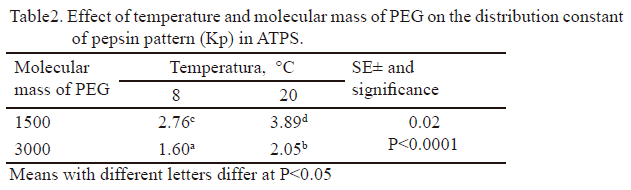
<body><![CDATA[<p align="justify" class="Cuerpodetexto" style="margin-top:12.0pt;text-indent:0cm;"><span style="font-family:'Verdana','sans-serif'; font-size:10.0pt; color:windowtext; ">Kp is the constant of pepsin  distribution </span></p>     <p align="justify" class="Cuerpodetexto" style="margin-top:12.0pt;text-indent:0cm;"><span style="font-family:'Verdana','sans-serif'; font-size:10.0pt; color:windowtext; ">R is the volume ratio between the  upper and lower phases, respectively </span></p>     <p align="justify" class="Cuerpodetexto" style="margin-top:12.0pt;text-indent:0cm;"><em><span style="font-family:'Verdana','sans-serif'; font-size:10.0pt; color:windowtext; ">Statistical analysis</span></em><span style="font-family:'Verdana','sans-serif'; font-size:10.0pt; color:windowtext; ">. To study the effect of temperature and molar mass in the  distribution constant of pepsin pattern an analysis of variance was carried  out, according to simple classification model with factorial arrangement 2 x 2.  The Duncan test (1955) was applied for comparing means.</span></p>     <p align="justify" class="Cuerpodetexto" style="margin-top:12.0pt;text-indent:0cm;"><span style="font-family:'Verdana','sans-serif'; font-size:10.0pt; color:windowtext; ">The determinations of the enzymatic  activity, protein concentration and distribution constants, were analyzed  according to simple classification model. The mean values were compared by the  Duncan test (1955) in necessary cases. The data were analyzed using computer  statistical package InfoStat, version 2012 (Di Rienzo <em>et al.</em> 2012).</span></p>     <p align="justify" class="subtitulo" style="margin-top:12.0pt;text-align:justify;"><span style="font-family:'Verdana','sans-serif'; font-size:10.0pt; color:windowtext; ">&nbsp;</span></p>     <p align="justify" class="subtitulo" style="margin-top:12.0pt;text-align:justify;"><span style="line-height:120%; font-family:'Verdana','sans-serif'; font-size:13.0pt; color:windowtext; "><b>RESULTS AND DISCUSSION</b> </span></p>     <p align="justify" class="Cuerpodetexto" style="margin-top:12.0pt;text-indent:0cm;"><span style="font-family:'Verdana','sans-serif'; font-size:10.0pt; color:windowtext; "><a href="/img/revistas/cjas/v50n3/t0213316.gif">Table 2</a> shows the effect of  temperature and the molecular mass of PEG on the distribution constant of  pepsin pattern.</span></p>     
<p align="justify" class="Cuerpodetexto" style="margin-top:12.0pt;text-indent:0cm;"><span style="font-family:'Verdana','sans-serif'; font-size:10.0pt; color:windowtext; ">The best pepsin distributions were  found in systems with PEG 1500 and for a temperature of 20 &deg;C. These results  are in agreement with that of pointed by Spelzini <em>et al.</em> (2006, 2011),  who reported that the systems better adapted to separate the pepsin are those  with low molecular masses of PEG.</span></p>     <p align="justify" class="Cuerpodetexto" style="margin-top:12.0pt;text-indent:0cm;"><span style="font-family:'Verdana','sans-serif'; font-size:10.0pt; color:windowtext; ">In this study a satisfactory  separation of the enzyme towards the upper phase of the two systems was  obtained, with values of coefficient distribution higher to the unit, which  indicates a favorable interaction between the protein and PEG. This performance  of pepsin in the two-phase system is due to, mainly, to its structure, because  although most of the hydrophobic residues are inside the molecule, this has a  high hydrophobic character in the surface exposed to the solvent, generating  interactions with the system under study (Spelzini <em>et al.</em> 2005).</span></p>     <p align="justify" class="Cuerpodetexto" style="margin-top:12.0pt;text-indent:0cm;"><span style="font-family:'Verdana','sans-serif'; font-size:10.0pt; color:windowtext; ">The PEG has a flexible molecule, which  can acquire a compact structure that is stabilized by intramolecular  hydrophobic unions. This compact structure has lower interaction with the  solvent than the molecules fully extended, allowing interacts with the protein  domain (Marini <em>et al.</em> 2011). The ability to interact with proteins is  also mediated by their molecular mass and the effect of temperature (Bassani <em>et  al.</em> 2010).</span></p>     ]]></body>
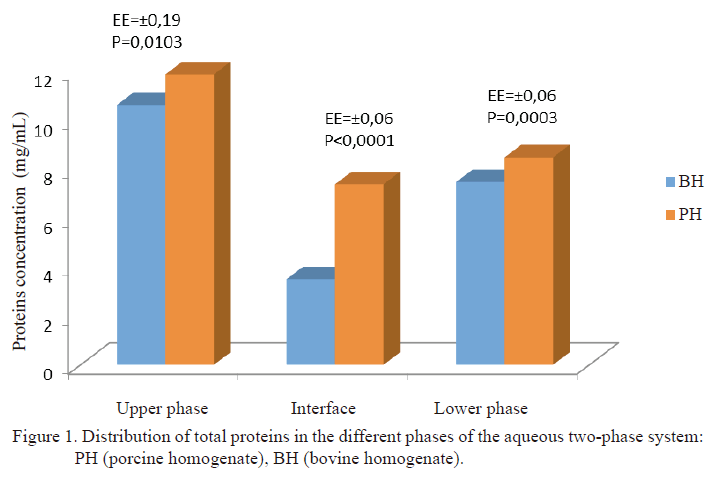
<body><![CDATA[<p align="justify" class="Cuerpodetexto" style="margin-top:12.0pt;text-indent:0cm;"><span style="font-family:'Verdana','sans-serif'; font-size:10.0pt; color:windowtext; ">According to Tub&iacute;o <em>et al.</em> (2007), the increase in the molecular mass of PEG induces the displacement the  distribution equilibrium towards the phase where the polymer is in lower  concentration, that is, towards the lower phase. The volume excluded by the PEG  increases as its molecular mass increases, causing a transfer of pepsin to the  salt- rich phase, with the consequent decrease of the distribution constant.  This effect agrees with the results which are obtained in this study.</span></p>     <p align="justify" class="Cuerpodetexto" style="margin-top:12.0pt;text-indent:0cm;"><span style="font-family:'Verdana','sans-serif'; font-size:10.0pt; color:windowtext; ">Arakawa and Timasheff (1985) studied  the interaction between PEG and lacto globulin &beta;, depending on the molecular  mass of PEG. These authors observed that the preferential exclusion increases  when the size of the PEG increases. This result is in favor of the steric  exclusion as one of the factors which determines the interaction of PEG with  proteins.</span></p>     <p align="justify" class="Cuerpodetexto" style="margin-top:12.0pt;text-indent:0cm;"><span style="font-family:'Verdana','sans-serif'; font-size:10.0pt; color:windowtext; ">In the case of the effect of  temperature on the distribution enzyme, it is observed that an increase in it  induces a displacement of pepsin to the polymer-rich phase, informed by  Spelzini <em>et al.</em> (2008) .This effect is manifested for most of proteins,  where the temperature increase leads to the distribution coefficient increase.</span></p>     <p align="justify" class="Cuerpodetexto" style="margin-top:12.0pt;text-indent:0cm;"><span style="font-family:'Verdana','sans-serif'; font-size:10.0pt; color:windowtext; ">Several authors stated (Imelio <em>et  al.</em> 2008, Spelzini <em>et al.</em> 2008) that in the systems formed by PEG /  Pi,&nbsp; the pepsin transfer from the salt-  rich phase towards&nbsp; the PEG -rich phase  is favored by increase of temperature, mainly to low molecular mass of PEG.  Spelzini <em>et al.</em> (2011) studied the heat associated with the pepsin  distribution and found that enthalpy changes are associated with the transfer  of pepsin from the salt-rich phase to the PEG- rich phase.</span></p>     <p align="justify" class="Cuerpodetexto" style="margin-top:12.0pt;text-indent:0cm;"><span style="font-family:'Verdana','sans-serif'; font-size:10.0pt; color:windowtext; ">When the transfer of protein from one  phase to the other is carried out, a large enthalpy change suggests the  breaking of many intermolecular unions (structured water in the protein domain  and in the polymer). This effect may be due to the strong interaction  PEG-protein that induces the displacement of water in the protein domain. It is  also considered, that the structured water around the hydrophobic chain  (ethylene) of PEG molecule release the ordered water (Tub&iacute;o <em>et al.</em> 2007).</span></p>     <p align="justify" class="Cuerpodetexto" style="margin-top:12.0pt;text-indent:0cm;"><span style="font-family:'Verdana','sans-serif'; font-size:10.0pt; color:windowtext; ">As it is shown in <a href="/img/revistas/cjas/v50n3/f0113316.gif">figure 1</a>, high  separation of contaminating proteins was achieved. The enzyme was distributed  mainly towards the upper PEG- rich phase and most of their impurities towards  the interface and the lower phase.</span></p>     
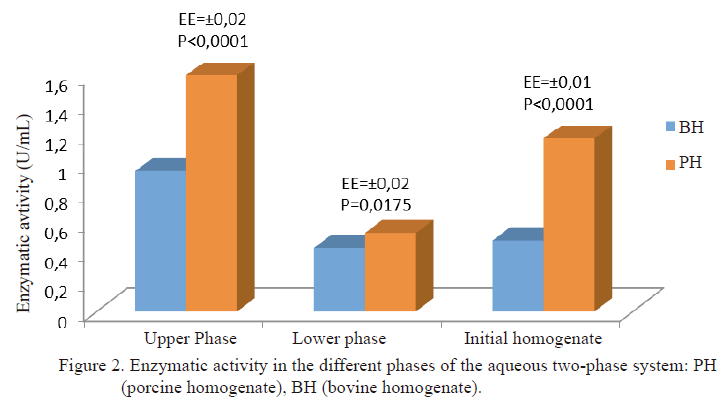
<p align="justify" class="Cuerpodetexto" style="margin-top:12.0pt;text-indent:0cm;"><span style="font-family:'Verdana','sans-serif'; font-size:10.0pt; color:windowtext; "><a href="/img/revistas/cjas/v50n3/f0213316.gif">Figure 2</a> show that the values of  enzymatic activity in the upper phase of each system have higher values to  those of the lower phase and to the original    preparations.</span></p>     
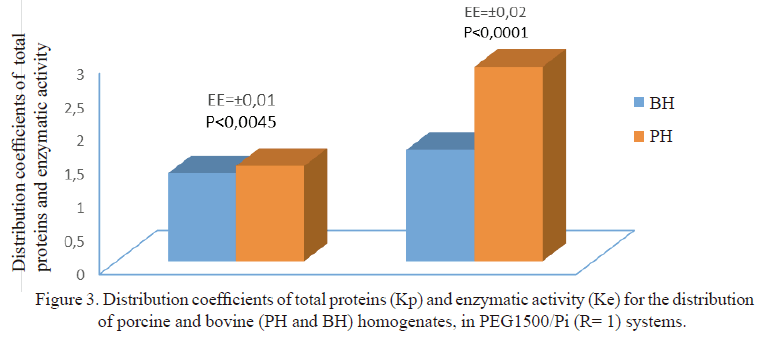
<p align="justify" class="Cuerpodetexto" style="margin-top:12.0pt;text-indent:0cm;"><span style="font-family:'Verdana','sans-serif'; font-size:10.0pt; color:windowtext; ">Spelzini <em>et al.</em> (2011) refers  that PEG produces interaction not destabilizing in the secondary structure of  protein. Therefore, to separate the enzymes in the upper PEG-rich phase is a  benefit, in terms of stability for subsequent purification steps.</span></p>     <p align="justify" class="Cuerpodetexto" style="margin-top:12.0pt;text-indent:0cm;"><span style="font-family:'Verdana','sans-serif'; font-size:10.0pt; color:windowtext; ">As <a href="/img/revistas/cjas/v50n3/f0313316.gif">figure 3</a> shows, there is greater  enzyme distribution than the total proteins, suggesting high recovery of  enzymatic activity in the upper phase of the system in relation to the rest of  the proteins present in the homogenates.</span></p>     
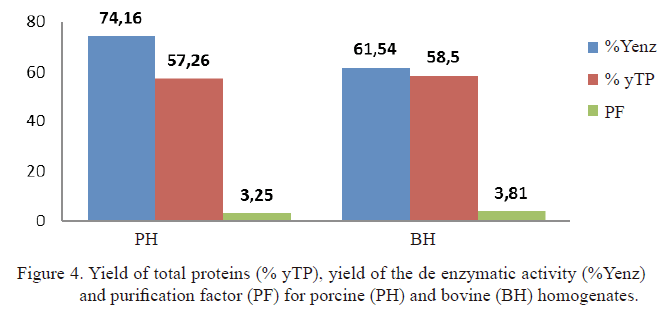
<p align="justify" class="Cuerpodetexto" style="margin-top:12.0pt;text-indent:0cm;"><span style="font-family:'Verdana','sans-serif'; font-size:10.0pt; color:windowtext; "><a href="/img/revistas/cjas/v50n3/f0413316.gif">Figure 4</a> shows that for both  homogenates a purification factor exceeding three was obtained, which indicate  that the target protein of a complex mixture was extracted. Although the  porcine homogenate showed higher yield of enzymatic activity, for both  homogenates best performance of enzyme was achieved than of protein, which  shows the separation of pepsin of much of the contaminating proteins.</span></p>     
]]></body>
<body><![CDATA[<p align="justify" class="Cuerpodetexto" style="margin-top:12.0pt;text-indent:0cm;"><span style="font-family:'Verdana','sans-serif'; font-size:10.0pt; color:windowtext; ">As for the purification factor, values  higher than three were reached. Differences between homogenates are associated  with higher concentration of contaminating proteins in the porcine homogenate.</span></p>     <p align="justify" class="Cuerpodetexto" style="margin-top:12.0pt;text-indent:0cm;"><span style="font-family:'Verdana','sans-serif'; font-size:10.0pt; color:windowtext; ">Previous studies of pepsin  purification from their natural sources with the use of PEG/Pi two-phase  systems described by Rito (2004) and Boeris <em>et al.</em> (2009) refers yield  values and purification factors similar to this study. </span></p>     <p align="justify" class="Cuerpodetexto" style="margin-top:12.0pt;text-indent:0cm;"><span style="font-family:'Verdana','sans-serif'; font-size:10.0pt; color:windowtext; ">It is known that the yield of a pure  enzyme is very high (between 80 and 95 %). However, when the method is used in  the purification of the same enzyme in a complex mixture, such as the animal  tissue homogenate or plant tissue homogenate, the yield is lower. This is due  to the presence of other macromolecules such as nucleic acids and proteins,  which can interact with the enzyme and cause its precipitation on the interface  (Bassani <em>et al.</em> 2010).</span></p>     <p align="justify" class="Cuerpodetexto" style="margin-top:12.0pt;text-indent:0cm;"><span style="line-height:120%; letter-spacing:.2pt; font-family:'Verdana','sans-serif'; font-size:10.0pt; color:windowtext; ">Pepsin is purified  from their natural sources by different methods, which it combines the  fractional precipitation with addition of salts (P&aacute;ez de Leon <em>et al.</em> 1995) and polyelectrolytes of opposite load (Boeris <em>et al.</em> 2009), the  anionic exchange chromatography (Rocha <em>et al.</em> 2010), gel filtration  (Brier <em>et al.</em> 2007), among others. Most of these methods allow obtaining  only a very few amount of the enzyme. Furthermore, in many cases the process is  complex and    expensive.</span><span style="font-family:'Verdana','sans-serif'; font-size:10.0pt; color:windowtext; "> </span></p>     <p align="justify" class="Cuerpodetexto" style="margin-top:12.0pt;text-indent:0cm;"><span style="font-family:'Verdana','sans-serif'; font-size:10.0pt; color:windowtext; ">Pepsin  purification with the use of aqueous two-phase systems provides a simple, fast  and inexpensive alternative besides of having the possibility of being widely  applied (Du <em>et al.</em> 2007). The use of this method to obtain preparations  that do not require high degrees of purity is of choice, as the characteristics  of the system provide a suitable environment that preserves the biological  activity of materials and provides high stability to macromolecules (Kayitmazer <em>et al.</em>    2007).</span><span style="font-family:'Verdana','sans-serif'; font-size:10.0pt; color:windowtext; "> </span></p>     <p align="justify" class="Cuerpodetexto" style="margin-top:12.0pt;text-indent:0cm;"><span style="line-height:107%; font-family:'Verdana','sans-serif'; font-size:10.0pt; ">It is concluded that the two-phase  system composed by PEG1500/potassium phosphate at a distribution temperature of  20 &deg;C was the variant that achieved the best pepsin distribution towards the  upper PEG rich- phase. This system allow eliminates most of the contaminating  proteins in a stage, obtain a purification factor higher three for each extract  and ensure an acceptable purity for subsequent extractive steps of the enzyme</span><span style="font-family:'Verdana','sans-serif'; font-size:10.0pt; color:windowtext; ">.</span></p>     <p align="justify" class="Cuerpodetexto" style="margin-top:12.0pt;text-indent:0cm;"><span style="font-family:'Verdana','sans-serif'; font-size:10.0pt; color:windowtext; ">&nbsp;</span></p>     <p align="justify" class="subtitulo" style="margin-top:12.0pt;text-align:justify;"><span style="font-family:'Verdana','sans-serif'; font-size:13.0pt; color:windowtext; "><b>REFERENCES</b></span></p>     <p align="justify" class="referencias" style="margin-top:12.0pt;margin-right:0cm;margin-bottom:.0001pt;margin-left:0cm;text-indent:0cm;"><span style="letter-spacing:-.1pt; font-family:'Verdana','sans-serif'; font-size:10.0pt; color:windowtext; ">Arakawa, T. &amp; Timasheff, S. N. 1985. &ldquo;Mechanism of  polyethylene glycol interaction with proteins&rdquo;. Biochemistry, 24(24):  6756&ndash;6762, ISSN: 0006-2960, 1520-4995, DOI: 10.1021/bi00345a005.</span></p>     <p align="justify" class="referencias" style="margin-top:12.0pt;margin-right:0cm;margin-bottom:.0001pt;margin-left:0cm;text-indent:0cm;"><span style="font-family:'Verdana','sans-serif'; font-size:10.0pt; color:windowtext; ">Bassani, G., Fuci&ntilde;os, P., Pic&oacute;, G. &amp; Farruggia, B.  2010. &ldquo;Candida rugosa lipase Lip1&ndash;polyethyleneglycol interaction and the  relation with its partition in aqueous two-phase systems&rdquo;. Colloids and  Surfaces B: Biointerfaces, 75(2): 532&ndash;537, ISSN: 0927-7765, DOI:  10.1016/j.colsurfb.2009.09.031.</span></p>     ]]></body>
<body><![CDATA[<p align="justify" class="referencias" style="margin-top:12.0pt;margin-right:0cm;margin-bottom:.0001pt;margin-left:0cm;text-indent:0cm;"><span style="font-family:'Verdana','sans-serif'; font-size:10.0pt; color:windowtext; ">Boeris, V., Spelzini, D., Farruggia, B. &amp; Pic&oacute;, G.  2009. &ldquo;Aqueous two-phase extraction and polyelectrolyte precipitation  combination: A simple and economically technologies for pepsin isolation from  bovine abomasum homogenate&rdquo;. </span><span style="font-family:'Verdana','sans-serif'; font-size:10.0pt; color:windowtext; ">Process  Biochemistry, 44(11): 1260&ndash;1264, ISSN: 13595113, DOI:  10.1016/j.procbio.2009.07.001.</span></p>     <p align="justify" class="referencias" style="margin-top:12.0pt;margin-right:0cm;margin-bottom:.0001pt;margin-left:0cm;text-indent:0cm;"><span style="font-family:'Verdana','sans-serif'; font-size:10.0pt; color:windowtext; ">Bravo, M. K. E., Mu&ntilde;oz, D. K., Calder&oacute;n, G. J. &amp;  Osorio, D. E. J. 2011. &ldquo;Desarrollo de un m&eacute;todo para la extracci&oacute;n de polifenol  oxidasa de uchuva (<em>Physalis peruviana</em> L.) y aislamiento por sistemas  bif&aacute;sicos acuososo&rdquo;. Vitae, 18(2): 124&ndash;132, ISSN: 0121-4004, 2145-2660.</span></p>     <p align="justify" class="referencias" style="margin-top:12.0pt;margin-right:0cm;margin-bottom:.0001pt;margin-left:0cm;text-indent:0cm;"><span style="font-family:'Verdana','sans-serif'; font-size:10.0pt; color:windowtext; ">Brier, S., Maria, G., Carginale, V., Capasso, A., Wu, Y.,  Taylor, R. M., Borotto, N. B., Capasso, C. &amp; Engen, J. R. 2007. </span><span style="font-family:'Verdana','sans-serif'; font-size:10.0pt; color:windowtext; ">&ldquo;Purification and characterization of pepsins A1 and A2  from the Antarctic rock cod <em>Trematomus bernacchii</em>&rdquo;. </span><span style="font-family:'Verdana','sans-serif'; font-size:10.0pt; color:windowtext; ">FEBS Journal, 274(23): 6152&ndash;6166, ISSN: 1742464X, DOI:  10.1111/j.1742-4658.2007.06136.x.</span></p>     <!-- ref --><p align="justify" class="referencias" style="margin-top:12.0pt;margin-right:0cm;margin-bottom:.0001pt;margin-left:0cm;text-indent:0cm;"><span style="font-family:'Verdana','sans-serif'; font-size:10.0pt; color:windowtext; ">Di Rienzo, J. A., Casanoves, F., Balzarini, M. G.,  Gonz&aacute;lez, L., Tablada, M. &amp; Robledo, C. W. 2012. InfoStat. version 2012,  [Windows], Universidad Nacional de C&oacute;rdoba, Argentina: Grupo InfoStat,  Available: &lt;<a href="http://www.infostat.com.ar/" target="_blank">http://www.infostat.com.ar/</a>&gt;    .</span></p>     <p align="justify" class="referencias" style="margin-top:12.0pt;margin-right:0cm;margin-bottom:.0001pt;margin-left:0cm;text-indent:0cm;"><span style="font-family:'Verdana','sans-serif'; font-size:10.0pt; color:windowtext; ">Du, Z., Yu, Y. L. &amp; Wang, J. H. 2007. &ldquo;Extraction of  Proteins from Biological Fluids by Use of an Ionic Liquid/Aqueous Two-Phase  System&rdquo;. Chemistry - A European Journal, 13(7): 2130&ndash;2137, ISSN: 09476539,  15213765, DOI: 10.1002/chem.200601234.</span></p>     <p align="justify" class="referencias" style="margin-top:12.0pt;margin-right:0cm;margin-bottom:.0001pt;margin-left:0cm;text-indent:0cm;"><span style="font-family:'Verdana','sans-serif'; font-size:10.0pt; color:windowtext; ">Duncan, D. B. 1955. &ldquo;Multiple Range and Multiple F  Tests&rdquo;. Biometrics, 11(1): 1&ndash;42, ISSN: 0006-341X, DOI: 10.2307/3001478.</span></p>     <p align="justify" class="referencias" style="margin-top:12.0pt;margin-right:0cm;margin-bottom:.0001pt;margin-left:0cm;text-indent:0cm;"><span style="font-family:'Verdana','sans-serif'; font-size:10.0pt; color:windowtext; ">Imelio, N., Marini, A., Spelzini, D., Pic&oacute;, G. &amp;  Farruggia, B. 2008. &ldquo;Pepsin extraction from bovine stomach using aqueous  two-phase systems: Molecular mechanism and influence of homogenate mass and  phase volume ratio&rdquo;. Journal of Chromatography B, 873(2): 133&ndash;138, ISSN:  15700232, DOI: 10.1016/j.jchromb.2008.07.006.</span></p>     <p align="justify" class="referencias" style="margin-top:12.0pt;margin-right:0cm;margin-bottom:.0001pt;margin-left:0cm;text-indent:0cm;"><span style="font-family:'Verdana','sans-serif'; font-size:10.0pt; color:windowtext; ">Kayitmazer, A. B., Strand, S. P., Tribet, C., Jaeger, W.  &amp; Dubin, P. L. 2007. &ldquo;Effect of Polyelectrolyte Structure on  Protein&minus;Polyelectrolyte Coacervates: Coacervates of Bovine Serum Albumin with  Poly (diallyl dimethyl ammonium chloride) versus Chitosan&rdquo;. Biomacromolecules,  8(11): 3568&ndash;3577, ISSN: 1525-7797, 1526-4602, DOI: 10.1021/bm700645t.</span></p>     <p align="justify" class="referencias" style="margin-top:12.0pt;margin-right:0cm;margin-bottom:.0001pt;margin-left:0cm;text-indent:0cm;"><span style="font-family:'Verdana','sans-serif'; font-size:10.0pt; color:windowtext; ">Lei, X., Diamond, A. D. &amp; Hsu, J. T. 1990.  &ldquo;Equilibrium phase behavior of the poly(ethylene glycol)/potassium  phosphate/water two-phase system at 4.degree.C&rdquo;. Journal of Chemical &amp;  Engineering Data, 35(4): 420&ndash;423, ISSN: 0021-9568, 1520-5134, DOI: 10.1021/je00062a014.</span></p>     ]]></body>
<body><![CDATA[<p align="justify" class="referencias" style="margin-top:12.0pt;margin-right:0cm;margin-bottom:.0001pt;margin-left:0cm;text-indent:0cm;"><span style="font-family:'Verdana','sans-serif'; font-size:10.0pt; color:windowtext; ">Marini, A., Imelio, N., Pic&oacute;, G., Romanini, D. &amp;  Farruggia, B. 2011. &ldquo;Isolation of a <em>Aspergillus niger</em> lipase from a  solid culture medium with aqueous two-phase systems&rdquo;. Journal of Chromatography  B, 879(22): 2135&ndash;2141, ISSN: 15700232, DOI: 10.1016/j.jchromb.2011.05.042.</span></p>     <p align="justify" class="referencias" style="margin-top:12.0pt;margin-right:0cm;margin-bottom:.0001pt;margin-left:0cm;text-indent:0cm;"><span style="font-family:'Verdana','sans-serif'; font-size:10.0pt; color:windowtext; ">Montes de Oca, O. A., Berm&uacute;dez, R. C. &amp; Serrat, D. M.  2013. </span><span style="font-family:'Verdana','sans-serif'; font-size:10.0pt; color:windowtext; ">&ldquo;Evaluaci&oacute;n del boniato tetuanado  como sustrato para la obtenci&oacute;n de prote&iacute;na microbiana&rdquo;. Tecnolog&iacute;a Qu&iacute;mica,  33(3): 340&ndash;352, ISSN: 2224-6185.</span></p>     <p align="justify" class="referencias" style="margin-top:12.0pt;margin-right:0cm;margin-bottom:.0001pt;margin-left:0cm;text-indent:0cm;"><span style="font-family:'Verdana','sans-serif'; font-size:10.0pt; color:windowtext; ">Morillo, O. T., Garc&iacute;a, L. P. J., Guerrero, C. B. R.,  Torres, V. Y. &amp; Casta&ntilde;eda, R. R. 2015. &ldquo;Evaluaci&oacute;n de la producci&oacute;n  experimental de enzimas coagulantes de leche utilizando cepas de <em>Rhizomucor  spp</em>.&rdquo;. Revista Colombiana de Biotecnolog&iacute;a, 17(1): 54&ndash;60, ISSN: 1909-8758,  0123-3475, DOI: 10.15446/rev.colomb.biote.v17n1.50701.</span></p>     <p align="justify" class="referencias" style="margin-top:12.0pt;margin-right:0cm;margin-bottom:.0001pt;margin-left:0cm;text-indent:0cm;"><span style="font-family:'Verdana','sans-serif'; font-size:10.0pt; color:windowtext; ">P&aacute;ez de Le&oacute;n, L., Pinz&oacute;n, G. &amp; Otaiza, V. E. 1995. </span><span style="font-family:'Verdana','sans-serif'; font-size:10.0pt; color:windowtext; ">&ldquo;Purification and assay of chicken pepsin&rdquo;. Acta  Cientifica Venezolana, 46(4): 237&ndash;241, ISSN: 0001-5504, PMID: 9334437.</span></p>     <p align="justify" class="referencias" style="margin-top:12.0pt;margin-right:0cm;margin-bottom:.0001pt;margin-left:0cm;text-indent:0cm;"><span style="font-family:'Verdana','sans-serif'; font-size:10.0pt; color:windowtext; ">Rito, P. M. 2004. &ldquo;Practical application of aqueous  two-phase partition to process development for the recovery of biological  products&rdquo;. Journal of Chromatography B, 807(1): 3&ndash;11, ISSN: 1570-0232, DOI:  10.1016/j.jchromb.2004.01.008.</span></p>     <p align="justify" class="referencias" style="margin-top:12.0pt;margin-right:0cm;margin-bottom:.0001pt;margin-left:0cm;text-indent:0cm;"><span style="font-family:'Verdana','sans-serif'; font-size:10.0pt; color:windowtext; ">Rocha, G. F., Fern&aacute;ndez, G. &amp; Parisi, M. G. 2010. </span><span style="font-family:'Verdana','sans-serif'; font-size:10.0pt; color:windowtext; ">&ldquo;Estudios de Caracterizaci&oacute;n Cin&eacute;tica y Fisicoqu&iacute;mica de  una Proteinasa Asp&aacute;rtica Aislada de Frutos Maduros de Salpichroa origanifolia&rdquo;.  Informaci&oacute;n Tecnol&oacute;gica, 21(2): 21&ndash;28, ISSN: 0718-0764, DOI:  10.4067/S0718-07642010000200004.</span></p>     <p align="justify" class="referencias" style="margin-top:12.0pt;margin-right:0cm;margin-bottom:.0001pt;margin-left:0cm;text-indent:0cm;"><span style="font-family:'Verdana','sans-serif'; font-size:10.0pt; color:windowtext; ">Saval, S. 2012. &ldquo;Aprovechamiento de Residuos  Agroindustriales: Pasado, Presente y Futuro&rdquo;. </span><span style="font-family:'Verdana','sans-serif'; font-size:10.0pt; color:windowtext; ">BioTecnolog&iacute;a,  16(2): 14&ndash;46.</span></p>     <p align="justify" class="referencias" style="margin-top:12.0pt;margin-right:0cm;margin-bottom:.0001pt;margin-left:0cm;text-indent:0cm;"><span style="font-family:'Verdana','sans-serif'; font-size:10.0pt; color:windowtext; ">Spelzini, D., Farruggia, B., Guerra, N. P., Rua, M. L.  &amp; Pastrana, L. 2011. </span><span style="font-family:'Verdana','sans-serif'; font-size:10.0pt; color:windowtext; ">&ldquo;Production of aspartic peptidases by <em>Aspergillus  spp</em>. using tuna cooked wastewater as nitrogen source and further extraction  using aqueous two phase system&rdquo;. African Journal of Biotechnology, 10(68):  15287&ndash;15294, ISSN: 1684-5315, DOI: 10.4314/ajb.v10i68.</span></p>     <p align="justify" class="referencias" style="margin-top:12.0pt;margin-right:0cm;margin-bottom:.0001pt;margin-left:0cm;text-indent:0cm;"><span style="font-family:'Verdana','sans-serif'; font-size:10.0pt; color:windowtext; ">Spelzini, D., Farruggia, B. &amp; Pic&oacute;, G. 2005.  &ldquo;Features of the acid protease partition in aqueous two-phase systems of  polyethylene glycol&ndash;phosphate: Chymosin and pepsin&rdquo;. Journal of Chromatography  B, 821(1): 60&ndash;66, ISSN: 15700232, DOI: 10.1016/j.jchromb.2005.04.007.</span></p>     <p align="justify" class="referencias" style="margin-top:12.0pt;margin-right:0cm;margin-bottom:.0001pt;margin-left:0cm;text-indent:0cm;"><span style="font-family:'Verdana','sans-serif'; font-size:10.0pt; color:windowtext; ">Spelzini, D., Peleteiro, J., Pic&oacute;, G. &amp; Farruggia, B.  2008. &ldquo;Polyethyleneglycol&ndash;pepsin interaction and its relationship with protein  partitioning in aqueous two-phase systems&rdquo;. Colloids and Surfaces B:  Biointerfaces, 67(2): 151&ndash;156, ISSN: 09277765, DOI:  10.1016/j.colsurfb.2008.06.013.</span></p>     ]]></body>
<body><![CDATA[<p align="justify" class="referencias" style="margin-top:12.0pt;margin-right:0cm;margin-bottom:.0001pt;margin-left:0cm;text-indent:0cm;"><span style="font-family:'Verdana','sans-serif'; font-size:10.0pt; color:windowtext; ">Spelzini, D., Pic&oacute;, G. &amp; Farruggia, B. 2006.  &ldquo;Dependence of chymosin and pepsin partition coefficient with phase volume and  polymer pausidispersity in polyethyleneglycol&ndash;phosphate aqueous two-phase  system&rdquo;. Colloids and Surfaces B: Biointerfaces, 51(1): 80&ndash;85, ISSN: 09277765,  DOI: 10.1016/j.colsurfb.2006.03.023.</span></p>     <p align="justify" class="referencias" style="margin-top:12.0pt;margin-right:0cm;margin-bottom:.0001pt;margin-left:0cm;text-indent:0cm;"><span style="line-height:107%; letter-spacing:-.1pt; font-family:'Verdana','sans-serif'; font-size:10.0pt; ">Tub&iacute;o,  G., Nerli, B. &amp; Pic&oacute;, G. 2007. &ldquo;Partitioning features of bovine trypsin and  &alpha;-chymotrypsin in polyethyleneglycol-sodium citrate aqueous two-phase systems&rdquo;.  Journal of Chromatography B, 852(1&ndash;2): 244&ndash;249, ISSN: 15700232, DOI: 10.1016/j.jchromb.2007.01.025</span><font size="2" face="Verdana, Arial, Helvetica, sans-serif">.</font></p>     <p align="justify">&nbsp;</p>     <p align="justify">&nbsp;</p>     <p align="justify"><font size="2" face="Verdana, Arial, Helvetica, sans-serif">Received: 14/09/2015    <br> Accepted: 11/07/2016</font></p>     <p align="justify">&nbsp;</p>     <p align="justify">&nbsp;</p>     <p align="justify"><font size="2" face="Verdana, Arial, Helvetica, sans-serif"><i>Maryen Alberto Vázquez,</i> Instituto de Ciencia Animal, Apartado Postal 24, San José de las Lajas, Mayabeque, Cuba.    Email: <a href="mailto:mvazquez@ica.co.cu">mvazquez@ica.co.cu</a></font></p>      ]]></body><back>
<ref-list>
<ref id="B1">
<nlm-citation citation-type="journal">
<person-group person-group-type="author">
<name>
<surname><![CDATA[Arakawa]]></surname>
<given-names><![CDATA[T.]]></given-names>
</name>
<name>
<surname><![CDATA[Timasheff]]></surname>
<given-names><![CDATA[S. N.]]></given-names>
</name>
</person-group>
<article-title xml:lang="nd"><![CDATA[Mechanism of polyethylene glycol interaction with proteins]]></article-title>
<source><![CDATA[Biochemistry]]></source>
<year>1985</year>
<volume>24</volume>
<numero>24</numero>
<issue>24</issue>
<page-range>6756–6762</page-range></nlm-citation>
</ref>
<ref id="B2">
<nlm-citation citation-type="journal">
<person-group person-group-type="author">
<name>
<surname><![CDATA[Bassani]]></surname>
<given-names><![CDATA[G.]]></given-names>
</name>
<name>
<surname><![CDATA[Fuciños]]></surname>
<given-names><![CDATA[P.]]></given-names>
</name>
<name>
<surname><![CDATA[Picó]]></surname>
<given-names><![CDATA[G.]]></given-names>
</name>
<name>
<surname><![CDATA[Farruggia]]></surname>
<given-names><![CDATA[B.]]></given-names>
</name>
</person-group>
<article-title xml:lang="nd"><![CDATA[Candida rugosa lipase Lip1–polyethyleneglycol interaction and the relation with its partition in aqueous two-phase systems]]></article-title>
<source><![CDATA[Colloids and Surfaces B: Biointerfaces]]></source>
<year>2010</year>
<volume>75</volume>
<numero>2</numero>
<issue>2</issue>
<page-range>532–537</page-range></nlm-citation>
</ref>
<ref id="B3">
<nlm-citation citation-type="journal">
<person-group person-group-type="author">
<name>
<surname><![CDATA[Boeris]]></surname>
<given-names><![CDATA[V.]]></given-names>
</name>
<name>
<surname><![CDATA[Spelzini]]></surname>
<given-names><![CDATA[D.]]></given-names>
</name>
<name>
<surname><![CDATA[Farruggia]]></surname>
<given-names><![CDATA[B.]]></given-names>
</name>
<name>
<surname><![CDATA[Picó]]></surname>
<given-names><![CDATA[G.]]></given-names>
</name>
</person-group>
<article-title xml:lang="nd"><![CDATA[Aqueous two-phase extraction and polyelectrolyte precipitation combination: A simple and economically technologies for pepsin isolation from bovine abomasum homogenate]]></article-title>
<source><![CDATA[Process Biochemistry]]></source>
<year>2009</year>
<volume>44</volume>
<numero>11</numero>
<issue>11</issue>
<page-range>1260–1264</page-range></nlm-citation>
</ref>
<ref id="B4">
<nlm-citation citation-type="journal">
<person-group person-group-type="author">
<name>
<surname><![CDATA[Bravo]]></surname>
<given-names><![CDATA[M. K. E.]]></given-names>
</name>
<name>
<surname><![CDATA[Muñoz]]></surname>
<given-names><![CDATA[D. K.]]></given-names>
</name>
<name>
<surname><![CDATA[Calderón]]></surname>
<given-names><![CDATA[G. J.]]></given-names>
</name>
<name>
<surname><![CDATA[Osorio]]></surname>
<given-names><![CDATA[D. E. J.]]></given-names>
</name>
</person-group>
<article-title xml:lang="nd"><![CDATA[Desarrollo de un método para la extracción de polifenol oxidasa de uchuva (Physalis peruviana L.) y aislamiento por sistemas bifásicos acuososo]]></article-title>
<source><![CDATA[Vitae]]></source>
<year>2011</year>
<volume>18</volume>
<numero>2</numero>
<issue>2</issue>
<page-range>124–132</page-range></nlm-citation>
</ref>
<ref id="B5">
<nlm-citation citation-type="journal">
<person-group person-group-type="author">
<name>
<surname><![CDATA[Brier]]></surname>
<given-names><![CDATA[S.]]></given-names>
</name>
<name>
<surname><![CDATA[Maria]]></surname>
<given-names><![CDATA[G.]]></given-names>
</name>
<name>
<surname><![CDATA[Carginale]]></surname>
<given-names><![CDATA[V.]]></given-names>
</name>
<name>
<surname><![CDATA[Capasso]]></surname>
<given-names><![CDATA[A.]]></given-names>
</name>
<name>
<surname><![CDATA[Wu]]></surname>
<given-names><![CDATA[Y.]]></given-names>
</name>
<name>
<surname><![CDATA[Taylor]]></surname>
<given-names><![CDATA[R. M.]]></given-names>
</name>
<name>
<surname><![CDATA[Borotto]]></surname>
<given-names><![CDATA[N. B.]]></given-names>
</name>
<name>
<surname><![CDATA[Capasso]]></surname>
<given-names><![CDATA[C.]]></given-names>
</name>
<name>
<surname><![CDATA[Engen]]></surname>
<given-names><![CDATA[J. R.]]></given-names>
</name>
</person-group>
<article-title xml:lang="nd"><![CDATA[Purification and characterization of pepsins A1 and A2 from the Antarctic rock cod Trematomus bernacchii]]></article-title>
<source><![CDATA[FEBS Journal]]></source>
<year>2007</year>
<volume>274</volume>
<numero>23</numero>
<issue>23</issue>
<page-range>6152–6166</page-range></nlm-citation>
</ref>
<ref id="B6">
<nlm-citation citation-type="book">
<person-group person-group-type="author">
<name>
<surname><![CDATA[Di Rienzo]]></surname>
<given-names><![CDATA[J. A.]]></given-names>
</name>
<name>
<surname><![CDATA[Casanoves]]></surname>
<given-names><![CDATA[F.]]></given-names>
</name>
<name>
<surname><![CDATA[Balzarini]]></surname>
<given-names><![CDATA[M. G.]]></given-names>
</name>
<name>
<surname><![CDATA[González]]></surname>
<given-names><![CDATA[L.]]></given-names>
</name>
<name>
<surname><![CDATA[Tablada]]></surname>
<given-names><![CDATA[M.]]></given-names>
</name>
<name>
<surname><![CDATA[Robledo]]></surname>
<given-names><![CDATA[C. W.]]></given-names>
</name>
</person-group>
<source><![CDATA[InfoStat]]></source>
<year>2012</year>
<publisher-loc><![CDATA[Universidad Nacional de Córdoba, Argentina ]]></publisher-loc>
<publisher-name><![CDATA[Grupo InfoStat]]></publisher-name>
</nlm-citation>
</ref>
<ref id="B7">
<nlm-citation citation-type="journal">
<person-group person-group-type="author">
<name>
<surname><![CDATA[Du]]></surname>
<given-names><![CDATA[Z.]]></given-names>
</name>
<name>
<surname><![CDATA[Yu]]></surname>
<given-names><![CDATA[Y. L.]]></given-names>
</name>
<name>
<surname><![CDATA[Wang]]></surname>
<given-names><![CDATA[J. H.]]></given-names>
</name>
</person-group>
<article-title xml:lang="nd"><![CDATA[Extraction of Proteins from Biological Fluids by Use of an Ionic Liquid/Aqueous Two-Phase System]]></article-title>
<source><![CDATA[Chemistry - A European Journal]]></source>
<year>2007</year>
<volume>13</volume>
<numero>7</numero>
<issue>7</issue>
<page-range>2130–2137</page-range></nlm-citation>
</ref>
<ref id="B8">
<nlm-citation citation-type="journal">
<person-group person-group-type="author">
<name>
<surname><![CDATA[Duncan]]></surname>
<given-names><![CDATA[D. B.]]></given-names>
</name>
</person-group>
<article-title xml:lang="nd"><![CDATA[Multiple Range and Multiple F Tests]]></article-title>
<source><![CDATA[Biometrics]]></source>
<year>1955</year>
<volume>11</volume>
<numero>1</numero>
<issue>1</issue>
<page-range>1–42</page-range></nlm-citation>
</ref>
<ref id="B9">
<nlm-citation citation-type="journal">
<person-group person-group-type="author">
<name>
<surname><![CDATA[Imelio]]></surname>
<given-names><![CDATA[N.]]></given-names>
</name>
<name>
<surname><![CDATA[Marini]]></surname>
<given-names><![CDATA[A.]]></given-names>
</name>
<name>
<surname><![CDATA[Spelzini]]></surname>
<given-names><![CDATA[D.]]></given-names>
</name>
<name>
<surname><![CDATA[Picó]]></surname>
<given-names><![CDATA[G.]]></given-names>
</name>
<name>
<surname><![CDATA[Farruggia]]></surname>
<given-names><![CDATA[B.]]></given-names>
</name>
</person-group>
<article-title xml:lang="nd"><![CDATA[Pepsin extraction from bovine stomach using aqueous two-phase systems: Molecular mechanism and influence of homogenate mass and phase volume ratio]]></article-title>
<source><![CDATA[Journal of Chromatography B]]></source>
<year>2008</year>
<volume>873</volume>
<numero>2</numero>
<issue>2</issue>
<page-range>133–138</page-range></nlm-citation>
</ref>
<ref id="B10">
<nlm-citation citation-type="journal">
<person-group person-group-type="author">
<name>
<surname><![CDATA[Kayitmazer]]></surname>
<given-names><![CDATA[A. B.]]></given-names>
</name>
<name>
<surname><![CDATA[Strand]]></surname>
<given-names><![CDATA[S. P.]]></given-names>
</name>
<name>
<surname><![CDATA[Tribet]]></surname>
<given-names><![CDATA[C.]]></given-names>
</name>
<name>
<surname><![CDATA[Jaeger]]></surname>
<given-names><![CDATA[W.]]></given-names>
</name>
<name>
<surname><![CDATA[Dubin]]></surname>
<given-names><![CDATA[P. L.]]></given-names>
</name>
</person-group>
<article-title xml:lang="nd"><![CDATA[Effect of Polyelectrolyte Structure on Protein-Polyelectrolyte Coacervates: Coacervates of Bovine Serum Albumin with Poly (diallyl dimethyl ammonium chloride) versus Chitosan]]></article-title>
<source><![CDATA[Biomacromolecules]]></source>
<year>2007</year>
<volume>8</volume>
<numero>11</numero>
<issue>11</issue>
<page-range>3568–3577</page-range></nlm-citation>
</ref>
<ref id="B11">
<nlm-citation citation-type="journal">
<person-group person-group-type="author">
<name>
<surname><![CDATA[Lei]]></surname>
<given-names><![CDATA[X.]]></given-names>
</name>
<name>
<surname><![CDATA[Diamond]]></surname>
<given-names><![CDATA[A. D.]]></given-names>
</name>
<name>
<surname><![CDATA[Hsu]]></surname>
<given-names><![CDATA[J. T.]]></given-names>
</name>
</person-group>
<article-title xml:lang="nd"><![CDATA[Equilibrium phase behavior of the poly(ethylene glycol)/potassium phosphate/water two-phase system at 4.degree.C]]></article-title>
<source><![CDATA[Journal of Chemical & Engineering Data]]></source>
<year>1990</year>
<volume>35</volume>
<numero>4</numero>
<issue>4</issue>
<page-range>420–423</page-range></nlm-citation>
</ref>
<ref id="B12">
<nlm-citation citation-type="journal">
<person-group person-group-type="author">
<name>
<surname><![CDATA[Marini]]></surname>
<given-names><![CDATA[A.]]></given-names>
</name>
<name>
<surname><![CDATA[Imelio]]></surname>
<given-names><![CDATA[N.]]></given-names>
</name>
<name>
<surname><![CDATA[Picó]]></surname>
<given-names><![CDATA[G.]]></given-names>
</name>
<name>
<surname><![CDATA[Romanini]]></surname>
<given-names><![CDATA[D.]]></given-names>
</name>
<name>
<surname><![CDATA[Farruggia]]></surname>
<given-names><![CDATA[B.]]></given-names>
</name>
</person-group>
<article-title xml:lang="nd"><![CDATA[Isolation of a Aspergillus niger lipase from a solid culture medium with aqueous two-phase systems]]></article-title>
<source><![CDATA[Journal of Chromatography B]]></source>
<year>2011</year>
<volume>879</volume>
<numero>22</numero>
<issue>22</issue>
<page-range>2135–2141</page-range></nlm-citation>
</ref>
<ref id="B13">
<nlm-citation citation-type="journal">
<person-group person-group-type="author">
<name>
<surname><![CDATA[Montes de Oca]]></surname>
<given-names><![CDATA[O. A.]]></given-names>
</name>
<name>
<surname><![CDATA[Bermúdez]]></surname>
<given-names><![CDATA[R. C.]]></given-names>
</name>
<name>
<surname><![CDATA[Serrat]]></surname>
<given-names><![CDATA[D. M.]]></given-names>
</name>
</person-group>
<article-title xml:lang="nd"><![CDATA[Evaluación del boniato tetuanado como sustrato para la obtención de proteína microbiana]]></article-title>
<source><![CDATA[Tecnología Química]]></source>
<year>2013</year>
<volume>33</volume>
<numero>3</numero>
<issue>3</issue>
<page-range>340–352</page-range></nlm-citation>
</ref>
<ref id="B14">
<nlm-citation citation-type="journal">
<person-group person-group-type="author">
<name>
<surname><![CDATA[Morillo]]></surname>
<given-names><![CDATA[O. T.]]></given-names>
</name>
<name>
<surname><![CDATA[García]]></surname>
<given-names><![CDATA[L. P. J.]]></given-names>
</name>
<name>
<surname><![CDATA[Guerrero]]></surname>
<given-names><![CDATA[C. B. R.]]></given-names>
</name>
<name>
<surname><![CDATA[Torres]]></surname>
<given-names><![CDATA[V. Y.]]></given-names>
</name>
<name>
<surname><![CDATA[Castañeda]]></surname>
<given-names><![CDATA[R. R.]]></given-names>
</name>
</person-group>
<article-title xml:lang="nd"><![CDATA[Evaluación de la producción experimental de enzimas coagulantes de leche utilizando cepas de Rhizomucor spp.]]></article-title>
<source><![CDATA[Revista Colombiana de Biotecnología]]></source>
<year>2015</year>
<volume>17</volume>
<numero>1</numero>
<issue>1</issue>
<page-range>54–60</page-range></nlm-citation>
</ref>
<ref id="B15">
<nlm-citation citation-type="journal">
<person-group person-group-type="author">
<name>
<surname><![CDATA[Páez de León]]></surname>
<given-names><![CDATA[L.]]></given-names>
</name>
<name>
<surname><![CDATA[Pinzón]]></surname>
<given-names><![CDATA[G.]]></given-names>
</name>
<name>
<surname><![CDATA[Otaiza]]></surname>
<given-names><![CDATA[V. E.]]></given-names>
</name>
</person-group>
<article-title xml:lang="nd"><![CDATA[Purification and assay of chicken pepsin]]></article-title>
<source><![CDATA[Acta Cientifica Venezolana]]></source>
<year>1995</year>
<volume>46</volume>
<numero>4</numero>
<issue>4</issue>
<page-range>237–241</page-range></nlm-citation>
</ref>
<ref id="B16">
<nlm-citation citation-type="journal">
<person-group person-group-type="author">
<name>
<surname><![CDATA[Rito]]></surname>
<given-names><![CDATA[P. M.]]></given-names>
</name>
</person-group>
<article-title xml:lang="nd"><![CDATA[Practical application of aqueous two-phase partition to process development for the recovery of biological products]]></article-title>
<source><![CDATA[Journal of Chromatography B]]></source>
<year>2004</year>
<volume>807</volume>
<numero>1</numero>
<issue>1</issue>
<page-range>3–11</page-range></nlm-citation>
</ref>
<ref id="B17">
<nlm-citation citation-type="journal">
<person-group person-group-type="author">
<name>
<surname><![CDATA[Rocha]]></surname>
<given-names><![CDATA[G. F.]]></given-names>
</name>
<name>
<surname><![CDATA[Fernández]]></surname>
<given-names><![CDATA[G.]]></given-names>
</name>
<name>
<surname><![CDATA[Parisi]]></surname>
<given-names><![CDATA[M. G.]]></given-names>
</name>
</person-group>
<article-title xml:lang="nd"><![CDATA[Estudios de Caracterización Cinética y Fisicoquímica de una Proteinasa Aspártica Aislada de Frutos Maduros de Salpichroa origanifolia]]></article-title>
<source><![CDATA[Información Tecnológica]]></source>
<year>2010</year>
<volume>21</volume>
<numero>2</numero>
<issue>2</issue>
<page-range>21–28</page-range></nlm-citation>
</ref>
<ref id="B18">
<nlm-citation citation-type="journal">
<person-group person-group-type="author">
<name>
<surname><![CDATA[Saval]]></surname>
<given-names><![CDATA[S.]]></given-names>
</name>
</person-group>
<article-title xml:lang="nd"><![CDATA[Aprovechamiento de Residuos Agroindustriales: Pasado, Presente y Futuro]]></article-title>
<source><![CDATA[BioTecnología]]></source>
<year>2012</year>
<volume>16</volume>
<numero>2</numero>
<issue>2</issue>
<page-range>14–46</page-range></nlm-citation>
</ref>
<ref id="B19">
<nlm-citation citation-type="journal">
<person-group person-group-type="author">
<name>
<surname><![CDATA[Spelzini]]></surname>
<given-names><![CDATA[D.]]></given-names>
</name>
<name>
<surname><![CDATA[Farruggia]]></surname>
<given-names><![CDATA[B.]]></given-names>
</name>
<name>
<surname><![CDATA[Guerra]]></surname>
<given-names><![CDATA[N. P.]]></given-names>
</name>
<name>
<surname><![CDATA[Rua]]></surname>
<given-names><![CDATA[M. L.]]></given-names>
</name>
<name>
<surname><![CDATA[Pastrana]]></surname>
<given-names><![CDATA[L.]]></given-names>
</name>
</person-group>
<article-title xml:lang="nd"><![CDATA[Production of aspartic peptidases by Aspergillus spp. using tuna cooked wastewater as nitrogen source and further extraction using aqueous two phase system]]></article-title>
<source><![CDATA[African Journal of Biotechnology]]></source>
<year>2011</year>
<volume>10</volume>
<numero>68</numero>
<issue>68</issue>
<page-range>15287–15294</page-range></nlm-citation>
</ref>
<ref id="B20">
<nlm-citation citation-type="journal">
<person-group person-group-type="author">
<name>
<surname><![CDATA[Spelzini]]></surname>
<given-names><![CDATA[D.]]></given-names>
</name>
<name>
<surname><![CDATA[Farruggia]]></surname>
<given-names><![CDATA[B.]]></given-names>
</name>
<name>
<surname><![CDATA[Picó]]></surname>
<given-names><![CDATA[G.]]></given-names>
</name>
</person-group>
<article-title xml:lang="nd"><![CDATA[Features of the acid protease partition in aqueous two-phase systems of polyethylene glycol–phosphate: Chymosin and pepsin]]></article-title>
<source><![CDATA[Journal of Chromatography B]]></source>
<year>2005</year>
<volume>821</volume>
<numero>1</numero>
<issue>1</issue>
<page-range>60–66</page-range></nlm-citation>
</ref>
<ref id="B21">
<nlm-citation citation-type="journal">
<person-group person-group-type="author">
<name>
<surname><![CDATA[Spelzini]]></surname>
<given-names><![CDATA[D.]]></given-names>
</name>
<name>
<surname><![CDATA[Peleteiro]]></surname>
<given-names><![CDATA[J.]]></given-names>
</name>
<name>
<surname><![CDATA[Picó]]></surname>
<given-names><![CDATA[G.]]></given-names>
</name>
<name>
<surname><![CDATA[Farruggia]]></surname>
<given-names><![CDATA[B.]]></given-names>
</name>
</person-group>
<article-title xml:lang="nd"><![CDATA[Polyethyleneglycol–pepsin interaction and its relationship with protein partitioning in aqueous two-phase systems]]></article-title>
<source><![CDATA[Colloids and Surfaces B: Biointerfaces]]></source>
<year>2008</year>
<volume>67</volume>
<numero>2</numero>
<issue>2</issue>
<page-range>151–156</page-range></nlm-citation>
</ref>
<ref id="B22">
<nlm-citation citation-type="journal">
<person-group person-group-type="author">
<name>
<surname><![CDATA[Spelzini]]></surname>
<given-names><![CDATA[D.]]></given-names>
</name>
<name>
<surname><![CDATA[Picó]]></surname>
<given-names><![CDATA[G.]]></given-names>
</name>
<name>
<surname><![CDATA[Farruggia]]></surname>
<given-names><![CDATA[B.]]></given-names>
</name>
</person-group>
<article-title xml:lang="nd"><![CDATA[Dependence of chymosin and pepsin partition coefficient with phase volume and polymer pausidispersity in polyethyleneglycol–phosphate aqueous two-phase system]]></article-title>
<source><![CDATA[Colloids and Surfaces B: Biointerfaces]]></source>
<year>2006</year>
<volume>51</volume>
<numero>1</numero>
<issue>1</issue>
<page-range>80–85</page-range></nlm-citation>
</ref>
<ref id="B23">
<nlm-citation citation-type="journal">
<person-group person-group-type="author">
<name>
<surname><![CDATA[Tubío]]></surname>
<given-names><![CDATA[G.]]></given-names>
</name>
<name>
<surname><![CDATA[Nerli]]></surname>
<given-names><![CDATA[B.]]></given-names>
</name>
<name>
<surname><![CDATA[Picó]]></surname>
<given-names><![CDATA[G.]]></given-names>
</name>
</person-group>
<article-title xml:lang="nd"><![CDATA[Partitioning features of bovine trypsin and a-chymotrypsin in polyethyleneglycol-sodium citrate aqueous two-phase systems]]></article-title>
<source><![CDATA[Journal of Chromatography B]]></source>
<year>2007</year>
<volume>852</volume>
<numero>1–2</numero>
<issue>1–2</issue>
<page-range>244–249</page-range></nlm-citation>
</ref>
</ref-list>
</back>
</article>