<?xml version="1.0" encoding="ISO-8859-1"?><article xmlns:mml="http://www.w3.org/1998/Math/MathML" xmlns:xlink="http://www.w3.org/1999/xlink" xmlns:xsi="http://www.w3.org/2001/XMLSchema-instance">
<front>
<journal-meta>
<journal-id>2079-3480</journal-id>
<journal-title><![CDATA[Cuban Journal of Agricultural Science]]></journal-title>
<abbrev-journal-title><![CDATA[Cuban J. Agric. Sci.]]></abbrev-journal-title>
<issn>2079-3480</issn>
<publisher>
<publisher-name><![CDATA[Editorial del Instituto de Ciencia Animal]]></publisher-name>
</publisher>
</journal-meta>
<article-meta>
<article-id>S2079-34802016000300014</article-id>
<title-group>
<article-title xml:lang="en"><![CDATA[Effects of scarification and storage on vigor expression of Albizia lebbeck (L.) Benth seeds]]></article-title>
<article-title xml:lang="es"><![CDATA[Efectos de la escarificación y el almacenamiento en la expresión del vigor de las semillas de Albizia lebbeck (L.) Benth]]></article-title>
</title-group>
<contrib-group>
<contrib contrib-type="author">
<name>
<surname><![CDATA[Navarro]]></surname>
<given-names><![CDATA[Marlén]]></given-names>
</name>
<xref ref-type="aff" rid="A01"/>
</contrib>
<contrib contrib-type="author">
<name>
<surname><![CDATA[Febles]]></surname>
<given-names><![CDATA[G.]]></given-names>
</name>
<xref ref-type="aff" rid="A02"/>
</contrib>
<contrib contrib-type="author">
<name>
<surname><![CDATA[Torres]]></surname>
<given-names><![CDATA[Verena]]></given-names>
</name>
<xref ref-type="aff" rid="A02"/>
</contrib>
</contrib-group>
<aff id="A01">
<institution><![CDATA[,Estación Experimental Indio Hatuey  ]]></institution>
<addr-line><![CDATA[ Matanzas]]></addr-line>
<country>Cuba</country>
</aff>
<aff id="A02">
<institution><![CDATA[,Instituto de Ciencia Animal  ]]></institution>
<addr-line><![CDATA[San José de las Lajas Mayabeque]]></addr-line>
<country>Cuba</country>
</aff>
<pub-date pub-type="pub">
<day>00</day>
<month>09</month>
<year>2016</year>
</pub-date>
<pub-date pub-type="epub">
<day>00</day>
<month>09</month>
<year>2016</year>
</pub-date>
<volume>50</volume>
<numero>3</numero>
<fpage>456</fpage>
<lpage>478</lpage>
<copyright-statement/>
<copyright-year/>
<self-uri xlink:href="http://scielo.sld.cu/scielo.php?script=sci_arttext&amp;pid=S2079-34802016000300014&amp;lng=en&amp;nrm=iso"></self-uri><self-uri xlink:href="http://scielo.sld.cu/scielo.php?script=sci_abstract&amp;pid=S2079-34802016000300014&amp;lng=en&amp;nrm=iso"></self-uri><self-uri xlink:href="http://scielo.sld.cu/scielo.php?script=sci_pdf&amp;pid=S2079-34802016000300014&amp;lng=en&amp;nrm=iso"></self-uri><abstract abstract-type="short" xml:lang="en"><p><![CDATA[An experiment was developed to estimate vigor of A. lebbeck seeds, related to the effect of scarification treatments (sulfuric acid, hot water, 24 h soak, cover cutting, puncture and control) and storage time (0, 1, 2, 3, 4, 5, 6, 7, 8, 9, 10, 11 and 12 months after initiated the storage, mais) with vigor expression. According to the methodology, the analyzed variables were: days before the beginning of emergence (E), percentage of final emergence during test period (Emer), peak day (PD), peak emergence (PE), germination value (GV), germination energy (Ener) and emergence rate (ER). These variables were evaluated at the nursery. A general assessment of results shows the negative effects of acid and hot water methods on vigor expression of albizia seeds. It may be concluded that pre-sowing treatments, applied through dry and wet scarification, showed cut efficiency of cover and soak, respectively, as promoting methods of germination, emergence and efficiency of vigor. Except acid and hot water treatments, the rest of the treatments showed the best expression of variables related to vigor at 3 mais]]></p></abstract>
<abstract abstract-type="short" xml:lang="es"><p><![CDATA[Se desarrolló un experimento para estimar el vigor de las semillas de A. lebbeck, relacionando el efecto de los tratamientos de escarificación (ácido sulfúrico, agua caliente, remojo 24 h, corte de cubierta, pinchazo y control) y el tiempo de almacenaje (0, 1, 2, 3, 4, 5, 6, 7, 8, 9, 10, 11 y 12 meses de iniciado el almacenamiento, mdia) con la expresión del vigor. De acuerdo con la metodología, se evaluaron en vivero, las variables: días para el inicio de la emergencia (IE), porcentaje de emergencia final para el período de la prueba (Emer), día pico (DP), emergencia pico (EP), valor de la germinación (VG), energía de germinación (Ener) y tasa de emergencia (TE). Una valoración general de los resultados muestra la afectación que producen los métodos del ácido y el agua caliente en la expresión del vigor de las semillas de albizia. Se concluye que los tratamientos pre-siembra, aplicados mediante la escarificación seca y húmeda mostraron la eficacia del corte de cubierta y el remojo, respectivamente, como métodos propulsores de la germinación, la emergencia y la eficiencia del vigor. Con excepción de los tratamientos con ácido y agua caliente, el resto mostró la mejor expresión de las variables relacionadas con el vigor a los 3 mdia]]></p></abstract>
<kwd-group>
<kwd lng="en"><![CDATA[germination]]></kwd>
<kwd lng="en"><![CDATA[emergence]]></kwd>
<kwd lng="en"><![CDATA[greenhouse]]></kwd>
<kwd lng="es"><![CDATA[germinación]]></kwd>
<kwd lng="es"><![CDATA[emergencia]]></kwd>
<kwd lng="es"><![CDATA[vivero]]></kwd>
</kwd-group>
</article-meta>
</front><body><![CDATA[ <p align="right"><font size="2" face="Verdana, Arial, Helvetica, sans-serif"><b>Cuban Journal  of Agricultural Science, 50(3): 456-478, 2016, ISSN: 2079-3480</b></font></p>     <p align="right">&nbsp;</p>     <p align="right"><font size="2" face="Verdana, Arial, Helvetica, sans-serif"><b>ORIGINAL ARTICLE</b></font></p>     <p align="justify">&nbsp;</p>     <p align="justify"><font size="4" face="Verdana, Arial, Helvetica, sans-serif">  <b>Effects of scarification and storage on vigor expression of <em>Albizia lebbeck</em> (L.) Benth seeds</b></font></p>      <p align="justify">&nbsp;</p>     <p align="justify"><font size="3" face="Verdana, Arial, Helvetica, sans-serif">  <b>Efectos de la escarificación y el almacenamiento en la expresión del vigor de las semillas de <em>Albizia lebbeck</em> (L.) Benth</b></font></p>      <p align="justify">&nbsp;</p>     <p align="justify">&nbsp;</p>     <p align="justify"><font size="2" face="Verdana, Arial, Helvetica, sans-serif">  <b>Marlén Navarro,</b><sup><b>I</b></sup> <b> G. Febles,</b><sup><b>II</b></sup> <b> Verena Torres,</b><sup><b>II</b></sup></font></p>     ]]></body>
<body><![CDATA[<p align="justify"><font size="2" face="Verdana, Arial, Helvetica, sans-serif"><b> </b></font><font size="2" face="Verdana, Arial, Helvetica, sans-serif">    <sup>I</sup>Estación Experimental “Indio Hatuey”. Universidad de Matanzas “Camilo Cienfuegos”.  Central España Republicana. CP44280. Matanzas, Cuba.    <br>   <sup>II</sup>Instituto de Ciencia Animal. Carretera Central, km 47 y ½, San José de las Lajas, Mayabeque, Cuba. </font></p>     <p align="justify">&nbsp;</p>     <p align="justify">&nbsp;</p> <hr align="JUSTIFY">     <p align="justify"><font size="2" face="Verdana, Arial, Helvetica, sans-serif"><b>ABSTRACT</b></font></p>     <p align="justify" class="resumen" style="margin-top:12.0pt;"><span style="line-height:120%; letter-spacing:.2pt; font-family:'Verdana','sans-serif'; font-size:10.0pt; color:windowtext; ">An experiment was developed to estimate  vigor of <em>A. lebbeck</em> seeds, related to the effect of scarification  treatments (sulfuric acid, hot water, 24 h soak, cover cutting, puncture and  control) and storage time (0, 1, 2, 3, 4, 5, 6, 7, 8, 9, 10, 11 and 12 months  after initiated the storage, mais) with vigor expression. According to the  methodology, the analyzed variables were: days before the beginning of  emergence (E), percentage of final emergence during test period (Emer), peak  day (PD), peak emergence (PE), germination value (GV), germination energy  (Ener) and emergence rate (ER). These variables were evaluated at the nursery.  A general assessment of results shows the negative effects of acid and hot  water methods on vigor expression of albizia seeds. It may be concluded that  pre-sowing treatments, applied through dry and wet scarification, showed cut  efficiency of cover and soak, respectively, as promoting methods of  germination, emergence and efficiency of vigor. Except acid and hot water  treatments, the rest of the treatments showed the best expression of variables  related to vigor at 3 mais.</span><span style="line-height:120%; font-family:'Verdana','sans-serif'; font-size:10.0pt; color:windowtext; "> </span></p>     <div align="justify"><strong><span style="line-height:107%; font-family:'Verdana','sans-serif'; font-size:10.0pt; ">Key words:</span></strong><span style="font-family:'Verdana','sans-serif'; font-size:10.0pt; "> germination,  emergence, greenhouse</span><font size="2" face="Verdana, Arial, Helvetica, sans-serif">.</font> </div> <hr align="JUSTIFY">     <p align="justify"><font size="2" face="Verdana, Arial, Helvetica, sans-serif"><b>RESUMEN</b></font></p>     <p align="justify" class="resumen" style="margin-top:12.0pt;"><span style="line-height:120%; letter-spacing:-.2pt; font-family:'Verdana','sans-serif'; font-size:10.0pt; color:windowtext; ">Se desarroll&oacute; un  experimento para estimar el vigor de las semillas de <em>A. lebbeck</em>,  relacionando el efecto de los tratamientos de escarificaci&oacute;n (&aacute;cido sulf&uacute;rico,  agua caliente, remojo 24 h, corte de cubierta, pinchazo y control) y el tiempo  de almacenaje (0, 1, 2, 3, 4, 5, 6, 7, 8, 9, 10, 11 y 12 meses de iniciado el  almacenamiento, mdia) con la expresi&oacute;n del vigor.&nbsp; De acuerdo con la metodolog&iacute;a, se evaluaron  en vivero, las variables: d&iacute;as para el inicio de la emergencia (IE), porcentaje  de emergencia final para el per&iacute;odo de la prueba (Emer), d&iacute;a pico (DP),  emergencia pico (EP), valor de la germinaci&oacute;n (VG), energ&iacute;a de germinaci&oacute;n  (Ener) y tasa de emergencia (TE). Una valoraci&oacute;n general de los resultados  muestra la afectaci&oacute;n que producen los m&eacute;todos del &aacute;cido y el agua caliente en  la expresi&oacute;n del vigor de las semillas de albizia. Se concluye que los  tratamientos pre-siembra, aplicados mediante la escarificaci&oacute;n seca y h&uacute;meda  mostraron la eficacia del corte de cubierta y el remojo, respectivamente, como  m&eacute;todos propulsores de la germinaci&oacute;n, la emergencia y la eficiencia del vigor.  Con excepci&oacute;n de los tratamientos con &aacute;cido y agua caliente, el resto mostr&oacute; la  mejor expresi&oacute;n de las variables relacionadas con el vigor a los 3 mdia.</span><span style="line-height:120%; font-family:'Verdana','sans-serif'; font-size:10.0pt; color:windowtext; "> </span></p>     <div align="justify"><strong><span style="line-height:107%; font-family:'Verdana','sans-serif'; font-size:10.0pt; ">Palabras clave:</span></strong><span style="font-family:'Verdana','sans-serif'; font-size:10.0pt; "> germinaci&oacute;n,  emergencia, vivero</span><font size="2" face="Verdana, Arial, Helvetica, sans-serif">.</font> </div> <hr align="JUSTIFY">     ]]></body>
<body><![CDATA[<p align="justify">&nbsp;</p>     <p align="justify">&nbsp;</p>     <p align="justify"><font size="2" face="Verdana, Arial, Helvetica, sans-serif"><b><font size="3">INTRODUCTION</font></b></font></p>     <p align="justify" class="Cuerpodetexto" style="margin-top:12.0pt;text-indent:0cm;"><span style="line-height:120%; font-family:'Verdana','sans-serif'; font-size:10.0pt; color:windowtext; ">The main challenge of researches on  vigor tests is the identification of indicators related to seed deterioration,  which precede the loss of germination ability and quality (Navarro <em>et al.</em> 2015).</span></p>     <p align="justify" class="Cuerpodetexto" style="margin-top:12.0pt;text-indent:0cm;"><span style="line-height:120%; letter-spacing:.2pt; font-family:'Verdana','sans-serif'; font-size:10.0pt; color:windowtext; ">&nbsp;Vigor tests are based on concepts like stress  resistance, germination speed, membrane integrity and plantlet development  (Matthews <em>et al.</em> 2012). Detection of seed deterioration through vigor  tests may be considered as an important component in the evaluation of elements  related to quality and contributes to the particular characterization of seed  industry and solution of problems, like storing. In addition, for dormant  seeds, it is essential to decide which pre-sowing treatment should be used,  resulting in a better security and success of planting with each seed lot.&nbsp; </span><span style="font-family:'Verdana','sans-serif'; font-size:10.0pt; color:windowtext; ">&nbsp;&nbsp;&nbsp;</span></p>     <p align="justify" class="Cuerpodetexto" style="margin-top:12.0pt;text-indent:0cm;"><span style="line-height:120%; letter-spacing:.1pt; font-family:'Verdana','sans-serif'; font-size:10.0pt; color:windowtext; ">Navarro <em>et al.</em> (2012) stated the conceptual bases to establish the importance and efficiency  of some biological variables during storing of seeds, in relation to vigor  variability. Therefore, these authors adapted the statistical model of Torres <em>et  al.</em> (2008) for measuring impact of innovation or technological transfer in  agricultural and livestock field, and proposed an original and integral  methodology for seed vigor estimation, as a quality indicator and later sowing  success of plantation.</span></p>     <p align="justify" class="Cuerpodetexto" style="margin-top:12.0pt;text-indent:0cm;"><span style="font-family:'Verdana','sans-serif'; font-size:10.0pt; color:windowtext; ">Previously, Febles <em>et al.</em> (2011a, b) used the method of Torres <em>et al.</em> (2008), to  determine the influence of edaphoclimatic factors on the production of tree,  forage legumes and grass seeds in different regions of Cuba</span><span style="font-family:'Verdana','sans-serif'; font-size:10.0pt; color:windowtext; ">.</span><span style="font-family:'Verdana','sans-serif'; font-size:10.0pt; color:windowtext; "> </span></p>     <p align="justify" class="Cuerpodetexto" style="margin-top:12.0pt;text-indent:0cm;"><span style="font-family:'Verdana','sans-serif'; font-size:10.0pt; color:windowtext; ">In a general  sense, although there are several methods available for testing vigor with  established procedures and reliable results, there is always a chance for  improvements or inclusion of more precise, objective and registered  alternatives (Filho 2011). Therefore, the objective of this experiment was to  estimate vigor of <em>A. lebbeck</em> seeds, related to the effect of treatments  of scarification and storing time with vigor expression</span><span style="font-family:'Verdana','sans-serif'; font-size:10.0pt; color:windowtext; ">.</span></p>     <p align="justify" class="subtitulo" style="margin-top:12.0pt;text-align:justify;"><span style="font-family:'Verdana','sans-serif'; font-size:10.0pt; color:windowtext; ">&nbsp;</span></p>     <p align="justify" class="subtitulo" style="margin-top:12.0pt;text-align:justify;"><span style="line-height:120%; font-family:'Verdana','sans-serif'; font-size:13.0pt; color:windowtext; "><b>MATERIALS AND METHODS</b></span></p>     ]]></body>
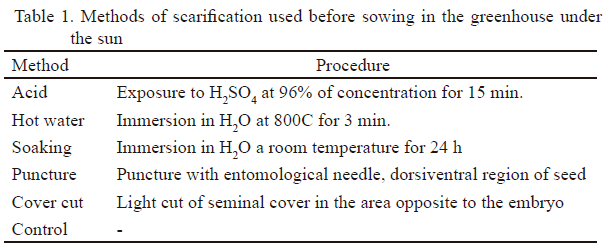
<body><![CDATA[<p align="justify" class="Cuerpodetexto" style="margin-top:12.0pt;text-indent:0cm;"><span style="font-family:'Verdana','sans-serif'; font-size:10.0pt; color:windowtext; ">In March, for three consecutive years, <em>A. lebbeck</em> seeds were collected in a plantation from the Estaci&oacute;n  Experimental de Pastos y Forrajes &ldquo;Indio Hatuey&rdquo;.</span></p>     <p align="justify" class="Cuerpodetexto" style="margin-top:12.0pt;text-indent:0cm;"><span style="font-family:'Verdana','sans-serif'; font-size:10.0pt; color:windowtext; ">In order to  evaluate vigor expression, a methodology proposed by&nbsp; Navarro <em>et al.</em> (2012) was used,  through the study of variables measured during the emergence of plantlets in  each pre-sowing treatment at the greenhouse, under the sun. Six methods of  scarification were evaluated in 13 storage times. For sowings, bags with a  substratum composed by a mixture of red ferrallitic soil and organic matter  were used, equally distributed (1:1). Before sowing, different methods of scarification  (<a href="/img/revistas/cjas/v50n3/t0114316.gif">table 1</a>) were applied, and there was a control, in which seeds received no  pre-sowing treatment.</span> </p>     
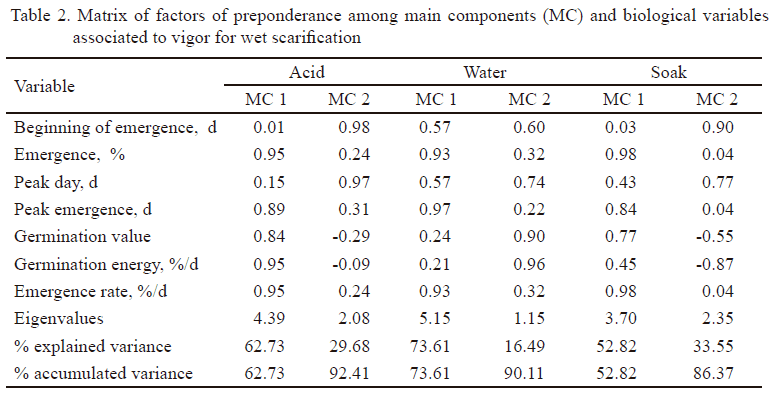
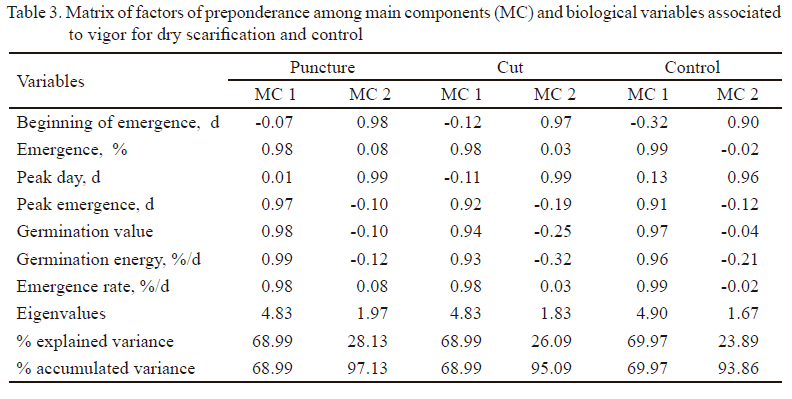
<p align="justify" class="Cuerpodetexto" style="margin-top:12.0pt;text-indent:0cm;"><span style="font-family:'Verdana','sans-serif'; font-size:10.0pt; color:windowtext; ">Evaluation frequency corresponded to  storing times: 0, 1, 2, 3, 4, 5, 6, 7, 8, 9, 10, 11 and 12 mais. Irrigation was  carried out until reaching field capacity of substratum.</span></p>     <p align="justify" class="Cuerpodetexto" style="margin-top:12.0pt;text-indent:0cm;"><span style="font-family:'Verdana','sans-serif'; font-size:10.0pt; color:windowtext; ">According to the  procedures described by Navarro <em>et al.</em> (2012), the analyzed variables  were: days before the beginning of emergence (E), percentage of final emergence  during test period (Emer), peak day (PD) peak emergence (PE), germination value  (GV), germination energy (Ener) and emergence rate (ER). These variables were  evaluated at the greenhouse, under the sun.</span><span style="font-family:'Verdana','sans-serif'; font-size:10.0pt; color:windowtext; "> </span></p>     <p align="justify" class="Cuerpodetexto" style="margin-top:12.0pt;text-indent:0cm;"><span style="font-family:'Verdana','sans-serif'; font-size:10.0pt; color:windowtext; ">Later, and according to the proposed  methodology, variables more related to vigor variability were defined. The relationship  between biological variables and storing time was determined through the  efficiency index (Ef), for establishing vigor groups, which will be composed by  different storing times per each of the evaluated scarification treatments.</span></p>     <p align="justify" class="Cuerpodetexto" style="margin-top:12.0pt;text-indent:0cm;"><span style="font-family:'Verdana','sans-serif'; font-size:10.0pt; color:windowtext; ">For processing the  obtained information, the statistical model proposed by Torres <em>et al.</em> (2008) was used, and with data obtained from the evaluations at the greenhouse,  a matrix of data was produced and premises of the application of multivariate  methods were confirmed with the matrix of correlation. Statistical analysis  allowed, first, to identify and select the order of importance of variables in  the explanation of vigor variability and, second, classify the evaluations  (storing times) according to pre-sowing scarification methods with support of  efficiency index (Ef) and definition of groups with low and high vigor per each  pre-sowing method. The statistical software SPSS, version 15 (StatPoint  Technologies 2010) was used.</span><span style="font-family:'Verdana','sans-serif'; font-size:10.0pt; color:windowtext; "> </span></p>     <p align="justify" class="subtitulo" style="margin-top:12.0pt;text-align:justify;"><span style="font-family:'Verdana','sans-serif'; font-size:10.0pt; color:windowtext; ">&nbsp;</span></p>     <p align="justify" class="subtitulo" style="margin-top:12.0pt;text-align:justify;"><span style="font-family:'Verdana','sans-serif'; font-size:13.0pt; color:windowtext; "><b>RESULTS AND DISCUSSION</b></span></p>     <p align="justify" class="Cuerpodetexto" style="margin-top:12.0pt;text-indent:0cm;"><span style="font-family:'Verdana','sans-serif'; font-size:10.0pt; color:windowtext; ">Eingenvalues and  explained variance (tables 2 and 3) evidenced that, in each evaluated  pre-sowing method, variability was superior to 85 %, when most of them were  grouped in the two first main components. According to Mart&iacute;n <em>et al.</em> (2008), this is interpreted as an accurate selection of variables that could be  related to vigor.</span><span style="font-family:'Verdana','sans-serif'; font-size:10.0pt; color:windowtext; "> </span></p>     <p align="justify" class="Cuerpodetexto" style="margin-top:12.0pt;text-indent:0cm;"><em><span style="font-family:'Verdana','sans-serif'; font-size:10.0pt; color:windowtext; ">Identification of  importance order of variables related to vigor</span></em><span style="font-family:'Verdana','sans-serif'; font-size:10.0pt; color:windowtext; ">. Emergence, as the emergence rate,  appear as the variables with higher preponderance values in all used  treatments, even in the control (tables 2 and 3). This performance indicates  that emergence rate is an indicator of considerable importance for vigor  estimation, in agreement with Copeland and McDonald (2001) and Laskowski and  Bautista (2002). This may be a negative factor from an agricultural point of  view, because it does not allow to achieve, at the same time, a uniform plant  population, regarding size and quality. On the other hand, emergence of  plantlets is mainly related to time and speed of seed germination, which may be  influenced by biotic and abiotic factors, as well as the election of sowing  date (Gardarin <em>et al.</em> 2011).</span><span style="font-family:'Verdana','sans-serif'; font-size:10.0pt; color:windowtext; "> </span></p>     ]]></body>
<body><![CDATA[<p align="justify" class="Cuerpodetexto" style="margin-top:12.0pt;text-indent:0cm;"><span style="font-family:'Verdana','sans-serif'; font-size:10.0pt; color:windowtext; ">This is related to  results reported by Navarro <em>et al.</em> (2010a, b), because the pre-sowing  methods used during time were important for the process of germination and emergence,  which expressions are evaluated in this experiment. A definite removal of  variables should not be applied on further studies because an analysis of  tables 2 and 3 indicates that variables from components 1 and 2 were 71 % of  all wet scarification and 100 % of dry (including control), after considering  higher and equal to 0.90 values of preponderance.</span><span style="font-family:'Verdana','sans-serif'; font-size:10.0pt; color:windowtext; "> </span></p>     <p align="justify" class="Cuerpodetexto" style="margin-top:12.0pt;text-indent:0cm;"><span style="font-family:'Verdana','sans-serif'; font-size:10.0pt; color:windowtext; ">When sulfuric acid  was used as wet scarification method, variables emergence, energy and emergence  rate were equally important in the main component 1(MC1). In the second  component (MC2), variables beginning of emergence and peak day were also  highlighted.</span><span style="font-family:'Verdana','sans-serif'; font-size:10.0pt; color:windowtext; "> </span></p>     <p align="justify" class="Cuerpodetexto" style="margin-top:12.0pt;text-indent:0cm;"><span style="font-family:'Verdana','sans-serif'; font-size:10.0pt; color:windowtext; ">F<span style="letter-spacing:.1pt; ">or  hot water in MC1, the most important variables were emergence, peak emergence  and emergence rate. In MC2, the essential ones were germination value and  energy. For MC1 of soak method, emergence and emergence rate were the best  variables and, in the second component, only the beginning of emergence was  high.</span></span></p>     <p align="justify" class="Cuerpodetexto" style="margin-top:12.0pt;text-indent:0cm;"><span style="font-family:'Verdana','sans-serif'; font-size:10.0pt; color:windowtext; ">For dry scarification and control,  variables selected in MC1 were emergence, emergence peak, germination value,  energy and rate of emergence, with similar values. In MC2, beginning of  emergence and peak day were selected (<a href="/img/revistas/cjas/v50n3/t0214316.gif">table 2</a>).</span></p>     
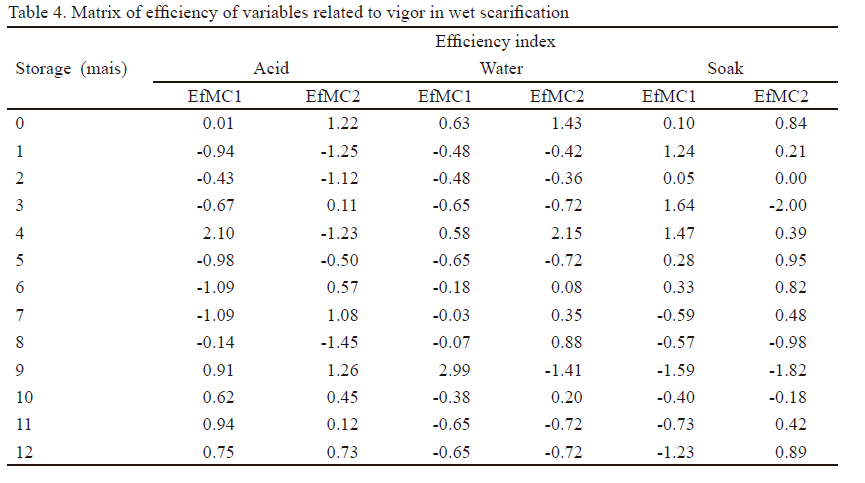
<p align="justify" class="Cuerpodetexto" style="margin-top:12.0pt;text-indent:0cm;"><span style="font-family:'Verdana','sans-serif'; font-size:10.0pt; color:windowtext; ">Because these mentioned variables vary  the most, numerically, it may be stated that, through its analysis, seed vigor  may be estimated.</span></p>     <p align="justify" class="Cuerpodetexto" style="margin-top:12.0pt;text-indent:0cm;"><span style="font-family:'Verdana','sans-serif'; font-size:10.0pt; color:windowtext; ">Emergence rate is positively related  to fast emergence in the field and to the development of many species of  plantlets, while fast emergence is an obvious advantage for plantlet  establishment. Filho (2005) defines germination speed as one of the first  properties that are affected during seed deterioration process. Therefore,  germination speed is an expression of seed vigor. According to Schmidt (2000),  it is called &ldquo;germination energy&rdquo;.</span></p>     <p align="justify" class="Cuerpodetexto" style="margin-top:12.0pt;text-indent:0cm;"><span style="font-family:'Verdana','sans-serif'; font-size:10.0pt; color:windowtext; ">Time  of emergence, usually, determines whether a plant may successfully compete with  its surroundings, it is consumed by herbivorous or flowers, reproduces and  matures appropriately at the end of its growing stage (Forcella <em>et al.</em> 2000). Therefore, an emergence in short periods of time is also an indicator of  high vigor in seeds.</span></p>     <p align="justify" class="Cuerpodetexto" style="margin-top:12.0pt;text-indent:0cm;"><span style="font-family:'Verdana','sans-serif'; font-size:10.0pt; color:windowtext; ">Santorum <em>et al.</em> (2013), after evaluating vigor in soybean seeds, found that emergence rate,  germination speed index and emergence speed were the tests of better  correlation to emergence. Similar results were obtained in this study, after  selecting variables with better relation in the expression of vigor    variability.</span><span style="font-family:'Verdana','sans-serif'; font-size:10.0pt; color:windowtext; "> </span></p>     <p align="justify" class="Cuerpodetexto" style="margin-top:12.0pt;text-indent:0cm;"><em><span style="font-family:'Verdana','sans-serif'; font-size:10.0pt; color:windowtext; ">Clasification of  storing times for every pre-sowing scarification methods</span></em><span style="font-family:'Verdana','sans-serif'; font-size:10.0pt; color:windowtext; ">. Tables 4 and 5 show the efficiency of  each variable for vigor estimation, after seeds are sown at different storing  times. Navarro <em>et al.</em> (2012) stated that efficiency index depends on  variables with the highest preponderance, and also expressed that the highest  positive values indicate which have more influence on a particular storing  time.</span><span style="font-family:'Verdana','sans-serif'; font-size:10.0pt; color:windowtext; "> </span></p>     <p align="justify" class="Cuerpodetexto" style="margin-top:12.0pt;text-indent:0cm;"><em><span style="font-family:'Verdana','sans-serif'; font-size:10.0pt; color:windowtext; ">Wet scarification</span></em><span style="font-family:'Verdana','sans-serif'; font-size:10.0pt; color:windowtext; ">. For acid method, in the evaluation at 4 mais, there were  better expressions of MC1 variables, without underestimating those values that  appear at 9 and 11 mais, while at 6 and 7 mais, these variables had the worst  expression.</span></p>     ]]></body>
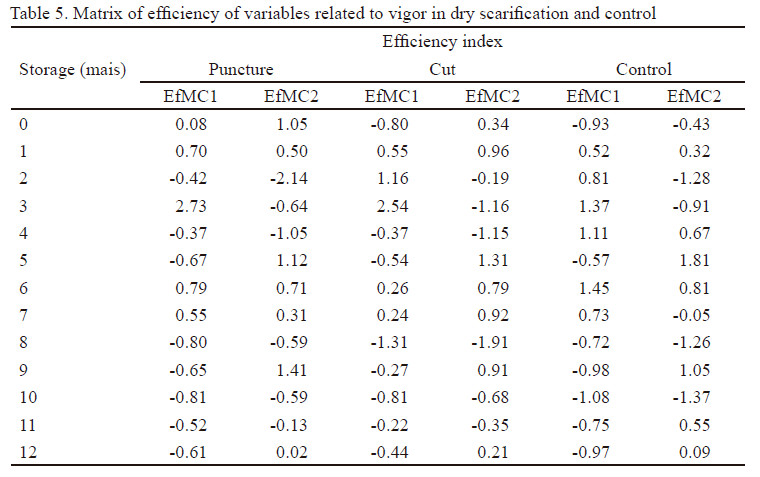
<body><![CDATA[<p align="justify" class="Cuerpodetexto" style="margin-top:12.0pt;text-indent:0cm;"><span style="font-family:'Verdana','sans-serif'; font-size:10.0pt; color:windowtext; ">In MC2 of this  method, the analysis should be the opposite. Therefore, the best variables were  more efficient at 1, 2, 4 and 8 mais. This is because it is more convenient,  for a successful sowing, an emergence that starts as early as possible and, in  turn, that the highest number of seedlings achieve emerge in the shortest time,  what has been reported by Forcella <em>et al.</em> (2000) and Guretzky <em>et al.</em> (2004). Higher values for the variables start emergency and peak day are  considered undesirable effects, as apparently happened at 0, 7 and 9 mais.</span><span style="font-family:'Verdana','sans-serif'; font-size:10.0pt; color:windowtext; "> </span></p>     <p align="justify" class="Cuerpodetexto" style="margin-top:12.0pt;text-indent:0cm;"><span style="font-family:'Verdana','sans-serif'; font-size:10.0pt; color:windowtext; ">In the hot water  method, variables that typify MC1 showed the best positive effect, only at 9  mais, as well as at 0 and 4 mais for MC2, while the effect was negative for 9  mais in this same component. In this storing time, there was the worst  expression of variables of MC2 (value of germination and energy). It is  necessary to highlight that results of the experiment did not favor these two  pre-sowing methods because, in the case of this study, these are aggressive    pre-treatments that affect, probably, the embryo. This is consistent with the  criteria of Navarro <em>et al.</em>  (2010a, b).</span><span style="font-family:'Verdana','sans-serif'; font-size:10.0pt; color:windowtext; "> </span></p>     <p align="justify" class="Cuerpodetexto" style="margin-top:12.0pt;text-indent:0cm;"><span style="font-family:'Verdana','sans-serif'; font-size:10.0pt; color:windowtext; ">In the case of  soak, it did not occur in the same way. Storing times in which emergence and  emergence rate (MC1) had the best expression were 1, 3 and 4 mais. The highest  index was at 3 mais and the worst were found at 9 and 12 mais. According to  efficiency index, the most negative value for the beginning of emergence (MC2)  appeared at 3 mais, but this is biologically beneficial because if there is a  high number of days, the delay for the beginning of emergence is lower.</span><span style="font-family:'Verdana','sans-serif'; font-size:10.0pt; color:windowtext; "> </span></p>     <p align="justify" class="Cuerpodetexto" style="margin-top:12.0pt;text-indent:0cm;"><span style="font-family:'Verdana','sans-serif'; font-size:10.0pt; color:windowtext; ">Although the  analysis of main components (AMC) only identified three variables in soak, this  is not a deficiency of the method because these three are related to important  measures in the development and growth of plantlets. Obviously, emergence is a  manifestation of seed vigor and, together with emergence rate, it is supposed  that plantlets emerge at a faster rate, which is maximized in those plantlets  that emerge at a lower time. This coincides with reports from Salinas <em>et al.</em> (2001) y Valadez <em>et al.</em>    (2007).</span><span style="font-family:'Verdana','sans-serif'; font-size:10.0pt; color:windowtext; "> </span></p>     <p align="justify" class="Cuerpodetexto" style="margin-top:12.0pt;text-indent:0cm;"><span style="font-family:'Verdana','sans-serif'; font-size:10.0pt; color:windowtext; ">As previously  stated, it is important to highlight that, in the control, all studied  variables were distributed between both components. This may indicate that, due  to the negative effect of acid and hot water, performance of peak emergence and  germination value was affected for the acid method. For hot water, the affected  variables were peak day and emergence rate. The fact that these variables had  no influence on storing time may be an indication of deterioration of quality  and, consequently, seed vigor. This idea was similar to that stated by Mandal <em>et  al.</em> (2000) and Rajasekaran <em>et al.</em> (2005). These indicators are  essential for the processes of germination, emergence and development so there  should be a logic agreement to the performance of crops in the   field.</span><span style="font-family:'Verdana','sans-serif'; font-size:10.0pt; color:windowtext; "> </span></p>     <p align="justify" class="Cuerpodetexto" style="margin-top:12.0pt;text-indent:0cm;"><em><span style="font-family:'Verdana','sans-serif'; font-size:10.0pt; color:windowtext; ">Dry scarification and control</span></em><span style="font-family:'Verdana','sans-serif'; font-size:10.0pt; color:windowtext; ">. Regarding vigor manifestation, puncture and cut were less  aggressive than acid and hot water. Previously, the way in which both methods  may contribute to performance of germination and emergence was stated, which is  confirmed with the values from <a href="/img/revistas/cjas/v50n3/t0514316.gif">table 5</a>.&nbsp;&nbsp;&nbsp;&nbsp; </span></p>     
<p align="justify" class="Cuerpodetexto" style="margin-top:12.0pt;text-indent:0cm;"><span style="font-family:'Verdana','sans-serif'; font-size:10.0pt; color:windowtext; ">According to this table, there was a  positive performance for variables that typify MC1, sowing seeds that received  a puncture at 3 mais. Likewise, there were positive results of sowings at 0, 5  and 9 mais, for selected indicators in MC2. At 2 and 4 mais, there were  negative results. </span></p>     <p align="justify" class="Cuerpodetexto" style="margin-top:12.0pt;text-indent:0cm;"><span style="font-family:'Verdana','sans-serif'; font-size:10.0pt; color:windowtext; ">In the case of cover cut, at 2 and 3  mais, there was a better expression of MC1 variables, and at 5 mais for MC2.  The worst values were found at 8 mais (MC1) and at 3, 4 and 8 mais (MC2) for  variables beginning of emergence and peak day.</span></p>     <p align="justify" class="Cuerpodetexto" style="margin-top:12.0pt;text-indent:0cm;"><span style="font-family:'Verdana','sans-serif'; font-size:10.0pt; color:windowtext; ">In control treatment, the best values  appeared at 3, 4 and 6 mais for the best represented variables in MC1. For MC2,  the most positively related storing times were 5 and 9 mais, while the most  negative were 2, 8 and 10 mais.</span></p>     <p align="justify" class="Cuerpodetexto" style="margin-top:12.0pt;text-indent:0cm;"><span style="font-family:'Verdana','sans-serif'; font-size:10.0pt; color:windowtext; ">These results  agree with reports of Navarro <em>et al.</em> (2010a, b), which refer that cut  showed high efficiency in the surpassing of dormant states for <em>A. lebbeck</em> species.</span><span style="font-family:'Verdana','sans-serif'; font-size:10.0pt; color:windowtext; "> </span></p>     ]]></body>
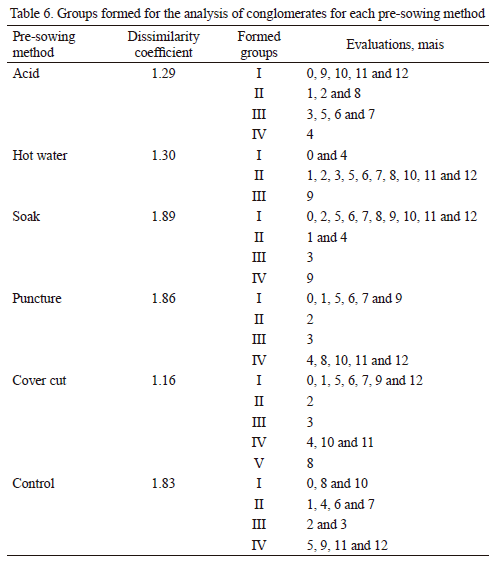
<body><![CDATA[<p align="justify" class="Cuerpodetexto" style="margin-top:12.0pt;text-indent:0cm;"><span style="font-family:'Verdana','sans-serif'; font-size:10.0pt; color:windowtext; ">According to the  highest positive Ef value, which corresponds to a determined storing time,  should be the rest of the times that could show an acceptable and similar  performance of vigor. In order to verify this statement, a conglomerate  analysis was    conducted. </span><span style="font-family:'Verdana','sans-serif'; font-size:10.0pt; color:windowtext; "> </span></p>     <p align="justify" class="Cuerpodetexto" style="margin-top:12.0pt;text-indent:0cm;"><em><span style="font-family:'Verdana','sans-serif'; font-size:10.0pt; color:windowtext; ">Group formation.</span></em><span style="font-family:'Verdana','sans-serif'; font-size:10.0pt; color:windowtext; "> From the efficiency indexes in each  pre-sowing method, there was an analysis of the existence of storing times with  similar performances, so responses to pre-sowing methods were the most  efficient as possible in the estimation of seed    vigor.</span><span style="font-family:'Verdana','sans-serif'; font-size:10.0pt; color:windowtext; "> </span></p>     <p align="justify" class="Cuerpodetexto" style="margin-top:12.0pt;text-indent:0cm;"><span style="font-family:'Verdana','sans-serif'; font-size:10.0pt; color:windowtext; ">In the grouping  process of each pre-sowing method, it was decided to perform the cut for a  certain dissimilarity coefficient (<a href="/img/revistas/cjas/v50n3/t0614316.gif">table 6</a>), which favored the classification  of storing period (evaluations) and the formation of groups. Space  representation of dissimilarity coefficient in known as dendrogram. According  to Hair <em>et al.</em> (1999), this is a quantitative estimator that describes  the degree of association of similarity among compared elements.</span></p>     
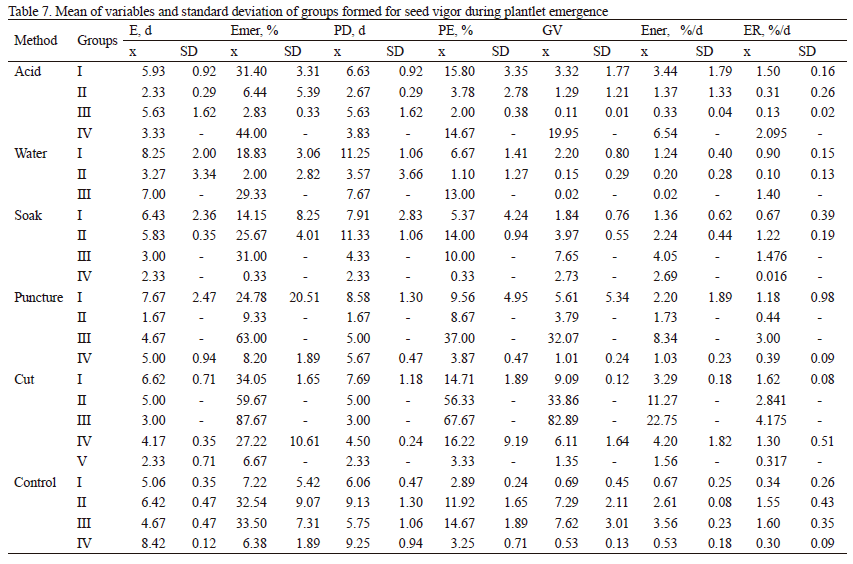
<p align="justify" class="Cuerpodetexto" style="margin-top:12.0pt;text-indent:0cm;"><em><span style="font-family:'Verdana','sans-serif'; font-size:10.0pt; color:windowtext; ">Definition of vigor groups.</span></em><span style="font-family:'Verdana','sans-serif'; font-size:10.0pt; color:windowtext; "> For the selection of groups, where vigor was more  efficiently expressed, those selected had the best global performance in  variables with the best preponderance in the MC1 for each scarification method.</span></p>     <p align="justify" class="Cuerpodetexto" style="margin-top:12.0pt;text-indent:0cm;"><em><span style="font-family:'Verdana','sans-serif'; font-size:10.0pt; color:windowtext; ">Acid.</span></em><span style="font-family:'Verdana','sans-serif'; font-size:10.0pt; color:windowtext; "> In the evaluation at 4 mais (group IV), the highest means  appeared for variables germination value, emergence, energy and rate of  emergence (<a href="/img/revistas/cjas/v50n3/t0714316.gif">table 7</a>). In addition, according to results of <a href="/img/revistas/cjas/v50n3/t0314316.gif">table 3</a>, the highest  positive value of efficiency index was registered at 4 mais.</span></p>     
<p align="justify" class="Cuerpodetexto" style="margin-top:12.0pt;text-indent:0cm;"><span style="font-family:'Verdana','sans-serif'; font-size:10.0pt; color:windowtext; ">It is important to  state that the analysis allowed to determine that the highest value of vigor is  expressed after the application of H<sub>2</sub>SO<sub>4</sub> as a pre-sowing  treatment in seeds with 4 mais. Nevertheless, this criteria could be too rigid  and, probably, it should be convenient to flexibilize this concept and evaluate  another or other groups close to the best, according to the performance of  variables that appear in MC and MC2, and with efficiency index. According to  these assumptions, group I may be evaluated, which includes 0, 9, 10, 11 and 12  mais storing times. Likewise, variables selected in the AMC (<a href="/img/revistas/cjas/v50n3/t0214316.gif">table 2</a>) in groups  1 and 4 (78 %), have a relatively superior expression in the months that appear  in both groups (tables 2, 5 and 6). This interpretation is supported by the  analysis of storing times included in both groups and efficiency index. The  best expression of variables was at 4 mais and in the 80% of storing times from  MC1 and/or MC2.</span> </p>     
<p align="justify" class="Cuerpodetexto" style="margin-top:12.0pt;text-indent:0cm;"><em><span style="font-family:'Verdana','sans-serif'; font-size:10.0pt; color:windowtext; ">Hot water.</span></em><span style="font-family:'Verdana','sans-serif'; font-size:10.0pt; color:windowtext; "> In group III, the highest means for  emergence, peak emergence and emergence rate were observed. It means that seeds  from this group emerged in a higher percentage, more regular and at a higher  rate (<a href="/img/revistas/cjas/v50n3/t0714316.gif">table 7</a>). These same variables were identified by the AMC as those that  varied the most when seeds received pre-sowing treatment with hot water (<a href="/img/revistas/cjas/v50n3/t0214316.gif">table  2</a>). &nbsp;&nbsp;</span></p>     
<p align="justify" class="Cuerpodetexto" style="margin-top:12.0pt;text-indent:0cm;"><span style="font-family:'Verdana','sans-serif'; font-size:10.0pt; color:windowtext; ">Results lead to  state that the highest vigor corresponded to those seeds that were sown at 9  mais (group III), after remaining three minutes under water at 80 &deg;C. </span><span style="font-family:'Verdana','sans-serif'; font-size:10.0pt; color:windowtext; "> </span></p>     <p align="justify" class="Cuerpodetexto" style="margin-top:12.0pt;text-indent:0cm;"><span style="font-family:'Verdana','sans-serif'; font-size:10.0pt; color:windowtext; ">Group II included  the evaluations that, together, showed the lowest values of beginning of  emergence, peak day and emergence rate. This performance indicates that seeds  from this group had a faster beginning of emergence and, at the same time,  maximum daily emergences were registered earlier. However, they showed the  worst percentage of plantlets at the end of the test (21 d) and the lowest  percentage of plantlets during the same day. These last variables, besides the  emergence rate, were the ones represented in the MC1 (<a href="/img/revistas/cjas/v50n3/t0214316.gif">table 2</a>).&nbsp; At the same time, evaluations comprising  group II showed negative values of efficiency index (<a href="/img/revistas/cjas/v50n3/t0414316.gif">table 4</a>). Therefore,  unfavorable performance in group II identifies it as the worst expression of  vigor. </span> </p>     
<p align="justify" class="Cuerpodetexto" style="margin-top:12.0pt;text-indent:0cm;"><span style="font-family:'Verdana','sans-serif'; font-size:10.0pt; color:windowtext; ">The highest values for beginning of  emergence and peak day were found in group I. This agrees with the results of  group I with H<sub>2</sub>SO<sub>4</sub> treatment. The effect represented by  both values was previously explained. However, these two variables were not  considered in the extracted main components (<a href="/img/revistas/cjas/v50n3/t0214316.gif">table 2</a>). Group I had the highest  means for germination value and energy (variables of MC2), and these variables  showed efficiency in the evaluations 0 and 4 mais (group I). All this reasoning  allows to state that group I shows seeds with mean vigor expression.</span></p>     
]]></body>
<body><![CDATA[<p align="justify" class="Cuerpodetexto" style="margin-top:12.0pt;text-indent:0cm;"><em><span style="font-family:'Verdana','sans-serif'; font-size:10.0pt; color:windowtext; ">Soak</span></em><span style="font-family:'Verdana','sans-serif'; font-size:10.0pt; color:windowtext; ">. Group III (3 mais) showed the maximum  emergence percentage of plantlets, and the maximum value of germination, energy  and emergence rate (<a href="/img/revistas/cjas/v50n3/t0714316.gif">table 7</a>). In this treatment, at 3 mais, it was possible to  express the highest seed vigor. Ramirez <em>et al.</em> (2012) reported that  leucaena seeds receiving treatment of soak in water for 24 h produced high  emergence percentage. </span><span style="font-family:'Verdana','sans-serif'; font-size:10.0pt; color:windowtext; "> </span></p>     
<p align="justify" class="Cuerpodetexto" style="margin-top:12.0pt;text-indent:0cm;"><span style="font-family:'Verdana','sans-serif'; font-size:10.0pt; color:windowtext; ">In order to assess  other groups, close to that with the highest vigor, group II was analyzed,  which owns storing times 1 and 3 mais. In this group, the two variables  selected in MC1 (<a href="/img/revistas/cjas/v50n3/t0214316.gif">table 2</a>) showed values relatively close to those of group III  (high vigor). Variables of MC1 (EfMC1) had the best expression at 1 and 3 mais.</span></p>     
<p align="justify" class="Cuerpodetexto" style="margin-top:12.0pt;text-indent:0cm;"><span style="line-height:120%; letter-spacing:.3pt; font-family:'Verdana','sans-serif'; font-size:10.0pt; color:windowtext; ">&nbsp;In group IV (9 md), the emergence began  faster, but the percentage of emerged plantlets was lower for the soaking  method and, in turn, occurred the worst mean values for peak emergence and  emergence rate. Added to this, the efficiency index was the highest negative  value at 9 mais (<a href="/img/revistas/cjas/v50n3/t0514316.gif">table 5</a>), which was manifested in the variables expressed in  MC1 showed the worst performance in this evaluation. This analysis showed that  group IV had the worst performance for seed vigor expression in the soaking  method. </span> </p>     
<p align="justify" class="Cuerpodetexto" style="margin-top:12.0pt;text-indent:0cm;"><em><span style="font-family:'Verdana','sans-serif'; font-size:10.0pt; color:windowtext; ">Puncture</span></em><span style="font-family:'Verdana','sans-serif'; font-size:10.0pt; color:windowtext; ">. In the puncture, it was deduced that seeds showed the  highest vigor at 3 mais (group III). The highest values of the variables,  chosen in the MC1 (tables 3 and 7), and the highest positive value of the  efficiency index (<a href="/img/revistas/cjas/v50n3/t0514316.gif">table 5</a>) appeared at 3 mais.</span></p>     
<p align="justify" class="Cuerpodetexto" style="margin-top:12.0pt;text-indent:0cm;"><span style="font-family:'Verdana','sans-serif'; font-size:10.0pt; color:windowtext; ">Group IV showed  the lowest mean values for percentage of emergence, peak emergence, germination  value and energy, which are four out of five variables identified in the  component 1 (<a href="/img/revistas/cjas/v50n3/t0314316.gif">table 3</a>). In the evaluations of group IV, there were negative  efficiency indexes (EfMC1), which allowed to decide that this group showed the  worst performance of seed vigor expression.</span></p>     
<p align="justify" class="Cuerpodetexto" style="margin-top:12.0pt;text-indent:0cm;"><em><span style="font-family:'Verdana','sans-serif'; font-size:10.0pt; color:windowtext; ">Cover cut</span></em><span style="font-family:'Verdana','sans-serif'; font-size:10.0pt; color:windowtext; ">. After conducting a cut on the seminal  cover at 3 mais, seed vigor was higher. In group III, as in the best group of  puncture (3 mais), the best mean values of emergence, peak emergence,  germination value, energy and emergence rate (<a href="/img/revistas/cjas/v50n3/t0714316.gif">table 7</a>) were found, which were  the same variables that represented MC1 (<a href="/img/revistas/cjas/v50n3/t0314316.gif">table 3</a>). <a href="/img/revistas/cjas/v50n3/t0414316.gif">Table 4</a> shows that, at 3  mais, the highest positive efficiency index was found for EfMC2, and one of the  highest negative EfMC2. In the latter, this performance is advantageous, in  which, as explained above, variables beginning of emergence and peak day were  more favorable as their values were lower. However, deciding that 3 mais was  the evaluation of the highest vigor is a rigid assertion. Group II (2 mais)  contained the second best values for the variables identified in the MC1 (56%),  and its expression in the efficiency index was similar to that exhibited at 3  mais.</span></p>     
<p align="justify" class="Cuerpodetexto" style="margin-top:12.0pt;text-indent:0cm;"><span style="font-family:'Verdana','sans-serif'; font-size:10.0pt; color:windowtext; ">Group IV showed  the lowest values of emergence: peak day, peak emergence, germination value,  energy and emergence rate. According to <a href="/img/revistas/cjas/v50n3/t0514316.gif">Table 5</a>, in this evaluation, the  highest negative value of the efficiency index was recorded, indicating the  negative performance of MC1 variables (<a href="/img/revistas/cjas/v50n3/t0314316.gif">Table 3</a>) in this storing time, so group  IV is considered as the group with the worst vigor. </span> </p>     
<p align="justify" class="Cuerpodetexto" style="margin-top:12.0pt;text-indent:0cm;"><em><span style="font-family:'Verdana','sans-serif'; font-size:10.0pt; color:windowtext; ">Control</span></em><span style="font-family:'Verdana','sans-serif'; font-size:10.0pt; color:windowtext; ">. In group III, there were evaluations in  which seeds expressed the highest vigor. This group contained the highest means  for the percentage of plantlet emergence, peak emergency, germination value,  energy and emergence rate, as well as the lowest value for the beginning of  emergence (<a href="/img/revistas/cjas/v50n3/t0714316.gif">table 7</a>), which is a very positive aspect. In general, it can be  stated that the seven variables related to vigor in group III (2 and 3 mais),  distributed between MC1 and MC2 (<a href="/img/revistas/cjas/v50n3/t0314316.gif">table 3</a>), showed the best performance, which  is also demonstrated in <a href="/img/revistas/cjas/v50n3/t0414316.gif">table 4</a>. It should be noted that 3 mais corresponded to  the evaluation that recorded one of the highest positive values of the  efficiency index (EfMC1) and, simultaneously, a considerably high negative  value (close to 1) for EfMC2. A similar performance for efficiency indexes was  observed at 2 mais.</span> </p>     
<p align="justify" class="Cuerpodetexto" style="margin-top:12.0pt;text-indent:0cm;"><span style="font-family:'Verdana','sans-serif'; font-size:10.0pt; color:windowtext; ">Nevertheless, storage times 1, 4, 6  and 7 mais, contained in group II, should not be discarded, because results  pointed this group as the closest performance to group III, due to the means of  selected variables by the MCA, but also by the efficiency with which variables  were expressed at storing time. Group II can be considered of medium vigor.</span></p>     <p align="justify" class="Cuerpodetexto" style="margin-top:12.0pt;text-indent:0cm;"><span style="font-family:'Verdana','sans-serif'; font-size:10.0pt; color:windowtext; ">Group IV (<a href="/img/revistas/cjas/v50n3/t0514316.gif">table 5</a>)  had the minimum evaluations (<a href="/img/revistas/cjas/v50n3/t0714316.gif">table 7</a>) for percentage of emerged plantlets,  germination value, energy and emergence rate, as well as the highest mean value  of beginning of emergence and peak day. As it has been repeatedly explained,  these values are adverse for the plantation. Added to this, <a href="/img/revistas/cjas/v50n3/t0414316.gif">table 4</a> shows that  evaluations of group IV presented high negative values for the efficiency index  in the MC1 (EfMC1) and high positive values in the MC2 (EfMC2). Seeds evaluated  in storing times (5, 9, 11 and 12 mais), contained in this group, showed the  lowest vigor for control method.</span> </p>     
]]></body>
<body><![CDATA[<p align="justify" class="Cuerpodetexto" style="margin-top:12.0pt;text-indent:0cm;"><span style="font-family:'Verdana','sans-serif'; font-size:10.0pt; color:windowtext; ">Group I presents the lowest mean value  of peak emergence and variables emergence, germination value, energy and  emergence rate had values very close to those of group IV. In addition, the  analysis of efficiency index at 0, 8 and 10 mais, for MC1 and MC2 (<a href="/img/revistas/cjas/v50n3/t0514316.gif">table 5</a>), showed  that group I, regarding seed vigor, had a close performance to group IV,  considered as the one with the worst vigor for seeds that receive no pre-sowing  treatment. </span></p>     
<p align="justify" class="Cuerpodetexto" style="margin-top:12.0pt;text-indent:0cm;"><span style="font-family:'Verdana','sans-serif'; font-size:10.0pt; color:windowtext; ">A general  assessment of the results of different scarification treatments demonstrated the  effect that produce acid and hot water methods on vigor expression of albizia  seeds. Navarro <em>et al.</em> (2012), in a study on the germination performance  of albizia seeds, ratified the aggressiveness of both pre-sowing methods for  the embryo. As for the storing time, results are consistent with Corbineau  (2012), who stated that seed vigor affects the sensitivity of plantlets to  external factors and storing capacity of seed    lots.</span></p>     <p align="justify" class="subtitulo" style="margin-top:12.0pt;text-align:justify;"><span style="font-family:'Verdana','sans-serif'; font-size:10.0pt; color:windowtext; ">&nbsp;</span></p>     <p align="justify" class="subtitulo" style="margin-top:12.0pt;text-align:justify;"><span style="font-family:'Verdana','sans-serif'; font-size:13.0pt; color:windowtext; "><b>CONCLUSIONS</b></span></p>     <p align="justify"><span style="line-height:107%; letter-spacing:.2pt; font-family:'Verdana','sans-serif'; font-size:10.0pt; ">With  the use of appropriate methods, aspects of seed quality were evaluated through  the study of germination viability, dormancy and aging. Pre-sowing treatments,  through wet and dry scarification, showed the efficiency of cover cut and  soaking, respectively, as propellant methods of germination, emergence and  vigor efficiency. Except for the treatments with acid and hot water, the rest  showed the best expression of variables related to vigor at    3 mais</span><span style="font-family:'Verdana','sans-serif'; font-size:10.0pt; color:windowtext; ">. </span></p>     <p align="justify" class="MsoNormal" style="margin-top:12.0pt;text-align:justify;"><span style="line-height:107%; font-family:'Verdana','sans-serif'; font-size:10.0pt; ">&nbsp;</span></p>     <p align="justify" class="subtitulo" style="margin-top:12.0pt;text-align:justify;"><span style="font-family:'Verdana','sans-serif'; font-size:13.0pt; color:windowtext; "><b>REFERENCES</b></span></p>     <!-- ref --><p align="justify" class="referencias" style="margin-top:12.0pt;margin-right:0cm;margin-bottom:.0001pt;margin-left:0cm;text-indent:0cm;"><span style="font-family:'Verdana','sans-serif'; font-size:10.0pt; color:windowtext; ">Copeland,  L. O. &amp; McDonald, M. B. 2001. Principles of Seed Science and Technology.  4th ed., Boston, M. A: Springer US, 467 p., ISBN: 978-1-4613-5644-8, Available:  &lt;<a href="http://link.springer.com/10.1007/978-1-4615-1619-4" target="_blank">http://link.springer.com/10.1007/978-1-4615-1619-4</a>&gt;, [Consulted: August  4, 2016].    </span></p>     <p align="justify" class="referencias" style="margin-top:12.0pt;margin-right:0cm;margin-bottom:.0001pt;margin-left:0cm;text-indent:0cm;"><span style="font-family:'Verdana','sans-serif'; font-size:10.0pt; color:windowtext; ">Corbineau,  F. 2012. &ldquo;Markers of seed quality: from present to future&rdquo;. Seed Science  Research, 22(S1): 61&ndash;68, ISSN: 0960-2585, 1475-2735, DOI:  10.1017/S0960258511000419.</span></p>     ]]></body>
<body><![CDATA[<p align="justify" class="referencias" style="margin-top:12.0pt;margin-right:0cm;margin-bottom:.0001pt;margin-left:0cm;text-indent:0cm;"><span style="font-family:'Verdana','sans-serif'; font-size:10.0pt; color:windowtext; ">Febles,  G., Torres, V., Ba&ntilde;os, R., Ruiz, T. E., Ya&ntilde;ez, S. &amp; Echeverr&iacute;a, J. 2011a.  &ldquo;Multivariate analysis application to determine the preponderance of  edaphoclimatic factors in the production of seeds from tropical prairie  grasses&rdquo;. Cuban Journal of Agricultural Science, 45(1): 45&ndash;51, ISSN: 2079-3480.</span></p>     <p align="justify" class="referencias" style="margin-top:12.0pt;margin-right:0cm;margin-bottom:.0001pt;margin-left:0cm;text-indent:0cm;"><span style="font-family:'Verdana','sans-serif'; font-size:10.0pt; color:windowtext; ">Febles,  G., Torres, V., Ba&ntilde;os, R., Ruiz, T. E., Ya&ntilde;ez, S. &amp; Echeverr&iacute;a, J. 2011b.  &ldquo;Utilization of the impact index to interpret the relative influence of  edaphoclimatic factors on the production of tropical pasture seeds&rdquo;. Cuban  Journal of Agricultural Science, 45(1): 53&ndash;57, ISSN: 2079-3480.</span></p>     <!-- ref --><p align="justify" class="referencias" style="margin-top:12.0pt;margin-right:0cm;margin-bottom:.0001pt;margin-left:0cm;text-indent:0cm;"><span style="font-family:'Verdana','sans-serif'; font-size:10.0pt; color:windowtext; ">Filho,  J. M. 2005. Fisiologia de sementes de plantas cultivadas. FEALQ, 495 p., ISBN:  978-85-7133-038-2, Available:  &lt;<a href="https://books.google.com.br/books/about/Fisiologia_de_sementes_de_plantas_cultiv.html?hl=pt-PT&id=01VfAAAACAAJ" target="_blank">https://books.google.com.br/books/about/Fisiologia_de_sementes_de_plantas_cultiv.html?hl=pt-PT&amp;id=01VfAAAACAAJ</a>&gt;,  [Consulted: August 4, 2016].    </span></p>     <p align="justify" class="referencias" style="margin-top:12.0pt;margin-right:0cm;margin-bottom:.0001pt;margin-left:0cm;text-indent:0cm;"><span style="font-family:'Verdana','sans-serif'; font-size:10.0pt; color:windowtext; ">Filho, J. M. 2011. &ldquo;Testes de vigor: dimens&atilde;o e perspectivas&rdquo;. </span><span style="font-family:'Verdana','sans-serif'; font-size:10.0pt; color:windowtext; ">Seed  News, 15(1), ISSN: 1415-0387.</span></p>     <p align="justify" class="referencias" style="margin-top:12.0pt;margin-right:0cm;margin-bottom:.0001pt;margin-left:0cm;text-indent:0cm;"><span style="font-family:'Verdana','sans-serif'; font-size:10.0pt; color:windowtext; ">Forcella,  F., Benech Arnold, R. L., Sanchez, R. &amp; Ghersa, C. M. 2000. &ldquo;Modeling  seedling emergence&rdquo;. Field Crops Research, 67(2): 123&ndash;139, ISSN: 0378-4290,  DOI: 10.1016/S0378-4290(00)00088-5.</span></p>     <p align="justify" class="referencias" style="margin-top:12.0pt;margin-right:0cm;margin-bottom:.0001pt;margin-left:0cm;text-indent:0cm;"><span style="font-family:'Verdana','sans-serif'; font-size:10.0pt; color:windowtext; ">Gardarin,  A., D&uuml;rr, C. &amp; Colbach, N. 2011. &ldquo;Prediction of germination rates of weed  species: Relationships between germination speed parameters and species  traits&rdquo;. Ecological Modelling, 222(3): 626&ndash;636, ISSN: 0304-3800, DOI: 10.1016/j.ecolmodel.2010.10.005.</span></p>     <p align="justify" class="referencias" style="margin-top:12.0pt;margin-right:0cm;margin-bottom:.0001pt;margin-left:0cm;text-indent:0cm;"><span style="font-family:'Verdana','sans-serif'; font-size:10.0pt; color:windowtext; ">Guretzky,  J. A., Moore, K. J., Knapp, A. D. &amp; Brummer, E. C. 2004. &ldquo;Emergence and  Survival of Legumes Seeded into Pastures Varying in Landscape Position&rdquo;. Crop  Science, 44(1): 227, ISSN: 1435-0653, DOI: 10.2135/cropsci2004.2270.</span></p>     <!-- ref --><p align="justify" class="referencias" style="margin-top:12.0pt;margin-right:0cm;margin-bottom:.0001pt;margin-left:0cm;text-indent:0cm;"><span style="font-family:'Verdana','sans-serif'; font-size:10.0pt; color:windowtext; ">Hair,  J., Anderson, R. E., Tatham, R. L. &amp; Black, W. C. 1999. An&aacute;lisis  Multivariante. Prentice, E. &amp; Cano, D. (trans.), 5th ed., Madrid: Prentice  Hall, 832 p., ISBN: 978-84-8322-035-1, Available:  &lt;<a href="https://www.amazon.es/An%C3%A1lisis-multivariante-datos-Joseph-Hair/dp/8483220350" target="_blank">https://www.amazon.es/An%C3%A1lisis-multivariante-datos-Joseph-Hair/dp/8483220350</a>&gt;,  [Consulted: August 4, 2016].    </span></p>     ]]></body>
<body><![CDATA[<p align="justify" class="referencias" style="margin-top:12.0pt;margin-right:0cm;margin-bottom:.0001pt;margin-left:0cm;text-indent:0cm;"><span style="font-family:'Verdana','sans-serif'; font-size:10.0pt; color:windowtext; ">Laskowski, L. &amp; Bautista, D. 2002. &ldquo;Efecto de la escarificaci&oacute;n y  profundidad de siembra sobre la germinaci&oacute;n y emergencia de <em>Malpighia  emarginata</em> DC&rdquo;. Bioagro, 14(2): 77&ndash;83, ISSN: 1316-3361.</span></p>     <p align="justify" class="referencias" style="margin-top:12.0pt;margin-right:0cm;margin-bottom:.0001pt;margin-left:0cm;text-indent:0cm;"><span style="font-family:'Verdana','sans-serif'; font-size:10.0pt; color:windowtext; ">Mandal, A. K., De, B. K., Saha, R. &amp; Basu, R. N. 2000. </span><span style="font-family:'Verdana','sans-serif'; font-size:10.0pt; color:windowtext; ">&ldquo;Seed  invigoration treatments for improved storability, field emergence and  productivity of soybean (<em>Glycine max</em> (L.) </span><span style="font-family:'Verdana','sans-serif'; font-size:10.0pt; color:windowtext; ">Merrill)&rdquo;. Seed  Science and Technology, 28(2): 349&ndash;355, ISSN: 0251-0952.</span></p>     <!-- ref --><p align="justify" class="referencias" style="margin-top:12.0pt;margin-right:0cm;margin-bottom:.0001pt;margin-left:0cm;text-indent:0cm;"><span style="font-family:'Verdana','sans-serif'; font-size:10.0pt; color:windowtext; ">Mart&iacute;n, Q. M., Cabero, M. T. M. &amp; de Paz, Y. del R. S. 2008.  Tratamiento estad&iacute;stico de datos con SPSS. Madrid, Espa&ntilde;a: Thomson, 596 p.,  ISBN: 978-84-9732-553-0,     OCLC: 268784812.</span></p>     <p align="justify" class="referencias" style="margin-top:12.0pt;margin-right:0cm;margin-bottom:.0001pt;margin-left:0cm;text-indent:0cm;"><span style="font-family:'Verdana','sans-serif'; font-size:10.0pt; color:windowtext; ">Matthews, S., Noli, E., Demir, I., Khajeh-Hosseini, M. &amp; Wagner, M.-H.  2012. </span><span style="font-family:'Verdana','sans-serif'; font-size:10.0pt; color:windowtext; ">&ldquo;Evaluation of seed quality: from physiology to international  standardization&rdquo;. Seed Science Research, 22(S1): 69&ndash;73, ISSN: 0960-2585,  1475-2735, DOI: 10.1017/S0960258511000365.</span></p>     <p align="justify" class="referencias" style="margin-top:12.0pt;margin-right:0cm;margin-bottom:.0001pt;margin-left:0cm;text-indent:0cm;"><span style="font-family:'Verdana','sans-serif'; font-size:10.0pt; color:windowtext; ">Navarro, M., Febles, G. &amp; Herrera, R. S. 2015. </span><span style="font-family:'Verdana','sans-serif'; font-size:10.0pt; color:windowtext; ">&ldquo;Vigor: essential  element for seed quality&rdquo;. Cuban Journal of Agricultural Science, 49(4):  509&ndash;514, ISSN: 2079-3480.</span></p>     <p align="justify" class="referencias" style="margin-top:12.0pt;margin-right:0cm;margin-bottom:.0001pt;margin-left:0cm;text-indent:0cm;"><span style="font-family:'Verdana','sans-serif'; font-size:10.0pt; color:windowtext; ">Navarro,  M., Febles, G. &amp; Torres, V. 2012. </span><span style="font-family:'Verdana','sans-serif'; font-size:10.0pt; color:windowtext; ">&ldquo;Bases conceptuales para la estimaci&oacute;n  del vigor de las semillas a trav&eacute;s de indicadores del crecimiento y el  desarrollo inicial&rdquo;. Pastos y Forrajes, 35(3): 233&ndash;246, ISSN: 0864-0394.</span></p>     <p align="justify" class="referencias" style="margin-top:12.0pt;margin-right:0cm;margin-bottom:.0001pt;margin-left:0cm;text-indent:0cm;"><span style="font-family:'Verdana','sans-serif'; font-size:10.0pt; color:windowtext; ">Navarro, M., Febles, G., Torres, V. &amp; Noda, A. 2010a. &ldquo;Efecto de la  escarificaci&oacute;n h&uacute;meda y seca en la capacidad germinativa de las semillas de <em>Albizia  lebbeck</em> (L.) Benth&rdquo;. Pastos y Forrajes, 33(2): 1&ndash;11, ISSN: 0864-0394.</span></p>     <p align="justify" class="referencias" style="margin-top:12.0pt;margin-right:0cm;margin-bottom:.0001pt;margin-left:0cm;text-indent:0cm;"><span style="font-family:'Verdana','sans-serif'; font-size:10.0pt; color:windowtext; ">Navarro, M., Febles, G., Torres, V. &amp; Noda, A. 2010b. &ldquo;Efecto de la  escarificaci&oacute;n h&uacute;meda y seca en la emergencia de pl&aacute;ntulas de <em>Albizia  lebbeck</em> (L.) Benth&rdquo;. Pastos y Forrajes, 33(3): 1&ndash;9, ISSN: 0864-0394.</span></p>     <p align="justify" class="referencias" style="margin-top:12.0pt;margin-right:0cm;margin-bottom:.0001pt;margin-left:0cm;text-indent:0cm;"><span style="font-family:'Verdana','sans-serif'; font-size:10.0pt; color:windowtext; ">Rajasekaran, R., Balamurugan, P. &amp; Reshma, C. 2005. </span><span style="font-family:'Verdana','sans-serif'; font-size:10.0pt; color:windowtext; ">&ldquo;Effect  of eco-friendly seed treatments and containers on storability of niger (<em>Guizotia  abyssinica</em>&nbsp; L.f. Cass.) cv. Paiyur  1&rdquo;. The Madras Agricultural Journal, 92(1&ndash;3): 95&ndash;100, ISSN: 0024-9602.</span></p>     ]]></body>
<body><![CDATA[<p align="justify" class="referencias" style="margin-top:12.0pt;margin-right:0cm;margin-bottom:.0001pt;margin-left:0cm;text-indent:0cm;"><span style="font-family:'Verdana','sans-serif'; font-size:10.0pt; color:windowtext; ">Ram&iacute;rez, M., Hallely, S., Regino, M., Brigida, C. &amp; Garc&iacute;a, D. E. 2012.  &ldquo;Respuesta a tratamientos pregerminativos y caracterizaci&oacute;n morfol&oacute;gica de  pl&aacute;ntulas de <em>Leucaena leucocephala, Pithecellobium dulce </em>y<em> Ziziphus  mauritiana</em>&rdquo;. Pastos y Forrajes, 35(1): 29&ndash;42, ISSN: 0864-0394.</span></p>     <p align="justify" class="referencias" style="margin-top:12.0pt;margin-right:0cm;margin-bottom:.0001pt;margin-left:0cm;text-indent:0cm;"><span style="font-family:'Verdana','sans-serif'; font-size:10.0pt; color:windowtext; ">Salinas, A. R., Yoldjian, A. M., Craviotto, R. M. &amp; Bisaro, V. 2001.  &ldquo;Pruebas de vigor y calidad fisiol&oacute;gica de semillas de soja&rdquo;. Pesquisa  Agropecu&aacute;ria Brasileira, 36(2): 371&ndash;379, ISSN: 0100-204X, DOI:  10.1590/S0100-204X2001000200022.</span></p>     <p align="justify" class="referencias" style="margin-top:12.0pt;margin-right:0cm;margin-bottom:.0001pt;margin-left:0cm;text-indent:0cm;"><span style="font-family:'Verdana','sans-serif'; font-size:10.0pt; color:windowtext; ">Santorum, M., N&oacute;brega, L. H. P., de Souza, E. G., dos Santos, D., Boller,  W. &amp; Mauli, M. M. 2013. </span><span style="font-family:'Verdana','sans-serif'; font-size:10.0pt; color:windowtext; ">&ldquo;Comparison of tests for the analysis of vigor and viability  in soybean seeds and their relationship to field emergence&rdquo;. Acta Scientiarum.  Agronomy, 35(1), ISSN: 1807-8621, 1679-9275, DOI: 10.4025/actasciagron.v35i1.14955,  Available:  &lt;<a href="http://periodicos.uem.br/ojs/index.php/ActaSciAgron/article/view/14955" target="_blank">http://periodicos.uem.br/ojs/index.php/ActaSciAgron/article/view/14955</a>&gt;,  [Consulted: August 4, 2016].</span></p>     <!-- ref --><p align="justify" class="referencias" style="margin-top:12.0pt;margin-right:0cm;margin-bottom:.0001pt;margin-left:0cm;text-indent:0cm;"><span style="font-family:'Verdana','sans-serif'; font-size:10.0pt; color:windowtext; ">Schmidt,  L. 2000. Guide to handling of tropical and subtropical forest seed. Humlebaek,  Denmark: Danida Forest Seed Centre, 511 p., ISBN: 978-87-982428-6-4,     OCLC:  48575968.</span></p>     <!-- ref --><p align="justify" class="referencias" style="margin-top:12.0pt;margin-right:0cm;margin-bottom:.0001pt;margin-left:0cm;text-indent:0cm;"><span style="font-family:'Verdana','sans-serif'; font-size:10.0pt; color:windowtext; ">StatPoint  Technologies 2010. Statgraphics Centurion. (ser. Centurion), version 16.1 (XV),  [Windows], Available:  &lt;<a href="http://statgraphics-centurion.software.informer.com/download/" target="_blank">http://statgraphics-centurion.software.informer.com/download/</a>&gt;    .</span></p>     <p align="justify" class="referencias" style="margin-top:12.0pt;margin-right:0cm;margin-bottom:.0001pt;margin-left:0cm;text-indent:0cm;"><span style="font-family:'Verdana','sans-serif'; font-size:10.0pt; color:windowtext; ">Torres, V., Ramos, N., Lizazo, D., Monteagudo, F. &amp; Noda, A. 2008.  &ldquo;Modelo estad&iacute;stico para la medici&oacute;n del impacto de la innovaci&oacute;n o  transferencia tecnol&oacute;gica en la rama agropecuaria&rdquo;. Cuban Journal of  Agricultural Science, 42(2): 133&ndash;139, ISSN: 2079-3480.</span></p>     <p align="justify" class="referencias" style="margin-top:12.0pt;margin-right:0cm;margin-bottom:.0001pt;margin-left:0cm;text-indent:0cm;"><span style="font-family:'Verdana','sans-serif'; font-size:10.0pt; ">Valadez, G. J., Mendoza, O.  L. E., C&oacute;rdoba, T. L., Vaquera, H. H., Mendoza, C. M. del C. &amp; Garc&iacute;a,&nbsp; de los S. G. 2007. &ldquo;Tama&ntilde;os de semilla,  substancias vigorizantes y pruebas de vigor en sorgos tolerantes al fr&iacute;o&rdquo;. Agrociencia,  41(2): 169&ndash;179, ISSN: 1405-3195</span><font size="2" face="Verdana, Arial, Helvetica, sans-serif">.</font></p>     <p align="justify">&nbsp;</p>     ]]></body>
<body><![CDATA[<p align="justify">&nbsp;</p>     <p align="justify"><font size="2" face="Verdana, Arial, Helvetica, sans-serif">Received: 28/09/2015    <br> Accepted: 01/08/2016</font></p>     <p align="justify">&nbsp;</p>     <p align="justify">&nbsp;</p>     <p align="justify"><font size="2" face="Verdana, Arial, Helvetica, sans-serif"><i>Marlén Navarro,</i> Estación Experimental “Indio Hatuey”. Universidad de Matanzas “Camilo Cienfuegos”.  Central España Republicana. CP44280. Matanzas, Cuba.    Email: <a href="mailto:boulandier@ihatuey.cu">boulandier@ihatuey.cu</a></font></p>      ]]></body><back>
<ref-list>
<ref id="B1">
<nlm-citation citation-type="book">
<person-group person-group-type="author">
<name>
<surname><![CDATA[Copeland]]></surname>
<given-names><![CDATA[L. O.]]></given-names>
</name>
<name>
<surname><![CDATA[McDonald]]></surname>
<given-names><![CDATA[M. B.]]></given-names>
</name>
</person-group>
<source><![CDATA[Principles of Seed Science and Technology]]></source>
<year>2001</year>
<edition>4th</edition>
<page-range>467</page-range><publisher-loc><![CDATA[Boston, M. A ]]></publisher-loc>
<publisher-name><![CDATA[Springer US]]></publisher-name>
</nlm-citation>
</ref>
<ref id="B2">
<nlm-citation citation-type="journal">
<person-group person-group-type="author">
<name>
<surname><![CDATA[Corbineau]]></surname>
<given-names><![CDATA[F.]]></given-names>
</name>
</person-group>
<article-title xml:lang="nd"><![CDATA[Markers of seed quality: from present to future]]></article-title>
<source><![CDATA[Seed Science Research]]></source>
<year>2012</year>
<volume>22</volume>
<numero>S1</numero>
<issue>S1</issue>
<page-range>61–68</page-range></nlm-citation>
</ref>
<ref id="B3">
<nlm-citation citation-type="journal">
<person-group person-group-type="author">
<name>
<surname><![CDATA[Febles]]></surname>
<given-names><![CDATA[G.]]></given-names>
</name>
<name>
<surname><![CDATA[Torres]]></surname>
<given-names><![CDATA[V.]]></given-names>
</name>
<name>
<surname><![CDATA[Baños]]></surname>
<given-names><![CDATA[R.]]></given-names>
</name>
<name>
<surname><![CDATA[Ruiz]]></surname>
<given-names><![CDATA[T. E.]]></given-names>
</name>
<name>
<surname><![CDATA[Yañez]]></surname>
<given-names><![CDATA[S.]]></given-names>
</name>
<name>
<surname><![CDATA[Echeverría]]></surname>
<given-names><![CDATA[J.]]></given-names>
</name>
</person-group>
<article-title xml:lang="nd"><![CDATA[Multivariate analysis application to determine the preponderance of edaphoclimatic factors in the production of seeds from tropical prairie grasses]]></article-title>
<source><![CDATA[Cuban Journal of Agricultural Science]]></source>
<year>2011</year>
<volume>45</volume>
<numero>1</numero>
<issue>1</issue>
<page-range>45–51</page-range></nlm-citation>
</ref>
<ref id="B4">
<nlm-citation citation-type="journal">
<person-group person-group-type="author">
<name>
<surname><![CDATA[Febles]]></surname>
<given-names><![CDATA[G.]]></given-names>
</name>
<name>
<surname><![CDATA[Torres]]></surname>
<given-names><![CDATA[V.]]></given-names>
</name>
<name>
<surname><![CDATA[Baños]]></surname>
<given-names><![CDATA[R.]]></given-names>
</name>
<name>
<surname><![CDATA[Ruiz]]></surname>
<given-names><![CDATA[T. E.]]></given-names>
</name>
<name>
<surname><![CDATA[Yañez]]></surname>
<given-names><![CDATA[S.]]></given-names>
</name>
<name>
<surname><![CDATA[Echeverría]]></surname>
<given-names><![CDATA[J.]]></given-names>
</name>
</person-group>
<article-title xml:lang="nd"><![CDATA[Utilization of the impact index to interpret the relative influence of edaphoclimatic factors on the production of tropical pasture seeds]]></article-title>
<source><![CDATA[Cuban Journal of Agricultural Science]]></source>
<year>2011</year>
<volume>45</volume>
<numero>1</numero>
<issue>1</issue>
<page-range>53–57</page-range></nlm-citation>
</ref>
<ref id="B5">
<nlm-citation citation-type="book">
<person-group person-group-type="author">
<name>
<surname><![CDATA[Filho]]></surname>
<given-names><![CDATA[J. M.]]></given-names>
</name>
</person-group>
<source><![CDATA[Fisiologia de sementes de plantas cultivadas]]></source>
<year>2005</year>
<page-range>495</page-range><publisher-name><![CDATA[FEALQ]]></publisher-name>
</nlm-citation>
</ref>
<ref id="B6">
<nlm-citation citation-type="journal">
<person-group person-group-type="author">
<name>
<surname><![CDATA[Filho]]></surname>
<given-names><![CDATA[J. M.]]></given-names>
</name>
</person-group>
<article-title xml:lang="nd"><![CDATA[Testes de vigor: dimensão e perspectivas]]></article-title>
<source><![CDATA[Seed News]]></source>
<year>2011</year>
<volume>15</volume>
<numero>1</numero>
<issue>1</issue>
</nlm-citation>
</ref>
<ref id="B7">
<nlm-citation citation-type="journal">
<person-group person-group-type="author">
<name>
<surname><![CDATA[Forcella]]></surname>
<given-names><![CDATA[F.]]></given-names>
</name>
<name>
<surname><![CDATA[Benech Arnold]]></surname>
<given-names><![CDATA[R. L.]]></given-names>
</name>
<name>
<surname><![CDATA[Sanchez]]></surname>
<given-names><![CDATA[R.]]></given-names>
</name>
<name>
<surname><![CDATA[Ghersa]]></surname>
<given-names><![CDATA[C. M.]]></given-names>
</name>
</person-group>
<article-title xml:lang="nd"><![CDATA[Modeling seedling emergence]]></article-title>
<source><![CDATA[Field Crops Research]]></source>
<year>2000</year>
<volume>67</volume>
<numero>2</numero>
<issue>2</issue>
<page-range>123–139</page-range></nlm-citation>
</ref>
<ref id="B8">
<nlm-citation citation-type="journal">
<person-group person-group-type="author">
<name>
<surname><![CDATA[Gardarin]]></surname>
<given-names><![CDATA[A.]]></given-names>
</name>
<name>
<surname><![CDATA[Dürr]]></surname>
<given-names><![CDATA[C.]]></given-names>
</name>
<name>
<surname><![CDATA[Colbach]]></surname>
<given-names><![CDATA[N.]]></given-names>
</name>
</person-group>
<article-title xml:lang="nd"><![CDATA[Prediction of germination rates of weed species: Relationships between germination speed parameters and species traits]]></article-title>
<source><![CDATA[Ecological Modelling]]></source>
<year>2011</year>
<volume>222</volume>
<numero>3</numero>
<issue>3</issue>
<page-range>626–636</page-range></nlm-citation>
</ref>
<ref id="B9">
<nlm-citation citation-type="journal">
<person-group person-group-type="author">
<name>
<surname><![CDATA[Guretzky]]></surname>
<given-names><![CDATA[J. A.]]></given-names>
</name>
<name>
<surname><![CDATA[Moore]]></surname>
<given-names><![CDATA[K. J.]]></given-names>
</name>
<name>
<surname><![CDATA[Knapp]]></surname>
<given-names><![CDATA[A. D.]]></given-names>
</name>
<name>
<surname><![CDATA[Brummer]]></surname>
<given-names><![CDATA[E. C.]]></given-names>
</name>
</person-group>
<article-title xml:lang="nd"><![CDATA[Emergence and Survival of Legumes Seeded into Pastures Varying in Landscape Position]]></article-title>
<source><![CDATA[Crop Science]]></source>
<year>2004</year>
<volume>44</volume>
<numero>1</numero>
<issue>1</issue>
<page-range>227</page-range></nlm-citation>
</ref>
<ref id="B10">
<nlm-citation citation-type="book">
<person-group person-group-type="author">
<name>
<surname><![CDATA[Hair]]></surname>
<given-names><![CDATA[J.]]></given-names>
</name>
<name>
<surname><![CDATA[Anderson]]></surname>
<given-names><![CDATA[R. E.]]></given-names>
</name>
<name>
<surname><![CDATA[Tatham]]></surname>
<given-names><![CDATA[R. L.]]></given-names>
</name>
<name>
<surname><![CDATA[Black]]></surname>
<given-names><![CDATA[W. C.]]></given-names>
</name>
<name>
<surname><![CDATA[Prentice]]></surname>
<given-names><![CDATA[E.]]></given-names>
</name>
<name>
<surname><![CDATA[Cano]]></surname>
<given-names><![CDATA[D.]]></given-names>
</name>
</person-group>
<source><![CDATA[Análisis Multivariante]]></source>
<year>1999</year>
<edition>5th</edition>
<page-range>832</page-range><publisher-loc><![CDATA[Madrid ]]></publisher-loc>
<publisher-name><![CDATA[Prentice Hall]]></publisher-name>
</nlm-citation>
</ref>
<ref id="B11">
<nlm-citation citation-type="journal">
<person-group person-group-type="author">
<name>
<surname><![CDATA[Laskowski]]></surname>
<given-names><![CDATA[L.]]></given-names>
</name>
<name>
<surname><![CDATA[Bautista]]></surname>
<given-names><![CDATA[D.]]></given-names>
</name>
</person-group>
<article-title xml:lang="nd"><![CDATA[Efecto de la escarificación y profundidad de siembra sobre la germinación y emergencia de Malpighia emarginata DC]]></article-title>
<source><![CDATA[Bioagro]]></source>
<year>2002</year>
<volume>14</volume>
<numero>2</numero>
<issue>2</issue>
<page-range>77–83</page-range></nlm-citation>
</ref>
<ref id="B12">
<nlm-citation citation-type="journal">
<person-group person-group-type="author">
<name>
<surname><![CDATA[Mandal]]></surname>
<given-names><![CDATA[A. K.]]></given-names>
</name>
<name>
<surname><![CDATA[De]]></surname>
<given-names><![CDATA[B. K.]]></given-names>
</name>
<name>
<surname><![CDATA[Saha]]></surname>
<given-names><![CDATA[R.]]></given-names>
</name>
<name>
<surname><![CDATA[Basu]]></surname>
<given-names><![CDATA[R. N.]]></given-names>
</name>
</person-group>
<article-title xml:lang="nd"><![CDATA[Seed invigoration treatments for improved storability, field emergence and productivity of soybean (Glycine max (L.) Merrill)]]></article-title>
<source><![CDATA[Seed Science and Technology]]></source>
<year>2000</year>
<volume>28</volume>
<numero>2</numero>
<issue>2</issue>
<page-range>349–355</page-range></nlm-citation>
</ref>
<ref id="B13">
<nlm-citation citation-type="book">
<person-group person-group-type="author">
<name>
<surname><![CDATA[Martín]]></surname>
<given-names><![CDATA[Q. M.]]></given-names>
</name>
<name>
<surname><![CDATA[Cabero]]></surname>
<given-names><![CDATA[M. T. M.]]></given-names>
</name>
<name>
<surname><![CDATA[de Paz]]></surname>
<given-names><![CDATA[Y. del R. S.]]></given-names>
</name>
</person-group>
<source><![CDATA[Tratamiento estadístico de datos con SPSS]]></source>
<year>2008</year>
<page-range>596</page-range><publisher-loc><![CDATA[Madrid, España ]]></publisher-loc>
<publisher-name><![CDATA[Thomson]]></publisher-name>
</nlm-citation>
</ref>
<ref id="B14">
<nlm-citation citation-type="journal">
<person-group person-group-type="author">
<name>
<surname><![CDATA[Matthews]]></surname>
<given-names><![CDATA[S.]]></given-names>
</name>
<name>
<surname><![CDATA[Noli]]></surname>
<given-names><![CDATA[E.]]></given-names>
</name>
<name>
<surname><![CDATA[Demir]]></surname>
<given-names><![CDATA[I.]]></given-names>
</name>
<name>
<surname><![CDATA[Khajeh-Hosseini]]></surname>
<given-names><![CDATA[M.]]></given-names>
</name>
<name>
<surname><![CDATA[Wagner]]></surname>
<given-names><![CDATA[M.-H.]]></given-names>
</name>
</person-group>
<article-title xml:lang="nd"><![CDATA[Evaluation of seed quality: from physiology to international standardization]]></article-title>
<source><![CDATA[Seed Science Research]]></source>
<year>2012</year>
<volume>22</volume>
<numero>S1</numero>
<issue>S1</issue>
<page-range>69–73</page-range></nlm-citation>
</ref>
<ref id="B15">
<nlm-citation citation-type="journal">
<person-group person-group-type="author">
<name>
<surname><![CDATA[Navarro]]></surname>
<given-names><![CDATA[M.]]></given-names>
</name>
<name>
<surname><![CDATA[Febles]]></surname>
<given-names><![CDATA[G.]]></given-names>
</name>
<name>
<surname><![CDATA[Herrera]]></surname>
<given-names><![CDATA[R. S.]]></given-names>
</name>
</person-group>
<article-title xml:lang="nd"><![CDATA[Vigor: essential element for seed quality]]></article-title>
<source><![CDATA[Cuban Journal of Agricultural Science]]></source>
<year>2015</year>
<volume>49</volume>
<numero>4</numero>
<issue>4</issue>
<page-range>509–514</page-range></nlm-citation>
</ref>
<ref id="B16">
<nlm-citation citation-type="journal">
<person-group person-group-type="author">
<name>
<surname><![CDATA[Navarro]]></surname>
<given-names><![CDATA[M.]]></given-names>
</name>
<name>
<surname><![CDATA[Febles]]></surname>
<given-names><![CDATA[G.]]></given-names>
</name>
<name>
<surname><![CDATA[Torres]]></surname>
<given-names><![CDATA[V.]]></given-names>
</name>
</person-group>
<article-title xml:lang="nd"><![CDATA[Bases conceptuales para la estimación del vigor de las semillas a través de indicadores del crecimiento y el desarrollo inicial]]></article-title>
<source><![CDATA[Pastos y Forrajes]]></source>
<year>2012</year>
<volume>35</volume>
<numero>3</numero>
<issue>3</issue>
<page-range>233–246</page-range></nlm-citation>
</ref>
<ref id="B17">
<nlm-citation citation-type="journal">
<person-group person-group-type="author">
<name>
<surname><![CDATA[Navarro]]></surname>
<given-names><![CDATA[M.]]></given-names>
</name>
<name>
<surname><![CDATA[Febles]]></surname>
<given-names><![CDATA[G.]]></given-names>
</name>
<name>
<surname><![CDATA[Torres]]></surname>
<given-names><![CDATA[V.]]></given-names>
</name>
<name>
<surname><![CDATA[Noda]]></surname>
<given-names><![CDATA[A.]]></given-names>
</name>
</person-group>
<article-title xml:lang="nd"><![CDATA[Efecto de la escarificación húmeda y seca en la capacidad germinativa de las semillas de Albizia lebbeck (L.) Benth]]></article-title>
<source><![CDATA[Pastos y Forrajes]]></source>
<year>2010</year>
<volume>33</volume>
<numero>2</numero>
<issue>2</issue>
<page-range>1–11</page-range></nlm-citation>
</ref>
<ref id="B18">
<nlm-citation citation-type="journal">
<person-group person-group-type="author">
<name>
<surname><![CDATA[Navarro]]></surname>
<given-names><![CDATA[M.]]></given-names>
</name>
<name>
<surname><![CDATA[Febles]]></surname>
<given-names><![CDATA[G.]]></given-names>
</name>
<name>
<surname><![CDATA[Torres]]></surname>
<given-names><![CDATA[V.]]></given-names>
</name>
<name>
<surname><![CDATA[Noda]]></surname>
<given-names><![CDATA[A.]]></given-names>
</name>
</person-group>
<article-title xml:lang="nd"><![CDATA[Efecto de la escarificación húmeda y seca en la emergencia de plántulas de Albizia lebbeck (L.) Benth]]></article-title>
<source><![CDATA[Pastos y Forrajes]]></source>
<year>2010</year>
<volume>33</volume>
<numero>3</numero>
<issue>3</issue>
<page-range>1–9</page-range></nlm-citation>
</ref>
<ref id="B19">
<nlm-citation citation-type="journal">
<person-group person-group-type="author">
<name>
<surname><![CDATA[Rajasekaran]]></surname>
<given-names><![CDATA[R.]]></given-names>
</name>
<name>
<surname><![CDATA[Balamurugan]]></surname>
<given-names><![CDATA[P.]]></given-names>
</name>
<name>
<surname><![CDATA[Reshma]]></surname>
<given-names><![CDATA[C.]]></given-names>
</name>
</person-group>
<article-title xml:lang="nd"><![CDATA[Effect of eco-friendly seed treatments and containers on storability of niger (Guizotia abyssinica L.f. Cass.) cv. Paiyur 1]]></article-title>
<source><![CDATA[The Madras Agricultural Journal]]></source>
<year>2005</year>
<volume>92</volume>
<numero>1–3</numero>
<issue>1–3</issue>
<page-range>95–100</page-range></nlm-citation>
</ref>
<ref id="B20">
<nlm-citation citation-type="journal">
<person-group person-group-type="author">
<name>
<surname><![CDATA[Ramírez]]></surname>
<given-names><![CDATA[M.]]></given-names>
</name>
<name>
<surname><![CDATA[Hallely]]></surname>
<given-names><![CDATA[S.]]></given-names>
</name>
<name>
<surname><![CDATA[Regino]]></surname>
<given-names><![CDATA[M.]]></given-names>
</name>
<name>
<surname><![CDATA[Brigida]]></surname>
<given-names><![CDATA[C.]]></given-names>
</name>
<name>
<surname><![CDATA[García]]></surname>
<given-names><![CDATA[D. E.]]></given-names>
</name>
</person-group>
<article-title xml:lang="nd"><![CDATA[Respuesta a tratamientos pregerminativos y caracterización morfológica de plántulas de Leucaena leucocephala, Pithecellobium dulce y Ziziphus mauritiana]]></article-title>
<source><![CDATA[Pastos y Forrajes]]></source>
<year>2012</year>
<volume>35</volume>
<numero>1</numero>
<issue>1</issue>
<page-range>29–42</page-range></nlm-citation>
</ref>
<ref id="B21">
<nlm-citation citation-type="journal">
<person-group person-group-type="author">
<name>
<surname><![CDATA[Salinas]]></surname>
<given-names><![CDATA[A. R.]]></given-names>
</name>
<name>
<surname><![CDATA[Yoldjian]]></surname>
<given-names><![CDATA[A. M.]]></given-names>
</name>
<name>
<surname><![CDATA[Craviotto]]></surname>
<given-names><![CDATA[R. M.]]></given-names>
</name>
<name>
<surname><![CDATA[Bisaro]]></surname>
<given-names><![CDATA[V.]]></given-names>
</name>
</person-group>
<article-title xml:lang="nd"><![CDATA[Pruebas de vigor y calidad fisiológica de semillas de soja]]></article-title>
<source><![CDATA[Pesquisa Agropecuária Brasileira]]></source>
<year>2001</year>
<volume>36</volume>
<numero>2</numero>
<issue>2</issue>
<page-range>371–379</page-range></nlm-citation>
</ref>
<ref id="B22">
<nlm-citation citation-type="journal">
<person-group person-group-type="author">
<name>
<surname><![CDATA[Santorum]]></surname>
<given-names><![CDATA[M.]]></given-names>
</name>
<name>
<surname><![CDATA[Nóbrega]]></surname>
<given-names><![CDATA[L. H. P.]]></given-names>
</name>
<name>
<surname><![CDATA[de Souza]]></surname>
<given-names><![CDATA[E. G.]]></given-names>
</name>
<name>
<surname><![CDATA[dos Santos]]></surname>
<given-names><![CDATA[D.]]></given-names>
</name>
<name>
<surname><![CDATA[Boller]]></surname>
<given-names><![CDATA[W.]]></given-names>
</name>
<name>
<surname><![CDATA[Mauli]]></surname>
<given-names><![CDATA[M. M.]]></given-names>
</name>
</person-group>
<article-title xml:lang="nd"><![CDATA[Comparison of tests for the analysis of vigor and viability in soybean seeds and their relationship to field emergence]]></article-title>
<source><![CDATA[Acta Scientiarum. Agronomy]]></source>
<year>2013</year>
<volume>35</volume>
<numero>1</numero>
<issue>1</issue>
</nlm-citation>
</ref>
<ref id="B23">
<nlm-citation citation-type="book">
<person-group person-group-type="author">
<name>
<surname><![CDATA[Schmidt]]></surname>
<given-names><![CDATA[L.]]></given-names>
</name>
</person-group>
<source><![CDATA[Guide to handling of tropical and subtropical forest seed]]></source>
<year>2000</year>
<page-range>511</page-range><publisher-loc><![CDATA[Humlebaek, Denmark ]]></publisher-loc>
<publisher-name><![CDATA[Danida Forest Seed Centre]]></publisher-name>
</nlm-citation>
</ref>
<ref id="B24">
<nlm-citation citation-type="">
<person-group person-group-type="author">
<name>
<surname><![CDATA[StatPoint Technologies]]></surname>
</name>
</person-group>
<source><![CDATA[Statgraphics Centurion]]></source>
<year>2010</year>
</nlm-citation>
</ref>
<ref id="B25">
<nlm-citation citation-type="journal">
<person-group person-group-type="author">
<name>
<surname><![CDATA[Torres]]></surname>
<given-names><![CDATA[V.]]></given-names>
</name>
<name>
<surname><![CDATA[Ramos]]></surname>
<given-names><![CDATA[N.]]></given-names>
</name>
<name>
<surname><![CDATA[Lizazo]]></surname>
<given-names><![CDATA[D.]]></given-names>
</name>
<name>
<surname><![CDATA[Monteagudo]]></surname>
<given-names><![CDATA[F.]]></given-names>
</name>
<name>
<surname><![CDATA[Noda]]></surname>
<given-names><![CDATA[A.]]></given-names>
</name>
</person-group>
<article-title xml:lang="nd"><![CDATA[Modelo estadístico para la medición del impacto de la innovación o transferencia tecnológica en la rama agropecuaria]]></article-title>
<source><![CDATA[Cuban Journal of Agricultural Science]]></source>
<year>2008</year>
<volume>42</volume>
<numero>2</numero>
<issue>2</issue>
<page-range>133–139</page-range></nlm-citation>
</ref>
<ref id="B26">
<nlm-citation citation-type="journal">
<person-group person-group-type="author">
<name>
<surname><![CDATA[Valadez]]></surname>
<given-names><![CDATA[G. J.]]></given-names>
</name>
<name>
<surname><![CDATA[Mendoza]]></surname>
<given-names><![CDATA[O. L. E.]]></given-names>
</name>
<name>
<surname><![CDATA[Córdoba]]></surname>
<given-names><![CDATA[T. L.]]></given-names>
</name>
<name>
<surname><![CDATA[Vaquera]]></surname>
<given-names><![CDATA[H. H.]]></given-names>
</name>
<name>
<surname><![CDATA[Mendoza]]></surname>
<given-names><![CDATA[C. M. del C.]]></given-names>
</name>
<name>
<surname><![CDATA[García]]></surname>
<given-names><![CDATA[de los S. G.]]></given-names>
</name>
</person-group>
<article-title xml:lang="nd"><![CDATA[Tamaños de semilla, substancias vigorizantes y pruebas de vigor en sorgos tolerantes al frío]]></article-title>
<source><![CDATA[Agrociencia]]></source>
<year>2007</year>
<volume>41</volume>
<numero>2</numero>
<issue>2</issue>
<page-range>169–179</page-range></nlm-citation>
</ref>
</ref-list>
</back>
</article>