<?xml version="1.0" encoding="ISO-8859-1"?><article xmlns:mml="http://www.w3.org/1998/Math/MathML" xmlns:xlink="http://www.w3.org/1999/xlink" xmlns:xsi="http://www.w3.org/2001/XMLSchema-instance">
<front>
<journal-meta>
<journal-id>2079-3480</journal-id>
<journal-title><![CDATA[Cuban Journal of Agricultural Science]]></journal-title>
<abbrev-journal-title><![CDATA[Cuban J. Agric. Sci.]]></abbrev-journal-title>
<issn>2079-3480</issn>
<publisher>
<publisher-name><![CDATA[Editorial del Instituto de Ciencia Animal]]></publisher-name>
</publisher>
</journal-meta>
<article-meta>
<article-id>S2079-34802016000300016</article-id>
<title-group>
<article-title xml:lang="en"><![CDATA[Potentialities of Bacillus strains for promoting growth in maize (Zea mays L.)]]></article-title>
<article-title xml:lang="es"><![CDATA[Potencialidades de cepas de Bacillus para la promoción del crecimiento del maíz (Zea mays L.)]]></article-title>
</title-group>
<contrib-group>
<contrib contrib-type="author">
<name>
<surname><![CDATA[Rojas]]></surname>
<given-names><![CDATA[Marcia M.]]></given-names>
</name>
<xref ref-type="aff" rid="A01"/>
</contrib>
<contrib contrib-type="author">
<name>
<surname><![CDATA[Tejera]]></surname>
<given-names><![CDATA[B.]]></given-names>
</name>
<xref ref-type="aff" rid="A01"/>
</contrib>
<contrib contrib-type="author">
<name>
<surname><![CDATA[Bosh]]></surname>
<given-names><![CDATA[Diana M.]]></given-names>
</name>
<xref ref-type="aff" rid="A01"/>
</contrib>
<contrib contrib-type="author">
<name>
<surname><![CDATA[Ríos]]></surname>
<given-names><![CDATA[Y.]]></given-names>
</name>
<xref ref-type="aff" rid="A02"/>
</contrib>
<contrib contrib-type="author">
<name>
<surname><![CDATA[Rodríguez]]></surname>
<given-names><![CDATA[Janet]]></given-names>
</name>
<xref ref-type="aff" rid="A02"/>
</contrib>
<contrib contrib-type="author">
<name>
<surname><![CDATA[Heydrich]]></surname>
<given-names><![CDATA[Mayra]]></given-names>
</name>
<xref ref-type="aff" rid="A01"/>
</contrib>
</contrib-group>
<aff id="A01">
<institution><![CDATA[,Universidad de La Habana Facultad de Biología Departamento de Microbiología y Virología]]></institution>
<addr-line><![CDATA[ La Habana]]></addr-line>
<country>Cuba</country>
</aff>
<aff id="A02">
<institution><![CDATA[,Instituto de Investigaciones Fundamentales en Agricultura Tropical Alejandro de Humboldt  ]]></institution>
<addr-line><![CDATA[Santiago de las Vegas La Habana]]></addr-line>
<country>Cuba</country>
</aff>
<pub-date pub-type="pub">
<day>00</day>
<month>09</month>
<year>2016</year>
</pub-date>
<pub-date pub-type="epub">
<day>00</day>
<month>09</month>
<year>2016</year>
</pub-date>
<volume>50</volume>
<numero>3</numero>
<fpage>485</fpage>
<lpage>496</lpage>
<copyright-statement/>
<copyright-year/>
<self-uri xlink:href="http://scielo.sld.cu/scielo.php?script=sci_arttext&amp;pid=S2079-34802016000300016&amp;lng=en&amp;nrm=iso"></self-uri><self-uri xlink:href="http://scielo.sld.cu/scielo.php?script=sci_abstract&amp;pid=S2079-34802016000300016&amp;lng=en&amp;nrm=iso"></self-uri><self-uri xlink:href="http://scielo.sld.cu/scielo.php?script=sci_pdf&amp;pid=S2079-34802016000300016&amp;lng=en&amp;nrm=iso"></self-uri><abstract abstract-type="short" xml:lang="en"><p><![CDATA[The Bacillus genus has representatives promoting plant growth. The objective of this research was to isolate and select bacteria from Bacillus genus, associated to the maize cultivation with potential in promoting growth in this crop of great importance in human and animal feeding. Isolations of bacteria belonging to this genus were carried out, endophytes as rhizosphere, of maize (Zea mays L.) hybrid cultivar P-7928. The isolates were physiologically characterized, in terms of indolic compounds production, the phosphate solubilization capacity and qualitative determination of biological nitrogen fixation. Also, the ability to form biofilms was evaluated using the method crystal violet stain on polystyrene plates. Later, the isolates with better results were entirely selected through a cluster analysis. A total of 19 isolates, 9 rhizosphere and 10 endophytes were obtained. All produce indole-acetic acid in a concentration range between 2.92 and 17.02 &#956;gmL-1 and fix atmospheric nitrogen; nine solubilize inorganic phosphate in a range between 12.16 and 33.07 &#956;gmL-1. Furthermore, the ability to form biofilms of 78.94% of the isolates was showed, which gives advantages in the colonization of plants. The formation of in vitro biofilm of a good strain producing and a nonproducing was compared. Both were adhered to the polystyrene plate with different pattern, which was more consistent in the EAM4 strain, with high biofilm production. The obtained results allowed selecting the native isolates ERM1, RM5, EAM5 and RM1 as the most promising to promote plant growth and their future use in the sustainable agriculture]]></p></abstract>
<abstract abstract-type="short" xml:lang="es"><p><![CDATA[El género Bacillus tiene representantes que promueven el crecimiento vegetal. El objetivo de este trabajo fue aislar y seleccionar bacterias del género Bacillus, asociadas al cultivo del maíz con potencialidades para la promoción su crecimiento en este cultivo de gran importancia en la alimentación humana y animal. Se realizaron aislamientos de bacterias de este género, endófitos como rizosféricos, del cultivo del maíz (Zea mays L.) cultivar híbrido P-7928. Se caracterizaron fisiológicamente los aislados, en cuanto a la producción de compuestos indólicos, capacidad de solubilización de fosfatos y determinación cualitativa de la fijación biológica de nitrógeno. Además, se evaluó la capacidad de formar biopelículas mediante el método de tinción con violeta cristal en placas de poliestireno. Posteriormente, se seleccionaron los aislados con mejores resultados de manera integral mediante un análisis de conglomerado. Se obtuvieron 19 aislados, 9 rizosféricos y 10 endófitos. Todos producen ácido indolacético en un rango de concentración que oscila entre 2.92 y 17.02 &#956;gmL-1 y fijan nitrógeno atmosférico; nueve solubilizan fosfato inorgánico en un rango entre 12.16 y 33.07 &#956;gmL-1. Además, se demostró la capacidad de formar biopelículas de 78.94 % de los aislados, lo que le confiere ventajas en la colonización de las plantas. Se comparó la formación de biopelícula in vitro de una cepa buena productora y una no productora. Ambas se adhirieron a la placa de poliestireno con diferente patrón, que fue más consistente en la cepa EAM4, con elevada producción de biopelícula. Los resultados obtenidos permitieron seleccionar los aislados autóctonos ERM1, RM5, EAM5 y RM1 como los más promisorios para promover el crecimiento de las plantas y su uso futuro en la agricultura sostenible]]></p></abstract>
<kwd-group>
<kwd lng="en"><![CDATA[Bacillus]]></kwd>
<kwd lng="en"><![CDATA[plant growth promoting bacteria]]></kwd>
<kwd lng="en"><![CDATA[phosphates solubilization]]></kwd>
<kwd lng="es"><![CDATA[Bacillus]]></kwd>
<kwd lng="es"><![CDATA[bacterias promotoras del crecimiento vegetal]]></kwd>
<kwd lng="es"><![CDATA[solubilización de fosfatos]]></kwd>
</kwd-group>
</article-meta>
</front><body><![CDATA[ <p align="right"><font size="2" face="Verdana, Arial, Helvetica, sans-serif"><b>Cuban Journal  of Agricultural Science, 50(3): 485-496, 2016, ISSN: 2079-3480</b></font></p>     <p align="right">&nbsp;</p>     <p align="right"><font size="2" face="Verdana, Arial, Helvetica, sans-serif"><b>ORIGINAL ARTICLE</b></font></p>     <p align="justify">&nbsp;</p>     <p align="justify"><font size="4" face="Verdana, Arial, Helvetica, sans-serif">  <b>Potentialities of Bacillus strains for promoting growth in maize  (<em>Zea mays</em> L.)</b></font></p>      <p align="justify">&nbsp;</p>     <p align="justify"><font size="3" face="Verdana, Arial, Helvetica, sans-serif">  <b>Potencialidades de cepas de Bacillus para la promoción del crecimiento del maíz (<em>Zea mays</em> L.)</b></font></p>      <p align="justify">&nbsp;</p>     <p align="justify">&nbsp;</p>     <p align="justify"><font size="2" face="Verdana, Arial, Helvetica, sans-serif">  <b>Marcia M. Rojas,</b><sup><b>I</b></sup> <b> B. Tejera,</b><sup><b>I</b></sup> <b> Diana M. Bosh,</b><sup><b>I</b></sup> <b> Y. Ríos,</b><sup><b>II</b></sup> <b> Janet Rodríguez,</b><sup><b>II</b></sup> <b> Mayra Heydrich,</b><sup><b>I</b></sup>  </font></p>     ]]></body>
<body><![CDATA[<p align="justify"><font size="2" face="Verdana, Arial, Helvetica, sans-serif"><b> </b></font><font size="2" face="Verdana, Arial, Helvetica, sans-serif">    <sup>I</sup>Departamento de Microbiología y Virología, Facultad de Biología, Universidad de La Habana, Cuba  Calle 25  #455 e/ J e I Vedado CP 10400, La Habana, Cuba.    <br>   <sup>II</sup>Instituto de Investigaciones Fundamentales en Agricultura Tropical “Alejandro de Humboldt” (INIFAT).  Calle 2 esq. 1, Santiago de las Vegas, La Habana, Cuba. </font></p>     <p align="justify">&nbsp;</p>     <p align="justify">&nbsp;</p> <hr align="JUSTIFY">     <p align="justify"><font size="2" face="Verdana, Arial, Helvetica, sans-serif"><b>ABSTRACT</b></font></p>     <p align="justify" class="resumen" style="margin-top:12.0pt;"><span style="line-height:120%; letter-spacing:.1pt; font-family:'Verdana','sans-serif'; font-size:10.0pt; color:windowtext; ">The Bacillus genus has representatives  promoting plant growth. The objective of this research was to isolate and  select bacteria from Bacillus genus, associated to the maize cultivation with  potential in promoting growth in this crop of great importance in human and  animal feeding. Isolations of bacteria belonging to this genus were carried  out, endophytes as rhizosphere, of maize (<em>Zea mays</em> L.) hybrid cultivar  P-7928. The isolates were physiologically characterized, in terms of indolic  compounds production, the phosphate solubilization capacity and qualitative  determination of biological nitrogen fixation. Also, the ability to form  biofilms was evaluated using the method crystal violet stain on polystyrene  plates. Later, the isolates with better results were entirely selected through  a cluster analysis. A total of 19 isolates, 9 rhizosphere and 10 endophytes  were obtained. All produce indole-acetic acid in a concentration range between  2.92 and 17.02 &mu;gmL<sup>-1</sup> and fix atmospheric nitrogen; nine solubilize  inorganic phosphate in a range between 12.16 and 33.07 &mu;gmL<sup>-1</sup>.  Furthermore, the ability to form biofilms of 78.94% of the isolates was showed,  which gives advantages in the colonization of plants. The formation of in vitro  biofilm of a good strain producing and a nonproducing was compared. Both were  adhered to the polystyrene plate with different pattern, which was more consistent  in the EAM4 strain, with high biofilm production. The obtained results allowed  selecting the native isolates ERM1, RM5, EAM5 and RM1 as the most promising to  promote plant growth and their future use in the sustainable agriculture.</span><span style="line-height:120%; font-family:'Verdana','sans-serif'; font-size:10.0pt; color:windowtext; "> </span></p>     <div align="justify"><strong><span style="line-height:107%; font-family:'Verdana','sans-serif'; font-size:10.0pt; ">Key words:</span></strong><span style="font-family:'Verdana','sans-serif'; font-size:10.0pt; "> Bacillus, plant growth promoting bacteria, phosphates solubilization</span><font size="2" face="Verdana, Arial, Helvetica, sans-serif">.</font> </div> <hr align="JUSTIFY">     <p align="justify"><font size="2" face="Verdana, Arial, Helvetica, sans-serif"><b>RESUMEN</b></font></p>     <p align="justify" class="resumen" style="margin-top:12.0pt;"><span style="line-height:120%; letter-spacing:-.1pt; font-family:'Verdana','sans-serif'; font-size:10.0pt; color:windowtext; ">El g&eacute;nero Bacillus  tiene representantes que promueven el crecimiento vegetal. El objetivo de este  trabajo fue aislar y seleccionar bacterias del g&eacute;nero Bacillus, asociadas al  cultivo del ma&iacute;z con potencialidades para la promoci&oacute;n su crecimiento en este  cultivo de gran importancia en la alimentaci&oacute;n humana y animal. Se realizaron  aislamientos de bacterias de este g&eacute;nero, end&oacute;fitos como rizosf&eacute;ricos, del  cultivo del ma&iacute;z (<em>Zea mays</em> L.) cultivar h&iacute;brido P-7928. Se caracterizaron  fisiol&oacute;gicamente los aislados, en cuanto a la producci&oacute;n de compuestos  ind&oacute;licos, capacidad de solubilizaci&oacute;n de fosfatos y determinaci&oacute;n cualitativa  de la fijaci&oacute;n biol&oacute;gica de nitr&oacute;geno. Adem&aacute;s, se evalu&oacute; la capacidad de formar  biopel&iacute;culas mediante el m&eacute;todo de tinci&oacute;n con violeta cristal en placas de  poliestireno. Posteriormente, se seleccionaron los aislados con mejores  resultados de manera integral mediante un an&aacute;lisis de conglomerado. Se  obtuvieron 19 aislados, 9 rizosf&eacute;ricos y 10 end&oacute;fitos. Todos producen &aacute;cido  indolac&eacute;tico en un rango de concentraci&oacute;n que oscila entre 2.92 y 17.02 </span><span style="font-family:'Verdana','sans-serif'; font-size:10.0pt; color:windowtext; ">&mu;</span><span style="font-family:'Verdana','sans-serif'; font-size:10.0pt; color:windowtext; ">gmL<sup>-1</sup> y fijan nitr&oacute;geno  atmosf&eacute;rico; nueve solubilizan fosfato inorg&aacute;nico en un rango entre 12.16 y    33.07 </span><span style="font-family:'Verdana','sans-serif'; font-size:10.0pt; color:windowtext; ">&mu;</span><span style="font-family:'Verdana','sans-serif'; font-size:10.0pt; color:windowtext; ">gmL<sup>-1</sup>.  Adem&aacute;s, se demostr&oacute; la capacidad de formar biopel&iacute;culas de  78.94 % de los aislados, lo que le confiere ventajas en la colonizaci&oacute;n de las  plantas. Se compar&oacute; la formaci&oacute;n de biopel&iacute;cula in vitro de una cepa buena  productora y una no productora. Ambas se adhirieron a la placa de poliestireno  con diferente patr&oacute;n, que fue m&aacute;s consistente en la cepa EAM4, con elevada  producci&oacute;n de biopel&iacute;cula. Los resultados obtenidos permitieron seleccionar los  aislados aut&oacute;ctonos ERM1, RM5, EAM5 y RM1 como los m&aacute;s promisorios para  promover el crecimiento de&nbsp; las plantas y  su uso futuro en la agricultura sostenible.</span><span style="line-height:120%; font-family:'Verdana','sans-serif'; font-size:10.0pt; color:windowtext; "> </span></p>     <div align="justify"><strong><span style="line-height:107%; font-family:'Verdana','sans-serif'; font-size:10.0pt; ">Palabras clave:</span></strong><span style="font-family:'Verdana','sans-serif'; font-size:10.0pt; "> <span style="letter-spacing:-.1pt; ">Bacillus, bacterias promotoras del crecimiento vegetal, solubilizaci&oacute;n  de fosfatos</span></span><font size="2" face="Verdana, Arial, Helvetica, sans-serif">.</font> </div> <hr align="JUSTIFY">     ]]></body>
<body><![CDATA[<p align="justify">&nbsp;</p>     <p align="justify">&nbsp;</p>     <p align="justify"><font size="2" face="Verdana, Arial, Helvetica, sans-serif"><b><font size="3">INTRODUCTION</font></b></font></p>     <p align="justify" class="Cuerpodetexto" style="margin-top:12.0pt;text-indent:0cm;"><span style="line-height:120%; letter-spacing:.1pt; font-family:'Verdana','sans-serif'; font-size:10.0pt; color:windowtext; ">The maize (<em>Zea  mays</em> L.) is an annual grass plant and one of the highest production cereals  in the world jointly with wheat and rice. In most of the America countries, the  maize historically forms the basis of the regional feeding and one of the  central aspects of the Mesoamerican and Andean cultures. Human consumption  worldwide is lower than other cereals, because maize is considered a staple  food for animals (Paliwal <em>et al.</em> 2001).</span><span style="line-height:120%; font-family:'Verdana','sans-serif'; font-size:10.0pt; color:windowtext; "> </span></p>     <p align="justify" class="Cuerpodetexto" style="margin-top:12.0pt;text-indent:0cm;"><span style="font-family:'Verdana','sans-serif'; font-size:10.0pt; color:windowtext; ">In order to improve the use of the  maize kernel in calf feeding there were developed experiences, in which which  demonstrated that the processing effect is to increase starch digestibility in  the digestive tract. However, as the processing method is more intense,  decreases in daily liveweight gains or in the conversion efficiency are  generated, associated with decreases in the dry matter intake.</span></p>     <p align="justify" class="Cuerpodetexto" style="margin-top:12.0pt;text-indent:0cm;"><span style="line-height:120%; letter-spacing:.2pt; font-family:'Verdana','sans-serif'; font-size:10.0pt; color:windowtext; ">Therefore, it  would be possible to improve the efficiency of starch use with the choice of  types of maize of high kernel size (Maresca <em>et al.</em> 2002). Lopez <em>et  al.</em> (2003) showed that bran and defatted maize germ can substitute the  kernel in the diet for growing pigs up to 40%, without affecting weight gains.  However, the efficiency of the diet conversion is affected. In this research,  the energy value estimated for growing pigs was 70% equivalent to maize,  demonstrating the importance of maize kernel in these animals    feeding.</span><span style="font-family:'Verdana','sans-serif'; font-size:10.0pt; color:windowtext; "> </span></p>     <p align="justify" class="Cuerpodetexto" style="margin-top:12.0pt;text-indent:0cm;"><span style="font-family:'Verdana','sans-serif'; font-size:10.0pt; color:windowtext; ">Due to the  economic importance of this kernel, it seeks to increase yields with the use of  alternatives offered by the sustainable agriculture, in order to affect as  little as possible to the environment. This includes the use of microorganisms  present in the soil to produce biofertilizer that replace chemical fertilizers  and thus, reduce soil damage. Among the most used microorganisms are the plant  growth promoting bacteria (PGPB) (Saharan and Nehra    2011).</span><span style="font-family:'Verdana','sans-serif'; font-size:10.0pt; color:windowtext; "> </span></p>     <p align="justify" class="Cuerpodetexto" style="margin-top:12.0pt;text-indent:0cm;"><span style="font-family:'Verdana','sans-serif'; font-size:10.0pt; color:windowtext; ">These microorganisms directly  influence on the plants metabolism promoting the increase of water and  nutrients intake and the root system development (Glick 2014). Also, they  stimulate plant growth through the phytohormone synthesis, N2 fixation and  inorganic phosphate solubilization. Indirectly, the effect is exercised by  enhancing the function of other beneficial organisms, present in the  rhizosphere (Gupta <em>et al.</em> 2015). The PGPB include the genus Pseudomonas,  Azospirillum, Azotobacter, Bacillus and Gluconacetobacter (Ahemad and Kibret  2014).</span></p>     <p align="justify" class="Cuerpodetexto" style="margin-top:12.0pt;text-indent:0cm;"><span style="font-family:'Verdana','sans-serif'; font-size:10.0pt; color:windowtext; ">The members of Bacillus genus are  characterized by being Gram-positive bacteria, bacillary form, strict aerobes  or facultative anaerobes, positive catalase and endospores forming. This genus  has been extensively studied, as to their antagonistic capacity of several  pathogens organisms to crops of economic importance, but is necessary to deepen  in the promoter activity of plant growth, to combine both effects.</span></p>     <p align="justify" class="Cuerpodetexto" style="margin-top:12.0pt;text-indent:0cm;"><span style="font-family:'Verdana','sans-serif'; font-size:10.0pt; color:windowtext; ">As de Araujo <em>et al.</em> </span><span style="font-family:'Verdana','sans-serif'; font-size:10.0pt; color:windowtext; ">(2011) stated, it is very important to obtain new strains of  Bacillus and to study their potential to stimulate plant growth. Thus the  objective of this study was to isolate and select bacteria from Bacillus genus,  associated with the maize cultivation, with potentialities in promoting plant  growth.</span></p>     ]]></body>
<body><![CDATA[<p align="justify" class="subtitulo" style="margin-top:12.0pt;text-align:justify;"><span style="font-family:'Verdana','sans-serif'; font-size:10.0pt; color:windowtext; ">&nbsp;</span></p>     <p align="justify" class="subtitulo" style="margin-top:12.0pt;text-align:justify;"><span style="line-height:120%; font-family:'Verdana','sans-serif'; font-size:13.0pt; color:windowtext; "><b>MATERIALS AND&nbsp; METHODS</b></span></p>     <p align="justify" class="Cuerpodetexto" style="margin-top:12.0pt;text-indent:0cm;"><em><span style="font-family:'Verdana','sans-serif'; font-size:10.0pt; color:windowtext; ">Asolations</span></em><span style="font-family:'Verdana','sans-serif'; font-size:10.0pt; color:windowtext; ">. The sampling area is located in the agricultural areas of  the Instituto de Investigaciones en Agricultura Tropical &quot;Alejandro de  Humboldt&quot;, Santiago de las Vegas, La Habana. The soil of the area used in  this study is classified as red ferrallitic (Hern&aacute;ndez <em>et al.</em> 2015). </span></p>     <p align="justify" class="Cuerpodetexto" style="margin-top:12.0pt;text-indent:0cm;"><span style="font-family:'Verdana','sans-serif'; font-size:10.0pt; color:windowtext; ">Isolations were performed from samples  of aerial, root and rizhozphere of three plants of maize to obtain endophytes  microorganisms.</span></p>     <p align="justify" class="Cuerpodetexto" style="margin-top:12.0pt;text-indent:0cm;"><span style="font-family:'Verdana','sans-serif'; font-size:10.0pt; color:windowtext; ">For isolation, the  plants were taken to separate the root of the aerial part. To isolate  rhizobacteria, 1g of the root with rhizosphere soil was placed in a tube  containing 9 mL of saline solution (NaCl 0.85%) and it was vigorously stirred  using a (Genie) stirrer. To obtain endophytes, roots, stems and leaves were  disinfected with sodium hypochlorite at 25% for    15 minutes. After this time, they were washed several times with sterile  distilled water and macerated in sterile saline solution</span><span style="font-family:'Verdana','sans-serif'; font-size:10.0pt; color:windowtext; ">.</span></p>     <p align="justify" class="Cuerpodetexto" style="margin-top:12.0pt;text-indent:0cm;"><span style="font-family:'Verdana','sans-serif'; font-size:10.0pt; color:windowtext; ">The samples were heated at 80 &deg;C for  30 minutes and cultivated by dissemination in Tryptone Soy Agar (TSA, OXOID)  medium. They were incubated at    30 &deg;C for 24 h.</span></p>     <p align="justify" class="Cuerpodetexto" style="margin-top:12.0pt;text-indent:0cm;"><span style="font-family:'Verdana','sans-serif'; font-size:10.0pt; color:windowtext; ">From the colonies with different  characteristics, the microscopic observation with Gram stain was performed to check  the purity and determine the micro-morphological and staining characteristics.  Also, the presence of spores, mobility and catalase activity, recommended in  Bergey's Manual for Bacillaceae family (Claus and Berkeley 1986) was  determined. Pure strains with these characteristics were stored in tubes of  Nutrient Agar and 20 % glycerol at -20 &deg;C.</span></p>     <p align="justify" class="Cuerpodetexto" style="margin-top:12.0pt;text-indent:0cm;"><em><span style="font-family:'Verdana','sans-serif'; font-size:10.0pt; color:windowtext; ">Determination of potential as growth  promoters</span></em><span style="font-family:'Verdana','sans-serif'; font-size:10.0pt; color:windowtext; ">. The determination&nbsp; of indole acetic acid (IAA) production was  performed according to the methodology which used Salkowski reagent(Glickmann  and Dessaux 1995), in Tryptone Soy (TS) liquid medium. For this, the cultures  were centrifuged at 5000 r.min<sup>-1</sup> for 15 minutes. Absorbance at  wavelength of 535 nm was determined. In parallel, a pattern curve synthetic IAA  was performed. This experiment was performed with three replications per  strain. As a negative control the corresponding uninoculated medium was used.</span></p>     <p align="justify" class="Cuerpodetexto" style="margin-top:12.0pt;text-indent:0cm;"><span style="font-family:'Verdana','sans-serif'; font-size:10.0pt; color:windowtext; ">To quantify phosphates solubilization,  the strains which were positive in the qualitative assay were used. They were  cultured in tubes with liquid medium NBRIP(Nautiyal 1999), which were incubated  at 30 &deg;C under stirring conditions in orbital shaker for 48 h.</span></p>     <p align="justify" class="Cuerpodetexto" style="margin-top:12.0pt;text-indent:0cm;"><span style="font-family:'Verdana','sans-serif'; font-size:10.0pt; color:windowtext; ">This test was  conducted according to the vanadomolybdate methodology proposed by Kundsen and  Beegle (1988). The absorbance of samples at wavelength of 880 nm was determined  in the spectrophotometer (Genesys 20). The reading of the results was performed  at 48 h of incubation. In parallel, a pattern curve K2HPO4was performed. They  were used to test three replications per isolates. As a negative control, the  uninoculated culture medium was used.</span><span style="font-family:'Verdana','sans-serif'; font-size:10.0pt; color:windowtext; "> </span></p>     ]]></body>
<body><![CDATA[<p align="justify" class="Cuerpodetexto" style="margin-top:12.0pt;text-indent:0cm;"><span style="font-family:'Verdana','sans-serif'; font-size:10.0pt; color:windowtext; ">Qualitative determination of N  fixation capacity was performed on semisolid nitrogen &ndash;free medium (Glucose 10  g, KH<sub>2</sub>PO<sub>4</sub> 0.41 g, K<sub>2</sub>HPO<sub>4</sub> 0.52 g, Na<sub>2</sub>SO<sub>4</sub> 0.05 g, CaCl<sub>2</sub> 0.2 g, MgSO<sub>4</sub> 7H<sub>2</sub>O 0.1 g, FeSO<sub>4</sub>7H<sub>2</sub>O    0.005 g, Na<sub>2</sub>MoO<sub>4</sub>H<sub>2</sub>O 0.0025 g, bacteriological  Agar 1.8 g, distilled H<sub>2</sub>O 1 L) and inoculated by puncture with the  obtained isolates. The isolates ability to grow in the medium without nitrogen  for five successive sweeps was observed.</span></p>     <p align="justify" class="Cuerpodetexto" style="margin-top:12.0pt;text-indent:0cm;"><em><span style="font-family:'Verdana','sans-serif'; font-size:10.0pt; color:windowtext; ">Determination of the ability to form  biofims</span></em><span style="font-family:'Verdana','sans-serif'; font-size:10.0pt; color:windowtext; ">. For this experiment the  isolates were cultured on TS medium and incubated for 24 h at 37 &deg;C under  stirring conditions in orbital shaker. Then, the cell concentration to 10<sup>8</sup> cells.mL<sup>-1</sup> was fitted, corresponding to 0.5 tube of McFarland  (Jorgensen 1993) scale and were added 2 mL of each cultures in wells of  polystyrene multiwell plates. These were incubated at 50 rpm and 30 &deg;C for 8 h  (Hsueh <em>et al.</em> 2006).</span></p>     <p align="justify" class="Cuerpodetexto" style="margin-top:12.0pt;text-indent:0cm;"><span style="font-family:'Verdana','sans-serif'; font-size:10.0pt; color:windowtext; ">Subsequently, the contents of each  well was removed, the plates were washed with distilled water and let to dry at  room temperature. Then, they were stained for    10 minutes with 2 mL of crystal violet at 0.5 %. After, they were washed with  distilled water and dried.</span></p>     <p align="justify" class="Cuerpodetexto" style="margin-top:12.0pt;text-indent:0cm;"><span style="font-family:'Verdana','sans-serif'; font-size:10.0pt; color:windowtext; ">Later were added 2 mL of ethanol at  70%. Finally, the absorbance reading of the contents of each well at 590 nm was  performed.</span></p>     <p align="justify" class="Cuerpodetexto" style="margin-top:12.0pt;text-indent:0cm;"><span style="font-family:'Verdana','sans-serif'; font-size:10.0pt; color:windowtext; ">They were used for the experiment  three replications per isolates and as negative control, the uninoculated  medium.</span></p>     <p align="justify" class="Cuerpodetexto" style="margin-top:12.0pt;text-indent:0cm;"><span style="font-family:'Verdana','sans-serif'; font-size:10.0pt; color:windowtext; ">After crystal violet staining, washing  and drying of the plates, the biofilm formation in the bottom of the wells was  observed in a trinocular biological microscope bright field, Zoel Model N-200M,  China. Photographs were taken with a digital camera attached and Software Motic  Images 2000 1.2 Micro-Optical Industrial Group Co.LT.</span></p>     <p align="justify" class="Cuerpodetexto" style="margin-top:12.0pt;text-indent:0cm;"><em><span style="font-family:'Verdana','sans-serif'; font-size:10.0pt; color:windowtext; ">Statistical analysis</span></em><span style="font-family:'Verdana','sans-serif'; font-size:10.0pt; color:windowtext; ">. For data analysis, normality testing and variance  homogeneity for all experiments variable were performed using the Statistica  program version 8.0 (StatSoft 2007) they were performed. In the case where the  normality and variance homogeneity was carried out, an ANOVA was performed and  subsequently, Tukey test (Sigarroa 1985).</span></p>     <p align="justify" class="Cuerpodetexto" style="margin-top:12.0pt;text-indent:0cm;"><span style="font-family:'Verdana','sans-serif'; font-size:10.0pt; color:windowtext; ">&nbsp;A cluster analysis with the Euclidean distance  application was performed for selecting strains that were completely better and  proved to be promising for plant growth in maize cultivation. The results of  the production of 3 indole-acetic acid and phosphate solubilization were used  for this. They were taken as positive, the highest values obtained in each of  the analyzed experiments and as negative, the lowers.</span></p>     <p align="justify" class="subtitulo" style="margin-top:12.0pt;text-align:justify;"><span style="font-family:'Verdana','sans-serif'; font-size:10.0pt; color:windowtext; ">&nbsp;</span></p>     <p align="justify" class="subtitulo" style="margin-top:12.0pt;text-align:justify;"><span style="font-family:'Verdana','sans-serif'; font-size:13.0pt; color:windowtext; "><b>RESULTS AND DISCUSSION</b> </span></p>     ]]></body>
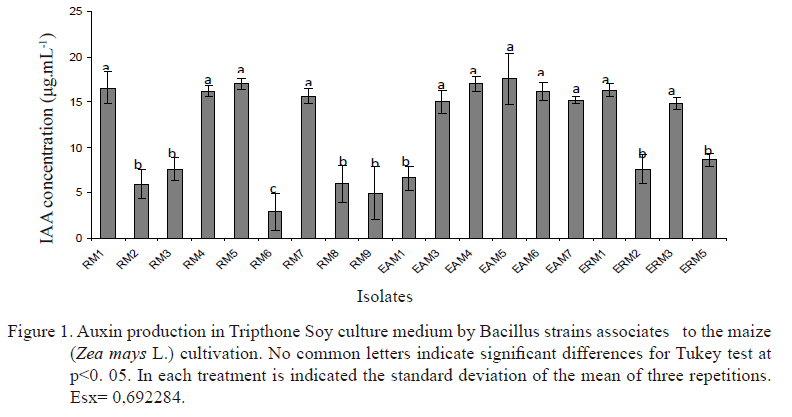
<body><![CDATA[<p align="justify" class="Cuerpodetexto" style="margin-top:12.0pt;text-indent:0cm;"><span style="font-family:'Verdana','sans-serif'; font-size:10.0pt; color:windowtext; ">From the isolates made in the  cultivation of maize (<em>Zea mays</em> L.) hybrid cultivar P-7928, there were  obtained nine isolates from the rhizosphere and ten endophytes. For the  selection of the members of this genus, was taken into account that the  bacteria grow after treatment at 80 &deg;C for 30 minutes, the response to the Gram  stain, the shape, the endospores presence, motility and catalase enzyme  activity, which all responded positively. Strains were named when consider the  area from they where isolated (R: rhizosphere, RE: root endophytes and EAP:  endophytes of the aerial part) and it was assigned a consecutive numbers for  each case.</span></p>     <p align="justify" class="Cuerpodetexto" style="margin-top:12.0pt;text-indent:0cm;"><span style="font-family:'Verdana','sans-serif'; font-size:10.0pt; color:windowtext; ">Fontes <em>et al.</em> (2009), in the  cultivation of Brazilian sweet corn, found more frequently the Bacillus genus  among endophytes bacteria. When performing a molecular analysis of the isolated  strains, concluded that the isolates found belonged to the species <em>Bacillus  subtilis</em>, <em>B. amyloliquefaciens</em>, <em>B. licheniformis, B. pumilus </em>and <em>B. cereus.</em></span></p>     <p align="justify" class="Cuerpodetexto" style="margin-top:12.0pt;text-indent:0cm;"><span style="font-family:'Verdana','sans-serif'; font-size:10.0pt; color:windowtext; ">In studies carried out in environments  of importance to agriculture, this genus has been also found between  rhizosphere microorganisms. The species <em>B. badius, B. macerans, B. subtilis,  B. licheniformis</em> are highlighted (Wu <em>et al.</em> 2006), which showed  potential in promoting plant growth. </span></p>     <p align="justify" class="Cuerpodetexto" style="margin-top:12.0pt;text-indent:0cm;"><span style="font-family:'Verdana','sans-serif'; font-size:10.0pt; color:windowtext; ">Hernandez <em>et al.</em> (2003) found  the Bacillus genus as one of the isolates when analyze the rhizosphere of  Francisco Mejorado&quot; cultivar in different types of soils in Cuba. This  genus had the highest percentage of appearance after Pseudomonas, Azospirillum  and Azotobacter.</span></p>     <p align="justify" class="Cuerpodetexto" style="margin-top:12.0pt;text-indent:0cm;"><span style="font-family:'Verdana','sans-serif'; font-size:10.0pt; color:windowtext; ">Among the plant growth promoting  hormones can be found auxins, gibberellins and cytokinins. Among the auxins, is  the indole-3-acetic acid (IAA), whose production is widely distributed among  plant growth promoting bacteria (PGPB) (Molina <em>et al.</em> 2015). It has been  shown that the beneficial effects of rhizosphere microorganisms are related to  auxins production, which may affect the initiation of lateral roots, their  growth or both development processes. This brings about increase of the  exploratory plant capacity and increases nutrient uptake (Ortiz <em>et al.</em> 2009).</span></p>     <p align="justify" class="Cuerpodetexto" style="margin-top:12.0pt;text-indent:0cm;"><span style="font-family:'Verdana','sans-serif'; font-size:10.0pt; color:windowtext; ">The 19 obtained  strains produced IAA in TS medium without addition of tryptophan, whose  concentrations are between 2.92 and 17.01 &mu;g.mL<sup>-1</sup> (<a href="/img/revistas/cjas/v50n3/f0116316.gif">Figure 1</a>). There  are no significant differences in IAA production between the isolates RM1, RM4,  RM5, RM7, EAM3, EAM4, EAM5, EAM6, EAM7, ERM1, ERM3, which are the highest  producers of this plant hormone.</span> </p>     
<p align="justify" class="Cuerpodetexto" style="margin-top:12.0pt;text-indent:0cm;"><span style="font-family:'Verdana','sans-serif'; font-size:10.0pt; color:windowtext; ">These results  agree from the quality and quantity point of view with those obtained by Swain <em>et  al.</em> (2007) and Yu <em>et al.</em> (2016). Swain <em>et al.</em> (2007) showed  that the inoculation of bacteria from this species to the yam plant (Dioscorea  rotundata L.) increased the length of the stem and roots, as well as their  fresh weight. This may be related to the production of such metabolite.</span><span style="font-family:'Verdana','sans-serif'; font-size:10.0pt; color:windowtext; "> </span></p>     <p align="justify" class="Cuerpodetexto" style="margin-top:12.0pt;text-indent:0cm;"><span style="font-family:'Verdana','sans-serif'; font-size:10.0pt; color:windowtext; ">Other authors showed the ability to  produce IAA for the genus in study, at concentrations higher than those  obtained, but with the use of tryptophan as an inducer in the culture medium  (Ali <em>et al.</em> 2009). It has also been shown that high concentrations of  auxins have opposite effect, that is to say, inhibit plant growth (Arshad and  Frankenberger 1997).</span></p>     <p align="justify" class="Cuerpodetexto" style="margin-top:12.0pt;text-indent:0cm;"><span style="font-family:'Verdana','sans-serif'; font-size:10.0pt; color:windowtext; ">If the results of the production of  IAA of isolates are compared with other microbial genera that produce this type  of metabolite, it is observed that are similar to those of <em>Rhizobium sp.</em> and <em>Azospirillum genera</em> (de Souza <em>et al.</em> 2013).</span></p>     <p align="justify" class="Cuerpodetexto" style="margin-top:12.0pt;text-indent:0cm;"><span style="font-family:'Verdana','sans-serif'; font-size:10.0pt; color:windowtext; ">The quantification of phosphate  solubilization at 48 h showed that strains RM1, RM2, RM5, EAM5, ERM1, ERM2 and  ERM5 there were not showed significant differences (<a href="/img/revistas/cjas/v50n3/f0216316.gif">figure 2</a>), being RM2 that  of&nbsp; the highest solubilization value. The  strains RM3 and RM9 were those of lower values. The strains that have high  concentrations of soluble phosphate in the culture medium could potentially act  as promoters of plant growth in soils with high levels of undissolved  phosphates.</span></p>     
]]></body>
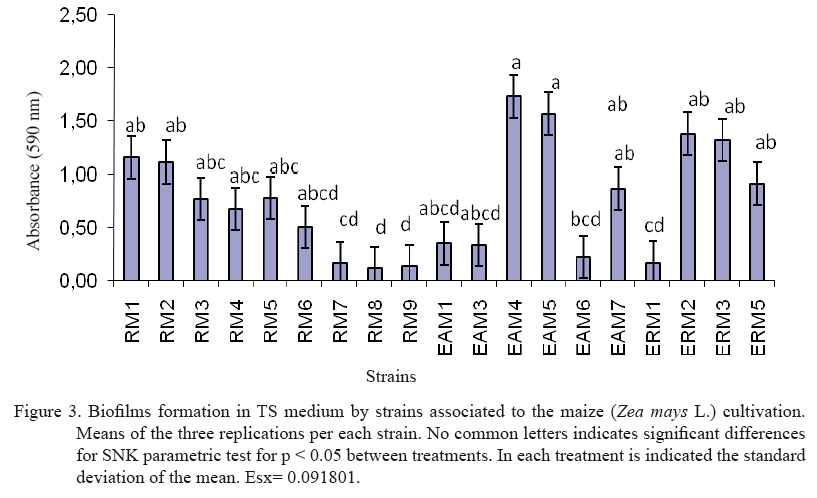
<body><![CDATA[<p align="justify" class="Cuerpodetexto" style="margin-top:12.0pt;text-indent:0cm;"><span style="font-family:'Verdana','sans-serif'; font-size:10.0pt; color:windowtext; ">One of the mechanisms by which  bacteria can contribute to plant growth is providing nutrients non normally  available to plants. Between these are the phosphates and PGPB, which can  perform the solubilization of them (Kumar <em>et al.</em> 2014). The values found  in the studied strains were similar to those obtained for members of this  bacterial genus, isolated from other crops (Mishra <em>et al.</em> 2015).</span></p>     <p align="justify" class="Cuerpodetexto" style="margin-top:12.0pt;text-indent:0cm;"><span style="font-family:'Verdana','sans-serif'; font-size:10.0pt; color:windowtext; ">In this study the nitro-fixer ability  of all isolates was qualitatively determined, when inoculated in semisolid  nitrogen-free medium for five successive sweeps, as there was growth in the  inoculation area in the semisolid nitrogen- free medium. Therefore, the  microorganism was growing at the expense of atmospheric    dinitrogen.</span></p>     <p align="justify" class="Cuerpodetexto" style="margin-top:12.0pt;text-indent:0cm;"><span style="font-family:'Verdana','sans-serif'; font-size:10.0pt; color:windowtext; ">This would mean great contribution in  the development of plant growth, since the dinitrogen is a limiting factor for  its limited availability in the cultivated soil, in addition to the use of  chemical fertilizers in large quantities it is an environmental danger (Bishnoi    2015).</span></p>     <p align="justify" class="Cuerpodetexto" style="margin-top:12.0pt;text-indent:0cm;"><span style="font-family:'Verdana','sans-serif'; font-size:10.0pt; color:windowtext; ">The microorganisms able to carry out  the biological nitrogen fixation are highly valued and used to increase the  yields of different crops. Acetobacter, Azospirillum, Azotobacter, Bacillus,  Enterobacter and Pseudomonas are among the microbial genera which have this  ability. Bacillus is one of the genuses that are reported as dinitrogen fixer.  It has been reported that the species Bacillus fusiformis shows high  nitrogenase activity, so it is used in promoting the growth of plants, such as  corn, wheat and rice (R&oacute;&#380;ycki <em>et al.</em> 1999). This characteristic is  interesting to use these strains in the subsequent development of a  biofertilizer.</span></p>     <p align="justify" class="Cuerpodetexto" style="margin-top:12.0pt;text-indent:0cm;"><span style="font-family:'Verdana','sans-serif'; font-size:10.0pt; color:windowtext; ">According to  Arruda <em>et al.</em> (2013), the selection of PGPB with multiple potentialities  for growth promotion suggests that they may have a better effect on plants at  the level of greenhouse and in the yields of corn crop in the field. However,  the physiological expression of bacteria under laboratory conditions does not  guarantee their growth promoting activity in association with the plant  (Fuentes and Caballero 2006). Therefore, it is essential to carry out studies  plant- PGPB interaction to check the benefits of this interaction.</span><span style="font-family:'Verdana','sans-serif'; font-size:10.0pt; color:windowtext; "> </span></p>     <p align="justify" class="Cuerpodetexto" style="margin-top:12.0pt;text-indent:0cm;"><span style="font-family:'Verdana','sans-serif'; font-size:10.0pt; color:windowtext; ">Biofilms are  defined as communities of microorganisms which growth embedded in an  exopolysaccharides matrix, adhering to an inert surface or a living tissue.  Biofilms growth is the standard way of bacteria growth in nature. The ability  of biofilms formation is not seemed to be restricted to any specific group of  microorganisms. It is considered that, in appropriate environmental conditions,  all microorganisms have the ability to form biofilms (Cairns <em>et al.</em> 2014).</span><span style="font-family:'Verdana','sans-serif'; font-size:10.0pt; color:windowtext; "> </span></p>     <p align="justify" class="Cuerpodetexto" style="margin-top:12.0pt;text-indent:0cm;"><span style="font-family:'Verdana','sans-serif'; font-size:10.0pt; color:windowtext; ">The ability to form biofilms on the  surface of the plant may be a competitive advantage. In this case, the ability  of biofilms to adhere to abiotic surfaces like polystyrene plates was studied,  which in vivo would allow a closer interaction of microorganisms with the  plant, keeping interacting longer.</span></p>     <p align="justify" class="Cuerpodetexto" style="margin-top:12.0pt;text-indent:0cm;"><span style="font-family:'Verdana','sans-serif'; font-size:10.0pt; color:windowtext; ">The isolates RM1, RM2, RM3, RM4, RM5,  RM6, EAM 1 EAM 3 EAM4, EAM5, EAM7, ERM2, ERM3 and ERM5 have not significant  differences and are the highest values (<a href="/img/revistas/cjas/v50n3/f0316316.gif">figure 3</a>). For RM8 and RM9, which did  not show significant differences, were the smaller values. The isolates RM7,  EAM6 and ERM1 showed differences from to the rest of the mentioned isolates,  with intermediate values between them. There are authors which delimit above  0.2 absorbance as a definition of biofilm-forming strains (Wakimoto <em>et al.</em> 2004).When considering this opinion, in this research 78.94 % of the strains  can be considered positive.</span></p>     
<p align="justify" class="Cuerpodetexto" style="margin-top:12.0pt;text-indent:0cm;"><span style="font-family:'Verdana','sans-serif'; font-size:10.0pt; color:windowtext; ">It has been shown that the Bacillus  genus is among the bacteria with ability to form biofilms which are used in  agro- ecosystems managements.</span></p>     <p align="justify" class="Cuerpodetexto" style="margin-top:12.0pt;text-indent:0cm;"><span style="font-family:'Verdana','sans-serif'; font-size:10.0pt; color:windowtext; ">Biofilms formation  is also important, because it reduces the risk of susceptibility of bacteria  that conform to adverse environmental conditions. It is also important because  it increases the access to resources and niches that require critical mass and  cannot be used effectively by isolated cells. The acquisition of new genetic  traits, nutrients availability and metabolic cooperation are also suggested as  a means that allowed optimizing the survival of the population in the biofilm  (Anderson and O'Toole 2008). Another advantage of biofilms is that they protect  the plant against pathogens and abiotic stress (Timmusk <em>et al.</em> 2009).</span><span style="font-family:'Verdana','sans-serif'; font-size:10.0pt; color:windowtext; "> </span></p>     ]]></body>
<body><![CDATA[<p align="justify" class="Cuerpodetexto" style="margin-top:12.0pt;text-indent:0cm;"><span style="font-family:'Verdana','sans-serif'; font-size:10.0pt; color:windowtext; ">Taking into  account the obtained results, microscopic observations of biofilms formed in  polystyrene plates by a high producing biofilm strain (EAM4) and a non-producer  (RM9) (<a href="/img/revistas/cjas/v50n3/f0416316.gif">figure 4</a>) were made. If it is compare with the control, there can be  seen a cluster of cells, in which these are inoculated (B and C), which is  different in both strains tested. In other bacteria, such as <em>Escherichia  coli</em>, they have been determined different adhesion patterns, even in  grouped strains as enterohemorrhagic (Wakimoto <em>et al.</em> 2004).</span><span style="font-family:'Verdana','sans-serif'; font-size:10.0pt; color:windowtext; "> </span></p>     
<p align="justify" class="Cuerpodetexto" style="margin-top:12.0pt;text-indent:0cm;"><span style="font-family:'Verdana','sans-serif'; font-size:10.0pt; color:windowtext; ">Bacterial  interactions, growth and biofilms formation on the surface of the root involve  complex mechanisms. The interaction between the roots and surrounding  microorganisms form a single self-regulating complex system (Beauregard <em>et  al.</em>    2013).</span><span style="font-family:'Verdana','sans-serif'; font-size:10.0pt; color:windowtext; "> </span></p>     <p align="justify" class="Cuerpodetexto" style="margin-top:12.0pt;text-indent:0cm;"><span style="font-family:'Verdana','sans-serif'; font-size:10.0pt; color:windowtext; ">Biofilms formation  is very beneficial for plants and to microorganisms associated with them,  therefore it is a characteristic to consider if it were to produce a  biofertilizer with the isolates obtained from this crop. Most of the  plant-bacterium associations involve the physical interaction between bacteria  and plant tissues. Direct observations of bacteria adhered to surfaces of  plants have revealed variables multi-cellular associations, described as  micro-colonies, aggregates and cell clusters (Beauregard <em>et al.</em> 2013).  These multi-cellular structures exhibit many of the attributes that define the  biofilms, groups of cells embedded in an exopolysaccharides matrix (EPS) on a  solid surface.</span><span style="font-family:'Verdana','sans-serif'; font-size:10.0pt; color:windowtext; "> </span></p>     <p align="justify" class="Cuerpodetexto" style="margin-top:12.0pt;text-indent:0cm;"><span style="font-family:'Verdana','sans-serif'; font-size:10.0pt; color:windowtext; ">In biocontrol  agents, as <em>Bacillus amyloliquefaciens </em>SQR9, is associated the regulation  of biofilms formation with the growth inhibition of <em>Fusarium oxysporum</em> in the cucumber rhizosphere (Xu <em>et al.</em> 2014).</span><span style="font-family:'Verdana','sans-serif'; font-size:10.0pt; color:windowtext; "> </span></p>     <p align="justify" class="Cuerpodetexto" style="margin-top:12.0pt;text-indent:0cm;"><span style="font-family:'Verdana','sans-serif'; font-size:10.0pt; color:windowtext; ">The exopolysaccharides production is  important in biofilms formation and also can contribute to the interaction of  bacteria with roots and root accessories (Bogino <em>et al.</em> 2013).</span></p>     <p align="justify" class="Cuerpodetexto" style="margin-top:12.0pt;text-indent:0cm;"><span style="font-family:'Verdana','sans-serif'; font-size:10.0pt; color:windowtext; ">Taking into  account the values obtained in the experiments, a cluster analysis was carried  out, which took as positive values the higher values of each of the capacities  (in this case IAA production and phosphates solubilization) and as negative,  the lowers. A cut at    20 % of the Euclidean distance (<a href="/img/revistas/cjas/v50n3/f0416316.gif">figure 4</a>) was performed.</span></p>     
<p align="justify" class="Cuerpodetexto" style="margin-top:12.0pt;text-indent:0cm;"><span style="font-family:'Verdana','sans-serif'; font-size:10.0pt; color:windowtext; ">Jointly with the positive value, a  group (I) was formed, in which RM1, EAM5, RM5 and ERM1 strains are included.  These are strains that have the highest values in all analyzed capacities, so  that may state that are the most promising for the promotion of crop growth. It  is valid to note that RM5 exactly coincide with the positive value, which might  suggest that it is the most promising.</span></p>     <p align="justify" class="Cuerpodetexto" style="margin-top:12.0pt;text-indent:0cm;"><span style="font-family:'Verdana','sans-serif'; font-size:10.0pt; color:windowtext; ">There are three groups with  intermediate values (II, III and IV). Group II includes EAM1 and RM8 strains.  In group III, they are RM2, RM9, RM3, ERM2 and ERM5 and in group IV are grouped  the strains RM4, EAM6, RM7, EAM3, EAM7, ERM3 and EAM4. In addition, a group (V)  is obtained where only RM6 strain and the negative value are joining.</span></p>     <p align="justify" class="Cuerpodetexto" style="margin-top:12.0pt;text-indent:0cm;"><span style="font-family:'Verdana','sans-serif'; font-size:10.0pt; color:windowtext; ">In this research 19 new Bacillus  isolates were obtained from maize cultivation, root endophytes and of the  aerial part, as rhizosphere. It was shown that all obtained strains have the  ability to produce auxins and grow in nitrogen-free media. Nine of them  solubilize phosphates, indicating their potential to promote plant growth.  Fifteen strains form biofilms, which you may confer advantages in the plant  colonization, important aspect for the future effectiveness of a bio-product.  The RM1, EAM5, RM5 and ERM1 strains are the most promising for promoting plant  growth in corn cultivation.</span></p>     <p align="justify" class="subtitulo" style="margin-top:12.0pt;text-align:justify;"><span style="font-family:'Verdana','sans-serif'; font-size:10.0pt; color:windowtext; ">&nbsp;</span></p>     ]]></body>
<body><![CDATA[<p align="justify" class="subtitulo" style="margin-top:12.0pt;text-align:justify;"><span style="font-family:'Verdana','sans-serif'; font-size:13.0pt; color:windowtext; "><b>ACKNOWLEDGMENTS</b> </span></p>     <div align="justify"><span style="line-height:107%; letter-spacing:.2pt; font-family:'Verdana','sans-serif'; font-size:10.0pt; ">We  thank to the Programa Nacional de Alimento Humano of CITMA in Cuba, to finance  part of this research. Also, to Daysi Lugo Moya for her technical support in  the development of experiments</span><span style="font-family:'Verdana','sans-serif'; font-size:10.0pt; color:windowtext; ">.</span> </div>     <p align="justify" class="Cuerpodetexto" style="margin-top:12.0pt;text-indent:0cm;"><span style="font-family:'Verdana','sans-serif'; font-size:10.0pt; color:windowtext; ">&nbsp;</span></p>     <p align="justify" class="subtitulo" style="margin-top:12.0pt;text-align:justify;"><span style="font-family:'Verdana','sans-serif'; font-size:13.0pt; color:windowtext; "><b>REFERENCES</b> </span></p>     <p align="justify" class="referencias" style="margin-top:12.0pt;margin-right:0cm;margin-bottom:.0001pt;margin-left:0cm;text-indent:0cm;"><span style="font-family:'Verdana','sans-serif'; font-size:10.0pt; color:windowtext; ">Ahemad,  M. &amp; Kibret, M. 2014. &ldquo;Mechanisms and applications of plant growth  promoting rhizobacteria: Current perspective&rdquo;. Journal of King Saud University  - Science, 26(1): 1&ndash;20, ISSN: 1018-3647, DOI: 10.1016/j.jksus.2013.05.001.</span></p>     <p align="justify" class="referencias" style="margin-top:12.0pt;margin-right:0cm;margin-bottom:.0001pt;margin-left:0cm;text-indent:0cm;"><span style="font-family:'Verdana','sans-serif'; font-size:10.0pt; color:windowtext; ">Ali, B.,  Sabri, A. N., Ljung, K. &amp; Hasnain, S. 2009. &ldquo;Quantification of  indole-3-acetic acid from plant associated <em>Bacillus spp</em>. and their phytostimulatory  effect on <em>Vigna radiata</em> (L.)&rdquo;. World Journal of Microbiology and  Biotechnology, 25(3): 519&ndash;526, ISSN: 0959-3993, 1573-0972, DOI:  10.1007/s11274-008-9918-9.</span></p>     <p align="justify" class="referencias" style="margin-top:12.0pt;margin-right:0cm;margin-bottom:.0001pt;margin-left:0cm;text-indent:0cm;"><span style="font-family:'Verdana','sans-serif'; font-size:10.0pt; color:windowtext; ">Anderson,  G. G. &amp; O&rsquo;Toole, G. A. 2008. &ldquo;Innate and Induced Resistance Mechanisms of Bacterial  Biofilms&rdquo;. In: Romeo, T. (ed.), Compans, R. W., Cooper, M. D., Honjo, T.,  Koprowski, H., Melchers, F., Oldstone, M. B. A., Olsnes, S. &amp; Vogt, P. K.  (ed. ser.), Bacterial Biofilms, vol. 322, Berlin, Heidelberg: Springer Berlin  Heidelberg, pp. 85&ndash;105, ISBN: 978-3-540-75417-6, Available:  &lt;<a href="http://link.springer.com/10.1007/978-3-540-75418-3_5" target="_blank">http://link.springer.com/10.1007/978-3-540-75418-3_5</a>&gt;, [Consulted:  September 6, 2016].</span></p>     <p align="justify" class="referencias" style="margin-top:12.0pt;margin-right:0cm;margin-bottom:.0001pt;margin-left:0cm;text-indent:0cm;"><span style="font-family:'Verdana','sans-serif'; font-size:10.0pt; color:windowtext; ">Arruda,  L., Beneduzi, A., Martins, A., Lisboa, B., Lopes, C., Bertolo, F., Passaglia,  L. M. P. &amp; Vargas, L. K. 2013. &ldquo;Screening of rhizobacteria isolated from  maize (<em>Zea mays</em> L.) in Rio Grande do Sul State (South Brazil) and  analysis of their potential to improve plant growth&rdquo;. Applied Soil Ecology, 63:  15&ndash;22, ISSN: 0929<sup>-1</sup>393, DOI: 10.1016/j.apsoil.2012.09.001.</span></p>     <p align="justify" class="referencias" style="margin-top:12.0pt;margin-right:0cm;margin-bottom:.0001pt;margin-left:0cm;text-indent:0cm;"><span style="font-family:'Verdana','sans-serif'; font-size:10.0pt; color:windowtext; ">Arshad,  M. &amp; Frankenberger, W. T. 1997. &ldquo;Plant Growth-Regulating Substances in the  Rhizosphere: Microbial Production and Functions&rdquo;. In: Advances in Agronomy,  vol. 62, Elsevier, pp. 45&ndash;151, ISBN: 978-0<sup>-1</sup>2-000762-2, Available:  &lt;<a href="http://linkinghub.elsevier.com/retrieve/pii/S0065211308605672" target="_blank">http://linkinghub.elsevier.com/retrieve/pii/S0065211308605672</a>&gt;,  [Consulted: September 6, 2016].</span></p>     <p align="justify" class="referencias" style="margin-top:12.0pt;margin-right:0cm;margin-bottom:.0001pt;margin-left:0cm;text-indent:0cm;"><span style="font-family:'Verdana','sans-serif'; font-size:10.0pt; color:windowtext; ">Beauregard,  P. B., Chai, Y., Vlamakis, H., Losick, R. &amp; Kolter, R. 2013. &ldquo;<em>Bacillus  subtilis</em> biofilm induction by plant polysaccharides&rdquo;. Proceedings of the  National Academy of Sciences, 110(17): 1621&ndash;1630, ISSN: 0027-8424, 1091-6490,  DOI: 10.1073/pnas.1218984110.</span></p>     ]]></body>
<body><![CDATA[<p align="justify" class="referencias" style="margin-top:12.0pt;margin-right:0cm;margin-bottom:.0001pt;margin-left:0cm;text-indent:0cm;"><span style="font-family:'Verdana','sans-serif'; font-size:10.0pt; color:windowtext; ">Bishnoi,  U. 2015. &ldquo;PGPR Interaction: An Ecofriendly Approach Promoting the Sustainable  Agriculture System&rdquo;. In: Advances in Botanical Research, vol. 75, Elsevier, pp.  81&ndash;113, ISBN: 978-0-12-420116-3, Available:  &lt;<a href="http://linkinghub.elsevier.com/retrieve/pii/S0065229615000671" target="_blank">http://linkinghub.elsevier.com/retrieve/pii/S0065229615000671</a>&gt;,  [Consulted: September 6, 2016].</span></p>     <p align="justify" class="referencias" style="margin-top:12.0pt;margin-right:0cm;margin-bottom:.0001pt;margin-left:0cm;text-indent:0cm;"><span style="font-family:'Verdana','sans-serif'; font-size:10.0pt; color:windowtext; ">Bogino, P., Oliva, M., Sorroche, F. &amp; Giordano, W. 2013. </span><span style="font-family:'Verdana','sans-serif'; font-size:10.0pt; color:windowtext; ">&ldquo;The  Role of Bacterial Biofilms and Surface Components in Plant-Bacterial  Associations&rdquo;. International Journal of Molecular Sciences, 14(8): 15838&ndash;15859,  ISSN: 1422-0067, DOI: 10.3390/ijms140815838.</span></p>     <p align="justify" class="referencias" style="margin-top:12.0pt;margin-right:0cm;margin-bottom:.0001pt;margin-left:0cm;text-indent:0cm;"><span style="font-family:'Verdana','sans-serif'; font-size:10.0pt; color:windowtext; ">Cairns,  L. S., Hobley, L. &amp; Stanley-Wall, N. R. 2014. &ldquo;Biofilm formation by <em>Bacillus  subtilis</em>: new insights into regulatory strategies and assembly mechanisms&rdquo;.  Molecular Microbiology, 93(4): 587&ndash;598, ISSN: 0950-382X, DOI:  10.1111/mmi.12697.</span></p>     <p align="justify" class="referencias" style="margin-top:12.0pt;margin-right:0cm;margin-bottom:.0001pt;margin-left:0cm;text-indent:0cm;"><span style="font-family:'Verdana','sans-serif'; font-size:10.0pt; color:windowtext; ">Claus,  D. &amp; Berkeley, R. C. W. 1986. &ldquo;Genus Bacillus Cohn 1872&rdquo;. In: Bergey, D.  H., Sneath, P. H. A. &amp; Holt, J. G. (eds.), Bergey&rsquo;s manual of systematic  bacteriology, Baltimore: Williams &amp; Wilkins, pp. 1105&ndash;1139, OCLC: 15105585.</span></p>     <p align="justify" class="referencias" style="margin-top:12.0pt;margin-right:0cm;margin-bottom:.0001pt;margin-left:0cm;text-indent:0cm;"><span style="font-family:'Verdana','sans-serif'; font-size:10.0pt; color:windowtext; ">de Araujo, F. F., Souza, E. C., Guerreiro, R. T., Guaberto, L. M. &amp; de  Ara&uacute;jo, A. S. F. 2011. </span><span style="font-family:'Verdana','sans-serif'; font-size:10.0pt; color:windowtext; ">&ldquo;Diversity and growth-promoting activities of Bacillus sp. in  maize&rdquo;. Revista Caatinga, 25(1): 1&ndash;7, ISSN: 1983-2125.</span></p>     <p align="justify" class="referencias" style="margin-top:12.0pt;margin-right:0cm;margin-bottom:.0001pt;margin-left:0cm;text-indent:0cm;"><span style="font-family:'Verdana','sans-serif'; font-size:10.0pt; color:windowtext; ">de  Souza, R., Beneduzi, A., Ambrosini, A., Beschoren,&nbsp; da C. P., Meyer, J., Vargas, L. K.,  Schoenfeld, R. &amp; Passaglia, L. M. P. 2013. &ldquo;The effect of plant  growth-promoting rhizobacteria on the growth of rice (<em>Oryza sativa</em> L.)  cropped in southern Brazilian fields&rdquo;. Plant and Soil, 366(1&ndash;2): 585&ndash;603, ISSN:  0032-079X, 1573-5036, DOI: 10.1007/s11104-012-1430-1.</span></p>     <p align="justify" class="referencias" style="margin-top:12.0pt;margin-right:0cm;margin-bottom:.0001pt;margin-left:0cm;text-indent:0cm;"><span style="font-family:'Verdana','sans-serif'; font-size:10.0pt; color:windowtext; ">Fontes,  F. J. E., Gomes, E. A., Teixeira, G. C., Gomes,&nbsp;  de P. L. U., Teixeira, M. A., Corr&ecirc;a, L. G. V. &amp; Bressan, W. 2009.  &ldquo;Molecular analysis of endophytic bacteria from the genus Bacillus isolated  from tropical maize (<em>Zea mays</em> L.)&rdquo;. Brazilian Journal of Microbiology,  40(3): 522&ndash;534, ISSN: 1517-8382, DOI: 10.1590/S1517-83822009000300014.</span></p>     <p align="justify" class="referencias" style="margin-top:12.0pt;margin-right:0cm;margin-bottom:.0001pt;margin-left:0cm;text-indent:0cm;"><span style="font-family:'Verdana','sans-serif'; font-size:10.0pt; color:windowtext; ">Fuentes,  R. L. E. &amp; Caballero, M. J. 2006. &ldquo;Bacterial Biofertilizers&rdquo;. In: Siddiqui,  Z. A. (ed.), PGPR: Biocontrol and Biofertilization, Berlin, Heidelberg:  Springer-Verlag, pp. 143&ndash;172, ISBN: 978-1-4020-4002-3, Available:  &lt;<a href="http://link.springer.com/10.1007/1-4020-4152-7_5" target="_blank">http://link.springer.com/10.1007/1-4020-4152-7_5</a>&gt;, [Consulted: September  6, 2016].</span></p>     <p align="justify" class="referencias" style="margin-top:12.0pt;margin-right:0cm;margin-bottom:.0001pt;margin-left:0cm;text-indent:0cm;"><span style="font-family:'Verdana','sans-serif'; font-size:10.0pt; color:windowtext; ">Glick,  B. R. 2014. &ldquo;Bacteria with ACC deaminase can promote plant growth and help to  feed the world&rdquo;. Microbiological Research, 169(1): 30&ndash;39, ISSN: 0944-5013, DOI:  10.1016/j.micres.2013.09.009.</span></p>     <p align="justify" class="referencias" style="margin-top:12.0pt;margin-right:0cm;margin-bottom:.0001pt;margin-left:0cm;text-indent:0cm;"><span style="font-family:'Verdana','sans-serif'; font-size:10.0pt; color:windowtext; ">Glickmann,  E. &amp; Dessaux, Y. 1995. &ldquo;A critical examination of the specificity of the  salkowski reagent for indolic compounds produced by phytopathogenic bacteria&rdquo;.  Applied and Environmental Microbiology, 61(2): 793&ndash;796, ISSN: 0099-2240,  1098-5336, PMID: 16534942.</span></p>     ]]></body>
<body><![CDATA[<p align="justify" class="referencias" style="margin-top:12.0pt;margin-right:0cm;margin-bottom:.0001pt;margin-left:0cm;text-indent:0cm;"><span style="font-family:'Verdana','sans-serif'; font-size:10.0pt; color:windowtext; ">Gupta,  G., Parihar, S. S., Ahirwar, N. K., Snehi, S. K. &amp; Singh, V. 2015. &ldquo;Plant  Growth Promoting Rhizobacteria (PGPR): Current and Future Prospects for  Development of Sustainable Agriculture&rdquo;. Journal of Microbial &amp; Biochemical  Technology, 7(2): 96&ndash;102, ISSN: 1948-5948, DOI: 10.4172/1948-5948.1000188.</span></p>     <p align="justify" class="referencias" style="margin-top:12.0pt;margin-right:0cm;margin-bottom:.0001pt;margin-left:0cm;text-indent:0cm;"><span style="font-family:'Verdana','sans-serif'; font-size:10.0pt; color:windowtext; ">Hern&aacute;ndez,  A., Caballero, A., Pazos, M., Ramirez, R. &amp; Heydrich, M. 2003. </span><span style="font-family:'Verdana','sans-serif'; font-size:10.0pt; color:windowtext; ">&ldquo;Identificaci&oacute;n de algunos g&eacute;neros microbianos asociados al cultivo del  ma&iacute;z (<em>Zea mays</em> L.) en diferentes suelos de Cuba&rdquo;. Revista Colombiana de  Biotecnolog&iacute;a, 5(1): 45&ndash;55, ISSN: 0123-3475.</span></p>     <!-- ref --><p align="justify" class="referencias" style="margin-top:12.0pt;margin-right:0cm;margin-bottom:.0001pt;margin-left:0cm;text-indent:0cm;"><span style="font-family:'Verdana','sans-serif'; font-size:10.0pt; color:windowtext; ">Hern&aacute;ndez, J. A., P&eacute;rez, J. J. M., Bosch, I. D. &amp; Castro, S. N. 2015.  Clasificaci&oacute;n de los suelos de Cuba 2015. Mayabeque, Cuba: Ediciones INCA, 93  p., ISBN: 978-959-7023-77-7.    </span></p>     <p align="justify" class="referencias" style="margin-top:12.0pt;margin-right:0cm;margin-bottom:.0001pt;margin-left:0cm;text-indent:0cm;"><span style="font-family:'Verdana','sans-serif'; font-size:10.0pt; color:windowtext; ">Hsueh,  Y. H., Somers, E. B., Lereclus, D. &amp; Wong, A. C. L. 2006. &ldquo;Biofilm  Formation by <em>Bacillus cereus</em> Is Influenced by PlcR, a Pleiotropic  Regulator&rdquo;. Applied and Environmental Microbiology, 72(7): 5089&ndash;5092, ISSN:  0099-2240, DOI: 10.1128/AEM.00573-06.</span></p>     <!-- ref --><p align="justify" class="referencias" style="margin-top:12.0pt;margin-right:0cm;margin-bottom:.0001pt;margin-left:0cm;text-indent:0cm;"><span style="font-family:'Verdana','sans-serif'; font-size:10.0pt; color:windowtext; ">Jorgensen,  J. H. 1993. Performance standards for antimicrobial disk susceptibility tests.  5th ed., vol. 23, Villanova, PA: National Committee for Clinical Laboratory  Standards, 32 p., ISBN: 978<sup>-1</sup>-56238-208-7, no. 24, OCLC: 31137295.    </span></p>     <p align="justify" class="referencias" style="margin-top:12.0pt;margin-right:0cm;margin-bottom:.0001pt;margin-left:0cm;text-indent:0cm;"><span style="font-family:'Verdana','sans-serif'; font-size:10.0pt; color:windowtext; ">Kumar,  A., Choudhary, C. S., Paswan, D., Kumar, B. &amp; Arun, A. 2014. &ldquo;Sustainable  way for enhancing phosphorus efficiency in agricultural soils through phosphate  solubilizing microbes&rdquo;. An Asian Journal of Soil Science, 9(2): 300&ndash;310, ISSN:  0973-4775, 0976-7231, DOI: 10.15740/HAS/AJSS/9.2/300-310.</span></p>     <p align="justify" class="referencias" style="margin-top:12.0pt;margin-right:0cm;margin-bottom:.0001pt;margin-left:0cm;text-indent:0cm;"><span style="font-family:'Verdana','sans-serif'; font-size:10.0pt; color:windowtext; ">Kundsen,  D. &amp; Beegle, D. 1988. &ldquo;Recommended phosphorous tests&rdquo;. In: Dahnke, W. C.  (ed.), Recommended chemical soil test procedures for the North Central Region,  (ser. North central regional publication, no. ser. 21), Fargo, ND: ND  Agricultural Experiment Station, North Dakota State University, pp. 12&ndash;15,  OCLC: 20293486.</span></p>     <p align="justify" class="referencias" style="margin-top:12.0pt;margin-right:0cm;margin-bottom:.0001pt;margin-left:0cm;text-indent:0cm;"><span style="font-family:'Verdana','sans-serif'; font-size:10.0pt; color:windowtext; ">L&oacute;pez, N., Chicco, C. F. &amp; Godoy, S. 2003. &ldquo;Valor nutritivo del afrecho  y germen desgrasado de ma&iacute;z en la alimentaci&oacute;n de cerdos&rdquo;. Zootecnia Tropical,  21(3): 219&ndash;236, ISSN: 0798-7269.</span></p>     ]]></body>
<body><![CDATA[<p align="justify" class="referencias" style="margin-top:12.0pt;margin-right:0cm;margin-bottom:.0001pt;margin-left:0cm;text-indent:0cm;"><span style="font-family:'Verdana','sans-serif'; font-size:10.0pt; color:windowtext; ">Maresca, S., Santini, F. J. &amp; Elizalde, J. C. 2002. &ldquo;Comportamiento  productivo de terneras alimentadas a corral con grano de ma&iacute;z entero y  partido&rdquo;. Revista Argentina de Producci&oacute;n Animal, 22(supl. 1): 163&ndash;168, ISSN:  0326-0550, 2314-324X.</span></p>     <p align="justify" class="referencias" style="margin-top:12.0pt;margin-right:0cm;margin-bottom:.0001pt;margin-left:0cm;text-indent:0cm;"><span style="font-family:'Verdana','sans-serif'; font-size:10.0pt; color:windowtext; ">Mishra, B. K., Singh, B., Singh, P., Rathore, S. S., Aishwath, O. P., Kant,  K. &amp; Dubey, P. N. 2015. </span><span style="font-family:'Verdana','sans-serif'; font-size:10.0pt; color:windowtext; ">&ldquo;Isolation and evaluation of phosphate solubilizing  microorganisms from fennel (<em>Foeniculum vulgare</em> Mill.) rhizospheric soils  of Rajasthan&rdquo;. International Journal of Seed Spices, 5(1): 71&ndash;75, ISSN:  0019-5022.</span></p>     <p align="justify" class="referencias" style="margin-top:12.0pt;margin-right:0cm;margin-bottom:.0001pt;margin-left:0cm;text-indent:0cm;"><span style="font-family:'Verdana','sans-serif'; font-size:10.0pt; color:windowtext; ">Molina,  R. D., Bustillos, C. M. del R., Rodr&iacute;guez, A. O., Morales, G. Y. E., Santiago,  S. Y., Casta&ntilde;eda, L. M. &amp; Mu&ntilde;oz, R. J. 2015. </span><span style="font-family:'Verdana','sans-serif'; font-size:10.0pt; color:windowtext; ">&ldquo;Mecanismos de  fitoestimulaci&oacute;n por rizobacterias, aislamientos en Am&eacute;rica y potencial  biotecnol&oacute;gico&rdquo;. </span><span style="font-family:'Verdana','sans-serif'; font-size:10.0pt; color:windowtext; ">Biol&oacute;gicas, 17(2): 24&ndash;34, ISSN: 2007-705X.</span></p>     <p align="justify" class="referencias" style="margin-top:12.0pt;margin-right:0cm;margin-bottom:.0001pt;margin-left:0cm;text-indent:0cm;"><span style="font-family:'Verdana','sans-serif'; font-size:10.0pt; color:windowtext; ">Nautiyal,  C. S. 1999. &ldquo;An efficient microbiological growth medium for screening phosphate  solubilizing microorganisms&rdquo;. FEMS Microbiology Letters, 170(1): 265&ndash;270, ISSN:  0378-1097, 1574-6968, DOI: 10.1111/j.1574-6968.1999.tb13383.x.</span></p>     <p align="justify" class="referencias" style="margin-top:12.0pt;margin-right:0cm;margin-bottom:.0001pt;margin-left:0cm;text-indent:0cm;"><span style="font-family:'Verdana','sans-serif'; font-size:10.0pt; color:windowtext; ">Ort&iacute;z,  C. R., Contreras, C. H. A., Mac&iacute;as, R. L. &amp; L&oacute;pez, B. J. 2009. &ldquo;The role of  microbial signals in plant growth and development&rdquo;. Plant Signaling &amp;  Behavior, 4(8): 701&ndash;712, ISSN: 1559-2324, DOI: 10.4161/psb.4.8.9047.</span></p>     <!-- ref --><p align="justify" class="referencias" style="margin-top:12.0pt;margin-right:0cm;margin-bottom:.0001pt;margin-left:0cm;text-indent:0cm;"><span style="font-family:'Verdana','sans-serif'; font-size:10.0pt; color:windowtext; ">Paliwal,  B. L., Granados, G., Laffite, H. R. &amp; Violic, A. D. 2001. </span><span style="font-family:'Verdana','sans-serif'; font-size:10.0pt; color:windowtext; ">El Ma&iacute;z en los tr&oacute;picos: mejoramiento y producci&oacute;n. Roma, Italia: FAO, 394  p., ISBN: 978-92-5-304457-3, Google-Books-ID: os79dx6BcmsC, Available:  &lt;<a href="https://books.google.com.cu/books?hl=es&lr=&id=os79dx6BcmsC&oi=fnd&pg=PA345&dq=El+ma%C3%ADz+en+los+tr%C3%B3picos:+Mejoramiento+y+producci%C3%B3&ots=OZWCPhKU1d&sig=n10zNncC6XJL9gIif4ayiPnJyO0&redir_esc=y#v=onepage&q=El%20ma%C3%ADz%20en%20los%20tr%C3%B3picos%3A%20Mejoramiento%20y%20producci%C3%B3&f=false" target="_blank">https://books.google.com.cu/books?hl=es&amp;lr=&amp;id=os79dx6BcmsC&amp;oi=fnd&amp;pg=PA345&amp;dq=El+ma%C3%ADz+en+los+tr%C3%B3picos:+Mejoramiento+y+producci%C3%B3&amp;ots=OZWCPhKU1d&amp;sig=n10zNncC6XJL9gIif4ayiPnJyO0&amp;redir_esc=y#v=onepage&amp;q=El%20ma%C3%ADz%20en%20los%20tr%C3%B3picos%3A%20Mejoramiento%20y%20producci%C3%B3&amp;f=false</a>&gt;,  [Consulted: September 6, 2016].    </span></p>     <p align="justify" class="referencias" style="margin-top:12.0pt;margin-right:0cm;margin-bottom:.0001pt;margin-left:0cm;text-indent:0cm;"><span style="font-family:'Verdana','sans-serif'; font-size:10.0pt; color:windowtext; ">R&oacute;&#380;ycki, H., Dahm, H., Strzelczyk, E. &amp; Li, C. Y. 1999. </span><span style="font-family:'Verdana','sans-serif'; font-size:10.0pt; color:windowtext; ">&ldquo;Diazotrophic  bacteria in root-free soil and in the root zone of pine (<em>Pinus sylvestris</em> L.) and oak (<em>Quercus robur</em> L.)&rdquo;. Applied Soil Ecology, 12(3): 239&ndash;250,  ISSN: 0929-1393, DOI: 10.1016/S0929-1393(99)00008-6.</span></p>     <p align="justify" class="referencias" style="margin-top:12.0pt;margin-right:0cm;margin-bottom:.0001pt;margin-left:0cm;text-indent:0cm;"><span style="font-family:'Verdana','sans-serif'; font-size:10.0pt; color:windowtext; ">Saharan,  B. S. &amp; Nehra, V. 2011. &ldquo;Plant growth promoting rhizobacteria: a critical  review&rdquo;. Life Sciences and Medicine Research, 21: 1&ndash;30, ISSN: 1948-7886.</span></p>     <p align="justify" class="referencias" style="margin-top:12.0pt;margin-right:0cm;margin-bottom:.0001pt;margin-left:0cm;text-indent:0cm;"><span style="font-family:'Verdana','sans-serif'; font-size:10.0pt; color:windowtext; ">Sigarroa,  A. 1985. Biometr&iacute;a y dise&ntilde;o experimental. Ministerio de Educaci&oacute;n Superior, 734  p., OCLC: 633780253, Available:  &lt;<a href="https://books.google.com.cu/books/about/Biometr%C3%ADa_y_dise%C3%B1o_experimental.html?id=cUbvXwAACAAJ&redir_esc=y" target="_blank">https://books.google.com.cu/books/about/Biometr%C3%ADa_y_dise%C3%B1o_experimental.html?id=cUbvXwAACAAJ&amp;redir_esc=y</a>&gt;,  [Consulted: September 6, 2016].</span></p>     ]]></body>
<body><![CDATA[<!-- ref --><p align="justify" class="referencias" style="margin-top:12.0pt;margin-right:0cm;margin-bottom:.0001pt;margin-left:0cm;text-indent:0cm;"><span style="font-family:'Verdana','sans-serif'; font-size:10.0pt; color:windowtext; ">StatSoft  2007. STATISTICA (data analysis software system). version 8.0, [Windows], US:  StatSoft, Inc., Available: &lt;<a href="http://www.statsoft.com" target="_blank">http://www.statsoft.com</a>&gt;    .</span></p>     <p align="justify" class="referencias" style="margin-top:12.0pt;margin-right:0cm;margin-bottom:.0001pt;margin-left:0cm;text-indent:0cm;"><span style="font-family:'Verdana','sans-serif'; font-size:10.0pt; color:windowtext; ">Swain,  M. R., Naskar, S. K. &amp; Ray, R. C. 2007. &ldquo;Indole-3-acetic acid production  and effect on sprouting of yam (<em>Dioscorea rotundata</em> L.) minisetts by <em>Bacillus  subtilis</em> isolated from culturable cowdung microflora&rdquo;. Polish Journal of  Microbiology, 56(2): 103&ndash;110, ISSN: 1733<sup>-1</sup>331.</span></p>     <p align="justify" class="referencias" style="margin-top:12.0pt;margin-right:0cm;margin-bottom:.0001pt;margin-left:0cm;text-indent:0cm;"><span style="font-family:'Verdana','sans-serif'; font-size:10.0pt; color:windowtext; ">Timmusk,  S., van West, P., Gow, N. A. R. &amp; Paul Huffstutler, R. 2009. &ldquo;<em>Paenibacillus  polymyxa</em> antagonizes oomycete plant pathogens <em>Phytophthora palmivora </em>and<em> Pythium aphanidermatum</em>&rdquo;. Journal of Applied Microbiology, 106(5):  1473&ndash;1481, ISSN: 1364-5072, 1365-2672, DOI: 10.1111/j.1365-2672.2009.04123.x.</span></p>     <p align="justify" class="referencias" style="margin-top:12.0pt;margin-right:0cm;margin-bottom:.0001pt;margin-left:0cm;text-indent:0cm;"><span style="font-family:'Verdana','sans-serif'; font-size:10.0pt; color:windowtext; ">Wakimoto, N., Nishi, J., Sheikh, J., Nataro, J. P., Sarantuya, J.,  Iwashita, M., Manago, K., Tokuda, K., Yoshinaga, M. &amp; Kawano, Y. 2004. </span><span style="font-family:'Verdana','sans-serif'; font-size:10.0pt; color:windowtext; ">&ldquo;Quantitative  biofilm assay using a microtiter plate to screen for enteroaggregative <em>Escherichia  coli</em>&rdquo;. The American Journal of Tropical Medicine and Hygiene, 71(5):  687&ndash;690, ISSN: 0002-9637, PMID: 15569806.</span></p>     <p align="justify" class="referencias" style="margin-top:12.0pt;margin-right:0cm;margin-bottom:.0001pt;margin-left:0cm;text-indent:0cm;"><span style="font-family:'Verdana','sans-serif'; font-size:10.0pt; color:windowtext; ">Wu, X.  Y., Walker, M. J., Hornitzky, M. &amp; Chin, J. 2006. &ldquo;Development of a  group-specific PCR combined with ARDRA for the identification of Bacillus  species of environmental significance&rdquo;. Journal of Microbiological Methods,  64(1): 107&ndash;119, ISSN: 0167-7012, DOI: 10.1016/j.mimet.2005.04.021.</span></p>     <p align="justify" class="referencias" style="margin-top:12.0pt;margin-right:0cm;margin-bottom:.0001pt;margin-left:0cm;text-indent:0cm;"><span style="font-family:'Verdana','sans-serif'; font-size:10.0pt; color:windowtext; ">Xu, Z.,  Zhang, R., Wang, D., Qiu, M., Feng, H., Zhang, N. &amp; Shen, Q. 2014.  &ldquo;Enhanced Control of Cucumber Wilt Disease by <em>Bacillus amyloliquefaciens </em>SQR9  by Altering the Regulation of Its DegU Phosphorylation&rdquo;. Applied and  Environmental Microbiology, 80(9): 2941&ndash;2950, ISSN: 0099-2240, DOI:  10.1128/AEM.03943<sup>-1</sup>3.</span></p>     <p align="justify" class="referencias" style="margin-top:12.0pt;margin-right:0cm;margin-bottom:.0001pt;margin-left:0cm;text-indent:0cm;"><span style="line-height:107%; font-family:'Verdana','sans-serif'; font-size:10.0pt; ">Yu, J., Yu, Z. H., Fan, G.  Q., Wang, G. H. &amp; Liu, X. B. 2016. &ldquo;Isolation and Characterization of  Indole Acetic Acid Producing Root Endophytic Bacteria and Their Potential for  Promoting Crop Growth&rdquo;. Journal of Agricultural Science and Technology, 18:  1381&ndash;1391, ISSN: 1680-7073</span><font size="2" face="Verdana, Arial, Helvetica, sans-serif">.</font></p>     <p align="justify">&nbsp;</p>     <p align="justify">&nbsp;</p>     ]]></body>
<body><![CDATA[<p align="justify"><font size="2" face="Verdana, Arial, Helvetica, sans-serif">Received: 06/07/2016    <br> Accepted: 05/09/2016</font></p>     <p align="justify">&nbsp;</p>     <p align="justify">&nbsp;</p>     <p align="justify"><font size="2" face="Verdana, Arial, Helvetica, sans-serif"><i>Marcia M. Rojas,</i> Departamento de Microbiología y Virología, Facultad de Biología, Universidad de La Habana, Cuba  Calle 25  #455 e/ J e I Vedado CP 10400, La Habana, Cuba.    Email: <a href="mailto:marcia@fbio.u.cu">marcia@fbio.u.cu</a></font></p>      ]]></body><back>
<ref-list>
<ref id="B1">
<nlm-citation citation-type="journal">
<person-group person-group-type="author">
<name>
<surname><![CDATA[Ahemad]]></surname>
<given-names><![CDATA[M.]]></given-names>
</name>
<name>
<surname><![CDATA[Kibret]]></surname>
<given-names><![CDATA[M.]]></given-names>
</name>
</person-group>
<article-title xml:lang="nd"><![CDATA[Mechanisms and applications of plant growth promoting rhizobacteria: Current perspective]]></article-title>
<source><![CDATA[Journal of King Saud University - Science]]></source>
<year>2014</year>
<volume>26</volume>
<numero>1</numero>
<issue>1</issue>
<page-range>1–20</page-range></nlm-citation>
</ref>
<ref id="B2">
<nlm-citation citation-type="journal">
<person-group person-group-type="author">
<name>
<surname><![CDATA[Ali]]></surname>
<given-names><![CDATA[B.]]></given-names>
</name>
<name>
<surname><![CDATA[Sabri]]></surname>
<given-names><![CDATA[A. N.]]></given-names>
</name>
<name>
<surname><![CDATA[Ljung]]></surname>
<given-names><![CDATA[K.]]></given-names>
</name>
<name>
<surname><![CDATA[Hasnain]]></surname>
<given-names><![CDATA[S.]]></given-names>
</name>
</person-group>
<article-title xml:lang="nd"><![CDATA[Quantification of indole-3-acetic acid from plant associated Bacillus spp. and their phytostimulatory effect on Vigna radiata (L.)]]></article-title>
<source><![CDATA[World Journal of Microbiology and Biotechnology]]></source>
<year>2009</year>
<volume>25</volume>
<numero>3</numero>
<issue>3</issue>
<page-range>519–526</page-range></nlm-citation>
</ref>
<ref id="B3">
<nlm-citation citation-type="book">
<person-group person-group-type="author">
<name>
<surname><![CDATA[Anderson]]></surname>
<given-names><![CDATA[G. G.]]></given-names>
</name>
<name>
<surname><![CDATA[O’Toole]]></surname>
<given-names><![CDATA[G. A.]]></given-names>
</name>
</person-group>
<article-title xml:lang="nd"><![CDATA[Innate and Induced Resistance Mechanisms of Bacterial Biofilms]]></article-title>
<person-group person-group-type="editor">
<name>
<surname><![CDATA[Romeo]]></surname>
<given-names><![CDATA[T.]]></given-names>
</name>
</person-group>
<source><![CDATA[Bacterial Biofilms]]></source>
<year>2008</year>
<volume>322</volume>
<page-range>85–105</page-range><publisher-loc><![CDATA[Berlin, Heidelberg ]]></publisher-loc>
<publisher-name><![CDATA[Springer Berlin Heidelberg]]></publisher-name>
</nlm-citation>
</ref>
<ref id="B4">
<nlm-citation citation-type="journal">
<person-group person-group-type="author">
<name>
<surname><![CDATA[Arruda]]></surname>
<given-names><![CDATA[L.]]></given-names>
</name>
<name>
<surname><![CDATA[Beneduzi]]></surname>
<given-names><![CDATA[A.]]></given-names>
</name>
<name>
<surname><![CDATA[Martins]]></surname>
<given-names><![CDATA[A.]]></given-names>
</name>
<name>
<surname><![CDATA[Lisboa]]></surname>
<given-names><![CDATA[B.]]></given-names>
</name>
<name>
<surname><![CDATA[Lopes]]></surname>
<given-names><![CDATA[C.]]></given-names>
</name>
<name>
<surname><![CDATA[Bertolo]]></surname>
<given-names><![CDATA[F.]]></given-names>
</name>
<name>
<surname><![CDATA[Passaglia]]></surname>
<given-names><![CDATA[L. M. P.]]></given-names>
</name>
<name>
<surname><![CDATA[Vargas]]></surname>
<given-names><![CDATA[L. K.]]></given-names>
</name>
</person-group>
<article-title xml:lang="nd"><![CDATA[Screening of rhizobacteria isolated from maize (Zea mays L.) in Rio Grande do Sul State (South Brazil) and analysis of their potential to improve plant growth]]></article-title>
<source><![CDATA[Applied Soil Ecology]]></source>
<year>2013</year>
<volume>63</volume>
<page-range>15–22</page-range></nlm-citation>
</ref>
<ref id="B5">
<nlm-citation citation-type="book">
<person-group person-group-type="author">
<name>
<surname><![CDATA[Arshad]]></surname>
<given-names><![CDATA[M.]]></given-names>
</name>
<name>
<surname><![CDATA[Frankenberger]]></surname>
<given-names><![CDATA[W. T.]]></given-names>
</name>
</person-group>
<article-title xml:lang="nd"><![CDATA[Plant Growth-Regulating Substances in the Rhizosphere: Microbial Production and Functions]]></article-title>
<source><![CDATA[Advances in Agronomy]]></source>
<year>1997</year>
<volume>62</volume>
<page-range>45–151</page-range><publisher-name><![CDATA[Elsevier]]></publisher-name>
</nlm-citation>
</ref>
<ref id="B6">
<nlm-citation citation-type="journal">
<person-group person-group-type="author">
<name>
<surname><![CDATA[Beauregard]]></surname>
<given-names><![CDATA[P. B.]]></given-names>
</name>
<name>
<surname><![CDATA[Chai]]></surname>
<given-names><![CDATA[Y.]]></given-names>
</name>
<name>
<surname><![CDATA[Vlamakis]]></surname>
<given-names><![CDATA[H.]]></given-names>
</name>
<name>
<surname><![CDATA[Losick]]></surname>
<given-names><![CDATA[R.]]></given-names>
</name>
<name>
<surname><![CDATA[Kolter]]></surname>
<given-names><![CDATA[R.]]></given-names>
</name>
</person-group>
<article-title xml:lang="nd"><![CDATA[Bacillus subtilis biofilm induction by plant polysaccharides]]></article-title>
<source><![CDATA[Proceedings of the National Academy of Sciences]]></source>
<year>2013</year>
<volume>110</volume>
<numero>17</numero>
<issue>17</issue>
<page-range>1621–1630</page-range></nlm-citation>
</ref>
<ref id="B7">
<nlm-citation citation-type="book">
<person-group person-group-type="author">
<name>
<surname><![CDATA[Bishnoi]]></surname>
<given-names><![CDATA[U.]]></given-names>
</name>
</person-group>
<article-title xml:lang="nd"><![CDATA[PGPR Interaction: An Ecofriendly Approach Promoting the Sustainable Agriculture System]]></article-title>
<source><![CDATA[Advances in Botanical Research]]></source>
<year>2015</year>
<volume>75</volume>
<page-range>81–113</page-range><publisher-name><![CDATA[Elsevier]]></publisher-name>
</nlm-citation>
</ref>
<ref id="B8">
<nlm-citation citation-type="journal">
<person-group person-group-type="author">
<name>
<surname><![CDATA[Bogino]]></surname>
<given-names><![CDATA[P.]]></given-names>
</name>
<name>
<surname><![CDATA[Oliva]]></surname>
<given-names><![CDATA[M.]]></given-names>
</name>
<name>
<surname><![CDATA[Sorroche]]></surname>
<given-names><![CDATA[F.]]></given-names>
</name>
<name>
<surname><![CDATA[Giordano]]></surname>
<given-names><![CDATA[W.]]></given-names>
</name>
</person-group>
<article-title xml:lang="nd"><![CDATA[The Role of Bacterial Biofilms and Surface Components in Plant-Bacterial Associations]]></article-title>
<source><![CDATA[International Journal of Molecular Sciences]]></source>
<year>2013</year>
<volume>14</volume>
<numero>8</numero>
<issue>8</issue>
<page-range>15838–15859</page-range></nlm-citation>
</ref>
<ref id="B9">
<nlm-citation citation-type="journal">
<person-group person-group-type="author">
<name>
<surname><![CDATA[Cairns]]></surname>
<given-names><![CDATA[L. S.]]></given-names>
</name>
<name>
<surname><![CDATA[Hobley]]></surname>
<given-names><![CDATA[L.]]></given-names>
</name>
<name>
<surname><![CDATA[Stanley-Wall]]></surname>
<given-names><![CDATA[N. R.]]></given-names>
</name>
</person-group>
<article-title xml:lang="nd"><![CDATA[Biofilm formation by Bacillus subtilis: new insights into regulatory strategies and assembly mechanisms]]></article-title>
<source><![CDATA[Molecular Microbiology]]></source>
<year>2014</year>
<volume>93</volume>
<numero>4</numero>
<issue>4</issue>
<page-range>587–598</page-range></nlm-citation>
</ref>
<ref id="B10">
<nlm-citation citation-type="book">
<person-group person-group-type="author">
<name>
<surname><![CDATA[Claus]]></surname>
<given-names><![CDATA[D.]]></given-names>
</name>
<name>
<surname><![CDATA[Berkeley]]></surname>
<given-names><![CDATA[R. C. W.]]></given-names>
</name>
</person-group>
<article-title xml:lang="nd"><![CDATA[Genus Bacillus Cohn 1872]]></article-title>
<person-group person-group-type="editor">
<name>
<surname><![CDATA[Bergey]]></surname>
<given-names><![CDATA[D. H.]]></given-names>
</name>
<name>
<surname><![CDATA[Sneath]]></surname>
<given-names><![CDATA[P. H. A.]]></given-names>
</name>
<name>
<surname><![CDATA[Holt]]></surname>
<given-names><![CDATA[J. G.]]></given-names>
</name>
</person-group>
<source><![CDATA[Bergey’s manual of systematic bacteriology]]></source>
<year>1986</year>
<page-range>1105–1139</page-range><publisher-loc><![CDATA[Baltimore ]]></publisher-loc>
<publisher-name><![CDATA[Williams & Wilkins]]></publisher-name>
</nlm-citation>
</ref>
<ref id="B11">
<nlm-citation citation-type="journal">
<person-group person-group-type="author">
<name>
<surname><![CDATA[de Araujo]]></surname>
<given-names><![CDATA[F. F.]]></given-names>
</name>
<name>
<surname><![CDATA[Souza]]></surname>
<given-names><![CDATA[E. C.]]></given-names>
</name>
<name>
<surname><![CDATA[Guerreiro]]></surname>
<given-names><![CDATA[R. T.]]></given-names>
</name>
<name>
<surname><![CDATA[Guaberto]]></surname>
<given-names><![CDATA[L. M.]]></given-names>
</name>
<name>
<surname><![CDATA[de Araújo]]></surname>
<given-names><![CDATA[A. S. F.]]></given-names>
</name>
</person-group>
<article-title xml:lang="nd"><![CDATA[Diversity and growth-promoting activities of Bacillus sp. in maize]]></article-title>
<source><![CDATA[Revista Caatinga]]></source>
<year>2011</year>
<volume>25</volume>
<numero>1</numero>
<issue>1</issue>
<page-range>1–7</page-range></nlm-citation>
</ref>
<ref id="B12">
<nlm-citation citation-type="journal">
<person-group person-group-type="author">
<name>
<surname><![CDATA[de Souza]]></surname>
<given-names><![CDATA[R.]]></given-names>
</name>
<name>
<surname><![CDATA[Beneduzi]]></surname>
<given-names><![CDATA[A.]]></given-names>
</name>
<name>
<surname><![CDATA[Ambrosini]]></surname>
<given-names><![CDATA[A.]]></given-names>
</name>
<name>
<surname><![CDATA[Beschoren]]></surname>
<given-names><![CDATA[da C. P.]]></given-names>
</name>
<name>
<surname><![CDATA[Meyer]]></surname>
<given-names><![CDATA[J.]]></given-names>
</name>
<name>
<surname><![CDATA[Vargas]]></surname>
<given-names><![CDATA[L. K.]]></given-names>
</name>
<name>
<surname><![CDATA[Schoenfeld]]></surname>
<given-names><![CDATA[R.]]></given-names>
</name>
<name>
<surname><![CDATA[Passaglia]]></surname>
<given-names><![CDATA[L. M. P.]]></given-names>
</name>
</person-group>
<article-title xml:lang="nd"><![CDATA[The effect of plant growth-promoting rhizobacteria on the growth of rice (Oryza sativa L.) cropped in southern Brazilian fields]]></article-title>
<source><![CDATA[Plant and Soil]]></source>
<year>2013</year>
<volume>366</volume>
<numero>1–2</numero>
<issue>1–2</issue>
<page-range>585–603</page-range></nlm-citation>
</ref>
<ref id="B13">
<nlm-citation citation-type="journal">
<person-group person-group-type="author">
<name>
<surname><![CDATA[Fontes]]></surname>
<given-names><![CDATA[F. J. E.]]></given-names>
</name>
<name>
<surname><![CDATA[Gomes]]></surname>
<given-names><![CDATA[E. A.]]></given-names>
</name>
<name>
<surname><![CDATA[Teixeira]]></surname>
<given-names><![CDATA[G. C.]]></given-names>
</name>
<name>
<surname><![CDATA[Gomes]]></surname>
<given-names><![CDATA[de P. L. U.]]></given-names>
</name>
<name>
<surname><![CDATA[Teixeira]]></surname>
<given-names><![CDATA[M. A.]]></given-names>
</name>
<name>
<surname><![CDATA[Corrêa]]></surname>
<given-names><![CDATA[L. G. V.]]></given-names>
</name>
<name>
<surname><![CDATA[Bressan]]></surname>
<given-names><![CDATA[W.]]></given-names>
</name>
</person-group>
<article-title xml:lang="nd"><![CDATA[Molecular analysis of endophytic bacteria from the genus Bacillus isolated from tropical maize (Zea mays L.)]]></article-title>
<source><![CDATA[Brazilian Journal of Microbiology]]></source>
<year>2009</year>
<volume>40</volume>
<numero>3</numero>
<issue>3</issue>
<page-range>522–534</page-range></nlm-citation>
</ref>
<ref id="B14">
<nlm-citation citation-type="book">
<person-group person-group-type="author">
<name>
<surname><![CDATA[Fuentes]]></surname>
<given-names><![CDATA[R. L. E.]]></given-names>
</name>
<name>
<surname><![CDATA[Caballero]]></surname>
<given-names><![CDATA[M. J.]]></given-names>
</name>
</person-group>
<article-title xml:lang="nd"><![CDATA[Bacterial Biofertilizers]]></article-title>
<person-group person-group-type="editor">
<name>
<surname><![CDATA[Siddiqui]]></surname>
<given-names><![CDATA[Z. A.]]></given-names>
</name>
</person-group>
<source><![CDATA[PGPR: Biocontrol and Biofertilization]]></source>
<year>2006</year>
<page-range>143–172</page-range><publisher-loc><![CDATA[Berlin, Heidelberg ]]></publisher-loc>
<publisher-name><![CDATA[Springer-Verlag]]></publisher-name>
</nlm-citation>
</ref>
<ref id="B15">
<nlm-citation citation-type="journal">
<person-group person-group-type="author">
<name>
<surname><![CDATA[Glick]]></surname>
<given-names><![CDATA[B. R.]]></given-names>
</name>
</person-group>
<article-title xml:lang="nd"><![CDATA[Bacteria with ACC deaminase can promote plant growth and help to feed the world]]></article-title>
<source><![CDATA[Microbiological Research]]></source>
<year>2014</year>
<volume>169</volume>
<numero>1</numero>
<issue>1</issue>
<page-range>30–39</page-range></nlm-citation>
</ref>
<ref id="B16">
<nlm-citation citation-type="journal">
<person-group person-group-type="author">
<name>
<surname><![CDATA[Glickmann]]></surname>
<given-names><![CDATA[E.]]></given-names>
</name>
<name>
<surname><![CDATA[Dessaux]]></surname>
<given-names><![CDATA[Y.]]></given-names>
</name>
</person-group>
<article-title xml:lang="nd"><![CDATA[A critical examination of the specificity of the salkowski reagent for indolic compounds produced by phytopathogenic bacteria]]></article-title>
<source><![CDATA[Applied and Environmental Microbiology]]></source>
<year>1995</year>
<volume>61</volume>
<numero>2</numero>
<issue>2</issue>
<page-range>793–796</page-range></nlm-citation>
</ref>
<ref id="B17">
<nlm-citation citation-type="journal">
<person-group person-group-type="author">
<name>
<surname><![CDATA[Gupta]]></surname>
<given-names><![CDATA[G.]]></given-names>
</name>
<name>
<surname><![CDATA[Parihar]]></surname>
<given-names><![CDATA[S. S.]]></given-names>
</name>
<name>
<surname><![CDATA[Ahirwar]]></surname>
<given-names><![CDATA[N. K.]]></given-names>
</name>
<name>
<surname><![CDATA[Snehi]]></surname>
<given-names><![CDATA[S. K.]]></given-names>
</name>
<name>
<surname><![CDATA[Singh]]></surname>
<given-names><![CDATA[V.]]></given-names>
</name>
</person-group>
<article-title xml:lang="nd"><![CDATA[Plant Growth Promoting Rhizobacteria (PGPR): Current and Future Prospects for Development of Sustainable Agriculture]]></article-title>
<source><![CDATA[Journal of Microbial & Biochemical Technology]]></source>
<year>2015</year>
<volume>7</volume>
<numero>2</numero>
<issue>2</issue>
<page-range>96–102</page-range></nlm-citation>
</ref>
<ref id="B18">
<nlm-citation citation-type="journal">
<person-group person-group-type="author">
<name>
<surname><![CDATA[Hernández]]></surname>
<given-names><![CDATA[A.]]></given-names>
</name>
<name>
<surname><![CDATA[Caballero]]></surname>
<given-names><![CDATA[A.]]></given-names>
</name>
<name>
<surname><![CDATA[Pazos]]></surname>
<given-names><![CDATA[M.]]></given-names>
</name>
<name>
<surname><![CDATA[Ramirez]]></surname>
<given-names><![CDATA[R.]]></given-names>
</name>
<name>
<surname><![CDATA[Heydrich]]></surname>
<given-names><![CDATA[M.]]></given-names>
</name>
</person-group>
<article-title xml:lang="nd"><![CDATA[Identificación de algunos géneros microbianos asociados al cultivo del maíz (Zea mays L.) en diferentes suelos de Cuba]]></article-title>
<source><![CDATA[Revista Colombiana de Biotecnología]]></source>
<year>2003</year>
<volume>5</volume>
<numero>1</numero>
<issue>1</issue>
<page-range>45–55</page-range></nlm-citation>
</ref>
<ref id="B19">
<nlm-citation citation-type="book">
<person-group person-group-type="author">
<name>
<surname><![CDATA[Hernández]]></surname>
<given-names><![CDATA[J. A.]]></given-names>
</name>
<name>
<surname><![CDATA[Pérez]]></surname>
<given-names><![CDATA[J. J. M.]]></given-names>
</name>
<name>
<surname><![CDATA[Bosch]]></surname>
<given-names><![CDATA[I. D.]]></given-names>
</name>
<name>
<surname><![CDATA[Castro]]></surname>
<given-names><![CDATA[S. N.]]></given-names>
</name>
</person-group>
<source><![CDATA[Clasificación de los suelos de Cuba 2015]]></source>
<year>2015</year>
<page-range>93</page-range><publisher-loc><![CDATA[Mayabeque, Cuba ]]></publisher-loc>
<publisher-name><![CDATA[Ediciones INCA]]></publisher-name>
</nlm-citation>
</ref>
<ref id="B20">
<nlm-citation citation-type="journal">
<person-group person-group-type="author">
<name>
<surname><![CDATA[Hsueh]]></surname>
<given-names><![CDATA[Y. H.]]></given-names>
</name>
<name>
<surname><![CDATA[Somers]]></surname>
<given-names><![CDATA[E. B.]]></given-names>
</name>
<name>
<surname><![CDATA[Lereclus]]></surname>
<given-names><![CDATA[D.]]></given-names>
</name>
<name>
<surname><![CDATA[Wong]]></surname>
<given-names><![CDATA[A. C. L.]]></given-names>
</name>
</person-group>
<article-title xml:lang="nd"><![CDATA[Biofilm Formation by Bacillus cereus Is Influenced by PlcR, a Pleiotropic Regulator]]></article-title>
<source><![CDATA[Applied and Environmental Microbiology]]></source>
<year>2006</year>
<volume>72</volume>
<numero>7</numero>
<issue>7</issue>
<page-range>5089–5092</page-range></nlm-citation>
</ref>
<ref id="B21">
<nlm-citation citation-type="book">
<person-group person-group-type="author">
<name>
<surname><![CDATA[Jorgensen]]></surname>
<given-names><![CDATA[J. H.]]></given-names>
</name>
</person-group>
<source><![CDATA[Performance standards for antimicrobial disk susceptibility tests]]></source>
<year>1993</year>
<volume>23</volume>
<edition>5th</edition>
<page-range>32</page-range><publisher-loc><![CDATA[Villanova, PA ]]></publisher-loc>
<publisher-name><![CDATA[National Committee for Clinical Laboratory Standards]]></publisher-name>
</nlm-citation>
</ref>
<ref id="B22">
<nlm-citation citation-type="journal">
<person-group person-group-type="author">
<name>
<surname><![CDATA[Kumar]]></surname>
<given-names><![CDATA[A.]]></given-names>
</name>
<name>
<surname><![CDATA[Choudhary]]></surname>
<given-names><![CDATA[C. S.]]></given-names>
</name>
<name>
<surname><![CDATA[Paswan]]></surname>
<given-names><![CDATA[D.]]></given-names>
</name>
<name>
<surname><![CDATA[Kumar]]></surname>
<given-names><![CDATA[B.]]></given-names>
</name>
<name>
<surname><![CDATA[Arun]]></surname>
<given-names><![CDATA[A.]]></given-names>
</name>
</person-group>
<article-title xml:lang="nd"><![CDATA[Sustainable way for enhancing phosphorus efficiency in agricultural soils through phosphate solubilizing microbes]]></article-title>
<source><![CDATA[An Asian Journal of Soil Science]]></source>
<year>2014</year>
<volume>9</volume>
<numero>2</numero>
<issue>2</issue>
<page-range>300–310</page-range></nlm-citation>
</ref>
<ref id="B23">
<nlm-citation citation-type="book">
<person-group person-group-type="author">
<name>
<surname><![CDATA[Kundsen]]></surname>
<given-names><![CDATA[D.]]></given-names>
</name>
<name>
<surname><![CDATA[Beegle]]></surname>
<given-names><![CDATA[D.]]></given-names>
</name>
</person-group>
<article-title xml:lang="nd"><![CDATA[Recommended phosphorous tests]]></article-title>
<person-group person-group-type="editor">
<name>
<surname><![CDATA[Dahnke]]></surname>
<given-names><![CDATA[W. C.]]></given-names>
</name>
</person-group>
<source><![CDATA[Recommended chemical soil test procedures for the North Central Region]]></source>
<year>1988</year>
<page-range>12–15</page-range><publisher-loc><![CDATA[Fargo, ND ]]></publisher-loc>
<publisher-name><![CDATA[ND Agricultural Experiment Station, North Dakota State University]]></publisher-name>
</nlm-citation>
</ref>
<ref id="B24">
<nlm-citation citation-type="journal">
<person-group person-group-type="author">
<name>
<surname><![CDATA[López]]></surname>
<given-names><![CDATA[N.]]></given-names>
</name>
<name>
<surname><![CDATA[Chicco]]></surname>
<given-names><![CDATA[C. F.]]></given-names>
</name>
<name>
<surname><![CDATA[Godoy]]></surname>
<given-names><![CDATA[S.]]></given-names>
</name>
</person-group>
<article-title xml:lang="nd"><![CDATA[Valor nutritivo del afrecho y germen desgrasado de maíz en la alimentación de cerdos]]></article-title>
<source><![CDATA[Zootecnia Tropical]]></source>
<year>2003</year>
<volume>21</volume>
<numero>3</numero>
<issue>3</issue>
<page-range>219–236</page-range></nlm-citation>
</ref>
<ref id="B25">
<nlm-citation citation-type="journal">
<person-group person-group-type="author">
<name>
<surname><![CDATA[Maresca]]></surname>
<given-names><![CDATA[S.]]></given-names>
</name>
<name>
<surname><![CDATA[Santini]]></surname>
<given-names><![CDATA[F. J.]]></given-names>
</name>
<name>
<surname><![CDATA[Elizalde]]></surname>
<given-names><![CDATA[J. C.]]></given-names>
</name>
</person-group>
<article-title xml:lang="nd"><![CDATA[Comportamiento productivo de terneras alimentadas a corral con grano de maíz entero y partido]]></article-title>
<source><![CDATA[Revista Argentina de Producción Animal]]></source>
<year>2002</year>
<volume>22</volume>
<numero>supl. 1</numero>
<issue>supl. 1</issue>
<page-range>163–168</page-range></nlm-citation>
</ref>
<ref id="B26">
<nlm-citation citation-type="journal">
<person-group person-group-type="author">
<name>
<surname><![CDATA[Mishra]]></surname>
<given-names><![CDATA[B. K.]]></given-names>
</name>
<name>
<surname><![CDATA[Singh]]></surname>
<given-names><![CDATA[B.]]></given-names>
</name>
<name>
<surname><![CDATA[Singh]]></surname>
<given-names><![CDATA[P.]]></given-names>
</name>
<name>
<surname><![CDATA[Rathore]]></surname>
<given-names><![CDATA[S. S.]]></given-names>
</name>
<name>
<surname><![CDATA[Aishwath]]></surname>
<given-names><![CDATA[O. P.]]></given-names>
</name>
<name>
<surname><![CDATA[Kant]]></surname>
<given-names><![CDATA[K.]]></given-names>
</name>
<name>
<surname><![CDATA[Dubey]]></surname>
<given-names><![CDATA[P. N.]]></given-names>
</name>
</person-group>
<article-title xml:lang="nd"><![CDATA[Isolation and evaluation of phosphate solubilizing microorganisms from fennel (Foeniculum vulgare Mill.) rhizospheric soils of Rajasthan]]></article-title>
<source><![CDATA[International Journal of Seed Spices]]></source>
<year>2015</year>
<volume>5</volume>
<numero>1</numero>
<issue>1</issue>
<page-range>71–75</page-range></nlm-citation>
</ref>
<ref id="B27">
<nlm-citation citation-type="journal">
<person-group person-group-type="author">
<name>
<surname><![CDATA[Molina]]></surname>
<given-names><![CDATA[R. D.]]></given-names>
</name>
<name>
<surname><![CDATA[Bustillos]]></surname>
<given-names><![CDATA[C. M. del R.]]></given-names>
</name>
<name>
<surname><![CDATA[Rodríguez]]></surname>
<given-names><![CDATA[A. O.]]></given-names>
</name>
<name>
<surname><![CDATA[Morales]]></surname>
<given-names><![CDATA[G. Y. E.]]></given-names>
</name>
<name>
<surname><![CDATA[Santiago]]></surname>
<given-names><![CDATA[S. Y.]]></given-names>
</name>
<name>
<surname><![CDATA[Castañeda]]></surname>
<given-names><![CDATA[L. M.]]></given-names>
</name>
<name>
<surname><![CDATA[Muñoz]]></surname>
<given-names><![CDATA[R. J.]]></given-names>
</name>
</person-group>
<article-title xml:lang="nd"><![CDATA[Mecanismos de fitoestimulación por rizobacterias, aislamientos en América y potencial biotecnológico]]></article-title>
<source><![CDATA[Biológicas]]></source>
<year>2015</year>
<volume>17</volume>
<numero>2</numero>
<issue>2</issue>
<page-range>24–34</page-range></nlm-citation>
</ref>
<ref id="B28">
<nlm-citation citation-type="journal">
<person-group person-group-type="author">
<name>
<surname><![CDATA[Nautiyal]]></surname>
<given-names><![CDATA[C. S.]]></given-names>
</name>
</person-group>
<article-title xml:lang="nd"><![CDATA[An efficient microbiological growth medium for screening phosphate solubilizing microorganisms]]></article-title>
<source><![CDATA[FEMS Microbiology Letters]]></source>
<year>1999</year>
<volume>170</volume>
<numero>1</numero>
<issue>1</issue>
<page-range>265–270</page-range></nlm-citation>
</ref>
<ref id="B29">
<nlm-citation citation-type="journal">
<person-group person-group-type="author">
<name>
<surname><![CDATA[Ortíz]]></surname>
<given-names><![CDATA[C. R.]]></given-names>
</name>
<name>
<surname><![CDATA[Contreras]]></surname>
<given-names><![CDATA[C. H. A.]]></given-names>
</name>
<name>
<surname><![CDATA[Macías]]></surname>
<given-names><![CDATA[R. L.]]></given-names>
</name>
<name>
<surname><![CDATA[López]]></surname>
<given-names><![CDATA[B. J.]]></given-names>
</name>
</person-group>
<article-title xml:lang="nd"><![CDATA[The role of microbial signals in plant growth and development]]></article-title>
<source><![CDATA[Plant Signaling & Behavior]]></source>
<year>2009</year>
<volume>4</volume>
<numero>8</numero>
<issue>8</issue>
<page-range>701–712</page-range></nlm-citation>
</ref>
<ref id="B30">
<nlm-citation citation-type="book">
<person-group person-group-type="author">
<name>
<surname><![CDATA[Paliwal]]></surname>
<given-names><![CDATA[B. L.]]></given-names>
</name>
<name>
<surname><![CDATA[Granados]]></surname>
<given-names><![CDATA[G.]]></given-names>
</name>
<name>
<surname><![CDATA[Laffite]]></surname>
<given-names><![CDATA[H. R.]]></given-names>
</name>
<name>
<surname><![CDATA[Violic]]></surname>
<given-names><![CDATA[A. D.]]></given-names>
</name>
</person-group>
<source><![CDATA[El Maíz en los trópicos: mejoramiento y producción]]></source>
<year>2001</year>
<page-range>394</page-range><publisher-loc><![CDATA[Roma, Italia ]]></publisher-loc>
<publisher-name><![CDATA[FAO]]></publisher-name>
</nlm-citation>
</ref>
<ref id="B31">
<nlm-citation citation-type="journal">
<person-group person-group-type="author">
<name>
<surname><![CDATA[Rózycki]]></surname>
<given-names><![CDATA[H.]]></given-names>
</name>
<name>
<surname><![CDATA[Dahm]]></surname>
<given-names><![CDATA[H.]]></given-names>
</name>
<name>
<surname><![CDATA[Strzelczyk]]></surname>
<given-names><![CDATA[E.]]></given-names>
</name>
<name>
<surname><![CDATA[Li]]></surname>
<given-names><![CDATA[C. Y.]]></given-names>
</name>
</person-group>
<article-title xml:lang="nd"><![CDATA[Diazotrophic bacteria in root-free soil and in the root zone of pine (Pinus sylvestris L.) and oak (Quercus robur L.)]]></article-title>
<source><![CDATA[Applied Soil Ecology]]></source>
<year>1999</year>
<volume>12</volume>
<numero>3</numero>
<issue>3</issue>
<page-range>239–250</page-range></nlm-citation>
</ref>
<ref id="B32">
<nlm-citation citation-type="journal">
<person-group person-group-type="author">
<name>
<surname><![CDATA[Saharan]]></surname>
<given-names><![CDATA[B. S.]]></given-names>
</name>
<name>
<surname><![CDATA[Nehra]]></surname>
<given-names><![CDATA[V.]]></given-names>
</name>
</person-group>
<article-title xml:lang="nd"><![CDATA[Plant growth promoting rhizobacteria: a critical review]]></article-title>
<source><![CDATA[Life Sciences and Medicine Research]]></source>
<year>2011</year>
<volume>21</volume>
<page-range>1–30</page-range></nlm-citation>
</ref>
<ref id="B33">
<nlm-citation citation-type="book">
<person-group person-group-type="author">
<name>
<surname><![CDATA[Sigarroa]]></surname>
<given-names><![CDATA[A.]]></given-names>
</name>
</person-group>
<source><![CDATA[Biometría y diseño experimental]]></source>
<year>1985</year>
<page-range>734</page-range><publisher-name><![CDATA[Ministerio de Educación Superior]]></publisher-name>
</nlm-citation>
</ref>
<ref id="B34">
<nlm-citation citation-type="journal">
<person-group person-group-type="author">
<name>
<surname><![CDATA[Swain]]></surname>
<given-names><![CDATA[M. R.]]></given-names>
</name>
<name>
<surname><![CDATA[Naskar]]></surname>
<given-names><![CDATA[S. K.]]></given-names>
</name>
<name>
<surname><![CDATA[Ray]]></surname>
<given-names><![CDATA[R. C.]]></given-names>
</name>
</person-group>
<article-title xml:lang="nd"><![CDATA[Indole-3-acetic acid production and effect on sprouting of yam (Dioscorea rotundata L.) minisetts by Bacillus subtilis isolated from culturable cowdung microflora]]></article-title>
<source><![CDATA[Polish Journal of Microbiology]]></source>
<year>2007</year>
<volume>56</volume>
<numero>2</numero>
<issue>2</issue>
<page-range>103–110</page-range></nlm-citation>
</ref>
<ref id="B35">
<nlm-citation citation-type="journal">
<person-group person-group-type="author">
<name>
<surname><![CDATA[Timmusk]]></surname>
<given-names><![CDATA[S.]]></given-names>
</name>
<name>
<surname><![CDATA[van West]]></surname>
<given-names><![CDATA[P.]]></given-names>
</name>
<name>
<surname><![CDATA[Gow]]></surname>
<given-names><![CDATA[N. A. R.]]></given-names>
</name>
<name>
<surname><![CDATA[Paul Huffstutler]]></surname>
<given-names><![CDATA[R.]]></given-names>
</name>
</person-group>
<article-title xml:lang="nd"><![CDATA[Paenibacillus polymyxa antagonizes oomycete plant pathogens Phytophthora palmivora and Pythium aphanidermatum]]></article-title>
<source><![CDATA[Journal of Applied Microbiology]]></source>
<year>2009</year>
<volume>106</volume>
<numero>5</numero>
<issue>5</issue>
<page-range>1473–1481</page-range></nlm-citation>
</ref>
<ref id="B36">
<nlm-citation citation-type="journal">
<person-group person-group-type="author">
<name>
<surname><![CDATA[Wakimoto]]></surname>
<given-names><![CDATA[N.]]></given-names>
</name>
<name>
<surname><![CDATA[Nishi]]></surname>
<given-names><![CDATA[J.]]></given-names>
</name>
<name>
<surname><![CDATA[Sheikh]]></surname>
<given-names><![CDATA[J.]]></given-names>
</name>
<name>
<surname><![CDATA[Nataro]]></surname>
<given-names><![CDATA[J. P.]]></given-names>
</name>
<name>
<surname><![CDATA[Sarantuya]]></surname>
<given-names><![CDATA[J.]]></given-names>
</name>
<name>
<surname><![CDATA[Iwashita]]></surname>
<given-names><![CDATA[M.]]></given-names>
</name>
<name>
<surname><![CDATA[Manago]]></surname>
<given-names><![CDATA[K.]]></given-names>
</name>
<name>
<surname><![CDATA[Tokuda]]></surname>
<given-names><![CDATA[K.]]></given-names>
</name>
<name>
<surname><![CDATA[Yoshinaga]]></surname>
<given-names><![CDATA[M.]]></given-names>
</name>
<name>
<surname><![CDATA[Kawano]]></surname>
<given-names><![CDATA[Y.]]></given-names>
</name>
</person-group>
<article-title xml:lang="nd"><![CDATA[Quantitative biofilm assay using a microtiter plate to screen for enteroaggregative Escherichia coli]]></article-title>
<source><![CDATA[The American Journal of Tropical Medicine and Hygiene]]></source>
<year>2004</year>
<volume>71</volume>
<numero>5</numero>
<issue>5</issue>
<page-range>687–690</page-range></nlm-citation>
</ref>
<ref id="B37">
<nlm-citation citation-type="journal">
<person-group person-group-type="author">
<name>
<surname><![CDATA[Wu]]></surname>
<given-names><![CDATA[X. Y.]]></given-names>
</name>
<name>
<surname><![CDATA[Walker]]></surname>
<given-names><![CDATA[M. J.]]></given-names>
</name>
<name>
<surname><![CDATA[Hornitzky]]></surname>
<given-names><![CDATA[M.]]></given-names>
</name>
<name>
<surname><![CDATA[Chin]]></surname>
<given-names><![CDATA[J.]]></given-names>
</name>
</person-group>
<article-title xml:lang="nd"><![CDATA[Development of a group-specific PCR combined with ARDRA for the identification of Bacillus species of environmental significance]]></article-title>
<source><![CDATA[Journal of Microbiological Methods]]></source>
<year>2006</year>
<volume>64</volume>
<numero>1</numero>
<issue>1</issue>
<page-range>107–119</page-range></nlm-citation>
</ref>
<ref id="B38">
<nlm-citation citation-type="journal">
<person-group person-group-type="author">
<name>
<surname><![CDATA[Xu]]></surname>
<given-names><![CDATA[Z.]]></given-names>
</name>
<name>
<surname><![CDATA[Zhang]]></surname>
<given-names><![CDATA[R.]]></given-names>
</name>
<name>
<surname><![CDATA[Wang]]></surname>
<given-names><![CDATA[D.]]></given-names>
</name>
<name>
<surname><![CDATA[Qiu]]></surname>
<given-names><![CDATA[M.]]></given-names>
</name>
<name>
<surname><![CDATA[Feng]]></surname>
<given-names><![CDATA[H.]]></given-names>
</name>
<name>
<surname><![CDATA[Zhang]]></surname>
<given-names><![CDATA[N.]]></given-names>
</name>
<name>
<surname><![CDATA[Shen]]></surname>
<given-names><![CDATA[Q.]]></given-names>
</name>
</person-group>
<article-title xml:lang="nd"><![CDATA[Enhanced Control of Cucumber Wilt Disease by Bacillus amyloliquefaciens SQR9 by Altering the Regulation of Its DegU Phosphorylation]]></article-title>
<source><![CDATA[Applied and Environmental Microbiology]]></source>
<year>2014</year>
<volume>80</volume>
<numero>9</numero>
<issue>9</issue>
<page-range>2941–2950</page-range></nlm-citation>
</ref>
<ref id="B39">
<nlm-citation citation-type="journal">
<person-group person-group-type="author">
<name>
<surname><![CDATA[Yu]]></surname>
<given-names><![CDATA[J.]]></given-names>
</name>
<name>
<surname><![CDATA[Yu]]></surname>
<given-names><![CDATA[Z. H.]]></given-names>
</name>
<name>
<surname><![CDATA[Fan]]></surname>
<given-names><![CDATA[G. Q.]]></given-names>
</name>
<name>
<surname><![CDATA[Wang]]></surname>
<given-names><![CDATA[G. H.]]></given-names>
</name>
<name>
<surname><![CDATA[Liu]]></surname>
<given-names><![CDATA[X. B.]]></given-names>
</name>
</person-group>
<article-title xml:lang="nd"><![CDATA[Isolation and Characterization of Indole Acetic Acid Producing Root Endophytic Bacteria and Their Potential for Promoting Crop Growth]]></article-title>
<source><![CDATA[Journal of Agricultural Science and Technology]]></source>
<year>2016</year>
<volume>18</volume>
<page-range>1381–1391</page-range></nlm-citation>
</ref>
<ref id="B40">
<nlm-citation citation-type="book">
<source><![CDATA[STATISTICA (data analysis software system)]]></source>
<year>2007</year>
<publisher-loc><![CDATA[US ]]></publisher-loc>
<publisher-name><![CDATA[StatSoft, Inc.]]></publisher-name>
</nlm-citation>
</ref>
</ref-list>
</back>
</article>