MOVING THE NEEDLE: LEVERAGING INNOVATION FOR INSTITUTIONAL CHANGE IN STUDY ABROAD
MOVIENDO LA AGUJA: APROVECHANDO LA INNOVACIÓN PARA EL CAMBIO INSTITUCIONAL EN EL ESTUDIO EN EL EXTRANJERO
1100000 Strong in the Americas Innovation Fund. Washington DC. United States of America.
2Association of International Educators. Washington DC. United States of America.
ABSTRACT
The Association of International Educators commissioned a study to evaluate the impact of certain institutional grant programs on the support, reach, and sustainability of study abroad at higher education institutions. These grants, termed "Innovation Grants," are designed to help institutions of higher education address the institutional, curricular, and cultural barriers that are keeping students from studying abroad. The analysis found that these Innovation Grants can lead to sustainable increases in study abroad by providing institutions with incentives to develop the structures and programs necessary for long-term investment and support for study abroad. Institutions that were awarded Innovation Grants reported an increase in the number and diversity of students studying abroad, greater support for study abroad activities from campus leadership, and new and strengthened relationships across campus. The report found that these benefits occurred in three distinct phases grant development, grant funding, and, importantly, post funding, where the impact of the grants proved to be lasting and sustainable.
Keywords: Programs on the support, study abroad, innovation grants.
RESUMEN
]]> La Asociación de Educadores Internacionales encargó un estudio para evaluar el impacto de ciertos programas de subvenciones institucionales en el apoyo, alcance y sostenibilidad de los estudios en el extranjero en instituciones de educación superior. Estas becas, denominadas "Becas de Innovación", están diseñadas para ayudar a las instituciones de educación superior a abordar las barreras institucionales, curriculares y culturales que impiden a los estudiantes estudiar en el extranjero. El análisis encontró que estas becas de innovación pueden conducir a aumentos sostenibles en los estudios en el extranjero proporcionando a las instituciones incentivos para desarrollar las estructuras y los programas necesarios para la inversión a largo plazo y el apoyo para estudiar en el extranjero. Las instituciones que recibieron subvenciones de innovación informaron un aumento en el número y la diversidad de estudiantes que estudian en el extranjero, un mayor apoyo para las actividades de estudio en el extranjero del liderazgo en el campus, y nuevas y fortalecidas relaciones a través del campus. El informe encontró que estos beneficios se dieron en tres fases distintas: desarrollo de subsidios, financiamiento de donaciones y, lo que es más importante, financiamiento posterior, donde el impacto de las subvenciones resultó ser duradero y sostenible.Palabras clave: Programas de subvenciones institucionales, estudios en el extranjero, becas de innovación.
INTRODUCTION
In 2003, NAFSA: Association of International Educators convened a Strategic Task Force on Education Abroad to provide recommendations on how to address the deficit in global competence that was becoming increasingly evident at the turn of the century. The task force warned that Americans’ lack of knowledge about the world posed "a national liability" and found that the primary barriers to study abroad are not merely financial, but rather are the result of a lack of focus on and commitment to study abroad by higher education institutions. It proposed a national effort to promote study abroad that included specific recommendations for the federal and state government, colleges and universities, the private sector, and professional licensing and accrediting agencies. The following year, the U.S. Congress took up this effort and formed a bipartisan federal commission to study and recommend how to dramatically increase study abroad participation and to diversify destinations and participants.
The Commission on the Abraham Lincoln Study Abroad Fellowship Program released its recommendations in November 2005 and set an ambitious goal of sending 1 million students abroad annually by 2016–17 (10 years after the release of the report). This bold goal represented a four-fold increase in the number of students who would study abroad annually, and would result in at least half of all college students graduating with knowledge of another world area and culture through study abroad. Following the findings of the Strategic Task Force on Education Abroad, the commission’s final report proposed a new national study abroad grant program that would primarily target higher education institutions, rather than individual students, in order to incentivize colleges and universities to remove the institutional barriers preventing their students from studying abroad.
Starting in 2010, NAFSA has worked with three different administration initiatives to enact a version of the Senator Paul Simon Study Abroad Program—100,000 Strong China, 100,000 Strong in the Americas, and the Transatlantic Friendship and Mobility Initiative—to test the idea that higher education institutions can be incentivized to increase their commitment to study abroad through institutional Innovation Grants.
100,000 Strong China: In 2010, NAFSA partnered with the US-China Education Trust to facilitate the Student Leaders Exchange Program. This program provided four $20,000 grants to higher education institutions throughout the United States. 100,000 Strong in the Americas: Following the success of the USCET Student Leaders Exchange Program, NAFSA partnered with Partners of the Americas, the
]]> U.S. State Department, and the White House to create the 100,000 Strong in the Americas Innovation Fund. The Innovation Fund is an ongoing public-private partnership to raise money primarily from the private sector to provide Innovation Grants to higher education institutions throughout the United States, Latin America, the Caribbean, and Canada. The Innovation Fund has awarded nearly $2 million in grants to 70 institutions throughout the Americas, and has commitments to run additional grant competitions at least through 2017.The Transatlantic Friendship and Mobility Initiative: This initiative was announced by the United States and France in 2014 and represents a commitment to double the number of students studying abroad to both countries by 2025. NAFSA has partnered with the Association of Public and Land-grant Universities and the Embassy of France to implement the Partnership for Innovation and Collaboration in Study Abroad grant program, which awarded four grants in 2014 and seven grants in 2015.
Through all three programs, the Innovation Grants have been relatively small, one-time grants ranging in size from $20,000 to $60,000, and were designed to encourage universities and colleges to leverage the promise of grant funding in order to secure institutional funding, to change institutional practices and culture, and to increase support and momentum for study abroad across campus.
Moving the Needle demonstrates that Innovation Grants can increase the number and diversity of students studying abroad, lead to greater support for study abroad activities from campus leadership, and create new and strengthen existing relationships across campus.
DEVELOPMENT
During the 2013–14 academic year, only 1.6 percent of U.S. college students studied abroad for any length of time. For a variety of reasons, colleges and universities have erected barriers, often unknowingly, that are keeping their students from participating in this increasingly valuable educational experience.
This international educational divide is detrimental to the national and economic security of the United States. The cross-cultural understanding that results from study abroad makes us better able to persuade, negotiate, and partner with others on the common goal of a safer world. Study abroad is equally important for our economic security. Ninety-five percent of the world’s consumers live outside of the United States.
Because our education system is highly decentralized, it is a challenge for policymakers in the United States to determine how best to influence higher education institutions to advance study abroad. The Innovation Grants described above are designed to encourage institutions to increase their commitment to study abroad not just by funding specific projects, but also by empowering champions on campus to build relationships, increase resources, and embed study abroad into the curriculum across academic fields and departments.
]]> The grants aim to create long-term, sustainable change that will lead to greater access to study abroad opportunities and broader exposure to international education for all students. When surveying the outcome of the Innovation Grant process, we found that there were positive benefits for institutions during three distinct phases: first, during the development of the grant proposal; second, while implementing the grant activities; and finally, as a result of the policies, programs, and infrastructure that the grant activities left behind.Importantly, many of the elements of the grant-funded activities were sustainable even after the grant period ended, identifying the promise of Innovation Grants at institutions of higher education.
Prefunding Benefits: Partnership and Resource Development
It is natural to assume that the positive impact of Innovation Grants on study abroad would come as a result of winning and implementing a grant. However, we found that the act of simply applying for the grant resulted in many benefits for the institution. This finding substantiates one of the assumptions made by the Lincoln Commission: in order to grow study abroad exponentially rather than incrementally, it is best to create competition among higher education institutions for grants, rather than issuing scholarships from a central agency to individual students.
Interview respondents consistently indicated that reviewing a request for proposals and the subsequent grant development provided an opportunity to elevate the conversation about study abroad across campus, particularly with campus leadership. Grant development served as a platform to introduce or deepen collaborations with or across academic departments. Regardless of eventual funding status, all institutions reported that they experienced the immediate benefits reaped through the process of applying for the Innovation Grants, including:
• Establishing engaged collaborative groups.
• Increasing support for study abroad.
• Developing and enriching external partnerships
Establishing engaged collaborative groups
Survey and interview responses from the funded institutions identified a deep, collaborative commitment to study abroad, attributable to the opportunity to engage with other interested groups via the grant development process. At each institution, representatives from faculty groups, campus administrators, and international education professionals engaged in grant development. In addition, the respondents indicated that having collaboration, advocacy, and support during grant development can assist the long-term success of the study abroad programs. Further, these improved collaborations are often connected with improved resources related to study abroad initiatives.
]]> Increasing financial supportAnother indication of the commitment to and engagement in study abroad development is demonstrated by the financial resources provided to support the study abroad activities outlined in the grant proposal. The grant development process helped to move the conversation from a general sense of support for study abroad to actual commitments of financial resources. The responses noted high levels of support from the study abroad office, of course, but also from college deans and academic departments and some support from the provost’s office signaling an intentional commitment by the broader campus community to create or expand study abroad experiences and integrate them into curricula.
Securing a commitment of financial support in the grant-writing process create awareness of study abroad opportunities and the possibility of financial support for projects regardless of the external funding status.
Developing and enriching external partnerships
External partnerships were also part of the grant development process and were viewed as crucial to the success of study abroad programs and internationalization. In some cases, new partnerships were created, and in others, existing partnerships continued to thrive or grow as a consequence of the coordination required to develop and submit the grant proposal. The opportunities created by the request for proposals and grant development catalyzed or deepened new or existing collaborations and partnerships, both internal and external to the campus.
Grant Funding Impacts: Engagement and Innovation
As a result of the funding, recipients of Innovation Grants saw institutional benefits that reach further than just the specific program or project that was funded by the grant, creating progress toward systemic growth and sustainability in study abroad.
These positive impacts of the grants include:
• Establishing and growing new study abroad programs.
• Developing study abroad infrastructure.
]]> • Engaging new student populations and developing study abroad in diverse academic majors.• Engaging new faculty and campus leaders.
• Elevating the profile and prestige of study abroad.
Some of the immediate benefits of implementing the grant continued well after the grant was completed. In other cases, such as student scholarships, the benefits were strongest during the grant period when funding was allotted specifically for that purpose.
Regardless of duration, core to all of these benefits is the opportunity the grant funding provided the institutions to better engage its stakeholders, partners, and participants in innovative study abroad and internationalization opportunities.
Newly engaged diverse student populations included students from lower-income populations, historically underrepresented racial/ethnic groups, and students in specific majors previously under- or unrepresented in study abroad programs.
Post funding Outcomes: Integration and Sustainability
Survey results and interviews suggest that the benefits of relatively small Innovation Grants, including innovative programming, collaborative partnerships, and stakeholder engagement can be integrated and sustained after the grant period. An overwhelming majority (more than 85 percent) of the institutions noted that study abroad continued to expand after completion of the grant.
Methods and study design
The authors conducted a mixed-methods study design with qualitative interviews and a quantitative survey. The qualitative and quantitative portions of the project were designed after a thorough review of the literature in organizational studies and higher education. This review identified previous research studies that inform institutional change efforts related to smaller scale externally funded Innovation Grants and study abroad and helped focus the project on several major areas related to grant programs: internal collaborations, external partnerships, institutional climate, leadership, and sustainability.
]]> Our goal was to uncover the potential impact of Innovation Grants, looking beyond the traditional measures identified in institutional progress reports, such as the number of students going abroad to specific regions. We sought to understand if and how the process of applying for the grants and their implementation, in the case of the funded institutions, impacted the development of new opportunities related to current and future study abroad or internationalization efforts.Therefore, interview and survey questions included the following topics: development and importance of internal collaborations and external partnerships; role(s) of campus leadership; activities that emerged from the grant; major goals of the grant; institutional practices and climate; unanticipated outcomes; student mobility and engagement; and sustainability. Data collection began in March 2016 with a series of interviews of two campus representatives on each of the nine funded campuses selected for this study. We selected campuses to achieve representation across the seven grant programs and different institutional types (e.g., private vs. public, size of student enrollment, etc.).
To select individuals to recruit for the interviews, NAFSA and partners contacted the grant principal investigators or other primary contacts at the institution who had significant involvement in the grant, indicating that the NAFSA researcher would be following up for an interview. Only one campus did not respond, which resulted in replacing that campus with another funded institution. To identify the second individual for interview, we used a snowball-sampling technique by querying initial participants. We interviewed 17 individuals for approximately one hour each. Only one campus had one representative; however, this individual served as the project initiator, project principal investigator, and went on the study abroad trip. In addition, she served as a dean on the campus; thus, she had a comprehensive understanding of the nuances related to the various issues involved with the grant program on her campus and at the study abroad site.
Analyses of the interviews were formally conducted to identify relevant themes. We used these themes to create a survey that we disseminated to all 32 grant funded institutions, as well as a group of 39 institutions that did not receive, but applied for, grant funding. The survey of funded institutions consisted of 41 questions, which were organized around the following categories: grant development and implementation; impact on student mobility; activities that emerged as part of grant; grant sustainability; faculty engagement and curricular development; leadership support; study institutions, 25 institutions responded for a response rate of 78 percent. Conversely, we received very few responses on the non-funded survey, just 10 institutions total. Consequently, data provided in this report on the non-funded institutions should be read with some caution, as the numbers are not necessarily reflective of all of the institutions that applied for but did not receive funding.
We asked respondents to identify the grant program they applied to or received funding from and their role—faculty, campus administrator, or international education professional. It became clear in the interviews that the grant process was initiated by one of these three role groups. This finding suggested that we needed a survey that would capture their role and its impacts with questions that would be relevant only to those specific roles. All respondents were asked the majority of questions with a few role-specific sections.
The survey of non-funded institutions emerged from the funded institutions survey, with attention to shortening the number of items and rewording statements to reflect the fact that these institutions did not receive funding.
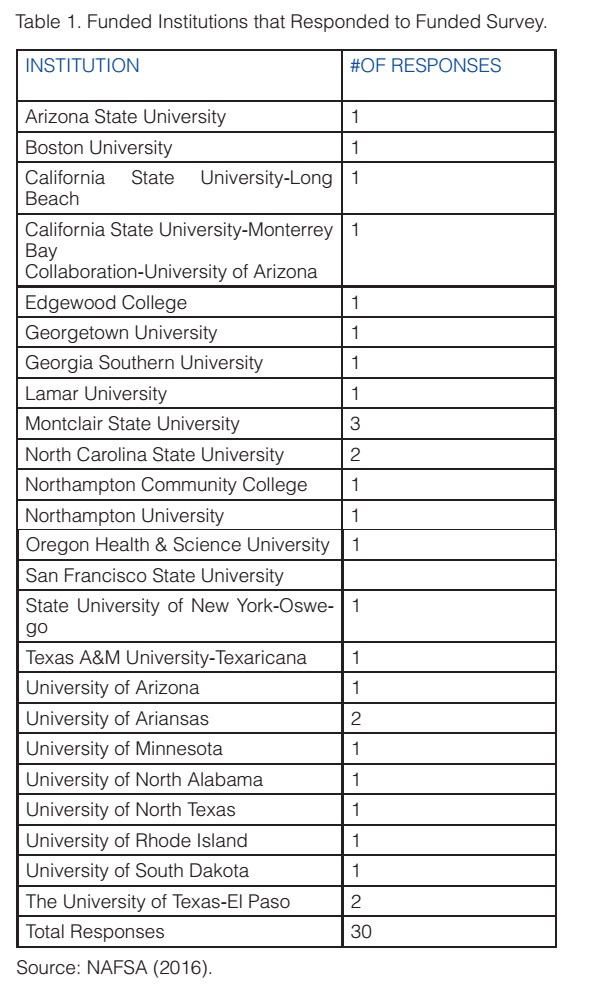
NAFSA and its partners conducted recruitment of survey respondents via e-mail during early April 2016.E-mails were sent to approximately 32 funded and 39non -funded institutions. The survey remained open for two weeks with multiple e-mail prompts to attempt to secure an adequate response rate. Of the funded institutions, 25 institutions responded for a response rate of 78 percent. Conversely, we received very few responses on the non-funded survey, just 10 institutions total. Consequently, data provided in this report on the non-funded institutions should be read with some caution, as the numbers are not necessarily reflective of all of the institutions that applied for but did not receive funding. The institutions that responded to the survey are included in Table 1.
Survey responses among the seven grant programs included: 4 (13.8 percent) US-China Education Trust Student Leaders Exchange; 5 (17.2 percent) Partnership for Innovation and Collaboration on Study Abroad (France); 2 (6.9 percent) 100,000 Strong in the Americas Innovation Fund – Freeport McMoRan; 7 (24.1 percent)
100,000 Strong in the Americas Innovation Fund – Santander Bank; 6 (20.7 percent) 100,000 Strong in the Americas Innovation Fund – ExxonMobil; and 5 (17.2 percent) 100,000 Strong in the Americas Innovation Fund – Coca-Cola Foundation. Among the 30 responses on the survey, nearly half (14 or 46.7 percent) indicated a role or title of international education professional with one-third (10 or 33.3 percent) indicating a role of faculty. Among the faculty respondents, eight indicated that they are tenured, with one who is tenure track. One faculty respondent did not complete these items. A total of six individuals indicated a role of campus administrator.
We conducted descriptive analysis of the survey data to examine the impact of the grants, funded or non - funded, on institutional efforts. The data were examined for differences across grant-funded programs and institutional types, although the smaller sample size does not allow for statistical comparisons across those groups. Open-ended responses were particularly valuable, as they provided additional insight into the activities promoted via the grants and confirmed the themes derived from the interview analysis.
]]>CONCLUSIONS
The stated intent of the Innovation Grants is to help support the commitment to study abroad on individual campuses by providing competitive grants that empower individuals, departments, and international educators to identify and remove barriers for greater access to study abroad and other internationalization efforts. The hope is that the efforts of the grant activity lead to sustainable programs and institutional change. While the institutions in this study are more recently funded and, therefore, have yet to establish evidence of lasting change, there was ample evidence of sustainability in the study abroad efforts, demonstrating the importance of the Innovation Grant. Essentially, the grant application and funding process places institutions on a pathway toward long-term institutional change.
The Innovation Grants provide occasions to increase and eventually sustain study abroad programs by providing learning and evaluation opportunities for institutions and their members that can inform future practice.
Evidence from the study identifies important benefits beyond the funding of the study abroad program articulated in the institutions’ grant proposal to study abroad and internationalization efforts, more generally.
The institutions included in the study did have successful study abroad programs in which they engaged new student populations from historically underrepresented groups and students across academic majors. Students who would not otherwise have an opportunity (due to lack of financial resources or fit with academic major) were able to study abroad.
The benefits of grant participation create opportunities for new and innovative programs to be developed. An example of this is the opportunity Innovation Grants provide to engage in partnership and relationship building.
Individuals and groups engage in new, or deepen existing, collaborations that support the current grant proposal process and articulate the value of study abroad to leaders as they seek institutional match funds or other forms of support. The process of forming and writing the grant is the platform to begin the change process—the establishing of relationships, values, and funding for study abroad.
Further, the Innovation Grants act as catalysts for the sustainability of study abroad and internationalization, as institutions often continued funding, experienced an overall increase in students going abroad and in students going to the specific study sites, and benefitted from sustained levels of leadership and faculty support. New ways of working included integrating study abroad in curricula with a pipeline of faculty support. Institutions recognized the importance of deepening internal and external partnerships by cultivating a diverse group of collaborators.
]]> The Innovation Grants are a platform of opportunity to support the increased dialogue with campus constituents, the collaboration of groups internal and external to the institution, and the building of infrastructure to support the sustainability of new models of study abroad.With time and attention, participating institutions have an opportunity to engage in organizational learning, diffusion of new models and partnerships, and the institutionalization of study abroad and internationalization as a part of the mission, strategies, and values of the institution.
BIBLIOGRAPHIC REFERENCES
Association of International Educators. (2003). Strategic Task Force on Education Abroad. 2003. Securing America’s Future: Global Education for a Global Age. Washington, D.C.: NAFSA. Retrieved fromhttp://www.nafsa.org/securingamericasfuture
Creswell, John W. (2008). Educational Research: Planning, Conducting, and Evaluating Quantitative and Qualitative Research. Upper Saddle River: Pearson Education, Inc.
Kezar, A. (2013). How Colleges Change: Understanding, Leading, and Enacting Change. New York: Routledge.
]]>United States of America. Commission on the Abraham Lincoln Study Abroad Fellowship Program. (2005). Global Competency and National Needs: One Million Americans Studying Abroad. Washington, D.C.: Commission on the Abraham Lincoln Study Abroad Fellowship Program. Retrieved fromhttp://www.nafsa.org/lincolncommission
United States of America. Institute of International Education. (2015). Host Regions and Destinations of U.S. Study Abroad Students, 2012/13 - 2013/14. In Open Doors Report on International Educational Exchange. New York: Institute of International Education.
Recieved: January 2017.
Accepted: February 2017.
E-mail: mclausen@partners.net
Jill Diane Welch
E-mail: jillw@nafsa.org
]]>