<?xml version="1.0" encoding="ISO-8859-1"?><article xmlns:mml="http://www.w3.org/1998/Math/MathML" xmlns:xlink="http://www.w3.org/1999/xlink" xmlns:xsi="http://www.w3.org/2001/XMLSchema-instance">
<front>
<journal-meta>
<journal-id>2224-5421</journal-id>
<journal-title><![CDATA[Revista Cubana de Química]]></journal-title>
<abbrev-journal-title><![CDATA[Rev Cub Quim]]></abbrev-journal-title>
<issn>2224-5421</issn>
<publisher>
<publisher-name><![CDATA[Ediciones UO, Universidad de Oriente]]></publisher-name>
</publisher>
</journal-meta>
<article-meta>
<article-id>S2224-54212014000100004</article-id>
<title-group>
<article-title xml:lang="en"><![CDATA[Covalent Immobilization of a Yeast Endopolygalacturonase in Calcium Alginate]]></article-title>
<article-title xml:lang="es"><![CDATA[Inmovilización covalente de una endopoligalacturonasa de levadura en alginato de calcio]]></article-title>
</title-group>
<contrib-group>
<contrib contrib-type="author">
<name>
<surname><![CDATA[Serrat-Díaz]]></surname>
<given-names><![CDATA[Manuel]]></given-names>
</name>
<xref ref-type="aff" rid="A01"/>
</contrib>
<contrib contrib-type="author">
<name>
<surname><![CDATA[Valverde-Núñez]]></surname>
<given-names><![CDATA[Tamara]]></given-names>
</name>
<xref ref-type="aff" rid="A01"/>
</contrib>
<contrib contrib-type="author">
<name>
<surname><![CDATA[Domínguez-Frandín]]></surname>
<given-names><![CDATA[Zuleyka]]></given-names>
</name>
<xref ref-type="aff" rid="A01"/>
</contrib>
</contrib-group>
<aff id="A01">
<institution><![CDATA[,Universidad de Oriente Facultad de Ciencias Naturales Centro de Estudios de Biotecnología Industrial]]></institution>
<addr-line><![CDATA[Santiago de Cuba ]]></addr-line>
<country>Cuba</country>
</aff>
<pub-date pub-type="pub">
<day>00</day>
<month>04</month>
<year>2014</year>
</pub-date>
<pub-date pub-type="epub">
<day>00</day>
<month>04</month>
<year>2014</year>
</pub-date>
<volume>26</volume>
<numero>1</numero>
<fpage>26</fpage>
<lpage>31</lpage>
<copyright-statement/>
<copyright-year/>
<self-uri xlink:href="http://scielo.sld.cu/scielo.php?script=sci_arttext&amp;pid=S2224-54212014000100004&amp;lng=en&amp;nrm=iso"></self-uri><self-uri xlink:href="http://scielo.sld.cu/scielo.php?script=sci_abstract&amp;pid=S2224-54212014000100004&amp;lng=en&amp;nrm=iso"></self-uri><self-uri xlink:href="http://scielo.sld.cu/scielo.php?script=sci_pdf&amp;pid=S2224-54212014000100004&amp;lng=en&amp;nrm=iso"></self-uri><abstract abstract-type="short" xml:lang="es"><p><![CDATA[En este trabajo se estudió la inmovilización covalente de una endopoligalacturonasa (endo-PG) de levadura en alginato de calcio. El soporte se activó por dos vías: mediante la adición de glutaraldehído (GA) y la oxidación con peryodato (PO), respectivamente. La activación con GA incorporó al soporte 5,8 mol de grupos carbonilo/mol de residuo de ácido urónico, mientras que en la reacción de PO se oxidó el 0,13 % de los glicoles vecinales. Los rendimientos de unión covalente y la estabilidad del gel disminuyeron con el incremento de la razón enzima/soporte; los mejores resultados correspondieron al alginato activado con GA. La pérdida de actividad enzimática durante la inmovilización fue > 90 %, lo cual es característico de la unión covalente. En todas las variantes se obtuvo una alta actividad enzimática inmovilizada, de unas 200 U/g. Se concluyó que la activación del alginato con GA y PO constituyen alternativas satisfactorias para la inmovilización covalente de la endo-PG en este soporte.]]></p></abstract>
<abstract abstract-type="short" xml:lang="en"><p><![CDATA[In this work, the covalent immobilization of a yeast endopolygalacturonase (endo-PG) in calcium alginate was examined. The carrier was activated by two different ways: glutaraldehyde addition (GA) and periodate oxidation (PO), respectively. During GA activation 5,8 mol of carbonyl groups/ mol of uronic acid residue were incorporated on the support whereas in the PO reaction only 0,13 % of vicinal glycols were oxidized. Covalent union yield and gel stability diminished when enzyme/support ratio was increased, corresponding the best results to the GA-activated alginate. The lost of enzymatic activity during immobilization was > 90 %, which is characteristic of covalent union. In all variants a high immobilized enzymatic activity was reached, around 200 U/g. It was concluded that the alginate activation, either with GA or PO, are feasible alternatives for the covalent immobilization of endo-PG on this support.]]></p></abstract>
<kwd-group>
<kwd lng="es"><![CDATA[endopoligalacturonasa]]></kwd>
<kwd lng="es"><![CDATA[alginato]]></kwd>
<kwd lng="es"><![CDATA[inmovilización de enzimas]]></kwd>
<kwd lng="es"><![CDATA[peryodato]]></kwd>
<kwd lng="es"><![CDATA[glutaraldehído]]></kwd>
<kwd lng="en"><![CDATA[endopolygalacturonase]]></kwd>
<kwd lng="en"><![CDATA[alginate]]></kwd>
<kwd lng="en"><![CDATA[enzyme immobilization]]></kwd>
<kwd lng="en"><![CDATA[periodate]]></kwd>
<kwd lng="en"><![CDATA[glutaraldehyde]]></kwd>
</kwd-group>
</article-meta>
</front><body><![CDATA[ <p align="right"><font face="Verdana" size="2"><b>ARTICULOS</b></font></p>     <p align="right">&nbsp;</p>     <p align="justify"><font face="Verdana" size="4"><b>Covalent Immobilization of a    Yeast Endopolygalacturonase in Calcium Alginate</b></font></p>     <p align="justify">&nbsp;</p>     <p align="justify"><font face="Verdana" size="3"><b>Inmovilizaci&oacute;n covalente    de una endopoligalacturonasa de levadura en alginato de calcio</b></font></p>     <p align="justify">&nbsp;</p>     <p align="justify">&nbsp;</p>     <p align="justify"><font face="Verdana" size="2"><b>Dr. Manuel Serrat-D&iacute;az,    MSc. Tamara Valverde-N&uacute;&ntilde;ez, MSc. Zuleyka Dom&iacute;nguez-Frand&iacute;n</b>    <br>       <br>   Centro de Estudios de Biotecnolog&iacute;a Industrial, Facultad de Ciencias    Naturales, Universidad de Oriente, Santiago de Cuba, Cuba. <a href="mailto:mserrat@cebi.uo.edu.cu">mserrat@cebi.uo.edu.cu</a></font></p>     ]]></body>
<body><![CDATA[<p align="justify">&nbsp;</p>     <p align="justify">&nbsp;</p> <hr align="JUSTIFY">     <p align="justify"><font face="Verdana" size="2"><b>RESUMEN</b></font></p>     <p align="justify"><font face="Verdana" size="2">En este trabajo se estudi&oacute;    la inmovilizaci&oacute;n covalente de una endopoligalacturonasa (endo-PG) de    levadura en alginato de calcio. El soporte se activ&oacute; por dos v&iacute;as:    mediante la adici&oacute;n de glutaraldeh&iacute;do (GA) y la oxidaci&oacute;n    con peryodato (PO), respectivamente. La activaci&oacute;n con GA incorpor&oacute;    al soporte 5,8 mol de grupos carbonilo/mol de residuo de &aacute;cido ur&oacute;nico,    mientras que en la reacci&oacute;n de PO se oxid&oacute; el 0,13 % de los glicoles    vecinales. Los rendimientos de uni&oacute;n covalente y la estabilidad del gel    disminuyeron con el incremento de la raz&oacute;n enzima/soporte; los mejores    resultados correspondieron al alginato activado con GA. La p&eacute;rdida de    actividad enzim&aacute;tica durante la inmovilizaci&oacute;n fue &gt; 90 %,    lo cual es caracter&iacute;stico de la uni&oacute;n covalente. En todas las    variantes se obtuvo una alta actividad enzim&aacute;tica inmovilizada, de unas    200 U/g. Se concluy&oacute; que la activaci&oacute;n del alginato con GA y PO    constituyen alternativas satisfactorias para la inmovilizaci&oacute;n covalente    de la endo-PG en este soporte.</font></p>     <p align="justify"><font face="Verdana" size="2"><b>Palabras clave:</b> endopoligalacturonasa,    alginato, inmovilizaci&oacute;n de enzimas, peryodato, glutaraldeh&iacute;do.</font></p> <hr align="JUSTIFY">     <p align="justify"><font face="Verdana" size="2"><b>ABSTRACTS</b></font></p>     <p align="justify"><font face="Verdana" size="2">In this work, the covalent immobilization    of a yeast endopolygalacturonase (endo-PG) in calcium alginate was examined.    The carrier was activated by two different ways: glutaraldehyde addition (GA)    and periodate oxidation (PO), respectively. During GA activation 5,8 mol of    carbonyl groups/ mol of uronic acid residue were incorporated on the support    whereas in the PO reaction only 0,13 % of vicinal glycols were oxidized. Covalent    union yield and gel stability diminished when enzyme/support ratio was increased,    corresponding the best results to the GA-activated alginate. The lost of enzymatic    activity during immobilization was &gt; 90 %, which is characteristic of covalent    union. In all variants a high immobilized enzymatic activity was reached, around    200 U/g. It was concluded that the alginate activation, either with GA or PO,    are feasible alternatives for the covalent immobilization of endo-PG on this    support. </font></p>     <p align="justify"><font face="Verdana" size="2"><b>Keywords:</b> endopolygalacturonase,    alginate, enzyme immobilization, periodate, glutaraldehyde.</font></p> <hr align="JUSTIFY">     <p align="justify">&nbsp;</p>     <p align="justify">&nbsp;</p>     ]]></body>
<body><![CDATA[<p align="justify"><font face="Verdana" size="3"><b>INTRODUCTION</b></font></p>     <p align="justify"><font face="Verdana" size="2">The use of enzymes to industrial    scale often demands its immobilization, with the aim to increase its stability    and to facilitate its reuse, as important issues for the development of an economically    feasible process. The covalent immobilization constitutes the most attractive    option to assure a bigger useful life of the immobilized biocatalyst.</font></p>     <p align="justify"><font face="Verdana" size="2">The election of suitable carrier    is a relevant issue which must be considered when an enzyme is immobilized.    Alginate, a polysaccharide extracted from brown seaweeds, has been commonly    used by these purposes, due to its low cost, low toxicity, biocompatibility<sup>1,    2</sup> and its ability to form beads by ionotropic gelation<sup>3</sup> in    the presence of bivalent or tervalent cations such as Ca2+ or Al3+, which ionically    cross-link carboxylate groups in the uronate blocks of alginate, giving it a    gel-like character. However, almost all studies on enzyme immobilization using    alginate as support have employed the entrapment method, which is inappropriate    when enzyme substrates are high molecular weight polymers <sup>4</sup>, as occur with    those ones of PGs. Other problem concerning to the entrapment is the tendency    for the entrapped proteins to leach out of gel over a period of time, as mentioned    by several authors <sup>5, 6</sup>. Immobilization by covalent linkage on alginate appears    to be a good alternative to overcome these problems.</font></p>     <p align="justify"><font face="Verdana" size="2">PGs are broadly used enzymes in    the industry of the juice fruits and vegetable processing. Endo-PGs form an    industrially important subgroup, because they promote a rapid decrease in the    pectin molecular weight and hence in the solution viscosity, with minimum release    of reducing sugars. These enzymes have recently gained a special interest concerning    its applications in obtaining of pectin fragments with biological activity,    which have found several applications in agriculture, plant biotechnology, pharmaceuticals    and functional foods <sup>7-9</sup>. </font></p>     <p align="justify"><font face="Verdana" size="2">Taken in account the practical relevance    of endo-PGs, polymeric nature of its substrates and physical-chemical properties    of alginate, this work was aimed at the study of the covalent immobilization    of a yeast endo-PG on calcium alginate, employing either the bifunctional reagent    glutaraldehyde (GA) or the (meta)periodate oxidation (PO) as ways for support    activation. </font></p>     <p align="justify">&nbsp;</p>     <p align="justify">&nbsp;</p> <hr align="JUSTIFY">     <p align="justify"><font face="Verdana" size="2"><b><font size="3">MATERIALS AND METHODS</font></b></font></p>     <p align="justify"><font face="Verdana" size="2"><b>Enzyme</b></font></p>     <p align="justify"><font face="Verdana" size="2">It was used the endo-PG of the Kluyveromyces    marxianus CCEBI 2011 yeast strain, which was prepared according to Serrat et    al. <sup>10</sup>, but omitting the step of ionic exchange chromatography. </font></p>     ]]></body>
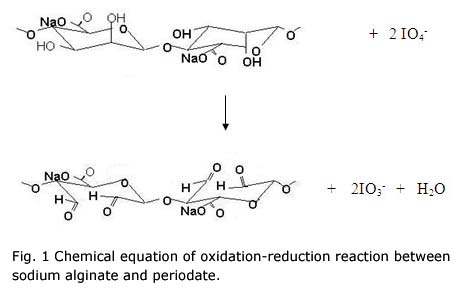
<body><![CDATA[<p align="justify"><font face="Verdana" size="2"><b>Carrier preparation and activation </b></font></p>     <p align="justify"><font face="Verdana" size="2">Calcium alginate gel was obtained by ionotropic    gelation with calcium ions <sup>11</sup> from 0.5-2 % (w/v) sodium alginate (from Laminaria    hiperborea; BDH) solutions. Activation with GA was performed in acid medium    according to Spagna et al. <sup>12</sup>. In brief, one hundred alginate beads (ca. 0,8    g) are added into 15 mL of 50 mM citrate buffer; pH 3,5; containing 2 % (w/v)    GA (Fluka). Then, the mixture was shaken (160 rev/min) during 1,5 h at 25 &ordm;C.    </font></p>     <p align="justify"><font face="Verdana" size="2">Alginate oxidation with periodate (Sigma) was    conducted using 1:5 and 1:25 oxidant/uronic acid residues molar ratios. These    relations were estimated from reaction stoichiometry (<a href="#f1">figure 1</a>).    The reaction was carried out in the dark at 25 &ordm;C, during 60 minutes. The    reaction was stopped by the addition of an equimolar amount of propylene glycol.    The degree of oxidation was evaluated by determining the aldehyde groups using    the Somogyi-Nelson method <sup>13, 14</sup>, and it was expressed as percent    of vicinal glycols oxidized. A GA solution, which was previously standardized    by the bisulfite method <sup>15</sup>, was used as standard.</font></p>     <p align="center"><font face="Verdana" size="2"><a name="f1"></a><img src="/img/revistas/ind/v26n1/f0104114.jpg" width="450" height="227"></font></p>     
<p align="justify"><font face="Verdana" size="2"><b>Enzyme immobilization </b></font></p>     <p align="justify"><font face="Verdana" size="2">The reaction was performed in 50    mM acetate buffer (pH 5) and 10 mM phosphate buffer (pH 7) for GA-activated    and PO-activated carriers, respectively. In any case the reaction mixtures were    maintained in agitation (60 rev/min) during 16 h at 25 &ordm;C. Enzyme/support    ratios of 10 U/mg and 70 U/mg were used. The covalent union yield (YCU) was    defined as the enzyme fraction which has been linked on the support as regards    the total introduced in the assay, whereas the yield of active immobilized enzyme    (YAI) was calculated as the fraction of active enzyme as regards the total linked    on the support.</font></p>     <p align="justify"><font face="Verdana" size="2"><b>Enzyme activity determination    </b></font></p>     <p align="justify"><font face="Verdana" size="2">The PG enzymatic activity was determined    using 0,5 % (m/v) polygalacturonic acid (Sigma) in 50 mM acetate buffer as substrate.    The assay was conducted by addition of 100 uL of enzyme (five beads by immobilized    biocatalyst) to 400 uL of substrate, both previously incubated at 37 &ordm;C,    followed of incubating the reaction mixture at this temperature during 10 minutes.    The reaction was stopped by addition of alkaline cupper reagent (Somogyi-Nelson    assay for reducing sugars). One unit of PG activity was defined as the amount    of enzyme that produces an increasing in the reducing power of the reaction    mixture of one micromole by minute. The reducing power was quantified according    Somogyi-Nelson method <sup>13, 14</sup>, using galacturonic acid (Sigma) as standard.    <br>   </font></p>     <p align="justify"><font face="Verdana" size="2"><b>Determination of the enzyme accessibility    to the carrier </b></font></p>     ]]></body>
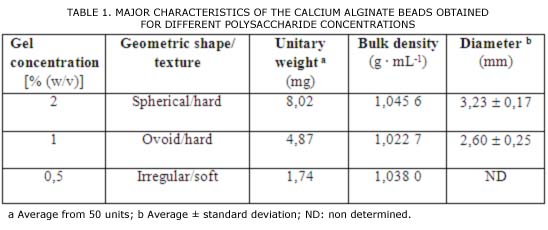
<body><![CDATA[<p align="justify"><font face="Verdana" size="2">This assay was conducted by means    of molecular exclusion chromatography. For this, a glass column (20 &middot;    2 cm) was carefully packed with calcium alginate beads and equilibrated with    five volumes of 50 mM acetate buffer (pH 5) containing 100 mM NaCl, to prevent    non-specific protein adsorption. Then, 1 mL of enzyme (ca. 500 &micro;g) was    applicated onto column and eluted at the same buffer with a flow of 1,2 mL/h.    1 mL-fractions were collected and the protein content was determined according    Lowry method <sup>16</sup>, using albumin from bovine serum (BDH) as standard, as well    as polygalacturonase activity. Dextran blue and phenol red were used as standards    for column calibration.     <br>   </font></p>     <p align="justify">&nbsp;</p> <hr align="JUSTIFY">     <p align="justify"><font face="Verdana" size="3"><b>RESULTS AND DISCUSSION</b></font><font face="Verdana" size="2">    <br>   </font></p>     <p align="justify"><font face="Verdana" size="2"><b>Carrier preparation and activation    </b>    <br>   </font></p>     <p align="justify"><font face="Verdana" size="2"><a href="#t1">Table 1</a> show the    main characteristic of alginate gels obtained for different sodium alginate    concentrations. Calcium alginate gel obtained from 2 % (w/v) sodium alginate    solution, by means of ionotropic gelation in presence of Ca2+ ions, consisted    in uniform spherical and translucent beads of 3,23 &plusmn; 0,17 mm of diameter    and 8,02 mg of average weight. </font></p>     <p align="center"><font face="Verdana" size="2"><a name="t1"></a><img src="/img/revistas/ind/v26n1/t0104114.jpg" width="547" height="175"></font></p>     
<p align="justify"><font face="Verdana" size="2">Alginate activation with bifunctional    agent GA was performed in acid medium to favour nucleophilic addition, which    yielded an incorporation of carbonyl groups on support of 5,8 moles by mole    of uronic acid residue. This result is considerably higher than the theoretical    expected value, which predict that to each mole of uronic acid residue correspond    two moles of GA linked (one by each hydroxyl group). Various factors could be    affecting the predicted result, such as GA polymerization <sup>12</sup> or the existence    of non-specific adsorption, being the later favoured by the formation of hydrogen    bonds between carrier and GA.</font></p>     ]]></body>
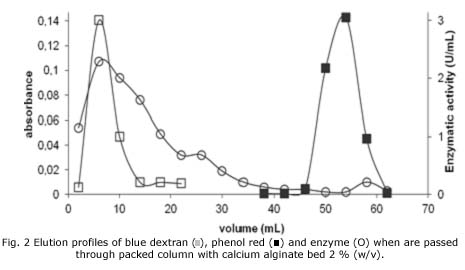
<body><![CDATA[<p align="justify"><font face="Verdana" size="2">To assess the alginate oxidation    by periodate, three assays were carried out. At the first experience, a 1:5    molar ratio periodate/uronic acid residues was used. The Fehling&acute;s qualitative    test for aldehydes was used to evaluate the extension of the oxidation. This    test resulted negative for native alginate, whereas a big positive response    (abundant red precipitated of cuprous oxide) was observed in oxidized alginate,    which suggested that the oxidation of vicinal glycols occurred at a large extension.    </font></p>     <p align="justify"><font face="Verdana" size="2">However, the gel obtained in this    case showed a fine fibrous structure, very different of the characteristic spherical    beads, which could be caused due to depolymerization occurred in presence of    oxidant agent <sup>17, 18</sup>. By other hand, the oxidative cleavage of C2-C3 bond    of the pyranosic ring by periodate lead to a increasing in polymer chain flexibility,    which could prevent the adequate formation of the egg-box structures presents    in the calcium alginate gels <sup>3</sup>.</font></p>     <p align="justify"><font face="Verdana" size="2">The PO was repeated but employing    a lower periodate/uronic residues molar ratio (1:25). Under these conditions    a degree of oxidation of 0,13 % was reached, which was considered satisfactory.    The beads formed from the oxidized carrier in presence of calcium ions had an    ellipsoidal form and showed a lower mechanical resistance with respect to that    obtained from native alginate.</font></p>     <p align="justify"><font face="Verdana" size="2">  Finally, the PO reaction was conducted directly on calcium alginate gel, using  a 1:25 /uronic residues molar ratio. The degree of oxidation was similar to  that reached for soluble alginate, but with the advantage that under these new  conditions the beads conserved its common spherical form and hardness.</font></p>     <p align="justify"><font face="Verdana" size="2"><b>Enzyme immobilization</b></font></p>     <p align="justify"><font face="Verdana" size="2">Catalytic activity of endo-PG on    sodium alginate was evaluated previous to develop the immobilization assays,    taken in account that structural units of alginate, b-d-manuronic and a-l-guluronic    acids, are stereoisomers of the galacturonic acid, which is the constitutive    unit of polygalacturonate, natural substrate of PGs. Once known that K. marxianus    endo-PG was inactive on alginate, then the accessibility of the enzyme into    the alginate beads was determined, using a gel filtration assay. The results    are shown in the <a href="#f2">figure 2</a>.</font></p>     <p align="center"><font face="Verdana" size="2"><a name="f2"></a><img src="/img/revistas/ind/v26n1/f0204114.jpg" width="434" height="232"></font></p>     
<p align="justify"><font face="Verdana" size="2">The elution volume of enzyme was    near to the exclusion volume, suggesting that the enzyme accessibility into    the gel is low (ca. 15 % of the inner volume). This result is in agreement with    Pedroza-Islas <sup>19</sup> (2002), who have referred that calcium alginate    gels are not permeable to molecules which molecular weight is over 10 000 Da.    Thus, it is assured that the immobilized enzyme will be, essentiality, restricted    to the external surface of the gel, which is convenient due to the endo-PG substrate  is unable to enter into the gel as consequence of its high molecular weight.</font></p>     <p align="justify"><font face="Verdana" size="2">A summary of the results obtained    during immobilization of K. marxianus endo-PG on calcium alginate activated    with GA and PO are shown in the <a href="#t2">table 2</a>. As can be observed,    YCU diminished when enzyme/support ratio was increased, which could be caused    by steric hindrances as result of an high concentration of support-linked enzyme    molecules. When enzyme/support ratio was 70 U/mg the alginate gel was turned    unstable. This fact could be caused as consequence of an ionic exchange between    positively charged enzyme molecules and calcium ions, which could cause distortion    in the egg-box gel structure. This problem was satisfactorily solved performing    the immobilization in presence of calcium ions at 50 mM of concentration, which    confirmed the hypothesis earlier exposed. Undoubtedly, enzyme/support ratio    constitutes an important variable to be considered in next studies conducted    to the optimization of this procedure of immobilization. </font></p>     <p align="center"><font face="Verdana" size="2"><a name="t2"></a><img src="/img/revistas/ind/v26n1/t0204114.jpg" width="373" height="190"></font></p>     
]]></body>
<body><![CDATA[<p align="justify"><font face="Verdana" size="2">PO-activated alginate showed lower    values of YCU, in agreement with its lower availability of actives groups (carbonyl)    for enzyme coupling. The variant where alginate oxidation was carried out before    gel formation showed the lowest YCU value. This fact suggest that an considerable    proportion of carbonyl groups stayed arranged inside the gel, being thus unavailable  for the reaction with amino groups of enzyme.</font></p>     <p align="justify"><font face="Verdana" size="2">The lost of enzymatic activity during    immobilization was considerable in all variants (YAI &lt; 10 %), which is characteristic    of covalent union. This is caused by several factors, such as conformational    changes in enzyme, conformational or chemical changes in the active site, steric    hindrances, and other ones <sup>4</sup>. The variant where the enzyme/support ratio was    70 U/mg and GA-activated alginate was used as carrier, YAI was barely of the    1 %. If is taken in account that density of enzyme molecules by surface unit    is the highest in this variant, then could be expected a higher affectation    to the enzymatic activity as consequence of steric hindrances and conformational    changes in enzyme.</font></p>     <p align="justify"><font face="Verdana" size="2">All variants showed a high immobilized    enzymatic activity, around 200 U/g, being reached the best value (400 U/g) in    the variant where alginate was activated by PO after gel formation. The activity    of immobilized biocatalyst can be considered satisfactory compared with other    results, such as that obtained by Spagna et al. <sup>12</sup> in covalent immobilization    of a pectin lyase.</font></p>     <p align="justify">&nbsp;</p>     <p align="justify"><font face="Verdana" size="3"><b>CONCLUSIONS</b></font></p>     <p align="justify"><font face="Verdana" size="2">This study have shown that alginate    activation with GA or PO are feasible alternatives to covalent immobilization    of the K. marxianus endo-PG on this carrier, corresponding the best results    to PO-activation, where enzymatic activity in immobilized biocatalyst is twice    the obtained in other variants. </font></p>     <p align="justify"><font face="Verdana" size="2">Several parameters, such as the    enzyme/support ratio and availability of active carbonyl groups onto support    are issues that should be optimized in next studies. These results are an important    first step in the development of enzymatic bioreactors based in K. marxianus    endo-PG covalently immobilized, which could offer a wide spectrum of applications    in food and agrochemical industries.</font></p>     <p align="left">&nbsp;</p>     <p align="left"><font face="Verdana" size="2"><b><font size="3">REFERENCES</font></b></font></p>     <!-- ref --><p align="justify"><font size="2" face="Verdana">1. SHAPIRO, L.; COHEN, S. &quot;Novel alginate sponges for cell culture and transplantation&quot;. <i>Biomaterials. </i>1997, 18, pp. 583–590.     </font></p>     <!-- ref --><p align="justify"><font size="2" face="Verdana">2. LEE, K. Y., <i>et al</i>. &quot;Degradation behavior of covalently cross-linked poly(aldehydeguluronate) hydrogels&quot;. <i>Macromolecules </i>. 2000, 33, pp. 97–101.     </font></p>     <!-- ref --><p align="justify"><font size="2" face="Verdana">3. GRANT, G. T., <i>et al</i>. &quot;Biological Interactions Between Polysaccharides and Divalent Cation, the Egg Box Model&quot;. <i>FEBS Letters. </i>1973, 32, pp. 195–198.     </font></p>     <!-- ref --><p align="justify"><font size="2" face="Verdana">4. ARROYO, M. &quot;Inmobilized Enzymes: Theory, Methods of Study and Applications&quot;. <i>Ars Pharmaceutica. </i>1998, 39, pp. 23-29.     </font></p>     <!-- ref --><p align="justify"><font size="2" face="Verdana">5. MUNJAL, N.; SAWHNEY, S. K. &quot;Stability and properties of mushroom tyrosinase entrapped in alginate, polyacrylamide and gelatin gels&quot;. <i>Enzyme and Microbial Technology. </i>2002, 30, pp. 613–619.     </font></p>     <!-- ref --><p align="justify"><font size="2" face="Verdana">6. FADNAVIS, N. W., <i>et al</i>. &quot;Gelatin blends with alginate: gels for lipase immobilization and purification&quot;. <i>Biotechnology Progress. </i>2003, 19, pp. 557–564.     </font></p>     <!-- ref --><p align="justify"><font size="2" face="Verdana">7. CABRERA, J. C. &quot;Obtenci&oacute;n de (1,4) a-D-oligogalactur&oacute;nidos bioactivos a partir de subproductos de la industria citr&iacute;cola&quot;. Tesis Doctoral. Instituto Nacional de Ciencias Agr&iacute;colas, San Jos&eacute; de Las Lajas, Cuba, 1999.     </font></p>     <!-- ref --><p align="justify"><font size="2" face="Verdana">8. LANG, C.; D&Ouml;RNENBURG, H. &quot;Perspectives in the Biological Function and the Technological Application of Polygalacturonases&quot;. <i>Applied Microbiology and Biotechnology. </i>2000, 53, pp. 366-375.     </font></p>     <!-- ref --><p align="justify"><font size="2" face="Verdana">9. KIYOHARA, H., <i>et al</i>. &quot;Pectic Polysaccharide from Roots of <i>Glycyrrhiza uralensis </i>: Possible Contribution of Neutral Oligosaccharide in the Galacturonase-Resistant Region to Anti-Complementary and Mitogenic Activities&quot;. En: <i>Pectin and Pectinases. </i>Visser, J; Voragen, A. G. J. (eds). Amsterdam: Elsevier Science, 1996. p. 673.     </font></p>     <!-- ref --><p align="justify"><font size="2" face="Verdana">10. SERRAT, M., <i>et al </i>. &quot;Production, Purification and Characterization of a Polygalacturonase from a New Strain of <i>Kluyveromyces marxianus </i>Isolated from Coffee Wet-Processing Wastewater&quot;. <i>Applied Biochemistry and Biotechnology. </i>2002, 97, pp. 193-208.     </font></p>     <!-- ref --><p align="justify"><font size="2" face="Verdana">11. LEE, K. Y.; HEO, T. R. &quot;Survival of <i>Bifidobacterium longum </i>immobilized in calcium alginate beads in simulated gastric juices and bile salt solution&quot;. <i>Applied and Environmental Microbiology</i>. </i>2000, 66, pp. 869-873.     </font></p>     <!-- ref --><p align="justify"><font size="2" face="Verdana">12. SPAGNA, G., <i>et al</i>. &quot;Immobilization of Pectinlyase from <i>A. niger </i>for Application in Food Technology&quot;. <i>Enzyme and Microbial Technology. </i>1995, 17, pp. 729-738.     </font></p>     <!-- ref --><p align="justify"><font size="2" face="Verdana">13. SOMOGYI, M. &quot;Notes on sugar determination&quot;. <i>Journal of Biological Chemistry </i>. 1952, 195, pp. 19-23.     </font></p>     <!-- ref --><p align="justify"><font size="2" face="Verdana">14. NELSON, N. J. &quot;Colorimetric Analysis of Sugars&quot;. En: <i>Methods of Enzymology. </i>Colowick, S. P.; Kaplan, N. O. (eds). New York: Academic Press, 1957, 3, pp. 85-86.     </font></p>     <!-- ref --><p align="justify"><font size="2" face="Verdana">15. WEISS, F. <i>Determination of Organic Compounds: Methods and Procedures </i>. New York, Wiles Interscience, 1970, p. 94.     </font></p>     <!-- ref --><p align="justify"><font size="2" face="Verdana">16. LOWRY, O. H., <i>et al</i>. &quot;Protein measurement with Folin phenol reagent&quot;. <i>J. Biol. Chem. </i>1951, 193, pp. 265-275.     </font></p>     <!-- ref --><p align="justify"><font size="2" face="Verdana">17. BOUDAHIR, K. H., <i>et al. </i>&quot;Synthesis of cross-linked poly(aldehyde guluronate) hydrogels&quot;. <i>Polymer. </i>1999, 40, pp. 3575-3584.     </font></p>     <!-- ref --><p align="justify"><font size="2" face="Verdana">18. LE-TIEN, C., <i>et al</i>. &quot;Modified Alginate Matrices for the Immobilization of Bioactive agents&quot;. <i>Biotechnology and Applied Biochemistry. </i>2004, 39, pp. 189–198.     </font></p>     <!-- ref --><div align="justify"><font size="2" face="Verdana">19. PEDROZA-ISLAS, R. &quot;Avances en Nutrici&oacute;n Acu&iacute;cola VI&quot;. En: <i>Memorias del VI Simposium Internacional de Nutrici&oacute;n Acu&iacute;cola </i>, 3-6 septiembre del 2002, Canc&uacute;n, Quintana Roo, M&eacute;xico, p. 438-447.    </font> </div>     <p align="left">&nbsp;</p>     <p align="left">&nbsp;</p>     <p align="left"><font face="Verdana" size="2">Recibido: 20/10/2013    ]]></body>
<body><![CDATA[<br>   Aceptado: 15/01/2014</font></p>     <p align="left">&nbsp;</p>     <p align="left">&nbsp;</p>     <p align="left"><font face="Verdana" size="2"><i>Dr. Manuel Serrat-D&iacute;az.    </i>Centro de Estudios de Biotecnolog&iacute;a Industrial, Facultad de Ciencias    Naturales, Universidad de Oriente, Santiago de Cuba, Cuba. <a href="mailto:mserrat@cebi.uo.edu.cu">mserrat@cebi.uo.edu.cu</a></font></p>      ]]></body><back>
<ref-list>
<ref id="B1">
<label>1</label><nlm-citation citation-type="book">
<person-group person-group-type="author">
<name>
<surname><![CDATA[SHAPIRO]]></surname>
<given-names><![CDATA[L]]></given-names>
</name>
<name>
<surname><![CDATA[COHEN]]></surname>
<given-names><![CDATA[S]]></given-names>
</name>
</person-group>
<article-title xml:lang="en"><![CDATA[Novel alginate sponges for cell culture and transplantation]]></article-title>
<source><![CDATA[]]></source>
<year>1997</year>
<volume>18</volume>
<page-range>583-590</page-range><publisher-name><![CDATA[Biomaterials]]></publisher-name>
</nlm-citation>
</ref>
<ref id="B2">
<label>2</label><nlm-citation citation-type="">
<person-group person-group-type="author">
<name>
<surname><![CDATA[LEE]]></surname>
<given-names><![CDATA[K. Y]]></given-names>
</name>
</person-group>
<article-title xml:lang="en"><![CDATA[Degradation behavior of covalently cross-linked poly(aldehydeguluronate) hydrogels]]></article-title>
<source><![CDATA[]]></source>
<year>2000</year>
<volume>33</volume>
<page-range>97-101</page-range></nlm-citation>
</ref>
<ref id="B3">
<label>3</label><nlm-citation citation-type="">
<person-group person-group-type="author">
<name>
<surname><![CDATA[GRANT]]></surname>
<given-names><![CDATA[G. T]]></given-names>
</name>
</person-group>
<article-title xml:lang="en"><![CDATA[Biological Interactions Between Polysaccharides and Divalent Cation, the Egg Box Mode]]></article-title>
<source><![CDATA[]]></source>
<year>1973</year>
<volume>32</volume>
<page-range>195-198</page-range></nlm-citation>
</ref>
<ref id="B4">
<label>4</label><nlm-citation citation-type="book">
<person-group person-group-type="author">
<name>
<surname><![CDATA[ARROYO]]></surname>
<given-names><![CDATA[M]]></given-names>
</name>
</person-group>
<article-title xml:lang="en"><![CDATA[Inmobilized Enzymes: Theory, Methods of Study and Applications]]></article-title>
<source><![CDATA[]]></source>
<year>1998</year>
<volume>39</volume>
<page-range>23-29</page-range><publisher-name><![CDATA[Ars Pharmaceutica]]></publisher-name>
</nlm-citation>
</ref>
<ref id="B5">
<label>5</label><nlm-citation citation-type="book">
<person-group person-group-type="author">
<name>
<surname><![CDATA[MUNJAL]]></surname>
<given-names><![CDATA[N]]></given-names>
</name>
<name>
<surname><![CDATA[SAWHNEY]]></surname>
<given-names><![CDATA[S. K]]></given-names>
</name>
</person-group>
<article-title xml:lang="en"><![CDATA[Stability and properties of mushroom tyrosinase entrapped in alginate, polyacrylamide and gelatin gels]]></article-title>
<source><![CDATA[]]></source>
<year>2002</year>
<volume>30</volume>
<page-range>613-619</page-range><publisher-name><![CDATA[Enzyme and Microbial Technology]]></publisher-name>
</nlm-citation>
</ref>
<ref id="B6">
<label>6</label><nlm-citation citation-type="">
<person-group person-group-type="author">
<name>
<surname><![CDATA[FADNAVIS]]></surname>
<given-names><![CDATA[N. W]]></given-names>
</name>
</person-group>
<article-title xml:lang="en"><![CDATA[Gelatin blends with alginate: gels for lipase immobilization and purification]]></article-title>
<source><![CDATA[]]></source>
<year></year>
</nlm-citation>
</ref>
<ref id="B7">
<label>7</label><nlm-citation citation-type="book">
<person-group person-group-type="author">
<name>
<surname><![CDATA[CABRERA]]></surname>
<given-names><![CDATA[J. C]]></given-names>
</name>
</person-group>
<source><![CDATA[Obtención de (1,4) a-D-oligogalacturónidos bioactivos a partir de subproductos de la industria citrícola]]></source>
<year>1999</year>
<publisher-loc><![CDATA[San José de Las Lajas ]]></publisher-loc>
<publisher-name><![CDATA[Instituto Nacional de Ciencias Agrícolas]]></publisher-name>
</nlm-citation>
</ref>
<ref id="B8">
<label>8</label><nlm-citation citation-type="">
<person-group person-group-type="author">
<name>
<surname><![CDATA[LANG]]></surname>
<given-names><![CDATA[C]]></given-names>
</name>
<name>
<surname><![CDATA[DÖRNENBURG]]></surname>
<given-names><![CDATA[H]]></given-names>
</name>
</person-group>
<article-title xml:lang="en"><![CDATA[Perspectives in the Biological Function and the Technological Application of Polygalacturonases]]></article-title>
<source><![CDATA[]]></source>
<year>2000</year>
<volume>53</volume>
<page-range>366-375</page-range></nlm-citation>
</ref>
<ref id="B9">
<label>9</label><nlm-citation citation-type="book">
<person-group person-group-type="author">
<name>
<surname><![CDATA[KIYOHARA]]></surname>
<given-names><![CDATA[H]]></given-names>
</name>
</person-group>
<source><![CDATA[Pectic Polysaccharide from Roots of Glycyrrhiza uralensis: Possible Contribution of Neutral Oligosaccharide in the Galacturonase-Resistant Region to Anti-Complementary and Mitogenic Activities]]></source>
<year>1996</year>
<page-range>673</page-range><publisher-name><![CDATA[Elsevier Science]]></publisher-name>
</nlm-citation>
</ref>
<ref id="B10">
<label>10</label><nlm-citation citation-type="">
<person-group person-group-type="author">
<name>
<surname><![CDATA[SERRAT]]></surname>
<given-names><![CDATA[M]]></given-names>
</name>
</person-group>
<article-title xml:lang="en"><![CDATA[Production, Purification and Characterization of a Polygalacturonase from a New Strain of Kluyveromyces marxianus Isolated from Coffee Wet-Processing Wastewater]]></article-title>
<source><![CDATA[]]></source>
<year>2002</year>
<volume>97</volume>
<page-range>193-208</page-range></nlm-citation>
</ref>
<ref id="B11">
<label>11</label><nlm-citation citation-type="">
<person-group person-group-type="author">
<name>
<surname><![CDATA[LEE]]></surname>
<given-names><![CDATA[K. Y]]></given-names>
</name>
<name>
<surname><![CDATA[HEO]]></surname>
<given-names><![CDATA[T. R]]></given-names>
</name>
</person-group>
<article-title xml:lang="en"><![CDATA[Survival of Bifidobacterium longum immobilized in calcium alginate beads in simulated gastric juices and bile salt solution]]></article-title>
<source><![CDATA[]]></source>
<year>2000</year>
<volume>66</volume>
<page-range>869-873</page-range></nlm-citation>
</ref>
<ref id="B12">
<label>12</label><nlm-citation citation-type="">
<person-group person-group-type="author">
<name>
<surname><![CDATA[SPAGNA]]></surname>
<given-names><![CDATA[G]]></given-names>
</name>
</person-group>
<article-title xml:lang="en"><![CDATA[Immobilization of Pectinlyase from A. niger for Application in Food Technology]]></article-title>
<source><![CDATA[]]></source>
<year>1995</year>
<volume>17</volume>
<page-range>729-738</page-range></nlm-citation>
</ref>
<ref id="B13">
<label>13</label><nlm-citation citation-type="">
<person-group person-group-type="author">
<name>
<surname><![CDATA[SOMOGYI]]></surname>
<given-names><![CDATA[M]]></given-names>
</name>
</person-group>
<article-title xml:lang="en"><![CDATA[Notes on sugar determination]]></article-title>
<source><![CDATA[]]></source>
<year>1952</year>
<volume>195</volume>
<page-range>19-23</page-range></nlm-citation>
</ref>
<ref id="B14">
<label>14</label><nlm-citation citation-type="book">
<person-group person-group-type="author">
<name>
<surname><![CDATA[NELSON]]></surname>
<given-names><![CDATA[N. J]]></given-names>
</name>
</person-group>
<source><![CDATA[Colorimetric Analysis of Sugars]]></source>
<year>1957</year>
<volume>3</volume>
<page-range>85-86</page-range><publisher-loc><![CDATA[New York ]]></publisher-loc>
<publisher-name><![CDATA[Academic Press]]></publisher-name>
</nlm-citation>
</ref>
<ref id="B15">
<label>15</label><nlm-citation citation-type="book">
<person-group person-group-type="author">
<name>
<surname><![CDATA[WEISS]]></surname>
<given-names><![CDATA[F]]></given-names>
</name>
</person-group>
<source><![CDATA[Determination of Organic Compounds: Methods and Procedures]]></source>
<year>1970</year>
<page-range>94</page-range><publisher-loc><![CDATA[New York ]]></publisher-loc>
<publisher-name><![CDATA[Wiles Interscience]]></publisher-name>
</nlm-citation>
</ref>
<ref id="B16">
<label>16</label><nlm-citation citation-type="">
<person-group person-group-type="author">
<name>
<surname><![CDATA[LOWRY]]></surname>
<given-names><![CDATA[O. H]]></given-names>
</name>
</person-group>
<article-title xml:lang="en"><![CDATA[Protein measurement with Folin phenol reagent]]></article-title>
<source><![CDATA[]]></source>
<year>1951</year>
<volume>193</volume>
<page-range>265-275</page-range></nlm-citation>
</ref>
<ref id="B17">
<label>17</label><nlm-citation citation-type="">
<person-group person-group-type="author">
<name>
<surname><![CDATA[BOUDAHIR]]></surname>
<given-names><![CDATA[K. H]]></given-names>
</name>
</person-group>
<article-title xml:lang="en"><![CDATA[Synthesis of cross-linked poly(aldehyde guluronate) hydrogels]]></article-title>
<source><![CDATA[]]></source>
<year>1999</year>
<volume>40</volume>
<page-range>3575-3584</page-range></nlm-citation>
</ref>
<ref id="B18">
<label>18</label><nlm-citation citation-type="">
<person-group person-group-type="author">
<name>
<surname><![CDATA[LE-TIEN]]></surname>
<given-names><![CDATA[C]]></given-names>
</name>
</person-group>
<article-title xml:lang="en"><![CDATA[Modified Alginate Matrices for the Immobilization of Bioactive agents]]></article-title>
<source><![CDATA[]]></source>
<year>2004</year>
<volume>39</volume>
<page-range>189-198</page-range></nlm-citation>
</ref>
<ref id="B19">
<label>19</label><nlm-citation citation-type="">
<person-group person-group-type="author">
<name>
<surname><![CDATA[PEDROZA-ISLAS]]></surname>
<given-names><![CDATA[R]]></given-names>
</name>
</person-group>
<source><![CDATA[Avances en Nutrición Acuícola VI]]></source>
<year>3-6 </year>
<month>se</month>
<day>pt</day>
<page-range>438-447</page-range><publisher-loc><![CDATA[Cancún^eQuintana Roo Quintana Roo]]></publisher-loc>
</nlm-citation>
</ref>
</ref-list>
</back>
</article>