<?xml version="1.0" encoding="ISO-8859-1"?><article xmlns:mml="http://www.w3.org/1998/Math/MathML" xmlns:xlink="http://www.w3.org/1999/xlink" xmlns:xsi="http://www.w3.org/2001/XMLSchema-instance">
<front>
<journal-meta>
<journal-id>2224-5421</journal-id>
<journal-title><![CDATA[Revista Cubana de Química]]></journal-title>
<abbrev-journal-title><![CDATA[Rev Cub Quim]]></abbrev-journal-title>
<issn>2224-5421</issn>
<publisher>
<publisher-name><![CDATA[Ediciones UO, Universidad de Oriente]]></publisher-name>
</publisher>
</journal-meta>
<article-meta>
<article-id>S2224-54212016000100002</article-id>
<title-group>
<article-title xml:lang="es"><![CDATA[Análisis Térmico Controlado por la Muestra y Termogravimetría de Alta Resolución. Influencia de las condiciones experimentales sobre los parámetros cinéticos calculados]]></article-title>
<article-title xml:lang="en"><![CDATA[Sample controlled thermal analysis and high resolution thermogravimetry. Influence of experimental conditions on calculated kinetic parameters]]></article-title>
</title-group>
<contrib-group>
<contrib contrib-type="author">
<name>
<surname><![CDATA[Quesada-González]]></surname>
<given-names><![CDATA[Omaida]]></given-names>
</name>
<xref ref-type="aff" rid="A01"/>
</contrib>
<contrib contrib-type="author">
<name>
<surname><![CDATA[Llópiz-Yurell]]></surname>
<given-names><![CDATA[Julio Cesar]]></given-names>
</name>
<xref ref-type="aff" rid="A02"/>
</contrib>
<contrib contrib-type="author">
<name>
<surname><![CDATA[Torres-Torres]]></surname>
<given-names><![CDATA[Enelio]]></given-names>
</name>
<xref ref-type="aff" rid="A02"/>
</contrib>
</contrib-group>
<aff id="A01">
<institution><![CDATA[,Universidad de Oriente Facultad de Ciencias Naturales ]]></institution>
<addr-line><![CDATA[ ]]></addr-line>
<country>Cuba</country>
</aff>
<aff id="A02">
<institution><![CDATA[,Instituto de Ciencia y Tecnología de Materiales  ]]></institution>
<addr-line><![CDATA[ ]]></addr-line>
<country>Cuba</country>
</aff>
<pub-date pub-type="pub">
<day>00</day>
<month>04</month>
<year>2016</year>
</pub-date>
<pub-date pub-type="epub">
<day>00</day>
<month>04</month>
<year>2016</year>
</pub-date>
<volume>28</volume>
<numero>1</numero>
<fpage>350</fpage>
<lpage>363</lpage>
<copyright-statement/>
<copyright-year/>
<self-uri xlink:href="http://scielo.sld.cu/scielo.php?script=sci_arttext&amp;pid=S2224-54212016000100002&amp;lng=en&amp;nrm=iso"></self-uri><self-uri xlink:href="http://scielo.sld.cu/scielo.php?script=sci_abstract&amp;pid=S2224-54212016000100002&amp;lng=en&amp;nrm=iso"></self-uri><self-uri xlink:href="http://scielo.sld.cu/scielo.php?script=sci_pdf&amp;pid=S2224-54212016000100002&amp;lng=en&amp;nrm=iso"></self-uri><abstract abstract-type="short" xml:lang="es"><p><![CDATA[El Análisis Térmico Controlado por la Muestra y la Termogravimetría de Alta Resolución fueron empleados para estudiar la deshidratación del BaCl2·2H2O. Los modelos controlados por el avance interfacial bidimensional (R2) y la energía de activación de 26 kJ/mol fueron calculados cuando se aplicaron las técnicas de ATCM; el modelo cinético difusivo tridimensional (D3) y la energía de activación de 40 kJ/mol fueron determinados cuando se aplicó la Termogravimetría de Alta Resolución. Se demostró la influencia de la atmósfera y particularmente de la presión residual en los alrededores de la muestra sobre los parámetros cinéticos calculados.]]></p></abstract>
<abstract abstract-type="short" xml:lang="en"><p><![CDATA[Sample Controlled Thermal Analysis and High-resolution Thermogravimetry are used for to study the dehydration of BaCl2·2H2O. Model controlled by 2-dimensional interfacial advancement (R2) and activation energy of 26 kJ/mol were calculated when the technique SCTA was applied and a 3-dimensional diffusive kinetic model (D3) and activation energy of 40 kJ/mol were determined when Hi- Res ATG was applied. The influence of atmosphere and particularly of the residual pressure in environment of the samples on the calculated kinetic parameters was demonstrated.]]></p></abstract>
<kwd-group>
<kwd lng="es"><![CDATA[Cinética]]></kwd>
<kwd lng="es"><![CDATA[ATVC]]></kwd>
<kwd lng="es"><![CDATA[TG Alta Resolución]]></kwd>
<kwd lng="es"><![CDATA[BaCl2·2H2O]]></kwd>
<kwd lng="en"><![CDATA[Kinetics]]></kwd>
<kwd lng="en"><![CDATA[CRTA]]></kwd>
<kwd lng="en"><![CDATA[Hi Res ATG]]></kwd>
<kwd lng="en"><![CDATA[BaCl2·2H2O]]></kwd>
</kwd-group>
</article-meta>
</front><body><![CDATA[ <p align="right"><font face="Verdana" size="2"><b>ARTICULOS</b></font></p>     <p align="center">&nbsp;</p>     <p align="left"><font size="2" face="Verdana"><b><font size="4"><strong>An&aacute;lisis T&eacute;rmico Controlado por la Muestra y Termogravimetr&iacute;a de Alta Resoluci&oacute;n. Influencia de las condiciones experimentales sobre los par&aacute;metros cin&eacute;ticos calculados</strong></font></b></font></p>     <p align="justify">&nbsp;</p>     <p align="justify"><font size="2" face="Verdana"><b><font size="3">Sample controlled thermal analysis and high resolution thermogravimetry. Influence of experimental conditions on calculated kinetic parameters</font></b></font></p>     <p align="justify">&nbsp;</p>     <p align="justify">&nbsp;</p>     <p align="justify"> <font size="2" face="Verdana"><b>Dra. C. Omaida Quesada-Gonz&aacute;lez<sup>I</sup>, Dr. Julio Cesar Ll&oacute;piz-Yurell<sup>I</sup><sup>I</sup>, Dr. Enelio Torres-Torres<sup>I</sup><sup>I</sup></b></font></p>     <p align="justify"><font size="2" face="Verdana"> <sup>I</sup>Facultad de Ciencias Naturales, Universidad de Oriente, Santiago de Cuba, Cuba, <a href="mailto:oquesada@cnt.uo.edu.cu">oquesada@cnt.uo.edu.cu</a>    <br>       <sup>II</sup>Instituto de Ciencia y Tecnolog&iacute;a de Materiales, Ciudad de La Habana, Cuba</font></p>     ]]></body>
<body><![CDATA[<p align="justify">&nbsp;</p>     <p align="justify">&nbsp;</p> <hr>     <p align="justify"><font size="2" face="Verdana"><b>RESUMEN</b></font></p>     <p align="justify"><font size="2" face="Verdana"> El An&aacute;lisis T&eacute;rmico Controlado por la Muestra y la Termogravimetr&iacute;a de Alta Resoluci&oacute;n fueron empleados para estudiar la deshidrataci&oacute;n del BaCl<sub>2</sub>&middot;2H<sub>2</sub>O. Los modelos controlados por el avance interfacial bidimensional (R<sub>2</sub>) y la energ&iacute;a de activaci&oacute;n de 26 kJ/mol fueron calculados cuando se aplicaron las t&eacute;cnicas de ATCM; el modelo cin&eacute;tico difusivo tridimensional (D<sub>3</sub>) y la energ&iacute;a de activaci&oacute;n de 40 kJ/mol fueron determinados cuando se aplic&oacute; la Termogravimetr&iacute;a de Alta Resoluci&oacute;n. Se demostr&oacute; la influencia de la atm&oacute;sfera y particularmente de la presi&oacute;n residual en los alrededores de la muestra sobre los par&aacute;metros cin&eacute;ticos calculados.</font></p>     <p align="justify"><font size="2" face="Verdana"><b>Palabras clave:</b> Cin&eacute;tica, ATVC, TG Alta Resoluci&oacute;n, BaCl<sub>2</sub>&middot;2H<sub>2</sub>O.</font></p> <hr>     <p align="justify"><font size="2" face="Verdana"> <b>ABSTRACT</b></font></p>     <p align="justify"><font size="2" face="Verdana"> Sample Controlled Thermal Analysis and High-resolution Thermogravimetry are used for to study the dehydration of BaCl<sub>2</sub>&middot;2H<sub>2</sub>O. Model controlled by 2-dimensional interfacial advancement (R<sub>2</sub>) and activation energy of 26 kJ/mol were calculated when the technique SCTA was applied and a 3-dimensional diffusive kinetic model (D<sub>3</sub>) and activation energy of 40 kJ/mol were determined when Hi- Res ATG was applied. The influence of atmosphere and particularly of the residual pressure in environment of the samples on the calculated kinetic parameters was demonstrated.</font></p>     <p align="justify"><font size="2" face="Verdana"> <b>Keywords:</b> Kinetics, CRTA, Hi Res ATG, BaCl<sub>2</sub>&middot;2H<sub>2</sub>O.</font></p> <hr>     <p>&nbsp;</p>     <p>&nbsp;</p>     ]]></body>
<body><![CDATA[<p><b><font size="3" face="Verdana">INTRODUCCI&Oacute;N</font></b></p>     <p align="justify"><font size="2" face="Verdana">It has often been reported in the literature that the calculated thermoanalytical curves and kinetic parameters in solid state reactions depend on the experimental conditions and it is difficult to accept them as intrinsic constants of the investigated reaction. Many papers have illustrated this problem when the Conventional Thermal Analysis is used. It has been showed the influence of heating rate, sample weight, crystallite size, gas flow and shape of the crucible on the calculated kinetic parameters [1].</font></p>     <p align="justify"><font size="2" face="Verdana">In the particular case of the control of atmosphere in environment of the sample, two procedures have been employed:</font></p>     <p align="justify"><font size="2" face="Verdana">i) Experiments with permanent vacuum in the reaction zone. The gaseous products are eliminated in a continuous form.</font></p>     <p align="justify"><font size="2" face="Verdana">ii)&nbsp; Experiments in dynamic atmosphere. It is used a continuous and constant gaseous flow that carries out the reaction products.</font></p>     <p align="justify"><font size="2" face="Verdana">Criado and Rouquerol assert that it is a mistake to suppose that the use of the mentioned procedures (vacuum or flow) is sufficient to depreciate the adverse influence of the atmosphere in environment of the sample. The authors also say that the experimental results may depend on the mentioned conditions [1].</font></p>     <p align="justify"><font size="2" face="Verdana">Then, the calculated kinetic parameters by Conventional Thermal Analysis are considered constant of the procedure and operational parameters. These aspects show the vulnerability of obtained kinetic parameters under arbitrary experimental conditions.</font></p>     <p align="justify"><font size="2" face="Verdana">It is suggested the effective control of the temperature and pressure gradients, as well as the control of the atmosphere in the environment of the sample to reduce the inconvenience of the influence of the experimental conditions over the calculated kinetic parameters [1].</font></p>     <p align="justify"><font size="2" face="Verdana">A new procedure to study the thermal behavior of a substance, based on the control of reaction rate appears. In the decade of 70 this idea was separately developed in Marseilles by Rouquerol and in Budapest by Paulik-Paulik. Rouquerol proposes a new approach known as Constant Decomposition Rate Thermal Analysis (CRTA) and the control of the flow of self-generated gas in the reaction. Paulik&acute;s, in the mean time, suggests other approach known as the Quasi-isothermal and Quasi-isobaric Thermal Analysis (QIQITA) and the control of mass change rate obtained, differentiating electronically the mass signal [2].</font></p>     <p align="justify"><font size="2" face="Verdana">In 1989 Rouquerol propose the Controlled Transformation Rate Thermal Analysis (CRTA) with the aim of to give a unified presentation to the modern trends of the Thermal Analysis.</font></p>     ]]></body>
<body><![CDATA[<p align="justify"><font size="2" face="Verdana">The Controlled Transformation Rate Thermal Analysis can be defined as a general thermoanalytical method where a physical or chemical property X of a substance is modified, following a predetermined program X = f (t) under an appropriate action of temperature [2]. Recently the same author proposed the expression Sample Controlled Thermal Analysis for this same definition [3].</font></p>     <p align="justify"><font size="2" face="Verdana">Another technique appears based essentially in the same principle and is known as High Resolution Thermogravimetric Analysis (Hi-Res TGA). In this technique, when no mass loss is occurring, it is possible to have a high heating rate (for example 50 &deg;C/min), but when a minimum loss is detected, the heating rate is reduced towards zero or kept low until the mass again becomes nearly constant [4, 5]. The development of these techniques has allowed a best study of the kinetics parameters in the studied chemical process, what it is evidenced in some paper recently published [6, 7].</font></p>     <p align="justify"><font size="2" face="Verdana">However, the effective control of temperature and pressure gradients that these modern techniques offer; sometimes is not sufficient and some researchers report the influence of the experimental conditions on calculated kinetic parameters.</font></p>     <p align="justify"><font size="2" face="Verdana">In 1993, Rouquerol studies the kinetic of dehydration of Li<sub>2</sub>SO<sub>4</sub>&middot;H<sub>2</sub>O by CRTA under a residual pressure selected in 10<font size="2" face="Verdana"><sup>-5</sup></font>–10<sup>-2</sup> mbar range. This work shows that, as the controlled pressure is increased, the kinetic model progressively switches from a phase boundary (or first order) controlled type to a nucleation and growth of nuclei [8].</font></p>     <p align="justify"><font size="2" face="Verdana">In 1996, Rouquerol using the same technique shows the influence of residual pressure on the kinetic model for the dehydration of uranyl nitrate trihydrate in the range of pressure between 10<sup>1</sup> and 10<font size="2" face="Verdana"><sup>-3</sup></font> mbar. Two kinetic models are distinguished: in the upper pressure region a model of instantaneous nucleation and 2-dimensional nuclei growth occurs, lowering the pressure a 2-dimensional interfacial advancement model is favored [9]. In this paper, we compare the results obtained by Sample Controlled Thermal Analysis (SCTA) and High Resolution Thermogravimetric Analysis (Hi-Res TGA), using as reaction model the first dehydration of BaCl<sub>2</sub>&middot;2H<sub>2</sub>O and show the influence of the experimental conditions on calculated kinetic parameters and particularly on the selected kinetic model.</font></p>     <p align="justify">&nbsp;</p>     <p align="justify"><strong><font size="3" face="Verdana">Experimental </font></strong></p>     <p align="justify"><font size="2" face="Verdana"><strong><em>Material</em></strong></font></p>     <p align="justify"><font size="2" face="Verdana">In this study was used BaCl<sub>2</sub>&middot;2H<sub>2</sub>O Panreac, purity 99 %.</font></p>     <p align="justify"><font size="2" face="Verdana"><strong><em>Apparatus</em></strong></font></p>     ]]></body>
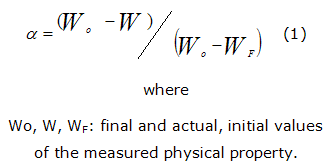
<body><![CDATA[<p align="justify"><font size="2" face="Verdana">The experiments were all carried out with:</font></p>     <p align="justify"><font size="2" face="Verdana">- The thermolysis in SCTA equipment is carried out &quot;under vacuum&quot;: The signal is produced by a Pirani gauge, which measures the total residual pressure of produced gases by the thermolysis. This signal is kept constant, controlling the furnace heating via a differential and integral, proportional regulation (PID). With this apparatus it is possible to work under a controlled residual pressure in the intervals from 10<font size="2" face="Verdana"><sup>-3</sup></font> to 100 mbar and in the temperature region among 30 and 100 &deg;C. The dehydration of BaCl<sub>2</sub>&middot;2H<sub>2</sub>O in a single experiment were carried out under a constant residual pressure of 1,86&middot;10<font size="2" face="Verdana"><sup>-3</sup></font> mbar and constant reaction rate C = 0,001 5 h<font size="2" face="Verdana"><sup>-1</sup></font>. When the rate jumps method is applied the ratio of the rate (r<sub>r</sub>) is fixed at a value of 4 and the fasted decomposition rate does not exceed 0,02 h<font size="2" face="Verdana"><sup>-1</sup></font>.</font></p>     <p align="justify"><font size="2" face="Verdana">- High Resolution Thermobalance, Hi-Res TGA (TA Instruments, mod. TG-2950). The experiments were done in flow of N<sub>2</sub> (100 ml/min). The heating rates were 10 and 20 &deg;C/min in non-isothermal segments and the experimental resolutions used was 5. In all cases the weight sample was about 56 mg.</font></p>     <p align="justify"><font size="2" face="Verdana"><strong><em>Kinetic procedure </em></strong></font></p>     <p align="justify"><font size="2" face="Verdana">The kinetic law may be assumed by simple comparing of the experimental curve transformation degree (&alpha;) versus Temperature (T), with the set of isokinetic theoretical curves reported by Criado and Ortega. In general, kinetic models of instantaneous nucleation and nuclei growth give rise to curves with a minimum &alpha;<sub>m</sub>. Models limited by diffusion phenomena give rise to curves with an inflexion point (with exception of one-dimensional diffusion), and models governed by interfacial advancement produce curves which show neither a minimum nor an inflexion point [10].</font></p>     <p align="justify"><font size="2" face="Verdana">Transformation degree can be calculated by the <a href="#e1">equation 1</a>:</font></p>     <p align="center"><font size="2" face="Verdana"><a name="e1"></a><img src="/img/revistas/ind/v28n1/e0102116.gif"></font></p>     
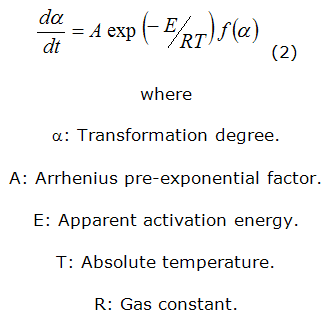
<p align="justify"><font size="2" face="Verdana">The analysis of isokinetic data is further carried out in the following way [8, 10] (<a href="#e2">2</a>):</font></p>     <p align="center"><font size="2" face="Verdana"><a name="e2"></a><img src="/img/revistas/ind/v28n1/e0202116.gif"></font></p>     
<p align="center"><font size="2" face="Verdana">f (&alpha;): Function related to the kinetic model obeyed by the reaction (<a href="#t1">table 1</a>).</font></p>     ]]></body>
<body><![CDATA[<p align="center"><font size="2" face="Verdana"><strong><a name="t1"></a>TABLE 1. KINETIC MODEL FUNCTIONS f(&alpha;), USUALLY EMPLOYED IN     <br> SOLID STATE REACTIONS [4,10]</strong> </font></p>      <div align="center">   <table border="1" cellpadding="0" cellspacing="0" bordercolor="#000000">     <tr>       <td width="208" valign="top">    <p align="center"><font size="2" face="Verdana">Model</font></p></td>       <td width="128" valign="top">    <p align="center"><font size="2" face="Verdana">Symbol </font></p></td>       <td width="203" valign="top">    <p align="center"><font size="2" face="Verdana">f(&alpha;)</font></p></td>     </tr>     <tr>       <td width="208" valign="top">    <p align="center"><font size="2" face="Verdana">One-dimensional diffusion</font></p></td>       <td width="128" valign="top">    <p align="center"><font size="2" face="Verdana">D1</font></p></td>       <td width="203" valign="top">    <p align="center"><font size="2" face="Verdana">&frac12; &alpha;</font></p></td>     </tr>     <tr>       <td width="208" valign="top">    <p align="center"><font size="2" face="Verdana">Two-dimensional diffusion</font></p></td>       <td width="128" valign="top">    ]]></body>
<body><![CDATA[<p align="center"><font size="2" face="Verdana">D2</font></p></td>       <td width="203" valign="top">    <p align="center"><font size="2" face="Verdana">-1/ ln (1-&alpha;)</font></p></td>     </tr>     <tr>       <td width="208" valign="top">    <p align="center"><font size="2" face="Verdana">Three-dimensional diffusion </font><font size="2" face="Verdana">(Jander)</font></p>       </td>       <td width="128" valign="top">    <p align="center"><font size="2" face="Verdana">D3</font></p></td>       <td width="203" valign="top">    <p align="center"><font size="2" face="Verdana">3 (1- &alpha;) 2/3 / 2 [1-(1-&alpha;)1/3]</font></p></td>     </tr>     <tr>       <td width="208" valign="top">    <p align="center"><font size="2" face="Verdana">Three- dimensional diffusion </font><font size="2" face="Verdana">(Ginstring- Brounshtein)</font></p>       </td>       <td width="128" valign="top">    <p align="center"><font size="2" face="Verdana">D4</font></p></td>       <td width="203" valign="top">    <p align="center"><font size="2" face="Verdana">3/2 [(1-&alpha;)-1/3-1]-1</font></p></td>     </tr>     <tr>       <td width="208" valign="top">    <p align="center"><font size="2" face="Verdana">First order</font></p></td>       <td width="128" valign="top">    <p align="center"><font size="2" face="Verdana">F1</font></p></td>       <td width="203" valign="top">    ]]></body>
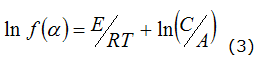
<body><![CDATA[<p align="center"><font size="2" face="Verdana">(1-&alpha;)</font></p></td>     </tr>     <tr>       <td width="208" valign="top">    <p align="center"><font size="2" face="Verdana">Phase boundary controlled</font></p></td>       <td width="128" valign="top">    <p align="center"><font size="2" face="Verdana">Rn (1 &le; n &le; 3)</font></p></td>       <td width="203" valign="top">    <p align="center"><font size="2" face="Verdana">n (1-&alpha;)1-1/n</font></p></td>     </tr>     <tr>       <td width="208" valign="top">    <p align="center"><font size="2" face="Verdana">Nucleation and growth </font><font size="2" face="Verdana">(Avrami-Erofeev)</font></p>       </td>       <td width="128" valign="top">    <p align="center"><font size="2" face="Verdana">Am (0,5 &le; m &le; 4)</font></p></td>       <td width="203" valign="top">    <p align="center"><font size="2" face="Verdana">m (1-&alpha;)[-ln(1-&alpha;)]1-1/m</font></p></td>     </tr>   </table> </div>     <p align="justify"><font size="2" face="Verdana">If d&alpha;/dt is a constant and logarithm is applied and reorganized the <a href="#e2">equation (2)</a> we obtained the <a href="#e3">equation (3)</a>:</font></p>     <p align="center"><font size="2" face="Verdana"><a name="e3"></a><img src="/img/revistas/ind/v28n1/e0302116.gif"></font></p>     
<p align="justify"><font size="2" face="Verdana">The term ln(A/C) is a constant. Then it is plotted ln f(&alpha;) versus reciprocal temperature (1/T) for various functions f(&alpha;) and the linear regression coefficients, together with the values of E, are calculated. The kinetic law or kinetic model is obtained from the best regression coefficient and the activation energy is calculated from the slope. This indicates that it is possible to obtain the reaction kinetic parameters from one single experiment [4, 11].</font></p>     ]]></body>
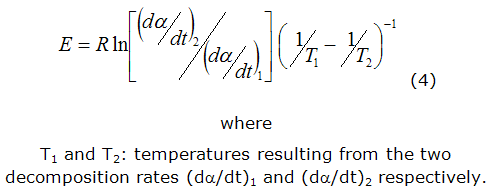
<body><![CDATA[<p align="justify"><font size="2" face="Verdana">Another way to calculate the activation energy is the following:</font></p>     <p align="justify"><font size="2" face="Verdana">When <a href="#e2">expression (2)</a> is applied for two decomposition rates, in isoconversion points (&alpha;<sub>1</sub> =&alpha;<sub>2</sub>), it is possible to calculate the activation energy without previous knowledge of the reaction kinetic model [11]. The resulting <a href="#e4">expression (4)</a> is:</font></p>     <p align="center"><font size="2" face="Verdana"><a name="e4" id="e4"></a><img src="/img/revistas/ind/v28n1/e0402116.gif"></font></p>     
<p align="justify"><font size="2" face="Verdana">In the particular case of rate jumps method applied in SCTA [8, 9], where the sample decomposes alternatively at two different decomposition rate with a ratio r<sub>r</sub>, the <a href="#e4">equation (4)</a> is simplificated to <a href="#e5">equation 5</a>:</font></p>     <p align="center"><font size="2" face="Verdana"><a name="e5" id="e5"></a><img src="/img/revistas/ind/v28n1/e0502116.gif"></font></p>     
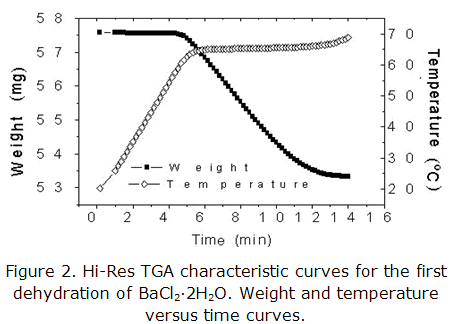
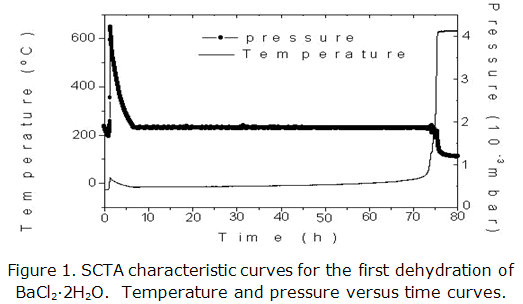
<p align="justify">&nbsp;</p>     <p align="justify"><font size="3" face="Verdana"><strong>RESULTS AND DISCUSSION</strong></font></p>     <p align="justify"><font size="2" face="Verdana"><a href="#f1">Figures 1</a> and <a href="#f2">2</a> show characteristic curves of single experiments of SCTA and Hi-Res TGA respectively, for the dehydration first stage of BaCl<sub>2</sub>&middot;2H<sub>2</sub>O. In the first case (<a href="#f1">figure 1</a>) can be observed that reaction occurs under temperature and pressure constant conditions.</font></p>     <p align="center"><font size="2" face="Verdana"><a name="f1" id="f1"></a><img src="/img/revistas/ind/v28n1/f0102116.gif"></font></p>     
<p align="justify"><font size="2" face="Verdana">In the second case (<a href="#f2">figure 2</a>) is appreciated an isothermal process. A similar result (isothermal process) is obtained when is applied the Paulik brother technique (QIQITA). These results show the control of temperature and pressure gradients attained with these techniques, which are essential factors to guarantee a best reproducibility and representability of calculated kinetic parameters. These aspects is not attained when are used the techniques of Conventional Thermal Analysis.</font></p>     ]]></body>
<body><![CDATA[<p align="center"><font size="2" face="Verdana"><a name="f2" id="f2"></a><img src="/img/revistas/ind/v28n1/f0202116.gif"></font></p>     
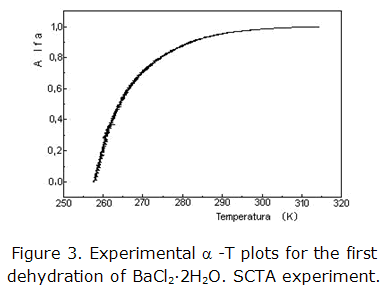
<p align="justify"><font size="2" face="Verdana"><strong><em>Kinetic of the dehydration according to SCTA</em></strong></font></p>     <p align="justify"><font size="2" face="Verdana"><a href="#f3">Figure 3</a> shows the dependency of transformation degree (&alpha;) with the temperature, in the interval of 0 &le; &alpha; &le; 1 for the first dehydration of BaCl<sub>2</sub>&middot;2H<sub>2</sub>O. In this case, the single experiments were done under a residual pressure of 1,86 &middot; 10<font size="2" face="Verdana"><sup>-3</sup></font> mbar and a constant reaction rate C = 0,015 h<font size="2" face="Verdana"><sup>-1</sup></font>. This curve has a very interesting feature that offers information about of possible kinetic model of the reaction, when it is compared with the set of isokinetic theoretical curves reported by Criado and Ortega [8, 10]. The profile of this curve suggests that this reaction is controlled by models of interfacial advancement (R<sub>2</sub>, R<sub>3</sub>) or first order (F<sub>1</sub>).</font></p>     <p align="center"><font size="2" face="Verdana"><a name="f3" id="f3"></a><img src="/img/revistas/ind/v28n1/f0302116.gif"></font></p>     
<p align="justify"><font size="2" face="Verdana">It is obtained a similar result when is applied the <a href="#e3">expression 3</a>. These results are shown in <a href="#t2">table 2</a>.</font></p>     <p align="center"><font size="2" face="Verdana"><a name="t2" id="t2"></a><strong>TABLE 2. KINETIC RESULTS OF THE FIRST DEHYDRATION OF BaCl</strong><sub><strong>2</strong></sub><strong>&middot;2H</strong><sub><strong>2</strong></sub><strong>O,     <br>   FROM EXPRESSION  3 AND SCTA EXPERIMENT</strong></font></p>      <div align="center">   <table border="1" cellpadding="0" cellspacing="0" bordercolor="#000000">     <tr>       <td width="113" valign="top">    <p align="center"><font size="2" face="Verdana">Symbol of the Kinetic models</font></p>          </td>       <td width="113" valign="top">    <p align="center"><font size="2" face="Verdana">Coefficients of </font><font size="2" face="Verdana">Regression </font></p>       </td>       <td width="113" valign="top">    ]]></body>
<body><![CDATA[<p align="center"><font size="2" face="Verdana">Standard Deviation </font></p>          </td>       <td width="113" valign="top">    <p align="center"><font size="2" face="Verdana">Activation Energy kJ/mol) </font></p></td>     </tr>     <tr>       <td width="113" height="29" valign="top">    <p align="center"><font size="2" face="Verdana">D<sub>1</sub></font></p></td>       <td width="113" valign="top">    <p align="center"><font size="2" face="Verdana">0,654 </font></p></td>       <td width="113" valign="top">    <p align="center"><font size="2" face="Verdana">0,78 </font></p></td>       <td width="113" valign="top">    <p align="center"><font size="2" face="Verdana">42 </font></p></td>     </tr>     <tr>       <td width="113" height="28" valign="top">    <p align="center"><font size="2" face="Verdana">D<sub>3</sub></font></p></td>       <td width="113" valign="top">    <p align="center"><font size="2" face="Verdana">0,890 </font></p></td>       <td width="113" valign="top">    <p align="center"><font size="2" face="Verdana">0,79 </font></p></td>       <td width="113" valign="top">    <p align="center"><font size="2" face="Verdana">96 </font></p></td>     </tr>     <tr>       <td width="113" height="26" valign="top">    ]]></body>
<body><![CDATA[<p align="center"><font size="2" face="Verdana">D<sub>4</sub></font></p></td>       <td width="113" valign="top">    <p align="center"><font size="2" face="Verdana">0,876 </font></p></td>       <td width="113" valign="top">    <p align="center"><font size="2" face="Verdana">0,78 </font></p></td>       <td width="113" valign="top">    <p align="center"><font size="2" face="Verdana">88 </font></p></td>     </tr>     <tr>       <td width="113" height="27" valign="top">    <p align="center"><font size="2" face="Verdana">F<sub>1</sub></font></p></td>       <td width="113" valign="top">    <p align="center"><font size="2" face="Verdana">0,684 </font></p></td>       <td width="113" valign="top">    <p align="center"><font size="2" face="Verdana">0,003 </font></p></td>       <td width="113" valign="top">    <p align="center"><font size="2" face="Verdana">7 </font></p></td>     </tr>     <tr>       <td width="113" height="27" valign="top">    <p align="center"><font size="2" face="Verdana">R<sub>2</sub></font></p></td>       <td width="113" valign="top">    <p align="center"><font size="2" face="Verdana">0,992 </font></p></td>       <td width="113" valign="top">    ]]></body>
<body><![CDATA[<p align="center"><font size="2" face="Verdana">0,061 </font></p></td>       <td width="113" valign="top">    <p align="center"><font size="2" face="Verdana">31 </font></p></td>     </tr>     <tr>       <td width="113" height="28" valign="top">    <p align="center"><font size="2" face="Verdana">R<sub>3</sub></font></p></td>       <td width="113" valign="top">    <p align="center"><font size="2" face="Verdana">0,992 </font></p></td>       <td width="113" valign="top">    <p align="center"><font size="2" face="Verdana">0,082 </font></p></td>       <td width="113" valign="top">    <p align="center"><font size="2" face="Verdana">41 </font></p></td>     </tr>     <tr>       <td width="113" height="25" valign="top">    <p align="center"><font size="2" face="Verdana">A<sub>2</sub></font></p></td>       <td width="113" valign="top">    <p align="center"><font size="2" face="Verdana">0,729 </font></p></td>       <td width="113" valign="top">    <p align="center"><font size="2" face="Verdana">0,44 </font></p></td>       <td width="113" valign="top">    <p align="center"><font size="2" face="Verdana">59 </font></p></td>     </tr>     <tr>       <td width="113" height="27" valign="top">    ]]></body>
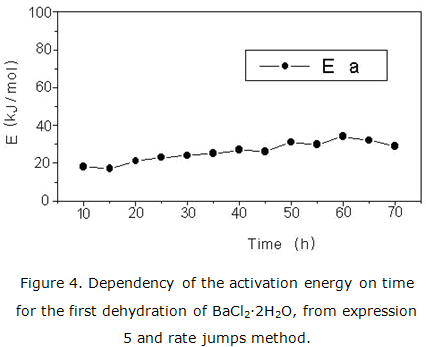
<body><![CDATA[<p align="center"><font size="2" face="Verdana">A<sub>3</sub></font></p></td>       <td width="113" valign="top">    <p align="center"><font size="2" face="Verdana">0,461 </font></p></td>       <td width="113" valign="top">    <p align="center"><font size="2" face="Verdana">0,57 </font></p></td>       <td width="113" valign="top">    <p align="center"><font size="2" face="Verdana">63 </font></p></td>     </tr>     <tr>       <td width="113" height="27" valign="top">    <p align="center"><font size="2" face="Verdana">A<sub>4</sub></font></p></td>       <td width="113" valign="top">    <p align="center"><font size="2" face="Verdana">0,314 </font></p></td>       <td width="113" valign="top">    <p align="center"><font size="2" face="Verdana">0,64 </font></p></td>       <td width="113" valign="top">    <p align="center"><font size="2" face="Verdana">48 </font></p></td>     </tr>   </table> </div>     <p align="justify"><font size="2" face="Verdana">The values of calculated activation energy from this expression are 30 kJ/mol to R<sub>2</sub> and 40 kJ/mol to R<sub>3</sub>. Besides, it is observed that the best fit correspond to the kinetic models R<sub>2</sub> y R<sub>3</sub>; although can be difficult to unambiguously select the correct mechanism. This impossibility of calculation method to discriminate among the models a same group has been frequently reported in literature [1, 8]. Nevertheless, when the rate jumps methods and the <a href="#e5">equation (5)</a> are applied, it can be identified the correct mechanism. <a href="#f4">Figure 4</a> represents the obtained results. </font></p>     <p align="center"><font size="2" face="Verdana"><a name="f4" id="f4"></a><img src="/img/revistas/ind/v28n1/f0402116.gif"></font></p>     
]]></body>
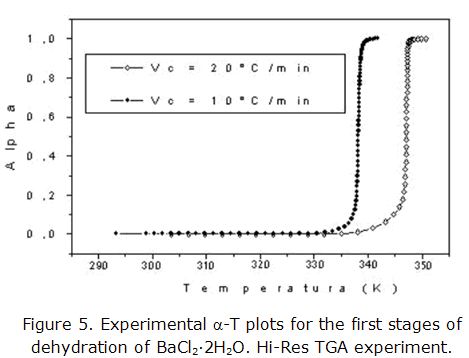
<body><![CDATA[<p align="justify"><font size="2" face="Verdana">The ratio of the rate (r<sub>r</sub>) is fixed at a value of 4 and the fasted decomposition rate does not exceed 0,02 h<font size="2" face="Verdana"><sup>-1</sup></font>.</font></p>     <p align="justify"><font size="2" face="Verdana">Thus, the activation energy can be estimated without previous knowledge of actual reaction mechanism. The estimated value is 26 &plusmn; 10 kJ/mol. This value is in good agreement with the calculated value to R<sub>2</sub> mechanism from <a href="#e3">expression (3)</a>. In this way, can be determined the actual mechanism and kinetic parameters by means of a combination of both analytical results.</font></p>     <p align="justify"><font size="2" face="Verdana"><strong><em>Kinetic of the dehydration according to Hi-Res TGA</em></strong></font></p>     <p align="justify"><font size="2" face="Verdana"><a href="#f5">Figure 5</a> shows the dependency of transformation degree (&alpha;) with the temperature, in an interval of 0 &le; &alpha; &le; 1 and heating rates of 10 and 20 &ordm;C/min, for the first dehydration of BaCl<sub>2</sub>&middot;2H<sub>2</sub>O.</font></p>     <p align="center"><font size="2" face="Verdana"><a name="f5" id="f5"></a><img src="/img/revistas/ind/v28n1/f0502116.gif"></font></p>     
<p align="justify"><font size="2" face="Verdana">When comparing with the set of isokinetic theoretical curves [8, 10] the clearly sigmoide forms of the curves suggests diffusive process. Therefore, the slowest stage in the reaction is the diffusion of the molecules of water through the solid product [12].</font></p>     <p align="justify"><font size="2" face="Verdana"><a href="#t3">Table 3</a> shows the obtained results to apply the expression 3, when the heating rate is 10 &ordm;C/min. Similar results are obtained for the heating rate of 20 &ordm;C/min. The best adjustments correspond to the kinetics models D<sub>1</sub>, D<sub>2</sub>, D<sub>3</sub> and D<sub>4</sub> although it cannot be select a kinetic model between the diffusive.</font></p>     <div align="center">       <p><font size="2" face="Verdana"><a name="t3" id="t3"></a><strong>TABLE  3. KINETIC RESULTS OF THE FIRST DEHYDRATION OF BaCl</strong><sub><strong>2</strong></sub><strong>&middot;2H</strong><sub><strong>2</strong></sub><strong>O     <br>   FROM EXPRESSION    3 AND Hi - Res TGA EXPERIMENTS</strong></font></p>   <table border="1" cellpadding="0" cellspacing="0" bordercolor="#000000">     <tr>       <td width="113" valign="top">    ]]></body>
<body><![CDATA[<p align="center"><font size="2" face="Verdana">Symbol of the </font><font size="2" face="Verdana">Kinetic models </font></p>       </td>       <td width="118" valign="top">    <p align="center"><font size="2" face="Verdana">Coefficients of Correlation </font></p>          </td>       <td width="90" valign="top">    <p align="center"><font size="2" face="Verdana">Standard </font><font size="2" face="Verdana">Deviation </font></p>       </td>       <td width="106" valign="top">    <p align="center"><font size="2" face="Verdana">Activation Energy (kJ/mol) </font></p></td>     </tr>     <tr>       <td width="113" height="27" valign="top">    <p align="center"><font size="2" face="Verdana">D<sub>1</sub></font></p></td>       <td width="118" valign="top">    <p align="center"><font size="2" face="Verdana">0,995 </font></p></td>       <td width="90" valign="top">    <p align="center"><font size="2" face="Verdana">0,004 7 </font></p></td>       <td width="106" valign="top">    <p align="center"><font size="2" face="Verdana">29 </font></p></td>     </tr>     <tr>       <td width="113" height="28" valign="top">    <p align="center"><font size="2" face="Verdana">D<sub>2</sub></font></p></td>       <td width="118" valign="top">    <p align="center"><font size="2" face="Verdana">0,992 </font></p></td>       <td width="90" valign="top">    ]]></body>
<body><![CDATA[<p align="center"><font size="2" face="Verdana">0,078 </font></p></td>       <td width="106" valign="top">    <p align="center"><font size="2" face="Verdana">14 </font></p></td>     </tr>     <tr>       <td width="113" height="25" valign="top">    <p align="center"><font size="2" face="Verdana">D<sub>3</sub></font></p></td>       <td width="118" valign="top">    <p align="center"><font size="2" face="Verdana">0,986 </font></p></td>       <td width="90" valign="top">    <p align="center"><font size="2" face="Verdana">0,128 </font></p></td>       <td width="106" valign="top">    <p align="center"><font size="2" face="Verdana">40 </font></p></td>     </tr>     <tr>       <td width="113" height="25" valign="top">    <p align="center"><font size="2" face="Verdana">D<sub>4</sub></font></p></td>       <td width="118" valign="top">    <p align="center"><font size="2" face="Verdana">0,990 </font></p></td>       <td width="90" valign="top">    <p align="center"><font size="2" face="Verdana">0,094 </font></p></td>       <td width="106" valign="top">    <p align="center"><font size="2" face="Verdana">52 </font></p></td>     </tr>     <tr>       <td width="113" height="27" valign="top">    ]]></body>
<body><![CDATA[<p align="center"><font size="2" face="Verdana">F<sub>1</sub></font></p></td>       <td width="118" valign="top">    <p align="center"><font size="2" face="Verdana">0,939 </font></p></td>       <td width="90" valign="top">    <p align="center"><font size="2" face="Verdana">0,112 </font></p></td>       <td width="106" valign="top">    <p align="center"><font size="2" face="Verdana">96 </font></p></td>     </tr>     <tr>       <td width="113" height="25" valign="top">    <p align="center"><font size="2" face="Verdana">R<sub>2</sub></font></p></td>       <td width="118" valign="top">    <p align="center"><font size="2" face="Verdana">0,939 </font></p></td>       <td width="90" valign="top">    <p align="center"><font size="2" face="Verdana">0,056 </font></p></td>       <td width="106" valign="top">    <p align="center"><font size="2" face="Verdana">73 </font></p></td>     </tr>     <tr>       <td width="113" height="26" valign="top">    <p align="center"><font size="2" face="Verdana">R<sub>3</sub></font></p></td>       <td width="118" valign="top">    <p align="center"><font size="2" face="Verdana">0,939 </font></p></td>       <td width="90" valign="top">    ]]></body>
<body><![CDATA[<p align="center"><font size="2" face="Verdana">0,075 </font></p></td>       <td width="106" valign="top">    <p align="center"><font size="2" face="Verdana">88 </font></p></td>     </tr>     <tr>       <td width="113" height="26" valign="top">    <p align="center"><font size="2" face="Verdana">A<sub>2</sub></font></p></td>       <td width="118" valign="top">    <p align="center"><font size="2" face="Verdana">0,78 </font></p></td>       <td width="90" valign="top">    <p align="center"><font size="2" face="Verdana">0,084 </font></p></td>       <td width="106" valign="top">    <p align="center"><font size="2" face="Verdana">23 </font></p></td>     </tr>     <tr>       <td width="113" height="26" valign="top">    <p align="center"><font size="2" face="Verdana">A<sub>3</sub></font></p></td>       <td width="118" valign="top">    <p align="center"><font size="2" face="Verdana">0,797 </font></p></td>       <td width="90" valign="top">    <p align="center"><font size="2" face="Verdana">0,077 </font></p></td>       <td width="106" valign="top">    <p align="center"><font size="2" face="Verdana">10 </font></p></td>     </tr>     <tr>       <td width="113" height="25" valign="top">    ]]></body>
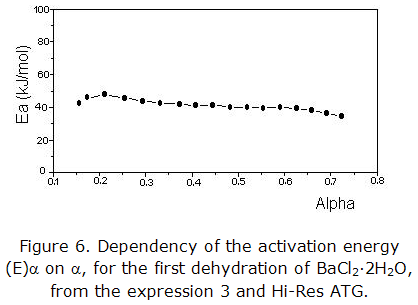
<body><![CDATA[<p align="center"><font size="2" face="Verdana">A<sub>4</sub></font></p></td>       <td width="118" valign="top">    <p align="center"><font size="2" face="Verdana">0,798 </font></p></td>       <td width="90" valign="top">    <p align="center"><font size="2" face="Verdana">0,103 </font></p></td>       <td width="106" valign="top">    <p align="center"><font size="2" face="Verdana">15 </font></p></td>     </tr>   </table> </div>     <p align="justify"><font size="2" face="Verdana">The dependency of the activation energy (E)<sub>&alpha;</sub> on &alpha; is shown in the <a href="#f6">figure 6</a>, when is applied the <a href="#e4">equation (4)</a> in points of isoconversion, for two experiments done to different decomposition rates.</font></p>     <p align="center"><font size="2" face="Verdana"><a name="f6" id="f6"></a><img src="/img/revistas/ind/v28n1/f0602116.gif"></font></p>     
<p align="justify"><font size="2" face="Verdana">The <a href="#f6">figure 6</a> shows in the 0,13 &le; &alpha; &le; 0,7 range, that the values of (E)<sub>&alpha;</sub> are essentially constant, with a slight tendency to decrease. Therefore, it is evidenced that activation energy is independent of the transformation degree. The estimated value of activation energy is 40 kJ/mol. The combination of the obtained analytical results from the <a href="#e3">equations (3)</a> and (<a href="#e4">4</a>) allows selecting the D<sub>3</sub> kinetic model as the most probable, when Hi-Res ATG is used.</font></p>     <p align="justify"><font size="2" face="Verdana"><strong><em>General considerations</em></strong></font></p>     <p align="justify"><font size="2" face="Verdana">The most important experimental consideration is deduced when are compared the obtained results by both techniques. In spite of the effective control of temperature and pressure gradients, when are used these experimental procedures, is evident the adverse influence of experimental conditions on the calculated kinetic parameters. The dependency of kinetic parameters and particularly of the kinetic model on the control of atmosphere in immediate vicinity of the sample is demonstrated. </font></p>     <p align="justify"><font size="2" face="Verdana">The results suggest the residual pressure as experimental parameter that originates this difference. The experience for SCTA uses lower pressures (vacuum conditions) and a model of interfacial advancement limits the dehydration, while the Hi-Res ATG is carried out to greater pressure and is limited by diffusive process. </font></p>     ]]></body>
<body><![CDATA[<p align="justify"><font size="2" face="Verdana">The interval of pressures established in each experiment allows favoring one or another kinetic model. In the <a href="#t2">table 2</a> for SCTA is observed that, the second models more probable are the diffusives and in the <a href="#t3">table 3</a> for Hi- Res ATG, the second models more probable are those characterized by the interfacial advancement. </font></p>     <p align="justify"><font size="2" face="Verdana">Rouquerol coincides with Eyraud when asserts, sometimes the vacuum condition eliminate adsorption and diffusion process [13]. This affirmation can explain because during the experience of SCTA, the diffusive process is not determinant. </font></p>     <p align="justify"><font size="2" face="Verdana">The literature refers that variations of pressure in 10<font size="2" face="Verdana"><sup>-5</sup></font>–10<font size="2" face="Verdana"><sup>-2</sup></font> mbar range during the study by SCTA of dehydration of the LiSO<sub>4</sub>&middot;H<sub>3</sub>O, cause changes of the kinetic model as was referred [8]. It is important to emphasize that the obtained differences in the kinetic models do not alter the values of calculated activation energy from both techniques. </font></p>     <p align="justify">&nbsp;</p>     <p align="justify"><font size="3" face="Verdana"><strong>CONCLUSIONS</strong></font></p>     <p align="justify"><font size="2" face="Verdana">The influence of atmosphere and particularly of the residual pressure in environment of the samples on the calculated kinetic parameters is demonstrated, for the first dehydration of BaCl<sub>2</sub>&middot;2H<sub>2</sub>O. Model controlled by 2-dimensional interfacial advancement (R<sub>2</sub>) and activation energy of 26 kJ/mol are calculated when is applied the technique SCTA; a 3-dimensional diffusive kinetic model (D<sub>3</sub>) and activation energy of 40 kJ/mol are determined when Hi- Res ATG is applied. The limited validity of the expression (3) in the discrimination of reaction kinetic model was also demonstrated. </font></p>     <p align="justify">&nbsp;</p>     <p align="justify"><font size="3" face="Verdana"><strong>REFERENCES</strong></font></p>     <!-- ref --><p align="justify"><font size="2" face="Verdana">1. CRIADO, J. M.; ORTEGA, A.; ROUQU&Eacute;ROL, J. Y.; ROUQUEROL, F., &quot;Un nuevo m&eacute;todo de An&aacute;lisis T&eacute;rmico: El an&aacute;lisis t&eacute;rmico a velocidad de transformaci&oacute;n controlada (ATVC)&quot;, <em>Bolet&iacute;n de la Sociedad Espa&ntilde;ola de Cer&aacute;mica y Vidrio</em>, 1987, 26, 3-11.    </font></p>     ]]></body>
<body><![CDATA[<!-- ref --><p align="justify"><font size="2" face="Verdana">2. ROUQUEROL, J., &quot;Controlled transformation rate thermal analysis: the hidden face of thermal analysis&quot;, <em>Termochimica Acta</em>, 1989, 144(2), 209-224.    </font></p>     <!-- ref --><p align="justify"><font size="2" face="Verdana">3. ROUQUEROL, J., <em>Sample Controlled Thermal Analysis</em>, 2nd ed., France, Kluwer Acad. Press, 2003, 325 p.    </font></p>     <!-- ref --><p align="justify"><font size="2" face="Verdana">4. HAINES, P. I., <em>Thermal Methods of Analysis. Principles, Applications and Problems</em>, Gran Breta&ntilde;a, Backie Academic and Professional Publishing, 1995, 132 p.    </font></p>     <!-- ref --><p align="justify"><font size="2" face="Verdana">5. VALOR, A.; KYCIA, S.; TORRES, E.; REGUERA, E.; V&Aacute;ZQUEZ, C.; S&Aacute;NCHEZ, F., &quot;Structural and thermal study of calcium undecanoate&quot;, <em>J. Solid State Chemistry</em>, 2003, 172(2), 471-479.    </font></p>     <!-- ref --><p align="justify"><font size="2" face="Verdana">6. TORRES, E.; PEL&Aacute;IZ, A., &quot;Oxidation kinetic study of copper (I) in ferroelectric ceramic by high resolution thermogravimetric analysis&quot;, <em>Thermochimica Acta</em>, 2002, 372(1), 39-44.    </font></p>     ]]></body>
<body><![CDATA[<!-- ref --><p align="justify"><font size="2" face="Verdana">7. ALEMAN V&Aacute;ZQUEZ, L. O.; RODR&Iacute;GUEZ GATTORNO, G., &quot;Oxidation process of MoOxCy to MoO<sub>3</sub>: kinetics and mechanism&quot;, <em>J. Solid State Chemistry</em>, 2004, 177(10), 3281-3289.    </font></p>     <!-- ref --><p align="justify"><font size="2" face="Verdana">8. ROUQU&Eacute;ROL, F.; LAUREIRO, Y.; ROUQU&Eacute;ROL, J., &quot;Influence of water vapour pressure on the thermal dehydration of lithium sulphate monohydrate&quot;, <em>Solid State Ionics</em>, 1993, 63, 363-366.    </font></p>     <!-- ref --><p align="justify"><font size="2" face="Verdana">9.  BORD&Eacute;RES, S.; ROUQU&Eacute;ROL, F.; LLEWELLYN, P. L.; ROUQU&Eacute;ROL, J., &quot;Unexpected effect of pressure on the dehydration kinetics of uranyl nitrate trihydrate: an example of a Smith-Topley effect&quot;, <em>Thermochimica Acta</em>, 1996, 282, 1-11.    </font></p>     <!-- ref --><p align="justify"><font size="2" face="Verdana">10. CRIADO, J. M.; ORTEGA, A.; P&Eacute;REZ, L., &quot;The use of master plots for discriminating the kinetics model of solid state reactions from a single constant rate thermal analysis (CRTA) experiment&quot;, <em>Thermochimica Acta</em>, 1996, 277, 165-173.    </font></p>     <!-- ref --><p align="justify"><font size="2" face="Verdana">11. TADASHI, A.; NOBUYUKI, F., &quot;Controlled-rate thermal analysis. Kinetic study in thermal dehydration of calcium sulphate dihydrate&quot;, <em>J. Analytical and Applied Pyrolysis</em>, 1997, 39(2), 129-143.    </font></p>     ]]></body>
<body><![CDATA[<!-- ref --><p align="justify"><font size="2" face="Verdana">12. QUESADA, O.; TORRES, E.; LL&Oacute;PIZ, J. C., &quot;Termogravimetr&iacute;a de alta resoluci&oacute;n. Estudio cin&eacute;tico de la deshidrataci&oacute;n t&eacute;rmica del cloruro de bario dihidratado&quot;, <em>Revista Cubana de Qu&iacute;mica</em>, 2002, 14(1), 44-50.    </font></p>     <!-- ref --><p align="justify"><font size="2" face="Verdana">13. ROUQUEROL, J.; GANTEAUME, M. , &quot;Thermolysis under vacuum: essential influence of the residual pressure of thermoanalytical curves and the reaction products&quot;, <em>J. Thermal Analysis</em>, 1977, 11(2), 201-210.    </font></p>     <p align="left">&nbsp;</p>     <p align="left">&nbsp;</p>     <p align="left"><font size="2" face="Verdana">Recibido: 07/05/2015    <br> Aceptado: 25/09/2015</font></p>     <p align="left">&nbsp;</p>     <p align="left">&nbsp;</p>     ]]></body>
<body><![CDATA[<p align="justify"><font size="2" face="Verdana"><em>Dra. C. Omaida Quesada-Gonz&aacute;lez</em>, Facultad de Ciencias Naturales, Universidad de Oriente, Santiago de Cuba, Cuba, <a href="mailto:oquesada@cnt.uo.edu.cu">oquesada@cnt.uo.edu.cu</a></font></p>      ]]></body><back>
<ref-list>
<ref id="B1">
<label>1</label><nlm-citation citation-type="">
<person-group person-group-type="author">
<name>
<surname><![CDATA[CRIADO]]></surname>
<given-names><![CDATA[J. M]]></given-names>
</name>
<name>
<surname><![CDATA[ORTEGA]]></surname>
<given-names><![CDATA[A]]></given-names>
</name>
<name>
<surname><![CDATA[ROUQUÉROL]]></surname>
<given-names><![CDATA[J. Y]]></given-names>
</name>
<name>
<surname><![CDATA[ROUQUEROL]]></surname>
<given-names><![CDATA[F]]></given-names>
</name>
</person-group>
<article-title xml:lang="es"><![CDATA[Un nuevo método de Análisis Térmico: El análisis térmico a velocidad de transformación controlada (ATVC)]]></article-title>
<source><![CDATA[]]></source>
<year>1987</year>
<volume>26</volume>
<page-range>3-11</page-range></nlm-citation>
</ref>
<ref id="B2">
<label>2</label><nlm-citation citation-type="">
<person-group person-group-type="author">
<name>
<surname><![CDATA[ROUQUEROL]]></surname>
<given-names><![CDATA[J]]></given-names>
</name>
</person-group>
<article-title xml:lang="en"><![CDATA[Controlled transformation rate thermal analysis: the hidden face of thermal analysis]]></article-title>
<source><![CDATA[]]></source>
<year>1989</year>
<volume>144</volume>
<numero>2</numero>
<issue>2</issue>
<page-range>209-224</page-range></nlm-citation>
</ref>
<ref id="B3">
<label>3</label><nlm-citation citation-type="book">
<person-group person-group-type="author">
<name>
<surname><![CDATA[ROUQUEROL]]></surname>
<given-names><![CDATA[J]]></given-names>
</name>
</person-group>
<source><![CDATA[Sample Controlled Thermal Analysis]]></source>
<year>2003</year>
<edition>2</edition>
<page-range>325</page-range><publisher-name><![CDATA[Kluwer Acad. Press]]></publisher-name>
</nlm-citation>
</ref>
<ref id="B4">
<label>4</label><nlm-citation citation-type="book">
<person-group person-group-type="author">
<name>
<surname><![CDATA[HAINES]]></surname>
<given-names><![CDATA[P. I]]></given-names>
</name>
</person-group>
<source><![CDATA[Thermal Methods of Analysis. Principles, Applications and Problems]]></source>
<year>1995</year>
<page-range>132</page-range><publisher-name><![CDATA[Backie Academic and Professional Publishing]]></publisher-name>
</nlm-citation>
</ref>
<ref id="B5">
<label>5</label><nlm-citation citation-type="">
<person-group person-group-type="author">
<name>
<surname><![CDATA[VALOR]]></surname>
<given-names><![CDATA[A]]></given-names>
</name>
<name>
<surname><![CDATA[KYCIA]]></surname>
<given-names><![CDATA[S]]></given-names>
</name>
<name>
<surname><![CDATA[TORRES]]></surname>
<given-names><![CDATA[E]]></given-names>
</name>
<name>
<surname><![CDATA[REGUERA]]></surname>
<given-names><![CDATA[E]]></given-names>
</name>
<name>
<surname><![CDATA[VÁZQUEZ]]></surname>
<given-names><![CDATA[C]]></given-names>
</name>
<name>
<surname><![CDATA[SÁNCHEZ]]></surname>
<given-names><![CDATA[F]]></given-names>
</name>
</person-group>
<article-title xml:lang="en"><![CDATA[Structural and thermal study of calcium undecanoate]]></article-title>
<source><![CDATA[]]></source>
<year>2003</year>
<volume>172</volume>
<numero>2</numero>
<issue>2</issue>
<page-range>471-479</page-range></nlm-citation>
</ref>
<ref id="B6">
<label>6</label><nlm-citation citation-type="">
<person-group person-group-type="author">
<name>
<surname><![CDATA[TORRES]]></surname>
<given-names><![CDATA[E]]></given-names>
</name>
<name>
<surname><![CDATA[PELÁIZ]]></surname>
<given-names><![CDATA[A]]></given-names>
</name>
</person-group>
<article-title xml:lang="en"><![CDATA[Oxidation kinetic study of copper (I) in ferroelectric ceramic by high resolution thermogravimetric analysis]]></article-title>
<source><![CDATA[]]></source>
<year>2002</year>
<volume>372</volume>
<numero>1</numero>
<issue>1</issue>
<page-range>9-44</page-range></nlm-citation>
</ref>
<ref id="B7">
<label>7</label><nlm-citation citation-type="">
<person-group person-group-type="author">
<name>
<surname><![CDATA[ALEMAN VÁZQUEZ]]></surname>
<given-names><![CDATA[L. O]]></given-names>
</name>
<name>
<surname><![CDATA[RODRÍGUEZ GATTORNO]]></surname>
<given-names><![CDATA[G]]></given-names>
</name>
</person-group>
<article-title xml:lang="en"><![CDATA[Oxidation process of MoOxCy to MoO3: kinetics and mechanism]]></article-title>
<source><![CDATA[]]></source>
<year>2004</year>
<volume>177</volume>
<numero>10</numero>
<issue>10</issue>
<page-range>3281-3289</page-range></nlm-citation>
</ref>
<ref id="B8">
<label>8</label><nlm-citation citation-type="">
<person-group person-group-type="author">
<name>
<surname><![CDATA[ROUQUÉROL]]></surname>
<given-names><![CDATA[F]]></given-names>
</name>
<name>
<surname><![CDATA[LAUREIRO]]></surname>
<given-names><![CDATA[Y]]></given-names>
</name>
<name>
<surname><![CDATA[ROUQUÉROL]]></surname>
<given-names><![CDATA[J]]></given-names>
</name>
</person-group>
<article-title xml:lang="en"><![CDATA[Influence of water vapour pressure on the thermal dehydration of lithium sulphate monohydrate]]></article-title>
<source><![CDATA[]]></source>
<year>1993</year>
<volume>63</volume>
<page-range>363-366</page-range></nlm-citation>
</ref>
<ref id="B9">
<label>9</label><nlm-citation citation-type="">
<person-group person-group-type="author">
<name>
<surname><![CDATA[BORDÉRES]]></surname>
<given-names><![CDATA[S]]></given-names>
</name>
<name>
<surname><![CDATA[ROUQUÉROL]]></surname>
<given-names><![CDATA[F]]></given-names>
</name>
<name>
<surname><![CDATA[LLEWELLYN]]></surname>
<given-names><![CDATA[P. L]]></given-names>
</name>
<name>
<surname><![CDATA[ROUQUÉROL]]></surname>
<given-names><![CDATA[J]]></given-names>
</name>
</person-group>
<article-title xml:lang="en"><![CDATA[Unexpected effect of pressure on the dehydration kinetics of uranyl nitrate trihydrate: an example of a Smith-Topley effect]]></article-title>
<source><![CDATA[]]></source>
<year>1996</year>
<volume>282</volume>
<page-range>1-11</page-range></nlm-citation>
</ref>
<ref id="B10">
<label>10</label><nlm-citation citation-type="">
<person-group person-group-type="author">
<name>
<surname><![CDATA[CRIADO]]></surname>
<given-names><![CDATA[J. M]]></given-names>
</name>
<name>
<surname><![CDATA[ORTEGA]]></surname>
<given-names><![CDATA[A]]></given-names>
</name>
<name>
<surname><![CDATA[PÉREZ]]></surname>
<given-names><![CDATA[L]]></given-names>
</name>
</person-group>
<article-title xml:lang="en"><![CDATA[The use of master plots for discriminating the kinetics model of solid state reactions from a single constant rate thermal analysis (CRTA) experiment]]></article-title>
<source><![CDATA[]]></source>
<year>1996</year>
<volume>277</volume>
<page-range>165-173</page-range></nlm-citation>
</ref>
<ref id="B11">
<label>11</label><nlm-citation citation-type="">
<person-group person-group-type="author">
<name>
<surname><![CDATA[TADASHI]]></surname>
<given-names><![CDATA[A]]></given-names>
</name>
<name>
<surname><![CDATA[NOBUYUKI]]></surname>
<given-names><![CDATA[F]]></given-names>
</name>
</person-group>
<article-title xml:lang="en"><![CDATA[Controlled-rate thermal analysis. Kinetic study in thermal dehydration of calcium sulphate dihydrate]]></article-title>
<source><![CDATA[]]></source>
<year>1997</year>
<volume>39</volume>
<numero>2</numero>
<issue>2</issue>
<page-range>129-143</page-range></nlm-citation>
</ref>
<ref id="B12">
<label>12</label><nlm-citation citation-type="">
<person-group person-group-type="author">
<name>
<surname><![CDATA[QUESADA]]></surname>
<given-names><![CDATA[O]]></given-names>
</name>
<name>
<surname><![CDATA[TORRES]]></surname>
<given-names><![CDATA[E]]></given-names>
</name>
<name>
<surname><![CDATA[LLÓPIZ]]></surname>
<given-names><![CDATA[J. C]]></given-names>
</name>
</person-group>
<article-title xml:lang="es"><![CDATA[Termogravimetría de alta resolución. Estudio cinético de la deshidratación térmica del cloruro de bario dihidratad]]></article-title>
<source><![CDATA[]]></source>
<year>2002</year>
<volume>14</volume>
<numero>1</numero>
<issue>1</issue>
<page-range>44-50</page-range></nlm-citation>
</ref>
<ref id="B13">
<label>13</label><nlm-citation citation-type="">
<person-group person-group-type="author">
<name>
<surname><![CDATA[ROUQUEROL]]></surname>
<given-names><![CDATA[J]]></given-names>
</name>
<name>
<surname><![CDATA[GANTEAUME]]></surname>
<given-names><![CDATA[M]]></given-names>
</name>
</person-group>
<article-title xml:lang="en"><![CDATA[Thermolysis under vacuum: essential influence of the residual pressure of thermoanalytical curves and the reaction products]]></article-title>
<source><![CDATA[]]></source>
<year>1977</year>
<volume>11</volume>
<numero>2</numero>
<issue>2</issue>
<page-range>201-210</page-range></nlm-citation>
</ref>
</ref-list>
</back>
</article>