<?xml version="1.0" encoding="ISO-8859-1"?><article xmlns:mml="http://www.w3.org/1998/Math/MathML" xmlns:xlink="http://www.w3.org/1999/xlink" xmlns:xsi="http://www.w3.org/2001/XMLSchema-instance">
<front>
<journal-meta>
<journal-id>2224-5421</journal-id>
<journal-title><![CDATA[Revista Cubana de Química]]></journal-title>
<abbrev-journal-title><![CDATA[Rev Cub Quim]]></abbrev-journal-title>
<issn>2224-5421</issn>
<publisher>
<publisher-name><![CDATA[Ediciones UO, Universidad de Oriente]]></publisher-name>
</publisher>
</journal-meta>
<article-meta>
<article-id>S2224-54212016000200012</article-id>
<title-group>
<article-title xml:lang="es"><![CDATA[Efecto del campo electromagnético en el contenido mineral y grupo químico durante el establecimiento in vitro y la multiplicación de fases en las plántulas de café]]></article-title>
<article-title xml:lang="en"><![CDATA[Effect of electromagnetic field on mineral content and chemical group during in vitro establishment and multiplication phases of coffee seedlings]]></article-title>
</title-group>
<contrib-group>
<contrib contrib-type="author">
<name>
<surname><![CDATA[Isaac-Aleman]]></surname>
<given-names><![CDATA[Elizabeth]]></given-names>
</name>
<xref ref-type="aff" rid="A01"/>
</contrib>
<contrib contrib-type="author">
<name>
<surname><![CDATA[Hernández-Aguilar]]></surname>
<given-names><![CDATA[Claudia]]></given-names>
</name>
<xref ref-type="aff" rid="A02"/>
</contrib>
<contrib contrib-type="author">
<name>
<surname><![CDATA[González-Olmedo]]></surname>
<given-names><![CDATA[Justo Lorenzo]]></given-names>
</name>
<xref ref-type="aff" rid="A03"/>
</contrib>
<contrib contrib-type="author">
<name>
<surname><![CDATA[González-Vega]]></surname>
<given-names><![CDATA[María Esther]]></given-names>
</name>
<xref ref-type="aff" rid="A04"/>
</contrib>
<contrib contrib-type="author">
<name>
<surname><![CDATA[Fung-Boix]]></surname>
<given-names><![CDATA[Yilan]]></given-names>
</name>
<xref ref-type="aff" rid="A01"/>
</contrib>
<contrib contrib-type="author">
<name>
<surname><![CDATA[Ferrer-Dubois]]></surname>
<given-names><![CDATA[Albys Esther]]></given-names>
</name>
<xref ref-type="aff" rid="A01"/>
</contrib>
</contrib-group>
<aff id="A01">
<institution><![CDATA[,Research Department, National Center of Applied Electromagnetism  ]]></institution>
<addr-line><![CDATA[Santiago de Cuba ]]></addr-line>
<country>Cuba</country>
</aff>
<aff id="A02">
<institution><![CDATA[,Unidad de Zacatenco Instituto Politécnico Nacional System Department]]></institution>
<addr-line><![CDATA[DF ]]></addr-line>
<country>México</country>
</aff>
<aff id="A03">
<institution><![CDATA[,Universidad de Ciego de Ávila Tissue Culture Department, Bioplantas Center ]]></institution>
<addr-line><![CDATA[Ciego de Ávila ]]></addr-line>
<country>Cuba</country>
</aff>
<aff id="A04">
<institution><![CDATA[,Instituto Nacional de Investigaciones Agrícolas Genetic Department ]]></institution>
<addr-line><![CDATA[Mayabeque ]]></addr-line>
<country>Cuba</country>
</aff>
<pub-date pub-type="pub">
<day>00</day>
<month>08</month>
<year>2016</year>
</pub-date>
<pub-date pub-type="epub">
<day>00</day>
<month>08</month>
<year>2016</year>
</pub-date>
<volume>28</volume>
<numero>2</numero>
<fpage>692</fpage>
<lpage>702</lpage>
<copyright-statement/>
<copyright-year/>
<self-uri xlink:href="http://scielo.sld.cu/scielo.php?script=sci_arttext&amp;pid=S2224-54212016000200012&amp;lng=en&amp;nrm=iso"></self-uri><self-uri xlink:href="http://scielo.sld.cu/scielo.php?script=sci_abstract&amp;pid=S2224-54212016000200012&amp;lng=en&amp;nrm=iso"></self-uri><self-uri xlink:href="http://scielo.sld.cu/scielo.php?script=sci_pdf&amp;pid=S2224-54212016000200012&amp;lng=en&amp;nrm=iso"></self-uri><abstract abstract-type="short" xml:lang="es"><p><![CDATA[Se investigó la influencia de los campos electromagnéticos de frecuencia extremadamente baja en contenido de minerales y grupos químicos durante el establecimiento in vitro y la multiplicación de las fases en las plántulas de café. Plantas de café sin tratar se consideraron como control mientras que las plantas tratadas se exponen a un campo magnético sinusoidal de 60 Hz de 2 mT de inducción magnética, durante tres minutos. Los resultados revelaron que las plantas tratadas, respecto a su control muestran un aumento significativo en el calcio (55 %), de aluminio (73 %) y de manganeso (43,2 %) los niveles en fase de establecimiento. Se obtuvo el aspecto de cuatro selecciones sensibles en los embriones intentado lo que respecta a controlar embriones. Se observó la presencia de un doble enlace carbono-carbono, ion nitrito y aldehídos. En aumento fase de multiplicación en el calcio (17,9 %), hierro (29,2%), magnesio (5,7 %) y zinc (26 %) los niveles se refiere, en las plantas tratadas respetan control. En conclusión, los resultados sugieren que la aplicación de un campo magnético de 60 Hz a plantas de café in vitro puede mejorar la calidad de las plántulas de café mediante la modificación del contenido de iones de movilidad garantizar una mejor calidad de las plantas.]]></p></abstract>
<abstract abstract-type="short" xml:lang="en"><p><![CDATA[Influence of extremely low frequency electromagnetic fields on minerals content and chemical groups during in vitro establishment and multiplication phases of coffee seedlings was investigated. Untreated coffee plants were considered as control whereas treated plants were exposed to a 60 Hz sinusoidal magnetic field of 2 mT of magnetic induction, during 3 minutes. The results revealed that treated plants, regard to their control shown a significant increase on calcium (55 %), aluminium (73 %) and manganese (43,2 %) levels in establishment phase. The appearance of four sensitive picks was obtained in the embryos tried regards to control embryos. The presence of carbon-carbon double bound, nitrit ion and aldehydes was noted. In multiplication phase increase on calcium (17,9 %), iron (29,2 %), magnesium (5,7 %) and zinc (26 %) levels was regards in treated plants respect control. In conclusion, the findings suggest that the application of 60 Hz magnetic field to in vitro coffee plants may improve the coffee seedlings quality by modifying of ions mobility content ensuring a better quality plants.]]></p></abstract>
<kwd-group>
<kwd lng="es"><![CDATA[iones]]></kwd>
<kwd lng="es"><![CDATA[clorofilas]]></kwd>
<kwd lng="es"><![CDATA[plántulas de café]]></kwd>
<kwd lng="es"><![CDATA[embriones]]></kwd>
<kwd lng="es"><![CDATA[campos electromagnéticos]]></kwd>
<kwd lng="en"><![CDATA[ions]]></kwd>
<kwd lng="en"><![CDATA[chlorophylls]]></kwd>
<kwd lng="en"><![CDATA[coffee seedlings]]></kwd>
<kwd lng="en"><![CDATA[embryos]]></kwd>
<kwd lng="en"><![CDATA[electromagnetic fields]]></kwd>
</kwd-group>
</article-meta>
</front><body><![CDATA[ <p align="right"><font face="Verdana" size="2"><b>ARTICULOS</b></font></p>     <p align="justify">&nbsp;</p>     <p align="left"><font face="Verdana" size="2"><b><font size="4"><strong> Efecto del campo electromagn&eacute;tico en el contenido mineral y grupo qu&iacute;mico durante el establecimiento <em>in vitro </em> y la multiplicaci&oacute;n de fases en las pl&aacute;ntulas de caf&eacute;</strong></font></b></font></p>     <p align="justify">&nbsp;</p>     <p align="justify"><font face="Verdana" size="2"><b><font size="3"> Effect of electromagnetic field on mineral content and chemical group during in vitro establishment and multiplication phases of coffee seedlings</font></b></font></p>     <p align="justify">&nbsp;</p>     <p align="justify">&nbsp;</p>     <p align="justify"> <font face="Verdana" size="2"><b> Elizabeth Isaac-Aleman<sup>I</sup>,    Claudia Hern&aacute;ndez-Aguilar<sup>II</sup>,    Justo Lorenzo Gonz&aacute;lez-Olmedo<sup>III</sup>,    Mar&iacute;a Esther Gonz&aacute;lez-Vega<sup>IV</sup>,     Yilan Fung-Boix<sup>I</sup>,     Albys Esther Ferrer-Dubois<sup>I</sup></b></font></p>     <p align="justify"><font face="Verdana" size="2"> <sup>I</sup>Research Department, National Center of Applied Electromagnetism, Santiago de Cuba, Cuba, <a href="mailto:elizabetha@uo.edu.cu">elizabetha@uo.edu.cu</a>    <br>       <sup>II</sup>System Department, Instituto Polit&eacute;cnico Nacional, Unidad de Zacatenco, DF, M&eacute;xico    ]]></body>
<body><![CDATA[<br>       <sup>III</sup>Tissue Culture Department, Bioplantas Center, Universidad de Ciego de &Aacute;vila, Ciego de &Aacute;vila, Cuba    <br>       <sup>IV</sup>Genetic Department, Instituto Nacional de Investigaciones Agr&iacute;colas, Mayabeque, Cuba</font></p>     <p align="justify">&nbsp;</p>     <p align="justify">&nbsp;</p> <hr>     <p align="justify"><font face="Verdana" size="2"><b>RESUMEN</b></font></p>     <p align="justify"><font face="Verdana" size="2"> Se investig&oacute; la influencia de los campos electromagn&eacute;ticos de frecuencia extremadamente baja en contenido de minerales y grupos qu&iacute;micos durante el establecimiento <em>in vitro </em> y la multiplicaci&oacute;n de las fases en las pl&aacute;ntulas de caf&eacute;. Plantas de caf&eacute; sin tratar se consideraron como control mientras que las plantas tratadas se exponen a un campo magn&eacute;tico sinusoidal de 60 Hz de 2 mT de inducci&oacute;n magn&eacute;tica, durante tres minutos. Los resultados revelaron que las plantas tratadas, respecto a su control muestran un aumento significativo en el calcio (55 %), de aluminio (73 %) y de manganeso (43,2 %) los niveles en fase de establecimiento. Se obtuvo el aspecto de cuatro selecciones sensibles en los embriones intentado lo que respecta a controlar embriones. Se observ&oacute; la presencia de un doble enlace carbono-carbono, ion nitrito y aldeh&iacute;dos. En aumento fase de multiplicaci&oacute;n en el calcio (17,9 %), hierro (29,2%), magnesio (5,7 %) y zinc (26 %) los niveles se refiere, en las plantas tratadas respetan control. En conclusi&oacute;n, los resultados sugieren que la aplicaci&oacute;n de un campo magn&eacute;tico de 60 Hz a plantas de caf&eacute; <em>in vitro </em> puede mejorar la calidad de las pl&aacute;ntulas de caf&eacute; mediante la modificaci&oacute;n del contenido de iones de movilidad garantizar una mejor calidad de las plantas.</font></p>     <p align="justify"><font face="Verdana" size="2"><b>Palabras clave:</b> iones, clorofilas, pl&aacute;ntulas de caf&eacute;, embriones, campos electromagn&eacute;ticos.</font></p> <hr>     <p align="justify"><font face="Verdana" size="2"> <b>ABSTRACT</b></font></p>     <p align="justify"><font face="Verdana" size="2"> Influence of extremely low frequency electromagnetic fields on minerals content and chemical groups during in vitro establishment and multiplication phases of coffee seedlings was investigated. Untreated coffee plants were considered as control whereas treated plants were exposed to a 60 Hz sinusoidal magnetic field of 2 mT of magnetic induction, during 3 minutes. The results revealed that treated plants, regard to their control shown a significant increase on calcium (55 %), aluminium (73 %) and manganese (43,2 %) levels in establishment phase. The appearance of four sensitive picks was obtained in the embryos tried regards to control embryos. The presence of carbon-carbon double bound, nitrit ion and aldehydes was noted. In multiplication phase increase on calcium (17,9 %), iron (29,2 %), magnesium (5,7 %) and zinc (26 %) levels was regards in treated plants respect control. In conclusion, the findings suggest that the application of 60 Hz magnetic field to in vitro coffee plants may improve the coffee seedlings quality by modifying of ions mobility content ensuring a better quality plants.</font></p>     <p align="justify"><font face="Verdana" size="2"> <b>Keywords:</b> ions, chlorophylls, coffee seedlings, embryos, electromagnetic fields.</font></p> <hr>     ]]></body>
<body><![CDATA[<p>&nbsp;</p>     <p>&nbsp;</p>     <p><b><font face="Verdana" size="3">INTRODUCTION</font></b></p>     <p align="justify"><font size="2" face="Verdana">Several studies have reported different positive effects on seed germination, shoot development, plant length, fresh weight, fruit production and mean fruit weight when extremely low frequency magnetic fields (ELF-MFs) are applied [1-8].</font></p>     <p align="justify"><font size="2" face="Verdana">The application of ELF-MFs can increase the ion mobility close to receptor places and/or through membrane ionic channels, mainly calcium ion or cluster in cytoplasm [9]. Others authors consider the cyclotron paramagnetic resonance like the main effects of ELF-MFs for membrane disorder related with calcium ion flux [10].</font></p>     <p align="justify"><font size="2" face="Verdana">Polk and Postow [11] reported that ELF-MFs action on some organism occur through two mechanism. The first related to physical-chemical process and tissue energy interaction. The second related with ELF-MFs and chemical reaction balance and speed of biochemical process.</font></p>     <p align="justify"><font size="2" face="Verdana">Nevertheless, for tissue plant this mechanism is not defined. Moreover, ELF-MFs have positive effects on some plant process like germination, seedling growing, photosynthetic process, enzymatic activity, and others [4, 5, 8].</font></p>     <p align="justify"><font size="2" face="Verdana">Coffee is the second most commercialized product in the world posing as an important source of income and jobs in several countries. Coffee trees may be obtained from the coffee seeds which remain viable for three months. Coffee in vitro culture has been successfully established, and consequently high quality coffee seedlings during many years has been generated [13].</font></p>     <p align="justify"><font size="2" face="Verdana">Even, the common way to produce coffee seedling is botanic seed, the loss of germination during storage is a problem for propagation and the conservation of genetic resources. Actually, embryos culture is effective to rescue the plant material in seed with low viability. This technique constitutes an alternative to coffee propagation during all year.</font></p>     <p align="justify"><font size="2" face="Verdana">In this investigation, we attempted determinate the relation between 60 Hz ELF-MFs on ionic mobility and the component structural formation in in vitro seedling coffee.</font></p>     ]]></body>
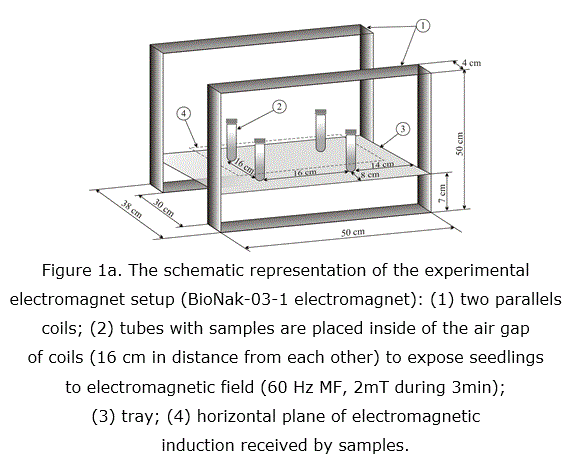
<body><![CDATA[<p align="justify">&nbsp;</p>     <p align="left"><font size="3" face="Verdana, Arial, Helvetica, sans-serif"><strong>MATERIALS AND METHODS</strong></font></p>     <p align="justify"><font size="2" face="Verdana"><strong><em>Plant growth conditions</em></strong></font></p>     <p align="justify"><font size="2" face="Verdana">Micropropagation and biochemical identification of coffee variety &quot;Catuai&quot; were performed according to the methodology established [14]. The embryos of <em>Coffea arabica </em> var. Catuai seeds were grown during 6 weeks in Murashige-Skoog (MS) medium [15], supplemented with 30 g/L of sucrose, 6 g/L of agar, 25 mg/L of cysteine, 0.5 mg/L of casein, and pH was adjusted to 5,6. Test tubes of 25 x 150 mm were used, each one containing 10 mL of culture medium for establishment phase. The plants were maintained under temperatures of 24 &plusmn; 1 &ordm;C, relative humidity of 70 &plusmn; 5 %, and a photoperiod of 24 h of illumination and 80 &micro;mol/m<sup>2</sup>s of photosynthetic photon flux (PPF) with fluorescent lamps.</font></p>     <p align="justify"><font size="2" face="Verdana">Coffee seedlings with one pair of leaves were subcultivated in same culture medium and maintained under temperatures of 24 &plusmn; 1 &ordm;C, relative humidity of 70 &plusmn; 5 %, photoperiod of 16 h and 80 &micro;mol/m<sup>2</sup>s of PPF, reaching the multiplication phase after six weeks.</font></p>     <p align="justify"><font size="2" face="Verdana"><strong><em>Magnetic field exposure</em></strong></font></p>     <p align="justify"><font size="2" face="Verdana">The 60 Hz MF treatment was performed using the BioNaK-03-1 electromagnet, manufactured at National Centre of Applied Electromagnetism (CNEA), Santiago de Cuba, Cuba. This electromagnet was located in a place away from other electromagnetic sources and ferromagnetic materials. It is formed by two parallel coils (dimensions 50384 cm) as depicted in <a href="#f1a">figure 1a</a>. These measurements were made with a Vernier caliper with clamping screw (0,05mmof precision; Model 5 30-104; Mitutoyo, Japan). The coils were connected in series and coupled to a signal generator of sinusoidal wave form. The coils were connected in series and coupled to a signal generator of sinusoidal waveform.</font></p>     <p align="center"><font size="2" face="Verdana"><a name="f1a" id="f1a"></a><img src="/img/revistas/ind/v28n2/f01a12216.gif"></font></p>     
<p align="justify"><font size="2" face="Verdana">A non-uniform variable magnetic field was generated inside of the coil when a sinusoidal electric current passed through it. The magnetic induction was 2 mT. It was measured with a digital gauss meter (0,01mT of resolution; basic accuracy: DC &plusmn; 3% (without probe), AC: &plusmn;2 % (Magnet-Physics, Model FH 54; CWIEME, Berlin, Germany). The measurements were taken at 24 &plusmn; 1 o C. The magnetic field homogeneity was 0,01 % in the work volume (20 x 20 x 4 cm) inside of the coils. It was computed by (Bi–Bo)/Bo, where Bi and Bo are the magnetic inductions at any point inside of the coil and in the center of magnetic system, respectively (<a href="#f1b">figure 1b</a>).</font></p>     <p align="center"><font size="2" face="Verdana"><a name="f1b" id="f1b"></a><img src="/img/revistas/ind/v28n2/f01b12216.gif"></font></p>     
]]></body>
<body><![CDATA[<p align="justify"><font size="2" face="Verdana">Although, there were electric fields induced in the seedlings by 60 Hz magnetic fields, these were not calculated because the electric vector decreased 10<sup>5</sup> times in intensity and changed the distribution when it crossed the biological tissue, while the magnetic vector did not change for EFL-MF. No magnetic field other than that of the geomagnetic field was detected within the experimental electromagnet when it was switched off.</font></p>     <p align="justify"><font size="2" face="Verdana">The local geomagnetic field within the coils was approximately 61mT, measured previously by Gilart [16]. One week after establishment phase, two experimental groups were formed: treated (60 Hz MF, 2mT during 3 min) and control (exposure to the local geomagnetic field only inside of the BioNaK-03-1electromagnet for 3 min) taking into account the results published by [17]. After 6 weeks, seedlings were transferred to the multiplication phase and after 1 week, treatment was applied as the establishment phase for each group (treated and control).</font></p>     <p align="justify"><font size="2" face="Verdana"><strong><em>Determination of chemical groups and mineral content</em></strong></font></p>     <p align="justify"><font size="2" face="Verdana">Mineral content determination was made for Inductively Coupled Plasma mass spectrometry (ICP-MS). Six grams of fresh foliar tissue was weighed and dry during 48 hours to 70 o C. One grams of dry tissue was introduced in muffle at 250&ordm;C&plusmn;25&ordm;C and the temperature was increased gradually, (50&ordm;C/hour), until 450&ordm;C &plusmn; 25&ordm;C to obtain ahs. Subsequently 1 ml of nitric acid and 2 ml of distilled water for laundering ash was added.</font></p>     <p align="justify"><font size="2" face="Verdana">The chemical group characterization of coffee embryos was made by Near Infrared Spectroscopy (IR) with Fourier transformed (Bruker Vector 33). The half capacity is between 500-4000 nm, 5nm of interval. 0,1mg of embryos was triturated with the same amount of potassium bromide. The mixture was compressed in a mechanic press to make a translucent pill. The technique of Total Attenuated Reflectivity in a range of 400-4000 nm was used. The result was analyzed with OMNIC software for Windows 09.</font></p>     <p align="justify"><font size="2" face="Verdana"><strong><em>Statistics</em></strong></font></p>     <p align="justify"><font size="2" face="Verdana">Data for control and treated samples were statistically compared by Student's t-test (P&lt; 0.05). SISVAR Software (License: 820459851, Lavras, Minas Gerais, Brazil) was used for statistical analyses.</font></p>     <p align="justify">&nbsp;</p>     <p align="justify"><font size="3" face="Verdana"><strong>RESULTS</strong></font></p>     <p align="justify"><font size="2" face="Verdana">Magnetically treated plants in establishment phase shown great differences for calcium (55 %), aluminum (73 %), and magnesium (43,2 %) respect to control seedlings. Whereas, the control plants results for iron and zinc was superior respect treated plants (<a href="/img/revistas/ind/v28n2/f0212216.jpg" target="_blank">figure 2</a>).</font></p>     
]]></body>
<body><![CDATA[<p align="justify"><font size="2" face="Verdana">The germination, beginning for update of water in seed, and it finish with root emergence. In this moment, differential permeability temporal alteration is made accomplish with passive loss of different low molar mass metabolites (sugars, organic acid, ions, amino acid and peptides). This activity shows the transformation of phospholipids component in cell membrane. An increase of ATP synthesis, respiratory activity and great numbers of enzymes are produced [18].</font></p>     <p align="justify"><font size="2" face="Verdana">The coffee embryos are collocated in a culture medium during the establishment phase. The culture medium is formed by macronutrients and micronutrients. The macro and micronutrients are absorbed by the embryos and inside of tissue the mineral participate in many cellular processes like calcium. The calcium is a co-factor for many enzymes involved in ATP hydrolysis.</font></p>     <p align="justify"><font size="2" face="Verdana">The results shown an increase of ion like calcium, aluminum and magnesium in treated plants that probably improve the growing in these seedlings, related with the increased of membrane permeability, a manner to agree with [17] and others authors. These authors reported during the expositions to ELF-MFs, the membrane cell channels stay open for more time and consequently an increase of nutrient absorption and cell metabolism [19-23].</font></p>     <p align="justify"><font size="2" face="Verdana">The plasmatic membrane has not special structure to act in electromagnetic signal perception unlike electric signal, voltage-dependents channels. The behavior is assign to phospholipids anisotropic properties. The phospholipids is reoriented in membrane and cause the membrane channels deformation and conductivity [10]. Probably this phenomenon happened in coffee embryos treated with ELF-MFs respect to control embryos.</font></p>     <p align="justify"><font size="2" face="Verdana">In multiplication phases an increase for calcium (17,9 %), iron (29,2 %) and zinc (26 %) with significant difference was observes in treated plants respect to control plants (<a href="/img/revistas/ind/v28n2/f0312216.jpg" target="_blank">figure 3</a>).</font></p>     
<p align="justify"><font size="2" face="Verdana">Like was said before, electromagnetic fields act on membrane permeability process and it have a positive influence on physiologic process like photosynthesis, hormonal transport, and others. The iron is considering a constituent of cytochromes and non-heme iron proteins involved in photosynthesis, nitrogen fixation, and respiration. The other hand, the zinc is constituent of process glycolytic enzymes and calcium is required as a cofactor by some enzymes involved in the hydrolysis of ATP and phospholipids and acts as a second messenger in metabolic regulation [18].The results indicate that 60 Hz- MF (2 mT and 3 min of exposure) induced a positive influence on the increase of this three elements improve the physiological process in coffee plants to guarantee de quality of seedlings.</font></p>     <p align="justify"><font size="2" face="Verdana">Infrared spectroscopy results are shown in <a href="/img/revistas/ind/v28n2/f0412216.jpg" target="_blank">figure 4</a>. We can to identify the increase of some components in treated embryos respect to control embryos.</font></p>     
<p align="justify"> <font size="2" face="Verdana">The interpretation of four sensible points in the <a href="/img/revistas/ind/v28n2/f0312216.jpg" target="_blank">figure 3</a>, that changed for treated embryos respect to control, agree with NO<sub>2</sub> (1 500 nm); double chemical bound C=C (1 600 nm) and aldehydes (2 800 nm).</font></p>     
<p align="justify"><font size="2" face="Verdana">This result probably is related with a superior metabolic activity in treated embryos, associated with the compound structural formation. In the germination process activation the metabolism of proteins takes place. It well know that double chemical bound (C=C) is a component of nitrogen bases, and the same time this nitrogen bases take place in nucleotide biosynthesis, who are direct precursor of DNA and RNA.</font></p>     <p align="justify"><font size="2" face="Verdana">Besides, NO<sub>2</sub> point in treated embryos could be related with the reduction for nitrite reductase to ammonium. Finally the amide form is linked to glutamine to be transformed in others amino acid for produce others proteins and nucleic acid [18].</font></p>     ]]></body>
<body><![CDATA[<p align="justify"><font size="2" face="Verdana">The results allows to consider the presence of this reaction of nucleotide metabolism in coffee embryos studied, agree with a positive influence on production rates of DNA, RNA, and mRNA, tRNA and rRNA transcripts [10, 19, 24].</font></p>     <p align="justify">&nbsp;</p>     <p align="justify"><strong><font size="3" face="Verdana">CONCLUSION</font></strong></p>     <p align="justify"><font size="2" face="Verdana">The data presented here on EMF- MFS induced changes in mineral content and chemical group during establishment and multiplication phases of embryos coffee is a reference to show a probably increase of membrane permeability in plant cell.</font></p>     <p align="justify">&nbsp; </p>     <p align="justify"><strong><font size="3" face="Verdana">BIBLIOGRAPHIC REFERENCES</font></strong></p>     <!-- ref --><p align="justify"><font size="2" face="Verdana">1. ROCHALSKA M., ORZESZKO-RYWKA A., &quot;Magnetic field treatment improves seed performance&quot;, <em>Seed Sci. Technol.</em>, 2005, (33),  669-674.    </font></p>     <!-- ref --><p align="justify"><font size="2" face="Verdana">2. FLOREZ M., CARBONEL M. V, MARTINEZ, E., &quot;Exposure of maize seeds to stationary magnetic fields: Effects on germination and early growth&quot;, <em>Environ. Exp. Bot., </em>2007, (59),  68-75.    </font></p>     ]]></body>
<body><![CDATA[<!-- ref --><p align="justify"><font size="2" face="Verdana">3. VASHISTH A., NAGARAJAN S., &quot;Exposure of seeds to static magnetic field enhances germination and early growth characteristic in chickpea (<em>Cicer arietinum </em> L.)&quot;, <em>Bioelectromagnetics, </em> 2008, (29),  571-578.    </font></p>     <!-- ref --><p align="justify"><font size="2" face="Verdana">4. NIMMI V., MADHU, G., &quot;Effect of pre-sowing treatment with permanent magnetic field on germination and growth of chili (<em>Capsicum annun </em>L.)&quot;, <em>Int. Agroph.</em>, 2009, (23),  195-198.    </font></p>     <!-- ref --><p align="justify"><font size="2" face="Verdana">5. CAKMAK, T., DUMLUPINAR, R., ERDAL, S., &quot;Acceleration of germination and early growth of wheat and bean seedlings grown under various magnetic field and osmotic conditions&quot;, <em>Bioelectromagnetics, </em> 2010, (31),  120-129.    </font></p>     <!-- ref --><p align="justify"><font size="2" face="Verdana">6. DE SOUZA, A., GARC&Iacute;A, D., SUEIRO, L., GILART, F., &quot;Improvement of seed germination, growth and yield of onion plants by extremely low frequency non-uniform magnetic field&quot;, <em>Scientia Horticulturae, </em> 2014, (176),  63-69.    </font></p>     <!-- ref --><p align="justify"><font size="2" face="Verdana">7. ISAAC ALEM&Aacute;N, E., MGOBOLI, A., FUNG, Y., GONZ&Aacute;LEZ OLMEDO, J., CHALFUN JUNIOR, A., &quot;Effects of EMFs on some biological parameters in coffee plants (<em>Coffea arabia </em> L.) obtained by <em>in vitro </em> propagation&quot;, <em>Pol. J. Enviorn. Stud.</em>, 23(1), 2014,  95-101.    </font></p>     ]]></body>
<body><![CDATA[<!-- ref --><p align="justify"><font size="2" face="Verdana">8. ISAAC ALEMAN, E., OLIVEIRA MOREIRA, R., ALMEIDA LIMA, A., CHAVES SILVA, S., LORENZO GONZ&Aacute;LEZ, J., CHALFUN JUNIOR, A., &quot;Effects of 60 Hz sinusoidal magnetic field on in vitro establishment, multiplication, and acclimatization phases of <em>Coffea arabica s</em>eedlings&quot;, <em>Bioelectromagnetics, </em> 2014, (35),  414-425.    </font></p>     <!-- ref --><p align="justify"><font size="2" face="Verdana">9. KARNAUKHOV, A. V., &quot;Dissipative structure in weakmagnetic field&quot;, <em>Biof&iacute;sica, </em> 1994,  39(6),  1009-1014.    </font></p>     <!-- ref --><p align="justify"><font size="2" face="Verdana">10. GALLAND, P., PAZUR, A., &quot;Magnetoreception in plants&quot;, <em>J. Plant Res.</em>, 2005,  118(6),  371-389.    </font></p>     <!-- ref --><p align="justify"><font size="2" face="Verdana">11. POLK, C., POSTOW, E., <em>Handbook of biological effects of electromagnetic fields, </em> 3ra edici&oacute;n, Ed.Taylor &amp; Francis Group, LLC, 2006, 503 p.    </font></p>     <!-- ref --><p align="justify"><font size="2" face="Verdana">12. DE SOUZA, A., GARCIA, D., SUEIRO, L., GILART, F., PORRAS, E., LICEA, L., &quot;Pre-sowing magnetic treatments of tomato seeds increase the growth and yield of plants&quot;, <em>Bioelectromagnetics, </em> 2006, (27),  247-257.    </font></p>     ]]></body>
<body><![CDATA[<!-- ref --><p align="justify"><font size="2" face="Verdana">13. MART&Iacute;NEZ GONZ&Aacute;LEZ, E., BARRIOS, G., ROVESTI, L., SANTOS, R., <em>Manejo Integrado de Plagas. Manual Pr&aacute;ctico, </em> Ed. Torralba, Espa&ntilde;a, 2007.    </font></p>     <!-- ref --><p align="justify"><font size="2" face="Verdana">14. DE LA CRUZ, G., ESTRADA, S., OROZCO, S., LABRADA, P. M., <em>Micropropagation and biochemical identifications methodology of coffee plants varieties</em>, 1st edition, Bayamo Granma, Cuba, Jorge Dimitrov Institute Publications, 1992.    </font></p>     <!-- ref --><p align="justify"><font size="2" face="Verdana">15. MURASHIGE, T., SKOOG, F., &quot;A revised medium for rapid growth and bioassays with tobacco tissue cultures&quot;, <em>Phys. Plant, </em> 1962, (15),  473- 497.    </font></p>     <!-- ref --><p align="justify"><font size="2" face="Verdana">16. GILART, F., DEAS, D., L&Oacute;PEZ, P., FERRER, D., RIBEAUX,, G., CASTILLO, J., &quot;High flow capacity devices for anti-scale magnetic treatment of water&quot;. <em>Chem Eng Proc: Proc Int</em>., 2013, (70),  211–216.    </font></p>     <!-- ref --><p align="justify"><font size="2" face="Verdana">17. ISAAC, E., GONZ&Aacute;LEZ OLMEDO, J., P&Eacute;REZ, A., ARAG&Oacute;N, C., &quot;Photosynthetic activity associated with gas exchange in two varieties of <em>Coffea arabica </em> obtained by in culture&quot;, <em>Cult. Tropic</em>., 2010, (31),  74–76.    </font></p>     ]]></body>
<body><![CDATA[<!-- ref --><p align="justify"><font size="2" face="Verdana">18. TAIZ, L., ZEIGER, E., <em>Plant Physiology</em>, 4ta edition, Sinauer Associates Inc., Massachussets, 2006, 672 p.    </font></p>     <!-- ref --><p align="justify"><font size="2" face="Verdana">19. LIBOFF, A. R., &quot;Geomagnetic cyclotron resonance in living cell&quot;, <em>J. Bio. Physc.</em>, 1985, (13),  99-102.    </font></p>     <!-- ref --><p align="justify"><font size="2" face="Verdana">20. YANO, A., OHASHI, Y., HIRASAKI, T., FUJIWARA, K., &quot;Effects of a 60 Hz magnetic field on photosynthetic CO2 uptake and early growth of radish seedlings&quot;, <em>Bioelectromagnetics, </em> 2004, (25),  572-581.    </font></p>     <!-- ref --><p align="justify"><font size="2" face="Verdana">21. DATTILO, A. M., BRACCHINI, L., LOISELLE, S. A., OVIDI, E., TIEZZI, A., ROSSI, C., &quot;Morphological anomalies in pollen tubes of <em>Actinidia deliciosa </em>(Kiwi) exposed to 50 Hz magnetic field&quot;, <em>Bioelectromagnetics, </em> 2005, (6),  153-156.    </font></p>     <!-- ref --><p align="justify"><font size="2" face="Verdana">22. DEL REL, B., BERSANI, F., AGOSTINI, C., MERSICA, P., GIORGIL, G., &quot;Various effects in <em>Escherichia coli </em>cells due two different ELM.-MF signals&quot;, <em>Bioelectromagnetics, </em> 2005, (3),  347-354.    </font></p>     ]]></body>
<body><![CDATA[<!-- ref --><p align="justify"><font size="2" face="Verdana">23. HSIN HSIUNG, H., SHOW RAN, W., &quot;The effects of inverter magnetic fields on early seed germination of mung beans&quot;, <em>Bioelectromagnetics, </em> 2008, 29(8),  649-657.    </font></p>     <!-- ref --><p align="justify"><font size="2" face="Verdana">24. VOLPE, P., &quot;Interactions of zero-frequency and oscillating magnetic fields with biostructures and biosystems&quot;, <em>Photochem. Photobiol. Sci.</em>, 2003, (2),  637–648.    </font></p>     <p align="justify">&nbsp;</p>     <p align="justify">&nbsp;</p>     <p align="left"><font size="2" face="Verdana">Recibido: 30/10/2015    <br> Aceptado: 02/02/2016</font></p>     <p align="left">&nbsp;</p>     <p align="left">&nbsp;</p>     ]]></body>
<body><![CDATA[<p align="left"><font size="2" face="Verdana"><em>Elizabeth Isaac-Aleman</em>, Research Department, National Center of Applied Electromagnetism, Santiago de Cuba, Cuba, <a href="mailto:elizabetha@uo.edu.cu">elizabetha@uo.edu.cu</a></font></p>      ]]></body><back>
<ref-list>
<ref id="B1">
<nlm-citation citation-type="">
<person-group person-group-type="author">
<name>
<surname><![CDATA[ROCHALSKA]]></surname>
<given-names><![CDATA[M]]></given-names>
</name>
<name>
<surname><![CDATA[ORZESZKO-RYWKA]]></surname>
<given-names><![CDATA[A]]></given-names>
</name>
</person-group>
<article-title xml:lang="en"><![CDATA[Magnetic field treatment improves seed performance]]></article-title>
<source><![CDATA[]]></source>
<year>2005</year>
<numero>33</numero>
<issue>33</issue>
<page-range>669-674</page-range></nlm-citation>
</ref>
<ref id="B2">
<label>2</label><nlm-citation citation-type="">
<person-group person-group-type="author">
<name>
<surname><![CDATA[FLOREZ]]></surname>
<given-names><![CDATA[M]]></given-names>
</name>
<name>
<surname><![CDATA[CARBONEL]]></surname>
<given-names><![CDATA[M. V]]></given-names>
</name>
<name>
<surname><![CDATA[MARTINEZ]]></surname>
<given-names><![CDATA[E]]></given-names>
</name>
</person-group>
<article-title xml:lang="en"><![CDATA[Exposure of maize seeds to stationary magnetic fields: Effects on germination and early growth]]></article-title>
<source><![CDATA[]]></source>
<year>2007</year>
<numero>59</numero>
<issue>59</issue>
<page-range>68-75</page-range></nlm-citation>
</ref>
<ref id="B3">
<label>3</label><nlm-citation citation-type="">
<person-group person-group-type="author">
<name>
<surname><![CDATA[VASHISTH]]></surname>
<given-names><![CDATA[A]]></given-names>
</name>
<name>
<surname><![CDATA[NAGARAJAN]]></surname>
<given-names><![CDATA[S]]></given-names>
</name>
</person-group>
<article-title xml:lang="en"><![CDATA[Exposure of seeds to static magnetic field enhances germination and early growth characteristic in chickpea (Cicer arietinum L.)]]></article-title>
<source><![CDATA[]]></source>
<year>2008</year>
<numero>29</numero>
<issue>29</issue>
<page-range>571-578</page-range></nlm-citation>
</ref>
<ref id="B4">
<label>4</label><nlm-citation citation-type="">
<person-group person-group-type="author">
<name>
<surname><![CDATA[NIMMI]]></surname>
<given-names><![CDATA[V]]></given-names>
</name>
<name>
<surname><![CDATA[MADHU]]></surname>
<given-names><![CDATA[G]]></given-names>
</name>
</person-group>
<article-title xml:lang="en"><![CDATA[Effect of pre-sowing treatment with permanent magnetic field on germination and growth of chili (Capsicum annun L.)]]></article-title>
<source><![CDATA[]]></source>
<year>2009</year>
<numero>23</numero>
<issue>23</issue>
<page-range>195-198</page-range></nlm-citation>
</ref>
<ref id="B5">
<label>5</label><nlm-citation citation-type="">
<person-group person-group-type="author">
<name>
<surname><![CDATA[CAKMAK]]></surname>
<given-names><![CDATA[T]]></given-names>
</name>
<name>
<surname><![CDATA[DUMLUPINAR]]></surname>
<given-names><![CDATA[R]]></given-names>
</name>
<name>
<surname><![CDATA[ERDAL]]></surname>
<given-names><![CDATA[S]]></given-names>
</name>
</person-group>
<article-title xml:lang="en"><![CDATA[Acceleration of germination and early growth of wheat and bean seedlings grown under various magnetic field and osmotic conditions]]></article-title>
<source><![CDATA[]]></source>
<year>2010</year>
<numero>31</numero>
<issue>31</issue>
<page-range>120-129</page-range></nlm-citation>
</ref>
<ref id="B6">
<label>6</label><nlm-citation citation-type="">
<person-group person-group-type="author">
<name>
<surname><![CDATA[DE SOUZA]]></surname>
<given-names><![CDATA[A]]></given-names>
</name>
<name>
<surname><![CDATA[GARCÍA]]></surname>
<given-names><![CDATA[D]]></given-names>
</name>
<name>
<surname><![CDATA[SUEIRO]]></surname>
<given-names><![CDATA[L]]></given-names>
</name>
<name>
<surname><![CDATA[GILART]]></surname>
<given-names><![CDATA[F]]></given-names>
</name>
</person-group>
<article-title xml:lang="en"><![CDATA[Improvement of seed germination, growth and yield of onion plants by extremely low frequency non-uniform magnetic field]]></article-title>
<source><![CDATA[]]></source>
<year>2014</year>
<numero>176</numero>
<issue>176</issue>
<page-range>63-69</page-range></nlm-citation>
</ref>
<ref id="B7">
<label>7</label><nlm-citation citation-type="">
<person-group person-group-type="author">
<name>
<surname><![CDATA[ISAAC ALEMÁN]]></surname>
<given-names><![CDATA[E]]></given-names>
</name>
<name>
<surname><![CDATA[MGOBOLI]]></surname>
<given-names><![CDATA[A]]></given-names>
</name>
<name>
<surname><![CDATA[FUNG]]></surname>
<given-names><![CDATA[Y]]></given-names>
</name>
<name>
<surname><![CDATA[GONZÁLEZ OLMEDO]]></surname>
<given-names><![CDATA[J]]></given-names>
</name>
<name>
<surname><![CDATA[CHALFUN JUNIOR]]></surname>
<given-names><![CDATA[A]]></given-names>
</name>
</person-group>
<article-title xml:lang="en"><![CDATA[Effects of EMFs on some biological parameters in coffee plants (Coffea arabia L.) obtained by in vitro propagation]]></article-title>
<source><![CDATA[]]></source>
<year>2014</year>
<volume>23</volume>
<numero>1</numero>
<issue>1</issue>
<page-range>95-101</page-range></nlm-citation>
</ref>
<ref id="B8">
<label>8</label><nlm-citation citation-type="">
<person-group person-group-type="author">
<name>
<surname><![CDATA[ISAAC ALEMAN]]></surname>
<given-names><![CDATA[E]]></given-names>
</name>
<name>
<surname><![CDATA[OLIVEIRA MOREIRA]]></surname>
<given-names><![CDATA[R]]></given-names>
</name>
<name>
<surname><![CDATA[ALMEIDA LIMA]]></surname>
<given-names><![CDATA[A]]></given-names>
</name>
<name>
<surname><![CDATA[CHAVES SILVA]]></surname>
<given-names><![CDATA[S]]></given-names>
</name>
<name>
<surname><![CDATA[LORENZO GONZÁLEZ]]></surname>
<given-names><![CDATA[J]]></given-names>
</name>
<name>
<surname><![CDATA[CHALFUN JUNIOR]]></surname>
<given-names><![CDATA[A]]></given-names>
</name>
</person-group>
<article-title xml:lang="en"><![CDATA[Effects of 60 Hz sinusoidal magnetic field on in vitro establishment, multiplication, and acclimatization phases of Coffea arabica seedlings]]></article-title>
<source><![CDATA[]]></source>
<year>2014</year>
<numero>35</numero>
<issue>35</issue>
<page-range>414-425</page-range></nlm-citation>
</ref>
<ref id="B9">
<label>9</label><nlm-citation citation-type="">
<person-group person-group-type="author">
<name>
<surname><![CDATA[KARNAUKHOV]]></surname>
<given-names><![CDATA[A. V]]></given-names>
</name>
</person-group>
<article-title xml:lang="en"><![CDATA[Dissipative structure in weakmagnetic field]]></article-title>
<source><![CDATA[]]></source>
<year>1994</year>
<volume>39</volume>
<numero>6</numero>
<issue>6</issue>
<page-range>1009-1014</page-range></nlm-citation>
</ref>
<ref id="B10">
<label>10</label><nlm-citation citation-type="">
<person-group person-group-type="author">
<name>
<surname><![CDATA[GALLAND]]></surname>
<given-names><![CDATA[P]]></given-names>
</name>
<name>
<surname><![CDATA[PAZUR]]></surname>
<given-names><![CDATA[A]]></given-names>
</name>
</person-group>
<article-title xml:lang="en"><![CDATA[Magnetoreception in plants]]></article-title>
<source><![CDATA[]]></source>
<year>2005</year>
<volume>118</volume>
<numero>6</numero>
<issue>6</issue>
<page-range>371-389</page-range></nlm-citation>
</ref>
<ref id="B11">
<label>11</label><nlm-citation citation-type="book">
<person-group person-group-type="author">
<name>
<surname><![CDATA[POLK]]></surname>
<given-names><![CDATA[C]]></given-names>
</name>
<name>
<surname><![CDATA[POSTOW]]></surname>
<given-names><![CDATA[E]]></given-names>
</name>
</person-group>
<source><![CDATA[Handbook of biological effects of electromagnetic fields]]></source>
<year>2006</year>
<edition>3</edition>
<page-range>503</page-range><publisher-name><![CDATA[Ed.Taylor & Francis Group, LLC]]></publisher-name>
</nlm-citation>
</ref>
<ref id="B12">
<label>12</label><nlm-citation citation-type="">
<person-group person-group-type="author">
<name>
<surname><![CDATA[DE SOUZA]]></surname>
<given-names><![CDATA[A]]></given-names>
</name>
<name>
<surname><![CDATA[GARCIA]]></surname>
<given-names><![CDATA[D]]></given-names>
</name>
<name>
<surname><![CDATA[SUEIRO]]></surname>
<given-names><![CDATA[L]]></given-names>
</name>
<name>
<surname><![CDATA[GILART]]></surname>
<given-names><![CDATA[F]]></given-names>
</name>
<name>
<surname><![CDATA[PORRAS]]></surname>
<given-names><![CDATA[E]]></given-names>
</name>
<name>
<surname><![CDATA[LICEA]]></surname>
<given-names><![CDATA[L]]></given-names>
</name>
</person-group>
<article-title xml:lang="en"><![CDATA[Pre-sowing magnetic treatments of tomato seeds increase the growth and yield of plants]]></article-title>
<source><![CDATA[]]></source>
<year>2006</year>
<numero>27</numero>
<issue>27</issue>
<page-range>247-257</page-range></nlm-citation>
</ref>
<ref id="B13">
<label>13</label><nlm-citation citation-type="book">
<person-group person-group-type="author">
<name>
<surname><![CDATA[MARTÍNEZ GONZÁLEZ]]></surname>
<given-names><![CDATA[E]]></given-names>
</name>
<name>
<surname><![CDATA[BARRIOS]]></surname>
<given-names><![CDATA[G]]></given-names>
</name>
<name>
<surname><![CDATA[ROVESTI]]></surname>
<given-names><![CDATA[L]]></given-names>
</name>
<name>
<surname><![CDATA[SANTOS]]></surname>
<given-names><![CDATA[R]]></given-names>
</name>
</person-group>
<source><![CDATA[Manejo Integrado de Plagas. Manual Práctico]]></source>
<year>2007</year>
<publisher-name><![CDATA[Ed. Torralba]]></publisher-name>
</nlm-citation>
</ref>
<ref id="B14">
<label>14</label><nlm-citation citation-type="book">
<person-group person-group-type="author">
<name>
<surname><![CDATA[DE LA CRUZ]]></surname>
<given-names><![CDATA[G]]></given-names>
</name>
<name>
<surname><![CDATA[ESTRADA]]></surname>
<given-names><![CDATA[S]]></given-names>
</name>
<name>
<surname><![CDATA[OROZCO]]></surname>
<given-names><![CDATA[S]]></given-names>
</name>
<name>
<surname><![CDATA[LABRADA]]></surname>
<given-names><![CDATA[P. M]]></given-names>
</name>
</person-group>
<source><![CDATA[Micropropagation and biochemical identifications methodology of coffee plants varieties]]></source>
<year>1992</year>
<edition>1</edition>
<publisher-loc><![CDATA[Granma ]]></publisher-loc>
<publisher-name><![CDATA[Jorge Dimitrov Institute Publications]]></publisher-name>
</nlm-citation>
</ref>
<ref id="B15">
<label>15</label><nlm-citation citation-type="">
<person-group person-group-type="author">
<name>
<surname><![CDATA[MURASHIGE]]></surname>
<given-names><![CDATA[T]]></given-names>
</name>
<name>
<surname><![CDATA[SKOOG]]></surname>
<given-names><![CDATA[F]]></given-names>
</name>
</person-group>
<article-title xml:lang="en"><![CDATA[A revised medium for rapid growth and bioassays with tobacco tissue cultures]]></article-title>
<source><![CDATA[]]></source>
<year>1962</year>
<numero>15</numero>
<issue>15</issue>
<page-range>473- 497</page-range></nlm-citation>
</ref>
<ref id="B16">
<label>16</label><nlm-citation citation-type="">
<person-group person-group-type="author">
<name>
<surname><![CDATA[GILART]]></surname>
<given-names><![CDATA[F]]></given-names>
</name>
<name>
<surname><![CDATA[DEAS]]></surname>
<given-names><![CDATA[D]]></given-names>
</name>
<name>
<surname><![CDATA[LÓPEZ]]></surname>
<given-names><![CDATA[P]]></given-names>
</name>
<name>
<surname><![CDATA[FERRER]]></surname>
<given-names><![CDATA[D]]></given-names>
</name>
<name>
<surname><![CDATA[RIBEAUX]]></surname>
<given-names><![CDATA[G]]></given-names>
</name>
<name>
<surname><![CDATA[CASTILLO]]></surname>
<given-names><![CDATA[J]]></given-names>
</name>
</person-group>
<article-title xml:lang="en"><![CDATA[High flow capacity devices for anti-scale magnetic treatment of water]]></article-title>
<source><![CDATA[]]></source>
<year>2013</year>
<numero>70</numero>
<issue>70</issue>
<page-range>211-216</page-range></nlm-citation>
</ref>
<ref id="B17">
<label>17</label><nlm-citation citation-type="">
<person-group person-group-type="author">
<name>
<surname><![CDATA[ISAAC]]></surname>
<given-names><![CDATA[E]]></given-names>
</name>
<name>
<surname><![CDATA[GONZÁLEZ OLMEDO]]></surname>
<given-names><![CDATA[J]]></given-names>
</name>
<name>
<surname><![CDATA[PÉREZ]]></surname>
<given-names><![CDATA[A]]></given-names>
</name>
<name>
<surname><![CDATA[ARAGÓN]]></surname>
<given-names><![CDATA[C]]></given-names>
</name>
</person-group>
<article-title xml:lang="en"><![CDATA[Photosynthetic activity associated with gas exchange in two varieties of Coffea arabica obtained by in culture]]></article-title>
<source><![CDATA[]]></source>
<year>2010</year>
<numero>31</numero>
<issue>31</issue>
<page-range>74-76</page-range></nlm-citation>
</ref>
<ref id="B18">
<label>18</label><nlm-citation citation-type="book">
<person-group person-group-type="author">
<name>
<surname><![CDATA[TAIZ]]></surname>
<given-names><![CDATA[L]]></given-names>
</name>
<name>
<surname><![CDATA[ZEIGER]]></surname>
<given-names><![CDATA[E]]></given-names>
</name>
</person-group>
<source><![CDATA[Plant Physiology]]></source>
<year>2006</year>
<edition>4</edition>
<page-range>672</page-range><publisher-loc><![CDATA[Massachussets ]]></publisher-loc>
<publisher-name><![CDATA[Sinauer Associates Inc]]></publisher-name>
</nlm-citation>
</ref>
<ref id="B19">
<label>19</label><nlm-citation citation-type="">
<person-group person-group-type="author">
<name>
<surname><![CDATA[LIBOFF]]></surname>
<given-names><![CDATA[A. R]]></given-names>
</name>
</person-group>
<article-title xml:lang="en"><![CDATA[Geomagnetic cyclotron resonance in living cell]]></article-title>
<source><![CDATA[]]></source>
<year>1985</year>
<numero>13</numero>
<issue>13</issue>
<page-range>99-102</page-range></nlm-citation>
</ref>
<ref id="B20">
<label>20</label><nlm-citation citation-type="">
<person-group person-group-type="author">
<name>
<surname><![CDATA[YANO]]></surname>
<given-names><![CDATA[A]]></given-names>
</name>
<name>
<surname><![CDATA[OHASHI]]></surname>
<given-names><![CDATA[Y]]></given-names>
</name>
<name>
<surname><![CDATA[HIRASAKI]]></surname>
<given-names><![CDATA[T]]></given-names>
</name>
<name>
<surname><![CDATA[FUJIWARA]]></surname>
<given-names><![CDATA[K]]></given-names>
</name>
</person-group>
<article-title xml:lang="en"><![CDATA[Effects of a 60 Hz magnetic field on photosynthetic CO2 uptake and early growth of radish seedlings]]></article-title>
<source><![CDATA[]]></source>
<year>2004</year>
<numero>25</numero>
<issue>25</issue>
<page-range>572-581</page-range></nlm-citation>
</ref>
<ref id="B21">
<label>21</label><nlm-citation citation-type="">
<person-group person-group-type="author">
<name>
<surname><![CDATA[DATTILO]]></surname>
<given-names><![CDATA[A. M]]></given-names>
</name>
<name>
<surname><![CDATA[BRACCHINI]]></surname>
<given-names><![CDATA[L]]></given-names>
</name>
<name>
<surname><![CDATA[LOISELLE]]></surname>
<given-names><![CDATA[S. A]]></given-names>
</name>
<name>
<surname><![CDATA[OVIDI]]></surname>
<given-names><![CDATA[E]]></given-names>
</name>
<name>
<surname><![CDATA[TIEZZI]]></surname>
<given-names><![CDATA[A]]></given-names>
</name>
<name>
<surname><![CDATA[ROSSI]]></surname>
<given-names><![CDATA[C]]></given-names>
</name>
</person-group>
<article-title xml:lang="en"><![CDATA[Morphological anomalies in pollen tubes of Actinidia deliciosa (Kiwi) exposed to 50 Hz magnetic field]]></article-title>
<source><![CDATA[]]></source>
<year>2005</year>
<numero>6</numero>
<issue>6</issue>
<page-range>153-156</page-range></nlm-citation>
</ref>
<ref id="B22">
<label>22</label><nlm-citation citation-type="">
<person-group person-group-type="author">
<name>
<surname><![CDATA[DEL REL]]></surname>
<given-names><![CDATA[B]]></given-names>
</name>
<name>
<surname><![CDATA[BERSANI]]></surname>
<given-names><![CDATA[F]]></given-names>
</name>
<name>
<surname><![CDATA[AGOSTINI]]></surname>
<given-names><![CDATA[C]]></given-names>
</name>
<name>
<surname><![CDATA[MERSICA]]></surname>
<given-names><![CDATA[P]]></given-names>
</name>
<name>
<surname><![CDATA[GIORGIL]]></surname>
<given-names><![CDATA[G]]></given-names>
</name>
</person-group>
<article-title xml:lang="en"><![CDATA[Various effects in Escherichia coli cells due two different ELM.-MF signals]]></article-title>
<source><![CDATA[]]></source>
<year>2005</year>
<numero>3</numero>
<issue>3</issue>
<page-range>347-354</page-range></nlm-citation>
</ref>
<ref id="B23">
<label>23</label><nlm-citation citation-type="">
<person-group person-group-type="author">
<name>
<surname><![CDATA[HSIN HSIUNG]]></surname>
<given-names><![CDATA[H]]></given-names>
</name>
<name>
<surname><![CDATA[SHOW RAN]]></surname>
<given-names><![CDATA[W]]></given-names>
</name>
</person-group>
<article-title xml:lang="en"><![CDATA[The effects of inverter magnetic fields on early seed germination of mung beans]]></article-title>
<source><![CDATA[]]></source>
<year>2008</year>
<volume>29</volume>
<numero>8</numero>
<issue>8</issue>
<page-range>649-657</page-range></nlm-citation>
</ref>
<ref id="B24">
<label>24</label><nlm-citation citation-type="">
<person-group person-group-type="author">
<name>
<surname><![CDATA[VOLPE]]></surname>
<given-names><![CDATA[P]]></given-names>
</name>
</person-group>
<article-title xml:lang="en"><![CDATA[Interactions of zero-frequency and oscillating magnetic fields with biostructures and biosystems]]></article-title>
<source><![CDATA[]]></source>
<year>2003</year>
<numero>2</numero>
<issue>2</issue>
<page-range>637-648</page-range></nlm-citation>
</ref>
</ref-list>
</back>
</article>
