<?xml version="1.0" encoding="ISO-8859-1"?><article xmlns:mml="http://www.w3.org/1998/Math/MathML" xmlns:xlink="http://www.w3.org/1999/xlink" xmlns:xsi="http://www.w3.org/2001/XMLSchema-instance">
<front>
<journal-meta>
<journal-id>2224-5421</journal-id>
<journal-title><![CDATA[Revista Cubana de Química]]></journal-title>
<abbrev-journal-title><![CDATA[Rev Cub Quim]]></abbrev-journal-title>
<issn>2224-5421</issn>
<publisher>
<publisher-name><![CDATA[Ediciones UO, Universidad de Oriente]]></publisher-name>
</publisher>
</journal-meta>
<article-meta>
<article-id>S2224-54212017000100011</article-id>
<title-group>
<article-title xml:lang="es"><![CDATA[Resonancia Paramagnética Electrónica (RPE) y caracterización de cuasicristal en la fase icosaédrica]]></article-title>
<article-title xml:lang="en"><![CDATA[Electron Paramagnetic Resonance (EPR) and Characterization of Quasicrystal in the Icosahedral Phase]]></article-title>
</title-group>
<contrib-group>
<contrib contrib-type="author">
<name>
<surname><![CDATA[Jamshidi]]></surname>
<given-names><![CDATA[A.L.C.L]]></given-names>
</name>
<xref ref-type="aff" rid="A01"/>
</contrib>
<contrib contrib-type="author">
<name>
<surname><![CDATA[Rodbari]]></surname>
<given-names><![CDATA[R. J]]></given-names>
</name>
<xref ref-type="aff" rid="A02"/>
</contrib>
<contrib contrib-type="author">
<name>
<surname><![CDATA[Nascimento]]></surname>
<given-names><![CDATA[L]]></given-names>
</name>
<xref ref-type="aff" rid="A01"/>
</contrib>
<contrib contrib-type="author">
<name>
<surname><![CDATA[Barbosa]]></surname>
<given-names><![CDATA[C.M.B.M]]></given-names>
</name>
<xref ref-type="aff" rid="A01"/>
</contrib>
</contrib-group>
<aff id="A01">
<institution><![CDATA[,Center of Technology and Geosciences (CTG), (UFPE) Department of Chemical Engineering (PPGEQ) ]]></institution>
<addr-line><![CDATA[ ]]></addr-line>
<country>Brazil</country>
</aff>
<aff id="A02">
<institution><![CDATA[,University Federal of Pernambuco (UFPE) Center Sciences of Exact and Natural (CCEN) Department of Materials Science (PPGMTR)]]></institution>
<addr-line><![CDATA[ ]]></addr-line>
<country>Brazil</country>
</aff>
<pub-date pub-type="pub">
<day>00</day>
<month>04</month>
<year>2017</year>
</pub-date>
<pub-date pub-type="epub">
<day>00</day>
<month>04</month>
<year>2017</year>
</pub-date>
<volume>29</volume>
<numero>1</numero>
<fpage>150</fpage>
<lpage>166</lpage>
<copyright-statement/>
<copyright-year/>
<self-uri xlink:href="http://scielo.sld.cu/scielo.php?script=sci_arttext&amp;pid=S2224-54212017000100011&amp;lng=en&amp;nrm=iso"></self-uri><self-uri xlink:href="http://scielo.sld.cu/scielo.php?script=sci_abstract&amp;pid=S2224-54212017000100011&amp;lng=en&amp;nrm=iso"></self-uri><self-uri xlink:href="http://scielo.sld.cu/scielo.php?script=sci_pdf&amp;pid=S2224-54212017000100011&amp;lng=en&amp;nrm=iso"></self-uri><abstract abstract-type="short" xml:lang="es"><p><![CDATA[Se estudia la fase icosaédrica de un cuasicristal de Al63Cu25Fe12 producido por fusión en horno de inducción de plasma bajo atmósfera del argón para garantizar la homogeneidad. En las transformaciones de fase, las estructuras formadas por la aleación del cuasicristal con fase icosaédrica ordenada condujeron a una disminución de la conductividad eléctrica lo que conllevó a considerar la presencia de débiles interacciones electrónicas. Para la caracterización microestructural se utilizó Difracción de rayos X, Microscopia Electrónica de Barrido, Espectroscopia de energía dispersiva, Calorimetría diferencial de barrido y Espectroscopia de Resonancia Paramagnética Electrónica (RPE), donde el espectro RPE experimental obtenido arrojó una magnitud de g = 2,036. Los espectros de RPE permitieron visualizar detalladamente los sitios magnéticamente equivalentes y los efectos de la temperatura de transición sobre los espines magnéticos en la muestra ordenada.]]></p></abstract>
<abstract abstract-type="short" xml:lang="en"><p><![CDATA[This article aims to study the icosahedral phase of a quasicrystal Al63Cu25Fe12 produced by casting in plasma induction furnace under an argon atmosphere to guarantee homogeneity. During phase transformations, the structures formed by the quasicrystalline alloy in ordered icosahedral phase lead to low electrical conductivity, which demonstrates weak electron-electron interactions. The following techniques were used for the microstructural characterization: X-ray Diffraction, Scanning Electron Microscopy, Energy Dispersive Spectroscopy, Thermal Analysis DSC and Spectroscopy Electron Paramagnetic Resonance (EPR). The experimental EPR spectrum obtained presents a resonance g = 2,036. EPR spectra provide a detailed view of magnetic equivalent sites and the transition temperature effects on the magnetic spins in the ordered sample.]]></p></abstract>
<kwd-group>
<kwd lng="es"><![CDATA[espectro RPE]]></kwd>
<kwd lng="es"><![CDATA[cuasicristal]]></kwd>
<kwd lng="es"><![CDATA[caracterización]]></kwd>
<kwd lng="es"><![CDATA[icosaédrico]]></kwd>
<kwd lng="es"><![CDATA[paramagnético]]></kwd>
<kwd lng="en"><![CDATA[EPR spectrum]]></kwd>
<kwd lng="en"><![CDATA[quasicrystal]]></kwd>
<kwd lng="en"><![CDATA[characterization]]></kwd>
<kwd lng="en"><![CDATA[icosahedral]]></kwd>
<kwd lng="en"><![CDATA[paramagnetic]]></kwd>
</kwd-group>
</article-meta>
</front><body><![CDATA[ <p align="right"><font face="Verdana" size="2"><b>ARTICULOS</b></font></p>     <p align="center">&nbsp;</p>     <p align="left"><font face="Verdana" size="2"><b><font size="4"><strong>Resonancia Paramagn&eacute;tica Electr&oacute;nica (RPE) y caracterizaci&oacute;n de cuasicristal en la fase icosa&eacute;drica</strong></font></b></font></p>     <p align="justify">&nbsp;</p>     <p align="justify"><font face="Verdana" size="2"><b><font size="3"> Electron Paramagnetic Resonance (EPR) and Characterization of Quasicrystal in the Icosahedral Phase</font></b></font></p>     <p align="justify">&nbsp;</p>     <p align="justify">&nbsp;</p>     <p align="justify"><font face="Verdana" size="2"><b>Dr. Jamshidi, A.L.C.L.<sup>I</sup>; Dr. Rodbari, R. J<sup>II</sup>; Dr. Nascimento, L.<sup>I</sup>; Dr. Barbosa, C.M.B.M<sup>I</sup></b></font></p>     <p align="justify">&nbsp;</p>     <p align="justify"><font face="Verdana" size="2"> <sup>I</sup>Department of Chemical Engineering (PPGEQ), Center of Technology and Geosciences (CTG), (UFPE), Brazil, <a href="mailto:cristina.ufcge@gmail.com">cristina.ufcge@gmail.com</a>    ]]></body>
<body><![CDATA[<br>     <sup>II</sup>Department of Materials Science (PPGMTR), Center Sciences of Exact and Natural (CCEN) University Federal of Pernambuco (UFPE), Brazil    <br> </font></p>     <p align="justify">&nbsp;</p> <hr>     <p align="justify"><font face="Verdana" size="2"><b>RESUMEN</b></font></p>     <p align="justify"><font face="Verdana" size="2"> </font><font face="Verdana" size="2"> Se estudia la fase icosa&eacute;drica de un cuasicristal de Al<sub>63</sub>Cu<sub>25</sub>Fe<sub>12</sub> producido por fusi&oacute;n en horno de inducci&oacute;n de plasma bajo atm&oacute;sfera del arg&oacute;n para garantizar la homogeneidad. En las transformaciones de fase, las estructuras formadas por la aleaci&oacute;n del cuasicristal con fase icosa&eacute;drica ordenada condujeron a una disminuci&oacute;n de la conductividad el&eacute;ctrica lo que conllev&oacute; a considerar la presencia de d&eacute;biles interacciones electr&oacute;nicas. Para la caracterizaci&oacute;n microestructural se utiliz&oacute; Difracci&oacute;n de rayos X, Microscopia Electr&oacute;nica de Barrido, Espectroscopia de energ&iacute;a dispersiva, Calorimetr&iacute;a diferencial de barrido y Espectroscopia de Resonancia Paramagn&eacute;tica Electr&oacute;nica (RPE), donde el espectro RPE experimental obtenido arroj&oacute; una magnitud de g = 2,036. Los espectros de RPE permitieron visualizar detalladamente los sitios magn&eacute;ticamente equivalentes y los efectos de la temperatura de transici&oacute;n sobre los espines magn&eacute;ticos en la muestra ordenada.</font></p>     <p align="justify"><font face="Verdana" size="2"><b>Palabras clave:</b> espectro RPE, cuasicristal, caracterizaci&oacute;n, icosa&eacute;drico, paramagn&eacute;tico.</font></p> <hr>     <p align="justify"><font face="Verdana" size="2"> <b>ABSTRACT</b></font></p>     <p align="justify">  <font face="Verdana" size="2"> This article aims to study the icosahedral phase of a quasicrystal Al<sub>63</sub>Cu<sub>25</sub>Fe<sub>12</sub> produced by casting in plasma induction furnace under an argon atmosphere to guarantee homogeneity. During phase transformations, the structures formed by the quasicrystalline alloy in ordered icosahedral phase lead to low electrical conductivity, which demonstrates weak electron-electron interactions. The following techniques were used for the microstructural characterization: X-ray Diffraction, Scanning Electron Microscopy, Energy Dispersive Spectroscopy, Thermal Analysis DSC and Spectroscopy Electron Paramagnetic Resonance (EPR). The experimental EPR spectrum obtained presents a resonance g = 2,036. EPR spectra provide a detailed view of magnetic equivalent sites and the transition temperature effects on the magnetic spins in the ordered sample.</font></p>     <p align="justify"><font face="Verdana" size="2"> <b>Keywords:</b> EPR spectrum, quasicrystal, characterization, icosahedral, paramagnetic.</font></p> <hr>     <p align="justify">&nbsp;</p>     ]]></body>
<body><![CDATA[<p align="justify">&nbsp;</p>     <p><b><font face="Verdana" size="3">INTRODUCTION</font></b></p>     <p align="justify"><font size="2" face="Verdana">The quasicrystals are solid atomic structures with periodic and quasi crystallographic symmetry forbidden, since the physical and chemical properties are different from conventional crystalline solids, by presenting a long-range periodicity [1]. The quasicrystalline alloy system AlCuFe and other families of quasicrystal have considerably raised interest because of good physical, chemical, and mechanical properties and tribological: a low electrical and thermal conductivity, good corrosion resistance and oxidation, high hardness and low friction coefficient [2].</font></p>     <p align="justify"><font size="2" face="Verdana">Research development on quasicrystal material comes from the thermodynamic stability, non-toxicity property and low production cost of quasicrystalline alloy as well as its great potential in various areas such as health, industry, and technology. Some important applications of this material under study are: photonics, electronic, magnetic, biomaterials and hydrogen storers to be used in catalytic reactions.</font></p>     <p align="justify"><font size="2" face="Verdana">The composition range of the quasicrystalline power system Al-Cu-Fe is 58-70 % Al, 20-28 % Fe and 10-14 % Cu, which allow thermodynamic stability in quasicrystalline icosahedral phase. The transformation from the solid phase results from quasicrystalline (ß crystalline, amorphous, icosahedral and intermetallic). In the transition from one phase to another there is presence of amorphous gamma; this process occurs through nucleation from a single crystal of &gamma;-Al<sub>2</sub>O<sub>2</sub>3 as the core of a layer of amorphous alumina present in quasicrystal under normal temperature and pressure conditions.</font></p>     <p align="justify"><font size="2" face="Verdana">The preparation of the alloy Al-Cu-Fe takes place through a thermal aluminum reaction as the <a href="#e1">equation (1)</a>, this overheating is fusion [3]. They are used iron powders, copper and aluminum which are added to reduce the adiabatic combustion temperature and, thereby, avoid vaporization of other components.</font></p>     <p align="center"><font size="2" face="Verdana"><a name="e1" id="e1"></a><img src="/img/revistas/ind/v29n1/e0111117.gif"></font></p>     
<p align="justify"><font size="2" face="Verdana">Aluminum, copper and iron oxide powders were weighed according to the stoichiometry of <a href="#e2">equation (2)</a> to produce quasicrystalline materials Al-Cu-Fe with a nominal composition of Al<sub>63</sub>Cu<sub>25</sub>Fe<sub>12</sub>,</font></p>     <p align="center"><font size="2" face="Verdana"><a name="e2" id="e2"></a><img src="/img/revistas/ind/v29n1/e0211117.gif"></font></p>     
<p align="justify"><font size="2" face="Verdana">The icosahedral phase presents quasicrystalline in the Al-Cu-Fe alloy, which is formed by peritectic solidification of crystalline and amorphous phases of high temperature react with a liquid phase [4].</font></p>     ]]></body>
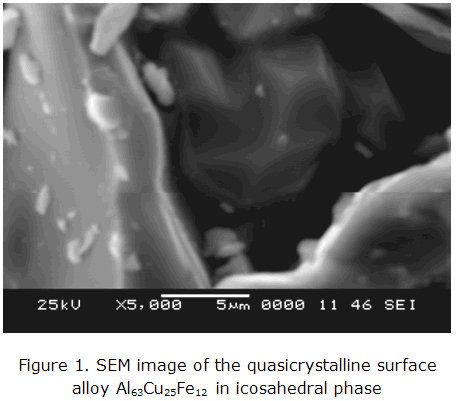
<body><![CDATA[<p align="justify"><font size="2" face="Verdana">In view of the formation of quasicrystalline phase from other phases occurred in icosahedral structure, the intermetallic compounds are related to the AlFe AlFeCu [5]. The ß-AlFe structure is a driving force in the formation of quasicrystalline phase AlFeCu. Then, these structures share similar properties and it can be said both are naturally brittle. Therefore, it is expected that the AlFeCu mechanism suffers from being a fragile intermetallic system similar to AlFe [6].</font></p>     <p align="justify"><font size="2" face="Verdana">When the quasicrystal is subjected to the eight-hour heat treatment, no decrease in oxidation of the alloy is noticed, which makes possible to obtain and observe the icosahedral structure as shown in <a href="#f1">figure 1</a>.</font></p>     <p align="center"><font size="2" face="Verdana"><a name="f1" id="f1"></a><img src="/img/revistas/ind/v29n1/f0111117.gif"></font></p>     
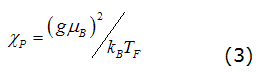
<p align="justify"><font size="2" face="Verdana">Conduction electron is an important study in quasicrystals because a physical understanding of the electronic density of states. Therefore, another interesting aspect that emerges from the location of the unpaired electron spins of the electrons present in quasicrystals in its magnetic moment contained in the transition metals (Mn, Ni, Co, Nb, and Fe) and rare earth metal atoms.</font></p>     <p align="justify"><font size="2" face="Verdana">The interaction between the magnetic exchanges unpaired d, f moments leads to magnetic ordering phenomena carrying a magnetic ordering of their spins or antiferromagnetic type at low temperatures [7]. However, to date the quasicrystalline alloy (Al-Mn-Si) and (Al-Mn-B-Pd) exhibited ferromagnetism by which were investigated by electron paramagnetic resonance, verified the existence of ferromagnetic resonance that is reported in ferromagnetic phase. This work aims to study some characterization techniques and magnetic effects by means of electron paramagnetic resonance usage in the icosahedral phase of quasicrystal Al-Cu-Fe.</font></p>     <p align="justify">&nbsp;</p>     <p><b><font face="Verdana" size="3">THEORY</font></b></p>     <p align="justify"><font size="2" face="Verdana"><strong><em>EPR Spectroscopic Study of Al<sub>63</sub>Cu<sub>25</sub>Fe<sub>12</sub> Quasicrystal in Non-magnetic Phase</em></strong></font></p>     <p align="justify"><font size="2" face="Verdana">The electrical resistivity of quasicrystals presents several orders of magnitude, but it is higher in transition metals. Typical lower resistivity measures at room temperature are in the range <em>&rho; </em>&asymp; 10<sup>2</sup> - 10<sup>3</sup> <em>&mu;</em>&Omega;<em>cm</em> for quasicrystals decagonal and icosahedral with <em>&rho; </em>&asymp; 10<sup>2</sup> - 10<sup>6</sup> <em>&mu;</em>&Omega;<em>cm </em>(the resistivity of aluminum metal <em>&rho;</em><sub>(77K)</sub> &asymp; 0,3 <em>&mu;</em>&Omega;<em>cm</em>) [8]. The resistivity of the quasicrystals and the remaining orders of magnitude lower than that seen in the insulation so that the quasicrystals can be generally considered as weak metals or semimetals. </font></p>     <p align="justify"><font size="2" face="Verdana">Paramagnetic Resonance Spectroscopy metal gives rise to two reasons: The first one is the fact that the intensity of the paramagnetic resonance spectroscopy line is proportional to the static spin susceptibility, the conduction electrons, it is of a type Pauli, their order of magnitude can be given by <a href="#e3">equation (3)</a>, [9].</font></p>     ]]></body>
<body><![CDATA[<p align="center"><font size="2" face="Verdana"><a name="e3" id="e3"></a><img src="/img/revistas/ind/v29n1/e0311117.gif"></font></p>     
<p align="justify"><font size="2" face="Verdana">An electron of an atom in the periodic quasi network then has a total angular momentum which is the sum of orbital angular momentum and orbital spin and spin in accordance with <a href="#e4">equation (4)</a> below [10]:</font></p>     <p align="center"><font size="2" face="Verdana"><a name="e4" id="e4"></a><img src="/img/revistas/ind/v29n1/e0411117.gif"></font></p>     
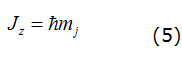
<p align="justify"><font size="2" face="Verdana">The relation between the orbital and spin magnetic moments and their angular momentum is different, i.e. that the total magnetic moment, in general, is not parallel to the total angular momentum. Here <em>&mu;</em><sub><em>B </em></sub>the same relation holds for an atom as a whole, where an electron from an atom then has a total angular momentum. However, the components and <em>&mu;</em><sub><em>Z </em></sub>maintain a proportional relationship which is expressed as <a href="#e5">equation (5)</a>:</font></p>     <p align="center"><font size="2" face="Verdana"><a name="e5" id="e5"></a><img src="/img/revistas/ind/v29n1/e0511117.gif"></font></p>     
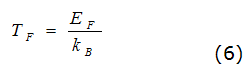
<p align="justify"><font size="2" face="Verdana">In this case, J is the sum of the angular momentum of all its electrons and the quantum number can assume both integer values as semi-integer, where in unit steps and, is the Fermi temperature of the order of 10 K<sup>4</sup> according to <a href="#e6">equation (6)</a>.</font></p>     <p align="center"><font size="2" face="Verdana"><a name="e6" id="e6"></a><img src="/img/revistas/ind/v29n1/e0611117.gif"></font></p>     
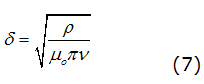
<p align="justify"><font size="2" face="Verdana">This susceptibility remains four orders of magnitude smaller than the type of Curie paramagnetic susceptibility of localized electrons at temperatures of liquid He to a comparable density of electron spins (since electrons are not located in a magnetically ordered state). The second reason for the weakness of the paramagnetic resonance spectroscopy signal is the surface that mediate the effect of conduction electrons.</font></p>     <p align="justify"><font size="2" face="Verdana">Spins, where the microwave field penetrates the metal sample only to the radius of the layer of depth order given by <a href="#e7">equation (7)</a>,</font></p>     <p align="center"><font size="2" face="Verdana"><a name="e7" id="e7"></a><img src="/img/revistas/ind/v29n1/e0711117.gif"></font></p>     
]]></body>
<body><![CDATA[<p align="justify"><font size="2" face="Verdana">The layer effect dramatically reduces the number of excited electrons which contributes to electron paramagnetic resonance signal. In the X-band electron paramagnetic resonance with the resonance frequency of free electrons g<sub>F</sub> &asymp; 2 in <em>v</em> = 9,6 GHZ a typical resistivity <em>&rho; </em>&asymp; 2.10<sup>3</sup> <em>&mu;</em>&Omega;<em>cm </em>quasicrystal in a sample which results in a depth of layer &delta; = 23 <em>&mu;</em><em>m</em> [11]. For electron paramagnetic resonance up field held in <em>v</em> = 109 GHZ, the depth of the layer reduces the &delta; = 7 <em>&mu;m</em>. The microwave field can thus excite a small amount of conduction electrons with the surface layer of a single sample. The factor <em>g</em> of conduction electrons in metals is generally not very different from the value of free electrons g<sub>F</sub> &asymp; 2. The reason is that the exchange interaction between the conduction electrons fast moving average is zero and therefore unable to change the resonance frequency. The small difference between actual values and the free electrons is of the order g-g<sub>F</sub> &le; 10<sup>-2 </sup>normally found in metal; it is attributed to the spin-orbit coupling, which causes the electron energy dependent upon the relative orientation between its two angular momentum, orbital and spins [12]. A related situation should be applied to quasicrystals as well. The average conduction electrons should be centered again towards the value of free electrons for the same reason. The spin-orbit coupling, however, deserves more attention in this study.</font></p>     <p align="justify"><font size="2" face="Verdana"><strong><em>Electron Paramagnetic Resonance in Quasicrystals Magnetic</em></strong></font></p>     <p align="justify"><font size="2" face="Verdana">Some quasicrystals icosahedral systems such as; Al-Pd-Re, Al-Mn-Pd, Al-Co-Cu and Al-Pd-Ce are perfectly diamagnetic, others may contain paramagnetic centers in addition to itinerant magnetic moments of the conduction electrons. Examples thereof are transition metals containing icosahedral families Al-Pd-Mn, Al-V-Cu, Al-Fe-Ni, Pt-Al-Fe, Al-Co-Ni, Fe-Cr-Al and Cu-Al-Fe, where the Cr, Co, Cu, Ni, Pt, Mn and Fe atoms have unpaired electrons in their energy sublevel &quot;d'' [13]. In this case two types of electronic resonances can be observed in both the conduction electrons in the electron spin location in quasi periodic work. The quasicrystalline alloy containing iron atom Hamiltonian of disturbed crystalline electric field is usually much greater than the spin-orbit coupling should result in small displacements g of localized electron resonances. There is an important difference between the spin-orbit coupling induced displacements of the conduction electrons and localized moments. An electron located is moving in a spherical electrostatic potential with its electrons and the effect of the crystalline electric field meets the electronic orbital angular momentum, whereas it does not affect much the network own potential at the atomic level.</font></p>     <p align="justify"><font size="2" face="Verdana">The resulting displacement is therefore very small in quasi periodic quasicrystal work. A conduction electron on the other hand, moves in the crystal a total potential. For regular metals this potential has the periodicity of the structure. In quasicrystals the periodicity of the structure does not exist, so that significant variations in potential sites without translational periodicity. This presents a distribution displacements g which is not necessarily small. The conduction s electrons and localized spins are coupled by an exchange interaction of form of <a href="#e8">equation (8)</a>, [14].</font></p>     <p align="center"><font size="2" face="Verdana"><a name="e8" id="e8"></a><img src="/img/revistas/ind/v29n1/e0811117.gif"></font></p>     
<p align="justify"><font size="2" face="Verdana">Here <em>J<sub>sd</sub></em> is the exchange coupling constant, <em>S<sub>F</sub></em>(R<sub>i</sub>-R) is the driving density of free electrons at one point <em>R</em>, <em>S<sub>di</sub></em>(<em>R<sub>i</sub></em>) it is the total spin of the d electron of the transition metal atom located at point <em>R<sub>i</sub></em> work and the sum is over all atoms of the magnetic structure of quasicrystalline network.This interaction introduces a broadening and a shift of the resonance. However, as the two resonant frequencies are almost equal, the resonance of conduction electrons and localized spins are aligned at the same time have to meet the natural frequencies of the coupled spins. The resonance frequency becomes a function of the frequencies of the two subsystems, the exchange parameter <em>J<sub>sd</sub></em> and the network spin relaxation damping of the two systems. Application of Spin Resonance spectroscopy quasicrystal the sample occurred at the end of a resonant cavity. The quantity measured is the power absorbed by the sample from change when the external field is varied.</font></p>     <p align="justify"><font size="2" face="Verdana">In this experiment the reflection was conducted in a band X (irradiation frequency 9.6 GHz, corresponding to the absorption center field 3400 for g<sub>F</sub> &asymp; 2) through a sample powder in quasicrystal Al<sub>63</sub>Cu<sub>25</sub>Fe<sub>12</sub> icosahedral phase. At room temperature until the liquid He, the spin resonance signal electrons can be detected just below 60 K in a relatively narrow line width, in the range of appeared &Delta;H<sub><em>pp</em></sub> = (4,5-5)<em>G</em> according to <a href="#f2">figure 2</a>. Its significance factor <em>g</em> varied in a small range to a low temperature of 4 K mode was observed in the experiment done <em>g</em>= (2,0060-2,0063) whereas the intensity of the line by the reverse enhanced cooling of the Curie temperature 1/T (the Curie law of a paramagnetic material), as disclosed in <a href="#f2">figure 2b</a>).</font></p>     <p align="justify"><font size="2" face="Verdana">The signal obtained left the day of electron paramagnetic resonance experience confirmed the origin of the sample quasicrystal; this was achieved by removed from resonance. But, it is also more likely to originate from impurities that are in the sample, another form of extrinsic quasicrystalline structure.</font></p>     <p align="justify"><font size="2" face="Verdana">The quasicrystal in high-field transmission electron spin resonance spectrometer operated in the frequency of microwave <em>109,270 GHz </em> (corresponding to the absorption center of the field <em>B = 3,890 T </em>to <em>g<sub>F</sub> = 2</em>). The camp was swept in a range 0-6 T, where we can see that the magnetic field operates at up to 14 T fields. The transmitted signal is detected by a thermal bolometer. In this high-field transmission experiment of electron spin resonance was clearly detected quasicrystal Al<sub>63</sub>Cu<sub>25</sub>Fe<sub>12</sub>, measurements were carried out at a temperature below.</font></p>     <p align="justify"><font size="2" face="Verdana">The spectra obtained in this experiment did not appear clear or pure dispersion, but have a slight mixture of absorption. A weak signal with a narrow spectral width is observed near the position of free electrons in <em>B = 3,8684 T</em>, which is obviously the same seen in X band in <a href="#f2">figure 2</a>.</font></p>     ]]></body>
<body><![CDATA[<p align="center"><font size="2" face="Verdana"><a name="f2" id="f2"></a><img src="/img/revistas/ind/v29n1/f0211117.gif"></font></p>     
<p align="justify"><font size="2" face="Verdana">In <a href="/img/revistas/ind/v29n1/f0311117.gif" target="_blank">figure 3</a> obtained by electron paramagnetic resonance shows the g factor for the icosahedral phase in quasicrystal Al-Cu-Fe where this shift is because of conduction electrons originating from the iron, because there was a slight variation for a low temperature <em>4 K</em>, however, the intensity of the line increases by cooling the inverse of the Curie temperature 1/T.</font></p>     
<p align="justify"><font size="2" face="Verdana">The behavior of the icosahedral phase quasicrystal AlCuFe by some important magnetic properties by electron paramagnetic resonance, and the influence of the magnetic field and the Curie temperature factor1/T, these factors magnetism quasicrystalline the alloy is crucial for applications some industrial sectors.</font></p>     <p align="justify"><font size="2" face="Verdana">The structures formed by quasicrystalline alloys have icosahedral phase orderly, provides low electrical conductivity, but is due to consider the location of weak electron-electron interactions. The microstructure effect on quasicrystal is observed by high polarization field, to go analyze heterogeneous spin caused by defects, dislocations and fluctuations of random magneto crystalline.</font></p>     <p align="justify"><font size="2" face="Verdana">The Al<sub>63</sub>Cu<sub>25</sub>Fe<sub>12</sub> quasicrystal has localized magnetic moments on iron atoms (Fe) since only 10<sup>-4</sup> Fe atoms have centered moments. The resistivity of the icosahedral quasicrystal Al-Fe-Cu and Al-Pd-Mn are almost the same so that a similar concentration to conduction electrons must exist in both quasicrystals. Furthermore, both quasicrystal families are structurally almost identical.</font></p>     <p align="justify">&nbsp;</p>     <p align="justify"><font size="3" face="Verdana, Arial, Helvetica, sans-serif"><strong>MATERIALS AND METHODS</strong></font></p>     <p align="justify"><font size="2" face="Verdana">The preparation of quasicrystalline alloy consists of an Al<sub>62</sub>Cu<sub>25</sub>Fe<sub>12</sub> nominal composition as its particle size, having a purity of <em>99,9 %. </em>The alloy was obtained by melting the pure elements of air. The induction furnace was used with Argon atmosphere controlled at 5.0 with the objective of obtaining a good homogenization of quasicrystalline phase.</font></p>     <p align="justify"><font size="2" face="Verdana">We used a high-frequency generator (40 kVA) POLITRON of manufacture. Each element that makes up the quasicrystalline alloy contains 10g; this measurement procedure was performed on a Shimadzu balance. The training method was through solidification in cold hearth furnace to generate a heterogeneous alloy, being a common procedure a mixture of quasicrystalline phase to the crystalline phase. To be a proportional increase of quasicrystalline phase in the sample, it is necessary to heat treatment, so that will favor the peritectic transformation of phases. This was accomplished using the heat treatment in a resistance furnace Nabertherm the mark, where the samples are maintained during the period of 8h and 24 h at a temperature of 1123 K.</font></p>     <p align="justify"><font size="2" face="Verdana">The diffraction of X - ray (XRD) was used to monitor the progress of the phases and stability of samples during casting. It was used for both a diffraction SIEMENS D5000 and is used CuK radiation whose wavelength is <em>&lambda;</em>= 1,5406 &Aring;. To examine the morphology of the powders being quasicrystalline using a LEO Scanning Electron Microscope, Model 1430, OXFORD coupled to a probe. The samples after casting and were placed in catalytic tests dispersion in isopropyl alcohol solution. The energy dispersive spectroscopy (EDS) in the sample binds quasicrystalline Al<sub>62</sub>Cu<sub>25</sub>Fe<sub>12</sub> micrograph was obtained at an energy dispersive analysis after 8 hours heat treatment coupled with the SEM sample which has previously been metallized with gold (average thickness 12nm).</font></p>     ]]></body>
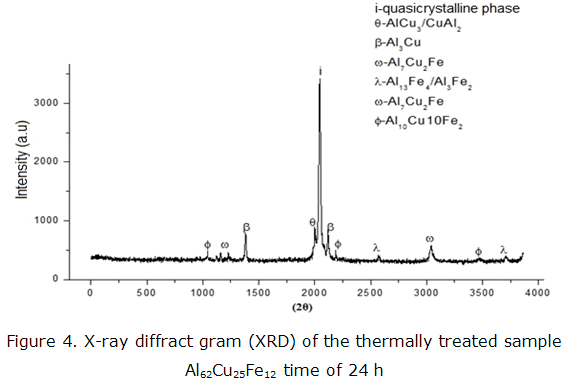
<body><![CDATA[<p align="justify"><font size="2" face="Verdana">The thermal properties of alloys were analyzed by Differential Scanning Calorimeter (DSC) at 10 &deg;C&middot;min<sup>-1</sup> heating rate under N<sub>2</sub> flow.</font></p>     <p align="justify">&nbsp;</p>     <p align="justify"><font size="3" face="Verdana"><strong>RESULTS AND DISCUSSION</strong></font></p>     <p align="justify"><font size="2" face="Verdana"><strong><em>X-ray Diffraction</em></strong></font></p>     <p align="justify"><font size="2" face="Verdana">The diffraction spectra of X-rays with the sample Al<sub>62</sub>Cu<sub>25</sub>Fe<sub>12</sub> stoichiometry is shown in <a href="#f4">figure 4</a> respectively for the thermal treatment of 24 hours at 1123 K.</font></p>     <p align="center"><font size="2" face="Verdana"><a name="f4" id="f4"></a><img src="/img/revistas/ind/v29n1/f0411117.gif"></font></p>     
<p align="justify"><font size="2" face="Verdana">This diffraction peak can identify the phases; the icosahedral quasicrystalline phase (I-phase) and tetragonal phases (&theta;-AlCu<sub>3</sub>, &theta;-CuA<sub>12</sub>and ß-Al<sub>3</sub>Cu) and intermetallic (&omega;-Al<sub>7</sub>Cu<sub>2</sub>Fe, <em>&lambda;</em>-Al<sub>13</sub>Fe<sub>4</sub>, <em>&lambda;</em>-Al<sub>3</sub>Fe<sub>2</sub>, &omega;-Al<sub>7</sub>Cu<sub>2</sub> Fe and &phi;-Al<sub>10</sub>Cu<sub>10</sub>Fe<sub>2</sub>). These results also suggest that the ß phase is directly formed from the liquid alloy. Moreover, the ß phase transforms below 873 K to form the <em>&lambda;</em> and &theta; stages, which are solid solutions induced by the solubility of Cu and Fe.</font></p>     <p align="justify"><font size="2" face="Verdana">The intensity of the peaks corresponding to the i-layer is higher than the peaks are specifically related to the <em>ß-phase</em>. However, Al<sub>62</sub>Cu<sub>25</sub>Fe<sub>12</sub> in the alloy melt, <em>i-phase </em> coexisting with a small amount of AlFe (Cu) solid solution [15]. The composition of Al<sub>62</sub>Cu<sub>25</sub>Fe<sub>12</sub>, have phases in balance with other crystalline phases such as ß-Al<sub>2</sub>Fe<sub>5</sub>, &gamma;-Al<sub>13</sub>Fe<sub>4</sub>, &gamma;-Al<sub>3</sub>Fe<sub>2</sub>, &theta;-Al<sub>2</sub>Cu, &omega;-Al<sub>7</sub>Cu<sub>2</sub>Fe andf-Al<sub>10</sub>Cu<sub>10</sub>Fe<sub>2</sub>.</font></p>     <p align="justify"><font size="2" face="Verdana">Among these crystalline phases, &omega; shows a great similarity with the icosahedral &Psi; phase. The coordination of Fe atoms is very similar in face-centered cubic structure with Cu being passivity with Al<sub>2</sub>O<sub>3</sub>. From the solidification path, the &phi; phase seems to be formed at equilibrium conditions with high thermodynamic stability, by a peritectic reaction from a crystalline and amorphous intermetallic phase due to phase transitions.</font></p>     <p align="justify"><font size="2" face="Verdana"><strong><em>Scanning Electron Microscopy and EDS</em></strong></font></p>     ]]></body>
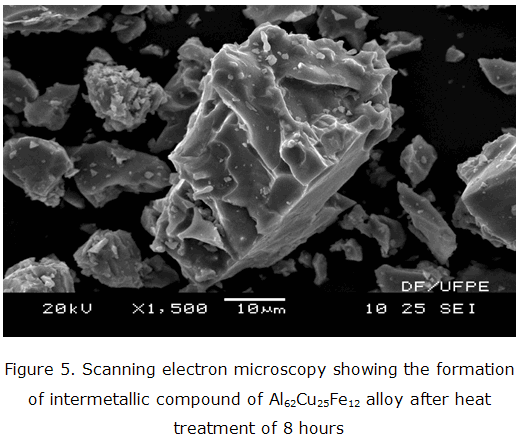
<body><![CDATA[<p align="justify"><font size="2" face="Verdana"><a href="#f5">Figures 5</a> and <a href="/img/revistas/ind/v29n1/f0611117.gif" target="_blank">6</a> are respectively represent the results obtained from samples of quasicrystals by Scanning Electron Microscopy and EDS spectrum post after being subjected to heat treatment with 8 hours.</font></p>     
<p align="justify"><font size="2" face="Verdana">The analysis Scanning Electron Microscopy (SEM) and Energy Dispersive Spectroscopy (EDS) were used for sample quasicrystal and produced <a href="#f5">figures 5</a> and <a href="/img/revistas/ind/v29n1/f0611117.gif" target="_blank">6</a> with the heat treatment of 8 hours. The image that the Scanning Electron Microscopy (SEM) and Energy Dispersive Spectroscopy spectrum (EDS), view the microstructure of quasicrystalline alloy with surface irregular crystals and geometric uniformity.</font></p>     
<p align="center"><font size="2" face="Verdana"><a name="f5" id="f5"></a><img src="/img/revistas/ind/v29n1/f0511117.gif"></font></p>     
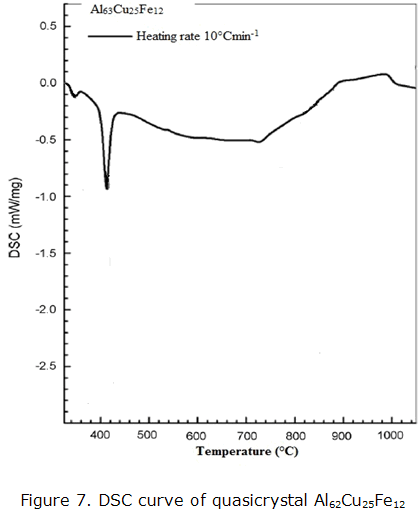
<p align="justify"><font size="2" face="Verdana">The phases present already been processed (ß-crystalline, and intermetallic icosahedral), there are show the strong presence of Fe and Cu conduction electrons which are protected by the thin layer of aluminum oxide which enables the peritectic reaction between phases [16].</font></p>     <p align="justify"><font size="2" face="Verdana">In the spectrum of elemental analysis EDS, there is a greater prevalence of aluminum than the other elements (copper and iron) that makes up the quasicrystalline alloy. The existence of &gamma;-Al<sub>2</sub>O<sub>3</sub> favors spinel formation on Al<sub>2</sub>O<sub>4</sub> oxidation in the presence of Cu or CuO. However, the possibility of formation of other oxides such as spine CuFe<sub>x</sub>Al<sub>2-x</sub>O<sub>4</sub>, are essential reactions and catalytic composites of Fe<sub>3</sub>O<sub>4</sub> and CuAl<sub>2</sub>O<sub>4</sub> are complex to form a thin film, the passive quasicrystalline structure of the alloy.</font></p>     <p align="justify"><font size="2" face="Verdana"><strong><em>Thermal Analysis DSC</em></strong></font></p>     <p align="justify"><font size="2" face="Verdana"><a href="#f7">Figure 7</a> shows the thermal behavior during non-isothermal heating made by Differential Scanning Calorimeter (DSC) conducted at a heating rate of 10&deg; CMIM-1 for quasicrystalline alloy powder during the heating Al<sub>62</sub>Cu<sub>25</sub>Fe<sub>12</sub> 400-1473 K, exothermic events occur are clearly defined and distinguished in a low temperature range of 773 K, however, relates to the formation of AlFe<sub>3</sub>e-&phi; &omega;-Al<sub>7</sub>Cu<sub>2</sub>Fe phases, which represents a fusion event or dissolution of the phases (amorphous intermetallic) corresponds to merging with predominance of copper and iron. A more complex sequence of thermal events is observed above 773 K. The increased heating rate causes a moderate change (~293 K) of the phase transition temperatures towards higher values, otherwise the following thermal events does not change. The &omega;-Al<sub>7</sub>Cu<sub>2</sub> Fe phase is the main precursor of f-phase (i-Al<sub>62</sub>Cu<sub>25</sub>Fe<sub>12</sub>) [17].</font></p>     <p align="center"><font size="2" face="Verdana"><a name="f7" id="f7"></a><img src="/img/revistas/ind/v29n1/f0711117.gif"></font></p>     
<p align="justify"><font size="2" face="Verdana">As the homogenization of the alloy composition is gradually completed, &omega;-Al<sub>7</sub>Cu<sub>2</sub> Fe makes if main constituent. The enthalpy of the minimum first peak is smaller than the other two peaks, indicating that the highest concentration of phases of &omega;-Al<sub>7</sub>Cu<sub>2</sub> Fe typeand (i-Al<sub>62</sub>Cu<sub>25</sub>Fe<sub>12</sub>).This result indicates the need for a detailed analysis of the microstructural evolution and the formation and stability of constituent phases during non-isothermal heat treatments, because this enables rich oxide layer that is essential for catalytic purposes.</font></p>     <p align="justify">&nbsp;</p>     ]]></body>
<body><![CDATA[<p align="justify"><font size="3" face="Verdana"><strong>CONCLUSIONS</strong></font><font size="2" face="Verdana"> </font></p>     <p align="justify"><font size="2" face="Verdana">The icosahedral phase becomes stable above 948 K and the crystalline phase a solid solution which controls the formation of the icosahedral phase due to its surface having rotational symmetry that are important to describe the mobility of conduction electrons at the surface.</font></p>     <p align="justify"><font size="2" face="Verdana">The nuclear magnetic resonance spectroscopy in quasicrystal is able to detect signs of both itinerant conduction electrons and localized magnetic moments of atoms can provide important information about the electronic properties of quasicrystalline materials.</font></p>     <p align="justify"><font size="2" face="Verdana">The use of a conventional X-band in the electron paramagnetic resonance in the conventional apparatus which employs downside scanning a relatively narrow field of 0-1 T.</font></p>     <p align="justify"><font size="2" face="Verdana">The sharp widening of the spectrum icosahedral quasicrystal Al<sub>63</sub>Cu<sub>25</sub>Fe<sub>12</sub> is doubly investigated. The first is the distribution of local electric fields due to the absence of periodicity in quasicrystal reticulum and the second is the exchange interaction energy sublevels in s-d between the conduction electrons and magnetic moments localized d sublevel in Fe.</font></p>     <div align="justify"><font size="2" face="Verdana">An abnormal temperature dependence of the electron in the line width in the electron paramagnetic resonance, which narrow 20-5 K by a factor of 3,7 which can originate from the change in the exchange interaction strength in the sublevels s-d due to conduct screening electrons of the locations of its magnetic moment in sublevel d Fe atom.</font> </div>     <p align="justify">&nbsp;</p>     <p align="justify"><font size="3" face="Verdana"><strong>ACKNOWLEDGEMENTS</strong></font></p>     <p align="justify"> <font size="2" face="Verdana"> The authors acknowledge the North east Center of Strategic Technologies - CETENE and the Department of Physics at UFPE/CCEN that support of this work.</font></p>     <p>&nbsp;</p>     ]]></body>
<body><![CDATA[<p align="justify"><font size="3" face="Verdana"><strong>REFERENCES</strong></font></p>     <!-- ref --><p align="justify"><font size="2" face="Verdana">1. </font><font size="2" face="Verdana"> JAMSHIDI, A.L.C.L.; <em>et al </em>. &quot;Use Alloy Quasicrystalline Al 62,2 Cu 25,3 Fe 12,5 for Steam Reforming of Methanol&quot;, <em>Journal of Chemical Engineering and Process Technology, </em>2014<em>, </em>5(2) 187. doi:10.4172/2157-7048.1000187</font><!-- ref --><p align="justify"><font size="2" face="Verdana">2. OLSSON, S.; <em>et al </em>. &quot;Formation of a -approximant and quasicrystalline Al–Cu–Fe thin films&quot;, <em>Thin Solid Films, </em>2012<em>, </em>526, 74–80.    </font></p>     <!-- ref --><p align="justify"><font size="2" face="Verdana">3. Li, L.; et al. &quot;Large-scale synthesis of Al–Cu–Fe submicron quasicrystals&quot;, <em>Scripta Materialia, </em>2008<em>, </em>59, 587–590.    </font></p>     <!-- ref --><p align="justify"><font size="2" face="Verdana">4. Srivastava, V.C.; <em>et al. </em> &quot;Bulk synthesis by spray forming of Al–Cu–Fe and Al–Cu–Fe–Sn alloys containing a quasicrystalline phase&quot;, <em>Journal of Alloys and Compounds, </em>2014<em>, </em>597, 258–268.    </font></p>     <!-- ref --><p align="justify"><font size="2" face="Verdana">5. WIDJAJA, E.J.; MARKS, L. D. &quot;Microstructural evolution in Al–Cu–Fe quasicrystalline thin films&quot;, <em>Thin Solid Films, </em>2003<em>, </em>441, 63–71.    </font></p>     ]]></body>
<body><![CDATA[<!-- ref --><p align="justify"><font size="2" face="Verdana">6. NASCIMENTO, L.; AGOSTINHO, L.C.L.; CAVALCANTI, F.B. &quot;Grouping Model in Fermi Surface Applied to Quasicrystals&quot;, <em>Revista Colombiana de Materiales, </em>2012<em>, </em>(3), 55-62.    </font></p>     <!-- ref --><p align="justify"><font size="2" face="Verdana">7. AZHAZHAA, V.; <em>et al </em>. &quot;The electrical resistivity of Ti-Zr-Ni quasicrystals in the interval 1.3–300 K&quot;<em>, Physics Letters, </em>2003<em>, </em>319, 539–543.    </font></p>     <!-- ref --><p align="justify"><font size="2" face="Verdana">8. ROY, M. &quot;Formation and magnetic properties of mechanically alloyed Al 65 Cu 20 Fe 15 quasicrystal&quot;, <em>Journal of Magnetism and Magnetic Materials, </em>2006<em>, </em>302, 52–55.    </font></p>     <!-- ref --><p align="justify"><font size="2" face="Verdana">9. TRSIC, M.; PINTO, M.F.S. <em>Qu&iacute;mica Qu&acirc;ntica: Fundamentos e Aplica&ccedil;&otilde;es</em>, Editora Manole LTDA., Barueri-SP, 2009.    </font></p>     <!-- ref --><p align="justify"><font size="2" face="Verdana">10. MISRA, S.K.; et al.; &quot;EPR, X-ray, and magnetization studies of metastable alloys Ti 2 Fe, Al 40 Cu 10 Mn 25 Ge 25 and A1 65 Cu 20 Fe 15 as prepared by mechanical alloying&quot;, <em>Journal Magnetic Materials, </em>1995<em>, </em>150, 430-436.    </font></p>     ]]></body>
<body><![CDATA[<!-- ref --><p align="justify"><font size="2" face="Verdana">11. GOMILŠEKA, J. P. <em>et al. </em>&quot;EXAF study of the Fe local environment in icosahedral AlCuFe and its relation to magnetism of quasicrystals&quot;, <em>Solid State Communications, </em>2012, 123, 527–530.    </font></p>     <!-- ref --><p align="justify"><font size="2" face="Verdana">12. MARION, J.B.; THORNTON, S.T. <em>Classical Dynamics of Particles and Systems</em>. 5a .Ed., Saunders College Publishing, 2004.    </font></p>     <!-- ref --><p align="justify"><font size="2" face="Verdana">13. AGOSTINH O, L.C.L. <em>Estudo da Aplicabilidade dos Quasicristais AlCuFe em Rea&ccedil;&otilde;es Catal&iacute;ticas na Oxida&ccedil;&atilde;o do Metanol </em>. Disserta&ccedil;&atilde;o (Mestrado em Ci&ecirc;ncias de Materiais). Universidade Federal da Para&iacute;ba, Jo&atilde;o Pessoa-Para&iacute;ba, 2009.    </font></p>     <!-- ref --><p align="justify"><font size="2" face="Verdana">14. SAKURAI, J. J. <em>Modern Quantum Mechanics</em>, Revised Edition, Addison-Wesley, 1994.    </font></p>     <!-- ref --><p align="justify"><font size="2" face="Verdana">15. SALES, M.; <em>et al. </em>&quot;Effect of the addition of crystalline ß -phase in Al–Cu-Fe quasicrystalline coatings on their tribological properties&quot;, <em>Surface &amp; Coatings Technology</em>, 2007, 201, 6206–6211.    </font></p>     ]]></body>
<body><![CDATA[<!-- ref --><p align="justify"><font size="2" face="Verdana">16. SVIRIDOVA, T.A. <em>et al</em>. &quot;Nano quasicrystalline Phase in Mechanically Alloyed and Heat-Treated Al 73 Cu 11 Cr 16&quot;, <em>Acta Physica Polonica </em>A. 2014, 126, 99-602.    </font></p>     <!-- ref --><div align="justify"><font size="2" face="Verdana">17. YIN, S. <em>et al. </em>&quot;Formation of AlCuFe icosahedral quasicrystal by mechanical alloying: XAFS and XRD studies&quot;, <em>Journal of Alloys and Compounds, </em>2008, 455(1-2), 314–321.    </font> </div>     <p align="justify">&nbsp;</p>     <p align="justify">&nbsp;</p>     <p><font size="2" face="Verdana">Recibido: 17/02/2016    <br> Aceptado: 2/09/2016</font></p>     <p>&nbsp;</p>     <p>&nbsp;</p>     ]]></body>
<body><![CDATA[<p><font size="2" face="Verdana"><em>Jamshidi, A.L.C.L.</em>, Department of Chemical Engineering (PPGEQ), Center of Technology and Geosciences (CTG), (UFPE), Brazil, <a href="mailto:cristina.ufcge@gmail.com">cristina.ufcge@gmail.com</a></font></p>      ]]></body><back>
<ref-list>
<ref id="B1">
<label>1</label><nlm-citation citation-type="">
<person-group person-group-type="author">
<name>
<surname><![CDATA[JAMSHIDI]]></surname>
<given-names><![CDATA[A.L.C.L]]></given-names>
</name>
</person-group>
<article-title xml:lang="en"><![CDATA[Use Alloy Quasicrystalline Al 62,2 Cu 25,3 Fe 12,5 for Steam Reforming of Methanol]]></article-title>
<source><![CDATA[]]></source>
<year>2014</year>
<volume>5</volume>
<numero>2</numero>
<issue>2</issue>
<page-range>187</page-range></nlm-citation>
</ref>
<ref id="B2">
<label>2</label><nlm-citation citation-type="">
<person-group person-group-type="author">
<name>
<surname><![CDATA[OLSSON]]></surname>
<given-names><![CDATA[S]]></given-names>
</name>
</person-group>
<article-title xml:lang="en"><![CDATA[Formation of a -approximant and quasicrystalline Al-Cu-Fe thin films]]></article-title>
<source><![CDATA[]]></source>
<year>2012</year>
<volume>526</volume>
<page-range>74-80</page-range></nlm-citation>
</ref>
<ref id="B3">
<label>3</label><nlm-citation citation-type="">
<person-group person-group-type="author">
<name>
<surname><![CDATA[Li]]></surname>
<given-names><![CDATA[L]]></given-names>
</name>
</person-group>
<article-title xml:lang="en"><![CDATA[Large-scale synthesis of Al-Cu-Fe submicron quasicrystals]]></article-title>
<source><![CDATA[]]></source>
<year>2008</year>
<volume>59</volume>
<page-range>587-590</page-range></nlm-citation>
</ref>
<ref id="B4">
<label>4</label><nlm-citation citation-type="">
<person-group person-group-type="author">
<name>
<surname><![CDATA[Srivastava]]></surname>
<given-names><![CDATA[V.C]]></given-names>
</name>
</person-group>
<article-title xml:lang="en"><![CDATA[Bulk synthesis by spray forming of Al-Cu-Fe and Al-Cu-Fe-Sn alloys containing a quasicrystalline phase]]></article-title>
<source><![CDATA[]]></source>
<year>2014</year>
<volume>597</volume>
<page-range>258-268</page-range></nlm-citation>
</ref>
<ref id="B5">
<label>5</label><nlm-citation citation-type="">
<person-group person-group-type="author">
<name>
<surname><![CDATA[WIDJAJA]]></surname>
<given-names><![CDATA[E.J]]></given-names>
</name>
<name>
<surname><![CDATA[MARKS]]></surname>
<given-names><![CDATA[L. D]]></given-names>
</name>
</person-group>
<article-title xml:lang="en"><![CDATA[Microstructural evolution in Al-Cu-Fe quasicrystalline thin films]]></article-title>
<source><![CDATA[]]></source>
<year>2003</year>
<volume>441</volume>
<page-range>63-71</page-range></nlm-citation>
</ref>
<ref id="B6">
<label>6</label><nlm-citation citation-type="">
<person-group person-group-type="author">
<name>
<surname><![CDATA[NASCIMENTO]]></surname>
<given-names><![CDATA[L]]></given-names>
</name>
<name>
<surname><![CDATA[AGOSTINHO]]></surname>
<given-names><![CDATA[L.C.L]]></given-names>
</name>
<name>
<surname><![CDATA[CAVALCANTI]]></surname>
<given-names><![CDATA[F.B]]></given-names>
</name>
</person-group>
<article-title xml:lang="en"><![CDATA[Grouping Model in Fermi Surface Applied to Quasicrystals]]></article-title>
<source><![CDATA[]]></source>
<year>2012</year>
<numero>3</numero>
<issue>3</issue>
<page-range>55-62</page-range></nlm-citation>
</ref>
<ref id="B7">
<label>7</label><nlm-citation citation-type="">
<person-group person-group-type="author">
<name>
<surname><![CDATA[AZHAZHAA]]></surname>
<given-names><![CDATA[V]]></given-names>
</name>
</person-group>
<article-title xml:lang="en"><![CDATA[The electrical resistivity of Ti-Zr-Ni quasicrystals in the interval 1.3-300 K]]></article-title>
<source><![CDATA[]]></source>
<year>2003</year>
<volume>319</volume>
<page-range>539-543</page-range></nlm-citation>
</ref>
<ref id="B8">
<label>8</label><nlm-citation citation-type="">
<person-group person-group-type="author">
<name>
<surname><![CDATA[ROY]]></surname>
<given-names><![CDATA[M]]></given-names>
</name>
</person-group>
<article-title xml:lang="en"><![CDATA[Formation and magnetic properties of mechanically alloyed Al 65 Cu 20 Fe 15 quasicrystal]]></article-title>
<source><![CDATA[]]></source>
<year>2006</year>
<volume>302</volume>
<page-range>52-55</page-range></nlm-citation>
</ref>
<ref id="B9">
<label>9</label><nlm-citation citation-type="book">
<person-group person-group-type="author">
<name>
<surname><![CDATA[TRSIC]]></surname>
<given-names><![CDATA[M]]></given-names>
</name>
<name>
<surname><![CDATA[PINTO]]></surname>
<given-names><![CDATA[M.F.S]]></given-names>
</name>
</person-group>
<source><![CDATA[Química Quântica: Fundamentos e Aplicações]]></source>
<year>2009</year>
<publisher-name><![CDATA[Editora Manole LTDA., Barueri-SP]]></publisher-name>
</nlm-citation>
</ref>
<ref id="B10">
<label>10</label><nlm-citation citation-type="">
<person-group person-group-type="author">
<name>
<surname><![CDATA[MISRA]]></surname>
<given-names><![CDATA[S.K]]></given-names>
</name>
</person-group>
<article-title xml:lang="en"><![CDATA[EPR, X-ray, and magnetization studies of metastable alloys Ti 2 Fe, Al 40 Cu 10 Mn 25 Ge 25 and A1 65 Cu 20 Fe 15 as prepared by mechanical alloying]]></article-title>
<source><![CDATA[]]></source>
<year>1995</year>
<volume>150</volume>
<page-range>430-436</page-range></nlm-citation>
</ref>
<ref id="B11">
<label>11</label><nlm-citation citation-type="">
<person-group person-group-type="author">
<name>
<surname><![CDATA[GOMILŠEKA]]></surname>
<given-names><![CDATA[J. P]]></given-names>
</name>
</person-group>
<article-title xml:lang="en"><![CDATA[EXAF study of the Fe local environment in icosahedral AlCuFe and its relation to magnetism of quasicrystals]]></article-title>
<source><![CDATA[]]></source>
<year>2012</year>
<volume>123</volume>
<page-range>527-530</page-range></nlm-citation>
</ref>
<ref id="B12">
<label>12</label><nlm-citation citation-type="book">
<person-group person-group-type="author">
<name>
<surname><![CDATA[MARION]]></surname>
<given-names><![CDATA[J.B]]></given-names>
</name>
<name>
<surname><![CDATA[THORNTON]]></surname>
<given-names><![CDATA[S.T]]></given-names>
</name>
</person-group>
<source><![CDATA[Classical Dynamics of Particles and Systems]]></source>
<year>2004</year>
<edition>5</edition>
<publisher-name><![CDATA[Saunders College Publishing]]></publisher-name>
</nlm-citation>
</ref>
<ref id="B13">
<label>13</label><nlm-citation citation-type="book">
<person-group person-group-type="author">
<name>
<surname><![CDATA[AGOSTINHO]]></surname>
<given-names><![CDATA[L.C.L]]></given-names>
</name>
</person-group>
<source><![CDATA[Estudo da Aplicabilidade dos Quasicristais AlCuFe em Reações Catalíticas na Oxidação do Metanol]]></source>
<year>2009</year>
<publisher-name><![CDATA[Universidade Federal da Paraíba, João Pessoa-Paraíba]]></publisher-name>
</nlm-citation>
</ref>
<ref id="B14">
<label>14</label><nlm-citation citation-type="book">
<person-group person-group-type="author">
<name>
<surname><![CDATA[SAKURAI]]></surname>
<given-names><![CDATA[J. J]]></given-names>
</name>
</person-group>
<source><![CDATA[Modern Quantum Mechanics]]></source>
<year>1994</year>
<publisher-name><![CDATA[Addison-Wesley]]></publisher-name>
</nlm-citation>
</ref>
<ref id="B15">
<label>15</label><nlm-citation citation-type="">
<person-group person-group-type="author">
<name>
<surname><![CDATA[SALES]]></surname>
<given-names><![CDATA[M]]></given-names>
</name>
</person-group>
<article-title xml:lang="en"><![CDATA[Effect of the addition of crystalline ß -phase in Al-Cu-Fe quasicrystalline coatings on their tribological properties]]></article-title>
<source><![CDATA[]]></source>
<year>2007</year>
<volume>201</volume>
<page-range>6206-6211</page-range></nlm-citation>
</ref>
<ref id="B16">
<label>16</label><nlm-citation citation-type="">
<person-group person-group-type="author">
<name>
<surname><![CDATA[SVIRIDOVA]]></surname>
<given-names><![CDATA[T.A]]></given-names>
</name>
</person-group>
<article-title xml:lang="en"><![CDATA[Nano quasicrystalline Phase in Mechanically Alloyed and Heat-Treated Al 73 Cu 11 Cr 16]]></article-title>
<source><![CDATA[]]></source>
<year>2014</year>
<volume>126</volume>
<page-range>99-602</page-range></nlm-citation>
</ref>
<ref id="B17">
<label>17</label><nlm-citation citation-type="">
<person-group person-group-type="author">
<name>
<surname><![CDATA[YIN]]></surname>
<given-names><![CDATA[S]]></given-names>
</name>
</person-group>
<article-title xml:lang="en"><![CDATA[Formation of AlCuFe icosahedral quasicrystal by mechanical alloying: XAFS and XRD studies]]></article-title>
<source><![CDATA[]]></source>
<year>2008</year>
<volume>455</volume>
<numero>1-2</numero>
<issue>1-2</issue>
<page-range>314-321</page-range></nlm-citation>
</ref>
</ref-list>
</back>
</article>