<?xml version="1.0" encoding="ISO-8859-1"?><article xmlns:mml="http://www.w3.org/1998/Math/MathML" xmlns:xlink="http://www.w3.org/1999/xlink" xmlns:xsi="http://www.w3.org/2001/XMLSchema-instance">
<front>
<journal-meta>
<journal-id>2224-6185</journal-id>
<journal-title><![CDATA[Tecnología Química]]></journal-title>
<abbrev-journal-title><![CDATA[RTQ]]></abbrev-journal-title>
<issn>2224-6185</issn>
<publisher>
<publisher-name><![CDATA[Universidad de Oriente]]></publisher-name>
</publisher>
</journal-meta>
<article-meta>
<article-id>S2224-61852011000200010</article-id>
<title-group>
<article-title xml:lang="en"><![CDATA[PHYSICOMECHANICAL AND COMPACTION CHARACTERIZATION OF TABLETS OBTAINED FROM A NATURAL DRY EXTRACTS]]></article-title>
<article-title xml:lang="es"><![CDATA[CARACTERIZACIÓN FISICO-MECÁNICA Y COMPACTATIVA DE COMPRIMIDOS OBTENIDOS DE EXTRACTOS SECOS NATURALES]]></article-title>
</title-group>
<contrib-group>
<contrib contrib-type="author">
<name>
<surname><![CDATA[Rodríguez-Amado]]></surname>
<given-names><![CDATA[Jesús Rafael]]></given-names>
</name>
<xref ref-type="aff" rid="AFF"/>
</contrib>
<contrib contrib-type="author">
<name>
<surname><![CDATA[LafourcadePrada]]></surname>
<given-names><![CDATA[Ariadna]]></given-names>
</name>
<xref ref-type="aff" rid="AFF"/>
</contrib>
<contrib contrib-type="author">
<name>
<surname><![CDATA[Escalona-Arranz]]></surname>
<given-names><![CDATA[Julio Cesar]]></given-names>
</name>
<xref ref-type="aff" rid="AFF"/>
</contrib>
<contrib contrib-type="author">
<name>
<surname><![CDATA[Pérez- Rosés]]></surname>
<given-names><![CDATA[Renato]]></given-names>
</name>
<xref ref-type="aff" rid="AFF"/>
</contrib>
<contrib contrib-type="author">
<name>
<surname><![CDATA[Iraizoz-Colarte]]></surname>
<given-names><![CDATA[Antonio]]></given-names>
</name>
<xref ref-type="aff" rid="AFF"/>
</contrib>
</contrib-group>
<aff id="AF1">
<institution><![CDATA[,University of Orient Department of Pharmacy ]]></institution>
<addr-line><![CDATA[Santiago of Cuba ]]></addr-line>
</aff>
<pub-date pub-type="pub">
<day>00</day>
<month>08</month>
<year>2011</year>
</pub-date>
<pub-date pub-type="epub">
<day>00</day>
<month>08</month>
<year>2011</year>
</pub-date>
<volume>31</volume>
<numero>2</numero>
<fpage>233</fpage>
<lpage>241</lpage>
<copyright-statement/>
<copyright-year/>
<self-uri xlink:href="http://scielo.sld.cu/scielo.php?script=sci_arttext&amp;pid=S2224-61852011000200010&amp;lng=en&amp;nrm=iso"></self-uri><self-uri xlink:href="http://scielo.sld.cu/scielo.php?script=sci_abstract&amp;pid=S2224-61852011000200010&amp;lng=en&amp;nrm=iso"></self-uri><self-uri xlink:href="http://scielo.sld.cu/scielo.php?script=sci_pdf&amp;pid=S2224-61852011000200010&amp;lng=en&amp;nrm=iso"></self-uri><abstract abstract-type="short" xml:lang="es"><p><![CDATA[En este trabajo se evaluó la influencia de la presión de compresión en las propiedades físico mecánicas de un comprimido obtenido a partir de un extracto seco de las hojas de Tamarindus indica L. El análisis de Heckel sugiere, que el extracto seco posee un mecanismo de deformación mixto con una Py igual a 179,85 MPa. La fuerza de torsión de los comprimidos aumenta con la presión de compactación. Los comprimidos deberán prepararse a presiones de compresión por debajo de 90 MPa ya que a presiones superiores el tiempo de desintegración aumenta sobre 30 min. La friabilidad de las tabletas nunca es superior del 1 %.]]></p></abstract>
<abstract abstract-type="short" xml:lang="en"><p><![CDATA[The aim of this work was to evaluate the compaction behavior and the physical mechanical characterization of tablets, obtained from a natural dry extracts of the leaves of Tamarindus indica L. The Heckel analysis was used to characterize the dry extract compaction behavior. The dry extract has a mixed mechanism of consolidation: plastic and brittle fracture, showing a mean yield pressure of 179,85 MPa. The compact&#8217;s tensile strength increase with the augment of compaction pressure. Compacts must be obtained at compaction pressure below 90MPa because of; at superior compaction pressure disintegration time increases over 30 min. The friability of the tablets in any case is superior to 1 percent.]]></p></abstract>
<kwd-group>
<kwd lng="es"><![CDATA[tamarindo]]></kwd>
<kwd lng="es"><![CDATA[extracto seco]]></kwd>
<kwd lng="es"><![CDATA[análisis de Heckel]]></kwd>
<kwd lng="es"><![CDATA[tabletas]]></kwd>
<kwd lng="es"><![CDATA[compresión]]></kwd>
<kwd lng="en"><![CDATA[tamarind]]></kwd>
<kwd lng="en"><![CDATA[dry extract]]></kwd>
<kwd lng="en"><![CDATA[Heckel analysis]]></kwd>
<kwd lng="en"><![CDATA[compression]]></kwd>
<kwd lng="en"><![CDATA[tablets]]></kwd>
</kwd-group>
</article-meta>
</front><body><![CDATA[ <p align="right"><font face="Verdana, Arial, Helvetica, sans-serif" size="2"><b>ART&Iacute;CULO    ORIGINAL</b></font></p>     <p align="justify">&nbsp;</p>     <p align="left"><strong><font size="4" face="Verdana, Arial, Helvetica, sans-serif">PHYSICOMECHANICAL AND COMPACTION CHARACTERIZATION OF TABLETS OBTAINED FROM A NATURAL DRY EXTRACTS</font></strong></p>     <p align="justify">&nbsp;</p>     <p align="left"><strong><font size="3" face="Verdana, Arial, Helvetica, sans-serif">CARACTERIZACI&Oacute;N FISICO-MEC&Aacute;NICA Y COMPACTATIVA DE COMPRIMIDOS OBTENIDOS DE EXTRACTOS SECOS NATURALES</font></strong></p>     <p align="justify">&nbsp;</p>     <p align="justify">&nbsp;</p>     <p align="justify"><font size="2" face="Verdana, Arial, Helvetica, sans-serif"><strong>MSc. Jes&uacute;s Rafael Rodr&iacute;guez-Amado,  MSc. Ariadna LafourcadePrada,  MSc. Julio Cesar Escalona-Arranz,    MSc. Renato P&eacute;rez- Ros&eacute;s, Phd. Antonio Iraizoz-Colarte</strong></font></p>     <p align="justify"><font size="2" face="Verdana, Arial, Helvetica, sans-serif"> Department of Pharmacy, University of Orient, Santiago of Cuba. <a href="mailto:jimmy@cnt.uo.edu.cu">jimmy@cnt.uo.edu.cu</a></font></p>     <p align="justify">&nbsp;</p>     ]]></body>
<body><![CDATA[<p align="justify">&nbsp;</p> <hr>     <p align="left"><strong><font size="2" face="Verdana, Arial, Helvetica, sans-serif">RESUMEN</font></strong></p>     <p align="justify"><font size="2" face="Verdana, Arial, Helvetica, sans-serif">En este trabajo se evalu&oacute; la influencia de la presi&oacute;n de compresi&oacute;n en las propiedades f&iacute;sico   mec&aacute;nicas de un comprimido obtenido a partir de un extracto seco de las hojas de Tamarindus   indica L. El an&aacute;lisis de Heckel sugiere, que el extracto seco posee un mecanismo de deformaci&oacute;n   mixto con una Py igual a 179,85 MPa. La fuerza de torsi&oacute;n de los comprimidos aumenta con la   presi&oacute;n de compactaci&oacute;n. Los comprimidos deber&aacute;n prepararse a presiones de compresi&oacute;n por   debajo de 90 MPa ya que a presiones superiores el tiempo de desintegraci&oacute;n aumenta sobre 30 min.   La friabilidad de las tabletas nunca es superior del 1 %.</font></p>     <p align="justify"><font size="2" face="Verdana, Arial, Helvetica, sans-serif"><strong>Palabras clave</strong>: tamarindo, extracto seco, an&aacute;lisis de Heckel, tabletas, compresi&oacute;n.</font></p> <hr>     <p align="left"><strong><font size="2" face="Verdana, Arial, Helvetica, sans-serif">ABSTRACT</font></strong></p>     <p align="justify"><font size="2" face="Verdana, Arial, Helvetica, sans-serif">The aim of this work was to evaluate the compaction behavior and the physical mechanical   characterization of tablets, obtained from a natural dry extracts of the leaves of Tamarindus indica   L. The Heckel analysis was used to characterize the dry extract compaction behavior. The dry   extract has a mixed mechanism of consolidation: plastic and brittle fracture, showing a mean yield   pressure of 179,85 MPa. The compact&rsquo;s tensile strength increase with the augment of compaction   pressure. Compacts must be obtained at compaction pressure below 90MPa because of; at superior   compaction pressure disintegration time increases over 30 min. The friability of the tablets in any   case is superior to 1 percent.</font></p>     <p align="justify"><font size="2" face="Verdana, Arial, Helvetica, sans-serif"><strong>Keywords</strong>: tamarind, dry extract, Heckel analysis, compression, tablets.</font></p> <hr>     <p align="justify">&nbsp;</p>     <p align="justify">&nbsp;</p>     <p align="left"><strong><font size="3" face="Verdana, Arial, Helvetica, sans-serif">INTRODUCTION</font></strong></p>     ]]></body>
<body><![CDATA[<p align="justify"><font size="2" face="Verdana, Arial, Helvetica, sans-serif">The development of drugs obtained from natural products is a necessity in the whole world   because it has multiple advantages for the patients.   Around the world, a lot of medicinal plants are   used to elaborate medicinal preparations, for that   reason Tamarindus indica L is one of the most useful   medicinal plant used by the population and it is used   in liver disorders treatment in El Caribe [1].</font></p>     <p align="justify"><font size="2" face="Verdana, Arial, Helvetica, sans-serif">Tamarindus indica L. (TIL) or Tamarind as   commonly known, belonging to Fabaceae family,   subfamily Caessalpinaceae is rich in fatty acids   from 8 to 33 of carbon atoms, heavy alcohols like &szlig;-sitosterol and cycloartanol; contain high levels   of crude protein and essential aminoacids, and   high contents of carbohydrate; rich in minerals as   potassium, magnesium, phosphorus, copper,   selenium, and calcium [2], reach in volatile oils [3].</font></p>     <p align="justify"><font size="2" face="Verdana, Arial, Helvetica, sans-serif">Steroids, resins, mucilage and sugars are reporting   for this species, too [4].   Dry extracts of natural products have many   advantages compared to the liquids extracts,   because of they are more stable, easy to handle   and dose. However, natural dry extracts generally   show deficient physical mechanical properties,   bad compressing behavior and they are very   sensitive to the moisture, that impede the direct   compression [5].</font></p>     <p align="justify"><font size="2" face="Verdana, Arial, Helvetica, sans-serif">The aim of this work was to evaluate the   compaction behavior of a tablets obtaining from   tamarind dry extracts, and the characterization of the   variability of the physical mechanical properties of it   with the augment of the compaction pressure applied.</font></p>     <p align="justify">&nbsp;</p>     <p align="justify"><strong><font size="3" face="Verdana, Arial, Helvetica, sans-serif">THEORETICAL FOUNDATION</font></strong></p>     <p align="justify"><font size="2" face="Verdana, Arial, Helvetica, sans-serif">Dry extracts constitute the most important   form of natural products in Pharmaceutical   Industry, because they have a great chemical,   physical, mechanical and pharmaceutical stability, since they possess very little humidity that is their   main enemy. Pharmaceutical compacts, constitute   the most important pharmaceutical form prepared   with the dry extracts because of, not necessarily   has to use water in the preparation and the dry   extract can be protected, assurance they stability   in the final formulation.</font></p>     <p align="justify"><font size="2" face="Verdana, Arial, Helvetica, sans-serif">The physical mechanical properties of the dry   extracts can be tested, to ensure they quality as   row material for pharmaceutical formulation, and   to provide enough information for the manufacture process on industry and for the subsequent   compressed process on tableting machine, in this   way the knowledge of the compaction behavior,   as well as the variability o the some physical   mechanical properties with the application of   different compaction pressure has great relevance   for the pharmaceutical technologist.</font></p>     <p align="justify"><font size="2" face="Verdana, Arial, Helvetica, sans-serif">Heckel analysis [6] relate the compaction pressure   with the material deformation behavior of it.   It is based on the assumption that powder   compression follows first-order kinetics, with the   inter particulate pores as the reactant and the   densification of the powder bed as the product.</font></p>     <p align="justify"><font size="2" face="Verdana, Arial, Helvetica, sans-serif">Heckel analysis is expressed as:</font></p>     ]]></body>
<body><![CDATA[<p align="justify"><font size="2" face="Verdana, Arial, Helvetica, sans-serif">ln(1/(1-D)) = KP + A (1)</font></p>     <p align="justify"><font size="2" face="Verdana, Arial, Helvetica, sans-serif">Where D is the relative density of a powder   compact at pressure P. Constant k is a measure of   the plasticity of a com-pressed material. Constant A   is related to the die filling and particle rearrangement   before deformation and bonding of the discrete   particles. Thus, a Heckel plot allows for the   interpretation of the mechanism of bonding.</font></p>     <p align="justify">&nbsp;</p>     <p align="justify"><strong><font size="3" face="Verdana, Arial, Helvetica, sans-serif">MATERIALS AND METHODS</font></strong></p>     <p align="justify"><font size="2" face="Verdana, Arial, Helvetica, sans-serif"><strong>Dry extract preparation</strong></font></p>     <p align="justify"><font size="2" face="Verdana, Arial, Helvetica, sans-serif">Tamarind dry extract (TDE) was prepared as   follows: selected amounts of lactose monohydrate   (Contero Excipients, Nueva Zeeland) and colloidal   sillicon dioxide (Aerosil&reg; V-200, Degusa,   Belgium), were weighed and placed in a mortar,   they were mixed carefully and passed through a   sieve of 250um. An equivalent amount of 30g as   total solids of the tamarind soft extract (TSE) was   added; this mixture was thoroughly manually   blended until an adequate consistency was   achieved and was then strained through a sieve   with a nominal aperture of 250um and dried in a   vacuum stove (MLW, Germany) at 40 &plusmn; 2 &ordm;C for   three hours. Dry extract was cooled at room   temperature on desiccators and grinded in a mortar   until the mass powder passed through a sieve with   a nominal aperture of 250 um. [7]</font></p>     <p align="justify"><font size="2" face="Verdana, Arial, Helvetica, sans-serif"><strong>Tablets preparation</strong></font></p>     <p align="justify"><font size="2" face="Verdana, Arial, Helvetica, sans-serif">In the preparation of TDE tablets, 5 % of   polyvinylpyrrolidone (Kolid&oacute;n 25, Basf Germany)   as binder, and 4% of croscarmellose sodium (CCS)   (Ad-Di-Sol, Blanver Brazil) as disintegrant were   added, and manually thoroughly mixed in a mortar   for 5 minutes. Tablets were compressed in a   PerkinElmer (Cambridge, UK) hydraulic press   using 12.5mm-diameter biplane punches. The die   and punches were lubricated atomizing over them,   after each compression, a 1% solution of   magnesium stearate (Derive SA, Germany) in   ethanol. For each compact, 600 mg of powder   was weighed on an analytical balance (Digital   Balance, Sartorius, Germany), and then manually   filled into the die.</font></p>     <p align="justify"><font size="2" face="Verdana, Arial, Helvetica, sans-serif"><strong>Physical mechanical properties of   the tablets</strong></font></p>     <p align="justify"><strong><font size="2" face="Verdana, Arial, Helvetica, sans-serif">Tensile strength</font></strong></p>     ]]></body>
<body><![CDATA[<p align="justify"><font size="2" face="Verdana, Arial, Helvetica, sans-serif">Diametrical crushing strength (CS) of tablets   was evaluated using an Eureka strength tester   (TBH-28, GmbH, Offenbach, Germany), tablets   diameter (d) and height (h) expressed in cm were   measured using a screw gauge micrometer capable   of differentiating up to 0.01mm. Tensile strength   (TS) of the tablets was computed from Fell &amp;   Newton  expression:</font></p>     <p align="justify"><font size="2" face="Verdana, Arial, Helvetica, sans-serif">TS = 2 x CS / p x h x d (2)</font></p>     <p align="justify"><font size="2" face="Verdana, Arial, Helvetica, sans-serif"><strong>Disintegration time</strong></font></p>     <p align="justify"><font size="2" face="Verdana, Arial, Helvetica, sans-serif">Disintegration time was measured according   to the literature, in a disintegration tester (Eureka,   Germany). 900ml of water at 37 &plusmn; 2 &deg;C were used as test medium. For each formulation, 6 tablets selected randomly were tested.</font></p>     <p align="justify"><font size="2" face="Verdana, Arial, Helvetica, sans-serif"><strong>Friability</strong></font></p>     <p align="justify"><font size="2" face="Verdana, Arial, Helvetica, sans-serif">Tablet friability (Fr) was measured as the   percentage of weight loss of 20 tablets tumbled in a   Roche friabilator following USP 30 specification.</font></p>     <p align="justify"><font size="2" face="Verdana, Arial, Helvetica, sans-serif"> <strong>Heckel analysis</strong></font></p>     <p align="justify"><font size="2" face="Verdana, Arial, Helvetica, sans-serif">The Heckel analysis (equation 1) was made   using tablets prepared at compaction pressure   (CP) between 20 and 100MPa, in a hydraulic   press (mentioned above) using 12,5 mm flat faces   punches. [6] At every pressure applied, the   diameter, height, and weight of the tablets were   measured. The density (D) at every pressure was   divided by the real density measured in a helium   picnometer (QuantaCrome Foran, USA) and   relative density (D) was calculated.</font></p>     <p align="justify"><font size="2" face="Verdana, Arial, Helvetica, sans-serif">Where D is the relative density of the compact   at pressure P, K is the slope of the linear portion   of the plot, and A is a function of the initial bulk   volume (intercept on a Heckel plot). Constant A   is related to the die filling and particle   rearrangement at nil pressure.</font></p>     <p align="justify"><font size="2" face="Verdana, Arial, Helvetica, sans-serif">The slope (K) of the Heckel equation provides   information about the compaction mechanism of a   substance [6] and can be correlated with the   Young&acute;s module. K and A were calculated [8]   fitting data to a linear function using Origin&reg; 6.1   (v6.1052 (B232), Northampton, MA, USA). Mean   yield pressure (Py) was calculated as the inverse   of the slope (1/K) expressed in MPa.</font></p>     ]]></body>
<body><![CDATA[<p align="justify"><font size="2" face="Verdana, Arial, Helvetica, sans-serif"><strong>Porosity</strong></font></p>     <p align="justify"><font size="2" face="Verdana, Arial, Helvetica, sans-serif">The porosity (e) of the compacts at pressure P   was also computed using Heckel parameters as:</font></p>     <p align="justify"><font size="2" face="Verdana, Arial, Helvetica, sans-serif">- ln &epsilon;= ln (1/ (1-D)) (3)</font></p>     <p align="justify"><font size="2" face="Verdana, Arial, Helvetica, sans-serif"><strong>Statistical analysis</strong></font></p>     <p align="justify"><font size="2" face="Verdana, Arial, Helvetica, sans-serif">All assays were made by quintuplicate, and the   mean and standard deviation were reported.   Statistical analysis was made using StatGraphics    <br>   Plus 5.0. Stat Ease Co. Minneapolis, USA.</font></p>     <p align="justify">&nbsp;</p>     <p align="justify"><strong><font size="3" face="Verdana, Arial, Helvetica, sans-serif">RESULTS AND DISCUSSION</font></strong></p>     <p align="justify"><font size="2" face="Verdana, Arial, Helvetica, sans-serif"><strong>Physical mechanical properties of the tablets</strong></font></p>     <p align="justify"><font size="2" face="Verdana, Arial, Helvetica, sans-serif">The mean and standard deviation of the tablets&acute;   properties are listed in <a href="#tabla">table</a>.</font></p>     ]]></body>
<body><![CDATA[<p align="center"><font size="2" face="Verdana, Arial, Helvetica, sans-serif"><strong><a name="tabla" id="tabla"></a>Table</strong>    <br>   Mechanical properties of the tablets    <br> prepared at different compaction pressure. (n = 5)</font></p>     <p align="center"><font size="2" face="Verdana, Arial, Helvetica, sans-serif"><img src="/img/revistas/rtq/v31n2/t0110211.jpg"></font></p>     
<p align="justify"><font size="2" face="Verdana, Arial, Helvetica, sans-serif"><strong>Analysis of the Heckel plot</strong></font></p>     <p align="justify"><font size="2" face="Verdana, Arial, Helvetica, sans-serif">Heckel&rsquo;s analysis has been used to classify   powders as their compaction behavior and for the   interpretation of the mechanism of bonding. Mean   yield pressure (Py) is the pressure required to   deform a powder or granules and to obtain   compacts, and is defined as the inverse of slope of   the linear portion of the Heckel plot [6,8]. The   slope (K) is an indication of the deformation </font><font size="2" face="Verdana, Arial, Helvetica, sans-serif">behavior of the material. With increasing slope of   the Heckel&acute;s plot (low values of Py), the amount of   plastic deformation increases, i.e. microcystalline   celulose (Avicel) has a Py equal to 54Mpa; when K   is decreased (high values of Py) is an indication of   the material compressing behavior is mainly   fragmentation, i.e. dibasic dicalcium phosphate   (Emcompress) has a Py equal to 250MPa [9]. A   low Py value, however need not necessarily reflect   that the compact has an acceptable tensile strength   [10]. The value of slope (K= 0,005 56) obtained from   the linear portion (from 20 to 80 MPa, R<sup>2</sup>   = 0,999 1)   of the Heckel graph (<a href="#figura1">Figure 1</a>) corresponds to the   apparent value of mean yield pressure (Py) of   179,85 MPa, this results suggest a mix deformation behavior for TDE.</font></p>     <p align="center"><font size="2" face="Verdana, Arial, Helvetica, sans-serif"><a name="figura1"></a><img src="/img/revistas/rtq/v31n2/f0110211.jpg"></font></p>     
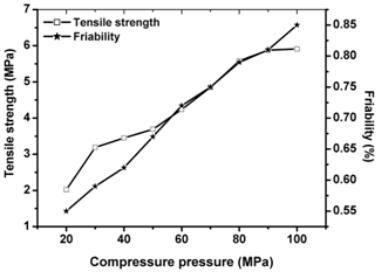
<p align="center"><font size="2" face="Verdana, Arial, Helvetica, sans-serif"><strong>Fig. 1</strong> Heckel&acute;s plot for tamarind dry extract. Tensile strength and friability</font></p>     <p align="justify"><font size="2" face="Verdana, Arial, Helvetica, sans-serif">Tensile strength augments as the compression pressure increases (<a href="#figura2">figure 2</a>). This behavior is in   accordance with many authors that describe the same behavior for tablets prepared with natural   extracts. [11,13]</font></p>     <p align="center"><font size="2" face="Verdana, Arial, Helvetica, sans-serif"><a name="figura2"></a><img src="/img/revistas/rtq/v31n2/f0210211.jpg"></font></p>     
]]></body>
<body><![CDATA[<p align="center"><font size="2" face="Verdana, Arial, Helvetica, sans-serif"><strong>Fig. 2</strong> Tensile strength and friability versus compaction pressure.</font></p>     <p align="justify"><font size="2" face="Verdana, Arial, Helvetica, sans-serif">A linear relationship between TS and CP was   found. The adjusted model for this relation   (equation 4) exhibit a R<sup>2</sup> equal to 0,982 9 with   statistical significance (p-value of 0,000 1) for 95   % of confidence. (Data not reported)</font></p>     <p align="justify"><font size="2" face="Verdana, Arial, Helvetica, sans-serif">TS = 1,407 22 + 0,048 42 x CP (4) </font></p>     <p align="justify"><font size="2" face="Verdana, Arial, Helvetica, sans-serif">In this work, soft tablets were obtained. According to literatures, lactose monohydrate (48   % of the dry extract composition) usually produces soft compacts because its fragmentation   behavior of compaction creates a large number of   small particles, that&rsquo;s why the number of contact   points that support the applied load is large, so that   the stress on each contact point is relatively small. The strength of bonds formed in compacts will   therefore be relatively low [11, 12 y 13].</font></p>     <p align="justify"><font size="2" face="Verdana, Arial, Helvetica, sans-serif">In the same way, as the TS augments the Fr   increase but in no case over one per cent; this   behavior was observed by other authors&rsquo; [11]. The fitted model (equation 5) for this relationship   explains the 98,94 % (R<sup>2</sup> = 0,989 4, p-value 0,000 1)   of the variability of Fr as function of TS with 95 %   of confidence.</font></p>     <p align="justify"><font size="2" face="Verdana, Arial, Helvetica, sans-serif">Fr = 0,401 11 + 0,004 33 x TS (5)</font></p>     <p align="justify"><font size="2" face="Verdana, Arial, Helvetica, sans-serif"><strong>Disintegration time and porosity</strong></font></p>     <p align="justify"><font size="2" face="Verdana, Arial, Helvetica, sans-serif">The DT in tablet formulations are influenced   by many factors like, hardness, porosity, the   amount of disintegrant, the disintegration   mechanisms (i.e. swelling or capillary forces), the   amount of lubricant and compression force [16].</font></p>     <p align="center"><font size="2" face="Verdana, Arial, Helvetica, sans-serif"><a name="figura3"></a><img src="/img/revistas/rtq/v31n2/f0310211.jpg"></font></p>     
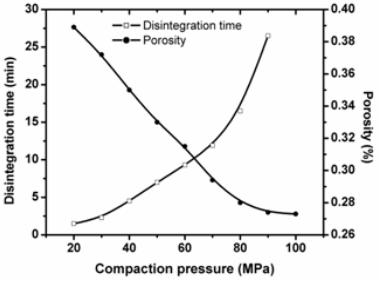
<p align="center"><font size="2" face="Verdana, Arial, Helvetica, sans-serif"><strong>Fig. 3</strong> Behavior of the disintegration related to the compaction pressure and the porosity.</font></p>     ]]></body>
<body><![CDATA[<p align="justify"><font size="2" face="Verdana, Arial, Helvetica, sans-serif">The relationship between compression pressure   versus Porosity and DT is showed in <a href="#figura3">figure 3</a>. As   compaction pressure increases the porosity of   tablets decrease and DT increases, this fact is   reported on literature [11]. It must be noted that,   DT for a compaction pressure over 90MPa and   further, tablets do not disintegrate, being this   value critical because beyond this point the DT   observed is at limits established for not coating   tables (30 min.) It is possible that at these   values of CP the porosity of the tablets be too low,   preventing the water penetration and the swelling   ability of the disintegrant agent be impede.</font></p>     <p align="justify"><font size="2" face="Verdana, Arial, Helvetica, sans-serif">As it is showed in the graphic (<a href="#figura3">figure 3</a>), the   lower CP the higher the porosity of tablets. DT is   minor as the CP applied decreases and is reduced   significantly at higher porosity of the tablets (lower   CP), due to that more porosity facilitates the   water penetration and swelling of CCS and tablets   can disintegrate more quickly.</font></p>     <p align="justify"><font size="2" face="Verdana, Arial, Helvetica, sans-serif">The experiment showed that values of CP   between 70 to 80 MPa, the DT of the tablets is   between 11,9 and 16,5 min., due to this fact a   further work on the formulation studies of tablet   using TDE is currently being performed by our   research group to minimize the disintegration time   optimizing the amount and kind of disintegrant.</font></p>     <p align="center"><font size="2" face="Verdana, Arial, Helvetica, sans-serif"><a name="figura4"></a><img src="/img/revistas/rtq/v31n2/f0410211.jpg"></font></p>     
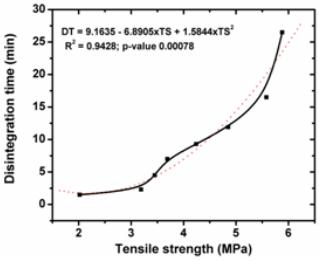
<p align="center"><font size="2" face="Verdana, Arial, Helvetica, sans-serif"><strong>Fig. 4</strong> Disintegration time versus tensile strength for tamarind dry extract tablets. Polynomial fitted appears in dotted line.</font></p>     <p align="justify"><font size="2" face="Verdana, Arial, Helvetica, sans-serif">The augment of TS increases the DT of the   tablets (<a href="#figura4">figure 4</a>). It&rsquo;s possible that compaction   pressure over 90MPa causes an interaction between   binder (PVP) and the component of the extracts   even with the CCS forming a very rigid network,   tablets became harder and disintegration never   occurs. A good second order polynomial model that   can describe 94,28 % of the DT variability as a function of TS was found with 95 % of confidence.</font></p>     <p align="justify"><font size="2" face="Verdana, Arial, Helvetica, sans-serif">The expression and some statistical parameters for   this relationship are showed in <a href="#figura4">figure 4</a>.</font></p>     <p align="justify">&nbsp;</p>     <p align="justify"><strong><font size="3" face="Verdana, Arial, Helvetica, sans-serif">CONCLUSIONS</font></strong></p>     <p align="justify"><font size="2" face="Verdana, Arial, Helvetica, sans-serif">The dry extract has a mixed mechanism of   consolidation: plastic and brittle fracture, showing a   mean yield pressure of 179,85 MPa. The tensile   strength of the compacts increase with the compaction   pressure applied fallowing a straightforward   relationship. Compacts must be obtained at   compaction pressure below 90M Pa because of; at   superior compaction pressure disintegration time   increases over 30 min. The friability of the tablets in   any case was superior to 1 percent.</font></p>     ]]></body>
<body><![CDATA[<p align="justify">&nbsp;</p>     <p align="justify"><strong><font size="3" face="Verdana, Arial, Helvetica, sans-serif">BIBLIOGRAPHY</font></strong></p>     <!-- ref --><p align="justify"><font size="2" face="Verdana, Arial, Helvetica, sans-serif">1. ACES, RP. Plantas &uacute;tiles de las antillas. Editora   Cient&iacute;fico T&eacute;cnica. La Habana. 1979.    </font></p>     <!-- ref --><p align="justify"><font size="2" face="Verdana, Arial, Helvetica, sans-serif">2. SAMINA KK, SHAIKH W, SHAHZADI S, KAZI   TG, USMANGHANI K, KABIR A, SHEERAZI TH.   Chemical constituents of Tamarindus indica L.   medicinal plant in sindh. Pak. J. Bot. 40. 2008.   P&aacute;gs. 2553-2559.    </font></p>     <!-- ref --><p align="justify"><font size="2" face="Verdana, Arial, Helvetica, sans-serif">3. PINO JA, ESCALONA JC, LICEA I, PEREZ RR,   AGUERO J. Leaf oil of Tamarindus indica L. JEOR.   14: 2002. P&aacute;gs. 187-188.    </font></p>     <!-- ref --><p align="justify"><font size="2" face="Verdana, Arial, Helvetica, sans-serif">4. EL-SIDDIG G, PRASAD P, RAMANA VW.   Tamarind, Tamarindus indica. Southampton Centre for Underutilised Crops, Southampton, UK. 2006</font><!-- ref --><p align="justify"><font size="2" face="Verdana, Arial, Helvetica, sans-serif">5. DE SOUZA TP, G&Oacute;MEZ TJ, MART&Iacute;NEZ R,   PETROVICK RP. Compression behavior of   formulations from Phyllanthus niruri spray dried   extract. Pharmazie. 61: 2006. P&aacute;gs. 213-217.    </font></p>     <!-- ref --><p align="justify"><font size="2" face="Verdana, Arial, Helvetica, sans-serif">6. HECKEL WR. An analysis of the powder   compaction phenomena. Trans Metallurg Soc   AIME., 221: 1961. P&aacute;gs. 1001-1008.    </font></p>     <!-- ref --><p align="justify"><font size="2" face="Verdana, Arial, Helvetica, sans-serif">7. RODR&Iacute;GUEZ AJ. Obtenci&oacute;n y caracterizaci&oacute;n de   un Nuevo extracto vegetal para compresi&oacute;n directa. Disertaci&oacute;n. IFAL-UH. 2009.    </font></p>     <!-- ref --><p align="justify"><font size="2" face="Verdana, Arial, Helvetica, sans-serif">8. LAND&Iacute;N M, MART&Iacute;NEZ R, G&Oacute;MEZ LJ. The effect   of country of origin on the properties of dicalcium   phosphate dihydrate powder. Int J Pharm., 103: 1994. P&aacute;gs. 9-18.    </font></p>     <!-- ref --><p align="justify"><font size="2" face="Verdana, Arial, Helvetica, sans-serif">9. ISIMI YC. Effects of the diluent type on the compressional characteristics of the mixed stem bark extract of Anogeissus leiocarpus and Prosopis africana tablet formulation, Acta Pharm. 2003; 53: P&aacute;gs. 49-56.    </font></p>     <!-- ref --><p align="justify"><font size="2" face="Verdana, Arial, Helvetica, sans-serif">10. VAN DER VOORT KM, BOLHUIS KG. Improving properties of materials for direct compression. Pharm   Technol Europe., 10: 1998. P&aacute;gs. 30-35.    </font></p>     <!-- ref --><p align="justify"><font size="2" face="Verdana, Arial, Helvetica, sans-serif">11. VAN DER VOORT KM, BOLHUIS KG. Bolhuis,   Improving properties of materials for direct   compression. Pharm Technol Europe., 10: 1998.   P&aacute;gs. 28-36.    </font></p>     <!-- ref --><p align="justify"><font size="2" face="Verdana, Arial, Helvetica, sans-serif">12. COLE TE, REES EJ, HERSEY AJ. Relations between   compaction data for some crystalline pharmaceutical   materials. Pharm Acta Helv., 50: 1975. P&aacute;gs. 28-32.    </font></p>     <!-- ref --><p align="justify"><font size="2" face="Verdana, Arial, Helvetica, sans-serif">13. SHANGRAW R, Mitrevej R, Shah AM. New era   of tablet disintegrant. Pharm Technol., 4: 1980. P&aacute;gs. 49-57.    </font></p>     <p align="justify">&nbsp;</p>     <p align="justify">&nbsp;</p>     <p align="justify"><font size="2" face="Verdana, Arial, Helvetica, sans-serif">Recibido:                                                                                Septiembre de 2010    ]]></body>
<body><![CDATA[<br>   Aprobado: Abril de 2011</font></p>     <p align="justify">&nbsp;</p>      <p align="justify">&nbsp;</p>      <p align="justify"><font size="2" face="Verdana, Arial, Helvetica, sans-serif"><em>MSc. Jes&uacute;s Rafael Rodr&iacute;guez-Amado.</em><strong> </strong></font><font size="2" face="Verdana, Arial, Helvetica, sans-serif">Department of Pharmacy, University of Orient, Santiago of Cuba. <a href="mailto:jimmy@cnt.uo.edu.cu">jimmy@cnt.uo.edu.cu</a></font></p>      ]]></body><back>
<ref-list>
<ref id="B1">
<label>1</label><nlm-citation citation-type="book">
<person-group person-group-type="author">
<name>
<surname><![CDATA[ACES]]></surname>
<given-names><![CDATA[RP]]></given-names>
</name>
</person-group>
<source><![CDATA[Plantas útiles de las antillas]]></source>
<year>1979</year>
<publisher-loc><![CDATA[La Habana ]]></publisher-loc>
<publisher-name><![CDATA[Editora Científico Técnica]]></publisher-name>
</nlm-citation>
</ref>
<ref id="B2">
<label>2</label><nlm-citation citation-type="journal">
<person-group person-group-type="author">
<name>
<surname><![CDATA[SAMINA]]></surname>
<given-names><![CDATA[KK]]></given-names>
</name>
<name>
<surname><![CDATA[SHAIKH]]></surname>
<given-names><![CDATA[W]]></given-names>
</name>
<name>
<surname><![CDATA[SHAHZADI]]></surname>
<given-names><![CDATA[S]]></given-names>
</name>
<name>
<surname><![CDATA[KAZI]]></surname>
<given-names><![CDATA[TG]]></given-names>
</name>
<name>
<surname><![CDATA[USMANGHANI]]></surname>
<given-names><![CDATA[K]]></given-names>
</name>
<name>
<surname><![CDATA[KABIR]]></surname>
<given-names><![CDATA[A]]></given-names>
</name>
<name>
<surname><![CDATA[SHEERAZI]]></surname>
<given-names><![CDATA[TH]]></given-names>
</name>
</person-group>
<article-title xml:lang="en"><![CDATA[Chemical constituents of Tamarindus indica L. medicinal plant in sindh]]></article-title>
<source><![CDATA[Pak. J. Bot.]]></source>
<year>2008</year>
<volume>40</volume>
<page-range>2553-2559</page-range></nlm-citation>
</ref>
<ref id="B3">
<label>3</label><nlm-citation citation-type="journal">
<person-group person-group-type="author">
<name>
<surname><![CDATA[PINO]]></surname>
<given-names><![CDATA[JA]]></given-names>
</name>
<name>
<surname><![CDATA[ESCALONA]]></surname>
<given-names><![CDATA[JC]]></given-names>
</name>
<name>
<surname><![CDATA[LICEA]]></surname>
<given-names><![CDATA[I]]></given-names>
</name>
<name>
<surname><![CDATA[PEREZ]]></surname>
<given-names><![CDATA[RR]]></given-names>
</name>
<name>
<surname><![CDATA[AGUERO]]></surname>
<given-names><![CDATA[J.]]></given-names>
</name>
</person-group>
<article-title xml:lang="en"><![CDATA[Leaf oil of Tamarindus indica L.]]></article-title>
<source><![CDATA[JEOR]]></source>
<year>2002</year>
<volume>14</volume>
<page-range>187-188</page-range></nlm-citation>
</ref>
<ref id="B4">
<label>4</label><nlm-citation citation-type="">
<person-group person-group-type="author">
<name>
<surname><![CDATA[EL-SIDDIG]]></surname>
<given-names><![CDATA[G]]></given-names>
</name>
<name>
<surname><![CDATA[PRASAD]]></surname>
<given-names><![CDATA[P]]></given-names>
</name>
<name>
<surname><![CDATA[RAMANA]]></surname>
<given-names><![CDATA[VW]]></given-names>
</name>
</person-group>
<source><![CDATA[Tamarind, Tamarindus indica]]></source>
<year>2006</year>
<publisher-loc><![CDATA[Southampton ]]></publisher-loc>
</nlm-citation>
</ref>
<ref id="B5">
<label>5</label><nlm-citation citation-type="journal">
<person-group person-group-type="author">
<name>
<surname><![CDATA[DE SOUZA]]></surname>
<given-names><![CDATA[TP]]></given-names>
</name>
<name>
<surname><![CDATA[GÓMEZ]]></surname>
<given-names><![CDATA[TJ]]></given-names>
</name>
<name>
<surname><![CDATA[MARTÍNEZ]]></surname>
<given-names><![CDATA[R]]></given-names>
</name>
<name>
<surname><![CDATA[PETROVICK]]></surname>
<given-names><![CDATA[RP]]></given-names>
</name>
</person-group>
<article-title xml:lang="en"><![CDATA[Compression behavior of formulations from Phyllanthus niruri spray dried extract]]></article-title>
<source><![CDATA[Pharmazie]]></source>
<year>2006</year>
<volume>61</volume>
<page-range>213-217</page-range></nlm-citation>
</ref>
<ref id="B6">
<label>6</label><nlm-citation citation-type="journal">
<person-group person-group-type="author">
<name>
<surname><![CDATA[HECKEL]]></surname>
<given-names><![CDATA[WR.]]></given-names>
</name>
</person-group>
<article-title xml:lang="en"><![CDATA[An analysis of the powder compaction phenomena]]></article-title>
<source><![CDATA[Trans Metallurg Soc AIME]]></source>
<year>1961</year>
<volume>221</volume>
<page-range>1001-1008</page-range></nlm-citation>
</ref>
<ref id="B7">
<label>7</label><nlm-citation citation-type="book">
<person-group person-group-type="author">
<name>
<surname><![CDATA[RODRÍGUEZ]]></surname>
<given-names><![CDATA[AJ.]]></given-names>
</name>
</person-group>
<source><![CDATA[Obtención y caracterización de un Nuevo extracto vegetal para compresión directa]]></source>
<year>2009</year>
<publisher-name><![CDATA[IFAL-UH]]></publisher-name>
</nlm-citation>
</ref>
<ref id="B8">
<label>8</label><nlm-citation citation-type="journal">
<person-group person-group-type="author">
<name>
<surname><![CDATA[LANDÍN]]></surname>
<given-names><![CDATA[M]]></given-names>
</name>
<name>
<surname><![CDATA[MARTÍNEZ]]></surname>
<given-names><![CDATA[R]]></given-names>
</name>
<name>
<surname><![CDATA[GÓMEZ]]></surname>
<given-names><![CDATA[LJ]]></given-names>
</name>
</person-group>
<article-title xml:lang="en"><![CDATA[The effect of country of origin on the properties of dicalcium phosphate dihydrate powder]]></article-title>
<source><![CDATA[Int J Pharm.]]></source>
<year>1994</year>
<volume>103</volume>
<page-range>9-18</page-range></nlm-citation>
</ref>
<ref id="B9">
<label>9</label><nlm-citation citation-type="journal">
<person-group person-group-type="author">
<name>
<surname><![CDATA[ISIMI]]></surname>
<given-names><![CDATA[YC]]></given-names>
</name>
</person-group>
<article-title xml:lang="en"><![CDATA[Effects of the diluent type on the compressional characteristics of the mixed stem bark extract of Anogeissus leiocarpus and Prosopis africana tablet formulation]]></article-title>
<source><![CDATA[Acta Pharm.]]></source>
<year>2003</year>
<volume>53</volume>
<page-range>49-56</page-range></nlm-citation>
</ref>
<ref id="B10">
<label>10</label><nlm-citation citation-type="journal">
<person-group person-group-type="author">
<name>
<surname><![CDATA[VAN DER VOORT]]></surname>
<given-names><![CDATA[KM]]></given-names>
</name>
<name>
<surname><![CDATA[BOLHUIS]]></surname>
<given-names><![CDATA[KG.]]></given-names>
</name>
</person-group>
<article-title xml:lang="en"><![CDATA[Improving properties of materials for direct compression]]></article-title>
<source><![CDATA[Pharm Technol Europe]]></source>
<year>1998</year>
<volume>10</volume>
<page-range>30-35</page-range></nlm-citation>
</ref>
<ref id="B11">
<label>11</label><nlm-citation citation-type="journal">
<person-group person-group-type="author">
<name>
<surname><![CDATA[VAN DER VOORT]]></surname>
<given-names><![CDATA[KM]]></given-names>
</name>
<name>
<surname><![CDATA[BOLHUIS]]></surname>
<given-names><![CDATA[KG.]]></given-names>
</name>
</person-group>
<article-title xml:lang="en"><![CDATA[Bolhuis, Improving properties of materials for direct compression]]></article-title>
<source><![CDATA[Pharm Technol Europe]]></source>
<year>1998</year>
<volume>10</volume>
<page-range>28-36</page-range></nlm-citation>
</ref>
<ref id="B12">
<label>12</label><nlm-citation citation-type="journal">
<person-group person-group-type="author">
<name>
<surname><![CDATA[COLE]]></surname>
<given-names><![CDATA[TE]]></given-names>
</name>
<name>
<surname><![CDATA[REES]]></surname>
<given-names><![CDATA[EJ]]></given-names>
</name>
<name>
<surname><![CDATA[HERSEY]]></surname>
<given-names><![CDATA[AJ.]]></given-names>
</name>
</person-group>
<article-title xml:lang="en"><![CDATA[Relations between compaction data for some crystalline pharmaceutical materials]]></article-title>
<source><![CDATA[Pharm Acta Helv]]></source>
<year>1975</year>
<volume>50</volume>
<page-range>28-32</page-range></nlm-citation>
</ref>
<ref id="B13">
<label>13</label><nlm-citation citation-type="journal">
<person-group person-group-type="author">
<name>
<surname><![CDATA[SHANGRAW]]></surname>
<given-names><![CDATA[R]]></given-names>
</name>
<name>
<surname><![CDATA[Mitrevej]]></surname>
<given-names><![CDATA[R]]></given-names>
</name>
<name>
<surname><![CDATA[Shah]]></surname>
<given-names><![CDATA[AM.]]></given-names>
</name>
</person-group>
<article-title xml:lang="en"><![CDATA[New era of tablet disintegrant]]></article-title>
<source><![CDATA[Pharm Technol.]]></source>
<year>1980</year>
<volume>4</volume>
<page-range>49-57</page-range></nlm-citation>
</ref>
</ref-list>
</back>
</article>