<?xml version="1.0" encoding="ISO-8859-1"?><article xmlns:mml="http://www.w3.org/1998/Math/MathML" xmlns:xlink="http://www.w3.org/1999/xlink" xmlns:xsi="http://www.w3.org/2001/XMLSchema-instance">
<front>
<journal-meta>
<journal-id>2224-6185</journal-id>
<journal-title><![CDATA[Tecnología Química]]></journal-title>
<abbrev-journal-title><![CDATA[RTQ]]></abbrev-journal-title>
<issn>2224-6185</issn>
<publisher>
<publisher-name><![CDATA[Universidad de Oriente]]></publisher-name>
</publisher>
</journal-meta>
<article-meta>
<article-id>S2224-61852015000300010</article-id>
<title-group>
<article-title xml:lang="es"><![CDATA[Construcción y Validación Experimental de un Biorreactor Artesanal Tipo Tanque Agitado para Fermentaciones Sumergidas a Escala de Laboratorio]]></article-title>
<article-title xml:lang="en"><![CDATA[Construction and Experimental Validation of a Homemade Stirred Tank Bioreactor for Lab-scale Submerged Fermentations]]></article-title>
</title-group>
<contrib-group>
<contrib contrib-type="author">
<name>
<surname><![CDATA[Serrat Díaz]]></surname>
<given-names><![CDATA[Manuel]]></given-names>
</name>
<xref ref-type="aff" rid="AFF"/>
</contrib>
<contrib contrib-type="author">
<name>
<surname><![CDATA[Méndez Hernández]]></surname>
<given-names><![CDATA[Abelardo Allán]]></given-names>
</name>
<xref ref-type="aff" rid="AFF"/>
</contrib>
</contrib-group>
<aff id="AF1">
<institution><![CDATA[,Universidad de Oriente Facultad de Ciencias Naturales Centro de Estudios de Biotecnología Industrial]]></institution>
<addr-line><![CDATA[Santiago de Cuba ]]></addr-line>
<country>Cuba</country>
</aff>
<pub-date pub-type="pub">
<day>00</day>
<month>12</month>
<year>2015</year>
</pub-date>
<pub-date pub-type="epub">
<day>00</day>
<month>12</month>
<year>2015</year>
</pub-date>
<volume>35</volume>
<numero>3</numero>
<fpage>362</fpage>
<lpage>375</lpage>
<copyright-statement/>
<copyright-year/>
<self-uri xlink:href="http://scielo.sld.cu/scielo.php?script=sci_arttext&amp;pid=S2224-61852015000300010&amp;lng=en&amp;nrm=iso"></self-uri><self-uri xlink:href="http://scielo.sld.cu/scielo.php?script=sci_abstract&amp;pid=S2224-61852015000300010&amp;lng=en&amp;nrm=iso"></self-uri><self-uri xlink:href="http://scielo.sld.cu/scielo.php?script=sci_pdf&amp;pid=S2224-61852015000300010&amp;lng=en&amp;nrm=iso"></self-uri><abstract abstract-type="short" xml:lang="es"><p><![CDATA[Los biorreactores a pequeña escala son ampliamente utilizados para la experimentación en los laboratorios microbiológicos. Su precio actual es del orden de los &#8364; 20 000, lo que dificulta su adquisición. En este trabajo se presenta la construcción de un sistema de tanque agitado artesanal, elaborado con instrumentación y recursos disponibles en cualquier laboratorio, teniendo como premisa el cumplimiento de los requisitos indispensables para el establecimiento de procesos fermentativos microbianos a pequeña escala. El biorreactor construido garantizó la esterilidad del sistema durante 24 horas de funcionamiento continuo y bajo condiciones reales de manipulación, incluidas tres tomas de muestra. Se determinó el coeficiente de transferencia de oxígeno (kl a) mediante el método del sulfito bajo diferentes condiciones de aireación-agitación, obteniéndose valores de 0.058 s-1 y 0.033 s-1 bajo flujo de aire 0.67 L·h-1 y agitación de 850 min-1y 650 min-1, respectivamente, los que resultan suficientes para un crecimiento microbiano óptimo en la mayoría de las situaciones. El biorreactor mostró una satisfactoria capacidad de mezclado, dada esta por su capacidad de mantener constante en el tiempo la concentración de un sólido insoluble finamente dividido y de alta densidad (BaSO4) en suspensión. Los resultados obtenidos avalan la aptitud del biorreactor artesanal para su uso en el estudio de fermentaciones microbianas a escala de laboratorio.]]></p></abstract>
<abstract abstract-type="short" xml:lang="en"><p><![CDATA[Small-scale bioreactors are widely used for experimentation in microbiological laboratories. Currently, the price of these systems is in the order of &#8364; 20 000, which obstructs its acquisition. A homemade stirred tank system, with easily available and inexpensive resources, was designed and assembled so that meets the essential requirements for the establishment of microbial fermentation processes on a small-scale. In this regard, the sterility of the system was checked by applying sterility controls during 24 hours of continuous operation under real conditions of handling, including three samplings. The oxygen transfer coefficient (kl a) was determined by the sulfite method, under different aeration-agitation conditions, yielding values of 0.058 s-1 and 0.033 s-1 under 0.67 L·min-1 of air flow rate and stirring rates of 850 min-1 and 650 min-1, respectively, which result usually sufficient for optimal microbial growth. The bioreactor exhibited a satisfactory mixing performance, which is expressed by its ability to maintain the temporal stability of the concentration of an insoluble, high density and finely divided solid (BaSO4). These results show the practical potentialities of this homemade bioreactor to the study of microbial fermentation at lab-scale level.]]></p></abstract>
<kwd-group>
<kwd lng="es"><![CDATA[biorreactor]]></kwd>
<kwd lng="es"><![CDATA[tanque agitado]]></kwd>
<kwd lng="es"><![CDATA[fermentación]]></kwd>
<kwd lng="es"><![CDATA[transferencia de oxígeno]]></kwd>
<kwd lng="es"><![CDATA[mezclado]]></kwd>
<kwd lng="en"><![CDATA[biorreactor]]></kwd>
<kwd lng="en"><![CDATA[stirred tank]]></kwd>
<kwd lng="en"><![CDATA[fermentation]]></kwd>
<kwd lng="en"><![CDATA[oxygen transfer coefficient]]></kwd>
<kwd lng="en"><![CDATA[mixing]]></kwd>
</kwd-group>
</article-meta>
</front><body><![CDATA[ <p align="right"><font face="Verdana, Arial, Helvetica, sans-serif" size="2"><b>ARTICULO    ORIGINAL</b></font></p>     <p align="right">&nbsp;</p>     <p align="left"><strong><font size="4" face="Verdana, Arial, Helvetica, sans-serif">Construcci&oacute;n  y Validaci&oacute;n Experimental de un Biorreactor Artesanal Tipo Tanque Agitado para  Fermentaciones Sumergidas a Escala de Laboratorio</font></strong></p>     <p align="left">&nbsp;</p>     <p align="left"><strong><font size="3" face="Verdana, Arial, Helvetica, sans-serif">Construction  and Experimental Validation of a Homemade Stirred Tank Bioreactor for Lab-scale  Submerged Fermentations</font></strong></p>     <p align="left">&nbsp;</p>     <p align="left">&nbsp;</p>     <p align="justify"><strong><font size="2" face="Verdana, Arial, Helvetica, sans-serif">Dr.C. Manuel Serrat  D&iacute;az, Lic. Abelardo All&aacute;n M&eacute;ndez Hern&aacute;ndez</font></strong></p>     <p align="justify"><font size="2" face="Verdana, Arial, Helvetica, sans-serif">Centro de Estudios de Biotecnolog&iacute;a Industrial. Facultad  de Ciencias Naturales. Universidad de Oriente. Santiago de Cuba. Cuba. <a href="mailto:mserrat@cebi.uo.edu.cu">mserrat@cebi.uo.edu.cu</a></font></p>     <p align="justify">&nbsp;</p>     ]]></body>
<body><![CDATA[<p align="left">&nbsp;</p> <hr>     <p align="left"><font face="Verdana, Arial, Helvetica, sans-serif" size="2"><b>RESUMEN</b></font></p>     <p align="justify"><font size="2" face="Verdana, Arial, Helvetica, sans-serif">Los biorreactores a  peque&ntilde;a escala son ampliamente utilizados para la experimentaci&oacute;n en los  laboratorios microbiol&oacute;gicos. Su precio actual es del orden de los &euro; 20 000, lo  que dificulta su adquisici&oacute;n. En este trabajo se presenta la construcci&oacute;n de un  sistema de tanque agitado artesanal, elaborado con instrumentaci&oacute;n y recursos  disponibles en cualquier laboratorio, teniendo como premisa el cumplimiento de  los requisitos indispensables para el establecimiento de procesos fermentativos  microbianos a peque&ntilde;a escala. El biorreactor construido garantiz&oacute; la  esterilidad del sistema durante 24 horas de funcionamiento continuo y bajo  condiciones reales de manipulaci&oacute;n, incluidas tres tomas de muestra. Se  determin&oacute; el coeficiente de transferencia de ox&iacute;geno (kl<sub>a</sub>) mediante  el m&eacute;todo del sulfito bajo diferentes condiciones de aireaci&oacute;n-agitaci&oacute;n,  obteni&eacute;ndose valores de 0.058 s<sup>-1</sup> y 0.033 s<sup>-1</sup> bajo flujo  de aire 0.67 L&middot;h<sup>-1</sup> y agitaci&oacute;n de 850 min<sup>-1</sup>y 650 min<sup>-1</sup>,  respectivamente, los que resultan suficientes para un crecimiento microbiano  &oacute;ptimo en la mayor&iacute;a de las situaciones. El biorreactor mostr&oacute; una satisfactoria  capacidad de mezclado, dada esta por su capacidad de mantener constante en el  tiempo la concentraci&oacute;n de un s&oacute;lido insoluble finamente dividido y de alta  densidad (BaSO<sub>4</sub>) en suspensi&oacute;n. Los resultados obtenidos avalan la  aptitud del biorreactor artesanal para su uso en el estudio de fermentaciones  microbianas a escala de laboratorio.</font></p>     <p align="justify"><font face="Verdana, Arial, Helvetica, sans-serif" size="2"><b>Palabras    clave</b>: biorreactor, tanque agitado,  fermentaci&oacute;n, transferencia de ox&iacute;geno, mezclado.</font></p> <hr>     <p align="left"><font face="Verdana, Arial, Helvetica, sans-serif" size="2"><b>ABSTRACT</b></font></p>     <p align="justify"><font size="2" face="Verdana, Arial, Helvetica, sans-serif">Small-scale  bioreactors are widely used for experimentation in microbiological  laboratories. Currently,  the price of these systems is in the order of &euro; 20 000, which obstructs its  acquisition. A homemade stirred tank system, with easily available and inexpensive  resources, was designed and assembled so that meets the essential requirements for the establishment of microbial fermentation processes on a small-scale. In this regard, the sterility of the  system was checked by applying sterility controls during 24 hours of continuous  operation under real conditions of handling, including three samplings. The oxygen transfer coefficient (kl<sub>a</sub>) was determined by the  sulfite method, under different aeration-agitation conditions, yielding values of 0.058 s<sup>-1</sup>  and 0.033 s<sup>-1</sup> &nbsp;under 0.67 L&middot;min<sup>-1</sup> of air flow rate and  stirring rates of 850 min<sup>-1</sup>  and 650 min<sup>-1</sup>,  respectively, which result usually sufficient for  optimal microbial growth. The bioreactor exhibited a satisfactory mixing  performance, which is expressed by its ability to maintain the temporal  stability of the concentration of an insoluble, high density and finely divided  solid (BaSO<sub>4</sub>). These results show the practical  potentialities of this homemade bioreactor to the study of microbial  fermentation at lab-scale level.</font></p>     <p align="justify"><font face="Verdana, Arial, Helvetica, sans-serif" size="2"><b>Keywords</b>:    biorreactor,  stirred tank, fermentation, oxygen transfer coefficient, mixing.</font></p> <hr>     <p>&nbsp;</p>     <p>&nbsp;</p>     <p align="left"><font face="Verdana, Arial, Helvetica, sans-serif" size="3"><b>INTRODUCCION</b></font></p>     ]]></body>
<body><![CDATA[<p align="justify"><font size="2" face="Verdana, Arial, Helvetica, sans-serif">Cuando se dise&ntilde;a una  fermentaci&oacute;n industrial se necesita de un gran n&uacute;mero de experimentos para  seleccionar una cepa, mejorar el medio de cultivo y, en general, optimizar el  procedimiento de fermentaci&oacute;n [1]. Durante los &uacute;ltimos 50 a&ntilde;os, los cient&iacute;ficos  han utilizado los frascos erlenmeyers para el cultivo celular como centro del  desarrollo de procesos a peque&ntilde;a escala, con vol&uacute;menes que oscilan com&uacute;nmente  entre los 10 mL y 500 mL. El uso de los mismos se estima en un 90 % de todos  los experimentos de este tipo realizados en la industria biotecnol&oacute;gica y en  estudios acad&eacute;micos [2].</font></p>     <p align="justify"><font size="2" face="Verdana, Arial, Helvetica, sans-serif">Estos cultivos a menudo se encuentran limitados por un  control impreciso de la temperatura, donde las variaciones alcanzan en  ocasiones los 5 &ordm;C  o m&aacute;s de la temperatura inicial. Adem&aacute;s, presentan otras limitaciones  relacionadas con el intercambio gaseoso, implicado en procesos vitales como la  transferencia y consumo de ox&iacute;geno u otros gases por microorganismos que as&iacute; lo  requieran. Por otra parte, son sensibles a p&eacute;rdidas por evaporaci&oacute;n en cultivos  &lsquo;calientes&rsquo;, t&iacute;picamente un 10 % en 24 h a 37 &ordm;C, todo lo cual modifica  la densidad del cultivo y limita operaciones de larga duraci&oacute;n [3].</font></p>     <p align="justify"><font size="2" face="Verdana, Arial, Helvetica, sans-serif">Los biorreactores de tanque agitado para la  experimentaci&oacute;n surgieron (hace m&aacute;s de medio siglo) con el prop&oacute;sito de lidiar  con muchas de estas limitaciones y se han ido perfeccionando en busca del  control m&aacute;s preciso de los ambientes de desarrollo de cultivos vivos,  estableci&eacute;ndose como un est&aacute;ndar en la industria biotecnol&oacute;gica. El empleo de  sensores en el interior del vaso, conectados a dispositivos de control  autom&aacute;tico, permite mantener los valores de temperatura, pH, ox&iacute;geno disuelto y  otros par&aacute;metros de inter&eacute;s, dentro de los l&iacute;mites estrechos necesarios para el  &eacute;xito de las fermentaciones. Por otro lado, el empleo de sistemas eficientes de  aireaci&oacute;n y agitaci&oacute;n garantiza niveles &oacute;ptimos en la transferencia de ox&iacute;geno  y en el mezclado. Dentro de estos, los biorreactores de peque&ntilde;a escala han  resultado vitales en procesos de escalado y desescalado, optimizaci&oacute;n de cepas,  caracterizaci&oacute;n y desarrollo de procesos [3, 4].</font></p>     <p align="justify"><font size="2" face="Verdana, Arial, Helvetica, sans-serif">Existe una interesante  diversidad de biorreactores comerciales con elevados est&aacute;ndares de calidad; sin  embargo, el elevado precio de venta que persiste a&uacute;n en los dise&ntilde;os m&aacute;s  econ&oacute;micos representa una inobjetable limitante. Importantes firmas  comercializadoras, como Infors HT&reg; (Suiza), ofertan estos equipos en  precios que rondan los &euro; 20 000 y &euro; 75 000 en biorreactores de tanque agitado  de peque&ntilde;a escala (Minifors&reg;) y escala piloto (Techfors-S&reg;),  respectivamente. Estos precios dificultan de forma considerable su  adquisici&oacute;n en pa&iacute;ses en v&iacute;as de desarrollo y, especialmente, en instituciones  cient&iacute;ficas y acad&eacute;micas dentro de estos.</font></p>     <p align="justify"><font size="2" face="Verdana, Arial, Helvetica, sans-serif">El objetivo de este trabajo estuvo dirigido al dise&ntilde;o  y construcci&oacute;n de un biorreactor artesanal tipo tanque agitado, utilizando para  ello materiales, equipamiento e instrumentaci&oacute;n de laboratorio asequible y de  bajo costo, as&iacute; como a la validaci&oacute;n experimental de su desempe&ntilde;o a partir del  cumplimiento de los requisitos indispensables requeridos para el cultivo de  microorganismos. </font></p>     <p align="justify">&nbsp;</p>     <p align="justify"><font face="Verdana, Arial, Helvetica, sans-serif" size="3"><b>MATERIALES    Y METODOS</b></font></p>     <p align="justify"><font size="2" face="Verdana, Arial, Helvetica, sans-serif">La investigaci&oacute;n se desarroll&oacute;  en los laboratorios del Centro de Estudios de Biotecnolog&iacute;a Industrial (CEBI),  perteneciente a la Facultad de Ciencias Naturales de la Universidad de Oriente.</font></p>     <p align="justify"><font size="2"><strong><font face="Verdana, Arial, Helvetica, sans-serif">Dise&ntilde;o y Construcci&oacute;n del Biorreactor</font></strong></font></p>     <p align="justify"><font size="2" face="Verdana, Arial, Helvetica, sans-serif"><strong><em>Vaso del biorreactor. </em></strong>Para este fin se utiliz&oacute; un bal&oacute;n de 2 L de capacidad,  de fondo redondo (geometr&iacute;a esf&eacute;rica) y provisto de una sola boca, con las  siguientes dimensiones espec&iacute;ficas: di&aacute;metro interior = 16 cm; altura hasta cuello = 14 cm; altura de la columna  l&iacute;quida para 1 L de volumen = 7.5   cm.</font></p>     ]]></body>
<body><![CDATA[<p align="justify"><font size="2" face="Verdana, Arial, Helvetica, sans-serif">La boca del bal&oacute;n est&aacute; dispuesta sobre un cuello  cil&iacute;ndrico corto de 7&times;7 cm (di&aacute;metro&times;altura). La boca se cerr&oacute; con un tap&oacute;n de  goma multihoradado, al cual se insertaron la flecha del agitador (con su  cojinete y junta de goma), el term&oacute;metro, el condensador (salida de gases) y  los tubos (puertos) para los restantes sistemas de transporte de gases y  l&iacute;quido hacia dentro y fuera del biorreactor.</font></p>     <p align="justify"><font size="2"><strong><em><font face="Verdana, Arial, Helvetica, sans-serif">Sistema  de suministro de aire. </font></em></strong><font face="Verdana, Arial, Helvetica, sans-serif">Se  constituy&oacute; por una bomba de vac&iacute;o (Sartorius,  Alemania) operando en reversa, con  capacidad m&aacute;xima de bombeo de 0.67 L&middot;min<sup>-1</sup>, acoplada a un rot&aacute;metro de gas (VEB MLW  PR&Uuml;FGERATE-WERK, Alemania), el que se conect&oacute; mediante una manguera de silicona a un filtro microbiol&oacute;gico (Midisart&reg; 2000,  Alemania) de membrana hidrof&oacute;bica (0.2 &micro;m de tama&ntilde;o de poro y 20 cm<sup>2</sup>  de &aacute;rea de filtrado), para garantizar la esterilidad del aire. El filtro se uni&oacute;  mediante una manguera a la tuber&iacute;a de vidrio que se introduce al biorreactor  por la parte superior y que termina en un dispersor de vidrio horadado, de  extremo en forma de espiral (dorificios &asymp; 3 mm), ubicado justo por  debajo del impelente.</font></font></p>     <p align="justify"><font size="2"><strong><em><font face="Verdana, Arial, Helvetica, sans-serif">Agitaci&oacute;n. </font></em></strong><font face="Verdana, Arial, Helvetica, sans-serif">La agitaci&oacute;n del sistema se estableci&oacute; por medio  de un agitador mec&aacute;nico portable (IKA&reg;  EUROSTAR Power control-vis, Alemania), de  150 W de potencia y rango de agitaci&oacute;n de 50-2000 min<sup>-1</sup>, al cual se  acopl&oacute; un impelente de acero inoxidable tipo turbina abierta de cuatro paletas  planas verticales [5] de 2&times;0.6 cm (largo&times;ancho), ubicado a una distancia del  fondo del vaso y del dispersor de 3.5 cm y 2.5 cm, respectivamente. Un cojinete fij&oacute; el  eje del agitador al tap&oacute;n de goma del vaso para propiciar su libre movimiento y  evitar vibraciones; este se lubric&oacute; con grasa s&oacute;lida de alto vac&iacute;o. Para  garantizar la hermeticidad del biorreactor durante su operaci&oacute;n, se situ&oacute; una  junta de goma tipo <em>O-ring</em> por debajo del rodamiento. El impelente se  posicion&oacute; exc&eacute;ntricamente para prevenir el flujo circulatorio y evitar la  formaci&oacute;n de v&oacute;rtices.</font></font></p>     <p align="justify"><font size="2"><strong><em><font face="Verdana, Arial, Helvetica, sans-serif">Sistema  de salida de gases. </font></em></strong><font face="Verdana, Arial, Helvetica, sans-serif">Se conform&oacute;  por un condensador de reflujo de 30&times;3 cm (largo&times;di&aacute;metro) acoplado directamente  al vaso del biorreactor. Este se conect&oacute; a una trampa qu&iacute;mica, para evitar la  entrada de contaminantes desde el exterior y contribuir a regular la presi&oacute;n  interna. Dicha trampa estuvo integrada por un bal&oacute;n de dos bocas donde se  depositaron 150 mL de una soluci&oacute;n microbicida (&aacute;cido benzoico saturado, pH 4.0). La boca  superior del bal&oacute;n se conect&oacute; al condensador y la lateral a un dispositivo  soxhlet (24.5 cm de largo)  para garantizar el reflujo de la soluci&oacute;n microbicida y evitar as&iacute; su p&eacute;rdida en  el aerosol.</font></font></p>     <p align="justify"><font size="2"><strong><em><font face="Verdana, Arial, Helvetica, sans-serif">Sistema  para la toma de muestra.</font></em></strong><font face="Verdana, Arial, Helvetica, sans-serif"> Se  dispuso de un embudo separador de vidrio provisto con llave de rosca de tefl&oacute;n.  La tapa del embudo se reemplaz&oacute; por un tap&oacute;n de goma con dos orificios, por los  cuales se introducen sendos tubos de vidrio. Uno de ellos penetra al interior  del embudo hasta la altura donde comienza su cuerpo y por su parte externa se acopl&oacute;  mediante una manguera de silicona al tubo que, penetrando a trav&eacute;s del tap&oacute;n  del vaso del biorreactor, llega hasta el fondo del mismo, pero sin tocar con  &eacute;l, sirviendo de conducto para el trasvase de la muestra hacia el embudo  separador. El segundo tubo solo penetra en el embudo 1 cm por debajo del tap&oacute;n y  por su extremo externo se une con una manguera a un filtro bacteriol&oacute;gico; su  funci&oacute;n es mantener el sistema abierto a la atm&oacute;sfera y evitar sobrepresiones  en el interior del embudo. La colecta de la muestra se realiza taponando el  extremo distal de la salida de gases, provocando un incremento de la presi&oacute;n en  el interior del vaso que empuja al l&iacute;quido contenido en el biorreactor hacia el  embudo separador. Se dispuso tambi&eacute;n de un sistema alternativo para la  extracci&oacute;n manual de la muestra, mediante el acoplamiento de una jeringuilla al  filtro bacteriol&oacute;gico ubicado en la parte superior del embudo separador. Este &uacute;ltimo  sistema resulta id&oacute;neo cuando se trabaja con cultivos no aireados.</font></font></p>     <p align="justify"><font size="2"><strong><em><font face="Verdana, Arial, Helvetica, sans-serif">Control  de temperatura. </font></em></strong><font face="Verdana, Arial, Helvetica, sans-serif">El vaso  del biorreactor se sumergi&oacute; en un ba&ntilde;o de agua isot&eacute;rmico constituido por una  desecadora cargada con agua destilada. La constancia de la temperatura se estableci&oacute;  por medio del dispositivo de calentamiento y recirculaci&oacute;n de agua de un ba&ntilde;o  termost&aacute;tico (VEB MLW PR&Uuml;FGERATE-WERK, Alemania; precisi&oacute;n &plusmn; 0.1 &ordm;C) y  se midi&oacute; mediante term&oacute;metros de mercurio convencionales sumergidos en el  cultivo y el ba&ntilde;o de agua, respectivamente.</font></font></p>     <p align="justify"><font size="2" face="Verdana, Arial, Helvetica, sans-serif"><strong><em>Sistema para la entrada de in&oacute;culo.</em></strong> Como reservorio del in&oacute;culo se dispuso de un  kitasato, a cuya salida lateral se conect&oacute; un filtro microbiol&oacute;gico (0.2 &micro;m),  en tanto en la boca se coloc&oacute; un tap&oacute;n de goma al cual se insert&oacute; un tubo de  vidrio que llega hasta muy cerca del fondo del frasco. En el momento de la  inoculaci&oacute;n, la parte superior del tubo se acopl&oacute;, as&eacute;pticamente, a una  manguera est&eacute;ril conectada al biorreactor. Insuflando aire al kitasato trav&eacute;s  del filtro, el in&oacute;culo es empujado hacia el interior del biorreactor.</font></p>     <p align="justify"><font size="2"><strong><font face="Verdana, Arial, Helvetica, sans-serif">Materiales utilizados en la construcci&oacute;n del biorreactor. </font></strong><font face="Verdana, Arial, Helvetica, sans-serif">Se utilizaron instrumentos y accesorios construidos a  base de vidrio borosilicato (balones, condensador, soxhlet, embudo separador y  tuber&iacute;as), tapones de caucho vulcanizado para uso qu&iacute;mico y mangueras de  silicona. El sistema de agitaci&oacute;n se construy&oacute; de acero inoxidable.</font></font></p>     <p align="justify"><font size="2"><strong><font face="Verdana, Arial, Helvetica, sans-serif">Determinaci&oacute;n  del Coeficiente Volum&eacute;trico Global de Transferencia de Ox&iacute;geno (kl<sub>a</sub>). </font></strong></font></p>     <p align="justify"><font size="2" face="Verdana, Arial, Helvetica, sans-serif">Se realiz&oacute; por el m&eacute;todo del sulfito [6]. Para ello,  el reactor se llen&oacute; con 1 L (50 % del volumen total y 80 % del volumen de  trabajo m&aacute;ximo) de una soluci&oacute;n de sulfito de sodio a 0.25 mol&middot;L<sup>-1</sup>,  conteniendo CuSO<sub>4</sub>&middot;5H<sub>2</sub>O a 1 g&middot;L<sup>-1</sup> como  catalizador, reci&eacute;n preparada en agua destilada desgasificada. El ensayo se  realiz&oacute; a temperatura constante (36 &ordm;C), empleando diferentes condiciones de  agitaci&oacute;n (0-850 min<sup>-1</sup>) y aireaci&oacute;n sostenida de 0.67 vvm. La  concentraci&oacute;n residual de sulfito se determin&oacute; por el m&eacute;todo yodim&eacute;trico seg&uacute;n  los procedimientos recomendados [7].</font></p>     ]]></body>
<body><![CDATA[<p align="justify"><font size="2"><strong><font face="Verdana, Arial, Helvetica, sans-serif">Determinaci&oacute;n de la Capacidad de Mezclado del Sistema</font></strong></font></p>     <p align="justify"><font size="2" face="Verdana, Arial, Helvetica, sans-serif">La eficiencia de mezclado dentro del biorreactor se  determin&oacute; mediante el an&aacute;lisis del comportamiento temporal de la concentraci&oacute;n de  un s&oacute;lido insoluble finamente particulado y con un alto coeficiente de  sedimentaci&oacute;n (precipitado de BaSO<sub>4</sub>) en un punto fijo del  biorreactor (punto de toma de muestra), bajo diferentes combinaciones de  aireaci&oacute;n/agitaci&oacute;n. El precipitado de BaSO<sub>4</sub> se obtuvo <em>in situ </em>al mezclarse vol&uacute;menes iguales  (500 mL) de soluciones de BaCl<sub>2</sub> y Na<sub>2</sub>SO<sub>4</sub>, ambas  a 0,29 mol&middot;L<sup>-1</sup>. Una vez formado el precipitado, se puso en marcha el  sistema a una temperatura fija de 36   &ordm;C, bajo diferentes condiciones de agitaci&oacute;n (0 min<sup>-1</sup>,  350 min<sup>-1</sup>, 650 min<sup>-1</sup> y 850 min<sup>-1</sup>), con  aireaci&oacute;n (0.67 L&middot;min<sup>-1</sup>) y sin ella. Se tomaron muestras del  interior del biorreactor a intervalos regulares de 5 min durante 30 min, luego  de una colecta inicial (t<sub>0</sub>), realizada a los 5 min de ponerse en  funcionamiento el biorreactor. La concentraci&oacute;n de s&oacute;lidos en las muestras  colectadas se determin&oacute; gravim&eacute;tricamente, luego de secar el sedimento a 105&ordm;C  durante 12 h.</font></p>     <p align="justify"><font size="2"><strong><font face="Verdana, Arial, Helvetica, sans-serif">Prueba  de Esterilidad del Sistema</font></strong></font></p>     <p align="justify"><font size="2"><font face="Verdana, Arial, Helvetica, sans-serif">El  biorreactor se carg&oacute; con 1 L  de caldo nutriente (UNI-CHEM), se acoplaron los dem&aacute;s accesorios y se  esteriliz&oacute; en autoclave (121   &ordm;C, 15 min). Una vez alcanzada la temperatura ambiente,  el sistema se puso en funcionamiento a temperatura sostenida de 37 &ordm;C, flujo de aire de 0.67  L&middot;min<sup>-1</sup> y agitaci&oacute;n de 650 min<sup>-1</sup>. Se establecieron tres puntos  temporales de control de esterilidad (0, 12 y 24 horas), en los cuales se  extrajeron aproximadamente 30 mL del medio contenido en el interior del vaso por  el sistema de toma de muestra. La primera toma (tiempo cero), se efectu&oacute; a los  cinco minutos de funcionamiento del sistema con el objetivo de descartar  contaminaciones al inicio del proceso o durante la esterilizaci&oacute;n.</font></font></p>     <p align="justify"><font size="2" face="Verdana, Arial, Helvetica, sans-serif">Para la detecci&oacute;n de posibles contaminantes, las  muestras colectadas se sembraron (100 &micro;L) en placas Petri conteniendo agar  nutriente (UNI-CHEM).</font></p>     <p align="justify"><font size="2" face="Verdana, Arial, Helvetica, sans-serif">En paralelo a la siembra directa en placas, se adicion&oacute;  as&eacute;pticamente 1 mL de la muestra colectada a un frasco erlenmeyer conteniendo  24 mL de caldo nutriente est&eacute;ril. Este se incub&oacute; en zaranda orbital durante 24  h a 150 min<sup>-1</sup> y temperatura ambiente. A continuaci&oacute;n se sembraron  al&iacute;cuotas de 100 &micro;L en placas Petri con agar nutriente. Todas las siembras se  realizaron por triplicado y las placas se incubaron a temperatura ambiente  durante 24 h.</font></p>     <p align="justify"><font size="2" face="Verdana, Arial, Helvetica, sans-serif">Se establecieron controles de esterilidad complementarios para  descartar posibles contaminaciones durante el trabajo en el flujo laminar y en  la manipulaci&oacute;n general.</font></p>     <p align="justify">&nbsp;</p>     <p align="justify"><strong><font size="3" face="Verdana, Arial, Helvetica, sans-serif">RESULTADOS Y DISCUSION</font></strong></p>     <p align="justify"><font size="2"><strong><font face="Verdana, Arial, Helvetica, sans-serif">Dise&ntilde;o  y Construcci&oacute;n del Biorreactor</font></strong></font></p>     ]]></body>
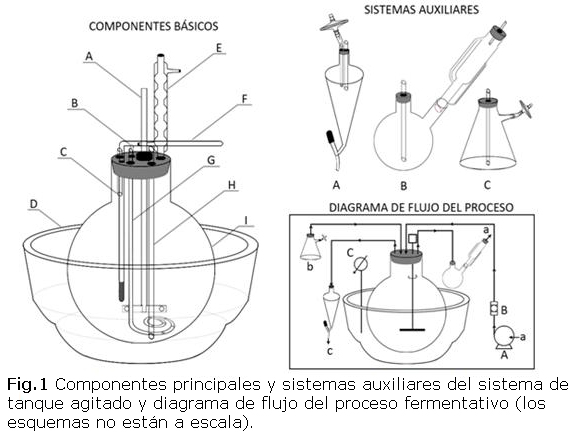
<body><![CDATA[<p align="justify"><font size="2" face="Verdana, Arial, Helvetica, sans-serif">La estructura del sistema de tanque agitado  construido con sus componentes b&aacute;sicos y dispositivos auxiliares, as&iacute; como el  diagrama de flujo del proceso, se exponen en las <a href="#f0110315">figuras 1</a> y <a href="/img/revistas/rtq/v35n3/f0210315.jpg">2</a>. En el dise&ntilde;o de  este biorreactor artesanal se enfatiz&oacute; en tres cuestiones esenciales de su  funcionamiento: capacidad de garantizar la esterilidad en su interior durante  un intervalo de tiempo relativamente largo y la realizaci&oacute;n de muestreos  peri&oacute;dicos, buena transferencia de ox&iacute;geno y mezclado uniforme de la suspensi&oacute;n  celular. Los dos &uacute;ltimos aspectos se relacionan muy estrechamente con los procesos  de agitaci&oacute;n y aireaci&oacute;n y ser&aacute;n discutidos a continuaci&oacute;n.</font></p>     
<p align="center"><a name="f0110315"></a><img src="/img/revistas/rtq/v35n3/f0110315.jpg"></p>     
<p align="center">&nbsp;</p>     <p align="justify"><font size="2" face="Verdana, Arial, Helvetica, sans-serif">En la <a href="#f0110315">figura 1</a> se  pueden observar los componentes b&aacute;sicos, los sistemas auxiliares y el diagrama  de flujo del proceso:</font></p>     <p align="justify"><font size="2" face="Verdana, Arial, Helvetica, sans-serif">COMPONENTES  B&Aacute;SICOS: A: Agitador, B: Tubo de entrada de antiespumante, C: Tubo de entrada  de in&oacute;culo, D: Desecadora, E: Condensador, F: Term&oacute;metro, G: Dispersor de gas,  H: Tubo de colecta, I: Vaso.</font></p>     <p align="justify"><font size="2" face="Verdana, Arial, Helvetica, sans-serif">SISTEMAS  AUXILIARES: A: Sistema de toma de muestra, B: Trampa qu&iacute;mica, C: Frasco de  inoculaci&oacute;n.</font></p>     <p align="justify"><font size="2" face="Verdana, Arial, Helvetica, sans-serif">DIAGRAMA DE FLUJO DEL PROCESO: A: Bomba de aire,  B: Filtro microbiol&oacute;gico, C: Termostato, a: Aire, b: In&oacute;culo, c: Muestra de  cultivo. </font></p>     <p align="justify"><font size="2" face="Verdana, Arial, Helvetica, sans-serif"><strong><em>Aireaci&oacute;n.</em></strong> Cuando se dispone de pocas  posibilidades de manejar los niveles de flujo y presi&oacute;n de aire suministrados  al biorreactor, como es el caso que nos ocupa, resulta indispensable que el  dispersor de aire suministre un gran n&uacute;mero de burbujas de peque&ntilde;o tama&ntilde;o. En  este caso se opt&oacute; por un dise&ntilde;o en espiral del dispersor, portando tres l&iacute;neas equidistantes  de orificios de &raquo;3 mm de  di&aacute;metro, en posicionamiento alterno. El tama&ntilde;o de las burbujas y su dispersi&oacute;n  a trav&eacute;s del volumen de l&iacute;quido, afectan los procesos de transferencia de masa;  as&iacute;, mientras m&aacute;s peque&ntilde;as sean las burbujas, mayor &aacute;rea superficial por unidad  de volumen se obtendr&aacute;. Adem&aacute;s, las burbujas peque&ntilde;as presentan menor velocidad  de ascenso y, en consecuencia, permanecen m&aacute;s tiempo en contacto con el  l&iacute;quido, todo lo cual deriva en una mejor transferencia de ox&iacute;geno al medio.  Este par&aacute;metro cr&iacute;tico en el desempe&ntilde;o de un biorreactor [8].</font></p>     <p align="justify"><font size="2" face="Verdana, Arial, Helvetica, sans-serif"><strong><em>Agitaci&oacute;n. </em></strong>Un mezclado apropiado es importante para  evitar los gradientes de temperatura y concentraci&oacute;n, adem&aacute;s de mejorar la  eficiencia de la transferencia de masa y calor [9]. Los agitadores de palas y  las turbinas de placas planas, como fue el caso empleado en el biorreactor  construido, producen buenos flujos radiales en el plano del rodete; las  corrientes generadas se desplazan hacia fuera, hasta la pared del tanque,  formando modelos distintos de circulaci&oacute;n: una parte fluye hacia abajo a lo  largo de la pared y retorna hacia el centro del rodete desde el fondo, mientras  que otra asciende hacia la superficie y retorna al rodete desde la parte  superior, todo lo cual beneficia la dispersi&oacute;n del gas que se introduce al  medio, propiciando la ruptura fina y uniforme de las burbujas [5]. En general,  los impelentes tipo turbina de palas resultan los m&aacute;s usados, dada su capacidad  de operar a velocidades de agitaci&oacute;n altas y un amplio rango de viscosidades.  En l&iacute;quidos de baja viscosidad las turbinas generan fuertes corrientes que  persisten en todo el tanque, destruyendo bolsas de fluido estancado [10].</font></p>     <p align="justify"><font size="2" face="Verdana, Arial, Helvetica, sans-serif">En los tanques de gran tama&ntilde;o, con  agitadores verticales, el m&eacute;todo m&aacute;s conveniente de reducir los remolinos es  instalar placas deflectoras, que impiden el flujo rotacional sin afectar al  flujo radial y longitudinal. La agitaci&oacute;n exc&eacute;ntrica fue la opci&oacute;n utilizada en  nuestro caso, al ser especialmente recomendable en biorreactores de peque&ntilde;a  escala, puesto que se evita el uso de deflectores [10, 11].</font></p>     ]]></body>
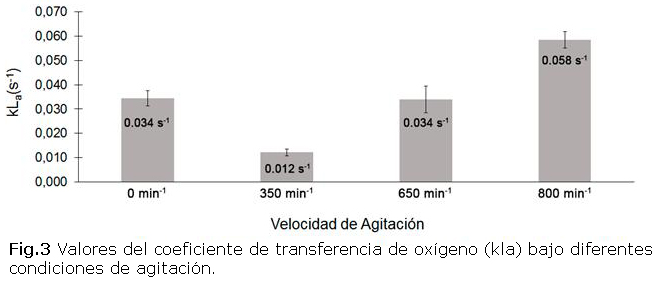
<body><![CDATA[<p align="justify"><font size="2" face="Verdana, Arial, Helvetica, sans-serif"><strong>Transferencia  de ox&iacute;geno en el biorreactor</strong></font></p>     <p align="justify"><font size="2" face="Verdana, Arial, Helvetica, sans-serif">La  transferencia de ox&iacute;geno es el par&aacute;metro m&aacute;s importante implicado en el dise&ntilde;o,  operaci&oacute;n y escalado de biorreactores. Una concentraci&oacute;n de ox&iacute;geno superior a  la cr&iacute;tica es necesaria para conseguir un crecimiento microbiano y formaci&oacute;n de  productos &oacute;ptimos. En consecuencia, el conocimiento del valor del coeficiente  volum&eacute;trico de transferencia de masa (kl<sub>a</sub>) bajo determinadas  condiciones de operaci&oacute;n, resulta indispensable.</font></p>     <p align="justify"><font size="2" face="Verdana, Arial, Helvetica, sans-serif">En todas las variantes analizadas se apreci&oacute; que los  valores del kl<sub>a</sub> aumentan a medida que se incrementan los niveles de  agitaci&oacute;n (<a href="/img/revistas/rtq/v35n3/f0310315.jpg">fig.3</a>), alcanz&aacute;ndose a 850 min<sup>-1</sup> niveles de  transferencia de ox&iacute;geno de 0.058 s<sup>-1</sup>, los cuales resultan  superiores en un 42 % a los obtenidos a velocidades de 650 min<sup>-1</sup> y 0  min<sup>-1</sup>(kl<sub>a</sub>= 0.034 s<sup>-1</sup>). Cuando la agitaci&oacute;n fue  de 350 min<sup>-1</sup> se obtuvo un kl<sub>a</sub> inferior al obtenido en el  sistema sin agitaci&oacute;n, lo que resulta aparentemente contradictorio. Esto  pudiera estar relacionado, de un lado, con una reducci&oacute;n significativa de los  niveles de turbulencia a estas velocidades de agitaci&oacute;n (t&eacute;ngase en cuenta que  la relaci&oacute;n di&aacute;metro del impelente/di&aacute;metro del vaso est&aacute; lejos de ser la  &oacute;ptima), limitando la posibilidad de que se produzca una disminuci&oacute;n  significativa en el tama&ntilde;o de las burbujas como consecuencia de su ruptura por  las fuerzas de corte; por otro lado, la agitaci&oacute;n favorece la velocidad de  ascensi&oacute;n de las burbujas como consecuencia de los flujos axiales ascendentes  que se originan, lo que podr&iacute;a resultar en un tiempo medio de retenci&oacute;n  inferior al del sistema no agitado.</font></p>     
<p align="justify"><font size="2" face="Verdana, Arial, Helvetica, sans-serif">Ver a continuaci&oacute;n la <a href="/img/revistas/rtq/v35n3/f0310315.jpg">figura 3</a>.</font></p>     
<p align="justify"><font size="2" face="Verdana, Arial, Helvetica, sans-serif">El  aumento del kla a medida que se aumenta la velocidad de agitaci&oacute;n es  un hecho comprobado en numerosos estudios. Kim y col. [12], utilizando el  m&eacute;todo del sulfito e impelentes tipo turbina Rushton de seis hojas, registraron  un aumento en los valores del kla a medida que se aument&oacute; la  velocidad de agitaci&oacute;n. As&iacute;, a velocidades de 800 min<sup>-1</sup>, 650 min<sup>-1</sup>,  500 min<sup>-1</sup> y 300 min<sup>-1</sup> obtuvieron valores de 0.086 s<sup>-1</sup>,  0.083 s<sup>-1</sup>, 0.072 s<sup>-1</sup> y 0.04 s<sup>-1</sup>,  respectivamente, en biorreactores de 20 L y flujo de aire de 1 vvm, atribuyendo  estas diferencias al hecho de que una mayor velocidad de agitaci&oacute;n ofrece un  mayor nivel de mezclado turbulento. Por otra parte, Karimi y col. [13]  resolvieron que el mezclado m&aacute;s eficiente se obtiene a velocidades de agitaci&oacute;n  de m&aacute;s de 400 min<sup>-1</sup> y menores que 800 min<sup>-1</sup>. Para  agitaciones menores de 400 min<sup>-1</sup> la turbulencia no es suficiente  para atrapar y mantener las burbujas de aire en la fase l&iacute;quida por mucho  tiempo y, consecuentemente, el valor del kla no se incrementa  notablemente. Adem&aacute;s, estos autores determinaron que el flujo de aire, entre  1-5 L&middot;min<sup>-1</sup>, correlaciona positivamente con la  transferencia de ox&iacute;geno, pero su influencia no resulta determinante.</font></p>     <p align="justify"><font size="2" face="Verdana, Arial, Helvetica, sans-serif">Todos estos estudios son congruentes con los  resultados obtenidos con el biorreactor artesanal. Por otro lado, el &oacute;ptimo del  kla en el biorreactor construido es un 30-60 % de los valores  informados para fermentadores comerciales tipo tanque agitado de 100 L de  volumen efectivo y similares a los alcanzados en reactores de 1.2 m3,  determinados por el mismo m&eacute;todo [14]. Tales resultados apuntan a una  influencia negativa derivada de las limitaciones geom&eacute;tricas del sistema  construido (configuraci&oacute;n esf&eacute;rica del vaso, baja relaci&oacute;n di&aacute;metro del  impelente/di&aacute;metro del vaso), que implican una menor potencia de agitaci&oacute;n y a que  la altura de la columna l&iacute;quida sea inferior al di&aacute;metro del vaso, lo que  conduce finalmente a un menor tiempo de retenci&oacute;n de las burbujas de gas en el  seno del l&iacute;quido y, con ello, a una reducci&oacute;n en la transferencia de masa en la  interfase gas-l&iacute;quido.</font></p>     <p align="justify"><font size="2" face="Verdana, Arial, Helvetica, sans-serif">No obstante, el valor del kla obtenido en  el biorreactor artesanal, a una velocidad de agitaci&oacute;n de 850 min<sup>-1</sup>,  resulta suficiente para garantizar un 20 % de saturaci&oacute;n de ox&iacute;geno en el medio, concentraci&oacute;n esta  usualmente requerida en muchos cultivos microbianos exigentes, como son los de  bacterias, levaduras y actinomicetos. Seg&uacute;n  Chisti [15], se precisa de valores del orden de 0.01 s<sup>-1</sup> para el  crecimiento &oacute;ptimo de hongos y de 0.1 s<sup>-1</sup> para bacterias y  levaduras. Para fermentaciones de  la levadura <em>Kluyveromyces marxianus</em>,  considerado el organismo eucariota que m&aacute;s r&aacute;pido crece [16], se han informado  concentraciones de ox&iacute;geno &oacute;ptimas del orden del 20 % de saturaci&oacute;n [17,  18]. </font></p>     <p align="justify"><font size="2"><strong><font face="Verdana, Arial, Helvetica, sans-serif">Capacidad de Mezclado del Biorreactor</font></strong></font></p>     <p align="justify"><font size="2"><font face="Verdana, Arial, Helvetica, sans-serif">Dentro de las funciones  b&aacute;sicas de los biorreactores est&aacute; la de garantizar un mezclado eficiente. La  t&eacute;cnica empleada en este estudio permiti&oacute; comprobar la adecuaci&oacute;n de los  dispositivos destinados a tal fin en el dise&ntilde;o del sistema, mediante el  registro del comportamiento temporal de la concentraci&oacute;n de una suspensi&oacute;n de  un s&oacute;lido finamente dividido y de alta densidad (precipitado de BaSO<sub>4</sub>)  en el punto de colecta de muestras del vaso del biorreactor.</font></font></p>     <p align="justify"><font size="2"><font face="Verdana, Arial, Helvetica, sans-serif">El BaSO<sub>4</sub> presenta una serie  de caracter&iacute;sticas que lo hacen adecuado para este prop&oacute;sito. Su bien conocida  r&aacute;pida cin&eacute;tica de formaci&oacute;n, estabilidad morfol&oacute;gica y de tama&ntilde;o de sus  part&iacute;culas (9.53&times;5.79 &micro;m) [19-21], unido a su inocuidad, baj&iacute;sima solubilidad  en agua (3.1  mg&middot;L<sup>-1</sup>) y alta  densidad (4.5 g&middot;cm<sup>3</sup>) [19], que lo hacen particularmente sensible a  la sedimentaci&oacute;n, condicionaron su elecci&oacute;n para este ensayo.</font></font></p>     ]]></body>
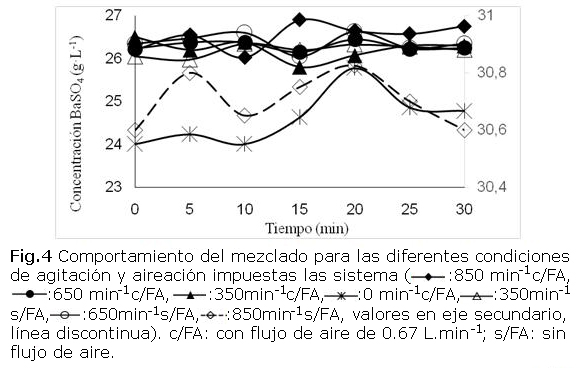
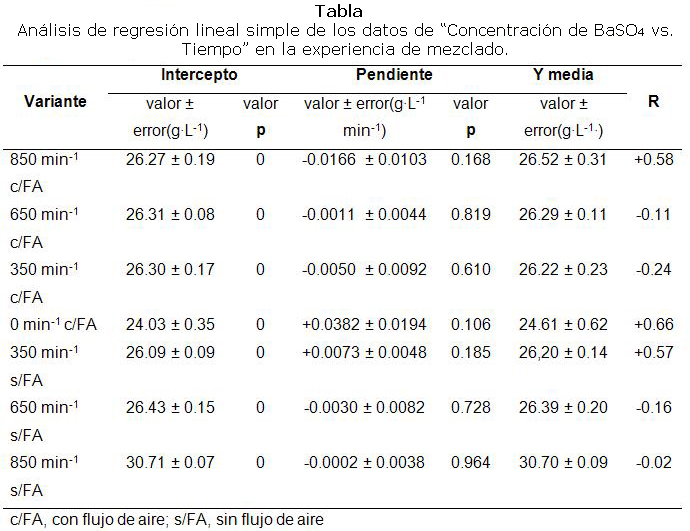
<body><![CDATA[<p align="justify"><font size="2"><font face="Verdana, Arial, Helvetica, sans-serif">El  experimento estuvo dirigido a determinar la eficiencia del biorreactor en el  proceso de mezclado, mediante la determinaci&oacute;n de su capacidad de mantener en  suspensi&oacute;n uniforme part&iacute;culas de elevada densidad, bajo diferentes niveles de  agitaci&oacute;n y aireaci&oacute;n. Este modelo simula el comportamiento de un cultivo  microbiano donde deben permanecer en suspensi&oacute;n micropart&iacute;culas (c&eacute;lulas  microbianas, agregados de ellas o fragmentos de micelio) m&aacute;s densas que el  medio l&iacute;quido.</font></font></p>     <p align="justify"><font size="2" face="Verdana, Arial, Helvetica, sans-serif">En todas las variantes evaluadas se registraron  comportamientos sinusoidales, con l&iacute;mites estrechos de dispersi&oacute;n, en la  concentraci&oacute;n de s&oacute;lidos suspendidos con respecto al tiempo <a href="#f0410315">(fig. 4</a>), lo que sugiere  una marcada ausencia de tendencias temporales de variaci&oacute;n de la concentraci&oacute;n.  El an&aacute;lisis de regresi&oacute;n lineal simple de la &ldquo;concentraci&oacute;n de BaSO<sub>4</sub> <em>vs. </em>tiempo&rdquo; (<a href="/img/revistas/rtq/v35n3/t0110315.jpg">tabla</a>) corrobor&oacute; esta  apreciaci&oacute;n, al no observarse tendencias temporales de variaci&oacute;n en la concentraci&oacute;n  del s&oacute;lido en suspensi&oacute;n (p &gt; 0,05 para la estimaci&oacute;n de la pendiente). En  cambio, los interceptos resultaron altamente significativos estad&iacute;sticamente,  coincidiendo, dentro del margen del error estad&iacute;stico, con el valor medio (Y  media) de las observaciones temporales realizadas. Solo en la variante sin  agitaci&oacute;n (valor <strong><em>p</em></strong> para la pendiente igual a 0,106 y R=0,66) pudiera suponerse  la existencia de una cierta tendencia a la sedimentaci&oacute;n, aunque  estad&iacute;sticamente no significativa para un 95 % de confianza.</font></p>     
<p align="center"><font size="2" face="Verdana, Arial, Helvetica, sans-serif"><a name="f0410315"></a><img src="/img/revistas/rtq/v35n3/f0410315.jpg"></font></p>     
<p align="justify"><font size="2" face="Verdana, Arial, Helvetica, sans-serif">La variante sin agitaci&oacute;n, pero con  flujo de aire constante, aunque presenta la menor capacidad de mezclado, podr&iacute;a  garantizar eficazmente procesos fermentativos con microorganismos o tejidos  celulares particularmente sensibles a situaciones de estr&eacute;s hidrodin&aacute;mico,  donde se precise de la ausencia de agitaci&oacute;n mec&aacute;nica. Se debe tener presente  que las part&iacute;culas de sulfato de bario son unas ocho veces m&aacute;s densas que  cualquier c&eacute;lula microbiana y que flujos de aire de esta magnitud presentan,  por s&iacute; solos, una capacidad adecuada de mezclado dada la cin&eacute;tica de ascenso y  transferencia de energ&iacute;a propia de las burbujas al medio [22]. Los  resultados obtenidos en esta experiencia avalan la eficiencia del mezclado en  el biorreactor y sus potencialidades para el cultivo intensivo de  microorganismos.</font></p>     <p align="justify"><font size="2" face="Verdana, Arial, Helvetica, sans-serif"><strong>Prueba  de Esterilidad</strong></font></p>     <p align="justify"><font size="2" face="Verdana, Arial, Helvetica, sans-serif">El  control de esterilidad se llev&oacute; a cabo a partir de la exposici&oacute;n continua  (durante 24 h) del sistema a condiciones de fermentaci&oacute;n microbiana reales y  luego de la esterilizaci&oacute;n previa en autoclave del biorreactor y sus sistemas  auxiliares. No se observ&oacute; la presencia de contaminantes en ninguna de las  placas Petri inoculadas directamente, para las 0, 12 y 24 h de funcionamiento  continuo. Estos resultados corresponden a un &iacute;ndice probable de contaminantes  inferior a 3 c&eacute;l&middot;mL<sup>-1</sup>, no determinable para el caso de la siembra  directa, seg&uacute;n las tablas estad&iacute;sticas del N&uacute;mero M&aacute;s Probable [23].</font></p>     <p align="justify"><font size="2" face="Verdana, Arial, Helvetica, sans-serif">Para  corroborar la esterilidad de las muestras tomadas, estas se propagaron en caldo  nutriente durante 24 horas (5 % de muestra como in&oacute;culo) y se sembraron  nuevamente en placas con agar nutriente, repiti&eacute;ndose la observaci&oacute;n de  ausencia de colonias microbianas indicadoras de contaminaci&oacute;n. Suponiendo un  tiempo de duplicaci&oacute;n de 2 h, para un nivel de contaminaci&oacute;n del orden probable  de 0.1-3 c&eacute;l&middot;mL<sup>-1</sup> era de esperar positividad en estos ensayos (de 40-120  ufc por placa). La negatividad observada demuestra la esterilidad del  biorreactor para 24 horas de funcionamiento continuo, con tres operaciones de  toma de muestra.</font></p>     <p align="justify"><font size="2" face="Verdana, Arial, Helvetica, sans-serif">Estos resultados garantizan la fiabilidad del  biorreactor para su uso en fermentaciones con cultivos puros, sin riesgo  potencial de contaminaci&oacute;n, siempre y cuando se garanticen aspectos claves como  el correcto autoclavado de todos los componentes del sistema y los cuidados  generales en la manipulaci&oacute;n de in&oacute;culos y tomas de muestra. Por otra parte, la  hermeticidad del sistema, dependiente de su correcto ensamblaje, permite el  mantenimiento de una presi&oacute;n positiva en el interior del vaso, requisito  indispensable para evitar la entrada de contaminantes.</font></p>     <p align="justify">&nbsp;</p>     <p align="justify"><strong><font face="Verdana, Arial, Helvetica, sans-serif" size="3">CONCLUSIONES</font></strong></p>     ]]></body>
<body><![CDATA[<p align="justify"><font size="2" face="Verdana, Arial, Helvetica, sans-serif">El biorreactor de tanque  agitado se dise&ntilde;&oacute; partiendo de la premisa de que el mismo reuniera los  requisitos indispensables para el &eacute;xito de una fermentaci&oacute;n microbiana, esto  es: adecuada capacidad de transferencia de ox&iacute;geno, mezclado eficiente, control  efectivo de la temperatura y mantenimiento de la esterilidad. Se construy&oacute;  usando materiales e instrumentaci&oacute;n comunes a cualquier laboratorio, integrados  en los sistemas de entrada y salida de gases, agitaci&oacute;n, toma de muestra,  control de temperatura y entrada as&eacute;ptica de in&oacute;culo, acoplados a un vaso  esf&eacute;rico de 2 L de capacidad. Los estudios de validaci&oacute;n experimental  realizados mostraron la aptitud del biorreactor para el desarrollo de  investigaciones en el campo de las fermentaciones y fisiolog&iacute;a microbianas,  dada la eficiencia observada en los procesos de mezclado y transferencia de  ox&iacute;geno, as&iacute; como en el mantenimiento de la esterilidad y la temperatura  durante el tiempo de duraci&oacute;n de la fermentaci&oacute;n.</font></p>     <p align="justify">&nbsp;</p>     <p align="justify"><strong><font size="3" face="Verdana, Arial, Helvetica, sans-serif">BIBLIOGRAFIA</font></strong></p>     <!-- ref --><p><span lang=EN-US style='font-size:10.0pt;font-family:"Verdana","sans-serif"'>1. SELETZKY, J., NOAK, U., FRICKE, J., WELK, E., EBERHARD, W., KNOCKE, C., B&Uuml;CHS, J. &#8220;</span><span lang=EN-US style='font-size:10.0pt; font-family:"Verdana","sans-serif"'>Scale-up from shake flasks to fermenters in                   batch and continuous mode with <em><span style='font-family:"Verdana","sans-serif"'>Corynebacterium                     glutamicum</span></em> on lactic acid based on oxygen transfer and pH</span><span lang=EN-US style='font-size:10.0pt;font-family:"Verdana","sans-serif"'>.</span> <em><span lang=EN-US style='font-size:10.0pt;font-family:"Verdana","sans-serif"'>Biotechnology                       and Bioengineering</span></em><span lang=EN-US style='font-size:10.0pt;font-family:"Verdana","sans-serif"'>. 2007, vol 98,         N&ordm;</span><span lang=EN-US style='font-size:10.0pt; font-family:"Verdana","sans-serif"'>4</span><span lang=EN-US style='font-size:10.0pt;font-family:"Verdana","sans-serif"'>, p. 800-811.    </span></p>     <!-- ref --><p><span lang=EN-US style='font-size:10.0pt;font-family:"Verdana","sans-serif"'>2. B&Uuml;CHS, J. &#8220;</span><span lang=EN-US style='font-size:10.0pt; font-family:"Verdana","sans-serif"'>Introduction to advantages and problems of   shaken cultures</span><span lang=EN-US style='font-size:10.0pt;font-family:"Verdana","sans-serif"'>&#8221;.</span> <em><span lang=EN-US style='font-size:10.0pt;font-family:"Verdana","sans-serif"'>Biochemical     Engineering Journa. </span></em><span lang=EN-US style='font-size:10.0pt; font-family:"Verdana","sans-serif"'>2001</span><span lang=EN-US style='font-size:10.0pt;font-family:"Verdana","sans-serif"'>, vol 7, p. 91-98.    </span> </p>     <!-- ref --><p align="justify"><font size="2" face="Verdana, Arial, Helvetica, sans-serif">3. NAJAFPOUR, G. Biochemical  Engineering and Biotechnology. Elsevier, Amsterdam.  2007.    </font></p>     <!-- ref --><p align="justify"><font size="2" face="Verdana, Arial, Helvetica, sans-serif">4. MATTHEWS, G. Fermentation  Equipment Selection: Laboratory Scale Bioreactor Design Considerations. Chapter  2. <em>McNeil B y Harvey L Eds. </em>New York. 2008.    </font></p>     <!-- ref --><p align="justify"><font size="2" face="Verdana, Arial, Helvetica, sans-serif">5. MCCABE, W., SMITH, J., HARRIOTT, P. Operaciones  Unitarias en Ingenier&iacute;a Qu&iacute;mica. 4ta Ed. Espa&ntilde;a. 1991. 690 p.    </font></p>     <!-- ref --><p align="justify"><span lang=EN-US style='font-size:10.0pt;font-family:"Arial","sans-serif"; color:#666699'></span><span lang=EN-US style='font-size:10.0pt; font-family:"Arial","sans-serif";color:#FF6600'></span><span lang=EN-US style='font-size:10.0pt;font-family:"Verdana","sans-serif"'>6</span><span lang=EN-US style='font-size:10.0pt;font-family:"Arial","sans-serif";color:#FF6600'></span><span lang=EN-US style='font-size:10.0pt;font-family:"Verdana","sans-serif"'>. </span><span lang=EN-US style='font-size:10.0pt;font-family:"Arial","sans-serif";color:fuchsia'></span><span lang=EN-US style='font-size:10.0pt; font-family:"Arial","sans-serif";color:red'></span><span lang=EN-US style='font-size:10.0pt;font-family:"Verdana","sans-serif"'>LINEK</span><span lang=EN-US style='font-size:10.0pt;font-family:"Arial","sans-serif";color:red'></span><span lang=EN-US style='font-size:10.0pt;font-family:"Verdana","sans-serif"'>, </span><span lang=EN-US style='font-size:10.0pt;font-family:"Arial","sans-serif";color:fuchsia'></span><span lang=EN-US style='font-size:10.0pt;font-family:"Verdana","sans-serif"'>V.</span><span lang=EN-US style='font-size:10.0pt;font-family:"Arial","sans-serif";color:fuchsia'></span><span lang=EN-US style='font-size:10.0pt;font-family:"Arial","sans-serif";color:blue'></span><span lang=EN-US style='font-size:10.0pt;font-family:"Verdana","sans-serif"'>, </span><span lang=EN-US style='font-size:10.0pt;font-family:"Arial","sans-serif";color:blue'></span><span lang=EN-US style='font-size:10.0pt; font-family:"Arial","sans-serif";color:red'></span><span lang=EN-US style='font-size:10.0pt;font-family:"Verdana","sans-serif"'>VACEK</span><span lang=EN-US style='font-size:10.0pt;font-family:"Arial","sans-serif";color:red'></span><span lang=EN-US style='font-size:10.0pt;font-family:"Verdana","sans-serif"'>, </span><span lang=EN-US style='font-size:10.0pt;font-family:"Arial","sans-serif";color:fuchsia'></span><span lang=EN-US style='font-size:10.0pt;font-family:"Verdana","sans-serif"'>V.</span><span lang=EN-US style='font-size:10.0pt;font-family:"Arial","sans-serif";color:fuchsia'></span><span lang=EN-US style='font-size:10.0pt;font-family:"Arial","sans-serif";color:blue'></span><span lang=EN-US style='font-size:10.0pt;font-family:"Verdana","sans-serif"'> &#8220;</span><span lang=EN-US style='font-size:10.0pt;font-family:"Arial","sans-serif";color:maroon'></span><span lang=EN-US style='font-size:10.0pt; font-family:"Verdana","sans-serif"'>Chemical engineering use of catalyzed sulfite oxidation kinetics for the determination of mass transfer characteristics of gas-liquid contactors</span><span lang=EN-US style='font-size:10.0pt; font-family:"Arial","sans-serif";color:maroon'></span><span lang=EN-US style='font-size:10.0pt;font-family:"Verdana","sans-serif"'>&#8221;.</span><span lang=EN-US style='font-size:10.0pt;font-family:"Arial","sans-serif";color:fuchsia'></span><span lang=EN-US style='font-size:10.0pt;font-family:"Verdana","sans-serif"'> </span><span lang=EN-US style='font-size:10.0pt;font-family:"Arial","sans-serif";color:green'></span><span lang=EN-US style='font-size:10.0pt;font-family:"Arial","sans-serif";color:#339966'></span><em><span lang=EN-US style='font-size:10.0pt;font-family:"Verdana","sans-serif"'>Chemical Engineering Science</span></em><em><span lang=EN-US style='font-size:10.0pt; font-family:"Arial","sans-serif";color:#339966;font-style:normal'></span></em><span lang=EN-US style='font-size:10.0pt;font-family:"Verdana","sans-serif"'>. </span><span lang=EN-US style='font-size:10.0pt;font-family:"Verdana","sans-serif"'>1981</span><span lang=EN-US style='font-size:10.0pt;font-family:"Arial","sans-serif";color:purple'></span><span lang=EN-US style='font-size:10.0pt;font-family:"Verdana","sans-serif"'>, vol </span><span lang=EN-US style='font-size:10.0pt;font-family:"Arial","sans-serif";color:red'></span><span lang=EN-US style='font-size:10.0pt;font-family:"Verdana","sans-serif"'>36</span><span lang=EN-US style='font-size:10.0pt;font-family:"Arial","sans-serif";color:red'></span><span lang=EN-US style='font-size:10.0pt;font-family:"Verdana","sans-serif"'>, p. </span><span lang=EN-US style='font-size:10.0pt;font-family:"Arial","sans-serif";color:purple'></span><span lang=EN-US style='font-size:10.0pt;font-family:"Verdana","sans-serif"'>1747-1768</span><span lang=EN-US style='font-size:10.    0pt;font-family:"Arial","sans-serif";color:purple'></span><span lang=EN-US style='font-size:10.0pt;font-family:"Verdana","sans-serif"'>.</span><span lang=EN-US style='font-size:10.0pt;font-family:"Arial","sans-serif";color:green'></span><span lang=EN-US style='font-size:10.0pt;font-family:"Arial","sans-serif";color:#666699'></span></p>     <!-- ref --><p align="justify"><font size="2" face="Verdana, Arial, Helvetica, sans-serif">7. ALEX&Eacute;IEV,  V. An&aacute;lisis Cuantitativo. Editorial Mir, Mosc&uacute;. 1976.    </font></p>     <!-- ref --><p align="justify"><font size="2" face="Verdana, Arial, Helvetica, sans-serif">8. GENCK, W. Perry's Chemical Engineers'  Handbook. 8th Ed. McGraw-Hill,   New York. 2008.    </font></p>     <!-- ref --><p align="justify"><font size="2" face="Verdana, Arial, Helvetica, sans-serif">9. ZLOKARNIK, M. Bestimmung des  Mischgrades und der Mischzeit. R&uuml;hrtechnik, Theorie und Praxis.  Berlin. 2002.    </font></p>     <!-- ref --><p align="justify"><font size="2" face="Verdana, Arial, Helvetica, sans-serif">10. ZLOKARNIK, M. Stirring  Theory and Practice.  New York. 2001.    </font></p>     <!-- ref --><p align="justify"><font size="2" face="Verdana, Arial, Helvetica, sans-serif">11. WALAS, S. Chemical Process  Equipment. Selection and Design. Amsterdam. 1990.    </font></p>     <!-- ref --><p align="justify"><span lang=EN-US style='font-size:10.0pt;font-family:"Arial","sans-serif"; color:#666699'></span><span lang=EN-US style='font-size:10.0pt; font-family:"Arial","sans-serif";color:#FF6600'></span><span lang=EN-US style='font-size:10.0pt;font-family:"Verdana","sans-serif"'>12</span><span lang=EN-US style='font-size:10.0pt;font-family:"Arial","sans-serif";color:#FF6600'></span><span lang=EN-US style='font-size:10.0pt;font-family:"Verdana","sans-serif"'>. </span><span lang=EN-US style='font-size:10.0pt; font-family:"Arial","sans-serif";color:red'></span><span lang=EN-US style='font-size:10.0pt;font-family:"Verdana","sans-serif"'>KIM</span><span lang=EN-US style='font-size:10.0pt;font-family:"Arial","sans-serif";color:red'></span><span lang=EN-US style='font-size:10.0pt;font-family:"Verdana","sans-serif"'>, </span><span lang=EN-US style='font-size:10.0pt;font-family:"Arial","sans-serif";color:fuchsia'></span><span lang=EN-US style='font-size:10.0pt;font-family:"Verdana","sans-serif"'>M.</span><span lang=EN-US style='font-size:10.0pt;font-family:"Arial","sans-serif";color:fuchsia'></span><span lang=EN-US style='font-size:10.0pt;font-family:"Arial","sans-serif";color:blue'></span><span lang=EN-US style='font-size:10.0pt;font-family:"Verdana","sans-serif"'>, </span><span lang=EN-US style='font-size:10.0pt;font-family:"Arial","sans-serif";color:blue'></span><span lang=EN-US style='font-size:10.0pt; font-family:"Arial","sans-serif";color:red'></span><span lang=EN-US style='font-size:10.0pt;font-family:"Verdana","sans-serif"'>KRAGL</span><span lang=EN-US style='font-size:10.0pt;font-family:"Arial","sans-serif";color:red'></span><span lang=EN-US style='font-size:10.0pt;font-family:"Verdana","sans-serif"'>, </span><span lang=EN-US style='font-size:10.0pt;font-family:"Arial","sans-serif";color:fuchsia'></span><span lang=EN-US style='font-size:10.0pt;font-family:"Verdana","sans-serif"'>F.</span><span lang=EN-US style='font-size:10.0pt;font-family:"Arial","sans-serif";color:fuchsia'></span><span lang=EN-US style='font-size:10.0pt;font-family:"Arial","sans-serif";color:blue'></span><span lang=EN-US style='font-size:10.0pt;font-family:"Verdana","sans-serif"'>, </span><span lang=EN-US style='font-size:10.0pt;font-family:"Arial","sans-serif";color:blue'></span><span lang=EN-US style='font-size:10.0pt; font-family:"Arial","sans-serif";color:red'></span><span lang=EN-US style='font-size:10.0pt;font-family:"Verdana","sans-serif"'>THOMPSON</span><span lang=EN-US style='font-size:10.0pt;font-family:"Arial","sans-serif";color:red'></span><span lang=EN-US style='font-size:10.0pt;font-family:"Verdana","sans-serif"'>, </span><span lang=EN-US style='font-size:10.0pt;font-family:"Arial","sans-serif";color:fuchsia'></span><span lang=EN-US style='font-size:10.0pt;font-family:"Verdana","sans-serif"'>R.</span><span lang=EN-US style='font-size:10.0pt;font-family:"Arial","sans-serif";color:fuchsia'></span><span lang=EN-US style='font-size:10.0pt;font-family:"Arial","sans-serif";color:blue'></span><span lang=EN-US style='font-size:10.0pt;font-family:"Verdana","sans-serif"'> &#8220;</span><span lang=EN-US style='font-size:10.0pt;font-family:"Arial","sans-serif";color:maroon'></span><span lang=EN-US style='font-size:10.0pt; font-family:"Verdana","sans-serif"'>Oxygen mass transfer coefficient (kl<sub>a</sub>) consideration for scale-up fermentation systems at the biotechnology laboratory US Army Edgewood Chemical Biological Center (No. ecbc-tr-846)</span><span lang=EN-US style='font-size:10.0pt;font-family:"Arial","sans-serif";color:maroon'></span><span lang=EN-US style='font-size:10.0pt;font-family:"Verdana","sans-serif"'>&#8221;.<em><span style='font-family:"Verdana","sans-serif"'> </span></em></span><span lang=EN-US style='font-size:10.0pt; font-family:"Verdana","sans-serif"'>2011</span><span lang=EN-US style='font-size:10.    0pt;font-family:"Arial","sans-serif";color:purple'></span><span lang=EN-US style='font-size:10.0pt;font-family:"Verdana","sans-serif"'>.</span><span lang=EN-US style='font-size:10.0pt;font-family:"Arial","sans-serif";color:#666699'></span></p>     <p align="justify"><span lang=EN-US style='font-size:10.0pt;font-family:"Arial","sans-serif";     color:#666699'></span><span lang=EN-US style='font-size:10.0pt;     font-family:"Arial","sans-serif";color:#FF6600'></span><span lang=EN-US     ]]></body>
<body><![CDATA[style='font-size:10.0pt;font-family:"Verdana","sans-serif"'>13</span><span     lang=EN-US style='font-size:10.0pt;font-family:"Arial","sans-serif";color:#FF6600'></span><span     lang=EN-US style='font-size:10.0pt;font-family:"Verdana","sans-serif"'>. </span><span     lang=EN-US style='font-size:10.0pt;font-family:"Arial","sans-serif";color:fuchsia'></span><span lang=EN-US style='font-size:10.0pt;     font-family:"Arial","sans-serif";color:red'></span><span lang=EN-US     style='font-size:10.0pt;font-family:"Verdana","sans-serif"'>KARIMI</span><span     lang=EN-US style='font-size:10.0pt;font-family:"Arial","sans-serif";color:red'></span><span     lang=EN-US style='font-size:10.0pt;font-family:"Verdana","sans-serif"'>, </span><span     lang=EN-US style='font-size:10.0pt;font-family:"Arial","sans-serif";color:fuchsia'></span><span     lang=EN-US style='font-size:10.0pt;font-family:"Verdana","sans-serif"'>A.</span><span     ]]></body>
<body><![CDATA[lang=EN-US style='font-size:10.0pt;font-family:"Arial","sans-serif";color:fuchsia'></span><span     lang=EN-US style='font-size:10.0pt;font-family:"Arial","sans-serif";color:blue'></span><span     lang=EN-US style='font-size:10.0pt;font-family:"Verdana","sans-serif"'>, </span><span     lang=EN-US style='font-size:10.0pt;font-family:"Arial","sans-serif";color:blue'></span><span lang=EN-US style='font-size:10.0pt;     font-family:"Arial","sans-serif";color:red'></span><span lang=EN-US     style='font-size:10.0pt;font-family:"Verdana","sans-serif"'>GOLBABAEI</span><span     lang=EN-US style='font-size:10.0pt;font-family:"Arial","sans-serif";color:red'></span><span     lang=EN-US style='font-size:10.0pt;font-family:"Verdana","sans-serif"'> </span><span     lang=EN-US style='font-size:10.0pt;font-family:"Arial","sans-serif";color:fuchsia'></span><span     lang=EN-US style='font-size:10.0pt;font-family:"Verdana","sans-serif"'>F</span><span     ]]></body>
<body><![CDATA[lang=EN-US style='font-size:10.0pt;font-family:"Arial","sans-serif";color:fuchsia'></span><span     lang=EN-US style='font-size:10.0pt;font-family:"Arial","sans-serif";color:blue'></span><span     lang=EN-US style='font-size:10.0pt;font-family:"Verdana","sans-serif"'>, </span><span     lang=EN-US style='font-size:10.0pt;font-family:"Arial","sans-serif";color:blue'></span><span lang=EN-US style='font-size:10.0pt;     font-family:"Arial","sans-serif";color:red'></span><span lang=EN-US     style='font-size:10.0pt;font-family:"Verdana","sans-serif"'>MEHRNIA</span><span     lang=EN-US style='font-size:10.0pt;font-family:"Arial","sans-serif";color:red'></span><span     lang=EN-US style='font-size:10.0pt;font-family:"Verdana","sans-serif"'> </span><span     lang=EN-US style='font-size:10.0pt;font-family:"Arial","sans-serif";color:fuchsia'></span><span     lang=EN-US style='font-size:10.0pt;font-family:"Verdana","sans-serif"'>M</span><span     ]]></body>
<body><![CDATA[lang=EN-US style='font-size:10.0pt;font-family:"Arial","sans-serif";color:fuchsia'></span><span     lang=EN-US style='font-size:10.0pt;font-family:"Arial","sans-serif";color:blue'></span><span     lang=EN-US style='font-size:10.0pt;font-family:"Verdana","sans-serif"'>, </span><span     lang=EN-US style='font-size:10.0pt;font-family:"Arial","sans-serif";color:blue'></span><span lang=EN-US style='font-size:10.0pt;     font-family:"Arial","sans-serif";color:red'></span><span lang=EN-US     style='font-size:10.0pt;font-family:"Verdana","sans-serif"'>NEGHAB</span><span     lang=EN-US style='font-size:10.0pt;font-family:"Arial","sans-serif";color:red'></span><span     lang=EN-US style='font-size:10.0pt;font-family:"Verdana","sans-serif"'> </span><span     lang=EN-US style='font-size:10.0pt;font-family:"Arial","sans-serif";color:fuchsia'></span><span     lang=EN-US style='font-size:10.0pt;font-family:"Verdana","sans-serif"'>M</span><span     ]]></body>
<body><![CDATA[lang=EN-US style='font-size:10.0pt;font-family:"Arial","sans-serif";color:fuchsia'></span><span     lang=EN-US style='font-size:10.0pt;font-family:"Arial","sans-serif";color:blue'></span><span     lang=EN-US style='font-size:10.0pt;font-family:"Verdana","sans-serif"'>, </span><span     lang=EN-US style='font-size:10.0pt;font-family:"Arial","sans-serif";color:blue'></span><span lang=EN-US style='font-size:10.0pt;     font-family:"Arial","sans-serif";color:red'></span><span lang=EN-US     style='font-size:10.0pt;font-family:"Verdana","sans-serif"'>MOHAMMAD</span><span     lang=EN-US style='font-size:10.0pt;font-family:"Arial","sans-serif";color:red'></span><span     lang=EN-US style='font-size:10.0pt;font-family:"Verdana","sans-serif"'> </span><span     lang=EN-US style='font-size:10.0pt;font-family:"Arial","sans-serif";color:fuchsia'></span><span     lang=EN-US style='font-size:10.0pt;font-family:"Verdana","sans-serif"'>K</span><span     ]]></body>
<body><![CDATA[lang=EN-US style='font-size:10.0pt;font-family:"Arial","sans-serif";color:fuchsia'></span><span     lang=EN-US style='font-size:10.0pt;font-family:"Arial","sans-serif";color:blue'></span><span     lang=EN-US style='font-size:10.0pt;font-family:"Verdana","sans-serif"'>, </span><span     lang=EN-US style='font-size:10.0pt;font-family:"Arial","sans-serif";color:blue'></span><span lang=EN-US style='font-size:10.0pt;     font-family:"Arial","sans-serif";color:red'></span><span lang=EN-US     style='font-size:10.0pt;font-family:"Verdana","sans-serif"'>NIKPE</span><span     lang=EN-US style='font-size:10.0pt;font-family:"Arial","sans-serif";color:red'></span><span     lang=EN-US style='font-size:10.0pt;font-family:"Verdana","sans-serif"'> </span><span     lang=EN-US style='font-size:10.0pt;font-family:"Arial","sans-serif";color:fuchsia'></span><span     lang=EN-US style='font-size:10.0pt;font-family:"Verdana","sans-serif"'>A</span><span     ]]></body>
<body><![CDATA[lang=EN-US style='font-size:10.0pt;font-family:"Arial","sans-serif";color:fuchsia'></span><span     lang=EN-US style='font-size:10.0pt;font-family:"Arial","sans-serif";color:blue'></span><span     lang=EN-US style='font-size:10.0pt;font-family:"Verdana","sans-serif"'> Y </span><span     lang=EN-US style='font-size:10.0pt;font-family:"Arial","sans-serif";color:blue'></span><span lang=EN-US style='font-size:10.0pt;     font-family:"Arial","sans-serif";color:red'></span><span lang=EN-US     style='font-size:10.0pt;font-family:"Verdana","sans-serif"'>POURMAND</span><span     lang=EN-US style='font-size:10.0pt;font-family:"Arial","sans-serif";color:red'></span><span     lang=EN-US style='font-size:10.0pt;font-family:"Verdana","sans-serif"'> </span><span     lang=EN-US style='font-size:10.0pt;font-family:"Arial","sans-serif";color:fuchsia'></span><span     lang=EN-US style='font-size:10.0pt;font-family:"Verdana","sans-serif"'>M.</span><span     ]]></body>
<body><![CDATA[lang=EN-US style='font-size:10.0pt;font-family:"Arial","sans-serif";color:fuchsia'></span><span     lang=EN-US style='font-size:10.0pt;font-family:"Arial","sans-serif";color:blue'></span><span     lang=EN-US style='font-size:10.0pt;font-family:"Verdana","sans-serif"'> &#8220;</span><span     lang=EN-US style='font-size:10.0pt;font-family:"Arial","sans-serif";color:maroon'></span><span lang=EN-US style='font-size:10.0pt;     font-family:"Verdana","sans-serif"'>Oxygen mass transfer in a stirred tank     bioreactor using different impeller configurations for environmental purposes</span><span     lang=EN-US style='font-size:10.0pt;font-family:"Arial","sans-serif";color:maroon'></span><span     lang=EN-US style='font-size:10.0pt;font-family:"Verdana","sans-serif"'>&#8221;.</span><span     lang=EN-US style='font-size:10.0pt;font-family:"Arial","sans-serif";color:fuchsia'></span><span     lang=EN-US style='font-size:10.0pt;font-family:"Verdana","sans-serif"'> </span><span     ]]></body>
<body><![CDATA[lang=EN-US style='font-size:10.0pt;font-family:"Arial","sans-serif";color:green'></span><span     lang=EN-US style='font-size:10.0pt;font-family:"Arial","sans-serif";color:#339966'></span><em><span     lang=EN-US style='font-size:10.0pt;font-family:"Verdana","sans-serif"'>Iranian     Journal of Environmental Health Sciences &amp; Engineering</span></em><em><span     lang=EN-US style='font-size:10.0pt;font-family:"Arial","sans-serif";color:#339966;     font-style:normal'></span></em><span lang=EN-US style='font-size:10.0pt;     font-family:"Verdana","sans-serif"'>. vol </span><span lang=EN-US     style='font-size:10.0pt;font-family:"Arial","sans-serif";color:red'></span><span     lang=EN-US style='font-size:10.0pt;font-family:"Verdana","sans-serif"'>10</span><span     lang=EN-US style='font-size:10.0pt;font-family:"Arial","sans-serif";color:red'></span><span     ]]></body>
<body><![CDATA[lang=EN-US style='font-size:10.0pt;font-family:"Verdana","sans-serif"'>,     N&ordm; </span><span lang=EN-US style='font-size:10.0pt;font-family:"Arial","sans-serif";     color:maroon'></span><span lang=EN-US style='font-size:10.0pt;     font-family:"Verdana","sans-serif"'>6</span><span lang=EN-US style='font-size:     10.0pt;font-family:"Arial","sans-serif";color:maroon'></span><span     lang=EN-US style='font-size:10.0pt;font-family:"Verdana","sans-serif"'>. </span><span lang=EN-US     style='font-size:10.0pt;font-family:"Verdana","sans-serif"'>2013</span><span     <!-- ref -->lang=EN-US style='font-size:10.    0pt;font-family:"Arial","sans-serif";color:purple'></span><span lang=EN-US style='font-size:10.0pt;font-family:"Verdana","sans-serif"'>.</span><span lang=EN-US style='font-size:10.0pt;font-family:"Arial","sans-serif";color:green'></span><span lang=EN-US style='font-size:10.0pt;font-family:"Arial","sans-serif";color:#666699'></span></p>     <!-- ref --><p align="justify"><font size="2" face="Verdana, Arial, Helvetica, sans-serif">14. HATCH R. Fermenter design. <em>Tannenbaum S y Wang D Eds. </em>Cambridge. 1975.    </font></p>     <!-- ref --><p align="justify"><font size="2" face="Verdana, Arial, Helvetica, sans-serif">15. CHISTI Y. Mass Transfer.  Fermentation, Biocatalysis,  and Bioseparation. Volumes 1-5<em>. </em>Flickinger M y Drew S Eds<em>.</em> New York.  1999.    </font></p>     <!-- ref --><p><span lang=EN-US style='font-size:10.0pt;font-family:"Arial","sans-serif"; color:#666699'></span><span lang=EN-US style='font-size:10.0pt; font-family:"Arial","sans-serif";color:#FF6600'></span><span lang=EN-US style='font-size:10.0pt;font-family:"Verdana","sans-serif"'>16</span><span lang=EN-US style='font-size:10.0pt;font-family:"Arial","sans-serif";color:#FF6600'></span><span lang=EN-US style='font-size:10.0pt;font-family:"Verdana","sans-serif"'>. </span><span lang=EN-US style='font-size:10.0pt;font-family:"Arial","sans-serif";color:fuchsia'></span><span lang=EN-US style='font-size:10.0pt; font-family:"Arial","sans-serif";color:red'></span><span lang=EN-US style='font-size:10.0pt;font-family:"Verdana","sans-serif"'>GROENEVELD</span><span lang=EN-US style='font-size:10.0pt;font-family:"Arial","sans-serif";color:red'></span><span lang=EN-US style='font-size:10.0pt;font-family:"Verdana","sans-serif"'>, </span><span lang=EN-US style='font-size:10.0pt;font-family:"Arial","sans-serif";color:fuchsia'></span><span lang=EN-US style='font-size:10.0pt;font-family:"Verdana","sans-serif"'>P.</span><span lang=EN-US style='font-size:10.0pt;font-family:"Arial","sans-serif";color:fuchsia'></span><span lang=EN-US style='font-size:10.0pt;font-family:"Arial","sans-serif";color:blue'></span><span lang=EN-US style='font-size:10.0pt;font-family:"Verdana","sans-serif"'>, </span><span lang=EN-US style='font-size:10.0pt;font-family:"Arial","sans-serif";color:blue'></span><span lang=EN-US style='font-size:10.0pt; font-family:"Arial","sans-serif";color:red'></span><span lang=EN-US style='font-size:10.0pt;font-family:"Verdana","sans-serif"'>STOUTHAMER</span><span lang=EN-US style='font-size:10.0pt;font-family:"Arial","sans-serif";color:red'></span><span lang=EN-US style='font-size:10.0pt;font-family:"Verdana","sans-serif"'>, </span><span lang=EN-US style='font-size:10.0pt;font-family:"Arial","sans-serif";color:fuchsia'></span><span lang=EN-US style='font-size:10.0pt;font-family:"Verdana","sans-serif"'>A.</span><span lang=EN-US style='font-size:10.0pt;font-family:"Arial","sans-serif";color:fuchsia'></span><span lang=EN-US style='font-size:10.0pt;font-family:"Arial","sans-serif";color:blue'></span><span lang=EN-US style='font-size:10.0pt;font-family:"Verdana","sans-serif"'>, </span><span lang=EN-US style='font-size:10.0pt;font-family:"Arial","sans-serif";color:blue'></span><span lang=EN-US style='font-size:10.0pt; font-family:"Arial","sans-serif";color:red'></span><span lang=EN-US style='font-size:10.0pt;font-family:"Verdana","sans-serif"'>WESTERHOFF</span><span lang=EN-US style='font-size:10.0pt;font-family:"Arial","sans-serif";color:red'></span><span lang=EN-US style='font-size:10.0pt;font-family:"Verdana","sans-serif"'>, </span><span lang=EN-US style='font-size:10.0pt;font-family:"Arial","sans-serif";color:fuchsia'></span><span lang=EN-US style='font-size:10.0pt;font-family:"Verdana","sans-serif"'>H.</span><span lang=EN-US style='font-size:10.0pt;font-family:"Arial","sans-serif";color:fuchsia'></span><span lang=EN-US style='font-size:10.0pt;font-family:"Arial","sans-serif";color:blue'></span><span lang=EN-US style='font-size:10.0pt;font-family:"Verdana","sans-serif"'> &#8220;</span><span lang=EN-US style='font-size:10.0pt;font-family:"Arial","sans-serif";color:maroon'></span><span lang=EN-US style='font-size:10.0pt; font-family:"Verdana","sans-serif"'>Super life - how and why &#8216;cell           selection&#8217; leads to the fastest-growing eukaryote</span><span lang=EN-US style='font-size:10.0pt;font-family:"Arial","sans-serif";color:maroon'></span><span lang=EN-US style='font-size:10.0pt;font-family:"Verdana","sans-serif"'>&#8221;.</span><span lang=EN-US style='font-size:10.0pt;font-family:"Arial","sans-serif";color:fuchsia'></span><span lang=EN-US style='font-size:10.0pt;font-family:"Verdana","sans-serif"'> </span><span lang=EN-US style='font-size:10.0pt;font-family:"Arial","sans-serif";color:green'></span><span lang=EN-US style='font-size:10.0pt;font-family:"Arial","sans-serif";color:#339966'></span><span lang=EN-US style='font-size:10.0pt;font-family:"Verdana","sans-serif"'>FEBS             Journal</span><span lang=EN-US style='font-size:10.0pt;font-family:"Arial","sans-serif"; color:#339966'></span><span lang=EN-US style='font-size:10.0pt; font-family:"Verdana","sans-serif"'>. </span><span lang=EN-US style='font-size:10.0pt;font-family:"Verdana","sans-serif"'>2009</span><span lang=EN-US style='font-size:10.0pt;font-family:"Arial","sans-serif";color:purple'></span><span lang=EN-US style='font-size:10.0pt;font-family:"Verdana","sans-serif"'>, </span><span lang=EN-US style='font-size:10.0pt;font-family:"Arial","sans-serif";color:red'></span><span lang=EN-US style='font-size:10.0pt;font-family:"Verdana","sans-serif"'>276</span><span lang=EN-US style='font-size:10.0pt;font-family:"Arial","sans-serif";color:red'></span><span lang=EN-US style='font-size:10.0pt;font-family:"Verdana","sans-serif"'>, </span><span lang=EN-US style='font-size:10.0pt;font-family:"Arial","sans-serif";color:purple'></span><span lang=EN-US style='font-size:10.0pt;font-family:"Verdana","sans-serif"'>254-270</span><span lang=EN-US style='font-size:10.    0pt;font-family:"Arial","sans-serif";color:purple'></span><span lang=EN-US style='font-size:10.0pt;font-family:"Verdana","sans-serif"'>.</span><span lang=EN-US style='font-size:10.0pt;font-family:"Arial","sans-serif";color:green'></span><span lang=EN-US style='font-size:10.0pt;font-family:"Arial","sans-serif";color:#666699'></span></p>     <p><span lang=EN-US style='font-size:10.0pt;font-family:"Arial","sans-serif";     color:#666699'></span><span lang=EN-US style='font-size:10.0pt;     font-family:"Arial","sans-serif";color:#FF6600'></span><span lang=EN-US     style='font-size:10.0pt;font-family:"Verdana","sans-serif"'>17</span><span     lang=EN-US style='font-size:10.0pt;font-family:"Arial","sans-serif";color:#FF6600'></span><span     ]]></body>
<body><![CDATA[lang=EN-US style='font-size:10.0pt;font-family:"Verdana","sans-serif"'>. </span><span     lang=EN-US style='font-size:10.0pt;font-family:"Arial","sans-serif";color:fuchsia'></span><span lang=EN-US style='font-size:10.0pt;     font-family:"Arial","sans-serif";color:red'></span><span lang=EN-US     style='font-size:10.0pt;font-family:"Verdana","sans-serif"'>SIGNORI</span><span     lang=EN-US style='font-size:10.0pt;font-family:"Arial","sans-serif";color:red'></span><span     lang=EN-US style='font-size:10.0pt;font-family:"Verdana","sans-serif"'>, </span><span     lang=EN-US style='font-size:10.0pt;font-family:"Arial","sans-serif";color:fuchsia'></span><span     lang=EN-US style='font-size:10.0pt;font-family:"Verdana","sans-serif"'>L.</span><span     lang=EN-US style='font-size:10.0pt;font-family:"Arial","sans-serif";color:fuchsia'></span><span     lang=EN-US style='font-size:10.0pt;font-family:"Arial","sans-serif";color:blue'></span><span     ]]></body>
<body><![CDATA[lang=EN-US style='font-size:10.0pt;font-family:"Verdana","sans-serif"'>, </span><span     lang=EN-US style='font-size:10.0pt;font-family:"Arial","sans-serif";color:blue'></span><span lang=EN-US style='font-size:10.0pt;     font-family:"Arial","sans-serif";color:red'></span><span lang=EN-US     style='font-size:10.0pt;font-family:"Verdana","sans-serif"'>PASSOLUNGHI</span><span     lang=EN-US style='font-size:10.0pt;font-family:"Arial","sans-serif";color:red'></span><span     lang=EN-US style='font-size:10.0pt;font-family:"Verdana","sans-serif"'>, </span><span     lang=EN-US style='font-size:10.0pt;font-family:"Arial","sans-serif";color:fuchsia'></span><span     lang=EN-US style='font-size:10.0pt;font-family:"Verdana","sans-serif"'>S.</span><span     lang=EN-US style='font-size:10.0pt;font-family:"Arial","sans-serif";color:fuchsia'></span><span     lang=EN-US style='font-size:10.0pt;font-family:"Arial","sans-serif";color:blue'></span><span     ]]></body>
<body><![CDATA[lang=EN-US style='font-size:10.0pt;font-family:"Verdana","sans-serif"'>, </span><span     lang=EN-US style='font-size:10.0pt;font-family:"Arial","sans-serif";color:blue'></span><span lang=EN-US style='font-size:10.0pt;     font-family:"Arial","sans-serif";color:red'></span><span lang=EN-US     style='font-size:10.0pt;font-family:"Verdana","sans-serif"'>RUOHONEN</span><span     lang=EN-US style='font-size:10.0pt;font-family:"Arial","sans-serif";color:red'></span><span     lang=EN-US style='font-size:10.0pt;font-family:"Verdana","sans-serif"'>, </span><span     lang=EN-US style='font-size:10.0pt;font-family:"Arial","sans-serif";color:fuchsia'></span><span     lang=EN-US style='font-size:10.0pt;font-family:"Verdana","sans-serif"'>L.</span><span     lang=EN-US style='font-size:10.0pt;font-family:"Arial","sans-serif";color:fuchsia'></span><span     lang=EN-US style='font-size:10.0pt;font-family:"Arial","sans-serif";color:blue'></span><span     ]]></body>
<body><![CDATA[lang=EN-US style='font-size:10.0pt;font-family:"Verdana","sans-serif"'>, </span><span     lang=EN-US style='font-size:10.0pt;font-family:"Arial","sans-serif";color:blue'></span><span lang=EN-US style='font-size:10.0pt;     font-family:"Arial","sans-serif";color:red'></span><span lang=EN-US     style='font-size:10.0pt;font-family:"Verdana","sans-serif"'>PORRO</span><span     lang=EN-US style='font-size:10.0pt;font-family:"Arial","sans-serif";color:red'></span><span     lang=EN-US style='font-size:10.0pt;font-family:"Verdana","sans-serif"'>, </span><span     lang=EN-US style='font-size:10.0pt;font-family:"Arial","sans-serif";color:fuchsia'></span><span     lang=EN-US style='font-size:10.0pt;font-family:"Verdana","sans-serif"'>D.</span><span     lang=EN-US style='font-size:10.0pt;font-family:"Arial","sans-serif";color:fuchsia'></span><span     lang=EN-US style='font-size:10.0pt;font-family:"Arial","sans-serif";color:blue'></span><span     ]]></body>
<body><![CDATA[lang=EN-US style='font-size:10.0pt;font-family:"Verdana","sans-serif"'>, </span><span     lang=EN-US style='font-size:10.0pt;font-family:"Arial","sans-serif";color:blue'></span><span lang=EN-US style='font-size:10.0pt;     font-family:"Arial","sans-serif";color:red'></span><span lang=EN-US     style='font-size:10.0pt;font-family:"Verdana","sans-serif"'>BRANDUARDI</span><span     lang=EN-US style='font-size:10.0pt;font-family:"Arial","sans-serif";color:red'></span><span     lang=EN-US style='font-size:10.0pt;font-family:"Verdana","sans-serif"'>, </span><span     lang=EN-US style='font-size:10.0pt;font-family:"Arial","sans-serif";color:fuchsia'></span><span     lang=EN-US style='font-size:10.0pt;font-family:"Verdana","sans-serif"'>P.</span><span     lang=EN-US style='font-size:10.0pt;font-family:"Arial","sans-serif";color:fuchsia'></span><span     lang=EN-US style='font-size:10.0pt;font-family:"Arial","sans-serif";color:blue'></span><span     ]]></body>
<body><![CDATA[lang=EN-US style='font-size:10.0pt;font-family:"Verdana","sans-serif"'> &#8220;</span><span     lang=EN-US style='font-size:10.0pt;font-family:"Arial","sans-serif";color:maroon'></span><span lang=EN-US style='font-size:10.0pt;     font-family:"Verdana","sans-serif"'>Effect of oxygenation and temperature on                   glucose-xylose fermentation in <em><span style='font-family:"Verdana","sans-serif"'>Kluyveromyces                     marxianus</span></em> CBS 712 strain</span><span lang=EN-US style='font-size:     10.0pt;font-family:"Arial","sans-serif";color:maroon'></span><span     lang=EN-US style='font-size:10.0pt;font-family:"Verdana","sans-serif"'>&#8221;.</span><span     lang=EN-US style='font-size:10.0pt;font-family:"Arial","sans-serif";color:fuchsia'></span><span     lang=EN-US style='font-size:10.0pt;font-family:"Verdana","sans-serif"'> </span><span     lang=EN-US style='font-size:10.0pt;font-family:"Arial","sans-serif";color:green'></span><span     ]]></body>
<body><![CDATA[lang=EN-US style='font-size:10.0pt;font-family:"Arial","sans-serif";color:#339966'></span><em><span     lang=EN-US style='font-size:10.0pt;font-family:"Verdana","sans-serif"'>Microbial                       Cell Factories</span></em><em><span lang=EN-US style='font-size:10.0pt;     font-family:"Arial","sans-serif";color:#339966;font-style:normal'></span></em><span     lang=EN-US style='font-size:10.0pt;font-family:"Verdana","sans-serif"'>. </span><span lang=EN-US     style='font-size:10.0pt;font-family:"Verdana","sans-serif"'>2014</span><span     lang=EN-US style='font-size:10.0pt;font-family:"Arial","sans-serif";color:purple'></span><span     lang=EN-US style='font-size:10.0pt;font-family:"Verdana","sans-serif"'>, vol </span><span     lang=EN-US style='font-size:10.0pt;font-family:"Arial","sans-serif";color:red'></span><span     lang=EN-US style='font-size:10.0pt;font-family:"Verdana","sans-serif"'>13</span><span     ]]></body>
<body><![CDATA[lang=EN-US style='font-size:10.0pt;font-family:"Arial","sans-serif";color:red'></span><span     lang=EN-US style='font-size:10.0pt;font-family:"Verdana","sans-serif"'>,                           N&ordm; </span><span lang=EN-US style='font-size:10.0pt;font-family:"Arial","sans-serif";     color:maroon'></span><span lang=EN-US style='font-size:10.0pt;     font-family:"Verdana","sans-serif"'>51</span><span lang=EN-US style='font-size:     <!-- ref -->10.    0pt;font-family:"Arial","sans-serif";color:maroon'></span><span lang=EN-US style='font-size:10.0pt;font-family:"Verdana","sans-serif"'>.</span><span lang=EN-US style='font-size:10.0pt;font-family:"Arial","sans-serif";color:green'></span><span lang=EN-US style='font-size:10.0pt;font-family:"Arial","sans-serif";color:#666699'></span></p>     <!-- ref --><p><span lang=EN-US style='font-size:10.0pt;font-family:"Arial","sans-serif"; color:#666699'></span><span lang=EN-US style='font-size:10.0pt; font-family:"Arial","sans-serif";color:#FF6600'></span><span lang=EN-US style='font-size:10.0pt;font-family:"Verdana","sans-serif"'>18</span><span lang=EN-US style='font-size:10.0pt;font-family:"Arial","sans-serif";color:#FF6600'></span><span lang=EN-US style='font-size:10.0pt;font-family:"Verdana","sans-serif"'>. </span><span lang=EN-US style='font-size:10.0pt;font-family:"Arial","sans-serif";color:fuchsia'></span><span lang=EN-US style='font-size:10.0pt; font-family:"Arial","sans-serif";color:red'></span><span lang=EN-US style='font-size:10.0pt;font-family:"Verdana","sans-serif"'>PARRONDO</span><span lang=EN-US style='font-size:10.0pt;font-family:"Arial","sans-serif";color:red'></span><span lang=EN-US style='font-size:10.0pt;font-family:"Verdana","sans-serif"'>, </span><span lang=EN-US style='font-size:10.0pt;font-family:"Arial","sans-serif";color:fuchsia'></span><span lang=EN-US style='font-size:10.0pt;font-family:"Verdana","sans-serif"'>J.</span><span lang=EN-US style='font-size:10.0pt;font-family:"Arial","sans-serif";color:fuchsia'></span><span lang=EN-US style='font-size:10.0pt;font-family:"Arial","sans-serif";color:blue'></span><span lang=EN-US style='font-size:10.0pt;font-family:"Verdana","sans-serif"'>, </span><span lang=EN-US style='font-size:10.0pt;font-family:"Arial","sans-serif";color:blue'></span><span lang=EN-US style='font-size:10.0pt; font-family:"Arial","sans-serif";color:red'></span><span lang=EN-US style='font-size:10.0pt;font-family:"Verdana","sans-serif"'>GARC&Iacute;A</span><span lang=EN-US style='font-size:10.0pt;font-family:"Arial","sans-serif";color:red'></span><span lang=EN-US style='font-size:10.0pt;font-family:"Verdana","sans-serif"'>, </span><span lang=EN-US style='font-size:10.0pt;font-family:"Arial","sans-serif";color:fuchsia'></span><span lang=EN-US style='font-size:10.0pt;font-family:"Verdana","sans-serif"'>A.</span><span lang=EN-US style='font-size:10.0pt;font-family:"Arial","sans-serif";color:fuchsia'></span><span lang=EN-US style='font-size:10.0pt;font-family:"Arial","sans-serif";color:blue'></span><span lang=EN-US style='font-size:10.0pt;font-family:"Verdana","sans-serif"'>, </span><span lang=EN-US style='font-size:10.0pt;font-family:"Arial","sans-serif";color:blue'></span><span lang=EN-US style='font-size:10.0pt; font-family:"Arial","sans-serif";color:red'></span><span lang=EN-US style='font-size:10.0pt;font-family:"Verdana","sans-serif"'>D&Iacute;AZ</span><span lang=EN-US style='font-size:10.0pt;font-family:"Arial","sans-serif";color:red'></span><span lang=EN-US style='font-size:10.0pt;font-family:"Verdana","sans-serif"'>, </span><span lang=EN-US style='font-size:10.0pt;font-family:"Arial","sans-serif";color:fuchsia'></span><span lang=EN-US style='font-size:10.0pt;font-family:"Verdana","sans-serif"'>M.</span><span lang=EN-US style='font-size:10.0pt;font-family:"Arial","sans-serif";color:fuchsia'></span><span lang=EN-US style='font-size:10.0pt;font-family:"Arial","sans-serif";color:blue'></span><span lang=EN-US style='font-size:10.0pt;font-family:"Verdana","sans-serif"'> &#8220;</span><span lang=EN-US style='font-size:10.0pt;font-family:"Arial","sans-serif";color:maroon'></span><span lang=EN-US style='font-size:10.0pt; font-family:"Verdana","sans-serif"'>Nutrient balance and metabolic analysis in           a <em><span style='font-family:"Verdana","sans-serif"'>Kluyveromyces marxianus</span></em> fermentation with lactose-added whey</span><span lang=EN-US style='font-size: 10.0pt;font-family:"Arial","sans-serif";color:maroon'></span><span lang=EN-US style='font-size:10.0pt;font-family:"Verdana","sans-serif"'>&#8221;.</span><span lang=EN-US style='font-size:10.0pt;font-family:"Arial","sans-serif";color:fuchsia'></span><span lang=EN-US style='font-size:10.0pt;font-family:"Verdana","sans-serif"'> </span><span lang=EN-US style='font-size:10.0pt;font-family:"Arial","sans-serif";color:green'></span><span lang=EN-US style='font-size:10.0pt;font-family:"Arial","sans-serif";color:#339966'></span><em><span lang=EN-US style='font-size:10.0pt;font-family:"Verdana","sans-serif"'>Brazilian             Journal of Chemical Engineering</span></em><em><span lang=EN-US style='font-size:10.0pt;font-family:"Arial","sans-serif";color:#339966; font-style:normal'></span></em><span lang=EN-US style='font-size:10.0pt; font-family:"Verdana","sans-serif"'>. </span><span lang=EN-US style='font-size:10.0pt;font-family:"Verdana","sans-serif"'>2009</span><span lang=EN-US style='font-size:10.0pt;font-family:"Arial","sans-serif";color:purple'></span><span lang=EN-US style='font-size:10.0pt;font-family:"Verdana","sans-serif"'>, vol </span><span lang=EN-US style='font-size:10.0pt;font-family:"Arial","sans-serif";color:red'></span><span lang=EN-US style='font-size:10.0pt;font-family:"Verdana","sans-serif"'>26</span><span lang=EN-US style='font-size:10.0pt;font-family:"Arial","sans-serif";color:red'></span><span lang=EN-US style='font-size:10.0pt;font-family:"Verdana","sans-serif"'>,                 N&ordm; </span><span lang=EN-US style='font-size:10.0pt;font-family:"Arial","sans-serif"; color:maroon'></span><span lang=EN-US style='font-size:10.0pt; font-family:"Verdana","sans-serif"'>3</span><span lang=EN-US style='font-size: 10.0pt;font-family:"Arial","sans-serif";color:maroon'></span><span lang=EN-US style='font-size:10.0pt;font-family:"Verdana","sans-serif"'>, p. </span><span lang=EN-US style='font-size:10.0pt;font-family:"Arial","sans-serif";color:purple'></span><span lang=EN-US style='font-size:10.0pt;font-family:"Verdana","sans-serif"'>445-456</span><span lang=EN-US style='font-size:10.    0pt;font-family:"Arial","sans-serif";color:purple'></span><span lang=EN-US style='font-size:10.0pt;font-family:"Verdana","sans-serif"'>.</span><span lang=EN-US style='font-size:10.0pt;font-family:"Arial","sans-serif";color:green'></span><span lang=EN-US style='font-size:10.0pt;font-family:"Arial","sans-serif";color:#666699'></span></p>     <!-- ref --><p align="justify"><font size="2" face="Verdana, Arial, Helvetica, sans-serif">19. STEYER, C. Precipitation of  Barium Sulfate in a Semi-batch Stirred Tank Reactor: Influence of Feeding  Policy on Particle Size and Morphology. Magdeburg  Universit&auml;t, Germany. 2012.    </font></p>     <!-- ref --><p><span lang=EN-US style='font-size:10.0pt;font-family:"Arial","sans-serif"; color:#666699'></span><span lang=EN-US style='font-size:10.0pt; font-family:"Arial","sans-serif";color:#FF6600'></span><span lang=EN-US style='font-size:10.0pt;font-family:"Verdana","sans-serif"'>20</span><span lang=EN-US style='font-size:10.0pt;font-family:"Arial","sans-serif";color:#FF6600'></span><span lang=EN-US style='font-size:10.0pt;font-family:"Verdana","sans-serif"'>. YANG,   B., ZHANG, X., SHI, X., GUO, J., WANG, Q., GAO, G., JIN, H. &#8220;Study in   kinetics of barium sulfate crystallization process of oil field   injection&#8221;. <em><span style='font-family:"Verdana","sans-serif"'>Advanced     Materials Research</span></em>. 2014, vol 962, p. 757-761.    </span><span lang=EN-US style='font-size:10.0pt;font-family:"Arial","sans-serif";color:#666699'></span></p>     <!-- ref --><p><span lang=EN-US style='font-size:10.0pt;font-family:"Arial","sans-serif"; color:#666699'></span><span lang=EN-US style='font-size:10.0pt; font-family:"Arial","sans-serif";color:#FF6600'></span><span lang=EN-US style='font-size:10.0pt;font-family:"Verdana","sans-serif"'>21</span><span lang=EN-US style='font-size:10.0pt;font-family:"Arial","sans-serif";color:#FF6600'></span><span lang=EN-US style='font-size:10.0pt;font-family:"Verdana","sans-serif"'>. </span><span lang=EN-US style='font-size:10.0pt;font-family:"Arial","sans-serif";color:fuchsia'></span><span lang=EN-US style='font-size:10.0pt; font-family:"Arial","sans-serif";color:red'></span><span lang=EN-US style='font-size:10.0pt;font-family:"Verdana","sans-serif"'>JUDAT</span><span lang=EN-US style='font-size:10.0pt;font-family:"Arial","sans-serif";color:red'></span><span lang=EN-US style='font-size:10.0pt;font-family:"Verdana","sans-serif"'>, </span><span lang=EN-US style='font-size:10.0pt;font-family:"Arial","sans-serif";color:fuchsia'></span><span lang=EN-US style='font-size:10.0pt;font-family:"Verdana","sans-serif"'>B.</span><span lang=EN-US style='font-size:10.0pt;font-family:"Arial","sans-serif";color:fuchsia'></span><span lang=EN-US style='font-size:10.0pt;font-family:"Arial","sans-serif";color:blue'></span><span lang=EN-US style='font-size:10.0pt;font-family:"Verdana","sans-serif"'>, </span><span lang=EN-US style='font-size:10.0pt;font-family:"Arial","sans-serif";color:blue'></span><span lang=EN-US style='font-size:10.0pt; font-family:"Arial","sans-serif";color:red'></span><span lang=EN-US style='font-size:10.0pt;font-family:"Verdana","sans-serif"'>KIND</span><span lang=EN-US style='font-size:10.0pt;font-family:"Arial","sans-serif";color:red'></span><span lang=EN-US style='font-size:10.0pt;font-family:"Verdana","sans-serif"'>, </span><span lang=EN-US style='font-size:10.0pt;font-family:"Arial","sans-serif";color:fuchsia'></span><span lang=EN-US style='font-size:10.0pt;font-family:"Verdana","sans-serif"'>M.</span><span lang=EN-US style='font-size:10.0pt;font-family:"Arial","sans-serif";color:fuchsia'></span><span lang=EN-US style='font-size:10.0pt;font-family:"Arial","sans-serif";color:blue'></span><span lang=EN-US style='font-size:10.0pt;font-family:"Verdana","sans-serif"'> &#8220;</span><span lang=EN-US style='font-size:10.0pt;font-family:"Arial","sans-serif";color:maroon'></span><span lang=EN-US style='font-size:10.0pt; font-family:"Verdana","sans-serif"'>Morphology and internal structure of barium         sulphate-derivation of a new growth mechanism</span><span lang=EN-US style='font-size:10.0pt;font-family:"Arial","sans-serif";color:maroon'></span><span lang=EN-US style='font-size:10.0pt;font-family:"Verdana","sans-serif"'>&#8221;.</span><span lang=EN-US style='font-size:10.0pt;font-family:"Arial","sans-serif";color:fuchsia'></span><span lang=EN-US style='font-size:10.0pt;font-family:"Verdana","sans-serif"'> </span><span lang=EN-US style='font-size:10.0pt;font-family:"Arial","sans-serif";color:green'></span><span lang=EN-US style='font-size:10.0pt;font-family:"Arial","sans-serif";color:#339966'></span><em><span lang=EN-US style='font-size:10.0pt;font-family:"Verdana","sans-serif"'>Journal           of Colloid and Interface Science</span></em><em><span lang=EN-US style='font-size:10.0pt;font-family:"Arial","sans-serif";color:#339966; font-style:normal'></span></em><span lang=EN-US style='font-size:10.0pt; font-family:"Verdana","sans-serif"'>. </span><span lang=EN-US style='font-size:10.0pt;font-family:"Verdana","sans-serif"'>2004</span><span lang=EN-US style='font-size:10.0pt;font-family:"Arial","sans-serif";color:purple'></span><span lang=EN-US style='font-size:10.0pt;font-family:"Verdana","sans-serif"'>, vol </span><span lang=EN-US style='font-size:10.0pt;font-family:"Arial","sans-serif";color:red'></span><span lang=EN-US style='font-size:10.0pt;font-family:"Verdana","sans-serif"'>269</span><span lang=EN-US style='font-size:10.0pt;font-family:"Arial","sans-serif";color:red'></span><span lang=EN-US style='font-size:10.0pt;font-family:"Verdana","sans-serif"'>,               N&ordm; </span><span lang=EN-US style='font-size:10.0pt;font-family:"Arial","sans-serif"; color:maroon'></span><span lang=EN-US style='font-size:10.0pt; font-family:"Verdana","sans-serif"'>2</span><span lang=EN-US style='font-size: 10.0pt;font-family:"Arial","sans-serif";color:maroon'></span><span lang=EN-US style='font-size:10.0pt;font-family:"Verdana","sans-serif"'>, p. </span><span lang=EN-US style='font-size:10.0pt;font-family:"Arial","sans-serif";color:purple'></span><span lang=EN-US style='font-size:10.0pt;font-family:"Verdana","sans-serif"'>341-353</span><span lang=EN-US style='font-size:10.    0pt;font-family:"Arial","sans-serif";color:purple'></span><span lang=EN-US style='font-size:10.0pt;font-family:"Verdana","sans-serif"'>.</span><span lang=EN-US style='font-size:10.0pt;font-family:"Arial","sans-serif";color:green'></span><span lang=EN-US style='font-size:10.0pt;font-family:"Arial","sans-serif";color:#666699'></span></p>     <!-- ref --><p><span lang=EN-US style='font-size:10.0pt;font-family:"Arial","sans-serif"; color:#666699'></span><span lang=EN-US style='font-size:10.0pt; font-family:"Arial","sans-serif";color:#FF6600'></span><span lang=EN-US style='font-size:10.0pt;font-family:"Verdana","sans-serif"'>22</span><span lang=EN-US style='font-size:10.0pt;font-family:"Arial","sans-serif";color:#FF6600'></span><span lang=EN-US style='font-size:10.0pt;font-family:"Verdana","sans-serif"'>. </span><span lang=EN-US style='font-size:10.0pt;font-family:"Arial","sans-serif";color:fuchsia'></span><span lang=EN-US style='font-size:10.0pt; font-family:"Arial","sans-serif";color:red'></span><span lang=EN-US style='font-size:10.0pt;font-family:"Verdana","sans-serif"'>GARCIA-OCHOA</span><span lang=EN-US style='font-size:10.0pt;font-family:"Arial","sans-serif";color:red'></span><span lang=EN-US style='font-size:10.0pt;font-family:"Verdana","sans-serif"'>, </span><span lang=EN-US style='font-size:10.0pt;font-family:"Arial","sans-serif";color:fuchsia'></span><span lang=EN-US style='font-size:10.0pt;font-family:"Verdana","sans-serif"'>F.</span><span lang=EN-US style='font-size:10.0pt;font-family:"Arial","sans-serif";color:fuchsia'></span><span lang=EN-US style='font-size:10.0pt;font-family:"Arial","sans-serif";color:blue'></span><span lang=EN-US style='font-size:10.0pt;font-family:"Verdana","sans-serif"'>, </span><span lang=EN-US style='font-size:10.0pt;font-family:"Arial","sans-serif";color:blue'></span><span lang=EN-US style='font-size:10.0pt; font-family:"Arial","sans-serif";color:red'></span><span lang=EN-US style='font-size:10.0pt;font-family:"Verdana","sans-serif"'>GOMEZ</span><span lang=EN-US style='font-size:10.0pt;font-family:"Arial","sans-serif";color:red'></span><span lang=EN-US style='font-size:10.0pt;font-family:"Verdana","sans-serif"'>, </span><span lang=EN-US style='font-size:10.0pt;font-family:"Arial","sans-serif";color:fuchsia'></span><span lang=EN-US style='font-size:10.0pt;font-family:"Verdana","sans-serif"'>E.</span><span lang=EN-US style='font-size:10.0pt;font-family:"Arial","sans-serif";color:fuchsia'></span><span lang=EN-US style='font-size:10.0pt;font-family:"Arial","sans-serif";color:blue'></span><span lang=EN-US style='font-size:10.0pt;font-family:"Verdana","sans-serif"'> &#8220;</span><span lang=EN-US style='font-size:10.0pt;font-family:"Arial","sans-serif";color:maroon'></span><span lang=EN-US style='font-size:10.0pt; font-family:"Verdana","sans-serif"'>Bioreactor scale-up and oxygen transfer         rate in microbial processes</span><span lang=EN-US style='font-size:10.0pt; font-family:"Arial","sans-serif";color:maroon'></span><span lang=EN-US style='font-size:10.0pt;font-family:"Verdana","sans-serif"'>: </span><span lang=EN-US style='font-size:10.0pt;font-family:"Arial","sans-serif";color:#FF6600'></span><span lang=EN-US style='font-size:10.0pt;font-family:"Verdana","sans-serif"'>an           overview</span><span lang=EN-US style='font-size:10.0pt;font-family:"Arial","sans-serif"; color:#FF6600'></span><span lang=EN-US style='font-size:10.0pt; font-family:"Verdana","sans-serif"'>&#8221;.</span><span lang=EN-US style='font-size:10.0pt;font-family:"Arial","sans-serif";color:fuchsia'></span><span lang=EN-US style='font-size:10.0pt;font-family:"Verdana","sans-serif"'> </span><span lang=EN-US style='font-size:10.0pt;font-family:"Arial","sans-serif";color:green'></span><span lang=EN-US style='font-size:10.0pt;font-family:"Arial","sans-serif";color:#339966'></span><em><span lang=EN-US style='font-size:10.0pt;font-family:"Verdana","sans-serif"'>Biotechnology             Advanced</span></em><em><span lang=EN-US style='font-size:10.0pt;font-family: "Arial","sans-serif";color:#339966;font-style:normal'></span></em><span lang=EN-US style='font-size:10.0pt;font-family:"Verdana","sans-serif"'>. </span><span lang=EN-US style='font-size:10.0pt;font-family:"Verdana","sans-serif"'>2009</span><span lang=EN-US style='font-size:10.0pt;font-family:"Arial","sans-serif";color:purple'></span><span lang=EN-US style='font-size:10.0pt;font-family:"Verdana","sans-serif"'>, vol </span><span lang=EN-US style='font-size:10.0pt;font-family:"Arial","sans-serif";color:red'></span><span lang=EN-US style='font-size:10.0pt;font-family:"Verdana","sans-serif"'>27</span><span lang=EN-US style='font-size:10.0pt;font-family:"Arial","sans-serif";color:red'></span><span lang=EN-US style='font-size:10.0pt;font-family:"Verdana","sans-serif"'>, p. </span><span lang=EN-US style='font-size:10.0pt;font-family:"Arial","sans-serif";color:purple'></span><span lang=EN-US style='font-size:10.0pt;font-family:"Verdana","sans-serif"'>153-176</span><span lang=EN-US style='font-size:10.    0pt;font-family:"Arial","sans-serif";color:purple'></span><span lang=EN-US style='font-size:10.0pt;font-family:"Verdana","sans-serif"'>.</span><span lang=EN-US style='font-size:10.0pt;font-family:"Arial","sans-serif";color:green'></span><span lang=EN-US style='font-size:10.0pt;font-family:"Arial","sans-serif";color:#666699'></span></p>     <!-- ref --><p align="justify"><font size="2" face="Verdana, Arial, Helvetica, sans-serif">23. CLESCERI, S., GREENBERG, A., EATON, A. Standard  Methods for the Examination of Water and Wastewater, 20th Ed.  American Public Health Association, Washington D.C. 1998.    </font></p>     <p align="justify">&nbsp;</p>       ]]></body>
<body><![CDATA[<p align="justify">&nbsp;</p>       <p align="justify"><font size="2" face="Verdana, Arial, Helvetica, sans-serif">Recibido:      Febrero de 2015    <br>   Aprobado: Junio de 2015</font></p>       <p align="justify">&nbsp;</p>       <p align="justify">&nbsp;</p>       <p align="justify"><font size="2" face="Verdana, Arial, Helvetica, sans-serif"><em>Dr.C. Manuel Serrat  D&iacute;az.</em></font> <font size="2" face="Verdana, Arial, Helvetica, sans-serif">Centro de Estudios de Biotecnolog&iacute;a Industrial. Facultad  de Ciencias Naturales. Universidad de Oriente. Santiago de Cuba. Cuba. <a href="mailto:mserrat@cebi.uo.edu.cu">mserrat@cebi.uo.edu.cu</a></font></p>      ]]></body><back>
<ref-list>
<ref id="B1">
<label>1</label><nlm-citation citation-type="journal">
<person-group person-group-type="author">
<name>
<surname><![CDATA[SELETZKY]]></surname>
<given-names><![CDATA[J.]]></given-names>
</name>
<name>
<surname><![CDATA[NOAK]]></surname>
<given-names><![CDATA[U.]]></given-names>
</name>
<name>
<surname><![CDATA[FRICKE]]></surname>
<given-names><![CDATA[J.]]></given-names>
</name>
<name>
<surname><![CDATA[WELK]]></surname>
<given-names><![CDATA[E.]]></given-names>
</name>
<name>
<surname><![CDATA[EBERHARD]]></surname>
<given-names><![CDATA[W.]]></given-names>
</name>
<name>
<surname><![CDATA[KNOCKE]]></surname>
<given-names><![CDATA[C.]]></given-names>
</name>
<name>
<surname><![CDATA[BÜCHS]]></surname>
<given-names><![CDATA[J.]]></given-names>
</name>
</person-group>
<article-title xml:lang="en"><![CDATA[Scale-up from shake flasks to fermenters in batch and continuous mode with Corynebacterium glutamicum on lactic acid based on oxygen transfer and pH]]></article-title>
<source><![CDATA[Biotechnology and Bioengineering]]></source>
<year>2007</year>
<volume>98</volume>
<numero>4</numero>
<issue>4</issue>
<page-range>800-811</page-range></nlm-citation>
</ref>
<ref id="B2">
<label>2</label><nlm-citation citation-type="journal">
<person-group person-group-type="author">
<name>
<surname><![CDATA[BÜCHS]]></surname>
<given-names><![CDATA[J.]]></given-names>
</name>
</person-group>
<article-title xml:lang="en"><![CDATA[Introduction to advantages and problems of shaken cultures]]></article-title>
<source><![CDATA[Biochemical Engineering Journa]]></source>
<year>2001</year>
<volume>7</volume>
<page-range>91-98</page-range></nlm-citation>
</ref>
<ref id="B3">
<label>3</label><nlm-citation citation-type="book">
<person-group person-group-type="author">
<name>
<surname><![CDATA[NAJAFPOUR]]></surname>
<given-names><![CDATA[G.]]></given-names>
</name>
</person-group>
<source><![CDATA[Biochemical Engineering and Biotechnology]]></source>
<year>2007</year>
<publisher-loc><![CDATA[Amsterdam ]]></publisher-loc>
<publisher-name><![CDATA[Elsevier]]></publisher-name>
</nlm-citation>
</ref>
<ref id="B4">
<label>4</label><nlm-citation citation-type="book">
<person-group person-group-type="author">
<name>
<surname><![CDATA[MATTHEWS]]></surname>
<given-names><![CDATA[G.]]></given-names>
</name>
</person-group>
<source><![CDATA[Fermentation Equipment Selection: Laboratory Scale Bioreactor Design Considerations. Chapter 2]]></source>
<year>2008</year>
<publisher-loc><![CDATA[New York ]]></publisher-loc>
<publisher-name><![CDATA[McNeil B y Harvey L Eds]]></publisher-name>
</nlm-citation>
</ref>
<ref id="B5">
<label>5</label><nlm-citation citation-type="">
<person-group person-group-type="author">
<name>
<surname><![CDATA[MCCABE]]></surname>
<given-names><![CDATA[W.]]></given-names>
</name>
<name>
<surname><![CDATA[SMITH]]></surname>
<given-names><![CDATA[J.]]></given-names>
</name>
<name>
<surname><![CDATA[HARRIOTT]]></surname>
<given-names><![CDATA[P.]]></given-names>
</name>
</person-group>
<source><![CDATA[Operaciones Unitarias en Ingeniería Química]]></source>
<year>1991</year>
<edition>4</edition>
<page-range>690</page-range></nlm-citation>
</ref>
<ref id="B6">
<label>6</label><nlm-citation citation-type="journal">
<person-group person-group-type="author">
<name>
<surname><![CDATA[LINEK]]></surname>
<given-names><![CDATA[V.]]></given-names>
</name>
<name>
<surname><![CDATA[VACEK]]></surname>
<given-names><![CDATA[V.]]></given-names>
</name>
</person-group>
<article-title xml:lang="en"><![CDATA[Chemical engineering use of catalyzed sulfite oxidation kinetics for the determination of mass transfer characteristics of gas-liquid contactors]]></article-title>
<source><![CDATA[Chemical Engineering Science]]></source>
<year>1981</year>
<volume>36</volume>
<page-range>1747-1768</page-range></nlm-citation>
</ref>
<ref id="B7">
<label>7</label><nlm-citation citation-type="book">
<person-group person-group-type="author">
<name>
<surname><![CDATA[ALEXÉIEV]]></surname>
<given-names><![CDATA[V.]]></given-names>
</name>
</person-group>
<source><![CDATA[Análisis Cuantitativo]]></source>
<year>1976</year>
<publisher-loc><![CDATA[Moscú ]]></publisher-loc>
<publisher-name><![CDATA[Editorial Mir]]></publisher-name>
</nlm-citation>
</ref>
<ref id="B8">
<label>8</label><nlm-citation citation-type="book">
<person-group person-group-type="author">
<name>
<surname><![CDATA[GENCK]]></surname>
<given-names><![CDATA[W.]]></given-names>
</name>
</person-group>
<source><![CDATA[Perry's Chemical Engineers' Handbook]]></source>
<year>2008</year>
<edition>8</edition>
<publisher-loc><![CDATA[New York ]]></publisher-loc>
<publisher-name><![CDATA[McGraw-Hill]]></publisher-name>
</nlm-citation>
</ref>
<ref id="B9">
<label>9</label><nlm-citation citation-type="">
<person-group person-group-type="author">
<name>
<surname><![CDATA[ZLOKARNIK]]></surname>
<given-names><![CDATA[M.]]></given-names>
</name>
</person-group>
<source><![CDATA[Bestimmung des Mischgrades und der Mischzeit. Rührtechnik, Theorie und Praxis]]></source>
<year>2002</year>
<publisher-loc><![CDATA[Berlin ]]></publisher-loc>
</nlm-citation>
</ref>
<ref id="B10">
<label>10</label><nlm-citation citation-type="">
<person-group person-group-type="author">
<name>
<surname><![CDATA[ZLOKARNIK]]></surname>
<given-names><![CDATA[M.]]></given-names>
</name>
</person-group>
<source><![CDATA[Stirring Theory and Practice]]></source>
<year>2001</year>
<publisher-loc><![CDATA[New York ]]></publisher-loc>
</nlm-citation>
</ref>
<ref id="B11">
<label>11</label><nlm-citation citation-type="">
<person-group person-group-type="author">
<name>
<surname><![CDATA[WALAS]]></surname>
<given-names><![CDATA[S.]]></given-names>
</name>
</person-group>
<source><![CDATA[Chemical Process Equipment. Selection and Design]]></source>
<year>1990</year>
<publisher-loc><![CDATA[Amsterdam ]]></publisher-loc>
</nlm-citation>
</ref>
<ref id="B12">
<label>12</label><nlm-citation citation-type="">
<person-group person-group-type="author">
<name>
<surname><![CDATA[KIM]]></surname>
<given-names><![CDATA[M.]]></given-names>
</name>
<name>
<surname><![CDATA[KRAGL]]></surname>
<given-names><![CDATA[F.]]></given-names>
</name>
<name>
<surname><![CDATA[THOMPSON]]></surname>
<given-names><![CDATA[R.]]></given-names>
</name>
</person-group>
<source><![CDATA[Oxygen mass transfer coefficient (kl a) consideration for scale-up fermentation systems at the biotechnology laboratory US Army Edgewood Chemical Biological Center (No. ecbc-tr-846)]]></source>
<year>2011</year>
</nlm-citation>
</ref>
<ref id="B13">
<label>13</label><nlm-citation citation-type="journal">
<person-group person-group-type="author">
<name>
<surname><![CDATA[KARIMI]]></surname>
<given-names><![CDATA[A.]]></given-names>
</name>
<name>
<surname><![CDATA[GOLBABAEI]]></surname>
<given-names><![CDATA[F]]></given-names>
</name>
<name>
<surname><![CDATA[MEHRNIA]]></surname>
<given-names><![CDATA[M]]></given-names>
</name>
<name>
<surname><![CDATA[NEGHAB]]></surname>
<given-names><![CDATA[M]]></given-names>
</name>
<name>
<surname><![CDATA[MOHAMMAD]]></surname>
<given-names><![CDATA[K]]></given-names>
</name>
<name>
<surname><![CDATA[NIKPE]]></surname>
<given-names><![CDATA[A]]></given-names>
</name>
<name>
<surname><![CDATA[POURMAND]]></surname>
<given-names><![CDATA[M.]]></given-names>
</name>
</person-group>
<article-title xml:lang="en"><![CDATA[Oxygen mass transfer in a stirred tank bioreactor using different impeller configurations for environmental purposes]]></article-title>
<source><![CDATA[Iranian Journal of Environmental Health Sciences & Engineering]]></source>
<year>2013</year>
<volume>10</volume>
<numero>6</numero>
<issue>6</issue>
</nlm-citation>
</ref>
<ref id="B14">
<label>14</label><nlm-citation citation-type="book">
<person-group person-group-type="author">
<name>
<surname><![CDATA[HATCH]]></surname>
<given-names><![CDATA[R.]]></given-names>
</name>
</person-group>
<source><![CDATA[Fermenter design]]></source>
<year>1975</year>
<publisher-loc><![CDATA[Cambridge ]]></publisher-loc>
<publisher-name><![CDATA[Tannenbaum S y Wang D Eds]]></publisher-name>
</nlm-citation>
</ref>
<ref id="B15">
<label>15</label><nlm-citation citation-type="book">
<person-group person-group-type="author">
<name>
<surname><![CDATA[CHISTI]]></surname>
<given-names><![CDATA[Y.]]></given-names>
</name>
</person-group>
<source><![CDATA[Mass Transfer. Fermentation, Biocatalysis, and Bioseparation]]></source>
<year>1999</year>
<volume>1-5</volume>
<publisher-loc><![CDATA[New York ]]></publisher-loc>
<publisher-name><![CDATA[Flickinger M y Drew S Eds.]]></publisher-name>
</nlm-citation>
</ref>
<ref id="B16">
<label>16</label><nlm-citation citation-type="journal">
<person-group person-group-type="author">
<name>
<surname><![CDATA[GROENEVELD]]></surname>
<given-names><![CDATA[P.]]></given-names>
</name>
<name>
<surname><![CDATA[STOUTHAMER]]></surname>
<given-names><![CDATA[A.]]></given-names>
</name>
<name>
<surname><![CDATA[WESTERHOFF]]></surname>
<given-names><![CDATA[H.]]></given-names>
</name>
</person-group>
<article-title xml:lang="en"><![CDATA[Super life - how and why &#8216;cell selection&#8217; leads to the fastest-growing eukaryote]]></article-title>
<source><![CDATA[FEBS Journal]]></source>
<year>2009</year>
<volume>276</volume>
<page-range>254-270</page-range></nlm-citation>
</ref>
<ref id="B17">
<label>17</label><nlm-citation citation-type="journal">
<person-group person-group-type="author">
<name>
<surname><![CDATA[SIGNORI]]></surname>
<given-names><![CDATA[L.]]></given-names>
</name>
<name>
<surname><![CDATA[PASSOLUNGHI]]></surname>
<given-names><![CDATA[S.]]></given-names>
</name>
<name>
<surname><![CDATA[RUOHONEN]]></surname>
<given-names><![CDATA[L.]]></given-names>
</name>
<name>
<surname><![CDATA[PORRO]]></surname>
<given-names><![CDATA[D.]]></given-names>
</name>
<name>
<surname><![CDATA[BRANDUARDI]]></surname>
<given-names><![CDATA[P.]]></given-names>
</name>
</person-group>
<article-title xml:lang="en"><![CDATA[Effect of oxygenation and temperature on glucose-xylose fermentation in Kluyveromyces marxianus CBS 712 strain]]></article-title>
<source><![CDATA[Microbial Cell Factories]]></source>
<year>2014</year>
<volume>13</volume>
<numero>51</numero>
<issue>51</issue>
</nlm-citation>
</ref>
<ref id="B18">
<label>18</label><nlm-citation citation-type="journal">
<person-group person-group-type="author">
<name>
<surname><![CDATA[PARRONDO]]></surname>
<given-names><![CDATA[J.]]></given-names>
</name>
<name>
<surname><![CDATA[GARCÍA]]></surname>
<given-names><![CDATA[A.]]></given-names>
</name>
<name>
<surname><![CDATA[DÍAZ]]></surname>
<given-names><![CDATA[M.]]></given-names>
</name>
</person-group>
<article-title xml:lang="en"><![CDATA[Nutrient balance and metabolic analysis in a Kluyveromyces marxianus fermentation with lactose-added whey]]></article-title>
<source><![CDATA[Brazilian Journal of Chemical Engineering]]></source>
<year>2009</year>
<volume>26</volume>
<numero>3</numero>
<issue>3</issue>
<page-range>445-456</page-range></nlm-citation>
</ref>
<ref id="B19">
<label>19</label><nlm-citation citation-type="book">
<person-group person-group-type="author">
<name>
<surname><![CDATA[STEYER]]></surname>
<given-names><![CDATA[C.]]></given-names>
</name>
</person-group>
<source><![CDATA[Precipitation of Barium Sulfate in a Semi-batch Stirred Tank Reactor: Influence of Feeding Policy on Particle Size and Morphology]]></source>
<year>2012</year>
<publisher-name><![CDATA[Universität]]></publisher-name>
</nlm-citation>
</ref>
<ref id="B20">
<label>20</label><nlm-citation citation-type="journal">
<person-group person-group-type="author">
<name>
<surname><![CDATA[YANG]]></surname>
<given-names><![CDATA[B.]]></given-names>
</name>
<name>
<surname><![CDATA[ZHANG]]></surname>
<given-names><![CDATA[X.]]></given-names>
</name>
<name>
<surname><![CDATA[SHI]]></surname>
<given-names><![CDATA[X.]]></given-names>
</name>
<name>
<surname><![CDATA[GUO]]></surname>
<given-names><![CDATA[J.]]></given-names>
</name>
<name>
<surname><![CDATA[WANG]]></surname>
<given-names><![CDATA[Q.]]></given-names>
</name>
<name>
<surname><![CDATA[GAO]]></surname>
<given-names><![CDATA[G.]]></given-names>
</name>
<name>
<surname><![CDATA[JIN]]></surname>
<given-names><![CDATA[H.]]></given-names>
</name>
</person-group>
<article-title xml:lang="en"><![CDATA[Study in kinetics of barium sulfate crystallization process of oil field injection]]></article-title>
<source><![CDATA[Advanced Materials Research]]></source>
<year>2014</year>
<volume>962</volume>
<page-range>757-761</page-range></nlm-citation>
</ref>
<ref id="B21">
<label>21</label><nlm-citation citation-type="journal">
<person-group person-group-type="author">
<name>
<surname><![CDATA[JUDAT]]></surname>
<given-names><![CDATA[B.]]></given-names>
</name>
<name>
<surname><![CDATA[KIND]]></surname>
<given-names><![CDATA[M.]]></given-names>
</name>
</person-group>
<article-title xml:lang="en"><![CDATA[Morphology and internal structure of barium sulphate-derivation of a new growth mechanism]]></article-title>
<source><![CDATA[Journal of Colloid and Interface Science]]></source>
<year>2004</year>
<volume>269</volume>
<numero>2</numero>
<issue>2</issue>
<page-range>341-353</page-range></nlm-citation>
</ref>
<ref id="B22">
<label>22</label><nlm-citation citation-type="journal">
<person-group person-group-type="author">
<name>
<surname><![CDATA[GARCIA-OCHOA]]></surname>
<given-names><![CDATA[F.]]></given-names>
</name>
<name>
<surname><![CDATA[GOMEZ]]></surname>
<given-names><![CDATA[E.]]></given-names>
</name>
</person-group>
<article-title xml:lang="en"><![CDATA[Bioreactor scale-up and oxygen transfer rate in microbial processes: an overview]]></article-title>
<source><![CDATA[Biotechnology Advanced]]></source>
<year>2009</year>
<volume>27</volume>
<page-range>153-176</page-range></nlm-citation>
</ref>
<ref id="B23">
<label>23</label><nlm-citation citation-type="book">
<person-group person-group-type="author">
<name>
<surname><![CDATA[CLESCERI]]></surname>
<given-names><![CDATA[S.]]></given-names>
</name>
<name>
<surname><![CDATA[GREENBERG]]></surname>
<given-names><![CDATA[A.]]></given-names>
</name>
<name>
<surname><![CDATA[EATON]]></surname>
<given-names><![CDATA[A.]]></given-names>
</name>
</person-group>
<source><![CDATA[Standard Methods for the Examination of Water and Wastewater]]></source>
<year>1998</year>
<edition>20</edition>
<publisher-loc><![CDATA[Washington D.C. ]]></publisher-loc>
<publisher-name><![CDATA[American Public Health Association]]></publisher-name>
</nlm-citation>
</ref>
</ref-list>
</back>
</article>