<?xml version="1.0" encoding="ISO-8859-1"?><article xmlns:mml="http://www.w3.org/1998/Math/MathML" xmlns:xlink="http://www.w3.org/1999/xlink" xmlns:xsi="http://www.w3.org/2001/XMLSchema-instance">
<front>
<journal-meta>
<journal-id>2227-1899</journal-id>
<journal-title><![CDATA[Revista Cubana de Ciencias Informáticas]]></journal-title>
<abbrev-journal-title><![CDATA[Rev cuba cienc informat]]></abbrev-journal-title>
<issn>2227-1899</issn>
<publisher>
<publisher-name><![CDATA[Editorial Ediciones Futuro]]></publisher-name>
</publisher>
</journal-meta>
<article-meta>
<article-id>S2227-18992014000400004</article-id>
<title-group>
<article-title xml:lang="es"><![CDATA[Compensatory fuzzy logic for intelligent social network analysis]]></article-title>
<article-title xml:lang="en"><![CDATA[Lógica difusa compensatoria para el análisis inteligente de redes sociales]]></article-title>
</title-group>
<contrib-group>
<contrib contrib-type="author">
<name>
<surname><![CDATA[Leyva-Vázquez]]></surname>
<given-names><![CDATA[Maikel Y]]></given-names>
</name>
<xref ref-type="aff" rid="A01"/>
</contrib>
<contrib contrib-type="author">
<name>
<surname><![CDATA[Bello-Lara]]></surname>
<given-names><![CDATA[Rafael]]></given-names>
</name>
<xref ref-type="aff" rid="A01"/>
</contrib>
<contrib contrib-type="author">
<name>
<surname><![CDATA[Espín-Andrade]]></surname>
<given-names><![CDATA[Rafael Alejandro]]></given-names>
</name>
<xref ref-type="aff" rid="A02"/>
</contrib>
</contrib-group>
<aff id="A01">
<institution><![CDATA[,Universidad de las Ciencias Informáticas  ]]></institution>
<addr-line><![CDATA[Boyeros La Habana]]></addr-line>
<country>Cuba</country>
</aff>
<aff id="A02">
<institution><![CDATA[,Universidad de Occidente  ]]></institution>
<addr-line><![CDATA[ Mazatlán]]></addr-line>
<country>México</country>
</aff>
<pub-date pub-type="pub">
<day>00</day>
<month>12</month>
<year>2014</year>
</pub-date>
<pub-date pub-type="epub">
<day>00</day>
<month>12</month>
<year>2014</year>
</pub-date>
<volume>8</volume>
<numero>4</numero>
<fpage>74</fpage>
<lpage>85</lpage>
<copyright-statement/>
<copyright-year/>
<self-uri xlink:href="http://scielo.sld.cu/scielo.php?script=sci_arttext&amp;pid=S2227-18992014000400004&amp;lng=en&amp;nrm=iso"></self-uri><self-uri xlink:href="http://scielo.sld.cu/scielo.php?script=sci_abstract&amp;pid=S2227-18992014000400004&amp;lng=en&amp;nrm=iso"></self-uri><self-uri xlink:href="http://scielo.sld.cu/scielo.php?script=sci_pdf&amp;pid=S2227-18992014000400004&amp;lng=en&amp;nrm=iso"></self-uri><abstract abstract-type="short" xml:lang="en"><p><![CDATA[Fuzzy graph theory has gained in visibility for social network analysis. In this work fuzzy logic and their role in modeling social relational networks is discussed. We present a proposal for extending the fuzzy logic framework to intelligent social network analysis using the good properties of robustness and interpretability of compensatory fuzzy logic. We apply this approach to the concept path importance taking into account the length and strength of the connection. Results obtained with our model are more consistent with the way human make decisions. Additionally a case study to illustrate the applicability of the proposal on a coauthorship network is developed. Our main outcome is a new model for social network analysis based on compensatory fuzzy logic that gives more robust results and allows compensation. Moreover this approach makes emphasis in using language for social network analysis.]]></p></abstract>
<abstract abstract-type="short" xml:lang="es"><p><![CDATA[La teoría de los grafos difusos ha ganado en visibilidad para el análisis de redes sociales. En este trabajo se discute el rol de las relaciones difusas y su papel en el modelado de redes sociales. En el artículo se presenta una propuesta para extender el marco de trabajo de la lógica difusa al análisis inteligente de las redes sociales usando las propiedades de robustez e interpretabilidad asociadas a la lógica difusa compensatoria. Mediante este enfoque es analizada la importancia de los caminos teniendo en cuenta la longitud y la fortaleza de la conexión entre nodos de la red. Los resultados obtenidos resultan más consistentes con la forma de tomar decisiones en los humanos. Adicionalmente se presenta un estudio de caso basado en el análisis de una red de coautoría mostrando la aplicabilidad de la propuesta. El principal resultado obtenido radica en un nuevo modelo para el análisis de redes sociales basado en la lógica difusa compensatoria brindando resultados más robustos y permitiendo la compensación. Adicionalmente el modelo contribuye al uso del lenguaje en el proceso de análisis de redes sociales.]]></p></abstract>
<kwd-group>
<kwd lng="en"><![CDATA[coauthorship network]]></kwd>
<kwd lng="en"><![CDATA[compensatory fuzzy logic]]></kwd>
<kwd lng="en"><![CDATA[fuzzy graph]]></kwd>
<kwd lng="en"><![CDATA[social network analysis]]></kwd>
<kwd lng="es"><![CDATA[análisis de redes sociales]]></kwd>
<kwd lng="es"><![CDATA[grafos difusos]]></kwd>
<kwd lng="es"><![CDATA[lógica difusa compensatoria]]></kwd>
<kwd lng="es"><![CDATA[redes de coautoría]]></kwd>
</kwd-group>
</article-meta>
</front><body><![CDATA[ <p align="right"><font face="Verdana, Arial, Helvetica, sans-serif" size="2"><B>ART&Iacute;CULO    ORIGINAL</B></font></p>     <p>&nbsp;</p>     <p><font face="Verdana, Arial, Helvetica, sans-serif"><strong><font size="4">Compensatory fuzzy logic for  intelligent social network analysis</font></strong></font></p>     <p>&nbsp;</p>     <p><font size="3" face="Verdana, Arial, Helvetica, sans-serif"><strong>L&oacute;gica difusa compensatoria  para el an&aacute;lisis inteligente de redes sociales</strong></font></p>     <p>&nbsp;</p>     <p>&nbsp;</p>     <P><font size="2" face="Verdana, Arial, Helvetica, sans-serif"><strong>Maikel Y. Leyva-V&aacute;zquez<sup>1*</sup>,</strong> <strong>Rafael Bello-Lara<sup>1</sup>, Rafael Alejandro  Esp&iacute;n-Andrade<sup>2</sup></strong> </font></p>     <p><font size="2" face="Verdana, Arial, Helvetica, sans-serif"><sup>1</sup> Centro de Consultor&iacute;a y Desarrollo de Arquitecturas  Empresariales. Departamento de Soluciones SOA. Universidad de las Ciencias Inform&aacute;ticas, Carretera a  San Antonio de los Ba&ntilde;os, km 2 &frac12;, Torrens, Boyeros, La Habana, Cuba. CP.:  19370.    <br>     <sup>2 </sup>Universidad  de Occidente, Mazatl&aacute;n, M&eacute;xico.</font></p>     ]]></body>
<body><![CDATA[<P><font face="Verdana, Arial, Helvetica, sans-serif"><span class="class"><font size="2">*Autor para la correspondencia:</font></span><a href="mailto:mleyvaz@uci.cu"><font size="2">mleyvaz@uci.cu</font></a> </font>     <p>&nbsp;</p>     <p>&nbsp;</p> <hr>     <P><font size="2" face="Verdana, Arial, Helvetica, sans-serif"><b>ABSTRACT</b></font>     <P><font size="2" face="Verdana, Arial, Helvetica, sans-serif">Fuzzy graph theory has  gained in visibility for social network analysis. In this work fuzzy logic and  their role in modeling social relational networks is discussed. We present a  proposal for extending the fuzzy logic framework to intelligent social network  analysis using the good properties of robustness and interpretability of  compensatory fuzzy logic. We apply this approach to the concept path importance  taking into account the length and strength of the connection. Results obtained  with our model are more consistent with the way human make decisions. Additionally  a case study to illustrate the applicability of the proposal on a coauthorship  network is developed. Our main outcome is a new model for social network  analysis based on compensatory fuzzy logic that gives more robust results and  allows compensation. Moreover this approach makes emphasis in using language  for social network analysis.<em>    <br>     </em></font><font face="Verdana, Arial, Helvetica, sans-serif">    <br>   <font size="2"><strong>Keywords: </strong>coauthorship network, compensatory  fuzzy logic, fuzzy graph, social network analysis.  </font></font> <hr>     <p><font face="Verdana, Arial, Helvetica, sans-serif"><strong><font size="2">RESUMEN</font></strong></font></p>     <p><font size="2" face="Verdana, Arial, Helvetica, sans-serif">La teor&iacute;a de los grafos difusos ha ganado en visibilidad  para el an&aacute;lisis de redes sociales. En este trabajo se discute el rol de las  relaciones difusas y su papel en el modelado de redes sociales. En el art&iacute;culo  se presenta una propuesta para extender el marco de trabajo de la l&oacute;gica difusa  al an&aacute;lisis inteligente de las redes sociales usando las propiedades de  robustez e interpretabilidad asociadas a la l&oacute;gica difusa compensatoria.  Mediante este enfoque es analizada la importancia de los caminos teniendo en  cuenta la longitud y la fortaleza de la conexi&oacute;n entre nodos de la red. Los  resultados obtenidos resultan m&aacute;s consistentes con la forma de tomar decisiones  en los humanos. Adicionalmente se presenta un estudio de caso basado en el  an&aacute;lisis de una red de coautor&iacute;a mostrando la aplicabilidad de la propuesta. El  principal resultado obtenido radica en un nuevo modelo para el an&aacute;lisis de  redes sociales basado en la l&oacute;gica difusa compensatoria brindando resultados  m&aacute;s robustos y permitiendo la compensaci&oacute;n. Adicionalmente el modelo contribuye  al uso del lenguaje en el proceso de an&aacute;lisis de redes sociales. </font></p>     <p><font size="2" face="Verdana, Arial, Helvetica, sans-serif"><b><span lang=EN-GB>Palabras clave: </span></b>an&aacute;lisis de redes sociales, grafos difusos, l&oacute;gica difusa compensatoria,  redes de coautor&iacute;a. </font></p> <hr>     ]]></body>
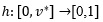
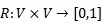
<body><![CDATA[<p>&nbsp;</p>     <p>&nbsp;</p>     <p><font size="3" face="Verdana, Arial, Helvetica, sans-serif"><strong>INTRODUCTION</strong></font></p>     <p><font size="2" face="Verdana, Arial, Helvetica, sans-serif">Recently  the ideas of a fuzzy relationship and fuzzy graph have gained in visibility.  Fuzzy cognitive maps (<a href="#_ENREF_11" title="Leyva-Vazquez, 2014 #1341">Leyva <em>et al.,</em> 2014</a>) and the paradigm for intelligent social network analysis  (PISNA) (<a href="#_ENREF_21" title="Yager, 2008 #1221">Yager, 2008</a>; <a href="#_ENREF_23" title="Yager, 2014 #1303">Yager, 2014</a>) are two examples. Social networks have become an important  technology with examples like Facebook and LinkedIn or ResearcheGate, a network  dedicated to researchers. </font></p>     <p><font size="2" face="Verdana, Arial, Helvetica, sans-serif">However  the current approaches for social network analysis (SNA) based on fuzzy graphs  have some limitations, especially for dealing with sensitivity to changes in  the values of truth and compensation when calculating the accuracy of compound  predicates (<a href="#_ENREF_16" title="Ortega, 2013 #1328">Ortega <em>et al.,</em> 2013</a>). Rickard and Yager (<a href="#_ENREF_17" title="Rickard, 2013 #1302">2013</a>) propose a method for improving interpretability in SNA using  interval type-2 (IT2) fuzzy sets (<a href="#_ENREF_10" title="John, 2006 #1001">John and Coupland, 2006</a>). The main drawback with this approach is the high  computational cost and the need of preprocessing the information. Another proposal  (<a href="#_ENREF_8" title="Brunelli, 2014 #1339">Brunelli <em>et al.,</em> 2014</a>) is based on the construction of higher dimensional fuzzy  m-ary adjacency relations from the binary relations by means of ordered  weighted averaging (OWA) functions (<a href="#_ENREF_20" title="Yager, 1988 #418">Yager, 1988</a>). This approach introduces a flexible consensus measure but  is not directly applicable to general tasks of social network analysis. </font></p>     <p><font size="2" face="Verdana, Arial, Helvetica, sans-serif">In  this paper we propose a model for SNA combining fuzzy graph and compensatory  fuzzy logic (CFL) (<a href="#_ENREF_3" title="Andrade, 2014 #1333">Andrade <em>et al.,</em> 2014a</a>). This combination allows overcoming the limitation in  traditional fuzzy logic for SNA to estimate the truth or falsity of  observations about a network.     <br>   The  outline of this paper is as follows: Section 1 is dedicated to fuzzy graphs and  Section 2 to compensatory fuzzy logic. The intelligent fuzzy social network  analysis based on CFL proposal is presented in Section 3. A case study is  discussed in Section 4. The paper closes with concluding remarks, and  discussion of future work in Section 5.</font></p>     <p>&nbsp;</p>     <p><font size="3" face="Verdana, Arial, Helvetica, sans-serif"><strong>COMPUTACIONAL METHODOLOGY </strong></font></p>     <p><font size="2" face="Verdana, Arial, Helvetica, sans-serif"><strong>Fuzzy Graph </strong>     ]]></body>
<body><![CDATA[<br>       <br> While  crisp relations are appropriate for describing relations like <em>parent of</em>, fuzzy set are better at  capturing relationships of degree like <em>friendship</em> (<a href="#_ENREF_19" title="Wierman, 2010 #1161">Wierman, 2010</a>). A fuzzy relationship on X is a mapping <img src="/img/revistas/rcci/v8n4/fo0104414.jpg" width="128" height="23">&nbsp;where R(x, y) indicates the degree of  relationship between x and y (<a href="#_ENREF_22" title="Yager, 2010 #1223">Yager, 2010</a>). This allows extending the connections in a network from connected  or not to fuzzy connections. Here we denote a fuzzy graph as <img src="/img/revistas/rcci/v8n4/fo0204414.jpg" width="95" height="23">&nbsp;here V is set of vertices, E is the set of  edges and R is a relation <img src="/img/revistas/rcci/v8n4/fo0304414.jpg" width="102" height="23">.     <br> Fuzzy  set theory has been applied to social network analysis (SNA) modeling fuzzy  relations that exist between entities as graph (<a href="#_ENREF_14" title="Nair, 2007 #1323">Nair and Sarasamma, 2007</a>). A social network can easily be represented by a fuzzy  relation or a fuzzy graph extending the analyst&acute;s capabilities of examining  networks (<a href="#_ENREF_21" title="Yager, 2008 #1221">Yager, 2008</a>).    <br> Using  fuzzy sets it is possible to formalize the idea of vocabulary. For any element<img src="/img/revistas/rcci/v8n4/fo0404414.jpg" width="36" height="23">, its membership grade, <img src="/img/revistas/rcci/v8n4/fo0504414.jpg" width="80" height="23">&nbsp;indicate the compatibility of the value <em>y</em> with the linguistic concept &nbsp;<em>W </em>(<a href="#_ENREF_21" title="Yager, 2008 #1221">Yager, 2008</a>). For studying fuzzy graphs, there are a number of attributes  about which it will be useful to have vocabularies. Strength of connection and  the number of links in a path (link-length) are two of them.     <br> It  is possible to define a fuzzy adjacency matrix to represent a social network  starting from real world information. If a value adjacency matrix <img src="/img/revistas/rcci/v8n4/fo0604414.jpg" width="81" height="23">&nbsp;exist with <img src="/img/revistas/rcci/v8n4/fo0704414.jpg" width="59" height="23">&nbsp;, and <em>v*</em> &nbsp;playing the role of the upper bound, we can  rescale each <em>v<sub>ij</sub></em> &nbsp;into<em> r<sub>ij</sub></em>&nbsp;with a function <img src="/img/revistas/rcci/v8n4/fo0804414.jpg" width="70" height="23">, <img src="/img/revistas/rcci/v8n4/fo0904414.jpg" width="103" height="22"> (<a href="#_ENREF_7" title="Brunelli, 2009 #1335">Brunelli and Fedrizzi, 2009</a>).</font></p>     <p><font size="2" face="Verdana, Arial, Helvetica, sans-serif"><strong>Compensatory Fuzzy Logic</strong>    <br>       <br> Fuzzy  logic is a multivalent logic system introduced by Zadeh (<a href="#_ENREF_24" title="Zadeh, 1965 #486">1965</a>) in 1965 at the University of Berkeley (California). Although  the many advantages of fuzzy logic to model ambiguous or vague knowledge it  have certain drawbacks. The mains limitations in the modeling of knowledge can  be summarized as (<a href="#_ENREF_2" title="Alonso, 2014 #1327">Alonso <em>et al.,</em> 2014</a>):</font></p> <ul>       <li><font size="2" face="Verdana, Arial, Helvetica, sans-serif">The  associative property of conjunction and disjunction operators. </font></li>       <li><font size="2" face="Verdana, Arial, Helvetica, sans-serif">The  lack of sensitivity to changes in the values of truth of the basic predicates  when calculating the truth value of compound predicates.</font></li>       ]]></body>
<body><![CDATA[<li><font size="2" face="Verdana, Arial, Helvetica, sans-serif">The  lack of compensation for the truth values of basic predicates when calculating  the accuracy of compound predicates.</font></li>     </ul>     <p><font size="2" face="Verdana, Arial, Helvetica, sans-serif">CFL is s a  variant of fuzzy logic that overcomes the preceding limitations. A CFL system  is a quartet of operators: a conjunction, a disjunction, a negation and a  strict fuzzy order that satisfies the axioms of compensation, commutativity,  strict growth, veto, fuzzy reciprocity, fuzzy transitivity and the Morgan&rsquo;s  laws (<a href="#_ENREF_3" title="Andrade, 2014 #1333">Andrade, Fern&aacute;ndez and Gonz&aacute;lez,  2014a</a>; <a href="#_ENREF_5" title="Andrade, 2014 #1316">Andrade <em>et al.,</em> 2014c</a>). In this  work Geometric Mean Based Compensatory Logic (GBCFL) is used due to the  robustness and relative simplicity of its operators (<a href="#_ENREF_16" title="Ortega, 2013 #1328">Ortega, Andrade and G&oacute;mez, 2013</a>). In GBCFL  conjunction is defined as follows:</font></p>     <p align="right"> <font face="Verdana, Arial, Helvetica, sans-serif"><img src="/img/revistas/rcci/v8n4/fo1004414.jpg" width="457" height="32"></font></p>     <p><font size="2" face="Verdana, Arial, Helvetica, sans-serif">The  disjunction is defined as the dual of the conjunction:</font></p>     <p align="right"><font face="Verdana, Arial, Helvetica, sans-serif"><img src="/img/revistas/rcci/v8n4/fo1104414.jpg" width="500" height="29"></font></p>     <p><font size="2" face="Verdana, Arial, Helvetica, sans-serif">The  fuzzy negation is:</font></p>     <p align="right"><font face="Verdana, Arial, Helvetica, sans-serif"><img src="/img/revistas/rcci/v8n4/fo1204414.jpg" width="363" height="29"></font></p>     <p><font size="2" face="Verdana, Arial, Helvetica, sans-serif">and  the fuzzy strict order is:</font></p>     <p align="right"><font face="Verdana, Arial, Helvetica, sans-serif"><img src="/img/revistas/rcci/v8n4/fo1304414.jpg" width="358" height="25"></font></p>     ]]></body>
<body><![CDATA[<p><font size="2" face="Verdana, Arial, Helvetica, sans-serif">At  any fuzzy predicate <em>P</em> &nbsp;over the universe <em>U</em>, universal and existential  propositions are defined respectively as (<a href="#_ENREF_4" title="Andrade, 2014 #1310">Andrade <em>et al.,</em> 2014b</a>):</font></p>     <p align="right"><font face="Verdana, Arial, Helvetica, sans-serif"><img src="/img/revistas/rcci/v8n4/fo1404414.jpg" width="411" height="64"></font></p>     <p><font size="2" face="Verdana, Arial, Helvetica, sans-serif">The  min-max approach of the Zadeh family of operator (<a href="#_ENREF_19" title="Wierman, 2010 #1161">Wierman, 2010</a>) used in the PISMA approach is not sensible to the changes in  the truth values of predicates. With CFL we can express an &ldquo;appealing&rdquo;  sensibility and attaint more reliable operators according to the way that human  take decisions. Combining the modeling capability of fuzzy graphs and CFL we  can provide more realistic formulation of some concepts available in SNA as  well as some new concepts.</font></p>     <p><font size="2"><strong><font face="Verdana, Arial, Helvetica, sans-serif">Intelligent social network analysis based on CFL </font></strong><font face="Verdana, Arial, Helvetica, sans-serif">    <br>       <br> The  centrality measures have been used for the analysis in fuzzy graphs ( e.g. (<a href="#_ENREF_18" title="Samarasinghea, 2011 #485">Samarasinghea and Strickert, 2011</a>), (<a href="#_ENREF_22" title="Yager, 2010 #1223">Yager, 2010</a>)). The most used centrality measures to identifying a central  node are: degree centrality, betweenness centrality, closeness centrality (<a href="#_ENREF_18" title="Samarasinghea, 2011 #485">Samarasinghea and Strickert, 2011</a>). Another way of measuring the centrality of a vertex by the  number of other vertices to which it directly connected by at most <em>k </em>steps  (<a href="#_ENREF_21" title="Yager, 2008 #1221">Yager, 2008</a>):</font></font></p>     <p align="right"><img src="/img/revistas/rcci/v8n4/fo1504414.jpg" width="416" height="39"></p>     <p><font size="2" face="Verdana, Arial, Helvetica, sans-serif">where R<sup>K</sup>(V<sub>i</sub>,V<sub>j</sub>) is the strength of the strongest path  from V<sub>i</sub>&nbsp;to V<sub>j</sub>&nbsp;containing at most k links.     <br> Strength (ST) of the path is usually defined as:</font></p>     <p align="right"><img src="/img/revistas/rcci/v8n4/fo1604414.jpg" width="360" height="30"></p>     ]]></body>
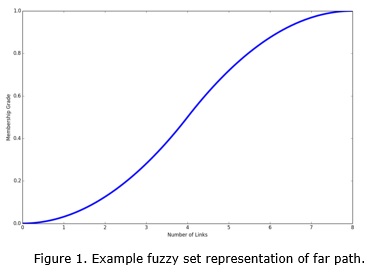
<body><![CDATA[<p><font size="2" face="Verdana, Arial, Helvetica, sans-serif">One  of the drawbacks of the <em>Min </em>operator is that it leads to a degradation  of outcomes by compressing strength, for example on a given node, a <em>very</em> <em>strong </em>relation and a <em>moderate </em>one would have the same partial  effect if the previous path strength of influence is <em>weak </em>(<a href="#_ENREF_13" title="Montibeller, 2009 #6">Montibeller  and Belton, 2009</a>).    <br>       <br> In this paper instead we define degree of connection  of a path (how strong is a path) taking into account the strength in all its edges:</font></p>     <p align="right"><img src="/img/revistas/rcci/v8n4/fo1704414.jpg" width="362" height="32"></p>     <p><font size="2" face="Verdana, Arial, Helvetica, sans-serif">where <img src="/img/revistas/rcci/v8n4/fo1804414.jpg" width="9" height="23">&nbsp;is the universal proposition in CFL.    <br>   Moreover the length of a path L(p) &nbsp;can be defined as the number of edges the path  contains. The word Far (F) can be defined a fuzzy subset <img src="/img/revistas/rcci/v8n4/fo1904414.jpg" width="83" height="21">&nbsp;such that F(K)&nbsp;is the degree to which a path of k links is <em>Far</em>.  (<a href="#f01">figure 1</a>).</font></p>     <p align="center"><a name="f01"></a><img src="/img/revistas/rcci/v8n4/f0104414.jpg" width="377" height="274"></p>     <p><font size="2" face="Verdana, Arial, Helvetica, sans-serif">We propose to find the better path between two vertices in terms  of the negation of its farness and the degree of  connection:</font></p>     <p align="right"><img src="/img/revistas/rcci/v8n4/fo200414.jpg" width="436" height="36"></p>     <p><font size="2" face="Verdana, Arial, Helvetica, sans-serif">Where <img src="/img/revistas/rcci/v8n4/fo2104414.jpg" width="11" height="23">&nbsp;and <img src="/img/revistas/rcci/v8n4/fo2204414.jpg" width="9" height="23">&nbsp;are the negation and conjunctive operator in  CFL respectively. </font></p>     ]]></body>
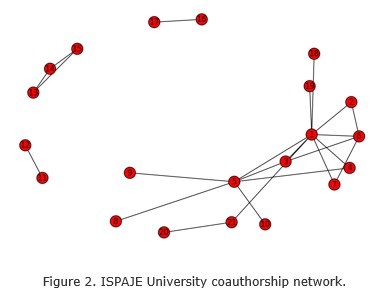
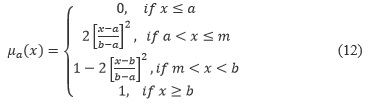
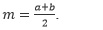
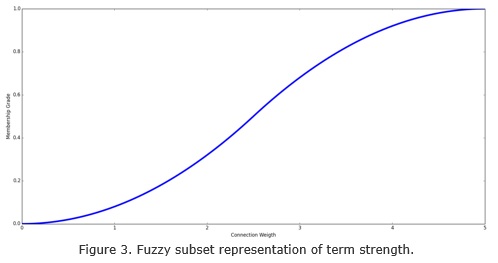
<body><![CDATA[<p>&nbsp;</p>     <p><font size="3" face="Verdana, Arial, Helvetica, sans-serif"><strong>RESULTS AND DISCUSSION</strong></font></p>     <p><font size="2" face="Verdana, Arial, Helvetica, sans-serif">Coauthorship  networks (<a href="#_ENREF_15" title="Newman, 2004 #1317">Newman, 2004</a>) are collaboration graph where nodes are scientific. Here we  consider that two scientists are connected if they have appeared as authors in  the same paper. <a href="#f02">figure 2</a> shows the network formed by of research staff at the  ISPJAE University inside the Eureka network.     <br>       <br> Eureka  network is a multinational scientific network. Its objective is the  contribution to increase capabilities of useful knowledge discovering for the  management of organizations in Iberian American region. For constructing  coauthorship network three books published by Eureka have been taking into  account (<a href="#_ENREF_6" title="Andrade, 2013 #1321">Andrade <em>et al.,</em> 2013</a>; <a href="#_ENREF_9" title="Esp&iacute;n Andrade, 2011 #1320">Esp&iacute;n <em>et al.,</em> 2011</a>; <a href="#_ENREF_12" title="Leyva L&oacute;pez J. C., 2013 #1322">Leyva <em>et al.,</em> 2013</a>) . </font></p>     <p align="center"><a name="f02"></a><img src="/img/revistas/rcci/v8n4/f0204414.jpg" width="387" height="295"></p>     <p><font size="2" face="Verdana, Arial, Helvetica, sans-serif">In this case study we analyze the  principal component of this network. The strength of connection among adjacency  vertices is obtained using the sigmoid membership function with parameters <em>a</em>&nbsp;and<em> b</em> &nbsp;(<a href="#f03">fig 3</a>):</font></p>     <p align="right"><img src="/img/revistas/rcci/v8n4/fo2304414.jpg" width="371" height="105"></p>     <p><font size="2" face="Verdana, Arial, Helvetica, sans-serif">where</font> <img src="/img/revistas/rcci/v8n4/fo2404414.jpg" width="103" height="30"></p>     <p><font size="2" face="Verdana, Arial, Helvetica, sans-serif">In this case a = 0 and b = 5 = <em>v*</em> (<a href="#f03">fig 3</a>).</font></p>     ]]></body>
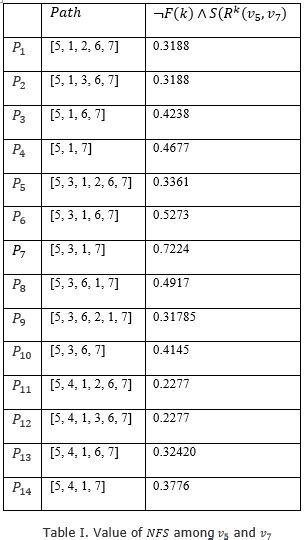
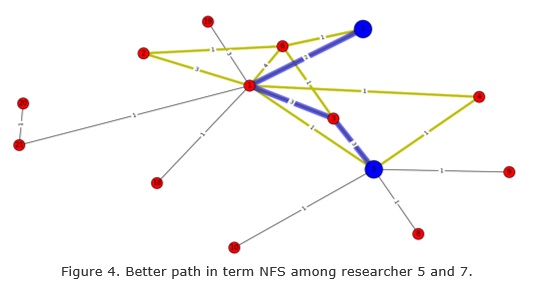
<body><![CDATA[<p align="center"><a name="f03"></a><img src="/img/revistas/rcci/v8n4/f0304414.jpg" alt="f03" width="498" height="263"></p>     <p align="left"><font face="Verdana, Arial, Helvetica, sans-serif"><em><font size="2">F(K)</font></em><font size="2"> is calculate with the  sigmoid function (12) with parameter a=0, b=8 and m=4 &nbsp;(<a href="#f01">fig 1</a>).     <br> The NFS values of paths  among vertices 5 y 7 in shown in <a href="#t01">table I</a>.</font></font></p>     <p align="center"><a name="t01"></a><img src="/img/revistas/rcci/v8n4/t0104414.jpg" alt="t01" width="304" height="540"></p>     <p><font size="2" face="Verdana, Arial, Helvetica, sans-serif">If a ranking were required, this is as follows: </font></p>     <p align="left"><img src="/img/revistas/rcci/v8n4/fo2504414.jpg" width="525" height="30"></p>     <p><font size="2" face="Verdana, Arial, Helvetica, sans-serif">The better path in term of length and strength  among researcher 5 and 7 (NFS(v<sub>5</sub>,v<sub></sub>)&nbsp;= 0.7224) is shown in conjunction with all  paths among them in <a href="#f04">figure 4</a>. The path found is neither shortest (P4) nor  strongest (P6), different to results with the min-max approach of Zadeh  operators (<a href="#_ENREF_19" title="Wierman, 2010 #1161">Wierman 2010</a>) and  more consistent with the way that human make decisions. </font></p>     <p align="center"><a name="f04"></a><img src="/img/revistas/rcci/v8n4/f0404414.jpg" alt="f04" width="537" height="286"></p>     <p><font size="2" face="Verdana, Arial, Helvetica, sans-serif">Comparing our proposal with the PISNA approach as proposed by  Yager (<a href="#_ENREF_21" title="Yager, 2008 #1221">2008</a>), we notice that the  former model will only gives the most suitable or the shortest path not  allowing to express compensation. Additionally our proposal will give more  robust results because among fuzzy operators the those belonging to CFL are the  most robust (<a href="#_ENREF_16" title="Ortega, 2013 #1328">Ortega,  Andrade and G&oacute;mez, 2013</a>). This results make our  model appealing for combining decision making models and social networks  analysis specially in recommendation tasks (<a href="#_ENREF_1" title="Al Falahi, 2012 #1319">Al  Falahi,<em> et al.,</em> 2012</a>) and  consensus reaching (<a href="#_ENREF_8" title="Brunelli, 2014 #1339">Brunelli  and Fedrizzi, 2014</a>). Our approach is an  opportunity to use the language as key element of communication in the  construction of semantic models in SNA (<a href="#_ENREF_21" title="Yager, 2008 #1221">Yager,  2008</a>). It is closer to the  objective to make reasoning processes in environments of uncertainty and  imprecision with words (<a href="#_ENREF_25" title="Zadeh, 1999 #1366">Zadeh, 1999</a>).</font></p>     <p align="left">&nbsp;</p>     ]]></body>
<body><![CDATA[<p><font face="Verdana, Arial, Helvetica, sans-serif" size="3"><B>CONCLUSIONS</B></font></p>     <p><font size="2" face="Verdana, Arial, Helvetica, sans-serif">In this work we discussed the idea of fuzzy graph and their role  in modeling social relational networks. Compensatory fuzzy logic was introduced  and we discussed how these technologies can provide the analyst further  flexibility for social network analysis. We applied this approach to the  concept path importance taking into account the length and strength of the connection.     <br>       <br> The new model for intelligent social network analysis based on  CFL gives more robust outcomes and allow expressing compensation. The  sensibility of the operators in our proposal gives more consistent results with the way that human make decisions. Moreover it bring  closer the opportunity to use the language as crucial component in the  construction of semantic models in SNA. </font></p>     <p><font size="2" face="Verdana, Arial, Helvetica, sans-serif">As future research we intend to develop models for combining  decision making and social networks analysis. Discovering knowledge with linguistic  summarization of social networks based on CFL is a promising area. The mining of social  relation networks, the development of more flexible ways for querying social  networks, and the development of a software tool are other areas of future  work.</font></p>     <p>&nbsp;</p>     <p><strong><font size="3" face="Verdana, Arial, Helvetica, sans-serif">ACKNOWLEDGEMENT</font>    <br> </strong>    <br>   <font size="2" face="Verdana, Arial, Helvetica, sans-serif">The authors are grateful to the anonymous reviewers  for their valuable suggestions.     <br> Author Maikel Leyva wants to thank to Dra. Macarena  Espinilla from Ja&eacute;n University and to MSc. Yasel Couce for their help. </font></p>     ]]></body>
<body><![CDATA[<p>&nbsp;</p>     <p align="left"><font face="Verdana, Arial, Helvetica, sans-serif" size="3"><B>REFERENCES</B></font>     <!-- ref --><p name="_ENREF_1"><font size="2" face="Verdana, Arial, Helvetica, sans-serif">AL FALAHI, K., N. MAVRIDIS AND Y. ATIF. Social Networks and  Recommender Systems: A World of Current and Future Synergies. In <em>Computational Social  Networks.</em> Springer, 2012, p. 445-465.     </font></p>     <!-- ref --><p name="_ENREF_2"><font size="2" face="Verdana, Arial, Helvetica, sans-serif">ALONSO, M. M., R. A. E. ANDRADE, V.  L. BATISTA AND A. R. SU&Aacute;REZ. Discovering Knowledge by Fuzzy Predicates in  Compensatory Fuzzy Logic Using Metaheuristic Algorithms. In <em>Soft Computing for  Business Intelligence.</em> Springer, 2014, p. 161-174.     </font></p>     <!-- ref --><p name="_ENREF_3"><font size="2" face="Verdana, Arial, Helvetica, sans-serif">ANDRADE, R. A. E., E. FERN&Aacute;NDEZ AND E. GONZ&Aacute;LEZ. Compensatory Fuzzy Logic: A Frame for  Reasoning and Modeling Preference Knowledge in Intelligent Systems In <em>Soft Computing for Business Intelligence.</em> Springer, 2014a.     </font></p>     <!-- ref --><p name="_ENREF_4"><font size="2" face="Verdana, Arial, Helvetica, sans-serif">ANDRADE, R. A. E., E. FERN&Aacute;NDEZ AND E. GONZ&Aacute;LEZ. Compensatory Fuzzy Logic: A Frame for  Reasoning and Modeling Preference Knowledge in Intelligent Systems. In <em>Soft Computing for  Business Intelligence.</em> Springer, 2014b, p. 3-23.     </font></p>     ]]></body>
<body><![CDATA[<!-- ref --><p name="_ENREF_5"><font size="2" face="Verdana, Arial, Helvetica, sans-serif">ANDRADE, R. A. E., E. GONZ&Aacute;LEZ, E. FERN&Aacute;NDEZ AND M. M.  ALONSO. Compensatory Fuzzy Logic Inference. In <em>Soft Computing for Business Intelligence.</em> Springer, 2014c, p. 25-43.     </font></p>     <!-- ref --><p name="_ENREF_6"><font size="2" face="Verdana, Arial, Helvetica, sans-serif">ANDRADE, R. A. E., R. B. P&Eacute;REZ, A. C.  ORTEGA, J. M. G&Oacute;MEZ, <em>et al.,</em> Soft  Computing for Business Intelligence. In<em>.</em>: Springer Berlin Heidelberg, 2013.     </font></p>     <!-- ref --><p name="_ENREF_7"><font size="2" face="Verdana, Arial, Helvetica, sans-serif">BRUNELLI, M. AND M. FEDRIZZI. A fuzzy  approach to social network analysis. In <em>Social  Network Analysis and Mining, 2009. ASONAM'09. International Conference on  Advances in.</em> IEEE, 2009, p.  225-230.     </font></p>     <!-- ref --><p name="_ENREF_8"><font size="2" face="Verdana, Arial, Helvetica, sans-serif">BRUNELLI, M., M. FEDRIZZI AND M.  FEDRIZZI Fuzzy m-ary adjacency relations in social network analysis:  Optimization and consensus evaluation. Information  Fusion, 2014, 17, 36-45.     </font></p>     <!-- ref --><p name="_ENREF_9"><font size="2" face="Verdana, Arial, Helvetica, sans-serif">ESP&Iacute;N ANDRADE, R., MARX G&Oacute;MEZ J. AND  R. V. A. Towards a transdisciplinary technology for Business Intelligence:  Gathering Knowledge Discovery, Knowledge Management and Decision Making. In <em>Schriftenreihe der  Oldenburger Wirtschaftsinformatik. </em>Aachen, 2011.     </font></p>     ]]></body>
<body><![CDATA[<!-- ref --><p name="_ENREF_10"><font size="2" face="Verdana, Arial, Helvetica, sans-serif">JOHN, R. AND S. COUPLAND Extensions  to type-1 fuzzy logic: Type-2 fuzzy logic and uncertainty. Computational Intelligence: Principles and Practice, 2006,  89-101.     </font></p>     <!-- ref --><p name="_ENREF_11"><font size="2" face="Verdana, Arial, Helvetica, sans-serif">LEYVA-VAZQUEZ, M., K. PEREZ-TERUEL AND R. I. JOHN. A model for enterprise architecture  scenario analysis based on fuzzy cognitive maps and OWA operators. In <em>Electronics, Communications and Computers  (CONIELECOMP), 2014 International Conference on.</em> IEEE, 2014, p. 243-247.     </font></p>     <!-- ref --><p name="_ENREF_12"><font size="2" face="Verdana, Arial, Helvetica, sans-serif">LEYVA L&Oacute;PEZ J. C., E. A. R., B. P. R.  AND &Aacute;. C. P. Studies on Knowledge Discovery, Knowledge Management and Decision  Support. In<em>.</em>: Atlantis Press, 2013.     </font></p>     <!-- ref --><p name="_ENREF_13"><font size="2" face="Verdana, Arial, Helvetica, sans-serif">MONTIBELLER, G. AND V. BELTON.  Qualitative operators for reasoning maps: Evaluating multi-criteria options  with networks of reasons. In<em>.</em>: Elsevier, 2009, vol. 195, p. 829-840.     </font></p>     <!-- ref --><p name="_ENREF_14"><font size="2" face="Verdana, Arial, Helvetica, sans-serif">NAIR, P. S. AND S. T. SARASAMMA. Data  mining through fuzzy social network analysis. In <em>Fuzzy Information Processing Society, 2007. NAFIPS'07. Annual Meeting  of the North American.</em> IEEE, 2007, p.  251-255.     </font></p>     ]]></body>
<body><![CDATA[<!-- ref --><p name="_ENREF_15"><font size="2" face="Verdana, Arial, Helvetica, sans-serif">NEWMAN, M. E. Coauthorship networks  and patterns of scientific collaboration. Proceedings of the National Academy of Sciences, 2004, 101(suppl 1),  5200-5205.     </font></p>     <!-- ref --><p name="_ENREF_16"><font size="2" face="Verdana, Arial, Helvetica, sans-serif">ORTEGA, M., P. MICHEL, R. E. ANDRADE  AND J. MARX G&Oacute;MEZ. Multivalued Fuzzy Logics: A Sensitive Analysis. In <em>Fourth International Workshop on Knowledge  Discovery, Knowledge Management and Decision Support.</em> Atlantis Press, 2013.     </font></p>     <!-- ref --><p name="_ENREF_17"><font size="2" face="Verdana, Arial, Helvetica, sans-serif">RICKARD, J. T. AND R. R. YAGER.  Perceptual computing in social networks. In <em>IFSA  World Congress and NAFIPS Annual Meeting (IFSA/NAFIPS), 2013 Joint.</em> IEEE, 2013, p. 691-696.     </font></p>     <p name="_ENREF_18"><font size="2" face="Verdana, Arial, Helvetica, sans-serif">SAMARASINGHEA, S. AND G. STRICKERT  2011. A New Method for Identifying the Central Nodes in Fuzzy Cognitive Maps  using Consensus Centrality Measure. In <em>Proceedings  of the 19th International Congress on Modelling and Simulation</em>, Perth,  Australia, 12&ndash;16 December 2011 2011. </font></p>     <!-- ref --><p name="_ENREF_19"><font size="2" face="Verdana, Arial, Helvetica, sans-serif">WIERMAN, M. J. <em>An Introduction to the Mathematics of Uncertainty</em>. Edtion ed.  Omaha, Nebraska: Center for Mathematics of Uncertainty, Inc., 2010.     </font></p>     <!-- ref --><p name="_ENREF_20"><font size="2" face="Verdana, Arial, Helvetica, sans-serif">YAGER, R. R. On ordered weighted  averaging aggregation operators in multicriteria decisionmaking. Systems, Man and Cybernetics, IEEE Transactions on, 1988,  18(1), 183-190.     </font></p>     <!-- ref --><p name="_ENREF_21"><font size="2" face="Verdana, Arial, Helvetica, sans-serif">YAGER, R. R. Intelligent social  network analysis using granular computing. International Journal of Intelligent Systems, 2008, 23(11), 1197-1219.     </font></p>     <!-- ref --><p name="_ENREF_22"><font size="2" face="Verdana, Arial, Helvetica, sans-serif">YAGER, R. R. Concept representation  and database structures in fuzzy social relational networks. Systems, Man and  Cybernetics, Part A: Systems and Humans, IEEE Transactions on, 2010, 40(2),  413-419.     </font></p>     <!-- ref --><p name="_ENREF_23"><font size="2" face="Verdana, Arial, Helvetica, sans-serif">YAGER, R. R. Social Network Database  Querying Based on Computing with Words. In <em>Flexible  Approaches in Data, Information and Knowledge Management.</em> Springer, 2014,  p. 241-257.     </font></p>     <!-- ref --><p name="_ENREF_24"><font size="2" face="Verdana, Arial, Helvetica, sans-serif">ZADEH, L. A. Fuzzy sets. Information and Control, 1965, 8(3), 338-353.     </font></p>     <p name="_ENREF_25"><font size="2" face="Verdana, Arial, Helvetica, sans-serif">ZADEH, L. A. From Computing with  Numbers to Computing with Words&mdash;From Manipulation of Measurements to  Manipulation of Perceptions. IEEE TRANSACTIONS ON CIRCUITS AND SYSTEMS&mdash;I:  FUNDAMENTAL THEORY AND APPLICATIONS, 1999, 45(1), 105.</font> </p>     ]]></body>
<body><![CDATA[<p name="_ENREF_25">&nbsp;</p>     <p>&nbsp;</p>     <p><font size="2" face="Verdana, Arial, Helvetica, sans-serif">Recibido: 14/05/2014     <br> Aceptado: </font><font size="2" face="Verdana, Arial, Helvetica, sans-serif">15/10/2014 </font></p>      ]]></body><back>
<ref-list>
<ref id="B1">
<nlm-citation citation-type="book">
<person-group person-group-type="author">
<name>
<surname><![CDATA[AL FALAHI]]></surname>
<given-names><![CDATA[K]]></given-names>
</name>
<name>
<surname><![CDATA[MAVRIDIS]]></surname>
<given-names><![CDATA[N]]></given-names>
</name>
<name>
<surname><![CDATA[ATIF]]></surname>
<given-names><![CDATA[Y]]></given-names>
</name>
</person-group>
<source><![CDATA[Social Networks and Recommender Systems: A World of Current and Future Synergies]]></source>
<year>2012</year>
<page-range>445-465</page-range><publisher-name><![CDATA[In Computational Social Networks. Springer]]></publisher-name>
</nlm-citation>
</ref>
<ref id="B2">
<nlm-citation citation-type="book">
<person-group person-group-type="author">
<name>
<surname><![CDATA[ALONSO]]></surname>
<given-names><![CDATA[M. M]]></given-names>
</name>
<name>
<surname><![CDATA[ANDRADE]]></surname>
<given-names><![CDATA[R. A. E]]></given-names>
</name>
<name>
<surname><![CDATA[BATISTA]]></surname>
<given-names><![CDATA[V. L]]></given-names>
</name>
<name>
<surname><![CDATA[SUÁREZ]]></surname>
<given-names><![CDATA[A. R]]></given-names>
</name>
</person-group>
<source><![CDATA[Discovering Knowledge by Fuzzy Predicates in Compensatory Fuzzy Logic Using Metaheuristic Algorithms.]]></source>
<year>2014</year>
<page-range>161-174</page-range><publisher-name><![CDATA[In Soft Computing for Business Intelligence. Springer]]></publisher-name>
</nlm-citation>
</ref>
<ref id="B3">
<nlm-citation citation-type="book">
<person-group person-group-type="author">
<name>
<surname><![CDATA[ANDRADE]]></surname>
<given-names><![CDATA[R. A. E]]></given-names>
</name>
<name>
<surname><![CDATA[FERNÁNDEZ]]></surname>
<given-names><![CDATA[E]]></given-names>
</name>
<name>
<surname><![CDATA[GONZÁLEZ]]></surname>
<given-names><![CDATA[E]]></given-names>
</name>
</person-group>
<source><![CDATA[Compensatory Fuzzy Logic: A Frame for Reasoning and Modeling Preference Knowledge in Intelligent Systems]]></source>
<year>2014</year>
<month>a</month>
<publisher-name><![CDATA[In Soft Computing for Business Intelligence. Springer]]></publisher-name>
</nlm-citation>
</ref>
<ref id="B4">
<nlm-citation citation-type="book">
<person-group person-group-type="author">
<name>
<surname><![CDATA[ANDRADE]]></surname>
<given-names><![CDATA[R. A. E]]></given-names>
</name>
<name>
<surname><![CDATA[FERNÁNDEZ]]></surname>
<given-names><![CDATA[E]]></given-names>
</name>
<name>
<surname><![CDATA[GONZÁLEZ]]></surname>
<given-names><![CDATA[E]]></given-names>
</name>
</person-group>
<source><![CDATA[Compensatory Fuzzy Logic: Frame for Reasoning and Modeling Preference Knowledge in Intelligent Systems.]]></source>
<year>2014</year>
<month>b</month>
<page-range>3-23</page-range><publisher-name><![CDATA[In Soft Computing for Business Intelligence. Springer]]></publisher-name>
</nlm-citation>
</ref>
<ref id="B5">
<nlm-citation citation-type="book">
<person-group person-group-type="author">
<name>
<surname><![CDATA[ANDRADE]]></surname>
<given-names><![CDATA[R. A. E]]></given-names>
</name>
<name>
<surname><![CDATA[GONZÁLEZ]]></surname>
<given-names><![CDATA[E]]></given-names>
</name>
<name>
<surname><![CDATA[FERNÁNDEZ]]></surname>
<given-names><![CDATA[E]]></given-names>
</name>
<name>
<surname><![CDATA[ALONSO]]></surname>
<given-names><![CDATA[M. M]]></given-names>
</name>
</person-group>
<source><![CDATA[Compensatory Fuzzy Logic Inference]]></source>
<year>2014</year>
<month>c</month>
<page-range>25-43</page-range><publisher-name><![CDATA[In Soft Computing for Business Intelligence. Springer]]></publisher-name>
</nlm-citation>
</ref>
<ref id="B6">
<nlm-citation citation-type="book">
<person-group person-group-type="author">
<name>
<surname><![CDATA[ANDRADE]]></surname>
<given-names><![CDATA[R. A. E]]></given-names>
</name>
<name>
<surname><![CDATA[PÉREZ]]></surname>
<given-names><![CDATA[R. B]]></given-names>
</name>
<name>
<surname><![CDATA[ORTEGA]]></surname>
<given-names><![CDATA[A. C]]></given-names>
</name>
<name>
<surname><![CDATA[GÓMEZ]]></surname>
<given-names><![CDATA[J. M]]></given-names>
</name>
</person-group>
<source><![CDATA[Soft Computing for Business Intelligence]]></source>
<year>2013</year>
<publisher-name><![CDATA[In.: Springer Berlin Heidelberg]]></publisher-name>
</nlm-citation>
</ref>
<ref id="B7">
<nlm-citation citation-type="book">
<person-group person-group-type="author">
<name>
<surname><![CDATA[BRUNELLI]]></surname>
<given-names><![CDATA[M]]></given-names>
</name>
<name>
<surname><![CDATA[FEDRIZZI]]></surname>
<given-names><![CDATA[M]]></given-names>
</name>
</person-group>
<source><![CDATA[A fuzzy approach to social network analysis.]]></source>
<year>2009</year>
<page-range>225-230</page-range><publisher-name><![CDATA[In Social Network Analysis and Mining, 2009. ASONAM'09. International Conference on Advances in. IEEE]]></publisher-name>
</nlm-citation>
</ref>
<ref id="B8">
<nlm-citation citation-type="">
<person-group person-group-type="author">
<name>
<surname><![CDATA[BRUNELLI]]></surname>
<given-names><![CDATA[M]]></given-names>
</name>
<name>
<surname><![CDATA[FEDRIZZI]]></surname>
<given-names><![CDATA[M]]></given-names>
</name>
<name>
<surname><![CDATA[FEDRIZZI]]></surname>
<given-names><![CDATA[M]]></given-names>
</name>
</person-group>
<article-title xml:lang="en"><![CDATA[Fuzzy m-ary adjacency relations in social network analysis: Optimization and consensus evaluation]]></article-title>
<source><![CDATA[]]></source>
<year>2014</year>
<volume>17</volume>
<page-range>36-45</page-range></nlm-citation>
</ref>
<ref id="B9">
<nlm-citation citation-type="book">
<person-group person-group-type="author">
<name>
<surname><![CDATA[ESPÍN ANDRADE]]></surname>
<given-names><![CDATA[R]]></given-names>
</name>
<name>
<surname><![CDATA[MARX GÓMEZ]]></surname>
<given-names><![CDATA[J]]></given-names>
</name>
<name>
<surname><![CDATA[V. A]]></surname>
<given-names><![CDATA[R]]></given-names>
</name>
</person-group>
<source><![CDATA[Towards a transdisciplinary technology for Business Intelligence: Gathering Knowledge Discovery, Knowledge Management and Decision Making.]]></source>
<year>2011</year>
<publisher-loc><![CDATA[^eAachen Aachen]]></publisher-loc>
<publisher-name><![CDATA[In Schriftenreihe der Oldenburger Wirtschaftsinformatik.]]></publisher-name>
</nlm-citation>
</ref>
<ref id="B10">
<nlm-citation citation-type="book">
<person-group person-group-type="author">
<name>
<surname><![CDATA[JOHN]]></surname>
<given-names><![CDATA[R]]></given-names>
</name>
<name>
<surname><![CDATA[COUPLAND]]></surname>
<given-names><![CDATA[S]]></given-names>
</name>
</person-group>
<source><![CDATA[Extensions to type-1 fuzzy logic: Type-2 fuzzy logic and uncertainty]]></source>
<year>2006</year>
<page-range>89-101</page-range><publisher-name><![CDATA[Computational Intelligence: Principles and Practice]]></publisher-name>
</nlm-citation>
</ref>
<ref id="B11">
<nlm-citation citation-type="book">
<person-group person-group-type="author">
<name>
<surname><![CDATA[LEYVA-VAZQUEZ]]></surname>
<given-names><![CDATA[M]]></given-names>
</name>
<name>
<surname><![CDATA[PEREZ-TERUEL]]></surname>
<given-names><![CDATA[K]]></given-names>
</name>
<name>
<surname><![CDATA[JOHN]]></surname>
<given-names><![CDATA[R. I]]></given-names>
</name>
</person-group>
<source><![CDATA[A model for enterprise architecture scenario analysis based on fuzzy cognitive maps and OWA operators.]]></source>
<year>2014</year>
<page-range>243-247</page-range><publisher-name><![CDATA[In Electronics, Communications and Computers (CONIELECOMP), 2014 International Conference on. IEEE]]></publisher-name>
</nlm-citation>
</ref>
<ref id="B12">
<nlm-citation citation-type="book">
<person-group person-group-type="author">
<name>
<surname><![CDATA[LEYVA LÓPEZ]]></surname>
<given-names><![CDATA[J. C]]></given-names>
</name>
<name>
<surname><![CDATA[A. R]]></surname>
<given-names><![CDATA[E]]></given-names>
</name>
<name>
<surname><![CDATA[P. R]]></surname>
<given-names><![CDATA[B]]></given-names>
</name>
<name>
<surname><![CDATA[C. P]]></surname>
<given-names><![CDATA[Á.]]></given-names>
</name>
</person-group>
<source><![CDATA[Studies on Knowledge Discovery, Knowledge Management and Decision Support.]]></source>
<year>2013</year>
<publisher-name><![CDATA[In.: Atlantis Press]]></publisher-name>
</nlm-citation>
</ref>
<ref id="B13">
<nlm-citation citation-type="">
<person-group person-group-type="author">
<name>
<surname><![CDATA[MONTIBELLER]]></surname>
<given-names><![CDATA[G]]></given-names>
</name>
<name>
<surname><![CDATA[BELTON]]></surname>
<given-names><![CDATA[V]]></given-names>
</name>
</person-group>
<article-title xml:lang="en"><![CDATA[Qualitative operators for reasoning maps: Evaluating multi-criteria options with networks of reasons.]]></article-title>
<source><![CDATA[]]></source>
<year>2009</year>
<volume>195</volume>
<page-range>829-840</page-range></nlm-citation>
</ref>
<ref id="B14">
<nlm-citation citation-type="book">
<person-group person-group-type="author">
<name>
<surname><![CDATA[NAIR]]></surname>
<given-names><![CDATA[P. S]]></given-names>
</name>
<name>
<surname><![CDATA[SARASAMMA]]></surname>
<given-names><![CDATA[S. T]]></given-names>
</name>
</person-group>
<source><![CDATA[Data mining through fuzzy social network analysis]]></source>
<year>2007</year>
<page-range>251-255</page-range><publisher-name><![CDATA[In Fuzzy Information Processing Society, 2007. NAFIPS'07. Annual Meeting of the North American. IEEE]]></publisher-name>
</nlm-citation>
</ref>
<ref id="B15">
<nlm-citation citation-type="">
<person-group person-group-type="author">
<name>
<surname><![CDATA[NEWMAN]]></surname>
<given-names><![CDATA[M. E]]></given-names>
</name>
</person-group>
<article-title xml:lang="en"><![CDATA[Coauthorship networks and patterns of scientific collaboration.]]></article-title>
<source><![CDATA[]]></source>
<year>2004</year>
<volume>101</volume>
<numero>1</numero>
<issue>1</issue>
<page-range>5200-5205</page-range></nlm-citation>
</ref>
<ref id="B16">
<nlm-citation citation-type="book">
<person-group person-group-type="author">
<name>
<surname><![CDATA[ORTEGA]]></surname>
<given-names><![CDATA[M]]></given-names>
</name>
<name>
<surname><![CDATA[MICHEL]]></surname>
<given-names><![CDATA[P]]></given-names>
</name>
<name>
<surname><![CDATA[ANDRADE]]></surname>
<given-names><![CDATA[R. E]]></given-names>
</name>
<name>
<surname><![CDATA[MARX GÓMEZ]]></surname>
<given-names><![CDATA[J]]></given-names>
</name>
</person-group>
<source><![CDATA[Multivalued Fuzzy Logics: A Sensitive Analysis]]></source>
<year>2013</year>
<publisher-name><![CDATA[In Fourth International Workshop on Knowledge Discovery, Knowledge Management and Decision Support. Atlantis Press]]></publisher-name>
</nlm-citation>
</ref>
<ref id="B17">
<nlm-citation citation-type="book">
<person-group person-group-type="author">
<name>
<surname><![CDATA[RICKARD]]></surname>
<given-names><![CDATA[J. T]]></given-names>
</name>
<name>
<surname><![CDATA[YAGER]]></surname>
<given-names><![CDATA[R. R]]></given-names>
</name>
</person-group>
<source><![CDATA[Perceptual computing in social networks.]]></source>
<year>2013</year>
<page-range>691-696</page-range><publisher-name><![CDATA[In IFSA World Congress and NAFIPS Annual Meeting (IFSA/NAFIPS), 2013 Joint. IEEE]]></publisher-name>
</nlm-citation>
</ref>
<ref id="B18">
<nlm-citation citation-type="book">
<person-group person-group-type="author">
<name>
<surname><![CDATA[SAMARASINGHEA]]></surname>
<given-names><![CDATA[S]]></given-names>
</name>
<name>
<surname><![CDATA[STRICKERT]]></surname>
<given-names><![CDATA[G]]></given-names>
</name>
</person-group>
<source><![CDATA[A New Method for Identifying the Central Nodes in Fuzzy Cognitive Maps using Consensus Centrality Measure.]]></source>
<year>12-1</year>
<month>6 </month>
<day>De</day>
<publisher-loc><![CDATA[^ePerth Perth]]></publisher-loc>
<publisher-name><![CDATA[In Proceedings of the 19th International Congress on Modelling and Simulation]]></publisher-name>
</nlm-citation>
</ref>
<ref id="B19">
<nlm-citation citation-type="book">
<person-group person-group-type="author">
<name>
<surname><![CDATA[WIERMAN]]></surname>
<given-names><![CDATA[M. J]]></given-names>
</name>
</person-group>
<source><![CDATA[An Introduction to the Mathematics of Uncertainty]]></source>
<year>2010</year>
<publisher-name><![CDATA[Edtion ed. Omaha, Nebraska: Center for Mathematics of Uncertainty, Inc.]]></publisher-name>
</nlm-citation>
</ref>
<ref id="B20">
<nlm-citation citation-type="">
<person-group person-group-type="author">
<name>
<surname><![CDATA[YAGER]]></surname>
<given-names><![CDATA[R. R]]></given-names>
</name>
</person-group>
<article-title xml:lang="en"><![CDATA[On ordered weighted averaging aggregation operators in multicriteria decisionmaking.]]></article-title>
<source><![CDATA[]]></source>
<year>1988</year>
<volume>18</volume>
<numero>1</numero>
<issue>1</issue>
<page-range>183-190</page-range></nlm-citation>
</ref>
<ref id="B21">
<nlm-citation citation-type="">
<person-group person-group-type="author">
<name>
<surname><![CDATA[YAGER]]></surname>
<given-names><![CDATA[R. R]]></given-names>
</name>
</person-group>
<article-title xml:lang="en"><![CDATA[Intelligent social network analysis using granular computing.]]></article-title>
<source><![CDATA[]]></source>
<year>2008</year>
<volume>23</volume>
<numero>11</numero>
<issue>11</issue>
<page-range>1197-1219</page-range></nlm-citation>
</ref>
<ref id="B22">
<nlm-citation citation-type="book">
<person-group person-group-type="author">
<name>
<surname><![CDATA[YAGER]]></surname>
<given-names><![CDATA[R. R]]></given-names>
</name>
</person-group>
<article-title xml:lang="en"><![CDATA[Concept representation and database structures in fuzzy social relational networks.]]></article-title>
<source><![CDATA[]]></source>
<year>2010</year>
<volume>40</volume>
<numero>2</numero>
<issue>2</issue>
<page-range>413-419</page-range><publisher-name><![CDATA[Part A: Systems and Humans, IEEE Transactions on]]></publisher-name>
</nlm-citation>
</ref>
<ref id="B23">
<nlm-citation citation-type="book">
<person-group person-group-type="author">
<name>
<surname><![CDATA[YAGER]]></surname>
<given-names><![CDATA[R. R]]></given-names>
</name>
</person-group>
<source><![CDATA[Social Network Database Querying Based on Computing with Words.]]></source>
<year>2014</year>
<page-range>241-257</page-range><publisher-name><![CDATA[In Flexible Approaches in Data, Information and Knowledge Management. Springer,]]></publisher-name>
</nlm-citation>
</ref>
<ref id="B24">
<nlm-citation citation-type="">
<person-group person-group-type="author">
<name>
<surname><![CDATA[ZADEH]]></surname>
<given-names><![CDATA[L. A]]></given-names>
</name>
</person-group>
<article-title xml:lang="en"><![CDATA[Fuzzy sets.]]></article-title>
<source><![CDATA[]]></source>
<year>1965</year>
<volume>8</volume>
<numero>3</numero>
<issue>3</issue>
<page-range>338-353</page-range></nlm-citation>
</ref>
<ref id="B25">
<nlm-citation citation-type="">
<person-group person-group-type="author">
<name>
<surname><![CDATA[ZADEH]]></surname>
<given-names><![CDATA[L. A]]></given-names>
</name>
</person-group>
<article-title xml:lang="en"><![CDATA[From Computing with Numbers to Computing with Words-From Manipulation of Measurements to Manipulation of Perceptions.]]></article-title>
<source><![CDATA[]]></source>
<year>1999</year>
<volume>45</volume>
<numero>1</numero>
<issue>1</issue>
<page-range>105</page-range></nlm-citation>
</ref>
</ref-list>
</back>
</article>