<?xml version="1.0" encoding="ISO-8859-1"?><article xmlns:mml="http://www.w3.org/1998/Math/MathML" xmlns:xlink="http://www.w3.org/1999/xlink" xmlns:xsi="http://www.w3.org/2001/XMLSchema-instance">
<front>
<journal-meta>
<journal-id>2227-1899</journal-id>
<journal-title><![CDATA[Revista Cubana de Ciencias Informáticas]]></journal-title>
<abbrev-journal-title><![CDATA[Rev cuba cienc informat]]></abbrev-journal-title>
<issn>2227-1899</issn>
<publisher>
<publisher-name><![CDATA[Editorial Ediciones Futuro]]></publisher-name>
</publisher>
</journal-meta>
<article-meta>
<article-id>S2227-18992015000100001</article-id>
<title-group>
<article-title xml:lang="en"><![CDATA[A Nectar of Frequent Approximate Subgraph Mining for Image Classification]]></article-title>
<article-title xml:lang="es"><![CDATA[Un nectar sobre la minería de subgrafos frecuentes aproximados en clasificación de imágenes]]></article-title>
</title-group>
<contrib-group>
<contrib contrib-type="author">
<name>
<surname><![CDATA[Acosta Mendoza]]></surname>
<given-names><![CDATA[Niusvel]]></given-names>
</name>
<xref ref-type="aff" rid="A01"/>
</contrib>
<contrib contrib-type="author">
<name>
<surname><![CDATA[Gago Alonso]]></surname>
<given-names><![CDATA[Andrés]]></given-names>
</name>
<xref ref-type="aff" rid="A01"/>
</contrib>
<contrib contrib-type="author">
<name>
<surname><![CDATA[Carrasco Ochoa]]></surname>
<given-names><![CDATA[Jesús Ariel]]></given-names>
</name>
<xref ref-type="aff" rid="A02"/>
</contrib>
<contrib contrib-type="author">
<name>
<surname><![CDATA[Martínez Trinidad]]></surname>
<given-names><![CDATA[José Francisco]]></given-names>
</name>
<xref ref-type="aff" rid="A02"/>
</contrib>
<contrib contrib-type="author">
<name>
<surname><![CDATA[Medina Pagola]]></surname>
<given-names><![CDATA[José Eladio]]></given-names>
</name>
<xref ref-type="aff" rid="A01"/>
</contrib>
</contrib-group>
<aff id="A01">
<institution><![CDATA[,Advanced Technologies Application Center  ]]></institution>
<addr-line><![CDATA[La Habana Playa]]></addr-line>
<country>Cuba</country>
</aff>
<aff id="A02">
<institution><![CDATA[,Instituto Nacional de Astrofísica, Óptica y Electrónica  ]]></institution>
<addr-line><![CDATA[Santa María Tonatzintla PUE]]></addr-line>
<country>México</country>
</aff>
<pub-date pub-type="pub">
<day>00</day>
<month>03</month>
<year>2015</year>
</pub-date>
<pub-date pub-type="epub">
<day>00</day>
<month>03</month>
<year>2015</year>
</pub-date>
<volume>9</volume>
<numero>1</numero>
<fpage>1</fpage>
<lpage>5</lpage>
<copyright-statement/>
<copyright-year/>
<self-uri xlink:href="http://scielo.sld.cu/scielo.php?script=sci_arttext&amp;pid=S2227-18992015000100001&amp;lng=en&amp;nrm=iso"></self-uri><self-uri xlink:href="http://scielo.sld.cu/scielo.php?script=sci_abstract&amp;pid=S2227-18992015000100001&amp;lng=en&amp;nrm=iso"></self-uri><self-uri xlink:href="http://scielo.sld.cu/scielo.php?script=sci_pdf&amp;pid=S2227-18992015000100001&amp;lng=en&amp;nrm=iso"></self-uri><abstract abstract-type="short" xml:lang="en"><p><![CDATA[Frequent approximate subgraph mining has emerged as an important research topic where graphs are used for modeling entities and their relations including some distortions in the data. In the last years, there has been a considerable growth in the application of this kind of mining on image classification; achieving competitive results against other approaches. In this nectar, a review of recent contributions on image classification based on frequent approximate subgraph mining is presented. We highlight the usefulness of this type of mining, as well as the improvements achieved in terms of efficiency and efficacy of the proposed frameworks.]]></p></abstract>
<abstract abstract-type="short" xml:lang="es"><p><![CDATA[La minería de subgrafos frecuentes aproximados ha emergido como un importante tópico de investigación donde los grafos son usados para modelar entidades y sus relaciones incluyendo distorsiones en los datos. En los últimos años, se ha observado un considerable crecimiento en la aplicación de este tipo de minería en clasificación de imágenes, donde se han alcanzado resultados competitivos comparados con otros enfoques. En este néctar se presenta una revisión de las contribuciones más recientes en clasificación de imágenes basada en la minería de subgrafos frecuentes aproximados. Se resalta la utilidad de este tipo de minería, así como las mejoras alcanzadas en términos de eficiencia y eficacia del esquema propuesto.]]></p></abstract>
<kwd-group>
<kwd lng="en"><![CDATA[approximate graph mining]]></kwd>
<kwd lng="en"><![CDATA[frequent approximate subgraph mining]]></kwd>
<kwd lng="en"><![CDATA[graph-based image classification]]></kwd>
<kwd lng="es"><![CDATA[clasificación basada en grafos]]></kwd>
<kwd lng="es"><![CDATA[minería de grafos aproximados]]></kwd>
<kwd lng="es"><![CDATA[minería de subgrafos frecuentes aproximados]]></kwd>
</kwd-group>
</article-meta>
</front><body><![CDATA[ <p align="right"><font face="Verdana, Arial, Helvetica, sans-serif" size="2"><B>ART&Iacute;CULO    CORTO </B></font></p>     <p>&nbsp;</p>     <p><font size="4"><strong><font face="Verdana, Arial, Helvetica, sans-serif">A  Nectar of Frequent Approximate Subgraph Mining for Image Classification</font></strong></font></p>     <p>&nbsp;</p>     <p><font size="3" face="Verdana, Arial, Helvetica, sans-serif"><strong>Un nectar sobre la miner&iacute;a  de subgrafos frecuentes aproximados en clasificaci&oacute;n de im&aacute;genes</strong></font></p>     <p>&nbsp;</p>     <p>&nbsp;</p>     <P><font size="2"><strong><font face="Verdana, Arial, Helvetica, sans-serif">Niusvel Acosta Mendoza<sup>1*</sup>, Andr&eacute;s Gago Alonso<sup>1</sup>,  Jes&uacute;s Ariel Carrasco Ochoa<sup>2</sup>, Jos&eacute; Francisco Mart&iacute;nez Trinidad<sup>2</sup>,  Jos&eacute; Eladio Medina Pagola<sup>1</sup></font></strong></font></p>     <p><font size="2"><font face="Verdana, Arial, Helvetica, sans-serif"><sup>1</sup> Advanced Technologies  Application Center (CENATAV). 7ma A #21406 e/ 214 y 216, Rpto. Siboney, Playa. C.P.  12200. La Habana, Cuba. Correo-e: {<a href="mailto:agago@cenatav.co.cu">agago, jmedina}@cenatav.co.cu</a>    <br> <sup>2</sup> Instituto Nacional de Astrof&iacute;sica, &Oacute;ptica y Electr&oacute;nica (INAOE). Luis Enrique  Erro # 1, Santa Mar&iacute;a Tonatzintla, 72840 Puebla, PUE, M&eacute;xico. Correo-e: {<a href="mailto:ariel,%20fmartine%7d@ccc.inaoep.mx">ariel,  fmartine}@ccc.inaoep.mx</a></font></font></p>     ]]></body>
<body><![CDATA[<P><font face="Verdana, Arial, Helvetica, sans-serif"><span class="class"><font size="2">*Autor para la correspondencia: <a href="mailto:nacosta@cenatav.co.cu">nacosta@cenatav.co.cu</a><a href="mailto:gheisa@uclv.edu.cu"></a></font></span> </font>     <p>&nbsp;</p>     <p>&nbsp;</p> <hr>     <P><font size="2" face="Verdana, Arial, Helvetica, sans-serif"><b>ABSTRACT</b></font>     <p><font size="2" face="Verdana, Arial, Helvetica, sans-serif">Frequent approximate subgraph mining has emerged as an important research topic where  graphs are used for modeling entities and their relations including some  distortions in the data. In the last years, there has been a considerable  growth in the application of this kind of mining on image classification;  achieving competitive results against other approaches. In this nectar, a  review of recent contributions on image classification based on frequent  approximate subgraph mining is presented. We highlight the usefulness of this type of mining, as well as the  improvements achieved in terms of efficiency and efficacy of the proposed  frameworks.</font></p>     <p>  <font size="2" face="Verdana, Arial, Helvetica, sans-serif"><b>Key words:</b> approximate graph mining, frequent approximate subgraph mining, graph-based  image classification.</font></p> <hr>     <p><strong><font size="2" face="Verdana, Arial, Helvetica, sans-serif">RESUMEN</font></strong></p>     <p><font size="2" face="Verdana, Arial, Helvetica, sans-serif">La miner&iacute;a de subgrafos  frecuentes aproximados ha emergido como un importante t&oacute;pico de investigaci&oacute;n  donde los grafos son usados para modelar entidades y sus relaciones incluyendo  distorsiones en los datos. En los &uacute;ltimos a&ntilde;os, se ha observado un considerable  crecimiento en la aplicaci&oacute;n de este tipo de miner&iacute;a en clasificaci&oacute;n de  im&aacute;genes, donde se han alcanzado resultados competitivos comparados con otros  enfoques. En este n&eacute;ctar se presenta una revisi&oacute;n de las contribuciones m&aacute;s  recientes en clasificaci&oacute;n de im&aacute;genes basada en la miner&iacute;a de subgrafos  frecuentes aproximados. Se resalta la utilidad de este tipo de miner&iacute;a, as&iacute;  como las mejoras alcanzadas en t&eacute;rminos de eficiencia y eficacia del esquema  propuesto.</font></p>     <p><font size="2" face="Verdana, Arial, Helvetica, sans-serif"><b>Palabras clave:</b><em>&nbsp;</em>clasificaci&oacute;n basada en grafos, miner&iacute;a de  grafos aproximados, miner&iacute;a de subgrafos frecuentes aproximados. </font></p> <hr>     <p>&nbsp;</p>     ]]></body>
<body><![CDATA[<p>&nbsp;</p>     <p><font size="3" face="Verdana, Arial, Helvetica, sans-serif"><b>INTRODUCTION</b></font></p>     <p><font size="2" face="Verdana, Arial, Helvetica, sans-serif">In practical applications,  exact matching between objects is unusual, since distortions, as a general  rule, must be taken into account. Thus, in real world applications, where data  is represented as graphs, the use of frequent approximate subgraphs (<em>FASs</em>), instead of exact ones, can  enhance data modeling.    <br> </font><font size="2" face="Verdana, Arial, Helvetica, sans-serif">    <br>   Taking this into account,  there have been some approaches (Acosta <em>et  al.,</em> 2012b; Jiang, <em>et al.,</em> 2012)  for developing frequent approximate subgraph (<em>FAS</em>) miners, considering different kinds of approximation criteria.  However, over graph collections, only <em>VEAM</em> (<strong><em>V</em></strong><em>ertex and <strong>E</strong>dge <strong>A</strong>pproximate graph <strong>M</strong>iner</em>) algorithm (Acosta <em>et al.,</em> 2012b) allows semantic  variations between the labels of vertices and edges; preserving graph topology.  In this nectar, an overview of FAS mining for image classification is  presented, specifically the approach based on VEAM. In this paper, the results  and contributions reached by FAS mining for image classification are  summarized, including some of the possible applications where relevant results  could be obtained.    <br>       <br> The organization of this  paper is the following. In Section 2, the VEAM algorithm is briefly described.  Later, in Section 3, a review of recent contributions on image classification  based on FAS mining is presented. Finally, our conclusions and future work  directions are discussed in Section 4.</font></p>     <p>&nbsp;</p>     <p><font size="3"><strong><font face="Verdana, Arial, Helvetica, sans-serif">METHODS AND MATERIALS</font></strong></font></p>     <p><font size="2" face="Verdana, Arial, Helvetica, sans-serif">There are many algorithms  for computing FASs on graph collections (Acosta <em>et al.,</em> 2012b; Jiang <em>et al.,</em> 2012), considering several heuristics for graph matching. However, as we have  already commented in Section 1, only VEAM (Acosta <em>et al.,</em> 2012b) follows the idea that vertex or edge labels  sometimes can be replaced by others, considering in this way, data distortions.  In order to show the usefulness of VEAM, several applications on image  classification tasks have been reported (see Section 3). VEAM processes a graph  collection using a depth-first search approach and iteratively extends each FAS  by adding an edge. Next, for computing the support, canonical adjacency matrix  codes for each candidate isomorphism test are applied.    ]]></body>
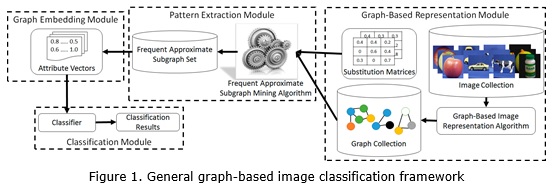
<body><![CDATA[<br>       <br> </font><font size="2" face="Verdana, Arial, Helvetica, sans-serif"> </font><font size="2" face="Verdana, Arial, Helvetica, sans-serif"> As we intimated above, in  classification tasks, images can be represented as graphs describing their  structural and topological characteristics (Morales and Garc&iacute;a <em>et al.,</em> 2011). Thus, the classification  framework introduced in the works reviewed in this section is based on FAS  mining, this framework is described in <a href="#f01">figure 1</a>. The classification process  starts at the graph-based representation module, where a pre-labeled image set  is represented as a graph collection, and the substitution matrices are built.  Next, in the pattern extraction module, a FAS mining algorithm (VEAM) is  applied for computing the frequent patterns of this graph collection. Later, in  the graph embedding module, the computed FASs are used to build attribute  vectors for representing the images. Finally, in the classification module,  these vectors are used as input for traditional classifiers.</font></p>     <p align="center"><a name="f01"></a><img src="/img/revistas/rcci/v9n1/f0101115.jpg" width="554" height="190"></p>     <p>&nbsp;</p>     <p><font size="3"><strong><font face="Verdana, Arial, Helvetica, sans-serif">RESULTS AND DISCUSSION</font></strong></font></p>     <p><font size="2" face="Verdana, Arial, Helvetica, sans-serif">The first advances applying  FAS mining in image classification were achieved in synthetic datasets obtained  from a random image generator, and the obtained results show the effectiveness  of the proposal (Acosta <em>et al.,</em> 2012b) and motivated further research. These promising scores were achieved by  VEAM, because its graph approximation criterion properly considers the range of  variations between objects in the same class. More recently, good classification  results (in terms of <em>Accuracy</em> and <em>F-measure</em> metrics) were achieved using  similar graph-based image classification frameworks on several real image  collections such as: <em>GREC </em>(<a href="http://www.iam.unibe.ch/fki/databases/">http://www.iam.unibe.ch/fki/databases/</a>), <em>COIL-100 </em>(<a href="http://www.cs.columbia.edu/CAVE/databases/">http://www.cs.columbia.edu/CAVE/databases/</a>)  and <em>ETH-80</em> (<a href="https://www.d2.mpi-inf.mpg.de/datasets/">https://www.d2.mpi-inf.mpg.de/datasets/</a>).  These collections have a higher level of complexity than synthetic datasets;  see the results reported in (Acosta <em>et  al.,</em> 2012a, Acosta <em>et al.,</em> 2012c,  Morales <em>et al.,</em> 2014).</font>    <br>       <br>   <font size="2" face="Verdana, Arial, Helvetica, sans-serif">In these works, the patterns  computed by VEAM are better for classification tasks than those computed by  exact graph miners. However, the number of patterns computed by VEAM is high  when the support and similarity thresholds are low. In most of the cases, many  of the computed FASs do not provide relevant information. Thence, a selection  module was included in (Acosta <em>et al.,</em> 2013) with the aim of reducing the cardinality of the FAS set used for  classification. In this work, the modified framework uses only representative  FAS subsets as attributes, achieving better classification results, reducing  the attribute space by the use of already known attribute selection algorithms  such as: information gain, chi-square, and gain ratio feature evaluation. This  fact allowed an increase in the efficiency and efficacy regarding previous  contributions which use the complete set of FASs. On the other hand, in  contribution (Acosta <em>et al.,</em> 2012c),  a way for automatically computing substitution matrices based on image features  is proposed; in this way good results are achieved. Later, this contribution is  extended in (Morales <em>et al.,</em> 2014),  where a criterion for selecting the similarity threshold for the mining step is  also suggested. These proposals are key steps for the classification approach based  on FAS mining, since these parameters are difficult to be fixed by the user. In  <a href="/img/revistas/rcci/v9n1/t0101115.jpg" target="_blank">table 1</a>, the main characteristics of the aforementioned contributions are  summarized.</font></p>     <p><font size="2" face="Verdana, Arial, Helvetica, sans-serif">It is important to highlight  that the proposed frameworks can be applied in different domains where the  objects under study can be represented as graphs, for example: conceptual maps,  ontology, semantic and social networks, Web community analysis, and text  classification.</font></p>     <p>&nbsp;</p>     ]]></body>
<body><![CDATA[<p><font size="3"><strong><font face="Verdana, Arial, Helvetica, sans-serif">CONCLUSIONS</font></strong></font></p>     <p><font size="2" face="Verdana, Arial, Helvetica, sans-serif">In this paper, the  usefulness of considering semantic distortions between graph labels, preserving  the topology, is summarized by means of analyzing some recently proposed image  classification approaches, based on frequent approximate subgraph (<em>FAS</em>) mining. The reported results show  good behavior in some artificial and real world image collections, improving  the classification accuracy regarding other state-of-the-art solutions. The  accuracy in these kinds of tasks was also increased by reducing the set of FASs  by applying feature selection algorithms. Thus, a considerable dimensionality  reduction is achieved, which improves efficiency of the classification stage;  while efficacy is not affected. On the other hand, with the aim of proposing  more robust frameworks for image classification, in the most recent  contributions, a strategy to automatically determine the similarity threshold  and the substitution matrices have also been introduced.    <br> Based on the results by  applying feature selection, as future work, we are going to study the  identification of only a subset of representative subgraphs specifically only  emerging patterns. In this way, we believe that the effectiveness of FAS  classifiers will be improved, reducing the runtime classifier at training  stage.</font></p>     <p>&nbsp;</p>     <p><b><font size="3" face="Verdana, Arial, Helvetica, sans-serif">REFERENCES</font></b></p>     <p><font size="2" face="Verdana, Arial, Helvetica, sans-serif">ACOSTA, M, N.; GAGO, A, A.;  CARRASCO, O, J.A.; MART&Iacute;NEZ, T, J.F. AND MEDINA, P, J.E. Feature Space  Reduction for Graph-Based Image Classification. In Proceedings of the CIARP&rsquo;13,  volume Part I, LNCS 8258, pages 246-253, Havana, Cuba, 2013. Springer-Verlag  Berlin Heidelberg.</font></p>     <!-- ref --><p><font size="2" face="Verdana, Arial, Helvetica, sans-serif">ACOSTA, M, N.; GAGO, A, A. AND MEDINA, P, J.E. Clasificai&oacute;n de im&aacute;genes utilizando  miner&iacute;a de subgrafos frecuentes aproximados. Revista  Cubana de Ciencias Inform&aacute;ticas (RCCI), 5(4):1-10, 2012a.    <br>       <br>   ACOSTA, M, N.; GAGO, A, A. AND MEDINA, P, J.E. Frequent approxi-mate subgraphs  as features for graph-based image classification. Knowledge-Based Systems,  27:381&ndash;392, 2012b.    <br>       ]]></body>
<body><![CDATA[<br>   ACOSTA, M, N.; MORALES, G, A.; GAGO, A, A.; GARC&Iacute;A, R, E.B. AND MEDINA, P, J.E.  Classification using frequent approximate subgraphs. In Proceedings of the  CIARP&rsquo;12, volume LNCS 7441, pages 292&ndash;299. Buenos Aires, Argentina,  Springer-Verlag Berlin Heidelberg, 2012c.    <br>       <!-- ref --><br>   JIANG, C.; COENEN, F. AND ZITO, M. A survey of frequent subgraph mining  algorithms. Knowledge Engineering Review, 2012.    <br>       <!-- ref --><br>   MORALES, G, A.; ACOSTA, M,  N.; GAGO, A, A.; GARC&Iacute;A, R, E.B. AND MEDINA, P, J.E. A new proposal for  graph-based image classification using frequent approximate subgraphs. Pattern  Recognition, 47(1):169-177, 2014.    <br>       <!-- ref --><br> MORALES, G, A. AND GARC&Iacute;A,  R, E.B. Simple object recognition based on spatial relations and visual  features represented using irregular pyramids. Multimedia Tools and  Applications, pages 1-23, 2011.     </font></p>     <p>&nbsp;</p>     <p>&nbsp;</p>     ]]></body>
<body><![CDATA[<p><font size="2" face="Verdana, Arial, Helvetica, sans-serif">Recibido: 12/09/2014     <br>   Aceptado: 19/01/2015</font></p>      ]]></body><back>
<ref-list>
<ref id="B1">
<nlm-citation citation-type="book">
<person-group person-group-type="author">
<name>
<surname><![CDATA[ACOSTA]]></surname>
<given-names><![CDATA[M, N]]></given-names>
</name>
<name>
<surname><![CDATA[GAGO]]></surname>
<given-names><![CDATA[A, A]]></given-names>
</name>
<name>
<surname><![CDATA[CARRASCO, O]]></surname>
<given-names><![CDATA[J.A]]></given-names>
</name>
<name>
<surname><![CDATA[MARTÍNEZ, T]]></surname>
<given-names><![CDATA[J.F]]></given-names>
</name>
<name>
<surname><![CDATA[MEDINA, P]]></surname>
<given-names><![CDATA[J.E]]></given-names>
</name>
</person-group>
<source><![CDATA[Feature Space Reduction for Graph-Based Image Classification]]></source>
<year>2013</year>
<page-range>246-253</page-range><publisher-loc><![CDATA[Havana ]]></publisher-loc>
<publisher-name><![CDATA[Springer-Verlag Berlin Heidelberg]]></publisher-name>
</nlm-citation>
</ref>
<ref id="B2">
<nlm-citation citation-type="">
<person-group person-group-type="author">
<name>
<surname><![CDATA[ACOSTA]]></surname>
<given-names><![CDATA[M, N]]></given-names>
</name>
<name>
<surname><![CDATA[GAGO]]></surname>
<given-names><![CDATA[A, A]]></given-names>
</name>
<name>
<surname><![CDATA[MEDINA, P]]></surname>
<given-names><![CDATA[J.E]]></given-names>
</name>
</person-group>
<article-title xml:lang="es"><![CDATA[Clasificaión de imágenes utilizando minería de subgrafos frecuentes aproximados]]></article-title>
<source><![CDATA[]]></source>
<year>2012</year>
<month>a</month>
<volume>5</volume>
<numero>4</numero>
<issue>4</issue>
<page-range>1-10</page-range></nlm-citation>
</ref>
<ref id="B3">
<nlm-citation citation-type="">
<person-group person-group-type="author">
<name>
<surname><![CDATA[ACOSTA]]></surname>
<given-names><![CDATA[M, N]]></given-names>
</name>
<name>
<surname><![CDATA[GAGO]]></surname>
<given-names><![CDATA[A, A]]></given-names>
</name>
<name>
<surname><![CDATA[MEDINA, P]]></surname>
<given-names><![CDATA[J.E]]></given-names>
</name>
</person-group>
<article-title xml:lang="en"><![CDATA[Frequent approxi-mate subgraphs as features for graph-based image classification.]]></article-title>
<source><![CDATA[]]></source>
<year>2012</year>
<month>b</month>
<volume>27</volume>
<page-range>381-392</page-range></nlm-citation>
</ref>
<ref id="B4">
<nlm-citation citation-type="book">
<person-group person-group-type="author">
<name>
<surname><![CDATA[ACOSTA]]></surname>
<given-names><![CDATA[M, N]]></given-names>
</name>
<name>
<surname><![CDATA[MORALES]]></surname>
<given-names><![CDATA[G, A]]></given-names>
</name>
<name>
<surname><![CDATA[GAGO]]></surname>
<given-names><![CDATA[A, A]]></given-names>
</name>
<name>
<surname><![CDATA[GARCÍA, R]]></surname>
<given-names><![CDATA[E.B]]></given-names>
</name>
<name>
<surname><![CDATA[MEDINA, P]]></surname>
<given-names><![CDATA[J.E]]></given-names>
</name>
</person-group>
<source><![CDATA[Classification using frequent approximate subgraphs]]></source>
<year>2012</year>
<month>c</month>
<page-range>292-299</page-range><publisher-loc><![CDATA[^eBuenos Aires Buenos Aires]]></publisher-loc>
<publisher-name><![CDATA[Springer-Verlag Berlin Heidelberg]]></publisher-name>
</nlm-citation>
</ref>
<ref id="B5">
<nlm-citation citation-type="book">
<person-group person-group-type="author">
<name>
<surname><![CDATA[JIANG]]></surname>
<given-names><![CDATA[C]]></given-names>
</name>
<name>
<surname><![CDATA[COENEN]]></surname>
<given-names><![CDATA[F]]></given-names>
</name>
<name>
<surname><![CDATA[ZITO]]></surname>
<given-names><![CDATA[M]]></given-names>
</name>
</person-group>
<source><![CDATA[A survey of frequent subgraph mining algorithms.]]></source>
<year>2012</year>
<publisher-name><![CDATA[Knowledge Engineering Review]]></publisher-name>
</nlm-citation>
</ref>
<ref id="B6">
<nlm-citation citation-type="book">
<person-group person-group-type="author">
<name>
<surname><![CDATA[MORALES]]></surname>
<given-names><![CDATA[G, A]]></given-names>
</name>
<name>
<surname><![CDATA[ACOSTA]]></surname>
<given-names><![CDATA[M, N]]></given-names>
</name>
<name>
<surname><![CDATA[GAGO]]></surname>
<given-names><![CDATA[A, A]]></given-names>
</name>
<name>
<surname><![CDATA[GARCÍA, R]]></surname>
<given-names><![CDATA[E.B]]></given-names>
</name>
<name>
<surname><![CDATA[MEDINA, P]]></surname>
<given-names><![CDATA[J.E]]></given-names>
</name>
</person-group>
<article-title xml:lang="en"><![CDATA[A new proposal for graph-based image classification using frequent approximate subgraphs]]></article-title>
<source><![CDATA[]]></source>
<year>2014</year>
<volume>47</volume>
<numero>1</numero>
<issue>1</issue>
<page-range>169-177</page-range><publisher-name><![CDATA[Pattern Recognition]]></publisher-name>
</nlm-citation>
</ref>
<ref id="B7">
<nlm-citation citation-type="book">
<person-group person-group-type="author">
<name>
<surname><![CDATA[MORALES]]></surname>
<given-names><![CDATA[G, A]]></given-names>
</name>
<name>
<surname><![CDATA[GARCÍA, R]]></surname>
<given-names><![CDATA[E.B]]></given-names>
</name>
</person-group>
<source><![CDATA[Simple object recognition based on spatial relations and visual features represented using irregular pyramids.]]></source>
<year>2011</year>
<page-range>1-23</page-range><publisher-name><![CDATA[Multimedia Tools and Applications]]></publisher-name>
</nlm-citation>
</ref>
</ref-list>
</back>
</article>
