<?xml version="1.0" encoding="ISO-8859-1"?><article xmlns:mml="http://www.w3.org/1998/Math/MathML" xmlns:xlink="http://www.w3.org/1999/xlink" xmlns:xsi="http://www.w3.org/2001/XMLSchema-instance">
<front>
<journal-meta>
<journal-id>2227-1899</journal-id>
<journal-title><![CDATA[Revista Cubana de Ciencias Informáticas]]></journal-title>
<abbrev-journal-title><![CDATA[Rev cuba cienc informat]]></abbrev-journal-title>
<issn>2227-1899</issn>
<publisher>
<publisher-name><![CDATA[Editorial Ediciones Futuro]]></publisher-name>
</publisher>
</journal-meta>
<article-meta>
<article-id>S2227-18992017000300001</article-id>
<title-group>
<article-title xml:lang="es"><![CDATA[The analysis of approaches to identify people with digital images in the task of ensuring public safety]]></article-title>
<article-title xml:lang="en"><![CDATA[El análisis de enfoques para identificar a las personas en imágenes digitales para la tarea de garantizar la seguridad pública]]></article-title>
</title-group>
<contrib-group>
<contrib contrib-type="author">
<name>
<surname><![CDATA[Samoylov]]></surname>
<given-names><![CDATA[Alexey]]></given-names>
</name>
<xref ref-type="aff" rid="A01"/>
</contrib>
<contrib contrib-type="author">
<name>
<surname><![CDATA[Kucherov]]></surname>
<given-names><![CDATA[Sergey]]></given-names>
</name>
<xref ref-type="aff" rid="A01"/>
</contrib>
</contrib-group>
<aff id="A01">
<institution><![CDATA[,Engineering and Technological Academy of the Southern Federal University Institute of Computer Technology and Information Security ]]></institution>
<addr-line><![CDATA[ ]]></addr-line>
</aff>
<pub-date pub-type="pub">
<day>00</day>
<month>09</month>
<year>2017</year>
</pub-date>
<pub-date pub-type="epub">
<day>00</day>
<month>09</month>
<year>2017</year>
</pub-date>
<volume>11</volume>
<numero>3</numero>
<fpage>01</fpage>
<lpage>08</lpage>
<copyright-statement/>
<copyright-year/>
<self-uri xlink:href="http://scielo.sld.cu/scielo.php?script=sci_arttext&amp;pid=S2227-18992017000300001&amp;lng=en&amp;nrm=iso"></self-uri><self-uri xlink:href="http://scielo.sld.cu/scielo.php?script=sci_abstract&amp;pid=S2227-18992017000300001&amp;lng=en&amp;nrm=iso"></self-uri><self-uri xlink:href="http://scielo.sld.cu/scielo.php?script=sci_pdf&amp;pid=S2227-18992017000300001&amp;lng=en&amp;nrm=iso"></self-uri><abstract abstract-type="short" xml:lang="en"><p><![CDATA[ABSTRACT One of the key areas of interdisciplinary research is to ensure public safety. In order to solve a number of problems within this area, information technology can be effectively used and, in particular, an automated pattern recognition technology and identification of objects on digital images. There are additional problems in object identification processes besides eliminating the influence of ambient light, angle, items of clothing and headgear. To ensure the applicability of recognition approach to public security issues it must meet requirements of the high processing speed, the replenishment capabilities on-the-fly list of known images, and the low computational complexity of algorithms. The article deals with the main approaches to the recognition and identification of objects on digital images based on statistical approaches, as well as neural network models. Finding their basic features and principles and providing a brief description of each method. A consideration is made in terms of the application for the problems of public safety, in which it is important the speed of the identification of the object, the ability to quickly learn new images and simultaneously processing a group of input pictures. The analysis of existing approaches showed that none of them satisfy at least one problem defined by the domain of public safety.]]></p></abstract>
<abstract abstract-type="short" xml:lang="es"><p><![CDATA[RESUMEN Una de las áreas clave de la investigación interdisciplinaria es asegurar la seguridad pública. Con el fin de resolver una serie de problemas dentro de esta área, la tecnología de la información puede ser utilizada eficazmente y en particular, el reconocimiento de patrones automatizado y de identificación de objetos en imágenes digitales. Existen problemas adicionales en los procesos de identificación de objetos además de eliminar la influencia de la luz ambiental, el ángulo, las prendas de vestir y sombrerería. Para garantizar la aplicabilidad del enfoque de reconocimiento a las cuestiones de seguridad pública, debe satisfacer los requisitos de la alta velocidad de procesamiento, la capacidad de reabastecimiento en la lista de las imágenes conocidas y la baja complejidad computacional de los algoritmos. El artículo aborda los principales enfoques para el reconocimiento e identificación de objetos sobre imágenes digitales basados &#8203;&#8203;en enfoques estadísticos, así como modelos de redes neuronales. Encontrando sus características básicas, principios y proporcionando una breve descripción de cada método. Se tiene en cuenta la aplicación de los problemas de seguridad pública, en la que es importante la velocidad de identificación del objeto, la capacidad de aprender rápidamente nuevas imágenes y procesar simultáneamente un grupo de imágenes de entrada. El análisis de los enfoques existentes mostró que ninguno de ellos satisface al menos un problema definido por el dominio de la seguridad]]></p></abstract>
<kwd-group>
<kwd lng="en"><![CDATA[object identification]]></kwd>
<kwd lng="en"><![CDATA[pattern recognition]]></kwd>
<kwd lng="en"><![CDATA[photometry]]></kwd>
<kwd lng="en"><![CDATA[public security]]></kwd>
<kwd lng="es"><![CDATA[identificación de objetos]]></kwd>
<kwd lng="es"><![CDATA[reconocimiento de patrones]]></kwd>
<kwd lng="es"><![CDATA[fotometría]]></kwd>
<kwd lng="es"><![CDATA[seguridad pública]]></kwd>
</kwd-group>
</article-meta>
</front><body><![CDATA[ <p align="right"><font face="Verdana, Arial, Helvetica, sans-serif" size="2"><B>ART&Iacute;CULO  ORIGINAL</B></font></p>     <p>&nbsp;</p>     <p><font size="4"><strong><font face="Verdana, Arial, Helvetica, sans-serif">The analysis of  approaches to identify people with digital images in the task of ensuring  public safety</font></strong></font></p>     <p>&nbsp;</p>     <p><font size="3"><strong><font face="Verdana, Arial, Helvetica, sans-serif">El an&aacute;lisis de enfoques  para identificar a las personas en im&aacute;genes digitales para la tarea de  garantizar la seguridad p&uacute;blica</font></strong></font></p>     <p>&nbsp;</p>     <p>&nbsp;</p>     <P><font size="2"><strong><font face="Verdana, Arial, Helvetica, sans-serif">Alexey Samoylov<strong><sup>1*</sup></strong>, Sergey Kucherov<strong><sup>1</sup></strong></font></strong></font></p>     <p><font size="2" face="Verdana, Arial, Helvetica, sans-serif"><sup>1</sup></font><font size="2" face="Verdana, Arial, Helvetica, sans-serif">Institute of Computer Technology and Information Security, Engineering  and Technological Academy of the Southern Federal University, Taganrog, Russia,  347922, Russian Federation, Taganrog, Chekhova str.2;  {asamoylov,skucherov}@sfedu.ru </font><font size="2"></font> <font size="2" face="Verdana, Arial, Helvetica, sans-serif">    <br> </font></p>     ]]></body>
<body><![CDATA[<P><font face="Verdana, Arial, Helvetica, sans-serif"><span class="class"><font size="2">*Correspondence to: </font></span></font><font size="2" face="Verdana, Arial, Helvetica, sans-serif"> <a href="mailto:jova@uci.cu">asamoylov@sfedu.ru </a></font><font face="Verdana, Arial, Helvetica, sans-serif"><a href="mailto:losorio@ismm.edu.cu"></a> </font>     <p>&nbsp;</p>     <p>&nbsp;</p> <hr>     <P><font size="2" face="Verdana, Arial, Helvetica, sans-serif"><b>ABSTRACT</b> </font>     <p><font size="2" face="Verdana, Arial, Helvetica, sans-serif">One of the key areas of interdisciplinary  research is to ensure public safety. In order to solve a number of problems  within this area, information technology can be effectively used and, in  particular, an automated pattern recognition technology and identification of  objects on digital images. There are additional problems in object  identification processes besides eliminating the influence of ambient light,  angle, items of clothing and headgear. To ensure the applicability of  recognition approach to public security issues it must meet requirements of the  high processing speed, the replenishment capabilities on-the-fly list of known  images, and the low computational complexity of algorithms. The article deals  with the main approaches to the recognition and identification of objects on  digital images based on statistical approaches, as well as neural network  models. Finding their basic features and principles and providing a brief  description of each method. A consideration is made in terms of the application  for the problems of public safety, in which it is important the speed of the  identification of the object, the ability to quickly learn new images and  simultaneously processing a group of input pictures. The analysis of existing  approaches showed that none of them satisfy at least one problem defined by the  domain of public safety.</font></p>     <p><font size="2" face="Verdana, Arial, Helvetica, sans-serif"><b>Key words<span lang=EN-GB>:</span></b></font> <font size="2" face="Verdana, Arial, Helvetica, sans-serif">object identification, pattern recognition,  photometry, public security</font></p> <hr>     <p><font size="2" face="Verdana, Arial, Helvetica, sans-serif"><b>RESUMEN</b></font></p>     <p><font size="2" face="Verdana, Arial, Helvetica, sans-serif">Una de  las &aacute;reas clave de la investigaci&oacute;n interdisciplinaria es asegurar la seguridad  p&uacute;blica. Con el fin de resolver una serie de problemas dentro de esta &aacute;rea, la  tecnolog&iacute;a de la informaci&oacute;n puede ser utilizada eficazmente y en particular, el  reconocimiento de patrones automatizado  y de identificaci&oacute;n de objetos en im&aacute;genes digitales.  Existen problemas adicionales en los procesos de identificaci&oacute;n de objetos  adem&aacute;s de eliminar la influencia de la luz ambiental, el  &aacute;ngulo, las prendas  de vestir y sombrerer&iacute;a.    <br> Para garantizar la aplicabilidad del enfoque de reconocimiento a las cuestiones  de seguridad p&uacute;blica, debe satisfacer los requisitos de la alta velocidad de  procesamiento, la capacidad de reabastecimiento en la lista de las im&aacute;genes  conocidas y la baja complejidad computacional de los algoritmos. El art&iacute;culo  aborda los principales enfoques para el reconocimiento e identificaci&oacute;n de  objetos sobre im&aacute;genes digitales basados &#8203;&#8203;en enfoques estad&iacute;sticos, as&iacute; como  modelos de redes neuronales. Encontrando sus caracter&iacute;sticas b&aacute;sicas, principios y  proporcionando una breve descripci&oacute;n de cada m&eacute;todo. Se tiene en cuenta la  aplicaci&oacute;n de los problemas de seguridad p&uacute;blica, en la que es importante la  velocidad de identificaci&oacute;n del objeto, la capacidad de aprender r&aacute;pidamente  nuevas im&aacute;genes y procesar simult&aacute;neamente un grupo de im&aacute;genes de entrada. El  an&aacute;lisis de los enfoques existentes mostr&oacute; que ninguno de ellos satisface al  menos un problema definido por el dominio de la seguridad</font></p>     <p><font size="2" face="Verdana, Arial, Helvetica, sans-serif"><b>Palabras clave<span lang=EN-GB>: </span></b>identificaci&oacute;n  de objetos, reconocimiento de patrones, fotometr&iacute;a, seguridad p&uacute;blica</font></p> <hr>     ]]></body>
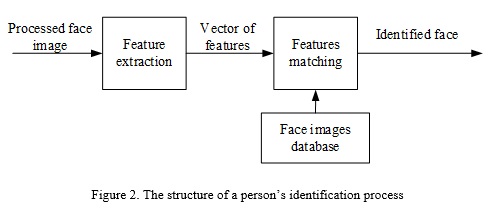
<body><![CDATA[<p>&nbsp;</p>     <p>&nbsp;</p>     <p><font size="3" face="Verdana, Arial, Helvetica, sans-serif"><b>INTRODUCTION</b></font></p>     <p><font size="2" face="Verdana, Arial, Helvetica, sans-serif">Nowadays interest in the automated recognition and  identification of people are caused by several factors. A wide range of tasks,  from security of mass events to protective and criminalistics needs, encourages  researchers around the world to search for new algorithms of people&rsquo;s  recognition and identification on the digital images. In addition, the  development of hardware and software technologies of photometry (Samoylov,  2014), and pre-capture and processing images increases the reliability of the  solutions.</font></p>     <p><font size="2" face="Verdana, Arial, Helvetica, sans-serif">One of the priority tasks for Russian Federation is to  ensure public safety, targeting aspects set out in the Concept approved by the  President of the Russian Federation (Public security concept,  2013). Computer-aided detection and identification systems in this context it  can be used to identify wanted people in a crowd. In crowded places (railway  stations, airports, meetings, concerts, etc.) special requirements for the  speed and quality of decisions in recognition tasks are formed. It is not always possible  to use the existing hardware and software systems and algorithms.</font></p>     <p><font size="2" face="Verdana, Arial, Helvetica, sans-serif">This paper presents  the analysis of existing categories of methods for recognition and  identification of objects in digital images in terms of their applicability in the  field of public safety.</font></p>     <p><font face="Verdana, Arial, Helvetica, sans-serif"><strong><font size="2">Common principles for recognition and identification </font></strong></font></p> <font size="2" face="Verdana, Arial, Helvetica, sans-serif">Today a wide range of  methods for solving the problems of recognition and identification exists.  Regardless of the specific approach, it is possible to identify common  structures of identification processes on digital images (<a href="/img/revistas/rcci/v11n3/f0101317.jpg" target="_blank">Fig. 1</a>).</font>     <p><font size="2" face="Verdana, Arial, Helvetica, sans-serif">The input data for identification systems is a digital  photo and video. In the first phase of the identification procedure, the  determination and the localization of the person's face in the picture are  executed. The desired output parameter set is provided for further pre-treatment.  Further, the pre-treatment stage is carried out. On this stage, the geometric  and brightness alignment of the face image is produced. Today, these two tasks  can be considered as trivial, because of the existing algorithms, which are  used to implement the decisions of the person localization tasks and  pre-processing successfully runs on mobile devices with low performance  compared to conventionally, used in the calculation and analytical tasks of  computing systems.</font></p>     <p><font size="2" face="Verdana, Arial, Helvetica, sans-serif">The main difficulty today  continues to be the face identification task (<a href="#f02">Fig. 2</a>). The challenge lies in  the variability in a real application of key parameters used for identification  (perspective, lighting, etc.). For this reason the overwhelming majority of  existing methods are focused and differ in approaches to the calculating  features and to the comparison of feature sets against each other.</font></p>     <p align="center"><img src="/img/revistas/rcci/v11n3/f0201317.jpg" alt="f02" width="498" height="219"><a name="f02"></a></p>     ]]></body>
<body><![CDATA[<p><font size="2" face="Verdana, Arial, Helvetica, sans-serif">According to  Figure 2, the process of identification may be described as follows:</font></p>     <p><font size="2" face="Verdana, Arial, Helvetica, sans-serif">1. The person's face processed for the further  analysis is subjected to feature extraction. Each specific approach to solve  the problem of feature extraction is to perform a series of complex  calculations and to solve optimization problems depending on the method: graphs,  vectors, matrixes, and other ways of representing are used.     <br>   2. The resulting set of object features (which is  usually represented by a vector) is used to search the database of photographic  portraits of the known feature vectors. The problem of finding the conformity  of known and received features with the minimization of compliance with the  objective function&rsquo;s solving. The objective function is determined as deviation  of resulting vector features from the feature vector that is in the database.</font></p>     <p><font size="2" face="Verdana, Arial, Helvetica, sans-serif">As a result, we have the  answer on the coincidence (or mismatch) of the object in the digital image with  objects from a database. In addition, the inverse problem can be solved, in  which for the specified object from the database (for example, suspected  person) we search for a matching in digital images from cameras.</font></p>     <p><font size="2" face="Verdana, Arial, Helvetica, sans-serif"><a><strong>The analysis of existing approaches for  recognition and identification</strong></a></font></p>     <p><font size="2"><a><font face="Verdana, Arial, Helvetica, sans-serif">The most  difficult case of raising the problem of identification is to work in a highly  changing environment, with a large flow of input data (work on city streets  with heavy traffic, subways, airports and so on). To solve such problems it is  necessary to use the maximum available information in order to achieve  satisfactory identification results.</font></a></font></p>     <p><font size="2" face="Verdana, Arial, Helvetica, sans-serif">The  identification algorithm must be able to effectively cut off the static and  slowly changing facilities, work in different lighting conditions, identify the  human figure from different angles, to track the movement of many people and  automatically choose the moment that is suitable to perform the identification  of the person. To provide such opportunities an algorithm requires a certain  equipment - cameras with high resolution and good optics to provide greater  range of reliable identification. </font></p>     <p><font size="2" face="Verdana, Arial, Helvetica, sans-serif">The  problem of determining the fact of human presence on the image requires from an  algorithm a certain level of intelligence. It should not be a system that  responds to the simple fact of scene changes. A human detection algorithm must  not give false alarms at light changes, moving shadows from static objects, at  the appearance of animals in control zone etc. </font></p>     <p><font size="2" face="Verdana, Arial, Helvetica, sans-serif">The  choice of algorithm used for identification of a person in the image of his  face, also depends on the specific conditions of its use. For example, a  recognition problem in a strictly limited team easily handles multi-layer  neural network. At the same time, the problem of detecting a concrete person in  a crowd (with undefined composition) requires much more sophisticated  techniques for reducing false alarms. Most likely, in this case, we need a  multi-level system comprising a plurality of analyzers, working in different  feature space, with the decision by voting. In initial stages of the identification,  system should cut obviously unsuitable candidates and use the remaining set of  candidates for a final decision on the identification.</font></p>     <p><font size="2" face="Verdana, Arial, Helvetica, sans-serif">Next,  the key features of the person identification problem and basic methods  currently used to solve it in the construction of machine vision systems will  be considered.</font></p>     ]]></body>
<body><![CDATA[<p><font size="2" face="Verdana, Arial, Helvetica, sans-serif"><em>The  method of flexible comparison on graphs </em>(Zafeiriou  et. al., 2011) is based on the elastic graphs comparison describing  the objects in the image. To solve the problem of recognition it creates the  reference graph, which is static and describes the known object. The second  graph is deformed for the purpose of adjusting to the original static. For this  case, the weighted edges and vertices are applied. </font></p>     <p><font size="2" face="Verdana, Arial, Helvetica, sans-serif">Characteristic values are  calculated in vertices of the graph, often on the base of Gabor's filter or  their Gabor wavelet (Lades et.al., 1993).  Graph edges are assigned with a weight according to the distance to the  adjacent vertices. The distance between the static and deformable graphs  calculated using the deformation of the objective function, taking into account  the difference between the characteristic values &#8203;&#8203;based on the calculated  peaks and the extent of deformation of edges. The value of the deformation  function is a measure of the difference between the input image of the object  and reference graph describing the known object in system. Detection is  performed by searching the best values &#8203;&#8203;of the deformation function. </font></p>     <p><font size="2" face="Verdana, Arial, Helvetica, sans-serif">This method has a high  recognition rates - above 80% (Zafeiriou et. al., 2011) when changing the face angle to 15 degrees. However,  it does not provide any means of prior restraint of the list of objects to  match, so a number of its main drawbacks are the high computational complexity (Briljuk  et.al., 2002), which is connected with the  necessity of comparison of the input image with all known.</font></p>     <p><font size="2" face="Verdana, Arial, Helvetica, sans-serif"><em>Recognition  and identification systems on the base of neural network </em>allow  to classify applied to the input image of the object in accordance with prior  instruction in the set of known objects. The essence of a network training  comes down to setting the scale of interneuron connections in the process of  solving the optimization problem of steepest descent method. </font></p>     <p><font size="2" face="Verdana, Arial, Helvetica, sans-serif">The best results in the field  of face recognition were showed by convolutional neural network (Lawrence,  2007; Khalajzadeh, 2007), which distinctive features  are local receptor fields, general weights and the hierarchical organization of  spatial sampling. This network is the most resistant to changes in the input  data (scale, perspective, lighting) (Duffner, 2008).  Methods of recognition based on neural networks are the most effective in terms  of the task. However, a major limitation on their use is the learning  procedure. All known methods of neural network based on the use of a fixed set  of standards for teaching that when a new object in the database requires a  complete re-education. In actual practice this results in downtime from one  hour to several days. </font></p>     <p><font size="2" face="Verdana, Arial, Helvetica, sans-serif"><em>Hidden  Markov model </em>(Dvojnoj,2013; Gul'tjaeva, 2006) is a statistical  pattern recognition method based on the use of statistical and spatial  properties of the signal characteristics. As element of the model it uses two  types of states (the hidden and observable), the matrix of transition  probabilities and initial state probabilities. Object recognition process is  based on the principle of maximum probability of generating search observing  sequence corresponding Markov model from a database of known objects.</font></p>     <p><font size="2" face="Verdana, Arial, Helvetica, sans-serif">Markov models allow us to  solve the inverse problem of finding objects in the image on the model, since  it increases the response of the image on your model. At the same time, they  are considered as not discriminating, since in addition to maximizing its response model images does not occur on other responses minimize. </font></p>     <p><font size="2" face="Verdana, Arial, Helvetica, sans-serif"><em>The  method of principal component </em>uses Pearson's  method (Pearson, 1901) to reduce the space  based features on the Karhunen-Loeve transformation (Kuharev,2010).  With it, objects are presented in the form of low-dimensional vectors (vectors  of principal components), which significantly speeds up the processing process.  The principle is similar to other statistical methods, in which an input vector  is compared with the existing image in the database. The main purpose of  principal component method is minimizing the number of features so that they  can be better describe &quot;typical&quot; images belonging to the set of  objects. The method is one of the most used in practice, but it is sensitive to  changes in facial expression or illumination. Its modification proposed in (Belhumeur,  1997), gives a better result, but the high labor intensity  of calculating a set of vector features making it unusable for the assigned  task.</font></p>     <p><font size="2" face="Verdana, Arial, Helvetica, sans-serif"><em>Active appearance models </em>are statistical  models of images (Cootes, 1998), bringing to the real image of the object by  the deformation of different nature (Baker, 2003). These models use two types  of parameters: parameters of shape and appearance parameters. Initially we must  made training of models on the set of pre-marked images. Marked images produced  manually or semi-automatically. Active appearance models effectively solve the  problem of identifying features from the images, but do not provide algorithms for  identification and comparison of identified features with reference to the  database by themselves. For this reason, in pure form, this approach for  solving the assigned problem is not applicable. There are also problems with  the computational complexity, but some partial solutions have been proposed (Matthews,  2004).</font></p>     <p>&nbsp;</p>     ]]></body>
<body><![CDATA[<p><font face="Verdana, Arial, Helvetica, sans-serif" size="3"><B>CONCLUSIONS</B></font></p>     <p><font size="2" face="Verdana, Arial, Helvetica, sans-serif">Methods considered in the  paper have sufficient detection performance under specified conditions. The  most effective method in terms of combating bad lighting, camera angle, etc.  changes are neural networks and active appearance models.</font></p>     <p><font size="2" face="Verdana, Arial, Helvetica, sans-serif">However, the main feature of  solving public safety problems with the use of the systems of recognition and  identification of objects on digital images, is the need to minimize the cost  (time and computing) to recognize, as well as reducing the complexity of the  system training on new images. From this standpoint, the existing methods may  be considered as inapplicable in whole or partially applicable.</font></p>     <p><font size="2" face="Verdana, Arial, Helvetica, sans-serif">In  order to achieve the best combination of recognition quality and system  training time following hypothesis can be put forward - a combination of  existing methods and simultaneous use of modern bioinspired methods for solving  subtasks of optimization, the founding of matching would  achieve the desired level of performance, learning time and the quality of the  digital images of the person's identification.</font></p>     <p>&nbsp;</p>     <p align="left"><font face="Verdana, Arial, Helvetica, sans-serif" size="3"><B>REFERENCIAS    BIBLIOGR&Aacute;FICAS</B></font>     <!-- ref --><p><font size="2" face="Verdana, Arial, Helvetica, sans-serif">SAMOYLOV, A. The method  of constructing the structures of configurable automated system for measuring  volume of roundwood // WIT Transactions on Information and Communication  Technologies. Volume 58 VOL I, 2014, Pages 277-284</font><p><font size="2" face="Verdana, Arial, Helvetica, sans-serif"> PUBLIC SECURITY CONCEPT  in Russian Federation (approved by President 20.11.2013) // URL:  http://kremlin.ru/acts/news/19653</font></p>     <p><font size="2" face="Verdana, Arial, Helvetica, sans-serif">STEFANOS ZAFEIRIOU,  Maria Petrou. 2.5D Elastic graph matching // Computer Vision and Image  Understanding 115 (2011) 1062&ndash;1072. <a href="https://doi.org/10.1016/j.cviu.2010.12.008" target="_blank" title="Persistent link using digital object identifier">https://doi.org/10.1016/j.cviu.2010.12.008</a> </font></p>     <!-- ref --><p><font size="2" face="Verdana, Arial, Helvetica, sans-serif">MARTIN LADES, Jan C.  Vorbruggen, Joachim Buhmann, Jorg Lange, Christoph v.d. Malsburg, Rolf P.  Wurtz, and Wolfgang Konen. Distortion Invariant Ob ject Recognition in the  Dynamic Link Architecture // IEEE transactions on computers, vol. 42, no. 3,  march 1993. p. 300-310 <a href="https://doi.org/10.1109/12.210173">https://doi.org/10.1109/12.210173</a> </font><p><font size="2" face="Verdana, Arial, Helvetica, sans-serif">BRILJUK&nbsp; D.V.,&nbsp;  Starovojtov&nbsp; V.V.&nbsp; Raspoznavanie&nbsp;  cheloveka&nbsp; po&nbsp; izobrazheniju&nbsp;  lica&nbsp; nejrosetevymi&nbsp; metodami. &ndash; Minsk, 2002. &ndash; 54 s. (Preprint /  In-t tehn. kibernetiki NAN Belarusi; &#8470; 2)</font></p>     <!-- ref --><p><font size="2" face="Verdana, Arial, Helvetica, sans-serif">S. LAWRENCE, C.L.  Giles, Ah Chung Tsoi, A.D. Back. Face recognition: a convolutional  neural-network approach // IEEE Transactions on Neural Networks, Volume: 8,  Issue: 1, Jan 1997. p. 98-113 <a href="https://doi.org/10.1109/72.554195">https://doi.org/10.1109/72.554195</a> </font><!-- ref --><p><font size="2" face="Verdana, Arial, Helvetica, sans-serif">KHALAJZADEH, Hurieh; MANSOURI, Mohammad; TESHNEHLAB, Mohammad. Face recognition  using convolutional neural network and simple logistic classifier. En Soft  Computing in Industrial Applications. Springer, Cham, 2014. p. 197-207.     </font></p>     <!-- ref --><p><font size="2" face="Verdana, Arial, Helvetica, sans-serif">STEFAN DUFFNER. Face image analysis with  convolutional neural networks. University of Freiburg 2008</font><!-- ref --><p><font size="2" face="Verdana, Arial, Helvetica, sans-serif">DVOJNOJ I.R. Metody  raspoznavanija izobrazhenija lica cheloveka po cvetovym priznakam i  identifikacii lichnosti na osnove skrytyh Markovskih modelej v sistemah  videonabljudenija: : dis. ... kand. tehn. nauk. Penzenskij gosudarstvennyj  tehnologicheskij universitet, Penza, 2013</font><p><font size="2" face="Verdana, Arial, Helvetica, sans-serif">GUL'TJAEVA T. A.  Primenenie skrytyh Markovskih modelej s odnomernoj topologiej k zadache  raspoznavanija lic // Rossijskaja nauchno-tehnicheskaja konferencija  &ldquo;Informatika i problema telekommunikacij&rdquo; Materialy rossijskoj  nauchno-tehnicheskoj konferencii. Novosibirsk: SibGUTI,2006. Tom I, s. 150-154.</font></p>     <p><font size="2" face="Verdana, Arial, Helvetica, sans-serif">PEARSON, K. 1901. On  lines and planes of closest fit to systems of points in space. Philosophical  Magazine 2:559-572. <a href="http://dx.doi.org/10.1080/14786440109462720">http://dx.doi.org/10.1080/14786440109462720</a> </font></p>     <p><font size="2" face="Verdana, Arial, Helvetica, sans-serif">KUHAREV, G.A. Algoritmy  dvumernogo analiza glavnyh komponent dlja zadach raspoznavanija izobrazhenij  lic / G.A. Kuharev, I.L. Shhjogoleva // Komp'juternaja optika. &ndash; 2010. &ndash; T. 34,  &#8470; 4. &ndash; S. 545-551.</font></p>     <p><font size="2" face="Verdana, Arial, Helvetica, sans-serif">PETER N. BELHUMEUR,  Joao P. Hespanha, and David J. Kriegman. Eigenfaces vs. Fisherfaces: Recognition  Using Class Specific Linear Projection // IEEE TRANSACTIONS ON PATTERN ANALYSIS  AND MACHINE INTELLIGENCE, VOL. 19, NO. 7, JULY 1997, p. 711-720 <a href="https://doi.org/10.1109/34.598228">https://doi.org/10.1109/34.598228</a> </font></p>     ]]></body>
<body><![CDATA[<p><font size="2" face="Verdana, Arial, Helvetica, sans-serif">T. COOTES, G. Edwards,  and C. Taylor. Face recognition using active appearance models. In Proceedings  of the European Conference on Computer Vision, volume 2, pages 484&ndash;498, 1998. <a href="https://doi.org/10.1007/BFb0054766">https://doi.org/10.1007/BFb0054766</a> </font></p>     <!-- ref --><p><font size="2" face="Verdana, Arial, Helvetica, sans-serif">S. BAKER, R. Gross, and  I. Matthews. Lucas-Kanade 20 years on: A unifying framework: Part 3. Technical  Report CMU-RI-TR-03-35, Carnegie Mellon University Robotics Institute, 2003.    </font></p>     <p><font size="2" face="Verdana, Arial, Helvetica, sans-serif">IAIN MATTHEWS and Simon Baker Active Appearance Models Revisited. International  Journal of Computer Vision, Vol. 60, No. 2, November, 2004, pp. 135 &mdash; 164. doi: <a href="https://doi.org/10.1023/B:VISI.0000029666.37597.d3">https://doi.org/10.1023/B:VISI.0000029666.37597.d3</a></font><font size="2"></font></p>     <p name="_ENREF_1">&nbsp;</p>     <p name="_ENREF_1">&nbsp;</p>     <p><font size="2" face="Verdana, Arial, Helvetica, sans-serif">Recibido: 02/12/2016    <br> Aceptado: 04/05/2017</font></p>      ]]></body><back>
<ref-list>
<ref id="B1">
<nlm-citation citation-type="">
<person-group person-group-type="author">
<name>
<surname><![CDATA[SAMOYLOV]]></surname>
<given-names><![CDATA[A]]></given-names>
</name>
</person-group>
<article-title xml:lang="en"><![CDATA[The method of constructing the structures of configurable automated system for measuring volume of roundwood]]></article-title>
<source><![CDATA[]]></source>
<year>2014</year>
<volume>Volume 58</volume>
<numero>VOL I</numero>
<issue>VOL I</issue>
<page-range>Pages 277-284</page-range></nlm-citation>
</ref>
<ref id="B2">
<nlm-citation citation-type="">
<collab>PUBLIC SECURITY CONCEPT</collab>
<source><![CDATA[Russian Federation]]></source>
<year>20.1</year>
<month>1.</month>
<day>20</day>
</nlm-citation>
</ref>
<ref id="B3">
<nlm-citation citation-type="">
<person-group person-group-type="author">
<name>
<surname><![CDATA[STEFANOS ZAFEIRIOU]]></surname>
<given-names><![CDATA[Maria Petrou]]></given-names>
</name>
</person-group>
<source><![CDATA[2.5D Elastic graph matching]]></source>
<year>2011</year>
<page-range>1062-1072</page-range></nlm-citation>
</ref>
<ref id="B4">
<nlm-citation citation-type="">
<person-group person-group-type="author">
<name>
<surname><![CDATA[MARTIN LADES]]></surname>
<given-names><![CDATA[Jan C]]></given-names>
</name>
<name>
<surname><![CDATA[Vorbruggen]]></surname>
<given-names><![CDATA[Joachim Buhmann]]></given-names>
</name>
<name>
<surname><![CDATA[Jorg Lange]]></surname>
<given-names><![CDATA[Christoph v.d]]></given-names>
</name>
<name>
<surname><![CDATA[Malsburg]]></surname>
<given-names><![CDATA[Rolf P. Wurtz]]></given-names>
</name>
<name>
<surname><![CDATA[Wolfgang]]></surname>
<given-names><![CDATA[Konen]]></given-names>
</name>
</person-group>
<article-title xml:lang="en"><![CDATA[Distortion Invariant Ob ject Recognition in the Dynamic Link Architecture]]></article-title>
<source><![CDATA[]]></source>
<year></year>
<volume>vol. 42</volume>
<numero>no. 3</numero>
<issue>no. 3</issue>
</nlm-citation>
</ref>
<ref id="B5">
<nlm-citation citation-type="">
<person-group person-group-type="author">
<name>
<surname><![CDATA[BRILJUK]]></surname>
<given-names><![CDATA[D.V]]></given-names>
</name>
<name>
<surname><![CDATA[Starovojtov]]></surname>
<given-names><![CDATA[V.V]]></given-names>
</name>
</person-group>
<source><![CDATA[Raspoznavanie cheloveka po izobrazheniju lica nejrosetevymi metodami.]]></source>
<year>2002</year>
</nlm-citation>
</ref>
<ref id="B6">
<nlm-citation citation-type="">
<person-group person-group-type="author">
<name>
<surname><![CDATA[LAWRENCE]]></surname>
<given-names><![CDATA[S]]></given-names>
</name>
<name>
<surname><![CDATA[Giles]]></surname>
<given-names><![CDATA[C.L]]></given-names>
</name>
<name>
<surname><![CDATA[Ah Chung Tsoi]]></surname>
<given-names><![CDATA[A.D]]></given-names>
</name>
</person-group>
<article-title xml:lang="en"><![CDATA[Face recognition: a convolutional neural-network approach]]></article-title>
<source><![CDATA[]]></source>
<year></year>
<volume>Volume: 8</volume>
<numero>Issue: 1</numero>
<issue>Issue: 1</issue>
</nlm-citation>
</ref>
<ref id="B7">
<nlm-citation citation-type="">
<person-group person-group-type="author">
<name>
<surname><![CDATA[KHALAJZADEH]]></surname>
<given-names><![CDATA[Hurieh]]></given-names>
</name>
<name>
<surname><![CDATA[Mohammad]]></surname>
<given-names><![CDATA[MANSOURI]]></given-names>
</name>
<name>
<surname><![CDATA[TESHNEHLAB]]></surname>
<given-names><![CDATA[Mohammad]]></given-names>
</name>
</person-group>
<source><![CDATA[Face recognition using convolutional neural network and simple logistic classifier]]></source>
<year>2014</year>
<page-range>197-207</page-range></nlm-citation>
</ref>
<ref id="B8">
<nlm-citation citation-type="book">
<person-group person-group-type="author">
<name>
<surname><![CDATA[DUFFNER]]></surname>
<given-names><![CDATA[STEFAN]]></given-names>
</name>
</person-group>
<source><![CDATA[Face image analysis with convolutional neural networks]]></source>
<year>2008</year>
<publisher-name><![CDATA[University of Freiburg]]></publisher-name>
</nlm-citation>
</ref>
<ref id="B9">
<nlm-citation citation-type="">
<person-group person-group-type="author">
<name>
<surname><![CDATA[DVOJNOJ]]></surname>
<given-names><![CDATA[I.R]]></given-names>
</name>
</person-group>
<source><![CDATA[Metody raspoznavanija izobrazhenija lica cheloveka po cvetovym priznakam i identifikacii lichnosti na osnove skrytyh Markovskih modelej v sistemah videonabljudenija:]]></source>
<year>2013</year>
</nlm-citation>
</ref>
<ref id="B10">
<nlm-citation citation-type="">
<person-group person-group-type="author">
<name>
<surname><![CDATA[GUL'TJAEVA]]></surname>
<given-names><![CDATA[T. A]]></given-names>
</name>
</person-group>
<source><![CDATA[Primenenie skrytyh Markovskih modelej s odnomernoj topologiej k zadache raspoznavanija lic]]></source>
<year>2006</year>
<page-range>150-154</page-range></nlm-citation>
</ref>
<ref id="B11">
<nlm-citation citation-type="book">
<person-group person-group-type="author">
<name>
<surname><![CDATA[PEARSON]]></surname>
<given-names><![CDATA[K]]></given-names>
</name>
</person-group>
<source><![CDATA[On lines and planes of closest fit to systems of points in space.]]></source>
<year>1901</year>
<volume>2</volume>
<page-range>559-572</page-range><publisher-name><![CDATA[Philosophical Magazine]]></publisher-name>
</nlm-citation>
</ref>
<ref id="B12">
<nlm-citation citation-type="">
<person-group person-group-type="author">
<name>
<surname><![CDATA[KUHAREV]]></surname>
<given-names><![CDATA[G.A]]></given-names>
</name>
</person-group>
<source><![CDATA[Algoritmy dvumernogo analiza glavnyh komponent dlja zadach raspoznavanija izobrazhenij lic / G.A]]></source>
<year>2010</year>
<page-range>545-551</page-range></nlm-citation>
</ref>
<ref id="B13">
<nlm-citation citation-type="">
<person-group person-group-type="author">
<name>
<surname><![CDATA[BELHUMEUR]]></surname>
<given-names><![CDATA[PETER N]]></given-names>
</name>
<name>
<surname><![CDATA[Hespanha]]></surname>
<given-names><![CDATA[Joao P]]></given-names>
</name>
<name>
<surname><![CDATA[Kriegman]]></surname>
<given-names><![CDATA[David J]]></given-names>
</name>
</person-group>
<article-title xml:lang="en"><![CDATA[Eigenfaces vs. Fisherfaces: Recognition Using Class Specific Linear Projection]]></article-title>
<source><![CDATA[]]></source>
<year></year>
<volume>VOL. 19</volume>
<numero>NO. 7</numero>
<issue>NO. 7</issue>
</nlm-citation>
</ref>
<ref id="B14">
<nlm-citation citation-type="">
<person-group person-group-type="author">
<name>
<surname><![CDATA[COOTES]]></surname>
<given-names><![CDATA[T]]></given-names>
</name>
<name>
<surname><![CDATA[Edwards]]></surname>
<given-names><![CDATA[G]]></given-names>
</name>
<name>
<surname><![CDATA[Taylor]]></surname>
<given-names><![CDATA[C]]></given-names>
</name>
</person-group>
<source><![CDATA[Face recognition using active appearance models]]></source>
<year></year>
<volume>volume 2</volume>
<page-range>484-498</page-range><page-range>1998</page-range></nlm-citation>
</ref>
<ref id="B15">
<nlm-citation citation-type="book">
<person-group person-group-type="author">
<name>
<surname><![CDATA[BAKER]]></surname>
<given-names><![CDATA[S]]></given-names>
</name>
<name>
<surname><![CDATA[Gross]]></surname>
<given-names><![CDATA[R]]></given-names>
</name>
<name>
<surname><![CDATA[Matthews]]></surname>
<given-names><![CDATA[I]]></given-names>
</name>
</person-group>
<source><![CDATA[Lucas-Kanade 20 years on: A unifying framework]]></source>
<year>2003</year>
<publisher-name><![CDATA[University Robotics Institute]]></publisher-name>
</nlm-citation>
</ref>
<ref id="B16">
<nlm-citation citation-type="">
<person-group person-group-type="author">
<name>
<surname><![CDATA[MATTHEWS]]></surname>
<given-names><![CDATA[IAIN]]></given-names>
</name>
<name>
<surname><![CDATA[Baker]]></surname>
<given-names><![CDATA[Simon]]></given-names>
</name>
</person-group>
<article-title xml:lang="en"><![CDATA[Active Appearance Models Revisited]]></article-title>
<source><![CDATA[]]></source>
<year></year>
<volume>Vol. 60</volume>
<numero>No. 2</numero>
<issue>No. 2</issue>
</nlm-citation>
</ref>
</ref-list>
</back>
</article>
