<?xml version="1.0" encoding="ISO-8859-1"?><article xmlns:mml="http://www.w3.org/1998/Math/MathML" xmlns:xlink="http://www.w3.org/1999/xlink" xmlns:xsi="http://www.w3.org/2001/XMLSchema-instance">
<front>
<journal-meta>
<journal-id>2227-1899</journal-id>
<journal-title><![CDATA[Revista Cubana de Ciencias Informáticas]]></journal-title>
<abbrev-journal-title><![CDATA[Rev cuba cienc informat]]></abbrev-journal-title>
<issn>2227-1899</issn>
<publisher>
<publisher-name><![CDATA[Editorial Ediciones Futuro]]></publisher-name>
</publisher>
</journal-meta>
<article-meta>
<article-id>S2227-18992018000300003</article-id>
<title-group>
<article-title xml:lang="en"><![CDATA[A new system for human movement induction based on virtual reality]]></article-title>
<article-title xml:lang="es"><![CDATA[Un nuevo sistema para inducción de movimiento humano basado en realidad virtual]]></article-title>
</title-group>
<contrib-group>
<contrib contrib-type="author">
<name>
<surname><![CDATA[Moráguez Piñol]]></surname>
<given-names><![CDATA[José]]></given-names>
</name>
<xref ref-type="aff" rid="A01"/>
</contrib>
<contrib contrib-type="author">
<name>
<surname><![CDATA[Trenard García]]></surname>
<given-names><![CDATA[Elías]]></given-names>
</name>
<xref ref-type="aff" rid="A02"/>
</contrib>
<contrib contrib-type="author">
<name>
<surname><![CDATA[Díaz Novo]]></surname>
<given-names><![CDATA[Carlos]]></given-names>
</name>
<xref ref-type="aff" rid="A03"/>
</contrib>
</contrib-group>
<aff id="A01">
<institution><![CDATA[,Universidad de Oriente Facultad de Ciencias Naturales y Exactas ]]></institution>
<addr-line><![CDATA[ Santiago de Cuba]]></addr-line>
<country>Cuba</country>
</aff>
<aff id="A02">
<institution><![CDATA[,Universidad de Oriente Centro de Biofísica Médica Dpto. de Bioinformática]]></institution>
<addr-line><![CDATA[ Santiago de Cuba]]></addr-line>
<country>Cuba</country>
</aff>
<aff id="A03">
<institution><![CDATA[,Universidad de Oriente Centro de Biofísica Médica Dpto. de Bioingeniería]]></institution>
<addr-line><![CDATA[ Santiago de Cuba]]></addr-line>
<country>Cuba</country>
</aff>
<pub-date pub-type="pub">
<day>00</day>
<month>09</month>
<year>2018</year>
</pub-date>
<pub-date pub-type="epub">
<day>00</day>
<month>09</month>
<year>2018</year>
</pub-date>
<volume>12</volume>
<numero>3</numero>
<fpage>32</fpage>
<lpage>46</lpage>
<copyright-statement/>
<copyright-year/>
<self-uri xlink:href="http://scielo.sld.cu/scielo.php?script=sci_arttext&amp;pid=S2227-18992018000300003&amp;lng=en&amp;nrm=iso"></self-uri><self-uri xlink:href="http://scielo.sld.cu/scielo.php?script=sci_abstract&amp;pid=S2227-18992018000300003&amp;lng=en&amp;nrm=iso"></self-uri><self-uri xlink:href="http://scielo.sld.cu/scielo.php?script=sci_pdf&amp;pid=S2227-18992018000300003&amp;lng=en&amp;nrm=iso"></self-uri><abstract abstract-type="short" xml:lang="en"><p><![CDATA[Nowadays there is a variety of new technologies for physical exercising and motor rehabilitation such as: serious games, natural user interfaces, and augmented reality. However, the application of these technologies is insufficient compared to traditional methods. For this reason, this paper discusses the design, implementation and testing of a human movement induction system based on Virtual Reality. The system offers three types of movements: two for the upper limbs, and one for the lower limbs. Each movement can be customized to the subject’s characteristics, in order to develop biomechanical parameters such as speed, and skills such as coordination and balance. The proposed system allows audio-visual feedback, automatic supervision and result analysis; providing service and research support. Compared to similar systems, this design brings innovations such as: the combination of Kinect and Google Cardboard, the indirect measurement of direction and motion speed, and the previsualization of kinematics parameters.]]></p></abstract>
<abstract abstract-type="short" xml:lang="es"><p><![CDATA[En la actualidad existen nuevas tecnologías para la ejercitación física y la rehabilitación motora como: Los juegos serios, las interfaces naturales de usuario y la realidad aumentada. Sin embargo, la aplicación de estas tecnologías es insuficiente respecto a los métodos tradicionales. Por estas razones se propone el diseño, implementación y prueba de un sistema de inducción de movimiento humano basado en Realidad Virtual. Dicho sistema ofrece tres tipos de movimientos: dos para miembros superiores y uno para miembros inferiores. Cada movimiento puede ser personalizado según las características del sujeto, para desarrollar parámetros biomecánicos como la velocidad y habilidades como la coordinación y el equilibrio. El Sistema propuesto permite la retroalimentación audiovisual, la supervisión automática y el análisis de resultados; brindando soporte para servicio e investigación. Comparado con sistemas similares, este diseño aporta innovaciones como: la combinación de las tecnologías Kinect y Google Cardboard, la medición indirecta de la velocidad y dirección del movimiento, y la visualización previa de parámetros cinemáticos.]]></p></abstract>
<kwd-group>
<kwd lng="en"><![CDATA[audio-visual feedback]]></kwd>
<kwd lng="en"><![CDATA[Google Cardboard]]></kwd>
<kwd lng="en"><![CDATA[human movement]]></kwd>
<kwd lng="en"><![CDATA[induction]]></kwd>
<kwd lng="en"><![CDATA[Kinect]]></kwd>
<kwd lng="en"><![CDATA[supervision]]></kwd>
<kwd lng="en"><![CDATA[virtual reality]]></kwd>
<kwd lng="es"><![CDATA[Google Cardboard]]></kwd>
<kwd lng="es"><![CDATA[inducción]]></kwd>
<kwd lng="es"><![CDATA[Kinect]]></kwd>
<kwd lng="es"><![CDATA[movimiento humano]]></kwd>
<kwd lng="es"><![CDATA[realidad virtual]]></kwd>
<kwd lng="es"><![CDATA[retroalimentación visual-auditiva]]></kwd>
<kwd lng="es"><![CDATA[supervisión]]></kwd>
</kwd-group>
</article-meta>
</front><body><![CDATA[ <p align="right"><font face="Verdana, Arial, Helvetica, sans-serif" size="2"><B>ART&Iacute;CULO  ORIGINAL</B></font></p>     <p>&nbsp;</p>     <p><font size="4"><strong><font face="Verdana, Arial, Helvetica, sans-serif">A  new system for human movement induction based on virtual reality</font></strong></font></p>     <p>&nbsp;</p>     <p><font size="3"><strong><font face="Verdana, Arial, Helvetica, sans-serif">Un nuevo sistema para inducci&oacute;n de movimiento  humano basado en realidad virtual</font></strong></font></p>     <p>&nbsp;</p>     <p>&nbsp;</p>     <P><font size="2"><strong><font face="Verdana, Arial, Helvetica, sans-serif">Lic. Jos&eacute; Mor&aacute;guez Pi&ntilde;ol<strong><sup>1</sup></strong>, Lic. El&iacute;as Trenard Garc&iacute;a<strong><sup>2*</sup></strong>, Dr.C. Carlos D&iacute;az Novo</font></strong><font face="Verdana, Arial, Helvetica, sans-serif"><strong><sup>3</sup></strong></font></font></p>     <p><font size="2" face="Verdana, Arial, Helvetica, sans-serif"><sup>1</sup>Facultad de Ciencias Naturales y Exactas, Universidad de Oriente,  Santiago de Cuba. Calle 11 # 253, Reparto Vista Alegre, Santiago de Cuba, Cuba.  C&oacute;digo Postal: 90400. <a href="mailto:jmoraguez@uo.edu.cu">jmoraguez@uo.edu.cu</a></font>    <br>   <font size="2" face="Verdana, Arial, Helvetica, sans-serif"><sup>2</sup>2 Dpto. de Bioinform&aacute;tica, Centro de Biof&iacute;sica M&eacute;dica, Universidad de  Oriente, Santiago de Cuba. Bartolome Maso No. 363, Apto. E, entre Carnicer&iacute;a y  San F&eacute;lix, Santiago de Cuba, Cuba. C&oacute;digo Postal: 90100. <a href="mailto:eliastrenard@gmail.com">eliastrenard@gmail.com</a>    ]]></body>
<body><![CDATA[<br>   <sup>3</sup>Dpto. de Bioingenier&iacute;a, Centro de Biof&iacute;sica M&eacute;dica, Universidad de  Oriente, Santiago de Cuba. Calixto Garc&iacute;a No. 425, esquina Corona, Santiago de  Cuba, Cuba. C&oacute;digo Postal: 90100. <a href="mailto:cdiaznovo@yahoo.es">cdiaznovo@yahoo.es</a></font><font size="2"></font></p>     <p>&nbsp;</p>     <P><font face="Verdana, Arial, Helvetica, sans-serif"><span class="class"><font size="2">*Autor para la correspondencia: </font></span></font><font size="2" face="Verdana, Arial, Helvetica, sans-serif"> <a href="mailto:jmperea@unex.es">eliastrenard@gmail.com</a><a href="mailto:jova@uci.cu"></a></font><font face="Verdana, Arial, Helvetica, sans-serif"><a href="mailto:losorio@ismm.edu.cu"></a> </font>     <p>&nbsp;</p>     <p>&nbsp;</p> <hr>     <P><font size="2" face="Verdana, Arial, Helvetica, sans-serif"><b>ABSTRACT</b></font>     <p><font size="2" face="Verdana, Arial, Helvetica, sans-serif">Nowadays there is a variety of new technologies for physical exercising  and motor rehabilitation such as: serious games, natural user interfaces, and  augmented reality. However, the application of these technologies is  insufficient compared to traditional methods. For this reason, this paper  discusses the design, implementation and testing of a human movement induction  system based on Virtual Reality. The system offers three types of movements:  two for the upper limbs, and one for the lower limbs. Each movement can be  customized to the subject&rsquo;s characteristics, in order to develop biomechanical  parameters such as speed, and skills such as coordination and balance. The  proposed system allows audio-visual feedback, automatic supervision and result  analysis; providing service and research support. Compared to similar systems,  this design brings innovations such as: the combination of Kinect and Google  Cardboard, the indirect measurement of direction and motion speed, and the  previsualization of kinematics parameters.</font></p>     <p><font size="2" face="Verdana, Arial, Helvetica, sans-serif"><b>Key words<span lang=EN-GB>:</span></b></font> <font size="2" face="Verdana, Arial, Helvetica, sans-serif">audio-visual feedback, Google Cardboard, human movement, induction, Kinect,  supervision, virtual reality.</font></p> <hr>     <p><font size="2" face="Verdana, Arial, Helvetica, sans-serif"><b>RESUMEN</b> </font></p>     <p><font size="2" face="Verdana, Arial, Helvetica, sans-serif">En la actualidad existen nuevas tecnolog&iacute;as para la ejercitaci&oacute;n f&iacute;sica  y la rehabilitaci&oacute;n motora como: Los juegos serios, las interfaces naturales de  usuario y la realidad aumentada. Sin embargo, la aplicaci&oacute;n de estas tecnolog&iacute;as  es insuficiente respecto a los m&eacute;todos tradicionales. Por estas razones se  propone el dise&ntilde;o, implementaci&oacute;n y prueba de un sistema de inducci&oacute;n de  movimiento humano basado en Realidad Virtual. Dicho sistema ofrece tres tipos  de movimientos: dos para miembros superiores y uno para miembros inferiores.  Cada movimiento puede ser personalizado seg&uacute;n las caracter&iacute;sticas del sujeto,  para desarrollar par&aacute;metros biomec&aacute;nicos como la velocidad y habilidades como  la coordinaci&oacute;n y el equilibrio. El Sistema propuesto permite la  retroalimentaci&oacute;n audiovisual, la supervisi&oacute;n autom&aacute;tica y el an&aacute;lisis de  resultados; brindando soporte para servicio e investigaci&oacute;n. Comparado con  sistemas similares, este dise&ntilde;o aporta innovaciones como: la combinaci&oacute;n de las  tecnolog&iacute;as Kinect y Google Cardboard, la medici&oacute;n indirecta de la velocidad y  direcci&oacute;n del movimiento, y la visualizaci&oacute;n previa de par&aacute;metros cinem&aacute;ticos.</font></p>     ]]></body>
<body><![CDATA[<p><font size="2" face="Verdana, Arial, Helvetica, sans-serif"><b>Palabras clave<span lang=EN-GB>: </span></b>Google  Cardboard, inducci&oacute;n, Kinect, movimiento humano, realidad virtual, retroalimentaci&oacute;n visual-auditiva,  supervisi&oacute;n.</font></p> <hr>     <p>&nbsp;</p>     <p>&nbsp;</p>     <p><font size="3" face="Verdana, Arial, Helvetica, sans-serif"><b>INTRODUCTION</b></font></p>     <p><font size="2" face="Verdana, Arial, Helvetica, sans-serif">Physical  activity (PA) is an important intervention to prevent, control and treat  sedentary life styles and motor disorders. Traditional PA involves gym, sports  and heath care environments; but it can also be achieved through the incorporation  of new technologies. Virtual Reality (VR) technologies are an alternative to  induce human movements. This is an attractive way to bring physical exercise to  our increasingly technophilic society. It is known that sedentary life styles,  physical inactivity problems and motor disorders among children and elder  persons, can be treated with these technologies (K.  O&rsquo;Loughlin et. al., 2012)&nbsp; (Maillot et.  al., 2012)&nbsp; (Corbetta et. al., 2015).</font></p>     <p><font size="2" face="Verdana, Arial, Helvetica, sans-serif">The  configuration and control of VR allows to establish interactive contexts for  the subjects, based on the manipulation of biomechanical time-space parameters.  Automatic monitoring of these environments allows quantifying and storing the  subject&rsquo;s progress and evolution time. The evolution time and the direction and  speed of the motion are biomechanical descriptors of motor recovery and  performance (Pe&ntilde;asco-Mart&iacute;n&nbsp; et. al., 2010) (Corbetta et. al., 2015) (De  Visser et. al., 2000). </font></p>     <p><font size="2" face="Verdana, Arial, Helvetica, sans-serif">Several  studies demonstrate the relative impact of some systems like serious games and  interactive games consoles in the motor function recovery process, recommending  the necessity of increasing the flexibility of these systems (Luque-Moreno et. al., 2015) (Pachoulakis et. al.,  2015). However, an objective planning based on evidences will be helpful  during the evaluation of the performance in time (Ling Chen et. al., 2016).    <br>   The systems  eBaViR, TOyRA, Removiem and CuPiD have been previously validated (Gil-G&oacute;mez et. al., 2011), (Gil-Agudoa et. al., 2012), (Lozano-Quilis et. al., 2014), (Rocchi, 2013).&nbsp;  These are based on the Kinect sensor, serious games, inertial sensors,  and audio-visual feedback. A prototype for shoulder rehabilitation has also  been tested using Oculus Rift DK2 and Intel RealSense (Baldominos et. al., 2015). Such solutions have proved to be  evidences of alternatives to traditional exercise, conventional rehabilitation  and robotic assisted therapies (Hidler et. al.,  2005). Another relevant work on this matter is: &ldquo;The gait rehabilitator  for treadmill of Julio Diaz Rehabilitation Center&rdquo; (P&eacute;rez Villamil et. al., 2016). This system guides the patient through  the projection of footprint images on the treadmill. However, it does not  include feedback or automatic supervision during the movement.</font></p>     <p><font size="2" face="Verdana, Arial, Helvetica, sans-serif">VR based exercises deliver  real time feedback to the subject, and  seem to be flexible to take advantage of the expert guidance to evaluate the  application of specific interventions (Sveistrup,  2004) (Pe&ntilde;asco-Mart&iacute;n&nbsp; et. al., 2010)  (Corbetta et. al., 2015). Nowadays, VR exercising  is still insufficient regarding traditional methods, and could be improved to  deliver a better service (Pachoulakis, et. al,  2015). This research aims at designing, implementing and testing a human  movement induction system based on VR, and supports research on its future  applications on exercising and rehabilitation. </font></p>     <p>&nbsp;</p>     ]]></body>
<body><![CDATA[<p><font face="Verdana, Arial, Helvetica, sans-serif"><strong><font size="3">MATERIALS Y METHODS </font></strong></font></p>     <p><font size="2" face="Verdana, Arial, Helvetica, sans-serif">The design  of the system included a poll that involved professionals of rehabilitation  services, and experts in the study of human movements. This information was  used to design the VR scenes that induce simple motor activities. </font></p>     <p><font size="2" face="Verdana, Arial, Helvetica, sans-serif">To test the  zero version of the system a control group of fourteen healthy subjects was  used, including: 3 females and 11 males, with ages from 14 to 48 years old.</font></p>     <p><font size="2" face="Verdana, Arial, Helvetica, sans-serif">To develop  the proposed system, the following software development tools were used: Visual  Studio Ultimate 2012, C#, Unity 3D version 5.2 (Free version), Android SDK  version 23, Android NDK version 10b, Microsoft Access 2010 version 14.0.4760,  .NET Framework version 4.5, GIT version 2.6.3.windows.1, TortoiseGIT version  1.8.16.0, Kinect SDK version 1.8 and iTextSharp library version 5.5.9.0. </font></p>     <p><font size="2" face="Verdana, Arial, Helvetica, sans-serif">The  hardware used was: Kinect for XBOX-360, Google Cardboard version 2, Wireless  Dual Band Gigabit Router 2.4GHz; computer Intel Core i5-3340 CPU 3.10GHz, 4GB  RAM, 1TB Hard Drive, USB 2.0 and Windows 7 Ultimate (64 bits). The smartphone  BLU with and Android version 4.4.2, Dual-core 1.3 GHz, 512 MB RAM, Wi-Fi  802.11, with the following sensors: accelerometer, light and proximity. The  tablet Samsung, with Android version 4.4.2, 1.2GHz Quad-Core, 1.5 GB RAM, 16 GB  Hard Drive; Wi-Fi 802.11; with accelerometer. </font></p>     <p><font size="2" face="Verdana, Arial, Helvetica, sans-serif"><strong>System workflow</strong> </font></p>     <p><font size="2" face="Verdana, Arial, Helvetica, sans-serif">To conceive the proposed  system, the main requirements were: the necessity to configure and supervise  movements. These principles allowed defining the system workflow, composed by  the following functionalities: (1) Selection and configuration of movements,  (2) Planning, (3) Execution of the session, (4) Results analysis, and (5)  Results exportation. These functionalities give support for health care and  training service, allowing the use of the system in research. </font></p>     <p>&nbsp;</p>     <p><font face="Verdana, Arial, Helvetica, sans-serif"><strong><font size="3">RESULTS</font></strong></font></p>     <p><font size="2"><strong><font face="Verdana, Arial, Helvetica, sans-serif">Defined movement types</font></strong></font></p>     ]]></body>
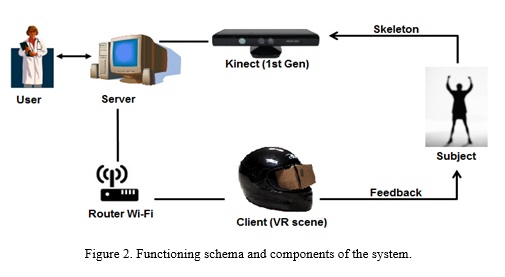
<body><![CDATA[<p><font size="2" face="Verdana, Arial, Helvetica, sans-serif">Three types  of movements were defined considering the motion induction, the human body  limbs, and the supervision and visualization of kinematical parameter, <a href="/img/revistas/rcci/v11n3/t0103318.jpg" target="_blank">Table 1</a>.  Every movement induces the execution of motor strategies, including the least  cognitive component possible. Motion speed and skills such as agility, balance  and coordination can be developed with these activities. </font></p>     <p><font size="2" face="Verdana, Arial, Helvetica, sans-serif">Movement  induction is a sequence of changes provoked by elements of the VR scene. Every  change is an event, previously configured with kinematic parameters  (Configuration categories of <a href="/img/revistas/rcci/v11n3/t0103318.jpg" target="_blank">Table 1</a>). In the &ldquo;Objects Evasion Movement&rdquo;, the  event consists of moving an object towards the subject <a href="/img/revistas/rcci/v11n3/f0103318.jpg" target="_blank">Fig.&nbsp; 1.c.</a> In the rest of the movements, the event  consists of the illumination of a sphere <a href="/img/revistas/rcci/v11n3/f0103318.jpg" target="_blank">Fig.&nbsp;  1.a, 1.b.</a> The resulting configuration of all events defines the movements  complexity, the required motion speed; and it is used to supervise the subject.</font></p>     <p><font size="2" face="Verdana, Arial, Helvetica, sans-serif">The  movements supervision is based on successes or failures. A success is produced  for every event, when the subject achieves the movement objective. In the  &ldquo;Objects Evasion Movement&rdquo;, a success occurs when the subject evades the object  and returns to the initial position. In the other two movements (Table and  Frontal Panel) a success occurs when the subject touches with his or her hand  the lightened sphere and returns that hand to the initial position. Any other  behavior is interpreted as a failure.</font></p>     <p><font size="2" face="Verdana, Arial, Helvetica, sans-serif">The user configures an events  sequence for the subject, and defines the number of times he must execute the sequence  (Luque-Moreno et. al., 2015). Every  execution is a session, consisting of three stages in the following order:  Warm-up, Work, and Relaxation. The Warm-up and Relaxation stages set the  subject, and the supervision is performed in the Work stage. For this reason,  the mayor complexity and exigency must be in the Work stage. The result of a  session is a sequence of success and failure, corresponding to the sequence of  pre-configured events.</font></p>     <p><font size="2" face="Verdana, Arial, Helvetica, sans-serif">The motion  induction is achieved by projecting the VR scene in a visual immersion helmet  (<a href="/img/revistas/rcci/v11n3/f0103318.jpg" target="_blank">Fig. 1</a>). The subject is represented through an avatar, and his or her interaction  with the scene allows the supervision based on collision detection. The avatar  is real time animated by the subject with the skeleton coordinates acquired by  the Kinect sensor. These coordinates are transmitted to the helmet. Therefore,  the subject avatar limbs have the same degree of freedom as the Kinect skeleton  limbs, obtaining an excellent visual feedback during the exercise.</font></p>     <p><font size="2" face="Verdana, Arial, Helvetica, sans-serif">It is  necessary for the subject to execute the movements without any wire ties, in a  space of 3m of width and no more than 3.5m away from the Kinect sensor in  normal mode (Catuhe, 2012) (Giorgio &amp;  Fascinari, 2013). It is also necessary to exchange information between  an Android mobile device and a computer with a Windows Operating System. Such  information includes the movement&rsquo;s settings, the VR scene control, the supervision  results, and a skeleton composed by 20 coordinates acquired by the Kinect  sensor at 30 frames per seconds (Jana, 2012).  These requirements make the wireless network ideal to maintain the  communication during the movement execution. The real time acquisition of human  movements, the setting, the data storage, and the supervision, are tasks that  can be distributed. For these reasons, this system is based on Client-Server  architecture. The Server application is executed in the computer, and the  Client application is executed in a mobile device attached to a visual  immersion helmet <a href="#f02">Fig.&nbsp; 2</a>. The  Client-Server architecture has additional benefits. This architecture made it possible  to use the computer power of the mobile device; and use a first generation Kinect  that does not have an official SDK for Unity Game Engine (Pedraza-Hueso et. al., 2015).</font></p>     <p align="center"><img src="/img/revistas/rcci/v11n3/f0203318.jpg" alt="f02" width="505" height="277"><a name="f02"></a></p>     <p><font size="2" face="Verdana, Arial, Helvetica, sans-serif">The first  person audio-visual feedback is achieved by combining Kinect and Google  Cardboard (GC) technologies. The VR scenes that induce the movements are  executed in a 7&rsquo;&rsquo; Tablet or a Smartphone in the GC. These components are  attached to the helmet (Fig. 2). GC provides the visual immersion and movement  freedom, due to its capacity to hold the mobile device with Wi-Fi connection  support, energetic independence and audio output. As the VR scene is executed  in the helmet, the network data traffic consists of the Kinect skeleton  coordinates, and the scene supervision and control data. </font></p>     <p><font size="2" face="Verdana, Arial, Helvetica, sans-serif">The system  software components are: The Client and Server applications. The design of  these applications was distributed in modules. The Server application contains  the modules: Kinect Management, Configuration, Evolution Analysis, and Database  Management. As well, the Client application contains the modules: Wi-Fi  Connection, VR Scenes and Supervision</font></p>     <p><font size="2" face="Verdana, Arial, Helvetica, sans-serif"><strong>Implemented System </strong></font></p>     ]]></body>
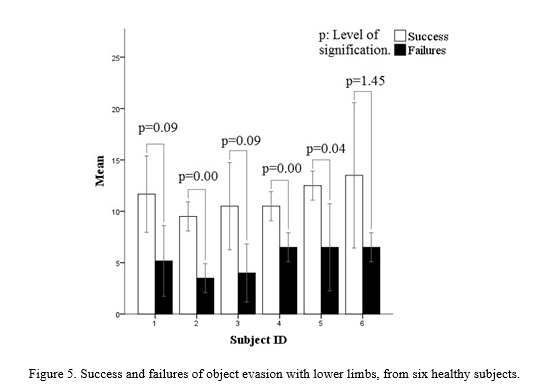
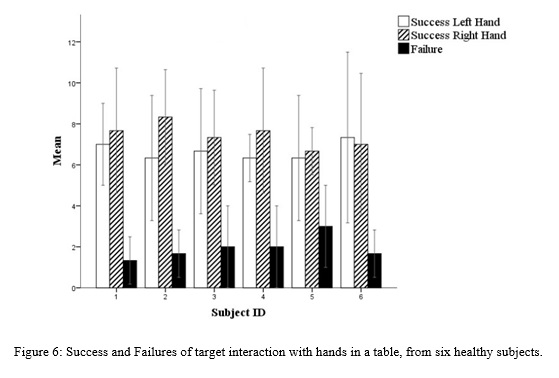
<body><![CDATA[<p><font size="2" face="Verdana, Arial, Helvetica, sans-serif">The system  stores the information in a flat file database of Microsoft Access. Each user  creates his or her database and executes the system workflow. The Microsoft  Access files allow the user to work in any computer the system is installed on.  For this purpose, two types of users were defined: &ldquo;Administrator&rdquo; and  &ldquo;Standard&rdquo;. The Administrator user is unique, it is the database creator and  manages the Standard users. A security layer is thus achieved to protect the  data patrimony.</font></p>     <p><font size="2" face="Verdana, Arial, Helvetica, sans-serif">The use cases of the system  include the workflow and the database management. These functionalities are  executed from the Server application&rsquo;s main interface <a href="/img/revistas/rcci/v11n3/f0303318.jpg" target="_blank">Fig.&nbsp; 3</a>. </font></p>     <p><font size="2" face="Verdana, Arial, Helvetica, sans-serif">The three configuration interfaces allow a detailed description of  movements sequence, the definition of their complexity and the number of  sessions. Each interface specializes its design in the central panel, according  to the kinematic parameters of the event <a href="/img/revistas/rcci/v11n3/f0403318.jpg" target="_blank">Fig.&nbsp;  4</a>. With these interfaces the user can customize the movements for the  subject (Luque-Moreno et. al., 2015)  (Pachoulakis et. al., 2015).</font></p>     <p><font size="2" face="Verdana, Arial, Helvetica, sans-serif">Each  configuration interface includes a preview functionality. This feature  reproduces the behavior of the kinematic parameters of every configured event.  This visualization allows the user to estimate the configuration suitability,  preventing a physical overload of the subject.</font></p>     <p><font size="2" face="Verdana, Arial, Helvetica, sans-serif">Three  Evolution Analysis interfaces are also specialized for the kinematic parameter  of the movement induction events. These interfaces can be set for success or  failure, and include a time graphic that visualizes the executed and planned  sessions. Each interface allows defining the interval of sessions to analyze,  and it is also possible to visualize the results of a specific session. All  these functionalities allow the analysis of the subject&rsquo;s performance, based on  the indirect measures of direction and movement speed.</font></p>     <p><font size="2" face="Verdana, Arial, Helvetica, sans-serif">The export  feature generates documentation that contains the current Evolution Analysis  and result graphics. The PDF exportation generates a report that includes: the  subject data, the planning information, and the result graphics. This document  is very useful for doctors, trainers and biomechanics experts. CSV exportation  is meant for researches. This functionality creates a directory that contains:  a CSV file for each graphic and a TXT file with information of the subject and  the planning. </font></p>     <p><font size="2" face="Verdana, Arial, Helvetica, sans-serif"><strong>Test with healthy subjects</strong></font></p>     <p><font size="2" face="Verdana, Arial, Helvetica, sans-serif">The functioning of the version  zero of the system was tested with fourteen healthy subjects. The results of  the test were exported to CSV format, with the previously described feature. The  following graphics were generated with a statistic tool, and they show results  from the object evasion for lower limbs (<a href="#f05">Fig. 5</a>), and both hands interaction in  a table for upper limbs (<a href="#f06">Fig. 6</a>). As expected, the results show more success  due to the healthy condition of the subjects. </font></p>     <p align="center"><img src="/img/revistas/rcci/v11n3/f0503318.jpg" alt="f05" width="534" height="391"><a name="f05"></a></p>     <p align="center"><img src="/img/revistas/rcci/v11n3/f0603318.jpg" alt="f06" width="559" height="378"><a name="f06"></a></p>     ]]></body>
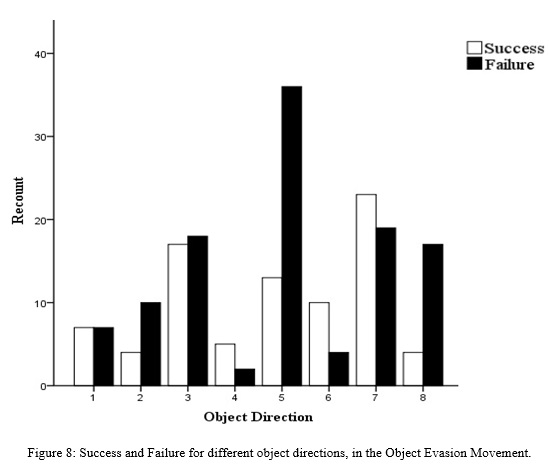
<body><![CDATA[<p><font size="2" face="Verdana, Arial, Helvetica, sans-serif">It is also  proved that the movement&rsquo;s complexity determines the results. <a href="/img/revistas/rcci/v11n3/f0703318.jpg" target="_blank">Fig. 7</a> shows  that, in the Object Evasion movement, the success is directly proportional to  the Distance Between Objects. A short distance between objects demands more  movement speed than a longer one. <a href="#f08">Fig. 8</a> as well, shows more failures in the  Object Direction number five (Center of the body, <a href="#f06">Fig. 6.c</a>). An object heading towards  the body center has to be dodged with larger steps, demanding more effort from  the subject.&nbsp; Therefore, it is possible  to measure the speed and movement direction indirectly.</font></p>     <p align="center"><img src="/img/revistas/rcci/v11n3/f0803318.jpg" alt="f08" width="550" height="475"><a name="f08"></a></p>     <p>&nbsp;</p>     <p><font face="Verdana, Arial, Helvetica, sans-serif" size="3"><B>DISCUSSION</B></font></p>     <p><font size="2" face="Verdana, Arial, Helvetica, sans-serif">In systems  alike the following similarities are observed: the VR application, the Kinect  sensor, audio-visual feedback, employment of avatars, the kinematic parameters  control, and the low cost hardware utilization (Gil-G&oacute;mez  et. al., 2011) (Gil-Agudoa et. al., 2012) (Lozano-Quilis et. al., 2014) (P&eacute;rez  Villamil et. al., 2016). Other similarities are the configuration,  planning and report features. The minimum requirements of the presented system  include common and accessible hardware like the Kinect sensor, a mobile device,  a Wi-Fi Router, and a GC. These requirements, and the automatic supervision,  allow the system to be adapted to the subject&rsquo;s home. This advantage is an  important similarity with In-Home systems like CuPiD and ReaKinG (Rocchi, 2013)&nbsp;  (Pedraza-Hueso et. al., 2015).</font></p>     <p><font size="2" face="Verdana, Arial, Helvetica, sans-serif">Some of the  previously mentioned systems differ from the proposed one in the measurements  precision, the application of other technologies and the visual immersion.  TOyRA (Gil-Agudoa et. al., 2012) and  CuPiD (Rocchi, 2013) perform more precise  kinematic measurements using wearable devices and inertial sensors. These  measurements quantify the range of movement (ROM) of the shoulder, elbow and  carpal (Gil-Agudoa et. al., 2012). This  information is also used to animate the avatars  (Gil-Agudoa et. al., 2012) (Rocchi, 2013). However, the use of the  Kinect sensor is intuitive, no complex calibration or additional equipment is  required. The proposal of this Kinect based system allows the indirect  measurement of the motion direction and speed, based on success and failure.  Such parameters can be evaluated, through the result analysis features of the  proposed system, to determine the optimum frequency and intensity of the  exercise (Ling Chen et. al., 2016). This  evaluation provides the user evidence to adjust the movements of the subject  through the configuration features. </font></p>     <p><font size="2" face="Verdana, Arial, Helvetica, sans-serif">The above mentioned systems  use screens to accomplish the immersion in the VR or the Augmented Reality (AR) (Lozano-Quilis et. al., 2014). These are  visual immersions in third person, they require additional familiarization and  might be susceptible to distractions. The current system proposes a visual  immersion in first person with a VR viewer, protecting the subject with a  helmet in case of a fall (Pachoulakis et. al.,  2015). The proposed immersion is intuitive, gives more motivation and  avoids the distractions during the movement execution. There is a system that  rehabilitates one shoulder using a therapy based on the Oculus Rift DK2 and  Intel Real Sense motion sensor, providing feedback with a one hand avatar (Baldominos et. al., 2015). However, the system  presented brings a similar viewer immersion, a better avatar feedback, movement  induction for both upper and lower limbs, with support for service and research. </font></p>     <p>&nbsp;</p>     <p><font face="Verdana, Arial, Helvetica, sans-serif" size="3"><B>CONCLUSIONS</B></font></p>     <p><font size="2" face="Verdana, Arial, Helvetica, sans-serif">It was possible to design,  implement and test a system for human movement induction based on virtual  reality. Such system brings a design innovation combining Kinect and Google  Cardboard. The successful test proved the possibilities to deliver evidences,  and perform indirect measurements of the direction and movement speed. Such  evidences will allow making quantitative studies, in order to evaluate the  future application of the system for exercising and rehabilitation.</font></p>     ]]></body>
<body><![CDATA[<p>&nbsp;</p>     <p><font face="Verdana, Arial, Helvetica, sans-serif" size="3"><B>ACKNOWLEDGEMENTS</B></font></p>     <p><font size="2" face="Verdana, Arial, Helvetica, sans-serif">Special thanks to the Human Movement Analysis Laboratory of the Medical  Biophysics Center and the Neurophysiology Department of Santiago de Cuba  General Hospital.</font></p>     <p>&nbsp;</p>     <p align="left"><font face="Verdana, Arial, Helvetica, sans-serif" size="3"><B>REFERENCES    </B></font>     <!-- ref --><p><font size="2" face="Verdana, Arial, Helvetica, sans-serif">Baldominos, A., Saez, Y., &amp; Garc&iacute;a  del Pozo, C. An approach to physical rehabilitation using state-of-the-art  virtual reality and motion tracking technologies. Procedia Computer Science,  2015, (64), 10-16.    </font></p>     <!-- ref --><p><font size="2" face="Verdana, Arial, Helvetica, sans-serif">Catuhe, D. A bit of background. Programming  with the Kinect for Windows Software Development Kit. Redmon, Washington:  Microsoft Press, 2012. p. 5.    </font></p>     <p><font size="2" face="Verdana, Arial, Helvetica, sans-serif">Corbetta, D., Imeri, F., &amp;  Gatti, R. Rehabilitation that incorporates virtual reality is more effective  than standard rehabilitation for improving walking speed, balance and mobility  after stroke: a systematic review. Journal  of Physiotherapy, 2015, (61), 117&ndash;124. Recuperado el 16 de September de 2016,  de http://www.sciencedirect.com/science/article/pii/S1836955315000569</font></p>     ]]></body>
<body><![CDATA[<!-- ref --><p><font size="2" face="Verdana, Arial, Helvetica, sans-serif">De Visser, E., Mulder, T., Schreuder,  H., Veth, R., &amp; Duysens, J. Gait and electromyographic analysis of patients  recovering after limb-saving surgery. Clinical Biomechanics, 2000, (15),  592-599.    </font></p>     <!-- ref --><p><font size="2" face="Verdana, Arial, Helvetica, sans-serif">Gil-Agudoa, A., Dimbwadyo-Terrerb, I., Pe&ntilde;asco-Mart&iacute;nc, B., de los  Reyes-Guzm&aacute;nc, A., Bernal-Sah&uacute;nd, A., &amp; Berbel-Garc&iacute;a, A. Experiencia  cl&iacute;nica de la aplicaci&oacute;n del sistema de realidad TOyRA en la  neuro-rehabilitaci&oacute;n de pacientes con lesi&oacute;n medular. Rehabilitaci&oacute;n, 2012,  46(1), 41-48. Recuperado el 5 de September de 2016, de http://www.elsevier.es/es-revista-rehabilitacion-120-articulo-experiencia-clinica-aplicacion-del-sistema-S0048712011001629?redirectNew=true</font><!-- ref --><p><font size="2" face="Verdana, Arial, Helvetica, sans-serif">Gil-G&oacute;mez, J. A., Llor&eacute;ns, R., Alca&ntilde;iz, M., &amp; Colomer, C. (2011). Effectiveness  of a Wii balance board-based system (eBaViR) for balance rehabilitation: a  pilot randomized clinical trial in patients with acquired brain injury.  [Online]. BioMed Central. [Consulted on September 16, 2016], Available in: <a href="https://jneuroengrehab.biomedcentral.com/articles/10.1186/1743-0003-8-30">https://jneuroengrehab.biomedcentral.com/articles/10.1186/1743-0003-8-30</a></font><p><font size="2" face="Verdana, Arial, Helvetica, sans-serif">Giorgio, C.; Fascinari, M. Hardware  Overview. Kinect in Motion &ndash; Audio and Visual Tracking by Example.  Birminghan-Mumbai: Packt Publishing, 2013. p. 11.</font></p>     <!-- ref --><p><font size="2" face="Verdana, Arial, Helvetica, sans-serif">Hidler, J., Nichols, D., Pelliccio,  M., &amp; Brady, K. Advances in the Understanding and Treatment of Stroke  Impairment Using Robotic Devices. Top Stroke Rehabil, 2005, 12(2), 22-35.    </font></p>     <!-- ref --><p><font size="2" face="Verdana, Arial, Helvetica, sans-serif">Jana, A. Human Skeleton Tracking. Kinect  for Windows SDK Programming Guide. Birmingham-Mumbai: Editorial, 2012. p.  158-211.    </font></p>     <p><font size="2" face="Verdana, Arial, Helvetica, sans-serif">K. O&rsquo;Loughlin, E., N. Dugas, E.,  M. Sabiston, C., &amp; L. O&rsquo;Loughlin, J. Prevalence and Correlates of  Exergaming in Youth. PEDIATRICS, 2012, 130(5). doi:10.1542/peds.2012-0391</font></p>     ]]></body>
<body><![CDATA[<p><font size="2" face="Verdana, Arial, Helvetica, sans-serif">Ling Chen, Wai Leung Ambrose Lo,  Yu Rong Mao, Ming Hui Ding, Qiang Lin, Hai Li, . . . Dong Feng Huang. [Online] Effect  of virtual reality on postural and balance control in patients with stroke: a  systematic literature review. BioMed Research International, 2016, [Consulted  on December 5, 2016]. Available in: de http://downloads.hindawi.com/journals/bmri/aip/7309272.pdf</font></p>     <!-- ref --><p><font size="2" face="Verdana, Arial, Helvetica, sans-serif">Lozano-Quilis, J.-A., Gil-G&oacute;mez,  H., Gil-G&oacute;mez, J.-A., Albiol-P&eacute;rez, S., Palacios-Navarro, G., M Fardoun, H.,  &amp; Mashat, S. A. Virtual Rehabilitation for Multiple Sclerosis Using a  Kinect-Based System: Randomized Controlled Trial. [Online] PubMed Central&reg;,  2014, [Consulted on September 5, 2016]. Available in:  https://www.ncbi.nlm.nih.gov/pmc/articles/PMC4307818/</font><!-- ref --><p><font size="2" face="Verdana, Arial, Helvetica, sans-serif">Luque-Moreno, C.,  Ferragut-Garc&iacute;as, A., Rodr&iacute;guez-Blanco, C., Heredia-Rizo, A. M., Oliva-Pascual-Vaca,  J., Kiper, P., &amp; Oliva-Pascual-Vaca, &Aacute;. A Decade of Progress Using Virtual  Reality for Poststroke</font><!-- ref --><p><font size="2" face="Verdana, Arial, Helvetica, sans-serif">Lower Extremity Rehabilitation: Systematic Review of the  Intervention Methods. [Online] BioMed Research International, 2015, [Consulted  on August 31, 2017]. Available in http://dx.doi.org/10.1155/2015/342529</font><!-- ref --><p><font size="2" face="Verdana, Arial, Helvetica, sans-serif">Maillot, P., Perrot, A., &amp;  Hartley, A. Effects of interactive physical-ativity video-game training on  physical and cognitive function in older adults. Psychology and Aging, American  Psychological Association, 2012, 27(3), 589-600. [Consulted on August 31, 2017]  Available in: https://hal.archives-ouvertes.fr/hal-00736985</font><p><font size="2" face="Verdana, Arial, Helvetica, sans-serif">Pachoulakis, I., Papadopoulos, N.,  &amp; Spanaki, C. PARKINSON&rsquo;S DISEASE PATIENT REHABILITATION USING GAMING  PLATFORMS: LESSONS LEARNT. International Journal of Biomedical Engineering and Science  (IJBES), 2015, 2(4).</font></p>     <p><font size="2" face="Verdana, Arial, Helvetica, sans-serif">Pedraza-Hueso, M., Mart&iacute;n-Calz&oacute;n,  S., D&iacute;az-Pernas, F., &amp; Mart&iacute;nez-Zarzuela, M. Rehabilitation using  Kinect-based Games and Virtual Reality. Procedia Computer Science, 2015, 75,  161 &ndash; 168.</font></p>     <!-- ref --><p><font size="2" face="Verdana, Arial, Helvetica, sans-serif">Pe&ntilde;asco-Mart&iacute;n, B., De los Reyes-Guzm&aacute;n, A., Gil-Agudo, A., Bernal-Sah&uacute;n,  A., P&eacute;rez-Aguilar, B., &amp; De la Pe&ntilde;a-Gonz&aacute;lez, A. Aplicaci&oacute;n de la realidad  virtual en los aspectos motores de la neurorrehabilitaci&oacute;n. Rev Neurol, 2010, (51),  481-8.    </font></p>     <!-- ref --><p><font size="2" face="Verdana, Arial, Helvetica, sans-serif">P&eacute;rez Villamil, A., &amp; Zamarre&ntilde;o Hern&aacute;ndez, J. Rehabilitador de Marcha  para cinta rodante del Centro Nacional de Rehabilitaci&oacute;n Julio D&iacute;az. Serie  Cient&iacute;fica de la Universidad de las Ciencias Inform&aacute;ticas, 2016, 9(3), 135-148.    </font></p>     <!-- ref --><p><font size="2" face="Verdana, Arial, Helvetica, sans-serif">Rocchi, L. (22 de October de 2013). Joinup.  [Consulted on August 29, 2016], de  https://joinup.ec.europa.eu/community/epractice/case/cupid-closed-loop-system-personalised-and-home-rehabilitation-people-parkin</font><!-- ref --><p><font size="2" face="Verdana, Arial, Helvetica, sans-serif">Sveistrup, H. Motor  rehabilitation using virtual reality. J NeuroengRehabil, 2004, 1:10.    </font></p>     <p name="_ENREF_1">&nbsp;</p>     <p name="_ENREF_1">&nbsp;</p>     <p><font size="2" face="Verdana, Arial, Helvetica, sans-serif">Recibido: 27/10/2017    <br> Aceptado: 06/07/2018</font></p>      ]]></body><back>
<ref-list>
<ref id="B1">
<nlm-citation citation-type="">
<person-group person-group-type="author">
<name>
<surname><![CDATA[Baldominos]]></surname>
<given-names><![CDATA[A]]></given-names>
</name>
<name>
<surname><![CDATA[Saez]]></surname>
<given-names><![CDATA[Y]]></given-names>
</name>
<name>
<surname><![CDATA[García del Pozo]]></surname>
<given-names><![CDATA[C]]></given-names>
</name>
</person-group>
<article-title xml:lang="en"><![CDATA[An approach to physical rehabilitation using state-of-the-art virtual reality and motion tracking technologies]]></article-title>
<source><![CDATA[]]></source>
<year>2015</year>
<volume>64</volume>
<page-range>10-16</page-range></nlm-citation>
</ref>
<ref id="B2">
<nlm-citation citation-type="book">
<person-group person-group-type="author">
<name>
<surname><![CDATA[Catuhe]]></surname>
<given-names><![CDATA[D]]></given-names>
</name>
</person-group>
<source><![CDATA[A bit of background. Programming with the Kinect for Windows Software Development Kit.]]></source>
<year>2012</year>
<page-range>5</page-range><publisher-loc><![CDATA[^eWashington Washington]]></publisher-loc>
<publisher-name><![CDATA[Microsoft Press,]]></publisher-name>
</nlm-citation>
</ref>
<ref id="B3">
<nlm-citation citation-type="book">
<person-group person-group-type="author">
<name>
<surname><![CDATA[Corbetta]]></surname>
<given-names><![CDATA[D]]></given-names>
</name>
<name>
<surname><![CDATA[Imeri]]></surname>
<given-names><![CDATA[F]]></given-names>
</name>
<name>
<surname><![CDATA[Gatti]]></surname>
<given-names><![CDATA[R]]></given-names>
</name>
</person-group>
<source><![CDATA[Rehabilitation that incorporates virtual reality is more effective than standard rehabilitation for improving walking speed, balance and mobility after stroke: a systematic review.]]></source>
<year>2015</year>
<volume>61</volume>
<page-range>117-124</page-range><publisher-name><![CDATA[Journal of Physiotherapy]]></publisher-name>
</nlm-citation>
</ref>
<ref id="B4">
<nlm-citation citation-type="">
<person-group person-group-type="author">
<name>
<surname><![CDATA[De Visser]]></surname>
<given-names><![CDATA[E]]></given-names>
</name>
<name>
<surname><![CDATA[Mulder]]></surname>
<given-names><![CDATA[T]]></given-names>
</name>
<name>
<surname><![CDATA[Schreuder]]></surname>
<given-names><![CDATA[H]]></given-names>
</name>
<name>
<surname><![CDATA[Veth]]></surname>
<given-names><![CDATA[R]]></given-names>
</name>
<name>
<surname><![CDATA[Duysens]]></surname>
<given-names><![CDATA[J]]></given-names>
</name>
</person-group>
<source><![CDATA[Gait and electromyographic analysis of patients recovering after limb-saving surgery.]]></source>
<year>2000</year>
<volume>15</volume>
<page-range>592-599</page-range></nlm-citation>
</ref>
<ref id="B5">
<nlm-citation citation-type="">
<person-group person-group-type="author">
<name>
<surname><![CDATA[Gil-Agudoa]]></surname>
<given-names><![CDATA[A]]></given-names>
</name>
<name>
<surname><![CDATA[Dimbwadyo-Terrerb]]></surname>
<given-names><![CDATA[I]]></given-names>
</name>
<name>
<surname><![CDATA[Peñasco-Martínc]]></surname>
<given-names><![CDATA[B]]></given-names>
</name>
<name>
<surname><![CDATA[de los Reyes-Guzmánc]]></surname>
<given-names><![CDATA[A]]></given-names>
</name>
<name>
<surname><![CDATA[Bernal-Sahúnd]]></surname>
<given-names><![CDATA[A]]></given-names>
</name>
<name>
<surname><![CDATA[Berbel-García]]></surname>
<given-names><![CDATA[A]]></given-names>
</name>
</person-group>
<article-title xml:lang="es"><![CDATA[Experiencia clínica de la aplicación del sistema de realidad TOyRA en la neuro-rehabilitación de pacientes con lesión medular]]></article-title>
<source><![CDATA[]]></source>
<year>2012</year>
<volume>46</volume>
<numero>1</numero>
<issue>1</issue>
<page-range>41-48</page-range></nlm-citation>
</ref>
<ref id="B6">
<nlm-citation citation-type="">
<person-group person-group-type="author">
<name>
<surname><![CDATA[Gil-Gómez]]></surname>
<given-names><![CDATA[J. A]]></given-names>
</name>
<name>
<surname><![CDATA[Lloréns]]></surname>
<given-names><![CDATA[R]]></given-names>
</name>
<name>
<surname><![CDATA[Alcañiz]]></surname>
<given-names><![CDATA[M]]></given-names>
</name>
<name>
<surname><![CDATA[Colomer]]></surname>
<given-names><![CDATA[C]]></given-names>
</name>
</person-group>
<source><![CDATA[Effectiveness of a Wii balance board-based system (eBaViR) for balance rehabilitation: a pilot randomized clinical trial in patients with acquired brain injury.]]></source>
<year>2011</year>
</nlm-citation>
</ref>
<ref id="B7">
<nlm-citation citation-type="book">
<person-group person-group-type="author">
<name>
<surname><![CDATA[Giorgio]]></surname>
<given-names><![CDATA[C]]></given-names>
</name>
<name>
<surname><![CDATA[Fascinari]]></surname>
<given-names><![CDATA[M]]></given-names>
</name>
</person-group>
<source><![CDATA[Hardware Overview. Kinect in Motion - Audio and Visual Tracking by Example.]]></source>
<year>2013</year>
<page-range>11</page-range><publisher-name><![CDATA[Birminghan-Mumbai: Packt Publishing]]></publisher-name>
</nlm-citation>
</ref>
<ref id="B8">
<nlm-citation citation-type="">
<person-group person-group-type="author">
<name>
<surname><![CDATA[Hidler]]></surname>
<given-names><![CDATA[J]]></given-names>
</name>
<name>
<surname><![CDATA[Nichols]]></surname>
<given-names><![CDATA[D]]></given-names>
</name>
<name>
<surname><![CDATA[Pelliccio]]></surname>
<given-names><![CDATA[M]]></given-names>
</name>
<name>
<surname><![CDATA[Brady]]></surname>
<given-names><![CDATA[K]]></given-names>
</name>
</person-group>
<article-title xml:lang="en"><![CDATA[Advances in the Understanding and Treatment of Stroke Impairment Using Robotic Devices]]></article-title>
<source><![CDATA[]]></source>
<year>2005</year>
<volume>12</volume>
<numero>2</numero>
<issue>2</issue>
<page-range>22-35</page-range></nlm-citation>
</ref>
<ref id="B9">
<nlm-citation citation-type="book">
<person-group person-group-type="author">
<name>
<surname><![CDATA[Jana]]></surname>
<given-names><![CDATA[A]]></given-names>
</name>
</person-group>
<source><![CDATA[Human Skeleton Tracking. Kinect for Windows SDK Programming Guide]]></source>
<year>2012</year>
<page-range>158-211</page-range><publisher-name><![CDATA[Birmingham-Mumbai: Editorial]]></publisher-name>
</nlm-citation>
</ref>
<ref id="B10">
<nlm-citation citation-type="">
<person-group person-group-type="author">
<name>
<surname><![CDATA[K. O’Loughlin]]></surname>
<given-names><![CDATA[E]]></given-names>
</name>
<name>
<surname><![CDATA[N. Dugas]]></surname>
<given-names><![CDATA[E]]></given-names>
</name>
<name>
<surname><![CDATA[M. Sabiston]]></surname>
<given-names><![CDATA[C]]></given-names>
</name>
<name>
<surname><![CDATA[L. O’Loughlin]]></surname>
<given-names><![CDATA[J]]></given-names>
</name>
</person-group>
<source><![CDATA[Prevalence and Correlates of Exergaming in Youth.]]></source>
<year>2012</year>
<volume>130</volume>
</nlm-citation>
</ref>
<ref id="B11">
<nlm-citation citation-type="">
<person-group person-group-type="author">
<name>
<surname><![CDATA[Ling]]></surname>
<given-names><![CDATA[Chen]]></given-names>
</name>
<name>
<surname><![CDATA[Ambrose Lo]]></surname>
<given-names><![CDATA[Wai Leung]]></given-names>
</name>
<name>
<surname><![CDATA[Yu Rong]]></surname>
<given-names><![CDATA[Mao]]></given-names>
</name>
<name>
<surname><![CDATA[Ming Hui]]></surname>
<given-names><![CDATA[Ding]]></given-names>
</name>
</person-group>
<source><![CDATA[Effect of virtual reality on postural and balance control in patients with stroke: a systematic literature review.]]></source>
<year>2016</year>
</nlm-citation>
</ref>
<ref id="B12">
<nlm-citation citation-type="">
<person-group person-group-type="author">
<name>
<surname><![CDATA[Lozano-Quilis]]></surname>
<given-names><![CDATA[J.-A]]></given-names>
</name>
<name>
<surname><![CDATA[Gil-Gómez]]></surname>
<given-names><![CDATA[H]]></given-names>
</name>
<name>
<surname><![CDATA[Gil-Gómez]]></surname>
<given-names><![CDATA[J.-A]]></given-names>
</name>
<name>
<surname><![CDATA[Albiol-Pérez]]></surname>
<given-names><![CDATA[S]]></given-names>
</name>
<name>
<surname><![CDATA[Palacios-Navarro]]></surname>
<given-names><![CDATA[G]]></given-names>
</name>
<name>
<surname><![CDATA[M Fardoun]]></surname>
<given-names><![CDATA[H]]></given-names>
</name>
<name>
<surname><![CDATA[Mashat]]></surname>
<given-names><![CDATA[S. A]]></given-names>
</name>
</person-group>
<source><![CDATA[Virtual Rehabilitation for Multiple Sclerosis Using a Kinect-Based System: Randomized Controlled Trial]]></source>
<year>2014</year>
</nlm-citation>
</ref>
<ref id="B13">
<nlm-citation citation-type="">
<person-group person-group-type="author">
<name>
<surname><![CDATA[Luque-Moreno]]></surname>
<given-names><![CDATA[C]]></given-names>
</name>
<name>
<surname><![CDATA[Ferragut-Garcías]]></surname>
<given-names><![CDATA[A]]></given-names>
</name>
<name>
<surname><![CDATA[Rodríguez-Blanco]]></surname>
<given-names><![CDATA[C]]></given-names>
</name>
<name>
<surname><![CDATA[Heredia-Rizo,]]></surname>
<given-names><![CDATA[A. M]]></given-names>
</name>
<name>
<surname><![CDATA[Oliva-Pascual-Vaca]]></surname>
<given-names><![CDATA[J]]></given-names>
</name>
<name>
<surname><![CDATA[Kiper]]></surname>
<given-names><![CDATA[P]]></given-names>
</name>
<name>
<surname><![CDATA[Oliva-Pascual-Vaca]]></surname>
<given-names><![CDATA[Á]]></given-names>
</name>
</person-group>
<source><![CDATA[A Decade of Progress Using Virtual Reality for Poststroke]]></source>
<year></year>
</nlm-citation>
</ref>
<ref id="B14">
<nlm-citation citation-type="book">
<source><![CDATA[Lower Extremity Rehabilitation: Systematic Review of the Intervention Methods]]></source>
<year>2015</year>
<publisher-name><![CDATA[BioMed Research International]]></publisher-name>
</nlm-citation>
</ref>
<ref id="B15">
<nlm-citation citation-type="">
<person-group person-group-type="author">
<name>
<surname><![CDATA[Maillot]]></surname>
<given-names><![CDATA[P]]></given-names>
</name>
<name>
<surname><![CDATA[Perrot]]></surname>
<given-names><![CDATA[A]]></given-names>
</name>
<name>
<surname><![CDATA[Hartley]]></surname>
<given-names><![CDATA[A]]></given-names>
</name>
</person-group>
<article-title xml:lang="en"><![CDATA[Effects of interactive physical-ativity video-game training on physical and cognitive function in older adults.]]></article-title>
<source><![CDATA[]]></source>
<year>2012</year>
<volume>27</volume>
<numero>3</numero>
<issue>3</issue>
<page-range>589-600</page-range></nlm-citation>
</ref>
<ref id="B16">
<nlm-citation citation-type="">
<person-group person-group-type="author">
<name>
<surname><![CDATA[Pachoulakis]]></surname>
<given-names><![CDATA[I]]></given-names>
</name>
<name>
<surname><![CDATA[Papadopoulos]]></surname>
<given-names><![CDATA[N]]></given-names>
</name>
<name>
<surname><![CDATA[Spanaki]]></surname>
<given-names><![CDATA[C]]></given-names>
</name>
</person-group>
<article-title xml:lang="en"><![CDATA[PARKINSON’S DISEASE PATIENT REHABILITATION USING GAMING PLATFORMS: LESSONS LEARNT.]]></article-title>
<source><![CDATA[]]></source>
<year>2015</year>
<volume>2</volume>
<numero>4</numero>
<issue>4</issue>
</nlm-citation>
</ref>
<ref id="B17">
<nlm-citation citation-type="book">
<person-group person-group-type="author">
<name>
<surname><![CDATA[Pedraza-Hueso]]></surname>
<given-names><![CDATA[M]]></given-names>
</name>
<name>
<surname><![CDATA[Martín-Calzón]]></surname>
<given-names><![CDATA[S]]></given-names>
</name>
<name>
<surname><![CDATA[Díaz-Pernas]]></surname>
<given-names><![CDATA[F]]></given-names>
</name>
<name>
<surname><![CDATA[Martínez-Zarzuela]]></surname>
<given-names><![CDATA[M]]></given-names>
</name>
</person-group>
<source><![CDATA[Rehabilitation using Kinect-based Games and Virtual Reality.]]></source>
<year>2015</year>
<volume>75</volume>
<page-range>161 - 168</page-range><publisher-name><![CDATA[Procedia Computer Science]]></publisher-name>
</nlm-citation>
</ref>
<ref id="B18">
<nlm-citation citation-type="book">
<person-group person-group-type="author">
<name>
<surname><![CDATA[Peñasco-Martín]]></surname>
<given-names><![CDATA[B]]></given-names>
</name>
<name>
<surname><![CDATA[De los Reyes-Guzmán]]></surname>
<given-names><![CDATA[A]]></given-names>
</name>
<name>
<surname><![CDATA[Gil-Agudo]]></surname>
<given-names><![CDATA[A]]></given-names>
</name>
<name>
<surname><![CDATA[Bernal-Sahún]]></surname>
<given-names><![CDATA[A]]></given-names>
</name>
<name>
<surname><![CDATA[Pérez-Aguilar]]></surname>
<given-names><![CDATA[B]]></given-names>
</name>
<name>
<surname><![CDATA[De la Peña-González]]></surname>
<given-names><![CDATA[A]]></given-names>
</name>
</person-group>
<source><![CDATA[Aplicación de la realidad virtual en los aspectos motores de la neurorrehabilitación.]]></source>
<year>2010</year>
<volume>51</volume>
<page-range>481-8</page-range><publisher-name><![CDATA[Rev Neurol]]></publisher-name>
</nlm-citation>
</ref>
<ref id="B19">
<nlm-citation citation-type="">
<person-group person-group-type="author">
<name>
<surname><![CDATA[Pérez Villamil]]></surname>
<given-names><![CDATA[A]]></given-names>
</name>
<name>
<surname><![CDATA[Zamarreño Hernández]]></surname>
<given-names><![CDATA[J]]></given-names>
</name>
</person-group>
<article-title xml:lang="es"><![CDATA[Rehabilitador de Marcha para cinta rodante del Centro Nacional de Rehabilitación Julio Díaz.]]></article-title>
<source><![CDATA[]]></source>
<year>2016</year>
<volume>9</volume>
<numero>3</numero>
<issue>3</issue>
<page-range>135-148</page-range></nlm-citation>
</ref>
<ref id="B20">
<nlm-citation citation-type="">
<person-group person-group-type="author">
<name>
<surname><![CDATA[Rocchi]]></surname>
<given-names><![CDATA[L]]></given-names>
</name>
</person-group>
<source><![CDATA[Joinup]]></source>
<year>22 d</year>
<month>e </month>
<day>Oc</day>
</nlm-citation>
</ref>
<ref id="B21">
<nlm-citation citation-type="">
<person-group person-group-type="author">
<name>
<surname><![CDATA[Sveistrup]]></surname>
<given-names><![CDATA[H]]></given-names>
</name>
</person-group>
<source><![CDATA[Motor rehabilitation using virtual reality.]]></source>
<year>2004</year>
<volume>1</volume>
<page-range>10</page-range></nlm-citation>
</ref>
</ref-list>
</back>
</article>