<?xml version="1.0" encoding="ISO-8859-1"?><article xmlns:mml="http://www.w3.org/1998/Math/MathML" xmlns:xlink="http://www.w3.org/1999/xlink" xmlns:xsi="http://www.w3.org/2001/XMLSchema-instance">
<front>
<journal-meta>
<journal-id>2227-1899</journal-id>
<journal-title><![CDATA[Revista Cubana de Ciencias Informáticas]]></journal-title>
<abbrev-journal-title><![CDATA[Rev cuba cienc informat]]></abbrev-journal-title>
<issn>2227-1899</issn>
<publisher>
<publisher-name><![CDATA[Editorial Ediciones Futuro]]></publisher-name>
</publisher>
</journal-meta>
<article-meta>
<article-id>S2227-18992018000300004</article-id>
<title-group>
<article-title xml:lang="en"><![CDATA[Application of fuzzy techniques in the evaluation of video surveillance technology suppliers]]></article-title>
<article-title xml:lang="es"><![CDATA[Aplicación de técnicas difusas en la evaluación de proveedores de tecnologías para VideoVigilancia]]></article-title>
</title-group>
<contrib-group>
<contrib contrib-type="author">
<name>
<surname><![CDATA[Vega Prieto]]></surname>
<given-names><![CDATA[Roexcy]]></given-names>
</name>
<xref ref-type="aff" rid="A01"/>
</contrib>
<contrib contrib-type="author">
<name>
<surname><![CDATA[Estrada Velazco]]></surname>
<given-names><![CDATA[Aylin]]></given-names>
</name>
<xref ref-type="aff" rid="A01"/>
</contrib>
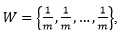
<contrib contrib-type="author">
<name>
<surname><![CDATA[Socarras Ramírez]]></surname>
<given-names><![CDATA[Ismaray]]></given-names>
</name>
<xref ref-type="aff" rid="A01"/>
</contrib>
<contrib contrib-type="author">
<name>
<surname><![CDATA[Zulueta Veliz]]></surname>
<given-names><![CDATA[Yeleny]]></given-names>
</name>
<xref ref-type="aff" rid="A01"/>
</contrib>
</contrib-group>
<aff id="A01">
<institution><![CDATA[,Universidad de las Ciencias Informáticas  ]]></institution>
<addr-line><![CDATA[ La Habana]]></addr-line>
<country>Cuba</country>
</aff>
<pub-date pub-type="pub">
<day>00</day>
<month>09</month>
<year>2018</year>
</pub-date>
<pub-date pub-type="epub">
<day>00</day>
<month>09</month>
<year>2018</year>
</pub-date>
<volume>12</volume>
<numero>3</numero>
<fpage>47</fpage>
<lpage>61</lpage>
<copyright-statement/>
<copyright-year/>
<self-uri xlink:href="http://scielo.sld.cu/scielo.php?script=sci_arttext&amp;pid=S2227-18992018000300004&amp;lng=en&amp;nrm=iso"></self-uri><self-uri xlink:href="http://scielo.sld.cu/scielo.php?script=sci_abstract&amp;pid=S2227-18992018000300004&amp;lng=en&amp;nrm=iso"></self-uri><self-uri xlink:href="http://scielo.sld.cu/scielo.php?script=sci_pdf&amp;pid=S2227-18992018000300004&amp;lng=en&amp;nrm=iso"></self-uri><abstract abstract-type="short" xml:lang="en"><p><![CDATA[Supplier evaluation is considered a key element in the procurement of resources. In this stage, a characterization of suppliers is carried out, based on a documentary review, interviews and experiences acquired in similar projects, which allows managers to make decisions about the project. Some of the main difficulties presented by methods in developing supplier evaluation are associated with inadequate uncertainty modeling and the lack of a mechanism for the treatment of multiple expert preferences on various criteria, which leads to loss of time and information. The general objective of this research is the application of fuzzy techniques for the evaluation of Video Surveillance technology suppliers, based on the fuzzy hierarchical analysis process and the 2-tuple linguistic representation model to treat uncertainty in decision making, based on the management of the information provided by multiple experts in their assessments. The obtained results can be easily interpreted by evaluators, without any loss of information.]]></p></abstract>
<abstract abstract-type="short" xml:lang="es"><p><![CDATA[La evaluación de los proveedores es considerada un elemento primordial en la adquisición de los recursos. En esta etapa se realiza una caracterización de los proveedores, a partir de una revisión documental, entrevistas, experiencias adquiridas en similares proyectos, lo que les permite a los gestores la toma de decisiones en el proyecto. Algunas de las principales dificultades que presentan los métodos para desarrollar la evaluación de proveedores, están asociadas a que realizan inadecuado modelado de la incertidumbre y no establecen ningún mecanismo para el tratamiento de las preferencias de múltiples expertos sobre varios criterios, lo que propicia pérdida de tiempo y de información. El objetivo general de este artículo es la aplicación de técnicas difusas para la evaluación de proveedores de tecnologías para Video Vigilancia basado en el proceso de análisis jerárquico difuso y el modelo de representación lingüística 2-tupla, para dar tratamiento a la incertidumbre en la toma de decisiones, a partir del manejo de la información brindada por múltiples expertos. Se obtuvieron resultados fácilmente interpretables por los evaluadores y sin pérdida de información.]]></p></abstract>
<kwd-group>
<kwd lng="en"><![CDATA[2-Tuple linguistic representation model]]></kwd>
<kwd lng="en"><![CDATA[evaluation]]></kwd>
<kwd lng="en"><![CDATA[fuzzy hierarchical analysis process]]></kwd>
<kwd lng="en"><![CDATA[supplier management]]></kwd>
<kwd lng="es"><![CDATA[Gestión de proveedores]]></kwd>
<kwd lng="es"><![CDATA[evaluación]]></kwd>
<kwd lng="es"><![CDATA[modelo de representación 2-Tuplalingüístico]]></kwd>
<kwd lng="es"><![CDATA[proceso de análisis jerárquico difuso]]></kwd>
</kwd-group>
</article-meta>
</front><body><![CDATA[ <p align="right"><font face="Verdana, Arial, Helvetica, sans-serif" size="2"><B>ART&Iacute;CULO  ORIGINAL</B></font></p>     <p>&nbsp;</p>     <p><font size="4"><strong><font face="Verdana, Arial, Helvetica, sans-serif">Application  of fuzzy techniques in the evaluation of video surveillance technology suppliers</font></strong></font></p>     <p>&nbsp;</p>     <p><font size="3"><strong><font face="Verdana, Arial, Helvetica, sans-serif">Aplicaci&oacute;n  de t&eacute;cnicas difusas en la evaluaci&oacute;n de proveedores de tecnolog&iacute;as para  VideoVigilancia</font></strong></font></p>     <p>&nbsp;</p>     <p>&nbsp;</p>     <P><font size="2"><strong><font face="Verdana, Arial, Helvetica, sans-serif">Roexcy Vega Prieto<strong><sup>1*</sup></strong>, Aylin Estrada Velazco<strong><sup>1</sup></strong>, Ismaray Socarras Ram&iacute;rez</font></strong><font face="Verdana, Arial, Helvetica, sans-serif"><strong><sup>1</sup>, Yeleny Zulueta Veliz<sup>1</sup></strong></font></font></p>     <p><font size="2" face="Verdana, Arial, Helvetica, sans-serif"><sup>1</sup>Universidad de las Ciencias  Inform&aacute;ticas, km 2&frac12; Carretera San Antonio de los Ba&ntilde;os, La  Habana, Cuba. {<a href="mailto:rprieto,%20avelazco,%20isocarras,%20yeleny%7d@uci.cu">rprieto, avelazco, isocarras, yeleny}@uci.cu</a>,</font></p>     <p>&nbsp;</p>     ]]></body>
<body><![CDATA[<P><font face="Verdana, Arial, Helvetica, sans-serif"><span class="class"><font size="2">*Autor para la correspondencia: </font></span></font><font size="2" face="Verdana, Arial, Helvetica, sans-serif"> <a href="mailto:jmperea@unex.es">rprieto@uci.cu</a><a href="mailto:jova@uci.cu"></a></font><font face="Verdana, Arial, Helvetica, sans-serif"><a href="mailto:losorio@ismm.edu.cu"></a> </font>     <p>&nbsp;</p>     <p>&nbsp;</p> <hr>     <P><font size="2" face="Verdana, Arial, Helvetica, sans-serif"><b>ABSTRACT</b> </font>     <p><font size="2" face="Verdana, Arial, Helvetica, sans-serif">Supplier evaluation is considered a key element in the procurement of  resources. In this stage, a characterization of suppliers is carried out, based  on a documentary review, interviews and experiences acquired in similar  projects, which allows managers to make decisions about the project. Some of  the main difficulties presented by methods in developing supplier evaluation  are associated with inadequate uncertainty modeling and the lack of a mechanism  for the treatment of multiple expert preferences on various criteria, which  leads to loss of time and information. The general objective of this research  is the application of fuzzy techniques for the evaluation of Video Surveillance  technology suppliers, based on the fuzzy hierarchical analysis process and the  2-tuple linguistic representation model to treat uncertainty in decision making,  based on the management of the information provided by multiple experts in  their assessments. The obtained results can be easily interpreted by  evaluators, without any loss of information.</font></p>     <p><font size="2" face="Verdana, Arial, Helvetica, sans-serif"><b>Key words<span lang=EN-GB>:</span></b> 2-Tuple linguistic representation model, evaluation, fuzzy hierarchical  analysis process, supplier management.</font></p> <hr>     <p><font size="2" face="Verdana, Arial, Helvetica, sans-serif"><b>RESUMEN</b></font></p>     <p><font size="2" face="Verdana, Arial, Helvetica, sans-serif">La evaluaci&oacute;n de los proveedores es  considerada un elemento primordial en la adquisici&oacute;n de los recursos. En esta  etapa se realiza una caracterizaci&oacute;n de los proveedores, a partir de una  revisi&oacute;n documental, entrevistas, experiencias adquiridas en similares  proyectos, lo que les permite a los gestores la toma de decisiones en el  proyecto. Algunas de las principales dificultades que presentan los m&eacute;todos  para desarrollar la evaluaci&oacute;n de proveedores, est&aacute;n asociadas a que realizan  inadecuado modelado de la incertidumbre y no establecen ning&uacute;n mecanismo para  el tratamiento de las preferencias de m&uacute;ltiples expertos sobre varios  criterios, lo que propicia p&eacute;rdida de tiempo y de informaci&oacute;n. El objetivo  general de este art&iacute;culo es la aplicaci&oacute;n de t&eacute;cnicas difusas para la  evaluaci&oacute;n de proveedores de tecnolog&iacute;as para Video Vigilancia basado en el  proceso de an&aacute;lisis jer&aacute;rquico difuso y el modelo de representaci&oacute;n ling&uuml;&iacute;stica  2-tupla, para dar tratamiento a la incertidumbre en la toma de decisiones, a  partir del manejo de la informaci&oacute;n brindada por m&uacute;ltiples expertos. Se obtuvieron resultados f&aacute;cilmente interpretables por los evaluadores y  sin p&eacute;rdida de informaci&oacute;n.</font></p>     <p><font size="2" face="Verdana, Arial, Helvetica, sans-serif"><b>Palabras clave<span lang=EN-GB>: </span></b>Gesti&oacute;n de proveedores, evaluaci&oacute;n, modelo de representaci&oacute;n 2-Tuplaling&uuml;&iacute;stico,  proceso de an&aacute;lisis jer&aacute;rquico difuso.</font></p> <hr>     <p>&nbsp;</p>     ]]></body>
<body><![CDATA[<p>&nbsp;</p>     <p><font size="3" face="Verdana, Arial, Helvetica, sans-serif"><b>INTRODUCTION</b></font></p>     <p><font size="2" face="Verdana, Arial, Helvetica, sans-serif">Supply  management play a fundamental role in all types of companies. This process  allows the establishment of contractual relations between the client and the  provider, where the necessary resources for the production of goods and  services are assured. Procurement management requires adequate purchasing  management, bearing in mind that it ensures that the resources needed for the  productive process are guaranteed, they have the necessary quality and delivery  is made at the right time (Ortiz et al. 2015; Gu et al. 2016). In order to  achieve the above-mentioned elements, it is necessary for the company to have  the best supplier(s).     <br>   Supplier selection  is a decision-making process marked by the complexity of the need to evaluate  the different providers on the basis of quantitative and qualitative criteria,  which can often conflict with each other, making it a multi-criteria  decision-making problem with strategic impact, which can generate uncertainty  for the experts responsible for carrying out this evaluation (Herrera et al.  2006). It also implies a decision that in some cases may be difficult in view  of the diversity of products and services currently offered for a given market. </font></p>     <p><font size="2" face="Verdana, Arial, Helvetica, sans-serif">Multiple  authors have addressed the issue of supplier evaluation and there has been a  broad debate about the most appropriate criteria for carrying out this analysis  (Ho et al. 2010; Chai, 2013; Ortiz et al. 2015). Some of the most commonly used  criteria range from the capacity of the supplierin a given situation, quality,  service, price and payment plans.     <br>   These  criteria could generate a certain complexity in the process, since their  character is, in most cases, subjective. Several of these criteria are composed  of sub-criteria, which are also involved in the final decision.</font></p>     <p><font size="2" face="Verdana, Arial, Helvetica, sans-serif">The supplier evaluation  problem is usually organized in a hierarchical manner and analyzed by levels,  for better processing of the information to be treated for each of the  alternatives.     <br>   Furthermore,  evaluators generally have different levels of knowledge, experience, and terms  they use to express their judgments are vague and imprecise, which adds ambiguity  to the process. Therefore, it is necessary to have tools that allow addressing  the problem of multi-criteria decision making in a systematic and scientific  manner, combined with elements of the theory of fuzzy sets, so as to deal with uncertainty  in decision-making.</font></p>     <p><font size="2" face="Verdana, Arial, Helvetica, sans-serif">The  development of computer applications has made resources and providers  management easier and faster. It has also increased the influence of project  leaders in the search for more efficient solutions. The Center for  Geoinformatics and Digital Signals (GEYSED), which belongs to the software  development centers network at the University of Informatics Sciences (UCI), is  dedicated to the field of Digital Signal Processing and Geoinformation, which  are its main research areas as well. Hence, they need to purchase the  technology necessary for the deployment of the computer system in charge of  video surveillance for locations in need of security and protection. </font></p>     <p><font size="2" face="Verdana, Arial, Helvetica, sans-serif">In focus group discussions with the development team,  it was found that suppliers had not been properly evaluated. In order to carry  out project management they use the XedroGespro V13.5 tool, which has a component  for the suppliers management. However, this tool has not been found to be  functional enough, since it allows suppliers to be added and associated with  requests for projects, offers and contracts, but it does not offer the  possibility of carrying out an analysis to select among a set of possible suppliers.  The team members have not established the criteria by which the evaluation of  the providers could be carried out and they have not defined how or who should  carry out this process to guarantee the selection of the best supplier of the  means they need to acquire for the good functioning of the project. These  shortcomings introduce greater uncertainty and ambiguity into the proper  evaluation of providers. </font></p>     ]]></body>
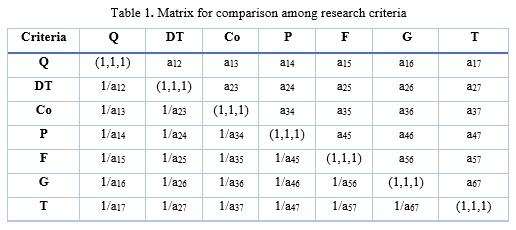
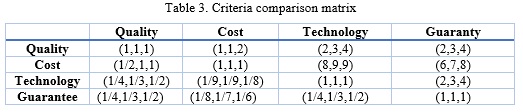
<body><![CDATA[<p><font size="2" face="Verdana, Arial, Helvetica, sans-serif">The purpose of this paper is  to describe how the technology suppliers for a video surveillance project are  selected using a method based on two fuzzy techniques to model uncertainty: the  fuzzy AHP and the fuzzy 2-tuple representation model. The rest of this paper is  organized as follows. Section 2 introduces the technology supplier selection  method for video surveillance. Section 3 presents the application of the  proposed method to a real project and Section 4 concludes the paper.</font></p>     <p><font size="2" face="Verdana, Arial, Helvetica, sans-serif"><strong>1. A method for the selection  of technology suppliers for Video Surveillance</strong></font></p>     <p><font size="2" face="Verdana, Arial, Helvetica, sans-serif">The  proposed method will have two phases: the first phase will define the criteria  needed to choose the best provider for which the weights are calculated using Fuzzy  AHP; the second phase will include the analysis of the providers defining the  evaluation framework (experts, criteria, alternatives) and the linguistic  scales that will be used in the evaluation of the providers. Subsequently, the  preferences of the evaluators are collected, for which the 2-tuple linguistic  representation model is used to calculate the linguistic overall evaluation of  suppliers. </font></p>     <p><font size="2" face="Verdana, Arial, Helvetica, sans-serif"><strong>1.1 Phase 1. Evaluation of criteria based  on fuzzy AHP</strong></font></p>     <p><font size="2" face="Verdana, Arial, Helvetica, sans-serif"><strong>1. - Definition of the evaluation criteria and development of the  hierarchical structure: </strong>A hierarchy structure is the framework of proposed solution. It can not  only be utilized to study the interaction among the elements involved in each  layer but also help decision makers to explore the impact of different elements  against the objective. The concepts of hierarchical structure analysis with two  distinct levels; that is, criteria level and sub-criteria level, are used in  this paper. The definition of criteria should be flexible and in line with the  needs of the organization. The following are the criteria proposed for the  research: Quality (Q), Delivery Time (DT), Cost (Co), Performance (P),  Flexibility (F), Guarantee (G) and Technology (T). <a href="#f01">Figure 1</a> shows the  sub-criteria that correspond to each criterion. To apply fuzzy AHP, the goal,  criteria and sub-criteria must be structured at different levels of hierarchy. </font></p>     <p align="center"><img src="/img/revistas/rcci/v11n3/f0104318.jpg" alt="f01" width="476" height="399"><a name="f01"></a></p>     <p><font size="2"><strong><font face="Verdana, Arial, Helvetica, sans-serif">2.- Selection of the fuzzy scale:</font></strong><font face="Verdana, Arial, Helvetica, sans-serif"> It will  allow the construction of the fuzzy judgment matrices. The experts' assessments  will be made on the basis of the modified Saaty scale (Chiu, 1998).</font></font></p>     <p><font size="2" face="Verdana, Arial, Helvetica, sans-serif"><strong>3.- Construction of fuzzy judgment matrices:</strong> the judgment matrices are  constructed based on the hierarchy constructed in step one and using the  selected fuzzy scale, and by comparing the elements at given levels in the  hierarchical representation to estimate their relative importance in relation  to the higher level element. To do this, the team uses the triangular numbers  to express their preferences between the different criteria with respect to the  goal (<a href="#t01">Table 1</a>) and this same procedure is repeated for the sub-criteria. </font></p>     <p align="center"><img src="/img/revistas/rcci/v11n3/t0104318.jpg" alt="t01" width="516" height="230"><a name="t01"></a></p>     <p><font size="2"><strong><font face="Verdana, Arial, Helvetica, sans-serif">4.- Calculation of weights of criteria and sub-criteria:</font></strong><font face="Verdana, Arial, Helvetica, sans-serif"> It is recommended to use the  methodology proposed by (Chang, 1996) in its extended method of analysis to  calculate the weight of the criteria and the local weight of the sub-criteria.</font></font></p>     ]]></body>
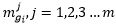
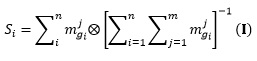
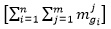
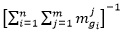
<body><![CDATA[<p align="center"><img src="/img/revistas/rcci/v11n3/fo0104318.jpg" alt="fo01" width="207" height="34"></p>     <p><font size="2" face="Verdana, Arial, Helvetica, sans-serif">Where all&nbsp; <img src="/img/revistas/rcci/v11n3/fo0204318.jpg" alt="fo02" width="116" height="24"> are fuzzy  triangular numbers.</font></p>     <p><font size="2" face="Verdana, Arial, Helvetica, sans-serif">To calculate the weight of the criteria, Chang proposes the following  equation:</font> </p>     <p align="center"><img src="/img/revistas/rcci/v11n3/fo0304318.jpg" alt="fo03" width="257" height="61"></p>     <p><font size="2" face="Verdana, Arial, Helvetica, sans-serif">Where the operator <img src="/img/revistas/rcci/v11n3/fo0404318.jpg" alt="fo04" width="14" height="14"> denotes the  extended multiplication of two fuzzy numbers.</font></p>     <p><font size="2" face="Verdana, Arial, Helvetica, sans-serif">To obtain the extended  analysis values for each element of the paired comparison matrix <img src="/img/revistas/rcci/v11n3/fo0504318.jpg" alt="fo05" width="69" height="27"> the basic addition of fuzzy numbers is applied as shown below: </font></p>     <p align="center"><img src="/img/revistas/rcci/v11n3/fo0604318.jpg" alt="fo06" width="276" height="52"></p>     <p><font size="2" face="Verdana, Arial, Helvetica, sans-serif">While to get <img src="/img/revistas/rcci/v11n3/fo0704318.jpg" alt="fo07" width="111" height="29">would be:</font></p>     <p align="center"><img src="/img/revistas/rcci/v11n3/fo0804318.jpg" alt="fo08" width="314" height="50"></p>     <p><font size="2" face="Verdana, Arial, Helvetica, sans-serif">Then <img src="/img/revistas/rcci/v11n3/fo0904318.jpg" alt="fo09" width="122" height="32">can be obtained as follows: </font></p>     ]]></body>
<body><![CDATA[<p align="center"><img src="/img/revistas/rcci/v11n3/fo1004318.jpg" alt="fo10" width="294" height="47"></p>     <p><font size="2" face="Verdana, Arial, Helvetica, sans-serif">To compare the values of m, it is taken into account that, for example,  to determine the degree to which <img src="/img/revistas/rcci/v11n3/fo1104318.jpg" alt="fo11" width="65" height="24"> t is defined that <img src="/img/revistas/rcci/v11n3/fo1204318.jpg" alt="fo12" width="302" height="24">can also be expressed as follows: </font></p>     <p align="center"><img src="/img/revistas/rcci/v11n3/fo1304318.jpg" alt="fo13" width="567" height="87"></p>     <p><font size="2" face="Verdana, Arial, Helvetica, sans-serif">To carry out the comparison of  and it is necessary to have the  values of V<img src="/img/revistas/rcci/v11n3/fo1104318.jpg" alt="fo11" width="65" height="24"> and V<img src="/img/revistas/rcci/v11n3/fo1404318.jpg" alt="fo14" width="72" height="16"> </font></p>     <p><font size="2" face="Verdana, Arial, Helvetica, sans-serif">The degree of possibility for  a convex fuzzy number to be greater than a convex fuzzy<em>k</em> mi(i=1,2,...., k) can be defined as:</font></p>     <p align="center"><img src="/img/revistas/rcci/v11n3/fo1504318.jpg" alt="fo15" width="561" height="24"></p>     <p><font size="2" face="Verdana, Arial, Helvetica, sans-serif">So it is  assumed that the weights are calculated as follows:</font></p>     <p><img src="/img/revistas/rcci/v11n3/fo1604318.jpg" alt="fo16" width="297" height="23"><font size="2" face="Verdana, Arial, Helvetica, sans-serif"> there for the weight vector is  given by:</font></p>     <p align="center"><img src="/img/revistas/rcci/v11n3/fo1704318.jpg" alt="fo17" width="433" height="20"></p>     <p><font size="2" face="Verdana, Arial, Helvetica, sans-serif">After the weight vector is  obtained, it must be normalized. Being a vector of natural non-fuzzy numbers,  this normalized vector is represented as:</font></p>     ]]></body>
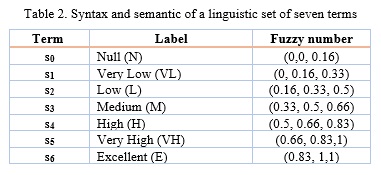
<body><![CDATA[<p align="center"><img src="/img/revistas/rcci/v11n3/fo1804318.jpg" alt="fo18" width="231" height="31"></p>     <p><font size="2" face="Verdana, Arial, Helvetica, sans-serif">The local weight of the sub-criteria is calculated  following the same procedure described in the previous section.</font></p>     <p><font size="2" face="Verdana, Arial, Helvetica, sans-serif"><strong>1.2 Phase 2. Evaluation  of suppliers based on the fuzzy 2-tuple linguistic model</strong></font></p>     <p><font size="2" face="Verdana, Arial, Helvetica, sans-serif"><strong>1.- Definition of the evaluation framework</strong>: The evaluation of suppliers should  be carried out based on a set of criteria </font><img src="/img/revistas/rcci/v11n3/fo1904318.jpg" alt="fo19" width="155" height="19"> <font size="2" face="Verdana, Arial, Helvetica, sans-serif">a set of suppliers (alternatives) </font><img src="/img/revistas/rcci/v11n3/fo2004318.jpg" alt="fo20" width="148" height="26"> <font size="2" face="Verdana, Arial, Helvetica, sans-serif">and a set of experts</font> <img src="/img/revistas/rcci/v11n3/fo2104318.jpg" alt="fo21" width="157" height="23"><font size="2" face="Verdana, Arial, Helvetica, sans-serif"> that are defined at the beginning of the evaluation. Itis important to  consider the weight or importance of each criterion for which the weight vector  is <img src="/img/revistas/rcci/v11n3/fo2204318.jpg" alt="fo22" width="117" height="20"> that can be calculated in phase 1 or can be defined according to the  evaluator will be used. In order for  evaluators to be able to express their perception and knowledge easily, it is  necessary for them to use an appropriate set of linguistic descriptors, the  cardinality of which must correspond to (Miller, 1956). The assessment  information is provided using the linguistic term set in <a href="#t02">Table 2</a>.</font></p>     <p align="center"><img src="/img/revistas/rcci/v11n3/t0204318.jpg" alt="t02" width="381" height="175"><a name="t02"></a></p>     <p><font size="2"><strong><font face="Verdana, Arial, Helvetica, sans-serif">2. Compilation of experts&rsquo; preferences:</font></strong><font face="Verdana, Arial, Helvetica, sans-serif"> The collection of the  experts' evaluations is based on the definitions made in the evaluation  framework. Each expert will be able to express its considerations, using the utility  vector <img src="/img/revistas/rcci/v11n3/fo2304318.jpg" alt="fo23" width="165" height="28"> represents his/her preference over the <strong>a</strong>j supplier according to the <strong>c</strong>k criterion.</font></font></p>     <p><font size="2"><strong><font face="Verdana, Arial, Helvetica, sans-serif">3.- Transformation of experts&rsquo;preferencesinto  2-tuple linguistic values:</font></strong><font face="Verdana, Arial, Helvetica, sans-serif"> For each assessment <img src="/img/revistas/rcci/v11n3/fo2404318.jpg" alt="fo24" width="30" height="19"> the transformation is carried out assuming that a=0, leaving the 2-tuple linguisticas <img src="/img/revistas/rcci/v11n3/fo2504318.jpg" alt="fo25" width="45" height="19"> Applying this rule, the new 2-tuple linguistic matrices will have the form <img src="/img/revistas/rcci/v11n3/fo2604318.jpg" alt="fo26" width="269" height="30"> </font></font></p>     <p><font size="2" face="Verdana, Arial, Helvetica, sans-serif"><strong>Remark: </strong>Since the calculation of the collective  evaluation for each supplier can be seen as a multi-step aggregation process  using 2-tuple linguistic aggregation operators. In (Mart&iacute;nez et al. 2015) many  of the basic 2-tuple linguistic aggregation operators can be revised and one of  the most used in literature are the following: </font></p>     <p><font size="2" face="Verdana, Arial, Helvetica, sans-serif">Assume that <img src="/img/revistas/rcci/v11n3/fo2704318.jpg" alt="fo27" width="140" height="20"> is a set of 2-tuple linguistic values, and W =(w1,.....,wm) the weighting vector such that <img src="/img/revistas/rcci/v11n3/fo2804318.jpg" alt="fo28" width="78" height="24">the weighted averaging aggregation operator  associated with W is the function <img src="/img/revistas/rcci/v11n3/fo2904318.jpg" alt="fo29" width="108" height="20">defined as:</font> </p>     <p align="center"><img src="/img/revistas/rcci/v11n3/fo3004318.jpg" alt="fo30" width="300" height="58"></p>     ]]></body>



<body><![CDATA[<p><font size="2" face="Verdana, Arial, Helvetica, sans-serif">When <img src="/img/revistas/rcci/v11n3/fo3104318.jpg" alt="fo31" width="118" height="35"> the 2TWM operator  reduces to the 2-tuple arithmetic mean (2TAM) operator:</font></p>     <p align="center"><img src="/img/revistas/rcci/v11n3/fo3204318.jpg" alt="fo32" width="287" height="54"></p>     <p><font size="2" face="Verdana, Arial, Helvetica, sans-serif">The selection of the operators in next  steps 4 and 5 will depend on the intended outcome.</font></p>     <p><font size="2" face="Verdana, Arial, Helvetica, sans-serif"><strong>4.-Calculation of the collective value for each  criterion</strong>: In this step, preferences provided by experts are aggregated together,  obtaining collective valuations from individual valuations, that is to say, the  collective value of each criterion can be obtained for each supplier by aggregating  the preferences of all the experts. Matrices <img src="/img/revistas/rcci/v11n3/fo3304318.jpg" alt="fo33" width="95" height="27">   are obtained based on: <img src="/img/revistas/rcci/v11n3/fo3404318.jpg" alt="fo34" width="140" height="24"></font></p>     <p><font size="2"><strong><font face="Verdana, Arial, Helvetica, sans-serif">5-. Calculation of the  collective value for each supplier</font></strong><font face="Verdana, Arial, Helvetica, sans-serif">: Once the evaluations issued on each criterion  have been aggregated, the overall value of the preferences for each supplier is  then calculated. Matrices <img src="/img/revistas/rcci/v11n3/fo3504318.jpg" alt="fo35" width="87" height="32">are generated based on: <img src="/img/revistas/rcci/v11n3/fo3604318.jpg" alt="fo36" width="128" height="26"></font></font></p>     <p><font size="2"><strong><font face="Verdana, Arial, Helvetica, sans-serif">6-. Obtaining the ordered list  of suppliers</font></strong><font face="Verdana, Arial, Helvetica, sans-serif">: Once the overall evaluation is obtained for each supplier, by  comparing the <img src="/img/revistas/rcci/v11n3/fo3704318.jpg" alt="fo37" width="58" height="25">linguistic values,  we can determine the ranking order of all suppliers and select the best one  from the initial set of feasible alternatives. The rules of comparison for 2-tuple  linguistic values were introduced in (Herrera and Mart&iacute;nez, 2000).</font></font></p>     <p><font size="2"><font face="Verdana, Arial, Helvetica, sans-serif"><a href="/img/revistas/rcci/v11n3/f0204318.jpg" target="_blank">Figure 2</a>  summarize the inputs, outputs and the 2-tuple linguistic computing tool to be  applied in each step.</font></font></p>     <p><font size="2" face="Verdana, Arial, Helvetica, sans-serif"><strong>2. Application of the proposed  method in the technology supplier selection for Xilema Suria</strong></font></p>     <p><font size="2" face="Verdana, Arial, Helvetica, sans-serif"><a>Xilema Suria is a professional  platform for the management of video surveillance in any environment in need of  security and protection. With a high degree of scalability and adaptability it  represents the ideal support in the protection of people, buildings, offices,  public establishments and other assets. Structured in six subsystems that  interact with each other, the system described is capable of operating on IP  cameras of any known manufacturer and allows real-time and delayed monitoring  of each action performed. The project team needs to select a company to provide  the necessary cameras for the deployment of the application. Mobotix (</a> a1), Vivotek (a2 ), Axis Comunications (a3 ) and Visiotech (a4 ), meet the essential requirements  for software installation and our model will be used to select the right  provider. </font></p>     <p><font size="2" face="Verdana, Arial, Helvetica, sans-serif">In the following, we employ the proposed method to aidthe Xilema Suria  project to select the most suitable technology supplier. The solution process  and the computation resultsare summarized as follows:</font></p>     ]]></body>
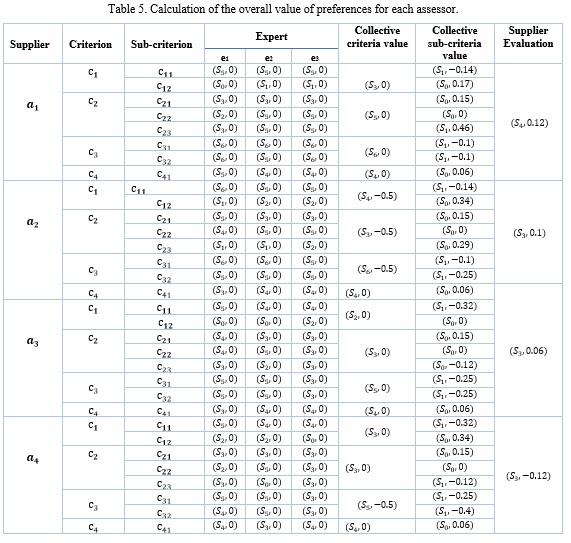
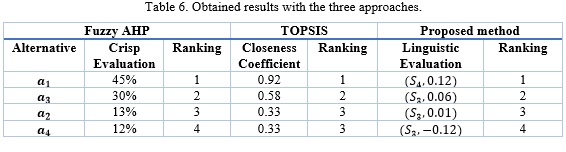
<body><![CDATA[<p><font size="2" face="Verdana, Arial, Helvetica, sans-serif"><strong>2.1 Phase 1. Evaluation of criteria based on fuzzy AHP</strong></font></p>     <p><font size="2" face="Verdana, Arial, Helvetica, sans-serif"><strong>1. - Definition of the evaluation  criteria and development of the hierarchical structure:</strong> Based on an interview with the project leader, where the needs of the  project were analyzed, it was determined that it was not necessary to take into  account the evaluation based on the 7 criteria defined in the main method.  Those chosen are represented in the hierarchical structure with their respective  sub-criteria in <a href="#f03">Figure 3</a>.</font></p>     <p align="center"><img src="/img/revistas/rcci/v11n3/f0304318.jpg" alt="f03" width="501" height="300"><a name="f03"></a></p>     <p><font size="2"><a><strong><font face="Verdana, Arial, Helvetica, sans-serif">2.-</font></strong></a><font face="Verdana, Arial, Helvetica, sans-serif"><strong>Selection of the fuzzy scale:</strong> The construction of the matrices of fuzzy judgment will be  done from the valuations of the experts taking into account the modified Saaty  scale (Chiu, 1998).</font></font></p>     <p><font size="2" face="Verdana, Arial, Helvetica, sans-serif"><strong>3.- Construction of fuzzy judgment matrices</strong>: The criteria issued by the project leader,  considered as the expert to carry out this evaluation, is presented in <a href="#t03">Table 3</a>,  the matrices of fuzzy judgment must be constructed from the paired comparison  of the selected criteria and sub-criteria. </font></p>     <p align="center"><img src="/img/revistas/rcci/v11n3/t0304318.jpg" alt="t03" width="523" height="112"><a name="t03"></a></p>     <p><font size="2" face="Verdana, Arial, Helvetica, sans-serif">Calculation of weights of criteria and sub-criteria: Once the matrices  of fuzzy judgment have been carried out from the paired comparison of the  criteria and sub-criteria selected by the project leader, the corresponding  weight of each criterion and sub-criterion is calculated. <a href="#t04">Table 4</a> shows the  values.</font></p>     <p align="center"><img src="/img/revistas/rcci/v11n3/t0404318.jpg" alt="t04" width="378" height="183"><a name="t04"></a></p>     <p><font face="Verdana, Arial, Helvetica, sans-serif"><strong><font size="2">2.2. Phase 2. Evaluation of suppliers based  on the fuzzy 2-tuple linguistic model</font></strong></font></p>     <p><font size="2" face="Verdana, Arial, Helvetica, sans-serif"><a href="#t05">Table 5</a> summarizes steps 2 to  5 of the Phase 2. Preferences provided by experts are collected and transformed  into 2-tuple linguistic values (columns 4-6). The collective value for each  criterion is calculated using the 2TAM aggregation operator (column 7). The  collective value of each sub-criterion is calculated using the 2TWM aggregation  operator (columns 7-8) and, finally, the overall evaluation for each supplier is  calculated using the 2TAM aggregation operator (column 9). </font></p>     ]]></body>
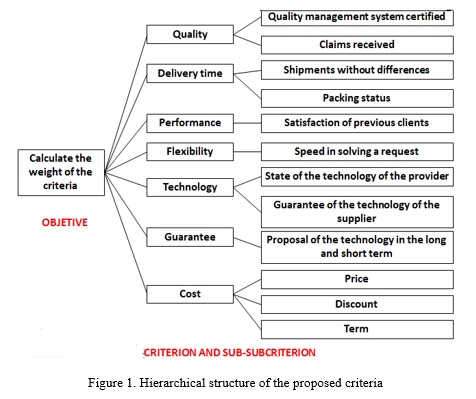
<body><![CDATA[<p align="center"><img src="/img/revistas/rcci/v11n3/t0504318.jpg" alt="t05" width="571" height="543"><a name="t05"></a></p>     <p><font size="2" face="Verdana, Arial, Helvetica, sans-serif">Since <img src="/img/revistas/rcci/v11n3/fo3804318.jpg" alt="fo38" width="316" height="23">, the final order of suppliers (a1,a2,a3,a4) and the best one is Mobotix(a1) with the highest global 2-tuple linguistic supplier  evaluation. </font></p>     <p><font size="2" face="Verdana, Arial, Helvetica, sans-serif"><strong>2.3 Results analysis</strong></font></p>     <p><font size="2" face="Verdana, Arial, Helvetica, sans-serif">It is interesting to contrast our results with others obtained with  different methods. To discuss our approach we propose to solve the problem  using two additional approaches:</font></p>     <p><ul>         <li>           <p><font size="2" face="Verdana, Arial, Helvetica, sans-serif">The Fuzzy AHP in the total solution (Chang,  1996).  That is, to use fuzzy AHP with the concepts of hierarchical structure analysis  with three distinct levels; that is, criteria level, sub-criteria level and  suppliers level. </font></p>     </li>         <li>           <p><font size="2" face="Verdana, Arial, Helvetica, sans-serif">The technique for order preference by similarity to  ideal solution (TOPSIS) (Hwang and Yoon, 1981). TOPSIS was originally  introduced for solving decision making problems with numerical inputs.&nbsp; Its basic principle is that the best  alternative should have the shortest distance from the positive ideal solution  and the farthest distance from the negative ideal solution. For determining a  collective evaluation for each supplier, considering importance weights for  criteria, fuzzy assessments are aggregated by means of arithmetical operations  over fuzzy. Then we calculate a closeness coefficient based on the distances to  the positive ideal solution and the negative ideal solution. So, these  closeness coefficients allow to obtain a ranking of alternatives, but they lack  interpretation, rather than the order. </font></p>     </li>         </ul>       ]]></body>
<body><![CDATA[<p><font size="2" face="Verdana, Arial, Helvetica, sans-serif"><a href="#t06">Table 6</a> summarizes the outputs for the  three methods. It is easy to see that the optimal order for these three  potential suppliers are similar, and the supplier &nbsp;is the most desirable supplier. The proposed  method is not only simple and easy to understand but also reduces the loss of  the original data information by using the 2-tuple linguistic model.</font></p>   <font size="2" face="Verdana, Arial, Helvetica, sans-serif">After applying the three methods to the same data  set, the results of our approach were considered as better for the experts. The  other approaches do not provide interpretability in the collective result for  each supplier, further than the order. This is a significant feature in  supplier evaluation processes when experts&rsquo; and stakeholders&rsquo; interpretability  requirements are beyond a simple ranking of suppliers in order to understand  the rating process and the obtained results. In these situations, our approach  based on fuzzy AHP and fuzzy 2-tuple linguistic model, provides desirable  characteristics because its results are close to human natural language and  provide interpretability and understandability. Moreover, they were more  confident on our results because they could deduce the result just by reading  the label and the symbolic translation.</font></p>     <p align="center"><img src="/img/revistas/rcci/v11n3/t0604318.jpg" alt="t06" width="566" height="152"><a name="t06"></a></p>     <p><font size="2" face="Verdana, Arial, Helvetica, sans-serif">To calculate the ranking of the TOPSIS method and the  proposed method, the experimental calculation application Flintstones was used  (Estrella et al. 2014). In the case of fuzzy AHP, a spreadsheet was used.</font></p>     <p>&nbsp;</p>     <p><font face="Verdana, Arial, Helvetica, sans-serif" size="3"><B>CONCLUSIONS</B></font></p>     <p><font size="2" face="Verdana, Arial, Helvetica, sans-serif">The supplier evaluation and selection problem involves  a multiplicity of complex considerations. Moreover, some evaluation criteria  faced an ambiguous and uncertain nature. Hence, the evaluation of supplier  selection is usually confronted with fuzzy decision-making models. In the light  of this, this paper developed a hybrid fuzzy multi criteria decision making approach  to solve the problem of supplier selection for video surveillance projects. It  applies in the first phase the fuzzy AHP to obtain the criteria weights in the  hierarchical structure. It also uses the fuzzy 2-tuple linguistic model in the  second phase to calculate the overall evaluation of each supplier.</font></p>     <p><font size="2" face="Verdana, Arial, Helvetica, sans-serif">The results are not only very simple and easy to  understand but also reduces the loss of the original data information byusing  the fuzzy 2-tuple linguistic model.</font></p>     <p><font size="2" face="Verdana, Arial, Helvetica, sans-serif">The proposed method is  illustrated with its application to the technology supplier selection problem for  Xilema Suria, a real video surveillance project developed at UCI. This  selection problem is one of the possible applications; it is expected that the  method proposed in this paper can be applied to many fields such as risk  analysis, project evaluation, renewable energy system selection and location  selection. </font></p>     <p>&nbsp;</p>     <p align="left"><font face="Verdana, Arial, Helvetica, sans-serif" size="3"><B>REFERENCES</B></font>     ]]></body>
<body><![CDATA[<p><font size="2"><strong><font face="Verdana, Arial, Helvetica, sans-serif">CHAI, Junyi; LIU, James NK; NGAI, Eric WT. </font></strong><font face="Verdana, Arial, Helvetica, sans-serif">Application of  decision-making techniques in supplier selection: A systematic review of  literature. Expert Systems with  Applications, vol.40, no 10, p. 3872&ndash;3885.<strong>2013</strong> DOI: 10.1016/j.eswa.2012.12.040.</font></font></p>     <!-- ref --><p><font size="2" face="Verdana, Arial, Helvetica, sans-serif"><strong>CHANG,  Da-Yong. </strong>Application  of the extent analysis method on fuzzy AHP. European Journal of Operational Research, Vol. 95, no 3, p. 649-655. <strong>1996</strong>DOI:org/10.1016/0377-2217(95)00300-2</font><p><font size="2" face="Verdana, Arial, Helvetica, sans-serif"><strong>CHIU, Chui-Yu; PARK, Chan S. </strong>Capital budgeting decisions  with fuzzy project.The Engineering  Economist, Vol.43, no 2, p. 125&ndash;150.<strong>1998</strong> DOI:org/10.1080/00137919808903193</font></p>     <!-- ref --><p><font size="2" face="Verdana, Arial, Helvetica, sans-serif"><strong>ESPINILLA, Macarena</strong>Nuevos modelos de evaluaci&oacute;n sensorial con  informaci&oacute;n ling&uuml;&iacute;stica. Tesis  Doctoral. Universidad de Ja&eacute;n. <strong>2009.    </strong></font></p>     <!-- ref --><p><font size="2" face="Verdana, Arial, Helvetica, sans-serif"><strong>ESTRELLA, Francisco Javier; ESPINILLA, Macarena; MART&Iacute;NEZ, Luis.</strong> FLINTSTONES: Una suite para la toma de decisiones  ling&uuml;&iacute;sticas basada en 2-tupla ling&uuml;&iacute;sticas y extensiones. En XVII Congreso espa&ntilde;ol sobre tecnolog&iacute;as y  l&oacute;gica fuzzy. <strong>2014.    </strong></font></p>     <!-- ref --><p><font size="2" face="Verdana, Arial, Helvetica, sans-serif"><strong>GU, Yu; DONG, Shaojian. </strong>Logistics Cost  Management from the Supply Chain Perspective. Journal of Service Science and Management, vol. 9, no 03, p.  229.<strong>2016.</strong> DOI:org/10.4236/jssm.2016.93028</font><!-- ref --><p><font size="2" face="Verdana, Arial, Helvetica, sans-serif"><strong>HERRERA UMA&Ntilde;A, Mar&iacute;a Fernanda; OSORIO G&Oacute;MEZ, Juan Carlos.</strong> Modelo para la gesti&oacute;n de proveedores utilizando  AHP difuso. Estudios Gerenciales,  vol. 22, no 99, p. 69-88.<strong>2006.    </strong></font></p>     ]]></body>
<body><![CDATA[<!-- ref --><p><font size="2" face="Verdana, Arial, Helvetica, sans-serif"><strong>HERRERA, Francisco; MART&Iacute;NEZ, Luis.</strong> A 2-tuple fuzzy linguistic representation model  for computing with words. IEEE  Transactions on fuzzy systems, vol. 8, no 6, p. 746-752. <strong>2000.    </strong> </font></p>     <!-- ref --><p><font size="2" face="Verdana, Arial, Helvetica, sans-serif"><strong>HO, William; XU, Xiaowei; DEY,  Prasanta K.</strong> Multi-criteria decision making  approaches for supplier evaluation and selection: A literature review. European Journal of operational research,  vol. 202, no 1, p. 16-24.<strong>2010.</strong> DOI:  10.1016/j.ejor.2009.05.009.     </font></p>     <!-- ref --><p><font size="2" face="Verdana, Arial, Helvetica, sans-serif"><strong>HWANG, Ching-Lai; YOON,  Kwangsun.</strong> Methods for multiple attribute decision making. En Multiple attribute decision making.  Springer, Berlin, Heidelberg, p. 58-191. <strong>1981.    </strong></font></p>     <!-- ref --><p><font size="2" face="Verdana, Arial, Helvetica, sans-serif"><strong>MART&Iacute;NEZ, Luis; RODRIGUEZ, Rosa  M.; HERRERA, Francisco.</strong>2-Tuple Linguistic Model. En The 2-tuple Linguistic Model.  Springer, Cham, p. 23-42.<strong>2015.    </strong></font></p>     <!-- ref --><p><font size="2" face="Verdana, Arial, Helvetica, sans-serif"><strong>MILLER, George A.</strong> The magical number seven, plus or minus two: Some limits on our capacity  for processing information. Psychological  review, vol. 63, no 2, p. 81. <strong>1956.    </strong></font></p>     ]]></body>
<body><![CDATA[<p><font size="2" face="Verdana, Arial, Helvetica, sans-serif"><strong>OSIECKI, Lawrence T.; PHILLIPS,  D. Michael; SCIBILIA, John.</strong> Understanding and Leveraging a  Supplier&rsquo;s CMMI&reg; Efforts: A Guidebook for Acquirers (Revised for V1. 3). <strong>2011.</strong> </font></p>     <!-- ref --><p><font size="2" face="Verdana, Arial, Helvetica, sans-serif"><strong>ORTIZ TORRES, Maritza; ORAMAS SANTOS, Onailis; SANZ P&Eacute;REZ, Magaly.</strong> Procedimiento De Evaluaci&oacute;n De Proveedores Con  Herramientas De La Teor&iacute;a De Los Subconjuntos Borrosos. Aplicaci&oacute;n a Proveedores Seleccionados De Una Empresa Comercial (<em>Method for Evaluating Suppliers with the  Theory of Fuzzy Subsets. Application to Selected Suppliers of a Commercial  Company</em>). 2015.    </font></p>     <!-- ref --><p><font size="2" face="Verdana, Arial, Helvetica, sans-serif"><strong>PHILLIPS, Mike</strong>. CMMI for Acquisition (CMMI-ACQ) Primer, Version 1.3. <strong>2011.    </strong></font></p>     <!-- ref --><p><font size="2" face="Verdana, Arial, Helvetica, sans-serif"><strong>JU, Yanbing; WANG, Aihua; LIU,  Xiaoyue</strong>. Evaluating emergency response capacity by fuzzy AHP  and 2-tuple fuzzy linguistic approach. Expert  Systems with Applications, vol. 39, no 8, p. 6972-6981.<strong>2012.</strong> DOI:10.1016/j.eswa.2012.01.061 </font><p><font size="2" face="Verdana, Arial, Helvetica, sans-serif"><strong>STELLINGWERF,  Rommert; ZANDHUIS, Anton.</strong>ISO  21500 Guidance on project management&ndash;A Pocket Guide. Van Haren. <strong>2013.</strong> </font></p>     <p name="_ENREF_1">&nbsp;</p>     <p name="_ENREF_1">&nbsp;</p>     <p><font size="2" face="Verdana, Arial, Helvetica, sans-serif">Recibido: 14/03/2018    ]]></body>
<body><![CDATA[<br> Aceptado: 04/07/2018</font></p>      ]]></body><back>
<ref-list>
<ref id="B1">
<nlm-citation citation-type="">
<person-group person-group-type="author">
<name>
<surname><![CDATA[CHAI]]></surname>
<given-names><![CDATA[Junyi]]></given-names>
</name>
<name>
<surname><![CDATA[LIU]]></surname>
<given-names><![CDATA[James NK]]></given-names>
</name>
<name>
<surname><![CDATA[NGAI]]></surname>
<given-names><![CDATA[Eric WT]]></given-names>
</name>
</person-group>
<article-title xml:lang="en"><![CDATA[Application of decision-making techniques in supplier selection: A systematic review of literature.]]></article-title>
<source><![CDATA[]]></source>
<year>2013</year>
<volume>40</volume>
<numero>10</numero>
<issue>10</issue>
<page-range>3872-3885</page-range></nlm-citation>
</ref>
<ref id="B2">
<nlm-citation citation-type="">
<person-group person-group-type="author">
<name>
<surname><![CDATA[CHANG]]></surname>
<given-names><![CDATA[Da-Yong]]></given-names>
</name>
</person-group>
<article-title xml:lang="en"><![CDATA[Application of the extent analysis method on fuzzy AHP.]]></article-title>
<source><![CDATA[]]></source>
<year>1996</year>
<volume>95</volume>
<numero>3</numero>
<issue>3</issue>
<page-range>649-655</page-range></nlm-citation>
</ref>
<ref id="B3">
<nlm-citation citation-type="">
<person-group person-group-type="author">
<name>
<surname><![CDATA[Chui-Yu]]></surname>
<given-names><![CDATA[CHIU]]></given-names>
</name>
<name>
<surname><![CDATA[PARK]]></surname>
<given-names><![CDATA[Chan S]]></given-names>
</name>
</person-group>
<article-title xml:lang="en"><![CDATA[Capital budgeting decisions with fuzzy project]]></article-title>
<source><![CDATA[]]></source>
<year>1998</year>
<volume>43</volume>
<numero>2</numero>
<issue>2</issue>
<page-range>125-150</page-range></nlm-citation>
</ref>
<ref id="B4">
<nlm-citation citation-type="book">
<person-group person-group-type="author">
<name>
<surname><![CDATA[ESPINILLA]]></surname>
<given-names><![CDATA[Macarena]]></given-names>
</name>
</person-group>
<source><![CDATA[Nuevos modelos de evaluación sensorial con información lingüística.]]></source>
<year>2009</year>
<publisher-name><![CDATA[Universidad de Jaén]]></publisher-name>
</nlm-citation>
</ref>
<ref id="B5">
<nlm-citation citation-type="">
<person-group person-group-type="author">
<name>
<surname><![CDATA[ESTRELLA]]></surname>
<given-names><![CDATA[Francisco Javier]]></given-names>
</name>
<name>
<surname><![CDATA[ESPINILLA]]></surname>
<given-names><![CDATA[Macarena]]></given-names>
</name>
<name>
<surname><![CDATA[MARTÍNEZ]]></surname>
<given-names><![CDATA[Luis]]></given-names>
</name>
</person-group>
<source><![CDATA[FLINTSTONES: Una suite para la toma de decisiones lingüísticas basada en 2-tupla lingüísticas y extensiones]]></source>
<year>2014</year>
</nlm-citation>
</ref>
<ref id="B6">
<nlm-citation citation-type="">
<person-group person-group-type="author">
<name>
<surname><![CDATA[GU]]></surname>
<given-names><![CDATA[Yu]]></given-names>
</name>
<name>
<surname><![CDATA[DONG]]></surname>
<given-names><![CDATA[Shaojian]]></given-names>
</name>
</person-group>
<article-title xml:lang="es"><![CDATA[Logistics Cost Management from the Supply Chain Perspective.]]></article-title>
<source><![CDATA[]]></source>
<year>2016</year>
<volume>9</volume>
<numero>03</numero>
<issue>03</issue>
<page-range>229</page-range></nlm-citation>
</ref>
<ref id="B7">
<nlm-citation citation-type="">
<person-group person-group-type="author">
<name>
<surname><![CDATA[HERRERA UMAÑA]]></surname>
<given-names><![CDATA[María Fernanda]]></given-names>
</name>
<name>
<surname><![CDATA[OSORIO GÓMEZ]]></surname>
<given-names><![CDATA[Juan Carlos]]></given-names>
</name>
</person-group>
<article-title xml:lang="es"><![CDATA[Modelo para la gestión de proveedores utilizando AHP difuso]]></article-title>
<source><![CDATA[]]></source>
<year>2006</year>
<volume>22</volume>
<numero>99</numero>
<issue>99</issue>
<page-range>69-88</page-range></nlm-citation>
</ref>
<ref id="B8">
<nlm-citation citation-type="">
<person-group person-group-type="author">
<name>
<surname><![CDATA[HERRERA]]></surname>
<given-names><![CDATA[Francisco]]></given-names>
</name>
<name>
<surname><![CDATA[MARTÍNEZ]]></surname>
<given-names><![CDATA[Luis]]></given-names>
</name>
</person-group>
<article-title xml:lang="en"><![CDATA[A 2-tuple fuzzy linguistic representation model for computing with words]]></article-title>
<source><![CDATA[]]></source>
<year>2000</year>
<volume>8</volume>
<numero>6</numero>
<issue>6</issue>
<page-range>746-752</page-range></nlm-citation>
</ref>
<ref id="B9">
<nlm-citation citation-type="">
<person-group person-group-type="author">
<name>
<surname><![CDATA[HO]]></surname>
<given-names><![CDATA[William]]></given-names>
</name>
<name>
<surname><![CDATA[XU]]></surname>
<given-names><![CDATA[Xiaowei]]></given-names>
</name>
<name>
<surname><![CDATA[DEY]]></surname>
<given-names><![CDATA[Prasanta K]]></given-names>
</name>
</person-group>
<article-title xml:lang="en"><![CDATA[Multi-criteria decision making approaches for supplier evaluation and selection: A literature review]]></article-title>
<source><![CDATA[]]></source>
<year>2010</year>
<volume>202</volume>
<numero>1</numero>
<issue>1</issue>
<page-range>16-24</page-range></nlm-citation>
</ref>
<ref id="B10">
<nlm-citation citation-type="">
<person-group person-group-type="author">
<name>
<surname><![CDATA[HWANG]]></surname>
<given-names><![CDATA[Ching-Lai]]></given-names>
</name>
<name>
<surname><![CDATA[YOON]]></surname>
<given-names><![CDATA[Kwangsun]]></given-names>
</name>
</person-group>
<source><![CDATA[Methods for multiple attribute decision making.]]></source>
<year>1981</year>
<page-range>58-191</page-range></nlm-citation>
</ref>
<ref id="B11">
<nlm-citation citation-type="book">
<person-group person-group-type="author">
<name>
<surname><![CDATA[MARTÍNEZ]]></surname>
<given-names><![CDATA[Luis]]></given-names>
</name>
<name>
<surname><![CDATA[RODRIGUEZ]]></surname>
<given-names><![CDATA[Rosa M]]></given-names>
</name>
<name>
<surname><![CDATA[HERRERA]]></surname>
<given-names><![CDATA[Francisco]]></given-names>
</name>
</person-group>
<source><![CDATA[2-Tuple Linguistic Model.]]></source>
<year>2015</year>
<page-range>23-42</page-range><publisher-name><![CDATA[Springer]]></publisher-name>
</nlm-citation>
</ref>
<ref id="B12">
<nlm-citation citation-type="">
<person-group person-group-type="author">
<name>
<surname><![CDATA[MILLER]]></surname>
<given-names><![CDATA[George A]]></given-names>
</name>
</person-group>
<article-title xml:lang="en"><![CDATA[The magical number seven, plus or minus two: Some limits on our capacity for processing information]]></article-title>
<source><![CDATA[]]></source>
<year>1956</year>
<volume>63</volume>
<numero>2</numero>
<issue>2</issue>
<page-range>81</page-range></nlm-citation>
</ref>
<ref id="B13">
<nlm-citation citation-type="">
<person-group person-group-type="author">
<name>
<surname><![CDATA[OSIECKI]]></surname>
<given-names><![CDATA[Lawrence T.]]></given-names>
</name>
<name>
<surname><![CDATA[PHILLIPS]]></surname>
<given-names><![CDATA[D. Michael]]></given-names>
</name>
<name>
<surname><![CDATA[SCIBILIA]]></surname>
<given-names><![CDATA[John]]></given-names>
</name>
</person-group>
<source><![CDATA[Understanding and Leveraging a Supplier’s CMMI® Efforts: A Guidebook for Acquirers (Revised for V1. 3)]]></source>
<year>2011</year>
</nlm-citation>
</ref>
<ref id="B14">
<nlm-citation citation-type="">
<person-group person-group-type="author">
<name>
<surname><![CDATA[ORTIZ TORRES]]></surname>
<given-names><![CDATA[Maritza]]></given-names>
</name>
<name>
<surname><![CDATA[ORAMAS SANTOS]]></surname>
<given-names><![CDATA[Onailis]]></given-names>
</name>
<name>
<surname><![CDATA[SANZ PÉREZ]]></surname>
<given-names><![CDATA[Magaly]]></given-names>
</name>
</person-group>
<source><![CDATA[Procedimiento De Evaluación De Proveedores Con Herramientas De La Teoría De Los Subconjuntos Borrosos.]]></source>
<year>2015</year>
</nlm-citation>
</ref>
<ref id="B15">
<nlm-citation citation-type="">
<person-group person-group-type="author">
<name>
<surname><![CDATA[PHILLIPS]]></surname>
<given-names><![CDATA[Mike]]></given-names>
</name>
</person-group>
<source><![CDATA[CMMI for Acquisition (CMMI-ACQ) Primer, Version 1.3]]></source>
<year>2011</year>
</nlm-citation>
</ref>
<ref id="B16">
<nlm-citation citation-type="">
<person-group person-group-type="author">
<name>
<surname><![CDATA[JU]]></surname>
<given-names><![CDATA[Yanbing]]></given-names>
</name>
<name>
<surname><![CDATA[WANG]]></surname>
<given-names><![CDATA[Aihua]]></given-names>
</name>
<name>
<surname><![CDATA[LIU]]></surname>
<given-names><![CDATA[Xiaoyue]]></given-names>
</name>
</person-group>
<article-title xml:lang="en"><![CDATA[Evaluating emergency response capacity by fuzzy AHP and 2-tuple fuzzy linguistic approach]]></article-title>
<source><![CDATA[]]></source>
<year>2012</year>
<volume>39</volume>
<numero>8</numero>
<issue>8</issue>
<page-range>6972-6981</page-range></nlm-citation>
</ref>
<ref id="B17">
<nlm-citation citation-type="">
<person-group person-group-type="author">
<name>
<surname><![CDATA[STELLINGWERF]]></surname>
<given-names><![CDATA[Rommert]]></given-names>
</name>
<name>
<surname><![CDATA[ZANDHUIS]]></surname>
<given-names><![CDATA[Anton]]></given-names>
</name>
</person-group>
<source><![CDATA[ISO 21500 Guidance on project management-A Pocket Guide]]></source>
<year>2013</year>
</nlm-citation>
</ref>
</ref-list>
</back>
</article>