<?xml version="1.0" encoding="ISO-8859-1"?><article xmlns:mml="http://www.w3.org/1998/Math/MathML" xmlns:xlink="http://www.w3.org/1999/xlink" xmlns:xsi="http://www.w3.org/2001/XMLSchema-instance">
<front>
<journal-meta>
<journal-id>2307-2113</journal-id>
<journal-title><![CDATA[Revista Cubana de Información en Ciencias de la Salud]]></journal-title>
<abbrev-journal-title><![CDATA[Rev. cuba. inf. cienc. salud]]></abbrev-journal-title>
<issn>2307-2113</issn>
<publisher>
<publisher-name><![CDATA[Centro Nacional de Información de Ciencias MédicasEditorial Ciencias Médicas]]></publisher-name>
</publisher>
</journal-meta>
<article-meta>
<article-id>S2307-21132016000400003</article-id>
<title-group>
<article-title xml:lang="en"><![CDATA[Scientific profiles in the field of children obesity]]></article-title>
<article-title xml:lang="es"><![CDATA[Perfiles científicos en el campo de la obesidad infantil]]></article-title>
</title-group>
<contrib-group>
<contrib contrib-type="author">
<name>
<surname><![CDATA[Biglu]]></surname>
<given-names><![CDATA[Mohammad-Hossein]]></given-names>
</name>
<xref ref-type="aff" rid="A01"/>
</contrib>
<contrib contrib-type="author">
<name>
<surname><![CDATA[Ghavami]]></surname>
<given-names><![CDATA[Mostafa]]></given-names>
</name>
<xref ref-type="aff" rid="A01"/>
</contrib>
</contrib-group>
<aff id="A01">
<institution><![CDATA[,Tabriz University of Medical Sciences Paramedical Faculty Basic Sciences Department]]></institution>
<addr-line><![CDATA[Tabriz ]]></addr-line>
<country>Iran</country>
</aff>
<aff id="A02">
<institution><![CDATA[,Tabriz University of Medical Sciences Paramedical Faculty Radiology Department]]></institution>
<addr-line><![CDATA[Tabriz ]]></addr-line>
<country>Iran</country>
</aff>
<pub-date pub-type="pub">
<day>00</day>
<month>12</month>
<year>2016</year>
</pub-date>
<pub-date pub-type="epub">
<day>00</day>
<month>12</month>
<year>2016</year>
</pub-date>
<volume>27</volume>
<numero>4</numero>
<fpage>447</fpage>
<lpage>455</lpage>
<copyright-statement/>
<copyright-year/>
<self-uri xlink:href="http://scielo.sld.cu/scielo.php?script=sci_arttext&amp;pid=S2307-21132016000400003&amp;lng=en&amp;nrm=iso"></self-uri><self-uri xlink:href="http://scielo.sld.cu/scielo.php?script=sci_abstract&amp;pid=S2307-21132016000400003&amp;lng=en&amp;nrm=iso"></self-uri><self-uri xlink:href="http://scielo.sld.cu/scielo.php?script=sci_pdf&amp;pid=S2307-21132016000400003&amp;lng=en&amp;nrm=iso"></self-uri><abstract abstract-type="short" xml:lang="en"><p><![CDATA[Childhood obesity is a serious health issue that has both immediate and long-term effects on health and well-being. Although obesity affects both children and adults, but childhood obesity is more serious than obesity in adults. The objective of current study was to depict the trend of publication entitled pediatric obesity indexed in the database of Scopus during years 2001-2015. A bibliometrics study was conducted to plot the development of scientific activities in the field of Pediatric obesity. Database of Scopus which covers 100 % of MEDLINE was used to extract all papers entitled pediatric obesity for a period of 15 years. Extraction of papers was restricted into papers entitled "pediatric obesity" from the Search Builder pull-down menu in the advanced search screen, this causes to obtain the articles that their major topics are in the desired subject area. Analysis of data showed that a total number of 663 papers entitled pediatric obesity indexed in scopus during the period of study. The results of study specified the investigation of pediatric obesity in 18 subject areas; the subject area of psychology seems to be in the inferior concern of scientists. Regarding the important influence of socio-psycho-genetic aspects on the pediatric obesity, these issues of study should be taken under consideration by policy-makers and nutritional scientists.]]></p></abstract>
<abstract abstract-type="short" xml:lang="es"><p><![CDATA[La obesidad en la infancia constituye un serio problema de salud, que tiene efectos tanto inmediatos como a largo plazo sobre la salud y el bienestar. A pesar de que la obesidad afecta tanto a niños como a adultos, en la niñez es más seria que en los adultos. El objetivo de este estudio fue conocer la tendencia de las publicaciones tituladas obesidad pediátrica indexadas en la base de datos de Scopus durante los años 2001-2015. Se realizó un estudio bibliométrico para conocer el desarrollo de las actividades científicas en el campo de la obesidad pediátrica. La base de datos de Scopus, la cual cubre el 100 % en MEDLINE, fue utilizada para extraer todos los trabajos titulados obesidad pediátrica en un período de 15 años. La búsqueda estuvo restringida a los trabajos titulados "obesidad pediátrica", en la pantalla de búsqueda avanzada, para obtener los artículos cuyos temas se encontraban en el área deseada. El análisis de los datos mostró que un total de 663 trabajos titulados obesidad pediátrica fueron indexados en Scopus durante el período de estudio. Los resultados de la investigación sobre este tema se obtuvieron en 18 áreas, en las que la Psicología mostró una preocupación inferior entre los científicos. Con respecto a la importante influencia de los aspectos socio-psico-genéticos relacionados con la obesidad pediátrica, estos deben ser tomados en consideración por los responsables de la política y por los científicos especializados en nutrición.]]></p></abstract>
<kwd-group>
<kwd lng="en"><![CDATA[Pediatric]]></kwd>
<kwd lng="en"><![CDATA[Obesity]]></kwd>
<kwd lng="en"><![CDATA[children obesity]]></kwd>
<kwd lng="en"><![CDATA[bibliometrics]]></kwd>
<kwd lng="es"><![CDATA[Pediatría]]></kwd>
<kwd lng="es"><![CDATA[obesidad]]></kwd>
<kwd lng="es"><![CDATA[obesidad en niños]]></kwd>
<kwd lng="es"><![CDATA[bibliometría]]></kwd>
</kwd-group>
</article-meta>
</front><body><![CDATA[  	     <p align="left" style='text&#45;align:right'><font face="verdana" size="2"><b>ART&Iacute;CULO    ORIGINAL</b></font></p>     <p align="right" style='text&#45;align:right'>&nbsp;</p>     <p style='text&#45;align:left'><font face="verdana" size="2"><b><font size="4">Scientific    profiles in the field of children obesity</font></b></font></p>     <p>&nbsp;</p>     <p align="left" style='text&#45;align:left'><b><font face="verdana" size="4">Perfiles    cient&iacute;ficos en el campo de la obesidad infantil</font></b></p>     <p align="left" style='text&#45;align:left'>&nbsp;</p>     <p>&nbsp;</p>     <p align="left" style='text&#45;align:left'><font face="verdana" size="2"><b>Mohammad&#45;Hossein    Biglu,<sup>I</sup> Mostafa Ghavami<sup>II</sup></b></font></p>  	     <p align="left" style='text&#45;align:left'><font face="verdana" size="2"><sup>I</sup>    Basic Sciences Department. Paramedical Faculty, Tabriz University of Medical    Sciences. Tabriz, Iran.    ]]></body>
<body><![CDATA[<br>   <sup>II</sup> Radiology Department. Paramedical Faculty, Tabriz University of    Medical Sciences. Tabriz, Iran.</font></p>     <p align="left" style='text&#45;align:left'>&nbsp;</p>     <p align="left" style='text&#45;align:left'>&nbsp;</p> <hr> <font face="verdana" size="2"><b>ABSTRACT</b></font>      <p align="left" style='margin&#45;left:0cm;text&#45;align:left; text&#45;indent:0cm'><font face="verdana" size="2">Childhood    obesity is a serious health issue that has both immediate and long&#45;term    effects on health and well&#45;being. Although obesity affects both children    and adults, but childhood obesity is more serious than obesity in adults. The    objective of current study was to depict the trend of publication entitled pediatric    obesity indexed in the database of Scopus during years 2001&#45;2015. A bibliometrics    study was conducted to plot the development of scientific activities in the    field of Pediatric obesity. Database of Scopus which covers 100 % of MEDLINE    was used to extract all papers entitled pediatric obesity for a period of 15    years. Extraction of papers was restricted into papers entitled "pediatric obesity"    from the Search Builder pull&#45;down menu in the advanced search screen, this    causes to obtain the articles that their major topics are in the desired subject    area. Analysis of data showed that a total number of 663 papers entitled pediatric    obesity indexed in scopus during the period of study. The results of study specified    the investigation of pediatric obesity in 18 subject areas; the subject area    of psychology seems to be in the inferior concern of scientists. Regarding the    important influence of socio&#45;psycho&#45;genetic aspects on the pediatric    obesity, these issues of study should be taken under consideration by policy&#45;makers    and nutritional scientists.    <br>       <br>   </font><font face="verdana" size="2"><b>Key words</b>: Pediatric; Obesity; children    obesity; bibliometrics.</font><font face="verdana" size="2">    <br>   </font></p> <hr> <font face="Verdana, Arial, Helvetica, sans-serif" size="2"><b>RESUMEN    <br>     <br> </b></font><font face="Verdana, Arial, Helvetica, sans-serif" size="2">La obesidad  en la infancia constituye un serio problema de salud, que tiene efectos tanto  inmediatos como a largo plazo sobre la salud y el bienestar. A pesar de que la  obesidad afecta tanto a ni&ntilde;os como a adultos, en la ni&ntilde;ez es m&aacute;s  seria que en los adultos. El objetivo de este estudio fue conocer la tendencia  de las publicaciones tituladas obesidad pedi&aacute;trica indexadas en la base  de datos de Scopus durante los a&ntilde;os 2001-2015. Se realiz&oacute; un estudio  bibliom&eacute;trico para conocer el desarrollo de las actividades cient&iacute;ficas  en el campo de la obesidad pedi&aacute;trica. La base de datos de Scopus, la cual  cubre el 100 % en MEDLINE, fue utilizada para extraer todos los trabajos titulados  obesidad pedi&aacute;trica en un per&iacute;odo de 15 a&ntilde;os. La b&uacute;squeda  estuvo restringida a los trabajos titulados &quot;obesidad pedi&aacute;trica&quot;,  en la pantalla de b&uacute;squeda avanzada, para obtener los art&iacute;culos  cuyos temas se encontraban en el &aacute;rea deseada. El an&aacute;lisis de los  datos mostr&oacute; que un total de 663 trabajos titulados obesidad pedi&aacute;trica  fueron indexados en Scopus durante el per&iacute;odo de estudio. Los resultados  de la investigaci&oacute;n sobre este tema se obtuvieron en 18 &aacute;reas, en  las que la Psicolog&iacute;a mostr&oacute; una preocupaci&oacute;n inferior entre  los cient&iacute;ficos. Con respecto a la importante influencia de los aspectos  socio-psico-gen&eacute;ticos relacionados con la obesidad pedi&aacute;trica, estos  deben ser tomados en consideraci&oacute;n por los responsables de la pol&iacute;tica  y por los cient&iacute;ficos especializados en nutrici&oacute;n.    <br> </font>     ]]></body>
<body><![CDATA[<p><font face="Verdana, Arial, Helvetica, sans-serif" size="2"><b>Palabras clave:    </b></font><font face="Verdana, Arial, Helvetica, sans-serif" size="2">Pediatr&iacute;a;    obesidad; obesidad en ni&ntilde;os; bibliometr&iacute;a.    <br>   </font></p> <hr>     <p>    <br>       <br> </p>     <p><font face="verdana" size="3"><b>INTRODUCTION</b></font> </p>     <p align="left" style='text&#45;align:left'><font face="verdana" size="2">Obesity    is a global public health problem, associated with a number of chronic disease    including cardiovascular disease, metabolic syndrome, type 2 diabetes mellitus    and several form of cancers.<sup>1,2</sup> The prevalence of obesity is increasing    worldwide in both developed and developing countries.<sup>3</sup> Childhood    obesity is another serious health issue that has both immediate and long&#45;term    effects on health and well&#45;being; although obesity affects both children    and adults,<sup>4</sup> but <i>childhood obesity is more serious than</i> obesity    in adults. Obesity in childhood is of particular concern due to its associated    health consequences and its influence on young psychosocial development.<sup>5,6</sup>    Overweight children are more likely to develop obesity in adulthood and approximately    50% of overweight adolescents and over one&#45;third of overweight children    remain obese in later ages.<sup>6,7</sup> Currently it was estimated that the    prevalence of childhood overweight and obesity range from 12 % to over 30 %    in developed countries and from 2 % to 12 % in developing countries.<sup>8</sup>    There are no evidences to reveal the attitude of scientists towards dealing    with pediatric obesity.</font></p>     <p align="left" style='text&#45;align:left'><font face="verdana" size="2">A most    reliable and trustworthy way to track science and technology activities is the    study of scientific literature.<sup>9</sup> Many bibliometrics analysis has    been done to illustrate the quantity and quality of scientific activities of    different fields in various databases.<sup>10&#45;12</sup> Since the number    of published papers in each subject area can reveal the attitudes and attempts    of individuals and/or organization towards the same field,<sup>13,14</sup> hence    in this study we aim to extract and analyse all papers entitled "pediatric obesity"    which published in the journals and indexed in the database of Scopus during    years 2011&#45;2015. The results of current study clearly show the attitudes    and approaches of institutions and countries for scientific activities in the    field of children obesity.</font></p>     <p align="left" style='text&#45;align:left'><font face="verdana" size="2">&nbsp;</font></p>     <p align="justify"><font face="verdana" size="2"><b><font size="3">METHODS    ]]></body>
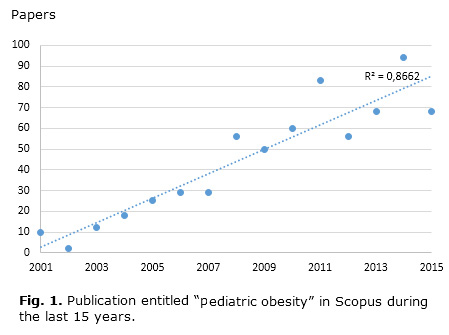
<body><![CDATA[<br>   </font></b>    <br>   </font><font face="verdana" size="2">All papers indexed as a title of "paediatric    obesity" in the bibliographic database of Scopus during years 2001&#45;2015    was extracted and went under analysis. We planed the search strategy as: &#91;("Pediatric    obesity") OR ("children obesity") OR ("child obesity")&#93;. We restricted our    search into "article title" from the menu of "fields type", and the years of    under study was limited into 2001&#45;2015. Scopus is a bibliographic database    which covers 100 % of MEDLINE database. MEDLINE is a part of National Library    of Medicine (NLM) journal citation database.</font></p>     <p align="left" style='text&#45;align:left;text&#45;autospace:none'><font face="verdana" size="2">Restriction    of papers into desired title, facilities the way to obtain the articles in the    most related subject area.<sup>15</sup> The origin country of papers identified    from the field of addresses (AD) in each records, after that the articles were    geographically classified. All obtained papers went under content analysis by    a specialist to determine the sub&#45;categories of papers in the field. We    are aware that these databases (Scopus and MEDLINE) lack the affiliation and    the country information of some co&#45;authors, for this reason only the origin    country of authors that appeared in the fields of address were taken under consideration    as the origin country of papers.</font></p>     <p align="left" style='text&#45;align:left;text&#45;autospace:none'><font face="verdana" size="2">&nbsp;</font></p>     <p align="left" style='text&#45;align:left'><font face="verdana" size="3"><b>RESULTS</b></font></p>     <p align="left" style='text&#45;align:left'><font face="verdana" size="2">The    extraction of papers entitled "pediatric obesity" during years 2001&#45;2015    in Scopus led to 663 papers. Although the number of publication in the field    of pediatric obesity (663 papers) for 15 years seems to be small, but considering    the number of publication for the last 15 years, we will find out that the number    of publication in the field has increased linear. It reached from 10 papers    in 2001 into 68 papers in 2015 (<a href="#f1">Fig 1</a>).</font></p>     <blockquote>        <p align="center"><img src="/img/revistas/ics/v27n4/f0103416.jpg" width="449" height="335"><a name="f1"></a></p> </blockquote>     
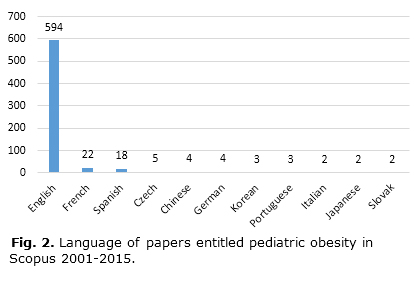
<p align="left" style='text&#45;align:left'><font face="verdana" size="2">The    extraction of data led to 663 papers in the form of Journal Article (376 papers),    Review (143 papers), Note (28 papers), Editorial (27 papers), Conference Paper    (26), Book Chapter (21), Letter (12), Short Survey (12), Article in Press (11    papers), Erratum (6), and Book (1). The majority of papers (89.6 %) was in English    language. Only 10.4 % of papers were in other languages such as: French (22    papers), Spanish (18 papers), Czech (5 papers), Chinese (4 papers), German (4    papers), Korean (3 papers), Portuguese (3 papers), Italian (2 papers), Japanese    (2 papers), Slovak (2 papers), Croatian (1 paper), Persian (1 paper), Russian    (1 paper), and Swedish one paper (<a href="#f2">Fig. 2</a>).</font></p>     <blockquote>        ]]></body>
<body><![CDATA[<p align="center"><img src="/img/revistas/ics/v27n4/f0203416.jpg" width="414" height="294"><a name="f2"></a></p> </blockquote>     
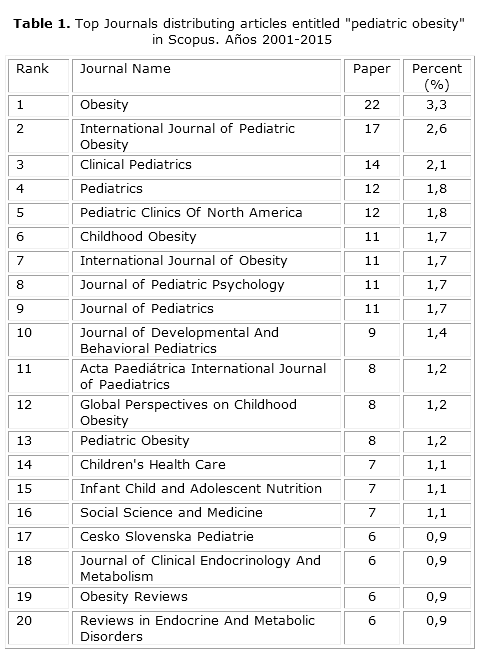
<p align="left" style='text&#45;align:left'><font face="verdana" size="2">As shows    the <a href="#t1">table 1</a>, from a total number of 160 journals contributing    papers entitled pediatric obesity, indexed in Scopus, the Journal of Obesity    sharing 3.3 % (22 papers) of the global publication entitled "pediatric obesity"    was the most productive journal, followed by the international Journal of pediatric    obesity (17 papers), Journal of Clinical Pediatrics (14 papers), and Journal    of Pediatrics (14 papers). Table 1 is restricted to the 20 top productive journals,    those published papers entitled pediatric obesity during years 2011&#45;2015.</font></p>     <blockquote>        <p align="center"><img src="/img/revistas/ics/v27n4/t0103416.gif" width="479" height="660"><a name="t1"></a></p> </blockquote>     
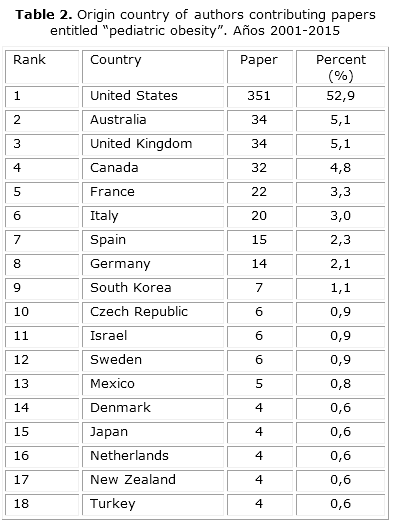
<p align="left" style='text&#45;align:left'><font face="verdana" size="2">Authors    from 39 countries shared their papers entitled pediatric obesity in Scopus during    years 2011&#45;2015. The American authors were the most productive authors,    sharing 52.9 % of global publication entitled "pediatric obesity", followed    by authors from Australia sharing 34 papers, United Kingdom sharing 34 papers,    Canada sharing 32 papers, and France sharing 22 papers in the field in the database    of Scopus during the period of study. Regarding to the origin regions of published    papers, they mostly came from North America and Western Europe. <a href="#t2">Table    2</a> shows the origin country of authors, who shared their works in Scopus.</font></p>     <blockquote>        <p align="center"><img src="/img/revistas/ics/v27n4/t0203416.gif" width="396" height="527"><a name="t2"></a></p> </blockquote>     
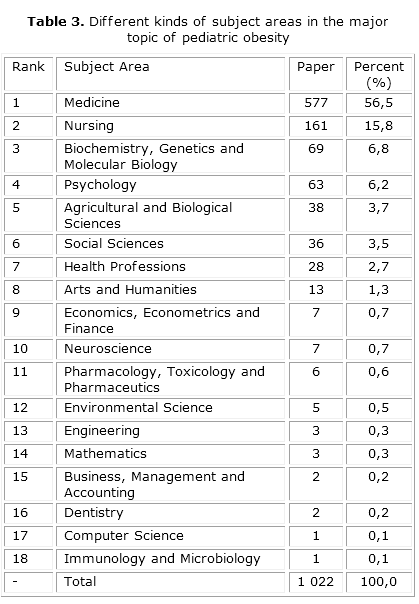
<p align="left" style='text&#45;align:left'><font face="verdana" size="2">A total    number of 1 112 authors, who shared their works in the field, among them <i>Joseph    Arnold Skelton</i>, from the Brenner Children's Hospital, <i>Winston Salem</i>,    United States publishing 11 papers entitled pediatric obesity during years 2001&#45;2015    was the most productive author. The following authors were <i>Ric G. Steele</i>,    from University of Kansas Lawrence, Clinical Child Psychology Program, Lawrence,    United States sharing 9 papers, <i>Geoff Dc C. Ball,</i> from Stollery Children's    Hospital, Pediatric Centre for Weight and Health, Edmonton, Canada sharing 8    papers. <i>David M. Janicke,</i> from University of Florida, Department of Clinical    and Health Psychology, Gainesville, United States sharing 8 papers, and <i>Elissa    Jelalian</i>, from Weight Control and Diabetes Research Center, Providence,    United States, sharing 8 papers entitled pediatric obesity (<a href="#t2">table    2</a>).</font></p>     <p><font face="verdana" size="2">The content analysis of extracted papers entitled    "pediatric obesity" indexed in Scopus during years 2001&#45;2015 indicated that    the scientist's approaches were in 18 major categories. Researches in Medicine    aspects was the most frequented subject area, 56.5 % of total researches were    in this area. 15.8 % of researches was in Nursing, 6.8 % of papers was in the    subject area of (Biochemistry, Genetics and Molecular Biology), and 6.2 % was    in the subject area of psychology (<a href="#t3">table 3</a>).</font></p>     <blockquote>        ]]></body>
<body><![CDATA[<p align="center"><font face="verdana" size="2"><img src="/img/revistas/ics/v27n4/t0303416.gif" width="419" height="604"><a name="t3"></a></font></p> </blockquote>     
<p><font face="verdana" size="2">    <br>       <br>   </font><font face="verdana" size="2"><b><font size="3">DISCUSSION AND CONCLUSION</font></b></font></p>     <p align="left" style='margin&#45;left:3.75pt;text&#45;align:left'><font face="verdana" size="2">According    to the results of previous studies, the childhood obesity has doubled more than    two times in children and quadrupled in adolescents during the last 30 years.    It is estimated that the percentage of obese children aged 6&#150;11 years in    United States has increased from 7 % in 1980 to nearly 18 % in 2012.<sup>16,17</sup>    Although the pediatric obesity was an important issue since long ago, but it    was introduced as an autonomous category in medical subject heading (MeSH) first    in 2014. Pediatric obesity is a multi&#45;factorial issues, and it is associated    with many factors such as family factors, diet, lack of exercise, psychological    factors and socioeconomic factors.</font></p>     <p align="left" style='text&#45;align:left'><font face="verdana" size="2">The    evidences have shown that childhood obesity is epidemic in many regions and    countries; therefore it is urgency to prevent further increases of this health    problem.<sup>18</sup> Studies suggested the importance of public health impact    of intervening on risk factors in early developmental periods, these studies    propose that maternal smoking during pregnancy, gestational weight gain, and    gestational diabetes are essential prenatally, and fast weight gaining, infant    feeding, sleep duration quantity and quality, and television viewing are major    factors during infancy.<sup>19</sup> maintaining the knowledge of changes in    researchs of pediatric obesity is vital, so it is essential to present the scientific    attitude towards pediatric obesity. Bibliometrics analysis is an appropriate    tool for depiction the trend of research centers' approaches towards health    problems in the societies; hence the result of current study can help the research    centers administers to lead the researches in the necessary and needed fields.    Analysis of data of current study indicated that, the number of publication    in the field of pediatric obesity is still lower than the required level to    guarantee the reliable attention of related institutions for solving the obesity    problems among children. The United States was the most productive country performing    researches and publishing papers in pediatric obesity followed by west Europe.    One may interpret this occurrence in such a way that developed countries have    more facilities for doing research in different areas e.g. in the field of obesity.    We should bear in mind that the obesity has a strong relationship with the income    level of countries. Based on the recent report of WHO, the prevalence of overweight    in high income and upper middle income countries was more than double that of    low and lower middle income countries.<sup>20</sup> The majority of publications    was in English language. This pheromone should not come as a surprise, the American    databases have concerned indexing of papers in English language since many years    ago.<sup>10</sup></font></p>     <p align="left" style='text&#45;align:left'><font face="verdana" size="2">The    content analysis of obtained papers identified that the scientists' methodologies    towards pediatric obesity were in eighteen different subject areas. The subject    area of medicine was the most frequented of them followed by nursing subject    area, the subject area of "Immunology and Microbiology" was the least one. Regarding    the important influence of socio&#45;psycho&#45;genetic aspects on the pediatric    obesity, these issues are crucial issues related to the obesity; hence it is    strongly recommended the nutritional scientists and policy makers in research    centres to take under consideration these issues of study.</font></p>     <p align="left" style='text&#45;align:left'>    <br>       <br>   <font face="verdana" size="2"><b>Conflict of interests    ]]></body>
<body><![CDATA[<br>       <br>   </b>The authors don't declare conflict of interests.</font></p>     <p align="left" style='text&#45;align:left'><font face="verdana" size="2"><b>    <br>       <br>   </b></font><font face="verdana" size="2"><b><font size="3">BIBLIOGRAFIC REFERENCES</font></b></font><font face="verdana" size="2">&nbsp;</font></p>     <!-- ref --><p align="left" style='text&#45;align:left'><font face="Verdana, Arial, Helvetica, sans-serif" size="2">1.    Caterson ID, Gill TP. Obesity: epidemiology and possible prevention. Best Pract    Res Clin Endocrinol Metab. 2002;16(4):595-610. PubMed PMID: 12468409. Epub 2002/12/07.    eng.    </font></p>     <!-- ref --><p><font face="Verdana, Arial, Helvetica, sans-serif" size="2">2. Schwarzenberg    SJ, Sinaiko AR. Obesity and inflammation in children. Paediatr Respir Rev. 2006;7(4):239-46.    PubMed PMID: 17098638. Epub 2006/11/14. eng.    </font></p>     <!-- ref --><p><font face="Verdana, Arial, Helvetica, sans-serif" size="2">3. Flynn MA, McNeil    DA, Maloff B, Mutasingwa D, Wu M, Ford C, et al. Reducing obesity and related    chronic disease risk in children and youth: a synthesis of evidence with &quot;best    practice&quot; recommendations. Obes Rev. 2006;7(Suppl 1):7-66. PubMed PMID:    16371076. Epub 2005/12/24. eng.    </font></p>     <!-- ref --><p><font face="Verdana, Arial, Helvetica, sans-serif" size="2">4. Dietz WH. Critical    periods in childhood for the development of obesity. Am J Clin Nutr. 1994;59:955-59.    </font></p>     <!-- ref --><p><font face="Verdana, Arial, Helvetica, sans-serif" size="2">5. Must A, Strauss    RS. Risks and consequences of childhood and adolescent obesity. Int J Obes Relat    Metab Disord. 1999;23(Suppl 2):S2-11. PubMed PMID: 10340798. Epub 1999/05/26.    eng.    </font></p>     <!-- ref --><p><font face="Verdana, Arial, Helvetica, sans-serif" size="2">6. Power C, Lake    JK, Cole TJ. Measurement and long-term health risks of child and adolescent    fatness. Int J Obes Relat Metab Disord. 1997;21(7):507-26. PubMed PMID: 9226480.    Epub 1997/07/01. eng.    </font></p>     <!-- ref --><p><font face="Verdana, Arial, Helvetica, sans-serif" size="2">7. Serdula MK,    Ivery D, Coates RJ, Freedman DS, Williamson DF, Byers T. Do obese children become    obese adults? A review of the literature. Prev Med. 1993;22(2):167-77. PubMed    PMID: 8483856. Epub 1993/03/01. eng.    </font></p>     <!-- ref --><p><font face="Verdana, Arial, Helvetica, sans-serif" size="2">8. Lobstein T,    Baur L, Uauy R. Obesity in children and young people: a crisis in public health.    Obes Rev. 2004;5(Suppl 1):4-104. PubMed PMID: 15096099. Epub 2004/04/21. eng.    </font></p>     <!-- ref --><p><font face="Verdana, Arial, Helvetica, sans-serif" size="2">9. Biglu MH. Patent    literature trends in Medline throughout 1965-2005. Acimed. 2009 [cited 2016    Oct 01];20(2). Available at: <a href="http://scielo.sld.cu/scielo.php?script=sci_arttext&pid=S1024-94352009000800006&lng=es" target="_blank">http://scielo.sld.cu/scielo.php?script=sci_arttext&amp;pid=S1024-94352009000800006&amp;lng=es</a></font><!-- ref --><p><font face="Verdana, Arial, Helvetica, sans-serif" size="2">10. Biglu MH. The    editorial policy of languages is being changed in Medline. 2007 [cited 2016    Oct 01]. Available at: <a href="http://www.bvs.sld.cu/revistas/aci/vol16_3_07/aci06907.html" target="_blank">http://www.bvs.sld.cu/revistas/aci/vol16_3_07/aci06907.html</a>    </font><!-- ref --><p><font face="Verdana, Arial, Helvetica, sans-serif" size="2">11. Biglu M, Askari    O. A bibliometric study of scientific output in Tabriz University of Medical    Sciences. Proceedings of 10th International Conference of the International    Society for Scientometrics and Informetrics (ISSI 2005). Stockholm: ISSI; 2005.    </font></p>     <!-- ref --><p><font face="Verdana, Arial, Helvetica, sans-serif" size="2">12. Biglu MH, Riazi    S. Network of nanomedicine researches: impact of Iranian scientists. BioImpacts:    BI. 2015;5(4):199.    </font></p>     <p><font face="Verdana, Arial, Helvetica, sans-serif" size="2">13. Biglu MH, Ghavami    M, Biglu S. Authorship, institutional and citation metrics for publications    on postmenopausal osteoporosis. Osteoporosis International. 2014;1;25(4):1337-43.</font></p>     <!-- ref --><p><font face="Verdana, Arial, Helvetica, sans-serif" size="2">14. National Library    of Medicine. EE.UU.: Base de datos NLM; 2014 [cited 2016 Oct 01]. Available    at: <a href="http://www.nlm.nih.gov/" target="_blank">http://www.nlm.nih.gov/</a></font><!-- ref --><p><font face="Verdana, Arial, Helvetica, sans-serif" size="2">15. Biglu MH. Scientometric    study of patent literature in MEDLINE &amp; SCI (Doctoral dissertation, Humboldt-Universit&auml;t    zu Berlin, Philosophische Fakult&auml;t I); 2008.    </font></p>     <!-- ref --><p><font face="Verdana, Arial, Helvetica, sans-serif" size="2">16. Ogden CL, Carroll    MD, Kit BK, Flegal KM. Prevalence of childhood and adult obesity in the United    States, 2011-2012. Jama. 2014;311(8):806-14.    </font></p>     <!-- ref --><p><font face="Verdana, Arial, Helvetica, sans-serif" size="2">17. Hyattsville    M. Health, United States 2011 with special feature on socioeconomic status and    health. National Center for Health Statistics; 2012. p. 310.    </font></p>     <!-- ref --><p><font face="Verdana, Arial, Helvetica, sans-serif" size="2">18. Christoffel    KK, Wang X, Binns HJ. Early origins of child obesity: bridging disciplines and    phases of development, september 30-October 1, 2010. Internat J Environm Res    Public Health. 2012;9(4):1227-62.    </font></p>     <!-- ref --><p><font face="Verdana, Arial, Helvetica, sans-serif" size="2">19. Gillman MW,    Rifas?Shiman SL, Kleinman K, Oken E, Rich?Edwards JW, Taveras EM. Developmental    origins of childhood overweight: potential public health impact. Obesity. 2008;16(7):1651-6.    </font></p>     <!-- ref --><p><font face="Verdana, Arial, Helvetica, sans-serif" size="2">20. WHO. Obesity:Situation    and trends 2014 [cited 2016 Oct 01]. Available from: <a href="http://www.who.int/gho/ncd/risk_factors/obesity_text/en/" target="_blank">http://www.who.int/gho/ncd/risk_factors/obesity_text/en/</a></font><p></p>     <p align="left" style='text&#45;align:left'><font face="Verdana, Arial, Helvetica, sans-serif" size="2">&nbsp;</font></p>     <p align="left" style='text&#45;align:left'>&nbsp;</p>     <p align="left" style='text&#45;align:left'><font face="verdana" size="2">Recibido:    3 de abril de 2016.    <br>   </font><font face="verdana" size="2">Aprobado: 15 de julio de 2016.</font></p>     <p align="left" style='text&#45;align:left'><font face="verdana" size="2">&nbsp;</font></p>     <p align="left" style='text&#45;align:left'><font face="verdana" size="2">&nbsp;</font></p>     <p align="left" style='text&#45;align:left'><font face="verdana" size="2"><i>Mohammad&#45;Hossein    Biglu.</i> Basic Sciences Department, Paramedical Faculty, Tabriz University    of Medical Sciences, Tabriz, Iran. Email: <a href="mailto:mh_biglu@yahoo.com">mh_biglu@yahoo.com</a></font></p>     <p align="left" style='text&#45;align:left'><font face="verdana" size="2">&nbsp;</font></p>      ]]></body><back>
<ref-list>
<ref id="B1">
<label>1</label><nlm-citation citation-type="journal">
<person-group person-group-type="author">
<name>
<surname><![CDATA[Caterson]]></surname>
<given-names><![CDATA[ID]]></given-names>
</name>
<name>
<surname><![CDATA[Gill]]></surname>
<given-names><![CDATA[TP]]></given-names>
</name>
</person-group>
<article-title xml:lang="en"><![CDATA[Obesity: epidemiology and possible prevention]]></article-title>
<source><![CDATA[Best Pract Res Clin Endocrinol Metab]]></source>
<year>2002</year>
<volume>16</volume>
<numero>4</numero>
<issue>4</issue>
<page-range>595-610</page-range></nlm-citation>
</ref>
<ref id="B2">
<label>2</label><nlm-citation citation-type="journal">
<person-group person-group-type="author">
<name>
<surname><![CDATA[Schwarzenberg]]></surname>
<given-names><![CDATA[SJ]]></given-names>
</name>
<name>
<surname><![CDATA[Sinaiko]]></surname>
<given-names><![CDATA[AR]]></given-names>
</name>
</person-group>
<article-title xml:lang="en"><![CDATA[Obesity and inflammation in children]]></article-title>
<source><![CDATA[Paediatr Respir Rev]]></source>
<year>2006</year>
<volume>7</volume>
<numero>4</numero>
<issue>4</issue>
<page-range>239-46</page-range></nlm-citation>
</ref>
<ref id="B3">
<label>3</label><nlm-citation citation-type="journal">
<person-group person-group-type="author">
<name>
<surname><![CDATA[Flynn]]></surname>
<given-names><![CDATA[MA]]></given-names>
</name>
<name>
<surname><![CDATA[McNeil]]></surname>
<given-names><![CDATA[DA]]></given-names>
</name>
<name>
<surname><![CDATA[Maloff]]></surname>
<given-names><![CDATA[B]]></given-names>
</name>
<name>
<surname><![CDATA[Mutasingwa]]></surname>
<given-names><![CDATA[D]]></given-names>
</name>
<name>
<surname><![CDATA[Wu]]></surname>
<given-names><![CDATA[M]]></given-names>
</name>
<name>
<surname><![CDATA[Ford]]></surname>
<given-names><![CDATA[C]]></given-names>
</name>
</person-group>
<article-title xml:lang="en"><![CDATA[Reducing obesity and related chronic disease risk in children and youth: a synthesis of evidence with "best practice" recommendations]]></article-title>
<source><![CDATA[Obes Rev]]></source>
<year>2006</year>
<volume>7</volume>
<numero>^s1</numero>
<issue>^s1</issue>
<supplement>1</supplement>
<page-range>7-66</page-range></nlm-citation>
</ref>
<ref id="B4">
<label>4</label><nlm-citation citation-type="journal">
<person-group person-group-type="author">
<name>
<surname><![CDATA[Dietz]]></surname>
<given-names><![CDATA[WH]]></given-names>
</name>
</person-group>
<article-title xml:lang="en"><![CDATA[Critical periods in childhood for the development of obesity]]></article-title>
<source><![CDATA[Am J Clin Nutr]]></source>
<year>1994</year>
<volume>59</volume>
<page-range>955-59</page-range></nlm-citation>
</ref>
<ref id="B5">
<label>5</label><nlm-citation citation-type="journal">
<person-group person-group-type="author">
<name>
<surname><![CDATA[Must]]></surname>
<given-names><![CDATA[A]]></given-names>
</name>
<name>
<surname><![CDATA[Strauss]]></surname>
<given-names><![CDATA[RS]]></given-names>
</name>
</person-group>
<article-title xml:lang="en"><![CDATA[Risks and consequences of childhood and adolescent obesity]]></article-title>
<source><![CDATA[Int J Obes Relat Metab Disord]]></source>
<year>1999</year>
<volume>23</volume>
<numero>^s2</numero>
<issue>^s2</issue>
<supplement>2</supplement>
<page-range>S2-11</page-range></nlm-citation>
</ref>
<ref id="B6">
<label>6</label><nlm-citation citation-type="journal">
<person-group person-group-type="author">
<name>
<surname><![CDATA[Power]]></surname>
<given-names><![CDATA[C]]></given-names>
</name>
<name>
<surname><![CDATA[Lake]]></surname>
<given-names><![CDATA[JK]]></given-names>
</name>
<name>
<surname><![CDATA[Cole]]></surname>
<given-names><![CDATA[TJ]]></given-names>
</name>
</person-group>
<article-title xml:lang="en"><![CDATA[Measurement and long-term health risks of child and adolescent fatness]]></article-title>
<source><![CDATA[Int J Obes Relat Metab Disord]]></source>
<year>1997</year>
<volume>21</volume>
<numero>7</numero>
<issue>7</issue>
<page-range>507-26</page-range></nlm-citation>
</ref>
<ref id="B7">
<label>7</label><nlm-citation citation-type="journal">
<person-group person-group-type="author">
<name>
<surname><![CDATA[Serdula]]></surname>
<given-names><![CDATA[MK]]></given-names>
</name>
<name>
<surname><![CDATA[Ivery]]></surname>
<given-names><![CDATA[D]]></given-names>
</name>
<name>
<surname><![CDATA[Coates]]></surname>
<given-names><![CDATA[RJ]]></given-names>
</name>
<name>
<surname><![CDATA[Freedman]]></surname>
<given-names><![CDATA[DS]]></given-names>
</name>
<name>
<surname><![CDATA[Williamson]]></surname>
<given-names><![CDATA[DF]]></given-names>
</name>
<name>
<surname><![CDATA[Byers]]></surname>
<given-names><![CDATA[T]]></given-names>
</name>
</person-group>
<article-title xml:lang="en"><![CDATA[Do obese children become obese adults?: A review of the literature]]></article-title>
<source><![CDATA[Prev Med]]></source>
<year>1993</year>
<volume>22</volume>
<numero>2</numero>
<issue>2</issue>
<page-range>167-77</page-range></nlm-citation>
</ref>
<ref id="B8">
<label>8</label><nlm-citation citation-type="journal">
<person-group person-group-type="author">
<name>
<surname><![CDATA[Lobstein]]></surname>
<given-names><![CDATA[T]]></given-names>
</name>
<name>
<surname><![CDATA[Baur]]></surname>
<given-names><![CDATA[L]]></given-names>
</name>
<name>
<surname><![CDATA[Uauy]]></surname>
<given-names><![CDATA[R]]></given-names>
</name>
</person-group>
<article-title xml:lang="en"><![CDATA[Obesity in children and young people: a crisis in public health]]></article-title>
<source><![CDATA[Obes Rev]]></source>
<year>2004</year>
<volume>5</volume>
<numero>^s1</numero>
<issue>^s1</issue>
<supplement>1</supplement>
<page-range>4-104</page-range></nlm-citation>
</ref>
<ref id="B9">
<label>9</label><nlm-citation citation-type="journal">
<person-group person-group-type="author">
<name>
<surname><![CDATA[Biglu]]></surname>
<given-names><![CDATA[MH]]></given-names>
</name>
</person-group>
<article-title xml:lang="en"><![CDATA[Patent literature trends in Medline throughout 1965-2005]]></article-title>
<source><![CDATA[Acimed]]></source>
<year>2009</year>
<volume>20</volume>
<numero>2</numero>
<issue>2</issue>
</nlm-citation>
</ref>
<ref id="B10">
<label>10</label><nlm-citation citation-type="">
<person-group person-group-type="author">
<name>
<surname><![CDATA[Biglu]]></surname>
<given-names><![CDATA[MH]]></given-names>
</name>
</person-group>
<source><![CDATA[The editorial policy of languages is being changed in Medline]]></source>
<year>2007</year>
</nlm-citation>
</ref>
<ref id="B11">
<label>11</label><nlm-citation citation-type="book">
<person-group person-group-type="author">
<name>
<surname><![CDATA[Biglu]]></surname>
<given-names><![CDATA[M]]></given-names>
</name>
<name>
<surname><![CDATA[Askari]]></surname>
<given-names><![CDATA[O]]></given-names>
</name>
</person-group>
<source><![CDATA[A bibliometric study of scientific output in Tabriz University of Medical Sciences: Proceedings of 10th International Conference of the International Society for Scientometrics and Informetrics (ISSI 2005)]]></source>
<year>2005</year>
<publisher-loc><![CDATA[Stockholm ]]></publisher-loc>
<publisher-name><![CDATA[ISSI]]></publisher-name>
</nlm-citation>
</ref>
<ref id="B12">
<label>12</label><nlm-citation citation-type="journal">
<person-group person-group-type="author">
<name>
<surname><![CDATA[Biglu]]></surname>
<given-names><![CDATA[MH]]></given-names>
</name>
<name>
<surname><![CDATA[Riazi]]></surname>
<given-names><![CDATA[S]]></given-names>
</name>
</person-group>
<article-title xml:lang="en"><![CDATA[Network of nanomedicine researches: impact of Iranian scientists]]></article-title>
<source><![CDATA[BioImpacts: BI]]></source>
<year>2015</year>
<volume>5</volume>
<numero>4</numero>
<issue>4</issue>
<page-range>199</page-range></nlm-citation>
</ref>
<ref id="B13">
<label>13</label><nlm-citation citation-type="journal">
<person-group person-group-type="author">
<name>
<surname><![CDATA[Biglu]]></surname>
<given-names><![CDATA[MH]]></given-names>
</name>
<name>
<surname><![CDATA[Ghavami]]></surname>
<given-names><![CDATA[M]]></given-names>
</name>
<name>
<surname><![CDATA[Biglu]]></surname>
<given-names><![CDATA[S]]></given-names>
</name>
</person-group>
<article-title xml:lang="en"><![CDATA[Authorship, institutional and citation metrics for publications on postmenopausal osteoporosis]]></article-title>
<source><![CDATA[Osteoporosis International]]></source>
<year>2014</year>
<volume>25</volume>
<numero>4</numero>
<issue>4</issue>
<page-range>1337-43</page-range></nlm-citation>
</ref>
<ref id="B14">
<label>14</label><nlm-citation citation-type="">
<collab>National Library of Medicine</collab>
<source><![CDATA[Base de datos NLM]]></source>
<year>2014</year>
</nlm-citation>
</ref>
<ref id="B15">
<label>15</label><nlm-citation citation-type="">
<person-group person-group-type="author">
<name>
<surname><![CDATA[Biglu]]></surname>
<given-names><![CDATA[MH]]></given-names>
</name>
</person-group>
<source><![CDATA[Scientometric study of patent literature in MEDLINE & SCI]]></source>
<year></year>
</nlm-citation>
</ref>
<ref id="B16">
<label>16</label><nlm-citation citation-type="journal">
<person-group person-group-type="author">
<name>
<surname><![CDATA[Ogden]]></surname>
<given-names><![CDATA[CL]]></given-names>
</name>
<name>
<surname><![CDATA[Carroll]]></surname>
<given-names><![CDATA[MD]]></given-names>
</name>
<name>
<surname><![CDATA[Kit]]></surname>
<given-names><![CDATA[BK]]></given-names>
</name>
<name>
<surname><![CDATA[Flegal]]></surname>
<given-names><![CDATA[KM]]></given-names>
</name>
</person-group>
<article-title xml:lang="en"><![CDATA[Prevalence of childhood and adult obesity in the United States, 2011-2012]]></article-title>
<source><![CDATA[Jama]]></source>
<year>2014</year>
<volume>311</volume>
<numero>8</numero>
<issue>8</issue>
<page-range>806-14</page-range></nlm-citation>
</ref>
<ref id="B17">
<label>17</label><nlm-citation citation-type="book">
<person-group person-group-type="author">
<name>
<surname><![CDATA[Hyattsville]]></surname>
<given-names><![CDATA[M]]></given-names>
</name>
</person-group>
<source><![CDATA[Health, United States 2011 with special feature on socioeconomic status and health]]></source>
<year>2012</year>
<page-range>310</page-range><publisher-name><![CDATA[National Center for Health Statistics]]></publisher-name>
</nlm-citation>
</ref>
<ref id="B18">
<label>18</label><nlm-citation citation-type="journal">
<person-group person-group-type="author">
<name>
<surname><![CDATA[Christoffel]]></surname>
<given-names><![CDATA[KK]]></given-names>
</name>
<name>
<surname><![CDATA[Wang]]></surname>
<given-names><![CDATA[X]]></given-names>
</name>
<name>
<surname><![CDATA[Binns]]></surname>
<given-names><![CDATA[HJ]]></given-names>
</name>
</person-group>
<article-title xml:lang="en"><![CDATA[Early origins of child obesity: bridging disciplines and phases of development, september 30-October 1, 2010]]></article-title>
<source><![CDATA[Internat J Environm Res Public Health]]></source>
<year>2012</year>
<volume>9</volume>
<numero>4</numero>
<issue>4</issue>
<page-range>1227-62</page-range></nlm-citation>
</ref>
<ref id="B19">
<label>19</label><nlm-citation citation-type="journal">
<person-group person-group-type="author">
<name>
<surname><![CDATA[Gillman]]></surname>
<given-names><![CDATA[MW]]></given-names>
</name>
<name>
<surname><![CDATA[Rifas?Shiman]]></surname>
<given-names><![CDATA[SL]]></given-names>
</name>
<name>
<surname><![CDATA[Kleinman]]></surname>
<given-names><![CDATA[K]]></given-names>
</name>
<name>
<surname><![CDATA[Oken]]></surname>
<given-names><![CDATA[E]]></given-names>
</name>
<name>
<surname><![CDATA[Rich?Edwards]]></surname>
<given-names><![CDATA[JW]]></given-names>
</name>
<name>
<surname><![CDATA[Taveras]]></surname>
<given-names><![CDATA[EM]]></given-names>
</name>
</person-group>
<article-title xml:lang="en"><![CDATA[Developmental origins of childhood overweight: potential public health impact]]></article-title>
<source><![CDATA[Obesity]]></source>
<year>2008</year>
<volume>16</volume>
<numero>7</numero>
<issue>7</issue>
<page-range>1651-6</page-range></nlm-citation>
</ref>
<ref id="B20">
<label>20</label><nlm-citation citation-type="">
<collab>WHO</collab>
<source><![CDATA[Obesity: Situation and trends]]></source>
<year>2014</year>
</nlm-citation>
</ref>
</ref-list>
</back>
</article>