<?xml version="1.0" encoding="ISO-8859-1"?><article xmlns:mml="http://www.w3.org/1998/Math/MathML" xmlns:xlink="http://www.w3.org/1999/xlink" xmlns:xsi="http://www.w3.org/2001/XMLSchema-instance">
<front>
<journal-meta>
<journal-id>0034-7507</journal-id>
<journal-title><![CDATA[Revista Cubana de Estomatología]]></journal-title>
<abbrev-journal-title><![CDATA[Rev Cubana Estomatol]]></abbrev-journal-title>
<issn>0034-7507</issn>
<publisher>
<publisher-name><![CDATA[Editorial Ciencias Médicas]]></publisher-name>
</publisher>
</journal-meta>
<article-meta>
<article-id>S0034-75072010000300008</article-id>
<title-group>
<article-title xml:lang="en"><![CDATA[Diffuse large B-cell lymphoma of the oral cavity]]></article-title>
<article-title xml:lang="es"><![CDATA[Linfoma difuso de células B grandes de la cavidad bucal]]></article-title>
</title-group>
<contrib-group>
<contrib contrib-type="author">
<name>
<surname><![CDATA[Carlos Bortoluzzi]]></surname>
<given-names><![CDATA[Marcelo]]></given-names>
</name>
<xref ref-type="aff" rid="A01"/>
</contrib>
<contrib contrib-type="author">
<name>
<surname><![CDATA[Dantas Batista]]></surname>
<given-names><![CDATA[Jonas]]></given-names>
</name>
<xref ref-type="aff" rid="A01"/>
</contrib>
<contrib contrib-type="author">
<name>
<surname><![CDATA[Cherubini]]></surname>
<given-names><![CDATA[Karen]]></given-names>
</name>
<xref ref-type="aff" rid="A01"/>
</contrib>
<contrib contrib-type="author">
<name>
<surname><![CDATA[Gonçalves Salum]]></surname>
<given-names><![CDATA[Fernanda]]></given-names>
</name>
<xref ref-type="aff" rid="A01"/>
</contrib>
<contrib contrib-type="author">
<name>
<surname><![CDATA[Figueiredo]]></surname>
<given-names><![CDATA[Maria Antonia]]></given-names>
</name>
<xref ref-type="aff" rid="A01"/>
</contrib>
</contrib-group>
<aff id="A01">
<institution><![CDATA[,Pontifical Catholic University of Rio Grande do Sul  ]]></institution>
<addr-line><![CDATA[Porto Alegre RS]]></addr-line>
<country>Brazil</country>
</aff>
<pub-date pub-type="pub">
<day>00</day>
<month>09</month>
<year>2010</year>
</pub-date>
<pub-date pub-type="epub">
<day>00</day>
<month>09</month>
<year>2010</year>
</pub-date>
<volume>47</volume>
<numero>3</numero>
<fpage>341</fpage>
<lpage>346</lpage>
<copyright-statement/>
<copyright-year/>
<self-uri xlink:href="http://scielo.sld.cu/scielo.php?script=sci_arttext&amp;pid=S0034-75072010000300008&amp;lng=en&amp;nrm=iso"></self-uri><self-uri xlink:href="http://scielo.sld.cu/scielo.php?script=sci_abstract&amp;pid=S0034-75072010000300008&amp;lng=en&amp;nrm=iso"></self-uri><self-uri xlink:href="http://scielo.sld.cu/scielo.php?script=sci_pdf&amp;pid=S0034-75072010000300008&amp;lng=en&amp;nrm=iso"></self-uri><abstract abstract-type="short" xml:lang="en"><p><![CDATA[The authors report a case of diffuse large B-cell lymphoma (DLBL) of the oral cavity. The patient was a 73-year-old white man who first presented at the Division of Stomatology with a large nodular mass in the hard palate and a nodular lesion in the upper lip, which were diagnosed as DLBL. The patient was treated with eight cycles of CHOP chemotherapy (cyclophosphamide, doxorubicin, vincristine and prednisone), but the disease recurred 22 months after the end of the therapy. Both primary sites hard palate and upper lip were involved again and the patient was resubmitted to chemotherapy.]]></p></abstract>
<abstract abstract-type="short" xml:lang="es"><p><![CDATA[Se reporta un caso de linfoma difuso de células B grandes (DLBL) de la cavidad bucal. Se trata de un paciente masculino, blanco, de 73 ańos de edad, que se presentó a la División de Estomatología, con una masa nodular difusa en el paladar duro y una lesión nodular en el labio superior, diagnosticadas como DLBL. El paciente fue tratado con ocho ciclos de quimioterapia CHOP (ciclofosfamida, doxorrubicina, vincristina, prednisona), pero se constató recidiva de la enfermedad en ambos sitios primarios, en el paladar duro y en el labio superior a los 22 meses después del término de la terapia. El paciente fue sometido de nuevo a la quimioterapia.]]></p></abstract>
<kwd-group>
<kwd lng="en"><![CDATA[non-hodgkin lymphoma]]></kwd>
<kwd lng="en"><![CDATA[diffuse large B-cell lymphoma]]></kwd>
<kwd lng="en"><![CDATA[mouth]]></kwd>
<kwd lng="es"><![CDATA[No-Hodgkin linfoma]]></kwd>
<kwd lng="es"><![CDATA[linfoma B de células grandes difuso]]></kwd>
<kwd lng="es"><![CDATA[cavidad oral]]></kwd>
</kwd-group>
</article-meta>
</front><body><![CDATA[ <P ALIGN="RIGHT"><FONT FACE="Verdana, Arial, Helvetica, sans-serif" SIZE="2"><B>PRESENTACI&Oacute;N  DE CASOS</B></FONT></P>    <P>&nbsp;</P>    <P><FONT FACE="Verdana, Arial, Helvetica, sans-serif" SIZE="4"><B>Diffuse  large B-cell lymphoma of the oral cavity</B></FONT></P>    <P>&nbsp;</P>    <P><B><FONT FACE="Verdana, Arial, Helvetica, sans-serif" SIZE="3">Linfoma  difuso de c&eacute;lulas B grandes de la cavidad bucal</FONT></B><B>    <P>    <P>    <P>      <P>     <P>     ]]></body>
<body><![CDATA[<P><FONT FACE="Verdana, Arial, Helvetica, sans-serif" SIZE="2">Marcelo  Carlos Bortoluzzi<SUP>I</SUP>; Jonas Dantas Batista<SUP>II</SUP>; Karen Cherubini<SUP>I</SUP>;  Fernanda Gon&ccedil;alves Salum<SUP>I</SUP>; Maria Antonia Figueiredo<SUP>I</SUP>;</FONT></B>      <P>      <P><FONT FACE="Verdana, Arial, Helvetica, sans-serif" SIZE="2"><SUP>I</SUP>Doctor    in Philosophy. Dental College, Pontifical Catholic University of Rio Grande    do Sul, Porto Alegre, RS, Brazil.    <BR>   </FONT><FONT FACE="Verdana, Arial, Helvetica, sans-serif" SIZE="2"><SUP>II</SUP>Master    in Sciences. Dental College, Pontifical Catholic University of Rio Grande do    Sul, Porto Alegre, RS, Brazil.</FONT>     <P>    <P>    <P><hr size="1" noshade>    <P><FONT FACE="Verdana, Arial, Helvetica, sans-serif" SIZE="2"><B>ABSTRACT</B>  </FONT></P>    <P><FONT FACE="Verdana, Arial, Helvetica, sans-serif" SIZE="2">The  authors report a case of diffuse large B-cell lymphoma (DLBL) of the oral cavity.  The patient was a 73-year-old white man who first presented at the Division of  Stomatology with a large nodular mass in the hard palate and a nodular lesion  in the<FONT  COLOR="#ff0000"> </FONT>upper lip, which were diagnosed as DLBL. The patient was  treated with eight cycles of CHOP chemotherapy (cyclophosphamide, doxorubicin,  vincristine and prednisone), but the disease recurred 22 months after the end  of the therapy. Both primary sites hard palate and upper lip were involved again  and the patient was resubmitted to chemotherapy. </FONT>    <P>     ]]></body>
<body><![CDATA[<P><FONT FACE="Verdana, Arial, Helvetica, sans-serif" SIZE="2"><I>Key  words:</I><B> </B>non-hodgkin lymphoma, diffuse large B-cell lymphoma, mouth.  <hr size="1" noshade></FONT>    <P>     <P><FONT FACE="Verdana, Arial, Helvetica, sans-serif" SIZE="2"><B>RESUMEN</B>  </FONT>    <P><FONT FACE="Verdana, Arial, Helvetica, sans-serif" SIZE="2">Se reporta  un caso de linfoma difuso de c&eacute;lulas B grandes (DLBL) de la cavidad bucal.  Se trata de un paciente masculino, blanco, de 73 a&ntilde;os de edad, que se present&oacute;  a la Divisi&oacute;n de Estomatolog&iacute;a, con una masa nodular difusa en el  paladar duro y una lesi&oacute;n nodular en el labio superior, diagnosticadas  como DLBL. El paciente fue tratado con ocho ciclos de quimioterapia CHOP (ciclofosfamida,  doxorrubicina, vincristina, prednisona), pero se constat&oacute; recidiva de la  enfermedad en ambos sitios primarios, en el paladar duro y en el labio superior  a los 22 meses despu&eacute;s del t&eacute;rmino de la terapia. El paciente fue  sometido de nuevo a la quimioterapia. </FONT>    <P>     <P><FONT FACE="Verdana, Arial, Helvetica, sans-serif" SIZE="2"><I>Palabras  clave: </I>No-Hodgkin linfoma, linfoma B de c&eacute;lulas grandes difuso, cavidad  oral.<hr size="1" noshade></FONT>    <P>&nbsp;</P>    <P>&nbsp;</P>    <P>     <P>     ]]></body>
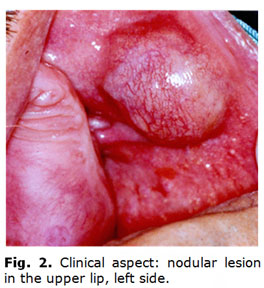
<body><![CDATA[<P><FONT FACE="Verdana, Arial, Helvetica, sans-serif" SIZE="2"><B><FONT SIZE="3">INTRODUCTION</FONT></B>  </FONT>    <P><FONT FACE="Verdana, Arial, Helvetica, sans-serif" SIZE="2">Lymphomas  are malignant neoplasms arisen from lymphocytes (B or T) that affect mainly lymph  nodes, spleen, and other non-hematopoietic tissues. They are classified as Hodgkin&#180;s  lymphoma or non-Hodgkin&#180;s lymphoma.<SUP>1</SUP> Diffuse large B-cell lymphoma  (DLBL) is the most common variant of non-Hodgkin&#180;s intermediate-grade lymphomas,  and frequently involves extranodal sites.<SUP> </SUP>Even though DLBL is characterized  by an aggressive behavior, it responds favorably to chemotherapy.<SUP>2</SUP>  Non-Hodgkin&#180;s lymphomas are usually manifested as localized or generalized  lymphadenopathy. However, the primary lesion can occur in other sites, principally  where lymphoid tissue is present such as oropharynx, intestine, bone marrow and  skin.<SUP>3</SUP> DLBL is often associated with systemic symptoms such as night  sweats, weight loss and fever. In the oral soft tissues, lesions can occur as  hard and diffuse tumors involving oral vestibule, gums and the posterior region  of the hard palate. In bone tissue, they may cause mild pain, paresthesia and  swelling; the radiographic examination often shows irregular radiolucid images.  DLBL corresponds to 68% of cases of non-Hodgkin's lymphoma of the oral cavity  and the average age of highest prevalence is 66 years.<SUP>4</SUP> Women are more  affected than men in a 2:1 ratio.<SUP>3</SUP> </FONT>    <P><FONT FACE="Verdana, Arial, Helvetica, sans-serif" SIZE="2">Most  lymphomas, including DLBL, arise from B cells and are characterized histologically  by diffuse population of large cells with oval nucleus, cleaved or not. Multiple  nucleoli are seen adjacent to a thick nuclear membrane; large quantities of cells  with clear cytoplasm and mitoses are easily observed; and focal necrosis may also  occur.<SUP>3-5</SUP> It is advisable to complement the histological diagnosis  by immunohistochemistry, which facilitates the classification of these tumors.<SUP>6,7  </SUP>Rosenwald et al.<SUP>2</SUP> used the gene-expression profiles of DLBL to  develop a molecular predictor of survival. The authors emphasize the importance  of molecular diagnosis in this type of lymphomas. According to them, DLBL molecular  features vary widely and, for this reason, individualized and molecularly targeted  therapies are required. The accuracy of the diagnosis is crucial to the efficacy  of the therapy.<SUP>8</SUP> </FONT>    <P><FONT FACE="Verdana, Arial, Helvetica, sans-serif" SIZE="2">The  main treatment for DLBL is chemotherapy, whose protocols can present great efficiency.  Using anthracyclin-based therapy (CHOP) alone, the cure can be achieved in 35%  to 40% of patients. Moreover, aiming to increase the efficacy of chemotherapy  other drugs such as rituximab can also be associated. Radiotherapy and surgery  are reported as adjuvant therapies as well.<SUP>2,9-12</SUP> </FONT>    <P>    <P>     <P><FONT FACE="Verdana, Arial, Helvetica, sans-serif" SIZE="3"><B>CASE  REPORT</B> </FONT>    <P><FONT FACE="Verdana, Arial, Helvetica, sans-serif" SIZE="2">A  73-year-old white man complaining of a painless swelling in the hard palate und<FONT  COLOR="#002060">e</FONT>r the upper removable denture was referred to Division  of Stomatology of S&atilde;o Lucas Hospital-PUCRS. The lesion had started three  months before, no previous sign or symptoms were reported and there was no relevant  medical history. Oral examination revealed two nodular lesions: one in the hard  palate, with firm consistency and erythematous overlying mucosa (<A HREF="#fig1">Fig.  1</A>); and the other one in the upper left lip measuring 2.5 cm in diameter,  erythematous and firm to palpation (<A HREF="#fig2">Fig. 2</A>). The patient also  presented with<FONT  COLOR="#ff0000"> </FONT>submandibular lymphadenopathy. Occlusal and panoramic  radiographic examinations did not show any relevant change.</FONT>    <P ALIGN="CENTER"><A NAME="fig1"></A><IMG SRC="/img/revistas/est/v47n3/f0108310.jpg" WIDTH="296" HEIGHT="279">    
<P ALIGN="CENTER"><A NAME="fig2"></A><IMG SRC="/img/revistas/est/v47n3/f0208310.jpg" WIDTH="264" HEIGHT="288">    
]]></body>
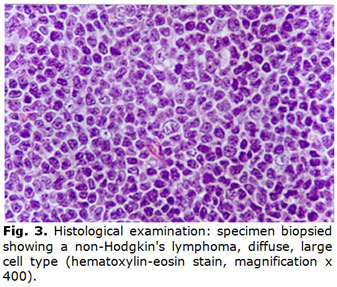
<body><![CDATA[<P><FONT FACE="Verdana, Arial, Helvetica, sans-serif" SIZE="2">    <BR>The  clinical diagnostic hypotheses were lymphoma and neoplasm of salivary gland. The  hematological tests (complete blood count, fasting blood glucose, prothrombin  time, partial thromboplastin time, erythrocyte sedimentation rate, anti-HIV) were  normal and the incisional biopsy of both lesions was performed. The histological  diagnosis was diffuse large cell lymphoma (<A HREF="#fig3">Fig. 3</A>). Immunohistochemical  panel showed the following results: Bcl2 positive; CD10 (calla) negative; CD20  (B cells) positive; CD45RO (T cells) focal-positive; CD3 (T cells) focal-positive;  CD30 negative; CD15 negative; CD5 focal-positive. The immunohistochemical evaluation  confirmed the diagnosis of B-cell lymphoma. The patient was treated by chemotherapy  with cyclophosphamide, doxorubicin, vincristine and prednisone (CHOP regimen).  Elapsed 22 months after chemotherapy, both lesions recurred and were biopsied  again. The histological examination confirmed the clinical diagnosis of recurrence  of DLBL, and the patient was referred to the Department of Oncology for new cycles  of chemotherapy.</FONT>    <P ALIGN="CENTER"><A NAME="fig3"></A><IMG SRC="/img/revistas/est/v47n3/f0308310.jpg" WIDTH="337" HEIGHT="287">    
<P ALIGN="CENTER">    <P>      <P><FONT FACE="Verdana, Arial, Helvetica, sans-serif" SIZE="2"><B><FONT SIZE="3">DISCUSSION</FONT></B>  </FONT>    <P><FONT FACE="Verdana, Arial, Helvetica, sans-serif" SIZE="2">Lymphoma  classification is controversial, with several changes proposed in the<FONT  COLOR="#008000"> </FONT>past decades. The original classification of Rappaport,  at the beginning of the 60s, was based on the pattern of tumor growth observed  in a lymph node (nodular or diffuse). However, the modern classification incorporated  both morphological and immunological features and, recently, also<FONT  COLOR="#ff0000"> </FONT>molecular and genetic ones.<SUP>4,13,14</SUP> </FONT>    <P><FONT FACE="Verdana, Arial, Helvetica, sans-serif" SIZE="2">Non-Hodgkin's  lymphoma represents a diverse and complex group of malignant neoplasms of lymphoreticular  histogenesis and can be grouped into three histological categories: low, intermediate  and high grades, according to the aggressiveness and prognosis. DLBL is classified  as a B-cell lymphoma of intermediate grade, and among the lymphomas, shows the  highest prevalence in the oral cavity.<SUP>3</SUP> This neoplasm accounts for  approximately 30 % - 58 % of cases of non-Hodgkin&#180;s lymphomas, and the incidence  increase with age from 0.3/100,000/year (35-39 years) to 26.6/100,000/year (80-84  years).<SUP>6</SUP> </FONT>    <P><FONT FACE="Verdana, Arial, Helvetica, sans-serif" SIZE="2">Recent  molecular studies evidenced that chromosomal abnormalities play an important role  in the pathogenesis of the disease and its sub-classification is important to  guide the treatment.<SUP>8,13,15</SUP> The standard treatment for patients with  diffuse large-B-cell lymphoma is cyclophosphamide, doxorubicin, vincristine, and  prednisone (CHOP). Nevertheless, with a projected disease-free survival rate of  36 %, it is far from ideal therapy, and there is a need for better treatment approaches.<SUP>16<FONT  COLOR="#ff0000"> </FONT></SUP>Even though, when cure is not possible, this treatment  is capable of controlling the disease for many years. Further chemotherapy can  often be given if the lymphoma comes back after initial treatment.<SUP>11,13</SUP>  </FONT>    <P><FONT FACE="Verdana, Arial, Helvetica, sans-serif" SIZE="2">This article  reports the case of a patient with oral non-Hodgkin's lymphoma, in which CHOP  regimen of chemotherapy was not efficacious, as the disease recurred 22 months  later. However, it is important to consider that the lesion was a clinical stage  II according to the classification of the Conference of Ann Arbor modified by  Carbone,<SUP>4</SUP> which indicates higher aggressiveness.</FONT>    ]]></body>
<body><![CDATA[<P>    <P>     <P><FONT FACE="Verdana, Arial, Helvetica, sans-serif" SIZE="2"><B><FONT SIZE="3">CONCLUSIONS</FONT>  </B> </FONT>    <P><FONT FACE="Verdana, Arial, Helvetica, sans-serif" SIZE="2">DLBL  is the most common lymphoma affecting oral cavity, and deserves the attention  of professionals. The diagnosis may be challenging because of the lack of symptoms,  which lead to misdiagnosis and delayed treatment. The recognition of clinical  manifestations of this disease in oral cavity is important. Efforts should be  made to diagnose this disease as soon as possible, since the prognosis is directly  related to the disease staging at the patient admission. An interesting point  that cannot be neglected is the ability of recurrence of DLBL, which makes the  follow-up of these patients indispensable.</FONT>    <P>    <P>     <P><FONT FACE="Verdana, Arial, Helvetica, sans-serif" SIZE="2"><B><FONT SIZE="3">REFERENCES</FONT></B>  </FONT>    <!-- ref --><P><FONT FACE="Verdana, Arial, Helvetica, sans-serif" SIZE="2">1. Epstein  JB, Epstein JD, Le ND, Gorsky M. Characteristics of oral and paraoral malignant  lymphoma: a population-based review of 361 cases. Oral Surg Oral Med Oral Pathol  Oral Radiol Endod. 2001;92(5):519-25. </FONT>    <!-- ref --><P><FONT FACE="Verdana, Arial, Helvetica, sans-serif" SIZE="2">2.  Rosenwald A, Wright G, Chan WC, Connors JM, Campo E, Fisher RI, et al. The use  of molecular profiling to predict survival after chemotherapy for diffuse large-B-cell  lymphoma. N Engl J Med. 2002;346(25):1937-47. </FONT>    <!-- ref --><P><FONT FACE="Verdana, Arial, Helvetica, sans-serif" SIZE="2">3.  Solomides CC, Miller AS, Christman RA, Talwar J, Simpkins H. Lymphomas of the  oral cavity: histology, immunologic type, and incidence of Epstein-Barr virus  infection. Hum Pathol. 2002;33(2):153-7. </FONT>    <!-- ref --><P><FONT FACE="Verdana, Arial, Helvetica, sans-serif" SIZE="2">4.  Kotylo PK, Gatzimoset K, Krause J. Lymphoproliferative disorders. In: Rodak, BF,  ed. Diagnostic Hematology. Philadelphia: WB Saunders, 1995:373-89. </FONT>    <!-- ref --><P><FONT FACE="Verdana, Arial, Helvetica, sans-serif" SIZE="2">5.  Handlers JP, Howell RE, Abrams AM, Melrose RJ. Extranodal oral lymphoma. Part  I. A morphologic and immunoperoxidase study of 34 cases. Oral Surg Oral Med Oral  Pathol. 1986;61(4):362-7. </FONT>    <!-- ref --><P><FONT FACE="Verdana, Arial, Helvetica, sans-serif" SIZE="2">6.  Tilly H, Dreyling M; ESMO Guidelines Working Group. Diffuse large B-cell non-Hodgkin's  lymphoma: ESMO Clinical Practice Guidelines for diagnosis, treatment and follow-up.  Ann Oncol. 2010;21(Suppl 5):v172-4. </FONT>    <!-- ref --><P><FONT FACE="Verdana, Arial, Helvetica, sans-serif" SIZE="2">7.  Armitage JO. How I treat patients with diffuse large B-cell lymphoma. Blood. 2007;110(1):29-36.  </FONT>    <!-- ref --><P><FONT FACE="Verdana, Arial, Helvetica, sans-serif" SIZE="2">8. Magrath,  I. Molecular characteristics of diffuse large-B-cell lymphoma. N Engl J Med. 2002;346(25):1998-9.  </FONT>    <!-- ref --><P><FONT FACE="Verdana, Arial, Helvetica, sans-serif" SIZE="2">9. Pfreundschuh  M, Tr&uuml;mper L, &Ouml;sterborg A, Pettengell R, Trneny M, Imrie K, et al. CHOP-like  chemotherapy plus rituximab versus CHOP-like chemotherapy alone in young patients  with good-prognosis diffuse large-B-cell lymphoma: a randomised controlled trial  by the Mab Thera International Trial (MInT) group. Lancet Oncol. 2006;7(5):379-91.  </FONT>    <!-- ref --><P><FONT COLOR="#241f20" FACE="Verdana, Arial, Helvetica, sans-serif" SIZE="2">10.  Goda JS, Gospodarowicz M, Pintilie M, Wells W, Hodgson DC, Sun A, et al. Long-term  outcome in localized extranodal mucosa-associated lymphoid tissue lymphomas treated  with radiotherapy. Cancer. 2010 (In press). doi: 10.1002/cncr.25226.</FONT>    <P><FONT FACE="Verdana, Arial, Helvetica, sans-serif" SIZE="2">11.  Rigacci L, Fabbri A, Puccini B, Chitarrelli I, Chiappella A, Vitolo U, et al.  Oxaliplatin-based chemotherapy (dexamethasone, high-dose cytarabine, and oxaliplatin)  +/- rituximab is an effective salvage regimen in patients with relapsed or refractory  lymphoma. Cancer 2010.    <BR> (In press). doi: 10.1002/cncr.25216. </FONT><FONT COLOR="#241f20"></FONT>      <!-- ref --><P><FONT FACE="Verdana, Arial, Helvetica, sans-serif" SIZE="2">12. Schmits R,  Schmitz N, Pfreundschuh M, German High-Grade Non-Hodgkin's Lymphoma Study Group.  The best treatment for diffuse large B-cell lymphoma: a German perspective. Oncology.  (Williston Park) 2005;19(4 Suppl 1):16-25. </FONT>    <!-- ref --><P><FONT FACE="Verdana, Arial, Helvetica, sans-serif" SIZE="2">13.  Papaj&iacute;k T, Jedlickov&aacute; K, Kriegov&aacute; E, Jarosov&aacute; M, Raida  L, Faber E, et al. Polymerase chain reaction detection of cell carrying t(14;18)  in bone marrow of patients with follicular and diffuse large-Bcell lymphoma: the  importance of analysis at diagnosis and significance of long-term follow-up. Neoplasma.  2001;48(6):501-5. </FONT>    <!-- ref --><P><FONT FACE="Verdana, Arial, Helvetica, sans-serif" SIZE="2">14.  Shaknovich R, Geng H, Johnson NA, Tsikitas L, Cerchietti L, Greally JM, et al.  DNA methylation signatures define molecular subtypes of diffuse large B cell lymphoma.  Blood. 2010 (In press). doi 10.1182/blood-2010-05-285320. </FONT>    <!-- ref --><P><FONT FACE="Verdana, Arial, Helvetica, sans-serif" SIZE="2">15.  Staudt LM, Dave S. The biology of human lymphoid malignancies revealed by gene  expression profiling. Adv Immunol. 2005;87:163-208. </FONT>    <!-- ref --><P><FONT FACE="Verdana, Arial, Helvetica, sans-serif" SIZE="2">16.  Fisher RI, Miller TP, O'Connor OA. Diffuse aggressive lymphoma. Hematology Am  Soc Hematol Educ Program. 2004:221-36.</FONT>    <P>    <P>    <P>     <P>     <P><FONT FACE="Verdana, Arial, Helvetica, sans-serif" SIZE="2">Recibido:  5 de marzo de 2010.    <BR>Aprobado: 10 de abril de 2010.</FONT>    ]]></body>
<body><![CDATA[<P>    <P>    <P>     <P>     <P><FONT FACE="Verdana, Arial, Helvetica, sans-serif" SIZE="2"><I>Dr.  Karen Cherubini</I>. Servi&ccedil;o de Estomatologia. Hospital S&atilde;o Lucas  PUCRS, CEP 90610-000. </FONT><FONT FACE="Verdana, Arial, Helvetica, sans-serif" SIZE="2">Porto  Alegre, RS, Brazil. E-mail: <U><FONT  COLOR="#0000ff"><A HREF="mailto:karen.cherubini@pucrs.br">karen.cherubini@pucrs.br</A></FONT></U>;  <U><FONT COLOR="#0000ff"><A HREF="mailto:kebini.ez@terra.com.br">kebini.ez@terra.com.br</A></FONT></U>  </FONT>       ]]></body><back>
<ref-list>
<ref id="B1">
<label>1</label><nlm-citation citation-type="journal">
<person-group person-group-type="author">
<name>
<surname><![CDATA[Epstein]]></surname>
<given-names><![CDATA[JB]]></given-names>
</name>
<name>
<surname><![CDATA[Epstein]]></surname>
<given-names><![CDATA[JD]]></given-names>
</name>
<name>
<surname><![CDATA[Le]]></surname>
<given-names><![CDATA[ND]]></given-names>
</name>
<name>
<surname><![CDATA[Gorsky]]></surname>
<given-names><![CDATA[M]]></given-names>
</name>
</person-group>
<article-title xml:lang="en"><![CDATA[Characteristics of oral and paraoral malignant lymphoma: a population-based review of 361 cases]]></article-title>
<source><![CDATA[Oral Surg Oral Med Oral Pathol Oral Radiol Endod]]></source>
<year>2001</year>
<volume>92</volume>
<numero>5</numero>
<issue>5</issue>
<page-range>519-25</page-range></nlm-citation>
</ref>
<ref id="B2">
<label>2</label><nlm-citation citation-type="journal">
<person-group person-group-type="author">
<name>
<surname><![CDATA[Rosenwald]]></surname>
<given-names><![CDATA[A]]></given-names>
</name>
<name>
<surname><![CDATA[Wright]]></surname>
<given-names><![CDATA[G]]></given-names>
</name>
<name>
<surname><![CDATA[Chan]]></surname>
<given-names><![CDATA[WC]]></given-names>
</name>
<name>
<surname><![CDATA[Connors]]></surname>
<given-names><![CDATA[JM]]></given-names>
</name>
<name>
<surname><![CDATA[Campo]]></surname>
<given-names><![CDATA[E]]></given-names>
</name>
<name>
<surname><![CDATA[Fisher]]></surname>
<given-names><![CDATA[RI]]></given-names>
</name>
</person-group>
<article-title xml:lang="en"><![CDATA[The use of molecular profiling to predict survival after chemotherapy for diffuse large-B-cell lymphoma]]></article-title>
<source><![CDATA[N Engl J Med.]]></source>
<year>2002</year>
<volume>346</volume>
<numero>25</numero>
<issue>25</issue>
<page-range>1937-47</page-range></nlm-citation>
</ref>
<ref id="B3">
<label>3</label><nlm-citation citation-type="journal">
<person-group person-group-type="author">
<name>
<surname><![CDATA[Solomides]]></surname>
<given-names><![CDATA[CC]]></given-names>
</name>
<name>
<surname><![CDATA[Miller]]></surname>
<given-names><![CDATA[AS]]></given-names>
</name>
<name>
<surname><![CDATA[Christman]]></surname>
<given-names><![CDATA[RA]]></given-names>
</name>
<name>
<surname><![CDATA[Talwar]]></surname>
<given-names><![CDATA[J]]></given-names>
</name>
<name>
<surname><![CDATA[Simpkins]]></surname>
<given-names><![CDATA[H]]></given-names>
</name>
</person-group>
<article-title xml:lang="en"><![CDATA[Lymphomas of the oral cavity: histology, immunologic type, and incidence of Epstein-Barr virus infection]]></article-title>
<source><![CDATA[Hum Pathol.]]></source>
<year>2002</year>
<volume>33</volume>
<numero>2</numero>
<issue>2</issue>
<page-range>153-7</page-range></nlm-citation>
</ref>
<ref id="B4">
<label>4</label><nlm-citation citation-type="book">
<person-group person-group-type="author">
<name>
<surname><![CDATA[Kotylo]]></surname>
<given-names><![CDATA[PK]]></given-names>
</name>
<name>
<surname><![CDATA[Gatzimoset]]></surname>
<given-names><![CDATA[K]]></given-names>
</name>
<name>
<surname><![CDATA[Krause]]></surname>
<given-names><![CDATA[J]]></given-names>
</name>
</person-group>
<article-title xml:lang="en"><![CDATA[Lymphoproliferative disorders]]></article-title>
<person-group person-group-type="editor">
<name>
<surname><![CDATA[Rodak]]></surname>
<given-names><![CDATA[BF]]></given-names>
</name>
</person-group>
<source><![CDATA[Diagnostic Hematology]]></source>
<year>1995</year>
<page-range>373-89</page-range><publisher-loc><![CDATA[Philadelphia ]]></publisher-loc>
<publisher-name><![CDATA[WB Saunders]]></publisher-name>
</nlm-citation>
</ref>
<ref id="B5">
<label>5</label><nlm-citation citation-type="journal">
<person-group person-group-type="author">
<name>
<surname><![CDATA[Handlers]]></surname>
<given-names><![CDATA[JP]]></given-names>
</name>
<name>
<surname><![CDATA[Howell]]></surname>
<given-names><![CDATA[RE]]></given-names>
</name>
<name>
<surname><![CDATA[Abrams]]></surname>
<given-names><![CDATA[AM]]></given-names>
</name>
<name>
<surname><![CDATA[Melrose]]></surname>
<given-names><![CDATA[RJ]]></given-names>
</name>
</person-group>
<article-title xml:lang="en"><![CDATA[Extranodal oral lymphoma: Part I. A morphologic and immunoperoxidase study of 34 cases]]></article-title>
<source><![CDATA[Oral Surg Oral Med Oral Pathol]]></source>
<year>1986</year>
<volume>61</volume>
<numero>4</numero>
<issue>4</issue>
<page-range>362-7</page-range></nlm-citation>
</ref>
<ref id="B6">
<label>6</label><nlm-citation citation-type="journal">
<person-group person-group-type="author">
<name>
<surname><![CDATA[Tilly]]></surname>
<given-names><![CDATA[H]]></given-names>
</name>
<name>
<surname><![CDATA[Dreyling]]></surname>
<given-names><![CDATA[M]]></given-names>
</name>
</person-group>
<collab>ESMO Guidelines Working Group</collab>
<article-title xml:lang="en"><![CDATA[Diffuse large B-cell non-Hodgkin's lymphoma: ESMO Clinical Practice Guidelines for diagnosis, treatment and follow-up]]></article-title>
<source><![CDATA[Ann Oncol]]></source>
<year>2010</year>
<volume>21</volume>
<numero>^s5</numero>
<issue>^s5</issue>
<supplement>5</supplement>
<page-range>v172-4</page-range></nlm-citation>
</ref>
<ref id="B7">
<label>7</label><nlm-citation citation-type="journal">
<person-group person-group-type="author">
<name>
<surname><![CDATA[Armitage]]></surname>
<given-names><![CDATA[JO]]></given-names>
</name>
</person-group>
<article-title xml:lang="en"><![CDATA[How I treat patients with diffuse large B-cell lymphoma]]></article-title>
<source><![CDATA[Blood.]]></source>
<year>2007</year>
<volume>110</volume>
<numero>1</numero>
<issue>1</issue>
<page-range>29-36</page-range></nlm-citation>
</ref>
<ref id="B8">
<label>8</label><nlm-citation citation-type="journal">
<person-group person-group-type="author">
<name>
<surname><![CDATA[Magrath]]></surname>
<given-names><![CDATA[I]]></given-names>
</name>
</person-group>
<article-title xml:lang="en"><![CDATA[Molecular characteristics of diffuse large-B-cell lymphoma]]></article-title>
<source><![CDATA[N Engl J Med.]]></source>
<year>2002</year>
<volume>346</volume>
<numero>25</numero>
<issue>25</issue>
<page-range>1998-9</page-range></nlm-citation>
</ref>
<ref id="B9">
<label>9</label><nlm-citation citation-type="journal">
<person-group person-group-type="author">
<name>
<surname><![CDATA[Pfreundschuh]]></surname>
<given-names><![CDATA[M]]></given-names>
</name>
<name>
<surname><![CDATA[Trümper]]></surname>
<given-names><![CDATA[L]]></given-names>
</name>
<name>
<surname><![CDATA[Österborg]]></surname>
<given-names><![CDATA[A]]></given-names>
</name>
<name>
<surname><![CDATA[Pettengell]]></surname>
<given-names><![CDATA[R]]></given-names>
</name>
<name>
<surname><![CDATA[Trneny]]></surname>
<given-names><![CDATA[M]]></given-names>
</name>
<name>
<surname><![CDATA[Imrie]]></surname>
<given-names><![CDATA[K]]></given-names>
</name>
</person-group>
<article-title xml:lang="en"><![CDATA[CHOP-like chemotherapy plus rituximab versus CHOP-like chemotherapy alone in young patients with good-prognosis diffuse large-B-cell lymphoma: a randomised controlled trial by the Mab Thera International Trial (MInT) group]]></article-title>
<source><![CDATA[Lancet Oncol]]></source>
<year>2006</year>
<volume>7</volume>
<numero>5</numero>
<issue>5</issue>
<page-range>379-91</page-range></nlm-citation>
</ref>
<ref id="B10">
<label>10</label><nlm-citation citation-type="">
<person-group person-group-type="author">
<name>
<surname><![CDATA[Goda]]></surname>
<given-names><![CDATA[JS]]></given-names>
</name>
<name>
<surname><![CDATA[Gospodarowicz]]></surname>
<given-names><![CDATA[M]]></given-names>
</name>
<name>
<surname><![CDATA[Pintilie]]></surname>
<given-names><![CDATA[M]]></given-names>
</name>
<name>
<surname><![CDATA[Wells]]></surname>
<given-names><![CDATA[W]]></given-names>
</name>
<name>
<surname><![CDATA[Hodgson]]></surname>
<given-names><![CDATA[DC]]></given-names>
</name>
<name>
<surname><![CDATA[Sun]]></surname>
<given-names><![CDATA[A]]></given-names>
</name>
</person-group>
<source><![CDATA[Long-term outcome in localized extranodal mucosa-associated lymphoid tissue lymphomas treated with radiotherapy: Cancer]]></source>
<year>2010</year>
</nlm-citation>
</ref>
<ref id="B11">
<label>11</label><nlm-citation citation-type="">
<person-group person-group-type="author">
<name>
<surname><![CDATA[Rigacci]]></surname>
<given-names><![CDATA[L]]></given-names>
</name>
<name>
<surname><![CDATA[Fabbri]]></surname>
<given-names><![CDATA[A]]></given-names>
</name>
<name>
<surname><![CDATA[Puccini]]></surname>
<given-names><![CDATA[B]]></given-names>
</name>
<name>
<surname><![CDATA[Chitarrelli]]></surname>
<given-names><![CDATA[I]]></given-names>
</name>
<name>
<surname><![CDATA[Chiappella]]></surname>
<given-names><![CDATA[A]]></given-names>
</name>
<name>
<surname><![CDATA[Vitolo]]></surname>
<given-names><![CDATA[U]]></given-names>
</name>
</person-group>
<source><![CDATA[Oxaliplatin-based chemotherapy (dexamethasone, high-dose cytarabine, and oxaliplatin) rituximab is an effective salvage regimen in patients with relapsed or refractory lymphoma: Cancer]]></source>
<year>2010</year>
</nlm-citation>
</ref>
<ref id="B12">
<label>12</label><nlm-citation citation-type="journal">
<person-group person-group-type="author">
<name>
<surname><![CDATA[Schmits]]></surname>
<given-names><![CDATA[R]]></given-names>
</name>
<name>
<surname><![CDATA[Schmitz]]></surname>
<given-names><![CDATA[N]]></given-names>
</name>
<name>
<surname><![CDATA[Pfreundschuh]]></surname>
<given-names><![CDATA[M]]></given-names>
</name>
</person-group>
<collab>German High-Grade Non-Hodgkin's Lymphoma Study Group</collab>
<article-title xml:lang="en"><![CDATA[The best treatment for diffuse large B-cell lymphoma: a German perspective]]></article-title>
<source><![CDATA[Oncology. (Williston Park)]]></source>
<year>2005</year>
<volume>19</volume>
<numero>4^s1</numero>
<issue>4^s1</issue>
<supplement>1</supplement>
<page-range>16-25</page-range></nlm-citation>
</ref>
<ref id="B13">
<label>13</label><nlm-citation citation-type="journal">
<person-group person-group-type="author">
<name>
<surname><![CDATA[Papajík]]></surname>
<given-names><![CDATA[T]]></given-names>
</name>
<name>
<surname><![CDATA[Jedlicková]]></surname>
<given-names><![CDATA[K]]></given-names>
</name>
<name>
<surname><![CDATA[Kriegová]]></surname>
<given-names><![CDATA[E]]></given-names>
</name>
<name>
<surname><![CDATA[Jarosová]]></surname>
<given-names><![CDATA[M]]></given-names>
</name>
<name>
<surname><![CDATA[Raida]]></surname>
<given-names><![CDATA[L]]></given-names>
</name>
<name>
<surname><![CDATA[Faber]]></surname>
<given-names><![CDATA[E]]></given-names>
</name>
</person-group>
<article-title xml:lang="en"><![CDATA[Polymerase chain reaction detection of cell carrying t(14;18) in bone marrow of patients with follicular and diffuse large-Bcell lymphoma: the importance of analysis at diagnosis and significance of long-term follow-up]]></article-title>
<source><![CDATA[Neoplasma]]></source>
<year>2001</year>
<volume>48</volume>
<numero>6</numero>
<issue>6</issue>
<page-range>501-5</page-range></nlm-citation>
</ref>
<ref id="B14">
<label>14</label><nlm-citation citation-type="">
<person-group person-group-type="author">
<name>
<surname><![CDATA[Shaknovich]]></surname>
<given-names><![CDATA[R]]></given-names>
</name>
<name>
<surname><![CDATA[Geng]]></surname>
<given-names><![CDATA[H]]></given-names>
</name>
<name>
<surname><![CDATA[Johnson]]></surname>
<given-names><![CDATA[NA]]></given-names>
</name>
<name>
<surname><![CDATA[Tsikitas]]></surname>
<given-names><![CDATA[L]]></given-names>
</name>
<name>
<surname><![CDATA[Cerchietti]]></surname>
<given-names><![CDATA[L]]></given-names>
</name>
<name>
<surname><![CDATA[Greally]]></surname>
<given-names><![CDATA[JM]]></given-names>
</name>
</person-group>
<source><![CDATA[DNA methylation signatures define molecular subtypes of diffuse large B cell lymphoma: Blood]]></source>
<year>2010</year>
</nlm-citation>
</ref>
<ref id="B15">
<label>15</label><nlm-citation citation-type="journal">
<person-group person-group-type="author">
<name>
<surname><![CDATA[Staudt]]></surname>
<given-names><![CDATA[LM]]></given-names>
</name>
<name>
<surname><![CDATA[Dave]]></surname>
<given-names><![CDATA[S]]></given-names>
</name>
</person-group>
<article-title xml:lang="en"><![CDATA[The biology of human lymphoid malignancies revealed by gene expression profiling]]></article-title>
<source><![CDATA[Adv Immunol.]]></source>
<year>2005</year>
<volume>87</volume>
<page-range>163-208</page-range></nlm-citation>
</ref>
<ref id="B16">
<label>16</label><nlm-citation citation-type="journal">
<person-group person-group-type="author">
<name>
<surname><![CDATA[Fisher]]></surname>
<given-names><![CDATA[RI]]></given-names>
</name>
<name>
<surname><![CDATA[Miller]]></surname>
<given-names><![CDATA[TP]]></given-names>
</name>
<name>
<surname><![CDATA[O'Connor]]></surname>
<given-names><![CDATA[OA]]></given-names>
</name>
</person-group>
<article-title xml:lang="en"><![CDATA[Diffuse aggressive lymphoma]]></article-title>
<source><![CDATA[Hematology Am Soc Hematol Educ Program]]></source>
<year>2004</year>
<page-range>221-36</page-range></nlm-citation>
</ref>
</ref-list>
</back>
</article>