<?xml version="1.0" encoding="ISO-8859-1"?><article xmlns:mml="http://www.w3.org/1998/Math/MathML" xmlns:xlink="http://www.w3.org/1999/xlink" xmlns:xsi="http://www.w3.org/2001/XMLSchema-instance">
<front>
<journal-meta>
<journal-id>0034-7507</journal-id>
<journal-title><![CDATA[Revista Cubana de Estomatología]]></journal-title>
<abbrev-journal-title><![CDATA[Rev Cubana Estomatol]]></abbrev-journal-title>
<issn>0034-7507</issn>
<publisher>
<publisher-name><![CDATA[Editorial Ciencias Médicas]]></publisher-name>
</publisher>
</journal-meta>
<article-meta>
<article-id>S0034-75072014000100011</article-id>
<title-group>
<article-title xml:lang="en"><![CDATA[Severe osteonecrosis of the jaws in a compromised patient subjected to bisphosphonate therapy]]></article-title>
<article-title xml:lang="es"><![CDATA[Osteonecrosis severa de los maxilares asociada al uso de bifosfonatos]]></article-title>
</title-group>
<contrib-group>
<contrib contrib-type="author">
<name>
<surname><![CDATA[Dreyer de Menezes]]></surname>
<given-names><![CDATA[Juliana]]></given-names>
</name>
<xref ref-type="aff" rid="A01"/>
</contrib>
<contrib contrib-type="author">
<name>
<surname><![CDATA[de Mello Rahde]]></surname>
<given-names><![CDATA[Nicole]]></given-names>
</name>
<xref ref-type="aff" rid="A01"/>
</contrib>
<contrib contrib-type="author">
<name>
<surname><![CDATA[Gonçalves Salum]]></surname>
<given-names><![CDATA[Fernanda]]></given-names>
</name>
<xref ref-type="aff" rid="A01"/>
</contrib>
<contrib contrib-type="author">
<name>
<surname><![CDATA[Figueiredo]]></surname>
<given-names><![CDATA[Maria Antonia]]></given-names>
</name>
<xref ref-type="aff" rid="A01"/>
</contrib>
<contrib contrib-type="author">
<name>
<surname><![CDATA[Cherubini]]></surname>
<given-names><![CDATA[Karen]]></given-names>
</name>
<xref ref-type="aff" rid="A01"/>
</contrib>
</contrib-group>
<aff id="A01">
<institution><![CDATA[,Pontifical Catholic University of Rio Grande do Sul  ]]></institution>
<addr-line><![CDATA[Porto Alegre, RS ]]></addr-line>
<country>Brazil</country>
</aff>
<pub-date pub-type="pub">
<day>00</day>
<month>03</month>
<year>2014</year>
</pub-date>
<pub-date pub-type="epub">
<day>00</day>
<month>03</month>
<year>2014</year>
</pub-date>
<volume>51</volume>
<numero>1</numero>
<fpage>107</fpage>
<lpage>112</lpage>
<copyright-statement/>
<copyright-year/>
<self-uri xlink:href="http://scielo.sld.cu/scielo.php?script=sci_arttext&amp;pid=S0034-75072014000100011&amp;lng=en&amp;nrm=iso"></self-uri><self-uri xlink:href="http://scielo.sld.cu/scielo.php?script=sci_abstract&amp;pid=S0034-75072014000100011&amp;lng=en&amp;nrm=iso"></self-uri><self-uri xlink:href="http://scielo.sld.cu/scielo.php?script=sci_pdf&amp;pid=S0034-75072014000100011&amp;lng=en&amp;nrm=iso"></self-uri><abstract abstract-type="short" xml:lang="en"><p><![CDATA[Bisphosphonate-related osteonecrosis of the jaws is characterized by alveolar bone exposure, especially after mucosal trauma or after surgical procedures, in patients who have previously received or who are currently receiving bisphosphonates without a history of radiation therapy in the maxillofacial region. The condition is refractory to treatment, and attempts at debridement are not completely effective in eradicating the necrotic bone. We report here a case of a severe osteonecrosis of the jaws in a 77-year-old male patient, who had been subjected to chemotherapy and treatment with zoledronic acid and corticosteroid. The patient also had comorbidities such as diabetes and periodontal disease, which might have contributed to the lesion development. Bisphosphonate-related osteonecrosis of the jaws has become a reality in dental clinical practice. Although palliative treatment aiming at controlling pain, infection and injury progression is indicated, the therapeutic strategy is still challenging. So far, the best approach available is prevention, based on oral care before, during, and after bisphosphonate therapy.]]></p></abstract>
<abstract abstract-type="short" xml:lang="es"><p><![CDATA[La osteonecrosis de los maxilares asociada al uso de bifosfonatos se traduce en la aparición de hueso alveolar expuesto y necrótico, especialmente después de un trauma de la mucosa o después de procedimientos quirúrgicos, en pacientes que han recibido previamente o que están recibiendo bifosfonatos pero sin historia de radioterapia a región máxilofacial. La afección es refractaria al tratamiento, y los intentos de desbridamiento no son totalmente eficaces en la erradicación del hueso necrótico. Se presenta aquí un caso de una grave osteonecrosis de los maxilares en un paciente masculino de 77 años de edad, que había sido sometido a quimioterapia y tratamiento con ácido zoledrónico y corticosteroides. El paciente también tenía comorbilidades como diabetes y enfermedad periodontal, que pueden haber contribuido al desarrollo de la lesión. El creciente número de casos de esta enfermedad en la literatura ha llamado la atención. Dado que el enfoque terapéutico sigue siendo difícil, la prevención es la mejor estrategia disponible.]]></p></abstract>
<kwd-group>
<kwd lng="en"><![CDATA[osteonecrosis]]></kwd>
<kwd lng="en"><![CDATA[bisphosphonates]]></kwd>
<kwd lng="en"><![CDATA[bone remodeling]]></kwd>
<kwd lng="en"><![CDATA[jaw diseases]]></kwd>
<kwd lng="es"><![CDATA[osteonecrosis]]></kwd>
<kwd lng="es"><![CDATA[bisfosfonatos]]></kwd>
<kwd lng="es"><![CDATA[remodelado óseo]]></kwd>
<kwd lng="es"><![CDATA[enfermedades de los maxilares]]></kwd>
</kwd-group>
</article-meta>
</front><body><![CDATA[ <p align="right"><font size="2" face="Verdana, Arial, Helvetica, sans-serif">Rev    Cubana Estomatol. 2014;51(1)</font></p>     <p align="right"><font size="2" face="Verdana, Arial, Helvetica, sans-serif"><B>PRESENTACI&Oacute;N    DE CASO </B></font></p>     <p align="right">&nbsp;</p> <B>      <P>  </B>     <P><font size="4" face="Verdana, Arial, Helvetica, sans-serif"><b>Severe osteonecrosis    of the jaws in a compromised patient subjected to bisphosphonate therapy </b></font> <B>     <P>&nbsp; </B>      <P>      <P><font size="3" face="Verdana, Arial, Helvetica, sans-serif"><b>Osteonecrosis    severa de los maxilares asociada al uso de bifosfonatos </b></font>     <P>&nbsp;     <P>&nbsp;     ]]></body>
<body><![CDATA[<P>      <P><font size="2" face="Verdana, Arial, Helvetica, sans-serif"><b>Juliana Dreyer    de Menezes, PhD. Nicole de Mello Rahde, PhD. Fernanda Gon&ccedil;alves Salum,PhD.    Maria Antonia Figueiredo, PhD. Karen Cherubini </b></font>      <P>      <P>      <P><font size="2" face="Verdana, Arial, Helvetica, sans-serif">Pontifical Catholic    University of Rio Grande do Sul, Porto Alegre, RS, Brazil. </font>     <P>&nbsp;     <P>&nbsp; <hr size="1" noshade>     <P>      <P>      <P><font size="2" face="Verdana, Arial, Helvetica, sans-serif"><B>ABSTRACT</B>    </font>     ]]></body>
<body><![CDATA[<P>      <P><font size="2" face="Verdana, Arial, Helvetica, sans-serif">Bisphosphonate-related    osteonecrosis of the jaws is characterized by alveolar bone exposure, especially    after mucosal trauma or after surgical procedures, in patients who have previously    received or who are currently receiving bisphosphonates without a history of    radiation therapy in the maxillofacial region. The condition is refractory to    treatment, and attempts at debridement are not completely effective in eradicating    the necrotic bone. We report here a case of a severe osteonecrosis of the jaws    in a 77-year-old male patient, who had been subjected to chemotherapy and treatment    with zoledronic acid and corticosteroid. The patient also had comorbidities    such as diabetes and periodontal disease, which might have contributed to the    lesion development. Bisphosphonate-related osteonecrosis of the jaws has become    a reality in dental clinical practice. Although palliative treatment aiming    at controlling pain, infection and injury progression is indicated, the therapeutic    strategy is still challenging. So far, the best approach available is prevention,    based on oral care before, during, and after bisphosphonate therapy. </font>     <P>      <P><font size="2" face="Verdana, Arial, Helvetica, sans-serif"><B>Keywords:</B>    osteonecrosis, bisphosphonates, bone remodeling, jaw diseases.</font>  <hr size="1" noshade>     <P>      <P><font size="2" face="Verdana, Arial, Helvetica, sans-serif"><B>RESUMEN</B>    </font>     <P>      <P><font size="2" face="Verdana, Arial, Helvetica, sans-serif">La osteonecrosis    de los maxilares asociada al uso de bifosfonatos se traduce en la aparici&oacute;n    de hueso alveolar expuesto y necr&oacute;tico, especialmente despu&eacute;s    de un trauma de la mucosa o despu&eacute;s de procedimientos quir&uacute;rgicos,    en pacientes que han recibido previamente o que est&aacute;n recibiendo bifosfonatos    pero sin historia de radioterapia a regi&oacute;n m&aacute;xilofacial. La afecci&oacute;n    es refractaria al tratamiento, y los intentos de desbridamiento no son totalmente    eficaces en la erradicaci&oacute;n del hueso necr&oacute;tico. Se presenta aqu&iacute;    un caso de una grave osteonecrosis de los maxilares en un paciente masculino    de 77 a&ntilde;os de edad, que hab&iacute;a sido sometido a quimioterapia y    tratamiento con &aacute;cido zoledr&oacute;nico y corticosteroides. El paciente    tambi&eacute;n ten&iacute;a comorbilidades como diabetes y enfermedad periodontal,    que pueden haber contribuido al desarrollo de la lesi&oacute;n. El creciente    n&uacute;mero de casos de esta enfermedad en la literatura ha llamado la atenci&oacute;n.    Dado que el enfoque terap&eacute;utico sigue siendo dif&iacute;cil, la prevenci&oacute;n    es la mejor estrategia disponible. </font>     <P>      <P><font size="2" face="Verdana, Arial, Helvetica, sans-serif"><B>Palabras clave:    </B>osteonecrosis, bisfosfonatos, remodelado &oacute;seo, enfermedades de los    maxilares. </font>  <hr size="1" noshade>     ]]></body>
<body><![CDATA[<p>&nbsp;</p>     <P>&nbsp;     <P>      <P>      <P><font size="3" face="Verdana, Arial, Helvetica, sans-serif"><B>INTRODUCTION</B>    </font>     <P>      <P><font size="2" face="Verdana, Arial, Helvetica, sans-serif">Bisphosphonates    are the drugs of choice to treat osteoporosis, multiple myeloma, hypercalcemia    of malignancy and bone metastases, especially those associated with breast and    prostate cancer. They can also be used to treat Paget's disease, osteogenesis    imperfecta, and idiopathic juvenile or steroid-induced osteoporosis.<SUP>1</SUP>    In 2003, a warning to the medical community was published in the Journal of    Oral and Maxillofacial Surgery, which reported 36 cases of jaw osteonecrosis    associated with the use of the intravenous bisphosphonates pamidronate and zoledronic    acid.<SUP>2</SUP> The injury can occur spontaneously or after invasive surgeries    such as tooth extractions, periodontal surgery, apicoectomy, dental implants    or mucosal trauma, often associated with ill-fitted dentures.<SUP>3</SUP> The    repair process delay leads to prolonged exposure of bone tissue in the oral    cavity and osteonecrosis. As the healing does not occur, the lesions become    infected and osteonecrosis is perpetuated.<SUP>4</SUP> We report here a case    of severe osteonecrosis of the jaws in a compromised patient subjected to bisphosphonate    therapy, discussing the clinical aspects concerning this injury. </font>     <P>      <P>&nbsp;     <P><font size="2" face="Verdana, Arial, Helvetica, sans-serif"><B><font size="3">CASE    REPORT</font></B> </font>     ]]></body>
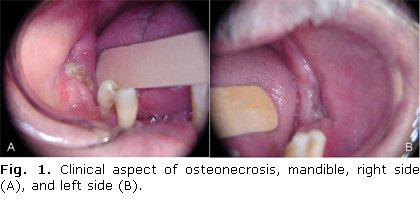
<body><![CDATA[<P>      <P><font size="2" face="Verdana, Arial, Helvetica, sans-serif">A 77-year-old male    Caucasian patient was referred to the stomatology department for evaluation    of a jaw injury, lasting one year, which had developed after tooth extractions.    The medical history included prostate carcinoma six years prior, treated by    surgical resection, which was followed by bone metastases. Metastases were treated    with radio- and chemotherapy as well as the administration of zoledronic acid,    4 mg monthly for 17 months. The patient also reported diabetes and daily use    of prednisone. Physical examination exhibited bilateral mandible bone tissue    exposures measuring 2.0 cm X 0.5 cm on the right side (<a href="#f1_11">Fig.1A</a>)    and 1.0 cm X 0.5 cm on the left side (<a href="#f1_11">Fig.1B</a>). </font>      <P align="center"><img src="/img/revistas/est/v51n1/f0111114.jpg" width="420" height="201"><a name="f1_11"></a>      <P><font size="2" face="Verdana, Arial, Helvetica, sans-serif">There was also    swelling in the submental region with cutaneous erythema, pain, and mild increase    in local temperature. On panoramic radiographic examination, radiolucent areas    were observed in the body of the mandible (<a href="#f2_11">Fig. 2</a>). </font>      <P align="center"><img src="/img/revistas/est/v51n1/f0211114.jpg" width="420" height="275"><a name="f2_11"></a>      <P><font size="2" face="Verdana, Arial, Helvetica, sans-serif">Computed tomography    showed changes in anatomical structure of the mandible with areas of condensation    and fragmentation of bone, and the presence of free fragments in the region    of the right lower molars, left pre-molars and molars, and mental region, involving    basilar and sub-apical area, with fracture risk in the left mental foramen region.    Areas of bone condensation were observed adjacent to those already described    and also reaching the mandibular ramus and the region underlying the mandibular    canal. The images were compatible with osteonecrosis of the jaw. </font>     <P>      <P><font size="2" face="Verdana, Arial, Helvetica, sans-serif">Clinico-radiographic    diagnosis was bisphosphonate-related osteonecrosis of the jaw. Therapeutic approach    consisted of amoxicillin 500 mg (t.i.d.) and chlorhexidine 0.12 % oral rinse    (t.i.d.). After the start of therapy, there was resolution of edema and erythema,    allowing afterwards antibiotic withdrawal. Two bone fragments were released    spontaneously, whose histopathological examination showed non-vital bone, lymphoplasmacytic    and polymorphonuclear neutrophil infiltrate, as well as microbial colonies consistent    with Actinomyces sp. (<a href="#f3_11">Fig. 3</a>). Eight months later, a new    x-ray showed some improvement of the radiographic features but without complete    resolution.    <br>   . </font>      <P align="center">     ]]></body>
<body><![CDATA[<p align="center"><img src="/img/revistas/est/v51n1/f0311114.jpg" width="420" height="216"><a name="f3_11"></a></p>     <p align="center">&nbsp;</p>     <p align="center">&nbsp;</p> <B>     <P>     <P>      <P><font size="3" face="Verdana, Arial, Helvetica, sans-serif">DISCUSSION</font> </B>      <P>      <P><font size="2" face="Verdana, Arial, Helvetica, sans-serif">Although IV bisphosphonate    can by itself determine jaw osteonecrosis in individuals subjected to tooth    extractions,<SUP>5</SUP> its association with chemotherapy and chronic use of    drugs such as steroids can affect the repair of the extraction wound even more.<SUP>4</SUP>    The duration of the treatment and number of infusions to which patient has been    exposed have been identified as significant risk factors. Bamias et al.<SUP>6</SUP>    observed that the minimum number of bisphosphonate infusions prior to the onset    of osteonecrosis was 13. Other factors such as age over 65 and periodontal disease    may increase the risk.<SUP>7,8</SUP> The present report shows a case of an old    man who received 17 zoledronic acid infusions and had tooth extractions after    using the drug. Moreover, medical history included diabetes and use of both    steroids and chemotherapy. These factors confirm the reports in the literature    on risk factors for the occurrence of the injury. Also, the periodontal disease    presented by this patient was an important comorbidity which might have contributed    to the development of the lesion. </font>     <P><font size="2" face="Verdana, Arial, Helvetica, sans-serif">In general, bisphosphonate-related    osteonecrosis patients exhibit the infectious process to a greater or lesser    degree, and this is usually responsible for painful symptoms. In this case,    the swelling and cutaneous erythema in the submental region, and the pain reported    by the patient went into remission after starting the antibiotic therapy. The    maintenance of topical therapy, in turn, aimed to prevent the exacerbation of    the injury. Moreover, as the patient reported two previous unsuccessful surgeries,    it was decided at first not to perform any surgical intervention. </font>     <P><font size="2" face="Verdana, Arial, Helvetica, sans-serif">The anatomical    site affected by osteonecrosis in this report (mandible) is considered the most    prevalent one, followed by the maxilla and with the lowest prevalence for occurrence    in the maxilla and mandible simultaneously. It is not clear why these lesions    affect almost exclusively the jaws. However, it is known this is due in part    to the high turnover of alveolar bone as well as to the exposure of jaw to the    outside environment through the teeth and periodontal ligament.<SUP>9,10</SUP>    Otherwise, pathological fracture is not a common finding, unless debridement    surgeries have been performed, which reduce the structural integrity of bone.<SUP>7</SUP>    Accordingly, in this report, the severity of the lesion and the risk of mandible    fracture might have been favored by the two previous surgical procedures performed.    </font>     ]]></body>
<body><![CDATA[<P><font size="2" face="Verdana, Arial, Helvetica, sans-serif">Bisphosphonate-related    osteonecrosis of the jaws has become a reality in dental clinical practice.    Although palliative treatment aiming at controlling pain, infection and injury    progression is indicated, the therapeutic strategy is still challenging. So    far, the best approach available is prevention, based on oral care before, during,    and after bisphosphonate therapy. </font>     <P>&nbsp;     <P>      <P>      <P><font size="3" face="Verdana, Arial, Helvetica, sans-serif"><B>REFERENCES</B>    </font>     <P>      <!-- ref --><P><font size="2" face="Verdana, Arial, Helvetica, sans-serif">1. Ruggiero SL,    Dodson TB, Assael LA, Landesberg R, Marx RE, Mehrotra B. American Association    of Oral and Maxillofacial Surgeons position paper on bisphosphonate-related    osteonecrosis of the jaw -2009 update. Aust Endod J [serial on the Internet].    2009 [cited 2013 Jun 28];35:119-30. Available from: <U><a href="http://www.ncbi.nlm.nih.gov/pubmed/19961450" target="_blank">http://www.ncbi.nlm.nih.gov/pubmed/19961450</a></U>    </font>     <P>      <!-- ref --><P><font size="2" face="Verdana, Arial, Helvetica, sans-serif">2. Marx RE. Pamidronate    (Aredia) and zoledronate (Zometa) induced avascular necrosis of the jaws: a    growing epidemic. J Oral Maxillofac Surg. 2003;61:1115-7.     </font>      ]]></body>
<body><![CDATA[<P>      <!-- ref --><P><font size="2" face="Verdana, Arial, Helvetica, sans-serif">3. Vescovi P, Campisi    G, Fusco V, Mergoni G, Manfredi M, Merigo E, et al. </font><font size="2" face="Verdana, Arial, Helvetica, sans-serif">Surgery-triggered    and non surgery-triggered Bisphosphonate-related Osteonecrosis of the Jaws (BRONJ):    A retrospective analysis of 567 cases in an Italian multicenter study. Oral    Oncol. 2011;47:191-4.     </font>     <P>      <!-- ref --><P><font size="2" face="Verdana, Arial, Helvetica, sans-serif">4. Ruggiero SL,    Mehrotra B, Rosenberg TJ, Engroff SL. Osteonecrosis of the jaws associated with    the use of bisphosphonates: a review of 63 cases. J Oral Maxillofac Surg. 2004;62:527-34.        </font>     <P>      <!-- ref --><P><font size="2" face="Verdana, Arial, Helvetica, sans-serif">5. Maahs MP, Azambuja    AA, Campos MM, Salum FG, Cherubini K. Association between bisphosphonates and    jaw osteonecrosis: a study in Wistar rats. Head Neck. 2011;33:199-207.     </font>      <P>      ]]></body>
<body><![CDATA[<!-- ref --><P><font size="2" face="Verdana, Arial, Helvetica, sans-serif">6. Bamias A, Kastritis    E, Bamia C, Moulopoulos LA, Melakopoulos I, Bozas G, et al. Osteonecrosis of    the jaw in cancer after treatment with bisphosphonates: incidence and risk factors.    J Clin Oncol 2005;23:8580-7.     </font>     <P>      <!-- ref --><P><font size="2" face="Verdana, Arial, Helvetica, sans-serif">7. Marx RE, Sawatari    Y, Fortin M, Broumand V. Bisphosphonate-induced exposed bone (osteonecrosis/osteopetrosis)    of the jaws: risk factors, recognition, prevention, and treatment. J Oral Maxillofac    Surg. 2005;63:1567-75.     </font>     <P>      <!-- ref --><P><font size="2" face="Verdana, Arial, Helvetica, sans-serif">8. Bagan JV, Jimenez    Y, Murillo J, Hernandez S, Poveda R, Sanchis JM, et al. Jaw osteonecrosis associated    with bisphosphonates: multiple exposed areas and its relationship to teeth extractions.    Study of 20 cases. Oral Oncol. 2006;42:327-9.     </font>      <P>      <!-- ref --><P><font size="2" face="Verdana, Arial, Helvetica, sans-serif">9. Coskun Benlidayi    I, Guzel R. Oral bisphosphonate related osteonecrosis of the jaw: a challenging    adverse effect. ISRN Rheumatol [serial on the Internet] 2013 [cited 2013 Jun    28];2013:215034. Available from: <U><a href="http://www.ncbi.nlm.nih.gov/pubmed/23762600" target="_blank">http://www.ncbi.nlm.nih.gov/pubmed/23762600</a></U>    </font>     <P>      <!-- ref --><P><font size="2" face="Verdana, Arial, Helvetica, sans-serif">10. Allen MR, Burr    DB. The pathogenesis of bisphosphonate-related osteonecrosis of the jaw: so    many hypotheses, so few data. J Oral Maxillofac Surg [serial on the Internet].    2009 [cited 2013 Jun 28];67:61-70. Available from: <U><a href="http://www.ncbi.nlm.nih.gov/pubmed/19371816" target="_blank">http://www.ncbi.nlm.nih.gov/pubmed/19371816</a></U>    </font>     <P>&nbsp;     <P>&nbsp;     <P>      <P>      <P><font size="2" face="Verdana, Arial, Helvetica, sans-serif">Recibido: 10 de    agosto de 2012.    <br>   </font><font size="2" face="Verdana, Arial, Helvetica, sans-serif">Aprobado:    7 de noviembre de 2013. </font>     <P>&nbsp;     <P>&nbsp;     ]]></body>
<body><![CDATA[<P>      <P><font size="2" face="Verdana, Arial, Helvetica, sans-serif"><I>Juliana Dreyer    de Menezes</I>. Pontifical Catholic University of Rio Grande do Sul, Porto Alegre,    RS, Brazil.    <br>   Corresponding author Karen Cherubini Servi&ccedil;o de Estomatologia. Av. Ipiranga    6690, Sala 231, Hospital S&atilde;o Lucas PUCRS, CEP 90610-000.    <br>   Porto Alegre, RS, Brazil. E- mail: <a href="mailto:kebini.ez@terra.com.br">kebini.ez@terra.com.br</a>;    <a href="mailto:karen.cherubini@pucrs.br">karen.cherubini@pucrs.br</a> </font>       ]]></body><back>
<ref-list>
<ref id="B1">
<label>1</label><nlm-citation citation-type="journal">
<person-group person-group-type="author">
<name>
<surname><![CDATA[Ruggiero]]></surname>
<given-names><![CDATA[SL]]></given-names>
</name>
<name>
<surname><![CDATA[Dodson]]></surname>
<given-names><![CDATA[TB]]></given-names>
</name>
<name>
<surname><![CDATA[Assael]]></surname>
<given-names><![CDATA[LA]]></given-names>
</name>
<name>
<surname><![CDATA[Landesberg]]></surname>
<given-names><![CDATA[R]]></given-names>
</name>
<name>
<surname><![CDATA[Marx]]></surname>
<given-names><![CDATA[RE]]></given-names>
</name>
<name>
<surname><![CDATA[Mehrotra]]></surname>
<given-names><![CDATA[B]]></given-names>
</name>
</person-group>
<article-title xml:lang="en"><![CDATA[American Association of Oral and Maxillofacial Surgeons position paper on bisphosphonate-related osteonecrosis of the jaw -2009 update]]></article-title>
<source><![CDATA[Aust Endod J]]></source>
<year>2009</year>
<volume>35</volume>
<page-range>119-30</page-range></nlm-citation>
</ref>
<ref id="B2">
<label>2</label><nlm-citation citation-type="journal">
<person-group person-group-type="author">
<name>
<surname><![CDATA[Marx]]></surname>
<given-names><![CDATA[RE]]></given-names>
</name>
</person-group>
<article-title xml:lang="en"><![CDATA[Pamidronate (Aredia) and zoledronate (Zometa) induced avascular necrosis of the jaws: a growing epidemic]]></article-title>
<source><![CDATA[J Oral Maxillofac Surg]]></source>
<year>2003</year>
<volume>61</volume>
<page-range>1115-7</page-range></nlm-citation>
</ref>
<ref id="B3">
<label>3</label><nlm-citation citation-type="journal">
<person-group person-group-type="author">
<name>
<surname><![CDATA[Vescovi]]></surname>
<given-names><![CDATA[P]]></given-names>
</name>
<name>
<surname><![CDATA[Campisi]]></surname>
<given-names><![CDATA[G]]></given-names>
</name>
<name>
<surname><![CDATA[Fusco]]></surname>
<given-names><![CDATA[V]]></given-names>
</name>
<name>
<surname><![CDATA[Mergoni]]></surname>
<given-names><![CDATA[G]]></given-names>
</name>
<name>
<surname><![CDATA[Manfredi]]></surname>
<given-names><![CDATA[M]]></given-names>
</name>
<name>
<surname><![CDATA[Merigo]]></surname>
<given-names><![CDATA[E]]></given-names>
</name>
</person-group>
<article-title xml:lang="en"><![CDATA[Surgery-triggered and non surgery-triggered Bisphosphonate-related Osteonecrosis of the Jaws (BRONJ): A retrospective analysis of 567 cases in an Italian multicenter study]]></article-title>
<source><![CDATA[Oral Oncol]]></source>
<year>2011</year>
<volume>47</volume>
<page-range>191-4</page-range></nlm-citation>
</ref>
<ref id="B4">
<label>4</label><nlm-citation citation-type="journal">
<person-group person-group-type="author">
<name>
<surname><![CDATA[Ruggiero]]></surname>
<given-names><![CDATA[SL]]></given-names>
</name>
<name>
<surname><![CDATA[Mehrotra]]></surname>
<given-names><![CDATA[B]]></given-names>
</name>
<name>
<surname><![CDATA[Rosenberg]]></surname>
<given-names><![CDATA[TJ]]></given-names>
</name>
<name>
<surname><![CDATA[Engroff]]></surname>
<given-names><![CDATA[SL]]></given-names>
</name>
</person-group>
<article-title xml:lang="en"><![CDATA[Osteonecrosis of the jaws associated with the use of bisphosphonates: a review of 63 cases]]></article-title>
<source><![CDATA[J Oral Maxillofac Surg]]></source>
<year>2004</year>
<volume>62</volume>
<page-range>527-34</page-range></nlm-citation>
</ref>
<ref id="B5">
<label>5</label><nlm-citation citation-type="journal">
<person-group person-group-type="author">
<name>
<surname><![CDATA[Maahs]]></surname>
<given-names><![CDATA[MP]]></given-names>
</name>
<name>
<surname><![CDATA[Azambuja]]></surname>
<given-names><![CDATA[AA]]></given-names>
</name>
<name>
<surname><![CDATA[Campos]]></surname>
<given-names><![CDATA[MM]]></given-names>
</name>
<name>
<surname><![CDATA[Salum]]></surname>
<given-names><![CDATA[FG]]></given-names>
</name>
<name>
<surname><![CDATA[Cherubini]]></surname>
<given-names><![CDATA[K]]></given-names>
</name>
</person-group>
<article-title xml:lang="en"><![CDATA[Association between bisphosphonates and jaw osteonecrosis: a study in Wistar rats]]></article-title>
<source><![CDATA[Head Neck]]></source>
<year>2011</year>
<volume>33</volume>
<page-range>199-207</page-range></nlm-citation>
</ref>
<ref id="B6">
<label>6</label><nlm-citation citation-type="journal">
<person-group person-group-type="author">
<name>
<surname><![CDATA[Bamias]]></surname>
<given-names><![CDATA[A]]></given-names>
</name>
<name>
<surname><![CDATA[Kastritis]]></surname>
<given-names><![CDATA[E]]></given-names>
</name>
<name>
<surname><![CDATA[Bamia]]></surname>
<given-names><![CDATA[C]]></given-names>
</name>
<name>
<surname><![CDATA[Moulopoulos]]></surname>
<given-names><![CDATA[LA]]></given-names>
</name>
<name>
<surname><![CDATA[Melakopoulos]]></surname>
<given-names><![CDATA[I]]></given-names>
</name>
<name>
<surname><![CDATA[Bozas]]></surname>
<given-names><![CDATA[G]]></given-names>
</name>
</person-group>
<article-title xml:lang="en"><![CDATA[Osteonecrosis of the jaw in cancer after treatment with bisphosphonates: incidence and risk factors]]></article-title>
<source><![CDATA[J Clin Oncol]]></source>
<year>2005</year>
<volume>23</volume>
<page-range>8580-7</page-range></nlm-citation>
</ref>
<ref id="B7">
<label>7</label><nlm-citation citation-type="journal">
<person-group person-group-type="author">
<name>
<surname><![CDATA[Marx]]></surname>
<given-names><![CDATA[RE]]></given-names>
</name>
<name>
<surname><![CDATA[Sawatari]]></surname>
<given-names><![CDATA[Y]]></given-names>
</name>
<name>
<surname><![CDATA[Fortin]]></surname>
<given-names><![CDATA[M]]></given-names>
</name>
<name>
<surname><![CDATA[Broumand]]></surname>
<given-names><![CDATA[V]]></given-names>
</name>
</person-group>
<article-title xml:lang="en"><![CDATA[Bisphosphonate-induced exposed bone (osteonecrosis/osteopetrosis) of the jaws: risk factors, recognition, prevention, and treatment]]></article-title>
<source><![CDATA[J Oral Maxillofac Surg]]></source>
<year>2005</year>
<volume>63</volume>
<page-range>1567-75</page-range></nlm-citation>
</ref>
<ref id="B8">
<label>8</label><nlm-citation citation-type="journal">
<person-group person-group-type="author">
<name>
<surname><![CDATA[Bagan]]></surname>
<given-names><![CDATA[JV]]></given-names>
</name>
<name>
<surname><![CDATA[Jimenez]]></surname>
<given-names><![CDATA[Y]]></given-names>
</name>
<name>
<surname><![CDATA[Murillo]]></surname>
<given-names><![CDATA[J]]></given-names>
</name>
<name>
<surname><![CDATA[Hernandez]]></surname>
<given-names><![CDATA[S]]></given-names>
</name>
<name>
<surname><![CDATA[Poveda]]></surname>
<given-names><![CDATA[R]]></given-names>
</name>
<name>
<surname><![CDATA[Sanchis]]></surname>
<given-names><![CDATA[JM]]></given-names>
</name>
</person-group>
<article-title xml:lang="en"><![CDATA[Jaw osteonecrosis associated with bisphosphonates: multiple exposed areas and its relationship to teeth extractions. Study of 20 cases]]></article-title>
<source><![CDATA[Oral Oncol]]></source>
<year>2006</year>
<volume>42</volume>
<page-range>327-9</page-range></nlm-citation>
</ref>
<ref id="B9">
<label>9</label><nlm-citation citation-type="journal">
<person-group person-group-type="author">
<name>
<surname><![CDATA[Coskun Benlidayi]]></surname>
<given-names><![CDATA[I]]></given-names>
</name>
<name>
<surname><![CDATA[Guzel]]></surname>
<given-names><![CDATA[R]]></given-names>
</name>
</person-group>
<article-title xml:lang="en"><![CDATA[Oral bisphosphonate related osteonecrosis of the jaw: a challenging adverse effect]]></article-title>
<source><![CDATA[ISRN Rheumatol]]></source>
<year>2013</year>
<volume>2013</volume>
<page-range>215034</page-range><page-range>http://www.ncbi.nlm.nih.gov/pubmed/23762600</page-range></nlm-citation>
</ref>
<ref id="B10">
<label>10</label><nlm-citation citation-type="journal">
<person-group person-group-type="author">
<name>
<surname><![CDATA[Allen]]></surname>
<given-names><![CDATA[MR]]></given-names>
</name>
<name>
<surname><![CDATA[Burr]]></surname>
<given-names><![CDATA[DB]]></given-names>
</name>
</person-group>
<article-title xml:lang="en"><![CDATA[The pathogenesis of bisphosphonate-related osteonecrosis of the jaw: so many hypotheses, so few data]]></article-title>
<source><![CDATA[J Oral Maxillofac Surg]]></source>
<year>2009</year>
<volume>67</volume>
<page-range>61-70</page-range></nlm-citation>
</ref>
</ref-list>
</back>
</article>
