<?xml version="1.0" encoding="ISO-8859-1"?><article xmlns:mml="http://www.w3.org/1998/Math/MathML" xmlns:xlink="http://www.w3.org/1999/xlink" xmlns:xsi="http://www.w3.org/2001/XMLSchema-instance">
<front>
<journal-meta>
<journal-id>0034-7507</journal-id>
<journal-title><![CDATA[Revista Cubana de Estomatología]]></journal-title>
<abbrev-journal-title><![CDATA[Rev Cubana Estomatol]]></abbrev-journal-title>
<issn>0034-7507</issn>
<publisher>
<publisher-name><![CDATA[Editorial Ciencias Médicas]]></publisher-name>
</publisher>
</journal-meta>
<article-meta>
<article-id>S0034-75072015000300004</article-id>
<title-group>
<article-title xml:lang="en"><![CDATA[Pemphigus vulgaris: a review of 12 cases]]></article-title>
<article-title xml:lang="es"><![CDATA[Pénfigo vulgar: revisión de 12 casos]]></article-title>
</title-group>
<contrib-group>
<contrib contrib-type="author">
<name>
<surname><![CDATA[Vasconcelos]]></surname>
<given-names><![CDATA[Ana Carolina]]></given-names>
</name>
<xref ref-type="aff" rid="A01"/>
</contrib>
<contrib contrib-type="author">
<name>
<surname><![CDATA[Miguens Jr]]></surname>
<given-names><![CDATA[Sergio Augusto]]></given-names>
</name>
<xref ref-type="aff" rid="A02"/>
</contrib>
<contrib contrib-type="author">
<name>
<surname><![CDATA[Figueiredo]]></surname>
<given-names><![CDATA[Maria Antonia]]></given-names>
</name>
<xref ref-type="aff" rid="A01"/>
</contrib>
<contrib contrib-type="author">
<name>
<surname><![CDATA[Gonçalves Salum]]></surname>
<given-names><![CDATA[Fernanda]]></given-names>
</name>
<xref ref-type="aff" rid="A01"/>
</contrib>
<contrib contrib-type="author">
<name>
<surname><![CDATA[Cherubini]]></surname>
<given-names><![CDATA[Karen]]></given-names>
</name>
<xref ref-type="aff" rid="A01"/>
</contrib>
</contrib-group>
<aff id="A01">
<institution><![CDATA[,Pontifical Catholic University of Rio Grande do Sul/Brasil Dental School ]]></institution>
<addr-line><![CDATA[ ]]></addr-line>
<country>Brasil</country>
</aff>
<aff id="A02">
<institution><![CDATA[,Universidade Luterana do Brasil Dental School ]]></institution>
<addr-line><![CDATA[ ]]></addr-line>
<country>Brasil</country>
</aff>
<pub-date pub-type="pub">
<day>00</day>
<month>09</month>
<year>2015</year>
</pub-date>
<pub-date pub-type="epub">
<day>00</day>
<month>09</month>
<year>2015</year>
</pub-date>
<volume>52</volume>
<numero>3</numero>
<fpage>268</fpage>
<lpage>275</lpage>
<copyright-statement/>
<copyright-year/>
<self-uri xlink:href="http://scielo.sld.cu/scielo.php?script=sci_arttext&amp;pid=S0034-75072015000300004&amp;lng=en&amp;nrm=iso"></self-uri><self-uri xlink:href="http://scielo.sld.cu/scielo.php?script=sci_abstract&amp;pid=S0034-75072015000300004&amp;lng=en&amp;nrm=iso"></self-uri><self-uri xlink:href="http://scielo.sld.cu/scielo.php?script=sci_pdf&amp;pid=S0034-75072015000300004&amp;lng=en&amp;nrm=iso"></self-uri><kwd-group>
<kwd lng="en"><![CDATA[pemphigus vulgaris]]></kwd>
<kwd lng="en"><![CDATA[mouth disease]]></kwd>
<kwd lng="en"><![CDATA[immunosuppressive therapy]]></kwd>
<kwd lng="es"><![CDATA[pénfigo vulgar]]></kwd>
<kwd lng="es"><![CDATA[enfermedad oral]]></kwd>
<kwd lng="es"><![CDATA[terapia inmunosupresora]]></kwd>
</kwd-group>
</article-meta>
</front><body><![CDATA[ <p align="right"> <font face="Verdana" size="2"><b>ART&Iacute;CULO ORIGINAL</b></font></p>     <p align="left">&nbsp;</p>     <p align="left"><font face="Verdana" size="2"><b><font size="4">Pemphigus vulgaris:    a review of 12 cases</font></b></font></p>     <p align="left">&nbsp;</p>     <p align="left"><font face="Verdana" size="2"> <b><font size="3">P&#233;nfigo    vulgar: revisi&#243;n de 12 casos</font></b></font></p>     <p align="left">&nbsp;</p>     <p align="left">&nbsp;</p>     <p align="left"><font face="Verdana" size="2"><b>Ana Carolina Vasconcelos,<sup>I</sup>    Sergio Augusto Miguens Jr,<sup>II</sup> Maria Antonia Figueiredo,<sup>I</sup>    Fernanda Gon&#231;alves Salum,<sup>I</sup> Karen Cherubini<sup>I</sup> </b></font></p>     <p> <font face="Verdana" size="2"><sup>I</sup> Pontifical Catholic University    of Rio Grande do Sul Brasil/Dental School. Brasil. </font>    <br>   <font face="Verdana" size="2"><sup>II</sup> Universidade Luterana do Brasil/Dental    School. Brasil.</font></p>     ]]></body>
<body><![CDATA[<p>&nbsp;</p>     <p>&nbsp;</p> <hr>     <p><font face="Verdana" size="2"><b>ABSTRACT</b> </font></p>     <p><font face="Verdana" size="2"><b>Introduction:</b> pemphigus vulgaris is an    autoimmune mucocutaneous disease, which presents at clinical examination as    blisters, erosions and ulcerations of the skin and mucous membranes. </font>    <br>   <font face="Verdana" size="2"><b>Objective:</b> the aim of this study was to    review 12 cases of pemphigus vulgaris diagnosed at the Stomatology Department    of S&#227;o Lucas Hospital, Pontifical Catholic University of Rio Grande do    Sul. </font>    <br>   <font face="Verdana" size="2"><b>Methods:</b> the medical charts were analyzed    considering patients age and sex; anatomic site and clinical aspect of the lesions;    as well as symptoms, duration and clinical course of the disease. </font>    <br>   <font face="Verdana" size="2"><b>Results:</b> the mean age of the patients was    46.7 years; most of cases occurred in females (75.0 %); buccal mucosa was the    site most frequently affected (83.3 %), and 25 % of cases showed extraoral manifestations.    Erosion/ulceration was the most prevalent clinical appearance (83.3 %), and    pain occurred in 100% of cases. The mean time of development of the lesions    reported by the time of the diagnosis was 12.3 months, and the mean time of    follow-up was 2 years. All patients received systemic therapy with prednisone,    meanwhile in 58.3 % of cases it was associated with topic therapy and in 25    %, with systemic immunosuppressive therapy. One case (8.3 %) remained in remission    regardless of the treatment withdrawal. </font>    <br>   <font face="Verdana" size="2"><b>Conclusion:</b> Pemphigus vulgaris is a disease    with important morbidity, which requires the attention of the dentist as a way    to achieve early diagnosis. </font></p>     <p> <font face="Verdana" size="2"><b>Key words: </b> pemphigus vulgaris, mouth    disease, immunosuppressive therapy.</font></p> <hr>     <p><font face="Verdana" size="2"><b>RESUMEN</b> </font></p>     ]]></body>
<body><![CDATA[<p><font face="Verdana" size="2"> <b>Introducci&#243;n:</b> el p&#233;nfigo vulgar    es una enfermedad autoinmune mucocut&#225;nea, que presenta al examen cl&#237;nico    ampollas, erosiones y ulceraciones de la piel y de las membranas mucosas. <br/>   <b>Objetivo: </b>presentar una revisi&#243;n de 12 casos de p&#233;nfigo vulgar    diagnosticados en el Departamento de Estomatolog&#237;a del Hospital S&#227;o    Lucas - Pontifical Catholic University of Rio Grande do Sul. <br/>   <b>M&#233;todos:</b> los registros m&#233;dicos fueron evaluados por edad y    sexo de los pacientes; el sitio anat&#243;mico y el aspecto cl&#237;nico de    las lesiones; as&#237; como los s&#237;ntomas, duraci&#243;n y el curso cl&#237;nico    de la enfermedad. <br/>   <b>Resutados: </b>la edad media fue 46,7 a&#241;os y la mayor&#237;a de los    casos fueron mujeres (75,0 %). La mucosa bucal fue el sitio m&#225;s frecuentemente    afectado (83,3 %) y el 25 % de los pacientes presentaron manifestaciones extraorales    de la enfermedad. La presentaci&#243;n cl&#237;nica ulcerada fue la m&#225;s    frecuente (83,3 %) y el dolor estaba presente en el 100 % de los casos. La duraci&#243;n    media de las lesiones en el diagnostico fue de 12,3 meses y el tiempo medio    del seguimiento fue de 2 a&#241;os. Todos los pacientes recibieron la terapia    sist&#233;mica con prednisona. En el 58,3 % de los casos hubo una asociaci&#243;n    con terapia t&#243;pica y en el 25 % con terapia inmunosupresora. Uno de los    casos (8,3 %) permaneci&#243; en remisi&#243;n despu&#233;s de la interrupci&#243;n    de la terapia. <b>    <br>   Conclusi&#243;n:</b> el p&#233;nfigo vulgar es una enfermedad con una morbilidad    importante, que requiere la atenci&#243;n del dentista como una manera de lograr    el diagn&#243;stico temprano. <ins cite="mailto:Karen" datetime="2014-03-30T20:22"></ins>    </font></p>     <p><font face="Verdana" size="2"> <b>Palabras clave: </b>p&#233;nfigo vulgar,    enfermedad oral, terapia inmunosupresora.</font></p> <hr>     <p>&nbsp;</p>     <p>&nbsp;</p>     <p><font face="Verdana" size="3"><b>INTRODUCTION </b></font></p>     <p><font face="Verdana" size="2"> The word pemphigus comes from the Greek (pemphix=    blister) and calls a rare group of autoimmune mucocutaneous diseases, which    presents at clinical examination as blisters, erosions and ulcerations of the    skin and mucous membranes<sup>1-4</sup> as a result of loss of cellular adhesion.<sup>1-5</sup>    The group comprises different forms of pemphigus: vulgaris, foliaceous, vegetans,    erythematosus and paraneoplastic.<sup>5 </sup>Pemphigus vulgaris is the most    prevalent, even though its incidence is low, which ranges from 0.1 to 0.5 cases    per 100,000 individuals.<sup>6-9</sup> The condition can be observed more frequently    in people from the Mediterranean area and among those of Jewish ancestry, which    suggests a genetic predisposition.<sup>2,3,5-7</sup> The disease affects wide    age range, with higher prevalence in the fifth and sixth decades of life.<sup>6,8,9</sup>    Some studies have reported preference for female,<sup>9-11</sup> whereas others    show no difference of prevalence between sexes.<sup>6,12</sup> </font></p>     <p><font face="Verdana" size="2"> Pemphigus develops as a result of the interaction    between genetic and environmental factors. Among the latter, vaccines, herpes    simplex virus, varicella zoster, Epstein Barr virus, cytomegalovirus and human    immunodeficiency virus have been associated as triggers or agonists. It is believed    that such agents are able to stimulate an immune response in genetically susceptible    people.<sup>3,4</sup> Autoantibodies IgG, particularly IgG1 and IgG4, are directed    against cell adhesion glycoproteins, the desmogleins.<sup>2,5,6</sup> Desmoglein    3 is preferentially expressed in oral epithelium, while desmoglein 1 can be    observed in the superficial layer of epidermis.<sup>7</sup> </font></p>     <p><font face="Verdana" size="2"> In approximately 70 % to 90 % of cases, the    oral mucosa is the first site of disease manifestation, and it can be the only    site affected in more than 50 % of patients.<sup>10</sup> Pemphigus vulgaris    is characterized clinically by the presence of blisters affecting skin and/or    mucosa, especially in the buccal mucosa, palate, ventral surface of the tongue    and lips. The blisters rupture quickly leading to the appearance of painful    erosions and ulcerations <sup>2,5</sup>. Positive Nikolsky's sign highlights    the fragility of the mechanism of cellular adhesion.<sup>13,14</sup> The ulcers    can also affect other mucous membranes including nasal, genital, conjunctiva,    pharynx, larynx and esophagus.<sup>6,10,15</sup> Erythema multiforme, erosive    lichen planus, candidiasis, pemphigoid, herpes simplex and recurrent aphthous    ulceration should be included in the differential diagnosis.<sup>6,13,15,16</sup>    </font></p>     <p><font face="Verdana" size="2"> The diagnosis is based on clinical and histological    examination. The latter shows an intraepithelial gap above the basal layer of    the epithelium, whereas this layer remains firmly attached to the connective    tissue, with cells in a tombstone-like<i> </i>arrangement. Within the intraepithelial    cleft, there are the typical rounded acantholytic Tzanck cells, which stand    out from the spinous layer of the epithelium,<sup>7,8,13,15</sup> and can be    observed also in exfoliative cytology. An inflammatory infiltrate, ranging from    mild to moderate, is observed in the connective tissue.<sup>4,9.14</sup> Diagnostic    confirmation is provided by direct immunofluorescence of fresh perilesional    tissue presenting intercellular antibodies IgG, IgM and complement components    (C3).<sup>15</sup> Indirect immunofluorescence shows circulating (serum) antibodies.<sup>7,8</sup>    This test is typically positive in about 90 % of cases, and may be useful in    patients who have contraindication for biopsy.<sup>7,12,13</sup> Upper endoscopy    should be recommended in cases of pemphigus vulgaris in which there is complaint    of dysphagia, to detect possible esophageal involvement.<sup>10</sup> </font></p>     ]]></body>
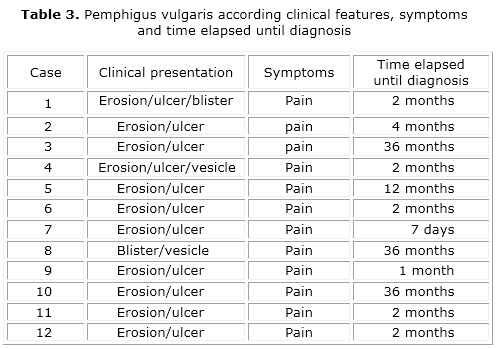
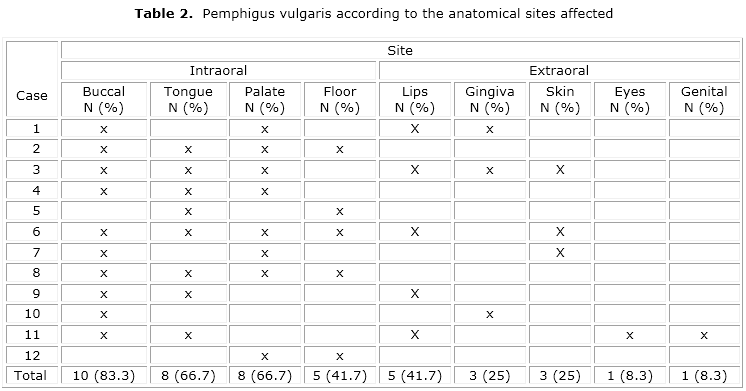
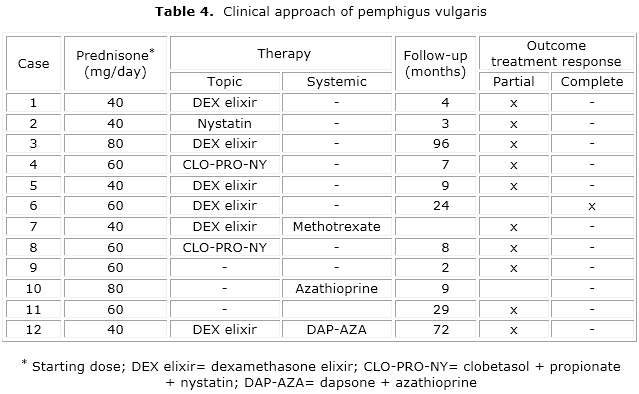
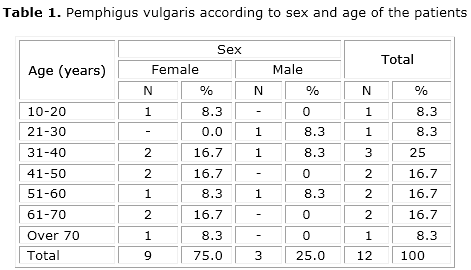
<body><![CDATA[<p><font face="Verdana" size="2">Corticosteroid is the drug of choice for the    treatment of pemphigus vulgaris. Its introduction in the pharmaceutical market    in the early 50's, reduced the mortality of the disease in a range of 10 %-90    %.<sup>2,6,8,12,17,18</sup> The association with topical therapy and with immunosuppressive    agents is indicated because it allows the use of lower doses of corticosteroid    and thus reduce its side effects.<sup>19 </sup>The present study reviewed 12    cases of pemphigus vulgaris, considering clinical features and therapeutic approach    to the disease. </font></p>     <p>&nbsp; </p>     <p><font face="Verdana" size="2"> <b><font size="3">METHODS</font></b> </font></p>     <p><font face="Verdana" size="2"> The medical charts of 12 patients with pemphigus    vulgaris attended at the Stomatology Department of S&#227;o Lucas Hospital -    Pontifical Catholic University of Rio Grande do Sul (PUCRS) were evaluated.    All cases had diagnosis confirmed by histological examination performed using    hematoxylin and eosin stain (H <i>&amp;</i> E). The charts were reviewed considering    the following variables: patients age and sex, anatomical site and clinical    aspect of lesions, symptoms, duration and clinical course of the disease. The    results were analyzed using descriptive statistics. </font></p>     <p>&nbsp;</p>     <p><font face="Verdana" size="3"><b>RESULTS</b></font><font face="Verdana" size="2">    </font></p>     <p><font face="Verdana" size="2"> The mean age was 46.7 years, whereas the youngest    patient was 19 years old and the oldest was 74. Women were the most affected,    representing 75 % of cases (<a href="#tab1_04">table 1</a>). Buccal mucosa was    the most frequent site (83.3 %), and 25 % of the cases had extraoral manifestations    (<a href="/img/revistas/est/v52n3/t0204315.gif">table 2</a>). <a href="#tab3_04">Table 3</a> displays    the distribution of lesions according to clinical presentation, symptoms and    time elapsed until diagnosis. The ulcerated/erosive clinical presentation was    the most prevalent (91.7 %), and pain was present in 100 % of cases. The time    course of lesions development reported at the patients&#8217; first visit ranged    from 7 days to 36 months, with a mean of 12.3 months. <a href="/img/revistas/est/v52n3/t0404315.gif">Table    4</a> shows the distribution of cases according to the clinical course. All    patients received systemic therapy with prednisone. In 58.3 % of cases there    was association with topical therapy and in 25 %, with immunosuppressive therapy.    One case (8.3 %) remained in remission after therapy withdrawal.</font></p>     <p align="center">    <br>   <a name="tab1_04"></a><img src="/img/revistas/est/v52n3/t0104315.gif" width="471" height="270"></p>     <p align="center">    ]]></body>
<body><![CDATA[<br>   <a name="tab3_04"></a><img src="/img/revistas/est/v52n3/t0304315.gif" width="497" height="349"></p>     <p align="left">&nbsp;</p>     <p align="left"><font face="Verdana" size="3"><b>DISCUSSION </b></font></p>     <p><font face="Verdana" size="2"> In the present study, the age most affected    by pemphigus vulgaris ranged from 31 to 40 years, with a mean age of 46.7 years,    which confirms reports in the literature.<sup>10,11,13</sup> We also observed    that occurred mainly in women. Although some studies claim there is no predilection    for sex,<sup>6,12 </sup> preference for females has been observed by some other    authors.<sup>9-11,17</sup> </font></p>     <p><font face="Verdana" size="2"> Buccal mucosa was the most frequently affected    site, erosive/ulcerated clinical presentation was the most prevalent, and pain    was present in all of cases. These findings are similar to those observed by    <i>Sirois</i> et al.<sup>13</sup> in a retrospective study of 42 cases of pemphigus    vulgaris. Skin was the main affected extraoral site, which is in accordance    to <i>Ishii</i> et al.<sup>11</sup> and <i>Robinson</i> et al.<sup>9</sup> </font></p>     <p><font face="Verdana" size="2"> Similarly to the study of <i>Robinson</i> et    al.,<sup>9</sup> all cases in this study started treatment with prednisone in    doses ranging from 40 mg to 80 mg. Other therapies such as azathioprine, cyclophosphamide,    cyclosporine, methotrexate, and dapsone are usually given to the patients unresponsive    to conventional therapy or who have complications from corticotherapy.<sup>17,20-23</sup>    Plasmapheresis, cholinergic agonists and immunoglobulin administered intravenously    are recent therapies for autoimmune diseases.<sup>9,10,17,24-28 </sup>Dexamethasone,    triamcinolone acetonide and fluticasone propionate have also been used successfully    as topical therapy in oral lesions.<sup>6,20 </sup>In this study, patients received    immunosuppressive therapy associated with systemic steroids, systemic steroids    were associated with topical therapy. <i>Robinson</i> et al.<sup>9</sup> found    that 12 patients (100 %) received immunosuppressants, as well as systemic and    topical steroids. This represents the different pathways in monitoring immunosuppressive    therapy, which varies according to clinical response of each patient. Approximately    75 % of the pemphigus vulgaris patients show remission of the symptoms after    10 years of treatment.<sup>9</sup> In this study, we observed one case with    complete remission after 4 months of therapy withdrawal. In neither case follow-up    treatment it lasted more than 10 years, due to death or treatment abandonment.    <i>Robinson</i> et al.<sup>9 </sup>found that in 75 % of cases there was at    some point, complete remission without the use of any medication. These authors    also noted that the time between recurrences was significantly increased in    patients treated for over 6 years indicating that the severity of the disease    tends to diminish with continued treatment. Pemphigus vulgaris is a serious    disease with important morbidity, whose first signs often occur in oral mucosa.    The knowledge and attention of the dentist to its clinical manifestations can    favor the early diagnosis of the disease. </font></p> <h4>&nbsp;</h4> <h4><font face="Verdana" size="3"><b>BIBLIOGRAPHIC REFERENCES</b></font><font face="Verdana" size="2">    </font></h4>     <!-- ref --><p><font face="Verdana" size="2"> 1. Mimouni D, Nousari CH, Cummins DL, Kouba    DJ, David M, Anhalt GJ. Differences and similarities among expert opinions on    the diagnosis and treatment of pemphigus vulgaris. <a>J Am Acad Dermatol</a>.    2003;49(6):1059-62.     </font></p>     <!-- ref --><p><font face="Verdana" size="2"> 2. Scully C, Mignogna M. Oral mucosal disease:    pemphigus. <a>Br J Oral Maxillofac Surg.</a> 2008;46(4):272-7.     </font></p>     ]]></body>
<body><![CDATA[<!-- ref --><p><font face="Verdana" size="2"> 3. Sagi L, Sherer Y, Trau H, Shoenfeld Y. Pemphigus    and infectious agents. <a>Autoimmun Rev.</a> 2008;8(1):33-5.     </font></p>     <!-- ref --><p><font face="Verdana" size="2"> 4. De Simone C, Caldarola G, D'agostino M, Zampetti    A, Amerio P, Feliciani C. Exacerbation of pemphigus after influenza vaccination.    <a>Clin Exp Dermatol</a>. 2008;33(6):718-20.    <!-- ref --> </font> </font>      <!-- ref --><p><font face="Verdana" size="2"> 6. Guillen S, Khachemoune A. Pemphigus vulgaris:    a short review for the practitioner. <a>Dermatol Nurs</a>. 2007;19(3):269-72.    <!-- ref -->    </font> </font>      <!-- ref --><p><font face="Verdana" size="2"> 8. Khelifa E, Benmously R, Badri T, Debbiche    A, Ben Ayed M, Mokhtar I, Fenniche S. Pemphigus vulgaris presenting as an isolated    crusted plaque of the cheek. <a>Dermatol Online J</a>. 2009;15(6):6.     </font></p>     ]]></body>
<body><![CDATA[<!-- ref --><p><font face="Verdana" size="2"> 9. Robinson JC, Lozada-Nur F, Friden I. Oral    pemphigus vulgaris: a review of the literature and a report on the management    of 12 cases. <a>Oral Surg Oral Med Oral Pathol Oral Radiol Endod</a>. 1997;84(4):349-55.        </font></p>     <!-- ref --><p><font face="Verdana" size="2"> 10. Mignogna MD, Lo Muzio L, Galloro G, Satriano    RA, Ruocco V, Bucci E. Oral pemphigus: clinical significance of esophageal involvement:    report of eight cases. <a>Oral Surg Oral Med Oral Pathol Oral Radiol Endod</a>.    1997;84(2):179-84.     </font></p>     <!-- ref --><p><font face="Verdana" size="2"> 11. Ishii N, Maeyama Y, Karashima T, Nakama    T, Kusuhara M, Yasumoto S, Hashimoto T. A clinical study of patients with pemphigus    vulgaris and pemphigus foliaceous: an 11-year retrospective study (1996-2006).    <a>Clin Exp Dermatol</a>. 2008;33(5):641-3.     </font></p>     <!-- ref --><p><font face="Verdana" size="2"> 12. Perez OA, Patton T. Novel therapies for    pemphigus vulgaris: an overview. <a>Drugs Aging</a>. 2009;26(10):833-46.     </font></p>     <!-- ref --><p><font face="Verdana" size="2"> 13. Sirois D, Leigh JE, Sollecito TP. Oral pemphigus    vulgaris preceding cutaneous lesions: recognition and diagnosis. <a>J Am Dent    Assoc</a>. 2000;131(8):1156-60.     </font></p>     ]]></body>
<body><![CDATA[<!-- ref --><p><font face="Verdana" size="2"> 14. Mignogna MD, Fortuna G, Leuci S, Ruoppo    E, Marasca F, Matarasso S. Nikolsky's sign on the gingival mucosa: a clinical    tool for oral health practitioners. <a>J Periodontol</a>. 2008;79(12):2241-6.        </font></p>     <!-- ref --><p><font face="Verdana" size="2"> 15. Dagistan S, Goregen M, Miloglu O, Cakur    B. Oral pemphigus vulgaris: a case report with review of the literature. <a>J    Oral Sci</a>. 2008;50(3):359-62.     </font></p>     <!-- ref --><p><font face="Verdana" size="2"> 16. Daneshpazhooh M, Chams-Davatchi C, Ramezani    A, Moinedin F, Hemami MR. Abortive aphthous-like oral lesions: an underreported    initial presentation of pemphigus vulgaris. <a>J Eur Acad Dermatol Venereol</a>.    2009;23(2):157-9.     </font></p>     <!-- ref --><p><font face="Verdana" size="2"> 17. Mignogna MD, Leuci S, Fedele S, Ruoppo E,    Adamo D, Russo G, Pagliuca R. Adjuvant high-dose intravenous immunoglobulin    therapy can be easily and safely introduced as an alternative treatment in patients    with severe pemphigus vulgaris: a retrospective preliminary study. <a>Am J Clin    Dermatol</a>. 2008;9(5):323-31.     </font></p>     <!-- ref --><p><font face="Verdana" size="2"> 18. Sethy PK, Khandpur S, Sharma VK. Randomized    open comparative trial of dexamethasone-cyclophosphamide pulse and daily oral    cyclophosphamide versus cyclophosphamide pulse and daily oral prednisolone in    pemphigus vulgaris. <a>Indian J Dermatol Venereol Leprol</a>. 2009;75(5):476-82.        </font></p>     ]]></body>
<body><![CDATA[<!-- ref --><p><font face="Verdana" size="2"> 19. Miletta N, Miller ME, Lam T, Chung KK, Hivnor    C. The Management of Pemphigus Vulgaris in a Burn Intensive Care Unit: A Case    Report and Treatment Review. J Burn Care Res . 2014 Feb 25. [Epub ahead of print].        </font></p>     <!-- ref --><p><font face="Verdana" size="2"> 20. Hapa A, Gurpinar A, Akan T, Gokoz O. A resistant    case of pemphigus gestationis successfully treated with intravenous immunoglobulin    plus cyclosporine.<b> </b> Int J Dermatol. 2014;53(4):e269-71.     </font></p>     <!-- ref --><p><font face="Verdana" size="2"> 21. Hocar O, Zidane W, Laissaoui K, Akhdari    N, Amal S. Herpes infection in pemphigus. <a>Med Mal Infect</a>. 2009;39(1):64-5.        </font></p>     <!-- ref --><p><font face="Verdana" size="2"> 22. Tran KD, Wolverton JE, Soter NA. Methotrexate    in the treatment of pemphigus vulgaris: experience in 23 patients.<b> </b> Br    J Dermatol. 2013;169(4):916-21.     </font></p>     <!-- ref --><p><font face="Verdana" size="2"> 23. Moreno AC, Santi CG, Gabbi TV, Aoki V, Hashimoto    T, Maruta CW. IgA pemphigus: case series with emphasis on therapeutic response.<b>    </b> J Am Acad Dermatol. 2014;70(1):200-1.     </font></p>     ]]></body>
<body><![CDATA[<!-- ref --><p><font face="Verdana" size="2"> 24. Fania L, Zampetti A, Guerriero G, Feliciani    C. Alteration of cholinergic system in keratinocytes cells produces acantholysis:    a possible use of cholinergic drugs in pemphigus vulgaris. Antiinflamm Antiallergy    Agents Med Chem . 2012;11(3):238-42.     </font></p>     <!-- ref --><p><font face="Verdana" size="2"> 25. G&#252;rcan HM, Ahmed AR. Analysis of current    data on the use of methotrexate in the treatment of pemphigus and pemphigoid.    <a>Br J Dermatol</a>. 2009;161(4):723-31.     </font></p>     <!-- ref --><p><font face="Verdana" size="2"> 26. Arnold DF, Burton J, Shine B, Wojnarowska    F, Misbah SA. An 'n-of-1' placebo-controlled crossover trial of intravenous    immunoglobulin as adjuvant therapy in refractory pemphigus vulgaris. <a>Br J    Dermatol</a>. 2009;160(5):1098-102.     </font></p>     <p><font face="Verdana" size="2"> 27. Grando SA, Bystryn JC, Chernyavsky AI, Frusi&#263;-Zlotkin    M, Gniadecki R, Lotti R, et al. Apoptolysis: a novel mechanism of skin blistering    in pemphigus vulgaris linking the apoptotic pathways to basal cell shrinkage    and suprabasal acantholysis. <a>Exp Dermatol</a>. 2009;18(9):764-70. </font></p>     <!-- ref --><p><font face="Verdana" size="2"> 28. Ruocco E, Wolf R, Ruocco V, Brunetti G,    Romano F, Lo Schiavo A. Pemphigus: associations and management guidelines: facts    and controversies. Clin Dermatol. 2013;31(4):382-90.     </font></p>     <p>&nbsp;</p>     ]]></body>
<body><![CDATA[<p>&nbsp;</p>     <p><font face="Verdana, Arial, Helvetica, sans-serif" size="2">Recibido: 22 de    enero de 2015.    <br>   Aprobado: 6 de febreo de 2015.</font><font face="Verdana" size="2">    <br>   </font></p>     <p>&nbsp;</p>     <p>&nbsp;</p>     <p><font face="Verdana" size="2"><i>Ana Carolina Vasconcelos.</i> Av. Ipiranga,    6681 - Partenon, Porto Alegre - RS, Zip Code: 90619-900, Brazil. </font>    <br>   <font face="Verdana" size="2">Correo electr&#243;nico: <a href="mailto:carolinauv@hotmail.com">carolinauv@hotmail.com</a>    </font></p>      ]]></body><back>
<ref-list>
<ref id="B1">
<label>1</label><nlm-citation citation-type="journal">
<person-group person-group-type="author">
<name>
<surname><![CDATA[Mimouni]]></surname>
<given-names><![CDATA[D]]></given-names>
</name>
<name>
<surname><![CDATA[Nousari]]></surname>
<given-names><![CDATA[CH]]></given-names>
</name>
<name>
<surname><![CDATA[Cummins]]></surname>
<given-names><![CDATA[DL]]></given-names>
</name>
<name>
<surname><![CDATA[Kouba]]></surname>
<given-names><![CDATA[DJ]]></given-names>
</name>
<name>
<surname><![CDATA[David]]></surname>
<given-names><![CDATA[M]]></given-names>
</name>
<name>
<surname><![CDATA[Anhalt]]></surname>
<given-names><![CDATA[GJ]]></given-names>
</name>
</person-group>
<article-title xml:lang="en"><![CDATA[Differences and similarities among expert opinions on the diagnosis and treatment of pemphigus vulgaris]]></article-title>
<source><![CDATA[J Am Acad Dermatol]]></source>
<year>2003</year>
<volume>49</volume>
<numero>6</numero>
<issue>6</issue>
<page-range>1059-62</page-range></nlm-citation>
</ref>
<ref id="B2">
<label>2</label><nlm-citation citation-type="journal">
<person-group person-group-type="author">
<name>
<surname><![CDATA[Scully]]></surname>
<given-names><![CDATA[C]]></given-names>
</name>
<name>
<surname><![CDATA[Mignogna]]></surname>
<given-names><![CDATA[M]]></given-names>
</name>
</person-group>
<article-title xml:lang="en"><![CDATA[Oral mucosal disease: pemphigus]]></article-title>
<source><![CDATA[Br J Oral Maxillofac Surg]]></source>
<year>2008</year>
<volume>46</volume>
<numero>4</numero>
<issue>4</issue>
<page-range>272-7</page-range></nlm-citation>
</ref>
<ref id="B3">
<label>3</label><nlm-citation citation-type="journal">
<person-group person-group-type="author">
<name>
<surname><![CDATA[Sagi]]></surname>
<given-names><![CDATA[L]]></given-names>
</name>
<name>
<surname><![CDATA[Sherer]]></surname>
<given-names><![CDATA[Y]]></given-names>
</name>
<name>
<surname><![CDATA[Trau]]></surname>
<given-names><![CDATA[H]]></given-names>
</name>
<name>
<surname><![CDATA[Shoenfeld]]></surname>
<given-names><![CDATA[Y]]></given-names>
</name>
</person-group>
<article-title xml:lang="en"><![CDATA[Pemphigus and infectious agents]]></article-title>
<source><![CDATA[Autoimmun Rev]]></source>
<year>2008</year>
<volume>8</volume>
<numero>1</numero>
<issue>1</issue>
<page-range>33-5</page-range></nlm-citation>
</ref>
<ref id="B4">
<label>4</label><nlm-citation citation-type="journal">
<person-group person-group-type="author">
<name>
<surname><![CDATA[De Simone]]></surname>
<given-names><![CDATA[C]]></given-names>
</name>
<name>
<surname><![CDATA[Caldarola]]></surname>
<given-names><![CDATA[G]]></given-names>
</name>
<name>
<surname><![CDATA[D'agostino]]></surname>
<given-names><![CDATA[M]]></given-names>
</name>
<name>
<surname><![CDATA[Zampetti]]></surname>
<given-names><![CDATA[A]]></given-names>
</name>
<name>
<surname><![CDATA[Amerio]]></surname>
<given-names><![CDATA[P]]></given-names>
</name>
<name>
<surname><![CDATA[Feliciani]]></surname>
<given-names><![CDATA[C]]></given-names>
</name>
</person-group>
<article-title xml:lang="en"><![CDATA[Exacerbation of pemphigus after influenza vaccination]]></article-title>
<source><![CDATA[Clin Exp Dermatol]]></source>
<year>2008</year>
<volume>33</volume>
<numero>6</numero>
<issue>6</issue>
<page-range>718-20</page-range></nlm-citation>
</ref>
<ref id="B5">
<label>5</label><nlm-citation citation-type="journal">
<person-group person-group-type="author">
<name>
<surname><![CDATA[Jessop]]></surname>
<given-names><![CDATA[S]]></given-names>
</name>
<name>
<surname><![CDATA[Khumalo]]></surname>
<given-names><![CDATA[NP]]></given-names>
</name>
</person-group>
<article-title xml:lang="en"><![CDATA[Pemphigus: a treatment update]]></article-title>
<source><![CDATA[Am J Clin Dermatol]]></source>
<year>2008</year>
<volume>9</volume>
<numero>3</numero>
<issue>3</issue>
<page-range>147-54</page-range></nlm-citation>
</ref>
<ref id="B6">
<label>6</label><nlm-citation citation-type="journal">
<person-group person-group-type="author">
<name>
<surname><![CDATA[Guillen]]></surname>
<given-names><![CDATA[S]]></given-names>
</name>
<name>
<surname><![CDATA[Khachemoune]]></surname>
<given-names><![CDATA[A]]></given-names>
</name>
</person-group>
<article-title xml:lang="en"><![CDATA[Pemphigus vulgaris: a short review for the practitioner]]></article-title>
<source><![CDATA[Dermatol Nurs]]></source>
<year>2007</year>
<volume>19</volume>
<numero>3</numero>
<issue>3</issue>
<page-range>269-72</page-range></nlm-citation>
</ref>
<ref id="B7">
<label>7</label><nlm-citation citation-type="journal">
<person-group person-group-type="author">
<name>
<surname><![CDATA[Darling]]></surname>
<given-names><![CDATA[MR]]></given-names>
</name>
<name>
<surname><![CDATA[Daley]]></surname>
<given-names><![CDATA[T]]></given-names>
</name>
</person-group>
<article-title xml:lang="unknown"><![CDATA[Blistering mucocutaneous diseases of the oral mucosa a review: part 2. Pemphigus vulgaris]]></article-title>
<source><![CDATA[J Can Dent Assoc]]></source>
<year>2006</year>
<volume>72</volume>
<numero>1</numero>
<issue>1</issue>
<page-range>63-6</page-range></nlm-citation>
</ref>
<ref id="B8">
<label>8</label><nlm-citation citation-type="journal">
<person-group person-group-type="author">
<name>
<surname><![CDATA[Khelifa]]></surname>
<given-names><![CDATA[E]]></given-names>
</name>
<name>
<surname><![CDATA[Benmously]]></surname>
<given-names><![CDATA[R]]></given-names>
</name>
<name>
<surname><![CDATA[Badri]]></surname>
<given-names><![CDATA[T]]></given-names>
</name>
<name>
<surname><![CDATA[Debbiche]]></surname>
<given-names><![CDATA[A]]></given-names>
</name>
<name>
<surname><![CDATA[Ben Ayed]]></surname>
<given-names><![CDATA[M]]></given-names>
</name>
<name>
<surname><![CDATA[Mokhtar]]></surname>
<given-names><![CDATA[I]]></given-names>
</name>
<name>
<surname><![CDATA[Fenniche]]></surname>
<given-names><![CDATA[S]]></given-names>
</name>
</person-group>
<article-title xml:lang="en"><![CDATA[Pemphigus vulgaris presenting as an isolated crusted plaque of the cheek]]></article-title>
<source><![CDATA[Dermatol Online J]]></source>
<year>2009</year>
<volume>15</volume>
<numero>6</numero>
<issue>6</issue>
<page-range>6</page-range></nlm-citation>
</ref>
<ref id="B9">
<label>9</label><nlm-citation citation-type="journal">
<person-group person-group-type="author">
<name>
<surname><![CDATA[Robinson]]></surname>
<given-names><![CDATA[JC]]></given-names>
</name>
<name>
<surname><![CDATA[Lozada-Nur]]></surname>
<given-names><![CDATA[F]]></given-names>
</name>
<name>
<surname><![CDATA[Friden]]></surname>
<given-names><![CDATA[I]]></given-names>
</name>
</person-group>
<article-title xml:lang="en"><![CDATA[Oral pemphigus vulgaris: a review of the literature and a report on the management of 12 cases]]></article-title>
<source><![CDATA[Oral Surg Oral Med Oral Pathol Oral Radiol Endod]]></source>
<year>1997</year>
<volume>84</volume>
<numero>4</numero>
<issue>4</issue>
<page-range>349-55</page-range></nlm-citation>
</ref>
<ref id="B10">
<label>10</label><nlm-citation citation-type="journal">
<person-group person-group-type="author">
<name>
<surname><![CDATA[Mignogna]]></surname>
<given-names><![CDATA[MD]]></given-names>
</name>
<name>
<surname><![CDATA[Lo Muzio]]></surname>
<given-names><![CDATA[L]]></given-names>
</name>
<name>
<surname><![CDATA[Galloro]]></surname>
<given-names><![CDATA[G]]></given-names>
</name>
<name>
<surname><![CDATA[Satriano]]></surname>
<given-names><![CDATA[RA]]></given-names>
</name>
<name>
<surname><![CDATA[Ruocco]]></surname>
<given-names><![CDATA[V]]></given-names>
</name>
<name>
<surname><![CDATA[Bucci]]></surname>
<given-names><![CDATA[E]]></given-names>
</name>
</person-group>
<article-title xml:lang="en"><![CDATA[Oral pemphigus: clinical significance of esophageal involvement: report of eight cases]]></article-title>
<source><![CDATA[Oral Surg Oral Med Oral Pathol Oral Radiol Endod]]></source>
<year>1997</year>
<volume>84</volume>
<numero>2</numero>
<issue>2</issue>
<page-range>179-84</page-range></nlm-citation>
</ref>
<ref id="B11">
<label>11</label><nlm-citation citation-type="journal">
<person-group person-group-type="author">
<name>
<surname><![CDATA[Ishii]]></surname>
<given-names><![CDATA[N]]></given-names>
</name>
<name>
<surname><![CDATA[Maeyama]]></surname>
<given-names><![CDATA[Y]]></given-names>
</name>
<name>
<surname><![CDATA[Karashima]]></surname>
<given-names><![CDATA[T]]></given-names>
</name>
<name>
<surname><![CDATA[Nakama]]></surname>
<given-names><![CDATA[T]]></given-names>
</name>
<name>
<surname><![CDATA[Kusuhara]]></surname>
<given-names><![CDATA[M]]></given-names>
</name>
<name>
<surname><![CDATA[Yasumoto]]></surname>
<given-names><![CDATA[S]]></given-names>
</name>
<name>
<surname><![CDATA[Hashimoto]]></surname>
<given-names><![CDATA[T]]></given-names>
</name>
</person-group>
<article-title xml:lang="en"><![CDATA[A clinical study of patients with pemphigus vulgaris and pemphigus foliaceous: an 11-year retrospective study (1996-2006)]]></article-title>
<source><![CDATA[Clin Exp Dermatol]]></source>
<year>2008</year>
<volume>33</volume>
<numero>5</numero>
<issue>5</issue>
<page-range>641-3</page-range></nlm-citation>
</ref>
<ref id="B12">
<label>12</label><nlm-citation citation-type="journal">
<person-group person-group-type="author">
<name>
<surname><![CDATA[Perez]]></surname>
<given-names><![CDATA[OA]]></given-names>
</name>
<name>
<surname><![CDATA[Patton]]></surname>
<given-names><![CDATA[T]]></given-names>
</name>
</person-group>
<article-title xml:lang="en"><![CDATA[Novel therapies for pemphigus vulgaris: an overview]]></article-title>
<source><![CDATA[Drugs Aging]]></source>
<year>2009</year>
<volume>26</volume>
<numero>10</numero>
<issue>10</issue>
<page-range>833-46</page-range></nlm-citation>
</ref>
<ref id="B13">
<label>13</label><nlm-citation citation-type="journal">
<person-group person-group-type="author">
<name>
<surname><![CDATA[Sirois]]></surname>
<given-names><![CDATA[D]]></given-names>
</name>
<name>
<surname><![CDATA[Leigh]]></surname>
<given-names><![CDATA[JE]]></given-names>
</name>
<name>
<surname><![CDATA[Sollecito]]></surname>
<given-names><![CDATA[TP]]></given-names>
</name>
</person-group>
<article-title xml:lang="en"><![CDATA[Oral pemphigus vulgaris preceding cutaneous lesions: recognition and diagnosis]]></article-title>
<source><![CDATA[J Am Dent Assoc]]></source>
<year>2000</year>
<volume>131</volume>
<numero>8</numero>
<issue>8</issue>
<page-range>1156-60</page-range></nlm-citation>
</ref>
<ref id="B14">
<label>14</label><nlm-citation citation-type="journal">
<person-group person-group-type="author">
<name>
<surname><![CDATA[Mignogna]]></surname>
<given-names><![CDATA[MD]]></given-names>
</name>
<name>
<surname><![CDATA[Fortuna]]></surname>
<given-names><![CDATA[G]]></given-names>
</name>
<name>
<surname><![CDATA[Leuci]]></surname>
<given-names><![CDATA[S]]></given-names>
</name>
<name>
<surname><![CDATA[Ruoppo]]></surname>
<given-names><![CDATA[E]]></given-names>
</name>
<name>
<surname><![CDATA[Marasca]]></surname>
<given-names><![CDATA[F]]></given-names>
</name>
<name>
<surname><![CDATA[Matarasso]]></surname>
<given-names><![CDATA[S]]></given-names>
</name>
</person-group>
<article-title xml:lang="en"><![CDATA[Nikolsky's sign on the gingival mucosa: a clinical tool for oral health practitioners]]></article-title>
<source><![CDATA[J Periodontol]]></source>
<year>2008</year>
<volume>79</volume>
<numero>12</numero>
<issue>12</issue>
<page-range>2241-6</page-range></nlm-citation>
</ref>
<ref id="B15">
<label>15</label><nlm-citation citation-type="journal">
<person-group person-group-type="author">
<name>
<surname><![CDATA[Dagistan]]></surname>
<given-names><![CDATA[S]]></given-names>
</name>
<name>
<surname><![CDATA[Goregen]]></surname>
<given-names><![CDATA[M]]></given-names>
</name>
<name>
<surname><![CDATA[Miloglu]]></surname>
<given-names><![CDATA[O]]></given-names>
</name>
<name>
<surname><![CDATA[Cakur]]></surname>
<given-names><![CDATA[B]]></given-names>
</name>
</person-group>
<article-title xml:lang="en"><![CDATA[Oral pemphigus vulgaris: a case report with review of the literature]]></article-title>
<source><![CDATA[J Oral Sci]]></source>
<year>2008</year>
<volume>50</volume>
<numero>3</numero>
<issue>3</issue>
<page-range>359-62</page-range></nlm-citation>
</ref>
<ref id="B16">
<label>16</label><nlm-citation citation-type="journal">
<person-group person-group-type="author">
<name>
<surname><![CDATA[Daneshpazhooh]]></surname>
<given-names><![CDATA[M]]></given-names>
</name>
<name>
<surname><![CDATA[Chams-Davatchi]]></surname>
<given-names><![CDATA[C]]></given-names>
</name>
<name>
<surname><![CDATA[Ramezani]]></surname>
<given-names><![CDATA[A]]></given-names>
</name>
<name>
<surname><![CDATA[Moinedin]]></surname>
<given-names><![CDATA[F]]></given-names>
</name>
<name>
<surname><![CDATA[Hemami]]></surname>
<given-names><![CDATA[MR]]></given-names>
</name>
</person-group>
<article-title xml:lang="en"><![CDATA[Abortive aphthous-like oral lesions: an underreported initial presentation of pemphigus vulgaris]]></article-title>
<source><![CDATA[J Eur Acad Dermatol Venereol]]></source>
<year>2009</year>
<volume>23</volume>
<numero>2</numero>
<issue>2</issue>
<page-range>157-9</page-range></nlm-citation>
</ref>
<ref id="B17">
<label>17</label><nlm-citation citation-type="journal">
<person-group person-group-type="author">
<name>
<surname><![CDATA[Mignogna]]></surname>
<given-names><![CDATA[MD]]></given-names>
</name>
<name>
<surname><![CDATA[Leuci]]></surname>
<given-names><![CDATA[S]]></given-names>
</name>
<name>
<surname><![CDATA[Fedele]]></surname>
<given-names><![CDATA[S]]></given-names>
</name>
<name>
<surname><![CDATA[Ruoppo]]></surname>
<given-names><![CDATA[E]]></given-names>
</name>
<name>
<surname><![CDATA[Adamo]]></surname>
<given-names><![CDATA[D]]></given-names>
</name>
<name>
<surname><![CDATA[Russo]]></surname>
<given-names><![CDATA[G]]></given-names>
</name>
<name>
<surname><![CDATA[Pagliuca]]></surname>
<given-names><![CDATA[R]]></given-names>
</name>
</person-group>
<article-title xml:lang="en"><![CDATA[Adjuvant high-dose intravenous immunoglobulin therapy can be easily and safely introduced as an alternative treatment in patients with severe pemphigus vulgaris: a retrospective preliminary study]]></article-title>
<source><![CDATA[Am J Clin Dermatol]]></source>
<year>2008</year>
<volume>9</volume>
<numero>5</numero>
<issue>5</issue>
<page-range>323-31</page-range></nlm-citation>
</ref>
<ref id="B18">
<label>18</label><nlm-citation citation-type="journal">
<person-group person-group-type="author">
<name>
<surname><![CDATA[Sethy]]></surname>
<given-names><![CDATA[PK]]></given-names>
</name>
<name>
<surname><![CDATA[Khandpur]]></surname>
<given-names><![CDATA[S]]></given-names>
</name>
<name>
<surname><![CDATA[Sharma]]></surname>
<given-names><![CDATA[VK]]></given-names>
</name>
</person-group>
<article-title xml:lang="en"><![CDATA[Randomized open comparative trial of dexamethasone-cyclophosphamide pulse and daily oral cyclophosphamide versus cyclophosphamide pulse and daily oral prednisolone in pemphigus vulgaris]]></article-title>
<source><![CDATA[Indian J Dermatol Venereol Leprol]]></source>
<year>2009</year>
<volume>75</volume>
<numero>5</numero>
<issue>5</issue>
<page-range>476-82</page-range></nlm-citation>
</ref>
<ref id="B19">
<label>19</label><nlm-citation citation-type="journal">
<person-group person-group-type="author">
<name>
<surname><![CDATA[Miletta]]></surname>
<given-names><![CDATA[N]]></given-names>
</name>
<name>
<surname><![CDATA[Miller]]></surname>
<given-names><![CDATA[ME]]></given-names>
</name>
<name>
<surname><![CDATA[Lam]]></surname>
<given-names><![CDATA[T]]></given-names>
</name>
<name>
<surname><![CDATA[Chung]]></surname>
<given-names><![CDATA[KK]]></given-names>
</name>
<name>
<surname><![CDATA[Hivnor]]></surname>
<given-names><![CDATA[C]]></given-names>
</name>
</person-group>
<article-title xml:lang="en"><![CDATA[The Management of Pemphigus Vulgaris in a Burn Intensive Care Unit: A Case Report and Treatment Review]]></article-title>
<source><![CDATA[J Burn Care Res]]></source>
<year>2014</year>
<month> F</month>
<day>eb</day>
</nlm-citation>
</ref>
<ref id="B20">
<label>20</label><nlm-citation citation-type="journal">
<person-group person-group-type="author">
<name>
<surname><![CDATA[Hapa]]></surname>
<given-names><![CDATA[A]]></given-names>
</name>
<name>
<surname><![CDATA[Gurpinar]]></surname>
<given-names><![CDATA[A]]></given-names>
</name>
<name>
<surname><![CDATA[Akan]]></surname>
<given-names><![CDATA[T]]></given-names>
</name>
<name>
<surname><![CDATA[Gokoz]]></surname>
<given-names><![CDATA[O]]></given-names>
</name>
</person-group>
<article-title xml:lang="en"><![CDATA[A resistant case of pemphigus gestationis successfully treated with intravenous immunoglobulin plus cyclosporine]]></article-title>
<source><![CDATA[Int J Dermatol]]></source>
<year>2014</year>
<volume>53</volume>
<numero>4</numero>
<issue>4</issue>
<page-range>e269-71</page-range></nlm-citation>
</ref>
<ref id="B21">
<label>21</label><nlm-citation citation-type="journal">
<person-group person-group-type="author">
<name>
<surname><![CDATA[Hocar]]></surname>
<given-names><![CDATA[O]]></given-names>
</name>
<name>
<surname><![CDATA[Zidane]]></surname>
<given-names><![CDATA[W]]></given-names>
</name>
<name>
<surname><![CDATA[Laissaoui]]></surname>
<given-names><![CDATA[K]]></given-names>
</name>
<name>
<surname><![CDATA[Akhdari]]></surname>
<given-names><![CDATA[N]]></given-names>
</name>
<name>
<surname><![CDATA[Amal]]></surname>
<given-names><![CDATA[S]]></given-names>
</name>
</person-group>
<article-title xml:lang="en"><![CDATA[Herpes infection in pemphigus]]></article-title>
<source><![CDATA[Med Mal Infect]]></source>
<year>2009</year>
<volume>39</volume>
<numero>1</numero>
<issue>1</issue>
<page-range>64-5</page-range></nlm-citation>
</ref>
<ref id="B22">
<label>22</label><nlm-citation citation-type="journal">
<person-group person-group-type="author">
<name>
<surname><![CDATA[Tran]]></surname>
<given-names><![CDATA[KD]]></given-names>
</name>
<name>
<surname><![CDATA[Wolverton]]></surname>
<given-names><![CDATA[JE]]></given-names>
</name>
<name>
<surname><![CDATA[Soter]]></surname>
<given-names><![CDATA[NA]]></given-names>
</name>
</person-group>
<article-title xml:lang="en"><![CDATA[Methotrexate in the treatment of pemphigus vulgaris: experience in 23 patients]]></article-title>
<source><![CDATA[Br J Dermatol]]></source>
<year>2013</year>
<volume>169</volume>
<numero>4</numero>
<issue>4</issue>
<page-range>916-21</page-range></nlm-citation>
</ref>
<ref id="B23">
<label>23</label><nlm-citation citation-type="journal">
<person-group person-group-type="author">
<name>
<surname><![CDATA[Moreno]]></surname>
<given-names><![CDATA[AC]]></given-names>
</name>
<name>
<surname><![CDATA[Santi]]></surname>
<given-names><![CDATA[CG]]></given-names>
</name>
<name>
<surname><![CDATA[Gabbi]]></surname>
<given-names><![CDATA[TV]]></given-names>
</name>
<name>
<surname><![CDATA[Aoki]]></surname>
<given-names><![CDATA[V]]></given-names>
</name>
<name>
<surname><![CDATA[Hashimoto]]></surname>
<given-names><![CDATA[T]]></given-names>
</name>
<name>
<surname><![CDATA[Maruta]]></surname>
<given-names><![CDATA[CW]]></given-names>
</name>
</person-group>
<article-title xml:lang="en"><![CDATA[IgA pemphigus: case series with emphasis on therapeutic response]]></article-title>
<source><![CDATA[J Am Acad Dermatol]]></source>
<year>2014</year>
<volume>70</volume>
<numero>1</numero>
<issue>1</issue>
<page-range>200-1</page-range></nlm-citation>
</ref>
<ref id="B24">
<label>24</label><nlm-citation citation-type="journal">
<person-group person-group-type="author">
<name>
<surname><![CDATA[Fania]]></surname>
<given-names><![CDATA[L]]></given-names>
</name>
<name>
<surname><![CDATA[Zampetti]]></surname>
<given-names><![CDATA[A]]></given-names>
</name>
<name>
<surname><![CDATA[Guerriero]]></surname>
<given-names><![CDATA[G]]></given-names>
</name>
<name>
<surname><![CDATA[Feliciani]]></surname>
<given-names><![CDATA[C]]></given-names>
</name>
</person-group>
<article-title xml:lang="en"><![CDATA[Alteration of cholinergic system in keratinocytes cells produces acantholysis: a possible use of cholinergic drugs in pemphigus vulgaris]]></article-title>
<source><![CDATA[Antiinflamm Antiallergy Agents Med Chem]]></source>
<year>2012</year>
<volume>11</volume>
<numero>3</numero>
<issue>3</issue>
<page-range>238-42</page-range></nlm-citation>
</ref>
<ref id="B25">
<label>25</label><nlm-citation citation-type="journal">
<person-group person-group-type="author">
<name>
<surname><![CDATA[Gürcan]]></surname>
<given-names><![CDATA[HM]]></given-names>
</name>
<name>
<surname><![CDATA[Ahmed]]></surname>
<given-names><![CDATA[AR]]></given-names>
</name>
</person-group>
<article-title xml:lang="en"><![CDATA[Analysis of current data on the use of methotrexate in the treatment of pemphigus and pemphigoid]]></article-title>
<source><![CDATA[Br J Dermatol]]></source>
<year>2009</year>
<volume>161</volume>
<numero>4</numero>
<issue>4</issue>
<page-range>723-31</page-range></nlm-citation>
</ref>
<ref id="B26">
<label>26</label><nlm-citation citation-type="journal">
<person-group person-group-type="author">
<name>
<surname><![CDATA[Arnold]]></surname>
<given-names><![CDATA[DF]]></given-names>
</name>
<name>
<surname><![CDATA[Burton]]></surname>
<given-names><![CDATA[J]]></given-names>
</name>
<name>
<surname><![CDATA[Shine]]></surname>
<given-names><![CDATA[B]]></given-names>
</name>
<name>
<surname><![CDATA[Wojnarowska]]></surname>
<given-names><![CDATA[F]]></given-names>
</name>
<name>
<surname><![CDATA[Misbah]]></surname>
<given-names><![CDATA[SA]]></given-names>
</name>
</person-group>
<article-title xml:lang="en"><![CDATA[An 'n-of-1' placebo-controlled crossover trial of intravenous immunoglobulin as adjuvant therapy in refractory pemphigus vulgaris]]></article-title>
<source><![CDATA[Br J Dermatol]]></source>
<year>2009</year>
<volume>160</volume>
<numero>5</numero>
<issue>5</issue>
<page-range>1098-102</page-range></nlm-citation>
</ref>
<ref id="B27">
<label>27</label><nlm-citation citation-type="journal">
<person-group person-group-type="author">
<name>
<surname><![CDATA[Grando]]></surname>
<given-names><![CDATA[SA]]></given-names>
</name>
<name>
<surname><![CDATA[Bystryn]]></surname>
<given-names><![CDATA[JC]]></given-names>
</name>
<name>
<surname><![CDATA[Chernyavsky]]></surname>
<given-names><![CDATA[AI]]></given-names>
</name>
<name>
<surname><![CDATA[Frusic-Zlotkin]]></surname>
<given-names><![CDATA[M]]></given-names>
</name>
<name>
<surname><![CDATA[Gniadecki]]></surname>
<given-names><![CDATA[R]]></given-names>
</name>
<name>
<surname><![CDATA[Lotti]]></surname>
<given-names><![CDATA[R]]></given-names>
</name>
</person-group>
<article-title xml:lang="en"><![CDATA[Apoptolysis: a novel mechanism of skin blistering in pemphigus vulgaris linking the apoptotic pathways to basal cell shrinkage and suprabasal acantholysis]]></article-title>
<source><![CDATA[Exp Dermatol]]></source>
<year>2009</year>
<volume>18</volume>
<numero>9</numero>
<issue>9</issue>
<page-range>764-70</page-range></nlm-citation>
</ref>
<ref id="B28">
<label>28</label><nlm-citation citation-type="journal">
<person-group person-group-type="author">
<name>
<surname><![CDATA[Ruocco]]></surname>
<given-names><![CDATA[E]]></given-names>
</name>
<name>
<surname><![CDATA[Wolf]]></surname>
<given-names><![CDATA[R]]></given-names>
</name>
<name>
<surname><![CDATA[Ruocco]]></surname>
<given-names><![CDATA[V]]></given-names>
</name>
<name>
<surname><![CDATA[Brunetti]]></surname>
<given-names><![CDATA[G]]></given-names>
</name>
<name>
<surname><![CDATA[Romano]]></surname>
<given-names><![CDATA[F]]></given-names>
</name>
<name>
<surname><![CDATA[Lo Schiavo]]></surname>
<given-names><![CDATA[A]]></given-names>
</name>
</person-group>
<article-title xml:lang="en"><![CDATA[Pemphigus: associations and management guidelines: facts and controversies]]></article-title>
<source><![CDATA[Clin Dermatol]]></source>
<year>2013</year>
<volume>31</volume>
<numero>4</numero>
<issue>4</issue>
<page-range>382-90</page-range></nlm-citation>
</ref>
</ref-list>
</back>
</article>