<?xml version="1.0" encoding="ISO-8859-1"?><article xmlns:mml="http://www.w3.org/1998/Math/MathML" xmlns:xlink="http://www.w3.org/1999/xlink" xmlns:xsi="http://www.w3.org/2001/XMLSchema-instance">
<front>
<journal-meta>
<journal-id>0034-7515</journal-id>
<journal-title><![CDATA[Revista Cubana de Farmacia]]></journal-title>
<abbrev-journal-title><![CDATA[Rev Cubana Farm]]></abbrev-journal-title>
<issn>0034-7515</issn>
<publisher>
<publisher-name><![CDATA[Editorial Ciencias Médicas]]></publisher-name>
</publisher>
</journal-meta>
<article-meta>
<article-id>S0034-75152000000100001</article-id>
<title-group>
<article-title xml:lang="es"><![CDATA[Características hidrodinámicas de carboximetilquitina y carboximetilquitosana]]></article-title>
</title-group>
<contrib-group>
<contrib contrib-type="author">
<name>
<surname><![CDATA[Fernández Monagas]]></surname>
<given-names><![CDATA[Sol Amalia]]></given-names>
</name>
</contrib>
</contrib-group>
<aff id="A01">
<institution><![CDATA[,Instituto de Farmacia y Alimentos. Universidad de La Habana  ]]></institution>
<addr-line><![CDATA[ ]]></addr-line>
</aff>
<pub-date pub-type="pub">
<day>00</day>
<month>04</month>
<year>2000</year>
</pub-date>
<pub-date pub-type="epub">
<day>00</day>
<month>04</month>
<year>2000</year>
</pub-date>
<volume>34</volume>
<numero>1</numero>
<fpage>6</fpage>
<lpage>11</lpage>
<copyright-statement/>
<copyright-year/>
<self-uri xlink:href="http://scielo.sld.cu/scielo.php?script=sci_arttext&amp;pid=S0034-75152000000100001&amp;lng=en&amp;nrm=iso"></self-uri><self-uri xlink:href="http://scielo.sld.cu/scielo.php?script=sci_abstract&amp;pid=S0034-75152000000100001&amp;lng=en&amp;nrm=iso"></self-uri><self-uri xlink:href="http://scielo.sld.cu/scielo.php?script=sci_pdf&amp;pid=S0034-75152000000100001&amp;lng=en&amp;nrm=iso"></self-uri><abstract abstract-type="short" xml:lang="es"><p><![CDATA[Se estudiaron algunas propiedades físico-químicas de 3 derivados carboximetilados, sintetizados a partir de la quitina que se obtiene en Cuba de los carapachos de langostas. Se analiza el comportamiento hidrodinámico de las soluciones de estas sustancias, comprobándose las características de polielectrólito que presentan y se determinan los valores de la masa molar para cada una de ellas.]]></p></abstract>
<abstract abstract-type="short" xml:lang="en"><p><![CDATA[Hydrodynamic characteristics of carboxymethylchitin and carboxymethylchitosan. A study was conducted on the physical and chemical properties of 3 carboxymethylate derivates synthetized from chitin obtained from lobster carapasses in Cuba. Also, the hydrodynamic performance of these susbstance solutions was analyzed to determine their polyelectrolite features and the molar mass values of each of them.]]></p></abstract>
<kwd-group>
<kwd lng="es"><![CDATA[QUITINA]]></kwd>
<kwd lng="es"><![CDATA[CHITIN]]></kwd>
</kwd-group>
</article-meta>
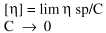
</front><body><![CDATA[ <H3> Art&iacute;culos Originales</H3>Instituto de Farmacia y Alimentos. Universidad  de La Habana <H2> Caracter&iacute;sticas hidrodin&aacute;micas de carboximetilquitina  y carboximetilquitosana</H2><I><A HREF="#Autores">Sol Amalia Fern&aacute;ndez  Monagas<SUP>1</SUP></A></I> <H4> RESUMEN</H4>Se estudiaron algunas propiedades  f&iacute;sico-qu&iacute;micas de 3 derivados carboximetilados, sintetizados a  partir de la quitina que se obtiene en Cuba de los carapachos de langostas. Se  analiza el comportamiento hidrodin&aacute;mico de las soluciones de estas sustancias,  comprob&aacute;ndose las caracter&iacute;sticas de polielectr&oacute;lito que  presentan y se determinan los valores de la masa molar para cada una de ellas.      <P><I>Descriptores DeCS</I>: QUITINA/an&aacute;logos &amp; derivados; QUITINA/qu&iacute;mica.      <P>La carboximetilquitina es un derivado soluble de la quitina, que posee propiedades  muy variadas e interesantes y que a la vez no resulta t&oacute;xico.<SUP>1 </SUP>Este  compuesto, al igual que la carboximetilquitosana, ha cobrado inter&eacute;s en  los &uacute;ltimos a&ntilde;os, ya que su obtenci&oacute;n resulta sencilla y  su espectro de aplicaci&oacute;n es bastante amplio. As&iacute;, estos compuestos  han encontrado aplicaci&oacute;n en la recuperaci&oacute;n de iones met&aacute;licos,<SUP>2  </SUP>como transportadores de f&aacute;rmacos,<SUP>3-5</SUP> en la elaboraci&oacute;n  de formas farmac&eacute;uticas de liberaci&oacute;n controlada,<SUP>6</SUP> la  activaci&oacute;n del sistema inmunol&oacute;gico,<SUP>7</SUP> en preparaciones  cosm&eacute;ticas,<SUP>8</SUP> la obtenci&oacute;n de liposomas<SUP>9-11</SUP>  y otras.     <P>En la actualidad, en Cuba, se estudian las propiedades terap&eacute;uticas  de estas sustancias en el tratamiento de diferentes afecciones d&eacute;rmicas.      <P>Entre las propiedades de un f&aacute;rmaco que deben ser conocidas, se encuentra  la masa molar, ya que es uno de los par&aacute;metros que influye en la actividad  biol&oacute;gica de los pol&iacute;meros.<SUP>12</SUP>     <P>Tanto la carboximetilquitina  como la carboximetilquitosana, deben presentar caracter&iacute;sticas de polielectr&oacute;lito,  lo cual permitir&iacute;a su utilizaci&oacute;n en la formaci&oacute;n de complejos  con lipoprote&iacute;nas de baja densidad, la estabilizaci&oacute;n de emulsiones  y otras aplicaciones en la industria farmac&eacute;utica.     <P>Teniendo en cuenta  dichos aspectos, en el presente trabajo se estudia el comportamiento hidrodin&aacute;mico  de estos compuestos y se determina el valor de la masa molar viscosim&eacute;trica  de cada uno de ellos. <H4> M&Eacute;TODOS</H4>Se utiliz&oacute; 1 muestra de carboxime-tilquitina  (CMQ-9) y 2 muestras de car-boximetilquitosana (CMQ-15 y CMQ-15M), obtenidas en  el Instituto de Farmacia y Alimentos de la Universidad de La Habana, por diferentes  tratamientos de quitina alcalina con &aacute;cido monocloroac&eacute;tico. La  quitina utilizada fue obtenida de carapachos de langostas, en los laboratorios  "Mario Mu&ntilde;oz" del Ministerio de Salud P&uacute;blica.     <P><I>Estimaci&oacute;n  de la masa molar</I>. Se utiliz&oacute; el m&eacute;todo viscosim&eacute;trico,  para el que se emple&oacute; un viscos&iacute;metro Ostwald, con un capilar de  0,6 mm de di&aacute;metro interior. La temperatura fue de 30 &plusmn; 0,01 <SUP>o</SUP>C.  El solvente utilizado fue NaCl 0,1 mol/L (tiempo de flujo = 122 s). Las lecturas  del tiempo de flujo se realizaron mediante cron&oacute;metro con un error de &plusmn;  0,1 s, las cuales se repitieron 10 veces para cada concentraci&oacute;n, a fin  de obtener un valor promedio. Con el prop&oacute;sito de determinar el valor de  la viscosidad intr&iacute;nseca, se utiliz&oacute; el concepto correspondiente:      <P><IMG SRC="/img/revistas/far/v34n1/f0101100.jpg" ALT="Figura" HEIGHT=33 WIDTH=106>      
<P>Con los datos obtenidos se obtuvo el valor del coeficiente de correlaci&oacute;n  lineal, el coeficiente de determinaci&oacute;n y la ecuaci&oacute;n de la recta  m&iacute;nimo cuadr&aacute;tica para h sp/C = f(C), de donde se obtuvo el valor  de [h ] = intercepto con el eje de ordenadas.     ]]></body>
<body><![CDATA[<P>Para calcular el valor de la  masa molar viscosim&eacute;trica (Mv), se utiliz&oacute; la ecuaci&oacute;n de  Mark-Houwink: <SUP>13</SUP>     <P>[h ] = kM<SUB>va</SUB>     <P>donde:     <P>k = 7,92.10<SUP>-5</SUP>      <P>a = 1,00     <P><I>Comportamiento como polielectr&oacute;-lito</I>. Las condiciones  de trabajo fueron las mismas que para la determinaci&oacute;n de la masa molar.  Los solventes empleados fueron agua, cloruro de sodio 0,05 mol/L y cloruro de  sodio 0,1 mol/L. Con los datos obtenidos se construyeron los gr&aacute;ficos de  viscosidad reducida contra concentraci&oacute;n para cada solvente. Fue analizada  tambi&eacute;n la influencia del pH en el valor de la viscosidad espec&iacute;fica.  Para ello se utiliz&oacute; un viscos&iacute;metro Ostwald de di&aacute;metro  interior de 0,4 mm y una temperatura de 30 &plusmn; 0,01 <SUP>o</SUP>C. El solvente  empleado fue agua (tiempo de flujo = 254 s) y el rango de pH analizado fue de  2 a 10. La concentraci&oacute;n de la muestra fue de 0,3 g/dL para CMQ-9 y CMQ-15  y de 0,2 g/dL para CMQ-15M. <H4> RESULTADOS</H4>En la tabla 1 se presentan los  resultados obtenidos para la masa molar de cada muestra analizada.     <CENTER> TABLA  1<I>. Masas molares viscosim&eacute;tricas</I> </CENTER>    <CENTER> <TABLE CELLPADDING=4 >  <TR> <TD VALIGN=TOP WIDTH="20%">Muestra&nbsp;</TD><TD VALIGN=TOP WIDTH="20%">      <CENTER> Mv </CENTER></TD><TD VALIGN=TOP WIDTH="20%">     <CENTER> Ecuaci&oacute;n  de la recta </CENTER></TD><TD VALIGN=TOP WIDTH="20%">     ]]></body>
<body><![CDATA[<CENTER> r </CENTER></TD><TD VALIGN=TOP WIDTH="20%">      <CENTER> r<SUP>2</SUP> </CENTER></TD></TR> <TR> <TD VALIGN=TOP WIDTH="20%">CMQ-9</TD><TD VALIGN=TOP WIDTH="20%">      <CENTER> 5,3.10<SUP>3</SUP> </CENTER></TD><TD VALIGN=TOP NOWRAP WIDTH="20%">     <CENTER>  Y = 0,5357X + 0,4209 </CENTER></TD><TD VALIGN=TOP WIDTH="20%">     <CENTER> 0,9836  </CENTER></TD><TD VALIGN=TOP WIDTH="20%">     <CENTER> 0,9675 </CENTER></TD></TR>  <TR> <TD VALIGN=TOP WIDTH="20%">CMQ-15</TD><TD VALIGN=TOP WIDTH="20%">     <CENTER>  9,6.10<SUP>3</SUP> </CENTER></TD><TD VALIGN=TOP WIDTH="20%">     <CENTER> Y = 0,8614X  + 0,7615 </CENTER></TD><TD VALIGN=TOP WIDTH="20%">     <CENTER> 0,9941 </CENTER></TD><TD VALIGN=TOP WIDTH="20%">      <CENTER> 0,9882 </CENTER></TD></TR> <TR> <TD VALIGN=TOP WIDTH="20%">CMQ-15M</TD><TD VALIGN=TOP WIDTH="20%">      ]]></body>
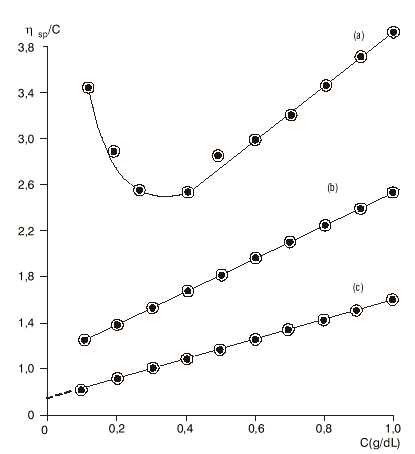
<body><![CDATA[<CENTER> 2,3.10<SUP>4</SUP> </CENTER></TD><TD VALIGN=TOP WIDTH="20%">     <CENTER>  Y =1,7415X + 1,8253 </CENTER></TD><TD VALIGN=TOP WIDTH="20%">     <CENTER> 0,9588  </CENTER></TD><TD VALIGN=TOP WIDTH="20%">     <CENTER> 0,9193 </CENTER></TD></TR>  </TABLE></CENTER>En las figuras 1, 2 y 3 se observan las curvas de viscosidad  reducida<I> vs.</I> concentraci&oacute;n para las 3 muestras estudiadas. En los  3 casos se indica el comportamiento caracter&iacute;stico de los polielectr&oacute;litos  en agua, mediante el aumento de la viscosidad reducida con la diluci&oacute;n.      <CENTER> <A HREF="/img/revistas/far/v34n1/f0102100.jpg"><IMG SRC="/img/revistas/far/v34n1/f0102100.jpg" ALT="Figura 1" BORDER=0 HEIGHT=123 WIDTH=225></A>  </CENTER>FIG.1.<I> Comportamiento hidrodin&aacute;mico de la carboximetilquitina  (CMQ-9) en diferentes solventes: (a) agua, (b) soluci&oacute;n de cloruro de sodio  0,05 mol/L, (c) soluci&oacute;n de cloruro de sodio 0,1 mol/L.</I>     
<CENTER> <A HREF="/img/revistas/far/v34n1/f0301100.jpg"><IMG SRC="/img/revistas/far/v34n1/f0301100.jpg" ALT="Figura 2" BORDER=0 HEIGHT=130 WIDTH=118></A>  </CENTER>FIG. 2.<I> Comportamiento hidrodin&aacute;mico de la carboximetilquitosana  (CMQ-15) en diferentes solventes: (a) agua, (b) soluci&oacute;n de cloruro de  sodio 0,05 mol/L, (c) soluci&oacute;n de cloruro de sodio 0,1 mol/L.</I>     
<CENTER>  <A HREF="/img/revistas/far/v34n1/f0401100.jpg"><IMG SRC="/img/revistas/far/v34n1/f0401100.jpg" ALT="Figura 3" BORDER=0 HEIGHT=142 WIDTH=156></A>  </CENTER>    
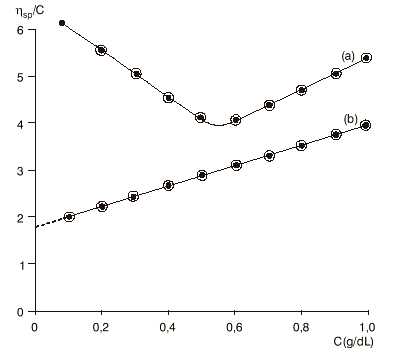
<CENTER> FIG. 3.<I> Comportamiento hidrodi-n&aacute;mico de la carboximetilquitosana  (CMQ-15M) en diferentes solventes: (a) agua, (b) soluci&oacute;n de cloruro de  sodio 0,1 mol/L.</I> </CENTER>    <P>En la tabla 2 se muestran los valores de viscosidad  espec&iacute;fica para diferentes valores de pH.     <CENTER> TABLA 2.<I> Valores  de viscosidad espec&iacute;fica para diferentes pH</I> </CENTER>    ]]></body>
<body><![CDATA[<CENTER> <TABLE CELLPADDING=4 >  <TR> <TD VALIGN=TOP WIDTH="8%">Muestra&nbsp;</TD><TD VALIGN=TOP WIDTH="8%">     <CENTER>  pH </CENTER></TD><TD VALIGN=TOP WIDTH="8%">     <CENTER> 1 </CENTER></TD><TD VALIGN=TOP WIDTH="8%">      <CENTER> 2 </CENTER></TD><TD VALIGN=TOP WIDTH="8%">     <CENTER> 3 </CENTER></TD><TD VALIGN=TOP WIDTH="8%">      <CENTER> 4 </CENTER></TD><TD VALIGN=TOP WIDTH="8%">     <CENTER> 5 </CENTER></TD><TD VALIGN=TOP WIDTH="8%">      <CENTER> 6 </CENTER></TD><TD VALIGN=TOP WIDTH="8%">     <CENTER> 7 </CENTER></TD><TD VALIGN=TOP WIDTH="8%">      <CENTER> 8 </CENTER></TD><TD VALIGN=TOP WIDTH="8%">     ]]></body>
<body><![CDATA[<CENTER> 9 </CENTER></TD><TD VALIGN=TOP WIDTH="8%">      <CENTER> 10 </CENTER></TD></TR> <TR> <TD VALIGN=TOP WIDTH="8%">CMQ-9</TD><TD VALIGN=TOP WIDTH="8%">      <CENTER> h sp </CENTER></TD><TD VALIGN=TOP WIDTH="8%">     <CENTER> - </CENTER></TD><TD VALIGN=TOP WIDTH="8%">      <CENTER> 0,24 </CENTER></TD><TD VALIGN=TOP WIDTH="8%">     <CENTER> 0,25 </CENTER></TD><TD VALIGN=TOP WIDTH="8%">      <CENTER> 0,21 </CENTER></TD><TD VALIGN=TOP WIDTH="8%">     <CENTER> 0,20 </CENTER></TD><TD VALIGN=TOP WIDTH="8%">      <CENTER> 0,30 </CENTER></TD><TD VALIGN=TOP WIDTH="8%">     <CENTER> 0,27 </CENTER></TD><TD VALIGN=TOP WIDTH="8%">      ]]></body>
<body><![CDATA[<CENTER> 0,22 </CENTER></TD><TD VALIGN=TOP WIDTH="8%">     <CENTER> 0,20 </CENTER></TD><TD VALIGN=TOP WIDTH="8%">      <CENTER> 0,20 </CENTER></TD></TR> <TR> <TD VALIGN=TOP WIDTH="8%">CMQ-15</TD><TD VALIGN=TOP WIDTH="8%">      <CENTER> h sp </CENTER></TD><TD VALIGN=TOP WIDTH="8%">     <CENTER> 0,64 </CENTER></TD><TD VALIGN=TOP WIDTH="8%">      <CENTER> 0,65 </CENTER></TD><TD VALIGN=TOP WIDTH="8%">     <CENTER> 0,72 </CENTER></TD><TD VALIGN=TOP WIDTH="8%">      <CENTER> - </CENTER></TD><TD VALIGN=TOP WIDTH="8%">     <CENTER> - </CENTER></TD><TD VALIGN=TOP WIDTH="8%">      <CENTER> - </CENTER></TD><TD VALIGN=TOP WIDTH="8%">     ]]></body>
<body><![CDATA[<CENTER> 0,73 </CENTER></TD><TD VALIGN=TOP WIDTH="8%">      <CENTER> 0,75 </CENTER></TD><TD VALIGN=TOP WIDTH="8%">     <CENTER> 0,71 </CENTER></TD><TD VALIGN=TOP WIDTH="8%">      <CENTER> 0,75 </CENTER></TD></TR> <TR> <TD VALIGN=TOP WIDTH="8%">CMQ-15M</TD><TD VALIGN=TOP WIDTH="8%">      <CENTER> h sp </CENTER></TD><TD VALIGN=TOP WIDTH="8%">     <CENTER> - </CENTER></TD><TD VALIGN=TOP WIDTH="8%">      <CENTER> 0,66 </CENTER></TD><TD VALIGN=TOP WIDTH="8%">     <CENTER> 0,67 </CENTER></TD><TD VALIGN=TOP WIDTH="8%">      <CENTER> - </CENTER></TD><TD VALIGN=TOP WIDTH="8%">     <CENTER> - </CENTER></TD><TD VALIGN=TOP WIDTH="8%">      ]]></body>
<body><![CDATA[<CENTER> 0,68 </CENTER></TD><TD VALIGN=TOP WIDTH="8%">     <CENTER> 0,69 </CENTER></TD><TD VALIGN=TOP WIDTH="8%">      <CENTER> 0,68 </CENTER></TD><TD VALIGN=TOP WIDTH="8%">     <CENTER> 0,70 </CENTER></TD><TD VALIGN=TOP WIDTH="8%">      <CENTER> 0,71 </CENTER></TD></TR> </TABLE></CENTER>    <CENTER> <H4> DISCUSI&Oacute;N</H4></CENTER>Los  valores encontrados para la masa molar de los 3 compuestos, ponen de manifiesto  sus caracter&iacute;sticas de macromol&eacute;culas. El resultado de la masa molar  de CMQ-15M, superior, resulta l&oacute;gico ya que las condiciones de obtenci&oacute;n  para este compuesto fueron menos dr&aacute;sticas.     <P>A concentraciones por encima  de 0,5 g/dL se observa un incremento casi lineal de la viscosidad reducida al  aumentar la concentraci&oacute;n del pol&iacute;mero, por lo que puede pensarse  que al tener estas soluciones valores elevados de viscosidad, las mol&eacute;culas  no est&aacute;n expandidas de forma apreciable y el comportamiento de la viscosidad  resulta aproximadamente normal, es decir, aumenta la viscosidad reducida al aumentar  la concentraci&oacute;n del pol&iacute;mero.     <P>Al a&ntilde;adir cloruro de sodio  a las soluciones, se observa el fen&oacute;meno caracter&iacute;stico de los polielectr&oacute;litos:  una relaci&oacute;n lineal entre la viscosidad reducida y la concentraci&oacute;n  del pol&iacute;mero, tanto en cloruro de sodio 0,05 mol/L como en cloruro de sodio  0,1 mol/L.     <P>La variaci&oacute;n de la viscosidad espec&iacute;fica con el pH  (tabla 2), corrobora las caracter&iacute;sticas de polielectr&oacute;lito de las  3 sustancias analizadas.     <P>A partir de los resultados obtenidos es posible concluir  que el comportamiento hidrodin&aacute;mico de los 3 derivados carboximetilados  de quitina demuestra que dichos derivados presentan caracter&iacute;sticas de  polielectr&oacute;lito, como corresponde a una estructura polim&eacute;rica donde  existen grupos ionizables. <H4> SUMMARY</H4><DIR> <DIR> <DIR>Hydrodynamic characteristics  of carboxymethylchitin and carboxymethylchitosan. A study was conducted on the  physical and chemical properties of 3 carboxymethylate derivates synthetized from  chitin obtained from lobster carapasses in Cuba. Also, the hydrodynamic performance  of these susbstance solutions was analyzed to determine their polyelectrolite  features and the molar mass values of each of them.     ]]></body>
<body><![CDATA[<P><I>Subject headings:</I>  CHITIN/analogos and derivatives; CHITIN/chemistry. </DIR></DIR></DIR><H4> REFERENCIAS  BIBLIOGR&Aacute;FICAS</H4><OL>     <!-- ref --><LI> Muzzarelli RAA. Carboxymethylated chitins  and chitosans. Carbohydr Polymers 1988;8:1-21.</LI>    <!-- ref --><LI> Muzzarelli RAA, Tanfani  F. N-carboxymethylchitosans and N-carboxybenzyl chitosans: novel chelating polyampholytes.  Proc. 2<SUP>nd</SUP> Int. Conf. on Chitin and Chitosan. The Japanese Society of  Chitin and Chitosan, Tottori, 1982.</LI>    <!-- ref --><LI> Watanabe K, Saiki Y, Uraki Y, Tokura  S, Azuma I. 6-0-carboxymethylchitin as a drug carrier. Chem Pharm Bull 1990;38(2):506-9.</LI>    <LI>  Song Y, Onishi H, Nagai T. Synthesis and drug-release characteristics of the conjugates  of mitomycin c with N-succinyl-chitosan and carboxymethylchitin. Chem Pharm Bull  1992;40/10:2822-5.</LI>    <!-- ref --><LI> Ohya Y, Inosaka K, Ouchi T. Synthesis and antitumor  activity of 6-0-carboxymethylchitin fixing 5-fluoracils through pentamethylene,  monomethylene spacer groups via amide, ester bonds. Crug Dev Ind Pharm 1989; 15(14-16):2475-89.</LI>    <!-- ref --><LI>  Iamelu S, Rao K. Studies on the carboxymethylchitosan-containing liposomes for  their stability and control release of dapsone. J Microencapsul 1991;8(4):505-19.</LI>    <!-- ref --><LI>  Nishimura S, Nishi N, Tokura S. Bioactive chitin derivatives. Activation of mouse  peritoneal macrophages by O-(carboxymethyl) chitins. Carbohydr Res 1986;146:251-8.</LI>    <!-- ref --><LI>  Izume M. Application of chitin and chitosan to toiletries. Bio Ind 1989;6(9):557-65.</LI>    <!-- ref --><LI>  Dong C, Rogers JA. Polymer-coated liposomes: stability and release of ASA from  carboxymethylchitin-coated liposomes. J Control Release 1991;17/3:217-24.</LI>    <!-- ref --><LI>  Nishiya T, Robico D. Quantitative analysis of carboxymehylchitin absorbed on a  liposome surface. Carbohydr Res 1992;235:239-45.</LI>    <!-- ref --><LI> Nishiya T, Chang TM.  Toxicity of liposomes containing low mol % of dienoyl phosphocoline to blood:  use of carboxymethylchitin to reduce toxicity. Artif Cells Blood Substit Immobil  Biotechnol 1994;22(3):883-8.</LI>    <!-- ref --><LI> Ringsdorf H. Structure and properties of  pharmacologically active polymers. J Polym Sci 1975;51:135-53.</LI>    <!-- ref --><LI> Somorin  O. Preparation and some properties of water soluble derivatives. Proc. 2<SUP>nd</SUP>  Int. Conference on Chitin and Chitosan. The Japanese Society of Chitin and Chitosan,  Tottori, 1982.</LI>    </OL>Recibido: 24 de septiembre de 1999. Aprobado: 29 de octubre  de 1999.     <P>MSc. <I>Sol Amalia Fern&aacute;ndez Monagas</I>. Instituto de Farmacia  y Alimentos. Universidad de La Habana. San L&aacute;zaro y L, El Vedado, municipio  Plaza de la Revoluci&oacute;n, Ciudad de La Habana, Cuba.     <P><SUP>1<A NAME="Autores"></A></SUP>  Master en Tecnolog&iacute;a y Control de Medicamentos. Profesora Auxiliar.        ]]></body><back>
<ref-list>
<ref id="B1">
<nlm-citation citation-type="journal">
<person-group person-group-type="author">
<name>
<surname><![CDATA[Muzzarelli]]></surname>
<given-names><![CDATA[RAA]]></given-names>
</name>
</person-group>
<article-title xml:lang="en"><![CDATA[Carboxymethylated chitins and chitosans]]></article-title>
<source><![CDATA[Carbohydr Polymers]]></source>
<year>1988</year>
<volume>8</volume>
<page-range>1-21</page-range></nlm-citation>
</ref>
<ref id="B2">
<nlm-citation citation-type="book">
<person-group person-group-type="author">
<name>
<surname><![CDATA[Muzzarelli]]></surname>
<given-names><![CDATA[RAA]]></given-names>
</name>
<name>
<surname><![CDATA[Tanfani]]></surname>
<given-names><![CDATA[F]]></given-names>
</name>
</person-group>
<source><![CDATA[N-carboxymethylchitosans and N-carboxybenzyl chitosans: novel chelating polyampholytes. Proc. 2nd Int. Conf. on Chitin and Chitosan]]></source>
<year>1982</year>
<publisher-loc><![CDATA[Tottori ]]></publisher-loc>
<publisher-name><![CDATA[The Japanese Society of Chitin and Chitosan]]></publisher-name>
</nlm-citation>
</ref>
<ref id="B3">
<nlm-citation citation-type="journal">
<person-group person-group-type="author">
<name>
<surname><![CDATA[Watanabe]]></surname>
<given-names><![CDATA[K]]></given-names>
</name>
<name>
<surname><![CDATA[Saiki]]></surname>
<given-names><![CDATA[Y]]></given-names>
</name>
<name>
<surname><![CDATA[Uraki]]></surname>
<given-names><![CDATA[Y]]></given-names>
</name>
<name>
<surname><![CDATA[Tokura]]></surname>
<given-names><![CDATA[S]]></given-names>
</name>
<name>
<surname><![CDATA[Azuma]]></surname>
<given-names><![CDATA[I]]></given-names>
</name>
</person-group>
<article-title xml:lang="en"><![CDATA[6-0-carboxymethylchitin as a drug carrier]]></article-title>
<source><![CDATA[Chem Pharm Bull]]></source>
<year>1990</year>
<volume>38</volume>
<numero>2</numero>
<issue>2</issue>
<page-range>506-9</page-range></nlm-citation>
</ref>
<ref id="B4">
<nlm-citation citation-type="journal">
<person-group person-group-type="author">
<name>
<surname><![CDATA[Song]]></surname>
<given-names><![CDATA[Y]]></given-names>
</name>
<name>
<surname><![CDATA[Onishi]]></surname>
<given-names><![CDATA[H]]></given-names>
</name>
<name>
<surname><![CDATA[Nagai]]></surname>
<given-names><![CDATA[T]]></given-names>
</name>
</person-group>
<article-title xml:lang="en"><![CDATA[Synthesis and drug-release characteristics of the conjugates of mitomycin c with N-succinyl-chitosan and carboxymethylchitin]]></article-title>
<source><![CDATA[Chem Pharm Bull]]></source>
<year>1992</year>
<volume>10</volume>
<page-range>2822-5</page-range></nlm-citation>
</ref>
<ref id="B5">
<nlm-citation citation-type="journal">
<person-group person-group-type="author">
<name>
<surname><![CDATA[Ohya]]></surname>
<given-names><![CDATA[Y]]></given-names>
</name>
<name>
<surname><![CDATA[Inosaka]]></surname>
<given-names><![CDATA[K]]></given-names>
</name>
<name>
<surname><![CDATA[Ouchi]]></surname>
<given-names><![CDATA[T]]></given-names>
</name>
</person-group>
<article-title xml:lang="en"><![CDATA[Synthesis and antitumor activity of 6-0-carboxymethylchitin fixing 5-fluoracils through pentamethylene, monomethylene spacer groups via amide, ester bonds]]></article-title>
<source><![CDATA[Crug Dev Ind Pharm]]></source>
<year>1989</year>
<volume>15</volume>
<numero>14-16</numero>
<issue>14-16</issue>
<page-range>2475-89</page-range></nlm-citation>
</ref>
<ref id="B6">
<nlm-citation citation-type="journal">
<person-group person-group-type="author">
<name>
<surname><![CDATA[Iamelu]]></surname>
<given-names><![CDATA[S]]></given-names>
</name>
<name>
<surname><![CDATA[Rao]]></surname>
<given-names><![CDATA[K]]></given-names>
</name>
</person-group>
<article-title xml:lang="en"><![CDATA[Studies on the carboxymethylchitosan-containing liposomes for their stability and control release of dapsone]]></article-title>
<source><![CDATA[J Microencapsul]]></source>
<year>1991</year>
<volume>8</volume>
<numero>4</numero>
<issue>4</issue>
<page-range>505-19</page-range></nlm-citation>
</ref>
<ref id="B7">
<nlm-citation citation-type="journal">
<person-group person-group-type="author">
<name>
<surname><![CDATA[Nishimura]]></surname>
<given-names><![CDATA[S]]></given-names>
</name>
<name>
<surname><![CDATA[Nishi]]></surname>
<given-names><![CDATA[N]]></given-names>
</name>
<name>
<surname><![CDATA[Tokura]]></surname>
<given-names><![CDATA[S]]></given-names>
</name>
</person-group>
<article-title xml:lang="en"><![CDATA[Bioactive chitin derivatives: Activation of mouse peritoneal macrophages by O-(carboxymethyl) chitins]]></article-title>
<source><![CDATA[Carbohydr Res]]></source>
<year>1986</year>
<volume>146</volume>
<page-range>251-8</page-range></nlm-citation>
</ref>
<ref id="B8">
<nlm-citation citation-type="journal">
<person-group person-group-type="author">
<name>
<surname><![CDATA[Izume]]></surname>
<given-names><![CDATA[M]]></given-names>
</name>
</person-group>
<article-title xml:lang="en"><![CDATA[Application of chitin and chitosan to toiletries]]></article-title>
<source><![CDATA[Bio Ind]]></source>
<year>1989</year>
<volume>6</volume>
<numero>9</numero>
<issue>9</issue>
<page-range>557-65</page-range></nlm-citation>
</ref>
<ref id="B9">
<nlm-citation citation-type="journal">
<person-group person-group-type="author">
<name>
<surname><![CDATA[Dong]]></surname>
<given-names><![CDATA[C]]></given-names>
</name>
<name>
<surname><![CDATA[Rogers]]></surname>
<given-names><![CDATA[JA]]></given-names>
</name>
</person-group>
<article-title xml:lang="en"><![CDATA[Polymer-coated liposomes: stability and release of ASA from carboxymethylchitin-coated liposomes]]></article-title>
<source><![CDATA[J Control Release]]></source>
<year>1991</year>
<volume>17/3</volume>
<page-range>217-24</page-range></nlm-citation>
</ref>
<ref id="B10">
<nlm-citation citation-type="journal">
<person-group person-group-type="author">
<name>
<surname><![CDATA[Nishiya]]></surname>
<given-names><![CDATA[T]]></given-names>
</name>
<name>
<surname><![CDATA[Robico]]></surname>
<given-names><![CDATA[D]]></given-names>
</name>
</person-group>
<article-title xml:lang="en"><![CDATA[Quantitative analysis of carboxymehylchitin absorbed on a liposome surface]]></article-title>
<source><![CDATA[Carbohydr Res]]></source>
<year>1992</year>
<volume>235</volume>
<page-range>239-45</page-range></nlm-citation>
</ref>
<ref id="B11">
<nlm-citation citation-type="journal">
<person-group person-group-type="author">
<name>
<surname><![CDATA[Nishiya]]></surname>
<given-names><![CDATA[T]]></given-names>
</name>
<name>
<surname><![CDATA[Chang]]></surname>
<given-names><![CDATA[TM]]></given-names>
</name>
</person-group>
<article-title xml:lang="en"><![CDATA[Toxicity of liposomes containing low mol %of dienoyl phosphocoline to blood: use of carboxymethylchitin to reduce toxicity]]></article-title>
<source><![CDATA[Artif Cells Blood Substit Immobil Biotechnol]]></source>
<year>1994</year>
<volume>22</volume>
<numero>3</numero>
<issue>3</issue>
<page-range>883-8</page-range></nlm-citation>
</ref>
<ref id="B12">
<nlm-citation citation-type="journal">
<person-group person-group-type="author">
<name>
<surname><![CDATA[Ringsdorf]]></surname>
<given-names><![CDATA[H]]></given-names>
</name>
</person-group>
<article-title xml:lang="en"><![CDATA[Structure and properties of pharmacologically active polymers]]></article-title>
<source><![CDATA[J Polym Sci]]></source>
<year>1975</year>
<volume>51</volume>
<page-range>135-53</page-range></nlm-citation>
</ref>
<ref id="B13">
<nlm-citation citation-type="book">
<person-group person-group-type="author">
<name>
<surname><![CDATA[Somorin]]></surname>
<given-names><![CDATA[O]]></given-names>
</name>
</person-group>
<source><![CDATA[Preparation and some properties of water soluble derivatives. Proc. 2nd Int. Conference on Chitin and Chitosan]]></source>
<year>1982</year>
<publisher-loc><![CDATA[Tottori ]]></publisher-loc>
<publisher-name><![CDATA[The Japanese Society of Chitin and Chitosan]]></publisher-name>
</nlm-citation>
</ref>
</ref-list>
</back>
</article>