<?xml version="1.0" encoding="ISO-8859-1"?><article xmlns:mml="http://www.w3.org/1998/Math/MathML" xmlns:xlink="http://www.w3.org/1999/xlink" xmlns:xsi="http://www.w3.org/2001/XMLSchema-instance">
<front>
<journal-meta>
<journal-id>0034-7515</journal-id>
<journal-title><![CDATA[Revista Cubana de Farmacia]]></journal-title>
<abbrev-journal-title><![CDATA[Rev Cubana Farm]]></abbrev-journal-title>
<issn>0034-7515</issn>
<publisher>
<publisher-name><![CDATA[Editorial Ciencias Médicas]]></publisher-name>
</publisher>
</journal-meta>
<article-meta>
<article-id>S0034-75152011000100010</article-id>
<title-group>
<article-title xml:lang="en"><![CDATA[Climate influence on chemical composition and antioxidant activity of Justicia pectoralis Jacq.]]></article-title>
<article-title xml:lang="es"><![CDATA[Influencia del clima en la composición química y la actividad antioxidante de Justicia pectorales Jacq]]></article-title>
</title-group>
<contrib-group>
<contrib contrib-type="author">
<name>
<surname><![CDATA[Méndez Arteaga]]></surname>
<given-names><![CDATA[Jonh Jairo]]></given-names>
</name>
<xref ref-type="aff" rid="A01"/>
</contrib>
<contrib contrib-type="author">
<name>
<surname><![CDATA[Murillo Perea]]></surname>
<given-names><![CDATA[Elizabeth]]></given-names>
</name>
<xref ref-type="aff" rid="A01"/>
</contrib>
<contrib contrib-type="author">
<name>
<surname><![CDATA[Yara Varón]]></surname>
<given-names><![CDATA[Edinson]]></given-names>
</name>
<xref ref-type="aff" rid="A01"/>
</contrib>
<contrib contrib-type="author">
<name>
<surname><![CDATA[Suescún Ospina]]></surname>
<given-names><![CDATA[Wilson Fabián]]></given-names>
</name>
<xref ref-type="aff" rid="A01"/>
</contrib>
<contrib contrib-type="author">
<name>
<surname><![CDATA[Niño Osorio]]></surname>
<given-names><![CDATA[Jaime]]></given-names>
</name>
<xref ref-type="aff" rid="A02"/>
</contrib>
<contrib contrib-type="author">
<name>
<surname><![CDATA[Mosquera Martínez]]></surname>
<given-names><![CDATA[Oscar Marino]]></given-names>
</name>
<xref ref-type="aff" rid="A02"/>
</contrib>
</contrib-group>
<aff id="A02">
<institution><![CDATA[,School of Technological Chemistry-University Thecnological of Pereira  ]]></institution>
<addr-line><![CDATA[Pereira-Risaralda ]]></addr-line>
<country>Colombia</country>
</aff>
<aff id="A01">
<institution><![CDATA[,Departament of Chemistry -University of Tolima  ]]></institution>
<addr-line><![CDATA[Ibagué-Tolima ]]></addr-line>
<country>Colombia</country>
</aff>
<pub-date pub-type="pub">
<day>00</day>
<month>03</month>
<year>2011</year>
</pub-date>
<pub-date pub-type="epub">
<day>00</day>
<month>03</month>
<year>2011</year>
</pub-date>
<volume>45</volume>
<numero>1</numero>
<fpage>88</fpage>
<lpage>100</lpage>
<copyright-statement/>
<copyright-year/>
<self-uri xlink:href="http://scielo.sld.cu/scielo.php?script=sci_arttext&amp;pid=S0034-75152011000100010&amp;lng=en&amp;nrm=iso"></self-uri><self-uri xlink:href="http://scielo.sld.cu/scielo.php?script=sci_abstract&amp;pid=S0034-75152011000100010&amp;lng=en&amp;nrm=iso"></self-uri><self-uri xlink:href="http://scielo.sld.cu/scielo.php?script=sci_pdf&amp;pid=S0034-75152011000100010&amp;lng=en&amp;nrm=iso"></self-uri><abstract abstract-type="short" xml:lang="en"><p><![CDATA[In this paper, the influence of the altitude in the phenols and flavonoids contents and the antioxidant activity of the extracts of different polarities of Justicia pectoralis Jacq(Acanthaceae) was evaluated. There was found that the plants cultivated under the Ibagué-Tolima's climate and soil conditions, can be a source of antioxidant compounds, especially in water preparations. The chromatographic analysis revealed that J. pectoralis extracts have mainly flavonoids of the flavonone type, as apigenine. A greater (or The greatest) content of flavonoids was detected in the ethanolic extract of the plant samples grown at 1 265 m.a.s.l. (meters above sea level) (2 748,03 mg/L). The altitude level does not seem to have any influence on the functional properties, neither on the phytophenols content. The J. pectoralis Jacq can be considered one species with a high therapeutic potential and with good commercial opportunities.]]></p></abstract>
<abstract abstract-type="short" xml:lang="es"><p><![CDATA[En este trabajo se evaluó la influencia de la altitud en el contenido de fenoles y flavonoides y la actividad antioxidante de los extractos de diferentes polaridades provenientes de Justicia pectorales (Acanthaceae). Se halló que las plantas cultivadas en las condiciones del suelo y el clima de la zona Ibagué-Tolima pueden constituirse en compuestos antioxidantes, especialmente en preparados acuosos. El análisis cromatográfico reveló que los extractos de J. pectorales poseen en lo fundamental flavonoides del tipo flavona como es la apigenina. Un mayor contenido (sino el mayor) de flavonoides se detectó en el extracto etanol obtenido de las muestras de la planta cultivadas a 1 265 metros por encima del nivel del mar (2 748,03 mg/L). La altitud no parece influir en las propiedades funcionales, ni en el contenido de fitofenoles del extracto. La J. pectorales puede considerarse una especie de gran potencial terapéutico y buenas posibilidades de comercialización.]]></p></abstract>
<kwd-group>
<kwd lng="en"><![CDATA[Antioxidant activity]]></kwd>
<kwd lng="en"><![CDATA[Justicia pectoralis (Acanthaceae)]]></kwd>
<kwd lng="en"><![CDATA[phenolic content]]></kwd>
<kwd lng="en"><![CDATA[Flavonoids]]></kwd>
<kwd lng="es"><![CDATA[actividad antioxidante]]></kwd>
<kwd lng="es"><![CDATA[Justicia pectorales (Acanthaceae)]]></kwd>
<kwd lng="es"><![CDATA[contenido de fenoles]]></kwd>
<kwd lng="es"><![CDATA[flavonoides]]></kwd>
</kwd-group>
</article-meta>
</front><body><![CDATA[ <div align="right">       <p><font face="Verdana, Arial, Helvetica, sans-serif" size="2"> <B>PRODUCTOS      NATURALES </B></font></p>       <p>&nbsp; </p> </div>     <P>     <P>     <P>     <P><font size="4"><b><font face="Verdana, Arial, Helvetica, sans-serif">Climate    influence on chemical composition and antioxidant activity of <I>Justicia pectoralis    </I>Jacq.</font></b></font>     <P>     <P>     <P>     ]]></body>
<body><![CDATA[<P>     <P>     <P>     <P>     <P> <B>      <P>      <P>      <P>      <P><font face="Verdana, Arial, Helvetica, sans-serif" size="3">Influencia del    clima en la composici&oacute;n qu&iacute;mica y la actividad antioxidante de    <I>Justicia pectorales </I>Jacq </font>      <P>      ]]></body>
<body><![CDATA[<P>      <P>      <P>      <P><font face="Verdana, Arial, Helvetica, sans-serif" size="2">Ph.D. Jonh Jairo    M&eacute;ndez Arteaga<SUP>I</SUP>; M.Sc. Elizabeth Murillo Perea<SUP>II</SUP>;    c Ph.D. Edinson Yara Var&oacute;n<SUP>III</SUP>; M.Sc. Wilson Fabi&aacute;n    Suesc&uacute;n Ospina<SUP>II</SUP>; Ph.D. Jaime Ni&ntilde;o Osorio<SUP>IV</SUP>;    c Ph.D. Oscar Marino Mosquera Mart&iacute;nez<SUP>V</SUP></font>  </B>      <P>      <P>      <P>      <P>      <P><font face="Verdana, Arial, Helvetica, sans-serif" size="2"><SUP>I</SUP>Departament    of Chemistry. University of Tolima. Ibagu&eacute;-Tolima, Colombia.    <br>   </font><font face="Verdana, Arial, Helvetica, sans-serif" size="2"><SUP>II</SUP>Departament    of Chemistry. University of Tolima. Ibagu&eacute;-Tolima, Colombia.    ]]></body>
<body><![CDATA[<br>   </font><font face="Verdana, Arial, Helvetica, sans-serif" size="2"><SUP>III</SUP>Departament    of Chemistry. University of Tolima. Ibagu&eacute;-Tolima, Colombia.    <br>   </font><font face="Verdana, Arial, Helvetica, sans-serif" size="2"><SUP>IV</SUP>School    of Technological Chemistry-University Thecnological of Pereira. Pereira-Risaralda,    Colombia.    <br>   </font><font face="Verdana, Arial, Helvetica, sans-serif" size="2"><SUP>V</SUP>School    of Technological Chemistry-University Thecnological of Pereira. Pereira-Risaralda,    Colombia. </font>      <P>     <P>     <P> <hr size="1" noshade>     <P><font face="Verdana, Arial, Helvetica, sans-serif" size="2"><B>ABSTRACT</B>    </font>     <P><font face="Verdana, Arial, Helvetica, sans-serif" size="2">In this paper,    the influence of the altitude in the phenols and flavonoids contents and the    antioxidant activity of the extracts of different polarities of <I>Justicia    pectoralis</I> Jacq(Acanthaceae) was evaluated. There was found that the plants    cultivated under the Ibagu&eacute;-Tolima's climate and soil conditions, can    be a source of antioxidant compounds, especially in water preparations. The    chromatographic analysis revealed that <I>J. pectoralis</I> extracts have mainly    flavonoids of the flavonone type, as apigenine. A greater (or The greatest)    content of flavonoids was detected in the ethanolic extract of the plant samples    grown at 1 265 m.a.s.l. (meters above sea level) (2 748,03 mg/L). The altitude    level does not seem to have any influence on the functional properties, neither    on the phytophenols content. The <I>J. pectoralis</I> <I>Jacq </I>can be considered    one species with a high therapeutic potential and with good commercial opportunities.    </font>     <P><font face="Verdana, Arial, Helvetica, sans-serif" size="2"><B>Key words:</B>    Antioxidant activity, <I>Justicia pectoralis</I> (Acanthaceae), phenolic content,    Flavonoids. </font> <hr size="1" noshade>     <P><font face="Verdana, Arial, Helvetica, sans-serif" size="2"><B>RESUMEN</B>    </font>     ]]></body>
<body><![CDATA[<P><font face="Verdana, Arial, Helvetica, sans-serif" size="2">En este trabajo    se evalu&oacute; la influencia de la altitud en el contenido de fenoles y flavonoides    y la actividad antioxidante de los extractos de diferentes polaridades provenientes    de Justicia pectorales (Acanthaceae). Se hall&oacute; que las plantas cultivadas    en las condiciones del suelo y el clima de la zona Ibagu&eacute;-Tolima pueden    constituirse en compuestos antioxidantes, especialmente en preparados acuosos.    El an&aacute;lisis cromatogr&aacute;fico revel&oacute; que los extractos de    J. pectorales poseen en lo fundamental flavonoides del tipo flavona como es    la apigenina. Un mayor contenido (sino el mayor) de flavonoides se detect&oacute;    en el extracto etanol obtenido de las muestras de la planta cultivadas a 1 265    metros por encima del nivel del mar (2 748,03 mg/L). La altitud no parece influir    en las propiedades funcionales, ni en el contenido de fitofenoles del extracto.    La <I>J. pectorales</I> puede considerarse una especie de gran potencial terap&eacute;utico    y buenas posibilidades de comercializaci&oacute;n. </font>     <P><font face="Verdana, Arial, Helvetica, sans-serif" size="2"><B>Palabras clave</B>:    actividad antioxidante, Justicia pectorales (Acanthaceae), contenido de fenoles,    flavonoides. </font> <hr size="1" noshade>     <p>&nbsp;</p>     <p>&nbsp;</p>     <P>     <P>      <P>      <P>      <P>      <P>      ]]></body>
<body><![CDATA[<P><font face="Verdana, Arial, Helvetica, sans-serif" size="3"><B>INTRODUCTION    </B></font>     <P><font face="Verdana, Arial, Helvetica, sans-serif" size="2">Day after day,    the number of diseases in which the etiology connected to oxidative stress,    produced when reactive oxygen species (ROS) or the nitrogen (NOS); known as    nitrogen stress. These diseases over number, in an independent or a joint way,    the antioxidant defenses on our organism.<SUP>1</SUP><B> </B>The nervous tissues    seem to be the best place for those pro-oxidant compounds since they have chemical    characteristics such as high quantities in polyunsaturated fatty acids, high    concentrations of iron and low quantity of antioxidant enzymes. </font>     <P><font face="Verdana, Arial, Helvetica, sans-serif" size="2">Some medicinal    plants and cooking herbs turn out to be of a particular interest due to the    fact that they can be used for the production of preparations that possess compounds    with a significant antioxidant effect. This effect is said to have happened    by the phenolic type, such as flavonoids.<SUP>2</SUP> Phenolic acids and diterpenesphenolics.<SUP>3</SUP>    The antioxidant activity of the phytophenols is due to its redox property, which    plays an important role in capturing the free radicals, inhibiting the singlete    and triple oxygen, nitrogen oxide or decomposition of peroxides.<SUP>4</SUP>    </font>     <P><font face="Verdana, Arial, Helvetica, sans-serif" size="2">The phytophenols    have usually been considered as anti nutritious factors due to their abilities    to chelate metals, their adverse effects to precipitate proteins, since most    of them are present as glycosides which lead lyses in the intestine. Consequently,    this could imply in the blocking of heterocyclic aromatics amines that promote    the gastric and colon carcinogenesis; despite the given fact, literature directly    correlates the antioxidant activity.<SUP>5-7<B> </B></SUP>Specifically, the    flavonoids are the most important group of natural phenols and more than 4 000    have been identified on severalsuperior and inferior species of plants. </font>     <P><font face="Verdana, Arial, Helvetica, sans-serif" size="2"><I>Justicia pectoralis    </I>Jacq. (Acanthaceae) is known as &#171;Bull tamer&#187;. This plant is widely    used by the Tolima regions ethnics and it represents the publicly called &#171;traditional    medicine&#187;, which has been transmitted from generation to generation due    to its ethno medicine relevant properties. This has helped increase the interest    of researchers in studying the biological, chemical and pharmacological properties    of the species.<SUP>8-11 </SUP> </font>     <P><font face="Verdana, Arial, Helvetica, sans-serif" size="2">In the present    work, a group of tests was carried out in orderto knowthe correlation of the    antioxidant activity with the phenolic and flavonoids total contents of <I>J.    pectoralis</I>. In this line an aqueous and organic extracts of the plant were    analyzed. This plant was grown in two thermal floors with the aim of knowing    the altitude effect in its chemical andbiological properties and to contribute    in the knowledge of our native flora. </font>     <P>     <p>&nbsp;</p>     <p><font face="Verdana, Arial, Helvetica, sans-serif" size="2"><B><font size="3">METHODS    </font></B></font><font size="3"><B> </B></font></p> <B>    <P><font face="Verdana, Arial, Helvetica, sans-serif" size="2">Chemicals</font> </B>      ]]></body>
<body><![CDATA[<P><font face="Verdana, Arial, Helvetica, sans-serif" size="2">All the chemicals    used were of analytical reagent from Merck or HPLC grade Sigma Chemical Co (St.    Louis,Missouri, USA). </font>     <P><font face="Verdana, Arial, Helvetica, sans-serif" size="2"><B>Plant Material</B>    </font>     <P><font face="Verdana, Arial, Helvetica, sans-serif" size="2">The aerial parts    of <I>J. pectoralis</I> were collected in Ibagu&eacute; (4&#176; 26' N y 75&#176;    13' O, 24 &#177; 1 &#186;C. Colombia), at 1 265 and at 1 030 m.a.s.l., under    the conditions of a semitechnical cultivation. A sample was the carried to the    Toli Herbarium at University of Tolima; it was referenced with the code 008989.    The collected plant material was air-dried under the shade and ground in a manual    mill and kept at room temperature (27 &#177; 2 &#176;C, 48 h) in order to protect    it from the direct light. </font>     <P><font face="Verdana, Arial, Helvetica, sans-serif" size="2"><B>Preparation    of the plant extracts</B> </font>     <P><font face="Verdana, Arial, Helvetica, sans-serif" size="2">A sample of ground    anddried material was soaked in ethanol and ethyl acetate (48 h, rate 1:20,    plant/solvent). The solvent was renewed every 24 h until the sample was run    out. Additionally, some water extract was used (rate 1:20, plant/solvent; 30    min) by the decoction method according to the methodology used by the ethnic    groups. The organic and aqueous extracts were concentrated under vacuum at 40    &#186;C to obtain a viscous material. This material was kept (4 &#186;C) in    labeled glasses. </font>     <P><font face="Verdana, Arial, Helvetica, sans-serif" size="2"><B>Determination    of the phenolic content</B> </font>     <P>      <P><font face="Verdana, Arial, Helvetica, sans-serif" size="2">The content of    total phenolic compounds of the extracts was quantified by using the Folin-Ciocalteu    (FC) reactive, according to the procedure by <I>Singleton</I> and <I>Rossi</I>.<SUP>12</SUP>    The extract (1 mL, 40 &micro;g/mL) was measuredwith water up to 50 mL; 1 mL    of this solution was mixed with the FC (2.5 mL, diluted1:1 on distilled water)    reactive and sodium carbonate (2 mL 7.5 %); the mixture was incubated (10 min,    50 <SUP>o</SUP>C). This mixture was cooled and the reaction mixture absorbance    was measured at 760 nm. The blank was prepared with all the reagents except    the sample. The gallic acid was chosen as a standard using 6 point standard    curve (10-50 &micro;g/mL). All the tests were conducted in triplicate. The total    phenolic content was expressed as milligram gallic acid/g extract. </font>      <P>      <P>     ]]></body>
<body><![CDATA[<P>     <P>     <p><font face="Verdana, Arial, Helvetica, sans-serif" size="3"><B>ANTIOXIDANT    ACTIVITY </B></font></p>     <p><font face="Verdana, Arial, Helvetica, sans-serif" size="2"><b>Free radical    scavenging activity </b></font></p> <B></B>      <P><font face="Verdana, Arial, Helvetica, sans-serif" size="2">The interaction    of constituents of samples was determined based on their ability to react with    the stable 2,2-diphenyl-1-picryl-hydrazyl (DPPH) free radical. The procedure    described by Ohinishiwas not widely adopted.<SUP>13</SUP> The assay was carried    out with aliquots of 1mL of each sample added to 3 mL of an ethanol solution    of DPPH (0.1 mM), the mixture was incubated at a temperature of 25 &#176;C for    30 min, and the absorbance of each solution was determined at 517 nm. </font>     <P><font face="Verdana, Arial, Helvetica, sans-serif" size="2">The scavenging    effect of the radical of each sample was calculated and compared with the scavenging    effect of 2.6 di-butyl-4-methylphenol (BHT), in the concentrations of 10-100    &micro;g/mL All the tests were conducted in triplicate. The scavenging effect    of the DPPH radical was calculated using the following equation: </font>      <P align="center"><img src="/img/revistas/far/v45n1/ecuacion%201.gif" width="414" height="30">      
<P>      <P><font face="Verdana, Arial, Helvetica, sans-serif" size="2"><B>Ferric Reducing    Antioxidant Power</B> </font>     <P><font face="Verdana, Arial, Helvetica, sans-serif" size="2">The ferric reducing    antioxidant power (FRAP) assay suggests an indication of the reducing ability    of the plant extract. The reducing power of <I>J. pectoralis</I>ethanolic, ethyl    acetate and aqueous extracts was determined using the method described previously    by Choi y Hwang.<SUP>14</SUP> A serial dilution of the extract was performed    (40-160 &micro;g/mL) in (2.5 mL, 0.2 M, pH, 6.6) phosphate buffer containing    1 % ferrocyanate (2.5 mL). The mixture was incubated (50 &#186;C, 20 min). 10    % trichloroacetic acid (TCA, 2.5 mL) was added to a portion of this mixture    (6 mL) and centrifuged (3 000 g /10 min). The supernatant was separated and    mixed with distilled water (2.5 mL) containing 1 % ferric chloride (0.5 mL).    The absorbance of this mixture was measured (700 nm). The increase of the variable    permitted to know the reducing power. The intensity in absorbance could be the    measurement of antioxidant activity of the extracts and compared with the activity    of Ascorbic acid (AA) and Gallic acid (AG), at 15 &micro;g/mL, used as reference    standards. All the tests were conducted in triplicate. </font>      ]]></body>
<body><![CDATA[<P><font face="Verdana, Arial, Helvetica, sans-serif" size="2"><B>Determination    of Fe<SUP>2+</SUP>-chelating ability</B> </font>     <P><font face="Verdana, Arial, Helvetica, sans-serif" size="2">The chelation of    ferrous ion by the extracts, gallic acid, BHT and EDTA, used as standard, was    measured using the method described by <I>Diniset al.</I><SUP>15<B> </B></SUP>The    <I>J. pectoralis</I> extracts (320 &micro;g/mL), was mixed with FeCl<SUB>2</SUB>    (0.1 mL, 2.0 mM) and after 30 min, 3-(2-pyridyl)-5,6-bis(4-phenylsulfonic acid)-1,2,4-triazine    (ferrozine 0.2 mL, 5 mM) was added. The resulting mixture was shaken vigorously    and left to stand for 10 min at room temperature. The absorbance of the resulting    solution was measured (562 nm). The lower the absorbance of the reaction mixture,    the higher the Fe<SUP>2+</SUP>-chelating ability. The percentage of inhibition    of ferrozine-Fe<SUP>2+</SUP> complex formation was calculated from the absorbance    ratio to that of the blank without any sample and calculated using the following    equation: </font>      <P align="center"><img src="/img/revistas/far/v45n1/ecuacion%202.gif" width="177" height="31">     
<P><font face="Verdana, Arial, Helvetica, sans-serif" size="2">A<SUB>0</SUB> indicates    the absorbance of the control and A1 the absorbance in the presence of the <I>J.    pectoralis</I> extracts, artificial antioxidants or EDTA. </font>     <P><font face="Verdana, Arial, Helvetica, sans-serif" size="2"><B>Scavenging of    hydrogen peroxide</B> </font>     <P><font face="Verdana, Arial, Helvetica, sans-serif" size="2">The ability of    the extracts to scavenge hydrogen peroxide was determined according to the method    of <I>Ruchet al.</I><SUP>16</SUP> A solution of hydrogen peroxide (40 mM) was    prepared in phosphate buffer (pH 7.4). The solution concentration was measured    by using a spectrophotometer at a wave length of 230 nm by using a constant    molar absorbing of 81 n<SUP>-1</SUP> L cm<SUP>-1 </SUP>in distilled water. The    percentage of hydrogen peroxide scavenging by the extract and standard compounds    was calculated as follows: </font>     <P align="center"><img src="/img/revistas/far/v45n1/ecuacion%203.gif" width="223" height="24">     
<P><font face="Verdana, Arial, Helvetica, sans-serif" size="2">A<SUB>B</SUB> was    the absorbance of the control and A<SUB>M</SUB> was the absorbance in the presence    of the sample of extract and standard. The activity of extracts was contrasted    with the ascorbic acid, gallic acid and rutin (15 &micro;g/mL). </font>      <P><font face="Verdana, Arial, Helvetica, sans-serif" size="2"><B>Qualitative    analysis of flavonoides</B> </font>      <P>      ]]></body>
<body><![CDATA[<P><font face="Verdana, Arial, Helvetica, sans-serif" size="2">Thin-layer chromatography    (TLC) was performed on precoated 20 x 20 cm TLC plates coated with 0.25 mm layers    of silica gel 60 F254 (Merck). After application of the extract and standard    solutions (10 &micro;L), the plates were developed on 19 cm in paper-lined all-    glass chambers (Desaga, Germany) previously left to equilibrate for at least    30 min. Two chromatography solvents were used: ethyl acetate/formic acid/acetic    acid/water, 100:11:11:26 (V/V) and ethyl n-hexane /acetate/formic acid, 62:28:10    (V/V) (Visualization of the flavonoids was achieved by spraying the sheets with    AlCl<SUB>3</SUB> al 1 %.<SUP>17</SUP> Typical intense fluorescence in UV light    at</font><font face="Symbol" size="4"> l</font><font face="Verdana, Arial, Helvetica, sans-serif" size="2">=    365 nm was produced immediately on spraying (flavonoids appeared as orange-yellow    bands).</font>      <P>      <P><font face="Verdana, Arial, Helvetica, sans-serif" size="2"><B>HPLC analysis    of flavonoids</B> </font>     <P>      <P><font face="Verdana, Arial, Helvetica, sans-serif" size="2">The HPLC system    was equipped with a Hewlett Packard 1 100 serial system, consisting of a quaternary    pump, online degasser, auto-sampler, column heater and variable wavelength detector.    Separation was achieved on a reversed phase column (Hypersil ODS 5 &#181;m,    125 x 4 mm), provided with a C18 guard column and methanol-water (7:3), v/v,    isocratically), was employed as the mobile phase. The flow rate was kept constant    at 0.7 mL/min and the peaks were identified using Diode array detector (DAD)    at 335 nm. The temperature of the column during analysis was maintained at 40    &#186;C. The injection volume was 20 &micro;L each time. </font>      <P>      <P><font face="Verdana, Arial, Helvetica, sans-serif" size="2"><B>Calibration</B>    </font>     <P><font face="Verdana, Arial, Helvetica, sans-serif" size="2">Stock solutions    of apigenine (10-400 &#181;g/mL) were prepared as well as 2.0 mL of the stock    solution. Each was put into a 25 mL volumetric flask and adjusted with methanol    for the standard curves. The analysis of the lineal regression, the correlation    coefficient (r<SUP>2</SUP>), the relative standard deviation (%RSD), or variation    coefficient (VC) was determined using the Software of (Chemstation LC unit).    The identification of the flavonoids was made taking into account the comparison    of the retention time (t<SUB>R</SUB>), in the solutions of the different extracts    of <I>J. pectoralis</I> and the patterns naringenine, Hesperidin, Myricetin,    Shikimic Acid and choloregenic acid. </font>     <P>      <P><font face="Verdana, Arial, Helvetica, sans-serif" size="2"><B>Statistical    analysis </B> </font>     ]]></body>
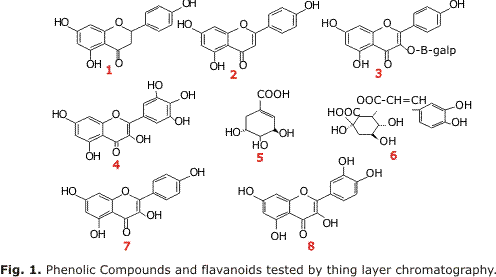
<body><![CDATA[<P><font face="Verdana, Arial, Helvetica, sans-serif" size="2">Experimental results    are expressed as Means &#177; SD. All measurements were replicated three times.    The analysis on lineal regression was made to calculate the dose-response relationship    of the standard solutions and also for the samples of the analyzed extracts.    The correlation degree between the variables was expressed through the correlation    coefficient r<SUB>xy</SUB>. In order to determine if there was an effect of    the altitude in regards to the antioxidant activity, an ANOVA was used. The    differences between the treatments were tested by using the Post-hoc (LSD, Tukey    and Bonferroni) application. The STATISTICS 7.0 software program was used. </font>     <P>      <P>     <P><font face="Verdana, Arial, Helvetica, sans-serif" size="3"><B>RESULTS</B>    </font>     <P><font face="Verdana, Arial, Helvetica, sans-serif" size="2">The types of flavonoids    in the extracts of <I>J. pectoralis</I> were qualified by thin-layer chromatography    based on the following patterns: (1) Naringenin, (2)Apigenine, (3) Hesperidin,    (4).<B> </B>Myricetin, (5) Shikimic acid, (6) Chrologenenic acid, (7) Kaempferol    and (8) Quercetin (<a href="#fig">fig. 1</a>). The thin layer chromatography    analysis revealed that the samples had mainly flavonoids, especially of the    flavone kind, just like the apigenine, particularly on the ethanol extracts    (1) and the ethyl acetate (5) obtained from the collected plant piece at 1 265    m.a.s.l., respectively. </font>     <P align="center"><a name="fig"></a><img src="/img/revistas/far/v45n1/f0110111.gif" width="496" height="277">      
<P>      <P>      <P>      <P>      ]]></body>
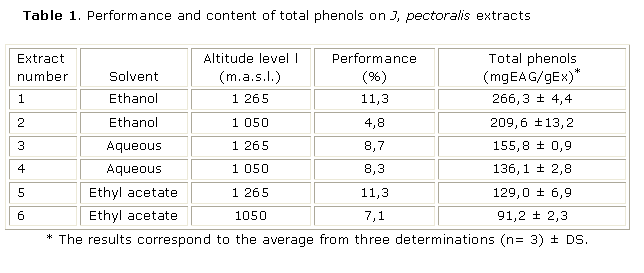
<body><![CDATA[<P>      <P>      <P>      <P><a href="/img/revistas/far/v45n1/t0110111.gif"><font face="Verdana, Arial, Helvetica, sans-serif" size="2">Table    1</font></a><font face="Verdana, Arial, Helvetica, sans-serif" size="2"> shown    the performance and the content of total phenols for every one of the extracts    of <I>J. pectoralis</I>, calculated by the regression equation of the calibrating    curve: y= 0.0167x - 0.0534, r<SUP>2</SUP>= 0.9996 and are expressed as equivalent    milligrams of Gallic acids per extracted gram (EAG/gEx). As seen, the ethanol    was able to get the greatest quantity of phytophenols. The highest altitude    level seemed to promote the biosynthesis of these metabolites. </font>      
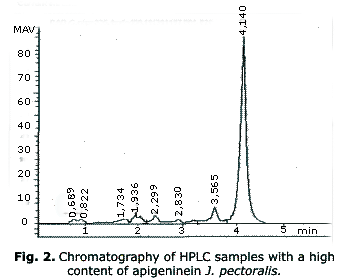
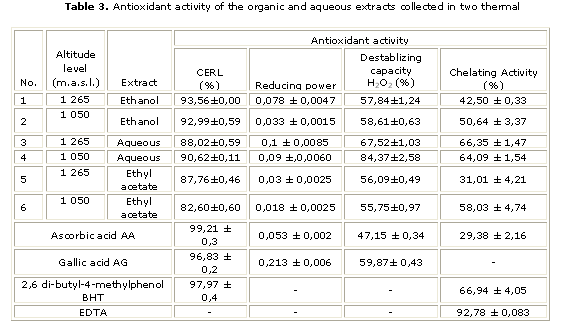
<P><font face="Verdana, Arial, Helvetica, sans-serif" size="2">Over the base of    the qualitative chromatographic results on thin layer, the apigenine was used    as an external pattern to quantify the flavonoids present on in the <I>J. pectoralis</I>    extracts. Under the chromatographic conditions of HPLC, the apigenine showed    a retention time of (t<SUB>r</SUB>), 4.25 min average and a calibration curve    of (r<SUP>2</SUP>= 0.9984). The mobile phase on the analysis showed an adequate    separation degree, the resolution of the peaks was appropriate and there was    a low noise; this permitted to obtain a stable base line during the several    analyses (6 min); these parameters were done in all the trials. </font>     <P align="left"><font face="Verdana, Arial, Helvetica, sans-serif" size="2">On    <a href="/img/revistas/far/v45n1/t0210111.gif">table 2</a> the content of flavonoids from all the samples    of <I>J. pectoralis</I> is shown, while on<a href="#fig2"> figure 2</a> the    chromatogram of the sample with the greatest content of flavonoids, is shown    influence on the flavonoids content. On the other hand, the <a href="#tab3">table    3</a> shows the antioxidant potential of <I>J. pectoralis</I>. </font>      
<P align="center"><font face="Verdana, Arial, Helvetica, sans-serif" size="2"><a name="fig2"></a></font><img src="/img/revistas/far/v45n1/f0210111.gif" width="341" height="305">      
<P align="center"><a name="tab3"></a><img src="/img/revistas/far/v45n1/t0310111.gif" width="564" height="334">      
<P>     <P><font face="Verdana, Arial, Helvetica, sans-serif" size="2"><B><font size="3">DISCUSSION</font></B>    </font>     ]]></body>
<body><![CDATA[<P><font face="Verdana, Arial, Helvetica, sans-serif" size="2">The presented values    for the extracts 1 and 5 suggest that the plant has structural diversity on    flavonoids; being the polar ones the greatest, either hydroxide and/or glycosides.    In general, all the extracts showed a big capacity to react with the pro-oxidant    species, which is beneficial for the human health since the contents of phytophenols    in the ethanol and aqueous extracts showed a greater stabilizing capacity of    the free radical (CERL) than the corresponding ones of the ethyl acetate. </font>     <P><font face="Verdana, Arial, Helvetica, sans-serif" size="2">The capacity to    interact with free radical of the phytophenols is considered to be dependent    on the location of the functional groups on its structure; so the number and    configuration of the donating hydroxiles of H<SUP>+ </SUP>are of a fundamental    importance to act as antioxidants. Moreover, the biological properties (vasodilators,    anticancer, antibacterial, antiviral), pharmacological ones (anti-inflammatory    and anti-allergic) and biochemical (estrogenic effects, inhibitors of the phosphatase    Enzymes A<SUB>2</SUB>, Cyclooxygenase, lipoxygenase, glutathionereductase y    xanthine oxidase) of the flavonoids have been widely reported.<SUP>18-20</SUP>    To this wide spectrum there is added the skill of these phytocompounds to stabilize    radical free,<SUP>21,22</SUP> sustained in the high number of hydroxile phenolic    groups joined the structural rings that typically they possess. </font>     <P><font face="Verdana, Arial, Helvetica, sans-serif" size="2">The antioxidant    potential of the extracts was re-confirmed by determining its capacity to reduce    the ion Fe<SUP>+2 </SUP>a Fe<SUP>+3</SUP>, which is supported in Fenton reaction.    This is traditionally defined as the catalytic generation of the radical <SUP>&#149;</SUP>OHgiven    the chain reaction between the iron ion and hydrogen peroxide. </font>     <P><font face="Verdana, Arial, Helvetica, sans-serif" size="2">It is important    to mention that the reducing capacity of a product can be determined by its    ability to bind metallic ions that act as catalyzers in reactions that generate    free radicals; for instance the Fe<SUP>+2</SUP> or the Cu<SUP>+</SUP> or the    stabilizing capacity of free radicals, already created or the inhibitory potential    in beginning reactions of these chemical species, or to its potential to decompose    peroxides.<SUP>23</SUP> </font>     <P><font face="Verdana, Arial, Helvetica, sans-serif" size="2">Even though most    extracts showed results higher than 50%, none was comparable to EDTA, a perfect    chelating agent. It has been reported that the chelating agents form sigma binds    with the metal, and then, it is grouped as secondary antioxidants, due to fact    that they can diminish the redox potential, generating the oxidized form of    the metallic ion.<SUP>24</SUP> </font>     <P><font face="Verdana, Arial, Helvetica, sans-serif" size="2">It is important    to mention that the H<SUB>2</SUB>O<SUB>2</SUB> generates hydroxyls in a catalyzed    reaction by metallic ions (Fe<SUP>+2</SUP> o Cu<SUP>+</SUP>); the hydroxyl radical    is a highly reactive species that attacks almost all bio-molecules. Then, removing    the hydrogen peroxide is an important measurement of the antioxidant activity    of the plant extracts. </font>     <P><font face="Verdana, Arial, Helvetica, sans-serif" size="2">Given the fact    that the action mechanisms of the antioxidants are diverse and depend on intrinsic    factors (structure, solubility, among others) and extrinsic (nature of the pro-oxidizing    unit, reducing factor, and sort of trial).<SUP>25</SUP> It is justifiable to    use a set of <I>in vitro</I> trials with the aim to estimate the antioxidant    action of a plant product; pure compound, extract or essential oil. </font>     <P><font face="Verdana, Arial, Helvetica, sans-serif" size="2">In this study several    solvents were in use for extracting the antioxidant ones, the ANOVA applied    to itself to the solvent variable extractor sheltered inside the height (F<SUB>4.47</SUB>=    1.599, p<I>= </I>0,1900 y F<SUB>1.47</SUB>= 1.1698, p<I>= </I>0.2849, respectively).    The obtained statisticians indicated that influence of the height does not exist    in the behavior of the constituent ones of the extracts. </font>     <P><font face="Verdana, Arial, Helvetica, sans-serif" size="2">Nonetheless, when    applying ANOVA to the solvents in an isolated way, it was revealed a significant    difference between them, and the marker F<SUB>2.50</SUB>= 3.2398, p= 0.0475    marker could be gotten. </font>     <P><font face="Verdana, Arial, Helvetica, sans-serif" size="2">In order to determine    the difference between them, several posterior tests were carried out (post    hoc): the LSD test, the Bonferroni test and the Tukey test (MS= 313.64, df=    50.00), which allowed to know that there were significant differences between    the antioxidant activity of the secondary metabolites of the extracted <I>J.    pectoralis</I> with water and those of ethyl acetate, but not between the latter    and the ethanol. </font>     ]]></body>
<body><![CDATA[<P><font face="Verdana, Arial, Helvetica, sans-serif" size="2">The shown responses    by the <I>J. pectoralis</I> extracts in the four tests with the antioxidant    activity were higher in the aqueous extracts, which could be caused by the greatest    content of polarity compounds, as phenols and flavonoids, usually known for    being great antioxidant agents. </font>     <P><font face="Verdana, Arial, Helvetica, sans-serif" size="2">This study allows    to infer the bioactive constituents of <I>J. pectoralis</I> could be included    in the non enzymatic secondary antioxidant group among those ones are Vitamin    C, since they come from the formation of new free radicals making them in less    inconvenient molecules before reacting or can avoid the formation of free radicals    from other molecules. Besides it is clear the capacity to capture free radicals    and then, it leads to stopping its chain reaction.<SUP>26-28</SUP> </font>     <P><font face="Verdana, Arial, Helvetica, sans-serif" size="2">It is of a particular    interest to see that in the related literature on this study does not show similar    researches, where the total phenolic and flavonoids of <I>J. pectoralis</I>    content is evaluated and, additionally the antioxidant activity on different    polarity extracts is tested by relating it with the altitude level where the    plant grows. </font>     <P>      <P>     <P><font face="Verdana, Arial, Helvetica, sans-serif" size="3"><B>CONCLUSIONS    </B></font><font face="Verdana, Arial, Helvetica, sans-serif" size="2"> </font>     <P><font face="Verdana, Arial, Helvetica, sans-serif" size="2">The work showed    that the <I>Justicia pectoralis</I>, cultivated under the conditions of climate    and soil in Ibagu&eacute;-Tolima, can be sources of antioxidant compounds given    the extracts of different polarity. The height where the plant is cultivated    does not seem to influence on its functional properties, as well as the content    of phytophenols (phenols and flavonoids). </font>     <P><font face="Verdana, Arial, Helvetica, sans-serif" size="2">The sort of used    solvent to extract the active constituents of the plant influence in the antioxidant    activity shows, being the aqueous extract obtained by decoction from the greatest    potential, which scientifically supports the popular local knowledge in Tolima.    </font>     <P><font face="Verdana, Arial, Helvetica, sans-serif" size="2">The shown antioxidant    action by <I>J. pectoralis</I> allows inferring that it can be a plant with    a high therapeutic potential and commercial use. The total content of the phenols    and flavonoids show that the extracts of <I>J. pectoralis</I> are possible to    have a good antibacterial and anti fungi activity, which is being subjected    to evaluation. </font>     <P>     ]]></body>
<body><![CDATA[<P><font face="Verdana, Arial, Helvetica, sans-serif" size="2"><B><font size="3">ACKNOWLEDGMENTS</font></B>    </font>     <P><font face="Verdana, Arial, Helvetica, sans-serif" size="2">To the Department    of Chemistry, to the Office of Investigations and Scientific Development of    the University of the Tolima for the economic and logistic support granted to    this investigation. </font>     <P>      <P>     <P><font face="Verdana, Arial, Helvetica, sans-serif" size="3"><B>REFERENCES </B></font><font face="Verdana, Arial, Helvetica, sans-serif" size="2">    </font>     <!-- ref --><P><font face="Verdana, Arial, Helvetica, sans-serif" size="2">1. Mavi A, Terzi    Z, Ozoen U, Yildirim A, Coskun M. Antioxidantproperties of some medicinal plants:    Prangosferulacea(Apiaceae), Sedumsempervivoides(Crassulaceae), Malvaneglecta(Malvaceae),    Cruciatataurica(Rubiaceae), Rosa pimpinellifolia (Rosaceae), Galium verum subsp.    Verum (Rubiaceae), Urtica dioica (Urticaceae). Biol Pharm Bull. 2003;27:702-5.    </font>    <P>      <!-- ref --><P><font face="Verdana, Arial, Helvetica, sans-serif" size="2">2. Perez TG. Los    flavonoides: antioxidantes o prooxidantes. Rev Cubana Invest Biomed. 2003;22:48-57.    </font>    <!-- ref --><P><font face="Verdana, Arial, Helvetica, sans-serif" size="2">3. Javanmardi J,    Stushnoft C, Vivanco J. M. Antioxidant activity and total phenolic content of    Iranian Ocimum accessions. Food Chemistry. 2003;83: 547-50. </font>    <P>      ]]></body>
<body><![CDATA[<!-- ref --><P><font face="Verdana, Arial, Helvetica, sans-serif" size="2">4. Osawa T. Novel    natural antioxidant for utilization in food and biological systems. Posharvest    systemsPosharvest biochemistry of plant food-materials in the tropicals. Tokyo:    Japan Scientific Societies Press; 1994. p. 241-51. </font>    <P>      <!-- ref --><P><font face="Verdana, Arial, Helvetica, sans-serif" size="2">5. Miliauskas G,    Venskutonis PR, Van Beek T. A. Screening of radical scavenging activity of some    medicinal and aromatic plant extracts. Food Chemistry. 2003;41:753-8. </font>    <P>      <!-- ref --><P><font face="Verdana, Arial, Helvetica, sans-serif" size="2">6. Deliorman O.    Novel flavonone glucoside with free radical scavenging properties from Galiumfissurense.    Pharm Biol. 2003;41:475-8. </font>    <P>      <!-- ref --><P><font face="Verdana, Arial, Helvetica, sans-serif" size="2">7. Faure M, Lissi    E, Torres RY, Videla LA. Antioxidant activities of lignans and flavonoids. Phytochemistry.    1990;29:3773-5. </font>    <P>      <P><font face="Verdana, Arial, Helvetica, sans-serif" size="2">8. Rodr&iacute;guez    FCA, Hechevarr&iacute;a SI, Fuentes FVR. Fecha y distancia de plantaci&oacute;n    en el cultivo del tilo (Justicia pectoralis Jacq. var. stenophylla Leonard).    Rev Cubana Plantas Med 2003; 1. Disponible en: <U><FONT  COLOR="#0000ff"><a href="http://scielo.sld.cu/scielo.php?script=sci_arttext&pid=S1028-47962003000100004&lng=es" target="_blank">    <br>   http://scielo.sld.cu/scielo.php?script=sci_arttext&amp;pid=S1028-47962003000100004&amp;lng=es</a></FONT></U>    </font>      ]]></body>
<body><![CDATA[<P>      <!-- ref --><P><font face="Verdana, Arial, Helvetica, sans-serif" size="2">9. Sanchez GE,    Fuentes HL, Ch&aacute;vez FD, Rodriguez FC. Estudio farmacogn&oacute;stico de    <I>Justicia pectoralis </I>Jacq. var. stenophylla Leonard. Rev Cubana Plantas    Med 2003;8(3). Disponible en: <U><FONT  COLOR="#0000ff"><a href="http://scielo.sld.cu/scielo.php?script=sci_arttext&pid=S1028-47962003000300005&lng=es" target="_blank">http://scielo.sld.cu/scielo.php?script=sci_arttext&amp;pid=S1028-47962003000300005&amp;lng=es</a></FONT></U><B><FONT  COLOR="#800000">&#160;</FONT></B> </font>    <!-- ref --><P><font face="Verdana, Arial, Helvetica, sans-serif" size="2">10. Montero R,    P&eacute;rez AG, Fern&aacute;ndez EN, Bada B, Arteaga PM, Mancebo RA. Estudio    genot&oacute;xico <I>in vivo</I> de 6 extractos de plantas medicinales en c&eacute;lulas    de la m&eacute;dula &oacute;sea de roedores. Rev Toxicol. 2001;18:75-8. </font>    <P>      <!-- ref --><P><font face="Verdana, Arial, Helvetica, sans-serif" size="2">11. Perez TG, Rivero    MR, Pardo RZ, Rodriguez CJ. Evaluaci&oacute;n de la actividad antioxidante de    Justicia pectoralis Jacq. Revista Cubana Invest Biomed. 2001; 20: 30-33. Disponible    en: <U><FONT  COLOR="#0000ff"><a href="http://scielo.sld.cu/scielo.phpscript=sci_arttext&pid=S0864-03002001000100006&lng=es" target="_blank">http://scielo.sld.cu/scielo.phpscript=sci_arttext&amp;pid=S0864-03002001000100006&amp;lng=es</a></FONT></U>    </font>    <P>      <!-- ref --><P><font face="Verdana, Arial, Helvetica, sans-serif" size="2">12. Singleton V,    Rossi JA. Colorimetry of Total Phenolics with Phosphomolybdic-Phosphotungstic    Acid Reagents. Am J Enol Vitic. 1965; 16:144-58. </font>    <P>      <P>      <!-- ref --><P><font face="Verdana, Arial, Helvetica, sans-serif" size="2">13. Ohinishi M.    Inhibitory effects of chlorogenic acids on linoleic acid peroxidation and haemolysis.    In: Miceli N<I>.</I> Anti-inflammatory activity of extract and fractions from    Nepetasibthorpii Bentham. J Ethnopharmacol. 2005;97:261-6. </font>    <P>      <!-- ref --><P><font face="Verdana, Arial, Helvetica, sans-serif" size="2">14. Choi EM, Hwang    JK. Screening of Indonesian medicinal plants for inhibitor activity on nitric    oxide production of RAW264.7 cells and antioxidant activity. Fitoterapia. 2005;76:194-203.    </font>    <P>      <P>      <!-- ref --><P><font face="Verdana, Arial, Helvetica, sans-serif" size="2">15. Dinis TCP,    Madeira VMC, Almeida LM. Action of phenolic derivates (acetoaminophen, salycilate    and 5-aminosalycilate) as inhibitors of membrane lipid peroxidation and as peroxyl    radical scavengers. Arch Biochem Biophys. 1994;315:161-9. </font>    <P>      <!-- ref --><P><font face="Verdana, Arial, Helvetica, sans-serif" size="2">16. Ruch RJ, Cheng    SJ, Klauning JE. Prevention of cytotoxixity and inhibition of intracellular    communication by antioxidant catechins isolated from Chinese green tea.<FONT COLOR="#ff0000">    </FONT>Carcinogenesis. 1989;10:1003-8. </font>    <!-- ref --><P><font face="Verdana, Arial, Helvetica, sans-serif" size="2">17. Wagner H, Bladt    S. Plant drug analysis a thin layer chromatography atlas. Berlin: Springer-Verlag;    1996. p. 384.</font>    <!-- ref --><p><font face="Verdana, Arial, Helvetica, sans-serif" size="2">18. Cody V, Middleton    E, Harborne JB, Beretz A. Plant flavonoids in biology and medicine-Biochemical,    pharmacological and structure-activity relationships. New York: Marcel Dekker;    1996. p. 281-96.</font><!-- ref --><p><font face="Verdana, Arial, Helvetica, sans-serif" size="2">19. Cody V, Koehrle    J, Auf'mkolk M, Hesch RD. Structure-activity relationships of flavonoid deiodinase    inhibitors and enzyme active-site models. In: Cody V, Middleton E, Harborne    Jr. JB. Plant Flavonoids in Biology and Medicine. Biochemical, Pharmacological    and Structure-activity Relationships, Liss. New York: Marcel Dekker; 1986. p.    373-82.</font><!-- ref --><p><font face="Verdana, Arial, Helvetica, sans-serif" size="2">20. Das NP. Flavonoids    in biology and medicine III: current issues in flavonoid research. Singapore:    National University of Singapore Press; 1990. p. 227-35.</font><!-- ref --><p><font face="Verdana, Arial, Helvetica, sans-serif" size="2">21. Gon&ccedil;alves    C, Dinis T, Batista MT. Antioxidant properties of proanthocyanidins of Uncariatomentosa    bark decoction: a mechanism for anti-inflammatory activity. Phytochemistry..    2005;66:89-98.</font><p><font face="Verdana, Arial, Helvetica, sans-serif" size="2">    <!-- ref --><br>   22. Jasril, Mooi LY, Lajis NH, Ali AM, Sukari MA, Rahman AA, Toman AG, Kikuzaki    H, Nakatani N. Antioxidant and antitumor promoting activities of the flavonoids    from Hedychiumthyrsiforme.Pharma Biol. 2003;41:506-11.</font><!-- ref --><p><font face="Verdana, Arial, Helvetica, sans-serif" size="2">23. Nordberg A.    Reactive oxygen species, antioxidants, and the mammalian thioredoxin system.    Free Radic Biol Med. 2001;31:1287-312.</font><p><font face="Verdana, Arial, Helvetica, sans-serif" size="2">    <!-- ref --><br>   24. Gordon MH. The mechanism of antioxidant action in vitro. In: Hudson BJF,    ed. Food Antioxidants. Elsevier: Applied Science; 1990. p. 1-18.</font><!-- ref --><p><font face="Verdana, Arial, Helvetica, sans-serif" size="2">25. Mathew S, Abraham    E. In vitro antioxidant activity and scavenging effects of Cinnamomumverum leaf    extract assayedby different methodologies. Food Chemical Toxicol. 2006;44:198-206.    </font><!-- ref --><p><font face="Verdana, Arial, Helvetica, sans-serif" size="2">26. Chae S, Kim    JS, Kang KA, Bu HD, Lee Y, Hyun JW, Kang SS. Antioxidant activity of Jionoside    D from Clerodendrontrichotomun. Biol Pharm Bull. 2004;27:1504-8.</font><p><font face="Verdana, Arial, Helvetica, sans-serif" size="2">    ]]></body>
<body><![CDATA[<!-- ref --><br>   27. C&eacute;spedes T, S&aacute;nchez D. Algunos aspectos sobre el estr&eacute;s    oxidativo, el estado antioxidante y la terapia de suplementaci&oacute;n. Rev    Cubana Cardiol. 2000; 14:55-60. Disponible en: <a href="http://bvs.sld.cu/revistas/car/vol14_1_00/car08100.pdf" target="_blank"><font color="#0000FF">http://bvs.sld.cu/revistas/car/vol14_1_00/car08100.pdf</font></a></font><!-- ref --><p><font face="Verdana, Arial, Helvetica, sans-serif" size="2">28. Ferrer D, Fonsec    J, Cuti&ntilde;o I, Garcia R, Arce D. Radicales libres y su papel en la homeostasia    neuronal. MEDISAN. 1999;3:5-11.</font><p>&nbsp;</p>     <p>&nbsp;</p>     <p><font face="Verdana, Arial, Helvetica, sans-serif" size="2">Recibido: 5 de    octubre de 2010.    <br>   Aprobado: 13 de noviembre de 2010.</font></p>     <p>&nbsp;</p>     <p>&nbsp;</p>     <p><font face="Verdana, Arial, Helvetica, sans-serif" size="2">Ph.D. Jonh Jairo    M&eacute;ndez Arteaga. Departament of Chemistry -University of Tolima. Barrio    Santa Helena, Ibagu&eacute;-Tolima, Colombia. E-mail: <a href="mailto:jmendez@ut.edu.co">jmendez@ut.edu.co</a></font></p>      ]]></body><back>
<ref-list>
<ref id="B1">
<label>1</label><nlm-citation citation-type="journal">
<person-group person-group-type="author">
<name>
<surname><![CDATA[Mavi]]></surname>
<given-names><![CDATA[A]]></given-names>
</name>
<name>
<surname><![CDATA[Terzi]]></surname>
<given-names><![CDATA[Z]]></given-names>
</name>
<name>
<surname><![CDATA[Ozoen]]></surname>
<given-names><![CDATA[U]]></given-names>
</name>
<name>
<surname><![CDATA[Yildirim]]></surname>
<given-names><![CDATA[A]]></given-names>
</name>
<name>
<surname><![CDATA[Coskun]]></surname>
<given-names><![CDATA[M]]></given-names>
</name>
</person-group>
<article-title xml:lang="es"><![CDATA[Antioxidantproperties of some medicinal plants: Prangosferulacea(Apiaceae), Sedumsempervivoides(Crassulaceae), Malvaneglecta(Malvaceae), Cruciatataurica(Rubiaceae), Rosa pimpinellifolia (Rosaceae), Galium verum subsp. Verum (Rubiaceae), Urtica dioica (Urticaceae)]]></article-title>
<source><![CDATA[Biol Pharm Bull]]></source>
<year>2003</year>
<volume>27</volume>
<page-range>702-5</page-range></nlm-citation>
</ref>
<ref id="B2">
<label>2</label><nlm-citation citation-type="journal">
<person-group person-group-type="author">
<name>
<surname><![CDATA[Perez]]></surname>
<given-names><![CDATA[TG]]></given-names>
</name>
</person-group>
<article-title xml:lang="es"><![CDATA[Los flavonoides: antioxidantes o prooxidantes]]></article-title>
<source><![CDATA[Rev Cubana Invest Biomed]]></source>
<year>2003</year>
<volume>22</volume>
<page-range>48-57</page-range></nlm-citation>
</ref>
<ref id="B3">
<label>3</label><nlm-citation citation-type="journal">
<person-group person-group-type="author">
<name>
<surname><![CDATA[Javanmardi]]></surname>
<given-names><![CDATA[J]]></given-names>
</name>
<name>
<surname><![CDATA[Stushnoft]]></surname>
<given-names><![CDATA[C]]></given-names>
</name>
<name>
<surname><![CDATA[Vivanco]]></surname>
<given-names><![CDATA[J. M]]></given-names>
</name>
</person-group>
<article-title xml:lang="en"><![CDATA[Antioxidant activity and total phenolic content of Iranian Ocimum accessions]]></article-title>
<source><![CDATA[Food Chemistry]]></source>
<year>2003</year>
<volume>83</volume>
<page-range>547-50</page-range></nlm-citation>
</ref>
<ref id="B4">
<label>4</label><nlm-citation citation-type="book">
<person-group person-group-type="author">
<name>
<surname><![CDATA[Osawa]]></surname>
<given-names><![CDATA[T]]></given-names>
</name>
</person-group>
<source><![CDATA[Novel natural antioxidant for utilization in food and biological systems. Posharvest systemsPosharvest biochemistry of plant food-materials in the tropicals]]></source>
<year>1994</year>
<page-range>241-51</page-range><publisher-loc><![CDATA[Tokyo ]]></publisher-loc>
<publisher-name><![CDATA[Japan Scientific Societies Press]]></publisher-name>
</nlm-citation>
</ref>
<ref id="B5">
<label>5</label><nlm-citation citation-type="journal">
<person-group person-group-type="author">
<name>
<surname><![CDATA[Miliauskas]]></surname>
<given-names><![CDATA[G]]></given-names>
</name>
<name>
<surname><![CDATA[Venskutonis]]></surname>
<given-names><![CDATA[PR]]></given-names>
</name>
<name>
<surname><![CDATA[Van Beek]]></surname>
<given-names><![CDATA[T. A]]></given-names>
</name>
</person-group>
<article-title xml:lang="en"><![CDATA[Screening of radical scavenging activity of some medicinal and aromatic plant extracts]]></article-title>
<source><![CDATA[Food Chemistry]]></source>
<year>2003</year>
<volume>41</volume>
<page-range>753-8</page-range></nlm-citation>
</ref>
<ref id="B6">
<label>6</label><nlm-citation citation-type="journal">
<person-group person-group-type="author">
<name>
<surname><![CDATA[Deliorman]]></surname>
<given-names><![CDATA[O]]></given-names>
</name>
</person-group>
<article-title xml:lang="en"><![CDATA[Novel flavonone glucoside with free radical scavenging properties from Galiumfissurense]]></article-title>
<source><![CDATA[Pharm Biol]]></source>
<year>2003</year>
<volume>41</volume>
<page-range>475-8</page-range></nlm-citation>
</ref>
<ref id="B7">
<label>7</label><nlm-citation citation-type="journal">
<person-group person-group-type="author">
<name>
<surname><![CDATA[Faure]]></surname>
<given-names><![CDATA[M]]></given-names>
</name>
<name>
<surname><![CDATA[Lissi]]></surname>
<given-names><![CDATA[E]]></given-names>
</name>
<name>
<surname><![CDATA[Torres]]></surname>
<given-names><![CDATA[RY]]></given-names>
</name>
<name>
<surname><![CDATA[Videla]]></surname>
<given-names><![CDATA[LA]]></given-names>
</name>
</person-group>
<article-title xml:lang="en"><![CDATA[Antioxidant activities of lignans and flavonoids]]></article-title>
<source><![CDATA[Phytochemistry]]></source>
<year>1990</year>
<volume>29</volume>
<page-range>3773-5</page-range></nlm-citation>
</ref>
<ref id="B8">
<label>8</label><nlm-citation citation-type="journal">
<person-group person-group-type="author">
<name>
<surname><![CDATA[Rodríguez]]></surname>
<given-names><![CDATA[FCA]]></given-names>
</name>
<name>
<surname><![CDATA[Hechevarría]]></surname>
<given-names><![CDATA[SI]]></given-names>
</name>
<name>
<surname><![CDATA[Fuentes]]></surname>
<given-names><![CDATA[FVR]]></given-names>
</name>
</person-group>
<article-title xml:lang="es"><![CDATA[Fecha y distancia de plantación en el cultivo del tilo (Justicia pectoralis Jacq. var. stenophylla Leonard)]]></article-title>
<source><![CDATA[Rev Cubana Plantas Med]]></source>
<year>2003</year>
<volume>1</volume>
</nlm-citation>
</ref>
<ref id="B9">
<label>9</label><nlm-citation citation-type="journal">
<person-group person-group-type="author">
<name>
<surname><![CDATA[Sanchez]]></surname>
<given-names><![CDATA[GE]]></given-names>
</name>
<name>
<surname><![CDATA[Fuentes]]></surname>
<given-names><![CDATA[HL]]></given-names>
</name>
<name>
<surname><![CDATA[Chávez]]></surname>
<given-names><![CDATA[FD]]></given-names>
</name>
<name>
<surname><![CDATA[Rodriguez]]></surname>
<given-names><![CDATA[FC]]></given-names>
</name>
</person-group>
<article-title xml:lang="es"><![CDATA[Estudio farmacognóstico de Justicia pectoralis Jacq. var. stenophylla Leonard]]></article-title>
<source><![CDATA[Rev Cubana Plantas Med]]></source>
<year>2003</year>
<volume>8</volume>
<numero>3</numero>
<issue>3</issue>
</nlm-citation>
</ref>
<ref id="B10">
<label>10</label><nlm-citation citation-type="journal">
<person-group person-group-type="author">
<name>
<surname><![CDATA[Montero]]></surname>
<given-names><![CDATA[R]]></given-names>
</name>
<name>
<surname><![CDATA[Pérez]]></surname>
<given-names><![CDATA[AG]]></given-names>
</name>
<name>
<surname><![CDATA[Fernández]]></surname>
<given-names><![CDATA[EN]]></given-names>
</name>
<name>
<surname><![CDATA[Bada]]></surname>
<given-names><![CDATA[B]]></given-names>
</name>
<name>
<surname><![CDATA[Arteaga]]></surname>
<given-names><![CDATA[PM]]></given-names>
</name>
<name>
<surname><![CDATA[Mancebo]]></surname>
<given-names><![CDATA[RA]]></given-names>
</name>
</person-group>
<article-title xml:lang="es"><![CDATA[Estudio genotóxico in vivo de 6 extractos de plantas medicinales en células de la médula ósea de roedores]]></article-title>
<source><![CDATA[Rev Toxicol]]></source>
<year>2001</year>
<volume>18</volume>
<page-range>75-8</page-range></nlm-citation>
</ref>
<ref id="B11">
<label>11</label><nlm-citation citation-type="journal">
<person-group person-group-type="author">
<name>
<surname><![CDATA[Perez]]></surname>
<given-names><![CDATA[TG]]></given-names>
</name>
<name>
<surname><![CDATA[Rivero]]></surname>
<given-names><![CDATA[MR]]></given-names>
</name>
<name>
<surname><![CDATA[Pardo]]></surname>
<given-names><![CDATA[RZ]]></given-names>
</name>
<name>
<surname><![CDATA[Rodriguez]]></surname>
<given-names><![CDATA[CJ]]></given-names>
</name>
</person-group>
<article-title xml:lang="es"><![CDATA[Evaluación de la actividad antioxidante de Justicia pectoralis Jacq]]></article-title>
<source><![CDATA[Revista Cubana Invest Biomed]]></source>
<year>2001</year>
<volume>20</volume>
<page-range>30-33</page-range></nlm-citation>
</ref>
<ref id="B12">
<label>12</label><nlm-citation citation-type="journal">
<person-group person-group-type="author">
<name>
<surname><![CDATA[Singleton]]></surname>
<given-names><![CDATA[V]]></given-names>
</name>
<name>
<surname><![CDATA[Rossi]]></surname>
<given-names><![CDATA[JA]]></given-names>
</name>
</person-group>
<article-title xml:lang="en"><![CDATA[Colorimetry of Total Phenolics with Phosphomolybdic-Phosphotungstic Acid Reagents]]></article-title>
<source><![CDATA[Am J Enol Vitic]]></source>
<year>1965</year>
<volume>16</volume>
<page-range>144-58</page-range></nlm-citation>
</ref>
<ref id="B13">
<label>13</label><nlm-citation citation-type="journal">
<person-group person-group-type="author">
<name>
<surname><![CDATA[Ohinishi]]></surname>
<given-names><![CDATA[M]]></given-names>
</name>
</person-group>
<article-title xml:lang="en"><![CDATA[Inhibitory effects of chlorogenic acids on linoleic acid peroxidation and haemolysis.In: Miceli N. Anti-inflammatory activity of extract and fractions from Nepetasibthorpii Bentham]]></article-title>
<source><![CDATA[J Ethnopharmacol]]></source>
<year>2005</year>
<volume>97</volume>
<page-range>261-6</page-range></nlm-citation>
</ref>
<ref id="B14">
<label>14</label><nlm-citation citation-type="journal">
<person-group person-group-type="author">
<name>
<surname><![CDATA[Choi]]></surname>
<given-names><![CDATA[EM]]></given-names>
</name>
<name>
<surname><![CDATA[Hwang]]></surname>
<given-names><![CDATA[JK]]></given-names>
</name>
</person-group>
<article-title xml:lang="en"><![CDATA[Screening of Indonesian medicinal plants for inhibitor activity on nitric oxide production of RAW264. 7 cells and antioxidant activity]]></article-title>
<source><![CDATA[Fitoterapia]]></source>
<year>2005</year>
<volume>76</volume>
<page-range>194-203</page-range></nlm-citation>
</ref>
<ref id="B15">
<label>15</label><nlm-citation citation-type="journal">
<person-group person-group-type="author">
<name>
<surname><![CDATA[Dinis]]></surname>
<given-names><![CDATA[TCP]]></given-names>
</name>
<name>
<surname><![CDATA[Madeira]]></surname>
<given-names><![CDATA[VMC]]></given-names>
</name>
<name>
<surname><![CDATA[Almeida]]></surname>
<given-names><![CDATA[LM]]></given-names>
</name>
</person-group>
<article-title xml:lang="en"><![CDATA[Action of phenolic derivates (acetoaminophen, salycilate and 5-aminosalycilate) as inhibitors of membrane lipid peroxidation and as peroxyl radical scavengers]]></article-title>
<source><![CDATA[Arch Biochem Biophys]]></source>
<year>1994</year>
<volume>315</volume>
<page-range>161-9</page-range></nlm-citation>
</ref>
<ref id="B16">
<label>16</label><nlm-citation citation-type="journal">
<person-group person-group-type="author">
<name>
<surname><![CDATA[Ruch]]></surname>
<given-names><![CDATA[RJ]]></given-names>
</name>
<name>
<surname><![CDATA[Cheng]]></surname>
<given-names><![CDATA[SJ]]></given-names>
</name>
<name>
<surname><![CDATA[Klauning]]></surname>
<given-names><![CDATA[JE]]></given-names>
</name>
</person-group>
<article-title xml:lang="en"><![CDATA[Prevention of cytotoxixity and inhibition of intracellular communication by antioxidant catechins isolated from Chinese green tea]]></article-title>
<source><![CDATA[Carcinogenesis]]></source>
<year>1989</year>
<volume>10</volume>
<page-range>1003-8</page-range></nlm-citation>
</ref>
<ref id="B17">
<label>17</label><nlm-citation citation-type="book">
<person-group person-group-type="author">
<name>
<surname><![CDATA[Wagner]]></surname>
<given-names><![CDATA[H]]></given-names>
</name>
<name>
<surname><![CDATA[Bladt]]></surname>
<given-names><![CDATA[S]]></given-names>
</name>
</person-group>
<source><![CDATA[Plant drug analysis a thin layer chromatography atlas]]></source>
<year>1996</year>
<page-range>384</page-range><publisher-loc><![CDATA[Berlin ]]></publisher-loc>
<publisher-name><![CDATA[Springer-Verlag]]></publisher-name>
</nlm-citation>
</ref>
<ref id="B18">
<label>18</label><nlm-citation citation-type="book">
<person-group person-group-type="author">
<name>
<surname><![CDATA[Cody]]></surname>
<given-names><![CDATA[V]]></given-names>
</name>
<name>
<surname><![CDATA[Middleton]]></surname>
<given-names><![CDATA[E]]></given-names>
</name>
<name>
<surname><![CDATA[Harborne]]></surname>
<given-names><![CDATA[JB]]></given-names>
</name>
<name>
<surname><![CDATA[Beretz]]></surname>
<given-names><![CDATA[A]]></given-names>
</name>
</person-group>
<source><![CDATA[Plant flavonoids in biology and medicine-Biochemical, pharmacological and structure-activity relationships]]></source>
<year>1996</year>
<page-range>281-96</page-range><publisher-loc><![CDATA[New York ]]></publisher-loc>
<publisher-name><![CDATA[Marcel Dekker]]></publisher-name>
</nlm-citation>
</ref>
<ref id="B19">
<label>19</label><nlm-citation citation-type="book">
<person-group person-group-type="author">
<name>
<surname><![CDATA[Cody]]></surname>
<given-names><![CDATA[V]]></given-names>
</name>
<name>
<surname><![CDATA[Koehrle]]></surname>
<given-names><![CDATA[J]]></given-names>
</name>
<name>
<surname><![CDATA[Auf'mkolk]]></surname>
<given-names><![CDATA[M]]></given-names>
</name>
<name>
<surname><![CDATA[Hesch]]></surname>
<given-names><![CDATA[RD]]></given-names>
</name>
</person-group>
<article-title xml:lang="en"><![CDATA[Structure-activity relationships of flavonoid deiodinase inhibitors and enzyme active-site models]]></article-title>
<person-group person-group-type="editor">
<name>
<surname><![CDATA[Cody]]></surname>
<given-names><![CDATA[V]]></given-names>
</name>
<name>
<surname><![CDATA[Middleton]]></surname>
<given-names><![CDATA[E]]></given-names>
</name>
<name>
<surname><![CDATA[Harborne Jr]]></surname>
<given-names><![CDATA[JB]]></given-names>
</name>
</person-group>
<source><![CDATA[Plant Flavonoids in Biology and Medicine. Biochemical, Pharmacological and Structure-activity Relationships]]></source>
<year>1986</year>
<page-range>373-82</page-range><publisher-loc><![CDATA[Liss. New York ]]></publisher-loc>
<publisher-name><![CDATA[Marcel Dekker]]></publisher-name>
</nlm-citation>
</ref>
<ref id="B20">
<label>20</label><nlm-citation citation-type="book">
<person-group person-group-type="author">
<name>
<surname><![CDATA[Das]]></surname>
<given-names><![CDATA[NP]]></given-names>
</name>
</person-group>
<source><![CDATA[Flavonoids in biology and medicine III: current issues in flavonoid research]]></source>
<year>1990</year>
<page-range>227-35</page-range><publisher-loc><![CDATA[Singapore ]]></publisher-loc>
<publisher-name><![CDATA[National University of Singapore Press]]></publisher-name>
</nlm-citation>
</ref>
<ref id="B21">
<label>21</label><nlm-citation citation-type="journal">
<person-group person-group-type="author">
<name>
<surname><![CDATA[Gonçalves]]></surname>
<given-names><![CDATA[C]]></given-names>
</name>
<name>
<surname><![CDATA[Dinis]]></surname>
<given-names><![CDATA[T]]></given-names>
</name>
<name>
<surname><![CDATA[Batista]]></surname>
<given-names><![CDATA[MT]]></given-names>
</name>
</person-group>
<article-title xml:lang="en"><![CDATA[Antioxidant properties of proanthocyanidins of Uncariatomentosa bark decoction: a mechanism for anti-inflammatory activity]]></article-title>
<source><![CDATA[Phytochemistry]]></source>
<year>2005</year>
<volume>66</volume>
<page-range>89-98</page-range></nlm-citation>
</ref>
<ref id="B22">
<label>22</label><nlm-citation citation-type="journal">
<person-group person-group-type="author">
<name>
<surname><![CDATA[Mooi]]></surname>
<given-names><![CDATA[LY]]></given-names>
</name>
<name>
<surname><![CDATA[Lajis]]></surname>
<given-names><![CDATA[NH]]></given-names>
</name>
<name>
<surname><![CDATA[Ali]]></surname>
<given-names><![CDATA[AM]]></given-names>
</name>
<name>
<surname><![CDATA[Sukari]]></surname>
<given-names><![CDATA[MA]]></given-names>
</name>
<name>
<surname><![CDATA[Rahman]]></surname>
<given-names><![CDATA[AA]]></given-names>
</name>
<name>
<surname><![CDATA[Toman]]></surname>
<given-names><![CDATA[AG]]></given-names>
</name>
<name>
<surname><![CDATA[Kikuzaki]]></surname>
<given-names><![CDATA[H]]></given-names>
</name>
<name>
<surname><![CDATA[Nakatani]]></surname>
<given-names><![CDATA[N]]></given-names>
</name>
</person-group>
<article-title xml:lang="en"><![CDATA[Antioxidant and antitumor promoting activities of the flavonoids from Hedychiumthyrsiforme]]></article-title>
<source><![CDATA[Pharma Biol]]></source>
<year>2003</year>
<volume>41</volume>
<page-range>506-11</page-range></nlm-citation>
</ref>
<ref id="B23">
<label>23</label><nlm-citation citation-type="journal">
<person-group person-group-type="author">
<name>
<surname><![CDATA[Nordberg]]></surname>
<given-names><![CDATA[A]]></given-names>
</name>
</person-group>
<article-title xml:lang="en"><![CDATA[Reactive oxygen species, antioxidants, and the mammalian thioredoxin system]]></article-title>
<source><![CDATA[Free Radic Biol Med]]></source>
<year>2001</year>
<volume>31</volume>
<page-range>1287-312</page-range></nlm-citation>
</ref>
<ref id="B24">
<label>24</label><nlm-citation citation-type="book">
<person-group person-group-type="author">
<name>
<surname><![CDATA[Gordon]]></surname>
<given-names><![CDATA[MH]]></given-names>
</name>
</person-group>
<article-title xml:lang="en"><![CDATA[The mechanism of antioxidant action in vitro]]></article-title>
<person-group person-group-type="editor">
<name>
<surname><![CDATA[Hudson]]></surname>
<given-names><![CDATA[BJF]]></given-names>
</name>
</person-group>
<source><![CDATA[Food Antioxidants]]></source>
<year>1990</year>
<page-range>1-18</page-range><publisher-loc><![CDATA[Elsevier ]]></publisher-loc>
<publisher-name><![CDATA[Applied Science]]></publisher-name>
</nlm-citation>
</ref>
<ref id="B25">
<label>25</label><nlm-citation citation-type="journal">
<person-group person-group-type="author">
<name>
<surname><![CDATA[Mathew]]></surname>
<given-names><![CDATA[S]]></given-names>
</name>
<name>
<surname><![CDATA[Abraham]]></surname>
<given-names><![CDATA[E]]></given-names>
</name>
</person-group>
<article-title xml:lang="en"><![CDATA[In vitro antioxidant activity and scavenging effects of Cinnamomumverum leaf extract assayedby different methodologies]]></article-title>
<source><![CDATA[Food Chemical Toxicol]]></source>
<year>2006</year>
<volume>44</volume>
<page-range>198-206</page-range></nlm-citation>
</ref>
<ref id="B26">
<label>26</label><nlm-citation citation-type="journal">
<person-group person-group-type="author">
<name>
<surname><![CDATA[Chae]]></surname>
<given-names><![CDATA[S]]></given-names>
</name>
<name>
<surname><![CDATA[Kim]]></surname>
<given-names><![CDATA[JS]]></given-names>
</name>
<name>
<surname><![CDATA[Kang]]></surname>
<given-names><![CDATA[KA]]></given-names>
</name>
<name>
<surname><![CDATA[Bu]]></surname>
<given-names><![CDATA[HD]]></given-names>
</name>
<name>
<surname><![CDATA[Lee]]></surname>
<given-names><![CDATA[Y]]></given-names>
</name>
<name>
<surname><![CDATA[Hyun]]></surname>
<given-names><![CDATA[JW]]></given-names>
</name>
<name>
<surname><![CDATA[Kang]]></surname>
<given-names><![CDATA[SS]]></given-names>
</name>
</person-group>
<article-title xml:lang="en"><![CDATA[Antioxidant activity of Jionoside D from Clerodendrontrichotomun]]></article-title>
<source><![CDATA[Biol Pharm Bull]]></source>
<year>2004</year>
<volume>27</volume>
<page-range>1504-8</page-range></nlm-citation>
</ref>
<ref id="B27">
<label>27</label><nlm-citation citation-type="journal">
<person-group person-group-type="author">
<name>
<surname><![CDATA[Céspedes]]></surname>
<given-names><![CDATA[T]]></given-names>
</name>
<name>
<surname><![CDATA[Sánchez]]></surname>
<given-names><![CDATA[D]]></given-names>
</name>
</person-group>
<article-title xml:lang="es"><![CDATA[Algunos aspectos sobre el estrés oxidativo, el estado antioxidante y la terapia de suplementación]]></article-title>
<source><![CDATA[Rev Cubana Cardiol]]></source>
<year>2000</year>
<volume>14</volume>
<page-range>55-60</page-range></nlm-citation>
</ref>
<ref id="B28">
<label>28</label><nlm-citation citation-type="journal">
<person-group person-group-type="author">
<name>
<surname><![CDATA[Ferrer]]></surname>
<given-names><![CDATA[D]]></given-names>
</name>
<name>
<surname><![CDATA[Fonsec]]></surname>
<given-names><![CDATA[J]]></given-names>
</name>
<name>
<surname><![CDATA[Cutiño]]></surname>
<given-names><![CDATA[I]]></given-names>
</name>
<name>
<surname><![CDATA[Garcia]]></surname>
<given-names><![CDATA[R]]></given-names>
</name>
<name>
<surname><![CDATA[Arce]]></surname>
<given-names><![CDATA[D]]></given-names>
</name>
</person-group>
<article-title xml:lang="es"><![CDATA[Radicales libres y su papel en la homeostasia neuronal]]></article-title>
<source><![CDATA[MEDISAN]]></source>
<year>1999</year>
<volume>3</volume>
<page-range>5-11</page-range></nlm-citation>
</ref>
</ref-list>
</back>
</article>