<?xml version="1.0" encoding="ISO-8859-1"?><article xmlns:mml="http://www.w3.org/1998/Math/MathML" xmlns:xlink="http://www.w3.org/1999/xlink" xmlns:xsi="http://www.w3.org/2001/XMLSchema-instance">
<front>
<journal-meta>
<journal-id>0034-7515</journal-id>
<journal-title><![CDATA[Revista Cubana de Farmacia]]></journal-title>
<abbrev-journal-title><![CDATA[Rev Cubana Farm]]></abbrev-journal-title>
<issn>0034-7515</issn>
<publisher>
<publisher-name><![CDATA[Editorial Ciencias Médicas]]></publisher-name>
</publisher>
</journal-meta>
<article-meta>
<article-id>S0034-75152011000200002</article-id>
<title-group>
<article-title xml:lang="es"><![CDATA[Ion-exchange resin complexation: Masking the bitter taste of cefuroxime axetil]]></article-title>
<article-title xml:lang="en"><![CDATA[Complejación de la resina de intercambio de iones: enmascaramiento del sabor amargo de cefuroxime acetil]]></article-title>
</title-group>
<contrib-group>
<contrib contrib-type="author">
<name>
<surname><![CDATA[Singh]]></surname>
<given-names><![CDATA[Inderbir]]></given-names>
</name>
<xref ref-type="aff" rid="A01"/>
</contrib>
<contrib contrib-type="author">
<name>
<surname><![CDATA[Kumar]]></surname>
<given-names><![CDATA[Pradeep]]></given-names>
</name>
<xref ref-type="aff" rid="A01"/>
</contrib>
<contrib contrib-type="author">
<name>
<surname><![CDATA[Nagpal]]></surname>
<given-names><![CDATA[Manju]]></given-names>
</name>
<xref ref-type="aff" rid="A02"/>
</contrib>
<contrib contrib-type="author">
<name>
<surname><![CDATA[Arora]]></surname>
<given-names><![CDATA[Sandeep]]></given-names>
</name>
<xref ref-type="aff" rid="A01"/>
</contrib>
</contrib-group>
<aff id="A02">
<institution><![CDATA[,Chitkara University chool of Pharmaceutical Sciences ]]></institution>
<addr-line><![CDATA[ ]]></addr-line>
<country>India</country>
</aff>
<aff id="A01">
<institution><![CDATA[,Chitkara College of Pharmacy Chandigarh-Patiala National Highway ]]></institution>
<addr-line><![CDATA[Patiala Punjab]]></addr-line>
<country>India</country>
</aff>
<pub-date pub-type="pub">
<day>00</day>
<month>06</month>
<year>2011</year>
</pub-date>
<pub-date pub-type="epub">
<day>00</day>
<month>06</month>
<year>2011</year>
</pub-date>
<volume>45</volume>
<numero>2</numero>
<fpage>171</fpage>
<lpage>181</lpage>
<copyright-statement/>
<copyright-year/>
<self-uri xlink:href="http://scielo.sld.cu/scielo.php?script=sci_arttext&amp;pid=S0034-75152011000200002&amp;lng=en&amp;nrm=iso"></self-uri><self-uri xlink:href="http://scielo.sld.cu/scielo.php?script=sci_abstract&amp;pid=S0034-75152011000200002&amp;lng=en&amp;nrm=iso"></self-uri><self-uri xlink:href="http://scielo.sld.cu/scielo.php?script=sci_pdf&amp;pid=S0034-75152011000200002&amp;lng=en&amp;nrm=iso"></self-uri><abstract abstract-type="short" xml:lang="en"><p><![CDATA[OBJECTIVE: the purpose of this research was to formulate taste masked complexes of cefuroxime axetil and to evaluate them for taste, drug loading and characterized by FTIR, XRD. Tablets were formulated of selected batches and evaluated for drug release and physical parameters. METHODS: complexation technique is used to prepare complexes of drug where ion exchange resins such as Indion® 214, Indion® 234 and Indion® 414 were used with a drug-resin ratio of 1:0.5, 1:1, 1:2. The drug resinates were characterized by Infrared Spectroscopy, DSC and X-Ray Diffraction pattern and evaluated for drug loading and taste. Direct compression method was used to formulate tablets. In vitro dissolution was carried out using USP II apparatus. RESULT: potential taste masking increased with increasing concentration of resin. Indion® 214 resin showed better taste masking effect as compared to Indion® 234 and Indion® 414. Percent of drug loading was maximum at drug : resin ratio of 1:1, after that it decreased. Prolonged (upto 5 h) and slow drug release was observed with resin 214 at higher concentration. CONCLUSIONS: out of three resins chosen, Indion® 214 at higher concentration exhibit excellent taste masking as well as sustained drug release action.]]></p></abstract>
<abstract abstract-type="short" xml:lang="es"><p><![CDATA[OBJETIVO: el objetivo de esta investigación fue formular los complejos con sabor amargo de cefuroxime acetil y evaluarlos por sabor, carga medicamentosa y caracterización por FTIR, XRD. Las tabletas fueron formuladas a partir de lotes seleccionados y evaluados en busca de la liberación medicamentosa y parámetros físicos. MÉTODOS: la técnica de complejación se utilizó para preparar complejos farmacológicos donde las resinas de intercambio iónico como Indion® 214, Indion® 234 y el Indion® 414 se emplearon a una proporción resina-medicamento de 1:0.5, 1:1, 1:2. Los resinados medicamentosos fueron caracterizados mediante espectroscopia infrarroja, DSC y el patrón de difracción-rayos-X, y evaluados para determinar la carga medicamentosa y el sabor. El método de compresión directa fue empleado para formular las tabletas. Se efectuó una disolución in vitro utilizando el equipo USP II. RESULTADOS: el posible enmascaramiento del sabor aumentó con la creciente concentración de resina. La resina Indion® 214 mostró el mejor enmascaramiento del gusto amargo en comparación con Indion® 234 e Indion® 414. El porcentaje de carga medicamentosa fue máximo en el fármaco: proporción de la resina 1:1, después disminuyó. Se observó una liberación medicamentosa prolongada (hasta 5 h) y lenta con la resina 214 a una mayor concentración. CONCLUSIONES: de las 3 resinas escogidas, Indion®214 a una mayor concentración muestra un excelente enmascaramiento del sabor así como una mantenida acción liberadora del fármaco.]]></p></abstract>
<kwd-group>
<kwd lng="en"><![CDATA[Cefuroxime Axetil]]></kwd>
<kwd lng="en"><![CDATA[Taste masking]]></kwd>
<kwd lng="en"><![CDATA[Indion® 214]]></kwd>
<kwd lng="en"><![CDATA[Indion® 234]]></kwd>
<kwd lng="en"><![CDATA[Indion® 414]]></kwd>
<kwd lng="en"><![CDATA[resinate]]></kwd>
<kwd lng="es"><![CDATA[Cefuroxime acetil]]></kwd>
<kwd lng="es"><![CDATA[enmascaramiento del sabor]]></kwd>
<kwd lng="es"><![CDATA[Indion® 214]]></kwd>
<kwd lng="es"><![CDATA[Indion® 234]]></kwd>
<kwd lng="es"><![CDATA[Indion® 414]]></kwd>
<kwd lng="es"><![CDATA[resinado]]></kwd>
</kwd-group>
</article-meta>
</front><body><![CDATA[ <div align="right">       <p><font face="Verdana, Arial, Helvetica, sans-serif" size="2"> <B>ART&Iacute;CULOS      ORIGINALES</B></font></p>       <p>&nbsp;</p>       <p align="left"><font face="Verdana, Arial, Helvetica, sans-serif" size="4"><b>Ion-exchange      resin complexation: Masking the bitter taste of cefuroxime axetil </b></font></p>       <p align="left">&nbsp;</p>       <p align="left"><font face="Verdana, Arial, Helvetica, sans-serif" size="3"><b>Complejaci&oacute;n      de la resina de intercambio de iones: enmascaramiento del sabor amargo de      cefuroxime acetil</b></font></p>       <p align="left">&nbsp;</p>       <p align="left">&nbsp;</p>       <p align="left"><font face="Verdana, Arial, Helvetica, sans-serif" size="2"><b>PhD.      Inderbir Singh<SUP>I</SUP>; PhD. Pradeep Kumar<SUP>I</SUP>; PhD Manju Nagpal<SUP>II</SUP>;      PhD. Sandeep Arora<SUP>I</SUP></b></font> </p> </div> <B></B>      <P>      ]]></body>
<body><![CDATA[<P><font face="Verdana, Arial, Helvetica, sans-serif" size="2"><SUP>I</SUP>Chitkara    College of Pharmacy, Chandigarh-Patiala National Patiala, Punjab, India.    <br>   </font><font face="Verdana, Arial, Helvetica, sans-serif" size="2"><SUP>II</SUP>School    of Pharmaceutical Sciences, Chitkara University, India.</font>     <P>     <P> <hr size="1" noshade>     <P><font face="Verdana, Arial, Helvetica, sans-serif" size="2"><B>ABSTRACT </B></font>      <P><font face="Verdana, Arial, Helvetica, sans-serif" size="2"><B>OBJECTIVE:</b>    the purpose of this research was to formulate taste masked complexes of cefuroxime    axetil and to evaluate them for taste, drug loading and characterized by FTIR,    XRD. Tablets were formulated of selected batches and evaluated for drug release    and physical parameters.    <br>   </font><font face="Verdana, Arial, Helvetica, sans-serif" size="2"><B>METHODS:</B>    complexation technique is used to prepare complexes of drug where ion exchange    resins such as Indion<SUP>&#174;</SUP> 214, Indion<SUP>&#174;</SUP> 234 and    Indion<SUP>&#174;</SUP> 414 were used with a drug-resin ratio of 1:0.5, 1:1,    1:2. The drug resinates were characterized by Infrared Spectroscopy, DSC and    X-Ray Diffraction pattern and evaluated for drug loading and taste. Direct compression    method was used to formulate tablets. <I>In vitro</I> dissolution was carried    out using USP II apparatus.    <br>   </font><font face="Verdana, Arial, Helvetica, sans-serif" size="2"><B>RESULT:    </B>potential taste masking increased with increasing concentration of resin.    Indion<SUP>&#174;</SUP> 214 resin showed better taste masking effect as compared    to Indion<SUP>&#174;</SUP> 234 and Indion<SUP>&#174;</SUP> 414. Percent of drug    loading was maximum at drug : resin ratio of 1:1, after that it decreased. Prolonged    (upto 5 h) and slow drug release was observed with resin 214 at higher concentration.    <br>   </font><font face="Verdana, Arial, Helvetica, sans-serif" size="2"><B>CONCLUSIONS:    </B>out of three resins chosen, Indion<SUP>&#174;</SUP> 214 at higher concentration    exhibit excellent taste masking as well as sustained drug release action. </font>      <P><font face="Verdana, Arial, Helvetica, sans-serif" size="2"><B>Key words: </B>Cefuroxime    Axetil, Taste masking, Indion<SUP>&#174; </SUP>214, Indion<SUP>&#174; </SUP>234,    Indion<SUP>&#174; </SUP>414, resinate.</font> <hr size="1" noshade>     ]]></body>
<body><![CDATA[<P><font face="Verdana, Arial, Helvetica, sans-serif" size="2"><B>RESUMEN </B></font>      <P><font face="Verdana, Arial, Helvetica, sans-serif" size="2"><B>OBJETIVO: </b>el    objetivo de esta investigaci&oacute;n fue formular los complejos con sabor amargo    de cefuroxime acetil y evaluarlos por sabor, carga medicamentosa y caracterizaci&oacute;n    por FTIR, XRD. Las tabletas fueron formuladas a partir de lotes seleccionados    y evaluados en busca de la liberaci&oacute;n medicamentosa y par&aacute;metros    f&iacute;sicos.    <br>   </font><font face="Verdana, Arial, Helvetica, sans-serif" size="2"><B>M&Eacute;TODOS:</B>    la t&eacute;cnica de complejaci&oacute;n se utiliz&oacute; para preparar complejos    farmacol&oacute;gicos donde las resinas de intercambio i&oacute;nico como Indion<SUP>&#174;</SUP>    214, Indion<SUP>&#174;</SUP> 234 y el Indion<SUP>&#174;</SUP> 414 se emplearon    a una proporci&oacute;n resina-medicamento de 1:0.5, 1:1, 1:2. Los resinados    medicamentosos fueron caracterizados mediante espectroscopia infrarroja, DSC    y el patr&oacute;n de difracci&oacute;n-rayos-X, y evaluados para determinar    la carga medicamentosa y el sabor. El m&eacute;todo de compresi&oacute;n directa    fue empleado para formular las tabletas. Se efectu&oacute; una disoluci&oacute;n    <I>in vitro</I> utilizando el equipo USP II.    <br>   </font><font face="Verdana, Arial, Helvetica, sans-serif" size="2"><B>RESULTADOS:    </B>el posible enmascaramiento del sabor aument&oacute; con la creciente concentraci&oacute;n    de resina. La resina Indion&#174; 214 mostr&oacute; el mejor enmascaramiento    del gusto amargo en comparaci&oacute;n con Indion<SUP>&#174;</SUP> 234 e Indion&#174;    414. El porcentaje de carga medicamentosa fue m&aacute;ximo en el f&aacute;rmaco:    proporci&oacute;n de la resina 1:1, despu&eacute;s disminuy&oacute;. Se observ&oacute;    una liberaci&oacute;n medicamentosa prolongada (hasta 5 h) y lenta con la resina    214 a una mayor concentraci&oacute;n.    <br>   </font><font face="Verdana, Arial, Helvetica, sans-serif" size="2"><B>CONCLUSIONES:</B>    de las 3 resinas escogidas, Indion<SUP>&#174;</SUP>214 a una mayor concentraci&oacute;n    muestra un excelente enmascaramiento del sabor as&iacute; como una mantenida    acci&oacute;n liberadora del f&aacute;rmaco. </font>      <P><font face="Verdana, Arial, Helvetica, sans-serif" size="2"><B>Palabras clave</B>:    Cefuroxime acetil, enmascaramiento del sabor, Indion<SUP>&#174;</SUP> 214, Indion<SUP>&#174;</SUP>    234, Indion<SUP>&#174;</SUP> 414, resinado.</font> <hr size="1" noshade>     <p>&nbsp;</p>     <p>&nbsp;</p>     <p><font face="Verdana, Arial, Helvetica, sans-serif" size="2"><B><font size="3">INTRODUCTION</font></B>    </font> </p>     <P><font face="Verdana, Arial, Helvetica, sans-serif" size="2">A number of orally    administered drugs exhibit natural bitter taste that creates a burning feeling    in the throat or mouth. This results in patient non-compliance to the medicines    especially in case of children and elderly, thereby reducing the effectiveness    of the pharmacotherapy. Therefore, it is necessary to reduce or mask the bitterness    for enhancing patient acceptability and improving oral palatability of bitter    tasting drugs. A number of methods have been reported for masking the bitter    taste, such as use of ion-exchange resins,<SUP>1 </SUP>use of inclusion complexes    with cyclodextrins,<SUP>2</SUP> viscosity modifications<SUP>3</SUP> melt granulation,<SUP>4</SUP>    microencapsulation techniques like spray-drying,<SUP>5</SUP> spray-congealing,<SUP>6</SUP>    coacervation<SUP>7</SUP> and solvent evaporation method.<SUP>8</SUP> Ion exchange    resins are solid and suitably insolubilized high molecular weight polyelectrolytes    that can exchange their mobile ions of equal charge with the surrounding medium    reversibly. Typically, the ionized drug and the ion-exchanger form a stable    complex for the relatively short period of exposure, making the drug unavailable    for taste sensation. As the formulation passes to the further parts of the GI    tract, the drug is released from the ion-exchanger into the surrounding media    due to low pH in the stomach, increased ionic concentration of the GI tract,    larger volume of the surrounding media and/or increased gastric residence time    and is, thus, available for absorption. Ion exchange resins have been widely    used as a drug carrier in pharmaceutical dosage forms for their taste masking    and controlled release applications.<SUP>9</SUP> Cefuroxime axetil is the acetoxyethyl    ester of cefuroxime and is an oral prodrug showing a bioavailability of 30 to    40 % when taken on fasting and 50 to 60 % when taken after food.<SUP>10</SUP>    The molecule is de-esterified during absorption, either in the mucosal cells,    the portal blood, or the liver such that only cefuroxime circulates systemically.    The cefuroxime axetil esterase can hydrolyze cefuroxime axetil to the nonabsorbable    cefuroxime in the gut lumen and is, therefore, suspected as a possible cause    of incomplete bioavailability. The absolute bioavailability of all newer oral    ester prodrug cephalosporins is below 50 to 60 %, which suggests an absorption    mechanism through the mucosa with limited capacity.<SUP>11</SUP> The present    study was aimed to prepare carboxylic acid functionalized crosslinked polyacrylic    ion-exchange resins (Indion<SUP>&#174; </SUP>214, 234 and 414) based drug resinate    complexes of cefuroxime axetil and to evaluate for taste and drug loading and    further characterization of the complexes using Fourier Transform Infra Red    (FTIR) and X-Ray Diffraction (X-RD) techniques. Drug resinates were compressed    into tablets by direct compression and tablets were evaluated for hardness,    friability and disintegration tests.<I> In vitro</I> dissolution studies were    carried out to study drug release pattern from the tablet formulation.<FONT  COLOR="#ff0000"> </FONT></font>      ]]></body>
<body><![CDATA[<P>     <P><font face="Verdana, Arial, Helvetica, sans-serif" size="2"><B><font size="3">METHODS</font></B>    </font>      <P><font face="Verdana, Arial, Helvetica, sans-serif" size="2">Cefuroxime axetil    was received as gift sample from Surya Pharmaceuticals, Baddi, India, Indion<SUP>&#174;    </SUP>214, Indion<SUP>&#174; </SUP>234 and Indion<SUP>&#174; </SUP>414 were    kindly gifted by Ion Exchange (India) Ltd, Mumbai, India<FONT COLOR="#993300">.    </FONT>Vivapur 102 was kindly gifted by S. Zhaveri Pharmakem Pvt. Ltd, Mumabi,    India. All other chemicals/reagents were of analytical grade and were used as    such. </font>     <P>      <P><font face="Verdana, Arial, Helvetica, sans-serif" size="2"><B>Preparation    of Drug Resin Complex</B> </font>     <P><font face="Verdana, Arial, Helvetica, sans-serif" size="2">Drug resin complexes    were prepared by reacting cefuroxime axetil with cation exchange resins (Indion<SUP>&#174;    </SUP>214, Indion<SUP>&#174; </SUP>234 and Indion<SUP>&#174; </SUP>414) in various    stoichiometric ratios (0.5:1, 1:1 and 1:2 of drug:resin). Weighed amount of    resin was added to distilled water (15 mL) in a glass beaker and the suspension    was stirred on magnetic stirrer for 30 min followed by the addition of the drug    and the contents of the beaker were allowed to stir for another 2 h at 37 &#186;C.    Resulting drug resinates were then separated by filtration and washed with distilled    water to remove the free drug and other ions. Overnight drying of the drug resinates    was carried at 40 &#186;C and the dried resinates were kept in a desiccator    till further use. </font>      <P><font face="Verdana, Arial, Helvetica, sans-serif" size="2"><B>Drug loading    analysis</B> </font>     <P><font face="Verdana, Arial, Helvetica, sans-serif" size="2">Dry drug resinate    (50 mg) was extracted with hydrochloric acid (0.1 N, 100 mL) in a sonicating    bath for 30 min. The flask was allowed to stand for 1 hour and then an aliquot    (1 mL) was diluted to 10 mL with water and filtered and analyzed by UV spectrophotometry    using a double beam spectrophotometer (2202, Systronics, India) at 278 nm. For    each resinate type three replicate extractions were carried out. </font>     <P><font face="Verdana, Arial, Helvetica, sans-serif" size="2"><B>Taste Evaluation</B>    </font>     <P><font face="Verdana, Arial, Helvetica, sans-serif" size="2">All the batches    of drug resin complexes were subjected to gustatory sensory evaluation test    performed by a panel of ten volunteers. The volunteers selected randomly and    were instructed to rate the samples as per the taste evaluation scale. Same    set of volunteers were employed for the taste evaluation study. Sample equivalent    to 50 mg was held in mouth for 15 s. The evaluation was performed by classifying    bitter taste into five classes: 0) No bitter taste, 1) Very slightly bitter    taste, 2) Slightly bitter taste, 3) Appreciably bitter taste, 4) Very bitter.    Significant differences among different drug resinates were analyzed using the    student's unpaired t-test; a value of p&lt; 0.05 was accepted as index of a    significant difference between samples. </font>      ]]></body>
<body><![CDATA[<P><font face="Verdana, Arial, Helvetica, sans-serif" size="2"><B>FTIR Spectroscopy</B>    </font>     <P><font face="Verdana, Arial, Helvetica, sans-serif" size="2">The drug, resin    and resinate were subjected to Fourier Transform Infrared (FTIR) studies to    check drug resin interaction. <FONT  COLOR="#231f20">FTIR spectra were recorded on samples prepared in KBr using FTIR-8400S    with IR solution software (Shimadzu). Data were collected over a spectral region    from 4 000 to 650 cm<SUP>1</SUP> with resolution of 4 cm<SUP>1</SUP>.</FONT></font>      <P><font face="Verdana, Arial, Helvetica, sans-serif" size="2"><B>X-ray Diffraction    Analysis</B> </font>     <P><font face="Verdana, Arial, Helvetica, sans-serif" size="2">The samples were    subjected to X-ray diffraction study for the confirmation of complex formation.    <FONT COLOR="#231f20">X-ray powder diffraction patterns were recorded on an    X-ray diffractometer (Model X&#187;Pert, Philips, Netherlands) using Ni-filtered,    Cu K radiation, voltage of 40 kV and 25 mA current. The scanning rate employed    was 1&#176; min<SUP>1</SUP> over the 0-100&#176; diffraction angle (2<font face="Symbol">q</font>)    range.</FONT></font>      <P><font face="Verdana, Arial, Helvetica, sans-serif" size="2"><B>Formulation    and evaluation of tablets</B> </font>     <P><font face="Verdana, Arial, Helvetica, sans-serif" size="2">The tablets of    taste masked resinates of cefuroxime axetil were prepared by direct compression    using single stroke multipunch tableting machine (AK Industries, Nakodar, India).    The tablet weight was kept 250 mg for all the batches consisting of resinate    equivalent to 50 mg of drug. The formulated tablets were evaluated for hardness,    friability and disintegration time. </font>     <P><font face="Verdana, Arial, Helvetica, sans-serif" size="2">Hardness<I>:</I>    Ten tablets from each batch were examined using Monsanto hardness tester. </font>     <P><font face="Verdana, Arial, Helvetica, sans-serif" size="2">Friability<I>:</I>    Ten tablets were weighed (W<SUB>1</SUB>) and rotated at one hundred revolutions    for 4 minutes in a Roche friabilator. The tablets were then reweighed (W<SUB>2</SUB>)    and the percentage weight loss (% F) was calculated: </font>     <P align="center"><font face="Verdana, Arial, Helvetica, sans-serif" size="2">%    F= W<SUB>1</SUB> - W<SUB>2</SUB> / W<SUB>1</SUB> x 100 </font>      <P><font face="Verdana, Arial, Helvetica, sans-serif" size="2">Disintegration    time<I>:</I> Six tablets from each batch were examined in USP disintegration    test apparatus. </font>     ]]></body>
<body><![CDATA[<P><font face="Verdana, Arial, Helvetica, sans-serif" size="2"><B><I>In vitro    </I>dissolution</B> </font>     <P><font face="Verdana, Arial, Helvetica, sans-serif" size="2"><FONT COLOR="#231f20">A    USP 23 dissolution test apparatus II (paddle type) at 37 &#177; 0.5 &#176;C    and 50 rpm using 900 mL of 0.1 N HCl (pH 1.2) as dissolution medium was used    to characterize the release of cefuroxime axetil from the tablets (selected    batches) formulated using drug resinates. </FONT>Aliquots of 5 mL<FONT  COLOR="#231f20"> were withdrawn at predetermined time intervals and an equal amount    of fresh dissolution medium was added. Test samples were filtered through whatman    filter paper No. 41 (Whatman Paper Limited, UK), suitably diluted and assayed    at </FONT>278 nm<FONT COLOR="#231f20"> using a blank solution as reference with    a UV-Vis double-beam spectrophotometer (Systronics 2202, India). The cumulative    percentage of cefuroxime axetil dissolved was calculated using a regression    equation generated from the standard data.</FONT></font>      <P>     <P><font face="Verdana, Arial, Helvetica, sans-serif" size="2"><B><font size="3">RESULTS    </font></B></font> <B>      <P><font face="Verdana, Arial, Helvetica, sans-serif" size="2">     <br>   Taste evaluation</font>  </B>      <P><font face="Verdana, Arial, Helvetica, sans-serif" size="2">A panel of 10 members    using time intensity method was employed for discriminating (in terms of bitterness)    various batches of resinates formulated using different ion exchange resins    in different proportions. The taste masking potential of the selected resins    was found to increase with increasing concentration of resin in drug resinate.    Indion<SUP>&#174;</SUP> 214 exhibit better taste masking potential at all ratios    as compared to Indion<SUP>&#174;</SUP> 234 and 414 as indicated by bitterness    score. However Indion<SUP>&#174;</SUP> 234 and 414 resins showed taste masking    only at higher concentration. The order of taste masking potential of different    resins is Indion<SUP>&#174;</SUP> 214&gt; Indion<SUP>&#174;</SUP> 234&gt; Indion<SUP>&#174;    </SUP>414 (<a href="/img/revistas/far/v45n2/t0102211.gif">table</a>). </font>      
<P><font face="Verdana, Arial, Helvetica, sans-serif" size="2"><B>Drug Loading    Analysis</B> </font>     <P><font face="Verdana, Arial, Helvetica, sans-serif" size="2">Drug loading was    found to increase with increasing fraction of resin but it is upto some extent.    1:1 ratio (batch F214II, F234II and F414II) showed maximum loading after that    decrease in drug loading was observed (table). Indion<SUP>&#174;</SUP> 214 and    414 resins showed higher increase in drug loading on increasing concentration    as compared to that with Indion<SUP>&#174;</SUP> 234 resin. </font>     <P><font face="Verdana, Arial, Helvetica, sans-serif" size="2"><B>FTIR Spectroscopy</B>    </font>     ]]></body>
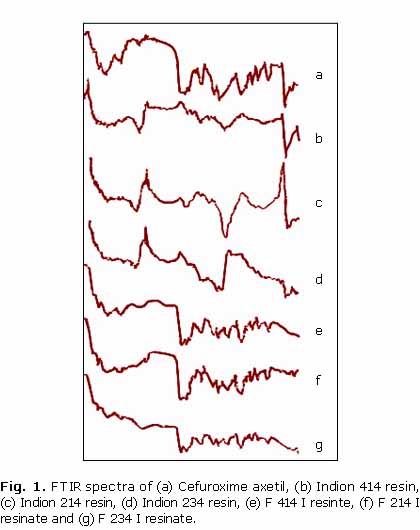
<body><![CDATA[<P><font face="Verdana, Arial, Helvetica, sans-serif" size="2">The FTIR spectra    of pure cefuroxime axetil <FONT  COLOR="#231f20">showed characteristic peaks at 1724.24 cm<SUP>1</SUP> (C= O stretching)    together with peaks at 1070.42 cm<SUP>1</SUP> and 3492.85 cm<SUP>1</SUP>characterizing    C-O stretching of ester group and N-H stretching of amide groups respectively.    The peak at 1328.86 cm<SUP>1</SUP> indicated the presence of aromatic ether    in the drug moiety. Significant reduction in the intensity of distinctive peaks    of drug demonstrates the formation of complex between drug and the resin molecule    </FONT>(<a href="#f1">fig. 1</a>). </font>     <P align="center"><a name="f1"></a><img src="/img/revistas/far/v45n2/f0102111.jpg" width="420" height="530">      
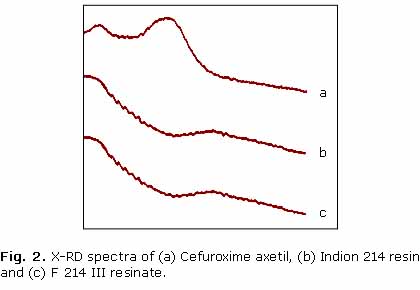
<P><font face="Verdana, Arial, Helvetica, sans-serif" size="2"><B>X-Ray Diffraction</B>    </font>     <P><font face="Verdana, Arial, Helvetica, sans-serif" size="2">Characteristic    peaks appeared in the X-RD pattern of the drug suggested about the crystalline    nature of the drug. Low intensity of cefuroxime axetil peaks in drug resinate    suggested that the drug in the complex is converted into amorphous form (<a href="#f2">fig.    2</a>). </font>     <P align="center"><a name="f2"></a><img src="/img/revistas/far/v45n2/f0202111.jpg" width="420" height="290">      
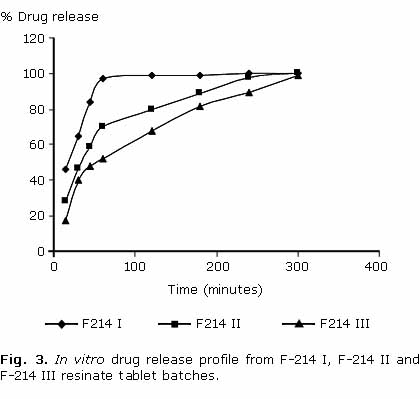
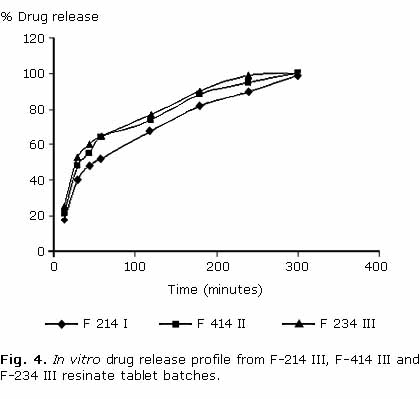
<P> <font face="Verdana, Arial, Helvetica, sans-serif" size="2"><B>Evaluation    of tablets </B></font> <B>     <P><font face="Verdana, Arial, Helvetica, sans-serif" size="2">Parametric evaluation:</font> </B>      <P><font face="Verdana, Arial, Helvetica, sans-serif" size="2">Friability of the    tablets was found to be between 0.60 to 0.80 % indicating good mechanical resistance    of the formulated tablets of drug resinates. Hardness was found to be between    2-4 kg/cm<SUP>2</SUP>. The disintegration time of tablets was found to be between    1-2 min. As no disintegrating agent was included for formulating tablets, the    effective tablet disintegration was due to extensive swelling properties of    the selected resins. </font>      <P><font face="Verdana, Arial, Helvetica, sans-serif" size="2"><B><I>In vitro    </I>dissolution</B> </font>     <P><font face="Verdana, Arial, Helvetica, sans-serif" size="2"><I>In vitro </I>drug    dissolution rate from different batches (F-214 I, F-214 II, F-214 III) containing    Indion<SUP>&#174;</SUP> 214 was found to be decreased with increasing concentration    of resin with in 60 min i.e. F-214 I&gt; F-214 II&gt; F-214 III. Almost 100    % drug release with F-214 I, about 70 % with F-214 II and about 50 % with F-214    III was achieved with in first 60 min. However extent of drug release was same    with three batches and sustained release up to 5 h (100 %) was observed (<a href="#f3">fig.    3</a>). Further <I>in vitro</I> dissolution of batch F214 III was compared with    batches F-234 III and F-414 III. Dissolution rate from these batches follows    the order: F-234 III&gt; F-414 III&gt; F-214 III. However there is no significant    difference in dissolution rate among different batches. Sustained and complete    drug release up to 5 h was observed with all batches (<a href="#f4">fig. 4</a>).    </font>     ]]></body>
<body><![CDATA[<P align="center"><a name="f3"></a><img src="/img/revistas/far/v45n2/f0302111.jpg" width="420" height="399">    
<br>     <P align="center"><a name="f4"></a><img src="/img/revistas/far/v45n2/f0402111.jpg" width="420" height="399">      
<P>     <P><font face="Verdana, Arial, Helvetica, sans-serif" size="2"><B><font size="3">DISCUSSION    </font></B> </font>      <P><font face="Verdana, Arial, Helvetica, sans-serif" size="2">Complexation of    cefuroxime axetil with cation exchange resins (Indion<SUP>&#174;</SUP> 214,    234 and 414) was found to increase the acceptability and palatability of the    drug. However, 1:2 ratio of drug resin complex of Indion<SUP>&#174;</SUP> 214    was found to exhibit better taste masking properties compared to drug resinates    of Indion<SUP>&#174;</SUP> 234 and 414. The taste masking ability of different    resins exhibit concentration dependence as it improves at higher concentrations.    Higher concentration may lead to interaction of each drug particle within resin    network thereby improving taste masking by the resins. The bitterness score    suggested Indion 214 as the best one as compared to Indion 234 and Indion 414.    the drug loading was found to be increased with increasing fraction of resin    but upto 1:1 ratio. The decreased drug loading after that may be due to increased    viscosity of the drug-resin mixture. Characterization of drug-resin complex    via FTIR and X-RD further confirms the interaction between drug particles with    resin network thereby providing taste masked drug particles. Taste masked tablet    batches pass the physicochemical evaluation tests suggesting that the formulation    complies as per official standards. Along with taste masking drug resin complex    also exhibits sustained release characteristics with increasing fraction of    resin. However different resins showed same release rate at higher ratios with    complete drug release with in 5 h. This    suggested that type of resin does not affect the release characteristics at    higher drug resin ratios. </font>     <P><font face="Verdana, Arial, Helvetica, sans-serif" size="2"><B>Acknowledgement</B>    </font>     <P><font face="Verdana, Arial, Helvetica, sans-serif" size="2">The authors are    grateful to Dr. <I>Madhu Chitkara</I>, Director, Chitkara Institute of Engineering    and Technology, Rajpura, Patiala, India and Dr. <I>Ashok Chitkara</I>, Chairman,    Chitkara Educational Trust, Chandigarh, India for support and institutional    facilities. </font>     <P>     <P><font face="Verdana, Arial, Helvetica, sans-serif" size="2"><B><font size="3">REFERENCES</font></B>    </font>      ]]></body>
<body><![CDATA[<!-- ref --><P><font face="Verdana, Arial, Helvetica, sans-serif" size="2">1. Agarwal R,&#160;Mittal    R, Singh A. Studies of Ion-Exchange Resin Complex of Chloroquine Phosphate.    Drug Dev Ind Pharm. 2000;26(7):773-6. </font>    <!-- ref --><P><font face="Verdana, Arial, Helvetica, sans-serif" size="2">2. Patel AR, Vavia    PR. Preparation and evaluation of taste masked famotidine formulation using    drug/beta-cyclodextrin/polymer ternary complexation approach. AAPS PharmSci    Tech. 2008;9(2):544-50. </font>    <!-- ref --><P><font face="Verdana, Arial, Helvetica, sans-serif" size="2">3. Blase CM, Shah    MN. Aqueous pharmaceutical suspensions for pharmaceutical actives. United States    Patent 5409907.1995. </font>    <!-- ref --><P><font face="Verdana, Arial, Helvetica, sans-serif" size="2">4. Appelgren C,    Eskilson C. Novel method for the granulation and coating of pharmacologically    active substance. Drug Dev Ind Pharm. 1990;16:2345-51. </font>    <!-- ref --><P><font color="#000025" face="Verdana, Arial, Helvetica, sans-serif" size="2">5.    Bora D, Borude P,&#160;Bhise K.<SUP>&#160;</SUP>Taste Masking by Spray-Drying    Technique. </font><font face="Verdana, Arial, Helvetica, sans-serif" size="2">AAPS    PharmSci Tech. 2008;9(4):1159-64. </font>    <!-- ref --><P><font face="Verdana, Arial, Helvetica, sans-serif" size="2">6. Yajima&#160;T,    Nogata A, Demachi&#160;M, Umeki&#160;N, Itai&#160;S, Yunoki&#160;N, et al. Particle    design for taste-masking using a spray-congealing technique. Chem Pharm Bull.    1996;44(1):187-91. </font>    <!-- ref --><P><font face="Verdana, Arial, Helvetica, sans-serif" size="2">7. Al-Omranm MF,    Al-Suwayeh SA, El-Helw AM, Saleh SI. Taste masking of diclofenac sodium using    microencapsulation. J Microencapsul. 2002;19(1):45-52. </font>    <!-- ref --><P><font face="Verdana, Arial, Helvetica, sans-serif" size="2">8. Shidhaye S,    Malke S, Kadam V. Taste masked, orally disintegrating tablet containing microspheres    for immediate release. J Pharm Res. 2008;1:225-9. </font>    <!-- ref --><P><font face="Verdana, Arial, Helvetica, sans-serif" size="2">9. Singh I, Rehni    AK, Kalra R, Joshi G, Kumar M, Aboul-Enein HY. Ion Exchange Resins: Drug Delivery    and Therapeutic Applications. FABAD&#160;J Pharm Sci. 2007;32:91-100. </font>    <!-- ref --><P><font face="Verdana, Arial, Helvetica, sans-serif" size="2">10. Finn A, Straugun    A, Meyer M, Chubb J. Effect of dose and food on the bioavailability of cefuroxime    axetil. Biopharm Drug Dispos. 1987;8:519-26. </font>    <!-- ref --><P><font face="Verdana, Arial, Helvetica, sans-serif" size="2">11. Kees F, Lukassek    U, Naber KG, Grobecker H. Comparative investigations on the bioavailability    of cefuroxime axetil. Arzneimittelforschung. 1991;41:84.</font><font face="Verdana, Arial, Helvetica, sans-serif" size="2">3.</font>    <P>     <P>     <P><font face="Verdana, Arial, Helvetica, sans-serif" size="2">Recibido: 5 de    octubre de 2010.     <br>   </font><font face="Verdana, Arial, Helvetica, sans-serif" size="2">Aprobado:    13 de noviembre de 2010. </font>     <P>     <P>     <P><font face="Verdana, Arial, Helvetica, sans-serif" size="2">PhD. <I>Inderbir    Singh</I>. Chitkara College of Pharmacy, Chandigarh-Patiala National Highway,    Rajpura-140401, Patiala, Punjab, India. E-mail: <U><FONT  COLOR="#0000ff"><a href="mailto:inderbirsingh2906@gmail.com">inderbirsingh2906@gmail.com</a>    </FONT></U> </font>      <P>      ]]></body><back>
<ref-list>
<ref id="B1">
<label>1</label><nlm-citation citation-type="journal">
<person-group person-group-type="author">
<name>
<surname><![CDATA[Agarwal]]></surname>
<given-names><![CDATA[R]]></given-names>
</name>
<name>
<surname><![CDATA[Mittal]]></surname>
<given-names><![CDATA[R]]></given-names>
</name>
<name>
<surname><![CDATA[Singh]]></surname>
<given-names><![CDATA[A]]></given-names>
</name>
</person-group>
<article-title xml:lang="en"><![CDATA[Studies of Ion-Exchange Resin Complex of Chloroquine Phosphate]]></article-title>
<source><![CDATA[Drug Dev Ind Pharm]]></source>
<year>2000</year>
<volume>26</volume>
<numero>7</numero>
<issue>7</issue>
<page-range>773-6</page-range></nlm-citation>
</ref>
<ref id="B2">
<label>2</label><nlm-citation citation-type="journal">
<person-group person-group-type="author">
<name>
<surname><![CDATA[Patel]]></surname>
<given-names><![CDATA[AR]]></given-names>
</name>
<name>
<surname><![CDATA[Vavia]]></surname>
<given-names><![CDATA[PR]]></given-names>
</name>
</person-group>
<article-title xml:lang="en"><![CDATA[Preparation and evaluation of taste masked famotidine formulation using drug/beta-cyclodextrin/polymer ternary complexation approach]]></article-title>
<source><![CDATA[AAPS PharmSci Tech]]></source>
<year>2008</year>
<volume>9</volume>
<numero>2</numero>
<issue>2</issue>
<page-range>544-50</page-range></nlm-citation>
</ref>
<ref id="B3">
<label>3</label><nlm-citation citation-type="">
<person-group person-group-type="author">
<name>
<surname><![CDATA[Blase]]></surname>
<given-names><![CDATA[CM]]></given-names>
</name>
<name>
<surname><![CDATA[Shah]]></surname>
<given-names><![CDATA[MN]]></given-names>
</name>
</person-group>
<source><![CDATA[Aqueous pharmaceutical suspensions for pharmaceutical actives. United States Patent 5409907]]></source>
<year>1995</year>
</nlm-citation>
</ref>
<ref id="B4">
<label>4</label><nlm-citation citation-type="journal">
<person-group person-group-type="author">
<name>
<surname><![CDATA[Appelgren]]></surname>
<given-names><![CDATA[C]]></given-names>
</name>
<name>
<surname><![CDATA[Eskilson]]></surname>
<given-names><![CDATA[C]]></given-names>
</name>
</person-group>
<article-title xml:lang="en"><![CDATA[Novel method for the granulation and coating of pharmacologically active substance]]></article-title>
<source><![CDATA[Drug Dev Ind Pharm]]></source>
<year>1990</year>
<volume>16</volume>
<page-range>2345-51</page-range></nlm-citation>
</ref>
<ref id="B5">
<label>5</label><nlm-citation citation-type="journal">
<person-group person-group-type="author">
<name>
<surname><![CDATA[Bora]]></surname>
<given-names><![CDATA[D]]></given-names>
</name>
<name>
<surname><![CDATA[Borude]]></surname>
<given-names><![CDATA[P]]></given-names>
</name>
<name>
<surname><![CDATA[Bhise]]></surname>
<given-names><![CDATA[K]]></given-names>
</name>
</person-group>
<article-title xml:lang="en"><![CDATA[Taste Masking by Spray-Drying Technique]]></article-title>
<source><![CDATA[AAPS PharmSci Tech]]></source>
<year>2008</year>
<volume>9</volume>
<numero>4</numero>
<issue>4</issue>
<page-range>1159-64</page-range></nlm-citation>
</ref>
<ref id="B6">
<label>6</label><nlm-citation citation-type="journal">
<person-group person-group-type="author">
<name>
<surname><![CDATA[Yajima]]></surname>
<given-names><![CDATA[T]]></given-names>
</name>
<name>
<surname><![CDATA[Nogata]]></surname>
<given-names><![CDATA[A]]></given-names>
</name>
<name>
<surname><![CDATA[Demachi]]></surname>
<given-names><![CDATA[M]]></given-names>
</name>
<name>
<surname><![CDATA[Umeki]]></surname>
<given-names><![CDATA[N]]></given-names>
</name>
<name>
<surname><![CDATA[Itai]]></surname>
<given-names><![CDATA[S]]></given-names>
</name>
<name>
<surname><![CDATA[Yunoki]]></surname>
<given-names><![CDATA[N]]></given-names>
</name>
</person-group>
<article-title xml:lang="en"><![CDATA[Particle design for taste-masking using a spray-congealing technique]]></article-title>
<source><![CDATA[Chem Pharm Bull]]></source>
<year>1996</year>
<volume>44</volume>
<numero>1</numero>
<issue>1</issue>
<page-range>187-91</page-range></nlm-citation>
</ref>
<ref id="B7">
<label>7</label><nlm-citation citation-type="journal">
<person-group person-group-type="author">
<name>
<surname><![CDATA[Al-Omranm]]></surname>
<given-names><![CDATA[MF]]></given-names>
</name>
<name>
<surname><![CDATA[Al-Suwayeh]]></surname>
<given-names><![CDATA[SA]]></given-names>
</name>
<name>
<surname><![CDATA[El-Helw]]></surname>
<given-names><![CDATA[AM]]></given-names>
</name>
<name>
<surname><![CDATA[Saleh]]></surname>
<given-names><![CDATA[SI]]></given-names>
</name>
</person-group>
<article-title xml:lang="en"><![CDATA[Taste masking of diclofenac sodium using microencapsulation]]></article-title>
<source><![CDATA[J Microencapsul]]></source>
<year>2002</year>
<volume>19</volume>
<numero>1</numero>
<issue>1</issue>
<page-range>45-52</page-range></nlm-citation>
</ref>
<ref id="B8">
<label>8</label><nlm-citation citation-type="journal">
<person-group person-group-type="author">
<name>
<surname><![CDATA[Shidhaye]]></surname>
<given-names><![CDATA[S]]></given-names>
</name>
<name>
<surname><![CDATA[Malke]]></surname>
<given-names><![CDATA[S]]></given-names>
</name>
<name>
<surname><![CDATA[Kadam]]></surname>
<given-names><![CDATA[V]]></given-names>
</name>
</person-group>
<article-title xml:lang="en"><![CDATA[Taste masked, orally disintegrating tablet containing microspheres for immediate release]]></article-title>
<source><![CDATA[J Pharm Res]]></source>
<year>2008</year>
<volume>1</volume>
<page-range>225-9</page-range></nlm-citation>
</ref>
<ref id="B9">
<label>9</label><nlm-citation citation-type="journal">
<person-group person-group-type="author">
<name>
<surname><![CDATA[Singh]]></surname>
<given-names><![CDATA[I]]></given-names>
</name>
<name>
<surname><![CDATA[Rehni]]></surname>
<given-names><![CDATA[AK]]></given-names>
</name>
<name>
<surname><![CDATA[Kalra]]></surname>
<given-names><![CDATA[R]]></given-names>
</name>
<name>
<surname><![CDATA[Joshi]]></surname>
<given-names><![CDATA[G]]></given-names>
</name>
<name>
<surname><![CDATA[Kumar]]></surname>
<given-names><![CDATA[M]]></given-names>
</name>
<name>
<surname><![CDATA[Aboul-Enein]]></surname>
<given-names><![CDATA[HY]]></given-names>
</name>
</person-group>
<article-title xml:lang="en"><![CDATA[Ion Exchange Resins: Drug Delivery and Therapeutic Applications]]></article-title>
<source><![CDATA[FABAD J Pharm Sci]]></source>
<year>2007</year>
<volume>32</volume>
<page-range>91-100</page-range></nlm-citation>
</ref>
<ref id="B10">
<label>10</label><nlm-citation citation-type="journal">
<person-group person-group-type="author">
<name>
<surname><![CDATA[Finn]]></surname>
<given-names><![CDATA[A]]></given-names>
</name>
<name>
<surname><![CDATA[Straugun]]></surname>
<given-names><![CDATA[A]]></given-names>
</name>
<name>
<surname><![CDATA[Meyer]]></surname>
<given-names><![CDATA[M]]></given-names>
</name>
<name>
<surname><![CDATA[Chubb]]></surname>
<given-names><![CDATA[J]]></given-names>
</name>
</person-group>
<article-title xml:lang="en"><![CDATA[Effect of dose and food on the bioavailability of cefuroxime axetil]]></article-title>
<source><![CDATA[Biopharm Drug Dispos]]></source>
<year>1987</year>
<volume>8</volume>
<page-range>519-26</page-range></nlm-citation>
</ref>
<ref id="B11">
<label>11</label><nlm-citation citation-type="journal">
<person-group person-group-type="author">
<name>
<surname><![CDATA[Kees]]></surname>
<given-names><![CDATA[F]]></given-names>
</name>
<name>
<surname><![CDATA[Lukassek]]></surname>
<given-names><![CDATA[U]]></given-names>
</name>
<name>
<surname><![CDATA[Naber]]></surname>
<given-names><![CDATA[KG]]></given-names>
</name>
<name>
<surname><![CDATA[Grobecker]]></surname>
<given-names><![CDATA[H]]></given-names>
</name>
</person-group>
<article-title xml:lang="en"><![CDATA[Comparative investigations on the bioavailability of cefuroxime axetil]]></article-title>
<source><![CDATA[Arzneimittelforschung]]></source>
<year>1991</year>
<volume>41</volume>
<page-range>84.3</page-range></nlm-citation>
</ref>
</ref-list>
</back>
</article>