<?xml version="1.0" encoding="ISO-8859-1"?><article xmlns:mml="http://www.w3.org/1998/Math/MathML" xmlns:xlink="http://www.w3.org/1999/xlink" xmlns:xsi="http://www.w3.org/2001/XMLSchema-instance">
<front>
<journal-meta>
<journal-id>0034-7515</journal-id>
<journal-title><![CDATA[Revista Cubana de Farmacia]]></journal-title>
<abbrev-journal-title><![CDATA[Rev Cubana Farm]]></abbrev-journal-title>
<issn>0034-7515</issn>
<publisher>
<publisher-name><![CDATA[Editorial Ciencias Médicas]]></publisher-name>
</publisher>
</journal-meta>
<article-meta>
<article-id>S0034-75152012000200012</article-id>
<title-group>
<article-title xml:lang="en"><![CDATA[Effects of D-002 on aspirin-induced ulcers and neutrophil infiltration on the gastric mucosa]]></article-title>
<article-title xml:lang="es"><![CDATA[Efecto del D-002 sobre la úlcera inducida por aspirina asociada al infiltrado de neutrófilos en la mucosa gástrica]]></article-title>
</title-group>
<contrib-group>
<contrib contrib-type="author">
<name>
<surname><![CDATA[Valle Clara]]></surname>
<given-names><![CDATA[Maikel]]></given-names>
</name>
<xref ref-type="aff" rid="A01"/>
</contrib>
<contrib contrib-type="author">
<name>
<surname><![CDATA[Noa Puig]]></surname>
<given-names><![CDATA[Miriam]]></given-names>
</name>
<xref ref-type="aff" rid="A01"/>
</contrib>
<contrib contrib-type="author">
<name>
<surname><![CDATA[Mendoza Castaño]]></surname>
<given-names><![CDATA[Sarahí]]></given-names>
</name>
<xref ref-type="aff" rid="A01"/>
</contrib>
<contrib contrib-type="author">
<name>
<surname><![CDATA[Oyarzábal Yera]]></surname>
<given-names><![CDATA[Ambar]]></given-names>
</name>
<xref ref-type="aff" rid="A01"/>
</contrib>
<contrib contrib-type="author">
<name>
<surname><![CDATA[Molina Cuevas]]></surname>
<given-names><![CDATA[Vivian]]></given-names>
</name>
<xref ref-type="aff" rid="A01"/>
</contrib>
<contrib contrib-type="author">
<name>
<surname><![CDATA[Mendoza Hernández]]></surname>
<given-names><![CDATA[Nilda]]></given-names>
</name>
<xref ref-type="aff" rid="A01"/>
</contrib>
<contrib contrib-type="author">
<name>
<surname><![CDATA[Mas Ferreiro]]></surname>
<given-names><![CDATA[Rosa]]></given-names>
</name>
<xref ref-type="aff" rid="A01"/>
</contrib>
</contrib-group>
<aff id="A01">
<institution><![CDATA[,Centro Nacional de Investigaciones Científicas Centro de Productos Naturales ]]></institution>
<addr-line><![CDATA[La Habana ]]></addr-line>
<country>Cuba</country>
</aff>
<pub-date pub-type="pub">
<day>00</day>
<month>06</month>
<year>2012</year>
</pub-date>
<pub-date pub-type="epub">
<day>00</day>
<month>06</month>
<year>2012</year>
</pub-date>
<volume>46</volume>
<numero>2</numero>
<fpage>249</fpage>
<lpage>258</lpage>
<copyright-statement/>
<copyright-year/>
<self-uri xlink:href="http://scielo.sld.cu/scielo.php?script=sci_arttext&amp;pid=S0034-75152012000200012&amp;lng=en&amp;nrm=iso"></self-uri><self-uri xlink:href="http://scielo.sld.cu/scielo.php?script=sci_abstract&amp;pid=S0034-75152012000200012&amp;lng=en&amp;nrm=iso"></self-uri><self-uri xlink:href="http://scielo.sld.cu/scielo.php?script=sci_pdf&amp;pid=S0034-75152012000200012&amp;lng=en&amp;nrm=iso"></self-uri><abstract abstract-type="short" xml:lang="en"><p><![CDATA[Introduction: the gastric mucosa is susceptible to the effects of aggressive factors, which are counterbalanced by mucosal defensive factors. Acid peptic diseases result from the imbalance between these aggressive and defensive factors. Aspirin-induced ulcer is a model of NSAIDs-induced damage in which neutrophil infiltration plays a key role. Objective: this paper investigates the protective effect of D-002 against aspirin-induced ulcers and associated neutrophil infiltration in the gastric mucosa. Methods: rats were randomized into six groups of 8 rats each. A negative vehicle control, and five aspirin (300 mg/kg)-treated groups: a positive control, orally treated with the vehicle, three with D-002 (25, 50 and 100 mg/kg, respectively) and other with 10 mg/kg Omeprazole. Five hours after induced damage the rats were sacrificed. The stomachs were removed and opened, and lesions examined macroscopically and microscopically. Ulcer indexes and neutrophil infiltration per ulcer areas were measured. Results: all positive, none negative, controls exhibited aspirin-induced ulcers. Oral treatment with D-002 (25-100 mg/kg) dose-dependently and significantly reduced aspirin-induced gastric lesions (37 to 75 %), the mean number of microscopic ulcers (40 to 72 %) and neutrophil infiltration (41.7 to 83.1 %) in the rat gastric mucosa. Conclusion: Oral treatment with D-002 (25-100 mg/kg) effectively protects against aspirin-induced ulcers and decreases the neutrophil infiltration in the gastric mucosa induced by aspirin ulceration.]]></p></abstract>
<abstract abstract-type="short" xml:lang="es"><p><![CDATA[Introducción: la integridad de la mucosa gástrica depende del balance entre los factores agresivos y defensivos. La úlcera inducida por aspirina es un modelo de daño por antiinflamatorios no esteroidales en el cual el infiltrado de neutrófilos desempeña una función fundamental. Objetivo: evaluar el efecto protector del D-002 sobre la úlcera inducida por aspirina asociada al infiltrado de neutrófilos en la mucosa gástrica. Métodos: las ratas fueron aleatorizadas en seis grupos de ocho animales cada uno. Un control negativo con vehículo y cinco grupos tratados con aspirina (300 mg/kg): un control positivo, tratado por vía oral con vehículo, tres grupos con D-002 (25, 50 and 100 mg/kg respectivamente) y otro con omeprazol 10 mg/kg. Cinco horas después de inducido el daño las ratas fueron sacrificadas y se extrajeron sus estómagos para su análisis morfológico. Se determinó el índice de úlcera, el número de úlceras microscópicas y el número de neutrófilos por área ulcerada. Resultados: todos los controles positivos y ninguno negativo mostraron lesiones en la mucosa. El tratamiento por vía oral con D-002 (25-100 mg/kg) redujo de modo significativo y dependiente de la dosis el índice de úlceras gástricas (37-75 %), el promedio de úlceras microscópicas (40- 72 %) y la infiltración de neutrófilos (41,7-83,1 %) en la mucosa de las ratas. Conclusiones: el tratamiento por vía oral con D-002 (25-100 mg/kg) protege la mucosa gástrica de las ratas del daño inducido por aspirina, lo que disminuye el índice de úlcera y el infiltrado de neutrófilos.]]></p></abstract>
<kwd-group>
<kwd lng="en"><![CDATA[D-002]]></kwd>
<kwd lng="en"><![CDATA[gastric ulcer]]></kwd>
<kwd lng="en"><![CDATA[neutrophil infiltration]]></kwd>
<kwd lng="en"><![CDATA[ASA]]></kwd>
<kwd lng="en"><![CDATA[rats]]></kwd>
<kwd lng="es"><![CDATA[D-002]]></kwd>
<kwd lng="es"><![CDATA[úlcera gástrica]]></kwd>
<kwd lng="es"><![CDATA[infiltración de neutrófilos]]></kwd>
<kwd lng="es"><![CDATA[aspirina]]></kwd>
<kwd lng="es"><![CDATA[ratas]]></kwd>
</kwd-group>
</article-meta>
</front><body><![CDATA[  <H6 align="right"> <font size="2" face="Verdana"><B>PRODUCTO NATURAL</B></font></H6> <H6 align="right">&nbsp;</H6> <B>     <P>      <P><font size="4" face="Verdana">Effects of D-002 on aspirin-induced ulcers and    neutrophil infiltration on the gastric mucosa </font>     <P>&nbsp;     <P>      <P><font size="3" face="Verdana">Efecto del D-002 sobre la &uacute;lcera inducida    por aspirina asociada al infiltrado de neutr&oacute;filos en la mucosa g&aacute;strica</font>     <P>&nbsp;     <P>&nbsp;     <P>      <P><font size="2" face="Verdana">MSc. Maikel Valle Clara, Dra. C. Miriam Noa Puig,    Dra. C. Sarah&iacute; Mendoza Casta&ntilde;o, MSc. Ambar Oyarz&aacute;bal Yera,    Dra. C. Vivian Molina Cuevas, T&eacute;c. Nilda Mendoza Hern&aacute;ndez, Dra.    C. Rosa Mas Ferreiro</font> </B>      ]]></body>
<body><![CDATA[<P>      <P><font size="2" face="Verdana">Centro de Productos Naturales, Centro Nacional    de Investigaciones Cient&iacute;ficas (CNIC). La Habana, Cuba.</font>     <P>&nbsp;     <P>&nbsp; <hr size="1" noshade>     <P>  <H6> </H6>     <P>  <H6>        <P>   <font size="2" face="Verdana"><B>ABSTRACT </B></font> </H6>     <p><font size="2" face="Verdana"><B>Introduction:</b> the gastric mucosa is susceptible    to the effects of aggressive factors, which are counterbalanced by mucosal defensive    factors. Acid peptic diseases result from the imbalance between these aggressive    and defensive factors. Aspirin-induced ulcer is a model of NSAIDs-induced damage    in which neutrophil infiltration plays a key role.    <br>   <b>Objective:</b> this paper investigates the protective effect of D-002 against    aspirin-induced ulcers and associated neutrophil infiltration in the gastric    mucosa.     <br>   <b>Methods:</b> rats were randomized into six groups of 8 rats each. A negative    vehicle control, and five aspirin (300 mg/kg)-treated groups: a positive control,    orally treated with the vehicle, three with D-002 (25, 50 and 100 mg/kg, respectively)    and other with 10 mg/kg Omeprazole. Five hours after induced damage the rats    were sacrificed. The stomachs were removed and opened, and lesions examined    macroscopically and microscopically. Ulcer indexes and neutrophil infiltration    per ulcer areas were measured. <b>    ]]></body>
<body><![CDATA[<br>   Results:</b> all positive, none negative, controls exhibited aspirin-induced    ulcers. Oral treatment with D-002 (25-100 mg/kg) dose-dependently and significantly    reduced aspirin-induced gastric lesions (37 to 75 %), the mean number of microscopic    ulcers (40 to 72 %) and neutrophil infiltration (41.7 to 83.1 %) in the rat    gastric mucosa.     <br>   </font><font size="2" face="Verdana"><b>Conclusion: </b>Oral treatment with    D-002 (25-100 mg/kg) effectively protects against aspirin-induced ulcers and    decreases the neutrophil infiltration in the gastric mucosa induced by aspirin    ulceration. </font></p>     <p><font size="2" face="Verdana"><b>Key words:</b> D-002, gastric ulcer, neutrophil    infiltration, ASA, rats. </font></p> <hr size="1" noshade>     <p>&nbsp;</p>     <p>&nbsp;</p>     <p></p>     <p><b><font size="2" face="Verdana">RESUMEN </font></b> </p>     <p><font size="2" face="Verdana"><b>Introducci&oacute;n:</b> la integridad de    la mucosa g&aacute;strica depende del balance entre los factores agresivos y    defensivos. La &uacute;lcera inducida por aspirina es un modelo de da&ntilde;o    por antiinflamatorios no esteroidales en el cual el infiltrado de neutr&oacute;filos    desempe&ntilde;a una funci&oacute;n fundamental.    <br>   <b>Objetivo:</b> evaluar el efecto protector del D-002 sobre la &uacute;lcera    inducida por aspirina asociada al infiltrado de neutr&oacute;filos en la mucosa    g&aacute;strica.    <br>   <b>M&eacute;todos:</b> las ratas fueron aleatorizadas en seis grupos de ocho    animales cada uno. Un control negativo con veh&iacute;culo y cinco grupos tratados    con aspirina (300 mg/kg): un control positivo, tratado por v&iacute;a oral con    veh&iacute;culo, tres grupos con D-002 (25, 50 and 100 mg/kg respectivamente)    y otro con omeprazol 10 mg/kg. Cinco horas despu&eacute;s de inducido el da&ntilde;o    las ratas fueron sacrificadas y se extrajeron sus est&oacute;magos para su an&aacute;lisis    morfol&oacute;gico. Se determin&oacute; el &iacute;ndice de &uacute;lcera, el    n&uacute;mero de &uacute;lceras microsc&oacute;picas y el n&uacute;mero de neutr&oacute;filos    por &aacute;rea ulcerada.    ]]></body>
<body><![CDATA[<br>   <b>Resultados:</b> todos los controles positivos y ninguno negativo mostraron    lesiones en la mucosa. El tratamiento por v&iacute;a oral con D-002 (25-100    mg/kg) redujo de modo significativo y dependiente de la dosis el &iacute;ndice    de &uacute;lceras g&aacute;stricas (37-75 %), el promedio de &uacute;lceras    microsc&oacute;picas (40-    <br>   72 %) y la infiltraci&oacute;n de neutr&oacute;filos (41,7-83,1 %) en la mucosa    de las ratas.    <br>   </font><font size="2" face="Verdana"><b>Conclusiones:</b> el tratamiento por    v&iacute;a oral con D-002 (25-100 mg/kg) protege la mucosa g&aacute;strica de    las ratas del da&ntilde;o inducido por aspirina, lo que disminuye el &iacute;ndice    de &uacute;lcera y el infiltrado de neutr&oacute;filos.</font></p>     <p><font size="2" face="Verdana"><b>Palabras clave:</b> D-002, &uacute;lcera g&aacute;strica,    infiltraci&oacute;n de neutr&oacute;filos, aspirina, ratas.</font></p> <hr size="1" noshade>     <p>&nbsp;</p>     <p>&nbsp;</p>     <p><font size="2" face="Verdana"><b><font size="3">INTRODUCTION </font></b></font></p>     <p><font size="2" face="Verdana">Gastric mucosa damage results from the imbalance    between aggressive factors (acid, pepsin, <I>H. pylori,</I> non steroidal anti-inflammatory    drugs (NSAIDs) and mucosal defensive factors (bicarbonate, mucus secretion,    blood flow, cellular regeneration, prostaglandins (PG) and growth factors.<SUP>1-5</SUP>    </font></p>     <p><font size="2" face="Verdana">The gastric mucosa produces arachidonic acid    (AA)-derived metabolites via cicloxygenase (COX) and lipoxygenase (LOX) pathways,    like PG and leukotrienes (LTs) which exhibit cytoprotective and pro-ulcerogenic    properties, respectively. NSAIDs block COX, thus inhibiting the production of    cytoprotective PG, which in turn lowers mucus and bicarbonate secretion, mucosal    blood flow, produces neutrophil infiltration, alters the microvascular structures    and increases acid and pepsinogen secretion, all of which leads to develop NSAIDs-induced    ulcers. Also, the NSAIDs-induced COX inhibition shuttles the AA metabolism towards    the overproduction of noxious 5-LOX derived metabolites, like LTs, hydroperoxyeicosatetranoic    acids (HPETEs) and derived reactive oxygen species (ROS).<SUP>3,6-8</SUP> </font></p>     <p><font size="2" face="Verdana"> Increased generation of ROS (superoxide anions    and hydroxyl radicals) by NSAIDs, together with PG suppression, leads to microvessel    occlusion and overproduction of ROS metabolites.<SUP>3,6-10 </SUP>Xantine-xantine    oxydase system and the polimorphonuclear leukocytes (neutrophils) represent    the two main sources of ROS in the gastric mucosa.<SUP>11,12</SUP> </font></p>     ]]></body>
<body><![CDATA[<p><font size="2" face="Verdana">Aspirin, the most widely consumed NSAID,<SUP>13</SUP>    induces gastric lesions due to the irreversible and non-selective inhibition    of COX. It has been demonstrated that increased production of ROS, increased    lipid peroxidation and neutrophil infiltration play a critical role in the pathogenesis    of aspirin-induced ulcers.<SUP>14-17</SUP> </font></p>     <p><font size="2" face="Verdana"> D-002, a mixture of 6 higher aliphatic alcohols    wherein triacontanol is the most abundant, has been shown to produce gastroprotective    effects.<SUP>18-25 </SUP>Experimental evidences support that the gastroprotective    effect of D-002 involves increased gastric mucus secretion, improved mucus composition<SUP>19,20    </SUP>and reduced lipid peroxidation<SUP>21 </SUP>in the rat gastric mucosa.    On the other hand, D-002 treatment has been shown to reduce acetic acid-induced    colitis, and particularly, the neutrophil infiltration into the colon wall.<SUP>26,27    </SUP>No previous study, however, had investigated its effects on NSAIDs-induced    gastric neutrophil infiltration. </font> </p>     <p><font size="2" face="Verdana">Keeping in mind this background, this study was    aimed to carry research into the protective effect of D-002 against neutrophil    infiltration in the gastric mucosa of rats with aspirin-induced ulcers. </font></p>     <p>&nbsp;</p>     <p><font size="2" face="Verdana"><b><font size="3">METHODS </font></b></font></p>     <p><font size="2" face="Verdana"><b>Animals </b></font> </p>     <p><font size="2" face="Verdana">Sprague Dawley rats (200-220 g), purchased in    the National Centre for Laboratory Animal Production (CENPALAB, Havana, Cuba)    were adapted for 7 days to the experimental conditions: temperature 25 &#177;    2 <SUP>o</SUP>C, humidity 60 &#177; 5 % and light/dark cycles of 12 h. During    this period, the rats had free access to tap water and standard chow (rodent    pellets from CENPALAB). Prior to ulcer induction, however, rats were fasted    for 24 h, with water <I>ad libitum</I>. </font></p>     <p><font size="2" face="Verdana">Experiments were conducted in accordance to the    Cuban guidelines of Animal Handling and the Cuban Code of Good Laboratory Practices    (GLP). Study protocol and animal use were approved prior to study by an independent    animal ethics committee. </font></p>     <p>    <br>   <font size="2" face="Verdana"><b>Dosage and administration </b></font></p>     ]]></body>
<body><![CDATA[<p><font size="2" face="Verdana">Aspirin and omeprazole were supplied by the Cuban    Medical Pharmaceutical Industry (Havana, Cuba). </font></p>     <p><font size="2" face="Verdana">The D-002 batch, supplied by the Plants of Natural    Products (National Centre for Scientific Research, Havana, Cuba), had the following    composition: triacontanol, 26.6 %; octacosanol, 17.5 %, dotriacontanol, 17.0    %; hexacosanol, 15.3 %, tetracosanol, 13.2 % and tetratriacontanol, 2.2 % (purity    91.8 %). </font></p>     <p><font size="2" face="Verdana">D-002 and omeprazole were suspended in a 2 %    Tween 20/water vehicle (10 mg/100 mL). Aspirin was dissolved (50 mg/ml) in a    1 % acacia gum solution. All solutions and suspensions were prepared two hours    prior to use, after verifying their stability and homogeneity. </font></p>     <p><font size="2" face="Verdana">Rats were randomized into six groups of 8 rats    each. A negative vehicle control, and five groups that received aspirin (300    mg/kg),<SUP>28</SUP> for ulcer induction: a positive control, treated orally    with the vehicle, three treated with D-002 (25, 50 and 100 mg/kg, respectively)    and the other with omeprazole 10 mg/kg. Treatments were given by oral gastric    gavage (5 mL/kg of bodyweight) for seven days prior to ulcer induction. </font>    <br>       <br> </p>     <p><font size="2" face="Verdana"><b>Induction of ulcers by aspirin </b></font></p>     <p><font size="2" face="Verdana">After the last dosing rats were fasted for 24    h and then orally administered a single dose of the vehicle (negative control)    or aspirin 300 mg/kg (all other groups). Five hours later the rats were sacrificed    under ether anesthesia.<SUP>29</SUP> </font></p>     <p>    <br>   <font size="2" face="Verdana"><b>Assessment of ulcer damage and histopathological    findings </b></font></p>     ]]></body>
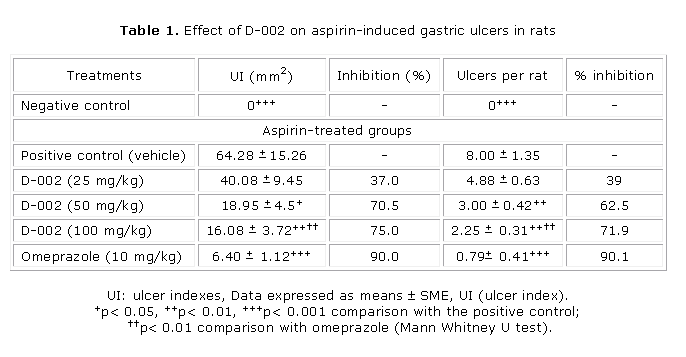
<body><![CDATA[<p><font size="2" face="Verdana">After the sacrifice, rat stomachs were immediately    removed, opened along the greater curvature and washed with saline solution.    The lesions were examined macroscopically under a microscope (magnification    3x) by two independent blinded observers. The ulcer indexes, the number of microscopic    ulcers and neutrophils per area of microscope field were quantified. </font></p>     <p><font size="2" face="Verdana">The ulcer indexes corresponded to sum of the    lengths of the gastric lesions (in mm). The protective ratio as the inhibition    (%) according to the following formula: [Inhibition (%)= (a - b)/a x 100], wherein    a was the ulcer index of the positive control group and b the ulcer index of    the test group. </font></p>     <p><font size="2" face="Verdana">Samples of the ulcer areas together with the    surrounding areas were taken and fixed in 10 % neutral formaldehyde (BDH, Poole,    Dorset, England), dehydrated in reagent degree ethanol, embedded in paraffin,    and cut in 4 &#181;m transverse sections that were stained with haematoxylin    and eosin (Merck, Darmstadt, Germany), and were examined (10 images per animal)    using an Olympus BH2 microscope. </font></p>     <p><font size="2" face="Verdana">Ulcer lesions were identified as epithelium erosions    accompanied by inflammatory infiltrates. </font></p>     <p><font size="2" face="Verdana"> Neutrophils were counted in each complete cross-section    of mucosa in accordance to <I>Nygard</I> et al. (1994).<SUP>30</SUP> Mean neutrophil    counts were determined in three sections per animal per group and afterwards    averaged for each group. </font></p>     <p>    <br>   <font size="2" face="Verdana"><b>Statistical analyses </b></font></p>     <p><font size="2" face="Verdana">Comparisons among the groups were done with the    Kruskal Wallis test, paired comparisons between control and treated groups with    the Mann-Whitney U test. Dose-relationships were explored with a linear regression    analysis. Statistical significance was chosen for </font><font face="Symbol" size="2">a</font><font size="2" face="Verdana">=    0.05. Data were processed with the statistical software Statistics for Window    (Release 6.1 Stat Soft Inc, Tulsa OK, USA). </font></p>     <p>&nbsp;</p>     <p> <font size="2" face="Verdana"><b><font size="3">RESULTS </font></b></font></p>     ]]></body>
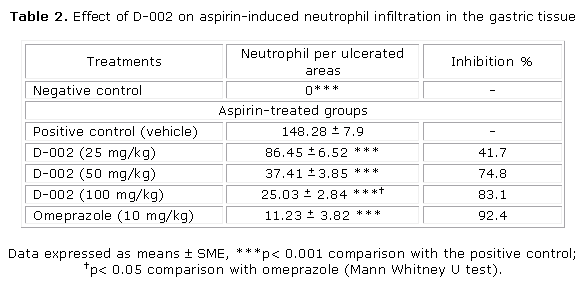
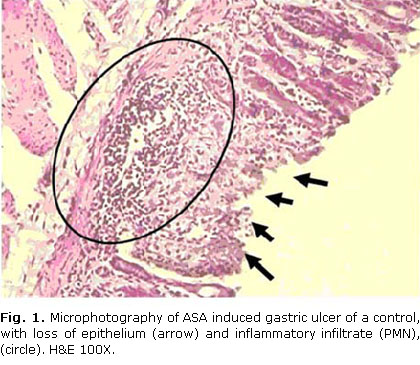
<body><![CDATA[<p><font size="2" face="Verdana"><b>Effects on aspirin-induced ulcers </b></font></p>     <p><font size="2" face="Verdana"> All the positive controls, but none negative    control rats, exhibited aspirin-induced erosive ulcers surrounded of inflammatory    infiltrates. <a href="#fig1">Figures 1</a> y <a href="#fig2">2 </a>illustrate    the observed lesions. </font></p>     <p align="center">    <br>   <img src="/img/revistas/far/v46n2/f0112212.jpg" width="420" height="365"><a name="fig1"></a></p>     <p align="center">    <br>   <img src="/img/revistas/far/v46n2/f0212212.jpg" width="580" height="329"><a name="fig2"></a></p>     <p><font size="2" face="Verdana">Oral treatment with D-002 dose-dependently (R=    0.98) prevented aspirin-induced gastric ulcers. D-002 given at 50 and 100 mg/kg,    not at 25 mg/kg, significantly (p&lt; 0.001) reduced ulcer indexes (70 and 75    %, respectively) as compared to the positive control group (<a href="/img/revistas/far/v46n2/t0112212.gif">table    1</a>). The positive control group averaged 8 microscopic ulcers per rat, a    variable significantly reduced by D-002 in a dose-dependent manner (R= 0.97).    The doses of 50 and 100 mg/kg, not 25 mg/kg, reduced the average number of these    lesions by 62.5 and 71.9 %, respectively. Omeprazole 10 mg/kg reduced the ulcers    indexes and the mean number of ulcers per rat more effectively (p&lt;0.001;    90.0 and 90.1 % inhibition, respectively) than D-002 (100 mg/kg). </font></p>     <p>    <br>   <font size="2" face="Verdana"><b>Effects on neutrophil infiltration </b></font></p>     <p><font size="2" face="Verdana">Aspirin-positive control rats displayed mean    values of 148.28 &#177; 7.9 (neutrophils per ulcerated area), which was dose-dependently    lowered (R= 0.94) by D-002 treatment (<a href="/img/revistas/far/v46n2/t0212212.gif">table 2</a>). All    doses of D-002 (25, 50 and 100 mg/kg), reduced significantly the number of neutrophils    per ulcerated area (41.7, 74.8 and 83.1 %, respectively, versus the aspirin    positive control). </font></p>     ]]></body>
<body><![CDATA[<p>&nbsp;</p>     <p><font size="3" face="Verdana"><b>DISCUSSION </b></font></p>     <p><font size="2" face="Verdana"> This study confirms that oral treatment with    D-002 (25-100 mg/kg) protects against aspirin-induced gastric lesions and demonstrates,    by first time, that D-002 reduces neutrophil infiltration on the gastric mucosa    in rats with gastric injury induced by aspirin. </font> </p>     <p><font size="2" face="Verdana">Gastric mucosal integrity is maintained by a    dynamic process in which defensive factors should counteract the effects of    aggressive factors. When this balance is lost, gastric mucosal damage becomes    evident.<SUP>1,2 </SUP>Aspirin administration to rats, a classical model of    NSAIDs-induced gastrotoxicity,<SUP>14-17,31,32 </SUP>mimics the potential gastric    damage of the members of this therapeutic class. In particular, aspirin is the    most widely used NSAIDs due its pivotal role in coronary and stroke prevention,<SUP>33,34    </SUP>in addition to the management of several inflammatory conditions.<SUP>35</SUP>    </font></p>     <p><font size="2" face="Verdana">All positive controls exhibited the characteristic    pattern of aspirin-induced gastric ulceration, such as erosions of the epithelium    and inflammatory infiltrates around the ulcer area.<SUP>31,32,36 </SUP>Omeprazole    10 mg/kg, the reference treatment, reduced significantly the ulcer indexes,    as reported by other authors.<SUP>15,33 </SUP> This supports the validity of    this model in our conditions, and hence the present results, so that the effects    here described herein can be attributable to D-002. </font></p>     <p><font size="2" face="Verdana">Oral treatment with D-002 dose-dependently prevented    the development of aspirin-induced gastric ulcers, but only the 50 and 100 mg/kg    doses were effective for lowering the gastric ulceration. The marked reduction    (75 %) achieved with the highest dose (100 mg/kg), however, cannot be interpreted    as a maximal inhibition because no <I>plateau</I> effect was seen and higher    doses were not evaluated. Consistently, the mean number of ulcers per rat in    the highest dose group was reduced by 71.9 %. These results are consistent with    previous reports of the efficacy of D-002 for preventing NSAIDs-induced ulcers    in rats.<SUP>18,21 </SUP> </font></p>     <p><font size="2" face="Verdana">The effects of D-002 on aspirin-induced neutrophil    infiltration in the gastric mucosa were dose-dependent and greater than its    effects on the ulcer indexes, since all doses (25, 50 and 100 mg/kg) effectively    reduced the number of neutrophils per ulcerated area (41.7, 74.8 and 83.1 %)    as compared to the positive control. These results suggest that the gastroprotective    effect of D-002 on this model is associated to the reduction of the neutrophil    infiltration that accompanied the gastric ulceration induced by aspirin in rats.    </font></p>     <p><font size="2" face="Verdana">It should be remembered that D-002 produces antioxidant    effects on different rat tissues, including the reduction of lipid peroxidation    in the gastric mucosa.<SUP>21,37 </SUP>Polimorphonuclear leukocytes represent    one of the major sources of ROS in the gastric mucosa,<SUP>12,16 </SUP>then    the present results should be attributable, at least partly, to the antioxidant    effects of D-002. Nevertheless, D-002 has been shown to reduce LTB<SUB>4</SUB>    levels in pleural exudates of carrageenan-induced pleurisy,<SUP>38 </SUP>an    effect that could be associated to the inhibition of the 5-LOX enzyme. Then,    the reduction of LTs and derived ROS<SUP>3,6-8 </SUP>could be another explanation    that could support the efficacy of D-002 on this model. </font></p>     <p><font size="2" face="Verdana">Oral treatment with D-002 (25-100 mg/kg) protects    against aspirin-induced ulceration in rats, decreasing ulcer indexes and neutrophil    infiltration in the gastric mucosa. </font></p>     <p>&nbsp;</p>     ]]></body>
<body><![CDATA[<p><font size="2" face="Verdana"><b><font size="3">REFERENCES </font></b></font></p>     <!-- ref --><p><font size="2" face="Verdana"> 1. Ramakrishnan K, Salinas RC. Peptic Ulcer    Disease. Am Fam Physician. 2007;76:1005-12.     </font> </p>     <!-- ref --><p><font size="2" face="Verdana">2. Tasman-Jones C. Pathogenesis of peptic ulcer    disease and gastritis: Importance of aggressive and cytoprotective factors.    Scand J Gastroenterol. 1986;19(22):1-5.     </font></p>     <!-- ref --><p><font size="2" face="Verdana">3. Lamarque D. Pathogenesis of gastroduodenal    lesions induced by non-steroidal anti-inflammatory drugs. Gastroenterol Clin    Biol. 2004;28:C18-26.     </font></p>     <!-- ref --><p><font size="2" face="Verdana">4. Allen A, Flemstr&ouml;m G. Gastroduodenal    mucus bicarbonate barrier: protection against acid and pepsin. Am J Cell Physiol.    2005;288:C1-19.     </font></p>     <!-- ref --><p><font size="2" face="Verdana">5. Laine L, Takeuchi K, Tarnawski A. Gastric    mucosal defense and cytoprotection: bench to bedside. Gastroenterology. 2008;135:41-60.        </font></p>     <!-- ref --><p><font size="2" face="Verdana">6. Wallace JL. Pathogenesis of NSAID-induced    gastroduodenal mucosal injury. Best Pract Res Clin Gastroenterol. 2001;15:691703.        </font></p>     <!-- ref --><p><font size="2" face="Verdana">7. Whittle BJ. Gastrointestinal effects of non-steroidal    anti-inflammatory drugs. Fundam Clin Pharmacol. 2003;17:301-313.    </font></p>     <!-- ref --><p><font size="2" face="Verdana"> 8. Komatsu Y, Nakamori Y, Kotani T, Takeuchi    K. Pathogenic importance of cysteinyl leukotrienes in development of gastric    lesions induced by ischemia/reperfusion in mice. Gastroenterology. 2009:134;A-240.        </font></p>     <!-- ref --><p><font size="2" face="Verdana">9. Kountouras J, Chatzopoulos D, Zavos C. Reactive    oxygen metabolites and upper gastrointestinal diseases. Hepatogastroenterology.    2001;48:743-51.     </font></p>     <!-- ref --><p><font size="2" face="Verdana"> 10. Demir S, Yilmaz M, Koseoglu M, Akalin N,    Aslan D, Aydin A. Role of free radicals in peptic ulcer and gastritis. Turkish    J Gastroenterology. 2003;14:39-43.     </font> </p>     <!-- ref --><p><font size="2" face="Verdana">11. Yasukawa K, Kasazaki K, Hyodo F, Utsumi H.    Non-invasive analysis of reactive oxygen species generated in rats with water    immersion restraint-induced gastric lesions using in vivo electron spin resonance    spectroscopy. Free Radic Res. 2004;38:147-55.     </font></p>     <!-- ref --><p><font size="2" face="Verdana">12. Naito Y, Takagi T, Katada K, Tomatsuri N,    Mizushima K, Handa O, et al. Gastric peroxisome proliferator activator receptor-&atilde;    expression and cytoprotective actions of its ligands against ischemia-reperfusion    injury in rats. J Clin Biochem Nutr. 2011;48:170-7.     </font></p>     <!-- ref --><p><font size="2" face="Verdana">13. Doweico HE. The Over-the-Counter Analgesics,    Unexpected Agent of Abuse (Chapter eighteen) in Concept of chemical dependency.    7th ed. Belmont: Brooks/Cole Cengage Learning; 2009. p. 269.     </font></p>     <!-- ref --><p><font size="2" face="Verdana">14. Pohle T, Brzozowski T, Becker JC, Van Der    Voort IR. Role of reactive oxygen metabolites in aspirin-induced gastric damage    in humans: gastroprotection by vitamin C. Aliment Pharmacol Ther. 2001;15:677-87.        </font></p>     <!-- ref --><p><font size="2" face="Verdana">15. Sener-Murato&eth;lu G, Paskalo&eth;lu K,    Arbak S, H&uuml;rda&eth; C, Ayano&eth;lu-D&uuml;lger G. Protective effect of    famotidine, omeprazole, and melatonin against acetylsalicylic acid-induced gastric    damage in rats. Dig Dis Sci. 2001;46:318-30.     </font></p>     <!-- ref --><p><font size="2" face="Verdana"> 16. Jainu M, Devi S. Attenuation of neutrophil    infiltration and proinflammatory cytokines by Cissus quadrangularis: a possible    prevention against gastric ulcerogenesis. J Herb Pharmacother. 2005;5:33-42.        </font> </p>     <!-- ref --><p><font size="2" face="Verdana">17. Jainu M, Mohan V. Devi S. Protective effect    of Cissus quadrangularis on neutrophil mediated tissue injury induced by aspirin    in rats. J Ethnopharmacol. 2006:104;302-5.     </font></p>     <!-- ref --><p><font size="2" face="Verdana">18. Carbajal D, Molina V, Vald&eacute;s S, Arruzazabala    L, M&aacute;s R. Anti-ulcer activity of higher primary alcohols of beeswax.    J Pharm Phamacol. 1995;47:731-3.     </font></p>     <!-- ref --><p><font size="2" face="Verdana">19. Carbajal D, Molina V, Vald&eacute;s S, Arruzazabala    L, Rodeiro I, M&aacute;s R, et al. Possible cytoprotective mechanism in rats    of D-002 an anti-ulcerogenic product isolated from beeswax. J Pharm Pharmacol.    1996;48:858-60.     </font></p>     <!-- ref --><p><font size="2" face="Verdana">20. Carbajal D, Molina V, Noa M, Valdes S, Arruzazabala    ML, Aguiar A, et al. Effects of D-002 on gastric mucus composition in ethanol-induced    ulcer. Pharmacol Res. 2000;42:329-32.     </font></p>     <!-- ref --><p><font size="2" face="Verdana">21. Molina V, Vald&eacute;s S, Carbajal D, Arruzazabala    L, Men&eacute;ndez R, M&aacute;s R. Antioxidant effects of D-002 on gastric    mucosa of rats with injury induced experimentally. J Med Food. 2001;4(2):79-84.        </font></p>     <!-- ref --><p><font size="2" face="Verdana">22. Hano O, Illnait J, Mas R, Fern&aacute;ndez    L, Pi&ntilde;ol F, Fern&aacute;ndez JC. Effects of D-002, a Product Isolated    from Beeswax, on Duodenal Ulcer: A Double-Blind, Placebo-Controlled Study. Curr    Ther Res. 2001;62:394-407.     </font></p>     <!-- ref --><p><font size="2" face="Verdana">23. Illnait J, Terry H, Mas R, Fern&aacute;ndez    L, Carbajal D. Effects of D-002, a product isolated from beeswax, on gastric    symptoms of patients with osteoarthritis treated with piroxicam: a pilot study.    J Med Food. 2005;8:63-8.     </font></p>     <!-- ref --><p><font size="2" face="Verdana"> 24. Fern&aacute;ndez L, Terry H, Qui&ntilde;ones    AM, D&iacute;az B, Hern&aacute;ndez ML, Illnait J, et al. Effects of Abexol    &#174; in middle-aged and older subjects: an open follow-up. Rev CENIC Cien    Biol. 2008;39:3-8.     </font> </p>     <!-- ref --><p><font size="2" face="Verdana">25. Rodriguez I, Illnait J, Fernandez L, Terry    H, Mas R, Fern&aacute;ndez L, et al. Effects of Abexol<SUP>&#174;</SUP> (beeswax    alcohols) on gastrointestinal symptoms of middle-aged and older subjects assessed.    Rev CENIC Cien Biol. 2009;40(3):147-54.     </font></p>     <!-- ref --><p><font size="2" face="Verdana">26. Noa M, M&aacute;s R, Carbajal D, Vald&eacute;s    S. Effect of D-002 on acetic acid-induced colitis in rats at single and repeated    doses. Pharmacol Res. 2000;41:392-5.     </font></p>     <!-- ref --><p><font size="2" face="Verdana">27. Noa M, Carbajal D, Molina V, Vald&eacute;s    S, M&aacute;s R. Comparative study of D-002 vs sulfasalazine on acetic acid-induced    colitis in rats. Drugs Exptl Clin Res. 1999;25:25-9.     </font></p>     <!-- ref --><p><font size="2" face="Verdana">28. Angelo A, Hassan M, Nour El Din N, Khalifa    HM, Ghany SA. A possible role for gastroprotectives on aspirin-induced gastric    ulcer in rats. Alexandria J Med. 2010;46(1):75-82.     </font></p>     <!-- ref --><p><font size="2" face="Verdana">29. Ko JK, Leung CC.J. Ginger extract and polaprezinc    exert gastroprotective actions by anti-oxidant and growth factor modulating    effects in rats. Gastroenterol Hepatol. 2010;25:1861-8.     </font></p>     <!-- ref --><p><font size="2" face="Verdana">30. Nygard G, Amthony A, Piasecki C, Trevethick    M, Hudson M, Dhilon A, et al. Acute indomethacin-induced jejunum injury in the    rat. Early morphological and biochemical changes. Gastroenterology. 1994;106:567-75.        </font></p>     <!-- ref --><p><font size="2" face="Verdana">31. Mukherjee M, Bhaskaran N, Srinath R, Shivaprasad    HN, Allan JJ, Shekhar D, et al. Anti-ulcer and antioxidant activity of GutGard.    Indian J Exp Biol. 2010;48:269-74.     </font></p>     <!-- ref --><p><font size="2" face="Verdana">32. Ogawa K, Oyagi A, Tanaka J, Kobayashi S,    Hara H. The Protective Effect and Action Mechanism of Vaccinium myrtillus L.    on Gastric Ulcer in Mice. Phytother Res. 2011 Aug 25(8):1160-5.     </font></p>     <!-- ref --><p><font size="2" face="Verdana">33. Sanmuganathan P. Ghahramani P. Jackson P.    Ramsay L. Aspirin in the primary and secondary prevention of vascular disease:    collaborative meta-analysis of individual participant data from randomised trials.    Lancet. 2009;373:1849-60.     </font></p>     <!-- ref --><p><font size="2" face="Verdana">34. Inzitari D, Piccardi B, Sarti C. A critical    review of aspirin in the secondary prevention of non-cardioembolic ischaemic    stroke. Int J Stroke. 2010;5:306-18.     </font></p>     <!-- ref --><p><font size="2" face="Verdana">35. Tsumura H, Tamura I, Tanaka H, Chinzei R,    , Masuda A, et al. Prescription of non-steroidal anti-inflammatory drugs and    co-prescribed drugs for mucosal protection: analysis of the present status based    on questionnaires obtained from orthopaedists in Japan. Inter Med. 2007;46:927-31.        </font></p>     <!-- ref --><p><font size="2" face="Verdana"> 36. Berenguer B, Trabadela C, S&aacute;nchez-Fidalgo    S, Qu&iacute;lez A, Mi&ntilde;o P, De la Puerta R, et al. The aerial parts of    Guazuma ulmifolia Lam. protect against NSAID-induced gastric lesions. Ethnopharmacol.    2007;114(2):153-60.     </font> </p>     <!-- ref --><p><font size="2" face="Verdana">37. Men&eacute;ndez R, Amor AM, Gonz&aacute;lez    RM, Jim&eacute;nez S, M&aacute;s R. Inhibition of rat microsomal lipid peroxidation    by the oral administration of D-002. Braz J Med Biol Res. 2000;33:85-90.     </font></p>     <!-- ref --><p><font size="2" face="Verdana">38. Carbajal D, Molina V, Vald&eacute;s S, Arruzazabala    ML, M&aacute;s R, Magraner J. Anti-inflammatory activity of D-002: an active    product isolated from beeswax. Prostagl Leukotr Essent Fatty Acids. 1998;59(4):235-8.        </font></p>     <p>&nbsp;</p>     <p>&nbsp;</p>     <p> </p>     ]]></body>
<body><![CDATA[<p><font size="2" face="Verdana">Recibido: 28 de noviembre de 2011.    <br>   </font><font size="2" face="Verdana">Aprobado: 19 de enero de 2012. </font></p>     <p>&nbsp;</p>     <p>&nbsp;</p>     <p> </p>     <p><font size="2" face="Verdana"><I>Maikel Valle Clara.</I> Centro de Productos    Naturales, Centro Nacional de Investigaciones Cient&iacute;ficas (CNIC). Calle    198 entre 19 y 21, Atabey, municipio Playa, La Habana, Cuba. Correo electr&oacute;nico:    <U><a href="mailto:maikel.valle@cnic.edu.cu">maikel.valle@cnic.edu.cu</a></U></font></p>      ]]></body><back>
<ref-list>
<ref id="B1">
<label>1</label><nlm-citation citation-type="journal">
<person-group person-group-type="author">
<name>
<surname><![CDATA[Ramakrishnan]]></surname>
<given-names><![CDATA[K]]></given-names>
</name>
<name>
<surname><![CDATA[Salinas]]></surname>
<given-names><![CDATA[RC]]></given-names>
</name>
</person-group>
<article-title xml:lang="en"><![CDATA[Peptic Ulcer Disease]]></article-title>
<source><![CDATA[Am Fam Physician.]]></source>
<year>2007</year>
<volume>76</volume>
<page-range>1005-12</page-range></nlm-citation>
</ref>
<ref id="B2">
<label>2</label><nlm-citation citation-type="journal">
<person-group person-group-type="author">
<name>
<surname><![CDATA[Tasman-Jones]]></surname>
<given-names><![CDATA[C]]></given-names>
</name>
</person-group>
<article-title xml:lang="en"><![CDATA[Pathogenesis of peptic ulcer disease and gastritis: Importance of aggressive and cytoprotective factors]]></article-title>
<source><![CDATA[Scand J Gastroenterol.]]></source>
<year>1986</year>
<volume>19</volume>
<numero>22</numero>
<issue>22</issue>
<page-range>1-5</page-range></nlm-citation>
</ref>
<ref id="B3">
<label>3</label><nlm-citation citation-type="journal">
<person-group person-group-type="author">
<name>
<surname><![CDATA[Lamarque]]></surname>
<given-names><![CDATA[D]]></given-names>
</name>
</person-group>
<article-title xml:lang="en"><![CDATA[Pathogenesis of gastroduodenal lesions induced by non-steroidal anti-inflammatory drugs]]></article-title>
<source><![CDATA[Gastroenterol Clin Biol.]]></source>
<year>2004</year>
<volume>28</volume>
<page-range>C18-26</page-range></nlm-citation>
</ref>
<ref id="B4">
<label>4</label><nlm-citation citation-type="journal">
<person-group person-group-type="author">
<name>
<surname><![CDATA[Allen]]></surname>
<given-names><![CDATA[A]]></given-names>
</name>
<name>
<surname><![CDATA[Flemström]]></surname>
<given-names><![CDATA[G]]></given-names>
</name>
</person-group>
<article-title xml:lang="en"><![CDATA[Gastroduodenal mucus bicarbonate barrier: protection against acid and pepsin]]></article-title>
<source><![CDATA[Am J Cell Physiol.]]></source>
<year>2005</year>
<volume>288</volume>
<page-range>C1-19</page-range></nlm-citation>
</ref>
<ref id="B5">
<label>5</label><nlm-citation citation-type="journal">
<person-group person-group-type="author">
<name>
<surname><![CDATA[Laine]]></surname>
<given-names><![CDATA[L]]></given-names>
</name>
<name>
<surname><![CDATA[Takeuchi]]></surname>
<given-names><![CDATA[K]]></given-names>
</name>
<name>
<surname><![CDATA[Tarnawski]]></surname>
<given-names><![CDATA[A]]></given-names>
</name>
</person-group>
<article-title xml:lang="en"><![CDATA[Gastric mucosal defense and cytoprotection: bench to bedside]]></article-title>
<source><![CDATA[Gastroenterology.]]></source>
<year>2008</year>
<volume>135</volume>
<page-range>41-60</page-range></nlm-citation>
</ref>
<ref id="B6">
<label>6</label><nlm-citation citation-type="journal">
<person-group person-group-type="author">
<name>
<surname><![CDATA[Wallace]]></surname>
<given-names><![CDATA[JL]]></given-names>
</name>
</person-group>
<article-title xml:lang="en"><![CDATA[Pathogenesis of NSAID-induced gastroduodenal mucosal injury]]></article-title>
<source><![CDATA[Best Pract Res Clin Gastroenterol.]]></source>
<year>2001</year>
<volume>15</volume>
<page-range>691703</page-range></nlm-citation>
</ref>
<ref id="B7">
<label>7</label><nlm-citation citation-type="journal">
<person-group person-group-type="author">
<name>
<surname><![CDATA[Whittle]]></surname>
<given-names><![CDATA[BJ]]></given-names>
</name>
</person-group>
<article-title xml:lang="en"><![CDATA[Gastrointestinal effects of non-steroidal anti-inflammatory drugs]]></article-title>
<source><![CDATA[Fundam Clin Pharmacol.]]></source>
<year>2003</year>
<volume>17</volume>
<page-range>301-313</page-range></nlm-citation>
</ref>
<ref id="B8">
<label>8</label><nlm-citation citation-type="journal">
<person-group person-group-type="author">
<name>
<surname><![CDATA[Komatsu]]></surname>
<given-names><![CDATA[Y]]></given-names>
</name>
<name>
<surname><![CDATA[Nakamori]]></surname>
<given-names><![CDATA[Y]]></given-names>
</name>
<name>
<surname><![CDATA[Kotani]]></surname>
<given-names><![CDATA[T]]></given-names>
</name>
<name>
<surname><![CDATA[Takeuchi]]></surname>
<given-names><![CDATA[K]]></given-names>
</name>
</person-group>
<article-title xml:lang="en"><![CDATA[Pathogenic importance of cysteinyl leukotrienes in development of gastric lesions induced by ischemia/reperfusion in mice]]></article-title>
<source><![CDATA[Gastroenterology.]]></source>
<year>2009</year>
<volume>134</volume>
<page-range>A-240</page-range></nlm-citation>
</ref>
<ref id="B9">
<label>9</label><nlm-citation citation-type="journal">
<person-group person-group-type="author">
<name>
<surname><![CDATA[Kountouras]]></surname>
<given-names><![CDATA[J]]></given-names>
</name>
<name>
<surname><![CDATA[Chatzopoulos]]></surname>
<given-names><![CDATA[D]]></given-names>
</name>
<name>
<surname><![CDATA[Zavos]]></surname>
<given-names><![CDATA[C]]></given-names>
</name>
</person-group>
<article-title xml:lang="en"><![CDATA[Reactive oxygen metabolites and upper gastrointestinal diseases]]></article-title>
<source><![CDATA[Hepatogastroenterology.]]></source>
<year>2001</year>
<volume>48</volume>
<page-range>743-51</page-range></nlm-citation>
</ref>
<ref id="B10">
<label>10</label><nlm-citation citation-type="journal">
<person-group person-group-type="author">
<name>
<surname><![CDATA[Demir]]></surname>
<given-names><![CDATA[S]]></given-names>
</name>
<name>
<surname><![CDATA[Yilmaz]]></surname>
<given-names><![CDATA[M]]></given-names>
</name>
<name>
<surname><![CDATA[Koseoglu]]></surname>
<given-names><![CDATA[M]]></given-names>
</name>
<name>
<surname><![CDATA[Akalin]]></surname>
<given-names><![CDATA[N]]></given-names>
</name>
<name>
<surname><![CDATA[Aslan]]></surname>
<given-names><![CDATA[D]]></given-names>
</name>
<name>
<surname><![CDATA[Aydin]]></surname>
<given-names><![CDATA[A]]></given-names>
</name>
</person-group>
<article-title xml:lang="en"><![CDATA[Role of free radicals in peptic ulcer and gastritis]]></article-title>
<source><![CDATA[Turkish J Gastroenterology.]]></source>
<year>2003</year>
<volume>14</volume>
<page-range>39-43</page-range></nlm-citation>
</ref>
<ref id="B11">
<label>11</label><nlm-citation citation-type="journal">
<person-group person-group-type="author">
<name>
<surname><![CDATA[Yasukawa]]></surname>
<given-names><![CDATA[K]]></given-names>
</name>
<name>
<surname><![CDATA[Kasazaki]]></surname>
<given-names><![CDATA[K]]></given-names>
</name>
<name>
<surname><![CDATA[Hyodo]]></surname>
<given-names><![CDATA[F]]></given-names>
</name>
<name>
<surname><![CDATA[Utsumi]]></surname>
<given-names><![CDATA[H]]></given-names>
</name>
</person-group>
<article-title xml:lang="en"><![CDATA[Non-invasive analysis of reactive oxygen species generated in rats with water immersion restraint-induced gastric lesions using in vivo electron spin resonance spectroscopy]]></article-title>
<source><![CDATA[Free Radic Res.]]></source>
<year>2004</year>
<volume>38</volume>
<page-range>147-55</page-range></nlm-citation>
</ref>
<ref id="B12">
<label>12</label><nlm-citation citation-type="journal">
<person-group person-group-type="author">
<name>
<surname><![CDATA[Naito]]></surname>
<given-names><![CDATA[Y]]></given-names>
</name>
<name>
<surname><![CDATA[Takagi]]></surname>
<given-names><![CDATA[T]]></given-names>
</name>
<name>
<surname><![CDATA[Katada]]></surname>
<given-names><![CDATA[K]]></given-names>
</name>
<name>
<surname><![CDATA[Tomatsuri]]></surname>
<given-names><![CDATA[N]]></given-names>
</name>
<name>
<surname><![CDATA[Mizushima]]></surname>
<given-names><![CDATA[K]]></given-names>
</name>
<name>
<surname><![CDATA[Handa]]></surname>
<given-names><![CDATA[O]]></given-names>
</name>
</person-group>
<article-title xml:lang="en"><![CDATA[Gastric peroxisome proliferator activator receptor-ã expression and cytoprotective actions of its ligands against ischemia-reperfusion injury in rats]]></article-title>
<source><![CDATA[J Clin Biochem Nutr.]]></source>
<year>2011</year>
<volume>48</volume>
<page-range>170-7</page-range></nlm-citation>
</ref>
<ref id="B13">
<label>13</label><nlm-citation citation-type="book">
<person-group person-group-type="author">
<name>
<surname><![CDATA[Doweico]]></surname>
<given-names><![CDATA[HE]]></given-names>
</name>
</person-group>
<source><![CDATA[The Over-the-Counter Analgesics, Unexpected Agent of Abuse (Chapter eighteen) in Concept of chemical dependency]]></source>
<year>2009</year>
<edition>7th ed</edition>
<page-range>p. 269</page-range><publisher-loc><![CDATA[Belmont ]]></publisher-loc>
<publisher-name><![CDATA[Brooks/Cole Cengage Learning]]></publisher-name>
</nlm-citation>
</ref>
<ref id="B14">
<label>14</label><nlm-citation citation-type="journal">
<person-group person-group-type="author">
<name>
<surname><![CDATA[Pohle]]></surname>
<given-names><![CDATA[T]]></given-names>
</name>
<name>
<surname><![CDATA[Brzozowski]]></surname>
<given-names><![CDATA[T]]></given-names>
</name>
<name>
<surname><![CDATA[Becker]]></surname>
<given-names><![CDATA[JC]]></given-names>
</name>
<name>
<surname><![CDATA[Van Der Voort]]></surname>
<given-names><![CDATA[IR]]></given-names>
</name>
</person-group>
<article-title xml:lang="en"><![CDATA[Role of reactive oxygen metabolites in aspirin-induced gastric damage in humans: gastroprotection by vitamin C]]></article-title>
<source><![CDATA[Aliment Pharmacol Ther.]]></source>
<year>2001</year>
<volume>15</volume>
<page-range>677-87</page-range></nlm-citation>
</ref>
<ref id="B15">
<label>15</label><nlm-citation citation-type="journal">
<person-group person-group-type="author">
<name>
<surname><![CDATA[Sener-Muratoðlu]]></surname>
<given-names><![CDATA[G]]></given-names>
</name>
<name>
<surname><![CDATA[Paskaloðlu]]></surname>
<given-names><![CDATA[K]]></given-names>
</name>
<name>
<surname><![CDATA[Arbak]]></surname>
<given-names><![CDATA[S]]></given-names>
</name>
<name>
<surname><![CDATA[Hürdað]]></surname>
<given-names><![CDATA[C]]></given-names>
</name>
<name>
<surname><![CDATA[Ayanoðlu-Dülger]]></surname>
<given-names><![CDATA[G]]></given-names>
</name>
</person-group>
<article-title xml:lang="en"><![CDATA[Protective effect of famotidine, omeprazole, and melatonin against acetylsalicylic acid-induced gastric damage in rats]]></article-title>
<source><![CDATA[Dig Dis Sci.]]></source>
<year>2001</year>
<volume>46</volume>
<page-range>318-30</page-range></nlm-citation>
</ref>
<ref id="B16">
<label>16</label><nlm-citation citation-type="journal">
<person-group person-group-type="author">
<name>
<surname><![CDATA[Jainu]]></surname>
<given-names><![CDATA[M]]></given-names>
</name>
<name>
<surname><![CDATA[Devi]]></surname>
<given-names><![CDATA[S]]></given-names>
</name>
</person-group>
<article-title xml:lang="en"><![CDATA[Attenuation of neutrophil infiltration and proinflammatory cytokines by Cissus quadrangularis: a possible prevention against gastric ulcerogenesis]]></article-title>
<source><![CDATA[J Herb Pharmacother.]]></source>
<year>2005</year>
<volume>5</volume>
<page-range>33-42</page-range></nlm-citation>
</ref>
<ref id="B17">
<label>17</label><nlm-citation citation-type="journal">
<person-group person-group-type="author">
<name>
<surname><![CDATA[Jainu]]></surname>
<given-names><![CDATA[M]]></given-names>
</name>
<name>
<surname><![CDATA[Mohan]]></surname>
<given-names><![CDATA[V]]></given-names>
</name>
<name>
<surname><![CDATA[Devi]]></surname>
<given-names><![CDATA[S]]></given-names>
</name>
</person-group>
<article-title xml:lang="en"><![CDATA[Protective effect of Cissus quadrangularis on neutrophil mediated tissue injury induced by aspirin in rats]]></article-title>
<source><![CDATA[J Ethnopharmacol.]]></source>
<year>2006</year>
<volume>104</volume>
<page-range>302-5</page-range></nlm-citation>
</ref>
<ref id="B18">
<label>18</label><nlm-citation citation-type="journal">
<person-group person-group-type="author">
<name>
<surname><![CDATA[Carbajal]]></surname>
<given-names><![CDATA[D]]></given-names>
</name>
<name>
<surname><![CDATA[Molina]]></surname>
<given-names><![CDATA[V]]></given-names>
</name>
<name>
<surname><![CDATA[Valdés]]></surname>
<given-names><![CDATA[S]]></given-names>
</name>
<name>
<surname><![CDATA[Arruzazabala]]></surname>
<given-names><![CDATA[L]]></given-names>
</name>
<name>
<surname><![CDATA[Más]]></surname>
<given-names><![CDATA[R]]></given-names>
</name>
</person-group>
<article-title xml:lang="en"><![CDATA[Anti-ulcer activity of higher primary alcohols of beeswax]]></article-title>
<source><![CDATA[J Pharm Phamacol.]]></source>
<year>1995</year>
<volume>47</volume>
<page-range>731-3</page-range></nlm-citation>
</ref>
<ref id="B19">
<label>19</label><nlm-citation citation-type="journal">
<person-group person-group-type="author">
<name>
<surname><![CDATA[Carbajal]]></surname>
<given-names><![CDATA[D]]></given-names>
</name>
<name>
<surname><![CDATA[Molina]]></surname>
<given-names><![CDATA[V]]></given-names>
</name>
<name>
<surname><![CDATA[Valdés]]></surname>
<given-names><![CDATA[S]]></given-names>
</name>
<name>
<surname><![CDATA[Arruzazabala]]></surname>
<given-names><![CDATA[L]]></given-names>
</name>
<name>
<surname><![CDATA[Rodeiro]]></surname>
<given-names><![CDATA[I]]></given-names>
</name>
<name>
<surname><![CDATA[Más]]></surname>
<given-names><![CDATA[R]]></given-names>
</name>
</person-group>
<article-title xml:lang="en"><![CDATA[Possible cytoprotective mechanism in rats of D-002 an anti-ulcerogenic product isolated from beeswax]]></article-title>
<source><![CDATA[J Pharm Pharmacol.]]></source>
<year>1996</year>
<volume>48</volume>
<page-range>858-60</page-range></nlm-citation>
</ref>
<ref id="B20">
<label>20</label><nlm-citation citation-type="journal">
<person-group person-group-type="author">
<name>
<surname><![CDATA[Carbajal]]></surname>
<given-names><![CDATA[D]]></given-names>
</name>
<name>
<surname><![CDATA[Molina]]></surname>
<given-names><![CDATA[V]]></given-names>
</name>
<name>
<surname><![CDATA[Noa]]></surname>
<given-names><![CDATA[M]]></given-names>
</name>
<name>
<surname><![CDATA[Valdes]]></surname>
<given-names><![CDATA[S]]></given-names>
</name>
<name>
<surname><![CDATA[Arruzazabala]]></surname>
<given-names><![CDATA[ML]]></given-names>
</name>
<name>
<surname><![CDATA[Aguiar]]></surname>
<given-names><![CDATA[A]]></given-names>
</name>
</person-group>
<article-title xml:lang="en"><![CDATA[Effects of D-002 on gastric mucus composition in ethanol-induced ulcer]]></article-title>
<source><![CDATA[Pharmacol Res.]]></source>
<year>2000</year>
<volume>42</volume>
<page-range>329-32</page-range></nlm-citation>
</ref>
<ref id="B21">
<label>21</label><nlm-citation citation-type="journal">
<person-group person-group-type="author">
<name>
<surname><![CDATA[Molina]]></surname>
<given-names><![CDATA[V]]></given-names>
</name>
<name>
<surname><![CDATA[Valdés]]></surname>
<given-names><![CDATA[S]]></given-names>
</name>
<name>
<surname><![CDATA[Carbajal]]></surname>
<given-names><![CDATA[D]]></given-names>
</name>
<name>
<surname><![CDATA[Arruzazabala]]></surname>
<given-names><![CDATA[L]]></given-names>
</name>
<name>
<surname><![CDATA[Menéndez]]></surname>
<given-names><![CDATA[R]]></given-names>
</name>
<name>
<surname><![CDATA[Más]]></surname>
<given-names><![CDATA[R]]></given-names>
</name>
</person-group>
<article-title xml:lang="en"><![CDATA[Antioxidant effects of D-002 on gastric mucosa of rats with injury induced experimentally]]></article-title>
<source><![CDATA[J Med Food.]]></source>
<year>2001</year>
<volume>4</volume>
<numero>2</numero>
<issue>2</issue>
<page-range>79-84</page-range></nlm-citation>
</ref>
<ref id="B22">
<label>22</label><nlm-citation citation-type="journal">
<person-group person-group-type="author">
<name>
<surname><![CDATA[Hano]]></surname>
<given-names><![CDATA[O]]></given-names>
</name>
<name>
<surname><![CDATA[Illnait]]></surname>
<given-names><![CDATA[J]]></given-names>
</name>
<name>
<surname><![CDATA[Mas]]></surname>
<given-names><![CDATA[R]]></given-names>
</name>
<name>
<surname><![CDATA[Fernández]]></surname>
<given-names><![CDATA[L]]></given-names>
</name>
<name>
<surname><![CDATA[Piñol]]></surname>
<given-names><![CDATA[F]]></given-names>
</name>
<name>
<surname><![CDATA[Fernández]]></surname>
<given-names><![CDATA[JC]]></given-names>
</name>
</person-group>
<article-title xml:lang="en"><![CDATA[Effects of D-002, a Product Isolated from Beeswax, on Duodenal Ulcer: A Double-Blind, Placebo-Controlled Study]]></article-title>
<source><![CDATA[Curr Ther Res.]]></source>
<year>2001</year>
<volume>62</volume>
<page-range>394-407</page-range></nlm-citation>
</ref>
<ref id="B23">
<label>23</label><nlm-citation citation-type="journal">
<person-group person-group-type="author">
<name>
<surname><![CDATA[Illnait]]></surname>
<given-names><![CDATA[J]]></given-names>
</name>
<name>
<surname><![CDATA[Terry]]></surname>
<given-names><![CDATA[H]]></given-names>
</name>
<name>
<surname><![CDATA[Mas]]></surname>
<given-names><![CDATA[R]]></given-names>
</name>
<name>
<surname><![CDATA[Fernández]]></surname>
<given-names><![CDATA[L]]></given-names>
</name>
<name>
<surname><![CDATA[Carbajal]]></surname>
<given-names><![CDATA[D]]></given-names>
</name>
</person-group>
<article-title xml:lang="en"><![CDATA[Effects of D-002, a product isolated from beeswax, on gastric symptoms of patients with osteoarthritis treated with piroxicam: a pilot study]]></article-title>
<source><![CDATA[J Med Food.]]></source>
<year>2005</year>
<volume>8</volume>
<page-range>63-8</page-range></nlm-citation>
</ref>
<ref id="B24">
<label>24</label><nlm-citation citation-type="journal">
<person-group person-group-type="author">
<name>
<surname><![CDATA[Fernández]]></surname>
<given-names><![CDATA[L]]></given-names>
</name>
<name>
<surname><![CDATA[Terry]]></surname>
<given-names><![CDATA[H]]></given-names>
</name>
<name>
<surname><![CDATA[Quiñones]]></surname>
<given-names><![CDATA[AM]]></given-names>
</name>
<name>
<surname><![CDATA[Díaz]]></surname>
<given-names><![CDATA[B]]></given-names>
</name>
<name>
<surname><![CDATA[Hernández]]></surname>
<given-names><![CDATA[ML]]></given-names>
</name>
<name>
<surname><![CDATA[Illnait]]></surname>
<given-names><![CDATA[J]]></given-names>
</name>
</person-group>
<article-title xml:lang="en"><![CDATA[Effects of Abexol ® in middle-aged and older subjects: an open follow-up]]></article-title>
<source><![CDATA[Rev CENIC Cien Biol.]]></source>
<year>2008</year>
<volume>39</volume>
<page-range>3-8</page-range></nlm-citation>
</ref>
<ref id="B25">
<label>25</label><nlm-citation citation-type="journal">
<person-group person-group-type="author">
<name>
<surname><![CDATA[Rodriguez]]></surname>
<given-names><![CDATA[I]]></given-names>
</name>
<name>
<surname><![CDATA[Illnait]]></surname>
<given-names><![CDATA[J]]></given-names>
</name>
<name>
<surname><![CDATA[Fernandez]]></surname>
<given-names><![CDATA[L]]></given-names>
</name>
<name>
<surname><![CDATA[Terry]]></surname>
<given-names><![CDATA[H]]></given-names>
</name>
<name>
<surname><![CDATA[Mas]]></surname>
<given-names><![CDATA[R]]></given-names>
</name>
<name>
<surname><![CDATA[Fernández]]></surname>
<given-names><![CDATA[L]]></given-names>
</name>
</person-group>
<article-title xml:lang="en"><![CDATA[Effects of Abexol® (beeswax alcohols) on gastrointestinal symptoms of middle-aged and older subjects assessed]]></article-title>
<source><![CDATA[Rev CENIC Cien Biol.]]></source>
<year>2009</year>
<volume>40</volume>
<numero>3</numero>
<issue>3</issue>
<page-range>147-54</page-range></nlm-citation>
</ref>
<ref id="B26">
<label>26</label><nlm-citation citation-type="journal">
<person-group person-group-type="author">
<name>
<surname><![CDATA[Noa]]></surname>
<given-names><![CDATA[M]]></given-names>
</name>
<name>
<surname><![CDATA[Más]]></surname>
<given-names><![CDATA[R]]></given-names>
</name>
<name>
<surname><![CDATA[Carbajal]]></surname>
<given-names><![CDATA[D]]></given-names>
</name>
<name>
<surname><![CDATA[Valdés]]></surname>
<given-names><![CDATA[S]]></given-names>
</name>
</person-group>
<article-title xml:lang="en"><![CDATA[Effect of D-002 on acetic acid-induced colitis in rats at single and repeated doses]]></article-title>
<source><![CDATA[Pharmacol Res.]]></source>
<year>2000</year>
<volume>41</volume>
<page-range>392-5</page-range></nlm-citation>
</ref>
<ref id="B27">
<label>27</label><nlm-citation citation-type="journal">
<person-group person-group-type="author">
<name>
<surname><![CDATA[Noa]]></surname>
<given-names><![CDATA[M]]></given-names>
</name>
<name>
<surname><![CDATA[Carbajal]]></surname>
<given-names><![CDATA[D]]></given-names>
</name>
<name>
<surname><![CDATA[Molina]]></surname>
<given-names><![CDATA[V]]></given-names>
</name>
<name>
<surname><![CDATA[Valdés]]></surname>
<given-names><![CDATA[S]]></given-names>
</name>
<name>
<surname><![CDATA[Más]]></surname>
<given-names><![CDATA[R]]></given-names>
</name>
</person-group>
<article-title xml:lang="en"><![CDATA[Comparative study of D-002 vs sulfasalazine on acetic acid-induced colitis in rats]]></article-title>
<source><![CDATA[Drugs Exptl Clin Res.]]></source>
<year>1999</year>
<volume>25</volume>
<page-range>25-9</page-range></nlm-citation>
</ref>
<ref id="B28">
<label>28</label><nlm-citation citation-type="journal">
<person-group person-group-type="author">
<name>
<surname><![CDATA[Angelo]]></surname>
<given-names><![CDATA[A]]></given-names>
</name>
<name>
<surname><![CDATA[Hassan]]></surname>
<given-names><![CDATA[M]]></given-names>
</name>
<name>
<surname><![CDATA[Nour El Din]]></surname>
<given-names><![CDATA[N]]></given-names>
</name>
<name>
<surname><![CDATA[Khalifa]]></surname>
<given-names><![CDATA[HM]]></given-names>
</name>
<name>
<surname><![CDATA[Ghany]]></surname>
<given-names><![CDATA[SA]]></given-names>
</name>
</person-group>
<article-title xml:lang="en"><![CDATA[A possible role for gastroprotectives on aspirin-induced gastric ulcer in rats]]></article-title>
<source><![CDATA[Alexandria J Med.]]></source>
<year>2010</year>
<volume>46</volume>
<numero>1</numero>
<issue>1</issue>
<page-range>75-82</page-range></nlm-citation>
</ref>
<ref id="B29">
<label>29</label><nlm-citation citation-type="journal">
<person-group person-group-type="author">
<name>
<surname><![CDATA[Ko]]></surname>
<given-names><![CDATA[JK]]></given-names>
</name>
<name>
<surname><![CDATA[Leung]]></surname>
<given-names><![CDATA[CCJ]]></given-names>
</name>
</person-group>
<article-title xml:lang="en"><![CDATA[Ginger extract and polaprezinc exert gastroprotective actions by anti-oxidant and growth factor modulating effects in rats]]></article-title>
<source><![CDATA[Gastroenterol Hepatol.]]></source>
<year>2010</year>
<volume>25</volume>
<page-range>1861-8</page-range></nlm-citation>
</ref>
<ref id="B30">
<label>30</label><nlm-citation citation-type="journal">
<person-group person-group-type="author">
<name>
<surname><![CDATA[Nygard]]></surname>
<given-names><![CDATA[G]]></given-names>
</name>
<name>
<surname><![CDATA[Amthony]]></surname>
<given-names><![CDATA[A]]></given-names>
</name>
<name>
<surname><![CDATA[Piasecki]]></surname>
<given-names><![CDATA[C]]></given-names>
</name>
<name>
<surname><![CDATA[Trevethick]]></surname>
<given-names><![CDATA[M]]></given-names>
</name>
<name>
<surname><![CDATA[Hudson]]></surname>
<given-names><![CDATA[M]]></given-names>
</name>
<name>
<surname><![CDATA[Dhilon]]></surname>
<given-names><![CDATA[A]]></given-names>
</name>
</person-group>
<article-title xml:lang="en"><![CDATA[Acute indomethacin-induced jejunum injury in the rat: Early morphological and biochemical changes]]></article-title>
<source><![CDATA[Gastroenterology.]]></source>
<year>1994</year>
<volume>106</volume>
<page-range>567-75</page-range></nlm-citation>
</ref>
<ref id="B31">
<label>31</label><nlm-citation citation-type="journal">
<person-group person-group-type="author">
<name>
<surname><![CDATA[Mukherjee]]></surname>
<given-names><![CDATA[M]]></given-names>
</name>
<name>
<surname><![CDATA[Bhaskaran]]></surname>
<given-names><![CDATA[N]]></given-names>
</name>
<name>
<surname><![CDATA[Srinath]]></surname>
<given-names><![CDATA[R]]></given-names>
</name>
<name>
<surname><![CDATA[Shivaprasad]]></surname>
<given-names><![CDATA[HN]]></given-names>
</name>
<name>
<surname><![CDATA[Allan]]></surname>
<given-names><![CDATA[JJ]]></given-names>
</name>
<name>
<surname><![CDATA[Shekhar]]></surname>
<given-names><![CDATA[D]]></given-names>
</name>
</person-group>
<article-title xml:lang="en"><![CDATA[Anti-ulcer and antioxidant activity of GutGard]]></article-title>
<source><![CDATA[Indian J Exp Biol.]]></source>
<year>2010</year>
<volume>48</volume>
<page-range>269-74</page-range></nlm-citation>
</ref>
<ref id="B32">
<label>32</label><nlm-citation citation-type="journal">
<person-group person-group-type="author">
<name>
<surname><![CDATA[Ogawa]]></surname>
<given-names><![CDATA[K]]></given-names>
</name>
<name>
<surname><![CDATA[Oyagi]]></surname>
<given-names><![CDATA[A]]></given-names>
</name>
<name>
<surname><![CDATA[Tanaka]]></surname>
<given-names><![CDATA[J]]></given-names>
</name>
<name>
<surname><![CDATA[Kobayashi]]></surname>
<given-names><![CDATA[S]]></given-names>
</name>
<name>
<surname><![CDATA[Hara]]></surname>
<given-names><![CDATA[H]]></given-names>
</name>
</person-group>
<article-title xml:lang="en"><![CDATA[The Protective Effect and Action Mechanism of Vaccinium myrtillus L. on Gastric Ulcer in Mice]]></article-title>
<source><![CDATA[Phytother Res]]></source>
<year>2011</year>
<month> A</month>
<day>ug</day>
<volume>25</volume>
<numero>8</numero>
<issue>8</issue>
<page-range>1160-5</page-range></nlm-citation>
</ref>
<ref id="B33">
<label>33</label><nlm-citation citation-type="journal">
<person-group person-group-type="author">
<name>
<surname><![CDATA[Sanmuganathan]]></surname>
<given-names><![CDATA[P]]></given-names>
</name>
<name>
<surname><![CDATA[Ghahramani]]></surname>
<given-names><![CDATA[P]]></given-names>
</name>
<name>
<surname><![CDATA[Jackson]]></surname>
<given-names><![CDATA[P]]></given-names>
</name>
<name>
<surname><![CDATA[Ramsay]]></surname>
<given-names><![CDATA[L]]></given-names>
</name>
</person-group>
<article-title xml:lang="en"><![CDATA[Aspirin in the primary and secondary prevention of vascular disease: collaborative meta-analysis of individual participant data from randomised trials]]></article-title>
<source><![CDATA[Lancet.]]></source>
<year>2009</year>
<volume>373</volume>
<page-range>1849-60</page-range></nlm-citation>
</ref>
<ref id="B34">
<label>34</label><nlm-citation citation-type="journal">
<person-group person-group-type="author">
<name>
<surname><![CDATA[Inzitari]]></surname>
<given-names><![CDATA[D]]></given-names>
</name>
<name>
<surname><![CDATA[Piccardi]]></surname>
<given-names><![CDATA[B]]></given-names>
</name>
<name>
<surname><![CDATA[Sarti]]></surname>
<given-names><![CDATA[C]]></given-names>
</name>
</person-group>
<article-title xml:lang="en"><![CDATA[A critical review of aspirin in the secondary prevention of non-cardioembolic ischaemic stroke]]></article-title>
<source><![CDATA[Int J Stroke.]]></source>
<year>2010</year>
<volume>5</volume>
<page-range>306-18</page-range></nlm-citation>
</ref>
<ref id="B35">
<label>35</label><nlm-citation citation-type="journal">
<person-group person-group-type="author">
<name>
<surname><![CDATA[Tsumura]]></surname>
<given-names><![CDATA[H]]></given-names>
</name>
<name>
<surname><![CDATA[Tamura]]></surname>
<given-names><![CDATA[I]]></given-names>
</name>
<name>
<surname><![CDATA[Tanaka]]></surname>
<given-names><![CDATA[H]]></given-names>
</name>
<name>
<surname><![CDATA[Chinzei]]></surname>
<given-names><![CDATA[R]]></given-names>
</name>
<name>
<surname><![CDATA[Masuda]]></surname>
<given-names><![CDATA[A]]></given-names>
</name>
</person-group>
<article-title xml:lang="en"><![CDATA[Prescription of non-steroidal anti-inflammatory drugs and co-prescribed drugs for mucosal protection: analysis of the present status based on questionnaires obtained from orthopaedists in Japan]]></article-title>
<source><![CDATA[Inter Med.]]></source>
<year>2007</year>
<volume>46</volume>
<page-range>927-31</page-range></nlm-citation>
</ref>
<ref id="B36">
<label>36</label><nlm-citation citation-type="journal">
<person-group person-group-type="author">
<name>
<surname><![CDATA[Berenguer]]></surname>
<given-names><![CDATA[B]]></given-names>
</name>
<name>
<surname><![CDATA[Trabadela]]></surname>
<given-names><![CDATA[C]]></given-names>
</name>
<name>
<surname><![CDATA[Sánchez-Fidalgo]]></surname>
<given-names><![CDATA[S]]></given-names>
</name>
<name>
<surname><![CDATA[Quílez]]></surname>
<given-names><![CDATA[A]]></given-names>
</name>
<name>
<surname><![CDATA[Miño]]></surname>
<given-names><![CDATA[P]]></given-names>
</name>
<name>
<surname><![CDATA[De la Puerta]]></surname>
<given-names><![CDATA[R]]></given-names>
</name>
</person-group>
<article-title xml:lang="en"><![CDATA[The aerial parts of Guazuma ulmifolia Lam. protect against NSAID-induced gastric lesions]]></article-title>
<source><![CDATA[Ethnopharmacol]]></source>
<year>2007</year>
<volume>114</volume>
<numero>2</numero>
<issue>2</issue>
<page-range>153-60</page-range></nlm-citation>
</ref>
<ref id="B37">
<label>37</label><nlm-citation citation-type="journal">
<person-group person-group-type="author">
<name>
<surname><![CDATA[Menéndez]]></surname>
<given-names><![CDATA[R]]></given-names>
</name>
<name>
<surname><![CDATA[Amor]]></surname>
<given-names><![CDATA[AM]]></given-names>
</name>
<name>
<surname><![CDATA[González]]></surname>
<given-names><![CDATA[RM]]></given-names>
</name>
<name>
<surname><![CDATA[Jiménez]]></surname>
<given-names><![CDATA[S]]></given-names>
</name>
<name>
<surname><![CDATA[Más]]></surname>
<given-names><![CDATA[R]]></given-names>
</name>
</person-group>
<article-title xml:lang="en"><![CDATA[Inhibition of rat microsomal lipid peroxidation by the oral administration of D-002]]></article-title>
<source><![CDATA[Braz J Med Biol Res.]]></source>
<year>2000</year>
<volume>33</volume>
<page-range>85-90</page-range></nlm-citation>
</ref>
<ref id="B38">
<label>38</label><nlm-citation citation-type="journal">
<person-group person-group-type="author">
<name>
<surname><![CDATA[Carbajal]]></surname>
<given-names><![CDATA[D]]></given-names>
</name>
<name>
<surname><![CDATA[Molina]]></surname>
<given-names><![CDATA[V]]></given-names>
</name>
<name>
<surname><![CDATA[Valdés]]></surname>
<given-names><![CDATA[S]]></given-names>
</name>
<name>
<surname><![CDATA[Arruzazabala]]></surname>
<given-names><![CDATA[ML]]></given-names>
</name>
<name>
<surname><![CDATA[Más]]></surname>
<given-names><![CDATA[R]]></given-names>
</name>
<name>
<surname><![CDATA[Magraner]]></surname>
<given-names><![CDATA[J]]></given-names>
</name>
</person-group>
<article-title xml:lang="en"><![CDATA[Anti-inflammatory activity of D-002: an active product isolated from beeswax]]></article-title>
<source><![CDATA[Prostagl Leukotr Essent Fatty Acids.]]></source>
<year>1998</year>
<volume>59</volume>
<numero>4</numero>
<issue>4</issue>
<page-range>235-8</page-range></nlm-citation>
</ref>
</ref-list>
</back>
</article>