<?xml version="1.0" encoding="ISO-8859-1"?><article xmlns:mml="http://www.w3.org/1998/Math/MathML" xmlns:xlink="http://www.w3.org/1999/xlink" xmlns:xsi="http://www.w3.org/2001/XMLSchema-instance">
<front>
<journal-meta>
<journal-id>0034-7515</journal-id>
<journal-title><![CDATA[Revista Cubana de Farmacia]]></journal-title>
<abbrev-journal-title><![CDATA[Rev Cubana Farm]]></abbrev-journal-title>
<issn>0034-7515</issn>
<publisher>
<publisher-name><![CDATA[Editorial Ciencias Médicas]]></publisher-name>
</publisher>
</journal-meta>
<article-meta>
<article-id>S0034-75152012000300004</article-id>
<title-group>
<article-title xml:lang="en"><![CDATA[Validation of a liquid chromatographic method for determination of sulphadoxine and pyrimethamine in whole blood spotted on filter paper]]></article-title>
<article-title xml:lang="es"><![CDATA[Validación de un método de cromatografía líquida para determinar la presencia de sulfadoxina y pirimetamina en muestra de sangre secada sobre papel de filtro]]></article-title>
</title-group>
<contrib-group>
<contrib contrib-type="author">
<name>
<surname><![CDATA[Márquez Fernández]]></surname>
<given-names><![CDATA[Diana Margarita]]></given-names>
</name>
<xref ref-type="aff" rid="A01"/>
</contrib>
<contrib contrib-type="author">
<name>
<surname><![CDATA[Pabón Vidal]]></surname>
<given-names><![CDATA[Adriana Lucía]]></given-names>
</name>
<xref ref-type="aff" rid="A02"/>
</contrib>
<contrib contrib-type="author">
<name>
<surname><![CDATA[López Córdoba]]></surname>
<given-names><![CDATA[Carlos Alberto]]></given-names>
</name>
<xref ref-type="aff" rid="A03"/>
</contrib>
<contrib contrib-type="author">
<name>
<surname><![CDATA[Blair Trujillo]]></surname>
<given-names><![CDATA[Silvia]]></given-names>
</name>
<xref ref-type="aff" rid="A02"/>
</contrib>
</contrib-group>
<aff id="A01">
<institution><![CDATA[,Facultad de Química Farmacéutica Universidad de Antioquia ]]></institution>
<addr-line><![CDATA[Medellín ]]></addr-line>
<country>Colombia</country>
</aff>
<aff id="A02">
<institution><![CDATA[,Facultad de Medicina Sede de Investigación Universitaria (SIU) Universidad de Antioquia]]></institution>
<addr-line><![CDATA[Medellín ]]></addr-line>
<country>Colombia</country>
</aff>
<aff id="A03">
<institution><![CDATA[,Instituto de Química Facultad de Ciencias Exactas y Naturales Universidad de Antioquia]]></institution>
<addr-line><![CDATA[Medellín ]]></addr-line>
<country>Colombia</country>
</aff>
<pub-date pub-type="pub">
<day>00</day>
<month>09</month>
<year>2012</year>
</pub-date>
<pub-date pub-type="epub">
<day>00</day>
<month>09</month>
<year>2012</year>
</pub-date>
<volume>46</volume>
<numero>3</numero>
<fpage>311</fpage>
<lpage>319</lpage>
<copyright-statement/>
<copyright-year/>
<self-uri xlink:href="http://scielo.sld.cu/scielo.php?script=sci_arttext&amp;pid=S0034-75152012000300004&amp;lng=en&amp;nrm=iso"></self-uri><self-uri xlink:href="http://scielo.sld.cu/scielo.php?script=sci_abstract&amp;pid=S0034-75152012000300004&amp;lng=en&amp;nrm=iso"></self-uri><self-uri xlink:href="http://scielo.sld.cu/scielo.php?script=sci_pdf&amp;pid=S0034-75152012000300004&amp;lng=en&amp;nrm=iso"></self-uri><abstract abstract-type="short" xml:lang="en"><p><![CDATA[Objective: to validate an analytical method for simultaneous determination and quantification of sulphadoxine and pyrimethamine in human blood dried onto filter paper, whose cost and analysis time can be reduced. Methods: whole blood spotted on filter paper of a healthy volunteer and solutions of sulphadoxine-pyrimethamine standard mixture were used. HPLC separations were carried out on Agilent equipment using a LiChrospher® column C18 with a mobile phase acetonitrile/0.1 M potassium phosphate buffer at pH 3.0 (1:1) for eight minutes under isocratic conditions. A flow rate of 0.7 mL/min, and a 20 mL volume injection were used. External standard method for quantitation of analytes was used. Results: the HPLC method described for the simultaneous determination of sulphadoxine and pyrimethamine in 100 mL of whole blood spotted on filter paper has been found to be linear, precise, accurate and selective. In this method, the sample preparation is simple using liquid-liquid extraction, and HPLC with ultraviolet detection is used. Conclusions: a simple, fast and sensitive method for determination of sulphadoxine and pyrimethamine in human blood dried onto filter paper was validated. This method can be used for the monitoring of both metabolites in pharmacokinetic and clinical studies.]]></p></abstract>
<abstract abstract-type="short" xml:lang="es"><p><![CDATA[Objetivo: validar un método de análisis para la determinación y cuantificación simultánea de sulfadoxina y pirimetamina en sangre humana secada sobre papel de filtro que sea rápido y barato. Métodos: se usó sangre de un voluntario sano impregnada sobre papel de filtro y soluciones estándar de la mezcla sulfadoxina y pririmetamina. Las separaciones por cromatografía líquida de alta resolución (CLAR) se hicieron en un equipo Agilent sobre una columna C18 LiChrospher® con acetonitrilo/buffer fosfato de potasio 0,1 M a pH 3,0 como fase móvil, usando condiciones isocráticas durante 8 min. Se usó un flujo de 0,7 mL/min y un volumen de inyección de 20 mL. Para la cuantificación de los analitos se utilizó el método del estándar externo. Resultados: el método CLAR descrito para la determinación simultánea de sulfadoxina y pirimetamina en 100 mL de sangre impregnada sobre el papel de filtro mostró linealidad, precisión, exactitud y selectividad. En este método la preparación de la muestra es simple ya que usa extracción líquido-líquido y detección ultravioleta. Conclusión: se obtuvo un método validado que es simple, rápido y sensible para la determinación de sulfadoxina y pirimetamina en sangre humana impregnada sobre papel de filtro, que puede ser usado para el monitoreo de ambos metabolitos en estudios farmacocinéticos y clínicos.]]></p></abstract>
<kwd-group>
<kwd lng="en"><![CDATA[pyrimethamine]]></kwd>
<kwd lng="en"><![CDATA[sulphadoxine]]></kwd>
<kwd lng="en"><![CDATA[validation]]></kwd>
<kwd lng="es"><![CDATA[pirimetamina]]></kwd>
<kwd lng="es"><![CDATA[sulfadoxina]]></kwd>
<kwd lng="es"><![CDATA[validación]]></kwd>
</kwd-group>
</article-meta>
</front><body><![CDATA[ <p align="right"><font face="Verdana, Arial, Helvetica, sans-serif" size="2">  <B>ART&Iacute;CULO ORIGINAL</B></font></p>    <p>&nbsp;</p>    <p><font face="Verdana, Arial, Helvetica, sans-serif" size="4"><b>Validation  of a liquid chromatographic method for determination of sulphadoxine and pyrimethamine  in whole blood spotted on filter paper</b></font></p>    <p>&nbsp;</p>    <p><b><font face="Verdana, Arial, Helvetica, sans-serif" size="4">Validaci&oacute;n  de un m&eacute;todo de cromatograf&iacute;a l&iacute;quida para determinar la  presencia de sulfadoxina y pirimetamina en muestra de sangre secada sobre papel  de filtro</font></b></p>    <p>&nbsp;</p>    <p>&nbsp;</p><B>    <P>     <P><font face="Verdana, Arial, Helvetica, sans-serif" size="2">Dra.  Cs. Diana Margarita M&aacute;rquez Fern&aacute;ndez,<SUP>I</SUP> Dra. Cs. Adriana  Luc&iacute;a Pab&oacute;n Vidal,<SUP>II</SUP> MSc. Carlos Alberto L&oacute;pez  C&oacute;rdoba,<SUP>III</SUP> MSc. Silvia Blair Trujillo<SUP>II</SUP></font> </B>      <P>     ]]></body>
<body><![CDATA[<P><font face="Verdana, Arial, Helvetica, sans-serif" size="2"><SUP>I</SUP>  Facultad de Qu&iacute;mica Farmac&eacute;utica. Universidad de Antioquia. Medell&iacute;n,  Colombia.    <br> </font><font face="Verdana, Arial, Helvetica, sans-serif" size="2"><SUP>II  </SUP>Facultad de Medicina. Sede de Investigaci&oacute;n Universitaria (SIU).  Universidad de Antioquia. Medell&iacute;n, Colombia.    <br> </font><font face="Verdana, Arial, Helvetica, sans-serif" size="2"><SUP>III  </SUP>Instituto de Qu&iacute;mica. Facultad de Ciencias Exactas y Naturales. Universidad  de Antioquia. Medell&iacute;n, Colombia.</font>     <P>&nbsp;     <P>&nbsp;     <P><hr size="1" noshade>      <p><font face="Verdana, Arial, Helvetica, sans-serif" size="2"><B>ABSTRACT </B></font>  </p>    <P><font face="Verdana, Arial, Helvetica, sans-serif" size="2"><B>Objective:</b>  to validate an analytical method for simultaneous determination and quantification  of sulphadoxine and pyrimethamine in human blood dried onto filter paper, whose  cost and analysis time can be reduced.    <br> <B>Methods:</B> whole blood spotted  on filter paper of a healthy volunteer and solutions of sulphadoxine-pyrimethamine  standard mixture were used. HPLC separations were carried out on Agilent equipment  using a LiChrospher<sup>&#174;</sup> column C<SUB>18 </SUB>with a mobile phase  acetonitrile/0.1 M potassium phosphate buffer at pH 3.0 (1:1) for eight minutes  under isocratic conditions. A flow rate of 0.7 mL/min, and a 20 <font face="Symbol">m</font>L  volume injection were used. External standard method for quantitation of analytes  was used.    <br> </font><font face="Verdana, Arial, Helvetica, sans-serif" size="2"><B>Results:  </B>the HPLC method described for the simultaneous determination of sulphadoxine  and pyrimethamine in 100 <font face="Symbol">m</font>L of whole blood spotted  on filter paper has been found to be linear, precise, accurate and selective.  In this method, the sample preparation is simple using liquid-liquid extraction,  and HPLC with ultraviolet detection is used.    ]]></body>
<body><![CDATA[<br> </font><font face="Verdana, Arial, Helvetica, sans-serif" size="2"><B>Conclusions:  </B>a simple, fast and sensitive method for determination of sulphadoxine and  pyrimethamine in human blood dried onto filter paper was validated. This method  can be used for the monitoring of both metabolites in pharmacokinetic and clinical  studies.</font>     <P><font face="Verdana, Arial, Helvetica, sans-serif" size="2"><B>Key  words:</B> pyrimethamine, sulphadoxine, validation. <hr size="1" noshade></font>      <P>     <P> <font face="Verdana, Arial, Helvetica, sans-serif" size="2"><B>RESUMEN  </B></font>     <P><font face="Verdana, Arial, Helvetica, sans-serif" size="2"><B>Objetivo:  </b>validar un m&eacute;todo de an&aacute;lisis para la determinaci&oacute;n y  cuantificaci&oacute;n simult&aacute;nea de sulfadoxina y pirimetamina en sangre  humana secada sobre papel de filtro que sea r&aacute;pido y barato.    <br> </font><font face="Verdana, Arial, Helvetica, sans-serif" size="2"><B>M&eacute;todos:  </B>se us&oacute; sangre de un voluntario sano impregnada sobre papel de filtro  y soluciones est&aacute;ndar de la mezcla sulfadoxina y pririmetamina. Las separaciones  por cromatograf&iacute;a l&iacute;quida de alta resoluci&oacute;n (CLAR) se hicieron  en un equipo Agilent sobre una columna C<SUB>18</SUB> LiChrospher</font><font face="Verdana, Arial, Helvetica, sans-serif" size="2"><sup>&#174;</sup></font><font face="Verdana, Arial, Helvetica, sans-serif" size="2">  con acetonitrilo/buffer fosfato de potasio 0,1 M a pH 3,0 como fase m&oacute;vil,  usando condiciones isocr&aacute;ticas durante 8 min. Se us&oacute; un flujo de  0,7 mL/min y un volumen de inyecci&oacute;n de 20 <font face="Symbol">m</font>L.  Para la cuantificaci&oacute;n de los analitos se utiliz&oacute; el m&eacute;todo  del est&aacute;ndar externo.    <br> </font><font face="Verdana, Arial, Helvetica, sans-serif" size="2"><B>Resultados:  </B>el m&eacute;todo CLAR descrito para la determinaci&oacute;n simult&aacute;nea  de sulfadoxina y pirimetamina en 100 <font face="Symbol">m</font>L de sangre impregnada  sobre el papel de filtro mostr&oacute; linealidad, precisi&oacute;n, exactitud  y selectividad. En este m&eacute;todo la preparaci&oacute;n de la muestra es simple  ya que usa extracci&oacute;n l&iacute;quido-l&iacute;quido y detecci&oacute;n  ultravioleta.    <br> </font><font face="Verdana, Arial, Helvetica, sans-serif" size="2"><B>Conclusi&oacute;n:  </B>se obtuvo un m&eacute;todo validado que es simple, r&aacute;pido y sensible  para la determinaci&oacute;n de sulfadoxina y pirimetamina en sangre humana impregnada  sobre papel de filtro, que puede ser usado para el monitoreo de ambos metabolitos  en estudios farmacocin&eacute;ticos y cl&iacute;nicos. </font>     <P><font face="Verdana, Arial, Helvetica, sans-serif" size="2"><B>Palabras  clave:</B> pirimetamina, sulfadoxina, validaci&oacute;n. <hr size="1" noshade></font>      <p>&nbsp;</p>    ]]></body>
<body><![CDATA[<p>&nbsp;</p>    <P>     <P><font face="Verdana, Arial, Helvetica, sans-serif" size="2"><B><font size="3">INTRODUCTION</font></B>  </font>     <P><font face="Verdana, Arial, Helvetica, sans-serif" size="2">Combination  of sulphadoxine and pyrimethamine has been used like an alternative therapy for  the treatment of malaria in places in which <I>Plasmodium falciparum</I> is cloroquine-resistant.  For determining the efficacy of both active ingredients, is a necessary take blood  sample of infected people with the parasite and treated with these drugs. Owing  to the risk of contagious with the human immunodeficiency virus (HIV)<I> </I>of  laboratory personal is evident with the bad manipulation these samples, the risk  has been minimized for impregnation of filter papers with blood samples and after  dried.</font>     <P><font face="Verdana, Arial, Helvetica, sans-serif" size="2">Some  studies related by the determination of sulphadoxine and pyrimethamine in plasma  have been done,<SUP>1-6</SUP> but only a study about determination of sulphadoxine  and pyrimethamine from whole blood dried onto filter paper using solid phase extraction  during the preparation of samples has been reported.<SUP>7</SUP> </font>     <P><font face="Verdana, Arial, Helvetica, sans-serif" size="2">Our  intention is to make easier the analysis both analytes using a validated technique,  which costs and analysis time can be decreased. In this technique, the sample  preparation is simple using liquid-liquid extraction, and HPLC with ultraviolet  detection is used.</font>     <P>&nbsp;     <P>     <P> <font face="Verdana, Arial, Helvetica, sans-serif" size="2"><B><font size="3">METHODS</font>  </B></font>     <P><font face="Verdana, Arial, Helvetica, sans-serif" size="2"><b>Reactives</b></font>  <B></B>     ]]></body>
<body><![CDATA[<P><font face="Verdana, Arial, Helvetica, sans-serif" size="2">Solvents  employed for extraction were analysis grade: potassium phosphate monobasic (Merck),  potassium phosphate dibasic (Carlo Erba), chloroform (Mallinckrodt), concentrated  hydrochloric acid (J.T. Baker), and HPLC-grade solvents were utilized without  further purification in HPLC separations (EM Science). </font>     <P><font face="Verdana, Arial, Helvetica, sans-serif" size="2"><B>    <br>  Equipment and chromatographic conditions</B> </font>     <P><font face="Verdana, Arial, Helvetica, sans-serif" size="2">Micropipettes  of 1-20 <font face="Symbol">m</font>L, 10-200 <font face="Symbol">m</font>L and  100-1 000 <font face="Symbol">m</font>L (Wilson), vortex mixer (Schott), centrifuge  5416 for eppendorf vials (Brikmann) and ultrasound (Ultrasonic LC60H Elma), were  used. HPLC separations were carried out on Agilent equipment (isocratic pump,  manual injector, programmable ultraviolet detector). The following chromatographic  conditions were used: a LiChrospher</font><font face="Verdana, Arial, Helvetica, sans-serif" size="2"><sup>&#174;</sup></font><font face="Verdana, Arial, Helvetica, sans-serif" size="2">  column C<SUB>18 </SUB>(150 &times; 10 mm, 5 <font face="Symbol">m</font>) with  a precolumn RP-18 (Merck), using as mobile phase acetonitrile/0.1 M potassium  phosphate buffer at pH 3.0 (monobasic potassium phosphate and dibasic potassium  phosphate and) (1:1) under isocratic conditions for eight minutes. A flow rate,  0.7 mL/min and 20 <font face="Symbol">m</font>L volume injection, were used. Analytes  were detected according follow conditions: 272 nm of 0 to 3 min for suphadoxine  and 287 nm of 3 to 8 min for pyrimethamine. Retention times were 1.5 &#177; 0.2  and 4.3 &#177; 0.3 min for suphadoxine and pyrimethamine, respectively. External  standard method for quantitation of analytes was used.</font>     <P>    <br> <font face="Verdana, Arial, Helvetica, sans-serif" size="2"><b>Reference  standards</b></font> <B></B>     <P><font face="Verdana, Arial, Helvetica, sans-serif" size="2">Reference  standards of sulphadoxine base (Hoffman La Roche Inc.) and pyrimethamine base  (Sigma Chemical Co/Wrair) were donated for El Centro Internacional de Entrenamiento  e Investigaciones M&eacute;dicas (CIDEIM-Cali, Colombia). </font>     <P><font face="Verdana, Arial, Helvetica, sans-serif" size="2"><B>    <br>  Preparation of samples</B> </font>     <P><font face="Verdana, Arial, Helvetica, sans-serif" size="2">100  &#181;L of blood of a healthy volunteer on a reference filter paper (Whatman #  3) were dried at room temperature and putted into a vial of 2 mL. The following  solutions were added: 500 <font face="Symbol">m</font>L of sulphadoxine-pyrimethamine  standard mixture at three levels of concentration (300 <font face="Symbol">m</font>g/mL,  200 <font face="Symbol">m</font>g/mL and 100 <font face="Symbol">m</font>g/mL  for sulphadoxine, and 300 ng/mL, 200 ng/mL, and 100 ng/mL for pyrimethamine),  250 <font face="Symbol">m</font>L hydrochloric acid 0.1 M and 750 <font face="Symbol">m</font>L  of acetonitrile. In brief, samples were centrifuged at 14 000 rpm by 15 min, after  that organic phase was separated and 1 mL of potassium phosphate buffer at pH  5.6 was added and the sample was sonicated two minutes into an ultrasound. Immediately,  2.5 mL of chloroform were added and mixed on a vortex mixer. Sample was settled  and chloroform phase was separated and evaporated. Dry residue was dissolved in  1 mL of mobile phase, filtered on a filter paper (0.45 <font face="Symbol">m</font>m)  and injected into the liquid chromatograph.</font>     ]]></body>
<body><![CDATA[<P>&nbsp;     <P> <font face="Verdana, Arial, Helvetica, sans-serif" size="2"><B><font size="3">VALIDATION  PARAMETERS </font></B></font>     <P><font face="Verdana, Arial, Helvetica, sans-serif" size="2"><b>Recovery  studies</b></font> <B></B>     <P><font face="Verdana, Arial, Helvetica, sans-serif" size="2">Standard  mixture of sulphadoxine-pyrimethamine at three levels of concentration (50, 100  and 150 <font face="Symbol">m</font>g/mL and 50, 100 and 150 ng/mL of sulphadoxine  and pyrimethamine, respectively, were added to blood samples of healthy individuals.  </font>     <P><font face="Verdana, Arial, Helvetica, sans-serif" size="2"><B>    <br>  Selectivity</B> </font>     <P><font face="Verdana, Arial, Helvetica, sans-serif" size="2">For  determining the selectivity of method mobile phase, placebo (blood of a healthy  volunteer without both analytes), sample added with both analytes and standard  mixture were injected into the liquid chromatograph.<SUP>8-15</SUP> </font>     <P><font face="Verdana, Arial, Helvetica, sans-serif" size="2"><B>    <br>  Linearity and range</B> </font>     <P><font face="Verdana, Arial, Helvetica, sans-serif" size="2">The  method linearity was evaluated using a calibration curve with the following concentrations:  300, 200, 100, 50 and 10 <font face="Symbol">m</font>g/mL for sulphadoxine, and  300, 200, 100, 50 and 10 ng/mL for pyrimethamine. Calibration curves were constructed  of peak-area measurement each analyte versus the concentration of corresponding  standard solution.<SUP>8-15</SUP> </font>     ]]></body>
<body><![CDATA[<P><font face="Verdana, Arial, Helvetica, sans-serif" size="2"><B>    <br>  Precision</B> </font>     <P><font face="Verdana, Arial, Helvetica, sans-serif" size="2">For  determining method precision, a repeatability assay was done. 100 <font face="Symbol">m</font>g  of sulphadoxine and 100 ng of pyrimethamine were added to sample that was injected  ten times into the liquid chromatograph.<SUP>8-15</SUP> </font>     <P><font face="Verdana, Arial, Helvetica, sans-serif" size="2"><B>    <br>  Accuracy</B> </font>     <P><font face="Verdana, Arial, Helvetica, sans-serif" size="2">Accuracy  of the assay method was determined using nine samples that were analyzed at three  levels of concentration and after the recovery percentages were calculated.<SUP>8-15</SUP>  </font>     <P><font face="Verdana, Arial, Helvetica, sans-serif" size="2"><B>    <br>  Detection and quantification limits</B> </font>     <P><font face="Verdana, Arial, Helvetica, sans-serif" size="2">The  detection (LOD) and quantification (LOQ) limits were estimated with the zero concentration  extrapolation method.<SUP>15</SUP> </font>     <P><font face="Verdana, Arial, Helvetica, sans-serif" size="2"><B>    ]]></body>
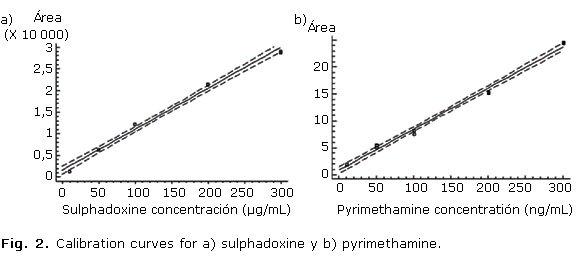
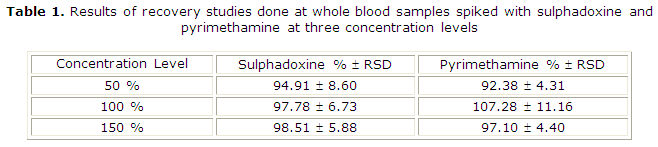
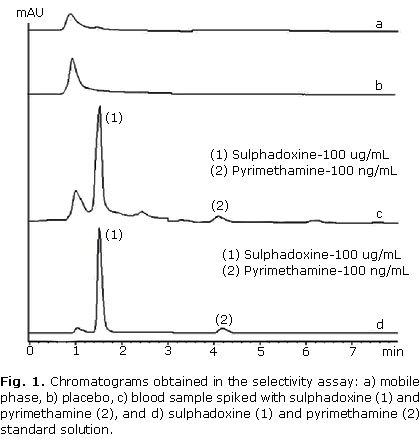
<body><![CDATA[<br>  Robustness</B> </font>     <P><font face="Verdana, Arial, Helvetica, sans-serif" size="2">The  robustness of the method was examined by making small, deliberate changes to conditions  such as pH, mobile phase composition, and flow rate. pH effect was evaluated at  pH selected &#177; 1.0 and standard solutions at 100 <font face="Symbol">m</font>g/mL  and 100 ng/mL of sulphadoxine and pyrimethamine were used. The concentration of  the mobile phase was varied at three levels (&#177; 2 %) and flow rate was varied  at three levels, 0.5, 0.7, and 0.9 mL/min.<SUP>8-15</SUP> </font>     <P><font face="Verdana, Arial, Helvetica, sans-serif" size="2"><B>    <br>  Stability of the analytes solutions</B> </font>     <P><font face="Verdana, Arial, Helvetica, sans-serif" size="2">The  stability of the analytes solutions were determined using sulphadoxine and pyrimethamine  solution (100 <font face="Symbol">m</font>g/mL for sulphadoxine and 100 ng/mL  for pyrimethamine) by keeping at ambient temperature for 48 h and analyzing.<SUP>14,15</SUP></font>      <P>&nbsp;     <P>     <P><font face="Verdana, Arial, Helvetica, sans-serif" size="2"><B><font size="3">RESULTS</font></B>  </font>     <P><font face="Verdana, Arial, Helvetica, sans-serif" size="2">The recovery  was studied at concentrations of 50 % (n= 4), 100 % (n= 7) and 150 % (n= 7) of  the target level in the sample. The results are showed in the <a href="/img/revistas/far/v46n3/t0104312.gif">table  1</a>. <a href="#fig1_04">Figure 1</a> show the obtained chromatogram in assays  done for determining method selectivity. Linearity was demonstrated at concentrations  from 10 to 300 &#181;g/mL for sulphadoxine and 10 to 300 ng/mL for pyrimethamine.  Data from three replicated calibration curves were drawn (<a href="#fig2_04">Fig.  2</a>). The regression equation of sulphadoxine and pyrimethamine were Y= 715.508  + 97.7624 X and Y= 1.01052 + 0.0661872 X, respectively. Results of regression  analysis are showed in the <a href="/img/revistas/far/v46n3/t0204312.gif">table  2</a>.</font>     
<P align="center"><a name="fig1_04"></a><img src="/img/revistas/far/v46n3/f0104312.jpg" width="420" height="447">      
]]></body>
<body><![CDATA[<P align="center"><a name="fig2_04"></a><img src="/img/revistas/far/v46n3/f0204312.jpg" width="580" height="264">      
<P><font face="Verdana, Arial, Helvetica, sans-serif" size="2">    <br> The precision  of the method was examined by performing intra-day by replicated (n= 10) injections  of the mixed standard solution at medium concentration. The results for repeatability  of injection of the solution at medium concentration showed a mean of 81.32 and  97.06 %, a standard deviation of 1.46 and 1.65, and a coefficient of variation  of 1.80 and 1.70 % for sulphadoxine and pyrimetamine, respectively. Individual  confidence intervals (X &#177; ts) were 78.07-84.57 % and 93.38-100.74 %, and  mean confidence intervals (X &#177; ts/&Ouml;n) were 78.07-84.57 % and 95.90-98.22  %, for sulphadoxine and pyrimetamine, respectively, at a 95 % of confidence level  for n-1 degrees of freedom with t<SUB>tables</SUB>= 2.228. </font>     <P><font face="Verdana, Arial, Helvetica, sans-serif" size="2">The  accuracy of the method was confirmed by measurement of recovery by the standard  addition method. Three different quantities (low, medium, and high) of the authentic  standards were added to blood samples. The mixtures were extracted by the method  described previously and analyzed by use of the HPLC. The quantity of each component  was subsequently obtained by use of the corresponding calibration plots and each  set of additions was repeated three times. Results of accuracy test of the method  are showed in the <a href="/img/revistas/far/v46n3/t0304312.gif">table 3</a>.  </font>     
<P><font face="Verdana, Arial, Helvetica, sans-serif" size="2">The values  obtained of LODs were 30.50 ng/mL and 1.39 ng/mL, and LOQs were 45.78 ng/mL and  1.49 ng/mL for sulphadoxine and pyrimethamine, respectively. The ruggedness of  the method was confirmed because variations assessed had little effect on separation  and quantification of the analytes.</font>     <P>&nbsp;     <P>     <P><font face="Verdana, Arial, Helvetica, sans-serif" size="2"><B><font size="3">DISCUSSION</font></B>  </font>     <P><font face="Verdana, Arial, Helvetica, sans-serif" size="2">In recovery  studies, a known amount of analytes was spiked with a determined amount of placebo  and the amount of each analyte recovered in relation to the added amount was calculated.  The selectivity study revealed the absence of interferences (placebo) since none  of the peaks appears at the same retention time of sulphadoxine and pyrimethamine.  Hence it was concluded that the developed method is selective in relation to the  samples used in this study.<SUP>8-15</SUP> </font>     <P><font face="Verdana, Arial, Helvetica, sans-serif" size="2">Linearity  was demonstrated at concentrations from 10 to 300 &#181;g/mL for sulphadoxine  and 10 to 300 ng/mL for pyrimethamine. The correlation coefficients (R<SUP>2</SUP>)  were 0.9957 for sulphadoxine and 0.9974 for pyrimethamine, indicating a high degree  of linearity for both sulphadoxine and pyrimethamine calibration curves. Slope  linearity test showed that t<SUB>exp </SUB>is lower than t<SUB>tables</SUB>, which  indicate the probability that slope be different of zero is elevated for n-2 degrees  of freedom at 95 % confidence interval.<SUP>8-15</SUP> </font>     ]]></body>
<body><![CDATA[<P><font face="Verdana, Arial, Helvetica, sans-serif" size="2">Results  of precision of the method showed all the RSD values for percentage of both analytes  were &lt; 2.0 % (15). Confidence interval individual results indicate that 95  % of analyses are between 78.07 % and 84.57 % for sulphadoxine, and 93.38 % and  100.74 % for pyrimethamine. Means confidence interval indicates than mean concentration  both analytes is with 95 % probability between 78.07 % and 84.57 % for sulphadoxine,  and 95.90 % and 98.22 % for pyrimethamine with n-1 (10-1) degrees of freedom.  This analysis demonstrated the method precision.<SUP>8-15</SUP> </font>     <P><font face="Verdana, Arial, Helvetica, sans-serif" size="2">The  accuracy of the method was confirmed by measurement of recovery by the standard  addition method. Analyzed concentrations were 50, 100, 150 <font face="Symbol">m</font>g/mL  for sulphadoxine and 50, 100, 150 ng/mL for pyrimethamine. C&ouml;chran and t-Student  tests were used for the data analysis. Results of both C&ouml;chran and t-Student  tests demonstrated G<SUB>exp</SUB> and t<SUB>exp</SUB> values were all &lt; G<SUB>tables</SUB>  (0.8709; P= 0.05, K= 3, n= 3) and &lt; t<SUB>tables </SUB>(2.306), respectively.  Recovery of the components ranged from 92.82 to 97.07 %, and the RSD values were  all &lt; 5.0 %; this indicates the method enables highly accurate simultaneous  analysis of the two analytes.<SUP>8-15</SUP> </font>     <P><font face="Verdana, Arial, Helvetica, sans-serif" size="2">The  HPLC method described for the simultaneous determination of sulphadoxine and pyrimethamine  in 100 <font face="Symbol">m</font>L of whole blood spotted on filter paper has  been found to be linear, precise, accurate and selective. Moreover, this method  is simple, fast and sensitive and can be used for the monitoring of pharmacokinetic  and clinical studies. </font>     <P>     <P><font face="Verdana, Arial, Helvetica, sans-serif" size="2"><B>    <br>  AKNOWLEDGMENTS</B> </font>     <P><font face="Verdana, Arial, Helvetica, sans-serif" size="2">Authors  thank at Seccional de Salud de Antioquia and Universidad de Antioquia for supporting  this work.</font>     <P>&nbsp;     <P>     <P><font face="Verdana, Arial, Helvetica, sans-serif" size="3"><B>REFERENCES</B>  </font><font face="Verdana, Arial, Helvetica, sans-serif" size="2"> </font>     ]]></body>
<body><![CDATA[<!-- ref --><P><font face="Verdana, Arial, Helvetica, sans-serif" size="2">1.  Edstein M. Quantification of antimalarial drugs. I. Simultaneous measurement of  sulphadoxine, N4acetylsulphadoxine and pyrimethamine in human plasma. J Chromatogr.  1984;305:502-7.     </font>     <!-- ref --><P><font face="Verdana, Arial, Helvetica, sans-serif" size="2">2.  Bergqvist Y, Eriksson M. Simultaneous determination of pyrimethamine and sulphadoxine  in human plasma by high-performance liquid chromatography. Trans R Soc Trop Med  Hyg. 1985;79:297-301.    </font>     <!-- ref --><P><font face="Verdana, Arial, Helvetica, sans-serif" size="2">3.  Eljaschewitsch J, Padberg J, Schurmann D, Ruf B. High-performance liquid chromatography  determination of pyrimethamine, dapsone, monoacetyldapsone, sulphadoxine and N-acetylsulfadoxine  after rapid solid-phase extraction. Ther Drug Monit. 1996;18:592-7.     </font>     <!-- ref --><P><font face="Verdana, Arial, Helvetica, sans-serif" size="2">4.  Edstein M. Quantification of antimalarial drugs. II. Simultaneous measurement  of dapsone, monoacetyldapsone and pyrimethamine in human plasma. J Chromatogr.  1984;307:426-31.     </font>     <!-- ref --><P><font face="Verdana, Arial, Helvetica, sans-serif" size="2">5.  Edstein MD, Lika ID, Chongsuphajaisiddhi T, Sabchareon A, Webster HK. Quantitation  of Fansimef components (mefloquine + sulfadoxine + pyrimethamine) in human plasma  by two high-performance liquid chromatographic methods. Ther Drug Monit.<I> </I>  1991;13:146-51.     </font>     ]]></body>
<body><![CDATA[<!-- ref --><P><font face="Verdana, Arial, Helvetica, sans-serif" size="2">6.  Astier H, Renard C, Cheminel V, Soares O, Mounier C, Peyron F, et al. Simultaneous  determination of pyrimethamine and sulfadoxine in human plasma by high-performance  liquid chromatography after automated liquid-solid extraction. J Chromatogr B  Biomed Appl. 1997;698(1-2):217-23.     </font>     <!-- ref --><P><font face="Verdana, Arial, Helvetica, sans-serif" size="2">7.  Green MD, Mount DL, Nettey H. High-performance liquid chromatography assay for  the simultaneous determination of sulphadoxine and pyrimetamine from whole blood  dried onto filter paper. J Chromatog B. 2002;767;159-62.     </font>     <!-- ref --><P><font face="Verdana, Arial, Helvetica, sans-serif" size="2">8.  Quattrocchi OA<I>, </I>De Andrizzi SA, Laba RF.<I> </I>Introducci&oacute;n a la  HPLC Aplicaci&oacute;n y Pr&aacute;ctica.<I> </I>Buenos Aires<I>: </I>Artes Gr&aacute;ficas  Farro, SA; 1992. p. 301-28.     </font>     <P>     <!-- ref --><P><font face="Verdana, Arial, Helvetica, sans-serif" size="2">9.  Center for Drugs Evaluation and Research (CDER). Reviewer Guidance. Validation  Chromatographic Methods. 5600 Fishers Lane, Rockville, Maryland 20857. November,  1994. Available from: <U><FONT  COLOR="#0000ff"><a href="http://www.fda.gov/downloads/Drugs/GuidanceComplianceRegulatoryInformation/Guidances/UCM134409.pdf" target="_blank">http://www.fda.gov/downloads/Drugs/GuidanceComplianceRegulatoryInformation/Guidances/UCM134409.pdf</a></FONT></U>  </font>     <P>     <!-- ref --><P><font face="Verdana, Arial, Helvetica, sans-serif" size="2">10.  US Food and Drug Administration. Guidance for industry: Q2B validation of analytical  procedures: methodology. Rockville, MD: Nov, 1996. Available from: <U><FONT  COLOR="#0000ff"><a href="http://www.fda.gov/downloads/Drugs/GuidanceComplianceRegulatoryInformation/Guidances/ucm073384.pdf" target="_blank">http://www.fda.gov/downloads/Drugs/GuidanceComplianceRegulatoryInformation/Guidances/ucm073384.pdf</a></FONT></U>  </font>     <!-- ref --><P><font face="Verdana, Arial, Helvetica, sans-serif" size="2">11. Eurachem.  The Fitness for Purpose of Analytical Methods: A Laboratory Guide to Method Validation  and Related Topics; LGC (Teddington) Ltd.: Middlesex, United Kingdom, 1998. Available  from: <U><FONT  COLOR="#0000ff"><a href="http://www.eurachem.org/guides/pdf/valid.pdf" target="_blank">http://www.eurachem.org/guides/pdf/valid.pdf</a></FONT></U>  </font>     <!-- ref --><P><font face="Verdana, Arial, Helvetica, sans-serif" size="2">12. Swartz  ME, Krull IS. Validation of Chromatographic Methods. Pharmaceutical Technology  Magazine. 1998;104:104-19.     </font>     <P><font face="Verdana, Arial, Helvetica, sans-serif" size="2">13.  Analytical Procedures and Method Validation: Highlights of FDA&#180;s Draft Guidance.  LC-GC [Internet]. 2001 [cited 2011 Aug 30];19(1). Available from: <U><FONT  COLOR="#0000ff"><a href="http://www.fda.gov/cder/guidance/2396dft.htm" target="_blank">http://www.fda.gov/cder/guidance/2396dft.htm</a></FONT></U>  </font>     <!-- ref --><P><font face="Verdana, Arial, Helvetica, sans-serif" size="2">14.&#160;Huber  L. Validation of analytical methods: Review and Strategy. Waldbronn: Hewlett-Packard  GmbH; 1998.     </font>     <!-- ref --><P><font face="Verdana, Arial, Helvetica, sans-serif" size="2">15.  Castro M, Gasc&oacute;n S, Pujol M, Sans JM, Pla LV. Asociaci&oacute;n Espa&ntilde;ola  de Farmac&eacute;uticos de la Industria. Validaci&oacute;n de M&eacute;todos Anal&iacute;ticos.  [Monograf&iacute;a]. Madrid: AEFI; 1989.    </font>     <P>&nbsp;     <P>&nbsp;     ]]></body>
<body><![CDATA[<P>     <P><font face="Verdana, Arial, Helvetica, sans-serif" size="2">Recibido:  3 de mayo de 2012.    <br> </font><font face="Verdana, Arial, Helvetica, sans-serif" size="2">Aprobado:  24 de mayo de 2012.</font>     <P>&nbsp;     <P>&nbsp;     <P>     <P><font face="Verdana, Arial, Helvetica, sans-serif" size="2"><I>Diana  Margarita M&aacute;rquez Fern&aacute;ndez.</I> Facultad de Qu&iacute;mica Farmac&eacute;utica,  Universidad de Antioquia. Calle 57 No. 53-108, Bloque 2, Laboratorio 131. Apartado  A&eacute;reo 1226. Medell&iacute;n, Colombia. Correo electr&oacute;nico: <U><a href="mailto:dmarquez@farmacia.udea.edu.co">dmarquez@farmacia.udea.edu.co</a></U>  </font>       ]]></body><back>
<ref-list>
<ref id="B1">
<label>1</label><nlm-citation citation-type="journal">
<person-group person-group-type="author">
<name>
<surname><![CDATA[Edstein]]></surname>
<given-names><![CDATA[M]]></given-names>
</name>
</person-group>
<article-title xml:lang="en"><![CDATA[Quantification of antimalarial drugs. I. Simultaneous measurement of sulphadoxine, N4acetylsulphadoxine and pyrimethamine in human plasma]]></article-title>
<source><![CDATA[J Chromatogr.]]></source>
<year>1984</year>
<volume>305</volume>
<page-range>502-7</page-range></nlm-citation>
</ref>
<ref id="B2">
<label>2</label><nlm-citation citation-type="journal">
<person-group person-group-type="author">
<name>
<surname><![CDATA[Bergqvist]]></surname>
<given-names><![CDATA[Y]]></given-names>
</name>
<name>
<surname><![CDATA[Eriksson]]></surname>
<given-names><![CDATA[M]]></given-names>
</name>
</person-group>
<article-title xml:lang="en"><![CDATA[Simultaneous determination of pyrimethamine and sulphadoxine in human plasma by high-performance liquid chromatography]]></article-title>
<source><![CDATA[Trans R Soc Trop Med Hyg]]></source>
<year>1985</year>
<volume>79</volume>
<page-range>297-301</page-range></nlm-citation>
</ref>
<ref id="B3">
<label>3</label><nlm-citation citation-type="journal">
<person-group person-group-type="author">
<name>
<surname><![CDATA[Eljaschewitsch]]></surname>
<given-names><![CDATA[J]]></given-names>
</name>
<name>
<surname><![CDATA[Padberg]]></surname>
<given-names><![CDATA[J]]></given-names>
</name>
<name>
<surname><![CDATA[Schurmann]]></surname>
<given-names><![CDATA[D]]></given-names>
</name>
<name>
<surname><![CDATA[Ruf]]></surname>
<given-names><![CDATA[B]]></given-names>
</name>
</person-group>
<article-title xml:lang="en"><![CDATA[High-performance liquid chromatography determination of pyrimethamine, dapsone, monoacetyldapsone, sulphadoxine and N-acetylsulfadoxine after rapid solid-phase extraction]]></article-title>
<source><![CDATA[Ther Drug Monit.]]></source>
<year>1996</year>
<volume>18</volume>
<page-range>592-7</page-range></nlm-citation>
</ref>
<ref id="B4">
<label>4</label><nlm-citation citation-type="journal">
<person-group person-group-type="author">
<name>
<surname><![CDATA[Edstein]]></surname>
<given-names><![CDATA[M]]></given-names>
</name>
</person-group>
<article-title xml:lang="en"><![CDATA[Quantification of antimalarial drugs. II. Simultaneous measurement of dapsone, monoacetyldapsone and pyrimethamine in human plasma]]></article-title>
<source><![CDATA[J Chromatogr.]]></source>
<year>1984</year>
<volume>307</volume>
<page-range>426-31</page-range></nlm-citation>
</ref>
<ref id="B5">
<label>5</label><nlm-citation citation-type="journal">
<person-group person-group-type="author">
<name>
<surname><![CDATA[Edstein]]></surname>
<given-names><![CDATA[MD]]></given-names>
</name>
<name>
<surname><![CDATA[Lika]]></surname>
<given-names><![CDATA[ID]]></given-names>
</name>
<name>
<surname><![CDATA[Chongsuphajaisiddhi]]></surname>
<given-names><![CDATA[T]]></given-names>
</name>
<name>
<surname><![CDATA[Sabchareon]]></surname>
<given-names><![CDATA[A]]></given-names>
</name>
<name>
<surname><![CDATA[Webster]]></surname>
<given-names><![CDATA[HK]]></given-names>
</name>
</person-group>
<article-title xml:lang="en"><![CDATA[Quantitation of Fansimef components (mefloquine + sulfadoxine + pyrimethamine) in human plasma by two high-performance liquid chromatographic methods]]></article-title>
<source><![CDATA[Ther Drug Monit.]]></source>
<year>1991</year>
<volume>13</volume>
<page-range>146-51</page-range></nlm-citation>
</ref>
<ref id="B6">
<label>6</label><nlm-citation citation-type="journal">
<person-group person-group-type="author">
<name>
<surname><![CDATA[Astier]]></surname>
<given-names><![CDATA[H]]></given-names>
</name>
<name>
<surname><![CDATA[Renard]]></surname>
<given-names><![CDATA[C]]></given-names>
</name>
<name>
<surname><![CDATA[Cheminel]]></surname>
<given-names><![CDATA[V]]></given-names>
</name>
<name>
<surname><![CDATA[Soares]]></surname>
<given-names><![CDATA[O]]></given-names>
</name>
<name>
<surname><![CDATA[Mounier]]></surname>
<given-names><![CDATA[C]]></given-names>
</name>
<name>
<surname><![CDATA[Peyron]]></surname>
<given-names><![CDATA[F]]></given-names>
</name>
</person-group>
<article-title xml:lang="en"><![CDATA[Simultaneous determination of pyrimethamine and sulfadoxine in human plasma by high-performance liquid chromatography after automated liquid-solid extraction]]></article-title>
<source><![CDATA[J Chromatogr B Biomed Appl.]]></source>
<year>1997</year>
<volume>698</volume>
<numero>1-2</numero>
<issue>1-2</issue>
<page-range>217-23</page-range></nlm-citation>
</ref>
<ref id="B7">
<label>7</label><nlm-citation citation-type="journal">
<person-group person-group-type="author">
<name>
<surname><![CDATA[Green]]></surname>
<given-names><![CDATA[MD]]></given-names>
</name>
<name>
<surname><![CDATA[Mount]]></surname>
<given-names><![CDATA[DL]]></given-names>
</name>
<name>
<surname><![CDATA[Nettey]]></surname>
<given-names><![CDATA[H]]></given-names>
</name>
</person-group>
<article-title xml:lang="en"><![CDATA[High-performance liquid chromatography assay for the simultaneous determination of sulphadoxine and pyrimetamine from whole blood dried onto filter paper]]></article-title>
<source><![CDATA[J Chromatog B.]]></source>
<year>2002</year>
<volume>767</volume>
<page-range>159-62</page-range></nlm-citation>
</ref>
<ref id="B8">
<label>8</label><nlm-citation citation-type="book">
<person-group person-group-type="author">
<name>
<surname><![CDATA[Quattrocchi]]></surname>
<given-names><![CDATA[OA]]></given-names>
</name>
<name>
<surname><![CDATA[De Andrizzi]]></surname>
<given-names><![CDATA[SA]]></given-names>
</name>
<name>
<surname><![CDATA[Laba]]></surname>
<given-names><![CDATA[RF]]></given-names>
</name>
</person-group>
<source><![CDATA[Introducción a la HPLC Aplicación y Práctica]]></source>
<year>1992</year>
<page-range>301-28</page-range><publisher-loc><![CDATA[Buenos Aires ]]></publisher-loc>
<publisher-name><![CDATA[Artes Gráficas Farro, SA]]></publisher-name>
</nlm-citation>
</ref>
<ref id="B9">
<label>9</label><nlm-citation citation-type="">
<collab>Center for Drugs Evaluation and Research (CDER)</collab>
<source><![CDATA[Reviewer Guidance. Validation Chromatographic Methods]]></source>
<year>Nove</year>
<month>mb</month>
<day>er</day>
<publisher-loc><![CDATA[Rockville ]]></publisher-loc>
</nlm-citation>
</ref>
<ref id="B10">
<label>10</label><nlm-citation citation-type="">
<collab>US Food and Drug Administration</collab>
<source><![CDATA[Guidance for industry: Q2B validation of analytical procedures: methodology]]></source>
<year>Nov,</year>
<month> 1</month>
<day>99</day>
<publisher-loc><![CDATA[Rockville^eMD MD]]></publisher-loc>
</nlm-citation>
</ref>
<ref id="B11">
<label>11</label><nlm-citation citation-type="book">
<collab>Eurachem</collab>
<source><![CDATA[The Fitness for Purpose of Analytical Methods: A Laboratory Guide to Method Validation and Related Topics; LGC (Teddington) Ltd]]></source>
<year>1998</year>
<publisher-name><![CDATA[Middlesex, United Kingdom]]></publisher-name>
</nlm-citation>
</ref>
<ref id="B12">
<label>12</label><nlm-citation citation-type="journal">
<person-group person-group-type="author">
<name>
<surname><![CDATA[Swartz]]></surname>
<given-names><![CDATA[ME]]></given-names>
</name>
<name>
<surname><![CDATA[Krull]]></surname>
<given-names><![CDATA[IS]]></given-names>
</name>
</person-group>
<article-title xml:lang="en"><![CDATA[Validation of Chromatographic Methods]]></article-title>
<source><![CDATA[Pharmaceutical Technology Magazine.]]></source>
<year>1998</year>
<volume>104</volume>
<page-range>104-19</page-range></nlm-citation>
</ref>
<ref id="B13">
<label>13</label><nlm-citation citation-type="journal">
<article-title xml:lang="en"><![CDATA[Analytical Procedures and Method Validation: Highlights of FDA´s Draft Guidance]]></article-title>
<source><![CDATA[LC-GC]]></source>
<year>2001</year>
<volume>19</volume>
<numero>1</numero>
<issue>1</issue>
</nlm-citation>
</ref>
<ref id="B14">
<label>14</label><nlm-citation citation-type="book">
<person-group person-group-type="author">
<name>
<surname><![CDATA[Huber]]></surname>
<given-names><![CDATA[L]]></given-names>
</name>
</person-group>
<source><![CDATA[Validation of analytical methods: Review and Strategy]]></source>
<year>1998</year>
<publisher-loc><![CDATA[Waldbronn ]]></publisher-loc>
<publisher-name><![CDATA[Hewlett-Packard GmbH]]></publisher-name>
</nlm-citation>
</ref>
<ref id="B15">
<label>15</label><nlm-citation citation-type="book">
<person-group person-group-type="author">
<name>
<surname><![CDATA[Castro]]></surname>
<given-names><![CDATA[M]]></given-names>
</name>
<name>
<surname><![CDATA[Gascón]]></surname>
<given-names><![CDATA[S]]></given-names>
</name>
<name>
<surname><![CDATA[Pujol]]></surname>
<given-names><![CDATA[M]]></given-names>
</name>
<name>
<surname><![CDATA[Sans]]></surname>
<given-names><![CDATA[JM]]></given-names>
</name>
<name>
<surname><![CDATA[Pla]]></surname>
<given-names><![CDATA[LV]]></given-names>
</name>
</person-group>
<source><![CDATA[Asociación Española de Farmacéuticos de la Industria. Validación de Métodos Analíticos]]></source>
<year>1989</year>
<publisher-loc><![CDATA[Madrid ]]></publisher-loc>
<publisher-name><![CDATA[AEFI]]></publisher-name>
</nlm-citation>
</ref>
</ref-list>
</back>
</article>