<?xml version="1.0" encoding="ISO-8859-1"?><article xmlns:mml="http://www.w3.org/1998/Math/MathML" xmlns:xlink="http://www.w3.org/1999/xlink" xmlns:xsi="http://www.w3.org/2001/XMLSchema-instance">
<front>
<journal-meta>
<journal-id>0034-7515</journal-id>
<journal-title><![CDATA[Revista Cubana de Farmacia]]></journal-title>
<abbrev-journal-title><![CDATA[Rev Cubana Farm]]></abbrev-journal-title>
<issn>0034-7515</issn>
<publisher>
<publisher-name><![CDATA[Editorial Ciencias Médicas]]></publisher-name>
</publisher>
</journal-meta>
<article-meta>
<article-id>S0034-75152013000100005</article-id>
<title-group>
<article-title xml:lang="en"><![CDATA[A validated RP-HPLC method for the determination of Irinotecan hydrochloride residues for cleaning validation in production area]]></article-title>
<article-title xml:lang="es"><![CDATA[Método RP- HPLC validado para la determinación de residuos de Irinotecan Hidrocloruro para la validación de la limpieza en el área de producción]]></article-title>
</title-group>
<contrib-group>
<contrib contrib-type="author">
<name>
<surname><![CDATA[Reddy]]></surname>
<given-names><![CDATA[Sunil]]></given-names>
</name>
<xref ref-type="aff" rid="A01"/>
</contrib>
<contrib contrib-type="author">
<name>
<surname><![CDATA[Sudhakar Babu]]></surname>
<given-names><![CDATA[K]]></given-names>
</name>
<xref ref-type="aff" rid="A02"/>
</contrib>
<contrib contrib-type="author">
<name>
<surname><![CDATA[Kumar]]></surname>
<given-names><![CDATA[Navneet]]></given-names>
</name>
<xref ref-type="aff" rid="A03"/>
</contrib>
</contrib-group>
<aff id="A01">
<institution><![CDATA[,Laboratories Ltd IPDO ]]></institution>
<addr-line><![CDATA[ ]]></addr-line>
<country>India</country>
</aff>
<aff id="A02">
<institution><![CDATA[,Department of ChemistryS, K. University  ]]></institution>
<addr-line><![CDATA[ ]]></addr-line>
<country>India</country>
</aff>
<aff id="A03">
<institution><![CDATA[,Laboratories Ltd IPDO ]]></institution>
<addr-line><![CDATA[ ]]></addr-line>
<country>India</country>
</aff>
<pub-date pub-type="pub">
<day>00</day>
<month>03</month>
<year>2013</year>
</pub-date>
<pub-date pub-type="epub">
<day>00</day>
<month>03</month>
<year>2013</year>
</pub-date>
<volume>47</volume>
<numero>1</numero>
<fpage>45</fpage>
<lpage>53</lpage>
<copyright-statement/>
<copyright-year/>
<self-uri xlink:href="http://scielo.sld.cu/scielo.php?script=sci_arttext&amp;pid=S0034-75152013000100005&amp;lng=en&amp;nrm=iso"></self-uri><self-uri xlink:href="http://scielo.sld.cu/scielo.php?script=sci_abstract&amp;pid=S0034-75152013000100005&amp;lng=en&amp;nrm=iso"></self-uri><self-uri xlink:href="http://scielo.sld.cu/scielo.php?script=sci_pdf&amp;pid=S0034-75152013000100005&amp;lng=en&amp;nrm=iso"></self-uri><abstract abstract-type="short" xml:lang="en"><p><![CDATA[Introduction: cleaning validation is an integral part of current good manufacturing practices in pharmaceutical industry. The main purpose of cleaning validation is to prove the effectiveness and consistency of cleaning in a given pharmaceutical production equipment to prevent cross contamination and adulteration of drug product with other active ingredient. Objective: a rapid, sensitive and specific reverse phase HPLC method was developed and validated for the quantitative determination of irinotecan hydrochloride in cleaning validation swab samples. Method: the method was validated using waters symmetry shield RP-18 (250mm x 4.6mm) 5 µm column with isocratic mobile phase containing a mixture of 0.02 M potassium di-hydrogen ortho-phosphate, pH adjusted to 3.5 with ortho-phosphoric acid, methanol and acetonitrile (60:20:20 v/v/v). The flow rate of mobile phase was 1.0 mL/min with column temperature of 25°C and detection wavelength at 220nm. The sample injection volume was 100 µl. Results: the calibration curve was linear over a concentration range from 0.024 to 0.143 µg/mL with a correlation coefficient of 0.997. The intra-day and inter-day precision expressed as relative standard deviation were below 3.2%. The recoveries obtained from stainless steel, PCGI, epoxy, glass and decron cloth surfaces were more than 85% and there was no interference from the cotton swab. The detection limit (DL) and quantitation limit (QL) were 0.008 and 0.023 µg ml-1, respectively. Conclusion: the developed method was validated with respect to specificity, linearity, limit of detection and quantification, accuracy, precision and solution stability. The overall procedure can be used as part of a cleaning validation program in pharmaceutical manufacture of irinotecan hydrochloride.]]></p></abstract>
<abstract abstract-type="short" xml:lang="es"><p><![CDATA[Introducción: la validación de la limpieza forma parte integral de las buenas prácticas de manufacturas actuales en la industria farmacéutica. El objetivo principal de la validación de la limpieza consiste en probar la efectividad y la consistencia de la limpieza en un equipo de producción farmacéutica dado para prevenir la contaminación cruzada y la adulteración del producto farmacéutico con otro ingrediente activo. Objetivo: se desarrollo y validó un método rápido, sensible y específico de fase de reversión HPLC para la determinación cuantitativa del Irinotecan Hidrocloruro en la limpieza de las muestras de frotis de validación. Método: el método fue validado usando una Columna RP-18 (250mm x 4.6mm) en una columna de 5 µm con una fase móvil isocrática que contenía una mezcla de 0,02 M de potasio dihidrógeno ortofosfato, un PH ajustado a 3.5 con ácido ortofosfórico, metanol y acetonitrilo (60:20:20 v/v/v). La velocidad del flujo de la fase móvil fue de 1.0 mL/min con una columna de temperatura de 25 o C y una detección de longitud de onda de 220 nm. El volumen de inyección de la muestra fue de 100 µl. Resultados: la curva de calibración fue lineal con una gama de concentración de 0.024 a 0.143 µg/mL y con un coeficiente de correlación de 0.997. La precisión intra y entre días expresada como derivación estándar relativa estuvo por debajo del 3.2 %. Las recuperaciones obtenidas del acero inoxidable, el PCGI, el epoxi el vidrio y de las superficies de tela de Dacrón representaron más del 85 % y no hubo interferencia con los palillos de algodón. Los límites de detección (LD) y de cuantificación (LC) fueron de 0.008 y 0.023 µg ml-1, respectivamente. Conclusiones: el método desarrollado se validó con relación a la especificidad, linealidad, límite de detección y cuantificación, exactitud y precisión y estabilidad de la solución. El procedimiento general se puede utilizar como parte de un programa de validación de limpieza en la producción farmacéutica del Irinotecan Hidrocloruro.]]></p></abstract>
<kwd-group>
<kwd lng="en"><![CDATA[Cleaning validation]]></kwd>
<kwd lng="en"><![CDATA[Irinotecan]]></kwd>
<kwd lng="en"><![CDATA[HPLC-UV]]></kwd>
<kwd lng="en"><![CDATA[Residues]]></kwd>
<kwd lng="en"><![CDATA[Swab analysis]]></kwd>
<kwd lng="es"><![CDATA[validación de la limpieza]]></kwd>
<kwd lng="es"><![CDATA[Irinotecan]]></kwd>
<kwd lng="es"><![CDATA[RP-HPLC]]></kwd>
<kwd lng="es"><![CDATA[residuos]]></kwd>
<kwd lng="es"><![CDATA[análisis por frotis]]></kwd>
</kwd-group>
</article-meta>
</front><body><![CDATA[ <P align="right">     <p align="right"><b><font face="Verdana, Arial, Helvetica, sans-serif" size="2">ART&Iacute;CULOS  ORIGINALES</font></b></p>    <p align="right">&nbsp;</p>    <p align="left"><font face="Verdana, Arial, Helvetica, sans-serif" size="2"><B><font size="4">A  validated RP-HPLC method for the determination of Irinotecan hydrochloride residues  for cleaning validation in production area</font></B></font></p>    <p>&nbsp;</p>    <p><font face="Verdana, Arial, Helvetica, sans-serif" size="3"><b>M&eacute;todo  RP- HPLC validado para la determinaci&oacute;n de residuos de Irinotecan Hidrocloruro  para la validaci&oacute;n de la limpieza en el &aacute;rea de producci&oacute;n</b></font></p>    <p>&nbsp;</p>    <p><font face="Verdana, Arial, Helvetica, sans-serif" size="2"><b>P.  Sunil Reddy<SUP>I</SUP>, K. Sudhakar Babu<SUP>II</SUP>, Navneet Kumar<SUP>III</SUP>  </b></font></p><B></B>     <P><font face="Verdana, Arial, Helvetica, sans-serif" size="2"><SUP>I</SUP>  Master of Science in Chemistry, Dr. Reddy's Laboratories Ltd., IPDO, Bachupally,  Hyderabad-500072, A.P, India.    <br> </font><font face="Verdana, Arial, Helvetica, sans-serif" size="2"><SUP>II  </SUP>Doctor of Philosophy in Chemistry, Department of Chemistry, S. K. University,  Anantapur-515055, A.P., India.    ]]></body>
<body><![CDATA[<br> </font><font face="Verdana, Arial, Helvetica, sans-serif" size="2"><SUP>III</SUP>  Master of Science in Pharmaceutical Chemistry, Dr. Reddy's Laboratories Ltd.,  IPDO, Bachupally, Hyderabad-500072, A.P, India. </font>     <P>&nbsp;     <P>&nbsp; <hr size="1" noshade>      <P><font face="Verdana, Arial, Helvetica, sans-serif" size="2"><B>ABSTRACT </B></font>      <P><font face="Verdana, Arial, Helvetica, sans-serif" size="2"><B>Introduction:</b>  cleaning validation is an integral part of current good manufacturing practices  in pharmaceutical industry. The main purpose of cleaning validation is to prove  the effectiveness and consistency of cleaning in a given pharmaceutical production  equipment to prevent cross contamination and adulteration of drug product with  other active ingredient.    <br> <B>Objective: </B>a rapid, sensitive and specific  reverse phase HPLC method was developed and validated for the quantitative determination  of irinotecan hydrochloride in cleaning validation swab samples.    <br> <B>Method:</B>  the method was validated using waters symmetry shield RP-18 (250mm x 4.6mm) 5  &#181;m column with isocratic mobile phase containing a mixture of 0.02 M potassium  di-hydrogen ortho-phosphate, pH adjusted to 3.5 with ortho-phosphoric acid, methanol  and acetonitrile (60:20:20 v/v/v). The flow rate of mobile phase was 1.0 mL/min  with column temperature of 25&#176;C and detection wavelength at 220nm. The sample  injection volume was 100 &#181;l.    <br> <B>Results:</B> the calibration curve was  linear over a concentration range from 0.024 to 0.143 &#181;g/mL with a correlation  coefficient of 0.997. The intra-day and inter-day precision expressed as relative  standard deviation were below 3.2%. The recoveries obtained from stainless steel,  PCGI, epoxy, glass and decron cloth surfaces were more than 85% and there was  no interference from the cotton swab. The detection limit (DL) and quantitation  limit (QL) were 0.008 and 0.023 &#181;g ml<SUP>-1</SUP>, respectively.    <br> <B>Conclusion:</B>  the developed method was validated with respect to specificity, linearity, limit  of detection and quantification, accuracy, precision and solution stability. The  overall procedure can be used as part of a cleaning validation program in pharmaceutical  manufacture of irinotecan hydrochloride. </font>     <P><font face="Verdana, Arial, Helvetica, sans-serif" size="2"><B>Keywords<I>:</I></B>  cleaning validation, Irinotecan, HPLC-UV, residues, swab analysis.</font> <hr size="1" noshade>      ]]></body>
<body><![CDATA[<p><FONT FACE="Verdana, Arial, Helvetica, sans-serif" SIZE="2"><B>RESUMEN</B></FONT></p>    <P><FONT FACE="Verdana, Arial, Helvetica, sans-serif" SIZE="2"><B>Introducci&oacute;n:</B>  la validaci&oacute;n de la limpieza forma parte integral de las buenas pr&aacute;cticas  de manufacturas actuales en la industria farmac&eacute;utica. El objetivo principal  de la validaci&oacute;n de la limpieza consiste en probar la efectividad y la  consistencia de la limpieza en un equipo de producci&oacute;n farmac&eacute;utica  dado para prevenir la contaminaci&oacute;n cruzada y la adulteraci&oacute;n del  producto farmac&eacute;utico con otro ingrediente activo.     <BR> <B>Objetivo:</B>  se desarrollo y valid&oacute; un m&eacute;todo r&aacute;pido, sensible y espec&iacute;fico  de fase de reversi&oacute;n HPLC para la determinaci&oacute;n cuantitativa del  Irinotecan Hidrocloruro en la limpieza de las muestras de frotis de validaci&oacute;n.    <BR>  <B>M&eacute;todo:</B> el m&eacute;todo fue validado usando una Columna RP-18 (250mm  x 4.6mm) en una columna de 5 &micro;m con una fase m&oacute;vil isocr&aacute;tica  que conten&iacute;a una mezcla de 0,02 M de potasio dihidr&oacute;geno ortofosfato,  un PH ajustado a 3.5 con &aacute;cido ortofosf&oacute;rico, metanol y acetonitrilo  (60:20:20 v/v/v). La velocidad del flujo de la fase m&oacute;vil fue de 1.0 mL/min  con una columna de temperatura de 25 o C y una detecci&oacute;n de longitud de  onda de 220 nm. El volumen de inyecci&oacute;n de la muestra fue de 100 &micro;l.    <BR>  <B>Resultados: </B>la curva de calibraci&oacute;n fue lineal con una gama de concentraci&oacute;n  de 0.024 a 0.143 &micro;g/mL y con un coeficiente de correlaci&oacute;n de 0.997.  La precisi&oacute;n intra y entre d&iacute;as expresada como derivaci&oacute;n  est&aacute;ndar relativa estuvo por debajo del 3.2 %. Las recuperaciones obtenidas  del acero inoxidable, el PCGI, el epoxi el vidrio y de las superficies de tela  de Dacr&oacute;n representaron m&aacute;s del 85 % y no hubo interferencia con  los palillos de algod&oacute;n. Los l&iacute;mites de detecci&oacute;n (LD) y  de cuantificaci&oacute;n (LC) fueron de 0.008 y 0.023 &micro;g ml-1, respectivamente.    <BR>  </FONT><FONT FACE="Verdana, Arial, Helvetica, sans-serif" SIZE="2"><B>Conclusiones:</B>  el m&eacute;todo desarrollado se valid&oacute; con relaci&oacute;n a la especificidad,  linealidad, l&iacute;mite de detecci&oacute;n y cuantificaci&oacute;n, exactitud  y precisi&oacute;n y estabilidad de la soluci&oacute;n. El procedimiento general  se puede utilizar como parte de un programa de validaci&oacute;n de limpieza en  la producci&oacute;n farmac&eacute;utica del Irinotecan Hidrocloruro. </FONT></P>    <P><FONT FACE="Verdana, Arial, Helvetica, sans-serif" SIZE="2"><B>Palabras  clave:</B> validaci&oacute;n de la limpieza, irinotecan, RP-HPLC, residuos, an&aacute;lisis  por frotis. </FONT>    <BR> </P><HR SIZE="1" noshade>    <p>&nbsp;</p>    <p><font face="Verdana, Arial, Helvetica, sans-serif" size="3"><b>INTRODUCTION</b></font></p><B></B>      ]]></body>
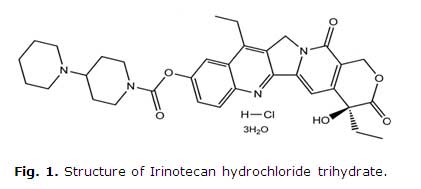
<body><![CDATA[<P><font face="Verdana, Arial, Helvetica, sans-serif" size="2">Pharmaceutical  manufacturing equipment and area has to be cleaned after production in order to  avoid cross contamination in the next batch of a different product. The effectiveness  of the cleaning process has to be confirmed by cleaning validation, which involves  sampling and testing for acceptable residue on the pharmaceutical manufacturing  equipment and production &aacute;rea.<SUP>1</SUP> </font>     <P><font face="Verdana, Arial, Helvetica, sans-serif" size="2">According  to FDA guideline, there are two general types of sampling that have been found  acceptable: The most desirable direct sampling from the surface of the equipment  by using swab and the use of rinse solution.<SUP>2</SUP> Challeneges for cleaning  validation are encountered especially when developing an adequate sampling procedure  and sensitive analytical methods capable of detecting traces of active pharmaceutical  ingredients, which are likely to remain on the surface of the pharmaceutical equipment  after cleaning. HPLC coupled with UV detection is widely used to monitor the efficiency  of the cleaning methods due to its high sevsititive, selective and automation  characterstics. </font>     <P><font face="Verdana, Arial, Helvetica, sans-serif" size="2">The  aim of this study was to validate simple RP-HPLC method for the quantitative determination  of irinotecan hydrochloride residues in production area equipments and to confirm  the efficiency of cleaning procedure. </font>     <P><font face="Verdana, Arial, Helvetica, sans-serif" size="2">Irinotecan  hydrochloride [(S)-4,11-diethyl-3,4,12,14-tetrahydro-4-hydroxy-3,14 -dioxo1Hpyrano[3',4':6,7]-indolizino[1,2-b]quinolin-9-yl-[1,4'bipiperidine]-1'-carboxylate,  monohydrochloride, trihydrate] (<a href="#f1">Fig. 1</a>), a semisynthetic water-soluble  derivative of camptothecin, an alkaloid isolated from <I>Camptotheca acuminate,</I><SUP>3</SUP>  has unique antitumor activity, preventing DNA synthesis by inhibiting topoisomerase  I.<SUP>4</SUP> </font>     <P align="center"><img src="/img/revistas/far/v47n1/f0105113.jpg" width="421" height="189"><a name="f1"></a>      
<P><font face="Verdana, Arial, Helvetica, sans-serif" size="2">Some LC methods  have been published for determination of irinotecan in pharmaceutical preparation  <SUP>5,6,7</SUP> and human plasma.<SUP>8,9</SUP> Reported LC methods are not enough  sensitive to quantitate trace level residues of irinotecan hydrochloride. A literature  survey revealed that no validated cleaning method for irinotecan hydrochloride  is to be found. Hence, we have developed a RP-HPLC method for the estimation of  trace level residue of irinotecan hydrochloride on swab and rinse solution collected  from manufacturing surfaces and production area after cleaning of the equipments.  The developed analytical method was validated with respect to specificity, linearity,  precision, accuracy, limit of detection (LOD) and quantification (LOQ). These  studies were performed in accordance with established ICH guidelines. </font>      <P>&nbsp;     <P><font face="Verdana, Arial, Helvetica, sans-serif" size="2"><B><font size="3">METHODS  </font></B></font> <B>     <P><font face="Verdana, Arial, Helvetica, sans-serif" size="2"><I>    <br>  Chemicals and reagents</I></font> </B>     ]]></body>
<body><![CDATA[<P><font face="Verdana, Arial, Helvetica, sans-serif" size="2">The  certified irinotecan hydrochloride trihydrate, working standard was supplied by  Dr. Reddy's laboratories limited, Hyderabad, India. The HPLC grade acetonitrile  and methanol, analytical grade KH<SUB>2</SUB>PO<SUB>4</SUB> and ortho-phosphoric  acid were purchased from Merck, Mumbai, India. Swabs for sampling were purchased  from ITW Texwipe (Philippines). </font>     <P><font face="Verdana, Arial, Helvetica, sans-serif" size="2"><B><I>Equipment  </I></B> </font>     <P><font face="Verdana, Arial, Helvetica, sans-serif" size="2">The  chromatography analysis was performed using Waters Alliance 2695 separation module  (Waters Corporation, Milford, USA) equipped with 2489 UV/visible detector, degasser,  quaternary pump and auto sampler system. The output signals were monitored and  processed using Empower 2 software. The pH of the solutions was measured by a  pH meter (Mettler-Toledo, Switzerland). </font>     <P><font face="Verdana, Arial, Helvetica, sans-serif" size="2"><B><I>Chromatographic  Conditions</I></B> </font>     <P><font face="Verdana, Arial, Helvetica, sans-serif" size="2">The  method was developed using Waters Symmetry Shield RP-18 (250 mm x 4.6 mm), 5&#181;m  particle size column with isocratic mobile phase containing a mixture of 0.02  M potassium di-hydrogen ortho-phosphate, pH adjusted to 3.5 with ortho-phosphoric  acid, methanol and acetonitrile (60:20:20 v/v/v). The flow rate of the mobile  phase was set at 1.0 mL/min. The column temperature was maintained at 25&#176;  C and the eluted compound was monitored at the wavelength of 220 nm. The sample  injection volume was 100 &#181;l. </font>     <P><font face="Verdana, Arial, Helvetica, sans-serif" size="2"><B><I>Standard  solution preparation</I></B> </font>     <P><font face="Verdana, Arial, Helvetica, sans-serif" size="2">Diluent  was prepared by mixing milli-Q water and methanol in the ratio of 20:80 v/v, respectively.  An appropriate amount of irinotecan hydrochloride trihydrate was dissolved in  diluent to get a stock solution containing 1 mg/mL drug. The final concentration  of solution was 0.048 &#181;g/mL of irinotecan hydrochloride trihydrate. </font>      <P><font face="Verdana, Arial, Helvetica, sans-serif" size="2"><B><I>Sample preparation</I></B>  </font>     <P><font face="Verdana, Arial, Helvetica, sans-serif" size="2">The selected  surfaces (25 cm x 25 cm) of stainless steel, glass, PGCI, epoxy and decron cloth,  previously cleaned and dried, were sprayed with 1000 &#181;L of standard solution,  for the positive swab control at all concentration level and the solvent was allowed  to evaporate. Except decron cloth, all surfaces were wiped with wet cotton swab  soaked with extraction solution (water-methanol 20:80, v/v) to remove the residue  from the surface. The swabs were placed in the 25 mL screw-cap test tubes containing  10 mL extraction solution. The tubes were placed in an ultrasonic bath for 15  minutes and the solutions were analysed by HPLC. </font>     <P><font face="Verdana, Arial, Helvetica, sans-serif" size="2">Rinse-sampling  was performed with extraction solvent for decron cloth. The volume of the rinsing  liquid for sampling point was 10 mL for 625 cm<SUP>2</SUP> surface. </font>     ]]></body>
<body><![CDATA[<P>      <P><font face="Verdana, Arial, Helvetica, sans-serif" size="2"><B>Validation of  proposed method</B> </font>     <P><font face="Verdana, Arial, Helvetica, sans-serif" size="2">The  method validation was performed in accordance with ICH guidelines.<SUP>14</SUP>  The following validation characteristics were addressed: specificity, accuracy,  precision, limit of detection and quantification, linearity, range and solution  stability. </font>     <P><font face="Verdana, Arial, Helvetica, sans-serif" size="2"><B><I>Specificity</I></B>  </font>     <P><font face="Verdana, Arial, Helvetica, sans-serif" size="2">To prove  that the determination of active residue is selective and free from anyy disturbing  effects, reference solution, blank and spiked solution sampled from stainless  stell, glass, PCGI, epoxy and decron cloth surfaces and placebo solution were  injected. </font>     <P><font face="Verdana, Arial, Helvetica, sans-serif" size="2"><B><I>Linearity  </I></B> </font>     <P><font face="Verdana, Arial, Helvetica, sans-serif" size="2">Linearity  of the method was established by analyzing standard solutions at ten different  concentration levels i.e. 0.024, 0.036, 0.048, 0.060, 0.072, 0.096, 0.108, 0.119,  0.131 and 0.143 &#181;g/mL. </font>     <P><font face="Verdana, Arial, Helvetica, sans-serif" size="2"><B><I>Limits  of Detection (LOD) and Quantification (LOQ)</I></B> </font>     <P><font face="Verdana, Arial, Helvetica, sans-serif" size="2">The  LOD and LOQ were determined based on signal-to-noise ratio of 3:1 and 10:1, respectively,  by injecting a series of dilute solutions of analyte with known concentrations.  </font>     <P><font face="Verdana, Arial, Helvetica, sans-serif" size="2"><B><I>Precision  </I></B> </font>     ]]></body>
<body><![CDATA[<P><font face="Verdana, Arial, Helvetica, sans-serif" size="2">The  precision of the method was evaluated by repeatability and intermediate precision.  The repeatability was determined by analyzing six replicated of extraction-recovery  samples and expressed in terms of % RSD. The intermediate precision of the method  was evaluated using different analyst and different instrument in the same laboratory.  </font>     <P>     <P><font face="Verdana, Arial, Helvetica, sans-serif" size="2"><B><I>Accuracy</I></B>  </font>     <P><font face="Verdana, Arial, Helvetica, sans-serif" size="2">The accuracy  of the method was determined in triplicate by spiking all surfaces with known  amount irinotecan hydrochloride. The accuracy of the method was checked at three  concentration levels, i.e. at 50 %, 100 % and 150 % level. Accuracy is expressed  as percentage of standard recovered from sample matrix. </font>     <P><font face="Verdana, Arial, Helvetica, sans-serif" size="2"><B><I>Stability  of analytical solutions </I></B> </font>     <P><font face="Verdana, Arial, Helvetica, sans-serif" size="2">The  stability of the irinotecan hydrochloride in the swab matrix and standard solution,  were tested. The spiked samples and standard solution were stored at bench top  and analyzed against freshly prepared standard solution at 24 hrs interval. </font>      <P>&nbsp;     <P><font face="Verdana, Arial, Helvetica, sans-serif" size="3"><b>RESULTS</b></font>  <B>     <P><font face="Verdana, Arial, Helvetica, sans-serif" size="2"><I>    <br> Specificity</I></font>  </B>     ]]></body>
<body><![CDATA[<P><font face="Verdana, Arial, Helvetica, sans-serif" size="2">The <a href="/img/revistas/far/v47n1/f0205113.jpg">figure  2 </a>shows the results of the specificity of the method. As observed in the chromatograms,  no sources of interference were observed at the retention time of the analyte.</font>      
<P>&nbsp;     <P><font face="Verdana, Arial, Helvetica, sans-serif" size="2"><B><I>Linearity  </I></B> </font>     <P><font face="Verdana, Arial, Helvetica, sans-serif" size="2">The  correlation coefficient was found to be 0.998, demonstrated the excellent relationship  between peak area and the concentration of irinotecn hydrochloride. </font>     <P><font face="Verdana, Arial, Helvetica, sans-serif" size="2"><B><I>Limits  of Detection (LOD) and Quantification (LOQ)</I></B> </font>     <P><font face="Verdana, Arial, Helvetica, sans-serif" size="2">The  LOD and LOQ for irinotecan hydrochloride were found to be 0.008 and 0.023 &#181;g/mL,  respectively. At LOQ level, RSD of the irinotecan area from six replicate injections  of standard solution was found to be 5.8 %. </font>     <P><font face="Verdana, Arial, Helvetica, sans-serif" size="2"><B><I>Precision  </I></B> </font>     <P><font face="Verdana, Arial, Helvetica, sans-serif" size="2">The  results of the precision of the method are reported in <a href="/img/revistas/far/v47n1/t0105113.gif">table  1</a>. In the repeatability and intermediate precision study coefficient of variation  was less than 8.1 % and 8.7 %, respectively. </font>     
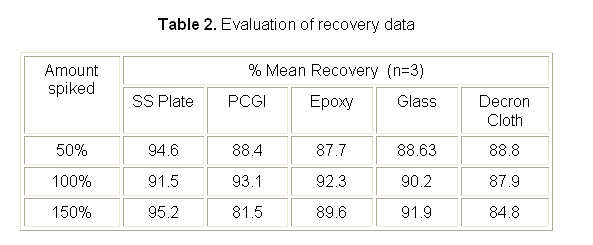
<P><font face="Verdana, Arial, Helvetica, sans-serif" size="2"><B><I>Accuracy</I></B>  </font>     <P><font face="Verdana, Arial, Helvetica, sans-serif" size="2"><a href="/img/revistas/far/v47n1/t0205113.gif">Table  2 </a>shows the results of the accuracy study of the method. The average recovery  was between 84.8 to 95.2 % on all surfaces. </font>     
]]></body>
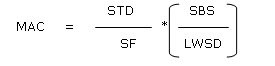
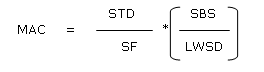
<body><![CDATA[<P><font face="Verdana, Arial, Helvetica, sans-serif" size="2"><B><I>Stability  of analytical solutions </I></B> </font>     <P><font face="Verdana, Arial, Helvetica, sans-serif" size="2">The  variability in the estimation of irinotecan hydrochloride was within <U>+</U>  10 % during solution stability. The results from solution stability experiments  confirmed that sample solution and standard solutions were stable up to 48 hrs.  </font>     <P>&nbsp;     <P><font face="Verdana, Arial, Helvetica, sans-serif" size="2"><B><font size="3">DISCUSSION</font></B></font>    <br>      <br> <B> </B> <B>     <P><font face="Verdana, Arial, Helvetica, sans-serif" size="2">Establishing  cleaning limits</font> </B>     <P><font face="Verdana, Arial, Helvetica, sans-serif" size="2">The  acceptable limit for the drug residue must ensure the absence of cross contamination  for subsequent batches manufactured in affected equipment [10]. FDA's guidance  for determining residue limits requires a logical, practical, achievable and verifiable  determination practice.<SUP>2</SUP> </font>     <P><font face="Verdana, Arial, Helvetica, sans-serif" size="2">The  basic principle of cleaning verification/ validation is that the patient should  not take more than 0.1 % of the standard therapeutic dose (effective dose). The  calculation formula is based on the dosage criteria.<SUP>11,12</SUP> </font>     <P><font face="Verdana, Arial, Helvetica, sans-serif" size="2">  </font><img src="/img/revistas/far/v47n1/f105113.gif" width="275" height="66">      
]]></body>
<body><![CDATA[<P><font face="Verdana, Arial, Helvetica, sans-serif" size="2">MAC is the maximum  allowable carryover, STD is the minimal daily dose (active weight) of previous  product, SF is a safety factor (10000), SBS is the smallest batch size of the  subsequent product and LWDS is the maximum daily dose (product weight) of the  following product. </font>     <P><font face="Verdana, Arial, Helvetica, sans-serif" size="2">An  additional criterion is the 10 ppm (part per million) limit.<SUP>13</SUP> According  to this criterion not more than 10 ppm of the previously manufactured product  is allowed to appear in the subsequent product. If the value, which is obtained  from the calculation based on the dosage criterion, is greater than 10 ppm, then  the 10 ppm criterion is applicable. The acceptable limit for residues (LA) is  expressed in &#181;g/dm<SUP>2</SUP>. </font>     <P><font face="Verdana, Arial, Helvetica, sans-serif" size="2"><img src="/img/revistas/far/v47n1/form0105113.gif" width="264" height="72"></font>      
<P><font face="Verdana, Arial, Helvetica, sans-serif" size="2">LA is the acceptance  limit, A is the sampling area, R is the recovery of the sampling method and TA  is the total production line area. On the basis of aforementioned discussion the  acceptance limit for the residue of irinotecan hydrochloride is 0.05 ppm. </font>      <P>     <P><font face="Verdana, Arial, Helvetica, sans-serif" size="2">No sources  of interference were observed at the retention time of the irinotecan hydrochloride  (<a href="#f1">Fig. 1</a>), which proved that the method is specific for the quantification  of analyte. </font>     <P><font face="Verdana, Arial, Helvetica, sans-serif" size="2">To  establish linearity, the peak area versus concentration data was treated by linear  regression analysis. The correlation coefficient was found &gt; 0.997, demonstrated  that the method is linear over the stated range. </font>     <P><font face="Verdana, Arial, Helvetica, sans-serif" size="2">The  LOD and LOQ for irinotecan hydrochloride were found to be 0.008 and 0.023 &#181;g/mL,  respectively. RSD of the area at precision at LOQ level was found to be 5.8 %.  Lower values of LOD and LOQ demonstrated that the method is enough sensitive to  quantify trace level amount of irinotecan hydrochloride. </font>     <P><font face="Verdana, Arial, Helvetica, sans-serif" size="2">The  results from precision (<a href="/img/revistas/far/v47n1/t0105113.gif">table  1</a>) and accuracy (<a href="/img/revistas/far/v47n1/t0205113.gif">table  2</a>) study confirmed that the method is adequately precise and accurate for  the quantification of irinotecan hydrochloride residue on production area equipments.  </font>     
<P><font face="Verdana, Arial, Helvetica, sans-serif" size="2">The sample  solution and standard solutions were stable up to 48 hrs. During the stability  studies no additional peaks developed and no change in the chromatography of the  stored samples and standard were found.</font>     ]]></body>
<body><![CDATA[<P>&nbsp;     <P><font face="Verdana, Arial, Helvetica, sans-serif" size="3"><b>CONCLUSIONS  </b></font>     <P><font face="Verdana, Arial, Helvetica, sans-serif" size="2">The  proposed method for quantitative determination of irinotecan hydrochloride residue  on production area equipments is efficient and sensitive. Validation studies showed  that the HPLC-UV method is selective, linear, precise, accurate and robust. The  recoveries obtained from stainless steel, PCGI, epoxy, glass and decron cloth  surfaces were more than 85 % and there was no interference from the cotton swab.  The overall procedure can be used as part of a cleaning validation program in  pharmaceutical manufacture of irinotecan hydrochloride. </font>     <P> <B>     <P><font face="Verdana, Arial, Helvetica, sans-serif" size="2">  <font size="3">Acknowledgement</font></font> </B>     <P><font face="Verdana, Arial, Helvetica, sans-serif" size="2">The  authors are thankful to the management of Dr. Reddy's Laboratories Ltd., Hyderabad  for providing facilities to carry out this work. </font>     <P>&nbsp;     <P><font face="Verdana, Arial, Helvetica, sans-serif" size="3"><b>REFERENCES</b></font>      <P><font face="Verdana, Arial, Helvetica, sans-serif" size="2">1. PDA Technical  Report No. 29, Points to consider for cleaning validation, PDA J. Pharm. Sci.  Technol. 52 (1998)1-29. </font>     <!-- ref --><P><font face="Verdana, Arial, Helvetica, sans-serif" size="2">2.  Guide to inspections validation of cleaning processes, U.S. Food and Drug Administration,  Office of Regulatory Affairs, Washington, DC, 1993, pp. 1-6.     </font>     <P><font face="Verdana, Arial, Helvetica, sans-serif" size="2">3.  RxList. The Internet Drug Index. Camptosar Injection. [cited 2012 Jan 31]. Available  from: <U><FONT COLOR="#0000ff"><a href="http://www.rxlist.com/camptosar_inj-drug.htm" target="_blank">http://www.rxlist.com/camptosar_inj-drug.htm</a></FONT></U>  </font>     <!-- ref --><P><font face="Verdana, Arial, Helvetica, sans-serif" size="2">4. Kawato  Y, Aonuma M, Hirota Y, Kuga H, Sato K. Intracellular role of SN-38, a metabolite  of the camptothecin derivative CPT-11, in the antitumor effect of CPT-11, Cancer  Res., 1991; 51: 4187-4191.     </font>     <!-- ref --><P><font face="Verdana, Arial, Helvetica, sans-serif" size="2">5.  Kumar VK, Raju NA, Rani N, Rao JVLNS, Satyanarayana T. The estimation of irinotecan  HCl in parenterals by RP-HPLC, Asian J. Research Chem. 2009; 2: 54-56.     </font>      <!-- ref --><P><font face="Verdana, Arial, Helvetica, sans-serif" size="2">6. Balaram VM,  Rao JV, Ramakrishna S, Ganesh GS, Krishna TB. Validated reverse phase HPLC method  for the determination of Irinotecan in pharmaceutical dosage forms, E-J Chem.,  2007; 4: 128-136.     </font>     <!-- ref --><P><font face="Verdana, Arial, Helvetica, sans-serif" size="2">7.  Mohammadi A, Esmaeili F, Dinarvand R, Atyabi F, Walker RB. Simultaneous determination  of irinotecan hydrochloride and its related compounds by high performance liquid  chromatography using ultraviolet detection, Asian J. Chem. 2010; 22: 3966-3972.      </font>     ]]></body>
<body><![CDATA[<!-- ref --><P><font face="Verdana, Arial, Helvetica, sans-serif" size="2">8. Doods  HM, Robert J, Rivory LP. The detection of photo degradation products of irrinotecn  (CPT-11, Campto<SUP>&#174;</SUP>, Camptosar<SUP>&#174;</SUP>), in clinical studies,  using high-performance liquid chromatography/atmospheric pressure chemical ionisation/mass  spectroscopy, J. Pharm. Biomed. Anal. 1998; 17: 785-792.     </font>     <!-- ref --><P><font face="Verdana, Arial, Helvetica, sans-serif" size="2">9.  Khan S, Ahmed A, Guo W, Wang YF, Abu-Ware A, Ahmad I. A simple and sensitive LC/MS/MS  assay for 7-ethyl-10-hydroxycamptothecin (SN-38) in mouse plasma and tissues:  application to pharmacokinetic study of liposome entrapped SN-38 (LE0SN38), J.  Pharm. Biomed. Anal. 2005; 37: 135-142.     </font>     <!-- ref --><P><font face="Verdana, Arial, Helvetica, sans-serif" size="2">10.  Forsyth RJ, Haynes DV, Cleaning validation in pharmaceutical research facility,  Pharm. Technol. 1998; 22: 104-112.     </font>     <!-- ref --><P><font face="Verdana, Arial, Helvetica, sans-serif" size="2">11.  Guidance on aspects of cleaning validation in active pharmaceutical ingredient  plants, Active Pharmaceutical Committee (APIC), 1-56.     </font>     <!-- ref --><P><font face="Verdana, Arial, Helvetica, sans-serif" size="2">12.  LeBlance DA, Establishing scientifically justified acceptance criteria for cleaning  validation of finished drug products, Pharm. Technol. 1998; 22 (10): 136-148.      </font>     ]]></body>
<body><![CDATA[<!-- ref --><P><font face="Verdana, Arial, Helvetica, sans-serif" size="2">13. Fourman  GL, Mullen MV, Determining cleaning validation acceptance limits for pharmaceutical  manufacturing operations, Pharm. Technol. 1993; 17 (4): 54-60.     </font>     <!-- ref --><P><font face="Verdana, Arial, Helvetica, sans-serif" size="2">14.  ICH Q2 (R1), Validation of Analytical Procedures: Text and Methodology, 2005.      </font>     <P>&nbsp;     <P>&nbsp;     <P><font face="Verdana" size="2">Recibido: 16 de agosto de 2012.    <br>  Aprobado: 4 de octubre de 2012.</font>     <P>&nbsp;     <P>&nbsp;     ]]></body>
<body><![CDATA[<P><font face="Verdana, Arial, Helvetica, sans-serif" size="2"><b>P.  Sunil Reddy</b></font>.     <P><font face="Verdana, Arial, Helvetica, sans-serif" size="2">  Tel # +91 9963029535; Fax # + 91 40 44346285. E-mail address: <a href="mailto:sunilpsr@yahoo.com">sunilpsr@yahoo.com</a>,  <a href="mailto:sunilrp@drreddys.com">sunilrp@drreddys.com</a> </font>       ]]></body><back>
<ref-list>
<ref id="B1">
<label>1</label><nlm-citation citation-type="journal">
<article-title xml:lang="en"><![CDATA[PDA Technical Report No. 29, Points to consider for cleaning validation]]></article-title>
<source><![CDATA[J. Pharm. Sci. Technol]]></source>
<year>1998</year>
<volume>52</volume>
<page-range>1-29</page-range></nlm-citation>
</ref>
<ref id="B2">
<label>2</label><nlm-citation citation-type="">
<source><![CDATA[Guide to inspections validation of cleaning processes, U.S. Food and Drug Administration, Office of Regulatory Affairs]]></source>
<year>1993</year>
<page-range>1-6</page-range><publisher-loc><![CDATA[Washington^eDC DC]]></publisher-loc>
</nlm-citation>
</ref>
<ref id="B3">
<label>3</label><nlm-citation citation-type="">
<source><![CDATA[RxList. The Internet Drug Index. Camptosar Injection]]></source>
<year></year>
</nlm-citation>
</ref>
<ref id="B4">
<label>4</label><nlm-citation citation-type="journal">
<person-group person-group-type="author">
<name>
<surname><![CDATA[Kawato]]></surname>
<given-names><![CDATA[Y]]></given-names>
</name>
<name>
<surname><![CDATA[Aonuma]]></surname>
<given-names><![CDATA[M]]></given-names>
</name>
<name>
<surname><![CDATA[Hirota]]></surname>
<given-names><![CDATA[Y]]></given-names>
</name>
<name>
<surname><![CDATA[Kuga]]></surname>
<given-names><![CDATA[H]]></given-names>
</name>
<name>
<surname><![CDATA[Sato]]></surname>
<given-names><![CDATA[K]]></given-names>
</name>
</person-group>
<article-title xml:lang="en"><![CDATA[Intracellular role of SN-38, a metabolite of the camptothecin derivative CPT-11, in the antitumor effect of CPT-11]]></article-title>
<source><![CDATA[Cancer Res,]]></source>
<year>1991</year>
<volume>51</volume>
<page-range>4187-4191</page-range></nlm-citation>
</ref>
<ref id="B5">
<label>5</label><nlm-citation citation-type="journal">
<person-group person-group-type="author">
<name>
<surname><![CDATA[Kumar]]></surname>
<given-names><![CDATA[VK]]></given-names>
</name>
<name>
<surname><![CDATA[Raju]]></surname>
<given-names><![CDATA[NA]]></given-names>
</name>
<name>
<surname><![CDATA[Rani]]></surname>
<given-names><![CDATA[N]]></given-names>
</name>
<name>
<surname><![CDATA[Rao]]></surname>
<given-names><![CDATA[JVLNS]]></given-names>
</name>
<name>
<surname><![CDATA[Satyanarayana]]></surname>
<given-names><![CDATA[T]]></given-names>
</name>
</person-group>
<article-title xml:lang="en"><![CDATA[The estimation of irinotecan HCl in parenterals by RP-HPLC, Asian J]]></article-title>
<source><![CDATA[Research Chem.]]></source>
<year>2009</year>
<volume>2</volume>
<page-range>54-56</page-range></nlm-citation>
</ref>
<ref id="B6">
<label>6</label><nlm-citation citation-type="journal">
<person-group person-group-type="author">
<name>
<surname><![CDATA[Balaram]]></surname>
<given-names><![CDATA[VM]]></given-names>
</name>
<name>
<surname><![CDATA[Rao]]></surname>
<given-names><![CDATA[JV]]></given-names>
</name>
<name>
<surname><![CDATA[Ramakrishna]]></surname>
<given-names><![CDATA[S]]></given-names>
</name>
<name>
<surname><![CDATA[Ganesh]]></surname>
<given-names><![CDATA[GS]]></given-names>
</name>
<name>
<surname><![CDATA[Krishna]]></surname>
<given-names><![CDATA[TB]]></given-names>
</name>
</person-group>
<article-title xml:lang="en"><![CDATA[Validated reverse phase HPLC method for the determination of Irinotecan in pharmaceutical dosage forms: E-J Chem]]></article-title>
<source><![CDATA[,]]></source>
<year>2007</year>
<volume>4</volume>
<page-range>128-136</page-range></nlm-citation>
</ref>
<ref id="B7">
<label>7</label><nlm-citation citation-type="journal">
<person-group person-group-type="author">
<name>
<surname><![CDATA[Mohammadi]]></surname>
<given-names><![CDATA[A]]></given-names>
</name>
<name>
<surname><![CDATA[Esmaeili]]></surname>
<given-names><![CDATA[F]]></given-names>
</name>
<name>
<surname><![CDATA[Dinarvand]]></surname>
<given-names><![CDATA[R]]></given-names>
</name>
<name>
<surname><![CDATA[Atyabi]]></surname>
<given-names><![CDATA[F]]></given-names>
</name>
<name>
<surname><![CDATA[Walker]]></surname>
<given-names><![CDATA[RB]]></given-names>
</name>
</person-group>
<article-title xml:lang="en"><![CDATA[Simultaneous determination of irinotecan hydrochloride and its related compounds by high performance liquid chromatography using ultraviolet detection Asian]]></article-title>
<source><![CDATA[J Chem.]]></source>
<year>2010</year>
<volume>22</volume>
<page-range>3966-3972</page-range></nlm-citation>
</ref>
<ref id="B8">
<label>8</label><nlm-citation citation-type="journal">
<person-group person-group-type="author">
<name>
<surname><![CDATA[Doods]]></surname>
<given-names><![CDATA[HM]]></given-names>
</name>
<name>
<surname><![CDATA[Robert]]></surname>
<given-names><![CDATA[J]]></given-names>
</name>
<name>
<surname><![CDATA[Rivory]]></surname>
<given-names><![CDATA[LP]]></given-names>
</name>
</person-group>
<article-title xml:lang="en"><![CDATA[The detection of photo degradation products of irrinotecn (CPT-11, Campto®, Camptosar®), in clinical studies, using high-performance liquid chromatography/atmospheric pressure chemical ionisation/mass spectroscopy, J: Pharm]]></article-title>
<source><![CDATA[Biomed. Anal.]]></source>
<year>1998</year>
<volume>17</volume>
<page-range>785-792</page-range></nlm-citation>
</ref>
<ref id="B9">
<label>9</label><nlm-citation citation-type="journal">
<person-group person-group-type="author">
<name>
<surname><![CDATA[Khan]]></surname>
<given-names><![CDATA[S]]></given-names>
</name>
<name>
<surname><![CDATA[Ahmed]]></surname>
<given-names><![CDATA[A]]></given-names>
</name>
<name>
<surname><![CDATA[Guo]]></surname>
<given-names><![CDATA[W]]></given-names>
</name>
<name>
<surname><![CDATA[Wang]]></surname>
<given-names><![CDATA[YF]]></given-names>
</name>
<name>
<surname><![CDATA[Abu-Ware]]></surname>
<given-names><![CDATA[A]]></given-names>
</name>
<name>
<surname><![CDATA[Ahmad]]></surname>
<given-names><![CDATA[I]]></given-names>
</name>
</person-group>
<article-title xml:lang="en"><![CDATA[A simple and sensitive LC/MS/MS assay for 7-ethyl-10-hydroxycamptothecin (SN-38) in mouse plasma and tissues: application to pharmacokinetic study of liposome entrapped SN-38 (LE0SN38), J]]></article-title>
<source><![CDATA[Pharm. Biomed. Anal.]]></source>
<year>2005</year>
<volume>37</volume>
<page-range>135-142</page-range></nlm-citation>
</ref>
<ref id="B10">
<label>10</label><nlm-citation citation-type="journal">
<person-group person-group-type="author">
<name>
<surname><![CDATA[Forsyth]]></surname>
<given-names><![CDATA[RJ]]></given-names>
</name>
<name>
<surname><![CDATA[Haynes]]></surname>
<given-names><![CDATA[DV]]></given-names>
</name>
</person-group>
<article-title xml:lang="en"><![CDATA[Cleaning validation in pharmaceutical research facility]]></article-title>
<source><![CDATA[Pharm Technol.]]></source>
<year>1998</year>
<volume>22</volume>
<page-range>104-112</page-range></nlm-citation>
</ref>
<ref id="B11">
<label>11</label><nlm-citation citation-type="book">
<source><![CDATA[Guidance on aspects of cleaning validation in active pharmaceutical ingredient plants]]></source>
<year></year>
<page-range>1-56</page-range><publisher-name><![CDATA[Active Pharmaceutical Committee (APIC)]]></publisher-name>
</nlm-citation>
</ref>
<ref id="B12">
<label>12</label><nlm-citation citation-type="journal">
<person-group person-group-type="author">
<name>
<surname><![CDATA[LeBlance]]></surname>
<given-names><![CDATA[DA]]></given-names>
</name>
</person-group>
<article-title xml:lang="en"><![CDATA[Establishing scientifically justified acceptance criteria for cleaning validation of finished drug products]]></article-title>
<source><![CDATA[Pharm Technol.]]></source>
<year>1998</year>
<volume>22</volume>
<numero>10</numero>
<issue>10</issue>
<page-range>136-148</page-range></nlm-citation>
</ref>
<ref id="B13">
<label>13</label><nlm-citation citation-type="journal">
<person-group person-group-type="author">
<name>
<surname><![CDATA[Fourman]]></surname>
<given-names><![CDATA[GL]]></given-names>
</name>
<name>
<surname><![CDATA[Mullen]]></surname>
<given-names><![CDATA[MV]]></given-names>
</name>
</person-group>
<article-title xml:lang="en"><![CDATA[Determining cleaning validation acceptance limits for pharmaceutical manufacturing operations]]></article-title>
<source><![CDATA[Pharm Technol.]]></source>
<year>1993</year>
<volume>17</volume>
<numero>4</numero>
<issue>4</issue>
<page-range>54-60</page-range></nlm-citation>
</ref>
<ref id="B14">
<label>14</label><nlm-citation citation-type="">
<source><![CDATA[ICH Q2 (R1), Validation of Analytical Procedures: Text and Methodology]]></source>
<year>2005</year>
</nlm-citation>
</ref>
</ref-list>
</back>
</article>