<?xml version="1.0" encoding="ISO-8859-1"?><article xmlns:mml="http://www.w3.org/1998/Math/MathML" xmlns:xlink="http://www.w3.org/1999/xlink" xmlns:xsi="http://www.w3.org/2001/XMLSchema-instance">
<front>
<journal-meta>
<journal-id>0034-7515</journal-id>
<journal-title><![CDATA[Revista Cubana de Farmacia]]></journal-title>
<abbrev-journal-title><![CDATA[Rev Cubana Farm]]></abbrev-journal-title>
<issn>0034-7515</issn>
<publisher>
<publisher-name><![CDATA[Editorial Ciencias Médicas]]></publisher-name>
</publisher>
</journal-meta>
<article-meta>
<article-id>S0034-75152016000100015</article-id>
<title-group>
<article-title xml:lang="en"><![CDATA[Pulmonary embolism secondary to inappropriate use of oral contraceptive therapy: a case report]]></article-title>
<article-title xml:lang="es"><![CDATA[Embolia pulmonar secundaria al uso inapropiado de la terapia anticonceptiva oral: un reporte de un caso]]></article-title>
</title-group>
<contrib-group>
<contrib contrib-type="author">
<name>
<surname><![CDATA[Domínguez-Domínguez]]></surname>
<given-names><![CDATA[Camilo Alberto]]></given-names>
</name>
<xref ref-type="aff" rid="A01"/>
</contrib>
<contrib contrib-type="author">
<name>
<surname><![CDATA[Nava-Mesa]]></surname>
<given-names><![CDATA[Mauricio Orlando]]></given-names>
</name>
<xref ref-type="aff" rid="A01"/>
</contrib>
<contrib contrib-type="author">
<name>
<surname><![CDATA[Calderón-Ospina]]></surname>
<given-names><![CDATA[Carlos Alberto]]></given-names>
</name>
<xref ref-type="aff" rid="A01"/>
</contrib>
</contrib-group>
<aff id="A01">
<institution><![CDATA[,Universidad del Rosario Escuela de Medicina y Ciencias de la Salud ]]></institution>
<addr-line><![CDATA[Bogotá D.C ]]></addr-line>
<country>Colombia</country>
</aff>
<pub-date pub-type="pub">
<day>00</day>
<month>03</month>
<year>2016</year>
</pub-date>
<pub-date pub-type="epub">
<day>00</day>
<month>03</month>
<year>2016</year>
</pub-date>
<volume>50</volume>
<numero>1</numero>
<fpage>162</fpage>
<lpage>170</lpage>
<copyright-statement/>
<copyright-year/>
<self-uri xlink:href="http://scielo.sld.cu/scielo.php?script=sci_arttext&amp;pid=S0034-75152016000100015&amp;lng=en&amp;nrm=iso"></self-uri><self-uri xlink:href="http://scielo.sld.cu/scielo.php?script=sci_abstract&amp;pid=S0034-75152016000100015&amp;lng=en&amp;nrm=iso"></self-uri><self-uri xlink:href="http://scielo.sld.cu/scielo.php?script=sci_pdf&amp;pid=S0034-75152016000100015&amp;lng=en&amp;nrm=iso"></self-uri><abstract abstract-type="short" xml:lang="en"><p><![CDATA[Forty-one year old female admitted to the hospital because of symptoms and signs suggestive of pulmonary thromboembolism which was confirmed by CT angiography. There was no history of prior thromboembolic events, smoking, venous stasis or vascular lesion (negative lupus anticoagulant and anticardiolipins). The only documented hypercoagulability factor was the use of an oral contraceptive containing drospirenone and ethinylestradiol for the last year. The patient was treated with anticoagulants such as enoxaparin and she recovered without sequelae; she is currently under treatment with warfarin as an outpatient. It is known that the use of combined oral contraceptives in patients over 35 years old requires caution, largely due to higher risk of thromboembolic events associated with increased hepatic synthesis of several coagulation factors. Therefore, this case represents a potentially fatal and preventable severe adverse reaction.]]></p></abstract>
<abstract abstract-type="short" xml:lang="es"><p><![CDATA[Mujer de 41 años que ingresa al hospital por cuadro clínico sugestivo de tromboembolismo pulmonar, el cual fue confirmado por AngioTAC. No había antecedentes de eventos tromboembólicos previos, tabaquismo, estasis venosa ni de lesión vascular (anticoagulante lúpico y anticardiolipinas negativo). Como único factor de hipercoagulabilidad que se documenta es el consumo de un anticonceptivo oral que contenía drospirenona y etinilestradiol desde un año atrás. La paciente fue anticoagulada con enoxaparina y se recuperó sin secuelas y actualmente se encuentra en manejo ambulatorio con warfarina. El uso de anticonceptivos orales en combinación se debe realizar con precaución en pacientes mayores de 35 años, en buena medida por el aumento del riesgo de eventos tromboembólicos asociado al incremento en la síntesis hepática de algunos factores de coagulación. Por lo tanto, éste representa un caso de reacción adversa severa, potencialmente fatal y prevenible.]]></p></abstract>
<kwd-group>
<kwd lng="en"><![CDATA[pulmonary thromboembolism]]></kwd>
<kwd lng="en"><![CDATA[combined oral contraceptives side effects]]></kwd>
<kwd lng="en"><![CDATA[adverse reactions]]></kwd>
<kwd lng="es"><![CDATA[embolia pulmonar]]></kwd>
<kwd lng="es"><![CDATA[anticonceptivos orales combinados]]></kwd>
<kwd lng="es"><![CDATA[efecto secundario]]></kwd>
<kwd lng="es"><![CDATA[reacciones adversas]]></kwd>
</kwd-group>
</article-meta>
</front><body><![CDATA[ <p align="right"> <font face="Verdana" size="2"><b>REPORTE DE CASO</b> </font></p>     <p align="right">&nbsp;</p>     <p align="left"><font face="Verdana" size="2"><b> <font size="4">Pulmonary embolism    secondary to inappropriate use of oral contraceptive therapy: a case report</font></b>    </font></p>     <p align="left">&nbsp;</p>     <p align="left"><font face="Verdana" size="3"><b>Pulmonary embolism secondary    to inappropriate use of oral contraceptive therapy: a case report</b> </font></p>     <p align="left">&nbsp;</p>     <p align="left">&nbsp;</p>     <p align="left"><font face="Verdana" size="2"><b>Camilo Alberto Dom&#237;nguez-Dom&#237;nguez,    Mauricio Orlando Nava-Mesa, Carlos Alberto Calder&#243;n-Ospina </b></font></p>     <p><font face="Verdana" size="2"> Escuela de Medicina y Ciencias de la Salud.    Universidad del Rosario.Bogot&#225; D.C., Colombia. </font></p>     <p>&nbsp;</p>     ]]></body>
<body><![CDATA[<p>&nbsp;</p> <hr size="1" noshade>     <p><font face="Verdana" size="2"><b>RESUMEN</b> </font></p>     <p><font face="Verdana" size="2"> Mujer de 41 a&#241;os que ingresa al hospital    por cuadro cl&#237;nico sugestivo de tromboembolismo pulmonar, el cual fue confirmado    por AngioTAC. No hab&#237;a antecedentes de eventos tromboemb&#243;licos previos,    tabaquismo, estasis venosa ni de lesi&#243;n vascular (anticoagulante l&#250;pico    y anticardiolipinas negativo). Como &#250;nico factor de hipercoagulabilidad    que se documenta es el consumo de un anticonceptivo oral que conten&#237;a drospirenona    y etinilestradiol desde un a&#241;o atr&#225;s. La paciente fue anticoagulada    con enoxaparina y se recuper&#243; sin secuelas y actualmente se encuentra en    manejo ambulatorio con warfarina. El uso de anticonceptivos orales en combinaci&#243;n    se debe realizar con precauci&#243;n en pacientes mayores de 35 a&#241;os, en    buena medida por el aumento del riesgo de eventos tromboemb&#243;licos asociado    al incremento en la s&#237;ntesis hep&#225;tica de algunos factores de coagulaci&#243;n.    Por lo tanto, &#233;ste representa un caso de reacci&#243;n adversa severa,    potencialmente fatal y prevenible. </font></p>     <p> <font face="Verdana" size="2"><b>Palabras clave:</b> embolia pulmonar; anticonceptivos    orales combinados; efecto secundario; reacciones adversas. </font></p> <hr size="1" noshade>     <p> <font face="Verdana" size="2"><b>ABSTRACT</b> </font></p>     <p><font face="Verdana" size="2"> Forty-one year old female admitted to the hospital    because of symptoms and signs suggestive of pulmonary thromboembolism which    was confirmed by CT angiography. There was no history of prior thromboembolic    events, smoking, venous stasis or vascular lesion (negative lupus anticoagulant    and anticardiolipins). The only documented hypercoagulability factor was the    use of an oral contraceptive containing drospirenone and ethinylestradiol for    the last year. The patient was treated with anticoagulants such as enoxaparin    and she recovered without sequelae; she is currently under treatment with warfarin    as an outpatient. It is known that the use of combined oral contraceptives in    patients over 35 years old requires caution, largely due to higher risk of thromboembolic    events associated with increased hepatic synthesis of several coagulation factors.    Therefore, this case represents a potentially fatal and preventable severe adverse    reaction. </font></p>     <p> <font face="Verdana" size="2"><b>Keywords:</b> pulmonary thromboembolism;    combined oral contraceptives side effects; adverse reactions. </font></p> <hr size="1" noshade>     <p>&nbsp;</p>     <p>&nbsp;</p>     <p><font face="Verdana" size="2"><b><font size="3">BACKGROUND</font></b> </font></p>     ]]></body>
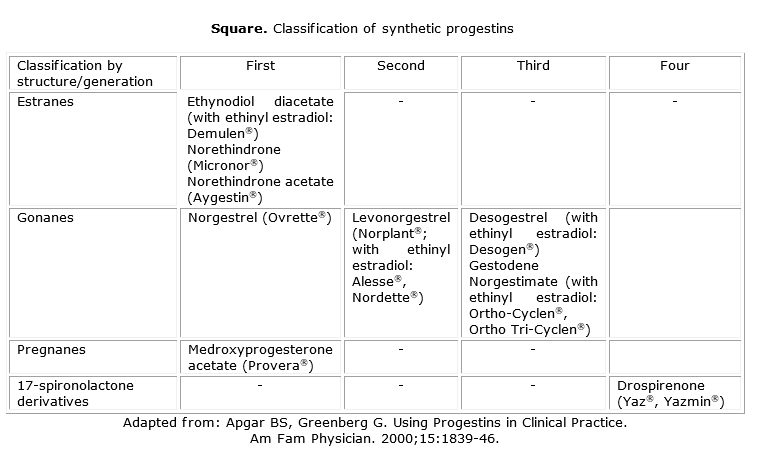
<body><![CDATA[<p><font face="Verdana" size="2"> Combined oral contraceptives (COC) are associated    with an increased risk of venous thromboembolism (VTE)<sup>1</sup> and the most    probable mechanism is the estrogen induction of hepatic plasma proteins involved    in coagulation. It has been reported that the risk is double that of non-users,    but that the total risk is low.<sup>2</sup> </font></p>     <p><font face="Verdana" size="2"> The risk of thromboembolism varies according    to the degree of exposure to estrogen and the type of progestin used. Many COC,    especially those containing drospirenone, or other third or fourth generation    progestins, have been associated with an increased risk of VTE.<sup>2 </sup>    </font></p>     <p><font face="Verdana" size="2"> On square, the four generations of progestins    are presented. </font></p>     <p><font face="Verdana" size="2"> Drospirenone is a derivative of 17 alpha spironolactone.    In rats, rabbits and in man, it is a progestational receptor agonist, and a    mineralocorticoid and androgen receptor antagonist, without effect on the glucocorticoid    receptor and the estrogen receptor. In normally menstruating women, 2-3 mg drospirenone    per day, taken from day 5 to 25 of the cycle, inhibit ovulation, lead to a slight    natriuresis, and a mild compensatory activation of the renin-angiotensin-aldosterone    system. The COC containing drospirenone has favorable effects in certain conditions    as premenstrual syndrome and acne, possibly due to its antiandrogenic effects.<sup>3</sup>    </font></p>     <p><font face="Verdana" size="2"> Regarding pharmacokinetics, drospirenone has    an oral bioavailability of 76-85 %, with a Tmax between 60-90 min. Its mean    terminal half-life is about 30-35 h, leading to steady state concentrations    in plasma after 10 days of application. All metabolites (not dependent of Cytochrome    P450) are hormonally inactive and are excreted by the kidney. Drospirenone does    not bind to sex hormone binding globulin or to corticoid binding globulin, but    to other plasma proteins. The free fraction in serum of drospirenone is about    5 %.<sup>3</sup> </font></p>     <p><font face="Verdana" size="2"> Although two studies published in 2007 entitled    EURAS<sup>4</sup> and INGENIX<sup>5</sup> did not report a significant increased    risk of VTE in women using COCs containing drospirenone compared to COCs containing    other progestins (e.g. levonorgestrel), other two analytical studies published    in 2009 confirmed the association, and led to the statement of a warning by    the Food and Drug Administration (FDA).<sup>6-8</sup> These studies found an    increased VTE risk 1,5 to 2 fold higher in women using COCs containing drospirenone    compared with other progestins. This led to several labeling changes on 2010    and 2011, to state an increased risk of VTE in COCs containing drospirenone.<sup>5</sup>    Other regulatory agencies such as European Medicines Agency (EMA) and Health    Canada took similar measures.<sup>9</sup> </font></p>     <p><font face="Verdana" size="2"> Risks factors of venous thromboembolism associated    with COC are linked with smoking, obesity and AB blood group,<sup>10</sup> as    well as alcohol consumption, ethnic group and thrombotic comorbidities.<sup>11</sup>    </font></p>     <p><font face="Verdana" size="2"> Based on the results of the MEGA case-control    by Hylckama Vlieg et al,<sup>8</sup> the relative risk (RR) of VTE in women    &lt;30 years was 3,1 (CI 2,2 to 4,6), while it was 5,0 (CI 3,8 to 6,5) for women    between 30 and 40 years. For women between 40 and 50 years as our patient, RR    was 5,8 (CI 4,6 to 7,3), almost double than women younger than 30 years old.    This lead to the FDA to indicate that the risk may be higher in patients older    than 35 years, <sup>6</sup> despite of the recommendations of the World Health    Organization and the American College of Obstetricians and Gynecologists which    advise the use of COCs in women over 40 years nonsmokers without arterial hypertension    associated.<sup>1,2</sup> Therefore, this case illustrates a potentially preventable    severe adverse drug reaction, and illustrates the importance of identifying    possible cautions prior to begin hormonal contraception. </font></p>     <p>&nbsp;</p>     <p><font face="Verdana" size="2"><b><font size="3">CASE PRESENTATION</font></b>    </font></p>     ]]></body>
<body><![CDATA[<p><font face="Verdana" size="2"> Forty-one year old female who presents with    sudden sharp chest pain for the past 20 minutes, with a 10/10 intensity on the    visual analog scale (VAS). The pain radiated to the lumbar region and was associated    with dyspnea. She did not present syncope or hemoptysis. She was using birth    control with drospirenone-ethinylestradiol 3 mg/0,02 mg since august 2013 until    july 2014 when the pulmonary thromboembolism (PTE) was diagnosed. There was    no history of prior thromboembolic events, smoking, dyslipidemia, recent surgery,    travelling, venous stasis or vascular lesion. She was not taken any other drugs    or herbal medicines. </font></p>     <p><font face="Verdana" size="2"> The patient was admitted conscious, alert, and    hydrated, with signs of respiratory difficulty: tachypnea and intercostal retractions.    Heart Rate: 110 per minute, Respiratory Rate: 26 per minute, Blood Pressure:    85/48 mmHg, Temperature: 37,7 &#176;C, Body Mass Index: 24 kg/m<sup>2</sup>,    pulse oximetry: 94 % at 28 % inspiratory oxygen fraction. </font></p>     <p><font face="Verdana" size="2"> Normochromic, moist oral mucosa, without jugular    distension, neck masses or lymphadenopathies, tachycardic cardiac sounds, right    basal hypoventilation and pain on superficial palpation of the right costal    cage. Abdomen soft without masses or organomegaly. No edemas or signs of deep    venous thrombosis and no motor or sensory neurological deficit. Glasgow coma    scale 15/15. </font></p>     <p>&nbsp;</p>     <p><font face="Verdana" size="2"><b><font size="3">INVESTIGATIONS</font></b> </font></p>     <p><font face="Verdana" size="2"> EKG: sinus tachycardia without signs of ischemia    or necrosis. </font></p>     <p><font face="Verdana" size="2"> The complete blood count showed mild leukocytosis    and anaemia. Platelet count, thromboplastin time and prothrombin time between    normal limits. Lipid profile was not performed. </font></p>     <p><font face="Verdana" size="2"> Normal renal function and electrolytes. </font></p>     <p><font face="Verdana" size="2"> Chest x-ray showed: right basal parenchymal    opacity and increased vascular markings. </font></p>     <p><font face="Verdana" size="2"> Arterial gases showed respiratory alkalosis    with moderately altered oxygenation. </font></p>     ]]></body>
<body><![CDATA[<p><font face="Verdana" size="2"> The CT angiogram showed: pulmonary thromboembolism    with right basal parenchymal opacity related to pulmonary ischemia without tomographic    signs of right ventricular dysfunction. </font></p>     <p><font face="Verdana" size="2"> Lupus anticoagulant and anticardiolipins: negative.    </font></p>     <p>&nbsp;</p>     <p><font face="Verdana" size="2"><b><font size="3">DIFFERENTIAL DIAGNOSIS</font></b>    </font></p>     <p><font face="Verdana" size="2"> Musculoskeletal pain, Pleuritis, Pericarditis,    Hyperventilation, Acute Coronary Syndrome, Anxiety disorders, Cardiac tamponade,    Pneumothorax, Pulmonary Edema, and Pulmonary Hypertension. </font></p>     <p>&nbsp;</p>     <p><font face="Verdana" size="2"><b><font size="3">TREATMENT</font></b> </font></p>     <p><font face="Verdana" size="2"> She was treated initially at the ICU with IV    fluids, enoxaparin, morphine, omeprazole and oxygen by nasal cannula, when she    was referred to internal medicine ward </font></p>     <p>&nbsp;</p>     <p><font face="Verdana" size="2"><b><font size="3">OUTCOME AND FOLLOW-UP </font></b>    </font></p>     ]]></body>
<body><![CDATA[<p><font face="Verdana" size="2"> She was discharged four days after admission    because her PTE had improved. Currently the patient is asymptomatic and without    functional limitations. The COC was withdrawn definitely and she was considering    surgical sterilization. She was treated with warfarin 5 mg during six months    after out, with an INR target of 2-3. Recommendations for prevention of PTE    were not discontinue warfarin, not to restart COC, not smoking, maintaining    a healthy weight, to report of signs of venous insufficiency appear or she would    make long journeys. Anticoagulated patient care (INR control, diet, use of concomitant    medications, fall prevention) and warning signs of thromboembolic disease (pain    and lower limb edema, chest pain, dyspnea). </font></p>     <p>&nbsp;</p>     <p><font face="Verdana" size="2"><b><font size="3">CAUSALITY ASSESSMENT</font></b>    </font></p>     <p><font face="Verdana" size="2"> Regarding causality assessment we used the Naranjo    algorithm<sup>12</sup> and World Health Organization-Uppsala Monitoring Centre    (WHO-UMC) scale,<sup>13</sup> with the following results: </font></p>     <p> <font face="Verdana" size="2"><i>Naranjo&#180;s Algorithm:</i> </font></p>     <p><font face="Verdana" size="2"> 1. Are there previous conclusive reports on    this reaction? Yes +1 </font></p>     <p><font face="Verdana" size="2"> 2. Did adverse event appear after the suspected    drug was given? Yes +2 </font></p>     <p><font face="Verdana" size="2"> 3. Did the adverse reaction improve when the    drug was discontinued or a specific antagonist was given? Yes 0 </font></p>     <p><font face="Verdana" size="2"> 4. Did the adverse reaction appear when the    drug was readministered? Not known or not done 0 </font></p>     <p><font face="Verdana" size="2"> 5. Are there alternative causes that could have    caused the reaction? No +2 </font></p>     ]]></body>
<body><![CDATA[<p><font face="Verdana" size="2"> 6. Did the reaction reappear when a placebo    was given? Not known or not done 0 </font></p>     <p><font face="Verdana" size="2"> 7. Was the drug detected in any body fluid in    toxic concentrations? Not known or not done 0 </font></p>     <p><font face="Verdana" size="2"> 8. Was the reaction more severe when the dose    was increased, or less severe when the dose was decreased? Not known or not    done 0 </font></p>     <p><font face="Verdana" size="2"> 9. Did the patient have a similar reaction to    the same or similar drugs in any previous exposure? Not known or not done 0    </font></p>     <p><font face="Verdana" size="2"> 10. Was the adverse event confirmed by any objective    evidence? Yes +1 </font></p>     <p><font face="Verdana" size="2"> Score: 6, Probable adverse drug reaction </font></p>     <p> <font face="Verdana" size="2"><i>WHO-UMC scale</i> </font></p>     <p><font face="Verdana" size="2"> Probable/Likely Event or laboratory test abnormality,    with reasonable time relationship to drug intake. Unlikely to be attributed    to disease or other drugs. Response to withdrawal clinically reasonable. Rechallenge    not required. </font></p>     <p>&nbsp;</p>     <p><font face="Verdana" size="2"><b><font size="3">DISCUSSION</font></b> </font></p>     ]]></body>
<body><![CDATA[<p><font face="Verdana" size="2"> A PTE case probably associated with the use    of a COC containing drospirenone is reported. It is noteworthy that the FDA    and other drug regulatory agencies had issued a warning regarding of an increased    risk of thromboembolic events for this drug, higher than other progestins. </font></p>     <p><font face="Verdana" size="2"> In this manner, a review published by the FDA    in 2011 entitled: "Combined Hormonal Contraceptives (CHCs) and the Risk of Cardiovascular    Disease Endpoints" found that the risk of VTE could be higher in women between    35 and 55 years old who take COCs containing drospirenone, (the age range of    our patient).<sup>14</sup> </font></p>     <p><font face="Verdana" size="2"> However, another FDA review published in 2012    found conflicting evidence regarding the risk of VTE associated with the use    of COCs containing drospirenone.<sup>15</sup> According to some epidemiological    studies, the risk of VTE can be up to 3 times higher in women who take COCs    containing this progestin, compared to users who take COCs with different progestins.    However, other studies that were part of the FDA review did not confirm this    association.<sup>15</sup> </font></p>     <p><font face="Verdana" size="2"> On the other hand, one of the most important    studies aimed at evaluating the safety of drospirenone versus levonorgestrel    and other progestins included in COCs included 58 674 women who were followed    for 142 475 women-years of observation, finding that the odds ratio of VTE for    drospirenone was 1,0 and 0,8 for levonorgestrel.<sup>4</sup> In the same way,    the studies by Lidegaard et al. and van Hylckama Vlieg et al. confirmed the    association.<sup>7,8</sup> </font></p>     <p><font face="Verdana" size="2"> On the whole, Martinez et al systematic review<sup>17</sup>    published in 2012 confirmed a slight increase in risk in patients using COCs    containing drospirenone compared to levonorgestrel (RR 1,26, 95 % CI: 1,03-1,52).    </font></p>     <p><font face="Verdana" size="2"> Other risk factors include age, thrombogenic    mutations (women with a Factor V Leiden mutation may have a risk of VTE up to    35 times higher), personal or family history of VTE, pregnancy and postpartum    (increased risk up to 3 to 6 weeks after giving birth), obesity, length of long    trips, and travelling at high altitudes (more than one week at more than 4 500    meters above sea level).<sup>1,2</sup> Other than age, none of these risk factors    could be documented in this patient. Similarly, drugs associated with thromboembolic    disease such as neuroleptics, hormone replacement therapy, non steroideal anti-inflammatory    drugs, among others, were not reported in this case. </font></p>     <p><font face="Verdana" size="2"> Although this adverse reaction is more frequent    in the first four months of contraceptive use,<sup>6 </sup>it is remarkable    that in our patient the event presented a year after having begun the medication.    </font></p>     <p align="center"><img src="/img/revistas/far/v50n1/t0115116.gif" width="769" height="454"></p>     <p>&nbsp;</p>     <p><font face="Verdana" size="3"><b>LEARNING POINTS/TAKE HOME MESSAGES</b> </font></p>     ]]></body>
<body><![CDATA[<p><font face="Verdana" size="2"> 1. Always consider the possibility of thromboembolic    events in patients using oral contraceptives. </font></p>     <p><font face="Verdana" size="2"> 2. Evaluate very well the risk factors for thromboembolic    events and weigh the benefit/risk ratio before prescribing oral contraceptives.    </font></p>     <p><font face="Verdana" size="2"> 3. Recognize that age over 40 years is a possible    caution for the use of oral contraceptives. </font></p>     <p><font face="Verdana" size="2"> 4. The use of drospirenone as a COC carries    a slightly higher risk of VTE than other progestins. </font></p>     <p><font face="Verdana" size="2"> 5. Remember that a new medicine is not necessarily    safer or more effective than those that already exist for certain indication    </font></p>     <p>&nbsp;</p>     <p><font face="Verdana" size="2"><b><font size="3">REFERENCES</font></b> </font></p>     <!-- ref --><p><font face="Verdana" size="2"> 1. Division of Reproductive Health, National    Center for Chronic Disease Prevention and Health Promotion, Centers for Disease    Control and Prevention (CDC). U.S. Selected Practice Recommendations for Contraceptive    Use, 2013: adapted from the World Health Organization selected practice recommendations    for contraceptive use, 2nd edition. MMWR Recomm Rep 2013;21:1-60.     </font></p>     <!-- ref --><p><font face="Verdana" size="2"> 2. American Society of Health System Pharmacists,    Inc., DynaMed. Ipswich (MA): EBSCO Information Services. 1995. Record No. 116852,    Oral contraceptives; [cited 2014 Nov 14]. Available from: <a href="http://web.b.ebscohost.com.ez.urosario.edu.co/dynamed/detail?sid=25fc1d70-eb2d-4c16-8e8f-%207339682903cc%40sessionmgr113&vid=0&hid=116&bdata=JnNpdGU9ZHluYW1lZC1saXZlJnNjb3BlPXNpdGU%3d#db=dme&AN=116852&anchor=top.%20Last%20access:%20september%2017th%202015.%20" target="_blank">http://web.b.ebscohost.com.ez.urosario.edu.co/dynamed/detail?sid=25fc1d70-eb2d-4c16-8e8f-    7339682903cc%40sessionmgr113&amp;vid=0&amp;hid=116&amp;bdata=JnNpdGU9ZHluYW1lZC1saXZlJnNjb3BlPXNpdGU%3d#db=dme&amp;AN=116852&amp;anchor=top.    Last access: september 17th 2015</a></font><!-- ref --><p><font face="Verdana" size="2"> 3. Oelkers W. Drospirenone, a progestogen with    antimineralocorticoid properties: a short review. Mol Cell Endocrinol. 2004;217(1-2):255-61.        </font></p>     <!-- ref --><p><font face="Verdana" size="2"> 4. Dinger JC, Heinemann LA, K&#252;hl-Habich    D. The safety of a drospirenone-containing oral contraceptive: final results    from the European Active Surveillance Study on oral contraceptives based on    142,475 women-years of observation. Contraception. 2007;75:344-54.     </font></p>     <!-- ref --><p><font face="Verdana" size="2"> 5. Seeger JD, Loughlin J, Eng PM. Risk of thromboembolism    in women taking ethinylestradiol/drospirenone and other oral contraceptives.    Obstet Gynecol. 2007;110:587-93.     </font></p>     <!-- ref --><p><font face="Verdana" size="2"> 6. The Food and Drug Administration. Background    Document for Joint Meeting of Advisory Committee for Reproductive Health Drugs    and the Drug Safety and Risk Management Advisory Committee: NDA 21-098 Yasmin    (3 mg drospirenone/0.03 mg ethinyl estradiol), NDA 21-676 YAZ (3 mg drospirenone/0.02    mg ethinyl estradiol), NDA 22-532 Beyaz (3 mg drospirenone/0.02 mg ethinyl estradiol/0.451    mg levomefolate calcium), NDA 22-574 Safyral (3 mg drospirenone/0.03 mg ethinyl    estradiol/0.451 mg levomefolate calcium); [cited 2014 Nov 14]. Available from:    <a href="http://www.fda.gov/downloads/AdvisoryCommittees/CommitteesMeetingMaterials/Drugs/ReproductiveHealthDrugsAdvisoryCommittee/UCM282462.pdf" target="_blank">    http://www.fda.gov/downloads/AdvisoryCommittees/CommitteesMeetingMaterials/Drugs/ReproductiveHealthDrugsAdvisoryCommittee/UCM282462.pdf</a>.    Last access: september 17th 2015.     </font></p>     <!-- ref --><p><font face="Verdana" size="2"> 7. Lidegaard O, Lokkegaard E, Svendsen AL. Hormonal    contraception and risk of venous thromboembolism: national follow-up study.    BMJ 2009;339:b2890.     </font></p>     ]]></body>
<body><![CDATA[<!-- ref --><p><font face="Verdana" size="2"> 8. van Hylckama Vlieg A, Helmerhorst FM, Vandenbroucke    JP. The venous thrombotic risk of oral contraceptives, effects of oestrogen    dose and progestogen type: results of the MEGA case-control study. BMJ 2009;339:b2921.        </font></p>     <!-- ref --><p><font face="Verdana" size="2"> 9. Instituto de Salud P&#250;blica, Ministerio    de Salud. Gobierno de Chile. Anticonceptivos orales que contienen drospirenona    como progest&#225;geno generan un aumento potencial de riesgo de tromboembolismo    venoso; [cited 2014 Nov 14]. Available from: <a href="http://www.ispch.cl/noticia/19404?page=328">http://www.ispch.cl/noticia/19404?page=328</a>.    Last access: september 17th 2015 </font><!-- ref --><p><font face="Verdana" size="2"> 10. Suchon P, Al Frouh F, Henneuse A. Risk factors    for venous thromboembolism in women under combined oral contraceptive. The PILl    Genetic Risk Monitoring (PILGRIM) Study. Thromb Haemost 2015;114-16.     </font></p>     <!-- ref --><p><font face="Verdana" size="2"> 11. Vinogradova Y, Coupland C, Hippisley-Cox    J. Use of combined oral contraceptives and risk of venous thromboembolism: nested    case-control studies using the QResearch and CPRD databases. BMJ 2015;350:h2135.        </font></p>     <!-- ref --><p><font face="Verdana" size="2"> 12. Naranjo CA, Busto U, Sellars EM. A method    for estimating the probability of adverse drug reactions, Clin Pharmacol Ther.    1981;30:239-45.     </font></p>     <!-- ref --><p><font face="Verdana" size="2"> 13. The World Health Organization - Uppsala    Monitoring Centre. The use of the WHO-UMC system or standardised case causality    assessment; [cited 2014 Nov 14]. Available from: <a href="http://who-umc.org/Graphics/24734.pdf" target="_blank">http://who-umc.org/Graphics/24734.pdf</a>.    Last access: September 17th 2015.     </font></p>     <!-- ref --><p><font face="Verdana" size="2"> 14. Ouellet-Hellstrom R, Graham DJ, Staffa JA.    Combined Hormonal Contraceptives (CHCs) and the Risk of Cardiovascular Disease    Endpoints; [cited 2014 Nov 14]. Available from: <a href="http://www.fda.gov/downloads/Drugs/DrugSafety/UCM277384.pdf" target="_blank">http://www.fda.gov/downloads/Drugs/DrugSafety/UCM277384.pdf</a>.    Last access: September 17th 2015.     </font></p>     <!-- ref --><p><font face="Verdana" size="2"> 15. Berresford S. FDA completes drospirenone    safety review. Reactions Weekly 2012;1398:2.     </font></p>     <!-- ref --><p><font face="Verdana" size="2"> 16. Dinger JC, Heinemann LA, K&#252;hl-Habich    D. The safety of a drospirenone-containing oral contraceptive: final results    from the European Active Surveillance Study on oral contraceptives based on    142,475 women-years of observation. Contraception 2007;75:344-54.     </font></p>     <!-- ref --><p><font face="Verdana" size="2"> 17. Mart&#237;nez F, Ram&#237;rez I, P&#233;rez-Campos    E, Latorre K, Lete I. Venous and pulmonary thromboembolism and combined hormonal    contraceptives. Systematic review and meta-analysis. Eur J Contracept Reprod    Health Care 2012;17:7-29.     </font></p>     <p><font face="Verdana" size="2"> Adapted from: Apgar BS, Greenberg G. Using Progestins    in Clinical Practice. Am Fam Physician. 2000;15:1839-46. </font></p>     ]]></body>
<body><![CDATA[<p>&nbsp;</p>     <p>&nbsp;</p>     <p><font face="Verdana" size="2">Recibido: 4 de agosto de 2015     <br>   </font><font face="Verdana" size="2">Aprobado: 14 de octubre de 2015 </font></p>     <p>&nbsp;</p>     <p>&nbsp;</p>     <p><font face="Verdana" size="2"><i>Carlos Alberto Calder&#243;n-Ospina</i>. Escuela    de Medicina y Ciencias de la Salud. Universidad del Rosario. Carrera 24 # 63    C - 69, Bogot&#225; D.C., Colombia. Tel&#233;fono: +57 1 2970200 Ext. 3318.    Correo electr&#243;nico: <a href="mailto:carlos.calderon@urosario.edu.co">carlos.calderon@urosario.edu.co</a>    </font></p>      ]]></body><back>
<ref-list>
<ref id="B1">
<label>1</label><nlm-citation citation-type="journal">
<collab>Division of Reproductive Health, National Center for Chronic Disease Prevention and Health Promotion, Centers for Disease Control and Prevention (CDC). U.S</collab>
<article-title xml:lang="en"><![CDATA[Selected Practice Recommendations for Contraceptive Use, 2013: adapted from the World Health Organization selected practice recommendations for contraceptive use, 2nd edition]]></article-title>
<source><![CDATA[MMWR Recomm Rep]]></source>
<year>2013</year>
<volume>21</volume>
<page-range>1-60</page-range></nlm-citation>
</ref>
<ref id="B2">
<label>2</label><nlm-citation citation-type="">
<collab>American Society of Health System Pharmacists, Inc., DynaMed</collab>
<source><![CDATA[Ipswich (MA): EBSCO Information Services]]></source>
<year>1995</year>
</nlm-citation>
</ref>
<ref id="B3">
<label>3</label><nlm-citation citation-type="journal">
<person-group person-group-type="author">
<name>
<surname><![CDATA[Oelkers]]></surname>
<given-names><![CDATA[W]]></given-names>
</name>
</person-group>
<article-title xml:lang="en"><![CDATA[Drospirenone, a progestogen with antimineralocorticoid properties: a short review]]></article-title>
<source><![CDATA[Mol Cell Endocrinol]]></source>
<year>2004</year>
<volume>217</volume>
<numero>1-2</numero>
<issue>1-2</issue>
<page-range>255-61</page-range></nlm-citation>
</ref>
<ref id="B4">
<label>4</label><nlm-citation citation-type="journal">
<person-group person-group-type="author">
<name>
<surname><![CDATA[Dinger]]></surname>
<given-names><![CDATA[JC]]></given-names>
</name>
<name>
<surname><![CDATA[Heinemann]]></surname>
<given-names><![CDATA[LA]]></given-names>
</name>
<name>
<surname><![CDATA[Kühl-Habich]]></surname>
<given-names><![CDATA[D]]></given-names>
</name>
</person-group>
<article-title xml:lang="en"><![CDATA[The safety of a drospirenone-containing oral contraceptive: final results from the European Active Surveillance Study on oral contraceptives based on 142,475 women-years of observation]]></article-title>
<source><![CDATA[Contraception]]></source>
<year>2007</year>
<volume>75</volume>
<page-range>344-54</page-range></nlm-citation>
</ref>
<ref id="B5">
<label>5</label><nlm-citation citation-type="journal">
<person-group person-group-type="author">
<name>
<surname><![CDATA[Seeger]]></surname>
<given-names><![CDATA[JD]]></given-names>
</name>
<name>
<surname><![CDATA[Loughlin]]></surname>
<given-names><![CDATA[J]]></given-names>
</name>
<name>
<surname><![CDATA[Eng]]></surname>
<given-names><![CDATA[PM]]></given-names>
</name>
</person-group>
<article-title xml:lang="en"><![CDATA[Risk of thromboembolism in women taking ethinylestradiol/drospirenone and other oral contraceptives]]></article-title>
<source><![CDATA[Obstet Gynecol]]></source>
<year>2007</year>
<volume>110</volume>
<page-range>587-93</page-range></nlm-citation>
</ref>
<ref id="B6">
<label>6</label><nlm-citation citation-type="">
<collab>The Food and Drug Administration</collab>
<source><![CDATA[Background Document for Joint Meeting of Advisory Committee for Reproductive Health Drugs and the Drug Safety and Risk Management Advisory Committee: NDA 21-098 Yasmin (3 mg drospirenone/0.03 mg ethinyl estradiol), NDA 21-676 YAZ (3 mg drospirenone/0.02 mg ethinyl estradiol), NDA 22-532 Beyaz (3 mg drospirenone/0.02 mg ethinyl estradiol/0.451 mg levomefolate calcium), NDA 22-574 Safyral (3 mg drospirenone/0.03 mg ethinyl estradiol/0.451 mg levomefolate calcium)]]></source>
<year></year>
</nlm-citation>
</ref>
<ref id="B7">
<label>7</label><nlm-citation citation-type="journal">
<person-group person-group-type="author">
<name>
<surname><![CDATA[Lidegaard]]></surname>
<given-names><![CDATA[O]]></given-names>
</name>
<name>
<surname><![CDATA[Lokkegaard]]></surname>
<given-names><![CDATA[E]]></given-names>
</name>
<name>
<surname><![CDATA[Svendsen]]></surname>
<given-names><![CDATA[AL]]></given-names>
</name>
</person-group>
<article-title xml:lang="en"><![CDATA[Hormonal contraception and risk of venous thromboembolism: national follow-up study]]></article-title>
<source><![CDATA[BMJ]]></source>
<year>2009</year>
<volume>339</volume>
<page-range>b2890</page-range></nlm-citation>
</ref>
<ref id="B8">
<label>8</label><nlm-citation citation-type="journal">
<person-group person-group-type="author">
<name>
<surname><![CDATA[van Hylckama Vlieg]]></surname>
<given-names><![CDATA[A]]></given-names>
</name>
<name>
<surname><![CDATA[Helmerhorst]]></surname>
<given-names><![CDATA[FM]]></given-names>
</name>
<name>
<surname><![CDATA[Vandenbroucke]]></surname>
<given-names><![CDATA[JP]]></given-names>
</name>
</person-group>
<article-title xml:lang="en"><![CDATA[The venous thrombotic risk of oral contraceptives, effects of oestrogen dose and progestogen type: results of the MEGA case-control study]]></article-title>
<source><![CDATA[BMJ]]></source>
<year>2009</year>
<volume>339</volume>
<page-range>b2921</page-range></nlm-citation>
</ref>
<ref id="B9">
<label>9</label><nlm-citation citation-type="">
<collab>Instituto de Salud Pública, Ministerio de Salud^dGobierno de Chile</collab>
<source><![CDATA[Anticonceptivos orales que contienen drospirenona como progestágeno generan un aumento potencial de riesgo de tromboembolismo venoso]]></source>
<year></year>
</nlm-citation>
</ref>
<ref id="B10">
<label>10</label><nlm-citation citation-type="journal">
<person-group person-group-type="author">
<name>
<surname><![CDATA[Suchon]]></surname>
<given-names><![CDATA[P]]></given-names>
</name>
<name>
<surname><![CDATA[Al Frouh]]></surname>
<given-names><![CDATA[F]]></given-names>
</name>
<name>
<surname><![CDATA[Henneuse]]></surname>
<given-names><![CDATA[A]]></given-names>
</name>
</person-group>
<article-title xml:lang="en"><![CDATA[Risk factors for venous thromboembolism in women under combined oral contraceptive: The PILl Genetic Risk Monitoring (PILGRIM) Study]]></article-title>
<source><![CDATA[Thromb Haemost]]></source>
<year>2015</year>
<page-range>114-16</page-range></nlm-citation>
</ref>
<ref id="B11">
<label>11</label><nlm-citation citation-type="journal">
<person-group person-group-type="author">
<name>
<surname><![CDATA[Vinogradova]]></surname>
<given-names><![CDATA[Y]]></given-names>
</name>
<name>
<surname><![CDATA[Coupland]]></surname>
<given-names><![CDATA[C]]></given-names>
</name>
<name>
<surname><![CDATA[Hippisley-Cox]]></surname>
<given-names><![CDATA[J]]></given-names>
</name>
</person-group>
<article-title xml:lang="en"><![CDATA[Use of combined oral contraceptives and risk of venous thromboembolism: nested case-control studies using the QResearch and CPRD databases]]></article-title>
<source><![CDATA[BMJ]]></source>
<year>2015</year>
<volume>350</volume>
<page-range>h2135</page-range></nlm-citation>
</ref>
<ref id="B12">
<label>12</label><nlm-citation citation-type="journal">
<person-group person-group-type="author">
<name>
<surname><![CDATA[Naranjo]]></surname>
<given-names><![CDATA[CA]]></given-names>
</name>
<name>
<surname><![CDATA[Busto]]></surname>
<given-names><![CDATA[U]]></given-names>
</name>
<name>
<surname><![CDATA[Sellars]]></surname>
<given-names><![CDATA[EM]]></given-names>
</name>
</person-group>
<article-title xml:lang="en"><![CDATA[A method for estimating the probability of adverse drug reactions]]></article-title>
<source><![CDATA[Clin Pharmacol Ther]]></source>
<year>1981</year>
<volume>30</volume>
<page-range>239-45</page-range></nlm-citation>
</ref>
<ref id="B13">
<label>13</label><nlm-citation citation-type="">
<collab>The World Health Organization - Uppsala Monitoring Centre</collab>
<source><![CDATA[The use of the WHO-UMC system or standardised case causality assessment]]></source>
<year></year>
</nlm-citation>
</ref>
<ref id="B14">
<label>14</label><nlm-citation citation-type="">
<person-group person-group-type="author">
<name>
<surname><![CDATA[Ouellet-Hellstrom]]></surname>
<given-names><![CDATA[R]]></given-names>
</name>
<name>
<surname><![CDATA[Graham]]></surname>
<given-names><![CDATA[DJ]]></given-names>
</name>
<name>
<surname><![CDATA[Staffa]]></surname>
<given-names><![CDATA[JA]]></given-names>
</name>
</person-group>
<source><![CDATA[Combined Hormonal Contraceptives (CHCs) and the Risk of Cardiovascular Disease Endpoints]]></source>
<year></year>
</nlm-citation>
</ref>
<ref id="B15">
<label>15</label><nlm-citation citation-type="journal">
<person-group person-group-type="author">
<name>
<surname><![CDATA[Berresford]]></surname>
<given-names><![CDATA[S]]></given-names>
</name>
</person-group>
<article-title xml:lang="en"><![CDATA[FDA completes drospirenone safety review]]></article-title>
<source><![CDATA[Reactions Weekly]]></source>
<year>2012</year>
<volume>1398</volume>
<page-range>2</page-range></nlm-citation>
</ref>
<ref id="B16">
<label>16</label><nlm-citation citation-type="journal">
<person-group person-group-type="author">
<name>
<surname><![CDATA[Dinger]]></surname>
<given-names><![CDATA[JC]]></given-names>
</name>
<name>
<surname><![CDATA[Heinemann]]></surname>
<given-names><![CDATA[LA]]></given-names>
</name>
<name>
<surname><![CDATA[Kühl-Habich]]></surname>
<given-names><![CDATA[D]]></given-names>
</name>
</person-group>
<article-title xml:lang="en"><![CDATA[The safety of a drospirenone-containing oral contraceptive: final results from the European Active Surveillance Study on oral contraceptives based on 142,475 women-years of observation]]></article-title>
<source><![CDATA[Contraception]]></source>
<year>2007</year>
<volume>75</volume>
<page-range>344-54</page-range></nlm-citation>
</ref>
<ref id="B17">
<label>17</label><nlm-citation citation-type="journal">
<person-group person-group-type="author">
<name>
<surname><![CDATA[Martínez]]></surname>
<given-names><![CDATA[F]]></given-names>
</name>
<name>
<surname><![CDATA[Ramírez]]></surname>
<given-names><![CDATA[I]]></given-names>
</name>
<name>
<surname><![CDATA[Pérez-Campos]]></surname>
<given-names><![CDATA[E]]></given-names>
</name>
<name>
<surname><![CDATA[Latorre]]></surname>
<given-names><![CDATA[K]]></given-names>
</name>
<name>
<surname><![CDATA[Lete]]></surname>
<given-names><![CDATA[I]]></given-names>
</name>
</person-group>
<article-title xml:lang="en"><![CDATA[Venous and pulmonary thromboembolism and combined hormonal contraceptives: Systematic review and meta-analysis]]></article-title>
<source><![CDATA[Eur J Contracept Reprod Health Care]]></source>
<year>2012</year>
<volume>17</volume>
<page-range>7-29</page-range></nlm-citation>
</ref>
</ref-list>
</back>
</article>
