<?xml version="1.0" encoding="ISO-8859-1"?><article xmlns:mml="http://www.w3.org/1998/Math/MathML" xmlns:xlink="http://www.w3.org/1999/xlink" xmlns:xsi="http://www.w3.org/2001/XMLSchema-instance">
<front>
<journal-meta>
<journal-id>0034-7523</journal-id>
<journal-title><![CDATA[Revista Cubana de Medicina]]></journal-title>
<abbrev-journal-title><![CDATA[Rev cubana med]]></abbrev-journal-title>
<issn>0034-7523</issn>
<publisher>
<publisher-name><![CDATA[Centro Nacional de Información de Ciencias MédicasEditorial Ciencias Médicas]]></publisher-name>
</publisher>
</journal-meta>
<article-meta>
<article-id>S0034-75231999000400003</article-id>
<title-group>
<article-title xml:lang="es"><![CDATA[Diferentes formas de tratamiento en los pacientes miasténicos del grupo II-A]]></article-title>
</title-group>
<contrib-group>
<contrib contrib-type="author">
<name>
<surname><![CDATA[Mustelier Fernández]]></surname>
<given-names><![CDATA[César]]></given-names>
</name>
<xref ref-type="aff" rid="A01"/>
</contrib>
<contrib contrib-type="author">
<name>
<surname><![CDATA[Almunia Leyva]]></surname>
<given-names><![CDATA[Arturo Luis]]></given-names>
</name>
</contrib>
</contrib-group>
<aff id="A01">
<institution><![CDATA[,Hospital Provincial Clinicoquirúrgico Celia Sánchez Manduley Servicio de Medicina Interna ]]></institution>
<addr-line><![CDATA[Manzanillo ]]></addr-line>
<country>Cuba.</country>
</aff>
<pub-date pub-type="pub">
<day>00</day>
<month>12</month>
<year>1999</year>
</pub-date>
<pub-date pub-type="epub">
<day>00</day>
<month>12</month>
<year>1999</year>
</pub-date>
<volume>38</volume>
<numero>4</numero>
<fpage>252</fpage>
<lpage>257</lpage>
<copyright-statement/>
<copyright-year/>
<self-uri xlink:href="http://scielo.sld.cu/scielo.php?script=sci_arttext&amp;pid=S0034-75231999000400003&amp;lng=en&amp;nrm=iso"></self-uri><self-uri xlink:href="http://scielo.sld.cu/scielo.php?script=sci_abstract&amp;pid=S0034-75231999000400003&amp;lng=en&amp;nrm=iso"></self-uri><self-uri xlink:href="http://scielo.sld.cu/scielo.php?script=sci_pdf&amp;pid=S0034-75231999000400003&amp;lng=en&amp;nrm=iso"></self-uri><abstract abstract-type="short" xml:lang="es"><p><![CDATA[Se estudiaron 32 pacientes con diagnóstico de miastenia gravis pertenecientes al grupo II-A de la clasificación de Osserman y Genkins, atendidos en los servicios de Medicina Interna y Neurología del Hospital Clínicoquirúrgico "Celia Sánchez Manduley", en el último decenio. Predominó el sexo femenino en la casuística y los grupos etarios comprendidos entre la segunda y quinta décadas de la vida. Encontramos relación directa entre el tiempo transcurrido desde el inicio de los primeros síntomas y el comienzo del tratamiento, con la dosis de medicamentos utilizadas y con la respuesta clínica manifestada. En el 52,38 % de los pacientes que recibieron tratamiento con anticolinesterásicos la respuesta fue buena, en tanto con la combinación de anticolinesterásicos -esteroides se obtuvo esta respuesta en el 50 % de los casos. Se observó buena respuesta con la timectomía en el 80 % de los pacientes. Se encontró relación entre el período que media desde la realización del diagnóstico y la intervención quirúrgica y la respuesta clínica.]]></p></abstract>
<abstract abstract-type="short" xml:lang="en"><p><![CDATA[32 patients with diagnosis of myasthenia gravis included in the group II-A according to Osserman and Genkin&acute;s classification, and who received medical attention at the Internal Medicine and Neurology Services of "Celia Sánchez Manduley" Clinical an Surgical Hospital during the last 10 years were studied. The females and the age groups between the second and the fifth decades of life prevailed in the casuistics. A direct relationship was found between the time elapsed since the onset of the first symptoms and the beginning of the treatment and the drug dose used and the clinical response. The response was good in 52.38 % of the patients that were treated with anticholinesterase agents, whereas the response was also favorable in 50 % of the patients who were administered a combination of anticholinesterase agents with steroids. Thymectomy yielded satisfactory results in 80 % of these individuals. It was observed a relationship between the time elapsed since the diagnosis was made, the surgical procedure, and the clinical response.]]></p></abstract>
<kwd-group>
<kwd lng="es"><![CDATA[MIASTENIA GRAVIS]]></kwd>
<kwd lng="en"><![CDATA[MYASTHENIA GRAVIS]]></kwd>
</kwd-group>
</article-meta>
</front><body><![CDATA[ <p>Hospital Provincial Clinicoquir&uacute;rgico "Celia S&aacute;nchez Manduley"    Manzanillo, Granma Servicio de Medicina Interna </p> <H2>   Diferentes formas de tratamiento en los pacientes miast&eacute;nicos del   grupo II-A</H2>   <I><A HREF="#x">Dr. C&eacute;sar Mustelier Fern&aacute;ndez<SUP>1</SUP>   y Dr. Arturo Luis Almunia Leyva<SUP>2</SUP></A></I>&nbsp;<B>&nbsp;</B>   <H4>   RESUMEN</H4>   Se estudiaron 32 pacientes con diagn&oacute;stico de miastenia <I>gravis</I>   pertenecientes al grupo II-A de la clasificaci&oacute;n de Osserman y Genkins,   atendidos en los servicios de Medicina Interna y Neurolog&iacute;a del   Hospital Cl&iacute;nicoquir&uacute;rgico "Celia S&aacute;nchez Manduley",   en el &uacute;ltimo decenio. Predomin&oacute; el sexo femenino en la casu&iacute;stica   y los grupos etarios comprendidos entre la segunda y quinta d&eacute;cadas   de la vida. Encontramos relaci&oacute;n directa entre el tiempo transcurrido   desde el inicio de los primeros s&iacute;ntomas y el comienzo del tratamiento,   con la dosis de medicamentos utilizadas y con la respuesta cl&iacute;nica   manifestada. En el 52,38 % de los pacientes que recibieron tratamiento   con anticolinester&aacute;sicos la respuesta fue buena, en tanto con la   combinaci&oacute;n de anticolinester&aacute;sicos -esteroides se obtuvo   esta respuesta en el 50 % de los casos. Se observ&oacute; buena respuesta   con la timectom&iacute;a en el 80 % de los pacientes. Se encontr&oacute;   relaci&oacute;n entre el per&iacute;odo que media desde la realizaci&oacute;n   del diagn&oacute;stico y la intervenci&oacute;n quir&uacute;rgica y la   respuesta cl&iacute;nica.          <P><I>Descriptores DeCS</I>: MIASTENIA GRAVIS/terapia.          <P>Muchos historiadores de la medicina est&aacute;n de acuerdo en afirmar   que la descripci&oacute;n inicial de la miastenia <I>gravis</I> corresponde   a <I>Thomas Willis</I>, en el a&ntilde;o 1685.<SUP>1,2</SUP> <I>Engel</I><SUP>3</SUP>   y <I>Guthire</I><SUP>4</SUP> aseguran que estas observaciones datan desde   1672, realizadas por el propio<I> Willis.</I> Desde los primeros trabajos   se defini&oacute; como una enfermedad caracterizada por f&aacute;cil fatigabilidad   de la musculatura esquel&eacute;tica por el ejercicio repetitivo, con tendencia   a la recuperaci&oacute;n tras el reposo o la administraci&oacute;n de anticolinester&aacute;sicos.   (St Luis GR. Conceptos actuales sobre patogenia y tratamiento de la miastenia<I>   gravis.</I> Informaci&oacute;n Cient&iacute;fico-Docente, IMN, 1986).          <P>En 1901, <I>Laquer </I>y <I>Weigert</I> describieron la relaci&oacute;n   entre la miastenia <I>gravis</I> y la gl&aacute;ndula t&iacute;mica. En   1911, <I>Sawerbruch</I> realiz&oacute; la primera timectom&iacute;a a un   paciente miast&eacute;nico, sin buenos resultados con la intervenci&oacute;n,   como tampoco en su posterior intento realizado en 1931.          <P>En 1936, <I>Blalock </I>encontr&oacute; la presencia de un timoma al   realizar la ex&eacute;resis de esta gl&aacute;ndula a un paciente miast&eacute;nico.   La utilidad de la timectom&iacute;a en otros casos de miastenia <I>gravis</I>   fue documentada ulteriormente por <I>Blalock</I>, en 1944.<SUP>5,6</SUP>       <BR><I>Mary Walker,</I> en 1934, describi&oacute; las respuestas satisfactorias   de estos enfermos a la medicaci&oacute;n anticolinester&aacute;sica, se   conoce as&iacute; que el sitio de la lesi&oacute;n es la uni&oacute;n mioneural   donde se produce un defecto en la transmisi&oacute;n del impulso nervioso.<SUP>7-9</SUP>   En 1935, comenz&oacute; a utilizarse por v&iacute;a oral la neosticnina   en el tratamiento de la miastenia <I>gravis.</I><SUP>10</SUP>          <P>En 1971, <I>Kjaer</I><SUP>11</SUP> report&oacute; remisiones completas   o casi completas de las manifestaciones miast&eacute;nicas en sus pacientes   con el uso de prednisol oral. En el mismo a&ntilde;o, <I>John</I>,<SUP>12</SUP>   public&oacute; resultados similares con dosis elevadas de prednisona al   inicio del tratamiento y reducci&oacute;n de las mismas en el curso de   varios meses.<I> Warmols</I> y Engel,<SUP>13</SUP> <I>Mann</I> y otros<SUP>14</SUP>   notificaron de favorables sus experiencias con esta droga.          <P>En 1968, se inici&oacute; el uso de citost&aacute;ticos aprovechando   su posible acci&oacute;n inmunosupresora; as&iacute;, mientras<I> Patten</I><SUP>15</SUP>   recomienda la ciclofosfamida, <I>Rowland</I><SUP>16</SUP> utiliz&oacute;   la azatioprina. Ambos autores reservaron estos medicamentos para los casos   que no respondan a la timectom&iacute;a ni al tratamiento con prednisona   y que adem&aacute;s eran muy dif&iacute;ciles de controlar con anticolinester&aacute;sicos,   otras veces en el posoperatorio de los pacientes que presentaban timomas.          <P>En 1976, <I>Pinching</I> emple&oacute; por primera vez la plasmaf&eacute;resis   en el tratamiento de la miastenia <I>gravis </I>en 3 casos, con mejor&iacute;a   en todos ellos y desaparici&oacute;n de los s&iacute;ntomas en 2, por lo   que pudo suspender las drogas anticolinester&aacute;sicas.<SUP>17,18</SUP>   En 1979, <I>Kornfeld </I>estudi&oacute; 12 pacientes miast&eacute;nicos,   les realiz&oacute; plasmaf&eacute;resis a 6 de ellos, los cuales mostraron   una mejor&iacute;a notable que no apareci&oacute; en los otros 6 a los   que no se les realiz&oacute;.<SUP>19</SUP><I> Pila,</I> someti&oacute;   a intercambio de plasma a 10 pacientes miast&eacute;nicos del grupo II   de la clasificaci&oacute;n de Osserman, refractarios al tratamiento habitual,   la respuesta fue favorable en el 100 % de los casos y realmente espectacular   en m&aacute;s de la mitad.<SUP>20</SUP> Reportes similares informaron <I>Llorens</I>   y otros.<SUP>21</SUP> Junto a las investigaciones tendentes a esclarecer   los mecanismos &iacute;ntimos de producci&oacute;n de la enfermedad, se   han dedicado numerosos esfuerzos para establecer una terap&eacute;utica   con base etiol&oacute;gica que se centra en 2 fuentes fundamentales:   <UL>       <LI>   Medidas encaminadas a la correcci&oacute;n del defecto fisiol&oacute;gico   para mantener una adecuada transmisi&oacute;n del impulso nervioso y, por   tanto, mejorar o hacer desaparecer los s&iacute;ntomas miast&eacute;nicos   sin influir en el curso de la enfermedad (drogas anticolinester&aacute;sicas).</LI>          ]]></body>
<body><![CDATA[<LI>   Medidas dirigidas contra el proceso inmune que parece constituir la base   de la enfermedad, tendentes a producir remisi&oacute;n o curaci&oacute;n   (esteroides, inmunosupresores, plasmaf&eacute;resis, timectom&iacute;a).<SUP>22,23</SUP></LI>       </UL>   El prop&oacute;sito de nuestro estudio fue valorar el resultado de las   diferentes formas de tratamiento aplicado a los pacientes miast&eacute;nicos   del grupo II-A de la clasificaci&oacute;n de Osserman y Genkins.       <BR>&nbsp;   <H4>   M&Eacute;TODOS</H4>   Realizamos un estudio retrospectivo en 32 pacientes miast&eacute;nicos   del grupo II-A de la clasificaci&oacute;n de Osserman y Genkins atendidos   en los servicios de Medicina Interna y Neurolog&iacute;a del Hospital Clinicoquir&uacute;rgico   "Celia S&aacute;nchez Manduley", en el &uacute;ltimo decenio.          <P>Seleccionamos la muestra teniendo en cuenta que era &eacute;ste el &uacute;nico   grupo cl&iacute;nico de la enfermedad donde hab&iacute;an sido aplicadas   tanto formas m&eacute;dicas como quir&uacute;rgicas de tratamiento.          <P>Obtuvimos el dato primario mediante la revisi&oacute;n de los expedientes   cl&iacute;nicos de cada paciente utilizando una encuesta confeccionada   para tal prop&oacute;sito.          <P>&nbsp;          <P>Para evaluar la respuesta terap&eacute;utica utilizamos las siguientes   categor&iacute;as:   <DIR><I>Buena</I></DIR>      <OL>       <LI>   Asintom&aacute;tico o con s&iacute;ntomas ligeros tolerables por el paciente.</LI>          <LI>   Sin crisis miast&eacute;nicas. Si las presenta, no atribuibles a la enfermedad.</LI>          <LI>   Sin necesidad de reajuste terap&eacute;utico. Si se reajusta el tratamiento   que sea por causas ajenas a la enfermedad.</LI>       ]]></body>
<body><![CDATA[</OL>      <DIR><I>Regular</I></DIR>      <OL>       <LI>   Asintom&aacute;tico o con s&iacute;ntomas tolerables por el paciente.</LI>          <LI>   Ha presentado crisis miast&eacute;nicas imputables a la enfermedad.</LI>          <LI>   Necesidad de reajustes terap&eacute;uticos motivados por la enfermedad.</LI>       </OL>      <DIR><I>Mala</I></DIR>      <OL>       <LI>   S&iacute;ntomas intolerables por el paciente.</LI>          <LI>   Gran frecuencia de crisis miast&eacute;nicas imputables a la enfermedad.</LI>          <LI>   Reajustes terap&eacute;uticos frecuentes, con escasa o ninguna mejor&iacute;a   cl&iacute;nica.</LI>       </OL>      <H4>   RESULTADOS</H4>   La distribuci&oacute;n de los pacientes seg&uacute;n la raza es: 21 pacientes   (65,7 %) eran mestizos, 9 (28,1 %) pertenecieron a la raza blanca y 2 (6,2   %) a la raza negra.          <P>Las caracter&iacute;sticas en cuanto a edad y sexo aparecen en la tabla   1.          ]]></body>
<body><![CDATA[<P>&nbsp;          <P>&nbsp;       <CENTER>Tabla 1.<I> Pacientes con miastenia Gravis II-A seg&uacute;n edad   y sexo</I></CENTER>          <CENTER><TABLE CELLPADDING=4 >   <TR>   <TD VALIGN=TOP COLSPAN="3" WIDTH="43%">       <CENTER>Masculino</CENTER>   </TD>      <TD VALIGN=TOP COLSPAN="2" WIDTH="29%">       <CENTER>Femenino</CENTER>   </TD>      <TD VALIGN=TOP COLSPAN="2" WIDTH="29%">       <CENTER>Total</CENTER>   </TD>   </TR>      <TR>   <TD VALIGN=TOP WIDTH="14%">       <CENTER>Grupos de edades</CENTER>   </TD>      <TD VALIGN=TOP WIDTH="14%">       <CENTER>No.</CENTER>   </TD>      <TD VALIGN=TOP WIDTH="14%">       <CENTER>%</CENTER>   </TD>      <TD VALIGN=TOP WIDTH="14%">       ]]></body>
<body><![CDATA[<CENTER>No.</CENTER>   </TD>      <TD VALIGN=TOP WIDTH="14%">       <CENTER>%</CENTER>   </TD>      <TD VALIGN=TOP WIDTH="14%">       <CENTER>No.</CENTER>   </TD>      <TD VALIGN=TOP WIDTH="14%">       <CENTER>%</CENTER>   </TD>   </TR>      <TR>   <TD VALIGN=TOP WIDTH="14%">       <CENTER>15-24</CENTER>   </TD>      <TD VALIGN=TOP WIDTH="14%">       <CENTER>3</CENTER>   </TD>      <TD VALIGN=TOP WIDTH="14%">       <CENTER>9,4</CENTER>   </TD>      <TD VALIGN=TOP WIDTH="14%">       <CENTER>6</CENTER>   </TD>      <TD VALIGN=TOP WIDTH="14%">       <CENTER>18,8</CENTER>   </TD>      <TD VALIGN=TOP WIDTH="14%">       <CENTER>9</CENTER>   </TD>      <TD VALIGN=TOP WIDTH="14%">       ]]></body>
<body><![CDATA[<CENTER>28,1</CENTER>   </TD>   </TR>      <TR>   <TD VALIGN=TOP WIDTH="14%">       <CENTER>25-34</CENTER>   </TD>      <TD VALIGN=TOP WIDTH="14%">       <CENTER>1</CENTER>   </TD>      <TD VALIGN=TOP WIDTH="14%">       <CENTER>3,1</CENTER>   </TD>      <TD VALIGN=TOP WIDTH="14%">       <CENTER>6</CENTER>   </TD>      <TD VALIGN=TOP WIDTH="14%">       <CENTER>18,8</CENTER>   </TD>      <TD VALIGN=TOP WIDTH="14%">       <CENTER>7</CENTER>   </TD>      <TD VALIGN=TOP WIDTH="14%">       <CENTER>21,9</CENTER>   </TD>   </TR>      <TR>   <TD VALIGN=TOP WIDTH="14%">       <CENTER>35-44</CENTER>   </TD>      <TD VALIGN=TOP WIDTH="14%">       <CENTER>3</CENTER>   </TD>      <TD VALIGN=TOP WIDTH="14%">       ]]></body>
<body><![CDATA[<CENTER>9,4</CENTER>   </TD>      <TD VALIGN=TOP WIDTH="14%">       <CENTER>4</CENTER>   </TD>      <TD VALIGN=TOP WIDTH="14%">       <CENTER>12,5</CENTER>   </TD>      <TD VALIGN=TOP WIDTH="14%">       <CENTER>7</CENTER>   </TD>      <TD VALIGN=TOP WIDTH="14%">       <CENTER>21,9</CENTER>   </TD>   </TR>      <TR>   <TD VALIGN=TOP WIDTH="14%">       <CENTER>45-54</CENTER>   </TD>      <TD VALIGN=TOP WIDTH="14%">       <CENTER>1</CENTER>   </TD>      <TD VALIGN=TOP WIDTH="14%">       <CENTER>3,1</CENTER>   </TD>      <TD VALIGN=TOP WIDTH="14%">       <CENTER>4</CENTER>   </TD>      <TD VALIGN=TOP WIDTH="14%">       <CENTER>12,5</CENTER>   </TD>      <TD VALIGN=TOP WIDTH="14%">       ]]></body>
<body><![CDATA[<CENTER>5</CENTER>   </TD>      <TD VALIGN=TOP WIDTH="14%">       <CENTER>15,7</CENTER>   </TD>   </TR>      <TR>   <TD VALIGN=TOP WIDTH="14%">       <CENTER>55-64</CENTER>   </TD>      <TD VALIGN=TOP WIDTH="14%">       <CENTER>1</CENTER>   </TD>      <TD VALIGN=TOP WIDTH="14%">       <CENTER>3,1</CENTER>   </TD>      <TD VALIGN=TOP WIDTH="14%">       <CENTER>1</CENTER>   </TD>      <TD VALIGN=TOP WIDTH="14%">       <CENTER>3,1</CENTER>   </TD>      <TD VALIGN=TOP WIDTH="14%">       <CENTER>2</CENTER>   </TD>      <TD VALIGN=TOP WIDTH="14%">       <CENTER>6,32</CENTER>   </TD>   </TR>      <TR>   <TD VALIGN=TOP WIDTH="14%">       <CENTER>+65</CENTER>   </TD>      <TD VALIGN=TOP WIDTH="14%">       ]]></body>
<body><![CDATA[<CENTER>2</CENTER>   </TD>      <TD VALIGN=TOP WIDTH="14%">       <CENTER>6,2</CENTER>   </TD>      <TD VALIGN=TOP WIDTH="14%">       <CENTER>-</CENTER>   </TD>      <TD VALIGN=TOP WIDTH="14%">       <CENTER>-</CENTER>   </TD>      <TD VALIGN=TOP WIDTH="14%">       <CENTER>2</CENTER>   </TD>      <TD VALIGN=TOP WIDTH="14%">       <CENTER>6,2</CENTER>   </TD>   </TR>   </TABLE></CENTER>   En la tabla 2 reflejamos la distribuci&oacute;n de los pacientes seg&uacute;n   el tratamiento utilizado. Indicamos anticolinester&aacute;sicos en 21 (65,62   %).          <P>&nbsp;       <CENTER>Tabla 2. <I>Distribuci&oacute;n de pacientes, seg&uacute;n el tratamiento   empleado</I></CENTER>          <CENTER><TABLE CELLPADDING=4 >   <TR>   <TD VALIGN=TOP COLSPAN="3">       <CENTER>N&uacute;mero</CENTER>   </TD>   </TR>      <TR>   <TD VALIGN=TOP WIDTH="33%">Tratamiento</TD>      <TD VALIGN=TOP WIDTH="33%">       ]]></body>
<body><![CDATA[<CENTER>de pacientes</CENTER>   </TD>      <TD VALIGN=TOP WIDTH="33%">       <CENTER>(%)</CENTER>   </TD>   </TR>      <TR>   <TD VALIGN=TOP WIDTH="33%">Anticolinester&aacute;sicos</TD>      <TD VALIGN=TOP WIDTH="33%">       <CENTER>21</CENTER>   </TD>      <TD VALIGN=TOP WIDTH="33%">       <CENTER>(65,62)</CENTER>   </TD>   </TR>      <TR>   <TD VALIGN=TOP WIDTH="33%">Anticolinester&aacute;sicos-esteroides</TD>      <TD VALIGN=TOP WIDTH="33%">       <CENTER>6</CENTER>   </TD>      <TD VALIGN=TOP WIDTH="33%">       <CENTER>(18,75)</CENTER>   </TD>   </TR>      <TR>   <TD VALIGN=TOP WIDTH="33%">Timectom&iacute;a</TD>      <TD VALIGN=TOP WIDTH="33%">       <CENTER>5</CENTER>   </TD>      <TD VALIGN=TOP WIDTH="33%">       <CENTER>(15,63)</CENTER>   </TD>   </TR>      <TR>   <TD VALIGN=TOP WIDTH="33%">Total</TD>      <TD VALIGN=TOP WIDTH="33%">       <CENTER>32</CENTER>   </TD>      <TD VALIGN=TOP WIDTH="33%">       <CENTER>(100,00)</CENTER>   </TD>   </TR>   </TABLE></CENTER>   &nbsp;          ]]></body>
<body><![CDATA[<P>En la tabla 3 mostramos de forma individual que los pacientes timectomizados   recibieron esta terap&eacute;utica despu&eacute;s de haber respondido mal   al tratamiento m&eacute;dico; adem&aacute;s, reflejamos que los pacientes   con respuesta buena a la timectom&iacute;a fueron operados en el transcurso   de los 2 primeros a&ntilde;os de evoluci&oacute;n de la enfermedad. El   paciente con respuesta mala a la timectom&iacute;a fue operado en el curso   del cuarto a&ntilde;o de evoluci&oacute;n de la misma.          <P>&nbsp;       <CENTER>Tabla 3. <I>Relaci&oacute;n entre respuesta y tiempo transcurrido   desde</I> <I>el inicio de los s&iacute;ntomas y el comienzo del tratamiento   (meses)</I></CENTER>          <CENTER><TABLE CELLPADDING=4 >   <TR>   <TD VALIGN=TOP ROWSPAN="2" WIDTH="40%" HEIGHT="69">&nbsp;          <P>Tiempo transcurrido entre&nbsp;          <P>el inicio de los s&iacute;ntomas&nbsp;          <P>y el comienzo del&nbsp;          <P>tratamiento&nbsp;          <P>(meses)&nbsp;</TD>      <TD VALIGN=TOP COLSPAN="3" WIDTH="60%" HEIGHT="69">       <CENTER>Respuestas</CENTER>   </TD>   </TR>      <TR>   <TD VALIGN=TOP WIDTH="20%">Anticolines- ter&aacute;sicos&nbsp;</TD>      <TD VALIGN=TOP WIDTH="20%">Anticolinester&aacute;sicos- esteroides</TD>      <TD VALIGN=TOP WIDTH="20%">Timectom&iacute;a</TD>   </TR>      <TR>   <TD VALIGN=TOP ROWSPAN="5" WIDTH="40%">       ]]></body>
<body><![CDATA[<CENTER>10</CENTER>          <CENTER>14</CENTER>          <CENTER>18</CENTER>          <CENTER>22</CENTER>          <CENTER>38</CENTER>   </TD>      <TD VALIGN=TOP WIDTH="20%">       <CENTER>M</CENTER>   </TD>      <TD VALIGN=TOP WIDTH="20%">       <CENTER>-</CENTER>   </TD>      <TD VALIGN=TOP WIDTH="20%">       <CENTER>B</CENTER>   </TD>   </TR>      <TR>   <TD VALIGN=TOP WIDTH="20%">       <CENTER>-</CENTER>   </TD>      <TD VALIGN=TOP WIDTH="20%">       <CENTER>M</CENTER>   </TD>      <TD VALIGN=TOP WIDTH="20%">       ]]></body>
<body><![CDATA[<CENTER>B</CENTER>   </TD>   </TR>      <TR>   <TD VALIGN=TOP WIDTH="20%">       <CENTER>-</CENTER>   </TD>      <TD VALIGN=TOP WIDTH="20%">       <CENTER>M</CENTER>   </TD>      <TD VALIGN=TOP WIDTH="20%">       <CENTER>B</CENTER>   </TD>   </TR>      <TR>   <TD VALIGN=TOP WIDTH="20%">       <CENTER>M</CENTER>   </TD>      <TD VALIGN=TOP WIDTH="20%">       <CENTER>-</CENTER>   </TD>      <TD VALIGN=TOP WIDTH="20%">       <CENTER>B</CENTER>   </TD>   </TR>      <TR>   <TD VALIGN=TOP WIDTH="20%">       <CENTER>-</CENTER>   </TD>      <TD VALIGN=TOP WIDTH="20%">       <CENTER>M</CENTER>   </TD>      <TD VALIGN=TOP WIDTH="20%">       <CENTER>M</CENTER>   </TD>   </TR>   </TABLE></CENTER>   <I>&nbsp;</I>          ]]></body>
<body><![CDATA[<P><I>&nbsp;</I>       <CENTER><B>Tabla 4</B>. <I>Distribuci&oacute;n de los pacientes, seg&uacute;n   la respuesta al trata</I></CENTER>          <CENTER><TABLE CELLPADDING=4 >   <TR>   <TD VALIGN=TOP COLSPAN="7">       <CENTER>Respuestas</CENTER>   </TD>   </TR>      <TR>   <TD VALIGN=TOP WIDTH="14%">Tipo de tratamiento</TD>      <TD VALIGN=TOP COLSPAN="2" WIDTH="29%">       <CENTER>Buena</CENTER>   </TD>      <TD VALIGN=TOP COLSPAN="2" WIDTH="29%">       <CENTER>Regular</CENTER>   </TD>      <TD VALIGN=TOP COLSPAN="2" WIDTH="29%">       <CENTER>Mala</CENTER>   </TD>   </TR>      <TR>   <TD VALIGN=TOP WIDTH="14%">&nbsp;</TD>      <TD VALIGN=TOP WIDTH="14%">       <CENTER>No.</CENTER>   </TD>      <TD VALIGN=TOP WIDTH="14%">       <CENTER>(%)</CENTER>   </TD>      <TD VALIGN=TOP WIDTH="14%">       <CENTER>. No.</CENTER>   </TD>      <TD VALIGN=TOP WIDTH="14%">       ]]></body>
<body><![CDATA[<CENTER>(%)</CENTER>   </TD>      <TD VALIGN=TOP WIDTH="14%">       <CENTER>No.</CENTER>   </TD>      <TD VALIGN=TOP WIDTH="14%">       <CENTER>(%)</CENTER>   </TD>   </TR>      <TR>   <TD VALIGN=TOP WIDTH="14%">Anticolinester&aacute;sicos</TD>      <TD VALIGN=TOP WIDTH="14%">       <CENTER>11</CENTER>   </TD>      <TD VALIGN=TOP WIDTH="14%">       <CENTER>(52,38)</CENTER>   </TD>      <TD VALIGN=TOP WIDTH="14%">       <CENTER>6</CENTER>   </TD>      <TD VALIGN=TOP WIDTH="14%">       <CENTER>(28,57)</CENTER>   </TD>      <TD VALIGN=TOP WIDTH="14%">       <CENTER>4</CENTER>   </TD>      <TD VALIGN=TOP WIDTH="14%">       <CENTER>(19,05)</CENTER>   </TD>   </TR>      <TR>   <TD VALIGN=TOP WIDTH="14%">Anticolines-</TD>      <TD VALIGN=TOP WIDTH="14%">&nbsp;</TD>      <TD VALIGN=TOP WIDTH="14%">&nbsp;</TD>      <TD VALIGN=TOP WIDTH="14%">&nbsp;</TD>      <TD VALIGN=TOP WIDTH="14%">&nbsp;</TD>      <TD VALIGN=TOP WIDTH="14%">&nbsp;</TD>      <TD VALIGN=TOP WIDTH="14%">&nbsp;</TD>   </TR>      <TR>   <TD VALIGN=TOP WIDTH="14%">ter&aacute;sicos-esteroides</TD>      <TD VALIGN=TOP WIDTH="14%">       <CENTER>3</CENTER>   </TD>      <TD VALIGN=TOP WIDTH="14%">       ]]></body>
<body><![CDATA[<CENTER>(50,00)</CENTER>   </TD>      <TD VALIGN=TOP WIDTH="14%">       <CENTER>2</CENTER>   </TD>      <TD VALIGN=TOP WIDTH="14%">       <CENTER>(33,37)</CENTER>   </TD>      <TD VALIGN=TOP WIDTH="14%">       <CENTER>1</CENTER>   </TD>      <TD VALIGN=TOP WIDTH="14%">       <CENTER>(16,63)</CENTER>   </TD>   </TR>      <TR>   <TD VALIGN=TOP WIDTH="14%">Timectom&iacute;a</TD>      <TD VALIGN=TOP WIDTH="14%">       <CENTER>4</CENTER>   </TD>      <TD VALIGN=TOP WIDTH="14%">       <CENTER>(80,00)</CENTER>   </TD>      <TD VALIGN=TOP WIDTH="14%">       <CENTER>-</CENTER>   </TD>      <TD VALIGN=TOP WIDTH="14%">       <CENTER>-</CENTER>   </TD>      <TD VALIGN=TOP WIDTH="14%">       <CENTER>1</CENTER>   </TD>      <TD VALIGN=TOP WIDTH="14%">       ]]></body>
<body><![CDATA[<CENTER>(20,00)</CENTER>   </TD>   </TR>   </TABLE></CENTER>   &nbsp;       <CENTER>   <A HREF="/img/revistas/med/v38n4/f0103499.jpg"><IMG SRC="/img/revistas/med/v38n4/f0103499.jpg" ALT="Figura 1" BORDER=1 HEIGHT=100 WIDTH=128></A>  </CENTER>             
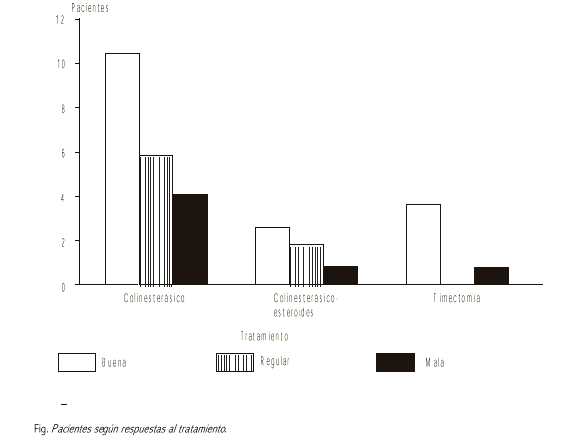
<P>En la tabla 4 y figura se observa que el porcentaje de respuesta buena   en los pacientes timectomizados (80 %) supera notablemente a la de los   pacientes que recibieron tratamiento m&eacute;dico (52,38 %) para los anticolinester&aacute;sicos   y 50 % para la combinaci&oacute;n anticolinester&aacute;sicos-esteroides.          <P>&nbsp;   <H4>   DISCUSI&Oacute;N</H4>   <I>St Luis</I><SUP>24</SUP> obtuvo los mejores resultados cuando la operaci&oacute;n   se realiz&oacute; en el segundo a&ntilde;o de evoluci&oacute;n de la miastenia   <I>gravis.</I> <I>Emeryk</I><SUP>25</SUP> postula que la timectom&iacute;a   debe realizarse lo antes posible tras el diagn&oacute;stico, pues en su   trabajo con 471 pacientes timectomizados observ&oacute; una marcada mejor&iacute;a   en aqu&eacute;llos de menos de 1 a&ntilde;o de evoluci&oacute;n de la enfermedad.          <P>Consideramos que los resultados que obtuvimos con el tratamiento quir&uacute;rgico   se debieron a que estos pacientes fueron operados precozmente y a que la   lesi&oacute;n histol&oacute;gica encontrada en todos ellos fue la hiperplasia   de la gl&aacute;ndula t&iacute;mica. <I>Papatestas </I>y otros<SUP>26</SUP>   en 185 pacientes timectomizados, pudieron observar remisi&oacute;n completa   en el 6,5 % de los pacientes con timoma. Esta conclusi&oacute;n se ve reforzada   por la de otros autores en su trabajo.<SUP>27</SUP> En cuanto a la causa   de la respuesta mala a la timectom&iacute;a en 1 de los pacientes en que   se us&oacute; este proceder consideramos que pudo ser por lo prolongado   de la evoluci&oacute;n de la enfermedad, la lesi&oacute;n de la sinapsis   ser&iacute;a ya irreversible, tambi&eacute;n podr&iacute;a ser porque no   se haya extirpado totalmente el tejido t&iacute;mico, bien por defectos   t&eacute;cnicos o porque exist&iacute;a tejido t&iacute;mico ect&oacute;pico.   Respecto al fracaso del tratamiento quir&uacute;rgico, otros autores se&ntilde;alan   causas similares.<SUP>28</SUP>   <H4>   SUMMARY</H4>   32 patients with diagnosis of myasthenia gravis included in the group II-A   according to Osserman and Genkin&acute;s classification, and who received   medical attention at the Internal Medicine and Neurology Services of "Celia   S&aacute;nchez Manduley" Clinical an Surgical Hospital during the last   10 years were studied. The females and the age groups between the second   and the fifth decades of life prevailed in the casuistics. A direct relationship   was found between the time elapsed since the onset of the first symptoms   and the beginning of the treatment and the drug dose used and the clinical   response. The response was good in 52.38 % of the patients that were treated   with anticholinesterase agents, whereas the response was also favorable   in 50 % of the patients who were administered a combination of anticholinesterase   agents with steroids. Thymectomy yielded satisfactory results in 80 % of   these individuals. It was observed a relationship between the time elapsed   since the diagnosis was made, the surgical procedure, and the clinical   response.          <P><I>Subject headings</I>: MYASTHENIA GRAVIS/ therapy.          <P>&nbsp;   <H4>   REFERENCIAS BIBLIOGR&Aacute;FICAS</H4>      <OL>       <LI>   Adams RA. Miastenia grave y formas epis&oacute;dicas de debilidad muscular.   En Principios de neurolog&iacute;a. La Habana: EditorialCient&iacute;fico-T&eacute;cnica,   1982;t 2:1042-80. (Edici&oacute;n Revolucionaria).</LI>          <LI>   Barraquer Bordas L. Neurolog&iacute;a fundamental. 3 ed. Barcelona: Toray,   1976:12-3, 882-3.</LI>          <LI>   Engel GA. Acquired autoinmune myasthenia gravis. En: Myology basic and   clinical. McGrow-Hill, 1986;1925-47.</LI>          ]]></body>
<body><![CDATA[<!-- ref --><LI>   Guthire LB. Myasthenia gravis in the 17 century. Lancet 1943;1:33.</LI>    <LI>   El&iacute;as SB, Appel SH. Recent advances in myasthenia gravis. Life Sci   1976;18:1031.</LI>          <LI>   Adams RA. Miastenia grave y debilidad muscular epis&oacute;dica. En: Harrison   Medicina interna. 5 ed. M&eacute;xico, DF: La Prensa M&eacute;dica Mexicana,   1979;t. 2:2383-5.</LI>          <!-- ref --><LI>   Walker MB. Treatment of myasthenia gravis with physostigmine. Lancet 1934;1:1200.</LI>    <LI>   Jolly F. Uber myasthenia gravis pseudoparalityca. Berl Klin Wochenschar   1985;32:1.</LI>          <LI>   Dale H, Feldberg W. Chemical transmision at motor nerve endings in voluntary   muscle. J Physiol 1934;81:39.</LI>          <LI>   Pritchard EAB. The use of prostigmin in the treatment of myasthenia gravis.   Lancet 1935;1:432.</LI>          <LI>   Kjaer, M. Myasthenia gravis and myasthenia syndromes treated with prednisone.   Acta Neurol Scand 1971;47:461.</LI>          <LI>   Johns TR, et al. The syndrome of myasthenia and polimyositis with comments   on therapy. Ann NY Acad Sci 1971;183:64.</LI>          <LI>   Warmols JR, Engel WK. Benefit from alternate day prednisone in myasthenia   gravis. N Engl J Med 1972;286:17.</LI>          ]]></body>
<body><![CDATA[<LI>   Mann JD. et al. Long term administration of corticosteroids in myasthenia   gravis. Neurology 1976;26:729.</LI>          <LI>   Patten BM. Myastenia gravis: Review fo diagnosis and managements. Muscle   nerve 1978;1:190.</LI>          <LI>   Martens HG, et al. The treatment of severe myasthenia gravis with inmunosuppresive   agents. Eur Neurol 1983;2:321.</LI>          <LI>   &Aacute;lvarez S&aacute;nchez B, y otros. Plasmaf&eacute;resis en el tratamiento   de la miastenia gravis. Rev Clin Esp 1983;170(1-2):61-4.</LI>          <LI>   Dau PC. Plasmapheresis and inmunosuppresive drug therapy in myasthenia   gravis. N Eng J Med 1977;297.</LI>          <!-- ref --><LI>   Kornfeld Pl. Plasmapheresis in myasthenia gravis. lancet 1979;1:190.</LI>    <LI>   Pila P&eacute;rez R, y otros. Resultados de la plasmaf&eacute;resis en   la miastenia gravis refractaria. Rev Cubana Med 1987;26(1):37-41.</LI>          <LI>   Llorens Figueroa JA, y otros. La timectom&iacute;a en la miastenia gravis.   Rev Cubana Med 1986;25(5):454-63.</LI>          <LI>   Stites DP. Inmunolog&iacute;a b&aacute;sica y cl&iacute;nica. 5. ed. La   Habana: Editorial Cient&iacute;fico-T&eacute;cnica, 1985;67:153-5, 1-176.   (Edici&oacute;n Revolucionaria).</LI>          <LI>   Walton JH. Enfermedades del m&uacute;sculo voluntario. En: Price?s Medicina   Interna. Barcelona: 1982;t.2:1862-4.</LI>          ]]></body>
<body><![CDATA[<LI>   St Luis Gonz&aacute;lez R. Valoraci&oacute;n de la timectom&iacute;a en   el tratamiento de la miastenia gravis. Rev Cubana Med 1988;27(2):64-72.</LI>          <LI>   Emeryk B, Strugalska MH. Evaluation of result of thymectomy in myasthenia   gravis. J Neurol 1976;211:115.</LI>          <LI>   Papatestas AE et al. Studies in myasthenia gravis: effects of thymectomy;   results on 185 patients with non-thymomatous myasthenia gravis 1941-1969.   Am J Med 1971;50:465.</LI>          <LI>   Genkis G et al. Studies in myasthenia gravis: early thymectomy, electrophysiologic   and pathology correlations. Am J Med 1975;58:517.</LI>          <!-- ref --><LI>   Havard CWH. Progress in myasthenia gravis. Br Med J 1973;3:437.</LI>    </OL>       <p>&nbsp; </p>     <p>Recibido: 26 de noviembre de 1998. Aprobado: 18 de marzo de 1999. </p>     <P><A NAME="x"></A>Dr. <I>C&eacute;sar Mustelier Fern&aacute;ndez.</I>   Hospital Provincial Clinicoquir&uacute;rgico "Celia S&aacute;nchez Manduley",   Servicio de Medicina Interna, Avenida Camilo Cienfuegos, Manzanillo, Granma,   Cuba.       <BR>&nbsp;             ]]></body>
<body><![CDATA[ ]]></body><back>
<ref-list>
<ref id="B1">
<nlm-citation citation-type="book">
<person-group person-group-type="author">
<name>
<surname><![CDATA[Adams]]></surname>
<given-names><![CDATA[RA]]></given-names>
</name>
</person-group>
<article-title xml:lang="es"><![CDATA[Miastenia grave y formas episódicas de debilidad muscular]]></article-title>
<source><![CDATA[Principios de neurología]]></source>
<year>1982</year>
<page-range>1042-80.</page-range><publisher-loc><![CDATA[La Habana ]]></publisher-loc>
<publisher-name><![CDATA[EditorialCientífico-Técnica]]></publisher-name>
</nlm-citation>
</ref>
<ref id="B2">
<nlm-citation citation-type="book">
<person-group person-group-type="author">
<name>
<surname><![CDATA[Barraquer Bordas]]></surname>
<given-names><![CDATA[L]]></given-names>
</name>
</person-group>
<source><![CDATA[Neurología fundamental]]></source>
<year>1976</year>
<edition>3</edition>
<page-range>12-3</page-range><page-range>882-3.</page-range><publisher-loc><![CDATA[Barcelona ]]></publisher-loc>
<publisher-name><![CDATA[Toray]]></publisher-name>
</nlm-citation>
</ref>
<ref id="B3">
<nlm-citation citation-type="book">
<person-group person-group-type="author">
<name>
<surname><![CDATA[Engel]]></surname>
<given-names><![CDATA[GA]]></given-names>
</name>
</person-group>
<article-title xml:lang="en"><![CDATA[Acquired autoinmune myasthenia gravis]]></article-title>
<source><![CDATA[Myology basic and clinical]]></source>
<year>1986</year>
<page-range>1925-47.</page-range><publisher-name><![CDATA[McGrow-Hill]]></publisher-name>
</nlm-citation>
</ref>
<ref id="B4">
<nlm-citation citation-type="journal">
<person-group person-group-type="author">
<name>
<surname><![CDATA[Guthire]]></surname>
<given-names><![CDATA[LB]]></given-names>
</name>
</person-group>
<article-title xml:lang="en"><![CDATA[Myasthenia gravis in the 17 century]]></article-title>
<source><![CDATA[Lancet]]></source>
<year>1943</year>
<volume>1</volume>
<page-range>33</page-range></nlm-citation>
</ref>
<ref id="B5">
<nlm-citation citation-type="journal">
<person-group person-group-type="author">
<name>
<surname><![CDATA[Elías]]></surname>
<given-names><![CDATA[SB]]></given-names>
</name>
<name>
<surname><![CDATA[Appel]]></surname>
<given-names><![CDATA[SH]]></given-names>
</name>
</person-group>
<article-title xml:lang="en"><![CDATA[Recent advances in myasthenia gravis]]></article-title>
<source><![CDATA[Life Sci]]></source>
<year>1976</year>
<volume>18</volume>
<page-range>1031</page-range></nlm-citation>
</ref>
<ref id="B6">
<nlm-citation citation-type="book">
<person-group person-group-type="author">
<name>
<surname><![CDATA[Adams]]></surname>
<given-names><![CDATA[RA]]></given-names>
</name>
</person-group>
<article-title xml:lang="es"><![CDATA[Miastenia grave y debilidad muscular episódica]]></article-title>
<source><![CDATA[Harrison Medicina interna]]></source>
<year>1979</year>
<edition>5</edition>
<page-range>2383-5.</page-range><publisher-loc><![CDATA[México, DF ]]></publisher-loc>
<publisher-name><![CDATA[La Prensa Médica Mexicana]]></publisher-name>
</nlm-citation>
</ref>
<ref id="B7">
<nlm-citation citation-type="journal">
<person-group person-group-type="author">
<name>
<surname><![CDATA[Walker]]></surname>
<given-names><![CDATA[MB]]></given-names>
</name>
</person-group>
<article-title xml:lang="en"><![CDATA[Treatment of myasthenia gravis with physostigmine]]></article-title>
<source><![CDATA[Lancet]]></source>
<year>1934</year>
<volume>1</volume>
<page-range>1200</page-range></nlm-citation>
</ref>
<ref id="B8">
<nlm-citation citation-type="journal">
<person-group person-group-type="author">
<name>
<surname><![CDATA[Jolly]]></surname>
<given-names><![CDATA[F]]></given-names>
</name>
</person-group>
<article-title xml:lang="en"><![CDATA[Uber myasthenia gravis pseudoparalityca]]></article-title>
<source><![CDATA[Berl Klin Wochenschar]]></source>
<year>1985</year>
<volume>32</volume>
<page-range>1</page-range></nlm-citation>
</ref>
<ref id="B9">
<nlm-citation citation-type="journal">
<person-group person-group-type="author">
<name>
<surname><![CDATA[Dale]]></surname>
<given-names><![CDATA[H]]></given-names>
</name>
<name>
<surname><![CDATA[Feldberg]]></surname>
<given-names><![CDATA[W]]></given-names>
</name>
</person-group>
<article-title xml:lang="en"><![CDATA[Chemical transmision at motor nerve endings in voluntary muscle]]></article-title>
<source><![CDATA[J Physiol]]></source>
<year>1934</year>
<volume>81</volume>
<page-range>39</page-range></nlm-citation>
</ref>
<ref id="B10">
<nlm-citation citation-type="journal">
<person-group person-group-type="author">
<name>
<surname><![CDATA[Pritchard]]></surname>
<given-names><![CDATA[EAB]]></given-names>
</name>
</person-group>
<article-title xml:lang="en"><![CDATA[The use of prostigmin in the treatment of myasthenia gravis]]></article-title>
<source><![CDATA[Lancet]]></source>
<year>1935</year>
<volume>1</volume>
<page-range>432</page-range></nlm-citation>
</ref>
<ref id="B11">
<nlm-citation citation-type="journal">
<person-group person-group-type="author">
<name>
<surname><![CDATA[Kjaer]]></surname>
<given-names><![CDATA[M]]></given-names>
</name>
</person-group>
<article-title xml:lang="en"><![CDATA[Myasthenia gravis and myasthenia syndromes treated with prednisone]]></article-title>
<source><![CDATA[Acta Neurol Scand]]></source>
<year>1971</year>
<volume>47</volume>
<page-range>461.</page-range></nlm-citation>
</ref>
<ref id="B12">
<nlm-citation citation-type="journal">
<person-group person-group-type="author">
<name>
<surname><![CDATA[Johns]]></surname>
<given-names><![CDATA[TR]]></given-names>
</name>
</person-group>
<article-title xml:lang="en"><![CDATA[The syndrome of myasthenia and polimyositis with comments on therapy]]></article-title>
<source><![CDATA[Ann NY Acad Sci]]></source>
<year>1971</year>
<volume>183</volume>
<page-range>64.</page-range></nlm-citation>
</ref>
<ref id="B13">
<nlm-citation citation-type="journal">
<person-group person-group-type="author">
<name>
<surname><![CDATA[Warmols]]></surname>
<given-names><![CDATA[JR]]></given-names>
</name>
<name>
<surname><![CDATA[Engel]]></surname>
<given-names><![CDATA[WK]]></given-names>
</name>
</person-group>
<article-title xml:lang="en"><![CDATA[Benefit from alternate day prednisone in myasthenia gravis]]></article-title>
<source><![CDATA[N Engl J Med]]></source>
<year>1972</year>
<volume>286</volume>
<page-range>17</page-range></nlm-citation>
</ref>
<ref id="B14">
<nlm-citation citation-type="journal">
<person-group person-group-type="author">
<name>
<surname><![CDATA[Mann]]></surname>
<given-names><![CDATA[JD]]></given-names>
</name>
</person-group>
<article-title xml:lang="en"><![CDATA[Long term administration of corticosteroids in myasthenia gravis]]></article-title>
<source><![CDATA[Neurology]]></source>
<year>1976</year>
<volume>26</volume>
<page-range>729.</page-range></nlm-citation>
</ref>
<ref id="B15">
<nlm-citation citation-type="journal">
<person-group person-group-type="author">
<name>
<surname><![CDATA[Patten]]></surname>
<given-names><![CDATA[BM]]></given-names>
</name>
</person-group>
<article-title xml:lang="en"><![CDATA[Myastenia gravis: Review fo diagnosis and managements]]></article-title>
<source><![CDATA[Muscle nerve]]></source>
<year>1978</year>
<volume>1</volume>
<page-range>190</page-range></nlm-citation>
</ref>
<ref id="B16">
<nlm-citation citation-type="journal">
<person-group person-group-type="author">
<name>
<surname><![CDATA[Martens]]></surname>
<given-names><![CDATA[HG]]></given-names>
</name>
</person-group>
<article-title xml:lang="en"><![CDATA[The treatment of severe myasthenia gravis with inmunosuppresive agents]]></article-title>
<source><![CDATA[Eur Neurol]]></source>
<year>1983</year>
<volume>2</volume>
<page-range>321</page-range></nlm-citation>
</ref>
<ref id="B17">
<nlm-citation citation-type="journal">
<person-group person-group-type="author">
<name>
<surname><![CDATA[Álvarez Sánchez]]></surname>
<given-names><![CDATA[B]]></given-names>
</name>
</person-group>
<article-title xml:lang="es"><![CDATA[Plasmaféresis en el tratamiento de la miastenia gravis]]></article-title>
<source><![CDATA[Rev Clin Esp]]></source>
<year>1983</year>
<volume>170</volume>
<numero>1-2</numero>
<issue>1-2</issue>
<page-range>61-4.</page-range></nlm-citation>
</ref>
<ref id="B18">
<nlm-citation citation-type="journal">
<person-group person-group-type="author">
<name>
<surname><![CDATA[Dau]]></surname>
<given-names><![CDATA[PC]]></given-names>
</name>
</person-group>
<article-title xml:lang="en"><![CDATA[Plasmapheresis and inmunosuppresive drug therapy in myasthenia gravis]]></article-title>
<source><![CDATA[N Eng J Med]]></source>
<year>1977</year>
<volume>297.</volume>
</nlm-citation>
</ref>
<ref id="B19">
<nlm-citation citation-type="journal">
<person-group person-group-type="author">
<name>
<surname><![CDATA[Kornfeld]]></surname>
<given-names><![CDATA[Pl]]></given-names>
</name>
</person-group>
<article-title xml:lang="en"><![CDATA[Plasmapheresis in myasthenia gravis]]></article-title>
<source><![CDATA[lancet]]></source>
<year>1979</year>
<volume>1</volume>
<page-range>190</page-range></nlm-citation>
</ref>
<ref id="B20">
<nlm-citation citation-type="journal">
<person-group person-group-type="author">
<name>
<surname><![CDATA[Pila Pérez]]></surname>
<given-names><![CDATA[R]]></given-names>
</name>
</person-group>
<article-title xml:lang="es"><![CDATA[Resultados de la plasmaféresis en la miastenia gravis refractaria]]></article-title>
<source><![CDATA[Rev Cubana Med]]></source>
<year>1987</year>
<volume>26</volume>
<numero>1</numero>
<issue>1</issue>
<page-range>37-41.</page-range></nlm-citation>
</ref>
<ref id="B21">
<nlm-citation citation-type="journal">
<person-group person-group-type="author">
<name>
<surname><![CDATA[Llorens Figueroa]]></surname>
<given-names><![CDATA[JA]]></given-names>
</name>
</person-group>
<article-title xml:lang="es"><![CDATA[La timectomía en la miastenia gravis]]></article-title>
<source><![CDATA[Rev Cubana Med]]></source>
<year>1986</year>
<volume>25</volume>
<numero>5</numero>
<issue>5</issue>
<page-range>454-63.</page-range></nlm-citation>
</ref>
<ref id="B22">
<nlm-citation citation-type="book">
<person-group person-group-type="author">
<name>
<surname><![CDATA[Stites]]></surname>
<given-names><![CDATA[DP]]></given-names>
</name>
</person-group>
<source><![CDATA[Inmunología básica y clínica]]></source>
<year>1985</year>
<edition>5</edition>
<page-range>153-5</page-range><page-range>1-176.</page-range><publisher-loc><![CDATA[La Habana ]]></publisher-loc>
<publisher-name><![CDATA[Editorial Científico-Técnica]]></publisher-name>
</nlm-citation>
</ref>
<ref id="B23">
<nlm-citation citation-type="">
<person-group person-group-type="author">
<name>
<surname><![CDATA[Walton]]></surname>
<given-names><![CDATA[JH]]></given-names>
</name>
</person-group>
<article-title xml:lang="es"><![CDATA[Enfermedades del músculo voluntario]]></article-title>
<source><![CDATA[Price?s Medicina Interna]]></source>
<year>1982</year>
<page-range>1862-4.</page-range><publisher-loc><![CDATA[Barcelona ]]></publisher-loc>
</nlm-citation>
</ref>
<ref id="B24">
<nlm-citation citation-type="journal">
<person-group person-group-type="author">
<name>
<surname><![CDATA[St Luis González]]></surname>
<given-names><![CDATA[R]]></given-names>
</name>
</person-group>
<article-title xml:lang="es"><![CDATA[Valoración de la timectomía en el tratamiento de la miastenia gravis]]></article-title>
<source><![CDATA[Rev Cubana Med]]></source>
<year>1988</year>
<volume>27</volume>
<numero>2</numero>
<issue>2</issue>
<page-range>64-72.</page-range></nlm-citation>
</ref>
<ref id="B25">
<nlm-citation citation-type="journal">
<person-group person-group-type="author">
<name>
<surname><![CDATA[Emeryk]]></surname>
<given-names><![CDATA[B]]></given-names>
</name>
<name>
<surname><![CDATA[Strugalska]]></surname>
<given-names><![CDATA[MH]]></given-names>
</name>
</person-group>
<article-title xml:lang="en"><![CDATA[Evaluation of result of thymectomy in myasthenia gravis]]></article-title>
<source><![CDATA[J Neurol]]></source>
<year>1976</year>
<volume>211</volume>
<page-range>115</page-range></nlm-citation>
</ref>
<ref id="B26">
<nlm-citation citation-type="journal">
<person-group person-group-type="author">
<name>
<surname><![CDATA[Papatestas]]></surname>
<given-names><![CDATA[AE]]></given-names>
</name>
</person-group>
<article-title xml:lang="en"><![CDATA[Studies in myasthenia gravis: effects of thymectomy; results on 185 patients with non-thymomatous myasthenia gravis 1941-1969]]></article-title>
<source><![CDATA[Am J Med]]></source>
<year>1971</year>
<volume>50</volume>
<page-range>465.</page-range></nlm-citation>
</ref>
<ref id="B27">
<nlm-citation citation-type="journal">
<person-group person-group-type="author">
<name>
<surname><![CDATA[Genkis]]></surname>
<given-names><![CDATA[G]]></given-names>
</name>
</person-group>
<article-title xml:lang="en"><![CDATA[Studies in myasthenia gravis: early thymectomy, electrophysiologic and pathology correlations]]></article-title>
<source><![CDATA[Am J Med]]></source>
<year>1975</year>
<volume>58</volume>
<page-range>517.</page-range></nlm-citation>
</ref>
<ref id="B28">
<nlm-citation citation-type="journal">
<person-group person-group-type="author">
<name>
<surname><![CDATA[Havard]]></surname>
<given-names><![CDATA[CWH]]></given-names>
</name>
</person-group>
<article-title xml:lang="en"><![CDATA[Progress in myasthenia gravis]]></article-title>
<source><![CDATA[Br Med J]]></source>
<year>1973</year>
<volume>3</volume>
<page-range>437</page-range></nlm-citation>
</ref>
</ref-list>
</back>
</article>