<?xml version="1.0" encoding="ISO-8859-1"?><article xmlns:mml="http://www.w3.org/1998/Math/MathML" xmlns:xlink="http://www.w3.org/1999/xlink" xmlns:xsi="http://www.w3.org/2001/XMLSchema-instance">
<front>
<journal-meta>
<journal-id>0034-7523</journal-id>
<journal-title><![CDATA[Revista Cubana de Medicina]]></journal-title>
<abbrev-journal-title><![CDATA[Rev cubana med]]></abbrev-journal-title>
<issn>0034-7523</issn>
<publisher>
<publisher-name><![CDATA[Centro Nacional de Información de Ciencias MédicasEditorial Ciencias Médicas]]></publisher-name>
</publisher>
</journal-meta>
<article-meta>
<article-id>S0034-75232003000100005</article-id>
<title-group>
<article-title xml:lang="es"><![CDATA[Creación y validación de un instrumento para el seguimiento de pacientes con enfermedad cerebrovascular]]></article-title>
</title-group>
<contrib-group>
<contrib contrib-type="author">
<name>
<surname><![CDATA[Bembibre Taboada]]></surname>
<given-names><![CDATA[Rubén M.]]></given-names>
</name>
<xref ref-type="aff" rid="A01"/>
</contrib>
<contrib contrib-type="author">
<name>
<surname><![CDATA[Suárez Suri]]></surname>
<given-names><![CDATA[Roberto]]></given-names>
</name>
</contrib>
<contrib contrib-type="author">
<name>
<surname><![CDATA[Concepción Morales]]></surname>
<given-names><![CDATA[Eduardo]]></given-names>
</name>
</contrib>
<contrib contrib-type="author">
<name>
<surname><![CDATA[Cabrera Gómez]]></surname>
<given-names><![CDATA[José]]></given-names>
</name>
</contrib>
<contrib contrib-type="author">
<name>
<surname><![CDATA[Espinosa Brito]]></surname>
<given-names><![CDATA[Alfredo]]></given-names>
</name>
</contrib>
<contrib contrib-type="author">
<name>
<surname><![CDATA[Erice Lafonte]]></surname>
<given-names><![CDATA[Ramón]]></given-names>
</name>
</contrib>
<contrib contrib-type="author">
<name>
<surname><![CDATA[Peraza]]></surname>
<given-names><![CDATA[María Victoria]]></given-names>
</name>
</contrib>
</contrib-group>
<aff id="A01">
<institution><![CDATA[,Hospital Clinicoquirúrgico Gustavo Aldereguía Lima  ]]></institution>
<addr-line><![CDATA[Cienfuegos ]]></addr-line>
<country>Cuba</country>
</aff>
<pub-date pub-type="pub">
<day>00</day>
<month>03</month>
<year>2003</year>
</pub-date>
<pub-date pub-type="epub">
<day>00</day>
<month>03</month>
<year>2003</year>
</pub-date>
<volume>42</volume>
<numero>1</numero>
<fpage>34</fpage>
<lpage>45</lpage>
<copyright-statement/>
<copyright-year/>
<self-uri xlink:href="http://scielo.sld.cu/scielo.php?script=sci_arttext&amp;pid=S0034-75232003000100005&amp;lng=en&amp;nrm=iso"></self-uri><self-uri xlink:href="http://scielo.sld.cu/scielo.php?script=sci_abstract&amp;pid=S0034-75232003000100005&amp;lng=en&amp;nrm=iso"></self-uri><self-uri xlink:href="http://scielo.sld.cu/scielo.php?script=sci_pdf&amp;pid=S0034-75232003000100005&amp;lng=en&amp;nrm=iso"></self-uri><abstract abstract-type="short" xml:lang="es"><p><![CDATA[Se realizó un estudio para crear y validar un instrumento para el seguimiento de pacientes con enfermedad cerebrovascular, y determinar las variables necesarias para evaluarlos y establecer procedimientos para obtener un puntaje y estratificación por grupos que permitan una clasificación pronóstica y evolutiva de nuevos casos. Se analizó una muestra multicéntrica, de 1 218 enfermos, por métodos estadísticos: V de Cramer. Detector Automático de Interacciones, Chi cuadrado, regresión logística, método de Spearman, escalamiento óptimo, análisis factorial, etc., sobre bases de datos EXCEL transferida al paquete estadístico para Ciencias Sociales. Se obtuvo un instrumento manual y 2 implementados en sistema computadorizado: clínico y general, con porcentajes correctos de clasificación superiores a 90 y válidos en resultado global con 90,09; 92,98 y 94,14 %, respectivamente. Los puntajes y clasificación se realizaron sobre la base de los coeficientes obtenidos en un intervalo de 0-1. Resultaron 3 grupos de riesgo: bajo (vivo sin discapacidad: 0 <FONT FACE=Symbol>&pound;</FONT> puntaje <FONT FACE=Symbol>&pound;</FONT> 0,33), medio (vivo con discapacidad 0,33 < puntaje < 0,67) y alto (fallecido 0,67 <FONT FACE=Symbol>&pound;</FONT> puntaje <FONT FACE=Symbol>&pound;</FONT> 1), algunos clasifican directamente por interacciones. Se obtuvo un instrumento de rigor científico cuanticualitativo, único en el país, de fácil aplicación, para atender pacientes con enfermedad cerebrovascular y, sobre esta base tomar decisiones para ejecutar una práctica médica de mayor calidad.]]></p></abstract>
<abstract abstract-type="short" xml:lang="en"><p><![CDATA[A study was conducted to create and validate an instrument for the follow-up of patients with stroke. The necessary variables to evaluate these patients were determined and procedures were established to obtain a score and a stratification by groups that allow a prognostic and evolutive classification of the new cases. A multicenter sample of 1 218 patients was analyzed by statistical methods, such as: Cramer’s V, automatic interaction detector, Chi square, logistic regression, Spearman’s method, optimum scaling, factorial analysis, and others, on EXCEL database transferred to SPSS. A manual instrument and 2 computer-generated tools: a clinical and a general one with correct percentages of classification over 90 and validated according to global result with 90.09; 92.98 and 94.14 %, respectively, were attained. The scores and the classification were made on the basis of the coefficients observed in an interval from 0 to 1. 3 risk groups were obtained: low (live without disability: 0<FONT FACE=Symbol>&pound;</FONT>score <FONT FACE=Symbol>&pound;</FONT> 0.33), mean (live with disability: 0.33< score<0.67) and high (dead: 0.67 <FONT FACE=Symbol>&pound;</FONT> score <FONT FACE=Symbol>&pound;</FONT> 1). Some patients were directly classified by interactions. An instrument of scientific quantitative and qualitative rigor, unique in the country and easy to apply was obtained to give attention to patients suffering from stroke and, on that basis, to make decisions aimed at performing a medical practice of higher quality.]]></p></abstract>
<kwd-group>
<kwd lng="es"><![CDATA[HEMORRAGIA CEREBRAL]]></kwd>
<kwd lng="es"><![CDATA[INFARTO CEREBRAL]]></kwd>
<kwd lng="es"><![CDATA[EQUIPOS Y SUMINISTROS]]></kwd>
<kwd lng="es"><![CDATA[ESTUDIOS DE SEGUIMIENTO]]></kwd>
<kwd lng="es"><![CDATA[PROGRAMAS NACIONALES DE SALUD]]></kwd>
<kwd lng="es"><![CDATA[ESTUDIOS DE EVALUACION]]></kwd>
<kwd lng="en"><![CDATA[CEREBRAL HEMORRHAGE]]></kwd>
<kwd lng="en"><![CDATA[CEREBRAL INFARCTION]]></kwd>
<kwd lng="en"><![CDATA[EQUIPMENT AND SUPPLIES]]></kwd>
<kwd lng="en"><![CDATA[FOLLOW-UP STUDIES]]></kwd>
<kwd lng="en"><![CDATA[NATIONAL HEALTH PROGRAMS]]></kwd>
<kwd lng="en"><![CDATA[EVALUATION STUDIES]]></kwd>
</kwd-group>
</article-meta>
</front><body><![CDATA[ <p>Hospital Universitario Cl&iacute;nicoquir&uacute;rgico &#147;Gustavo Alderegu&iacute;a&#148;        <br>   Hospital Universitario Cl&iacute;nicoquir&uacute;rgico &#147;Arnaldo Mili&aacute;n&#148;    <br>   Universidad de Cienfuegos</p> <h2>Creaci&oacute;n y validaci&oacute;n de un instrumento para el seguimiento    de pacientes con enfermedad cerebrovascular </h2>     <p><i><a href="#cargo">Dr. Rub&eacute;n M. Bembibre Taboada,<span class="superscript">1</span>    Lic. Roberto Su&aacute;rez Suri,<span class="superscript">2</span> Lic. Eduardo    Concepci&oacute;n Morales,<span class="superscript">3</span> Dr. Jos&eacute;    Cabrera G&oacute;mez,<span class="superscript">4</span> Alfredo Espinosa Brito,<span class="superscript">5</span>    Dr. Ram&oacute;n Erice Lafonte<span class="superscript">6</span> y Mar&iacute;a    Victoria Peraza<span class="superscript">7</span></a><span class="superscript"><a name="autor"></a>    </span></i></p> <h4>Resumen</h4>     <p>Se realiz&oacute; un estudio para crear y validar un instrumento para el seguimiento    de pacientes con enfermedad cerebrovascular, y determinar las variables necesarias    para evaluarlos y establecer procedimientos para obtener un puntaje y estratificaci&oacute;n    por grupos que permitan una clasificaci&oacute;n pron&oacute;stica y evolutiva    de nuevos casos. Se analiz&oacute; una muestra multic&eacute;ntrica, de 1 218    enfermos, por m&eacute;todos estad&iacute;sticos: V de Cramer. Detector Autom&aacute;tico    de Interacciones, Chi cuadrado, regresi&oacute;n log&iacute;stica, m&eacute;todo    de Spearman, escalamiento &oacute;ptimo, an&aacute;lisis factorial, etc., sobre    bases de datos EXCEL transferida al paquete estad&iacute;stico para Ciencias    Sociales. Se obtuvo un instrumento manual y 2 implementados en sistema computadorizado:    cl&iacute;nico y general, con porcentajes correctos de clasificaci&oacute;n    superiores a 90 y v&aacute;lidos en resultado global con 90,09; 92,98 y 94,14    %, respectivamente. Los puntajes y clasificaci&oacute;n se realizaron sobre    la base de los coeficientes obtenidos en un intervalo de 0-1. Resultaron 3 grupos    de riesgo: bajo (vivo sin discapacidad: 0 <font face="Symbol">&pound;</font>    puntaje <font face="Symbol">&pound;</font> 0,33), medio (vivo con discapacidad    0,33 &lt; puntaje &lt; 0,67) y alto (fallecido 0,67 <font face="Symbol">&pound;</font>    puntaje <font face="Symbol">&pound;</font> 1), algunos clasifican directamente    por interacciones. Se obtuvo un instrumento de rigor cient&iacute;fico cuanticualitativo,    &uacute;nico en el pa&iacute;s, de f&aacute;cil aplicaci&oacute;n, para atender    pacientes con enfermedad cerebrovascular y, sobre esta base tomar decisiones    para ejecutar una pr&aacute;ctica m&eacute;dica de mayor calidad.</p>     <p><i>DeCS:</i> HEMORRAGIA CEREBRAL; INFARTO CEREBRAL; EQUIPOS Y SUMINISTROS;    ESTUDIOS DE SEGUIMIENTO; PROGRAMAS NACIONALES DE SALUD; ESTUDIOS DE EVALUACION.    <br> </p>     <p>Las enfermedades cerebrovasculares (ECV) constituyen la tercera causa de muerte    y primera de discapacidad en el mundo.<span class="superscript">1</span> Se    reportan tasa de incidencia para la primera ECV de 132,4 <font face="Symbol">&acute;    </font>100 000 hab y para cualquier ECV, de 162,7 por 100 000 hab; con tasas    de incidencia ajustadas por edades para poblaci&oacute;n mundial de 61,3 y 73,6    <font face="Symbol">&acute;</font> 100 000 hab, respectivamente.<span class="superscript">2</span>    La mortalidad global var&iacute;a entre 6 y 30 % con una media aproximada del    20 %.<span class="superscript">3</span> Por la magnitud de su repercusi&oacute;n    en la salud ha sido priorizada en los programas sanitarios de la Organizaci&oacute;n    Mundial de la Salud (OMS).</p>     <p>En Cuba, las ECV constituyen uno de los problemas de salud m&aacute;s importantes,    afectan alrededor del 5 % de la poblaci&oacute;n mayor de 65 a&ntilde;os y representa    entre el 9 y el 10 % del total de fallecidos. Entre los que sobreviven, el 50    % o m&aacute;s quedan con alguna secuela. La mortalidad por ECV ha mostrado    un incremento progresivo desde los a&ntilde;os 70, alcanz&oacute; las cifras    m&aacute;s altas en 1999. En los &uacute;ltimos 5 a&ntilde;os, en Cuba mueren,    como promedio, anualmente unas 7 900 personas por esta causa y de ellas, alrededor    del 85 % tiene 60 a&ntilde;os o m&aacute;s.<span class="superscript">4</span></p>     <p>El incremento de la rigurosidad de atenci&oacute;n y sistematicidad para el    tratamiento y seguimiento de estos pacientes est&aacute; priorizado por el Ministerio    de Salud P&uacute;blica. Sobre esa base se est&aacute; implementando el Programa    Nacional de Prevenci&oacute;n y Control de las ECV en el pa&iacute;s.<span class="superscript">4</span></p>     ]]></body>
<body><![CDATA[<p>El &eacute;xito de la medicina intensiva est&aacute; estrechamente vinculado    al pron&oacute;stico que debe ser lo m&aacute;s preciso posible para poder planificar    mejor la estrategia terap&eacute;utica y de seguimiento adecuadas.<span class="superscript">5</span>    La omisi&oacute;n de la predicci&oacute;n como objetivo fundamental de la ciencia    m&eacute;dica b&aacute;sica ha creado una importante deficiencia en el trabajo    cl&iacute;nico, puesto que uno de los mayores desaf&iacute;os actuales en el    cuidado de los pacientes es el de establecer una predicci&oacute;n pron&oacute;stica.    Sin instrumentos de medici&oacute;n ser&iacute;a imposible ejercer una medicina    verdaderamente cient&iacute;fica a la luz de los conocimientos actuales.</p> <h4>M&eacute;todos</h4>     <p>El universo de la investigaci&oacute;n estuvo constituido por todos los pacientes    con ECV que ingresaron en los servicios de Terapia de los hospitales clinicoquir&uacute;rgicos    &#147;Gustavo Alderegu&iacute;a&#148;, de la provincia Cienfuegos, y &#147;Arnaldo    Mili&aacute;n Castro&#148;de Villa Clara, en el per&iacute;odo del 1-7-2000    al 1-7-2001. Comprobados por tomograf&iacute;a axial computadorizada (TAC).</p>     <p>Un personal entrenado aplic&oacute; una encuesta a los enfermos, para ello    evaluaron previamente sus conocimientos para lograr evaluaci&oacute;n con criterios    unicistas y evitar sesgo en la recogida de datos en el aspecto datos aportados    por el observador, teniendo en cuenta que los requisitos aceptados internacionalmente    para construir escalas son: tiempo de aplicaci&oacute;n, concordancia interobservadores,    y concordancia intraobservador, esto fue analizado por m&eacute;todo estad&iacute;stico    determinado por coeficiente de Kappa y la prueba no param&eacute;trica de Friedman    del paquete SPSS (<i>Statistical Paquet Social Sciences</i>). Estos an&aacute;lisis    se realizaron con la informaci&oacute;n proveniente de los casos que ingresaron    en un per&iacute;odo de 30 d previos a la investigaci&oacute;n. El personal    encargado fueron m&eacute;dicos intensivistas que laboran en las unidades citadas.    <br> </p>     <p>Luego se revisaron los expedientes cl&iacute;nicos de los encuestados y una    vez concluidas las planillas se transfirieron los datos a sistema EXCEL para    su ulterior traspaso a SPSS.</p>     <p>Se analizaron las variables implicadas en el estudio, se determinaron las significativas    y se definieron las necesarias para incluir en el instrumento de medici&oacute;n.    <br> </p>     <p>El estudio estad&iacute;stico se bas&oacute; en la informaci&oacute;n aportada    por 94 variables en los 1 218 pacientes incluidos en la investigaci&oacute;n.    El an&aacute;lisis de las correlaciones bivariadas fue ejecutado mediante el    coeficiente de correlaci&oacute;n V de Cramer y m&eacute;todo de Spearman.</p>     <p>Se realiz&oacute; un an&aacute;lisis m&aacute;s detallado mediante tablas de    contingencias; inicialmente fueron eliminadas del proceso, para la b&uacute;squeda    de puntuaci&oacute;n, las variables cuyas correlaciones fueron muy pr&oacute;ximas    a cero y no hubo indicios de relaci&oacute;n, ni en el caso de fundici&oacute;n    de categor&iacute;as contiguas. No obstante, algunas de las variables excluidas    en este an&aacute;lisis fueron consideradas en la b&uacute;squeda de interacciones    y analizadas en los 4 momentos en los que se realizaron mediciones (ingreso,    24 h, 72 h y egreso), en el caso de las variables cl&iacute;nicas y siempre    con la totalidad de casos. Fue aplicado escalamiento &oacute;ptimo.    <br> </p>     ]]></body>
<body><![CDATA[<p>Para determinar la importancia de las variables en la b&uacute;squeda de la    escala se realiz&oacute; un an&aacute;lisis factorial. Se aplic&oacute; una    regresi&oacute;n log&iacute;stica por el m&eacute;todo paso a paso, primeramente,    empleando como variable dependiente el estado del paciente al egreso en 2 categor&iacute;as    (vivos y fallecidos) y posteriormente, con las de vivos sin discapacidad y vivos    con discapacidad, lo cual permiti&oacute; establecer las variables independientes    que mejor diferenciaron a los pacientes en las diferentes categor&iacute;as;    se realiz&oacute; ajuste en ambos casos (empleando variables cl&iacute;nicas    y la totalidad de variables).</p>     <p>Despu&eacute;s se aplicaron las regresiones log&iacute;sticas a las variables    que quedaban del m&eacute;todo paso a paso y, finalmente, la prueba de bondad    de ajuste.    <br> </p>     <p>Luego de efectuados los an&aacute;lisis se repiti&oacute; el proceso de regresi&oacute;n    log&iacute;stica con una muestra aleatoria de 2 936 casos. Este n&uacute;mero    fue obtenido a partir de las variables fraccionadas por tiempos (1 218 pacientes    en 4 mediciones).</p>     <p>Para determinar las variables en el procedimiento de clasificaci&oacute;n con    variables cl&iacute;nicas de car&aacute;cter manual se emple&oacute; una regresi&oacute;n    lineal m&uacute;ltiple con los resultados de un escalamiento &oacute;ptimo que    permiti&oacute; eliminar las no necesarias. Para establecer los procedimientos    para clasificar y estratificar los grupos de riesgo en este ac&aacute;pite fueron    utilizados el Detector Autom&aacute;tico de Interacciones Chi cuadrado (CHAID)con    acoplamiento a SPSS y el CATPCA versi&oacute;n 1.0 de la Data Theory Scaling    System Group(DTSS).</p>     <p>A partir de las variables seleccionadas se aplicaron 2 regresiones log&iacute;sticas,    la primera para diferenciar los vivos y fallecidos, y la segunda, aplicada a    los individuos clasificados como vivos para su reclasificaci&oacute;n en vivos    sin discapacidad y vivos con discapacidad.</p>     <p>El procedimiento anterior fue aplicado para establecer el proceso de clasificaci&oacute;n    empleando variables cl&iacute;nicas y todas las variables. Se logr&oacute; un    procedimiento de clasificaci&oacute;n compuesto de 2 partes. Primero, clasificaci&oacute;n    por interacciones y segundo, clasificaci&oacute;n utilizando los resultados    de la regresi&oacute;n log&iacute;stica, para los casos no clasificados en uno.    <br> </p>     <p>En el caso de las variables cl&iacute;nicas se emple&oacute; un procedimiento    similar al anterior, pero los individuos no clasificados por interacciones son    clasificados empleando una regresi&oacute;n lineal m&uacute;ltiple utilizando    los resultados del escalamiento &oacute;ptimo. Con el compendio de todos los    an&aacute;lisis hasta aqu&iacute; efectuados se obtuvieron los instrumentos    de medici&oacute;n que se presentan.    <br>   Uno netamene cl&iacute;nico para uso manual, uno de variables cl&iacute;nicas,    computadorizado y otro con todas las variables, computadorizado. Los instrumentos    se implementaron en un programa (software) en el ambiente Borland Delphi, versi&oacute;n    6.0, que funciona sobre el sistema operativo Windows 2000.</p> <h4>Resultados</h4>     ]]></body>
<body><![CDATA[<p>El n&uacute;mero de pacientes distribuidos seg&uacute;n la variable egreso    fue el siguiente: vivos sin discapacidad, 173; vivos con discapacidad, 758 y    fallecidos 287, lo que representa un 14,2; 62,2 y 23,6 % respectivamente.</p>     <p>La correspondencia con el nivel de medici&oacute;n de las variables entre el    estado del enfermo al egreso y cada una de las variables por separado permiti&oacute;    reconocer cu&aacute;les de las variables estaban mejor correlacionadas. Se hizo    evidente en los resultados obtenidos por Spearman la significaci&oacute;n de    las variables obtenidas.</p>     <p>Despu&eacute;s de aplicar un escalamiento &oacute;ptimo donde particip&oacute;    el conjunto de variables con un comportamiento favorable en cuanto a su relaci&oacute;n    con la variable egreso, se calcularon las correlaciones parciales de estos con    el estado del paciente, result&oacute; que las variables cl&iacute;nicas y no    cl&iacute;nicas con mejores correlaciones, as&iacute; como los resultados de    las pruebas de Hosmer y Lemeshow fueron las que se expresan en las tablas 1,    2, 3 y 4.</p>     <p align="center">TABLA 1. <i>Correlaciones variables no cl&iacute;nicas</i></p> <table width="75%" border="1" align="center">   <tr>      <td width="21%">&nbsp;</td>     <td width="35%">&nbsp;</td>     <td width="33%">&nbsp;</td>     <td width="11%">Egreso</td>   </tr>   <tr>      <td width="21%">Rho de Spearman </td>     <td width="35%">            <p>Egreso</p>     </td>     <td width="33%">           <p>Coeficiente de currelaci&oacute;n </p>           <p>Significaci&oacute;n (bilateral)</p>     </td>     <td width="11%">            <div align="center">1,000</div>     </td>   </tr>   <tr>      <td width="21%">&nbsp;</td>     <td width="35%">Enfermedad previa: AVE isqu&eacute;mico previo</td>     <td width="33%">Coeficiente de correlaci&oacute;n</td>     <td width="11%">            <div align="center">0,193 </div>     </td>   </tr>   <tr>      <td width="21%">&nbsp;</td>     <td width="35%">&nbsp;</td>     <td width="33%">Significaci&oacute;n (bilateral) </td>     <td width="11%">            <div align="center">0,000 </div>     </td>   </tr>   <tr>      <td width="21%">&nbsp;</td>     <td width="35%">Localizaci&oacute;n de la lesi&oacute;n: Parietal</td>     <td width="33%">Coeficiente de correlaci&oacute;n</td>     <td width="11%">            ]]></body>
<body><![CDATA[<div align="center">0,059</div>     </td>   </tr>   <tr>      <td width="21%">&nbsp;</td>     <td width="35%">&nbsp;</td>     <td width="33%">Significaci&oacute;n (bilateral)</td>     <td width="11%">            <div align="center">0,039</div>     </td>   </tr>   <tr>      <td width="21%">&nbsp;</td>     <td width="35%">Localizaci&oacute;n de la lesi&oacute;n: tallo</td>     <td width="33%">Coeficiente de correlaci&oacute;n</td>     <td width="11%">            <div align="center">0,049</div>     </td>   </tr>   <tr>      <td width="21%">&nbsp;</td>     <td width="35%">&nbsp;</td>     <td width="33%">Significaci&oacute;n (bilateral) </td>     <td width="11%">            <div align="center">0,087</div>     </td>   </tr>   <tr>      <td width="21%">&nbsp;</td>     <td width="35%">Diagn&oacute;stico fisiopatol&oacute;gico: ATI </td>     <td width="33%">Coeficiente de correlaci&oacute;n</td>     <td width="11%">            <div align="center">-0,140</div>     </td>   </tr>   <tr>      <td width="21%">&nbsp;</td>     <td width="35%">&nbsp;</td>     <td width="33%">Significaci&oacute;n (bilateral) </td>     <td width="11%">            <div align="center">0,000</div>     </td>   </tr>   <tr>      <td width="21%">&nbsp;</td>     <td width="35%">Diagn&oacute;stico fisiopatol&oacute;gico: HIP</td>     <td width="33%">Coeficiente de correlaci&oacute;n </td>     <td width="11%">            <div align="center">0,056</div>     </td>   </tr>   <tr>      <td width="21%">&nbsp;</td>     <td width="35%">&nbsp;</td>     <td width="33%">Significaci&oacute;n (bilateral) </td>     <td width="11%">            <div align="center">0,052</div>     </td>   </tr>   <tr>      <td width="21%">&nbsp;</td>     <td width="35%">Diagn&oacute;stico fisiopatol&oacute;gico: HSA </td>     <td width="33%">Coeficiente de correlaci&oacute;n</td>     <td width="11%">            <div align="center">-0,090</div>     </td>   </tr>   <tr>      <td width="21%">&nbsp;</td>     <td width="35%">aneurisma </td>     <td width="33%">Significaci&oacute;n (bilateral)</td>     <td width="11%">            <div align="center">0,002</div>     </td>   </tr>   <tr>      <td width="21%">&nbsp;</td>     <td width="35%">Complicaciones: edema cerebral </td>     <td width="33%">Coeficiente de correlaci&oacute;n</td>     <td width="11%">            ]]></body>
<body><![CDATA[<div align="center">0,412</div>     </td>   </tr>   <tr>      <td width="21%">&nbsp;</td>     <td width="35%">&nbsp;</td>     <td width="33%">Significaci&oacute;n (bilateral)</td>     <td width="11%">            <div align="center">0,000</div>     </td>   </tr>   <tr>      <td width="21%">&nbsp;</td>     <td width="35%">Complicaciones cardiopat&iacute;a isqu&eacute;mica</td>     <td width="33%">Coeficiente de correlaci&oacute;n</td>     <td width="11%">            <div align="center">0,311</div>     </td>   </tr>   <tr>      <td width="21%">&nbsp;</td>     <td width="35%">&nbsp;</td>     <td width="33%">Significaci&oacute;n (bilateral) </td>     <td width="11%">            <div align="center">0,000</div>     </td>   </tr>   <tr>      <td width="21%">&nbsp;</td>     <td width="35%">Complicaciones: DM, descompensada </td>     <td width="33%">Coeficiente de correlaci&oacute;n</td>     <td width="11%">            <div align="center">-0,182</div>     </td>   </tr>   <tr>      <td width="21%">&nbsp;</td>     <td width="35%">&nbsp;</td>     <td width="33%">Significaci&oacute;n (bilateral) </td>     <td width="11%">            <div align="center">0,000</div>     </td>   </tr> </table>     <p align="center">     <br>       <br>   TABLA 2. <i>Tabla de contingencias para la prueba de Hosmer y Lemshow</i></p> <table width="75%" border="1" align="center">   <tr>      <td>&nbsp;</td>     <td>&nbsp;</td>     <td colspan="2">Egreso = vivo </td>     <td colspan="2">Egreso = fallecido</td>     <td>&nbsp;</td>   </tr>   <tr>      <td height="2">&nbsp;</td>     <td height="2">            <div align="center"></div>     </td>     <td height="2">            ]]></body>
<body><![CDATA[<div align="center">Observado </div>     </td>     <td height="2">            <div align="center">Esperado </div>     </td>     <td height="2">            <div align="center">Observado</div>     </td>     <td height="2">            <div align="center">Esperado </div>     </td>     <td height="2">            <div align="center">Total</div>     </td>   </tr>   <tr>      <td>Paso </td>     <td>            <div align="center">1 </div>     </td>     <td>            <div align="center">357 </div>     </td>     <td>            <div align="center">357,000</div>     </td>     <td>            <div align="center">0 </div>     </td>     <td>            <div align="center">0,000 </div>     </td>     <td>            ]]></body>
<body><![CDATA[<div align="center">357 </div>     </td>   </tr>   <tr>      <td>1 </td>     <td>            <div align="center">2 </div>     </td>     <td>            <div align="center">377</div>     </td>     <td>            <div align="center">376,998 </div>     </td>     <td>            <div align="center">0 </div>     </td>     <td>            <div align="center">0,002 </div>     </td>     <td>            <div align="center">377</div>     </td>   </tr>   <tr>      <td>&nbsp;</td>     <td>            <div align="center">3 </div>     </td>     <td>            <div align="center">373 </div>     </td>     <td>            <div align="center">372,971 </div>     </td>     <td>            ]]></body>
<body><![CDATA[<div align="center">0 </div>     </td>     <td>            <div align="center">0,029 </div>     </td>     <td>            <div align="center">373</div>     </td>   </tr>   <tr>      <td>&nbsp;</td>     <td>            <div align="center">4 </div>     </td>     <td>            <div align="center">342 </div>     </td>     <td>            <div align="center">343,646</div>     </td>     <td>            <div align="center">2 </div>     </td>     <td>            <div align="center">0,354</div>     </td>     <td>            <div align="center">344</div>     </td>   </tr>   <tr>      <td>&nbsp;</td>     <td>            <div align="center">5 </div>     </td>     <td>            ]]></body>
<body><![CDATA[<div align="center">325 </div>     </td>     <td>            <div align="center">323,706 </div>     </td>     <td>            <div align="center">0 </div>     </td>     <td>            <div align="center">1,294 </div>     </td>     <td>            <div align="center">325</div>     </td>   </tr>   <tr>      <td>&nbsp;</td>     <td>            <div align="center">6 </div>     </td>     <td>            <div align="center">424 </div>     </td>     <td>            <div align="center">421,338 </div>     </td>     <td>            <div align="center">0 </div>     </td>     <td>            <div align="center">2,662 </div>     </td>     <td>            ]]></body>
<body><![CDATA[<div align="center">424</div>     </td>   </tr>   <tr>      <td>&nbsp;</td>     <td>            <div align="center">7 </div>     </td>     <td>            <div align="center">346 </div>     </td>     <td>            <div align="center">345,291</div>     </td>     <td>            <div align="center">4 </div>     </td>     <td>            <div align="center">4,709</div>     </td>     <td>            <div align="center">350</div>     </td>   </tr>   <tr>      <td>&nbsp;</td>     <td>            <div align="center">8 </div>     </td>     <td>            <div align="center">388 </div>     </td>     <td>            <div align="center">382,754 </div>     </td>     <td>            ]]></body>
<body><![CDATA[<div align="center">6 </div>     </td>     <td>            <div align="center">11,246 </div>     </td>     <td>            <div align="center">394</div>     </td>   </tr>   <tr>      <td>&nbsp;</td>     <td>            <div align="center">9 </div>     </td>     <td>            <div align="center">295 </div>     </td>     <td>            <div align="center">297,732 </div>     </td>     <td>            <div align="center">80 </div>     </td>     <td>            <div align="center">77,268 </div>     </td>     <td>            <div align="center">375</div>     </td>   </tr>   <tr>      <td>&nbsp;</td>     <td>            <div align="center">10 </div>     </td>     <td>            ]]></body>
<body><![CDATA[<div align="center">18 </div>     </td>     <td>            <div align="center">23,548 </div>     </td>     <td>            <div align="center">416 </div>     </td>     <td>            <div align="center">410,452 </div>     </td>     <td>            <div align="center">434</div>     </td>   </tr> </table>     <p align="center">     <br>   TABLA 3. <i>Correlaciones parciales de las variables cl&iacute;nicas cuantificadas    con egreso</i></p> <table width="75%" border="1" align="center">   <tr>      <td>(Cuantificaci&oacute;n) </td>     <td>Variables cl&iacute;nicas </td>     <td>Egreso</td>   </tr>   <tr>      <td>&nbsp;</td>     <td>Conciencia </td>     <td>256</td>   </tr>   <tr>      <td>&nbsp;</td>     <td>Nivel de orientaci&oacute;n </td>     <td>-2,84E-02</td>   </tr>   <tr>      <td>&nbsp;</td>     <td>Respuesta a &oacute;rdenes </td>     <td>0,101</td>   </tr>   <tr>      <td>&nbsp;</td>     <td>Fuerza motora MSD </td>     <td>-0,221</td>   </tr>   <tr>      <td>&nbsp;</td>     <td>Fuerza motora MSI </td>     <td>0,148</td>   </tr>   <tr>      <td>&nbsp;</td>     <td>Fuerza Motora MID </td>     <td>0,181</td>   </tr>   <tr>      <td>&nbsp;</td>     <td>Fuerza motora MII</td>     <td>-0,135 </td>   </tr>   <tr>      <td>&nbsp;</td>     <td>Par&aacute;lisis facial</td>     <td>0,207</td>   </tr>   <tr>      <td>&nbsp;</td>     <td>Sensibilidad </td>     <td>0,114</td>   </tr>   <tr>      <td>&nbsp;</td>     <td>Lenguaje</td>     <td>0,147</td>   </tr>   <tr>      <td>&nbsp;</td>     <td>Tono </td>     <td>0,226</td>   </tr>   <tr>      <td>&nbsp;</td>     <td>Reflejos osteotendinosos </td>     <td>1,504E-02</td>   </tr>   <tr>     <td>&nbsp;</td>     <td>Reflejos cut&aacute;neos mucosos </td>     <td>0,121</td>   </tr> </table>     <p align="center">    <br> </p>     <p align="center">TABLA 4. <i>Tabla de contingencia para la prueba de Hosmer y    Lemeshow</i></p> <table width="75%" border="1" align="center">   <tr>      <td>&nbsp;</td>     <td>&nbsp;</td>     <td>Egreso = vivo sin discapacidad </td>     <td>&nbsp;</td>     <td>Egreso = vivo con discapacidad</td>     <td>&nbsp;</td>     <td>&nbsp;</td>   </tr>   <tr>      <td>&nbsp;</td>     <td>&nbsp;</td>     <td>Observado</td>     <td>Esperado </td>     <td>Observado </td>     <td>Esperado</td>     <td>Total </td>   </tr>   <tr>      <td>Paso </td>     <td>1 </td>     <td>332 </td>     <td>331,490 </td>     <td>0 </td>     <td>0,510 </td>     <td>332</td>   </tr>   <tr>      <td>1 </td>     <td>2 </td>     <td>244 </td>     <td>242,489 </td>     <td>84 </td>     <td>85,511</td>     <td>328</td>   </tr>   <tr>      <td>&nbsp;</td>     <td>3 </td>     <td>25 </td>     <td>23,943</td>     <td>297 </td>     <td>298,057 </td>     <td>322</td>   </tr>   <tr>      <td>&nbsp;</td>     <td>4 </td>     <td>0 </td>     <td>3,616 </td>     <td>331 </td>     <td>327,384 </td>     <td>331</td>   </tr>   <tr>      <td>&nbsp;</td>     <td>5 </td>     <td>1 </td>     <td>1,243 </td>     <td>323 </td>     <td>322,757 </td>     <td>324</td>   </tr>   <tr>      <td>&nbsp;</td>     <td>6 </td>     <td>1 </td>     <td>0,199 </td>     <td>331 </td>     <td>331,801</td>     <td>332</td>   </tr>   <tr>      <td>&nbsp;</td>     <td>7 </td>     <td>0 </td>     <td>0,022 </td>     <td>330 </td>     <td>329,978</td>     <td>330</td>   </tr>   <tr>      <td>&nbsp;</td>     <td>8 </td>     <td>0 </td>     <td>0,000 </td>     <td>325 </td>     <td>325,000 </td>     <td>325</td>   </tr>   <tr>      <td>&nbsp;</td>     <td>9 </td>     <td>0 </td>     <td>0,000 </td>     <td>325 </td>     <td>325,000 </td>     <td>325</td>   </tr>   <tr>      <td>&nbsp;</td>     <td>10 </td>     <td>0 </td>     <td>0,000 </td>     <td>292 </td>     <td>292,000 </td>     <td>292</td>   </tr> </table>     ]]></body>
<body><![CDATA[<p align="center">    <br>   TABLA 5.<i> Calidad de la clasificaci&oacute;n</i></p> <table width="75%" border="1" align="center">   <tr>      <td>&nbsp;</td>     <td>&nbsp;</td>     <td>&nbsp;</td>     <td>&nbsp;</td>     <td>Porcentaje</td>     <td>Porcentaje</td>   </tr>   <tr>      <td>&nbsp;</td>     <td>Clasificaci&oacute;n global </td>     <td>Frecuencia</td>     <td>Porcentaje</td>     <td>v&aacute;lido</td>     <td>acumulado </td>   </tr>   <tr>      <td>V&aacute;lidos</td>     <td>-1,00 </td>     <td>104</td>     <td>2,1</td>     <td>2,8 </td>     <td>2,8</td>   </tr>   <tr>      <td>&nbsp;</td>     <td>0,00 </td>     <td>3 499 </td>     <td>71,8 </td>     <td>95,6 </td>     <td>98,5</td>   </tr>   <tr>      <td>&nbsp;</td>     <td>1,00 </td>     <td>56 </td>     <td>1,1 </td>     <td>1,5 </td>     <td>100,0</td>   </tr>   <tr>      <td>&nbsp;</td>     <td>Total</td>     <td>3 659 </td>     <td>75,1</td>     <td>100,0</td>     <td>&nbsp;</td>   </tr>   <tr>      <td>Perdidos </td>     <td>Sistema </td>     <td>1 213 </td>     <td>24,9</td>     <td>&nbsp;</td>     <td>&nbsp;</td>   </tr>   <tr>     <td>Total </td>     <td>&nbsp;</td>     <td>4872 </td>     <td>100,0</td>     <td>&nbsp;</td>     <td>&nbsp;</td>   </tr> </table>     <p>En el an&aacute;lisis factorial, el factor 1 estuvo determinado por las variables    conciencia, respuesta a &oacute;rdenes y orientaci&oacute;n; el 2 por fuerza    motora izquierda y reflejos osteotendinosos y el 3, por fuerza en miembro superior    derecho y reflejos cutaneo-mucosos. Los resultados de la clasificaci&oacute;n    global se expresan en la tabla 5.</p>     <p>La repetici&oacute;n del proceso de regresi&oacute;n log&iacute;stica con la    muestra aleatoria mostr&oacute; resultados an&aacute;logos a los obtenido con    todos los datos con un porcentaje de clasificaci&oacute;n correcta del 95. Fueron    determinadas como significativas por su mayor correlaci&oacute;n las variables:    <i>cl&iacute;nicas:</i> conciencia, nivel de orientaci&oacute;n, respuesta a    &oacute;rdenes, fuerza motora miembro superior derecho, fuerza motora miembro    superior izquierdo, fuerza motora miembro inferior derecho, fuerza motora miembro    inferior izquierdo, par&aacute;lisis facial, sensibilidad, lenguaje, tono, reflejos    osteotendinosos y reflejos cutaneomucosos.</p>     <p><i>No cl&iacute;nicas: </i>enfermedad previa AVE isqu&eacute;mico, localizaci&oacute;n    parietal localizaci&oacute;n tallo, diagn&oacute;stico fisiopatol&oacute;gico    accidente transitorio de isquemia (ATI), hemorragia intraparenquimatosa (HTP),    hemorragia subaracnoidea (HSA), complicaci&oacute;n edema, cardiopat&iacute;a    isqu&eacute;mica, diabetes mellitus (DM) descompensada y falla org&aacute;nica.</p>     <p>Se definieron como variables a incluir en el instrumento:    <br> </p>     <p><i>Cl&iacute;nicas: </i>conciencia, respuesta a &oacute;rdenes, fuerza motora    miembro inferior derecho, fuerza motora miembro inferior izquierdo, par&aacute;lisis    facial, sensibilidad, lenguaje, tono, reflejos osteotendinosos, reflejos cutaneomucosos    y momento.    <br> </p>     <p><i>No cl&iacute;nicas:</i> enfermedad previa AVE isqu&eacute;mico, localizaci&oacute;n    parietal, localizaci&oacute;n tallo, diagn&oacute;stico fisiopatol&oacute;gico    ATI, diagn&oacute;stico fisiopatol&oacute;gico HIP, HSA, hemorragia cerebromeningea    (HCM), complicaci&oacute;n edema, cardiopat&iacute;a isqu&eacute;mica, DM descompensada    y falla org&aacute;nica.    ]]></body>
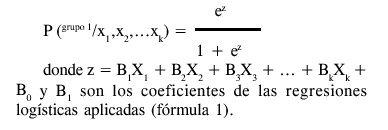
<body><![CDATA[<br> </p>     <p>Para comenzar la determinaci&oacute;n de puntajes y estratificaci&oacute;n    de grupos se emple&oacute; el m&eacute;todo de interacciones las que fueron    determinadas inicialmente en el 90 % delos casos, las m&aacute;s significativas    fueron aplicadas con los casos de validaci&oacute;n y posteriormente, recalculadas    con todos los casos.    <br> </p>     <p>De acuerdo con el nivel de medici&oacute;n ordinal de la mayor&iacute;a de    las variables consideradas, se procedi&oacute; a aplicar un an&aacute;lisis    de componentes principales no param&eacute;trico con el objetivo de elevar el    nivel de medici&oacute;n logrado y efectuar otros an&aacute;lisis param&eacute;tricos.    Se hizo un an&aacute;lisis factorial con las variables transformadas. Considerando    el resultado de las t&eacute;cnicas empleadas y su correspondencia con la experiencia    en la pr&aacute;ctica m&eacute;dica se intent&oacute; establecer el peso de    cada una de las variables y su puntuaci&oacute;n total en cada paciente, lo    cual no condujo a una escala satisfactoria, d&aacute;ndose el caso que variables    que de forma global no correlacionan con el grupo, s&iacute; lo hacen en algunas    de las categor&iacute;as, lo cual fue resuelto con el uso del CHAID, de donde    resultaron 10 alteraciones significativas en el caso de las variables cl&iacute;nicas    y 20 para todas las variables.    <br> </p>     <p>Los puntajes asignados a los casos con vistas a seguir su evoluci&oacute;n    en los diferentes momentos del ingreso en el caso de todas las variables fueron    establecidos a partir de las probabilidades de pertenencia al grupo de referencia    en las regresiones log&iacute;sticas aplicadas, se emplearon los siguientes    criterios y se obtuvo los resultados que se se&ntilde;alan.    <br>   La probabilidad de pertenecer al grupo de referencia en una regresi&oacute;n    log&iacute;stica esta dado por:</p>     <p> <a href="/img/revistas/med/v42n1/formula105103.jpg"><img src="/img/revistas/med/v42n1/formula105103.jpg" width="275" height="99" border="0"></a></p>     
<p>En el caso de las variables cl&iacute;nicas de acuerdo con la regresi&oacute;n    log&iacute;stica efectuada, la cual fue validada a trav&eacute;s de una muestra    aleatoria, se obtuvieron resultados similares en cuanto a la clasificaci&oacute;n,    se asume la combinaci&oacute;n lineal de las variables participantes con los    coeficientes<font face="Symbol"> b</font>.    <br> </p>     ]]></body>
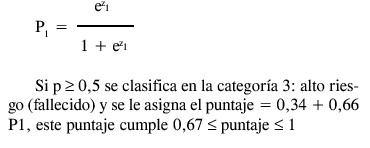
<body><![CDATA[<p>Si se denota esta funci&oacute;n en el caso de la clasificaci&oacute;n en vivos    y fallecidos por Z1, a partir de esta se puede calcular la probabilidad de pertenencia    a cada grupo seg&uacute;n la formula1.    <br> </p>     <p>Para lograr los puntajes de los individuos en una escala de puntos de 0 a 1    se procedi&oacute; de la forma siguiente:    <br> </p>     <p>En la clasificaci&oacute;n de vivos y fallecidos, consideramos que la funci&oacute;n    lineal obtenida se denot&oacute; por Z1, entonces:    <br> </p>     <p><a href="/img/revistas/med/v42n1/formula205103.jpg"><img src="/img/revistas/med/v42n1/formula205103.jpg" width="287" height="133" border="0"></a></p>     
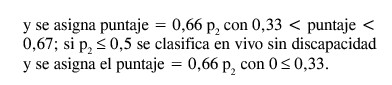
<p>Si p1 &lt; 0,5, se calcula Z2 obtenida a partir de la regresi&oacute;n log&iacute;stica    para clasificar los vivos en vivos sin o con discapacidad (bajo riesgo y riesgo    moderado, respectivamente), donde:</p>     <p> <a href="/img/revistas/med/v42n1/formula305103.jpg"><img src="/img/revistas/med/v42n1/formula305103.jpg" width="296" height="95" border="0"></a></p>     
<p><a href="/img/revistas/med/v42n1/formula3a05103.jpg"><img src="/img/revistas/med/v42n1/formula3a05103.jpg" width="277" height="71" border="0"></a></p>     
]]></body>
<body><![CDATA[<p>Este procedimiento de asignaci&oacute;n de puntaje, es v&aacute;lido para las    variables cl&iacute;nicas y para todas las variables en el instrumento computadorizado,    pues para los puntajes en el caso de las variables cl&iacute;nicas modalidad    manual se sigui&oacute; el siguiente procedimiento.    <br> </p>     <p>Se aplic&oacute; una regresi&oacute;n lineal m&uacute;ltiple empleando los    valores de las variables escaladas seg&uacute;n el an&aacute;lisis de componentes    principales no param&eacute;trico y en el caso de la variable dependiente, el    estado al egreso fue recodificado convenientemente el intervalo (0-1), de modo    que las estimaciones oscilan en este intervalo.    <br> </p>     <p>Este procedimiento clasifica de forma correcta el 87,5 % de los casos.    <br> </p>     <p>Se establecieron 3 procedimientos para la clasificaci&oacute;n: uno manual    cl&iacute;nico, uno cl&iacute;nico computadorizado y uno general computadorizado    con todas las variables y se estratificaron 3 grupos sobre la base del puntaje    y las interacciones:</p>     <p>1. Bajo riesgo (vivo sin discapacidad: 0 <font face="Symbol">&pound;</font>    puntaje <font face="Symbol">&pound;</font> 0,33)    <br>   2. Moderado riesgo (vivo con discapacidad: 0,33 &lt; puntaje &lt; 0,67)    <br>   3. Alto riesgo (fallecido 0,67 <font face="Symbol">&pound;</font> puntaje<font face="Symbol">    &pound;</font> 1)</p>     ]]></body>
<body><![CDATA[<p>El instrumento de clasificaci&oacute;n de los pacientes qued&oacute; constituido    por 2 m&oacute;dulos: M&oacute;dulo 1: interacciones y M&oacute;dulo 2: puntajes.    <br> </p>     <p>Si un paciente cumple una de las interacciones en el orden en que est&aacute;n    dispuestas (anexo) es clasificado en la categor&iacute;a correspondiente y se    pasa al m&oacute;dulo 2 para asignarle un puntaje, si el puntaje obtenido no    corresponde a la categor&iacute;a asignada por interacciones se le asigna el    valor m&aacute;s cercano de la categor&iacute;a de pertenencia.    <br> </p>     <p>Si no satisface ninguna de las interacciones se pasa al m&oacute;dulo 2 y se    clasifica seg&uacute;n el puntaje correspondiente.    <br> </p>     <p>Se suman los valores de S1, se suman los valores de S2, se resta S1 de S2 y    se obtiene un valor. 1.Grupo 1:0 <font face="Symbol">&pound;</font> puntaje    <font face="Symbol">&pound; </font>0,33; 2.Grupo 2: 0,33 &lt; puntaje &lt; 0,67    y 3.Grupo 3: 0,67 <font face="Symbol">&pound;</font> puntaje<font face="Symbol">    &pound;</font> 1.    <br> </p>     <p>Los 3 instrumentos de medici&oacute;n: manual con variables cl&iacute;nicas    y computadorizados: uno con variables cl&iacute;nicas y uno con variables cl&iacute;nicas    y generales presentaron clasificaciones correctas superiores al 90 %. Validados    en resultado global con 90,09; 92,98 y 94,14 %, respectivamente.</p> <h4>Discusi&oacute;n</h4>     <p>Para seleccionar las variables se deben tener en cuenta la experiencia pasada    y el juicio cl&iacute;nico, en la confecci&oacute;n de otros instrumentos como    el <i>Acute Physilogy, Age, Chronic Health Evaluation</i>(APACHE) fueron seleccionadas    20 variables fisiol&oacute;gicas para medir severidad de la enfermedad.    ]]></body>
<body><![CDATA[<br> </p>     <p>En nuestra serie fue constatada correlaci&oacute;n significativa en cuanto    a enfermedades previas con la existencia de ECV isqu&eacute;mica, explicable    por la importancia que tiene el desarrollo de la afecci&oacute;n en un cerebro    da&ntilde;ado o en un organismo con condiciones predisponentes para una evoluci&oacute;n    t&oacute;rpida, de igual forma se detectaron correlaciones importantes para    las variables localizaciones seg&uacute;n TAC en parietal y tallo. En la primera,    dada por su frecuencia y evoluci&oacute;n relacionada con la discapacidad y    en la segunda, por radicar a este nivel puntos importantes de control vital    que en muchos casos provocan evoluci&oacute;n t&oacute;rpida.    <br> </p>     <p>La TAC de perfusi&oacute;n trif&aacute;sica se plantea como muy buena en el    diagn&oacute;stico de la oclusi&oacute;n de la arteria cerebral media seg&uacute;n    investigaciones hechas en el Centro Nacional de Sansung, Se&uacute;l.<span class="superscript">6</span>    En nuestro medio se realiza TAC lineal o helicoidal. Igualmente se se&ntilde;ala    la importancia del ultrasonido (UTS) en el estudio del flujo y caracter&iacute;sticas    de la placa de ateroma, con uso de modo B.<span class="superscript">7,8</span>    <br> </p>     <p>En nuestra serie en la variable diagn&oacute;stico fisiopatol&oacute;gico,    se encontr&oacute; correlaci&oacute;n significativa para el ATI, asociado a    evoluci&oacute;n favorable, as&iacute; como para el HIP, HSA y HCM en que se    asoci&oacute; con correlaciones de otro tipo, la &uacute;ltima clasificando    a trav&eacute;s de la variable coma en nivel de conciencia, con evoluci&oacute;n    t&oacute;rpida.    <br> </p>     <p>La variable complicaci&oacute;n: edema, cardiopat&iacute;a isqu&eacute;mica,    descompensaci&oacute;n de DM y la falla org&aacute;nica resultaron con significativos    niveles correlacionales en nuestra serie, explicables por ser representativas    o causales de des&oacute;rdenes org&aacute;nicos importantes, siempre asociados    a evoluci&oacute;n desfavorable.    <br> </p>     <p>Para estimar el peso de las variables, el APACHE III utiliz&oacute; el an&aacute;lisis    multivariado de regresi&oacute;n log&iacute;stica para determinar la relaci&oacute;n    entre la muerte y cada una de las 20 variables fisiol&oacute;gicas, edad, condiciones    cr&oacute;nicas de afectaci&oacute;n de salud, <i>status</i> de operaci&oacute;n    y otras categor&iacute;as mayores de enfermedad, usando ambas categor&iacute;as    con medici&oacute;n continua del peso.    ]]></body>
<body><![CDATA[<br> </p>     <p>Escalas neurol&oacute;gicas espec&iacute;ficas han utilizado para el puntaje    paquetes calculadores con construcci&oacute;n de modelos multivariados predictivos    que usan m&eacute;todos de regresi&oacute;n simple por transformaci&oacute;n    logar&iacute;tmica o an&aacute;lisis de regresi&oacute;n m&uacute;ltiple.<span class="superscript">9</span>    <br> </p>     <p>El estudio de Inouye, Hospital de Hyogo, en Kobe, Jap&oacute;n, confirm&oacute;    que el uso de un modelo simple de regresi&oacute;n por transformaci&oacute;n    logar&iacute;tmica tiene un alto valor predictivo.<span class="superscript">9</span>        <br> </p>     <p>Para la construcci&oacute;n de la escala japonesa para AVE, el Comit&eacute;    de Escalas de AVE de la Sociedad de ECV del Jap&oacute;n seleccion&oacute; 10    variables estudiadas por an&aacute;lisis multivariado, tom&oacute; una bater&iacute;a    de base de datos y las categoriz&oacute; y evalu&oacute; por distribuci&oacute;n    y severidad, formul&oacute; una escala sin pesos, temporalmente sobre la base    de 198 pacientes, y luego con 80 enfermos nuevos, interconsultados con 150 neur&oacute;logos    sobre los rangos evaluativos y combin&oacute; variables de acuerdo con la severidad.    Sobre la base de estos rangos estim&oacute; los pesos para cada factor. Otros    autores han obtenido clasificaciones predictivas con uso de m&eacute;todos estad&iacute;sticos    basados en aspectos determinados como la presencia de fibrilaci&oacute;n auricular(FA).    <i>Gage </i>y otros<span class="superscript">10</span> validaron una clasificaci&oacute;n    cl&iacute;nica de predicci&oacute;n para AVE estimando el riesgo en pacientes    con FA y combinando clasificaciones mediante la asignaci&oacute;n de pesajes    con valores de un punto por cada aspecto tenido en cuenta.    <br> </p>     <p>La estratificaci&oacute;n de grupos resulta de extrema importancia, pues sobre    la base del establecimiento de los pesos de las variables seg&uacute;n su valor    en la ulterior evoluci&oacute;n, se podr&aacute; definir, por determinados rangos,    &eacute;l pron&oacute;stico del enfermo. De acuerdo con el puntaje otorgado,    un incremento o disminuci&oacute;n del mismo, implica un peor o mejor pron&oacute;stico.        <br> </p>     <p>Hay estudios que refieren predicciones hasta mediano plazo con el 90 % de efectividad    y sobre la base del puntaje obtenido hacen inferencia pron&oacute;stica y utilizan    escalas, como la NIHSS , que muestran altos niveles de sensibilidad y especificidad    con valores predictivos positivos por encima del 90 %, evaluados a los 3 meses,    seg&uacute;n <i>Frankel</i> y otros11, del Instituto Nacional de Des&oacute;rdenes    Neurol&oacute;gicos o <i>Baird </i>y otros<span class="superscript">12</span>,    en Bethesda, que toman el NIHSS, el &iacute;ndice de Barthel y estudios de resonancia    magn&eacute;tica nuclear(REM) y clasifican el riesgo en bajo (0-2), medio (3-4)    y alto(5-7) riesgo.     ]]></body>
<body><![CDATA[<br> </p>     <p>Algunos autores como <i>Demchuk </i>y otros<span class="superscript">13</span>,    en Calgary, relacionan clasificaciones con pron&oacute;stico, como el de tromboembolismo    en el ictus isqu&eacute;mico y grados de flujo por Doppler transcraneal como    predictivo de severidad cl&iacute;nica y mortalidad, o los grupos obtenidos    en el estudio de caracterizaci&oacute;n inmunofenot&iacute;pica de la placa    en car&oacute;tida por <i>Schumacher</i> y otros14, en Heidelburg, Alemania.<span class="superscript">14</span>    <br> </p>     <p>Las tabulaciones cruzadas que usan factores significativos con acceso por an&aacute;lisis    de varianza y an&aacute;lisis de regresi&oacute;n log&iacute;stica permiten    identificar grupos de caracter&iacute;sticas homog&eacute;neas y considerar    un valor predictivo para el mismo.<span class="superscript">15</span>    <br> </p>     <p>La construcci&oacute;n de la escala, teniendo en cuenta las variables y los    puntajes, una vez realizados los diversos procesos matem&aacute;ticos necesarios,    es el resultado de un exhaustivo trabajo.    <br> </p>     <p>Entre los resultados obtenidos por otros autores se se&ntilde;alan usos de    modelos simples de regresi&oacute;n con transformaci&oacute;n logar&iacute;tmica    o con an&aacute;lisis de regresi&oacute;n m&uacute;ltiple que logran un poder    predictivo bien validado y con uso cl&iacute;nico; la creaci&oacute;n de la    escala param&eacute;trica japonesa que prove&eacute; una medici&oacute;n cuantitativa    de la severidad del AVE, con datos que revelan su potencialidad frente a otras    universalmente aceptadas, con sistemas estandarizados desde el punto de vista    clinim&eacute;tricos; el uso del m&eacute;todo de Steinman con diferentes mediciones    independientes como edad, estado marital, situaci&oacute;n de vida, situaci&oacute;n    social, tipo de AVE, mediciones fisiol&oacute;gicas de independencia que permiti&oacute;    construir una escala pron&oacute;stica.<span class="superscript">15 </span>    <br> </p>     <p>La ejecuci&oacute;n de trabajos como el puntaje por tomograf&iacute;a temprana    del Programa para ECV del <i>Alberta Stroke Programme Early CT Score</i> (ASPECTS)    basado en el desarrollo tecnol&oacute;gico (REM) permiti&oacute; los c&aacute;lculos    por regresi&oacute;n log&iacute;stica para obtener un puntaje.<span class="superscript">16</span>    ]]></body>
<body><![CDATA[<br> </p>     <p>El uso de puntaje para hemorragia intracraneal (ICH score) ha sido &uacute;til    en la estratificaci&oacute;n de riesgo para este tipo de pacientes, seg&uacute;n    demostraron los estudios de <i>Hemphill</i> y otros,<span class="superscript">17</span>    en una Universidad de California.    <br> </p>     <p>En cuanto a su aplicabilidad, el instrumento creado puede ser, por sus caracter&iacute;sticas,    similar a otros existentes, como el empleado en la evaluaci&oacute;n de las    Gu&iacute;as de Buenas Pr&aacute;cticas Cl&iacute;nicas. Se han realizado trabajos    como el de <i>La Clair </i>y otros<span class="superscript">18</span> para describir    m&eacute;todos y convertir las referidas gu&iacute;as en criterios de medici&oacute;n    para evaluar los procederes recibidos por los enfermos, han usado la t&eacute;cnica    de Delphi modificada, con instrumentos de abstracci&oacute;n, criterios y algoritmos    de puntaje, el establecimiento de un &iacute;ndice pron&oacute;stico es una    de las aplicaciones principales. Se han realizado diferentes investigaciones    como una efectuada en Grecia, que se&ntilde;ala los factores influyentes m&aacute;s    reportados y realiza el an&aacute;lisis de la mortalidad durante1 a&ntilde;o.<span class="superscript">19</span>    El an&aacute;lisis de la calidad de vida es uno de los mayores retos, ya que    una serie de medidas deben ir encaminadas en tal sentido, pues si importante    es la cantidad de vida, tambi&eacute;n lo es la calidad de esta. Estos estudios    son variados y comprenden desde la determinaci&oacute;n del validismo y rehabilitaci&oacute;n    general hasta los medidores de otro tipo de discapacidad, como el efectuado    por <i>Gompertz </i>y otros<span class="superscript">20</span>, incluyendo las    alteraciones de las funciones motoras, como el <i>motor function test</i>.<span class="superscript">21</span>    <br> </p>     <p><i>Binkofsky</i> y otros<span class="superscript">22</span>, en Alemania, estudiaron    los valores predictivos de datos cl&iacute;nicos en correspondencia con el tama&ntilde;o    de la lesi&oacute;n y con la recuperaci&oacute;n del defecto, analizaron 52    pacientes hemipar&eacute;ticos monitoreados en el curso cl&iacute;nico de su    recuperaci&oacute;n mediante un sensimotor de funci&oacute;n normal; relacionaron    el tama&ntilde;o de la lesi&oacute;n por densidad prot&oacute;nica de REM y    establecieron 3 grupos de pacientes, la recuperaci&oacute;n fue m&aacute;s precoz    en los que el defecto inicial fue menor.<span class="superscript">22</span>    Se plantea que el estudio sobre calidad de vida, realizado en Yale, sobre ECV    hemorr&aacute;gica es un instrumento mejor que otros de su tipo para discriminar    subgrupos entre sobrevivientes por AVE hemorr&aacute;gico.<span class="superscript">23</span>    <br> </p>     <p>El primer y segundo estudio europeo cooperativo de AVE<i>(European Cooperative    Acute Stroke Study I y II-ECASS</i>) y el estudio del Instituto Nacional de    Des&oacute;rdenes Neurol&oacute;gicos y AVE, con el uso del activador h&iacute;stico    del plasmin&oacute;geno, con ventanas terap&eacute;uticas establecidas en 6    y 3h, respectivamente y diferentes dosis de activador h&iacute;stico del plasmin&oacute;geno    (rtpa) obtuvieron diferentes resultados y utilizaron la NIHSS, escala de Rankin    modificada, el &iacute;ndice de Barthel y la escala de coma de <i>Glasgow</i>.<span class="superscript">24    </span>En la definici&oacute;n de conductas con pacientes que requieren tratamientos    quir&uacute;rgicos, como el endovascular en la estenosis severa sintom&aacute;tica    de la arteria car&oacute;tida, investigaci&oacute;n realizada en Dinamarca por    <i>Baudier </i>y otros<span class="superscript">25</span>, u otro tipo de intervenci&oacute;n    en la cual es necesario definir el riesgo-beneficio para el enfermo, hay que    aplicar sistemas pron&oacute;sticos.    <br> </p>     <p>El <i>Older Americans Resources Scale for Instrumental Activities of Daily    living </i>(OARS-IADL)<span class="superscript">26</span>, en Montreal, el cual    demostr&oacute; que un pronto traslado combinado con rehabilitaci&oacute;n domiciliaria    logra una recuperaci&oacute;n m&aacute;s r&aacute;pida, mayor nivel de satisfacci&oacute;n    y reintegraci&oacute;n a la comunidad fue con aplicaci&oacute;n del &iacute;ndice    de Barthel y la <i>Americam Resources Scale for Instrumental Activities of Daily    Living</i> (OARS-IADL).<span class="superscript">26</span>    ]]></body>
<body><![CDATA[<br> </p>     <p>En conclusi&oacute;n, fueron creados 3 instrumentos de evaluaci&oacute;n para    pacientes con ECV, 1 manual y 2 computadorizados, de f&aacute;cil manejo y con    alta confiabilidad, que permiten la estratificaci&oacute;n de pacientes en grupos    de riesgo, con dis&iacute;miles aplicaciones, mediante los cuales se realiza    pron&oacute;stico y seguimiento evolutivo de los enfermos con incremento en    la calidad de atenci&oacute;n m&eacute;dica.</p>     <p align="center">ANEXO. <i>M&oacute;dulos 1 y 2 del instrumento de evaluaci&oacute;n    para pacientes con enfermedad cerebrovascular</i></p> <table width="75%" border="1">   <tr>      <td colspan="10">M&oacute;dulo 1</td>   </tr>   <tr>      <td colspan="10">            <div align="center">Conciencia</div>     </td>   </tr>   <tr>      <td colspan="4">            <div align="center">Alerta </div>     </td>     <td colspan="2">            <div align="center">Somnoliento</div>     </td>     <td colspan="3">            <div align="center">Estupor </div>     </td>     <td width="6%">Coma</td>   </tr>   <tr>      <td width="15%">Reflejos</td>     <td width="12%">&nbsp;</td>     <td width="11%">Reflejos </td>     <td width="6%">&nbsp;</td>     <td width="13%">FMSI </td>     <td width="11%">FMSD</td>     <td width="6%">FMSI </td>     <td width="7%">FMSD </td>     <td width="13%">Reflejo </td>     <td width="6%">FMII</td>   </tr>   <tr>      <td width="15%">cut&aacute;neos</td>     <td width="12%">&nbsp;</td>     <td width="11%">cut&aacute;neos </td>     <td width="6%">&nbsp;</td>     <td width="13%">paresia </td>     <td width="11%">paresia </td>     <td width="6%">paresia</td>     <td width="7%">paresia </td>     <td width="13%">cutaneomucoso</td>     <td width="6%">paresia</td>   </tr>   <tr>      <td width="15%">ausentes</td>     <td width="12%">&nbsp;</td>     <td width="11%">normal </td>     <td width="6%">&nbsp;</td>     <td width="13%">3 o plejia </td>     <td width="11%">2,3 o plejia</td>     <td width="6%">3 o plejia</td>     <td width="7%">2,3 o plejia </td>     <td width="13%">ausente</td>     <td width="6%">1,2,3 o plejia</td>   </tr>   <tr>      <td width="15%">FMSI</td>     <td width="12%">FMSI</td>     <td width="11%">Sensibilidad </td>     <td width="6%">&nbsp;</td>     <td colspan="6" rowspan="2">            <div align="center">Alto riesgo</div>     </td>   </tr>   <tr>      <td width="15%">normal </td>     <td width="12%">paresia 2</td>     <td width="11%">normal</td>     <td width="6%">&nbsp;</td>   </tr>   <tr>      <td width="15%">FMID</td>     <td width="12%">Riesgo</td>     <td width="11%">FMSI </td>     <td width="6%">FMSI</td>     <td colspan="6" rowspan="5">&nbsp;</td>   </tr>   <tr>      <td width="15%">paresia </td>     <td width="12%">moderado</td>     <td width="11%">paresia </td>     <td width="6%">normal</td>   </tr>   <tr>      <td width="15%">1,2,3 </td>     <td rowspan="3" width="12%">&nbsp;</td>     <td width="11%">2,3 </td>     <td width="6%">&nbsp;</td>   </tr>   <tr>      <td width="15%">Riesgo</td>     <td width="11%">Riesgo </td>     <td width="6%">Bajo</td>   </tr>   <tr>      <td width="15%">moderado</td>     <td width="11%">moderado </td>     <td width="6%">riesgo</td>   </tr>   <tr>      <td colspan="10">&nbsp;</td>   </tr>   <tr>      <td colspan="10">            <p></p>           <p>M&oacute;dulo 2</p>     </td>   </tr>   <tr>      <td colspan="10">&nbsp;</td>   </tr>   <tr>      <td width="15%">Variable </td>     <td width="12%">Subsistemas</td>     <td width="11%">S1 </td>     <td width="6%">S2 </td>     <td width="13%">Variable </td>     <td width="11%">Subitemas </td>     <td width="6%">S1 </td>     <td width="7%">S2 </td>     <td colspan="2" rowspan="32">&nbsp;</td>   </tr>   <tr>      <td width="15%">Conciencia</td>     <td width="12%">1.Alerta</td>     <td width="11%">&nbsp;</td>     <td width="6%">0,038</td>     <td width="13%">Lenguaje</td>     <td width="11%">1.Normal </td>     <td width="6%">&nbsp;</td>     <td width="7%">0,036</td>   </tr>   <tr>      <td width="15%">&nbsp;</td>     <td width="12%">2.Somnolencia</td>     <td width="11%">0,109 </td>     <td width="6%">&nbsp;</td>     <td width="13%">&nbsp;</td>     <td width="11%">2.Disartria ligera </td>     <td width="6%">    ]]></body>
<body><![CDATA[<br>     0,002</td>     <td width="7%">&nbsp;</td>     </tr>     <tr>      <td width="15%">&nbsp;</td>     <td width="12%">3.Estupor </td>     <td width="11%">0,156 </td>     <td width="6%">&nbsp;</td>     <td width="13%">&nbsp;</td>     ]]></body>
<body><![CDATA[<td width="11%">3.Disartria severa </td>     <td width="6%">0,044</td>     <td width="7%">&nbsp;</td>     </tr>     <tr>      <td width="15%">&nbsp;</td>     <td width="12%">4.Coma</td>     <td width="11%">0,334</td>     <td width="6%">&nbsp;</td>     <td width="13%">&nbsp;</td>     ]]></body>
<body><![CDATA[<td width="11%">4.Disfasia</td>     <td width="6%">0,058 </td>     <td width="7%">&nbsp;</td>     </tr>     <tr>      <td width="15%">&nbsp;</td>     <td width="12%">&nbsp;</td>     <td width="11%">&nbsp;</td>     <td width="6%">&nbsp;</td>     <td width="13%">&nbsp;</td>     ]]></body>
<body><![CDATA[<td width="11%">5.Afasia </td>     <td width="6%">0,058 </td>     <td width="7%">&nbsp;</td>     </tr>     <tr>      <td width="15%">FMSD </td>     <td width="12%">1. No defecto</td>     <td width="11%">0,034 </td>     <td width="6%">&nbsp;</td>     <td width="13%">FMSI </td>     ]]></body>
<body><![CDATA[<td width="11%">1. </td>     <td width="6%">&nbsp;</td>     <td width="7%">0,033</td>     </tr>     <tr>      <td width="15%">&nbsp;</td>     <td width="12%">2. Paresia 1 </td>     <td width="11%">0,034 </td>     <td width="6%">&nbsp;</td>     <td width="13%">&nbsp;</td>     ]]></body>
<body><![CDATA[<td width="11%">2. </td>     <td width="6%">&nbsp;</td>     <td width="7%">0,033</td>     </tr>     <tr>      <td width="15%">&nbsp;</td>     <td width="12%">3. Paresia 2</td>     <td width="11%">0,008 </td>     <td width="6%">&nbsp;</td>     <td width="13%">&nbsp;</td>     ]]></body>
<body><![CDATA[<td width="11%">3. </td>     <td width="6%">&nbsp;</td>     <td width="7%">0,011</td>     </tr>     <tr>      <td width="15%">&nbsp;</td>     <td width="12%">4. Paresia 3</td>     <td width="11%">&nbsp;</td>     <td width="6%">0,069 </td>     <td width="13%">&nbsp;</td>     ]]></body>
<body><![CDATA[<td width="11%">4. </td>     <td width="6%">0,054</td>     <td width="7%">&nbsp;</td>     </tr>     <tr>      <td width="15%">&nbsp;</td>     <td width="12%">5. Plejia </td>     <td width="11%">&nbsp;</td>     <td width="6%">0,22 </td>     <td width="13%">&nbsp;</td>     ]]></body>
<body><![CDATA[<td width="11%">5 .</td>     <td width="6%">0,097 </td>     <td width="7%">&nbsp;</td>     </tr>     <tr>      <td width="15%">FMID </td>     <td width="12%">1. </td>     <td width="11%">&nbsp;</td>     <td width="6%">0,016</td>     <td width="13%">FMII </td>     ]]></body>
<body><![CDATA[<td width="11%">1. </td>     <td width="6%">0,032</td>     <td width="7%">&nbsp;</td>     </tr>     <tr>      <td width="15%">&nbsp;</td>     <td width="12%">2.</td>     <td width="11%">&nbsp;</td>     <td width="6%">0,016 </td>     <td width="13%">&nbsp;</td>     ]]></body>
<body><![CDATA[<td width="11%">2. </td>     <td width="6%">0,002</td>     <td width="7%">&nbsp;</td>     </tr>     <tr>      <td width="15%">&nbsp;</td>     <td width="12%">3. </td>     <td width="11%">0,005</td>     <td width="6%">&nbsp;</td>     <td width="13%">&nbsp;</td>     ]]></body>
<body><![CDATA[<td width="11%">3 .</td>     <td width="6%">&nbsp;</td>     <td width="7%">0,047</td>     </tr>     <tr>      <td width="15%">&nbsp;</td>     <td width="12%">4. </td>     <td width="11%">0,068 </td>     <td width="6%">&nbsp;</td>     <td width="13%">&nbsp;</td>     ]]></body>
<body><![CDATA[<td width="11%">4.</td>     <td width="6%">&nbsp;</td>     <td width="7%">0,072</td>     </tr>     <tr>      <td width="15%">&nbsp;</td>     <td width="12%">5. </td>     <td width="11%">0,194 </td>     <td width="6%">&nbsp;</td>     <td width="13%">&nbsp;</td>     ]]></body>
<body><![CDATA[<td width="11%">5. </td>     <td width="6%">&nbsp;</td>     <td width="7%">0,078 </td>     </tr>     <tr>      <td width="15%">Respuesta a &oacute;rdenes</td>     <td width="12%">1.Obedece todas </td>     <td width="11%">&nbsp;</td>     <td width="6%">0,026 </td>     <td width="13%">Tono </td>     ]]></body>
<body><![CDATA[<td width="11%">1.Normal </td>     <td width="6%">&nbsp;</td>     <td width="7%">0,061</td>     </tr>     <tr>      <td width="15%">&nbsp;</td>     <td width="12%">2.Obedece algunas </td>     <td width="11%">0,052 </td>     <td width="6%">&nbsp;</td>     <td width="13%">&nbsp;</td>     ]]></body>
<body><![CDATA[<td width="11%">2.Flacidez</td>     <td width="6%">0,055</td>     <td width="7%">&nbsp;</td>     </tr>     <tr>      <td width="15%">&nbsp;</td>     <td width="12%">3.No obedece</td>     <td width="11%">0,152 </td>     <td width="6%">&nbsp;</td>     <td width="13%">&nbsp;</td>     ]]></body>
<body><![CDATA[<td width="11%">3.Hiperton&iacute;a </td>     <td width="6%">0,097</td>     <td width="7%">&nbsp;</td>     </tr>     <tr>      <td width="15%">&nbsp;</td>     <td width="12%">&nbsp;</td>     <td width="11%">&nbsp;</td>     <td width="6%">&nbsp;</td>     <td width="13%">&nbsp;</td>     ]]></body>
<body><![CDATA[<td width="11%">&nbsp;</td>     <td width="6%">&nbsp;</td>     <td width="7%">&nbsp;</td>     </tr>     <tr>      <td width="15%">Sensibilidad </td>     <td width="12%">1.Normal </td>     <td width="11%">&nbsp;</td>     <td width="6%">0,009 </td>     <td width="13%">Reflejos osteotendinosos</td>     ]]></body>
<body><![CDATA[<td width="11%">1.Normal </td>     <td width="6%">&nbsp;</td>     <td width="7%">0,002</td>     </tr>     <tr>      <td width="15%">&nbsp;</td>     <td width="12%">2.P&eacute;rdida parc </td>     <td width="11%">0,028 </td>     <td width="6%">&nbsp;</td>     <td width="13%">&nbsp;</td>     ]]></body>
<body><![CDATA[<td width="11%">2.Hipo reflejos </td>     <td width="6%">0,002</td>     <td width="7%">&nbsp;</td>     </tr>     <tr>      <td width="15%">&nbsp;</td>     <td width="12%">3.P&eacute;rdida dens </td>     <td width="11%">0,07 </td>     <td width="6%">&nbsp;</td>     <td width="13%">&nbsp;</td>     ]]></body>
<body><![CDATA[<td width="11%">3.Hiper reflejos</td>     <td width="6%">0,002</td>     <td width="7%">&nbsp;</td>     </tr>     <tr>      <td width="15%">&nbsp;</td>     <td width="12%">&nbsp;</td>     <td width="11%">&nbsp;</td>     <td width="6%">&nbsp;</td>     <td width="13%">&nbsp;</td>     ]]></body>
<body><![CDATA[<td width="11%">4.Ausente</td>     <td width="6%">0,005</td>     <td width="7%">&nbsp;</td>     </tr>     <tr>      <td width="15%">Momento </td>     <td width="12%">1. Ingreso </td>     <td width="11%">0,007 </td>     <td width="6%">&nbsp;</td>     <td width="13%">Par&aacute;lisis facial</td>     ]]></body>
<body><![CDATA[<td width="11%">1.No</td>     <td width="6%">&nbsp;</td>     <td width="7%">0,02</td>     </tr>     <tr>      <td width="15%">&nbsp;</td>     <td width="12%">2. 24 h </td>     <td width="11%">0,014</td>     <td width="6%">&nbsp;</td>     <td width="13%">&nbsp;</td>     ]]></body>
<body><![CDATA[<td width="11%">2.Central pares </td>     <td width="6%">0,018</td>     <td width="7%">&nbsp;</td>     </tr>     <tr>      <td width="15%">&nbsp;</td>     <td width="12%">3. 72 h </td>     <td width="11%">0,021 </td>     <td width="6%">&nbsp;</td>     <td width="13%">&nbsp;</td>     ]]></body>
<body><![CDATA[<td width="11%">3.Central cpta </td>     <td width="6%">0,109</td>     <td width="7%">&nbsp;</td>     </tr>     <tr>      <td width="15%">&nbsp;</td>     <td width="12%">4. Egreso</td>     <td width="11%">0,028 </td>     <td width="6%">&nbsp;</td>     <td width="13%">&nbsp;</td>     ]]></body>
<body><![CDATA[<td width="11%">4.Perif&eacute;rica &#145;paresia </td>     <td width="6%">0,228</td>     <td width="7%">&nbsp;</td>     </tr>     <tr>      <td width="15%">&nbsp;</td>     <td width="12%">&nbsp;</td>     <td width="11%">&nbsp;</td>     <td width="6%">&nbsp;</td>     <td width="13%">&nbsp;</td>     ]]></body>
<body><![CDATA[<td width="11%">5.Perif&eacute;rica completa </td>     <td width="6%">0,294 </td>     <td width="7%">&nbsp;</td>     </tr>     <tr>      <td width="15%">&nbsp;</td>     <td width="12%">&nbsp;</td>     <td width="11%">&nbsp;</td>     <td width="6%">&nbsp;</td>     <td width="13%">&nbsp;</td>     ]]></body>
<body><![CDATA[<td width="11%">&nbsp;</td>     <td width="6%">&nbsp;</td>     <td width="7%">&nbsp;</td>     </tr>     <tr>      <td width="15%">Reflejos cutaneomucosos </td>     <td width="12%">0-Normal</td>     <td width="11%">0,00</td>     <td width="6%">&nbsp;</td>     <td width="13%">&nbsp;</td>     ]]></body>
<body><![CDATA[<td width="11%">&nbsp;</td>     <td width="6%">&nbsp;</td>     <td width="7%">&nbsp;</td>     </tr>     <tr>      <td width="15%">&nbsp;</td>     <td width="12%">1-Ausente</td>     <td width="11%">0,144 </td>     <td width="6%">&nbsp;</td>     <td width="13%">&nbsp;</td>     ]]></body>
<body><![CDATA[<td width="11%">&nbsp;</td>     <td width="6%">&nbsp;</td>     <td width="7%">&nbsp;</td>     </tr>     </table>     <h4 align="center">Summary</h4>     <p>A study was conducted to create and validate an instrument for the follow-up    of patients with stroke. The necessary variables to evaluate these patients    were determined and procedures were established to obtain a score and a stratification    by groups that allow a prognostic and evolutive classification of the new cases.    A multicenter sample of 1 218 patients was analyzed by statistical methods,    such as: Cramer&#146;s V, automatic interaction detector, Chi square, logistic    regression, Spearman&#146;s method, optimum scaling, factorial analysis, and    others, on EXCEL database transferred to SPSS. A manual instrument and 2 computer-generated    tools: a clinical and a general one with correct percentages of classification    over 90 and validated according to global result with 90.09; 92.98 and 94.14    %, respectively, were attained. The scores and the classification were made    on the basis of the coefficients observed in an interval from 0 to 1. 3 risk    groups were obtained: low (live without disability: 0<font face="Symbol">&pound;</font>score    <font face="Symbol">&pound;</font> 0.33), mean (live with disability: 0.33&lt;    score&lt;0.67) and high (dead: 0.67 <font face="Symbol">&pound;</font> score    <font face="Symbol">&pound;</font> 1). Some patients were directly classified    by interactions. An instrument of scientific quantitative and qualitative rigor,    unique in the country and easy to apply was obtained to give attention to patients    suffering from stroke and, on that basis, to make decisions aimed at performing    a medical practice of higher quality.</p>     <p><i>Subject headings</i>: CEREBRAL HEMORRHAGE; CEREBRAL INFARCTION; EQUIPMENT    AND SUPPLIES; FOLLOW-UP STUDIES; NATIONAL HEALTH PROGRAMS; EVALUATION STUDIES.</p>     <p></p> <h4>Referencias bibliogr&aacute;ficas</h4> <ol>       <!-- ref --><li> Wojner AW, Alexandrov AV. Predictors of tube feeding in acute stroke patients      with dysphagia.AACN Clin Issues 2000;11(4):531-40.    <br>   </li>       <!-- ref --><li>Caicoya M, Rodr&iacute;guez T, Lasheras C, Cuello R, Corrales C, Blazquez      B. Stroke incidence in Asturias, 1990-1991. Rev Neurol 1996;24(131):806-11.    <br>   </li>       <!-- ref --><li>L&oacute;pez Gonz&aacute;lez FJ, Aldrey JM, Cacabelos P, Castillo J. Mortalidad      hospitalaria en el ictus: influencia de los factores de riesgo vascular. Rev      Neurol 1998;27(157):473-7.    <br>   </li>       <!-- ref --><li>. Cuba. Ministerio de Salud P&uacute;blica. Programa Nacional de Prevenci&oacute;n      y Control de las Enfermedades Cerebrovasculares. La Habana: Ministerio de      Salud P&uacute;blica; 2000.    <br>   </li>       <!-- ref --><li>Knaus WA, Wagner DP, Draper EA, Zimmerman JE, Bergner M, Basts PG, et al.The      APACHE III Prognostic System. Risk Prediction of Hospital Mortality for Critically      ill Hospitalized Adults. Chest 1991;100(6):1619-36.    <br>   </li>       <!-- ref --><li>Lee KH, Cho SJ, Byun HS, Na DG, Choi NC, Lee SJ, et al. Triphasic perfusion      computed tomography in acute middle cerebral artery stroke:a correlation with      angiographic findings. Arch Neurol 2000;57(7):990-9.    <br>   </li>       <!-- ref --><li>Arnold A, Taylor P, Poston R, Modaresi K, Padayachee S.An objective method      for grading ultrasound images of carotid artery plaques. Ultrasound Med Biol      2001;27(8): 1041-7.    <br>   </li>       <!-- ref --><li>Alexandrov AV, Burgin WS, Demchuk AM, El-Mitwalli A, Grotta JC.Speed of      intracranial clot lysis with intravenous tissue plasminogen activator therapy:      sonographic classification and short -term improvement. Circulation 2001;103(24):2897-902.    <br>   </li>       <li>Inouye M. Predicting outcome of patients in Japan after first acute stroke      using a simple model. Am J Phys Med Rehabil 2001;80(9):645-9.    <br>   </li>       <!-- ref --><li>Gage BF, Waterman AD, Shannon W, Boechler M, Rich NW, Radford MJ. Validation      of clinical classification schemes for predicting stroke:results from the      National Registry of Atrial Fibrillation. JAMA 2001;285(22):2864-70.    <br>   </li>       <!-- ref --><li>Frankel MR, Morgenstern MD, Kwiatkowski MD, Lu M, Tilley BC,Broderik JP,      et al. Predicting prognosis after stroke. Neurology 2000; 55(10):953-8.    <br>   </li>       <!-- ref --><li>Baird AE, Dambrosia J, Janket S, Eichbaum Q, Chavez C, Silver B, et al.      A three scale for the early prediction of stroke recovery.Lancet 2001;357(9274):2095-9.    <br>   </li>       <!-- ref --><li>Demchuk AM, Burgin WS, Christou I, Felberg RA, Barber PA, Hill MD, et al.Thrombolysis      in brain ischemia (TISI) transcranial Doppler flow grades predict clinical      severity, early recovery, and mortality in patients treated with intravenous      tissue plasminogen activator. Stroke 2001;32(1):89-93.    <br>   </li>       <!-- ref --><li>Schumacher H, Kaiser E, Schnabel PA, Sykora J, Eckstein HH, Allenberg JR.      Immunophenotypic characterisation of carotid plaque: increased amount of inflammatory      cells as an independent predictor for ischaemic symptoms. Eur Vasc Endovasc      Surg 2001;21(6):494-501.    <br>   </li>       <!-- ref --><li>Ween JE, Mernoff ST, Alexander MP. Recovery rates after stroke and their      impact on outcome prediction.Neurorehabil Neural Repair 2000; 14(3):229-35.    <br>   </li>       <!-- ref --><li>Barber PA, Demchuk AM, Zhang J, Buchan AM.Validity and reliability of a      quantitative computed tomography score in predicting outcome of hyperacute      stroke before thrombolytic therapy. Lancet 2000;355(9221):2170.    <br>   </li>       <!-- ref --><li>Hemphill JC, Bonovich DC, Besmertis L, Manley GT, Johnston SC.The ICH score:      a simple , reliable grading scale for intracerebral hemorrhage. Stroke 2001;32(4):891-7.    <br>   </li>       <!-- ref --><li>LaClair BJ, Reker DM, Duncan PW, Horner RD, Hoenig H.Stroke care:a method      for measuring compliance with AHCPR guidelines. Am J Phys Med Rehabil 2001;      80(3):235-42.    <br>   </li>       <!-- ref --><li>Vemmos KN, Bots ML, Tsibouris PK, Zis VP, Takis CE, Grobbee DE.Prognosis      of stroke in the south of Greece:1 year mortality, functional outcome and      its determinants: The Arcadia Stroke Registry. J Neurol Neurosurg Psychiatry      2000;69(5):595-600.    <br>   </li>       <!-- ref --><li>Gompertz PH, Irwin P, Morris R, Lowe D, Rutledge Z, Rudd AG, et al. Reliability      and validity of the Intercollegiate Stroke Audit Package. J Eval Clin Pract      2001;7(1):1-11.    <br>   </li>       <!-- ref --><li>Wolf SL, Catlin PA, Ellis M, Archer AL, Morgan S, Piacentino A. Assessing      Wolf motor function test as outcome measure for research in patients after      stroke. Stroke 2001;32(7):1635-9.    <br>   </li>       <!-- ref --><li>Binkofski F, Seitz RJ, Hacklander T, Pawelec D, Mau J, Freund HJ. Recovery      of motor functions following hemiparetic stroke:a clinical and magnetic resonance-morphometric      study. Cerebrovasc Dis 2001;11(3):273-81.    <br>   </li>       <!-- ref --><li>Hamedani AG, Wells CK, Brass LM, Kernan WN, Viscoli CM, Maraire JN, et al.A      quality of life instrument for young hemorrhagic stroke patients. Stroke 2001;      32(3):687-95.    <br>   </li>       <!-- ref --><li>Hacke W, Brott T, Caplan L, Meier D, Fieschi C, Von Kummer R, et al. Thrombolysis      in acute ishemic stroke:Controlled trials and clinical experience. Neurology      2000; 53(4):3-14.    <br>   </li>       <!-- ref --><li> Baudier JF, Licht PB, Roder O, Andersen PE. Endovascular treatment of severe      symptomatic stenosis of the internal carotid artery:early nad late outcome.      Eur J Vasc Endovasc Surg 2001;22(3):205-10.    <br>   </li>       <!-- ref --><li>Mayo NE, Wood-Dauphinee S, Cote R, Gayton D, Carlton J,Buttery J, et al.      Theres no place like home: an evaluation of early supported discharge for      stroke. Stroke 2000; 31(10):2521-2.</li>    </ol>     <p>Recibido: 18 de julio de 2002. Aprobado: 8 de octubre de 2002.    <br>   Dr. <i>Rub&eacute;n Bembibre Taboada</i>. Hospital Clinicoquir&uacute;rgico    &#147;Dr. Gustavo Alderegu&iacute;a Lima,&#148; Avenida 5 de Septiembre y calle    51-A, Cienfuegos, Cuba.</p>     <p></p>     <p></p>     <p></p>     <p></p>     <p><span class="superscript"><a href="#autor">1</a></span><a href="#autor"> Especialista    de II en Medicina Interna. Medicina Intensiva y Emergencia. Profesor Asistente.    <br>   <span class="superscript"><b>2</b> </span>Licenciado en Educaci&oacute;n. Master    en Matem&aacute;tica Aplicada. Profesor Asistente.    <br>   <span class="superscript"><b>3</b> </span>Licenciado en Matem&aacute;tica. Master    en Matem&aacute;tica Aplicada. Profesor Asistente.    ]]></body>
<body><![CDATA[<br>   <span class="superscript"><b>4</b> </span>Doctor en Ciencias. Especialista de    II Grado en Neurolog&iacute;a. Profesor Auxiliar.    <br>   <span class="superscript"><b>5</b></span> Doctor en Ciencias. Especialista de    II Grado en Medicina. Profesor Titular.    <br>   <span class="superscript"><b>6</b></span><b> </b>Especialista de I Grado en    Medicina. Diplomado en Terapia Intensiva.    <br>   <span class="superscript"><b>7</b></span> Especialista de I Grado en Geriatr&iacute;a.    Diplomado en Terapia Intensiva.</a><a name="cargo"></a></p>      ]]></body><back>
<ref-list>
<ref id="B1">
<nlm-citation citation-type="journal">
<person-group person-group-type="author">
<name>
<surname><![CDATA[Wojner]]></surname>
<given-names><![CDATA[AW]]></given-names>
</name>
<name>
<surname><![CDATA[Alexandrov]]></surname>
<given-names><![CDATA[AV]]></given-names>
</name>
</person-group>
<article-title xml:lang="en"><![CDATA[Predictors of tube feeding in acute stroke patients with dysphagia]]></article-title>
<source><![CDATA[AACN Clin Issues]]></source>
<year>2000</year>
<volume>11</volume>
<numero>4</numero>
<issue>4</issue>
<page-range>531-40</page-range></nlm-citation>
</ref>
<ref id="B2">
<nlm-citation citation-type="journal">
<person-group person-group-type="author">
<name>
<surname><![CDATA[Caicoya]]></surname>
<given-names><![CDATA[M]]></given-names>
</name>
<name>
<surname><![CDATA[Rodríguez]]></surname>
<given-names><![CDATA[T]]></given-names>
</name>
<name>
<surname><![CDATA[Lasheras]]></surname>
<given-names><![CDATA[C]]></given-names>
</name>
<name>
<surname><![CDATA[Cuello]]></surname>
<given-names><![CDATA[R]]></given-names>
</name>
<name>
<surname><![CDATA[Corrales]]></surname>
<given-names><![CDATA[C]]></given-names>
</name>
<name>
<surname><![CDATA[Blazquez]]></surname>
<given-names><![CDATA[B]]></given-names>
</name>
</person-group>
<article-title xml:lang="en"><![CDATA[Stroke incidence in Asturias, 1990-1991]]></article-title>
<source><![CDATA[Rev Neurol]]></source>
<year>1996</year>
<volume>24</volume>
<numero>131</numero>
<issue>131</issue>
<page-range>806-11</page-range></nlm-citation>
</ref>
<ref id="B3">
<nlm-citation citation-type="journal">
<person-group person-group-type="author">
<name>
<surname><![CDATA[López González]]></surname>
<given-names><![CDATA[FJ]]></given-names>
</name>
<name>
<surname><![CDATA[Aldrey]]></surname>
<given-names><![CDATA[JM]]></given-names>
</name>
<name>
<surname><![CDATA[Cacabelos]]></surname>
<given-names><![CDATA[P]]></given-names>
</name>
<name>
<surname><![CDATA[Castillo]]></surname>
<given-names><![CDATA[J]]></given-names>
</name>
</person-group>
<article-title xml:lang="es"><![CDATA[Mortalidad hospitalaria en el ictus: influencia de los factores de riesgo vascular]]></article-title>
<source><![CDATA[Rev Neurol]]></source>
<year>1998</year>
<volume>27</volume>
<numero>157</numero>
<issue>157</issue>
<page-range>473-7</page-range></nlm-citation>
</ref>
<ref id="B4">
<nlm-citation citation-type="book">
<collab>Ministerio de Salud Pública</collab>
<source><![CDATA[Programa Nacional de Prevención y Control de las Enfermedades Cerebrovasculares]]></source>
<year>2000</year>
<publisher-loc><![CDATA[La Habana ]]></publisher-loc>
<publisher-name><![CDATA[Ministerio de Salud Pública]]></publisher-name>
</nlm-citation>
</ref>
<ref id="B5">
<nlm-citation citation-type="journal">
<person-group person-group-type="author">
<name>
<surname><![CDATA[Knaus]]></surname>
<given-names><![CDATA[WA]]></given-names>
</name>
<name>
<surname><![CDATA[Wagner]]></surname>
<given-names><![CDATA[DP]]></given-names>
</name>
<name>
<surname><![CDATA[Draper]]></surname>
<given-names><![CDATA[EA]]></given-names>
</name>
<name>
<surname><![CDATA[Zimmerman]]></surname>
<given-names><![CDATA[JE]]></given-names>
</name>
<name>
<surname><![CDATA[Bergner]]></surname>
<given-names><![CDATA[M]]></given-names>
</name>
<name>
<surname><![CDATA[Basts]]></surname>
<given-names><![CDATA[PG]]></given-names>
</name>
<name>
<surname><![CDATA[et]]></surname>
<given-names><![CDATA[al]]></given-names>
</name>
</person-group>
<article-title xml:lang="en"><![CDATA[The APACHE III Prognostic System: Risk Prediction of Hospital Mortality for Critically ill Hospitalized Adults]]></article-title>
<source><![CDATA[Chest]]></source>
<year>1991</year>
<volume>100</volume>
<numero>6</numero>
<issue>6</issue>
<page-range>1619-36</page-range></nlm-citation>
</ref>
<ref id="B6">
<nlm-citation citation-type="journal">
<person-group person-group-type="author">
<name>
<surname><![CDATA[Lee]]></surname>
<given-names><![CDATA[KH]]></given-names>
</name>
<name>
<surname><![CDATA[Cho]]></surname>
<given-names><![CDATA[SJ]]></given-names>
</name>
<name>
<surname><![CDATA[Byun]]></surname>
<given-names><![CDATA[HS]]></given-names>
</name>
<name>
<surname><![CDATA[Na]]></surname>
<given-names><![CDATA[DG]]></given-names>
</name>
<name>
<surname><![CDATA[Choi]]></surname>
<given-names><![CDATA[NC]]></given-names>
</name>
<name>
<surname><![CDATA[Lee]]></surname>
<given-names><![CDATA[SJ]]></given-names>
</name>
</person-group>
<article-title xml:lang="en"><![CDATA[Triphasic perfusion computed tomography in acute middle cerebral artery stroke: a correlation with angiographic findings]]></article-title>
<source><![CDATA[Arch Neurol]]></source>
<year>2000</year>
<volume>57</volume>
<numero>7</numero>
<issue>7</issue>
<page-range>990-9</page-range></nlm-citation>
</ref>
<ref id="B7">
<nlm-citation citation-type="journal">
<person-group person-group-type="author">
<name>
<surname><![CDATA[Arnold]]></surname>
<given-names><![CDATA[A]]></given-names>
</name>
<name>
<surname><![CDATA[Taylor]]></surname>
<given-names><![CDATA[P]]></given-names>
</name>
<name>
<surname><![CDATA[Poston]]></surname>
<given-names><![CDATA[R]]></given-names>
</name>
<name>
<surname><![CDATA[Modaresi]]></surname>
<given-names><![CDATA[K]]></given-names>
</name>
<name>
<surname><![CDATA[Padayachee]]></surname>
<given-names><![CDATA[S]]></given-names>
</name>
</person-group>
<article-title xml:lang="en"><![CDATA[An objective method for grading ultrasound images of carotid artery plaques]]></article-title>
<source><![CDATA[Ultrasound Med Biol]]></source>
<year>2001</year>
<volume>27</volume>
<numero>8</numero>
<issue>8</issue>
<page-range>1041-7</page-range></nlm-citation>
</ref>
<ref id="B8">
<nlm-citation citation-type="journal">
<person-group person-group-type="author">
<name>
<surname><![CDATA[Alexandrov]]></surname>
<given-names><![CDATA[AV]]></given-names>
</name>
<name>
<surname><![CDATA[Burgin]]></surname>
<given-names><![CDATA[WS]]></given-names>
</name>
<name>
<surname><![CDATA[Demchuk]]></surname>
<given-names><![CDATA[AM]]></given-names>
</name>
<name>
<surname><![CDATA[El-Mitwalli]]></surname>
<given-names><![CDATA[A]]></given-names>
</name>
<name>
<surname><![CDATA[Grotta]]></surname>
<given-names><![CDATA[JC]]></given-names>
</name>
</person-group>
<article-title xml:lang="en"><![CDATA[Speed of intracranial clot lysis with intravenous tissue plasminogen activator therapy: sonographic classification and short -term improvement]]></article-title>
<source><![CDATA[Circulation]]></source>
<year>2001</year>
<volume>103</volume>
<numero>24</numero>
<issue>24</issue>
<page-range>2897-902</page-range></nlm-citation>
</ref>
<ref id="B9">
<nlm-citation citation-type="journal">
<person-group person-group-type="author">
<name>
<surname><![CDATA[Inouye]]></surname>
<given-names><![CDATA[M]]></given-names>
</name>
</person-group>
<article-title xml:lang="en"><![CDATA[Predicting outcome of patients in Japan after first acute stroke using a simple model]]></article-title>
<source><![CDATA[Am J Phys Med Rehabil]]></source>
<year>2001</year>
<volume>8</volume>
<numero>9</numero>
<issue>9</issue>
<page-range>645-9</page-range></nlm-citation>
</ref>
<ref id="B10">
<nlm-citation citation-type="journal">
<person-group person-group-type="author">
<name>
<surname><![CDATA[Gage]]></surname>
<given-names><![CDATA[BF]]></given-names>
</name>
<name>
<surname><![CDATA[Waterman]]></surname>
<given-names><![CDATA[AD]]></given-names>
</name>
<name>
<surname><![CDATA[Shannon]]></surname>
<given-names><![CDATA[W]]></given-names>
</name>
<name>
<surname><![CDATA[Boechler]]></surname>
<given-names><![CDATA[M]]></given-names>
</name>
<name>
<surname><![CDATA[Rich]]></surname>
<given-names><![CDATA[NW]]></given-names>
</name>
<name>
<surname><![CDATA[Radford]]></surname>
<given-names><![CDATA[MJ]]></given-names>
</name>
</person-group>
<article-title xml:lang="en"><![CDATA[Validation of clinical classification schemes for predicting stroke: results from the National Registry of Atrial Fibrillation]]></article-title>
<source><![CDATA[JAMA]]></source>
<year>2001</year>
<volume>285</volume>
<numero>22</numero>
<issue>22</issue>
<page-range>2864-70</page-range></nlm-citation>
</ref>
<ref id="B11">
<nlm-citation citation-type="journal">
<person-group person-group-type="author">
<name>
<surname><![CDATA[Frankel]]></surname>
<given-names><![CDATA[MR]]></given-names>
</name>
<name>
<surname><![CDATA[Morgenstern]]></surname>
<given-names><![CDATA[MD]]></given-names>
</name>
<name>
<surname><![CDATA[Kwiatkowski]]></surname>
<given-names><![CDATA[MD]]></given-names>
</name>
<name>
<surname><![CDATA[Lu]]></surname>
<given-names><![CDATA[M]]></given-names>
</name>
<name>
<surname><![CDATA[Tilley]]></surname>
<given-names><![CDATA[BC]]></given-names>
</name>
<name>
<surname><![CDATA[Broderik]]></surname>
<given-names><![CDATA[JP]]></given-names>
</name>
</person-group>
<article-title xml:lang="en"><![CDATA[Predicting prognosis after stroke]]></article-title>
<source><![CDATA[Neurology]]></source>
<year>2000</year>
<volume>55</volume>
<numero>10</numero>
<issue>10</issue>
<page-range>953-8</page-range></nlm-citation>
</ref>
<ref id="B12">
<nlm-citation citation-type="journal">
<person-group person-group-type="author">
<name>
<surname><![CDATA[Baird]]></surname>
<given-names><![CDATA[AE]]></given-names>
</name>
<name>
<surname><![CDATA[Dambrosia]]></surname>
<given-names><![CDATA[J]]></given-names>
</name>
<name>
<surname><![CDATA[Janket]]></surname>
<given-names><![CDATA[S]]></given-names>
</name>
<name>
<surname><![CDATA[Eichbaum]]></surname>
<given-names><![CDATA[Q]]></given-names>
</name>
<name>
<surname><![CDATA[Chavez]]></surname>
<given-names><![CDATA[C]]></given-names>
</name>
<name>
<surname><![CDATA[Silver]]></surname>
<given-names><![CDATA[B]]></given-names>
</name>
</person-group>
<article-title xml:lang="en"><![CDATA[A three scale for the early prediction of stroke recovery]]></article-title>
<source><![CDATA[Lancet]]></source>
<year>2001</year>
<volume>357</volume>
<numero>9274</numero>
<issue>9274</issue>
<page-range>2095-9</page-range></nlm-citation>
</ref>
<ref id="B13">
<nlm-citation citation-type="journal">
<person-group person-group-type="author">
<name>
<surname><![CDATA[Demchuk]]></surname>
<given-names><![CDATA[AM]]></given-names>
</name>
<name>
<surname><![CDATA[Burgin]]></surname>
<given-names><![CDATA[WS]]></given-names>
</name>
<name>
<surname><![CDATA[Christou]]></surname>
<given-names><![CDATA[I]]></given-names>
</name>
<name>
<surname><![CDATA[Felberg]]></surname>
<given-names><![CDATA[RA]]></given-names>
</name>
<name>
<surname><![CDATA[Barber]]></surname>
<given-names><![CDATA[PA]]></given-names>
</name>
<name>
<surname><![CDATA[Hill]]></surname>
<given-names><![CDATA[MD]]></given-names>
</name>
</person-group>
<article-title xml:lang="en"><![CDATA[Thrombolysis in brain ischemia (TISI) transcranial Doppler flow grades predict clinical severity, early recovery, and mortality in patients treated with intravenous tissue plasminogen activator]]></article-title>
<source><![CDATA[Stroke]]></source>
<year>2001</year>
<volume>32</volume>
<numero>1</numero>
<issue>1</issue>
<page-range>89-93</page-range></nlm-citation>
</ref>
<ref id="B14">
<nlm-citation citation-type="journal">
<person-group person-group-type="author">
<name>
<surname><![CDATA[Schumacher]]></surname>
<given-names><![CDATA[H]]></given-names>
</name>
<name>
<surname><![CDATA[Kaiser]]></surname>
<given-names><![CDATA[E]]></given-names>
</name>
<name>
<surname><![CDATA[Schnabel]]></surname>
<given-names><![CDATA[PA]]></given-names>
</name>
<name>
<surname><![CDATA[Sykora]]></surname>
<given-names><![CDATA[J]]></given-names>
</name>
<name>
<surname><![CDATA[Eckstein]]></surname>
<given-names><![CDATA[HH]]></given-names>
</name>
<name>
<surname><![CDATA[Allenberg]]></surname>
<given-names><![CDATA[JR]]></given-names>
</name>
</person-group>
<article-title xml:lang="en"><![CDATA[Immunophenotypic characterisation of carotid plaque: increased amount of inflammatory cells as an independent predictor for ischaemic symptoms]]></article-title>
<source><![CDATA[Eur Vasc Endovasc Surg]]></source>
<year>2001</year>
<volume>21</volume>
<numero>6</numero>
<issue>6</issue>
<page-range>494-501</page-range></nlm-citation>
</ref>
<ref id="B15">
<nlm-citation citation-type="journal">
<person-group person-group-type="author">
<name>
<surname><![CDATA[Ween]]></surname>
<given-names><![CDATA[JE]]></given-names>
</name>
<name>
<surname><![CDATA[Mernoff]]></surname>
<given-names><![CDATA[ST]]></given-names>
</name>
<name>
<surname><![CDATA[Alexander]]></surname>
<given-names><![CDATA[MP]]></given-names>
</name>
</person-group>
<article-title xml:lang="en"><![CDATA[Recovery rates after stroke and their impact on outcome prediction]]></article-title>
<source><![CDATA[Neurorehabil Neural Repair]]></source>
<year>2000</year>
<volume>14</volume>
<numero>3</numero>
<issue>3</issue>
<page-range>229-35</page-range></nlm-citation>
</ref>
<ref id="B16">
<nlm-citation citation-type="journal">
<person-group person-group-type="author">
<name>
<surname><![CDATA[Barber]]></surname>
<given-names><![CDATA[PA]]></given-names>
</name>
<name>
<surname><![CDATA[Demchuk]]></surname>
<given-names><![CDATA[AM]]></given-names>
</name>
<name>
<surname><![CDATA[Zhang]]></surname>
<given-names><![CDATA[J]]></given-names>
</name>
<name>
<surname><![CDATA[Buchan]]></surname>
<given-names><![CDATA[AM]]></given-names>
</name>
</person-group>
<article-title xml:lang="en"><![CDATA[Validity and reliability of a quantitative computed tomography score in predicting outcome of hyperacute stroke before thrombolytic therapy]]></article-title>
<source><![CDATA[Lancet]]></source>
<year>2000</year>
<volume>355</volume>
<numero>9221</numero>
<issue>9221</issue>
<page-range>2170</page-range></nlm-citation>
</ref>
<ref id="B17">
<nlm-citation citation-type="journal">
<person-group person-group-type="author">
<name>
<surname><![CDATA[Hemphill]]></surname>
<given-names><![CDATA[JC]]></given-names>
</name>
<name>
<surname><![CDATA[Bonovich]]></surname>
<given-names><![CDATA[DC]]></given-names>
</name>
<name>
<surname><![CDATA[Besmertis]]></surname>
<given-names><![CDATA[L]]></given-names>
</name>
<name>
<surname><![CDATA[Manley]]></surname>
<given-names><![CDATA[GT]]></given-names>
</name>
<name>
<surname><![CDATA[Johnston]]></surname>
<given-names><![CDATA[SC]]></given-names>
</name>
</person-group>
<article-title xml:lang="en"><![CDATA[The ICH score: a simple , reliable grading scale for intracerebral hemorrhage]]></article-title>
<source><![CDATA[Stroke]]></source>
<year>2001</year>
<volume>32</volume>
<numero>4</numero>
<issue>4</issue>
<page-range>891-7</page-range></nlm-citation>
</ref>
<ref id="B18">
<nlm-citation citation-type="journal">
<person-group person-group-type="author">
<name>
<surname><![CDATA[LaClair]]></surname>
<given-names><![CDATA[BJ]]></given-names>
</name>
<name>
<surname><![CDATA[Reker]]></surname>
<given-names><![CDATA[DM]]></given-names>
</name>
<name>
<surname><![CDATA[Duncan]]></surname>
<given-names><![CDATA[PW]]></given-names>
</name>
<name>
<surname><![CDATA[Horner]]></surname>
<given-names><![CDATA[RD]]></given-names>
</name>
<name>
<surname><![CDATA[Hoenig]]></surname>
<given-names><![CDATA[H]]></given-names>
</name>
</person-group>
<article-title xml:lang="en"><![CDATA[Stroke care: a method for measuring compliance with AHCPR guidelines]]></article-title>
<source><![CDATA[Am J Phys Med Rehabil]]></source>
<year>2001</year>
<volume>80</volume>
<numero>3</numero>
<issue>3</issue>
<page-range>235-42</page-range></nlm-citation>
</ref>
<ref id="B19">
<nlm-citation citation-type="journal">
<person-group person-group-type="author">
<name>
<surname><![CDATA[Vemmos]]></surname>
<given-names><![CDATA[KN]]></given-names>
</name>
<name>
<surname><![CDATA[Bots]]></surname>
<given-names><![CDATA[ML]]></given-names>
</name>
<name>
<surname><![CDATA[Tsibouris]]></surname>
<given-names><![CDATA[PK]]></given-names>
</name>
<name>
<surname><![CDATA[Zis]]></surname>
<given-names><![CDATA[VP]]></given-names>
</name>
<name>
<surname><![CDATA[Takis]]></surname>
<given-names><![CDATA[CE]]></given-names>
</name>
<name>
<surname><![CDATA[Grobbee]]></surname>
<given-names><![CDATA[DE]]></given-names>
</name>
</person-group>
<article-title xml:lang="en"><![CDATA[Prognosis of stroke in the south of Greece: 1 year mortality, functional outcome and its determinants: The Arcadia Stroke Registry]]></article-title>
<source><![CDATA[J Neurol Neurosurg Psychiatry]]></source>
<year>2000</year>
<volume>69</volume>
<numero>5</numero>
<issue>5</issue>
<page-range>595-600</page-range></nlm-citation>
</ref>
<ref id="B20">
<nlm-citation citation-type="journal">
<person-group person-group-type="author">
<name>
<surname><![CDATA[Gompertz]]></surname>
<given-names><![CDATA[PH]]></given-names>
</name>
<name>
<surname><![CDATA[Irwin]]></surname>
<given-names><![CDATA[P]]></given-names>
</name>
<name>
<surname><![CDATA[Morris]]></surname>
<given-names><![CDATA[R]]></given-names>
</name>
<name>
<surname><![CDATA[Lowe]]></surname>
<given-names><![CDATA[D]]></given-names>
</name>
<name>
<surname><![CDATA[Rutledge]]></surname>
<given-names><![CDATA[Z]]></given-names>
</name>
<name>
<surname><![CDATA[Rudd]]></surname>
<given-names><![CDATA[AG]]></given-names>
</name>
</person-group>
<article-title xml:lang="en"><![CDATA[Reliability and validity of the Intercollegiate Stroke Audit Package]]></article-title>
<source><![CDATA[J Eval Clin Pract]]></source>
<year>2001</year>
<volume>7</volume>
<numero>1</numero>
<issue>1</issue>
<page-range>1-11</page-range></nlm-citation>
</ref>
<ref id="B21">
<nlm-citation citation-type="journal">
<person-group person-group-type="author">
<name>
<surname><![CDATA[Wolf]]></surname>
<given-names><![CDATA[SL]]></given-names>
</name>
<name>
<surname><![CDATA[Catlin]]></surname>
<given-names><![CDATA[PA]]></given-names>
</name>
<name>
<surname><![CDATA[Ellis]]></surname>
<given-names><![CDATA[M]]></given-names>
</name>
<name>
<surname><![CDATA[Archer]]></surname>
<given-names><![CDATA[AL]]></given-names>
</name>
<name>
<surname><![CDATA[Morgan]]></surname>
<given-names><![CDATA[S]]></given-names>
</name>
<name>
<surname><![CDATA[Piacentino]]></surname>
<given-names><![CDATA[A]]></given-names>
</name>
</person-group>
<article-title xml:lang="en"><![CDATA[Assessing Wolf motor function test as outcome measure for research in patients after stroke]]></article-title>
<source><![CDATA[Stroke]]></source>
<year>2001</year>
<volume>32</volume>
<numero>7</numero>
<issue>7</issue>
<page-range>1635-9</page-range></nlm-citation>
</ref>
<ref id="B22">
<nlm-citation citation-type="journal">
<person-group person-group-type="author">
<name>
<surname><![CDATA[Binkofski]]></surname>
<given-names><![CDATA[F]]></given-names>
</name>
<name>
<surname><![CDATA[Seitz]]></surname>
<given-names><![CDATA[RJ]]></given-names>
</name>
<name>
<surname><![CDATA[Hacklander]]></surname>
<given-names><![CDATA[T]]></given-names>
</name>
<name>
<surname><![CDATA[Pawelec]]></surname>
<given-names><![CDATA[D]]></given-names>
</name>
<name>
<surname><![CDATA[Mau]]></surname>
<given-names><![CDATA[J]]></given-names>
</name>
<name>
<surname><![CDATA[Freund]]></surname>
<given-names><![CDATA[HJ]]></given-names>
</name>
</person-group>
<article-title xml:lang="en"><![CDATA[Recovery of motor functions following hemiparetic stroke: a clinical and magnetic resonance-morphometric study]]></article-title>
<source><![CDATA[Cerebrovasc Dis]]></source>
<year>2001</year>
<volume>11</volume>
<numero>3</numero>
<issue>3</issue>
<page-range>273-81</page-range></nlm-citation>
</ref>
<ref id="B23">
<nlm-citation citation-type="journal">
<person-group person-group-type="author">
<name>
<surname><![CDATA[Hamedani]]></surname>
<given-names><![CDATA[AG]]></given-names>
</name>
<name>
<surname><![CDATA[Wells]]></surname>
<given-names><![CDATA[CK]]></given-names>
</name>
<name>
<surname><![CDATA[Brass]]></surname>
<given-names><![CDATA[LM]]></given-names>
</name>
<name>
<surname><![CDATA[Kernan]]></surname>
<given-names><![CDATA[WN]]></given-names>
</name>
<name>
<surname><![CDATA[Viscoli]]></surname>
<given-names><![CDATA[CM]]></given-names>
</name>
<name>
<surname><![CDATA[Maraire]]></surname>
<given-names><![CDATA[JN]]></given-names>
</name>
</person-group>
<article-title xml:lang="en"><![CDATA[A quality of life instrument for young hemorrhagic stroke patients]]></article-title>
<source><![CDATA[Stroke]]></source>
<year>2001</year>
<volume>32</volume>
<numero>3</numero>
<issue>3</issue>
<page-range>687-95</page-range></nlm-citation>
</ref>
<ref id="B24">
<nlm-citation citation-type="journal">
<person-group person-group-type="author">
<name>
<surname><![CDATA[Hacke]]></surname>
<given-names><![CDATA[W]]></given-names>
</name>
<name>
<surname><![CDATA[Brott]]></surname>
<given-names><![CDATA[T]]></given-names>
</name>
<name>
<surname><![CDATA[Caplan]]></surname>
<given-names><![CDATA[L]]></given-names>
</name>
<name>
<surname><![CDATA[Meier]]></surname>
<given-names><![CDATA[D]]></given-names>
</name>
<name>
<surname><![CDATA[Fieschi]]></surname>
<given-names><![CDATA[C]]></given-names>
</name>
<name>
<surname><![CDATA[Von Kummer]]></surname>
<given-names><![CDATA[R]]></given-names>
</name>
</person-group>
<article-title xml:lang="en"><![CDATA[Thrombolysis in acute ishemic stroke: Controlled trials and clinical experience]]></article-title>
<source><![CDATA[Neurology]]></source>
<year>2000</year>
<volume>53</volume>
<numero>4</numero>
<issue>4</issue>
<page-range>3-14</page-range></nlm-citation>
</ref>
<ref id="B25">
<nlm-citation citation-type="journal">
<person-group person-group-type="author">
<name>
<surname><![CDATA[Baudier]]></surname>
<given-names><![CDATA[JF]]></given-names>
</name>
<name>
<surname><![CDATA[Licht]]></surname>
<given-names><![CDATA[PB]]></given-names>
</name>
<name>
<surname><![CDATA[Roder]]></surname>
<given-names><![CDATA[O]]></given-names>
</name>
<name>
<surname><![CDATA[Andersen]]></surname>
<given-names><![CDATA[PE]]></given-names>
</name>
</person-group>
<article-title xml:lang="en"><![CDATA[Endovascular treatment of severe symptomatic stenosis of the internal carotid artery: early nad late outcome]]></article-title>
<source><![CDATA[Eur J Vasc Endovasc Surg]]></source>
<year>2001</year>
<volume>22</volume>
<numero>3</numero>
<issue>3</issue>
<page-range>205-10</page-range></nlm-citation>
</ref>
<ref id="B26">
<nlm-citation citation-type="journal">
<person-group person-group-type="author">
<name>
<surname><![CDATA[Mayo]]></surname>
<given-names><![CDATA[NE]]></given-names>
</name>
<name>
<surname><![CDATA[Wood-Dauphinee]]></surname>
<given-names><![CDATA[S]]></given-names>
</name>
<name>
<surname><![CDATA[Cote]]></surname>
<given-names><![CDATA[R]]></given-names>
</name>
<name>
<surname><![CDATA[Gayton]]></surname>
<given-names><![CDATA[D]]></given-names>
</name>
<name>
<surname><![CDATA[Carlton]]></surname>
<given-names><![CDATA[J]]></given-names>
</name>
<name>
<surname><![CDATA[Buttery]]></surname>
<given-names><![CDATA[J]]></given-names>
</name>
</person-group>
<article-title xml:lang="en"><![CDATA[Theres no place like home: an evaluation of early supported discharge for stroke]]></article-title>
<source><![CDATA[Stroke]]></source>
<year>2000</year>
<volume>31</volume>
<numero>10</numero>
<issue>10</issue>
<page-range>2521-2</page-range></nlm-citation>
</ref>
</ref-list>
</back>
</article>