<?xml version="1.0" encoding="ISO-8859-1"?><article xmlns:mml="http://www.w3.org/1998/Math/MathML" xmlns:xlink="http://www.w3.org/1999/xlink" xmlns:xsi="http://www.w3.org/2001/XMLSchema-instance">
<front>
<journal-meta>
<journal-id>0034-7531</journal-id>
<journal-title><![CDATA[Revista Cubana de Pediatría]]></journal-title>
<abbrev-journal-title><![CDATA[Rev Cubana Pediatr]]></abbrev-journal-title>
<issn>0034-7531</issn>
<publisher>
<publisher-name><![CDATA[Centro Nacional de Información de Ciencias MédicasEditorial Ciencias Médicas]]></publisher-name>
</publisher>
</journal-meta>
<article-meta>
<article-id>S0034-75311997000300005</article-id>
<title-group>
<article-title xml:lang="es"><![CDATA[Infección bacteriana severa en niños febriles: Parámetros predictivos]]></article-title>
</title-group>
<contrib-group>
<contrib contrib-type="author">
<name>
<surname><![CDATA[Álvarez Rodríguez]]></surname>
<given-names><![CDATA[Alicia]]></given-names>
</name>
<xref ref-type="aff" rid="A01"/>
</contrib>
<contrib contrib-type="author">
<name>
<surname><![CDATA[Aguilar Hernández]]></surname>
<given-names><![CDATA[Idalberto]]></given-names>
</name>
<xref ref-type="aff" rid="A01"/>
</contrib>
<contrib contrib-type="author">
<name>
<surname><![CDATA[Capote Rodríguez]]></surname>
<given-names><![CDATA[Alexei]]></given-names>
</name>
<xref ref-type="aff" rid="A01"/>
</contrib>
<contrib contrib-type="author">
<name>
<surname><![CDATA[Ortiz Silva]]></surname>
<given-names><![CDATA[Orlando]]></given-names>
</name>
<xref ref-type="aff" rid="A01"/>
</contrib>
<contrib contrib-type="author">
<name>
<surname><![CDATA[Barrios Rodríguez]]></surname>
<given-names><![CDATA[Juan Carlos]]></given-names>
</name>
<xref ref-type="aff" rid="A01"/>
</contrib>
</contrib-group>
<aff id="A01">
<institution><![CDATA[,HOSPITAL GENERAL DOCENTE ALEIDA FERNÁNDEZ CHARDIET  ]]></institution>
<addr-line><![CDATA[Güines, Habana ]]></addr-line>
<country>Cuba</country>
</aff>
<pub-date pub-type="pub">
<day>00</day>
<month>12</month>
<year>1997</year>
</pub-date>
<pub-date pub-type="epub">
<day>00</day>
<month>12</month>
<year>1997</year>
</pub-date>
<volume>69</volume>
<numero>3</numero>
<fpage>179</fpage>
<lpage>186</lpage>
<copyright-statement/>
<copyright-year/>
<self-uri xlink:href="http://scielo.sld.cu/scielo.php?script=sci_arttext&amp;pid=S0034-75311997000300005&amp;lng=en&amp;nrm=iso"></self-uri><self-uri xlink:href="http://scielo.sld.cu/scielo.php?script=sci_abstract&amp;pid=S0034-75311997000300005&amp;lng=en&amp;nrm=iso"></self-uri><self-uri xlink:href="http://scielo.sld.cu/scielo.php?script=sci_pdf&amp;pid=S0034-75311997000300005&amp;lng=en&amp;nrm=iso"></self-uri><abstract abstract-type="short" xml:lang="es"><p><![CDATA[Diferentes investigadores han realizado estudios sobre el manejo del niño febril y plantean que es un dilema al que se enfrenta a diario el médico que atiende niños. Motivados por este tema se efectuó un estudio descriptivo retrospectivo de los niños febriles, sin causa aparente en su valoración inicial, que asistieron al servicio de urgencias en un período de 9 meses, con el objetivo de identificar el diagnóstico definitivo al egreso y se precisó el tipo de infección bacteriana severa y relacionó la presencia de éstos con parámetros clínicos y de laboratorios. El mayor número de niños febriles valorados e ingresados mostraron edades desde 91 días hasta 36 meses. El menor porcenaje de ellos ingresaron y desarrollaron alguna infección bacteriana severa principalmente neumonía, y fue mayor el porcentaje de niños con esta patología a menos edad con predominio del aspecto tóxico y de la temperatura 39 EC. Resultó el manejo ambulatorio del niño febril mayor de 90 días y bajo riesgo de infección bacteriana severa un ahorro en vidas y dinero, por lo que se recomienda generalizar el flujograma propuesto para la evaluación y manejo del niño febril de 3 a 36 meses de edad.]]></p></abstract>
<abstract abstract-type="short" xml:lang="en"><p><![CDATA[Different researches have performed studies on the management of the febrile infant and they point out that this is a dilemma faced by every physician who takes care of children. Motivated by this subject, a descriptive and retrospective study of febrile infants was conducted. The study was carried out to evaluate febrile infants without evident cause at the baseline evaluation who attended the emergency service during a period of 9 months with the objective of identifying the definite diagnosis at admission. The type of bacterial infection was accurately assessed and the presence of this was related to clinical and laboratory parameters. The greatest number of febrile infants evaluated and admitted to hospital were 91 days-36 months old. The lowest percentage of them were admitted to hospital and they developed some serious bacterial infection, mainly pneumonia. The percentage of infants presenting with pneumonia was greater in infants under the age above mentioned with predominance of the toxic aspect and of a temperature 39 EC. The outpatient management of the febrile infant over 90 days of life and low risk of serious bacterial infection resulted in lifes and money saved; that's why we recommend to systematized the flujogram proposed for the evaluation and management of the 3-36 months old febrile infant.]]></p></abstract>
<kwd-group>
<kwd lng="es"><![CDATA[INFECCIONES BACTERIANAS]]></kwd>
<kwd lng="es"><![CDATA[FIEBRE]]></kwd>
<kwd lng="es"><![CDATA[COSTOS DE LA ATENCION EN SALUD]]></kwd>
<kwd lng="es"><![CDATA[SERVICIOS DE URGENCIA]]></kwd>
<kwd lng="es"><![CDATA[EVALUACION]]></kwd>
<kwd lng="es"><![CDATA[COSTOS DE HOSPITAL]]></kwd>
<kwd lng="en"><![CDATA[BACTERIAL INFECTIONS]]></kwd>
<kwd lng="en"><![CDATA[FEVER]]></kwd>
<kwd lng="en"><![CDATA[HEALTH CARE COSTS]]></kwd>
<kwd lng="en"><![CDATA[EMERGENCY MEDICAL SERVICES]]></kwd>
<kwd lng="en"><![CDATA[EVALUATION]]></kwd>
<kwd lng="en"><![CDATA[HOSPITAL COSTS]]></kwd>
</kwd-group>
</article-meta>
</front><body><![CDATA[ HOSPITAL GENERAL DOCENTE "ALEIDA FERN&Aacute;NDEZ CHARDIET"  <H2>  Infecci&oacute;n bacteriana severa en ni&ntilde;os febriles. Par&aacute;metros  predictivos</H2>  Dra. Alicia &Aacute;lvarez Rodr&iacute;guez,<SUP>1</SUP> Dr. Idalberto  Aguilar Hern&aacute;ndez,<SUP>2 </SUP>Dr. Alexei Capote Rodr&iacute;guez,<SUP>2</SUP>  Dr. Orlando Ortiz Silva<SUP>3</SUP> y Dr. Juan Carlos Barrios Rodr&iacute;guez<SUP>4</SUP>  <OL>      <LI>  Especialista de II Grado en Pediatr&iacute;a. Profesora Auxiliar. Filial  provincia Habana.</LI>        <LI>  M&eacute;dico de la familia en etapa de familiarizaci&oacute;n.</LI>        <LI>  Especialista de I Grado en Pediatr&iacute;a. Asistente. Profesor principal  de Medicina General Integral. Filial provincia Habana.</LI>        <LI>  Especialista de I Grado en Pediatr&iacute;a. Vicedirector de Asistencia  M&eacute;dica del Hospital General Docente "Aleida Fern&aacute;ndez Chardiet".</LI>      </OL>    <H4>  RESUMEN</H4>  Diferentes investigadores han realizado estudios sobre el manejo del ni&ntilde;o  febril y plantean que es un dilema al que se enfrenta a diario el m&eacute;dico  que atiende ni&ntilde;os. Motivados por este tema se efectu&oacute; un  estudio descriptivo retrospectivo de los ni&ntilde;os febriles, sin causa  aparente en su valoraci&oacute;n inicial, que asistieron al servicio de  urgencias en un per&iacute;odo de 9 meses, con el objetivo de identificar  el diagn&oacute;stico definitivo al egreso y se precis&oacute; el tipo  de infecci&oacute;n bacteriana severa y relacion&oacute; la presencia de  &eacute;stos con par&aacute;metros cl&iacute;nicos y de laboratorios. El  mayor n&uacute;mero de ni&ntilde;os febriles valorados e ingresados mostraron  edades desde 91 d&iacute;as hasta 36 meses. El menor porcenaje de ellos  ingresaron y desarrollaron alguna infecci&oacute;n bacteriana severa principalmente  neumon&iacute;a, y fue mayor el porcentaje de ni&ntilde;os con esta patolog&iacute;a  a menos edad con predominio del aspecto t&oacute;xico y de la temperatura  > 39 EC. Result&oacute; el manejo ambulatorio del ni&ntilde;o febril mayor  de 90 d&iacute;as y bajo riesgo de infecci&oacute;n bacteriana severa un  ahorro en vidas y dinero, por lo que se recomienda generalizar el flujograma  propuesto para la evaluaci&oacute;n y manejo del ni&ntilde;o febril de  3 a 36 meses de edad.        <P><I>Descriptores DeCS:</I> INFECCIONES BACTERIANAS/diagn&oacute;stico;  FIEBRE/etiolog&iacute;a; COSTOS DE LA ATENCION EN SALUD; SERVICIOS DE URGENCIA/econom&iacute;a;  EVALUACION; COSTOS DE HOSPITAL.        <P>El objetivo fundamental de la evaluaci&oacute;n del ni&ntilde;o con  fiebre sin causa aparente est&aacute; en el riesgo que tiene de padecer  de infecci&oacute;n bacteriana severa (IBS), que es m&aacute;s en el lactante  febril en los primeros 6 meses de la vida y sobre todo en los primeros  2 a 3 meses cuando el sistema inmune es menos maduro y los ni&ntilde;os  no pueden localizar bien las infecciones. El diagn&oacute;stico precoz  no es f&aacute;cil, pues el lactante peque&ntilde;o con IBS no puede demostrar  los s&iacute;ntomas tempranamente y muchos s&iacute;ntomas y signos son  atribuibles a otras causas no infecciosas.<SUP>1-5</SUP>        <P>Diferentes investigadores, pediatras, infect&oacute;logos, y terapistas  han estudiado profundamente este tema y plantean que adem&aacute;s de ser  un "escenario com&uacute;n de la pr&aacute;ctica pedi&aacute;trica" es  "controversial" y "un dilema" al cual se enfrenta a diario el m&eacute;dico  que atiende ni&ntilde;os.        <P>La mayor&iacute;a de los investigadores estudian grupos de edades espec&iacute;ficos  con sus particularidades e introducen sus propios par&aacute;metros predictores  de IBS.<SUP>6-20</SUP>        ]]></body>
<body><![CDATA[<P>Se realiz&oacute; este trabajo con el objetivo de identificar los ni&ntilde;os  febriles de 0 a 36 meses de edad que desarrollan IBS y se relacion&oacute;  con algunos par&aacute;metros cl&iacute;nicos y de laboratorio, as&iacute;  como la repercusi&oacute;n econ&oacute;mica del manejo de los ni&ntilde;os  febriles.  <H4>  M&Eacute;TODOS</H4>  Se realiz&oacute; un estudio descriptivo, retrospectivo de corte longitudinal,  con un universo de 747 ni&ntilde;os de 0 a 36 meses de edad, atendidos  en el Cuerpo de Guardia del Servicio de Pediatr&iacute;a del Hospital General  Docente "Aleida Fern&aacute;ndez Chardiet" por fiebre sin causa aparente,  desde el 1 de enero hasta el 31 de octubre de 1996 y la muestra la constituy&oacute;  el total de ellos que ingresaron para 264 infantes.        <P>Se realiz&oacute; una revisi&oacute;n de las hojas de cargo del Servicio  de Pediatr&iacute;a, para identificar los ni&ntilde;os de 0 a 36 meses  de edad que fueron atendidos con fiebre sin causa aparente en la primera  visita, y se consideraron a aquellos ni&ntilde;os con una enfermedad febril  en la cual la causa no fue aparente despu&eacute;s de una cuidadosa historia  y examen f&iacute;sico; a &eacute;stos les denominamos ni&ntilde;os febriles.<SUP>16</SUP>        <P>Los grupos de edades considerados fueron: de 0 a 28 d&iacute;as, de  29 a 90 d&iacute;as, de 91 d&iacute;as a 12 meses y de 13 a 36 meses.        <P>Posteriormente se revisaron las historias cl&iacute;nicas de los 264  ni&ntilde;os, para identificar diagn&oacute;stico al egreso y precisar  tipos de IBS.<SUP>1,16</SUP>        <P>Se identificaron algunos par&aacute;metros predictivos de IBS en los  ni&ntilde;os febriles, tales como:  <OL>      <LI>  Edad.</LI>        <LI>  Aspecto t&oacute;xico.<SUP>4,16</SUP></LI>        <LI>  Temperatura.</LI>        <LI>  Leucograma.</LI>      </OL>  Con vistas a determinar la relaci&oacute;n existente entre la IBS y los  par&aacute;metros predictivos se agruparon los ni&ntilde;os febriles en  2 grupos de estudio:        ]]></body>
<body><![CDATA[<P>Grupo 1: ni&ntilde;os con IBS.        <P>Grupo 2: ni&ntilde;os sin IBS.        <P>Se compar&oacute; el comportamiento de dichos par&aacute;metros en ambos  grupos de estudio y se obtuvo mediante la prueba de significaci&oacute;n  estad&iacute;stica, la existencia de diferencias significativas entre &eacute;stos,  utilizando la prueba de diferencias de proporciones que se incluyen en  el software MICROSTAT, y se escogi&oacute; el nivel de significaci&oacute;n  de 0,05.        <P>Para identificar la repercusi&oacute;n econ&oacute;mica del manejo de  ni&ntilde;os febriles se calcul&oacute; el costo de cada ni&ntilde;o febril  en una visita inicial al departamento de urgencias, para ser &eacute;ste  el costo del ni&ntilde;o febril de bajo riesgo. Adem&aacute;s se realiz&oacute;  el c&aacute;lculo de costo de la hospitalizaci&oacute;n durante un corto  per&iacute;odo (5 d&iacute;as), con antibioticoterapia endovenosa en un  paciente que se identific&oacute; como riesgo y el costo de seguimiento  ambulatorio durante 48 horas.  <H4>  RESULTADOS</H4>  La tabla 1 muestra que algo m&aacute;s de la mitad de los ni&ntilde;os  (53,8 %) ten&iacute;an de 91 d&iacute;as a 12 meses, seguido del grupo  de 13 a 36 meses con 28,6 % y agrupados en un n&uacute;mero menor de ni&ntilde;os,  los grupos de 29 a 90 d&iacute;as y de 0 a 28 d&iacute;as.      <CENTER>TABLA 1. Ni&ntilde;os febriles vistos e ingresados seg&uacute;n  grupo de edades</CENTER>        <CENTER><TABLE CELLPADDING=4 >  <TR>  <TD VALIGN=TOP WIDTH="20%">Grupo de edades&nbsp;</TD>    <TD VALIGN=TOP COLSPAN="4" WIDTH="80%">      <CENTER>N&uacute;mero de pacientes</CENTER>  </TD>  </TR>    <TR>  <TD VALIGN=TOP WIDTH="20%">&nbsp;</TD>    <TD VALIGN=TOP COLSPAN="2" WIDTH="40%">      <CENTER>Vistos</CENTER>  </TD>    <TD VALIGN=TOP COLSPAN="2" WIDTH="40%">      <CENTER>Ingresados</CENTER>  </TD>  </TR>    <TR>  <TD VALIGN=TOP WIDTH="20%">0 - 28 d&iacute;as</TD>    <TD VALIGN=TOP WIDTH="20%">      <CENTER>41</CENTER>  </TD>    <TD VALIGN=TOP WIDTH="20%">      ]]></body>
<body><![CDATA[<CENTER>(5,5 %)</CENTER>  </TD>    <TD VALIGN=TOP WIDTH="20%">      <CENTER>5</CENTER>  </TD>    <TD VALIGN=TOP WIDTH="20%">      <CENTER>(0,6 %)</CENTER>  </TD>  </TR>    <TR>  <TD VALIGN=TOP WIDTH="20%">29-90 d&iacute;as</TD>    <TD VALIGN=TOP WIDTH="20%">      <CENTER>90</CENTER>  </TD>    <TD VALIGN=TOP WIDTH="20%">      <CENTER>(12,1 %)</CENTER>  </TD>    <TD VALIGN=TOP WIDTH="20%">      <CENTER>26</CENTER>  </TD>    <TD VALIGN=TOP WIDTH="20%">      <CENTER>(3,5 %)</CENTER>  </TD>  </TR>    <TR>  <TD VALIGN=TOP WIDTH="20%">91 d&iacute;as - 12 meses</TD>    <TD VALIGN=TOP WIDTH="20%">      <CENTER>402</CENTER>  </TD>    <TD VALIGN=TOP WIDTH="20%">      <CENTER>(53,8 %)</CENTER>  </TD>    <TD VALIGN=TOP WIDTH="20%">      <CENTER>180</CENTER>  </TD>    <TD VALIGN=TOP WIDTH="20%">      ]]></body>
<body><![CDATA[<CENTER>(24,1 %)</CENTER>  </TD>  </TR>    <TR>  <TD VALIGN=TOP WIDTH="20%">13-36 meses</TD>    <TD VALIGN=TOP WIDTH="20%">      <CENTER>214</CENTER>  </TD>    <TD VALIGN=TOP WIDTH="20%">      <CENTER>(28,6 %)</CENTER>  </TD>    <TD VALIGN=TOP WIDTH="20%">      <CENTER>53</CENTER>  </TD>    <TD VALIGN=TOP WIDTH="20%">      <CENTER>(7,1 %)</CENTER>  </TD>  </TR>    <TR>  <TD VALIGN=TOP WIDTH="20%">Total&nbsp;</TD>    <TD VALIGN=TOP WIDTH="20%">      <CENTER>747</CENTER>  </TD>    <TD VALIGN=TOP WIDTH="20%">      <CENTER>(100 %)</CENTER>  </TD>    <TD VALIGN=TOP WIDTH="20%">      <CENTER>264</CENTER>  </TD>    <TD VALIGN=TOP WIDTH="20%">      <CENTER>(35,3 %)</CENTER>  </TD>  </TR>  </TABLE></CENTER>        <CENTER>Fuente: Hojas de cargo y movimiento hospitalario pedi&aacute;trico.  Departamento de Estad&iacute;sticas.</CENTER>          ]]></body>
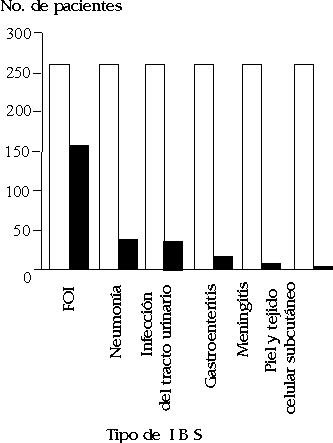
<body><![CDATA[<P>No se concluy&oacute; una causa defi-nida del cuadro febril en 161 ni&ntilde;os  (61 %). Predomin&oacute; la neumon&iacute;a 40/264 (15,15 %), seguida de  infecci&oacute;n del tracto urinario (ITU) 36/264 (13,60 %), gastroenteritis  21/264 (7,95 %), menin-gitis 4/264 (1,50 %), infecci&oacute;n de la piel  y tejido celular subcut&aacute;neo 2/264 (0,80 %); estos ni&ntilde;os se  incluyeron dentro del grupo 1 con IBS (figura).      <CENTER>     <A HREF="/img/revistas/ped/v69n3/f105397.gif"><IMG SRC="/img/revistas/ped/v69n3/f105397.gif" ALT="Figura" VSPACE=10 BORDER=1 HEIGHT=175 WIDTH=131></A>    </CENTER>        
<CENTER>Fuente: Historias cl&iacute;nicas.</CENTER>        <CENTER>FIGURA. Infecci&oacute;n bacteriana severa en ni&ntilde;os febriles.  Par&aacute;metros predictivos.</CENTER>          <P>Al realizar este an&aacute;lisis para cada grupo de edad independientemente  se observ&oacute; que a medida que disminuy&oacute; la edad aument&oacute;  el porcentaje de ni&ntilde;os con IBS del total de cada grupo (tabla 2).      <CENTER>TABLA 2. Ni&ntilde;os febriles ingresados seg&uacute;n presencia  o no de infecci&oacute;n bacteriana severa por grupos de edades</CENTER>        <CENTER><TABLE CELLPADDING=4 >  <TR>  <TD VALIGN=TOP WIDTH="17%">Grupo de edades&nbsp;</TD>    <TD VALIGN=TOP COLSPAN="2" WIDTH="33%">      <CENTER>Grupo 1</CENTER>  </TD>    <TD VALIGN=TOP COLSPAN="2" WIDTH="33%">      <CENTER>Grupo 2</CENTER>  </TD>    <TD VALIGN=TOP WIDTH="17%">      <CENTER>Total</CENTER>  </TD>  </TR>    <TR>  <TD VALIGN=TOP WIDTH="17%">0 - 28 d&iacute;as</TD>    <TD VALIGN=TOP WIDTH="17%">      ]]></body>
<body><![CDATA[<CENTER>3</CENTER>  </TD>    <TD VALIGN=TOP WIDTH="17%">      <CENTER>(60 %)</CENTER>  </TD>    <TD VALIGN=TOP WIDTH="17%">      <CENTER>2</CENTER>  </TD>    <TD VALIGN=TOP WIDTH="17%">      <CENTER>(40 %)</CENTER>  </TD>    <TD VALIGN=TOP WIDTH="17%">      <CENTER>5</CENTER>  </TD>  </TR>    <TR>  <TD VALIGN=TOP WIDTH="17%">29 - 90 d&iacute;as&nbsp;</TD>    <TD VALIGN=TOP WIDTH="17%">      <CENTER>11</CENTER>  </TD>    <TD VALIGN=TOP WIDTH="17%">      <CENTER>(42,3 %)</CENTER>  </TD>    <TD VALIGN=TOP WIDTH="17%">      <CENTER>15</CENTER>  </TD>    <TD VALIGN=TOP WIDTH="17%">      <CENTER>(57,7 %)</CENTER>  </TD>    <TD VALIGN=TOP WIDTH="17%">      <CENTER>26</CENTER>  </TD>  </TR>    <TR>  <TD VALIGN=TOP WIDTH="17%">91 d&iacute;as - 12 meses</TD>    <TD VALIGN=TOP WIDTH="17%">      ]]></body>
<body><![CDATA[<CENTER>68</CENTER>  </TD>    <TD VALIGN=TOP WIDTH="17%">      <CENTER>(37,7 %)</CENTER>  </TD>    <TD VALIGN=TOP WIDTH="17%">      <CENTER>112</CENTER>  </TD>    <TD VALIGN=TOP WIDTH="17%">      <CENTER>(62,3 %)</CENTER>  </TD>    <TD VALIGN=TOP WIDTH="17%">      <CENTER>180</CENTER>  </TD>  </TR>    <TR>  <TD VALIGN=TOP WIDTH="17%">13 - 36 meses</TD>    <TD VALIGN=TOP WIDTH="17%">      <CENTER>21</CENTER>  </TD>    <TD VALIGN=TOP WIDTH="17%">      <CENTER>(39,2 %)</CENTER>  </TD>    <TD VALIGN=TOP WIDTH="17%">      <CENTER>32</CENTER>  </TD>    <TD VALIGN=TOP WIDTH="17%">      <CENTER>(60,8 %)</CENTER>  </TD>    <TD VALIGN=TOP WIDTH="17%">      <CENTER>53</CENTER>  </TD>  </TR>    <TR>  <TD VALIGN=TOP WIDTH="17%">Total</TD>    <TD VALIGN=TOP WIDTH="17%">      ]]></body>
<body><![CDATA[<CENTER>103</CENTER>  </TD>    <TD VALIGN=TOP WIDTH="17%">      <CENTER>(39 %)</CENTER>  </TD>    <TD VALIGN=TOP WIDTH="17%">      <CENTER>161</CENTER>  </TD>    <TD VALIGN=TOP WIDTH="17%">      <CENTER>(61 %)</CENTER>  </TD>    <TD VALIGN=TOP WIDTH="17%">      <CENTER>264</CENTER>  </TD>  </TR>  </TABLE></CENTER>        <CENTER>Fuente: Historias cl&iacute;nicas.</CENTER>          <P>Del an&aacute;lisis de los datos cl&iacute;nicos y de laboratorio entre  los ni&ntilde;os febriles ingresados que presentaron o no IBS se observaron  diferencias significativas entre ambos grupos de estudio para el aspecto  t&oacute;xico y los valores de la temperatura, no as&iacute; para el leucograma  (tabla 3).      <CENTER>TABLA 3. Datos cl&iacute;nicos y de laboratorio en ni&ntilde;os  febriles seg&uacute;n presencia o no de infecci&oacute;n bacteriana severa</CENTER>        <CENTER><TABLE CELLPADDING=4 >  <TR>  <TD VALIGN=TOP WIDTH="17%">Datos&nbsp;</TD>    <TD VALIGN=TOP WIDTH="17%">&nbsp;</TD>    <TD VALIGN=TOP COLSPAN="2" WIDTH="33%">      <CENTER>Grupo 1</CENTER>  </TD>    <TD VALIGN=TOP COLSPAN="2" WIDTH="33%">      ]]></body>
<body><![CDATA[<CENTER>Grupo 2</CENTER>  </TD>  </TR>    <TR>  <TD VALIGN=TOP WIDTH="17%">&nbsp;</TD>    <TD VALIGN=TOP WIDTH="17%">&nbsp;</TD>    <TD VALIGN=TOP COLSPAN="2" WIDTH="33%">      <CENTER>n = 103</CENTER>  </TD>    <TD VALIGN=TOP COLSPAN="2" WIDTH="33%">      <CENTER>n = 161</CENTER>  </TD>  </TR>    <TR>  <TD VALIGN=TOP WIDTH="17%">Aspecto t&oacute;xico</TD>    <TD VALIGN=TOP WIDTH="17%">      <CENTER>29</CENTER>  </TD>    <TD VALIGN=TOP WIDTH="17%">      <CENTER>(28 %)</CENTER>  </TD>    <TD VALIGN=TOP WIDTH="17%">      <CENTER>11</CENTER>  </TD>    <TD VALIGN=TOP WIDTH="17%">      <CENTER>(6,8 %)</CENTER>  </TD>    <TD VALIGN=TOP WIDTH="17%">      <CENTER>+</CENTER>  </TD>  </TR>    <TR>  <TD VALIGN=TOP WIDTH="17%">Fiebre menor de 39 EC</TD>    <TD VALIGN=TOP WIDTH="17%">      <CENTER>50</CENTER>  </TD>    <TD VALIGN=TOP WIDTH="17%">      <CENTER>(48,6 %)</CENTER>  </TD>    <TD VALIGN=TOP WIDTH="17%">      ]]></body>
<body><![CDATA[<CENTER>156</CENTER>  </TD>    <TD VALIGN=TOP WIDTH="17%">      <CENTER>(96,7 %)</CENTER>  </TD>    <TD VALIGN=TOP WIDTH="17%">      <CENTER>+</CENTER>  </TD>  </TR>    <TR>  <TD VALIGN=TOP WIDTH="17%">Fiebre mayor de 39 EC</TD>    <TD VALIGN=TOP WIDTH="17%">      <CENTER>53</CENTER>  </TD>    <TD VALIGN=TOP WIDTH="17%">      <CENTER>(51,4 %)</CENTER>  </TD>    <TD VALIGN=TOP WIDTH="17%">      <CENTER>5</CENTER>  </TD>    <TD VALIGN=TOP WIDTH="17%">      <CENTER>(3,3 %)</CENTER>  </TD>    <TD VALIGN=TOP WIDTH="17%">      <CENTER>+</CENTER>  </TD>  </TR>    <TR>  <TD VALIGN=TOP WIDTH="17%">Leucocitos en sangre:</TD>    <TD VALIGN=TOP WIDTH="17%">&nbsp;</TD>    <TD VALIGN=TOP WIDTH="17%">&nbsp;</TD>    <TD VALIGN=TOP WIDTH="17%">&nbsp;</TD>    <TD VALIGN=TOP WIDTH="17%">&nbsp;</TD>    <TD VALIGN=TOP WIDTH="17%">      <CENTER>NS</CENTER>  </TD>  </TR>    <TR>  <TD VALIGN=TOP WIDTH="17%">- menor de 5x10<SUP>9</SUP>/L</TD>    <TD VALIGN=TOP WIDTH="17%">      <CENTER>1</CENTER>  </TD>    <TD VALIGN=TOP WIDTH="17%">      ]]></body>
<body><![CDATA[<CENTER>(0,9 %)</CENTER>  </TD>    <TD VALIGN=TOP WIDTH="17%">      <CENTER>13</CENTER>  </TD>    <TD VALIGN=TOP WIDTH="17%">      <CENTER>(8,5 %)</CENTER>  </TD>    <TD VALIGN=TOP WIDTH="17%">&nbsp;</TD>  </TR>    <TR>  <TD VALIGN=TOP WIDTH="17%">- entre 5 y 15x10<SUP>9</SUP>/L</TD>    <TD VALIGN=TOP WIDTH="17%">      <CENTER>83</CENTER>  </TD>    <TD VALIGN=TOP WIDTH="17%">      <CENTER>(80,5 %)</CENTER>  </TD>    <TD VALIGN=TOP WIDTH="17%">      <CENTER>139</CENTER>  </TD>    <TD VALIGN=TOP WIDTH="17%">      <CENTER>(86 %)</CENTER>  </TD>    <TD VALIGN=TOP WIDTH="17%">&nbsp;</TD>  </TR>    <TR>  <TD VALIGN=TOP WIDTH="17%">- mayor de 15x10<SUP>9</SUP>/L</TD>    <TD VALIGN=TOP WIDTH="17%">      <CENTER>19</CENTER>  </TD>    <TD VALIGN=TOP WIDTH="17%">      <CENTER>(18,6 %)</CENTER>  </TD>    <TD VALIGN=TOP WIDTH="17%">      <CENTER>9</CENTER>  </TD>    <TD VALIGN=TOP WIDTH="17%">      ]]></body>
<body><![CDATA[<CENTER>(5,5 %)</CENTER>  </TD>    <TD VALIGN=TOP WIDTH="17%">&nbsp;</TD>  </TR>  </TABLE></CENTER>        <CENTER>+ p &lt; 0,001. Fuente: Historias cl&iacute;nicas.</CENTER>    <H4>  DISCUSI&Oacute;N</H4>  Las enfermedades infecciosas contin&uacute;an siendo importantes en la  morbilidad y la mortalidad en la edad pedi&aacute;trica. En un estudio  realizado en Estados Unidos de Norteam&eacute;rica se estim&oacute; que  40 000 ni&ntilde;os se presentaron anualmente en los centros de emergencia  con una enfermedad infecciosa aguda.<SUP>21,23</SUP>        <P>En nuestro trabajo predominaron los ni&ntilde;os mayores de 3 meses  vistos e ingresados por fiebre. En la literatura m&eacute;dica se reporta  que la fiebre no es un signo com&uacute;n entre los ni&ntilde;os menores  de 12 semanas, como es en los ni&ntilde;os despu&eacute;s de esta edad.  En una serie de 2 estudios se obtuvo que s&oacute;lo el 1 % de los ni&ntilde;os  menores de 3 meses valorados en cl&iacute;nicas ambulatorias, presentaron  temperatura rectal mayor de 38 EC y no fue com&uacute;n que en este grupo  de edad los ni&ntilde;os presenten IBS y sean afebriles al ingreso.        <P>Referente al dato de la hospitalizaci&oacute;n de los reci&eacute;n  nacidos febriles, es una pr&aacute;ctica apoyada por la mayor&iacute;a  de los autores por el riesgo elevado que tienen de desarrollar IBS.<SUP>2-4,7,8,10-14,18,21</SUP>        <P>La tendencia mundial es evitar la hospitalizaci&oacute;n, m&eacute;todos  invasivos y antibioticoterapia innecesaria, sobre todo en el ni&ntilde;o  febril de bajo riesgo de IBS.<SUP>2,3,6-8,13,14,16-18</SUP>        <P>Los resultados de este trabajo fueron alentadores en este sentido, pues  las dos terceras partes de los ni&ntilde;os febriles valorados no fueron  ingresados, lo cual signific&oacute; un ahorro en costos y complicaciones  como la sepsis nosocomial entre otras.        <P>Se calcula que la valoraci&oacute;n inicial en el departamento de urgencias  de un ni&ntilde;o febril tiene un costo de $ 32,00, mientras que la hospitalizaci&oacute;n  durante un corto per&iacute;odo (5 d&iacute;as) en la cual se proporcionan  antibi&oacute;ticos endovenosos a un paciente identificado como riesgo  es de $ 225,28<SUP>24</SUP> (anexo 1). Estudios realizados por autores  extranjeros plantean que el costo de la valoraci&oacute;n inicial es de  Z 90,00 (USD), mientras que la hospitalizaci&oacute;n cuesta Z 1 780,30  (USD).<SUP>15</SUP>        <P>El diagn&oacute;stico definitivo del ni&ntilde;o febril no siempre es  precisado,<SUP>8</SUP> sobre todo cuando el ni&ntilde;o al ingreso no tiene  signos de infecci&oacute;n focal. En relaci&oacute;n con la incidencia  de los diferentes tipos de infecci&oacute;n bacteriana, en t&eacute;rminos  generales predomina la infecci&oacute;n del tracto urinario, la bacteriemia  y la neumon&iacute;a.<SUP>3,6,7,9,13,14</SUP>        <P>El aspecto t&oacute;xico se reconoce como un indicador sensitivo de  IBS en los ni&ntilde;os febriles, as&iacute; como la relaci&oacute;n entre  intensidad de la fiebre y riesgo de IBS en la que aumenta &eacute;sta proporcionalmente  con el aumento de la temperatura, y es mayor el riesgo con temperatura  igual o mayor de 39 EC.        <P>La mayor&iacute;a de los autores estudiosos de este tema opinan que  no existen par&aacute;metros predictivos de IBS infalibles, y plantean  que la combinaci&oacute;n de variables en la determinaci&oacute;n del riesgo  de IBS en el ni&ntilde;o febril resulta ser la mejor opci&oacute;n. Concluimos  en que predominaron los ni&ntilde;os de 91 d&iacute;as a 36 meses vistos  e ingresados. El porcentaje de IBS fue mayor en los ni&ntilde;os de menor  edad y las entidades cl&iacute;nicas m&aacute;s frecuentes la neumon&iacute;a  y la ITU.        ]]></body>
<body><![CDATA[<P>El aspecto t&oacute;xico y la temperatura mayor de 39 EC guard&oacute;  relaci&oacute;n altamente significativa con los que desarrollaron infecciones  y el leucograma se comport&oacute; de forma similar en ambos grupos de  estudio. Recomendamos generalizar la aplicaci&oacute;n del flujograma propuesto  en la evaluaci&oacute;n y manejo del ni&ntilde;o febril de 3 a 36 meses  de edad (anexo 2).  <H4>  ANEXO 1</H4>  An&aacute;lisis del estudio econ&oacute;mico        <P>1. Costo de la visita inicial de un ni&ntilde;o febril al Departamento  de Urgencias:  <DIR>- Atenci&oacute;n del m&eacute;dico $ 15,40        <P>- Atenci&oacute;n de enfermer&iacute;a $ 7,33        <P>- Leucograma $ 9,12      <PRE>- Cituria <U>$ 0,15  </U>&nbsp;&nbsp;&nbsp;&nbsp;&nbsp;&nbsp;&nbsp;&nbsp;&nbsp; $ 32,00</PRE>  </DIR>          <P>2. Costo de la hospitalizaci&oacute;n durante 5 d&iacute;as de un ni&ntilde;o  identificado como riesgo:  <DIR>- Visita inicial $ 32,00        <P>- Cultivos realizados:      <BR>&nbsp;  <DIR>Hemocultivo $ 10,84      <BR>LCR $7,69      <BR>Urocultivo $ 8,14      ]]></body>
<body><![CDATA[<BR>Coprocultivo $ 6,94</DIR>          <P>- Radiograf&iacute;a de t&oacute;rax $ 0,95        <P>- Leucograma $ 9,12        <P>- Cituria $ 0,15        <P>- Atenci&oacute;n m&eacute;dica $ 77,00        <P>- Atenci&oacute;n de enfermer&iacute;a $ 33,00        <P>- Costo de la cama $ 3,55      <PRE>- Antibioticoterapia <U>$ 35,90  </U>&nbsp;&nbsp;&nbsp;&nbsp;&nbsp;&nbsp;&nbsp;&nbsp;&nbsp;&nbsp;&nbsp;&nbsp;&nbsp;&nbsp;&nbsp;&nbsp;&nbsp;&nbsp;&nbsp;&nbsp; $ 225,28</PRE>  </DIR>          <P>3. Costo de seguimiento ambulatorio de un ni&ntilde;o febril de bajo  riesgo durante 2 d&iacute;as:  <DIR>- Atenci&oacute;n del m&eacute;dico $ 30,80        <P>- Atenci&oacute;n de enfermer&iacute;a $ 14,66      ]]></body>
<body><![CDATA[<PRE>- Urocultivo <U>$ 8,14  </U>&nbsp;&nbsp;&nbsp;&nbsp;&nbsp;&nbsp;&nbsp;&nbsp;&nbsp;&nbsp;&nbsp;&nbsp; $ 53,60</PRE>  </DIR>    <H4>  ANEXO 2</H4>  Flujograma propuesto:        <P><U>Ni&ntilde;o febril de 3 a 36 meses.</U>        <P>- Valoraci&oacute;n por el especialista.        <P>- Anamnesis.        <P>- Examen f&iacute;sico minucioso.        <P>- Leucograma.        <P><I>Valoraci&oacute;n de riesgo de infecci&oacute;n bacteriana severa:</I>        <P>Aspecto t&oacute;xico Riesgo Bajo riesgo        <P>Buen aspecto Buen aspecto        <P>L > 15x10<SUP>9</SUP>/L L &lt; 15x10<SUP>9</SUP>/L        ]]></body>
<body><![CDATA[<P>Temp. p > 39 EC Temp. p &lt; 39 EC        <P>Opci&oacute;n 1:      <CENTER><TABLE CELLSPACING=0 CELLPADDING=4 >  <TR>  <TD VALIGN=TOP WIDTH="33%">- Ingreso.</TD>    <TD VALIGN=TOP WIDTH="33%">- Ingreso.</TD>    <TD VALIGN=TOP WIDTH="33%">- Seguimiento ambulatorio.</TD>  </TR>    <TR>  <TD VALIGN=TOP WIDTH="33%">- Evaluaci&oacute;n completa de sepsis.</TD>    <TD VALIGN=TOP WIDTH="33%">- Evaluaci&oacute;n completa de sepsis.</TD>    <TD VALIGN=TOP WIDTH="33%">- Urocultivo a los menores de 1 a&ntilde;o.</TD>  </TR>    <TR>  <TD VALIGN=TOP WIDTH="33%">&nbsp;</TD>    <TD VALIGN=TOP WIDTH="33%">&nbsp;</TD>    <TD VALIGN=TOP WIDTH="33%">&nbsp;</TD>  </TR>    <TR>  <TD VALIGN=TOP WIDTH="33%">- Antibi&oacute;tico parenteral.</TD>    <TD VALIGN=TOP WIDTH="33%">Antibi&oacute;tico a decisi&oacute;n m&eacute;dica.</TD>    <TD VALIGN=TOP WIDTH="33%">(hembras hasta los 2 a&ntilde;os).</TD>  </TR>    <TR>  <TD VALIGN=TOP WIDTH="33%">&nbsp;</TD>    <TD VALIGN=TOP WIDTH="33%">&nbsp;</TD>    <TD VALIGN=TOP WIDTH="33%">&nbsp;</TD>  </TR>    <TR>  <TD VALIGN=TOP WIDTH="33%">Opci&oacute;n 2:</TD>    <TD VALIGN=TOP WIDTH="33%">&nbsp;</TD>    <TD VALIGN=TOP WIDTH="33%">&nbsp;</TD>  </TR>    <TR>  <TD VALIGN=TOP WIDTH="33%">- Ingreso en caso de inadecuadas condiciones:</TD>    <TD VALIGN=TOP WIDTH="33%">&nbsp;</TD>    <TD VALIGN=TOP WIDTH="33%">&nbsp;</TD>  </TR>    <TR>  <TD VALIGN=TOP WIDTH="33%">! sociales.</TD>    <TD VALIGN=TOP WIDTH="33%">&nbsp;</TD>    <TD VALIGN=TOP WIDTH="33%">&nbsp;</TD>  </TR>    <TR>  <TD VALIGN=TOP WIDTH="33%">! geogr&aacute;ficas.</TD>    <TD VALIGN=TOP WIDTH="33%">&nbsp;</TD>    <TD VALIGN=TOP WIDTH="33%">&nbsp;</TD>  </TR>    <TR>  <TD VALIGN=TOP WIDTH="33%">! m&eacute;dicas.</TD>    <TD VALIGN=TOP WIDTH="33%">&nbsp;</TD>    <TD VALIGN=TOP WIDTH="33%">&nbsp;</TD>  </TR>    <TR>  <TD VALIGN=TOP WIDTH="33%">- Observaci&oacute;n</TD>    <TD VALIGN=TOP WIDTH="33%">&nbsp;</TD>    <TD VALIGN=TOP WIDTH="33%">&nbsp;</TD>  </TR>    <TR>  <TD VALIGN=TOP WIDTH="33%">- Urocultivo</TD>    <TD VALIGN=TOP WIDTH="33%">&nbsp;</TD>    <TD VALIGN=TOP WIDTH="33%">&nbsp;</TD>  </TR>    <TR>  <TD VALIGN=TOP WIDTH="33%">(igual que 1).</TD>    <TD VALIGN=TOP WIDTH="33%">&nbsp;</TD>    <TD VALIGN=TOP WIDTH="33%">&nbsp;</TD>  </TR>  </TABLE></CENTER>  <I>Evaluaci&oacute;n completa de sepsis:</I>        <P>- Hemocultivo.      <BR>- Urocultivo.      <BR>- Cultivo del LCR.      <BR>- Radiograf&iacute;a de t&oacute;rax y otros cultivos a decisi&oacute;n  m&eacute;dica.  <H4>  SUMMARY</H4>  Different researches have performed studies on the management of the febrile  infant and they point out that this is a dilemma faced by every physician  who takes care of children. Motivated by this subject, a descriptive and  retrospective study of febrile infants was conducted. The study was carried  out to evaluate febrile infants without evident cause at the baseline evaluation  who attended the emergency service during a period of 9 months with the  objective of identifying the definite diagnosis at admission. The type  of bacterial infection was accurately assessed and the presence of this  was related to clinical and laboratory parameters. The greatest number  of febrile infants evaluated and admitted to hospital were 91 days-36 months  old. The lowest percentage of them were admitted to hospital and they developed  some serious bacterial infection, mainly pneumonia. The percentage of infants  presenting with pneumonia was greater in infants under the age above mentioned  with predominance of the toxic aspect and of a temperature > 39 EC. The  outpatient management of the febrile infant over 90 days of life and low  risk of serious bacterial infection resulted in lifes and money saved;  that's why we recommend to systematized the flujogram proposed for the  evaluation and management of the 3-36 months old febrile infant.        <P><I>Subject headings:</I> BACTERIAL INFECTIONS/diagnosis; FEVER/etiology;  HEALTH CARE COSTS; EMERGENCY MEDICAL SERVICES/economics; EVALUATION; HOSPITAL  COSTS.  <H4>  REFERENCIAS BIBLIOGR&Aacute;FICAS</H4>    <OL>      <LI>  Jaskiewicz JA, Mc Carthy CA. Evaluation an management of the febrile infant  60 days of age or youreger. Pediatric Annals 1993;22(8):477-83.</LI>        <LI>  Harper MB, Fleisher GR. Occult Bacteremia in the 3-month-old to 3-year-old  age group. Pediatric Annals 1993;22(8):484-93.</LI>        ]]></body>
<body><![CDATA[<LI>  Basking MN. The prevalence of serious Bacterial Infections by age in febrile  infants during the first 3 month of life. Pediatric Annals 1993;22(8):462-6.</LI>        <LI>  Guzm&aacute;n Rodr&iacute;guez E, Guzm&aacute;n RE. S&iacute;ndrome s&eacute;ptico:  Importancia del diagn&oacute;stico temprano. Rev Cubana Pediatr 1995;67(1):56-61.</LI>        <LI>  Baraff LJ, Bass HW, Fleisher GR, Klein JO, Mc Cracken GH, Powell KR, et  al. Practice guideline for the management of infants and children 0 to  36 months of age with fever wethont source. Annals Emergency Medicine 1993;22(7):108-120.</LI>        <LI>  Bonadio WA. Evaluation and management of serious bacterial infections in  the febrile young infant. Pediatric Infect Dis J 1990;9(12):905-12.</LI>        <LI>  Jaskiewicz JA, Mc Carthy CA, Richardson AC, White KC, Fisher DJ, Dagan  R, et al. Febrile infants at low risk of serious bacterial infection-An  appaisal of the Rochester Criterio and implications for management. Pediatrics  1994;94(3):390-6.</LI>        <LI>  Broner CW, Palk SA, Sherman JM. Febrile infants less than ligth weeks old.  Clin Pediatr 1990;29(8):438-43.</LI>        <LI>  D&iacute;az &Aacute;lvarez M, Fern&aacute;ndez de la Paz MT, Moreno V&aacute;zquez  O, Piloto SR, Arango MI, D&iacute;az &Aacute;lvarez J. Infecci&oacute;n  Bacteriana Severa en Reci&eacute;n Nacidos Febriles sin signos de focalizaci&oacute;n.  Rev Cubana Pediatr 1995;67(2):79-87.</LI>        <LI>  D&iacute;az &Aacute;lvarez M, Fern&aacute;ndez de la Paz MT, Moreno V&aacute;zquez  O, Pino A, Rivera L, P&eacute;rez R. Resultados en la evaluaci&oacute;n  inicial y antibioticoterapia en el reci&eacute;n nacido febril. Rev Cubana  Pediatr 1995;67(2):88-96.</LI>        <LI>  D&iacute;az &Aacute;lvarez M, Moreno V&aacute;zquez O, Fern&aacute;ndez  de la Paz MT, Mart&iacute;nez Canalejo H. Nuevos criterios de bajo riesgo  de infecci&oacute;n bacteriana severa en reci&eacute;n nacidos febriles.  Rev Cubana Pediatr 1996;68(2):77-84.</LI>        <LI>  . Eficacia de la aplicaci&oacute;n de Bajo Riesgo de Infecci&oacute;n Bacteriana  Severa en reci&eacute;n nacidos febriles. Rev Cubana Pediatr 1996;68(3):143-51.</LI>        ]]></body>
<body><![CDATA[<LI>  Douglas BM, Bell JM, Avner JR. Out patient management with hout antibiotic  of fever in selected infants. New Engl J Med 1993;329(20):1437-41.</LI>        <LI>  Baskin WN, O Rourke EJ, Fleisher GR. Out patient treatment of febrile infants  28 to 89 days of age with intramuscular administration of Ceftriaxone.  J Pediatr 1992;120(1):22-37.</LI>        <LI>  Lien TA, Baskin MN, Shusartz S, Fleisher GR. Clinical and cost-effectiveness  of out patient strategies for management of febrile infants. Pediatrics  1992;89(6):1135-44.</LI>        <LI>  Wasserman GM, White CB. Evaluation of the necessity for hospitalization  of the febrile infants less than three months of age. Pediatric Infect  Dis J 1990;9(3):163-9.</LI>        <!-- ref --><LI>  Mc Carthy PL. The febrile infant. Pediatrics 1994;94(3):397-8.</LI>    <!-- ref --><LI>  . Management of the febrile infants. Pediatrics 1992;89(6): 1251-2.</LI>    <LI>  Harper MB. Pediatric infections diseases emergencies. Current Opinion in  Pediatrics 1995;7:302-8.</LI>        <LI>  Young PC. The management of febrile infants by primary care pediatricians  in what: Comparison with published practice quidelines. Pediatrics 1995;95(5):623-7.</LI>        <LI>  Harper MB, Bachus R, Fleisher GR. Effect of antibiotic therapy of the outcome  of out patients with unsuspected bacteremia. Pediatr Infect Dis J 1995;14(9):760-7.</LI>        <LI>  Kramer MS, Tange SM, Mells EL. Role of complete blood count in detection  occult focal bacterial infection in the young febrile child. Clin Epidemiol  J 1993;46:349-57.</LI>        ]]></body>
<body><![CDATA[<LI>  Sara V, Sotiropoulos MD. Antibiotic choices: the critical first hour. Pediatric  Annals 1996;25(6):345-50.</LI>        <LI>  Bennington J, Boer G. T&eacute;cnicas de direcci&oacute;n y control de  costos para los laboratorios. Editorial Revert&eacute;, 1980;12-54.</LI>      </OL>  Recibido: 5 de agosto de 1997. Aprobado: 23 de septiembre de 1997. Dra.  <I>Alicia &Aacute;lvarez Rodr&iacute;guez.</I> Calle 44, n&uacute;mero  9707, entre 97 y 99, G&uuml;ines, Habana, Cuba.         ]]></body><back>
<ref-list>
<ref id="B1">
<nlm-citation citation-type="journal">
<person-group person-group-type="author">
<name>
<surname><![CDATA[Jaskiewicz]]></surname>
<given-names><![CDATA[JA]]></given-names>
</name>
<name>
<surname><![CDATA[Mc Carthy]]></surname>
<given-names><![CDATA[CA]]></given-names>
</name>
</person-group>
<article-title xml:lang="en"><![CDATA[Evaluation an management of the febrile infant 60 days of age or youreger]]></article-title>
<source><![CDATA[Pediatric Annals]]></source>
<year>1993</year>
<volume>22</volume>
<numero>8</numero>
<issue>8</issue>
<page-range>477-83</page-range></nlm-citation>
</ref>
<ref id="B2">
<nlm-citation citation-type="journal">
<person-group person-group-type="author">
<name>
<surname><![CDATA[Harper]]></surname>
<given-names><![CDATA[MB]]></given-names>
</name>
<name>
<surname><![CDATA[Fleisher]]></surname>
<given-names><![CDATA[GR]]></given-names>
</name>
</person-group>
<article-title xml:lang="en"><![CDATA[Occult Bacteremia in the 3-month-old to 3-year-old age group]]></article-title>
<source><![CDATA[Pediatric Annals]]></source>
<year>1993</year>
<volume>22</volume>
<numero>8</numero>
<issue>8</issue>
<page-range>484-93</page-range></nlm-citation>
</ref>
<ref id="B3">
<nlm-citation citation-type="journal">
<person-group person-group-type="author">
<name>
<surname><![CDATA[Basking]]></surname>
<given-names><![CDATA[MN]]></given-names>
</name>
</person-group>
<article-title xml:lang="en"><![CDATA[The prevalence of serious Bacterial Infections by age in febrile infants during the first 3 month of life]]></article-title>
<source><![CDATA[Pediatric Annals]]></source>
<year>1993</year>
<volume>22</volume>
<numero>8</numero>
<issue>8</issue>
<page-range>462-6</page-range></nlm-citation>
</ref>
<ref id="B4">
<nlm-citation citation-type="journal">
<person-group person-group-type="author">
<name>
<surname><![CDATA[Guzmán Rodríguez]]></surname>
<given-names><![CDATA[E]]></given-names>
</name>
<name>
<surname><![CDATA[Guzmán]]></surname>
<given-names><![CDATA[RE]]></given-names>
</name>
</person-group>
<article-title xml:lang="es"><![CDATA[Síndrome séptico: Importancia del diagnóstico temprano]]></article-title>
<source><![CDATA[Rev Cubana Pediatr]]></source>
<year>1995</year>
<volume>67</volume>
<numero>1</numero>
<issue>1</issue>
<page-range>56-61</page-range></nlm-citation>
</ref>
<ref id="B5">
<nlm-citation citation-type="journal">
<person-group person-group-type="author">
<name>
<surname><![CDATA[Baraff]]></surname>
<given-names><![CDATA[LJ]]></given-names>
</name>
<name>
<surname><![CDATA[Bass]]></surname>
<given-names><![CDATA[HW]]></given-names>
</name>
<name>
<surname><![CDATA[Fleisher]]></surname>
<given-names><![CDATA[GR]]></given-names>
</name>
<name>
<surname><![CDATA[Klein]]></surname>
<given-names><![CDATA[JO]]></given-names>
</name>
<name>
<surname><![CDATA[Mc Cracken]]></surname>
<given-names><![CDATA[GH]]></given-names>
</name>
<name>
<surname><![CDATA[Powell]]></surname>
<given-names><![CDATA[KR]]></given-names>
</name>
</person-group>
<article-title xml:lang="en"><![CDATA[Practice guideline for the management of infants and children 0 to 36 months of age with fever wethont source]]></article-title>
<source><![CDATA[Annals Emergency Medicine]]></source>
<year>1993</year>
<volume>22</volume>
<numero>7</numero>
<issue>7</issue>
<page-range>108-120</page-range></nlm-citation>
</ref>
<ref id="B6">
<nlm-citation citation-type="journal">
<person-group person-group-type="author">
<name>
<surname><![CDATA[Bonadio]]></surname>
<given-names><![CDATA[WA]]></given-names>
</name>
</person-group>
<article-title xml:lang="en"><![CDATA[Evaluation and management of serious bacterial infections in the febrile young infant]]></article-title>
<source><![CDATA[Pediatric Infect Dis J]]></source>
<year>1990</year>
<volume>9</volume>
<numero>12</numero>
<issue>12</issue>
<page-range>905-12</page-range></nlm-citation>
</ref>
<ref id="B7">
<nlm-citation citation-type="journal">
<person-group person-group-type="author">
<name>
<surname><![CDATA[Jaskiewicz]]></surname>
<given-names><![CDATA[JA]]></given-names>
</name>
<name>
<surname><![CDATA[Mc Carthy]]></surname>
<given-names><![CDATA[CA]]></given-names>
</name>
<name>
<surname><![CDATA[Richardson]]></surname>
<given-names><![CDATA[AC]]></given-names>
</name>
<name>
<surname><![CDATA[White]]></surname>
<given-names><![CDATA[KC]]></given-names>
</name>
<name>
<surname><![CDATA[Fisher]]></surname>
<given-names><![CDATA[DJ]]></given-names>
</name>
<name>
<surname><![CDATA[Dagan]]></surname>
<given-names><![CDATA[R]]></given-names>
</name>
</person-group>
<article-title xml:lang="en"><![CDATA[Febrile infants at low risk of serious bacterial infection-An appaisal of the Rochester Criterio and implications for management]]></article-title>
<source><![CDATA[Pediatrics]]></source>
<year>1994</year>
<volume>94</volume>
<numero>3</numero>
<issue>3</issue>
<page-range>390-6</page-range></nlm-citation>
</ref>
<ref id="B8">
<nlm-citation citation-type="journal">
<person-group person-group-type="author">
<name>
<surname><![CDATA[Broner]]></surname>
<given-names><![CDATA[CW]]></given-names>
</name>
<name>
<surname><![CDATA[Palk]]></surname>
<given-names><![CDATA[SA]]></given-names>
</name>
<name>
<surname><![CDATA[Sherman]]></surname>
<given-names><![CDATA[JM]]></given-names>
</name>
</person-group>
<article-title xml:lang="en"><![CDATA[Febrile infants less than ligth weeks old]]></article-title>
<source><![CDATA[Clin Pediatr]]></source>
<year>1990</year>
<volume>29</volume>
<numero>8</numero>
<issue>8</issue>
<page-range>438-43</page-range></nlm-citation>
</ref>
<ref id="B9">
<nlm-citation citation-type="journal">
<person-group person-group-type="author">
<name>
<surname><![CDATA[Díaz Álvarez]]></surname>
<given-names><![CDATA[M]]></given-names>
</name>
<name>
<surname><![CDATA[Fernández de la Paz]]></surname>
<given-names><![CDATA[MT]]></given-names>
</name>
<name>
<surname><![CDATA[Moreno Vázquez]]></surname>
<given-names><![CDATA[O]]></given-names>
</name>
<name>
<surname><![CDATA[Piloto]]></surname>
<given-names><![CDATA[SR]]></given-names>
</name>
<name>
<surname><![CDATA[Arango]]></surname>
<given-names><![CDATA[MI]]></given-names>
</name>
<name>
<surname><![CDATA[Díaz Álvarez]]></surname>
<given-names><![CDATA[J]]></given-names>
</name>
</person-group>
<article-title xml:lang="es"><![CDATA[Infección Bacteriana Severa en Recién Nacidos Febriles sin signos de focalización]]></article-title>
<source><![CDATA[Rev Cubana Pediatr]]></source>
<year>1995</year>
<volume>67</volume>
<numero>2</numero>
<issue>2</issue>
<page-range>79-87</page-range></nlm-citation>
</ref>
<ref id="B10">
<nlm-citation citation-type="journal">
<person-group person-group-type="author">
<name>
<surname><![CDATA[Díaz Álvarez]]></surname>
<given-names><![CDATA[M]]></given-names>
</name>
<name>
<surname><![CDATA[Fernández de la Paz]]></surname>
<given-names><![CDATA[MT]]></given-names>
</name>
<name>
<surname><![CDATA[Moreno Vázquez]]></surname>
<given-names><![CDATA[O]]></given-names>
</name>
<name>
<surname><![CDATA[Pino]]></surname>
<given-names><![CDATA[A]]></given-names>
</name>
<name>
<surname><![CDATA[Rivera]]></surname>
<given-names><![CDATA[L]]></given-names>
</name>
<name>
<surname><![CDATA[Pérez]]></surname>
<given-names><![CDATA[R]]></given-names>
</name>
</person-group>
<article-title xml:lang="es"><![CDATA[Resultados en la evaluación inicial y antibioticoterapia en el recién nacido febril]]></article-title>
<source><![CDATA[Rev Cubana Pediatr]]></source>
<year>1995</year>
<volume>67</volume>
<numero>2</numero>
<issue>2</issue>
<page-range>88-96</page-range></nlm-citation>
</ref>
<ref id="B11">
<nlm-citation citation-type="journal">
<person-group person-group-type="author">
<name>
<surname><![CDATA[Díaz Álvarez]]></surname>
<given-names><![CDATA[M]]></given-names>
</name>
<name>
<surname><![CDATA[Moreno Vázquez]]></surname>
<given-names><![CDATA[O]]></given-names>
</name>
<name>
<surname><![CDATA[Fernández de la Paz]]></surname>
<given-names><![CDATA[MT]]></given-names>
</name>
<name>
<surname><![CDATA[Martínez Canalejo]]></surname>
<given-names><![CDATA[H]]></given-names>
</name>
</person-group>
<article-title xml:lang="es"><![CDATA[Nuevos criterios de bajo riesgo de infección bacteriana severa en recién nacidos febriles]]></article-title>
<source><![CDATA[Rev Cubana Pediatr]]></source>
<year>1996</year>
<volume>68</volume>
<numero>2</numero>
<issue>2</issue>
<page-range>77-84</page-range></nlm-citation>
</ref>
<ref id="B12">
<nlm-citation citation-type="journal">
<article-title xml:lang="es"><![CDATA[Eficacia de la aplicación de Bajo Riesgo de Infección Bacteriana Severa en recién nacidos febriles]]></article-title>
<source><![CDATA[Rev Cubana Pediatr]]></source>
<year>1996</year>
<volume>68</volume>
<numero>(3)</numero>
<issue>(3)</issue>
<page-range>143-51</page-range></nlm-citation>
</ref>
<ref id="B13">
<nlm-citation citation-type="journal">
<person-group person-group-type="author">
<name>
<surname><![CDATA[Douglas]]></surname>
<given-names><![CDATA[BM]]></given-names>
</name>
<name>
<surname><![CDATA[Bell]]></surname>
<given-names><![CDATA[JM]]></given-names>
</name>
<name>
<surname><![CDATA[Avner]]></surname>
<given-names><![CDATA[JR]]></given-names>
</name>
</person-group>
<article-title xml:lang="en"><![CDATA[Out patient management with hout antibiotic of fever in selected infants]]></article-title>
<source><![CDATA[New Engl J Med]]></source>
<year>1993</year>
<volume>329</volume>
<numero>20</numero>
<issue>20</issue>
<page-range>1437-41</page-range></nlm-citation>
</ref>
<ref id="B14">
<nlm-citation citation-type="journal">
<person-group person-group-type="author">
<name>
<surname><![CDATA[Baskin]]></surname>
<given-names><![CDATA[WN]]></given-names>
</name>
<name>
<surname><![CDATA[O Rourke]]></surname>
<given-names><![CDATA[EJ]]></given-names>
</name>
<name>
<surname><![CDATA[Fleisher]]></surname>
<given-names><![CDATA[GR]]></given-names>
</name>
</person-group>
<article-title xml:lang="en"><![CDATA[Out patient treatment of febrile infants 28 to 89 days of age with intramuscular administration of Ceftriaxone]]></article-title>
<source><![CDATA[J Pediatr]]></source>
<year>1992</year>
<volume>120</volume>
<numero>1</numero>
<issue>1</issue>
<page-range>22-37</page-range></nlm-citation>
</ref>
<ref id="B15">
<nlm-citation citation-type="journal">
<person-group person-group-type="author">
<name>
<surname><![CDATA[Lien]]></surname>
<given-names><![CDATA[TA]]></given-names>
</name>
<name>
<surname><![CDATA[Baskin]]></surname>
<given-names><![CDATA[MN]]></given-names>
</name>
<name>
<surname><![CDATA[Shusartz]]></surname>
<given-names><![CDATA[S]]></given-names>
</name>
<name>
<surname><![CDATA[Fleisher]]></surname>
<given-names><![CDATA[GR]]></given-names>
</name>
</person-group>
<article-title xml:lang="en"><![CDATA[Clinical and cost-effectiveness of out patient strategies for management of febrile infants]]></article-title>
<source><![CDATA[Pediatrics]]></source>
<year>1992</year>
<volume>89</volume>
<numero>6</numero>
<issue>6</issue>
<page-range>1135-44</page-range></nlm-citation>
</ref>
<ref id="B16">
<nlm-citation citation-type="journal">
<person-group person-group-type="author">
<name>
<surname><![CDATA[Wasserman]]></surname>
<given-names><![CDATA[GM]]></given-names>
</name>
<name>
<surname><![CDATA[White]]></surname>
<given-names><![CDATA[CB]]></given-names>
</name>
</person-group>
<article-title xml:lang="en"><![CDATA[Evaluation of the necessity for hospitalization of the febrile infants less than three months of age]]></article-title>
<source><![CDATA[Pediatric Infect Dis J]]></source>
<year>1990</year>
<volume>9</volume>
<numero>3</numero>
<issue>3</issue>
<page-range>163-9</page-range></nlm-citation>
</ref>
<ref id="B17">
<nlm-citation citation-type="journal">
<person-group person-group-type="author">
<name>
<surname><![CDATA[Mc Carthy]]></surname>
<given-names><![CDATA[PL]]></given-names>
</name>
</person-group>
<article-title xml:lang="en"><![CDATA[The febrile infant]]></article-title>
<source><![CDATA[Pediatrics]]></source>
<year>1994</year>
<volume>94</volume>
<numero>3</numero>
<issue>3</issue>
<page-range>397-8</page-range></nlm-citation>
</ref>
<ref id="B18">
<nlm-citation citation-type="journal">
<article-title xml:lang="en"><![CDATA[Management of the febrile infants]]></article-title>
<source><![CDATA[Pediatrics]]></source>
<year>1992</year>
<volume>89</volume>
<numero>(6)</numero>
<issue>(6)</issue>
<page-range>1251-2</page-range></nlm-citation>
</ref>
<ref id="B19">
<nlm-citation citation-type="journal">
<person-group person-group-type="author">
<name>
<surname><![CDATA[Harper]]></surname>
<given-names><![CDATA[MB]]></given-names>
</name>
</person-group>
<article-title xml:lang="en"><![CDATA[Pediatric infections diseases emergencies]]></article-title>
<source><![CDATA[Current Opinion in Pediatrics]]></source>
<year>1995</year>
<volume>7</volume>
<page-range>302-8</page-range></nlm-citation>
</ref>
<ref id="B20">
<nlm-citation citation-type="journal">
<person-group person-group-type="author">
<name>
<surname><![CDATA[Young]]></surname>
<given-names><![CDATA[PC]]></given-names>
</name>
</person-group>
<article-title xml:lang="en"><![CDATA[The management of febrile infants by primary care pediatricians in what: Comparison with published practice quidelines]]></article-title>
<source><![CDATA[Pediatrics]]></source>
<year>1995</year>
<volume>95</volume>
<numero>5</numero>
<issue>5</issue>
<page-range>623-7</page-range></nlm-citation>
</ref>
<ref id="B21">
<nlm-citation citation-type="journal">
<person-group person-group-type="author">
<name>
<surname><![CDATA[Harper]]></surname>
<given-names><![CDATA[MB]]></given-names>
</name>
<name>
<surname><![CDATA[Bachus]]></surname>
<given-names><![CDATA[R]]></given-names>
</name>
<name>
<surname><![CDATA[Fleisher]]></surname>
<given-names><![CDATA[GR]]></given-names>
</name>
</person-group>
<article-title xml:lang="en"><![CDATA[Effect of antibiotic therapy of the outcome of out patients with unsuspected bacteremia]]></article-title>
<source><![CDATA[Pediatr Infect Dis J]]></source>
<year>1995</year>
<volume>14</volume>
<numero>9</numero>
<issue>9</issue>
<page-range>760-7</page-range></nlm-citation>
</ref>
<ref id="B22">
<nlm-citation citation-type="journal">
<person-group person-group-type="author">
<name>
<surname><![CDATA[Kramer]]></surname>
<given-names><![CDATA[MS]]></given-names>
</name>
<name>
<surname><![CDATA[Tange]]></surname>
<given-names><![CDATA[SM]]></given-names>
</name>
<name>
<surname><![CDATA[Mells]]></surname>
<given-names><![CDATA[EL]]></given-names>
</name>
</person-group>
<article-title xml:lang="en"><![CDATA[Role of complete blood count in detection occult focal bacterial infection in the young febrile child]]></article-title>
<source><![CDATA[Clin Epidemiol J]]></source>
<year>1993</year>
<volume>46</volume>
<page-range>349-57</page-range></nlm-citation>
</ref>
<ref id="B23">
<nlm-citation citation-type="journal">
<person-group person-group-type="author">
<name>
<surname><![CDATA[Sara]]></surname>
<given-names><![CDATA[V]]></given-names>
</name>
<name>
<surname><![CDATA[Sotiropoulos]]></surname>
<given-names><![CDATA[MD]]></given-names>
</name>
</person-group>
<article-title xml:lang="en"><![CDATA[Antibiotic choices: the critical first hour]]></article-title>
<source><![CDATA[Pediatric Annals]]></source>
<year>1996</year>
<volume>25</volume>
<numero>6</numero>
<issue>6</issue>
<page-range>345-50</page-range></nlm-citation>
</ref>
<ref id="B24">
<nlm-citation citation-type="book">
<person-group person-group-type="author">
<name>
<surname><![CDATA[Bennington]]></surname>
<given-names><![CDATA[J]]></given-names>
</name>
<name>
<surname><![CDATA[Boer]]></surname>
<given-names><![CDATA[G]]></given-names>
</name>
</person-group>
<source><![CDATA[Técnicas de dirección y control de costos para los laboratorios]]></source>
<year>1980</year>
<page-range>12-54</page-range><publisher-name><![CDATA[Editorial Reverté]]></publisher-name>
</nlm-citation>
</ref>
</ref-list>
</back>
</article>