<?xml version="1.0" encoding="ISO-8859-1"?><article xmlns:mml="http://www.w3.org/1998/Math/MathML" xmlns:xlink="http://www.w3.org/1999/xlink" xmlns:xsi="http://www.w3.org/2001/XMLSchema-instance">
<front>
<journal-meta>
<journal-id>0034-7531</journal-id>
<journal-title><![CDATA[Revista Cubana de Pediatría]]></journal-title>
<abbrev-journal-title><![CDATA[Rev Cubana Pediatr]]></abbrev-journal-title>
<issn>0034-7531</issn>
<publisher>
<publisher-name><![CDATA[Centro Nacional de Información de Ciencias MédicasEditorial Ciencias Médicas]]></publisher-name>
</publisher>
</journal-meta>
<article-meta>
<article-id>S0034-75311998000100006</article-id>
<title-group>
<article-title xml:lang="es"><![CDATA[Morbilidad y mortalidad por síndrome hemolítico urémico]]></article-title>
</title-group>
<contrib-group>
<contrib contrib-type="author">
<name>
<surname><![CDATA[Mena Miranda]]></surname>
<given-names><![CDATA[Vivian R.]]></given-names>
</name>
<xref ref-type="aff" rid="A01"/>
</contrib>
<contrib contrib-type="author">
<name>
<surname><![CDATA[Pérez Cruz]]></surname>
<given-names><![CDATA[José A.]]></given-names>
</name>
<xref ref-type="aff" rid="A02"/>
</contrib>
<contrib contrib-type="author">
<name>
<surname><![CDATA[Salvato Dueñas]]></surname>
<given-names><![CDATA[Alena]]></given-names>
</name>
<xref ref-type="aff" rid="A01"/>
</contrib>
<contrib contrib-type="author">
<name>
<surname><![CDATA[Levy]]></surname>
<given-names><![CDATA[Olga Noemí]]></given-names>
</name>
<xref ref-type="aff" rid="A01"/>
</contrib>
</contrib-group>
<aff id="A01">
<institution><![CDATA[,Hospital Pediátrico Docente Centro Habana  ]]></institution>
<addr-line><![CDATA[Ciudad de La Habana ]]></addr-line>
<country>Cuba</country>
</aff>
<aff id="A02">
<institution><![CDATA[,Hospital Pediátrico del Cerro  ]]></institution>
<addr-line><![CDATA[ ]]></addr-line>
</aff>
<pub-date pub-type="pub">
<day>00</day>
<month>03</month>
<year>1998</year>
</pub-date>
<pub-date pub-type="epub">
<day>00</day>
<month>03</month>
<year>1998</year>
</pub-date>
<volume>70</volume>
<numero>1</numero>
<fpage>32</fpage>
<lpage>37</lpage>
<copyright-statement/>
<copyright-year/>
<self-uri xlink:href="http://scielo.sld.cu/scielo.php?script=sci_arttext&amp;pid=S0034-75311998000100006&amp;lng=en&amp;nrm=iso"></self-uri><self-uri xlink:href="http://scielo.sld.cu/scielo.php?script=sci_abstract&amp;pid=S0034-75311998000100006&amp;lng=en&amp;nrm=iso"></self-uri><self-uri xlink:href="http://scielo.sld.cu/scielo.php?script=sci_pdf&amp;pid=S0034-75311998000100006&amp;lng=en&amp;nrm=iso"></self-uri><abstract abstract-type="short" xml:lang="es"><p><![CDATA[Se revisaron las 201 historias clínicas de los pacientes con diagnóstico de insuficiencia renal aguda (IRA) que necesitaron algún método dialítico, en el período comprendido entre enero de 1980 y diciembre de 1995, en el Hospital Pediátrico Docente de Centro Habana. Se seleccionaron las 10 que tenían el diagnóstico de síndrome hemolítico urémico (SHU) comprobado por biopsia renal y se dividieron en SHU D+ o típico y SHU D- o atípico en relación con la presencia o ausencia de diarreas como pródromo para determinar sus características generales. El 100 % de los enfermos con SHU D+ eran menores de 3 años. En este grupo la duración de los síntomas prodrómicos fue menor de 15 días de evolución, y el hallazgo más frecuente encontrado fue la diarrea con sangre. En el 100 % de los afectados con SHU D- la duración de su cuadro clínico fue de más de 15 días (anemia hemolítica, trombocitopenia e insuficiencia renal aguda) y todos evolucionaron hacia la insuficiencia renal crónica. El 50 % del total de los pacientes estudiados SHU (D+ y D-) presentó convulsiones y peritonitis. El SHU D- tuvo una mortalidad de 66,6 %.]]></p></abstract>
<abstract abstract-type="short" xml:lang="en"><p><![CDATA[201 medical records of patients diagnosed with acute renal failure (ARF) who required some dialysis method at Centro Habana Teaching Pediatric Hospital from January 1980 to December 1995 were reviewed. Ten records which show hemolytic uremic syndrome (HUS) diagnosis proved by a renal biopsy were selected and divided into HUS D+ or typical and HUS D- or atypical according to the existance or absence of diarrheas as a prodorme for determininig disease general characteristics. 100 % of sick children with HUS D+ were under 3 years-old and their prodromic symptoms developed in less than 15 days, being bloody diarrhea the most frequent finding in these children. The clinical picture of children with HUS D- lasted over 15 days (Hemolytic anemia, thrombocytopenia and acute renal failure) and all of them developed chronic renal defficiency. 50 % of all studied patients with HUS (D+ and D-) suffered from convulsions and peritonitis. The mortality rate of the HUS D- group was 66.6 %]]></p></abstract>
<kwd-group>
<kwd lng="es"><![CDATA[SINDROME HEMOLITICO-UREMICO]]></kwd>
<kwd lng="en"><![CDATA[HEMOLYTIC-UREMIC SYNDROME]]></kwd>
</kwd-group>
</article-meta>
</front><body><![CDATA[ <H3>  Experiencia y resultados</H3>  Hospital Pedi&aacute;trico Docente &laquo;Centro Habana&raquo;, Ciudad  de La Habana  <H2>  Morbilidad y mortalidad por s&iacute;ndrome hemol&iacute;tico ur&eacute;mico</H2>  <A HREF="#autores"><I>Dra. Vivian R. Mena Miranda,</I><SUP>1</SUP><I> Dr.  Jos&eacute; A. P&eacute;rez Cruz,</I><SUP>2</SUP><I> Dra. Alena Salvato  Due&ntilde;as</I><SUP>3</SUP><I> y Dra. Olga Noem&iacute; Levy</I><SUP>4</SUP></A>  <H4>  RESUMEN</H4>  Se revisaron las 201 historias cl&iacute;nicas de los pacientes con diagn&oacute;stico  de insuficiencia renal aguda (IRA) que necesitaron alg&uacute;n m&eacute;todo  dial&iacute;tico, en el per&iacute;odo comprendido entre enero de 1980  y diciembre de 1995, en el Hospital Pedi&aacute;trico Docente de Centro  Habana. Se seleccionaron las 10 que ten&iacute;an el diagn&oacute;stico  de s&iacute;ndrome hemol&iacute;tico ur&eacute;mico (SHU) comprobado por  biopsia renal y se dividieron en SHU D<SUP>+</SUP> o t&iacute;pico y SHU  D<SUP>-</SUP> o at&iacute;pico en relaci&oacute;n con la presencia o ausencia  de diarreas como pr&oacute;dromo para determinar sus caracter&iacute;sticas  generales. El 100 % de los enfermos con SHU D<SUP>+</SUP> eran menores  de 3 a&ntilde;os. En este grupo la duraci&oacute;n de los s&iacute;ntomas  prodr&oacute;micos fue menor de 15 d&iacute;as de evoluci&oacute;n, y el  hallazgo m&aacute;s frecuente encontrado fue la diarrea con sangre. En  el 100 % de los afectados con SHU D<SUP>-</SUP> la duraci&oacute;n de su  cuadro cl&iacute;nico fue de m&aacute;s de 15 d&iacute;as (anemia hemol&iacute;tica,  trombocitopenia e insuficiencia renal aguda) y todos evolucionaron hacia  la insuficiencia renal cr&oacute;nica. El 50 % del total de los pacientes  estudiados SHU (D<SUP>+ </SUP>y D<SUP>-</SUP>) present&oacute; convulsiones  y peritonitis. El SHU D<SUP>-</SUP> tuvo una mortalidad de 66,6 %.        <P><I>Descriptores DeCS:</I> SINDROME HEMOLITICO-UREMICO/clasificaci&oacute;n;  SINDROME HEMOLITICO-UREMICO/complicaciones; SINDROME HEMOLITICO-UREMICO/mortalidad.        <P>El s&iacute;ndrome hemol&iacute;tico ur&eacute;mico (SHU) constituye  la primera causa de insuficiencia renal aguda (IRA) en la infancia.<SUP>1,2</SUP>  Para su estudio existen muchas clasificaciones,<SUP>3</SUP> pero la que  lo divide en t&iacute;pico o D<SUP>+</SUP> si tiene como antecedente un  cuadro diarreico agudo con sangre o sin ella y at&iacute;pico o D<SUP>-</SUP>  si no se recoge este pr&oacute;dromo, es de utilidad para evaluar el pron&oacute;stico  y evoluci&oacute;n de la entidad, as&iacute; como la posibilidad de recidivas.<SUP>4,5</SUP>        <P>Su origen es diverso y el SHU D<SUP>+</SUP> se asocia fundamentalmente  con enterobacterias productoras de verotoxinas (<I>Shigella dysenteryae</I>,  <I>E.coli</I> O<SUB>157</SUB>:H7, O<SUB>26</SUB>:H11, O<SUB>47</SUB>:H28,  etc&eacute;tera,<SUP>6,7</SUP> ) pero en nuestro medio pocas veces llegamos  al aislamiento microbiol&oacute;gico. El SHU D<SUP>-</SUP> se puede asociar  con infecciones por neumococos, enfermedades malignas, trasplante renal,  uso de ciclosporina, hipocomplementemia, y a otras causas.<SUP>8-10</SUP>        <P>El cuadro cl&iacute;nico del SHU D<SUP>+</SUP> puede variar a causa  de que en su patogenia plantea que las toxinas tienen receptores de membrana  en los diferentes &oacute;rganos de la econom&iacute;a, por lo cual pueden  producir s&iacute;ntomas y signos intestinales y/o extraintestinales.<SUP>11,12</SUP>  Cl&aacute;sicamente se presenta una tr&iacute;ada caracter&iacute;stica  compuesta por anemia hemol&iacute;tica microangiop&aacute;tica, trombocitopenia  e insuficiencia renal aguda, a la que se pueden asociar fiebre, convulsiones  y una lesi&oacute;n anatomopatol&oacute;gica al nivel glomerular.<SUP>13,14</SUP>        <P>El tratamiento es sintom&aacute;tico, donde el garantizar un ritmo diur&eacute;tico  adecuado y eliminar el grado de congesti&oacute;n vascular perif&eacute;rica,  ya sea con diur&eacute;ticos o alg&uacute;n m&eacute;todo dial&iacute;tico,  constituyen los principales objetivos de &eacute;ste. Se discute el efecto  terap&eacute;utico de los antibi&oacute;ticos, y el uso de antimot&iacute;licos  est&aacute; contraindicado.<SUP>15,16</SUP>        <P>El objetivo de este trabajo es conocer las caracter&iacute;sticas generales  del SHU en relaci&oacute;n con su clasificaci&oacute;n ( D<SUP>+</SUP>  o D<SUP>-</SUP>), en cuanto a la edad de los afectados, cuadro cl&iacute;nico,  evoluci&oacute;n y complicaciones.  <H4>  M&Eacute;TODOS</H4>  Se revisaron las historias cl&iacute;nicas de 201 pacientes vivos y fallecidos  que necesitaron alg&uacute;n m&eacute;todo dial&iacute;tico (di&aacute;lisis  o hemodi&aacute;lisis) por presentar insuficiencia renal aguda, en el per&iacute;odo  comprendido entre enero de 1980 y diciembre de 1995, en el Hospital Pedi&aacute;trico  Docente de Centro Habana y se seleccionaron los que correspond&iacute;an  al SHU, comprobado el diagn&oacute;stico por biopsia renal. Esta afecci&oacute;n  represent&oacute; el 5 % del total de la muestra estudiada.        <P>Los 10 casos hallados se subdividieron para su an&aacute;lisis en relaci&oacute;n  con la asociaci&oacute;n con enfermedades diarreicas agudas ( SHU D<SUP>+</SUP>  n= 7) y los que no ten&iacute;an este antecedente (SHU D<SUP>-</SUP> n=  3). En el total de la muestra seleccionada pueden existir subregistros  a causa de que un grupo de pacientes no haya tenido que utilizar alg&uacute;n  m&eacute;todo dial&iacute;tico para resolver su cuadro cl&iacute;nico,  por mejorar con el uso de diur&eacute;ticos o por no haberse comprobado  la causa de insuficiencia renal aguda por biopsia renal.        <P>El an&aacute;lisis utilizado fue el m&eacute;todo cuantitativo de porcentajes,  donde se evaluaron diferentes variables como s&iacute;ntomas prodr&oacute;micos,  edad de los afectados, evoluci&oacute;n y complicaciones en relaci&oacute;n  con la clasificaci&oacute;n de Karmali.<SUP>4</SUP>        <P>Para su mejor an&aacute;lisis los resultados se muestran en figura y  tablas.  <H4>  RESULTADOS</H4>      ]]></body>
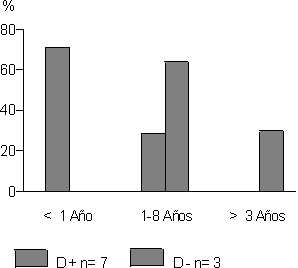
<body><![CDATA[<p>Al analizar la figura, que refleja la relaci&oacute;n entre la edad de los    afectados por SHU y la clasificaci&oacute;n de Karmali, encontramos que el 100    % de los casos de SHU D<SUP>+</SUP> eran menores de 3 a&ntilde;os, con un predominio    del 70 % en lactantes. Al relacionar los s&iacute;ntomas prodr&oacute;micos    con la duraci&oacute;n de la enfermedad (tabla 1) los pacientes afectados por    SHU D<SUP>+</SUP> tuvieron pr&oacute;dromos con una duraci&oacute;n igual o    inferior a los 15 d&iacute;as de evoluci&oacute;n. Los m&aacute;s frecuentemente    reportados fueron la diarrea con sangre, y la diarrea con sangre, v&oacute;mitos    y fiebre de 38 <FONT FACE="WP MathA">E</FONT>C en el 71,4 y 28,6 % respectivamente.    En todos los casos de SHU at&iacute;pico o D<SUP>-</SUP> hallamos pr&oacute;dromos    de m&aacute;s de 15 d&iacute;as de evoluci&oacute;n, y de forma similar se comporta    la hipertensi&oacute;n arterial, la faringoamigdalitis y el s&iacute;ndrome    febril prolongado (33 %). </p>     <CENTER>   <A HREF="/img/revistas/ped/v70n1/f0106198.gif"><IMG SRC="/img/revistas/ped/v70n1/f0106198.gif" ALT="Figura 1" VSPACE=10 BORDER=1 HEIGHT=134 WIDTH=149></A>  </CENTER>        
<CENTER>       <p>FIGURA. <I>Relaci&oacute;n edad vs. clasificaci&oacute;n de Karmali (CD*      y D-)</I></p>  </CENTER>        <CENTER>TABLA 1. <I>Relaci&oacute;n entre la clasificaci&oacute;n y duraci&oacute;n  de los s&iacute;ntomas prodr&oacute;micos del SHU</I></CENTER>        <CENTER><TABLE CELLPADDING=4 >  <TR>  <TD VALIGN=BOTTOM WIDTH="8%">S&iacute;ntomas producidos&nbsp;</TD>    <TD VALIGN=BOTTOM COLSPAN="4" WIDTH="31%">      <CENTER>EDA con sangre</CENTER>  </TD>    <TD VALIGN=BOTTOM COLSPAN="4" WIDTH="31%">      <CENTER>EDA con sangre, fiebre, v&oacute;mitos</CENTER>  </TD>    <TD VALIGN=BOTTOM COLSPAN="4" WIDTH="31%">      <CENTER>S&iacute;ntomas inespec&iacute;ficos</CENTER>  </TD>  </TR>    <TR>  <TD VALIGN=TOP ROWSPAN="2" WIDTH="8%">Clasificaci&oacute;n y duraci&oacute;n&nbsp;</TD>    <TD VALIGN=TOP WIDTH="8%">      <CENTER>D+</CENTER>  </TD>    <TD VALIGN=TOP WIDTH="8%">      ]]></body>
<body><![CDATA[<CENTER>D-</CENTER>  </TD>    <TD VALIGN=TOP WIDTH="8%">      <CENTER>D+</CENTER>  </TD>    <TD VALIGN=TOP WIDTH="8%">      <CENTER>D-</CENTER>  </TD>    <TD VALIGN=TOP WIDTH="8%">      <CENTER>D+</CENTER>  </TD>    <TD VALIGN=TOP WIDTH="8%">      <CENTER>D-</CENTER>  </TD>    <TD VALIGN=TOP WIDTH="8%">      <CENTER>D+</CENTER>  </TD>    <TD VALIGN=TOP WIDTH="8%">      <CENTER>D-</CENTER>  </TD>    <TD VALIGN=TOP WIDTH="8%">      <CENTER>D+</CENTER>  </TD>    <TD VALIGN=TOP WIDTH="8%">      <CENTER>D-</CENTER>  </TD>    <TD VALIGN=TOP WIDTH="8%">      <CENTER>D+</CENTER>  </TD>    <TD VALIGN=TOP WIDTH="8%">      ]]></body>
<body><![CDATA[<CENTER>D-</CENTER>  </TD>  </TR>    <TR>  <TD VALIGN=TOP COLSPAN="2" WIDTH="15%">      <CENTER>n=7</CENTER>  </TD>    <TD VALIGN=TOP COLSPAN="2" WIDTH="15%">      <CENTER>n=3</CENTER>  </TD>    <TD VALIGN=TOP COLSPAN="2" WIDTH="15%">      <CENTER>n=7</CENTER>  </TD>    <TD VALIGN=TOP COLSPAN="2" WIDTH="15%">      <CENTER>n=3</CENTER>  </TD>    <TD VALIGN=TOP COLSPAN="2" WIDTH="15%">      <CENTER>n=7</CENTER>  </TD>    <TD VALIGN=TOP COLSPAN="2" WIDTH="15%">      <CENTER>n=3</CENTER>  </TD>  </TR>    <TR>  <TD VALIGN=TOP WIDTH="8%">&nbsp;</TD>    <TD VALIGN=TOP WIDTH="8%">      <CENTER>n</CENTER>  </TD>    <TD VALIGN=TOP WIDTH="8%">      <CENTER>%</CENTER>  </TD>    <TD VALIGN=TOP WIDTH="8%">      <CENTER>n</CENTER>  </TD>    <TD VALIGN=TOP WIDTH="8%">      ]]></body>
<body><![CDATA[<CENTER>%</CENTER>  </TD>    <TD VALIGN=TOP WIDTH="8%">      <CENTER>n</CENTER>  </TD>    <TD VALIGN=TOP WIDTH="8%">      <CENTER>%</CENTER>  </TD>    <TD VALIGN=TOP WIDTH="8%">      <CENTER>n</CENTER>  </TD>    <TD VALIGN=TOP WIDTH="8%">      <CENTER>%</CENTER>  </TD>    <TD VALIGN=TOP WIDTH="8%">      <CENTER>n</CENTER>  </TD>    <TD VALIGN=TOP WIDTH="8%">      <CENTER>%</CENTER>  </TD>    <TD VALIGN=TOP WIDTH="8%">      <CENTER>n</CENTER>  </TD>    <TD VALIGN=TOP WIDTH="8%">      <CENTER>%</CENTER>  </TD>  </TR>    <TR>  <TD VALIGN=TOP WIDTH="8%">&lt; 15 d&iacute;as</TD>    <TD VALIGN=TOP WIDTH="8%">      <CENTER>5</CENTER>  </TD>    <TD VALIGN=TOP WIDTH="8%">      ]]></body>
<body><![CDATA[<CENTER>71,4</CENTER>  </TD>    <TD VALIGN=TOP WIDTH="8%">      <CENTER>-</CENTER>  </TD>    <TD VALIGN=TOP WIDTH="8%">      <CENTER>-</CENTER>  </TD>    <TD VALIGN=TOP WIDTH="8%">      <CENTER>2</CENTER>  </TD>    <TD VALIGN=TOP WIDTH="8%">      <CENTER>28,6</CENTER>  </TD>    <TD VALIGN=TOP WIDTH="8%">      <CENTER>-</CENTER>  </TD>    <TD VALIGN=TOP WIDTH="8%">      <CENTER>-</CENTER>  </TD>    <TD VALIGN=TOP WIDTH="8%">      <CENTER>-</CENTER>  </TD>    <TD VALIGN=TOP WIDTH="8%">      <CENTER>-</CENTER>  </TD>    <TD VALIGN=TOP WIDTH="8%">      <CENTER>-</CENTER>  </TD>    <TD VALIGN=TOP WIDTH="8%">      ]]></body>
<body><![CDATA[<CENTER>-</CENTER>  </TD>  </TR>    <TR>  <TD VALIGN=TOP WIDTH="8%">> 15 d&iacute;as</TD>    <TD VALIGN=TOP WIDTH="8%">      <CENTER>-</CENTER>  </TD>    <TD VALIGN=TOP WIDTH="8%">      <CENTER>-</CENTER>  </TD>    <TD VALIGN=TOP WIDTH="8%">      <CENTER>-</CENTER>  </TD>    <TD VALIGN=TOP WIDTH="8%">      <CENTER>-</CENTER>  </TD>    <TD VALIGN=TOP WIDTH="8%">      <CENTER>-</CENTER>  </TD>    <TD VALIGN=TOP WIDTH="8%">      <CENTER>-</CENTER>  </TD>    <TD VALIGN=TOP WIDTH="8%">      <CENTER>-</CENTER>  </TD>    <TD VALIGN=TOP WIDTH="8%">      <CENTER>-</CENTER>  </TD>    <TD VALIGN=TOP WIDTH="8%">      <CENTER>-</CENTER>  </TD>    <TD VALIGN=TOP WIDTH="8%">      ]]></body>
<body><![CDATA[<CENTER>-</CENTER>  </TD>    <TD VALIGN=TOP WIDTH="8%">      <CENTER>3</CENTER>  </TD>    <TD VALIGN=TOP WIDTH="8%">      <CENTER>100</CENTER>  </TD>  </TR>  </TABLE></CENTER>        <CENTER>Fuente: Datos tomados de las historias cl&iacute;nicas.</CENTER>          <P>Como se puede observar, en la tabla 2 el 100 % de los pacientes con SHU D<SUP>-</SUP>    presentaron en su cuadro cl&iacute;nico hem&oacute;lisis, trombocitopenia e    insuficiencia renal aguda por m&aacute;s de 15 d&iacute;as de evoluci&oacute;n.    Las complicaciones m&aacute;s frecuentes que se reportaron fueron las convulsiones    y la peritonitis en el 50 % del total de la muestra estudiada. El 100 % de los    enfermos con SHU D<SUP>-</SUP> evolucion&oacute; a la insuficiencia renal cr&oacute;nica    (tabla 3).      <P>        <CENTER>   </CENTER>       <CENTER>     TABLA 2. <I>Relaci&oacute;n entre la clasificaci&oacute;n y duraci&oacute;n      del SHU</I>   </CENTER>     <CENTER><TABLE CELLPADDING=4 >  <TR>  <TD VALIGN=BOTTOM ROWSPAN="4" WIDTH="8%">Clasificaci&oacute;n y duraci&oacute;n</TD>    <TD VALIGN=TOP COLSPAN="4" WIDTH="31%">      <CENTER>Hem&oacute;lisis&nbsp;</CENTER>  </TD>    <TD VALIGN=TOP COLSPAN="4" WIDTH="31%">      ]]></body>
<body><![CDATA[<CENTER>Trombocitopenia</CENTER>  </TD>    <TD VALIGN=TOP COLSPAN="4" WIDTH="31%">      <CENTER>Insuficiencia renal aguda</CENTER>  </TD>  </TR>    <TR>        <TD VALIGN=TOP COLSPAN="2" WIDTH="15%" height="26">              <CENTER>D<SUP>+</SUP></CENTER>  </TD>          <TD VALIGN=TOP COLSPAN="2" WIDTH="15%" height="26">              <CENTER>D<SUP>-</SUP></CENTER>  </TD>          <TD VALIGN=TOP COLSPAN="2" WIDTH="15%" height="26">              <CENTER>D<SUP>+</SUP></CENTER>  </TD>          <TD VALIGN=TOP COLSPAN="2" WIDTH="15%" height="26">              <CENTER>D<SUP>-</SUP></CENTER>  </TD>          <TD VALIGN=TOP COLSPAN="2" WIDTH="15%" height="26">              <CENTER>D<SUP>+</SUP></CENTER>  </TD>          <TD VALIGN=TOP COLSPAN="2" WIDTH="15%" height="26">              <CENTER>D<SUP>-</SUP></CENTER>  </TD>  </TR>    <TR>  <TD VALIGN=TOP COLSPAN="2" WIDTH="15%">      <CENTER>n=7&nbsp;</CENTER>  </TD>    <TD VALIGN=TOP COLSPAN="2" WIDTH="15%">      <CENTER>n=3</CENTER>  </TD>    <TD VALIGN=TOP COLSPAN="2" WIDTH="15%">      ]]></body>
<body><![CDATA[<CENTER>n=7</CENTER>  </TD>    <TD VALIGN=TOP COLSPAN="2" WIDTH="15%">      <CENTER>n=3</CENTER>  </TD>    <TD VALIGN=TOP COLSPAN="2" WIDTH="15%">      <CENTER>n=7</CENTER>  </TD>    <TD VALIGN=TOP COLSPAN="2" WIDTH="15%">      <CENTER>n=3</CENTER>  </TD>  </TR>    <TR>  <TD VALIGN=TOP WIDTH="8%">      <CENTER>n</CENTER>  </TD>    <TD VALIGN=TOP WIDTH="8%">      <CENTER>%</CENTER>  </TD>    <TD VALIGN=TOP WIDTH="8%">      <CENTER>n</CENTER>  </TD>    <TD VALIGN=TOP WIDTH="8%">      <CENTER>%</CENTER>  </TD>    <TD VALIGN=TOP WIDTH="8%">      <CENTER>n</CENTER>  </TD>    <TD VALIGN=TOP WIDTH="8%">      <CENTER>%</CENTER>  </TD>    <TD VALIGN=TOP WIDTH="8%">      ]]></body>
<body><![CDATA[<CENTER>n</CENTER>  </TD>    <TD VALIGN=TOP WIDTH="8%">      <CENTER>%</CENTER>  </TD>    <TD VALIGN=TOP WIDTH="8%">      <CENTER>n</CENTER>  </TD>    <TD VALIGN=TOP WIDTH="8%">      <CENTER>%</CENTER>  </TD>    <TD VALIGN=TOP WIDTH="8%">      <CENTER>n</CENTER>  </TD>    <TD VALIGN=TOP WIDTH="8%">      <CENTER>%</CENTER>  </TD>  </TR>    <TR>  <TD VALIGN=TOP WIDTH="8%">&lt; 7 d&iacute;as</TD>    <TD VALIGN=TOP WIDTH="8%">      <CENTER>2</CENTER>  </TD>    <TD VALIGN=TOP WIDTH="8%">      <CENTER>28,5</CENTER>  </TD>    <TD VALIGN=TOP WIDTH="8%">      <CENTER>-</CENTER>  </TD>    <TD VALIGN=TOP WIDTH="8%">      <CENTER>-</CENTER>  </TD>    <TD VALIGN=TOP WIDTH="8%">      ]]></body>
<body><![CDATA[<CENTER>2</CENTER>  </TD>    <TD VALIGN=TOP WIDTH="8%">      <CENTER>28,6</CENTER>  </TD>    <TD VALIGN=TOP WIDTH="8%">      <CENTER>-</CENTER>  </TD>    <TD VALIGN=TOP WIDTH="8%">      <CENTER>-</CENTER>  </TD>    <TD VALIGN=TOP WIDTH="8%">      <CENTER>-</CENTER>  </TD>    <TD VALIGN=TOP WIDTH="8%">      <CENTER>-</CENTER>  </TD>    <TD VALIGN=TOP WIDTH="8%">      <CENTER>-</CENTER>  </TD>    <TD VALIGN=TOP WIDTH="8%">      <CENTER>-</CENTER>  </TD>  </TR>    <TR>  <TD VALIGN=TOP WIDTH="8%">7 - 14 d&iacute;as</TD>    <TD VALIGN=TOP WIDTH="8%">      <CENTER>5</CENTER>  </TD>    <TD VALIGN=TOP WIDTH="8%">      <CENTER>71,5</CENTER>  </TD>    <TD VALIGN=TOP WIDTH="8%">      ]]></body>
<body><![CDATA[<CENTER>-</CENTER>  </TD>    <TD VALIGN=TOP WIDTH="8%">      <CENTER>-</CENTER>  </TD>    <TD VALIGN=TOP WIDTH="8%">      <CENTER>4</CENTER>  </TD>    <TD VALIGN=TOP WIDTH="8%">      <CENTER>57,1</CENTER>  </TD>    <TD VALIGN=TOP WIDTH="8%">      <CENTER>-</CENTER>  </TD>    <TD VALIGN=TOP WIDTH="8%">      <CENTER>-</CENTER>  </TD>    <TD VALIGN=TOP WIDTH="8%">      <CENTER>3</CENTER>  </TD>    <TD VALIGN=TOP WIDTH="8%">      <CENTER>42,9</CENTER>  </TD>    <TD VALIGN=TOP WIDTH="8%">      <CENTER>-</CENTER>  </TD>    <TD VALIGN=TOP WIDTH="8%">      <CENTER>-</CENTER>  </TD>  </TR>    <TR>  <TD VALIGN=TOP WIDTH="8%">> 15 d&iacute;as</TD>    <TD VALIGN=TOP WIDTH="8%">      ]]></body>
<body><![CDATA[<CENTER>-</CENTER>  </TD>    <TD VALIGN=TOP WIDTH="8%">      <CENTER>-</CENTER>  </TD>    <TD VALIGN=TOP WIDTH="8%">      <CENTER>3</CENTER>  </TD>    <TD VALIGN=TOP WIDTH="8%">      <CENTER>100</CENTER>  </TD>    <TD VALIGN=TOP WIDTH="8%">      <CENTER>1</CENTER>  </TD>    <TD VALIGN=TOP WIDTH="8%">      <CENTER>14,3</CENTER>  </TD>    <TD VALIGN=TOP WIDTH="8%">      <CENTER>3</CENTER>  </TD>    <TD VALIGN=TOP WIDTH="8%">      <CENTER>100</CENTER>  </TD>    <TD VALIGN=TOP WIDTH="8%">      <CENTER>4</CENTER>  </TD>    <TD VALIGN=TOP WIDTH="8%">      <CENTER>57,1</CENTER>  </TD>    <TD VALIGN=TOP WIDTH="8%">      ]]></body>
<body><![CDATA[<CENTER>3</CENTER>  </TD>    <TD VALIGN=TOP WIDTH="8%">      <CENTER>100</CENTER>  </TD>  </TR>    <TR>  <TD VALIGN=TOP WIDTH="8%">Total</TD>    <TD VALIGN=TOP WIDTH="8%">      <CENTER>7</CENTER>  </TD>    <TD VALIGN=TOP WIDTH="8%">      <CENTER>100</CENTER>  </TD>    <TD VALIGN=TOP WIDTH="8%">      <CENTER>3</CENTER>  </TD>    <TD VALIGN=TOP WIDTH="8%">      <CENTER>100</CENTER>  </TD>    <TD VALIGN=TOP WIDTH="8%">      <CENTER>7</CENTER>  </TD>    <TD VALIGN=TOP WIDTH="8%">      <CENTER>100</CENTER>  </TD>    <TD VALIGN=TOP WIDTH="8%">      <CENTER>3</CENTER>  </TD>    <TD VALIGN=TOP WIDTH="8%">      <CENTER>100</CENTER>  </TD>    <TD VALIGN=TOP WIDTH="8%">      ]]></body>
<body><![CDATA[<CENTER>7</CENTER>  </TD>    <TD VALIGN=TOP WIDTH="8%">      <CENTER>100</CENTER>  </TD>    <TD VALIGN=TOP WIDTH="8%">      <CENTER>3</CENTER>  </TD>    <TD VALIGN=TOP WIDTH="8%">      <CENTER>100</CENTER>  </TD>  </TR>  </TABLE></CENTER>        <CENTER>       <p>Fuente: Datos tomados de las historias cl&iacute;nicas.</p> </CENTER>        <CENTER></CENTER>        <CENTER>TABLA 3.<I> Relaci&oacute;n entre las complicaciones y la clasificaci&oacute;n  del SHU</I></CENTER>        <CENTER><TABLE CELLPADDING=4 >  <TR>  <TD VALIGN=BOTTOM ROWSPAN="3" WIDTH="14%">Clasificaci&oacute;n y complicaciones&nbsp;</TD>    <TD VALIGN=TOP COLSPAN="2" WIDTH="29%">      <CENTER>SHU D<SUP>+</SUP></CENTER>  </TD>    <TD VALIGN=TOP COLSPAN="2" WIDTH="29%">      ]]></body>
<body><![CDATA[<CENTER>SHU D<SUP>-</SUP></CENTER>  </TD>    <TD VALIGN=TOP COLSPAN="2" WIDTH="29%">      <CENTER>Total</CENTER>  </TD>  </TR>    <TR>  <TD VALIGN=TOP COLSPAN="2" WIDTH="29%">      <CENTER>n=7</CENTER>  </TD>    <TD VALIGN=TOP COLSPAN="2" WIDTH="29%">      <CENTER>n=3</CENTER>  </TD>    <TD VALIGN=TOP COLSPAN="2" WIDTH="29%">      <CENTER>n=10</CENTER>  </TD>  </TR>    <TR>  <TD VALIGN=TOP WIDTH="14%">      <CENTER>n</CENTER>  </TD>    <TD VALIGN=TOP WIDTH="14%">      <CENTER>%</CENTER>  </TD>    <TD VALIGN=TOP WIDTH="14%">      <CENTER>n</CENTER>  </TD>    <TD VALIGN=TOP WIDTH="14%">      <CENTER>%</CENTER>  </TD>    <TD VALIGN=TOP WIDTH="14%">      <CENTER>n</CENTER>  </TD>    <TD VALIGN=TOP WIDTH="14%">      ]]></body>
<body><![CDATA[<CENTER>%</CENTER>  </TD>  </TR>    <TR>  <TD VALIGN=TOP WIDTH="14%">Convulsiones</TD>    <TD VALIGN=TOP WIDTH="14%">      <CENTER>3</CENTER>  </TD>    <TD VALIGN=TOP WIDTH="14%">      <CENTER>43,8</CENTER>  </TD>    <TD VALIGN=TOP WIDTH="14%">      <CENTER>2</CENTER>  </TD>    <TD VALIGN=TOP WIDTH="14%">      <CENTER>66,7</CENTER>  </TD>    <TD VALIGN=TOP WIDTH="14%">      <CENTER>5</CENTER>  </TD>    <TD VALIGN=TOP WIDTH="14%">      <CENTER>50,0</CENTER>  </TD>  </TR>    <TR>  <TD VALIGN=TOP WIDTH="14%">Peritonitis</TD>    <TD VALIGN=TOP WIDTH="14%">      <CENTER>2</CENTER>  </TD>    <TD VALIGN=TOP WIDTH="14%">      <CENTER>28,5</CENTER>  </TD>    <TD VALIGN=TOP WIDTH="14%">      <CENTER>3</CENTER>  </TD>    <TD VALIGN=TOP WIDTH="14%">      ]]></body>
<body><![CDATA[<CENTER>100</CENTER>  </TD>    <TD VALIGN=TOP WIDTH="14%">      <CENTER>5</CENTER>  </TD>    <TD VALIGN=TOP WIDTH="14%">      <CENTER>50,0</CENTER>  </TD>  </TR>    <TR>  <TD VALIGN=TOP WIDTH="14%">Enterocolitis necrotizante</TD>    <TD VALIGN=TOP WIDTH="14%">      <CENTER>1</CENTER>  </TD>    <TD VALIGN=TOP WIDTH="14%">      <CENTER>14,2</CENTER>  </TD>    <TD VALIGN=TOP WIDTH="14%">      <CENTER>-</CENTER>  </TD>    <TD VALIGN=TOP WIDTH="14%">      <CENTER>-</CENTER>  </TD>    <TD VALIGN=TOP WIDTH="14%">      <CENTER>1</CENTER>  </TD>    <TD VALIGN=TOP WIDTH="14%">      <CENTER>14,2</CENTER>  </TD>  </TR>    <TR>  <TD VALIGN=TOP WIDTH="14%">Sepsis y/o fallo multiorg&aacute;nico</TD>    <TD VALIGN=TOP WIDTH="14%">      <CENTER>1</CENTER>  </TD>    <TD VALIGN=TOP WIDTH="14%">      ]]></body>
<body><![CDATA[<CENTER>14,2</CENTER>  </TD>    <TD VALIGN=TOP WIDTH="14%">      <CENTER>-</CENTER>  </TD>    <TD VALIGN=TOP WIDTH="14%">      <CENTER>-</CENTER>  </TD>    <TD VALIGN=TOP WIDTH="14%">      <CENTER>1</CENTER>  </TD>    <TD VALIGN=TOP WIDTH="14%">      <CENTER>14,2</CENTER>  </TD>  </TR>    <TR>  <TD VALIGN=TOP WIDTH="14%">Insuficiencia renal cr&oacute;nica</TD>    <TD VALIGN=TOP WIDTH="14%">      <CENTER>-</CENTER>  </TD>    <TD VALIGN=TOP WIDTH="14%">      <CENTER>-</CENTER>  </TD>    <TD VALIGN=TOP WIDTH="14%">      <CENTER>3</CENTER>  </TD>    <TD VALIGN=TOP WIDTH="14%">      <CENTER>100</CENTER>  </TD>    <TD VALIGN=TOP WIDTH="14%">      <CENTER>3</CENTER>  </TD>    <TD VALIGN=TOP WIDTH="14%">      ]]></body>
<body><![CDATA[<CENTER>100</CENTER>  </TD>  </TR>  </TABLE></CENTER>        <CENTER>Fuente: Datos tomados de las historias cl&iacute;nicas.</CENTER>          <P>Relacionado con la evoluci&oacute;n de los pacientes el 14,3 % de los  afectados por SHU D<SUP>+</SUP> falleci&oacute; (tabla 4). Esto correspondi&oacute;  a un lactante de 4 meses de edad que desencaden&oacute; un cuadro de sepsis  y fallo multiorg&aacute;nico. El 66,6 % de los afectados (2 pacientes)  por SHU D<SUP>-</SUP> falleci&oacute;: uno relacionado con una infecci&oacute;n  respiratoria alta como antecedente prodr&oacute;mico y el otro al que se  le diagnostic&oacute; un linfoma abdominal, el cual cur&oacute; de su enfermedad  de base y falleci&oacute; posteriormente a causa de un cuadro de peritonitis  por una oclusi&oacute;n por bridas. La enfermedad de este paciente se inici&oacute;  como un s&iacute;ndrome febril prolongado. Actualmente hay un paciente  con SHU D<SUP>-</SUP> vivo con una insuficiencia renal cr&oacute;nica que  fue trasplantado, pero que hizo un rechazo al ri&ntilde;&oacute;n por su  enfermedad de base (s&iacute;ndrome nefr&oacute;tico, nefr&iacute;tico).        <P align="center">TABLA 4. <I>Relaci&oacute;n entre la clasificaci&oacute;n y    duraci&oacute;n de los s&iacute;ntomas prodr&oacute;micos del SHU</I>      <CENTER><TABLE CELLPADDING=4 >  <TR>  <TD VALIGN=BOTTOM ROWSPAN="3" WIDTH="20%">Clasificaci&oacute;n y duraci&oacute;n&nbsp;</TD>    <TD VALIGN=BOTTOM COLSPAN="2" WIDTH="40%">      <CENTER>SHU D<SUP>+</SUP></CENTER>  </TD>    <TD VALIGN=BOTTOM COLSPAN="2" WIDTH="40%">      <CENTER>SHU D<SUP>-</SUP></CENTER>  </TD>  </TR>    <TR>  <TD VALIGN=BOTTOM COLSPAN="2" WIDTH="40%">      <CENTER>n=7</CENTER>  </TD>    <TD VALIGN=BOTTOM COLSPAN="2" WIDTH="40%">      <CENTER>n=3</CENTER>  </TD>  </TR>    <TR>  <TD VALIGN=BOTTOM WIDTH="20%">      <CENTER>n</CENTER>  </TD>    <TD VALIGN=BOTTOM WIDTH="20%">      ]]></body>
<body><![CDATA[<CENTER>%</CENTER>  </TD>    <TD VALIGN=BOTTOM WIDTH="20%">      <CENTER>n</CENTER>  </TD>    <TD VALIGN=BOTTOM WIDTH="20%">      <CENTER>%</CENTER>  </TD>  </TR>    <TR>  <TD VALIGN=TOP WIDTH="20%">Vivos</TD>    <TD VALIGN=TOP WIDTH="20%">      <CENTER>6</CENTER>  </TD>    <TD VALIGN=TOP WIDTH="20%">      <CENTER>85,7</CENTER>  </TD>    <TD VALIGN=TOP WIDTH="20%">      <CENTER>1</CENTER>  </TD>    <TD VALIGN=TOP WIDTH="20%">      <CENTER>33,4</CENTER>  </TD>  </TR>    <TR>  <TD VALIGN=TOP WIDTH="20%">Fallecidos</TD>    <TD VALIGN=TOP WIDTH="20%">      <CENTER>1</CENTER>  </TD>    <TD VALIGN=TOP WIDTH="20%">      <CENTER>14,3</CENTER>  </TD>    <TD VALIGN=TOP WIDTH="20%">      <CENTER>2</CENTER>  </TD>    <TD VALIGN=TOP WIDTH="20%">      ]]></body>
<body><![CDATA[<CENTER>66,6</CENTER>  </TD>  </TR>    <TR>  <TD VALIGN=TOP WIDTH="20%">Total</TD>    <TD VALIGN=TOP WIDTH="20%">      <CENTER>7</CENTER>  </TD>    <TD VALIGN=TOP WIDTH="20%">      <CENTER>100</CENTER>  </TD>    <TD VALIGN=TOP WIDTH="20%">      <CENTER>3</CENTER>  </TD>    <TD VALIGN=TOP WIDTH="20%">      <CENTER>100</CENTER>  </TD>  </TR>  </TABLE></CENTER>        <CENTER>Fuente: Datos tomados de las historias cl&iacute;nicas.</CENTER>    <H4>  DISCUSI&Oacute;N</H4>  La literatura m&eacute;dica refleja que hay mejor evoluci&oacute;n en los  pacientes afectados por SHU menores de 3 a&ntilde;os cuando est&aacute;n  presentes las diarreas, como antecedente prodr&oacute;mico, pues no tiene  generalmente recidiva, no evolucionan a la insuficiencia renal cr&oacute;nica,  la hipertensi&oacute;n endocraneana es moderada y las complicaciones son  poco frecuentes.<SUP>4,17</SUP> En relaci&oacute;n con la presencia de  s&iacute;ntomas pr&oacute;dromicos la literatura especializada reporta  que la duraci&oacute;n de los pr&oacute;dromos en el SHU D<SUP>+</SUP>  es de alrededor de 5,5 d&iacute;as y el m&aacute;s frecuente es la diarrea  con sangre,<SUP>18</SUP> lo que coincide en lo encontrado en nuestro estudio.  Sin embargo en el SHU D<SUP>-</SUP> como su origen es variado, los pr&oacute;dromos  son inespec&iacute;ficos y de mayor duraci&oacute;n.<SUP>12</SUP>        <P>Aunque no es un estudio con caso control, se refleja que este tipo de  s&iacute;ndrome tiene peor evoluci&oacute;n que el SHU D<SUP>+</SUP>, porque  depende fundamentalmente del antecedente patol&oacute;gico personal del  paciente que condiciona la aparici&oacute;n de la entidad.<SUP>10,19</SUP>        <P>En relaci&oacute;n con las clasificaciones se sabe que la afectaci&oacute;n  del sistema nervioso central ensombrece el pron&oacute;stico del s&iacute;ndrome,  independientemente del grupo a que pertenezca.<SUP>20,21</SUP> La peritonitis  en estos casos no estuvo en relaci&oacute;n espec&iacute;ficamente con  las manifestaciones gastrointestinales de la entidad,<SUP>22,23</SUP> sino  con el procedimiento dial&iacute;tico utilizado, y la insuficiencia renal  cr&oacute;nica en la literatura m&eacute;dica revisada se asocia con mayor  frecuencia al SHU at&iacute;pico,<SUP>1,8</SUP> lo que se corresponde con  el pron&oacute;stico, seg&uacute;n su causa y clasificaci&oacute;n.<SUP>4</SUP>  La sepsis y el fallo multiorg&aacute;nico se justifica por la teor&iacute;a  que se se&ntilde;ala en la fisiopatogenia del SHU D<SUP>+</SUP>, donde  existe un sinergismo entre las citotoxinas producidas por las enterobacterias  gramnegativas y el lipopolisac&aacute;rido liberado por la pared de &eacute;stos,  que desencadenan una respuesta inmunol&oacute;gica sist&eacute;mica desorganizada  con activaci&oacute;n de los mediadores inflamatorios, y aparici&oacute;n  de alteraciones que puede producir en el enfermo manifestaciones cl&iacute;nicas  y bioqu&iacute;micas de sepsis, s&iacute;ndrome s&eacute;ptico, fallo multiorg&aacute;nico  y muerte.<SUP>24-26</SUP>        <P>La evoluci&oacute;n de los pacientes con SHU at&iacute;pico se correspondi&oacute;  con la descrita en la literatura m&eacute;dica donde su mortalidad es m&aacute;s  alta, as&iacute; como la posibilidad de recidivas.<SUP>27-30</SUP> Se necesitan  estudios en series a largo plazo en los afectados por SHU para conocer  mejor su evoluci&oacute;n y pron&oacute;stico.        <P>En conclusi&oacute;n podemos decir que:  <OL>      ]]></body>
<body><![CDATA[<LI>  El 100 % de los pacientes afectados por SHU D<SUP>+</SUP> eran menores  de 3 a&ntilde;os.</LI>        <LI>  Los enfermos de SHU D<SUP>+</SUP> tuvieron pr&oacute;dromos por menos de  15 d&iacute;as de evoluci&oacute;n y el m&aacute;s frecuente fue la diarrea  con sangre.</LI>        <LI>  Todos los pacientes con SHU D<SUP>-</SUP> presentaron s&iacute;ntomas de  la enfermedad por m&aacute;s de 15 d&iacute;as de duraci&oacute;n.</LI>        <LI>  El 50 % de los pacientes con SHU (D<SUP>+</SUP> y D<SUP>-</SUP>) mostraron  convulsiones y peritonitis.</LI>        <LI>  El 85,7 % de los pacientes con SHU D<SUP>+</SUP> se reportaron como curados  y el 66,6 % con SHU D<SUP>-</SUP> falleci&oacute; .</LI>      </OL>    <H4>  Summary</H4>  201 medical records of patients diagnosed with acute renal failure (ARF)  who required some dialysis method at Centro Habana Teaching Pediatric Hospital  from January 1980 to December 1995 were reviewed. Ten records which show  hemolytic uremic syndrome (HUS) diagnosis proved by a renal biopsy were  selected and divided into HUS D+ or typical and HUS D- or atypical according  to the existance or absence of diarrheas as a prodorme for determininig  disease general characteristics. 100 % of sick children with HUS D+ were  under 3 years-old and their prodromic symptoms developed in less than 15  days, being bloody diarrhea the most frequent finding in these children.  The clinical picture of children with HUS D- lasted over 15 days (Hemolytic  anemia, thrombocytopenia and acute renal failure) and all of them developed  chronic renal defficiency. 50 % of all studied patients with HUS (D+ and  D-) suffered from convulsions and peritonitis. The mortality rate of the  HUS D- group was 66.6 %        <P><I>Subject headings</I>: HEMOLYTIC-UREMIC SYNDROME/classification; HEMOLYTIC-UREMIC  SYNDROME/complications; HEMOLYTIC-UREMIC SYNDROME/mortality.  <H4>  REFERENCIAS BIBLIOGR&Aacute;FICAS</H4>    <OL>      <LI>  Neill MA. Pathogenesis of Escherichia coli O 157:H7 infection. Curr Op  Inf Dis 1994;7:295-303.</LI>        <LI>  Robson WLM, Leung AKG, Kaplan BS. Hemolytic Uremic Syndrome. Curr Probl  Pediatr 1993;23:16-33.</LI>        <LI>  Exeni R, L&oacute;pez E, Devoto S, Contrini MN, de Rosa MF, S&aacute;nchez  Avalo J. S&iacute;ndrome Ur&eacute;mico Hemol&iacute;tico. Actualizaci&oacute;n.  Arch Arg Pediatr 1994;92:222-35.</LI>        ]]></body>
<body><![CDATA[<LI>  Beatle TJ. Recent developments in the pathogenesis of Hemolytic Uremic  Syndrome. Renal Fail 1990;12:3-7.</LI>        <LI>  Kaplan BS. Another step forward in our understanding of the hemolytic uremic  syndrome: teling up some loose ends. Pediatr Nephrol 1995;9:30-2.</LI>        <LI>  Goldwater PN, Bettelheim KA. Hemolytic Uremic Syndrome due to Shiga- like  toxin producing Escherichia coli O48:H21 in South Australia. Emerg Infect  Dis 1995;1:132-3.</LI>        <LI>  Bin Saeed AA, El Bushra HE, Al Aamdan NA. Does treatment of bloody diarrhea  due to Shigella dysenteriae Type 1 with Ampicillin precipitate Hemolytic  Uremic Syndrome. Emerg Infect Dis 1995;7:134-5.</LI>        <LI>  Urizar Er, Cerda JP, Mu&ntilde;oz AR, Largent AJ, Saich CA. Nuevos conceptos  acerca del S&iacute;ndrome Hemol&iacute;tico Ur&eacute;mico. Rev Chil Pediatr  1991;62:61-8.</LI>        <LI>  Nzeyimana H, Jaber W, Laneelle D, Fabiani B, Beaufils H. Syndrome H&eacute;molitique  et Ur&eacute;mique r&eacute;v&eacute;lant un lymphome. Ann Med Intern 1994;145:381-4.</LI>        <LI>  Zachwieja J, Strzykala K, Golda W, Maciejewski J. Familial recurrent haemolytic  uremic syndrome with hypocomplementemia. Pediatr Neph 1992;6:221-2.</LI>        <LI>  Boyce TG, Swerdlow DL, Griffin PM. Escherichia coli O157:H7 and the Hemolytic  Uremic Syndrome. N Engl J Med 1995;333:364-8.</LI>        <LI>  Siegler RL. Spectrum of extrarenal involvement in post diarrheal hemolytic-uremic  syndrome. J Pediatr 1994;125:511-8.</LI>        <LI>  Browne RMR. Enterohaemmorrhagic Escherichia coli: an emerging food-borne  pathogen with serious consequences. Med J Austr 1995;162:511-2.</LI>        ]]></body>
<body><![CDATA[<LI>  Tapper D, Tarr P, Auner E, Brandt J, Waldhausen J. Lesson learned in the  management of Hemolytic Uremic Syndrome in children. J Pediatr Surg 1995;30:158-63.</LI>        <LI>  Kaplan BS, Mc Gowan KL. Hemolytic Uremic Syndrome. Curr Opin Infect Dis  1994;7:351-7.</LI>        <LI>  Pickering LK, Obrig TG, Stapleton FB. Hemolytic Uremic Symdrome and enterohemorrhagic  Escherichia coli. Pediatr Infect Dis J 1994;13:459-76.</LI>        <LI>  Renaud C, Niaudet P, Gagnadoux MF, Broyer M, Habib R. Haemolytic uraemic  syndrome: prognostic factors in children over 3 years old. Pediatr Nephrol  1995;9:24-9.</LI>        <LI>  Gianviti A, Rosmini F, Caprioli A, Corona RM, Chiara Matteuci MCh. Haemolytic  uraemic syndrome in childhood: surveillance and case control studies in  Italy. Pediatr Nephr 1994;8:705-6.</LI>        <LI>  Griffin PM, Tauxe RV. The epidemiology of infections caused by Escherichia  coli O<SUB>157</SUB>:H7, other enterohemorrhagic E. coli, and associated  hemolytic uremic syndrome. Epidemiol Rev 1991;13:60-98.</LI>        <LI>  Milford DV, Taylor CM, Guttridge B, Hall SM, Rowe B. Haemolytic Uremic  Syndromes in the Bristish Isles 1985-8 association with Verocytotoxin producing  Escherichia coli. Clinical and epidemiological aspects. Arch Dis Child  1990;65:716-21.</LI>        <LI>  Schlieper A, Rowe PC, Orrbine E, Zoubek M, Clark W, Wolfiish N, et al.  Sequelae of haemolytic uraemic syndrome. Arch Dis Child 1992;67:930-4.</LI>        <LI>  Grodinsky S, Telmesani A, Robson LM, Scott RB. Gastrointestinal Manifestation  of Hemolytic Uremic Syndrome: Recognition of Pancreatitis. J Pediatr Gastroenterol  Nutr 1990;11:518-24.</LI>        <LI>  Rothman D, Gulli V. Colonic necrosis in the hemolytic uremic syndrome.  N J Med 1991;88:911-3.</LI>        ]]></body>
<body><![CDATA[<LI>  Newburg DS, Chatuvedi P, L&oacute;pez EL, Devoto S, Fayad A, et al. Susceptibility  to Hemolytic Uremic Syndrome relates to erythrocyte glycosphingolipid patterns.  J Infect Dis 1993;168:476-9.</LI>        <LI>  Kaye SA, Louise CB, Boyd B, Lingwood CA, Obrig TG. Shiga toxin associated  hemolytic uremic syndrome: Interleukin 1 enhancement of Shiga toxin cytotoxicity  toward human vascular endothelial cells in vitro. Infect Immunol 1993;61:3886-91.</LI>        <LI>  Obrig TG, Louise CB, Lingwood CA, Boyd B, Barley M, Maloney E. Endothelial  heterogenecity in Shiga toxin receptors and responses. J Biol Chem 1993;268:15484-8.</LI>        <LI>  Mc Couley J, Shapiro R, Bromster O, Jordan M, Ellis D. Renal transplantation  under FK 506 in patients with previous loss of renal function due to hemolytic  uremic syndrome. Transplant Proc 1991;23:3068-70.</LI>        <LI>  Bassani CE, Ferraris J, Gianantonio CA, Ruiz S, Ram&iacute;rez J. Renal  transplantation in patients with classical haemolytic uremic syndrome.  Pediatr Nephrol 1991;5:607-11.</LI>        <LI>  Grimm PC, Ogborn MR. Hemolytic Uremic Syndrome: The most common cause of  acute renal failure in childbood. Ped Ann 1994;23:505-10.</LI>        <LI>  Milford T. New insigths into the haemolytic uraemic syndromes. Arch Dis  Child 1990;65:713-5.</LI>      </OL>  Recibido: 29 de octubre de 1996. Aprobado: 7 de abril de 1997.        <P>Dra. <I>Vivian R. Mena Miranda</I>. Calle 15, n&uacute;mero 1209, entre  18 y 20, El Vedado, municipio Plaza de La Revoluci&oacute;n, Ciudad de  La Habana, Cuba.        <P><SUP>1</SUP>&nbsp;<A NAME="autores"></A>Especialista de I Grado en Pediatr&iacute;a.  M&eacute;dico intensivista. Asistente de la Facultad "General Calixto Garc&iacute;a".      ]]></body>
<body><![CDATA[<BR><SUP>2</SUP> Especialista de I Grado en Pediatr&iacute;a. M&eacute;dico  intensivista. Hospital Pedi&aacute;trico del Cerro.      <BR><SUP>3</SUP> Especialista de I Grado en Pediatr&iacute;a. Hospital  Pedi&aacute;trico Docente "Centro Habana".      <BR><SUP>4</SUP> Especialista de I Grado en Nefrolog&iacute;a. Hospital  Pedi&aacute;trico Docente "Centro Habana".          ]]></body><back>
<ref-list>
<ref id="B1">
<nlm-citation citation-type="journal">
<person-group person-group-type="author">
<name>
<surname><![CDATA[Neill]]></surname>
<given-names><![CDATA[MA]]></given-names>
</name>
</person-group>
<article-title xml:lang="en"><![CDATA[Pathogenesis of Escherichia coli O 157: H7 infection]]></article-title>
<source><![CDATA[Curr Op Inf Dis]]></source>
<year>1994</year>
<volume>7</volume>
<page-range>295-303</page-range></nlm-citation>
</ref>
<ref id="B2">
<nlm-citation citation-type="journal">
<person-group person-group-type="author">
<name>
<surname><![CDATA[Robson]]></surname>
<given-names><![CDATA[WLM]]></given-names>
</name>
<name>
<surname><![CDATA[Leung]]></surname>
<given-names><![CDATA[AKG]]></given-names>
</name>
<name>
<surname><![CDATA[Kaplan]]></surname>
<given-names><![CDATA[BS]]></given-names>
</name>
</person-group>
<article-title xml:lang="en"><![CDATA[Hemolytic Uremic Syndrome]]></article-title>
<source><![CDATA[Curr Probl Pediatr]]></source>
<year>1993</year>
<volume>23</volume>
<page-range>16-33</page-range></nlm-citation>
</ref>
<ref id="B3">
<nlm-citation citation-type="journal">
<person-group person-group-type="author">
<name>
<surname><![CDATA[Exeni]]></surname>
<given-names><![CDATA[R]]></given-names>
</name>
<name>
<surname><![CDATA[López]]></surname>
<given-names><![CDATA[E]]></given-names>
</name>
<name>
<surname><![CDATA[Devoto]]></surname>
<given-names><![CDATA[S]]></given-names>
</name>
<name>
<surname><![CDATA[Contrini]]></surname>
<given-names><![CDATA[MN]]></given-names>
</name>
<name>
<surname><![CDATA[de Rosa]]></surname>
<given-names><![CDATA[MF]]></given-names>
</name>
<name>
<surname><![CDATA[Sánchez Avalo]]></surname>
<given-names><![CDATA[J]]></given-names>
</name>
</person-group>
<article-title xml:lang="es"><![CDATA[Síndrome Urémico Hemolítico: Actualización]]></article-title>
<source><![CDATA[Arch Arg Pediatr]]></source>
<year>1994</year>
<volume>92</volume>
<page-range>222-35</page-range></nlm-citation>
</ref>
<ref id="B4">
<nlm-citation citation-type="journal">
<person-group person-group-type="author">
<name>
<surname><![CDATA[Beatle]]></surname>
<given-names><![CDATA[TJ]]></given-names>
</name>
</person-group>
<article-title xml:lang="en"><![CDATA[Recent developments in the pathogenesis of Hemolytic Uremic Syndrome]]></article-title>
<source><![CDATA[Renal Fail]]></source>
<year>1990</year>
<volume>12</volume>
<page-range>3-7</page-range></nlm-citation>
</ref>
<ref id="B5">
<nlm-citation citation-type="journal">
<person-group person-group-type="author">
<name>
<surname><![CDATA[Kaplan]]></surname>
<given-names><![CDATA[BS]]></given-names>
</name>
</person-group>
<article-title xml:lang="en"><![CDATA[Another step forward in our understanding of the hemolytic uremic syndrome: teling up some loose ends]]></article-title>
<source><![CDATA[Pediatr Nephrol]]></source>
<year>1995</year>
<volume>9</volume>
<page-range>30-2</page-range></nlm-citation>
</ref>
<ref id="B6">
<nlm-citation citation-type="journal">
<person-group person-group-type="author">
<name>
<surname><![CDATA[Goldwater]]></surname>
<given-names><![CDATA[PN]]></given-names>
</name>
<name>
<surname><![CDATA[Bettelheim]]></surname>
<given-names><![CDATA[KA]]></given-names>
</name>
</person-group>
<article-title xml:lang="en"><![CDATA[Hemolytic Uremic Syndrome due to Shiga- like toxin producing Escherichia coli O48: H21 in South Australia]]></article-title>
<source><![CDATA[Emerg Infect Dis]]></source>
<year>1995</year>
<volume>1</volume>
<page-range>132-3</page-range></nlm-citation>
</ref>
<ref id="B7">
<nlm-citation citation-type="journal">
<person-group person-group-type="author">
<name>
<surname><![CDATA[Bin Saeed]]></surname>
<given-names><![CDATA[AA]]></given-names>
</name>
<name>
<surname><![CDATA[El Bushra]]></surname>
<given-names><![CDATA[HE]]></given-names>
</name>
<name>
<surname><![CDATA[Al Aamdan]]></surname>
<given-names><![CDATA[NA]]></given-names>
</name>
</person-group>
<article-title xml:lang="en"><![CDATA[Does treatment of bloody diarrhea due to Shigella dysenteriae Type 1 with Ampicillin precipitate Hemolytic Uremic Syndrome]]></article-title>
<source><![CDATA[Emerg Infect Dis]]></source>
<year>1995</year>
<volume>7</volume>
<page-range>134-5</page-range></nlm-citation>
</ref>
<ref id="B8">
<nlm-citation citation-type="journal">
<person-group person-group-type="author">
<name>
<surname><![CDATA[Urizar]]></surname>
<given-names><![CDATA[Er]]></given-names>
</name>
<name>
<surname><![CDATA[Cerda]]></surname>
<given-names><![CDATA[JP]]></given-names>
</name>
<name>
<surname><![CDATA[Muñoz]]></surname>
<given-names><![CDATA[AR]]></given-names>
</name>
<name>
<surname><![CDATA[Largent]]></surname>
<given-names><![CDATA[AJ]]></given-names>
</name>
<name>
<surname><![CDATA[Saich]]></surname>
<given-names><![CDATA[CA]]></given-names>
</name>
</person-group>
<article-title xml:lang="es"><![CDATA[Nuevos conceptos acerca del Síndrome Hemolítico Urémico]]></article-title>
<source><![CDATA[Rev Chil Pediatr]]></source>
<year>1991</year>
<volume>62</volume>
<page-range>61-8</page-range></nlm-citation>
</ref>
<ref id="B9">
<nlm-citation citation-type="journal">
<person-group person-group-type="author">
<name>
<surname><![CDATA[Nzeyimana]]></surname>
<given-names><![CDATA[H]]></given-names>
</name>
<name>
<surname><![CDATA[Jaber]]></surname>
<given-names><![CDATA[W]]></given-names>
</name>
<name>
<surname><![CDATA[Laneelle]]></surname>
<given-names><![CDATA[D]]></given-names>
</name>
<name>
<surname><![CDATA[Fabiani]]></surname>
<given-names><![CDATA[B]]></given-names>
</name>
<name>
<surname><![CDATA[Beaufils]]></surname>
<given-names><![CDATA[H]]></given-names>
</name>
</person-group>
<article-title xml:lang="fr"><![CDATA[Syndrome Hémolitique et Urémique révélant un lymphome]]></article-title>
<source><![CDATA[Ann Med Intern]]></source>
<year>1994</year>
<volume>145</volume>
<page-range>381-4</page-range></nlm-citation>
</ref>
<ref id="B10">
<nlm-citation citation-type="journal">
<person-group person-group-type="author">
<name>
<surname><![CDATA[Zachwieja]]></surname>
<given-names><![CDATA[J]]></given-names>
</name>
<name>
<surname><![CDATA[Strzykala]]></surname>
<given-names><![CDATA[K]]></given-names>
</name>
<name>
<surname><![CDATA[Golda]]></surname>
<given-names><![CDATA[W]]></given-names>
</name>
<name>
<surname><![CDATA[Maciejewski]]></surname>
<given-names><![CDATA[J]]></given-names>
</name>
</person-group>
<article-title xml:lang="en"><![CDATA[Familial recurrent haemolytic uremic syndrome with hypocomplementemia]]></article-title>
<source><![CDATA[Pediatr Neph]]></source>
<year>1992</year>
<volume>6</volume>
<page-range>221-2</page-range></nlm-citation>
</ref>
<ref id="B11">
<nlm-citation citation-type="journal">
<person-group person-group-type="author">
<name>
<surname><![CDATA[Boyce]]></surname>
<given-names><![CDATA[TG]]></given-names>
</name>
<name>
<surname><![CDATA[Swerdlow]]></surname>
<given-names><![CDATA[DL]]></given-names>
</name>
<name>
<surname><![CDATA[Griffin]]></surname>
<given-names><![CDATA[PM]]></given-names>
</name>
</person-group>
<article-title xml:lang="en"><![CDATA[Escherichia coli O157: H7 and the Hemolytic Uremic Syndrome]]></article-title>
<source><![CDATA[N Engl J Med]]></source>
<year>1995</year>
<volume>333</volume>
<page-range>364-8</page-range></nlm-citation>
</ref>
<ref id="B12">
<nlm-citation citation-type="journal">
<person-group person-group-type="author">
<name>
<surname><![CDATA[Siegler]]></surname>
<given-names><![CDATA[RL]]></given-names>
</name>
</person-group>
<article-title xml:lang="en"><![CDATA[Spectrum of extrarenal involvement in post diarrheal hemolytic-uremic syndrome]]></article-title>
<source><![CDATA[J Pediatr]]></source>
<year>1994</year>
<volume>125</volume>
<page-range>511-8</page-range></nlm-citation>
</ref>
<ref id="B13">
<nlm-citation citation-type="journal">
<person-group person-group-type="author">
<name>
<surname><![CDATA[Browne]]></surname>
<given-names><![CDATA[RMR]]></given-names>
</name>
</person-group>
<article-title xml:lang="en"><![CDATA[Enterohaemmorrhagic Escherichia coli: an emerging food-borne pathogen with serious consequences]]></article-title>
<source><![CDATA[Med J Austr]]></source>
<year>1995</year>
<volume>162</volume>
<page-range>511-2</page-range></nlm-citation>
</ref>
<ref id="B14">
<nlm-citation citation-type="journal">
<person-group person-group-type="author">
<name>
<surname><![CDATA[Tapper]]></surname>
<given-names><![CDATA[D]]></given-names>
</name>
<name>
<surname><![CDATA[Tarr]]></surname>
<given-names><![CDATA[P]]></given-names>
</name>
<name>
<surname><![CDATA[Auner]]></surname>
<given-names><![CDATA[E]]></given-names>
</name>
<name>
<surname><![CDATA[Brandt]]></surname>
<given-names><![CDATA[J]]></given-names>
</name>
<name>
<surname><![CDATA[Waldhausen]]></surname>
<given-names><![CDATA[J]]></given-names>
</name>
</person-group>
<article-title xml:lang="en"><![CDATA[Lesson learned in the management of Hemolytic Uremic Syndrome in children]]></article-title>
<source><![CDATA[J Pediatr Surg]]></source>
<year>1995</year>
<volume>30</volume>
<page-range>158-63</page-range></nlm-citation>
</ref>
<ref id="B15">
<nlm-citation citation-type="journal">
<person-group person-group-type="author">
<name>
<surname><![CDATA[Kaplan]]></surname>
<given-names><![CDATA[BS]]></given-names>
</name>
<name>
<surname><![CDATA[Mc Gowan]]></surname>
<given-names><![CDATA[KL]]></given-names>
</name>
</person-group>
<article-title xml:lang="en"><![CDATA[Hemolytic Uremic Syndrome]]></article-title>
<source><![CDATA[Curr Opin Infect Dis]]></source>
<year>1994</year>
<volume>7</volume>
<page-range>351-7</page-range></nlm-citation>
</ref>
<ref id="B16">
<nlm-citation citation-type="journal">
<person-group person-group-type="author">
<name>
<surname><![CDATA[Pickering]]></surname>
<given-names><![CDATA[LK]]></given-names>
</name>
<name>
<surname><![CDATA[Obrig]]></surname>
<given-names><![CDATA[TG]]></given-names>
</name>
<name>
<surname><![CDATA[Stapleton]]></surname>
<given-names><![CDATA[FB]]></given-names>
</name>
</person-group>
<article-title xml:lang="en"><![CDATA[Hemolytic Uremic Symdrome and enterohemorrhagic Escherichia coli]]></article-title>
<source><![CDATA[Pediatr Infect Dis J]]></source>
<year>1994</year>
<volume>13</volume>
<page-range>459-76</page-range></nlm-citation>
</ref>
<ref id="B17">
<nlm-citation citation-type="journal">
<person-group person-group-type="author">
<name>
<surname><![CDATA[Renaud]]></surname>
<given-names><![CDATA[C]]></given-names>
</name>
<name>
<surname><![CDATA[Niaudet]]></surname>
<given-names><![CDATA[P]]></given-names>
</name>
<name>
<surname><![CDATA[Gagnadoux]]></surname>
<given-names><![CDATA[MF]]></given-names>
</name>
<name>
<surname><![CDATA[Broyer]]></surname>
<given-names><![CDATA[M]]></given-names>
</name>
<name>
<surname><![CDATA[Habib]]></surname>
<given-names><![CDATA[R]]></given-names>
</name>
</person-group>
<article-title xml:lang="en"><![CDATA[Haemolytic uraemic syndrome: prognostic factors in children over 3 years old]]></article-title>
<source><![CDATA[Pediatr Nephrol]]></source>
<year>1995</year>
<volume>9</volume>
<page-range>24-9</page-range></nlm-citation>
</ref>
<ref id="B18">
<nlm-citation citation-type="journal">
<person-group person-group-type="author">
<name>
<surname><![CDATA[Gianviti]]></surname>
<given-names><![CDATA[A]]></given-names>
</name>
<name>
<surname><![CDATA[Rosmini]]></surname>
<given-names><![CDATA[F]]></given-names>
</name>
<name>
<surname><![CDATA[Caprioli]]></surname>
<given-names><![CDATA[A]]></given-names>
</name>
<name>
<surname><![CDATA[Corona]]></surname>
<given-names><![CDATA[RM]]></given-names>
</name>
<name>
<surname><![CDATA[Chiara Matteuci]]></surname>
<given-names><![CDATA[MCh]]></given-names>
</name>
</person-group>
<article-title xml:lang="en"><![CDATA[Haemolytic uraemic syndrome in childhood: surveillance and case control studies in Italy]]></article-title>
<source><![CDATA[Pediatr Nephr]]></source>
<year>1994</year>
<volume>8</volume>
<page-range>705-6</page-range></nlm-citation>
</ref>
<ref id="B19">
<nlm-citation citation-type="journal">
<person-group person-group-type="author">
<name>
<surname><![CDATA[Griffin]]></surname>
<given-names><![CDATA[PM]]></given-names>
</name>
<name>
<surname><![CDATA[Tauxe]]></surname>
<given-names><![CDATA[RV]]></given-names>
</name>
</person-group>
<article-title xml:lang="en"><![CDATA[The epidemiology of infections caused by Escherichia coli O157:H7, other enterohemorrhagic E. coli, and associated hemolytic uremic syndrome]]></article-title>
<source><![CDATA[Epidemiol Rev]]></source>
<year>1991</year>
<volume>13</volume>
<page-range>60-98</page-range></nlm-citation>
</ref>
<ref id="B20">
<nlm-citation citation-type="journal">
<person-group person-group-type="author">
<name>
<surname><![CDATA[Milford]]></surname>
<given-names><![CDATA[DV]]></given-names>
</name>
<name>
<surname><![CDATA[Taylor]]></surname>
<given-names><![CDATA[CM]]></given-names>
</name>
<name>
<surname><![CDATA[Guttridge]]></surname>
<given-names><![CDATA[B]]></given-names>
</name>
<name>
<surname><![CDATA[Hall]]></surname>
<given-names><![CDATA[SM]]></given-names>
</name>
<name>
<surname><![CDATA[Rowe]]></surname>
<given-names><![CDATA[B]]></given-names>
</name>
</person-group>
<article-title xml:lang="en"><![CDATA[Haemolytic Uremic Syndromes in the Bristish Isles 1985-8 association with Verocytotoxin producing Escherichia coli: Clinical and epidemiological aspects]]></article-title>
<source><![CDATA[Arch Dis Child]]></source>
<year>1990</year>
<volume>65</volume>
<page-range>716-21</page-range></nlm-citation>
</ref>
<ref id="B21">
<nlm-citation citation-type="journal">
<person-group person-group-type="author">
<name>
<surname><![CDATA[Schlieper]]></surname>
<given-names><![CDATA[A]]></given-names>
</name>
<name>
<surname><![CDATA[Rowe]]></surname>
<given-names><![CDATA[PC]]></given-names>
</name>
<name>
<surname><![CDATA[Orrbine]]></surname>
<given-names><![CDATA[E]]></given-names>
</name>
<name>
<surname><![CDATA[Zoubek]]></surname>
<given-names><![CDATA[M]]></given-names>
</name>
<name>
<surname><![CDATA[Clark]]></surname>
<given-names><![CDATA[W]]></given-names>
</name>
<name>
<surname><![CDATA[Wolfiish]]></surname>
<given-names><![CDATA[N]]></given-names>
</name>
</person-group>
<article-title xml:lang="en"><![CDATA[Sequelae of haemolytic uraemic syndrome]]></article-title>
<source><![CDATA[Arch Dis Child]]></source>
<year>1992</year>
<volume>67</volume>
<page-range>930-4</page-range></nlm-citation>
</ref>
<ref id="B22">
<nlm-citation citation-type="journal">
<person-group person-group-type="author">
<name>
<surname><![CDATA[Grodinsky]]></surname>
<given-names><![CDATA[S]]></given-names>
</name>
<name>
<surname><![CDATA[Telmesani]]></surname>
<given-names><![CDATA[A]]></given-names>
</name>
<name>
<surname><![CDATA[Robson]]></surname>
<given-names><![CDATA[LM]]></given-names>
</name>
<name>
<surname><![CDATA[Scott]]></surname>
<given-names><![CDATA[RB]]></given-names>
</name>
</person-group>
<article-title xml:lang="en"><![CDATA[Gastrointestinal Manifestation of Hemolytic Uremic Syndrome: Recognition of Pancreatitis]]></article-title>
<source><![CDATA[J Pediatr Gastroenterol Nutr]]></source>
<year>1990</year>
<volume>11</volume>
<page-range>518-24</page-range></nlm-citation>
</ref>
<ref id="B23">
<nlm-citation citation-type="journal">
<person-group person-group-type="author">
<name>
<surname><![CDATA[Rothman]]></surname>
<given-names><![CDATA[D]]></given-names>
</name>
<name>
<surname><![CDATA[Gulli]]></surname>
<given-names><![CDATA[V]]></given-names>
</name>
</person-group>
<article-title xml:lang="en"><![CDATA[Colonic necrosis in the hemolytic uremic syndrome]]></article-title>
<source><![CDATA[N J Med]]></source>
<year>1991</year>
<volume>88</volume>
<page-range>911-3</page-range></nlm-citation>
</ref>
<ref id="B24">
<nlm-citation citation-type="journal">
<person-group person-group-type="author">
<name>
<surname><![CDATA[Newburg]]></surname>
<given-names><![CDATA[DS]]></given-names>
</name>
<name>
<surname><![CDATA[Chatuvedi]]></surname>
<given-names><![CDATA[P]]></given-names>
</name>
<name>
<surname><![CDATA[López]]></surname>
<given-names><![CDATA[EL]]></given-names>
</name>
<name>
<surname><![CDATA[Devoto]]></surname>
<given-names><![CDATA[S]]></given-names>
</name>
<name>
<surname><![CDATA[Fayad]]></surname>
<given-names><![CDATA[A]]></given-names>
</name>
</person-group>
<article-title xml:lang="en"><![CDATA[Susceptibility to Hemolytic Uremic Syndrome relates to erythrocyte glycosphingolipid patterns]]></article-title>
<source><![CDATA[J Infect Dis]]></source>
<year>1993</year>
<volume>168</volume>
<page-range>476-9</page-range></nlm-citation>
</ref>
<ref id="B25">
<nlm-citation citation-type="journal">
<person-group person-group-type="author">
<name>
<surname><![CDATA[Kaye]]></surname>
<given-names><![CDATA[SA]]></given-names>
</name>
<name>
<surname><![CDATA[Louise]]></surname>
<given-names><![CDATA[CB]]></given-names>
</name>
<name>
<surname><![CDATA[Boyd]]></surname>
<given-names><![CDATA[B]]></given-names>
</name>
<name>
<surname><![CDATA[Lingwood]]></surname>
<given-names><![CDATA[CA]]></given-names>
</name>
<name>
<surname><![CDATA[Obrig]]></surname>
<given-names><![CDATA[TG]]></given-names>
</name>
</person-group>
<article-title xml:lang="en"><![CDATA[Shiga toxin associated hemolytic uremic syndrome: Interleukin 1 enhancement of Shiga toxin cytotoxicity toward human vascular endothelial cells in vitro]]></article-title>
<source><![CDATA[Infect Immunol]]></source>
<year>1993</year>
<volume>61</volume>
<page-range>3886-91</page-range></nlm-citation>
</ref>
<ref id="B26">
<nlm-citation citation-type="journal">
<person-group person-group-type="author">
<name>
<surname><![CDATA[Obrig]]></surname>
<given-names><![CDATA[TG]]></given-names>
</name>
<name>
<surname><![CDATA[Louise]]></surname>
<given-names><![CDATA[CB]]></given-names>
</name>
<name>
<surname><![CDATA[Lingwood]]></surname>
<given-names><![CDATA[CA]]></given-names>
</name>
<name>
<surname><![CDATA[Boyd]]></surname>
<given-names><![CDATA[B]]></given-names>
</name>
<name>
<surname><![CDATA[Barley]]></surname>
<given-names><![CDATA[M]]></given-names>
</name>
<name>
<surname><![CDATA[Maloney]]></surname>
<given-names><![CDATA[E]]></given-names>
</name>
</person-group>
<article-title xml:lang="en"><![CDATA[Endothelial heterogenecity in Shiga toxin receptors and responses]]></article-title>
<source><![CDATA[J Biol Chem]]></source>
<year>1993</year>
<volume>268</volume>
<page-range>15484-8</page-range></nlm-citation>
</ref>
<ref id="B27">
<nlm-citation citation-type="journal">
<person-group person-group-type="author">
<name>
<surname><![CDATA[Mc Couley]]></surname>
<given-names><![CDATA[J]]></given-names>
</name>
<name>
<surname><![CDATA[Shapiro]]></surname>
<given-names><![CDATA[R]]></given-names>
</name>
<name>
<surname><![CDATA[Bromster]]></surname>
<given-names><![CDATA[O]]></given-names>
</name>
<name>
<surname><![CDATA[Jordan]]></surname>
<given-names><![CDATA[M]]></given-names>
</name>
<name>
<surname><![CDATA[Ellis]]></surname>
<given-names><![CDATA[D]]></given-names>
</name>
</person-group>
<article-title xml:lang="en"><![CDATA[Renal transplantation under FK 506 in patients with previous loss of renal function due to hemolytic uremic syndrome]]></article-title>
<source><![CDATA[Transplant Proc]]></source>
<year>1991</year>
<volume>23</volume>
<page-range>3068-70</page-range></nlm-citation>
</ref>
<ref id="B28">
<nlm-citation citation-type="journal">
<person-group person-group-type="author">
<name>
<surname><![CDATA[Bassani]]></surname>
<given-names><![CDATA[CE]]></given-names>
</name>
<name>
<surname><![CDATA[Ferraris]]></surname>
<given-names><![CDATA[J]]></given-names>
</name>
<name>
<surname><![CDATA[Gianantonio]]></surname>
<given-names><![CDATA[CA]]></given-names>
</name>
<name>
<surname><![CDATA[Ruiz]]></surname>
<given-names><![CDATA[S]]></given-names>
</name>
<name>
<surname><![CDATA[Ramírez]]></surname>
<given-names><![CDATA[J]]></given-names>
</name>
</person-group>
<article-title xml:lang="en"><![CDATA[Renal transplantation in patients with classical haemolytic uremic syndrome]]></article-title>
<source><![CDATA[Pediatr Nephrol]]></source>
<year>1991</year>
<volume>5</volume>
<page-range>607-11</page-range></nlm-citation>
</ref>
<ref id="B29">
<nlm-citation citation-type="journal">
<person-group person-group-type="author">
<name>
<surname><![CDATA[Grimm]]></surname>
<given-names><![CDATA[PC]]></given-names>
</name>
<name>
<surname><![CDATA[Ogborn]]></surname>
<given-names><![CDATA[MR]]></given-names>
</name>
</person-group>
<article-title xml:lang="en"><![CDATA[Hemolytic Uremic Syndrome: The most common cause of acute renal failure in childbood]]></article-title>
<source><![CDATA[Ped Ann]]></source>
<year>1994</year>
<volume>23</volume>
<page-range>505-10</page-range></nlm-citation>
</ref>
<ref id="B30">
<nlm-citation citation-type="journal">
<person-group person-group-type="author">
<name>
<surname><![CDATA[Milford]]></surname>
<given-names><![CDATA[T]]></given-names>
</name>
</person-group>
<article-title xml:lang="en"><![CDATA[New insigths into the haemolytic uraemic syndromes]]></article-title>
<source><![CDATA[Arch Dis Child]]></source>
<year>1990</year>
<volume>65</volume>
<page-range>713-5</page-range></nlm-citation>
</ref>
</ref-list>
</back>
</article>
