<?xml version="1.0" encoding="ISO-8859-1"?><article xmlns:mml="http://www.w3.org/1998/Math/MathML" xmlns:xlink="http://www.w3.org/1999/xlink" xmlns:xsi="http://www.w3.org/2001/XMLSchema-instance">
<front>
<journal-meta>
<journal-id>0034-7531</journal-id>
<journal-title><![CDATA[Revista Cubana de Pediatría]]></journal-title>
<abbrev-journal-title><![CDATA[Rev Cubana Pediatr]]></abbrev-journal-title>
<issn>0034-7531</issn>
<publisher>
<publisher-name><![CDATA[Centro Nacional de Información de Ciencias MédicasEditorial Ciencias Médicas]]></publisher-name>
</publisher>
</journal-meta>
<article-meta>
<article-id>S0034-75312013000400012</article-id>
<title-group>
<article-title xml:lang="es"><![CDATA[Frenillo labial superior doble]]></article-title>
<article-title xml:lang="en"><![CDATA[Double frenulum of the superior lip]]></article-title>
</title-group>
<contrib-group>
<contrib contrib-type="author">
<name>
<surname><![CDATA[López del Castillo]]></surname>
<given-names><![CDATA[Carlos Albornoz]]></given-names>
</name>
<xref ref-type="aff" rid="A01"/>
</contrib>
<contrib contrib-type="author">
<name>
<surname><![CDATA[Bencomo Basulto]]></surname>
<given-names><![CDATA[Heberto]]></given-names>
</name>
<xref ref-type="aff" rid="A02"/>
</contrib>
<contrib contrib-type="author">
<name>
<surname><![CDATA[Areas Socarrás]]></surname>
<given-names><![CDATA[Dunier]]></given-names>
</name>
<xref ref-type="aff" rid="A02"/>
</contrib>
<contrib contrib-type="author">
<name>
<surname><![CDATA[Rivero Pérez]]></surname>
<given-names><![CDATA[Oscar]]></given-names>
</name>
<xref ref-type="aff" rid="A03"/>
</contrib>
<contrib contrib-type="author">
<name>
<surname><![CDATA[Fernández García]]></surname>
<given-names><![CDATA[Giselle]]></given-names>
</name>
<xref ref-type="aff" rid="A01"/>
</contrib>
</contrib-group>
<aff id="A01">
<institution><![CDATA[,Hospital Pediátrico Eduardo Agramonte Piña  ]]></institution>
<addr-line><![CDATA[Camagüey ]]></addr-line>
<country>Cuba</country>
</aff>
<aff id="A02">
<institution><![CDATA[,Hospital Clinicoquirúrgico Amalia Simoni  ]]></institution>
<addr-line><![CDATA[Camagüey ]]></addr-line>
<country>Cuba</country>
</aff>
<aff id="A03">
<institution><![CDATA[,Facultad de Estomatología  ]]></institution>
<addr-line><![CDATA[Camagüey ]]></addr-line>
<country>Cuba</country>
</aff>
<pub-date pub-type="pub">
<day>00</day>
<month>12</month>
<year>2013</year>
</pub-date>
<pub-date pub-type="epub">
<day>00</day>
<month>12</month>
<year>2013</year>
</pub-date>
<volume>85</volume>
<numero>4</numero>
<fpage>523</fpage>
<lpage>528</lpage>
<copyright-statement/>
<copyright-year/>
<self-uri xlink:href="http://scielo.sld.cu/scielo.php?script=sci_arttext&amp;pid=S0034-75312013000400012&amp;lng=en&amp;nrm=iso"></self-uri><self-uri xlink:href="http://scielo.sld.cu/scielo.php?script=sci_abstract&amp;pid=S0034-75312013000400012&amp;lng=en&amp;nrm=iso"></self-uri><self-uri xlink:href="http://scielo.sld.cu/scielo.php?script=sci_pdf&amp;pid=S0034-75312013000400012&amp;lng=en&amp;nrm=iso"></self-uri><abstract abstract-type="short" xml:lang="es"><p><![CDATA[El frenillo labial superior doble no sindrómico es una anomalía del desarrollo que no hemos encontrado reportada en la revisión bibliográfica realizada. Se presenta una niña de 11 años de edad que fue remitida al servicio de Cirugía Maxilofacial del Hospital "Eduardo Agramonte Piña", de Camagüey, por presentar un frenillo labial superior doble de baja inserción. Se describen los síntomas clínicos asociados a esta anomalía y el tratamiento quirúrgico utilizado para su solución: una frenectomía y plastia sobre la banda muscular frénica anormal que provocaba exceso de tejido en la mucosa labial. Consideramos muy interesante la descripción de este caso, por no haber encontrado reporte similar en la literatura revisada.]]></p></abstract>
<abstract abstract-type="short" xml:lang="en"><p><![CDATA[Non-syndromic double frenulum of the superior lip is a developmental anomaly that was not found as reported in our literature review. This is the case of an eleven-years old girl who was referred to the maxillofacial surgery service of "Eduardo Agramonte Pina" hospital in Camaguey, with a diagnosis of double frenulum of the superior lip of low insertion. The clinical symptoms linked to this anomaly and the surgical treatment applied to this case were described in this paper: frenectomy and frenoplasty upon the abnormal muscular band of the frenulum that brought excessive amount of tissue in the lip mucosa. The description of this case was considered to be very interesting since no similar report had been found in the reviewed literature.]]></p></abstract>
<kwd-group>
<kwd lng="es"><![CDATA[frenillo labial]]></kwd>
<kwd lng="es"><![CDATA[anomalías del desarrollo]]></kwd>
<kwd lng="en"><![CDATA[frenulum of the lip]]></kwd>
<kwd lng="en"><![CDATA[developmental anomalies]]></kwd>
</kwd-group>
</article-meta>
</front><body><![CDATA[ <p align="right"><font face="Verdana" size="2"> <B>PRESENTACI&Oacute;N DE CASO    </B></font></p>     <p><B> </B></p> <B>      <P>      <P>      <P>      <P><font face="Verdana" size="4">Frenillo labial superior doble </font>      <P>&nbsp;      <P><font face="Verdana" size="3">Double frenulum of the superior lip </font>     <P>&nbsp;     <P>&nbsp;     ]]></body>
<body><![CDATA[<P>      <P>      <P><font face="Verdana" size="2">MSc. Dr. Carlos Albornoz L&oacute;pez del Castillo,<SUP>I</SUP>    Dr. Heberto Bencomo Basulto,<SUP>II</SUP> Dr. Dunier Areas Socarr&aacute;s,<SUP>II</SUP>    Dr. Oscar Rivero P&eacute;rez,<SUP>III</SUP> Dra. Giselle Fern&aacute;ndez Garc&iacute;a<SUP>I</SUP></font> </B>      <P>      <P><font face="Verdana" size="2"><SUP>I</SUP>Hospital Pedi&aacute;trico &quot;Eduardo    Agramonte Pi&ntilde;a&quot;. Camag&uuml;ey, Cuba.     <br>   </font><font face="Verdana" size="2"><SUP>II</SUP>Hospital Clinicoquir&uacute;rgico    &quot;Amalia Simoni&quot;. Camag&uuml;ey, Cuba.     <br>   </font><font face="Verdana" size="2"><SUP>III</SUP>Facultad de Estomatolog&iacute;a.    Camag&uuml;ey, Cuba. </font>     <P>&nbsp;     <P>&nbsp;  <hr size="1" noshade>     <P><font face="Verdana" size="2"><B>RESUMEN</B> </font>     ]]></body>
<body><![CDATA[<P><font face="Verdana" size="2">El frenillo labial superior doble no sindr&oacute;mico    es una anomal&iacute;a del desarrollo que no hemos encontrado reportada en la    revisi&oacute;n bibliogr&aacute;fica realizada. Se presenta una ni&ntilde;a    de 11 a&ntilde;os de edad que fue remitida al servicio de Cirug&iacute;a Maxilofacial    del Hospital &quot;Eduardo Agramonte Pi&ntilde;a&quot;, de Camag&uuml;ey, por    presentar un frenillo labial superior doble de baja inserci&oacute;n. Se describen    los s&iacute;ntomas cl&iacute;nicos asociados a esta anomal&iacute;a y el tratamiento    quir&uacute;rgico utilizado para su soluci&oacute;n: una frenectom&iacute;a    y plastia sobre la banda muscular fr&eacute;nica anormal que provocaba exceso    de tejido en la mucosa labial. Consideramos muy interesante la descripci&oacute;n    de este caso, por no haber encontrado reporte similar en la literatura revisada.    </font>      <P>      <P><font face="Verdana" size="2"><B>Palabras clave:</B> frenillo labial, anomal&iacute;as    del desarrollo. </font> <hr size="1" noshade>     <P>      <P><font face="Verdana" size="2"><b>ABSTRACT</b></font>     <P><font face="Verdana" size="2">Non-syndromic double frenulum of the superior    lip is a developmental anomaly that was not found as reported in our literature    review. This is the case of an eleven-years old girl who was referred to the    maxillofacial surgery service of &quot;Eduardo Agramonte Pina&quot; hospital    in Camaguey, with a diagnosis of double frenulum of the superior lip of low    insertion. The clinical symptoms linked to this anomaly and the surgical treatment    applied to this case were described in this paper: frenectomy and frenoplasty    upon the abnormal muscular band of the frenulum that brought excessive amount    of tissue in the lip mucosa. The description of this case was considered to    be very interesting since no similar report had been found in the reviewed literature.    <br>   </font> <font face="Verdana" size="2">    <br> </font>      <P><font face="Verdana" size="2"><b>Keywords: </b>frenulum of the lip, developmental    anomalies.    <br>   </font> <hr size="1" noshade>     ]]></body>
<body><![CDATA[<P>&nbsp;     <P>&nbsp;      <P><font face="Verdana" size="3"><B>INTRODUCCI&Oacute;N</B> </font>     <P><font face="Verdana" size="2">Los frenillos bucales son bandas de tejido conectivo    fibroso, muscular o de ambos, cubiertas de una membrana mucosa situadas en la    l&iacute;nea media y de origen cong&eacute;nito. Existen 3 frenillos: labial    superior, labial inferior y lingual.<SUP>1</SUP> </font>     <P><font face="Verdana" size="2">El frenillo labial superior se desarrolla junto    con las estructuras palatinas de la l&iacute;nea media en la vida fetal. En    el nacimiento ocupa un lugar prominente bajo el labio superior, pues conecta    el labio con el paladar. Cuando los dientes temporales son reemplazados por    los permanentes el frenillo parece alejarse hacia el borde alveolar. As&iacute;    pues, constituye un repliegue de la mucosa bucal, que parte de la cara interna    del labio y va a insertarse sobre la l&iacute;nea media de la enc&iacute;a adherida    interincisiva del maxilar superior. Su formaci&oacute;n empieza en la d&eacute;cima    semana de gestaci&oacute;n, y dependiendo de las estructuras que lo forman,    se puede distinguir el tipo fibroso, muscular y mixto.<SUP>2,3</SUP> </font>     <P><font face="Verdana" size="2">Existen distintas clasificaciones seg&uacute;n    su morfolog&iacute;a. <I>Monti,</I> citado por <I>G&aacute;mez Carrillo,</I><SUP>4</SUP>    los divide en 3 tipos: un frenillo de tipo alargado, pero que presenta sus bordes    derecho e izquierdo paralelos; un frenillo de forma triangular, cuya base coincide    con el fondo vestibular; y un frenillo triangular, de base inferior. </font>     <P><font face="Verdana" size="2">Los signos cl&iacute;nicos asociados con el frenillo    labial superior incluyen el diastema interincisal medial, limitaci&oacute;n    del movimiento del labio, problemas de autoclisis en el vest&iacute;bulo, labio    corto y bermell&oacute;n elevado, y por &uacute;ltimo, alteraciones en relaci&oacute;n    con la pr&oacute;tesis en personas adultas desdentadas.<SUP>5</SUP> </font>     <P><font face="Verdana" size="2">El objetivo del presente art&iacute;culo fue    reportar un caso aislado de doble frenillo labial superior. </font>     <P>&nbsp;     <P>      ]]></body>
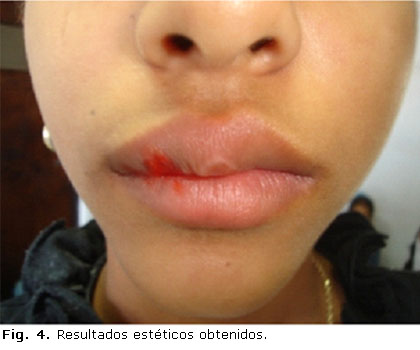
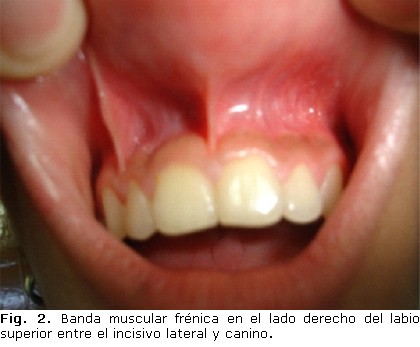
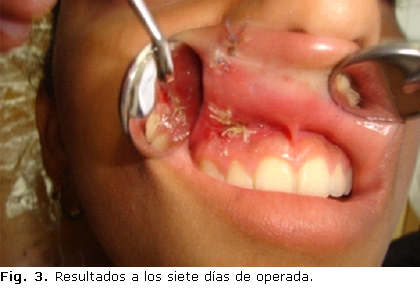
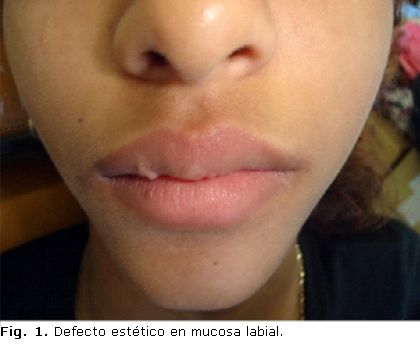
<body><![CDATA[<P><font face="Verdana" size="3"><B>CASO CL&Iacute;NICO</B> </font>     <P><font face="Verdana" size="2">Se trata de una escolar de 11 a&ntilde;os de    edad con antecedentes de salud anterior, que fue remitida a la consulta de Cirug&iacute;a    Maxilofacial del Hospital Pedi&aacute;trico &quot;Eduardo Agramonte Pi&ntilde;a&quot;,    de Camag&uuml;ey, por presentar un doble frenillo en el labio superior de inserci&oacute;n    baja, y que provocaba defecto est&eacute;tico en el labio superior. </font>      <P><font face="Verdana" size="2">El examen cl&iacute;nico constat&oacute; la presencia    de una banda muscular fr&eacute;nica en el lado derecho del labio superior,    entre el incisivo lateral y canino, que provocaba un defecto est&eacute;tico    en la mucosa labial, con una baja inserci&oacute;n en la enc&iacute;a adherida    (<a href="#fig1">figuras 1</a> y <a href="#fig2">2</a>). El frenillo labial    superior, inferior y lingual fueron normales. </font>     <P align="center"><font face="Verdana" size="2"><a name="fig1"></a> <img src="/img/revistas/ped/v85n4/f0112413.jpg" width="420" height="347"></font>      <P align="center"><a name="fig2"></a><img src="/img/revistas/ped/v85n4/f0212413.jpg" width="420" height="347">     <P><font face="Verdana" size="2">No se recogieron en el interrogatorio y examen    cl&iacute;nico pedi&aacute;trico otras malformaciones asociadas, y los estudios    complementarios fueron normales. </font>     <P><font face="Verdana" size="2">Se realiz&oacute; frenectom&iacute;a y plastia    sobre la banda muscular anormal situada entre lateral y canino, con el objetivo    de eliminar el exceso de tejido en la mucosa labial, favorecer la autoclisis    en el vest&iacute;bulo y evitar futuras alteraciones parodontales. Para ello,    se utiliz&oacute; la ex&eacute;resis<I> </I>romboidal o en diamante. Se estir&oacute;    el labio para ver bien el frenillo, y despu&eacute;s se colocaron 2 pinzas hemost&aacute;ticas    (mosquito tipo Halstead recta), para cortar por fuera de estas con el bistur&iacute;.    Una vez retirados los mosquitos con la secci&oacute;n triangular del frenillo,    nos qued&oacute; una herida romboidal que fue suturada con cromado 4-0. </font>     <P><font face="Verdana" size="2">La evoluci&oacute;n a los 7 d&iacute;as y un    mes fueron satisfactorios (<a href="#fig3">figuras 3</a> y <a href="#fig4">4</a>).    </font>      <P>&nbsp;     <P align="center"><font face="Verdana" size="2"><a name="fig3"></a> <img src="/img/revistas/ped/v85n4/f0312413.jpg" width="420" height="291"></font>      ]]></body>
<body><![CDATA[<P align="center"><img src="/img/revistas/ped/v85n4/f0412413.jpg" width="420" height="350"><a name="fig4"></a>     <P>&nbsp;     <P><font face="Verdana" size="2"><B><font size="3">DISCUSI&Oacute;N</font></B>    </font>     <P><font face="Verdana" size="2">El caso presentado reporta la presencia de un    doble frenillo labial superior no sindr&oacute;mico. Luego de una minuciosa    b&uacute;squeda en la literatura nacional y extranjera, no se encontraron reportes    de esta anomal&iacute;a del desarrollo. <I>Guion Almeida</I> y otros<SUP>6 </SUP>mencionan    que puede existir una duplicaci&oacute;n del frenillo maxilar, como parte del    amplio espectro de dimorfismos faciales en el s&iacute;ndrome de Pai. Este s&iacute;ndrome    es un trastorno cong&eacute;nito descrito por primera vez en 1987, que se caracteriza    por la presencia de uno o m&aacute;s p&oacute;lipos nasales junto a un p&oacute;lipo    cong&eacute;nito alveolar en la l&iacute;nea media anterior y/o hendidura media    del labio superior.<SUP>7</SUP> </font>     <P><font face="Verdana" size="2">Se han reportado otras anomal&iacute;as del frenillo    labial superior, como su ausencia en el s&iacute;ndrome del incisivo central    &uacute;nico de la l&iacute;nea media del maxilar, y fusi&oacute;n de incisivos    centrales permanentes mandibulares.<SUP>8 </SUP> </font>     <P><font face="Verdana" size="2"><I>Kara</I> y otros<SUP>9</SUP> describen que    la duplicaci&oacute;n del labio superior puede producirse como un componente    del s&iacute;ndrome de Ascher. </font>     <P><font face="Verdana" size="2">Por no encontrar en la revisi&oacute;n bibliogr&aacute;fica    realizada reportes previos de esta anomal&iacute;a, es imposible comparar y    normar pautas de tratamiento. No obstante, un frenillo demasiado hipertr&oacute;fico    puede provocar acumulaci&oacute;n de alimentos y dificultar la autoclisis de    la zona; puede dificultar el cepillado dental por no existir el fondo de saco    vestibular, y, secundariamente, tambi&eacute;n pueden aparecer problemas periodontales    por la inserci&oacute;n del frenillo en la papila interincisiva vestibular.    </font>     <P><font face="Verdana" size="2">Estas consideraciones determinaron la indicaci&oacute;n    quir&uacute;rgica del frenillo situado entre el lateral y canino superior. Adem&aacute;s,    aunque el frenillo superior raramente es de naturaleza muscular, en la paciente    parec&iacute;a existir un componente muscular importante que provocaba deformidad    est&eacute;tica, y actuaba como rienda flexible que limitaba el movimiento del    labio. </font>     <P><font face="Verdana" size="2">Para la extirpaci&oacute;n quir&uacute;rgica    del frenillo se han propuesto numerosas t&eacute;cnicas. La frenectom&iacute;a    consiste en la extirpaci&oacute;n completa del frenillo, que puede efectuarse    mediante la ex&eacute;resis simple o la ex&eacute;resis romboidal. La frenotom&iacute;a    o reposici&oacute;n apical del frenillo se basa en la plastia V-Y, y finalmente    la Z plastia, que consigue eliminar el frenillo y deja la cicatriz mucosa en    otra direcci&oacute;n, as&iacute; consigue alargar el labio superior y profundizar    el vest&iacute;bulo.<SUP>10</SUP> </font>      <P>&nbsp;     ]]></body>
<body><![CDATA[<P>      <P><font face="Verdana" size="3"><B>REFERENCIAS BIBLIOGR&Aacute;FICAS</B></font><font face="Verdana" size="2">    </font>     <!-- ref --><P><font face="Verdana" size="2">1. Dollberg S, Botzer E. Neonatal tongue-tie:    myths and science. Harefuah. 2011;150(1):46-9.     </font>     <!-- ref --><P><font face="Verdana" size="2">2. Barroso Macedo JA, S&aacute;ez Mart&iacute;nez    S, Ballet Dalmau LJ. Indicaci&oacute;n quir&uacute;rgica de los frenillos bucales:    a prop&oacute;sito de un caso. Rev Oper Dent Endod. 2007;5:56.     </font>     <!-- ref --><P><font face="Verdana" size="2">3. Edmundo J, Miles SC, Fulbrook P. Tongue-tie    and breastfeeding: a review of the literature. Breastfeed Rev. 2011;19(1):19-26.        </font>     <!-- ref --><P><font face="Verdana" size="2">4. G&aacute;mez Carrillo R. Frenectom&iacute;a    convencional frente a frenectom&iacute;a l&aacute;ser. Odontol Act. 2008;60(5):26-32.        </font>     ]]></body>
<body><![CDATA[<!-- ref --><P><font face="Verdana" size="2">5. Pe&ntilde;arrocha Diago M. Frenillos bucales.    Tratamiento quir&uacute;rgico y consideraciones ortod&oacute;ncicas. Arch Odontoestomatol.    2003;19(1):23-32.     </font>     <!-- ref --><P><font face="Verdana" size="2">6. Guion Almeida ML, Richieri Costa A. Severe    midline craniofacial anomalies: overlap with Pai syndrome. Clin Dysmorphol.    2009;18(3):154-7.     </font>     <!-- ref --><P><font face="Verdana" size="2">7. Savasta S, Chiapedi S, Perrini S, Tognato    E,<B> </B>Corsano L, Chiara A. Pai syndrome: a further report    of a case with bifid nose, lipoma and agenesis of the corpus callosum. Childs    Nerv Syst.<I> </I>2008;24(6):773-6.     </font>     <!-- ref --><P><font face="Verdana" size="2">8. Catania P, Conti C, Pogi G, Bardelli T, Lasagni    D, De Martino M. Two cases of solitary median maxillary central incisor syndrome.    Minerva Pediatr. 2010;62(1):113-8.     </font>     <!-- ref --><P><font face="Verdana" size="2">9. Kara IG, Kara CO. Ascher syndrome. Otolaryngol    Head Neck Surg. 2001;124:236-7.     </font>     ]]></body>
<body><![CDATA[<!-- ref --><P><font face="Verdana" size="2">10. Shetty K, Trajtenberg C, Patel C, Streckfus    C.<I> </I>Maxillary frenectomy using a carbon dioxide laser in a pediatric patient:    a case report. Gen Dent. 2008;56(1):60-3.    <I> </I></font>      <P>     <P>     <P>     <P>     <P>     <P>    <br>     <P>    ]]></body>
<body><![CDATA[<br>       <br>     <P>     <P>     <P>     <P>     <P>     <P>     <P><font face="Verdana" size="2">Recibido: 20 de noviembre de 2012. </font>     <br>   <font face="Verdana" size="2">Aprobado: 1&#186; de abril de 2013. </font>     ]]></body>
<body><![CDATA[<P>&nbsp;     <P>&nbsp; <I>     <P>      <P>  </I>      <P><font face="Verdana" size="2"><I>Carlos Albornoz L&oacute;pez del Castillo.    </i>Hospital Pedi&aacute;trico &quot;Eduardo Agramonte Pi&ntilde;a&quot;. Camag&uuml;ey,    Cuba. Correo electr&oacute;nico: <U><FONT  COLOR="#0000ff"><a href="mailto:albornoz@finlay.cmw.sld.cu" target="_blank">albornoz@finlay.cmw.sld.cu</a></FONT></U></font>      <P>      <P>      <P>      <P>      <P>      ]]></body>
<body><![CDATA[<P>      <P>      <P>      <P>      <P>      <P>      <P>      <P>      <P>&nbsp; <I></I>       ]]></body><back>
<ref-list>
<ref id="B1">
<label>1</label><nlm-citation citation-type="journal">
<person-group person-group-type="author">
<name>
<surname><![CDATA[Dollberg]]></surname>
<given-names><![CDATA[S]]></given-names>
</name>
<name>
<surname><![CDATA[Botzer]]></surname>
<given-names><![CDATA[E]]></given-names>
</name>
</person-group>
<article-title xml:lang="en"><![CDATA[Neonatal tongue-tie: myths and science]]></article-title>
<source><![CDATA[Harefuah.]]></source>
<year>2011</year>
<volume>150</volume>
<numero>1</numero>
<issue>1</issue>
<page-range>46-9</page-range></nlm-citation>
</ref>
<ref id="B2">
<label>2</label><nlm-citation citation-type="journal">
<person-group person-group-type="author">
<name>
<surname><![CDATA[Barroso Macedo]]></surname>
<given-names><![CDATA[JA]]></given-names>
</name>
<name>
<surname><![CDATA[Sáez Martínez]]></surname>
<given-names><![CDATA[S]]></given-names>
</name>
<name>
<surname><![CDATA[Ballet Dalmau]]></surname>
<given-names><![CDATA[LJ]]></given-names>
</name>
</person-group>
<article-title xml:lang="es"><![CDATA[Indicación quirúrgica de los frenillos bucales: a propósito de un caso]]></article-title>
<source><![CDATA[Rev Oper Dent Endod.]]></source>
<year>2007</year>
<volume>5</volume>
<page-range>56</page-range></nlm-citation>
</ref>
<ref id="B3">
<label>3</label><nlm-citation citation-type="journal">
<person-group person-group-type="author">
<name>
<surname><![CDATA[Edmundo]]></surname>
<given-names><![CDATA[J]]></given-names>
</name>
<name>
<surname><![CDATA[Miles]]></surname>
<given-names><![CDATA[SC]]></given-names>
</name>
<name>
<surname><![CDATA[Fulbrook]]></surname>
<given-names><![CDATA[P]]></given-names>
</name>
</person-group>
<article-title xml:lang="en"><![CDATA[Tongue-tie and breastfeeding: a review of the literature]]></article-title>
<source><![CDATA[Breastfeed Rev.]]></source>
<year>2011</year>
<volume>19</volume>
<numero>1</numero>
<issue>1</issue>
<page-range>19-26</page-range></nlm-citation>
</ref>
<ref id="B4">
<label>4</label><nlm-citation citation-type="journal">
<person-group person-group-type="author">
<name>
<surname><![CDATA[Gámez Carrillo]]></surname>
<given-names><![CDATA[R]]></given-names>
</name>
</person-group>
<article-title xml:lang="es"><![CDATA[Frenectomía convencional frente a frenectomía láser]]></article-title>
<source><![CDATA[Odontol Act.]]></source>
<year>2008</year>
<volume>60</volume>
<numero>5</numero>
<issue>5</issue>
<page-range>26-32</page-range></nlm-citation>
</ref>
<ref id="B5">
<label>5</label><nlm-citation citation-type="journal">
<person-group person-group-type="author">
<name>
<surname><![CDATA[Peñarrocha Diago]]></surname>
<given-names><![CDATA[M]]></given-names>
</name>
</person-group>
<article-title xml:lang="es"><![CDATA[Frenillos bucales: Tratamiento quirúrgico y consideraciones ortodóncicas]]></article-title>
<source><![CDATA[Arch Odontoestomatol.]]></source>
<year>2003</year>
<volume>19</volume>
<numero>1</numero>
<issue>1</issue>
<page-range>23-32</page-range></nlm-citation>
</ref>
<ref id="B6">
<label>6</label><nlm-citation citation-type="journal">
<person-group person-group-type="author">
<name>
<surname><![CDATA[Guion Almeida]]></surname>
<given-names><![CDATA[ML]]></given-names>
</name>
<name>
<surname><![CDATA[Richieri Costa]]></surname>
<given-names><![CDATA[A]]></given-names>
</name>
</person-group>
<article-title xml:lang="en"><![CDATA[Severe midline craniofacial anomalies: overlap with Pai syndrome]]></article-title>
<source><![CDATA[Clin Dysmorphol.]]></source>
<year>2009</year>
<volume>18</volume>
<numero>3</numero>
<issue>3</issue>
<page-range>154-7</page-range></nlm-citation>
</ref>
<ref id="B7">
<label>7</label><nlm-citation citation-type="journal">
<person-group person-group-type="author">
<name>
<surname><![CDATA[Savasta]]></surname>
<given-names><![CDATA[S]]></given-names>
</name>
<name>
<surname><![CDATA[Chiapedi]]></surname>
<given-names><![CDATA[S]]></given-names>
</name>
<name>
<surname><![CDATA[Perrini]]></surname>
<given-names><![CDATA[S]]></given-names>
</name>
<name>
<surname><![CDATA[Tognato]]></surname>
<given-names><![CDATA[E]]></given-names>
</name>
<name>
<surname><![CDATA[Corsano]]></surname>
<given-names><![CDATA[L]]></given-names>
</name>
<name>
<surname><![CDATA[Chiara]]></surname>
<given-names><![CDATA[A]]></given-names>
</name>
</person-group>
<article-title xml:lang="en"><![CDATA[Pai syndrome: a further report of a case with bifid nose, lipoma and agenesis of the corpus callosum]]></article-title>
<source><![CDATA[Childs Nerv Syst.]]></source>
<year>2008</year>
<volume>24</volume>
<numero>6</numero>
<issue>6</issue>
<page-range>773-6</page-range></nlm-citation>
</ref>
<ref id="B8">
<label>8</label><nlm-citation citation-type="journal">
<person-group person-group-type="author">
<name>
<surname><![CDATA[Catania]]></surname>
<given-names><![CDATA[P]]></given-names>
</name>
<name>
<surname><![CDATA[Conti]]></surname>
<given-names><![CDATA[C]]></given-names>
</name>
<name>
<surname><![CDATA[Pogi]]></surname>
<given-names><![CDATA[G]]></given-names>
</name>
<name>
<surname><![CDATA[Bardelli]]></surname>
<given-names><![CDATA[T]]></given-names>
</name>
<name>
<surname><![CDATA[Lasagni]]></surname>
<given-names><![CDATA[D]]></given-names>
</name>
<name>
<surname><![CDATA[De Martino]]></surname>
<given-names><![CDATA[M]]></given-names>
</name>
</person-group>
<article-title xml:lang="en"><![CDATA[Two cases of solitary median maxillary central incisor syndrome]]></article-title>
<source><![CDATA[Minerva Pediatr.]]></source>
<year>2010</year>
<volume>62</volume>
<numero>1</numero>
<issue>1</issue>
<page-range>113-8</page-range></nlm-citation>
</ref>
<ref id="B9">
<label>9</label><nlm-citation citation-type="journal">
<person-group person-group-type="author">
<name>
<surname><![CDATA[Kara]]></surname>
<given-names><![CDATA[IG]]></given-names>
</name>
<name>
<surname><![CDATA[Kara]]></surname>
<given-names><![CDATA[CO]]></given-names>
</name>
</person-group>
<article-title xml:lang="en"><![CDATA[Ascher syndrome]]></article-title>
<source><![CDATA[Otolaryngol Head Neck Surg.]]></source>
<year>2001</year>
<volume>124</volume>
<page-range>236-7</page-range></nlm-citation>
</ref>
<ref id="B10">
<label>10</label><nlm-citation citation-type="journal">
<person-group person-group-type="author">
<name>
<surname><![CDATA[Shetty]]></surname>
<given-names><![CDATA[K]]></given-names>
</name>
<name>
<surname><![CDATA[Trajtenberg]]></surname>
<given-names><![CDATA[C]]></given-names>
</name>
<name>
<surname><![CDATA[Patel]]></surname>
<given-names><![CDATA[C]]></given-names>
</name>
<name>
<surname><![CDATA[Streckfus]]></surname>
<given-names><![CDATA[C]]></given-names>
</name>
</person-group>
<article-title xml:lang="en"><![CDATA[Maxillary frenectomy using a carbon dioxide laser in a pediatric patient: a case report]]></article-title>
<source><![CDATA[Gen Dent.]]></source>
<year>2008</year>
<volume>56</volume>
<numero>1</numero>
<issue>1</issue>
<page-range>60-3</page-range></nlm-citation>
</ref>
</ref-list>
</back>
</article>