<?xml version="1.0" encoding="ISO-8859-1"?><article xmlns:mml="http://www.w3.org/1998/Math/MathML" xmlns:xlink="http://www.w3.org/1999/xlink" xmlns:xsi="http://www.w3.org/2001/XMLSchema-instance">
<front>
<journal-meta>
<journal-id>0034-7531</journal-id>
<journal-title><![CDATA[Revista Cubana de Pediatría]]></journal-title>
<abbrev-journal-title><![CDATA[Rev Cubana Pediatr]]></abbrev-journal-title>
<issn>0034-7531</issn>
<publisher>
<publisher-name><![CDATA[Centro Nacional de Información de Ciencias MédicasEditorial Ciencias Médicas]]></publisher-name>
</publisher>
</journal-meta>
<article-meta>
<article-id>S0034-75312016000200006</article-id>
<title-group>
<article-title xml:lang="en"><![CDATA[Drug interactions in children with respiratory diseases in the pediatric unit of a teaching hospital in Brazil]]></article-title>
<article-title xml:lang="es"><![CDATA[Interacciones medicamentosas observadas en niños con enfermedades respiratorias en la unidad pediátrica de un hospital docente de Brasil]]></article-title>
</title-group>
<contrib-group>
<contrib contrib-type="author">
<name>
<surname><![CDATA[Yuriko Masukawa]]></surname>
<given-names><![CDATA[Márcia]]></given-names>
</name>
<xref ref-type="aff" rid="A01"/>
</contrib>
<contrib contrib-type="author">
<name>
<surname><![CDATA[Batalho Veríssimo]]></surname>
<given-names><![CDATA[Glenda]]></given-names>
</name>
<xref ref-type="aff" rid="A01"/>
</contrib>
<contrib contrib-type="author">
<name>
<surname><![CDATA[Vianello Richtzenhain]]></surname>
<given-names><![CDATA[Maria Helena]]></given-names>
</name>
<xref ref-type="aff" rid="A02"/>
</contrib>
<contrib contrib-type="author">
<name>
<surname><![CDATA[Linardi]]></surname>
<given-names><![CDATA[Alessandra]]></given-names>
</name>
<xref ref-type="aff" rid="A02"/>
</contrib>
</contrib-group>
<aff id="A01">
<institution><![CDATA[,BSN. Department of Physiological Sciences. Santa Casa de São Paulo. School of Nursing  ]]></institution>
<addr-line><![CDATA[ SP]]></addr-line>
<country>Brazil</country>
</aff>
<aff id="A02">
<institution><![CDATA[,PhD, Associate Professor. Department of Physiological Sciences. Santa Casa de São Paulo School of Medical Sciences  ]]></institution>
<addr-line><![CDATA[ SP]]></addr-line>
<country>Brazil</country>
</aff>
<pub-date pub-type="pub">
<day>00</day>
<month>06</month>
<year>2016</year>
</pub-date>
<pub-date pub-type="epub">
<day>00</day>
<month>06</month>
<year>2016</year>
</pub-date>
<volume>88</volume>
<numero>2</numero>
<fpage>0</fpage>
<lpage>0</lpage>
<copyright-statement/>
<copyright-year/>
<self-uri xlink:href="http://scielo.sld.cu/scielo.php?script=sci_arttext&amp;pid=S0034-75312016000200006&amp;lng=en&amp;nrm=iso"></self-uri><self-uri xlink:href="http://scielo.sld.cu/scielo.php?script=sci_abstract&amp;pid=S0034-75312016000200006&amp;lng=en&amp;nrm=iso"></self-uri><self-uri xlink:href="http://scielo.sld.cu/scielo.php?script=sci_pdf&amp;pid=S0034-75312016000200006&amp;lng=en&amp;nrm=iso"></self-uri><kwd-group>
<kwd lng="en"><![CDATA[cystic fibrosis]]></kwd>
<kwd lng="en"><![CDATA[drug interaction]]></kwd>
<kwd lng="en"><![CDATA[pediatric]]></kwd>
<kwd lng="en"><![CDATA[respiratory tract diseases]]></kwd>
<kwd lng="es"><![CDATA[fibrosis quística]]></kwd>
<kwd lng="es"><![CDATA[interacción medicamentosa]]></kwd>
<kwd lng="es"><![CDATA[pediátrico]]></kwd>
<kwd lng="es"><![CDATA[enfermedades del tracto respiratorio]]></kwd>
</kwd-group>
</article-meta>
</front><body><![CDATA[ <p align="right"><font size="2" face="Verdana"><b>Rev Cubana Pediatr. 2016;88(2)</b></font></p>     <p align="right"><font face="Verdana" size="2"><b>ORIGINAL ARTICLE</b></font></p>     <p>&nbsp;</p>     <p><font face="Verdana" size="2"><b><font size="4">Drug interactions in children    with respiratory diseases in the pediatric unit of a teaching hospital in Brazil</font></b></font></p>     <p>&nbsp;</p>     <p><font face="Verdana" size="2"><b><font size="3">Interacciones medicamentosas    observadas en ni&ntilde;os con enfermedades respiratorias en la unidad pedi&aacute;trica    de un hospital docente de Brasil</font></b></font></p>     <p>&nbsp;</p>     <p>&nbsp; </p>     <p><font face="Verdana" size="2"> <b>M&#225;rcia Yuriko Masukawa,<sup>I</sup>    Glenda Batalho Ver&#237;ssimo,<sup>I</sup> Maria Helena Vianello Richtzenhain,<sup>II    </sup></b></font><b><font face="Verdana" size="2">Alessandra Linardi<sup>II</sup>    </font></b> </p>     <p><font face="Verdana" size="2"><sup>I</sup>BSN. Department of Physiological    Sciences. Santa Casa de S&#227;o Paulo. School of Nursing. SP, Brazil. <br/>   <sup>II</sup>PhD, Associate Professor. Department of Physiological Sciences.    Santa Casa de S&#227;o Paulo School of Medical Sciences. SP, Brazil. </font>  </p>     ]]></body>
<body><![CDATA[<p>&nbsp;</p>     <p>&nbsp;</p> <hr>     <p><font face="Verdana" size="2"><b>ABSTRACT</b> </font></p>     <p><font face="Verdana" size="2"><b>Introduction: </b> the pharmacokinetic and    pharmacodynamic responses to drugs can change during childhood, with children    being more susceptible to adverse drug reactions than adults. The frequency    of adverse reactions and length of hospitalization generally increase as the    number of drugs administered increases. </font>    <br>   <font face="Verdana" size="2"><b>Objective:</b> evaluating the drug associations    used in children hospitalized with respiratory disorders in the pediatric unit    of a teaching hospital in Brazil. </font>    <br>   <font face="Verdana" size="2"><b>Methods:</b> this retrospective study was based    on the quantitative analysis of data collected from medical records of hospitalized    children aged 7-12 years with diagnoses for respiratory diseases and cystic    fibrosis with pulmonary exacerbation. The descriptive analyses of data were    done using SPSS&#174; v.13.0 software. The Micromedex database was used to identify    drug interactions and to determine the classification based on severity. </font>    <br>   <font face="Verdana" size="2"><b>Results:</b> there were 111 possible drug interactions    for respiratory diseases (25 major, 75 moderate, 10 minor and one contraindicated    drug association) in 49 medical records. For cystic fibrosis, there were five    possible drug interactions (four major and one minor) in 18 medical records.    </font>    <br>   <font face="Verdana" size="2"><b>Conclusions:</b> these findings indicate that    pediatric prescription should be confined to essential drugs. The prescription    should contain the smallest possible number of medications to prevent possible    drug interactions. The availability of a multidisciplinary team combined with    a program of active pharmacovigilance can help to prevent the occurrence of    drug. interactions. </font></p>     <p> <font face="Verdana" size="2"><b>Key words:</b> cystic fibrosis; drug interaction;    pediatric; respiratory tract diseases.</font></p> <hr>     <p><font face="Verdana" size="2"><b><font color="#000000">RESUMEN</font></b></font></p>     ]]></body>
<body><![CDATA[<p><b><font size="2" face="Verdana">Introducci&oacute;n: </font></b><font size="2" face="Verdana">las    respuestas farmacocin&eacute;ticas y farmacodin&aacute;micas al consumo de medicamentos    pueden cambiar en la ni&ntilde;ez al encontrarse ni&ntilde;os que son m&aacute;s    propensos a desarrollar reacciones adversas a los medicamentos que los adultos.    Por lo general, la frecuencia de las reacciones adversas y el tiempo de hospitalizaci&oacute;n    aumentan a medida que se incrementa el n&uacute;mero de f&aacute;rmacos suministrados.    <br>   <b>Objetivo: </b>evaluar la relaci&oacute;n entre los medicamentos utilizados    en ni&ntilde;os hospitalizados por sufrir enfermedades respiratorias en la unidad    pedi&aacute;trica de un hospital docente de Brasil.    <br>   <b>M&eacute;todos:</b> este estudio retrospectivo se bas&oacute; en el an&aacute;lisis    cuantitativo de la informaci&oacute;n recopilada en las historias cl&iacute;nicas    de pacientes pedi&aacute;tricos de 7 a 12 a&ntilde;os de edad, quienes fueron    diagnosticados con enfermedades respiratorias y fibrosis qu&iacute;stica acompa&ntilde;ada    de exacerbaci&oacute;n pulmonar. Para el an&aacute;lisis descriptivo de los    datos se utiliz&oacute; el software SPSS versi&oacute;n 13.0. Asimismo se emple&oacute;    la base de datos Micromedex para identificar las interacciones de los medicamentos    y determinar la clasificaci&oacute;n seg&uacute;n el nivel de gravedad.    <br>   <b>Resultados:</b> ocurrieron once interacciones medicamentosas probables en    las enfermedades respiratorias (25 severas, 75 moderadas, 10 leves y la asociaci&oacute;n    con un medicamento contraindicado) en 49 historias cl&iacute;nicas revisadas.    En cuanto a la fibrosis qu&iacute;stica, hubo cinco interacciones medicamentosas    probables (cuatro severas y una leve) seg&uacute;n 18 historias cl&iacute;nicas.    <br>   <b>Conclusiones:</b> estos resultados indican que la prescripci&oacute;n de    medicamentos en pacientes pedi&aacute;tricos debe limitarse a los f&aacute;rmacos    esenciales y debe contener la menor cantidad posible de estos a fin de evitar    posibles interacciones medicamentosas. La disponibilidad de un equipo multidisciplinario    junto con un programa de farmacovigilancia activo puede apoyar en la prevenci&oacute;n    de interacciones medicamentosas.</font></p>     <p><font size="2" face="Verdana"><b>Palabras clave: </b>fibrosis qu&iacute;stica;    interacci&oacute;n medicamentosa; pedi&aacute;trico; enfermedades del tracto    respiratorio. </font></p> <hr>     <p>&nbsp;</p>     <p>&nbsp;</p>     <p><font face="Verdana" size="2"><b><font size="3">INTRODUCTION</font></b> </font></p>     <p><font face="Verdana" size="2">In clinical practice, the rational prescribing    of drugs should consider the dose capable of generating a therapeutic effect    while causing minimal adverse reactions.<sup>1</sup> In certain conditions,    a combination of two or more drugs can enhance the overall therapeutic effect.    However, as the number of drugs administered increases, the occurrence of drug    interactions becomes significant and can lead to adverse reactions, toxicity    and prolonged hospitalization.<sup>2-4</sup> An adverse drug reaction is defined    by the World Health Organization (WHO) as any noxious, unintended or undesired    effect of a drug that occurs at doses used in humans for prophylaxis, diagnosis    or therapy. Multiple factors can contribute to adverse drug reactions, including    multiple drug therapy, disease severity and age.<sup>2-5</sup> </font></p>     ]]></body>
<body><![CDATA[<p><font face="Verdana" size="2"> In particular, the pharmacokinetic and pharmacodynamic    characteristics of a drug may change during childhood development, with children    being more susceptible to adverse drug reactions than adults.<sup>6,7</sup>    Accordingly, effective and safe drug therapy in children requires an understanding    of organ maturation and of drug absorption, distribution, metabolism and excretion,    as well as drug action.<sup>8,9</sup> For example, some drug-metabolizing enzymes    do not become active until a certain age is reached and this may lead to the    accumulation of a drug in the body; in contrast, other enzymes may show a higher    metabolic capacity compared to adults, resulting in the increased production    of toxic metabolites.<sup>6,7</sup> </font></p>     <p><font face="Verdana" size="2"> In addition, mature renal function is achieved    at one year of age, whereas the participation of transporter proteins in the    active renal excretion and reabsorption of many drugs during childhood development    is unclear.<sup>10,11</sup> The reduction in total plasma proteins (including    albumin) in neonates and young infants increases the free fraction of some drugs,    thereby influencing their bioavailability and distribution to tissues.<sup>6,12,13</sup>    Most drugs are administered orally to children and gastric pH increases in neonates    and infants to reach adult values at ~2 years of age. In addition, gastrointestinal    motility decreases in neonates and reaches adult levels in older infants and    children.<sup>6,13</sup> With regard to pharmacodynamics, there is little information    on the interaction between drugs and receptors and the consequence(s) of these    interactions during childhood development.<sup>6 </sup> Unfortunately, many    drugs are given to children in an &#8220;off label&#8221; manner that requires    more significant therapeutic monitoring.<sup>14</sup> The number of prescribed    drugs and posology constitute risk factors for adverse reactions and toxicity;    monitoring these factors requires a constant review of clinical protocols and    a large therapeutic arsenal.<sup>4</sup> In this study, we evaluated the drug    associations used in children hospitalized with respiratory disorders in the    pediatric unit of a teaching hospital in Brazil. </font></p>     <p>&nbsp; </p>     <p> <font face="Verdana" size="2"><b><font size="3">METHODS</font></b> </font></p>     <p><font face="Verdana" size="2"> The study consisted of a retrospective and descriptive    quantitative analysis of the prescription patterns for pediatric patients with    respiratory problems hospitalized in the Irmandade da Santa Casa de Miseric&#243;rdia    de S&#227;o Paulo (ISCMSP) in S&#227;o Paulo city from January to December,    2011. This study was approved by the Ethics Committee of the ISCMSP (protocol    no. 346/11). </font></p>     <p><font face="Verdana" size="2">The subject sample was limited to patients with    diagnoses defined by ICD-10, Chapter X, J00 to J99, and Chapter IV, E84.0, corresponding    to respiratory diseases and cystic fibrosis with respiratory disorders, respectively.<sup>15</sup>    Patients aged 7-12 years were included in the study. </font></p>     <p><font face="Verdana" size="2"> A form containing two parts was used to compile    data from the medical records: </font></p>     <p><font face="Verdana" size="2"> - Part 1: contained information on patient identification    such as registration number, date of admission, name (initials), birth date,    age, sex, weight, height, skin color (as defined by the Brazilian Institute    of Geography and Statistics - IBGE), hospital discharge and duration of hospitalization.    </font></p>     <p><font face="Verdana" size="2"> - Part 2: contained information relating to    the patient&#180;s admission: diagnosis (ICD-10 criterion/definition), prescription    date, drug, dose, route and interval of administration. </font></p>     <p><font face="Verdana" size="2">     ]]></body>
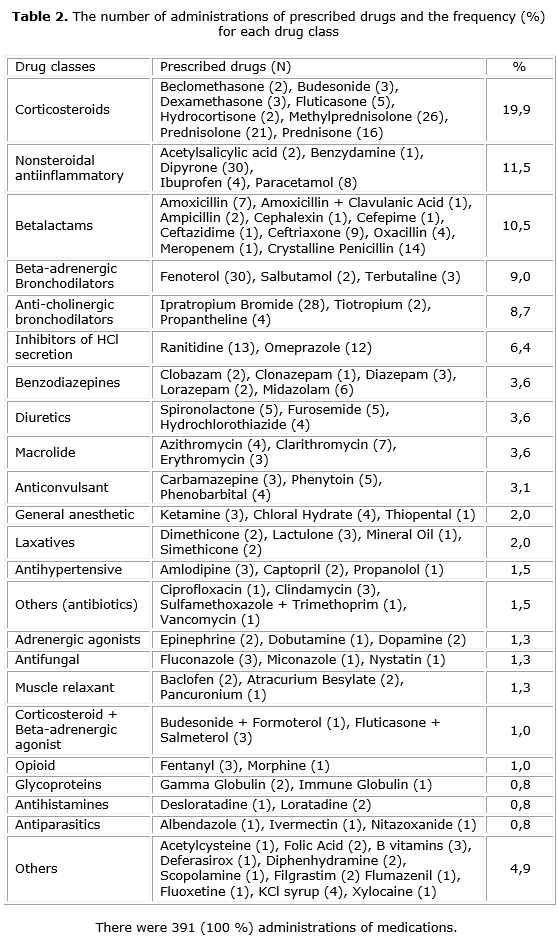
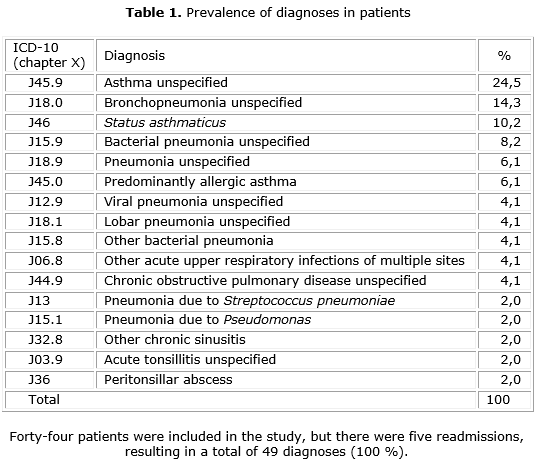
<body><![CDATA[<br>   The Thomson Micromedex database was used to identify drug interactions that    were then classified according to severity. When there was a health hazard that    required immediate medical intervention the drug interaction was classified    as major. The interaction was considered moderate when it exacerbated the patient&#180;s    disease or adverse effects and required drug substitution. A minor interaction    caused clinical effects with an adverse reaction but did not require drug replacement.    When the concomitant use of drugs was not recommended the interactions were    classified as contraindicated. Since dipyrone and fenoterol hydrobromide are    not commercialized in the USA, we reviewed the literature data indicative of    possible drug interactions involving these compounds. The data were compiled    using the program Microsoft Office Excel<sup>&#174;</sup>. The descriptive analyses    and assessment of the correlation between variables were done using Statistical    Package for the Social Sciences (SPSS<sup>&#174;</sup>) v.13.0 software. </font></p>     <p>&nbsp; </p>     <p><font face="Verdana" size="2"><b><font size="3">RESULTS</font></b> </font></p>     <p><font face="Verdana" size="2">    <br>   RESPIRATORY DISEASES<b> </b> </font></p>     <p><font face="Verdana" size="2">One hundred and twenty-six medical records were    evaluated, of which 82 were excluded because they involved patients outside    the age limit (exclusion criterion). Of the remaining 44 records, 24 (54.5 %)    were males and 20 (45.5 %) were females. There were five re-admissions totaling    49 medical records for the study. The length of hospitalization ranged from    1 to 45 days. There were 16 different diagnoses (<a href="#tab1_06">table 1</a>),    the most prevalent being unspecified asthma detected in 12 medical records (24    %), unspecified bronchopneumonia present in seven medical records (14 %) and    status asthmaticus in five medical records (10 %). The total number of prescribed    drugs was 90 and there were 1 to 21 prescribed drugs per medical record (mean    &#177; SD: 8.0 &#177; 5.4); one patient received no medication during hospitalization.    There were 391 (100 %) administrations of medication, with the intravenous route    being the most frequently used (37.3 %), followed by oral administration (29.7    %), inhalation (20.2 %), gastrostomy (7.4 %) and the nasoenteral route (5.4    %). </font></p>     <p align="center"><font face="Verdana" size="2"><a name="tab1_06"></a> <img src="/img/revistas/ped/v88n2/t0106216.gif" width="539" height="463"></font></p>     <p><font face="Verdana" size="2">     <br>   <a href="#tab2_06">Table 2</a> shows the prescribed drugs recorded in the medical    records. Corticosteroids, nonsteroidal anti-inflammatory drugs, betalactam antibiotics,    beta-adrenergic bronchodilators and anti-cholinergic bronchodilators were the    most prescribed drugs. </font></p>     <p align="center"><font face="Verdana" size="2"><a name="tab2_06"></a> <img src="/img/revistas/ped/v88n2/t0206216.gif" width="558" height="940"></font></p>     ]]></body>
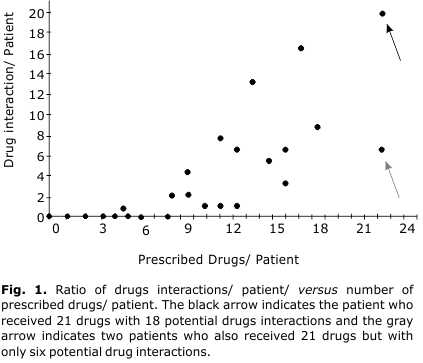
<body><![CDATA[<p><font face="Verdana" size="2">     <br>   According to the Micromedex database, there were 21 medical records with possible    drug interactions (1 to 18 drug interactions per medical record; mean &#177;    SD: 5.3 &#177; 4.8). Four medical records revealed a significant number of possible    drug interactions (8, 12, 16 and 18 interactions). <a href="#fig1_06">Figure    1</a> shows that the administration of up to seven medications did not increase    the probability of interactions, whereas with &gt; 7 drugs there was a progressive    increase in the number of possible interactions. In one patient who received    21 drugs we detected 18 possible drug interactions (black arrow in <a href="#fig1_06">figure    1</a>). However, in two patients who also received 21 drugs only six possible    drug interactions were detected (gray arrow in <a href="#fig1_06">figure 1</a>).    Five medical records showed 10 minor interactions, 17 medical records had 75    moderate interactions and 12 medical records had 25 major interactions; only    one medical report showed a contraindicated association. The total number of    possible drug interactions was 111. </font></p>     <p align="center"><font face="Verdana" size="2"><a name="fig1_06"></a> <img src="/img/revistas/ped/v88n2/f0106216.jpg" width="423" height="363"></font></p>     <p><font face="Verdana" size="2">     <br>   There was a significant prevalence of major and moderate possible interactions    between drugs administered concomitantly by the intravenous route (32 % and    18.7 %, respectively) and between drugs administered concomitantly by the oral    and intravenous routes (moderate= 16 % and major= 14.7 %). Among the major interactions,    the most prevalent involved chloral hydrate, phenobarbital or fentanyl with    midazolam (28 %) that can induce respiratory depression. The most prevalent    moderate interactions involved clarithromycin and corticosteroids (10.7 %; induced    toxic effects of corticosteroids), phenobarbital and corticosteroids (6.7 %;    reduction in therapeutic efficacy), acetyl salicylic acid and corticosteroids    (5.3 %; increased risk of ulcers), midazolam and ranitidine (5.3 %; increase    in midazolam bioavailability), atracurium besylate and corticosteroids (5.3    %; reduction in atracurium besylate efficacy, muscle weakness and myopathy),    diazepam and phenytoin (4 %; increased toxic effects of phenytoin), carbamazepine    and phenytoin (4 %; alteration in the plasma concentrations of both drugs),    hydrochlorothiazide and corticosteroids (4 %; hypokalemia and subsequent cardiac    arrhythmias), phenytoin and corticosteroids (4 %; reduction in corticosteroid    efficacy), ciprofloxacin and corticosteroids (4 %; increased risk of tendon    rupture) and carbamazepine and corticosteroids (4 %; reduction in corticosteroid    efficacy). For minor interactions, those involving phenytoin and ranitidine    (40 %; increase in phenytoin concentrations) and carbamazepine and clobazam    (20 %; decrease in carbamazepine and metabolite concentrations) were the most    significant. Only one contraindicated association (fluconazole and fluticasone    plus salmeterol; increased risk of <i>QT</i> prolongation and arrhythmias) was    detected. </font></p>     <p><font face="Verdana" size="2"><b>    <br>   </b>CYSTIC FIBROSIS </font></p>     <p><font face="Verdana" size="2">Eleven patients (3 males and 8 females) diagnosed    with cystic fibrosis and pulmonary exacerbations were included in this study    and there were seven re-admissions, totaling 18 medical records. The length    of hospitalization ranged from 14 to 23 days and the total number of prescription    drugs was 27. The number of prescribed drugs ranged from 6 to 12 per medical    record (7.9 &#177; 4.3). There were 159 (100 %) administrations of medications    and the oral route was used most (40 %), followed by inhalation (34 %) and intravenous    administration (21 %). The most prevalent bacteria described in the medical    records were <i>Pseudomonas aeruginosa</i> (20 %), followed by <i>Staphylococcus    aureus</i> (10 %), <i>Streptococcus viridans</i> (10 %) and <i>Bulkholderia    cepacia</i>, <i>Klebsiella pneumoniae</i> and <i>Neisseria </i>spp. (8.8 % each).    </font></p>     <p><font face="Verdana" size="2"> <a href="#fig2_06">Figure 2</a> shows that betalactam    antibiotics were the most prescribed medications (13 %), followed by mucolytic    dornase alfa (10.1 %), pancreatic enzymes (8.8 %), nutritional support (8.8    %) and the antibiotic amikacin (8.8 %). The Micromedex data base identified    five medical records with possible drug interactions. Four medical records had    four major interactions (vancomycin plus amikacin) and only one had a minor    drug interaction (amikacin plus piperacillin and tazobactam). </font></p>     <p align="center"><font face="Verdana" size="2"><a name="fig2_06"></a> <img src="/img/revistas/ped/v88n2/f0206216.jpg" width="578" height="845"></font></p>     ]]></body>
<body><![CDATA[<p>&nbsp; </p>     <p> <font face="Verdana" size="2"><b><font size="3">DISCUSSION</font></b> </font></p>     <p><font size="2" face="Verdana">    <br>   RESPIRATORY DISEASES</font> <font face="Verdana" size="2"> </font></p>     <p><font face="Verdana" size="2"> Intravenous injection was the major route of    administration (37.3 %) used in respiratory diseases. In addition, the most    prevalent major and moderate interactions were observed with drugs administered    concomitantly by the intravenous route. The intravenous administration of drugs    in children has great clinical relevance. The importance of this route in daily    nursing practice includes different methods and periods of administration, a    range of agents used for dilution, and drug incompatibility resulting from the    combination of drugs in solution.<sup>16</sup> In addition, the drug is 100    % bioavailable when administered intravenously and may therefore show greater    distribution throughout the organism; this can lead to adverse drug reactions    and interactions. </font></p>     <p><font face="Verdana" size="2"> There was significant prescription of dipyrone    (metamizole) for intravenous and oral administration, and this apparently reflected    the importance of preventing and treatment symptoms such as pain and fever.    However, since there is no description of dipyrone in Micromedex, the general    literature was used to determine possible drug interactions. Dipyrone has an    antipyretic and analgesic action mediated by the inhibition of cyclooxygenase    (responsible for the synthesis of arachidonic acid metabolites, principally    prostaglandins) and activation of the opioid and cannabinoid systems (prostaglandin-independent    pathway).<sup>17 </sup>In the medical records evaluated there were dipyrone    associations with hydrochlorothiazide, furosemide, captopril, amlodipine and    captopril. Dipyrone can reduce the diuretic effects of furosemide and hydrochlorothiazide    and decrease the efficacy of antihypertensives such as captopril (angiotensin-converting    enzyme inhibitor) and amlodipine (calcium channel blocker). The mechanism of    these interactions seems to involve a reduction in prostaglandins levels.<sup>18,19</sup>    In addition, dipyrone can induce cytochrome P450 enzymes (CYP3A4 and CYP2B6)    and UDP-glucoronosyltransferase (a conjugation enzyme) that have a very significant    role in metabolizing drugs. Thus, dipyrone may trigger various drug interactions    by modulating the activity of cytochrome P450 or the conjugation pathway.<sup>20-22</sup>    </font></p>     <p><font face="Verdana" size="2"> Corticosteroids were the most prescribed drugs    and therefore more prone to cause drug interactions. Based on the Micromedex    database, the drugs that presented the highest number of possible drug interactions    were phenytoin (23), clarithromycin (18), prednisone (16), midazolam (15), carbamazepine    (13), methylprednisolone (11) and ranitidine (10). Three medical records reported    the prescription of 21 drugs; two of these cases had six possible drug interactions    while the third had 18 possible drug interactions. The latter medical record    included a prescription for prednisone and midazolam, two drugs with higher    frequencies of interactions because both are metabolized by cytochrome P450    enzymes.<sup>23-25</sup> In addition, this same record had a prescription for    deferasirox, a CYP3A4/5 inducer and moderate inhibitor of CYP2C8,<sup>26</sup>    and ranitidine, a weak inhibitor of CYP.<sup>27</sup> The combination of these    drugs explains the greater probability of drug interactions in this case when    compared to the other two medical records with the same number of prescribed    drugs. We also observed that in one medical record with 15 drugs prescribed    there were only three possible drugs interactions while in another record that    also had 15 drugs there were 16 possible drug interactions. In the latter medical    record there was prescription of phenytoin (a CYP2C/3A inducer), clarithromycin    (a CYP3A4 inhibitor), prednisone, midazolam, carbamazepine (a CYP2C9/3A inducer)    and methylprednisolone.<sup>28,29</sup> Furthermore, the five medical records    mentioned above also included a prescription for dipyrone, a CYP inducer (see    Discussion in previous paragraph). Therefore, drugs with a low therapeutic index    (e.g., phenytoin, carbamazepine, corticosteroids) and that require careful dose    control are the most associated with adverse effects related to drug interactions.    Most of these drugs are used in prolonged treatment and many also are biotransformed    by hepatic enzymes that can induce additional drug interactions in child.<sup>1,30    </sup> </font></p>     <p><font face="Verdana" size="2"> These findings indicate that pediatric prescription    should be confined to essential drugs. The prescription should contain the smallest    possible number of medications to prevent possible drug interactions. In addition,    detailed knowledge of the drugs prescribed to hospitalized children with different    illnesses, sex and age will be useful in understanding drug interactions and    in avoiding adverse reactions. In this regard, nurses have a key role in ensuring    quality care, in participating in drug therapy and in identifying adverse events    and drug interactions.</font></p>     <p>    <br>   <font face="Verdana" size="2">CYSTIC FIBROSIS </font></p>     ]]></body>
<body><![CDATA[<p><font face="Verdana" size="2"> The management of cystic fibrosis is based on    established guidelines, with the drugs recommended for pulmonary exacerbations    including antibiotics, anti-inflammatory agents, bronchodilators, mucolytics,    pancreatic enzyme and nutritional support.<sup>31-33</sup> In this study, betalactam    antibiotics, mucolytic dornase alpha, digestive enzymes, nutritional support    and the antibiotic amikacin were the drugs most prescribed, in agreement with    the literature. </font></p>     <p><font face="Verdana" size="2"> There was no correlation between hospitalization    time and the number of drug interactions in the data analyzed (SPSS<sup>&#174;</sup>    v.13.0 software). In addition, there was no correlation between the number of    drugs prescribed per patient and the occurrence of drug interactions, despite    the elevated number of drugs per admission (range: 6 to 12). These findings    probably reflect the fact that the hospital where this study was done is a referral    center for the treatment of cystic fibrosis. A search of Micromedex identified    the association of amikacin (an aminoglycoside) and vancomycin (a glycopeptide)    as a major interaction that may increase the risk of ototoxicity and nephrotoxicity.    The association of vancomycin and amikacin results in combined toxicity that    may injure the target organ, e.g., kidneys.<sup>34-36</sup> In the present study,    amikacin was administered once a day while vancomycin and piperacillin plus    tazobactam were administered once every 6 h, with the duration of therapy ranging    from 14 to 21 days. The administration of aminoglycosides in a single daily    dose reduces the nephrotoxicity, ototoxicity and vestibular toxicity caused    by these antibiotics.<sup>37,38</sup> One of the medical records revealed a    minor interaction due to the association of amikacin and piperacillin/tazobactam    (betalactam) that may have attenuated the efficacy of the aminoglycoside if    both antibiotics were administered intravenously in the same solution or via    the same venous access. </font></p>     <p><font face="Verdana" size="2"> Aminoglycosides are used because of their effectiveness    against gram-negative bacilli and their action extends to gram-positive bacteria    when associated with betalactam or glycopeptide antibiotics.<sup>38,39</sup>    The acute and chronic pulmonary infections induced by the presence of mucus    and an inflammatory response can determine the morbidity and mortality of cystic    fibrosis patients. The treatment of cystic fibrosis with acute pulmonary exacerbations    often involves the intravenous administration of aminoglycosides in combination    with other classes of antibiotics.<sup>39,40</sup> These antibiotic associations    are very important for the eradication of resistant <i>P. aeruginosa</i>. Polymicrobial    infections are common in cystic fibrosis and the most prevalent bacteria reported    in the medical records of our patients were <i>P. aeruginosa</i>, <i>S. aureus</i>    and <i>S. viridans</i>.<i>Pseudomonas aeruginosa</i> is the most prevalent bacteria    in cystic fibrosis and usually appears in children of school age or in adolescents.<sup>38,39,41    </sup>This species is the principal cause of the respiratory exacerbations associated    with respiratory infections in cystic fibrosis. Correct identification of pathogens    is a major challenge and choice of the correct treatment is fundamental for    preventing microbial resistance to these antibiotics.<sup>42,43</sup> Since    <i>P. aeruginosa</i> is the most prevalent pathogen in cystic fibrosis, treatment    with oral fluoroquinolones is a therapeutic option for mild exacerbations, whereas    antipseudomonal betalactams associated with an aminoglycoside, administered    intravenously, are used for severe exacerbations.<sup>41 </sup>The use of combination    antibiotic therapy, the dosing frequency, duration of therapy and parenteral    administration for the treatment of respiratory tract infections in cystic fibrosis    may induce significant drug interactions. However, in reference centers, the    efficacy of treatment with aminoglycosides and the occurrence of adverse reactions    and toxicity are monitored periodically. In the reference center where this    study was done, the dosage schedules were chosen in an attempt to prevent drug    interactions. In this situation, the availability of a multidisciplinary team    combined with a program of active pharmacovigilance can help prevent the occurrence    of drug interactions. </font></p>     <p><font face="Verdana" size="2"> The inappropriate use of drugs is observed throughout    the world in health care system and the consequences are enormous for patients    and communities. Drugs are inappropriately prescribed, dispensed or sold, while    many patients fail to take them correctly. In contrast, according to WHO, the    rational use of medicines is defined as &#8220;Patients receive medications    appropriate to their clinical needs, in doses that meet their own individual    requirements, for an adequate period of time, and at the lowest cost to them    and their community.&#8221;<sup>44</sup> Additionally, monitoring studies aims    to focus on drugs prescription, dispense and administration and may promote    the appropriate use and the reduction of abuse or misuse of drugs.<sup>45</sup>    These studies could collaborate to develop a guide to prescribers, dispensers    and the general public. According to this, the rational use of medicines involves    all healthcare professionals, directly or indirectly. Previous reports described    nurses are able to detect and identify adverse reactions.<sup>46-48</sup> However,    according to recent studies, contribution of nurses fall shorts than physicians    and pharmacists.<sup>49,50</sup> </font></p>     <p><font face="Verdana" size="2"> According to nurses self-reports, the lack of    pharmacological background, mainly regarding relation between theory and practice    aspects (i.e. mechanism of drug action and their interactions) is the main factor    responsible for this insufficient participation.<sup>51</sup> Therefore, educational    programs, discussion groups and pharmacovigilance training could be encouraged    to improve nursing involvement in detecting and reporting drug-related problems.    These strategies will enable nurses to play prominent role in pharmacovigilance    practices and could reduce significantly drug interactions and adverse reactions.    </font></p>     <p> <font face="Verdana" size="2"><b>    <br>   Acknowledgments</b> </font></p>     <p><font face="Verdana" size="2"> G.B.V. was supported by a PIBIC studentship    from Conselho Nacional de Desenvolvimento Cient&#237;fico e Tecnol&#243;gico    (CNPq). </font></p>     <p>&nbsp;</p>     <p><font face="Verdana" size="2"><b><font size="3">REFERENCES</font></b> </font></p>     ]]></body>
<body><![CDATA[<p><font face="Verdana" size="2"> 1. Therapeutic National Formulary. Minist&#233;rio    da Sa&#250;de, Secretaria de Ci&#234;ncia, Tecnologia e Insumos Estrat&#233;gicos,    Departamento de Assist&#234;ncia Farmac&#234;utica e Insumos Estrat&#233;gicos.    2th ed. Bras&#237;lia (DF) [Internet]. 2010 [cited 2014 April 14]. Available    from: <a href="http://bvsms.saude.gov.br/bvs/publicacoes/formulario_terapeutico_nacional_2010.pdf" target="_blank">    http://bvsms.saude.gov.br/bvs/publicacoes/formulario_terapeutico_nacional_2010.pdf    </a> </font></p>     <!-- ref --><p><font face="Verdana" size="2"> 2. Cruciol-Souza JM, Thomson JC. A pharmacoepidemiologic    study of drug interactions in a Brazilian teaching hospital. Clinics. 2006;61:515-20.        </font></p>     <!-- ref --><p><font face="Verdana" size="2"> 3. Carleton BC, Smith MA, Gelin MN, Heathcote    SC. Paediatric adverse drug reaction reporting: understanding and future directions.    Can J Clin Pharmacol. 2007;14(1):e45-57.     </font></p>     <!-- ref --><p><font face="Verdana" size="2"> 4. Lobo MG, Pinheiro SM, Castro JG, Moment&#233;    VG, Pranchevicius MC. Adverse drug reaction monitoring: support for pharmacovigilance    at a tertiary care hospital in northern Brazil. BMC Pharmacol Toxicol. 2013;14(5):1-7.        </font></p>     <!-- ref --><p><font face="Verdana" size="2"> 5. Hartshorn EA. Evolution of drug-drug interactions:    a personal viewpoint. Ann Pharmacother. 2006;40:112-3.     </font></p>     <!-- ref --><p><font face="Verdana" size="2"> 6. Kearns GL, Abdel-Rahman SM, Blander SW, Blowey    DL, Leeder JS, Kauffman RE. Developmental pharmacology &#8211; drug disposition,    action, and therapy in infants and children. N Engl J Med. 2003;349(12):1157-67.        </font></p>     <!-- ref --><p><font face="Verdana" size="2"> 7. Barterlink IH, Rademaker CMA, Schobben AF,    van den Anker JN. Guidelines on pediatric dosing on the basis of developmental    physiology and pharmacokinetic considerations. Clin Pharmacokinet. 2006;45(11):1077-97.        </font></p>     <!-- ref --><p><font face="Verdana" size="2"> 8. Morselli PL, Franco-Morselli R, Bossi L.    Clinical pharmacokinetics in newborns and infants. Age-related differences and    therapeutic implications. Clin Pharmacokinet. 1980;5(6):485-527.     </font></p>     <!-- ref --><p><font face="Verdana" size="2"> 9. Johnson TN. The development of drug metabolising    enzymes and their influence on the susceptibility to adverse drug reactions    in children. Toxicology. 2003;192(1):37-48.     </font></p>     <!-- ref --><p><font face="Verdana" size="2"> 10. Hayton WL. Maturation and growth of renal    function: dosing renally cleared drugs in children. AAPS Pharm Sci. 2000;2(1):22-8.        </font></p>     <!-- ref --><p><font face="Verdana" size="2"> 11. Sweet DH, Bush KT, Nigam SK. The organic    anion transporter family: from physiology to ontogeny and the clinic. American    Journal of Physiology. Renal Physiology. 2001;281:F197-F205.     </font></p>     <!-- ref --><p><font face="Verdana" size="2"> 12. Strolin BM, Baltes EL. Drug metabolism and    disposition in children. Fundam Clin Pharmacol. 2003;17(3):281-99.     </font></p>     <!-- ref --><p><font face="Verdana" size="2"> 13. Anderson GD. Developmental pharmacokinetics.    Semin Pediatr Neurol. 2010;17(4):208-13.     </font></p>     <!-- ref --><p><font face="Verdana" size="2"> 14. Turner MA, Catapano M, Hirschfeld S, Giaquinto    C. Paediatric drug development: the impact of evolving regulations. Adv Drug    Deliv Rev. 2014;73C,2-13.     </font></p>     <!-- ref --><p><font face="Verdana" size="2"> 15. International Classification of Diseases    (ICD-10) [Internet]. 2015 [cited 2015 May 14]. Available from: <a href="http://apps.who.int/classifications/icd10/browse/2015/en" target="_blank">http://apps.who.int/classifications/icd10/browse/2015/en</a>    </font><!-- ref --><p><font face="Verdana" size="2"> 16. Peterlini MA, Chaud MN, Pedreira, ML. Drug    therapy orphans: the administration of intravenous drugs in hospitalized children.    Rev Lat Am Enfermagem. 2003;11(1):88-95.     </font></p>     ]]></body>
<body><![CDATA[<!-- ref --><p><font face="Verdana" size="2"> 17. Jasiecka A, M&#225;slanka T, Jaroszewski    JJ. Pharmacological characteristics of metamizole. Pol J Vet Sci. 2014;17(1):207-14.        </font></p>     <!-- ref --><p><font face="Verdana" size="2"> 18. Rosenkranz, B, Lehr KH, Mackert G, Seyberth    HW. Metamizole-furosemide interaction study in healthy volunteers. Eur J Clin    Pharmacol. 1992;42(6):593-8.     </font></p>     <!-- ref --><p><font face="Verdana" size="2"> 19. Hinz B, Cheremina O, Bachmakov J, Renner    B, Zolk O, Fromm MF, et al. Dipyrone elicits substantial inhibition of peripheral    cyclooxygenases in humans: new insights into the pharmacology of an old analgesic.    FASEB J. 2007;21(10):2343-51.     </font></p>     <!-- ref --><p><font face="Verdana" size="2"> 20. Kraul H, Pasanen M, Saguache H, Stenb&#228;ck    F, Park SS, Gelboin HV, et al. Immunohistochemical properties of dipyrone-induced    cytochromes P450 in rats. Hum Exp Toxicol. 1996;15(1):45-50.     </font></p>     <!-- ref --><p><font face="Verdana" size="2"> 21. Saussele T, Burk O, Blievernicht JK, Klein    K, Nussler A, Nussler, et al. Selective induction of human hepatic cytochromes    P450 2B6 and 3A4 by metamizole. Clin Pharmacol Ther. 2007;82(3):265-74.     </font></p>     ]]></body>
<body><![CDATA[<!-- ref --><p><font face="Verdana" size="2"> 22. Qin WJ, Zhang W, Liu ZQ, Chen XP, Tan ZR,    Hu DL, et al. Rapid clinical induction of bupropion hydroxylation by metamizole    in healthy Chinese men. Br J Clin Pharmacol. 2012;74(6):999-1004.     </font></p>     <!-- ref --><p><font face="Verdana" size="2"> 23. Von Moltke LL, Greenblatt DJ, Schmider J,    Harmatz JS, Shader RI. Metabolism of drugs by P450, 3A isoforms. Implications    for drug interactions in psychopharmacology. Clin Pharmacokinet. 1995;29(1):33-44.        </font></p>     <!-- ref --><p><font face="Verdana" size="2"> 24. Czock D, Keller F, Rasche FM, H&#228;ussler    U. Pharmacokinetics and pharmacodynamics of systemically administered glucocorticoids.    Clinical Pharmacokinetics Journal. 2005;44(1):61-98.     </font></p>     <!-- ref --><p><font face="Verdana" size="2"> 25. Bergmann TK, Barraclough KA, Lee KJ, Staatz    CE. Clinical pharmacokinetics and pharmacodynamics of prednisolone and prednisone    in solid organ transplantation. Clin Pharmacokinet. 2012;51(11):711-41.     </font></p>     <!-- ref --><p><font face="Verdana" size="2"> 26. Skerjanec A, Wang J, Maren K, Rojkjaer L.    Investigation of the pharmacokinetic interactions of deferasirox, a once-daily    oral iron chelator, with midazolam, rifampin, and repaglinide in healthy volunteers.    J Clin Pharmacol. 2010;50(2):205-13.     </font></p>     ]]></body>
<body><![CDATA[<p><font face="Verdana" size="2"> 27. Rendi&#263; S. Drug interactions of H2-receptor    antagonists involving cytochrome P450 (CYPs) enzymes: from the laboratory to    the clinic. Croat Med J. 1999;40(3):357-67. </font></p>     <!-- ref --><p><font face="Verdana" size="2"> 28. Westphal JF. Macrolide-induced clinically    relevant drug interactions with cytochrome P-450A (CYP) 3A4: an update focused    on clarithromycin, azithromycin and dirithromycin. Br J Clin Pharmacol. 2000;50(4):285-95.        </font></p>     <!-- ref --><p><font face="Verdana" size="2"> 29. Perucca E. Clinically relevant drug interactions    with antiepileptic drugs. Br J Clin Pharmacol. 2006;61(3):246-55.     </font></p>     <!-- ref --><p><font face="Verdana" size="2"> 30. Gonzalez FJ, Coughtrie M, Tukey RH. Metabolismo    dos f&#225;rmacos. In: Brunton LL, Chabner BA, Knollmann BC, eds. As bases farmacol&#243;gicas    da terap&#234;utica de Goodman &amp; Gilman. 12 ed. Porto Alegre: AMGH Publisher    Ltda./MacGraw-Hill Education; 2012. p. 123-43.     </font></p>     <!-- ref --><p><font face="Verdana" size="2"> 31. Borowitz D, Robinson KA, Rosenfeld M, Davis    SD, Sabadosa KA, Spear SL, et al. Cystic Fibrosis Foundation evidence-based    guidelines for management of infants with cystic fibrosis. Journal of Pediatrics.    2009;155(6):S73-93.     </font></p>     <!-- ref --><p><font face="Verdana" size="2"> 32. Filho LVRFS, Damaceno N, Reis FJC, Hira    AY. Registro brasileiro de fibrose c&#237;stica [Internet]. 2010 [cited 2014    March 22]. Avaible from: <a href="http://www.cysticfibrosisdata.org/LiteratureRetrieve.aspx?ID=135160" target="_blank">http://www.cysticfibrosisdata.org/LiteratureRetrieve.aspx?ID=135160</a>    </font><!-- ref --><p><font face="Verdana" size="2"> 33. Adde FV, Marostica PJC, Ribeiro MAGO, Santos    CIS, Sol D, Vieira SE. Fibrose c&#237;stica: diagn&#243;stico e tratamento [Internet].    2014 [cited 2014 April 20] Avaible from: <a href="http://www.projetodiretrizes.org.br/ans/diretrizes/fibrose_cistica-diagnostico_e_tratamento.pdf" target="_blank">    http://www.projetodiretrizes.org.br/ans/diretrizes/fibrose_cistica-diagnostico_e_tratamento.pdf</a></font><!-- ref --><p><font face="Verdana" size="2"> 34. Prayle A, Smyth AR. Aminoglycoside use in    cystic fibrosis: therapeutic strategies and toxicity. Curr Opin Pulm Med. 2010;16(6):604-10.        </font></p>     <!-- ref --><p><font face="Verdana" size="2"> 35. Liangos O. Drugs and AKI. Minerva Urol Nefrol.    2012;64(1):51-62.     </font></p>     <!-- ref --><p><font face="Verdana" size="2"> 36. Khalili H, Bairam S, Kargar M. Antibiotics    induced acute kidney injury: incidence, risk factors, onset time and outcome.    Acta Med Iran. 2013;51(12):871-8.     </font></p>     <!-- ref --><p><font face="Verdana" size="2"> 37. Barza M, Loannidis JPA, Capelleri JC, Lau    J. Single or multiple daily doses of aminoglycosides: a meta-analysis. Br Med    J. 1996;312(7027):338-45.     </font></p>     <!-- ref --><p><font face="Verdana" size="2"> 38. Flume PA, Mogayzel PJJr, Robinson KA, Goss,    CH, Rosenblatt, RL, Kuhn RJ, et al. Clinical Practice Guidelines for Pulmonary    Therapies committee. Cystic fibrosis pulmonary guidelines: treatment of pulmonary    exacerbations. Am J Respir Crit Care Med. 2009;180(9):802-8.     </font></p>     <!-- ref --><p><font face="Verdana" size="2"> 39. Smyth AR, Bhatt J. Once-daily versus multiple-daily    dosing with intravenous aminoglycosides for cystic fibrosis. Cochrane Database    Syst Rev. 2014;2:CD002009.     </font></p>     <!-- ref --><p><font face="Verdana" size="2"> 40. Bhatt JM. Treatment of pulmonary exacerbations    in cystic fibrosis. Eur Respir Rev. 2013;22:205-16.     </font></p>     <!-- ref --><p><font face="Verdana" size="2"> 41. Castro MCS, Firmida MC. O tratamento na    fibrose c&#237;stica e suas complica&#231;&#245;es. HUPE. 2011;10:82-108.     </font></p>     <!-- ref --><p><font face="Verdana" size="2"> 42. Geller DE. Aerosol antibiotics in cystic    fibrosis. Respir Care. 2009;54(5):658-70.     </font></p>     <!-- ref --><p><font face="Verdana" size="2"> 43. Levy CE. Microbiologia no trato respirat&#243;rio    na fibrose c&#237;stica. In: Paschoal IA, Pereira MC, eds. Fibrose C&#237;stica.    S&#227;o Paulo: Yends; 2010. p. 201-12.     </font></p>     <p><font face="Verdana" size="2"> 44. Promoting Rational Use of Medicines: Core    Components-WHO Policy perspectives on medicine, No. 005, September 2002. Essential    medicines and Health Products Information Portal. A World Health Organization    Resource [internet]. 2015 [cited 2015 October 23]. Available from: <a href="http://www.who.int/medicines/publications/policyperspectives/ppm05en.pdf" target="_blank">    http://www.who.int/medicines/publications/policyperspectives/ppm05en.pdf </a>    </font></p>     <!-- ref --><p><font face="Verdana" size="2"> 45. Jain S, Upadhyaya P, Goyal J, Kumar A, Jain    P, Seth V, et al. A systematic review of prescription pattern monitoring studies    and their effectiveness in promoting rational use of medicines. Perspect Clin    Res. 2015;6(2):86-90.     </font></p>     <!-- ref --><p><font face="Verdana" size="2"> 46. Bergqvist M, Ulfvarson J, Andersen Karlsson    E, von Bahr C. A nurse-led intervention for identification of drug-related problems.    Eur J Clin Pharmacol. 2008;64:451&#8211;56.     </font></p>     <!-- ref --><p><font face="Verdana" size="2"> 47. Morrison-Griffiths S, Walley TJ, Park BK,    Breckenridge AM, Pirmohamed M. Reporting of adverse drug reactions by nurses.    Lancet. 2003;361(9366):1347-8.     </font></p>     <!-- ref --><p><font face="Verdana" size="2"> 48. Ulfvarson J, Mejyr S, Bergman U. Nurses    are increasingly involved in pharmacovigilance in Sweden. Pharmacoepidemiol    Drug Safety. 2007;16(5):532-7.     </font></p>     ]]></body>
<body><![CDATA[<!-- ref --><p><font face="Verdana" size="2"> 49. Johansson-Pajala RM, Martin L, Fastbom J,    Jors&#228;ter Blomgren K. Nurses' self-reported medication competence in relation    to their pharmacovigilant activities in clinical practice. J Eval Clin Pract.    2015;21(1):145-52.     </font></p>     <!-- ref --><p><font face="Verdana" size="2"> 50. Mendes D, Alves C, Batel Marques F. Nurses&#8217;    spontaneous reporting of adverse drug reactions: expert review of routine reports.    J Nurs Man. 2014;22:322-30.     </font></p>     <!-- ref --><p><font face="Verdana" size="2"> 51. King RL. Nurses&#8217; perceptions of their    pharmacology educational needs. J Adv Nurs.2004;45(4):392-400.     </font></p>     <p>&nbsp;</p>     <p>&nbsp;</p>     <p><font face="Verdana" size="2">Recibido: 26 de agosto de 2015. <b> <br/>   </b> Aprobado: 3 de noviembre de 2015. </font></p>     <p>&nbsp; </p>     ]]></body>
<body><![CDATA[<p> <font face="Verdana" size="2"><i>M&#225;rcia Yuriko Masukawa</i><i>.</i> Department    of Physiological Sciences. Santa Casa de S&#227;o Paulo. School of Nursing.    SP, Brazil. Correo electr&oacute;nico: <a href="mailto:marciaymxix@gmail.com">marciaymxix@gmail.com</a>    </font></p>        ]]></body><back>
<ref-list>
<ref id="B1">
<label>1</label><nlm-citation citation-type="">
<collab>Ministério da Saúde^dSecretaria de Ciência, Tecnologia e Insumos Estratégicos, Departamento de Assistência Farmacêutica e Insumos Estratégicos</collab>
<source><![CDATA[Therapeutic National Formulary]]></source>
<year>2010</year>
<edition>2th</edition>
<publisher-loc><![CDATA[Brasília (DF) ]]></publisher-loc>
</nlm-citation>
</ref>
<ref id="B2">
<label>2</label><nlm-citation citation-type="journal">
<person-group person-group-type="author">
<name>
<surname><![CDATA[Cruciol-Souza]]></surname>
<given-names><![CDATA[JM]]></given-names>
</name>
<name>
<surname><![CDATA[Thomson]]></surname>
<given-names><![CDATA[JC]]></given-names>
</name>
</person-group>
<article-title xml:lang="en"><![CDATA[A pharmacoepidemiologic study of drug interactions in a Brazilian teaching hospital]]></article-title>
<source><![CDATA[Clinics]]></source>
<year>2006</year>
<volume>61</volume>
<page-range>515-20</page-range></nlm-citation>
</ref>
<ref id="B3">
<label>3</label><nlm-citation citation-type="journal">
<person-group person-group-type="author">
<name>
<surname><![CDATA[Carleton]]></surname>
<given-names><![CDATA[BC]]></given-names>
</name>
<name>
<surname><![CDATA[Smith]]></surname>
<given-names><![CDATA[MA]]></given-names>
</name>
<name>
<surname><![CDATA[Gelin]]></surname>
<given-names><![CDATA[MN]]></given-names>
</name>
<name>
<surname><![CDATA[Heathcote]]></surname>
<given-names><![CDATA[SC]]></given-names>
</name>
</person-group>
<article-title xml:lang="en"><![CDATA[Paediatric adverse drug reaction reporting: understanding and future directions]]></article-title>
<source><![CDATA[Can J Clin Pharmacol]]></source>
<year>2007</year>
<volume>14</volume>
<numero>1</numero>
<issue>1</issue>
<page-range>e45-57</page-range></nlm-citation>
</ref>
<ref id="B4">
<label>4</label><nlm-citation citation-type="journal">
<person-group person-group-type="author">
<name>
<surname><![CDATA[Lobo]]></surname>
<given-names><![CDATA[MG]]></given-names>
</name>
<name>
<surname><![CDATA[Pinheiro]]></surname>
<given-names><![CDATA[SM]]></given-names>
</name>
<name>
<surname><![CDATA[Castro]]></surname>
<given-names><![CDATA[JG]]></given-names>
</name>
<name>
<surname><![CDATA[Momenté]]></surname>
<given-names><![CDATA[VG]]></given-names>
</name>
<name>
<surname><![CDATA[Pranchevicius]]></surname>
<given-names><![CDATA[MC]]></given-names>
</name>
</person-group>
<article-title xml:lang="en"><![CDATA[Adverse drug reaction monitoring: support for pharmacovigilance at a tertiary care hospital in northern Brazil]]></article-title>
<source><![CDATA[BMC Pharmacol Toxicol]]></source>
<year>2013</year>
<volume>14</volume>
<numero>5</numero>
<issue>5</issue>
<page-range>1-7</page-range></nlm-citation>
</ref>
<ref id="B5">
<label>5</label><nlm-citation citation-type="journal">
<person-group person-group-type="author">
<name>
<surname><![CDATA[Hartshorn]]></surname>
<given-names><![CDATA[EA]]></given-names>
</name>
</person-group>
<article-title xml:lang="en"><![CDATA[Evolution of drug-drug interactions: a personal viewpoint]]></article-title>
<source><![CDATA[Ann Pharmacother]]></source>
<year>2006</year>
<volume>40</volume>
<page-range>112-3</page-range></nlm-citation>
</ref>
<ref id="B6">
<label>6</label><nlm-citation citation-type="journal">
<person-group person-group-type="author">
<name>
<surname><![CDATA[Kearns]]></surname>
<given-names><![CDATA[GL]]></given-names>
</name>
<name>
<surname><![CDATA[Abdel-Rahman]]></surname>
<given-names><![CDATA[SM]]></given-names>
</name>
<name>
<surname><![CDATA[Blander]]></surname>
<given-names><![CDATA[SW]]></given-names>
</name>
<name>
<surname><![CDATA[Blowey]]></surname>
<given-names><![CDATA[DL]]></given-names>
</name>
<name>
<surname><![CDATA[Leeder]]></surname>
<given-names><![CDATA[JS]]></given-names>
</name>
<name>
<surname><![CDATA[Kauffman]]></surname>
<given-names><![CDATA[RE]]></given-names>
</name>
</person-group>
<article-title xml:lang="en"><![CDATA[Developmental pharmacology - drug disposition, action, and therapy in infants and children]]></article-title>
<source><![CDATA[N Engl J Med]]></source>
<year>2003</year>
<volume>349</volume>
<numero>12</numero>
<issue>12</issue>
<page-range>1157-67</page-range></nlm-citation>
</ref>
<ref id="B7">
<label>7</label><nlm-citation citation-type="journal">
<person-group person-group-type="author">
<name>
<surname><![CDATA[Barterlink]]></surname>
<given-names><![CDATA[IH]]></given-names>
</name>
<name>
<surname><![CDATA[Rademaker]]></surname>
<given-names><![CDATA[CMA]]></given-names>
</name>
<name>
<surname><![CDATA[Schobben]]></surname>
<given-names><![CDATA[AF]]></given-names>
</name>
<name>
<surname><![CDATA[van den Anker]]></surname>
<given-names><![CDATA[JN]]></given-names>
</name>
</person-group>
<article-title xml:lang="en"><![CDATA[Guidelines on pediatric dosing on the basis of developmental physiology and pharmacokinetic considerations]]></article-title>
<source><![CDATA[Clin Pharmacokinet]]></source>
<year>2006</year>
<volume>45</volume>
<numero>11</numero>
<issue>11</issue>
<page-range>1077-97</page-range></nlm-citation>
</ref>
<ref id="B8">
<label>8</label><nlm-citation citation-type="journal">
<person-group person-group-type="author">
<name>
<surname><![CDATA[Morselli]]></surname>
<given-names><![CDATA[PL]]></given-names>
</name>
<name>
<surname><![CDATA[Franco-Morselli]]></surname>
<given-names><![CDATA[R]]></given-names>
</name>
<name>
<surname><![CDATA[Bossi]]></surname>
<given-names><![CDATA[L]]></given-names>
</name>
</person-group>
<article-title xml:lang="en"><![CDATA[Clinical pharmacokinetics in newborns and infants. Age-related differences and therapeutic implications]]></article-title>
<source><![CDATA[Clin Pharmacokinet]]></source>
<year>1980</year>
<volume>5</volume>
<numero>6</numero>
<issue>6</issue>
<page-range>485-527</page-range></nlm-citation>
</ref>
<ref id="B9">
<label>9</label><nlm-citation citation-type="journal">
<person-group person-group-type="author">
<name>
<surname><![CDATA[Johnson]]></surname>
<given-names><![CDATA[TN]]></given-names>
</name>
</person-group>
<article-title xml:lang="en"><![CDATA[The development of drug metabolising enzymes and their influence on the susceptibility to adverse drug reactions in children]]></article-title>
<source><![CDATA[Toxicology]]></source>
<year>2003</year>
<volume>192</volume>
<numero>1</numero>
<issue>1</issue>
<page-range>37-48</page-range></nlm-citation>
</ref>
<ref id="B10">
<label>10</label><nlm-citation citation-type="journal">
<person-group person-group-type="author">
<name>
<surname><![CDATA[Hayton]]></surname>
<given-names><![CDATA[WL]]></given-names>
</name>
</person-group>
<article-title xml:lang="en"><![CDATA[Maturation and growth of renal function: dosing renally cleared drugs in children]]></article-title>
<source><![CDATA[AAPS Pharm Sci]]></source>
<year>2000</year>
<volume>2</volume>
<numero>1</numero>
<issue>1</issue>
<page-range>22-8</page-range></nlm-citation>
</ref>
<ref id="B11">
<label>11</label><nlm-citation citation-type="journal">
<person-group person-group-type="author">
<name>
<surname><![CDATA[Sweet]]></surname>
<given-names><![CDATA[DH]]></given-names>
</name>
<name>
<surname><![CDATA[Bush]]></surname>
<given-names><![CDATA[KT]]></given-names>
</name>
<name>
<surname><![CDATA[Nigam]]></surname>
<given-names><![CDATA[SK]]></given-names>
</name>
</person-group>
<article-title xml:lang="en"><![CDATA[The organic anion transporter family: from physiology to ontogeny and the clinic.]]></article-title>
<source><![CDATA[American Journal of Physiology. Renal Physiology]]></source>
<year>2001</year>
<volume>281</volume>
<page-range>F197-F205</page-range></nlm-citation>
</ref>
<ref id="B12">
<label>12</label><nlm-citation citation-type="journal">
<person-group person-group-type="author">
<name>
<surname><![CDATA[Strolin]]></surname>
<given-names><![CDATA[BM]]></given-names>
</name>
<name>
<surname><![CDATA[Baltes]]></surname>
<given-names><![CDATA[EL]]></given-names>
</name>
</person-group>
<article-title xml:lang="en"><![CDATA[Drug metabolism and disposition in children]]></article-title>
<source><![CDATA[Fundam Clin Pharmacol]]></source>
<year>2003</year>
<volume>17</volume>
<numero>3</numero>
<issue>3</issue>
<page-range>281-99</page-range></nlm-citation>
</ref>
<ref id="B13">
<label>13</label><nlm-citation citation-type="journal">
<person-group person-group-type="author">
<name>
<surname><![CDATA[Anderson]]></surname>
<given-names><![CDATA[GD]]></given-names>
</name>
</person-group>
<article-title xml:lang="en"><![CDATA[Developmental pharmacokinetics]]></article-title>
<source><![CDATA[Semin Pediatr Neurol]]></source>
<year>2010</year>
<volume>17</volume>
<numero>4</numero>
<issue>4</issue>
<page-range>208-13</page-range></nlm-citation>
</ref>
<ref id="B14">
<label>14</label><nlm-citation citation-type="journal">
<person-group person-group-type="author">
<name>
<surname><![CDATA[Turner]]></surname>
<given-names><![CDATA[MA]]></given-names>
</name>
<name>
<surname><![CDATA[Catapano]]></surname>
<given-names><![CDATA[M]]></given-names>
</name>
<name>
<surname><![CDATA[Hirschfeld]]></surname>
<given-names><![CDATA[S]]></given-names>
</name>
<name>
<surname><![CDATA[Giaquinto]]></surname>
<given-names><![CDATA[C]]></given-names>
</name>
</person-group>
<article-title xml:lang="en"><![CDATA[Paediatric drug development: the impact of evolving regulations]]></article-title>
<source><![CDATA[Adv Drug Deliv Rev]]></source>
<year>2014</year>
<volume>73C</volume>
<page-range>2-13</page-range></nlm-citation>
</ref>
<ref id="B15">
<label>15</label><nlm-citation citation-type="">
<source><![CDATA[International Classification of Diseases (ICD-10)]]></source>
<year>2015</year>
</nlm-citation>
</ref>
<ref id="B16">
<label>16</label><nlm-citation citation-type="journal">
<person-group person-group-type="author">
<name>
<surname><![CDATA[Peterlini]]></surname>
<given-names><![CDATA[MA]]></given-names>
</name>
<name>
<surname><![CDATA[Chaud]]></surname>
<given-names><![CDATA[MN]]></given-names>
</name>
<name>
<surname><![CDATA[Pedreira]]></surname>
</name>
<name>
<surname><![CDATA[ML]]></surname>
</name>
</person-group>
<article-title xml:lang="en"><![CDATA[Drug therapy orphans: the administration of intravenous drugs in hospitalized children]]></article-title>
<source><![CDATA[Rev Lat Am Enfermagem]]></source>
<year>2003</year>
<volume>11</volume>
<numero>1</numero>
<issue>1</issue>
<page-range>88-95</page-range></nlm-citation>
</ref>
<ref id="B17">
<label>17</label><nlm-citation citation-type="journal">
<person-group person-group-type="author">
<name>
<surname><![CDATA[Jasiecka]]></surname>
<given-names><![CDATA[A]]></given-names>
</name>
<name>
<surname><![CDATA[Máslanka]]></surname>
<given-names><![CDATA[T]]></given-names>
</name>
<name>
<surname><![CDATA[Jaroszewski]]></surname>
<given-names><![CDATA[JJ]]></given-names>
</name>
</person-group>
<article-title xml:lang="en"><![CDATA[Pharmacological characteristics of metamizole]]></article-title>
<source><![CDATA[Pol J Vet Sci]]></source>
<year>2014</year>
<volume>17</volume>
<numero>1</numero>
<issue>1</issue>
<page-range>207-14</page-range></nlm-citation>
</ref>
<ref id="B18">
<label>18</label><nlm-citation citation-type="journal">
<person-group person-group-type="author">
<name>
<surname><![CDATA[Rosenkranz]]></surname>
<given-names><![CDATA[B]]></given-names>
</name>
<name>
<surname><![CDATA[Lehr]]></surname>
<given-names><![CDATA[KH]]></given-names>
</name>
<name>
<surname><![CDATA[Mackert]]></surname>
<given-names><![CDATA[G]]></given-names>
</name>
<name>
<surname><![CDATA[Seyberth]]></surname>
<given-names><![CDATA[HW]]></given-names>
</name>
</person-group>
<article-title xml:lang="en"><![CDATA[Metamizole-furosemide interaction study in healthy volunteers]]></article-title>
<source><![CDATA[Eur J Clin Pharmacol]]></source>
<year>1992</year>
<volume>42</volume>
<numero>6</numero>
<issue>6</issue>
<page-range>593-8</page-range></nlm-citation>
</ref>
<ref id="B19">
<label>19</label><nlm-citation citation-type="journal">
<person-group person-group-type="author">
<name>
<surname><![CDATA[Hinz]]></surname>
<given-names><![CDATA[B]]></given-names>
</name>
<name>
<surname><![CDATA[Cheremina]]></surname>
<given-names><![CDATA[O]]></given-names>
</name>
<name>
<surname><![CDATA[Bachmakov]]></surname>
<given-names><![CDATA[J]]></given-names>
</name>
<name>
<surname><![CDATA[Renner]]></surname>
<given-names><![CDATA[B]]></given-names>
</name>
<name>
<surname><![CDATA[Zolk]]></surname>
<given-names><![CDATA[O]]></given-names>
</name>
<name>
<surname><![CDATA[Fromm]]></surname>
<given-names><![CDATA[MF]]></given-names>
</name>
</person-group>
<article-title xml:lang="en"><![CDATA[Dipyrone elicits substantial inhibition of peripheral cyclooxygenases in humans: new insights into the pharmacology of an old analgesic]]></article-title>
<source><![CDATA[FASEB J]]></source>
<year>2007</year>
<volume>21</volume>
<numero>10</numero>
<issue>10</issue>
<page-range>2343-51</page-range></nlm-citation>
</ref>
<ref id="B20">
<label>20</label><nlm-citation citation-type="journal">
<person-group person-group-type="author">
<name>
<surname><![CDATA[Kraul]]></surname>
<given-names><![CDATA[H]]></given-names>
</name>
<name>
<surname><![CDATA[Pasanen]]></surname>
<given-names><![CDATA[M]]></given-names>
</name>
<name>
<surname><![CDATA[Saguache]]></surname>
<given-names><![CDATA[H]]></given-names>
</name>
<name>
<surname><![CDATA[Stenbäck]]></surname>
<given-names><![CDATA[F]]></given-names>
</name>
<name>
<surname><![CDATA[Park]]></surname>
<given-names><![CDATA[SS]]></given-names>
</name>
<name>
<surname><![CDATA[Gelboin]]></surname>
<given-names><![CDATA[HV]]></given-names>
</name>
</person-group>
<article-title xml:lang="en"><![CDATA[Immunohistochemical properties of dipyrone-induced cytochromes P450 in rats]]></article-title>
<source><![CDATA[Hum Exp Toxicol]]></source>
<year>1996</year>
<volume>15</volume>
<numero>1</numero>
<issue>1</issue>
<page-range>45-50</page-range></nlm-citation>
</ref>
<ref id="B21">
<label>21</label><nlm-citation citation-type="journal">
<person-group person-group-type="author">
<name>
<surname><![CDATA[Saussele]]></surname>
<given-names><![CDATA[T]]></given-names>
</name>
<name>
<surname><![CDATA[Burk]]></surname>
<given-names><![CDATA[O]]></given-names>
</name>
<name>
<surname><![CDATA[Blievernicht]]></surname>
<given-names><![CDATA[JK]]></given-names>
</name>
<name>
<surname><![CDATA[Klein]]></surname>
<given-names><![CDATA[K]]></given-names>
</name>
<name>
<surname><![CDATA[Nussler]]></surname>
<given-names><![CDATA[A]]></given-names>
</name>
<name>
<surname><![CDATA[Nussler]]></surname>
</name>
</person-group>
<article-title xml:lang="en"><![CDATA[Selective induction of human hepatic cytochromes P450 2B6 and 3A4 by metamizole]]></article-title>
<source><![CDATA[Clin Pharmacol Ther]]></source>
<year>2007</year>
<volume>82</volume>
<numero>3</numero>
<issue>3</issue>
<page-range>265-74</page-range></nlm-citation>
</ref>
<ref id="B22">
<label>22</label><nlm-citation citation-type="journal">
<person-group person-group-type="author">
<name>
<surname><![CDATA[Qin]]></surname>
<given-names><![CDATA[WJ]]></given-names>
</name>
<name>
<surname><![CDATA[Zhang]]></surname>
<given-names><![CDATA[W]]></given-names>
</name>
<name>
<surname><![CDATA[Liu]]></surname>
<given-names><![CDATA[ZQ]]></given-names>
</name>
<name>
<surname><![CDATA[Chen]]></surname>
<given-names><![CDATA[XP]]></given-names>
</name>
<name>
<surname><![CDATA[Tan]]></surname>
<given-names><![CDATA[ZR]]></given-names>
</name>
<name>
<surname><![CDATA[Hu]]></surname>
<given-names><![CDATA[DL]]></given-names>
</name>
</person-group>
<article-title xml:lang="en"><![CDATA[Rapid clinical induction of bupropion hydroxylation by metamizole in healthy Chinese men]]></article-title>
<source><![CDATA[Br J Clin Pharmacol]]></source>
<year>2012</year>
<volume>74</volume>
<numero>6</numero>
<issue>6</issue>
<page-range>999-1004</page-range></nlm-citation>
</ref>
<ref id="B23">
<label>23</label><nlm-citation citation-type="journal">
<person-group person-group-type="author">
<name>
<surname><![CDATA[Von Moltke]]></surname>
<given-names><![CDATA[LL]]></given-names>
</name>
<name>
<surname><![CDATA[Greenblatt]]></surname>
<given-names><![CDATA[DJ]]></given-names>
</name>
<name>
<surname><![CDATA[Schmider]]></surname>
<given-names><![CDATA[J]]></given-names>
</name>
<name>
<surname><![CDATA[Harmatz]]></surname>
<given-names><![CDATA[JS]]></given-names>
</name>
<name>
<surname><![CDATA[Shader]]></surname>
<given-names><![CDATA[RI]]></given-names>
</name>
</person-group>
<article-title xml:lang="en"><![CDATA[Metabolism of drugs by P450, 3A isoforms. Implications for drug interactions in psychopharmacology]]></article-title>
<source><![CDATA[Clin Pharmacokinet]]></source>
<year>1995</year>
<volume>29</volume>
<numero>1</numero>
<issue>1</issue>
<page-range>33-44</page-range></nlm-citation>
</ref>
<ref id="B24">
<label>24</label><nlm-citation citation-type="journal">
<person-group person-group-type="author">
<name>
<surname><![CDATA[Czock]]></surname>
<given-names><![CDATA[D]]></given-names>
</name>
<name>
<surname><![CDATA[Keller]]></surname>
<given-names><![CDATA[F]]></given-names>
</name>
<name>
<surname><![CDATA[Rasche]]></surname>
<given-names><![CDATA[FM]]></given-names>
</name>
<name>
<surname><![CDATA[Häussler]]></surname>
<given-names><![CDATA[U]]></given-names>
</name>
</person-group>
<article-title xml:lang="en"><![CDATA[Pharmacokinetics and pharmacodynamics of systemically administered glucocorticoids]]></article-title>
<source><![CDATA[Clinical Pharmacokinetics Journal]]></source>
<year>2005</year>
<volume>44</volume>
<numero>1</numero>
<issue>1</issue>
<page-range>61-98</page-range></nlm-citation>
</ref>
<ref id="B25">
<label>25</label><nlm-citation citation-type="journal">
<person-group person-group-type="author">
<name>
<surname><![CDATA[Bergmann]]></surname>
<given-names><![CDATA[TK]]></given-names>
</name>
<name>
<surname><![CDATA[Barraclough]]></surname>
<given-names><![CDATA[KA]]></given-names>
</name>
<name>
<surname><![CDATA[Lee]]></surname>
<given-names><![CDATA[KJ]]></given-names>
</name>
<name>
<surname><![CDATA[Staatz]]></surname>
<given-names><![CDATA[CE]]></given-names>
</name>
</person-group>
<article-title xml:lang="en"><![CDATA[Clinical pharmacokinetics and pharmacodynamics of prednisolone and prednisone in solid organ transplantation]]></article-title>
<source><![CDATA[Clin Pharmacokinet]]></source>
<year>2012</year>
<volume>51</volume>
<numero>11</numero>
<issue>11</issue>
<page-range>711-41</page-range></nlm-citation>
</ref>
<ref id="B26">
<label>26</label><nlm-citation citation-type="journal">
<person-group person-group-type="author">
<name>
<surname><![CDATA[Skerjanec]]></surname>
<given-names><![CDATA[A]]></given-names>
</name>
<name>
<surname><![CDATA[Wang]]></surname>
<given-names><![CDATA[J]]></given-names>
</name>
<name>
<surname><![CDATA[Maren]]></surname>
<given-names><![CDATA[K]]></given-names>
</name>
<name>
<surname><![CDATA[Rojkjaer]]></surname>
<given-names><![CDATA[L]]></given-names>
</name>
</person-group>
<article-title xml:lang="en"><![CDATA[Investigation of the pharmacokinetic interactions of deferasirox, a once-daily oral iron chelator, with midazolam, rifampin, and repaglinide in healthy volunteers]]></article-title>
<source><![CDATA[J Clin Pharmacol]]></source>
<year>2010</year>
<volume>50</volume>
<numero>2</numero>
<issue>2</issue>
<page-range>205-13</page-range></nlm-citation>
</ref>
<ref id="B27">
<label>27</label><nlm-citation citation-type="journal">
<person-group person-group-type="author">
<name>
<surname><![CDATA[Rendic]]></surname>
<given-names><![CDATA[S]]></given-names>
</name>
</person-group>
<article-title xml:lang="en"><![CDATA[Drug interactions of H2-receptor antagonists involving cytochrome P450 (CYPs) enzymes: from the laboratory to the clinic]]></article-title>
<source><![CDATA[Croat Med J]]></source>
<year>1999</year>
<volume>40</volume>
<numero>3</numero>
<issue>3</issue>
<page-range>357-67</page-range></nlm-citation>
</ref>
<ref id="B28">
<label>28</label><nlm-citation citation-type="journal">
<person-group person-group-type="author">
<name>
<surname><![CDATA[Westphal]]></surname>
<given-names><![CDATA[JF]]></given-names>
</name>
</person-group>
<article-title xml:lang="en"><![CDATA[Macrolide-induced clinically relevant drug interactions with cytochrome P-450A (CYP) 3A4: an update focused on clarithromycin, azithromycin and dirithromycin]]></article-title>
<source><![CDATA[Br J Clin Pharmacol]]></source>
<year>2000</year>
<volume>50</volume>
<numero>4</numero>
<issue>4</issue>
<page-range>285-95</page-range></nlm-citation>
</ref>
<ref id="B29">
<label>29</label><nlm-citation citation-type="journal">
<person-group person-group-type="author">
<name>
<surname><![CDATA[Perucca]]></surname>
<given-names><![CDATA[E]]></given-names>
</name>
</person-group>
<article-title xml:lang="en"><![CDATA[Clinically relevant drug interactions with antiepileptic drugs]]></article-title>
<source><![CDATA[Br J Clin Pharmacol]]></source>
<year>2006</year>
<volume>61</volume>
<numero>3</numero>
<issue>3</issue>
<page-range>246-55</page-range></nlm-citation>
</ref>
<ref id="B30">
<label>30</label><nlm-citation citation-type="book">
<person-group person-group-type="author">
<name>
<surname><![CDATA[Gonzalez]]></surname>
<given-names><![CDATA[FJ]]></given-names>
</name>
<name>
<surname><![CDATA[Coughtrie]]></surname>
<given-names><![CDATA[M]]></given-names>
</name>
<name>
<surname><![CDATA[Tukey]]></surname>
<given-names><![CDATA[RH]]></given-names>
</name>
</person-group>
<article-title xml:lang="pt"><![CDATA[Metabolismo dos fármacos]]></article-title>
<person-group person-group-type="editor">
<name>
<surname><![CDATA[Brunton]]></surname>
<given-names><![CDATA[LL]]></given-names>
</name>
<name>
<surname><![CDATA[Chabner]]></surname>
<given-names><![CDATA[BA]]></given-names>
</name>
<name>
<surname><![CDATA[Knollmann]]></surname>
<given-names><![CDATA[BC]]></given-names>
</name>
</person-group>
<source><![CDATA[As bases farmacológicas da terapêutica de Goodman & Gilman]]></source>
<year>2012</year>
<edition>12</edition>
<page-range>123-43</page-range><publisher-loc><![CDATA[Porto Alegre ]]></publisher-loc>
<publisher-name><![CDATA[AMGH Publisher Ltda./MacGraw-Hill Education]]></publisher-name>
</nlm-citation>
</ref>
<ref id="B31">
<label>31</label><nlm-citation citation-type="journal">
<person-group person-group-type="author">
<name>
<surname><![CDATA[Borowitz]]></surname>
<given-names><![CDATA[D]]></given-names>
</name>
<name>
<surname><![CDATA[Robinson]]></surname>
<given-names><![CDATA[KA]]></given-names>
</name>
<name>
<surname><![CDATA[Rosenfeld]]></surname>
<given-names><![CDATA[M]]></given-names>
</name>
<name>
<surname><![CDATA[Davis]]></surname>
<given-names><![CDATA[SD]]></given-names>
</name>
<name>
<surname><![CDATA[Sabadosa]]></surname>
<given-names><![CDATA[KA]]></given-names>
</name>
<name>
<surname><![CDATA[Spear]]></surname>
<given-names><![CDATA[SL]]></given-names>
</name>
</person-group>
<article-title xml:lang="en"><![CDATA[Cystic Fibrosis Foundation evidence-based guidelines for management of infants with cystic fibrosis]]></article-title>
<source><![CDATA[Journal of Pediatrics]]></source>
<year>2009</year>
<volume>155</volume>
<numero>6</numero>
<issue>6</issue>
<page-range>S73-93</page-range></nlm-citation>
</ref>
<ref id="B32">
<label>32</label><nlm-citation citation-type="">
<person-group person-group-type="author">
<name>
<surname><![CDATA[Filho]]></surname>
<given-names><![CDATA[LVRFS]]></given-names>
</name>
<name>
<surname><![CDATA[Damaceno]]></surname>
<given-names><![CDATA[N]]></given-names>
</name>
<name>
<surname><![CDATA[Reis]]></surname>
<given-names><![CDATA[FJC]]></given-names>
</name>
<name>
<surname><![CDATA[Hira]]></surname>
<given-names><![CDATA[AY]]></given-names>
</name>
</person-group>
<source><![CDATA[Registro brasileiro de fibrose cística]]></source>
<year>2010</year>
</nlm-citation>
</ref>
<ref id="B33">
<label>33</label><nlm-citation citation-type="">
<person-group person-group-type="author">
<name>
<surname><![CDATA[Adde]]></surname>
<given-names><![CDATA[FV]]></given-names>
</name>
<name>
<surname><![CDATA[Marostica]]></surname>
<given-names><![CDATA[PJC]]></given-names>
</name>
<name>
<surname><![CDATA[Ribeiro]]></surname>
<given-names><![CDATA[MAGO]]></given-names>
</name>
<name>
<surname><![CDATA[Santos]]></surname>
<given-names><![CDATA[CIS]]></given-names>
</name>
<name>
<surname><![CDATA[Sol]]></surname>
<given-names><![CDATA[D]]></given-names>
</name>
<name>
<surname><![CDATA[Vieira]]></surname>
<given-names><![CDATA[SE]]></given-names>
</name>
</person-group>
<source><![CDATA[Fibrose cística: diagnóstico e tratamento]]></source>
<year>2014</year>
</nlm-citation>
</ref>
<ref id="B34">
<label>34</label><nlm-citation citation-type="journal">
<person-group person-group-type="author">
<name>
<surname><![CDATA[Prayle]]></surname>
<given-names><![CDATA[A]]></given-names>
</name>
<name>
<surname><![CDATA[Smyth]]></surname>
<given-names><![CDATA[AR]]></given-names>
</name>
</person-group>
<article-title xml:lang="en"><![CDATA[Aminoglycoside use in cystic fibrosis: therapeutic strategies and toxicity]]></article-title>
<source><![CDATA[Curr Opin Pulm Med]]></source>
<year>2010</year>
<volume>16</volume>
<numero>6</numero>
<issue>6</issue>
<page-range>604-10</page-range></nlm-citation>
</ref>
<ref id="B35">
<label>35</label><nlm-citation citation-type="journal">
<person-group person-group-type="author">
<name>
<surname><![CDATA[Liangos]]></surname>
<given-names><![CDATA[O]]></given-names>
</name>
</person-group>
<article-title xml:lang="en"><![CDATA[Drugs and AKI]]></article-title>
<source><![CDATA[Minerva Urol Nefrol]]></source>
<year>2012</year>
<volume>64</volume>
<numero>1</numero>
<issue>1</issue>
<page-range>51-62</page-range></nlm-citation>
</ref>
<ref id="B36">
<label>36</label><nlm-citation citation-type="journal">
<person-group person-group-type="author">
<name>
<surname><![CDATA[Khalili]]></surname>
<given-names><![CDATA[H]]></given-names>
</name>
<name>
<surname><![CDATA[Bairam]]></surname>
<given-names><![CDATA[S]]></given-names>
</name>
<name>
<surname><![CDATA[Kargar]]></surname>
<given-names><![CDATA[M]]></given-names>
</name>
</person-group>
<article-title xml:lang="en"><![CDATA[Antibiotics induced acute kidney injury: incidence, risk factors, onset time and outcome]]></article-title>
<source><![CDATA[Acta Med Iran]]></source>
<year>2013</year>
<volume>51</volume>
<numero>12</numero>
<issue>12</issue>
<page-range>871-8</page-range></nlm-citation>
</ref>
<ref id="B37">
<label>37</label><nlm-citation citation-type="journal">
<person-group person-group-type="author">
<name>
<surname><![CDATA[Barza]]></surname>
<given-names><![CDATA[M]]></given-names>
</name>
<name>
<surname><![CDATA[Loannidis]]></surname>
<given-names><![CDATA[JPA]]></given-names>
</name>
<name>
<surname><![CDATA[Capelleri]]></surname>
<given-names><![CDATA[JC]]></given-names>
</name>
<name>
<surname><![CDATA[Lau]]></surname>
<given-names><![CDATA[J]]></given-names>
</name>
</person-group>
<article-title xml:lang="en"><![CDATA[Single or multiple daily doses of aminoglycosides: a meta-analysis]]></article-title>
<source><![CDATA[Br Med J]]></source>
<year>1996</year>
<volume>312</volume>
<numero>7027</numero>
<issue>7027</issue>
<page-range>338-45</page-range></nlm-citation>
</ref>
<ref id="B38">
<label>38</label><nlm-citation citation-type="journal">
<person-group person-group-type="author">
<name>
<surname><![CDATA[Flume]]></surname>
<given-names><![CDATA[PA]]></given-names>
</name>
<name>
<surname><![CDATA[Mogayzel PJJr]]></surname>
</name>
<name>
<surname><![CDATA[Robinson]]></surname>
<given-names><![CDATA[KA]]></given-names>
</name>
<name>
<surname><![CDATA[Goss]]></surname>
</name>
<name>
<surname><![CDATA[CH]]></surname>
</name>
<name>
<surname><![CDATA[Rosenblatt]]></surname>
</name>
<name>
<surname><![CDATA[RL]]></surname>
</name>
<name>
<surname><![CDATA[Kuhn]]></surname>
<given-names><![CDATA[RJ]]></given-names>
</name>
</person-group>
<article-title xml:lang="en"><![CDATA[Clinical Practice Guidelines for Pulmonary Therapies committee. Cystic fibrosis pulmonary guidelines: treatment of pulmonary exacerbations]]></article-title>
<source><![CDATA[Am J Respir Crit Care Med]]></source>
<year>2009</year>
<volume>180</volume>
<numero>9</numero>
<issue>9</issue>
<page-range>802-8</page-range></nlm-citation>
</ref>
<ref id="B39">
<label>39</label><nlm-citation citation-type="journal">
<person-group person-group-type="author">
<name>
<surname><![CDATA[Smyth]]></surname>
<given-names><![CDATA[AR]]></given-names>
</name>
<name>
<surname><![CDATA[Bhatt]]></surname>
<given-names><![CDATA[J]]></given-names>
</name>
</person-group>
<article-title xml:lang="en"><![CDATA[Once-daily versus multiple-daily dosing with intravenous aminoglycosides for cystic fibrosis]]></article-title>
<source><![CDATA[Cochrane Database Syst Rev]]></source>
<year>2014</year>
<volume>2</volume>
<page-range>CD002009</page-range></nlm-citation>
</ref>
<ref id="B40">
<label>40</label><nlm-citation citation-type="journal">
<person-group person-group-type="author">
<name>
<surname><![CDATA[Bhatt]]></surname>
<given-names><![CDATA[JM]]></given-names>
</name>
</person-group>
<article-title xml:lang="en"><![CDATA[Treatment of pulmonary exacerbations in cystic fibrosis]]></article-title>
<source><![CDATA[Eur Respir Rev]]></source>
<year>2013</year>
<volume>22</volume>
<page-range>205-16</page-range></nlm-citation>
</ref>
<ref id="B41">
<label>41</label><nlm-citation citation-type="journal">
<person-group person-group-type="author">
<name>
<surname><![CDATA[Castro]]></surname>
<given-names><![CDATA[MCS]]></given-names>
</name>
<name>
<surname><![CDATA[Firmida]]></surname>
<given-names><![CDATA[MC]]></given-names>
</name>
</person-group>
<article-title xml:lang="pt"><![CDATA[O tratamento na fibrose cística e suas complicações]]></article-title>
<source><![CDATA[HUPE]]></source>
<year>2011</year>
<volume>10</volume>
<page-range>82-108</page-range></nlm-citation>
</ref>
<ref id="B42">
<label>42</label><nlm-citation citation-type="journal">
<person-group person-group-type="author">
<name>
<surname><![CDATA[Geller]]></surname>
<given-names><![CDATA[DE]]></given-names>
</name>
</person-group>
<article-title xml:lang="en"><![CDATA[Aerosol antibiotics in cystic fibrosis]]></article-title>
<source><![CDATA[Respir Care]]></source>
<year>2009</year>
<volume>54</volume>
<numero>5</numero>
<issue>5</issue>
<page-range>658-70</page-range></nlm-citation>
</ref>
<ref id="B43">
<label>43</label><nlm-citation citation-type="book">
<person-group person-group-type="author">
<name>
<surname><![CDATA[Levy]]></surname>
<given-names><![CDATA[CE]]></given-names>
</name>
</person-group>
<article-title xml:lang="en"><![CDATA[Microbiologia no trato respiratório na fibrose cística]]></article-title>
<person-group person-group-type="editor">
<name>
<surname><![CDATA[Paschoal]]></surname>
<given-names><![CDATA[IA]]></given-names>
</name>
<name>
<surname><![CDATA[Pereira]]></surname>
<given-names><![CDATA[MC]]></given-names>
</name>
</person-group>
<source><![CDATA[Fibrose Cística]]></source>
<year>2010</year>
<page-range>201-12</page-range><publisher-loc><![CDATA[São Paulo ]]></publisher-loc>
<publisher-name><![CDATA[Yends]]></publisher-name>
</nlm-citation>
</ref>
<ref id="B44">
<label>44</label><nlm-citation citation-type="">
<collab>A World Health Organization Resource</collab>
<source><![CDATA[Promoting Rational Use of Medicines: Core Components-WHO Policy perspectives on medicine, No. 005, September 2002. Essential medicines and Health Products Information Portal]]></source>
<year>2015</year>
</nlm-citation>
</ref>
<ref id="B45">
<label>45</label><nlm-citation citation-type="journal">
<person-group person-group-type="author">
<name>
<surname><![CDATA[Jain]]></surname>
<given-names><![CDATA[S]]></given-names>
</name>
<name>
<surname><![CDATA[Upadhyaya]]></surname>
<given-names><![CDATA[P]]></given-names>
</name>
<name>
<surname><![CDATA[Goyal]]></surname>
<given-names><![CDATA[J]]></given-names>
</name>
<name>
<surname><![CDATA[Kumar]]></surname>
<given-names><![CDATA[A]]></given-names>
</name>
<name>
<surname><![CDATA[Jain]]></surname>
<given-names><![CDATA[P]]></given-names>
</name>
<name>
<surname><![CDATA[Seth]]></surname>
<given-names><![CDATA[V]]></given-names>
</name>
</person-group>
<article-title xml:lang="en"><![CDATA[A systematic review of prescription pattern monitoring studies and their effectiveness in promoting rational use of medicines]]></article-title>
<source><![CDATA[Perspect Clin Res]]></source>
<year>2015</year>
<volume>6</volume>
<numero>2</numero>
<issue>2</issue>
<page-range>86-90</page-range></nlm-citation>
</ref>
<ref id="B46">
<label>46</label><nlm-citation citation-type="journal">
<person-group person-group-type="author">
<name>
<surname><![CDATA[Bergqvist]]></surname>
<given-names><![CDATA[M]]></given-names>
</name>
<name>
<surname><![CDATA[Ulfvarson]]></surname>
<given-names><![CDATA[J]]></given-names>
</name>
<name>
<surname><![CDATA[Andersen Karlsson]]></surname>
<given-names><![CDATA[E]]></given-names>
</name>
<name>
<surname><![CDATA[von Bahr]]></surname>
<given-names><![CDATA[C]]></given-names>
</name>
</person-group>
<article-title xml:lang="en"><![CDATA[A nurse-led intervention for identification of drug-related problems]]></article-title>
<source><![CDATA[Eur J Clin Pharmacol]]></source>
<year>2008</year>
<volume>64</volume>
<page-range>451-56</page-range></nlm-citation>
</ref>
<ref id="B47">
<label>47</label><nlm-citation citation-type="journal">
<person-group person-group-type="author">
<name>
<surname><![CDATA[Morrison-Griffiths]]></surname>
<given-names><![CDATA[S]]></given-names>
</name>
<name>
<surname><![CDATA[Walley]]></surname>
<given-names><![CDATA[TJ]]></given-names>
</name>
<name>
<surname><![CDATA[Park]]></surname>
<given-names><![CDATA[BK]]></given-names>
</name>
<name>
<surname><![CDATA[Breckenridge]]></surname>
<given-names><![CDATA[AM]]></given-names>
</name>
<name>
<surname><![CDATA[Pirmohamed]]></surname>
<given-names><![CDATA[M]]></given-names>
</name>
</person-group>
<article-title xml:lang="en"><![CDATA[Reporting of adverse drug reactions by nurses]]></article-title>
<source><![CDATA[Lancet]]></source>
<year>2003</year>
<volume>361</volume>
<numero>9366</numero>
<issue>9366</issue>
<page-range>1347-8</page-range></nlm-citation>
</ref>
<ref id="B48">
<label>48</label><nlm-citation citation-type="journal">
<person-group person-group-type="author">
<name>
<surname><![CDATA[Ulfvarson]]></surname>
<given-names><![CDATA[J]]></given-names>
</name>
<name>
<surname><![CDATA[Mejyr]]></surname>
<given-names><![CDATA[S]]></given-names>
</name>
<name>
<surname><![CDATA[Bergman]]></surname>
<given-names><![CDATA[U]]></given-names>
</name>
</person-group>
<article-title xml:lang="en"><![CDATA[Nurses are increasingly involved in pharmacovigilance in Sweden]]></article-title>
<source><![CDATA[Pharmacoepidemiol Drug Safety]]></source>
<year>2007</year>
<volume>16</volume>
<numero>5</numero>
<issue>5</issue>
<page-range>532-7</page-range></nlm-citation>
</ref>
<ref id="B49">
<label>49</label><nlm-citation citation-type="journal">
<person-group person-group-type="author">
<name>
<surname><![CDATA[Johansson-Pajala]]></surname>
<given-names><![CDATA[RM]]></given-names>
</name>
<name>
<surname><![CDATA[Martin]]></surname>
<given-names><![CDATA[L]]></given-names>
</name>
<name>
<surname><![CDATA[Fastbom]]></surname>
<given-names><![CDATA[J]]></given-names>
</name>
<name>
<surname><![CDATA[Jorsäter Blomgren]]></surname>
<given-names><![CDATA[K]]></given-names>
</name>
</person-group>
<article-title xml:lang="en"><![CDATA[Nurses' self-reported medication competence in relation to their pharmacovigilant activities in clinical practice]]></article-title>
<source><![CDATA[J Eval Clin Pract]]></source>
<year>2015</year>
<volume>21</volume>
<numero>1</numero>
<issue>1</issue>
<page-range>145-52</page-range></nlm-citation>
</ref>
<ref id="B50">
<label>50</label><nlm-citation citation-type="journal">
<person-group person-group-type="author">
<name>
<surname><![CDATA[Mendes]]></surname>
<given-names><![CDATA[D]]></given-names>
</name>
<name>
<surname><![CDATA[Alves]]></surname>
<given-names><![CDATA[C]]></given-names>
</name>
<name>
<surname><![CDATA[Batel Marques]]></surname>
<given-names><![CDATA[F]]></given-names>
</name>
</person-group>
<article-title xml:lang="en"><![CDATA[Nurses' spontaneous reporting of adverse drug reactions: expert review of routine reports]]></article-title>
<source><![CDATA[J Nurs Man]]></source>
<year>2014</year>
<volume>22</volume>
<page-range>322-30</page-range></nlm-citation>
</ref>
<ref id="B51">
<label>51</label><nlm-citation citation-type="journal">
<person-group person-group-type="author">
<name>
<surname><![CDATA[King]]></surname>
<given-names><![CDATA[RL]]></given-names>
</name>
</person-group>
<article-title xml:lang="en"><![CDATA[Nurses' perceptions of their pharmacology educational needs]]></article-title>
<source><![CDATA[J Adv Nurs]]></source>
<year>2004</year>
<volume>45</volume>
<numero>4</numero>
<issue>4</issue>
<page-range>392-400</page-range></nlm-citation>
</ref>
</ref-list>
</back>
</article>