<?xml version="1.0" encoding="ISO-8859-1"?><article xmlns:mml="http://www.w3.org/1998/Math/MathML" xmlns:xlink="http://www.w3.org/1999/xlink" xmlns:xsi="http://www.w3.org/2001/XMLSchema-instance">
<front>
<journal-meta>
<journal-id>0138-6557</journal-id>
<journal-title><![CDATA[Revista Cubana de Medicina Militar]]></journal-title>
<abbrev-journal-title><![CDATA[Rev Cub Med Mil]]></abbrev-journal-title>
<issn>0138-6557</issn>
<publisher>
<publisher-name><![CDATA[Centro Nacional de Información de Ciencias MédicasEditorial Ciencias Médicas]]></publisher-name>
</publisher>
</journal-meta>
<article-meta>
<article-id>S0138-65572010000200012</article-id>
<title-group>
<article-title xml:lang="es"><![CDATA[Meningioma quístico]]></article-title>
<article-title xml:lang="en"><![CDATA[Cystic meningioma]]></article-title>
</title-group>
<contrib-group>
<contrib contrib-type="author">
<name>
<surname><![CDATA[Solís Alfonso]]></surname>
<given-names><![CDATA[Lesly]]></given-names>
</name>
<xref ref-type="aff" rid="A01"/>
</contrib>
<contrib contrib-type="author">
<name>
<surname><![CDATA[González López]]></surname>
<given-names><![CDATA[Ariel]]></given-names>
</name>
<xref ref-type="aff" rid="A01"/>
</contrib>
<contrib contrib-type="author">
<name>
<surname><![CDATA[Rojas Manresa]]></surname>
<given-names><![CDATA[Jorge Luis]]></given-names>
</name>
<xref ref-type="aff" rid="A01"/>
</contrib>
<contrib contrib-type="author">
<name>
<surname><![CDATA[Piñera]]></surname>
<given-names><![CDATA[Bárbara Mercedes Paula]]></given-names>
</name>
<xref ref-type="aff" rid="A01"/>
</contrib>
</contrib-group>
<aff id="A01">
<institution><![CDATA[,Hospital Militar Central Dr. Carlos J. Finlay  ]]></institution>
<addr-line><![CDATA[La Habana ]]></addr-line>
<country>Cuba</country>
</aff>
<pub-date pub-type="pub">
<day>00</day>
<month>06</month>
<year>2010</year>
</pub-date>
<pub-date pub-type="epub">
<day>00</day>
<month>06</month>
<year>2010</year>
</pub-date>
<volume>39</volume>
<numero>2</numero>
<fpage>163</fpage>
<lpage>169</lpage>
<copyright-statement/>
<copyright-year/>
<self-uri xlink:href="http://scielo.sld.cu/scielo.php?script=sci_arttext&amp;pid=S0138-65572010000200012&amp;lng=en&amp;nrm=iso"></self-uri><self-uri xlink:href="http://scielo.sld.cu/scielo.php?script=sci_abstract&amp;pid=S0138-65572010000200012&amp;lng=en&amp;nrm=iso"></self-uri><self-uri xlink:href="http://scielo.sld.cu/scielo.php?script=sci_pdf&amp;pid=S0138-65572010000200012&amp;lng=en&amp;nrm=iso"></self-uri><abstract abstract-type="short" xml:lang="es"><p><![CDATA[OBJETIVO: presentar un paciente con un meningioma quístico, hallazgo infrecuente en la práctica neuroquirúrgica. DESCRIPCIÓN: paciente de sexo femenino, de 66 años de edad, con antecedentes de salud, quien fue llevada al cuerpo de guardia por presentar convulsiones. El examen físico resultó negativo. Los hallazgos obtenidos en la tomografía simple y contrastada hicieron pensar en el diagnóstico de tumor cerebral primario, probable astrocitoma de bajo grado vs. hemangioblastoma, que por su localización parietal alta podría justificar el cuadro clínico de la paciente. INTERVENCIÓN: se realizó tratamiento quirúrgico, con posterior examen histopatológico, y se detectó un meningioma angiomatoso. CONCLUSIONES: los meningiomas quísticos constituyen un hallazgo infrecuente en la práctica neuroquirúrgica, no obstante, no se debe olvidar que existen varios signos imagenológicos que orientan al diagnóstico preoperatorio como la existencia del signo de la cola, la irrigación procedente de la carótida externa o la ubicación en sitios de asentamiento frecuente de meningiomas.]]></p></abstract>
<abstract abstract-type="short" xml:lang="en"><p><![CDATA[OBJECTIVE: the presentation of a patient with cystic meningioma an uncommon finding in the neurosurgical practice. DESCRIPTION: a female patient aged 66 with health history seen in emergency department due to convulsions. The physical examination was negative. The findings obtained in single and contrasted tomography to bring about the diagnosis of primary cerebral tumor, a low grade probable astrocytoma versus hemangioblastoma which due to its parietal location could to justify the clinical picture of the patient. INTERVENTION: surgical treatment with a subsequent histological-pathological examination detecting the presence of an angiomatous meningioma. CONCLUSIONS: the cystic meningiomas are a uncommon finding in the neurosurgical practice, however, we must to take into account the there are some imaging signs leading to the preoperative diagnosis as the presence of tail sign, the irrigation of the external carotid or the location in sites of frequent settlement of meningiomas.]]></p></abstract>
<kwd-group>
<kwd lng="es"><![CDATA[Meningioma quístico]]></kwd>
<kwd lng="es"><![CDATA[meningioma angiomatoso]]></kwd>
<kwd lng="es"><![CDATA[tomografía]]></kwd>
<kwd lng="en"><![CDATA[Cystic meningioma]]></kwd>
<kwd lng="en"><![CDATA[angiomatous meningioma]]></kwd>
<kwd lng="en"><![CDATA[tomography]]></kwd>
</kwd-group>
</article-meta>
</front><body><![CDATA[ <div align="right">       <p><font size="2" face="Verdana"><B>PRESENTACIONES DE CASOS</B></font></p> </div> <B>     <P>      <P>      <P><font size="4" face="Verdana">Meningioma qu&iacute;stico </font>     <P>     <P>      <P><font size="3" face="Verdana">Cystic meningioma </font>     <P>     <P>      ]]></body>
<body><![CDATA[<P>      <P>      <P>     <P><font size="2" face="Verdana">Dra. Lesly Sol&iacute;s Alfonso<SUP>I</SUP>;    Dr. Ariel Gonz&aacute;lez L&oacute;pez<SUP>I</SUP>; My. Jorge Luis Rojas Manresa<SUP>II</SUP>;    Dra. B&aacute;rbara Mercedes Paula Pi&ntilde;era<SUP>III</SUP></font> </B>      <P>      <P>      <P><font size="2" face="Verdana"><SUP>I</SUP>Especialista de I Grado en Imagenolog&iacute;a.    Instructor. Hospital Militar Central &quot;Dr. Carlos J. Finlay&quot;.<B> </B>La    Habana, Cuba.    <br>   </font><font size="2" face="Verdana"><SUP>II</SUP>Especialista de I Grado de    Neurocirug&iacute;a. Hospital Militar Central &quot;Dr. Carlos J. Finlay&quot;.<B>    </B>La Habana, Cuba.    <br>   </font><font size="2" face="Verdana"><SUP>III</SUP>Especialista de I Grado en    Anatom&iacute;a Patol&oacute;gica. Instructora. Militar Central &quot;Dr. Carlos    J. Finlay&quot;.<B> </B>La Habana, Cuba. </font>      <P>     ]]></body>
<body><![CDATA[<P> <hr size="1" noshade>     <P>      <P>      <P> <font size="2" face="Verdana"><B>RESUMEN </B></font>      <P><font size="2" face="Verdana"><B>OBJETIVO</b>: presentar un paciente con un    meningioma qu&iacute;stico, hallazgo infrecuente en la pr&aacute;ctica neuroquir&uacute;rgica.    <br>   </font><font size="2" face="Verdana"><B>DESCRIPCI&Oacute;N:</B> paciente de    sexo femenino, de 66 a&ntilde;os de edad, con antecedentes de salud, quien fue    llevada al cuerpo de guardia por presentar convulsiones. El examen f&iacute;sico    result&oacute; negativo. Los hallazgos obtenidos en la tomograf&iacute;a simple    y contrastada hicieron pensar en el diagn&oacute;stico de tumor cerebral primario,    probable astrocitoma de bajo grado <I>vs.</I> hemangioblastoma, que por su localizaci&oacute;n    parietal alta podr&iacute;a justificar el cuadro cl&iacute;nico de la paciente.    <br>   </font><font size="2" face="Verdana"><B>INTERVENCI&Oacute;N:</B> se realiz&oacute;    tratamiento quir&uacute;rgico, con posterior examen histopatol&oacute;gico,    y se detect&oacute; un meningioma angiomatoso.    <br>   </font><font size="2" face="Verdana"><B>CONCLUSIONES</B>: los meningiomas qu&iacute;sticos    constituyen un hallazgo infrecuente en la pr&aacute;ctica neuroquir&uacute;rgica,    no obstante, no se debe olvidar que existen varios signos imagenol&oacute;gicos    que orientan al diagn&oacute;stico preoperatorio como la existencia del signo    de la cola, la irrigaci&oacute;n procedente de la car&oacute;tida externa o    la ubicaci&oacute;n en sitios de asentamiento frecuente de meningiomas. </font>      <P><font size="2" face="Verdana"><B>Palabras claves</B>: Meningioma qu&iacute;stico,    meningioma angiomatoso, tomograf&iacute;a.</font> <hr size="1" noshade>     <P>      ]]></body>
<body><![CDATA[<P> <font size="2" face="Verdana"><B>ABSTRACT </B></font>      <P><font size="2" face="Verdana"><B>OBJECTIVE: </b>the presentation of a patient    with cystic meningioma an uncommon finding in the neurosurgical practice.    <br>   </font><font size="2" face="Verdana"><B>DESCRIPTION:</B> a female patient aged    66 with health history seen in emergency department due to convulsions. The    physical examination was negative. The findings obtained in single and contrasted    tomography to bring about the diagnosis of primary cerebral tumor, a low grade    probable astrocytoma versus hemangioblastoma which due to its parietal location    could to justify the clinical picture of the patient.    <br>   </font><font size="2" face="Verdana"><B>INTERVENTION: </B>surgical treatment    with a subsequent histological-pathological examination detecting the presence    of an angiomatous meningioma.    <br>   </font><font size="2" face="Verdana"><B>CONCLUSIONS:</B> the cystic meningiomas    are a uncommon finding in the neurosurgical practice, however, we must to take    into account the there are some imaging signs leading to the preoperative diagnosis    as the presence of tail sign, the irrigation of the external carotid or the    location in sites of frequent settlement of meningiomas. </font>      <P><font size="2" face="Verdana"><B>Key words:</B> Cystic meningioma, angiomatous    meningioma, tomography. </font> <hr size="1" noshade>     <p>&nbsp;</p>    <P>     <P>      <P>      ]]></body>
<body><![CDATA[<P><font size="3" face="Verdana"><B>INTRODUCCI&Oacute;N</B> </font>     <P><font size="2" face="Verdana">El meningioma es la neoplasia extraaxial m&aacute;s    frecuente del adulto. Representa entre el 15-20 % de todos los tumores intracraneales.    El pico de frecuencia est&aacute; entre los 50 y 60 a&ntilde;os de edad. La    localizaci&oacute;n m&aacute;s frecuente (40-50 %) es en la hoz del cerebro,    la convexidad y alas del esfenoides. La mayor&iacute;a son benignos (95 %),    de crecimiento lento, no infiltrantes, proceden de la transformaci&oacute;n    de las c&eacute;lulas aracnoideas de las meninges y m&aacute;s raramente de    los fibroblastos y los vasos sangu&iacute;neos presentes en ellas.<SUP>1-5</SUP>    Se clasifican seg&uacute;n su histolog&iacute;a en:<SUP>1,2,5 </SUP> </font>      <blockquote>        <p><font size="2" face="Verdana">o WHO grupo l (90 %): meningoendotelial, fibroso      (fibrobl&aacute;stico), transicional, psamomatoso, &nbsp;&nbsp;&nbsp;angiomatoso,      microqu&iacute;stico, secretor, linfoplasmoc&iacute;tico, metapl&aacute;sico.    <br>     </font><font size="2" face="Verdana">o WHO grupo II (5-7 %): de c&eacute;lulas      claras, cordoide, meningioma at&iacute;pico.    <br>     </font><font size="2" face="Verdana">o WHO grupo III (1-5 %): meningioma papilar,      meningioma anapl&aacute;sico, rabdoide. </font></p> </blockquote>     <P><font size="2" face="Verdana">Los meningiomas poseen algunos de los hallazgos    radiol&oacute;gicos m&aacute;s cl&aacute;sicos de todas las lesiones del sistema    nervioso. Por tomograf&iacute;a axial computadorizada (TAC) simple, la imagen    m&aacute;s frecuente es la lesi&oacute;n de bordes bien definidos y homog&eacute;neamente    hiperdenso (74 %), isodensos (14 %) y raramente hipodensos (0,8 %). Menos frecuentemente    se observan con densidad mixta, cuando contienen quistes que se pueden alojar    dentro o alrededor de ellos, por lo que resulta dif&iacute;cil diferenciarlo    del edema cerebral. Puede verse adem&aacute;s, edema perilesional, calcificaciones,    ensanchamiento de los surcos vasculares de la calota (arteria men&iacute;ngea    media), hiperostosis (15-20 %), osteolisis y erosi&oacute;n en el sitio de la    inserci&oacute;n dural. Por TAC con contraste endovenoso se visualiza realce    precoz y homog&eacute;neo de la lesi&oacute;n, que se hace muy densa en la fase    venosa (<I>blush</I>). La gran duraci&oacute;n de la opacificaci&oacute;n lo    hace caracter&iacute;stico y lo diferencia de otros tumores hipervasculares.<SUP>3,4</SUP>    </font>     <P><font size="2" face="Verdana">Este trabajo tiene como objetivo presentar un    paciente con un meningioma qu&iacute;stico, hallazgo infrecuente en la pr&aacute;ctica    neuroquir&uacute;rgica. </font>     <P>     <P>      ]]></body>
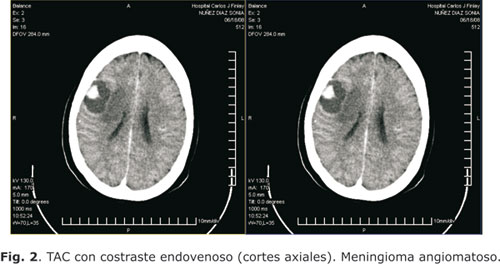
<body><![CDATA[<P><font size="3" face="Verdana"><B>CASO CL&Iacute;NICO</B> </font>     <P><font size="2" face="Verdana">Paciente del sexo femenino, de 66 a&ntilde;os    de edad, con antecedentes de salud que fue llevada al cuerpo de guardia por    presentar convulsiones. El examen f&iacute;sico fue negativo. Se le realiz&oacute;    TAC simple y contrastada, visualiz&aacute;ndose una imagen mixta de contornos    bien definidos, con n&oacute;dulo hiperdenso (30-36 UH) en su interior de &#177;    22 x 15 x 19 mm; el resto de la lesi&oacute;n se observ&oacute; hipodensa (14-19UH)    midiendo en su conjunto 36 x 28 x 35 mm, se localiz&oacute; en la regi&oacute;n    parietal anterior derecha, adyacente a la tabla interna, acompa&ntilde;&aacute;ndose    de edema perilesional y colapso parcial del ventr&iacute;culo lateral homolateral    sin desplazamiento de las estructuras de la l&iacute;nea media (<a href="#fig1">fig.    1</a>). </font>      <P align="center"><a name="fig1"></a><img src="/img/revistas/mil/v39n2/f0112210.jpg" width="450" height="243">      
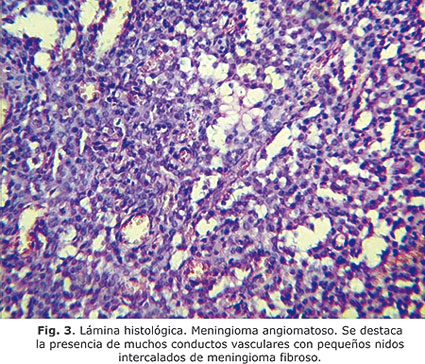
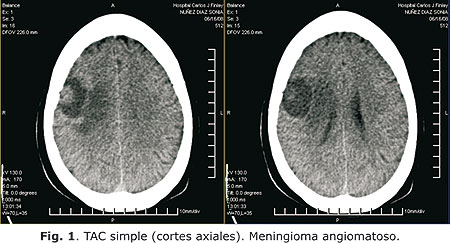
<P><font size="2" face="Verdana">En el TAC con contrate endovenoso, el n&oacute;dulo    se realz&oacute; intensamente, de forma homog&eacute;nea y precoz, la periferia    de la lesi&oacute;n no capt&oacute; (<a href="#fig2">fig. 2</a>). Estos hallazgos    permitieron realizar el diagn&oacute;stico presuntivo de tumor cerebral primario,    probable astrocitoma de bajo grado <I>vs.</I> hemangioblastoma, que por su localizaci&oacute;n    parietal alta podr&iacute;a justificar el cuadro cl&iacute;nico, lo que motiv&oacute;    el tratamiento quir&uacute;rgico, con posterior examen histopatol&oacute;gico,    encontr&aacute;ndose un meningioma angiomatoso (<a href="#fig3">fig.3</a>).    </font>     <P align="center"><a name="fig2"></a><img src="/img/revistas/mil/v39n2/f0212210.jpg" width="500" height="264">      
<P align="center"><a name="fig3"></a><img src="/img/revistas/mil/v39n2/f0312210.jpg" width="425" height="364">      
<P>     <P>      <P><font size="3" face="Verdana"><B>COMENTARIOS</B> </font>     <P><font size="2" face="Verdana">El diagn&oacute;stico preoperatorio del meningioma    qu&iacute;stico constituye un hecho dif&iacute;cil ya que por una parte los    cambios qu&iacute;sticos son infrecuentes en estas neoplasias y por otro lado    muy frecuentes en otras, por lo que son habitualmente confundidos con gliomas    qu&iacute;sticos o con &aacute;reas de necrosis, abscesos intracraneales, met&aacute;stasis    y linfomas.<SUP>6</SUP> </font>     ]]></body>
<body><![CDATA[<P><font size="2" face="Verdana">La bibliograf&iacute;a revisada sugiere que la    existencia de un meningioma qu&iacute;stico debe ser sospechada cuando la porci&oacute;n    qu&iacute;stica del tumor es de similares proporciones que la s&oacute;lida,    cuando el componente s&oacute;lido asienta en los sitios cl&aacute;sicos en    que se encuentran los meningiomas, cuando la apariencia de la porci&oacute;n    s&oacute;lida sea lobulada y se realce uniformemente con el medio de contraste;    especialmente si existen calcificaciones, reacci&oacute;n men&iacute;ngea u    &oacute;sea as&iacute; como afluencia vascular por el sistema carotideo externo    (angiograf&iacute;a cerebral). La resonancia magn&eacute;tica nuclear es m&aacute;s    sensible y espec&iacute;fica para demostrar la existencia de uni&oacute;n del    tumor a las meninges (signo de la cola); no obstante, en la actualidad el diagn&oacute;stico    preoperatorio de esta entidad solo se logra en el 65 % de los casos.<SUP>5,7,8</SUP>    </font>     <P><font size="2" face="Verdana">Un 8 % de estos tumores son de variedad maligna    y un 12 % angiobl&aacute;sticos, pudiendo estar ausente por completo el sitio    de uni&oacute;n a la duramadre. Hasta el momento no se ha demostrado que esta    infrecuente variedad de meningioma lleve impl&iacute;cito mayor riesgo de malignidad    o recidiva.<SUP>5,9</SUP> </font>     <P>      <P><font size="2" face="Verdana">En conclusi&oacute;n,<B> </B>los meningiomas    qu&iacute;sticos constituyen un hallazgo infrecuente en la pr&aacute;ctica neuroquir&uacute;rgica,    no obstante, se debe recordar que existen varios signos imagenol&oacute;gicos    que orientan al diagn&oacute;stico preoperatorio, como la existencia del signo    de la cola, la irrigaci&oacute;n procedente de la car&oacute;tida externa o    la ubicaci&oacute;n en sitios de asentamiento frecuente de meningiomas. </font>     <P>     <P>      <P><font size="3" face="Verdana"><B>REFERENCIAS BIBLIOGR&Aacute;FICAS</B> </font>     <!-- ref --><P><font size="2" face="Verdana">1. Sales Llopis J. Meningioma [Internet]. Servicio    de Neurocirug&iacute;a del Hospital General Universitario de Alicante. 2006.    [Actualizado 17/2/2006; citado octubre de 2009]. Disponible en: <a href="http://www.neurocirugia.com/diagnostico/meningioma/index.htm" target="_blank">http://www.neurocirugia.com/diagnostico/meningioma/index.htm</a>.    </font>    <!-- ref --><P><font size="2" face="Verdana">2. De Girolani V. El sistema nervioso central.    En: Robbinns, Cotran RS, Kumar V, Collins T. Patolog&iacute;a estructural y    funcional. 6ta. ed. Madrid: McGraw Hill;<FONT  COLOR="#00b0f0"> </FONT>2000. p.1339-404. </font>    <!-- ref --><P><font size="2" face="Verdana">3. Gaensler HL, Barakos JA, Barr RM, Gean AD,    Helms CA, Koeller K, et al. Neurorradiolog&iacute;a Fundamental. Madrid: MARB&Aacute;N;    1998. p. 100-34. </font>    <!-- ref --><P><font size="2" face="Verdana">4. Ugarte Su&aacute;rez JC, Ugarte Moreno D,    Jord&aacute;n Gonz&aacute;lez J, Gaspar Obreg&oacute;n A, Quevedo Sotolongo    L, Ferm&iacute;n Hern&aacute;ndez E, et al. Manual de tomograf&iacute;a axial    computarizada multicorte. 3ra ed. La Habana: CIMEQ; 2006. p. 80-2. </font>    <P><font size="2" face="Verdana">5. Varela Hern&aacute;ndez A, S&aacute;nchez    Rodr&iacute;guez H, Rosales Torres P, Zayas Alba E. Presentaci&oacute;n de un    caso de meningioma qu&iacute;stico. Revisi&oacute;n de la literatura. [Internet]    II Congreso Virtual Neurocirug&iacute;a, 2002. Disponible en:    <BR>   <a href="http://www.uninet.edu/neuroc2002/papers/TL-MeningQuist.htm" target="_blank">http://www.uninet.edu/neuroc2002/papers/TL-MeningQuist.htm</a></font>     <!-- ref --><P><font size="2" face="Verdana">6. El- Fiki M, El-Henawy Y, Abdel-Rahman N. Cystic    Meningioma. Acta Neurochirurgica [Internet]; julio de 1996 [citado octubre de    2009]; 138(7): [6 pantallas]. Disponible en: <a href="http://www.springerlink.com/content/ux606m1511637620/fulltext.pdf" target="_blank">http://www.springerlink.com/content/ux606m1511637620/fulltext.pdf</a></font>    <!-- ref --><P><font size="2" face="Verdana">7. McDermott MW, Wilson BC. Meningiomas. In:    Winn RH. Youman Neurological Surgery. Philadelphia: Ed. Saunders; 1996. p. 2782-825.    </font>    <!-- ref --><P><font size="2" face="Verdana">8. Chen CT, Zee Ch, Miller AC, Weiss HM, Tang    G, Chin L, et al. Magnetic resonance imaging and pathological correlates of    meningioma. Neurosurgery. 1992 Diciembre;31(6):1015-21. </font>    <!-- ref --><P><font size="2" face="Verdana">9. Suzuki Y, Sugimoto T, Shibuya M, Sugita K,    Patel JS. Meningioma: Correlation between MRI characteristics and operative    findings including consistency<FONT  COLOR="#ff0000">. </FONT>Acta Neurochirurgica. 1994;129:29-46.</font>    <P>     <P>     <P>      ]]></body>
<body><![CDATA[<P><font size="2" face="Verdana">Recibido: 15 de octubre de 2010.    <br>   </font><font size="2" face="Verdana">Aprobado: 17 de noviembre de 2010.</font>     <P>     <P>     <P>      <P><font size="2" face="Verdana">Dra. <I>Lesly Sol&iacute;s Alfonso</I>. Hospital    Militar Central &quot;Dr. Carlos J. Finlay&quot;.<B> </B>Avenida 114 y 31, Marianao,    La Habana, Cuba. Correo electr&oacute;nico: <U><a href="mailto:vicky@ida.cu">vicky@ida.cu</a></U></font>      ]]></body><back>
<ref-list>
<ref id="B1">
<label>1</label><nlm-citation citation-type="book">
<person-group person-group-type="author">
<name>
<surname><![CDATA[Sales Llopis]]></surname>
<given-names><![CDATA[J]]></given-names>
</name>
</person-group>
<source><![CDATA[Meningioma]]></source>
<year>2006</year>
<publisher-name><![CDATA[Servicio de Neurocirugía del Hospital General Universitario de Alicante]]></publisher-name>
</nlm-citation>
</ref>
<ref id="B2">
<label>2</label><nlm-citation citation-type="book">
<person-group person-group-type="author">
<name>
<surname><![CDATA[De Girolani]]></surname>
<given-names><![CDATA[V]]></given-names>
</name>
</person-group>
<article-title xml:lang="es"><![CDATA[El sistema nervioso central]]></article-title>
<person-group person-group-type="editor">
<name>
<surname><![CDATA[Robbinns, Cotran]]></surname>
<given-names><![CDATA[RS]]></given-names>
</name>
<name>
<surname><![CDATA[Kumar]]></surname>
<given-names><![CDATA[V]]></given-names>
</name>
<name>
<surname><![CDATA[Collins]]></surname>
<given-names><![CDATA[T]]></given-names>
</name>
</person-group>
<source><![CDATA[Patología estructural y funcional]]></source>
<year>2000</year>
<edition>6ta</edition>
<page-range>1339-404</page-range><publisher-loc><![CDATA[Madrid ]]></publisher-loc>
<publisher-name><![CDATA[McGraw Hill]]></publisher-name>
</nlm-citation>
</ref>
<ref id="B3">
<label>3</label><nlm-citation citation-type="book">
<person-group person-group-type="author">
<name>
<surname><![CDATA[Gaensler]]></surname>
<given-names><![CDATA[HL]]></given-names>
</name>
<name>
<surname><![CDATA[Barakos]]></surname>
<given-names><![CDATA[JA]]></given-names>
</name>
<name>
<surname><![CDATA[Barr]]></surname>
<given-names><![CDATA[RM]]></given-names>
</name>
<name>
<surname><![CDATA[Gean]]></surname>
<given-names><![CDATA[AD]]></given-names>
</name>
<name>
<surname><![CDATA[Helms]]></surname>
<given-names><![CDATA[CA]]></given-names>
</name>
<name>
<surname><![CDATA[Koeller]]></surname>
<given-names><![CDATA[K]]></given-names>
</name>
</person-group>
<source><![CDATA[Neurorradiología Fundamental]]></source>
<year>1998</year>
<page-range>100-34</page-range><publisher-loc><![CDATA[Madrid ]]></publisher-loc>
<publisher-name><![CDATA[MARBÁN]]></publisher-name>
</nlm-citation>
</ref>
<ref id="B4">
<label>4</label><nlm-citation citation-type="book">
<person-group person-group-type="author">
<name>
<surname><![CDATA[Ugarte Suárez]]></surname>
<given-names><![CDATA[JC]]></given-names>
</name>
<name>
<surname><![CDATA[Ugarte Moreno]]></surname>
<given-names><![CDATA[D]]></given-names>
</name>
<name>
<surname><![CDATA[Jordán González]]></surname>
<given-names><![CDATA[J]]></given-names>
</name>
<name>
<surname><![CDATA[Gaspar Obregón]]></surname>
<given-names><![CDATA[A]]></given-names>
</name>
<name>
<surname><![CDATA[Quevedo Sotolongo]]></surname>
<given-names><![CDATA[L]]></given-names>
</name>
<name>
<surname><![CDATA[Fermín Hernández]]></surname>
<given-names><![CDATA[E]]></given-names>
</name>
</person-group>
<source><![CDATA[Manual de tomografía axial computarizada multicorte]]></source>
<year>2006</year>
<edition>3ra</edition>
<page-range>80-2</page-range><publisher-loc><![CDATA[La Habana ]]></publisher-loc>
<publisher-name><![CDATA[CIMEQ]]></publisher-name>
</nlm-citation>
</ref>
<ref id="B5">
<label>5</label><nlm-citation citation-type="confpro">
<person-group person-group-type="author">
<name>
<surname><![CDATA[Varela Hernández]]></surname>
<given-names><![CDATA[A]]></given-names>
</name>
<name>
<surname><![CDATA[Sánchez Rodríguez]]></surname>
<given-names><![CDATA[H]]></given-names>
</name>
<name>
<surname><![CDATA[Rosales Torres]]></surname>
<given-names><![CDATA[P]]></given-names>
</name>
<name>
<surname><![CDATA[Zayas Alba]]></surname>
<given-names><![CDATA[E]]></given-names>
</name>
</person-group>
<source><![CDATA[Presentación de un caso de meningioma quístico: Revisión de la literatura]]></source>
<year></year>
<conf-name><![CDATA[II Congreso Virtual Neurocirugía]]></conf-name>
<conf-date>2002</conf-date>
<conf-loc> </conf-loc>
</nlm-citation>
</ref>
<ref id="B6">
<label>6</label><nlm-citation citation-type="journal">
<person-group person-group-type="author">
<name>
<surname><![CDATA[El- Fiki]]></surname>
<given-names><![CDATA[M]]></given-names>
</name>
<name>
<surname><![CDATA[El-Henawy]]></surname>
<given-names><![CDATA[Y]]></given-names>
</name>
<name>
<surname><![CDATA[Abdel-Rahman]]></surname>
<given-names><![CDATA[N]]></given-names>
</name>
</person-group>
<article-title xml:lang="en"><![CDATA[Cystic Meningioma]]></article-title>
<source><![CDATA[Acta Neurochirurgica]]></source>
<year>juli</year>
<month>o </month>
<day>de</day>
<volume>138</volume>
<numero>7</numero>
<issue>7</issue>
</nlm-citation>
</ref>
<ref id="B7">
<label>7</label><nlm-citation citation-type="book">
<person-group person-group-type="author">
<name>
<surname><![CDATA[Mc Dermott]]></surname>
<given-names><![CDATA[MW]]></given-names>
</name>
<name>
<surname><![CDATA[Wilson]]></surname>
<given-names><![CDATA[BC]]></given-names>
</name>
</person-group>
<article-title xml:lang="es"><![CDATA[Meningiomas]]></article-title>
<person-group person-group-type="editor">
<name>
<surname><![CDATA[Winn]]></surname>
<given-names><![CDATA[RH]]></given-names>
</name>
</person-group>
<source><![CDATA[Youman Neurological Surgery]]></source>
<year>1996</year>
<page-range>2782-825</page-range><publisher-loc><![CDATA[Philadelphia ]]></publisher-loc>
<publisher-name><![CDATA[Ed. Saunders]]></publisher-name>
</nlm-citation>
</ref>
<ref id="B8">
<label>8</label><nlm-citation citation-type="journal">
<person-group person-group-type="author">
<name>
<surname><![CDATA[Chen]]></surname>
<given-names><![CDATA[CT]]></given-names>
</name>
<name>
<surname><![CDATA[Zee]]></surname>
<given-names><![CDATA[Ch]]></given-names>
</name>
<name>
<surname><![CDATA[Miller]]></surname>
<given-names><![CDATA[AC]]></given-names>
</name>
<name>
<surname><![CDATA[Weiss]]></surname>
<given-names><![CDATA[HM]]></given-names>
</name>
<name>
<surname><![CDATA[Tang]]></surname>
<given-names><![CDATA[G]]></given-names>
</name>
<name>
<surname><![CDATA[Chin]]></surname>
<given-names><![CDATA[L]]></given-names>
</name>
</person-group>
<article-title xml:lang="en"><![CDATA[Magnetic resonance imaging and pathological correlates of meningioma]]></article-title>
<source><![CDATA[Neurosurgery.]]></source>
<year>1992</year>
<month> D</month>
<day>ic</day>
<volume>31</volume>
<numero>6</numero>
<issue>6</issue>
<page-range>1015-21</page-range></nlm-citation>
</ref>
<ref id="B9">
<label>9</label><nlm-citation citation-type="journal">
<person-group person-group-type="author">
<name>
<surname><![CDATA[Suzuki]]></surname>
<given-names><![CDATA[Y]]></given-names>
</name>
<name>
<surname><![CDATA[Sugimoto]]></surname>
<given-names><![CDATA[T]]></given-names>
</name>
<name>
<surname><![CDATA[Shibuya]]></surname>
<given-names><![CDATA[M]]></given-names>
</name>
<name>
<surname><![CDATA[Sugita]]></surname>
<given-names><![CDATA[K]]></given-names>
</name>
<name>
<surname><![CDATA[Patel]]></surname>
<given-names><![CDATA[JS]]></given-names>
</name>
</person-group>
<article-title xml:lang="es"><![CDATA[Meningioma: Correlation between MRI characteristics and operative findings including consistency]]></article-title>
<source><![CDATA[Acta Neurochirurgica.]]></source>
<year>1994</year>
<volume>129</volume>
<page-range>29-46</page-range></nlm-citation>
</ref>
</ref-list>
</back>
</article>