<?xml version="1.0" encoding="ISO-8859-1"?><article xmlns:mml="http://www.w3.org/1998/Math/MathML" xmlns:xlink="http://www.w3.org/1999/xlink" xmlns:xsi="http://www.w3.org/2001/XMLSchema-instance">
<front>
<journal-meta>
<journal-id>0253-570X</journal-id>
<journal-title><![CDATA[Revista de Salud Animal]]></journal-title>
<abbrev-journal-title><![CDATA[Rev Salud Anim.]]></abbrev-journal-title>
<issn>0253-570X</issn>
<publisher>
<publisher-name><![CDATA[Centro Nacional de Sanidad Agropecuaria]]></publisher-name>
</publisher>
</journal-meta>
<article-meta>
<article-id>S0253-570X2007000100006</article-id>
<title-group>
<article-title xml:lang="en"><![CDATA[WEIGHT DIFFERENCES BETWEEN Boophilus microplus (IXODOIDEA: IXODIDAE) FROM BRAZIL AND FROM CUBA]]></article-title>
<article-title xml:lang="es"><![CDATA[DIFERENCIAS DE PESO ENTRE Boophilus microplus (IXODOIDEA:IXODIDAE) DE BRASIL Y DE CUBA]]></article-title>
</title-group>
<contrib-group>
<contrib contrib-type="author">
<name>
<surname><![CDATA[de la Vega]]></surname>
<given-names><![CDATA[R]]></given-names>
</name>
<xref ref-type="aff" rid="A01"/>
</contrib>
<contrib contrib-type="author">
<name>
<surname><![CDATA[Díaz]]></surname>
<given-names><![CDATA[G]]></given-names>
</name>
<xref ref-type="aff" rid="A02"/>
</contrib>
<contrib contrib-type="author">
<name>
<surname><![CDATA[Camejo]]></surname>
<given-names><![CDATA[A]]></given-names>
</name>
<xref ref-type="aff" rid="A01"/>
</contrib>
<contrib contrib-type="author">
<name>
<surname><![CDATA[Fonseca]]></surname>
<given-names><![CDATA[A.H]]></given-names>
</name>
<xref ref-type="aff" rid="A03"/>
</contrib>
<contrib contrib-type="author">
<name>
<surname><![CDATA[Passos Rangel]]></surname>
<given-names><![CDATA[C]]></given-names>
</name>
<xref ref-type="aff" rid="A03"/>
</contrib>
</contrib-group>
<aff id="A01">
<institution><![CDATA[,LABIOFAM  ]]></institution>
<addr-line><![CDATA[Ciudad Habana ]]></addr-line>
<country>Cuba</country>
</aff>
<aff id="A02">
<institution><![CDATA[,Universidad de La Habana Facultad de Biología Departamento Biología Animal y Humana]]></institution>
<addr-line><![CDATA[ ]]></addr-line>
</aff>
<aff id="A03">
<institution><![CDATA[,Universidad Federal Rural de Rio do Janeiro  ]]></institution>
<addr-line><![CDATA[Antiga Rodovia Rio-São Paulo ]]></addr-line>
<country>Brasil</country>
</aff>
<pub-date pub-type="pub">
<day>00</day>
<month>04</month>
<year>2007</year>
</pub-date>
<pub-date pub-type="epub">
<day>00</day>
<month>04</month>
<year>2007</year>
</pub-date>
<volume>29</volume>
<numero>1</numero>
<fpage>36</fpage>
<lpage>38</lpage>
<copyright-statement/>
<copyright-year/>
<self-uri xlink:href="http://scielo.sld.cu/scielo.php?script=sci_arttext&amp;pid=S0253-570X2007000100006&amp;lng=en&amp;nrm=iso"></self-uri><self-uri xlink:href="http://scielo.sld.cu/scielo.php?script=sci_abstract&amp;pid=S0253-570X2007000100006&amp;lng=en&amp;nrm=iso"></self-uri><self-uri xlink:href="http://scielo.sld.cu/scielo.php?script=sci_pdf&amp;pid=S0253-570X2007000100006&amp;lng=en&amp;nrm=iso"></self-uri><abstract abstract-type="short" xml:lang="en"><p><![CDATA[Weights of engorged females and recently molted adults Boophilus microplus (both females and males) from Cuba and Brazil were compared by means of t-Student tests. It was observed that Brazilian ticks were always significantly heavier than those from Cuba. Some comments about the possible causes, significance of observation and further researches to be performed are offered.]]></p></abstract>
<abstract abstract-type="short" xml:lang="en"><p><![CDATA[Key words: ticks; weight; Boophilus; Ixodoidea; Ixodidae]]></p></abstract>
<abstract abstract-type="short" xml:lang="es"><p><![CDATA[Se comparó el peso de hembras repletas y adultos recién mudados (hembras y machos) de Boophilus microplus de Cuba y de Brasil mediante pruebas de t de Student. Se observó que las garrapatas de Brasil fueron siempre significativamente más pesadas que las de Cuba. Se comenta sobre las posibles causas y significado de este fenómeno y de las futuras investigaciones a realizar.]]></p></abstract>
<kwd-group>
<kwd lng="es"><![CDATA[garrapatas]]></kwd>
<kwd lng="es"><![CDATA[peso]]></kwd>
<kwd lng="es"><![CDATA[Boophilus]]></kwd>
<kwd lng="es"><![CDATA[Ixodoidea]]></kwd>
<kwd lng="es"><![CDATA[Ixodidae]]></kwd>
</kwd-group>
</article-meta>
</front><body><![CDATA[ <p align="right"><font face="Verdana, Arial, Helvetica, sans-serif" size="2"><b>Art&iacute;culo    original</b></font></p>     <p>&nbsp;</p>     <p>&nbsp;</p>     <p><font face="Verdana, Arial, Helvetica, sans-serif" size="2"><B><font size="4">WEIGHT    DIFFERENCES BETWEEN <I>Boophilus microplus</I> (IXODOIDEA: IXODIDAE) FROM BRAZIL    AND FROM CUBA</font></B></font></p>     <p>&nbsp;</p>     <p><font face="Verdana, Arial, Helvetica, sans-serif" size="2"><b><font size="3">DIFERENCIAS    DE PESO ENTRE B<i>oophilus microplus</i> (IXODOIDEA:IXODIDAE) DE BRASIL Y DE    CUBA</font></b></font></p> <B>     <P>      <P>      <P><font face="Verdana, Arial, Helvetica, sans-serif" size="2">R. de la Vega*,    G. D&iacute;az**, A Camejo*, A.H. Fonseca*** and C. Passos Rangel*** </font> </B>      <P><font face="Verdana, Arial, Helvetica, sans-serif" size="2"><I>*LABIOFAM, Apartado    34, General Peraza, CP-19210, Ciudad Habana, Cuba FAX: (537)334857, E-mail:    delavega@infomed.sld.cu; **Departamento Biolog&iacute;a Animal y Humana, Facultad    de Biolog&iacute;a, Universidad de La Habana, E-mail:<a href="mailto:gdacosta@fbio.uh.cu"> gdacosta@fbio.uh.cu</a>; ***Universidad    Federal Rural de Rio do Janeiro, Serop&eacute;dica, RJ, Brasil Km 47 Antiga    Rodovia Rio-S&atilde;o Paulo, E-mail: <a href="mailto:adivaldo@ufrrj.br">adivaldo@ufrrj.br</a> </I> </font>     ]]></body>
<body><![CDATA[<P>      <P>  <hr noshade size="1">     <P><font face="Verdana, Arial, Helvetica, sans-serif" size="2"><B>ABSTRACT</B>    </font>     <P><font face="Verdana, Arial, Helvetica, sans-serif" size="2">Weights of engorged    females and recently molted adults <I>Boophilus microplus </I>(both females    and males) from Cuba and Brazil were compared by means of t-Student tests. It    was observed that Brazilian ticks were always significantly heavier than those    from Cuba. Some comments about the possible causes, significance of observation    and further researches to be performed are offered. </font>     <P><font face="Verdana, Arial, Helvetica, sans-serif" size="2"><b>Key words:</b>    ticks; weight; Boophilus; Ixodoidea; Ixodidae. </font> <hr noshade size="1">     <P><font face="Verdana, Arial, Helvetica, sans-serif" size="2"><b>RESUMEN </b></font>     <P><font face="Verdana, Arial, Helvetica, sans-serif" size="2">Se compar&oacute;    el peso de hembras repletas y adultos reci&eacute;n mudados (hembras y machos)    de <I>Boophilus microplus</I> de Cuba y de Brasil mediante pruebas de t de Student.    Se observ&oacute; que las garrapatas de Brasil fueron siempre significativamente    m&aacute;s pesadas que las de Cuba. Se comenta sobre las posibles causas y significado    de este fen&oacute;meno y de las futuras investigaciones a realizar. </font>     <P><font face="Verdana, Arial, Helvetica, sans-serif" size="2"><b>Palabras clave:</b>    garrapatas; peso; Boophilus; Ixodoidea; Ixodidae. </font> <hr noshade size="1">     <P>      <P>      ]]></body>
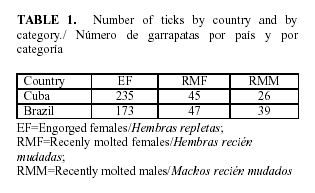
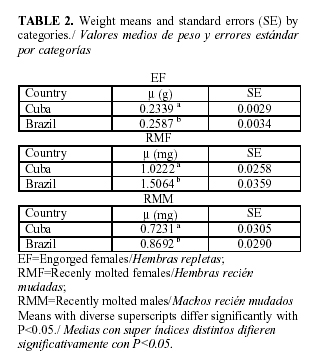
<body><![CDATA[<P><font face="Verdana, Arial, Helvetica, sans-serif" size="2"><B><font size="3">INTRODUCTION</font></B>    </font>     <P><font face="Verdana, Arial, Helvetica, sans-serif" size="2">Ecology has been    linked to divergence and speciation, but debates about evolution in sympatry    have often eclipsed its importance. Nevertheless, recent studies on diverse    taxa have suggested that natural selection caused by shifts in ecology or invasion    of novel habitats could develop in extremely rapid rates of evolutionary divergence.    Experimental approaches linking rapid ecological divergences are scarce, though    recent papers indicate those are the best approaches to be used (7). </font>     <P><font face="Verdana, Arial, Helvetica, sans-serif" size="2">In parasites, number    of diversifying factors is potentially larger than in free living organisms,    because host-parasite coevolution (5). Otherwise, there have been relatively    few traditional phylo-geographical studies on non-free living species (1). It    was seen that when <I>Boophilus microplus </I>from Australia and from South    Africa were crossed, a high degree of infertility and of sterile hybrids were    obtained (11). Also, Davey <I>et al. </I>(2) looked for differences in weight    on <I>B. microplus </I>ticks from different areas of Mexico and USA, including    Puerto Rico, and found that weights of ticks varied with location. In the present    paper, it was reported on a weight comparison of recently molted<I> B. microplus    </I>(females and males) and engorged females from Cuba and from Brazil. </font>     <P>      <P><font face="Verdana, Arial, Helvetica, sans-serif" size="2"><B><font size="3">MATERIALS    AND METHODS</font></B> </font>     <P><font face="Verdana, Arial, Helvetica, sans-serif" size="2">Holstein calfs    were infested with groups of 10 000 <I>B. microplus </I>larvae. At 13 and 14    days after infestation, nymphs were collected and incubated at 28<SUP>o</SUP>C    and relative humidity over 80%. Adults were sexed and weighed in an analytical    balance (P=0.0001g). Engorged females were taken from the floor of the stable    and similarly weighed. </font>     <P><font face="Verdana, Arial, Helvetica, sans-serif" size="2">Statistical Analysis._    In each category, mean (m) in grams (g) or in milligrams (mg) and standard deviation    (SD) were calculated and any weights not in the interval m &#177; 2*(SD) were    discarded. The m and SD were then recalculated. In all groups, a t-Student test    was done. Before mean comparison, a test of variance homogeneity was performed.    </font>     <P>      <P><font face="Verdana, Arial, Helvetica, sans-serif" size="2"><B><font size="3">RESULTS</font></B>    </font>     <P><font face="Verdana, Arial, Helvetica, sans-serif" size="2"><a href="#t1">Table 1</a> shows number    of ticks utilized within each category and country of the experiment, while      <a href="#t2">Table 2</a> summarizes the comparative results. </font>     ]]></body>
<body><![CDATA[<P><font face="Verdana, Arial, Helvetica, sans-serif" size="2"><a name="t1"></a><img src="/img/revistas/rsa/v29n1/f0106107.gif" width="315" height="193"></font>      
<P><font face="Verdana, Arial, Helvetica, sans-serif" size="2"><a name="t2"></a><img src="/img/revistas/rsa/v29n1/f0206107.gif" width="319" height="363"></font>     
<P><font face="Verdana, Arial, Helvetica, sans-serif" size="2"><B><font size="3">DISCUSSION</font></B>    </font>     <P><font face="Verdana, Arial, Helvetica, sans-serif" size="2">In all categories,    Brazilian ticks were heavier than Cuban ones. Geographical isolation could be    invoked as a possible explanation of this divergence as ecological conditions    of Rio de Janeiro are somewhat different to those of Havana. Otherwise, some    authors (4,8) consider that processes of ecological, sexual, and spatial differentiation    can interact to create reproductively isolated lineages without geographical    isolation. Davey <I>et al</I>. (2) found ovipositional and morphological differences    between <I>B. microplus</I> from different sites of the USA-Mexico border and    from Puerto Rico. Also, they verified that ticks raised in laboratory were the    heaviest and ticks from Puerto Rico the lightest. Besides, these authors encountered    morphological differences between males of these sites. However, in a study    in USA (9), four natural colonies and four laboratory colonies of <I>B. microplus</I>    were subjected to eletrophoretic analysis to determine levels of genetic similarity    and genetic variability. Results have shown that high genetic similarity (I=0.984&#177;0.012)    and low genetic variability (h=0.092&#177;0.008) exist among these eight populations.    Recently (10), in 30 <I>B.microplus</I> strains from different sites of Brazil,    Argentina, Colombia, Venezuela and Uruguay, variations were seen in bm86 and    bm95 genes that could explain the variable efficiencies of recombinant vaccines    derived from the Bm86 and Bm95 proteins in different <I>B. microplus </I>strains.    </font>     <P><font face="Verdana, Arial, Helvetica, sans-serif" size="2">Otherwise, differences    in eggs weight between <I>B. microplus</I> from Brazil and from Cuba also seem    to exist according to Labruna <I>et al</I>. (6) report: mean egg weight=0.0050    g and De la Vega (3) results: mean egg weight=0.0044 g. Again, weights from    Brazil are higher than those from Cuba. Wilding <I>et al</I>. (12) afirme that    speciation requires the acquisition of reproductive isolation, which is still    to be proven in the present species from Cuba and from Brazil. Present results    could not be interpreted as initial signs of speciation until works about genetic    similarity and variability and about sexual behavior and the output of cross-matings    of <I>B. microplus</I> of both countries were performed. </font>     <P>      <P><font face="Verdana, Arial, Helvetica, sans-serif" size="2"><B><font size="3">ACKNOWLEDGEMENTS</font></B>    </font>     <P><font face="Verdana, Arial, Helvetica, sans-serif" size="2">To Mr. Edward Deutsch    for the revision of this paper. To Dr. Jorge de la Cruz for his valuable advices.    </font>     <P>      <P><font face="Verdana, Arial, Helvetica, sans-serif" size="2"><B><font size="3">REFERENCES</font></B>    </font>     ]]></body>
<body><![CDATA[<!-- ref --><P><font face="Verdana, Arial, Helvetica, sans-serif" size="2">1. Criscione CD,    Poulin R, Blouin MS. Molecular ecology of parasites: elucidating ecological    and microevolutionary processes. <I>Mol Ecol.</I> 2005;14:2247-2257. </font>     <!-- ref --><P><font face="Verdana, Arial, Helvetica, sans-serif" size="2">2. Davey RB, Osburn    RL, Miller JA. Ovipositional and Morphological Comparisons of <I>Boophilus microplus    </I>(Acari:Ixodidae) collected from Different Geographic Areas. <I>Ann Entomol    Soc Am. </I>1984;77:1-5. </font>     <!-- ref --><P><font face="Verdana, Arial, Helvetica, sans-serif" size="2">3. de la Vega,    R. A note on some factors influencing the mean egg weight of cattle tick <I>Boophilus    microplus</I> (Canestrini) (Ixodoidea: Ixodidae). <I>Cuban J. Agric. Sci.</I>    1976;10:313-316. </font>     <!-- ref --><P><font face="Verdana, Arial, Helvetica, sans-serif" size="2">4. Dieckmann U,    Doebeli M. On the origin of species by sympatric speciation. <I>Nature. </I>1999;400:354-357.    </font>     <!-- ref --><P><font face="Verdana, Arial, Helvetica, sans-serif" size="2">5. Huyse T, Poulin    R, Th&eacute;ron A. Speciation in parasites: a population genetic approach.    <I>Trends Parasitol.</I> 2005;21(10):469-475. </font>     <!-- ref --><P><font face="Verdana, Arial, Helvetica, sans-serif" size="2">6. Labruna MB,    Leite RC, Oliveira PR. Study of the Weight of Eggs from Six Ixodid Species from    Brazil. <I>Mem Inst Oswaldo Cruz.</I> 1997;92(2):205-207. </font>     <!-- ref --><P><font face="Verdana, Arial, Helvetica, sans-serif" size="2">7. Orr MR, Smith    TB. Ecology and speciation. <I>TREE</I> 1998;13(12):502-506. </font>     <!-- ref --><P><font face="Verdana, Arial, Helvetica, sans-serif" size="2">8. Sander van Doorn    G, Dieckmann U, Weissing FJ. Sympatric Speciation by Sexual Selection: A Critical    Reevaluation. <I>Am Nat.</I> 2004;163(5):709-725. </font>     <!-- ref --><P><font face="Verdana, Arial, Helvetica, sans-serif" size="2">9. Sattler PW,    Hilburn LR, Davey RB, George JE, Rojas Avalos JB.Genetic Similarity and Variability    between Natural Populations and Laboratory Colonies of North American <I>Boophilus</I>    (Acari:Ixodidae). <I>J Parasitol.</I> 1986;72(1):95-100. </font>     <!-- ref --><P><font face="Verdana, Arial, Helvetica, sans-serif" size="2">10.Sossai S, Peconick    AP, Sales-Junior PA, Marcelino FC, Vargas MI, Neves ES. Polymorphism of the    bm86 gene in South American strains of the cattle tick <I>Boophilus microplus.</I>    <I>Exp Appl Acarol.</I> 2005;37:199-214. </font>     <!-- ref --><P><font face="Verdana, Arial, Helvetica, sans-serif" size="2">11.Spickett AM,    Malan JR. Genetic Incompatibility between <I>Boophilus decoloratus</I> (Koch,    1844) and <I>Boophilus microplus</I> (Canestrini, 1888) and Hybrid Sterility    of Australian and South African <I>Boophilus microplus</I> (Acarina:Ixodidae).<I>    </I>Onderstepoort <I>J Vet Res</I>. 1978;45:149-153. </font>     <!-- ref --><P><font face="Verdana, Arial, Helvetica, sans-serif" size="2">12.Wilding CS,    Butlin RK, Grahame J. Differential gene exchange between parapatric morphs of    <I>Littorina saxatilis</I> detected using AFLP markers. <I>J Evol Biol.</I>    2001;14 611-619. </font>     <P>      <P>      <P>      <P>      <P>      <P>      <P>      <P><font face="Verdana, Arial, Helvetica, sans-serif" size="2"><B>(Recibido 20-2-2006;    Aceptado 18-3-2006)</B> </font>     ]]></body>
<body><![CDATA[ ]]></body><back>
<ref-list>
<ref id="B1">
<label>1</label><nlm-citation citation-type="journal">
<person-group person-group-type="author">
<name>
<surname><![CDATA[Criscione]]></surname>
<given-names><![CDATA[CD]]></given-names>
</name>
<name>
<surname><![CDATA[Poulin]]></surname>
<given-names><![CDATA[R]]></given-names>
</name>
<name>
<surname><![CDATA[Blouin]]></surname>
<given-names><![CDATA[MS]]></given-names>
</name>
</person-group>
<article-title xml:lang="en"><![CDATA[Molecular ecology of parasites: elucidating ecological and microevolutionary processes]]></article-title>
<source><![CDATA[Mol Ecol]]></source>
<year>2005</year>
<volume>14</volume>
<page-range>2247-2257</page-range></nlm-citation>
</ref>
<ref id="B2">
<label>2</label><nlm-citation citation-type="journal">
<person-group person-group-type="author">
<name>
<surname><![CDATA[Davey]]></surname>
<given-names><![CDATA[RB]]></given-names>
</name>
<name>
<surname><![CDATA[Osburn]]></surname>
<given-names><![CDATA[RL]]></given-names>
</name>
<name>
<surname><![CDATA[Miller]]></surname>
<given-names><![CDATA[JA]]></given-names>
</name>
</person-group>
<article-title xml:lang="en"><![CDATA[Ovipositional and Morphological Comparisons of Boophilus microplus (Acari:Ixodidae) collected from Different Geographic Areas]]></article-title>
<source><![CDATA[Ann Entomol Soc Am]]></source>
<year>1984</year>
<volume>77</volume>
<page-range>1-5</page-range></nlm-citation>
</ref>
<ref id="B3">
<label>3</label><nlm-citation citation-type="journal">
<person-group person-group-type="author">
<name>
<surname><![CDATA[de la Vega]]></surname>
<given-names><![CDATA[R]]></given-names>
</name>
</person-group>
<article-title xml:lang="en"><![CDATA[A note on some factors influencing the mean egg weight of cattle tick Boophilus microplus (Canestrini) (Ixodoidea: Ixodidae)]]></article-title>
<source><![CDATA[Cuban J Agric Sci]]></source>
<year>1976</year>
<volume>10</volume>
<page-range>313-316</page-range></nlm-citation>
</ref>
<ref id="B4">
<label>4</label><nlm-citation citation-type="journal">
<person-group person-group-type="author">
<name>
<surname><![CDATA[Dieckmann]]></surname>
<given-names><![CDATA[U]]></given-names>
</name>
<name>
<surname><![CDATA[Doebeli]]></surname>
<given-names><![CDATA[M]]></given-names>
</name>
</person-group>
<article-title xml:lang="en"><![CDATA[On the origin of species by sympatric speciation]]></article-title>
<source><![CDATA[Nature]]></source>
<year>1999</year>
<volume>400</volume>
<page-range>354-357</page-range></nlm-citation>
</ref>
<ref id="B5">
<label>5</label><nlm-citation citation-type="journal">
<person-group person-group-type="author">
<name>
<surname><![CDATA[Huyse]]></surname>
<given-names><![CDATA[T]]></given-names>
</name>
<name>
<surname><![CDATA[Poulin]]></surname>
<given-names><![CDATA[R]]></given-names>
</name>
<name>
<surname><![CDATA[Théron]]></surname>
<given-names><![CDATA[A]]></given-names>
</name>
</person-group>
<article-title xml:lang="en"><![CDATA[Speciation in parasites: a population genetic approach]]></article-title>
<source><![CDATA[Trends Parasitol]]></source>
<year>2005</year>
<volume>21</volume>
<numero>10</numero>
<issue>10</issue>
<page-range>469-475</page-range></nlm-citation>
</ref>
<ref id="B6">
<label>6</label><nlm-citation citation-type="journal">
<person-group person-group-type="author">
<name>
<surname><![CDATA[Labruna]]></surname>
<given-names><![CDATA[MB]]></given-names>
</name>
<name>
<surname><![CDATA[Leite]]></surname>
<given-names><![CDATA[RC]]></given-names>
</name>
<name>
<surname><![CDATA[Oliveira]]></surname>
<given-names><![CDATA[PR]]></given-names>
</name>
</person-group>
<article-title xml:lang="en"><![CDATA[Study of the Weight of Eggs from Six Ixodid Species from Brazil]]></article-title>
<source><![CDATA[Mem Inst Oswaldo Cruz]]></source>
<year>1997</year>
<volume>92</volume>
<numero>2</numero>
<issue>2</issue>
<page-range>205-207</page-range></nlm-citation>
</ref>
<ref id="B7">
<label>7</label><nlm-citation citation-type="journal">
<person-group person-group-type="author">
<name>
<surname><![CDATA[Orr]]></surname>
<given-names><![CDATA[MR]]></given-names>
</name>
<name>
<surname><![CDATA[Smith]]></surname>
<given-names><![CDATA[TB]]></given-names>
</name>
</person-group>
<article-title xml:lang="en"><![CDATA[Ecology and speciation]]></article-title>
<source><![CDATA[TREE]]></source>
<year>1998</year>
<volume>13</volume>
<numero>12</numero>
<issue>12</issue>
<page-range>502-506</page-range></nlm-citation>
</ref>
<ref id="B8">
<label>8</label><nlm-citation citation-type="journal">
<person-group person-group-type="author">
<name>
<surname><![CDATA[Sander van Doorn]]></surname>
<given-names><![CDATA[G]]></given-names>
</name>
<name>
<surname><![CDATA[Dieckmann]]></surname>
<given-names><![CDATA[U]]></given-names>
</name>
<name>
<surname><![CDATA[Weissing]]></surname>
<given-names><![CDATA[FJ]]></given-names>
</name>
</person-group>
<article-title xml:lang="en"><![CDATA[Sympatric Speciation by Sexual Selection: A Critical Reevaluation]]></article-title>
<source><![CDATA[Am Nat]]></source>
<year>2004</year>
<volume>163</volume>
<numero>5</numero>
<issue>5</issue>
<page-range>709-725</page-range></nlm-citation>
</ref>
<ref id="B9">
<label>9</label><nlm-citation citation-type="journal">
<person-group person-group-type="author">
<name>
<surname><![CDATA[Sattler]]></surname>
<given-names><![CDATA[PW]]></given-names>
</name>
<name>
<surname><![CDATA[Hilburn]]></surname>
<given-names><![CDATA[LR]]></given-names>
</name>
<name>
<surname><![CDATA[Davey]]></surname>
<given-names><![CDATA[RB]]></given-names>
</name>
<name>
<surname><![CDATA[George]]></surname>
<given-names><![CDATA[JE]]></given-names>
</name>
<name>
<surname><![CDATA[Rojas Avalos]]></surname>
<given-names><![CDATA[JB]]></given-names>
</name>
</person-group>
<article-title xml:lang="en"><![CDATA[Genetic Similarity and Variability between Natural Populations and Laboratory Colonies of North American Boophilus (Acari:Ixodidae)]]></article-title>
<source><![CDATA[J Parasitol]]></source>
<year>1986</year>
<volume>72</volume>
<numero>1</numero>
<issue>1</issue>
<page-range>95-100</page-range></nlm-citation>
</ref>
<ref id="B10">
<label>10</label><nlm-citation citation-type="journal">
<person-group person-group-type="author">
<name>
<surname><![CDATA[Sossai]]></surname>
<given-names><![CDATA[S]]></given-names>
</name>
<name>
<surname><![CDATA[Peconick]]></surname>
<given-names><![CDATA[AP]]></given-names>
</name>
<name>
<surname><![CDATA[Sales-Junior]]></surname>
<given-names><![CDATA[PA]]></given-names>
</name>
<name>
<surname><![CDATA[Marcelino]]></surname>
<given-names><![CDATA[FC]]></given-names>
</name>
<name>
<surname><![CDATA[Vargas]]></surname>
<given-names><![CDATA[MI]]></given-names>
</name>
<name>
<surname><![CDATA[Neves]]></surname>
<given-names><![CDATA[ES]]></given-names>
</name>
</person-group>
<article-title xml:lang="en"><![CDATA[Polymorphism of the bm86 gene in South American strains of the cattle tick Boophilus microplus]]></article-title>
<source><![CDATA[Exp Appl Acarol]]></source>
<year>2005</year>
<volume>37</volume>
<page-range>199-214</page-range></nlm-citation>
</ref>
<ref id="B11">
<label>11</label><nlm-citation citation-type="journal">
<person-group person-group-type="author">
<name>
<surname><![CDATA[Spickett]]></surname>
<given-names><![CDATA[AM]]></given-names>
</name>
<name>
<surname><![CDATA[Malan]]></surname>
<given-names><![CDATA[JR]]></given-names>
</name>
</person-group>
<article-title xml:lang="en"><![CDATA[Genetic Incompatibility between Boophilus decoloratus (Koch, 1844) and Boophilus microplus (Canestrini, 1888) and Hybrid Sterility of Australian and South African Boophilus microplus (Acarina:Ixodidae)]]></article-title>
<source><![CDATA[Onderstepoort J Vet Res]]></source>
<year>1978</year>
<volume>45</volume>
<page-range>149-153</page-range></nlm-citation>
</ref>
<ref id="B12">
<label>12</label><nlm-citation citation-type="journal">
<person-group person-group-type="author">
<name>
<surname><![CDATA[Wilding]]></surname>
<given-names><![CDATA[CS]]></given-names>
</name>
<name>
<surname><![CDATA[Butlin]]></surname>
<given-names><![CDATA[RK]]></given-names>
</name>
<name>
<surname><![CDATA[Grahame]]></surname>
<given-names><![CDATA[J]]></given-names>
</name>
</person-group>
<article-title xml:lang="en"><![CDATA[Differential gene exchange between parapatric morphs of Littorina saxatilis detected using AFLP markers]]></article-title>
<source><![CDATA[J Evol Biol]]></source>
<year>2001</year>
<volume>14</volume>
<page-range>611-619</page-range></nlm-citation>
</ref>
</ref-list>
</back>
</article>