<?xml version="1.0" encoding="ISO-8859-1"?><article xmlns:mml="http://www.w3.org/1998/Math/MathML" xmlns:xlink="http://www.w3.org/1999/xlink" xmlns:xsi="http://www.w3.org/2001/XMLSchema-instance">
<front>
<journal-meta>
<journal-id>0253-570X</journal-id>
<journal-title><![CDATA[Revista de Salud Animal]]></journal-title>
<abbrev-journal-title><![CDATA[Rev Salud Anim.]]></abbrev-journal-title>
<issn>0253-570X</issn>
<publisher>
<publisher-name><![CDATA[Centro Nacional de Sanidad Agropecuaria]]></publisher-name>
</publisher>
</journal-meta>
<article-meta>
<article-id>S0253-570X2009000300003</article-id>
<title-group>
<article-title xml:lang="en"><![CDATA[A POLYCLONAL -ANTIBODY-IMMUNOPEROXIDASE-CONJUGATE FOR THE SPECIFIC DETECTION OF PORCINE CIRCOVIRUS TYPE 2]]></article-title>
<article-title xml:lang="es"><![CDATA[ANTICUERPO POLICLONAL CONJUGADO CON PEROXIDASA PARA LA DETECCIÓN ESPECÍFICA DE CIRCOVIRUS PORCINO TIPO 2]]></article-title>
</title-group>
<contrib-group>
<contrib contrib-type="author">
<name>
<surname><![CDATA[Pérez]]></surname>
<given-names><![CDATA[L.J.]]></given-names>
</name>
<xref ref-type="aff" rid="A01"/>
</contrib>
<contrib contrib-type="author">
<name>
<surname><![CDATA[Díaz de Arce]]></surname>
<given-names><![CDATA[Heidy]]></given-names>
</name>
<xref ref-type="aff" rid="A01"/>
</contrib>
<contrib contrib-type="author">
<name>
<surname><![CDATA[Barrera]]></surname>
<given-names><![CDATA[Maritza]]></given-names>
</name>
<xref ref-type="aff" rid="A01"/>
</contrib>
<contrib contrib-type="author">
<name>
<surname><![CDATA[Castell]]></surname>
<given-names><![CDATA[Sara]]></given-names>
</name>
<xref ref-type="aff" rid="A01"/>
</contrib>
<contrib contrib-type="author">
<name>
<surname><![CDATA[Frías]]></surname>
<given-names><![CDATA[María T]]></given-names>
</name>
<xref ref-type="aff" rid="A01"/>
</contrib>
</contrib-group>
<aff id="A01">
<institution><![CDATA[,Centro Nacional de Sanidad Agropecuaria (CENSA) Departamento Virología ]]></institution>
<addr-line><![CDATA[La Habana ]]></addr-line>
<country>Cuba</country>
</aff>
<pub-date pub-type="pub">
<day>00</day>
<month>12</month>
<year>2009</year>
</pub-date>
<pub-date pub-type="epub">
<day>00</day>
<month>12</month>
<year>2009</year>
</pub-date>
<volume>31</volume>
<numero>3</numero>
<fpage>152</fpage>
<lpage>157</lpage>
<copyright-statement/>
<copyright-year/>
<self-uri xlink:href="http://scielo.sld.cu/scielo.php?script=sci_arttext&amp;pid=S0253-570X2009000300003&amp;lng=en&amp;nrm=iso"></self-uri><self-uri xlink:href="http://scielo.sld.cu/scielo.php?script=sci_abstract&amp;pid=S0253-570X2009000300003&amp;lng=en&amp;nrm=iso"></self-uri><self-uri xlink:href="http://scielo.sld.cu/scielo.php?script=sci_pdf&amp;pid=S0253-570X2009000300003&amp;lng=en&amp;nrm=iso"></self-uri><abstract abstract-type="short" xml:lang="en"><p><![CDATA[Porcine circovirus 2 is nowadays accepted as the essential infectious agent of postweaning multisystemic wasting syndrome which causes severe economic losses in porcine production worldwide. The diagnosis of PMWS is a difficult task and must follow three criteria: (i) the presence of compatible clinical signs, (ii) the presence of characteristic microscopic histopathological lesions, and (iii) the presence of PCV2 within these lesions in moderate or high. The presence of PCV2 in lymphoid tissues must be demonstrated by in situ hybridization or immunohistochemical methods. The in situ hybridization is a more complex and expense compared to other diagnostic tools, on the other hand, one problem concerning the immunohistochemical methods for PMWS diagnostic is the lack of a commercial anti-PCV2 peroxidase conjugate; therefore, the aim of this work was to obtain a polyclonal-antibody-immunoperoxidase-conjugate for the PCV2 specific detection. An anti-PCV2-peroxidase conjugated for the PCV2 specific detection was obtained based on the use of the available commercial vaccine against PCV2 as immunogenic inoculation for producing a polyclonal antibody in rabbits. The conjugate obtained was able to discriminate between PCV2 and PCV1 infections and a high sensitivity and specificity of the conjugate were observed.]]></p></abstract>
<abstract abstract-type="short" xml:lang="es"><p><![CDATA[El circovirus porcino 2 (PCV2) se considera actualmente como el agente infeccioso esencial del síndrome del desmedro post-destete (PMWS), el cual causa grandes pérdidas económicas en la producción porcina de todo el mundo. El diagnóstico del PMWS es difícil y debe seguir tres criterios: (i) la presencia de signos clínicos compatibles, (ii) la presencia de lesiones histopatológicas microscópicas características y (iii) la presencia de cantidades moderadas o altas del PCV2 dentro de las lesiones. La presencia de PCV2 en los tejidos linfoides se debe demostrar por hibridación in situ o métodos inmunohistoquímicos. La hibridación in situ es un método más complejo y costoso comparado con otras herramientas diagnósticas, por otra parte, un problema con relación a los métodos inmunohistoquímicos para el diagnóstico de PMWS es la carencia de un conjugado con peroxidasa comercial específico contra PCV2, por lo tanto el objetivo de este trabajo fue obtener un anticuerpo policlonal conjugado con peroxidasa par la detección específica de PCV2. Se obtuvo un conjugado con peroxidasa para la detección específica de PCV2 con el uso de una vacuna contra PCV2 disponible comercialmente como inmunogéno en conejos con el fin de obtener el anticuerpo policlonal contra PCV2. El conjugado obtenido fue capaz de discriminar la infección por PCV2 de la infección por PCV1, y mostró elevadas sensibilidad y especificidad.]]></p></abstract>
<kwd-group>
<kwd lng="en"><![CDATA[porcine circovirus 2]]></kwd>
<kwd lng="en"><![CDATA[immunohistochemical]]></kwd>
<kwd lng="en"><![CDATA[conjugate]]></kwd>
<kwd lng="en"><![CDATA[polyclonal antibody]]></kwd>
<kwd lng="es"><![CDATA[cirovirus porcino 2]]></kwd>
<kwd lng="es"><![CDATA[inmunohistoquímica]]></kwd>
<kwd lng="es"><![CDATA[conjugado]]></kwd>
<kwd lng="es"><![CDATA[anticuerpo policlonal]]></kwd>
</kwd-group>
</article-meta>
</front><body><![CDATA[ <p align="right"><font face="Verdana, Arial, Helvetica, sans-serif" size="2"><b>Art&iacute;culo    original</b></font></p>     <p>&nbsp;</p>     <p>&nbsp;</p>     <p><font face="Verdana, Arial, Helvetica, sans-serif" size="2"><B><font size="4">A    POLYCLONAL -ANTIBODY-IMMUNOPEROXIDASE-CONJUGATE FOR THE SPECIFIC DETECTION OF    PORCINE CIRCOVIRUS TYPE 2</font></B></font></p>     <p>&nbsp;</p>     <p><font face="Verdana, Arial, Helvetica, sans-serif" size="2"><b><font size="3">ANTICUERPO    POLICLONAL CONJUGADO CON PEROXIDASA PARA LA DETECCI&Oacute;N ESPEC&Iacute;FICA    DE CIRCOVIRUS PORCINO TIPO 2</font></b></font></p>     <p>&nbsp;</p>     <p>&nbsp;</p>     <p><font face="Verdana, Arial, Helvetica, sans-serif" size="2"><B>L.J. P&eacute;rez,    Heidy D&iacute;az de Arce, Maritza Barrera, Sara Castell, Mar&iacute;a T. Fr&iacute;as</B>    </font></p>     <P><font face="Verdana, Arial, Helvetica, sans-serif" size="2"><I>Departamento    Virolog&iacute;a, Centro Nacional de Sanidad Agropecuaria (CENSA), Apartado    10, San Jos&eacute; de las Lajas, La Habana, Cuba. Correo electr&oacute;nico:    <a href="mailto:lesterjosue@censa.edu.cu">lesterjosue@censa.edu.cu</a></I></font>      ]]></body>
<body><![CDATA[<P>&nbsp;     <P>&nbsp; <hr noshade size="1">     <P><font face="Verdana, Arial, Helvetica, sans-serif" size="2"><B>ABSTRACT</B></font>     <P><font face="Verdana, Arial, Helvetica, sans-serif" size="2">Porcine circovirus    2 is nowadays accepted as the essential infectious agent of postweaning multisystemic    wasting syndrome which causes severe economic losses in porcine production worldwide.    The diagnosis of PMWS is a difficult task and must follow three criteria: (i)    the presence of compatible clinical signs, (ii) the presence of characteristic    microscopic histopathological lesions, and (iii) the presence of PCV2 within    these lesions in moderate or high. The presence of PCV2 in lymphoid tissues    must be demonstrated by in situ hybridization or immunohistochemical methods.    The in situ hybridization is a more complex and expense compared to other diagnostic    tools, on the other hand, one problem concerning the immunohistochemical methods    for PMWS diagnostic is the lack of a commercial anti-PCV2 peroxidase conjugate;    therefore, the aim of this work was to obtain a polyclonal-antibody-immunoperoxidase-conjugate    for the PCV2 specific detection. An anti-PCV2-peroxidase conjugated for the    PCV2 specific detection was obtained based on the use of the available commercial    vaccine against PCV2 as immunogenic inoculation for producing a polyclonal antibody    in rabbits. The conjugate obtained was able to discriminate between PCV2 and    PCV1 infections and a high sensitivity and specificity of the conjugate were    observed. </font>     <P><font face="Verdana, Arial, Helvetica, sans-serif" size="2"><b>Key words: </b>porcine    circovirus 2; immunohistochemical; conjugate; polyclonal antibody</font> <hr noshade size="1">     <P><b><font face="Verdana, Arial, Helvetica, sans-serif" size="2"></font></b> <b><font face="Verdana, Arial, Helvetica, sans-serif" size="2">RESUMEN</font></b>      <P><font face="Verdana, Arial, Helvetica, sans-serif" size="2">El circovirus porcino    2 (PCV2) se considera actualmente como el agente infeccioso esencial del s&iacute;ndrome    del desmedro post-destete (PMWS), el cual causa grandes p&eacute;rdidas econ&oacute;micas    en la producci&oacute;n porcina de todo el mundo. El diagn&oacute;stico del    PMWS es dif&iacute;cil y debe seguir tres criterios: (i) la presencia de signos    cl&iacute;nicos compatibles, (ii) la presencia de lesiones histopatol&oacute;gicas    microsc&oacute;picas caracter&iacute;sticas y (iii) la presencia de cantidades    moderadas o altas del PCV2 dentro de las lesiones. La presencia de PCV2 en los    tejidos linfoides se debe demostrar por hibridaci&oacute;n <I>in situ</I> o    m&eacute;todos inmunohistoqu&iacute;micos. La hibridaci&oacute;n <I>in situ</I>    es un m&eacute;todo m&aacute;s complejo y costoso comparado con otras herramientas    diagn&oacute;sticas, por otra parte, un problema con relaci&oacute;n a los m&eacute;todos    inmunohistoqu&iacute;micos para el diagn&oacute;stico de PMWS es la carencia    de un conjugado con peroxidasa comercial espec&iacute;fico contra PCV2, por    lo tanto el objetivo de este trabajo fue obtener un anticuerpo policlonal conjugado    con peroxidasa par la detecci&oacute;n espec&iacute;fica de PCV2. Se obtuvo    un conjugado con peroxidasa para la detecci&oacute;n espec&iacute;fica de PCV2    con el uso de una vacuna contra PCV2 disponible comercialmente como inmunog&eacute;no    en conejos con el fin de obtener el anticuerpo policlonal contra PCV2. El conjugado    obtenido fue capaz de discriminar la infecci&oacute;n por PCV2 de la infecci&oacute;n    por PCV1, y mostr&oacute; elevadas sensibilidad y especificidad.</font>      <P><font face="Verdana, Arial, Helvetica, sans-serif" size="2"><b>Palabras clave:</b>    cirovirus porcino 2; inmunohistoqu&iacute;mica; conjugado; anticuerpo policlonal</font> <hr noshade size="1">     <P>&nbsp;     <P>&nbsp;     ]]></body>
<body><![CDATA[<P><font face="Verdana, Arial, Helvetica, sans-serif" size="2"><B><font size="3">INTRODUCTION</font></B></font>     <P><font face="Verdana, Arial, Helvetica, sans-serif" size="2">Porcine circoviruses    are classified into two species included into <I>Circoviridae </I>family (1).    PCV1 was discovered as a noncytopathic contaminant of the continuous porcine    kidney cell line PK-15 (ATCC CCL-33 and is not regarded as a pathogen for pigs    (2,3). PCV2 is nowadays accepted as the essential infectious agent of postweaning    multisystemic wasting syndrome (PMWS) (4) porcine dermatitis and nephropathy    syndrome (PDNS), (5,6), and has been also associated to reproductive failure    (7,8,9). All these syndrome were collectively grouped as porcine circovirus    diseases (PCVD) (10). </font>     <P><font face="Verdana, Arial, Helvetica, sans-serif" size="2">The PMWS is the    most important disease within PCVD due to this syndrome disease causes severe    economic losses in consequences of an increased mortality rates and reduced    feed conversion efficiency in weaning and fattening pigs at the worldwide (10).    In addition, PMWS is considered an immunosu-ppressant disease, thence facilitates    the infection with opportunist pathogens affecting the swine herd health status    (11). </font>     <P><font face="Verdana, Arial, Helvetica, sans-serif" size="2">The diagnosis of    PMWS is difficult and must follow three criteria: (i) the presence of compatible    clinical signs, (ii) the presence of characteristic microscopic histopathological    lesions, and (iii) the presence of PCV2 within these lesions in moderate or    high amounts (10,12). The presence of PCV2 DNA or antigen in lymphoid tissues    must be demonstrated by <I>in situ</I> hybridization and immunohistochemical    methods (10,12,13). </font>     <P><font face="Verdana, Arial, Helvetica, sans-serif" size="2">In spite of that    <I>in situ</I> hybridization has recently become increasingly important in diagnostic    procedures (14,15,16), the use of this technique remains restricted to a few    diagnostic laboratories because of its greater technical complexity and expense    compared to other diagnostic tools. In the case of the immunohistochemical although    a certain expertise is required, this is a cost effective and easy method that    could be implemented in several laboratories for the PMWS diagnostic. Nevertheless,    one problem concerning the immunohistochemistry methods for the PMWS diagnostic    is the lack of a commercial anti-PCV2 peroxidase conjugate, for this reason,    several laboratories has developed its own anti-PCV2 conjugate for this purpose    (17,18). Therefore, the aim of this work was to obtain a polyclonal-antibody-immunoperoxidase-conjugate    for the PCV2 specific detection.</font>     <p>&nbsp;</p>     <p><font face="Verdana, Arial, Helvetica, sans-serif" size="2"><b><font size="3">MATERIAL    AND METHOD</font></b></font></p>     <P><font face="Verdana, Arial, Helvetica, sans-serif" size="2"><b>Virus and cell    lines</b></font> <B></B>      <P><font face="Verdana, Arial, Helvetica, sans-serif" size="2">The Cuban PCV2    field isolate identified as PNE1 (genome sequence deposited in GenBank under    the accession number FM999737) from CENSA viral collection (19) was propagated    as follows: the PK15A cell line monolayer was trypsinised and resuspended to    contain 5x10⁴ cells/mL in growth medium (Dulbecco's modified Eagle's medium,    DMEM) supplemented with 10% foetal bovine serum (Gibco, free from virus) and    100 &#181;g/ml gentamicin. Three-millilitres of the virus propagated was added    to 20 mL of this cell suspension and seeded in 10 mL volumes into two 25 cm2    cell culture flasks. After 18 h incubation at 37&#186;C the resulting semi-confluent    monolayers were treated with 300mMD-glucosamine in Hanks basal salt solution    for 30 min and the virus/cells were passaged. </font>     <P><font face="Verdana, Arial, Helvetica, sans-serif" size="2"><B>Nucleic acid    isolation and polymerase chain reaction </B> </font>     ]]></body>
<body><![CDATA[<P><font face="Verdana, Arial, Helvetica, sans-serif" size="2">Total DNA was extracted    from 100 &#181;l of each sample (10% tissue homogenate), with Wizard&#174; Genomic    DNA Purification Kit, (<I>Promega, Madison, WI, USA</I>) following manufacturer    instructions. DNA was diluted in 10&#160;&#181;l of nuclease free water (<I>Promega,    Madison, WI, USA</I>). To detect PCV2 DNA in order to evaluate the status of    PCV2 infections in pigs, a polymerase chain reaction (PCR) assay was carry out    as described by Sandvik et al., (2001) (20), using the primers PCV2-2A: 5'-CACCTTCGGATATACTGTCAA-3'    and PCV2-2B:5'-TACATGGTTACACGGATA TTGTA-3'. The primer pair targeted an amplicon    of 501 bp of the ORF2. Briefly, the amplification reaction was carried out in    a volume of 50&#160;&#181;l comprised of 2 &#181;l of DNA sample (extracted    as described above), 1x GoTaq&#174; Flexi DNA Polymerase (<I>Promega, Madison,    WI, USA</I>) [200uM of each dNTP, 1.5mM MgCl2 (pH 8.5)] and 1 &#181;M of each    primer. The PCR reaction was done under the conditions described by Sandvik    <I>et al.</I> (20) in a thermal cycler (<I>Eppendorf Mastercycler</I>). The    amplicons (10 &#181;l) were visualized by electrophoresis on 2.0% agarose gel    in TBE buffer (90mM Tris-borate, 2 mM EDTA) ethidium bromide stained. </font>      <P><font face="Verdana, Arial, Helvetica, sans-serif" size="2"><B>Polyclonal antiserum    </B> </font>     <P><font face="Verdana, Arial, Helvetica, sans-serif" size="2">A rabbit polyclonal    antiserum was produced at the Institute, briefly: two <I>Chinchilla</I> rabbits    were intradermic immunizated with a total 8ml of a killed PCV1-2 chimeric vaccine    (<I>Suvaxyn&#174; PCV2 One DoseTM; Fort Dodge Animal Health, Inc.,Fort Dodge,    IA, USA; Lot number 1861133A</I>) delivered in 10 doses on the back in multiple    sites close to the neck and groin. A booster inoculation was carried out 3 weeks    later at same inoculum and via. In order to improve affinity of the antiserum    a third inoculation at 4 weeks after a second inoculation was performed. The    animals were monitored; blood samples were taken before each immunization and    evaluated on PK15 monolayer infected with PCV2 by an immunoperoxidase monolayer    assay described by Fort <I>et al.</I> (21). Rabbits were euthanized, and serum    was harvested 2 weeks after the final immunization and anti-PCV2 antiserum was    assessed. </font>      <P><font face="Verdana, Arial, Helvetica, sans-serif" size="2"><B>IgG purification    and conjugated</B> </font>     <P><font face="Verdana, Arial, Helvetica, sans-serif" size="2">The immunoglobulin    using a protein A-Sepharose (<I>Amersham, Pharmacia</I>) column chromatography    were purified following standard protocols for this method (22). The concentration    of the immunoglobulin purified was calculated using the <I>expression [1]</I>.    A total of 10 mg/mL of immunoglobulin purified was conjugated with peroxidase    (<I>Peroxidase from horseradish Type XII, Sigma</I>) using the oxidation with    periodate method (23) and the Conjugation ratio (IgG/peroxidase) was calculated.    </font>     <P><font face="Verdana, Arial, Helvetica, sans-serif" size="2"><I>Conc(mg/mL)=O.D<SUB>280</SUB>*dilution    factor*extinction coef IgG(rabbit) <B>expression</B></I> [1] </font>     <P><font face="Verdana, Arial, Helvetica, sans-serif" size="2"><B>Specificity    of the anti-PCV2 conjugate</B> </font>     <P><font face="Verdana, Arial, Helvetica, sans-serif" size="2">The specificity    of the anti-PCV2 conjugated was evaluated using PK15A cell line infected with    the PCV2 isolated E1 and the PK15 cell line persistently infected with PCV1.    A immunoperoxidase monolayer assay as described by Fort et al., 2007 (21) was    carry out and the presences of PCV2 and PCV1 in PK15A and PK15 cell lines was    checked thorough a PCR assay described by Sandvik <I>et al.</I> (20) and Fenaux    <I>et al.</I> (24) respectively.</font>     <P>&nbsp;     <P><font face="Verdana, Arial, Helvetica, sans-serif" size="2"><B><font size="3">RESULTS</font></B></font>     ]]></body>
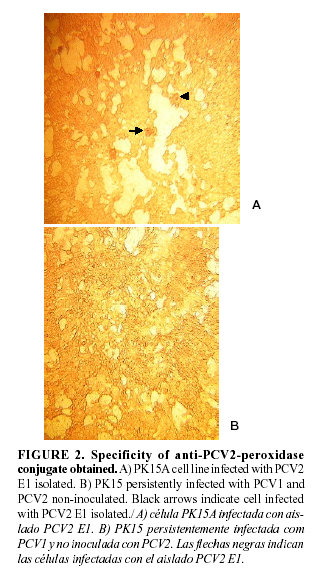
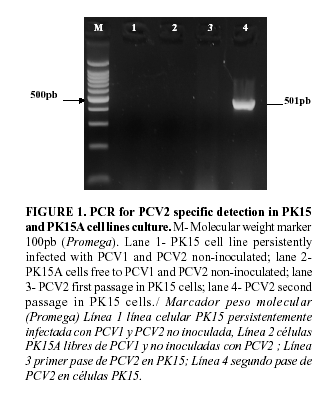
<body><![CDATA[<P><font face="Verdana, Arial, Helvetica, sans-serif" size="2"><I><b>Obtaining    the anti-PCV2-peroxidase conjugate</b></I></font> <B></B>      <P><font face="Verdana, Arial, Helvetica, sans-serif" size="2">Two fraction of    IgG total corresponding to a concentration of 24mg/mL each were collected. The    anti-PCV2-peroxidase conjugated was obtained and the IgG/peroxidase ratio showed    a value of 0.4. The obtained conjugated was mixed with 1% of bovine serum albumin    (BSA) and a final mix (v/v) glycerol/ anti-PCV2-peroxidase conjugated was conserved    at -20&#186;C. </font>     <P><font face="Verdana, Arial, Helvetica, sans-serif" size="2"><B><I>Test of specificity    of the anti-PCV2 conjugate</I></B> </font>     <P><font face="Verdana, Arial, Helvetica, sans-serif" size="2">The presence of    PCV2 E1 isolated in PK15A infected cell lines was verified. Likewise the absence    of PCV2 in PK15 persistently infected with PCV1 was tested, (figure1). (In this    same sense the presence of PCV1 in persistently infected with PCV1 was make    sure (data not shown)). The anti-PCV2-peroxidase conjugate obtained when a dilution    1/40 was used revealed a specific reaction in PCV2 infected cell and a lack    of color in PK15 PCV1 infected cell was observed, figure 2. Hence, the anti-PCV2-peroxidase    conjugate obtained showed to be specific in the PCV2 detection. </font>     <P><img src="/img/revistas/rsa/v31n3/f0103309.gif" width="335" height="397">      
<P>      <P>      <P>      <P>      <P>      ]]></body>
<body><![CDATA[<P>      <P>      <P>      <P>      <P>      <P>&nbsp;     <P><img src="/img/revistas/rsa/v31n3/f0203309.jpg" width="323" height="582">      
<P><b><font face="Verdana, Arial, Helvetica, sans-serif" size="3">DISCUSSION</font></b>     <P><font face="Verdana, Arial, Helvetica, sans-serif" size="2">In this work an    anti-PCV2-peroxidase conjugated for the PCV2 specific detection was obtained.    </font>     <P><font face="Verdana, Arial, Helvetica, sans-serif" size="2">The PCV2 is considered    an emerging pathogen, causing economically important diseases worldwide (25,26).    This virus reported by Meehan <I>et al.,</I> 1998 as a novel circovirus (27)    has nucleotide identity of 66% concerning to the proteins encoded by ORF2 to    be compared with PCV1 (28), thence these two viral agent can be differentiated    using polyclonal antibodies against the capside protein (18). </font>     ]]></body>
<body><![CDATA[<P><font face="Verdana, Arial, Helvetica, sans-serif" size="2">The fact that for    the PMWS diagnosis the presence of the PCV2 within these lesions in moderate    or high amounts of the virus must be demonstrated by immunohistochemical methods    (10,12) as well as the lack of commercial anti-PCV2-peroxidase conjugate imply    the requirement by the laboratories involved in the PMWS diagnosis to develop    their own anti-PCV2-peroxidase conjugate. </font>      <p><font face="Verdana, Arial, Helvetica, sans-serif" size="2">The use of the    killed PCV1-2 chimeric vaccine for obtaining polyclonal antibodies against PCV2    protein capside described here is a useful strategy that could be assume for    those laboratories with problems in cell cultures technologies or because of    the complicated PCV2 isolation and multiplication, hence to obtain enough viral    amount to be used as immunogenic inoculation will be a very difficult task.    </font>      <P><font face="Verdana, Arial, Helvetica, sans-serif" size="2">The PCV2 infection    and replication in cell culture occur to very low titer of the virus (29), thus    with the purpose of increasing the viral amount different strategies has been    described (29,30). Nevertheless, the fact that the PCV2 multiplication in cell    culture is carried out to very low amount of the virus suggests that the anti-PCV2-peroxidase    conjugated obtained has a high sensitivity and could be able to distinguish    between subclinical PCV2 infection and PMWS condition. </font>     <P><font face="Verdana, Arial, Helvetica, sans-serif" size="2">The high sensitivity    and specificity of the anti-PCV2-peroxidase conjugate obtained in this work    will allow perform the PMWS diagnosis in the future. Nevertheless a further    evaluation of this conjugate in tissues samples will be needed to carry out.    </font>     <P><font face="Verdana, Arial, Helvetica, sans-serif" size="2">In summary, in    this paper we described the anti-PCV2-peroxidase conjugate obtainment based    on the use of the available commercial vaccine against PCV2 as immunogenic inoculation    to produce a polyclonal antibody in rabbits. The obtained conjugate was able    to discriminate between PCV2 and PCV1 infections and a high sensitivity of the    conjugate was observed. </font>     <P>&nbsp;     <P><font face="Verdana, Arial, Helvetica, sans-serif" size="2"><B><font size="3">REFERENCES</font></B></font>     <!-- ref --><P><font face="Verdana, Arial, Helvetica, sans-serif" size="2">1. Todd D, McNulty    MS, Mankertz A, Lukert PD, Randles JW, Dale JL. Circoviridae. In: van Regenmortel    MHV, Fauquet CM, Bishop DHL, Carstens EB, Estes MK, Lemon SM, Malinoff J, Mayo    MA, McGeoch DJ, Pringle CR, Wickner RB. (Eds.), Virus Taxonomy. Seventh report    of the ICTV. Academic Press, San Diego. 2000. </font>    <!-- ref --><P><font face="Verdana, Arial, Helvetica, sans-serif" size="2">2. Allan GM, McNeilly    F, Cassidy JP, Reilly GA, Adair B, Ellis WA, et al. Pathogenesis of porcine    circovirus; experimental infections of colostrum deprived piglets and examination    of pig foetal material. Vet Microbiol. 1995;44:49-64. </font>    <!-- ref --><P><font face="Verdana, Arial, Helvetica, sans-serif" size="2">3. Tischer I, Mields    W, Wolff D, Vagt M, Griem W. Studies on epidemiology and pathogenicity of porcine    circovirus. Arch Virol. 1986;91:271-276. </font>    <!-- ref --><P><font face="Verdana, Arial, Helvetica, sans-serif" size="2">4. Harding J, Clark    E. Recognizing and diagnosing postweaning multisystemic wasting syndrome (PMWS).    Swine Health Prod. 1998;5:201-203. </font>    <!-- ref --><P><font face="Verdana, Arial, Helvetica, sans-serif" size="2">5. Smith WJ, Thompson    JR, Done S. Dermatitis/ nephropathy syndrome of pigs. Vet Rec.1993;132:47. </font>    <!-- ref --><P><font face="Verdana, Arial, Helvetica, sans-serif" size="2">6. Rosell C, Segal&eacute;s    J, Ramos-Vara JA, Folch JM, Rodriguez-Arrioja GM, Duran CO, et al. </font><font face="Verdana, Arial, Helvetica, sans-serif" size="2">Identification    of porcine circovirus in tissues of pigs with porcine dermatitis and nephropathysyndrome.    Vet Rec. 2000;146:40-43. </font>    <!-- ref --><P><font face="Verdana, Arial, Helvetica, sans-serif" size="2">7. West KW, Bystrom    J, Wojnarowicz C. Myocarditis and abortion associated with intrauterine infection    of sows with porcine circovirus-2. J Vet Diagn Invest.1999;11(6):530-532. </font>    <!-- ref --><P><font face="Verdana, Arial, Helvetica, sans-serif" size="2">8. O'Connor B,    Gauvreau H, West K, Bogdan J, Ayroud M, Clark E, et al. Multiple porcine circovirus    2 associated abortion and reproductive failure in a multiple-site swine production    unit. Can Vet J. 2001;42:551-553. </font>    <P><font face="Verdana, Arial, Helvetica, sans-serif" size="2">9. Ohlinger VF,    Schmidt U, Pesch S. Studies on pathogenic aspects of the post-weaning multisystemic    wasting syndrome (PMWS). 2000. In: Proceedings of the 16th International Pig    Veterinary Society Congress. </font>     <!-- ref --><P><font face="Verdana, Arial, Helvetica, sans-serif" size="2">10.Segal&eacute;s    J, Allan GM, Domingo M. Porcine circovirus diseases. Anim Health Res Rev.2005;6:119-142.    </font>    <P><font face="Verdana, Arial, Helvetica, sans-serif" size="2">11.Darwich L, Segal&eacute;s    J, Mateu E. Pathogenesis of postweaning multisystemic wasting syndrome caused    by Porcine circovirus 2: an immune riddle. A review. Arch Virol. 2004;149:857-74.    </font>     <!-- ref --><P><font face="Verdana, Arial, Helvetica, sans-serif" size="2">12.Chae C. Postweaning    multisystemic wasting syndrome: a review of aetiology, diagnosis and pathology.    Vet J. 2004;168:41-49. </font>    <!-- ref --><P><font face="Verdana, Arial, Helvetica, sans-serif" size="2">13.Segal&eacute;s    J, Domingo M. Post-weaning multisystemic wasting syndrome (PMWS) in pigs: a    review. Vet Quart. 2002;24:109-24. </font>    <!-- ref --><P><font face="Verdana, Arial, Helvetica, sans-serif" size="2">14.Dupont K, Nielsen    EO, B&aelig;kbo P, Larsen LE. Genomic analysis of PCV2 isolates from Danish    archives and a currentPMWS case-control study supports a shift in genotypes    with time. Vet. Microbiol. 2007.doi: 10.1016/j.vetmic.2007.09.016. </font>    <!-- ref --><P><font face="Verdana, Arial, Helvetica, sans-serif" size="2">15.Grau-Roma L,    Crisci E, Sibila M, L&oacute;pez-Soria S, Nofrarias M, Cortey M, et al. A proposal    on porcine circovirus type 2 (PCV2) genotype definitions and their relation    with postweaning multisystemic wasting syndrome (PMWS) occurrence. Vet Microbiol.    2008;128:23-35. </font>    <!-- ref --><P><font face="Verdana, Arial, Helvetica, sans-serif" size="2">16.Rosell C, Segales    J, Plana-Duran J, Balasch M, Rodriguez-Arrioja GM, Kennedy S, et al. Pathological,    immunohistochemical, and in situ hybridization studies of natural cases of postweaning    multisystemic wasting syndrome (PMWS) in pigs. J Comp Pathol. 1999;120:59-78.    </font>    <!-- ref --><P><font face="Verdana, Arial, Helvetica, sans-serif" size="2">17.McNeilly F,    McNair I, Mackie DP, Meehan BM, Kennedy S, Moffett D, et al. Production, characterisation    and applications of monoclonal antibodies to porcine circovirus 2. Arch Virol.    2001;146:909-922. </font>    <!-- ref --><P><font face="Verdana, Arial, Helvetica, sans-serif" size="2">18.Sorden SD, Harms    PA, Nawagitgul P, Cavanaugh D, Paul PS. Development of a polyclonal-antibody-based    immunohistochemical method for the detection of type 2 porcine circovirus in    formalin-fixed, paraffin-embedded tissue. J Vet Diagn Invest. 1999;11:528-530.    </font>    <P>      <!-- ref --><P><font face="Verdana, Arial, Helvetica, sans-serif" size="2">19.P&eacute;rez    LJ, D&iacute;az de Arce H, Percedo MI, Dom&iacute;nguez P, Fr&iacute;as MT.    First report of porcine circovirus type 2 infections in Cuba. Res Vet Sci. <I>Submitted    for publication. </I> </font>    <!-- ref --><P><font face="Verdana, Arial, Helvetica, sans-serif" size="2">20.Sandvik T, Grierson    S, King DP, Spencer Y, Banks M, Drew T. Detection and genetic typing of porcine    circovirus DNA isolated from archived paraffin embedded pig tissues. Comp. Virol.    Proceedings - ss DNA Viruses of Plants, Birds, Pigs and Primates, Saint-Malo,    24-27 September, 2001. </font>    <!-- ref --><P><font face="Verdana, Arial, Helvetica, sans-serif" size="2">21.Fort M, Olvera    A, Sibila M, Segal&eacute;s J, Mateu E. Detection of neutralizing antibodies    in postweaning multisystemic wasting syndrome (PMWS)-affected and non-PMWS-affected    pigs. Vet Microbiol. 2007;125:244-55. </font>    <!-- ref --><P><font face="Verdana, Arial, Helvetica, sans-serif" size="2">22.Kruger NJ, Hammond    JBW. Purification of Immunoglobulins Using Protein A-Sepharose. Methods in Molecular    Biology. 2008 chapter, 26, pp363-371. DOI:10.1385/0-89603-126-8:363. </font>    <!-- ref --><P><font face="Verdana, Arial, Helvetica, sans-serif" size="2">23.Wilson MB, Nakane    PK. Recent developments in the periodate method of conjugating horseradish peroxidase    (HRPO) to antibodies. En: Knapp W, Hollubat K, Wick G, eds. Immunofluorescence    and related staining techniques. New York: Academic, 1978; 215. </font>    <P><font face="Verdana, Arial, Helvetica, sans-serif" size="2">24.Fenaux M, Halbur    PG, Gill M, Toth TE, Meng XJ. Genetic characterization of type 2 porcine circovirus    (PCV-2) from pigs with postweaning multisystemic wasting syndrome in different    geographic regions of North America and     <BR>   development of a differential PCR-restriction fragment length polymorphism assay    to detect and differentiate between infections with PCV-1 and PCV-2. J Clin    Microbiol. 2000;38:2494-503. </font>     <!-- ref --><P><font face="Verdana, Arial, Helvetica, sans-serif" size="2">25.Hesse R, Kerrigan    M, Rowland R. Evidence for recombination between PCV2a and PCV2b in the field.    Virus Res. 2008;132:201-07. </font>    <!-- ref --><P><font face="Verdana, Arial, Helvetica, sans-serif" size="2">26.Ostanello F,    Caprioli A, Di Francesco A, Battilani M, Sala G, Sarli G, et. al. Experimental    infection of 3-week-old conventional colostrum-fed pigs with porcine circovirus    type 2 and porcine parvovirus. Vet. Microbiol. 2005;108:179-86. </font>    <!-- ref --><P><font face="Verdana, Arial, Helvetica, sans-serif" size="2">27.Meehan BM, McNeilly    F, Todd D, Kennedy S, Jewhurst VA, Ellis JA, et. al. Characterization of novel    circovirus DNAs associated with wasting syndromes in pigs. J Gen Virol. 1998;79:2171-79.    </font>    <!-- ref --><P><font face="Verdana, Arial, Helvetica, sans-serif" size="2">28.Hamel AL, Lin    LL, Nayar GP. Nucleotide sequence of porcine circovirus associated with postweaning    multisystemic wasting syndrome in pigs. J Virol. 1998;72:5262-5267. </font>    <!-- ref --><P><font face="Verdana, Arial, Helvetica, sans-serif" size="2">29.Allan GM, McNeilly    F, Kennedy S, Draft B, Clarke EG, Ellis JA, et al. Isolation of porcine circovirus-like    virus from pigs with a wasting disease in the USA and Europe. J Vet Diagn Invest.    1998;10(1):3-10. </font>    <!-- ref --><P><font face="Verdana, Arial, Helvetica, sans-serif" size="2">30.Misinzo G, Delputte    PL, Lefebvre DJ, Nauwynck HJ. Porcine circovirus 2 infection of epithelial cells    is clathrin-, caveolae- and dynamin-independent, actin and Rho-GTPase-mediated,    and enhanced by cholesterol depletion. Virus Res. 2009;139:1-9. </font>    <P>      ]]></body>
<body><![CDATA[<P>&nbsp;     <P>&nbsp;     <P><font face="Verdana, Arial, Helvetica, sans-serif" size="2"><B>(Recibido 23-8-2009;    Aprobado 3-9-2009)</B></font>      ]]></body><back>
<ref-list>
<ref id="B1">
<label>1</label><nlm-citation citation-type="book">
<person-group person-group-type="author">
<name>
<surname><![CDATA[Todd]]></surname>
<given-names><![CDATA[D]]></given-names>
</name>
<name>
<surname><![CDATA[McNulty]]></surname>
<given-names><![CDATA[MS]]></given-names>
</name>
<name>
<surname><![CDATA[Mankertz]]></surname>
<given-names><![CDATA[A]]></given-names>
</name>
<name>
<surname><![CDATA[Lukert]]></surname>
<given-names><![CDATA[PD]]></given-names>
</name>
<name>
<surname><![CDATA[Randles]]></surname>
<given-names><![CDATA[JW]]></given-names>
</name>
<name>
<surname><![CDATA[Dale]]></surname>
<given-names><![CDATA[JL]]></given-names>
</name>
</person-group>
<article-title xml:lang="en"><![CDATA[Circoviridae]]></article-title>
<person-group person-group-type="editor">
<name>
<surname><![CDATA[van Regenmortel]]></surname>
<given-names><![CDATA[MHV]]></given-names>
</name>
<name>
<surname><![CDATA[Fauquet]]></surname>
<given-names><![CDATA[CM]]></given-names>
</name>
<name>
<surname><![CDATA[Bishop]]></surname>
<given-names><![CDATA[DHL]]></given-names>
</name>
<name>
<surname><![CDATA[Carstens]]></surname>
<given-names><![CDATA[EB]]></given-names>
</name>
<name>
<surname><![CDATA[Estes]]></surname>
<given-names><![CDATA[MK]]></given-names>
</name>
<name>
<surname><![CDATA[Lemon]]></surname>
<given-names><![CDATA[SM]]></given-names>
</name>
<name>
<surname><![CDATA[Malinoff]]></surname>
<given-names><![CDATA[J]]></given-names>
</name>
<name>
<surname><![CDATA[Mayo]]></surname>
<given-names><![CDATA[MA]]></given-names>
</name>
<name>
<surname><![CDATA[McGeoch]]></surname>
<given-names><![CDATA[DJ]]></given-names>
</name>
<name>
<surname><![CDATA[Pringle]]></surname>
<given-names><![CDATA[CR]]></given-names>
</name>
<name>
<surname><![CDATA[Wickner]]></surname>
<given-names><![CDATA[RB]]></given-names>
</name>
</person-group>
<source><![CDATA[Virus Taxonomy]]></source>
<year>2000</year>
<publisher-name><![CDATA[Academic Press, San Diego]]></publisher-name>
</nlm-citation>
</ref>
<ref id="B2">
<label>2</label><nlm-citation citation-type="journal">
<person-group person-group-type="author">
<name>
<surname><![CDATA[Allan]]></surname>
<given-names><![CDATA[GM]]></given-names>
</name>
<name>
<surname><![CDATA[McNeilly]]></surname>
<given-names><![CDATA[F]]></given-names>
</name>
<name>
<surname><![CDATA[Cassidy]]></surname>
<given-names><![CDATA[JP]]></given-names>
</name>
<name>
<surname><![CDATA[Reilly]]></surname>
<given-names><![CDATA[GA]]></given-names>
</name>
<name>
<surname><![CDATA[Adair]]></surname>
<given-names><![CDATA[B]]></given-names>
</name>
<name>
<surname><![CDATA[Ellis]]></surname>
<given-names><![CDATA[WA]]></given-names>
</name>
</person-group>
<article-title xml:lang="en"><![CDATA[Pathogenesis of porcine circovirus; experimental infections of colostrum deprived piglets and examination of pig foetal material]]></article-title>
<source><![CDATA[Vet Microbiol]]></source>
<year>1995</year>
<volume>44</volume>
<page-range>49-64</page-range></nlm-citation>
</ref>
<ref id="B3">
<label>3</label><nlm-citation citation-type="journal">
<person-group person-group-type="author">
<name>
<surname><![CDATA[Tischer]]></surname>
<given-names><![CDATA[I]]></given-names>
</name>
<name>
<surname><![CDATA[Mields]]></surname>
<given-names><![CDATA[W]]></given-names>
</name>
<name>
<surname><![CDATA[Wolff]]></surname>
<given-names><![CDATA[D]]></given-names>
</name>
<name>
<surname><![CDATA[Vagt]]></surname>
<given-names><![CDATA[M]]></given-names>
</name>
<name>
<surname><![CDATA[Griem]]></surname>
<given-names><![CDATA[W]]></given-names>
</name>
</person-group>
<article-title xml:lang="en"><![CDATA[Studies on epidemiology and pathogenicity of porcine circovirus]]></article-title>
<source><![CDATA[Arch Virol]]></source>
<year>1986</year>
<volume>91</volume>
<page-range>271-276</page-range></nlm-citation>
</ref>
<ref id="B4">
<label>4</label><nlm-citation citation-type="journal">
<person-group person-group-type="author">
<name>
<surname><![CDATA[Harding]]></surname>
<given-names><![CDATA[J]]></given-names>
</name>
<name>
<surname><![CDATA[Clark]]></surname>
<given-names><![CDATA[E]]></given-names>
</name>
</person-group>
<article-title xml:lang="en"><![CDATA[Recognizing and diagnosing postweaning multisystemic wasting syndrome (PMWS)]]></article-title>
<source><![CDATA[Swine Health Prod]]></source>
<year>1998</year>
<volume>5</volume>
<page-range>201-203</page-range></nlm-citation>
</ref>
<ref id="B5">
<label>5</label><nlm-citation citation-type="journal">
<person-group person-group-type="author">
<name>
<surname><![CDATA[Smith]]></surname>
<given-names><![CDATA[WJ]]></given-names>
</name>
<name>
<surname><![CDATA[Thompson]]></surname>
<given-names><![CDATA[JR]]></given-names>
</name>
<name>
<surname><![CDATA[Done]]></surname>
<given-names><![CDATA[S]]></given-names>
</name>
</person-group>
<article-title xml:lang="en"><![CDATA[Dermatitis/ nephropathy syndrome of pigs]]></article-title>
<source><![CDATA[Vet Rec]]></source>
<year>1993</year>
<volume>132</volume>
<page-range>47</page-range></nlm-citation>
</ref>
<ref id="B6">
<label>6</label><nlm-citation citation-type="journal">
<person-group person-group-type="author">
<name>
<surname><![CDATA[Rosell]]></surname>
<given-names><![CDATA[C]]></given-names>
</name>
<name>
<surname><![CDATA[Segalés]]></surname>
<given-names><![CDATA[J]]></given-names>
</name>
<name>
<surname><![CDATA[Ramos-Vara]]></surname>
<given-names><![CDATA[JA]]></given-names>
</name>
<name>
<surname><![CDATA[Folch]]></surname>
<given-names><![CDATA[JM]]></given-names>
</name>
<name>
<surname><![CDATA[Rodriguez-Arrioja]]></surname>
<given-names><![CDATA[GM]]></given-names>
</name>
<name>
<surname><![CDATA[Duran]]></surname>
<given-names><![CDATA[CO]]></given-names>
</name>
</person-group>
<article-title xml:lang="en"><![CDATA[Identification of porcine circovirus in tissues of pigs with porcine dermatitis and nephropathysyndrome]]></article-title>
<source><![CDATA[Vet Rec]]></source>
<year>2000</year>
<volume>146</volume>
<page-range>40-43</page-range></nlm-citation>
</ref>
<ref id="B7">
<label>7</label><nlm-citation citation-type="journal">
<person-group person-group-type="author">
<name>
<surname><![CDATA[West]]></surname>
<given-names><![CDATA[KW]]></given-names>
</name>
<name>
<surname><![CDATA[Bystrom]]></surname>
<given-names><![CDATA[J]]></given-names>
</name>
<name>
<surname><![CDATA[Wojnarowicz]]></surname>
<given-names><![CDATA[C]]></given-names>
</name>
</person-group>
<article-title xml:lang="en"><![CDATA[Myocarditis and abortion associated with intrauterine infection of sows with porcine circovirus-2]]></article-title>
<source><![CDATA[J Vet Diagn Invest]]></source>
<year>1999</year>
<volume>11</volume>
<numero>6</numero>
<issue>6</issue>
<page-range>530-532</page-range></nlm-citation>
</ref>
<ref id="B8">
<label>8</label><nlm-citation citation-type="journal">
<person-group person-group-type="author">
<name>
<surname><![CDATA[O'Connor]]></surname>
<given-names><![CDATA[B]]></given-names>
</name>
<name>
<surname><![CDATA[Gauvreau]]></surname>
<given-names><![CDATA[H]]></given-names>
</name>
<name>
<surname><![CDATA[West]]></surname>
<given-names><![CDATA[K]]></given-names>
</name>
<name>
<surname><![CDATA[Bogdan]]></surname>
<given-names><![CDATA[J]]></given-names>
</name>
<name>
<surname><![CDATA[Ayroud]]></surname>
<given-names><![CDATA[M]]></given-names>
</name>
<name>
<surname><![CDATA[Clark]]></surname>
<given-names><![CDATA[E]]></given-names>
</name>
</person-group>
<article-title xml:lang="en"><![CDATA[Multiple porcine circovirus 2 associated abortion and reproductive failure in a multiple-site swine production unit]]></article-title>
<source><![CDATA[Can Vet J]]></source>
<year>2001</year>
<volume>42</volume>
<page-range>551-553</page-range></nlm-citation>
</ref>
<ref id="B9">
<label>9</label><nlm-citation citation-type="">
<person-group person-group-type="author">
<name>
<surname><![CDATA[Ohlinger]]></surname>
<given-names><![CDATA[VF]]></given-names>
</name>
<name>
<surname><![CDATA[Schmidt]]></surname>
<given-names><![CDATA[U]]></given-names>
</name>
<name>
<surname><![CDATA[Pesch]]></surname>
<given-names><![CDATA[S]]></given-names>
</name>
</person-group>
<article-title xml:lang="en"><![CDATA[Studies on pathogenic aspects of the post-weaning multisystemic wasting syndrome (PMWS)]]></article-title>
<source><![CDATA[]]></source>
<year></year>
</nlm-citation>
</ref>
<ref id="B10">
<label>10</label><nlm-citation citation-type="journal">
<person-group person-group-type="author">
<name>
<surname><![CDATA[Segalés]]></surname>
<given-names><![CDATA[J]]></given-names>
</name>
<name>
<surname><![CDATA[Allan]]></surname>
<given-names><![CDATA[GM]]></given-names>
</name>
<name>
<surname><![CDATA[Domingo]]></surname>
<given-names><![CDATA[M]]></given-names>
</name>
</person-group>
<article-title xml:lang="en"><![CDATA[Porcine circovirus diseases]]></article-title>
<source><![CDATA[Anim Health Res Rev]]></source>
<year>2005</year>
<volume>6</volume>
<page-range>119-142</page-range></nlm-citation>
</ref>
<ref id="B11">
<label>11</label><nlm-citation citation-type="journal">
<person-group person-group-type="author">
<name>
<surname><![CDATA[Darwich]]></surname>
<given-names><![CDATA[L]]></given-names>
</name>
<name>
<surname><![CDATA[Segalés]]></surname>
<given-names><![CDATA[J]]></given-names>
</name>
<name>
<surname><![CDATA[Mateu]]></surname>
<given-names><![CDATA[E]]></given-names>
</name>
</person-group>
<article-title xml:lang="en"><![CDATA[Pathogenesis of postweaning multisystemic wasting syndrome caused by Porcine circovirus 2: an immune riddle]]></article-title>
<source><![CDATA[Arch Virol.]]></source>
<year>2004</year>
<volume>149</volume>
<page-range>857-74</page-range></nlm-citation>
</ref>
<ref id="B12">
<label>12</label><nlm-citation citation-type="journal">
<person-group person-group-type="author">
<name>
<surname><![CDATA[Chae]]></surname>
<given-names><![CDATA[C]]></given-names>
</name>
</person-group>
<article-title xml:lang="en"><![CDATA[Postweaning multisystemic wasting syndrome: a review of aetiology, diagnosis and pathology]]></article-title>
<source><![CDATA[Vet J.]]></source>
<year>2004</year>
<volume>168</volume>
<page-range>41-49</page-range></nlm-citation>
</ref>
<ref id="B13">
<label>13</label><nlm-citation citation-type="journal">
<person-group person-group-type="author">
<name>
<surname><![CDATA[Segalés]]></surname>
<given-names><![CDATA[J]]></given-names>
</name>
<name>
<surname><![CDATA[Domingo]]></surname>
<given-names><![CDATA[M]]></given-names>
</name>
</person-group>
<article-title xml:lang="en"><![CDATA[Post-weaning multisystemic wasting syndrome (PMWS) in pigs: a review]]></article-title>
<source><![CDATA[Vet Quart.]]></source>
<year>2002</year>
<volume>24</volume>
<page-range>109-24</page-range></nlm-citation>
</ref>
<ref id="B14">
<label>14</label><nlm-citation citation-type="journal">
<person-group person-group-type="author">
<name>
<surname><![CDATA[Dupont]]></surname>
<given-names><![CDATA[K]]></given-names>
</name>
<name>
<surname><![CDATA[Nielsen]]></surname>
<given-names><![CDATA[EO]]></given-names>
</name>
<name>
<surname><![CDATA[Bækbo]]></surname>
<given-names><![CDATA[P]]></given-names>
</name>
<name>
<surname><![CDATA[Larsen]]></surname>
<given-names><![CDATA[LE]]></given-names>
</name>
</person-group>
<article-title xml:lang="en"><![CDATA[Genomic analysis of PCV2 isolates from Danish archives and a currentPMWS case-control study supports a shift in genotypes with time]]></article-title>
<source><![CDATA[Vet Microbiol]]></source>
<year>2007</year>
</nlm-citation>
</ref>
<ref id="B15">
<label>15</label><nlm-citation citation-type="journal">
<person-group person-group-type="author">
<name>
<surname><![CDATA[Grau-Roma]]></surname>
<given-names><![CDATA[L]]></given-names>
</name>
<name>
<surname><![CDATA[Crisci]]></surname>
<given-names><![CDATA[E]]></given-names>
</name>
<name>
<surname><![CDATA[Sibila]]></surname>
<given-names><![CDATA[M]]></given-names>
</name>
<name>
<surname><![CDATA[López-Soria]]></surname>
<given-names><![CDATA[S]]></given-names>
</name>
<name>
<surname><![CDATA[Nofrarias]]></surname>
<given-names><![CDATA[M]]></given-names>
</name>
<name>
<surname><![CDATA[Cortey]]></surname>
<given-names><![CDATA[M]]></given-names>
</name>
</person-group>
<article-title xml:lang="en"><![CDATA[A proposal on porcine circovirus type 2 (PCV2) genotype definitions and their relation with postweaning multisystemic wasting syndrome (PMWS) occurrence]]></article-title>
<source><![CDATA[Vet Microbiol.]]></source>
<year>2008</year>
<volume>128</volume>
<page-range>23-35</page-range></nlm-citation>
</ref>
<ref id="B16">
<label>16</label><nlm-citation citation-type="journal">
<person-group person-group-type="author">
<name>
<surname><![CDATA[Rosell]]></surname>
<given-names><![CDATA[C]]></given-names>
</name>
<name>
<surname><![CDATA[Segales]]></surname>
<given-names><![CDATA[J]]></given-names>
</name>
<name>
<surname><![CDATA[Plana-Duran]]></surname>
<given-names><![CDATA[J]]></given-names>
</name>
<name>
<surname><![CDATA[Balasch]]></surname>
<given-names><![CDATA[M]]></given-names>
</name>
<name>
<surname><![CDATA[Rodriguez-Arrioja]]></surname>
<given-names><![CDATA[GM]]></given-names>
</name>
<name>
<surname><![CDATA[Kennedy]]></surname>
<given-names><![CDATA[S]]></given-names>
</name>
</person-group>
<article-title xml:lang="en"><![CDATA[Pathological, immunohistochemical, and in situ hybridization studies of natural cases of postweaning multisystemic wasting syndrome (PMWS) in pigs]]></article-title>
<source><![CDATA[J Comp Pathol.]]></source>
<year>1999</year>
<volume>120</volume>
<page-range>59-78</page-range></nlm-citation>
</ref>
<ref id="B17">
<label>17</label><nlm-citation citation-type="journal">
<person-group person-group-type="author">
<name>
<surname><![CDATA[McNeilly]]></surname>
<given-names><![CDATA[F]]></given-names>
</name>
<name>
<surname><![CDATA[McNair]]></surname>
<given-names><![CDATA[I]]></given-names>
</name>
<name>
<surname><![CDATA[Mackie]]></surname>
<given-names><![CDATA[DP]]></given-names>
</name>
<name>
<surname><![CDATA[Meehan]]></surname>
<given-names><![CDATA[BM]]></given-names>
</name>
<name>
<surname><![CDATA[Kennedy]]></surname>
<given-names><![CDATA[S]]></given-names>
</name>
<name>
<surname><![CDATA[Moffett]]></surname>
<given-names><![CDATA[D]]></given-names>
</name>
</person-group>
<article-title xml:lang="en"><![CDATA[Production, characterisation and applications of monoclonal antibodies to porcine circovirus 2]]></article-title>
<source><![CDATA[Arch Virol.]]></source>
<year>2001</year>
<volume>146</volume>
<page-range>909-922</page-range></nlm-citation>
</ref>
<ref id="B18">
<label>18</label><nlm-citation citation-type="journal">
<person-group person-group-type="author">
<name>
<surname><![CDATA[Sorden]]></surname>
<given-names><![CDATA[SD]]></given-names>
</name>
<name>
<surname><![CDATA[Harms]]></surname>
<given-names><![CDATA[PA]]></given-names>
</name>
<name>
<surname><![CDATA[Nawagitgul]]></surname>
<given-names><![CDATA[P]]></given-names>
</name>
<name>
<surname><![CDATA[Cavanaugh]]></surname>
<given-names><![CDATA[D]]></given-names>
</name>
<name>
<surname><![CDATA[Paul]]></surname>
<given-names><![CDATA[PS]]></given-names>
</name>
</person-group>
<article-title xml:lang="en"><![CDATA[Development of a polyclonal-antibody-based immunohistochemical method for the detection of type 2 porcine circovirus in formalin-fixed, paraffin-embedded tissue]]></article-title>
<source><![CDATA[J Vet Diagn Invest.]]></source>
<year>1999</year>
<volume>11</volume>
<page-range>528-530</page-range></nlm-citation>
</ref>
<ref id="B19">
<label>19</label><nlm-citation citation-type="journal">
<person-group person-group-type="author">
<name>
<surname><![CDATA[Pérez]]></surname>
<given-names><![CDATA[LJ]]></given-names>
</name>
<name>
<surname><![CDATA[Díaz de Arce]]></surname>
<given-names><![CDATA[H]]></given-names>
</name>
<name>
<surname><![CDATA[Percedo]]></surname>
<given-names><![CDATA[MI]]></given-names>
</name>
<name>
<surname><![CDATA[Domínguez]]></surname>
<given-names><![CDATA[P]]></given-names>
</name>
<name>
<surname><![CDATA[Frías]]></surname>
<given-names><![CDATA[MT]]></given-names>
</name>
</person-group>
<article-title xml:lang="en"><![CDATA[First report of porcine circovirus type 2 infections in Cuba]]></article-title>
<source><![CDATA[Res Vet Sci]]></source>
<year></year>
</nlm-citation>
</ref>
<ref id="B20">
<label>20</label><nlm-citation citation-type="book">
<person-group person-group-type="author">
<name>
<surname><![CDATA[Sandvik]]></surname>
<given-names><![CDATA[T]]></given-names>
</name>
<name>
<surname><![CDATA[Grierson]]></surname>
<given-names><![CDATA[S]]></given-names>
</name>
<name>
<surname><![CDATA[King]]></surname>
<given-names><![CDATA[DP]]></given-names>
</name>
<name>
<surname><![CDATA[Spencer]]></surname>
<given-names><![CDATA[Y]]></given-names>
</name>
<name>
<surname><![CDATA[Banks]]></surname>
<given-names><![CDATA[M]]></given-names>
</name>
<name>
<surname><![CDATA[Drew]]></surname>
<given-names><![CDATA[T]]></given-names>
</name>
</person-group>
<article-title xml:lang="en"><![CDATA[Detection and genetic typing of porcine circovirus DNA isolated from archived paraffin embedded pig tissues]]></article-title>
<source><![CDATA[Comp. Virol. Proceedings - ss DNA Viruses of Plants, Birds, Pigs and Primates]]></source>
<year>Sept</year>
<month>em</month>
<day>be</day>
<publisher-name><![CDATA[Saint-Malo]]></publisher-name>
</nlm-citation>
</ref>
<ref id="B21">
<label>21</label><nlm-citation citation-type="journal">
<person-group person-group-type="author">
<name>
<surname><![CDATA[Fort]]></surname>
<given-names><![CDATA[M]]></given-names>
</name>
<name>
<surname><![CDATA[Olvera]]></surname>
<given-names><![CDATA[A]]></given-names>
</name>
<name>
<surname><![CDATA[Sibila]]></surname>
<given-names><![CDATA[M]]></given-names>
</name>
<name>
<surname><![CDATA[Segalés]]></surname>
<given-names><![CDATA[J]]></given-names>
</name>
<name>
<surname><![CDATA[Mateu]]></surname>
<given-names><![CDATA[E]]></given-names>
</name>
</person-group>
<article-title xml:lang="en"><![CDATA[Detection of neutralizing antibodies in postweaning multisystemic wasting syndrome (PMWS)-affected and non-PMWS-affected pigs]]></article-title>
<source><![CDATA[Vet Microbiol.]]></source>
<year>2007</year>
<volume>125</volume>
<page-range>244-55</page-range></nlm-citation>
</ref>
<ref id="B22">
<label>22</label><nlm-citation citation-type="">
<person-group person-group-type="author">
<name>
<surname><![CDATA[Kruger]]></surname>
<given-names><![CDATA[NJ]]></given-names>
</name>
<name>
<surname><![CDATA[Hammond]]></surname>
<given-names><![CDATA[JBW]]></given-names>
</name>
</person-group>
<source><![CDATA[Purification of Immunoglobulins Using Protein A-Sepharose: Methods in Molecular Biology]]></source>
<year>2008</year>
<page-range>363-371</page-range></nlm-citation>
</ref>
<ref id="B23">
<label>23</label><nlm-citation citation-type="book">
<person-group person-group-type="author">
<name>
<surname><![CDATA[Wilson]]></surname>
<given-names><![CDATA[MB]]></given-names>
</name>
<name>
<surname><![CDATA[Nakane]]></surname>
<given-names><![CDATA[PK]]></given-names>
</name>
</person-group>
<article-title xml:lang="en"><![CDATA[Recent developments in the periodate method of conjugating horseradish peroxidase (HRPO) to antibodies]]></article-title>
<person-group person-group-type="editor">
<name>
<surname><![CDATA[Knapp]]></surname>
<given-names><![CDATA[W]]></given-names>
</name>
<name>
<surname><![CDATA[Hollubat]]></surname>
<given-names><![CDATA[K]]></given-names>
</name>
<name>
<surname><![CDATA[Wick]]></surname>
<given-names><![CDATA[G]]></given-names>
</name>
</person-group>
<source><![CDATA[Immunofluorescence and related staining techniques]]></source>
<year>1978</year>
<page-range>215</page-range><publisher-name><![CDATA[New York: Academic]]></publisher-name>
</nlm-citation>
</ref>
<ref id="B24">
<label>24</label><nlm-citation citation-type="journal">
<person-group person-group-type="author">
<name>
<surname><![CDATA[Fenaux]]></surname>
<given-names><![CDATA[M]]></given-names>
</name>
<name>
<surname><![CDATA[Halbur]]></surname>
<given-names><![CDATA[PG]]></given-names>
</name>
<name>
<surname><![CDATA[Gill]]></surname>
<given-names><![CDATA[M]]></given-names>
</name>
<name>
<surname><![CDATA[Toth]]></surname>
<given-names><![CDATA[TE]]></given-names>
</name>
<name>
<surname><![CDATA[Meng]]></surname>
<given-names><![CDATA[XJ]]></given-names>
</name>
</person-group>
<article-title xml:lang="en"><![CDATA[Genetic characterization of type 2 porcine circovirus (PCV-2) from pigs with postweaning multisystemic wasting syndrome in different geographic regions of North America and development of a differential PCR-restriction fragment length polymorphism assay to detect and differentiate between infections with PCV-1 and PCV-2]]></article-title>
<source><![CDATA[J Clin Microbiol.]]></source>
<year>2000</year>
<volume>38</volume>
<page-range>2494-503</page-range></nlm-citation>
</ref>
<ref id="B25">
<label>25</label><nlm-citation citation-type="journal">
<person-group person-group-type="author">
<name>
<surname><![CDATA[Hesse]]></surname>
<given-names><![CDATA[R]]></given-names>
</name>
<name>
<surname><![CDATA[Kerrigan]]></surname>
<given-names><![CDATA[M]]></given-names>
</name>
<name>
<surname><![CDATA[Rowland]]></surname>
<given-names><![CDATA[R]]></given-names>
</name>
</person-group>
<article-title xml:lang="en"><![CDATA[Evidence for recombination between PCV2a and PCV2b in the field]]></article-title>
<source><![CDATA[Virus Res.]]></source>
<year>2008</year>
<volume>132</volume>
<page-range>201-07</page-range></nlm-citation>
</ref>
<ref id="B26">
<label>26</label><nlm-citation citation-type="journal">
<person-group person-group-type="author">
<name>
<surname><![CDATA[Ostanello]]></surname>
<given-names><![CDATA[F]]></given-names>
</name>
<name>
<surname><![CDATA[Caprioli]]></surname>
<given-names><![CDATA[A]]></given-names>
</name>
<name>
<surname><![CDATA[Di Francesco]]></surname>
<given-names><![CDATA[A]]></given-names>
</name>
<name>
<surname><![CDATA[Battilani]]></surname>
<given-names><![CDATA[M]]></given-names>
</name>
<name>
<surname><![CDATA[Sala]]></surname>
<given-names><![CDATA[G]]></given-names>
</name>
<name>
<surname><![CDATA[Sarli]]></surname>
<given-names><![CDATA[G]]></given-names>
</name>
</person-group>
<article-title xml:lang="en"><![CDATA[Experimental infection of 3-week-old conventional colostrum-fed pigs with porcine circovirus type 2 and porcine parvovirus]]></article-title>
<source><![CDATA[Vet Microbiol.]]></source>
<year>2005</year>
<volume>108</volume>
<page-range>179-86</page-range></nlm-citation>
</ref>
<ref id="B27">
<label>27</label><nlm-citation citation-type="journal">
<person-group person-group-type="author">
<name>
<surname><![CDATA[Meehan]]></surname>
<given-names><![CDATA[BM]]></given-names>
</name>
<name>
<surname><![CDATA[McNeilly]]></surname>
<given-names><![CDATA[F]]></given-names>
</name>
<name>
<surname><![CDATA[Todd]]></surname>
<given-names><![CDATA[D]]></given-names>
</name>
<name>
<surname><![CDATA[Kennedy]]></surname>
<given-names><![CDATA[S]]></given-names>
</name>
<name>
<surname><![CDATA[Jewhurst]]></surname>
<given-names><![CDATA[VA]]></given-names>
</name>
<name>
<surname><![CDATA[Ellis]]></surname>
<given-names><![CDATA[JA]]></given-names>
</name>
</person-group>
<article-title xml:lang="en"><![CDATA[Characterization of novel circovirus DNAs associated with wasting syndromes in pigs]]></article-title>
<source><![CDATA[J Gen Virol.]]></source>
<year>1998</year>
<volume>79</volume>
<page-range>2171-79</page-range></nlm-citation>
</ref>
<ref id="B28">
<label>28</label><nlm-citation citation-type="journal">
<person-group person-group-type="author">
<name>
<surname><![CDATA[Hamel]]></surname>
<given-names><![CDATA[AL]]></given-names>
</name>
<name>
<surname><![CDATA[Lin]]></surname>
<given-names><![CDATA[LL]]></given-names>
</name>
<name>
<surname><![CDATA[Nayar]]></surname>
<given-names><![CDATA[GP]]></given-names>
</name>
</person-group>
<article-title xml:lang="en"><![CDATA[Nucleotide sequence of porcine circovirus associated with postweaning multisystemic wasting syndrome in pigs]]></article-title>
<source><![CDATA[J Virol.]]></source>
<year>1998</year>
<volume>72</volume>
<page-range>5262-5267</page-range></nlm-citation>
</ref>
<ref id="B29">
<label>29</label><nlm-citation citation-type="journal">
<person-group person-group-type="author">
<name>
<surname><![CDATA[Allan]]></surname>
<given-names><![CDATA[GM]]></given-names>
</name>
<name>
<surname><![CDATA[McNeilly]]></surname>
<given-names><![CDATA[F]]></given-names>
</name>
<name>
<surname><![CDATA[Kennedy]]></surname>
<given-names><![CDATA[S]]></given-names>
</name>
<name>
<surname><![CDATA[Draft]]></surname>
<given-names><![CDATA[B]]></given-names>
</name>
<name>
<surname><![CDATA[Clarke]]></surname>
<given-names><![CDATA[EG]]></given-names>
</name>
<name>
<surname><![CDATA[Ellis]]></surname>
<given-names><![CDATA[JA]]></given-names>
</name>
</person-group>
<article-title xml:lang="en"><![CDATA[Isolation of porcine circovirus-like virus from pigs with a wasting disease in the USA and Europe]]></article-title>
<source><![CDATA[J Vet Diagn Invest.]]></source>
<year>1998</year>
<volume>10</volume>
<numero>1</numero>
<issue>1</issue>
<page-range>3-10</page-range></nlm-citation>
</ref>
<ref id="B30">
<label>30</label><nlm-citation citation-type="journal">
<person-group person-group-type="author">
<name>
<surname><![CDATA[Misinzo]]></surname>
<given-names><![CDATA[G]]></given-names>
</name>
<name>
<surname><![CDATA[Delputte]]></surname>
<given-names><![CDATA[PL]]></given-names>
</name>
<name>
<surname><![CDATA[Lefebvre]]></surname>
<given-names><![CDATA[DJ]]></given-names>
</name>
<name>
<surname><![CDATA[Nauwynck]]></surname>
<given-names><![CDATA[HJ]]></given-names>
</name>
</person-group>
<article-title xml:lang="en"><![CDATA[Porcine circovirus 2 infection of epithelial cells is clathrin-, caveolae- and dynamin-independent, actin and Rho-GTPase-mediated, and enhanced by cholesterol depletion]]></article-title>
<source><![CDATA[Virus Res.]]></source>
<year>2009</year>
<volume>139</volume>
<page-range>1-9</page-range></nlm-citation>
</ref>
</ref-list>
</back>
</article>